As for young Bloch—give him plenty of time & leeway to fumble around & see what he really wants to do. He seems to want to do something, & there are many years ahead for him to develop in. His stories are of course imitative, overcoloured, & immature …. but what were most of the writers doing at 18?
H. P. Lovecraft to R. H. Barlow, [11? May 1935], O Fortunate Floridian 259
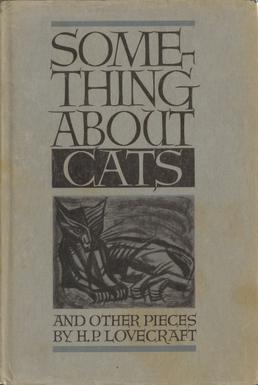
In 1949, Arkham House published Something About Cats and Other Pieces, an anthology that was the beginning of the scraping of what was then believed to be the bottom of the barrel of Lovecraftiana. Along with various essays, poems, and memoirs, the book also included several stories Lovecraft revised or ghostwrote, notably including “The Horror at Martin’s Beach” (1923) and “Four O’Clock” (1949) by Sonia H. Greene; “The Horror in the Burying-Ground” (1937) by Hazel Heald; “The Last Test” (1928) and “The Electric Executioner” (1930) by Adolphe de Castro, and almost as an afterthought, “Satan’s Servants” by Robert Bloch.
This was a decade before Bloch’s Psycho would be published; while a prolific pulp writer, he was not yet a household name, although his star was on the rise thanks to “Yours Truly, Jack the Ripper” (Weird Tales, July 1943), which was adapted for radio and broadcast nationally in 1944, and Arkham House had published his first hardcover collection The Opener of the Way in 1945. Bloch was in correspondence with Derleth, and Derleth was on the hunt for Lovecraftiana—including copies of Bloch’s letters from Lovecraft for the long-simmering Selected Letters project. Perhaps it was during that rummaging in the files that led Bloch to unearth something that was almost a Lovecraft collaboration—though not quite. As Bloch told the story:
Some while ago a statement appeared to the effect that there were “no more unpublished Lovecraft stories or collaborations.” While lamenting this pronouncement, I recalled that early in 1935 I had written and submitted a story entitled Satan’s Servants, which was rejected by Farnsworth Wright, then editor of Weird Tales on the grounds that the plot-structure was too flimsy for the extended length of the narrative.
At that time I was in constant correspondence with H. P. Lovecraft, and we frequently exchanged current manuscripts for suggestions and critical comment. Accordingly, I sent him my rejected sotry; and because the tale had a New England locale I made bold to ask if he would be interested in collaborating with me on a revision.
As the excerpts from his letter below will indicate, he refused a full-dress collaborative effort, but my manuscript came back copiously annotated and corrected, together with a lengthy and exhaustive list of suggestions for revision.
I placed the story in my files, fully intending to get at a new version when the time was right. Through the years the pages literally mouldered; I exhumed them from time to time when re-sorting material, moving, weeding out deadwood, and reviewing unpublished stories and outlines. Some years ago I utilized the name of the principal character, “Gideon Godfrey” when writing a tale in a modern setting. But Satan’s Servants gathered dust for fourteen long years until I fell to musing upon the sorry fact that there would be no more Lovecraft stories or stories inspired, revised, or partially-written.
Acting on impulse, I invaded the elephants’ graveyard at the bottom of my bureau and there, amidst a welter of outlines, novel fragments, radio scripts and assorted incunabula, I managed to disinter the yellowed pages of the original manuscript, with the marginalia in HPL’s familiar crabbed hand. I also unearthed Lovecraft’s lengthy letter in which he discussed the project of revision.
I determined to revise the tale forthwith, and spoke of my determination to August Derleth, Lovecraft’s biography, who suggested that I revise the story especially for the Arkham Sampler, and include a portion of the correspondence, plus some of the more pertinent critical commentary in the form of footnotes to the text of the tale. Excerpts from HPL’s letter accordingly follow, and the notes will be found at the conclusion of the story.
There is much to interest the student of Lovecraft’s work here; his comments mirror perfectly his own precise and erudite approach to his material. From the purely personal standpoint, I was often fascinated during the process of revision by the way in which certain interpolated sentences or phrases of Lovecraft’s seemed to dovetail with my own work–for in 1935 I was quite consciously a disciple of what has since come to be known as the “Lovecraft school” of weird fiction. I doubt greatly if even the self-professed “Lovecraft scholar” can pick out his actual verbal contributions to the finished tale; most of the passages which would be identified as “pure Lovecraft” are my work; all of the sentences and bridges he added are of an incidental nature and merely supplement the text. Certain major suggestions for plot-revision have been incorporated, but these in turn have been re-edited by a third party—myself, 1949 edition. For the Robert Bloch of 1935, as I painfully discovered during this revision process, is as dead as Howard Phillips Lovecraft is today. Peace to their mutual ashes!
Robert Bloch, Something About Cats 117-118
Versions of this anecdote were repeated by Bloch in interviews, his autobiography Once Around The Bloch, and a few other places; these various renditions are strongly consistent with one another, and what little evidence of the story there is in Lovecraft’s published Letters to Robert Bloch and Others corroborates the account. Bloch offers few additional details on “Satan’s Servants” and its creation—and why he let it molder for so long—but there are some pieces of information we can add to round out the story.
Bloch began submitting stories to Farnsworth Wright, editor of Weird Tales, in 1933 while still in high school. He didn’t receive an acceptance from Wright until after he graduated in June 1934, and his first publications were in fanzines like Marvel Tales, The Fantasy Fan, and Unusual Stories. When exactly “Satan’s Servants” was written and submitted isn’t exactly clear in the timeline of Bloch’s early fiction, but it may well have been one of his first attempts at novelette length (the finished product is ~11,500 words). Lovecraft’s first letter mentioning the story is believed to have been written in late February or early March of 1935, so the story may have been submitted to Weird Tales near the end of 1934.
The timing may be important: Bloch’s first professional publication was “The Feast in the Abbey” (Weird Tales Jan 1935), another story that deals with Satanism, and which perhaps borrows on or was inspired by Algernon Blackwood’s “Ancient Sorceries”—and in many respects, “Satan’s Servants” reads as though it might have been a more extended effort along this same theme, albeit transposed from the European setting to North America, and drawing a connection with the Salem Witch Trials. Too, it is important to note that this was just before Bloch’s proper “Lovecraftian phase” with stories like “The Suicide in the Study” (Weird Tales Jun 1935)—while Bloch was showing a bit of evidence of Lovecraft’s influence in his prose in terms of adjectivitis, there is no direct Mythos connection in the published version of the story, nor references to such in Lovecraft’s letters discussing the story, so it was probably not directly inspired by Lovecraft’s “The Dreams in the Witch-House” (Weird Tales Jul 1933) or any of his other references to a Salem diaspora as in “The Dunwich Horror,” The Case of Charles Dexter Ward, “The Festival,” etc.
Some reviewers, notably Evertt F. Bleiler in The Guide to Supernatural Fiction and Randall D. Larson in Robert Bloch Starmont Reader’s Guide 37, have drawn a connection between the Puritan protagonist Gideon Godfrey and Robert E. Howard’s Puritan adventurer Solomon Kane—and that is possible. In 1934, Bloch had publicly lambasted Howard’s Conan the Cimmerian in the pages of Weird Tales (see Fan Mail: Bloch vs. Conan), but Bloch’s denunciation of the barbarian did not extend to Kane. Certainly, Bloch took at least a little inspiration from Robert E. Howard at times, such as the reference to Set in “Mother of Serpents” (1936), and perhaps even in “The Black Lotus” (Unusual Stories Winter 1935). However, Bloch himself never drew this parallel, however, and the literal Bible-thumping Godfrey is far from the sword-wielding Solomon Kane.
When Bloch did finally resurrect this story from his files for August Derleth, he did so with extensive quotes from Lovecraft’s letter in reply to his collaboration suggestion. Since that time, the full contents of the letter have been published, including several bits that Bloch or Derleth mistranscribed or left out. Lovecraft’s fuller remarks on the story are as follows:
And now let me congratulate you most sincerely on the excellence of “Satan’s Servants”—which I read with keen pleasure & unflagging interest. Wright was an ass to reject it—for, as I have often pointed out, plot in the artificial sense has no place in a weird tale—which should be simply the reflection of a mood. I greatly appreciate the compliment of the intended dedication to me, & would have deemed it an honour to be mentioned in such a way.
Regarding the future treatment of the story—it certainly deserved touching up & further submission for publication. I have taken the liberty to add some marginal notes & made some changes which seemed necessary from an historical & geographical standpoint. Most of these explain themselves.
Roodford had to be outside the boundaries of teh Massachusetts Bay Colony, since the strict oversight prevailing within that rigid theocratic unit would never have suffered such a place to exist. Also–the location had to be shifted to some point on the coast where the settlement was not thick. Early New England was colonised with a rush, so that by 1690 the whole coastal region was dotted with thriving towns & almost continuous farmsteads. Two generations of settled life had removed every trace of the wilderness aspect, & (after King Phillip’s War in 1675-6) Indians were rarely seen. The only place in the coast where a village could exist relatively unknown, would be Maine—whose connexion with Mass. did not begin until 1663, & which was not an actual part of that province till July 1690. I have decided to locate Roodford between York & Wells if that is agreeable to you. Enclosed is a map of N.E. (which you can keep) shewing the new position. That any wilderness journey would have to start from Portsmouth & not Boston or Salem, will be obvious from an inspection of this chart. The narrative itself is splendidly vivid—my only criticism having to do with Gideon’s excessively quick discovery of the nature & horrors of Roodford. It would be much more powerful to have this revelation come with hideous gradualness, after days of hellish suspicion—as in Blackwood’s “Ancient Sorceries”. That is what I tried to do (though with a reduced time-scale) in “Innsmouth”. In going over the style, it would be well to be on guard against the tendency toward adjectival heaviness which besets both you & me. (In my present attempt I am pausing now & then to cut out bits of involuntary overcolouring which insist on creeping in—references to “monstrous & maddening arcana of daemoniac palaeogean horror” &c. &c.) Occasionally I have changed a word—either because of repetition or because of some doubtfulness in usage. If any such case seems unjustified, I’ll be glad to explain it—or the dictionary will shed light on most. Be very careful when representing archaic language—for the usual tendency is to overshoot the mark & make the diction too ancient. Study the spelling in actual specimens of 17th century printing. I’ve made a few changes in your principal sample—on page 1. Regarding Governor Phips—he was no witch-finder prior to 1692, but a voyager & soldier of fortune whose career makes interesting reading. Look up the long section devoted to him in Mather’s “Magnalia” (probably available at the public library), or read the interesting popular account in Hawthorne’s “Grandfather’s Chair”. At the end of the story I’ve brought up the point of whether you ought to have the action of the story take place before or after the 1692-3 Salem affair. Certainly, it ought to be afterward if you wish to convey the idea that this Roodford business ended witchcraft in New England. Byt the way—the leading wizard in the Salem trouble, Rev. George Burroughs, came from Wells, Maine, near the relocated site of Roodford. You could make something of that, perhaps, if you wished. Another thing—if you want Roodford farther removed from the outposts of civilisation—so that very little will be known about it—you could have it up some navigable river farther north in Maine. That would provide for a longer journey through the primal wilderness, & the dark charm of greater isolation. But it’s quite all right right as now relocated.
Now as to the idea of collaboration—this tale really tempts me more than any other I’ve seen lately, but I honestly don’t believe I could undertake any collaborative job at all at this time. Collaboration is for me the most difficult & exhausting of all work. It entails twice the labour of original writing, & tends to cut off original material which I would otherwise be producing. […] Under any circumstances collaboration is a harder task than original writing, & the only possible justification is that of wishing some idea to be properly developed which otherwise wouldn’t be. Now in the case of “Satan’s Servants”, I feel certain that you can develop the tale yourself just as well as I could—hence don’t feel guilty in suggesting that you try it. During recent months I have had to place a complete veto—sheer self-defense—on all collaboration projects. I have refused point-blank to do any more jobs for Mrs. Heald & old de Castro & others–& recently declined to collaborate with Price on a sequel to the “Gates of the Silver Key”. I simply can’t tackle so much when my time & nervous energy are so limited—& when so many stories of my own are veritably howling to be written.
But as I said before–in this case I feel sure that I’m not doing the tory any harm by staying out of it. It’s great stuff, & you can polish it up just as well as anybody else oculd. The descriptions of the Sabbat are splendid, & the climax is magnificent. The primary need is to make the traveller’s introduction to the horrors subtler & more gradual. One excellent story to follow as a guide is John Buchan’s novel “Witch Wood”—which you ought to be able to get at a library. I can lend you Blackwood’s “John Silence” (with “Ancient Sorceries”) if you like, but unfortunately I don’t own “Witch Wood.” If you want to introduce more events in the story, you could have Godfrey suspected by the evil folk before he unmasks. That episode of the stag could form a basis for such a development—Hell-Friar could come upon Gideon praying in the woods, or something like that. Or some lesser denizen (so as to save H. F. for the climax) could spy on Gideon, & be detected in so doing. Gid could shoot him (at a distance—across a river or something like that) & fail to find any body when he reaches the spot. There are all sorts of twists one could work in if necessary. But none of them is really needed. Just make the unveiling of the hellish conditions more gradual, & you’re all set! I surely hope the tale will achieve eventual placement–illustrations form your pen would make a mighty asset. Incidentally—I feel rather akin to Gideon, since I have an actual line of Godfrey ancestry. On Oct. 29, 1732, my ancestor Newman Perkins (b. 1711) was married to Mehitabel, daughter of John Godfrey of S. Kingston, R.I. We may well assume John to be Gid’s brother or nephew or cousin!
H. P. Lovecraft to Robert Bloch, [late Feb/early Mar 1935], Letters to Robert Bloch & Others 129-131
Some of these ideas Bloch clearly took to heart: the opening dedication to Lovecraft was replaced by a quote from Cotton Mather’s The Wonders of the Invisible World (1693). Readers might be surprised at Lovecraft’s caution against excessive color in the descriptions, but this is not that unusual—Lovecraft wrote something very similar when critiquing Henry Kuttner’s “The Salem Horror” the next year:
Another criticism I’d make is that the colour is laid on too thickly—strange things come too rapidly in succession, & with too great abruptness. In some cases there is not enough gradualness & emotional preparation. The best & most potent horror is the subtlest—what is vaguely hinted but never told. A certain kind of sensation of disquiet is usualy more effective than a scaly, tentacled monster—& in the greatest weird story ever written—Algernon Blackwood’s “The Willows”—virtually nothing visibly & openly happens.
H. P. Lovecraft to Henry Kuttner, 12 Mar 1936, Letters to C. L. Moore & Others 230
One has to wonder if Lovecraft recognized already that pasticheurs were distorting his style by accentuating the easily-imitatable bits while overlooking the underlying mood he intended to invoke in the reader.
In addition to these notes, Lovecraft had also sent back the annotated first draft and the map with Roodford marked on it; while the full extant of these notes is unclear, Bloch has given a bit of the flavor to them by including, as an appendix to the story, a set of 18 such notations. For example, the tale in Something About Cats opens:
It was quite evident that the inhabitants of Roodsford(1) did not come over in the Mayflower or any of her sister ships; that, indeed, they had not sailed from an English port at all.
Robert Bloch, Something About Cats 121
And the parallel footnote is:
(1) The original mss. Gives the name as Rood-ford. HPL suggests “Roodsford” saying, “The hyphenated place name would not have occurred in early New England.”
Something About Cats 146
Lovecraft’s letter clearly uses “Roodford” (no s), whether it was different in the annotation or if Bloch misread or mistranscribed those notes is impossible to say without the original—Bloch is otherwise very consistent in the name. Absent the original, the notes go to show the typical thought process which Lovecraft put into his own stories such as “The Shadow over Innsmouth,” with the great attention to detail and an eye toward historical accuracy, or at least as accurate as Lovecraft was aware of given his sources at the time. For example, another pair reads:
Again and again time was lost, till at length Gideon’s carefully arranged daylight travelling schedule seemed likely to prove of no avail. (7)
(7) The previous sentence was inserted by HPL with comment, “Travel was very slow in 1690.” And on the obverse side of the mss. Page, he lists four ferry passages by name, followed by such estimates as “On horseback—av. 5 MPH. With guides on foot—av. 3 MPH.Boston-Nemb.—40M. Newb.-Ports.—20 M. Ports-Roodf.—20 M. Tme from Ports to Roodf. Should be 8 or 9 h., allowing for rest, delays. Starting 6 AM, intending to arrive at 3 PM, delays adding 5 to 6 hours more—hence twilight or nocturnal advent would be correct.” This is an excellent example of HPL’s perfectionist approach to his own work.
Something About Cats 124 / 146
The question may well be asked at this point: to what degree does “Satan’s Servants” qualify as a revision or collaboration? Without the original version to compare, with or without Lovecraft’s annotations, it’s difficult to say with any exactitude how much Bloch took from Lovecraft. Certainly, Lovecraft gave notes to many young writers on their stories, some of which they accepted, but we would hardly claim that Fritz Leiber’s “Adepts Gambit” (1947) was a Lovecraft revision for all that he saw the first version and commented extensively on it, and some of those suggestions taken. Bloch himself was very careful to not call it full-on revision or collaboration, avoiding the kind of claim that August Derleth would make with stories like “The Murky Glass” (1957). Perhaps he had good reason to.
SCHWEITZER/75: Didn’t [Lovecraft] revise one of your stories?
BLOCH: That was a story called “Satan’s Servants” and he sent me a map locating my imaginary town of Roodsford, and he made several of these genealogical and historical references in the form of footnotes which I then incorporated into the sotry of referred to, but he did no actual rewriting of it whatsoever. I had written it, and Weird Tales wasn’t interested in it, so I put it away until August Derleth said, “Would you please let me print this?”
SCHWEITZER/75: Do you think that the fact that you did it yourself is the reason that of all the people Lovecraft did any revision for, you’re the only one who ever amounted to anything? For example, none of the heavy revision clients of his that you see in The Horror in the Museum ever sold anything by themselves or gained any reputation.
BLOCH: I think I was just lucky. I was fortunate to be able to break into print on my own, and there might be an element of learned the hard easy in the school of the Depression. You’ve got to do it on your own or else you have no inner security. If you have to rely on someone else, some exterior force, whether it’s a person or a talisman or a compulsive ritual that you have to indulge in before you can write, you’re really painting yourself into a corner. So I’ve tried to avoid those things.
Darrell Schweitzer, Interview with Robert Bloch, quoted in The Robert Bloch Companion 34
Although Bloch was probably ignorant of it, there was some rumination among the circle of Lovecraft’s former correspondents about how much Lovecraft had helped the young writer:
I cannot believe that Bloch had any outright jobs done for him by HPL, for the reason that Bloch is showing us all his letters from HPL, and they would reveal any such tinkerings. Bloch himself says he made changes on his first story—in which he killed HPL off—made suggestions on occasion, did no rewriting on any of his tales, says he never even saw The Manikin. Any proof of collaborations you have I shall be eager to examine; I know about Mrs. Heald’s work—she has forwarded a concise statement of his revisions for her.
August Derleth to R. H. Barlow, 5 Apr [n.d.; 1943?], MSS. Wisconsin Historical Society
You know about Heald. He rewrote Rimel until he was a new text, and I have a strong belief that he did Bloch. (Bloch is not necessarily sending you all letters, and anyway HP was very graceful about such things and might not make open statements. I’m indifferent to Bloch—not out to drag him down, but I think he gets unfair credit.) Belknap says that he is certain—on what grounds I don’t know—that HP wrote all of Bloch’s good stories.
R. H. Barlow to August Derleth, [n.d. 1943?], Wisconsin Historical Society
I’m sure that’s all wet about HPL writing Bloch’s earlier stories in toto. I saw some of the mss., and in spite of certain crudities and juvenilities, they had plenty of promise and did not need an unlimited amount of retouching. Bobby Barlow is full of prunes or tequila or something.
Clark Ashton Smith to August Derleth, 4 Jan 1944, Eccentric, Impractical Devils 344
Scuttlebutt and gossip. Ultimately, it is only of academic interest how much influence Lovecraft had on this particular story—Robert Bloch’s reputation does not rest on “Satan’s Servants,” nor did it ever. It would be of interest to unearth the original annotated manuscript, if it still exists—or perhaps that map that Lovecraft sent to Bloch still exists among his papers—but at the end of the day, taking the story on its own merits, the Lovecraftian connections are probably the most interesting thing about it.
Which may explain, in part, it’s rather limited publication history. After appearing in Something About Cats (1949), the story was reprinted in The Magazine of Horror #30 (Dec 1969) and Revelations from Yuggoth #2 (May 1988)…and that is it for English publications, although various non-English translations exist. “Satan’s Servants” never appeared in any collection of Bloch’s Mythos fiction, or in any ofhis collections of his early fiction. A letter preceeding the 1988 publication may explain things:
Dear Mr Ford:
Thanks for yours of the 13th—but it’s not proving to be a lucky number! I’ve already promised use of SATAN’S SERVANTS to someone else, and it will be appearing soon, I believe. Of course certain changes in the text—i.e. elimination of HPL’s comments—will be made, since Arkham House claims ownership of his literary estate and the original SOMETHING ABOUT CATS is copyrighted by Derleth, which further complicates matters. Sorry the timing of your request dodn’t work out—that all goes well with you!
Robert Bloch
Robert Bloch to Carl Ford, 28 Aug 1987, H. P. Lovecraft and His Legacy
If Derleth’s heirs were being tightfisted about the quotes from Lovecraft’s letters, that might account for the relative scarcity of “Satan’s Servants” in English.
“Satan’s Servants” is not some lost Lovecraftian masterpiece; it is a rather prosaic, even old-fashioned, tale of good-vs.-evil in a decidedly Christian mold. There is a bit of irony that a Jewish teenager might so successfully ape the tropes of the Christian fantasy story, but Bloch had attended the Methodist Church and was anyway quite familiar with the slant of Weird Tales, where it was not counted a sin to fight vampires with crucifixes and holy water, but which was notably short on dybbuks, golems, and other aspects of Jewish religion and folklore. It is, ultimately, a fairly minor early Bloch story, not one of his best and certainly not some of his worst writing for the period, and notable almost exclusively for the Lovecraft connection. For Bloch-heads and Lovecraftian completists, it is worth tracking down.
Bobby Derie is the author of Weird Talers: Essays on Robert E. Howard and Others and Sex and the Cthulhu Mythos.
Deep Cuts in a Lovecraftian Vein uses Amazon Associate links. As an Amazon Associate I earn from qualifying purchases.
 Deep Cuts in a Lovecraftian Vein