“Re-Quest Denied” (1998) by Stanley C. Sargent

Dedicated to W.H. Pugmire, the culprit concealed behind every bush of Sesqua Valley.
—Stanley C. Sargent, “Re-Quest Denied” in Mythos Online, Vol. 1, #8 (Feb 1998)

In 1996, Stanley C. Sargent wrote “For Wilum, Gent.,” published in the obscure journal Leathered in Crimson #1. In 1997, Sargent reviewed Tales of Sesqua Valley by W. H. Pugmire; it was Pugmire’s first fiction collection. In 1999, Sargent co-edited and illustrated Dreams of Lovecraftian Horror, Pugmire’s next collection. They were friends, they were admirers of each other’s work. And in 1998, Sargent penned a small tribute to his friend.

“Re-Quest Denied” is a rare tale of Sesqua Valley written by someone other than Pugmire himself, and interestingly it parallels some of the themes expressed in “Vyvyan’s Father” (2013) by Jayaprakash Satyamurthy. Both stories essentially deal with an escape into disenchantment, the refusal of the call of beauty and emotion to focus on logic, rationality, mundanity, dullness—and both ultimately come to regret that choice and embrace what they had once rejected.

There is a question as to how much of Sargent himself went into this story. Not in the exact details, but in the emotions. In his own brief bio, he wrote:

Born at high noon on the summer solstice, 1950, in Ohio, Stanley C. Sargent grew up near his grandparents’ 200 acre farm. He populated three large, abandoned gravel pits on the farm with prehistoric and mythological beasts only he could see.

At age 18, Stan pulled up stakes and moved to San Francisco, where he could live as he liked and be openly gay. He attended a conference on Mayan hieroglyphs in Guatemala City in the mid-1970’s, and he spent a month in Iran in 1979. He worked for many years for corporate law firms, as word processing department supervisor.

In 1991, Stan abandoned the business world. He continued his long-time interest in and production of art (ink pointillism and later airbrush painting); in 1999, he completely illustrated a paperback book by W.H. Pugmire. At age 44, he began writing horror fiction inspired by the style of H.P. Lovecraft.

Compare that to:

Victor had dedicated every moment of his waking life to work, to the exclusion of all else. He had never even stopped long enough to get married. Emotions, longings, and his natural romantic lean had been suppressed and ignored completely. The result had been a brilliant career as advisor to the most powerful men and women on Earth; all the world had known and honored him. Now he was retired, and none of it meant anything to him.

At age sixty-five, Victor felt his life had been wasted. Without the endless distractions he had always known, a tidal wave of emotion rose up from deep within his soul, overwhelming him with the realization that, regardless of his worldly success, his life was a total failure.

He had lived a one-sided existence devoid of love and passion. He had spent his life building a magnificent palace in which he dwelled alone; in all his years, he had never found anyone with whom to share the love or passion that resided within him. And now that he was an old man, overweight and wrinkled, loosing his hair, it was too late.

Likewise, it seems clear that “Pug” is inspired by W. H. Pugmire, even if it isn’t meant to be him. A sort of idealized Pugmire, the eternal youth that echoes the kind of masculine beauty that written about in stories like “Pale, Trembling Youth” (1986) by W. H. Pugmire & Jessica Amanda Salmonson. Pug is a dream, a promise, a part of Sesqua Valley made flesh, the fire the moth is drawn to.

In terms of writing, this is one of Sargent’s minor works; the prose is straightforward, a bit basic, the plotting fairly straightforward and heavy with foreshadowing. Readers might compare it to The Substance (2025), only in reverse. Perhaps wisely, Sargent doesn’t step on Pugmire’s toes, doesn’t add much to the lore of Sesqua Valley. A single legend, a couple of inhabitants. Nothing that Pugmire would have to write around or contradict in his own works, but also not much to tie it in except for Mt. Selta itself.

“Re-Quest Denied” is far from a lost work, although it remains fairly obscure. Originally published in the now-defunct Mythos Online webzine in 1998, it was reprinted in the print journals Al Azif #3 (May-Jun 1998), Dreaming in R’lyeh #1 (2003), and Tales of the Cthulhu Mythos: Cthulhu’s Creatures (2007), all of which are long out of print. Unfortunately, Sargent never included it in any of his own collections; even more unfortunately, the original art that accompanied this work (titled “Pug” and with the alt text: “Yet it was the nude youth of breathtaking veauty that was the true centerpiece of Victor’s dreamlike vision.”) appears to be lost, as it wasn’t captured by the Internet Archive.

Alas.


Bobby Derie is the author of Weird Talers: Essays on Robert E. Howard and Others and Sex and the Cthulhu Mythos.

Deep Cuts in a Lovecraftian Vein uses Amazon Associate links. As an Amazon Associate I earn from qualifying purchases.

“Vyvyan’s Father” (2013) by Jayaprakash Satyamurthy

In H. P. Lovecraft’s body of work, the town of Innsmouth is mentioned by name only in four stories (“Celephaïs,” “The Shadow over Innsmouth,” “The Thing on the Doorstep,” and “The Dreams in the Witch House”) and a couple “Fungi from Yuggoth.” The core of Lovecraft’s Mythos, which so many writers have expanded upon over the decades, tends to be fairly scanty. Lovecraft country, that literary realm where the Old Ones walk, was painted in broad strokes and a few fine details, and it is everyone else who has filled in the gaps.

Writers who came after Lovecraft have, when not playing in his sandbox, carved out their own spaces. The most famous are Ramsey Campbell’s Severn Valley stories set in and around the literary Brichester and Goatswood in the United Kingdom; and W. H. Pugmire‘s Sesqua Valley and associated towns and mountains set in the Pacific Northwest of North America. Since these writers lived much longer than Lovecraft, and had more opportunity to write and publish, it might not be surprising that they have produced correspondingly more lore for their associated locales than Lovecraft did for his.

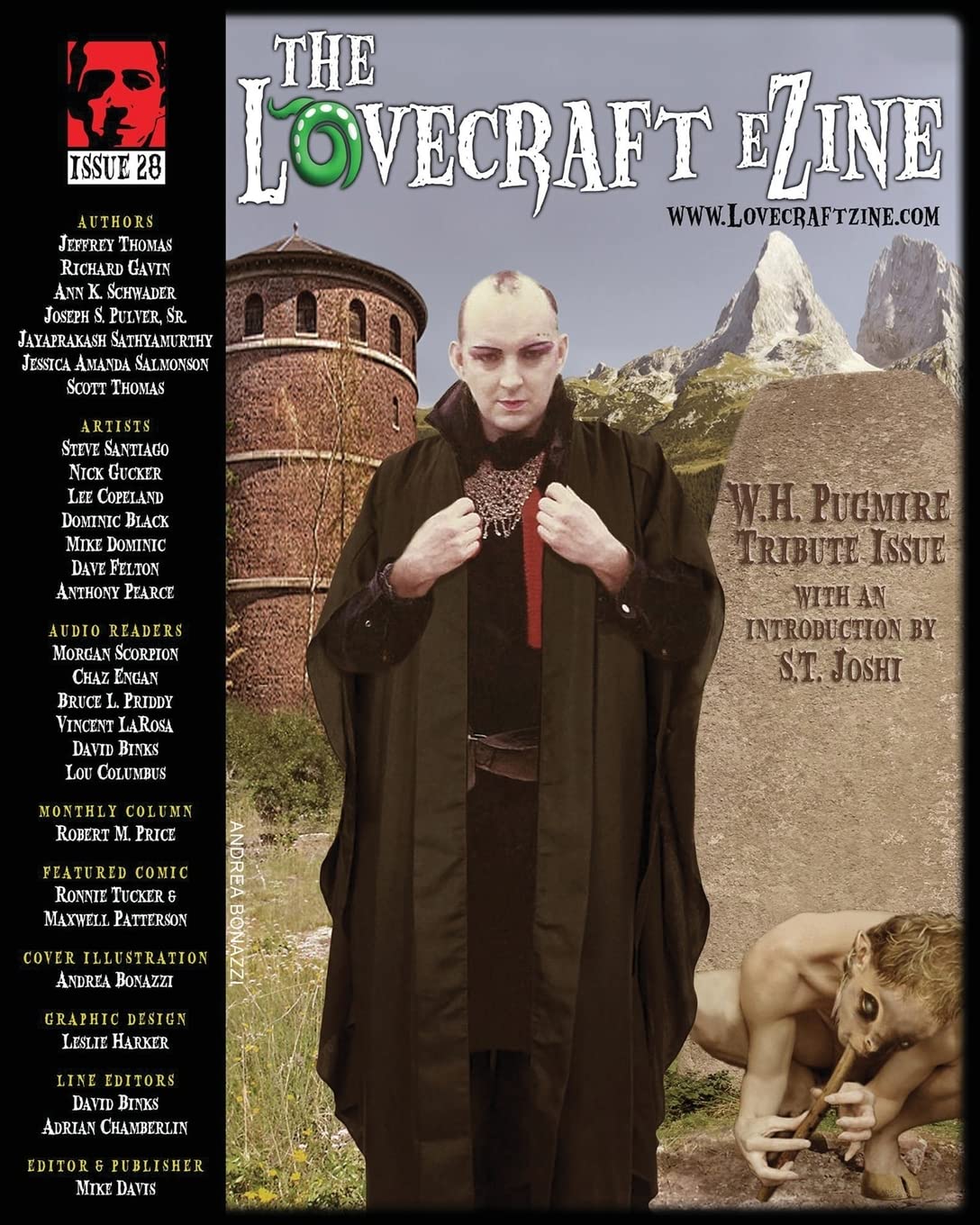
And yet, these places often feel smaller, because the voices associated with them tend to be singular. While anybody can write a tale of Innsmouth, it is generally considered uncouth to poach a living author’s copyrighted creations without permission. Some of them have consented to letting other writers splash in their ponds—Ramsey Campbell, for instance, consented to Made in Goatswood (1996), a tribute anthology; and in 2013 the Lovecraft eZine #28 did a similar tribute to W. H. Pugmire.

These tales represented a first step at a wider Sesqua Valley Mythos. New ideas, new perspectives, new angles. Pugmire was never dogmatic about his Sesqua Valley lore, preferring to expand it in hints and suggestions, a tale at a time, and there has not yet been an effort to correlate all the contents of his fiction into a single concordance or wiki. Perhaps, in the future, there will be more. For now, one particular tale from Lovecraft eZine #28 is worth discussing, because it does something different than the rest. Something very Pugmire-like in its approach to the Sesqua Valley tales.

“Vyvyan’s Father” by Jayaprakash Satyamurthy does not mention Sesqua Valley. Simon Gregory Williams and William Davis Manly do not appear on the page. Uniquely of the tribute stories in the eZine, Satyamurthy chose to write a story that is definably set in the world of Sesqua Valley—for anyone who is familiar with Pugmire’s work, at least, it is obvious from the clues and details as much as the context of the issue—without falling into the same trap of Mythos pasticheurs who load up a story with familiar names. It is an approach that echoes Pugmire’s own insistence that writing Lovecraftian fiction should echo the aesthetics of Lovecraft, not just pay lip-service to Arkham and Innsmouth, Dunwich and Kingsport, Cthulhu and the Necronomicon.

His eyes beguiled me, being slightly slanted and of a silver hue that seemed to contain particles of other shades in their pale irises.
—W. H. Pugmire, “The Horror on Tempest Hill” in An Imp of Aether 142

If his eyes were open, they would startle you with their timeless, silvery-grey depth.
—Jayaprakash Satyamurthy, “Vyvyan’s Father” in Lovecraft eZine (2013)

There is something very appropriate in how Satyamurthy’s tale is a bridge between India and Sesqua Valley; the lost child, the orphan of the Valley, is caught between two worlds in a way that echoes something of India’s own history as a crossroads of empires, with those who fall outside the established social orders caught like nuts in a pulau: a part of the whole, yet apart from the rest. This between-two-worlds tension defines Vyvyan’s character, but it also echoes the story as a whole: instead of just playing in Pugmire’s backyard, Satyamurthy builds a bridge between the setting of many of his own stories and Pugmire’s. Instead of submitting himself to Pugmire’s aesthetic, he shows how their themes can connect. Like New World tomatoes incorporated into a quintessentially Indian paneer gravy.

The slow expansion of Sesqua Valley beyond the bounds of Pugmire’s fiction is not the trauma-driven diaspora that marks much of contemporary Innsmouth tales. It is a different kind of cultural diffusion, spread by wanderers and their children, artifacts and ideas that spread out and draw strangers in. Where it goes from here…who can say?

“Vyvyan’s Father” by Jayaprakash Satyamurthy can be read online at Lovecraft eZine #28, and print edition is also available.


Bobby Derie is the author of Weird Talers: Essays on Robert E. Howard and Others and Sex and the Cthulhu Mythos.

Deep Cuts in a Lovecraftian Vein uses Amazon Associate links. As an Amazon Associate I earn from qualifying purchases.
Untitled poem (1976) by William Davis Manly

In the summer of 1976, a one-shot ‘zine of of weird poetry and art emerged from 5115 South Mead St., Seattle Washington. The publisher titled it Visions of Khroyd’hon, which probably meant nothing to anyone at the time, and it was published in the spirit of good fun:

There are many interesting poetry publications popping up every now & then, and I thought it wou’d be fun if I join’d—if only for a moment—ye crowd and publish’d this first and only issue of VOK. I’ve assembled lots of good poetry here, with a number of talented youngsters contributing clever rhymes, love sonnets, and exciting verse. There’s something for everyone’ I’m sure each reader will be able to find some moments of entertainment.
—W. H. Pugmire, Visions of Khroyd’hon 1

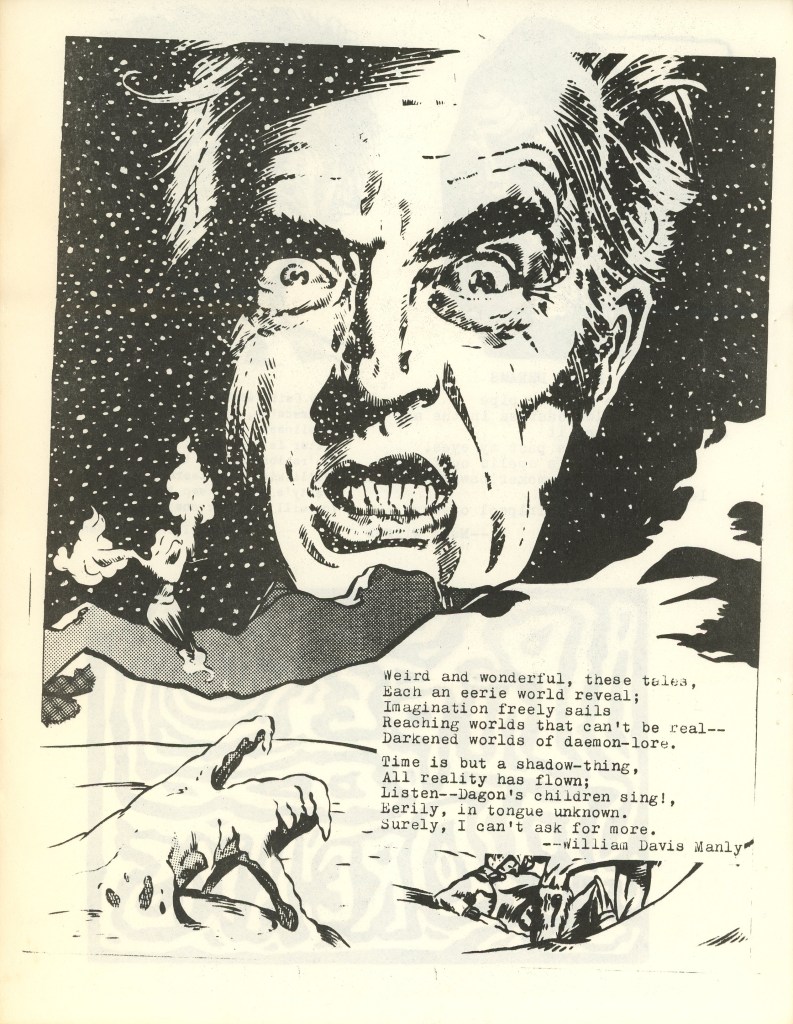
Among the contributors were luminaries such as Brian Lumley, H. Warner Munn, J. Vernon Shea, Jessica Amanda Salmonson, and William Davis Manly, the latter of whom included several untitled verses, including this one:

Weird and wonderful, these tales,
Each an eerie world reveal;
Imagination freely sails
Reaching worlds that can’t be real—
Darkened worlds of daemon-lore.

Time is but a shadow-thing,
All reality has flown;
Listen—Dagon’s children sing!,
Eerily, in tongue unknown.
Surely, I can’t ask for more.
—william davis manly

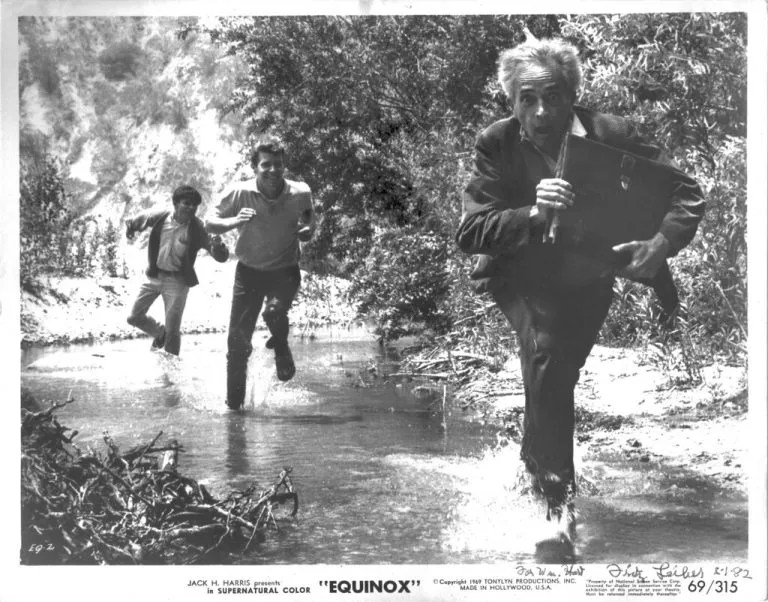
It is a poem in praise of weird fiction, from someone who loves the strange, eerie, horrific, and awesome. A paean from one Mythos fan to every other. The artist is unknown, but the subject is writer Fritz Leiber, Jr., and appears to be traced from a scene from the 1970 film Equinox.

Equinox has several parallels with Evil Dead II, including a recording of a professor (Leiber) who unwisely reads aloud an incantation from a very evil book…although the book in Equinox is not specifically called the Necronomicon.

The hidden joke is that William Davis Manly is, like Robert E. Howard’s Justin Geoffrey or H. P. Lovecraft’s Abdul Alhazred, not a flesh-and-blood poet at all, but a character in Pugmire’s stories—a staple name in what would become the Sesqua Valley stories. Pugmire had begun producing poetry under the name William Davis Manly in the 1970s, probably first “The Cryptic Power” in the ‘zine Bleak December #8. The first bit of fiction referencing Manly was “From ye Journal of William Davis Manly” (Old Bones #1, Summer 1976), and in “The Thing in the Glen” (Space and Time Sep 1977) the story begins with a poetic epigraph:

“Beneath the old narcotic moon
It preys upon mortality,
Hungry to devour hope,
And whispering to darkness.”
—William Davis Manly, Visions of Khroyd’hon
(quoted from Dreams of Lovecraftian Horror 57)

So Pugmire’s poetry ‘zine became, in the context of his Mythos fiction, a volume of poetry, much like Justin Geoffrey’s People of the Monolith in Robert E. Howard’s “The Black Stone.” William Davis Manly (or at least, his legend) would grow and develop in Pugmire’s tales, as would his slightly more diabolical counterpart, the sorcerer Simon Gregory Williams.

There is no definitive collection of W. H. Pugmire’s poetry, and maybe such a thing would be difficult to put together, given how much of it was published in ‘zines and scattered hither and yon. The quality and focus of it varies considerably, as Pugmire was equally disposed to either fulfilling some weird and fantastic corner of the Mythos or just praising his aunt in verse, but for readers who enjoy his fiction, Pugmire’s poetry is an indelible part of his larger body of work.

As far as I have yet been able to determine, the untitled poem from Visions of Khroyd’an has only ever been reprinted in the chapbook Sesqua Rising (2016) by Graeme Davis, which collects many other early Pugmire rarities.


Bobby Derie is the author of  Weird Talers: Essays on Robert E. Howard and Others  and  Sex and the Cthulhu Mythos .

Deep Cuts in a Lovecraftian Vein uses Amazon Associate links. As an Amazon Associate I earn from qualifying purchases.
“Candlewax” (1990) by W. H. Pugmire & Ashleigh Talbot

Eldritch Fappenings
This review deals in part with artwork that includes nudity and/or sexuality explicit content.
As such, please be advised before reading further.


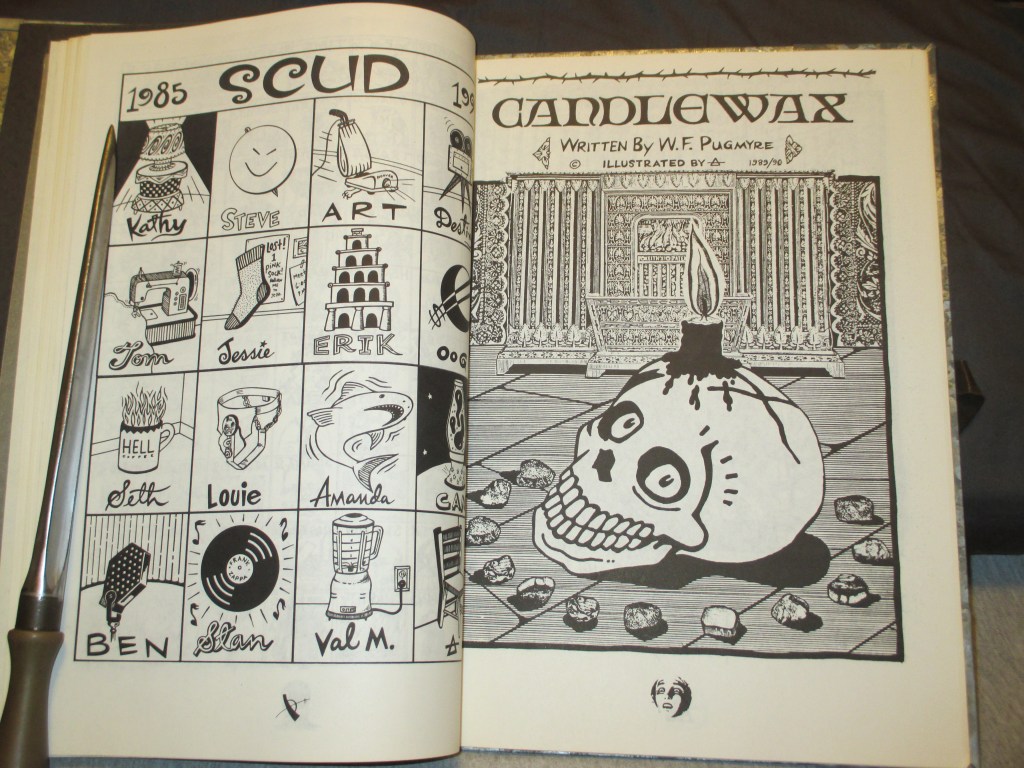
In the 1985 Christmas supplement to the fanzine Fungi, W. H. Pugmire‘s story “Candlewax” first saw publication. This was one of Pugmire’s earliest efforts at Mythos fiction, and is a part of his Sesqua Valley cycle—his own corner of Lovecraft country set in the Pacific Northwest, populated by characters like Simon Gregory Williams. While Pugmire would go on to write many more tales of Sesqua Valley, which have been collected and published in various volumes, “Candlewax” is one of the comparatively rarer tales, having been reprinted only a handful of times—and, most interestingly, in an illustrated edition.

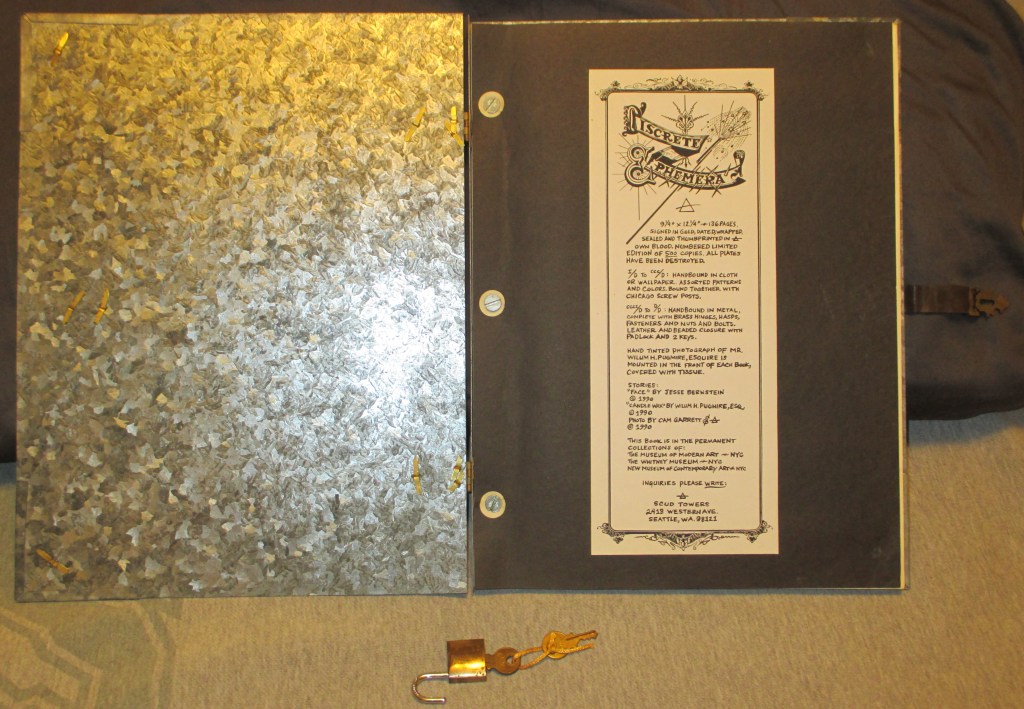
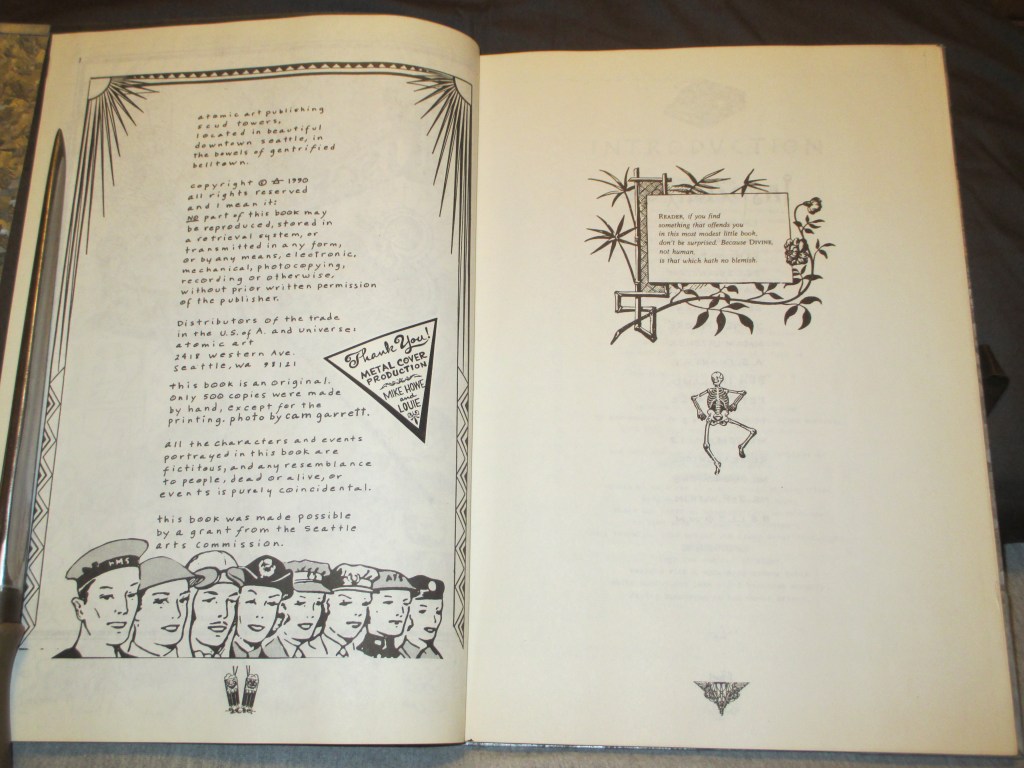
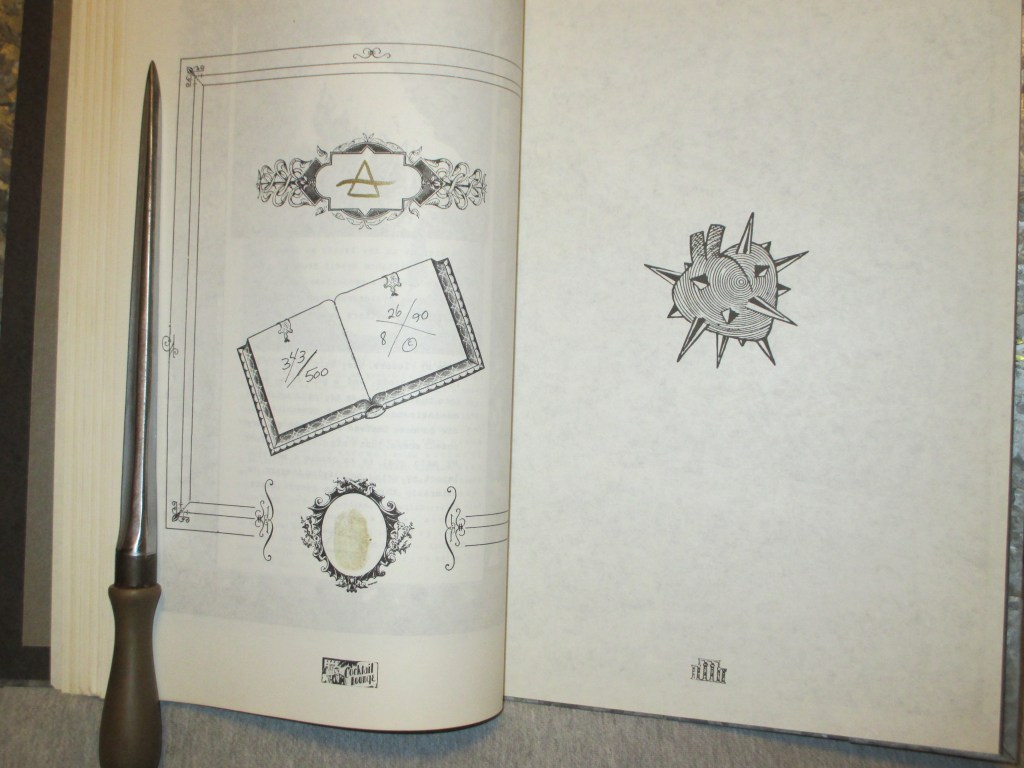
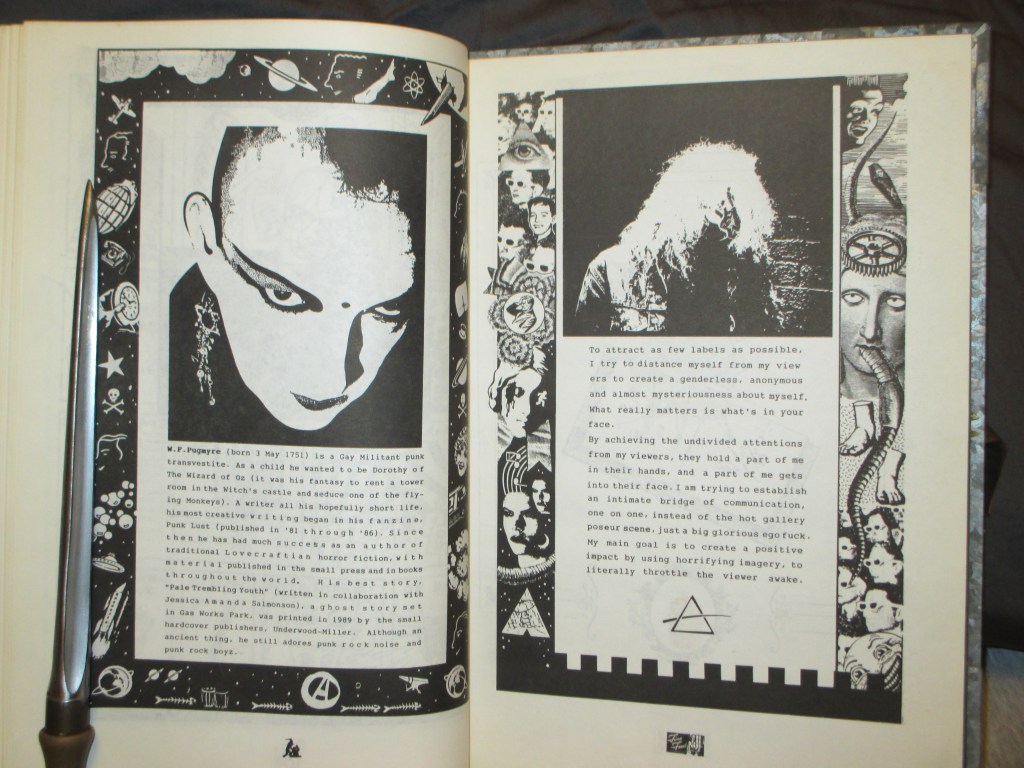
Discrete Ephemera (1990) is a limited edition (500 copies) book art project by Ashleigh Talbot, and illustrated texts by Steven J. Bernstein (“Face”) and W. H. Pugmire (“Candlewax,” as “W. F. Pugmire”), made possible by an art grant. Madame Talbot is presented throughout via a symbol:

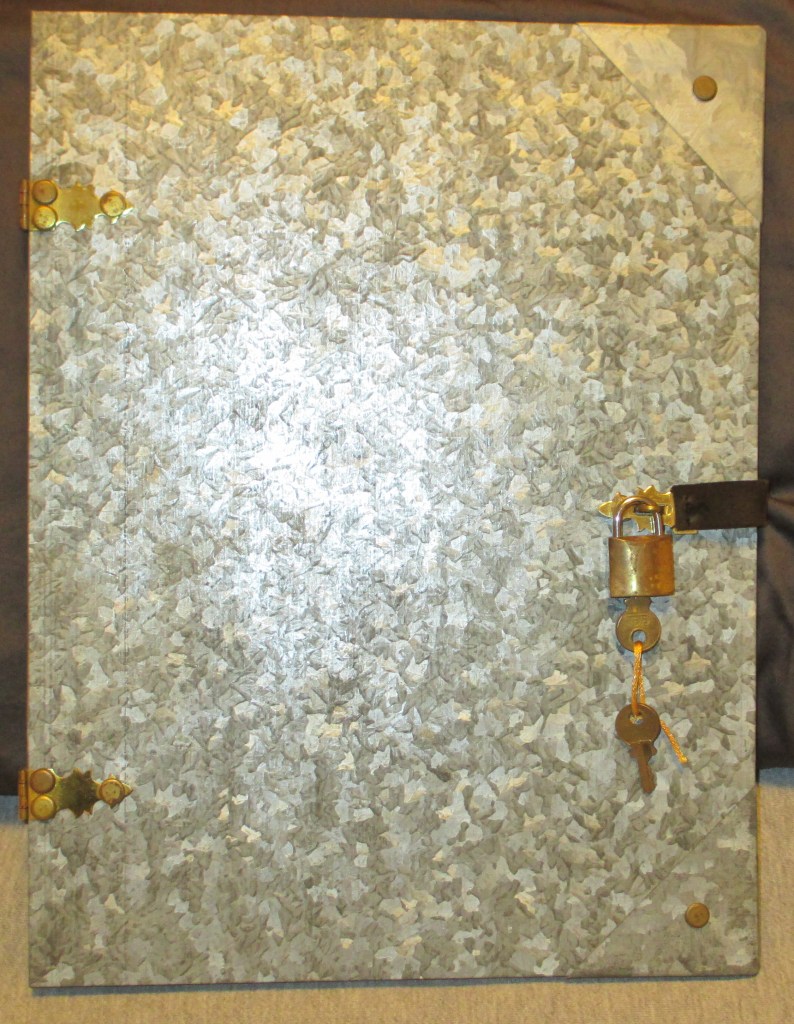
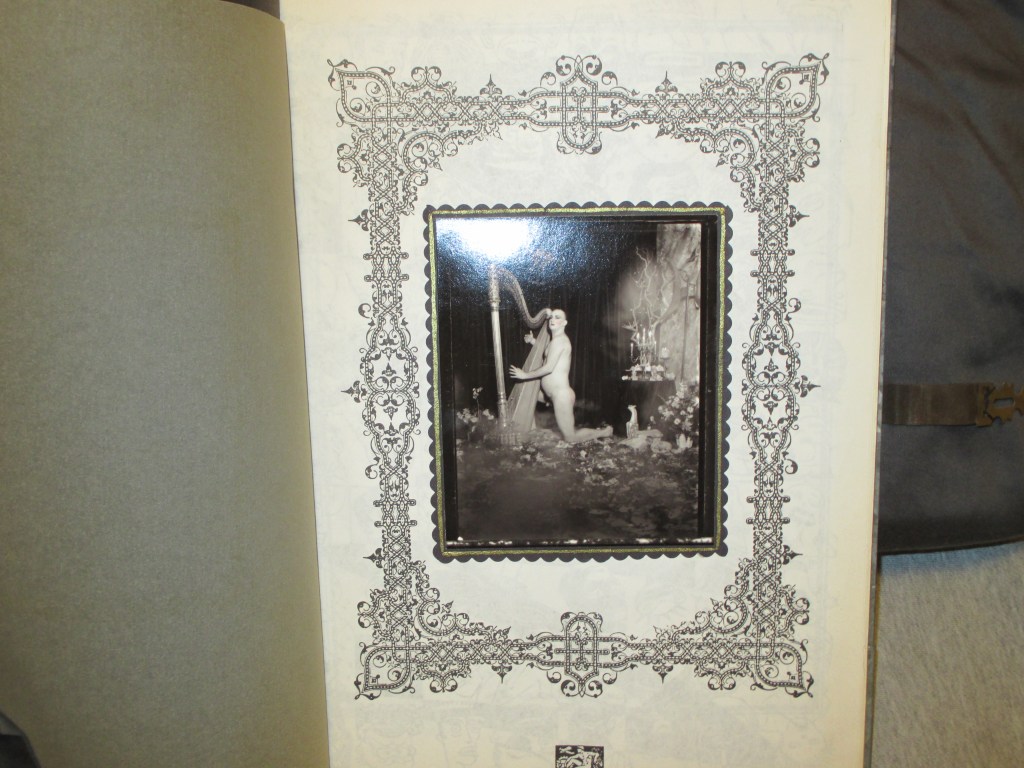
The book exists in different states. My copy of 136 unnumbered sheets is bound between sheet metal plates with a small brass padlock, while others are bound in textured wallpaper; with a fingerprint imprint in gold ink (some listings say blood, but it looks like gold ink to me) on the limitation page, and a tipped-in photo of Pugmire in the nude. The overall aesthetic is strongly reminiscent of underground comix, punk zines, and copybooks of the 1960s-1980s, with an emphasis on cut-and-paste techniques, surreal imagery, the presentation of familiar images in unfamiliar contexts or subtly distorted, and a Burroughs-esque eye for the unfiltered and sometimes teratophiliac reality presented by medical textbooks and cabinets of curiosity.

Example of the wallpaper cover from the Mullen Books listing.

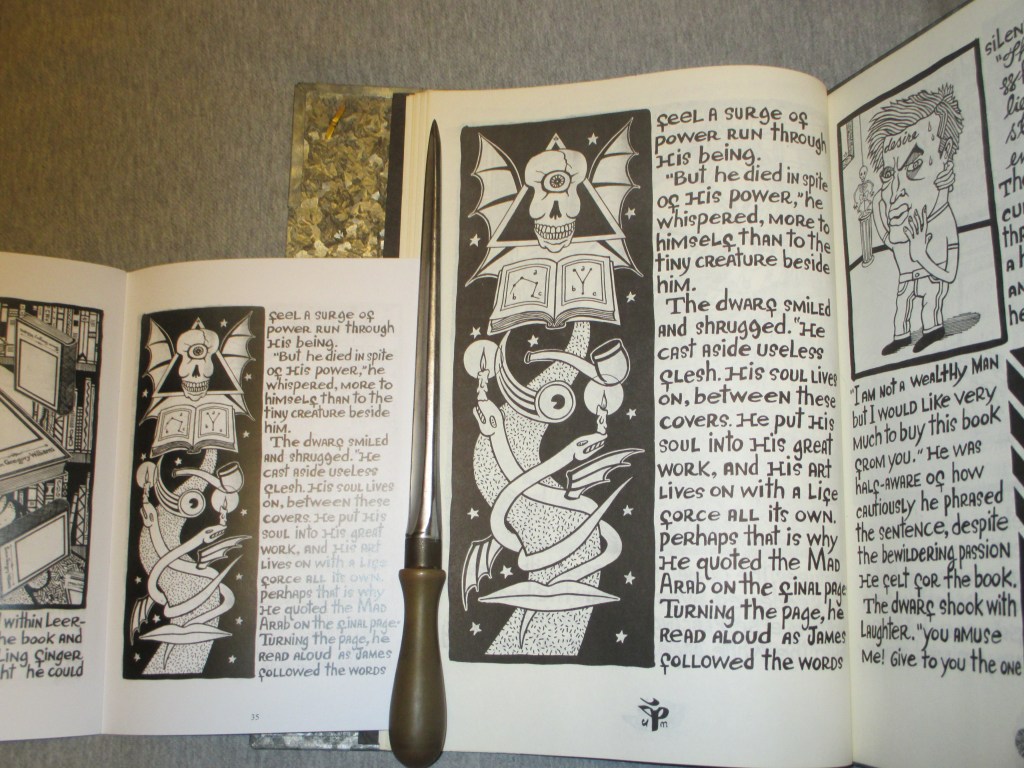
The illustrated version of Pugmire’s “Candlewax” is distinct from the rest of the project, but mostly because it has a coherent, linear narrative, with a darker, more Gothic tone than the more stylized kaleidoscope of images that preceeded this section, or the much more comic-strip style collaboration “Faces” with Bernstein. While Talbot continues to use the same distinctive style, the illustrations work to complement the text, at times a strict depiction, and at times more abstract and evocative.

The story itself is a sketch in miniature of bibliomania, murder, necromancy, hubris, and revenge. A fitting snapshot of the kind of obsession that has characterized aspects of the Mythos (and readers of the Mythos) from the beginning.

At least two versions of the “Candlewax” text have seen print. Pugmire had a tendency to rewrite his stories when they were reprinted, and this seems to be the case here as well. To give the flavor of the difference:

The man was a dwarf. His bent and twisted frame, disfigured by age and nameless ailments, seemed perpetually trembling. Drool moistened thin black lips, and yellow pus oozed from reddened eyes. A skeletal finger tapped the book that lay before him, and he addressed his visitor in a whispered voice.

“His name was Simon Gregory Williams. He wrote this book of spells in the late 1960s. That in itself makes it unique. Most of my books are ancient tomes, crumbling and worm-infected. But, as you see, this looks almost new.”
The tiny man bent his twisted frame toward the curious tome. Drool moistened his thin grey lips; yellow pus oozed from his reddened eyes. A skeletal finger tapped the yellow cover of the book. He addressed his visitor in a low whispered voice.

“His name was Simon Gregory Williams. He wrote this book of spells thirty years ago, while visiting the poet William Davis Manly, in your curious Sesqua Valley.” Here he opened the book and turned to various illustrated pages. He stopped at a vivid depiction of a tremendous mountain of white stone, the twin peaks of which resembled wings folded up on a daemon’s shoulders. “The infamous Mount Selta, of which I’ve heard so much. And below, in purple ink, the name ‘Khroyd’Hon’; such a strange name.”
“Candlewax” in Discrete Ephemera (1990)“Candlewax” in Mythos Tales & Others #1

The 1996 text deals much more with the Sesqua Valley cycle, probably to better incorporate it into the loose collection of stories and the Mythos that Pugmire would continue to build on in tales like “An Imp of Aether” (1997). Readers hunting this particular text may find themselves like the protagonist Oscar James, hunters of arcane lore about that mysterious vale and its even more mysterious occupants.

Left: Sesqua Rising, right: Discrete Ephemera

With an edition of only 500 copies, Discrete Ephemera and its illustrated version of “Candlewax” is very scarce and relatively expensive. Graeme Phillips reprinted the entire illustrated story in the chapbook Sesqua Rising (2016), but that was limited to only 50 copies, and is even scarcer, making this one of the rarest of Pugmire’s collaborations.

Madame Talbot also collaborated with Pugmire on some illustrated prose poems, and wrote:

I was thrill’d when one of my early Mythos stories, “Candlewax”, appear’d fully illustrated in one of Ashleigh’s hand-made books. There is nothing more thrilling than working on projects with outstanding artists 

W. H. Pugmire, “In Collaboration with Genius” (2016)

What is Discrete Ephemera and “Candlewax”? A collaboration of talents, a cross-pollination of ideas, attitudes, and styles. Discrete Ephemera is a kind of punkish grimoire, an art object to be experienced more than a text to be read and consumed, and in that sense “Candlewax” almost feels like a metatext…or, perhaps, a warning. For now, this copy is in my library. In time, it will be passed on to someone else. Hopefully, someone who gets it.


Bobby Derie is the author of Weird Talers: Essays on Robert E. Howard and Others and Sex and the Cthulhu Mythos.

Deep Cuts in a Lovecraftian Vein uses Amazon Associate links. As an Amazon Associate I earn from qualifying purchases.

“The Child of Dark Mania” (1996) by W. H. Pugmire

This story appeals to me more than most of the things I’ve written this past decade. I am fond of the image of the woman with her weird masked face, and was delighted when two pictorial renditions of that image were included in my first American collection, one by my editor and publisher, Jeffrey Thomas, and the other gracing the superb cover illustration by Earl Grier. There is a lot of peculiar passion in this story, and it gets me, deliciously. I was delighted to be able to write it in memory to HPL’s great buddy and fellow weird author, Frank Long. “The Child of Dark Mania” originally appeared in The Pnakotic Series.
—W. H. Pugmire, “Afterword” in Sesqua Valley & Other Haunts 113

Frank Belknap Long, Jr.’s “The Horror from the Hills” (Weird Tales Jan, Feb-Mar 1931) is one of his most famous additions to the Cthulhu Mythos—mostly because the novella incorporates a lengthy sequence borrowed from one of Lovecraft’s letters (with permission), describing a Roman dream in ancient Iberia. The main antagonist of the novella is Chaugnar Faugn, which in turn was inspired by a small statuette of the elephant-headed Hindu deity Ganesha that Long’s aunt Cassie Symmes had gifted him.

Long is busy on a horror tentatively called “The Elephant God of Leng”—based on a curiously carved idol his aunt lately brought him from Europe, plus a suggestion or two of mine.
—H. P. Lovecraft to Clark Ashton Smith, 2 Feb 1930, Dawnward Spire, Lonely Hill 204

The appropriation of an Indian religious icon was not uncommon in Weird Tales during the period. Readers might compare the elephant-headed Yog-Kosha from Robert E. Howard’s “The Tower of the Elephant” (Weird Tales Mar 1933), or the eponymous idol in Seabury Quinn’s “The Green God’s Ring” (Weird Tales Jan 1945). Inspiration comes where it does, and the “Exotic East” was an important inspiration for many pulp writers, and a draw for many pulp readers—and we can perhaps be grateful that Long drew a distinction between the benevolent Ganesha and the malevolent Chaugnar Faugn.

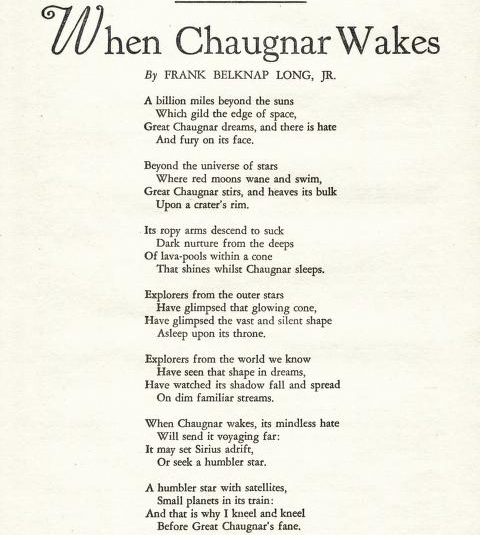
While “The Horror in the Hills” has been long recognized as a part of the Mythos, there has never quite been a distinct “Chaugnar Faugn Cycle.” Lovecraft would include Chaugnar Faugn among the deities in “The Horror in the Museum” (1933), and Long would revisit the character in his poem “When Chaugnar Wakes” (Weird Tales Sep 1932), and a few others have tried their hand at it, notably Robert Bloch with “Death is an Elephant” (Weird Tales Feb 1939), Joseph Pulver, Sr.’s untitled poem that begins “Elephant Lord, Chaugnar Faugn,…” (Cthulhu Cultus #12, 1998), Robert M. Price’s “The Elephant God of Leng” (Black Book #1, 2002), and W. H. Pugmire’s “The Child of Dark Mania” (1996).

Weird_Tales_v20n03_1932-09_sas_0123

As with “An Imp of Aether” (1997), “The Child of Dark Mania” is one of a series of stories that Pugmire wrote in the 1990s in homage to various weird authors that had come before; and as with “Imp” this one has been revised in its various publications, so that while the basic elements of the story remain, the details shift a bit depending on whether you read it in the original Pnakotic Fragments (1996) fanzine, the Tales of Sesqua Valley (1997) chapbook, or paperback publication in Sesqua Valley & Other Haunts (2008) or An Imp of Aether (2019).

Most of these changes are minimal—the consolidation of paragraphs, another word or sentence of description, etc. One notable change is the name of the protagonist, a writer of horror fiction who in the original is Frank or Franklyn, and in the 2019 version is “Sonny” or Francis—no doubt to more closely associate the writer with “Sonny” Belknap, as Lovecraft used to call his friend.

She went to a stand and unwrapped a piece of plastic, from which she removed a cone of incense. This she placed next to me on the bed, along with an incense burner shaped as an Eastern deity, an elephant god whose name I could not recall.
—W. H. Pugmire, “Child of Dark Mania” in An Imp of Aether 169

In keeping with his usual style, Pugmire is not so unsubtle as to name Chaugnar Faugn directly. The story is all the more effective for not being another gushing bit of fanfiction that tries to dump a vast chunk of Mythos lore on the reader. Nor does Pugmire try for anything grandiose; this is a quieter tale than “The Dunwich Horror” or “The Devil’s Hop Yard” (1978) by Richard Lupoff, somewhat closer to Arthur Machen’s “The Great God Pan” in scope—and Melissa is perhaps a close cousin to Helen Vaughn as portrayed in Helen’s Story (2013) by Rosanne Rabinowitz.

Instead, it is a very slight, intimate story, content to communicate the plot by image and intimation, and leave the reader’s imagination to fill in the rest. One of the most distinct such images is worth going into a little more deeply:

I tired but found it impossible not to study the grotesque cloth mask, and the bizarre shape that moved beneath it. I had known that Melissa had been born with birth defects, and we had assumed that this had been the result of Diane’s consumption of foreign opiates. (ibid. 168)

Savvy readers might draw any number of references: the masked high priest not to be described in The Dream-Quest of Unknown Kadath, perhaps—but also Joseph Merrick, the Victorian performer billed as “The Elephant Man,” who would wear a hood or mask to help conceal his features when in public.

There is that sense of empathy for Diane, the wild child who had “journeyed with a gang of lesbian witches” and returned pregnant, disapproved of by her family, and forced to raise her daughter alone…and now might lose her, as Melissa comes of age—which is the only odd part of the changes between editions. In the earlier versions of the text, Diane gave birth eighteen years before the start of the story, in the 2019 text this is shortened to eight. Whether this is an error or meant to invoke the quick growth of Wilbur Whateley is not clear, and doesn’t effect the final story much.

In conception, Pugmire’s Chaugnar Faugn is more intriguing than Long’s. Here, the deity has an aspect reminiscent of Pan, Bacchus, or Dionysus, who might attract very Lovecraftian maenads, drunk on the cosmic wonder of it all…and dance.

My blood froze as she bent low and kissed the shadow of the rigid god, and I inwardly cringed when that blasphemous silhouette began to blur and bend. (ibid. 171)

Why did Diane flee to Sesqua Valley? Perhaps because that was Pugmire’s corner of Lovecraft Country, and he wished to draw to himself those dark, shining jewels of the Mythos he prized. There is a jealous tendency to the valley, magnetic and sympathetic, like calling to like. The Child of Dark Mania fits in well among those shadowy residents.

The latest version of the text, titled “Child of Dark Mania,” can be read in An Imp of Aether (2019).


Bobby Derie is the author of Weird Talers: Essays on Robert E. Howard & Others (2019) and Sex and the Cthulhu Mythos (2014).

“This Weave of Witchery” (2019) by W. H. Pugmire & Maryanne K. Snyder

I’ve been working with Maryanne K. Snyder on a book of collaborative work, and she has proved an absolute delight to work with.  I prefer to write alone, collaborating is a lot more work for me; but often writing with someone else can take you to places you would never otherwise discover writing on your own. 
—W. H. Pugmire, “New Story Sale” (6 Oct 2010)

On the surface, “This Weave of Witchery” feels almost unfinished. Bits of pieces of Sesqua Valley and Lovecraft Country, dovetailed together into a kind of prose poem, capturing echoes of old moods: “The Dunwich Horror” and “The Silver Key,” “Born in Strange Shadow” and “Some Distant Baying Sound.” Imagine treading old, familiar territory, only to look back and suddenly see it from an angle you’ve never seen it before. Familiar, yet strange. That’s the prevailing attitude of “This Weave of Witchery.”

The plot feels like a deliberate reworking of “The Silver Key,” but from a different angle. Many writers have worked around the theme of losing the ability to dream—either literally, or in the sense of losing some creative urge or muse. Lord Dunsany wrote a bit about that in the end of “Idle Days on the Yann”:

Long we regarded one another, knowing that we should meet no more, for my fancy is weakening as the years slip by, and I go ever more seldom into the Lands of Dream. Then we clasped hands, uncouthly on his part, for it is not the method of greeting in his country, and he commended my soul to the care of his own gods, to his little lesser gods, the humble ones, to the gods that bless Belzoond.

Dunsany had followed this up in “The Shop In Go-By Street,” where the protagonist seeks once more to return to the Lands of Dream, only to find:

I would have waited three more days, but on the third day I had gone in my loneliness to see the very spot where first I met Bird of the River at her anchorage with her bearded captain sitting on the deck. And as I looked at the black mud of the harbour and pictured in my mind that band of sailors whom I had not seen for two years, I saw an old hulk peeping from the mud. The lapse of centuries seemed partly to have rotted and partly to have buried in the mud all but the prow of the boat and on the prow I faintly saw a name. I read it slowly— it was Bird of the River. And then I knew that, while in Ireland and London two years had barely passed over my head, ages had gone over the region of Yann and wrecked and rotted that once familiar ship, and buried years ago the bones of the youngest of my friends, who so often sang to me of Durl and Duz or told the dragon-legends of Belzoond.

There is something of this in Lovecraft’s “The Silver Key,” and perhaps in Pugmire & Snyder’s story something of Arthur Machen’s The Hill of Dreams:

He strove to rise from his chair, to cry out, but he could not. Deep, deep the darkness closed upon him, and the storm sounded far away. The Roman fort surged up, terrific, and he saw the writhing boughs in a ring, and behind them a glow and heat of fire. There were hideous shapes that swarmed in the thicket of the oaks; they called and beckoned to him, and rose into the air, into the flame that was smitten from heaven about the walls. And amongst them was the form of the beloved, but jets of flame issued from her breasts, and beside her was a horrible old woman, naked; and they, too, summoned him to mount the hill.

He heard Dr. Burrows whispering of the strange things that had been found in old Mrs. Gibbon’s cottage, obscene figures, and unknown contrivances. She was a witch, he said, and the mistress of witches.

He fought against the nightmare, against the illusion that bewildered him. All his life, he thought, had been an evil dream, and for the common world he had fashioned an unreal red garment, that burned in his eyes. Truth and the dream were so mingled that now he could not divide one from the other. He had let Annie drink his soul beneath the hill, on the night when the moonfire shone, but he had not surely seen her exalted in the flame, the Queen of the Sabbath. Dimly he remembered Dr. Burrows coming to see him in London, but had he not imagined all the rest?

Compare with:

It came as a wall of liquid blackness, an inky abyss in which he felt he would be drowned. There was something almost beguiling in its churning sentience, and he felt the need to speak to it, to name himself. Parting lips, he moaned his name as the blackness spilled into his mouth and shook him awake. […] Early sunset washed the sky over Sesqua Valley with muted color, and Thorley stood for a little while to appreciate the orange and pink effects that tainted the white stone of the titanic twin-peaked mountain. He had never thought to see that mountain again, and did not remember its effect on him, how it captivated one part of his mind and troubled another. He gazed at it until he felt himself grow faint, and then he remembered his mother’s words of caution, “It’s not wise to stare at Mount Selta for too long a time. Turn your eyes away.”
—W. H. Pugmire & Maryanne K. Synder, “This Weave of Witchery” in An Imp of Aether 211

These are old themes, paths well-trod, familiar territory for weird fiction aficionados. Donald Wandrei touched on such confusions of dreams and reality in the obscure Mythos story “The Lady in Gray”; and maybe there’s something of that in this weave of witchery as well.

If Pugmire & Snyder had done no more than write a prose poem in that tradition, one more bridge between the waking world and the Dreamlands, “The Weave of Witchery” would be an unremarkable yet solid entry. Yet they did manage to find a new perspective, one which Dunsany, Machen, Lovecraft, & Wandrei had not played with. Think back to “The Silver Key,” and Randolph Carter’s lament of what he had lost—and think of how it would change the story if he was wrong.

“This Weave of Witchery” is the fourth published collaboration between W. H. Pugmire & Maryanne K. Snyder, the others being “The House of Idiot Children” (2008), “The Hidden Realm” (2011), and “The Seventh Eikon” (2012). “This Weave of Witchery” was first published in An Imp of Aether (2019).


Bobby Derie is the author of Weird Talers: Essays on Robert E. Howard & Others (2019) and Sex and the Cthulhu Mythos (2014).

“An Imp of Aether” (1997) by W. H. Pugmire

To ye memory of August William Derleth
—original dedication

“Lovecraft Country” was the name given to that fictional setting in New England where so many of his stories were set, or at least referred to. The Miskatonic River that flowed through Arkham and gave is name to the university there down to Innsmouth, Dunwich and Kingsport—all based on real places that Lovecraft visited in Massachusetts, but occupying an unreal estate in the mind; Lovecraft country is a character itself in stories like “The Dunwich Horror.”

Some subsequent writers in the Mythos have carved out their own geographies; Ramsey Campbell, on the suggestion of August Derleth, set his early Lovecraftian tales in a fictional Severn Valley with towns like Brichester and Goatwood, which continues to be developed today. W. H. Pugmire set his Sesqua Valley in the Pacific Northwest, and populated the place shadowed by the mountains with his own strange creations, including the poet William Davis Manly and the sorcerer Simon Gregory Williams.

In this story, set in the shadows of Sesqua Valley, Pugmire pays homage to August Derleth.

We thought at first that it was some kind of poem, but upon further study discovered that it was a prayer to something called Cthugha. Known as ‘the Burning One.’
—W. H. Pugmire, Tales of Sesqua Valley 39

We thought at first that it was some kind of poem or unholy psalm, but upon further study discovered that it is a prayer to something called Cthugha. Supposedly a fire element. You know the idiotic notion that Great Old Ones represent terrestrial elements, as if these cosmic creatures could be molded by corporeal law or understanding. Utterly absurd; but in this case, there seems some sustainment.
—W. H. Pugmire, Sesqua Valley & Other Haunts 94-95

We thought at first that it was some kind of poem or unholy psalm; but with further study we discovered it to be a prayer to something called Cthugha, supposedly a fire elemental. You know the idiotic notion that the Great Old Ones represent terrestrial elements, as if these cosmic creatures could be molded by corporeal law. Bah! However, in this case, there seems to be some sustainment.
—W. H. Pugmire, An Imp of Aether 129

As a writer, Pugmire was a tinkerer; many of his stories show the result of revision between printings, so that while the title, plot, and overall characters are the same, the text in each publication is different—sometimes slightly, sometimes markedly. The revised texts tend to be cleaner, in general; the result of looking back at a work from a decade ago and tidying it up after one’s younger self.

In the February 1933 issue of Weird Tales, Donald Wandrei published “The Fire Vampires”; a tale of the 24th century involving the fiery alien entity Fthaggua; and the idea of elementals in the Mythos dates back to Derleth’s “The Thing That Walked On The Wind” (Strange Tales of Mystery and Terror, Jan 1933). Wandrei’s tale was not explicitly of the Cthulhu Mythos, although later writers adopted it, or elements from it, into the Mythos; Derleth’s was deliberate pastiche. After Lovecraft’s death, August Derleth and Donald Wandrei came together to form Arkham House to publish Lovecraft’s fiction and letters—and Derleth himself continued to publish Mythos pastiches.

The “elemental theory” as a paradigm for the Cthulhu Mythos (as Derleth called Lovecraft’s artificial mythology) as a whole came after Lovecraft’s death, detailed by fan Francis T. Laney in “The Cthulhu Mythology” in The Acolyte #2 (1942), where he noted:

The fire gods were not covered by Lovecraft, so it is up to other writers to fill in this section of the Mythos. (8)

August Derleth was paying attention. He wrote to Laney, asking him to expand the article for a further book of Lovecraft’s fiction—which became “The Cthulhu Mythos: A Glossary” in Beyond The Wall of Sleep (1943, Arkham House). This expanded article includes mention of a fire elemental, Cthugha, created by Derleth:

I’m certainly agog to read “The Dweller in Darkness.” Cthugha will certainly fill a gaping hole; I well remember how disgusted I was when I found the “fire department” had been completely neglected. I’m not trying to appear conceited, but by any chance did my mention of this in my article start you off on this tack, or was it just a coincidence?
—Francis T. Laney to August Derleth, 29 Mar 1943

Whether it was Laney that inspired Derleth, or two fans arriving at the same conclusion, Derleth determined to “fill the gap” and embraced the elemental theory wholeheartedly, making it his own (and borrowing elements of Wandrei’s Fthaggua in the process). As it happened, publication of fiction didn’t always go in order—the story that effectively introduced Cthugha was “The Dweller in Darkness” (Weird Tales Nov 1944), but the first story that saw mention of Cthugha in print was “The Trail of Cthulhu” (Weird Tales Mar 1944), later titled “The House on Curwen Street.”

Derleth’s conception of the Mythos did not long survive him; Richard L. Tierney famously exploded the idea in “The Derleth Mythos” (1972), beginning a period when fans and scholars seriously re-assessed what Lovecraft did and did not write, and interest increased in textually accurate versions of Lovecraft’s fiction—but selective elements of Derleth’s Mythos fiction, such as Cthugha, were adopted by others.

Hence, Pugmire’s dedication.

This is a story with a nod-and-a-wink toward Mythos fans who can pat themselves on the back that they know about Derleth and the elemental theory and can scoff at such notions along with the sorcerer Simon Gregory Williams. And yet…that is just the beginning of the story, the set-up. That is Pugmire laying the groundwork.

Because there is potential in Cthugha, and some of Derleth’s other ideas—and as much as Derleth’s memory was somewhat hounded in latter years because of his flaws as a writer, a businessman, sometimes even as a human being, he was still a good writer, and he promoted and published Lovecraft unceasingly during his life, and there are ideas which he introduced to the Mythos that are worth exploring and expanding on. So Pugmire did.

No, no. It was the fire vampire. You looked too long and deeply into its burning eyes. Your cool silver eyes took in too much of its property, and thus you burn with strange agitation. One born of the valley’s shadow cannot withstand such cosmic brilliance.
—W. H. Pugmire, Sesqua Valley & Other Haunts 97

No, lad. It was the fire vampire, an essence of the Old One that burns in Fomalhaut. You looked too long, too deeply, into its ember eyes. Your cool silver orbs are slightly scarred, so potent was your engagement with the valet of Cthugha.
—W. H. Pugmire, An Imp of Aether 132-133

Pugmire never shied away from making his creations sensual; but this is a rare story where he plays with gender as a concept. Wilus Shakston (original) or Jacob Wirth (revised) has encountered the old witch of Cthugha…plaited a lock of her hair with his own…and so began a transformation. Whether the transition can be said to be transgender or genderqueer is largely up to the reader to interpret; the nature of the transition is slower and less total than in “The Thing on the Doorstep.” But in a setting where the children of Sesqua Valley seem to be predominantly male, the acquisition of feminine attributes is marked—and not-unwelcomed by Wilus/Jacob.

In an afterword to this story, Pugmire wrote:

In 1995, after my lover’s heroine overdose and death, I began to write a series of Sesqua Valley stories dedicated to deceased members of the Lovecraft Circle. I suppose I was trying to take my mind off personal tragedy by sinking into creativity. It worked quite well, and many of those tales became the core of my first American collection of fiction, Tales of Sesqua Valley, published by my good buddy and fellow author Jeffrey Thomas. With these stories I mentioned breifly the addition to the Mythos created by the gent to whom the story was dedicated. It was a fun wee game, although the results were not stories of importance. The original version of this story had its first appearance in the chapbook that Jeff published in 1997 under his Necropolitan Press imprint; it has been susbtantially rewritten for this edition.
—W. H. Pugmire, Sesqua Valley & Other Haunts 99

Whatever version of the story you read, it is worth reading. Proof that the Mythos can be reimagined and reworked by different hands, and that ideas that had their start in the nigh-forgotten pulp fiction of the 1930s can inspire strange and wondrous things.

“An Imp of Aether” was first published in Tales of Sesqua Valley (1997), it was revised and republished in Sesqua Valley & Other Haunts (2008) and The Tangled Muse (2011); and revised again for publication as the title piece in Pugmire’s posthumous collection An Imp of Aether (2019).


Bobby Derie is the author of Weird Talers: Essays on Robert E. Howard & Others (2019) and Sex and the Cthulhu Mythos (2014).