“Howard Phillips Lovecraft and Sex” (1974) by R. A. Everts

If anyone speculated about Lovecraft’s sexuality while he was alive, they were polite enough not to publish about it. It wasn’t until Lovecraft was safely dead that the lockpicks of biographers went for his underwear drawer. When Winfield Townley Scott published “His Own Most Fantastic Creation: Howard Phillips Lovecraft” in The Providence Journal for 26 Dec 1943, he wrote:

His stories are sexless and one supposes the man was nearly so, all but mothered into impotency. One can say that almost all of his adult relationships were homosexual, if the word is intended in the blandest sense: there is no sign of strong sexual impulse of any kind. He was “not at ease” with women. His marriage was a mistake and a quick failure. He was disturbed by even mildly sexual writing. When he bought pulps at Douglass Dana’s Old College Book Shop, at the foot of College Street, he tore off the more lurid covers lest friends misunderstand his interests.

Speculation on Lovecraft’s sexuality picked up during the period of the Lavender Scare. Attention on that front shifted to his ex-wife, Sonia H. Davis, who was perhaps uniquely in a position to know. Her memoir does not go into any detail, but suggests Lovecraft was reserved, e.g.:

When I parted for the night, I said “Howard, won’t you kiss me goodnight?” His reply was, “No, it is better not to.”
Sonia H. Davis, “The Private Life of H. P. Lovecraft” in Ave Atque Vale 143

This scene has been interpreted as an invitation to resume marital relations and Lovecraft’s decline; the morality involved is old-fashioned these days. But certainly Sonia implied that she and Howard engaged in normal heterosexual relations as a married couple. She implied further in the “pinkey” anecdote and the “asequately excellent lover” comments in Memories of Lovecraft (1969), and once, August Derleth asked her directly about it:

A propos your piece on Lovecraft, the question of HPL and sex had been bothering me for some time, especially in view of his violent reaction against Oscar Wilde as a person, however much he admired his work; so in 1953 when I was in Los Angeles, I asked Sonia Davis—the ex-Mrs. Lovecraft—rather bluntly about HPL’s sexual adequacy. She assured me that he had been entirely adequate sexually, and since she impressed me as a well-sexed woman, not easily satisfied, I concluded that HPL’s “aversion” was very probably nothing more than a kind of puritanism—that is, it was something “gentlemen” didn’t discuss, and so on.
—August Derleth, Haunted vol. 1, no. 3 (June 1968), 114.

The idea of Lovecraft as prudish, sexually repressed, asexual, or homosexual thus developed further in the literature; L. Sprague de Camp would synthesize several of these lines of thought in “Sonia & H. P. L.” (1973) and his biographical essay “Eldritch Yankee Gentleman” (1971), where he wrote:

He abhorred sexual irregularities and deviations, yet his own approach to sex was so prissy and inhibited as to make some wonder whether he, too, had a touch of lavender.
—L. Sprague de Camp, “Eldritch Yankee Gentleman” part 1, Fantastic Stories (Aug 1971) 98

Writers have described Lovecraft as “sexless,” which does not seem to have been really the case. During the early months of his marriage, he seems to have performed his husbandly duties adequately if without great enthusiasm. The charge of “latent homosexual tendencies” has, however, becomes such a fad that it is leveled at almost any notable, including Lovecraft, whose love life is the lease unusual. As far as the evidence goes, it is probably true that Lovecraft had a low sexual drive. Otherwise, there is nothing to support the “latent homosexual” charge.
—L. Sprague de Camp, “Eldritch Yankee Gentleman” part 2, Fantastic Stories (Oct 1971)

Comments like this may have been what inspired R. Alain Everts to write up “Howard Phillips Lovecraft and Sex: or The Sex Life of a Gentleman” for Nyctalops #9 (1974), an article based on Sonia’s memories of her long-dead second husband and H. P. Lovecraft’s sexuality:

During the course of my friendship with Sonia Lovecraft, the topic of her sexual relationship with Howard Phillips Lovecraft came up not once—due more to the young age at that time of this author, than to the lack of his scholarship. Fortunately for me, however, several times Mrs. Lovecraft brought up the subject herself and this scholar duly recorded and filed away the pertinent data.

In several unpublished recollections of HPL, Sonia mentioned in passing that aspect of their relationship—of course, as was HPL, she was also a Victorian prude when it came to sex and sexual relations; however Sonia lived into an age of greater liberties regarding sexual matters and the revelation of them in publick. And, she also had given birth to two children prior to her 20th birthday, children by her first husband, only one of which survived. This experience, although somewhat traumatic and repressing to her at the time, was certainly much more than Howard had ever had, for he was a virgin at their marriage in 1924. His bride was hardly blushing, and although both were not enthusiastic in any sexual sense of the word, both were able to sustain satisfying sexual relations.

There are two immediate issues with this piece: first, the degree to which it tracks with (and thus was likely informed by) earlier works like Winfield Townley Scotts’s influential biographical essay make it suspect, and second, the source documents and conversations that Everts cites have never been published. While we know he was in contact with an elderly Sonia H. Davis for several years, this means that everything he’s reporting is being filtered through his own viewpoints and in his own words, and the veracity of the material is qualified by how trustworthy Everts himself is as a scholar and journalist (see The Curse of Cthulhu for some potential issues).

Even if Everts accurately presented Sonia’s comments on Lovecraft’s sexual reticience, she herself may have been influenced by posthumous publications on HPL. For example, when Everts quotes her as saying:

Sonia also reaffirmed a statement that I have heard from various sources—that when HPL was growing to young manhood, “his mother’s admonitions to him were ‘devastating.’” This possibly pertains to HPL’s looks—his mother did tell him that he was “grotesque” and that he should not go out at daytime for fear of scaring the neighbours. No doubt some sexual admonitions arose also, for the entire family, according to what Sonia recalls Annie Gamwell telling her, knew of Winfield Lovecraft’s paresis, and the adventures with prostitutes and women on his lengthy travels that gave him his affliction. In fact, Annie told Sonia prior to her marrying HPL that they could not have children—in fact this was a warning that Annie was giving to Sonia, and to me her choice of words was interesting—could not instead of should not.

The idea that Susan Lovecraft was concerned about her son’s appearance first appeared in the letters of Clara Lovrien Hess to Winfield Townley Scott, and were reported in his column in the Providence Journal. Sonia was in correspondence with Scott at the time (some of their letters remain at the John Hay Library) and would have learned of this; Scott’s research and speculations may well have influenced her memories. The story of Annie Gamwell confessing that HPL’s father had syphilis, for example, was written after Scott revealed Winfield Scott Lovecraft’s diagnosis and cause of death. It is impossible to tell, at this distance, how much if at all Sonia’s memories were fitted to the facts as reported, rather than straight recollections, with all their inherent inconsistencies and errors.

If this skepticism seems extreme, it is because the evaluation of historical evidence demands a certain amount of rigorous questioning of the sources: who is writing? When did they write it? Why did they write it? What sources influenced the writing? Both Everts and Sonia had their own biases when expressing views on Lovecraft’s sexuality, explicit and implicit, and this has to be understood when reading the essay. Without access to Everts’ source materials, we cannot tell if he was censoring Sonia by leaving out recollections that didn’t fit his theme (that of Lovecraft as heterosexual, capable of sexual intercourse, but of low sex drive), or if he was presenting everything she said and adding his own interpretation based on the then-current state of Lovecraft scholarship. The emphasis on Winfield Lovecraft’s syphilis, for example, appears to be an addendum to the discussion on WSL and syphillis in Dr. David H. Keller’s “Shadows over Lovecraft” (1948), Dr. Kenneth Sterling’s “A Reply to Keller’s Article on Lovecraft” (1951), and Arthur S. Koki’s “H. P. Lovecraft: An Introduction to His Life and Writings” (1962).

The degree to which “Howard Phillips Lovecraft and Sex” parallels or is in conversation with Lovecraft scholarship of the 1970s cannot really be overstated. While the quotes from Sonia’s unpublished memoirs or interviews are unique and original, the actual content strongly follows existing lines of thought. For example, when Everts quotes her as saying:

He was reared more like a girl evidently instead of being reared like a man; yet he was far from unsexed as someone has stated. But it was this sort of up-bringing, I believe, that made him squeamish and prudish about perfectly natural functions.

The “reared like a girl” comment dovetails some anecdotes in Sonia’s account that Susan Lovecraft had hoped to give birth to a girl, and that a young Lovecraft (who, as many infants in the 1890s, wore dresses and kept long hair) “looked like a beautiful little girl” and his mother cried bitterly when the long locks were cut off (Ave Atque Valley 121). Sonia and Lovecraft didn’t begin their relationship until after Susan Lovecraft’s death, so Sonia was reporting at best second-hand recollections, which were then quoted (hopefully accurately) by Everts—but the photographs of the infant Lovecraft in a dress were published in Rhode Island on Lovecraft (1945), and Lovecraft’s own recollections of his earliest years were published in the first volumes of the Selected Letters.

The degree to which Sonia’s memories were affected by such post-Lovecraft materials is unknown; that she speculated on such things seems clear, based on material that didn’t pass through Everts’ hands. Everts’ motivation for adding it in this essay seems clear enough: it’s relevant, even if speculative, and it helps sell the narrative of a young Lovecraft who was prudish and dominated by his mother, “all but mothered into impotency” as Winfield Townley Scott put it.

An interesting question to ask is: what is not in “Howard Phillips Lovecraft and Sex?” There is no reference to any speculations about Lovecraft as a homosexual or transgender. This was not a strong theme in Lovecraft scholarship at the time, although it would swiftly become one when L. Sprague de Camp’s Lovecraft: A Biography (1975) came out the following year. While Winfield Townley Scott had given short shrift to the idea of Lovecraft as a homosexual, de Camp would devote an entire chapter to Lovecraft’s sex life and speculation of HPL as a closeted homosexual. Whether this was a deliberate choice on Everts’ part (in some private correspondence, Everts evinced some homophobia), or simply accurate reporting of Sonia’s thoughts is unknown.

The idea of Lovecraft as transgender is relatively recent, and mostly based on the same evidence that was presented for HPL as a closeted homosexual; e.g. the idea that his mother attempted to raise him as a girl, as Sonia speculates in this essay. This harkens back to an older perspective on homosexuality that muddled sexuality and gender identity, with the idea that homosexual men were necessarily effiminate and possibly overly-influenced by women when young. Contemporary understanding of transgender identity does not follow this line of thought, but when reading older material out of context, misunderstandings can happen.

Also absent are any quotes from Lovecraft’s letters on the subject of sex. This may be more understandable as HPL’s more extensive discussions on the subject weren’t published until the later Selected Letters volumes published after this article came out. Some of Sonia’s further comments on Lovecraft and sex in her letters to August Derleth are also not present, but there is no reason to believe Everts would have had access to those letters and she may never have repeated those comments to him.

Today, “Howard Phillips Lovecraft and Sex” is probably more interesting for the snippets from Sonia H. Davis than for Everts’ speculations and interpretations on Lovecraft’s sexuality. Some of the estimations have held up as more evidence has been presented: the idea of Lovecraft having a low sex drive seems well-supported based on his letters, the impressions of friends, and especially Sonia’s estimation quoted here. Lovecraft the prude has shown to be more complicated; his correspondence doesn’t include any frankly explicit or erotic material, but he was not otherwise reticient in writing about sex, even if he never went into anatomical detail. There is some supporting evidence in the memoirs of Mara Kirk Hart for Lovecraft’s reticience in discussing sex verbally.

“Howard Phillips Lovecraft and Sex: or The Sex Life of a Gentleman” by R. A. Everts is ultimately a nonfiction work representative of a particular historical period and context, and understanding what works that Everts and Sonia were influenced by and responding to changes how we read and understand the essay. Its historical impact on Lovecraft studies hasn’t been dramatic; there are no terrific revelations here, mostly quite confirmations of ideas that had already been passed around before. However, it is one of the first works to discuss Lovecraft and Sonia’s sex life openly, quoting some of Sonia’s own words on the subject, and for that, at least, it has a place in the study of the lives of both H. P. Lovecraft and Sonia H. Davis.


Bobby Derie is the author of Weird Talers: Essays on Robert E. Howard and Others and Sex and the Cthulhu Mythos.

Deep Cuts in a Lovecraftian Vein uses Amazon Associate links. As an Amazon Associate I earn from qualifying purchases.
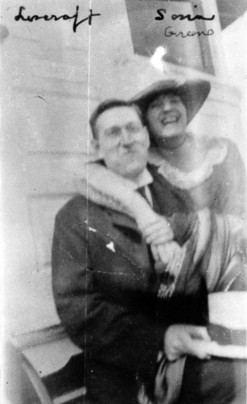
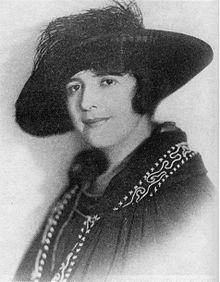
“When Sonia Sizzled” (1973) by Gerry de la Ree

Immediately after “Sonia & H. P. L.” by L. Sprague de Camp in The Normal Lovecraft (1973) is an essay by Gerry de la Ree titled “When Sonia Sizzled” that also takes as its subject Sonia H. Davis, the former wife of H. P. Lovecraft. De la Ree was a noted collector who managed to procure an enviable number of original letters and artwork connected with pulp writers of the 1930s, including original art from Clark Ashton Smith, and he used part of this collection as the basis for a series of publications, of which The Normal Lovecraft was one example.

“When Sonia Sizzled” is one of several essays and articles that he wrote on pulp matters. Like much of The Normal Lovecraft, it has never been reprinted. The essay begins, thus:

Except for a repeated general distaste for life in New York City, H P. Lovecraft in general restricted commentary on his two years of married life with Sonia Shifirkin Greene. His brief autobiographical sketch, published in 1963 by Arkham Hosue and written some 30 years earlier, makes no mention of this period.

Likewise, in “Ec’h-Pi-El Speaks”, an autobiographical sketch written in 1929 and published by this writer last year, H. P. L. again skipped over the period of his marriage as if it had never existed.

Lovecraft’s closest associates have often testified to his apparent lack of interest in the opposite sex, and both his fiction and his countless letters seem to bear out this contention.
—Gerry de la Ree, “When Sonia Sizzled” in The Normal Lovecraft 28

In context, by 1973 Arkham House had published the first three volumes of Lovecraft’s Selected Letters, which covered a period up to 1931—the entirety of his New York period (1924-1926) and marriage leading up to the divorce decree (1924-1929). August Derleth and Donald Wandrei, editors of those volumes, had selected, excerpted, and in places edited Lovecraft’s letters to emphasize information value and points of interest. Sonis is mentioned in ~45 pages of Selected Letters I and ~14 pages of Selected Letters II, mostly in letters to his aunts or to mutual friends and amateur journalists. But it is a paltry account of the marriage; whether the editors did this deliberately or it fell out like that as they prioritized Lovecraft’s fiction isn’t clear.

Today, with so many of Lovecraft’s unabridged letters published thanks to Hippocampus Press, we have a better sense for how often Lovecraft mentioned Sonia in his letters, and to whom. In fact, he did mention her much more frequently and in greater detail in letters to his aunts than anyone else, and to some correspondents—especially later ones—he does not mention his marriage at all. There was nothing particularly nefarious in this omission; Lovecraft was under no obligation to bare his soul to everyone he wrote a letter to, and the failure of his marriage must have been a source of personal disappointment and embarrassment.

However, it does mean that when scholars in the 1970s were trying to reconstruct Lovecraft’s marriage and find out more about his wife, they hit a wall. Sonia’s memoir was available in some formats, and small articles like “Lovecraft’s Marriage and Divorce” (1968) by Muriel E. Eddy, Memories of Lovecraft (1969) by Sonia H. Davis, and “Mrs. Howard Phillips Lovecraft” (1973) by R. Alain Everts were available, but that was pretty much it, except for sporadic mentions in Lovecraft’s letters and in a few memoirs by friends who had known both Sonia and Howard.

Gerry de la Ree knew this. And with diligence and no doubt money, he bought Sonia’s letters to Samuel Loveman from the 1940s. “When Sonia Sizzled” consists mostly of excerpts from these letters, which date from after Sonia had been informed of Lovecraft’s death and when she had come into contact with Derleth, but before she published her memoir. In one letter, Sonia enclosed a letter she had received from August Derleth dated 21 November 1947, to get Loveman’s opinion on it. De la Ree quotes an excerpt:

I have so far had no reply to my letter of 18 September. Meanwhile, I hope you are not going ahead regardless of our stipulations to arrange for publication of anything containing Writings of any kind, letters or otherwise, of H. P. Lovecraft, thus making it necessary for us to enjoin publication and ale, and to bring suit, which we will certainly do if any manuscript containing works of Lovecraft does not pass through our office for the executor’s permission.

You will be interested to know that we know have in Lovecraft’s own letters to his aunts a complete and detailed account of how things went during his entire married life.
—Quoted in The Normal Lovecraft 29

Derleth was not the executor of Lovecraft’s estate. He was not even the literary executor; that was R. H. Barlow, who died in 1951. Arkham House had an agreement with Lovecraft’s surviving aunt Annie Gamwell to publish HPL’s writings before her death in 1941, and on this basis Derleth often pretended to complete authority over Lovecraft’s copyrighted work, and occasionally threatened legal action against those who published or republished anything by Lovecraft without Arkham House’s blessing. In hindsight, this can be seen as a deliberate bluff, a means for Derleth to concentrate and maintain control of the Lovecraft material, if not an actual monopoly.

However, at the time, this would not have been easy to discern; if Derleth had ever sued and been forced to go through discovery by someone calling his bluff, things might have gone very differently for Arkham House and Lovecraft’s legacy. Sonia’s follow-up to this was a letter to Loveman dated 1 Jan 1948; it mostly continues repeats assertions that appeared in her memoir, particularly that she financially supported Lovecraft during the New York period, which Derleth had flatly denied.

Readers in 1973 might have appreciated the peek behind the scenes, which led to the publication of Sonia’s memoir in 1948; although there was much more drama to it than these few letter excerpts state. The actual details of how much financial assistance Lovecraft received from his wife and aunts during that period is interesting for those who would like to reconstruct Lovecraft’s parsimonious budget; it was obviously sufficient to live on, but not thrive, or else he wouldn’t have left.

The third and final letter snippet de la Ree quotes from is dated 16 Nov 1949, after the publication of Something About Cats and Other Pieces by Arkham House, which contains a version of Sonia’s memoir, “The Horror at Martin’s Beach” (1923), and “Four O’Clock” (1949). By this point, Sonia and Derleth had achieved détente, which would grow into amicability in later years. De la Ree quotes her as writing to Loveman:

Yes, Derleth sent me a copy of “Cats”. He paid me a modicum for the H. P. L. story as well as for the two revisions, and while not much, it helped last year when I wasn’t earning anything while I was sick.
—Quoted in The Normal Lovecraft 31

None of these letters has ever been published in full, and aren’t likely to be anytime soon. If they still survive, it is in someone’s private collection. When read in conjunction with letters from Sonia and Derleth that survive at the John Hay Library and Wisconsin Historical Society, we can get a fuller picture of the tumultuous period in the late 1940s when Sonia stumbled into the complicated literary legacy of her deceased husband, and had to contend with one of the biggest fish in that small pond that was Lovecraft publishing.

Still, this was when Sonia was hot—or as de la Ree put it, when she sizzled—when her memoir was the hottest thing to hit Lovecraft fans since Arkham House had begun publishing in 1939. We know now, because of access to Derleth’s letters, that he was more concerned with Sonia’s portrayal of Lovecraft as antisemitic than with how much money she gave to Lovecraft to live on in New York, and his efforts to discredit and downplay her memoir probably reflect Derleth’s own interests in Lovecraft’s legacy as much as his friendship with the late HPL.

In 1973, “When Sonia Sizzled” was a peek behind the curtain of Lovecraft publishing in the 1940s, and was probably safe to publish because both Sonia and Derleth were safely deceased. Searchers after more data on Sonia herself were no doubt disappointed, but even if this isn’t the most substantial piece, it is still a piece of the puzzle that was her life, both with and after her marriage to H. P. Lovecraft. It wasn’t the whole story, nor did it pretend to be, but it added a bit of context to how Sonia came to publish her memoir. Today, with more of the pieces of the puzzle, we have a better picture of what happened.


Bobby Derie is the author of Weird Talers: Essays on Robert E. Howard and Others and Sex and the Cthulhu Mythos.

Deep Cuts in a Lovecraftian Vein uses Amazon Associate links. As an Amazon Associate I earn from qualifying purchases.
“Mrs. Howard Phillips Lovecraft” (1973) by R. Alain Everts v. “Sonia & H. P. L.” (1973) by L. Sprague de Camp

During my recent visit to Los Angeles over the Christmas hollidays [sic], I telephoned the Diana Lynn Lodge where Mrs. Sonia Lovecraft Davis had been living for the past 8 years. I phoned on 22 December and spoke with Mrs. Davis’ nurse, who informed me that Sonia was quite ill and deteriorating rapidly. She no longer read – that used to give her the greatest pleasure – as did writing, which she also no longer did. For the most part she watched television and slept – and of course died alone in that particularly horrible manner that we condemn the old to.
—R. Alain Everts, “Mrs. Howard Phillips Lovecraft” in Nyctalops #8 (Apr 1973), 45

Sonia H. Davis, the former wife of H. P. Lovecraft, was seldom mentioned in his letters after the divorce was filed in 1929. She largely disappeared from his life after the editing of “European Glimpses” in 1933. Was not informed of his death in 1937, and did not learn of it until 1946. Many of Lovecraft’s friends and correspondents did not know he was married, or if they knew, did not know Sonia’s name or where she was. When Winfield Townley Scott published “His Own Most Fantastic Creation: Howard Phillips Lovecraft” in The Providence Journal for 26 Dec 1943, he wrote honestly:

Then a quite astonishing thing happened—I don’t know how else to describe this sudden outbreak of a semi-invalid tangled with apron strings; Lovecraft in 1924 went to New York and married. So far I have not discovered either the woman’s name or her present whereabouts.

The next year, in “His Own Most Fantastic Creation” in Marginalia (1944, Arkham House), the first extensive biographical essay on Lovecraft, Scott had at least learned Sonia’s name and some basic account of the marriage, though he added:

It is very difficult—and so I think I shall not bury this somewhat footnote-ish aside in an actual footnote but, without apology, keep it up here in larger print—to write of Lovecraft’s marriage. This is principally because the former Mrs. Lovecraft is inaccessible; one hears that she is remarried and that she is probably living out West, but even old friends of Lovecraft who knew his wife are unable to establish communication with her because they are denied, by her relatives, knowledge of her present name and whereabouts. To write of the marriage from others’ reminiscences and speculations is under the circumstances certainly permissible, and as certainly embarrassing. One can only hope, in view of Lovecraft’s increasing fame and the consequent importance of his biography and of the need for fairness all around, that this one woman who ever lived intimately with him will tell her story. Until then, one can only piece the story together form the fragments offered by outsiders—human outsiders! (ibid. 321)

Sonia did finally get in contact with Winfield Townley Scott, and with his assistance, she did write her memoir of the marriage, and he also helped her to get it published, in abridged and edited form. This led to Sonia meeting August Derleth, the eventual publication of “Four O’Clock” (1949), and many other things—but relatively little from or about Sonia herself made it to print. She had some scattered references in mid-century amateur journals, including attempts to sell books associated with Lovecraft. In 1961, when Scott revised his biographical essay for his collection Exiles and Fabrications, he included material from Sonia’s memoir, but new material on or about Sonia was almost nil.

Fans eager for data could look to “Lovecraft’s Marriage and Divorce” (1968) by Muriel E. Eddy, but would scarcely learn anything not already in Sonia’s memoir. August Derleth put together Memories of Lovecraft (1969) from some of Sonia’s letters, but again, this is fairly thin. New facts about Sonia, and new information on her marriage with Lovecraft wasn’t really made public until after her death.

I heard later that Sonia had died on 26 December 1972 – I had the pleasure of her acquaintance for nearly 5 years, and of her family for the same length of time. it was on her 85th birthday in 1968 that I first met her personally although I had corresponded with her from some time previously. I was more than anxious to meet her, to try and persuade her to talk about her second husband, Howard Phillips Lovecraft, which she was at first extremely reticent to do – she was now the widowed Mrs. Nathaniel Abraham Davis, and owed most of her final good memories ot him. However, during the course of our personal acquaintance, in which I visited her several dozen times, to talk with her, to tape record her reminiscences of Howard Lovecraft, and her own life, to take her out to lunch and on special errands, and simply to visit this lonely and charming, and until her decline into senility, vibrant lady.
—R. Alain Everts, “Mrs. Howard Phillips Lovecraft” in Nyctalops #8 (Apr 1973), 45

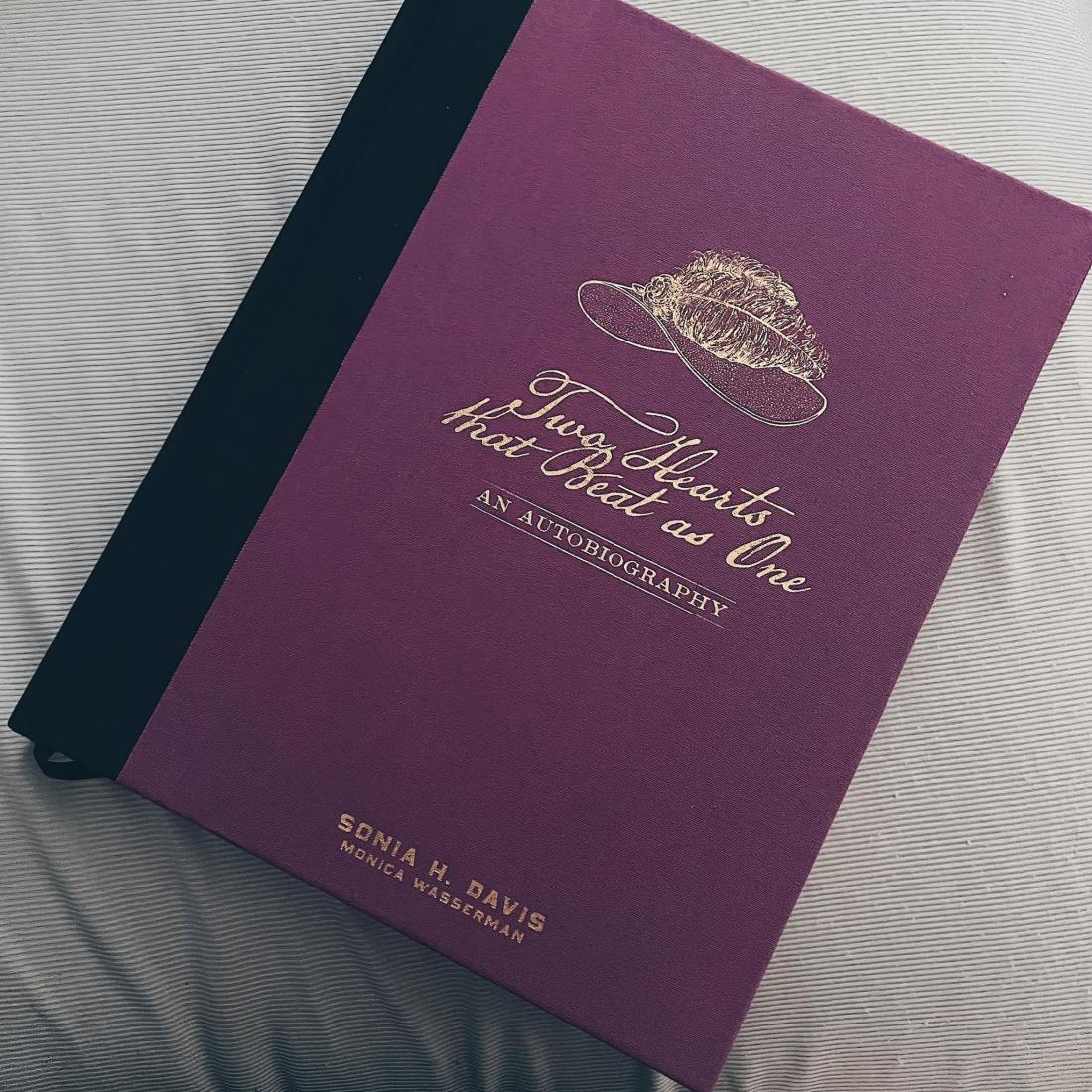
Everts’ article was the first really new information on Sonia H. Davis’ life and background available to fandom, and it must have derived from his communications with Sonia and her family. Later authors, like L. Sprague de Camp in Lovecraft: A Biography (1975), either Drew on Everts’ piece or similar sources when writing about her birth in what is now Ukraine, her parents, her early history as a young immigrant to the United Kingdom and then the United States, apprenticeship as a milliner, and all the events that led up to her marriage with Lovecraft and carried on afterwards. Everts, at least, had read Sonia’s autobiography in manuscript, later published as Two Hearts That Beat As One (2024), edited by Monica Wasserman.

Scholarship is not just the accumulation of evidence, the piling together of facts, the collection of books and manuscripts to cite and quote with uncritical acceptance. Today, we can compare Everts’ article with Sonia’s autobiography and other sources and conclude it is largely accurate. However, there is a lot that Everts doesn’t say in this short piece as well. Everts’ relationship with Sonia was not always completely friendly; Everts developed a negative reputation in fandom, partially covered in The Curse of Cthulhu (2002), whereby he alienated several fans by action or inaction, such as the failure to return a photograph of Robert E. Howard lent by Novalyne Price Ellis, accusations of other borrowings, etc. A photocopy of a letter from Everts to Sonia dated 24 Apr 1969 survives among the August Derleth papers at the Wisconsin Historical Society, which includes admission of borrowing material without permission, and responses to some allegations apparently levied against Everts by Sonia, though in that letter Everts states his intention to return everything and his belief that the true sources of the allegations are August Derleth and Muriel E. Eddy.

Which is a long way to say, we have to read this piece with the understanding that it is not Sonia H. Davis expressing herself directly to the reader, but is filtered and edited through Everts, and Everts does not include anything in the article that speaks to their possible contretemps.

From 1946 until about 1960, Sonia worked at various jobs – she broke her hip that year and had to go to live in a rest home in southern Los Angeles. In 1965, she was transferred to the Diana Lynn Lodge in Sunland, on the north rim of the San Fernando Valley, where she died just after Christmas of 1972.
—R. Alain Everts/ 21 January 1973
—R. Alain Everts, “Mrs. Howard Phillips Lovecraft” in Nyctalops #8 (Apr 1973), 45

“Mrs. Howard Phillips Lovecraft” has been superseded as a source of information about Sonia’s life by later works, the only really unique information in there concerns her relationship with Everts (which, again, not the whole story) and the end of her life. It holds a place in historical scholarship because when we ask how we know certain information and when did we know it, Everts’ article stands out as a point where new biographical information on Sonia became publicly available, where fans and scholars could read and cite it. The snapshot it offers of the end of Sonia’s life, with Everts as one of her few points of contact outside the rest home, is poignant but necessarily brief.

Yet it is also at this point that Everts takes a hand in shaping the narrative of Sonia and her marriage to Lovecraft. He would go on to create his own publishing imprint, The Strange Company, whose publications include material borrowed or copied from Sonia’s files, including Alcestis: A Play (1985) by Sonia H. Greene & H. P. Lovecraft. We can only speculate why Everts waited until after Sonia was dead; perhaps the money wasn’t there earlier, or life got in the way; such things happen. Sadly, his correspondence and interviews with Sonia have never been transcribed and published or made accessible, save in brief essays like “Mrs. Howard Phillips Lovecraft.”

Yet there was another essay on Sonia H. Davis published in 1973, and one that showcases a different approach to the same material. This was “Sonia & H. P. L.” by L. Sprague de Camp, one of the items in The Normal Lovecraft (1973, Gerry de la Ree), a magazine-sized chapbook published by fans for fans. To understand de Camp’s approach, we need to wind back a little:

For five years I had been writing short articles for [George] Scither’s Amra on authors of heroic fantasy, such as Pratt, Howard, and Lovecraft. In 1970 I decided to expand the series by rewriting these pieces as regular magazine articles and eventually to combine them into a book. The only market for the articles was the now defunct Fantastic Stories, which paid badly and often neglected to register copyrights. […] The book, Literary Swordsmen and Sorcerers, which resulted from these labors, was slow to become airborne. I tried a sample and synopsis on a prospective new agent; no results, so for a few years I put it aside. In 1974 I sold the book to Arkham House; it appeared in 1976 and is still in print. Meanwhile my book-length biography of Lovecraft had been published.
—L. Sprague de Camp, Time & Chance: An Autobiography, 366-367

The first biographical article on Lovecraft, “Eldritch Yankee Gentleman,” ran in two parts in Fantastic Stories August and October 1971; Sonia appears in the second part, which covers 1921-1937. For sources, de Camp leaned heavily (or exclusively) on Sonia’s memoir and Lovecraft’s letters at the John Hay Library in Providence, RI, where they had been deposited after Lovecraft’s death. There is no indication that de Camp contacted Sonia directly—and given the timing, this might be understandable; by the time de Camp got seriously into writing about Lovecraft, Sonia was in her twilight years, in a rest home in California, health declining. By the time de Camp decided to expand his biographical essay of Lovecraft into a full-blown book, Sonia was already dead.

So what did de Camp have to write about in “Sonia & H. P. L.” that wasn’t already published?

Five years later, Lovecraft wrote Derleth: “My one venture into matrimony ended in the divorce-court for reasons 98 per cent financial”. This ignores other weighty factors, such as his topomania (his fantastic attachment to Providence), his xenophobia, and his strong anti-sexual bias, which he probably got from his mother and which made him at best a tepid and half-unwilling lover.
—L. Sprague de Camp, “Sonia & H. P. L.” in The Normal Lovecraft 25

It would be fair to say that de Camp was correlating the contents; he could take Sonia’s memoir, combine that material with Lovecraft’s letters, and use the ideas from Winfield Townley Scott’s biographical essay as a framework to build his own image of Lovecraft, Sonia, and their relationship. When de Camp sticks to just the facts, this has the overall benefit of combining Sonia and Lovecraft’s different perspectives of the marriage and relationship; however, whenever de Camp gets into analysis, his own biases show through more strongly:

Lovecraft never pretended to be other than he was. Sonia had taken the initiative in their courtship, although he had tried to warn her of what she was getting into. And if the episode left him looking hardly heroic, he would not have looked much more so, according to the mores of the time, if he had gone on letting Sonia support him.

Over the next few years, Lovecraft and Sonia visited each other every times. Although Sonia was a full-blooded woman, Lovecraft declined to renew martial relations. For reasons that we can guess at but cannot really know, he let his maternal tabu against sex prevail, even though it would have been perfectly legal and moral. Although his organs and instincts, as far as is known, were normal, he had been early inclucated with the ideas that sex was “sordid” and “bestial”. Young persons might be subject to irrepressible animal urges, but middle-aged persons like himself and Sonia ought to be “all though” with it. (To him, middle age began at thirty.)

Then came the divorce and Sonia’s move to California. Poor strenuous, generous, passionate, managerial, loving Sonia! The moral would seem to be: girls, don’t marry a man with the ideas of “making a man of him” or otherwise drastically changing him. It won’t work.
—L. Sprague de Camp, “Sonia & H. P. L.” in The Normal Lovecraft 27

This was the kind of psychologizing that de Camp would receive considerable criticism for when Lovecraft: A Biography (1975) came out, but more than that, there’s a great deal of rampant speculation and characterization on de Camp’s part in those few paragraphs. It was Winfield Townley Scott who had first emphasized that Lovecraft’s relationship with his mother was unhealthy and speculated on Lovecraft’s sexuality, on fairly weak evidence, and de Camp doubled down on both ideas.

The characterization of Sonia as “a full-blooded woman” was a counterpoint to that; de Camp built her up as a sexual entity in opposition to Lovecraft’s apparent asexuality. In this, de Camp was not alone—August Derleth had famously cornered Sonia in 1953 and asked about her sex life with Lovecraft. As he put it:

A propos your piece on Lovecraft, the question of HPL and sex had been bothering me for some time, especially in view of his violent reaction against Oscar Wilde as a person, however much he admired his work; so in 1953 when I was in Los Angeles, I asked Sonia Davis—the ex-Mrs. Lovecraft—rather bluntly about HPL’s sexual adequacy. She assured me that he had been entirely adequate sexually, and since she impressed me as a well-sexed woman, not easily satisfied, I concluded that HPL’s “aversion” was very probably nothing more than a kind of puritanism—that is, it was something “gentlemen” didn’t discuss, and so on.
—August Derleth, Haunted vol. 1, no. 3 (June 1968), 114.

This interest in Sonia and Lovecraft’s sexual life can be seen in the historical context of the Lavender Scare as an effort on the part of some scholars to establish Lovecraft as heterosexual; Sonia’s confirmation of heterosexual relations would help immensely in that regard. De Camp would bring up the possibility of Lovecraft as a closeted homosexual in Lovecraft: A Biography (Derleth was, at the time of its publication dead and thus past the ability to protest). Both de Camp and Derleth seemed fixated on the idea of Sonia as sexually aggressive, though never to the point of suggesting she was promiscuous, and make this part of their characterization.

When de Camp did finally write Lovecraft: A Biography, he had more to say about Sonia than he did in “Sonia & H. P. L.”; the bibliography includes both Everts’ “Mrs. Howard Phillips Lovecraft,” Derleth’s letter in Haunted, and “Misc. unpublished autobiographical MSS. in the John Hay Library” (479), in addition to Sonia’s memoir and Memories of Lovecraft (1969). Yet it is easy to see how, in 1973, not long after Sonia H. Davis passed away, her memory was already being shaped and fitted to the purpose of would-be Lovecraft biographers, her words selectively used to convey the impression they wished to give rather than presented unaltered.


Bobby Derie is the author of Weird Talers: Essays on Robert E. Howard and Others and Sex and the Cthulhu Mythos.

Deep Cuts in a Lovecraftian Vein uses Amazon Associate links. As an Amazon Associate I earn from qualifying purchases.
“Lovecraft’s Marriage and Divorce” (1968) by Muriel E. Eddy

Of his marriage to Sonia Greene, not too much is known. He visited us the night prior to his departure for New York, to advise us that he was saying goodbye to Providence, and asking us if we would accept some of the personal furniture he would no longer have any use for. He made no mention at all of his forthcoming marriage. One of these pieces of furniture was a marble-topped bureau, which we still have—another was a folding bed, gone with the years. Both were delivered to us by an expressman the next day.

[…218] The next news we have of Lovecraft was an engraved announcement of his marriage to Sonia Greene. It was a simple announcement, but it took us so completely by surprise that it was several hours before we thoroughly digested the news. The marriage, destined to be short-lived, took place in New York in the spring of 1924. Lovecraft sent us snapshots of himself and Sonia—now dimmed with the passing of the years—and in letters to us he never forget to include “Sonia sends he love, and hopes some day to meet you.” In the snapshots, Sonia Greene Lovecraft appeared as a tall, handsome woman, dark and stately. […]

At least one weird story by Sonia appeared in Weird Tales, bearing signs of Lovecraft’s unmistakable revision, and published when she was still Sonia Greene. If Sonia, too, was a writer, we anticipated a long and happy marriage, but such was not to be—after an interval of several months, during which letters from Lovecraft became few and far between, we began to receive postcards from Lovecraft bearing various postmarks, and we realized he had left New York and perhaps Sonia.
—Muriel E. Eddy, “Howard Phillips Lovecraft” in Ave Atque Vale 217, 218

One of the issues that arises from multiple memoirs by the same individual is that there are only so many memories to mine, so many impressions that can be conveyed before their small store of experiences of the deceased runs out. Muriel E. Eddy and her husband were friends and correspondents with Lovecraft (see: Her Letters To Lovecraft: Muriel E. Eddy), and she wrote fairly extensively about her encounters with Lovecraft in later years (see: Her Letters To August Derleth: Muriel E. Eddy, Deeper Cut: Muriel E. Eddy’s Selected Letters to the Editor, The Gentleman from Angell Street (2001) by Muriel E. Eddy & C. M. Eddy Jr.), even to speculative posthumous encounters (“Message in Stone” (1956) by Muriel E. Eddy). It should come to no surprise that a large part of her reminiscences over the years cover many of the same memories, the same impressions.

Yet the essay titled “Lovecraft’s Marriage and Divorce,” which ran in the fanzine Haunted vol. 1, no. 3 (June 1968) is a bit peculiar, if only because the one aspect of Lovecraft’s life that Muriel did not know much about was his marriage. They knew him in Providence, R.I. before his 1924 marriage in New York, and resumed the acquaintence after he returned to Providence in 1926, but had little or no contact with his wife (and then ex-wife) Sonia until some decades later. And perhaps that is what inspired this piece.

I had not heard from the former Sonia Greene Lovecraft for many years. In the Fall of 1967, she wrote to me, after August Derleth had published some of my husband’s work. Sonia told me about the happy marriage she had enjoyed with Dr. Nathaniel A. Davis for many years. Sonia said he had been an M.D., a PH.D., anthropologist, scientist, poet, artist, writer and lecturer.

At the time Sonia wrote she was in a nursing home in California because of a broken hip. She told me that she read poetry to other patients in the nursing home. She was in good spirits and said she was glad to still be mentally alert.

—Muriel E. Eddy, The Gentleman From Angell Street 29

The brief essay that results is a bit of a mish-mash, combining selected memories of Lovecraft mingled with details borrowed from Sonia’s memoir The Private Life of H. P. Lovecraft (1985) by Sonia H. Davis, then out-of-print, and a healthy dose of Muriel’s own speculation.

Lovecraft’s Marriage and Divorce
by Muriel E. Eddy

“Here, have some sweet chocolate. I buy it—broken up, much cheaper—down at the dime store. There’s lots of nourishment in chocolate! Chocolate and cheese, crackers and pears—and ice-cream when I can afford it—this is about all I require when I’m deep in the throes of writing!”

It was our dear friend, Howard Phillips Lovecraft, speaking, and the place was our humble little gas-lit kitchen, way back in the year 1923, on Furnace Street, in the Fox Point section of Providence. He had arrived at midnight, with a big sack of his beloved sweet chocolate and a brief-case of manuscripts under his arm…manuscripts to read aloud to us!

That was the never-to-be-forgotten night when he announced to use the fact that he was bound for New York on the morrow, to marry Sonia Greene, a writer whom he had helped sell some stories…a Jewish divorcée with a pretty face, a charming manner, and what he considered to be a genuine love for him.

His brown eyes looked misty with dreams as he recounted her many charms. he’d never expected any woman to want him, but according to her letters Sonia REALLY wanted him. Later, my children got many postcards to play with, which she had penned affectionately to him; and now wonder he thought she loved him—every other word was a “love-declaration!”

A long, long manuscript, entitled “A Magician Among the Pyramids,” which he had ghost-written for the late Harry Houdini, master magician, was all typed and in his pocket to go to New York with him. Unfortunately, he lost it, the next day, in the Union Station, while awaiting his New York train. He had fallen asleep while re-reading the typed manuscript, in the waiting-room, and that is why it fell to the floor and was lost. Evidently it was swept up by the station janitor and was destroyed. So part of HPL’s honeymoon was spent in re-typing the original manuscript, which, fortunately, he had in his suitcase. Some honeymoon!

I wish I could say that this marriage was a perfect union of souls; but oh, it wasn’t…not at all. Sonia failed to understand why this poetic soul could not thoroughly commercialize his talents. Little by little came the rift in the lute…that makes sweet music mute!

The divorce was touching to us, because we loved this man and understood his heartbreak at what he considered his failure to make Sonia happy. But it was Howard’s wonderful gentlemanly Spirit that made him marry Sonia in the first place. He couldn’t say “no” because he was a gentleman!

Haunted vol. 1, no. 3 (June 1968), 86, 93

From a scholarly point of view, there’s not a lot here. The bit about Lovecraft and the broken choclate appears elsewhere in Muriel Eddy’s memoirs, with greater detail (and possibly less putting-words-directly-in-Lovecraft’s-mouth). The incident of the lost manuscript for “Imprisoned with the Pharaohs” and typing it up (with Sonia’s assistance) during their honeymoon is covered in Sonia’s memoir and Lovecraft’s letters. The bit about the children and the postcards is another anecdote which Muriel covers in greater depth elsewhere:

Mrs. Gamwell also gave the children about a hundred picture postcards that Sonia had mailed to Howard. These all held  loving, spirited messages to H.P.L. from his sweetheart in New York. Not knowing their possible value in the far-away future, I did not hold on to any of these cards bearing Sonia’s signature, written in her breezy, happy handwriting. It was plain to be seen, from the messages on the cards, that this pretty woman of writing ability—among her other gifts—really liked H.P.L.! And the strange part of it all was that he had not once mentioned his love affair to us…and we were his very good friends.

The children played for hours with the cards, and they eventually went the way all children’s toys go…in the ash-heap!

—Muriel E. Eddy, The Gentleman From Angell Street 17

Given the lack of new facts or impressions, it is perhaps unsurprising that “Lovecraft’s Marriage and Divorce” was never reprinted. The main value it possessed at the time it was published was that there was relatively little information in print about Lovecraft’s marriage—there was no full biography of Lovecraft at that point, Sonia’s memoir was out of print, and the abridged letters of Lovecraft in Selected Letters I (1964) and II (1968) offered only limited insight into their relationship. This is a memoir that found a space largely because better sources were not widely available, and it shows.


Bobby Derie is the author of Weird Talers: Essays on Robert E. Howard and Others and Sex and the Cthulhu Mythos.

Deep Cuts in a Lovecraftian Vein uses Amazon Associate links. As an Amazon Associate I earn from qualifying purchases.
Two Hearts That Beat As One (2024) by Sonia H. Davis & Monica Wasserman (ed.)

In the small village of Itchno, which is on the outskirts of the town of Konotop, in the small Province of Chernigov, on the cold and wintry night of March 16, 1883, with the temperature several degrees below zero, an infant girl was born.
—Sonia H. Davis, Two Hearts That Beat As One (2024) 1

In February 2022, when the Russian Federation invaded Ukraine, I noted the news as the invaders moved through Konotop, the birthplace of Sonia H. Davis, who had once been Sonia H. Lovecraft. In 2019, when I prepared my notes for a panel at NecronomiCon on Lovecraft’s ex-wife, I had wondered if there were any records of her early life still there in the city. As the Russians overran the city, any hope I had of some original documents about Sonia or her family surviving to fill in the gaps in her early life faded.

It was mid-October 2022 when I got in touch with Monica Wasserman (The Papers of Sonia H. Davis), and to my surprise found there were better sources closer at hand than Konotop. We shared a common interest in the former Sonia H. Greene, who had become Mrs. Lovecraft. However, Monica’s dedication to the subject far outstripped mine. Her considerable research on Sonia’s life included access to the papers of Sonia and her third husband at Brown University, tracking down some of Sonia’s books and the extremely scarce second issue of The Rainbow, and scouring newspaper archives and genealogical databases. She even managed to access photographs of Sonia that had never been published, and contacted Sonia’s living relatives for family lore.

My own research was more modest, though complementary: while Monica had focused on her subject, I’d been focused on everything else around Sonia. I had been meticulously reading H. P. Lovecraft’s letters for references to Sonia, and had obtained access to other correspondence from or related to Sonia in various archives. Monica had unearthed the goods: I could offer a bit of context and insight from the Lovecraftian side of things. When Monica followed through on her project of actually publishing Sonia’s autobiography, unearthed from the archive and supplemented by additional autobiographical materials like The Private Life of H. P. Lovecraft (1985) by Sonia H. Davis, she was very gracious in allowing me to be a beta reader and to comment on it before publication. Because a few of my suggestions found their way into the final product, I’m listed as a contributor.

Which is a very long way to say, I’m biased when it comes to Two Hearts That Beat As One.

Most readers come to Sonia H. Davis as an adjunct to their interest in her second husband, H. P. Lovecraft. Her memoirs of their marriage shed light on a critical period of Lovecraft’s life, and fans and scholars alike sought her out for what she could give them about him. Yet that interest never manifested in any profitable form. Lovecraftian scholarship and publishing in the 1930s-early 1970s was almost entirely a small-scale endeavor, dominated by amateurs and small presses like Arkham House that sometimes seemed more labors of love than businesses that could produce actual revenue. There was no major biography of Lovecraft released during Sonia’s lifetime, though every major biography since has depended at least in part on her memoirs.

Pretty much no one seemed interested in Sonia’s own story. Until Monica Wasserman, that is.

Sonia’s autobiographical manuscript is, first and foremost, the story of her life. Born to Jewish parents in Ukraine (then a part of the Russian Empire), the loss of her father, her travels to the United Kingdom and then the United States, the new family her mother made, her need to work at a young age, marry at a young age, to become a mother, a successful businesswoman, an amateur journalist…long before she met Lovecraft, Sonia lived a life worth telling about. Her story is the story of many immigrants that came to the United States, living by her wits and the sweat of her brow, striving for education to better herself, dreaming of her own business and financial freedom, and yes, even of love.

While Sonia is very honest in her autobiography, there are things she doesn’t talk about very much. This is where Monica added footnotes, stitched-in material from The Private Life of H. P. Lovecraft and other autobiographical writings, to fill in some of the gaps. The result is more complete than just the individual works by themselves would be; the formatting by Helios is carefully done so it is easy to see at a glance when another text is “pasted-in,” and perhaps most importantly, in a way that preserves the intent of the book:

To tell Sonia’s story in her own words.

To appreciate Monica’s work, it is important to realize that Sonia desperately needed an editor. While some of her autobiographical writings proceed in a fairly linear manner, she had a tendency to hop around in time, or to put down sudden thoughts and recollections as they occurred to her, and there is much that might be forgotten (or omitted) when writing for a general audience decades later. We see little of her daughter, Florence Carol Greene, who grew up to be the journalist Carol Welde, for example, though we know their relationship was fraught and eventually irrevocably sundered. Endings seemed to be particularly difficult for Sonia; she struggled to wrap things up. The raw manuscripts aren’t unreadable, but they benefit immensely from someone taking the time and care to put them in order and to clarify a few obtuse points with cogent endnotes.

Monica put in the work so that the reader can access Sonia’s story more easily.

Two Hearts That Beat As One is, as of the moment it saw print, the definitive text on Sonia’s life. In a format accessible to both scholars and casual readers, it provides a unique glimpse into the life of a woman who suffered, strove, and finally achieved much of what she hoped for—love, a degree of economic comfort, and purpose—with her third husband, Nathaniel Davis. In time, old age would take this all away. All lives end, and the last chapters are rarely pleasant. Here, at last, Sonia is the star and subject of her own story, not a brief and shadowy chapter in H. P. Lovecraft’s.

After a successful crowdfunding campaign, Two Hearts That Beat As One is available both as a standard edition and a collector’s edition (with handsome slipcase). Helios House has made a beautiful, well-laid out project that does great service to Sonia’s text and Monica’s scholarship and hard work bringing this project together.


Bobby Derie is the author of Weird Talers: Essays on Robert E. Howard and Others and Sex and the Cthulhu Mythos.

Deep Cuts in a Lovecraftian Vein uses Amazon Associate links. As an Amazon Associate I earn from qualifying purchases.
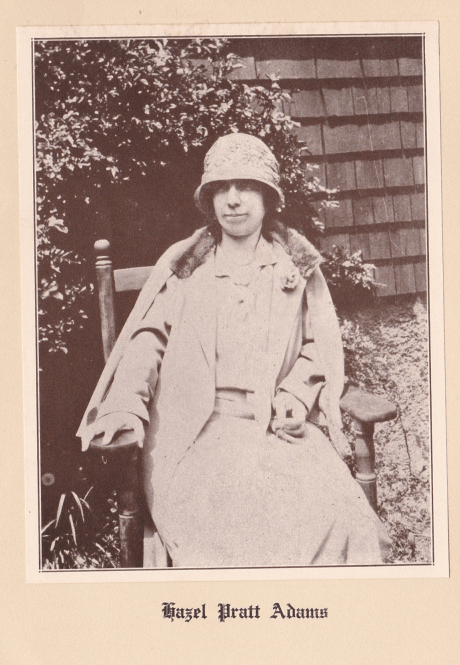
Her Letters To Lovecraft: Hazel Pratt Adams

A visit was also made to Eglin’s book store where Sam Loveman delighted all who had the privilege of becoming better acquainted with his magnetic personality. He was one of the most pleasing surprizes of the convention, and like Howard Lovecraft, despite his profound poetical effusions, is really quite human and intensely interesting.

Hazel Pratt Adams, “The National Convention” in The Brooklynite July 1923

She was born Hazel Bosler Pratt on 10 January 1888 in New York City; the middle child of Abram E. Pratt and Jeannette (also spelled Genette or Jannett in various census rolls) Bosler Pratt. Her early life is somewhat vague; census data indicates she was still living with her family through 1910, and her obituary claims:

Financial reverses made it necessary for her to enter business life at an early age, and she was first employed in different financial institutions of Brooklyn, later becoming secretary to George McLaughlin, who afterward became State Superintendent of Banks and Police Commissioner. She also did considerable newspaper and magazine work, including contributions to Brooklyn Life, over a pariod of many years […]

The 1910 Federal census lists her profession as stenographer, and that she was then working as a private secretary; a 1915 criminal trial of banker Edward M. Grout brought Hazel in as a witness, as she had worked as a stenographer for him in 1908, and a 1911 list of those who passed civil service exam for stenographers lists Hazel Pratt. From all this, we can gather that she was literate, competent, and professional.

What this obituary does not mention is her amateur journalism activity. While it isn’t entirely clear when Hazel joined amateur journalism, she was elected the inaugural Official Editor of the Brooklyn Amateur Journalists Club in 1908—which in 1912 would change its name to the Blue Pencil Club. Pratt would serve various roles in the Brooklyn club, including Secretary/Treasurer (1910), and the editor/publisher of the amateur journal The Brooklynite. In 1912, she was elected president of the newly-labeled Blue Pencil Club, and various newspaper articles indicate the club frequently met in her home. Her involvement also spread to other organizations; in 1911 she was listed as Eastern manuscript manager for the United Amateur Press Association, and in that same year attended a convention of the Interstate Press Association.

Hazel was presumably working as a stenographer during this time, and helping to care for his mother; her other interests are unknown, although a 1912 letter to the editor on the subject of women’s suffrage suggests she was forward-looking and politically conscious.

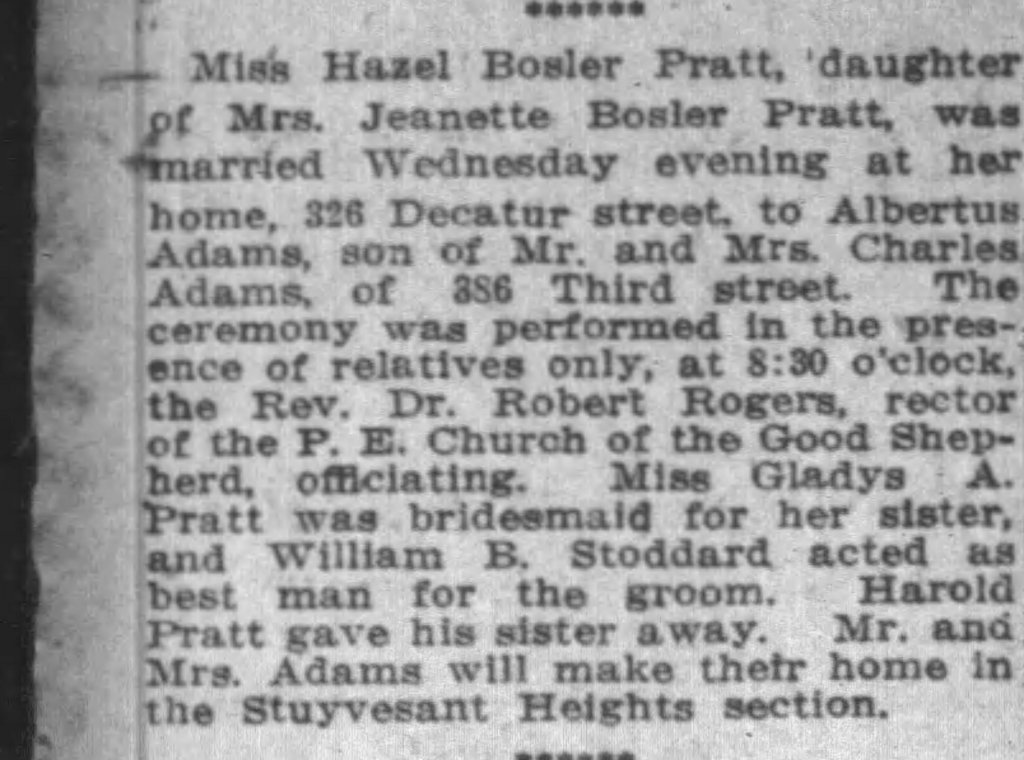
In 1914, Albertus Milton (A. M.) Adams (1879-1952) was elected President of the Blue Pencil Club, with Hazel Pratt Adams as the secretary and treasurer. A. M. Adams was the editor of the National Hotel Review, and with Hazel’s work in newspapers and magazines as well as amateur journalism, they seem to have shared interests in literature. By the end of the year, they were married.

So it was that when H. P. Lovecraft joined amateur journalism in 1914, he would likely have known her only as Hazel Pratt Adams. His first mention of her is from around this time:

Mrs. Adams’ essay on ghosts displays considerable literary knowledge, though the anecdote at the end is rather ancient for use today. We last heard it about ten years ago, with a Scotchman instead of a negro preacher as the narrator, and with the word “miracle” instead of “phenomena” as the subject.

H. P. Lovecraft, “Department of Public Criticism” (United Amateur Mar 1915), Collected Essays 1.23

Married life must have been interesting. In 1916, the Adamses bought the Tupper Lake Herald, a local newspaper for Tupper Lake, N.Y., and ran it for three years. Two sons were born to the marriage, Raymond Pratt Adams (5 Sep 1917-19 Dec 2010) and Charles LeRoy Adams (7 May 1920-9 Jan 1996), and Hazel continued her involvement in amateur journalism. In 1916, Hazel was named the Official Editor of the National Amateur Press Association.

In 1922, William B. Dowdell was elected as president of the National Amateur Press Association. Dowdell subsequently resigned, and H. P. Lovecraft filled out the remainder of his term. During his time in office, Hazel Pratt Adams impressed Lovecraft with her dedication to quality and leadership:

To stimulate more publishing, which we need so desperately, Mrs. Hazel Pratt Adams has unselfishly offered to assume complete charge of the issuance of any paper which any member may care to publish, attending in full to the arrangement, printing, addressing, and mailing, at a charge of only $20 for eight pages or $12.50 for four pages the size of the recent Brooklynite. This opportunity is so marvellously favourable, and so easy for even the newcomer, that we see no excuse for the lack of a striking revival of individual publishing.

H. P. Lovecraft, “President’s Message” (National Amateur Mar 1923), Collected Essays 1.325

When the next election loomed in 1923, Lovecraft wanted someone else—ideally someone ideologically in line with his vision for the organization, in terms of supporting high literary and print quality, even at the sacrifice of frequency—to lead the organization. The candidate settled on was Hazel Pratt Adams.

Concerning that other dark shadow, whose bat-wings flapped so menacingly above the bright lights of that elegant dining saloon where I was so mercilessly grilled, I am half convinced that the fates have saved me by giving to Mrs. A. an unalterable resolution to continue her candidacy. At least, I received from her an epistle wherein, besides a two-buck checque for the O.O. fund, was distinct mention of a campaign requiring money, & of a prospective Adams-and-Liberty journal to be intitul’d The Campaigner.

So, as Ya-know-me-Al would put it—that’s that! If Mme. Eve & Bro. Mortonius choose to alter their deep-laid designs, I suppose I can’t help myself; but just now it looks as though they were sailing ahead in fine shape, so that Fortuna will spare a victim whose (semi-)willingness to mount the scaffold hath been so conclusively demonstrated. But even so, I hardly look for utter chaos. Something’s been started, & if the ball is well rolling by the nones of Quintilis it will surely have enough momentum to keep on a while. It’ll take a full year to wipe Mike White off the map—& you can be sure Long & Galpin won’t still till that’s done! Still—me word is gave, & if the Adams-Morton move is changed, I stand ready for the axe.

H. P. Lovecraft to Edward H. Cole, 23 Feb [1923], Letters to Alfred Galpin & Others 42-43

I find that J. Ferd. [Morton] is completely & finally committed to the Adams candidacy, & that any other move would now be a positive act of hostility toward him. He is too far committed to withdraw without seeming traitorous to the Adams cause; a cause which he embraced because he knew how abhorrent office-holding is to me. […] [45] However, as I said before, I believe that the Adams arrangement will agreeably surprise you. Mrs. A. is certainly a capable routine administrator, & Morton assures me that he stands firmly in the background as an inspiration & intellectual influence . . . . . not that he uses those words, which from him would be less becoming than from another! He will continue whatever policy is started this term—& Mrs. Adams is heartily ready to act as a sympathetic standard-bearer.

H. P. Lovecraft to Edward H. Cole, 24 Feb [1923], Letters to Alfred Galpin & Others 44, 45

“Mme. Eve” was apparently Lovecraft’s nickname for Hazel—because she was the wife of Adam(s). As puns go, it isn’t very good, but a ticket with Hazel Pratt Adams and James F. Morton was a strong one. Cole, apparently, was not happy about this nomination, and had wanted Lovecraft to run.

About the Cole mess—I’d better curl up with a bottle of cyanide & get it over with before I do any more harm to myself and others. Bah. Probably I’ve incurred his undying coldness—he hasn’t answered that definitively declinatory epistle yet—and now Mrs. Adams writes that he’ll probably be peeved at her! Undertaker, put a good shot of embalming fluid in the old simp’s head—it’s been dead a long time. Tell Mrs. A.—though I’ll answer her myself in a day or two—that I’ll take all the Colic blame myself & exculpate her, & you, & everybody but poor me—in toto. He might as well be damn mad at one guy as half mat at several birds.

H. P. Lovecraft to James F. Morton, 1 Mar 1923, Letters to James F. Morton 26-27

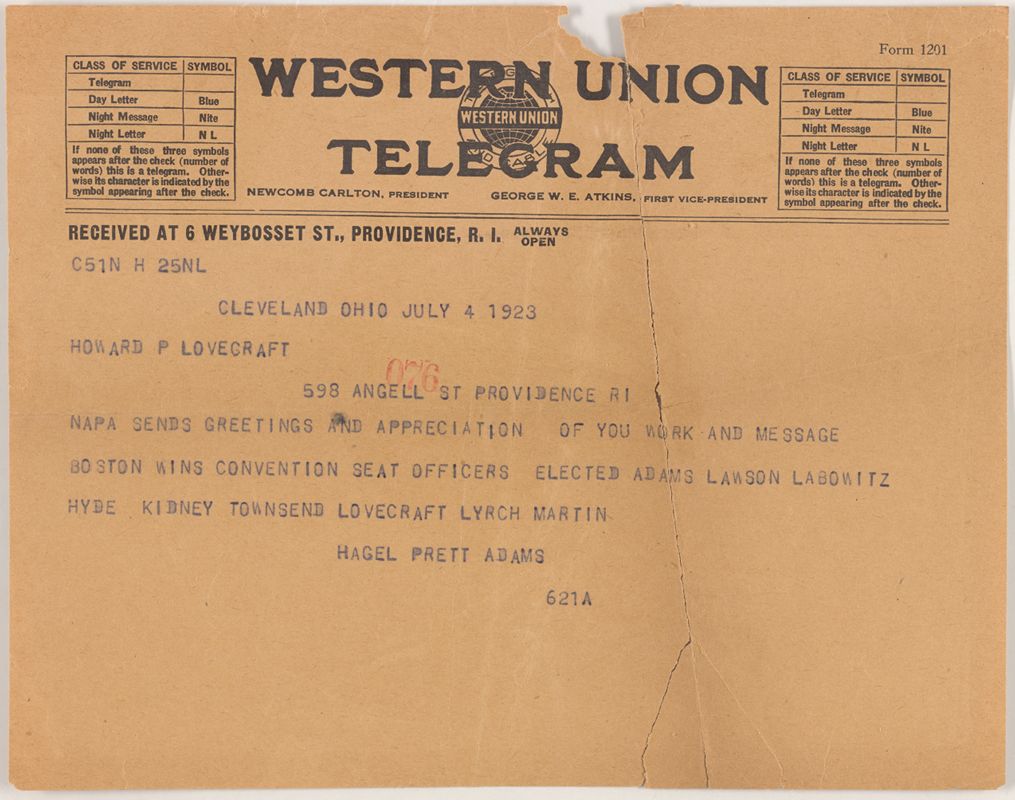
“Her epistle” suggests that Lovecraft and Hazel Pratt Adams were in correspondence by this time; when and how this started it is not clear, but presumably came about through his NAPA presidency, if not before. As it happened, with the support of Lovecraft and Morton, Hazel Pratt Adams was elected almost unanimously as the 4th woman president of the National Amateur Press Association. From the convention, she sent Lovecraft a telegram:

It was apparently not an easy time for her:

President Adams labored under serious difficulties, personal and otherwise. Throughout her entire term illness in her family added to her burdens. But she set an excellent example of activity by publishing 15 papers, and although the institution was entering upon one of its periodical times of depression, she maintained the high standard of work established by her predecessor.

The Fossils: History of the National Amateur Press Association

Lovecraft, for his part, was busy with his other things. On 3 March 1924, Lovecraft married Sonia H. Greene in New York; the couple set up their household in Brooklyn. Among their first visitors was Hazel Pratt Adams:

We had our first callers yesterday—Mrs. Adams of Plainfield, N.J., and Mrs. Myers of Cambridge, who is visiting Mrs. Adams before sailing for Paris for six months. They seemed very favourably impressed with the new household, and S.H. assures me that I did not appear altogether ridiculous as a host.

H. P. Lovecraft to Lillian D. Clark, 18 Mar 1924, Letters to Family and Family Friends 1.115

Sonia had been a member of the Blue Pencil Club, and almost assuredly was already friends with Mrs. Adams; it isn’t clear if this is the first time Lovecraft met Adams in person, or if they had met at an earlier convention, or Lovecraft’s prior trip to New York. In any event, it was the newlywed’s first time receiving callers as a couple.

Lovecraft apparently continued to correspond with Hazel Pratt Adams through at least 1925, because “The Horror at Red Hook” was composed on the backs of a letter dated 13 November 1925 (Midnight Rambles 225n78). The text of this letter has not yet been printed, and no other letters from the Hazel Pratt Adams/H. P. Lovecraft correspondence are known to survive.

Hazler Bosler Pratt Adams died on 6 August 1927. The cause of her death was not recorded in her obituary.

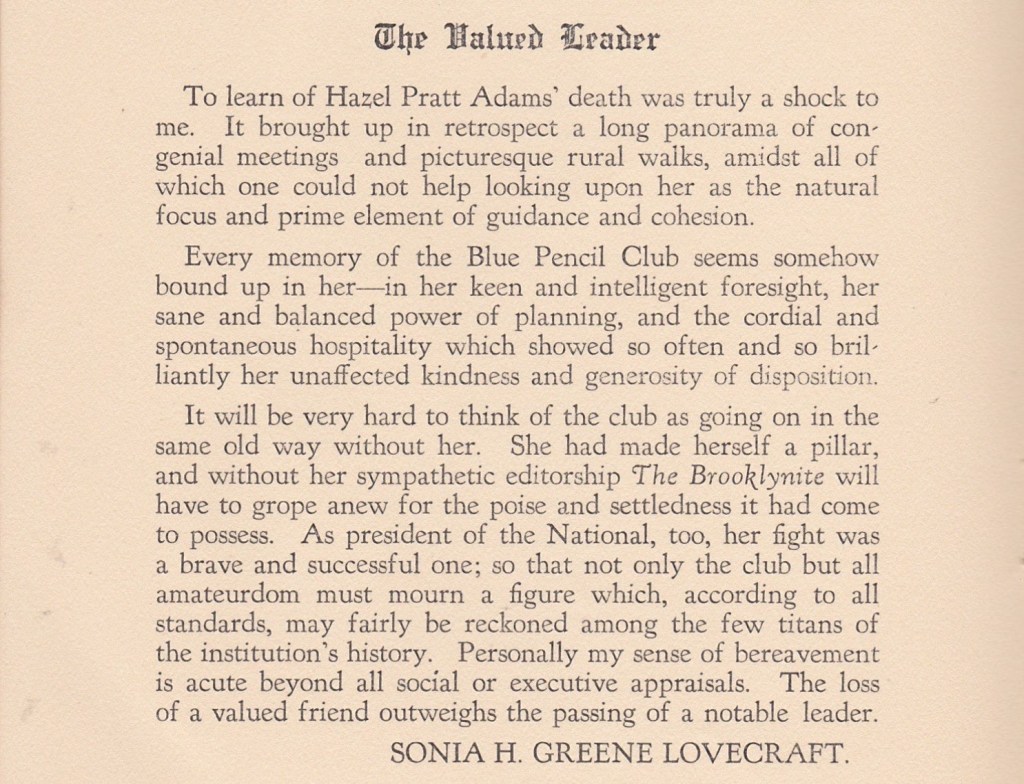
The Blue Pencil Club arranged the publication of In Memoriam: Hazel Pratt Adams. Sonia and Howard Lovecraft both penned tributes to their friend:

Source: The Papers of Sonia H. Davis, by Monica Wasserman

With such scanty evidence, it is difficult to say anything for certain about the friendship and correspondence of Hazel Pratt Adams and H. P. Lovecraft, except that they did correspond, and they were friends. They shared friends and interests in common, and wrote well (if sparingly) of one another. What else they might have talked about, we may never know, unless some new cache of letters turns up.

Thanks and appreciation to Monica Wasserman for her help with this piece.


Bobby Derie is the author of Weird Talers: Essays on Robert E. Howard and Others and Sex and the Cthulhu Mythos.

Deep Cuts in a Lovecraftian Vein uses Amazon Associate links. As an Amazon Associate I earn from qualifying purchases.
Her Letters To Lovecraft: Christmas Greetings

H. P. Lovecraft spent most of his adult life in genteel poverty, slowly diminishing the modest inheritance that had come down to him from his parents and grandparents. He had no cash to spare on expensive gifts for his many friends and loved ones. So Lovecraft was generous with what he had—time, energy, and creativity. While not religious or given to mawkish displays, when it came to Christmas, Lovecraft poured his time and energies into writing small verses to his many correspondents, a body of poems collectively known as his “Christmas Greetings.”

Yesterday I wrote fifty Christmas cards—stamping & mailing them before midnight. Only a few, of course, had verses—& these were all brief and not brilliant.

H. P. Lovecraft to Lillian D. Clark, 23 December 1925, Letters to Family & Family Friends 1.511

Most of these verses do not survive. They would have been written on cheap Christmas cards, which were seldom preserved. Those that survive are mostly attested in drafts that survive among Lovecraft’s papers, or more rarely in a letter where he copied a few verses to share with someone else (LFF 1.511-515). Most of them are not pro forma verses, the same rhyme copied for each recipient, but are uniquely tailored for their recipient, a reflection of their shared history and correspondence with Lovecraft.

In looking at Lovecraft’s Christmas Greetings to his women correspondents, we catch a glimpse at Lovecraft’s thoughtfulness. Their response, unfortunately, is often lost to us; though some few of them certainly responded in kind. We know Elizabeth Toldridge, for example, wrote her own Christmas poems to Lovecraft, because at least one survives.


To Lillian D. Clark

Enclos’d you’ll find, if nothing fly astray,

Cheer in profusion for your Christmas Day;

Yet will that cheer redound no less to me,

For where these greetings go, my heart shall be!

The Ancient Track 330

Six poems to Lovecraft’s elder aunt survive. Probably he began writing these to her as a child. Probably too this was one of the later verses, when an adult Lovecraft spent Christmases in New York, and his Christmas greetings would be sent by mail instead of delivered by hand. Though Lovecraft might travel as widely as his finances permitted, and visit friends far away, yet his heart was ever in Providence, Rhode Island—and his family there.

To Mary Faye Durr

Behold a wretch with scanty credit,—

An editor who does not edit—

But if thou seek’st a knave to hiss,

Change cars—he lives in Elroy, Wis.!

The Ancient Track 314-315

One poem survives to Mary Faye Durr, president of the United Amateur Press Association for the 1919-1920 term, and refers to amateur journalism affairs. The “knave” in this case was E.E. Ericson of Elroy, Wisconsin, who was the Official Printer for the United.

To Mr. and Mrs. C. M. Eddy, Jr.

Behold a pleasure and a guide

To light the letter’d path you’re treading;

Achievements with your own allied,

But each the beams of polish shedding.

Here masters rove with easy pace,

Open to all who care to spy them,

And if you copy well their grace,

I vow, you’ll catch up and go by them!

The Ancient Track 328

One poem survives to the Eddys. They were friends from Providence before Lovecraft eloped to New York in 1924, and Lovecraft would revise or collaborate with Clifford Martin Eddy, Jr., and his wife Muriel E. Eddy would write several memoirs of Lovecraft in later years, chiefly The Gentleman from Angell Street (2001). While it isn’t certain, this letter probably refers to C. M. Eddy, Jr.’s efforts to embark on a career as a writer (“the letter’d path”).

To Annie E. P. Gamwell

No false address is this with which I start,

Since the lines come directly from my heart.

Would that the rest of me were hov’ring night

That spot where my soul rose, and where ’twill die.

But since geography has scatter’d roung

That empty shell which still stalks on the ground,

To Brooklyn’s shores I’ll waft a firm command,

And lay a duty on the dull right hand:

“Hand,” I will broadcast, as my soul’s eyes look

O’er roofs of Maynard, Gowdy, Greene, and Cook,

Past Banigan’s toward Seekonk’s red-bridg’d brook,

“To daughter Anne a Yuletide greeting scrawl

Where’er her footsteps may have chanc’d to fall,

And bid her keep my blessings clear in view

In Providence, Daytona, or Peru!”

The Ancient Track 327

Five poems survive to Lovecraft’s younger aunt, of which this is the longest—a Christmas greeting sent from New York, because Lovecraft was not in Providence to spend Christmas with her. The reference to “Daytona” references Anne Gamwell’s own trips to Florida.

To Sonia H. Green

Once more the greens and holly grow

Against the (figurative) snow

To make the Yuletide cheer;

Whilst as of old the aged quill

Moves in connubial fondness still,

And quavers, “Yes, My Dear!”

May Santa, wheresoe’er he find

Thy roving footsteps now inclin’d,

His choicest boons impart;

Old Theobald, tho’ his purse be bare,

Makes haste to proffer, as his share,

Affection from the heart.

The Ancient Track 326-327

Four poems to Sonia H. Greene, who in 1924 became Lovecraft’s wife, survive. This one dates from after their marriage, but during a period when they were separated and unable to have Christmas together (“Thy roving footsteps now inclin’d”). Broke (“his purse be bare”), Lovecraft offers the only thing to Sonia he can: his love.

To Alice M. Hamlet

May Christmas bring such pleasing boons

As trolldom scarce can shew;

More potent than the Elf-King’s runes

Or Erl of long ago!

And sure, the least of Santa’s spells

Dwarfs all of poor Ziroonderel’s!

The Ancient Track 326

Three poems to Lovecraft’s fellow-amateur journalist Alice M. Hamlet survive. She is best-known for introducing H. P. Lovecraft to the works of Lord Dunsany, and this Christmas Greeting contains explicit references to Dunsany’s novel The King of Elfland’s Daughter (1924), such as the witch Ziroonderel and the land of Erl—and there is a slight joke comparing Santa in this context, as Clement Clarke Moore had famously described him as “a right jolly old elf” in “A Visit from St. Nicholas” (1823).

To Winifred Virginia Jackson

Inferior worth here hails with limping song

The new-crown’d Monarch of Aonia’s throng;

And sends in couplets weak and paralytick,

The Yuletide greetings of a crusty critick!

The Ancient Track 317

Two poems to Winifred Virginia Jackson, Lovecraft’s fellow amateur-journalism and literary collaborator, survive. The Aonian was an amateur journal, while Lovecraft was serving as head of the department of public criticism.

To Myrta Alice Little

Tho’ Christmas to the stupid pious throng,

These are the hours of Saturn’s pagan song;

When in the greens that hang on ev’ry door

We see the spring that lies so far before.

The Ancient Track 317

Not every Christmas Greeting was unique; in some cases Lovecraft sent identical (or near-identical) verses to multiple correspondents. So for Myrta Alice Little only one Christmas greeting survives, which was also sent to Winifred Virginia Jackson, Verna McGeoch, and Alfred Galpin—and the sentiments echo the opening to “The Festival,” where Lovecraft is less interested in the Christian ideology than the pagan roots of the holiday.

To Sarah Susan Lovecraft

May these dull verses for thy Christmastide

An added ray of cheerfulness provide,

For tho’ in art they take an humble place,

Their message is not measur’d by their grace.

As on this day of cold the turning sun

Hath in the sky his northward course begun,

So may this season’s trials hold for thee

The latent fount of bright futurity!

Yr aff. son & obt Servt., H.P. L., The Ancient Track 311

One Christmas poem to Lovecraft’s mother survives, though there are other examples of poetry he wrote to her on other occasions. These were likely some of his earliest Christmas Greetings, written during childhood and early adulthood, until his mother’s passing in 1921.

To Verna McGeoch

Tho’ late I vow’d no more to rhyme,

The Yuletide season wakes my quill;

So to a fairer, flowing clime

An ice-bound scribbler sends good will.

The Ancient Track 314

Two poems survive to Verna McGeoch, who was Official Editor of the United Amateur Press Association during Lovecraft’s term as president (1917-1918). The 1920 census shows McGeoch lived in St. Petersburg, Florida (“a fairer, flowing clime”), while Lovecraft froze in Providence. We know this poem was sent before 1921, because in the autumn of that year, Verna married James Chauncey Murch of Pennsylvania, and thus became Mrs. Murch and moved to that state.

To S. Lilian McMullen

To poetry’s home the bard would fain convey

The brightest wishes of a festal day;

Yet fears they’ll seem, so lowly is the giver,

Coals to Newcastle; water to the river!

The Ancient Track 318

One poem to Susan Lilian McMullen survives; she also published poetry under the pseudonym Lilian Middleton. A prominent poet in amateur journalism, Lovecraft wrote an essay praising her work, “The Poetry of Lilian Middleton” (CE 2.51-56), which would not be published during his lifetime. The two met at a gathering of amateurs in 1921. Their relations appear to have been cordial, though tempered by some of his criticisms of her poetry, and their correspondence was likely slight.

To Edith Miniter

From distant churchyards hear a Yuletide groan

As ghoulish Goodguile heaves his heaps of bone;

Each ancient slab the festive holly wears,

And all the worms disclaim their earthly cares:

Mayst thou, ‘neight sprightlier skies, no less rejoice,

And hail the season with exulting voice!

The Ancient Track 320

Five Christmas poems survive from Lovecraft to Edith Miniter, the grand dame of Boston’s amateur journalists. Miniter, among all of Lovecraft’s correspondents and fellow amateurs, was able and willing to take the piss a little with him, and wrote the first Lovecraftian parody, “Falco Ossifracus” (1921)—hence Lovecraft’s adoption of her nickname “Goodguile” for him.

To Anne Tillery Renshaw

Madam, accept a halting lay

That fain would cheer thy Christmas Day;

But fancy not the bard’s good will

Is as uncertain as his quill!

From the Copy-Reviser, The Ancient Track 311

Two poems survive to Anne Tillery Renshaw, teacher, editor, and amateur journalist. Lovecraft’s sign-off as “the Copy-Reviser” suggests their positions in amateur journalism at that time; Lovecraft had a tendency to correct metrical irregularities in poems of amateur journals he edited, and sometimes worked to revise the poetry of others. A Christmas card from Renshaw to Lovecraft survives.

To Laurie A. Sawyer

As Christmas snows (as yet a poet’s trope)

Call back one’s bygone days of youth and hope,

Four metrick lines I send—they’re quite enough—

Tho’ once I fancy’d I could write the stuff!

The Ancient Track 316

A single poem survives to amateur journalist Laurie A. Sawyer, whom Lovecraft described as “Amateurdom’s premier humourist” (CE 1.258). Sawyer was also president of the Interstate Amateur Press Association in 1909, and a leading figure of the Hub Club in Boston, moving in the same circles as Edith Miniter. She is known to have met Lovecraft at amateur conventions in Boston, and she helped issue the Edith Miniter memorial issue of The Tryout (Sep 1934).

To L. Evelyn Schump

May Yuletide bless the town of snow

Where Mormons lead their tangled lives;

And may the light of promise glow

On each grave cit and all his wives.

The Ancient Track 316

A single poem survives to amateur journalist and poet L. Evelyn Schump. She graduated from Ohio State University in 1915 and apparently took up the teaching profession in Ohio. The Church of Latter-Day Saints was established in Kirkland, Ohio during the 1830s until major schisms rent the church, whose members moved on to Missouri. Presumably there is some correspondence, now lost, behind this reference. Given how lightly Lovecraft touches on the issue of polygamy (officially rescinded in 1904), it isn’t likely she was a member of the congregation. As an amateur journalist, Lovecraft called her “a light essayist of unusual power and grace” (CE 1.224).


There are undoubtedly many Christmas Greetings that have been lost over the years, and what remains is little more than a sample of the whole. Yet it is clear that Lovecraft put his time and effort into crafting these verses, no matter how slight or silly, and even if he could afford no more than a card and a stamp, perhaps they spread a little cheer on long winter nights.


Bobby Derie is the author of Weird Talers: Essays on Robert E. Howard and Others and Sex and the Cthulhu Mythos.

Deep Cuts in a Lovecraftian Vein uses Amazon Associate links. As an Amazon Associate I earn from qualifying purchases.
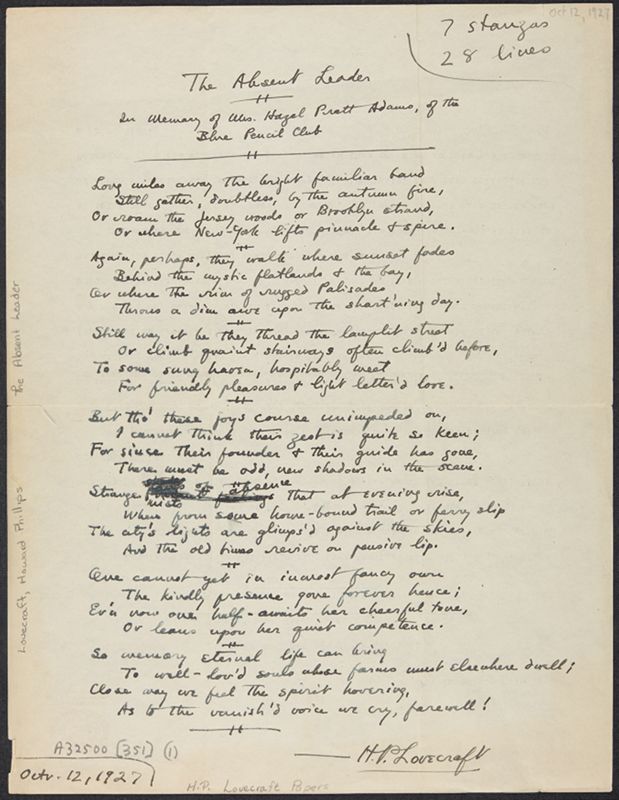
“Wife to Mr. Lovecraft” (2017) by Lucy Sussex

Dear How,

I meant to write Howard, but got interrupted, as happens. When I came back ‘How’ looked just fine on the page. it summed us up. Like: How did we ever get married? Blame the words, what we said and wrote to each other, the only thing we had in common. How did we ever think we would work it out? Those words again, mixed with pure blind optimism. How did we part? Without pain, as it should be.

I meant to write you before my news, but time just runs away sometimes. You did file the divorce papers? [crossed through]. I am now Mrs Doctor Nathaniel Davis.

Lucy Sussex, “Wife to Mr. Lovecraft” in Cthulhu Deep Down Under Vol. 1 (2017), 51

She was born Sonia Haft Shafirkin to a Jewish couple in 1883 in the Russian Empire, modern-day Ukraine. At the age of 7, she immigrated to the United States of America. At age 16, she married another immigrant, Samuel Seckendorff, who changed his last name to Greene. By 1920 she was divorced, her first husband dead; she had given birth to a daughter and a son, the latter who died in infancy. Skill and hard work brought her success in her business, and amateur journalism had become a hobby and a way to improve her mind. In 1921, Sonia H. Greene met H. P. Lovecraft at an amateur journalist convention in Boston. Contact sparked correspondence, further meetings, collaboration on stories and amateur journals, and then, in 1924, she married again.

The Lovecrafts’ marriage did not last long, and only Sonia gives a full account of their relationship. They separated, and finally filed for divorce…though Howard did not sign the papers in the end, either out of ignorance or some other unguessed reason, so that when Sonia married for a third time, to Dr. Nathaniel Davis in 1936, she thought she was free to do so.

Sonia’s marriage to H. P. Lovecraft has become part of his myth. It was during a brief but incredibly formative and important part of his life, and he spoke so little of her afterward that knowledge of his marriage was scanty among many of his correspondents. Details about their married life, and the mysterious Mrs. Lovecraft, did not begin to emerge into the public consciousness until many years after his death, when journalist Winfield Townley Scott finally made contact with her after publishing a lengthy biographical piece on Lovecraft.

The life story of Sonia H. Davis neither began nor ended with H. P. Lovecraft; and her full life story is given in her own words in her forthcoming autobiography Two Hearts That Beat As One, edited by Monica Wasserman. Yet the relative lack of information on her, the focus on her marriage with Lovecraft, and the way biographers like L. Sprague de Camp have presented Sonia in their works on Lovecraft have strongly skewed the image of who Sonia was as a person.

In Arcade #3 (Fall 1975) for example, George Kuchar’s biographical comic on Sonia drew heavily on L. Sprague de Camp’s Lovecraft: A Biography (19750. Sonia’s portrayal shows her as sexually aggressive compared to the timid Lovecraft, obsessed with money, a brief whirlwind romance in the life a neurotic and impractical horror-writer. While Kuchar is conscientious to reproduce some of Lovecraft’s words and feelings, with Sonia he takes more liberties, putting words and ideas into her mouth she never uttered.

Very few writers think to present matters from Sonia’s point of view.

In this tradition, “Wife of Mr. Lovecraft” by Lucy Essex is a bit different than most. The short story takes the form of a series of postcards Sonia sent to her ex-husband while on a cruise (no dates are given, but we can assume this was meant to be a honeymoon trip to the South Pacific that never happened in real life). Told from Sonia’s perspective, it shows more than a modicum of research, even with the occasional touch of invention and the odd omission or two. The story is more wistful than weird, although it flirts with weirdness.

It had tentacles, or stubs of limbs, and one staring gold eye, with a slot of a pupil, like a goat’s. […] There was something weirdly cute about it, like you get with kittens or pups. When I thought that, I remembered our baby, that story we wrote together, about horror on Martin’s Beach. I said: “Throw it back, it’s a juvenile.”

Lucy Sussex, “Wife to Mr. Lovecraft” in Cthulhu Deep Down Under Vol. 1 (2017), 53

Many writers and artists have portrayed Sonia in one form or another. Nearly every biographical comic of Lovecraft includes her at some point, and some biographical stories written after her memoir of their marriage came out, like Lovecraft’s Book (1985) by Richard Lupoff, include her as a character. Yet rarely is Sonia fleshed out. Relateable. There’s something refreshing about the portrayal of Sonia as someone…human.

Not a stereotype of a Jewish emigre or domineering wife, nor a fantastic succubus out to drain Lovecraft dry. Not someone defined by Lovecraft at all. Sonia had her own life, before and after Lovecraft, and she lived that life. The tide of their lives drew them together, and eventually bore them apart. Sussex seeks a kind of closure here which we mere readers never really got. After Sonia returned from Europe, the references in Lovecraft’s letters just peter out…and Sonia’s own account of events after that has long been unpublished. The publication of Sonia’s autobiography will, hopefully, go a long way to rectify that oversight.

“Wife to Mr. Lovecraft” by Lucy Sussex was published in Cthulhu Deep Down Under Vol. 1 (2017). It has not yet been reprinted.


Bobby Derie is the author of Weird Talers: Essays on Robert E. Howard and Others and Sex and the Cthulhu Mythos.

Deep Cuts in a Lovecraftian Vein uses Amazon Associate links. As an Amazon Associate I earn from qualifying purchases.
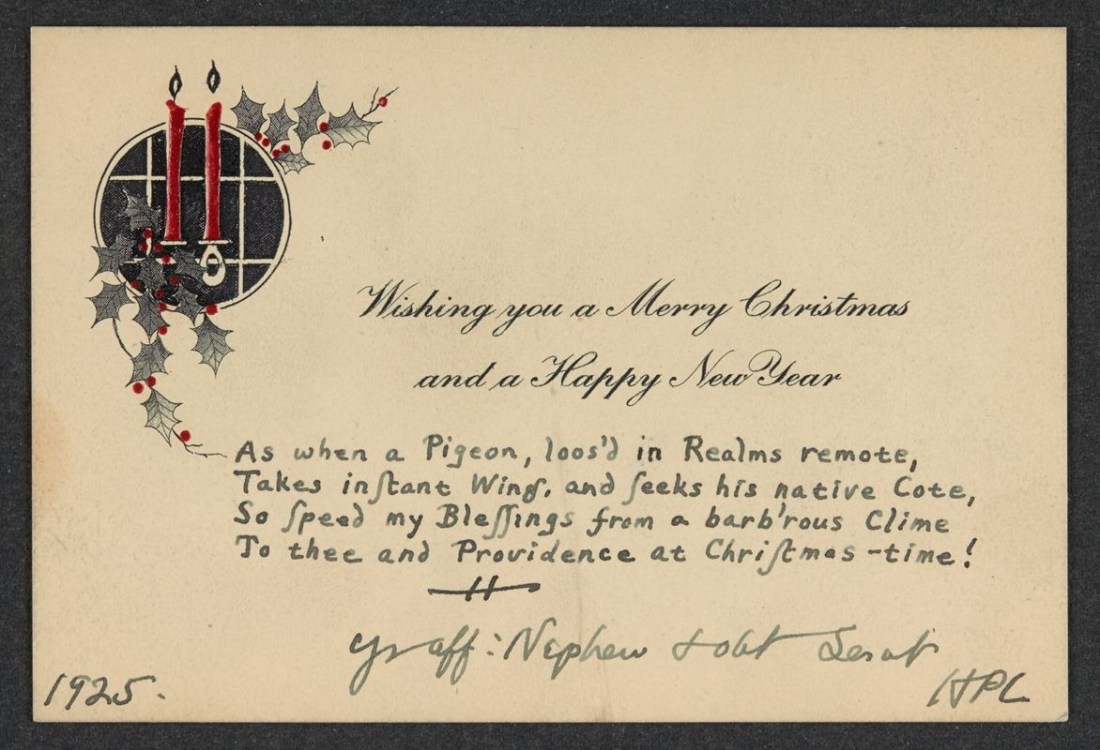
Howard, Mon Amour (2018) by Martine Chifflot

Sonia (Assise en train d’écrire, elle s’interrompt, levant la tête et s’exprimant a voix haute):
Howard est mort.
Quelle tristesse!

Et moi, qui ne suis plus tout à fait sa veuve…
Divorcée, remariée, je ne peux plus être sa veuve officielle.
Sonia (Sitting down to write, she interrupts herself, raises her head and speaks out loud):
Howard is dead.
What sadness!

And I, who am not quite his widow anymore…
Divorced, remarried, I can no longer be his widow, officially.
Howard, Mon Amour 19English translation
Scene 1

Ever since the publication of The Private Life of H. P. Lovecraft (1985) by Sonia H. Davis in various recensions, there has been great interest in the marriage of H. P. Lovecraft, and in his wife Sonia Haft Greene, who remarried in 1936 and became Sonia H. Davis. As the story of their marriage has unfolded in letters and memoirs, the narrative possibilities have struck several writers. Richard Lupoff included Sonia as a character in Lovecraft’s Book (1985), later expanded or restored as Marblehead (2015), to give one prominent example. Readers and scholars who have traced the story of their meeting, their work on the Rainbow, their collaborations “The Horror at Martin’s Beach” (1923), “Four O’Clock” (1949), Alcestis: A Play (1985), and “European Glimpses” (1988), and their final separation all speak to a dramatic narrative—some might say a tragedy, for all human lives tend toward tragedy at the end.

Howard, Mon Amour is a short drama in 23 scenes by Martine Chifflot. The scene is 1946; their mutual friend Wheeler Dryden has informed Sonia of the death of H. P. Lovecraft, nearly a decade prior. The two had fallen out of touch, and apparently contact had been broken prior to her third and final marriage to Nathaniel A. Davis. Alone while writing, the phantom of Lovecraft appears…whether his ghost, or a hallucination born of her grief, never quite clear. It doesn’t really matter.

Howard: Je suis ici, Sonia; je resterai aussi longtemps que tu vivras. Les choses là-bas ne sont pas tout à fait semblables à ce que l’on raconte, à ce que, moi-même, j’en ai dit et je ne suis pas autorisé à en parler mais il a été permis que je revienne… pour toi, comme pour t’accompagner, comme pour te remercier.Howard: I am here, Sonia; I will stay as long as you live. Things down there are not quite the same as we are told, as I myself have said, and I am not allowed to talk about them, but I have been allowed to come back… for you, as if to accompany you, as if to thank you.
Howard, Mon Amour 22English translation
Scene 2

The French found an early appreciation for Lovecraft, and not just his fiction but many of his letters and associated biographical materials have been translated into French, including Sonia’s memoir. “Un mari nommé H.P.L.” (“A Husband Named H.P.L.” in Lovecraft (Robert Laffront, 1991) appears to have been Chifflot’s main source of data on the marriage, and Chifflot’s drama is fairly accurate to the facts. She may put words into her character’s mouths, but the events play out largely in accordance with Sonia’s account of the marriage, warts and all; the drama of the scenes is a little heightened in the telling, the events more emotional and detailed, but also emotionally true to how Sonia told them herself.

Tante Lilian (ou Sonia L’imitant), apres un moment de silence):
Chère Sonia, nous vous remercions mais cela est tout bonnement impossible.

Voyez-vous, Howard et nous-mêmes sommes des Phillips et nous ne pouvons envisager que l’épouse de Howard doive traviller pour vivre à Providence. Cela constitue une sort de déshonneur que nouse ne pouvons tolérer pour Howard et pour nous-mêmes.

Non. L’épouse de Howard Phillips Lovecraft no peut entretenir son ménage, ni ses tantes. C’est le devoir du mari de subvenir aux besoins familiaux et Howard a joué de malchance à cet égard. Nous connaissons, tout comme vous, les grandes qualités de Howard et nouse aimerions vous voir réunis mais cela ne se peut dans de telles conditions. Vous nous entretiendriez et nous seriouns à votre charge. Ce serait une honte pour nous malgré votre générosité. Cela ne se peut, chère Madame… et nous devrons tous souffrir en silence.
Aunt Lilian (or Sonia imitating her), after a moment of silence):
Dear Sonia, we thank you but this is simply impossible.

You see, we and Howard are Phillips and we cannot contemplate Howard’s wife having to work to live in Providence. This is a dishonor that we cannot tolerate for Howard and ourselves.


No. The wife of Howard Phillips Lovecraft cannot support his household, nor his aunts. It is the husband’s duty to provide for his family, and Howard has been unfortunate in this regard. We know, as you do, the great qualities of Howard and we would like to see you reunited, but it is not possible under these conditions. You would be supporting us and we would be in your charge. It would be a shame for us despite your generosity. It cannot be, dear Madame… and we must all suffer in silence.
Howard, Mon Amour 64English translation
Scene 16

Most of the scenes are monologues, recalling some incident from their married lives; the more interesting scenes are dialogues, where Howard and Sonia actually have a bit of back-and-forth; other characters like Howard’s aunts Lillian and Annie have brief roles, and as suggested, could simply be retold by the actress playing Sonia doing their parts. It is a work meant to be not just read, but acted out; Chifflot herself has performed on stage in the role of Sonia:

Howard, Mon Amour. Scène 10. Sebastien Ciesielski et Martine Chifflot

For all the research that went in Howard, Mon Amour, there are a few idiosyncrasies that go beyond the facts. Little attention is given to Sonia’s Jewish identity or how Howard’s prejudices and antisemitism spiked during his stressful stay in New York, for example. There is an odd moment where Sonia believes that Howard’s correspondence with his revision client Zealia Bishop caused a “cooling” (refroidissement) of their relationship; and another where Sonia is said to dislike Crowley (in reality, Sonia and Aleister Crowley never met, it’s all an internet hoax). Which can all be explained as dramatic license rather than error or intentional misdirection. These are things that might stand out to a Lovecraft scholar with a penchant for pedantry more than a Lovecraft fan.

The emotional core of the work is true, however. In many ways, Sonia did find herself haunted by Lovecraft’s ghost for the rest of her life; his legacy clung to her as people asked her about the marriage, and many of her surviving letters survive because they are about Howard or addressed to his friends like August Derleth and Samuel Loveman. In Howard, Mon Amour, Sonia seems to accept that…and that she still loves him. Which, perhaps, is true. It was never love that got in the way of their relationship, but everything else around them: her health, his aunts, their finances, a difference in wants and needs, what they were and were not willing to do.

Howard, Mon Amour by Martine Chifflot was published in 2018 by L’Aigle Botté, and has been performed on stage as “Lovecraft, Mon Amour.” An English translation by Claude Antony has been announced:


Bobby Derie is the author of Weird Talers: Essays on Robert E. Howard & Others (2019) and Sex and the Cthulhu Mythos (2014).

The Rainbow Vol. I, No. 1 (Oct. 1921) & Vol. II, No. 2 (May 1922) by Sonia H. Greene (ed.)

Also, she hath told him that I am egotistical from reading Nietzsche—which disturbeth me not in the least. Anybody can call me anything he damn pleases if he will give fifty sinkers to the organ fund & issue a United paper as good as the RAINBOW promises to be! […] By the way—I have just returned proofs of my RAINBOW article, which is a melange of cynical aphorisms culled from two letters of mine. Whoever was the printer knoweth his business, for errors were monstrous few. The R. will evidently be quite some paper—pictures ‘n’ everything. Surely Mrs. G is the find of the present year amateurically, & I regret very much the recent indisposition to which you refer.
—H. P. Lovecraft to Rheinhart Kleiner, 30 Aug 1921, Letters to Rheinhart Kleiner & Others 187

In July 1921, Sonia H. Greene met H. P. Lovecraft at the National Amateur Press Association convention in Boston. The meeting led to an extended correspondence, and eventually their marriage in 1924. Yet before they married, Sonia worked hard on a new project: an amateur journal of her own. Many amateurs issued their own journals, forerunners of the ‘zine culture of today, put together with love, enthusiasm, and and often rather modest equipment. H. P. Lovecraft had issued his own amateur journal, The Conservative (1915-1919, 1923), and he suppiled both content for the two issues, but also proofreading and (perhaps) editorial assistance.

Finally #598 was reached, & the visitor was introduced to the present regent of these domains—my elder aunt. Both seemed delighted with each other, & my aunt has ever been eloquent in her praise of Mme. G., whose ideas, speech, manner, aspect, & even attire impressed her with the greatest of favourableness. In truth, this visit has materially heightened my aunt’s respect for amateurdom—an institution whose extreme democracy & occasional heterogeneity have at times made it necessary for me to apologise for it. During the session at #598, Rainbow proofs were the main topic. I read most of them, denatured a sketch which some might have taken as a caricature on myself, & set aside for revision a piece of verse entitled “Mors Omnibus Communis”. I am told that you advised the inclusion of this piece in the R. If so, why the hell didn’t you correct it? It could not stand as it was. The R. will be quite some paper—believe Grandpa! Since the visit I have let Mme. G. have Loveman’s “Triumph in Eternity”, which will lend a finishing touch of exquisite classicism. It is one of the most splendid poems amateurdom has ever produced. At length the meeting adjourned, & Mme. G. generously invited both my aunt & myself to dinner at the Crown. Having had a noon meal, (we eat but twice daily) we were not ready for another; so my aunt had to decline, whilst I went along & consumed only a cup of coffee & portion of chocolate ice-cream.
—H. P. Lovecraft to Rheinhart Kleiner, 21 Sep 1921, Letters to Rheinhart Kleiner & Others 190

Sonia H. Greene was not an amateur printer with a handpress; she had the amateur magazine typeset and printed professionally, including with photographs, on good paper. This makes those two issues some of the handsomest amateur journals of the period. There is no indication of the number of copies of each issue, but given the size of each issue (the first issue was 14 pages, the second issue 20), even a modest run of 50 copies, complete with proofs, would have been a considerable outlay of cash, and the printrun may well have been higher.

Beyond a doubt, the leading amateur publication of the season is Mrs. Sonia H. Greene’s resplendent October Rainbow. The editor is anxious to have this magazine reach every member of the United, and hopes that all who have been accidentally overlooked will notify her at 259 Parkside Ave., Brooklyn, N.Y., that the omission may be repaired.
—“News Notes,” United Amateur 21, No. 1 (Sep 1921), Collected Essays 1.299

In 1921, Lovecraft was the Official Editor for his faction of the United Amateur Press Association of America; an election dispute in the organization some years before had split the membership, and Lovecraft assumed a leadership role. It is no doubt Lovecraft’s personal influence that convinced Sonia H. Greene to join the UAPA, and to issue The Rainbow to both the United and National members. How much more influence Lovecraft had on the production of The Rainbow is a matter of conjecture.

The Rainbow (October 1921), Vol. I, No. 1

How many struggling mortals languish and pine for want of an adequate outlet for self-expression! Thousands find it a prime necessity to give vent to their thoughts on paper—thousands who think deeply and feel strongly, yet who through diffidenceor hesitancy tend to be inarticulate regarding their half-conscious aesthetic and intellectual longings. Such persons, knowing how prone are ones near and dear to misunderstand, must either speak through the medium of writing or remain mute, lonely and repressed.
—Sonia H. Greene, “Amateurdom and the Editor,” The Rainbow (vol. 1, no. 1) 3

Thus does Sonia open her first amateur journal. The contents include “Ode to Florence” by Sonia H. Greene (poem; Florence Carol Greene being her daughter), “Nietzsche as a Practical Prophet” by Alfred Galpin (essay), “Philosophia” by Sonia H. Greene (essay), “How I Would Like To Be Entertained At The Next National Convention” by James F. Morton (poem), “More Omnibus Communis” by Sonia H. Greene (poem), “Nietscheism and Realism” by H. P. Lovecraft (essay), “Idle Idylls” by Sonia H. Greene (essay), “To—” by Rheinhart Kleiner (poem), “A Triumph in Eternity” by Samuel Loveman (poem), two letters from Sonia H. Greene, and “Oh, If The Gods” by Rheinhart Kleiner (poem).

The most notable thing about his issue is that the editing and writing of the editorials show little to no influence from Lovecraft, though he likely helped procure some of the contents. Galpin, Kleiner, Morton, and Loveman were all mutual friends of the two, and one of the letters is to their amateur friend Edith Miniter with praise for her novel Out Naputski Neighbors (1916). Lovecraft’s essay “Nietscheism and Realism” was stitched together from two letters to Sonia on the subject of Nietzsche, which subject she had been arguing through correspondence with both Lovecraft and Galpin.

I have just read proofs of my RAINBOW article, which consists of some cynical aphorisms culled from two letters of mine. I fear this stuff will shock friend Mocrates—but it may help prepare him for the fuller shock of my “Confession of Unfaith” in Campbell’s next LIBERAL.
—H. P. Lovecraft to the Gallomo, 31 Aug 1921, Letters to Alfred Galpin 104

There is still the air of the amateur to the production; not in the formatting or the editing, but the content. Sonia’s material doesn’t exactly dominate the issue thanks to the meaty essays by Lovecraft and Galpin, but her own essays are relatively weak and unfocused by comparison. Given the placement and source of Lovecraft and Galpin’s essays, I suspect that “Philosophia” is borrowed from one of her letters to Galpin or Lovecraft, addressing a similar subject but in a very informal way; her strongest passage being:

When the intellectually and phsyically strong will learn how to rule wisely and humanely, and the weak will recognize the limits of their natural ability; when the strong will properly compensate the weak for their efforts, giving them the chance to develop according to their lights; when property and the accumulation of superfluous wealth and dominant power shell not be placed above human comfort and life—then may civilization rise to altitudes not yet achieved in the history of man. There must be neither “master nor slave,” but “leader and led.” Then, and then only, may there be a justifiable hope for the advent of the superman.
—Sonia H. Greene, “Philosphia,” The Rainbow (vol. 1, no. 1) 7

H. P. Lovecraft made a great deal about The Rainbow in the pages of amateur journals; aside from The United Amateur, he also penned Rainbow called Best First Issue” in the National Amateur 44, No. 4 (Mar 1922), CE 1.310-312, and he wrote about it in letters to friends:

You have probably seen Mrs. G.’s paper—The Rainbow—ere this, and may judge her general amateur interest by it. After her amazing pledge to the O.O. Fund I do not know how tactful it would be to suggest recruiting funds immediately; but after a duly decorous interval I fancy the matter might well be broached. You might drop her a line of welcome, her address being 259 Parkside Ave., Brooklyn, N.Y. Mrs. G. is an agnostic & anti-religionist, as you may observe in the Rainbow; but is too Russian & emotional to share the biting cynicism of Galpin & myself.
—H. P. Lovecraft to Anne Tillery Renshaw, 3 Oct 1921, Letters to Elizabeth Toldridge 367

The issue, already fairly long by amateur standards, might have been longer still, but at least one item was apparently left out of The Rainbow:

I have sent to Arkham House snapshots of HPL’s aunts, some postcards, a story revised by HP. and a fictitious story I wrote about HP a few months after I met him, but at his request I did not publish it in the Rainbow because, as he told it, it was too obviously a description of himself.
—Sonia Davis to Winfield Townley Scott, 11 Dec 1948, MSS. John Hay Library

By inference, this would be “Four O’Clock” (1949) by Sonia H. Greene.

It must not have been too long after the successful mailing of the first issue that plans came underway for a second.

The Rainbow (May 1922), Vol. II, No. 2

Without a doubt the greatest publishing event of the season is the second number of Mrs. Sonia H. Greene’s magnificent Rainbow. It is difficult to imagine either mechanical lavishness or excellence of contents carried to a greater extreme, and the United may well be proud of having such an exponent. The editorial tone is a stimulating one, forming an influence in just the proper direction at this trying juncture of amateur history. A special word is due the excellent portraits of eminent amateurs, among which is the first likeness of our poet-laureate, Mrs. S. Lilian McMullen (Lillian Middleton) ever published in Amatuer Journalism. Amateurs failing to receive The Rainbow are urged to notify the editor at 259 Parkside Ave., Booklyn, N.Y.
—”News Notes,” United Amateur 21, No. 5 (May 1922), Collected Essays 1.317

The second (and ultimately final) issue of The Rainbow was even larger and more lavish than the first. It begins with three extensive editorial essays: “Amateurdom and the Editor,” “Recruiting,” and “Opinion” (all unsigned); followed by “Commercialism—The Curse of Art” (essay), “Amatory Aphorisms” (prose), “A Game of Chess” (essay), and “Heins versus Houtain” (essay), all by Sonia H. Greene; “I Wonder” (poem) and “Keep Smiling” (poem), by B. C. Brightrall, “My Yesterdays” (poem) by W. C. Brightrall, “The Distant Forest” (poem) by Betty Jane Kendall, “Certain Ideals” (essay) by Edith Miniter, “Behind the Swinging Door” (poem) by Lilian Middleton, “Celephais” (short story) by H. P. Lovecraft, “Misconceptions of Art” (essay) by James F. Morton, “A Letter to G— K—” (poem) by Samuel Loveman, “Through the Eyes of the Poet” (essay) by Maurice W. Moe, “Frank Harris” (essay) by Alfred Galpin, “Amatuerdom of the Editor” (essay) by “The Editor.”

There are new names: Maurice W. Moe was a friend of Lovecraft, Lillian Middleton was a well-known amateur poet, W. C. or B. C. Brightall was probably William Clemens Brightall, an amateur poet and traveling salesman who would publisha book of poetry titled Tip o’ The Tongue (1925), and Betty Jane Kendall, only nine years old, was the daughter of former NAPA president Frank Austin Kendall, and her mother Jennie Kendall Plaisier was still active in amateurdom as well. Lovecraft fans will note the first publication of Lovecraft’s story “Celephrais,” and Loveman’s poem “A Letter to G— K—” is a reference to bookseller George Kirk, a mutual friend of Lovecraft and Loveman who would go on to be one of the founding members of the Kalem Club during Lovecraft’s New York adventure.

Some readers might wonder if Lovecraft had a heavier hand in the editing of this issue, at least in touching up some of the four unsigned editorial pieces. It’s hard to tell, especially since there is very little in Lovecraft’s letters on the creation of this issue, his only comment being:

I am grateful to Mrs. Greene for her editorial in support of my literary policies, as indeed for many instances of a courtesy & generosity seldom found in this degenerate aera. You may be assur’d that I shall not diminish the frequency of the epistles I send her, tho’ I am of opinion that S. Loveman & my grandchild Alfredus deserve much of the credit for her retention in the United. I regret that she hath suffer’d indignites from Mrs. Houtain; whose cast of mind, I suspect, is not exempt from the petty cruelty & fondness for gossip which blemish the humours of the most commonplace females.
—H. P. Lovecraft to Rheinhart Kleiner, 25 Jan 1922, Letters to Rheinhart Kleiner & Others 194

The former is a reference to the lead editorial “Amateurdom and the Editor,” which reads like some of Lovecraft’s unsigned editorials in other amateur journals—and it is written in the third person, whereas Sonia’s more personable editorial “Amateurdom of the Editor” is written in the first person. While it is impossible to tell, without some surviving manuscript or letter, I would not be surprised if Lovecraft helped Sonia complete this issue by revising a few of the earlier, unsigned editorials. At the very least, Lovecraft was seeing these editorials, or proofs thereof, months earlier than anyone else if the date on his letter to Kleiner is to be believed.

The later bit regarding “Mrs. Houtain,” is a reference to Sonia’s essay “Heins versus Houtain,” and involves a dispute between NAPA president Elsie Houtain and the teenaged Official Editor John Milton Heins; Sonia had not been in amateur journalism long and was already feeling the effects of some of the politics and personalities that come with any small organization.

Some gauge to response to these two issue of The Rainbow can be had in the memoirs of Lovecraft and Sonia’s mutual amateur friends:

Just previous to his coming to Brooklyn, and no doubt as part of her campaign to impress herself upon Lovecraft, his wife-to-be had issued an elaborate number of an amateur magazine, The Rainbow. It contained half-tone reproductions of Lovecraft’s portrait, together with portraits of his friends and articles or poems from their pens. It was a great success from the amateur journalist’s point-of-view, and I believe it may have been during the early stage of her married life with Lovecraft that she decided to issue another one. Printing costs being then, as now, quite high, I suppose the first issue cost a couple of hundred dollars. The second could not have cost much less. I don’t know what crisis took place in her affairs at this time—she had been holding a well-paid job as “buyer” in an uptown hat shop—but to pay for this issue she made an arrangement with the printer whereby his wife could obtain all the hats she wanted up to the amount of the bill. I am almost certain that Lovecraft was prominently featured in the first Rainbow, but he may have had enough influence to keep himself out of too conspicuous a place in the second. But this mere conjecture.
—Rheinhart Kleiner, “A Memoir of Lovecraft” in Ave Atque Vale 105

But I leave all the fascinating details of that convention to tell of The Rainbow, issued by Sonia Greene in the following October. It was a large and handsome affair, illustrated with half-tone reproductions of photographs of well-known amateurs of the day and containing excellent contributions by many of them. Lovecraft, still in Providence, reviewed it at some length in The National Amateur, for March, 1922. He said, in part, that The Rainbow represented “a genuinely artistic and intelligent attempt to crystallise homogeneously a definite mood as handled by many writers.” He said much more, and it was all highly satisfactory to Mrs. Greene. In fact, the vivacious Brooklyn widow was quite dazed with delight.
—Rheinhart Kleiner, “Discourse on H. P. Lovecraft” in Ave Atque Vale 194

Some time in the school year 1921-1922 I received a brief visit at Madison from Sonia Greene, later Mrs. Lovecraft. She had recently joined the United Amatuer Press Association, met Howard, and presented ponderous essays by Howard and me in her amateur publication, The Rainbow (October, 1921). Howard and I were then both faithful to a vaguely aesthetic sort of Nietzscheism. In her incidenta correspondence with me she found that besides my fondness for Nietzsche I was even fonder of Dostoievski, and it was this discovery (the Russians were not so generally in style in those days) that imprelled her to meet me in person.
—Alfred Galpin, “Memories of a Friendship” in Ave Atque Vale 203

Kleiner’s recollection of the arrangement with the printer may be confused with a later affair; when in 1928 she had her own hat shop for a time (cf. Letters to Family and Family Friends 2.628-629), but the admiration of both those amateurs even decades later was real.

So why were there only two issues? No doubt cost was a major factor, and perhaps time. Publishing an amateur journal is a largely thankless task, and Sonia’s final editorial speaks of her burning the metaphorical midnight oil to write and edit; perhaps business and her personal life made putting together and issuing a third issue untenable. Even Lovecraft had gaps in the publication of his much more modest journal The Conservative, which he finally revived for a few issues in 1923.

The Rainbow (Vol. I, No. 1) has historically been the most accessible of the two issues because in 1977 Marc Michaud of the Necronomicon Press issued a facsimile reproduction in an edition of 550 copies, and this facsimile edition is still widely available at reasonable prices, for those interested in this early piece of Lovecraftiana, and to read Lovecraft’s essay in something close to it’s original context, as part of a conversation with Sonia.

The Rainbow (Vol. II, No. 2) has never been reprinted. However, as it is in the public domain a digital copy of the issue is now available for free on the Internet Archive.


Bobby Derie is the author of Weird Talers: Essays on Robert E. Howard and Others and Sex and the Cthulhu Mythos.

Deep Cuts in a Lovecraftian Vein uses Amazon Associate links. As an Amazon Associate I earn from qualifying purchases.