“On Safari in R’lyeh and Carcosa with Gun and Camera” (2020) by Elizabeth Bear

The oldest and strongest emotion of mankind is fear, and the oldest and strongest kind of fear is fear of the unknown.
—H. P. Lovecraft, “Supernatural Horror in Literature”

While many horror stories grapple with fear of the unknown, there are elements within and without the narrative of cozy horror stories that bring the work in question into a safer, more knowable realm, allowing for a sense of comfort to take hold.
—Jose Cruz, “The H Word: Getting Cozy With Horror”

“Cozy horror” is the current term for a broad swathe of horror-flavored creative works. It is probably more properly a mode of weird fiction than a subgenre. A kind of attitude and approach that reaches across genre conventions. Not everything with horror trappings is necessarily horrific in the pure sense of the term. With experience comes familiarity. Bela Lugosi capes, Boris Karloff neck-bolts and flat top, plush Cthulhus all come from the same Hallowe’en-store aesthetic of cozy horror.

Parts of Lovecraftian horror have been cozy for a long time.

In part, this is because Mythos fiction, more than most, tends to be intensely self-referential. Writers want the readers to make connections with other stories, they want to be part of something bigger. Sometimes this bleeds over into full-blown nostalgia; “The Discovery of the Ghooric Zone” (1977) by Richard Lupoff and “Down into Silence” (2018) by Storm Constantine are both stories that bank on the reader not only being able to catch the hints, but to share in that sensation of quiet longing and awed recognition. Others just go for straight-up humor, even to the point of parody and satire: what is “At the Mountains of Murkiness, or From Lovecraft to Leacock” (1940) by Arthur C. Clarke if not taking the piss out of Lovecraftian horror, in a gentle and ribbing British manner?

The balancing point of “cozy Lovecraftian horror” is going to be subjective. It needs to at least work as a weird tale on its own; it needs to be a part of or allude to the Mythos in a way that the readers can recognize and respond to. Jose Cruz’ four elements of Familiarity, Sensuousness, Distance, and Fun are all important—but three of those, at least, are typical of most Mythos stories by default. Readers rarely identify with finding our great-great-great-grandma was a Deep One or Ape Princess, or experience the anxiety of living in the attic room of a witch house and dealing with an extradimensional rodent infestation when they really should be focusing on their finals. The Fun aspect of cozy horror is probably the trickiest and most argumentative aspect of the whole business.

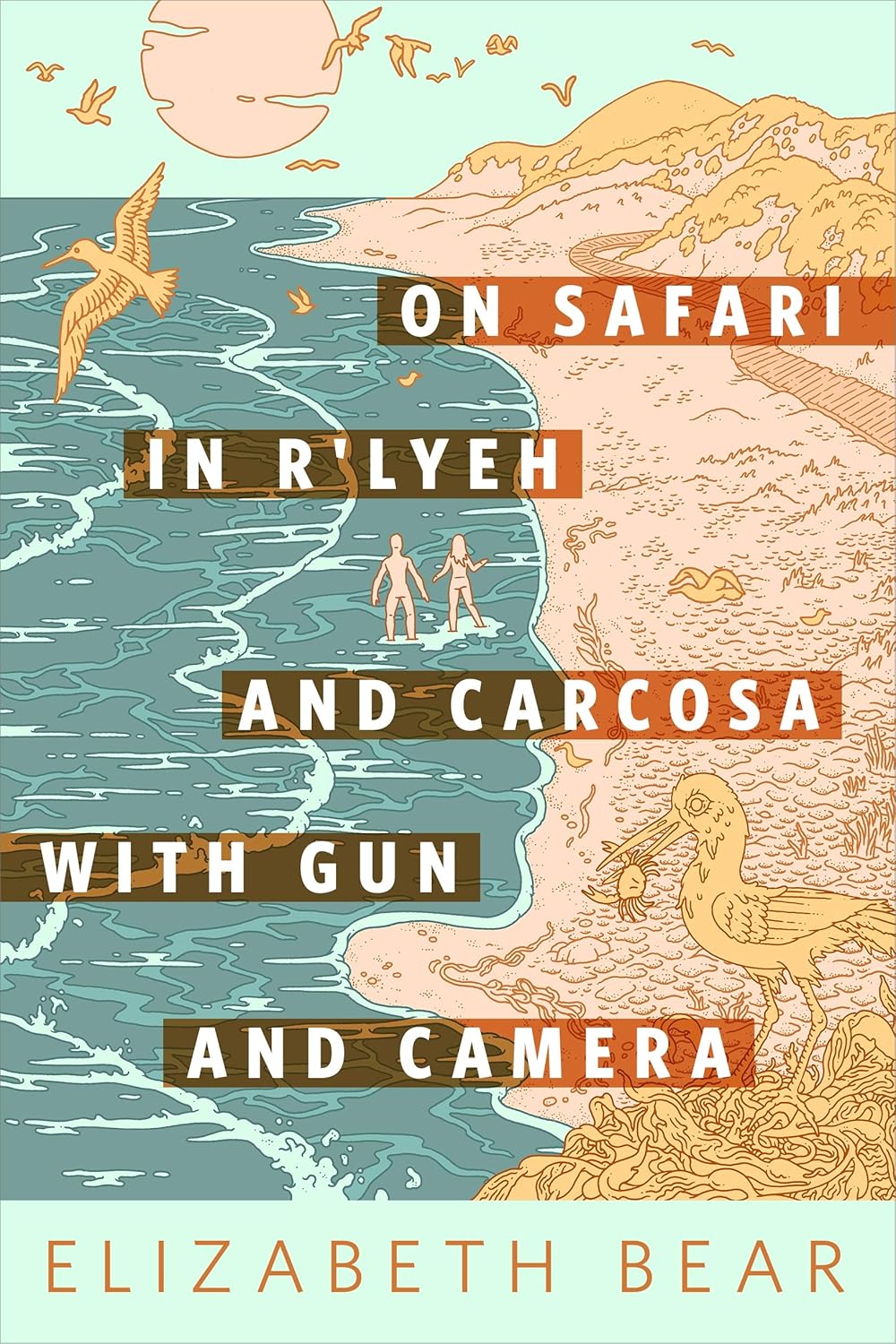
That being said, I believe “On Safari in R’lyeh and Carcosa with Gun and Camera” (2020) by Elizabeth Bear stands out as a very good representation of cozy Lovecraftian horror. The overall shape of the narrative is intensely familiar: how many scions of Innsmouth (never mentioned under that name) have come back home, in how many different variations? Yet the way the story is told is relatively light and novel: a fifty-something female physics professor with tenure and a penchant for sushi. A perfect setup for any number of funny-because-its-true comments about the lives of women in academia.

I note, entirely for the record and apropos of nothing, that I am the only female tenured faculty in the physics department. I note, entirely for the record and apropos of nothing, that I do an estimated thirty-six percent of the emotional labor in my sixteen-person department.

Female grad students and admins do the rest. And it’s not like we’re any less introverted and non-neurotypical than the dudes. We’re just forced to learn to endure more discomfort in order to have careers.
—Elizabeth Bear, “On Safari in R’lyeh and Carcosa with Gun and Camera” (2020)

If the story was just a whine, no matter how well-deserved, it probably wouldn’t sustain interest. Yet Bear is very good at composing her narratives, and has structure the story with an in media res action sequence right at the start to let us know that yes, the safari with guns and cameras are real, we’re getting to that. Then she gets to that. It’s not exactly a novel story structure, but it’s a workhorse of fiction for a reason: putting a bit of action first as a hook to draw the reader in, and then it can build up again.

The actual horror in the story is slight. The monsters aren’t very monstrous, the characters aren’t really scared as much as driven by scientific curiosity; blasting away at byakhees like Hunter S. Thompson in bat country is a select aesthetic that doesn’t really encourage the same kind of comforting glow of, say, a mountain that walked or stumbled, or the remnants of an ancient cannibal feast that happens to have the unmistakable physical tell-tales of your own peculiar family. This is not quite on the level of a hypothetical Abbott and Costello Meet Cthulhu, but it’s not far from it.

It is the kind of good, clean fun that you can have when you learn to stop worrying and love the Lovecraft Mythos—and it managed to do it without naming Deep Ones, without running across a copy of the Necronomicon, and only mentioning Miskatonic Univeristy once and in regards to a failed graduate thesis in genetics. If the rules at play seem to owe a little more to the Call of Cthulhu Roleplaying Game than Lovecraft’s original, then at least Bear has the good sense not to recapitulate the entire Mythos, August Derleth style. She gives just enough lore to keep things moving, and no more.

“On Safari in R’lyeh and Carcosa with Gun and Camera” (2020) by Elizabeth Bear is available as an ebook. It has also been republished in The Year’s Best Dark Fantasy and Horror: Volume 2 (2021) and The Long List Anthology: Volume 7 (2022).


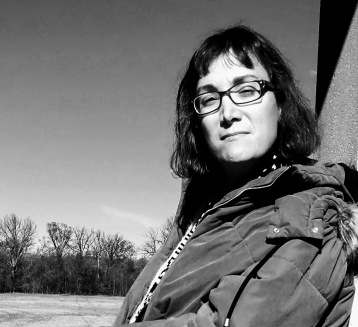
Bobby Derie is the author of Weird Talers: Essays on Robert E. Howard and Others and Sex and the Cthulhu Mythos.

Deep Cuts in a Lovecraftian Vein uses Amazon Associate links. As an Amazon Associate I earn from qualifying purchases.
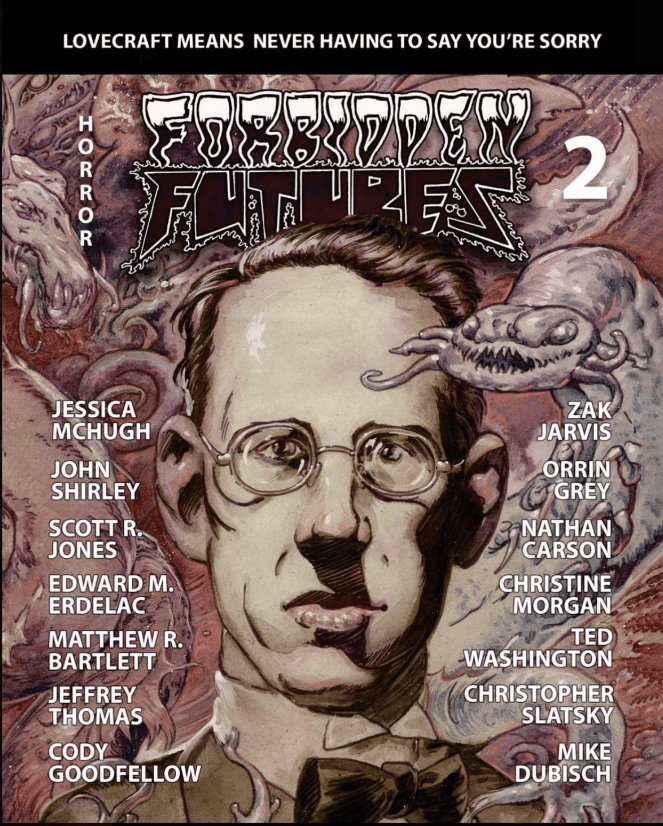
“Waxen” (2018) by Christine Morgan

And that, friends and neighbors, was eau de cancer, a body rotting from the inside out. Strong today. Very strong.
—Christine Morgan, “Waxen” (2018) in Around Eldritch Corners (2024) 164

Robert W. Chambers and H. P. Lovecraft generally did not write historical fiction. Their stories were set in the present, they dealt with contemporary issues and concerns. Many readers today lack the historical context to understand where Lovecraft and Chambers were necessarily writing from when they wrote their stories. The conventions, the issues, the current events that found expression in their fiction.

The militarism and xenophobia in “The Repairer of Reputations” often catch newcomers to the Yellow Mythos off-guard. Readers today aren’t familiar with the wave of future war fiction that inspired the setting, the rising nationalism, the ugly Yellow Peril fantasies which those first readers in 1895 would have been primed with. Chambers set his tale in an alternate future, but was writing for an audience of the present.

Yet cosmic horror, with whatever trappings it takes, adapts to the syntax of new eras and settings. The King in Yellow may be found as easily in a trailer park in the Southern United States (The Wingspan of Severed Hands (2020) by Joe Koch) as it can in an archaeological dig someplace exotic and tropical (“Slick Black Bones and Soft Black Stars” (2012) by Gemma Files); the issues and concerns expressed may not be looming war or civil insurrection, but the alienation we feel in mental health systems that fail us (Where Black Stars Rise (2022) by Nadia Shammas and Marie Enger) or when racism and sexism intersect (Black Stars Above (2019) by Lonnie Nadler & Jenna Cha).

Sometimes people stumble across the Yellow Mythos. Sometimes it’s omnipresent and only a trick of perception is needed to see it. Yet it tends to zero in on the broken, the outcast, the ones out on the fringes of society. Where things are already broken down, the black stars rise. When things can hardly get worse, there’s something worse waiting, in Carcosa.

“Waxen” by Christine Morgan is a wonderful example of a type of story that has no generic label as yet, although it probably should. They’re a slightly supernatural twist on the conte cruel; an object arrives that turns the protagonist’s own sins against them in some fashion. It’s a close cousin to “Binky Malomar And His Amazing Instant Pussy Kit” (1994) by Nancy Collins, but lust isn’t the cardinal sin here. It is a very specific form of greed, as nastily precise to the syntax of this era as Chambers’ militarism was to his.

How long and how well, he wondered, would the candles mask the full-on decay? When she did die, nobody had to know, did they? The checks would keep coming until it was reported, and who else but him would be reporting it? Quitting the agency and claiming he’d been hired as her live-in was the smartest thing he’d ever done.
—Christine Morgan, “Waxen” (2018) in Around Eldritch Corners (2024) 164-165

Morgan knows her business; “Waxen” doesn’t overstay its welcome, just sets up the story, sketches the characters, and lets events unfold. It does exactly what it sets out to do, in clear and evocative language, with just enough detail and just enough room for the reader to imagine what comes next. Yet brief as it is, the story is not timeless; without ever giving a date, it is set in a nebulous now of scented candles, chemotherapy, and medical fraud. Maybe someday, someone will need that historical context explained to them.

An idle glance at the label didn’t tell him much.

C&C Candles, Lake Hali, The Hyades.

Never heard of them.
—Christine Morgan, “Waxen” (2018) in Around Eldritch Corners (2024) 163

“Waxen” by Christine Morgan was first published in Forbidden Futures #2 (2018), and has been republished in her collection Around Eldritch Corners (2024) by WordHorde.


Bobby Derie is the author of Weird Talers: Essays on Robert E. Howard & Others (2019) and Sex and the Cthulhu Mythos (2014).

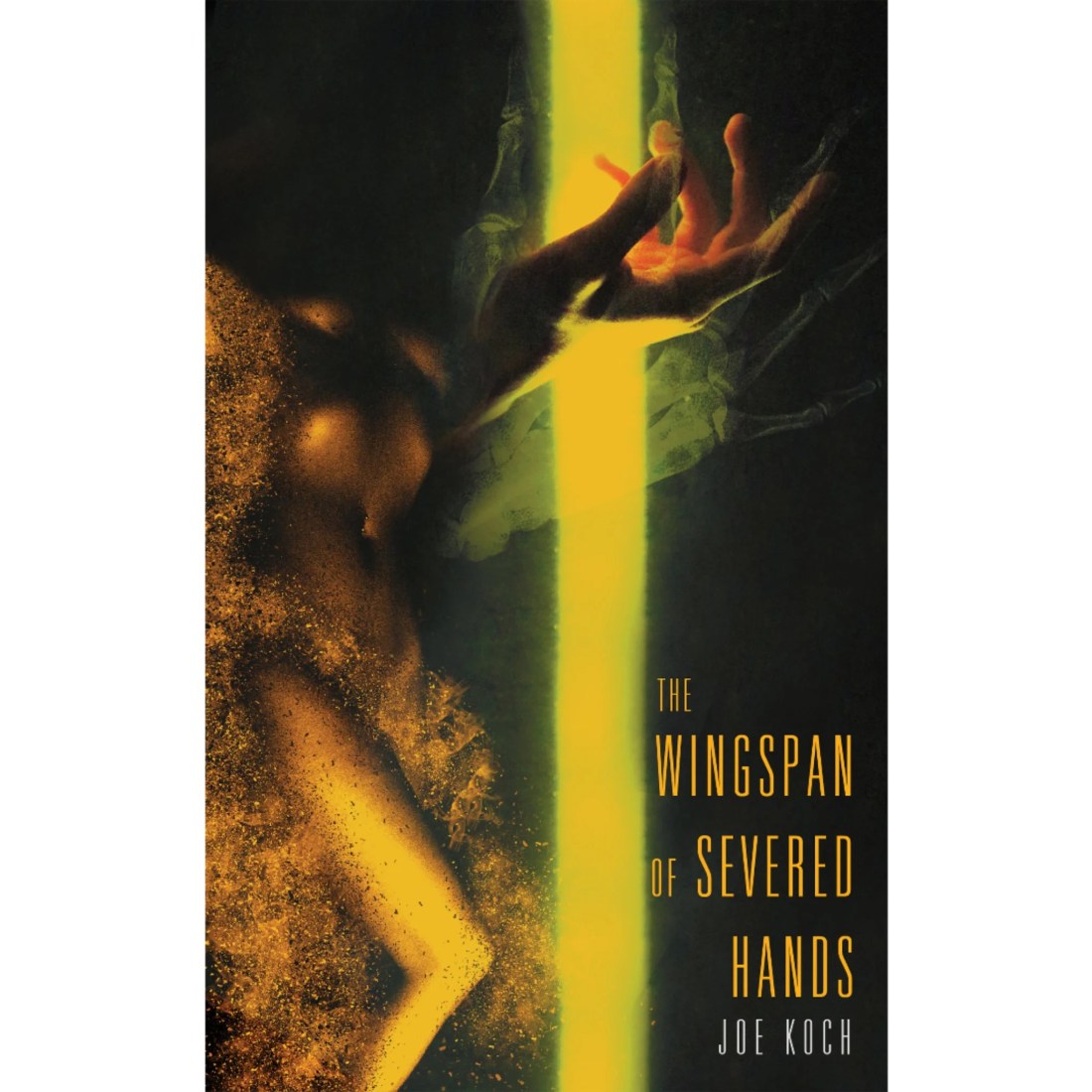
The Wingspan of Severed Hands (2020) by Joe Koch

My lost heart bled beneath the sands
Of distant, dead Carcosa.
My heart, once buried, fed the land
That grew the oak Carcosa.

The oak was felled and burned to light
Those dim shores of Carcosa.
Love’s but a candle. Soon I’ll die
To wander lost Carcosa.

My love’s a dream, and dreams must die
To resurrect Carcosa.
My dream is dead. My queen’s alive.
She conquers bright Carcosa.
—Joe Koch, The Wingspan of Severed Hands 79

A dry description of The Wingspan of Severed Hands might be something like: “a short novel that reimagines Robert W. Chambers’ mythology of The King in Yellow with distinct feminist themes, a nonlinear narrative, and surreal imagery.” Which would not do justice to the language or the story. This is a story with texture and attitude, occupying a grey area between cosmic horror, body horror, magical realism, surrealism, and splatterpunk. Like a gelatinous eyeball, it’s not easy to nail down; and it resists easy labeling.

Much of the effectiveness of the story lies in its deliberately ambiguous, unsettled nature. The narrative shifts from familiar scenes and scenarios to nightmarish episodes, the transition often seamless and in a condition of otherwise banal reality, so that the readers are left wondering how much is really happening and how much is undiagnosed psychotic episode or hallucination. There is a loving richness to the description of mutilation, decay, graphic violence, bodily corruption, and growth that is a stylistic hallmark of Koch’s work, an evident love and appreciation for the language and imagery of transformation.

Trying to capture in words that fascinating process of transition. From girl to woman, life to death, caterpillar to butterfly, steak to ground beef, health cell to cancerous, girlfriend to ex. Wrapped up in and around a reinterpretation of the Yellow Mythos.

There are, broadly speaking, two horizons of the Yellow Mythos. The first horizon derives directly from Robert W. Chambers’ The King in Yellow (1895) and the mythology of the same. Folks might expand on it, re-intrepret it, but it is distinctly tied to the original snippets of the play. Works of this sort include “Cordelia’s Song from The King in Yellow” (1938) by Vincent Starrett & “Evening Reflections, Carcosa” (2011) by Ann K. Schwader, “Slick Black Bones and Soft Black Stars” (2012) by Gemma Files, and Black Stars Above (2019) by Lonnie Nadler & Jenna Cha. They’re not all consistent, the authors aren’t all in communion with each other, but they’re all drawing more or less directly on Chambers.

The post-Classical horizon of Yellow Mythos stories comes to the Yellow Mythos more indirectly, usually through popular culture like the Call of Cthulhu Roleplaying Game, which popularized images like the three-limbed figure of the Yellow Sign designed by Kevin Ross in 1989, or the American Gothic sensibilities of the first season of True Detective created by Nic Pizzolatto. Post-Classical is less beholden to Chambers, more directly influenced by the imagery and ideas of what the Yellow Mythos is in the popular consciousness—which can be both very freeing and very constraining, depending on whether the creator hews close to what someone else has done or pushes outward to define their own space. A good example of this might be the Alagadda series of the SCP-wiki, which draws inspiration from the first horizon stories but is more adjacent to it than directly connected.

The Wingspan of Severed Hands is in the second horizon. It’s a post-Kevin Ross piece, the three-legged image of the Yellow Sign derived from the roleplaying game; the Queen in Yellow is similar to the Hanged King in the Alagadda series, a new riff on a familiar concept. Yet the actual references to Chambers are few; Koch draws more strongly off the mass of post-Chambers ideas than Chambers himself. There’s no play, no Cordelia, and the madness inspired by the Yellow Sign is an outbreak more in line with an RPG in mid-apocalypse.

The Yellow Mythos in this story is a kind of lifeline to the reader. Something familiar that they can keep a hold of during a narrative that changes perspective as it winds its way through time and space. Yet at the same time, it’s not Chambers’ mythos. There are surprises in store, odd pieces that might not jive with what a reader familiar with Yellow Mythos stories thinks is going on.

It is, all in all, much more personal.

Three women. One battle.

A world gone mad. Cities abandoned. Dreams invade waking minds. An invisible threat lures those who oppose its otherworldly violence to become acolytes of a nameless cult. As a teenage girl struggles for autonomy, a female weapons director in a secret research facility develops a living neuro-cognitive device that explodes into self-awareness. Discovering their hidden emotional bonds, all three unveil a common enemy through dissonant realities that intertwine in a cosmic battle across hallucinatory dreamscapes.

Time is the winning predator, and every moment spirals deeper into the heart of the beast.
—Joe Koch, The Wingspan of Severed Hands back cover copy

This is a story focused on women. There aren’t many male characters, and while the actions of the men and boys are not peripheral to the story, we don’t get their viewpoint and their actions are critical largely with regard to how they treat the women who are the viewpoint characters. We don’t see husbands, fathers, brothers, or sons; there’s an implicit matriarchial arrangement to the story. Mothers, daughters, and grandmothers are the main relationships, and that’s the emotional heart of the book. The suffering that goes into these toxic relationships, invisible to so many, that finds manifestation in so many little ways.

Yet at the same time, the relationships in the book represent a closed circle. The viewpoint characters don’t really have any women friends to turn to, no support network. They are isolated, locked in—in a trailer, in a bunker, in a cage, in a decaying body, in a cycle of expectations and recriminations, haunted by a past that they cannot escape until the climax.

The end of The Wingspan of Severed Hands is the beginning of a new life. An opportunity for at least some of the viewpoint characters to move on, out of the shadow of motherly expectations, grief, and trauma. The reward for all the gooey, gory, traumatic, painful growth and transformation in the story is…the potential for more growth. Maybe even to be happy, although the ending is not itself exactly happy.

One of the themes suggested, but not fully explored, in The Wingspan of Severed Hands is the nature of The King in Yellow itself. So many writers have focused on what Chambers did, what he wrote, the things he hinted at. Yet if one day, if you opened up a book marked with the Yellow Sign on its spine, and found it blank—how would you fill the pages? What would you write? What would The King in Yellow be in your own words?

The Wingspan of Severed Hands (2020) by Joe Koch was published by Weird Punk Books.


Bobby Derie is the author of  Weird Talers: Essays on Robert E. Howard and Others  and  Sex and the Cthulhu Mythos .

Deep Cuts in a Lovecraftian Vein uses Amazon Associate links. As an Amazon Associate I earn from qualifying purchases.
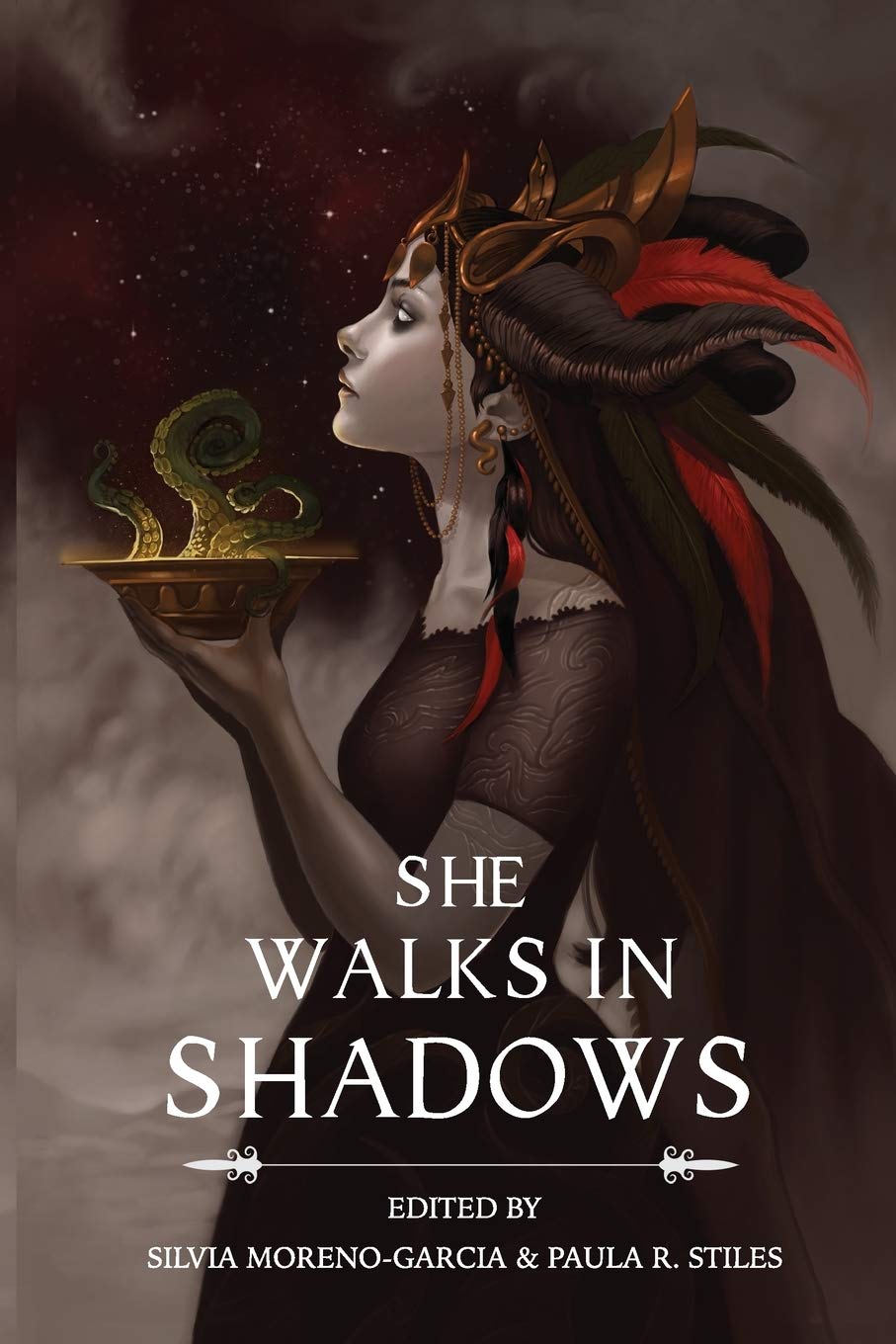
“Bring the Moon to Me” (2015) by Amelia Gorman

I wasn’t afraid of the storms or earthquakes that visited the bay. I wasn’t afraid of the depths of the sea or the dark things that swam there. The shadows in our house made me anxious. They came out of the corners when my mother sang and knit, and flew across her face and hands. She sang about shepherds and Hastur and the sweet smell of lemon trees at night.

Amelia Gorman, “Bring the Moon to Me” in She Walks in Shadows 31

One of my favorite early pieces of Lovecraft criticism is the very brief essay “Cosmic Horror” (1945) by Dorothy Tilden Spoerl, who discovered that knitting was a cure to the eldritch horrors of H. P. Lovecraft. Amelia Gorman has taken that idea and inverted it: instead of exorcism, an invocation.

As a story, there is a vast amount that remains unsaid. The core is as perfectly beautiful and simple as Arthur C. Clarke’s “The Nine Billion Names of God” (1952), but it is framed through women’s history. Knitting was often relegated to women’s work. So was computing. As Margot Lee Shetterly wrote about in Hidden Figures (2016), it was women at NASA who checked and double-checked the calculations and code for the early space missions. You the reader don’t need to know that to understand the story, but it may deepen their appreciation to know that this isn’t some random programmer; this is a story implicitly set in that point of history where women’s work was transitioning outside the home or the factory and into government offices and research labs. Education was becoming more available, and while glass ceilings and discrimination still existed, the women were in the workforce to stay after World War II, as old trades died away and new careers in computing were just beginning to take shape.

The Mythos elements in this piece are few. Hastur’s appearance is an old, old call back to an often-forgotten aspect of his artificial mythology. Before August Derleth made him a counterpart to Cthulhu; before Robert W. Chamber’s borrowed some names for The King in Yellow (1895), Hastur was a god of shepherds in Ambrose Bierce’s “Haïta the Shepherd” (1891). Shepherds have sheep, sheep make wool. It is the kind of idea so obvious you might wonder why nobody thought to put the pieces together before.

Drawing down the moon is a Wiccan practice. Witchcraft was often seen as the domain of women as well…and while the unnamed protagonist and her mother are not skinning down to dance around outside, or making candles of unbaptized baby fat, there is a current of witchy thought to the whole story. The way that women of two different generations finally learn to communicate, despite the disconnect between their lives; the passing on of secret knowledge, the suggestion of how this knowledge and power can be used against those who discriminate against them because of their gender, all partake of the idea of witchcraft without breaking out a broomstick or pointy hat or Book of Shadows.

It’s a story that works on so many different levels, but perhaps most surprisingly, it’s a story that only really works because it’s told from a woman’s perspective. A young man working as a programmer at NASA talking to his father about weaving fishing nets isn’t facing the same prejudices, the same societal expectations; “the context wouldn’t work nearly so well.

“Bring the Moon to Me” by Amelia Gorman was published in She Walks in Shadows (2015) and its paperback reprints; it was adapted as an audiobook on PseudoPod #538 in 2016.


Bobby Derie is the author of Weird Talers: Essays on Robert E. Howard and Others and Sex and the Cthulhu Mythos.

Deep Cuts in a Lovecraftian Vein uses Amazon Associate links. As an Amazon Associate I earn from qualifying purchases.
Where Black Stars Rise (2022) by Nadia Shammas and Marie Enger

I’ve always loved horror, particularly eldritch horror. Despite the deeply racist and misogynistic roots of these works, primarily the violent xenophobia of its creators, there’s an existential understanding of what it feels like to be powerless. While these men grappled with the horror of an uncaring universe, marginalized individuals grapple with the horror of a system specifically designed not to care about us. We are born into something larger, something malevolent, something we have no power to stop. Similarly, in The King in Yellow itself, there is no reason why our unfortunate narrators are chosen.

Nadia Shammas & Marie Enger, Where Black Stars Rise

On 15 December 1973, the American Psychological Association removed homosexuality from its list of mental illnesses. This reversed a course of accepted practice that had run through the 19th and 20th centuries, including during the lives of H. P. Lovecraft, Robert E. Howard, Robert W. Chambers, and other formative voices in what has come to be known as eldritch or cosmic horror. Popular understanding of mental illness and sexuality would take a few decades to catch up; some roleplaying games in the 1980s still listed homosexuality among the mental illnesses a character could have.

To say that Lovecraft et al. were products of their time is not an excuse for their bigotries and prejudices, yet it must be at least an explanation for some of the attributes of their lives and fiction. Lovecraft lived and died in an era when combat-related trauma was categorized as shell shock; the term Post Traumatic Stress Disorder wasn’t coined until 1980. It would be inaccurate to fault Lovecraft and company for working within the limits of knowledge of their own time—and even then, Mythos fiction often treats mental health with more of a Gothic, Victorian, or pulp sensibility. Lovecraft speaks of alienists more often than psychologists, and those who experience breaks from reality or accepted behavior (such as Nathan Peaslee in The Shadow Out of Time, or Delapore in “The Rats in the Walls”), or simple physical or mental abnormality (the errant cousin in “The Shadow over Innsmouth”) are more likely to be institutionalized than diagnosed and treated.

Sanity often seems a fragile, precarious state to many of these characters.

Despite the prevalence of talk of mental health in the works of Lovecraft and co., relatively few of the stories experience sharp breaks with reality—the infamous snap of the last thread that sends them from rationality into incoherence. The sight of Cthulhu in “The Call of Cthulhu” is a terrible shock, but very few characters in the works of Lovecraft or his contemporaries go mad just from the sight of an eldritch entity. More than a few characters who read from the Necronomicon do not lose touch with reality from the revelations therein. Even in Robert W. Chambers’ The King in Yellow, the eponymous play acts more as a catalyst for mental illness than a source of it.

Which is a long way to get to the point: as our cultural and scientific understanding of mental health changes, so too must the literature of horror shift to reflex that new syntax. What Lovecraft and Chambers wrote made sense within their context, but today we look on mental health very differently. This doesn’t invalidate the older stories, but it does open up vast new realms of possibility for new ones. With new understanding comes new ways to think about the Mythos.

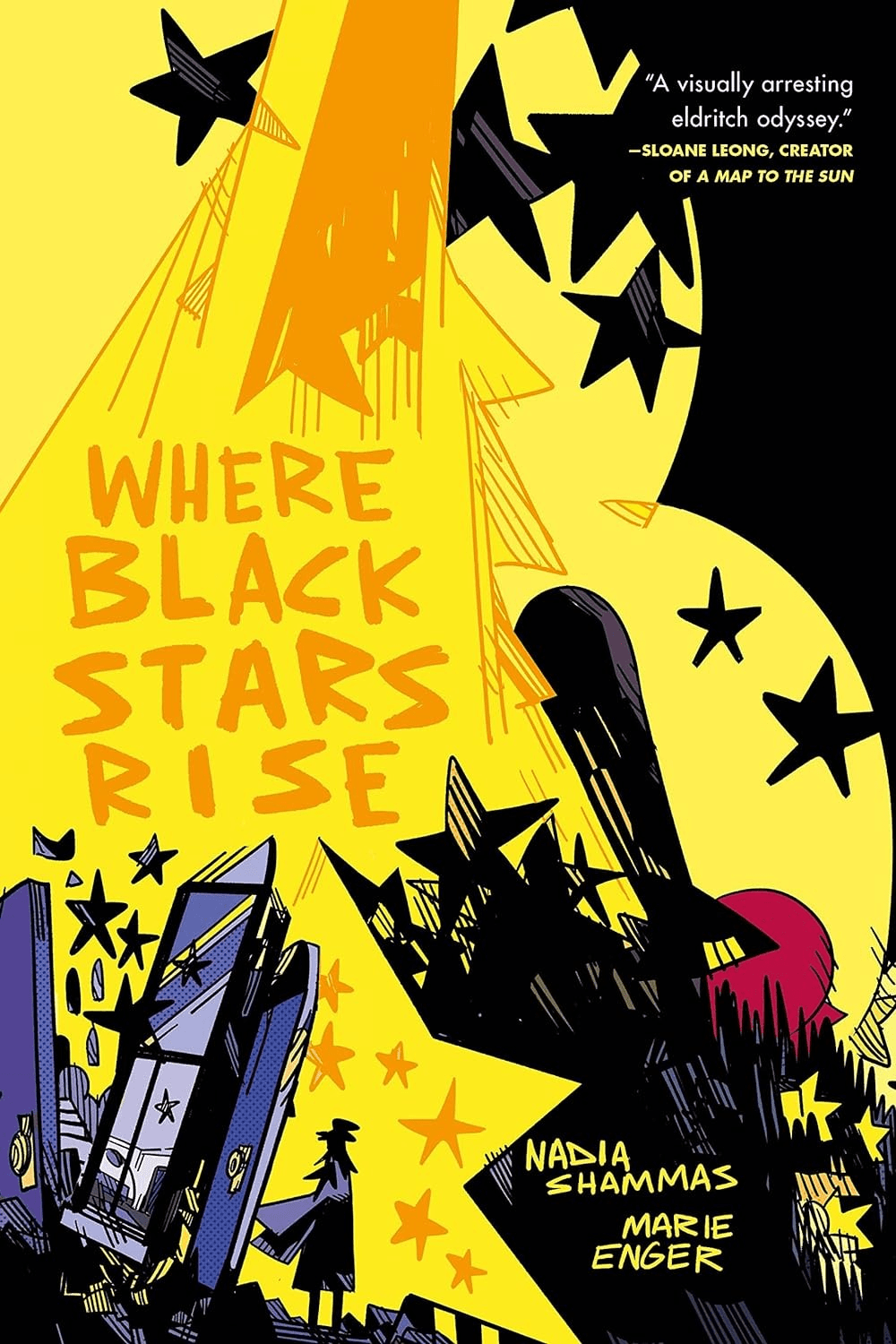
Where Black Stars Rise (2022) by Nadia Shammas (script) and Marie Enger (art) is a graphic novel focused on mental health and the King in Yellow, the eponymous play that acts as a metatextual touchstone for the first half of Robert W. Chambers’ 1895 collection of the same name. In the course of dealing with her own life issues and mental health, therapist Amal Robardin loses a patient—and goes to find her. The journey takes her over the metatextual threshold to Carcosa itself, led by a changeling psychopomp that alternately takes on aspects of Ambrose Bierce, Robert W. Chambers, and H. P. Lovecraft (August Derleth and D. J. Tyrer, perhaps fortunately, didn’t make the cut).

If there’s a point of criticism, it might be in casting those three as the closest thing the story has to a villain—Lovecraft barely used The King in Yellow or its mythos in his work, and Bierce’s original creation bears little resemblance to what Chambers made of it—but having a straw man psychopomp is barely a speed bump in the enjoyment of a dream quest re-cast in terms of therapy.

…you’re wrong

I’m deserving of love. I’m capable of love without fear, and of doing better.

I am capable of more than this. I’m not a monster, and I’m no lost cause.

Nadia Shammas & Marie Enger, Where Black Stars Rise

One of the benefits of eldritch horror is that, very often, there is an external force involved in whatever the characters are dealing with. Dealing with mental health is often a long and involved process, and individuals are rarely “cured” in the sense that a broken bone heals or an infection runs its course. Nor can people overcome trauma or brain chemistry issues simply by lying on the couch and talking about their dreams. You might not be able to punch Cthulhu in his stupid face, but at least you know Cthulhu exists and isn’t just a figment of your imagination. Flip Cthulhu off if it makes you feel better.

There is a moment, after the visual climax, when it looks like Where Black Stars Rise is going to go the full John Milton (“The mind is its own place, and in it self Can make a Heav’n of Hell, a Hell of Heav’n.”) It is to the credit of the creators that the story steps away from this, to something sadder, perhaps more horrific, yet ultimately more real, more in line with “The Book of Fhtagn” (2021) by Jamie Lackey. Happily ever afters are for fairy tales; in the real world, not everyone can be saved, or wants to be. Sometimes you have to respect that.

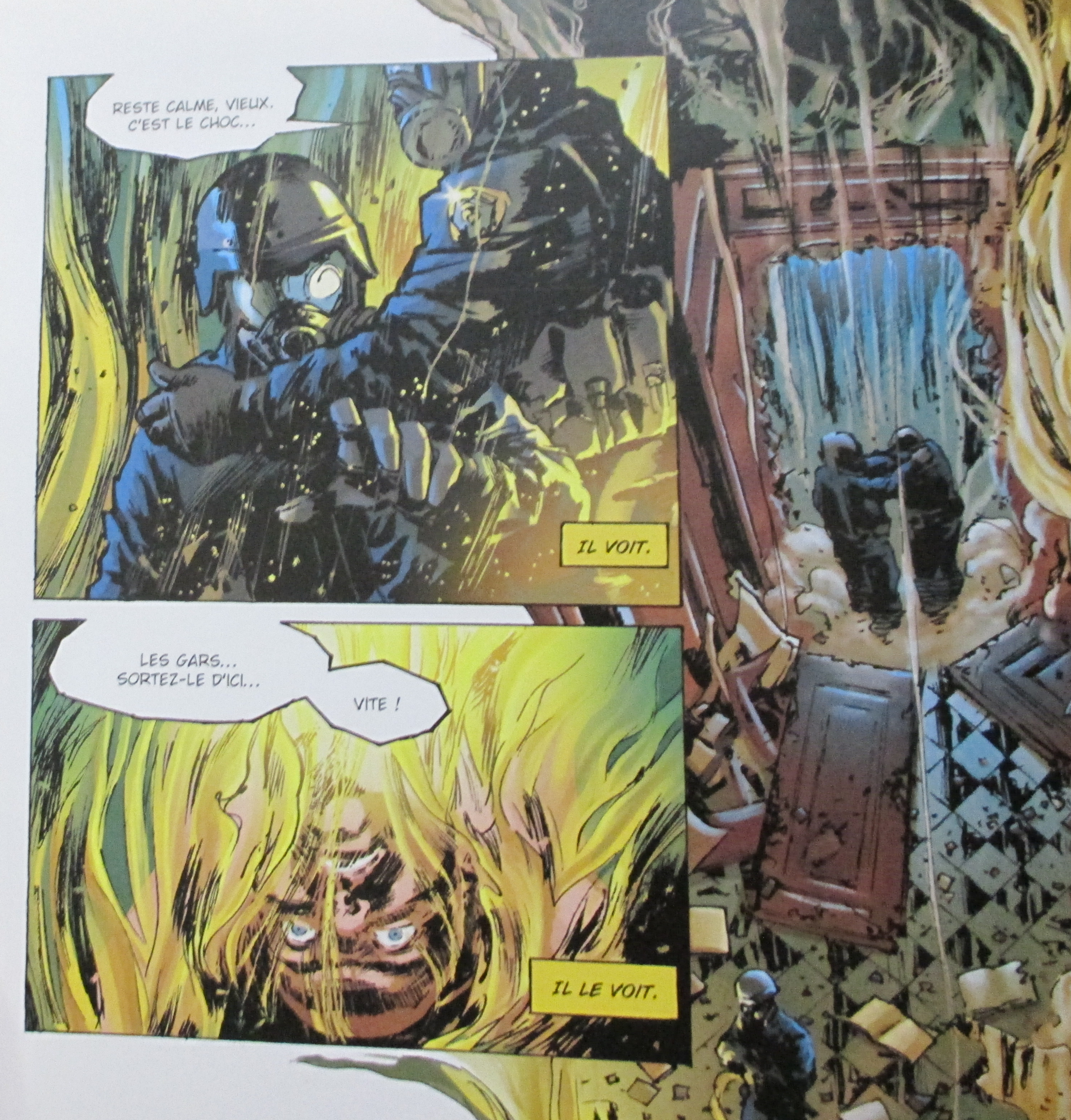
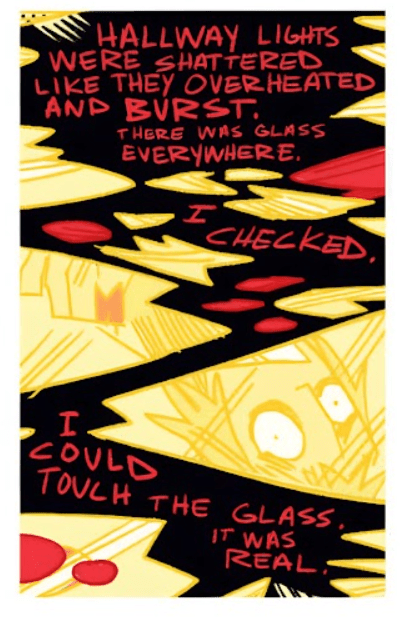
A panel from Where Black Stars Rise by Nadia Shammas & Marie Enger.

For this graphic novel, Marie Enger presents a somewhat grungy, Mike Mignola-esque style. Stark shadows and bright yellows, stipple give more of the texture than hatching; there’s a lovely clutter to some scenes, and others where the curtain is dropped for effect; and the lettering and framing both fit the mood. Like the eponymous play, the graphic narrative is split into two acts, the first relatively normal and almost banal, while the second act is where things go fantastic and metaphysical.

Shammas and Enger’s work makes for an interesting contrast with I. N. J. Culbard’s graphic adaptation of The King in Yellow. Culbard is at pains to be accurate to Chambers’ original story, but as with his Lovecraft graphic adaptations, his restrained style and dedication to the original often misses the opportunity to do something extraordinary, to go beyond the text. That’s not meant as a knock on Culbard, who is meticulous with regard to authenticity, but it illustrates some of the possibilities of reworking old ideas in a new context, of offering up details the original authors had not given, of going beyond traditional interpretations and lore.

The graphic realization of Shammas’ story is a true collaboration, Enger’s art complements and expands on the text, and vice versa. Without the words, Where Black Stars Rise would still work, like Masreel or Lynd Ward’s novels in woodcuts; without art, Shammas’ script would still be a good story. Together, the result is a gem of a graphic novel, reminiscent of Black Stars Above (2019) by Lonnie Nadler & Jenna Cha but representing a distinct and novel approach to the material.

A look at the King in Yellow and its themes from a very different perspective. Not that of a white, heterosexual Anglo-American who grapple with an uncaring universe with outmoded ideas of sanity and madness; but from marginalized folks for whom an uncaring universe is something they deal with on a daily basis.

Where Black Stars Rise by Nadia Shammas and Marie Enger was published in 2022 by Tom Doherty Associates, and won the Ignyte Award for best comics team.


Bobby Derie is the author of Weird Talers: Essays on Robert E. Howard and Others and Sex and the Cthulhu Mythos.

Deep Cuts in a Lovecraftian Vein uses Amazon Associate links. As an Amazon Associate I earn from qualifying purchases.
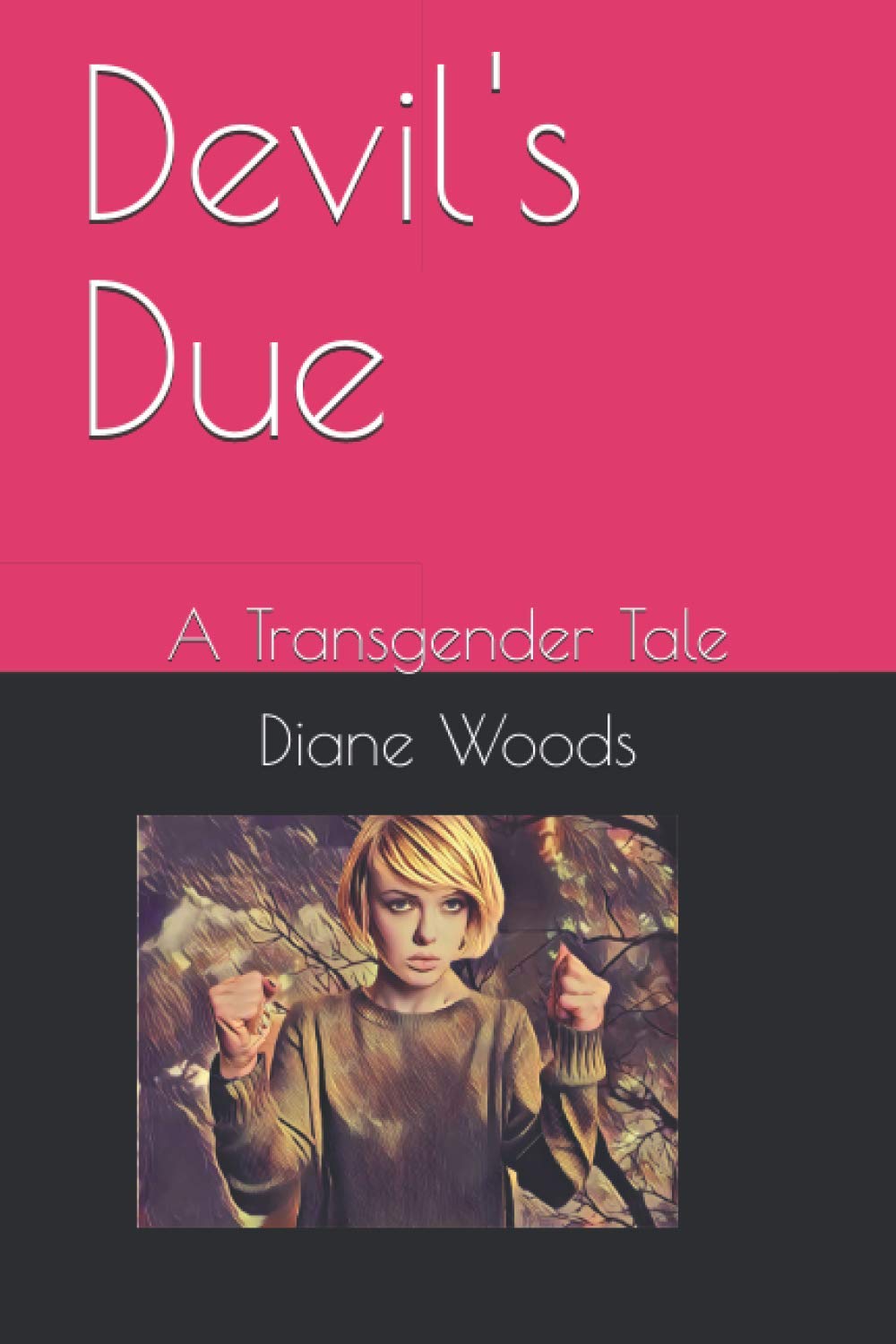
Devil’s Due: A Transgender Tale (2021) by Diane Woods

It began with what has been called Cancel Culture, I suppose. Without much warning, I was subjected to a number of public accusations by various women of my alleged misdeeds. These accusations were largely unsubstantiated and were simply the public revenge of various disgruntled and jilted former lovers and employees.

But the resulting furor was considerable. I was dropped by my long-time publisher, in a very public manner. My book sales, which had been very considerable (and some quite lucrative movie development deals) quickly began to evaporate. […]

I spent a small fortune on lawyers. It was not successful. And in the court of public opinion, I was tried and convicted in short order. And so, it was in the depths of despair that I somehow found a most unusual, a most intriguing, website for someone or something called “The Repairer of Reputation”.

Diane Woods, Devil’s Due: A Transgender Tale (2021)

“The Repairer of Reputations” is the first, weirdest, and arguably most important tale in Robert W. Chamber’s 1895 collection The King in Yellow. It is also the hardest to actually follow up: Chambers had set the scene thirty years in his future, in the manner of future war stories like H. G. Wells’ “The Land Ironclads” (1903). The narrator is unreliable, as is Mr. Wilde, the eponymous Repairer of Reputations, which adds to the mystery and disquiet of the story—how much of this is true, and how much is madness?

While a few works like Alan Moore & Jacen Burrows’ Providence have deliberately woven some elements of that story into their own, this is rare. Most who draw on The King in Yellow focus on the Yellow Mythos surrounding the play, such as “Cordelia’s Song from The King in Yellow” (1938) by Vincent Starrett & “Evening Reflections, Carcosa” (2011) by Ann K. Schwader rather than the events of the story. So there is a certain cleverness in how Diane Woods takes the idea of the Repairer of Reputations and gives it the perfect contemporary context: who would be in more need of such a service than someone who has been canceled?

Political partisans can be relieved that this book is not about cancel culture, either for or against. The social ostracism is the catalyst for the events of the story, and Woods never goes into vast detail about how true the allegations are or whether the outrage is justified or not. This is, as the story suggests, a transgender tale: the way that the protagonist’s reputation is repaired involves becoming someone else.

Impossibly, my transformation was complete. This was monstrously alarming, of course, but Tanya assured me that this need not be a permanent change. For my own personal reasons, this felt deeply ironic to me. At the same time, deeply erotic.

Since my adolescence, I had been obsessed with the idea of a male being transformed into a female. And since my teens, I had compulsion to periodically dress in the clothes of a female. This has been my most closely guarded secret, of course. But it may help explain what happened next.

Diane Woods, Devil’s Due: A Transgender Tale (2021)

Fantasy gender-bending stories are nothing new. H. P. Lovecraft had body-swapping in “The Thing on the Doorstep,” Bergier used Mythos magic in “Celui qui suscitait l’effroi…” (1958), John Blackburn had a surgical solution in Dagger of Blood (1997), and so on. The method varied, but the result was often the same: a gender transition that was often swift and total. The reality of transition is much longer, messier, and more difficult, involving various degrees of psychiatric evaluation and therapy, hormone treatments, and possibly surgery—and accompanied by legal and bureaucratic hurdles, healing times, side effects from medication, and social ostracism.

Transgender fantasies cut past many of the real-life difficulties to focus on the drama—and sometimes wonder—of the transformation itself, and in many ways are probably closer to transformation erotica than to any desire to live vicariously through someone else’s transition. In this respect, many such “gender bender” tales are closer to a fetishization of the idea of gender transition, titillating readers with the taboo of crossing that imaginary definitive line between male and female, rather than any effort to create an authentic transgender character.

Devil’s Due: A Transgender Tale is not King in Yellow erotica in the usual sense, however. There are a few scattered erotic scenes in the book, but those hoping for a version of the King in Yellow to appear with a three-foot penis will be sadly disappointed. Fantasy transition tales like this one have a body of tropes of their own, involving how willing the participant is, how they come to accept or reject their new gender, etc.; if the physical transition is swift, the mental transition and acceptance of new gender—and often new sexuality—takes longer, and Diane Woods plays with some of the familiar tropes, but shies away from going into lengthy and explicit sex scenes as the protagonist, now a woman, has to find out if she is a lesbian or bisexual.

While the premise of the story is focused on the repairing of the protagonist’s reputation, and the gender transition is a part of that, the plot gets a little messier. Rather than keep strictly to the Yellow Mythos, Wood brings in elements of the Cthulhu Mythos including Randi Carter (a transitioned Randolph Carter) and Nyarlathotep; the relatively magical physical gender transition is accompanied by a science fiction hypnosis/brainwashing device that facilitates the mental transition and sets up a somewhat Twilight Zone-esque ending. It is far more Mythos material than is strictly necessary for the plot, and gives the story a bit of a fanfiction feel which it didn’t need to accomplish some of the plot twists—but some of the twists themselves aren’t bad.

It is important to note that Devil’s Due does not tackle a difficult subject via the medium of the Mythos in the manner of “Koenigsberg’s Model” (2011) by Peter Tupper & “The Ape in Me: A Tale of Lovecraftian Lust” (2016) by Raine Roka; that is, Woods is not using the story to address any social theme or element in Chambers or Lovecraft’s fiction, or any such theme or element in their personal prejudices. Devil’s Due is a transformation story that uses the Mythos for inspiration and aesthetics, but there’s not any deeper message about how Lovecraft felt about gender or how Chambers depicted gender in his stories.

Which is fair: not every latter-day Mythos story has to be a commentary on what has gone before. Devil’s Due is a competently-written fantasy transformation story; the riff off of “The Repairer of Reputations” helps it stand out from the dozens of other titles involving gender transformation on the Amazon ebook stocklist, and that is no doubt the point. If anything, it perhaps reads a bit closer to some of the older, less sexually explicit transvestite and transgender stories edited by Sandy Thomas.

Devil’s Due: A Transgender Tale (2021) by Diane Woods is available on Amazon Kindle, it was briefly available as a paperback.


Bobby Derie is the author of Weird Talers: Essays on Robert E. Howard & Others (2019) and Sex and the Cthulhu Mythos (2014).

“Massacre à Miskatonic High School” (2008) by Jean-Jacques Dzialowski & Dimitri Fogolin

Depuis la nuit des temps,
Des dieux noirs corrompent notre monde.
Ce sont les Grands Anciens.

La folie est leur visage.
L’horreur est leur royaume.
Leur éveil approache…
Since the dawn of time,
The dark gods corrupt our world.
These are the Old Ones.

Madness is their face.
Horror is their kingdom.
Their awakening approaches…
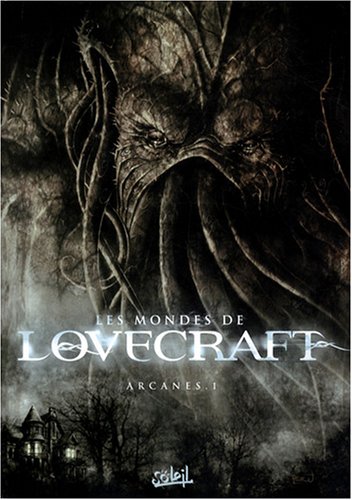
Back cover, Les Mondes de Lovecraft

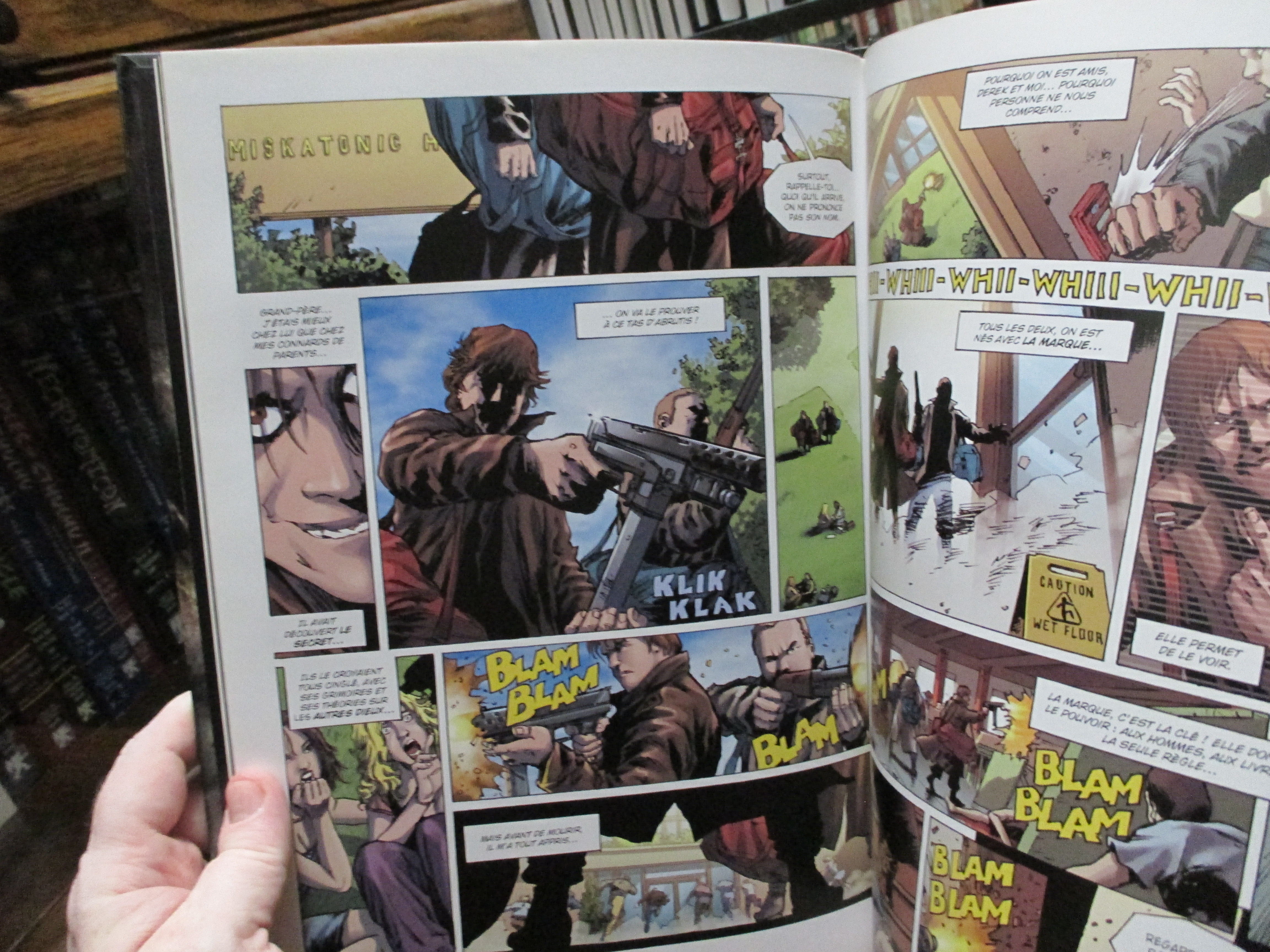
MondesLes Mondes de Lovecraft (“The Worlds of Lovecraft,” 2008, Soleil) is a standalone French-language comic anthology of stories set in the world of H. P. Lovecraft, including an adaptation of Lovecraft’s “Dagon.” Two of the stories in the book are the work of Jean-Jacques Dzialowski (writer) & Dimitri Fogolin (artist): “Le Signe sans Nom” (“The Nameless Sign”) and “Massacre à Miskatonic High School” (“Miskatonic High School Massacre”). The two works are complementary, in that they tell different sides of the same story from different perspectives. “Le Signe sans Nom” is given after-the-fact, during the deposition of a Sergeant McDermot, who responded to the events at Miskatonic High. “Massacre à Miskatonic High School” on the other hand gives the perspective of the school shooters. 


IMG_2591

The 1999 Columbine High School Massacre casts a long shadow over culture and pop culture alike. The media blitz helped to inspire numerous copycats; partisan politicians and pundits in the United States tend to quickly politicize shootings to minimize arguments over gun ownership as happened in the aftermath of the 2012 Sandy Hook Elementary School Shootings. Comic books have rarely touched on such controversial and emotionally-charged territory; DC Comics notoriously cancelled the Hellblazer story “Shoot” by Warren Ellis, Phil Jimenez, and Andy Lanning in 1999 over concerns of backlash.

At the bottom of most coverage of such shootings is one question: Why did they do it? What drove these kids to kill other kids?

Real-world causes are complex: psychological issues, a disturbed home life, access to firearms are all contributing factors. In the worlds of H. P. Lovecraft however…it’s rather simple.

They want the books.

Toute sa vie, grand-père a cherché les livres. Il en avait trouvé certains et il m’a laissé plein de notes…

All his life, grandfather searched for books. He had found some and he left me lots of notes …

In real life, the two Columbine Massacre shooters committed suicide in the library. In this Miskatonic Massacre, Dzialowski and Fogolin have something similar happen, but for very different reasons. Taking a page from Lovecraft’s “The Dunwich Horror,” the two shooters want access to the ancient tomes contained (somewhat inexplicably) in the Miskatonic High School library.

“Massacre à Miskatonic High School” is nine pages; “Le Signe sans Nom” is eight. The two works should really be considered as parts of the same story, and being parallel narratives, they have visual and textual echoes and references to one another—the final panels are largely identical. Fogolin, however, approaches each story separately. “Le Signe sans Nom” is darker, with more blacks, greys, and blues, while “Massacre” is brighter, dominated by yellows and greens—appropriate enough given the prominence of Hastur in this chapter of the story. The layouts for both stories also start the same: a regular nine-panel grid, which breaks down in the subsequent pages.

Given the subject matter, there is a certain amount of commendable reticence to show too much. We see bullets, blood, dead bodies, but we don’t actually see anyone get shot on the page, in close up or detail. Readers can be appalled at what is happening without seeing every last bullet hole or shard of bone. At the same time, this gloss of violence and the digital coloring lends a certain muddiness to the compositions; one wonders how it would have been different if Jacen Burrows or Raulo Cáceres might have handled the same material.

IMG_2600

Lovecraft never quite tackled such a mundane horror as a school shooting. Yet the horror in this story is a little different from real life. What if Wilbur Whateley had reached the Necronomicon? Would he have succeeded in clearing off the Earth, or would he have ended up as these two did? The central issue isn’t just the horrors perpetrated, but that the two shooters in this story very nearly succeeded. If someone had been a little more competent…how much more damage could they have wrought?

Perhaps more importantly, what’s to stop the same thing from happening again?

“Le Signe sans Nom” and “Massacre à Miskatonic High School” are both published in Les Mondes de Lovecraft. It has not been translated into English or reprinted, as far as I have been able to ascertain.


Bobby Derie is the author of Weird Talers: Essays on Robert E. Howard & Others (2019) and Sex and the Cthulhu Mythos (2014).

“While The Black Stars Burn” (2015) by Lucy A. Snyder

It was the first and last time she had been glad to be a disappointment in the eyes of the universe.
—Lucy A. Snyder, “While the Black Stars Burn” in Cassilda’s Song (2015) 120

Rape has the primary definition of sexual trespass, but in the broader sense encompasses a variety of behaviors which force or take from a subject without their consent, and often against their direct wishes. Rapists often seek, not sexual gratification, but control and dominance. The sense of inevitability that accompanies the Yellow Mythos can play into such fantasies, sometimes literally as in “Yella” (2015) by Nicole Cushing, but more often a kind of metaphysical invasion and entrapment—as in Lucy A. Snyder’s “While the Black Stars Burn.”

At least half of this story is untold. Caroline Cage-Satin doesn’t know it, and the audience is left to guess at the cruelty of her father, drunk and sober; his fixation on her development of a violinist appearing to be more than an extension of parental ego. When the scar breaks open on Caroline’s palm, readers will have to wonder how much of the whole incident—from the Maestro pulling out the burning brand to the doctor who completed the sign—was planned, and who was in on it. How many people, knowing and unknowning, had pushed and pulled Caroline to that moment, to be that person, desperate enough to wrap her crippled hand around the neck of a violin and face the music?

Worst of all she knew—since she’d been repeatedly told so—that she was quite plain, good as a violinist but unremarkable as a woman. Her music was the only conceivable reason anyone would welcome her to a wedding.
—Lucy A. Snyder, “While The Black Stars Burn” 122

There’s a skill in the half-built nature of the story, in that it doesn’t feel incomplete—and in the characterization of the protagonist. Caroline never loses her agency. She can say no, and she does. Despite being raised by a cruel and egotistical father, Caroline does not demonstrate those traits herself. Her act of striking back against the world is self-sacrifice: to throw away her instrument, abandon the course charted for her. To seek a new life.

This is exactly what is denied her, choice ignored, as she finds herself playing the piece once again. Caroline does not consent to what happens at the end of the story…but it isn’t about what she wants. It’s about what others want, what they can make her do.

Rape.

A search for literary forebears and parallels turns up two interesting pieces: H. P. Lovecraft’s “The Music of Erich Zann” and Charles Stross’ The Annihilation Score (2015). Zann is the quintessential musical touchstone of Lovecraft’s Mythos, his music on the viol keeps whatever is outside at bay. In this sense, Snyder’s story is an inversion of Lovecraft’s: where Zann forces himself to play, Caroline is forced to play, and the results of their playing are exactly opposite.

Stross’ novel actually touches on Lovecraft’s story—the heroine’s bone violin is a Zann Special—but the violin itself and the score in question are tied to Carcosa; it represents a coincidental parallel to Snyder’s story. Stross also makes an explicit sexual tension between Dr. Dominique “Mo” O’Brien and her violin, and outside forces pressure and shape her toward specific ends against her will. Like in Snyder’s story, O’Brien in Stross’ work is ultimately forced to play…but she at least has the resources to find a way out.

“While the Black Stars Burn” was first published in Cassilda’s Song (2015), and also appeared in and lent its name to Snyder’s collection While the Black Stars Burn (2015). It has been reprinted in Turn to Ash, Volume 1 (2016), Apex Magazine (Sep 2017), and Pseudopod #574 (2017). Snyder’s other Mythos fiction includes “The Girl With the Star-Stained Soul” (2014), “The Abomination of Fensmere” (2015), “Cthylla” (2015), “Blossoms Blackened Like Dead Stars” (2017), “Sunset on Mott Island” (2017), “The Tingling Madness” (2018), and “Cosmic Cola” (2018). Many of these are included in her collection Garden of Eldritch Delights (2018).

Lucy A. Snyder has also written nonfiction articles/reviews about Lovecraftian fiction for Horror World, and the essay “Unreliable Narrators in Kiernan and Chambers” (7 Oct 2015, Apex Magazine).


Bobby Derie is the author of Sex and the Cthulhu Mythos (2014)

“Lilloth” (2006) by Susan McAdam

Now what if I told you that there is such a work available for study, but this particular body of knowledge is near impossible to correctly interpret because sheer madness is the irreversible result from the mere reading of it? That’s right. You know the text.
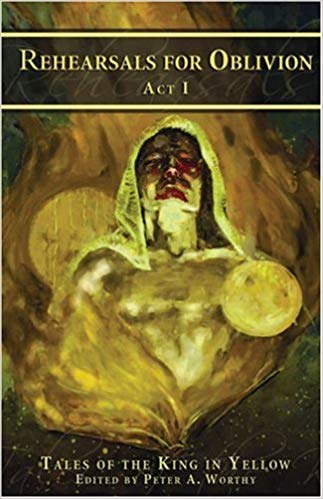
—Susan McAdam, “Lilloth” in Rehearsals for Oblivion: Act I (2006) 107

The stories in The King in Yellow are structured as tragedies, in the sense that there is a certain inevitability that accompanies them, with all the characters’ actions leading them inexorably on; their fates cannot be otherwise, because they cannot be or do otherwise. This has often found expression in the stories of the Yellow Mythos: sometimes they evince a quiet irresistible force, as in “The Viking in Yellow” (2014) by Christine Morgan and “Yella” (2015) by Nicole Cushing, or as a portentous foreboding of doom, as in “Slick Black Bones and Soft Black Stars” (2012) by Gemma Files and “Flash Frame” (2010) by Silvia Moreno-Garcia. There are rarely horrors to be fought in the sense of a raised fist, a drawn sword, or a loaded gun; no spell to ward off the inevitable. Though certain outward manifestations may be halted, the knowledge of the horror remains…and the terrible reality is there, waiting, in Carcosa.

In “Lilloth,” Susan McAdam takes advantage of both these approaches. The titular character’s name combines ‘Lillith’ from Jewish mythology and the -oth ending favored by Lovecraft in names like Yuggoth, Yog-Sothoth, and Azathoth, suggesting something of her nature—and she acts as both catalyst and focus for the story, narrated by an unknown, not-quiet-omniscient narrator, somewhat in the manner of Arthur Machen’s “The White People.” Lilloth is the beginning and the end of the story; the doom of her teenage friends is foreshadowed long before it is developed, and the nature of that doom is inevitable as it is, to a degree, self-inflicted. The teenagers act as they must, being who they are. The reader watches it unfold, like a horror movie, third-party witness to the event.

How a story is told matters at least as much as who the characters are, the setting, or the actual events of the plot. One of the advantages of operating within a specific Mythos is that a certain amount of the heavy lifting is already done: the reader is familiar with basic concepts, familiar names, disbelief is partially suspended already. The reader wants to read the story.

Such a pre-investment can allow room for experimentation, and so it is with McAdam: Lilloth’s story is told in fits and spurts, as though the narrator was piecing everything together from disparate newspaper accounts, interviews, police reports—all for the purpose of illustrating a point about reading between the lines, and the dangers of connecting certain dots.

It’s a familiar Mythos trope, as old as Lovecraft’s line “We live on a placid island of ignorance…” from “The Call of Cthulhu,” and there are many more old favorites in “Lilloth.” The actual plot of the story is less interesting than the way it is told, the connective tissue between the scenes somewhat thin, as might be expected of a piecemeal narrative. Most of the mysteries are left untold, and that’s perhaps more fun.

Lilloth joins the new generation with Helen Vaughn, Wilbur Whateley, and Hester Sawyer, and the circumstances of her conception are perhaps less of interest than that of her coming of age—and that is an aspect of these characters it is interesting to compare and contrast. Born of human women, they live for a time a changeling’s life, though often apart from humanity, teenage alienation made flesh—a theme sometime explored, as in Stanley C. Sargent’s “The Black Brat of Dunwich” (1997) or W. H. Pugmire’s “The Child of Dark Mania” (1997). Lilloth’s characterization is in between those of Wilbur Whateley and Hester Sawyer: conscious of her heritage, but ignorant of the details; she has to learn, to grow as a person before she can take the next step, to transition from childhood to adulthood, from humanity to whatever lies outside of it…and there are casualties along the way.

“Lilloth” was published in Rehearsals for Oblivion: Act I: Tales of the King in Yellow (2006). It has not been reprinted.


Bobby Derie is the author of Sex and the Cthulhu Mythos (2014)

“Yella” (2015) by Nicole Cushing

And he can’t help himself. He lets out a little, sissy-like wail and flinches at the noise.
—Nicole Cushing, “Yella” in Cassilda’s Song (2015) 39

Colors take on symbolic meaning, adapted to the syntax of their era. Robert W. Chambers’ seminal collection The King in Yellow (1895) was published during the “Yellow Nineties,” when publications like The Yellow Book (1894-1897) gained a reputation for decadence and eroticism, and that aesthetic can still be felt in stories like “Flash Frame” (2010) by Silvia Moreno-Garcia. Through the auspices of The King in Yellow, the color itself has become a byword and hallmark for activity in later fiction, giving its name to the “Yellow Mythos”—which might otherwise be the Chambers Mythos (to parallel the “Lovecraft Mythos”), the Cassilda Mythos (to parallel “Cthulhu Mythos,” yet keep it distinct from the “Hastur Mythos”), or the Carcosa Cycle (echoing Lovecraft’s reference to “the Arkham Cycle”).

Yellow can have many other connotations, however. “The Yellow Wallpaper” (1892) by Charlotte Perkins Gilman showcases a woman’s slow descent into madness, with certain thematic resonance to Chambers’ work. Yellow journalism is cheap, tawdry, sensational, and degrading; named after crumbling, fast-fading newsprint. Yellow is the color sometimes associated with fear and cowardice.

“Yella” by Nicole Cushing embraces the latter. Not the sudden fear of bodily harm, or of sudden climactic revelations, but the slow gnawing death by inches that comes from not wanting to act, to interfere. Fear of consequences, of being left alone, of what people will say and think of them. Adult fears, real and poignant, the kind that people bottle up inside and drown sip by sip from a whiskey bottle.

The basic premise of Cushing’s story echoes several other Mythos tales, particularly since it involves a male protagonist who appears unable to bring themselves to interfere with a female they are in a relationship with, even as she grows more distant from normal behaviors and closer to stranger things; August Derleth’s “Innsmouth Clay” (1971) and Ann K. Schwader’s “Mail Order Bride” (1999). The specter of fertility issues on relationships has been given a Mythos twist in stories like “In His Daughter’s Darkling Womb” (1997) by Tina L. Jens and “Prey of the Goat” (1994) by Margaret L. Carter.

What sets “Yella” apart is the focus on fear—and masculinity.

It’s enough to make any man prissy-prance his way outta there, but he ain’t gonna be scared off. He’s gonna do what he shoulda done days ago. Gonna be a fuckin man.
—Nicole Cushing, “Yella” 41

As in “Gilgamesh in the Outback” (1986) by Robert Silverberg, there’s a focus on both the internal narrative of masculinity and the external expression of it. Billy, the “empty man” protagonist of Cushing’s narrative, is hounded by the image of how he thinks a man should be and act, juxtaposed against his actual actions and inaction; his failures to confront his wife and his inability to impregnate her. His wife Patti uses those same fears against Billy, throwing his failures in his face, threatening his masculinity:

Yer gonna turn sissy fer him, ain’tcha? Ya turn sissy fer Him, He’ll give ya babies, too. Don’t make no difference if y’ain’t gotta pussy or a womb. He’ll make some fer ya, claw some into ya!
—Nicole Cushing, “Yella” 43

Billy’s fear that his wife will leave him for another man, that Patti has gone crazy, run up against a harsher reality. His fears, small and personal as they are, showcase the limits of his imagination—and what is really going on with Patti and her Yella Angel is much worse than what has Billy hitting the bourbon.

“Yella” plays with all these themes, stemming from and circling back around to the name, what it symbolizes and implies—the King in Yellow, Billy’s cowardice and its association with unmasculine behavior, sexual decadence, a woman’s descent into madness—and it does so quickly, pulling no punches, no graceful glances aside or slow build-up. Patti’s foul-mouthed speech is raw and perfect, brash and detailed where Billy is reticent and afraid to put his fears into words.

Billy is raped near the end of the story; and it is a rare event in the Mythos for a man to be penetrated. It is the culmination of Billy’s emasculation, and the fulfillment of Patti’s promise, at least from a certain point of view. Certainly, Billy didn’t ask for it—but in many of ways, that lack of choice may be the point. Rape is an expression of power and dominance, not sexuality; power and dominance are key aspects of patriarchal systems and cultures. Billy’s attempts to prove he is a man by dominating Patti, verbally and physically, ultimately fail…and ends up with roles reversed.

The real horror is that this isn’t Billy’s punishment, either for acting or failing to act. Getting raped, body and mind violated by the Yella Angel in its tattered robe, is not some vicious moral for failing to act up to a John Wayne standard of how a man is supposed to act. It would have happened anyway. There was nothing Billy could have done to prevent it—and there is nothing he or anyone else can do to prevent it from happening again. Billy’s reality is wakening up to how powerless he and everyone else is. A bleak and utterly appropriate nihilistic end, in the best traditions of the Yellow Mythos.

“Yella” was published in Cassilda’s Daughters (2015). Nicole Cushing’s other Mythos/Lovecraftian stories include “A Catechism for Aspiring Amnesiacs” (2012) and “Diary of a Sane Man” (2016); her story “The Company Town” appeared in the Thomas Ligotti-inspired anthology The Grimscribe’s Puppets (2013).


Bobby Derie is the author of Sex and the Cthulhu Mythos (2014)