Racist Language
Commentary and discussion of this story includes quotation of racist language from historical sources. Reader discretion is advised.
In 1923, Edwin Baird was editor of two magazine: Detective Tales and its companion, Weird Tales. Most of Baird’s latter-day fame comes from the latter, where he corresponded with H. P. Lovecraft, accepted and published several of Lovecraft’s tales, and was editor during the magazine’s brief collaboration with Harry Houdini. Weird Tales ended up losing a considerable amount of money in its first year, and in the financial re-arrangement that followed, Baird was out of the editor chair at Weird Tales, to be replaced by Farnsworth Wright, though he remained the editor of Detective Tales (to be renamed Real Detective).
Yet before and after his time at Weird Tales, Baird was a successful writer of stories for magazines and newspapers, and later novels like The Unordained Preacher (1913), The City of Purple Dreams (1913), The Heart of Virginia Keep (1918), and Fay (1923). To most readers today, Baird’s career may be unremarkable—and largely lost. He worked in several genres, from generic human interest tales to detective yarns to fantasy (including one story in Weird Tales‘ May 1937 issue, “Anton’s Last Dream”), but there are no collections of his work, and relatively few anthology appearances. Whatever popularity he had as a writer largely died with him.
However, that doesn’t mean his writing outside of Weird Tales is entirely without interest. The short story “Blackie” by Edwin Baird first appeared in Munsey’s Magazine (Oct 1916), and subsequently saw reprint in various newspapers.
※
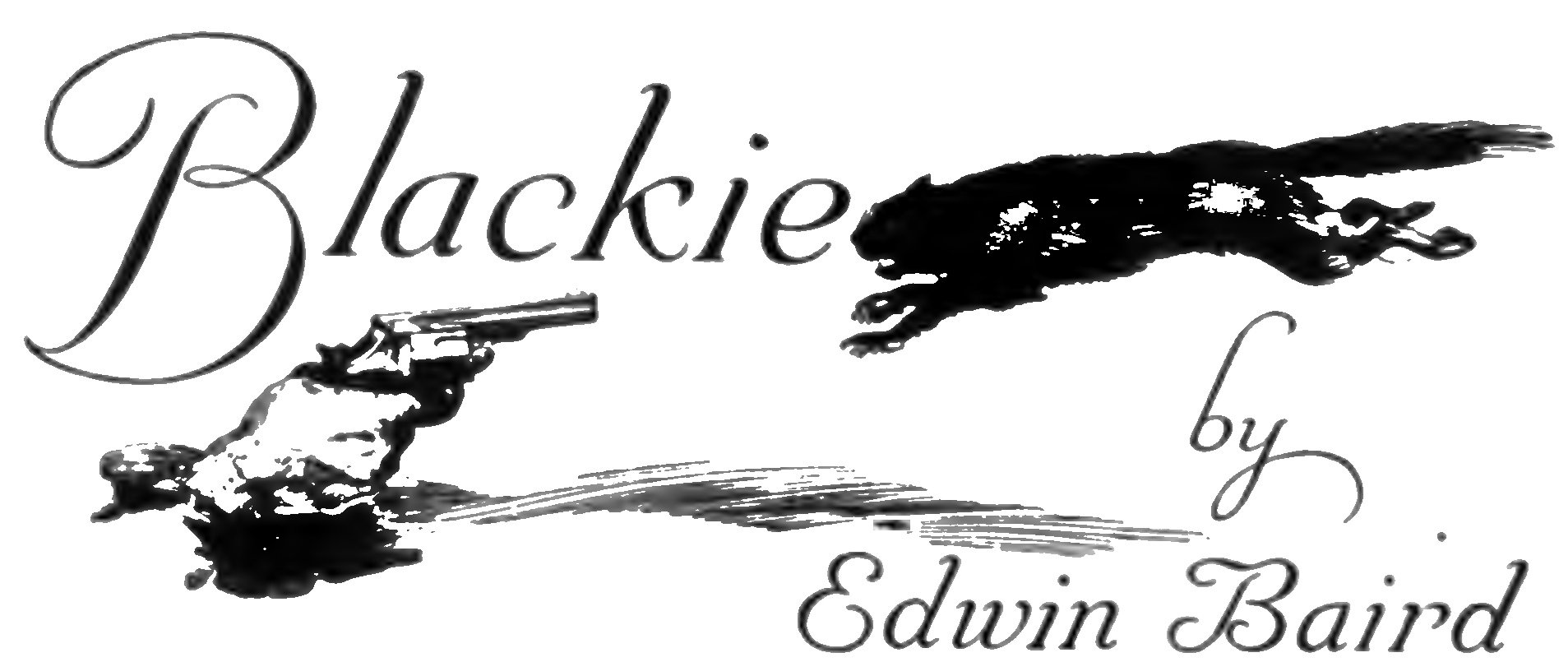
Blackie
by Edwin Baird
GALLOWAY COBB, of Springdale, sat at his kitchen table, breakfasting on pork-chops and corn-meal muffins, and reading, between bites, the Springdale Courant aloud to Sarah Cobb, his wife.
“It’s an outrage!” he interjected wrathfully. “It oughta be stopped!”
“What oughta be stopped?” inquired Mrs. Cobb, refilling his coffee-cup.
Cobb leveled a stubby finger at an item in the Courant.
“It says here,” he continued thickly, talking and eating at the same time, “the police are drivin’ the crooks from the city, and Springdale’s gettin’ the benefit. One hold-up man was taken to the calaboose last night, and two ’spicious characters were told to leave town. Others are thought to be headed this way. A fine howdy-do, I must say! Why don’t the city keep its crooks? Why don’t—”
Mr. Cobb paused abruptly, his cup midway to his lips, his gaze riveted on Blackie Toodles, who, questing edibles, had leaped to the table in her noiseless way and now stood, with arched back and elevated tail, surveying his plate longingly. Cobb returned his cup to the saucer and looked at his wife, who stood at the stove, a fork in her hand, her attention devoted to a pan of sizzling pork-chops.
“Since when,” he asked, obviously struggling for a cool politeness, “must I eat my meals with that infernal cat?”
Mrs. Cobb lifted her patient eyes from the meat.
“Blackie, get down this moment!”
No such gentleness characterized Cobb when he addressed the cat.
“Scat, you beast!” he bellowed, and flourished his napkin threateningly.
Blackie retreated to the edge of the table. Her back shot suddenly higher, every hair standing on end. Her green eyes glared at the enemy with owlish, unwinking defiance. Then, baring her teeth and emitting a hiss of hatred, she sprang softly to the floor and scurried under the sink, where she again directed her staring green eyes to the man she feared and hated.
Mr. Cobb buttered a hot muffin, and his roly-poly face reddened somewhat as he vigorously resumed:
“You gotta get rid of that worthless beast! If you don’t, I will! What good is it, anyway? What d’you keep it for? I tell you, Sarah, I won’t stand it another day—”
“It’s five minutes to seven,” reminded his wife, with a warning glance at the kitchen clock. “Finish your breakfast and don’t talk so much.”
She transferred a chop from the frying pan to his plate. Cobb promptly attacked the delicacy with gusto; but he continued to mumble indistinct threats while his fat jaws champed in rapid mastication. The long-handled fork held at her hip, Mrs. Cobb gazed pensively at the remaining chop, which later was to form her breakfast. A scrawny, rather angular woman, with a resigned face and bony fingers denoting hard toil, she presented a startling contrast to her husband, who was short, thick, and self-assertive.
Mr. Cobb’s ire against Blackie showed no sign of abating, and his wife’s distress grew. Presently her faded blue eyes began winking. She passed the back of her thin hand across them, and it came away wet. Soon she was whimpering and sniffing.
“You’re always picking on poor little Blackie, and she’s the only friend I’ve got in this world. What pleasure would I get out of life, anyway, if it wasn’t for Blackie? You’ll persist in your meanness till you make us both run away from home; that’s what you’ll do!”
Cobb rose with a fat, energetic movement, an expression akin to shame on his moonlike face.
“There, there!” he soothed roughly, as he put his plump arm around her scraggy waist and kissed her cheek. ‘Don’t carry on so. Where’s my hat? I’ll be late at the office.”
And then, in another minute, he was out of the house, and his stocky legs were propelling him in the direction of the Eden Real-Estate Company’s office, where it was his business to capture back-to-the-soil enthusiasts from the city and interest them in the purchase of lots and plots on the instalment plan.
II
IN town, during the day, Galloway Cobb heard much talk concerning the influx of undesirable characters; but somehow the topic had lost its flavor for him. Of more appeal was the reflection that he had behaved rather shabbily to his wife that morning. So potent an influence did the reflection exert on him that when he started for home, late in the afternoon, he carried in his overcoat pocket a two-pound box of candy.
When he drew within sight of the house and saw that it was dark, a horrid foreboding seized him. He was too late with his propitiatory gift! Mrs. Cobb had run away and left him, just as she had threatened to do!
So ran his thought. Nor was his fear alleviated when he entered the lower hall, called her name, and got no answer.
Then he lit the living-room lamp—and discovered that he had troubled himself to no purpose. This note was pinned over the face of the mantel clock:
Calling on Mrs. Kempner. Back in a few minutes.—SARAH.
Much relieved, he placed his box of candy in the exact center of the living-room table, where Mrs. Cobb would be sure to see it the moment she returned; and then, waddling in his fat way, he proceeded toward the cloak-room, removing his overcoat en route.
All at once a piercing scream, dismal and heart-rending, apprised him that his foot had encountered Blackie’s tail, with painful results to the luckless animal. He immediately offered an apology; but the cat fled to its box in the kitchen. He followed, struck a light, and again tried to show that he was sorry.
Blackie, however, brought to bay, crouched away from him, her ears flattened, her green eyes flashing fierily, while menacing growls of warning rumbled in her throat.
“Nice kitty!” cooed Mr. Cobb, and stooped to pat her head.
Instantly, and with her deadly hiss, Blackie’s right front paw flashed forth, every hooked nail extended—and Mr. Cobb straightened suddenly up, blood streaming from an irregular scratch on his hand.
Back came his anger of the morning, blazing twice as fiercely now. He raced to the basement, with his smarting hand to his lips, found a covered basket, and, after an exciting hunt, found Blackie.
Seizing her by the scruff of her neck, he popped her into the basket, clapped the lid down, and marched forth in the direction of Springdale Creek, his mind’s eye beholding fascinating pictures of Blackie sinking deep into the water with a rock tied around her neck.
But alas for the plans of men in this precarious world! The road to the creek led through an unwholesome part of town, and in a particularly cheerless neighborhood a masculine form, somewhat darker than the enveloping gloom, stepped quietly from the doorway of an abandoned building, pointed a revolver at Mr. Cobb’s head, and remarked succinctly:
“H’ist yer mitts!”
Mr. Cobb dutifully elevated one mitt—the left one—his right being employed with the basket. He was conscious of no feeling for several moments. He seemed to congeal where he stood. In fact—why try to disguise it longer?—Mr. Cobb was frightened stiff.
“Whatcha got in dat basket?” demanded the rough and aggressive voice behind the gun.
With no more ado, the owner of the voice lifted the lid. He dropped it still more abruptly. Spitting as never before in her life, Blackie sprang at the intruder’s face and clung there, clawing furiously. Her nails behaved as they had on Mr. Cobb’s flesh, only now, instead of five of them, all twenty were doing business simultaneously.
The robber, in a frenzy, called upon Satan and invoked the locality that gentleman is said to inhabit, and fled at his utmost possible speed. After a distance of some twenty yards Blackie parted company with him and vanished down an alley in a black streak, her tail almost half as big as her body. The highwayman, still profane with agonized eloquence, also disappeared, no man knows where.
III
Mr. Cobb’s fright passed gradually, but it was a considerable space before he felt assured that all was well. Even then his knees trembled slightly as he waddled down the alley calling:
“Kitty! Kitty! Kitty!”
Ten minutes of this proved fruitless, and he started home.
Half an hour later he presented himself at the kitchen door, a small parcel in his hand. His wife was baking biscuits for supper and singing happily at the employment, too.
“Why, dear!” she exclaimed as he opened the door. “Where did you go? I found the candy, and I couldn’t imagine—”
“I went to the butcher’s,” said Cobb, displaying his parcel, “to get this liver for the cat. Here, kitty!”
Blackie, reclining in her box near the stove, opened her bottle-green eyes at him in a wide, suspicious stare.
※
The story can be read in its original publication on the Internet Archive.
Stories, as I view the matter, divide themselves into two classes. In class No. 1 are the stories which a man writes to please himself. Class No. 2 stories are the ones he writes to please the editors.
I vastly prefer the first-named sort. I, however, must make a living by writing stories, and so I mostly write the other kind.
I’ve been writing fiction for a number of years, and I’ve encountered no loss of fertility. In fact, my story plots come far easier now than they did at first.
—Edwin Baird, The Student-Writer (Dec 1912), 6
“Blackie” is, we may hope, a Class 2 story by Baird’s own definition. It is almost the definition of filler; short and largely pointless, with characters drawn broadly and the barest sketch of a plot. Good to fill a few pages or column inches, utterly inoffensive, utterly lacking in innovation. Yet, because of a particular coincidence, it may hold interest for fans of Weird Tales and H. P. Lovecraft.
Edwin Baird’s prejudices in life are largely unknown to readers today; unlike H. P. Lovecraft, we have no massive trove of letters to provide an extensive record of Baird’s thoughts on race, prejudice, and related subjects. However, we can say unequivocally as an editor that Baird was willing to publish stories that included racist language and stereotypes in the magazines he controls. The very first issue of Weird Tales includes the n-word in the stories “The Unknown Beast” by Howard Ellis Davis and “The Skull” by Harold Ward. Not every subsequent issue edited by Baird reprinted the offensive word, but one particularly notable story used it repeatedly: “The Rats in the Walls” by H. P. Lovecraft (Weird Tales Mar 1924).
Lovecraft actually mentioned the cat in a letter to Baird that survives, part of a long, rambling answer to a request for autobiographical information:
I can assure you that Nigger-Man is (or was, alas!) a glorious and purring reality!
—H. P. Lovecraft to Edwin Baird, 3 Feb 1924, Letters to Woodburn Harris and Others 49
In some later adaptations and reprints, the cat in “The Rats in the Walls” would sometimes be renamed “Blackie.” This was not a coincidence. “Blackie” was a not-uncommon bowdlerization of the familiar racist pejorative, a G-rated version of the same idea. Lovecraft showed no embarrassment in writing his pet’s name, and Baird apparently felt no qualms about printing it. Both names were, at that point in time, socially acceptable for a black cat—as both Lovecraft and Baird were aware.
The coincidence is that Lovecraft managed to land that tale with an editor who had previously written his own tale starring a black cat—albeit one aimed for a much more general audience—and who was willing and able to print the n-word in the magazines he edited. We know Farnsworth Wright was also willing to publish the n-word in Weird Tales as well—after all, he was willing to reprint “The Rats in the Walls,” without change, in Weird Tales June 1930 (where Robert E. Howard read it). Yet by that time, the story had already been published once.
There is no evidence Lovecraft ever read or heard of this story. We may speculate whether Baird was particularly inclined to accept Lovecraft’s story, or at least not opposed to it merely because of the cat’s name, because he himself had already splashed in the same puddle. Yet we cannot deny that both men were part of a culture that accepted and proliferated those names, and in that sense, the two fictional felines are literary cousins.
Bobby Derie is the author of Weird Talers: Essays on Robert E. Howard and Others and Sex and the Cthulhu Mythos.
Deep Cuts in a Lovecraftian Vein uses Amazon Associate links. As an Amazon Associate I earn from qualifying purchases.

