The Multi-Dimensional Career of Weird Literature Editor and Book Designer David E. Schultz by Katherine Kerestman

An English major toting a brand-new Bachelor of Arts degree, David E. Schultz stumbled into a numinous career in editing and book design by accepting gainful employment as a proofreader with an engineering firm. The way Schultz tells it, S. T. Joshi, wanted an estimate of page count for his edition of H. P. Lovecraft’s Supernatural Horror in Literature and, recognizing a good potential collaborator when he saw one, S. T. co-opted his talents and energy to aid him in his own efforts in Lovecraft Studies and Weird Fiction. Although he vigorously denies being a horror aficionado, Schultz has never been able to find his way back from the weird genre. Through years of scanning endless documents, converting them to Word, and then selecting type-faces for them, in the guise of freelance amateur book designer, Schultz became learned in the field, through a sort of literary osmosis, and has been able to make significant contributions to the burgeoning study of weird fiction.

In our interview, Schultz provides a tantalizing glimpse into early Lovecraftian scholarship (most notably the coediting with S. T. Joshi of thousands of Lovecraft’s surviving letters); the evolution of book publishing in the computer age; and his own exceptional contributions to Lovecraft scholarship (the highlights of which are his annotated Fungi of Yuggoth [Hippocampus Press, 2017] and his soon-to-be-released annotated edition of H. P. Lovecraft’s Commonplace Book). The last I heard, he had written only 84 annotations for a future volume of Clark Ashton Smith’s prose poems and epigrams. Schultz is the guy who looks up all the cryptical words that most non-academic readers skim over, trying to divine their meanings from the context and seldom succeeding; his efforts are much appreciated by those of us who read every footnote and endnote.

From a Lovecraftian standpoint, though, the greatest contribution of David E. Schultz is his collaborative work with S. T. Joshi in preserving 25 volumes of the extant correspondence of H. P. Lovecraft, who is thought to have penned tens of thousands of letters. Not surprisingly, this project has spanned three decades. Lovecraft’s correspondence with friends, colleagues, and revision clients engulfed so much of his time that fans lament the fact that he was not always writing stories. To Lovecraft, though, epistolary conversations with far-flung friends were much more important. His letters provide valuable autobiographical information, commentary on his own writing, a window into his evolving philosophy, his beliefs about life and literature, and an inside look at his relationships with Frank Belknap Long, Sonia H. Greene, R. H. Barlow, Robert E. Howard, August Derleth, and other contemporary writers. With Joshi, Schultz has published a number of other letters projects; in 2024 what he thinks is the last volume of Clark Ashton Smith’s letters came out.

Currently, Schultz is completing work on an astounding 350-page annotated edition of Lovecraft’s Commonplace Book, the pocket notebook in which Lovecraft jotted down ideas for writing. Not a scholar by design or inclination, Schultz became one by default, thanks to a consistent immersion in Lovecraftian texts. And, as he will tell you below, most recently he has been drafted into service by the August Derleth Society to preserve that author’s texts. At the Wisconsin Historical Society in Madison, Schultz recently scanned in one day about 600 pages of Derleth’s fiction, including both published and unpublished works, which are slated for publication by the August Derleth Society. He has created a spreadsheet of 850 poems from the magazines in the Historical Society’s archives. We were obliged to put this interview on hold for a time, as David needed to put in precious time at the University of Wisconsin Memorial Library Special Collections Department: he is preparing a bibliography of periodicals containing Derleth’s poetry (much of it uncollected) for future volumes of Derleth’s collected works, and the Special Collections department is about to close for a year to upgrade its fire system. Here’s a sample of a typical work week for David E. Schultz:

Just this week I’ve designed 4 books from scratch (>800 pp) and had my fingers in probably a dozen others. A day in Green Bay coming up, probably another in Fond du Lac (actually 2), another in Madison.

He’s hot on the trail of missing Derleth works—possibly thousands of poems among them—and he’s sure to bag them and bring them home eventually.

Now, I have the great privilege of introducing David E. Schultz.

I’ll begin at the beginning, David, by asking you which details of your life and education you would care to share with our readers.

I’ve lived my entire life in Milwaukee, Wisconsin. Education: Marquette University, B.A. Liberal Arts—in other words, the dreaded “English major.” I entered the workforce completely unprepared. I married my wife Gail in 1977. We had four children and now have 7 grandchildren. We’ve lived in our current house for 44 years. I retired in 2014, but have been immersed in book projects ever since. I still make time to go to organ or early music concerts in Milwaukee or other not too distant locations.

Please talk about your career in publishing.

After brief stint at a local book publisher, and an even briefer one in a factory for a summer, I got a job at—of all places—an engineering company. The company was part of a consortium for a huge wastewater treatment project, and they were responsible for getting a proofreader for the project office. When I was interviewed, the interviewer said, “I think we have a different job for you. Let me get back to you.” Of course, I expected no further communication, but he did in fact summon me again, and I went to interview at the project office. Got the job because the supervisor of the publications department thought my Latin and Greek background would be useful. (He later admitted, “You know, you had no experience . . .”) And so I became a “technical editor.” I spent 5 years with HNTB, 3 with Creative Marketing Corporation (again, hired on as proofreader, quickly bumped up to editor), and 27 with CH2M HILL—once a fellow member of aforementioned consortium. I’ve been retired nearly 10 years, but it seems I work harder than ever.

The engineering companies were rather like publishers. Print runs were very small—environmental impact statements, technical memorandums on various subjects, and so on, typically photocopied and comb-bound in-house. The subject fields were very broad: transportation, civil engineering, environmental engineering, geology, wastewater treatment, you name it. It was particularly fulfilling because the results of our work can be seen all around us. For example, an aging viaduct carrying traffic over the Menomonee Valley, just 2 blocks from my house, was demolished and redesigned by my company, and I worked on various documents associated with the project.

At first, all the “typesetting” in the office was done by our document processing crew. As computers entered the office, I found I could do much of the formatting and editing myself. By reverse-engineering the company’s well-designed templates, I learned the ins and outs of Word, and in time that knowledge led me to book designing—initially against my will.

By that I mean in 1999, S. T. Joshi asked me how big of a book his annotated Supernatural Horror in Literature might be. Well, it could be anything. I had no idea how to design a book that wasn’t 8½ × 11 inches in format, so I picked page dimensions based on a real book, tried to arrange margins to suit, and then picked typefaces. I was instructed to “keep the number of pages down,” presumably to minimize cost associated with the book. So I showed him how it had turned out—thinking only that the design gave an approximate page count. A skilled designer would then execute the actual and final design. His response was “We’re using this!!” And it promptly went to Hippocampus Press. Now, I thought in terms of appearance the thing was barely okay. What I presented Hippocampus with was hard copy—it had to be scanned and cropped somehow by the printer. Very primitive. In time, Hippocampus began to use print-on-demand publishing for most books because it meant the publisher didn’t have to keep inventory in his apartment. And gradually I learned the preferred means of submitting an electronic file for publishing. And I also learned more efficient ways of executing design. I recently made an electronic file of 461 single-spaced pages into two books set up for a conventional 6 × 9 in just a few hours. I hate to think how long that would have taken me, using basically the same tools, 25 years ago.

Being employed full time didn’t allow much time for my own book projects, but I did manage to publish a few booklets with Necronomicon Press and to coedit some books published by university presses. I’ve been publishing a brief rag in the Esoteric Order of Dagon Amateur Press Association irregularly since 1973. So I’ve been “publishing” for more than 50 years.

Were supernatural and science fiction always your chief interests in reading?

My early reading was eclectic. I’d read anything, if I was capable. I was urged, in eighth grade, to participate in a reading program for eighth graders. We got a box of books to read and discuss: Hiroshima, The Diary of a Young Girl, To Kill a Mockingbird, The Seven Story Mountain, Profiles in Courage, and many others The box also contained 20,000 Leagues Under the Sea. Of that vast array of genres and styles, the last stirred me the most. I swayed toward science fiction after reading Ray Bradbury, thanks to a flyer received in grade school with books recommended for students. It may have been Fahrenheit 451 that first grabbed me. From there I learned of the Science Fiction Book Club and became immersed in the genre. Favorites became Isaac Asimov, Harlan Ellison, Robert Silverberg, R. A. Lafferty, Theodore Sturgeon, Philip K. Dick. But I think these days my reading—what little there is—leans toward 19th and 20th century literature: Faulkner, Borges, Melville, Wodehouse, Dorothy Day. Mundane stuff, I suppose.

I think I first learned of Lovecraft when I saw a paperback of his stories at a department store. The Colour out of Space from Lancer, with its ridiculous cover depicting a skull amid flames. It may be—I can’t remember—that I first heard of him when I read Bradbury’s “Pillar of Fire,” when in the future, all morbidness in life is gotten rid of. Cemeteries are destroyed, and the works of morbid writers are destroyed. He mentioned Poe, but the other authors he named . . . Lovecraft, Bierce, Derleth, Machen. Well, basically Bradbury was telling me “Go look for these authors’ works!” And so I did. Bierce puzzled me, because the book I found had stories about the civil war and a “devil’s dictionary.” But upon closer examination, there were some outré stories. Many years later, I prepared an annotated “unabridged” edition of The Devil’s Dictionary.

The title story of The Colour out of Space was like nothing I’d ever read before. The copyright page of the book stated that the stories were reprinted with permission of Arkham House, Sauk City, WI. The kindly librarian at my high school looked up the address for me and I promptly requested a catalog. And equally promptly ordered The Dunwich Horror, Dagon, At the Mountains of Madness, and Collected Poems. I can’t remember just how I learned of the various fanzines, such as Nyctalops and Etchings and Odysseys, but in ordering them I saw plenty of advertisements for still other ’zines. I think the most influential was H. P. L. by Meade and Penny Frierson, because it contained discussion of Lovecraft like nothing I’d seen before. Particularly arresting was Richard L. Tierney’s “The Derleth Mythos.” How dare he stand up to August Derleth? But he was right. I gradually came to read more non-Arkham House-sanctioned writing about Lovecraft. And I was fortunate enough to cross paths with Dirk Mosig, Ken Faig, Jr., and R. Alain Everts, who dug far deeper than most others writing about Lovecraft had done.

Speaking as one English major to another, how did you develop into an editor and a conservator of twentieth-century weird literature?

Probably I sought to emulate what I’d seen written about other writers. In college I read books about Faulkner and his work and was struck by the scholarship and deep understanding of his writing. The same goes for other writers. I guess, inspired by Tierney’s article, I thought “Why not Lovecraft?” I was not impressed by the writings of August Derleth, Lin Carter, and L. Sprague de Camp on Lovecraft. But I was bowled over by Willis Conover’s Lovecraft at Last. Not particularly great scholarship, but it vividly brought the man to life. I was particularly impressed by the chronological list of stories that Lovecraft supplied to Conover. I compared it to the “chronology” found in Dagon and Other Macabre Tales. The latter was no chronology at all. If one looked at it closely, one could see that for any given year (sometimes incorrectly) the stories were all listed in alphabetical order. I doubt any author starts any year writing stories beginning with the letter “A” in the title and ending the year with stories starting with “Z.”

I had joined the Esoteric Order of Dagon Amateur Press Association in 1973, not really understanding what it was—which was an outfit much like the United and National amateur press associations to which Lovecraft himself belonged, but instead focused on him in some way. I began to get in touch with other fans. I went to many MinnCons with the Minneapolis/Duluth crowd, who alerted me to a fan who lived in Milwaukee, and I met R. Alain Everts of Madison, Wisconsin. In time he started a Necronomicon Amateur Press Association—supposedly for “scholarly” contributions. I’ll never know why I was invited to join, because I hadn’t written anything to date and was no scholar, then and now. My contributions to the EOD were very bad “poetry.” Since I needed to come up with something “scholarly” for the Necronomicon apa, the very first piece I wrote was an article about the order in which Lovecraft’s stories were written. At the time, only three volumes of his Selected Letters had been published. But I was able to do a pretty good job of getting the stories into the proper sequence, expanding Lovecraft’s own list to Conover, even if I could not pinpoint precise dates.

At the time, S. T. Joshi had independently approached Dirk W. Mosig on the same subject, and for the same reason I had. Dirk—also a member of the Necronomicon apa—steered S. T. toward me, and that was how our close relationship began.

I’d like you to talk about your edition of Fungi from Yuggoth. When I read the sonnets, I knew that they must be brimming with allusions and symbolism, but I did not have a key.  And then I read your book, which greatly enriched the reading experience for me.

Having turned in a paper on the chronology of Lovecraft’s stories, I needed something else “scholarly” to do. So I started looking into Lovecraft’s Fungi from Yuggoth—his long poem. I don’t recall the details, but it seems to me I issued several little ’zines treating of the poem, eventually writing an “essay” on its composition, meaning, and so on. Some of those little pieces appeared in Crypt of Cthulhu. I provoked a bit of a controversy by stating—contrary to the long-held description of the poem—that there is no linear story in it. The first three sonnets tell a brief narrative, but all subsequent sonnets are completely independent of each other. Some commentators held that there was a cohesive story. I begged to differ and offered proof for my thesis using Lovecraft’s own words.

I was supposed to come up with a book for the Strange Company, but because it was taking me too long to assemble a proper text, it did not appear there. I poked around at the thing for the next 40 years. Over time, more and more information about the poem came to light, so I was always adding to the book. It finally appeared from Hippocampus Press in 2017. Necronomicon Press once issued a pamphlet of the poem printed on three legal-sized sheets, three poems per page. A 12-page booklet. My book is a ridiculous 288 pages. I am completely undisciplined when it comes to making a book. I fill it with everything under the sun.

Please discuss your edition (forthcoming) of Lovecraft’s Commonplace Book.

Commonplace Book has similar origins to Fungi from Yuggoth. Strange Company was going to publish an edition of Commonplace Book as edited by Ken Faig., Jr. At one of our gatherings in Madison (known as Madcons), Randy Everts handed out proofs of the book for people to proofread. I didn’t know what to make of the thing. Had never heard of Lovecraft’s commonplace book before. I didn’t proof the book at all, but studied it for my own edification. It was a bare-bones presentation of the text. What looked like errors were in fact accurate transcriptions of Lovecraft’s entries as he wrote them. Not long after, I received a copy of The Shuttered Room and Other Pieces. It contained the commonplace book, but the entries were organized differently and were very lightly annotated—mostly to point out which entries were used by August Derleth as Lovecraft’s “contributions” to various stories Derleth wrote that he called “posthumous collaborations.” I thought Heck, I can find all sorts of connections between the entries and Lovecraft’s work, and so I began writing on that for the Necronomicon apa.

With assistance from S. T. (who was attending Brown at the time), and input from colleagues, I began to fashion a book similar in intent to Fungi from Yuggoth. Necronomicon Press published it in 1987 as two fat booklets. I was astonished in 1990 to see a fellow standing on the Quad at Brown (for the Lovecraft Centennial) holding the two books side-by-side against his chest while a colleague took a photo of him proudly sporting my book. Over time, much more came to light about the origin of some of the entries, and then, with the Internet, books.google.com, and the Brown Digital Repository, I had access to an enormous library to sift through looking for material to add to my annotations. I had earlier dismissed Zinge as something Lovecraft whimsically made up, but I later learned that it is real—at least in the sense that it is mentioned in a poem by Thomas Moore—something Lovecraft had in his own library.

After more than 35 years after publication of my first edition of the book, I have now prepared (probably shouldn’t say finished) a new edition. It is not at this time ready for publication, because I have to integrate into text images of Lovecraft’s notebook—a complicated logistical problem. I’m guessing it will run to about 350 pages when done, because again, applying the kitchen sink method, it contains all sorts of related material not in Lovecraft’s original notebook. Once I circulated through the EOD my early annotation of the book. I also included Lovecraft’s text for reference. Being a stingy person, I didn’t want to pay for a lot of xeroxing, so I typed out his text in small type on two sides, in two columns, of a single sheet of 11 × 17 paper. In effect 4 pages. And so, it, too, has bloated into a gargantuan monstrosity.

What place do you accord H. P. Lovecraft and Weird Fiction in the greater rubric of literature? 

Long ago, many kinds of magazines would publish an outré story along with more conventional tales. And publishers would publish a weird novel here and there. It seems to me (though I’m no follower of the book business) that now one needs to publish only in certain markets.

Derleth somewhat disparagingly said Lovecraft was a major writer in a minor field (a somewhat backhanded compliment, since he recognized himself as a minor writer, but in a major field. A better place to be, it would seem). I don’t really have an opinion in the matter. Lovecraft is, of course, now published by the Library of America, whose goal is to keep in print “canonical” American writers. And so he rubs shoulders now with Herman Melville, Nathanial Hawthorne, Edgar Allan Poe, Ralph Waldo Emerson, Edith Wharton, James Thurber, Walt Whitman (Lovecraft would be shocked), Gertrude Stein (ditto), Henry James, and many others. August Derleth does not. I guess that says something.

As with everything else, Sturgeon’s law applies to weird literature. “Ninety percent of everything is crap.” I don’t follow any modern weird writers—I’m just not interested. I haven’t read much other than the masters, and what I have I don’t really remember. I imagine M. R. James, Algernon Blackwood, and Arthur Machen will remain the titans, and there surely are some other worthy of note, such as William Hope Hodgson and Walter de la Mare. Again, I haven’t read them. I couldn’t say who is truly a master in the field, but according to S. T. it probably would be Ramsey Campbell.

What can you tell us about your coediting of Lovecraft’s correspondence?

I can’t remember how it came about exactly, but either S. T. or I, c. 1990, came up with the idea for a Lovecraft festschrift. It wasn’t such a book technically, since its subject was long deceased, but the idea of a book commemorating him 100 years after his birth seemed like a good idea. S. T. had plenty of contacts from whom to solicit essays. At the time, I had typed Lovecraft’s letters to Henry Kuttner. They were at the Wisconsin Historical Society of all places. So we annotated them, but ultimately decided they really didn’t belong in the book, and instead we offered our text to Necronomicon Press, which issued them in a small booklet. That was the genesis of the letters project, although at the time we didn’t know it.

S. T. had worked up a prospectus for 13 volumes of Lovecraft’s fiction, poetry, revision work, essays, and travelogues. I’m sure he said several times “No letters! Too much!” I learned that one could obtain a copy of the microfilm at the Historical Society of Lovecraft’s letters to August Derleth. I ordered it, but then what? S. T. had access to a microfilm printer, and so he printed the entire film—1000+ pages, in triplicate. I used the letters for my own research purposes, but following the Lovecraft Centennial Conference, I felt energized by the whole thing, so on the q.t., I began to transcribe the letters, saying nothing about it. The letters posed some issues. First of all, bad copies, or difficult to read handwriting. Then, most of the letters were not dated, because Lovecraft and Derleth wrote very frequently. Lovecraft’s letters may have said something on the order of “Thursday” and nothing more. So I had to try to determine the sequence of the letters. When I informed S. T. I had typed it all, he was thunderstruck.

Then the possibility of publishing Lovecraft’s letters took off. First we typed all the mss. we could find, preferring them to published (and edited) letters. S. T. typed letters to Donald Wandrei, R. H. Barlow, Duane W. Rimal, and Lovecraft’s aunts. I typed letters to Clark Ashton Smith, Wilfred Blanche Talman, Elizabeth Toldridge, F. Lee Baldwin, and J. Vernon Shea. Then, we were fortunate to be able to borrow a set of the Arkham House transcripts—those held by Derleth at his home. For example, there were a few letters by Lovecraft to Clark Ashton Smith at Brown University, but others were scattered all around. We merged the Arkham House transcripts among letters from manuscript, but still lacked many. In time, we obtained copies of the photocopies held by Roy A. Squires who had sold the letters, and other letter caches as they appeared: Hyman Bradofsky, Helm C. Spink, Arthur Harris, Frederic J. Pabody, Emil Petaja, and others.

We had issued a few small sets with Necronomicon Press, which always issued booklets in its customary squarish format, but the books we now could compile were far bigger than the press’s capacity. University presses were not interested. Once Hippocampus Press was founded in 1999, we had a sympathetic publisher who could issue big books. And so, in the twenty-first century, we began to publish books first typed in the 1990s.

Again, my models for such books were books compiled by others, such as The Letters of Jack London (Stanford University Press). The Lovecraft letters posed great problems for me, in that much of the material he discusses is not readily available. I was fortunate that the University of Wisconsin–Madison accepted the Fossil Library of amateur journalism, so that I could make short trips every so often to consult the many amateur journals in its collection.

These days, I tend to see Lovecraft more as a lifelong amateur journalist than a writer of spooky stories. His letters show that he thought of himself that way too.

Please share your experiences salvaging, restoring, republishing (or, initially publishing) the works of H. P. Lovecraft and August Derleth (your current project). You’ve saved many of these from being lost to time.

Oh, I don’t know I’ve “saved” anything. The writers stand on their own merits, and their work has long been available. The business of Lovecraft being “saved from oblivion” by August Derleth seems ludicrous to me. If he hadn’t done the work, someone else would have. On the other hand, Sauk City’s pride and joy seems largely to be unknown—when he’s not riding Lovecraft’s coat-tails. His “regional” writings seem to have sold well enough in his time, but the man on the street is more likely by a thousandfold to recognize the name Lovecraft over Derleth—even in Wisconsin. The August Derleth Society is keen on getting his regional writing back into print, and so S. T. (its Veep) has been reissuing his novels, and also quite a bit of uncollected and unpublished material. Much of the latter is available at the Wisconsin Historical Society, and because Madison is a mere 79 miles due west of Milwaukee, I can make trips there to obtain material quite easily. (S. T. would have to travel 1900 miles to do the work himself.) The books are all print-on-demand, with virtually no advertising, so whether people are noticing them at all is questionable. So far ADS has issued 9 titles. There are at least another 13 on my list, but there could be more. ADS won’t do juvenile books, horror, detective, and the like.

I’ve been roped into designing books for the August Derleth Society—books by, of course, August Derleth. Not my favorite author. Because I’m not far from the repository of his papers, I can go there from time to time unearthing uncollected and unpublished writings for various projects. My “research” is somewhat superficial. Merely compiling stuff for others to organize. I had another project I’d long wanted to do, but because it takes me so long to get anything like that done, amid dozens of other books, I have been scooped by another writer. We’ll see.

I have to admit, though, that I really enjoyed and take great pride in The Song of the Sun, by Leah Bodine Drake. I think it is generally overlooked, as I hear very little response to the appearance of the book. Now, her papers at the University of Lexington are available to anyone for consultation. I learned that August Derleth wanted to issue another book of her poetry after her death, but could not himself travel there to consult her notebooks. When I arrived there I was shown a big scanner that was able to flatten out the tight scrapbooks and pull all the text. I scanned all 24 of them in a day, along with other papers of hers. Beyond that, I had to dig in periodicals for appearances of her work. I was fortunate to get assistance from others in tracking them down. No one had ever written a comprehensive bibliography of her work, and much of her poetry was unpublished, or published in obscure little magazines. By careful analysis of the little material available about her, I was able to write a biographical sketch about her. The book is yet another example of the “kitchen sink” method, because it has all her poems that I could find, letters, short stories, essays, reviews, notes—everything. And yet it is unknown, and the disproven myth about publication of her Hornbook for Witches still prevails in the world at large. But I enjoyed doing it.

Same with Eyes of the God [by R. H. Barlow] and Out of the Immortal Night [by Samuel Loveman]. Somehow I got ensnared in them when the books were largely compiled and edited by two others. But for the second editions, I had access to resources that were out of reach when the first editions were prepared. Those were fun to do.

What other projects are keeping you busy these days?

As designer for Hippocampus and Sarnath Press (S. T. Joshi’s micro-press), I do nearly all the book designs. That runs to perhaps forty books a year. The editing of Lovecraft’s letters ended in 2024, with his correspondence with Frank Belknap Long. Same with Clark Ashton Smith’s (far less voluminous) correspondence with his Miscellaneous Letters. S. T. is eager to take on still more letters projects, although letters in a market for weird writings seems like a stretch. Lovecraft and Smith correspondence may sell. But letters to R. H. Barlow? To H. P. Lovecraft? Well, maybe. The letters to Barlow are quite fascinating, very broad in scope, and they shed considerable light on the man, even if the words are not his. I look at most of our projects as building individual research libraries for others to use—and the books do get used from time to time. Midnight Rambles and Deep Cuts in a Lovecraftian Vein cite the Lovecraft letters a lot, and it’s gratifying to see that people can stitch together information from those books to make interesting and insightful narratives about Lovecraft.

Ambrose Bierce’s collected journalism—all assembled and designed a year ago—continues to emerge, one volume a month. Fifteen more books remain to be published. Believe it or not, I’ve compiled a fairly large book of the poetry of Winifred Virginia Jackson, amateur journalist and colleague (and lover?) of Lovecraft.

Do tell, what evidence do we have of a possible love affair between H. P. and Winifred Jackson?

I myself don’t have evidence re Jackson. George Wetzel and R. Alain Everts wrote a monograph on her in which that is mentioned. I believe the source of the anecdote is in Sonia Greene’s memoir, in which she says she “stole” Lovecraft away from Jackson. Now, Jackson and Lovecraft may not have been a thing—or even a potential thing. Maybe Sonia was just trying to head off Jackson at the pass.

I wish to thank David E. Schultz for a most informative conversation. First, through his painstaking overview of the myriad technical and intellectual processes necessary to the physical production of books, he provides a privileged look at the behind-the-scenes mechanisms of publishing. Secondly, and of greater moment, though, are his personal contributions to a broader discourse regarding a philosophy of literature; for, his editorial exertions safeguard the vulnerable texts of worthy writers. Typically, authors hope their works will outlive them — and yet human memory is very short and very fickle; as an example, consider that fashions in literature must change rapidly in a consumer society in which books are a commodity and yesteryear’s writers are relegated to discard bins. Thirdly, while most authors, trusting foolishly in the protection of copyright, have absolutely no idea how much and how often their works will be adulterated once they have sent them into the world, published texts are, in fact, corrupted appallingly often. Finally, today, as so often in dark eras past (the student of history may find cases in every corner of the globe and in every aeon), there are nefarious individuals hard at work, intent upon erasing the ideas of those writers who lived before and who thought differently than they do. Simply by letting authors’ works stand unmolested, we help fight that societal evil.

Schultz’s honorable efforts have helped to preserve the integrity of texts, presenting them to the world as the authors meant the world to see them; and his herculean footnote-endeavors permit the ideas of these writers to be accessible to readers of later generations. David E. Schultz’s deeds in the conservation of manuscripts and letters provide the literary world with an arsenal of invaluable tools that may be used for the defense of literature as an art form, the defense of intellectual property, and the defense of free, individual expression in a modern climate in which both art and thought are threatened with extinction.


Katherine Kerestman is the author of Lethal(Psychotoxin Press, 2023), Creepy Cat’s Macabre Travels: Prowling around Haunted Towers, Crumbling Castles, and Ghoulish Graveyards (WordCrafts Press, 2020), and Haunted House and Other Strange Tales (Hippocampus Press, 2024). She is the Editor (with S. T. Joshi) of The Weird Cat (WordCrafts Press, 2023), Shunned Houses: An Anthology of Weird Stories, Unspeakable Poems, and Impious Essays (WordCrafts Press, 2024), and Witches and Witchcraft (Hippocampus Press, 2025). She is wild about Dark Shadows and Twin Peaks; and her name is etched among the inscrutable glyphs of the Esoteric Order of Dagon and the Dracula Society. Interested parties may stalk her at www.creepycatlair.com 

Copyright 2025 Katherine Kerestman
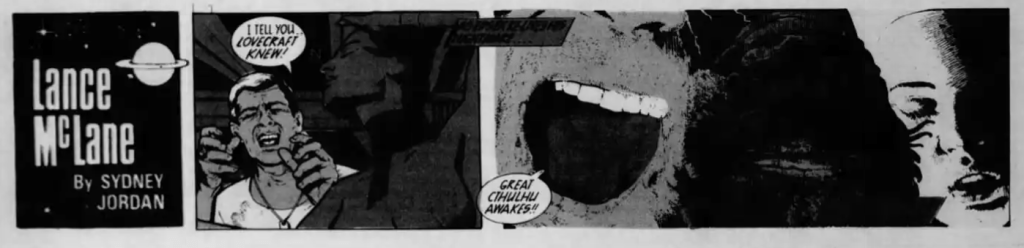
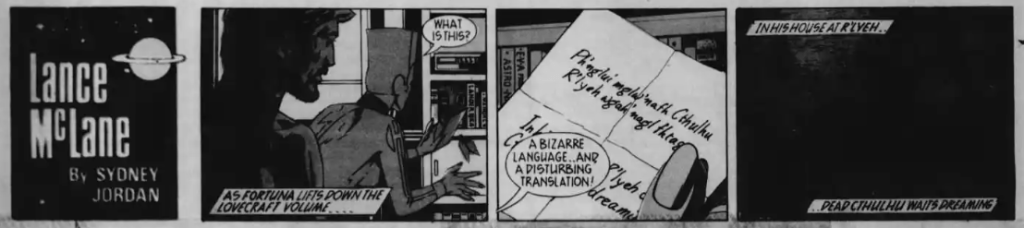
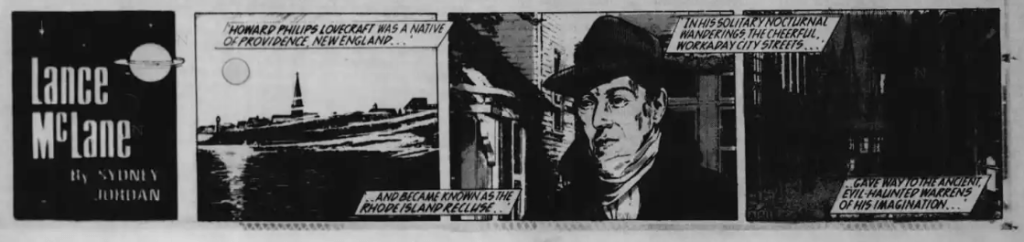
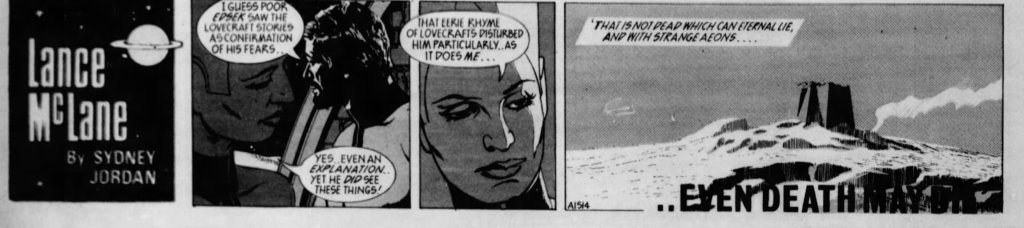
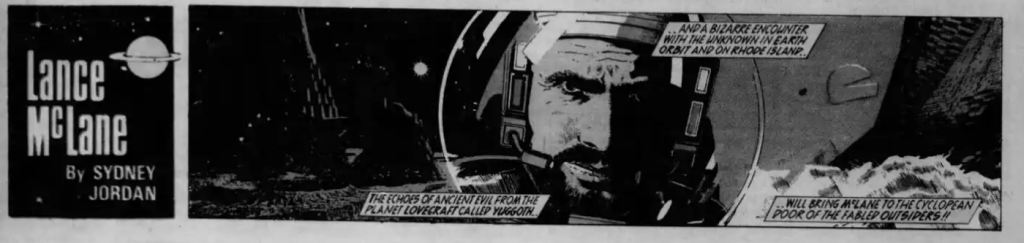
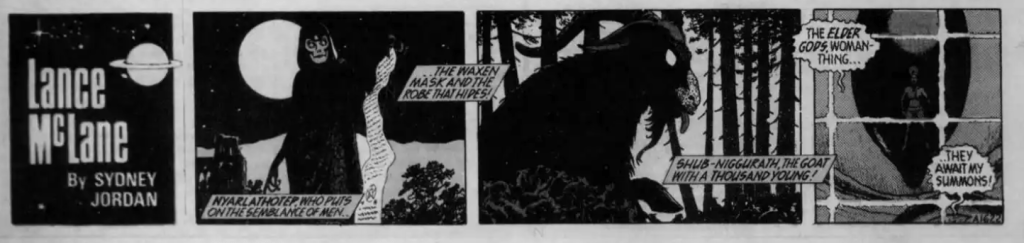
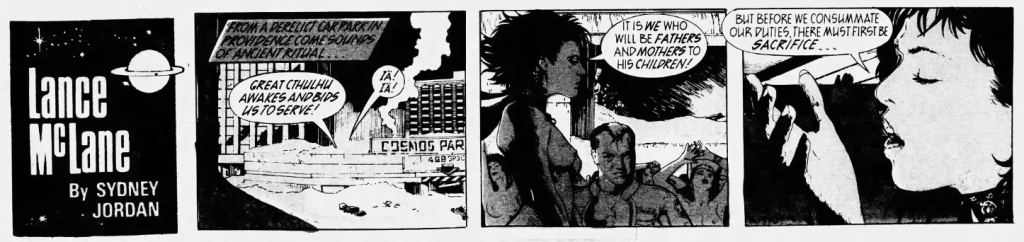
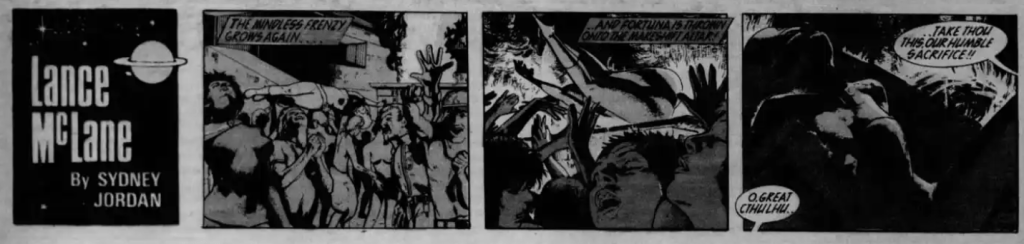
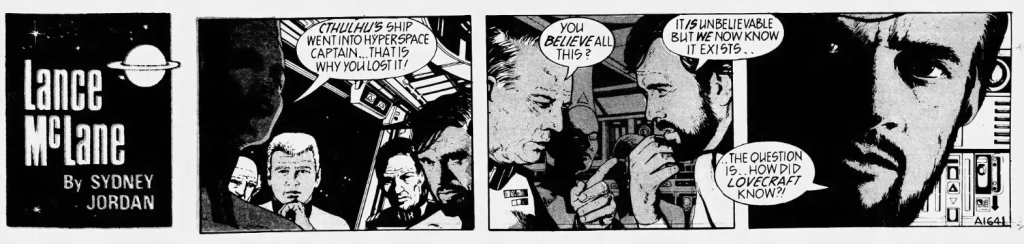
Lance McLane: Even Death May Die (1985-1986) by Sydney Jordan

The space opera comic strip Jeff Hawke by British cartoonist Sydney Jordan (with William Patterson 1956-1969) ran from 15 Feb 1955-18 Apr 1974 in the Daily Express. While cut in the mold of Flash Gordon, Jeff Hawke was aimed at an adult audience (including some mild erotic elements in the form of topless women, which also appeared in British newspaper strips like Axa), and found an appreciative audience not just in the United Kingdom but in translation outside of English, particularly in Italy, Spain, and Sweden. Because the Express owned the rights to the strip, there were no English-language reprints until the 1980s, wheren Titan Books obtained the rights, although various European collections appeared.

In 1976, Sydney Jordan launched a “new” strip, Lance McLane (1976-1988), which ran in the Scottish Daily Record newspaper (several strips 1-238 also ran in the London Evening News under the title Earthspace.) This was, more or less, a soft relaunch of Jeff Hawke under a different title; Jordan even made it clear in a connecting storyline that “Lance McLane” was simply Jeff Hawke, several decades into the future, and some European editions continued the series numbering without interruption (which leads to some confusion, especially as some strips were created specifically for European magazines or fanzines that didn’t run in the daily paper).

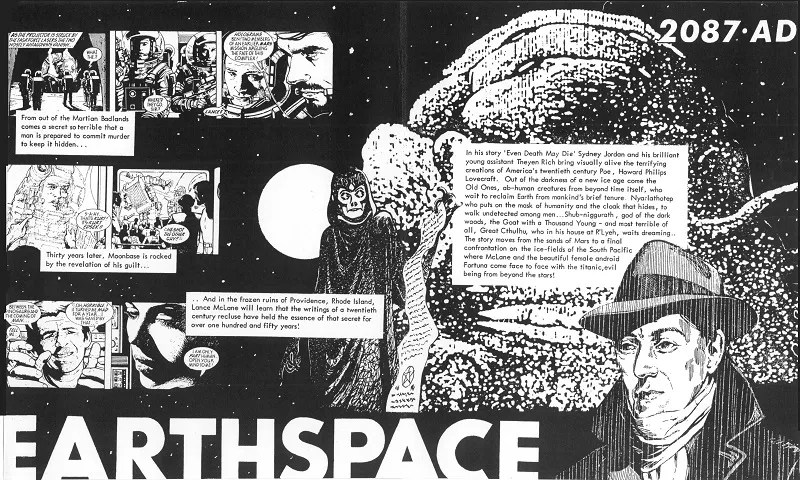
In 1985, the “Even Death May Die” storyline began which saw Jeff Hawke and the telepathic female android Fortuna up against the Cthulhu Mythos—a run has only been collected once in English, in Jeff Hawke’s Cosmos vol. 10, no. 3, a subscription-only publication of the Jeff Hawke Fan Club. The storyline is more available inthe Italian collection Jeff Hawke/Lance McLane 2 Storie Inedite (2014), which also offers some valuable background material, if you can read Italian.

Io fui uno dei pochi a non esere totalmente sorpreso dall anuova direzione che aveva preso la storia, a circa metà di Vele nel Rosso Tramonto, perché sapevo che Sydney Jordan aveva acquisito i diritti di un racconto di H. P. Lovecraft da utilizzare per una storia chiamata The Dark Tower che non fu mai pubblicata. Le prime citazioni derivano da Il Richiamo di Cthulhu (1928), ristampato da August Derleth nella raccolta L’Orrore di Dunvich e altre storie, 1963, e in una selezione di storie da essa tratte, Il Colore dallo Spazio e altre storie (Lancer, 1964). Marise Morland suggerì la litania “O Gorgo, Mormo, luna dalle mille facce, guarda con benevolenza ai nostri sacrifici”, e altri dettagli, perché Sydney aveva letto solo poche storie, mentre lei le aveva lette tutte.I was one of the few who wasn’t totally surprised by the new direction the story had taken, about halfway through Sails in the Red Sunset, because I knew that Sydney Jordan had acquired the rights to an H. P. Lovecraft story for use in a story called The Dark Tower that was never published. The earliest citations are from “The Call of Cthulhu” (1928), reprinted by August Derleth in the collection The Dunwich Horror and Other Stories, 1963, and in a selection of stories from it, The Colour from Space, and Other Stories (Lancer, 1964). Marise Morland suggested the litany “O Gorgo, Mormo, thousand-faced moon, look kindly upon our sacrifices,” and other details, because Sydney had only read a few stories, while she had read them all.
“Note a ‘..Anche la morte può morire!’” di Duncan Lunan,
Jeff Hawke/Lance McLane 2 Storie Inedite (2014) 96
“Notes on ‘Even Death May Die!'” by Duncan Lunan
Translated into English

Sails in the Red Sunset was the storyline immediately preceding Even Death May Die, and includes the first references to Lovecraft and Cthulhu on the lips of a madman; it is this clue that leads McLane and Fortuna to Earth to investigate the cult of Cthulhu. It isn’t clear which Lovecraft story Jordan might have attempted to license for the never-published “The Dark Tower” story; presumably this would have been a deal with Arkham House, based solely on the title, I wonder if it didn’t involve The Lurker at the Threshold (1945).

Duncan Lunan also shared the above image in his post Space Notes 24 Jeff Hawke Part 4 – Not As We Know It (29 Oct 2023), a montage that combines panels and images from several strips in the storyline under the Earthspace banner.

Many of Jordan’s storylines ran 12-16 weeks (~72-96 strips), but but according to Tony O’Sullivan’s index “Even Death May Die” ran for 145 daily strips (A1508 – 1653), making this one of the longer storylines, and according to O’Sullivan’s notes the storyline wasn’t even syndicated in Europe (hence “Storie Inedite”—”Unpublished Stories”). Italian Wikipedia gives a different numbering, 149 strips (A1503 – A1652), but with the way “Even Death May Die” dovetails with the previous storyline and idiosyncrasies of international publishing it can be tricky to decide where one story starts and ends, exactly.

Given that there are ~10,000 strips, that the Cthulhu material came nearly at the end of this long-running project, wasn’t even published in Europe at the time, and that reprints nearly always focus on the beginning of the run, it may be no surprise that collections are scarce and that Jordan’s take on the Mythos has been largely overlooked. I only stumbled across it because the Daily Record archive is available on newspapers.com, while trying to find the first newspaper comic strips to include Lovecraft and Cthulhu.

The story itself follows what is now fairly familiar territory: Lovecraft was writing more than fiction, the Cthulhu Mythos is real, malevolent, and it’s up to Lance McLane and Fortuna to stop their nefarious plans for the human race. The pace of a daily strip can seem plodding compared to a comic book or graphic novel, and the often muddy tones of newsprint often render Jordan’s artwork very dark in the newspaper scans. Which is a pity, because Jordan’s artwork is strongly realistic, grounding the strip in a way that makes the fantasy elements appear as truly intrusive…even if the darker text boxes are sometimes difficult to read.

The 1980s UK sensibilities allowed a degree of eroticism, which is probably one of the reasons Lance McLane never found syndication in the United States newspapers. This is measured titillation (Jordan couldn’t be explicit even if he wanted to), but not inappropriate to the material: the idea of an orgiastic cult comes straight from “The Call of Cthulhu,” after all, and it’s a bold storyteller that manages to get as much on the screen as Jordan does.

However, this has to be read in the context of works like “The Discovery of the Ghooric Zone” (1977) by Richard Lupoff and Strange Eons (1978) by Robert Bloch: this was one of the first attempts to project the Mythos into the space opera future, and it was doing it in a mainstream newspaper, not in the pages of Metal Hurlant/Heavy Metal or other specialist comic magazine.

It is a pity that “Even Death May Day” hasn’t received a more widespread publication; at the moment, your best bet to read it in English is to get a newspaper.com subscription and manually scroll through the Daily Record day by day. For those that read Italian, Jeff Hawke/Lance McLane 2 Storie Inedite (2014) is a choice option to see the strip compiled and restored, looking better than it ever did on newsprint, being on glossy paper and in color:


Bobby Derie is the author of Weird Talers: Essays on Robert E. Howard and Others and Sex and the Cthulhu Mythos.

Deep Cuts in a Lovecraftian Vein uses Amazon Associate links. As an Amazon Associate I earn from qualifying purchases.

“Amb la tècnica de Lovecraft” (1956) by Joan Perucho

The works of H. P. Lovecraft have never entered another language wholesale; they tend to trickle in, translated a story here and a story there, or at best one collection at a time. Tracing the spread and influence of Lovecraft’s work in languages other than English thus becomes doubly tricky. A Spanish translation might have first been published in Barcelona, Mexico City, or Buenos Aires, just as an English edition might be published in New York, London, or Brisbane, and by what paths a copy in one nation might end up in the hands of a reader in another…well, the distribution is ultimately uneven.

According to S. T. Joshi’s H. P. Lovecraft: A Comprehensive Bibliography (2009), Lovecraft began being translated into Spanish in the 1940s, although publication was largely piecemeal until the 1980s (which in Spain, at least, may have been in part due to the Francoist regime), and regional languages like Galician and Catalán have their own publication histories that largely start in the 1980s and 1990s. However, when it comes to the history of Lovecraft in Catalan and Spanish, there is at least one really interesting outlier, which has been largely overlooked in much English-language histories of Mythos fiction.

Joan Perucho Gutiérrez (1920 – 2003) was a noted writer and poet in the Spanish and Catalán languages in Spain, who wrote under the pen-names Joan Perucho (Catalán) and Juan Perucho (Spanish). In 1956 he published his first short fiction, “Amb la tècnica de Lovecraft” (“In the style of Lovecraft”) in the Catalán publication Els Quaderns d’atzavara (“The Agave Notebooks”). Perucho must have been a precocious writer indeed, because Lovecraft was far from a household name in Spain at the time, and this is sometimes credited as Lovecraft’s introduction to Catalán audiences—a claim I cannot verify or deny.

In 1969, Perucho translated “Amb la tècnica de Lovecraft” into Spanish, where it was published in the newspaper La Vanguardia Española (16 Aug 1969, p.9) under the title “Magia Negra” (“Black Magic”), and in the anthology Los Mitos de Cthulhu (Alianza Editorial) under the more well-known title “Con la técnica de Lovecraft” (“In the style of Lovecraft”); the two Spanish versions have some minor differences, particularly in the beginning of the text. Largely because of its inclusion in that important Spanish-language Mythos anthology, Perucho’s story has gained a degree of notability, if not exactly acclaim, and has been republished a few times. However, it has largely gone without comment in English.

The following translation is taken from the “Magia Negra” Spanish version of the piece:

TRADUJO el texto, hace aproximadamente diez años, el poeta José Corredor Matheos, en homenaje a Philip Howard Lovecraft, escritor de «science fiction» que murió perseguido por los seres invisibles. Sólo entonces se supo la verdadera relación de los hechos y que, en un momento impreciso, el automático de la gramola se disparó; hizo un ruidito y lentamente bajó el disco. Hubo uno pausa. Alguna cosa, como una corriente de aire casi imperceptible, fue creciendo en intensidad; entreabrió una puerta y descendió unos escalones que daban a un patio interior; tropezó con algo sólido y opaco, y blasfemó en vox baja; después se dirigió a un pequeño pasadizo, al otro lado del patio, y allí se arremolinó. La música se oía ahora lejana, sorda, filtrada. Era una noche silenciosa y tranquila, de una gran suavidad, con el aromo de la primavera que descendía de los árboles.

La magia de la boca desapareció debajo de las pequeñas placas de la sífilis en los labios y en el paladar. Eran unas luces rojas y verdes, en el interior de las cuales podía verse perfectamente su imagen con un rictus de ironía amarga y de decepción. Ironía nacida de la desesperación y de la muerte, más allá de las cuales, débiles ráfagas de aire descansan en el interior de los vasos abandonados, llenos de ceniza y agua pútrida; o dentro de la caja de resonancia de los pianos «Chassaigne», modelo 1906, esperando la oportunidad del conducto sutilísimo que les una, con unas cuantas palabras no pronunciadas, al oído del caballero momificado o de la dama solitaria. Formas gastadas de vida o de muerte, de nacimiento mecánico en un dolor visceral; de vómitos que se suceden implacables (o que por lo menos atormentan con la angustia del espasmo que ha de venir y que siempre, siempre desemboca en una suerte de abismo, y en el sudor, y en los cabellos enganchados) y de pequeñas crisis de histeria, y de dientes que se carían y que la lengua percibe voluminosos y febricitantes.

No era esto. Sólo la quemadura gélida de un «thoulú», uno di aquellos seres informes y terribles que ya había descrito minuciosamente en el siglo XII el árabe Al-Buruyu en su tratado «Los que vigilan». La evidencia de las cosas surgía de improviso con mil y una significaciones aterradoras y alusivas. No había fuerza humana capaz de conjurar lo inevitable, de alejar el dogal que ceñiría al elegido, el cual, por un impulso misterioso, sería arrastrado al sacrificio, al aniquilamiento de lo propia personalidad, y se convertiría en algo horrible y sin nombre. Abominable concepción ésta, fruto de las nupcias del cielo y del infierno. No era otra cosa lo aparición de señales en todas las habitaciones de la casa, y aquellos restos de cuerpos extraños, hallados en el patio una mañana, y que se volatilizaron misteriosamente una hora después. El magisterio de Al-Buruyu se presentaba como una fuerza maléfica, anticipándose a los siglos; como un ojo impasible y escrutador; y con una voz caligráfica y cabalística que iba avanzando como una risa en la noche, sobre la nieve surcada de pisadas deformes y con alaridos alucinantes cerca de las rejas de los manicomios.

Se oyó la bocina de un automóvil. La presencia, inquieta, se distendió. Murmuró unos sonidos ininteligibles y se insinuó —leve fosforescencia apenas— en el fondo del pasadizo, entre inmundicia y botellas de licor vacías. Se encendió una luz en una ventana vecina y poco después se apagó. La primavera respiraba afuera.

El tiempo se acumulaba en el cerebro y en la sangre en pliegues suavísimos y turbadores, en los cuales se percibía la claridad solar. Había cortezas y una materia rugosa, resquebrajada por surcos sin dirección precisa, que parecía calcinada por un contacto satánico o sordamente enfurecido. O bien una superficie enharinada con polvos de arroz, debajo de la cual, latían, vívidas y sensibles, amplias llagas supuradoras, como bocas martirizadas y ocultas, como flores monstruosas y sonámbulas que súbitamente se agrandaban inflándose, tensando su estructura íntima hacia un delirio febril. Era demasiado tarde para el antídoto: la invertida esvástica de plata, que traería ecos de los cantos litúrgicos hasta la huida de la estepa y la venida de la savia vivificadora. El vuelo de las hojas era un vuelo de bronces, enlutado y solemne, sobre una tierra árida y espectral. Apenas se podío entrever, con un supremo esfuerzo, la risa de un niño vestido de marinero, medio nublada por el dolor; o la triste tenacidad del hombre que medita hasta altas horas de la madrugada, y que se veía ahora bajo el peso de una lágrima; o la inútil trenza perfumada, aire de una mirada que alimentaba el deseo. La carne había comenzado a corromperse, todavía con la presencia de la vida, y exhalaba una pestilencia indefinible que lo impregnaba todo. Lentamente se inició el éxodo, e incluso la araña huyó, con su perezosa pero terrible seguridad, abandonando el refugio de su vida feliz. Entreveía lecturas de íncubos y súcubos, formulas mágicas dé la muerte y del diablo, traspasando todo vestigio de razón, viéndose hojear la «Dissertation sur les apparitions des anges, des demons et des esprits et sur les revenants et vampirs», del monje Calmet, que ponía en evidencia la realidad de la fría certeza de Al-Buruyu. Ya Angela Foligno había revelado al comentarista que al principio «non est in me membrum quod non sit percussum, tortum, et pœnatum a dœmonius, et semper sum infírma, et semper stupefacta, et plena doloríbus in omnibus membris vivís». Existía también un flotar sobre la realidad, un ir a la deriva a través de paisajes inexistentes, de algas mortecinas que se crispaban airadas y amenazadoras al contacto más leve, y manubrios que giraban vertiginosamente dentro del cráneo, con un alboroto insufrible de timbres y altavoces disporados, para desaparecer después en un angustioso silencio de tumba.

Se alisó el cabello con la mano, despacio y maquinalmente. Bebía con delectación y a pequeños sorbos una copa de auténtico «scotch» Forrester, y se encontraba seguramente a diez millas de la costa y con una tempestad de todos los diablos. Una muchacha rió, con la risa provocadora di Jane Rusell, y se aproximó desde la barra. Llevaba la boca pintada de un rojo intenso, color de sangre de buey, y un jersey que le ceñía apretadamente el busto. Le hizo una caricia en la mejilla y le murmuró algo afectuoso, mientras rozaba con su cara la de él. Había una atmósfera densa y enturbiada por el humo del tabaco, y algunos invitados se habían quitado la chaqueta. Otra muchacha, que movía las ancas como una estrella de Hollywood, cantaba con éxtasis lánguido y sensual que se adhería a la piel.

Creía que no lo volvería a ver. De pronto se le ocurrió ponerse a reír delante de aquel niño vestido de marinero, pasado de moda y ridiculo. Lo relacionó con muchas otras cosas, como el banderín de un club de hockey clavado en alguna pared, una desteñida fotografía que fijaba unos rostros ausentes en una lejana excursión a Bañólas, un día de mucho frío; o en un pequeño bar del Paseo de Gracia, mucho tiempo después, cuando ella ya preparaba el equipo de novia y le regalaba corbatas el día de su santo.

La cantante agradeció los aplausos con una sonrisa. Ahora la gente intentaba bailar, excepto un grupito que bebía y conversaba con el camarero y con la muchacha, que ya había concluido su número. Había una media luz, sucia y gastada.

Penetrado por las sombras, detrás del gran monumento a Napoleón, detrás de las campanas de los tranvías, bajo los burdeles de todas las ciudades del mundo, en el último momento lúcido, necesitaba ahora buscar la luz, engañar a la presencia, acercarla si era preciso, de la manera que fuese, a la luz limpia y purificadora, a la luz que a veces rasgaba las tinieblas. Debía haber luz en algún sitio. Así se lo parecía a él.

Muy lejos, seguramente a diez millas de distancia, alguien o algo reptaba por la alfombra. Dejó atrás las dos butacas y se incorporó poco a poco. Era como un babear o como un ruido inconfesable. Se hizo una claridad lívida. Como una alucinación de Lovecraft.


Juan PERUCHO
I TRANSLATED the text, about ten years ago by the poet José Corredor Matheos, in homage to Philip Howard Lovecraft, a science fiction writer who died persecuted by invisible beings. Only then did the true story become known, and that at an imprecise moment, the jukebox automatically triggered; it made a little noise and slowly lowered the record. There was a pause. Something, like an almost imperceptible current of air, grew in intensity; it half-opened a door and went down some steps that led to an inner courtyard; it stumbled against something solid and opaque, and cursed in a low voice; then it went to a small passageway on the other side of the courtyard, and swirled there. The music now sounded distant, muffled, filtered. It was a night silent and calm, of great softness, with the aroma of spring descending from the trees.

The magic of the mouth disappeared beneath the small syphilis plaques on the lips and palate. They were red and green lights, inside which one could perfectly see his image with a rictus of bitter irony and disappointment. Irony born of despair and death, beyond which, weak gusts of air rest inside abandoned glasses, full of ashes and putrid water; or inside the sound box of the “Chassaigne” pianos, model 1906, waiting for the opportunity of the subtlest conduit that would unite them, with a few unspoken words, to the ear of the mummified knight or the lonely lady. Worn-out forms of life or death, of mechanical birth in visceral pain; of vomiting that follows one another relentlessly (or that at least torments with the anguish of the spasm that is to come and that always, always ends in a kind of abyss, and in sweat, and in tangled hair) and of small hysterical crises, and of cavities in teeth that the tongue perceives as voluminous and feverish.

It was not this. Only the icy burn of a “thoulú”, one of those formless and terrible beings that the Arab Al-Buruyu had already described in detail in the 12th century in his treatise “Those Who Watch”. The evidence of things emerged suddenly with a thousand and one terrifying and allusive meanings. There was no human force capable of adjuring the inevitable, of removing the noose that would bind the chosen one, who, by a mysterious impulse, would be dragged to sacrifice, to the annihilation of his own personality, and would become something horrible and nameless. Abominable conception this, fruit of the marriage of heaven and hell. It was nothing else than the appearance of signs in all the rooms of the house, and those remains of strange bodies, found in the courtyard one morning, and which mysteriously vanished an hour later. The teaching of Al-Buruyu presented itself as an evil force, anticipating the centuries; like an impassive and scrutinizing eye; and with a calligraphic and cabalistic voice that advanced like a laugh in the night, on the snow furrowed with deformed footprints and with hallucinatory screams near the bars of the asylums.

The sound of a car horn honked. The presence, uneasy, became relaxed. It murmured some unintelligible sounds and insinuated itself—barely a faint phosphorescence—at the end of the passage, among filth and empty liquor bottles. A light came on in a neighboring window and shortly after went out. Spring was breathing outside.

Time accumulated in the brain and blood in soft and disturbing folds, in which the light of the sun could be perceived. There were crusts and rough matter, cracked by furrows without a precise direction, which seemed calcined by a satanic or dully enraged contact. Or a surface floured with rice powder, beneath which, vivid and sensitive, wide suppurating sores throbbed, like martyred and hidden mouths, like monstrous and somnambulistic flowers that suddenly enlarged and inflated, straining their intimate structure towards a feverish delirium. It was too late for the antidote: the inverted silver swastika, which would bring echoes of liturgical chants until the flight from the steppe and the coming of the life-giving sap. The flight of the leaves was a flight of bronze, mournful and solemn, over an arid and spectral land. It was only with a supreme effort that one could make out the laughter of a child dressed as a sailor, half clouded by pain; or the sad tenacity of the man who meditates until the early hours of the morning, and who now saw himself under the weight of a tear; or the useless perfumed braid, the air of a look that fed desire. The flesh had begun to rot, still with the presence of life, and exhaled an indefinable stench that permeated everything. Slowly the exodus began, and even the spider fled, with its lazy but terrible security, abandoning the refuge of its happy life. He glimpsed readings of incubi and succubi, magical formulas of death and the devil, transcending all vestiges of reason, seeing himself leafing through the “Dissertation sur les apparitions des anges, des demons et des esprits et sur les revenants et vampirs” [1], by the monk Calmet, which highlighted the reality of the cold certainty of Al-Buruyu. Angela Foligno had already revealed to the commentator that at the beginning “non est in me membrum quod non sit percussum, tortum, et pœnatum a dœmonius, et semper sum infírma, et semper stupefacta, et plena doloríbus in omnibus membris vivís.” [2] There was also a floating above reality, a drifting through non-existent landscapes, through dying algae that twitched angrily and threateningly at the slightest touch, and handlebars that turned vertiginously inside the skull, with an unbearable uproar of ringing bells and loudspeakers, to then disappear in an agonizing silence of the grave.

He smoothed his hair slowly and mechanically. He sipped a glass of genuine Forrester scotch with delight and in small sips, and was probably ten miles from the coast and in a hell of a storm. A girl laughed, the provocative laugh of Jane Russell, and came over from the bar. Her mouth was painted a deep red, the color of oxblood, and her sweater cinched tight around her bust. She caressed his cheek and murmured something affectionate as she brushed her face against his. The air was thick and clouded with tobacco smoke, and some of the guests had taken off their jackets. Another girl, who moved her haunches like a Hollywood star, sang with a languid, sensual ecstasy that clung to the skin.

He thought he would never see her again. Suddenly it occurred to him to laugh in front of that boy dressed as a sailor, old-fashioned and ridiculous. He connected it to many other things, like the pennant of a hockey club nailed to a wall, a faded photograph that showed some absent faces on a distant excursion to Bañólas, one very cold day; or in a small bar in Paseo de Gracia, long after, when she was already preparing her bridal outfit and giving him ties on his saint’s day.

The singer acknowledged the applause with a smile. Now people were trying to dance, except for a small group that was drinking and talking with the waiter and the girl, who had already finished her number. There was a half-light, dirty and worn.

Penetrated by the shadows, behind the great monument to Napoleon, behind the bells of the trams, beneath the brothels of all the cities of the world, in his last lucid moment, he now needed to seek the light, to deceive the presence, to bring it closer if necessary, in whatever way, to the clean and purifying light, to the light that sometimes pierced the darkness. There had to be light somewhere. It seemed so to him.

Far away, surely ten miles away, someone or something was crawling across the carpet. He left the two armchairs behind and slowly sat up. It was like drooling or an unutterable noise. It became a livid clarity. Like an hallucination of Lovecraft.

[1] French: “Dissertation on the apparitions of angels, demons and spirits, and on ghosts and vampires”
[2] Latin: “There is not a member in me that is not struck, twisted, and punished by the devil, and I am always sick, and always astonished, and full of pains in all my living members.”

Juan PERUCHO
Transcribed from La Vanguardia Española (16 Aug 1969, p.9) English translation

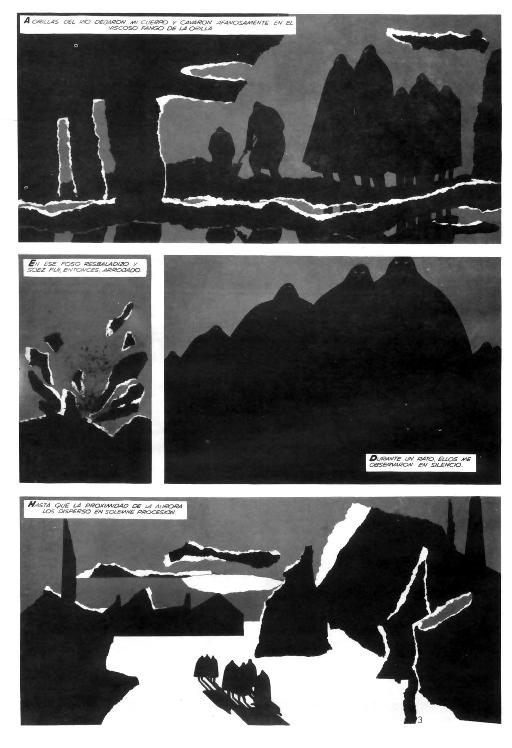
“Magia Negra” / “Con la técnica de Lovecraft” is more of a prose poem than a short story; a collection of images and ideas meant to invoke the mood and style of Lovecraft more than a pastiche like “Celui qui suscitait l’effroi…” (1958) by Jacques Janus. It isn’t clear what exactly Perucho had read of Lovecraft at this point, but several themes are and ideas are evocative of Lovecraft’s Mythos tales without being direct references to any specific story.

We have a strange Arab author (“Al-Buruyu” instead of Abdul Alhazred), and his mysterious book (Those Who Watch, rather than the more familiar Necronomicon). There is no Cthulhu but there are the strange and formless “thoulú.” Was this deliberate, mangling things like Howard Phillips Lovecraft’s name for effect, or the result of a botched translation from English into another language? I suspect the cumulative differences represent Perucho’s innovation and playing of the Mythos game, mixing fact and fiction. Which is very Lovecraftian.

The work remains a liminal entry, a Catalán introduction to an English-language author that was later translated into Spanish for a wider audience, even as Lovecraft himself began to enjoy wider translation in Spanish-language markets. It is easy to see how it might have frustrated early readers of Los Mitos de Cthulhu (1969); it doesn’t fit neatly into the Mythos like many early pastiches. The very ambiguity gives it character, however; so few early efforts to write in Lovecraft’s style try to capture the essence. While I don’t think Perucho really nailed it—like the pasticheurs, he tends to focus on the more obvious elements—it’s an interesting experiment, and strikes an interesting contrast with some of the other Lovecraft-inspired works in the 1950s and 60s.

Thanks to Mariano Villarreal ( literfan@yahoo.es ) for his help and assistance; all the errors in the translation are mine.


Bobby Derie is the author of Weird Talers: Essays on Robert E. Howard and Others and Sex and the Cthulhu Mythos.

Deep Cuts in a Lovecraftian Vein uses Amazon Associate links. As an Amazon Associate I earn from qualifying purchases.

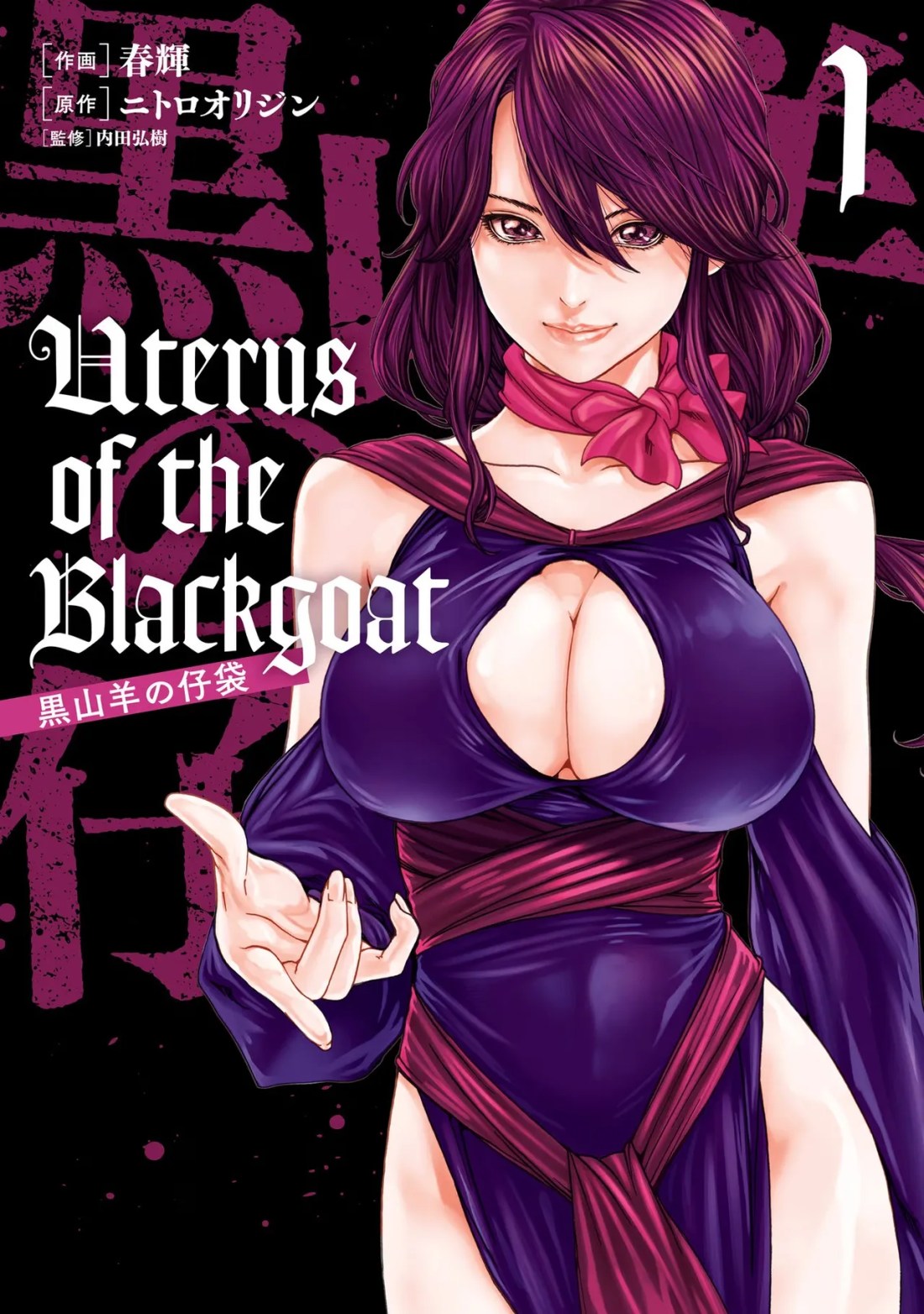
Uterus of the Black Goat Vol 1.(黒山羊の仔袋 1, 2022) by Haruki (春輝)

Eldritch Fappenings
This review concerns a work of adult literature. Some images contain nudity. Reader discretion is advised.


Powers of Darkness

The lifting of the curtain on the massive horrors of Germany’s prison and concentration camps recalls the supernatural tales of H. P. Lovecraft, a writer who was relatively unknown until August Derleth undertook his popularization, says a Chicago Tribune column. To conjure up the mood of unearthly terrors, Lovecraft invented the mythology of Cthulhu in which there are many monstrous spirits of evil, forever seeking to take possession of this planet.

Lovecraft wrote of his work: “All my stories, unconnected as they may be, are based on teh fundamental lore or legend that this race [sic] was inhabited at one time by another race who, in practicing black magic, lost their foothold and were expelled, yet live on outside, ever ready to take possession of this earth again.”

Perhaps Othulhu [sic] has come back through the cracks in Hitler’s mind. Lovecraft, who died in 1937, would be staggered by the revelation.

The Windsor (Ontario) Star, 2 May 1945, p4

In the aftermath of World War 2, the combination of Allied propaganda and the real-world horrors and atrocities committed by the Nazis and central powers created a perfect icon of evil. The Nazis became the epitome of cruelty, madness, violence, lust, and decadence; while Hitler and the Nazis became occasional figures of ridicule in works like Hogan’s Heroes, they also became the perfect embodiment of sin in post-war men’s adventure magazines, comic books, Stalag novels, and the Nazisploitation films like Ilsa, She-Wolf of the S.S. (1974), The Night Porter (1974), and Salon Kitty (1976).

H. P. Lovecraft died before the German invasion of Poland in 1939 that sparked the European beginnings of World War 2, and long before the Final Solution was decided upon and enacted. He did not live to see the Holocaust laid bare, and certainly not the pop-culture cross-pollination as the Nazis, the ultimate figures of taboo, became enmeshed in erotic and sadistic art and literature. Yet perhaps it is not surprising that, over time, Lovecraft’s Mythos and Nazis have mixed and mingled on occasion.

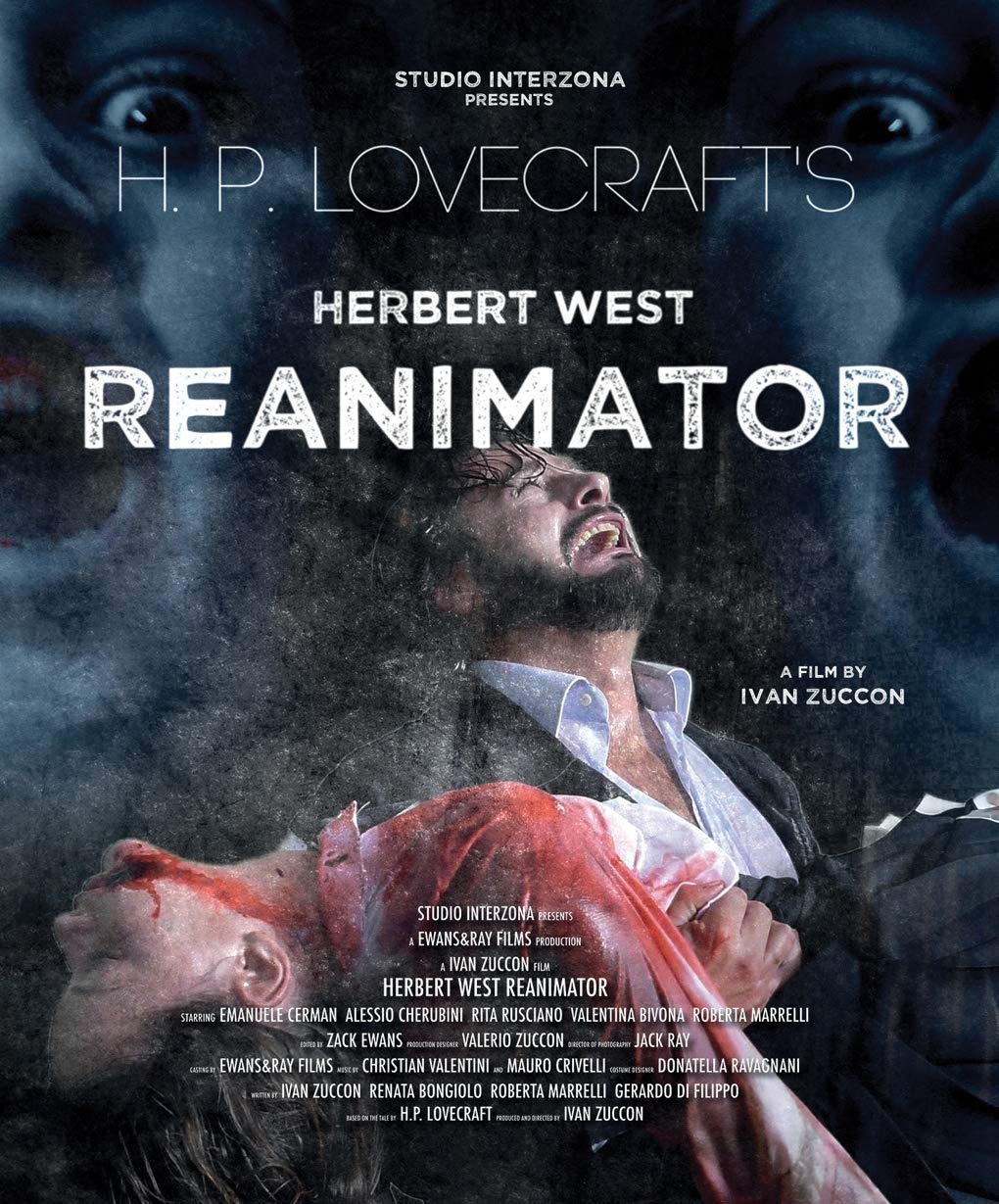
Dagger of Blood (1997) by John Blackburn, for instance, featured a former Nazi scientists in South America, inspired by Mengele and works like The Boys from Brazil (1976). Hellboy fought any number of Nazis in comics and film, some of whom had connections with Lovecraftian critters (a point called out specifically in the crossover Batman/Hellboy/Starman). Brian McNaughton brought the Reanimator to the Nazis with “Herbert West—Reincarnated: Part II, The Horror from the Holy Land” (1999). Insania Tenebris (2020) by Raúlo Cáceres also includes scenes where the Third Reich mixes with the Mythos, and Kthulhu Reich (2019) by Asamatsu Ken (朝松健) is an entire collection of stories that re-imagines the Nazis in a Lovecraftian context, and Charles Stross’ outstanding novel The Atrocity Archives (2004) also riffs on the wedding of these two taboos, the eldritch evils of Lovecraft and the visceral cruelty of Hitler and the Nazis.

Most of these works take as a jumping-off point the Nazi’s real and fictional investigations into the archaeological and the occult, which became widespread in popular culture thanks to films like Raiders of the Lost Ark (1981) and Indiana Jones and the Last Crusade (1989). There is some basis for truth in this, as Kenneth Hite explores in The Nazi Occult (2013), but the pop culture legacy of Nazi mystics dabbling in the Mythos has grown very far from reality. Intersections between sex and the Nazi occult exist, and so do works that combine sex and Lovecraft’s Mythos, but the combination of all three flavors is relatively rare.

Most works that deal with Lovecraftian Nazism eschew the erotic.

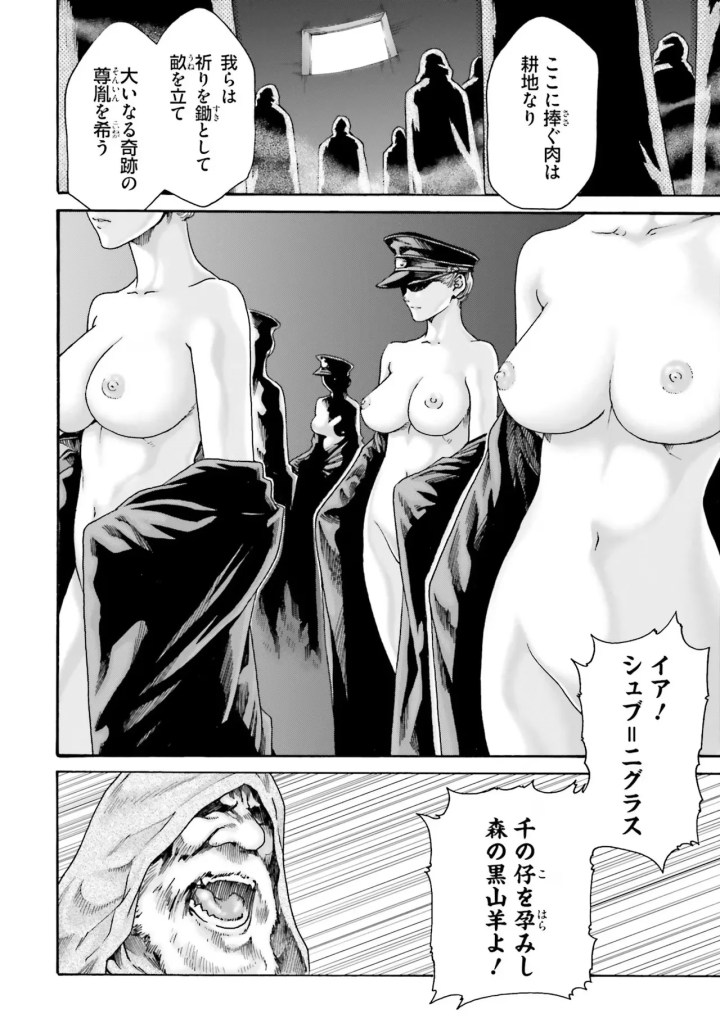
Uterus of the Blackgoat Vol 1.(黒山羊の仔袋 1, 2022) by Haruki (春輝) is a standout in that it very specifically does just that. This historical occult action manga’s prologue opens in Nazi Germany, where Hitler’s disciples are trying to unlock a Lovecraftian artifact with sex magick.

Nazi sacrifices disrobe for a ritual to Shub-Niggurath

Haruki (春輝) is an established mangaka whose works include the Ero Ninja Scrolls and Parasite Doctor Suzune series. Like all legal erotic works in Japan, the actual genitalia is obscured, often by carefully placed speech bubbles, figure-work, and blurring out the genitals. However, this work is more than “tits and tentacles”; there is a considerable amount of detail given to period dress, architecture, and background to ground the story, including some very effective splash pages that appear to have been referenced from period photographs.

Post-War Berlin

The bulk of the story takes place during the early days of the Cold War, as both the USSR and United States attempt to seize the Nazi’s research into Shub-Niggurath for themselves. At the center of their separate and competing investigations is a former maid, Mia Olbrich, who worked in the house where the rituals took place. Trying to keep both the Americans and the Soviets from getting the information is a woman named Macleod (who may actually be Mata Hari) with supernatural powers, who is also the secret agent codenamed Black Goat.

What readers get is thus a three-way struggle involving a lot of sex, some body horror, and Cold War spy shenanigans with some interesting plot twists and revelations (and this only in volume 1, there are 3 volumes in the series). While there are many typical tropes of the eromanga genre (all of the main characters are willowy, busty young women; there’s a sex scene in every chapter, etc.), it is sort of refreshing to see a work that strongly leans into the sexual aspect of Shub-Niggurath in as explicit a means as they can given the limits of the medium. While we don’t get a lot of actual Nazis in this volume after the prologue, the emphasis on sex, sexual violence, and the setting is what draws comparisons to exploitation films; there is a similar aesthetic, the idea that this is a serious story that is being played for titillation as well as action and intrigue.

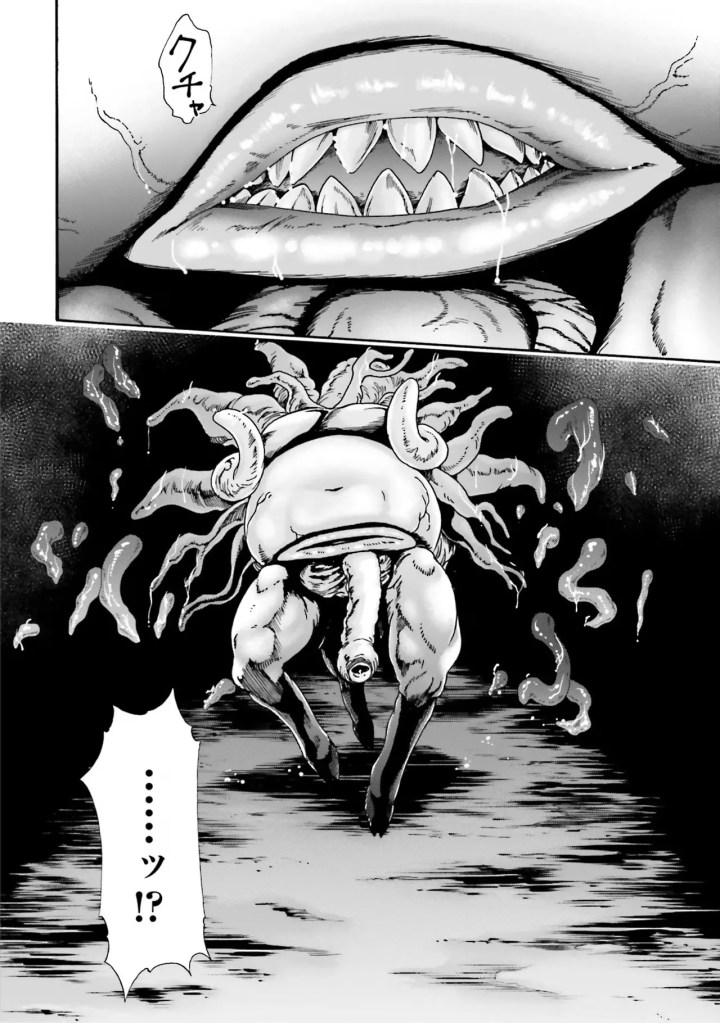
There are some cosmetic parallels with “The Elder Sister-like One, Vol. 1” (2016) by Pochi Iida (飯田ぽち。) and The Mystery of Lustful Illusion -Cthulhu Pregnant- (2015) by Takayuki Hiyori (宇行 日和); the manga creators are each drawing from similar manga artistic traditions and Lovecraftian stories and roleplaying games, which shows variations on similar themes, less in any plot sense as in similarities between the depictions of Shub-Niggurath, playing with tentacles, etc. However, the emphasis on erotic content in each work is different and distinct and reflects the tone of the stories, with Uterus of the Black Goat aimed more toward erotic horror than the other two.

A Dark Young of Shub-Niggurath, as inspired by the Call of Cthulhu roleplaying game

Uterus of the Black Goat has not yet had an official English translation or release, but Japanese editions are available from various outlets, including Amazon.co.jp and Ebay.


Bobby Derie is the author of Weird Talers: Essays on Robert E. Howard and Others and Sex and the Cthulhu Mythos.

Deep Cuts in a Lovecraftian Vein uses Amazon Associate links. As an Amazon Associate I earn from qualifying purchases.

Pleasure Planet (1974) by Edward George

Eldritch Fappenings
This review concerns a work of adult literature. Reader discretion is advised.


Around November 1923, H. P. Lovecraft sent a letter to Weird Tales editor Edwin Baird, commenting on the contents of the magazine during its first year of existence. The letter was published in the March 1924 issue of Weird Tales, and included a challenge to writers of weird fiction:

Popular authors do not and apparently cannot appreciate the fact that true art is obtainable only by rejecting normality and conventionality in toto, and approaching a theme purged utterly of any usual or preconceived point of view. Wild and ‘different’ as they may consider their quasi-weird products, it remains a fact that the bizarrerie is on the surface alone; and that basically they reiterate the same old conventional values and motives and perspectives. Good and evil, teleological illusion, sugary sentiment, anthropocentric psychology—the usual superficial stock in trade, and all shot through with the eternal and inescapable commonplace. Take a werewolf story, for instance—who ever wrote a story from the point of view of the wolf, and sympathising strongly with the devil to whom he has sold himself? Who ever wrote a story from the point of view that man is a blemish on the cosmos, who ought to be eradicated?
—H. P. Lovecraft to Edwin Baird, c. Nov 1923

This inspired H. Warner Munn, a weird fiction enthusiast from Athol, Massachusetts, to write a story and submit it to the magazine. “The Werewolf of Ponkert” (WT Jul 1925) and earned the coveted cover spot. It was Munn’s first professional publication, the start of a long career in science fiction and fantasy, and perhaps most importantly the start of a long series of tales. Subsequently in the pages of Weird Tales, Munn published “The Return of the Master” (WT Jul 1927), “The Werewolf’s Daughter” (WT OctNovDec 1928), and a series of Tales of the Werewolf Clan published as “The Master Strikes” (WT Nov 1930), “The Master Fights” (WT Dec 1930), and “The Master Has A Narrow Escape” (WT Jan 1931).

Munn also became friends and correspondents with Lovecraft, who referred to the whole work in one letter as the “master” cycle—much as he referred to his own mythos as the “Arkham” cycle. Yet for Lovecraft, Munn had missed the mark:

It is my constant complaint that allegedly weird writers fell into commonplaceness though reflecting wholly conventional & ordinary perspectives, sympathies, & value-systems; & in this instance (as in others) I sought to escape from this pitfall as widely as I could. It pleases me that you grasp this matter so spontaneously—for some persons seem unable to understand what I mean when I bring it up. For example—I once said that a werewolf story from the wolf’s point of view ought to be written. H. Warner Munn, taking me up, thereupon produced his “Ponkert” series; in which, however, he made the werewolf an unwilling one, filled with nothing but conventionally human regrets over his condition!
—H. P. Lovecraft to J. Vernon Shea, 19 Jun 1931, LJS 16

The series also suffered from a relative lack of overt weirdness, as Lovecraft put it:

The trouble with Munn’s tale is that it subscribes too much to the conventional tradition of swashbuckling romance—the Stanley J. Weyman cloak & swordism of 1900.
—H. P. Lovecraft to Clark Ashton Smith, [17 Oct 1930], DS 245

Yes—Munn does get into arid and sterile regions when he tries to hitch his romantic-adventure mood and technique to the domain of the weird. He is drawing the poor Master out to such lengths that one cannot keep track of the creature’s nature and attributes—indeed, the impression is that he merely retains the supernatural framework as a matter of duty—or concession to Wright—whereas he really wants to write a straight historical romance. But the kid’s young, and we can well afford to give him time. Let him get Ponkertian werewolves out of his system, and see what he can do with a fresh start!
—H. P. Lovecraft to August Derleth, [Dec 1930], ES1.305

“Romance” in this case doesn’t refer to stories about love or lust, but the older sense of romance as a fictional prose narrative of heroic adventure, in the traditional of medieval romances. The sentiments echo some thoughts by Lovecraft with regard to Robert E. Howard, whose weird fiction often contained a strong action-adventure element, sometimes with the monster or magic a bit of an afterthought. Still, Weird Tales editor Farnsworth Wright was impressed enough to consider the publication of Munn’s werewolf tales as a standalone volume:

Munn’s effort—I read the whole tale in MS. a year ago—has romantic facility, but to my mind he seldom achieves real weirdness. He is, though, a very capable writer, & ought to have quite a future ahead of him. Wright tells him that his collected “Ponkert” tales will form the third book of a W.T. series beginning with “The Moon Terror”—my own tales forming the second. Personally I’d wager that much time will elapse before W.T. publishes any more volumes.
—H. P. Lovecraft to August Derleth, [6 Sep 1928], ES1.155-156

Unfortunately, Lovecraft was correct: The Moon Terror failed to sell, and the idea of Weird Tales publishing collections or anthologies was largely abandoned. The Werewolf of Ponkert series would finally be collected in 1958, and when Munn expanded the series with additional tales in the 1970s and 80s was reprinted and recollected again. Of his friend, Lovecraft wrote:

Frank B. Long, Jr., Donald Wandrei, Wilfred B. Talman, H. Warner Munn, August W. Derleth, & Clark Ashton Smith are indeed all friends of mine, but it would hardly be fair to their own talents & initiative to call them my “proteges”. I have tried to encourage the younger ones & help them with their style whenever such help seemed in order, but they all succeed on their own merits. I am proud, though, to have been the first to persuade Long & Talman & Munn to send stuff to W.T.
—H. P. Lovecraft to J. Vernon Shea, 19 Jun 1931, LJS 18

So what does this have to do with Pleasure Planet (1974) as by Edward George (pseudonym for Robert E. Vardeman and George W. Proctor), an erotic science fiction novel? Well…read the back cover copy:

Step aboard the sex-computer equipped Intergalactic Vessel Werewolf along with Captain Chad Ponkert and his very horny co-pilot, Janet. Their mission—to find a planet to be used as a sex playground—a place where creatures from all over the galaxy can come together and get it on!

Chad Ponkert, I. V. Werewolf. Yes, it does appear that Lovecraft’s innocent suggestion in 1924 had, fifty years later, inspired a sleazy erotic novel, by way of one H. Warner Munn (who was probably utterly unaware of the borrowing).

The novel itself is almost a parody, although it might be more accurate to call it a pastiche. The oversexed everyman Chadwick Ponkert the Third is a spaceship pilot with a raging libido and a black belt in karate, who plays a few BDSM games with his co-pilot Janet where she refers to him as ‘Master.’ Their ship crash lands on a planet called Keller, which is like medieval Europe if there were no Christian church, a rather open and eager attitude toward sex, and the occasional alien beast. Which is to say, not much like medieval Europe, but not unlike a thousand sword & planet stories that ran in the pulps. Ponkert and Janet quickly establish themselves as lords and ladies in the oversexed land, happily screwing pretty much anyone and everyone they encounter page after raunchy page.

The girl was a veritable wealth of information about Keller. During their endless hours of bouncing on the backs of their sturdy steeds, he had never tired of her explanations of various sights they passed. She had also provided a history of Keller’s development. From what Ponkert could make of the various legends and myths she told, Keller had grown from the remnants of a derelict colonial rocket from Earth. The lost voyage had long been forgotten by the mother planet, which was to his advantage. If the Earth’s residents had known about Keller, they would have come in the teeming millions.
Pleasure Planet 113

Aside from the names mentioned, Vardeman and Proctor make no overt reference to Munn’s werewolf stories, nor are they parodying them. It is, rather, a rather basic and straightforward sword & planet tale fluffed out with a lot of hardcore sex. The difference between this and a mainstream science fiction novel is a matter of degree rather than kind, although there really isn’t anything to recommend it as science fiction. The story hits most of the weaknesses that Lovecraft noted about interplanetary stories in the 30s, following the Edgar Rice Burroughs model of a strong Earthman arriving at an Earth-like planet, rescuing a very human princess, etc.

As with many erotic novels, Pleasure Planet went through a number of titles and author pseudonyms. While it may be of interest to some folks for its place in the history of erotic science fiction, it also demonstrates the ripple-effect that Lovecraft had on science fiction and fantasy—how inspiration spreads out, from one little letter, to a series of werewolf tales, to an erotic novel—and who knows where it might end?


Bobby Derie is the author of Weird Talers: Essays on Robert E. Howard and Others and Sex and the Cthulhu Mythos.

Deep Cuts in a Lovecraftian Vein uses Amazon Associate links. As an Amazon Associate I earn from qualifying purchases.

“Shethulhu: The Elder Goddess Returns” (2017) by T. G. Cooper

Eldritch Fappenings
This review concerns a work of adult literature. Reader discretion is advised.


The work of H. P. Lovecraft hints at weird sex. Generations of incest in “The Lurking Fear” lead to a rapid devolution among the fecund family; Arthur Jermyn in “Facts Concerning the Late Arthur Jermyn and His Family” is the byproduct of an ancestor not quite human; Audrey Davis in “The Curse of Yig” killed the children of Yig, and bore them in return; the men and women of Innsmouth in “The Shadow over Innsmouth” take on Deep Ones as their mates to spawn the next generation; Lavinia Whateley gives birth to the childer of Yog-Sothoth in “The Dunwich Horror.” The common theme that runs through these stories is one of procreation; these are stories of the aftermath of sex for the purpose of reproduction.

So what if a character is infertile? Asexual? Gay?

After 1921, Lovecraft was aware that homosexuality was a sexual practice and preference in the present day, as well as in ancient historical accounts. Specifics were not something he went into in his letters in any great detail; and because of the mores and censorship at the time, homosexual characters or acts in fiction could often only be alluded to obliquely, if at all. Lovecraft could mention the decadence of the people of K’n-yan in “The Mound” or the delvers in “The Hound” and let readers fill in the blank with their imaginations, but that was about the limit of how explicit he could go in Weird Tales.

So it has been up to other creators to wonder how homosexuality fits into the Mythos.

There have been several different attempts at this. Grant Cogswell & Daniel Gildark and Cthulhu (2007) use the absence of overt homosexuality in the Mythos to essentially tell a story of being gay in a very restrictive social environment that is focused on heterosexual relationships and procreation; it’s a familiar story with a weird twist. Widdershins (2013) by Jordan L. Hawk, “Moonshine” (2018) by G. D. Penman, and “Cthulhu for Christmas” (2023) by Meghan Maslow all depict rather straightforward homosexual romances in settings with real-world prejudices, with no focus on the cultural issue of reproduction within a Mythos milieu. “Le Pornomicon” (2005) by Logan Kowalsky and Strange Bedfellows (2023) by Caroline Manley (Raph) ditch the reproductive and heterosexual angle entirely, focusing on homosexual characters and relationships.

All of the above stories involve cisgender male/male relationships where neither partner is capable of being impregnated through any normal sexual action (an important caveat). Lesbians and transgender relationships are also present in the Mythos; such as in “Pages Found Among the Effects of Miss Edith M. Teller” (2005) by Caitlín R. Kiernan and “The Artist’s Retreat” (2011) by Annabeth Leong; for some of these characters, the reproductive theme rears its head again, simply by virtue of a functionary womb. However, in general there seem to be relatively fewer lesbians, transwomen, and transmen in Lovecraft country than homosexual men.

Weird and erotic literature can blur issues of gender, sexuality, and reproduction to play to various kinks. The Invitation (2017) by InCase depicts with characters that exhibit different combinations of genitalia and secondary sexual characteristics (all functional); Dagger of Blood (1997) by John Blackburn uses some weird surgery to swap the genitalia of two characters; Devil’s Due: A Transgender Tale (2021) by Diane Woods uses magic to effect a gender transition. These kinds of gender-bending play to specific sexual fantasies, and while these examples don’t deal with pregnancy, there is an entire mode of gender-bending weird fiction that does.

“Shethulhu: The Elder Goddess Returns” (2017) by T. G. Cooper (who also writes as Cooper Kadee) stars Charles Ward Dexter as a private detective hired to find the Femnomicon—and who is dealing with personal issues:

Back in his room, he crawled back onto his damp, smelly bed, and lay on his back, staring at the full moon outside his window. As he did so, he felt a thump inside his belly and put a hand on his tummy, grimacing. He didn’t want to sleep. Didn’t dare, really, and so he just lay there, staring at the moon and waiting for the dawn.

In his dream he’d been a woman, again, and that memory disturbed him. He’d always been a dude, a bro, a man’s man, and he didn’t know what it meant in his dreams now, which came every night, he always found himself in a woman’s body, helpless and afraid.

T. G. Cooper specializes in gender-bending fiction, and this particular story is pretty typical of the genre, adapted as a Lovecraftian pastiche. This is not a politically correct tale of an individual coming to an awareness of themselves as trans. There’s magic and tentacles involved, and the tongue is firmly in cheek:

“You should get yourself a real dog,” Ward said, pausing to scratch the white poodle under the chin.

“She was a Pitbull named Butch when I read that damn book,” the girl said. “We both got turned into girls.”

The pace flows quickly as Cooper runs through some familiar feminization tropes—including a marriage to Dexter’s former secretary, Asenath Waite. The Lovecraftian references are a bit basic; instead of the Necronomicon it’s the Femnomicon; instead of Miskatonic University, it’s Chthonic College; instead of Cthulhu it is Shethulhu. The erotic content is slight; there is no traditional humping and pumping; the eroticism is bound up in Ward’s situation, their transformation, their strong sense of gender identity and powerlessness as it is changed, and above all the pregnancy itself.

The kink aspect of “Shethulhu” plays up the crisis of masculinity that characters feel during the unwanted transition, the helplessness and despair at finding themselves in their new body; and in this case the shock and terror at being pregnant. The crisis—and, as in the end of “The Shadow over Innsmouth,” the final acceptance—is all-important; it is the arc that Charles Ward Dexter completes, the ultimate submission to the new self which is so terribly taboo in toxic masculinity. Not that gender-bending and pregnancy need always play to those specific ideas, but that’s the set-up here.

It is important to distinguish that there is a difference between erotic fiction starring trans characters vs. gender-bending erotic fiction that is firmly grounded in and plays to cisgender sexual mores and ideology. This is less Emilia Pérez (2024) and more Dr. Jekyll and Sister Hyde (1971). This is not a positive depiction of transition as much as it a vehicle for a specific set of kinks.

The Lovecraftian names and setting are played mostly for laughs, and we don’t get any deep meditation on the reproductive themes in Lovecraft’s work. Rather, it is played straight: horror is what a man would feel to suffer through what Lavinia Whateley did.

There are many permutations of pregnancy, birth, and gender-bending as kinks in Mythos fiction, this is just a relatively scarce example that puts them all together. It is especially scarce because it is less available than it once was: the story was previously available on Amazon Kindle, but is no longer purchasable through the store. T. G. Cooper’s DeviantArt page for the story indicates that it is available on their Patreon, for anyone interested in reading it.

E-books, unfortunately, are often subject to the whims of corporations and hosting services. “Shethulhu” and the Femnomicon may well be lost entirely someday.


Bobby Derie is the author of Weird Talers: Essays on Robert E. Howard and Others and Sex and the Cthulhu Mythos.

Deep Cuts in a Lovecraftian Vein uses Amazon Associate links. As an Amazon Associate I earn from qualifying purchases.

Her Letters to August Derleth: Lilith Lorraine

Lilith Lorraine was the pseudonym of Mary Maude Dunn Wright (1894-1967), a prolific poet, pulp fiction writer, editor, publisher, and early science fiction fan. It isn’t clear when exactly Lorraine and Derleth became aware of each other, though they shared interests in common, particularly fantastic poetry. If Derleth did not see any of her stories that were published in the 1930s, he would have heard of Lilith Lorraine at least in late 1943, when Clark Ashton Smith mentioned her to him in a letter (EID 341). Derleth would also probably have noticed her poems “The Acolytes” (1946) and “The Cup-Bearer” (1951), but they do not appear to have had direct contact with one another, since as late as 1950 Clark Ashton Smith was still offering to act as a go-between (EID 417). For her own part, based on Smith’s letters Lorraine was clearly aware of Derleth as the editor and co-founder of Arkham House.

The file of correspondence at the Derleth Archive of the Wisconsin Historical Society is a bit thin: 11 pieces of correspondence, mostly notes and postcards, most undated, in Box 32, Folder 9. There may well have been other bits of correspondence over the years that was lost or misfiled, but based on the contents this correspondence seems to have covered roughly 1959-1963, which coincides with the latter years of publication of Lorraine’s poetry magazine Flame (1954-1963), which later merged with another ‘zine to become Cycle*Flame. At the same time, Derleth was trying to promote his own poetry ‘zine Hawk & Whippoorwill (1960-1963) and publish the anthology Fire and Sleet and Candlelight (1961, Arkham House), and the crux of the correspondence seems to cover their mutual selling of poems to each other and promoting their respective magazines.

Sample of Lilith Lorraine’s postcards to August Derleth.

The “article on the ‘little magazines'” that Lilith Lorraine mentions might be “Hawk & Whippoorwill: Poems of Man and Nature,” a form letter that was sent out to advertise Derleth’s new poetry magazine; curious readers can find it reproduced as Item 65 in Arkham House Ephemera.

It is not clear how many poems Derleth actually placed in Flame, as there is neither a complete index to the magazine nor a complete index to Derleth’s poetry. Three poems were definitely published: “Moon and Fog” (Summer 1959), “Fox by Night” (Spring 1960), and “Satelite” (Winter 1961). The letters and notes suggest the acceptance of “Lantern in the Winter Woods,” but if that was published in Flame, I have not yet located the issue.

For his part, Derleth solicited and accepted five of Lorraine’s poems for his poetry anthology Fire and Sleet and Candlelight, including “Case History,” with the correction she noted:


CASE HISTORY
by Lilith Lorraine

When all his seas with serpents were aflame
And he was God trapped in his universe,
A dark and shadowed loneliness, whose name
Wavered like plumes above a phantom hearse,

The hearse moved on and six phantasmal steeds,
Pawed the gray emptiness of outer space.
And scattered all his comets and his creeds,
With muted thunder and malignant grace.

His mind constricted to the planet’s core,
Dissolved to fire mist and virgin night,
Until upon a sea without a shore,
He stood ungarmented, a naked light,
Alone once more upon the terrible coasts,
And desperately tired of gods and ghosts.

There is a printed biographical flyer in the folder of correspondence, and Lorraine may have sent this to Derleth in response to a request for biographical data for the back pages of Fire and Sleet and Candlelight, which includes the entry:

LILITH LORRAINE was born in Texas and still lives there, where she edits Flame and manages the Different Press. She has written extensively in the field of science-fiction, and is an active proponent of the best in poetry, at the same time serving as an exponent of the traditional in verse as opposed to obscurantist and incoherent experimentation. She is founder-director of Avalon. She is the author of several books, among them Wine of Wonder, Not for Oblivion, The Lost Word, and Character Against Chaos, and has for several years edited the annual Avalon anthology She has been distinguished for her activity all her life in behalf of poetry.
—August Derleth, Fire and Sleet and Candlelight 232

For the most part these brief letters and notes are cordial, but largely impersonal. Friendly, but not revealing great details of each other’s lives. These missives were written with a specific purpose, the horse-trading of poetry editors who are also poets themselves, and they seemed to get along well with one another.

Why did the correspondence cease? Perhaps time and energy in their personal and professional lives just led to a drop-off, since Derleth was no longer publishing a poetry journal or anthology, and Flame had gone on to its new incarnation. We are left with only a brief glimpse into the lives of two poets and editors, who ironically wrote little to each other of art or aesthetics, but who apparently appreciated one another’s work. After all, they each published the other.

Thanks to David E. Schultz for his help with this one.


Bobby Derie is the author of Weird Talers: Essays on Robert E. Howard and Others and Sex and the Cthulhu Mythos.

Deep Cuts in a Lovecraftian Vein uses Amazon Associate links. As an Amazon Associate I earn from qualifying purchases.

“Wicked Walter” (1981) by Mark Bloodstone

Eldritch Fappenings
This review concerns a work of explicit adult literature. Reader discretion is advised.


Men’s adult magazines emerged during the 1950s. Titles like Modern Man (1952) and Playboy (1953) featured softcore nude pictorials of women models, intermixed with a combination of editorials, articles, interviews, advertisements, cartoons, letters from readers, and quite a bit of fiction. The relative success of Playboy in particular inspired numerous imitators of various degrees of sophistication and quality. Loosening censorship restrictions in the United States and other countries in the 1970s saw some magazines become more explicit, directly depicting genitalia, sex acts (including penetration), and sexual fluids, but every magazine publisher and editor had to find the right balance for the time and place—to sell the magazine to readers, and not to get thrown in jail if they went too far.

Weird fiction has a surprisingly long history in men’s adult magazines; Playboy published William Hope Hodgson’s “The Voice in the Night” in the July 1954 issue, and various other publications have published articles on pulp magazine art, Robert E. Howard’s Conan character, H. P. Lovecraft, and related subjects. Even a revised version of “The Rats in the Walls” (1956) by H. P. Lovecraft first appeared in a minor men’s magazine. So it might not come as too big of a surprise that there’s a small body of Cthulhu Mythos fiction which has appeared first—and only—in men’s adult magazines.

Such is the case of the “Wicked Walter” series by grandmaster of horror Brian McNaughton (under his pseudonym Mark Bloodstone), which ran in the magazine Beaver from 1981 to 1983, and are comprised of “Wicked Walter” (July 1981), “The Panty Demon” (October 1981), “They Don’t Write Them Like They Used To” (November 1981), “Glamour Puss” (February 1982), “The Enchanted Dildo” (July 1982), “The Great Cat-House Raid” (January 1983), “How Are They Hanging?” (February 1983), “I’ll See You In My Dreams” (May 1983), and according to Robert M. Price a final unpublished story “Her Night to Howl.”

The eponymous “Wicked Walter” is about an Arkham cop and Miskatonic University graduate named Walter Finn, a hereditary witch who uses his powers to solve other magical crimes.

You don’t expect a red-blooded American cop to pack every room of his partment from floor to ceiling with mouldy old books, some of them in Latin and Greek. Nor do you expect him to have a pet crow named Dr. Dee who squawks that he’s a raven when you call him a crow, and whose favorite perch is a human skull on Walter’s desk. Walter didn’t even have a television set. She would have laid odds that he didn’t have a bowling ball in his closet or a six-pack in his icebox, either, like every other guy on the force. But he did have a bed, and once he got her into it she forgot everything else.
—Brian McNaughton (as Mark Bloodstone), Beaver July 1981, 66

Wicked Walter came along at an odd time and place for McNaughton.

McNaughton began his career in the fanzines of the 1950s while in high school; he attended Harvard but did not take a degree, and for a decade worked as a newspaperman at the Newark Evening News until the paper folded, and he turned to other work, including a decade as night manager of a motel. In 1971 he began writing adult fiction with In Flagrant Delight (1971) by Olympia Press. Under his own name and pseudonyms he would go on to write at least twenty erotic novels and a couple dozen short stories published between 1971 and 1983. The vast majority of these works have no reference to the Mythos, nor does McNaughton’s thriller Buster Callahan (1978; also released as The Poacher).

McNaughton’s breakthough came in the late-1970s, when he convinced longtime publisher Carlyle Communications to print a series of non-erotic horror novels. Although stuck with editorially mandated titles by Carlyle, the novels Satan’s Love Child (1977), Satan’s Mistress (1978) and its sequel Satan’s Seductress (1980), and Satan’s Surrogate (1982) proved successful enough to help relaunch McNaughton as a writer of dark fantasy and horror fiction. Aside from the middle two books, the Satan novels are not part of the same series as the titles would indicate, and the share little with one another besides a common writer and certain common themes. However, the success of these novels signaled McNaughton’s transition (or return) to weird and horror fiction, including contributions to Weirdbook (1968–97) and Lore (1995–98), and culminated in such masterpieces as The Throne of Bones (1997).

Brian McNaughton also wrote a number of pornographic “romance” novels under the pen names Sheena Clayton and Mark Bloodstone as well as his own, mainly for Carlyle Communications under imprints like Beeline, Tigress, and Pandora. The exact number and titles of his books I have been unable to determine, but the ones written as Sheena Clayton include Love and Desire (1982), The Aura of Seduction (1982), Tide of Desire (1983), Danielle Book Two (1983), There Lies Love (1983), and Perfect Love (1983)—all of which to greater or lesser extent contain supernatural elements and references to the Mythos. It was during this same time frame that McNaughton wrote his Wicked Walter stories.

In the first story, Walter Finn encounters a new cult in Arkham, run by a woman who calls herself Isobel Gowdie. Finn takes a magical precaution before he confronts Gowdie, and once inside her office he confirms she’s up to no good.

He hadn’t needed more proof, but it was all here in the decor of her office. One of the supposedly modern paintings on her wall was in fact the very old and awesome Yellow Sign. The tapestry on the opposite wall incorporated secret symbols of Nodens and Magna Mater, whose worshippers had been driven underground by the horrified pagans of ancient Rome. The paper-weight on her desk was a statuette of the dread Cthulhu. Few people would recognize the significance of these clues, but they alerted Walter that he was in the presence of a power darker and more terrible than he had suspected.
—Brian McNaughton (as Mark Bloodstone), Beaver July 1981, 70

The language is very pulpy, with lots of straightforward action and declarations, not getting too bogged down into details but offering enough details to tantalize, titillate, and even assure readers that they’re reading about consensual sexual encounters and not rape or coercion…this time.

Walter seldom used his occult powers to overcome a girl’s resistance, partly from masculine pride and partly because it took some of the spontaneity out of it. He was glad he hadn’t done that with Isobel. Apart from taking her dress off, everything she’d done had been done of her own free will. Maybe she was hoping to con him in some way, but she sure as hell wasn’t faking her responses.
—Brian McNaughton (as Mark Bloodstone), Beaver July 1981, 70

The character of Walter Finn very much falls into a certain male archetype of the period; a guy who is confident, amiable, willing and able to have sex at nearly any opportunity, but who isn’t extraordinarily strong, good-looking, rich, intelligent, cruel, or overly moralistic. A kind of hypersexual everyman, not unlike many characters in period films like Animal House (1978), Stripes (1981), Police Academy (1984), or Revenge of the Nerds (1984).

It isn’t a very long story, and McNaughton sets things up and wraps them up quickly, with two very explicit sex scenes taking up a considerable chunk of the word count. Yet “Wicked Walter” is, without a doubt, a bit of fun. McNaughton had no need to build up Walter Finn’s character as well as he did, didn’t need to add in the Mythos references. Yet they don’t come across as padding, either. McNaughton was finding a happy middle ground between erotic fiction and what today we might call urban fantasy. The series as a whole makes entertaining light reading, if the mandatory sex scenes often throw the pacing off a little.

McNaughton’s “Wicked Walter” stories, with their occasionally dated references and language, are artifacts of erotic fiction from an age before shaving pubic hair was commonplace, and practically unique for their content at the time of publication. Unfortunately, unless you’re a collector of vintage men’s adult magazines, you will probably never read them. “Wicked Walter” and its sequels have never been reprinted since their original publication, and anyone who did desire to do so would probably have an interesting time sorting out who owns the rights and getting the correct permissions to do so.


Bobby Derie is the author of Weird Talers: Essays on Robert E. Howard and Others and Sex and the Cthulhu Mythos.

Deep Cuts in a Lovecraftian Vein uses Amazon Associate links. As an Amazon Associate I earn from qualifying purchases.

Monstrous Lust: The Cat of Ulthar (2017) by E. M. Beastly

Eldritch Fappenings
This review concerns a work of explicit adult literature. Reader discretion is advised.


There is an old legen in Ulthar, which lies beyond the river Skai, that no person can kill a cat. The legend speaks of a caravan full of strange wanderers. Some say they brought with them a blessing, others say a curse. From that day when a little boy lost his previous black kitten to an old cotter and his wife, the people of Ulthar did not dare kill a cat.

In Ulthar the cat became revered, cherished and praised. His the kind of the jungle’s lords, and heri to the secrets of hoary and sinister Africa. The Sphinx is his cousin, and he speaks her language; but is more ancient than the Sphinx, and remembers that which she hath forgotten.

As time went by, visitors to Ulthar said the cat became a powerful symbol.
—E. M. Beastly, Monstrous Lust: The Cat of Ulthar (2017)

According to Rule 34 of the Internet, there is porn of it. No exceptions. Strictly speaking, this is not true. It would be more accurate to say that the potential for erotic art and literature exists for every human conception. Diligent researchers would struggle to find, for example, a more explicit re-telling of H. P. Lovecraft’s “Sweet Ermengarde,” or lovingly rendered erotic fan-art of “Winged Death” (1934) by Hazel Heald & H. P. Lovecraft. There’s no reason for those adult works to not exist, but searchers after erotic horror will find vastly greater numbers of images dedicated to Cthulhu, Deep Ones, and shoggoths, shoggoths, shoggoths.

If porn of everything exists, it isn’t very evenly distributed. Some works and ideas attract more erotic attention and creativity than others.

Erotic works derived from Lovecraft’s “The Cats of Ulthar” exist in a relative minority compared to the erotic library spawned by “The Shadow over Innsmouth.” Lovecraft’s Dunsany-esque fantasy, part of the Dreamlands cycle, has no named characters, and as the name implies is primarily concerned with an episode involving domestic felines, told with the distinct style of a fable or just-so story. The erotic potential isn’t absent, but how to best adapt the themes and characters of the story to adult entertainment.

Well, there are the cats…

Erotic fanworks involving animal characters (expressive, talking animals, or fully anthropomorphic) have been around since at least the 1930s/1940s, when Tijuana bibles depicted erotic episodes of popular comic strip (e.g. Napoleon) and cartoon characters (e.g. Donald Duck). The emergence of an organized furry fandom from science fiction and comic book fandom would come in the 1970s and 80s, as a result of a convergence of factors, including the increased prevalence of fur-clad aliens in science fiction, the increase in shapechangers in fantasy, the success and sophistication of anthropomorphic characters in comics, cartoons, and animated films especially Disney’s Robin Hood (1973), and the late 60s/early 70s underground comic movement which included strong currents of parody, satire, and explicit sexuality that gave birth to characters like Fritz the Cat.

Technically speaking, Lovecraft got into the talking animals game in the 1920s when he wrote “The Dream-Quest of Unknown Kadath,” where the cats of the Dreamlands are not just intelligent but conversant with Randolph Carter. While Lovecraft isn’t usually seen as a precursor to contemporary furry fandom, it is clear that he was drawing from the idea of talking animals stories from stock collections of fairie tales and fables, and that he conceived the cats of Ulthar as capable of being characters in their own right. So when E. M. Beastly decided to riff off of Lovecraft for another entry in their Monstrous Lust series, the step from talking animal to anthropomorphic animal was less of a stretch than it might seem at first glance.

“Monstrous Lust: The Cat of Ulthar” is at once a sequel to and continuation of Lovecraft’s “The Cats of Ulthar,” and an erotic novella that takes the basic premise of the story in unexpected directions. While Lovecraft’s tale is horrible in the sense of Poe or Dunsany, Beastly takes things in a direction that seems to owe more to “The Shadow over Innsmouth,” where the cat-friendly law of Ulthar leads to more profound cultural changes, the rise of a dark cult, and finally physical expression in the bodies of the people of Ulthar. Until at last they disappear entirely, leaving behind a monstrous creature…the Cat of Ulthar.

While the concept is interesting, the execution is the real key. Here, the actual plot and writing of the story may disappoint readers. While the set-up of an Ulthar haunted by a sexy creature caught between human and cat with aspects of both has promise, in personality the eponymous Cat has a personality not unlike a sexually promiscuous version of the Cheshire Cat, and the two human characters who go to confront the creature are seduced and corrupted with a bare minimum of conflict. The stakes are low-to-nonexistent, the characters barely sketches, and the premise a bit weak. If you’re interested in passages discussing furry breasts and sexually explicit encounters between humans and a mystical cat-human hybrid, the story checks those boxes—but it doesn’t go far beyond that.

It is important to emphasize that there’s nothing inherently more taboo, weird, or perverted about anthropomorphic literature than any other kind. Nearly everyone has seen or read talking animal stories in some format, from Bambi to Br’er Rabbit, and anthropomorphism can apply to inanimate objects as easily as animals, as shown by the Transformers and Cars (2006). The same standards and good storytelling principles which apply to other literature also apply to anthropomorphic lit. As one reviewer put it:

On the surface, Bambi’s story is just what the subtitle says: A Life in the Woods. Yet one can find so much more in the story. The entire novel can be read as an existentaist parable, suggesting how one might make meaning in one’s own life. The novel is often seen as a disatribe against hunting, or more generally, a warning of the danger human beings pose to the natural world. The story can be read as castigating any system where the powerful exploit the weak, whether aristocracy or capitalism.

Yet Bambi is not a sermon. Salten’s beliefs and values are suggested on every page, but he doesn’t beat the reader over the head with them. He’s created characters that we as readers care about. Seeing them go through their struggles better enables us to contemplate our own lives. It is a story about its characters, not about issues; the issues become important to us because of the characters.
—Donald Jacob Uitvlugt, “Re-Reading a Classic: Bambi for the Furry Writer” in
A Glimpse of Anthropomorphic Literature (2016), 85-96

This is where “Monstrous Lust: The Cat of Ulthar” tends to fall flat; the characters fail to engage emotionally, and the story scenario doesn’t make sufficient use of the Lovecraftian setting and premise—which is, in Lovecraftian lit., a character in its own right. There’s humping and pumping, but without characters we care about. The setting is nominally Ulthar, but an Ulthar twisted into a Lovecraftian pastiche of itself, warped, twisted, depopulated, and barely present during the sexytimes. It is a fantasy sexual encounter that might easily be moved into any generical medieval setting with minimal effort.

Which is not to say that E. M. Beastly’s story is a failure, if that is exactly what the reader wants.


Bobby Derie is the author of Weird Talers: Essays on Robert E. Howard and Others and Sex and the Cthulhu Mythos.

Deep Cuts in a Lovecraftian Vein uses Amazon Associate links. As an Amazon Associate I earn from qualifying purchases.

The Invitation (2017) by InCase

Eldritch Fappenings
This review concerns a work of explicit adult art and literature, and will touch on aspects of historical pornographic works, including NSFW images. Reader discretion is advised.


By the way—Cthulhu isn’t a she but a he. He’d feel deeply enraged if anyone regarded him as sissified!
—H. P. Lovecraft to Willis Conover, Jr. 29 Aug 1936 Letters to Robert Bloch & Others 389

In “The Call of Cthulhu,” Lovecraft defaults to referring to Cthulhu as male. Whether human gender binaries can encompass Great Cthulhu is something for later writers in the Mythos to decide. Lovecraft, for his part, only addresses it in his letters in a joking matter, with the typical cultural disdain toward “sissies”—men who display effeminate manners or dress, often misconstrued as homosexuals; Lovecraft had made another comment about the “sissy” Gordon Hatfield.

Throughout human history, in pretty much every culture, there has existed a minority who do not fit into rigid gender or sexual binaries. Whether this was a physical condition such as being intersex, or an individual’s identification with a different gender than assigned at birth, or taking on cultural attributes and attire associated with different genders—there is a broad range of physical, psychological, social, and sexual aspects involved. Each culture and language has their own nomenclature involved. In English in the 20th century, terms like hermaphrodite have fallen out of use in favor of words like intersex; the term transvestite, once identified largely as a sexual fetish or mental disorder, has largely fallen away from use in favor of transgender.

The rich vocabulary includes both contemporary efforts to define identities (e.g. genderqueer, gender fluid), pejorative terms (e.g. tranny, cross-dresser), and a grey middle ground of terminology most often associated with sex work, erotic literature, and pornography (e.g. ladyboy, shemale). Loanwords from other languages also enrich the language, e.g., futanari, from the Japanese ふたなり. The term futanari has come to be a pornographic genre unto itself, both in adult comics and literature, with its own specific tropes, and generally presents a fetishized ideal: an individual that possesses (sometimes exaggerated) sexual traits of both male and female.

Despite the term futanari coming from the Japanese language and popularized by Japanese erotic comics, the basic idea is not unique to Japan. In the 1980s, for example, U.S.-born adult artist Eric Stanton created his “Princks” or “Ladyprinckers” or “Princkazons,” women with Amazonian physiques who also possessed penises (often of exaggerated proportions) and used their great strength and sexual organs to dominate and emasculate men. For example, in Stantoons #49 (“Makeover”), he presents a scenario where the men, unable to resist, are forcibly transformed and feminized. Stanton takes this idea to its cartoonish limit, and plays it for body horror and black humor as much as sexual titillation.

For the most part, however, “Princks” died with Eric Stanton. By the 1990s and 2000s, gender transition surgery and hormone replacement therapy had progressed substantially from the gland stories of early science fiction (see The Hormonal Lovecraft); the legal recognition of homosexuality and rights led to greater awareness of different LGBTQ+ identities outside of fetishized pornographic stereotypes. Besides this, futanari proved to be a more popular fetishized pornographic stereotype.

More importantly, the increasing acceptance of transgender individuals and the process of gender transition opened up literature for more positive stories of gender transition. While feminization as a sexual fantasy, voluntary or involuntary, will always remain, the acceptance and embrace of such a change as a positive metamorphosis instead of body horror gained more traction (see Seabury Quinn’s “Lynne Foster is Dead!” (1938): A Mistaken Gender Identity by Sophie Litherland).

Which doesn’t mean that a clever and skilled creator couldn’t combine the two. Lovecraft in “The Shadow over Innsmouth” presented a narrator who, at first horrified at the changes happening to their body, comes to accept their metamorphosis and the new identity that comes with it. For Lovecraft, the reader is allowed a peak as someone that fear and hated the alien and other becomes the other—and in fact, was one of them all along. The completeness of their change is indicated by how thoroughly they embrace who they are now, and reject who they thought they were.

In 2017, erotic comic artist InCase began producing “The Invitation,” a sexually explicit webcomic. The second chapter was published in 2019. At first glance, “The Invitation” shares many hallmarks with feminization and futanari adult comics. Part of what sets it apart, however, is the framing and development of the story.

William Loving III starts out as a very Lovecraftian protagonist, an obsessive delver in the obscure and occult, who had finally found an artefact that promises to put him in touch with a strange, eldritch entity…and he goes a little mad with the revelations.

As their transformation progresses, William’s priorities and attitudes shift, their old mores fall away as they embrace a broader and more inclusive attitude toward gender and sexuality attraction. Above all, the Master who brought these changes to body and mind is imprisoned, and members of their cult, like William, seek to free them. Idol, old one, madness, cult…while InCase is not using Lovecraft’s Mythos directly, there are some clear parallels to aspects of Lovecraft’s work and the broader genre of stories inspired by the Mythos.

Then, whispered Castro, those first men formed the cult around small idols which the Great Ones shewed them; idols brought in dim aeras from dark stars. That cult would never die till the stars came right again, and the secret priests would take great Cthulhu from His tomb to revive His subjects and resume His rule of earth. The time would be easy to know, for then mankind would have become as the Great Old Ones; free and wild and beyond good and evil, with laws and morals thrown aside and all men shouting and killing and revelling in joy. Then the liberated Old Ones would teach them new ways to shout and kill and revel and enjoy themselves, and all the earth would flame with a holocaust of ecstasy and freedom. Meanwhile the cult, by appropriate rites, must keep alive the memory of those ancient ways and shadow forth the prophecy of their return.
—H. P. Lovecraft, “The Call of Cthulhu”

In the second half of the first chapter, InCase shifts the focus away from William pursuing the transformation on their own to interacting with the Master and their other servants. Sexual activity slowly grows more transgressive, with rougher action, bigger penetrations, more and less human (and more tentacular) participants…and the wonder of transformation and the bliss of sex is juxtaposed against the cosmic horror of the Master’s true face, and a glimpse of their true nature.

For a story about transformation and sex, and the gorgeously rendered artwork that conveys both sexuality and teratophilia, corruption and indulgence, these two characters are essentially character-driven. William is obsessed with magic, and having followed that obsession it consumes them utterly. What he left behind was his fiancé Annie, who becomes the protagonist of the second chapter.

In the Victorian milieu of The Invitation, Annie more than William represents a character whose body and identity are repressed by society; she is bound up in expectations of behavior (social and sexual) that she strains again; a woman of science at a period when women are not widely tolerated in science. A woman whose social standing is in peril from a broken engagement. A person who is, like William, innately curious.

There is a strong fantasy element to InCase’s work, both in The Invitation and in their other erotic comics. Without going into clinical detail, many of their characters fall into the spectrum of the sexualized fantasy of intersex characters rather than the reality. There are rarely true hermaphrodites, but there are often characters who appear to be women in every aspect save for having a penis and testes, which is fully functional (often incredibly so). Characters don’t undergo costly top and bottom and facial surgeries, they don’t take regimens of hormones their entire lives to achieve some semblance of the body they desire, that matches their gender identity. In real life, things are messy and imperfect; in comics, they can be idealized.

It is the fantasy that allows the exploration of these ideas. What would a Victorian woman do if she suddenly had a penis? If she was no longer restricted to the sexual role that biology and society had deigned for someone of her sex and gender? If you grew gills in Innsmouth, would you avoid the sea?

The Invitation is not a body-positive story about gender transition. It is an erotic horror story with themes of body horror and cosmic horror. William and Annie are not individuals who seek transition as a means to express and assert their gender identity. They are cultists who reject the world that they feel has rejected them; they are the outsiders who having finally given up on belonging to the world around them, with all the repressive mores, have turned to a being for whom all laws and mores are oppressive. Even natural laws.

It is important to distinguish between the reality of being transgender and the fantasy. Not everyone who is trans undergoes surgery or takes hormones; nor are trans folk mere sexual objects for others to fetishize and covet. InCase is drawing specifically on the tropes of trans and intersex characters as they have developed in erotic comics art over the last several decades; Annie and William are not Stanton’s Princks, but they are conceptual cousins. Where the Princks’ purpose is entirely driven by kink, the transition of Annie and William is much more moral.

Stanton’s Princks are domineering and cruel; they degrade and make fun of the men they transform, they revel in their strength and the men are helpless to resist. The suffering of the Princks’ victims is the point; that’s the relationship that Eric Stanton often pursued, regardless of whether it was Princkazons vs. men, or women vs. men, or women vs. women. The Master never taunts her victims, never degrades them, never says a cruel word; the Master’s inhuman hunger is frightening, but what really breaks Annie at the end is the realization that it is entirely voluntary. Like the Cenobites in Clive Barker’s “The Hellbound Heart” (1986), the Master does not seek out new victims—they find her. Drawn in by curiosity, they find a moral universe at odds with what they know.

A universe both horrific and addictive. Twisted, unnatural, and yet utterly freeing. Is it any wonder why some folks have embraced it as a positive example of gender transition, at least in jest?

In the end, it isn’t about whether or not William has a vagina or Annie has a dick. Their final acceptance of each other was to move beyond their conceptions of sex and gender, to discard all labels. This is presented as both horror…and a short of transcendence. As old de Castro said in “The Call of Cthulhu,” they had become like the Master themselves, they had moved beyond the need to define themselves in human terms, and had come at last into a more complete marriage, through and within the Master.

Which is about as Lovecraftian an ending as one could hope for.

InCase’s work can be found on their website and their Patreon account.


Bobby Derie is the author of Weird Talers: Essays on Robert E. Howard and Others and Sex and the Cthulhu Mythos.

Deep Cuts in a Lovecraftian Vein uses Amazon Associate links. As an Amazon Associate I earn from qualifying purchases.

All images copyright their respective owners.