“The Peace Advocate” (1917) by Elizabeth Berkeley

It is true that I once used the pseudonym of “Elizabeth Berkeley” in conjunction with its more rightful owner W. V. J.—in 1916 the name covered certain verses by both authors, in an effort to mystify the public by having widely dissmilar work form the same nominal hand.

H. P. Lovecraft to the Gallomo, 12 Sep 1921, Miscellaneous Letters 121

Winifred Virginia Jackson was the normal owner of the pseudonym “Elizabeth Berkeley,” but Lovecraft borrowed it from his collaborator for two poems: “The Unknown” (1916) and “The Peace Advocate” which was published in the May 1917 issue of The Tryout.

On 4 April 1917, the U. S. Senate voted to declare war on Germany. Like many Americans, Lovecraft had followed news of the unfolding Great War since its opening stages. Lovecraft was firmly on the side of the Allies, no surprise given his ancestral affinity for the United Kingdom. Having joined amateur journalism in 1914 near the start of the war, Lovecraft found the amateur press an outlet for his thoughts and feelings with essays such as “The Crime of the Century” (The Conservative Apr 1915) and “The Renaissance of Manhood” (The Conservative Oct 1915), and once war was declared, poems such as “The Crime of Crimes: Lusitania 1915” (Interesting Items Jul 1915), “The Volunteer” (Providence Evening News 1 Feb 1918), and “To the Nurses of the Red Cross” (1917).

Lovecraft’s position with regard to the war was complicated. He was not in a normal sense an American patriot, reserving his greatest affinity for England and the British monarchy. His support for the British Empire meant his opposition to the Irish home rule movement and Irish nationalism; Lovecraft’s bitterest anti-Irish statements date from around the period of the Easter Rising in 1916 and its aftermath. Racial hierarchies and white supremacist doctrine in the early 20th century lauded the “Teutonic race,” to which the “Anglo-Saxons” of Britain were either a part or close cousins; which is why Lovecraft decried the war as “The Crime of Crimes”—because white people were fighting white people.

It should come as no surprise that Lovecraft was, once hostilities broke out, in favor of war with Germany, yet Lovecraft was not a war-hawk in the normal sense, later writing:

No—we can’t justly endorse any sort of killing except in defence of oneself, or of some racial or national fabric representing one’s larger self.

H. P. Lovecraft to Robert E. Howard, 7 May 1936, A Means to Freedom 2.929

This is to say, Lovecraft did not advocate wars of aggression, but was impassioned in his support for defensive wars, especially when it was his beloved England and its allies (and later, fellow Americans) who were attacked. The initial neutrality of the United States to the war in Europe incensed Lovecraft, who bitterly attacked Woodrow Wilson’s position, and wrote in letters and essays passages like this:

This neutrality hath been a source of the keenest distress and humiliation to me ever since the war began, since I believe that the rightful place of America is at the side of her mother nation, defending the Anglo-Saxon civilisation and ideals which both countries hold in common. In fact, I have more than once blushed at the base and selfish attitude of the States at a time when all the forces of humanity should be engaged in warding off the Hun. Never before was I more disposed to make ostentation of the legal provision which makes me still able, as the grandson in direct male line of a true-born Englishman, to call myself a rightful British subject. England is my country as well as America—let those call me “hyphenate” who so desire!

H. P. Lovecraft to the Kleikomolo, Oct 1916, Miscellaneous Letters 28

Lovecraft’s dislike of neutrality also found expression in his personal discontent with pacifists and anti-war protestors; those who argued either for concessions to the Central Powers to buy peace, or simply opposed the United States sending troops to join a foreign war, or selling weapons and materiel to the Allies, which would only extend the war and its suffering—or as in the case of the Irish-American John T. Dunn, who opposed aiding Britain because he supported Irish nationalism. Dunn would later be drafted, refused to serve, and was sentenced to prison.

When Lovecraft’s Jewish friend Samuel Loveman faced the draft, the man from Providence had no sympathy:

By the way—our mutual friend & fellow-bard Samuel Loveman is in CLass I Div. A, expecting to be called for active duty. In the first draft he was exempted for poor vision, but the requirements are now less strict. If I were Loveman I should enlist. I have no patience at all with a strong man sans dependents who deliberately stays home till dragged out from under the bed. Loveman admts he is “unpoetically robust” & that his sight is not at all seriously impaired. But Jews will be Jews, & I will judge neither harshly nor hastily. He is certainly a very pelasant & exceedingly gifted person, & now that he is subject to call, shews no sign of timidity or unrest. I trust his career may be honourable, & tht he will meet with an easier fate than the other soldier-poets, Brooke, Seeger, Ledwidge, et al.

H. P. Lovecraft to Rheinhart Kleiner, 23 Feb 1918, Letters to Rheinhart Kleiner & Others 103-104

As it happened, Loveman spent most of his military service 1918-1919 at Camp Gordon in Georgia, and did not serve overseas.

A recurring theme in Lovecraft’s war-poems, essays, and letters is masculine identity and its ties with white supremacist national identity. Anglo-Saxons and Teutons were in the racial rhetoric of the day supposed to be warriors and conquerors who had dominated the globe because racial superiority was synonymous with martial superiority. It was a white man’s place to show courage and gladly answer the call. For Lovecraft, these were not just armchair ideals: not long after “The Peace Advocate” was published he attempted to enlist.

Some time ago, impressed by my entire uselessness in the world, I resolved to attempt enlistment despite my almost invalid condition. I argued that if I chose a regiment soon to depart for France; my shear nervous force, which is not inconsiderable, might sustain me till a bullet or piece of shrapnel could more conclusively & effectively dispose of me. Accordingly I presented myself at the recruiting station of the R. I. National Guard & applied for entry into whichever unit should first proceed to the front. On account of my lack of technical or special training, I was told that I could not enter the Field Artillery, which leaves first; but was given a blank of application for the Coast Artillery, which will go after a short preliminary period of defence service at one of the forts of Narragansett Bay. The questions asked me were childishly inadequate, & so far as physical requirements are concerned, would have admitted a chronic invalid. The only diseases brought into discussion were specific ailments from which I had never suffered, & of some of which I had scarce ever heard. The medical examination related only to major organic troubles, of which I have none, & I soon found myself (as I thought) a duly enrolled private in the 9th Co. R.I.N.G.! As you may have deduced, I embarked upon this desperate venture without informing my mother; & as you may also have deduced, the sensation created at home was far from slight. In fact, my mother was almost prostrated with the news, since she knew that only by rare chance could a weakling like myself survive the rigorous routine of camp life. Her activities soon brought my military career to a close for the present. It required but a few words from our family physician regarding my nervous condition to annul the enlistment, though the army surgeon declared that such an annulment was highly unusual & almost against the regulations of the service. The fact is, I had really gotten the best of that astute medicus; for without making a single positive misstatement I had effectively concealed the many & varied weaknesses which have virtually blasted my career. Fortune had sided with me in causing no attack of blurred eyesight to come upon me during the physical examination. But my final status is that of a man “Rejected for physical disability.” On the appointed day I shall register for conscription, but I presume my services will not be desired. My mother has threatened to go to any lengths, legal or otherwise, if I do not reveal all the ills which unfit me for the army. If I had realised to the full how much she would suffer through my enlistment, I should have been less eager to attempt it; but being of no use to myself it was hard for me to believe I am of use to anyone else. […] And so I am still in civil life, scribbling as of old, & looking with envious eye upon the Khaki-clad men who are now so frequently seen upon the streets of the business section & in the cars everywhere. […] Had my enlistment matured successfully, I wonder how I should have kept up! And yet—I will wager that I would have kept up some way or other. Now that death is about to become the fashion, I wish that I might meet it in the most approved way, “Somewhere in France”.

H. P. Lovecraft to Rheinhart Kleiner, 23 May 1917, Letters to Rheinhart Kleiner & Others 83-84

The effect on Lovecraft was dejection. While readers today might be glad that Lovecraft did not die as part of the American Expeditionary Force, for Lovecraft it was as those who hold their manhood cheap on St. Crispin’s Day. In a subsequent letter, he lamented:

I am feeling desolate & lonely indeed as a civilian. Practically all my personal acquaintances are now in some branch of the service, mostly Plattsburg or R.I.N.G. Yesterday one of my closest friends entered the Medical (not as a doctor, but as an assistant—carrying stretchers, driving ambulances, &c. &c.) Corps of the regular army. The physical tests for this corps are very light, & in spite of my previous rejection for Coast Artillery I would try to enter, were it not for the almost frantic attitude of my mother; who makes me promise every time I leave the house that I will not make another attempt at enlistment! But it is disheartening to be the one non-combatant among a profusion of proud recruits.

H. P. Lovecraft to Rheinhart Kleiner, 22 Jun 1917, Letters to Rheinhart Kleiner & Others 85

As it was, Lovecraft had to content himself by offering what moral support he could, in the form of poems in praise of those who could serve. This is the context we must imagine for when Lovecraft was writing “The Peace Advocate”: fighting had been going on for almost three years, yet the United States retained its stubborn neutrality as the Allies and the Central Powers engaged in bloody trench warfare in Europe, allied shipping faced German submarines, Britain itself was bombed from the air by zeppelins, and around the world the colonies and allies of the two sides clashed in a truly global conflict.

“The Peace Advocate” is a narrative poem about a conscientious vicar who opposes war (implicitly on religious grounds), even as his son goes off to fight, until the invaders literally land on his doorstep, destroying his church. The vicar regains his masculine ferocity (“manhood’s thought,” “with the manhood he had found,” “wak’d to man’s estate”) and fights to defend his home—too late, for his wife and daughter both die in the fray.

The politics and philosophy are not complex, and would be counted as propaganda if published by some government outlet. The fore are faceless, the reasons and causes of the war utterly unknown and opaque. It’s enough that they are the invaders in the universe of the poem. Lovecraft makes no effort to understand the peace advocate’s position or give them any arguments for opposing war; the combat and loss, on the other hand, are effective and brutal to support the moral. In failing to join the fight in time, the vicar has failed as a husband and father…and perhaps importantly, burns his book.

Prieſt. Give peace in our time, O Lord;
Anſw. Becauſe there is none other that fighteth for us, but only thou, O God.

1662 Book of Common Prayer

Lovecraft was a materialist and atheist; while not militantly anti-Christian, he did oppose the passivity and turn-the-other-cheek theology as counter to his ideas of the natural character of white people. Influenced by Nietzsche and similar thinkers, Lovecraft attributed this attitude to the Jewish origin of Christianity. As he would put it after the war:

Semiticism has never done anything save harm when forced upon us or adopted by accident. It gave us the puling hypocrises of the Christian doctrine—us, who by every law of Nature are virile, warlike, and beauty-loving pagans and Northern polytheists!

H. P. Lovecraft to Frank Belknap Long, 21 Aug 1926, Selected Letters 2.67

It is a rhetorical trick to make the subject of the poem a Christian priest, because Lovecraft can imply a religious motivation for antiwar sentiment without actually engaging with any religious arguments.

Of all the stanzas in the poem, one in particular stands out in its imagery as possibly being inspired by another poem:

His son had buckled on his sword,
The first at the front was he;
But the vicar his valiant child ignor’d,
And his noble deeds in the field deplor’d,
For he knew not bravery.

While “buckled on his sword” could be a metaphor for joining the Army and taking up arms against the foe, there is a parallel with another very well-known war song:

The Minstrel-Boy to the war is gone,
 In the ranks of death you’ll find him;
His father’s sword he has girded on,
 And his wild harp slung behind him.
“Land of song!” said the warrior-bard,
“Tho’ all the world betrays thee,
One sword, at least, thy rights shall guard,
One faithful harp shall praise thee!”

Thomas Moore, “The Minstrel Boy”

This could be simply parallel imagery: Moore was after all writing specifically from an Irish nationalist perspective, while Lovecraft was in the midst of his anti-Irish period, and there wasn’t much common purpose there. On the other hand, there would be a certain irony in appropriating the image of the boy who clads on his father’s sword to go to war, when the father himself stays home as a take-that to Irish nationalists who refused to fight in Britain’s aid. Lovecraft’s letters are silent on the subject, no doubt to maintain the illusion that “Elizabeth Berkeley” had written the verses.

Lovecraft’s motivations and ideology in writing this piece were wrapped up in contemporary politics and ideas of masculinity, national identity, and racial identity; he failed to attempt to accurately understand or present anti-war arguments in his letters, essays, and poems, because his rhetorical purpose was in support of the side of the conflict he identified with. It is one thing to understand, from an intellectual standpoint and the distance of years, how Lovecraft’s ideas and rhetoric were shaped by the forces of his life…and there are flaws in both.

Yet how would “The Peace Advocate” be received in Ukraine if it was published in 2023? As the men and women of that nation strive to defend their people, their culture, and their borders from the invading military forces of the Russian Federation? Would they not see parallels between the parable of “Elizabeth Berkeley” and Russia’s indiscriminate bombing of civilians and the Transfiguration Cathedral in Odessa?

While Lovecraft’s ideology is flawed and his rhetoric ignores real tenets of and arguments for pacifism, or conscientious objection, there is an argument to be made that in the face of unprovoked aggression, there exists a moral justification to take up arms and resist. Every individual, and nation, has the right to self-defense—and if necessary, to meet deadly force with deadly force. Slava Ukraini.

“The Peace Advocate” is not one of Lovecraft’s more influential works, in part because he never openly acknowledged authorship and it has seldom been reprinted. There is nothing weird or supernatural about it, there are no connections to the Mythos, and it was written years before Weird Tales first hit the stands or Cthulhu was conceived. That it holds any resonance to events in 2023, over a century after it was first published, is due only to the fact that war is as much a reality today as it was then. In that respect at least, less has changed than we might have hoped.

“The Peace Advocate” may be read in its entirety at https://hplovecraft.com.


Bobby Derie is the author of Weird Talers: Essays on Robert E. Howard and Others and Sex and the Cthulhu Mythos.

Deep Cuts in a Lovecraftian Vein uses Amazon Associate links. As an Amazon Associate I earn from qualifying purchases.
El Esqueleto de la Señora Morales (1960)

It is the same tale in all the arts: the low comedian was always sure of a laugh if he cared to tumble over a pin; and the weakest murderer is sure of a certain amount of respectful attention if he will take the trouble to dismember his subject.

Arthur Machen, “The Islington Mystery” (1927)

While Welsh author and newspaperman Arthur Machen is best known today for his weird and fantastic fiction, during his life he never restricted himself to any one narrow genre. A particular focus of his during the early-mid 1920s was true crime, which resulted in the publication of The Canning Wonder in 1925—a book-length non-fiction study of the disappearance of Elizabeth Canning in 1753. True crime inspired crime fiction, most notably “The Islington Mystery” (1927), which references the infamous case of “Dr.” Crippen‘s murder of his wife. Machen’s style in “The Islington Mystery” is not that of a thriller or a melodrama; it is told with sly humor and a certain jaded recognition as to what the public is looking for when it comes to crimes—lurid details, tawdry affairs, courtroom dramatics.

In 1958, “The Islington Mystery” was published in Spanish translation (as “El misterio de Islington”) within the pages of the Antología de cuentos de misterio y terror. The story was adapted into a screenplay by Luis Alcoriza de la Vega, who effectively localized the story: transposing the setting from London to Mexico, changing Mr. & Mrs. Boales to Señor and Señora Morales (played by Arturo de Córdova and Amparo Rivelles), and adding as elements and motivation the religiosity of Señora Morales and her denial of the sexual advances of her husband. Directed by Rogelio A. González, the result was the black-and-white masterpiece of Mexican cinema El Esqueleto de la Señora Morales (“The Skeleton of Mrs. Morales,” 1960).

“The Islington Mystery” is a sketch of a story, with the kind of dark humor and subtle suggestion of terrible things that Machen was known for; in the film adaptation, it becomes something else. Machen’s rather meandering opening is swept aside and two lives are put under the microscope. Machen’s original story is genially sardonic; written so that readers might sympathize with the murderer, to recognize and admire the tropes of the evidence being presented and disproved.

In the adaptation, the film is more dramatic, and a visual feast for the eyes, lingering on the skeletons and taxidermied animals for the morbid aspect they lend to the film. Raul Lavista’s score is likewise dramatic, with musical stingers like punctuation, yet here and there touched with the eerie. There is some wonderful cinematography, and unusual shots that are very Hitchcockian, making excellent play of light and shadow and unusual angles. While not a horror film or thriller, it borrows many of the tropes of such films, and the scene with a real animal carcass being processed, and the carefully-shot scene where he goes to work on her corpse are incredibly effective.

Where Machen can tell in a few words that “Mrs Boale was a tartar and a scold,” in the film they have to show it—and in doing so they add depth to the relationship, and to the character of Mrs. Morales, though she still does not come across as sympathetic. Quite the opposite; the leads have a wonderful chemistry, with Arturo de Córdova suffering with every smile, and Amparo Rivelles playing the cruel bitch, the prude, gossip, scold, and martyr-in-her-own-mind to the hilt. It is not a feminist portrayal by any stretch, and a contemporary remake might give Señor Morales more obvious flaws, but it is true to Machen’s intent: the audience is meant to sympathize with the long-suffering husband who is tortured and embarrassed by his wife in any number of ways, rather than the long-suffering wife whose troubles seem to be mostly in her head or of her own making.

Women have died for far less in films, but it shouldn’t be overlooked that for all that Señor Morales was put upon by his wife, she was ultimately the victim and he the murderer. Divorce or abandonment might not have been options that she sanctioned, but they were at least options. Nor was it a crime of passion, but a coldly deliberate and calculated affair—right down to the disposal of her corpse.

There is a great deal of dark humor in the script, but also deeper psychology than in Machen’s book. Señor Morales’ soliloquy to the skeleton could have made a fantastic scene on stage, as would his final confession, with him savoring every word as the priest chokes on his own bile. If it isn’t Shakespeare, it is as revealing and self-serving as any murderer’s speech, blaming the victim for driving him to do it, and turning the sanctimoniousness of his tormentor, the priest, against himself. The latter part of the film is a courtroom drama, and the minor character actors, each with their brief parts to play, are fantastic.

In Machen’s story, the guilt of Mr. Boales is never expressed explicitly, it is left as an open question—the “mystery” of “The Islington Mystery”—and Boales goes on to what may be a happier marriage. In El Esqueleto de la Señora Morales the guilt is explicit, and the film ends in a flourish with a final dramatic irony.

There are painfully few adaptations of Machen’s fiction to film, but it cannot be argued that El Esqueleto de la Señora Morales is the best so far, if not in absolute accuracy, then in being a wonderful film as enjoyable today as it was when it was released.


Bobby Derie is the author of Weird Talers: Essays on Robert E. Howard and Others and Sex and the Cthulhu Mythos.

Deep Cuts in a Lovecraftian Vein uses Amazon Associate links. As an Amazon Associate I earn from qualifying purchases.
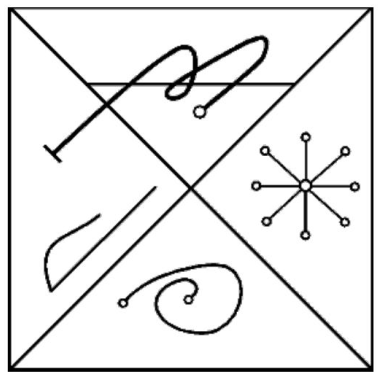
The Rise of the Great Old One (2020) by Jasmine Jarvis

What if I told you that the creatures from Lovecraft’s stories are real?

Back cover copy of The Rise of the Great Old One (2020) by Jasmine Jarvis

It is an open secret that H. P. Lovecraft created the Mythos as a kind of literary game. Alongside the artificial mythology and geography he developed, Lovecraft would work in references to friends like Clark Ashton Smith and his creations of Tsathoggua and the Book of Eibon. In turn, Smith & others at Weird Tales would start to play the same game, working references to the Lovecraft Mythos into their own stories. Frank Belknap Long, Jr. and Robert Bloch would even include fictional representations of Lovecraft himself into the Mythos, as an in-joke. Writers like August Derleth and Manly Wade Wellman would go a step further—putting Lovecraft himself into their stories, alongside his fictional creations.

He wished that Lovecraft were alive to see and hear—Lovecraft knew so much about the legend of Other-People, from before human times, and how their behaviors and speech had trickled a little into the ken of the civilization known to the wakeaday world. De Grandin, too—a Frenchman, a scientist, and with the double practicality of his race and education. De Grandin would be interested to hear of all this later. Thunstone had no doubt that he would survive to tell de Grandin about it, over a bottle of wine at Huntington, New Jersey.

Manly Wade Wellman, “Shonokin Town” in Weird Tales (July 1946)

The idea had a bit of cachet in the 1940s, but in the ensuing six decades the idea that Lovecraft was really writing the truth and existed in the same continuity as his own fictional creations has become cliché. Yet part of the reason the idea remains so popular after so many decades is that Lovecraft’s own mythic image has become intimately entwined with his Mythos. The Old Gent from Providence has engrossed decades of fans and scholars, and his image—typically a somber face with a prognathous jaw, in a plain and unassuming dark suit without ornament, a bit like an undertaker—has become as indelible to Mythos-art as Cthulhu or the Necronomicon. Lovecraft is still in many ways the face of the Mythos, and as a character in his own right has appeared in many media, from fiction and poetry to comic books and film.

Leeman Kessler as H. P. Lovecraft in “Ask Lovecraft”
Source: “Depicting Lovecraft” by Leeman Kessler

It is important to emphasize that there’s nothing inherently wrong with having H. P. Lovecraft as a character in a Mythos story, or pursuing the idea that Lovecraft was writing the truth as fiction. Many writers have done it, from Robert Bloch in his novel Strange Eons (1978) to Alan Moore & Jacen Burrows in Providence (2015). A cliché is not bad by itself, but with so many other examples to compare it against, the execution becomes all-important—does the author do anything new? Do they do it well?

In the case of Jasmine Jarvis and The Rise of the Great Old One, there are a couple of good ideas buried in the narrative, but the execution doesn’t really give them time to develop. The style of the story is very reminiscent of a creepypasta: short, unadorned, straightforward, largely a first-person narrative, and set in the contemporary period. There isn’t a lot of character development or a lot of characters; the lore isn’t especially deep, there is a strong element of random weirdness, and the Lovecraftian element is most strongly represented by a kind of general aesthetic of crawling tentacles and fish-faced cultists. This isn’t a sequel to any specific Mythos story as much as a story inspired by the very existence of Lovecraft and the Mythos.

So what kind of ideas are buried in there?

One evening, whilst browsing the Internet and flicking through HP Lovecraft books I had obtained from the local library, I noticed that Lovecraft had stopped writing for a period of about twelve months. My interest was piqued—why? No one can account for his whereabouts during this time,and when he finally returned to writing, it seemed he struggled to put his stories together.

Jasmine Jarvis, The Rise of the Great Old One (2020) 15

In real life, Lovecraft’s letters provide an incredible record of his life and it’s unlikely you could squeeze a gap year in there. Of course, this isn’t real life, so that offers some interesting possibilities: if Lovecraft was recording truth as fiction, and if there was a missing year in his life, what was he up to during that chunk of missing time?

Unfortunately, length and format don’t really give The Rise of the Great Old One a chance to explore this fully. While the conceit of the plot is that Lovecraft was onto something, the point of view character is an unreliable narrator named Angus who is spilling his guts to a psychiatrist. The result is a story that feels more like a sketch of what could have been, with more evolution, an interesting novella. What we get instead is a narrative that is very full of Lovecraftian clichés, but doesn’t do enough new and interesting with those clichés to really elicit interest. It is a little too generically Lovecraftian, more devoted to the pop culture idea of what Lovecraftian is rather than in the sense of how Lovecraft and his contemporaries wrote it.

This is something that you tend to see a lot of these days, especially in relatively low-budget Lovecraftian cinema like H. P. Lovecraft’s Witch House (2021) or H. P. Lovecraft’s The Deep Ones (2020). Stories that are trying to invoke a Lovecraft, but what they’re aiming for is less the careful development of mood and ideas of cosmic insignificance and biological determinism that Lovecraft wrote, and more a generic idea of robed cultists, old grimoires, and tentacle monsters—the elements that were so easy to pastiche and have thus become synonymous with the Mythos for a lot of people who have absorbed their idea of what the Mythos is through other media instead of reading his stories and letters.

The Rise of the Great Old One by Jasmine Jarvis was published in 2020 by Black Hare Press.


Bobby Derie is the author of Weird Talers: Essays on Robert E. Howard and Others and Sex and the Cthulhu Mythos.

Deep Cuts in a Lovecraftian Vein uses Amazon Associate links. As an Amazon Associate I earn from qualifying purchases.
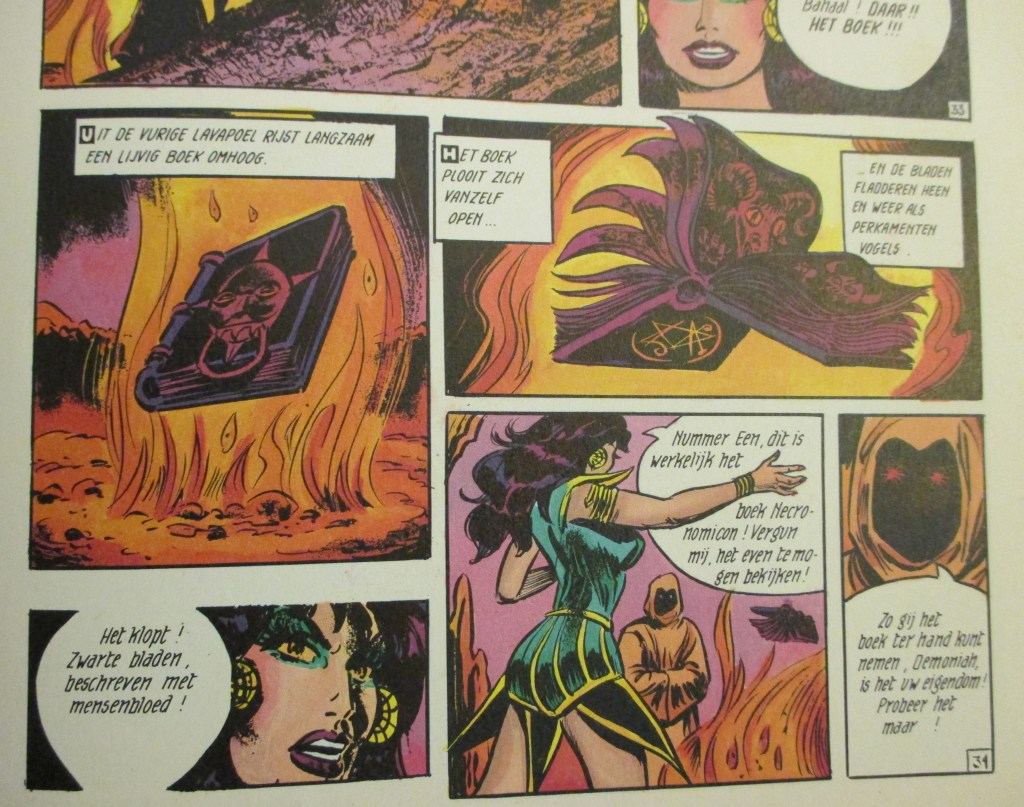
“The One That Got Away” (2011) by Esther M. Friesner

The horror crossover is a fine art. Beyond the mere marketing-stunt spectacle that such ventures often are, from Frankenstein Meets The Wolf Man (1943), House of Frankenstein (1944), House of Dracula (1945), and King Kong vs. Godzilla (1961) to Freddy vs. Jason (2003), Puppet Master vs. Demonic Toys (2004), and Alien vs. Predator (2004), there is more to these films than just a howling of werewolves and a trample of kaiju. There is a genuine sense of clashing mythos—how do you reconcile the mad science of Frankenstein’s Monster with lycanthropy and vampirism?

When you look at what world can accommodate not just the individual narratives of each weird entity, but all of them together, you’re moving past the stage of passive consumption. Like the ancient citizens on the streets of Rome, facing a bewildering array of divinities from across the known world with all of their stories and attributes, some conflicting, some paralleling one another closely…the shared universe can become richer, tying together disparate elements of their backstories, hinting at a more complex relationship with more stories waiting to be told. Then you get films like The Monster Squad (1987) and comics like Screamland (2008), works powered by something more than nostalgia and replaying the same classics.

While all the individual elements might be familiar, when you play them off against each other, something new emerges.

The Cthulhu Mythos already exists as a shared universe, and it has been remixed and crossed over with more traditional horror franchises and creations dozens, perhaps hundreds of times. Aquaman has fought Cthulhu. Sherlock Holmes has interacted the Mythos in dozens of stories and novels, including “A Study in Emerald” (1993) by Neil Gaiman. A Night in the Lonesome October (1993) by Roger Zelazny sees Holmes, the Cthulhu Mythos, and various Universal monsters play off against each other in the Game. In “From Cabinet 34, Drawer 6” (2005) by Caitlín R. Kiernan revisits “The Shadow over Innsmouth” by way of The Creature from the Black Lagoon (1954). Whether or not a horror/Mythos crossover succeeds is whether it transcends the formula of “X vs. Y”; whether it builds on its constituent elements to create something new and distinct.

“The One That Got Away” (2011) by Esther M. Friesner is that kind of story.

Damn it, it wasn’t fair! I went through just as much as that little blond chippie, and her big-shot showbiz pals knew it. Sure, they lost their star attraction, but what was stopping them from salvaging something from their losses by giving me a chance at the spitlight? I would’ve worn my native costume. I would’ve acted like I couldn’t speak a word of English so someone could pretend to translate while I recounted my terrible ordeal in his hairy clutches—even though I’d dodged those cltches pretty slickly, if I do say so myself. And if one of those puffed-up producers would’ve thought to scrape the pavement, salvage what was left of him, hire an army of taxidermists to pretty up the remains a bit, and stuck him back on stage, I would’ve screamed on cue like a champ at the results. Hell, I’ll bet I could’ve shrieked loud enough to make the audience believe—just for a moment—that he was still alive!

Esther M. Friesner, “The One That Got Away,” Asimov’s Science Fiction Apr/May 2011, 136
KING KONG (1933)

Friesner can’t come out and say things explicitly, because copyrights and trademarks are still owned by others, but the waltzing-around the subject is part of the charm of the narrative. The crossover is the premise; a nigh-forgotten character from a classic story dropped into an encounter with some Innsmouth sailors. What makes it work is the telling, and how Friesner develops the story. A young woman, late of Skull Island, left to her own devices in the United States of America during the Great Depression and Jim Crow has turned into a hardboiled woman of the world—and a surprisingly open-minded one.

Bat-winged and taloned, with what looked like an octopus boquet for a mouth, the creature reared out of the depths and strode toward me with eldritch lust in his fiery eyes.

Eh. I’d seen worse.

Esther M. Friesner, “The One That Got Away,” Asimov’s Science Fiction Apr/May 2011, 144

The tone is flippant, and the story is a play on wits worthy of the fast-talking repartee in a noir film. It is the unexpected (one might say sacrilegious if either Lovecraft or King Kong is one of your sacred cows) lightness that makes the story work. There is a darkly comic Pollyanna aspect of the narrator as she compares the cultural rituals of Innsmouth and Skull Island with gallows humor and no hard feelings.

Two mythologies meeting in unexpected ways…but also ways that are oddly fitting. For those who like to explore the culture of Innsmouth, in works like Innsmouth (2019) by Megan James, it’s nice to see what happens when the sailors get out into the wider world and encounter folks from other cultures. It is all good fun.

“The One That Got Away” by Esther Mr. Friesner was published in Asimov’s Science Fiction Apr/May 2011. It has not been reprinted.


Bobby Derie is the author of Weird Talers: Essays on Robert E. Howard and Others and Sex and the Cthulhu Mythos.

Deep Cuts in a Lovecraftian Vein uses Amazon Associate links. As an Amazon Associate I earn from qualifying purchases.
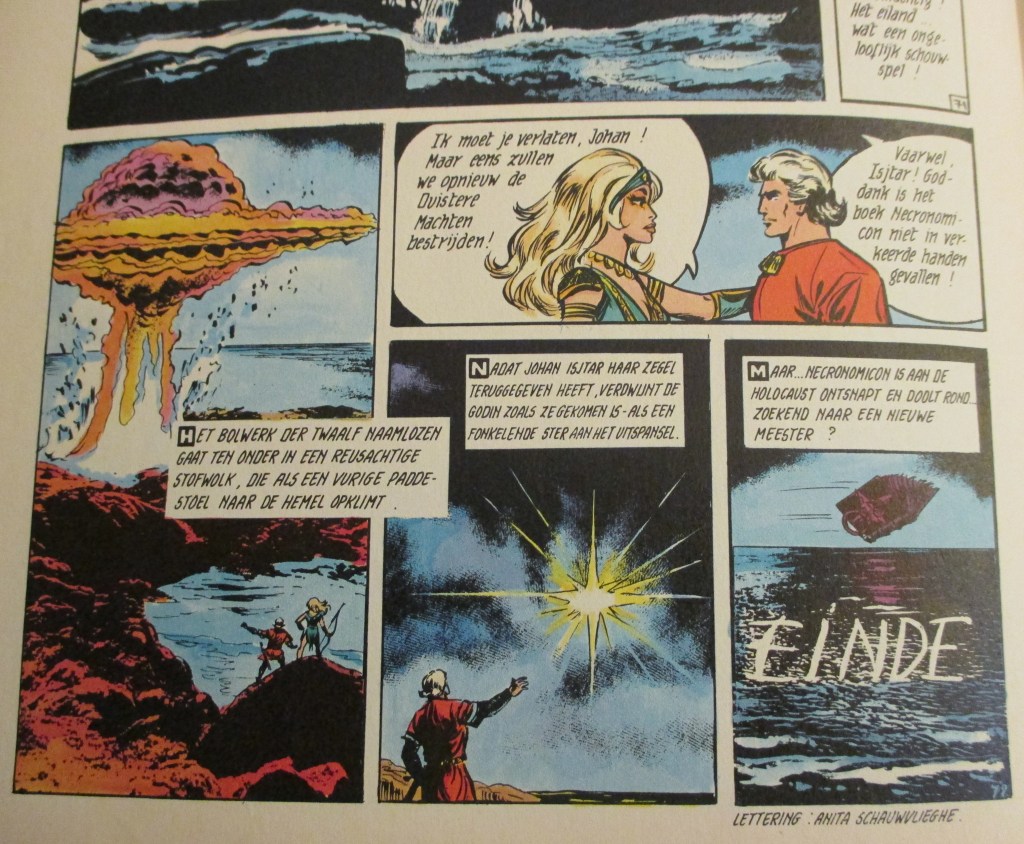
The Mysteries of Udolpho (1794) by Ann Radcliffe

up 8 p.m.—Read Mysteries of Udolpho—retire 9 a.m. Friday

H. P. Lovecraft’s 1925 diary, entry for 3 December, Collected Essays 5.173

Fate sits on these dark battlements, and frowns,
And, as the portals open to receive me,
Her voice, in sullen echoes through the courts,
Tells of a nameless deed.

Epigraph to Ann Radcliffe’s The Mysteries of Udolpho

In 1764, Horace Walpole kicked off the Gothic novel craze with The Castle of Otranto: A Gothic Story. Thirty years later, Otranto would serve as the blueprint for Ann Radcliffe’s fourth novel, The Mysteries of Udolpho, A Romance (1794). Radcliffe had begun her literary career in 1789 at age 25, first publishing anonymously, and then eventually using her own name as her novels grew in popularity and commanded higher prices from publishers. Immensely popular during her own life despite only publishing five novels in that time, Udolpho which would go on to rival Otranto as the archetypical Gothic novel, to the point of being satirized in Jane Austen’s Northanger Abbey (1817).

To H. P. Lovecraft, Radcliffe was essential reading in the history of horror literature; although he did not first encounter her by reading the whole novel:

Belknap, having sharper eyes than his old Grandpa, picked up a book which I would have given much to have seen first—”Tales of Mystery”, composed of extracts from the most celebrated horror novelists of the 18th century—Walpole, Mrs. Radcliffe, Lewis, &c. He will later lend his prize to me—just as I am lending him my own prizes.

H. P. Lovecraft to Lillian Clark, 29 Sep 1922, Letters to Family & Family Friends 1.80

Tales of Mystery (1891) was an anthology edited by George Saintsbury collecting excerpts from the Gothic romances of Radcliffe (including bits of Udolpho), Matthew Gregory Lewis, and Charles Maturin. Frank Belknap Long, Jr., who had spied the book first at a bookstall during Lovecraft’s trip to New York, would later gift it to his friend as at Christmas 1922:

I’ve been eating up Gothick stuff lately—all the posterity of “Otranto”. Miss Reeves’ “Old English Baron” (1777) is infernally tame, but in damned good Georgian English. Radcliffe stuff is vastly—immeasurably—superior in interest & atmosphere, though the language is more stilted. (And yet beats Reynolds by a mile!) I’m reading that volume of selections which Little Belknap picked up right under his Old Grandpa’s nose at the shop in Vesey-Street, & which he magnanimously gave the poor old gentleman as a Christmas gift.

H. P. Lovecraft to James F. Morton, 5 Apr 1923, Letters to James F. Morton 35

In 1925, now living in New York, Lovecraft was asked by W. Paul Cook to write the article that would become “Supernatural Horror in Literature.” While Lovecraft would learn relatively heavily on The Tale of Terror (1921) by Edith Birkhead for his section on Gothic novels, among the books we know he read was The Mysteries of Udolpho. He later noted that his friend, the bookseller Goerge Kirk, gave him a copy of Udolpho (LWP 180), and his diary entry for 9 May 1925includes the notation “GK call—Udolpho” (CE 5.158), which may be when he received his copy, although he didn’t devour the noel until December:

I waded through the whole of “Udolpho” last week, & am now on the hunt for Maturin’s “Melmoth”.

H. P. Lovecraft to Clark Ashton Smith, 12 Dec 1925, Dawnward Spire, Lonely Hill 92

From this reading, Lovecraft would write:

[…] all existing lamps are paled by the rising of a fresh luminary of wholly superior order—Mrs. Ann Radcliffe (1764–1823), whose famous novels made terror and suspense a fashion, and who set new and higher standards in the domain of macabre and fear-inspiring atmosphere despite a provoking custom of destroying her own phantoms at the last through laboured mechanical explanations. To the familiar Gothic trappings of her predecessors Mrs. Radcliffe added a genuine sense of the unearthly in scene and incident which closely approached genius; every touch of setting and action contributing artistically to the impression of illimitable frightfulness which she wished to convey. A few sinister details like a track of blood on castle stairs, a groan from a distant vault, or a weird song in a nocturnal forest can with her conjure up the most powerful images of imminent horror; surpassing by far the extravagant and toilsome elaborations of others. Nor are these images in themselves any the less potent because they are explained away before the end of the novel. Mrs. Radcliffe’s visual imagination was very strong, and appears as much in her delightful landscape touches—always in broad, glamorously pictorial outline, and never in close detail—as in her weird phantasies. Her prime weaknesses, aside from the habit of prosaic disillusionment, are a tendency toward erroneous geography and history and a fatal predilection for bestrewing her novels with insipid little poems, attributed to one or another of the characters.


Mrs. Radcliffe wrote six novels; The Castles of Athlin and Dunbayne (1789), A Sicilian Romance (1790), The Romance of the Forest (1791), The Mysteries of Udolpho (1794), The Italian (1797), and Gaston de Blondeville, composed in 1802 but first published posthumously in 1826. Of these Udolpho is by far the most famous, and may be taken as a type of the early Gothic tale at its best. It is the chronicle of Emily, a young Frenchwoman transplanted to an ancient and portentous castle in the Apennines through the death of her parents and the marriage of her aunt to the lord of the castle—the scheming nobleman Montoni. Mysterious sounds, opened doors, frightful legends, and a nameless horror in a niche behind a black veil all operate in quick succession to unnerve the heroine and her faithful attendant Annette; but finally, after the death of her aunt, she escapes with the aid of a fellow-prisoner whom she has discovered. On the way home she stops at a chateau filled with fresh horrors—the abandoned wing where the departed chatelaine dwelt, and the bed of death with the black pall—but is finally restored to security and happiness with her lover Valancourt, after the clearing-up of a secret which seemed for a time to involve her birth in mystery. Clearly, this is only the familiar material re-worked; but it is so well re-worked that Udolpho will always be a classic. Mrs. Radcliffe’s characters are puppets, but they are less markedly so than those of her forerunners. And in atmospheric creation she stands preëminent among those of her time.

H. P. Lovecraft, “Supernatural Horror in Literature”

It is easy to see both what Lovecraft would have enjoyed and deplored in Radcliffe’s Udolpho, which was the only complete novel of hers he had read at the time of writing. The moralistic tone of the story with its sappy ending and romances were largely anathema to his aesthetic style. Many characters, not least of them the heroine Emily, are prone to fainting and melodramatics, the story is peppered with bits of verse, quotes from Milton and Shakespeare, and some convoluted linguistic expressions typical of the period which probably earned a bemused smile from Lovecraft. Yet there are also many vivid descriptions hinting of terrible horrors and revelations to be made, of castles and battlements, and old family histories with their buried secrets.

For critical analysis, Lovecraft would have had The Tale of Terror, and it was from Birkhead that he probably drew his facts about Radcliffe’s life and her other novels, but his impressions appear to be his own. The note about her “insipid little poems” is interesting in particular because Radcliffe later wrote an essay “On the Supernatural in Poetry” (1826), which Lovecraft apparently never read, where she wrote:

The wild attire, the look not of this earth, are essential traits of supernatural agents, working evil in the darkness of mystery. Whenever the poet’s witch condescends, according to the vulgar notion, to mingle mere ordinary mischief with her malignity, and to become familiar, she is ludicrous, and loses her power over the imagination; the illusion vanishes.

A sentiment that echoes some of Lovecraft’s sentiments in “Supernatural Horror in Literature,” and which he might well have appreciated. As it was, at the time Lovecraft had read only Udolpho and some excerpts from Radcliffe’s other novels, and his literary opinion was set on that…although it was sufficient that when August Derleth was looking for recommendations, he would write:

Incidentally—have you read other early horror work? If not, let me advise the following as worthy ingredients (if only for historical reasons) for any fantaisiste’s library:

Mysteries of Udolpho (1793) by Anne Radcliffe
The Monk (1795) by Matthew Gregory Lewis

H. P. Lovecraft to August Derleth, 2 Sep 1926, Essential Solitude 1.34

In other letters, Lovecraft gives a few more details on his private thoughts on Radcliffe and Udolpho, spurred in large part by a course on Gothic fiction that Donald Wandrei was taking:

As to “Melmoth”—of course it dags in places, like all the interminable novels of its time; but it seems to me to hold a certain convincing kinship with horrors beyond the veil which we find lacking in its predecessors—such as “Udolpho”, “The Monk”, &c.

H. P. Lovecraft to August Derleth, 7 Nov 1926, Essential Solitude 1.47

You’re lucky to get hold of “The Romance of the Forest”—the only Radcliffian oeuvre which I’ve ever seen in toto is “Udolpho”, now being lent to Dwyer. Yes—her gentle melancholy is certainly both romantic & hydraulic!

H. P. Lovecraft to Donald Wandrei, 22 Oct 1927, Letters wth Donald and Howard Wandrei 172

Of the Goths, only Maturin had the sense of unholy outsideness developed to any considerable degree—you couldn’t bribe me to swallow all the sobbing Radcliffery which your course is forcing upon you. The few selections in an anthology by George Sainstbury are all I want—though I have read Udolpho through. (Just now, by the way, I’ve lent it to Dwyer.)

H. P. Lovecraft to Donald Wandrei, 3 Nov 1927, Letters wth Donald and Howard Wandrei 179-180

Dwyer is just forming the acquaintance of our gushing friend Mrs. Radcliffe through my copy of “Udolpho”, & expresses the opinion that she is unsurpassed in imparting horror to a frowning castle landscape. Cook is going to lend me “The Italian” shortly.

H. P. Lovecraft to Donald Wandrei, 25 Nov 1927, Letters wth Donald and Howard Wandrei 184

Your Radcliffian satiation is scarcely an encouraging emotion to confront me as I stand on the brink of “The Italian” & “The Romance of the Forest”—lent me by Cook—but I do not think I shall let it deter me from at least a skimming. The author of a standard treatise on supernatural horror in literature ought to read—as a matter of duty—one or two of the volumes he has analysed & appraised so sagely. You & Dwyer can work up an interesting controversy about the sombre & sentimental Mother Anne, for “Udolpho” had made him a shouting Radcliffe-fan of the first & foremost order. He is, of course, right so far as the sheer weaving of vague, terrible impressions of cyclopean mystery & imminent nightmare is concerned; & we ought not to let the peterings-out or the salt lakes of “poetic” sensibility deter us from giving credit where credit is due.

H. P. Lovecraft to Donald Wandrei, 19 Dec 1927, Letters wth Donald and Howard Wandrei 189

Lafcadio Hearn averred that Gothic cathedrals frightened him with their bulk and mystical design. They seemed to him about to rise from the ground. Of this quality of size-terror I fancy Mrs. Radcliffe is, as you say, the chief exponent. Certainly, it recurs throughout her work.

H. P. Lovecraft to Bernard Austin Dwyer, 14 Feb 1928, Letters to Maurice W. Moe and Others 469

Lovecraft did eventually read Radcliffe’s novels The Romance of the Forest (1791) and The Italian (1797), which were lent to him by W. Paul Cook in 1928, noting:

I have also read lately those old Radcliffe standbys—”The Italian” & “The Romance of the Forest”—neither of which is really weird according to my standard.

H. P. Lovecraft to August Derleth, 20 Aug 1928, Essential Solitude 1.153

In truth, the supernatural element in Radcliffe’s novels was always a false one, like the ghosts and ghouls in the typical Scooby Doo episode, at the end the mask will come off and a rational explanation offered. Yet she showed great skill in the build-up of such terrors, and this is nowhere as prominent as in The Mysteries of Udolpho. Lovecraft, to his credit, appeared to recognize that Radcliffe had earned her place in the pantheon of weird fiction authors for her work:

Also—are you familiar with the so-called “Gothic” novels of the later 18th & early 19th centuries—Mrs. Radcliffe’s “Udolpho”, Lewis’s “Monk”, Maturin’s “Melmoth”, &c? Some years ago I wrote an article on the history of the weird tale, mentioning the titles of things which had particularly impressed me. If you’d like to see this as a guide to weird reading I might be able to dip up a duplicate to lend you.

H. P. Lovecraft to Robert Bloch, 22 Apr 1933, Letters to Robert Bloch & Others 20

It is difficult to say how much Lovecraft was influenced by The Mysteries of Udolpho; there is certainly a deliberate echo of the Gothic manse in “The Rats in the Walls,” which was written after he read the Saintsbury Tales of Mystery but before he read the full novel. It might be fair to say that Lovecraft’s study of the Gothics confirmed in him the lessons of what not to do. No fainting heroines, little to no romances, something more than drafty castles at work. Nor did Lovecraft follow Radcliffe in explaining away every mystery with a rational explanation:

“I perceive,” said Emily, smiling, “that all old mansions are haunted; I am lately come from a place of wonders; but unluckily, since I left it, I have heard almost all of them explained.”

Ann Radcliffe, The Mysteries of Udolpho, Vol. 3, Chapter XII

The syntax of horror shifts through the years, decades, and centuries; in Lovecraft’s day, the old familiar terrors of Radcliffe’s Udolpho no longer held the same power as they did when they were fresh and new in the late 18th century—yet they were a part of the legacy of horror to which Lovecraft was an inheritor, and so too are both Radcliffe and Lovecraft part of the genealogy of horror fiction today, literary ancestors whose works have been often lampooned and satirized, adapted and criticized, but still read, still relevant to us today.

What better measure of their power and influence?


Bobby Derie is the author of Weird Talers: Essays on Robert E. Howard and Others and Sex and the Cthulhu Mythos.

Deep Cuts in a Lovecraftian Vein uses Amazon Associate links. As an Amazon Associate I earn from qualifying purchases.
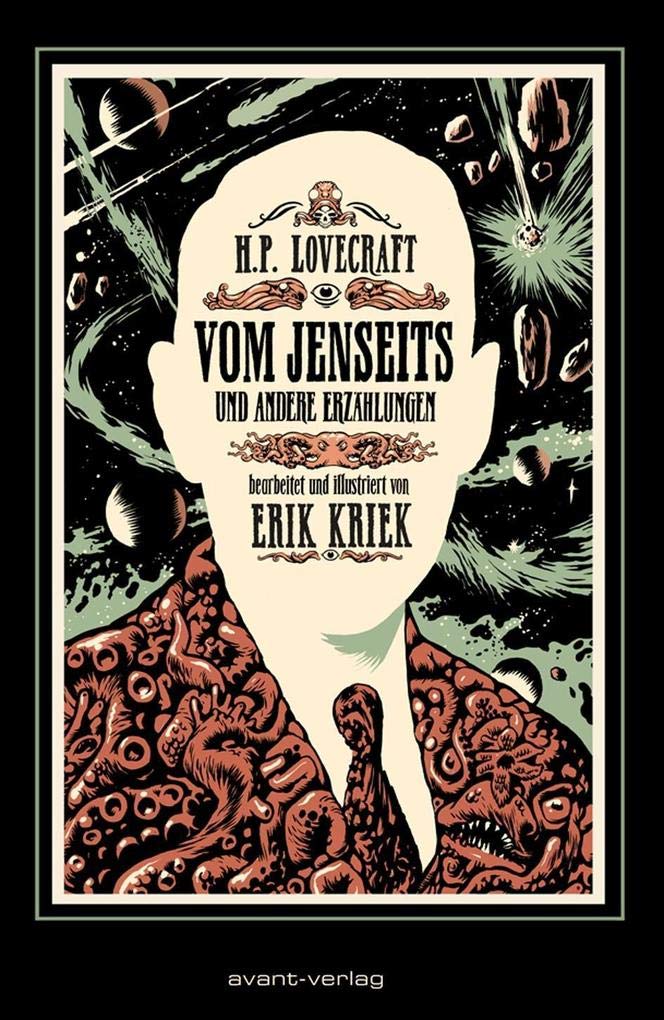
Psyche (1953) by August Derleth

Never send to know for whom the bell tolls;
it tolls for thee.

For ego and satyr,
for lover and beloved;

ask to know for whom the heart beats,
send to ask for whom the quickened pulse,
bend to hear the hushed impassioned voice
sobbing your name or mine in all the body’s rapture:
or send to know for whom arms’ clasp,
eyes’ love, the hot possessive mouth;

for lover and beloved,
islandless man, of sea and land equally,
of sky and stars, of heaven and hell—
but never need to ask for whom the bell tolls;
make each man’s answer to yourself:
It tolls for me.

August Derleth, canto XIV of “Enigma: Variations on a Theme of Donne,” in Psyche (1953) 25

No man is an island, entire of itself; every man is a piece of the continent, a part of the main. If a clod be washed away by the sea, Europe is the less, as well as if a promontory were, as well as if a manor of thy friend’s or of thine own were: any man’s death diminishes me, because I am involved in mankind, and therefore never send to know for whom the bell tolls; it tolls for thee.

John Donne, Meditation XVII in Devotions Upon Emergent Occasions, and severall steps in my Sicknes (1623)

August Derleth’s greatest fame today is as a publisher, co-founder of Arkham House in 1939 with Donald Wandrei. Derleth was also an editor and anthologist of note, and a writer of diverse works of fiction and nonfiction, from the quiet regional portrayals of his Sac Prairie Saga to the potboiler horrors of Weird Tales, from the delicately plotted pastiches of Solar Pons to young adult and juvenile fiction; in non-fiction his works included everything from a book on Wisconsin’s rivers to newspaper columns on his nature walks to his biography of Henry David Thoreau.

Yet before, and during, and among all this other writing, August Derleth was a poet. He wrote, and what is more importantly published, reams of verse from the fantastic and the macabre to the lighthearted, odes on nature to sonnets on love, in many different meters and forms. Poetry was a sensibility and avocation that Derleth shared with many of his contemporaries, including Lovecraft, Clark Ashton Smith, Robert E. Howard, and many other writers for Weird Tales. Some of it has been republished here or there, particularly those bits of verse dedicated to or relevant to Lovecraft fans such as “Providence: Two Gentlemen Meet at Midnight” and “On Reading Old Letters, For H. P. L.,” but for the most part Derleth’s poetry remains unreprinted and largely unexamined.

This is a pity as such works provide, if nothing else, an interesting study of the importance of historical context. Derleth’s 1953 collection of love poetry Psyche is a good example.

These are poems of love and anguish. In this cycle of thirty-one poems, August Derleth tells the moving story of a love from its first awakening through uncertanty and agony to its foreseen dissolution.

These poems not only represent August Derleth at this best, but bid fair to take a place among the finest love poetry of our time.

Psyche, inner jacket flap

To anyone that holds this book in its hands, it may appear the prosaic but well-made product of a small press—in this case, the Prairie Press of Iowa City, Iowa—72 pages of good paper on cloth boards with a floral print; the dust jacket, when intact, is often rather tanned by sun and age. The contents are divided into two sections; “Enigma: Variations on a Theme of Donne” runs to 14 cantos, each taking inspiration from John Donne’s lines, and the second cycle of thirty poems runs the gamut of a love affair, from “I. When first I saw you” to “XXX. Beloved, now you are gone.” A few of these later poems have erotic elements, such as:

Something speaks for the essential you scattered here
in the black skirt and the blue blouse,
and the aqua pants with the embroidered I love you
and Forget-Me-Not (and who could?),
the slip in the usual pink and the gold slippers,
and the little bra from which the breasts
have spilled tightly above the taut belly
and Venus’ mound and the indolent legs
in their skilled proportions where you lie
waiting for love, savoring your victory
sweet in your smile, in your eye,
aloof, serene: the thin shoulders,
the slender arms, the small round
still firm nates behind,
all waiting for love, to be possessed
and to possess in ecstasy of union,
knowing my Achilles’ heel:
with that small cat’s contentment of triumph
the smile aware and the eyes
confident and the legs parted
where the dark hair already glistens
and the lips, there shadowed, opening
to sheathe my sword, waiting for love and lust,
knowing I will cross the room and touch and feel,
knowing I will possess and be possessed,
not alone because our mutual wish dictates
but because I must.

August Derleth, “XVII.” in Psyche 46

This collection of thirty poems was apparently a selection from a much longer cycle of love-poetry, which came to light after Derleth’s death when Peter Ruber, who had become editor of Arkham House in 1997, went through some of Derleth’s old files:

Another very important find was the entire Psyche lyric love poems cycle. Derleth published 30 in a 72-page book of that title in 1953. In reality, he had written 233 Psyche poems, and we have them in chronological order. The entire group will be published late 1997 or early 1998.

M. Dianne Bergenske, “Hidden Literary Treasures Revealed: Unpublished Works of Wisconsin Author August Derleth” in BookLovers (V5, N1), 7.

As with Ruber’s projected biography of Derleth and other projects, this never came to pass. However, Psyche did reach a wider audience in another form: as an LP.

Sauk Prairie (2015) 80
“S-P STAR,” June 16, 1960

It isn’t clear how well Psyche sold, but it evinced enough interest that in 1960 Derleth recorded the lyrics onto vinyl at the Cuca Records Company in his native Sauk City:

The LP was released with both a blue and a red slipcase; it isn’t clear if this represents separate printings or one printing, as the discs and backmatter are otherwise identical.

The title Psyche is in reference to the tale of Cupid and Psyche from the Metamorphoses of Apuleius, and Derleth’s dedication in the book is: “for the woman who was Psyche and is gone…” which casts Derleth as Cupid, overcoming obstacles to achieve union. Such dramatic romances were not unusual within Derleth’s fiction, and there was often a quasi-autobiographical element, for example, the teenaged romance with “Margery” (a local Sauk City girl) which formed the basis for his first novel, Evening in Spring (1945).

The liner notes are clear on the autobiographical element of Psyche:

That PSYCHE is an immensely felt autobiographical experience can hardly be questioned, and the alert listener will learn that it is a tribute to two women—not only one called “PSYCHE” but another known as “Cassandra”—but primarily it is the celebration of love and passion by a widely-known poet and novelist.

Liner notes to Psyche (1960)

“Cassandra” had been the subject of a previous book of primarily nature poems, Habitant of Dusk: A Garland for Cassandra (1946). In Psyche, Cassandra is mentioned by name only in a single poem:

Death is my mistress; what name I give her matters not—
call her Psyche or Cassandra,
Call her by any name you will,
Death it is in love’s own guise,
my mistress.

August Derleth, canto XIII of “Enigma: Variations on a Them of Donne,” in Psyche (1953) 24

According to Derleth: Hawk…and Dove (1997) by Dorothy M. Grobe Litersky, Cassandra was another romantic entanglement of Derleth’s in the early-mid 1940s, and their affair would be the subject for his unpublished novel Droughts of March.

For all that Derleth mined his personal experiences for fictional and poetic material and inspiration, he was not keen to publish his love affairs and generally avoided providing sufficient information in print for the average reader to identify who he was talking about. Sauk City was, after all, a small town and people would talk. Still, students of Derleth’s life would not be surprised at reading in Litersky’s biography that “Psyche” was none other than Sandra Winters, who married August Derleth in 1953, the year that Psyche was published. There is nothing unusual about a man writing love-poems to his wife, after all.

Except for one important detail.

PSYCHE is now virtually done in its 4th draft, and it seems to stand up very well in amatory verse, at which I have never pretended to be very good. But then, I have always had that as a poet I am at best a second-rater, which is saying a good deal, because there are a lot of poets far worse than that. But this book is most revealing and cannot be published for some (3) years because it is plainly about an affair with a girl who is not more than 15, and the facts wd currently be too obvious to local readers.

August Derleth to Carl Jacobi, 9 Jul 1949, MSS. Bowling Green University Library

Sandra Evelyn Winters was born 1 March 1935; according to Litersky she met August Derleth in 1948, and they married on 6 April 1953. That his relationship with her before their marriage was sexual is not much doubted; in another letter, he wrote:

Oh, yes, I would not deny that Sandra has done me a lot of good. Not just making love to her, Sandra herself. Of course, she is sharp enough to know that, and I think that in this lies the ultimate dissolution of the affair, unless an accident makes it necessary for us to be married. For, being young, she is entirely likely, even with her mother’s advice, to take me for granted, and that might well be fatal. She has been frank enough to say that she intended all along that I should ultimately need her more than she needs me, and, while she intends to marry me, she intends also to have as much of her cake and eat much of it too, as possible. That never works, manifestly. But whatever takes place, it is certain that I have already benefited a great deal, and all the clothes and jewelry I’ve bought her won’t balance my own benefits.

August Derleth to Zealia Bishop, 18 Aug 1949, MSS. Wsconsin Historical Society

Given the age gap (August Derleth was born in 24 February 1909, making him 40 years old in 1949 when these letters were written), Derleth may have had more to worry about than his reputation; statutory rape charges were a real possibility. As Litersky points out, this fact rather changes how Psyche is read. When Derleth writes:

When first I saw you,
but one among a sea of faces,
my glance swept past, came wondering back
in search of something from alien places
to see the countenance of little more than child,
demure, aloof, and bland,
not akin to what I felt—that wild,
strange beauty, that warm impassioned spirit
lurking deep,
hidden by a child’s serene and lovely face,
inscrutable as sleep.

As Iseult, Helen of Troy,
immortal Psyche—you, too, in this child’s guise:
something from deep within gazed tranquil back,
the challenge of your untamed spirit looked
from out your eyes.

August Derleth, “I.” in Psyche 26

At what age would you as the reader have put Psyche and Derleth based on this poem? Do you read it differently now that you know he met his future wife as a thirteen-year-old girl, and this poem might be an attempt to capture—or at least capitalize on—the beginning of that relationship? Without that piece of information about who Psyche was based on and her age at the time, Psyche is little more than an innocuous curiosity. With that bit of historical context, it becomes a different thing entirely, and a reader might not only look for new meaning in the lines, but find it. Comparable in some ways to “Doom of the Thrice-Cursed” (1997) by Marion Zimmer Bradley, it is impossible to turn back the clock to before you knew, and read the words they wrote with innocent eyes.

With thanks and appreciation to John Haefele for his help with this article.


Bobby Derie is the author of Weird Talers: Essays on Robert E. Howard and Others and Sex and the Cthulhu Mythos.

Deep Cuts in a Lovecraftian Vein uses Amazon Associate links. As an Amazon Associate I earn from qualifying purchases.
Ecstasy (1989)

Eldritch Fappenings

This review deals with a work of pornography, and the history of erotic art and writing. As part of this review, selected passages involving sexually explicit activites will be included.
As such, please be advised before reading further.


Bellezza prorompente e maliziosa, biondo desiderio che esplode dalle copertine delle riviste, dalle locandine dei cinema, dai cartellon dei night club e anche (quando la censura lo permette…), dal piccolo chermo televisivo. Con Moana Pozzi, diventata ormai un “mito”, il cinema erotico italiano si è conquistto un posto d’onore accanto alle produzioni internazionali più importanti. Moana è sensualità, irruenza, genuinità. Moana è… ecstasy. Chi è sensibile alle sue grazie non dimenticherà faclmente questo concentrato di sogni…Beauty, breathtaking and mischievous, blonde desire exploding from magazine covers, movie posters, night club billboards and even (when censorship allows…), from the small television screen. Starring Moana Pozzi, who has now become a “myth,” Italian erotic cinema has won a place of honor next to the most important international productions. Moana is sensual, impetuous, genuine. Moana is… ecstasy. Those who are sensitive to her graces will not easily forget this concentrate of dreams….
Back cover text on the 2009 Minerva Video DVDEnglish translation

In the mid-1980s, Italian actress Moana Pozzi became a sensation for her adult films, brazen nudity on television, and her intelligence and outspokenness on sex and sexuality. In the 1990s she became a published author and political candidate, co-founding the Partito dell’Amore (“Party of Love”), which campaigned on a platform that included better sex education and legalization of brothels. While Pozzi never achieved any real political power, it added to her growing status as an Italian icon of the adult film industry. In 1994, Pozzi would die relatively young from liver cancer, leaving behind an enduring legacy—including inspiring the 1999 film Guardami and being the subject of the 2009 biographical docudrama Moana. Her name recognition was such that even in 2016, the Disney animated film Moana had to be marketed under the alternate title Oceanica in Italy.

Buried in Moana’s filmography is an odd gem: the relatively obscure Ecstasy (1989), which was very loosely adapted from (or perhaps more accurately, inspired by) Welsh author Arthur Machen’s “The Novel of the White Powder,” one of the episodes in his picaresque weird novel The Three Impostors; or, The Transmutations (1895). Machen, for all his fame as a writer of the weird and an inspiration for H. P. Lovecraft and others, has very rarely been adapted to film or television. Yet in the late 1980s, Moana Pozzi and director Luca Ronchi gave it a shot:

la storia è liberamente ispirata al racconto “Polvere biance” di ARTHUR MACHEN (1984)the story is loosely based on the short story “White Powder” by ARTHUR MACHEN (1984)
From opening credits of EcstasyEnglish translation

It isn’t exactly clear which text/translation that the filmmakers were drawing from but it seems likely to be Giuseppe Lippi’s translation in Il gran Dio Pan e altre storie soprannaturali (1982). Whatever the case, the approach to adapting Machen’s story was very “liberamente,” taking broad inspiration but telling its own story:

[…] con Ecstasy di Luch Ronchi (’90) nel cui cast figura anche il pornodivo Rocco Siffredi (vero nome Rocco Tano), qui in veste soft. Storia onirica, molto liberamente tratta dal racconto “Polvere bianca” di Arthur Machen, scrittore inglese di fine Ottocentro, basata sui poteri di una misteriosa droga che esalta, ma allo stesso tempo uccide, Ecstasy offre a Moana Pozzi una chance che lei non riesce a sfruttare appieno. Del resto la Pozzi dichiarava allora, in un sussulto di autocoscienza: « Sia chiaro, io non sono un’attrice sono una che cerca di interpretare se stessa in tante situazioni diverse».[…] with Ecstasy by Luch Ronchi (’90) whose cast also includes porn star Rocco Siffredi (real name Rocco Tano), here in a soft role. A dreamlike story, very loosely based on the short story “White Powder” by Arthur Machen, a late 19th-century English writer, based on the powers of a mysterious drug that enhances but at the same time kills, Ecstasy offers Moana Pozzi a chance that she fails to take full advantage of. After all, Pozzi declared at the time, in a jolt of self-consciousness: “Let it be clear, I am not an actress I am someone who tries to play herself in many different situations.”
Moana e le altre: il cinema pornografico in Italia 39-40English translation

In Machen’s original, the scene is 19th-century England, where a sister worries about her brother’s ascetic habits. The family physician suggests a medicine—an innocuous white powder—and at first it seems to have positive effects, making her brother more social, outgoing, and forgetting his cares. Too soon, however, things take a turn for the worse; the drug had deleterious effects, yet the brother cannot cease taking it—and a trifle wound on the hand becomes something profoundly worse. The physician discovers it was not what he had prescribed at all, and its effects finally lead to a fate worse than death for the poor, afflicted brother.

Keeping in mind that Machen was writing a little less than ninety years before D.A.R.E., the parallels with drug addiction and “scared straight” drug literature may seem overly obvious in hindsight, but “The Novel of the White Powder” isn’t really an anti-drug story. The Victorians were well aware of the addictive possibilities of drugs like opium in the 1890s, but the white powder that the brother takes isn’t just a chemical pick-me-up:

By the power of that Sabbath wine, a few grains of white powder thrown into a glass of water, the house of life was riven asunder, and the human trinity dissolved, and the worm which never dies, that which lies sleeping within us all, was made tangible and an external thing, and clothed with a garment of flesh. And then in the hour of midnight, the primal fall was repeated and represented, and the awful thing veiled in the mythos of the Tree in the Garden was done anew.

Arthur Machen, “The Novel of the White Powder”

This is how Machen took a familiar story and turned it from a familiar tale of dissolution into something infinitely more suggestive and supernatural.

In Ecstasy, the setting is moved from the 19th-century United Kingdom to Italy in the 1980s. Moana Pozzi plays a version of herself, an outgoing adult film actress named Moana. Her younger sister Anna (Carrie Janisse), is the opposite of her outgoing sister: reclusive and given to watching horror movies, living in the shadow of her more glamorous sister. Moana provides Anna with a strange drug (ironically, a grey powder). Moana narrates as her sister Anna slowly comes out of her shell…and then spirals into drug abuse and degradation. Despite a brief flirtation with witchcraft imagery at the beginning and the end, and Anna suffering a similar hand injury, there isn’t much in the way of Machen’s original idea for the drug or its effects….and it is these brief flourishes that are as near as the film ever approaches to horror in the traditional sense.

Ecstasy was evidently never intended as a straight adaptation of Machen’s story, but even so, it feels like there’s a lot of missed opportunity here. The film neither draws on the rise of cocaine or club drugs like MDMA (popularized with the street name ecstasy) in the 1980s, nor on the more overtly supernatural dissolution in “The Novel of the White Powder.” As such, there’s no explicit social commentary, and no horrific spectacle at the end. We’re left instead with a film that hovers between hardcore adult film and erotic thriller, never quite being one or the other. Sexually explicit, and yet not simply a succession of sexual encounters; being more dreamlike in tone, dominated by an overarching narration.

As a work of cinema, Ecstasy is hard to pin down. A good deal of European horror during the period was heavy on blood, nudity, and atmosphere, but there were often lines that still weren’t crossed—explicit sex and genitalia, for example, were not common features of anything except the sleaziest of the Eurosleaze during the 1970s and 80s. By the same contrast, adult films, even when they had a plot (this was not long after the Golden Age of Porn in the United States), rarely addressed anything like a drug theme in a serious way. Ultimately, the film is almost narcissistically focused on Moana herself; even her sister’s suffering is a story that happens within the context of Moana’s life, work, and her sexual encounters. Anna’s story lives in the shadow of Moana’s throughout the film, and that feels like a deliberate choice.

Ecstasy seems to walk this tightrope, being more restrained, artistic, and plot-driven than the typical adult film, and yet more sexually explicit than more overtly transgressive European horror films of the period. From the moment that Moana rubs a piece of banana on her bare vagina and offers it to the man she’s having a conversation with, you know that you’re watching a film that is transgressive in ways that your typical 1980s horror film couldn’t be, for fear of never getting distribution.

While working with a relatively small cast, and presumably a small budget, the film makes the most of what it has. The cinematography is surprisingly solid, especially the night shots of Rome. The film’s quasi-biographical aspect is an asset as well, taking advantage of Moana’s widespread publicity in showing magazine covers, glamour shots, fumetti, and pinups. The soundtrack is nothing special but doesn’t detract from the overall atmosphere either; simple synth-and-drum-machine pieces, neither corny nor overly dramatic, but oddly fitting the overall 80s aesthetic.

If there’s a charm to the film, it is how so very 1980s it is, from the teased hair to the technology, all instant film cameras, walkmans, telephone booths, and CRT televisions; the utter ubiquity of trash and cigarettes, the boxy Italian cars on the roads and the discotheque. So too, there’s something oddly endearing about how utterly blasé the adult film actors are in their skimpy outfits on the sets, the utter ambivalence they express to casual nudity and even foreplay. The conscious artifice of it all is at once a glamourization of the lifestyle, and highlights how fundamentally silly a lot of adult filmmaking really is, looking at it from the outside.

Ecstasy has never received an English-language release. The 2009 DVD is out of print, which makes this a relatively scarce and obscure film, especially for those obsessively interested in Machen’s rather limited filmography.


Bobby Derie is the author of Weird Talers: Essays on Robert E. Howard & Others (2019) and Sex and the Cthulhu Mythos (2014).

Deep Cuts in a Lovecraftian Vein uses Amazon Associate links. As an Amazon Associate I earn from qualifying purchases.
“The Rats in the Walls” (1956) by H. P. Lovecraft

Racist Language

The following article deals explicitly with racist language in a historical context. Frank discussion of these matters requires the reproduction of at least some samples of these pejoratives. As such, please be advised before reading further.


As I have said, I moved in on July 16, 1923. My household consisted of seven servants and nine cats, of which latter species I am particularly fond. My eldest cat, “Nigger-Man”, was seven years old and had come with me from my home in Bolton, Massachusetts; the others I had accumulated whilst living with Capt. Norrys’ family during the restoration of the priory. I moved in on July 16, 1953. My household consisted of seven servants and nine cats, of which latter species I am particularly fond. My eldest cat, Black Tom, was seven years old and had come with me from my home in Bolton, Massachusetts; the others I had accumulated while living with Capt Norrys’ family during the restoration of the priory.
“The Rats in the Walls” (Weird Tales Mar 1924)“The Rats in the Walls” (Zest Jan 1956)

In January 1956, the premiere issue of Zest: The Magazine for Men debuted on the newsstands of the United States. Zest was one of a crowd of men’s magazines, from the upscale Playboy (which featured nude photographs of women) to men’s adventure pulps like Cavalier and Swank. Weird fiction in these magazines wasn’t unknown; Playboy had reprinted William Hope Hodgson’s “The Voice in the Night” in the July 1954 issue. The point of such magazines was not just titillation, but adult entertainment of a broad, masculine stripe—everything from frank articles about sex to lurid tales of escapes from Nazi death camps, real and imagined.

In that context, the decision of a new men’s magazine with a broadly scattershot tabloid approach to content reprinting an H. P. Lovecraft story isn’t necessarily that odd. “The Rats in the Walls” was broadcast on the cover as “The greatest horror story ever told!” and the copyright notice was to H. P. Lovecraft—by then dead almost 19 years, and with August Derleth and Arkham House acting in de facto control of the estate. Presumably, Derleth would have been happy to let them reprint the story for a modest fee.

What sets the 1956 version of “The Rats in the Walls” apart, however, is not the simple fact of its publication but the editorial changes that went along with it. The story was initially set in 1923, the year it was written, and features as background the Great War. In the Zest version, the setting is shifted to 1953, post-World War II. The story was also abridged, jettisoning some of Lovecraft’s verbiage, taking a hatchet to his paragraphs so that they would more easily fit in the three-column magazine format, and perhaps most notably, changing the name of the cat from “Nigger-Man” to “Black Tom.”

For all that Lovecraft has a reputation as a racist, much of that reputation is based on his private letters rather than his published fiction. Lovecraft used the word “nigger” just 31 times in five stories—”The Rats in the Walls” (19), “Medusa’s Coil” (6), “Winged Death” (3), “Through the Gates of the Silver Key” (2), and “The Picture in the House” (1)—although he occasionally used other similar terms (“Nig” for the black cat in The Case of Charles Dexter Ward, “darky” and “darkies” once each in “Medusa’s Coil,” etc.). More important than how often or not Lovecraft used these terms was why and how he used them; in many instances, the terms are used by racist characters, and we know they’re racist because they use those terms; the use of pejoratives was a way for Lovecraft to establish that part of their character.

In the case of “The Rats in the Walls” and The Case of Charles Dexter Ward, however, things are different. The use of the terms “Nig” and “Nigger-Man” are very specific references to black cats, and rather than being narrative contrivances to announce a character as being racist, they are expressly drawn from Lovecraft’s own life:

I can assure you that Nigger-Man is (or was, alas!) a glorious and purring reality!

H. P. Lovecraft to Edwin Baird, 3 Feb 1924, Letters to Woodburn Harris and Others 49

Nigger-Man (or Nig) had been the name of Lovecraft’s own childhood pet, a black cat that the family had adopted and named at an unknown point. The first reference to “Nig” is in a letter from Whipple Phillips (Lovecraft’s grandfather) to a young HPL in 1895. We don’t know if a young H. P. Lovecraft named the cat himself, or if one of the adults named it. We do know that whoever named it, the adults apparently tolerated the name, which wasn’t an unusual name for an animal with black coloring at the time; the cat aboard the Terra Nova during Robert Falcon Scott’s 1910-1913 Antarctic expedition carried the name, for example. It isn’t clear when the use of the word declined as a pet name in the US, but anecdotal evidence suggests after WW2.

In later life Lovecraft would refer to black cats by similar names:

When I speak to little Sam I call him all sorts of things—“Little Black Devil”, “Old Nigger Man”, “Spawn of the Shadows”, “Little Piece of the Night”, “Old Black Panther”, “Little Onyx Sphinx”, “Child of Bast”, & so on, & so on ….. Not excluding the succinct & universal “kittie”!

H. P. Lovecraft to Duane W. Rimel, 10 Aug 1934, Letters to F. Lee Baldwin, etc. 200-201

The cat vanished in 1904, the tumultuous year that saw the death of Lovecraft’s grandfather, which forced Lovecraft and his mother to move from the family home into reduced quarters, and began the long slide into genteel poverty. Lovecraft never again could afford a true pet, though he enjoyed neighborhood kitties like the above-mentioned Sam Perkins and remembered his former cat for the rest of his life.

Editor Edwin Baird had already published stories that contained the word “nigger” in Weird Tales, and the use of the name for black-furred pets was so common during the period as to be almost innocuous; no doubt he didn’t think twice about publishing “The Rats in the Walls” in 1924. Nor did editor Farnsworth Wright, who succeeded Baird, change the cat’s name when he reprinted “The Rats in the Walls” in the June 1930 issue of Weird Tales. Twenty-six years later, however, the editor at Zest apparently thought differently. So it was that the 19 instances of the cat’s name were deftly replaced.

It would not be the last time.

In terms of textual traditions, the Zest text of “The Rats in the Walls” is largely a dead end, rarely reprinted and largely ignored by both scholars and readers, a curiosity for collectors but not much more. None of Arkham House’s reprints of “The Rats in the Walls” ever replaced the cat’s name. Three years later when another men’s magazine, Sensation, reprinted “The Rats in the Walls” it was somewhat garbled and chopped-up, but the cat’s name was intact. The main textual tradition of “The Rats in the Walls” kept the cat’s name, even as societal views on the acceptability of that name gradually shifted.

Before 1971, the resistance to changing the name came from Arkham House, who insisted they owned the copyrights to Lovecraft’s fiction and who handled licensing and reprints; after the death of August Derleth in 1971 the control Arkham House used fell apart—and, more importantly, a “pure text” movement grew within the burgeoning community of Lovecraft fans and scholars. They wanted to read what Lovecraft actually wrote, warts and all, rather than what editors had made of his stories. For example, the ending of “Medusa’s Coil” (1939) by Zealia Bishop & H. P. Lovecraft was bowdlerized in its first publication, changing Lovecraft’s “a Negress” to “a loathsome, bestial thing, and her forebears had come from Africa.”

In adaptation and translation, however, English-language scholars and editors had less sway, and subtle shades of meaning came into play. In Maria Luisa Bonfanti’s Italian translation “I ratti nel muro,” the cat becomes Moro (“Moor”) and Jacques Papy’s French translation “Les rats dans les murs” calls it Négrillon (“Pickaninny”); Bob Jennings in adapting “The Rats in the Walls” to comics for Creepy #10 (Jul 1968) re-named the cat Salem; Richard Corben in Skull Comix #5 (1972) it was Nigaman; Vicente Navarro and Adolfo Usero in Lovecraft Un Homenaje en 15 Historietas (2013) it was Negro (“Black”); and Horacio Lalia in Le Manuscrit oublié (2000) used “Blakie” or “Blackie.” Dan Lockwood in The Lovecraft Anthology Vol. 1 (2011) simply left the cat’s name out, though the puss otherwise retains its accustomed role. The picture is further complicated when various of these adaptations are themselves translated into other languages, but the examples illustrate the very general point: some translators and adapters attempt to capture the essence of the name, some deliberately sidestep or avoid the issue.

This idiosyncratic approach to handling Lovecraft’s material is understandable. In the context of the story, the name has no particular significance to anyone except Lovecraft himself, it doesn’t matter whether the cat even has a proper name, as far as its narrative purpose is concerned. Where translators and adaptors have kept the name or something close to it, the reason must be a very conservative approach to the material—a desire to be as true to Lovecraft’s original text as possible.

There are those for whom that represents a fundamental issue. For example, when compiling a collection of Lovecraft’s most Gothic tales, “The Rats in the Walls” was left out. The reasoning given was:

[…] some of his most famous Gothic stories, such as ‘Herbert West—Reanimator’ (1922) and ‘The Rats in the Walls’ (1924), are disfigured by casual racist remarks or allusions that make contemporary reprintings problematic.*

*It is broadly acknowledged, even by his fas, that Lovecraft espoused racist views in his writing; and there are references in this collection which readers are likely to find offensive. Their inclusion in this edition in no way implies endorsement by the editor or publisher.

Xavier Aldana Reyes, introduction to The Gothic Tales of H. P. Lovecraft (2018) xi

“Problematic” in this context has to be read as “potentially offensive to today’s audience”; it cannot mean “an actual difficulty in reprinting the story” because “The Rats in the Walls” is one of Lovecraft’s most-reprinted stories, and is now in the public domain and freely available to read on the internet (link). There has been considerable clamor on the internet lately about the censoring or sanitization of works by dead authors—Roald Dahl, Ian Fleming, and Agatha Christie have all come up—and each case is a little different. For example, Christie authorized some changes to her works while still alive—it being remembered that the original title of And Then There Were None (1939) was Ten Little Niggers, named after an 1869 minstrel song, and that the original title persisted until 1980 in some editions.

What these authors share with Lovecraft is literary longevity. They were all born in a world where racism, antisemitism, and sexism were much more prevalent, pervasive, open, and accepted; these views influenced their work. Unlike many of their contemporaries that work is still being published and read. Though they have all long since given up the ghost, their literary works are still in print, still marketable, and still in demand by new generations of readers. Editors of new editions who cover up or erase the racism and antisemitism of yesterday are not doing the historian’s duty to preserve and accurately represent the past…but neither are they historians: they’re businesspeople, trying to sell a product to the widest possible market, and to give that market what they think it wants.

As the Zest version of “The Rats in the Walls” shows, such efforts do not tend to amount to much in the long run. Well-meaning as folks like Reyes might be in their effort to protect the innocent eyes of contemporary readers from historical racism, failing to reprint Lovecraft’s most Gothic story in a collection of Gothic stories is simply an act of cowardice. If editors and publishers, scholars and critics, are to be good stewards of the past and honest with the reading public, then we have to deal with historical racism honestly and openly—and if the words and themes are offensive, to explain their original context, and why and how Lovecraft used them, and how his original audience would have read and understood them.

Reprinting Lovecraft’s “The Rats in the Walls” is an educational opportunity to teach readers more about this story and Lovecraft. Removing the cat’s offensive name removes the opportunity to engage with that aspect of the text. At the same time, now that the story is in the public domain, anyone can play with the text freely. Scholars and fans will no doubt continue to strive for accuracy to Lovecraft’s original, but there is no reason why anyone appropriating the text of the story of its characters cannot make their own decisions about what is appropriate in this day and age—if anyone has a desire to write the further adventures of Black Tom.


Bobby Derie is the author of Weird Talers: Essays on Robert E. Howard & Others (2019) and Sex and the Cthulhu Mythos (2014).

Deep Cuts in a Lovecraftian Vein uses Amazon Associate links. As an Amazon Associate I earn from qualifying purchases.
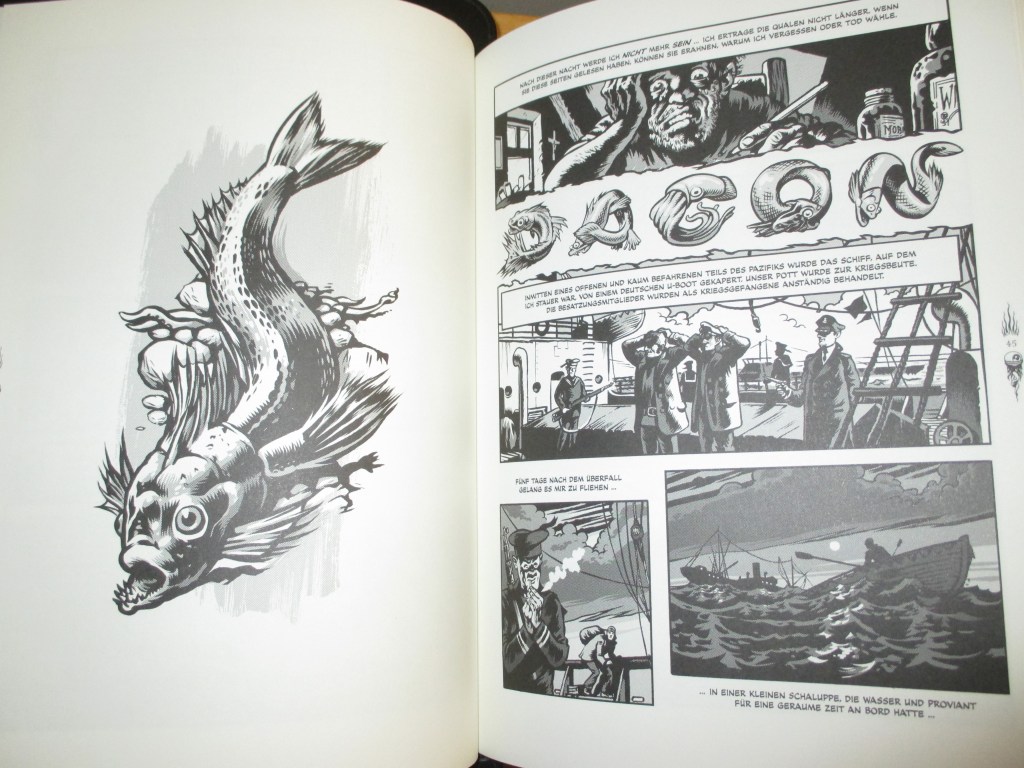
“Writhing Mind” (2022) by Zoe Burgess-Foreman

What he truly wanted to do was to find a way to express the feelings and images that had begun to creep into his head when he dreamt – a vast cosmos, something swirling and dancing in the void beyond, a body dancing to a distant beat and tendrils reaching out to take his hand.

Zoe Burgess-Foreman, “Writhing MInd” (2022)

Madness is a key theme of cosmic horror, an aspect of both attraction and repulsion. Weird fiction rarely accurately depicts mental health issues, but it has often sought to capture something of the mystique of the distorted sensorium, the disordered mind, the transition from “normal” and prosaic consciousness to one that has moved beyond rationality and into an increasingly different world view and mode of thinking. In traditional horror fiction, that state of altered consciousness is unreal—in weird fiction, that state is the true reality, a glimpse behind the veil, a realization of previously hidden truths.

Artists are a common lightning rod for such eldritch revelations, as exemplified by Lovecraft’s horror in clay:

Wilcox was a precocious youth of known genius but great eccentricity, and had from childhood excited attention through the strange stories and odd dreams he was in the habit of relating. He called himself “psychically hypersensitive”, but the staid folk of the ancient commercial city dismissed him as merely “queer”. Never mingling much with his kind, he had dropped gradually from social visibility, and was now known only to a small group of aesthetes from other towns. Even the Providence Art Club, anxious to preserve its conservatism, had found him quite hopeless.

H. P. Lovecraft, “The Call of Cthulhu”

Other writers picked up on the idea; “Something in Wood” (1948), “The Tulu Jar” (2000) by Ann K. Schwader, “The Summoned” (2015) by Clint Collins, a macabre gallery could be filled with Mythos-inflected objets d’art. Yet few stories focus on the headspace of the artist, the experience of creation, the relationship or insight or period of possession which shapes ordinary materials into an effort to capture in some form the extraordinary.

Which is ultimately what Zoe Burgess-Forman’s “Writhing Mind” is. As a story, it is almost a snapshot; there is little build-up and the denouement is cursory. These are the boring parts of the story anyway, the background and exposition. By the time the story starts, the events have already begun; the reader is only carried along for the ride, like a voyeur, watching the artist struggle to create, their descent and transcendence. The bloody climax rolls out like the first few minutes of a horror film, normal people too stuck in rational thinking to recognize the signs or heed the warnings, leaving behind only blood, bodies, and a particularly tenacious and circular idea.

They had slightly moist quality to them, not unpleasant but just enough to make them glide over his skn and make his body tingle with anticipation. They reminded him, now he collected his thoughts, of the tentacles of an octopus as rounded mouths sucked on his flesh like hungry kisses.

Zoe Burgess-Foreman, “Writhing MInd” (2022)

“Writhing Mind” is described as “a queer cosmic horror,” and that’s worth a moment of consideration. Lovecraftian fiction, as much as it deals with cosmic horrors from beyond human experience, is almost always heteronormative by default. Works like “(UN)Bury Your Gays: A Queering of Herbert West – Reanimator by H.P. Lovecraft” by Clinton W. Waters are the exception, not the rule. Queer Lovecraftian works like Le Pornomicon (2005) by Logan Kowalsky, Dagger of Blood (1997) by John Blackburn, and Strange Bedfellows (2023) by Caroline Manley (Raph) are comparatively rare compared to works like Booty Call of Cthulhu (2012) by Dalia Daudelin. By comparison, the sensuality and sexuality in Zoe Brugess-Foreman’s story is explicit, but not overly concerned with labels. The artist is cisgender male and a self-described himbo; but their sexual preference, if any, is oblique. Ultimately, it doesn’t matter.

The artist is queer for tentacled things from beyond. This is entirely appropriate: the same open mind that fuels their eldritch artwork goes pseudopod-in-hand with their sexuality. In the context of the story, there is no introspection that goes into this. The artist is already too far along in the process to question their sexual shift, or to comment on it rationally. No passing reference to Hokusai’s erotic print Tako no Ama, no anatomical studies of octopus or squid, or anything that could serve as a foreshadowing of a growing paraphilia that comes to consume them.

In hindsight, that feels like a mistake, because the artist is the only queer character in the story. Their queerness becomes inextricable from their madness, and lacking the boring build-up of a background, a deeper understanding of the character’s mindset and sexuality, the combination of sensuality, violence, and mental illness can be mistaken as causal rather than correlation. It feels like the story would have benefited from giving the artist a queer friend, someone that understood them and could relate to them but was unaffected. This was a device that Lovecraft used in stories like “The Thing on the Doorstep,” where a more straitlaced friend tells the story of a weirder associate.

Ultimately, “Writhing Mind” feels like a literary exercise with many familiar building blocks. It is not explicitly a part of the Cthulhu Mythos, there are no references to the Necronomicon, and the eldritch entity that fills the artist’s dreams and body is called by no familiar barbarous name. Yet it is clearly working in the same mode as works like Prnomicon and Strange Bedfellows, even if it mixes the ingredients a little differently…and not without a degree of skill.

“Writhing Mind” (2022) by Zoe Burgess-Foreman is available on Lulu as an ebook.


Bobby Derie is the author of Weird Talers: Essays on Robert E. Howard & Others (2019) and Sex and the Cthulhu Mythos (2014).

Deep Cuts in a Lovecraftian Vein uses Amazon Associate links. As an Amazon Associate I earn from qualifying purchases.
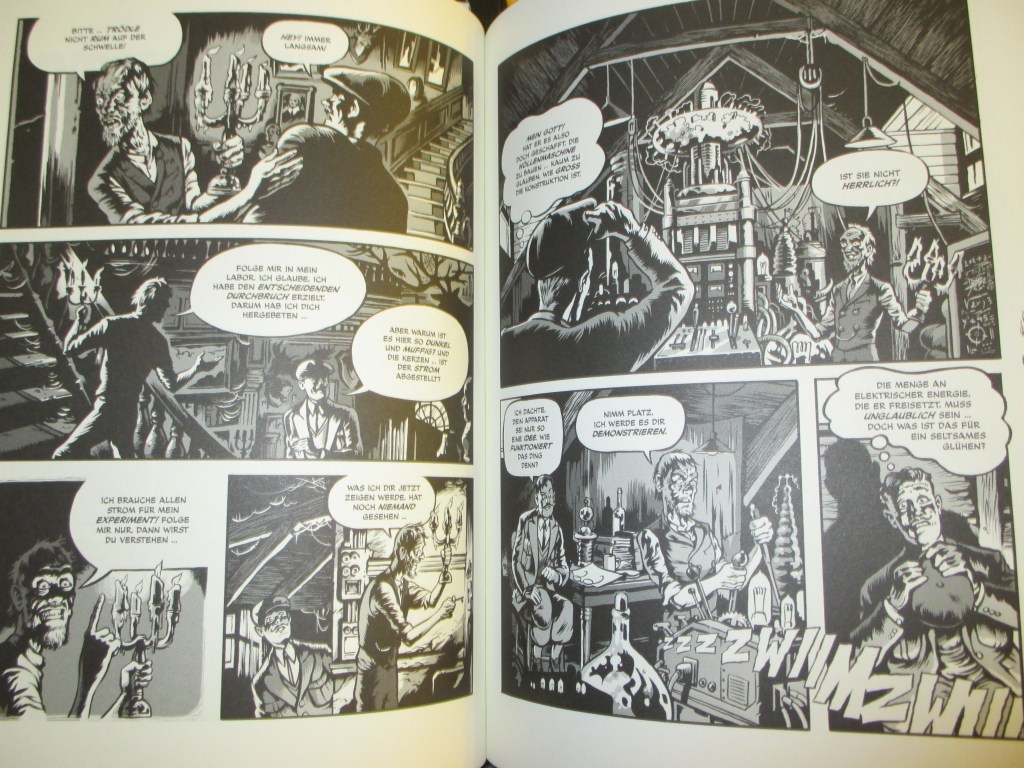
The Death-Mask and Other Ghosts by H. D. Everett

In odd moments I have read a number of weird & almost weird books—including the “Romance of the Forest” & “Italian” of your friend Mrs. Radcliffer. Others are Arthur Ransome’s “Elixir of Life”, Mrs. H. D. Everett’s “The Death Mask”, H. R. Wakefield’s “They Return at Evening”, Buchan’s “Runagates Club”, (in which 3 out of the 12 tales are weird) & the French & Asquith ghost anthologies.

H. P. Lovecraft to Donald Wandrei, 30 Sep 1928, Letters with Donald and Howard Wandrei and to Emil Petaja 220

Henrietta Dorothy Everett (1851-1923) was a popular British author of novels and short stories from the 1890s to 1910s, most of which were published under the alias “Theo. Douglas,” several of them with supernatural themes. By 1920 she was a widow, had survived the end of the Victorian and Edwardian eras and the Great War, and her final publication was a collection of rather traditional British ghost stories under her own name: The Death-Mask and Other Ghosts (1920).

For Lovecraft, Everett’s book was new: he had not read it during his initial body of research that resulted in Supernatural Horror in Literature (1927), and as such did not mention it in the first published version of that essay. Reading it now, in the midst of a splurge of weird fiction, Lovecraft was in a good place to judge her works compared to her contemporaries. When the time came to revise his essay, Lovecraft wrote:

Since the appearance of this article in 1927 I’ve jotted down other important weird items which ought to be cited in any second edition—some that I’d overlooked, & others that have appeared subsequently to the article.

H. P. Lovecraft to Robert Bloch, 1 Jun 1933, Letters to Robert Bloch & Others 33

Lovecraft included The Death-Mask and Other Ghosts in a list of “Books to mention in a new edition of weird article” (Collected Essays 5.234), noting that it was “post-war” (many of the stories being set during or slightly after World War I), and in his revised article (1935) added in “The Weird Tradition of the British Isles”:

Mrs. H. D. Everett, though adhering to very old and conventional models, occasionally reaches singular heights of spiritual terror in her collection of short stories.

H. P. Lovecraft, Supernatural Horror in Literature

Nor was Lovecraft the only one to take note of Everett’s book of ghost stories. M. R. James, whom Lovecraft acknowledged as the master of the traditional British ghost story, wrote in “Some Remarks on Ghost Stories” (1929) on recent collections:

Going back a few years I light on Mrs Everett’s The Death Mask, of a rather quieter tone on the whole, but with some excellently conceived stories.

Despite this contemporary (if posthumous praise), The Death-Mask had a long fallow period between reprintings, with few of the stories inside reappearing in anthologies. Everett F. Bleiler noted in his encyclopedic The Guide to Supernatural Fiction (1983) that the book consists of “Undistinguished stories of literal horror” (180), and Neil Wilson in The Shadow in the Attic: A Guide to British Supernatural Fiction 1820-1950 (2000) wrote: “Whilst most of the author’s works have not aged particularly well, they are of interest as typical examples of late Victorian pulp fiction.” and added that:

[H. D. Everett’s] work has been rediscovered by a new generation of readers and collectors interested in classic ghost fiction who have found her unusual blend of horror and the supernatural to be well worth their attention. (194)

Which is a very brief way to say that the public domain has probably saved The Death-Mask from being completely forgotten by almost everyone except the most devoted collectors of old ghost stories. Standard critical works such as Night Visitors: The Rise and Fall of the English Ghost Story (1977), Elegant Nightmares: The English Ghost Story from le Fanu to Blackwood (1978), The Ghost Story 1840-1920: A Cultural History (2010), and The Victorian Ghost Story and Theology: From Le Fanu to James (2016) all omit Everett and her collection completely…although Melissa Edmundson, a scholar who specializes in women writers of that period and genre, has not neglected Everett. I suspect part of the reason for the general lack of critical appreciation and scholarly interest is that the stories in The Death-Mask and Other Ghosts are both very middling when compared to stories by M. R. James, Algernon Blackwood, J. Sheridan Le Fanu, Oliver Onions, or Lady Cynthia Asquith.

This is not to diminish Everett’s ability: she does more than just repeat the same plot with the same ghosts fourteen times and call it a book. However, many of her literary hauntings were familiar in outline long before she put them to paper, like tropes from popular horror movies may get recycled today, and her execution of those familiar literary lines is almost excruciatingly geared toward a British middle-class Edwardian-era sensibility clinging on after the disruptions of the Great War. Unlike writers like M. P. Dare, Dion Fortune, Elliott O’Donnell, or William Hope Hodgson, Everett doesn’t have occult investigators or technical explanations for paranormal phenomenon—indeed, one of the strengths of the book is that many of the stories end with no explanation whatsoever, leaving the imaginative reader to decide for themselves the cause and the effect of the business.

The stories in The Death-Mask are typical Not At Night thrillers, there is no encompassing mythology, the reader follows no single investigator a la John Silence or Thomas Carnacki. The stories are fundamentally grounded in a middle-class existence with its focus on marriage, domestic relationships, and money; there are no castles or titled nobility, and only in one story do any non-white characters appear. It is a collection may seem almost too narrowly focused, old-fashioned ghost stories set in an interwar period, yet I feel they represent a good example of what Edmundson called the woman’s ghost story. To give a better idea of the contents, and an idea of what Lovecraft and James saw in Everett, let’s look at each story in turn.

The Death Mask

“Of course its a delicate matter to urge upon a widower. But you have paid the utmost ceremonial respect. Four years, you know. The greatest stickler for propriety would deem it ample.”

“It isn’t that. Dick, I—I’ve a great mind to tell you a rather queer story.” He puffedhard at his smoke, and stare into the red coals in the pauses. “But I don’t know what you’d think of it. Or think of me.”

H. D. Everett, The Death-Mask and Other Ghosts 4

In this way, the widower Enderby recounts the strange way he is haunted by the ghost of his dead wife—a haunting that takes the form of nearby cloth assuming the form of the death mask of her features whenever he gets close to other women. The idea has vague parallels with M. R. James’ “The Diary of Mr. Poynter” (1919), but is distinct. The action is entirely domestic, and the haunting never rises to the level of a violent threat. The unnerving sight of the dead wife’s countenance being reproduced in whatever fabric was at hand was sufficient to force the end of Enderby’s engagement to another woman, and to forestall his further romantic efforts. Nor is it ever resolved; the story ends as Enderby finishes his story, without hearing any reply from his friend Dick.

The story thus has an unfinished feel; the characters in limbo. No explanation is given, beyond the intuitively obvious that the dead Mrs. Enderby is forcing her husband to have no other wife, and no means of resolving the issue is suggested. In that ambiguous tension lies most of the charm of the story, because it could have easily gone for a dramatic supernatural confrontation and an easy romantic ending, but instead opts for the more disquieting possibility that the haunting will never resolve, leaving Enderby lonely and harrassed from beyond the grave. So too, the method of the haunting is, if not entirely novel, at least an unusual variation on the classic of the old burial shroud.

Parson Clench

“The Lord have mercy upon us!” Aldridge was staring with his jaw dropped. “It was Parson Clench himself, and you not knowing! And him buried a fortnight come Wednesday! Lord save us: what is to be done?”

H. D. Everett, The Death-Mask and Other Ghosts 25-26

The Church of England includes benefices, positions which can be assigned to specific priests to serve specific churches or districts, and carry with them certain properties and revenues, some of which are quite generous relative to the duties required—and which made them attractive slots for second sons and other family members who would not stand to inherit the majority of a wealthy or titled family’s monies and lands. For this cause, certain families who has subsidized such positions had the right to recommend who would fill them, effectively reserving certain choice positions for sons, nephews, etc.

This is necessary preliminary because the crux of the story is that in the small parish of Stokes-St. Edith, the Reverend August Clench has died, and Mrs. Emmeline Albury wants to move her nephew Rev. Basil Deane into the now vacated benefice. The only problem being, the shade of the deceased has no desire to go anywhere. Deane is thus stuck between a rock (the ghost) and a hard place (his well-meaning but insistent aunt). Again, there is nothing of violence in this haunting: the presence alone of the unquiet spirit—which only Deane can see—is enough to put him off of accepting the benefice, even though his aunt had been particularly generous about it.

As with “The Death Mask,” there is no reason nor resolution given to the haunting itself. The idea of a spirit of a priest lingering is not particularly unusual in terms of the British ghost story, as the Church was the primary interaction between the people and the supernatural, and the cleric could be an imposing figure. Readers might recall M. R. James’ “The Residence of Whitminster” (1919) and Lovecraft’s “The Evil Clergyman” (written 1933). While readers today might ask why Deane didn’t perform an exorcism, it should be recalled that this was not a common procedure in the early 20th century, and more strongly associated with Roman Catholicism during the period. The practice would receive more widespread popularity following the success of The Exorcist (1973), but was fairly untypical of British ghost stories.

The Wind of Dunowe

“It is the solitary point on which we touch. A sympathetic interest in ghosts is better than no fellow-interest at all. I’ve given myself out as psychical–save the mark!”–and here the lady laughed. “I might personate the ghost, and get at the boxes that way. But the clue of how to make up is still to seek. We do not know what sort of figure is seen.”

H. D. Everett, The Death-Mask and Other Ghosts 41

Reginald and Flossie Noyes are a husband-and-wife team of thieves and grifters, who wrangled an invitation to Dunowe in order to either fleece the MacIvors or steal their jewelry, an antique necklace of pink pearls. To this end, they concoct a scheme relying on the legend of a ghost in the old house, which manifests as a gale of wind blowing through the halls while the weather is still. Flossie plans the caper, inspiring the lady of the house to wear the pearls for a ball, and then having Reginald distract her by telling a made-up story of the ghost while Flossie steals them. Except things do not go entirely to plan, as Flossie later explains:

“The wind came: it was more than wind—it was anger, fury. It seems, when I look back, there was a face with it; or I dreamed the face after. A face that was terrible. I was so near safety when it came: a few more steps: and I was full of triumph. The wind struck me down. I knew no more till I found myself in here, and the women with me. Do you think the pearls—were taken—when I fell?”

H. D. Everett, The Death-Mask and Other Ghosts 65

The pearls reappear inside the locked safe where they were withdrawn from the evening, though placed there by no mortal hand. The story has the familiar outlines of family legends like the Luck of Edenhall or the Fairy Flag of Clan MacLeod; the heist only serves to test the old legend, which being a ghost story turns out to be true. Like the other stories, no particular explanation is given for the wind of Dunowe, or the connection to the pink pearls; Lovecraft or James would probably have at least hinted at whatever cryptic legend lay behind both, but Everett’s story is relatively brief—and once again, a supernatural force overcomes mere materialistic greed or desire.

Nevill Nugent’s Legacy

It seemed to have come to use straight from heaven, Cousin Nevill’s bequest. For you must know we were at the time very hard up’ almost, as the saying is, “stony-broke.” Kenneth giving up his profession to join the army made a great change in our circumstances. We could not keep on our pretty house, of which I used to be so proud; and, as soon as I was alone, I moved into a tiny flat in town, and got work to do. But when Ken came out of hospital last January so ill and broken, my work had to stop, for I was so needed to nurse him. Ever since then the money has been flowing out, with only a little—so little—trickling in: I cried over it only the night before, of course when Ken did not see. For it seemed as if even the wretched flat was mor ethan we could afford, and I did not know where Tom’s school-fees were to come for another term—all important as his education is, the chance of life for such a clever boy.

H. D. Everett, The Death-Mask and Other Ghosts 68

Ken and Maggie, in dire economic straits, inherit the house of Muir Grange and its surrounding properties from a cousin. The Grange (or Chapel House) is currently untenated, and the small family move in until they can get a tenant, meeting Mrs. Wilding and her invalid husband Bassett, to whom she is estranged. Shortly thereafter, they discover the house is haunted—or at least the chapel attached to it—and this has made it impossible to rent out. As luck would have it, someone wishes to buy the chapel and remove it for war purposes, and in the deconstruction they found human remains beneath the floor; Bassett had killed his stepson and hidden the body there, which began the haunting, and the proper disposal of the remains lifts it.

The inheritance is a classic ghost story plot device, one made rather infamous in Cthulhu Mythos circles for the many times it has been used, a trend rather more attributable to August Derleth and stories like “The Murky Glass” (1957) than Lovecraft himself, but it was also a device which M. R. James used, notably in “Mr Humphreys and His Inheritance” (1911), and many others have followed on that use of the unexpected death of an uncle, cousin, or other relation leaving a suprising supernatural windfall in the inheritor’s lap. The build-up and resolution of the mystery in this particular haunting could have been handled with more skill; the removal of the chapel for the war-effort is a bit deus ex machina, and the identity of the ghost was fairly telegraphed. What is interesting is the treatment of the characters. When Mrs. Wilding says:

Ma’am, they say that marriage is an honourable estate, and a married woman is respectable. I thought it would be good for me to be married; but I say now that the worst day’s work that ever I did, and the wickedest, was when I married Bassett. To give him power over myself, body and soul, was bad enough, he being what he was; but the sin was to give him power over my child.

H. D. Everett, The Death-Mask and Other Ghosts 83

That is rare territory for a ghost story, and the setting shows that Everett was familiar with some of the trials and tribulations that families faced during the war and afterwards, trying to put their lives back together. It might not be much of a ghost story, but it does show that insight into the human condition which is convincing.

The Crimson Blind

Spooks were under discussion, and it was discovered–a source of fiendish glee to the allied brothers—that Ronald believed in ghosts, as he preferred more respectfully to term them, and also in such marvels as death-warnings, wraiths, and second-sight.

“That comes of being a Highlander,” said Jack the elder. “Superstition is a taint that gets in the blood, and so is born with you. But I’ll wager anything you have no valid reason for believing. The best evidence is only second-hand; most of it third or fourth hand, if as near. You have never seen a ghost yourself?”

“No,” acknowledged Ronald somewaht sourly, for he had been more than sufficiently badgered. “But I’ve spoken with those that have.”

H. D. Everett, The Death-Mask and Other Ghosts 93

Sixteen-year-old Ronald McEwan is down to visit his cousins for a summer holiday, and being teenaged boys they dare themselves to go visit the local haunted house. They wait for the specter, with Ronald more than half-convinced his cousins are playing a trick on him, when a strange sight does appear: a light through a crimson blind at a certain window, then a figure appears who opens that window and appears to crash through—which none of them can explain.

The second part of the story was twenty years later, when now an adult Ronald returns to the village to find his friend Parkinson and the friend’s new bride Cecilia occupying the haunted house, with Ronald unwittingly given the haunted room he had last seen from the outside. During his stay, his nights are haunted by incidents of paralysis and visions of flames, the crimson blind, and the haggard man breaking through the window…only to awake none the worse for wear. The supposed source of the haunting is finally described in a letter at the end of the story, as a kind of denouement:

The house was built by a doctor who took in lunatic patients—harmless ones they were supposed to be, and he was properly certified and all that: there was no humbug about it that I know. One man who was thought quite a mild case suddenly became violent. He locked himself into his room and set it on fire, and then smashed a window—I beliee it was that window—and jumped out. It was only from the first floor, but he was so badly injured that he died: a good riddance of bad rubbish, I should say.

H. D. Everett, The Death-Mask and Other Ghosts 114

What cannot be easily expressed in a mere synopsis of the story is the extreme prosaicness of it. Parkinson and his wife are concerned principally about property values, the difficulty of finding renters, the post-war housing market in Britain, and keeping up appearances; McEwan, for all that he is the prime voyeur for these nightly hauntings, is thinking of the bridesmaid Lillian whom he wishes to court (and they are engaged at the end). There is not a whit of empathy for whatever tortured soul may be trapped replaying their death, or the psychic echo of such a terrible death, nor does anybody try to resolve the supernatural issue—which is, as might be noticed, something of a continuing theme.

Fingers of a Hand

Some blank sheets of paper were lying about, besides the one pinned to her board with the half-finished sketch; and on one of these I noticed some large scrawled writing. Not Sara’s writing, which is particularly small and neat ; not the writing of any one I knew. The words were quite legible, but they were very odd. GO—by itself at the top of the sheet; and the same word repeated twice below, followed by GET OUT AT ONCE.

H. D. Everett, The Death-Mask and Other Ghosts 118

While their brother and his wife are in India, the unmarried aunts are taking care of the children, and decide on a brief and economical seaside holiday at Cove, renting a cottage for the purpose. Rain puts a damper on the vacation, and quickly thereafter mysterious messages appear, urging the family to vacate. On the surface, this looks like such a stereotypical haunting as to be almost quaint—but there is a little charm in it, as the messages progress to underlining specific bible passages to reinforce the general idea.

The volume was lying open at the nineteenth chapter of Genesis, and these words in the twenty-second verse were scored under blackly in pencil—Haste the: escape.

H. D. Everett, The Death-Mask and Other Ghosts 120

At last, they catch sight of fingers materializing to scrawl out a message, and getting the point at last, one of them leaves with the kids. Shortly thereafter a landslip undermines the foundations of the house, and the children were evacuated just in time. Others were not so lucky.

There’s not much to this story, where the phenomonon is the crux of the thing and the disbelief falls flat and there is no real build-up of tension beyond the increasingly stringent but short messages. The idea of the manifesting hand recalls the writing on the wall, a bit of divine providence rather than any kind of “typical” haunting. However, there is one passage near the beginning which might have caught Lovecraft’s eye:

That is one great use of unmarried aunts—to shoulder other people’s responsibilities; and I, for one, think people’s responsibilities; and I, for one, think the world would be a poorer place if the “million of unwanted women” were, by some convulsion of nature, to be swept away.

H. D. Everett, The Death-Mask and Other Ghosts 115

By this time, Lovecraft was back in Providence, caring for his aunt Lillian and keeping in regular communication with his aunt Annie; he could certainly appreciate these “spinsters” (although technically widowed), and the sentiment that they were far from being “unwanted.”

The Next Heir

If the present Mr. Quinton, your second cousin, makes no will, the Quinton property goes to the heir-male of your mutual great-grandfather.

H. D. Everett, The Death-Mask and Other Ghosts 130

Canadian soldier Richard Quinton answers an advertisement for an heir, and connects with the British side of the family left behind. However, the cousin Clement Quinton is an invalid antiquarian, worshipper of the pagan god Pan, experiences stigmata (bleeding of the palms) due to a mother’s curse at the death of his elder twin brother, an occultist with a scrying-stone, and wants somebody to carry on his work…hence his advertisement. Richard goes to his cousin’s house, where he is installed in a haunted room. Clement tries to get Richard to agree to certain conditions to become heir to the estate, but after some disquieting experiences and visions, Richard refuses and leaves. Clement dies without a will, so Richard gets the estate anyway, without conditions—making a point to burn the haunted house, and then bringing his fiance to the UK to live in the old family manse on the property.

The synopsis hardly does it justice, but “The Next Heir” is novella-length, and yet feels almost abridged. This is the most ambitious of the stories in The Death-Mask in terms of how many weird elements Everett had thrown into the mix: a pagan cult, hauntings, bloody hands, a curse, a seeing stone, etc. If the story had developed more slowly and the tension and atmosphere built up carefully to some strange and terrible ultimate revelation, it might have been properly Jamesian or Lovecraftian in tone. As it is, Richard’s fleeing from his cousin’s designs is more anticlimactic than not, and the feel-good ending is rather conventional instead of powerful. There are hints of a terrific imagination and a deeper, more terrible fantasy here but the story as developed is neither subtle nor explicit enough to really be the classic it could have been.

While there is a fair degree of hokeyness to how everything opens with the legalities of inheritance and ends with a happily-ever-after wedding, it’s not hard to look at this story and see clear parallels with “Mr Humphreys and His Inheritance” (1911). One might even compare it with H. P. Lovecraft’s “The Rats in the Walls” (1924), with the prodigal heir returning to Britain and finding some darker aspects to the family history tied up with the house, the physical location metaphysically tied with the bloodline. Lovecraft and James would both have seen familiar themes in this story, even if it was developed differently than they would handle similar subjects.

Anne’s Little Ghost

“People must have been here with children,” she said presently in an interval of filling my cup. “The attic over our bedroom has evidently been used as a nursery, for there are coloured pictures pasted on the wall, and a child’s bed is pushed into one corner. Mrs. Stokes said she would take it out if it was in our way.

There was just the slightest sigh with this communication, and the least possible droop at the corners of Anne’s sensitive mouth, but enough to give me a clue to what was in her mind. […] We have been married rather more than eight years, and in our second yer together we possessed, for a brief space of only weeks, a baby daughter.

H. D. Everett, The Death-Mask and Other Ghosts 191

After his discharge, British soldier Godfrey and his wife Anne go on a cheap holiday (all they can afford) to Deepdene. The childlessness of their marriage weighs on them both, and Anne begins to hear a child sobbing in the night. It isn’t long before Anne can see and touch the child, a little girl about six years old, as well. As the vacation goes on, Anne spends more and more time caring for the child only she can see and touch, and she seems to be wasting away…and there is nothing Godfrey can do about it…except he did see the child, just once. Inquiries turn up nothing; according to everyone, the house is not, and has never been haunted. At last, their vacation comes to an end, and that is where the story ends.

There are two parts of this story that are interesting. The first is that this is not presented as a typical haunting; it is in fact presented as most untypical, and until Godfrey confirms that he too has seen the child, it might be wondered if this isn’t something more psychological with Anne, echoing “The Yellow Wallpaper” (1892) by Charlotte Perkins Gilman, some expression of misplaced maternal energies manifesting. I almost wish the revelation that he had seen the child too had been left for the end, just to carry the illusion on a little further. The second interesting part is a statement that occurs during Godfrey’s research, where a friend who believes in ghosts states:

I always know how to distinguish a true ghost-story from a faked one. The true ghost-story never has any point, and the faked one dare not leave it out.

H. D. Everett, The Death-Mask and Other Ghosts 206

This is interesting because it may be as close as Everett comes to explaining her own lack of a point in her ghost stories. By refusing to tie things up neatly, she is adding a degree of verisimilitude to her stories by making them as inexplicable as real-life accounts. Or at least, that is a possibility worth considering, given that we have none of her other thoughts on ghost stories.

Over the Wires

Only one item in Hay’s room demands description. There was a telephone installtion in one corner; and twice while Carrington’s dinner was being served, there came upon it a sharp summons […]

H. D. Everett, The Death-Mask and Other Ghosts 209

Ernest Carrington was on leave in England, staying with his friend Hay and searching for his fiance Isabeau Regnier among the refugees from Belgium. The search goes poorly, until a call comes on the telephone—and it is Isabeau, though she doesn’t remember her right name and cannot help him find her. They communicate only through the frantic calls—and at last, he does find her. Only to find that she was in a coma during the first two calls, and had died before the last call was made.

Telephones were invented in 1876, but the expansion of such service expanded slowly into the early 20th century as the technology was refined and standardized. There was still something a bit preternatural about the device, or at least there were still fantastic possibilities attached to it, as Lord Dunsany did in “The Three Infernal Jokes” (1916), and the usage here, getting a literal phonecall from the dead, is right in line with that kind of usage. A somewhat less-supernatural parallel might also be drawn with the ending of Lovecraft’s “The Statement of Randolph Carter” (1919).

It is somewhat surprising that more hasn’t been used of this story, since it seems ripe for adaptation to a small-scale play or comic book; the ending is right in line with EC Comics like Tales from the Crypt or shows like The Twilight Zone, since the final twist leaves the viewer with more questions than it answers, and the conversations themselves have plenty of drama.

A Water Witch

Everett F. Bleiler described this story as “A somewhat confused story of a white woman who drowns cattle.” and it’s difficult to argue with that summary. The narrator is Mary Larcomb, who is disappointed her brother married a woman named Frederica instead of something more prosaic (all the women in the family apparently being named either Susan, Anne, Mary, or Elizabeth exclusively). Frederica is a “weak sister”-in-law, and after the death of a child a few days after it is born, Robert takes her out to a country house to recuperate; when Robert needs to go into town, Mary comes in to help take care of Frederica.

What follows is…odd. The local animals in the district shy away from a certain crossroads where a suicide is buried; the ghost of the same, described as a white woman, is blamed on leading cows, sheep, and other animal to the nearby river to be drowned. Frederica is recovering slowly, but she is affected by hearing strange drops of water. The story of the white woman, as related by Dr. Vickers, a neighbor with an interest in folklore, slightly parallels that of Frederica:

She was unhappy, because her husband neglected her. He had—other things to attend to, and the charm she once possessed for him was lost and gone. he left her too much alone. She lost her health, they say, through fretting, and so fell into a melancholy way, spending her time in weeping, and in wandering up and down on the banks of Roscawen Water. She may have fallen in by accident, it was not exactly known; but her death was thought to be suicide, and she was buried at the cross-roads.

H. D. Everett, The Death-Mask and Other Ghosts 238

The possible haunting of the white woman—she is never called a witch in the story itself—is counterpoised against what is strongly suspected to be Dr. Vicker’s unseemly interest in Frederica, though this is handled with all the tact of a Victorian confessional (“Any open scandal must be avoided; she must neither be shamed nor pained.”) An accident finally brings Robert back to care for sister and wife, and to take them away from Vickers and the white woman. Death came to Frederica a few months later, then war was declared and Robert volunteered, and his sisters hoped next time Robert chose a wife he’d be more practical about it.

It is another one of those stories where the prosaicness, the sheer Britishness of striving to keep up appearances totally overwhelms what might otherwise have been a really weird and unusual haunting. We get so little information about the white woman, who sounds similar to but distinct from the bean-nighe that it could have been a really effective piece of pseudo-folklore if expanded upon and made the central focus of the story.

The Lonely Road

“Why, Boris,” he exclaimed unthinking, and the creature came beside him with wagging tail : surely in the event of attack, here would be a formidable ally.

The dog was friendly, and appeared to answer to the name called. Margaret had had such a dog in her husband’s lifetime, a Russian wolf-hound of which she had been fond; Pulteney had often seen them together, the tall elegant woman followed by the noble hound. Surely this must be Boris; and yet he had a dim recollection of some mischance mentioned in a letter of Adelaide’s, an accident in which the dog had been injured, and he thought killed.

H. D. Everett, The Death-Mask and Other Ghosts 257

In Ireland, Tom Pulteney is visiting his widowed cousin Margaret, with an eye toward asking her to marry him. Forced to walk eight miles at night, he is tracked by thieves—but her loyal hound Boris aids him, only to disappear. Naturally enough, the dog had been dead, and it was his ghost that helped Tom scare off his assailants.

This is the slightest of the stories in The Death-Mask, in terms of length; and not badly told, for all that the plot is straightforward and the ending rather obvious, right down to Tom’s coded proposal of marriage in the final letter. There is nothing particularly groundbreaking or innovative about it, but it is the kind of story that could be slipped into almost any book of Irish ghost tales without a second thought. The only oddity is the insistence that the breed is a borzoi, or Russian wolfhound, rather than an Irish wolfhound; but the modern Irish wolfhound breed was bred in the late 19th century with some borzoi in the mix, so the appearance of a borzoi is not too unusual given the time and location.

A Girl In White

I write this, but add a query: perhaps one wiser than I will answer, and unravel the mystery which I merely present. I do not pretend to explain.

H. D. Everett, The Death-Mask and Other Ghosts 261

A man rents a country cottage for his mother and sister in 1914. Going down to visit them for a weekend, he feels ill-at-ease in the house, and his nights are interrupted with visions of a girl in white (not the same as the white woman in “A Water Witch”). Without telling anyone of the strange appearance of the girl in white, he suffers through and returns to London; the girl in white does not follow him, nor do his mother or sister see her. Two weeks later he returns, and events occur again.

War broke out, the narrator did his military duty, inquiring about the cottage and finding no record of haunting or past tragedy. Wounded three times, he was out of action when his mother and sister brought him back to the same district, to an adjoining cottage to the one they originally rented, to recuperate. There his sister attempted to set him up with his neighbor Emily Tressidy, but he was instead interested in her sister Grace Tressidy—the spitting image, if a few years older, of the girl in white. During the period of his previous stay at the cottage, Grace had developed a habit of sleepwalking, and dreamed strange dreams. One early morning, he was out rowing, recalling a dream when he did so and the girl in white appeared. Suddenly, she did again, and he was not sure if he was seeing dream or ghost or real vision when a sleep-walking Grace fell into the water, and he leaped in to rescue her.

There was the implication at the end that they would be married. Which is rather a theme in these stories. As for the query:

Does this afford an explanation of the story I have told? It may, or it may not; but it is the only one I have to offer.

H. D. Everett, The Death-Mask and Other Ghosts 277

On a rational level, readers are free to draw their own conclusions as to why the girl in white appeared there at that time in that place, and whether she was mental projection, dream-self, or something more obscure. Like a dream, rational logic is something applied in hindsight, there’s an emotional core to the story intended to tug at the heart strings.

A Perplexing Case

There a certain amount of vital fluid was in process of interchange, and two spirits wrongly housed in their tenements of flesh were brought into touch by a force only partially recognised, though of existence coeval with human life.

H. D. Everett, The Death-Mask and Other Ghosts 295

Two soldiers in France have been wounded: the man who is identified as Henri de Hochepied Latour of France wakes to think of himself as Richard Adams of London; a circumstance that causes the gravest confusion to himself, his friends, and family. After several pages of increasing insistence that he is not who he is identified as, and not recognizing himself in a mirror, Latour is taken in for a blood transfusion with another shell shock case—Richard Adams—and when the two wake up, they are in their correct bodies once again.

This is practically a Fortean anecdote stretched out to short story length rather than a ghost story proper, but weird fiction has seen stranger exchanges of souls, and Lovecraft would revisit some similar ideas in stories like “The Thing on the Doorstep” and “The Shadow out of Time.”

Beyond the Pale

Joan began her married life with high ideals. She determined so to identify herself with her husband’s pursuits, that she might everywhere be his unfailing companion; and to this young wife the nursery interests, which frequently alter such a programme, had not been vouchsafed by Providence. So when Henniker laid his plans for a season’s shooting in the wilds of Western America, Joan, as amatter of course, expected to go too.

H. D. Everett, The Death-Mask and Other Ghosts 298-299

In a nondescript part of the American West, the Hennikers had settled in for a hunting trip. As a maid, Joan was provided with “Nita, the half-bred Indian girl”—who spoke Spanish, her own Native American language, and a little English. The collision of different cultures and language barriers proved insurmountable when, returning to the ranch after a visit, Joan found Nita had broken into all of her boxes, stolen a few things, and run off. The local sheriff accosted Nita’s grandmother Rachel, who was reputed to be a witch, for knowledge of Nita’s whereabouts, which did not help matters. In retaliation, the Hennikers are bewitched. After tolerating various afflictions for some time, they resolve to hire a rival witch doctor, Hill-of-the-Raven, to deal with the witchcraft at their door.

The anti-witchcraft ritual now takes center stage, described in great detail, and ending with the sudden appearance of a woman’s severed hand. Hill-of-the-Raven gives the Hennikers instructions on what to do with this, and the English couple follow those instructions. Presently, Nita returns—with a bloody stump—to return the stolen articles in exchange for her hand back.

He then united the severed parts, and Joan used afterwards to aver that she heard the bones grate together as they met.

H. D. Everett, The Death-Mask and Other Ghosts 320

In terms of cultural depictions, the story is very rough, even by the standards of 1920. The Native American characters are largely stereotyped, the attitudes are casually classist and racist, and approximately zero research was done on actual Native American traditions. Or, to put that in context, about the level of many popular depictions of Native Americans from the dime novels of the 1890s through to the pulp westerns, comic books, and motion pictures of the 1930s and beyond.

What is different about “Beyond the Pale” is how different it is from the rest of Everett’s stories in The Death-Mask. While “The Next Heir” had magic of a kind in the visions of the scrying-stone, there were no spells or incantations, no witchcraft or sorcery. In this story and only this story, magic is a fact of life, and the English couple, completely at a loss for how else to solve their problems, resort to local methods (“when in Rome, do as the Romans do”)—and that, more than anything, may be why this story is titled “Beyond the Pale.” It goes beyond the normal remit of a traditional British ghost story, just as they have gone far beyond the limits of the British Isles.

While not in any way lacking in imagination, “Beyond the Pale” is still not a particularly great story. Like most of the others in this book, it is relatively straightforward and linear in its telling, there are few characters and fewer kinks in the plot. It does not explain everything, but it also features a resolution lacking from the earlier stories. The supernatural manifestation can’t be ignored or left alone, doesn’t resolve itself, so it is actually confronted. It is the kind of story that, had it been submitted a few years later, might actually have been accepted for an early issue of Weird Tales.

Looking at the contents of The Death-Mask and Other Ghosts as a whole, it is possibly easier to see why Lovecraft and James had at least a small amount of praise for it. Everrett knew her business, she was working within an established tradition, and she could stretch that tradition to about the limit of what it could stand. She was not looking to the past, but working within a contemporary milieu, and writing to contemporary concerns with some degree of verisimilitude. She could write some evocative passages, and many of her subtler horrors are not the usual ones. By the standards of the 1920s, that was playing to the expectations of a specific audience that knew what they wanted from a British ghost story, and doing a very competent job of it.

Yet, they are very much tales of their time. There is no cohesion to the collection, no shared setting beyond Britain itself (and that often focused, somewhat oddly, on Scotland), no series character, and no uniformity of metaphysics. Each of the stories is independent of the other, nothing builds to any greater revelation, and so much of the stories’ wordcount is taken up by really mundane concerns like how much money the furniture is worth or what the income of the rental properties are, or whether the one male character will marry this sister or that sister…and these are the very human melodramas which subtract from what could be much more evocative stories. It’s almost like what Everett really wanted to write were Edwardian paranormal romances…and you can’t blame her for that, because that is still working within the tradition of the British ghost story. M. R. James in “The Tractate Middoth” (1911), to give just one example, has the hint of just such a relationship at the end.

That the stories focus relatively heavily on women and social issues that involve women is no accident. Ghost stories were a safe way to address such issues:

Melissa Edmundson: It’s fascinating to me how well the supernatural lends itself to the exploration of social issues and how it can tell us about the eras in which it was written. Many scholars still don’t take Gothic too seriously as a source for serious critical study – that’s changed in recent years, but the dismissive attitude is still there. So finding strong social elements in these stories, what I call the ‘social supernatural’ in Women’s Ghost Literature in Nineteenth-Century Britain (2013), makes these stories something more than just light entertainment. Yes, they were written to entertain but they also had an important purpose. When you think about it, there’s unsettlement on two levels: there’s the unsettled nature of the ghost who can’t be at peace and then there’s the social imbalance that the ghost in the story often reflects.

Peter Meinhertzhagen, “Melissa Edmundson, interview about Avenging Angels,” 24 Feb 2019

It is a humanistic element deliberately lacking from Lovecraft’s work, as Lovecraft disliked the distraction of romance in the setting and execution of his weird phenomena, and rarely addressed social issues, much less those that affected women. Yet he could no doubt appreciate some of what Everett did in these stories, and perhaps if for no other reason that might encourage more readers today to read and rediscover them—keeping an open mind about both what the stories are, and are not. If you go in expecting a female M. R. James or H. P. Lovecraft, you will be sorely disappointed. If you go in hoping to find the last interwar ghost stories of H. D. Everett—you will find them.


Bobby Derie is the author of Weird Talers: Essays on Robert E. Howard & Others (2019) and Sex and the Cthulhu Mythos (2014).

Deep Cuts in a Lovecraftian Vein uses Amazon Associate links. As an Amazon Associate I earn from qualifying purchases.