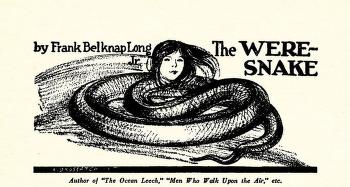
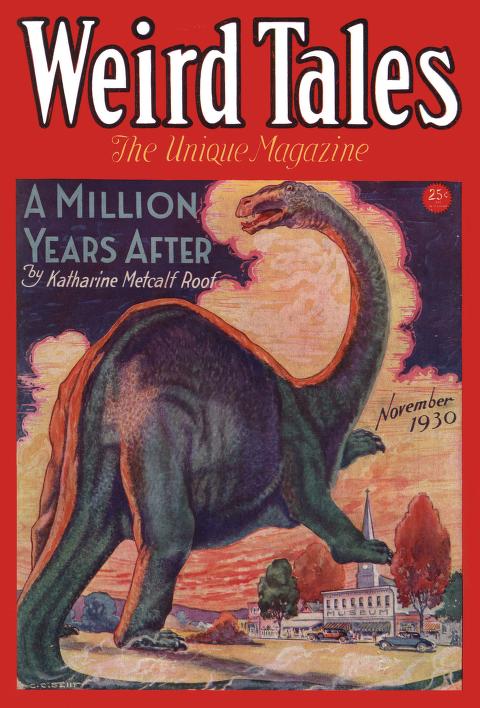
“A Million Years After” (1930) by Katharine Metcalf Roof

It is, unquestionably, the product of the lost dinosaur’s egg that has somehow, somewhere, mysteriously hatched itself. We believed them to be petrified in the rock, yet in some miraculous way the germ of life was not destroyed.
—Katherine Metcalf Roof, “A Million Years After” in Weird Tales November 1930

It was her only story in Weird Tales, though she wrote for other magazines; and had books to her credit, fiction and nonfiction. H. P. Lovecraft might have run across her work before, in Ghost Stories or the Argosy All-Story, though if he did he never mentioned it. Yet what brought her to Lovecraft’s attention, and the reason why he wrote about Katharine Metcalf Roof at all in his letters, is because of this tale—which earned the cover illustration in this issue—and that ties in to events that had occurred long years before, and some of the most important discoveries in the history of early paleontology.

It begins with one of H. P. Lovecraft’s first trips to New York in 1922, where he visited with his friend Frank Belknap Long, Jr:

Monday Long & I explored the American Museum of Natural History—examining it in far greater detail than did Kleiner & I a couple of weeks ago. Long appreciates science & nature more than Kleiner does—he is a marvellous kid, far above the average “amateur journalist” type.
—H. P. Lovecraft to Lillian D. Clark, 13 Sep 1922, Letters to Family & Family Friends 1.63-64

While innocuous, it was apparently during this trip that Long or Lovecraft conceived of a story…one that would germinate for some years without being written. Lovecraft would chide his friend:

Grandpa thought he’d write and tell you that he hath just perused Wells’ Thirty Strange Stories! Magnificent plots, but how prosaically handled when one compares them to Machen’s work! I do not think Aepyornis Island anticipates your dinosaur egg story, and advise you to write the latter. Think of the difference—the dinosaur belongs to aeons immemorially remote and unconnected with anything in human experience, whilst the museum-cellar hatching can be handled with a creepiness wholly alien to anything in wells. Your idea is far the stronger, and Grandpa will spank you if you don’t write your story like a nice boy!
—H. P. Lovecraft to Frank Belknap Long, 26 Jan 1924, Selected Letters 1.287

The Æpyornis maximus was a large flightless bird native to Madagascar; in “Æpyornis Island” (1895) by H. G. Wells, a fossil hunter collecting some of the eggs of the supposedly extinct animal is surprised when it hatches. Such “living fossil” stories sometimes caught the imagination, such as Sir Arthur Conan Doyle’s The Lost World (1912), and dinosaurs in a variety of settings were far from strangers in the pages of Weird Tales.

Yet dinosaur eggs were cutting edge news at the time. In the 1920s, Roy Chapman Andrews carried out the Central Asiatic Expeditions of the American Museum of Natural History, including fossil-hunting in the until-then largely inaccessible Gobi desert of Mongolia. In 1923 he discovered the first dinosaur eggs and nests, which in time were shipped back to the museum in New York…there to whet the imaginations of H. P. Lovecraft and Frank Belknap Long.

Sunday we answered advertisements and hoped for the best, but Monday we decided to have some fun whilst life might last, so went to the American Museum of Natural History. Here we lingered over the illuminated bird displays […] and noted in passing the famous dinosaur eggs discovered by the museum’s Mongolian expedition. The latter were not impressive—being the eggs of a very small dinosaur, the ancestor of the later massive species.
—H. P. Lovecraft to Lillian D. Clark, 20 Aug 1924, Letters to Family & Family Friends 1.147

Lovecraft encouraged his friend to write the story, but Long did not, whether from lack of interest or fear of plagiarizing Wells’ plot is unknown. The idea sat, unused. In 1928, another visit is recorded:

I rose at noon & went up to Sonny’s to meet our client Mrs. Reed, who was in town Sun. & Mon. She seems quite prepossessing & intelligent. After her departure Sonny & I went to the Nat. Hist. Museum, where we both bought 25¢ dinosaur paperweights.
—H. P. Lovecraft to Lillian D. Clark, 29 May 1928, Letters to Family & Family Friends 676

Perhaps this visit encouraged Lovecraft to think of writing the story himself. In 1928 he recorded in his Commonplace Book, where he jotted down many story ideas: “What hatches from primordial egg.” (36)

Yet Lovecraft & Long did not write the story. Ultimately, Katharine Metcalf Roof did.

This vexed Lovecraft to no end.

The dinosaur’s egg story was simply a minus quantity—but it made me curse, because I thought of that same plot just eight years ago (before any real dinosaurs’ eggs were discovered) & urged kid Belknap to develop it in connexion with his beloved American Museum, within walking distance of which he’s lived all his young life. I went so far as to make inquiries of a sub-curator as to whether dinosaurs probably laid real eggs, or whether they were semi-viviparous like some other reptilia. On being told that they were probably truly oviparous, I renewed my urging that Belknap write the tale, but just about that time he read Wells’ “Æpyornis Island”, & thought that any prehistoric-egg story would just constitute a plagiarism. I told him that such an idea was nonsense—& just then the news came of the finding of the first actual dinosaur eggs by an expedition from Belknap’s own pet museum! Afterward I thought of writing the tale myself, though I always shelved the idea in favour of others. And now comes the miserable hash—so poor that nothing but its idea could possibly have won it first place & cover-design. If only Belknap or I had gone ahead & written a real story on the theme! Heaven knows—I may yet, for the idea is none the less mine because of this independent use—or abuse—of it. But if I do use the primordial egg idea, I may introduce variants. Perhaps it won’t bring forth a dinosaur at all, but instead, a hellish half-man of the pre-human Tsathogguan period!
—H. P. Lovecraft to Clark Ashton Smith, 17 Oct 1930, Dawnward Spire, Lonely Hill 245-246

But what makes me maddest about this issue, damn it, is the dinosaur’s egg story given first place and cover design. Rotten—cheap—puerile—yet winning prime distinction because of the subject matter. Now didn’t Grandpa tell a bright young man just eight years ago this month to write a story like that? Didn’t Grandpa go and ask at the American Museum about dinosaur eggs (then known only hypothetically) to see whether they were hard or soft, and didn’t he tell flaming youth to write a nightmare of a yarn about what lumbered about in the museum basement at night? And then didn’t a timid youth go and refuse to do it just because he’d read H. G. Wells’ Æpyornis Island? Fie, Sir! Somebody else wasn’t so afraid of the subject—and now a wretched mess of hash, just on the strength of its theme, gets the place of honour that Young Genoa might have had! Now, Sir, let this teach you not to be so scareful about general similarities in future! You ought to know that the style is the thing, and that subject-matter is relatively immaterial, It’s the development which makes a tale one’s own or not one’s own. Why, damn it, boy, I’ve half a mind to write an egg story myself right now—though I fancy my primal ovoid would hatch out something infinitely more palaeogean and unrecognisable than the relatively commonplace dinosaur.
—H. P. Lovecraft to Frank Belknap Long, 17 Oct 1930, Selected Letters 3.186-187

Nor was Lovecraft entirely alone in this opinion of Roof’s tale:

The “dinosaur egg” was truly rotten;—and I don’t blame you for cursing. I, too, would go ahead and use the idea, which could certainly be developed to great advantage by a good writer.
—Clark Ashton Smith to H. P. Lovecraft, c.24-30 Oct 1930, Dawnward Spire, Lonely Hill 255

Was all of this opprobrium appropriate? Did Roof deserve the ruing of Lovecraft & co.? It is hardly unusual for two writers to run across the same basic idea; Lovecraft would run into a similar situation with the revision tale “Winged Death” (1934).

There is some fairness to the criticism. Roof’s story is told with a certain disarming prosaic quality; the thieves speak like characters that wandered in from Black Mask or some other hardboiled pulp, the Irish-American moonshiners have a certain rusticity and more than a touch of ethnic stereotype to them. The story is not at all long, and the mystery is scarcely that, for even though Roof refrains from calling it a dinosaur until near the end, there seems little else that the giant reptile could be—and even if there was, the cover is a bit of a dead giveaway. The entire mechanism by which the egg managed to hatch is left unexplained; the critter remains undiscovered and grows to prodigious size within months. It’s final death by a chance bullet—and its remains destroyed by another chance—are almost deus ex machina. Even the title is a bit of a misnomer—although in this case, Weird Tales editor Farnsworth Wright often changed titles on authors and might have been responsible for that.

If you compare “A Million Years After” with “The Dunwich Horror”—another story which features a large, dangerous, and exotic entity encountering a rural community—some of the reasons the story fails to resonate become apparent. There’s little sense of horror conveyed by the dinosaur, for all that the rural folks are scare of it; the description is at once both too much and insufficient. We never get a clear idea of what species of dinosaur it even is: the creature is reptilian and dwells in a swamp; has a huge body, a snake-like neck with a small head, claws on its feat, spotted skin instead of scales, and…most oddly…runs on its hind legs! While the cover depicts a sauropod, especially the early depictions of such creatures, the combination of features doesn’t quite line up.

The best that could be said about the story is that the bones of a good idea are there. The idea of a living dinosaur of titanic size, extinct for millions of years, has serious legs…as was proved in the film The Lost World (1925), and would be proved again by King Kong (1933), inaugurating a number of monster movies and creature features. Lovecraft himself saw both films, and was impressed by the stop-motion animation that brought the dinosaurs and giant ape to life:

I shall, I think, see “The Lost World” two weeks hence, for it is coming to the Strand at fairly popular prices. This palaeontological phantasy charmed me as a story some fifteen or more years ago, & I have wanted to see it ever since it was presented as a cinema. What a writer Doyle was before he went to seed as a dupe of spirit-mediums! Lost worlds have always been a favourite theme of mine, & I shall treat them more than once before I lay down my fictional pen for ever. The novelette I have mapped out, & which will probably be the next thing I shall write, deals largely with strange vestiges of a past primordial & horrible beyond expression. To me there is no one subject in literature so fascinating as chronological disarrangement—the conquest of time & Nature, & the momentary bringing together of two ages infinities apart.
—H. P. Lovecraft to Lillian D. Clark, 23 Sep 1925, Letters to Family & Family Friends 1.410

Yes—I shall see “The Lost World” this week, & know I shall enjoy it. Those of our gang who saw it are still marvelling over the impressive cleverness of the mechanical effects.
—H. P. Lovecraft to Lillian D. Clark, 4 Oct 1925, Letters to Family & Family Friends 1.436

I may do likewise with “King Kong” if its prehistoric life scenes are as good as those in “The Lost World”—which I say in 1925.
—H. P. Lovecraft to J. Vernon Shea, 29 May 1933, Letters to J. Vernon Shea, &c. 134

Since last writing you I have seen “King Kong” (good mechanical effects) & “Madchen in Uniform.”
—H. P. Lovecraft to J. Vernon Shea, 30 Jul 1933, Letters to J. Vernon Shea, &c. 141

“A Million Years After” has never been reprinted, except in facsimile reprints of Weird Tales. The story’s author Katharine Metcalf Roof remains mostly unknown today, and there are no collections of her pulp fiction. It might well be claimed that she had little impact on weird fiction, and is basically forgotten.

Except…in early 1931, only a couple months after “A Millions Years After” came out, H. P. Lovecraft did begin to write a story that involved a strange survival from hundreds of millions of years in the past, that was awakened by a group of scientists after a long hibernation. There was no egg, and it wasn’t a dinosaur, but as he said to Clark Ashton Smith, it was an utterly alien form of life…

The story was At the Mountains of Madness.

While “A Million Years After” surely isn’t the only inspiration for the story, the timing is such that maybe—just maybe—it was Roof’s handling of the idea of the ancient survival that gave Lovecraft the impetus to put his ideas on paper.

“A Million Years After” (1930) by Katharine Metcalf Roof can be read for free online here.


Bobby Derie is the author of Weird Talers: Essays on Robert E. Howard & Others (2019) and Sex and the Cthulhu Mythos (2014).
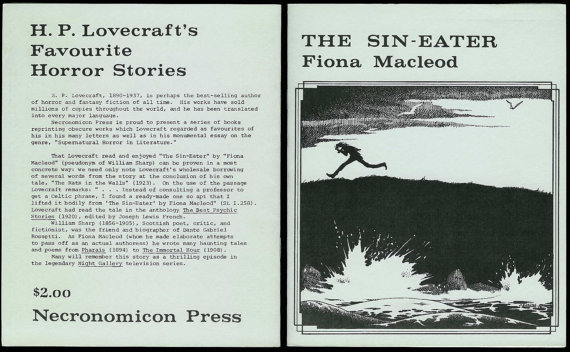
“The Sin-Eater” (1895) by Fiona Macleod

Now, we are a scattered band. The Breton’s eyes are slowly turning from the sea, and slowly his ears are forgetting the whisper of the wind around Menhir and Dolmen. The Cornishman has lost his language, and there is now no bond between him and his ancient kin. The Manxman has ever been the mere yeoman of the Celtic chivalry; but even his rude dialect perishes year by year. In Wales, a great tradition survives; in Ireland, a supreme tradition fades through sunset-hued horizons to the edge o’ dark; in Celtic Scotland, a passionate regret, a despairing love and longing, narrows yearly before a bastard utilitarianism which is almost as great a curse to our despoiled land as Calvinistic theology has been and is.
—Fiona Macleod, “From Iona” in The Sin-Eater and Other Tales and Episodes (1895), 11-12

It was called alternately the Celtic Twilight and the Celtic Revival. The languages and cultures of the Gaelic-speaking peoples of the British Isles was rapidly fading in response to the events of the 18th, 19th, and 20th century; spreading industrialization, transportation and emigration, especially after the Great Famine in Ireland, accelerated the decline of the Gaelic languages in favor of English, which had become the language of government, literature, and trade in the United Kingdom—and, before the breakup of the British Empire, throughout the world.

Against this decline rose varied movements; some aimed to preserve and promulgate the declining language and customs, such as the gorsedds in Wales, while the Irish Literary Revival in the late 19th/early 20th century sought to raise awareness of Irish literature and writers. Common cause was made between Gaelic speakers based on mutual interest in languages, lore, and preservation of rapidly-disappearing ways of life. The Celtic Revival filtered across the Atlantic to the United States in many forms; W. B. Yeats, Æ (George William Russell), reprints of James Macpherson’s Ossian and the novels of Sir Walter Scot, the fantasies of George Macdonald and Lord Dunsany, the weird tales of Arthur Machen…and, though often forgotten today, the weird works of Scottish writer William Sharp, who also wrote as Fiona Macleod.

Sharp was already a relatively successful author whose books of poetry and realistic novels in the 1880s had progressed to the point where by 1890-1891 he could support himself full-time as a writer and editor. He and his wife went on a trip to Italy, where he found a muse in the form of Mrs. Edith Wingate Rinder (Alaya 125), and the inspiration for a new literary persona.

Anyone might than have observed something different about Sharp. His creative voice was stronger, all his work more passionate and vital. And those who knew him intimately knew also that it was in the years immediately following his return from Italy that Sharp began, quietly but steadfastly, to produce the work later to be attributed to the pen of Fiona Macleod.
—Flavia Alaya, William Sharp—”Fiona Macleod” 1855-1905 (1970), 97

Sharp had previously tried on other literary voices, H. P. Siwaärmill, W. H. Brooks, and COuntess Ilse von Jaromar, but works under these names failed to gather attention. Fiona Macleod was created not just as a female voice for Sharp’s fiction, but a distinctly Scottish one; Sharp was at this point becoming more aware of himself as a Scot, and of the importance of Scottish Gaelic and folklore. It also provided an outlet for Sharp’s more occult leanings; he was a member of the Hermetic Order of the Golden Dawn and an associate of Wiliam Butler Yeats on the “Celtic Mysteries” project, which involved trance workings (Talking to the Gods, 23, 36), and “second sight” and prophecy would find their way into Macleod’s work (Alaya 190).

The degree to which Sharp identified with Fiona Macleod has been a point among his biographers, up to and including his wife, who quoted from one of his letters:

…I can write out of my heart in a way I could not do as William Sharp, and indeed I could not do so if I were the woman Fiona Macleod is supposed to be, unless veiled in scrupulous anonymity…

This rape sense of oneness with nature, this cosmic ecstasy and elation, this wayfaring along the extreme verges of the common world, all this is so wrought up with the romance of life that I could not bring myself to expression by my outer self, insistent and tyrannical as that need is. … My truest self, the self who is below all other selves, and my most intimate life and joys and sufferings, thoughts, emotions and dreams, must find expression, yet I cannot save in this hidden way.
William Sharp (Fiona Macleod) A Memoir (1910) 227

The ruse was more than skin-deep; from 1894 onwards he maintained two simultaneous and distinct writing careers, one as Sharp and the other as Macleod, answering letters “in character,” having his sister write out manuscripts in a woman’s handwriting, mailing letters to himself from “Fiona Macleod,” careful that he and his wife would always talk about “Fiona” as if she was a separate entity to avoid a slip, etc. The stress of the dual existence increased during his later years; Sharp forbore applying for a civil list pension because it would require revealing his authorship…and there may have been additional reasons.

Terry L. Meyers in The Sexual Tensions of William Sharp (1996), traces some of the subtle issues of gender identity and sexuality that Sharp expressed in his letters and fiction. A fierce advocate for gender equality, Meyers also traces themes of possible homosexual and transgender thought in his work and affiliations with other Victorian writers. Full expression or exploration of these feelings would have been difficult or impossible; Oscar Wilde being a prime example of the consequences of being found out. It is perhaps notable that in 1898 Sharp served on the Free Press Defence Committee formed to defend Havelock Ellis’ Studies in the Psychology of Sex: Sexual Inversion from prosecution for obscenity (Meyers 18).

While it is impossible at this remove to say definitely whether Sharp was homosexual, transsexual, transgender, genderqueer, or somewhere else on the spectrum, the combination of a strong feminine voice and a focus on authentic Scottish Gaelicisms came together to acclaim in the novels Pharais (1894), The Mountain Lovers (1895), and Green Fire (1896) to positive critical appraisal—sometimes eclipsing that of Sharp under his own name. Yet for all of Macleod’s literary output, the collection of short stories The Sin-Eater and Other Tales and Episodes (1895), particularly the title story, has come to be the most impactful—albeit in a way that Sharp/Macleod could not have foreseen, unless they really did have the Sight.

Alaya describes The Sin-Eater stories as “semi-autobiographical tales”; and there is in them a combination of authentic folklore, realistic portrayals of the lives of the Scottish people (warts and all), and perhaps above all a strong focus on Scottish Gaelic language. Macleod captures not just the somewhat stereotypical cadence of a way of thought and speaking, but makes knowledge of Gaelic a point of identity. Many phrases and a few special passages are in Gaelic, often with translation but some left au natural with only the context to guide the English reader. Yet it is telling when it is written:

The man had used the English when first he spoke, but as though mechanically. Supposing that he had not been understood, he repeated his question in the Gaelic.

After a minute’s silence the old woman answered him in the native tongue, but only to put a question in return.

“I am thinking it is a long time since you have been in Iona?”
—Fiona Macleod, “The Sin-Eater” in The Best Psychic Stories (1920), 127

Frank Belknap Long gifted a copy of The Best Psychic Stories to H. P. Lovecraft c.1923; the editor was Joseph Lewis French, an industrious editor and anthologist developed a reputation for weird anthologies beginning with Great Ghost Stories (1918) and The Best Ghost Stories (1919), and would go on to edit several more anthologies in that vein in the 1920s. The introduction was by Dorothy Scarborough, PhD., author of The Supernatural in Modern English Fiction (1917). French doesn’t mention Fiona Macleod’s alter ego, although the secret had been out a decade or so at that point; Scarborough doesn’t mention it in her brief introduction either, although her 1917 opus refers to Macleod as “Sharp’s other literary self” (65).

It isn’t clear if Lovecraft himself knew that Sharp was Macleod at that point—but it had apparently crossed his radar at a particularly good time for a little story he was working on titled “The Rats in the Walls:”

That bit of gibberish which immediately followed the atavistic Latin was not pithecanthropoid. The first actual ape-cry was the “ungl”. What the intermediate jargon is, is perfectly good Celtica bit of venomously vituperative phraseology which a certain small boy ought to know; because his grandpa, instead of consulting a professor to get a Celtic phrase, found a ready-made one so apt that he lifted it bodily from The Sin-Eater, by Fiona McLeod [sic], in the volume of Best Psychic Stories which Sonny himself generously sent! I thought you’d note that at once—but youth hath a crowded memory. Anyhow, the only objection to the phrase is that it’s Gaelic instead of Cymric as the south-of-England locale demands. But as—with anthropology—details don’t count. Nobody will ever stop to note the difference.
H. P. Lovecraft to Frank Belknap Long, 8 Nov 1923, Selected Letters 1.258

Scottish and Irish Gaelic are Goidelic (Q-Celtic) languages; Welsh (Cymric) is P-Celtic. Different branches of the same linguistic family tree, but not mutually comprehensible. Lovecraft had borrowed a Scottish Gaelic phrase and put it where a Welsh phrase should be. As it happened, Lovecraft was correct. No one noticed the slip when the story was published in Weird Tales in March 1924. However, when the story was reprinted in the June 1930 issue, it came under the eye of a Celtophile who had made some effort to learn Irish Gaelic—Robert E. Howard of Texas. As Lovecraft later told the story:

As for the languages represented in the atavistic passage—I don’t recall including Sanscrit [sic], though I did lift a sentence of Celtic (of which I know not a single word) from another story, “The Sin-Eater”, by “Fiona McLeod” (William Sharp). This sentence, incidentally, was what brought me into correspondence with Robert E. Howard. It was—since I swiped it from a Scottish story—a Gaelic specimen, whereas of course the Celtic language of southern Britain was Cymric. R.E.H.—as an expert Celtic antiquarian—noticed the discrepancy, & thought I had adopted a minor theory that a Gaelic wave had preceded the coming of the Cymri to Britannia. He wrote Wright on the subject, & Wright forwarded the letter to me—whereupon I felt obliged to drop a line to the mighty Conan exposing my own ignorance & confessing to my rather inept borrowing.
—H. P. Lovecraft to C. L. Moore, 2 Jul 1935, Letters to C. L. Moore 47

Much as I admired him, I had no correspondence with him till 1930—for I was never a guy to butt in on people. In that year her read the reprint of my Rats in the Walls and instantly spotted the bit of harmless fakery whereby I had lifted a Celtic phrase (for use as an atavistic exclamation) from a footnote to an old classic—The Sin-Eater, by Fiona Macleod (William Sharp). He didn’t realise the source of the phrase, but his sharp eye for Celtic antiquities told him it didn’t quite fit—being a Gaelic (not Cymric) expression assigned to a South British locale. I myself don’t know a word of any Celtic tongue, and never fancied anybody could spot the incongruity. Too charitable to suspect me of ignorant appropriation, he came to the conclusion that I followed a now-discredited theory whereby the Gaels were supposed to have preceded the Cymri in England—and wrote Satrap Pharnabazus [Weird Tales editor Farnsworth Wright] a long and scholarly letter on the subject. Farny passed this on to me—and I couldn’t rest easy until I had set the author right. Hence I dropped REH a line confessing my ignorance and telling him that I had merely picked a phrase with the right meaning from a note to a Scottish story while perfectly well aware that the language of Celtic South-Britain was really somewhat different.
—H. P. Lovecraft to E. Hoffmann Price, 5 Jul 1936, Selected Letters 5.277

Howard’s letters show that in 1929 and early 1930 his reading was turning increasingly to Irish history, with long letters to Harold Preece and Tevis Clyde Smith on Celtic history and language. It was perhaps this focus which made Howard so sensitive to Lovecraft’s use of language in “The Rats in the Walls”—as given in his letter to Wright:

As to the climax, the maunderings of the maddened victim is like a sweep of horror down the eons, dwindling back and back to be finally lost in those grisly mists of world-birth where the mind of man refuses to follow. And I note from the fact that Mr. Lovecraft has his character speaking Gaelic instead of Cymric, in denoting the Age of the Druids, that he holds to Lhuyd’s theory as to the settling of Britain by the Celts.

This theory is not generally agreed to, but I scarcely think that it has ever been disproved, and it was upon this that my story “The Lost Race” was based — that the Gaelic tribes preceded the Cymric peoples into Britain, by way of Ireland, and were later driven out by them. Baxter, the highly learned author of Glossario Antiquae Britanniae upholds this theory on the grounds that the Brigantes, supposed to be the first Celtic settlers in Britain, were unacquainted with the “p” sound, which was not used in Britain until the advent of the Brythonic or Cymric peoples. According to this, the Brigantes were a Goidhelic tribe, and Lhuyd’s point seems proven.

Personally, I hold to the theory of Cymric precedence, and believe that Brythonic tribes inhabited, not only Britain and Scotland before the coming of the Gaels, but Ireland as well. The blond Britons appear to me to be a closer branch of the ancient Aryan stock, the Gaels arriving later, and being mixed with some Turanian or Mediterranean blood. But every man is entitled to his own view and a writer has the right to use any and all theories, no matter how conflicting, in his stories. I may write a story one day upholding a certain theory of science, letters, anthropology or what-not, and the next day, a story upholding a theory directly opposite. A fiction writer, whose job is to amuse and entertain, should give all theories equal scope and justice. But I’m taking up too much of your time.
—Robert E. Howard to Farnsworth Wright, Collected Letters 2.42-43

Howard’s specific source for this argument appears to be O’Donovan and O’Reilly’s Irish-English Dictionary (1864 ed.). We know Howard had this volume, as he cites in a subsequent letter to Lovecraft (CL2.70), and it seems to be the source for some of his Irish language comments in prior letters (cf. CL2.7, 20-21, 22-23). This passage in particular jives with the content of Howard’s letter:

Mr. Baxter (in Glossario Antiquæ Birtanniæ, p. 90) remarks, that the oldest Brigantes, whom he esteems the first inhabitants of Britain, never used in their language the sound of the letter p, which was afterwards introduced by the Belgic Britains. If the old Brigantes were really of the first inhabitants of Britain, it would follow, that they were a part of the Guidelian, or Gaulish colony, which went over to Ireland, and whom Mr. Lhuyd evidently proves to have been the first inhabitants of all that part of Great Britain which now comprehends England and Wales.
“Remarks on the Letter P” in An Irish-English Dictionary 399-400)

Lovecraft’s response is now lost, but that exchange began a correspondence that would last until Robert E. Howard took his own life in 1936; Lovecraft would still mourn his Texas friend until his own death in 1937. It is notable that while the first couple of letters are lost their collected correspondence, A Means to Freedom begins with both men deep into British Celtic history, and their wide-ranging letters spin out from there—but this period would always inform Lovecraft’s image of Robert E. Howard as a scholar and enthusiast for Gaelic language and culture. It is possible that Lovecraft’s high opinion of Howard helped overcome Lovecraft’s lingering prejudices regarding the Irish and “Celtic peoples,” who in the early 20th century still faced racial and ethnic discrimination.

No where in the surviving letters do Howard and Lovecraft discuss William Sharp or Fiona Macleod. The first time that Lovecraft acknowledges Sharp and Macleod as the same individual is in 1929:

The lines of William Sharp (who, by the way, has written some remarkable weird material under the pseudonym of “Fiona MacLeod” [sic]) are highly potent despite their simplicity. I have followed the draining of Lacus Nemorensis with great interest, though without much hope that anything valuable will be discovered on Caligula’s galleys.
—H. P. Lovecraft to Elizabeth Toldridge, 15 Apr 1929, Letters to Elizabeth Toldridge 57

Lovecraft refers to “The Lake of Nemi” in Sharp’s volume of poetry Sospiri di Roma (1891)—which is, coincidentally, a product of the same trip to Italy in which Fiona Macleod was born in Sharp’s mind. Benito Mussolini had begun a project to drain Lake Nemi (Lacus Nemorensis), which Sharp had visited. So sometime between 1923 and 1929, Lovecraft discovered that Fiona Macleod was William Sharp…and had read enough of Macleod’s fiction to praise it, if only briefly. It is a pity that Lovecraft doesn’t expand on the subject at any length in his letters; he doesn’t even mention Macleod or Sharp in his essay “Supernatural Horror in Literature”—and Lovecraft could scarcely have faulted Sharp for using Macleod as a pseudonym, considering Lovecraft had written under the name Elizabeth Berkeley himself.

It may be worthwhile to look at the infamous borrowing in context:

Curse you, Thornton, I’ll teach you to faint at what my family do! … ’Sblood, thou stinkard, I’ll learn ye how to gust … wolde ye swynke me thilke wys? … Magna Mater! Magna Mater! … Atys … Dia ad aghaidh ’s ad aodaun … agus bas dunach ort! Dhonas ’s dholas ort, agus leat-sa! … Ungl … ungl … rrrlh … chchch ….
H. P. Lovecraft, “The Rats in the Walls”

“But, Andrew Blair, I will say this: when you fair abroad, Droch caoidh ort! and when you go upon the water, Gaoth gun direadh ort! Ay, ay, Anndra-mhic-Adam, Dia ad aghaidh ’s ad aodann … agus bas dunach ort! Dhonas ’s dholas ort, agus leat-sa!”†

† Droch caoidh ort! “May a fatal accident happen to you” (lit. “bad moan on you”). Gaoth gun direadh ort! “May you drift to your drowning” (lit. “wind without direction on you”). Dia ad aghaidh, etc., “God against thee and in thy face … and may a death of woe be yours … Evil and sorrow to the and thine!”
—Fiona Macleod, “The Sin-Eater,” The Best Psychic Stories 146

Delapore’s speech devolves from contemporary English (“Curse you, Thornton”) to Elizabethan English (“‘Sblood, thou stinkard”) to Old English (“wolde ye swynke” i.e. “would you belabor me like this?”) to Latin (“Magna Mater!” i.e “Great Mother”) to Gaelic (“Dia ad aghaidh”) and finally prehuman speech (“Ungl.”) As Lovecraft had no knowledge of Scottish Gaelic, he accidentally copied the spelling error (“aodaun” for “aodann”) in The Best Psychic Stories version of the text.

In Macleod’s “The Sin-Eater,” the speech is given not so much as a curse but as a deliberate insult by the eponymous Sin-Eater Neil Ross who is already, though he knows it not, doomed. There is something of a parallel to the two speeches in that regard: both men who speak it are destined to be consumed by madness, driven to their fate by old family sins and quite literal consumption. While it is probably too much to say that “The Sin-Eater” inspired “The Rats in the Walls,” it is likely that Lovecraft might have been struck by the parallels…and the bit of luck that put such an appropriate choice of phrase in his way.

The phrase and the story can only exist in the wider context of the Celtic Twilight, and of Sharp’s assumption of the literary identity of Fiona Macleod; the very focus on Celtic languages and culture which was the focus of Sharp’s purpose in writing and publishing as Macleod in turn directly led to Lovecraft’s correspondence with Robert E. Howard, based on his awareness of and interest in Celtic languages and history.

An odd legacy for Fiona Macleod—yet perhaps oddly appropriate.

“The Sin-Eater” by Fiona Macleod can be read online for free here.


Bobby Derie is the author of Weird Talers: Essays on Robert E. Howard & Others (2019) and Sex and the Cthulhu Mythos (2014).
“The Yellow Wallpaper” (1892) by Charlotte Perkins Gilman

It is dull enough to confuse the eye in following, pronounced enough to constantly irritate, and provoke study, and when you follow the lame, uncertain curves for a little distance they suddenly commit suicide—plunge off at outrageous angles, destroy themselves in unheard-of contradictions.
—Charlotte Perkins Gilman, “The Yellow Wallpaper” (1892)

Old Keziah, he reflected, might have had excellent reasons for living in a room with peculiar angles; for was it not through certain angles that she claimed to have gone outside the boundaries of the world of space we know?
—H. P. Lovecraft, “The Dreams in the Witch-House” (1933)

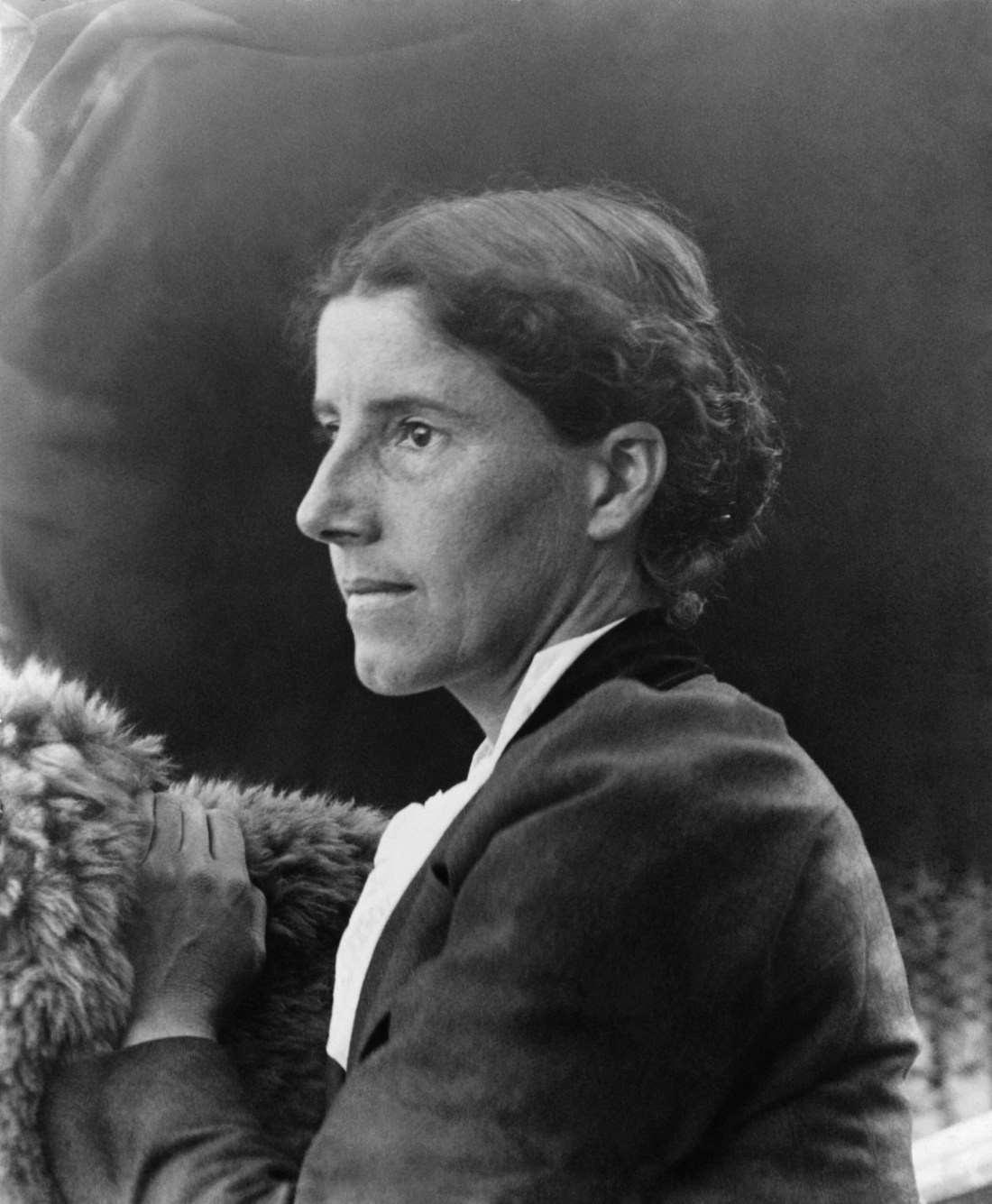
Charlotte Perkins Gilman (1860-1935) was a feminist, humanist, social reformer, lecturer and writer. She was born in Connecticut, and spent much of her early life in Providence, Rhode Island, H. P. Lovecraft’s home town. Like Lovecraft she had limited formal education, but was a prodigious autodidact. As with many of the more famous writers of his day, Lovecraft’s brush with Gilman was one-sided: his letters attest to an awareness of her work and as an individual, but her letters and diaries do not mention Lovecraft. His work, limited mostly to the pulps and the amateur press, either did not rise to her notice or did not merit comment.

At one point, however, there might have been a stronger connection:

“The Yellow Wall Paper” is the sole fictional effort of the feminist & social worker Charlotte Perkins Gilman—whom, by the way, my mother knew in youth. It is a most insidiously potent tale of the aura of madness, & was included by William Dean Howells in his anthology of American Short Story masterpieces.
H. P. Lovecraft to Donald Wandrei, 11 Jan 1927, Letters w/Donald & Howard Wandrei &c. 31

My mother knew her well-since as plain Charlotte Perkins she used to be governess in the home of some friends of ours. Later her first husband was the Providence artist Stetson. She always had an affected, eccentric streak of self-conscious intellectuality.
H. P. Lovecraft to August Derleth, 20 Sep 1935, Essential Solitude 2.708

In 1883, Charlotte Anna Perkins was living in Providence, Rhode Island. She had been working as a teacher or tutor, and recounts:

I gave drawing lessons to a boy and a girl, the girl died, and the lonely little brother begged to have me come and stay with him. So I tried governessing, for ten weeks, and learned more about the servant question in that time than most of us ever find out.
—Charlotte Perkins Gilman, The Living of Charlotte Perkins Gilman: An Autobiography 69

According to her letters, the clients were Dr. and Mrs. Jackson of Providence; the boy was Eddie. The 1880 census lists a Walter Marsh Jackson, physician; wife, Amelia (Amy) Jackson, daughter Isabel Jackson (died 1883, age 13), and son Edward P. Jackson. The Jacksons are buried in Swan Point Cemetery, where H. P. Lovecraft and the Phillips family are also buried.

Charlotte Perkins’ ten weeks as governess of Eddie began on 16 July 1883, and part of it was spent in Maine. Sarah Susan Phillips (1857-1921) in 1881 was living at the family home, 194 Angell St. The Jacksons are the most likely candidates for a mutual acquaintance with the future Mrs. Lovecraft, but Gilman’s letters of the period do not reference a Mrs. Phillips or her sisters—so the connection is tenuous. It is interesting to note that there are two surviving letters sent by Gilman from 207 Angell St., which is less 100 yards from the Phillips’ home, so it is not impossible that the then Charlotte Perkins and Susie Lovecraft might have met on the street, or had other acquaintances in common at the time.

Their lives diverged. In May 1884, Charlotte Perkins married her first husband, the Providence artist Charles Stetson. Their daughter Katharine Stetson was born eleven months later in 1885. Her periodic depressions deepened after the birth, and in April 1887 she broke down. Women’s medicine at the time was dominated by sexist attitudes; she submitted for a period to the “rest cure” of neurologist S. Weir Mitchell, but…well, as she puts it so elegantly:

For many years I suffered from a severe and continuous nervous breakdown tending to melancholia-and beyond. During about the third year of this trouble I went, in devout faith and some faint stir of hope, to a noted specialist in nervous diseases, the best known in the country. This wise man put me to bed and applied the rest cure, to which a still good physique responded so promptly that he concluded there was nothing much the matter with me, and sent me home with solemn advice to “live a domestic a life as far as possible,” to “have but two hours’ intellectual life a day,” and “never to touch pen, brush or pencil again as long a I lived.” This was in 1897.

I went home and obeyed those directions for some three months, and came so near the border line of utter mental ruin that I could see over.

I then, using the remnant of intelligence that remained, and helped by a wise friend, I cast the noted specialist’s advice to the winds and went to work againwork, the normal life of every human being; work , in which is joy and growth and service, without which one is a pauper and a parasite; ultimately recovering some measure of power.

Being naturally moved to rejoicing by this narrow escape, I wrote The Yellow Wallpaper, with its embellishments and additions to carry out the ideal (I never had hallucinations or objections to my mural decorations) and sent a copy to the physician who so nearly drove me mad. He never acknowledged it.
—Charlotte Perkins Gilman, “Why I Wrote The Yellow Wallpaper” (1913)

“The Yellow Wallpaper” was actually written in 1890, and finally published in 1892 in The New England Magazine, and there is a degree of myth-making in some of Gilman’s later claims about the story, as explored by Helen Lefkowitz Horowitz in Wild Unrest: Charlotte Perkins Gilman and the Making of “The Yellow-Wallpaper” (2010), but that is a bit beyond the scope of this article. Suffice to say that by the time Lovecraft first mentions the story in his letters in 1926, “The Yellow Wallpaper” had already been established as a story of note.

Your plan for a weird bibliography is splendid, & I hope to see it carried into effect. Such a thing ought to include not only books but isolated tales in magazines as well; since some veritable masterpieces have never got beyond that form. Single tales in anthologies, also, (like Mrs. Charlotte Perkins Gilman’s “Yellow Wall Paper” in Howells’ collection) merit citation.
—H. P. Lovecraft to Donald Wandrei, 24 Dec 1926, Letters w/Donald & Howard Wandrei &c. 26

It’s not clear when Lovecraft first read the story, but starting in 1925 he began an intensive course of reading weird fiction to write his essay Supernatural Horror in Literature (1927), so it is possible he read it during that period. The anthology he mentions is The Great Modern American Stories: An Anthology (1920), edited by William Dean Howells. In his introduction, Howells writes of Gilman’s story:

It wanted at least two generations to freeze our young blood with Mrs. Perkins Gilman’s story of The Yellow Wall Paper, which Horace Scudder (then of The Atlantic) said in refusing it that it was so terribly good that it ought never to be printed. But terrible and too wholly dire it was, I could not rest until I had corrupted the editor of The New England Magazine into publishing it. Now that I have got it into my collection here, I shiver over it as much as I did when I first read it in manuscript, though I agree with the editor of The Atlantic of the time that it was too terribly good to be printed. (vii)

Lovecraft’s response is withering:

Am surprised that Howells was concerned in a venture like this, since ordinarily he was old-womanishly opposed to the really gruesome & terrible. He made an absurd apology for including Mrs. Gilman’s “Yellow Wall Paper” in an anthology he edited.
H. L. Lovecraft to August Derleth, 27 Sep 1927, Essential Solitude 1.37

In “Supernatural Horror in Literature,” Lovecraft is generally positive about “The Yellow Wallpaper”:

With this foundation, no one need wonder at the existence of a literature of cosmic fear. It has always existed, and always will exist; and no better evidence of its tenacious vigour can be cited than the impulse which now and then drives writers of totally opposite leanings to try their hands at it in isolated tales, as if to discharge from their minds certain phantasmal shapes which would otherwise haunt them. Thus Dickens wrote several eerie narratives; Browning, the hideous poem “Childe Roland”; Henry James, The Turn of the Screw; Dr. Holmes, the subtle novel Elsie Venner; F. Marion Crawford, “The Upper Berth” and a number of other examples; Mrs. Charlotte Perkins Gilman, social worker, “The Yellow Wall Paper”; whilst the humourist W. W. Jacobs produced that able melodramatic bit called “The Monkey’s Paw”. […]

Charlotte Perkins Gilman, in “The Yellow Wall Paper”, rises to a classic level in subtly delineating the madness which crawls over a woman dwelling in the hideously papered room where a madwoman was once confined.

Lovecraft’s interpretation is fair, but curious. Many readings, especially today, focus more on the “rest cure” aspect, and the suggestion of postpartum depression. The women’s horrors, as it were. Lovecraft’s reading focuses on the subtle suggestions that Gilman never makes explicit: why has this colonial manse gone untenanted so long? Who is the woman she sees in the wallpaper?—and comes to his own conclusion. He stops short of suggesting a haunting, and it seems he was aware that the focus was on the slowly devolving mindset of the protagonist, the creeping psychological horror—and writing to August Derleth a few years later, when Derleth was working on his thesis “The Weird Tale in English Since 1890”:

“The Yellow Wall Paper” is a great tale, but to me it lacks just that final touch of “outsideness” necessary to make the top grade […]
—H. P. Lovecraft to August Derleth, 7 Jun 1930, Essential Solitude 2.265

My stand on cosmic outsideness, however, is likely to remain unchanged; for I feel that this element is eminently necessary to produce a macabre thrill of the very first water. “The Yellow Wall Paper” & “Shadows on the Wall” are excellent of their kind, but the sensation they produce is a tame & secondary one as compared with that produced by “The Willows”, “The White People”, “The House of Sounds”, or even (in my estimation, at least) “The Yellow Sign.”
—H. P. Lovecraft to August Derleth, 20 Jun 1930, Essential Solitude 2.268

Derleth differed:

The weird tale can, I believe, be divided into two rough classes—those hinting of cosmic evil and horror—and those only vaguely suggesting something beyond, something beyond the surface, the appearance, and range all the way from vague fright to utmost horror. You prefer the former group, to which we would according to this grouping, parcel such tales as The Yellow Sign, your Cthulhu et al[.] tales, the White People, etc.; I prefer the latter group, in which fall Mary E. Wilkins-Freeman’s tales, your own Rats in the Walls, Strange High House, my Panelled Room, etc., The Monkey’s Paw, The Yellow Wall Paper. And so on. The vast majority of the first-raters belong in this latter class.
—August Derleth to H. P. Lovecraft, 2 Nov 1931, Essential Solitude 2.402

However, Derleth did take Lovecraft’s reading to heart:

The Yellow Wall Paper is the story of a woman who goes mad from the effect of hideously yellow wall paper in the room where she is convalescing, and where a mad-woman was once confined. The narrator, who is being urged to fight off the delusion that there is a woman trying to escape from behind the wall paper, enters gradually and subtly into the character of the imagined person; in reality this character, composed of forces left behind by the late madwoman, enters into her. Her husband does not realize the effect of the wall paper, nor does he regard the recent presence of the madwoman as significant. The story rises to a climax with startling subtlety, and the delineation of the approaching madness is classic. […]

There is something shudderingly horrible in the thought of this woman chronicling day by day her approaching madness, and remaining stolidly unaware of it all the time. Horror lies between the lines here, and the reader must read it in to get the full force of the story. […]

There is a suggestion of the “outside” [in The Yellow Sign by Robert W. Chambers”], which neither The Yellow Wall Paper nor The Upper Berth [by F. Marion Crawford] carried […]
—August Derleth, “The Weird Tale in English Since 1890” in The Ghost (1945) 8-9

Neither Lovecraft nor Derleth denied the importance or the efficacy of “The Yellow Wallpaper” as a weird tale; Derleth himself borrowed heavily from Gilman when he wrote “The Panelled Room” (written 1930, published 1933). Both counted it an important tale worth mentioning in their respective overviews of weird fiction—and in this they were perhaps a little ahead of the game; while some classify “The Yellow Wallpaper” as a Gothic story, Edith Birkhead in The Tale of Terror: A Study of the Gothic Romance (1921) does not list it; neither does Dorothy Scarborough in The Supernatural in Modern English Fiction (1917). Both those women focused on supernatural horror, and as Lovecraft pointed out— “The Yellow Wallpaper” isn’t quite that. The horror is more vague, indeterminate, and we never quite know how much is real and how much is in the narrator’s mind.

“The Yellow Wallpaper” is weird. So what influence did it have on Lovecraft?

In terms of direct influence, it’s hard to say. There are definitely elements of “The Yellow Wallpaper” that jive with Lovecraft’s pet themes: the question of sanity, the descent into madness, the particular focus on angles— “The Dreams in the Witch-House” might owe at least a little debt to “The Yellow Wallpaper.” Lovecraft himself, however, never offers any insights in this line. Savvy readers might point out that Gilman’s hotel in “The Shadow over Innsmouth” or Walter Gilman in “The Dreams in the Witch-House” which could be glancing references, but aside from the obvious pun in the case of Innsmouth, “Gilman” is also an old established New England name—Lovecraft might have been inspired by her, or not. He is silent on the matter.

Gilman’s novel Herland was not published until long after both their deaths, so from Lovecraft’s perspective, she had only a single weird tale to her credit:

In the case of general authors who have produced a little weird material, one has to use one’s own judgment. I would, in such cases, ask (a) how typical of this author is his weird stuff, & (b) all apart from this, how important is this weird material? […] I’d admit Mrs. Gilman for her one weird tale—”The Yellow Wall Paper”—because of its great importance, though it is wholly non-typical of her.
—H. P. Lovecraft to Emil Petaja, 29 Dec 1934, Letters w/Donald & Howard Wandrei &c. 396

There is little left to say. Lovecraft’s final word on Gilman concerns notice of her death. Suffering from breast cancer, she chose to take her own life with chloroform.

Too bad Mrs. Gilman bumped herself off—I was told of it in N Y, though I haven’t reached Aug. 17 as yet in my reading-up of back newspapers. […] Well—may she rest in peace!
—H. P. Lovecraft to August Derleth, 20 Sep 1935, Essential Solitude 2.708

There are few enough women mentioned in Supernatural Horror in Literature; whether this reflected Lovecraft’s particular reading or any unspoken sexism on his part is unclear. Yet he went out of his way more than once in both that public essay and in his private letters to champion Charlotte Perkins Gilman for her weird tale “The Yellow Wallpaper”…and who can say that Gilman’s depiction of creeping madness did not strike a chord in Lovecraft, if the memory of the story stayed with him all those years?

“The Yellow Wallpaper” can be read for free online here.

Thanks to Donovan Loucks and Dave Goudsward for their help.


Bobby Derie is the author of Weird Talers: Essays on Robert E. Howard & Others (2019) and Sex and the Cthulhu Mythos (2014).
“The Tulu Jar” (2000) by Ann K. Schwader

Of one thing I am really glad, and that is that I could not then identify the squatting octopus-headed thing which dominated most of the ornate cartouches, and which the manuscript called “Tulu”. Recently I have associated it, and the legends in the manuscript connected with it, with some new-found folklore of monstrous and unmentioned Cthulhu, a horror which seeped down from the stars while the young earth was still half-formed; and had I known of the connexion then, I could not have stayed in the same room with the thing.
—H. P. Lovecraft & Zealia Bishop, “The Mound”

In “Winged Death” it is Clulu; in “Medusa’s Coil” it is “Marse Clooloo”; in “The Electric Executioner” it is “Cthulhutl”—and in “The Mound” it is “Tulu.” Different names for the same concept, the same entity. Variations on a theme. One of humanity’s great gifts is pattern recognition, and one of Lovecraft’s great insights in writing those first Mythos stories was to recognize the tendency of weird fiction fans to correlate the contents. This was part of the game that Lovecraft played with his readers: giving them the pieces of the puzzle and letting them put it together.

Despite the variations on the same name, Lovecraft never wrote a full comparison of how different cultures perceived Cthulhu. The names alone suggest a signal-to-noise ratio; the oral tradition like a long game of telephone down the ages, bits of lore garbled, misunderstood, mistranslated, subject to reinterpretation. However, they also represent possibility. Maybe there isn’t just one canon, one truth. Maybe there are a lot of different ways to look at Cthulhu…and absent the original article, who is to say which is more correct than any other?

“The Tulu Jar” by Ann K. Schwader plays on misunderstandings & mistranslations. The audience knows who or what Tulu is, and thus has a bit more of an inkling of what is going on than the characters in the story. The narrative itself is fairly straightforward, the effectiveness is measured in how the revelations build and develop. There are things the reader never finds out, mysteries that are not explained—because they don’t need to be.

The name is the only thing that connects “The Tulu Jar” to “The Mound,” the only tie between Schwader’s story and Yig Country. In all other respects, “The Tulu Jar” could just as easily have been “The Cthulhu Jar” and stood next to works like “Something in Wood” (1948) by August Derleth, or as an appendix to Lin Carter’s Xothic Legend Cycle. One more horror in clay, one more work of Mythos artwork to sit alongside the masterpieces of Pickmans and Wilcoxes.

So why Tulu?

In part perhaps because it implies mistranslation, incompleteness, something different. Cthulhu makes no appearance in the story; Miskatonic University and Arkham are mentioned but far-off, and no one consults the Necronomicon. Using “Tulu” instead of “Cthulhu” tells the reader that those involved do not know what they’re dealing with. Quite literally dabbling with forces they don’t understand…and that works, in the context of the story.

Speaking of which…there is an anecdote about this story that bears repeating:

By the way, there really is a Tulu jar! Ann and her husband bought an art object at a Denver scifi con entitled Cthulhu Scroll Case. They bought it before the actual art sale, but then the lid was vandalized while the piece was still on display. She tells me that the artist offered to make it right by making another lid, which he subsequently did, but Ann was understandably upset nonetheless. As she put it, “a little literary justice seemed in order”, and the result was this story. The sculpture still holds a place of honor on a shelf in her office. Ann describes it as “wonderfully nasty-looking”, but in reality it looks nothing like the jar in the story.
—Kevin O’Brien, Strange Stars & Alien Shadows 1

“The Tulu Jar” was first published in Chronicles of the Cthulhu Codex #17 (2000) and subsequently republished in The Black Book #3 (2003), and Strange Stars & Alien Shadows: The Dark Fiction of Ann K. Schwader (2003).


Bobby Derie is the author of Weird Talers: Essays on Robert E. Howard & Others (2019) and Sex and the Cthulhu Mythos (2014).
Her Letters to Lovecraft: Josephine Evalyn Crane Blossom

In 1934, H. P. Lovecraft traveled down the Eastern seaboard of the United States by bus to Florida, where he visited with R. H. Barlow and his family in DeLand for some weeks. While on this trip, Lovecraft sent out dozens of postcards to familiar correspondents like his aunt Annie Gamwell, Robert E. Howard, Clark Ashton Smith, August Derleth, Farnsworth Wright, Zealia Bishop, and Natalie H. Wooley—we have a list in the Collected Essays, “[List of Correspondents to Whom Postcards Have Been Sent]” identifying who got cards from where—and near the bottom of the list, receiving postcards from St. Augustine, DeLand, and Nantucket, is “Blossom.” (Collected Essays 5.267) In Lovecraft’s 1937 diary, a “J E C Blossom, 117 Church St., Rutland, Vt” is given among the list of addresses; Lovecraft scholar Ken Faig identifies this individual:

Josephine E. Crane Blossom was born 17 July 1861, Mayatta KS, and died 4 January 1952, Rutland VT. In the 1900 U.S. census, she was recorded in Shrewsbury, Rutland Count, VT in the household of her husband William R. Blossom, born April 1854 VT of VT-born parents, a physician. THey had then been married twenty-one years and Josephine was the mother of seven children, of whom five were then living all of them in the paternal household: Elsie C. (b. August 1885 VT), Ethel C. (b. March 1889 VT), Fay E. (b. August 1890 KS), Franklin O. (b. August 1890 KS), and Wilhelmina J. (b. August 1896 VT). Josephine Blossom was active as a poet in amateur journalism. (Lovecraft Annual #6 165)

No letters or cards from J. E. C. Blossom/H. P. Lovecraft correspondence are known to survive, so Lovecraft’s list is the only remaining evidence that testifies that they were in touch by mail; Blossom’s activity in amateur journalism is the one suggestion for why they might be in touch. The rest of Lovecraft’s published letters do not mention a Josephine Blossom directly…however, this is one letter in 1934 which may have bearing on their relationship:

Nor do I grudge old Ma Blossom of Vermont (a professional client) the newspaper praise of “her” verse which is giving zest to her sunset days.
—H. P. Lovecraft to R. H. Barlow, 25 Sep 1934, O Fortunate Floridian! 179-180

This is the only direct mention of Blossom as one of Lovecraft’s revision clients; although S. T. Joshi and David E. Schultz believe this is the individual alluded to in W. Paul Cook’s memoir of Lovecraft during one anecdote of Lovecraft’s efforts at revising the poetry of others:

A woman, very earnest, very soulful, writing by the yard but unable to achieve anything printable. All of a sudden, in a fair eruption of glory, she began to get into print here, there, and everywhere. Editors, instead of rejection slips, returned requests for more. I was puzzled. This stuff was too good for her to do. One day, in a purely incidental manner and in connection with something else, the secret slipped out. She commenced to suffer from enlargement of the ego, vulgarly called “Swelled head.” Why should she pay a revisionist when she was some poet all by herself. Accordingly, she dropped Lovecraft, neglecting, if not refusing, to pay his last fee. No more of her work appeared in print. In time something or other penetrated her consciousness, and it was in a state of considerable deflation that she sent Howard what she owed him together with a mass of manuscript. The manuscript came back, unrevised, with a note to the effect that Mr. Lovecraft was so busy, and would be for the next nine months, that he was unable to advise about her work. The deflation continues to all this day. So far as I know, she never published another poem. How do I know all this? Not from Lovecraft, although he later conceded enough to furnish proof.
—W. Paul Cook, “In Memoriam: Howard Phillips Lovecraft” in Ave Atque Vale 75

Cook is not always the most reliable of reporters, and in this anecdote he frankly admits that he’s working to a degree from speculation and inference—but there are some interesting facts that might support part of his anecdote. In November 1931, Josephine Evalyn Crane Blossom began to have her poems published in the Rutland Daily Herald, and the poems received lavish praise including from Lovecraft’s friend Walter J. Coates, an amateur journalist who published The Driftwind, which included some of Lovecraft’s own work. The article of 9 November 1931 would end:

We can say, in addition, that Mrs. Blossom, who is now 70 years old, is still composing verse and we have before us another contribution in her own handwriting, which shows many characteristics of the foregoing “Autumn,” which is, as our experts have said, something of a masterpiece.

Have we, by chance, been living along side of a real genius?

It really looks that way.

In 1932, Blossom’s poetry becomes much more scarce in the newspaper, and the praise dries up—although Cook appears to be wrong, and she was published again, periodically. Did Lovecraft revise her poetry? If so, one of the pieces he may have had a hand in is “Dream World,” published 23 Nov 1931:

Dream World

Through dust and quiet comes the dawn-like glow
Of visioned vistas gay with roseate light;
Gardens more beautiful than we can ever know,
With fadeless flowers and golden fruitage bright.

Across dim twilight seas of fragrant dreams
A white ship bears us soundless to that shore,
Moved by the wordless music-hinting streams
Of soft, still winds that purple skies outpour.

Green banks expand with calm, Hesperian grace
And latent wonder beckons and revives;
Here may we shed the last encumbering trace
Of pains and cares that weight our waking lives.

The sunlit fields are starred with asphodels;
The forests echo to an endless song
Beyond the plains a violet mountain swells,
While in bright valleys brooklets wind along.

A world unspoiled, that shapes us all anew
As down its leaf-lined path our spirits stray:
How longs the heart to hold it clear in view.
And glean the joys of its eternal day!

Interested readers might compare this prose with Blossom’s later published work, such as “The Last Act” in the Rutland Daily Herald for 22 Sep 1943. Lovecraft himself downplayed the extant or quality of his poetry revision work:

Really, of course, the boost given to these old souls is very trivial. After all, one merely makes their jingles technically acceptable. The basic inanity remains, & no really exactly critic takes the doggerel seriously even when it is revised.
—H. P. Lovecraft to R. H. Barlow, 25 Sep 1934, O Fortunate Floridian! 180

If it is the case that Lovecraft revised J. E. C. Blossom’s poetry, then their lost correspondence must have included at least discussion on that issue, and possibly something more on amateur affairs. Sadly, we don’t know how that impacted her…seventy years of age, homemaker and mother and wife, getting her poetry published in the newspapers along with rather lavish praise…and here in the mail comes postcards from Florida and Nantucket from her friend H. P. Lovecraft to brighten her day. That he continued to send her cards in itself suggests that it was still a friendship, whether or not there was a business end to it.

Thanks to Dave Goudsward for his help and assistance on the elusive Mrs. Blossom.


Bobby Derie is the author of Weird Talers: Essays on Robert E. Howard & Others (2019) and Sex and the Cthulhu Mythos (2014).
“Taste of the Snake’s Honey” (2005) by Rio Matsudono (松殿理央)

“Taste of the Snake’s Honey” (2005) by Rio Matsudono (松殿理央) was published in the second volume in the Lairs of the Hidden Gods series from Kurodahan Press, edited by Asamatsu Ken (朝松健). It is the English-language translation of the 2002 novella 蛇蜜 (Hebi Mitsu); the translator was Erin S. Brodhead.

Sexuality is a fundamental aspect of Yig. In “The Curse of Yig” (1929) by Zealia Bishop & H. P. Lovecraft, this nature is implicit: the curse of Yig is that Aubrey Davis bears children with snake-like characteristics. While at least one critic claimed this was a story of maternal impression, the impression usually given was that Yig raped her, presaging to some degree the connection between Yog-Sothoth and Lavinia Whateley in “The Dunwich Horror.” The aspect of Yig as a sexual deity was affirmed in “The Mound” (1940) by Zealia Bishop & H. P. Lovecraft as “the principle of life symbolised as the Father of all Serpents.”

In writing that, Lovecraft might have been inspired by contemporary ideas that ancient serpent deities represented phallic cults, as discussed in O. A. Wall’s Sex and Sex Worship (1922); this was a book that Robert E. Howard owned, and Howard mentioned phallic worship in at least one letter to Lovecraft (A Means to Freedom 1.87). A few later authors have taken the general idea of the Father of Serpents as a masculine deity of virility and run with it; occultists like Kenneth Grant have incorporated Yig into their system as an aspect of masculine sexual power, representing the “Ophidian Current” in his Typhonian Trilogies.

Sex presents certain difficulties for translation; the language of sex is usually either dryly technical (penis, vagina, anus, etc.) or extremely idiomatic or euphemistic (rod, Johnson, 69, French letter, salad tossing, etc.), and sexual slang varies by region, language, culture, and period—compare the language in The Merry Order of St. Bridget (1857) to something like Anne Rice’s Sleeping Beauty trilogy, and it’s easy to see that while it covers some of the same thematic ground, the language and cultural syntax have shifted drastically. Trying to write period-appropriate sexual language is tricky enough, translating it in such a way that it retains the essence of its meaning for an audience doubly so…and that’s before you try to work the Mythos into it.

This is all necessary ground to cover because “Taste of the Snake’s Honey” is one of the relatively scarce Mythos works which contains a great deal of sexual matter, but isn’t really erotic in any significant sense. The best comparable work is probably Robert M. Price’s “A Thousand Young” (1989), which follows a young libertine seeking admission into a Mythos cult through increasingly deviant sexual acts, but both that story and this one are ultimately a more explicit version of the decadent pleasure-seekers in Lovecraft’s “The Hound”—the idea being that libido sciendi, the desire to know, the quest for forbidden knowledge applies equally well to sexual knowledge as it does to, say, advanced mathematics and occultism (cf. “The Dreams in the Witch-House”).

Sometimes this is very explicitly the case, such as in “Under the Keeper of the Key” (2015) by Jaap Boekestein, but in the case of Rio Matsudono, it’s more of a barometer to let readers know that the ambient sexual morality of the tale is falling fast, and as the Lovecraftian protagonist slides from receiving fellatio from women who had had all their teeth removed to necrophilia, the novella is really just getting started.

Which is all on purpose: the acts given are almost dry in their description, which might be a translation issue (see above; imagine trying to write 1930s-period sexual decadence to a 2000s-contemporary Japanese audience, and then imagine trying to translate that into English for a completely different audience) but likely also because the purpose of the acts is not to titillate or tantalize but to transgress, to provoke a degree of rejection and outrage at the breaking of taboos. The actual acts themselves aren’t dwelt on until we get to the literal climax of the story, because the author isn’t trying to get you off, or go into horrorporn territory with microscopic detail a la Edward Lee’s Hardcore Lovecraft novels like Going Monstering.

For “The Taste of the Snake’s Honey,” sex isn’t the revelation, it’s the initiation.

What the reader and the protagonist are initiated into is another question. Rio Matsudono’s novella is a direct expansion on the lore of Yig, and the straightforward lore dumps are maybe at the expense of the story itself. Like with The Queen of K’n-yan (2008) by Asamatsu Ken (朝松健), there’s an effort to at least draw parallels between an aspect of Lovecraft’s Mythos with Chinese folklore…and the parallels work fine; the exposition is a little heavy at points, but that’s pretty common in Lovecraftian pastiches. What the story lacks, aside from a certain prosody, is a direct explanation for what drove the sexual decadence of the protagonist in the first place…unless you understand and appreciate Yig’s role as a fundamentally sexual entity to begin with.

So much of this novella is stated bluntly or outright that some of the subtextual implications and assumptions can be easily lost. The protagonist’s sexual activities aren’t portrayed as mental illness or learned practices; they’re the result of natural inclinations—or, maybe, supernatural ones. Nature winning out over nurture. At the same time those sexual desires and activities appear to have nothing to do with the final resolution of the plot: they led the narrator protagonist to the point of revelation, but aside from plot fiat there was no reason that these specific revelations had to happen in this way. A surface read of this story might suggest that Rio Matsudono wanted to deliberately shock the reader, but the apparent conflict can be resolved by thinking of Yig and his children as driven by inhuman appetites.

He was not wholly evil, and was usually quite well-disposed toward those who gave proper respect to him and his children, the serpents; but in the autumn he became abnormally ravenous, and had to be driven away by means of suitable rites.
—H. P. Lovecraft & Zealia Bishop, “The Curse of Yig”

Suppose these appetites are analogous to the strange hankerings of a pregnant woman? Suppose the hungers for strange flesh, and blood, and wild venturings way over the borders of sane sexuality are a reaching out for ultramundane fare, the pickles and ice cream of the alien soul coming to birth within the confines of a human life that is only a womb for that which gestates inside, increasingly making its presence known?
—introduction to “Taste of the Snake’s Honey” in Inverted Kingdom 113-114

The introduction to “The Taste of Snake’s Honey” spotlights the issue for reader, although like all good warnings to the curious, the full implications aren’t necessarily clear until after the novella is finished. Then the story can be seen in the theme of “Paedomorphosis” (1998) by Caitlín R. Kiernan—a changeling or puberty story, where the old self is shed to make way for the new, adult form.

If read from this angle, the sexual deviations from the beginning of the story are not just there to shock the reader, but as deliberate steps in a process of development. The sexual pleasures being sought are increasingly strange and terrible by human standards because what the protagonist is being prepared to mate with is nothing human. It’s a rationalization which resolves some of the apparent conflicts in the story, such as why the narrator feels their behaviors are different from those of decadent humans who engage in the same or similar practices like teratophilia or necrophilia.

A point of view which potentially has interesting implications if applied to some of the other entities in the Cthulhu Mythos, especially those that pass for human, or whose cults engage in proscribed sexual practices.


Bobby Derie is the author of Weird Talers: Essays on Robert E. Howard & Others (2019) and Sex and the Cthulhu Mythos (2014).
“The Head of T’la-yub” (2015) by Nelly Geraldine García-Rosas

We came to the Mictlán, the place of the dead, which the ancient people called Xinaián […]
—”The Head of T’la-yub” by Nelly Geraldine García-Rosas, trans. Silvia Moreno-Garcia

Most of “The Mound” is given as a story-within-a-story: the English translation of the Spanish conquistador Pánfilo de Zamacona y Nuñez, gentleman, of Luarca in Asturias, Concerning the Subterranean World of Xinaián, A. D. 1545. Few of the Aztec codices have survived the flames and floods, the mold and wear of centuries of hands; we today often read about the peoples and places they encountered through accounts like Zamacona’s…who being their own skewed, flawed interpretation of what they see and witnessed of ways of life and belief of which they knew little, and could only understand through the lens of their own religion, politics, philosophy, and experience.

Which is a long way to say: no one has tried to tell the story from T’la-yub’s point of view.

In Lovecraft’s narrative via Zamacona, T’la-yub is a tragic figure. She dared to love, dared to dream of a monogamous union, and the subject of her affections determined only to put her aside as soon as convenient. For her transgressions in the name of romance, she is doomed to mutilation, death, and then undeath. T’la-yub is one of the ghosts of the mound, the dead woman who holds her head, facing eternal punishment for a momentary infraction.

There’s something very Christian about that interpretation, isn’t there? Nelly Geraldine García-Rosas flips the script. What if Zamacona didn’t understand what was happening? What if he misconstrued his place and importance in the sequence of events?

As with her other stories “Tloque Nahuaque” (2011)“Ahuizotl” (2011), and “In Xochitl in Cuicatl in Shub-Niggurath” (2014), “The Head of T’la-yub” mixes elements of the Mythos was Aztec mythology. Instead of the more Pellucidar-esque elements of Lovecraft’s alien civilization beneath the earth, the focus is on T’la-yub’s personal spiritual and physical journey, here modeled on the descent of the dead to Mictlán, the growth of her understanding as to what she has become and what her role is. The result is brief, but novel: a new way to look at this aspect of the “Mesoamerican Mythos,” taking Lovecraft not at face value, but as one interpretation of events told through a very European lens.

Which doesn’t mean that Lovecraft was wrong and García-Rosas is right; the point of the story is not to disprove Lovecraft or point out sources of error, but to provide a new viewpoint that suggests that the picture is much more richly complex than Lovecraft himself gives it. Where works like Winter Tide (2017) by Ruthanna Emrys takes “The Mound” at more or less face value, or The Queen of K’n-yan (2008) by Asamatsu Ken (朝松健) that takes the basic ideas but moves in its own direction, “The Head of T’la-yub” is essentially an alternative narrative of “The Mound”—and readers can put on their scholar’s caps, read up on Aztec mythology, and decide for themselves where the balance of truth lies.

“The Head of T’la-yub” by Nelly Geraldine García-Rosas was translated by Silvia Moreno-Garcia and was first published in She Walks in Shadows (2015); it was republished in the paperback edition Cthulhu’s Daughters (2016).


Bobby Derie is the author of Weird Talers: Essays on Robert E. Howard & Others (2019) and Sex and the Cthulhu Mythos (2014).

“Yig Country” (1993) by Ann K. Schwader

In this particular case, we are looking into the possibility of a single mound inhabited by an Indian snake-god of death, referred to as “Yig” by Zealia Bishop. […] After trudging through the countryside around Binger [, Oklahoma], I have not had the luck so far of stumbling across the mound mentioned by Zealia Bishop. […] In retrospect, it is well known that Indians even now will not often divulge the true location of something held sacred to their tribe – much less something which is feared and forbidden. Should information leak out concerning such a spot, the informant might fear the finger of tribal suspicion pointed in his direction. The Indian ways have changed little in the last three hundred years, and it is not their nature to trust a man from outside the tribes.
—W. E. Baardson, “The Mound of Yig?” in Etchings & Oddyseys (1973) 10-12

As I braced myself for the tourist trap, I bet Wallace [Baardson] a quarter we’d have to pay to see the Snake Mound. Certainly, there would be dozens of bright painted signs with the come-on, “Only two miles to the horrible Snake Mound…..one mile…..one yard….. […] But where was the arrow pointing to the mound? It had to be Binger’s second most famous site! […] For my part, I have given up the search for the Binger Mound and Father Yig but Wallace is still searching. He has found several mounds in that section of Oklahoma and is still searching for some peiece of evidence to throw more light on the subject. If anyone can find it, I’m sure Wallace can. For now, though, it looks as though the mound does not exist. Perhaps only Lovecraft and Zealia Bishop know the truth.
—J. J. Koblas, “In Search of Yig” in Nyctalops#9 (1974), 11-12

Lovecraft blundered in selecting the location of his mound. There are no mounds of Indian (or pre-Indian origin) in Oklahoma, the setting of “The Mound.” […] None of the extant Amerindian cultures has a snake god that even approximates Yig.
—Michael DiGregorio, “‘Yig,’ ‘The Mound,’ and American Indian Lore” in Crypt of Cthulhu #11 (1983), 25-26

Searchers after Yig Country have, for the most part, been looking in the wrong place. Zealia Bishop did tell H. P. Lovecraft real bits of local folklore about Binger, Oklahoma around which he wrote “The Curse of Yig” (1929) and “The Mound” (1940)—but Yig Country is not marked on any gas station map or visible from GoogleEarth. It is a province of Lovecraft Country, and the borders grow gradually in works like “Mother of Serpents” (1936) by Robert Bloch “Medusa’s Curse” (1995) by Sakura Mizuki (桜 水樹氏)The Queen of K’n-yan (2008) by Asamatsu Ken (朝松健)Winter Tide (2017) by Ruthanna Emrys, and Wrath of N’kai (2020) by Josh Reynolds. As the lore grows, so too does Yig Country spread…from contemporary China & Japan to ancient Zambebwei in the Hyborian Age.

Yet rarely in Oklahoma, for all that is where the original two stories were set, and have their real-world roots.

Low tom-toms throbbing through the autumn air,
Shrill Pawnee whistles rising day & night,
Alter the learned traveler to beware
Of this cursed region’s legendary blight.
—Ann K. Schwader, “Yig Country” in Twisted in Dream 85

“Yig Country” is part of a collection of poems that Schwader has written inspired by “The Mound” and “The Curse of Yig.” The others are “Namesake” (In dread K’n-yan’s spired citadel, Tsath”), “Survivals” (“In Anasazi lands where ruins rise”), “Drums of the Father” (“Dread autumn brings a throbbing on the wind”), and “Guardians of the Mound” (“In Caddo County where the snake-god’s rite”). Of all the works that were inspired by Lovecraft and Bishop’s stories, Schwader’s poems might come closest to capturing the promise of this Southwestern corner of the Mythos…and with a degree of consideration that some searchers after Yig Country have lacked.

Both “The Mound” and “The Curse of Yig” explicitly incorporate the presence of Native Americans, and suggest that Yig and the eponymous mound are a part of their local folklore, history, and religion. Lovecraft invented Gray Eagle as a representative, but he did not invent the Pawnee; fact and fiction were woven together—and it is always a question of appropriateness how far to pursue that particular warp and weft, because the Native Americans are still around, in the United States, in Oklahoma. It was perhaps a bit easier in past decades to be ignorant about Native American culture, to pretend they were just like they were depicted in the movies and on television. Maybe this, as much as anything, is why authors following on Lovecraft and Bishop so rarely return to Caddo County, and are more content with K’n-yan than Binger; the geography is a bit too real.

Even the Tewa do not remember why certain glyphs were first carved, or what waits coiled between the stars until they fade. But the Old Ones do.

And the Old Ones still whisper.
—Herbert J. Spinden, Songs from the Tewa (1915), quoted in Twisted in Dream 85

No one has yet written the Mound as a tourist trap, like Innsmouth in “Down into Silence” (2018) by Storm Constantine. The descendants of Aubrey Davis do not haunt the dilapidated sideshows of the circus that follows the dusty road to set up outside the quiet little town, charging for a peep. Yig Country is still frontier territory, even for dedicated searchers after horror. It grows in fits, a poem here, a short story there. Shedding the scales of racist rhetoric as it outgrows them, turning into something fresh and new, bigger and deadlier than it once was…and no one yet has captured that attitude as well, in a single poem.

Drive on to a cleaner country if you’re wise
—Ann K. Schwader, “Yig Country” in Twisted in Dream 85

Ann K. Schwader’s “Yig Country” was first published Eldritch Tales #28 (1993), it has been republished along with her other Yig- and Mound-inspired poems in her collections The Worms Remember (2001) and Twisted in Dream: The Collected Weird Poetry of Ann K. Schwader (2011).


Bobby Derie is the author of Weird Talers: Essays on Robert E. Howard & Others (2019) and Sex and the Cthulhu Mythos (2014).
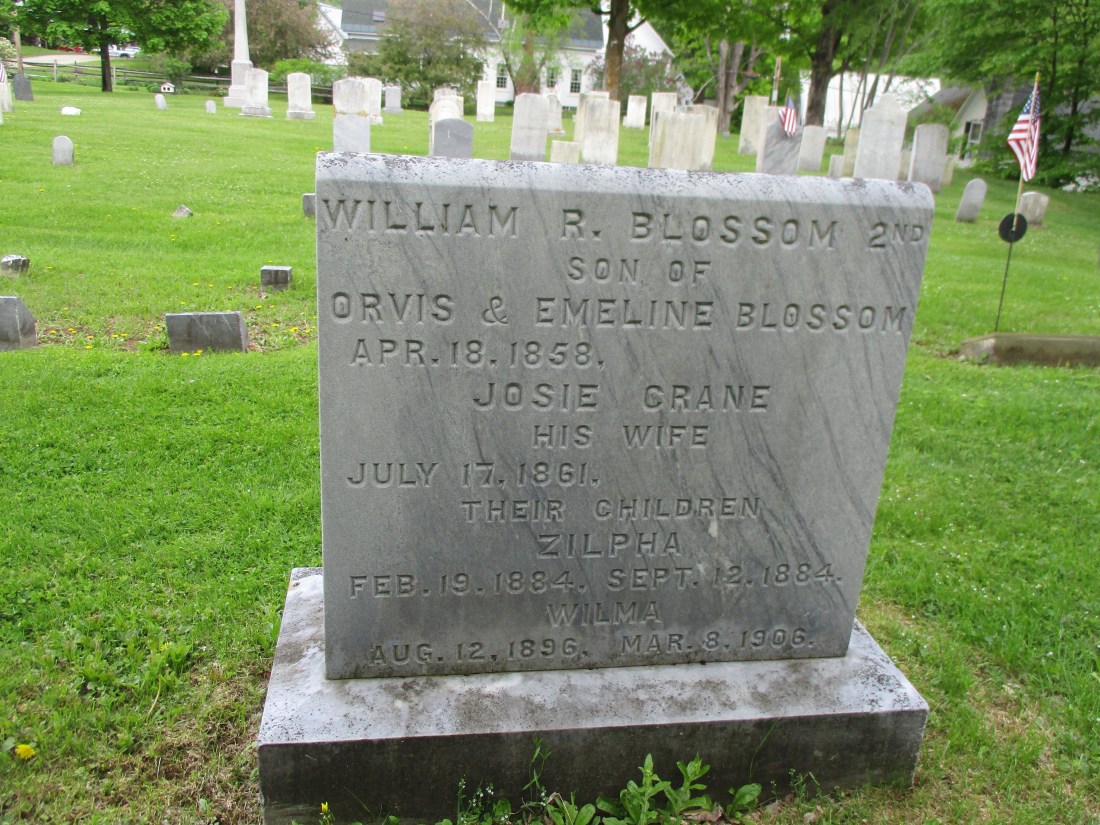
“An Heir to the Mesozoic” (1938) by Hazel Heald

I have a manuscript that almost beats yours. This is “In the Gulfs of N’Logh” by Hazel Heald. Besides that I’ve got an old poem of Lovecraft’s and another Hazel Heald story. The first story by Heald is composed of Thirty-two typewritten sheets.
—John Weir to Willis Conover, 16 Mar 1937, MSS. John Hay Library

In January 1937, H. P. Lovecraft recommended that John T. Weir solicit material for his new fanzine Fantasmagoria from several of his correspondents, and specifically mentioned his former revision client Hazel Heald, whom he knew had a couple of unpublished manuscripts still in her possession.

Hazel Heald responded by sending Weir two substantial manuscripts, “In the Gulf of N’Logh” and “An Heir of the Mesozoic.” While “In the Gulf of N’Logh” was too long for Weir to publish, he managed to split “An Heir of the Mesozoic” and publish it across two different issues—which, because of the vagaries of fan publishing, occurred a year after Heald had first submitted the story, and it was two years before the whole thing was published. So much time went by that Heald apparently became confused as to the details of the publication.

I have had several rejected tales I passed on to J. James Weird who is starting a new fan magazine. HPL advised me to keep myself in the public eye as much as possible.
—Hazel Heald to August Derleth, 31 May 1937, MSS. Wisconsin Historical Society

Several years ago a man wrote to me and said he would like some of my unpublished tales for a book he was going to publish, and though he did not pay for them, it would be good advertising. I did not regard them as worth printing, but he insisted. I even forgot his name and thought no more about it until I received a letter saying they would be printed soon. From that day to this I have heard nothing. Do you think he was trying to get plots for stories, and went about it in that way? I did not care anything about the tales as I have carbon copies somewhere, but it seemed like a strange request, didn’t it?
—Hazel Heald to August Derleth, 14 Oct 1944, MSS. Wisconsin Historical Society

Heald had written two letters to Weir asking about the publication in 1937, but she either never heard back or had forgotten this by 1944; it doesn’t seem likely she ever got a chance to see what would be her final story in print—and it has remained out of print since that publication, despite the fact that it was never copyrighted and has been in the public domain since Weir published it. While a few fans speculated that this might be a relatively unknown Lovecraft revision, the rarity of issues of Fantasmagoria prevented most from making any kind of judgment…until now.

The First Fandom Experience, whose outstanding publications include the Visual History of Science Fiction Fandom and facsimiles reproductions of the important early fanzines Science Fiction Digest and Fantasy Magazine were gracious enough to provide scans of “An Heir of the Mesozoic.” The scans have been uploaded to the Internet Archive and can be seen here. However, because the print quality of those early ‘zines was particularly poor, what follows before the review itself is a transcript of the text. A couple of sentences have become illegible over the decades of handling, but the bulk of the story is intact. Corrections and illegible portions are denoted by brackets [e.g].


An Heir of the Mesozoic
by Hazel Heald

[Part I]

“SoBurt gave you this measly little thing. Quite a gift from a former admirer, I’ll say!” and Warren Drake looked quizzically at the little creature, half crawling, half-swimming around in the large crystal bowl in the center of the table. “What does he think we want of a salamander?” and he gave vicious poke with his pencil at the saurian, which resulted in a vicious snap from the little jaws. His wife, Veronica, pall’d at his arm and looked at her husband in a half-pleading way.

“Now Warren, leave the poor little thing alone. It’s mine, and I’m NOT going to let you tantalize it. Take something your size instead of that poor little helpless thingsuch a mite” and she switched indignantly from the room leaving her husband in a puzzled frame of mind.

“Helpless, eh?” ejaculated Warren, watching the knife-like tail slash the water, the little snake-like head lifted, with its bright eyes staring into his vehemently. Why the creature seemed almost human! Giving a last look, he left the room to make peace with his wife; who was now [illegible] only two short years before, after much competition with Burt Strout for her affections. Burt had taken it rather hard at the time for it had been a toss-up between them, but finally Veronica had decided in Warren’s favor. When the day of the wedding arrived, Burt drew Warren aside for a few minutes of private conversation.

“Warren,” he said, “In a few minutes you and Veronica will be made one, but I warn you now I will never entirely give her up, even if it is only in my dreams. If it hadn’t been for you, I would have been the lucky man waiting at the altar. And I will always be waiting for herno matter how interminable the length of time. And when you turn up your toes for the last time, and the lily is placed on your breast, I won’t be shedding any crocodile tears. So you see, Warren, I’ve come clean, and am not hiding my true feelings from you. Be good to her or you’ll hear from me!” and Burt walked away, leaving a rather bewildered Warren.

Since then Veronica had received mysterious packages on special occasions like Christmas and Birthdays, but these always contained trivial gifts that could not be interpreted other wise than friendly offerings. Still it rather rankled in Warren’s consciousness and several rather bitter quarrels with Veronica had been the result. These, he felt, had been communicated to Burt in some wayit almost seemed as if a powerful wireless ran between their two selves. Perhaps he did say rather cruel and aggravating things to Veronica, but Nature had provided him with a rather vile temper, that when aroused, stopped at nothing. There was always a reconciliation and an aftermath to this weakness, but each was a little slower about coming about than the time before.

Burt had dropped in very frequently the first year of their married life, then his interest seemed to dwindle and his visits became rare indeed. but the last few months his lost interest had seemed to rekindle, only the night before he had brought the little dark brown specimen, half-lizard, half-frog, its only color being its spotted vermilion-red bellythus starting the unpleasantness.

All the next day Warren seemed haunted with a stron[g] intuition of impending evil, as if a vandal had entered his home. Why should a little creature like a salamander fill his thoughts, driving all of the serious perplexities of his office work from him? He would get rid of itaccidentally tip the bowl over, then his heel could do the rest. The sooner it was done the betterVeronica wouldn’t mistrust but what it was accidental. And she might get more attached to the thing as time went onthen it would be more difficult to exterminate it.

So Warren went home that night with a fixed purpose in his mind. Veronica did not meet him at the door as usual, which rather surprised him, but her contagious laughter floated out from the living room to his ears, then a low rumbling voice gave evidence of a visitor. Entering the room he beheld Veronica sitting in a wingback chair with Burt standing in back of her, his arms resting on the back of the chair, while they both were indulging in a heart laugh.

“Why, hello, WarrenRonnie and I were having a good laugh at your expense. So you didn’t like little Sally, did you? She’s like all the female of the speciesmore deadly than the male! But you’l like her in time, only don’t feed her too muchshe might grow!” and Burt glanced at Warren with a look hard to analyze.

“Don’t lose any sleep worrying about me, Burt. I guess I’ll live through it. But I don’t guarantee that ‘Sally’ will. No little runt of a lizard will bother me long. You and Veronica are having a great laugh about nothing. What if I do abhor slimy thingsthat’s my business, and that thing crawling over the house isn’t a pleasing spectacle. Gorman has a couple of them always getting outsometimes he find them crawling on his pillow, for he keeps them in a bowl on a stand near a bed. But you don’t catch me standing that” and Warren slumped into a chair viciously sweeping a gray tabby-cat from its depths.

“Oh, did I rub your fur the wrong way?” questioned Burt. “I didn’t know I was touching a sore spot. you must be getting old if you can’t stand a little kidding. Ronnie just told me how Sally snapped at you last night. Anyone would think that the little hing had you worried. Better leave her aloneshe might be a ticklish customer to handle if she returned to type” and Burt gave a knowing wink, that was returned with an icy stare.

“Say, you tow, stop that silly scrapping and come to dinner. It will be getting cold,” and Veronica lead the way to the dining-room. An uneventful evening followed, with much bandying of words between Burt and Warren, the former’s conversation seemed to run on a tantalizing string. After a late goodnight he left reluctantly.

“Whew, I’m glad that pest is gone,” said Warren drawing a long sigh of relief. “Two nights in succession is enough to provoke a saint. now I want you to just scrap that friendship with Bertjust forget he rushed you once. As for that salamanderthe sewer will be getting her soon” and he stamped off to bed, leaving irate Veronica to nurse her wrath.

The next morning he arose with an aching head[,] acid stomach, and a general rundown feeling. Even his usual cup of strong coffee did not help, and the sleeping Veronica was mute evidence of last night’s quarrel, for she was usually up bright and early to prepare the morning meal. Glancing up at him with half-closed eyes from its crystal palace, the little saurian lay, its paddling arms crooked at the elbows like a human’s, its four fingers spread fanwise, while the five-toed hind feet were waving gently to keep the small body afloat. Warren could not resist poking it, but drew his fingers away as the little jaws rose to the [illegible] had teeth?

Each night Warren ascertained to kill the loathsome creature, but something always prevented. When he would draw his chair toward the table to read by the table lamp he would feel the little snaky eyes looking at him from their glass prison until he was forced to turn his eyes in their direction. Then the baleful look he was forced meet seemed to hypnotize himuntil he was compelled to return to another room, or give up reading. Veronica would watch the scene with a knowing look but not offering any solution to his problem. Anyway, they weren’t too friendly these daysand she seemed to hover like a guardian angle over her pet. Confound the thingit must be some spawn of the devil! The vicious jabs aimed at the thing when she happened to be absent were many, but they never found their mark. One favorite was a long, old fashioned hat-pin, which he held like a spear, but it never seemed to reach its [mark]. Some daysome day when the little [illegible] saurian got a good puncture his life would become normal again.

At last he decided to ignore the thing entirely, to [f]orget its existence if possible. So for a fortnight he persistently avoided the table where the bowl rested, although he could feel the creature’s eyes boring like gimlets, trying to draw his own in their direction. Then it camethe shock that made his hair rise on his scalphis blood to run cold. On going past the table one night he looked into the crystal depths to find the saurian resting on a pile of rocks in one corner, its size being increased by one-half! It couldn’t be possibleVeronica must have been feeding it too many fliesor it was an optical illusion. Nothing could grow as swiftly as that in so short a time. But Veronica’s non-committal answers weren’t very enlighteningwell, women weren’t very observing anyway!

Heir 2

[Part II]

That night he studied the lizard-like creature under a strong magnifying class, although its repulsiveness jarred on his already shattered nerves. It returned his stares unflinchingly, raising its flat head above the surface of the water, its beady eyes looking into his unwaveringly, the red mouth opening from time to time as if to gnash the imaginary teeth of its ancestors, while the vermilion and black spots underneath glowed with an evil light. The tough skin seemed to be stretched to its greatest extent, and the length of the human-like arms and legs had increased. It seemed to be more vicious than evertrying to scale the slippery sides of the bowl to get at him.

For another week he kept away from the creature, for the sight of it repulsed and sickened him. Then one night at the dinner table Veronica startled him by saying, “Sally is beginning to cut her teeth. I wonder if they are milk teeth or wisdom? Burt thinks it’s a good joke!”

“Cutting teethwhat are you talking about! Who ever heard of a salamander with teethyou must be crazy!” and he rushed into the living-room to behold the object of their conversation asleep on his little rock-island. A sharp prod with his pencil made it come instantly to life, opening its jaws in anger at being disturbed, disclosing two little white points on each side of the upper jaw which were unmistakablyteeth! It had also increased in size during the weekits hide fairly bursting with the strain of extended capacity.

Veronica was right behind him, looking at his surprised discomfiture. “Wasn’t I right, big boy? And probably more teeth will come laterand see how she has grown. That food that Burt gave me to feed her must surely have its vitamins!” and she laughed gaily as she linked her arm into his, drawing him back to the dinner table.

After this it was a regular occurrence to be informed that “Sally has a new tooth” or “Sally got out today and I found her under your bed.” All there was to it he must get rid of the pest! One night Veronica went out to a nearby theater to see a special feature, but Warren pleaded a headache. Now was his chance while she was absent to fulfill his plans!

Stealing softly into the room he tip-toed over to the table without turning on a light. He must not awaken the thing for it might be dangerous with all of its mysterious teeth. The bowl seemed extra heavy as he staggered out to the kitchen where he had laid out the ice-pick, hammer and various other tools. The lights shining in from the street made a dim twilight in which to work. Somehow in his over-cautious haste the bowl slipped form his hands into the soapstone sink with a splintering crash, followed by the thrashing of its occupant. Warren’s heart stood stillwhy it sounded as though the thing weighed pounds! Rushing to the center of the room he pulled the electric light cord, but an empty click was the only result. Confound it all, someone must have removed the bulb to plug in the electric iron and forgotten to have put it back!

A dull splashing in the sink was followed by a sharp thud on the floor as some object it it with a resounding clatterthen a slithering sound on the smooth linoleum gave evidence that the thing was still alive. Warren ran half-stumbling, half-running into the living-room, feeling nervously in the dark for the light switchat last locating it with trembling fingers, but as before only an empty click was the result. From room to room he staggered, bumping into heavy furniture, scraping the skin from his tortured limbseach switch being found useless. What could have happened to all of the lights? Something was wrong somewhere. A hurried glance out of the window showed the streets in darkness. A short circuit somewhere must have suddenly plunged the city into darkness! The black devils of all evil seemed leagued with that slimy thing somewhere in the depths of his apartment.

Suddenly, a bright idea penetrated his fear-crazed mind. The creature couldn’t have followed him as far as the bedroom he now occupiedhe would just close the door and stay barricaded against its unpleasant presence. It might be inferior in intelligence and size, but those sharp teeth would not offer a pleasin[g] conclusion to his night’s adventure. And Veronica must never find out about thisshe would jeer at his cowardice. Sliding over to the door he shut it with a bang that vouched for its staying closed for some time, then locating the bed he tried to make himself as comfortable as possible in its depths, with both ears straining for the slightest sound.

Why had he tormented the little saurian as he had? But it had always seemed to taunt himits snaky eyes looking defiantly into his as if to draw him on. And to think of the size of the mammal-eating monsters it had descended from! Just lately he hadn’t bothered to even look at it. No knowing how big the creature was now. Anyway it gave a good thud when it landed, and that spelled danger with a capital “D”. And the bowl had seemed larger than usual. Good Heavens had it outgrown the other? This was no trifling matter, for it was unnatural for it to grow as it had. What could be the darn stuff that Burt gave Veronica to feed it? Well, that was an ideahe must inquire tomorrowthere was something fishy somewhere. And Veronica had such a fondness for the thingalmost silly at times. No, it couldn’t be any plot hatched between them although he had said he would never give her up. Strange words to tell a bridegroom! Had had seemed to drop around afternoons quite a bit latelybut anyway, he would take a few winks of sleep before Veronica came. The creature would not harm hershe petted it too much. As for absence of lightsshe would speak to him quickly enough when she arrived, for she was a regular child in the dark.

No sound broke the stillness, and presently Warren took off his shoes and crawled in to bed fully dressed. The thing wasn’t in the room or it would have been thrashing around before this after being so long out of water. Probably it was a lot of nonsense anyway to imagine it knew him from anyone else. But how could he explain about the shattered bowl to Veronica?? He could say he was giving it a fresh lot of waterthat would be the best explanation. It did not matter if he hadn’t done this beforethe always was a first time to everything. it was no use trying to carry out any murderous designs on the creature in the darknessit was a cinch it would get him first. As his nerves calmed down and the absolute silence of the place deadened his nerves, his eyelids drooped over aching eyeballs, and he was fast asleep.

How long he slept he did not know. Phantoms of the wildest sort flitted through his dreams, culminating in the leap of a monstrous gargoyle toward him as he lay trapped in a cave. When he started awake in a cold perspiration, some obscure instinct threw him into an attitude of intense and agonized listeningthough for what he could not tell. Finally he thought he heard a soundsomething like scraping of slippery feet over a polished floor. Before he could form a definite image his blood ran cold. Then he knew that this could mean only one thing. After allin spite of all his confidencethat accursed saurian must be in the room! The utter horror of his helplessness made him draw himself farther under the bedclothes, pulling the quilts over his head. He felt cowardly lying here like thisbut what could he do? A man couldn’t fight in the darkand surely the creature could not get on the bed. If he could only see to kill it. It must be nearly time for Veronicahe must stall it off until then.

He couldn’t have slept longbut these beastly Fall evenings were interminable! The air was becoming stiflinghe must get a few gasps, so cautiously removing his head from the covers he gulped it in filling his lungs in great sweepsbut both ears on the alert for any sound. A slight slithering sound near the window renewed his fearsthe thing was moving around in a blind search for him! Slowly, noiselessly, eh reached for one of his shoes he had place[d] on the bed near the footthen taking a careful aim he threw it in the direction of the weird sounds. A crashthen the sound of the thrashing of the thing as if in agony gave evidence that he hit his mark. At last the horrible sounds ceased, and Warren lay back on the bed, the beads of icy sweat making his forehead clammy and cold. He must have killed the thing after all! What a relief after this siege of horror! His hair would be white after this or he’d miss his guess! Now he would lie there until Veronica camethen the lighting system might be restored.

At last he dropped into a troubled sleep, filled with all sorts of prehistoric monsters, dancing in a circle around him, making his head swim with eternal whirlingtheir avid mouths full of long white teeththeir red tongues dripping with the blood of their victims. The circle was closing in on himthey were crushing his bones, sapping his consciousnesskilling him……………

He opened his eyes, the horror of his dream overwhelming himpulling the covers from his face for air. Then he screamed in terror as a snake-like head reared itself from a loathsome body that was lying full-length on hiseyes like gimle[t]s bored into his in the darkness, lit by a phosphorescent glowthe spicy odor of the saurian filling his nostrils with its loathsomeness. He tried to sit up, to throw the thing from his chest, but the evil jaws snapped at him, getting nearer and neare[r] to his throat. Its hot fetid breath fanned his face, the teeth gnashing in rage, while the blood that was flowing from its wounds, drenched the bedclothes.

His hands clawed at the thing[,] trying to pull it away, but the vicious jaws snapped at his index finger, sinking almost to the bone. The pain from the wound was terrific, he kicked, tore at the humanlike arms and fingers, and screamed desperately for helpbut it was useless. The red mouth at last found its mark, the sharp teeth tore at his throat, and windpipe and jugular vein were severed in the hideous gnawing that followed. Then in a spasm of demoniac rage, the little four-fingered hands ripped his staring eyes from their sockets, while the hind feet kicked at his chest till the flesh was a mere pulp of gory laceration. But the creature’s own wounds were gaining on it. The vindictive tearings grew feeblerand at last, with a human-like sob, the grotesque monster sprawled inerta lifeless lump of hideousness.

When the lights came on a frightful scene would have disclosed to any watchera scene in which a man and an abnormally overgrown lizard lay broken and blood-soaked in the grip of relentless death. But there was no one to watchfor hours passed before the hideous discovery was made. The papers dwelt on the horror but no inquest was thought necessary. Everything was so obvious.

But across the city, in a trim flat in Maple Street, the lights had revealed another scene as they flashed ona scene which might have interested many persons both official and unofficial. There were a man and a womanthe former cool and self-satisfied, the latter white and shaken. The man was coaching and reassuring the woman, and promising great happiness to repay her for something she was going through. He was telling her how superficial the notion of conscience is, and urging her not to be frightened by what she would sooner or later have to face. And he was carefully explaining the glandular extract which, fed to man or reptile, stimulates the processes of abnormal growth.

THE END


“An Heir to the Mesozoic” does not appear to be a lost Lovecraft revision. Perhaps he had seen and commented on it at some point, and perhaps even Heald had submitted it to Weird Tales or Amazing Stories and it had been turned down; both magazines have published material on about this level. It notably contains no reference to Lovecraft’s Mythos, but then neither did Heald’s “The Horror in the Burying Ground” (1937); however unlike that story, none of the personal or place names, or even any of the prose, seem to show any similarities to Lovecraft’s style.

The reference at the end to “glandular extract” marks this as a particular mode of early science fiction known as “gland stories,” based on biochemical discoveries about the effects of hormones on the body (which would lead, eventually, to the production of synthetic hormones, making everything from birth control pills to hormone replacement therapy possible. But in the 1920s and 30s, “glands” were also the domain of noted medical frauds such as Serge Voronoff, who grafted monkey testicles to male patients promising restored virility, and John R. Brinkley, who promised miraculous effects from grafting goat testicles. In the domain of science fiction, glands could achieve almost any effect. An example of such as story is “The Superman of Dr. Jukes” (Wonder Stories Nov 1931) by Francis Flagg, one of Lovecraft’s pulpster peers and correspondents.

Other than that, there’s not a lot else to say. Like “The Man of Stone” (1932), there is a romantic triangle at the heart of this story, and a supernatural/super-scientific resolution. If this was more typical of Heald’s output outside of Lovecraft’s influence, it might explain why she had difficulty getting acceptance in the pulps: the plot isn’t bad, but it is basic; the prose doesn’t exactly sing or grip the reader; and the weird-science angle is a bit weak…despite the title, the unknown reptile never really hits “Age of Reptiles” levels.

Even if “An Heir to the Mesozoic” isn’t a lost Lovecraftian classic, it is still a rare weird story from one of Lovecraft’s revision clients. For those who wonder whether Hazel Heald could write, or what she would write outside of Lovecraft’s revision or ghostwriting—well, here we have an answer to that.


Bobby Derie is the author of Weird Talers: Essays on Robert E. Howard & Others (2019) and Sex and the Cthulhu Mythos (2014).
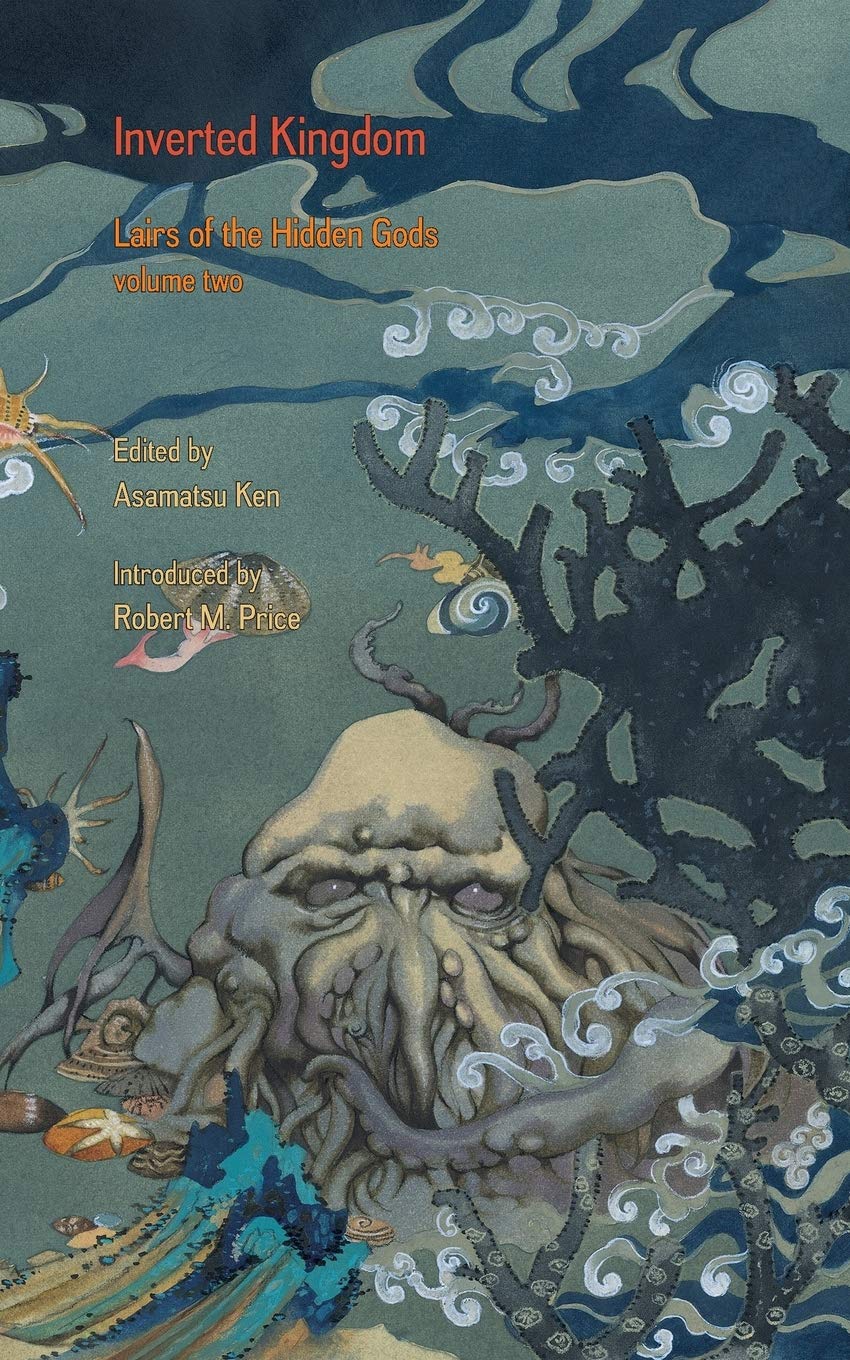
Winter Tide (2017) by Ruthanna Emrys

After I wrote “The Litany of Earth,” I thought I was done. I’d said what I needed to about Lovecraft and being a monster; it was time to move on. When people started asking for more, I figured it was just a nice way of saying “I liked it.” But the requests kept coming, and I started explaining to anyone who’d listen why the story didn’t need a sequel.

My second thanks, therefore, are to everyone who pushed for more of Aphra’s story until I talked myself around and figured out what else I had to say.
—Ruthanna Emrys, “Acknowledgements” in Winter Tide (2017) 363

A Cthulhu Mythos novel is difficult to write. The very first was August Derleth’s The Lurker at the Threshold (1945); others followed, such as Brian Lumley’s Beneath the Moors (1974) and Robert Bloch’s Strange Eons (1978). Most of these early Mythos novels face the same problems and criticisms: the difficulty of maintaining a Lovecraftian narrative and atmosphere at length, and an over-reliance on Mythos tie-ins. They were basically very long pastiches, and not always good pastiche. The little tie-ins which readers thrill in during a short story can become overburdening if dwelt on at length, or if the entire story’s plot serves no other purpose than to expand on connections between parts of the Mythos. While Lovecraft could sometimes inundate readers with references, it was usually fairly brief and never to the detriment of the plot of the story he was telling. The reference to Innsmouth in “The Thing on the Doorstep,” for example, is a reference that would thrill readers of “The Shadow over Innsmouth,” but Lovecraft doesn’t focus on the connection, or even explain it.

Ruthanna Emrys’ “The Litany of Earth” is admirably self-contained in that way. While Aphra Marsh retells some of the events of “The Shadow over Innsmouth” in her own words, the story is not just a retelling and commentary of Lovecraft’s story, but focuses on Aphra’s life after that tragedy. Coping and rebuilding, forming bonds and friendship, learning and learning to deal with accumulated trauma, trust issues, etc. The close of the story doesn’t cease Aphra’s narrative—she’s still alive—but neither does it beg for or immediately suggest a sequel.

Looking back at “The Litany of Earth” and Winter Tide in hindsight, it is easier to see how Emrys got from one to the other. The novel takes advantage of its length to explore a few of the themes of “Litany” in greater depth, and following that thread Aphra and her companions return to Lovecraft Country in Massachusetts, picking up on some of the wider connections between “The Shadow over Innsmouth” and the Mythos. Some of these work better than others; Pickman Sanitarium is basically an Easter egg, the Cthäat Aquadingen (originally created by Brian Lumley in “The Cyprus Shell”) a wink and a nod. The regurgitation of endless Mythos titles is the kind of thing that feels like running a finger down the laundry-list of tomes in the Call of Cthulhu Roleplaying Game; the little Mythos details are generally at their best when being creative (salt-cakes!)

While Emrys’ novel definitely isn’t pastiche, the over-reliance of tie-ins does drag a little; Miskatonic University in this incarnation looks a lot more like Ex Libris Miskatonici (1993) by Joan C. Stanley in the sheer density and scale of the occult shenanigans. More annoyingly because some of the details given don’t line up, but without any real explanation. The founders of Innsmouth, for example, are alleged in the novel to have come from England rather than Oceania, and for reasons unspecified apparently the Deep Ones don’t have any communities off the West Coast of the United States. There might be good narrative reasons for this, but without some hint it feels like a misstep rather than a deliberate authorial choice. Those pedantic niggles are relatively rare, and not necessarily bad. For example, the Hall School for girls which Lovecraft mentioned in “The Thing on the Doorstep” is transformed into a women’s college affiliate with Miskatonic University in Winter Tide.

The issue of plot and atmosphere are different for Winter Tide than the early Mythos novels. “The Litany of Earth” never made any attempt to copy Lovecraft’s atmosphere;  Emrys has her own voice and is comfortable with it. Aphra and the other main characters are essentially already initiates into the Mythos, or become initiated quickly, so there is a lot less peeling-back-the-onion…which is fine, except that nominally the A plot is a Cold War occult spy thriller (“cloak & enchanted dagger,” or maybe “cloak & tentacle”) a la Charles Stross’ The Atrocity Archives and “A Colder War,” Tim Powers’ Declare, or even the Delta Green Roleplaying Game, and that plot goes…essentially nowhere. Most of the book, and thus most of the interest in the novel, relies entirely on the drama generated by the interactions between the slowly expanding cast of characters.

The expansion of the cast seems less organic than it should be. While admirably diverse for a Mythos novel in terms of gender, race/ethnicity, and sexual orientation, the cast is bigger than it needs to be and some of the relationships feel forced. One of the characters from “Litany” is revealed as homosexual, for example, but there’s no build-up to the revelation and ultimately no real impact on the narrative. While Emrys is keenly aware of the discrimination that various characters are subject to in the 1940s United States of America for being some combination of women, homosexual, African-American, Japanese, Jewish, and/or an Innsmouth hybrid and doesn’t shy away from how bad the “good old days” could be if you weren’t a white, Anglo-Saxon Protestant, she can’t give equal attention to every single character’s experience and not all of those characters have an equal contribution to the nominal plot.

The opposition to Aphra & her group are basically heterosexual white people—whether privileged Miskatonic students, sexist and sexually abusive male university professors, or racist and sexist FBI agents. The characterization isn’t inaccurate to the time period (and it is the rampant bigotry, spoken and unspoken, which unites the group of outsiders in common cause), but it does get to be a little frustrating when pretty much every single one of them refuses to learn absolutely anything from the mistakes that leave a trail of bodies and ruined lives in their wake. Maybe that’s deliberate, but it still feels like there could have been room for more nuance—or, at least, that there would have been some small moral victory in getting at least one them to step out of their headspace of thinking they know better than everyone else, or of being self-righteous about it.

Where “Litany of Earth” doesn’t demand a sequel, readers might wonder what the point of Winter Tide is. Mostly, it serves to drag Aphra back to Innsmouth, the prodigal daughter returning home to reconnect with and face the demands of her family. Many Mythos stories have focused on issues of reproduction, from Lovecraft’s miscegenation theme in “The Shadow over Innsmouth” to miscarriage and infertility (“In His Daughter’s Darkling Womb” (1997) by Tina L. Jens), arranged marriages and unwanted pregnancies (“Mail Order Bride” (1999) by Ann K. Schwader), to rape leading to pregnancy (“The Thing from Lover’s Lane” (1996) by Nancy A. Collins), to spousal abuse (“A Coven in Essex County” (2016) by J. M. Yales), but this is one that addresses an issue both perennial and very current: family expectations to have kids, and the right to choose not to have a child.

This could honestly have been the theme of the novel in many ways; a way of confronting past and future at once…but it feels like a B-plot that is, if not completely resolved, at least resolved way too quickly. There are good reasons why Aphra (or any woman) might want to have a child and not want to have a child; replace an aging parent with an immortal, fully-transformed Deep One asking when and how you’re going to spawn and suggesting suitable mates from your immediate pool of friends is something that could be played up for both horror and laughs. Yet for a decision that doesn’t have to be made right away, it’s one that Aphra caves to after a bare minimum of self-reflection. Aphra isn’t the only one subject to this expectation—at least two or three other characters are in analogous positions, even if not all of their family have gills—and Emrys could have played with the comparison of situations a bit more there, but chose not to.

Winter Tide is definitely a better written novel than The Lurker at the Threshold or Strange Eons; the characters are deeper, the interactions better, many of the embellishments on the Mythos more creative. From a Mythos perspective, it feels like it draws too much from the roleplaying game side of things; as a dramatic novel, it feels like it has too many characters and doesn’t do enough with those that are there. In comparison with “The Litany of Earth,” Winter Tide definitely doesn’t have the same focus; Emrys already made her point about providing an alternate take on “The Shadow over Innsmouth,” and there’s no need to rehash it here—but neither does Emrys have quite the same twist or insight to offer on Miskatonic-focused stories like “The Thing on the Doorstep” and The Shadow Out of Time.

The marketing for this novel refers to it as part of the “Innsmouth Legacy” series—and it really is the focus on the bits and piece of Innsmouth culture, material and otherwise, that survive which are the best “Mythos” parts of the novel. The references to “The Mound” (1940) by Zealia Bishop & H. P. Lovecraft are less interesting and relevant than the pieces of Innsmouth gold we see, and the meaning that they represent; the depictions of the gods (including “Shub-Nigaroth” as a substitute for “Shub-Niggurath,” probably to avoid any perceived issues with etymology); an origin story for the Deep Ones; the reference to how Innsmouth had few graveyards and that the dates on the stones were relatively young (stillbirths and childhood illnesses & accidents)…these are all good details. The kind of world-building which the book could have used more of, or have focused more on.

 It’s a great story and a seamless subversion of Lovecraft’s most repellent views while simultaneously being a tribute to his greatest accomplishments.
—Carrie S., review of Winter Tide on Smart Bitches, Trashy Books (26 May 2017)

Is Winter Tide actually subverting Lovecraft? This is a question that applies to many books published around the same time which dealt with issues of race, prejudice, and the Mythos, including Lovecraft Country (2016) by Matt Ruff and “The Ballad of Black Tom” (2016) by Victor LaValle. It’s not an easy question to answer. 1949 is a different world than the one Lovecraft left in 1937, or wrote about when “The Shadow over Innsmouth” in 1931. Lovecraft himself was racist, to the point of bigotry, he was homophobic, antisemitic, and anti-immigrant; how much of that made it into “The Shadow over Innsmouth” and “The Thing on the Doorstep?”

The fantasy racism with regards to Innsmouth in Lovecraft’s fiction is inspired by the real-life racial discrimination of the United States in the 1930s, but in Lovecraft’s stories it is very specifically so much weirder than “normal” racism that the prejudices of the surrounding towns is the red herring. Unlike Winter Tide, no one in Lovecraft’s stories suspects what the people of Innsmouth actually are. That is what makes Lovecraft’s Innsmouth narrative so sensational…and what makes it so difficult to subvert.

Is it a subversion if the Deep Ones are sympathetic and not actively evil? Is it a subversion to tell a story from the perspective of a Deep One? Or to have a protagonist who openly embraces various characters without discriminating about them based on gender, sexuality, race, or religion? Not rhetorical questions; Ruthanna Emrys doesn’t carry forward many of Lovecraft’s prejudices, but neither does she invert all of them.

“The Innsmouth Legacy” is more inclusive than Lovecraft’s Mythos, but it can’t negate or even really address the substance of race and discrimination that informed Lovecraft’s writing. Or to put it another way, Winter Tide does not exist to deconstruct the ideas of race & the Cthulhu Mythos. Emrys works to turn Lovecraft’s ideas to her own usage, but in doing so never really questions the underlying fundamentals of some of those ideas—the Deep Ones (“Children of Water”) and K’n-yans (“Children of Earth”) are in several respects fundamentally different from “normal humans” (“Children of Air”), and Lovecraft’s depictions of them are treated as broadly accurate, if not universal—and they could not be otherwise, for the characters to be as they are, or the narrative to play out as it does.

In the review for “The Litany of Earth,” it was noted to make Deep Ones just a nigh-immortal, magically adept subspecies of humanity is to basically turn them into ugly versions of Tolkien’s elves. To extend a tortured metaphor, the depiction of the inhabitants of K’n-yan is basically a version of the Drow from Dungeons & Dragons. While they don’t have dark skin pigmentation, the K’n-yans are a magically adept subspecies of humanity, but one which is seen as (perhaps genetically) evil, insane, and sadistic; they are shunned by other intelligent peoples and subject to pejorative epithets (“dustblood”) and wariness, if not outright discrimination. The discovery of K’n-yan heritage fundamentally changes how a character views herself, and how she is viewed by an interacts with the other characters; this isn’t an ancestry test where the character is pleasantly surprised to see an unexpected result giving them a genetic tie that didn’t know about…and unlike at the end of “The Shadow over Innsmouth,” acceptance of this unusual heritage does not equal any kind of promise of glorious transfiguration.

Which does not make Winter Tide in any sense a bad novel; a Dungeons & Dragons novel can be fine fantasy without working to subvert everything J. R. R. Tolkien wrote about elves. A book can be fresh and well-written without necessarily being revolutionary. Part of the point of a Cthulhu Mythos novel is to build on what has gone before—and add to it. Ruthanna Emrys has certainly done that.

Winter Tide was published in 2017; the Innsmouth Legacy series would continue with a sequel novel Deep Roots in 2019.


Bobby Derie is the author of Weird Talers: Essays on Robert E. Howard & Others (2019) and Sex and the Cthulhu Mythos (2014).