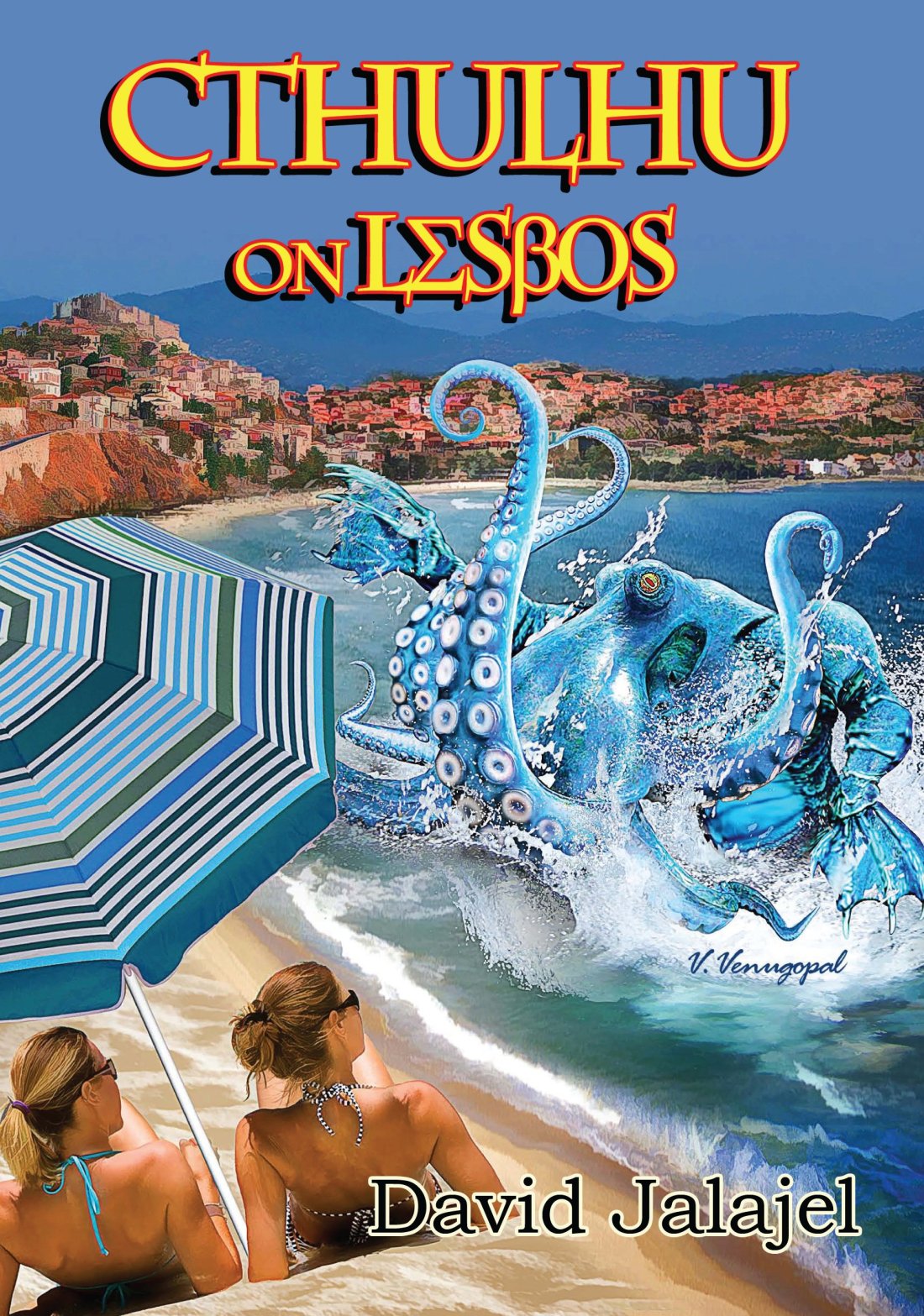
Cthulhu on Lesbos (2011) by David Jalajel

The professor had been stricken whilst returning from the Newport boat; falling suddenly, as witnesses said, after having been jostled by a nautical-looking negro who had come from one of the queer dark courts on the precipitous hillside which formed a short cut from the waterfront to the deceased’s home in Williams Street. Physicians were unable to find any visible disorder, but concluded after perplexed debate that some obscure lesion of the heart, induced by the brisk ascent of so steep a hill by so elderly a man, was responsible for the end.
—H. P. Lovecraft, “The Call of Cthulhu”

Jostled negro come from of queer on hillside
Formed a short from waterfront home in Williams
Street. Physicians find but concluded after
Lesion of heart, by
—David Jalajel, Cthulhu on Lesbos 10

The earliest contributors of the Cthulhu Mythos were poets—H. P. Lovecraft, Clark Ashton Smith, Robert E. Howard, August Derleth, Frank Belknap Long, Jr., R. H. Barlow, etc. all composed verse, of various types and quality. Weird Tales was more accepting of poetry than some of the other pulps, and the poetic sensibilities of the authors often found expression in the fiction itself, through Lovecraft’s curious couplet or Howard’s fictional poet Justin Geoffrey and his lines in “The Black Stone.”

This tradition was basically immediately continued by fans, from “Shadow Over Innsmouth” (1942) by Virginia Anderson & “The Woods of Averoigne” (1934) by Grace Stillman to “Yig Country” (1993) by Ann K. Schwader and “Cthulhu Sex (ahem!)—a poem—” (1998) by Katherine Morel. Yet some poets aren’t content to stick to strictly traditional approaches. Some of them get downright experimental.

David Jalajel’s basic conceit in Cthulhu on Lesbos is pretty simple: he has taken the text of H. P. Lovecraft’s “The Call of Cthulhu” and chopped it up into a series of Sapphic stanzas, so named for Sappho of Lesbos, arguably the most famous Greek woman poet in history, whose legend gave rise to the terms sapphic and Lesbian in reference to female homosexuality. More than this, Jalajel has subtly shifted the meaning of the text with certain insertions ([Lesbos], always in brackets) and erasures (“queer,” “Negro,” and “Chinamen.”)

Sailing for London, I reëmbarked at once for the Norwegian capital; and one autumn day landed at the trim wharves in the shadow of the Egeberg. Johansen’s address, I discovered, lay in the Old Town of King Harold Haardrada, which kept alive the name of Oslo during all the centuries that the greater city masqueraded as “Christiana”. I made the brief trip by taxicab, and knocked with palpitant heart at the door of a neat and ancient building with plastered front.
—H. P. Lovecraft, “The Call of Cthulhu”

Sailing [Lesbos], one and at trim in shadow
Lay in Old Town King which alive the name of
[Lesbos] during all that greater city
Made the by knocked with
—David Jalajel, Cthulhu on Lesbos 46

The result is a weirdly altered narrative, one that transposes the action to the Greek island of Lesbos, but also tackles, subtly, an emphasis on issues of race and sexuality, simply by both highlighting and removing instances of “queer,” “Chinamen,” and “Negro” in the text. It makes for a challenging, disjointed read; sentences don’t resolve neatly at the end of stanzas, words rush together, disconnected and out of place, a paragraph whittled down to four broken lines…yet there is a bit of craft and art to how this is done, just as a collage has a certain aesthetic and order to what might otherwise be indecipherable fragments.

The premise and the technique are perhaps a bit more interesting than the result, for most Mythos fans. Those hoping for a homoerotic re-interpretation of Lovecraft will be disappointed. What jumps out upon a reading of the text is, shorn of context, the sheer poetic choice of phrase that Lovecraft employed in the story. His training as a poet always shown through in his fiction, but in this text, eroded as a stone on a Lesbian beach, select phrases stand out as particularly evocative and capturing and communicating the mood of the story.

Slowly, amidst the distorted horrors of that indescribable scene, she began to churn the lethal waters; whilst on the masonry of that charnel shore that was not of earth the titan Thing from the stars slavered and gibbered like Polypheme cursing the fleeing ship of Odysseus. Then, bolder than the storied Cyclops, great Cthulhu slid greasily into the water and began to pursue with vast wave-raising strokes of cosmic potency. Briden looked back and went mad, laughing shrilly as he kept on laughing at intervals till death found him one night in the cabin whilst Johansen was wandering deliriously.
—H. P. Lovecraft, “The Call of Cthulhu”

Shore that earth the titan from stars and gibbered
Cursing fleeing ship of hen, bolder storied
Cyclops, great Cthulhu the water vast strokes
Cosmic and laughing 
—David Jalajel, Cthulhu on Lesbos 52 


Bobby Derie is the author of Weird Talers: Essays on Robert E. Howard & Others (2019) and Sex and the Cthulhu Mythos (2014).
“The Tale of Toad Loop” (1998) by Stanley C. Sargent

When I first began writing weird fiction, just under a decade ago, I never expected any of my stories would see print. I wrote tales that I, as a reader, would like to read but could rarely find.
—Stanley C. Sargent, “Author’s Preface” in Ancient Exhumations +2 (2004) x

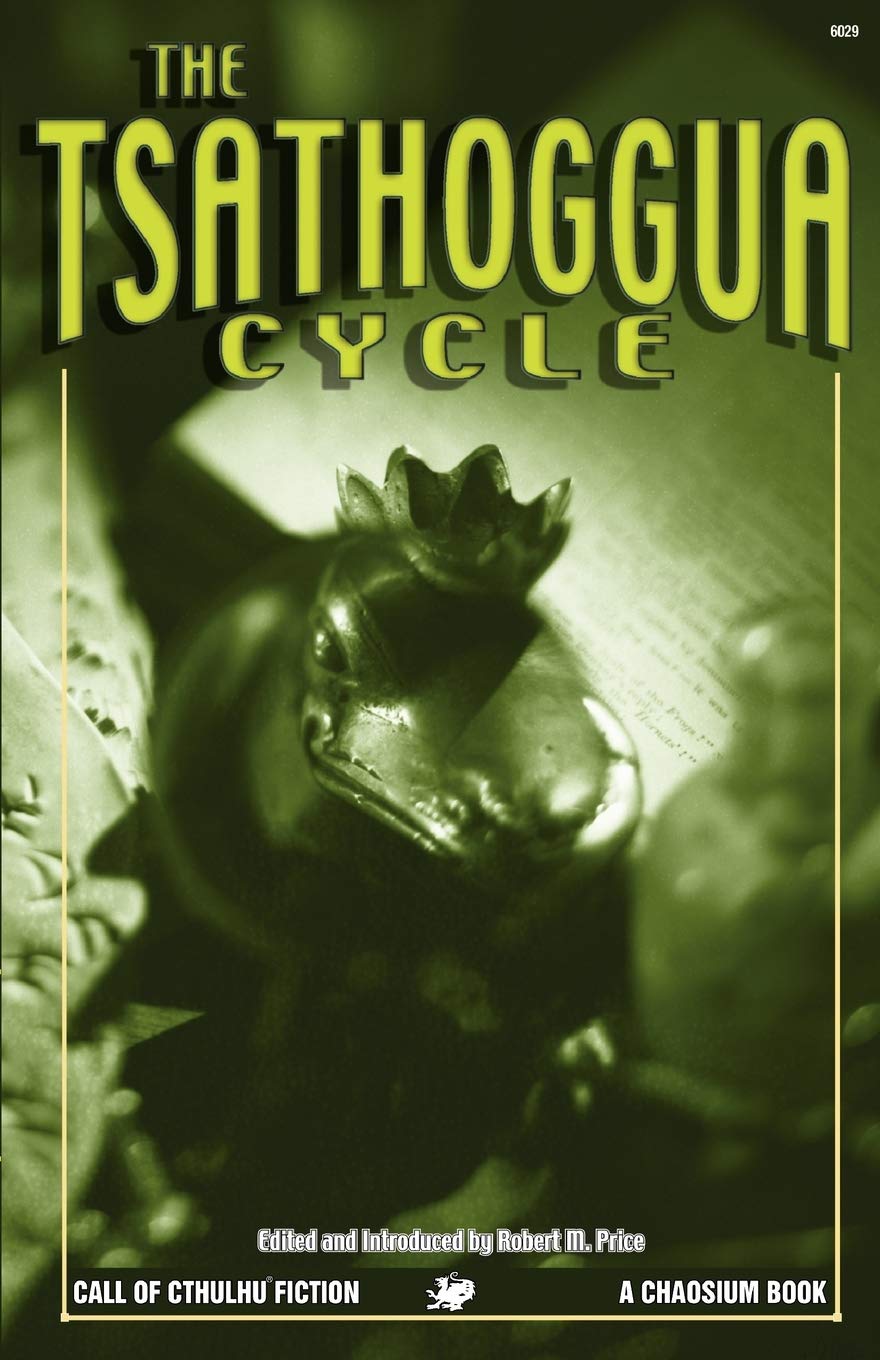
“The Tale of Toad Loop” is one of Sargent’s most-reprinted tales. It was first published online in the webzine Nightscapes (January 1998), and later that year in the print magazine Dark Legacy (August 1988). It featured in his first collection of stories, Ancient Exhumations (1999), and its slightly expanded sequel Ancient Exhumations+2 (2004). The anthology Eldritch Blue: Love & Sex in the Cthulhu Mythos (2004) reprinted it, and the year after that it appeared in The Tsathoggua Cycle: Terror Tales of the Toad God (2005).

The relative success of the story in the early 2000s, and the reason why it’s been mostly forgotten by editors since is fairly straightforward: “The Tale of Toad Loop” might be the quintessential Mythos pastiche.

Which is not in any way a negative criticism. The story is not poorly written, it does not focus solely on the surface aspects of Mythos fiction, makes no effort to ape Lovecraft’s style, nor does it overload the reader with dozens of references to other stories. It is not bad pastiche. Yet it is also recognizable as a work in a distinct tradition, in a certain style, in imitation of what has come before.

“Toad Loop” owes its existence to “The Shadow over Innsmouth” and “The Dunwich Horror” by H. P. Lovecraft, August Derleth’s novel The Lurker at the Threshold (or at least, the fragment “The Round Tower” by Lovecraft which Derleth incorporated into the story), and through that snippet Clark Ashton Smith’s Tsathoggua. It has a style reminiscent of Derleth’s “The Shuttered Room” or “Witches’ Hollow,” the idea of carving out a new corner of the Mythos with connections to the old familiar stories. Familiar themes in unfamiliar places. Old wine in new bottles.

When read in the context of those stories, “The Tale of Toad Loop” stands out as perfectly competent and of a piece with those works. It fits into the Mythos neatly as a lost puzzle piece, lending a slightly new outline to the picture. Sargent is not an eager fanboy expounding some pet theory of the Mythos. The prose is slightly more explicit than Lovecraft or Derleth would have used in terms of language, gore, and sexuality, but otherwise it has the same feel of a piece that was written in those decades between the death of Lovecraft in 1937 and the first non-Arkham House Cthulhu Mythos anthology, The Disciples of Cthulhu, in 1976.

Tastes change.

Like “The Devil’s Hop Yard” (1978) by Richard Lupoff, Sargent’s story is essentially a rehash of a familiar Mythos narrative: a rural locale, a sorcerer that is a little too successful at summoning, a young woman who ends up conceiving the inconceivable. In this case, Pritchy Kwik stands in for Lavinia Whateley, and is given even less agency—not even a line of dialogue—and there are a few other criticisms that might be leveled against the plot:

The Injuns claimed the Circle was built for some kind of unearthly critter that come down from the sky on occasion. Toadaggwa, they called it, sayin’ it put the stones to questionable uses at certain times of the year. Truth is, they were scared shitless of the place without really knowing why. They gave the Loop the widest possible berth, swearin’ the stones were the works of demons here long before any of the tribes. None of the whites confessed to belief in such savage superstitions, yet we all steered clear of the Loop just like the redskins did.
—Stanley C. Sargent, “The Tale of Toad Loop” in Ancient Exhumations +2 (2004) 109-110

It is weird to think about writing “Injuns” and “redskins” in the 1990s. Rationally, Sargent was trying to keep within the vocabulary and viewpoint of a rustic yokel in Madland County (based on southern Ohio), at some unspecified date (references to “Captain Marsh” of Innsmouth suggests the 1850s). It is the kind of reference that wouldn’t have raised an eyebrow for decades in the United States…but cultural syntax shifts. Would an editor let “Injuns” pass today?

In the broader context of the story, this is an incidental detail. Yet it is symptomatic of the issue for the story as a whole. “The Tale of Toad Loop” is a perfectly competent little tale, but it broaches no new ground, not in the characterization, or the storytelling style. It is a variation on a very familiar theme, but the theme is too familiar, and while there’s a twist in the end and the framing, it doesn’t stand out as particularly genius or original in the sense of Sargent’s “The Black Brat of Dunwich” (1997).

While “The Tale of Toad Loop” more or less fits in Eldritch Blue, it would feel old-fashioned and out of place in Cthulhurotica or Conqueror Womb: Lusty Tales of Shub-Niggurath. There are any number of tales of cosmic miscegenation in the Mythos already; it is hard to see what Sargent adds to the subject that is new, novel, revolutionary, or thrilling in that particular. Neither the sex nor the gore rises to the level of notability in a market with extreme horror, erotic horror, and splatterpunk. It is hard to judge the shift in the tastes of consumers of Mythos fiction, but it is usually excellence of ideas as much as excellence of prose that makes tales stand out, and “The Tale of Toad Loop” may be doomed to future obscurity simply because it was too successful at being excellent pastiche of an older style of Mythos fiction which has largely fallen out of fashion.

It is worth pointing out that “The Tale of Toad Loop” is not exemplary of all of Sargent’s fiction. He was a creative and capable writer who experimented with style and subject, continuing to grow and develop throughout his literary career. “The Black Brat of Dunwich” (1997) and “The Insider” (1998) are both good stories that still deserve to be read.

Readers interested in determining for themselves whether Sargent’s style is out of step with the current vogue of Mythos fiction, the story may be read for free at Nightscapes.


Bobby Derie is the author of Weird Talers: Essays on Robert E. Howard & Others (2019) and Sex and the Cthulhu Mythos (2014).
“Massacre à Miskatonic High School” (2008) by Jean-Jacques Dzialowski & Dimitri Fogolin

Depuis la nuit des temps,
Des dieux noirs corrompent notre monde.
Ce sont les Grands Anciens.

La folie est leur visage.
L’horreur est leur royaume.
Leur éveil approache…
Since the dawn of time,
The dark gods corrupt our world.
These are the Old Ones.

Madness is their face.
Horror is their kingdom.
Their awakening approaches…
Back cover, Les Mondes de Lovecraft

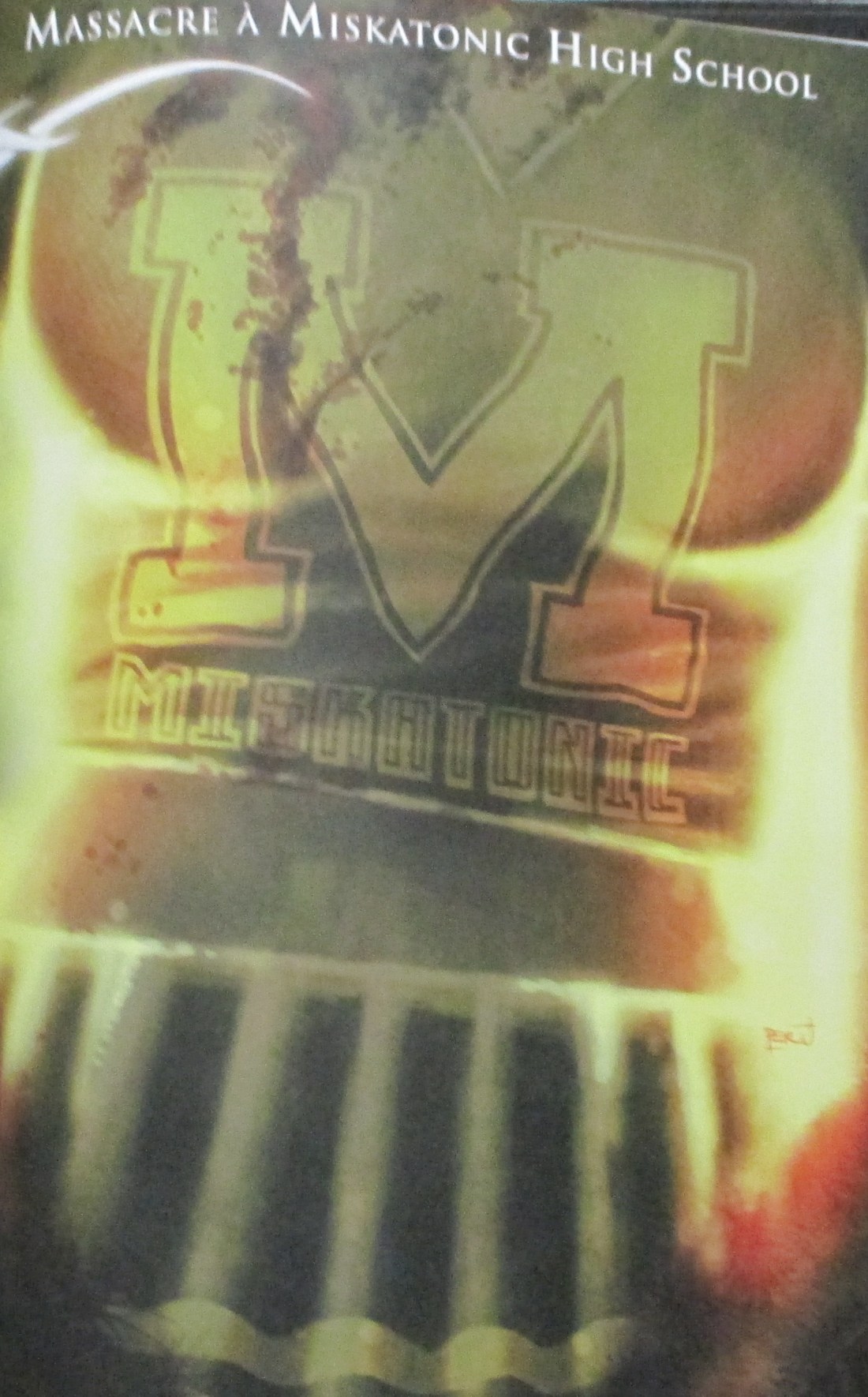
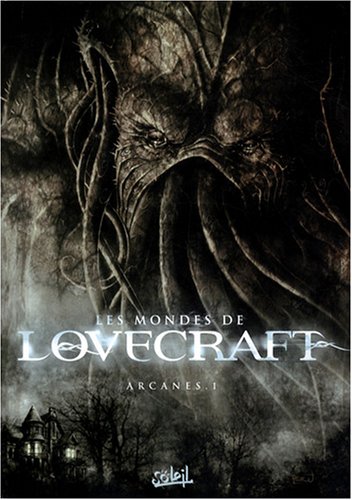
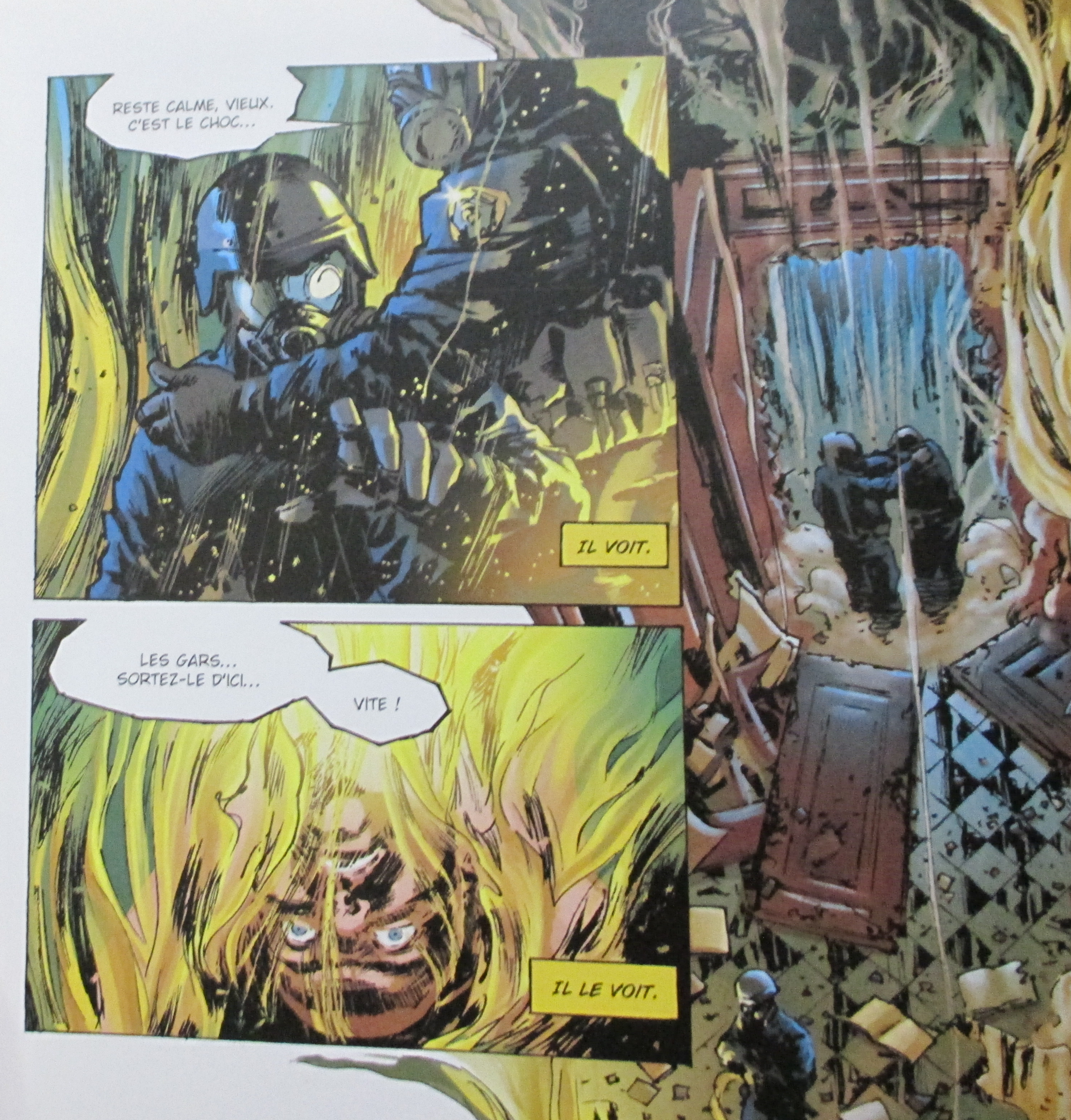
MondesLes Mondes de Lovecraft (“The Worlds of Lovecraft,” 2008, Soleil) is a standalone French-language comic anthology of stories set in the world of H. P. Lovecraft, including an adaptation of Lovecraft’s “Dagon.” Two of the stories in the book are the work of Jean-Jacques Dzialowski (writer) & Dimitri Fogolin (artist): “Le Signe sans Nom” (“The Nameless Sign”) and “Massacre à Miskatonic High School” (“Miskatonic High School Massacre”). The two works are complementary, in that they tell different sides of the same story from different perspectives. “Le Signe sans Nom” is given after-the-fact, during the deposition of a Sergeant McDermot, who responded to the events at Miskatonic High. “Massacre à Miskatonic High School” on the other hand gives the perspective of the school shooters. 


IMG_2591

The 1999 Columbine High School Massacre casts a long shadow over culture and pop culture alike. The media blitz helped to inspire numerous copycats; partisan politicians and pundits in the United States tend to quickly politicize shootings to minimize arguments over gun ownership as happened in the aftermath of the 2012 Sandy Hook Elementary School Shootings. Comic books have rarely touched on such controversial and emotionally-charged territory; DC Comics notoriously cancelled the Hellblazer story “Shoot” by Warren Ellis, Phil Jimenez, and Andy Lanning in 1999 over concerns of backlash.

At the bottom of most coverage of such shootings is one question: Why did they do it? What drove these kids to kill other kids?

Real-world causes are complex: psychological issues, a disturbed home life, access to firearms are all contributing factors. In the worlds of H. P. Lovecraft however…it’s rather simple.

They want the books.

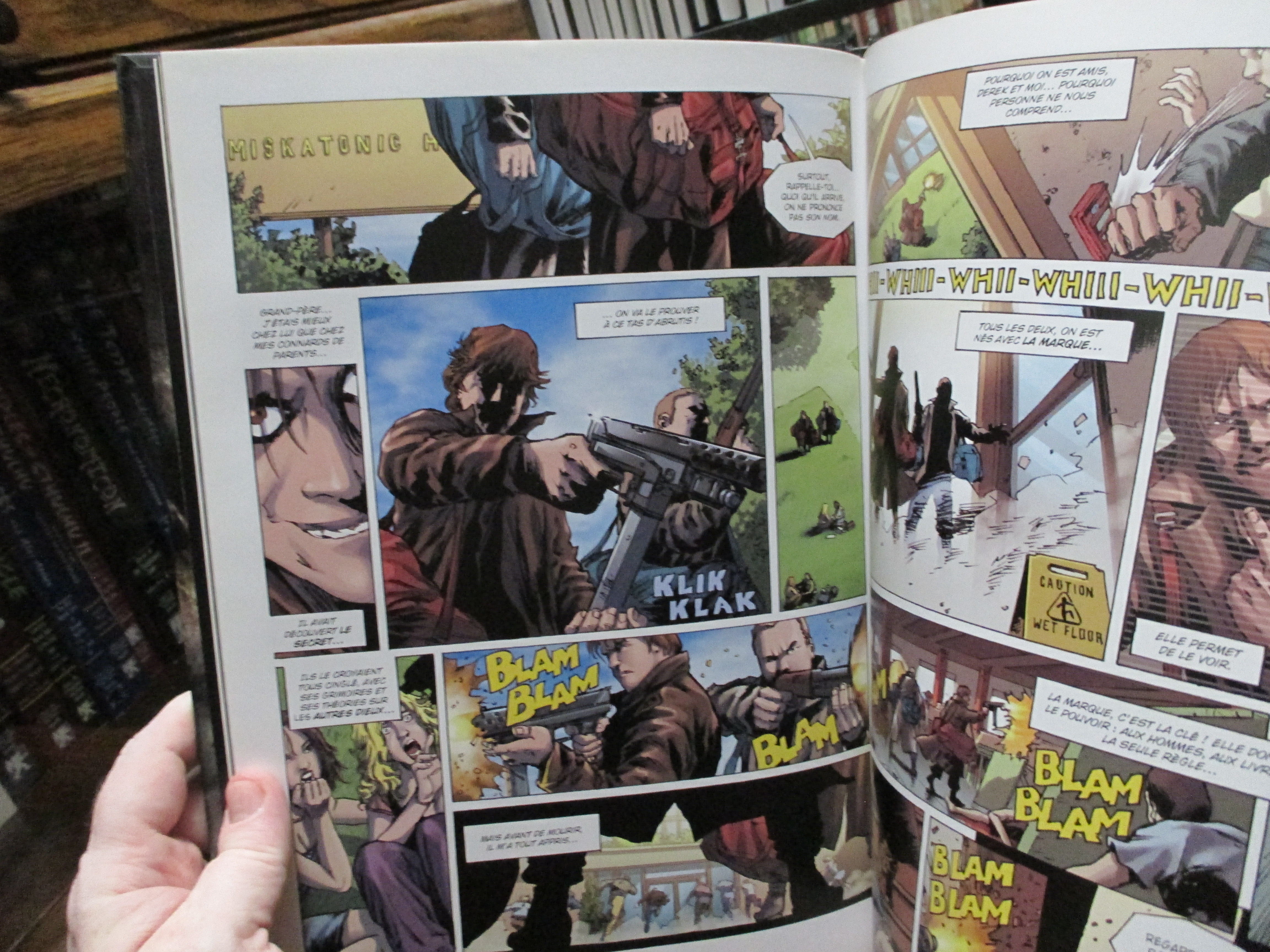
Toute sa vie, grand-père a cherché les livres. Il en avait trouvé certains et il m’a laissé plein de notes…

All his life, grandfather searched for books. He had found some and he left me lots of notes …

In real life, the two Columbine Massacre shooters committed suicide in the library. In this Miskatonic Massacre, Dzialowski and Fogolin have something similar happen, but for very different reasons. Taking a page from Lovecraft’s “The Dunwich Horror,” the two shooters want access to the ancient tomes contained (somewhat inexplicably) in the Miskatonic High School library.

“Massacre à Miskatonic High School” is nine pages; “Le Signe sans Nom” is eight. The two works should really be considered as parts of the same story, and being parallel narratives, they have visual and textual echoes and references to one another—the final panels are largely identical. Fogolin, however, approaches each story separately. “Le Signe sans Nom” is darker, with more blacks, greys, and blues, while “Massacre” is brighter, dominated by yellows and greens—appropriate enough given the prominence of Hastur in this chapter of the story. The layouts for both stories also start the same: a regular nine-panel grid, which breaks down in the subsequent pages.

Given the subject matter, there is a certain amount of commendable reticence to show too much. We see bullets, blood, dead bodies, but we don’t actually see anyone get shot on the page, in close up or detail. Readers can be appalled at what is happening without seeing every last bullet hole or shard of bone. At the same time, this gloss of violence and the digital coloring lends a certain muddiness to the compositions; one wonders how it would have been different if Jacen Burrows or Raulo Cáceres might have handled the same material.

IMG_2600

Lovecraft never quite tackled such a mundane horror as a school shooting. Yet the horror in this story is a little different from real life. What if Wilbur Whateley had reached the Necronomicon? Would he have succeeded in clearing off the Earth, or would he have ended up as these two did? The central issue isn’t just the horrors perpetrated, but that the two shooters in this story very nearly succeeded. If someone had been a little more competent…how much more damage could they have wrought?

Perhaps more importantly, what’s to stop the same thing from happening again?

“Le Signe sans Nom” and “Massacre à Miskatonic High School” are both published in Les Mondes de Lovecraft. It has not been translated into English or reprinted, as far as I have been able to ascertain.


Bobby Derie is the author of Weird Talers: Essays on Robert E. Howard & Others (2019) and Sex and the Cthulhu Mythos (2014).
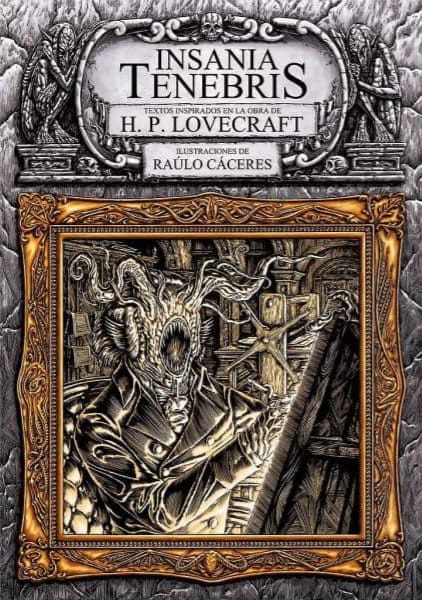
Insania Tenebris (2020) by Raúlo Cáceres

This dossier collects research on the nineteenth-century engravings of a mysterious Goya student that represent impossible beings and disturbing anachronisms.

Following in the footsteps of the Genius of Providence and inspired by the Cthulhu Mythos, the group of writers The Bastards of Abdul Alhazred and the cartoonist Raúlo Cáceres come together to recreate this universe of madness and darkness.
—Back cover copy, Insania Tenebris, translated from the Spanish

Spanish artist Raúlo Cáceres is no stranger to Lovecraft, and though many fans might not recognize him by name, there’s no mistaking his incredibly detailed, explicit style that often takes horror and eroticism for its subject. His comics and graphic novels in this vein include Elizabeth Bathory, Cuentos Mórbidos, Justine y Juliette (after the Marquis de Sade novels), and Agues Calientes, which have been translated into several languages. Less pornographic but still fun are books like Galeria de los Engendros Album de Cromos de los Monstruos, an album of monsters in the vein of 1970s and 80s compilations for kids.

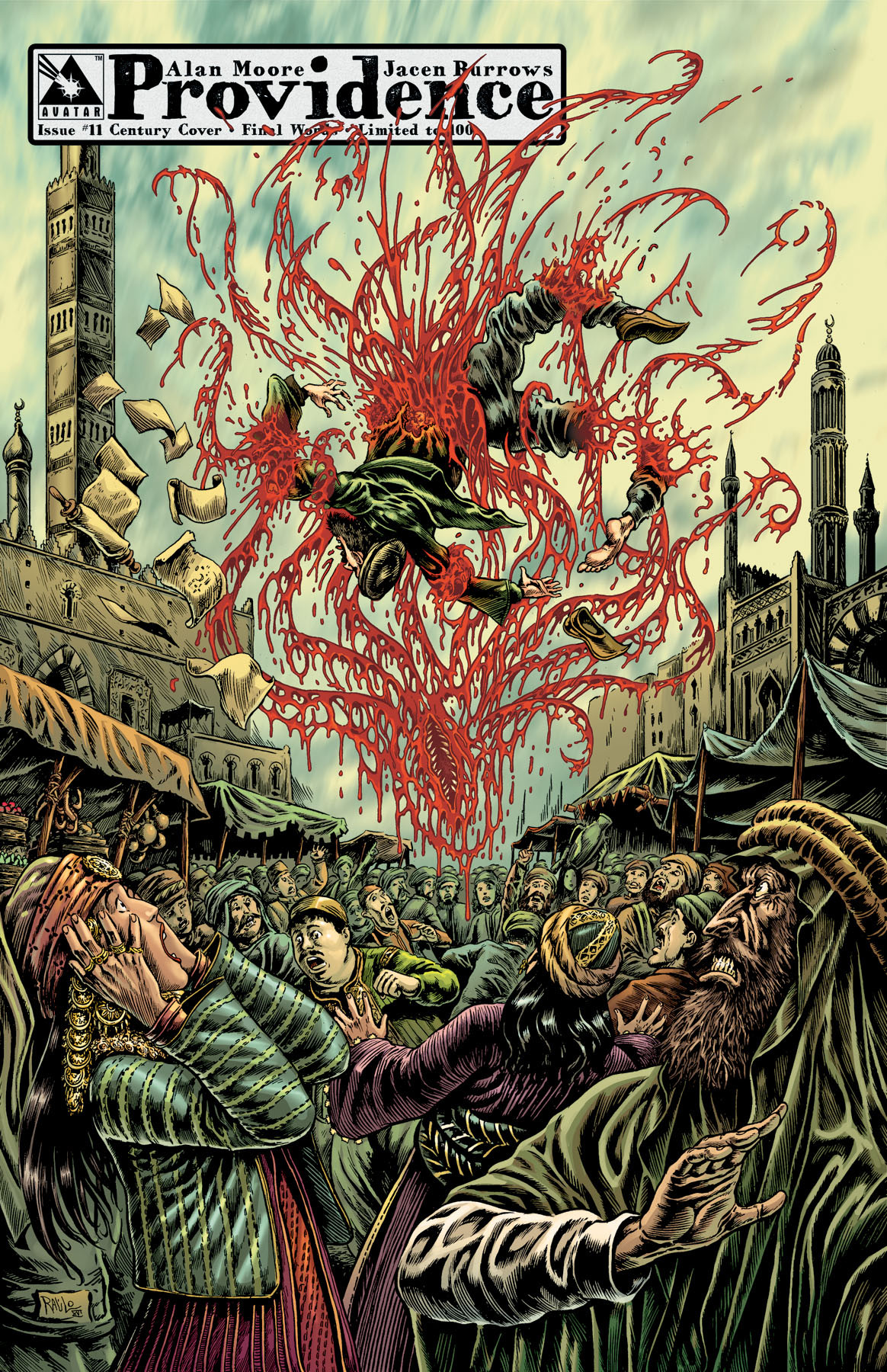
For English-speaking audiences, Cáceres’ most notable work would include his work on Crossed, Crécy, and The Extinction Parade, but he also provided some gorgeous covers for Alan Moore and Jacen Burrow’s Providence which showcase not just his skill and style, but his deep appreciation for the details of Lovecraft’s Mythos.

providence-raulo-cover-02-finalwords

Cáceres was also the artist on the Lovecraftian horror series Code Pru, written by Garth Ennis, and Ennis/Cáceres continued the storyline in the anthology book Cinema Purgatorio, and provided illustrations for the Lovecraftian alien gods of Spanish roleplaying game Eden.

In 2020, Raúlo Cáceres published the first volume of Insania Tenebris: Textos de Los Bastards de Abdul Alhazered (Shadowy Madness: Texts from the Bastards of Abdul Alhazred), a 32-page collaborative project where multiple Spanish writers provided short text pieces to accompany Cáceres’ unique vision of Lovecraft’s Mythos—which takes the form of a series of found documents. Imagine stumbling across a dossier of evidence proving the existence of the Mythos, from ancient times through World War 2 and to the present day—illustrated in glorious and disturbing detail.

It is these collaborators who are the “Bastards of Alhazred”: Gabriel Soriano, Emilio Gómez, J. M. Morcillo, La doctora X, Gómez Navarro, Tito Alberto, and of course, Raúlo Cáceres himself.

InsTen3

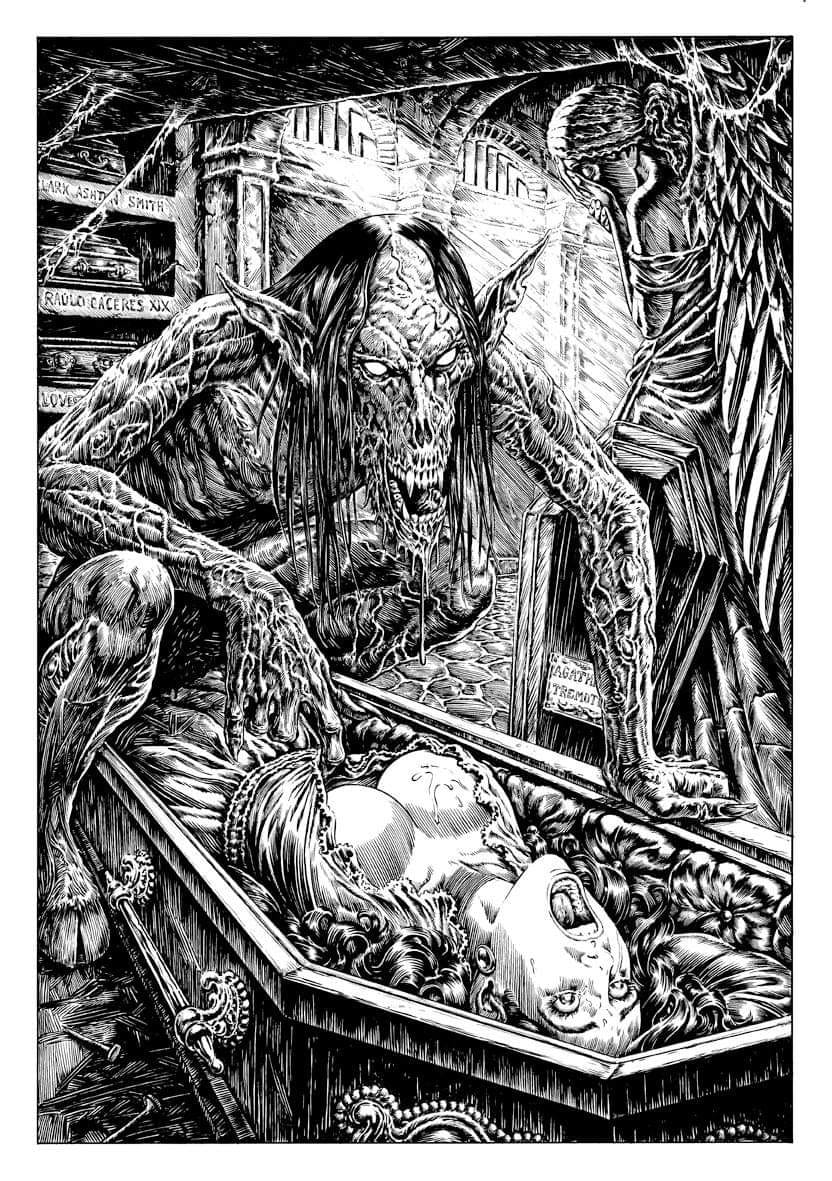
En el lecho de un ataud asiste
sobre absorta dama, su piel mancilla
un lúgubre gul perpetra y resiste.

In the bed of a coffin attends
Above lost lady, her skin stained
A melancholy ghoul persists and remains.
—”Despertar oscuro” by Emilio Gómez, Insania Tenebris 10

Like many extreme artists, Cáceres is at his best when there are no holds barred—but just because he can show as much graphic detail as he wishes to doesn’t mean every scene has to be fit for a death metal album or a storyboard for a graphic erotic horror film. Look at the names on the niches in the wall: Clark Ashton Smith in the top left, the name “Agatha Tremoth” on the coffin lid. This is an homage and illustration for Smith’s “The Nameless Offspring,” a ghoul story that Lovecraft praised.

InsTen4

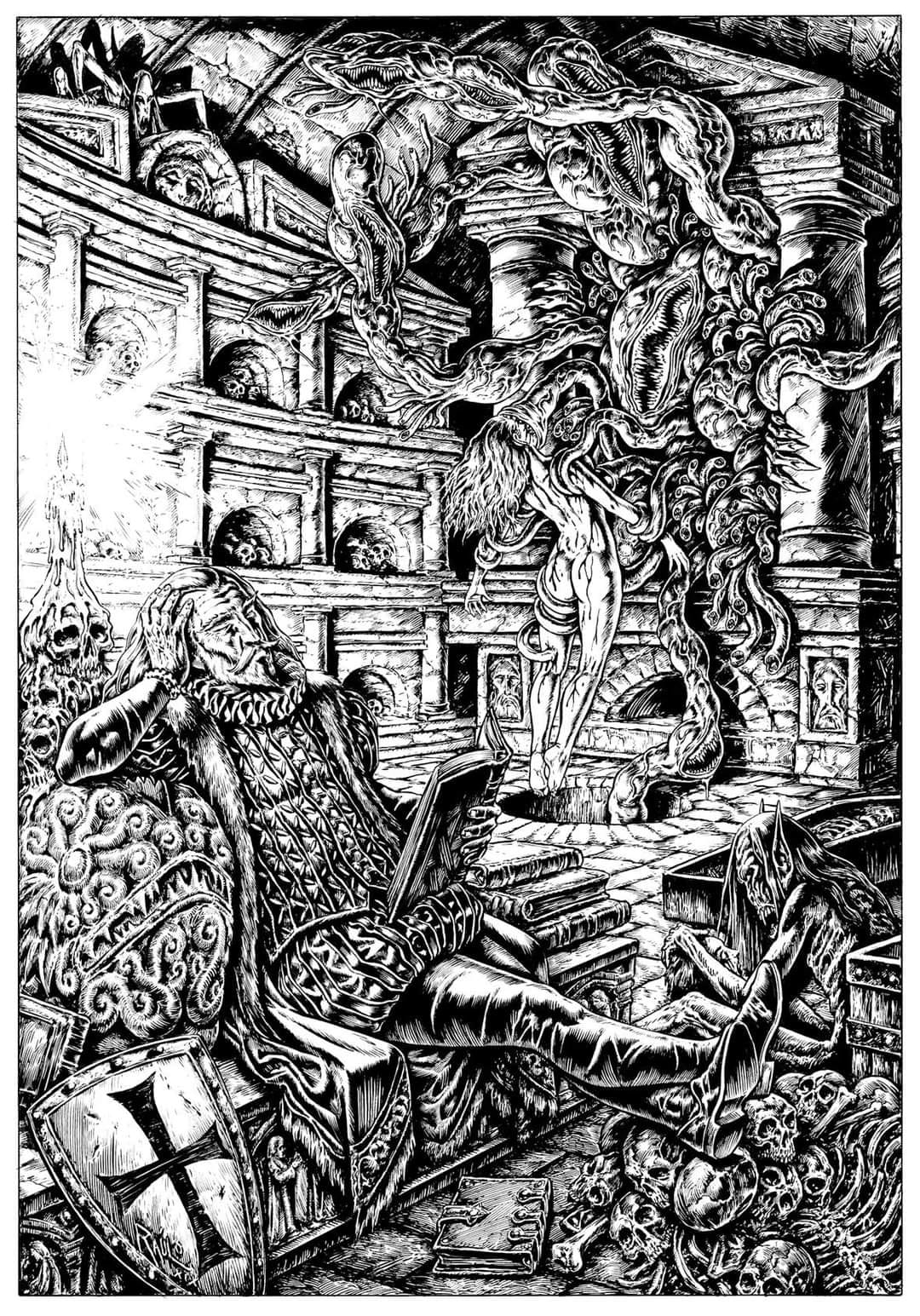
En dicho grabado, y tal como se describe en el texto de Notre-Dame, destaca la figure de un caballero ritualista invocador de seres oscuros que, a través de la utilización de plegarias de sangre, buscará la intersección con seres del más allá, valiéndose para ello de la lectura del libro prohibido De Vermis Misteriis, utilizado como llave conductora a la mediación interdimensional.

In said engraving, and as described in the Notre-Dame text, the figure of a knight ritually invoking dark beings stands out who, through the use of bloody prayers, will seek the intersection with beings from beyond, availing himself by reading from the forbidden book De Vermis Misteriis, used as a conductive key to interdimensional mediation.
—”Las cartas de Notre-Dame” by Emilio Gómez, Insania Tenebris 6

There are influences here beyond just Lovecraftian fiction and in-jokes. As with Monster Girl Encyclopedia II (2016) by Kenkou Cross (健康クロス), the Call of Cthulhu Roleplaying Game had an obvious visual influence in the way Cáceres depicts some of his Mythos entities, notably the Night-Gaunts, Mi-Go, and Dark Young of Shub-Niggurath. The nature of the texts are also representative of gaming influence: these are all in-character pieces, found documents, meant to be read and interpreted not as complete stories in and of themselves but as deliberate fragments—like piecing together the clues in a Cthulhu Mythos story, from copied snatches of journals and paintings.

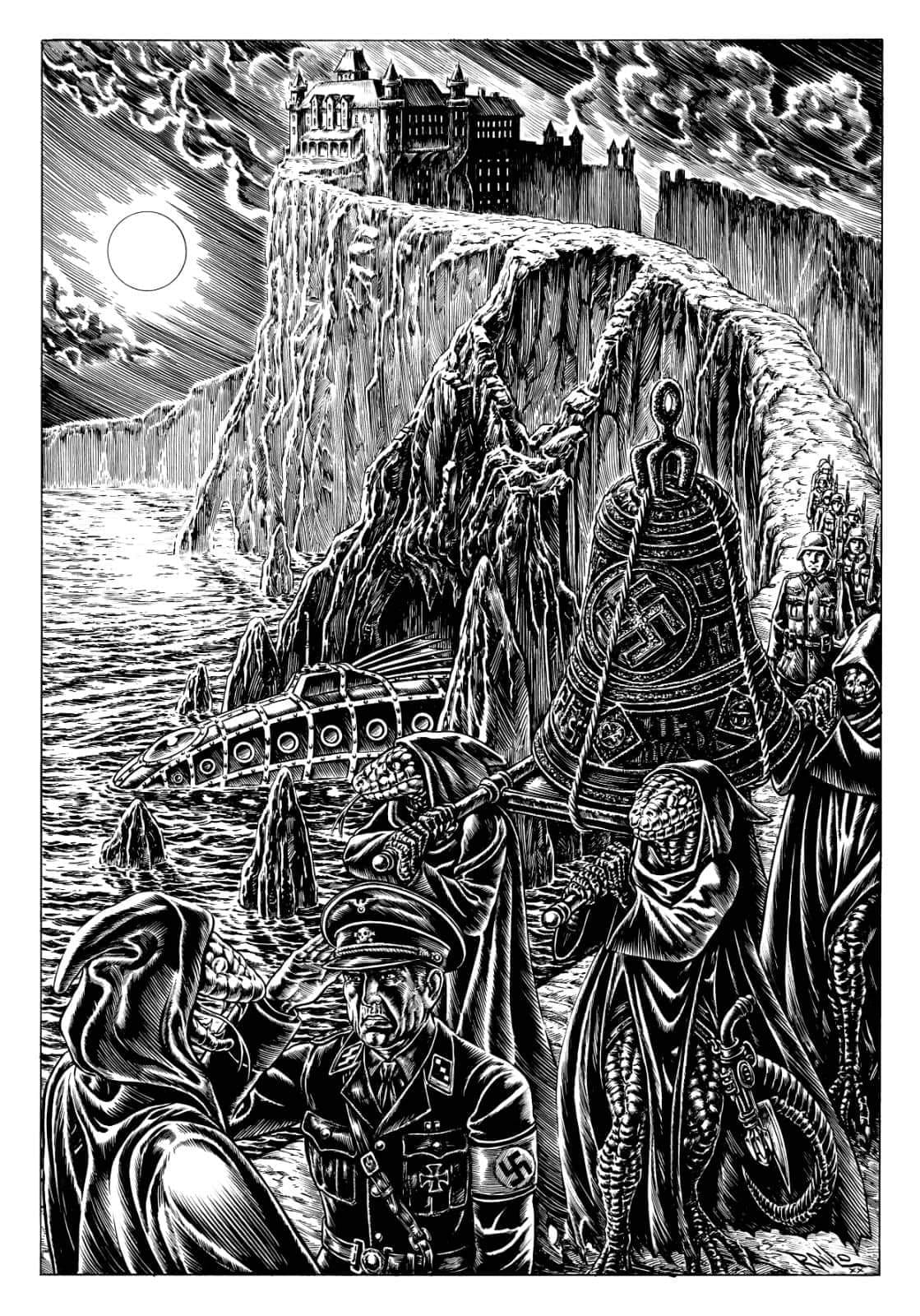
InsTen1

En esta, encuentra un viejo diario firmado por un tal capitán Pierre Eaudon, escrito en francés, con extraños dibujos de figuras humanas de aspecto reptiloide, cálculos matemáticos, anagramas y las palabras “YIG” y “VALUSIA” repetidas de forma obsesiva a lo largo del texto.

In it, he finds an old diary signed by a certain Captain Pierre Eaudon, written in French, with strange drawings of human figures of reptilian aspect, mathematical calculations, anagrams and the words “YIG” and “VALUSIA” repeated obsessively throughout of the text.
—”Informe de las SS” by J. M. Morcillo, Insania Tenebris 14

There are scenes in this portfolio which might turn a weak stomach or dissuade the prudish; notably a cannibal feast captured in particularly lurid detail, and the final pièce de résistance which captures Cthulhu and his paramour mid-coitus as the acolytes look on…and there are scenes that might make a reader smile, like the nod to death metal church-burning, the Mi-Go and the astronauts…and maybe just the care and detail that went into the written work as well.

For make no mistake, while Cáceres’ art is the main attraction (especially for those who don’t read Spanish), this is a true collaboration and the Bastards deliver appropriately creepy context that adds depth and substance to already fantastic scenes. There is a story here, told in bits and pieces, building up to more than just a portfolio of exquisite artwork. Goya’s student found himself on the trail of something bigger and darker than he could have imagined.

As of this writing, Insania Tenebris (2020) is only on sale in Spain, and has not been translated. A second volume, Insania Tenebris 2, is due to be published in 2021…and if anything, looks more daring and fantastic.

With thanks and appreciation to Iantha Maria Fyolek for her help. Any errors in translation are mine.


Bobby Derie is the author of Weird Talers: Essays on Robert E. Howard & Others (2019) and Sex and the Cthulhu Mythos (2014).
“La mano de la diosa” (2013) by Fátima Fernández & Paco Zarco

Lovecraftian horror appeals to a blind and sick cosmos where human beings are little more than ants. The abysses of the human soul that the tortured characters of Poe traversed, give way, in Lovecraft, to a struggle of inhuman powers, nightmarish deities that dispute the dominion of the living beings and that have, among us, their brotherhoods, their cults and their devotees.

Since the disappearance of the master, his fictions have gradually increased in popularity until they became, together with The Lord of the Rings, one of the most fascinating literary mythologies of our time. His influence on popular culture is still valid, demonstrating a surprising ability to adapt to the tastes and sensibilities of several generations.

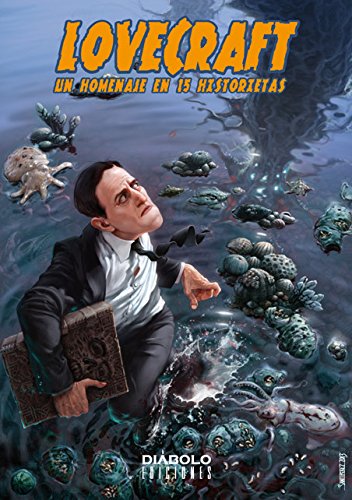
The authors of CTHULHU magazine come together again to pay tribute and emotional tribute to what we can consider the father of modern horror and his pantheon of nightmare creatures and deities. A journey through 15 stories that demonstrate the variety and richness of a privileged imagination.
—Manuel Mota, Lovecraft un homenaje en 15 historietas (2013), back cover copy
Translated from Spanish

Diábolo Ediciones of Madrid has been publishing Cthulhu, a Spanish-language anthology of comics and dark fiction, since 2007. Despite the name, the majority of the stories in any given issue aren’t necessarily explicitly devoted to the Cthulhu Mythos, although most issues have at least some Lovecraftian reference. The focus is on horror and dark fantasy, and the editors are not afraid for the works to be gory or involve nudity, if that’s what the story calls for, but they also contain moments of light-hearted ghoulish fun like the episodes of El Joven Lovecraft by José Oliver and Bart Torress. Special issues have been devoted to William Hope Hodgson and Robert E. Howard.

In 2013, Diábolo Ediciones published Lovecraft en los cómics. Un homenaje en 15 Historietas (Lovecraft in the Comics, An homage in 15 stories). The creators all presented diffrent styles and approaches, from a straight adaptation of “The Transition of Juan Romero” by Juan Aguilera to original works, every mood from ghoulish comedy and satire to visceral body horror, styles ranging from neatly inked black-and-white to digitally colored works. It is probably the first Mythos comic anthology to include former president Barack Obama and former secretary of state Hillary Clinton among its characters—which is to say, the book showcases not just the depth of talent that the editors of Cthulhu can draw upon, but the vast variety of approaches there are to the subject of the Mythos.

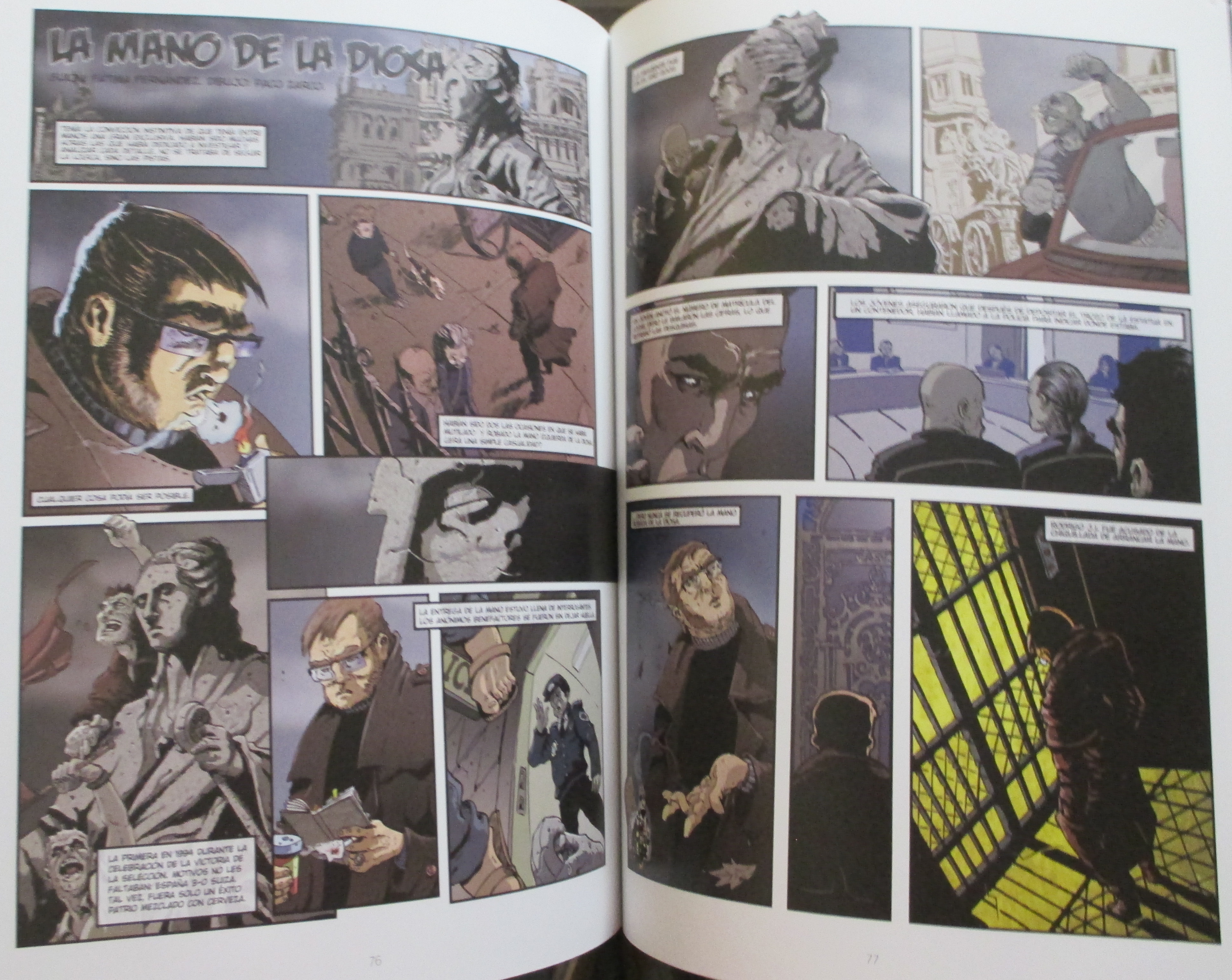
“La mano de la diosa” (“The Hand of the Goddess”) by writer Fátima Fernández & artist Paco Zarco is an original Cthulhu Mythos story, set in contemporary Spain, in a rather classical Cthulhu mode: a journalist after a story  finds themselves on the trail of something more than they expected.

No se trataba de seguir la logica, sino las pistas.
It was not about following the logic, but the clues.

The story is based on a real-life series of curious events. The Fuente de Cibeles (Fountain of Cybele) in Madrid includes a statue of the goddess Cybele—the Magna Mater of Lovecraft’s “The Rats in the Walls”—by sculptor Francisco Gutiérrez. In 1994 and 2002, the left hand of the statue was broken off. The events were seemingly unrelated, the statue was repaired…

…pero nunca se recupero la mano robada de la diosa.
…but they never recovered the stolen hand of the goddess.

As setups go, this is a solid premise for a Mythos story. Fernández conveys the minimal amount of information necessary in a few succinct captions, as if the reporter was giving the voice-over on a film, and Zarco captures the mood of the events in an economical and effective manner. The focus of the panels is drawn to the statue of Cybele, to the stump of the hand, to the trenchcoat-wrapped reporter who moves between shadows on cracked pavement. This could almost be a Kolchak story…or, if it had been cast in stark blacks and whites, a noir. Essentially an occult detective tale, with a protagonist that doesn’t yet know it’s an occult detective tale.

IMG_2583

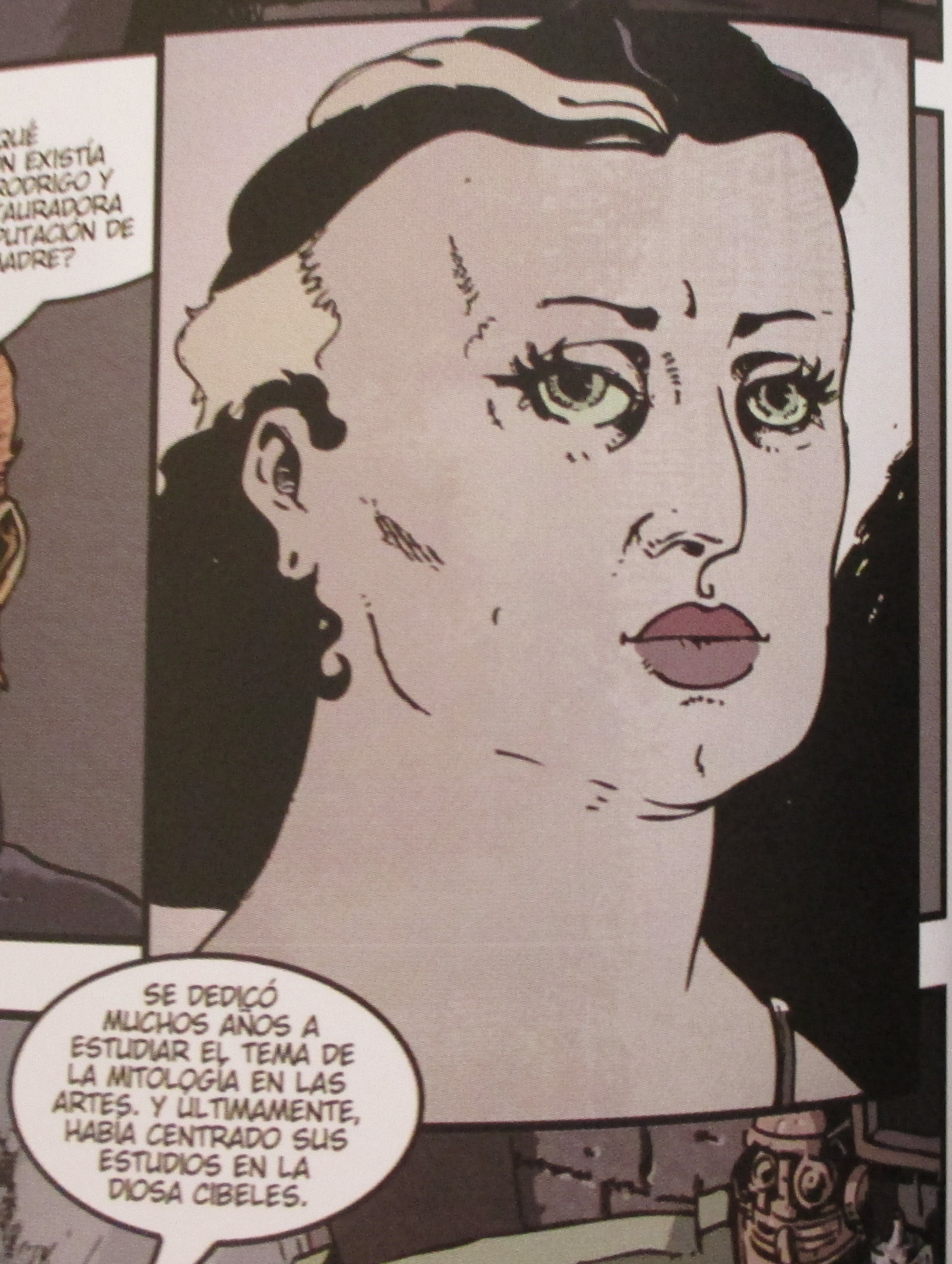
Turn the page, and the dialogue begins. Human players also complicate the simplicity of one person’s narration; readers now have to deal with multiple points of view, conflicting motivations, weigh each word and sentence carefully to look for hidden meaning. Who do you trust now?

IMG_2584

Mi madre era une persona gentil y hermosa en todos los sentidos. Pero ambiciosa.
My mother was a gentle and beautiful woman in every way. But ambitious.

Lovecraft had made a study of the detective stories of Edgar Allan Poe, and many of his Mythos tales follow a similar form of nested narrative. There is the story set in the now (here, the reporter investigating the missing hand of the statue), and there is the story in the past (the story being told to him); the story in the past is the nested narrative, like the manuscript uncovered in “The Mound” or Rose’s diary in “The Man of Stone.” The reader simultaneously is in the present, with the protagonist, but they are also looking over their shoulder and reading what they read. This narrative trick allowed Lovecraft to avoid the simple exposition of the narrator simply telling the reader (through some audience surrogate) what they have discovered, and takes the reader on the journey of discovery along with them. It also allows for a very effective reveal when the two layers of the narrative meet: past foreshadowing future.

IMG_2586

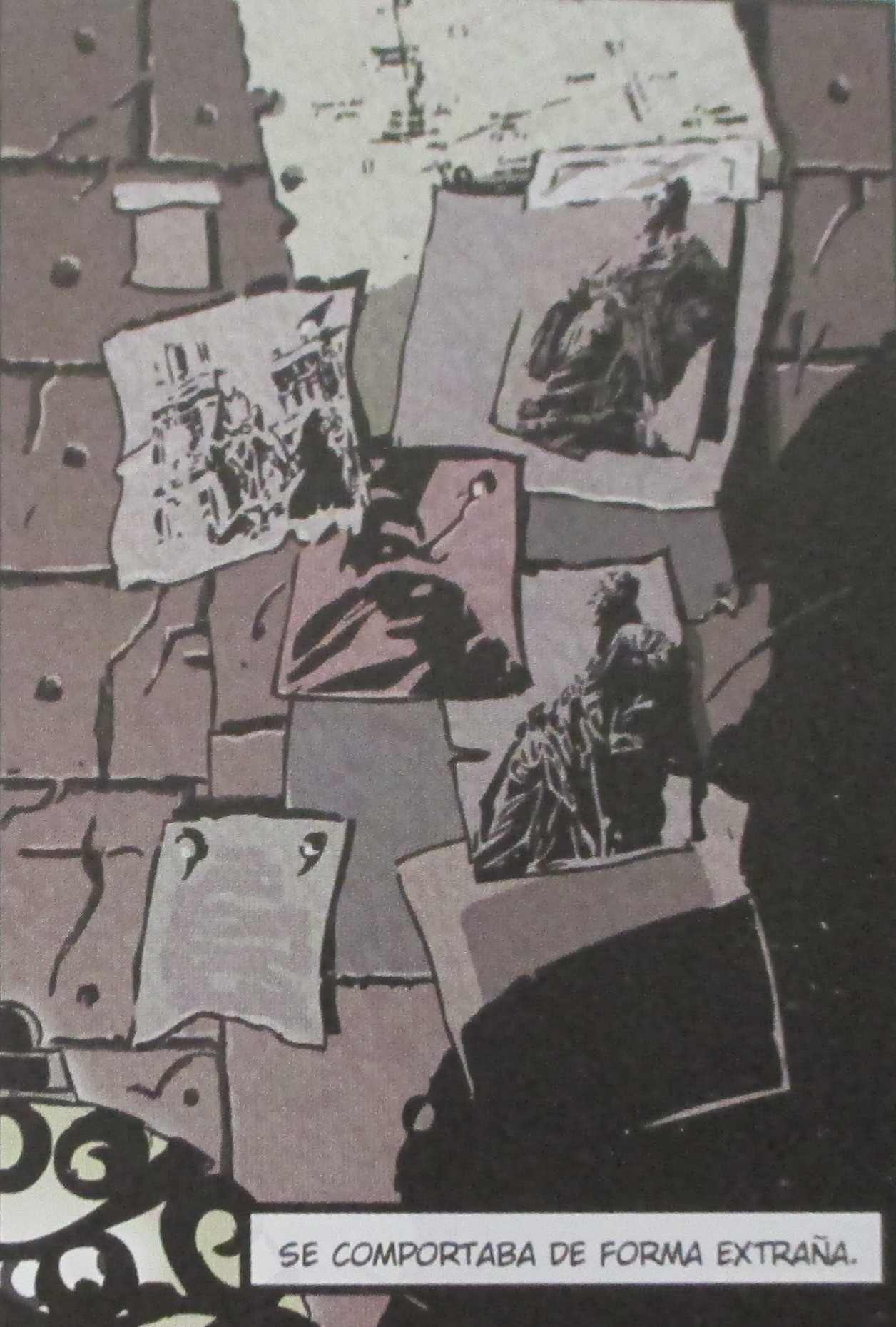
Paco Zarco’s artwork is competent, and he has an eye for panel layouts the emphasizes the repetition of key elements—portraits, eyes, hands—in a way the underlines the relatively sparse script. Considering relatively little is happening, this might seem like padding, but it feels more like pacing. At seven pages, “La mano de la diosa” doesn’t overstay its welcome or drag at all, but the Mythos twist, when it comes, is sudden.

In black and white, it might be much more effective; the digital coloring and shading, especially on the backgrounds, does little service to the linework and tends to emphasize the flatness of the faces rather than give them depth. That is a common issue with digital colorization, trying to achieve effects with the palette instead of the pen tends to catch the eye like a false note catches the ear.

Mi madra siempre me decía que las estatuas disponían de mucho tiempo para pensar y observar…
My mother always told me that the statues had a lot of time to think and observe …

IMG_2587

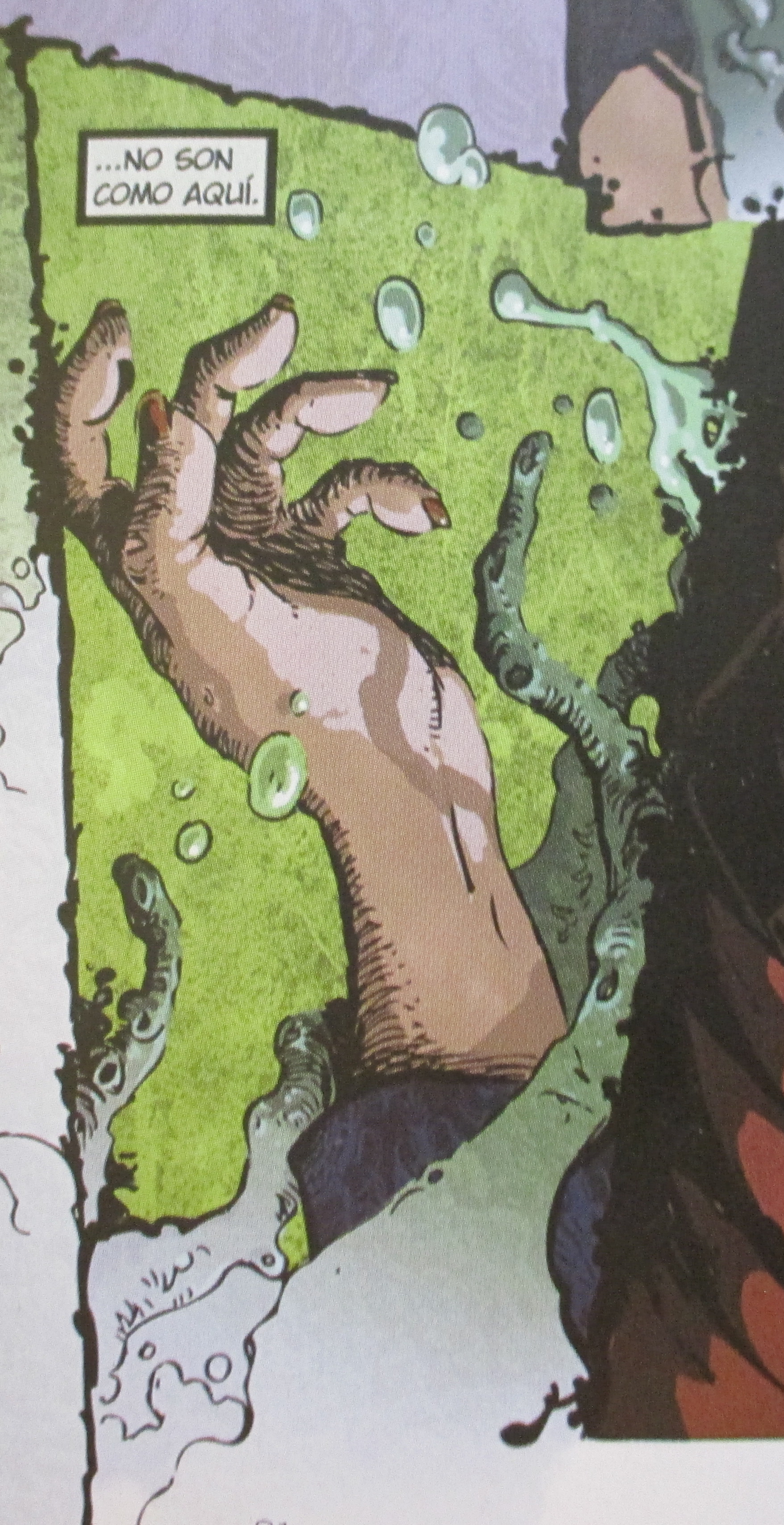
Zarco knows what he is doing when the actual supernatural element arrives onto the page; the clearly defined boxes of the panels give way to Dutch angles, ragged and uneven panel breaks and gutters. Like Jacen Burrows in Providence, this is visual rhetoric that informs the reader without telling them explicitly that they’ve entered a nightmare; like a horror movie when the killer’s motif begins to play, and the camera shifts from smooth movement to sudden and abrupt close-ups and shifts.

Algo mas fuerte que su ambicion se apoderaba de el.
Something stronger than his ambition took hold of him.

“La mano de la diosa” manages to evoke the Mythos without a single fhtagn, and very few tentacles; a particularly Lovecraftian figure makes an appearance in the final panels in a bit of a well-worn twist, for readers who have read enough Mythos stories to recognize similar endings. At seven pages it is neither too long or too short for the story it has to tell, getting the job done without rushing it or overstaying its welcome, and most of that is told not through the text, but by visual storytelling and unspoken hints. In the context of Lovecraft un homenaje en 15 historietas, it is the most subtle, the most understated of the stories…and one which is set in Spain, and couldn’t really be set anywhere else.

Lovecraft un homenaje en 15 historietas has not yet been translated into English.


Bobby Derie is the author of Weird Talers: Essays on Robert E. Howard & Others (2019) and Sex and the Cthulhu Mythos (2014).
“O que dorme” (2016) by Bábara Garcia & Elias Aquino

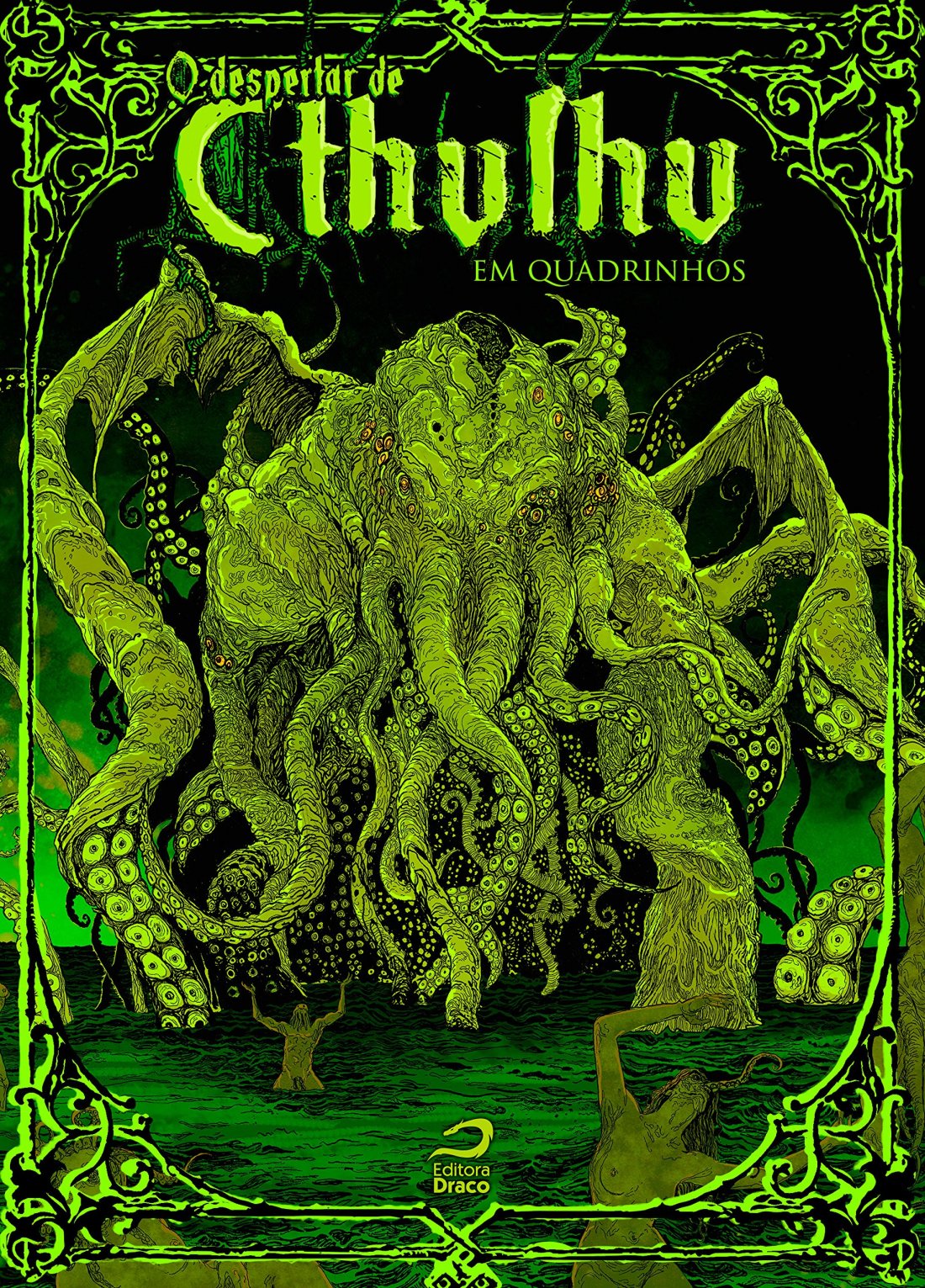
“O que dorme” (“What sleeps”) by writer Bábara Garcia & artist Elias Aquino is the final entry in the comic anthology O Despertar de Cthulhu em Quadrinhos (“The Awakening of Cthulhu in Comics,” 2016) by Brazilian publisher Editora Draco. The book was edited by Raphael Fernandes, who introduces the volume on the inside cover flaps:

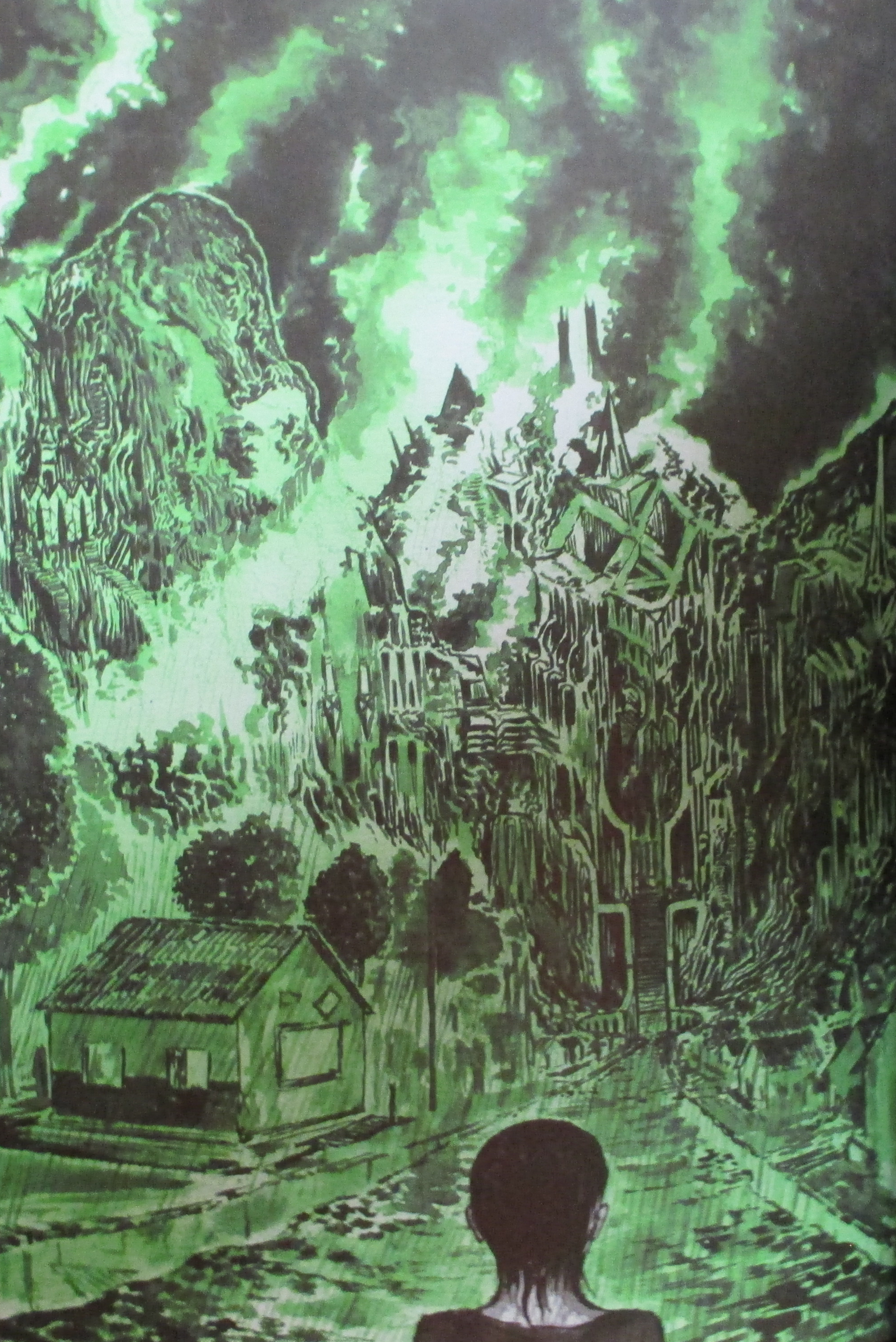
The cult work of H. P. Lovecraft is the main inspiration for this collection with eight comics that will transfer the imagination to the darkest side of the human mind, a cosmic horror in white and green.

[…] The Awakening of Cthulhu in Comics and the horror that cannot be uttered, get lost in images and stories that shouldn’t have been conceived. Now there’s no turning back for those involved by the tentacles of despair, it’s time to wake up to a decadent reality tinged with just two colors.

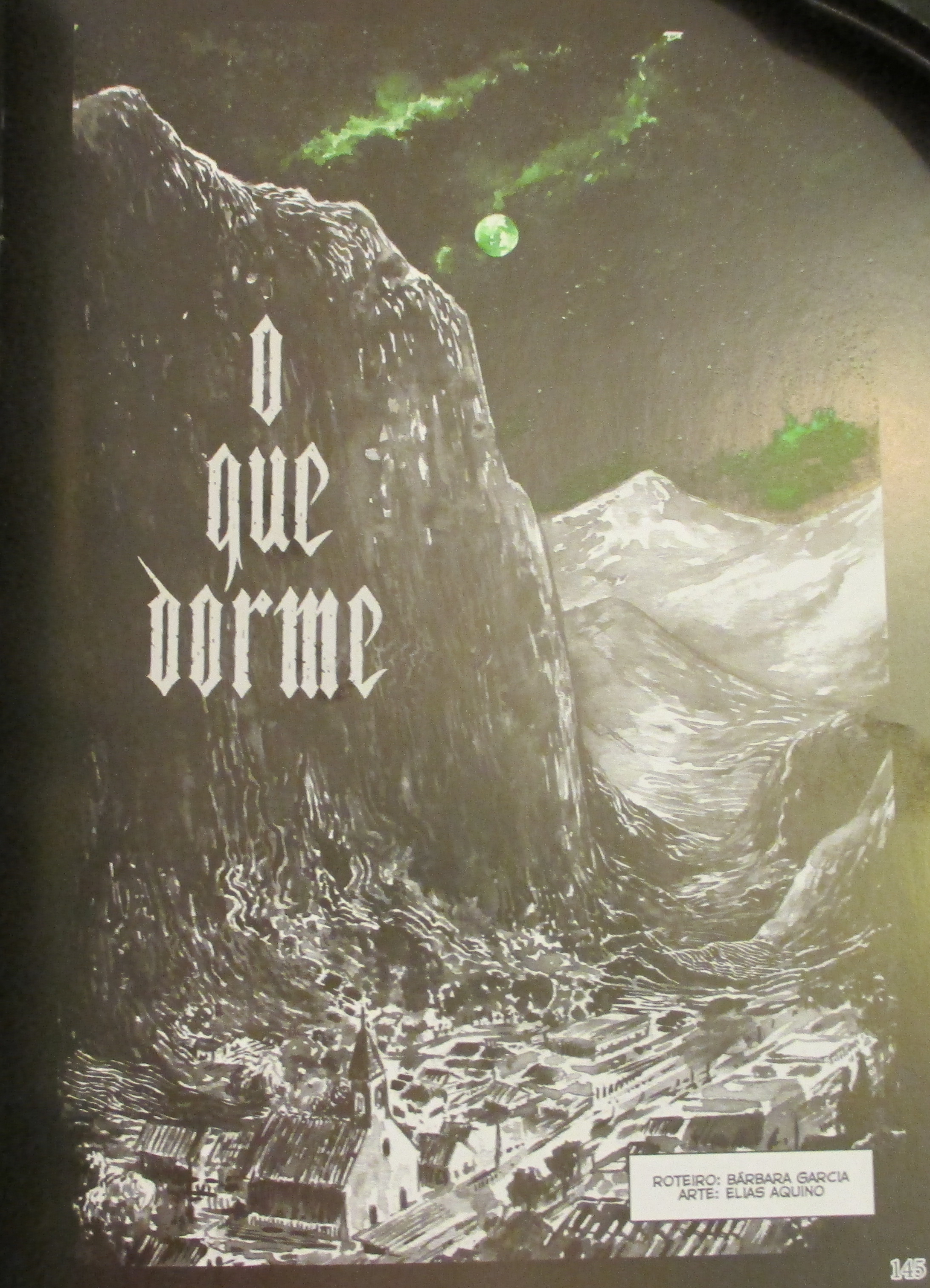
All of the comics, including “O que dorme” are done in black, white, and green—and the addition of the bright, almost sickly green against the otherwise stark noir black-and-whites significantly enhances both the effectiveness of the individual stories, and the uniformity of the overall book—readers might compare the glowing green Loc-Nar from the Heavy Metal (1981) film, or the sickly yellow in Frank Miller’s That Yellow Bastard (1996)—it’s not that the Mythos are color-coded, since any entities that appear on the page can be seen in black and white as well, but only that the splash of color is used by the artists to convey subtleties of mood and atmosphere. Like in the title page, where the green is a faint tinge against the night sky.

IMG_2571

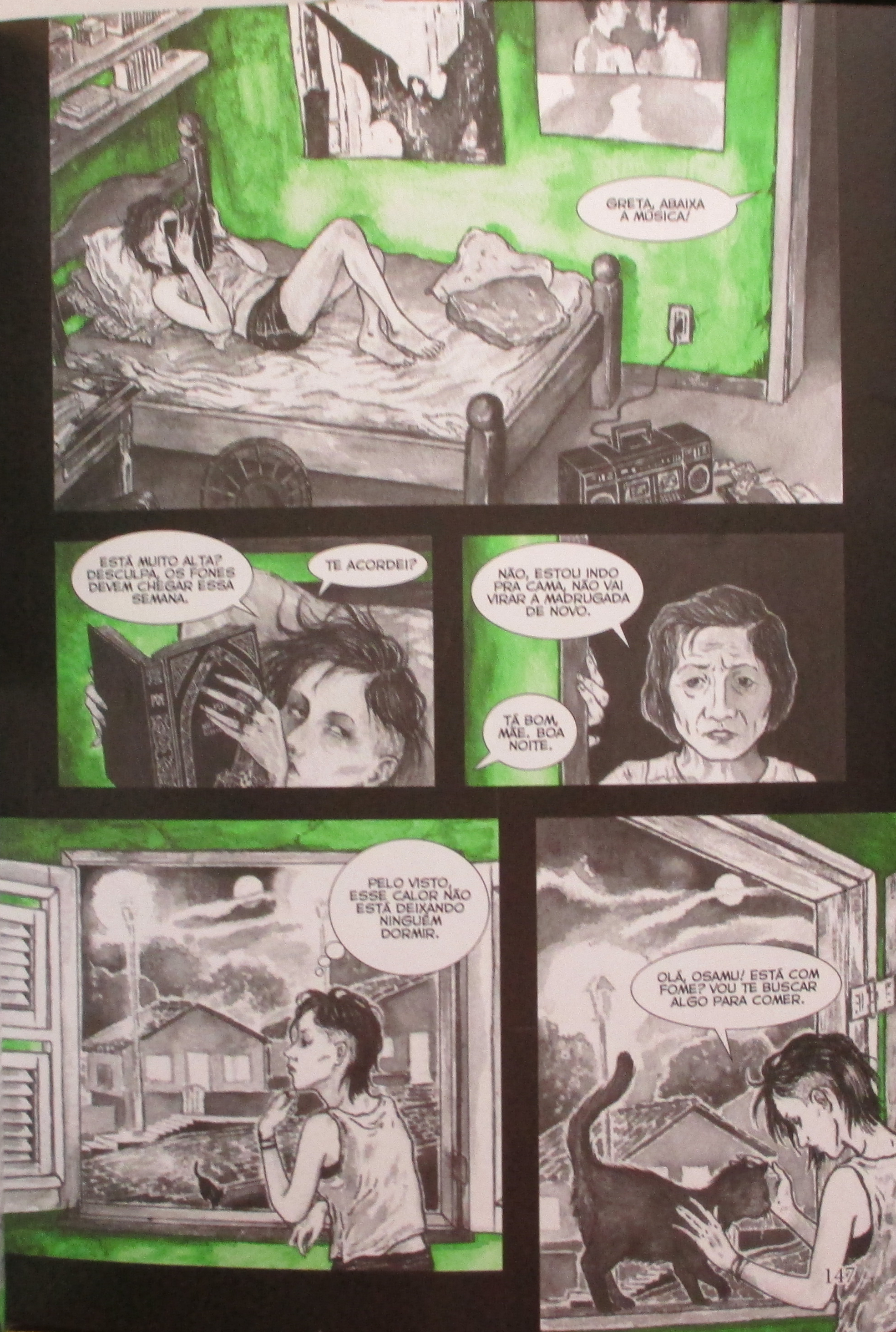
The setting is contemporary. The sensibility is postmodern. Captions and word balloons, but no thought bubbles, no sound effects. A rural community in the mountains which produces coffee. A young woman named Greta who can’t sleep, but stays up all night reading Edgar Allan Poe, a Bauhaus poster on her wall…

I always planned to leave as soon as I had money or a place to stay. Time passed and neither happened.

IMG_2576

Here, the green frames figures and offers contrast. Varies in depth and intensity, fading into the shadows on the corners, but distinct. It gives texture to what would be a blank wall, but doesn’t bleed past the outlines. The atmosphere is aggressively normal, yet something’s off. People talk about the heat, a bad smell, it hasn’t rained, the panels darken as it shifts to nighttime…most of the storytelling is expressed in these little details, showing rather than telling. Ordinary scenes and remarks receive significance only because they are what are being shown to the reader, in the same way as a David Lynch film or Mike Mignola’s Hellboy.

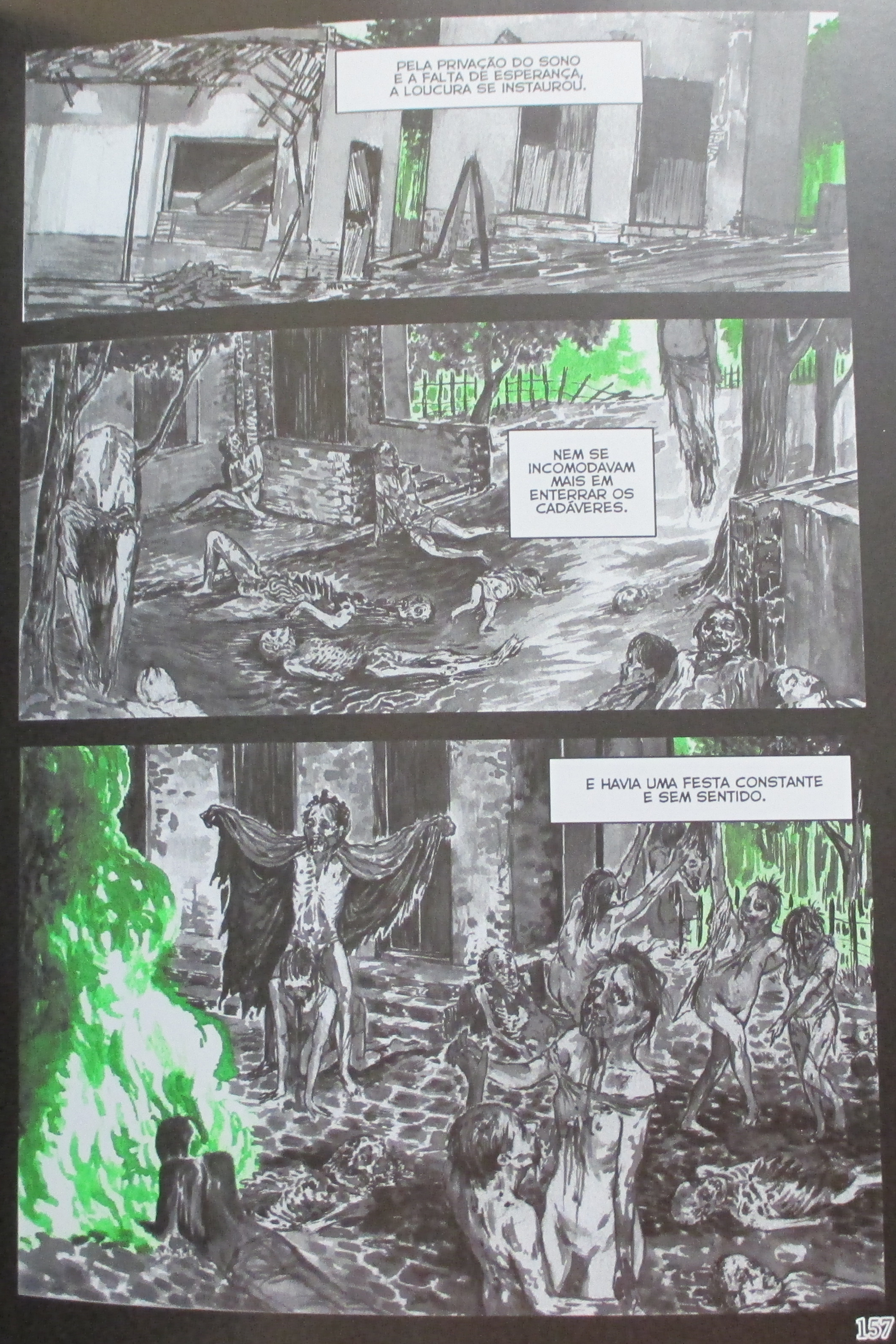
But the fact is that, little by little, everyone stopped sleeping. An entire city sleepless.

Things move quicker. The timeline grows uncertain, but within a panel the corpses appear, and things shift from uneasy to macabre. There is a Poe-like quality to the rapid downward spiral…but the reader knows there are pages left. How much worse can it get?

IMG_2577

The rain comes.

There’s nothing explicitly Mythos to any of this yet, no ancient tomes, not a whisper of alien entities or black stars. Everything that’s happened to this point, it could a disease, a toxic gas, simple madness as the heat and lack of sleep take their toll on frail human psyches. Then the rules change.

IMG_2578

The green in the story to this point had been balanced, contained, a highlight; this deep splash shows it as pervasive, all-encompassing…and a herald of what’s coming. Maybe it was always that.

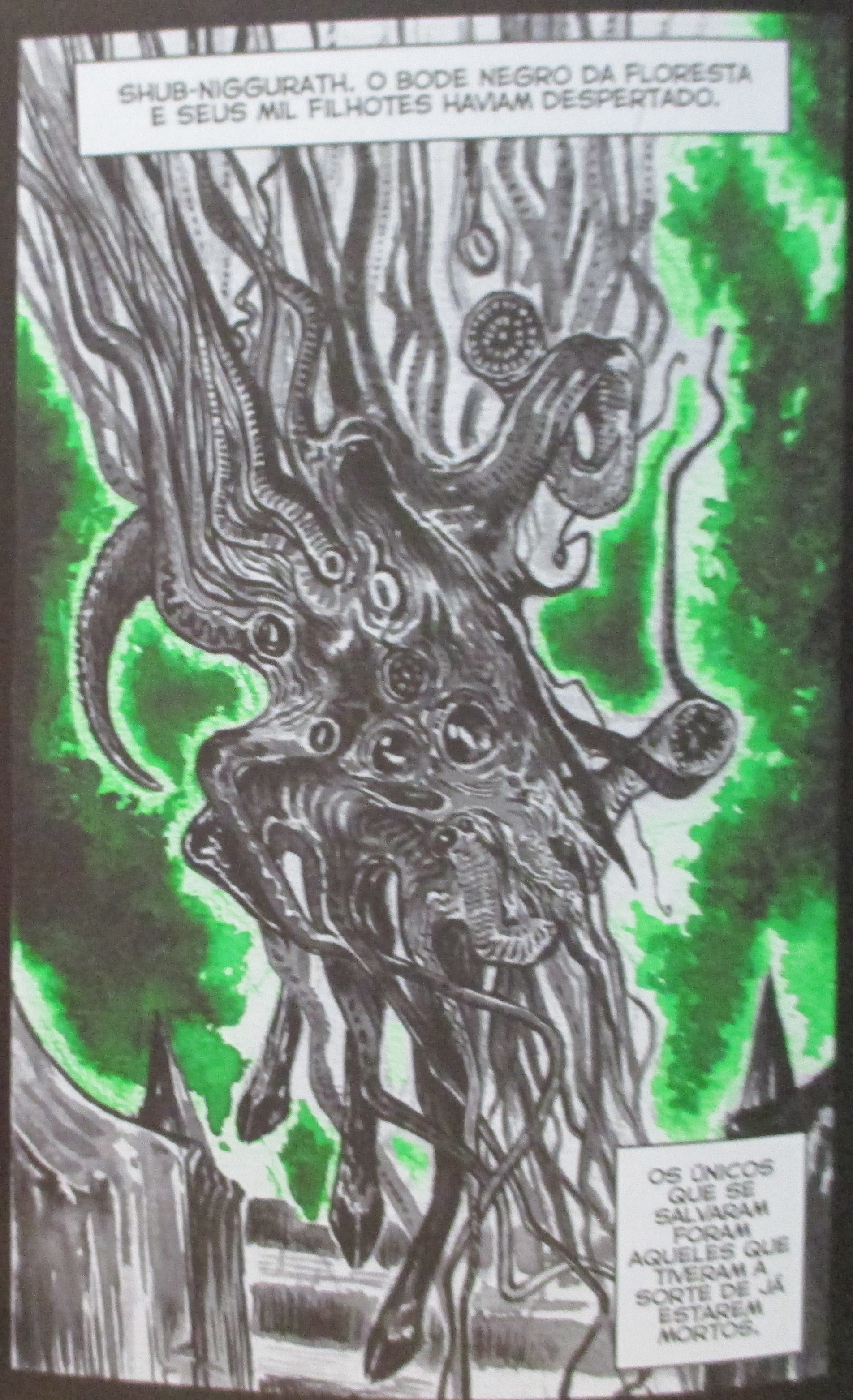
The only ones who were saved were those who were lucky enough to be already dead.

IMG_2582

As narratives go, the twenty pages go by swiftly. This is a story all about mood and atmosphere, not explanations. No one is at fault, no one went poking about where they shouldn’t, or read the wrong spell and awakened the eldritch horror. There is no cult to worship the things that crawl down off the mountain. It isn’t a deep dive into the lore of the Mythos, though there is definitely some artistic influence from the Call of Cthulhu Roleplaying Game on the design of the Dark Young of Shub-Niggurath. This is almost the definition of the Mythos as uncaring, not even necessarily malevolent, but simply destroying humanity by its very presence, like a tiger in the jungle stepping on so many ants.

“O que dorme” showcases the universality of the Lovecraftian experience. The liminal spaces we know are out there, the things that creep in from outside.

O Despertar de Cthulhu em Quadrinhos has not yet been translated into English.


Bobby Derie is the author of Weird Talers: Essays on Robert E. Howard & Others (2019) and Sex and the Cthulhu Mythos (2014).
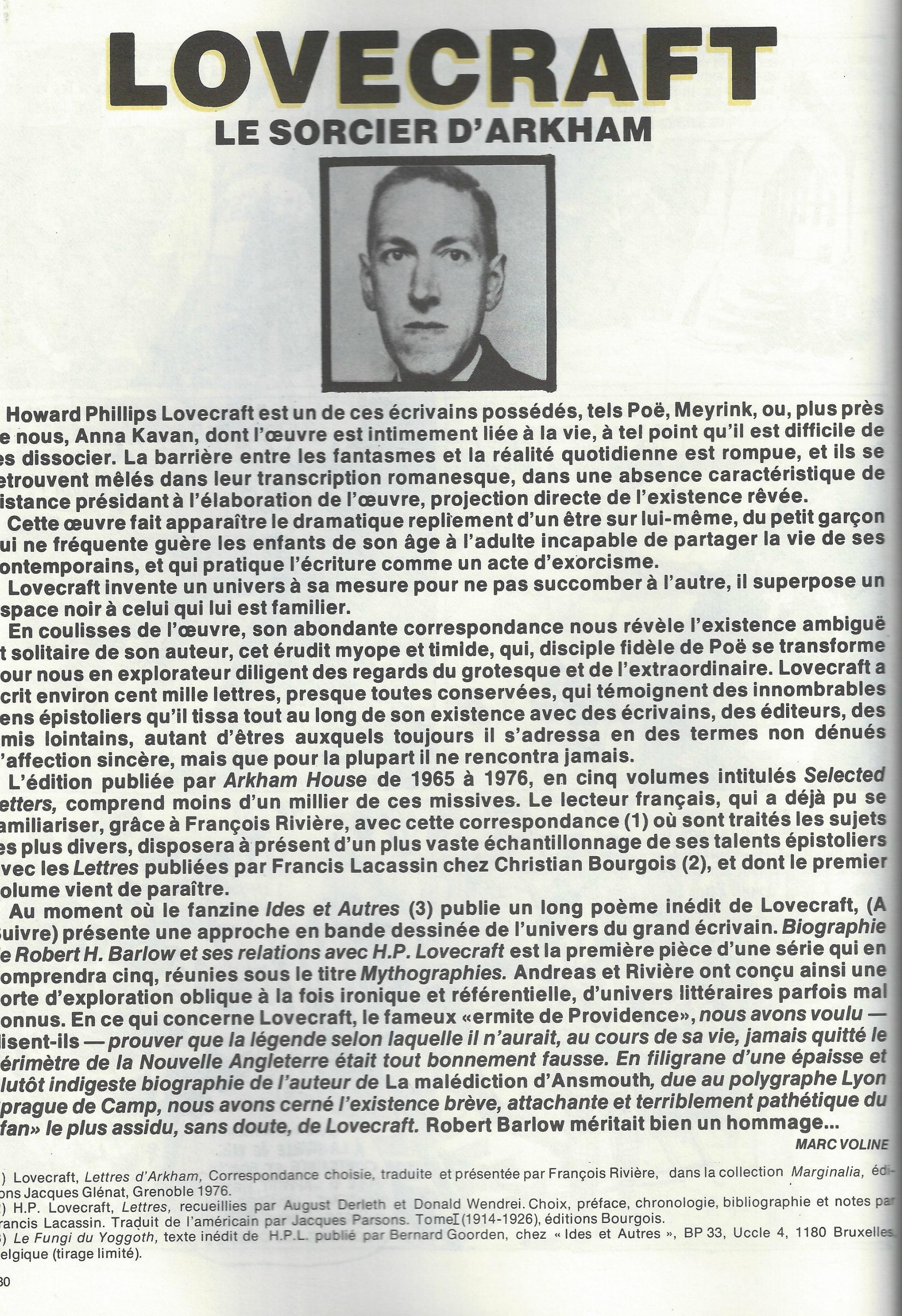
“R. H. B.” (1978) by Andreas and Rivière


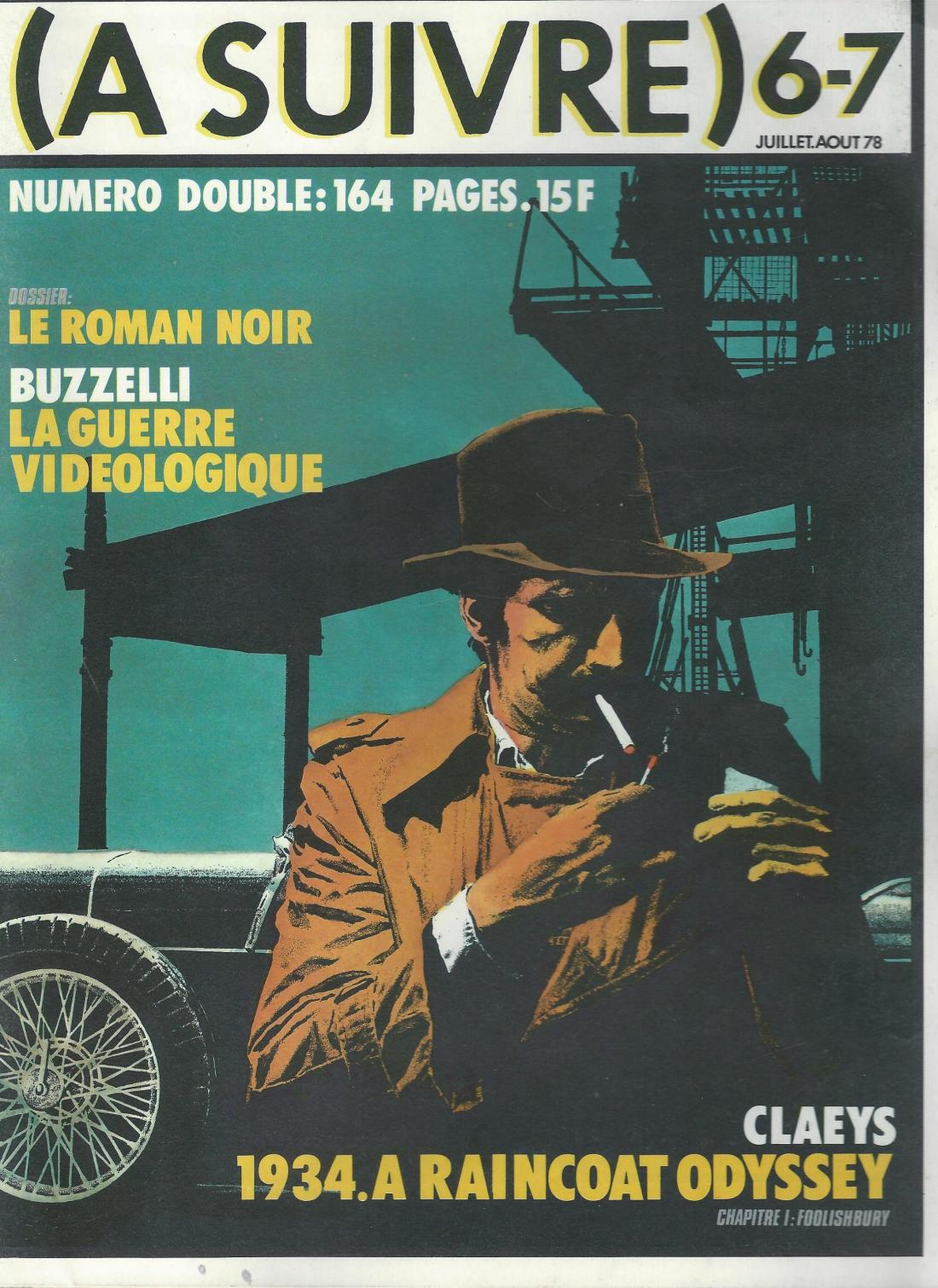
À Suivre (“To Be Continued”, 1978-1997) was one of the major Franco-Belgian comic magazines of the period, publishing such great European comics creators as Alexandro Jodorowsky, Milo Manara, Mœbius (Jean Giraud), François Schuiten, and Guido Crepax, a contemporary of magazines like Métal hurlant and Pilote, focusing on comics for a more mature audience.

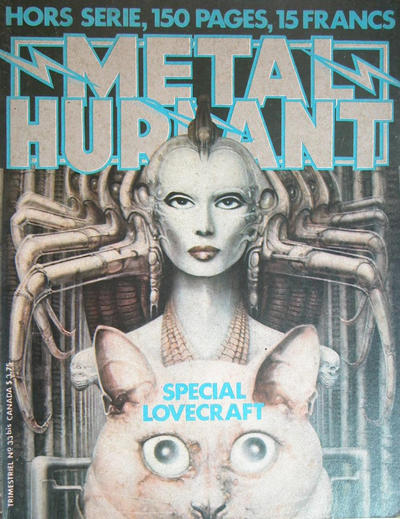
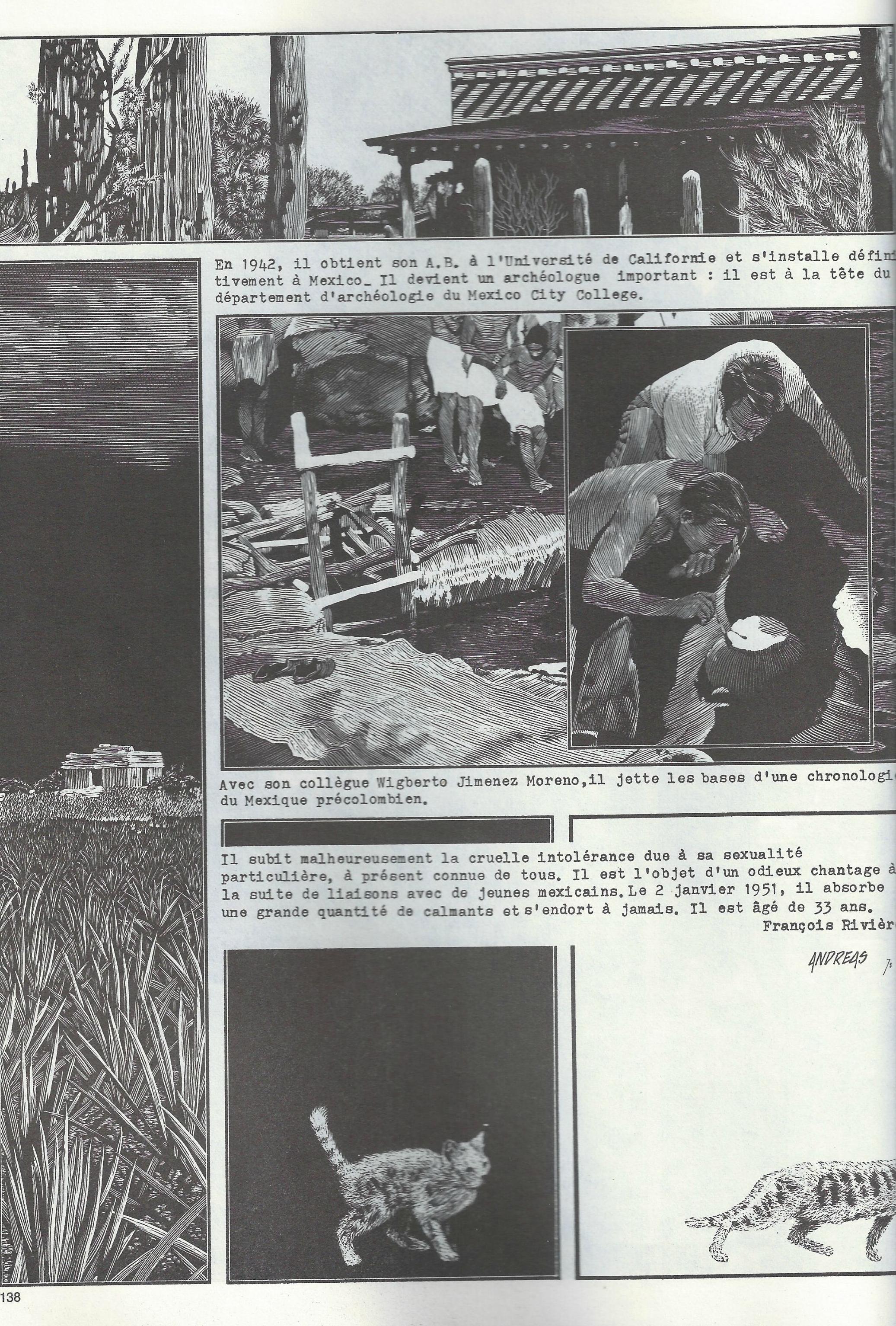
“R. H. B,” by Andreas (Andreas Martens) and Rivière (François Rivière) was published in À Suivre 6-7, the July-August double issue for 1978. The title stands for Robert Hayward Barlow, friend and literary executor to H. P. Lovecraft. This coincides with the increased enthusiasm for Lovecraft in France, particularly the publication of LETTRES, 1 (1914-1926), which was published May 1978—a translation of Lovecraft’s letters, taken from volume I and part of volume II of Arkham House’s five-volume Selected Letters series. By comparison, Métal hurlant‘s Lovecraft special issue was published in September 1978.

metal

H. P. Lovecraft received a fan letter from a 13-year-old R. H. Barlow in June 1931; Lovecraft was then 41 years old, and the two continued corresponding for six years, until Lovecraft’s death in 1937. The two met in May 1934, when Lovecraft took a trip down to Barlow’s family home in DeLand, Florida, a visit which lasted seven weeks; they met again briefly in New York during the winter of 1934-1935, where Lovecraft was in the habit of meeting friends for New Years Eve, and Lovecraft repeated his trip to visit the Barlows in Florida in 1935, where he spent ten weeks with his hosts, but begged off the invitation to stay all summer. Their next visit was when Barlow came to visit Lovecraft in Providence, Rhode Island, 28 July 1936, when the teenager stayed more than a month at the boarding house behind Lovecraft’s residence. It was the last time the two would meet; Lovecraft would die of cancer on 15 March 1937. Lovecraft’s “Instructions in Case of Decease,” dating from 1936, named Barlow his literary executor…and it is through Barlow’s efforts that many of Lovecraft’s papers, unpublished stories, and letters were preserved at the John Hay Library.

The comic proper is presaged by an introduction by editor Marc Voline:

suiver-2

At the time the Ides et Autres (“Ides and Others”) fanzine published an unpublished poem by Lovecraft (3), (A Suivre) presents a comic strip approach of the great writer universe. “Biography of Robert H. Barlow and his relationship with HP Lovecraft” is the first of a five-part series, collected under the title Mythographies. Andreas and Rivière designed this as a kind of oblique exploration, referential and ironic, of sometimes poorly known literary universe. As for Lovecraft the famous “hermit of Providence,” we wanted—they say—to prove that the legend that he would, during his life, never leaves the perimeter of New England was all simply false. From the thick and rather indigestible biography of the author of La malediction d’Ansmouth (“The Shadow over Innsmouth”) written by Lyon Sprague de Camp, we briefly identify with the existence of an endearing and terribly pathetic “fan” most assiduous without doubt Lovecraft. Robert Barlow well deserved homage …

Marc Voline

Most of the material in the comic would come from L. Sprague de Camp’s H. P. Lovecraft: A Biography (1975); this would not be available in French until 1987 when Richard D. Nolane translated it as H. P. Lovecraft ; le Roman de sa Vie, so the creators of “R. H. B.” were working through some linguistic hurdles and miscommunications. As Lettres 1 doesn’t have any actual letters from Barlow, essentially all of the material for “R. H. B.” was drawn directly from de Camp’s book, with many phrases translated directly from the English edition.

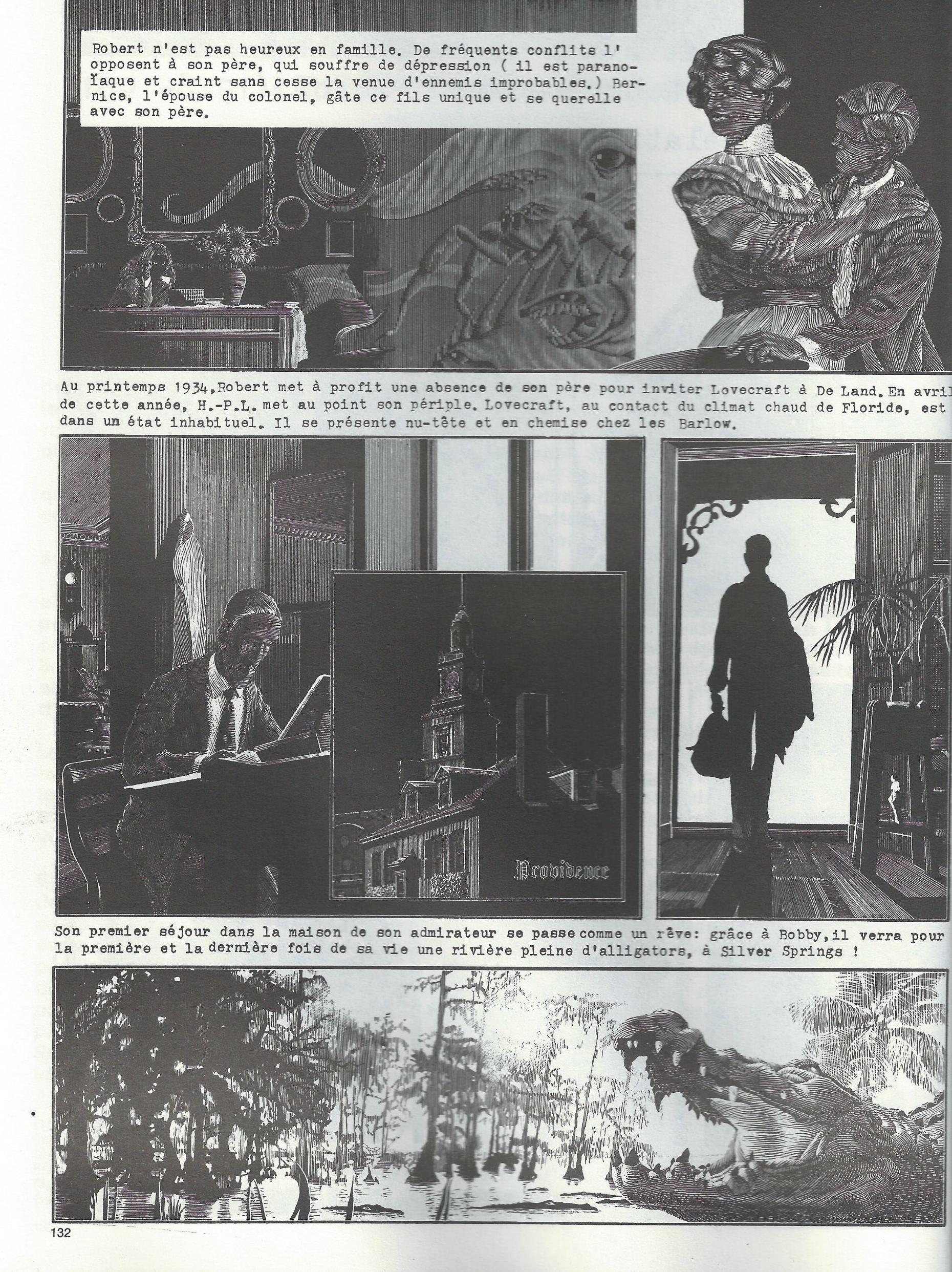
suiver-4

Small issues of translation aside, this is a starkly beautiful comic, with fantastic linework by Andreas, who obviously referenced what photos of Lovecraft were available. Translation of the French above:

Robert’s is not a happy family. There are frequent conflicts between him and his father, who suffers from depression (he is paranoid and continually fears the coming of improbable enemies.) Bernice, the wife of the colonel, spoiled the only son and quarreled with his father.

In spring 1934, Robert makes a profit of the absence of his father to invite Lovecraft to De Land. In April this year, HPL makes this journey. Lovecraft, in contact with the hot climate of Florida, is in an unusual state. He presents himself to Barlow with hatless and coatless.

His first stay in the house of his admirer is as a dream thanks to Bobby, he will see for the first and last time in his life a river full of alligators, at Silver Springs!

By comparison, this is how de Camp described this encounter:

The family home was at De Land, Florida, seventeen miles inland from Daytona Beach. Barlow’s father, Everett D. Barlow, was a retired U. S. Army lieutenant colonel and something of a mental case. Subject to moods of intense depression, he suffered from delusions of having to defend his home against the attacks of a mysterious Them. He was cracked on religion and on sex.

Robert Barlow got on badly with his father. At this time, he told his friends that he hated the colonel; although later, after his parents had been divorced, he carried on a friendly correspondence with him. Robert Barlow’s mother, Bernice Barlow, spoiled and pampered her son (somewhat as Lovecraft’s mother had done with him) and quarreled with her husband over the boy’s upbringing.

In the spring of 1934, Barlow and his mother were at De Land while the father, in the North, recuperated with relatives from one of his attacks. In January, Robert Barlow began urging Lovecraft to come for a visit to Florida. By April, Lovecraft had planned the trip. […] At the Barlows’, the heat stimulated Lovecraft. In high spirits he went hatless and coatless and boasted of the tan he was working up. His one disappointment was in not being able to go on to Havana. He was consoled by a trip with the Barlows to Silver Springs. There he had his first view of a jungle-shaded tropical river and even glimpsed wild alligators.
—L. Sprague de Camp, H. P. Lovecraft: A Biography 393-394

There are some errors in de Camp’s portrayal, which were repeated by Rivière. Lt. Col. Everett D. Barlow had seen action during World War I, and may have suffered from post-traumatic stress disorder; Lovecraft was aware of the elder Barlow’s mental illness and was notably more sympathetic than de Camp:

I surely am sorry that your father remains under the weather psychologically. These depressed states may be troublesome to others, & may seem exasperating when coupled with good physical health, yet they are really every inch as painful & unavoidable as any other form of illness. The victim can’t help himself any more than a victim of indigestion or cardiac trouble can. The more we know of psychology, the less distinction we are able to make betwixt the functional disorders known as “mental” and “physical.”
—H. P. Lovecraft to R. H. Barlow, 10 April 1934, O Fortunate Floridian! 125

suiver-6

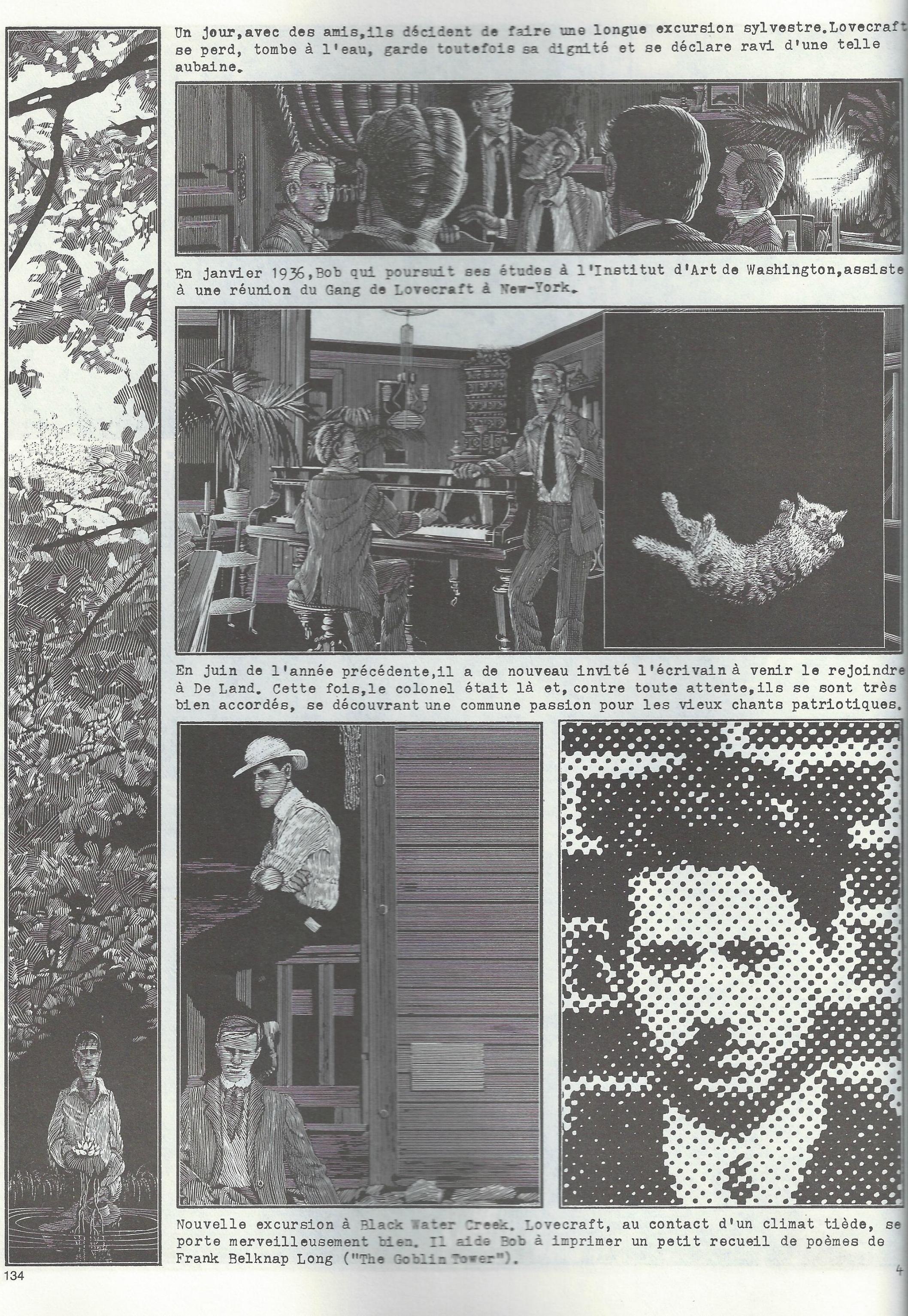
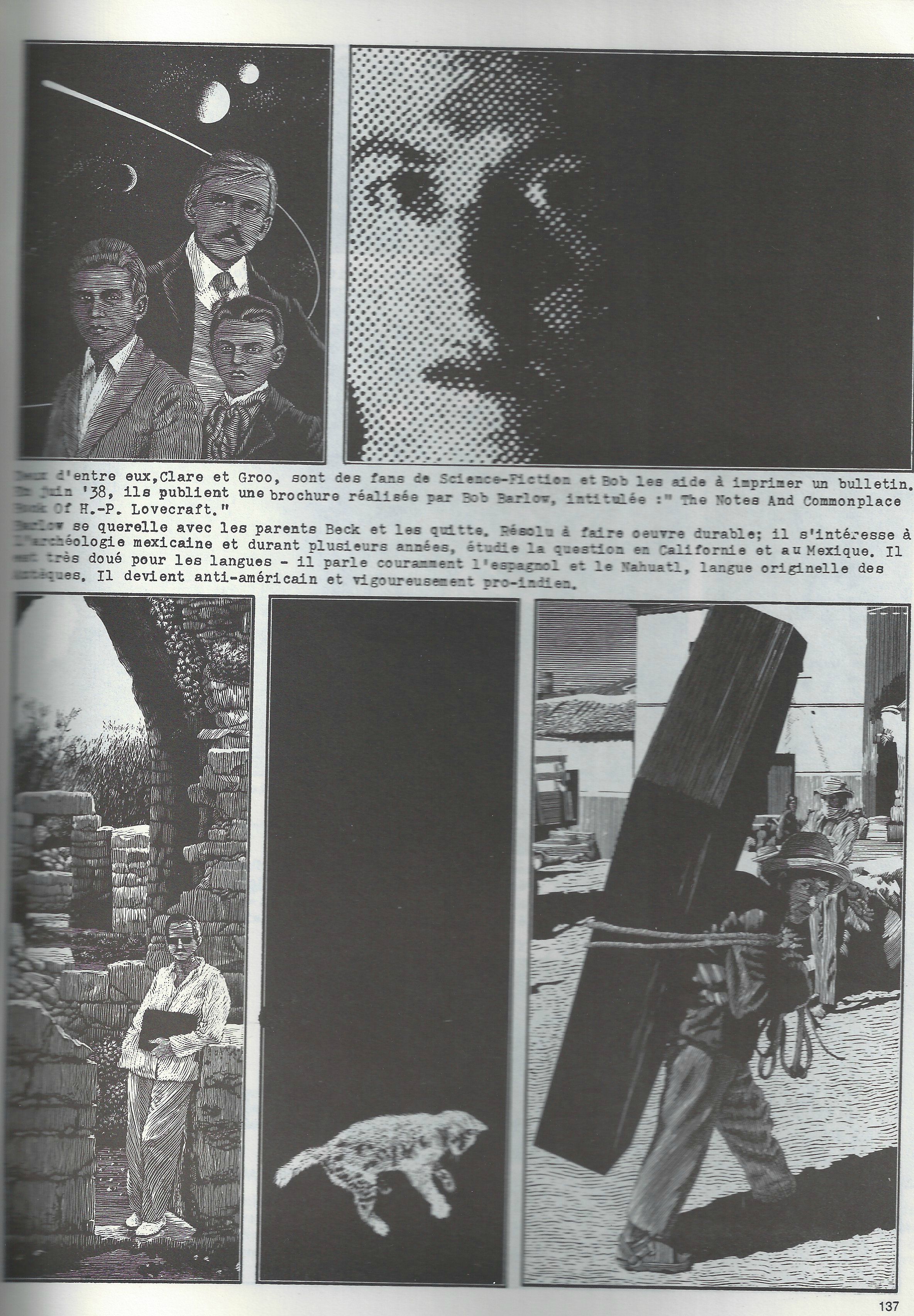
The narrative is, like most biographies, not some action-and-romance-packed account. Artist and writer manage to convey a sense time passing with the arrangement of the panels, particularly an extended shot of a kitten falling through perfect blackness that stretches out over several pages. While Lovecraft is the principal focus of the story because of the narrative, he dies in 1937…and Barlow’s story goes on, to his university education in Kansas, California, and then Mexico.

suiver-8

suiver-9

He unfortunately suffers the cruel intolerance due to his particular sexuality, at present known to all. It is the subject of an odious blackmail as a result of links with a Mexican youth. On 2 January 1951, it takes a large amount of sedatives and falls asleep forever. He is 33 years of age.

There are large parts of Barlow’s life that are not included in this brief but poignant bio-comic, because de Camp was more focused on those parts of Barlow’s life that concerned Lovecraft. We don’t read much about his career as a poet or writer of fiction; the issue of his sexuality and how de Camp came to publicize it was touched on in “The Night Ocean” (1936) by R. H. Barlow with H. P. Lovecraft, and here we see an example of how information spreads.

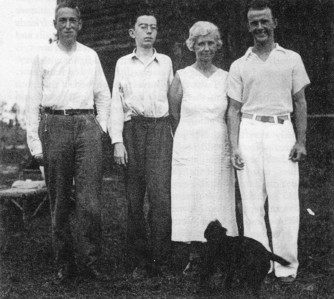
Notably absent from “R. H. B.” is an accurate depiction of R. H. Barlow himself. De Camp didn’t include any photographs in his biography for Andreas to base his depictions on, and few photos of Barlow at that point had been published.

1935-E

c. 1935

Left to right: H. P. Lovecraft, R. H. Barlow, Bernice Barlow, unknown cat, Wayne Barlow

“R. H. B.” stands as an artistic achievement, and one of (if not the first) graphic adaptations of Lovecraft’s life to feature R. H. Barlow, who did so much to preserve his legacy. Others appear in Alan Moore & Jacen Burrow’s graphic novel Providence (2015-2017); Henrik Möller & Lars Krantz’s Vägan Till NecronomiconCreation of the Necronomicon (2017); Sam Gafford & Jason Eckhardt’s Some Notes on a Nonentity (2017); and especially in Alex Nikolavitch, Gervasio, Carlos Aón, & Lara Lee’s H. P. Lovecraft: He Who Wrote in the Darkness: A Graphic Novel (2018), which showcases Lovecraft’s first encounter with Barlow in 1934…and all of these showcase how Barlow’s story has assumed its own mythical proportion, entwined with Lovecraft’s own.

While it was not uncommon for works in À Suivre to be reprinted, other than the publication in À Suivre, the only other publication of “R. H. B.”  that I have been able to confirm is in The Cosmical Horror of H. P. Lovecraft: A Pictorial Anthology (1991), a tri-lingual guide to Lovecraft comics published up to that point, which reproduces six of the eight pages of “R. H. B.” and Révélations posthumes (1980), a collection of Rivière and Andreas’ biographical comics from À Suivre.


Bobby Derie is the author of Weird Talers: Essays on Robert E. Howard & Others (2019) and Sex and the Cthulhu Mythos (2014).
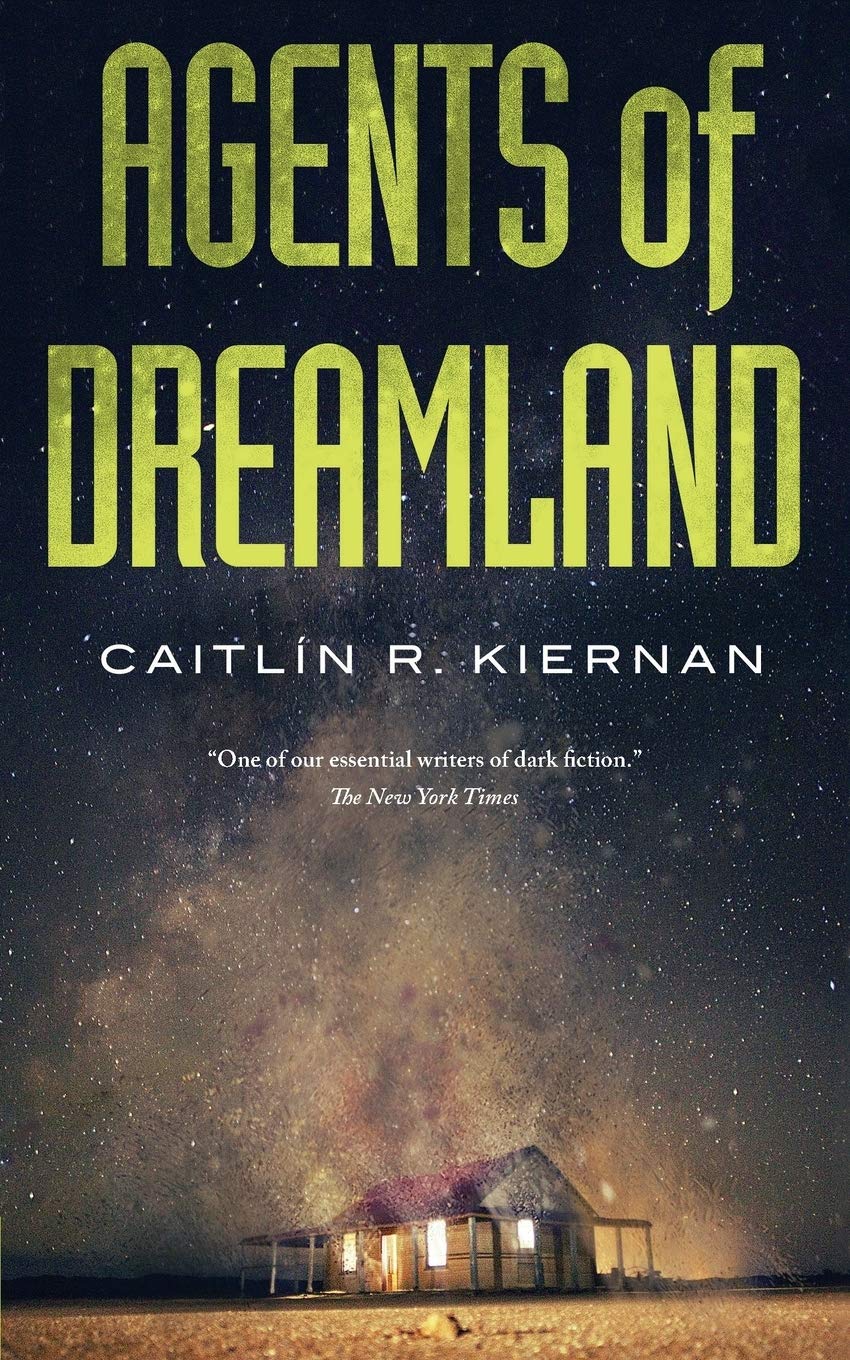
Agents of Dreamland (2017) by Caitlín R. Kiernan

The Truth Is Out There
—X Files, “Pilot,” 10 September 1993

The Federal Bureau of Investigation was created in 1908, when H. P. Lovecraft was eighteen years old. In his youth, he had formed a detective agency with his friends, inspired by the Pinkerton National Detective Agency and similar private companies. The Secret Service was the arm of the U. S. Treasury department, set up to crack counterfeiting rings and protect the president; the Black Chamber, forerunner of the National Security Agency, wouldn’t be formed until 1919.

Lovecraft had grown up in a world without G-men. With the passage of the Volstead Act and Prohibition, that would change. Hardboiled pulp crime magazines demanded more than just Sherlock Holmes-style consulting detectives, police detectives, Texas Rangers, federal marshals, or Pinkertons, though all of those characters had their place in the pages of magazines like Black Mask. Dashiell Hammett cut his teeth with The Continental Op, who worked for a fictional Continental Detective Agency modeled after the Pinkertons that Hammett himself would work for. Yet it was the rise of organized crime that came with Prohibition, and the personage of J. Edgar Hoover as head of the new Bureau of Investigation, that put their stamp on the idea of government agents in pulp fiction.

Which is why the opening to “The Shadow over Innsmouth” starts off as it does:

During the winter of 1927–28 officials of the Federal government made a strange and secret investigation of certain conditions in the ancient Massachusetts seaport of Innsmouth. The public first learned of it in February, when a vast series of raids and arrests occurred, followed by the deliberate burning and dynamiting—under suitable precautions—of an enormous number of crumbling, worm-eaten, and supposedly empty houses along the abandoned waterfront. Uninquiring souls let this occurrence pass as one of the major clashes in a spasmodic war on liquor.

H. P. Lovecraft didn’t invent the idea that governments conceal certain things from the public; the Great War impressed on the whole nation the importance of some things remaining secret. Yet it is important to place “The Shadow over Innsmouth” in that context of the rise of the G-men, of government agencies concerned with finding secrets and keeping them…and to understand that the roots of spy fiction in the Mythos, the whole cloak-and-tentacle business in Bruce Sterling’s “The Unthinkable” (1991), Alan Moore’s “The Courtyard” (1994), Delta Green (1997), Charles Stross’ “A Colder War” (2000) and The Atrocity Archives (2004), “The Star that is Not a Star” (2016) by Lucy Brady—they’re all part of a continuing tradition, born out of changes in the United States government, world affairs, and the semiotic impact on an American culture that knows that its government is hiding things from it.

Which leads also to flavors and trends in spy fiction. Ian Fleming’s James Bond is flashy, emotionally damaged, fighting secret wars against terrorists with next-generation gadgetry; Len Deighton’s unnamed protagonist of The IPCRESS FILE is faced with something no less fantastic, but the syntax is different—James Bond doesn’t deal with paperwork and bureaucracy. Spy fiction tends to vacillate between the glamorous fantasy and the grungy reality. The staid George Smiley of John le Carré’s Tinker, Tailor, Soldier, Spy is not the psychologically damaged one-man-army of Robert Ludlum’s The Bourne Identity, but they’re two sides of the same fictional coin, different iterations of the concept of the government agent, the finders and keepers of secrets.

Which is all background to set Caitlín R. Kiernan’s Agents of Dreamland in it’s proper context: the here-and-now of 2015, with a hazy secret history that extends out of knowing into past and future alike. The post-Cold War zeitgeist married the pre-war concept of G-men with the burgeoning fields of Ufology, the Shaver Mystery, Men in Black and Black Helicopters, and the warehouse at the end of Raiders of the Lost Ark. Pulp fiction jumped the semiotic shark when conspiracy fantasies like Robert Shea & Robert Anton Wilson’s The Illuminatus! Trilogy and Umberto Eco’s Foucault’s Pendulum became more or less indistinguishable from the actual conspiracy theories being peddled in Fate Magazine. When The X-Files hit in 1993, based on the 70s journalistic exploits of Kolchak, the Night Stalker, it was a spike driven straight into the vein of the American collective unconscious.

People want to believe the truth really is out there…and that the government knows and is hiding it.

Post-X Files fiction in this vein is rife, everything from big-budget Hollywood blockbusters like Independence Day (1996), Men in Black (1997), and Paul (2011) to graphic novels like Groom Lake (2009). Some are played straight, others for laughs—the bigger the cover-up, the more people and resources at play, the more it stretches the suspension of disbelief that any government agency can keep a lid on anything for any period of time.

Yet at the same time, everyone accepts that governments do successfully cover up things all the time. Documents are unclassified over time and reveal the details of events that happened in the shadows…and we know there are files still sealed. Secret histories under lock and seal. Anything might be in there—and that’s the attraction of the government conspiracy mindset. The imagination can populate those locked binders with any secrets—never mind that most of them are probably mundane things, like the sexual escapades of past presidents now safely dead, or the schematics for encryption machines rusting away in some government warehouse.

While his parents sleep, the boy is treated to Ray Harryhausen’s Rhedosaurus, Charles Laughton’s Quasimodo, and, finally, English director James Whale’s little-known and once-believed-lost The Star Maiden (1934).
—Caitlín R. Kiernan, Agents of Dreamland (2017), 48

Agents of Dreamland is the first in her Tinfoil Dossier series, which will probably be compared to Charles Stross’s Laundry series by default: both involve the Men-in-Black end of a government cover up, agencies working behind the scenes to investigate and contain the Mythos. The two bodies of work are distinctly different beasts, however. Kiernan’s point-of-view character the Signalman is on the ragged end of a career out on the edge of the spook world, a veteran of too many horrors. Not the smartest or the most clever, no Jason Bourne-style action scenes, just a bone-weary tiredness and a looming sense of desperation hovering over all.

That’s the mood. This is a war that can’t be won, because the people fighting it don’t realize it is a war yet.

The lore is stripped down; this isn’t a roleplaying game supplement about the Men in Black and their valiant secret war against the Cthulhu Mythos. This is grungier, grittier, more homely and with an air of inevitability. There are scenes and themes reminiscent of Mexican Gothic (2020) by Silvia Moreno-Garcia. Lovecraft, for all that he created, was working within a late-19th/early-20th century frame of scientific understanding—and science has dug up some much stranger things since 1937.

Kiernan doles out the information from the black dossier in measured doses, switching point of view and time between chapters, balancing exposition and description. The idea isn’t to give the reader too much at once, to let the reader form their own connections, to feel the people that are in these places at these times. It’s a spy story written like a Cthulhu Mythos story, and by the time the reader finds out the truth about The Star Maiden, puts the pieces together and think they have a clue about where this is going…

The truth is weirder than you think.

Caitlín R. Kiernan’s Agents of Dreamland (2017) is the first in the Tinfoil Dossier series, and is followed by Black Helicopters (2018) and The Tindalos Asset (2020).


Bobby Derie is the author of Weird Talers: Essays on Robert E. Howard & Others (2019) and Sex and the Cthulhu Mythos (2014).
“The Child of Dark Mania” (1996) by W. H. Pugmire

This story appeals to me more than most of the things I’ve written this past decade. I am fond of the image of the woman with her weird masked face, and was delighted when two pictorial renditions of that image were included in my first American collection, one by my editor and publisher, Jeffrey Thomas, and the other gracing the superb cover illustration by Earl Grier. There is a lot of peculiar passion in this story, and it gets me, deliciously. I was delighted to be able to write it in memory to HPL’s great buddy and fellow weird author, Frank Long. “The Child of Dark Mania” originally appeared in The Pnakotic Series.
—W. H. Pugmire, “Afterword” in Sesqua Valley & Other Haunts 113

Frank Belknap Long, Jr.’s “The Horror from the Hills” (Weird Tales Jan, Feb-Mar 1931) is one of his most famous additions to the Cthulhu Mythos—mostly because the novella incorporates a lengthy sequence borrowed from one of Lovecraft’s letters (with permission), describing a Roman dream in ancient Iberia. The main antagonist of the novella is Chaugnar Faugn, which in turn was inspired by a small statuette of the elephant-headed Hindu deity Ganesha that Long’s aunt Cassie Symmes had gifted him.

Long is busy on a horror tentatively called “The Elephant God of Leng”—based on a curiously carved idol his aunt lately brought him from Europe, plus a suggestion or two of mine.
—H. P. Lovecraft to Clark Ashton Smith, 2 Feb 1930, Dawnward Spire, Lonely Hill 204

The appropriation of an Indian religious icon was not uncommon in Weird Tales during the period. Readers might compare the elephant-headed Yog-Kosha from Robert E. Howard’s “The Tower of the Elephant” (Weird Tales Mar 1933), or the eponymous idol in Seabury Quinn’s “The Green God’s Ring” (Weird Tales Jan 1945). Inspiration comes where it does, and the “Exotic East” was an important inspiration for many pulp writers, and a draw for many pulp readers—and we can perhaps be grateful that Long drew a distinction between the benevolent Ganesha and the malevolent Chaugnar Faugn.

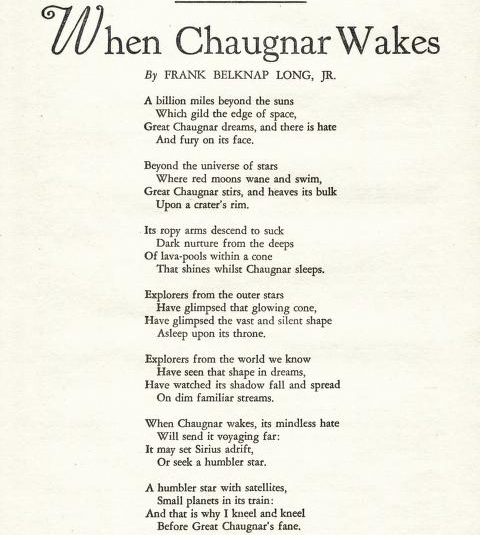
While “The Horror in the Hills” has been long recognized as a part of the Mythos, there has never quite been a distinct “Chaugnar Faugn Cycle.” Lovecraft would include Chaugnar Faugn among the deities in “The Horror in the Museum” (1933), and Long would revisit the character in his poem “When Chaugnar Wakes” (Weird Tales Sep 1932), and a few others have tried their hand at it, notably Robert Bloch with “Death is an Elephant” (Weird Tales Feb 1939), Joseph Pulver, Sr.’s untitled poem that begins “Elephant Lord, Chaugnar Faugn,…” (Cthulhu Cultus #12, 1998), Robert M. Price’s “The Elephant God of Leng” (Black Book #1, 2002), and W. H. Pugmire’s “The Child of Dark Mania” (1996).

Weird_Tales_v20n03_1932-09_sas_0123

As with “An Imp of Aether” (1997), “The Child of Dark Mania” is one of a series of stories that Pugmire wrote in the 1990s in homage to various weird authors that had come before; and as with “Imp” this one has been revised in its various publications, so that while the basic elements of the story remain, the details shift a bit depending on whether you read it in the original Pnakotic Fragments (1996) fanzine, the Tales of Sesqua Valley (1997) chapbook, or paperback publication in Sesqua Valley & Other Haunts (2008) or An Imp of Aether (2019).

Most of these changes are minimal—the consolidation of paragraphs, another word or sentence of description, etc. One notable change is the name of the protagonist, a writer of horror fiction who in the original is Frank or Franklyn, and in the 2019 version is “Sonny” or Francis—no doubt to more closely associate the writer with “Sonny” Belknap, as Lovecraft used to call his friend.

She went to a stand and unwrapped a piece of plastic, from which she removed a cone of incense. This she placed next to me on the bed, along with an incense burner shaped as an Eastern deity, an elephant god whose name I could not recall.
—W. H. Pugmire, “Child of Dark Mania” in An Imp of Aether 169

In keeping with his usual style, Pugmire is not so unsubtle as to name Chaugnar Faugn directly. The story is all the more effective for not being another gushing bit of fanfiction that tries to dump a vast chunk of Mythos lore on the reader. Nor does Pugmire try for anything grandiose; this is a quieter tale than “The Dunwich Horror” or “The Devil’s Hop Yard” (1978) by Richard Lupoff, somewhat closer to Arthur Machen’s “The Great God Pan” in scope—and Melissa is perhaps a close cousin to Helen Vaughn as portrayed in Helen’s Story (2013) by Rosanne Rabinowitz.

Instead, it is a very slight, intimate story, content to communicate the plot by image and intimation, and leave the reader’s imagination to fill in the rest. One of the most distinct such images is worth going into a little more deeply:

I tired but found it impossible not to study the grotesque cloth mask, and the bizarre shape that moved beneath it. I had known that Melissa had been born with birth defects, and we had assumed that this had been the result of Diane’s consumption of foreign opiates. (ibid. 168)

Savvy readers might draw any number of references: the masked high priest not to be described in The Dream-Quest of Unknown Kadath, perhaps—but also Joseph Merrick, the Victorian performer billed as “The Elephant Man,” who would wear a hood or mask to help conceal his features when in public.

There is that sense of empathy for Diane, the wild child who had “journeyed with a gang of lesbian witches” and returned pregnant, disapproved of by her family, and forced to raise her daughter alone…and now might lose her, as Melissa comes of age—which is the only odd part of the changes between editions. In the earlier versions of the text, Diane gave birth eighteen years before the start of the story, in the 2019 text this is shortened to eight. Whether this is an error or meant to invoke the quick growth of Wilbur Whateley is not clear, and doesn’t effect the final story much.

In conception, Pugmire’s Chaugnar Faugn is more intriguing than Long’s. Here, the deity has an aspect reminiscent of Pan, Bacchus, or Dionysus, who might attract very Lovecraftian maenads, drunk on the cosmic wonder of it all…and dance.

My blood froze as she bent low and kissed the shadow of the rigid god, and I inwardly cringed when that blasphemous silhouette began to blur and bend. (ibid. 171)

Why did Diane flee to Sesqua Valley? Perhaps because that was Pugmire’s corner of Lovecraft Country, and he wished to draw to himself those dark, shining jewels of the Mythos he prized. There is a jealous tendency to the valley, magnetic and sympathetic, like calling to like. The Child of Dark Mania fits in well among those shadowy residents.

The latest version of the text, titled “Child of Dark Mania,” can be read in An Imp of Aether (2019).


Bobby Derie is the author of Weird Talers: Essays on Robert E. Howard & Others (2019) and Sex and the Cthulhu Mythos (2014).
“The Night Ocean” (1936) by R. H. Barlow with H. P. Lovecraft

 For I have always been a seeker, a dreamer, and a ponderer on seeking and dreaming; and who can say that such a nature does not open latent eyes sensitive to unsuspected worlds and orders of being?
—R. H. Barlow with H. P. Lovecraft, “The Night Ocean” (1936)

From 28 July to 1 September 1936, R. H. Barlow visited H. P. Lovecraft for what would be the final time. Barlow had just turned 18 the previous May, and his parent’s marriage was on the point of deterioration; the young man was destined to stay with relatives in Kansas City, and a brief term at the Kansas City Art Institute. But for over a month he roomed at the boarding house near Lovecraft’s home on 66 College Street, and it was presumably at this time that Lovecraft made some revisions to Barlow’s story “The Night Ocean.”

A few paragraphs of this story had first been published as “A Fragment” in The Californian Winter 1935 issue. The Californian was the amateur journal of Hyman Bradofsky, one to which Lovecraft and a few of his friends such as Natalie H. Wooley also contributed, and Lovecraft was luring Barlow into amateur journalism, at least for a brief spell. Lovecraft mentions “The Night Ocean” among items he hadn’t seen before Barlow’s visit (O Fortunate Floridian! 353), so it seems clear that this was a story Barlow had been working on for quite some time. There is some evidence in Lovecraft’s letters that Barlow was at loose ends during this period, trying many different things—art, writing, printing, poetry—to see where his talents were best suited, and this included writing a passel of fiction, some of it carefully, some of it hastily.

Lovecraft apparently showed some of these fictional efforts to August Derleth during or shortly after Barlow’s stay, including an intriguing piece titled “I Hate Queers” which does not appear to have survived. After passing along Derleth’s criticism, Lovecraft wrote:

Barlow appreciates your criticism immensely, & will doubtless be guided by them in future attempts. He is now, of course, in a purely experimental stage—scarcely knowing what he wants to write, or whether he wants to write at all…as distinguished from painting, printing, bookbinding, &c. My own opinion is that writing best suits him–but I think he does better in fantasy than in realism. A recent atmospheric sketch of his—”The Night Ocean”—is quite Blackwoodian in its power of dark suggestion.—H. P. Lovecraft to August Derleth, 23 Sep 1936, Essential Solitude 2.748

Lovecraft’s suggested revisions for “The Night Ocean” were somewhat uncharacteristically light. While we often think of Lovecraft essentially re-writing stories, in this case his changes only amount to less than 10% of the work. A typed manuscript with Lovecraft’s handwritten revisions survives, and is reproduced in facsimile in Lovecraft Annual #8. Barlow then prepared a fresh typescript incorporating most (but not all) of Lovecraft’s suggested revisions, which was submitted and accepted by Bradofsky, who published it in Winter 1936 issue of The Californian. In his letters, Lovecraft praised Barlow and the story:

Glad to know that you’ve been in touch with Kansas City’s brilliant new citizen, & hope you’ll be able to meet the little imp in person before long. He is certainly one of the brightest & most promising kids I have ever seen—gifted alike in literature, art, & various forms of craftsmanship—& despite his present scattering of energies in different fields I think he will go far in the end. His studies at the Art Institute will undoubtedly be very good for him, & help him to establish a sort of aesthetic orientation. Hope he’ll meet your uncle amidst the academic maze—though the size of the institution doubtless minimises the chances of accidental contact. Barlow has been growing fast in a literary as well as artistic way—as you doubtless deduced from his “Dim-Remembered Story” in The Californian. A still later tale of his—”The Night Ocean”, also scheduled for The Californianshows an even greater advance, being really one of the finest atmospheric studies ever written by a member of the group.
—H. P. Lovecraft to Natalie H. Wooley, 21 Nov 1936, Letters to Robert Bloch & Others 213

As much as Lovecraft is sometimes held to include autobiographical elements in his stories, it’s hard not to see something of young Barlow in the the nameless narrator; a sensitive artist who holds himself apart from the crude masses of normal people. Whose sensitive soul opens him to vague fears when they finally achieve the isolation they had thought they wanted:

That the place was isolated I have said, and this at first pleased me; but in that brief evening hour when the sun left a gore-splattered decline and darkness lumbered on like an expanding shapeless blot, there was an alien presence about the place: a spirit, a mood, an impression that came from the surging wind, the gigantic sky, and that sea which drooled blackening waves upon a beach grown abruptly strange. At these times I felt an uneasiness which had no very definite cause, although my solitary nature had made me long accustomed to the ancient silence and the ancient voice of nature. These misgivings, to which I could have put no sure name, did not affect me long, yet I think now that all the while a gradual consciousness of the ocean’s immense loneliness crept upon me, a loneliness that was made subtly horrible by intimations—which were never more than such—of some animation or sentience preventing me from being wholly alone.
—R. H. Barlow with H. P. Lovecraft, “The Night Ocean”

Massimo Barruti, who has examined “The Night Ocean” in the greatest depth in his book Dim-Remembered Stories: A Critical Study of R. H. Barlow notes that the story is a “textbook example of the extreme sensitiveness and poetic attitude of Barlow’s personality” (102)—the mental degeneration brought by isolation and a too-active imagination causes the protagonist to question reality, even as he populates his nighttime seashore with nameless terrors. Imagine an Innsmouth without any Deep Ones, yet none the less haunting for their absence, to one of sufficient temperament to imagine croaking voices by night, or hear something sinister in the splash of water.

“The Night Ocean” is Barlow at his most Lovecraftian. He never tries to pastiche Lovecraft exactly, or to tie his artist’s strange fears, longing, and imagined horrors into anything from Lovecraft’s nascent Mythos, although readers can certainly draw such connections themselves. Instead, Barlow reproduces the atmosphere and themes of Lovecraft, tries to capture and express the cosmicism—perhaps in homage to his mentor, perhaps as a reflection to how much of an influence Lovecraft had on him. Brian Humphreys explored this in detail in “‘The Night Ocean’ and the Subtleties of Cosmicism” in Lovecraft Studies #30. One thing that Humphreys notes is: “He has left society to be alone, yet feels lonely in his solitude” (18).

Which could well be said of Barlow himself.

While he has achieved a posthumous notoriety as one of Lovecraft’s homosexual friends and correspondents, Barlow does not seem to have expressed his sexuality in his published fiction in any overt manner, or even by obvious metaphor or allegory. There might have been something in “I Hate Queers” that addressed his experience as a closeted homosexual growing up in a very homophobic society, but that piece no longer appears to be extant…and it is worth a little digression to ask what we know about Barlow’s sexuality and how we know it.

Like several of Lovecraft’s young proteges, Barlow became an active homosexual. His homosexuality, however, may not have developed until after Lovecraft’s death; at least, Lovecraft apparently never knew of his young friend’s deviation.
—L. Sprague de Camp, H. P. Lovecraft: A Biography (1975), 190

As far as I have been able to determine, de Camp was the first writer to publicly “out” Barlow as homosexual. Lovecraft never mentions this in his letters, nor does E. Hoffmann Price in his memoirs The Book of the Dead mentions Barlow in California, but gives no hint of homosexuality, and none of the memorial pieces after Barlow’s passing mention it. Given the atmosphere of prejudice regarding homosexuality at the time, if any of those who knew Barlow did know about his sexuality, they might have deliberately avoided mention to preserve his memory and reputation. That being said, rumors of Barlow’s sexuality had apparently been circulating for some time within some circles:

Barlow is for sure a homo; from what I have heard, so was the late minister-weird taler Henry S. Whitehead. Any anybody with a mandarin moustache is vulnerable to the kind of flattery, larding I can do very well.
—August Derleth to Donald Wandrei, 21 March [1937]

Derleth had not met either Whitehead or Barlow in person; it is possible that his intuition on Barlow’s sexuality was based entirely on the “I Hate Queers” manuscript and his own experiences. While this is speculative, it could be that the story dealt with a homosexual man who assumed a homophobic persona to better conceal his own sexuality. While this might seem like a stretch, in Barlow’s 1944 autobiographical essay he recalls something of this mindset:

Once I saw a man bring a sailor up to his room and thought of protesting to the management. A blond clerk and a Basque elevator boy—man, rather—caught my eye, and I took them out once or twice to drink at my expense.
—R. H. Barlow, “Autobiography” in O Fortunate Floridian! 411

This autobiographical essay is the most singularly definitive proof we have of Barlow’s sexuality; he very clearly describes his interests, even if he does not record any detailed encounters. When describing his stay with Claire and Groo Beck in California, he wrote:

I could not decide which of the Beck boys to fall in love with and vacillated continually. Claire had a mania for bathing, and I saw him once or twice quite naked. He had a nice prick, uncircumcised. At other times he found excuses to go downstairs from the bath to the living room, dressed only in skin-tight drawers, which also showed him off to advantage. (ibid. 410)

It’s not clear if de Camp read this essay among Barlow’s papers, or whether he picked up the rumors about Barlow’s sexuality. There are many inaccuracies in de Camp’s rendering of Lovecraft and other figures, so it is not beyond the pale to think that de Camp presented rumors as fact. His last word on Barlow in the book is a good example of what he could write without citing any sources:

All this time, however, Barlow energetically pursued his career as a homosexual lover. This was long before Gay Liberation, and Mexico has been if anything less tolerant of sexual deviation than the United States. On January 2, 1951, Barlow killed himself with an overdose of sedatives, because he was being blackmailed for his relations with Mexican youths.
—L. Sprague de Camp, H. P. Lovecraft: A Biography (1975), 431-432

This interpretation of Barlow’s death has since become generally accepted, mainly because no one else has come up with a better reason for Barlow’s suicide at about the height of his career. William S. Burroughs who was present in Mexico at the time and commented on Barlow’s suicide does mention that Barlow was “queer”, but does not mention blackmail. Barlow himself asserts in his autobiography that by 1944 he had “a good part of the material things I have desired—money, sex, a small reputation for ability […]” (O Fortunate Floridian! 407) so de Camp’s assertion is not impossible—merely unconfirmed, and perhaps unconfirmable.

Questions of how “out” Barlow was remain essentially unanswered. He did not, for the most part, grow up in any urban area which might have had an active homosexual subculture to be out in; and what can be reconstructed of his adult life shows him very candid about his sexuality but also not, apparently, flaunting it. The earliest possible hint of his burgeoning sexuality might have been an entry in his 1933 diary for May 23:

Back at George’s again, when he & Si arrived, Si went calmly about cleaning up, in a semi-nude condition. It is perhaps indiscreet to record such observations on paper, for my meaning might be misconstrued, but he looked lovely and young and strong and clean…He is a fine boy; the nicest, I believe, I have ever known. Too, he treats me decently, something no other has ever done.

It isn’t clear who “Si” is, although apparently George and Si are neighbors of the 15 year-old Barlow in or around Deland, Florida. If this is an indication of Barlow’s early awareness of his sexuality, it predated his first meeting with Lovecraft in 1934.

Which brings us back, after a long digression, to Barlow and “The Night Ocean.” Because however much of himself Barlow may have poured into the story, the mood he captured regards that which is not simply mysterious, but unknowable. There are secrets which we cannot fathom, no matter how hard we try…and the narrator accepts this as something essential to the very nature of the sea itself:

The night ocean withheld whatever it had nurtured. I shall know nothing more.
—R. H. Barlow with H. P. Lovecraft, “The Night Ocean”

There is much about R. H. Barlow’s life that we will never know; no matter what bits and pieces wash upon the beach for us to find, there are some things we cannot know. Why did he take his own life? Who did de Camp get his information from? Did Lovecraft ever pick up on his young friend’s sexuality? Shapes in the waves as the sun sets, shadows on the water that suggest more than they define. “The Night Ocean” is not a metaphor for Barlow’s life; he could not know when he wrote it in 1935-1936 what the skein of his career would be, in terms of who he would become Barlow had hardly been born yet. Yet it is a very Lovecraftian story…and R. H. Barlow lived, and ultimately died, a very Lovecraftian death.

“The Night Ocean” by R. H. Barlow with H. P. Lovecraft may be read for free online here.


Bobby Derie is the author of Weird Talers: Essays on Robert E. Howard & Others (2019) and Sex and the Cthulhu Mythos (2014).