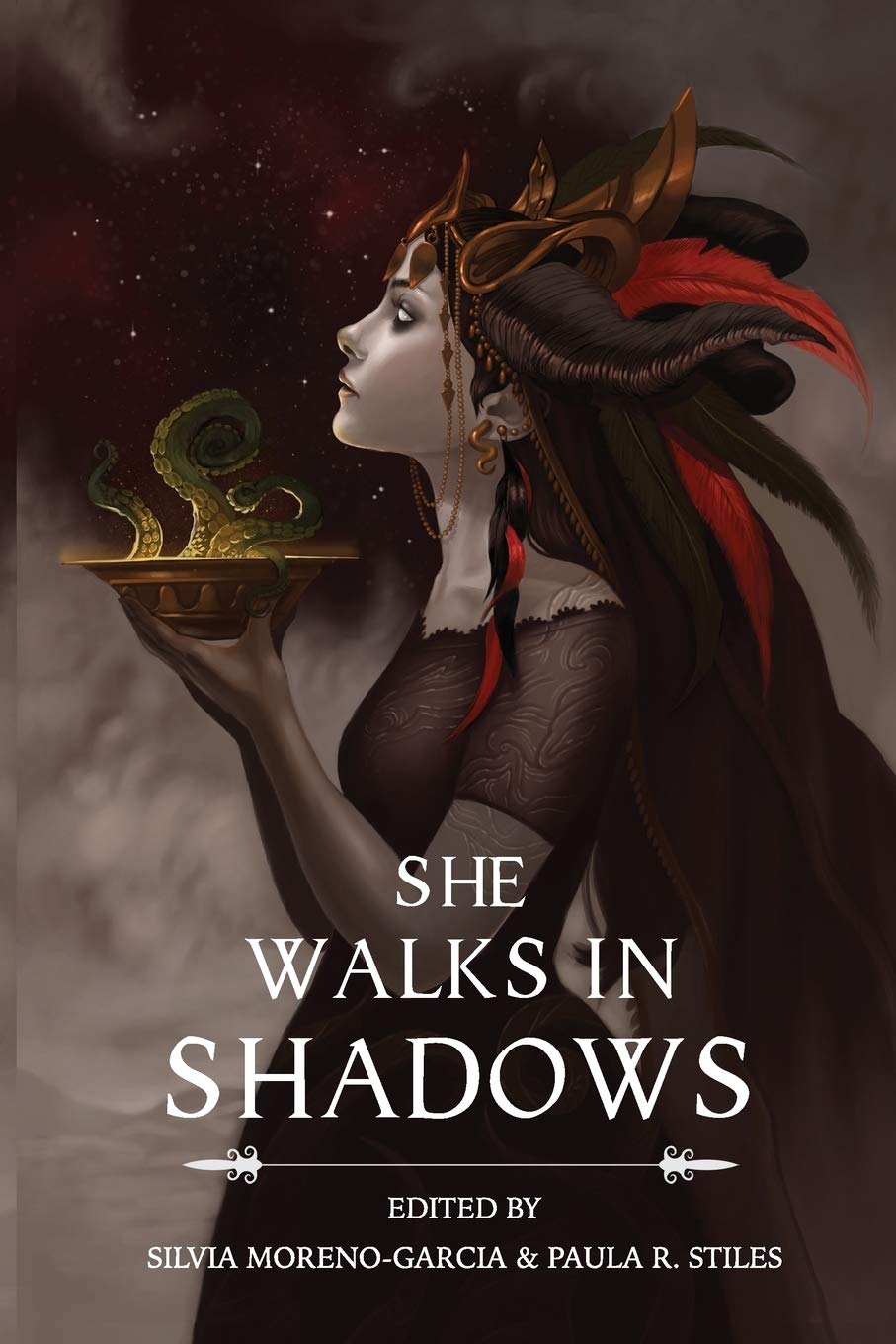
He noticed only the tiny waist, the flaring lower hourglass of her hips, and the bushy white triangle at the junction of her sturdy legs. He was so distracted that he didn’t notice the malformations on her flanks, her hips, the myriad tiny eyes embedded there, blinking lashless lids in the flickering orange glow. —Angela Slatter, “Lavinia’s Wood” in She Walks In Shadows 69
Readers and scholars often talk about the body of fiction inspired by Lovecraft in terms of religion and folklore. That is the nearest real equivalent we have to a very unusual phenomenon, where so many different authors are riffing off similar ideas, similar characters and stories. Terms like canon get thrown about a great deal, and some of Lovecraft’s own stories are as close to the Biblical canon get. Most authors agree that the events of “The Dunwich Horror” and “The Shadow over Innsmouth” happened, though they might fiddle with the details, and expand in different ways on what came before and after.
Yet the Mythos is not a single coherent body of internally-consistent works, or some divine text interpreted by many different authors. It is a sprawling mass of stories by different writers who often work in familiar cycles. The point is that not all of the stories do agree, or can agree. There is no one absolute, true, final, and complete version of any story. There are multiple different takes on the same subject, and they are often strongly divergent. Readers might be able to reconcile “The Dunwich Horror,” “The Shuttered Room” by August Derleth, “The Devil’s Hop Yard” by Richard Lupoff, and “The Cry in the Darkness” by Richard Baron as all being episodes in a single tale, but it is harder to fit in Lavinia Rising by Farah Rose Smith, The Dunwich Romance by Edward Lee, or “Lavinia’s Wood” by Angela Slatter.
At some point, there are too many differences to gloss, too many points of disagreement.
Too many different versions of Lavinia Whateley (or, in some versions, Whatley).
“The Dunwich Horror” is Lavinia’s story as much as that of her sons, though she is given short shrift by the folk of Dunwich. Various authors have expanded on her character. In some, she is a pure victim, like her predecessor Mary in Arthur Machen’s “The Great God Pan.” In many stories, Lavinia lacks agency, utterly dominated by her overbearing father Wizard Whateley. In a few, she is more active, even malevolent, an active participant rather than a meek vessel to be filled.
It is a rare story that suggests that Wilbur and his brother take as much from Lavinia as they do from Yog-Sothoth. Angela Slatter’s version in “Lavinia’s Wood” is more complicated than most, giving evidence of Lavinia’s dreams, desires, and actions that go far beyond the woman seen in Lovecraft’s account. Someone who dreams of a world beyond Dunwich, and who herself is not quite completely human.
There is a degree of pathos to Dunwich prequels. Readers already know Lavinia’s fate, or at least one of her possible fates. How she gets there is where authors diverge; what details they choose to emphasize, and what aspects of the character they develop in new directions. In “Lavinia’s Wood,” Angela Slatter gives Lavinia context. Social, geographic, biographical, biological. Lavinia as a part of the decayed Whateleys, in contrast to her richer and more educated cousins; as an outsider even among the inbred rural folk of Dunwich; her relation with her father and his books; and even how her body differed from others in ways not immediately obvious.
“Lavinia’s Wood” is not the prequel to “The Dunwich Horror.” It is one of many. Yet it is an interesting, insightful take on Lavinia, one that sheds a different light on the preceding events—and who knows what elements of that might make their way into further stories in the Dunwich cycle?
“Lavinia’s Wood” by Angela Slatter was first published in She Walks In Shadows, and its reprints. It has not otherwise been reprinted.
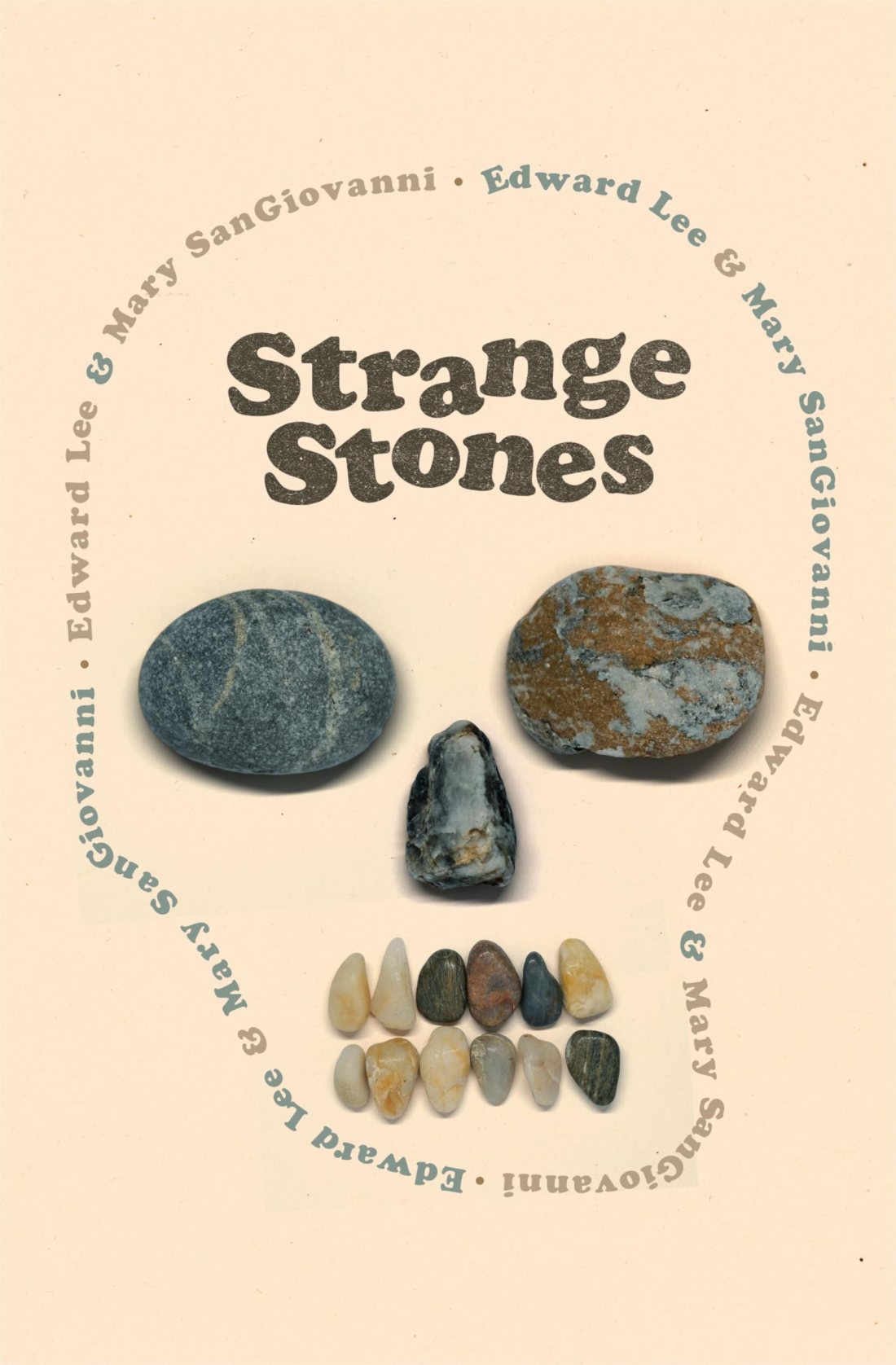
It was Arkham House that perpetuated the Big Lie in this case, and from there a mechanism of critical bandwagonism took off and continues to this day. The tenet is, if you tell a lie big enough and enough times, people will believe it. That’s why Lovecraft has been raved about for all these decades. It’s a big lie that readers have been force-fed by a pro-Lovecraftian syndicate designed to make money. —Edward Lee & Mary SanGiovanni, Strange Stones(2025) 3
Professor Robert Everard, who speaks those words at a horror convention, is a Lovecraft-hating asshole. That is his point. If the sentiment gets a rise out of you and makes you want to refute it, congratulations: the authors have succeeded at their characterization. It is a very unconventional way to draw readers into a rather meta short Lovecraftian horror novel, but Everard’s arguments and the context in which they take place are important to understand, because they’re fundamental to the plot of the novel.
Fiction genres in the sense that we think of them today tended to emerge around the turn of the 20th century. Western dime novels were a staple of 19th century popular literature in the United States; science fiction, mysteries, fan clubs, etc. all preceded the emergence of pulp magazines in the 1910s and 1920s, but it was really the pulp magazines that began to crystallize genre as we think of it today, and especially organized fandom as we think of it today. The horror conventions today are all descended, more or less, from the early science fiction fan conventions of the 1930s in the United States.
Genre is only secondarily a literary convention; the primary purpose was marketing. Specialization allowed pulp magazines to carve out niches and develop dedicated readership that they could directly market to. Magazines in the same genre competed with one another for the same dimes and quarters; Weird Tales had to struggle against Ghost Stories, Tales of Magic and Mystery, Strange Tales of Mystery and Terror, Terror Tales, Famous Fantastic Mysteries, Unusual Stories, and others, and tried to draw in readers from science fiction magazines like Astounding Stories, Amazing Stories, Wonder Stories, and Planet Stories.
Hardbacks, paperbacks, comics, and movie makers all learned this lesson, that specialization has the benefit of attracting a specific, dedicated readership. And once you have that audience, the quality of the content is less important than if it stays in genre. Decades of genre products have been, essentially, disposable pap, churned out quick and cheap for an eager audience that cared less about quality than if it was horror or science fiction. This is the kind of silly, low-quality stuff that gives genre media a bad name, but it’s also the stuff that’s generally predominant at any given moment. True genre classics are rare, and stand out because so much of the run-of-the-mill material is generic, familiar monsters and spaceships.
In this sense, what is a genre convention, then, then a target-rich environment? The earliest conventions weren’t entirely uncommercial, but they weren’t dominated by dealer rooms or particular creators promoting their latest film or book, which are common attributes of contemporary conventions. What creators and companies learned was that it’s a lot easier to sell your product if your customers are all in the same place; genre conventions in the United States in particular have become an important part of the economic ecosystem of various celebrities, independent dealers, small companies, and boutique shops.
The cultural phenomenon of the convention has developed to the point where it’s become a key aspects of organized fan culture, to the point of becoming the setting of new creative works, like I Am Providence: A Novel(2016) by Nick Mamatas and Screamland: Death of the Party(2012) by Harold Sipe, Christopher Sebela, and Lee Leslie. And it’s this crux of the commercialization of horror and the convention experience which forms the springboard setting for Edward Lee and Mary SanGiovanni’s novel Strange Stones (2025).
Richard Everard’s grudging kvetch against Lovecraft’s ascendance in horror media is in part a tongue-in-cheek jab at a genuine aspect of fandom and how Lovecraft and his Mythos have faced posthumous commercialization and pop culture significance way beyond its initial tiny dedicated genre audience. Everard’s own interaction with the convention circuit has been primarily a lecherous attempt to get in the pants of as many women as he could, a series of sexual conquests that is both a kind of wish fulfillment and a genuine recognition that yes, fans do hook up at conventions. Rachel Bloom wasn’t being entirely inaccurate with Fuck Me Ray Bradbury in the way genre literary figures can attract groupies.
There is a dark side to that, too: many prominent or even beloved genre literary figures have been revealed as sex pests or abusers. Alec Nevala-Lee’s excellent Astounding: John W. Campbell, Isaac Asimov, Robert A. Heinlein, L. Ron Hubbard, and the Golden Age of Science Fiction (2018) contains accounts of bad behavior by writers like Isaac Asimov, for example. This kind of contact between fans and creators is mainly possible because of events like conventions, where individuals who would normally be separated by hundreds or thousands of miles are brought into geographical proximity and with shared purpose.
So Everard is a caricature of specific figures in convention culture: a lecher (right there in the name: “Everard”/”Ever-hard”), a high-minded academic who snobbishly looks down on the tastes of the masses, a shit-stirrer more focused on selling his own books and tearing others down instead of creating something positive. All of which makes him less than sympathetic when he does encounter some real horror.
The back three-quarters of the short novel are a whirlwind tour through several of Lovecraft’s Mythos stories, but not in a way that readers might think. Lee and SanGiovanni are very carefully and deliberately introducing Lovecraftian settings like Innsmouth, Arkham, and Dunwich in ways that are very accurate to Lovecraft’s fiction—often focused on small details, which are then blown up and expanded upon—but not trying to pastiche Lovecraft’s particular style or language. So it is very deliberately Lovecraftian, with Everard’s familiarity with Lovecraft’s corpus letting him recognize where and when he is, yet at the same time the settings are fresh, parts of the setting that Lovecraft himself never put on the page.
Readers might be curious if there are any connections with Edward Lee’s “Hardcore Lovecraft” series which includes books like The Haunter at the Threshold and The Wet Dreams of Dead Gods. Strictly speaking, the answer is no; Lee’s own Lovecraftian novels remain very distinct in setting and approach, and Strange Stones is in general much less explicit in terms of violence, gore, and sexual activity. That doesn’t mean it isn’t there, but it is less prominent in the plot. In part because the focus of the story isn’t on titillation or exploitation-level sex and violence, while there is definitely transgressive grue and sexual activity, the pace of the story is such that the writers don’t dwell on it in anything like the detail of Lee’s more extreme solo works.
One important characteristic of Strange Stones, however, is that it is not nostalgic for Lovecraft. Works of the type “Lovecraft was right! The Mythos was real!” or revisiting old stomping grounds like Dunwich and Innsmouth can lead to much more watered-down horrors. Like Bela Lugosi’s Dracula or Boris Karloff’s Frankenstein or Lon Chaney Jr.’s Wolfman, there comes a point where Cthulhu becomes overly familiar, to the point that the appearance of the Big C comes across more as a friendly face than a stark horrific reality that haunts the imagination. A point Ken Hite touched on in “Cthulhu’s Polymorphous Perversity” in Cthulhurotica, discussing the plush toy incarnations of Lovecraft’s primal alien horror.
Instead, Lee and SanGiovanni present Lovecraft’s Mythos as terrifying.
Dismembered corpses. Perverse sexual defilements. Sudden violence. The Mythos in Strange Stones has all the subtlety of a Goatwhore album cover or an issue of Crossed by Garth Ennis and Jacen Burrows. Readers are going to have to make their way through dead babies, threats of anal assault by oversized piscine pricks, and an alien orgy in which dismembered torsos feature prominently. The Mythos is not a dry, abstract, intellectual horror in this novel; it is a living, breathing cult simmering with malice, madness, and strange and terrible hungers. That this is not quite as extreme in terms of sex and violence as Edward Lee gets up to on his own is not the same as saying that this novel is tame or soft in any way.
It is a difference in emphasis. Everard doesn’t see the clean Mythos that Lovecraft presented to the world, with its carefully-constructed narratives where all the orgies and most of the violence happens off the page. What Everard sees is Lovecraft with the blinders taken off; what Lovecraftian fiction could look like, if writers approached his Mythos with the imagination normally reserved for a particularly lurid Cannibal Corpsealbum or exploitation film. Fairly reminiscent in many ways of what Antony Johnston, Alan Moore, and Jace Burrows did in The Courtyard and Neonomicon, though without quite as elaborate a working-out of details.
Strange Stones is, after all, a fairly short novel, briskly paced, and not concerned with a unified theory of the Cthulhu Mythos as much as keeping the story moving through each step of Everard’s ordeal. While there is room for a sequel, as a one-and-done novel it stands alone effectively enough. While not perfect, it is fun and a quick read, quite unlike the majority of Mythos fiction published these days.
On page 50, quire E, on the 7th leaf, on the face of one of the only decorative plates in the book, an illustration, beneath which these handwritten words appear (Translations are my own):
Idh-yaa Lythalia Vhuzompha Shub-Niggurath Yaghni Yidhra (names of lesser outer goddesses) Dare licentiam ad ut eam in servitium vestrum Arma capere milites, (Give her permission to arem soldiers in your service.) —Jilly Dreadful, “De Deabus Minoribus Exterioris Theomagicae” in She Walks In Shadows (2015) 51
There is a strong strain of bibliophilia that runs right through the heart of the Mythos, its authors and readers. Part of the game was creating eldritch tomes like the Necronomicon and Unaussprechlichen Kulten, some of them with detailed backstories, strange and terrible authors, and blasphemous contents that were often only hinted at—secret histories, oddly effective spells, sanity-sapping diagrams and illustrations.
Yet very few Mythos tomes are written by women. Even fewer are written for women.
How women interacted with the male-dominated cult space of the Mythos, and why they did so, may seem like questions directly born out of second-wave feminism—but while there have been efforts to address those issues, directly or indirectly (see “A Coven in Essex County” (2016) by J. M. Yales), in practice such explorations have been relatively rare and limited in scope. Because beyond writing a feminist lore for the Mythos, there needs to be a narrative attached to it, a story that demands telling that uses that lore in some essential way.
That’s what makes Jilly Dreadful’s “De Deadbus Minoribus Exterioris Theomagicae” so much fun. The experimental format is the breadcrumb trail of a bibliophilic investigation, but the mythology is different in focus from the typical Mythos lore. What it outlines is a representative undercurrent to the popular literary cults of Cthulhu, Hastur, Nyarlathotep, and other Mythos entities normally presented in a male aspect; and that aspect has not to do with gender than sex.
Woodcut features worm-like Idh-yaa; sylvan Lythalia; Vhuzompha covered in multiple sets of eyes, mouths, as well as male and female genitalia; horned goat goddess Shub-Niggurath suckling infant devil at breast; many-tentacled Yaghni; and beautiful dream-witch Yidhra. —Jilly Dreadful, “De Deabus Minoribus Exterioris Theomagicae” in She Walks In Shadows (2015) 53
If it were just another story of yet another researcher finding yet another eldritch tome and falling prey to its influence, that wouldn’t be terribly original; something to be judged on the execution, like a panel of judges marking their scorecards. However, there is a shift near the end—a final twist of the knife which, if it isn’t entirely foreshadowed, rather makes the piece. It breaks a wall that is rarely broken in Mythos fiction, and addresses the reader directly.
There is room for more elaboration on the secret history and alternate Mythos theology suggested by this story; perhaps some other writer will pick up the ball and sketch their own elaboration, add their own little flourish to what Jilly Dreadful has started here. That is how the Mythos grows, after all.
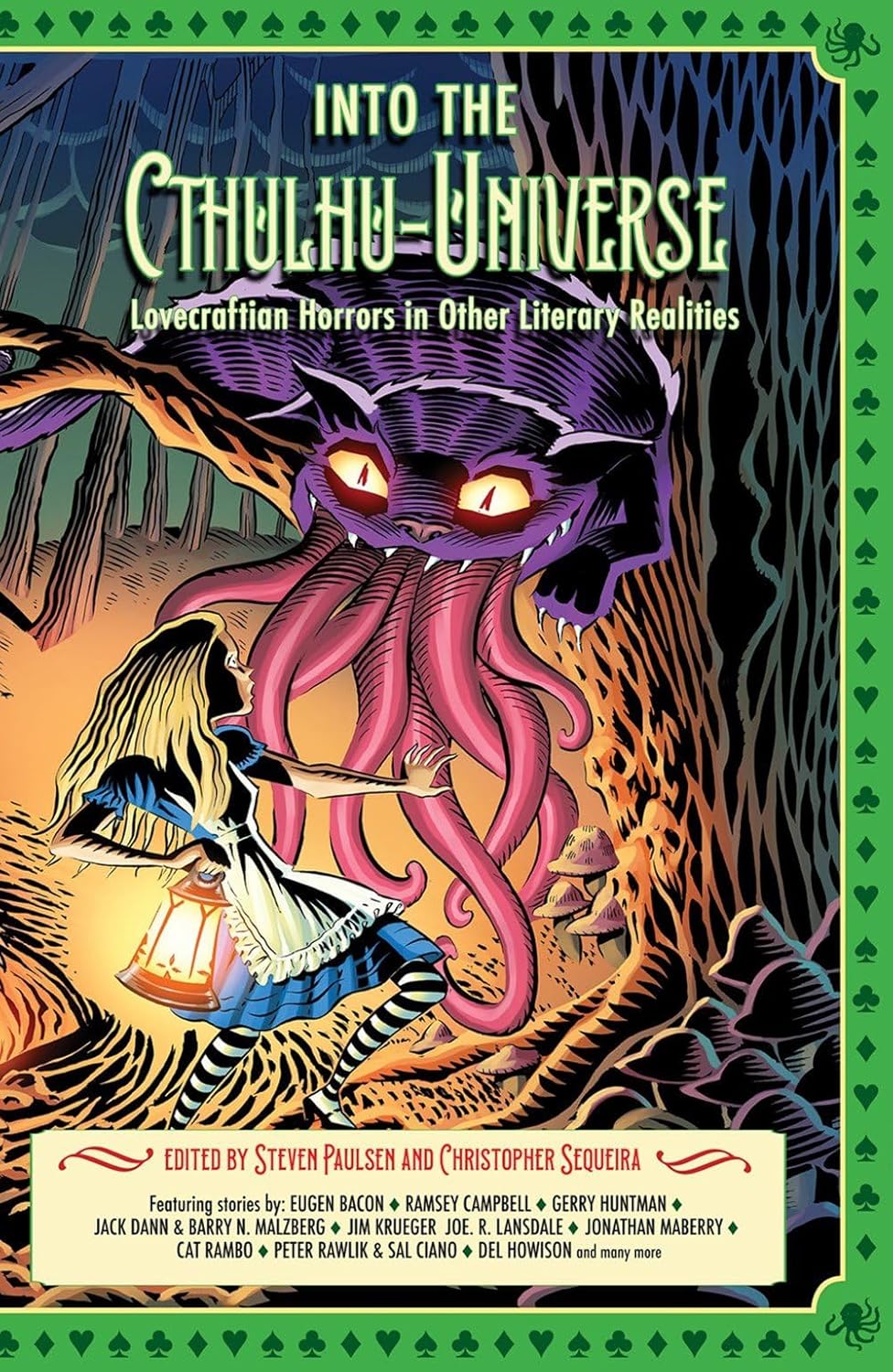
The day Oswald arrived, he called us to my father’s study and said peremptorily, “It is a truth universally acknowledged that a spinster sister with a small portion is nothing but a burden to her relatives. I want you silly women married and out of my household as soon as possible.” Then he burned my father’s extensive collection of coastal plants and butterflies and sold his library. —Jane Routley, “Innsmouth Park” in Into the Cthulhu-Universe (2025) 76-77
We don’t like Oswald.
Jane Austen’s role in weird fiction is underappreciated, largely because she herself didn’t really write any (although Northanger Abbey is a biting satire of the Gothic novel, and a must-read for Gothic fans which even Lovecraft acknowledged, which has to at least classify Austen as weird fiction’s strange aunt.) Yet the world she described, the characters and milieu she envisioned, have been enduring and influential far beyond the genre she initially worked in. Generations of writers have called back to Austen, and mashups like Sense and Sensibility and Sea Monsters (2009) by Austen & Ben H. Winters, Regency Cthulhu (2023) by Andrew Peregrine & Lynne Hardy, and Secrets & Sacrifices: A Regency Cthulhu Novel (2024) by Cath Lauria all point to a similar rainy-day afternoon brainstorm:
Why not mix Austen and Lovecraft?
“In ’forty-six Cap’n Obed took a second wife that nobody in the taown never see—some says he didn’t want to, but was made to by them as he’d called in—had three children by her—two as disappeared young, but one gal as looked like anybody else an’ was eddicated in Europe. Obed finally got her married off by a trick to an Arkham feller as didn’t suspect nothin’. But nobody aoutside’ll hev nothin’ to do with Innsmouth folks naow. Barnabas Marsh that runs the refin’ry naow is Obed’s grandson by his fust wife—son of Onesiphorus, his eldest son, but his mother was another o’ them as wa’n’t never seed aoutdoors. —H. P. Lovecraft, “The Shadow over Innsmouth”
Lovecraft did not live in Austen’s world, but the New England society that Lovecraft came from retained some of the same social mores and norms as in Austen’s day. Marriages were not just alliances of mutual love and affection, but involved perceptions of respectability and status, and practical concerns of money and temperament. While women in the UK have more options today than they did in the late 18th/early 19th century, the societal obsessions with marriage, reproduction, and compatibility are still there for many.
Jane Routley in “Innsmouth Park” takes this to heart. She drops an Innsmouth gent into an Austen scenario. Between the Oswalds of the world and the intelligent, meek, and slightly inhuman (but very wealthy) owner of Innsmouth Park, readers might suspect that they know the outcome of this short story before it gets three pages in. However, Routley does have a twist or two for the readers, and manages to pull off a solid story out of what could easily have been a farce.
As in any mashup, the tone tends to be rather light, and in this case favors Austen over Lovecraft. Nothing wrong with that; Austen’s strength was her setting and characters, and the Mythos is a flavor that mixes well into different settings. What makes it fun, however, are the little flourishes, the nods to both Austen and Lovecraft, and the very careful effort to build up the relationship between protagonist Eugenia and her potential suitor Rowah Marsh. We get to see things, not from the Lovecraftian point of view, but from the Austenian.
Whoever asked the Marsh daughter how she felt getting married off “by a trick?” Would she have been relieved to be out from under her domineering father, or lost and at sea among people she had never met before? Was it a step down or a step up in terms of her lifestyle and freedoms? We don’t get those questions or answers in “The Shadow over Innsmouth,” but you can be damned sure if Austen was writing that story that we would.
Routley recognizes this. While the story is filled with witty lines and little nods to her literary forebears, at the core the story is played straight. If you really did read an Austenian take on “The Shadow over Innsmouth,” it would have the same basic outlines as “Innsmouth Park.” We don’t like Oswald because he represents all the overbearing dudebro assholes we have to deal with in our own lives, but in the specific Austenian context he plays the necessary role of the manifest social norms that are forcing the woman protagonist out of the family home and into a suitable marriage (other options, such as being a governess, being considered but found unsatisfactory.)
That is really what makes “Innsmouth Park” work; the choice that is made is ultimately not driven by green or love or lust, but a practical consideration of limited options and the available alternatives. Faced with a momentous life decision, Eugenia zeroes in on what really matters to her, and the priorities may or may not surprise the Lovecraft fans—but the Austen fans will understand.
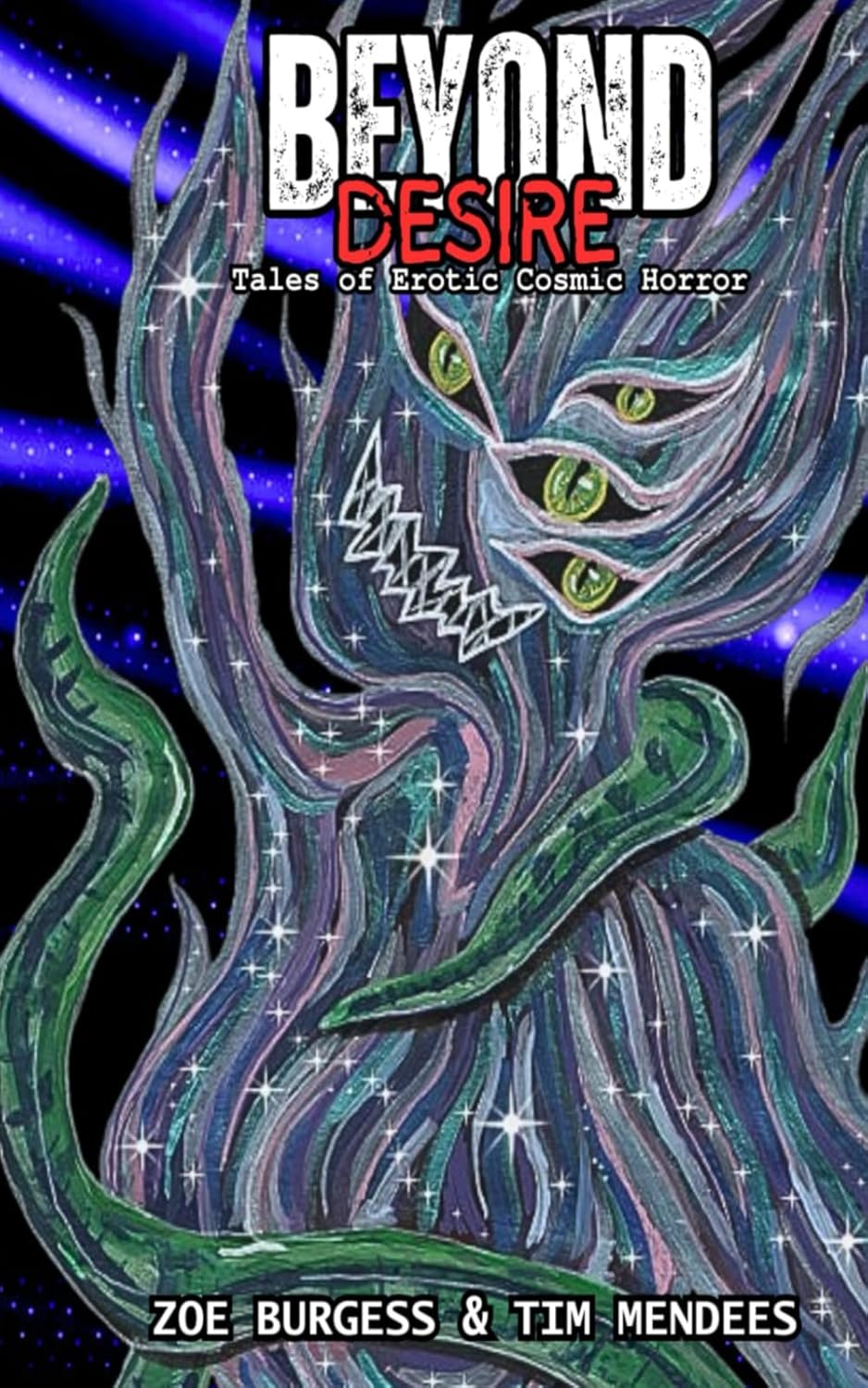
Ever since Helen Vaughan saw ‘the face of The Great God Pan’ and Lavinia Whately gave birth to the spawn of Yog-Sothoth, a sexual undercurrent has existed in cosmic horror. Rarely seen but its effects often felt, eroticism helps to shape tales of the uncanny and unfathomable. —Back cover copy of Beyond Desire (2025)
This is a difficult balance, yet it seems to be what Zoe Burgess aims for in “The Tunnel.” The beginning of this story was featured in the Flash Horror 250 Contest in 2024, and if that visceral opening whets a reader’s whistle, Burgess goes much deeper—and gets more explicit—as the story is developed in her joint collection with Tim Mendees: Beyond Desire: Tales of Erotic Cosmic Horror (2025); the volume also contains “Writhing Mind” (2022) by Zoe Burgess.
Like in that story, “The Tunnel” is a tale of obsession, of an almost fetishistic desire for knowledge and sensation. There’s a quality reminiscent of Clive Barker’s “The Hellbound Heart,” the familiar outlines of which have been seen in many weird and erotic stories over the decades. Shades of Dr. Raymond’s search in Mary’s brain for the Great God Pan, or of William’s desire to uncover real magic through the artifact in The Invitation (2017) by InCase The language of the story is deliberately decadent, emphasizing the physical, the intimate, and hinting at something more than merely carnal.
This was what awoke Izzy’s companions, and they were greeted by faces of fear and adjective horror as the iron shell melted away to reveal the throbbing flesh-like pages of the manuscript inside. —Zoe Burgess, “The Tunnel” in Beyond Desire (2025) 166
There is a literalness to the descriptions that is reminiscent of “Night Voices, Night Journeys” (2005) by Inoue Masahiko (井上雅彦), but it is probably more accurate to say that Burgess knows the tropes of the genre and plays to them. Familiar images remixed, recombined, carefully arranged. The tunnel of the title is both physical distance for the protagonist Izzy to transverse and the metaphysical vagina to be reborn from. The reader is just along for the ride, the voyeur of a journey of discovery and self-discovery:
Izzy held onto tarlike hips and almost felt like they were pushing deeper into the unknown, as that hot cavern pulsated and caressed as well. —Zoe Burgess, “The Tunnel” in Beyond Desire (2025) 175
Metaphor and description break down on such an ecstatic psychosexual journey. Burgess strives to capture both novel sensations and something beyond that, some spiritual contagion that warps and fills and makes the sex act something profoundly more than just sticking tab A into slot B, repeat as desired. The story is essentially a spiritual descendant of the climax of Ramsey Campbell’s “The Moon Lens,” a story of initiation and transformation; while the cosmic horror is not called Shub-Niggurath, Burgess’ Void Walker has some of the same attributes.
More than anything else, “The Tunnel” by Zoe Burgess is an effort to tell an erotic horror story in the Lovecraftian mode. Not by invoking Cthulhu and the Necronomicon, but by trying to invoke familiar images and aspects as she tells a raw, uncensored story of transgression, transfiguration, and finally a kind of transcendence. When Izzy goes back out into the world, born from the tunnel, they are a carrier of a strange and terrible disease of knowledge, one which they desire to spread—and isn’t that so very familiar, readers of the Mythos?
Tell my sad little life story? I was a weird kid. Believed I was a Witch when very young, as did my older sister. She and I used to practice what we thought was magick. Grew up knowing I was a sissy (loved playing house with the neighborhood girls, but always dressed LIKE them, wearing play dresses &c) and being tormented for it by grown-ups, kids at school, and thus I became an introvert and created my own realms of reality where I could be safe. My best friend in high school was Jewish, and that began a Jewish identification. Later I learned that I AM Jewish on my mom’s side of the family. —W. H. Pugmire, “An Interview with W. H. PUGMIRE” (28 Feb 2009) by Jeffrey Thomas
There is a fine distinction between Jewish weird fiction and weird fiction that takes Jews or Judaism as its subject. Jewish weird fiction should be, ideally, written from a Jewish point of view; that may or may not involve aspects of Jewish religion or culture, but it should definitely have that viewpoint—and ideally, it should be written by someone who has lived experience to lend verisimilitude and authenticity to the story, who can approach the story as someone other than an outsider looking in. A good example might be “My Mother Was A Witch” (1966) by William Tenn.
A story doesn’t have to have a Jewish point-of-view to be about Jews or Judaism. Innumerable examples of Christian supernatural fiction reach back to Jewish religion and folklore to tell a story that is still focused, primarily, on a Christian point of view. The Wandering Jew in legend and literature may be Jewish in name, but their characterization follows the narratives conceived by predominantly Christian writers.
“The House of Idiot Children” (2008) by W. H. Pugmire & Maryanne K. Snider is, I suspect, their attempt at Jewish weird fiction. It follows Rav Samuel Shammua, a teacher in a small Jewish community who works at a school for autistic students. The description of the students reflects common depictions of autistic savants, formerly and derogatorily known as idiot savants:
They sat there, some very still some moving slightly back and forth, all staring into the air before them. Samuel shocked himself to feeling suddenly jealous. What did they see as they looked into nothingness. What did they listen to with an inner ear? The world saw these children as idiots who would always have difficulty functioning with the normal ear; and yet these children each contained a singular degree of genius. One was a mathematical genius. Another had memorized huge portions of Torah and Talmud in both English and Hebrew. And Moshe, who sat awaiting him, had excelled in the art of gematria […] —W. H. Pugmire & Maryanne K. Sinder, “The House of Idiot Children” in Weird Tales #308 (26)
As in many of his stories, Pugmire slightly reworked the language in subsequent publications, so for example in An Imp of Aether (2019) he wrote:
[…] saw some students who, sitting at various tables awaiting instructors, watched his entrance, some very still, some moving slightly to and fro. Samuel shocked himself with feelings of sudden jealousy. What did they see with their autistic senses, what could they hear with an inner ear? The world saw these children as idiots who would always have difficulty functioning in the “normal” world; and yet these children each contained a singular degree of genius. One excelled in mathematics, another had memorized weighty portions of Torah and Talmudic lore, in both English and Hebrew. And mOshe, who sat awaiting him, had excelled in the art of gematria […] (44)
Autistic savants have their in supernatural literature, like the young girl Tiffany in Hellbound: Hellraiser II (1988) who uses her knack for puzzle solving to solve the Lament configuration. Such peculiar aptitudes can interact oddly with certain aspects of Jewish culture. The Hebrew alphabet has 22 letters, each of which can also represent an associated number, a practice called gematria. This overlap of linguistic and mathematical concepts has significant interest with topics like cryptography, the interpretation of certain Jewish and Christian religious texts, as well as Kabbalah and other occult systems. The intersection of these different areas of interest has been a fruitful area for creatives, such as the film Pi (1998) where a genius Jewish mathematician’s investigations into the nature of π reveal a number which might be the secret name of God.
Pugmire and Snider play with this idea:
“A twenty-third Hebrew letter, a letter of fire.” The elder man raised his hand so as to thoughtfully stroke his beard. “An angelic letter. A letter out of which nothing is formed.”
Samuel’s face felt odd, and he ran his hands over it, trying not to shudder. “You know of this?” His voice was laced with fear, for never had he experienced such a conversation. The mysteries of cabalistic lore were something with which he had never trafficked. He had seen certain friends of his become utterly obsessed with studying the Zohar and other such books, to the detriment of everything else. It was a lure in which he had no wish to find himself entangled. —W. H. Pugmire & Maryanne K. Sinder, “The House of Idiot Children” in Weird Tales #308 (26)
“They’re not like others, that’s the point!” Samuel suddenly shouted, his face flushed with anger. “They are special creatures, for whom we especially care. What the hell is normal, Avram? Were you a normal kid? Our religious and ethnic heritage makes us outsiders in the normal world, that’s why we’re hated, that’s why madmen seek to destroy us.” —W. H. Pugmire & Maryanne K. Sinder, “The House of Idiot Children” in Weird Tales #308 (29)
All of these elements come together in this story in an ending that is expected, and yet powerful. We the readers never learn the final mystery, which Moshe and the autistic children know and which Samuel Shammua learns. It is a literally ineffable truth, a knowledge beyond the scope of human experience. Whatever flaws the story might have in its depiction of autistic children, this was a deliberate and researched effort to weave together these disparate threads into a story that tried to express a weird tale from a Jewish point of view.
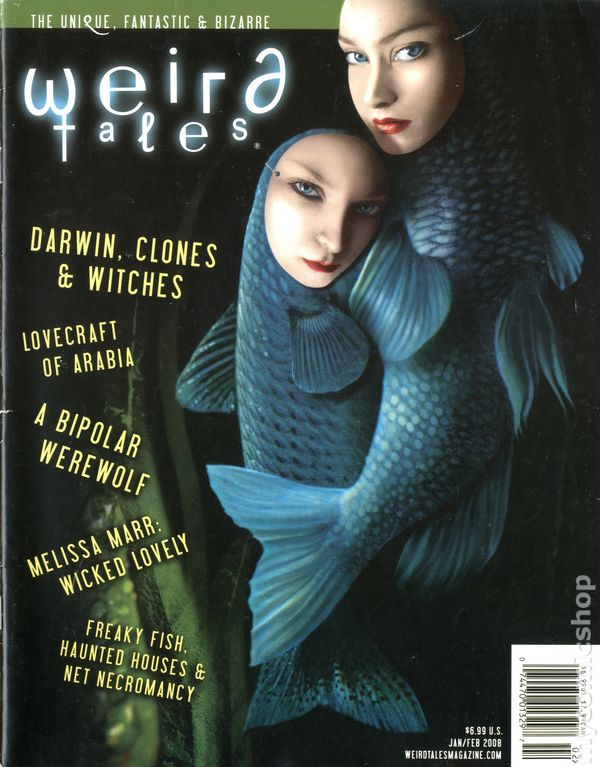
“The House of Idiot Children” was first published in Weird Tales #308 (Jan/Feb 2008). It was slightly revised and republished in The Tangled Muse (2008, Centipede Press), and then slightly revised again for An Imp of Aether (2019), which appears to be the authors’ final version.
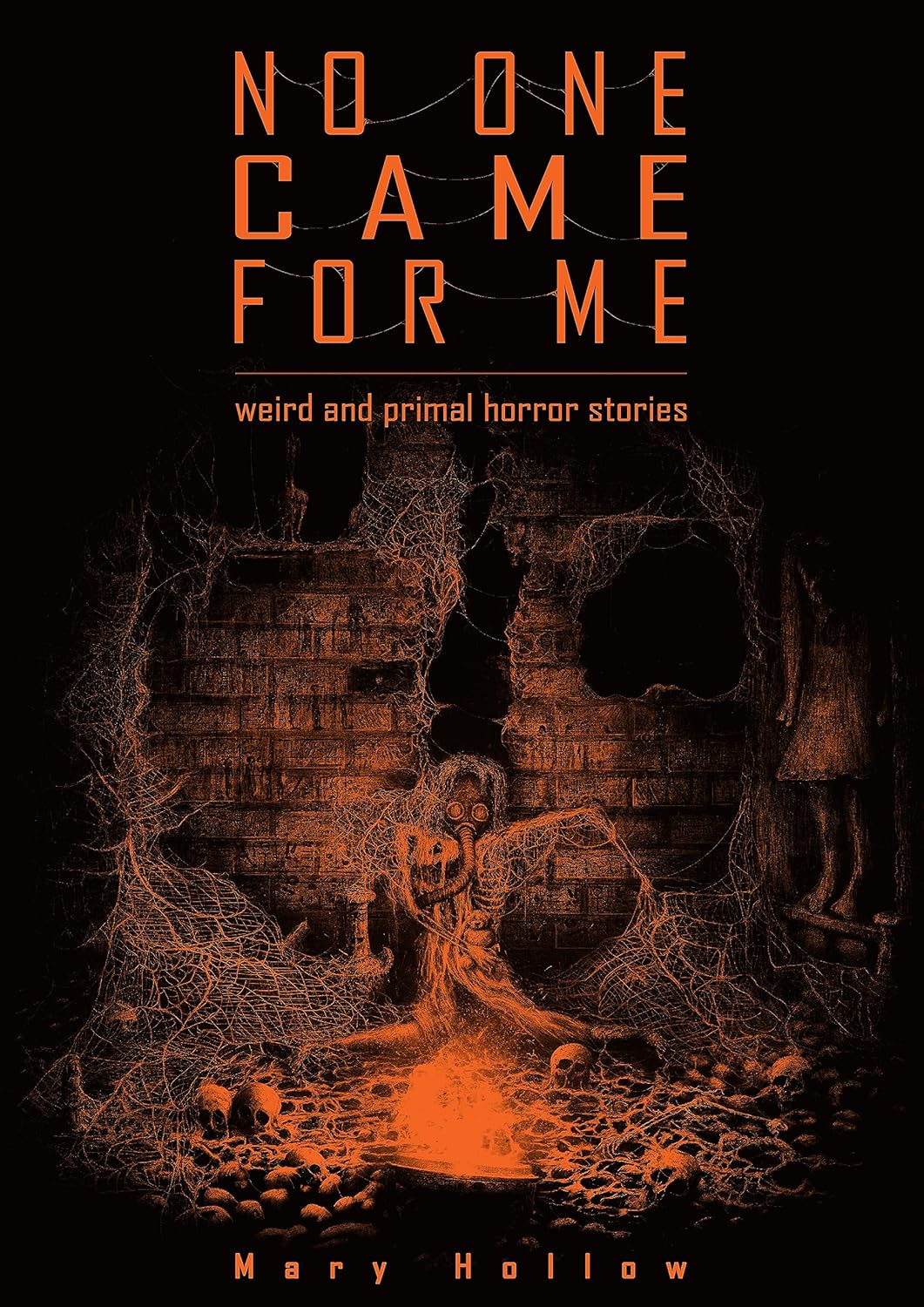
Dear Ms. Hollow. You don’t know me, but you and I share a mutual acquaintance, through whom I had the opportunity to read the draft of your horror story about the exotic fruit that turns pain signals into pleasure. I much enjoyed the prose of your story, but I have some relevant information that I would like to share with you. —Mary Hollow, No One Came For Me: Weird and Primal Horror Stories
Lines of literary descent are not always easy to trace. If a writer goes out of their way to mention Cthulhu or the Necronomicon, then we can say with some certainty that they’ve read Lovecraft, or that they’ve read somebody that read Lovecraft, and so on. Without such concrete citations, it can be tricky to assign influences with any certainty. Would we say that Jeff Vandermeer’s Annihilation owes a debt to H. P. Lovecraft’s “The Colour Out of Space?” Well, probably not within earshot of Vandermeer.
Fiction is like that. Writers can play with the same subjects, but may arrive at parallel approaches. We can only note the parallels. Fortunately, in this case, in the afterword to her collection, Mary Hollow gives thanks to Thomas Ligotti, so it is easy to say that yet, “Neural Mechanisms of Analgesia” (2023) is a story in the Ligotti lineage of weird fiction.
There’s a relation to Lovecraftian fiction, a similarity, but a distance as well. Hollow doesn’t cite the Necronomicon or Arkham, doesn’t try to fit her work into someone else’s mythology. As a medical horror, there is a distant echo of “From Beyond” and other gland stories, the clinical detachment that threads its way to a kind of sublime understanding regarding some fundamental function of life.
If you prick us, do we not bleed? —William Shakespeare, The Merchant of Venus Act 3, Scene 1
The story takes the form of a letter to Hollow herself. The epistolary format offers some advantages; like with “Machines Are Digging” (2009) by Reza Negarestani, there is that fine frisson as scientific citation and rational argument segues into something else. That moves beyond science fiction and touches on something else, something that goes beyond science in a direction that approaches—not the mystical, but a kind of revelation that limits rather than expands the possibilities of life. The opposite of wonder is not terror, but a kind of disenchantment that negates wonder, cancels it out.
There is that aspect of—not exactly pessimism, but the kind of microscopic focus of ultra-sanity that strips away the comforting illusions of life, or even of weird fiction. There is no Elder Sign to ward of the neurological realities of the pain response in humans, no resonator to smash to hide from what was always around us all the time. Imagination can offer no comfort, and when stripped away there is only a kind of philosophical numbness. The reader ends the story burdened with knowledge, but there is nothing to do with that knowledge.
Does it matter if Hollow draws from Lovecraft or Ligotti? Only insofar as we can recognize the connection, the thematic parallels with their works. Hollow is working in a tradition, though not borrowing from anyone’s mythology in doing so. A reminder that as fun as the Mythos is, there is much more to Lovecraftian literature than just the Mythos.
Cuando lea estas lineas yo no estaré ya en el mundo de los vivos . . .
Con estas palabras comienza la carta que Robert E. Howard envía a su amigo, mentor y famoso escritor. En un escrito delirante el auto tejano describe su progresivo descenso al infierno de la locura y la desesparación después de visitar una antiqua tumba india sita en el interior de una cueva.
En la narración se mezclan los sueños con la realidad, la escritura, la relación con los amigos y su novia, la salud de la madre y su dependencia de ella . . Sin salida, totalmente acorralado por sus miedos, Howard debe buscar una solución, una huida, un sacrificio . . .
Dear H. P. Lovecraft,
When you read these lines, I will no longer be in the world of the living . . .
With these words begins the letter Robert E. Howard sent to his friend, mentor, and famous writer. In a delirious letter, the Texan author describes his gradual descent into the hell of madness and despair after visiting an ancient Indian tomb located inside a cavern.
The story mixes dreams with reality, writing, his relationship with his friends and girlfriend, his mother’s health and his dependence on her… With no way out, completely cornered by his fears, Howard must find a solution, an escape, a sacrifice…
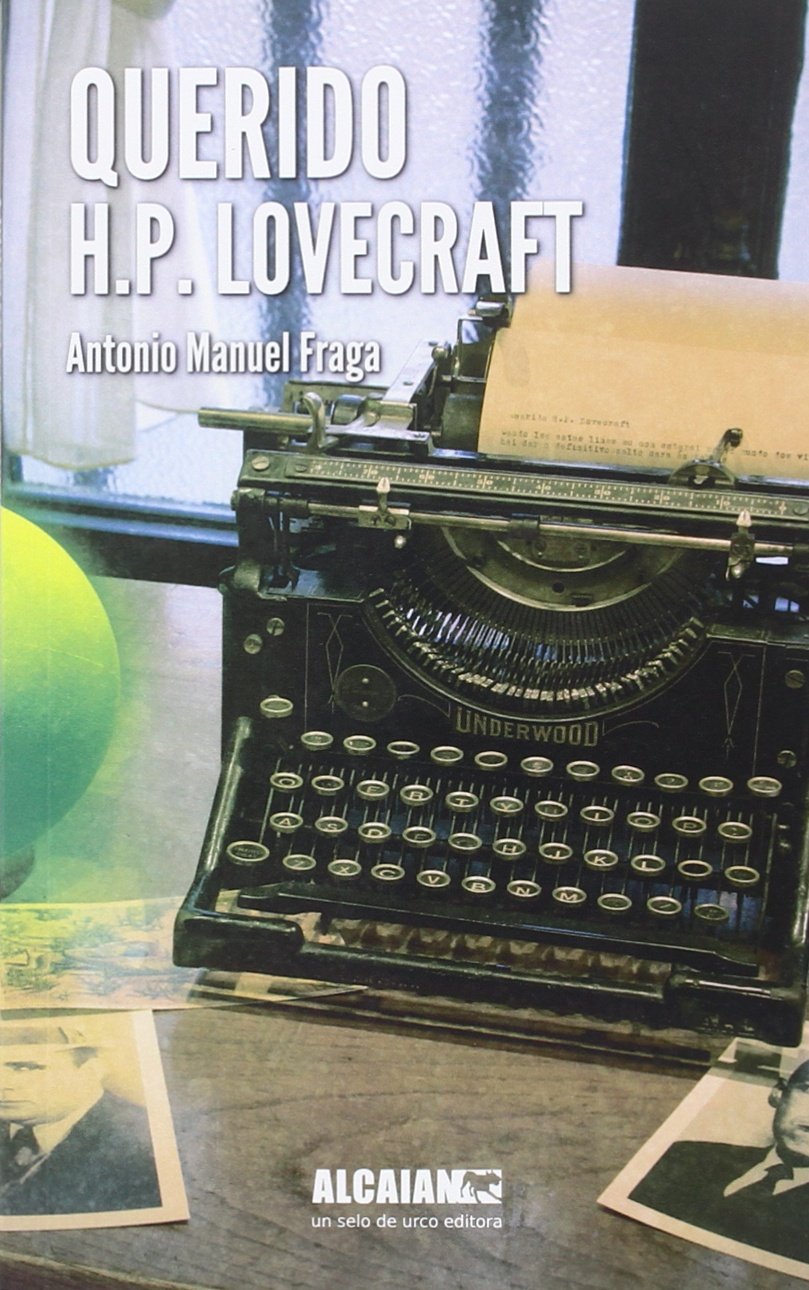
Querido H. P. Lovecraft (2017, Spanish), back cover copy
English translation
Rusty Burke, a scholar of the life and work of Robert E. Howard, has noted that REH was one of H. P. Lovecraft’s major correspondents—but that HPL was Howard’s major correspondent. The bulk of the surviving letters we have from Robert E. Howard are to Lovecraft; and while many of Howard’s other letters—to Clark Ashton Smith, Farnsworth Wright, C. L. Moore, Novalyne Price, etc. are important, none of them really cover the same breadth and depth as Howard’s letters to Lovecraft. Nor, in many cases, have we much of the other side of the conversation. In the collected correspondence of both men, at least as much as survives, we gain a deeper understanding and appreciation for the push and tug of the conversation.
This literary friendship has extended far past the limits of the grave. Novalyne Price Ellis mentioned it in her memoir One Who Walked Alone (1986); “Gilgamesh in the Outback” (1986) by Robert Silverberg sees the two palling around the underworld together. The semiotic ghosts of both men have followed each other into novels and comic books, from Rick McCollum’s Ashley Dust (1996) to Lovecraft’s Book(1985) by Richard Lupoff, later restored as Marblehead (2006). Howard makes an appearance in most of the biographical graphic novels that have come out about Lovecraft, and every biography of Howard cannot avoid mentioning their “civilization vs. barbarism” argument in letters that winged their way from Providence, R.I. to Cross Plains, TX and back again.
It is this relationship that Antonio Manuel Fraga has attempted to capture in his novel Querido H. P. Lovecraft(2016, “Dear H. P. Lovecraft), which was written and published in Galician. The novel was then translated into Spanish (Castilian) by Mercedes Pacheco Vázquez and published, also as Querido H. P. Lovecraft, in 2017. It has not yet been translated or published in English, but in brief the novel takes the form of a classic epistolary novel, like Dracula, but consisting of several fictional letters between H. P. Lovecraft, Robert E. Howard, and Dr. Isaac M. Howard (REH’s father, with whom HPL corresponded after REH’s death in 1936). The bulk of the novel consists of Howard’s final letter to Lovecraft, detailing the supernatural curse that descended upon him and the real reason he took his life that day.
De ROBERT ERVIN HOWARD para H. P. LOVECRAFT 10 de junio de 1936 Sr. H. P. Lovecraft 66, College Street. Providence, R.I.
Querido H. P. Lovecraft:
Cuando lea estas líneas no estaré ya en el mundo de los vivos, pues pronto daré el definitivo salto hacia las tinieblas. Sin otra salida, y después de lo vivido, espero que la muerte se abra a mi como una madre redentora, un pecho cálido que me ampare y silencie los horripilates alaridos que no dejan reposar mi mente, cansada y enferma.
Puede que este testimonio, dictado por la urgencia y la necesidad de purga, me sirva también para comprender mejor toda esta atrocidad, o por lo menos para distinguirla de un modo más global.
Hace dos semanas me acerqué a Brownwood, donde compré tres tumbas en su camposanto. Los miembros de mi exiqua familia tendrán así cada uno su trozo de tierra donde reposar, donde olvidar tanto dolor embalsamados en la archilla arenosa de Texas.
Las raíces de nuestros padecimientos se entredan en el pasado, se mezclan y alimentan de las mismas sales, pero sus tallos crecen independientes hacia un sol que es fuego fatuo, sin bndad ni compasión.
En el caso de mi madre, la desgraciada Hester, hablamos de una vida marcada por la enfermedad propia y ajena –si como enfermeded se puede calificar mi mal, que después expcliaré detalladamente. ¡Tiempo habrá!–.
El padecimiento de mi padre, el viejo doctor Howard, tiene el sabor de la ceniza del desprecio de su compañera. Durante toda su vida fue un imán para las malas inversiones, en las que dilapidó los escasos ahorros de la familia. ¡Y bien que se lo reprochó Hester! Esa fue una de las causas del désden de su mujer, pero no el único ni el más importante. En esa guerra fue un titán. Por el contrario, sospecho fundadamente que no resistirá el trance de nuestra partida. Ojalá me equivoque.
Y por último está mi padecimiento, el del necio Bob, el torpe ignorante. Afortunademente, pronto será silenciado por este colt que ahora siento en el muslo y que se convertirá en mi redentor, reverendo y verdugo.
From ROBERT ERVIN HOWARD to H. P. LOVECRAFT 10 June 1936 Mr. H. P. Lovecraft 66 College Street, Providence, R.I.
Dear H. P. Lovecraft:
When you read these lines, I will no longer be in the world of the living, for I will soon take the final leap into darkness. With no other way out, and after what I have experienced, I hope that death will greet me like a redeeming mother, a warm breast to shelter me and silence the horrifying screams that keep my tired and sick mind from resting.
Perhaps this testimony, dictated by the urgency and necessity for a purge, will also help me better understand this whole atrocity, or at least to distinguish it in a more comprehensive way.
Two weeks ago, I went to Brownwood, where I bought three graves in the cemetery. The members of my tiny family will each have their own piece of land to rest in, where they can forget so much pain, embalmed in the sandy Texas clay.
The roots of our sufferings are buried in the past, they mix and feed on the same salts, but their stems grow independently toward a sun that is a will-o’-the-wisp, without kindness or compassion.
In the case of my mother, the unfortunate Hester, we are talking about a life marked by her own and other people’s illnesses—if my illness can be described as illness, which I will explain in detail later. If there is time!
The predicament of my father, old Dr. Howard, tastes like the ashes of his companion’s contempt. Throughout his life he was a magnet for bad investments, in which he squandered our family’s meager savings. And well did Hester reproach him for it! That was one of the causes of his wife’s disdain, but not the only one, nor the most important. In that war he was a titan. On the contrary, I strongly suspect that he will not be able to withstand our departure. I hope I am wrong.
And finally there is my suffering, that of the foolish Bob, the ignorant bumbler. Fortunately, he will soon be silenced by this colt that I now feel in my thigh and that will become my redeemer, reverend and executioner.
Querido H. P. Lovecraft (2017, Spanish) 20-21
English translation
Perhaps surprisingly given how prominently the letters formed their relationship—Lovecraft and Howard never met, though they corresponded from 1930 until Howard’s death in 1936—the epistolary format has featured less prominently in their fictional afterlives. In fiction, at least, the two men would get the chance to meet as they never did in life. So too, that way the writer isn’t forced to write as many letters to and from Lovecraft and Howard from the other’s perspective, which would require more than a passing familiarity with both men’s life and letters to convincingly nail the voice and knowledge of each.
It is difficult to judge how well Antonio Manuel Fraga has captured their voices. That Fraga did some research into Robert E. Howard’s life is evident, he obviously read at least the flawed biography Dark Valley Destiny(1983), or Mark Finn’s Blood and Thunder (1st ed. 2006/2nd ed. 2013), which emphasizes the sometimes conflicted family dynamics among the Howards. Some of the choices (filtered, admittedly, through two layers of translation) strike me as unlikely; Robert E. Howard would probably not have referred to his mother by her given name, for example, and never had anything but praise for his father in his letters to Lovecraft. There are a few other details that are “off” in the short novel, but to try and catalogue them would be pedantic. This is a fantasy novel, and some allowances have to be given.
As a novel, Querido H. P. Lovecraft is an interesting example of a familiar idea: the author becoming the character. The Robert E. Howard of this book is not the same REH that comes through in his letters to Lovecraft, but he is recognizable as an interpretation of that person. What it reveals is less about Howard and Lovecraft than it does about Antonio Manuel Fraga—what Fraga has taken away from his research about Howard, the aspects of his life and relationships that he wished to emphasize in telling his story.
Is it a story worth telling? As an exercise in fantasy, it’s fine. There have been innumerable stories that mingled H. P. Lovecraft’s death with his Mythos, that have blurred the lines between reality and fantasy, for fun if nothing else. In that sense, Querido H. P. Lovecraft is something of a fanfic novel, a great and impossible what if, the kind of cache of letters that Lovecraft and Howard fan-scholars might dream of coming across, like the scholarly protagonists of a ghost story that find the document that explains it all at last.
What we cannot forget, however, is that this is not about how Robert E. Howard lived and died, but the stories and interpretations that have grown up around it.
The death Robert E. Howard is tinged with tragedy. This was a man whose life has sometimes been described as a trajectory toward his inevitable demise, with biographers and critics looking back across the whole of his existence for signs that would point to his self-destruction. Howard’s suicide is a part of his mythos, as explored in works like “El guardian” (2010) by Enrique Balmes & Roc Espinet and “Life After Death” (2010) by David Güell, so the focus on his crucial final days isn’t unusual. The addition of a supernatural element throws off the narrative of inevitability; it emphasizes Howard as more of a victim and cheapens a tragic affair by diluting his own agency. He goes out not as the cipher, the man who had reached his hidden limit and came to the final step, but as a haunted man who suffers under persecutions the novel details all too well.
It would be interesting, someday, to read this in a proper English translation. To see what niceties of language I’ve missed, what nuances may come out from having someone fluent translate Fraga’s prose. While I doubt the translation would capture Howard or Lovecraft’s voice in their letters, there are a lot of nods to people, stories, and events in Howard’s life that would get a nod from Howard and Lovecraft aficionados.
A major focus of the Western occult tradition is the grimoire. For the most part, the occult tradition that has come down to us is primarily a literate one rather than an oral one; and potential occultists are more likely to first encounter magical teachings in written form than by word of mouth. While that may be shifting a bit in an era of ubiquitous streaming video and podcasts, for the most part it holds true: Western magic as we know it has focused heavily on written texts as a primary store of data and means of transmission. Readers interested in delving further into the topic are recommended to read Owen Davies’ excellent and accessible Grimoires: A History of Magic Books.
Translations are a major part of the occult publishing scene. Dan Harms regularly reviews new translations of occult manuscripts and texts into English. However, these reviews rarely deal with just the quality of the individual translation, but the selection and editing of the text, the critical and academic apparatus that surrounds the text. While some works might be simply translated into another language without comment, most translations involve either selective transmission, or the addition of explanatory and critical material that adds to the value of the translation by providing additional historical or literary context, or speaks to the translator’s intended purpose for the translation.
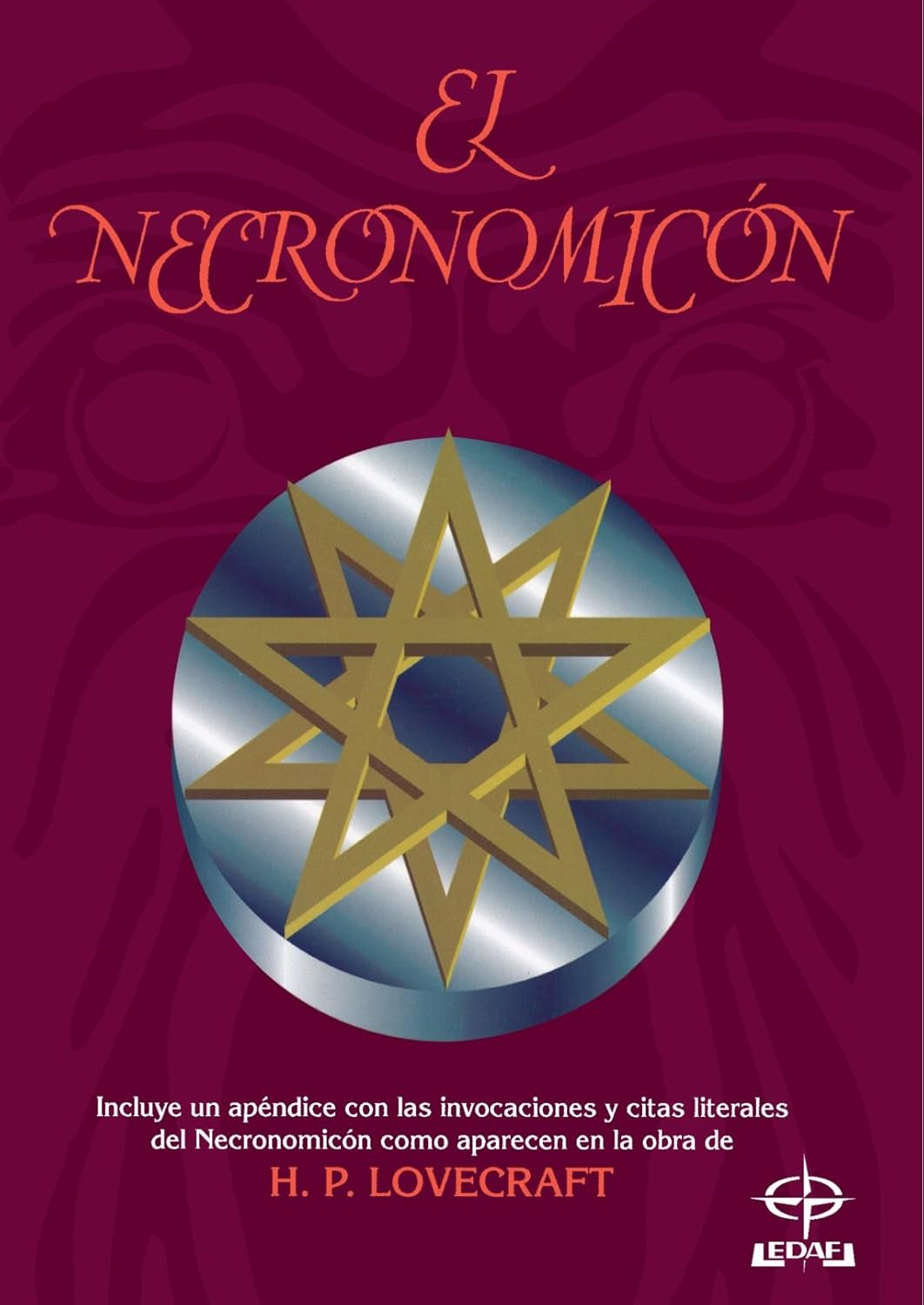
The Simon Necromonicon(1977) was the first, most popular, and at this point most pirated Grimoire associated with the Lovecraftian occult tradition; for decades the mass-market paperback edition has been a mainstay of New Age bookshelves, and has numerous sequels and derivative works. Elías Sarhan’s authorized translation, first published in 1992 by EDAF in Spain, has also gone through multiple editions. It is a faithful translation of the Avon paperback edition, including Simon’s acknowledgments, the preface to the second edition, the quote from the Chaldean Oracle of Zoroaster, and all illustrations, magical seals, and non-English names in the original text, with one notable exception:
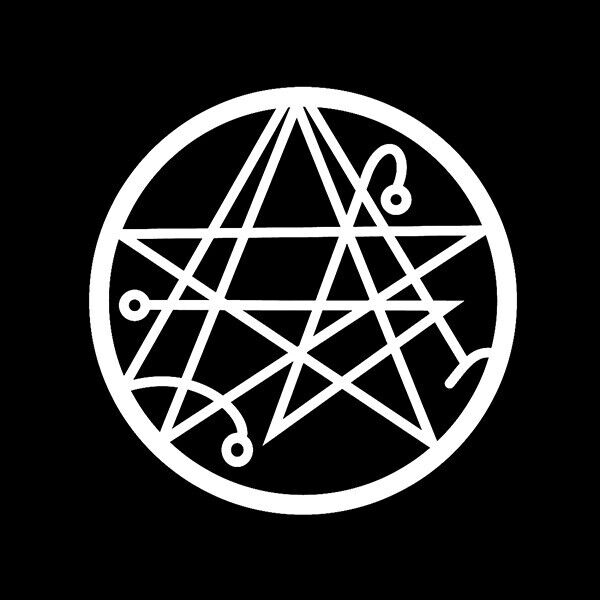
The highly characteristic Necronomicon gate sigil created by Khem Caigan which normally graces the cover and frontispiece of the Simon Necronomicon is nowhere in evidence. Whether Avon didn’t ship the plates or that wasn’t part of the licensing deal, the publishers simply didn’t use it, at least on several printings. The paperback copy I have includes a generic computer-generated 10-pointed star on the cover. Considering how prominently Caigan’s design has been displayed in many editions and how widely it has been swiped by artists as a generic Lovecraftian symbol, its absence is a significant departure from English-language version.
Necronomicon gate sigil created by Khem Caigan
In addition, there is an appendix. “Cronología, Fragmentos e Invocaciones de H. P. Lovecraft sobre « El Necronomicón»” (“Chronology, Fragments, and Invocations from H. P. Lovecraft’s Necronomicon). This begins with an introduction by Alberto Santos Castillo, an editor of many Spanish-language translations of Lovecraft’s works, that begins:
Si abordamos la obra de H. P. Lovecraft teniendo en cuenca el contenido del presented libro, nos surgeon does cuestiones queue son como dos caras different es del author de Providence: el iniciado en saberes ocultos y el escéptico materialista.
A lo largo de toda su vida, Lovecraft defendió que el contenido de sus historias era producto de un ejercicio literario propio de la ficción y que no mostraban ningún tipo de realidad posible o alternativa a la nuestra. Desde muy pequeño convivió con la soledad y el aislamiento. La imagen de su abuelo Whipple, un hombre bondadoso y «sabio», por toda esa biblioteca que le donó a su muerte, afianzaron en él esa inquietud por el concocimiento. El mundo debía ser creado y medido entre los povorientos volúmenes de las estanterías. Sin embargo, Lovecraft ansiaba un saber oculto cuando las pesadillas y las obsesiones se cebaban en él. Al leer su obra, uno descubre que hay una verdad que se escapa entre líneas, frente a esa imagen de frialdad y distanciameiento emocional pretendido.
If we approach the work of H. P. Lovecraft taking into account the content of the presented book, there are two different faces of the author of Providence: the initiate in occult knowledge and the materialistic skeptic.
Throughout his life, Lovecraft maintained that the content of his stories was the product of a literary exercise characteristic of fiction and that they did not depict any kind of possible or alternative reality to our own. From a very young age, he lived with loneliness and isolation. The image of his grandfather Whipple, a kind and “wise” man, and the entire library he donated to him upon his death, strengthened his desire for knowledge. The world had to be created and measured among the dusty volumes on the shelves. However, Lovecraft yearned for hidden knowledge when nightmares and obsessions took their toll on him. Reading his work, one discovers that there is a truth that escapes between the lines, in contrast to that image of coldness and intended emotional detachment.
El Necronomicón 271
English translation
Simon’s Necronomicon has any number of flaws, many of which are discussed in The Necronomicon Files by Dan Harms and John W. Gonce, but there are two immediate issues every Lovecraft fan and would-be Lovecraftian occultists have to face: 1) Simon’s assertions of the real existence of the Necronomicon goes against what we know of Lovecraft’s life, attitudes, and knowledge of the occult; and 2) Simon’s Necronomicon, purportedly a translation of the original text, bears basically no similarity to the Necronomicon that Lovecraft and his contemporaries wrote about, containing only a scattered handful of familiar-sounding names and none of the translations or contents supposed to be in there according to stories like “The Dunwich Horror.”
To address these shortcomings and add value to the basic Simonomicon, Castillo tacked on an appendix that contains (in order), a Spanish translation of Lovecraft’s “History of the Necronomicon,” a collection of quotes (“fragmentos”) from the Necronomicon that Lovecraft peppered into his work in stories like “The Nameless City” and “The Dunwich Horror,” and finally a collection of incantations from Lovecraft’s work, mostly in his made-up artificial language (e.g. « ¡Wza-y’ei! ¡Wza-y’ei! Y’kaa haa bho: ii, Rhan-Tegoth: Cthulhu fthang: ¡Ei! ¡Ei! ¡Ei! ¡Ei! Rhan-Tegoth. ¡Rhan-Tegooth, Rhan-Tegoth!» (287) adapted from “The Horror in the Museum”). Some minor spelling and formatting errors aside from the translation, this is a neat piece of work and a definite improvement over the base version of Simon’s Necronomicon, and makes sense for a Spanish translator that knows they need to address both potential audiences: those primarily interested in Lovecraft’s fiction and those primarily interested in the occult.
Fragmentos Originales del Necronomicón (2001) trans. Marcelo Bigliano
The Necronomicon: The Book of Dead Names (1978) edited by George Hay is probably the second-most popular (and pirated) Necronomicon grimoires in existence. Except much of the book is not actually a grimoire at all; of the 184 pages, there are 12 pages of front matter, an introduction by Colin Wilson that weaves a fictional history of the “real” Necronomicon manuscript (pp. 13-56), a fake letter from Dr. Stanislaus Hinterstoisser (pp. 57-64), a commentary by Robert Turner (pp. 65-80), and a note on supposed decipherment of the text (pp. 81-102) before readers actually get to the supposed English translation of the medieval grimoire that inspired Lovecraft (pp.103-140). Then there are the appendices in the form of three essays: “Young Man Lovecraft” by L. Sprague de Camp (pp. 141-146), “Dreams of Dead Names” by Christopher Frayling (pp. 147-171), “Lovecraft and Landscape” by Angela Carter (pp. 171-182), and the whole book is rounded off with a bibliography (pp. 183-4).
The actual Necronomicon material in the Hay Necronomicon is effectively less than 40 pages. Which might explain why someone had the bright idea to cut out the pseudo-scholarship and present a highly abridged translation of the book. That is exactly what Marcelo Bigliano did in Fragmentos Originales del Necronomicón: El Libro de Los Nombres Muertos de Abdul al-Hazred (2001), published by Tomo in Mexico in several editions, as a modestly sized and priced paperback.
Where El Necronomicón was being inclusive, Fragmentos Originales is selective. Bigliano begins with what appears to be an original prologue that essentially lays out an abbreviated version of Lovecraft’s history of the Necronomicon and then tries to sell the authenticity of the Necronomicon as an occult document. To give a sample:
También los conocidos libros negros titulados Seventh Books of Moses son mencionados por Lovecraft en sus relatos. Si se considera la relación entre estas obras, basadas en versiones latinas alterads de Key of Solomon y ciertos textos hebreos poco conocidos: The Leyden Papyrus, un antiquo libro de magia egipcio que se le considera parte de un todo con el Eigth Book of Moses y the Sword of Moses, que a su vez se cree que contiene en Ninth and Tenth Books de la serie, surge con fuerza un sistema mágico estrechmente relacionado con el Necronomicón.
Also the well-known black books titled the Seventh Books of Moses are also mentioned by Lovecraft in his stories. Considering the relationship between these works, based on altered Latin versions of the Key of Solomon and certain little-known Hebrew texts—The Leyden Papyrus, an ancient Egyptian book of magic considered part of a whole with the Eighth Book of Moses and the Sword of Moses, which in turn is believed to contain the Ninth and Tenth Books of the series—a magical system emerges that is closely related to the Necronomicon.
Fragmentos Originales del Necronomicón 9
English translation
However, this is really an uncredited translation of Robert Turner’s “The Necronomicon: A Commentary” from the Hay Necronomicon:
The well-known ‘black books’ entitled the Sixth and Seventh Books of Moses are mentioned by Lovecraft in his stories, and if one considers the terlationship between these works—based on corrupt Latin versions of the Key of Solomon and certain little known Hebrew texts—The Leyden Papyrus,—an ancient Egyptian book of magic said to be one with the Eighth Book of Moses—and The Sword of Moses—held to contain the Ninth and Tenth Books in the series, a system of magic closely related to concept of the Necronomicon powerfully emerges. (Hay 68)
Lovecraft does not mention the Sixth and Seventh Books of Moses—which are genuine grimoires—in any of his fiction, though the title crops up in some related works by other authors (Dan Harms pointed out to me that the Seventh Book of Moses appears in “Wentworth’s Day,” one of Derleth’s “posthumous collaborations” with Lovecraft). This is part of Turner’s wind-up to the actual magical manuscript material he invented, and if it resembles those “authentic” grimoires at all, it’s because he designed them to.
Following this prologue (pp. 8-16), Bigliano then presents the translation of Turner’s “Foreword” (Hay 105, 108; Fragmentos 17-20), sans illustrations, and then jumps directly into a highly abbreviated rundown of the major eldritch entities in the Lovecraft Mythos, again borrowed from Turner (Hay 74-75; Fragmentos 20-23). For example:
Shub-Niggurat El Gran Macho Cabrío Negro de los Bosques con un millar de Jóvenes. La manifestación Terrenal del Poder de los Antiquos. El Dios del Aquelarre de las Brujas. La naturaleza ELemental de Shub-Niggurat es la de la Tierra, simbolizada por el signo de Tauro en los cielos y, en el mundo, por la Puerta del Viento del Norte.
Shub-Niggurath The Great Black Goat of the Woods with a thousand Young. The Earthly manifestation of the Power of the Ancients. The God of the Witches’ Sabbath. Shub-Niggurath’s Elemental nature is that of the Earth, symbolized by the sign of Taurus in the heavens and, in the world, by the Gate of the North Wind.
Fragmentos Originales del Necronomicón 23
English translation
Not actually sure if Bigliano picked up these planetary associations somewhere or if they’re original additions to the text, but from there he continues directly into a translation of the magical manuscript portion of the Hay Necronomicon, including reproducing all the sigils and seal (pp. 25-85). A conclusion chapter is also borrowed from Turner in an earlier part of the book (Hay 78-79; Fragmentos 87-89). A brief note on Lovecraft (pp. 91-92) is followed by a translation of Angela Carter’s essay (pp. 93-116), and finally a section on the Cthulhu Mythos (pp. 117-124).
In the end, the Fragmentos lives up to its title: like a handful of pages from a larger manuscript that have been re-bound as their own work. Bigliano cut out the heart of the Hay Necronomicon and packaged it as a mass-market grimoire along the lines of the Simon Necronomicon, judiciously rearranging bits and pieces to suit his needs or tastes and ejecting most of the more peripheral matter about the supposed manuscript’s origins and connections to Lovecraft. All of the tongue-in-cheek elements, such as Colin Wilson’s carefully written introduction, and all the more elaborate illustrations, were cut. That isn’t particularly surprising when one considers that there are no notices of permission granted; this was, by all appearances, one of the many unauthorized translations of the Hay Necronomicon and its material.
The two Spanish-language grimoires are separated in time, translator, and geographical publishing context, but were both working toward a similar end: translating this English-language Lovecraftian occult material to a Spanish-language market who were presumably familiar with Lovecraft and eager for more. The popularity of the works can be attested by their multiple editions, and the different paths that the editors and translators took to the material represent respective approaches.
It is fun to think how, in a couple of centuries, historians of the occult might have multiple different recensions and translations of the Necronomicon available, and will have to figure how the family of texts relate to one another, to try and understand or re-create the chain of events or decisions that led to such similar material following different paths. If only the Fragmentos survived, one could not reconstruct the Hay Necronomicon; but they could probably ascertain its influence on Eldritch Witchcraft: A Grimoire of Lovecraftian Magick (2023) by Amentia Mari & Orlee Stewart based on certain illustrations and lore. Who knows what the Lovecraftian occult tradition might look like, in a different time and in different tongues?
Sasturain: Mais mesure un peu l’influence que peut avoir un regard critique sur ton oeuvre: dans les années 1960, tu as tout laissé tomber jusqu’à ce qu’apparaissent des gens qui te lisaient, te suivaient, t’appreciaient. Qu t’ont renvoyé un écho positif de ce que tu avais fait. Ce n’est qu’en 1968, à la sortie du livre de Martínez Peyrou, puis celui de Masotta, qu’on t’apprécie, qu’on reconnaît ta valeur. Ton travail est reconnu en Europe, tu retrouves une stimulation. La réaction de l’extérieur te motive, t’encourage.
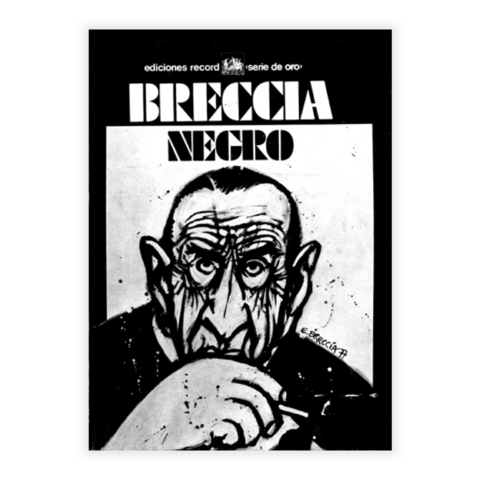
Breccia: Et j’ai trouvé un marché où proposer des choses dont tout le monde se fichait ici. Quand j’ai fait L’Éternaute, on m’a tiré dessus à boulets rouges. Mort Cinder n’a pas eu de succés. Richard Long est passé completèment inaperçu. Je veux dire par là que toutes ces ouevres relativement valables, tout le monde s’en battait l’oeil, en Argentine, alors qu’elles ont eu du succès en Europe. Si je propose Le Couer révélateur ici, personne ne le publie. Il est paru dans Breccia Negro, édité par Scutti, mais c’est moi qui l’ai imposé. À cette époque, Scutti publiait n’importe quoi. Je lui ai dit: «Faisons un livre», et c’etait parti. Le cas de Là où la marée monte et se retire, l’adaptation de la nouvelle de Lord Dunsany, par exemple, montre qu’un tas de choses n’ont pas reçu non plus un bon accueil en Europe, elles sont restées et restent inédites. Mais c’est vrai que ce genre-là m’a intéressé. Après, quand j’ai voyagé en Europe et que j’ai vu ce qui se passait la-bas, tout a changé, j’ai découvert qu’il existait un marché immense, un public qui attendait des oeuvres différentes, et qu’on pouvait faire du neuf. Un endroit où la bande dessinée était très respectée, pas comme ici, où elle demeure encore aujourd’hui un genre marginal.
Sasturain: But consider the influence that a critical eye can have on your work: in the 1960s, you dropped everything until people appeared who read you, followed you, appreciated you. Who gave you a positive response to what you had done. It was only in 1968, with the release of Martínez Peyrou’s book, then Masotta’s, that you were appreciated, that your value was recognized. Your work was recognized in Europe, you found stimulation. The reaction from outside motivated you, encouraged you.
Breccia: And I found a market where I could offer things that nobody cared about here. When I did The Eternaut, I was shot at with red-hot cannonballs. Mort Cinder was not a success. Richard Long went completely unnoticed. I mean by that that all these relatively valid works, nobody cared about them, in Argentina, while they were successful in Europe. If I offer “The Telltale Heart” here, nobody publishes it. It appeared in Breccia Negro, published by Scutti, but I was the one who insisted on it. At that time, Scutti published anything. I told him: “Let’s make a book,” and that was it. The case of “Where the Tide Ebb and Flow,” the adaptation of Lord Dunsany’s story, for example, shows that a lot of things were not well received in Europe either; they remained and remain unpublished. But it’s true that this genre interested me. Then, when I traveled to Europe and saw what was happening there, everything changed, I discovered that there was a huge market, an audience that was waiting for different works, and that we could do something new. A place where comics were very respected, not like here, where they still remain a marginal genre today.
Alberto Breccia, a comic artist now hailed as a master and whose work is internationally recognized and translated into myriad languages, got his start like pretty much every other artist: wherever he could. When opportunities in his native Argentina were few, Breccia turned to Europe, which welcomed international talent. His fame in the English-speaking world largely rests on a series of nine adaptations of H. P. Lovecraft’s stories that he first completed and published in the 1970s, but while these have gained fame and been published and republished, they were part of a broader turn in his career toward adapting classic works of horror and fantasy into the medium of comics during the 70s.
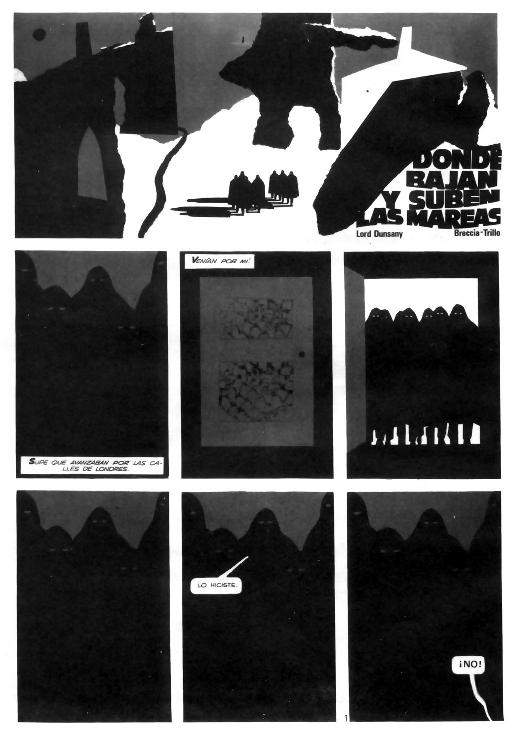
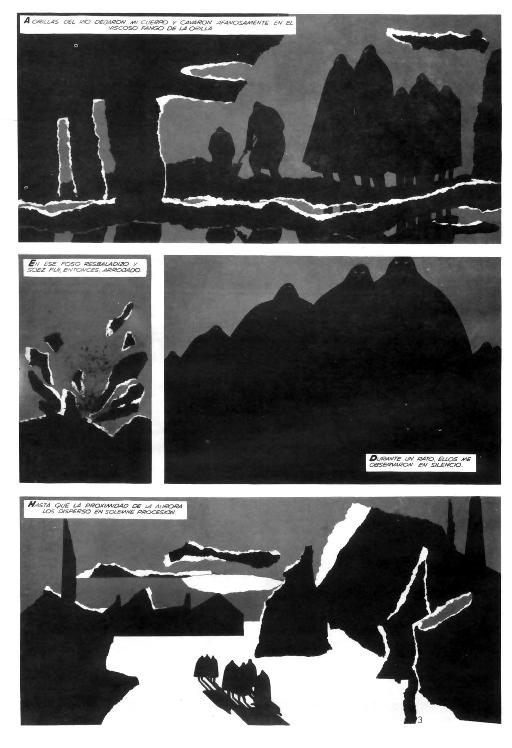
One of the more obscure of these adaptations, especially to English-language audiences, is “Donde suben y bajan las mareas” (1978), adapted from Lord Dunsany’s “Where the Tides Ebb and Flow” from A Dreamer’s Tales (1910). The script was written by Carlos Trillo, and Breccia did the artwork using a collage method; a technique that provides a certain texture to his more experimental 70s works. At a scanty 8 pages, it was probably intended for an Italian market like Il Mago, but as near as I can determine the first—and for a long time only—publication was in the now rare Breccia Negro (1978), a collection of his unpublished and scarce work, which has itself never been reprinted.
Supe que avanzaban por las calles de Londres. Venían por mí. Lo hiciste. ¡NO!
I knew they were advancing through the streets of London. They were coming for me. You did it. NO!
The effect is dark, almost minimalist, a chiaroscuro nightmare. As in Dunsany’s tale, it is told primarily from the view of the protagonist, who cannot see the faces of his friends and executioners clearly. Only their eyes, only the numberless mass of them who come to execute justice for the unspoken crime. When in Europe in the 70s, Breccia went to Great Britain to stand on the banks of the Thames.
Sasturain: Un jour, tu m’as raconté que tu étais allé à Londres pour chercher…
Breccia: Pour chercher la boue de la Tamise, celle de Là où la marée monte et se retire. Je suis allé voir ça de nuit. Et j’ai marché dans les ruelles de Soho, tu vois? Les ruelles de Jack l’Éventreur. Tue sais que je ne suis pas vraiment un rigolo. (Rires) J’ai suivi la piste de Lord Dunsany et de Jack l’Éventreur. Mais la ville de Lonres m’a plu tout entiere, tout ce que j’ai vu de l’Angleterre m’a plu.
Sasturain: One day, you told me that you went to London to look for…
Breccia: To look for the mud of the Thames, the one Where the tide ebbs and flows. I went to see it at night. And I walked in the alleys of Soho, you see? The alleys of Jack the Ripper. You know I’m not really a joker. (Laughs) I followed the trail of Lord Dunsany and Jack the Ripper. But I liked the whole city of London, everything I saw of England I liked.
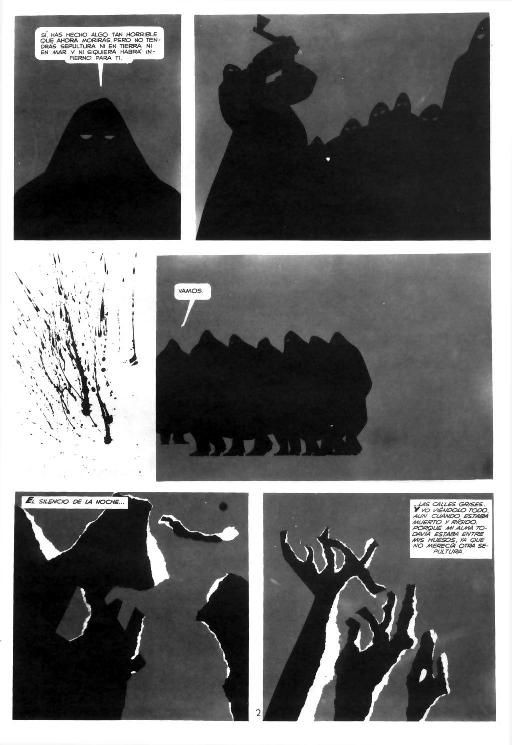
Sí. Has hecho algo tan horrible que ahora morirás. Pero no tendrás sepultura ni en tierra ni en mar y ni siquiera habrá infierno para ti.
Vamos.
El silencio de la noche…
…las calles grises yo viéndolo todo. Aun cuando estaba muerto y rígido. Porque mi alma todavía estaba entre mis huesos, ya que no merecía otra sepultura.
Yes. You have done something so horrible that now you will die. But you will have no burial on land or sea, and there will not even be hell for you.
Let us go.
The silence of the night…
…the gray streets, I saw it all. Even when I was dead and stiff. Because my soul was still among my bones, for it deserved no other grave.
I dreamt that I had done a horrible thing, so that burial was to be denied me either in soil or sea, neither could there be any hell for me.
I waited for some hours, knowing this. Then my friends came for me, and slew me secretly and with ancient rite, and lit great tapers, and carried me away.
It was all in London that the thing was done, and they went furtively at dead of night along grey streets and among mean houses until they came to the river. And the river and the tide of the sea were grappling with one another between the mud-banks, and both of them were black and full of lights. A sudden wonder came in to the eyes of each, as my friends came near to them with their glaring tapers. All these things I saw as they carried me dead and stiffening, for my soul was still among my bones, because there was no hell for it, and because Christian burial was denied me. —Lord Dunsany, “Where the Tides Ebb and Flow”
Truncated, translated; in dark blacks on greys and stark whites, Breccia sought to capture, not the cityscape of London or the lushness of Dunsany’s prose, but that shadowy limbo in which the murdered man was caught. In describing this style, Laura Caraballo wrote:
En premier lieu, les papiers lisses constituent des aplats et sont souvent utilisés pour créer des figures elliptiques qui se détachent du fond créant aussi une réversibilité entre les deux, comme on peut le voir dans Là où la maree monte et se retire (adaptation de la nouvelle de Lord Dunsany, Where the Tides Ebb and Flow), où le collage est la seule technique apploquée. Dans ces séquences, la qualité tangible des couches de papier est mise en avaunt. Breccia ajoute un élément qui redonne son caractère palpable au papier collé, notamment la trace du papier arraché qui vient à la fois avertir sur la technique et fonctionner comme accent de lumière ciblée au niveau de la composition. Dans cest formes construites par la technique du papier arraché, on peut donc retracer le geste de l’auteur qu exerce un mouvement intempestif au moment de définir ses plans et ses figures en coupant brusequement le papier. Il explore ainsi, avec une quantité minimale d’éléments et trois valeurs achromatiques, la possibilitié de construire des images avec des atmosphères très pesantes et un état d’esprit déscenchanté, tout comme la voix du narrateur dans le text de Lord Dunsany, à l’origine de cette adaptation. Le collage oscille alors entre sa fonction de trace de la technique en elle-même et de contiguïté physique avec le geste, et sa fonction mimétique, par exemple pour représenter l’impact de la lumière sur les objets.
In the first instance, smooth papers are used as solids, often to create elliptical figures that stand out from the background, also creating a reversibility between the two, as can be seen in Là où la maree monte et se retire (an adaptation of Lord Dunsany’s short story, “Where the Tides Ebb and Flow”), where collage is the only technique applied. In these sequences, the tangible quality of the layers of paper is brought to the fore. Breccia adds an element that restores its palpable character to the collaged paper, notably the trace of the torn paper which both warns about the technique and functions as an accent of targeted light at the level of the composition. In these forms constructed using the torn paper technique, we can therefore trace the author’s gesture, which exerts an untimely movement at the moment of defining his planes and figures by abruptly cutting the paper. He thus explores, with a minimal quantity of elements and three achromatic values, the possibility of constructing images with very heavy atmospheres and a disenchanted state of mind, just like the voice of the narrator in Lord Dunsany’s text, at the origin of this adaptation. The collage then oscillates between its function as a trace of the technique itself and of physical contiguity with the gesture, and its mimetic function, for example to represent the impact of light on objects.
The result is a rather stark, dark tale, in keeping with the mood of Breccia and Trillo’s other adaptations of Edgar Allan Poe and the like; probably the grimmest adaptation of any story by Lord Dunsany to comics to date, though they preserve Dunsany’s ending. While no one would claim this is one of Breccia’s masterworks—the collage technique is effective but lacks some of the energy and brilliance of his pen and mixed media art—it is an effective adaptation, and one that deserves more attention.
A orillas del río dejaron mi cuerpo y cavaron afanosamente en el viscoso fango de la orilla.
En ese foso resbaldizo y soez fui, entonces arrojado.
Durante un rato, ellos me observaron en silencio.
Hasta que la proximidad de la aurora los disperso en solemne procession.
On the banks of the river they left my body and dug busily in the slimy mud of the shore.
Into that slippery and foul ditch, I was then thrown.
For a while, they watched me in silence.
Until the approach of dawn dispersed them in solemn procession.
“Donde suben y bajan las mareas” has been reprinted and translated into several languages, but the only English-language adaptation I could locate is Alberto Breccia Sketchbook (2003, Ancares Editora), a bilingual edition in English and Spanish, but difficult to locate as it was published in Argentina and is now out of print. Most curious readers will have to satisfy themselves with the Spanish-language version reprinted in collections like Informe sobre ciegos y otras historias if they wish to read this tale.
A Note: I am aware that the Breccia interviews conducted with his occasional collaborator Juan Sasturain were originally done in Spanish, but the only edition I have of them is in French. Sometimes we have to work with what we have on hand.
 Deep Cuts in a Lovecraftian Vein