“Shethulhu: The Elder Goddess Returns” (2017) by T. G. Cooper

Eldritch Fappenings
This review concerns a work of adult literature. Reader discretion is advised.


The work of H. P. Lovecraft hints at weird sex. Generations of incest in “The Lurking Fear” lead to a rapid devolution among the fecund family; Arthur Jermyn in “Facts Concerning the Late Arthur Jermyn and His Family” is the byproduct of an ancestor not quite human; Audrey Davis in “The Curse of Yig” killed the children of Yig, and bore them in return; the men and women of Innsmouth in “The Shadow over Innsmouth” take on Deep Ones as their mates to spawn the next generation; Lavinia Whateley gives birth to the childer of Yog-Sothoth in “The Dunwich Horror.” The common theme that runs through these stories is one of procreation; these are stories of the aftermath of sex for the purpose of reproduction.

So what if a character is infertile? Asexual? Gay?

After 1921, Lovecraft was aware that homosexuality was a sexual practice and preference in the present day, as well as in ancient historical accounts. Specifics were not something he went into in his letters in any great detail; and because of the mores and censorship at the time, homosexual characters or acts in fiction could often only be alluded to obliquely, if at all. Lovecraft could mention the decadence of the people of K’n-yan in “The Mound” or the delvers in “The Hound” and let readers fill in the blank with their imaginations, but that was about the limit of how explicit he could go in Weird Tales.

So it has been up to other creators to wonder how homosexuality fits into the Mythos.

There have been several different attempts at this. Grant Cogswell & Daniel Gildark and Cthulhu (2007) use the absence of overt homosexuality in the Mythos to essentially tell a story of being gay in a very restrictive social environment that is focused on heterosexual relationships and procreation; it’s a familiar story with a weird twist. Widdershins (2013) by Jordan L. Hawk, “Moonshine” (2018) by G. D. Penman, and “Cthulhu for Christmas” (2023) by Meghan Maslow all depict rather straightforward homosexual romances in settings with real-world prejudices, with no focus on the cultural issue of reproduction within a Mythos milieu. “Le Pornomicon” (2005) by Logan Kowalsky and Strange Bedfellows (2023) by Caroline Manley (Raph) ditch the reproductive and heterosexual angle entirely, focusing on homosexual characters and relationships.

All of the above stories involve cisgender male/male relationships where neither partner is capable of being impregnated through any normal sexual action (an important caveat). Lesbians and transgender relationships are also present in the Mythos; such as in “Pages Found Among the Effects of Miss Edith M. Teller” (2005) by Caitlín R. Kiernan and “The Artist’s Retreat” (2011) by Annabeth Leong; for some of these characters, the reproductive theme rears its head again, simply by virtue of a functionary womb. However, in general there seem to be relatively fewer lesbians, transwomen, and transmen in Lovecraft country than homosexual men.

Weird and erotic literature can blur issues of gender, sexuality, and reproduction to play to various kinks. The Invitation (2017) by InCase depicts with characters that exhibit different combinations of genitalia and secondary sexual characteristics (all functional); Dagger of Blood (1997) by John Blackburn uses some weird surgery to swap the genitalia of two characters; Devil’s Due: A Transgender Tale (2021) by Diane Woods uses magic to effect a gender transition. These kinds of gender-bending play to specific sexual fantasies, and while these examples don’t deal with pregnancy, there is an entire mode of gender-bending weird fiction that does.

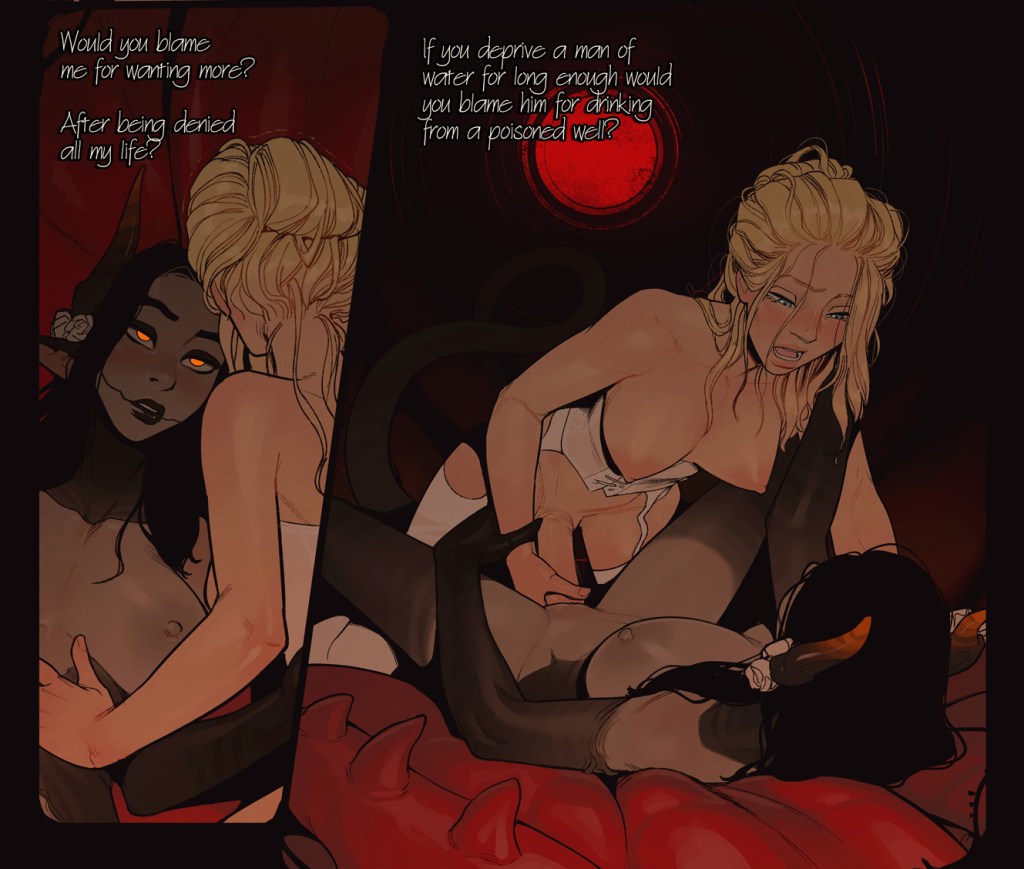
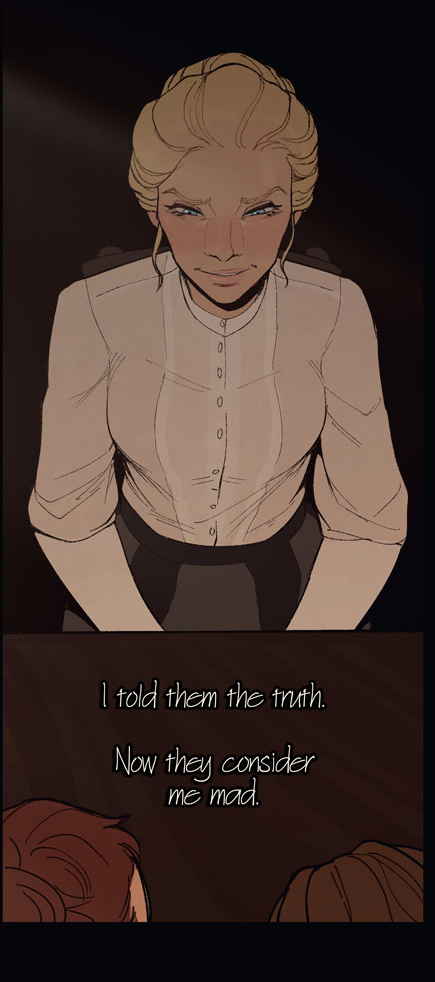
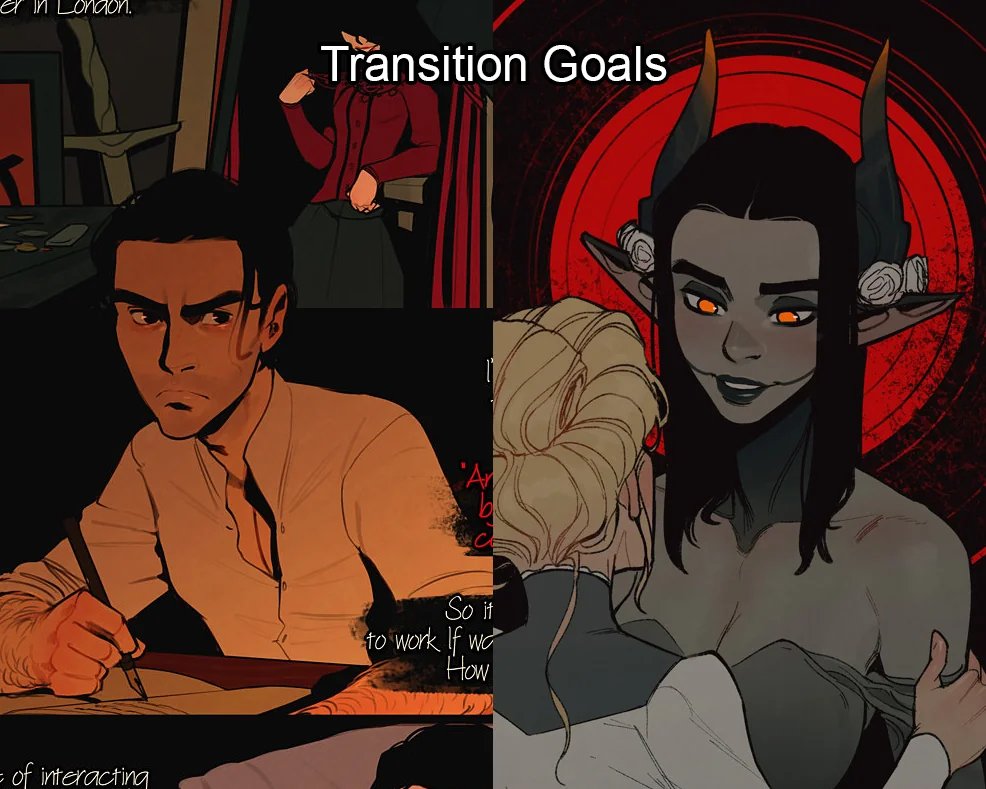
“Shethulhu: The Elder Goddess Returns” (2017) by T. G. Cooper (who also writes as Cooper Kadee) stars Charles Ward Dexter as a private detective hired to find the Femnomicon—and who is dealing with personal issues:

Back in his room, he crawled back onto his damp, smelly bed, and lay on his back, staring at the full moon outside his window. As he did so, he felt a thump inside his belly and put a hand on his tummy, grimacing. He didn’t want to sleep. Didn’t dare, really, and so he just lay there, staring at the moon and waiting for the dawn.

In his dream he’d been a woman, again, and that memory disturbed him. He’d always been a dude, a bro, a man’s man, and he didn’t know what it meant in his dreams now, which came every night, he always found himself in a woman’s body, helpless and afraid.

T. G. Cooper specializes in gender-bending fiction, and this particular story is pretty typical of the genre, adapted as a Lovecraftian pastiche. This is not a politically correct tale of an individual coming to an awareness of themselves as trans. There’s magic and tentacles involved, and the tongue is firmly in cheek:

“You should get yourself a real dog,” Ward said, pausing to scratch the white poodle under the chin.

“She was a Pitbull named Butch when I read that damn book,” the girl said. “We both got turned into girls.”

The pace flows quickly as Cooper runs through some familiar feminization tropes—including a marriage to Dexter’s former secretary, Asenath Waite. The Lovecraftian references are a bit basic; instead of the Necronomicon it’s the Femnomicon; instead of Miskatonic University, it’s Chthonic College; instead of Cthulhu it is Shethulhu. The erotic content is slight; there is no traditional humping and pumping; the eroticism is bound up in Ward’s situation, their transformation, their strong sense of gender identity and powerlessness as it is changed, and above all the pregnancy itself.

The kink aspect of “Shethulhu” plays up the crisis of masculinity that characters feel during the unwanted transition, the helplessness and despair at finding themselves in their new body; and in this case the shock and terror at being pregnant. The crisis—and, as in the end of “The Shadow over Innsmouth,” the final acceptance—is all-important; it is the arc that Charles Ward Dexter completes, the ultimate submission to the new self which is so terribly taboo in toxic masculinity. Not that gender-bending and pregnancy need always play to those specific ideas, but that’s the set-up here.

It is important to distinguish that there is a difference between erotic fiction starring trans characters vs. gender-bending erotic fiction that is firmly grounded in and plays to cisgender sexual mores and ideology. This is less Emilia Pérez (2024) and more Dr. Jekyll and Sister Hyde (1971). This is not a positive depiction of transition as much as it a vehicle for a specific set of kinks.

The Lovecraftian names and setting are played mostly for laughs, and we don’t get any deep meditation on the reproductive themes in Lovecraft’s work. Rather, it is played straight: horror is what a man would feel to suffer through what Lavinia Whateley did.

There are many permutations of pregnancy, birth, and gender-bending as kinks in Mythos fiction, this is just a relatively scarce example that puts them all together. It is especially scarce because it is less available than it once was: the story was previously available on Amazon Kindle, but is no longer purchasable through the store. T. G. Cooper’s DeviantArt page for the story indicates that it is available on their Patreon, for anyone interested in reading it.

E-books, unfortunately, are often subject to the whims of corporations and hosting services. “Shethulhu” and the Femnomicon may well be lost entirely someday.


Bobby Derie is the author of Weird Talers: Essays on Robert E. Howard and Others and Sex and the Cthulhu Mythos.

Deep Cuts in a Lovecraftian Vein uses Amazon Associate links. As an Amazon Associate I earn from qualifying purchases.
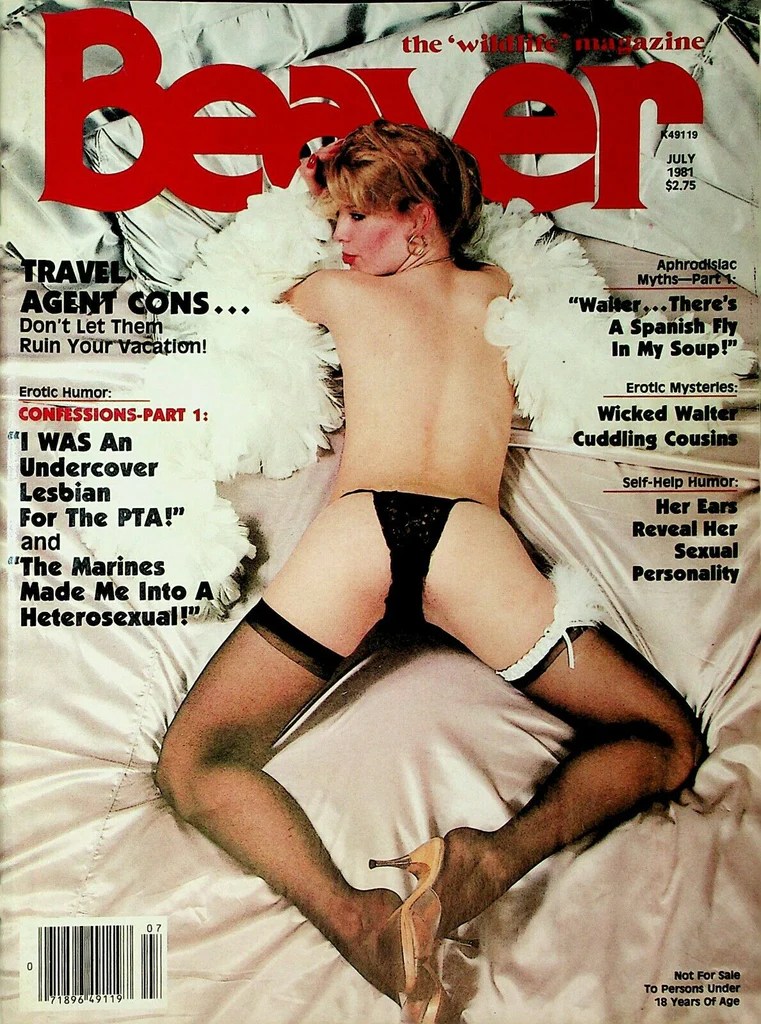
“Wicked Walter” (1981) by Mark Bloodstone

Eldritch Fappenings
This review concerns a work of explicit adult literature. Reader discretion is advised.


Men’s adult magazines emerged during the 1950s. Titles like Modern Man (1952) and Playboy (1953) featured softcore nude pictorials of women models, intermixed with a combination of editorials, articles, interviews, advertisements, cartoons, letters from readers, and quite a bit of fiction. The relative success of Playboy in particular inspired numerous imitators of various degrees of sophistication and quality. Loosening censorship restrictions in the United States and other countries in the 1970s saw some magazines become more explicit, directly depicting genitalia, sex acts (including penetration), and sexual fluids, but every magazine publisher and editor had to find the right balance for the time and place—to sell the magazine to readers, and not to get thrown in jail if they went too far.

Weird fiction has a surprisingly long history in men’s adult magazines; Playboy published William Hope Hodgson’s “The Voice in the Night” in the July 1954 issue, and various other publications have published articles on pulp magazine art, Robert E. Howard’s Conan character, H. P. Lovecraft, and related subjects. Even a revised version of “The Rats in the Walls” (1956) by H. P. Lovecraft first appeared in a minor men’s magazine. So it might not come as too big of a surprise that there’s a small body of Cthulhu Mythos fiction which has appeared first—and only—in men’s adult magazines.

Such is the case of the “Wicked Walter” series by grandmaster of horror Brian McNaughton (under his pseudonym Mark Bloodstone), which ran in the magazine Beaver from 1981 to 1983, and are comprised of “Wicked Walter” (July 1981), “The Panty Demon” (October 1981), “They Don’t Write Them Like They Used To” (November 1981), “Glamour Puss” (February 1982), “The Enchanted Dildo” (July 1982), “The Great Cat-House Raid” (January 1983), “How Are They Hanging?” (February 1983), “I’ll See You In My Dreams” (May 1983), and according to Robert M. Price a final unpublished story “Her Night to Howl.”

The eponymous “Wicked Walter” is about an Arkham cop and Miskatonic University graduate named Walter Finn, a hereditary witch who uses his powers to solve other magical crimes.

You don’t expect a red-blooded American cop to pack every room of his partment from floor to ceiling with mouldy old books, some of them in Latin and Greek. Nor do you expect him to have a pet crow named Dr. Dee who squawks that he’s a raven when you call him a crow, and whose favorite perch is a human skull on Walter’s desk. Walter didn’t even have a television set. She would have laid odds that he didn’t have a bowling ball in his closet or a six-pack in his icebox, either, like every other guy on the force. But he did have a bed, and once he got her into it she forgot everything else.
—Brian McNaughton (as Mark Bloodstone), Beaver July 1981, 66

Wicked Walter came along at an odd time and place for McNaughton.

McNaughton began his career in the fanzines of the 1950s while in high school; he attended Harvard but did not take a degree, and for a decade worked as a newspaperman at the Newark Evening News until the paper folded, and he turned to other work, including a decade as night manager of a motel. In 1971 he began writing adult fiction with In Flagrant Delight (1971) by Olympia Press. Under his own name and pseudonyms he would go on to write at least twenty erotic novels and a couple dozen short stories published between 1971 and 1983. The vast majority of these works have no reference to the Mythos, nor does McNaughton’s thriller Buster Callahan (1978; also released as The Poacher).

McNaughton’s breakthough came in the late-1970s, when he convinced longtime publisher Carlyle Communications to print a series of non-erotic horror novels. Although stuck with editorially mandated titles by Carlyle, the novels Satan’s Love Child (1977), Satan’s Mistress (1978) and its sequel Satan’s Seductress (1980), and Satan’s Surrogate (1982) proved successful enough to help relaunch McNaughton as a writer of dark fantasy and horror fiction. Aside from the middle two books, the Satan novels are not part of the same series as the titles would indicate, and the share little with one another besides a common writer and certain common themes. However, the success of these novels signaled McNaughton’s transition (or return) to weird and horror fiction, including contributions to Weirdbook (1968–97) and Lore (1995–98), and culminated in such masterpieces as The Throne of Bones (1997).

Brian McNaughton also wrote a number of pornographic “romance” novels under the pen names Sheena Clayton and Mark Bloodstone as well as his own, mainly for Carlyle Communications under imprints like Beeline, Tigress, and Pandora. The exact number and titles of his books I have been unable to determine, but the ones written as Sheena Clayton include Love and Desire (1982), The Aura of Seduction (1982), Tide of Desire (1983), Danielle Book Two (1983), There Lies Love (1983), and Perfect Love (1983)—all of which to greater or lesser extent contain supernatural elements and references to the Mythos. It was during this same time frame that McNaughton wrote his Wicked Walter stories.

In the first story, Walter Finn encounters a new cult in Arkham, run by a woman who calls herself Isobel Gowdie. Finn takes a magical precaution before he confronts Gowdie, and once inside her office he confirms she’s up to no good.

He hadn’t needed more proof, but it was all here in the decor of her office. One of the supposedly modern paintings on her wall was in fact the very old and awesome Yellow Sign. The tapestry on the opposite wall incorporated secret symbols of Nodens and Magna Mater, whose worshippers had been driven underground by the horrified pagans of ancient Rome. The paper-weight on her desk was a statuette of the dread Cthulhu. Few people would recognize the significance of these clues, but they alerted Walter that he was in the presence of a power darker and more terrible than he had suspected.
—Brian McNaughton (as Mark Bloodstone), Beaver July 1981, 70

The language is very pulpy, with lots of straightforward action and declarations, not getting too bogged down into details but offering enough details to tantalize, titillate, and even assure readers that they’re reading about consensual sexual encounters and not rape or coercion…this time.

Walter seldom used his occult powers to overcome a girl’s resistance, partly from masculine pride and partly because it took some of the spontaneity out of it. He was glad he hadn’t done that with Isobel. Apart from taking her dress off, everything she’d done had been done of her own free will. Maybe she was hoping to con him in some way, but she sure as hell wasn’t faking her responses.
—Brian McNaughton (as Mark Bloodstone), Beaver July 1981, 70

The character of Walter Finn very much falls into a certain male archetype of the period; a guy who is confident, amiable, willing and able to have sex at nearly any opportunity, but who isn’t extraordinarily strong, good-looking, rich, intelligent, cruel, or overly moralistic. A kind of hypersexual everyman, not unlike many characters in period films like Animal House (1978), Stripes (1981), Police Academy (1984), or Revenge of the Nerds (1984).

It isn’t a very long story, and McNaughton sets things up and wraps them up quickly, with two very explicit sex scenes taking up a considerable chunk of the word count. Yet “Wicked Walter” is, without a doubt, a bit of fun. McNaughton had no need to build up Walter Finn’s character as well as he did, didn’t need to add in the Mythos references. Yet they don’t come across as padding, either. McNaughton was finding a happy middle ground between erotic fiction and what today we might call urban fantasy. The series as a whole makes entertaining light reading, if the mandatory sex scenes often throw the pacing off a little.

McNaughton’s “Wicked Walter” stories, with their occasionally dated references and language, are artifacts of erotic fiction from an age before shaving pubic hair was commonplace, and practically unique for their content at the time of publication. Unfortunately, unless you’re a collector of vintage men’s adult magazines, you will probably never read them. “Wicked Walter” and its sequels have never been reprinted since their original publication, and anyone who did desire to do so would probably have an interesting time sorting out who owns the rights and getting the correct permissions to do so.


Bobby Derie is the author of Weird Talers: Essays on Robert E. Howard and Others and Sex and the Cthulhu Mythos.

Deep Cuts in a Lovecraftian Vein uses Amazon Associate links. As an Amazon Associate I earn from qualifying purchases.

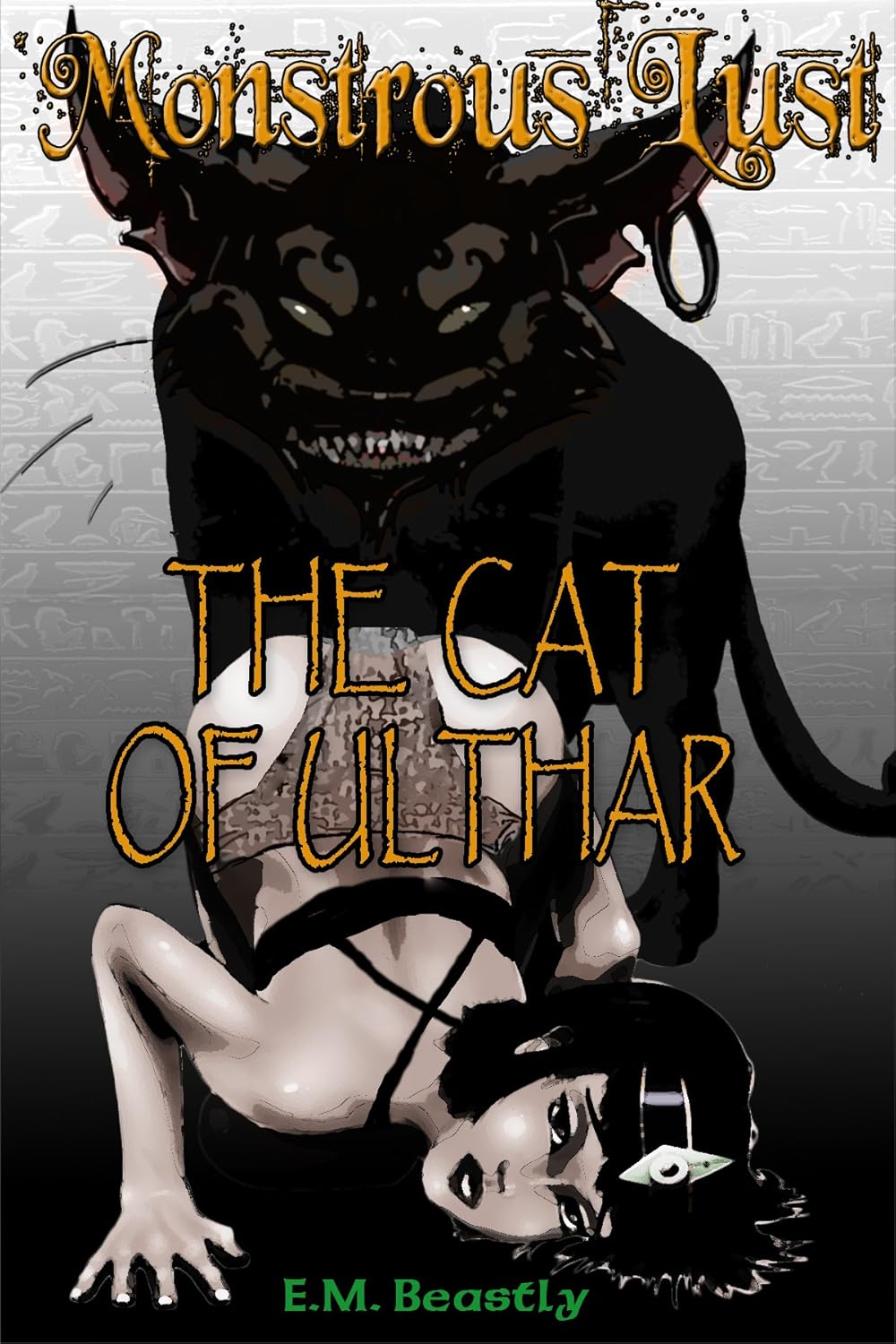
Monstrous Lust: The Cat of Ulthar (2017) by E. M. Beastly

Eldritch Fappenings
This review concerns a work of explicit adult literature. Reader discretion is advised.


There is an old legen in Ulthar, which lies beyond the river Skai, that no person can kill a cat. The legend speaks of a caravan full of strange wanderers. Some say they brought with them a blessing, others say a curse. From that day when a little boy lost his previous black kitten to an old cotter and his wife, the people of Ulthar did not dare kill a cat.

In Ulthar the cat became revered, cherished and praised. His the kind of the jungle’s lords, and heri to the secrets of hoary and sinister Africa. The Sphinx is his cousin, and he speaks her language; but is more ancient than the Sphinx, and remembers that which she hath forgotten.

As time went by, visitors to Ulthar said the cat became a powerful symbol.
—E. M. Beastly, Monstrous Lust: The Cat of Ulthar (2017)

According to Rule 34 of the Internet, there is porn of it. No exceptions. Strictly speaking, this is not true. It would be more accurate to say that the potential for erotic art and literature exists for every human conception. Diligent researchers would struggle to find, for example, a more explicit re-telling of H. P. Lovecraft’s “Sweet Ermengarde,” or lovingly rendered erotic fan-art of “Winged Death” (1934) by Hazel Heald & H. P. Lovecraft. There’s no reason for those adult works to not exist, but searchers after erotic horror will find vastly greater numbers of images dedicated to Cthulhu, Deep Ones, and shoggoths, shoggoths, shoggoths.

If porn of everything exists, it isn’t very evenly distributed. Some works and ideas attract more erotic attention and creativity than others.

Erotic works derived from Lovecraft’s “The Cats of Ulthar” exist in a relative minority compared to the erotic library spawned by “The Shadow over Innsmouth.” Lovecraft’s Dunsany-esque fantasy, part of the Dreamlands cycle, has no named characters, and as the name implies is primarily concerned with an episode involving domestic felines, told with the distinct style of a fable or just-so story. The erotic potential isn’t absent, but how to best adapt the themes and characters of the story to adult entertainment.

Well, there are the cats…

Erotic fanworks involving animal characters (expressive, talking animals, or fully anthropomorphic) have been around since at least the 1930s/1940s, when Tijuana bibles depicted erotic episodes of popular comic strip (e.g. Napoleon) and cartoon characters (e.g. Donald Duck). The emergence of an organized furry fandom from science fiction and comic book fandom would come in the 1970s and 80s, as a result of a convergence of factors, including the increased prevalence of fur-clad aliens in science fiction, the increase in shapechangers in fantasy, the success and sophistication of anthropomorphic characters in comics, cartoons, and animated films especially Disney’s Robin Hood (1973), and the late 60s/early 70s underground comic movement which included strong currents of parody, satire, and explicit sexuality that gave birth to characters like Fritz the Cat.

Technically speaking, Lovecraft got into the talking animals game in the 1920s when he wrote “The Dream-Quest of Unknown Kadath,” where the cats of the Dreamlands are not just intelligent but conversant with Randolph Carter. While Lovecraft isn’t usually seen as a precursor to contemporary furry fandom, it is clear that he was drawing from the idea of talking animals stories from stock collections of fairie tales and fables, and that he conceived the cats of Ulthar as capable of being characters in their own right. So when E. M. Beastly decided to riff off of Lovecraft for another entry in their Monstrous Lust series, the step from talking animal to anthropomorphic animal was less of a stretch than it might seem at first glance.

“Monstrous Lust: The Cat of Ulthar” is at once a sequel to and continuation of Lovecraft’s “The Cats of Ulthar,” and an erotic novella that takes the basic premise of the story in unexpected directions. While Lovecraft’s tale is horrible in the sense of Poe or Dunsany, Beastly takes things in a direction that seems to owe more to “The Shadow over Innsmouth,” where the cat-friendly law of Ulthar leads to more profound cultural changes, the rise of a dark cult, and finally physical expression in the bodies of the people of Ulthar. Until at last they disappear entirely, leaving behind a monstrous creature…the Cat of Ulthar.

While the concept is interesting, the execution is the real key. Here, the actual plot and writing of the story may disappoint readers. While the set-up of an Ulthar haunted by a sexy creature caught between human and cat with aspects of both has promise, in personality the eponymous Cat has a personality not unlike a sexually promiscuous version of the Cheshire Cat, and the two human characters who go to confront the creature are seduced and corrupted with a bare minimum of conflict. The stakes are low-to-nonexistent, the characters barely sketches, and the premise a bit weak. If you’re interested in passages discussing furry breasts and sexually explicit encounters between humans and a mystical cat-human hybrid, the story checks those boxes—but it doesn’t go far beyond that.

It is important to emphasize that there’s nothing inherently more taboo, weird, or perverted about anthropomorphic literature than any other kind. Nearly everyone has seen or read talking animal stories in some format, from Bambi to Br’er Rabbit, and anthropomorphism can apply to inanimate objects as easily as animals, as shown by the Transformers and Cars (2006). The same standards and good storytelling principles which apply to other literature also apply to anthropomorphic lit. As one reviewer put it:

On the surface, Bambi’s story is just what the subtitle says: A Life in the Woods. Yet one can find so much more in the story. The entire novel can be read as an existentaist parable, suggesting how one might make meaning in one’s own life. The novel is often seen as a disatribe against hunting, or more generally, a warning of the danger human beings pose to the natural world. The story can be read as castigating any system where the powerful exploit the weak, whether aristocracy or capitalism.

Yet Bambi is not a sermon. Salten’s beliefs and values are suggested on every page, but he doesn’t beat the reader over the head with them. He’s created characters that we as readers care about. Seeing them go through their struggles better enables us to contemplate our own lives. It is a story about its characters, not about issues; the issues become important to us because of the characters.
—Donald Jacob Uitvlugt, “Re-Reading a Classic: Bambi for the Furry Writer” in
A Glimpse of Anthropomorphic Literature (2016), 85-96

This is where “Monstrous Lust: The Cat of Ulthar” tends to fall flat; the characters fail to engage emotionally, and the story scenario doesn’t make sufficient use of the Lovecraftian setting and premise—which is, in Lovecraftian lit., a character in its own right. There’s humping and pumping, but without characters we care about. The setting is nominally Ulthar, but an Ulthar twisted into a Lovecraftian pastiche of itself, warped, twisted, depopulated, and barely present during the sexytimes. It is a fantasy sexual encounter that might easily be moved into any generical medieval setting with minimal effort.

Which is not to say that E. M. Beastly’s story is a failure, if that is exactly what the reader wants.


Bobby Derie is the author of Weird Talers: Essays on Robert E. Howard and Others and Sex and the Cthulhu Mythos.

Deep Cuts in a Lovecraftian Vein uses Amazon Associate links. As an Amazon Associate I earn from qualifying purchases.
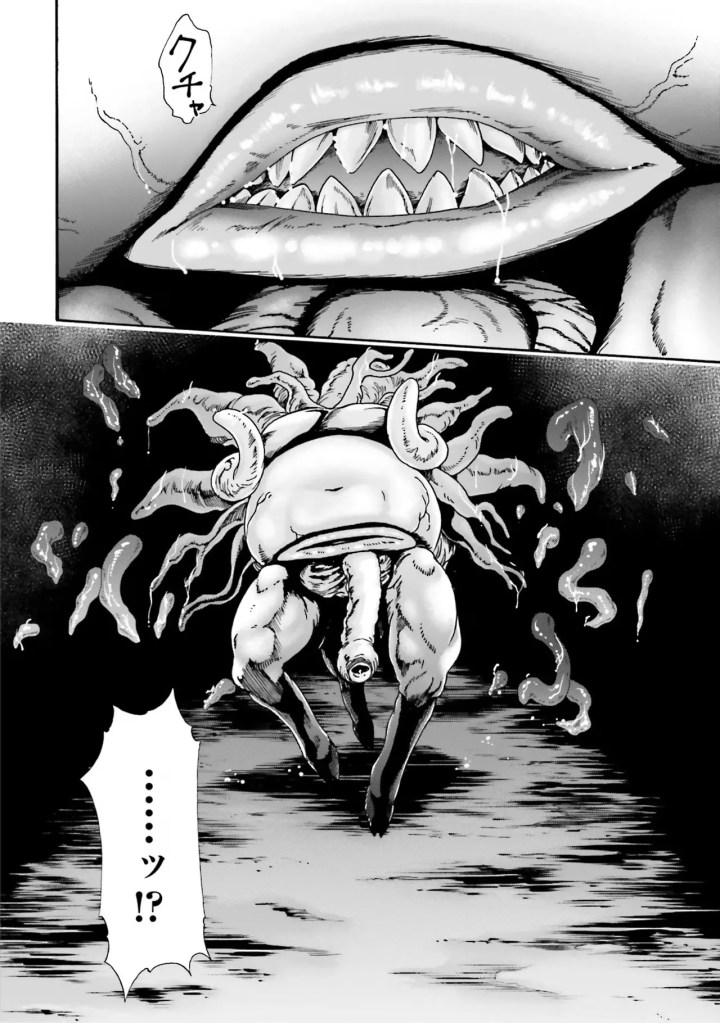
The Invitation (2017) by InCase

Eldritch Fappenings
This review concerns a work of explicit adult art and literature, and will touch on aspects of historical pornographic works, including NSFW images. Reader discretion is advised.


By the way—Cthulhu isn’t a she but a he. He’d feel deeply enraged if anyone regarded him as sissified!
—H. P. Lovecraft to Willis Conover, Jr. 29 Aug 1936 Letters to Robert Bloch & Others 389

In “The Call of Cthulhu,” Lovecraft defaults to referring to Cthulhu as male. Whether human gender binaries can encompass Great Cthulhu is something for later writers in the Mythos to decide. Lovecraft, for his part, only addresses it in his letters in a joking matter, with the typical cultural disdain toward “sissies”—men who display effeminate manners or dress, often misconstrued as homosexuals; Lovecraft had made another comment about the “sissy” Gordon Hatfield.

Throughout human history, in pretty much every culture, there has existed a minority who do not fit into rigid gender or sexual binaries. Whether this was a physical condition such as being intersex, or an individual’s identification with a different gender than assigned at birth, or taking on cultural attributes and attire associated with different genders—there is a broad range of physical, psychological, social, and sexual aspects involved. Each culture and language has their own nomenclature involved. In English in the 20th century, terms like hermaphrodite have fallen out of use in favor of words like intersex; the term transvestite, once identified largely as a sexual fetish or mental disorder, has largely fallen away from use in favor of transgender.

The rich vocabulary includes both contemporary efforts to define identities (e.g. genderqueer, gender fluid), pejorative terms (e.g. tranny, cross-dresser), and a grey middle ground of terminology most often associated with sex work, erotic literature, and pornography (e.g. ladyboy, shemale). Loanwords from other languages also enrich the language, e.g., futanari, from the Japanese ふたなり. The term futanari has come to be a pornographic genre unto itself, both in adult comics and literature, with its own specific tropes, and generally presents a fetishized ideal: an individual that possesses (sometimes exaggerated) sexual traits of both male and female.

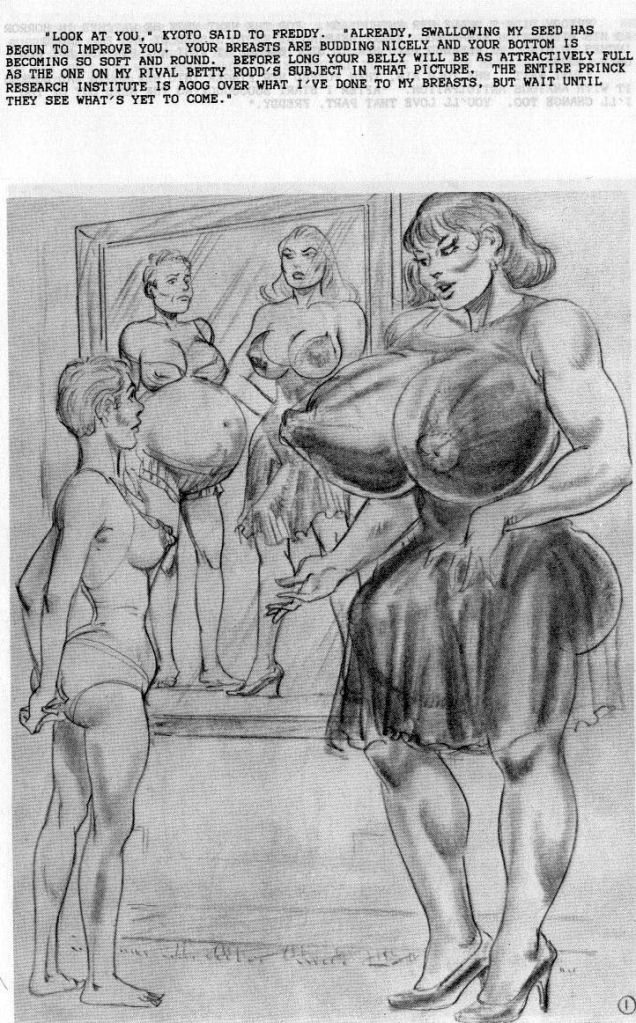
Despite the term futanari coming from the Japanese language and popularized by Japanese erotic comics, the basic idea is not unique to Japan. In the 1980s, for example, U.S.-born adult artist Eric Stanton created his “Princks” or “Ladyprinckers” or “Princkazons,” women with Amazonian physiques who also possessed penises (often of exaggerated proportions) and used their great strength and sexual organs to dominate and emasculate men. For example, in Stantoons #49 (“Makeover”), he presents a scenario where the men, unable to resist, are forcibly transformed and feminized. Stanton takes this idea to its cartoonish limit, and plays it for body horror and black humor as much as sexual titillation.

For the most part, however, “Princks” died with Eric Stanton. By the 1990s and 2000s, gender transition surgery and hormone replacement therapy had progressed substantially from the gland stories of early science fiction (see The Hormonal Lovecraft); the legal recognition of homosexuality and rights led to greater awareness of different LGBTQ+ identities outside of fetishized pornographic stereotypes. Besides this, futanari proved to be a more popular fetishized pornographic stereotype.

More importantly, the increasing acceptance of transgender individuals and the process of gender transition opened up literature for more positive stories of gender transition. While feminization as a sexual fantasy, voluntary or involuntary, will always remain, the acceptance and embrace of such a change as a positive metamorphosis instead of body horror gained more traction (see Seabury Quinn’s “Lynne Foster is Dead!” (1938): A Mistaken Gender Identity by Sophie Litherland).

Which doesn’t mean that a clever and skilled creator couldn’t combine the two. Lovecraft in “The Shadow over Innsmouth” presented a narrator who, at first horrified at the changes happening to their body, comes to accept their metamorphosis and the new identity that comes with it. For Lovecraft, the reader is allowed a peak as someone that fear and hated the alien and other becomes the other—and in fact, was one of them all along. The completeness of their change is indicated by how thoroughly they embrace who they are now, and reject who they thought they were.

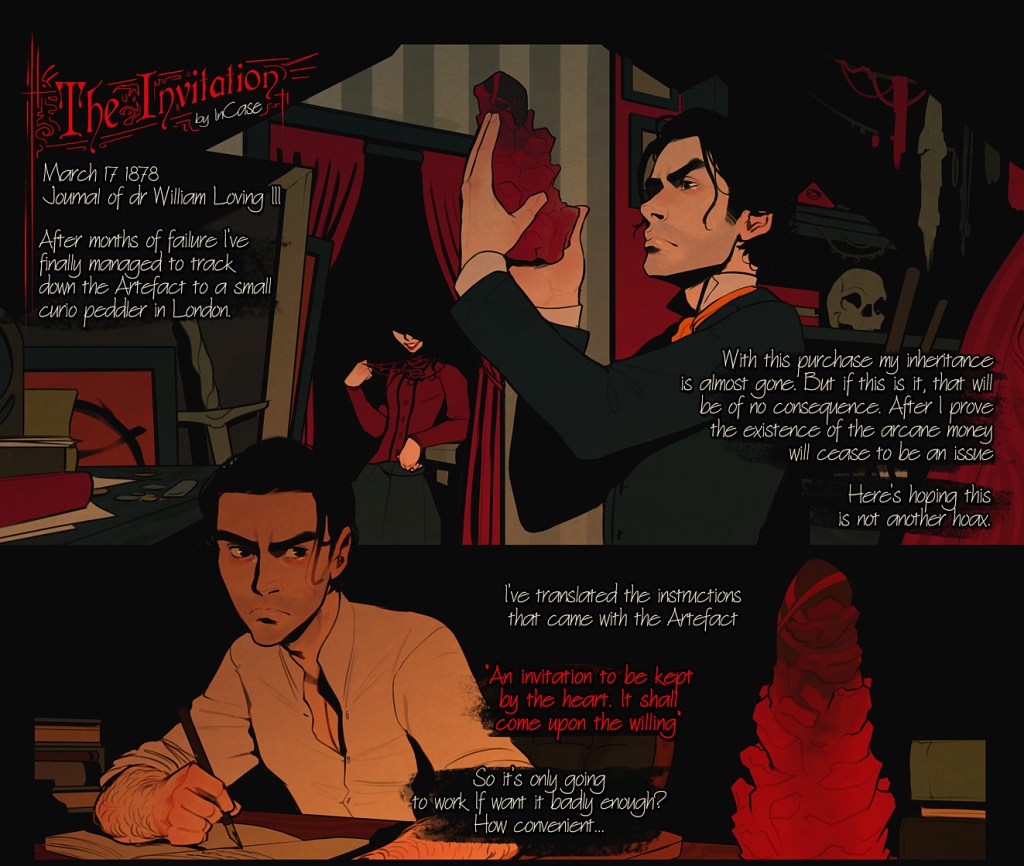
In 2017, erotic comic artist InCase began producing “The Invitation,” a sexually explicit webcomic. The second chapter was published in 2019. At first glance, “The Invitation” shares many hallmarks with feminization and futanari adult comics. Part of what sets it apart, however, is the framing and development of the story.

William Loving III starts out as a very Lovecraftian protagonist, an obsessive delver in the obscure and occult, who had finally found an artefact that promises to put him in touch with a strange, eldritch entity…and he goes a little mad with the revelations.

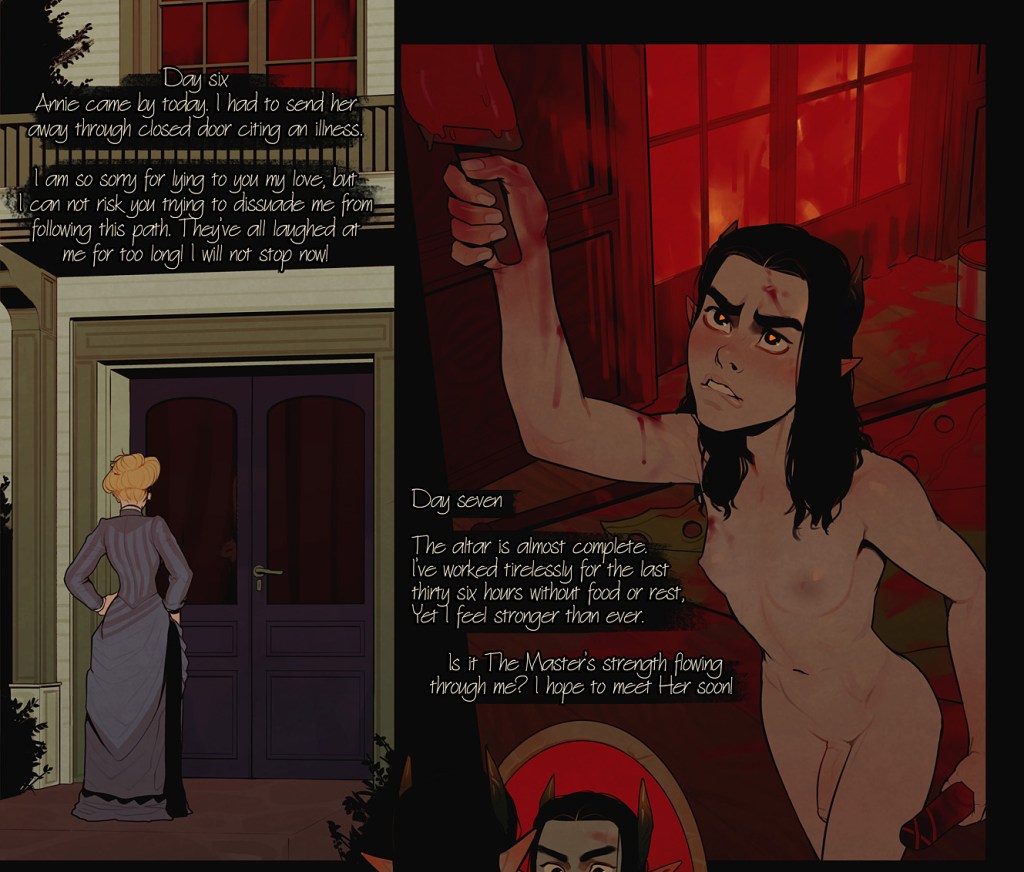
As their transformation progresses, William’s priorities and attitudes shift, their old mores fall away as they embrace a broader and more inclusive attitude toward gender and sexuality attraction. Above all, the Master who brought these changes to body and mind is imprisoned, and members of their cult, like William, seek to free them. Idol, old one, madness, cult…while InCase is not using Lovecraft’s Mythos directly, there are some clear parallels to aspects of Lovecraft’s work and the broader genre of stories inspired by the Mythos.

Then, whispered Castro, those first men formed the cult around small idols which the Great Ones shewed them; idols brought in dim aeras from dark stars. That cult would never die till the stars came right again, and the secret priests would take great Cthulhu from His tomb to revive His subjects and resume His rule of earth. The time would be easy to know, for then mankind would have become as the Great Old Ones; free and wild and beyond good and evil, with laws and morals thrown aside and all men shouting and killing and revelling in joy. Then the liberated Old Ones would teach them new ways to shout and kill and revel and enjoy themselves, and all the earth would flame with a holocaust of ecstasy and freedom. Meanwhile the cult, by appropriate rites, must keep alive the memory of those ancient ways and shadow forth the prophecy of their return.
—H. P. Lovecraft, “The Call of Cthulhu”

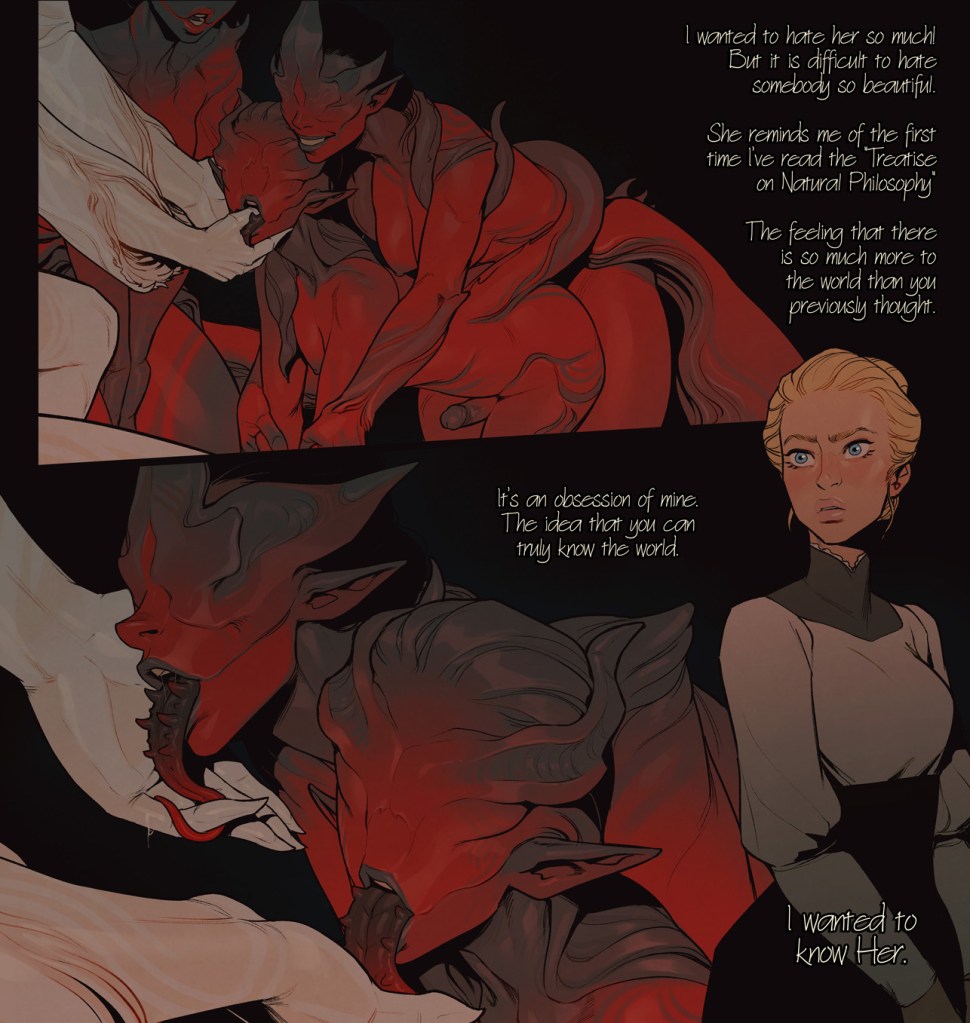
In the second half of the first chapter, InCase shifts the focus away from William pursuing the transformation on their own to interacting with the Master and their other servants. Sexual activity slowly grows more transgressive, with rougher action, bigger penetrations, more and less human (and more tentacular) participants…and the wonder of transformation and the bliss of sex is juxtaposed against the cosmic horror of the Master’s true face, and a glimpse of their true nature.

For a story about transformation and sex, and the gorgeously rendered artwork that conveys both sexuality and teratophilia, corruption and indulgence, these two characters are essentially character-driven. William is obsessed with magic, and having followed that obsession it consumes them utterly. What he left behind was his fiancé Annie, who becomes the protagonist of the second chapter.

In the Victorian milieu of The Invitation, Annie more than William represents a character whose body and identity are repressed by society; she is bound up in expectations of behavior (social and sexual) that she strains again; a woman of science at a period when women are not widely tolerated in science. A woman whose social standing is in peril from a broken engagement. A person who is, like William, innately curious.

There is a strong fantasy element to InCase’s work, both in The Invitation and in their other erotic comics. Without going into clinical detail, many of their characters fall into the spectrum of the sexualized fantasy of intersex characters rather than the reality. There are rarely true hermaphrodites, but there are often characters who appear to be women in every aspect save for having a penis and testes, which is fully functional (often incredibly so). Characters don’t undergo costly top and bottom and facial surgeries, they don’t take regimens of hormones their entire lives to achieve some semblance of the body they desire, that matches their gender identity. In real life, things are messy and imperfect; in comics, they can be idealized.

It is the fantasy that allows the exploration of these ideas. What would a Victorian woman do if she suddenly had a penis? If she was no longer restricted to the sexual role that biology and society had deigned for someone of her sex and gender? If you grew gills in Innsmouth, would you avoid the sea?

The Invitation is not a body-positive story about gender transition. It is an erotic horror story with themes of body horror and cosmic horror. William and Annie are not individuals who seek transition as a means to express and assert their gender identity. They are cultists who reject the world that they feel has rejected them; they are the outsiders who having finally given up on belonging to the world around them, with all the repressive mores, have turned to a being for whom all laws and mores are oppressive. Even natural laws.

It is important to distinguish between the reality of being transgender and the fantasy. Not everyone who is trans undergoes surgery or takes hormones; nor are trans folk mere sexual objects for others to fetishize and covet. InCase is drawing specifically on the tropes of trans and intersex characters as they have developed in erotic comics art over the last several decades; Annie and William are not Stanton’s Princks, but they are conceptual cousins. Where the Princks’ purpose is entirely driven by kink, the transition of Annie and William is much more moral.

Stanton’s Princks are domineering and cruel; they degrade and make fun of the men they transform, they revel in their strength and the men are helpless to resist. The suffering of the Princks’ victims is the point; that’s the relationship that Eric Stanton often pursued, regardless of whether it was Princkazons vs. men, or women vs. men, or women vs. women. The Master never taunts her victims, never degrades them, never says a cruel word; the Master’s inhuman hunger is frightening, but what really breaks Annie at the end is the realization that it is entirely voluntary. Like the Cenobites in Clive Barker’s “The Hellbound Heart” (1986), the Master does not seek out new victims—they find her. Drawn in by curiosity, they find a moral universe at odds with what they know.

A universe both horrific and addictive. Twisted, unnatural, and yet utterly freeing. Is it any wonder why some folks have embraced it as a positive example of gender transition, at least in jest?

In the end, it isn’t about whether or not William has a vagina or Annie has a dick. Their final acceptance of each other was to move beyond their conceptions of sex and gender, to discard all labels. This is presented as both horror…and a short of transcendence. As old de Castro said in “The Call of Cthulhu,” they had become like the Master themselves, they had moved beyond the need to define themselves in human terms, and had come at last into a more complete marriage, through and within the Master.

Which is about as Lovecraftian an ending as one could hope for.

InCase’s work can be found on their website and their Patreon account.


Bobby Derie is the author of Weird Talers: Essays on Robert E. Howard and Others and Sex and the Cthulhu Mythos.

Deep Cuts in a Lovecraftian Vein uses Amazon Associate links. As an Amazon Associate I earn from qualifying purchases.
All images copyright their respective owners.

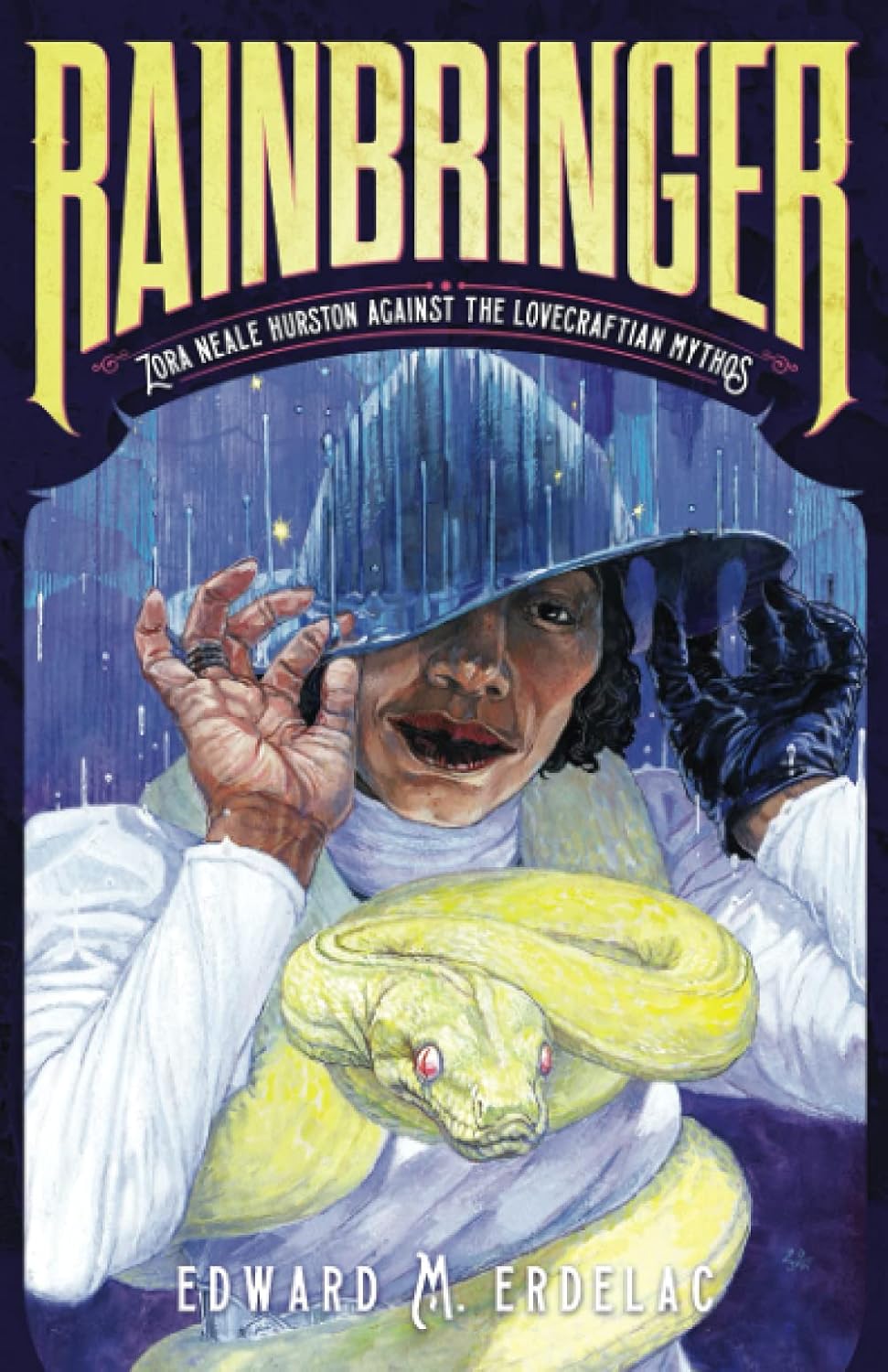
Rainbringer (2021) by Edward M. Erdelac

If you stay in Haiti long enough and really mingle with the people, the time will come when you hear secret societies mentioned. Nobody, of course, sits down and gives lectures on these dread gatherings. It is not in any open way that you come to know. You hear a little thing here and see a little thing there that seem to have no connection at first. It takes a long time and a mass of incidents before it all links up and gains significance.
—Zora Neale Hurston, Tell My Horse (1938)

William Seabrook’s The Magic Island (1929) was the book that launched the craze for Haitian Vodun and zombies in the United States, the direct inspiration for the film White Zombie (1932) and stories in pulp magazines like Strange Tales of Mystery and Terror such as August Derleth’s “The House in the Magnolias” (ST Jun 1932). Lovecraft read Seabrook’s book on a visit to Florida, and seems to have largely lost interest in voodoo, though he praised tales like “Mother of Serpents” (1936) by Robert Bloch.

Seabrook, however, was not the only one writing about African diaspora religions or African-American folklore. Zora Neale Hurston seems to have completely missed Lovecraft and his immediate contemporaries. In part, this was just a matter of timing; Lovecraft was dead by ’38 when Hurston’s book on Haitian Vodun, Tell My Horse, was finally published. In part, it was a reflection of segregation: as a Black woman, Hurston struggled seemingly her whole life against the prejudices of white editors and white audiences. Voodoo as a theme for Mythos fiction did not die off after the ’30s, but the Hollywood tropes of pins in dolls and zombies as reanimated corpses tended to overshadow authentic anthropology and folklore research.

Zora Neale Hurston never really got a chance to go up against the Mythos. Not until 2021, when Edward M. Erdelac, author of the Merkabah Rider series, published Rainbringer. In this episodic novel, Erdelac wears together fact and fiction, interpolating encounters with the Mythos into Hurston’s already busy and adventurous life. Her particular career of poking her nose into hoodoo, Vodun, and other systems of belief provide a good excuse for her to stumble across the much weirder cults and entities of the Cthulhu Mythos, and the stories are inflected in their interpretation and depiction of the Mythos to reflect Hurston’s own writings.

Erdelac took pains to present a period-accurate but not discriminatory view of Black people during the period; the word “Negro” was in common use at the time, without any pejorative association. Gullah speech is presented with fair accuracy. Most of Hurston’s investigations into insular African-American communities are played straight, and the joy of exploration and discovery, the use of her wits and charisma, her respect for the people she meets and their beliefs all lend verisimilitude to the stories. Then things get a little Lovecraftian.

“An Old One?” I said, folding my arms, and thought to myself, Lord God and Papa Yig, not these motherfuckers again.
—Ed Erdelac, “Ekwensu’s Lullaby” in Rainbringer 57

Yig, in the context of the fictional Zora Neale Hurston’s career, is cast as her hoodoo patron, the figure who presided over her initiation into the occult. Yet stories like “Ekwensu’s Lullaby” are not an effort to cast African diaspora beliefs into a Mythos mold; rather, it is a story about African diaspora religion and strange survivals in an out-of-the-way place, in a universe that is Mythos-inflected.

This is much more believable, and therefore more interesting, than if Zora Neale Hurston were trying to fight Cthulhu by her lonesome. The approach is reminiscent of “Jeroboam Henley’s Debt” (1982) by Charles R. Saunders, “Hairwork” (2015) by Gemma Files, and Ring Shout (2020) by P. Djèlí Clark in that the stories are very much grounded in the African-American and African-Caribbean experience, the echoes of slavery and discrimination that have left their mark on bodies, minds, souls, and cultures. In a system of belief that already accepts the supernatural, the existence of Yig & co. doesn’t have the same sanity-blasting effect.

Erdelac was strongly inspired by Hurston’s fieldwork in writing these stories, as he mentioned in his interview Cthulhu in the Deep South on Tentacle Talk, but there is a second vein trying to balance out in these stories, and that’s weaving Zora’s adventures into the Mythos with the skill of a pasticheur. If the whole book had only been about Hurston’s dealings with Yig as her patron, that might have been interesting but slight from a Mythos perspective. However, she also encounters the Dreamlands, the “King in Yeller,” Tsathoggua, and other eldritch entities. Which sometimes adds spice to the gumbo, and sometimes is a bit of an overpowering flavor.

The strength of each episode is really in how well the story hangs together more than how many references to Hurston’s work of Lovecraft’s Mythos he can stir in. The more spiritual and dream-like episodes are balanced out with shoot-’em-up pulp action sequences, and the balance of elements shifts from episode to episode, reflecting changes in both Hurston’s real life and whatever Mythos threat Erdelac wants to put her against next. The result isn’t an exhaustive Mythos biography of Zora Neale Hurston, by any means. I could easily see Erdelac writing another story that fits in between the existing episodes, as the plot occurs to him.


Bobby Derie is the author of Weird Talers: Essays on Robert E. Howard and Others and Sex and the Cthulhu Mythos.

Deep Cuts in a Lovecraftian Vein uses Amazon Associate links. As an Amazon Associate I earn from qualifying purchases.

Ghosts and Monsters (1982) by Mark Falstein & Tony Gleeson

Ghosts and monsters have long been favorite topics for many children, so this Getting Into Literature set has a real built-in motivation factor. The art aids understanding, and the text is set in type (rather than hand-lettered in the traditional comic-book style). These features make GHOSTS AND MONSTERS enjoyable and easy to read.
—Teacher’s Guide: Ghosts and Monsters

Imagine yourself in a public middle school in the United States of America, circa the 1980s or early 1990s. A genuine chalk board, rows of desks, an old-style projector. It’s the fall; leaves are falling from the trees, t-shirts are giving way to long sleeves and jackets. The classroom might be decorated with black and orange chains of paper, a cut-out of a witch, a pumpkin with a crooked smile drawn on in sharpie. The teacher passes out a stack of worksheets—but what is this? Comics? Horror comics?

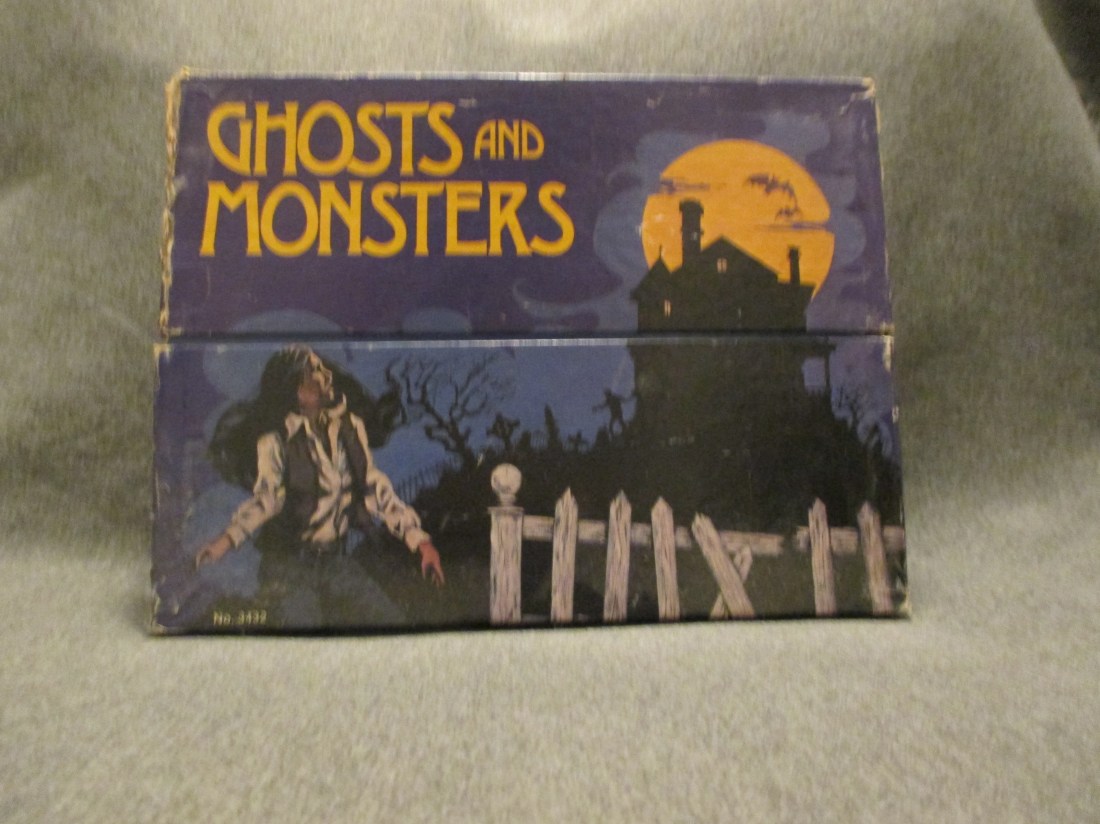
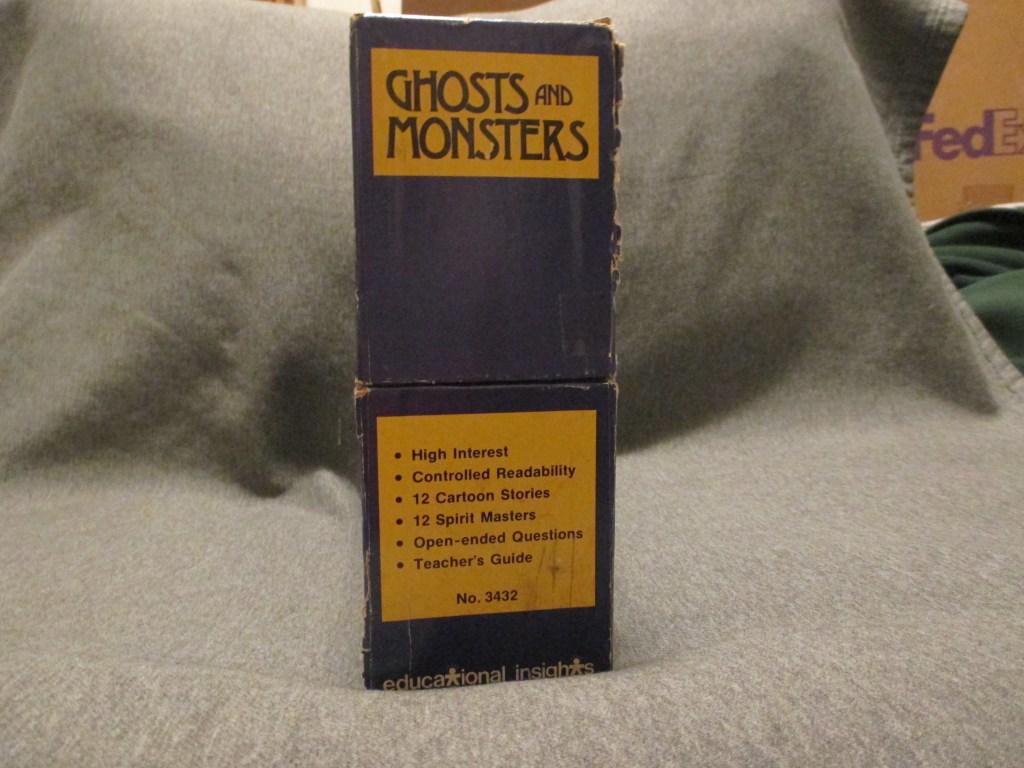
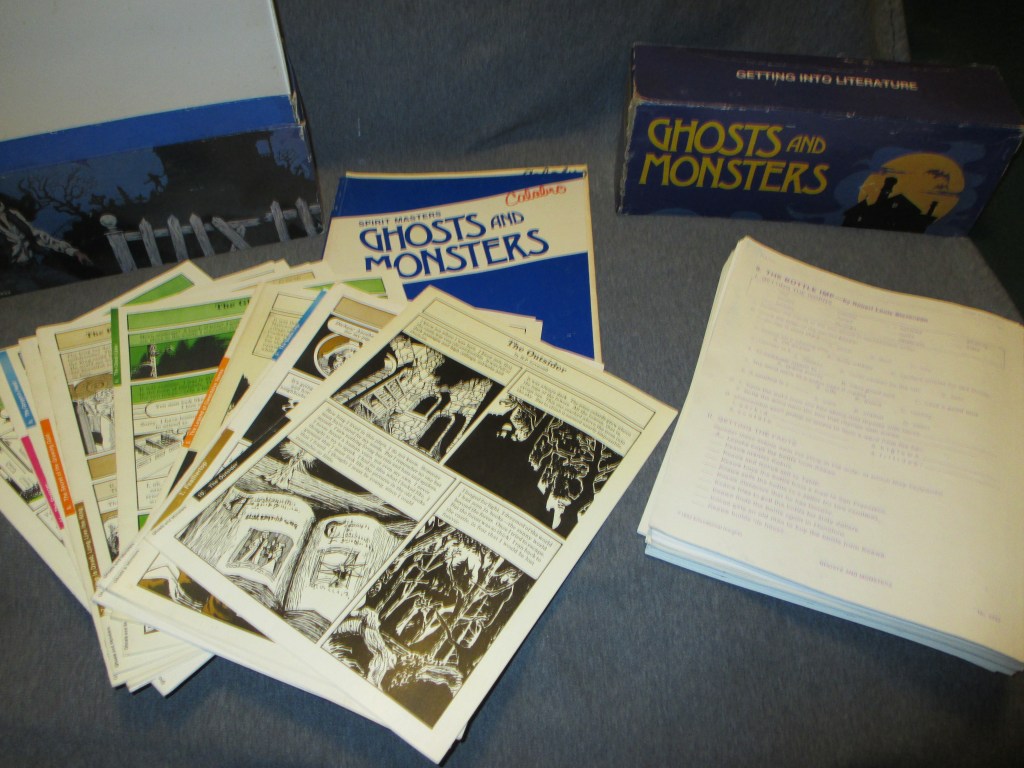
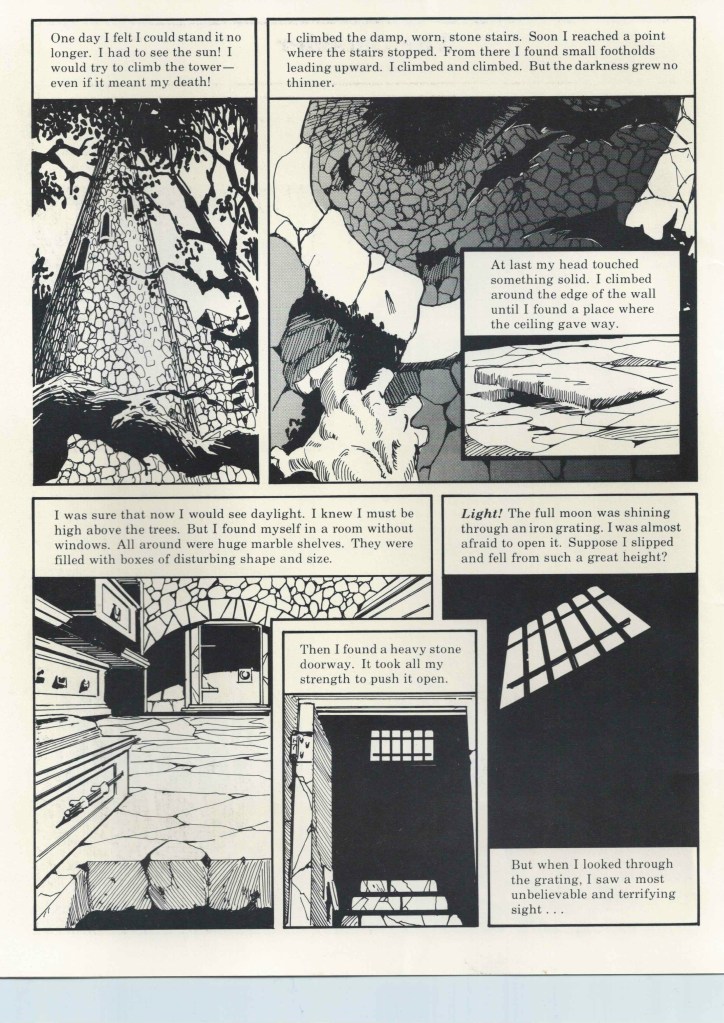
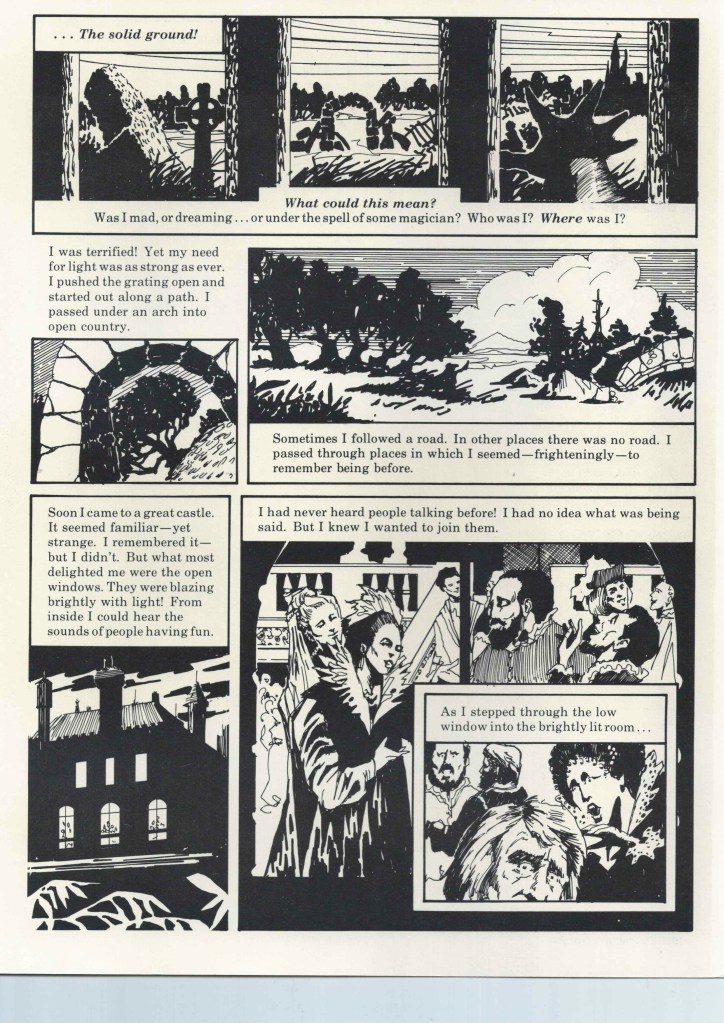
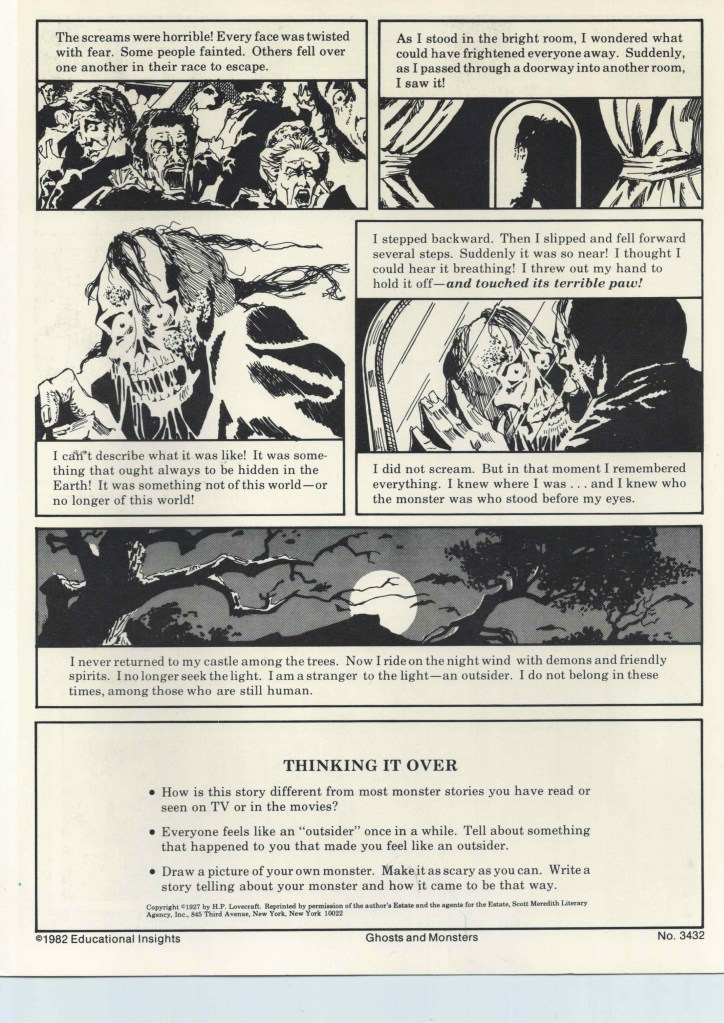
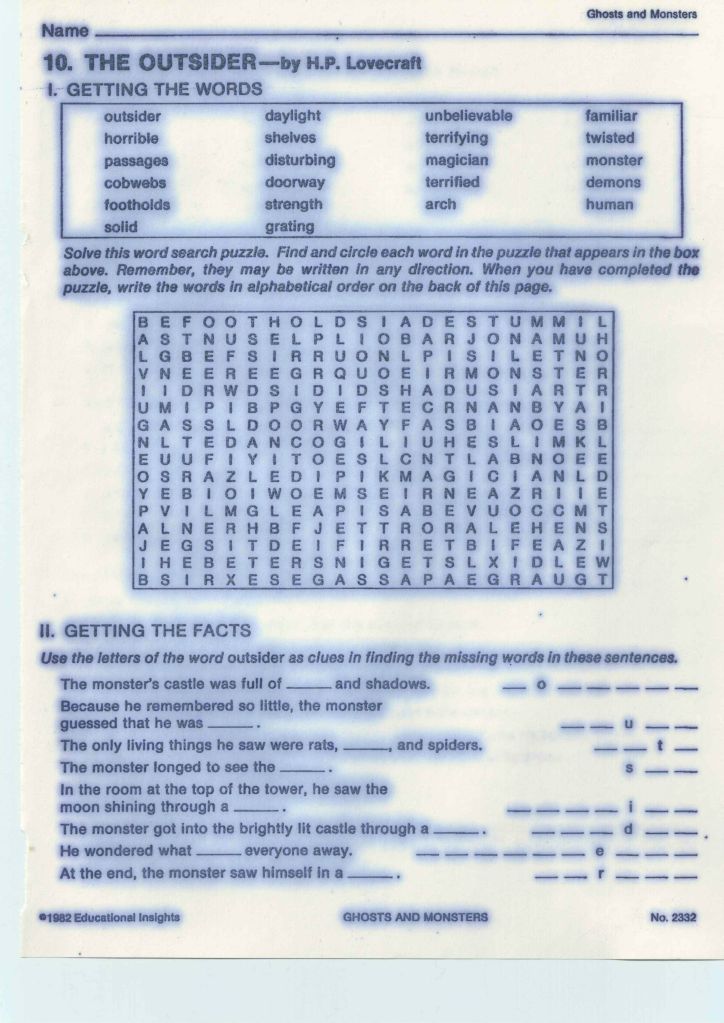
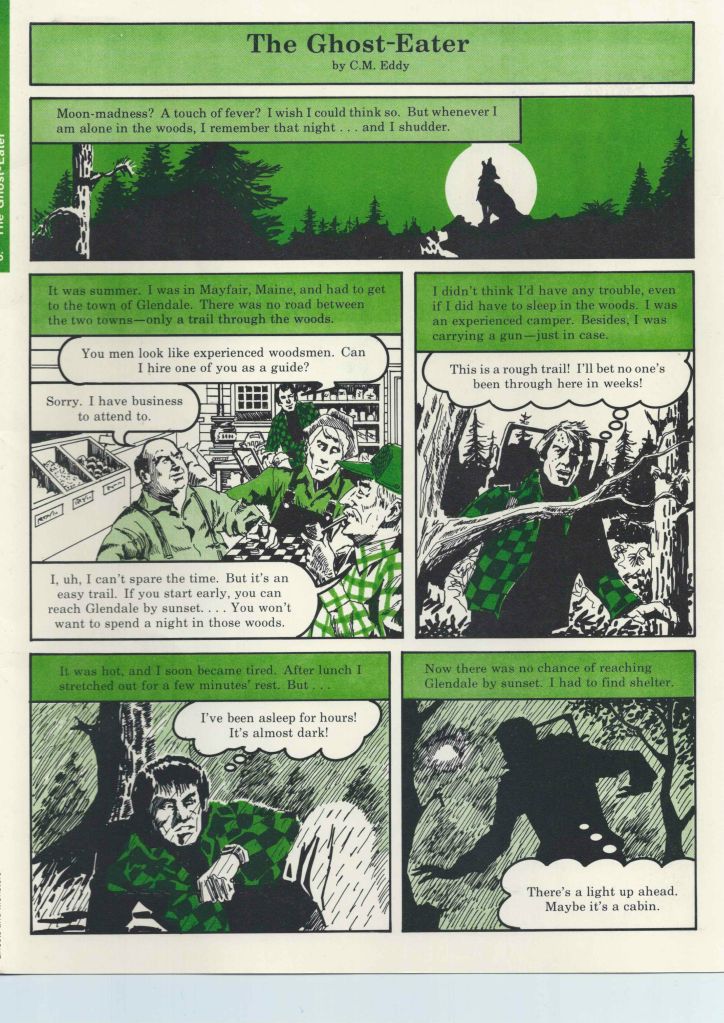
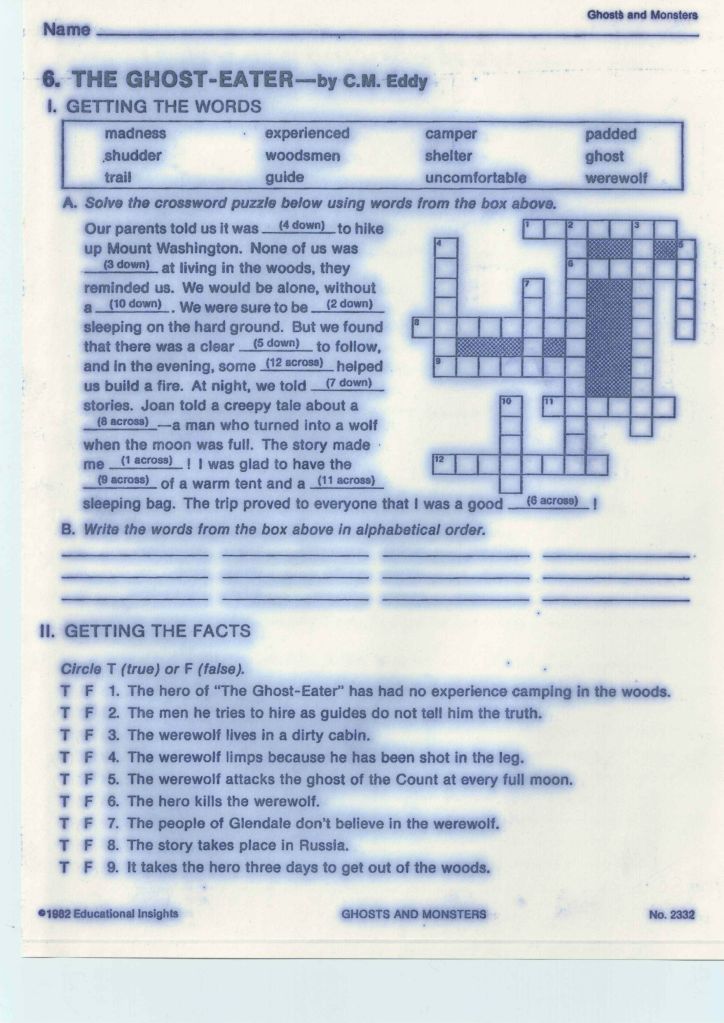
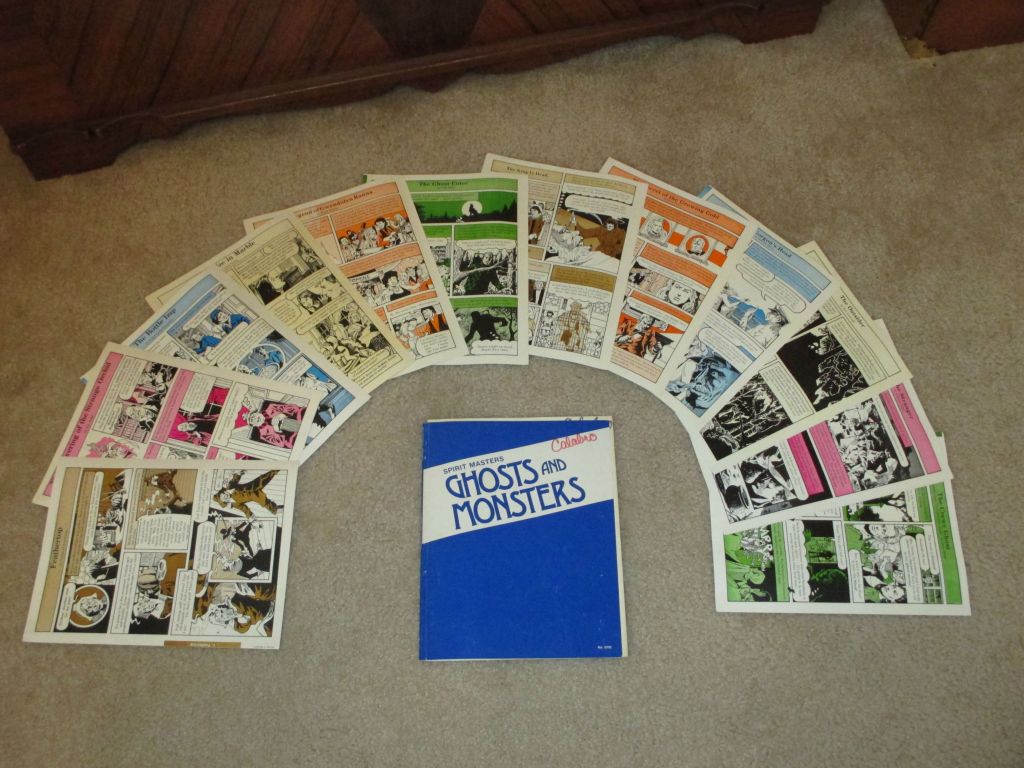
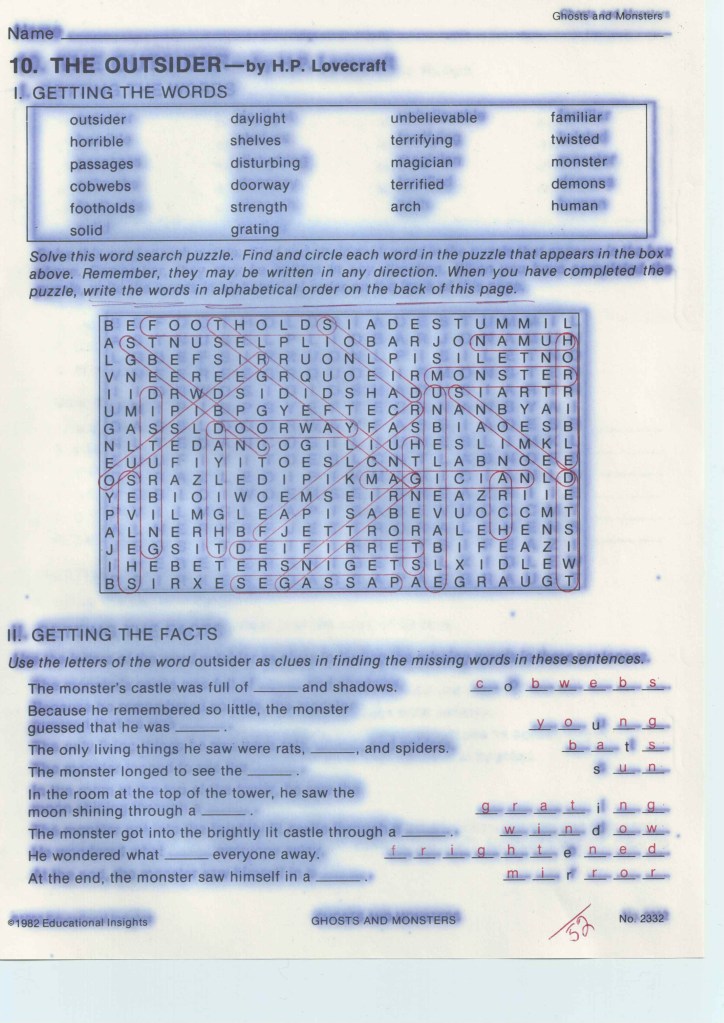
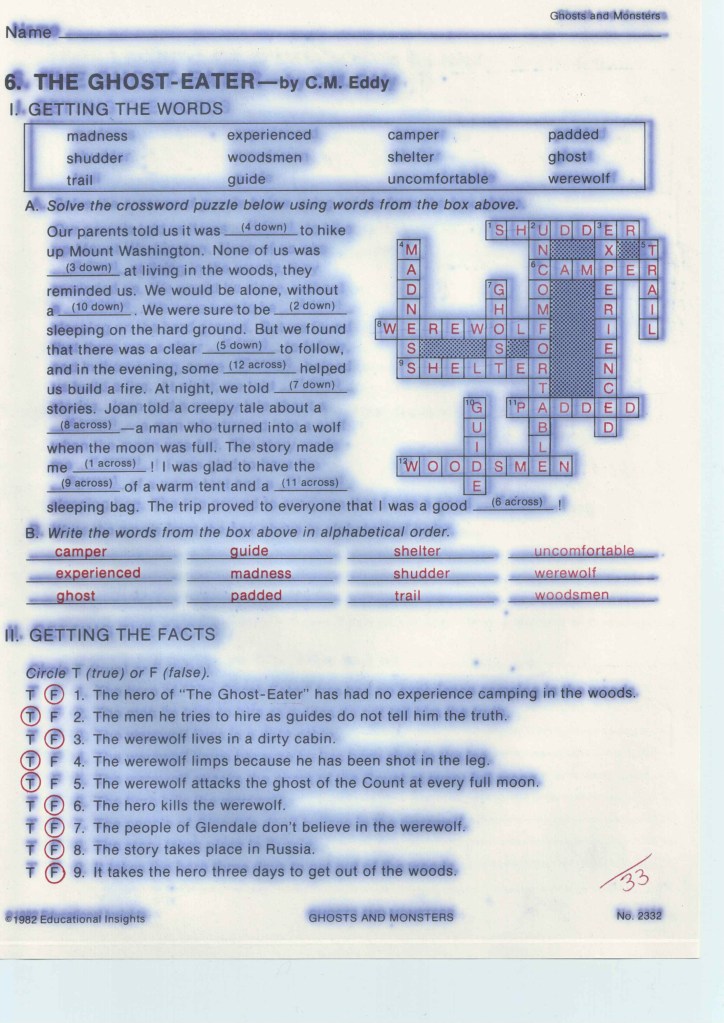
Ghosts and Monsters was published by Educational Insights in 1982. The kind of boxed set of teaching materials that found there way easily into hundreds or thousands of classrooms across the country. The contents were pretty basic: a book of spirit masters for duplicating worksheets (crosswords, etc.) in an age before photocopying became ubiquitous; a brief teacher’s guide with suggested questions and activities; and a package of comic booklets which adapted a dozen tales of horror and weird fiction to comics:

  1. “Feathertop” (1852) by Nathaniel Hawthorne
  2. “The Flowering of the Strange Orchid” (1894) by H. G. Wells
  3. “The Bottle Imp” (1891) by Robert Louis Stevenson
  4. “Man-Size in Marble” (1887) by Edith Nesbit
  5. “The Legend of Gwendolyn Ranna” (1982?) by Frank Maltesi
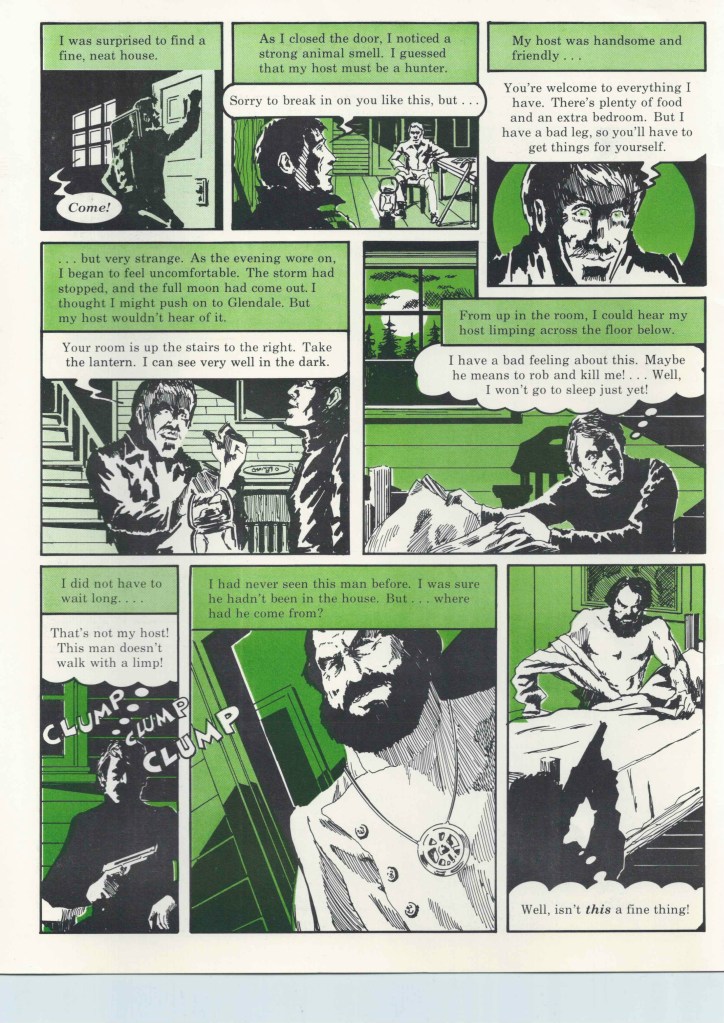
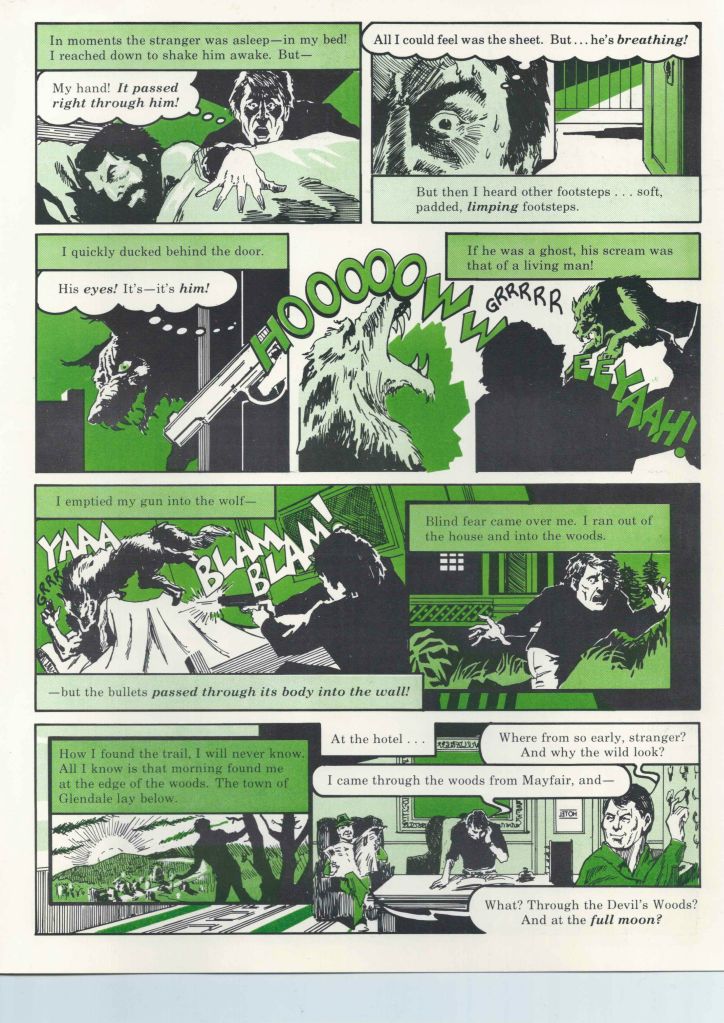
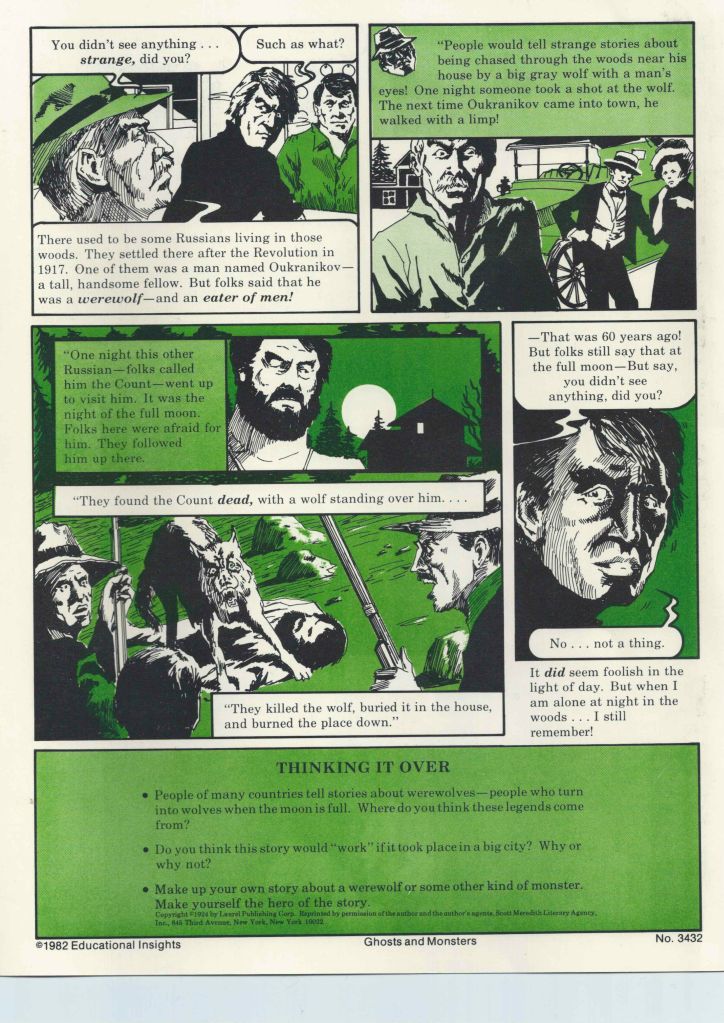
  6. “The Ghost-Eater” (1924) by C. M. Eddy
  7. “The King is Dead, Long Live the King” (1928) by Mary Coleridge
  8. “The Secret of the Growing Gold” (1892) by Bram Stoker
  9. “The Gorgon’s Head” (1899) by Gertrude Bacon
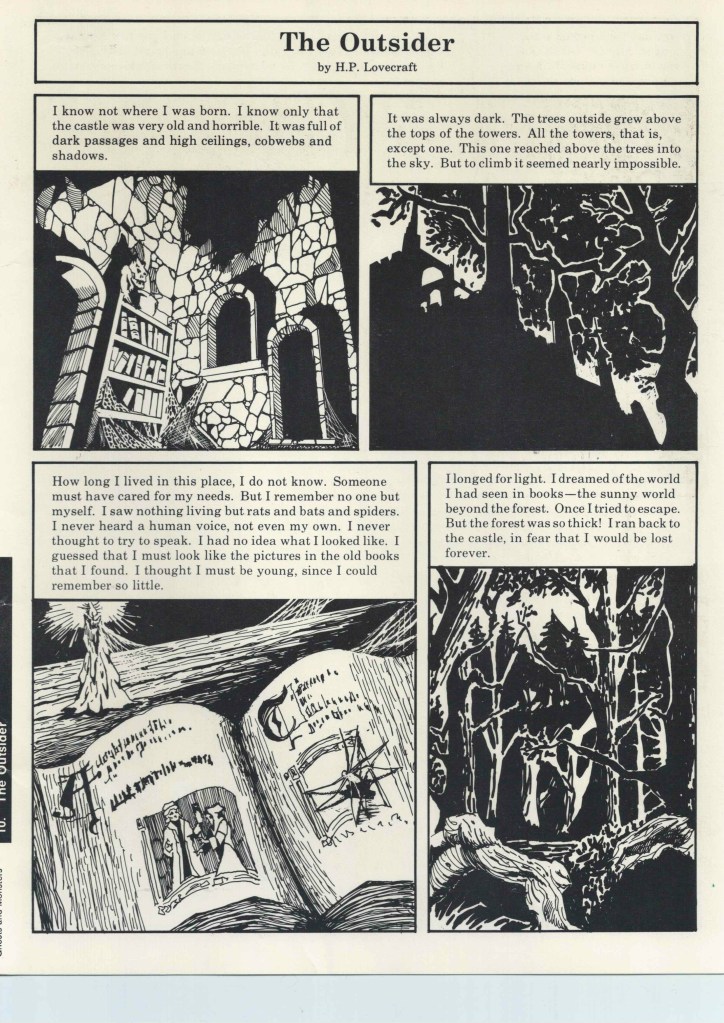
  10. “The Outsider” (1926) by H. P. Lovecraft
  11. “The Stranger” (1909) by Ambrose Bierce
  12. “The Crewe Ghost” after Oscar Wilde [based on “The Canterville Ghost” (1887)]

It’s an odd mix. Many of these works were in the public domain, while the others were largely drawn from the pulps or (more likely) horror anthologies. “The Legend of Gwendolyn Ranna” by Frank Maltesi is a bit of an enigma, though the name is associated with several other brief legendary tales that have popped up in other educational materials; this may well be its first (and only) publication.

Most of the interest is on the comics themselves. The Teacher’s Guide credits Mark Falstein (well-known author of fiction for young adults) for selection and adaptation, and freelance artist Tony Gleeson for the illustrations. Each comic booklet is basically one large folded page, which gives four pages to tell and illustrate a complete story—a not-inconsiderable task!

The results tend to less grue and taboo than young horror fans might hope for. These were the last generation of “monster kids” that might pick up Famous Monsters of Filmland (1958-1983) on the stand, but they might still find a Helen Hoke-edited horror anthology in the school library, or pick up something from Scholastic involving vampires, werewolves, or bug-eyed aliens at the school book fair. Yet I have to wonder how many kids sat down one day and read Lovecraft for the first time as part of a school assignment—

And then fill out the worksheet afterwards!

Actually, there were two bits of Lovecraft tucked away in this package. C. M. Eddy, Jr.’s “The Ghost-Eater” (Weird Tales Apr 1924) was one of the stories that Lovecraft had somewhat revised for Eddy, and sold to Weird Tales editor Edwin Baird. As Lovecraft put it:

I have, I may remark, been able to secure Mr. Baird’s acceptance of two tales by my adopted son Eddy, which he had before rejected. Upon my correcting them, he profest himself willing to pint them in early issues; they being intitul’d respectively “Ashes”, and “The Ghost-Eater”.
—H. P. Lovecraft to James F. Morton, 28 Oct 1923, Letters to James F. Morton 57

How much of it Lovecraft actually wrote is a matter for debate; S. T. Joshi in Revisions and Collaborations notes the plot and some of the dialogue seems very typical of Eddy, while much of the prose reads like Lovecraft. In any event, it’s a genuine rarity. While many of Lovecraft’s tales have been adapted to comics, his revisions and collaborations are much less likely to receive the same treatment. This is certainly the first, and possibly the only adaptation of “The Ghost-Eater” to comics.

Given the limitations of space, the monochromatic printing, and the incredibly tight scripts, credit has to be given to Tony Gleeson for doing a very decent job on the art. Stuck with a very boxy framing setup, he nevertheless manages to use perspective shots and shadowed silhouettes to hint and convey something of a horror-mood. While the Teacher’s Guide suggests that the typeset text will make it easier to read, I suspect the real issue was that the budget for this project didn’t extend to hiring a letterer.

When we consider Lovecraft as something more than a cult figure, but as a writer who has entered the canon of world literature—this is a good example of what that looks like. Not necessarily fancy, expensive editions that can only be seen and enjoyed by a few, but stories that penetrate into common educational materials, hitting the masses when they’re young and becoming part of the foundation of reading. Ghosts and Monsters is a core sample of how Lovecraft came to the masses.

It’s a bit of history easily overlooked and easily lost. These were sold for classroom use, not to the public, and not preserved in libraries. How many classes went through Ghosts and Monsters before the comics were too worn for further use, or lost and displaced? Who preserves old worksheets from childhood days? These are deliberately ephemeral products, designed to last a few seasons and then be replaced as educational guidelines shift or a company needs to sell a new product. Edutainment marches on.

(Here are the answer keys to the worksheets if you need them.)


Bobby Derie is the author of Weird Talers: Essays on Robert E. Howard and Others and Sex and the Cthulhu Mythos.

Deep Cuts in a Lovecraftian Vein uses Amazon Associate links. As an Amazon Associate I earn from qualifying purchases.
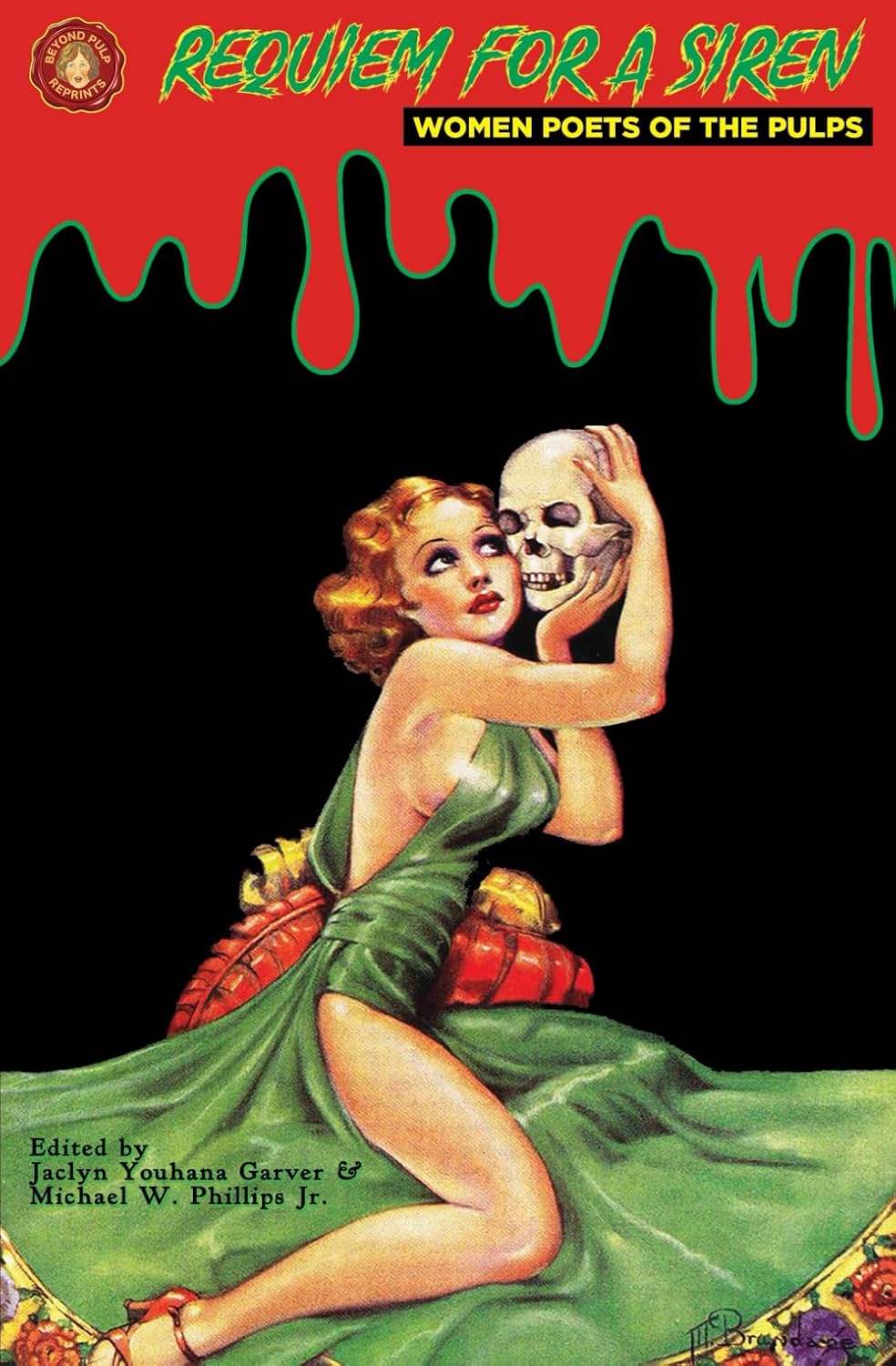
Requiem for a Siren: Women Poets of the Pulps (2024) ed. Jaclyn Youhana Garver & Michael W. Phillips, Jr.

Dorothy Quick was one of almost three hundred women who published fiction and poetry in sci-fi and horror pulp magazines before 1960.

Have you heard of her?
—”Introduction: A Place for Wild Women” in Requiem for a Siren (2024) 1

The pulp reprint anthology has long had a place in genre fiction. In the 1920s and 30s, the Not at Night series and its imitators mined Weird Tales to package pulp stories for audiences in hardback. In the 1960s and 1970s, as fantasy and science fiction boomed, authors like H. P. Lovecraft, Robert E. Howard, and Clark Ashton Smith found a strange afterlife alongside the paperback reprints of The Lord of the Rings and Edgar Rice Burrough’s Tarzan and John Carter of Mars novels. Editors like Helen Hoke, Margaret Ronan, and Betty M. Owen were not above reprinting pulp tales to fill out their anthologies for youngsters, and as copies of pulps decayed and rose in price, anthologists like Sam Moskowitz and Peter Haining saw a market in reprinting classic tales from the pulps.

They were right. There was a market for repackaging the best of Weird Tales from the 30s in hardback or paperback, and readers were eager to read the science fiction of the 40s, or themed anthologies of evil plants, drug use, vampire tales. Anthologies proliferated, and continue to proliferate—because now many of the contents of those original pulps have entered the public domain, their text has been scanned, transcribed, and posted online. Every laptop is capable of word processing, layout, and desktop publishing work that used to take an entire office, or at least a some dedicated space in the garage; print-on-demand publishing and ebooks mean it has never been easier for free content to be collated, packaged, and presented for sale at prices that range from the bargain-basement for a cheap ebook with content pulled from Wikipedia to a substantial sum for a high-end hardback, like Weird Tales: The Best of the 1920s (2024, Centipede Press).

The question presented is one of value: what have the editors and publishers provided in their anthology that makes it worth the reader’s hard-earned dollars? Does it save them time or effort? Is there some unique insight provided in the way of explanatory essays? Or is it merely a luxury good, designed to be enjoyed as an aesthetic experience for its own sake, and priced accordingly?

Personally, I tend to be leery of cheap pulp reprints in the print-on-demand era. The return on investment for the cheapest work seems to be low, so the folks attracted to that market are either bottomfeeders or rank amateurs, and the products reflect that. Aim a little higher, however, at the level of some of the self-published scholars and small independent presses, however, and some much more interesting books start to emerge.

Night Fears: Weird Tales in Translation (2023, Paradise Editions), edited by Eric Williams, is a collection of the non-English weird fiction that was translated and published in Weird Tales during the 20s and 30s, with explanatory essays and notes on the works. While you could go out and find the individual stories, these aren’t works that were ever published together before, and the essay adds history and context to why and how they appeared in the Unique Magazine.

So too, the women of Weird Tales, who so often never got collections of their own during their lifetimes when their male counterparts did, are finally getting some posthumous recognition in print. Today, those who want to read Francis Stevens can pick up The Citadel of Fear (2022, Flame Tree) with scholarly introduction by Melanie R. Anderson; Everil Worrell’s The Canal and Other Weird Stories (2023, Weird House) with introduction by S. T. Joshi; Greye la Spina’s Fettered and Other Tales of Terror (2023, From Beyond Press), with introduction by Michael W. Phillips, Jr.; Dorothy Quick’s The Witch’s Mark and Others (2024Sarnath Press), also introduced by Joshi.

Collecting these disparate stories from half-forgotten authors and bringing them together with a bit of information about their lives and works produces a whole that is more than the sum of the parts, because it effectively presents these women authors of weird fiction in the same way that their male counterparts have often been presented. In effect, it gives readers a chance to get to know an entire body of work by an author, instead of randomly running across a story or two, often presented without context.

Requiem for a Siren: Women Poets of the Pulps (2024, From Beyond Press) is representative of the best of this impulse to not just reproduce the work of women pulpsters in danger of being forgotten, but to arrange and comment on them in a way that highlights both the publishing history of poetry in pulp magazines and the lives of these women. While many of the poems are taken from Weird Tales, including “The Woods of Averoigne” (1934) by Grace Stillman and “The Eldritch One” (1948) by Pauline Booker, the collection also includes science-fiction poetry from the pages of Amazing Stories and other pulps. Much of the background information for the women is credited to Terence E. Hanley’s Tellers of Weird Tales blog, which is good as Hanley has put in tremendous work into his biographies of the authors and artists of Weird Tales.

Full disclosure at this point:

I would like to thank Bobby Derie, proprietor of the blog Deep Cuts in a Lovecraftian Vein (deepcuts.blog), for his invaluable assistance in researching the introduction to this chapter, and Timaeus Bloom for reading an early draft.
Requiem for a Siren (2024) 1

My help consisted solely of a few brief discussions on social media, to try and help provide a few sources; I had no input into the selection or editing process. The final product is due to the hard work of the editors Haclyn Youhana Garver & Michael W. Phillips Jr., who made an effort to present a representative core sample of poetry by women in the fantastic pulps, covering not just multiple genres and themes, but tone and mood. The black humor of Lilith Lorraine’s “Mutation” to the fey rhythms of Frances Elliott’s “The Hill Woman,” the utter silliness of Julia Boynton Green’s “Radio Revelations” to the somber antique mystery of Alice I’Anson’s “Teotihuacan.” The brief biographies and introductory essays in between sections are functional and sometimes insightful.

Is it a perfect volume? I would have preferred an index of titles and/or first lines, to assist in finding a particular poem again without having to flip through the whole book. The selection is overall solid, but certain names predominate—as was the case in Weird Tales. Poets like Leah Bodine Drake, Dorothy Quick, and Cristel Hastings dominate a bit. If I had my druthers, I would have included more fan poetry, include Virginia “Nanek” Anderson, and perhaps Lilith Lorraine’s “The Acolytes” (1946) or “The Cup-Bearer” (1951)—but that would have been going outside of their own self-circumscribed ambit. This was a look at the women pulp poets, not all genre poetry from the period.

Requiem for a Siren: Women Poets of the Pulps provides value for the money. More than just saving the reader the time of flipping through thousands of pages of pulp magazines and reading a vast amount of dross, this curated collection of poetry is presented in a way to highlight not just some of the best weird and science fiction poetry of the period, but to highlight the women poets as well.


Bobby Derie is the author of Weird Talers: Essays on Robert E. Howard and Others and Sex and the Cthulhu Mythos.

Deep Cuts in a Lovecraftian Vein uses Amazon Associate links. As an Amazon Associate I earn from qualifying purchases.
Eldritch Witchcraft: A Grimoire of Lovecraftian Magick (2023) by Amentia Mari & Orlee Stewart

We are living in the only period in history in which it is considered fashionable to be a witch. Given this complete public acceptance, an understandable tendency towards fadism develops. The once-stigmatizing label of “witch” has become a title of positive intrigue and has attained a status never before realized.
—Anton Szandor LaVey, The Satanic Witch (1989), 1

In his book The Triumph of the Moon (1999), Ronald Hutton traces the history of modern pagan witchcraft, and how a combination of factors and personalities in the late 19th/early 20th century—the shift to urban living which caused a romantic attitude toward nature and rural areas, the spiritual awakenings that weakened the grip of Christianity and encouraged the spread of new religious movements and ceremonial magic, the anthropological re-evaluation of myth in George Frazer’s The Golden Bough (1890) which inspired The Witch-Cult in Western Europe (1921) by Margaret A. Murray—all came together in the mid-century as individual practitioners like Gerald Gardner and Doreen Valiente shaped the core practices that would characterize Wicca and other modern pagan witchcraft systems.

Lovecraftian witchcraft is an interesting concept. H. P. Lovecraft’s views on witchcraft were largely shaped by Murray’s Witch-Cult Hypothesis as set forth in The Witch-Cult in Western Europe; there’s no evidence he read her later book The God of the Witches, and while Lovecraft had some understanding of the history of ceremonial magic based on Éliphas Lévi’s The History of Magic (1922, trans. by A. E. Waite), he was never an occultist or member of any group like the Hermetic Order of the Golden Dawn. When asked by one Salem witch descendant for magical secrets hinted at in his fiction, Lovecraft had to politely confess he made it all up. While Lovecraft made much of the Salem witch diaspora in his stories, connecting characters like Keziah Mason (“The Dreams in the Witch House”), Joseph Curwen (The Case of Charles Dexter Ward), and the founders of Dunwich (“The Dunwich Horror”) among others with the cult, that religion is uniformly depicted as dark, secretive, and often violent and malevolent. Keziah Mason even sacrifices children, repeating the old blood libel.

Most of Lovecraft’s contemporaries and immediate followers were not much better. Robert E. Howard’s Stregoicavar in Turkey in “The Black Stone” (1931) is a degenerate, alien, bloodthirsty religion. Henry Kuttner’s “The Salem Horror” (1937) strongly echoes “The Dreams in the Witch House,” with Abigail Prinn standing in for Keziah Mason. The image of the witch as a positive figure for female empowerment hadn’t really formed yet, though it was on its way with novels like Conjure Wife (1943) by Fritz Leiber. Over the decades, as the image of witchcraft shifted, Lovecraftian media often shifted to reflect the syntax of the time.

When exactly modern witches began to incorporate Lovecraftian elements into their work is a matter of debate. Doreen Valiente’s first book, Where Witchcraft Lives (1962), includes an invocation of the Old Ones during a full-moon ritual, which Hutton notes is nowhere in Gerald Gardner’s Writings and is very Lovecraftian (321). Any prospective witch who picked up Anton LaVey’s The Compleat Witch (1971; later reprinted as The Satanic Witch), could have used the Lovecraftian rites presented for the Church of Satan in The Satanic Rituals (1972) a year later. Kenneth Grant, one of the heirs of Aleister Crowley, threaded the needle of working references to witchcraft and Lovecraft into his system of ceremonial magick in The Magical Revival (1972). In 1977, Schlangekraft published the Necronomicon by Simon, which included a very Murray-esque witch cult into its Lovecraftian version of magical history as well.

So from the mid-to-late 1970s at least, modern pagan witches have had a vast amount of Lovecraftian occultism and lore to potentially draw on and incorporate into their own practices, if they so choose. Most of them do not. Daniel Harms and John W. Gonce in The Necronomicon Files noted that Doreen Valiente was familiar with Lovecraft and Lovecraftian occultism because she published an article on it: “Necronomicon—the Ultimate Grimoire?” that appeared in Prediction magazine (Apr 1982), which referenced a few of Lovecraft’s occult connections but gave little shrift to the Necronomicon as a genuine reality. As Harms & Gonce put it:

Most present-day Wiccans won’t give the Necronomicon (Simon or anyone else’s) the time of day. Other members of the Neopagan community also seem to give the Simon book short shift. Many of them see themselves as followers of the Light just as much as Christians do, and have no use for a “dark” grimoire. (209)

Modern pagan witchcraft in general has sometimes been derided as “cafeteria paganism” where practitioners pick and choose elements of their personal religion, and replaced any effort toward authenticity with fantasy, but the high degree of individualism and adaptability is a genuine strength for the movement as a whole. There is no hard canon for most would-be witches to get hung up on, and syncretization of Wiccan practices with other themes, or the incorporation of different magical and ceremonial practices into a Wiccan framework is fairly common.

Which brings us to Eldritch Witchcraft: A Grimoire of Lovecraftian Magick (2023) by Amentia Mari & Orlee Stewart. This slim (38 pages) POD-published workbook is relatively light on Lovecrafian lore (a 3-page essay on “Eldritch Witchcraft” that discusses witches in some of Lovecraft’s stories, and mentions influential occultist Austin Osman Spare), and the rest of the book consists of magical recipes, rituals, sigils, and illustrations divided into five chapters:

  • Rite to Become An Eldritch Witch: A Lovecraft Mythos-themed rite for solo initiation.
  • The Eldritch Candle Prayer of Chaos: A variation on a prayer candle, with Lovecraftian trappings.
  • Calling the Outer Gods: Sigils and incantations to invoke various Lovecraftian entities (Azathoth, Yog-Sothoth, Nyarlathotep, Shub-Niggurath, and Nahab (Keziah Mason)).
  • Spells of Yog-Sothothery: Collection of recipes and charms: a ritual to consecrate your altar and tools, creating an amulet consecrated to Nyarlathotep, compounding a “witch’s unguent” of unspecified purpose, making the incense of Zkauba, making a dream pillow associated with Keziah Mason, and brewing dream tea. Many of the materials require the information from the previous two sections.
  • Heart of Stars Meditation: A meditation intended to provide contact with alien intelligences via automatic writing; uses some of the materials in the “Spells of Yog-Sothery.” Ends with a brief personal account by Orlee Stewart of her experiences using this ritual, including contact with an entity that she speculates might be Nyogtha from “The Salem Horror.”

As a workbook for solo witches go, this book presumes a level of familiarity with the terminology and basic practices of contemporary witchcraft. Probably many Wiccans could fold it into their practice fairly easily; the gist is basic enough and familiar enough to magical practices by Austin Osman Spare, Thelemites, etc. that many occultists would have little difficulty adapting it to their own practices as well (though the Heart of Stars Meditation, it should be added, is written only for women in its current form).

Perhaps surprisingly, Eldritch Witchcraft doesn’t borrow heavily from Aleister Crowley, Kenneth Grant, or the Simon Necronomicon; instead it takes inspiration from the Necronomicon (1978) edited by George Hay, which is presented as translations from a fictitious medieval grimoire that is claimed to be the original from which Lovecraft derived the Necronomicon in his fiction.

Right: Hay Necronomicon, showing various ritual gestures. Left: Eldritch Witchcraft, showing a subset of the same gestures.
Right: Hay Necronomicon showing the Seal of Yog-Sothoth. Left: Eldritch Witchcraft showing a very similar sigil for Yog-Sothoth.

Many elements from the Hay Necronomicon have proven popular among artists and creators and both been re-used and inspired similar depictions. While the majority of the sigils and all of the artwork in Eldritch Witchcraft is original, it’s clear that the authors were drawing on the Hay Necronomicon when developing some of their practices.

Perhaps most notably absent in Eldritch Witchcraft are the trappings and religious underpinnings commonly associated with contemporary pagan witchcraft; neither is there any extended effort to pronounce Lovecraft’s Mythos as real or his stories as representing literal truth. The direct use of fictional characters in place of more traditional deities and the prominence of Austin Osman Spare suggests the influence of chaos magick, and a certain level of pragmatism: this is a practical collection of spells and materials designed to build one on the other, not a quasi-philosophical work like Phil Hine’s Pseudonomicon or Scott R. Jone’s When the Stars Are Right: Toward An Authentic R’lyehian Spirituality. Readers get the how, but not necessarily the why.

Which leaves open the question: what is the viewpoint of a Lovecraftian witch? How would a contemporary pagan witch reconcile their ideology and practice Lovecraft’s Mythos? Which tradition(s), if any, do they blend into their own practices? Eldritch Witchcraft provides one possible answer to the latter, but the other questions the reader will have to figure out for themselves.


Bobby Derie is the author of Weird Talers: Essays on Robert E. Howard and Others and Sex and the Cthulhu Mythos.

Deep Cuts in a Lovecraftian Vein uses Amazon Associate links. As an Amazon Associate I earn from qualifying purchases.
“The Message of Thuba Mleen” (1911) by Aleister Crowley

“Was it because of the Desert’s curse?” I asked. And he said, “Partly it was the fury of the Desert and partly the advice of the Emperor Thuba Mleen, for that fearful beast is in some way connected with the Desert on his mother’s side.”
—Lord Dunsany, “The Hashish-Man” in A Dreamer’s Tales (1910)

To properly review “The Message of Thuba Mleen” (1911) by Aleister Crowley requires a little background on Crowley’s relationship with the Cthulhu Mythos and Lovecraft’s references to Crowley in his letters. Since this background is a bit long with numerous quotes, some handy links are provided above to help readers navigate to whichever section they want to go to.

Crowley & Cthulhu

Aleister Crowley (1875-1947) never met H. P. Lovecraft (1890-1937) in life. Crowley was an English occultist, writer, poet, and artist who became notorious both for personal life and his mystical philosophy, which coalesced into the development of Thelema in the early 20th century. After his death, his systems of ceremonial magic and philosophy were developed by various successors and fed into the growing interest during the post-WWII spiritual awakening. Notably, his secretary Kenneth Grant worked to expand and integrate Crowley’s system of “magick” with other esoteric practices and even fictional material from writers like H. P. Lovecraft.

Although Lovecraft seems to have been unacquainted with Crowley’s work, it is evident that both were in touch with a source of power, ‘a prater-human intelligence’, capable of inspiring very real apprehension in the minds of those who were, either through past affiliation or present inclination, on the same wavelength. Whether this Intelligence is called Alhazred or Aiwaz (both names, strangely enough, evoking Arab associations) we are surely dealing with a power that is seeking ingress into the present life cycle of the planet.
— Kenneth Grant, “Dreaming Out of Space” in Man, Myth, and Magic (1970), vol. 23, 3215

Grant wasn’t the first to draw associations between weird fiction and magic; Le Matin des magicians (1960) by Louis Pauwels and Jacques Bergier referenced the perceived connection between Arthur Machen’s fiction and his membership in the Hermetic Order of the Golden Dawn (an occult organization of which Crowley was also a member). However, Grant did more than draw parallels; in his writing, he directly associated his understanding of Lovecraft’s Mythos into his exegesis of Crowley’s magick.

Fiction, as a vehicle, has often been used by occultists. Bulwer Lytton’s Zanoni and A Strange Story have set many a person on the ultimate Quest. Ideas not acceptable to the everyday mind, limited by prejudice and spoiled by a “bread-winning” education, can be made to slip past the censor, and by means of the novel, the poem, the short story be effectually planted in soil that would otherwise reject or destroy them.

Writers such as Arthur Machen, Brodie Innes, Algernon Blackwood and H. P. Lovecraft are in this category. Their novels and stories contain some remarkable affinities with those aspects of Crowley’s Cult deal with in the present chapter, i.e. themes of resurgent atavisms that lure people to destruction. Whether it be the Vision of Pan, as in the case of Machen and Dunsany, or the even more sinister traffic with denizens of forbidden dimensions, as in the tales of Lovecraft, the reader is plunged into a world of barbarous names and incomprehensible signs. Lovecraft was unacquainted both with the name and the work of Crowley, yet some of his fantasies reflect, however, distortedly, the salient themes of Crowley’s Cult. The following comparative table will show how close they are:
— Kenneth Grant, The Magical Revival (1972), 114

Grant then followed with a table of correspondences he perceived between Crowley and Lovecraft. A similar, though distinct, table was also included in the Necronomicon (1977) written by “Simon.” This was the first commercial hoax Necronomicon which was also explicitly a grimoire, something that was intended to mimic other collections of ceremonial magic rites, sigils, lore, etc. intended for use by practicing occultists. The introduction by “Simon” leaned heavily on the supposed correspondences between Lovecraft’s Mythos and Crowley’s magick.

We can profitably compare the essence of most of Lovecraft’s short stories with the basic themes of Crowley’s unique system of ceremonial Magick. While the latter was a sophisticated psychological structure, intended to bring the initiate into contact with his higher Self, via a process of individuation that is active and dynamic (being brought about by the “patient” himself) as opposed to the passive depth analysis of the Jungian adepts. Lovecraft’s Cthulhu Mythos was meant for entertainment. Scholars, of course, are able to find higher, ulterior motives in Lovecraft’s writings, as can be done with any manifestation of Art.
— “Simon” (Peter Levenda), Necronomicon (1977) xii

The ceremonial magic presented in the Simon Necronomicon was distinct from that in Grant’s system derived from Crowley; though they shared some common references in Lovecraft and Crowley’s respective mythos & magick. This unexpected complexity invited comparison, and sometimes fusion. From a metafictional perspective, it became the beginning of a parallel body of literature alongside the growing body of Cthulhu Mythos fiction: a Lovecraftian occult scene. One that started to flower when another Necronomicon, edited by George Hay, was published in 1978:

I had also been reading the works of Aleister Crowley—collected by my friend Roger Staples of Michigan University—and found the parallels so striking that I owndered if Lovecraft and Crowley had been acquainted.

Derleth was positive that they had never met—in fact, he doubted whether Lovecraft had ever heard of ‘the Great Beast’. If he had, Derleth seemed to think, he would have dismissed him as a charlatan and a poseur.
— Colin Wilson, “Introduction,” The Necronomicon: The Book of Dead Names (1978), 14

Wilson refers to a meeting with Derleth in 1967; later in the same introduction, he cites Grant’s merging of Lovecraftian Mythos with Crowleyian magick. The introduction was written with all the care of a good hoax; starting from a basis of facts and gradually weaving in fictional elements, to build up to the idea that Lovecraft’s Necronomicon wasn’t just a fictional book, but had been based on a genuine occult document from the Middle East—which is what the Hay Necronomicon was presented as.

So as the 1980s dawned and the Simon Necronomicon became available in an affordable paperback edition to grace New Age shelves forevermore, would-be Lovecraftian occultists had at least three separate sources to draw upon. All of them tried to tie H. P. Lovecraft to Aleister Crowley. The two men, who had never met in life, found elements of their legends entwined posthumously.

With the advent of the internet, it became easier for misinformation to spread. Colin Law’s Necronomicon Anti-FAQ (1995) was, like Wilson’s introduction, just a bit of fun—but it fostered certain misconceptions about Crowley and Lovecraft, despite repeated debunkings:

In 1918 Crowley was in New York. As always, he was trying to establish his literary reputation, and was contributing to The International and Vanity Fair. Sonia Greene was an energetic and ambitious Jewish emigre with literary ambitions, and she had joined a dinner and lecture club called “Walker’s Sunrise Club” (?!); it was there that she first encountered Crowley, who had been invited to give a talk on modern poetry. […]

In 1918 she was thirty-five years old and a divorcee with an adolescent daughter. Crowley did not waste time as far as women were concerned; they met on an irregular basis for some months.

In 1921 Sonia Greene met the novelist H.P. Lovecraft, and in that same year Lovecraft published the first novel where he mentions Abdul Alhazred (“The Nameless City”). In 1922 he first mention the Necronomicon (“The Hound”). On March 3rd. 1924, H.P. Lovecraft and Sonia Greene married.

We do not know what Crowley told Sonia Greene, and we do not know what Sonia told Lovecraft. 

Edwin C. Walker (1849-1931) was a radical liberal who founded the Sunrise Club in 1889; this interracial club held dinner meetings at which speakers were invited to discuss on a wide range of topics. According to L. Sprague de Camp’s H. P. Lovecraft: A Biography (1975), Sonia joined the club c. 1917 (160-161); and there is a reference to Sonia’s membership in one of Lovecraft’s letters (LFF 1.83). I have yet to find any reference to Crowley addressing or attending the club. Given he lived in the United States from 1914-1919 and was often living in New York City at the time, it is possible, if not necessarily plausible that he could have attended some evening.

There is no reference to Crowley in any of Sonia’s surviving letters, essays, or autobiography; no mention of grimoires or the Necronomicon. The idea that Lovecraft got the idea of the Necronomicon from Crowley by way of Sonia is unsupported by any evidence and relies on the idea that the Necronomicon bears some similarity to Crowley’s The Book of the Law—the same supposition pushed by Grant and Simon, among others. It is rather telling that nothing in Crowley’s own writings supports his meeting with Sonia either, and that all references to the idea of their meeting ultimately derive from Low. For more on this and other Necronomicon-related hoaxes and occult history, see The Necronomicon Files by Daniel Harms & John W. Gonce III.

It’s easy to go on, although facts and fiction get furiously muddled. Despite Grant’s assertion that Lovecraft had never heard of Crowley and Derleth’s assertion (as related by Wilson) that Lovecraft may not have heard of Crowley and certainly never met him, fictional meetings between the writer of the weird and the prophet of Thelema have increasingly featured in books and comics, one notable example being The Arcanum (2007) by Thomas Wheeler. Yet my favorite hypothetical meeting is a 1927 chess game between Aleister Crowley and Wilbur Whateley:

If Derleth did tell Colin Wilson that he doubted Lovecraft had ever heard of Crowley and this wasn’t another part of the hoax, then he was badly mistaken and should’ve known better. Lovecraft’s letters give considerable detail on his thoughts regarding Aleister Crowley.

H. P. Lovecraft on Aleister Crowley

The Crowley cutting is interesting. What has the poor devil-worshipper been up to now? When I was in Leominster (near Athol) with Cook & Munn last month, calling on a bookseller, I saw a copy of a book by Crowley—“The Diary of a Drug-Fiend.” The merchant informed me that it has been suppressed by some branch of the powers that be—though he agreed to part with his copy for three thalers. I did not take him up—but I told Belknap about the offer.
–H. P. Lovecraft to Wilfred B. Talman, [8 Jun 1929], LWT 114

In 1929, French authorities deported Crowley, which led to sensationl articles (Why France Finally Kicked Out the High Priest of the Devil Cult), and a similar cutting was no doubt passed to Lovecraft. From this first reference in Lovecraft’s letters, it isn’t clear when exactly the Old Gent from Providence became aware of Aleister Crowley, but the suggestion seems to be that Lovecraft was at least passingly familiar with the magus by the late 1920s, probably from similar newspaper clippings. From Lovecraft’s comments, his friend Frank Belknap Long, Jr. had an interest in Crowley…a greater interest than Lovecraft himself had:

Aleister Crowley still keeps in the news! Don’t take any especial trouble to send the clipping unless you find it lying around, for my interest in the gent is perhaps less intense than Belknap’s.
–H. P. Lovecraft to Wilfred B. Talman, [7 Jul 1929], LWT 116

In 1930, Percy Reginald Stephensen’s The Legend of Aleister Crowley: Being a Study of the Documentary Evidence Relating to a Campaign of Personal Vilification Unparalleled in Literary History was published, ostensibly to ameliorate Crowley’s reputation. Lovecraft apparently caught a few reviews:

And speaking of your precious files—have you seen reviews of the new book about that suave diabolist Aleister Crowley? Belknap sent me a cutting from the Tribune. The biographer—abetted by the reviewer—(Hebert S. Gorman, who claims to have dined with Crowley) tries to depict the reputed ally of Satan as a much-wronged and basically blameless poet—whose eccentricities are merely the harmless foibles of genius!
–H. P. Lovecraft to Wilfred B. Talman, [Sep 1930], LWT 133-134

Years passed. Crowley’s infamy was such that he served as the basis for several fictional magicians, most notably the character of Oliver Haddo in Somerset Maugham’s The Magician (1908); the black magician Oscar Clinton in H. R. Wakefield’s “He Cometh and He Passeth By” (1928) (and later, Apuleius Charlton in “The Black Solitude” (1951)); and, though Lovecraft never lived to see it, Rowley Thorne in the stories fellow Weird Tales writer Manly Wade Wellman, in one such story, “The Letters of Cold Fire” (WT May 1944), Thorne attempts to obtain a copy of the Necronomicon!

Lovecraft had not read Maguham’s novel, but was aware of its association with Crowley:

I’ve never seen the Ramuz & Maugham items. Poor old Crowley figures more than once in fiction—for I believe it is her upon whom the villain in Wakefield’s “He Cometh & He Passeth By” is modelled.
–H. P. Lovecraft to Richard Ely Morse, 22 Mar 1932, LHB 42

“Ramuz” may be a reference to C. F. Ramuz La Regne de l’esprit Malin (1917) tr. by James Whitall as The Reign of the Evil One (1922). The novel seems to draw no direct inspiration from Crowley, being about a stranger (who might be the devil himself) who comes to a small Swiss town and turns it into hell.

Lovecraft did read Wakefield, however, and was appreciative.

Wakefield’s stuff is generally very good, & I’m glad you’ve had an opportunity to read it. Of the tales in the first book my favourites are “He Cometh & He Passeth By” (the villain in which is a sort of caricature of the well-known living mystic & alleged Satanist Aleister Crowley), “The Red Lodge”, “The 17th Hole at Duncaster[“], & “And He Shall Sing”.
–H. P. Lovecraft to Robert Bloch, [22 Jul 1933], LRBO 62

Glad to see the item about Crowley. What a queer duck! He is the original of Clinton in Wakefield’s “They Return at Evening.”
– H. P. Lovecraft to Clark Ashton Smith, [14 Dec 1933], DS 507

Wakefield is pretty good—I’ll enclose “They Return at Evening” as a loan in the coming shipment. You’l probably find at least four of the tales especially absorbing—“The Red Lodge”, “He Cometh & He Passeth By” based on Aleister Crowley), “And He Shall Sing”, & “The Seventeenth Hole at Duncaster.”
–H. P. Lovecraft to Clark Ashton Smith, [Jan 1934], DS 515

Clark Ashton Smith, when he read the “He Cometh and He Passeth By,” gave his own opinion to Lovecraft:

I read one of the Wakefield stories last night—“He Cometh and he passeth by—” and found it excellent, especially in the suggestion of the diabolic Shadow. Crowley is surely a picturesque character, to have inspired anything like Clinton! I know little about Crowley myself, but wouldn’t be surprised if many of the more baleful elements in his reputation were akin to those in the Baudelaire legend . . .  that is to say, largely self-manufactured or foisted upon him by the credulous bourgeoisie.
– Clark Ashton Smith to H. P. Lovecraft, [Jan 1934], DS 520

Lovecraft’s reply reveals something new—an acquaintances of his had actually met Crowley:

As for Aleister Crowley—I rather thought at first that his evil reputation was exaggerated, but Belknap says that Harré has met him & has found him indescribably loathsome in mind, emotions, & conduct. This from Harré is quite a damning indictment, for Belkanp tells me that T. Everett himself is far from squeamish or fastidious in his language & anecdotes when amidst the sort of company that dissolves inhibitions. But Crowley was too much for him. He didn’t relate particulars—but said that the evil magus made him so nauseated that he left abruptly. I guess Crowley is about as callous, unclean-minded, & degenerate a bounder as one can often find at large—though he undoubtedly has talents & scholarship of a very high order. It seems to me I heard that he is in New York now—London won’t stand him any longer. And this reminds me that I forgot to return that old cutting of yours which mentions him—permit me to repair the omission now.
–H. P. Lovecraft to Clark Ashton Smith, [11 Feb 1934], DS 525

In 1933-1934, Crowley appears to have primarily been in London, dealing with a libel suit (which he lost). I have not discovered anything to suggest he went to New York at this time. However, Harré’s papers contain a folder associated with Aleister Crowley, so they may well have met or interacted at some point. It is also known that Harré and Crowley were published together in The International in 1915, so possibly the meeting occurred over a decade and a half earlier, when Crowley was in New York, and Lovecraft misunderstood.

Smith responded:

Judging from Harré’s reactions, it would appear that Aleister Crowley is a pretty hard specimen. I had discounted the legends on general principles, knowing nothing whatever about the mysterious magus.
–Clark Ashton Smith to H. P. Lovecraft, [Mar 1934], DS 536

At this point, Crowley became a reference point for diabolists and occultists of all stripes.

The case of the Boer lady—Mevrouw van de Riet—certainly offers dark food for the imagination. She seems to be a sort of female Aleister Crowley—or a striga, lamia, empusa, or something of the sort.
–H. P. Lovecraft to Clark Ashton Smith, [18 Nov 1933], DS 479

The subject would next come up when Lovecraft began corresponding with the young fan Emil Petaja in 1935, when the subject turned toward the Black Mass, Satanism, and the occult. Lovecraft was an atheist and materialist, but he had read something of the occult for research purposes over the years, and picked up other tidbits:

In the 1890’s the fashionable decadents liked to pretend that they belonged to all sorts of diabolic Black Mass cults, & possessed all sorts of frightful occult information. The only specimen of this group still active is the rather over-advertised Aleister Crowley . . . . who, by the way, is undoubtedly the original of the villainous character to H. R. Wakefield’s “He Cometh & He Passeth By.”
–H. P. Lovecraft to Emil Petaja, 6 Mar 1935, LWP 414

Petaja apparently pursued the subject with Lovecraft, who responded at greater length, apparently still under the misconception that Crowley was in New York:

Regarding the Black Mass & its devotees—it is really even more repulsive than fascinating. The whole thing is described minutely in Joris-Karl Huysmans’ “Las Bas”—which was posthumously translated into English in 1923 & promptly suppressed. The Black Mass consisted in general of a malevolent & incredibly obscene parody on the Catholic Mass—involving public actions & natural substances almost impossible to describe in print. It originated in the Middle Ages, & has [ev]er since been secretly celebrated by groups of half-crazed, psychologically degenerate sensation-seekers—largely in the great metropolitan centres. Paris, Berlin, London, & New York are probably its greatest centres today. It seems to draw its devotees almost equally from the decadent artist class & from the general run of over-sophisticated psychopathic personalities. Aleister Crowley is a now-elderly Englishman who has dabbled in this sort of thing since his Oxford days. He is really, of course, a sort of maniac or degenerate despite his tremendous mystical scholarship. He has organised secret groups of repulsive Satanic & phallic worship in many places in Europe & Asia, & has been quietly kicked out of a dozen countries. Sooner or later the U.S. (he is now [in] N.Y.) will probably deport him—which will be bad luck for him, since England will probably put him in jail when he is sent home. T. Everett Harré—whom I have met & whom Long knows well—has seen quite a bit of Crowley, & thinks he is about the most loathsome & sinister skunk at large. And when a Rabelaisian soul like Harré (who is never sober!) thinks that of anybody, the person must be a pretty bad egg indeed! Crowley is the compiler of the fairly well-known “Oxford Book of Mystical Verse”, & a standard writer on occult subjects. The story of Wakefield’s which brings him in (under another name, of course) is in the collection “They Return at Evening”, which I’ll lend you if you like.
–H. P. Lovecraft to Emil Petaja, 5 Apr 1935, LWP 420-421

The Oxford Book of English Mystical Verse (1918) was compiled by D. H. S. Nicholson and A. H. E. Lee; but the book contains three poems by Crowley. The reference to “phallic worship” suggests that Harré may have confided something to Lovecraft about Crowley’s practice of sex magick, but this is as close as Lovecraft would ever come to mentioning the subject. Lovecraft apparently lent Petaja a cutting about Crowley:

Keep the review of the O’Donnell book—& here’s another from the Times. I’d like to see the Crowley one again—though there’s no hurry.
– H. P. Lovecraft to Emil Petaja, 31 May 1935, LWP 433

Elliott O’Donnell was a well-known collector of ghost and haunted house stories.

As it turned out, Lovecraft wasn’t the only one who knew someone that knew Crowley:

Conversation with one who has known the fabulous Aleister Crowley must surely have been interesting! I’ve seen several articles on this curious & repulsive entity, & am familiar with the portrayal in “He Cometh & He Passeth By”—though I have not read Maugham’s “Magician.” One other side-light comes from the amiable & picturesque source T. Everett Harré—editor of “Beware After Dark.” Harré has met Crowley; & although himself something of a specialist in corpological diction & anecdote, avers that the Hellish Archimage actually sickened him with the tone & subject-matter of his conversation. And anything or anybody capable of sickening the hard-boiled & perpetually pickled T. Everett must be—in the language of Friend Koenig—pretty strong meat! Crowley is evidently a tragic example of diseased & degenerate development in certain lines. Whether such a mass of psychological putrescence ought to be allowed at large is a sociological question too tough for a layman to tackle. The answer would really depend upon just how much social effect he has. But in any case he is obviously one of those “gamey” specimens who are much pleasanter to read & speculate about than to meet! Of his genius—of a sort—there can be no doubt. I believe he is an important contributor to a standard anthology which I’ve never read—“The Oxford Book of Mystical Verse.”
–H. P. Lovecraft to Richard Ely Morse, 25 Apr 1936, LHB 125

This is Lovecraft’s final published letter on Aleister Crowley—and it’s interesting to note that Lovecraft’s information is entirely second- or third-hand. At no point does he give any indication of having read any of Crowley’s prose or poetry, much less any of his magickal writings. To Lovecraft, Crowley was already essentially a living legend. There is no indication that any information passed between them.

Which doesn’t mean there isn’t a connection between Aleister Crowley and the Lovecraft Mythos.

“The Message of Thuba Mleen” (1911)

Many believe that it was a message from Thuba Mleen, the mysterious emperor of those lands, who is never seen by man, advising that Bethmoora should be left desolate.
—Lord Dunsany, “Bethmoora” in A Dreamer’s Tales (1910)

In 1911, Aleister Crowley was in France, writing prolifically as he finished the books of Thelema, a considerable body of poetry, and the occasional review. One work that particularly caught his imagination was A Dreamer’s Tales (1910) by Lord Dunsany. This was the fourth collection of Dunsany’s fantasies, and a strong influence on H. P. Lovecraft. Crowley was inspired by the book to write a review titled “The Big Stick,” published in his own magazine The Equinox in 1911. Appended to the review is Crowley’s poem “The Message of Thuba Mleen.”

The Message of Thuba Mleen

I.

Far beyond Utnar Véhi, far beyond
The Hills of Hap,
Sits the great Emperor crowned with diamond,
Twitching the rosary in his lap—
The rosary whose every bead well-conned
With sleek unblinking bliss
Was once the eyeball of an unborn child of his.

II.

He drank the smell of living blood, that hissed
On flame-white steel.
He tittered while his mother’s limbs were kissed
By the fish-hooks on the Wheel
That shredded soul and shape, more fine than mist
Is torn by the bleak wind
That blows from Kragua and the unknown lands behind

III.

As the last flesh was flicked, he wearied; slaves
From bright Bethmoora
Sprang forward with carved bowls whose crimson craves
Green wine of hashish, black wine of datura,
Like the Yann’s earlier and its latter waves!
These wines soothed well the spleen
Of the Desert‘s bastard brother Thuba Mleen.

IV.

He drank, and eyed the slaves “Mwass, Dagricho, Xu-Xulgulura,
Saddle your mules!” he whispered, “ride full slow
Unto Bethmoora
And bid the people of the city know
That that most ancient snake,
The Crone of Utnar Véhi, is awake.”

V.

Thus twisted he his dagger in the hearts
Of those two slaves
That bore him wine ; for they knew well the arts
Of Utnar Véhi—what the grey Crone craves!—
Knew how their kindred in the vines and marts
Of bright Bethmoora, thus accurst,
Would rush to the mercy of the Desert’s thirst.

VI.

I would that Māna-Yood-Sushāī would lean
And listen, and hear
The tittering, thin-bearded, epicene.
Dwarf, fringed with fear,
Of the Desert’s bastard brother Thuba Mleen!
For He would wake, and scream
Aloud the Word to annihilate the dream

Thuba Mleen appeared in two of the stories in A Dreamer’s Tales: “Bethmoora” and “The Hashish Man.” Lovecraft never used the mysterious emperor directly, but Bethmoora appeared in a long list of names and places:

I found myself faced by names and terms that I had heard elsewhere in the most hideous of connexions—Yuggoth, Great Cthulhu, Tsathoggua, Yog-Sothoth, R’lyeh, Nyarlathotep, Azathoth, Hastur, Yian, Leng, the Lake of Hali, Bethmoora, the Yellow Sign, L’mur-Kathulos, Bran, and the Magnum Innominandum—and was drawn back through nameless aeons and inconceivable dimensions to worlds of elder, outer entity at which the crazed author of the Necronomicon had only guessed in the vaguest way.
—H. P. Lovecraft, “The Whisperer in Darkness” (1931)

So it was that Crowley and Lovecraft shared at least one influence; and in Lord Dunsany they both found inspiration, and they both created new works that tied into his dreamer’s tales—and by extension, because they were both building off Dunsany’s Dreamlands, so did their own dreams touch, or were in communion, all unknowing. “The Message of Thuba Mleen” stand easily with any of the other dream cycle stories and verses inspired by Dunsany and Lovecraft, with their strange names and dark, suggestive hints.

Many occultists looked for a common source between the two, and sought to create a shared origin for the Necronomicon and the Book of the Law; to tie Crowley to Cthulhu, and Magick to Mythos. Yet the shared Mythos was there all along, in a half-forgotten poem. The two were not tied together by any dark secret or occult truth, but by an appreciation for the great fantaisiste, Lord Dunsany.

And always will be, ’til wakes Māna-Yood-Sushāī.


Bobby Derie is the author of Weird Talers: Essays on Robert E. Howard and Others and Sex and the Cthulhu Mythos.

Deep Cuts in a Lovecraftian Vein uses Amazon Associate links. As an Amazon Associate I earn from qualifying purchases.
Earth is a Breeding Ground For Monstrous Creatures (2024) by Starbound HFY & Chikondi C

Darwinism is older than space opera. The epic scales and timelines of interstellar travel and alien worlds with their own unique forms of life gave writers and artists the opportunity to depict different evolutionary paths than life took on Earth. How different environments shaped and nurtured these extraterrestrial forms of life. From the rubber-forehead aliens of Star Trek and Star Wars to more non-humanoid lifeforms of H. G. Wells’ The War of the Worlds (1898) or Arthur C. Clarke’s Rendezvous with Rama (1973).

Social Darwinism and eugenics are also older than space opera, and the idea emerged that survival-of-the-fittest and particularly challenging environments would lead to hardier organisms. The thinking went that the harsh conditions would weed out the weak and force the survivors to be toughened up. To many, this might seem self-evident: wild animals are often leaner and more ferocious than domesticated pets and farm animals; rural people who work physically demanding jobs are often stronger and physically fit than city folk working office jobs. In practice, this is a misconception: survival of the fittest doesn’t necessarily mean the strongest or the toughest, and the forces that shape an individual over their lifetime aren’t necessarily passed down to the next generation (Lamarkism).

However, the idea had legs in science fiction.

“But every report on Salusa Secundus says S.S. is a hell world!”

“Undoubtedly. But if you were going to raise tough, strong, ferocious men, what environmental conditions would you impose on them?”
—Frank Herbert, Dune (1965)

Earth is a diverse world with many biomes, and evolution has made plenty of weird stuff on our own planet. Some of them are harsher than others, and the same basic idea that science fiction authors applied to “hell worlds” in their space opera could also be applied (jocularly) to, say, Australia.

POSSIBLY IT WOULD BE SIMPLER IF I ASKED FOR A LIST OF THE HARMLESS CREATURES OF THE AFORESAID CONTINENT?

They waited.

IT WOULD APPEAR THAT—

“No, wait, master. Here it comes.”

Albert pointed to something white zigzagging lazily through the air. Finally Death reached up and caught the single sheet of paper.

He read it carefully and then turned it over briefly just in case anything was written on the other side.

“May I?” said Albert. Death handed him the paper.

“Some of the sheep,” Albert read aloud.
—Terry Pratchett, The Last Continent (1998)

The ideas came together online in a series of Tumbr posts in 2016 in a thread titled “Humans Are Weird,” which started out with unusual traits of human beings as a species and then transitioned to Earth is Australia. The basic idea is a Star Trek or Star Wars-style universe with multiple intelligent, technologically advanced species, and they come across Earth…and compared to the rest of the inhabitable planets in the universe, Earth is a deathworld.

Which would make humans, as those who survive and thrive on said deathworld, incomparably awesome compared to the rest of the galaxy.

The idea has legs, and has inspired several memes, microfiction on social media sites, fanart, and entire novels and audiobooks. Variations and spinoffs include “Humans Are Space Orcs,” “Space Australia,” and “HFY” (Humanity, Fuck Yeah!). While initially light-hearted and at least mildly grounded in real-world science, as the ideas have developed and spread different themes have emerged—often involving environmentalism, military conflicts, morality, ethics, and above all human ingenuity and determination. Strong insirpirations from military science fiction are evident, with humans often being depicted with unshakeable resolve, peaceful unless provoked, relentless when provoked, and alternately surprisingly passionate or unstoppable horrors depending on the tone of the story.

Enterprising creators are commercializing these themes; one such endeavor is Starbound HFY, which might be most politely described as a fiction factory. Writers are solicited to submit stories that meet certain guidelines, get paid for their work; the stories are then read by voice actors, who are also paid; and the resulting audiobooks are posted online, usually accompanied by AI-generated artwork to lend some visual clutter to the production.

The use of generative AI has led to speculation about whether the audio productions use AI-generated text or are read by AI, or whether they plagiarize the stories of other creators. Part of the problem is that the titles for the stories are very clickbait-y, authors are rarely credited (although this has been getting better lately), and the voice actors who read the stories are often completely uncredited, although they usually appear at the beginning of the videos to confirm that yes, real human beings were involved in this production (though it appears they might have used narration software on the early videos). Competition in the field for clicks and views has led to a lot of imitation; how often this results in actual plagiarism or bots scraping content and repackaging it on different channels isn’t clear.

The whole process reminds me weirdly of the ultra-competitive nature of science fiction pulp magazines circa 1940, when there was an explosion of titles on the stands, all competing for the same dimes and quarters, often using the same writers or riffing on the same themes. Robots, bug-eyed aliens, women in distress, etc. were the order of the day. In the 2020s, the HFY-themes tend toward militarism, cultural exchange, and an elevated sense of how badass and cool humans are. In that respect, it reminds me of the men’s adventure fiction magazines of the 1950s. The emphasis on human strength, durability, and ingenuity over extraterrestrials—and the humans almost always being well-meaning, peaceful unless provoked, and utterly terrifying when not—tends to put human failings and weaknesses in the past tense, as cultural traits that have been overcome.

To be fair, this isn’t exactly a new idea. Larry Niven’s Man-Kzin Wars that began in 1966 and David Drake’s Hammer’s Slammers in 1979 was almost exactly this kind of quasi-hard-sci fi where humanity turns out to be very good at war and is surprisingly effective against alien species when conflict breaks out. Unlike those works, humans are usually depicted in HFY stories as possessing innate advantages thanks to evolving on a deathworld, including greater strength, ability to sustain and heal injuries, and quick reflexes—although sometimes the ability to metabolize oxygen and liquid water or exist at room temperature is enough to impress some alien species.

Starbound HFY publishes both stand-alone stories and has multiple separate canons which follow a particular setting or characters. On 1 August 2024, they published Earth Is A Breeding Ground For Monstrous Creatures—which is not to be mistaken for Earth is a Breeding Ground For Fearsome Creatures (12 Aug 2024, Galaxy’s Sci-Fi Story) or Earth is a Breeding Ground For Monstrous Creatures (23 Nov 2024, HFY Sci-Fi Story)—which is an interesting departure from the norm as it is a crossover between HFY and the Cthulhu Mythos.

The story itself is very much Delta Green or the SCP Foundation in a space opera setting. The HFY setting elements are a balance between popular conceptions of the Mythos (e.g. looking at a shoggoth or other Mythos entity drives someone insane). There very little taken directly from Lovecraft in the script compared to other Mythos-inflected space operas like the Boojumverse series by Elizabeth Bear & Sarah Monette (“Boojum” (2008), “Mongoose” (2009), “The Wreck of the Charles Dexter Ward” (2012)) or La Planète aux Cauchemars (2019) by Mathieu Sapin & Patrick Pion, but the emphasis of the danger and difficulty of dealing with the Mythos does balance out the “humans are awesome” elements a little bit, which can get ludicrous at times.

A large part of the effectiveness for the audio narration is due to the voice actor, Chikondi C, who does an admirable job of trying to render R’lyehian as well as the different voices of the characters and the over all narration. The emphasis and emotion that come through in his reading goes a long way to bring alive a competent story. I highly doubt that the prose story by itself would be nearly as effective without Chikondi’s careful and clear narration and effective emoting.

“Earth is a Breeding Ground For Monstrous Creatures” (2024) is, effectively, a contemporary pulp story. In an era when print magazines are increasingly less relevant in the fiction publishing landscape, the edge of popular publishing has moved online, into spaces like Tumblr, Reddit, TikTok, and Youtube. Listen to it like that and you might know what it was like, back in the 40s or 50s, when a sci fi fan picked a magazine off the rack of the local newsstand, never know what might be a silly potboiler with bug-eyed aliens—or an early work by a writer destined to be a big name in science fiction in the future.

Update (15 Jan 2025): As of this writing the StarboundHFY Youtube channel has been removed and their content banned from the r/HFY subreddit following claims of stealing content, using generative AI when they claimed they weren’t, and basically unethically content farming. When or if it ever returns is ever unknown.


Bobby Derie is the author of Weird Talers: Essays on Robert E. Howard and Others and Sex and the Cthulhu Mythos.

Deep Cuts in a Lovecraftian Vein uses Amazon Associate links. As an Amazon Associate I earn from qualifying purchases.