This is a brief history of Mythos fiction by and about Black people. “Mythos” in this context refers specifically to the artificial mythology created by H. P. Lovecraft and his contemporaries, popularly known as the Lovecraft Mythos, and then extended by subsequent authors as the Cthulhu Mythos. To a much lesser degree, it touches on Lovecraftian fiction and cosmic horror by Black authors, but this is focused much more narrowly on Lovecraft, Cthulhu, & the associated Mythos.
The present Negro inhabitants were known to him, and he was very courteously shown about the interior by old Asa and his stout wife Hannah.
H. P. Lovecraft, The Case of Charles Dexter Ward
The house at Olney Court, with its Black inhabitants Asa and Hannah, really existed. It was occupied by William and Delilah Townsend, who had a long association with Lovecraft’s family, Delilah acted as a housekeeper for his aunt and was mentioned in several of his letters. Delilah died in 1944; if anyone wrote to her about Lovecraft or his family, or attempted an interview, it has not come to light. Real people, there all the time, but given little attention, often overlooked, their contributions, even if passive, obfuscated. Think of this as an unintended metaphor: Black people have never been absent from the Mythos, but they are often easily overlooked.
Weird Tales as White Mythic Space (1923-1954)
Jim Crow did not prevent Black people from buying Weird Tales, or writing or illustrating for the magazine. However, there was no survey of fans to see who was buying the pulps, and the letter pages in ‘The Eyrie’ don’t really disclose such things. We know H. P. Lovecraft was white, we know his contemporaries who contributed to the nascent Mythos such as Robert E. Howard, Clark Ashton Smith, and August Derleth were white. This wasn’t a conscious decision on Lovecraft’s part, just the way the demographics shook out: after all, he rarely met his fellow pulp writers face-to-face, and a writer’s byline can conceal much if they choose—readers did not know at first that “M. Brundage” or “C. L. Moore” were women, or that “Francis Flagg” was really Henry George Weiss, whose pseudonym may have helped him avoid certain anti-German prejudice after World War I.
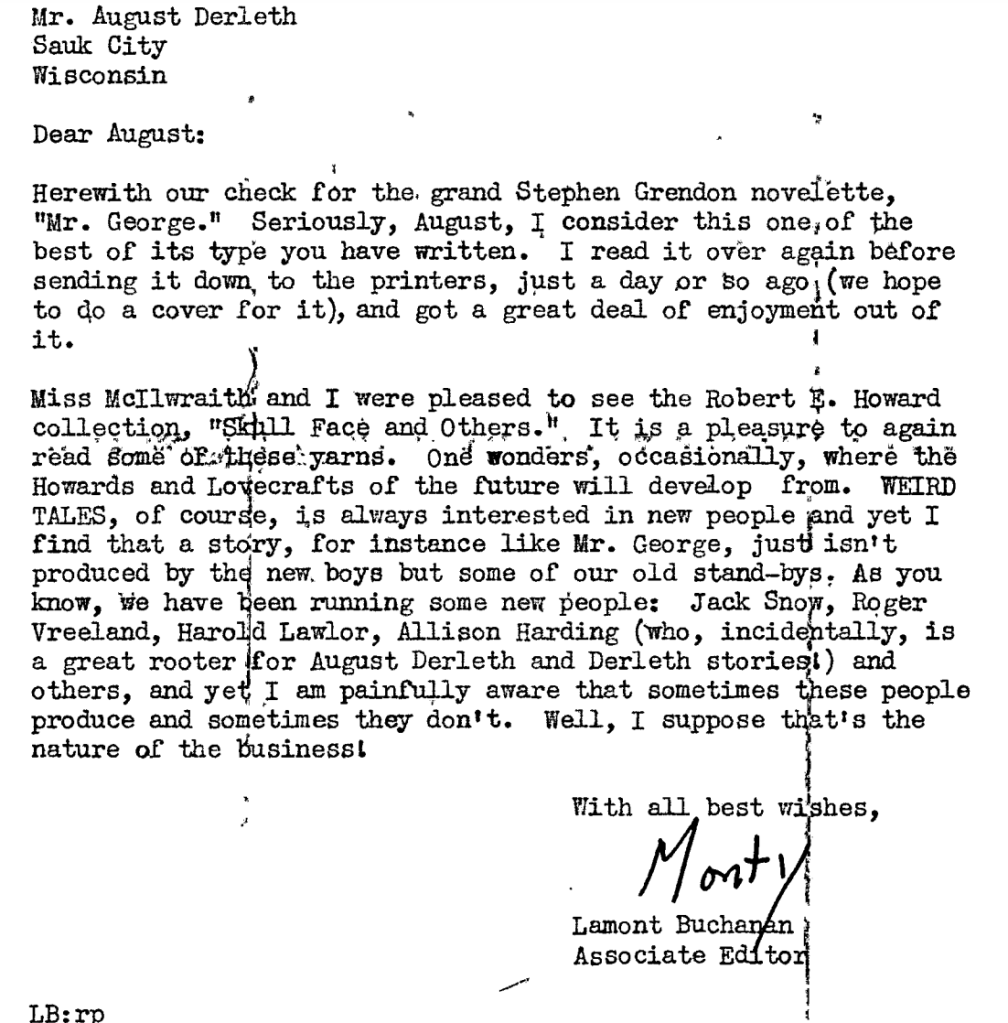
Just because researchers cannot (yet) name a specific Black fan who bought and read Weird Tales during Lovecraft’s lifetime, nor a specific Black writer for the magazine during that period, doesn’t mean they didn’t exist. Or that it would be unusual if they did. Such things were simply not talked about very openly during the 20s and 30s; and the editorial policy of the early Weird Tales editors Edwin Baird (1923-1924), Farnsworth Wright (1924-1940), and Dorothy McIlwraith (1940-1954) (all white) with regards to race are a closed book to us. No specific comment about race or prejudice in Weird Tales has yet come to light from them; but looking at the stories and art that they accepted and published, we can say a few things.
The bulk of the stories in Weird Tales from 1923-1954 had white protagonists; Black characters (and other people of color) were often supporting characters or antagonists. Black stereotypes were common, although not universal. Racist language, including the N-word, was included from the very first issue, although again, not universal. Stories that focused on Black prejudice, such as “The Last Horror” (1927) by Eli Colter, were relatively rare or “Black Canaan” (1936) by Robert E. Howard; stories that portrayed Black people as parts of voodoo cults or the like, such as “Mother of Serpents” (1936) by Robert Bloch, relatively common. Artistic depictions of Black people tended to follow the line of the stories, see Black People and Africa on the Cover of Weird Tales.
Weird Tales in its initial run might be perceived as a white mythic space, where a Black reader, writer, artist, or any character who wasn’t a stereotype would be out of place in the all-white milieu. The truth is more nuanced; the prevailing prejudice kept Weird Tales from headlining Black protagonists, but not every character was a villain or a racist stereotype. We might not know their names, but there’s no reason to doubt that Black people did read Weird Tales. There may be Black pulp writers who wrote under pseudonyms and haven’t been identified yet. At the same time, it’s fair to say that Weird Tales from 1923-1954 was very, very white, and as a consequence, the early Mythos conceived by Lovecraft and his contemporaries was very white as well.
Jim Crow & August Derleth (1937-1971)
There was no formal law preventing any Black fan or writer from writing their own Mythos fiction or poetry, and with the death of H. P. Lovecraft in 1937 he could hardly have objected if anyone did. Shortly after Lovecraft’s death, his friends August Derleth and Donald Wandrei began their efforts to get Lovecraft published between hard covers. When they failed to entice major publishers to take the job, they formed their own independent publisher, Arkham House, which they would jointly own and run, with Derleth as the major editor and manager of the business until his death in 1971.
Under Derleth’s guidance, Arkham House published not only the work of H. P. Lovecraft, but other pulp writers from Weird Tales and the fantasy and science fiction pulps as well, such as Robert E. Howard, Clark Ashton Smith, Henry S. Whitehead, Seabury Quinn, Robert Bloch, and Ray Bradbury. Derleth also became an anthologist of note, with books like Sleep No More (1944) and Tales of the Cthulhu Mythos (1969) drawing heavily from Weird Tales. As a consequence, the contents of these anthologies tended to be mostly white authors; not terribly surprising when you consider how white Weird Tales was in the first place.
Derleth also had a chilling effect on the production of new Mythos fiction outside the control of Arkham House. Claiming to represent Lovecraft’s estate, Derleth made legal threats against folks like C. Hall Thompson who attempted to write their own Mythos fiction. While there is no indication that Derleth was specifically targeting Black writers, the effect of the two policies—focusing on re-printing white authors from Weird Tales and controlling who did write new Mythos fiction—severely restricted the opportunities any writer might have to professionally publish their Mythos fiction, and inadvertently kept the Mythos writer pool pretty much exclusively white men for decades.
This wasn’t an issue limited to Derleth; John W. Campbell, the editor of Astounding and also an anthologist, was notedly racist and sexist and likewise excluded many writers that weren’t white men. The lack of diversity was an endemic issue in the science fiction field throughout the Jim Crow era. Amateur publication in fanzines faced fewer restrictions, but organized fandom had its own associated prejudices that often limited Black participation (see Jim Crow, Science Fiction, and WorldCon).
This is a very long way to say that the overall history of Black fans and writers in the Mythos is mostly silent from the 1920s through the 1970s. Black people were almost certainly reading and writing weird fiction, but the peculiar dynamics of the industry, headed by white men and geared toward largely white audiences, severely restricted the diversity of what saw publication. The Civil Rights Act of 1964 and the Voting Rights Act of 1965, however, signaled an end to Jim Crow, and the death of August Derleth in 1971 ended Arkham House’s near-monopoly on Mythos fiction. While it would take time for Mythos publishing to open up, and many prejudices remained, Mythos fiction was now increasingly an equal opportunity field.
Sword & Sorcery to Sword & Soul (1960s-1980s)
The 1960s saw a boom in fantasy paperback publishing. The paperback edition of The Lord of the Rings was immensely popular, as were the Conan the Cimmerian stories of Robert E. Howard with their captivating covers by Frank Frazetta, edited by L. Sprague de Camp. The Ballantine Adult Fantasy series by Lin Carter cheaply reprinted a vast range of long-out-of-print fantasy, from Lord Dunsany and William Morriss to H. P. Lovecraft. Readers clamored for more, and writers and artists surged to meet the need.
Robert E. Howard’s particular style, with its focus on action and flawed heroes with a kind of earthy, hardboiled realism distinct from the more ideological good-and-evil of Tolkien, became known as heroic fantasy or Sword & Sorcery. Many imitators swiftly followed, and de Camp and Carter, in particular, wrote new tales of Howard’s Conan or rewrote non-Conan stories as Conan stories for an eager audience. Marvel Comics licensed Conan for comics, and in 1970 Conan the Barbarian was born, the Sword & Sorcery boom spread into comics.
The problem was that these stories from the 1930s being reprinted or adapted in the 1960s and 70s still had intact all of the prejudice of the 1930s. Many of the same racist stereotypes that plagued Weird Tales were being reprinted, and worse, emulated by later authors who were trying to pastiche Robert E. Howard’s style. This became a notable issue with stories like “The Vale of Lost Women”(1967) by Robert E. Howard, which elicited comments from both Black and white fans for its racism. Black fans, though still a minority in organized fandom, were increasingly making their voices heard. One of the most vocal and creative was Charles R. Saunders, whose essay “Die Black Dog! A Look At Racism In Fantasy Literature” (1975) specifically called out Carter and de Camp for continuing these 1930s racist tropes in a post-Jim Crow America.
Saunders’ frustration could be well understood. Black fans of fantasy and weird fiction faced a marketplace stuffed full of books by white people, for white people, starring white protagonists, with Black, indigenous, and other people of color often relegated as supporting characters or antagonists. Black heroes in pulp fiction in the 1930s were rare, and the recycled racism of the 1970s kept them uncommon. Saunders wanted to read fantasy and weird fiction about people like himself, whom he could identify with.
So he wrote it.
Saunders began publishing action-heavy fantasy stories centered on Black protagonists in the mid-1970s, initially in fanzines and then in professional magazines and novels. If Middle Earth and the Hyborian Age are fantasy extensions of Europe, Saunders’ Nyumbani tales are fantasy extensions of Africa. The new mode of fiction has been named Sword & Soul. Saunders also wrote horror fiction, and his story “Jeroboam Henley’s Debt” (1982) is the earliest Cthulhu Mythos story by a Black author that I have found.
Saunders’ influence on genre fiction should not be ignored simply because most of it was in Mythos-adjacent fantasy instead of churning out Lovecraft pastiches. The rise of sword & sorcery and the difficulties it faced with reconciling the 1930s prejudices of the original stories and creators with contemporary audiences paralleled the same struggles being worked out in weird and horror fiction. The subgenres have always been closely aligned, since Lovecraft and Robert E. Howard were friends and correspondents who worked references to each other’s creations into their work.
Increasing Integration (1990s-2011)
As the older generation of fans and writers have died and retired, so too have most of the remaining attitudes toward racial stereotypes in genre fiction. Black fans and writers became more welcomed for their contributions, such as Ex Libris Miskatonici (1993) by Joan C. Stanley and Cthulhu Trek (2008) by Leslie Thomas, and increasing critical attention was paid to the issues of race and prejudice in the life and work of H. P. Lovecraft, his contemporaries, and their literary heirs and followers. Sometimes this was expressed in fiction, such as “Collector the Third: Charles Wilson Hodap (1842-1944)” (1995) by Kenneth W. Faig, Jr., “Nautical-Looking Negroes” (1996) by Peter Cannon & Robert M. Price, and “Shoggoths in Bloom” (2008) by Elizabeth Bear.
More often it found expression in non-fiction biographies, essays, and editorials. The concerted project by editors S. T. Joshi and David E. Schultz (mostly through Derrick Hussey’s Hippocampus Press) to publish Lovecraft’s entire, uncensored correspondence, as well as his essays and fiction, provided never-before-available insight into and awareness of Lovecraft’s prejudices. Similar efforts resulted in the publication of the complete letters of Robert E. Howard by the Robert E. Howard Foundation Press.
Readers could no longer turn a blind eye to the prejudices of the past, and the tide of public opinion began to shift.
It is difficult to point out any major Black Mythos writers during this period because the field was still opening up. The table of contents of anthologies became more diverse, more small presses were bringing out their own books, magazines, ezines, etc. With proliferation came fracture: there was no single voice that stood out from the rest or dominated the field. H. P. Lovecraft had fallen into the public domain, and many writers and artists focused on revisiting and expanding on Lovecraft’s Mythos. Print-on-demand technology, global logistics, and the advent of crowdfunding led to an explosion in small press anthologies in the mid-2010s.
The Mythos was primed for another explosion in popularity—and notoriety.
Beyond Lovecraft (2011-)
In 2011, Nnedi Okorafor won the World Fantasy Award for her novel Who Fears Death. The award, inaugurated in 1975, was nicknamed “The Howard” after Howard P. Lovecraft and Robert E. Howard, and was a bust of Lovecraft’s head sculpted by weird fiction writer and cartoonist Gahan Wilson. Okorafor published an article on her blog about Lovecraft’s racism & The World Fantasy Award statuette, noting her conflict that one of the highest honors in the field bore the name and image of a noted white supremacist and racist. The post sparked an internet shitstorm, and a petition to change the award. In 2015, the World Fantasy Awards Administration officially replaced the statuette; Lovecraft was no longer the face of the award.
The online outrage revealed some important things: 1) that old prejudices die hard, and 2) that the current generation of Black writers, artists, and fans were increasingly active, prominent, and their voices would be heard.
Some of these Black writers would tackle Lovecraft’s works directly, like Victor LaValle with“The Ballad of Black Tom” (2016) and “Up from Slavery” (2019). Others would tackle Lovecraft and his views themselves, either directly, as with The City We Became (2020) by N. K. Jemisin, or indirectly, as with Ring Shout (2020) by P. Djèlí Clark. Some writers don’t deal with Lovecraft or the Mythos at all but still work with the ideas and tropes of cosmic horror in works like Tentacle (2019) by Rita Indiana and Flowers for the Sea (2021) by Zin E. Rocklyn. Anthologies like Heroes of Red Hook (2016) and EOM: Equal Opportunity Madness (2017) showcases the increasing diversity of Mythos fiction writers.
Tabletop roleplaying games have also begun to address issues of race and diversity more openly. Lovecraftian roleplaying has been around since the 1980s and faced many of the same issues of racial stereotypes as genre fiction, but in recent years game designers and writers have increasingly come to work on addressing the history of racism in weird fiction and how to deal with those issues in play. Chris Spivey of Darker Hue Studios in particular has centered games like Harlem Unbound (2017) and Haunted West (2021) on issues of representation, inclusion, and accuracy.
In 2016, white novelist Matt Ruff published Lovecraft Country (2016), an episodic novel set in 1950s Jim Crow America. The name alleges a connection with Lovecraft, or at least an allegorical Lovecraft country, which is rarely evident in the book—but if found an audience, and perhaps most importantly an adaptation. Misha Greene adapted the novel as a 10-issue series for HBO, starring Jurnee Smollett and Jonathan Majors as the leads. While having about as much to do with Lovecraft as the source novel, the series received strongly positive critical responses, especially for the performances by Smollet and Majors, and raising awareness about sundown towns, Emmett Till, and the Tulsa race massacre.
Lovecraft Country doesn’t ultimately have much to say about Lovecraft, and it wasn’t the first Lovecraft-related film or TV show with Black actors—Ken Foree in From Beyond (1986) and Elliot Knight in The Color Out of Space (2019) being two prominent examples—but it was the first such cinematic work to be focused on Black characters and interests. Lovecraft Country and the response to it illustrate how far things have come from that white mythic space that was the Weird Tales milieu of the 1920s and 30s. Whatever prejudices Lovecraft and his contemporaries held when they were alive, today’s audience largely doesn’t share them. Many actively oppose those same ideologies and are turning cosmic horror and the Mythos—with and without Lovecraft to their own ends, to tell their own stories.
There are many more stories by Black writers to come.
Is There A Black Mythos?
While the above sections have dealt with issues of “Where are the Black Mythos authors?” and “Who are the Black Mythos authors?,” it has largely sidestepped the issue about whether there is any part of the Cthulhu Mythos oriented toward or focused on Black people or Black characters. After all, representation in the 1920s and 30s wasn’t great, but it wasn’t nonexistent either.
H. P. Lovecraft had relatively few stories focused on Black characters, although they are sometimes a part of the subject without appearing. For example, “The Picture in the House” does not include any Black characters, but the eponymous picture from Relatione del Reame di Congo (1591) by Filippo Pigafetta is very much tied into the Colonial depiction of indigenous Africans. Stories like “Facts Concerning the Late Arthur Jermyn and His Family,” “Winged Death” (1934) by Hazel Heald & H. P. Lovecraft, and poems like “The Outpost” touch on Colonial Africa and its peoples. Subsequent writers have written stories referencing or based on those tales, like “Magna Mater” (2015) by Arinn Dembo. Other writers got in on the idea of setting Mythos or Mythos-adjacent stories in Africa, such as “The Tree-Men of M’bwa” (1932) by Donald Wandrei. So one could definitely make an argument that that a subset of Mythos fiction deals with a Lovecraftian version of Africa and its peoples. This line of reasoning has been picked up especially by tabletop game designers, with books like Secrets of Kenya (2007), Secrets of Morocco (2008), and Secrets of the Congo (2009) expanding on ideas from Lovecraft and elsewhere.
Lovecraft himself seems to have had vague ideas about a more cohesive mythology involving Africa in general. “Medusa’s Coil” (1939) by Zealia Bishop & H. P. Lovecraft references a tribe from “Arthur Jermyn,” the ruins of Zimbabwe from “The Outpost,” and possibly the worship of Cthulhu and Tsathoggua among certain African peoples hinted at in “Winged Death.” However, that story is notably one of his most blatantly racist, and there are very few who have chosen to try and build off of it, one example being “Hairwork” (2015) by Gemma Files.
Outside of Lovecraft’s own work, there are tie-in works from his fellow Mythos co-creators and collaborators. For example, Robert Bloch’s depiction of Haiti in “Mother of Serpents” (1936), Henry S. Whitehead’s Canevin tales including “Cassius” (1931), Robert E. Howard’s Solomon Kane tales set in Africa, and the Conan stories set in Hyborian Age Kush. Individual works display the author’s own prejudices and don’t always reflect Lovecraft’s own themes in the Mythos—Lovecraft, for example, didn’t reference voodoo very much in his fiction, and made it clear that the cult of Cthulhu in “The Call of Cthulhu” was distinct from that religion. While some later writers like L. Sprague de Camp and Lin Carter have picked up and expanded on Black characters in Robert E. Howard’s Hyborian Age, for the most part, the shift in social awareness that came with the Civil Rights Movement in the United States appears to have precluded a great deal of interest in revisiting or reviving some of the characters and ideas in these works, which are often firmly enmeshed with bigotry or ideas of white supremacy.
The focus so far has been on derivative works from Lovecraft and his contemporaries, but many other Mythos writers included Black characters. The issue is, the work of writers like Ramey Campbell, Brian Lumley, W. H. Pugmire, Stephen King, etc. are all under copyright; using their work requires permission, which often isn’t asked for or granted. The communal atmosphere of a shared setting hasn’t really come together in the same way as it was with Lovecraft & co. in the 1920s and 30s—N. K. Jemisin, for instance, isn’t borrowing Black Tom from Victor LaValle for a story, nor is P. Djèlí Clark dropping references to Charles Saunders’ Imaro in Ring Shout.
That means that many stories today are being written that call back to Lovecraft and his life or beliefs, but they are effectively being written as independent works, not talking to each other, not building off one another. If there isn’t sharing, there isn’t a shared Mythos. So while there are a lot of stories that have spun out from “The Shadow over Innsmouth” and “The Dunwich Horror,” the cluster of derivative works that directly reference Black characters in Lovecraft’s fiction tends to be fairly few by comparison. Outside of the roleplaying games, there has not so far been the same level of interest in expanding on that material in fiction; works like “The Ballad of Black Tom” which inserts original Black characters into an existing Lovecraft setting seem more common, and that is understandable.
In part, this is because there isn’t a lot in Lovecraft specifically Black-oriented to work with, and what is there is often not a positive portrayal. The same could be said for most of his contemporaries. These were pulp stories where the characterization of Black people in various contexts—the Caribbean, the American South, and various parts of Africa—could and did get by with stereotypes, prejudices, Colonialist attitudes, and just plain lazy research that would not fly today. In Lovecraft’s day, the idea that Great Zimbabwe was the result of some unknown white civilization because the indigenous Black Africans were deemed incapable of civilization was commonly accepted. Today, a glance at the Wikipedia page shows how incorrect this view was. So how do writers today reconcile the bad anthropology in “The Outpost” with the contemporary understanding of Great Zimbabwe’s history?
Most just don’t. That isn’t a needle that most writers are interested in threading. Nor can you really blame anyone who would rather work on an original setting or mythology instead of writing a gloss to Lovecraft or Robert E. Howard’s take on Black people. The lack of interest can generally be seen in the lack of publication: there is no anthology of Cthulhu Mythos stories set in Africa, for example…and perhaps that is a good thing. Because for most of the Mythos’ history, such stories would have been written by white people, for a presumed white audience, showcasing the biases of their era. There are already dozens of anthologies that accomplish that quite well without focusing on what white authors think of a pre-decolonization Africa.
Apologies & Disclaimers
I had initially planned to make this “A Short History of the BIPOC Mythos” (Black, Indigenous, and People of Color), but the scope of such a work was too much for the format. The same obstacles in place for publishing Black authors also were in place for indigenous writers and people of color, with few differences—and those mostly having to do with works in translation or non-English language publication—but the specifics of prejudices expressed by Lovecraft & co. reflect broader cultural trends that really require their own essays to talk about. So, apologies for not addressing any other specific race or ethnicity. Not trying to discount their contributions, just too much to focus on in a single essay.
A disclaimer: I have used “Black” throughout. In the United States especially, “Black” as a racial categorization has been applied equally to African Americans, Black British, Black Hispanics, Afro-Caribbeans, Indigenous Australians, Melanesians, etc., and has given rise to a Black identity that reaches across those individual ethnicities (e.g. Black Lives Matter). It seemed more correct to use a term that addressed a broader Black identity than to narrowly specify “African American” or the like.
Finally, there are any number of works by Black authors not included here. I tried to touch on all the major works I am aware of, but I can’t read everything. If you think I’ve missed something significant, please leave a comment and let me know.
Bobby Derie is the author of Weird Talers: Essays on Robert E. Howard and Others and Sex and the Cthulhu Mythos.

 Deep Cuts in a Lovecraftian Vein