Posts

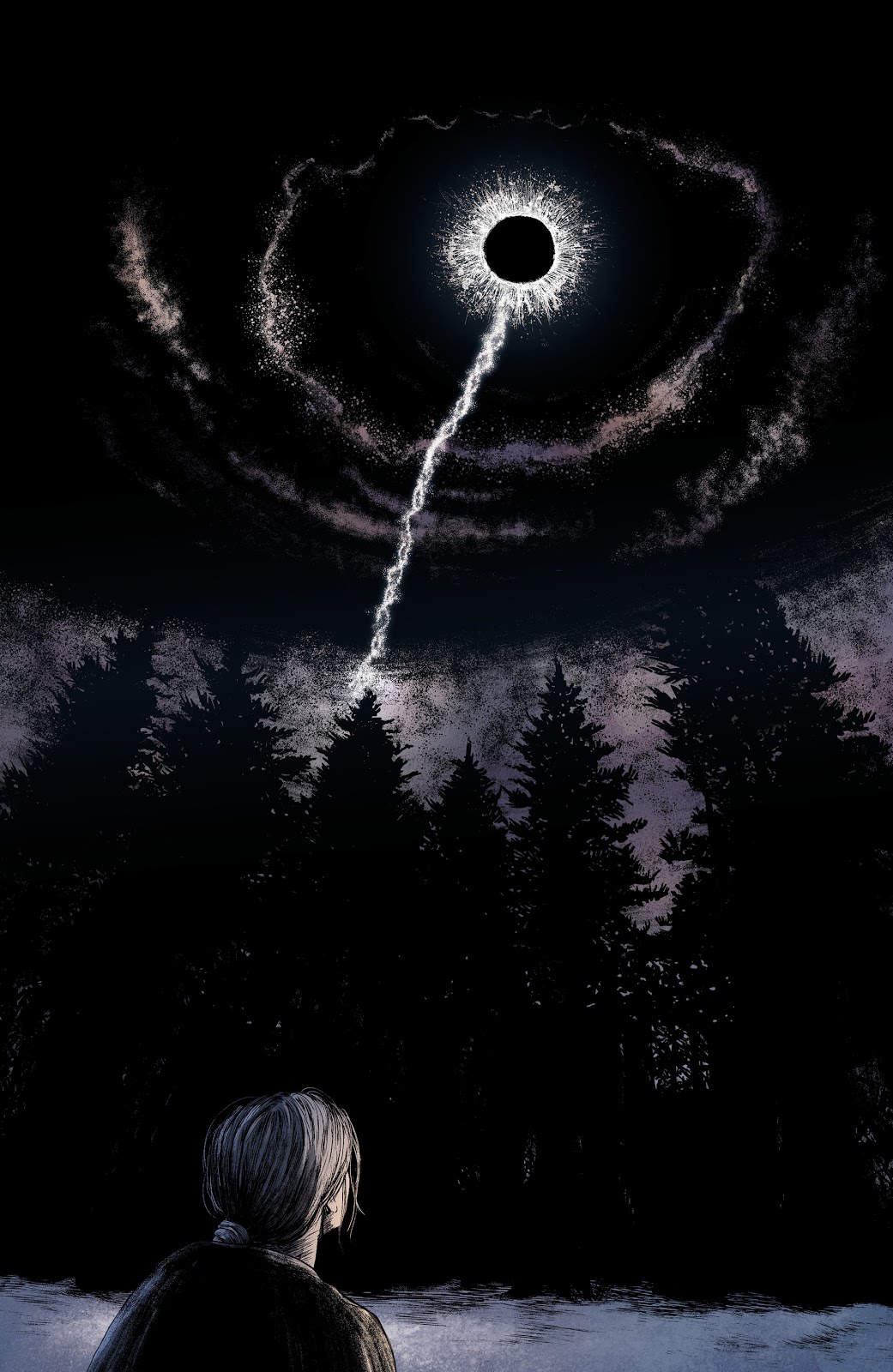
“Unseen” (2020) by Claire Leslie

What if we focused an entire anthology on the gods and monsters of Lovecraft, instead of just the horror? How would that feel, especially since Lovecraft specifically kept the gods in the background, lest we look upon them and go insane?
—Russel Nohelty, Cthulhu Is Hard To Spell: The Terrible Twos

It is a popular trope—sometimes amounting to a complaint—that Lovecraft kept his most tremendous horrors off the page; that all of his bogeys and Mythos entities were impossible, indescribable, ineffable, and unnamable. The truth is a little more complicated. Lovecraft recognized that a reader’s imagination could go places which no artist could achieve with pen and ink, and often strove to put off showing the horror to let the terror build and build, to strengthen the atmosphere by degrees with careful excitation, to hint darkly to suggest certain things that were more effective for being unseen.

In this, Lovecraft was not alone. Guy de Maupassant’s “Le Horla” (1887), Ambrose Bierce’s “The Damned Thing” (1893), Algernon Blackwood’s “The Willows” (1907) are all characterized by unseen or unseeable horrors; subtlety in description was characteristic of Edgar Allan Poe, Arthur Machen, and M. R. James who were all influences on Lovecraft. Lovecraft was working within an established tradition when he held off from immediately describing the exact shape and form of some of some his Mythos entities in clinical detail…and yet, when the time came for them to appear, Lovecraft wasn’t shy about that either. Nor did the sight immediately drive the viewers mad.

Poor Johansen’s handwriting almost gave out when he wrote of this. Of the six men who never reached the ship, he thinks two perished of pure fright in that accursed instant. The Thing cannot be described—there is no language for such abysms of shrieking and immemorial lunacy, such eldritch contradictions of all matter, force, and cosmic order. A mountain walked or stumbled. God! What wonder that across the earth a great architect went mad, and poor Wilcox raved with fever in that telepathic instant? The Thing of the idols, the green, sticky spawn of the stars, had awaked to claim his own. The stars were right again, and what an age-old cult had failed to do by design, a band of innocent sailors had done by accident. After vigintillions of years great Cthulhu was loose again, and ravening for delight.
—H. P. Lovecraft, “The Call of Cthulhu”

“The Thing cannot be described”—then Lovecraft goes ahead and describes it.

Like many of the tropes of the Cthulhu Mythos, the idea of seeing a Mythos entity driving an individual insane is something that developed in the secondary literature, where authors were more likely to copy the more superficial aspects of Lovecraft’s work instead of the core themes that they served. Sandy Petersen in The Call of Cthulhu Roleplaying Game introduced the Sanity mechanic as a sort of mental equivalent to Hit Points in Dungeons & Dragons. In D&D, when your hit points run out your character dies and the game ends for that character; in CoC, when your Sanity runs out your character is insane and the game ends for that character. In games of Call of Cthulhu, seeing the monsters really does shave points off your Sanity. This has led to a lot of un-Lovecraftian behavior on the tabletop: player characters, wanting to continue to play, may deliberately avoid looking at the eldritch horrors as they toss a grenade or a stick of dynamite in that direction, or perhaps they might burn the ancient Mythos tome instead of suffering whatever Sanity it would cost them to read through the terrible pages.

In terms of illustrating the Mythos, this creates an obvious issue: how do you try to visualize and capture some of the indescribable quality of these entities and places? Some artists achieve at least partial success: John Coulthart’s R’lyeh in The Haunter in the Dark and Other Grotesque Visions springs to mind, the delightfully detailed morbid and erotic fantasies of Raúl Cáceres’ Insania Tenebris, probably a few others whose art isn’t afraid to tiptoe up to and past the point of taboo. Yet even if some of these images are haunting, they are ultimately just that: images. As with “The Picture in the House,” there’s not that sense that staring too long at them is going to shave off a few Sanity points or necessarily instill some terrible knowledge.

That is one of reasons that comics and graphic novels based on the Mythos are so interesting: it isn’t just a question of the technical quality of the artist, or even of the power of their conception and execution. It is the interaction of art and text which come together. Anyone can make a comic adaptation of a Lovecraft story; At the Mountains of Madness could be adapted on sticky notes with stick figures, and Lovecraft’s text would come through and hold the same power. The question is, what interplay is offered in the combination of art and text? How can one serve and enhance the other? What kind of stories can you tell in comic form, that would be impossible to tell with art or text alone?

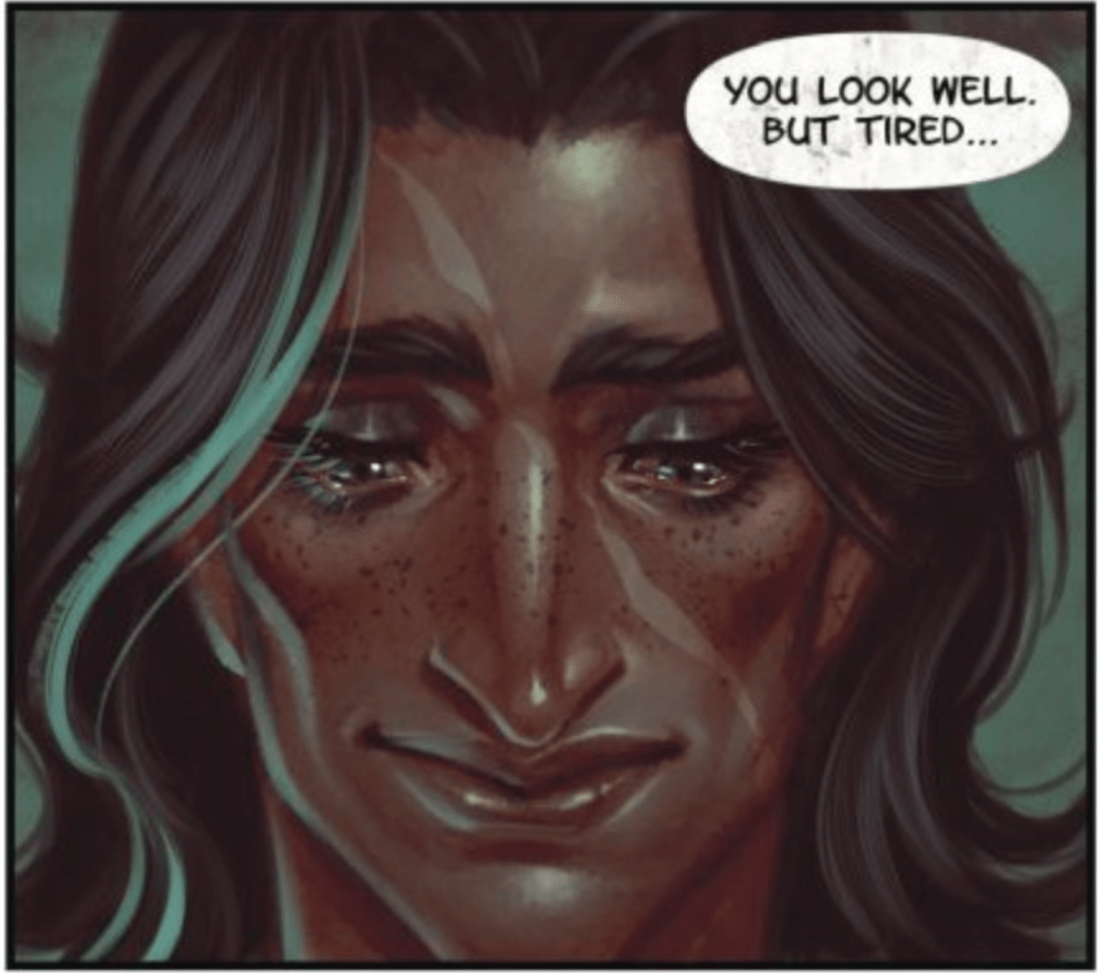
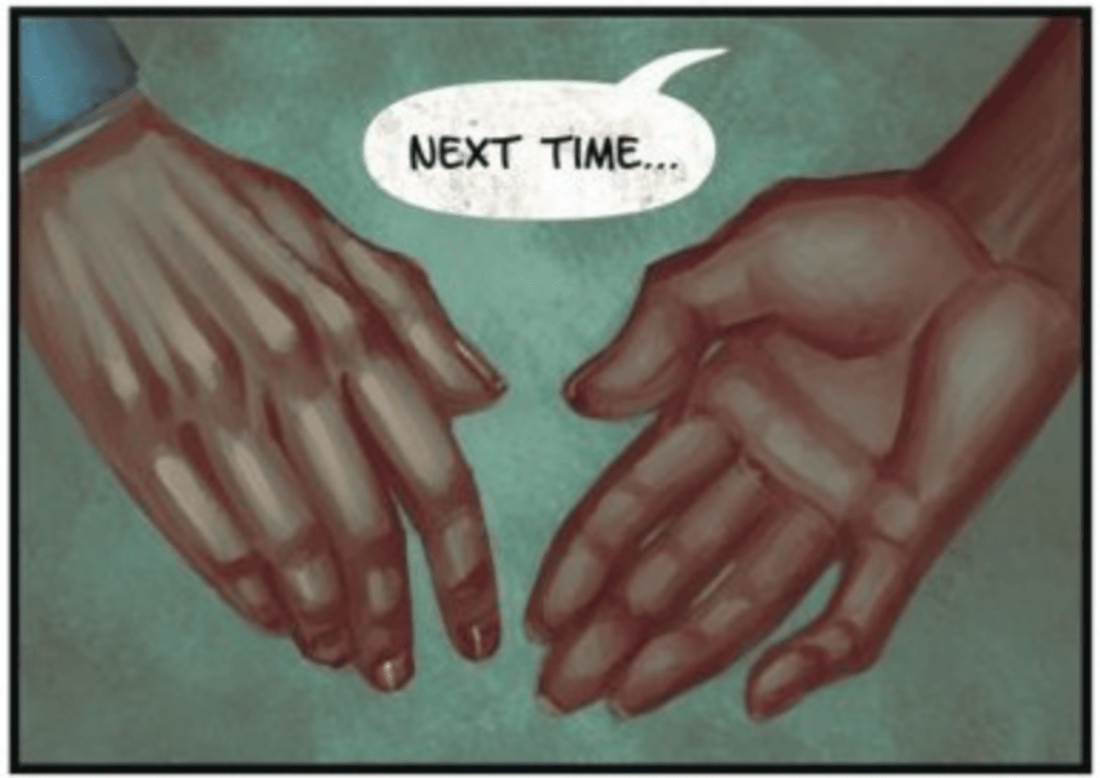
“Unseen” by Claire Leslie is one such example. In four pages, Leslie manages a surprisingly complex narrative, not so much by what is spoken, but what is unspoken. The reader, looking at the page from without, sees more than one of the characters does—and there is plenty of room to read between the lines regarding what they want to say to each other, but can’t. As an exploration of a concept, the length is perfect: readers get a sense of the Lovecraftian goings-on, the slow build of intrusive elements, without getting tired of them. The whole story can be read in a few minutes, yet the reader might turn back to it two or three times and still find some new little detail to reflect on.

Leslie Abdul

Leslie’s style has a certain quality that’s somewhere between bishōnen and Tom of Finland, with a bit of a Gothic quality, reminiscent of Olivier Ladroit’s work for Requiem Chevalier Vampire, but with a more dreamlike quality to her digital paint technique, tight clothes on muscular figures, but with long, effeminate eyelashes and manicured hands. The art suits the writing; readers pick up on character traits without having to be told them directly, and this sells the idea of things left unspoken, or perhaps something else that one of the characters just cannot see but that the reader can.

Leslie hands

“Unseen” was created by Claire Leslie and published in Cthulhu Is Hard to Spell: The Terrible Twos (2020, Wannabee Press), edited by Russell Nohelty. The book was originally launched on Kickstarter, though you can still buy hardcopies on etsy and digital editions are available on Kindle/Comixology. Leslie also did a separate mock cover for “Unseen,” which is available as a print from her etsy store.


Bobby Derie is the author of Weird Talers: Essays on Robert E. Howard & Others (2019) and Sex and the Cthulhu Mythos (2014).
“The Descent of Reginald Pembroke Live” (2020) by Cathy Smith

Your imagination is too pedestrian.
—Cathy Smith, “The Descent of Reginald Pembroke Live” in Eldritch Dream Realms 156

H. P. Lovecraft set most of his stories in the 1920s and 30s. They were not, for the most part, stories of the long ago no matter how ancient the horrors might be, those horrors were intruding on the present. Readers would have recognized this; the suspension of disbelief was that such things could occur in the now.

Many of those who followed Lovecraft continued to focus on that Jazz Age period. It became a part of the atmosphere and mood of the setting. Rumrunners and gangsters, such as in “Moonshine” (2018) by G. D. Penman; confessionals like “I Wore The Brassiere Of Doom” (1986) by Sally Theobald; colonialism and Yellow Peril as in “Dreams of a Thousand Young” (2014) by Jennifer Brozek. Not everyone chose to confine themselves to that period, but enough did to strongly flavor Mythos fiction as a whole. It is no surprise that The Call of Cthulhu Roleplaying Game‘s default setting is the 1920s and 30s.

Some writers have sought to drag the Mythos into the current now—and in so doing, face a continuously shifting target. August Derleth’s depiction of nuclear weapons versus the Mythos in his “Trail of Cthulhu” serial is only possible in a world where the atom bomb is a reality; Robert Bloch’s Mythos novel Strange Eons (1979) is first and foremost a contemporary novel, both in setting and perhaps more importantly in tone and content; the Call of Cthulhu Roleplaying Game settings of Cthulhu Now (1987) and Delta Green (1997) both seek to bridge that gap between Lovecraft’s setting and how it might be adapted to the world we live in today—and these efforts always contain a certain amount of baked-in obsolescence. Today becomes yesterday, tomorrow becomes today.

This is the basic reason why CthulhuPunk fiction, rare enough in itself, tends to age out pretty quickly. Stories like “Star Bright, Star Byte” (1994) by Marella Sands become quaint when technology zigs instead of zags. We don’t have fully-immersive virtual reality settings which are structured according to old-school bulletin board systems. That just never happened; the internet blossomed into its own weird, terrible, awe-inspiring way. The zeitgeist, even if captured with tremendous decision, tends to fade very quickly.

Why do you think transhumanism is the way to immortality? Doesn’t our computer tech become obsolete every few years?
—Cathy Smith, “The Descent of Reginald Pembroke Live” in Eldritch Dream Realms 151

One of the great strengths of the Mythos as a discrete flavor or set of buildings blocks is that it does mix well with a great many things—different genres, tones, forms, and settings. You can have a lighthearted Mythos-inflected noir story, set it in outer space in the distant future, written in as an epic poem, and that is still very much recognizable as “Mythos.” In that sense, the Mythos is extremely versatile and adaptable, which may be why it has continued to attract new readers and writers. Individual stories may chase the zeitgeist, but Mythos fiction itself is both eternal (in that so much of it remains in print) and perennial (in that so much continues to be written).

Cathy Smith’s “The Descent of Reginald Pembroke Live” is a story that lives entirely in the contemporary zeitgeist. It could, possibly, have been written in 2015 or so, but the culture of the internet, video blogging, crowdfunding, “fake news,” and debunking is very much the finger on the pulse of the world with Donald Trump as president, even if Smith is careful to avoid any direct mention of the president or politics in general. Perhaps by 2020, the story might already be obsolete; Patreon might dissolve, YouTube might transform itself, “apps” and smartphones might evolve. We cannot foresee the future, some people cannot even see the present.

In many ways, this story is a good pairing with “The Nyarlathotep Experience™” (2019) by Miguel Fliguer. It too is a take-off from Lovecraft’s “Nyarlathotep,” a “what if?” that drags the old familiar horrors into the syntax of the now, and imagines how contemporary sensibilities would skew that reception. Yet there is something a little different at work here too; more than crass commercialization, the story is at heart a sickening pokes-fun at a world and culture and perspective of online rage and militant disbelief. Smith stops short of an abject moral: while the inability to allow the experience of wonder is portrayed as a toxic condition that harms those who cling to it, the same narrow world view proves an effective buffer and defense against those very forces that prey on the more easily awed and gullible.

If only because Nyarlathotep bemusedly decides to there is appeal in those who torture themselves in such internet drama, gaining courage only when safely and anonymously behind a screen. Who is to say that such a view is wrong? How would the Mythos be perceived today, if it was real and uploading Youtube videos? A very crass and earthbound thought—but that is the issue with the Mythos marrying the zeitgeist. If the story is set in the present, the view is almost always myopic; it doesn’t look at the present as seen from the 1920s, as Lovecraft might have seen it. “Now” stories are grounded in the life we can see and absorb around us, newspaper headlines and ways of life we are familiar with. Smith handles that very well.

Cathy Smith’s “The Descent of Reginald Pembroke Love” was published in Eldritch Dream Realms: Tales from Lovecraft’s Dream Realms (2020).


Bobby Derie is the author of Weird Talers: Essays on Robert E. Howard & Others (2019) and Sex and the Cthulhu Mythos (2014).

The City We Became (2020) by N. K. Jemisin

“Cover up that shit,” Bronca snaps at them. “Took me a minute, but I get it now. ‘Dangerous mental machines,’ hah.” […] “Yeah, that was H. P. Lovecraft’s fun little label for folks in Chinatown—sorry, ‘Asiatic filth.’ He was willing to concede that they might be as intelligent as white people because they knew how to make a buck. But he didn’t think they had souls.”

“Oh, but he was an equal-opportunity hater,” Yijing drawls, folding her arms and glaring at the men. “In the same letter, he went in on pretty much everybody. Let’s see—Black people were ‘childlike half-gorillas,’ Jews were a curse, the Portuguese were ‘simian,’ whatever. We had a lot of fun deconstructing that one in my thesis seminar.”
—N. K. Jemisin, The City We Became 148

And of course the New York Mongoloid problem is beyond calm mention. The city is befouled and accursed—I come away from it with a sense of having been tainted by contact, and long for some solvent of oblivion to wash it out! …… How in Heaven’s name sensitive and self-respecting white men can continue to live in the stew of Asiatic filth which the region has become—with marks and reminders of the locust-plague on every hand—is absolutely beyond me. In fact, I’m jolly well certain that they won’t continue. New York will become a vast trading-mart for long-distance white commuters—and for the nameless spawn. When, at length, the power of the latter rises to dangerous heights of rivalry, I can see nothing short of war or separation from the union. There is here a grave and mighty problem beside which the negro problem is a jest—for in this case we have to deal not with childlike half-gorillas, but with yellow, soulless enemies whose repulsive carcasses house dangerous mental machines warped culturelessly in the single direction of material gain by stealth at any cost. I hope the end will be warfare—but not till such a time as our own minds are fully freed of the humanitarian hindrances of the Syrian superstition imposed upon us by Constantinus.
—H. P. Lovecraft to Frank Belknap Long, Jr., 21 Aug 1926, Selected Letters 2.68

Weird fiction cannot afford hagiography. For all that H. P. Lovecraft accomplished during his lifetime, for all the lives and literature he influenced, there is no point in pretending the man was a saint, his memory to be enshrined with only the good things he has done. Every author that stands on the shoulders of giants has to decide on how best to address that legacy. Some ignore it, moving past Lovecraft’s prejudices; others reinvent his Mythos, put their own spin on it; a few use it their fiction as a mirror to highlight Lovecraft’s racism.

N. K. Jemisin calls Lovecraft out on it.

Why not? Dead men cannot have their feelings hurt. He wrote all those words, so there’s no false reporting. The only ones likely to be upset about Jemisin’s bare handful of references to Lovecraft in the novel are those who either share in his prejudices, or are so strongly attuned to the idea of Lovecraft as an icon that they perceive a simple statement of facts as an attack.

It seems evident that Jemisin didn’t open a random book on Lovecraft and pull out the first racist quote she came across, so it’s not like the “On the Creation of…” scene in Lovecraft Country (2016) by Matt Ruff. This moment in The City We Became and those that follow it aren’t exactly essential to the novel, but certainly enrich it by expanding on themes of cosmic horror and race. The structure of the story, how the characters react to the information as they get it, how Lovecraft and his work are described, all shows effort and craft in how Jemisin chooses to incorporate Lovecraft into her book.

This is not N. K. Jemisin beating the dead horse named H. P. Lovecraft. It is a way for her to address him and his legacy on her own terms. In a 2017 interview, the question was asked and answered:

So if you’re using Cthulhu, are you an H.P. Lovecraft fan?

Oh, hell no.

This is deliberately a chance for me to kind of mess with the Lovecraft legacy. He was a notorious racist and horrible human being. So this is a chance for me to have the “chattering” hordes—that’s what he called the horrifying brown people of New York that terrified him. This is a chance for me to basically have them kick the ass of his creation. So I’m looking forward to having some fun with that.
N. K. Jemisin’s New Contemporary Fantasy Trilogy Will “Mess with the Lovecraft Legacy”

This approach can probably safely be called cathartic (NK Jemisin: ‘It’s easier to get a book set in black Africa published if you’re white’). Many writers exorcise their demons and address their issues by writing them out. It is a process which can often be as beneficial for the reader as well: how many women, how many people of color, who have felt uncomfortable knowing that Lovecraft was racist but unwilling to say anything might feel a relief to actually see it called out in print?

There are other ways Jemisin could have expressed her point. The reference to Lovecraft’s 1926 letter to Long is factually accurate, but lacks context. In 1926, Lovecraft’s New York adventure—and his marriage, in all but name and legalities—was over. He had slumped back off to Providence, Rhode Island, having been unable (like millions of others) to make his way in the city, to find gainful employment, to be with his wife and friends. Lovecraft had left Providence for New York less than two years prior, with hopes and aspirations for work, married life, a home of his own with his wife—and returned older, alone, wiser in the world, richer in experience of a thousand things. One memoir stated that:

He came back to Providence a human being—and what a human being! He had been tried in the fire and came out pure gold.
—W. Paul Cook, “In Memoriam: Howard Phillips Lovecraft” in Ave Atque Vale 43

What Cook does not add is that the stresses and failures Lovecraft had experienced in New York had brought his prejudices to a fever point; throwing himself into the “melting pot” of New York City had only exacerbated his prejudices, and for the rest of his life he would write about his hatred of the city, which he considered no longer culturally a part of the United States, but completely overtaken by immigrants and people of color. Nothing of which excuses Lovecraft’s prejudices in  his letter…but perhaps gives more context as to why Jemisin chose to focus on this particular letter.

The City We Became is not a book about H. P. Lovecraft. Jemisin’s references to him and his fiction are symptomatic of the real crux of the novel, which is the city itself. Her novel is a love affair of New York City, in the same vein as Fritz Leiber, Jr.’s Our Lady of Darkness (1977) or John Shirley’s City Come a-Walkin’ (1980) for San Francisco. A snapshot in time of New York as it is, the people that live there are represent it; an acceptance and an exorcism of old ghosts.

But she is a city, in the end—fair R’lyeh where the streets are always straight and the buildings all curve, risen from the brine-dark deep well between universes. And no living city can remain within the boundary of another while it is unwelcome.
—N. K. Jemisin, The City We Became 428

Lovecraft’s New York—the New York of Al Smith and Fiorello La Guardia, Prohibition, the Harlem Renaissance and the Harlem Hellfighters—is long gone. Jemisin’s novel is about her New York, the post 9/11 New York, the New York of Lyft, IKEA, and Dunkin’ Donuts. It isn’t any less diverse, it isn’t really any weirder. Where a novella like “The Ballad of Black Tom” (2016) by Victor LaValle deals with the fictional New York that Lovecraft presented in his writings, Jemisin deals with Lovecraft himself—and finds the only real use for him as a springboard to talking about bigger things, or perhaps a bedrock of ideas and images to mine. If there is any criticism to be had of the book, it’s that it feels like having evoked Lovecraft and R’lyeh, Jemisin could have made more use out of the connections with the city…but again, this isn’t a book about H. P. Lovecraft.


Bobby Derie is the author of Weird Talers: Essays on Robert E. Howard & Others (2019) and Sex and the Cthulhu Mythos (2014).
The Book of Dzyan (1888) by Helena Blavatsky

But there were others he had known merely by reputation or not at all—the Pnakotic Manuscripts, the Book of Dzyan, and a crumbling volume in wholly unidentifiable characters yet with certain symbols and diagrams shudderingly recognisable to the occult student.
—H. P. Lovecraft, “The Haunter of the Dark” (written 1935)

I learned of the city Shamballah, built by the Lemurians fifty million years ago, yet inviolate still behind its walls of psychic force in the eastern desert. I learned of the Book of Dzyan, whose first six chapters antedate the earth, and which was old when the lords of Venus came through space in their ships to civilise our planet.
—H. P. Lovecraft & William Lumley, “The Diary of Alonzo Typer” (written 1935)

As with The Witch-Cult in Western Europe (1921) by Margaret A. Murray, the Book of Dzyan did not originate in the creative mind of H. P. Lovecraft. Its literary genesis began in the theosophical writings of Helena Blavatsky…and to understand the Book of Dzyan properly requires a knowledge of the founding and development of Theosophy, from the 1870s though its discovery by Lovecraft and his contemporaries at Weird Tales in the 1920s and 30s. Because of the sometimes deliberate myth-making and contradictory claims made by some of the personalities involved, sorting fact from fiction can be a little difficult, but sheds some valuable light on the influence of one of the great occult and spiritual developments of the late 19th and early 20th century on the Weird Tales circle.

Helena Petrovna Blavatsky arrived in New York in 1873. At forty-two years old, she was already working as a medium and an occultist in Russia and Europe; now in America, she became involved in Spiritualism, wrote articles and established herself as a medium. In 1875 she claimed to have to have made contact with a group of Egypt-based mystic named the Brotherhood of Luxor, and convinced an associate Henry Steel Olcott to take out an advertisement in the Spiritual Scientist citing their names. Having done so, she convinced Olcott to create the “Miracle Club,” a short-lived organization devoted to psychical research. Olcott began to receive letters from the “Brotherhood of Luxor,” and William Quan Judge became attracted to the meetings being held in Blavatsky’s parlor, and the idea was started to create a society for occult research. Thus the Miracle Club transitioned into the Theosophical Society.

“And while there are those,” the mad Arab had written, “who have dared to seek glimpses beyond the Veil, and to accept HIM as a Guide, they would have been more prudent had they avoided commerce with HIM; for it is written in the Book of Thoth how terrific is the price of a single glimpse.[”]
—H. P. Lovecraft & E. Hoffmann Price, “Through the Gates of the Silver Key” (written 1932-33)

In 1875, Blavatsky began work on the book that would become Isis UnveiledThe title is an allusion to the Veil of Isis, promising the revelation of secrets. At this time, the Theosophical Society did not have a firm philosophical or magical framework, beyond Spiritualism that had begun to explore Western occultism. Blavatsky’s book would begin to rectify that situation; a mash-up of science, religion, mythology, and occultism which suggests two essential points: that neither contemporary science or religion know the truth of existence, and that there exists a unifying tradition of ancient wisdom represented by occultism. This was long years before Sir James George Frazer’s The Golden Bought: A Study in Comparative Religion (1890), and the mix of science, occult history, and comparative religion displays an outward modicum of erudition, learnedly quoting from diverse sources in different languages.

Erudition can be faked, however, and accounts of the book’s writing are muddled. Blavatsky was not a native English speaker, seems not to have had access to many of the worked cited; Alexander Wilder is credited with silently editing the book’s prose, and many of the primary sources were copied from secondary sources—a practice Lovecraft himself would follow in, for example, the invocation in “The Horror at Red Hook” copied from the Encyclopedia BritannicaIsis Unveiled also mentions the Brotherhood of Luxor (vol. 2, ch. 7), and gives them a Rosicrucian origin; the Hermetic Order of the Golden Dawn (founded 1887) would similarly draw on the idea of being descended from, or tied to, an existing occult group to establish its pedigree.

In later years, Blavatsky and her followers would claim Isis Unveiled or parts of it were dictated to her, making this a revealed work like “The Book of the Forgotten Ones” (1977) by Nema Andahadna, but in the text itself she begins:

There exists somewhere in this wide world an old Book — so very old that our modern antiquarians might ponder over its pages an indefinite time, and still not quite agree as to the nature of the fabric upon which it is written. It is the only original copy now in existence. The most ancient Hebrew document on occult learning — the Siphra Dzeniouta — was compiled from it, and that at a time when the former was already considered in the light of a literary relic.
—H. P. Blavatsky, Isis Unveiled, vol. 1, ch. 1 

Not much else on this “old Book” is written, nor are such pseudobiblia limited to Lovecraftian fiction;  the Western esoteric tradition is replete with mythical or fictional volumes such as the Book of Thoth or spuriously attributed to legendary figures such as the Sixth and Seventh Books of Moses. In Vajrayana and Tibetan Buddhism and Bön, there is also a tradition of terma, where esoteric teachings may be hidden or concealed in texts that are only discovered later in a system of continuous revelation. So Blavatsky’s Isis Unveiled, which focuses strongly on the errors of Judeo-Christian religion and the comparable merits of Buddhism, was drawing from very different traditions of occult and esoteric literature…and almost assuredly also from the novels of Edward Bulwer-Lytton such as Zanoni (1842) and The Coming Race (1871, also published later as Vril: The Power of the Coming Race). Much as Lovecraft was to influence contemporary occultism in works like Necronomicon Gnosis: A Practical Introduction (2007) by Asenath Mason, so did earlier forebears draw inspiration from fiction.

When Isis Unveiled was finally published in 1877, it was not the complete system of Theosophy; it was a precursor to ideas that would be more fully developed in her later books. Blavatsky’s habit of not citing the secondary sources she was quoting the primary sources from also eventually brought accusations of plagiarism, most notably from William Emmett Coleman, but it also provided the impetus for her relocation to India, where the Theosophical Society, which had almost sputtered out, could be reincarnated as a viable organization.

Blavatsky and Olcott moved to India in 1879. There she met Alfred Percy Sinnett, who would condense and popularize her ideas in a book titled Esoteric Buddhism (1883). During these years the Theosophical Society grew. Following the Masonic model, individual “lodges” had been formed in different localities by members. Once in London in 1885 she established her Blavatsky Lodge; and in 1888 she established the “Esoteric Section,” an inner circle within the society; and the Theosophical Publishing Company. It was this imprint which would publish her massive masterwork, The Secret Doctrine (1888/1889). This treatise purports to be “Stanzas Translated with Commentaries from the Secret Book of Dzyan.”

It is more than probable that the book will be regarded by a large section of the public as a romance of the wildest kind; for who has ever even heard of the book of Dzyan?
—H. P. Blavatsky, The Secret Doctrine vol. 1, preface

Like Isis UnveiledThe Secret Doctrine was claimed to draw from an ancient, apocryphal text that Blavatsky had revealed to her by her supposed masters—now “The Great White Brotherhood” or mahatmas—in India and Tibet. Indeed, Blavatsky informs the readers that that book first mentioned in Isis Unveiled is the very same as the Book of Dzyan:

The “very old Book” is the original work from which the many volumes of Kiu-ti were compiled. Not only this latter and the Siphrah Dzeniouta but even the Sepher Jezirah,* the work attributed by the Hebrew Kabalists to their Patriarch Abraham (!), the book of Shu-king, China’s primitive Bible, the sacred volumes of the Egyptian Thoth-Hermes, the Puranas in India, and the Chaldean Book of Numbers and the Pentateuch itself, are all derived from that one small parent volume. Tradition says, that it was taken down in Senzar, the secret sacerdotal tongue, from the words of the Divine Beings, who dictated it to the sons of Light, in Central Asia, at the very beginning of the 5th (our) race; for there was a time when its language (the Sen-zar) was known to the Initiates of every nation, when the forefathers of the Toltec understood it as easily as the inhabitants of the lost Atlantis, who inherited it, in their turn, from the sages of the 3rd Race, the Manushis, who learnt it direct from the Devas of the 2nd and 1st Races. The “illustration” spoken of in “Isis” relates to the evolution of these Races and of our 4th and 5th Race Humanity in the Vaivasvata Manvantara or “Round”; each Round being composed of the Yugas of the seven periods of Humanity; four of which are now passed in our life cycle, the middle point of the 5th being nearly reached. The illustration is symbolical, as every one can well understand, and covers the ground from the beginning. The old book, having described Cosmic Evolution and explained the origin of everything on earth, including physical man, after giving the true history of the races from the First down to the Fifth (our) race, goes no further. It stops short at the beginning of the Kali Yuga just 4989 years ago at the death of Krishna, the bright “Sun-god,” the once living hero and reformer.
—H. P. Blavatsky, The Secret Doctrine vol. 1, introduction

If Isis Unveiled is the start of Theosophy, The Secret Doctrine is the formal codification of it—a grand cosmogenic saga of revelations, the cycles of the ages, the incarnations of humanity and root races, all couched in a language which is half-derived from Buddhism and Hinduism, occult terminology, Spiritualism, and even a bit of contemporary science.

In 1889, Annie Besant would review The Secret Doctrine, conduct an interview with Blavatsky, and become a convert to Theosophy; Besant would swiftly rise through the ranks and became the President of the Theosophical Society. Blavatsky would continue to write and publish, including The Key to Theosophy and The Voice of Silence in 1889. The Voice of Silence is:

The following pages are derived from “The Book of the Golden Precepts,” one of the works put into the hands of mystic students in the East. […] The work from which I here translate forms part of the same series as that from which the “Stanzas” of the Book of Dzyan were taken, on which the Secret Doctrine is based. 
—H. P. Blavatsky, The Voice of Silence, preface

Helena Blavatsky would die of influenza in 1891. The Theosophical Society would continue to print and re-print her work—and many individual theosophists would expand upon or elaborate the mythology that Blavatsky created. Notable for our purposes is William Scott-Elliot, who in silent collaboration with Charles Webster Leadbeater produced two volumes expanding on Blavatsky’s occult history of the root-races: The Story of Atlantis (1896) and The Lost Lemuria (1904); these would be reprinted in a combined edition The Story of Atlantis & The Lost Lemuria (1925). Scott-Elliot quotes from “The Book of Dzyan” a handful of times; these are taken from the “Stanzas of Dzyan” in The Secret Doctrine.

In the United States, Alice Bailey joined the Theosophical Society in 1917. Like Besant, she began to climb the ranks, and her initial theosophical writings were well-regarded; but in 1921/1922 a dispute with Besant led to Bailey’s expulsion from the Society. Undeterred, Bailey formed her own organization and continued writing. Her book A Treatise on Cosmic Fire (1925) contains 13 additional “Stanzas of Dzyan” with Bailey’s commentaries on the same. If readers need an analogy, Alice Bailey was to H. P. Blavatsky what August Derleth was to H. P. Lovecraft.

Lovecraft had obviously heard of the The Book of Dzyan by at least 1935 when he wrote “The Haunter in the Dark” and co-wrote “The Diary of Alonzo Typer.” In other stories and writing he shows at least a basic awareness of the existence of Theosophy and some of its ideas:

At this time a wave of interest in spiritualistic charlatanry, mediumism, Hindoo theosophy, and such matters, much like that of the present day, was flourishing; so that the number of weird tales with a “psychic” or pseudo-scientific basis became very considerable.
—H. P. Lovecraft, Supernatural Horror in Literature (written 1925-1927)

Theosophists have guessed at the awesome grandeur of the cosmic cycle wherein our world and human race form transient incidents. They have hinted at strange survivals in terms which would freeze the blood if not masked by a bland optimism. But it is not from them that there came the single glimpse of forbidden aeons which chills me when I think of it and maddens me when I dream of it.
—H. P. Lovecraft, “The Call of Cthulhu” (written 1926)

A smattering of theosophical lore, and a fondness for the speculations of such writers as Colonel Churchward and Lewis Spence concerning lost continents and primal forgotten civilisations, made Reynolds especially alert toward any aeonian relic like the unknown mummy.
—H. P. Lovecraft & Hazel Heald, “Out of the Aeons” (written 1933)

A few of the myths had significant connexions with other cloudy legends of the pre-human world, especially those Hindoo tales involving stupefying gulfs of time and forming part of the lore of modern theosophists.
—H. P. Lovecraft, “The Shadow out of Time” (written 1935)

The questions start to multiply: Where did Lovecraft learn about the Book of Dzyan? How much did he know or read about Theosophy? How did Helena Blavatsky and her associates influence H. P. Lovecraft and his contemporaries? How did Theosophy influence the Cthulhu Mythos?

It should be stated at the outset that the Mythos as a whole was always more than just H. P. Lovecraft. In creating his artificial mythology, he borrowed elements from writers like Robert E. Howard (Nameless Cults, Bran Mak Morn, etc.), Clark Ashton Smith (The Book of Eibon, Tsathoggua, etc.), and others, and they in turn borrowed from him. In the 1920s and 30s when Lovecraft & co. were in contact with one another, each of them had different opportunities to come into contact with Theosophy and its ideas, and each author used those ideas in their fiction in their own ways. Lemuria and Atlantis, for example, form common elements in the fiction of Howard, Lovecraft, and Smith; but while these all draw some inspiration from the theosophical versions of these legendary lands, they aren’t necessarily deliberately working to make them match Theosophy. They were weird talers writing their own fiction with their own settings; informed by Theosophy, but not trying to write expansions of the Blavatsky mythos.

I’ve also been digesting something of vast interest as background or source material—which has belatedly introduced me to a cycle of myth with which I have reason to believe you are particularly familiar—i.e., the Atlantis-Lemuria tales, as developed by modern occultists & the sophical charlatans. Really, some of these hints about the lost “City of the of the Golden Gates” & the shapeless monsters of archaic Lemuria are ineffably pregnant with fantastic suggestion; & I only wish I could get hold of more of the stuff. What I have read is The Story of Atlantis & the Lost Lemuria, by W. Scott-Elliot.
—H. P. Lovecraft to Clark Ashton Smith, 17 Jun 1926, Dawnward Spire, Lonely Hill 106

From existing accounts, Lovecraft’s first brush with actual Theosophy was W. Scott-Elliot’s book, and in “The Call of Cthulhu” the only theosophical text cited is “W. Scott-Elliot’s Atlantis and the Lost Lemuria).” Robert E. Howard came across his first information from somewhere else, possibly the Oriental Library Clinic, a journal with some theosophical items:

About Atlantis — I believe something of the sort existed, though I do not especially hold any theory about a high type of civilization existing there — in fact, I doubt that. But some continent was submerged away back, or some large body of land, for practically all peoples have legends about a flood. And the Cro Magnons appeared suddenly in Europe, developed to a high stage of primitive culture; there is no trace to show that they came up the ladder of utter barbarism in Europe. Suddenly their remains are found supplanting the Neanderthal Men, to whom they have no ties of kinship whatever. Where did they originate? Nowhere in the known world, evidently. They must have originated and developed through the different basic stages of evolution in some land which is not now known to us. The occultists say that we are the fifth — I believe — great sub-race. Two unknown and unnamed races came, then the Lemurians, then the Atlanteans, then we. They say the Atlanteans were highly developed. I doubt it. I think they were simply the ancestors of the Cro Magnon men, who by some chance, escaped the fate which overtook the rest of the tribes. All my views on the matter I included in a long letter to the editor to whom I sold a tale entitled “The Shadow Kingdom,” which I expect will be published as a foreword to that story — if ever. This tale I wove about a mythical antediluvian empire, a contemporary of Atlantis.
— Robert E. Howard to Harold Preece, 20 Oct 1928, Collected Letters of Robert E. Howard 1.237

Clark Ashton Smith came at it from still a third way, possibly Sinnett’s Esoteric Buddhism:

It is good to know that you liked this last story. As to that problem of transmission—well, it seems to me that the author has to be omniscient or nothing: though one might get the story out of the “astral records” (preserved somewhere in the ether, and accessible to adepts) which are mentioned in the literature of esoteric Buddhism! The tradition of Hyperborea, Mu and Atlantis were supposedly preserved in these records! […] I have never seen The Riddle of the Pacific, nor the book by Scott-Elliot either, and must find out if they are locally procurable.
— Clark Ashton Smith to H. P. Lovecraft, 17 Nov 1930, Dawnward Spire, Lonely Hill 271-272

Lovecraft & co. do not seem to have deliberately sought out any additional theosophical lore for a while. However, in the intervening period they became friends and correspondents with another weird taler, E. Hoffmann Price—the only man to actually meet all three of them, an ex-army officer and astrologer with a taste for Persian carpets, wine, and occultism. In 1932, Lovecraft visited New Orleans; he was not then in contact with Price, but their mutual friend Robert E. Howard managed to get them in touch with one another. The two men became immediate friends, and even began a collaborative story, a sequel to Lovecraft’s “The Silver Key.” Later on, Lovecraft would write:

By the way—Price has dug up another cycle of actual folklore involving an allegedly primordial thing called “The Book of Dyzan”, [sic] which is supposed to contain all sorts of secrets of the Elder World before the sinking of Kusha (Atlantis) and Shâlmali (Lemuria). It is kept at the Holy City of Shamballah, & is regarded as the oldest book in the world—its language being Senzar (ancestor of Sanscrit), which was brought to earth 18,000,000 years ago by the Lords of Venus. I don’t know where E. Hoffmann got hold of this stuff, but it sounds damn good. I shall ask him to spill particulars to you and me—though you may have met this cycle before. It reminds me of the Scott-Elliot stuff connected with theosophy.
— H. P. Lovecraft to Clark Ashton Smith, c.10 Feb 1933, Dawnward Spire, Lonely Hill 404

What you say of your new tale, and of the Pushkara-Plaksha-Kusha-Shâlmali-Mt. Wern-Senzar-Dzyan-Shamballah myth-cycle which you have dug up, interests me to fever heat; and I am tempted to overwhelm you with questions as to the source, provenance, general bearings, and bibliography of all this unknown legendry. Where did you find it? How can one get hold of it? What nation or region developed it? Why isn’t it mentioned in ordinary works on comparative folklore? What—if any—special cult (like the theosophist, who have concocted a picturesque tradition of Atlanteo-Lemurian elder world stuff, well summarised in a book by W. Scott-Elliott) cherishes it? For gawd’s sake, yes—send along those notes, and I’m sure that Klarkash-Ton, High-Priest of Tsathoggua, would (unless he knows about the cycle in question, appreciate them as keenly as I. […] Meanwhile, as I said before, I’m quite on edge about that Dzyan-Shamballah stuff. The cosmic scope of it—Lords of Venus, and all that—sounds so especially and emphatically in my line!
— HPL to E. Hoffmann Price, 15 Feb 1933, Selected Letters 4.153

Price duly copied out a load of quotes from several theosophical books, which he sent to Lovecraft. The notes themselves are not known to survive, but in a later letter, Price describes some of the materials her had transmitted to Lovecraft:

Get Annie Besant’s THE PEDIGREE OF MAN. The copy I studied is borrowed, else I would gladly lend it. It came from Theosophic Book Corporation, Fine Arts Bldg., Chicago, and is dated (with owner’s signature) Nov. 1910. Published by Theosophical Publishing Society, Theosophist Office, Adyar, Madras, s. 1908. Price, 1 rupee. 

Printed by Freeman & Co., Ltd., Tara Printing Works, Benares.

145 pages of text, charts, tables, diagrams: and a mine of occult lore in condensed, terrifically condensed form. Maybe THE OCCULT SOCIETY, 604 Locust St., Phila. Pa. might be able to get it, although their catalog does not list it.

The quotations I sent you are from Leadbeater’s INNER LIFE, page 105, under “symbology”. Each quotation is the germ of a novelette in my deft hands!

The job I finished last night is based on some of the note I sent you. Help yourself there’s enough for all.

W. Scott-Elliot’s book has not passed through my hands. I got mine from the sources: Blavatsky’s Secret Doctrine, 1st edition, with excerpts from the Book of Dzyan.

It is hard reading, some of it—but it’s right up your alley. It takes guts to wade through it, unless you have a taste for it; and you have. However, that remains to be seen. Try it and see.
[…]

Read, use, copy—and if you please, send on to Klark-Ashton, with request to use, then forward to Barlow. You see, I promised Barlow a piece de resistance: the whole works of a 1st draft, from plot germ–research–prelimary [sic] scribblings–all the dirt & crap of composition. I will do so, and therefore ask you to pass these 4 pages to Smith with this request, so that Barlow will get a real gem, even though not all handwritten.
— E. Hoffmann Price to H. P. Lovecraft, 18 Feb 1933, MSS. John Hay Library

Lovecraft appears to have duly copied the notes and sent them on to various correspondents.

As you have probably recognised, that mystic primal dope from Price (notes of which I’ll send you soon) was conventional theosophical stuff (Besant, Leadbeater, &c) after all. Do you know anything about the real source of this? Does it have any real Oriental source, or is it just a synthetic concoction of the theosophists? I’ve read almost nothing in that line. 
— H. P. Lovecraft to Clark Ashton Smith, 21 Feb 1933, Dawnward Spire, Lonely Hill 406

By the way—it turns out that Price’s mystical legendry was, after all, only the stuff promulgated by the theosophists—Besant, Leadbeater, &c. I thought it sounded like that. Do you know anything of the origin of that stuff? It pretends to be real folklore—at least in part (of India, I suppose)—but I have a certain sneaking suspicion that the theosophists themselves have interpolated a lot of dope. There are things which suggest a knowledge of certain 19th century conceptions.
— H. P. Lovecraft to August Derleth, c.27 Feb 1933, Essential Solitude 2.547-548

Lovecraft’s inquiries as to the source of all this material, which was ultimately the Book of Dzyan that Blavatsky had claimed as the ultimate source for so much of her work, would turn up empty:

The Book of Dyzan [sic] is new to me—I haven’t read any great amount of theosophical literature. I’d be vastly interested in any dope you or Price can pass on to me. Theosophy, as far as I can gather, is a version of esoteric Yoga prepared for western consumption, so I dare say its legendry must have some sort of basis in ancient Oriental records. One can disregard the theosophy, and make good use of the stuff about elder continents, etc. I got my own ideas about Hyperborea, Poseidonis, etc., from such sources, and then turned my imagination loose.
— Clark Ashton Smith to H. P. Lovecraft, 1 Mar 1933, Dawnward Spire, Lonely Hill 408

The same can no doubt be said of Robert E. Howard, whose versions of Atlantis and Lemuria are different from, but complementary, to Clark Ashton Smith’s. For his part, Lovecraft and Price continued to correspond on the subject.

By this time you’ll have received the forwarded matter from Price to be sent to Barlow. I am very curious about this holy city of Shamballah, said to exist unimpaired somewhere in the Gobi; though built by the Lemurians or 3d root race several million years ago. It is here that the Book of Dzyan— parts of which are older than the earth—is kept. Shamballah would make a splendid fictional theme. I wonder if any theosophists or Hindoos pretend to have visited it? As you say, the theosophic myth-cycle is probably based on ancient Indian lore with certain 19th century accessions. Price mentions A. P. Sinnett’s “Esoteric Buddhism”, Besant’s “Pedigree of Man”, Leadbeater’s “Inner Life”, & Blavatsky’s “Secret Doctrine” in his bibliography (I’ve read none of these)—to which might be added Scott-Elliot’s “Atlantis & the Lost Lemuria”, which I read some years ago. I think I must do some research along this line when I get the time. I found Scott-Elliot quite an imaginative stimulus. […]

P.S. Just heard from Price. He says that according to theosophists, Shamballah keeps itself from invasion through adverse thought-waves which deflect all attempts to reach it—producing bad weather, apparent accidents, &c. 
— H. P. Lovecraft to Clark Ashton Smith, 15 Mar 1933, Dawnward Spire, Lonely Hill 410, 411

This is what Lovecraft was referring to in “The Diary of Alonzo Typer” when he wrote of “Shamballah, built by the Lemurians fifty million years ago, yet inviolate still behind its walls of psychic force in the eastern desert.” Nor does it appear that Lovecraft ever delved much deeper into the fine points of Theosophy, despite assurances in his letters to friends that he should do. From all that Lovecraft was getting second- and third-hand, he’d already decided that pretty much all of Theosophy had to be a 19th century hoax—albeit a fun one:

Thanks exceedingly for the sidelights on the theosophical cycle. Sinnett must surely be a standard authority, since both you & the Peacock Sultan recommend him. This stuff is certainly worth looking up—the matter of the invisible planets being especially promising. As you say, there is probably a good bit of genuine tradition in the lore of theosophy. One thing we can say for the Hindoos is that their mythology shews a better grasp of the earth’s transience & insignificance in time & space than any other known to history & anthropology. I wonder how these legends of early things compare with what Col. Churchward claims of the Himalayan priests & their records in the primal Naacal language which tell of sunken Mu?

Obviously, these traditions are very old among the Hindoos; & it would be interesting to discover how they arose. Originally the Aryan creators of Brahmanism had a mythology of personified natural forces homologous to those of the Greeks & Romans, & of our Northern ancestors. Could the theosophical cycle have arisen out of these, or were its germs derived from the non-Aryan subject races of India? Since the Brahmans arrived in India about 2000 B.C., there was plenty of time for the crystallisation of a definite new myth-cycle before the earliest contacts with the Western World. It is not likely that any “Atlantis” ever existed. The evidences of geology & natural history are that no connexion betwixt various Atlantic islands has existed since the appearance of man on the planet. But of course there may well have been important pre-Aryan civilisations & legends in India. Indeed, we know there were pre-Aryan cities on the Indus river. 

The notion of the “Akashic” records is indeed an unique one. But I don’t think there’s much ground for assuming any truth in these tales. To begin with, they assume an antiquity for mankind which is against all the indications of palaeontology & geology. As for the pineal gland—modern endocrinology has fairly well established its actual function in the human system . . . as a regulator of the chemical & biological changes attending adolescence & maturity. But surely the legends lose nothing in picturesqueness & imaginative value through being merely legends. […]

From something Price says, I take it that Blavatsky is the best “authority” anent the Book of Dzyan (not Dyzan, as I first carelessly transcribed it). Accounts of Holy Shamballah would seem to vary—but it’s great fictional stuff in any form!  
— H. P. Lovecraft to Clark Ashton Smith, 24 Mar 1933, Dawnward Spire, Lonely Hill 411

The interesting part of this exchange is that Lovecraft appeared quite ready to incorporate some of this theosophical material into the nascent Mythos:

What you say of the theosophy cycle & of the special fictionally developable features interests me tremendously. I simply must look up Blavatsky, Besant, Leadbeater, Sinnett, &c. One could, as you say, derive a whole canon of tales from it. It seems to make my Yog-Sothoth stuff pallid by comparison! These Akashic records tickle my imagination. It is from them, of course, that the Book of Eibon & the Pnakotic Manuscripts were first devised! 
— H. P. Lovecraft to Clark Ashton Smith, 8 Apr 1933, Dawnward Spire, Lonely Hill 414

Glad you duly received the Price notes with data on the theosophical myth-cycle. I copied a good deal of this, & took the names of the books from which Price dug up this dope. Beside the body of tradition, my own Cthulhu-Yog-Sothoth stuff sounds quite pallid & unconvincing! Much of this stuff undoubtedly represents actual beliefs current among the HIndoos, although a great deal has undoubtedly been added by the theosophists of the 19th century. Smith is following this research still further, & has unearthed a great deal of interesting data which Price does not include. It surely does form an admirable background for fantastic fiction.
— H. P. Lovecraft to R. H. Barlow, 9 Apr 1933, O Fortunate Floridian 60

The Lovecraft-Price collaboration went through a couple of drafts. The initial draft was written by Price, and was later published separately as “The Lord of Illusions” (MSS. John Hay Library). As was his habit, Lovecraft completely re-wrote the story in a handwritten draft (MSS. John Hay Library). Another draft of the story, probably typed by Price, is much expanded and includes several theosophical references (MSS. John Hay Library); a letter from Price to Lovecraft contains several notes on this or a related draft (MSS. John Hay Library), including more theosophical lore and even a lengthy quote from Blavatsky’s The Voice of Silence. Ultimately, the theosophical references were dropped from the final version of the story which appeared in the July 1934 issue of Weird Taleswith the main surviving remnant being, perhaps, the “Swami Chandraputra.”

By the summer of 1933, Lovecraft has absorbed about as much theosophical knowledge that he can confidently rattle off a list of titles to a correspondent:

Another cycle of impressive-sounding folklore or pseudo-folklore is that sponsored by the modern theosophists. Some of this is undoubtedly genuine Hindoo myth, but I suspect that the cult of theosophists has mixed with it a great deal of synthetic fakery of 19th century origin. The best books of this sort of thing to read are the following:

Besant, Annie—The Pedigree of Man
Blavatsky, Helena—The Secret Doctrine
Leadbeater—The Inner Life
Scott-Elliot, W.—Atlantis & the Lost Lemuria
Sinnett, A. P.—Esoteric Buddhism

More of this stuff can be found in the catalogues of the Occult Society, 604 Locust St., Philadelphia, Pa. Those theosophical mystifications involved vast gulfs of time & cycles of change—pre-human aeons & life coming from other planets—not found in other folklore.
— H. P. Lovecraft to Natalie H. Wooley, 18 Jul 1933, Letters to Robert Bloch & Others 190-191

There are a handful of other references to Theosophy and the Book of Dzyan in the letters of H. P. Lovecraft and his contemporaries, but they are few, far between, and show no greater knowledge of the theosophical texts than what Lovecraft already had in 1933. Near the end of his life, however, he finally managed to get access to one of the books he had heard about:

Thanks, by the way, for the loan of the Blavatsky opus—which I shall read with the most intense interest. I’ve never read any of the classics of theosophy, though I’ve always been meaning to. I wonder if anybody has ever tried to isolate the real Oriental folklore in them from the 19th century fakery & interpolations? I may have fumbled the allusion to the Book of Dzyan, since all I know about it is something in a letter of Price’s which spoke of the early parts as having been brought from an older solar system than ours. Of course the text ridiculed in the Necronomicon is the merest imitation!
— H. P. Lovecraft to Henry Kuttner, 30 Nov 1936, Letters to C. L. Moore & Others 257

This was probably The Secret Doctrine. However, at this point Lovecraft already dying, and it seems unlikely he managed to wade through its 1,500+ pages in the few months remaining to him. The last word on Price’s theosophical notes came over a decade after Lovecraft’s death:

I imagine that Lovecraft derived his information about Shamballah from E. Hoffmann Price, who in turn probably drew the data from Blavatsky or some other theosophical authority. I have some notes that Price gave me, in which Shamballah is mentioned:

“The word came from Shamballah, the Holy City, to destroy Atlantis 850,000 years ago, and overthrow the Lords of the Dark Face. The divine race of Aarab escaped the catastrophe, and in Al Yemen they reared the mighty Himyar palaces, with prodigious bulks, uncounted domes.”

S. is supposed to exist, invisible, somewhere in the Gobi desert. It was, I seem to remember, built by the lords of the Flame who came down from Venus. In it is kept the Book of Dzyan, older than the world.
— Clark Ashton Smith to Donald Wandrei, 27 Oct 1948, Selected Letters of Clark Ashton Smith 354-355

It plays like a telephone game. H. P. Blavatsky invents a fictional book for Isis Unveiled, fleshes it out in The Secret Doctrine and The Voice of Silence; other writers like W. Scott-Elliot and Alice Bailey write their own books expanding on it, and so the idea of the Book of Dzyan is carried to H. P. Lovecraft, who plops it into some of his final stories, and thus makes Theosophy and the Book of Dzyan an extension of the Cthulhu Mythos—which, to be fair, also already implicitly includes real-world works like the Christian Bible, Jewish Talmud, Islamic Koran, etc., but those books aren’t listed among the Mythos tomes in the library of the Church of the Starry Wisdom.

At least one friend tweaked his nose about how he presented the book in “The Haunter of the Dark”:

On that same page, I might suggest that while the Book of Dzyan could be used by a malignant cult, its connotation is quite the opposite. The original is supposed to be in Shamballah, where it was deposited by the children of the fire mist, when they came to earth 18 million years ago, from Venus.
— E. Hoffmann Price to H. P. Lovecraft, 3 Feb 1936, MSS. John Hay Library

Blavatsky always alleged that she was drawing from a real source; scholars have yet to identify any esoteric Buddhist work which matches the Stanzas of Dzyan, though not for lack of trying (see Blavatsky’s Secret Books). Looking at the history of her writing and development, the idea that the whole Book of Dzyan is essentially a fabrication, a close cousin of the Necronomicon, seems abundantly clear—but it becomes a matter of trust and faith. For those who believe in Theosophy, the Book of Dzyan may be as real and accurate as the Book of Mormon is to the Church of Latter Day Saints.

In the Mythos, however, it is mostly one tome among many. At least two dozen stories reference the Book of Dzyan, some only occupying space on a Mythos bookshelf (especially in the Call of Cthulhu Roleplaying Game), a few in greater detail. Ex Libris Miskatonici (1993) by Joan C. Stanley and Dan Harms in The Starry Wisdom Library (2014) give Blavatsky’s book rather more attention and respect, attempting to parse the difference between Theosophy’s cosmic vision and Lovecraft’s cosmic horror. Stanley makes no bones; she claims that this is completely separate from the Theosophical book of the same name. Harms’ version pays homage to Stanley’s, but hews closer to the source material, trying to thread the needle that would make the Book of Dzyan more realistic, and yet distinct from Blavatsky’s version.

The wider impact of Theosophy—and thus The Secret Doctrine‘s—influence on the Mythos and Lovecraftian literature is much wider but more nebulous. Lovecraft and his contemporaries didn’t replicate much of the inherent racism and antisemitism present in Blavatsky’s writing, but it’s difficult not to see the influence of those cycles of humanity in Robert E. Howard’s “Hyborian Age” essay, and by extension the tales of Kull, Conan, Bran Mak Morn, Solomon Kane, and Turlough Dubh O’Brien; in the Atlantis, Poseidonis, and Hyperborea cycles of Clark Ashton Smith; in “The Call of Cthulhu” and “The Shadow out of Time,” and however many stories that came after, drawing on or referencing those traditions…and other media besides. When the time comes to look up information on the Mythos in “The Collect Call of Cathulhu,” an episode of The Real Ghostbusters cartoon, Egon tells Ray to check the Book of Dzyan. (The Necronomicon Files 287)

Beyond even that…the Lovecraftian occult has a habit of seizing on any occult reference in the Mythos and weaving that thread into their own tapestry. Kenneth Grant considered Blavatsky’s Book of Dzyan and Lovecraft’s Necronomicon “akashic grimoires” (The Necronomicon Files 110).

Readers that want a version of The Book of Dzyan on their shelves could do worse than The Book of Dzyan: The Known Text, The Secret Doctrine, Additional Sources, A Life of Mme. Blavatsky (2000, Chaosium), part of the Call of Cthulhu Fiction series.

Acknowledgements

For the biographical details of Blavatsky’s life, this article largely relies on Madame Blavatsky: The Woman Behind the Myth (1980) by Marion Meade.

Thanks to Rick Lai for transcripts of E. Hoffmann Price’s letters.


Bobby Derie is the author of Weird Talers: Essays on Robert E. Howard & Others (2019) and Sex and the Cthulhu Mythos (2014).
“From the Cold Dark Sea” (2016) by Storm Constantine

“Book title Marvels of the Deeps,” she began. “Dimensions approximately 30 centimeters width, 40 centimeters height. Thickness 8 centimeters.”

“How very forensic,” murmured Mrs. De La Mere.
—Storm Constantine, “From the Cold Dark Sea” in Dreams From the Witch House 278

Bibliophilia has been descried as “the gentle madness,” and is one of the more respectable sorts of mental illness for both fans and characters of the Mythos to fall into. Ever since Lovecraft’s “History of the Necronomicon and Robert E. Howard’s history of Nameless Cults in “The Black Stone”, the various tomes and texts of the Mythos have attracted the love of readers. Sometimes this extends to full catalogs of pseudobiblia, including Ex Libris Miskatonici (1993) by Joan C. Stanley and The Starry Wisdom Library: The Catalogue of the Greatest Occult Book Auction of All Time (2014) edited by Nade Pedersen. Sometimes too, it provides an entry into a story through the antiquarian book trade: collectors, sellers, forgers, book detectives like Corso in The Club Dumas (2006) by Arturo Perez-Reverte…and, in the case of Storm Constantine’s “From the Cold, Dark Sea,” a book-restorer named Cara Milltop.

It’s a fish out of water story, pun very much intended. The shadow of “The Shadow over Innsmouth” hangs over it, as it does with many other stories, though Constantine makes no explicit mention of either Innsmouth or the Deep Ones. This is a Mythos story in construction and inference; Cara Milltop never hears any calls to Father Dagon and Mother Hydra, or great Cthulhu. Yet there is enough indisputably there that Mythos aficionados can slip into the feel of this story like putting on an old glove; the pace and texture of it almost tells itself—but Constantine knows what she is doing, and if you don’t question the plot there’s more than enough embroidery on the Deep Ones lore to satisfy, with some lovely imagery to the description of the woodcuts and the dreams that they bring.

What really sets “From the Cold, Dark Sea” apart from stories like “Mail Order Bride” (1999) by Ann K. Schwader is that there is no confirmation. Cara Milltop remains a hired hand, an outsider. Knowledge does not bring initiation, nor does Constantine provide a final proof to any mystery. The unreadable words on the page remain unread, the actual truth remains unconfirmed. Readers are left to wonder if it really is just all in Cara’s head, an overactive imagination from working to restore an old book, exacerbated by staying in a spooky old house full of women.

There are no male characters in the story. Something that might sneak up on readers, but one of those nice details that dovetails with the frisson of unknowing in the story. Is it just coincidence, or is there something more to it? The legend, as Cara interprets it, is a female rite of passage, starkly in contrast to the patriarchal approach of the Esoteric Order of Dagon in, say, “A Coven in Essex County” (2016) by J. M. Yales. Not so much a rebuttal to Lovecraft’s “The Shadow over Innsmouth,” but an alternative. Maybe the Deep Ones don’t marry, as such.

Of course, if every child survived there would be far too many of them. How cruel, though, how barbaric. Yet, little different from the way baby turtles started life, Cara thought. Just the cruel barbarism of Nature herself.
—Storm Constantine, “From the Cold Dark Sea” in Dreams From the Witch House 294

Bibliophilia is a gentle madness. Cara Milltop never gets violent, never says outright what she thinks she knows—or suspects. The Marvels of the Deep can slide onto the shelf next to The R’lyeh Text and the Cthäat Aquadingen, squeezed between the Codex Dagonesis and Invocations to Dagon, and it would not be out of place. What she is left with in the end is not horror, or awe, but disappointment. To have come that close to something so magical, or almost-magical, and yet be unable to know if what she suspects is true, no invitation to take part. In the end, she doesn’t even have the book; she was only there to restore it, as she did. Money is a poor coin in a Mythos story, because so rarely can it buy what the characters—and the readers—really want.

“From the Cold, Dark Sea” was first published in Dreams From the Witch House (2016), and was reprinted in Storm Constantine’s collection Mythumbra (2018).


Bobby Derie is the author of Weird Talers: Essays on Robert E. Howard & Others (2019) and Sex and the Cthulhu Mythos (2014).
Her Letters To Lovecraft: Jonquil Leiber

But first I must explain that my husband, Fritz Leiber, Jr, son of the Shakespearian actor, (who often played in Providence in time past) met Lovecraft through myself and formed a delightful friendship. We were the recipients of many letters now in the hands of the Wisconsin people, Eerleth [sic] et al. Many of the things you touched on in your article, we knew a little more in detail due to this correspondence – about his brief marriage for instance. And since I wa [sic] more interested in Lovecraft as a man or human than I was as a writer, (I lean to the Montague Rhode James, plus the weird man known as Summers type of mystery having been brought up in a draft old English castle – I’m an Englishwoman) so that I learned a number of things about him that his more well bred correspondents did. The man literally starved to death.
—Jonquil Leiber to William Townley Scott, 18 May 1944, MSS. John Hay Library

Jonquil Ellen Stephens married Fritz Reuter Leiber, Jr. on 18 January 1936. Fritz was working as an actor and pursuing a career as a writer; he had met and dated Jonquil at the University of Chicago in 1933-1934. They shared a love of supernatural fiction and poetry, and she encouraged her husband’s interests. On the 14th of October 1936, Jonquil wrote to Lovecraft.

Then in the late summer my wife, with a bold directness I had been unable to conceive for myself, wrote a letter to Lovecraft care of Weird Tales. A few days later the great man replied with what we thought was a long letter, until we had received some of his average-sized communications. That was the beginning of an orgy of letter-writing which lasted the few short months until his death. My wife wrote more letters herself and shortly we were joined by my friend and fellow enthusiast for the fantastic, Harry O. Fischer, then of Lousiville, Kentucky. Our letters were returned to us by Mrs. Gamwell afterwards. The entire correspondence was excerpted by Derleth for the volume of letters and later borrowed and retained, permanently as yet, by another individual who shall remain nameless here.
—Fritz Leiber, Jr. “My Correspondence with Lovecraft,” Letters to C. L. Moore and Others 375

Of the nine published letters from H. P. Lovecraft to Fritz & Jonquil Leiber, based off the Arkham House Transcripts created by August Derleth & co., four are addressed to “My dear Mrs. Leiber.” The originals letters, as far as I am aware, have not surfaced in the interim.

It is difficult to feel out who Jonquil was through these letters. As she told Scott, they show an interest in Lovecraft as a human being more than in his fiction; where Fritz and Lovecraft soon got deep into literary criticism and history, which would cause Fritz Leiber to revise his first Fafhrd & the Grey Mouser novella Adept’s Gambit, to her he answered questions on his life, who Lovecraft was and how he lived. Yet this was a real correspondence, a two-way channel of communication, and Lovecraft found out about her even as she was finding out about him.

It is interesting to know that you have a touch of piracy in your ancestry! I have a counterfeiter as a great-great-grand-uncle about whom I’ll tell you some time.
—H. P. Lovecraft to Jonquil Leiber, Letters to C. L. Moore and Others 317

The best picture of her probably came from her husband, writing decades later after thirty-three years of marriage which only ended with her death due to a combination of alcohol and barbiturates. He remembered her as she was when they married:

She was small (four foot ten; best weight, ninety pounds), had bright blue eyes that were at times violet; she was fast (at Cyfartha Castle school in Wales she’d been a great scorer in field hockey; her method: get the ball and dodge your way to the enemy goal, no teamwork needed—you can always dodge big girls) and a good apache dancer; she had natural grace and artistry (early on she’d done illuminated manuscripts just as had the hero of Machen’s The Hill of Dreams); in America she posed for silk stocking advertisements; she was a great party planner and giver, a gifted fortuneteller, enthusiastic, and friendly, but capable of sudden vast dignified reserves, again just like a kitten.
—Fritz Leiber, Jr., “Not Much Disorder and Not So Early Sex: An Autobiographic Essay”
in The Ghost Light 334

Fritz talks about how cold winter was that January and February in Chicago, and how he read to Jonquil “At the Mountains of Madness” by H. P. Lovecraft from the pages of Astounding Stories (the first part appeared in the February 1936 issue, which might have been on the stands the month before). Their correspondence itself is almost lost in his account of their life together. It was, after all, only about four months—though it would influence Fritz for the rest of his life, help inform his work and make connections with the circle of Lovecraft’s correspondents, and he would return the favor with literary analyses and appreciations such as “The Works of H. P. Lovecraft: Suggestions for a Critical Appraisal” (1944), “A Literary Copernicus” (1949), “Through Hyperspace with Brown Jenkin” (1963), and “To Arkham and the Stars” (1966).

Throughout his life, Fritz Leiber, Jr. never forgot his debt to Lovecraft—or to Jonquil.

Because without Jonquil, none of it would have happened. Perhaps Fritz would have found his voice eventually; sold his stories and made his name. Fafhrd & the Grey Mouser may yet have helped inspire Dungeons & Dragons and played their part in the sword & sorcery boom of the 1960s and 70s; Fritz may even have written his homages to Lovecraft without that personal connection and communication. Yet because she had the courage to write to Lovecraft, a torch was passed from one generation of weird writers to another—and the effects of her letters to Lovecraft are still being felt today. They can still be read today, thanks to her: his final hopes to get a job, his painful economic necessities to scrimp on food. Not always pleasant reading, but the kind of insight which Lovecraft did not always share with every correspondent.

Lovecraft’s letters to Jonquil & Fritz Leiber were published in part in volume five of the Selected Letters (Arkham House, 1976), published more fully in Fritz Leiber and H.P. Lovecraft: Writers of the Dark (2005, Wildside Press), and reprinted in Letters to C. L. Moore and Others (2017, Hippocampus Press).

To A Dead Lover

Your limbs lie quietly beneath the grey dust and mould
And I am done with you and all you were of old
The blind worms creep about that once lovely head
I held against my heart…once, when your blood ran red.

Long years ago I loved you, but now I smile
Having other men a long, long while
I have forgotten you, I say, and all you were….

….But why do I hear your slow step on the stair…
And wait, eyes closed, to feel your arms about me?
—Jonquil Stephens, Sonnets to Jonquil and All (1978) vii


Bobby Derie is the author of Weird Talers: Essays on Robert E. Howard & Others (2019) and Sex and the Cthulhu Mythos (2014).
“This Weave of Witchery” (2019) by W. H. Pugmire & Maryanne K. Snyder

I’ve been working with Maryanne K. Snyder on a book of collaborative work, and she has proved an absolute delight to work with.  I prefer to write alone, collaborating is a lot more work for me; but often writing with someone else can take you to places you would never otherwise discover writing on your own. 
—W. H. Pugmire, “New Story Sale” (6 Oct 2010)

On the surface, “This Weave of Witchery” feels almost unfinished. Bits of pieces of Sesqua Valley and Lovecraft Country, dovetailed together into a kind of prose poem, capturing echoes of old moods: “The Dunwich Horror” and “The Silver Key,” “Born in Strange Shadow” and “Some Distant Baying Sound.” Imagine treading old, familiar territory, only to look back and suddenly see it from an angle you’ve never seen it before. Familiar, yet strange. That’s the prevailing attitude of “This Weave of Witchery.”

The plot feels like a deliberate reworking of “The Silver Key,” but from a different angle. Many writers have worked around the theme of losing the ability to dream—either literally, or in the sense of losing some creative urge or muse. Lord Dunsany wrote a bit about that in the end of “Idle Days on the Yann”:

Long we regarded one another, knowing that we should meet no more, for my fancy is weakening as the years slip by, and I go ever more seldom into the Lands of Dream. Then we clasped hands, uncouthly on his part, for it is not the method of greeting in his country, and he commended my soul to the care of his own gods, to his little lesser gods, the humble ones, to the gods that bless Belzoond.

Dunsany had followed this up in “The Shop In Go-By Street,” where the protagonist seeks once more to return to the Lands of Dream, only to find:

I would have waited three more days, but on the third day I had gone in my loneliness to see the very spot where first I met Bird of the River at her anchorage with her bearded captain sitting on the deck. And as I looked at the black mud of the harbour and pictured in my mind that band of sailors whom I had not seen for two years, I saw an old hulk peeping from the mud. The lapse of centuries seemed partly to have rotted and partly to have buried in the mud all but the prow of the boat and on the prow I faintly saw a name. I read it slowly— it was Bird of the River. And then I knew that, while in Ireland and London two years had barely passed over my head, ages had gone over the region of Yann and wrecked and rotted that once familiar ship, and buried years ago the bones of the youngest of my friends, who so often sang to me of Durl and Duz or told the dragon-legends of Belzoond.

There is something of this in Lovecraft’s “The Silver Key,” and perhaps in Pugmire & Snyder’s story something of Arthur Machen’s The Hill of Dreams:

He strove to rise from his chair, to cry out, but he could not. Deep, deep the darkness closed upon him, and the storm sounded far away. The Roman fort surged up, terrific, and he saw the writhing boughs in a ring, and behind them a glow and heat of fire. There were hideous shapes that swarmed in the thicket of the oaks; they called and beckoned to him, and rose into the air, into the flame that was smitten from heaven about the walls. And amongst them was the form of the beloved, but jets of flame issued from her breasts, and beside her was a horrible old woman, naked; and they, too, summoned him to mount the hill.

He heard Dr. Burrows whispering of the strange things that had been found in old Mrs. Gibbon’s cottage, obscene figures, and unknown contrivances. She was a witch, he said, and the mistress of witches.

He fought against the nightmare, against the illusion that bewildered him. All his life, he thought, had been an evil dream, and for the common world he had fashioned an unreal red garment, that burned in his eyes. Truth and the dream were so mingled that now he could not divide one from the other. He had let Annie drink his soul beneath the hill, on the night when the moonfire shone, but he had not surely seen her exalted in the flame, the Queen of the Sabbath. Dimly he remembered Dr. Burrows coming to see him in London, but had he not imagined all the rest?

Compare with:

It came as a wall of liquid blackness, an inky abyss in which he felt he would be drowned. There was something almost beguiling in its churning sentience, and he felt the need to speak to it, to name himself. Parting lips, he moaned his name as the blackness spilled into his mouth and shook him awake. […] Early sunset washed the sky over Sesqua Valley with muted color, and Thorley stood for a little while to appreciate the orange and pink effects that tainted the white stone of the titanic twin-peaked mountain. He had never thought to see that mountain again, and did not remember its effect on him, how it captivated one part of his mind and troubled another. He gazed at it until he felt himself grow faint, and then he remembered his mother’s words of caution, “It’s not wise to stare at Mount Selta for too long a time. Turn your eyes away.”
—W. H. Pugmire & Maryanne K. Synder, “This Weave of Witchery” in An Imp of Aether 211

These are old themes, paths well-trod, familiar territory for weird fiction aficionados. Donald Wandrei touched on such confusions of dreams and reality in the obscure Mythos story “The Lady in Gray”; and maybe there’s something of that in this weave of witchery as well.

If Pugmire & Snyder had done no more than write a prose poem in that tradition, one more bridge between the waking world and the Dreamlands, “The Weave of Witchery” would be an unremarkable yet solid entry. Yet they did manage to find a new perspective, one which Dunsany, Machen, Lovecraft, & Wandrei had not played with. Think back to “The Silver Key,” and Randolph Carter’s lament of what he had lost—and think of how it would change the story if he was wrong.

“This Weave of Witchery” is the fourth published collaboration between W. H. Pugmire & Maryanne K. Snyder, the others being “The House of Idiot Children” (2008), “The Hidden Realm” (2011), and “The Seventh Eikon” (2012). “This Weave of Witchery” was first published in An Imp of Aether (2019).


Bobby Derie is the author of Weird Talers: Essays on Robert E. Howard & Others (2019) and Sex and the Cthulhu Mythos (2014).

Relatione del Reame di Congo (1591) by Filippo Pigafetta

The first object of my curiosity was a book of medium size lying upon the table and presenting such an antediluvian aspect that I marvelled at beholding it outside a museum or library. It was bound in leather with metal fittings, and was in an excellent state of preservation; being altogether an unusual sort of volume to encounter in an abode so lowly. When I opened it to the title page my wonder grew even greater, for it proved to be nothing less rare than Pigafetta’s account of the Congo region, written in Latin from the notes of the sailor Lopez and printed at Frankfort in 1598.
—H. P. Lovecraft, “The Picture in the House”

The Portuguese had begun their colonial empire in Africa in the 15th century, and the explorer Diogo Cão had made contact with the BaKongo people and explored the Congo River in 1482. After the Treaty of Tordesillas in 1494 restricted Portuguese colonial interests in the Americas, they focused more strongly on trade with and colonial possessions in Africa, as well as sending missionaries to spread Christianity. In the Congo River region, the Portuguese missions became embroiled in local politics, especially the independence movement of the Kingdom of Ndongo, which was a tributary state to the Kingdom of Kongo.

In 1571, the Portuguese led a third mission to the Congo region with the intent of conquering territory for a permanent colony. The Kingdom of the Kongo at this time was faced with not only the independent Kingdom of Ndongo, but raids from other peoples on the border referred to ambiguously as Jagas. The Portuguese established a permanent presence in what they now called Angola, establishing São Paulo de Loanda in 1575, and the Portuguese military force established alliances with both Ndongo and Kongo to assist them against the Jaga as the Portuguese established further forts, trading posts, and settlements with an emphasis on the slave trade for plantations in the Americas.

In 1578, a Portuguese tradesman named Duarte Lopez traveled to the new colony. He stayed there through 1584, which would have including the beginning of the First Portuguese-Ndongo War in 1579. Lopez became involved with local politics, and was made ambassador by the Kongo king Alvaro II, and returned to Europe with letters to Phillip II of Spain (at the time joined with Portugal) and Pope Alexander II. According to Filippo Pigafetta, it was in Rome that he met Duarte Lopez. Filippo Pigafetta’s uncle was Antonio Pigafetta, who had written Relazione del primo viaggio intorno al mondo (Report of the First Voyage Around the World). The Mgr. Antonio Migliore, the Bishop of St. Mark, charged Filippo Pigafetta with writing a similar report of the Congo, with Lopez supplying the necessary data. At this point, Lopez apparently returned to Angola, and no more is known of him.

Pigafetta translated Lopez’ account from Portuguese into Italian, expanded it to cover more of Africa, and in 1591 published it in Rome as Relatione del Reame di Congo et delle circonvicine contrade tratta dalli scritti & ragionamenti di Odoardo Lopez Portoghese. The book proved popular and was translated into many more languages. The German edition of 1597 included plates by the famous engravers Johann Theodor De Bry and his brother Johann Israel De Bry. Although the two never traveled beyond Europe, their engravings of the exploration of the Americas and Africa would become infamous—not the least because of their elaborate illustrations cannibalism and other practices which the European explorers claimed the indigenous peoples practiced.

The De Bry plates, from the German edition, was also reproduced in the 1598 Latin translation, which went under the title Regnum Congo: hoc est Vera descriptio regni Africani Quod Tam ab Incolis Quam Lusitanis Congus Appellatur… which is the supposed volume that Lovecraft placed in the ancient Massachusetts house. That image, minus the blackletter, is the eponymous “Picture in the House” that Lovecraft’s ancient cannibal and his guest would have seen.

anziques1

The remaining three are not of the fantastic but of the realistically gruesome type—the last, which I finished day before yesterday, being rather unique. I am wondering what Loveman will think of it. The title is “The Picture in the House”, & it hinges on a very old engraving by the brothers DeBry—Plate XII of Pigafetta’s “Regnum Congo”, printed in Frankfort in 1598.
—H. P. Lovecraft to Rheinhart Kleiner, 14 Dec 1920, Letters to Rheinhart Kleiner 201

Except, Lovecraft almost certainly never saw an actual copy of the Regnum Congo. His account in “The Picture in the House” contains several errors because he was not taking it directly from Pigafetta’s book in any translation. Lovecraft scholar S. T. Joshi in “Lovecraft and the Regnum Congo” (1984) traces the probable source of the weird taler’s data on the book to Thomas Henry Huxley’s Man’s Place in Nature and Other Anthropological Essays (1894). Huxley was “Darwin’s bulldog,” a strong proponent of evolution in the late 19th century—however, he was also a racialist whose essays provided some of the framework and language for Lovecraft’s statements on race in the 1920s and ’30s.

Huxley’s book does not contain a full reproduction of the de Bry plate XII, instead it includes a partial facsimile. So what Lovecraft would have seen, and what would have inspired “The Picture in the House” is this:

mansplaceinnatur00huxl_0096

The Regnum Congo exists in rare territory similar to The Witch-Cult in Western Europe (1921) by Margaret A. Murray: an authentic book which has become a part of the Mythos (“The Picture in the House” is the first story to mention Arkham). However, it’s also a case where the actual truth behind the eponymous picture has been almost lost behind several layers of translation and distortion. So it is important to break down not just how Lovecraft utilizes the Regnum Congo in this story, but how he got to that point.

What annoyed me was merely the persistent way in which the volume tended to fall open of itself at Plate XII, which represented in gruesome detail a butcher’s shop of the cannibal Anziques. […] The book fell open, almost of its own accord and as if from frequent consultation at this place, to the repellent twelfth plate shewing a butcher’s shop amongst the Anzique cannibals. My sense of restlessness returned, though I did not exhibit it. The especially bizarre thing was that the artist had made his Africans look like white men—the limbs and quarters hanging about the walls of the shop were ghastly, while the butcher with his axe was hideously incongruous. […] Thet feller bein’ chopped up gives me a tickle every time I look at ’im—I hev ta keep lookin’ at ’im—see whar the butcher cut off his feet? Thar’s his head on thet bench, with one arm side of it, an’ t’other arm’s on the graound side o’ the meat block.
—H. P. Lovecraft, “The Picture in the House”

They have shambles [slaughterhouses] for human flesh, as we have of animals, even eating the enemies they have killed in battle, and selling their slaves if they can get a good price for them; if not, they give them to the butcher, who cuts them in pieces, and then sells them to be roasted or boiled.
—Filippo Pigafetta, trans. Margarite Hutchinson,
in A Report of the Kingdom of the Congo (1881), 29

The infamous cannibal butcher shop is supposed to have belonged to the “Anziques” (the Anziku Kingdom, north of Kongo and Loango). Accounts of cannibalism in European travelogues in Africa, the Americas, and Polynesia are more often hearsay and imputation than not, and Lopez never claims to have seen these supposed butcher shops or slaughterhouses himself. Other accounts of cannibalism in the Regnum Congo involve the Jaga, who were also enemies of the Kongo, and likewise Lopez isn’t an eyewitness, but is depending on local accounts. Readers today might compare such tales of cannibalism to rumors of Germans making soap from human corpses during WWI; an exaggerated polemic against an enemy.

Jared Staller in Converging on Cannibals: Terrors of Slaving in Atlantic Africa, 1509–1670 points this out, and also that Pigafetta knew what he was doing: lurid accounts of cannibalism would shock and entice European readers, confirming implicit biases of “primitiveness” and brutality and the need to Christianize the indigenous peoples. The descriptions were already cliched by the 16th century, with the cannibals described as gluttonous for human flesh, the opposite of civilization. This kind of polemic toward indigenous peoples would survive for centuries, finding a home in the pulps in stories like Robert E. Howard’s “The Man-Eaters of Zamboula” (published as “Shadows in Zamboula,” Weird Tales Nov 1935), and even in mid-century cartoons where indigenous peoples put white explorers in great cooking pots.

So the indigenous peoples in the Regnum Congo were probably not cannibals. So why were they depicted as white?

And them men—them can’t be niggers—they dew beat all. Kinder like Injuns, I guess, even ef they be in Afriky. […] The especially bizarre thing was that the artist had made his Africans look like white men—the limbs and quarters hanging about the walls of the shop were ghastly, while the butcher with his axe was hideously incongruous. But my host seemed to relish the view as much as I disliked it.
—H. P. Lovecraft, “The Picture in the House”

Elmer Kolfin in “Tradition and innovation in Dutch ethnographic prints of Africans c. 1590-1670” notes the technical difficulties as well as artistic traditions of engraving indigenous Africans. Early woodcuts did not allow much depiction of skin coloration beyond some shading; in a flat, black-and-white medium, the difficulty of providing detail of the body when so much of the skin is dark would have been prohibitive (compare early depictions of the Drow in Dungeons & Dragons products). Relatione del reame di Congo was the first travel book with engravings of Africans; this involved 8 prints by Roman engraver Natale di Bonifazio. The de Bry brothers in their illustration for the German (and reused for the Latin) edition followed Bonifazio’s preference of anatomy over color, trying to capture the curly hair and using hatching to imply a darker skin tone.

So it isn’t so much that the Africans were depicted as white, as that skin color was not easy to depict with early print technologies and the artists focused on detail rather than color. Lovecraft would have likely been oblivious to the technical side of things, and there’s no evidence that he was familiar with early print efforts at depicting non-European skin tones. Even that bit of detail was lost when W. H. Wesley created his facsimile of a detail of Plate XII for Huxley’s Man’s Place In Nature, which grossly simplified the de Bry’s hatching and features.

Huxley takes Pigafetta’s account at face value; that and Wesley’s partial copy of a fragment of the de Bry’s work is all that Lovecraft had to go on. The Rengum Congo in “The Picture in the House” is as accurate as Lovecraft could make it given his limited and flawed information—although as Joshi notes, Lovecraft uses a little literary license in making the text a bit larger than it was in real life, and gave it metal fittings which wouldn’t have been standard. The acuteness of Lovecraft’s attention to detail can be seen in a reference to:

[“]Some o’ these here critters looks like monkeys, or half monkeys an’ half men, but I never heerd o’ nothing like this un.” Here he pointed to a fabulous creature of the artist, which one might describe as a sort of dragon with the head of an alligator.
—H. P. Lovecraft, “The Picture in the House”

Leslie Klinger in his The New Annotated Lovecraft notes that “Some strange creatures are depicted in the De Bry illustrations, but none that matches this description”—which he is wrong about; this creature, one of the strange animals described in Pigafitta’s text and mentioned by Huxley on page 3, is actually depicted on Plate XI, and can be seen on the middle-right.

regnvmcongohoces00piga_3_0111

So—”The Picture in the House” deals with an at least somewhat sensationalized account of Africa, transmitted from Portuguese to Italian, Italian to German, the etchings from the de Bry brothers taken from the textual descriptions, translated into Latin—and select parts of it quoted, summarized, and partially reproduced in a turn-of-the-century work of racialist essays. Any number of hands added their prejudices and biases to make the book that finally ended up in Lovecraft’s hands and so fired his imagination that in late 1920, he would sit down and write “The Picture in the House.”

What you say of the dark Saxon-Scandinavian heritage as a possible source of the atavistic impulses brought out by emotional repression, isolation, climatic rigour, and the nearness of the vast unknown forest with its coppery savages, is of vast interest to me; insomuch as I have often both said and written exactly the same thing! Have you seen my old story “The Picture in the House”? If not, I must send you a copy. The introductory paragraph virtually sums up the idea you advance.
H. P. Lovecraft to Robert E. Howard, 4 Oct 1930, A Means to Freedom 1.67

It is maybe a little odd to talk about how Lovecraft’s prejudices are expressed in the story, given that the only characters that appear are two white men, and even they recognize the Regnum Congo as something almost quaint and inaccurate in its depiction of indigenous Africans. Yet it is probably important that neither the nameless narrator or his rustic host ever question the validity of the book’s contents. Both white men are willing to accept the reality of Africans as cannibals, and between themselves, the older and less educated man shows no compunction about using the “n-word” (which is rare in Lovecraft’s published fiction).

The horror that the Regnum Congo gives rise to in “The Picture in the House” isn’t so much the cannibalism, which the bigoted white men accept as a matter of course—it’s the idea of white people committing cannibalism on members of their own race. The act which Pigafetta depicted so luridly as a contrast to “white” European civilization in the 16th century is the very same act that the rustic Yankee is implied to have degenerated to. So “The Picture in the House” is very similar in that respect to stories like “The Beast in the Cave,” “Facts Concerning the Late Arthur Jermyn and His Family,” “The Lurking Fear,” and “The Rats in the Walls”—the atavistic horror that white people, for all their supposed superiority, can fall back into the same habits and qualities that centuries of prejudice had attributed to black Africans.

What makes this somewhat ironic is that such prejudices proliferated thanks in no small part due to books like the Regnum Congo itself. While it may have been obscure by 1920 when Lovecraft wrote the story, the Regnum Congo in many ways helped spread the libel that Africans were inferior, savage, and cannibalistic. Such depictions would influence pulp fiction tales like “The Picture in the House” and “Mother of Serpents” (1936) by Robert Bloch, general fiction like Black Magic (1929) by Paul Morand with its cannibalistic African cult, and still influences depictions of Africa and Africans today.

In the wider sense of the Cthulhu Mythos, “The Picture in the House” is an outlier. It is the start of Lovecraft’s “Arkham Cycle,” but otherwise contains no overt connections to the Mythos and no supernatural elements beyond the suggestion of cannibalism leading to unnatural longevity. As a story, it has been effective enough to get a couple of graphic adaptations, and the de Bry print of Plate XII (or other de Bry cannibalism depictions) are relatively popular as illustrations. The Regnum Congo isn’t a “Mythos tome” in the sense of the Necronomicon, or even as The Witch-Cult in Western Europe is sometimes taken to be. The strongest effort to tie it in to Lovecraft’s greater body of work is in Alan Moore & Jacen Burrow’s Providence, where the idea of cannibalism as a potential method of immortality is presented as a viable option in the Kitab Al-Hikmah Al-Najmiyya (“The Book of Starry Wisdom”).

Many versions of the Regnum Congo are now in the public domain and can be read for free online. The 1598 Latin edition with the de Bry plates may be found here, and the 1881 edition of the English translation may be found here.


Bobby Derie is the author of Weird Talers: Essays on Robert E. Howard & Others (2019) and Sex and the Cthulhu Mythos (2014).

“Pale, Trembling Youth” (1986) by W. H. Pugmire & Jessica Amanda Salmonson

Dykes, kikes, spics, micks, fags, drags, gooks, spooks…more of us are outsiders than aren’t, and that’s what the dear young ones too often fail to understand.
—W. H. Pugmire & Jessica Amanda Salmonson, “Pale, Trembling Youth”
in An Imp of Aether 173

This brief story could be a memory—and probably it is, several memories, all bundled up together. Pugmire & Salmonson had history like that. Punks. Not pop-punk, queercore, or Riot Grrrl, but the older, original punk rock, the substratum on which the newer sounds and aesthetics and even politics are built. Patti Smith and William S. Burroughs. The same visceral rebellion that John Shirley would pay tribute to in A Song Called Youth trilogy (1985-1990), the same energy and themes that would show up in the early cyberpunk fiction of Pat Cardigan, Bruce Sterling, and William Gibson. Writers whose vision of the future would give inspiration to Cthulhupunk works like “Star Bright, Star Byte” (1994) by Marella Sands.

“Pale, Trembling Youth” isn’t Cthulhupunk. There’s nothing of the Mythos in its few pages, no dark cults or alien entities. It is a spiritual by-blow, the kind of story that feels like it should have inspired something. Reminiscent of “Beckoner of the Nightwatch” (1989) by Jessica Amanda Salmonson and Pugmire’s editorial vision on Tales of Lovecraftian Horror. There’s Lovecraft in the literary DNA, but not the part of Lovecraft enshrined in pop media as Cthulhu and the Necronomicon.

It’s “The Outsider.”

Unhappy is he to whom the memories of childhood bring only fear and sadness. Wretched is he who looks back upon lone hours in vast and dismal chambers with brown hangings and maddening rows of antique books, or upon awed watches in twilight groves of grotesque, gigantic, and vine-encumbered trees that silently wave twisted branches far aloft. Such a lot the gods gave to me—to me, the dazed, the disappointed; the barren, the broken.
—H. P. Lovecraft, “The Outsider”

Lovecraft’s universe is amoral, mechanistic, often antagonistic to human life. Yet it is not without empathy, nor is it incapable of inspiring sympathy. Wilbur Whateley was recast as a sympathetic figure in stories like Stanley C. Sargent’s “The Black Brat of Dunwich” (1997) and Robert M. Price’s “Wilbur Whateley Waiting” (1987). The sympathetic view of the Innsmouth residents is at the heart of “The Litany of Earth” (2014) by Ruthanna Emrys and “All Our Salt-Bottled Hearts” (2016) by Sonya Taaffe.

At it’s heart, there is horror in “Pale, Trembling Youth”—but not quite eldritch horror. The real, visceral, street-level horrors of kids burning bright, ignorant of history but starkly brilliant, the stars that flare twice as bright and half so long—runaways tired of getting beaten by their parents, living rough on the street, burning the candle at both ends with speed, finding beauty in noise, seeking and finding their own self-destruction. Nameless kids dying sad deaths far too young.

So there’s nothing new. Least of all pain. It’s the oldest thing around. I want to tell them, “Yes, you’re outsiders. Yes, this thing you’re feeling really is pain. But you’re not alone.” Or not alone in being alone. A poison-bad planet. For everyone.
—W. H. Pugmire & Jessica Amanda Salmonson, “Pale, Trembling Youth”
in An Imp of Aether 174

The narrator is nameless. The place is real, in Seattle. You can go and visit the park, see the pipes. There is a very Lovecraftian construction to the story, though a sneaky one. A chance meeting, a tale that Zadok Allen might have told for a bottle, but offered for free. Sudden impulse driving the narrator on…and after that…maybe a touch of M. R. James. Mythos? No. Lovecraftian? Absolutely.

“Pale, Trembling Youth” was first published in Cutting Edge (1986); it has been reprinted many times, most recently in the collection An Imp of Aether (2019).


Bobby Derie is the author of Weird Talers: Essays on Robert E. Howard & Others (2019) and Sex and the Cthulhu Mythos (2014).

“Somewhere To Belong” (2020) by Yolanda Sfetsos

The thing was like something out of a Lovecraft story.
—Yolanda Sfetsos, “Somewhere To Belong”
in Under Her Black Wings: 2020 Women of Horror Anthology Volume One

His name was Howard Phillips Lovecraft. Invoke it at your peril.

One of the side-effects of the rising awareness of H. P. Lovecraft is an increased number of references to the man and his work. What might have started out as a geeky in-joke or homage, such as “I Had Vacantly Crumpled It into My Pocket … But By God, Eliot, It Was a Photograph from Life!” (1964) by Joanna Russ or “The Discovery of the Ghooric Zone” (1977) by Richard Lupoff, would go on to become a deliberate effort to conjure associations with the man and his work, to inform a story by mentioning Lovecraft without necessarily drawing any tangible link to the Lovecraft Mythos into the narrative. This can be seen in works as wide apart as Brian McNaughton’s “To My Dear Friend Hommy-Beg” (1994) to the discreet use of a copy of The Shadow over Innsmouth as a prop in Aquaman (2019).

When Yolanda Sfetsos invokes Lovecraft in “Somewhere To Belong,” it tells the audience things, both explicitly and implicitly. That the story is set in a world where Lovecraft wrote and published his fiction; that the narrator (Enid), has read Lovecraft; and that, connection established, the reader should be primed for more subtle references. In this instance, the last bit is probably the primary point. The story would be Lovecraftian without any explicit reference to Lovecraft, but invoking Lovecraft sets the reader to look for the themes and parallels.

A good point of comparison might be “She Flows” by Takeuchi Yoshikazu (竹内義和). Both stories have a similar mood, and some common elements—the rain, children, a supernatural transformation, friendship and loneliness. Takeuchi’s story is more subtle in execution; Sfetsos’ more explicit, but they’re playing around with some of the same themes and building blocks. Water, childhood, transformation. The ghost of “The Shadow over Innsmouth” hangs over both stories, even if they never mention Innsmouth or anything explicitly connected to it. Sfetsos, by invoking Lovecraft, establishes a connection in the mind of the reader while keeping it out of the narrative itself. Enid doesn’t make the connection between the entity of Mother and Lovecraft’s Mother Hydra. The burden of such connections is placed on the reader.

We shall swim out to that brooding reef in the sea and dive down through black abysses to Cyclopean and many-columned Y’ha-nthlei, and in that lair of the Deep Ones we shall dwell amidst wonder and glory for ever.
—H. P. Lovecraft, “The Shadow over Innsmouth”

The ending of Lovecraft’s story is either horrific or wondrous, depending on your interpretation. A loss of self or a finding of ones true self, a true family. Somewhere to belong. Y’ha-nthlei is in that sense a promise of things to come, and for those who are lonely in their life—and there are few that have not felt like outsiders—finding such a place might be worth a few sacrifices. Loneliness is definitely one of the quieter sub-themes in many of Lovecraft’s stories, including “The Shadow over Innsmouth.” The protagonists tend to have few friends, to be disconnected from those around them. The nameless narrator wanders through the streets of Innsmouth, a stranger in a strange land, and yet he already has the Innsmouth Look…he already belongs there. He just doesn’t know it yet.

Enid’s journey in “Somewhere To Belong” focuses on that theme of loneliness and belonging, on a smaller, more personal scale. Enid thought about getting a dog or a cat, but she really needed was a friend…and got one. Yet this is not a bittersweet reflection on Mother Hydra’s promise, as in “All Our Salt-Bottled Hearts” (2016) by Sonya Taaffe. Sfetsos’ maintains the horror of it all, the loss. A bit more visceral and metaphysical than Lovecraft, because tentacles can squirm inside brains and souls can be plucked out. There’s not much beauty in it, but that might be the whole point. Sometimes we don’t feel we belong anywhere beautiful, and as Milton says in Paradise Lost:

The mind is its own place, and in it self
Can make a Heav’n of Hell, a Hell of Heav’n.

“Somewhere To Belong” by Yolanda Sfetsos was published in Under Her Black Wings: 2020 Women of Horror Anthology Volume One.


Bobby Derie is the author of Weird Talers: Essays on Robert E. Howard & Others (2019) and Sex and the Cthulhu Mythos (2014).