Posts

“Beckoner of the Nightwatch” (1989) by Jessica Amanda Salmonson

To the many authors who fired my sense of wonder as a child, and to the anthologists who drew my youthful attention to the best stories of the time. These people, some living, some gone, are cumulatively responsible for those stories of mine that I call “little horrors,” the kind mainly selected for the present collection. A handful of these people are named in dedications for individual stories.
—dedication in John Collier and Fredric Brown Went Quarrelling Through My Head

for H. P. Lovecraft and Robert Bloch
—dedication to “Beckoner of the Nightwatch” (ibid. 103)

Jessica Amanda Salmonson gives the date that “Beckoner of the Nightwatch” was given as 1974. She was 24 years old then, editor of The Literary Magazine of Fantasy and Terror, and coming out as transgender—one of the first fans to do so—and continued on to a long career as writer, poet, editor, and anthologist.

“Beckoner” was either only published once, fifteen years after it was written, or it was published the first time in 1974 in a ‘zine so scarce as to have been missed by catalogers, and then again for the final time in 1989. Such things happen; not every story finds a home or an audience the year it is written. It is a slight tale; at three-and-a-half pages it definitely counts as a “short-short,” and despite the dedication the story has no overt connections to the Mythos that might otherwise have guaranteed it a slot in innumerable anthologies.

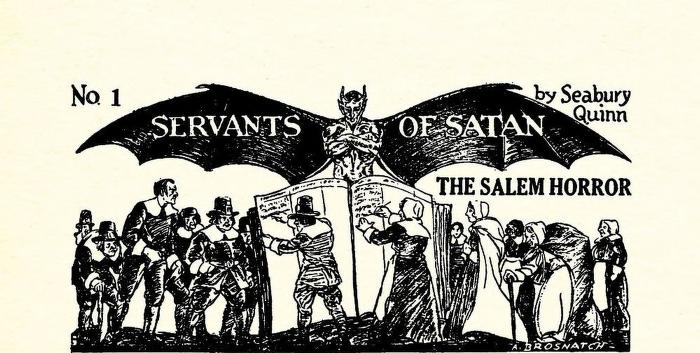
Which is rather interesting in itself. What is it about this story, so brief and yet complete in itself, that speaks to Salmonson—and to readers—of Bloch and Lovecraft? Those names together bring to mind their quasi-collaboration “Satan’s Servants” (1949), their triptych of Mythos stories “The Suicide in the Study” (1935), “The Shambler from the Stars” (1935), and “The Haunter of the Dark” (1936). Yet “Beckoner” doesn’t quite suggest those.

It is reminiscent of, if anything, Lovecraft’s “The Unnamable” or “The Picture in the House”, or Bloch’s “The Unspeakable Betrothal” (1949). “Little horror” is as good a descriptor as any; the scene is set and the action begins not someplace and time long ago and far away, but in the now, right here. The kind of horror that can find you at work, or in the apartment building, when it’s dark and you’re alone; where your own imagination may be playing tricks at you as something moves in the dark and you fill in the details of what might cause those sounds.

Yet this isn’t a sedate M. R. James ghost story. The horror, when it appears on the page at last, stepping into the light of a flashlight, beckoning for the protagonist to follow, blood oozing from the bullet holes in its belly…is real. Some solid, physical thing. A real horror, however uncanny. That was the transition, the hand-off from Lovecraft to Bloch in many ways. It wasn’t all clanking chains and bloody bones, horror could be, had to be both of the mind and have a physical existence outside of it; had to both repel and attract us. Perhaps that’s what Salmonson was trying to capture here. Because at the end, we still don’t know what the Beckoner was trying to beckon us to.

[…] intent rather than length is what define’s “little.” In my earlier collection of little horrors, HAG’S TAPESTRY published in England, I called them cyanide-laced candies in a chocolate sampler, as opposed to a condemned man’s final banquet. Hardly earth-shaking in importance, but entertaining. Although I admit to numerous influences or inspirations, I trust the end result is strictly my own.
—Author’s notes in John Collier and Fredric Brown Went Quarrelling Through My Head

In “The Picture in the House,” Lovecraft famously began: “Searchers after horror haunt strange, far places.” Yet his point was that there were plenty of horrors right at home, if you cared to look. In 1984, Salmonson wrote a poem titled “Searchers After Horror (Paraphrasing Lovecraft),” which serves as the proem to this book, which begins:

We searchers after horror haunt strange, far places:

We. There’s a sense of community among horror readers. An affection for old familiar horrors, the thrill of the chase in hunting down obscure books and films, a recognition of that inexplicable drive that sets us apart to look for and experience the ghastly, the morbid, the dark and grotesque…yet it is also the same sense of community that lets us delight in the Addams Family, The Nightmare Before Christmas, Gahan Wilson, Warren Magazines and Famous Monsters of Filmland, Mike Mignola and Eric Powell and Steve Niles.

Not every horror story has to be epic in scale. Cthulhu need not rise from the depths every story, the zombies need not overrun the world in every episode. If they did, then the shock and awe and grandeur of those horrors gets lost; one of those things Neil Gaiman hinted at in Only the End of the World Again. In this sense, little horrors are necessary for we searchers after horror.

Jessica Amanda Salmonson’s “The Beckoner of the Nightwatch” was published in John Collier and Fredric Brown Went Quarrelling Through My Head (1989). It has not been republished.


Bobby Derie is the author of Weird Talers: Essays on Robert E. Howard & Others (2019) and Sex and the Cthulhu Mythos (2014).
Derleth: Hawk…and Dove (1997) by Dorothy M. Grobe Litersky

He was known for his prolific writing production—at one time 10,000 words a day. He was also bisexual.

This book moves through Derleth’s many talents, from a five-year-old’s first reading experience to the man’s present statue as the only classic author to come out of the 20th century. It speaks eloquently of the hellish life endured by homosexuals in a society where their kind of living was confined to the boundaries of “closet” walls.
—Back cover copy of Derleth: Hawk…and Dove

Dorothy M. Grobe Litersky was a Wisconsinite, a charter member of the August Derleth Society, and one of the founders of the Rhinelander School of Arts where Derleth was engaged as a Writer in Residence. By her own account, this book—so far the only full biography of August Derleth’s life—was the result of 25-30 years of research, including interviews with family and friends and reference to Derleth’s private journals and correspondence, archived with his other papers at the Wisconsin Historical Society.

Before going into the particulars of Derleth: Hawk…and Dove, it’s important to place Derleth’s life in its proper context. He was born in 1909 in Sauk City, Wisconsin; sold his first story, “Bat’s Belfry” to Weird Tales at age 16, and from that point on never looked back at the writing game. He was a regular at Weird Tales, but prolific beyond that pulp magazine and that genre; a friend and correspondent of H. P. Lovecraft, Robert E. Howard, Clark Ashton Smith, E. Hoffmann Price and others, when Lovecraft died in 1937 it was Derleth and his friend Donald Wandrei that conspired to publish Lovecraft’s fiction and letters in hardcover. When they could not convince an established publisher to do it, they founded their own small press. Arkham House would, for the next fifty years, be one of the most important publishers of weird fiction, fantastic poetry, and Lovecraft-related materials in the world.

Derleth had a literary life outside of Arkham House. He became an important regional writer with the Sac Prairie Saga, a series of novels and short stories about his native Wisconsin and especially his home tome of Sauk City and the adjacent Prairie du Sac. For mystery fiction he created the detective characters Judge Peck and Solar Pons, the latter a deliberate pastiche of Sherlock Holmes, who remains popular. Beyond that, he wrote nonfiction histories and biographies, children’s books (including a series for which the authors received the Apostolic Blessing of Pope John XXIII) and poetry, articles and reviews. Awarded a Guggenheim fellowship in 1938, Derleth used the money to bind his collection of newspaper comics; those archives are now an important source for comic strips that may otherwise have been lost to time.

Much of this would have been opaque to even dedicated fans and readers of Arkham House. Derleth was a capable self-promoter, as his volumes, August Derleth: Twenty Years of WritingAugust Derleth: Twenty-Five Years of Writing, and August Derleth: Thirty Years of Writing attest, but he rarely wrote publicly about his marriage, love life, children, or the full details of his business. He had a diverse fanbase, but their interests typically appear narrow: the weird fans had little interest in his Sac Prairie saga, the Solar Pons fans little interest in his poetry, etc. So while there was no little interest in Derleth as a writer, bookman, publisher, and individual, there were few works that could—or even tried—to encompass all of the man and his range of writing. Those few works were mostly published by the August Derleth Society, which continues to work today to keep his writing in print and his memory alive.

Derleth’s death in 1971 saw an opening up of both Lovecraft scholarship and wider dissemination of the Mythos. During his time at the helm of Arkham House, Derleth had strongly claimed proprietary interest on Lovecraft’s fiction and letters, assuming effective (if not legal) control from Lovecraft’s literary executor R. H. Barlow. Derleth limited the ability of others to publish Mythos and Lovecraft-related works beyond Arkham House’s control (see the C. Hall Thompson affair and the publication of The Private Life of H. P. Lovecraft (1985) by Sonia H. Davis). Without him, and with the 12-year lawsuit between Arkham House co-founder Donald Wandrei and Derleth’s estate over the rights to the Lovecraft material, Mythos fiction began to proliferate. Derleth himself became criticized posthumously, both for his actions as editor and publisher, and for his Mythos fiction; Richard L. Tierney’s “The Derleth Mythos” (1973) was a watershed moment that emphasized the critical pushback against Derleth among Lovecraft studies.

Yet for all this, there was still relatively little on Derleth as an individual. The August Derleth Society Newsletter and volumes such as Remembering Derleth (1988), Return to Derleth (1993), and August Harvest (1994) are memoirs and essays by those who knew him, but approach hagiography at points. While valuable in their own right, there was for some decades after Derleth’s death no one willing or able to do the kind of initial work comparable to L. Sprague de Camp’s Lovecraft: A Biography (1975).

Not until Dorothy M. Grobe Litersky, who had been gathering material for the book since before Derleth’s death, finally wrote and published it.

Her book is, even from the most generous reading, far from perfect. Readers interested in a detailed account of his writing career, the development and publication schedule of Arkham House and its imprints, even his friendship with Lovecraft will be disappointed. There are no real revelations on these aspects of his life. It is not that Litersky ignores these things, but her interest is more focused on Derleth’s personal life.

As Derleth’s biographer, I have, to the best of my ability, tried to present as accurate a profile as possible. He wanted a portrayal of the whole man, free of the closet of lies he had been forced to hide in throughout his lifetime.
—Litersky, Derleth: Hawk…and Dove ix

While written without malice, Litersky’s “warts and all” approach to Derleth’s life includes a number of statements and assertions that are serious eye-openers to those who had only known Derleth through his fiction, essays on Lovecraft, and introductions to Arkham House books. Some of these are unequivocally true; many are simply impossible to verify without more information—and Litersky’s citations are minimal, often frustrating to work with, missing dates or page numbers, and typically take the form of “A. D. Journal” or “Robert Marx to A.D.” (ibid. 130); dates and page numbers are rare. Where they do exist, they are almost invariably accurate; there is every evidence that while she had access she was drawing directly from Derleth’s correspondence. However, the citations are still sparse and often lacking critical information, making it difficult to verify the contents.

One example of an event that we can confirm:

A group of about fifty young people converging upon the Place of Hawks on an evening in mid-October, 1948, included a precocious fourteen-year-old beauty who had made up her mind a year earlier that she was going to marry August Derleth.
—Litersky, Derleth: Hawk…and Dove 113

August Derleth’s marriage to Sandra Winters in 1953, which resulted in two children (April and Walden Derleth) and ended in divorce in 1959 is a matter of public record. They became engaged when she was 16 and still attending high school, and married shortly after she turned 18 in 1953, when Derleth was 44 years old (Rhinelander Daily News, 7 Feb 1953). The relationship appears to have been sexual even before they were married—and that Derleth was far from head-over-heels in love with the apparently infatuated teenager:

Oh, yes, I would not deny that Sandra has done me a lot of good. Not just making love to her, Sandra herself. Of course, she is sharp enough to know that, and I think that in this lies the ultimate dissolution of the affair, unless an accident makes it necessary for us to be married. For, being young, she is entirely likely, even with her mother’s advice, to take me for granted, and that might well be fatal. She has been frank enough to say that she intended all along that I should ultimately need her more than she needs me, and, while she intends to marry me, she intends also to have as much of her cake and eat much of it too, as possible. That never works, manifestly. But whatever takes place, it is certain that I have already benefited a great deal, and all the clothes and jewelry I’ve bought her won’t balance my own benefits.
—August Derleth to Zealia Bishop, 18 Aug 1949

Litersky’s account of the marriage goes into further detail, but there remains much unspoken about the entire relationship. The biographer never cites Sandra’s version of events; she appears to have relied entirely on Derleth’s accounts, despite the fact that the former Mrs. Derleth was still alive. There are no interviews with or letters from Sandra that might shed light on her side of the story. Derleth is apparently the sole source of all of the lurid details (her affairs, his affairs, the nude photography, the surprise pregnancy, etc.), as filtered through Litersky’s gloss of Derleth’s letters and journals.

The issue of statutory rape is hardly discussed. Sandra Winters as portrayed in the book is described as sexually precocious, and it beggars belief that a girl at fourteen could seduce a 40-year-old man. Derleth had to know what he was getting into, and it feels weird that in the context of the book more attention is not given to how the difference in ages was felt by both the immediate family or the community at large, or to how this reflected in the wider context of Derleth’s personal life. This is characteristic of Litersky’s style throughout the book; she presents the events as a fait accompli, not laying any moral judgment on Derleth’s flaws or foibles, but her portrait of others is colored by Derleth’s own perceptions—they become supporting characters, sympathetic when Derleth loves them and flawed or monstrous when he turns against them.

How reliable Litersky’s information is remains an open question. The book is not without errors of fact, and there are certainly instances where error of interpretation seem likely. The nature and paucity of the citations makes it difficult to assess the overall accuracy of the text, or even of specific sections. As a researcher, the book must be considered more as a guideline than a source of concrete data. Each instance has to be independently verified as much as possible.

That being said, very few of the claims in Derleth: Hawk…and Dove claims appear to be entirely baseless. If the interested reader can track down Litersky’s original sources or supplement them with other primary materials, usually there is at least some evidence to support them. To take one example:

Years later after Derleth’s death Sara told her story to a class of young students and reporters of her walk in the woods with August. She was relaxing on a blanket when he proceeded to discard all his clothes except his socks and to dance under the trees. She said she was shocked and embarrassed and pretended to be asleep.
—Litersky, Derleth: Hawk…and Dove 206

While somewhat inexplicable to Sara (and Litersky), a letter from Derleth to Lovecraft may suggest that nudism was a common practice for him, at least when the weather permitted: “I am brown as a berry, and have managed to rouse some indignation by being a one-man nudist colony on the hills only a  third of a mile across the river from the village” (Essential Solitude 632–33). So while we cannot say that this event actually happened, we can at least say that there is evidence that Derleth may have at least engaged in this behavior at some point. The anecdote is at least plausible, even if it isn’t provable.

A more complicated matter is Litersky’s assertion that August Derleth was bisexual, especially that he maintained long-term sexual relationships with both men and women. For reasons of privacy, Litersky does not name all of Derleth’s sexual partners outright; even her citations in this regard appear more circumspect than usual. This makes it especially difficult to verify; and there are no published letters where Derleth specifically states he has ever engaged in a homosexual relationship.

The importance of this aspect of Derleth’s character is arguable: it would make him the first bisexual author in the Cthulhu Mythos, and perhaps lend insight into readings of his fiction. Certainly it would cast some of Derleth’s occasional homophobic comments into new perspective, e.g.:

Barlow is I am sure a homo; from what I have heard, so was the later minister-weird taler Henry S. Whitehead.
—August Derleth to Donald Wollheim, 21 Mar n.d. [1937]

Could this be performative homophobia from a closeted bisexual? Or the genuine mild prejudice of an individual who, regardless of their sexuality, conformed to early 20th-century cultural norms regarding gender behavior and sexuality? Hard to tell. But the possibility of Derleth being on the LGBTQ+ spectrum is interesting, and deserves a deeper look.

When the subject turned to sex, August stated, “…I have no inhibitions, had few all my life sexually, that if I wanted to masturbate, I did so without guilt; if I wished to make love to a member of my own sex, likewise; if I wished to make love to a woman, again, likewise, the only condition being that sexual pleasure must rise from love, or at least a deep and genuine affection….”
—Litersky, Derleth: Hawk…and Dove 211

Here, Litersky is apparently relaying a snippet from a private conversation, as no other source is cited, so no separate confirmation is possible. Some of her statements in this line are even more unreliable; for example when she wrote:

The name Mara was mentioned only casually. He’s in love with her, the correspondent realized suddenly. Her fingers, holding the letter, felt a strange vibration. She met Mara a few years later, and had another shock. Mara was not a young lady, as she’d assumed. It wasn’t until after August’s death, a decade later, that she’d discovered her psychic flash had been 100% correct. August was bisexual and was indeed in love with Mara.
—Litersky, Derleth: Hawk…and Dove 180

“Mara” was a name used in some of Derleth’s poetry and fiction, notably in an eponymous 1948 ghost story about an unfaithful female lover; the volume of poetry This Wound (1962), which includes love poems, is dedicated to “Mara.” So while there was apparently a Mara (probably a nickname of a pseudonym), there is no indication Mara was male—also but not enough information for positive identification.

August Derleth never admits to a homosexual liaison or relationship in his published letters, but he did discuss sexuality in his correspondence, and there are several letters which are suggestive of the idea that he might be open to it, at least intellectually:

I must confess, that though I am steeped in abnormal sex, having studied all kinds of perverts at first hand, the suspicion of necrophilia in A Rose for Emily never once entered my mind. [. . .] Here is a woman starved for something—what is it, love perhaps? Let us assume it is. But she knows nothing about it. Love to her means a possession, a having. What she had come to regard as hers seems to be too independent. She kills. Thus, she keeps, she possesses, she loves. Necrophilia may or may not enter into this relation; it’s a minor point to me, since my own experience with people in this existence has led me to look on such things as part and parcel of life, though I am still conservative enough to be horrified by them, deeply. Yet I would be the first to jump tot the defense of a necrophiliac, a homosexual, &c., largely because I know that so often these poor creatures are incapable of helping themselves, have had their nerve systems tortured and twisted permanently from birth.
—August Derleth to H. P. Lovecraft, 9 Nov 1931, ES 406

I can understand your detestation of sex irregularities in life as violations of harmony and I here fully agree with you. I had previously misunderstood you to mean protestation from a basis of morals, and on this basis I would have stood squarely opposed to you. I have known and still know many people who are sexually irregular, both homosexual men and women, and except for three cases out of perhaps 21, I have always found these people highly intellectual, fully aware of what they were doing, and in all cases quite helpless. Speaking perspectively and in the abstract, I could as easily conceive myself entering upon a monogamous homosexual relation as a heterosexual one—though perhaps practice would change that pointofview. To quibble about mere words, I should not say that perverts necessarily lived inartistically.
—August Derleth to H. P. Lovecraft, 14 Feb 1933, ES 543

The idea that Derleth had an interest in the psychology of sex is supported by evidence he took out a subscription (under a pseudonym) to ONE Institute Quarterly, the journal of homosexual studies, in 1962. He would discuss the issue with others besides Lovecraft as well:

As for homosexuals—my only feeling is that I abhor promiscuity and I dislike violently to see children troubled; but this holds true also for heterosexuals, so there is actually no prejudice. Consenting behavior between adults is not offensive to me. But I do detest the flamboyant homo, the almost professional gay. To tell the truth I don’t know many real homos, though; I do know quite a number of bisexuals, and I never found one offensive, indeed, many of them strike me as brilliant, and most of them appear to be limited to one lasting affection, and are not promiscuous, that is one woman, and one man—oddly, there seems to be no conflict despite what the head-shrinkers insist  upon.
—August Derleth to Ramsey Campbell, 24 May 1966, Letters to Arkham 277-278

The subject comes up more than once in the Derleth-Campbell letters, and it is this sort of substantial quote which perhaps could have lent authority to Derleth: Hawk…and Dove. Therein lies what is arguably the single major issue with the book, beyond any question of Litersky’s style, sourcing, or quality of her analysis:

Missing Journal dates and dates of letters to and from August Derleth resulted from biographer’s incomplete notes, and a loss of actual copies of those items, journal entries and letters, beyond her control. When her lawyers accidentally discovered that the failure of Derleth’s lawyer to renew copyrights on all of Augie’s works, as requested by the U. S. Copyright offices, and informed April and Walden Derleth of the fact, the children not only moved quickly to remedy the mistake, they froze the Derleth papers in the Wisconsin State Historical Society’s Museum archives to prevent anyone access to them until the year 2020. Only then will it be possible to verify some of the material in Chapter 22, and elsewhere throughout the book.
—Litersky, Derleth: Hawk…and Dove 201-202

This is essentially the claim for why the book is not cited better than it is. Unfortunately, like everything else in the book, it is impossible to take Litersky at face value. It is true that there are some restrictions on access to portions of the Derleth archive, as described in the Administrative/Restriction Information; not all of the details quite align with Litersky’s version of events given above, but circumstances can change over time—or perhaps she misunderstood or misrepresented the reasons for the sealing. We don’t know.

It also isn’t clear why Litersky chose to publish this through the National Writers Press—a vanity press—rather than the August Derleth Society; one can imagine the content might have given the ADS pause. To say that Litersky’s assertions or interpretations of August Derleth’s life are “contested” or “controversial” would be inaccurate; most scholars don’t engage with Litersky’s biography at all. In part, this is more a reflection of a failure of the scope of Derleth: Hawk…and Dove than the question of its scholarship or distribution.

Readers who want to learn more about Derleth and Arkham House or Derleth and the Cthulhu Mythos will pick up John Haefele’s August Derleth Redux (2010) or A Look Behind the Derleth Mythos (2014); those interested in his Sac Prairie writings will pick up Evelyn Schroth’s The Derleth Saga (1979). For those who want more information on the man himself, his volumes of letters with H. P. Lovecraft and Ramsey Campbell are the major primary sources available in print.

In many ways, Litersky’s biography is characteristic of many first biographies of authors, in that it is only a beginning. Derleth: Hawk…and Dove is not the last word in Derleth studies; it is at best the start of the serious study of his life and work, and any subsequent biographer of Derleth will be forced to read Litersky and tackle the errors and weaknesses in her approach if they hope to produce anything that can surpass her work. Such a biography, when and if it written, can at least take advantage of sources that Litersky herself did not have available: the published letters, digital scans of unpublished correspondence, databases to help track down errant Derleth publications and criticism—and it would be worthwhile to see such a book published.

August Derleth was an important figure in the life and literary afterlife of H. P. Lovecraft, Robert E. Howard, Clark Ashton Smith, and many other writers. His vast body of work and his personal life are of interest in and of themselves, but he also touched on the lives of so many others—it was largely through his hard work and diligence that Arkham House became a legend, and that Lovecraft, the Mythos, and even weird fiction are still known and loved today. Whatever his personal flaws and foibles, and Derleth was certainly no saint, the ripples his life left on the world continue to expand and touch others. 


Bobby Derie is the author of Weird Talers: Essays on Robert E. Howard & Others (2019) and Sex and the Cthulhu Mythos (2014).
“The Flower of Innsmouth” (2011) by Monique Poirier

Eldritch Fappenings

This review deals with a work of erotic content, and the history of erotic art and writing. As part of this review, selected passages with descriptions of genitalia and/or sexually explicit contact will be included.
As such, please be advised before reading further.


In ’forty-six Cap’n Obed took a second wife that nobody in the taown never see—some says he didn’t want to, but was made to by them as he’d called in—had three children by her—two as disappeared young, but one gal as looked like anybody else an’ was eddicated in Europe. Obed finally got her married off by a trick to an Arkham feller as didn’t suspect nothin’.
—H. P. Lovecraft, The Shadow over Innsmouth

The undeniable fact of “The Shadow over Innsmouth” is that a great deal of sex has occurred. That is true in pretty much every town; human beings do not spontaneously pop into existence, but are the end result of a typically long and somewhat agreeably messy process of conception, gestation, birth. Within the specific parameters of Lovecraft’s plot, Innsmouth itself has hosted a lot of sexual liaisons with the Deep Ones, and this has fired imaginations in many strange ways because unlike with stories such as “The Call of Cthulhu,” sex is essentially the driving engine of the plot. The central horror of the story isn’t just the revelation that Deep Ones exist, but that they are breeding with humans.

Most of the sequels, prequels, and miscellaneous episodes inspired by Lovecraft’s story deal with the subject in one form or another, examining the gender and sexual politics, the vast possible permutations of marriage, lineage, growing up with or without “the Innsmouth Look.” Most of them don’t get into erotic details. Tide of Desire (1983) by Sheena Clayton does, a little; “Pages Found Among the Effects of Miss Edith M. Teller” (2005) by Caitlín R. Kiernan broaches some new territory; “Mail Order Bride” (1999) by Ann K. Schwader and “A Coven in Essex County” (2016) by J. M. Yales hints at nuptial horrors…

…but does Innsmouth sex have to be horrific?

Fans of horror are no stranger to teratophilia, the love of monsters. While it would be an exaggeration to say that Cthulhu Mythos erotica has been with us nearly as long as we have conceived of Cthulhu, the sexualization of “monstrous” entities has been and is and will be an ongoing aspect of reader interaction. It was not long after Carmilla or Dracula’s wives appeared on the page that “sexy vampires” became a thing, and artists and writers have, in their own way and in their own time, broached the subject of a sexy Deep One or Deep One hybrid.

The psychology of why is varied and individual. The Innsmouth Porno VHS (2014) focuses on a fascination with the different, the monstrous, the alien, the deformed. There’s a certain jaded sensibility expressed where “normal” is no longer arousing. “Under the Keeper of the Key” by Jaap Boekestein in Lovecraft After Dark (2015) uses the Innsmouth transformation as the ultimate physical expression of the mental and spiritual changes experienced during BDSM.

Monique Poirier is more sex-positive. What if a young couple just really hit it off and try something a bit different and end up liking it?

I’d never so much as seen Octavia’s unclothed ankle, never laid a hand upon her thigh for more than the barest moment before she demurely removed it. She had always been most perfectly modest and coy. In the echoing distance, thunder rolled, and another volley of sleet pelted the windows with a smooth hiss. Lightning flashed, and I saw it reflect in her eyes with a ravenous light.
—Monique Poirier, “The Flower of Innsmouth” in Whispers in Darkness

It’s fun. There’s no blood and gore, no hand-wringing or guilt, no rape or regret. All those things have their place, and there are absolutely flavors of Innsmouth fiction that will give them to you. Yet it has to be remembered that the Victorians, for all their straitlaced propriety, produced and consumed a vast amount of pornography as well. Just because sex is taboo doesn’t mean people didn’t do it.

Frankly, it makes you wonder why someone else didn’t do try to write a story like this before.

Plotwise, “The Flower of Innsmouth” is technically a prequel to “The Shadow over Innsmouth,” showing how the youngest daughter of Captain Marsh’s got “married off by a trick.” The setup was right there in Lovecraft’s own story. If one wants to get technical, there’s room to nitpick: Poirier uses “Obadiah” instead of “Obed,” “Octavia” instead of “Eliza,” the marriage should have been in 1867 instead of 1870—but there’s room to gloss that kind of detail. However, most readers will probably be more interested in the kind of bedroom scene that Lovecraft did not and would not write:

Something hot and slick probed between my buttocks in insistent exploration. I think I made a noise of protest then, and certainly tensed at the intrusion, but Octavia chose that moment to tighten her nether muscles in a paroxysm around my manhood, as if she meant to draw it up into her body entirely and the whole of me with it. (ibid.)

There is a bit of a delight in the language involved. It is probably closer to Edwardian than Victorian; reminiscent of The Way of a Man with a Maid (1908), but in the confluence between historical erotica and historical Mythos fiction, Poirier manages to get the message across without losing contemporary audiences entirely. She hits a lot of tropes—”I’m not like other girls”—but tropes aren’t a sin if used well. Nor does the story overstay its welcome; there is a plot, there is a scene, and the finale is a single sentence—but that’s really all you need for a story like this. As a brief episode of Innsmouth history, this works. As a brief erotic episode, this also works.

“The Flower of Innsmouth” by Monique Poirier was first published in Whispers in Darkness: Lovecraftian Erotica (2011, Circlet Press); it has since been reprinted in her own collection This World Between: Erotic Stories (2018).


Bobby Derie is the author of Weird Talers: Essays on Robert E. Howard & Others (2019) and Sex and the Cthulhu Mythos (2014).
“Lovecraft and Benefit Street” (1943) by Dorothy C. Walter

The house was—and for that matter still is—of a kind to attract the attention of the curious. Originally a farm or semi-farm building, it followed the average New England colonial lines of the middle eighteenth century—the prosperous peaked-roof sort, with two stories and dormerless attic, and with the Georgian doorway and interior panelling dictated by the progress of taste at that time. It faced south, with one gable end buried to the lower windows in the eastward rising hill, and the other exposed to the foundations toward the street. Its construction, over a century and a half ago, had followed the grading and straightening of the road in that especial vicinity; for Benefit Street—at first called Back Street—was laid out as a lane winding amongst the graveyards of the first settlers, and straightened only when the removal of the bodies to the North Burial Ground made it decently possible to cut through the old family plots.
—H. P. Lovecraft, “The Shunned House”

Dorothy Charlotte Walters was secretary of the League of Vermont Writers, a worker on the Vermont Commission on Country Life, and local historian and writer who had attended Brown University in Providence.  She met H. P. Lovecraft only once, in early 1934 while visiting Providence; her memoir of that meeting was later published as “Three Hours with H. P. Lovecraft” (1959). But her first memoir of Lovecraft, published in 1943, as “Lovecraft and Benefit Street.” It is one of the first such memoirs of Lovecraft by any of his female acquaintances.

Returning from such rambles in space and time to his desk in his sightly study from which he overlooked the treetops of Benefit Street, dark against the sky-glow of downtown Providence, he spent night after night, which was his working time, using the familiar localities, the characteristic family and Christian names of Rhode Island, and factual details of the present and past of the life and business of Providence to furnish a setting for tales and doings that were strange indeed.
—Dorothy C. Walter, “Lovecraft and Benefit Street”

At the time they met, Lovecraft was ensconced at 66 College Street, his final home; the window in Lovecraft’s study offered a good view of the treetops and roofs lower down the hill. Walter’s piece combines elements of biography and literary criticism; it is obvious she either read or re-read a good chunk of Lovecraft’s fiction before writing this piece, probably from the first Arkham House collection The Outsider and Others (1939) which she mentions later on in the piece. Some of her observations are more cogent than others:

In the making of imaginative tales of the sort that Mr. Lovecraft wrote there cannot help being a good deal of claptrap and mumbo-jumbo. His stories suffer, if too many are read in quick succession, from similarity in the method of producing a weird atmosphere. It is easy to tire of gothic effects in landscape and in weather when one knows that by such artifices one is being “softened up” to be bowled over at the appropriate moment by the horror of the narrative. One longs for a mystery to develop in a neat, ordinary house, or for a homicide committed in brilliant daylight. Many of the stories are too long. Cutting would have improved them. And Mr. Lovecraft leaned too heavily on a few trick words that had come to have a heightened significance for him—nameless and forbidden, for example, to mention two. He also relied much too often on references to things distasteful to himself that he assumed would produce similar feelings of aversion or fear or disgust in others—fishy odors, for instance, which he couldn’t endure and used again and again as a symbol of the evil and the malevolent; the strangeness of the foreigner; the unpleasantness of things squirmy and slimy; and chief of all, the sensation of cold. […] He would have agreed with Dante in making hell cold. (ibid.)

Subjective assessments aside, there are criticisms and observations in Walter’s piece which would be repeated by many others—indeed, some of the myths about Lovecraft may have been partially popularized by her little memoir. The main thrust of her article is not just about Lovecraft, but about Benefit Street itself, and here it should be remembered that Walter and Lovecraft were of an age—she was born in 1889, he in 1890—and shared a few of the same influences and, probably, prejudices. So in describing the street, she wrote:

One can savor early Providence under its elms, or the Yankee Providence of today, and one can also travel to foreign lands without leaving the street, if one has an open sesame to the pleasant hospitality of the Syrian, Portuguese, and Jewish homes that cluster around its opposite ends. (ibid.)

Benefit Street also provides the setting of “The Shunned House,” and so  involves one of the more dramatic and complicated publishing histories in the Lovecraftian corpus. Robert Weinberg wrote an excellent article on the publishing history of “The Shunned House,” but the short version is that in 1928, Lovecraft’s friend W. Paul Cook—a small-time printer—offered to publish the story in an edition of 250 copies. It would have been Lovecraft’s first standalone hardcover publication. Nothing went right. The edition was printed, but not bound; some of the unbound sheets were bound by R. H. Barlow, and later still some were bound by Arkham House, becoming an odd collector’s item long after Lovecraft’s death, with asking prices in the thousands of dollars (and at least one set of forgeries). The general failure of the book to be properly published during his lifetime was one of Lovecraft’s many discouragements and regrets in the writing game. Cook mentions the printing briefly in his own memoir “In Memoriam: Howard Phillips Lovecraft: Recollections, Appreciations, Estimates” (1941), which is probably all that Walter knew of the matter.

Her own approach to this confluence of Lovecraft and local history comes by way of an anecdote:

But one below-zero night in northern Vermont, in search of a bedtime story, she opened the huge Lovecraft volume that a friend had loaned her. Her eye chanced on a familiar name in a story entitled “The Shunned House,” and she read on just where she had opened the book, astonished to find herself in Providence, wandering along Benefit Street. It was pleasant to be so transported so unexpectedly to a neighborhood well known since college days, interesting and amusing to find it figuring as a setting for the outrageous events of a weird tale when she had always considered it seemly and sedate. She read on, absorbed in the pleasures of recollection. And before she knew it, she was getting shivers and a crinkly spine out of the hair-raising particulars of an uncanny and not very believable yarn. Well, of course it was late, and a very cold night! But what more could a writer of weird fiction have asked for his efforts! (ibid)

Walter’s memoir doesn’t offer any uniquely critical insight into Lovecraft: their association was too brief. Yet it as an example, if any be needed, at how we all touch the lives of others, and might be remembered afterwards by those we knew but briefly. Walter has her few anecdotes of Lovecraft, expands on his fiction and character through her own lens, and even though there is little hard data here that you won’t find anywhere else, she still adds what little she has to the store of Lovecraftian lore. We are richer for her brief memoirs of Lovecraft than we would be without them.

“Lovecraft on Benefit Street” was first published by W. Paul Cook in The Ghost #1 (1943), reprinted by his Driftwind Press as a small chapbook, reprinted again in the fanzine Xenon (July 1944), reached something like wider publication in Rhode Island on Lovecraft (1945, Donald M. Grant), and finally in Lovecraft Remembered (1998, Arkham House).

“Three Hours with Lovecraft” was first published in The Shuttered Room and Other Pieces (1959, Arkham House), republished in Lovecraft Remembered (1998, Arkham House), and again in Ave atque Vale: Reminiscences of H. P. Lovecraft (2018, Necronomicon Press).


Rhode Island on Lovecraft can be read for free at the Internet Archive.


Bobby Derie is the author of Weird Talers: Essays on Robert E. Howard & Others (2019) and Sex and the Cthulhu Mythos (2014).

The Dream-Quest of Vellitt Boe (2016) by Kij Johnson

In a land defined by dreaming men and bickering gods, there were no sure rules, but there was also no certain randomness.
—Kij Johnson, The Dream-Quest of Vellitt Boe 133-134

You don’t have to have read Lovecraft or Dunsany to appreciate The Dream-Quest of Vellitt Boe. Without those references, it is still a very competent fantasy novelette. Johnson has a good eye for detail, characterization, description; the plot moves quick, never gets hung up too long in one place, one peril. Vellitt Boe is on a mission, after all.

That being said, without the historical context of Lovecraft and Dunsany, The Dream-Quest of Vellitt Boe is in danger of being misunderstood as a generic fantasy novel, of the sort inspired by a thousand sessions of Dungeons & Dragons, Tunnels & Trolls, or Fighting Fantasy. This comes almost as a consequence of how you get from Lord Dunsany to Kij Johnson, and to really appreciate what she is doing in this novelette and how it got there requires a bit of background. 

H. P. Lovecraft discovered Lord Dunsany in 1919. The Anglo-Irish peer had created an artificial mythology in his tales of Pegāna, which would inspire Lovecraft’s own mythos, and the stories of “Beyond the Fields We Know” in Tales of Three Hemispheres (1919) including “Idle Days on the Yann” and “The Shop in Go-By Street” would lay the groundwork for Lovecraft’s Dreamlands.

It is important to remember that Lovecraft built his Mythos over time, defining and re-defining it as time went on and other influences came to bear. “The Cats of Ulthar” (written June 1920) was not originally set in the Dreamlands; it was a generic fantasy. The first actual Dreamlands story was “Celephaïs” (written November 1920). In later fiction, these early fantasies and their names and geographies would be subsumed into the Dreamlands—and the “Dream Cycle” with its vagaries and contradictions (were exactly is Leng?) have given compilers of Mythos-lore much to chew on and argue about.

Randolph Carter came into existence in 1919 as well, in “The Statement of Randolph Carter.” This early story had nothing to do with the Dreamlands either; Lovecraft recorded a dream in his letters involving himself and his friend Samuel Loveman. In turning the dream into a story, Loveman became “Hartley Warren” and Lovecraft himself became “Randolph Carter.” The character became a self-identified counterpart for Lovecraft himself in his stories, though he appeared in only a few of them, notably “The Silver Key” (1926), which is the only one that was a Dreamlands tale until The Dream-Quest of Unknown Kadath (written 1926-1927).

Lovecraft’s Dream-Quest is fundamentally different from anything he wrote before or since. Maybe that is why in part it found no publication during his lifetime. Too long, too weird, too inexplicably full of adventure—it is this novelette which binds together Lovecraft’s “dream” stories, early fantasies, and Randolph Carter stories. Without Dream-Quest, you could argue the Dreamlands are still a part of the Mythos, but places like Ulthar wouldn’t be a part of it. This was the story that really gave the scope and connective tissue that bound much of Lovecraft’s early fiction together. In structure and conception, it is much more similar to David Lindsay’s A Voyage to Arcturus (1920) or E. R. Eddison’s The Worm Ouroboros (1922) than anything else.

There aren’t really any women in it.

Which is true for much more of Lovecraft’s fiction than just The Dream-Quest of Unknown Kadath. As discussed in Sex and the Cthulhu Mythos, Lovecraft does have female characters in his stories, but the gender balance is distinctly skewed towards male characters. In large part, this seems to be simply because Lovecraft seldom made a character female unless there was a reason for her to be female. Which is why the only absolute reference to women in Dream-Quest is:

It is known that in disguise the younger among the Great Ones often espouse the daughters of men, so that around the borders of the cold waste wherein stands Kadath the peasants must all bear their blood. 

That’s it. There are other references to women in some of the other stories, if you look hard enough—the cat-killing wife in “The Cats of Ulthar” for example—but for the most part, women are implicit. Priests, but no priestesses. “Men” as a generic term for all persons of every gender, in the very 18th century sense. Rapacious gods of the Greco-Roman school, but no lusty goddesses bedding the handsome young men around Kadath.

It was in this context that Kij Johnson wrote her own Dream-Quest, and it is in many ways both a continuation of the tradition of Dunsany and Lovecraft, and a reflection on those works.

And I must of course acknowledge Lovecraft’s The Dream-Quest of Unknown Kadath. I first read it at ten, thrilled and terrified, and uncomfortable with the racism but not yet aware that the total absence of women was also problematic. This story is my adult self returning to a thing I loved as a child and seeing whether I could make adult sense of it.
—Kij Johnson, “Acknowledgements” in The Dream-Quest of Vellitt Boe 167

Johnson did the work, sifted the stories. The story is set between “The Silver Key” and “Through the Gates of the Silver Key”; it references Lovecraft’s geography and zoology, but also subtly grounds and expands them. The Dreamlands are seen through the eyes of a native, an intelligent and experienced woman who knows more of how things work and finds delight in them. The skill of her construction is such that she never needs to cite a story specifically; it is never written that “In Ulthar no man may kill a cat,” because the idea is implicit in the story: no one even thinks of trying to kill a cat in Ulthar. It simply doesn’t come up. More amusingly and refreshingly, we get little anecdotes like how a young Vellitt Boe tried to climb Hatheg-Kla under the logic that it was only said no man could climb it. A neat bit which feels a bit like Éowyn taking a swing at the Witch-King of Angmar.

The story is at its best when it is showing rather than telling. Why not a woman’s college in Ulthar? Why not a female far-traveler? Nothing in Randolph Carter’s dream-quest required him to have a penis, so what’s to stop a woman from having her own adventure in the Dreamlands? Absolutely nothing.

The story is arguably at its weakest when it stops showing and starts telling.

She had never met a woman from the waking world. Once she asked Carter about it.

“Women don’t dream large dreams,” he had said, dismissively. “It is all babies and housework. Tiny dreams.”

Men said stupid things all the time, and it was perhaps no surprise that men of the waking world might do so as well, yet she was disappointed in Carter. Her dreams were large, of trains a mile long and ships that climbed to the stars, of learning the languages of squids and slime-molds, of crossing a chessboard the size of a city. That night and for years afterward, she had envisioned another dream land, built from the imaginings of powerful women dreamers. (ibid. 71-72)

In narrative terms, the characterization of Randolph Carter as a bit of a straw-man serves its purpose only in highlighting Boe’s struggles as a woman. Even in the Dreamlands, there are gender norms and imbalances; the women’s college of Ulthar is the youngest and most vulnerable of the seven universities, and even a hint of scandal could see it closed, upper education cut off. In that sense, Johnson needed some character to personify the casual misogyny that Boe quested against as much as anything else.

Carter as a mouthpiece is problematic mainly because he never voices such views in Lovecraft’s fiction, and as he is implicitly Lovecraft’s alter-ego (though Johnson does not make this point) it can be read as Johnson putting words in Lovecraft’s mouth. While Lovecraft did evince a few chauvinistic statements during his life, he never wrote anything like what Carter says in Johnson’s Dream-Quest. The statement (“powerful women dreamers” is a great line) needed to be made at some point, if for no other reason than it sets up the finale, but the characterization seems off; rather like Ervin Howard in “The Ballad of Black Tom” (2016) by Victor LaValle. If a dead horse is going to be beaten, at least beat it for something it actually did.

There is a line in the story that may be uncomfortable, but then it would be a sad world where such a line would be otherwise:

As a young woman, when she had been beautiful and had worn her hair short and her clothes loose to conceal that fact, she had known all the signs of men and read them well enough that she had been successfully robbed only three times and raped once; but none of those had burned from her the hunger for empty spaces, strange cities, new oceans. (ibid. 83)

Nothing of the act, which happened sometime in the far past, is shown. Which is good; the last thing the story needed was an exploitative recap, some trauma porn of the effect and slow recovery. The event happened, it didn’t define her. It is also not the only mention of rape in the story; Vellitt Boe is traveling mostly alone in a quasi-Early Modern fantasy world. Sexual assault need not have a gender bias (the setting rarely hints at lesbianism as a possibility, and male homosexuality is completely absent from the text) but old habits die hard. How many women traveling alone today have the same fear?

Which is perhaps the one real criticism of The Dream-Quest of Villett Boe. It is great for what it is, but if the purpose was to have a message as well tell a story, it feels like it could have been that much better. Why aren’t there any female gods in the Dreamlands? Why aren’t there any female dreamers? Johnson wasn’t obliged to stick to Lovecraft or Dunsany in every regard, and doesn’t. Yet her Dreamland is almost too close to the waking world in some of its gender constructs and mores.

You might be interested to know that at the party one very bright young woman described her adolescent reading of SF as a genuinely subversive force in her life, a real alternative to the fundamentalist community into which she had been born. This alternative had nothing to do with the cardboard heroes and heroines or the imperial American/engineering values which she had skipped right over. What got to her were the alien landscapes and alien creatures. We scholars perhaps tend to forget how much subversive potential both SF and fantasy have, even at their crudest.
—Joanna Russ, To Write Like A Woman 64

Russ, of course, wrote her own Dreamlands tale: “My Boat” (1976). Ironically, Russ’s story features a powerful woman dreamer (who also happens to be black), exactly the kind of character that Villett Boe lamented never meeting in her own Dreamlands. It’s a pity that the two characters didn’t run across each other—but the tales remain complementary. The Dreamlands is big enough for both characters, and more besides.

The book is at its most subversive when just letting Vellitt Boe find her own way, rather than being escorted by guards or ghouls or rescued by gugs. The Dreamlands through her eyes is a delight, and just having a female character be the protagonist of a Dreamlands story in itself is more of a statement that See? Women can explore the Dreamlands too! than any of the casual misogyny attributed to Randolph Carter (or, implicitly, Lovecraft). If Johnson’s goal beyond writing the story was to write a Dreamlands where the women aren’t invisible and mute, she can certainly be said to have succeeded. Above and beyond that, The Dream-Quest of Vellitt Boe is a very rare thing: a good Dreamlands story, written in a way that is not a pastiche of Dunsany or Lovecraft.

Kij Johnson’s The Dream-Quest of Vellitt Boe was published in 2016 by Tor.


Bobby Derie is the author of Weird Talers: Essays on Robert E. Howard & Others (2019) and Sex and the Cthulhu Mythos (2014).
Her Letters To Lovecraft: Natalie H. Wooley

I should say that weird fans who have a taste in liking the outre in literature have a superior taste, rather than a morbid one, a sign of an inquiring mind, that is not satisfied with Wild West, Gangster, or sickly mediocre love stories. But to explore the hidden corners of things, whether it be the universe, the mind, or the supernatural, is providing that one’s mind is not smug or narrow. If this be madness, insanity, or morbidity, glory in it, you weird and fantasy fans. 
—Natalie H. Wooley,
The Fantasy Fan May 1934

Natalie Hartley Wooley wrote to Lovecraft by way of Weird Tales in c. June 1933, inquiring into the reality of the strange tomes and Mythos in his fiction. While we cannot say for certain what prompted her letter, Lovecraft’s “The Dreams in the Witch House” was published in the July 1933 issue, which hit stands the month before. Lovecraft, as he always did, revealed that it was an artificial mythology. The correspondence went on from there.

She was 29 years old in 1933, and her son George was nine years old. Biographical details are scarce; very few of her letters appear to have survived, and we have only Lovecraft’s side of the the correspondence, amounting to 15 letters (or parts thereof) from 1933 to 1936. Wooley was also a member of Lovecraft’s late round robin letter group the Coryciani, of which 4 letters survive from 1934-1936. More of her own writing survives in early fanzines and amateur journalism.

It appears that through Lovecraft, Wooley was introduced to both amateur journalism and early science fiction fandom—and joined both. Wooley was a poet, and perhaps had aspirations to be a writer. Lovecraft’s letters give lists of weird fiction that a dedicated fan might read, sources for occult lore ranging from The Witch-Cult in Western Europe (1921) by Margaret A. Murray to medieval grimoires and Theosophy, and advice on writing and being published. Perhaps aware of how he had advised revision clients like Zealia Bishop in the past, Lovecraft wrote:

However—don’t bother with weird fiction at all unless you feel a genuine inclination toward it. It is the most difficult of all material to market professionally, & the circle of those who truly enjoy & appreciate it is always discouragingly small.
—H. P. Lovecraft to Natalie H. Wooley, 6 Aug 1933, Letters to Robert Bloch & Others 191

Marketable or not, Wooley tried her hand at it. Her short story of a murderer on death’s row feeling the ghostly revenge of another was published as “Spurs of Death” in The Fantasy Fan (Dec 1933). Acclaim was modest; Lovecraft’s letter in the January 1934 issue reads “All the stories are excellent and the departments are as interesting as usual.”; H. C. Koenig in the February issue wrote “this Wooley person certainly did a very nice job with her story.”

More effusive praise would come for Wooley’s poetry, much of it from Lovecraft himself. Still, she was in the mix and among the fans; her poems and fan-letters graced the pages of The Fantasy Fan and Marvel Tales in 1934 and 1935, and from Lovecraft’s responses it is clear that she read and commented on his fiction. Beyond that, Lovecraft appears to have recruited her to amateur journalism, where she had further outlet for her poetry and opinions:

A new voice in the National is that of Mrs. Natalie Hartley Wooley, whose brief, wistful lyrics strike one’s fancy with singular sharpness through certain faint overtones subtly suggesting magical vistas and dim regions beyond the confines of daylight reality. “Western Night”, in the Summer Goldenrod, has great charm and power; while “Flight”, in the October Sea Gull, unites with its general elfin quality a poignant human pathos.
—H. P. Lovecraft, “Bureau of Critics” in the National Amateur (June 1934), Collected Essays 1.375

NATALIE HARTLEY WOOLEY, Kansas, is a member of both the National and United Amateur Press Associations and has contributed to Kansas City Star, Kansas City Journal-Post, Marvel Tales, The Fantasy Fan, and to The Christian Board of Publication periodicals. She wrote the lyrics for “Querida, a Spanish Serenade,” a song which may be heard on the radio.
“Who’s New,” Kaleidograph (Dec 1934), quoted in Letters to Robert Bloch & Others 10n7

As with most of Lovecraft’s letters, what began as a focus on weird fiction eventually grew broader. Wooley asked about Wiggam’s The Fruit of the Family Tree (1924), a popular work on eugenics, which led to a lengthy response from Lovecraft, touching on Nazi antisemitism and the 1933 law on compulsory sterilization, miscegenation and the color-line in the United States, and the rising power of and Westernization of Japan. Yet for the most part their letters concern weird fiction, fellow fans, and especially in the Coryciani letters, poetry. One such letter shows Lovecraft’s appreciation for her verse:

Mrs. Wooley’s contribution is rich in illuminating comments & examples. She is, it would seem, right in believing that both simple & involvedly mystical & allusive (within reasonable limits) verse have a definite & unchallengeable place in the aesthetic scheme. Like Mr. Adams’s, her preferences run to the philosophical—albeit in a somewhat less concrete fashion. A certain wistful, elusive mysticism—involving touches of the whimsical, the fantastic, & the delicately spectral—often characterises Mrs. Wooley’s own verses—as the columns of amateur journalism amply attest.
—H. P. Lovecraft to the Coryciani, 17 Mar 1935, Lovecraft Annual (2017) #11 136-137

As an example of her poetry, this bit of verse was squeezed in after a few verses of the Fungi from Yuggoth and before Robert E. Howard’s “Voices of the Night” in The Fantasy Fan (Jan 1935):

THE ALIEN
by Natalie H. Wooley

She is like living golden flame.
She knows not whence or why she came
       Into this world…and yet at times
I hear her call strange gods by name.

There is no warmth in her embrace,
Of human passions not a trace.
       She seems remote, a thing attuned
To summonings from outer space.

And on each starry, moonlit night
She gazes long in rapt delight
        Toward the skies…while I weep
Lest the message come, and she take flight.

Robert E. Howard was another author that interested Wooley. She must have read his Conan story “Beyond the Black River” (Weird Tales May-Jun 1935) with enthusiasm, and written to Lovecraft about him, for Lovecraft wrote back:

Yes—Robert E. Howard is a notable author—more powerful & spontaneous than even he himself realises. He tends to get away from weirdness toward sheer sanguinary adventure, but there is still no one equal to him in describing haunted cyclopean ruins in an African or Hyperborean jungle. He has written reams of powerful poetry, also—most of which is still unpublished.
—H. P. Lovecraft to Natalie H. Wooley, 28 Jun 1935, Letters to Robert Bloch & Others 205

Wooley excerpted a passage from “Beyond the Black River” for a brief critical work titled “The Adventure Story,” published in The Californian (Fall 1935). She praised the Texan as a writer—one of the few such critical assessments he would ever get in his short life.

There, my friends, is writing. A paragraph of less than a hundred words, yet combining description, menace, and a hint of action to come. Each word is carefully chosen. Note that artfully worded last sentence, with its intimation of impending conflict; sustaining the reader’s interest through what otherwise might be a rather colorless bit of description. Mr. Howard, well known adventure-fiction story writer, is one of the few who do not sacrifice beautiful narrative style for the action demanded in such stories, but combines the two masterfully.
—Natalie H. Wooley, “The Adventure Story,” reprinted in Letters to Robert Bloch & Others 441

Robert E. Howard received a copy of The Californian, and wrote back—though any further contact was cut short by his suicide in 1936.

Thank you very much for the copy of The Californian. I feel greatly honored that Miss Wooley should have quoted an excerpt from my serial “Beyond the Black River” in her article in your fine journal.
—Robert E. Howard to The Californian (Summer 1936)

Lovecraft’s friend and future literary executor R. H. Barlow moved to Kansas City to attend the art institute there in 1936; through their mutual friend and correspondent Barlow and Wooley got in touch. It is the only time that Wooley is known to have met with anyone else in the Lovecraft circle—or science fiction fandom in general.

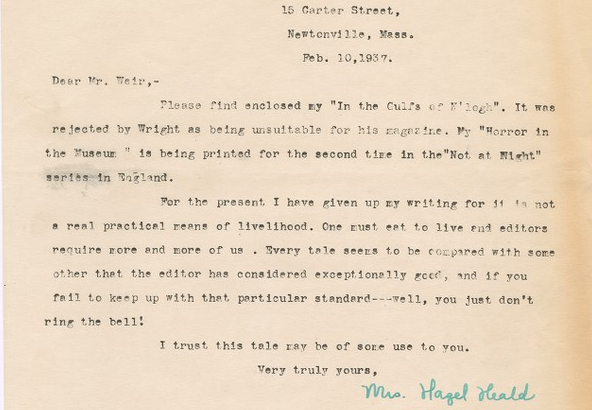
No letters to Wooley or mention of her survives in Lovecraft’s correspondence past December 1936; no doubt his fatal illness curtailed their back-and-forth. We may get a sense of her side of the correspondence from a single letter that survives at the John Hay Library among Lovecraft’s papers—this was sent from Wooley to E. A. Edkins, who forwarded it to Lovecraft.

WooleyLetter

Wooley did not immediately disappear from view; The Fantasy Fan and Marvel Tales, her main outlets for fandom, had both faltered, but she was still active in amateur journalism for a time. A favorite example is her assessment of James Joyce’s Ulysses (1922):

As erotica, the book is a disappointment. Some of Boccaccio or Balzac, or the modern writers Bodenheim and Donald Henderson Clarke outstrip it completely. As history, it is
insignificant. As a text-book of hitherto deleted words, it leaves little to the imagination.
—Natalie H. Wooley, “Well, I’ve Read It” in Nix Nem (Dec 1936), quoted in The Fossil 345

What did Lovecraft’s correspondence mean to Natalie H. Wooley? It encouraged her writing and poetry, helped her find new outlets to publish her work. She was, whether she knew it or not, in the thick of early fandom, and her voice was heard among writers who would grow to become legends—though she herself is nearly forgotten today, her poetry lives on.

Lovecraft’s letters with Natalie H. Wooley, along with a selection of her poetry and critical writings from amateur journalism have been published in Letters to Robert Bloch & Others (2015, Hippocampus Press); some of these letters had previously been published in volume 4 and 5 of the Selected Letters from Arkham House. The letters to the Coryciani have been published in Lovecraft Annual #11 (2017, Hippocampus Press).

Thanks and appreciation to Dave Goudsward for his help on this one.


Bobby Derie is the author of Weird Talers: Essays on Robert E. Howard & Others (2019) and Sex and the Cthulhu Mythos (2014).
Hammers on Bone (2016) by Cassandra Khaw

Not for the first time, I consider giving the kid a refund. I’d gotten into the detective business to escape the deepwater blues, from the songs that squirm in your veins like worms. Sure, I’d go for an easy job, sometimes, ice a monster that had gotten too big for his bed. But this?
—Cassandra Khaw, Hammers on Bone 56

H. P. Lovecraft did not invent weird fiction, in the same way Raymond Chandler didn’t invent hardboiled detective fiction. Noir and the Mythos are first cousins, descended from Edgar Allan Poe’s detective stories of C. Auguste Dupin—and over the years many writers have written weirdly consanguineous marriages in that sprawling family. Sometimes they even work out.

Cassandra Khaw is working in a tradition that includes C. J. Henderson’s The Tales of Inspector Legrasse (2005), James Ambuehl’s anthology Hardboiled Cthulhu (2006), and Ron Shiftlet’s Looking for Darla (2008). Graphic novels have been especially prolific of late, with entries including Weird Detective (2017) and Casefile: Arkham (2016). The stories work (when they do work) because both Mythos and noir stories are at heart mysteries; there is some hidden truth, cosmic or sordid, to be uncovered before the end. In many cases, they also share a setting in the 1920s and 30s. But the approach is distinct; hardboiled detectives are made of sterner stuff than most Lovecraftian protagonists, and the hard-drinking men and women who try to find the rotten worms of the earth at the core of a Mythos mystery usually end up regretting the experience.

Which is the case with Khaw’s novella Hammers on Bone.

John Persons, P.I., is an anachronism. Prowling the streets of modern-day London, he talks like a character out of a Mickey Spillane novel. A creature out of time in more sense than one, he lives the gumshoe role in a case that combines the tragic realities of domestic violence and economic hardship on the one hand, and body horror and eldritch experiences on the other. If you don’t think about the details; it works fine: Khaw has a great sense for her characters, and Persons’ personality and penchant for hardboiled slang carry the narrative along nicely.

The plot itself? A jigsaw puzzle with a few pieces deliberately missing. Khaw doesn’t set up any particular rules for her universe, at least not on the page. Like “All This for the Greater Glory of the 7th and 329th Children of the Black Goat of the Woods” (2012) by Molly Tanzer it feels filtered through half-remembered sessions of the Call of Cthulhu Roleplaying Game. There is that assumption of familiarity with various bits and pieces of Mythos lore, but also a slapdash quality to it all. An almost cartoonish aspect where things happen because the story demands an action beat and the visuals are cool, but at the end of things there are crucial questions that remained unanswered. It isn’t a mystery where you can guess the end by page three, or page ninety-three, and when the last page of the epilogue is turned the reader may find themselves asking why Persons didn’t handle the case differently.

After all, it’s only murder.

Part of the problem is that the villain of this piece is a cipher. A domestic abuser and chav’s chav with squamous secret beneath the skin, but there are fill-in-the-blanks missing. Why does he do what he does? What is he after? Why hasn’t he done it already, if he has the power to? Unanswered questions and missing motivations. During the legwork phase of the investigation, Persons stumbles across something bigger than an alcoholic asshole who beats his not-quite-wife and spreads his eldritch infection—but the story cuts off before we get further down that particular road. Maybe in the sequel.

Hammers on Bone was published in 2016 as part of Tor’s Lovecraftian novella series. Khaw has written a sequel, A Song for Quiet (2017).


Bobby Derie is the author of Weird Talers: Essays on Robert E. Howard & Others (2019) and Sex and the Cthulhu Mythos (2014).
The Alluring Art of Margaret Brundage (2013) by Stephen D. Korshak & J. David Spurlock

Sometime in 1932, a six-foot tall, chain smoking woman, in need of a job to support her three-year-old son and crippled mother, walked into the office of legendary Weird Tales editor Farnsworth Wright. The woman was a freelance fashion design illustrator with no knowledge of who H. P. Lovecraft, Robert E. Howard, Clark Ashton Smith, Otis Adelbert Kline, Seabury Quinn, Jack Williamson, Robert Bloch and dozens of other writers were. She had simply looked through the telephone book to find the name of a publishing company where she might find employment. During this initial meeting the woman, Margaret Brundage, displayed a painting of an Oriental female done in pastel chalk to Farnsworth Wright that caught his eye.
—Stephen D. Korshack, “Queen of the Pulps” in The Alluring Art of Margaret Brundage 11

In 1932, Margaret Brundage (née Margaret Hedda Johnson) was a single mother; her husband Myron “Slim” Brundage was an alcoholic who had abandoned the marriage and the care of their son Kerlynn (born in 1927). Her first pulp cover would be for the Spring 1932 issue of Oriental Stories, and her first cover for Weird Tales would be for the September 1932 issue. Over the next 13 years she would produce 66 covers for Weird Tales, more than any other artist, and those during the height of the magazine’s golden years—when Robert E. Howard and H. P. Lovecraft were still alive, and C. L. Moore would make her sensational debut.

Pulp authors vied for their story to be featured on the cover; it often meant extra pay as well esteem. Pulp fans argued in the letter pages about the propensity for nudes, and began spreading the rumors that Brundage (originally signed only as M. Brundage; her gender was not revealed until a couple of years later) was using her non-existent daughters to model the bondage shots. Sometimes the covers had real effects on the authors lives, as one anecdote might show:

“You said you’d like to read some of my stuff, and so I—I brought a copy of this magazine that’s just come out…It’s—it’s got a yarn of mine in it. I—I thought you might like to look at it.”

My eyes bulged. I’d never looked at a magazine like that before! That cover! A big, handsome man, except for his very short hair, was standing there with a big, green snake wrapped around him. A blonde girl sat on the ground staring at him. She was something! All she had on was a wispy scarf that didn’t quite cover her up front. Between her legs was another wisp of cloth fastened to a red and gold belt.

“It’s—it’s ‘The Devil in Iron.’”

—Novalyne Price Ellis, One Who Walked Alone 58

Weird_Tales_1934-08_-_The_Devil_in_Iron

The Alluring Art of Margaret Brundage is not quite a biography, however. It is primarily a collection of obscure but critical sources and essays on her life and work: memoirs and interviews normally only found in moldering and expensive fanzines, as well as new essays that expand on her life before and after Weird Tales. On top of that, the book includes a full gallery of her pulp art, and numerous photos of her life and art you won’t find anywhere else, all reproduced without the clipping or muddying of color typical of a lot of pulp art books. It is a gorgeous production from start to finish—and an enlightening one, as Brundage herself is a fascinating subject.

Arguably the best part of the book is J. David Spurlock’s “The Secret Life of Margaret Brundage.” Most of the interviews and memoirs you could track down with time; this is new, and fantastic. A glimpse at Margaret Brundage before she was the Queen of the Pulps. Her fascinating encounter with a young Walt Disney in 1917 has to be read to be believed:

Margaret (walks toward the freshman, mumbling under her breath): If I were a man, they would give me a title; Editor, Art Director, something. One day women will win the right to vote. We’ll see some changes then.

(Approaching freshman, extends her hand): Dizzy, is it?

Walter: Oh… it’s Disney, Walter Disney.

(Both laugh)

Margaret: Sorry, I’m Margaret Johnson.

Walter: Are you the art director?

Margaret: Well, sort of. They have me doing the work but (raising her voice), I GUESS I’M NOT MAN ENOUGH FOR THE TITLE. So tell me about yourself. Do you have any experience?
—J. David Spurlock, The Alluring Art of Margaret Brundage 128-129

Did it happen exactly that way? Hard to tell. But it gives the flavor of the young fiery woman who would get mixed up with the Bohemian scene in Chicago, and eventually marry (and divorce) labor agitator “Slim” Brundage. Her life in the 1940s and beyond is filled in by examining her work with Bronzeville “the epicenter of the Chicago black renaissance”; Margaret Brundage did not have the same racial prejudices as many in the period.

Spurlock gives some of the extra details missing from the interviews and memoirs, filling in some of the context. It is not a blow-by-blow, cover-by-cover essay—there might be a market for such a thing, but the focus is on Brundage’s life beyond the pulp scene, which many researchers have overlooked or ignored, and for that it is welcomed and invaluable.

There isn’t much of Lovecraft in the book, but then there wouldn’t be. Lovecraft seldom included women or nudes in his fiction, much less bondage, and never had a story of his feature on the cover of Weird Tales during his lifetime. More than that, Lovecraft has been noted as a general critic of Brundage’s artwork:

As for the covers—I never yet saw one that was worth the coloured inks expended on it. Of course the luscious & irrelevant nudes are rabble-catchers & nothing else but—an attempt by Wright to attract two publics instead of one.
—H. P. Lovecraft to Lee McBride White, 28 Oct 1935, Letters to J. Vernon Shea Etc. 362

About the Conan tales—I don’t know that they contain any more sex than is necessary in a delineation of the life of a lusty bygone age. Good old Two-Gun didn’t seem to me to overstress eroticism nearly as much as other cash-seeking pulpists—even if he did now & then feel in duty bound to play up to a Brundage cover-design.
—H. P. Lovecraft to Willis Conover, 14 Aug 1936, Letters to Robert Bloch & Others 382

About WT covers—they are really too trivial to get angry about. If they weren’t totally irrelevant and unrepresentative nudes, they’d probably be something equally awkward and trivial, even though less irrelevant. The “art” of the pulps is even worse than its fiction, if such be possible. Rankin, Utpatel, and Finlay are the only real illustrators of WT who are worth anything. I have no objection to the nude in art—in fact, the human figure is as worthy a type of subject-matter as any other object of beauty in the visible world. But I don’t see what the hell Mrs. Brundage’s undressed ladies have to do with weird fiction!
—H. P. Lovecraft to Willis Conover, 1 Sep 1936, Letters to Robert Bloch & Others 391-392

Lovecraft wasn’t alone in his criticism. Clark Ashton Smith was not trained as an artist, but had his own self-taught style in drawing, painting, and later sculpture noted:

Glad you liked “Ilalotha,” a story in wich I seem to have slipped something over on the PTA. The issue containing it, I hear, was removed from the stands in Philadelphia because of the Brundage cover. Query: why does Brundage try to make all her women look like wet-nurses? It’s a funny, not to say tiresome, complex.
—Clark Ashton Smith to R. H. Barlow, 9 Sep 1937, Selected Letters of Clark Ashton Smith 313

This was an oblique reference to something that comes up in one of Brundage’s interviews in the book:

E&O: Where you ever asked to start covering  your nudes a bit?

Brundage: I was never asked to, no. One funny thing did happen. One of the authors—well, Weird Tales asked me to make larger and larger breasts—larger than I would have liked to—well, one cover, one of the authors wrote in and said that things were getting a little bit out of line. And even for an old expert like him, the size of the breastwork was getting a little too large.

Etchings & Odysseys Interview with Margaret Brundage, The Alluring Art of Margaret Brundage 32

We don’t know who wrote in, whether it was Smith or Lovecraft or someone else. Brundage is quite frank in her interviews about the details of her work for Weird Tales, and frank too about her sense of loss at the death of Robert E. Howard, whose stories she would illustrate for many of the covers. If you consider his Conan tales as extensions of the Cthulhu Mythos, her covers form some of the first Mythos art in color. For her work on Weird Tales alone, Brundage will probably long be remembered, emulated, parodied, and subject to homage. Her October 1933 “Bat Woman” cover for Hugh Davidson’s “The Vampire Master” has long been a favorite hallmark of her Weird Tales work, and is paid tribute to even today by artists like Abigail Larson.

Margaret Brundage as an artist and as a human being was more than 70-odd pulp covers. A lot more.

The Alluring Art of Margaret Brundage was published in 2013 by Vanguard Publishing, and is available in a paperback, hardcover, and deluxe hardcover editions.


Bobby Derie is the author of Weird Talers: Essays on Robert E. Howard & Others (2019) and Sex and the Cthulhu Mythos (2014).

“Shoggoths in Bloom” (2008) by Elizabeth Bear

The sea-swept rocks of the remote Maine coast are habitat to a panoply of colorful creatures. It’s an opportunity, a little-studied maritime ecosystem. This is in part due to the difficulty of access and in part due to the perils inherent in close contact with its rarest and most spectacular object: Oracupoda horibilis, the common surf shoggoth.
—Elizabeth Bear, “Shoggoths in Bloom” in The Book of Cthulhu 150-151

Shoggoths appear or are mentioned only three times in the work of H. P. Lovecraft: they appear on the page in At the Mountains of Madness (written 1931, published 1936), and they are mentioned in passing but do not appear in “The Shadow over Innsmouth” (written 1931, published 1936) and “The Thing on the Doorstep” (written 1933, published 1937). It is in the latter story that we learn there are shoggoths in Maine.

In “The Mound”, Lovecraft had shown how an “advanced” yet alien race had used biological science to enslave and shape living creatures to their use. Intelligent beings became beasts of burden and livestock. The shoggoths extended this conception: where part of the horror in “The Mound” (as with the earlier story “The Rats in the Walls”) was that the creatures of K’n-yan were part-human, the shoggoths were entirely inhuman in their conception. Biological robots in all but name, engineered lifeforms created to serve…and for anyone raised in the United States of America, as Lovecraft and most of his readers would have been, there are connotations there. Because for centuries the slave system of the United States had been based entirely on race.

Lovecraft knew this. He commented on historical slavery in his letters with friends. Like many white people in the early 20th century, he was misled by the Lost Cause propaganda of the United Daughters of the Confederacy and the Dunning School—and by his own prejudices—about the horrors of slavery. His view of the plantation system in the antebellum South (and his own native Rhode Island and Providence Plantations, which was an historical nexus for the slave trade) was rose-colored. The best example of Lovecraft’s line of thought on this matter, when he and his friend and fellow pulpster Robert E. Howard had fallen into a discussion of what we would call wage-slavery today:

As for peonage or actual slavery—that is hardly a practical possibility except with inferior or badly-cowed race-stocks. The whole psychological equilibrium which made it possible in mediaeval and ancient times has been permanently destroyed. But it really wouldn’t be so bad to enslave niggers, Mexicans, and certain types of biologically backward foreign peasants. I’m no abolitionist—in fact, I’d probably have been almost ostracised in New England in the hectic days of Charles Sumner, Wendell Phillips, and Bostonese pharasaism in general. Of course, slavery ought to be regulated by stringent laws as to the treatment of slaves—laws backed up by frequent governmental inspections, and sustained by a carefully directed public sentiment as to humane conditions. In the 18th century, when we had negro slaves in Rhode Island, there was never any discontent or talk of ill-treatment. On the large estates of King’s County (estates duplicating the plantations of the South, and quite unique for the North) the blacks were in general simply contented—having their own festivities, and indulging in a kind of annual Saturnalia in which large numbers met and elected one of their number “King of Africa” for the ensuing year. One of my ancestors—Robert Hazard—left 133 slaves in his will. What caused slavery to decline in the north was the complex economic readjustment which rendered large-scale agriculture and stock-raising no longer as profitable as maritime commerce. When it no longer paid to keep niggers, our pious forbears began to have moral and religious scruples about the matter—so that around 1800 Rhode Island passed a law limiting slavery to black over 21, and declaring all others, and all subsequently born, free. Later this was amended to free the adult negroes—though most stayed right on with their masters as nominally paid servants. In the next generation, when slavery was defunct in the north but seen to be still a source of profit in the south, it occurred to northern politicians to become very Quixotic and devoted to the ideal of freedom—hence the impassioned frock-coated moralists of the abolitionist school, calling upon heaven to end the unrighteous curse of human bondage. But on the whole I don’t think slavery would form a practical policy for the future. Psychological conditions have changed. I don’t think inferior races, or persons of very inferior education or capacity in any race, ought to have the political franchise; but I think it is the best public policy to give them as much freedom as is consistent with the maintenance of the civilisation on an unimpaired level.
—H. P. Lovecraft to Robert E. Howard, 7 Nov 1932, A Means to Freedom 466-467

Howard, for his part, concurred and cited his own family’s history of slaveowningalthough as Rob Roehm pointed out on Howard History, Robert E. Howard appeared ignorant of the details of his own ancestors’ violence toward their slaves.

The shoggoths had rebelled.

Rebellion was the one great fear of all slave-owners; that the violence inflicted on slaves for years and generations would be returned. Lovecraft, writing in 1931, might have been inspired by the Haitian Revolution (1791-1804) mentioned in books he read that year such as William Seabrook’s The Magic Island (1929). The racial violence of that conflict was very clear to Lovecraft, and in discussing one of August Derleth’s voodoo stories of the period Lovecraft notes:

[…] you have the woman describe herself & family as Haitian, which conclusively implies nigger blood. There are no pure white Haitians. White persons living in Haiti are not citizens, & always refer to themselves in terms of their original nationalities—French, American, Spanish, or whatever they may be. The old French Creoles were wholly extirpated—murdered or exiled—at the beginning of the 19th century.
—H. P. Lovecraft to August Derleth, 9 Sep 1931, Essential Solitude 1.376

Shoggoths are not explicitly a metaphor for the Haitians throwing off the yoke of slavery, or of any African-American rebellion. Slavery in the pulps was not uncommon when it came to both historical and fantasy subjects, and the treatment was seldom sympathetic unless person enslaved was white, as is the case in “The Vale of Lost Women”(1967) by Robert E. Howard—and that involves a very different set of racial stereotypes, though white supremacy is still implicit.

It is notable that in At the Mountains of Madness, none of the characters are explicitly African-American. There is no one in that story who might sympathize with the shoggoths through the lens of their personal history. No one like Paul Harding, the protagonist of Elizabeth Bear’s “Shoggoths in Bloom.”

Harding’s an educated man, well-read, and he’s the grandson of Nathan Harding, the buffalo soldier. An African-born ex-slave who fought on both sides of the Civil War, when Grampa Harding was sent to serve in his master’s place, he deserted, and lied, and stayed on with the Union Army after.
—Elizabeth Bear, “Shoggoths in Bloom” in The Book of Cthulhu 150

It is interesting to compare and contrast Harding with Theotis Nedeau in “Jeroboam Henley’s Debt” (1982) by Charles R. Saunders. Both characters are Lovecraftian protagonists as they might have been. College-educated African-American men, with deep roots in American history. However, both Bear and Saunders take their characters further, exploring the black experience in the United States at the time. Throughout the story we get more hints of Harding’s background, his mother in Harlem, his experience with segregation and Jim Crow in the South, and even fighting prejudices from nominally sympathetic white Yankees like Burt Clay in Maine.

His Ph.D. work at Yale, the first school in America to have awarded a doctorate to a Negro, taught him two things other than natural history. One was that Booker T. Washington was right, and white men were afraid of a smart colored. The other was that W. E. B. Du Bois was right, and sometimes people were scared of what was needful.
—Elizabeth Bear, “Shoggoths in Bloom” in The Book of Cthulhu 155-156

There is no doubt that the Cthulhu Mythos needs more characters like Paul Harding, and more stories like “Shoggoths in Bloom.” Not because fans of the Mythos need to be beaten over the head with the historical horrors of racial violence and discrimination in the United States or any principle of forced inclusion as a form of political correctness, but because Harding brings a new and important perspective to shoggoths, both as a natural scientist and an African-American who remembered the scars of shackles around his grandfather’s back, and the dark lines of scar tissue on his back.

That is the advantage of inclusiveness: bringing in new points of view.

Bear makes this especially topical in that the story is implicitly set during the opening days of World War II—before there is a war, before the United States is in it. The Holocaust has begun, though the world may not yet know it. What can one man do, when faced with such a threat? Especially when the people around him seem devoted to doing nothing. To standing by while Jews are legislated against, forced out of public life and into concentration camps. This is a different tact than undertaken by “The Doom That Came to Innsmouth” (1999) by Brian McNaughton & “The Litany of Earth” (2014) by Ruthanna Emrys. In those stories, the comparison between the concentration camps at Innsmouth and the Nazi efforts fall apart a bit because the Innsmouth folk are confirmed as at least partially inhuman; but in “Shoggoths in Bloom,” it is their common humanity that makes Paul Harding sympathize with the Jewish people in Germany. A victim of racial violence and discrimination all his life, he feels for them as a fellow-sufferer.

In 2009, Elizabeth Bear wrote an article titled “Why We Still Write Lovecraftian Pastiche”, where she writes:

As for what it is about his worlds that brings me as an artist back to them time and again? It’s the holes, quite frankly. The things I want to argue with.

I want to argue with his deterministic view of genetics and morality, his apparent horror of interracial marriage and the resulting influence on the gene pool, as exemplified in The Shadow over Innsmouth. That leads me to write a story like “The Follow-Me Light,” in which a descendent of the Marsh and Gilman families meets a nice human girl and wants to settle down. I want to argue with his reflexive racism, which leads me to write a story like “Shoggoths in Bloom,” in which an African-American college professor confronts the immorality of slavery on the eve of one of our greatest modern atrocities.

Lovecraft is dead, so such an argument might strike readers as one-sided—but it isn’t, not really. Because people are still writing Mythos fiction and pastiche, still elaborating, reinterpreting, re-engaging with Lovecraft’s world and concepts. The context and syntax of the conversation changes, but it hasn’t stopped. People still find new things they want to talk about, and new ways to talk about it. That is in large part what keeps the Mythos alive as a mode of weird fiction.

“Shoggoths in Bloom” by Elizabeth Bear won the 2009 Hugo award for best novelette; it was also nominated for a Locus award the same year. It was first published in Asimov’s Science Fiction (Mar 2008), and has been reprinted many times, including in The Book of Cthulhu (2011) and New Cthulhu: The Recent Weird (2011), and it lent its title to Bear’s collection Shoggoths in Bloom (2012). Readers interested in a deeper analysis of the story may be interested in “How to Hack Lovecraft, Make Friends with His Monsters, and Hijack His Mythos: Reading Biology and Racism in Elizabeth Bear’s “Shoggoths in Bloom”” (2016) by Anthony Camara.


Bobby Derie is the author of Weird Talers: Essays on Robert E. Howard & Others (2019) and Sex and the Cthulhu Mythos (2014).

“Elder Gods” (1997) by Nancy Collins

Necronomicon,
freely translated, means the types or masks of death,
a museum of the most fabulous abominations and perversions.
The famous writer H. P. Lovecraft
was the first to mention this work,
in his Cthulhu mythology.
Many science fiction and fantasy writers have repeatedly mention this work
but it is only now, in
Giger’s Necronomicon,
that it has become reality for the first time.

—Opening statement to H. R. Giger’s Necronomicon (1992 edition)

In 1975, Swiss artist H. R. Giger, Dan O’Bannon, and Ronald Shusett were all working on Jodowrosky’s adaptation of Frank Herbert’s Dune, but the production fell apart. In the aftermath, Dan O’Bannon and Ronald Shusett would revive a script titled Memory, which then became a screenplay, at first under the working title Star Beast, which was eventually changed to the final title: Alien.

In 1977, as Star Wars blew up the box office (and showed the potential for science fiction films, so that 20th Century Fox greenlit Alien for production), Giger’s first major print collection of his work was published. Necronomicon borrowed its title from Lovecraft’s fictional tome, although none of the artworks within are explicitly based off of or depict anything in his fiction; some of the artwork came from the aborted production of Jodorowsy’s Dune.  A copy of the book made its way to Ridley Scott, who was directing Alien. Giger was brought on board the production to add his unique aesthetic sense to the design of sets and the eponymous extraterrestrial xenomorph itself. Dan O’Bannon would go on to direct The Resurrected (1991), an adaptation of “The Case of Charles Dexter Ward,” and is sometimes claimed to have been inspired by Lovecraft in writing the script for Alien—although as with Giger, nothing explicitly Lovecraft-related made it into the final film.

The slightness of the connection between Lovecraft and the Alien franchise may be one reason that critics consider Alien “Lovecraftian,” praising its atmosphere and approach as reminiscent of Lovecraft’s work, even as the film lacks any direct connection to the Lovecraft Mythos. As the Alien grew into a franchise with sequels such as Aliens (1986) and licensed comic books from Dark Horse (starting in 1988), more and more creators were drawn into the expanding Aliens mythosand at least a couple of them were keen on a more definite connection with Lovecraft and his works, if only for a bit of fun.

“Elder Gods” is a 16-page black-and-white comic story written by Nancy Collins, pencils by Leif Jones, inked by John Stokes, and lettered by Clem Robbins. It originally appeared in the one-shot Aliens Special (1997). Taking its lead from Aliens and Aliens 3, the script takes the reader to an off-world colony…but with a twist.

RCO264_1583480616

Yes, Nancy Collins penned a tongue-in-cheek parody set in the Aliens franchise, where “Horace Payne Loveless” stands in for “Howard Phillips Lovecraft.” However, it is a loving parody. “Father Lumley” is a reference to contemporary Mythos writer Brian Lumley, and he inherited the mantle from “Father August” who was inspired by August Derleth, “Brother Ramsey” inspired by Ramsey Campbell, etc.; Loveless’ stories include “The Sign of Tulitu” (“The Call of Cthulhu”) and “The Abomination from Ipswich” (“The Dunwich Horror”), and so on and so forth. These are all Easter eggs for fans to spot in what is otherwise a very competent and workable Aliens sci-fi- horror comic; less of a distraction and more that little something extra.

RCO268_1583480616

The art complements and expands on the script. “Elder Gods” is one of the few Aliens comics to never be colored, and the stark black-and-white works very well—Leif Jones has always had a talent for the chiaroscuro effect, and with Stokes’ inks they seem to just drink in the light from the page. The symbols of the cult throughout are reminiscent of the magical signs in the George Hay and Simon Necronomicons, but the Giger influence is also clear. Everybody knew what they were doing on this one, and it shows.

“Elder Gods” might be read as a stab at the “cult” of Lovecraft’s readers, or at least the occultists that take the creations seriously. However, there is no ironic twist, no comeuppance where the cultists realize that they’ve made an error. On the contrary, blind as they are to the realities and determined as they may be to try and fit what they see into their worldview…this is still an Aliens comic. What do you think is going to happen?

RCO273_1583480616

Horror franchises, whether they be the Cthulhu Mythos or Aliens or whatnot, depend on the the audience knowing more than the characters in the work itself. While there can be plenty of surprises in store, part of the build-up of excitement and a sense of apprehension is recognizing what is going on before the characters on the page or on the screen. A sore throat by itself isn’t scary—but in an Aliens comic… It’s not a question of whether or not the xenomorph is going to appear. It’s when and how. The appeal of these stories isn’t necessarily in bloody bones and grue, but in the million variations on the established concept. Adding a Lovecraftian cult to the mix is definitely a new one.

The closing pages of the story are reminiscent of the transition from Alien to Aliens, where old sins and old threats have been forgotten, disbelieved. That is very Lovecraftian too. Lovecraftian protagonists tend to demand proof before they believe in the unseen things that challenge their worldview; cultists are more accepting, but still try and fit strange alien entities into a very limited, very human perspective. The reality of the xenomorphs is beyond both of them…and isn’t that true of the Alien franchise as a whole? It was a somewhat similar idea expressed in “At the Left Hand of Nothing” (2016) by Jayaprakash Satyamurthy, that the cults of Cthulhu and what not project human attributes and preconceptions onto entities that were never human to begin with.

Like a lot of the Dark Horse Aliens comics, this one has little lasting impact. It’s a little piece of a bigger franchise, often forgotten and overlooked—although it is worth pointing out that the idea of a xenomorph cult is not unique to “Elder Gods,” and who knows but that the story may have played its little part in seeding the idea further.

“Elder Gods” was first published in Aliens Special (1997), and has been reprinted in the Aliens Omnibus Volume 6 (2009) and is available as a digital comic from Dark Horse. Nancy Collins’ other Mythos fiction includes “The Land of the Reflected Ones” (1995) and “The Thing from Lover’s Lane” (1996).


Bobby Derie is the author of Weird Talers: Essays on Robert E. Howard & Others (2019) and Sex and the Cthulhu Mythos (2014).