Posts

“What Hides and What Returns” (2011) by Bryan Thao Worra

Ajan Somnung had sternly encouraged us not to look too closely for some secrets, but to turn our eyes to the lessons of the Buddha. The search for Nirvana should supersede any attachments ot this illusory world and all its perilous entanglements. He had taught us that death was impermanent, a great dreaming slumber, and one day, we could break free of our eternal returns because, after a time, even death would die.
—Bryan Thao Worra, “What Hides and What Returns” in Historical Lovecraft 227

Lovecraft did not create the unseen, the indescribable, the unnameable, the ineffable, the invisible monster or threat. Before him there was Algernon Blackwood’s “The Willows” (1907), Ambrose Bierce’s “The Damned Thing” (1893), Guy de Maupassant’s “Le Horla” (1887). Maupassant was alive during France’s imperial drive into Southeast Asia, although he did not quite live to see the establishment of the French Protectorate of Laos at the end of the Franco-Siamese War of 1893. It is in Laos under the French where and when Bryan Thao Worra has set “What Hides and What Returns.”

It is important to remember that weird fiction was never created in a vacuum, that the people who wrote these stories lived in a busy, complex, and changing world. Where many writers found horror in distant and exotic places, such as “The Lair of the Star-Spawn” (1932) by August Derleth and Mark Schorer, Lovecraft found just as much potential for terror and antiquity in his proverbial backyard; Lovecraft Country as it was originally conceived was about finding the darkness close at hand, both geographically and chronologically, in stories set not in some far-off place and time.

This can hold true, of course, for people that are in places which Lovecraft would have felt wild & exotic as well. For the Lao, their country was no more strange and exotic for them than Massachusetts and Rhode Island were to Lovecraft. And for Worra, that means there is just as much potential there to find horror in their own backyard.

It is interesting to compare and contrast this story with “Dreams of a Thousand Young” (2014) by Jennifer Brozek; both are Mythos stories set in European “protectorates” in Asia, the imperialist intrusion of the British and French setting up the well-trodden trope of ignorant Westerners sticking their greedy noses into dark places. Where they differ is in approach and presentation; Worra’s protagonist Saeng is philosophical, ungreedy, clever enough to put a few pieces of the puzzle together and wise enough to let sleeping gods lie, so to speak, and in “What Hides and What Returns” Laos itself becomes a character, with much of the story given over to describing the environment, the peoples, the interaction of history and the present—and it is not dark and forbidding, except through the eyes of European characters.

Well, except for one part. Worra has made of Laos a bit of Lovecraft Country.

There is a curious question, posed and answered to the reader, which sets the tone of the story and perhaps the Mythos:

Some would say it was an inappropriate gathering, but if you learn from it, how can it be wrong? Our worlds are not some fragile bits of glass that shatter at the encounter with the Other. Our ability to inquite surely defines our humanity; it sets us above hounds and mere rutting beasts of the field, all jaw and genital.
—Bryan Thao Worra, “What Hides and What Returns” in Historical Lovecraft 228

This might be taken as a gentle rebuke of Lovecraft’s opening to “The Call of Cthulhu”:

The most merciful thing in the world, I think, is the inability of the human mind to correlate all its contents. We live on a placid island of ignorance in the midst of black seas of infinity, and it was not meant that we should voyage far.

But Saeng’s statement is given near the beginning of the story, before the end—where all is not quite revealed—and while Saeng never quite rebuts himself, he does end by noting that: “[…] some things were meant to stay forgotten….” (236). It is a fine point, but one which many Mythos enthusiasts will appreciate: the naive young Lao did not conceive of such a horror, only experience of encountering such a thing could bring them around to a Lovecraftian point of view.

Like “Red Goat, Black Goat” (2010) by Nadia Bulkin, Worra manages to evoke the Mythos without falling into the habit of naming familiar names. There is no Necronomicon in this story (although Worra creates his own addition, an occult variant of the Thao Cheuang), no Cthulhu or other familiar Mythos entity. It is instead unseen Sealed Evil In A Can, and if the trope is hoary and well-represented in Mythos fiction, it’s because it works.

The point is less that some Lovecraftian horror waits to be unleashed, but that the Lovecraftian experience is ultimately universal. It can be set anywhere or anywhen; it is not relegated to Massachusetts in the 1920s, it can be experienced regardless of race, gender, or religion.

“What Hides and What Returns” by Bryan Thao Worra was first published in Historical Lovecraft (2011); it has not since been republished. While Worra has written other fiction, he is also a very notable poet, whose Lovecraftian works include “The Deep Ones” (2007), “Fragment of a Dream of Atlantean Yellows” (2013), “Dead End in December” (2013), “Laonomicon” (2013), “The Doom That Came To New Sarnath” (2013), and “The Pearl in the Shadows” (2016), many of which can be found in his Demonstra (2013).


Bobby Derie is the author of Weird Talers: Essays on Robert E. Howard & Others (2019) and Sex and the Cthulhu Mythos (2014).

“Portrait of Death” (1952) by Rudy Palais

Early comic books had close ties with the pulps; they sometimes shared artists, writers, editors, even publishers. Both DC and Marvel started off publishing pulps; Harry Donenfeld’s Spicy magazines ran comic strips like Polly of the Plains, Olga Mesmer, and Sally the Sleuth. Donenfeld switched to producing comic books—and ultimately found Superman more profitable.

Lovecraft had no direct ties to the nascent comic book industry; he died the year before Superman appeared on the newsstands, but several of his associates and contemporaries did. Julius Schwartz, the teenager who acted as Lovecraft’s agent to sell “The Shadow out of Time” and “At the Mountains of Madness” to Astounding ended up at DC Comics. Frank Belknap Long, Jr. and Otto Binder wrote for the comic books, as did Manly Wade Wellman. August Derleth was more of a collector—and famously used his Guggenheim grant to bind his collection of newspaper comic strips—but he made it into the comics anyway when a writer plagiarized his story “The Ormulu Clock” (1950) for a comic (Forbidden Adventures: The History of the American Comics Group 73).

Plagiarism, or at least “borrowing,” was rife in both comics and the pulps; and not even H. P. Lovecraft was immune from it. “Cool Air” had already been discreetly adapted by EC as “Baby…It’s Cold Inside!” in Vault of Horror #17 (1951). In 1952, someone else published an adaptation of “Pickman’s Model”…with a few changes.

18
Weird Terror #1 (1952) – Page 18

The writer is unknown; the artist is Rudy Palais, who had been working in comic books since the 1930s. “Pickman’s Model” was first published in Weird Tales in 1927, but had been reprinted a number of times, including in the Best Supernatural Stories of H. P. Lovecraft (1950, World Publishing, Co.) and Famous Fantastic Mysteries (Dec 1951), so it was definitely available.

At seven pages, the adaptation drastically truncates Lovecraft’s story, and the character of Richard Upton Pickman is replaced by the slightly more generic (but still vaguely Lovecraftian) Eric Gilman; the narrator is replaced by female investigative reporter Pat Carter—shades of Lois Lane and Sally the Sleuth. Her journalistic instincts are correct, her courage is undoubted, and Pat Carter is tough enough not to “scream like a silly fool.” Hardboiled though she might be, Carter is not prepared for Eric Gilman’s secret…that he paints from life!

22
Weird Terror #1 (1952) – Page 22

Much as with “Pickman’s Other Model (1929)” (2008) by Caitlín R. Kiernan, the writer goes a step further than Lovecraft—capturing actual video evidence for the ghoulish creatures that live beneath the earth. The denouement is stereotypical of horror stories and creature features in comics at the time—the preservation of the status quo, at least nominally; the trust in the “proper authorities” to deal with the unpleasant realities that normal people wouldn’t be equipped to deal with and the desire not to cause mass panic. The preservation of normalcy.

“Portrait of Death” is ultimately an effective adaptation; not the first or the best, although perhaps the first with a female protagonist. It definitely isn’t one of the most gruesome of the pre-Code horror comics ever published, but it gets the job done…and in an intriguing way. Other uncredited Lovecraft adaptations may well still in the yellowing pages of old comics, waiting to be recognized for what they are.

The story was first published in Weird Terror #1 (1952, Allen Hardy Associates), republished in Horrific #8 (1953, Allen Hardy Associates), and slightly reworked and republished in Tales of Voodoo #3 (1968). The reworked version has been reprinted in Weird Worlds #2 (1971) and Terror Tales #6 (1972) from Eerie Publications. It has also been republished as part of Weird Terror volume 1 (2016).

The original story is in the public domain, and may be read in its entirety here.


Bobby Derie is the author of Weird Talers: Essays on Robert E. Howard & Others (2019) and Sex and the Cthulhu Mythos (2014).

“The Opera Singer” (2015) by Priya J. Sridhar

Strictly speaking, “The Opera Singer” is not a Mythos story. Mythos by association only. No invocation of strange and terrible and familiar names, nary a tentacle to be seen. Yet it is a Lovecraftian story; those who are initiated into the Mythos, who have read Lovecraft’s “The Colour Out of Space,” can draw their own connections, their own conclusions.

Nor is it entirely unprecedented.

Brian Lumley’s “Big ‘C'” (1990) is a brother-from-another-mother-with-a-thousand-young to Sridhar’s story. The two have parallels, similar ideas but carried out very differently. A combination of adult fears and something alien, intrusive, other. For “Big ‘C'” it is cancer; for “The Opera Singer” it’s the stroke that landed the protagonist Circe in a wheelchair. That terrible biological betrayal, body turned against itself. Sridhar does a better job than Lumley in showcasing a woman with a disability; living with the body as a cage. Lumley is focused on a bigger picture, fewer emotional attachments. Different takes on the idea.

Readers might also compare “The Opera Singer” with “While The Black Stars Burn” (2015) by Lucy A. Snyder; both involve a glimpse into the life of the trained musician, talent toned with tragedy. Even exceptional musicians rarely rise to rock-star fame; they take gigs, pour their heart into operas and rehearsals, watch the money go to other people. Musicians are like athletes, their bodies a part of the performance, and as they get older bits wear out. Singers can no longer hit the same notes. Snyder and Sridhar touch on some of the same points there as well, although they are going in different directions; while readers might suspect more than cosmic accident to what happens to the protagonist in “The Opera Singer,” Sridhar gives no hint of actual conspiracy.

Sridhar gives a Lovecraftian frame to the story as well; the revelation unfolds, a bit at a time, and at the beginning of the story it isn’t even clear that there are things to reveal. Call it Chekov’s wheelchair: if you show the protagonist struggling in a wheelchair in the first act, you have to show how they got there by the end of it—but even that might be too simple. To understand how the protagonist lives, it isn’t just important to show how she got in the wheelchair, but what she lost in the process.

There are names involved too—Circe, the protagonist, lives under the shadow of the Circe from Greek myth, has odd connections with 34 Circe. Significant? Hard to say. The human talent for pattern recognition comes into play; what seems like a pattern could be random chance. The Mythos is dependent on pattern recognition, of readers recognizing associations between names, places, critters, ideas.

What else is this review but an effort to place this story within the wider framework of Lovecraftian fiction, finding the points that seem to fit?

There is always that danger with labeling something Lovecraftian fiction: a false positive. Maybe Priya J. Sridhar never meant a Lovecraftian connection at all when she wrote the piece, and it just happened to find a home in a Mythos anthology. It is always possible to read meaning and intent in a piece, especially if the net of comparable fiction is cast wide enough. Still, it is in a Mythos anthology now. The association is set.

Priya J. Sridhar’s “The Opera Singer” was first published in She Walks In Shadows (2015) and its paperback American edition Cthulhu’s Daughters (2016); it was also published in Nightmare Magazine (Dec 2016), where it may be read online for free.


Bobby Derie is the author of Weird Talers: Essays on Robert E. Howard & Others (2019) and Sex and the Cthulhu Mythos (2014).
The Private Life of H. P. Lovecraft (1985) by Sonia H. Davis

I’ve heard from various sources in town that Lovecraft’s wife has suddenly put in an appearance and is causing somewhat of a rumpus. Is this true, or is it, as usual, the kind of ill thought out gossip that is prevalent among the inept citizens of the L. A. Fantasy Society?
—Ray Bradbury to August Derleth, 19 Nov 1947 

Lovecraft’s wife did turn up; she is now a Mrs. Sonia Davis, the widow of the husband (no. 3) she had after HPL. She wrote a biography called THE PRIVATE LIFE OF H. P. LOVECRAFT, and wanted to incorporate a lot of his prejudices as if they were major parts of his life, seen through her Yiddish eyes; she also wanted to include letters of Lovecraft, but we pointed out that the only way she could do that would be with our permission first. We have heard nothing further from her, though I had a talk with her in New York City.
—August Derleth to Ray Bradbury, 21 Nov 1947

Howard Phillips Lovecraft met Sonia Haft Greene at an amateur convention in Boston in 1921; on 3 March 1924 they were married. The union was brief; they cohabited for only about fifteen months in New York City, with Sonia forced to seek work in the Midwest where Howard would not follow, and Howard returned to Providence. In 1929, Sonia petitioned Howard for a divorce; due to the laws in place at the time, this could not be granted without cause, and the pretense was made that Sonia had deserted him. Howard, however, did not sign the final decree. They remained in touch for some years, and Howard even helped her with her travelogue. In 1933 Sonia left for California, and in 1936 she remarried, to Nathaniel Abraham Davis. H. P. Lovecraft died in 1937; Sonia was not made aware of this until 1945, when informed of the fact by their mutual associate Wheeler Dryden. Nathaniel Davis died 6 April 1946.

So it was, in the immediate aftermath of the second World War and the revelations of the Holocaust, that Sonia H. Davis cast back her mind some twenty years to write her memoir of her second husband, H. P. Lovecraft. The resulting document is a valuable account on several fronts: no one was as intimate with H. P. in the way of his wife, and since H. P. was very reluctant to write about his marriage in his letters, Sonia’s account provides the major source for their domestic life, as well as incidental information on their courtship.

Getting published, however, was a bit tricky.

While here Belknap Long put me in touch with Mr. August Derleth, who seems to have full rights to HP’s work; at least so he states.

I read a few pages to him from my scribbled manuscript (it was almost illegible to myself).

At first he told me that he wanted to publish it. Then he shunted me off to one Ben Abramson who, he said would publish it. At first Derleth said he would me $600.00 for it at the end of three years, with possibly a small initial sum against royalties.

I’m not young enough to wait three years. If the work is important to those who are most interested I felt it ought to be paid for outright.

So upon reflection I wrote to Mr. Derleth telling him I would have my own publisher do the work and that I would use my story of the “Invisible Monster” as revised by H.P. of mine first as well as some very personal letters and poems of his revision.

In reply he shot back a spec. del. letter that all HP. material belong to the estate of H.P.L. and that “Arkham House” (ie. he) alone had full legal rights to its use; and that I was likely to find that the could would restrain the sale of the work, would confiscate & destroy it.

I have written him stating that I had already offered the material to you, but that I may have to retract the offer if I am to be punished for using letters that were addressed to me personally.

Perhaps I am quite ignorant of the law but I cannot see how these can belong to the Lovecraft estate, to Mr. Barlow (as he stated) or to himself! Personally I no longer feel an interest in my past. Other interests have developed since then. However, because Mr. D. & you and others clamored for HPL’s private life with me, I thought it might be a source of income, and at the same time tell some truths that would throw more light on his character and perhaps on his psychology.

Since I do not know the law regarding these matters and as I have no money to start any “fights” it might be the better part of valor to drop the matter altogether, since while I do not fear Mr. D’s veiled threats and open intimidation I’m not in a position to fight.

Mr. D’s method of “high pressuring” me into doing what he wants is not to my taste. It would be interesting to contact the county clerk in Providence and make sure my reasons to believe that H.P. died intestate. If so, how does the property belong to Barlow and Derleth?

Had HP. lived and known of D’s aims, I feel sure he would not have countenanced D’s intimidation of me, no matter how much he would have liked to have his words read by his followers.

Sonia Davis to Winfield Townley Scott, 13 Sep 1947

We will never know exactly what passed between August Derleth and Sonia when they met in New York, but some correspondence survives regarding the meeting and its aftermath. After his death, Lovecraft had provided instructions that R. H. Barlow was to be his literary executor, and whether or not the document was exactly legal his surviving aunt Annie Gamwell respected his wishes. August Derleth and Donald Wandrei were anxious and eager to get Lovecraft into print so that their friend’s work would not be lost; to this end they quickly got to work, and after securing permission from Mrs. Gamwell, began looking for a publisher. Failing to find one, they founded their own small press: Arkham House.

Barlow’s position as literary executor was a complication; especially as Barlow was at university at the time and moved from Kansas City to San Francisco, and then down to Mexico. Donald Wandrei joined the U.S. Army during WWII (Derleth was exempted from the draft for health reasons), leaving Derleth in essential control of Arkham House—and by extension, the Lovecraft estate, having secured Barlow’s essential cooperation for access to Lovecraft’s manuscripts and letters and Gamwell’s permission to print. Derleth took a very proprietary stance with regard to Lovecraft’s fiction, claiming that Arkham House had sole and exclusive rights to all of it, as well as his letters and any other materials—if it was to be published, it would be through Arkham House. In part, this legal bluff was hard-nosed business sense, Arkham House was not exactly a cash cow, with small print runs of relatively expensive books that took a long time to sell, the company basically supported by Derleth’s other writing. But also in part Derleth wished to preserve the memory of H. P. Lovecraft and his image. So Derleth would also threaten legal action against C. Hall Thompson during this period for using the Mythos without permission, and in 1950 would refuse publication of Warren Thomas’ thesis on Lovecraft, which cast an unflattering light.

Meanwhile, did I tell you Sonia Lovecraft Davis turned up with some laughable idea of cashing in on HPL’s “fame” and the desire to publish a “frank” book, entitled THE PRIVATE LIFE OF H. P. LOVECRAFT, and quoting generously from his letters. She read me part of the ms. in New York, and in it she has HPL posing as a Jew-baiter (she is Jewish), she says she completely supported HPL for the years 1924 to 1932, and so on, all bare-faced lies. I startled her considerably when I told her we had a detailed account of their life together in HPL’s letters to Mrs. Clark [Lovecraft’s aunt Lillian Clark]. I also forbade her to use any quotations from HPL’s letters without approval from us, acting for the estate. I told her by all means to write her book and I would read it, but it was pathetically funny; she thought you could get rich on the book. She said it would sell easily a million copies! Can you beat it! I tried to point out that a biographical book on HPL by myself, out two years, had not yet sold 1000 copies, and that book combined two well-known literary names. She thought she should have $500 advance on her book as a gift, and royalties besides! I burst into impolite laughter, I fear.
—August Derleth to R. H. Barlow, 23 Oct 1947

Sonia probably didn’t have an idea about the realities of publishing, and she did likely need the money. An agreement was finally reached: Sonia cut all the quotations from Lovecraft’s letters, and the journalist Winfield Townley Scott heavily edited the piece, which was published in the 28 August 1948 edition of the Providence Journal as “Howard Phillips Lovecraft As His Wife Remembers Him.”

In September 1948, Sonia suffered a heart attack.

“Howard Phillips Lovecraft As His Wife Remembers Him” was published in Books at Brown vol. XI, nos. 1-2; Lovecraft’s papers had been placed at the John Hay Library at Brown University in Providence by R. H. Barlow shortly after Lovecraft’s death. Cordial relations between Sonia and August Derleth were re-established. In 1949, Arkham House published Something About Cats and Other Pieces which included “Lovecraft As I Knew Him” (a Derleth-edited version of “Howard Phillips Lovecraft As His Wife Remembers Him”) as well as the stories “The Invisible Monster” and “Four O’Clock.”

Little other material was forthcoming; Sonia broke her hip in 1960 and ceased to work, moving into a rest home. Arkham House eventually published a briefer remembrance “Memories of Lovecraft I” in the Arkham Collector (Winter 1969), and later a letter that Lovecraft had sent her as “Lovecraft in Love” in the Arkham Collector (Winter 1971). A young student named R. Alain Everts, interviewing Lovecraft’s surviving correspondents interviewed her and obtained a copy of Alcestis which he would eventually publish. His final telephone call with her was 22 December 1972; Sonia H. Davis would pass away four days later.

While a few more items would be published after Sonia’s death, her memoir of Lovecraft remains her single largest work. It was eventually published in its original form—sans any quotes from Lovecraft’s letters but before Scott or Derleth edited it, with an appendix on their mutual friend Samuel Loveman—in 1985 from Necronomicon Press under her original title: The Private Life of H. P. Lovecraft.

As an historical document, Sonia’s memoir is both extremely valuable and not without its flaws. On the one hand, it is a first-person account, even if some of the events being written about are twenty years in the past. Many of the basic facts that can be checked against other sources do check out; there are a few claims that probably deserved caveats—S. T. Joshi in his introduction to the text notes:

The extent to which Sonia harps upon money matters in her memoir may in part be justified—she was clearly trying to set the record straight and correct the inadequacies of previous treatments, especially by W. Paul Cook—but also underscores another point of tension which Lovecraft was perhaps reluctant to mention to his correspondents. For a full two years—from 1924 to 1926—Lovecraft was essentially supported financially by his wife. he had virtually no independent income, and his bootless efforts to find employment in New York are poignantly chronicled in his letters of the period. (5-6)

Some claims have to be measured against what else we know. Sonia’s assertion that:

He admired Hitler, and read Mein Kampf almost as soon as it was released and translated into English. I believe he was much influenced by that book. It may have had much to do in influencing further his hate, not only for Jews, but for all minorities, which he made little effort to conceal. (28)

This claim is on the last page of the book, in an addendum of afterthoughts that are predominantly about Lovecraft’s racial views. Keeping in mind that Sonia was writing this after World War II, when antisemitism was more prominent, and that she had very limited contact with Lovecraft after 1932 when Hitler came to power—which she and Lovecraft chronicled a small part of in their European Glimpses. The first English edition of Mein Kampf was the Dugdale abridged version published in 1933; it is possible Lovecraft read this, although there is no mention of it in his correspondence, and excerpts were published in the Times. So the claim is a bit iffy on the face: it’s not clear how Sonia would know this, the timing is a bit suspect, and there is no clear corroborating evidence from Lovecraft’s letters that he read Mein Kampf. But it cannot be completely discounted; they may well have continued corresponding in the mid-30s, and Lovecraft may have read the excerpts in the Times and mentioned them.

Similar consideration has to be given to every claim in the book. Her insistence on the importance of The Private Papers of Henry Ryecroft to Howard does not seem borne out by a study of Lovecraft’s letters, but many other little details are. In some cases, such as the writing of “The Horror at Martin’s Beach,” Sonia is essentially the sole source we have to go on. Her manuscript sans Scott and Derleth’s writing is often disordered, written down as she remembers it, or to counteract specific points in previous memoirs about Lovecraft that had been written at that point (1946).

Also telling at the things that Sonia does not talk about. She makes almost no mention of her previous marriage or family; barely mentioning her mother (Lovecraft’s mother-in-law), who was alive and in New York at the time of their marriage, or her adult daughter Carol Weld (they had become estranged sometime in the 1920s), and no mention of her half-siblings in the Midwest. Juicy details on the Lovecrafts’ sex life were also not forthcoming, although Everts would provide what few we have from his interviews with Sonia, and Derleth noted after meeting Sonia in Los Angeles in 1953:

A propos your piece on Lovecraft, the question of HPL and sex had been bothering me for some time […] so in 1953 when I was in Los Angeles, I asked Sonia Davis—the ex-Mrs. Lovecraft—rather bluntly about HPL’s sexual adequacy. She assured me that he had been entirely adequate sexually, and since she impressed me as a well-sexed woman, not easily satisfied, I concluded that HPL’s “Aversion” was very probably nothing more than a kind of puritanism—that is, it was something “gentlemen” didn’t discuss.
—August Derleth, Haunted (1968) vol. 1, no 3, 114

Much of the actual domestic life and some of their later visits after their separation are not included in Sonia’s memoir. We know from Lovecraft’s letters to his aunts that he spent an extensive amount of time out of the household, visiting friends and the Kalem Club; we know that they enjoyed going out to dinner and to the theater; that when she was ill he would visit her in the hospital for hours; that they struggled with finances after Sonia lost her job and ended up selling some of her furniture.

It is an important memoir; perhaps one of the most important memoirs of Lovecraft that we have. Nearly forty years were required to get Sonia’s unedited words to the public, and she did not live to see that happen. The few errors in it or the critical assessment of some claims do not detract from its importance; it is the nature of historical research to question sources, to view them critically, to weigh the evidence against other accounts. To ask ourselves why Sonia was writing this, and to whom. There she was, alone once more, writing about a husband that had died nearly a decade before, and whom she had first met over twenty years before—and there are moments in her recollections that may be a bit rose-tinted, and others where Sonia was clearly trying to answer to claims about Lovecraft’s prejudices, or refute the inaccuracies of early biographers. Yet she wrote what only she could—and we are the richer for it.

“The Private Life of H. P. Lovecraft” has been most recently published in Ave Atque Vale (2018) from Necronomicon Press, alongside other memoirs of Lovecraft.


Bobby Derie is the author of Weird Talers: Essays on Robert E. Howard & Others (2019) and Sex and the Cthulhu Mythos (2014).
“At the Left Hand of Nothing” (2016) by Jayaprakash Satyamurthy

That cult would never die till the stars came right again, and the secret priests would take great Cthulhu from His tomb to revive His subjects and resume His rule of earth. The time would be easy to know, for then mankind would have become as the Great Old Ones; free and wild and beyond good and evil, with laws and morals thrown aside and all men shouting and killing and revelling in joy. Then the liberated Old Ones would teach them new ways to shout and kill and revel and enjoy themselves, and all the earth would flame with a holocaust of ecstasy and freedom.
—H. P. Lovecraft, “The Call of Cthulhu”

When all is madness, there is no madness.
—Scott R. Jones, introduction to Cthulhusattva: Tales of the Black Gnosis (2016) 5

Lovecraft was a materialist; he had no belief in gods, neither those of traditional religion or of his own making, and carefully informed fans that yes, Cthulhu and the Necronomicon and all the rest were totally fictional, that he and Robert E. Howard and Clark Ashton Smith & co. had made them all up. The irony of this is that the writings of the materialist would inspire in others true faith; that his writings would be taken by some as revelations of occult truth, and others as something close to holy writ. So we have Necronomicon Gnosis: A Practical Introduction (2007) by Asenath Mason and “The Book of the Forgotten Ones” (1977) by Nema Andahadna and many other works of esotericism, accounts of spiritual revelation or occult compilation.

For all that these individuals and groups pay homage to the names and ideas that Lovecraft & co. created, few of them strive to capture or explore the philosophy behind those names. Thomas Ligotti comes to mind: “The Sect of the Idiot” and “The Last Feast of Harlequin” dig deep into the philosophic underpinnings of the Mythos. Scott R. Jones in When the Stars Are Right: Towards An Authentic R’lyehian Spirituality (2014) describes the deep understanding of the Mythos, beyond the farcical family trees of the gods and sometimes humorous mucking about with incantations and talismans, as the Black Gnosis.

Humanity, with its bilateral symmetry, tends to think in dichotomies. Good and evil, black and white, left and right. Theosophists and occultists in the early 20th century talked about black lodges and white, locked in a cycle of conflict; the devotees of “evil” revelations followed the left-hand path, the Satanists and Thelemites, while those “white magicians” followed the right-hand path. The terminology of left hand/right hand was borrowed (stolen, appropriated) from Indian tantra; Westerners like Aleister Crowley seeking to incorporate aspects of Eastern esoteric practices into their occult systems were cafeteria occultists.

Of course the Chinese mix everything up. Look at what they have to work with. There’s Buddhism, Confucianism, and Taoist alchemy and sorcery. We take what we want and leave the rest. Just like your salad bar.
—Egg Shen, Big Trouble in Little China (1986)

Every so often, however, someone comes along that reminds us that the universe is much stranger than our standard definitions, that we are limited by our conceptions. Such a work is “At the Left Hand of Nothing” by Jayaprakash Satyamurthy.

A short piece, but dense in concepts. An unnamed cultist or adept speaks to an unknown audience. Familiar terms are embedded in unfamiliar attitudes. The language is carefully chosen, the reader letting the onion peel back, layer by layer, revelation by revelation.

There is an entire literature out there dealing with the antics of these fools. It is imagined that these plots and cults are the sum of our ambition; that we exist merely to subvert normality and exalt some strang epantheon, that we want to pring a triumphal return of squamous divinity to old Earth.
—Jayaprakash Satyamurthy, “At the Left Hand of Nothing”
in Cthulhusattva: Tales of the Black Gnosis (2016) 54

The central idea of Satyamurthy’s piece harkens back to the older, original idea of left-hand and right-hand tantra. Wearing black robes and participating in orgies in the swamp isn’t the left-hand path; maybe none of the characters in any of Lovecraft’s stories had the insight and ambition to conceive of the possibilities that Satyamurthy hints at, though some of the stories that came after have characters whose feet might have turned in such directions.

It is, if nothing else, a revelation. A new way to think about the Mythos. Something to widen your preconceptions, re-calibrate how you think about stories old and new. Go back and re-read “The Call of Cthulhu” after reading this story, and see if you can experience it in a new way. Not as the naive believer in old Castro’s ramblings, but as an initiate that knows a deeper truth and can recognize him and his for what they are…and who their true undying masters must be.

“At the Left Hand of Nothing” was first published in Cthulhusattva: Tales of the Black Gnosis (2016); it has not yet been reprinted. Jayaprakash Satyamurthy has written a number of weird tales, some of which have been collected in Weird Tales of a Bangalorean (2015) and Come Tomorrow: And Other Tales of Bangalore Terror (2020). His Lovecraftian stylings can also be experienced with his band Djinn and Miskatonic.


Bobby Derie is the author of Weird Talers: Essays on Robert E. Howard & Others (2019) and Sex and the Cthulhu Mythos (2014).
“The Vale of Lost Women”(1967) by Robert E. Howard

I was fortunate enough to locate, last year, the bulk of the long lost Howard files. This includes a number of unpublished items, some of which appear in this issue. The unpublished fragment was among these papers; it is impossible to definitely determine whether this is an unfinished story or whether the remaining portion has been lost. Conan fans will be pleased to learn that several previously unpublished Conan stories were found: “Wolves Beyond the Border”, “The Snout in the Dark”, “The Hall of the Dead”, “The Hand of Nergal” and “The Vale of Lost Women”. Only the latter was finished; L. Sprague de Camp has completed the first three titles, while Lin Carter has finished “The Hand of Nergal.” “The Hall of the Dead” has been accepted by The Magazine of Fantasy and Science Fiction , while “The Vale of Lost Women” will appear in Magazine of Horror. All titles will appear in the Lancer Conan series in due course.
—Glenn Lord, The Howard Collector #9 (Spring 1967), 2-3

We know almost nothing about the origins of “The Vale of Lost Women.” There are two drafts extant, one unfinished (17 pages) and one complete (21 pages), with editing marks not in Howard’s hand, both undated. It is mentioned in none of Howard’s surviving correspondence, and if it was ever submitted to Farnsworth Wright at Weird Tales, no records of its submission or rejection have come to light. Howard scholar Patrice Louinet has stated in his essay “Hyborian Genesis” that the story was written circa February 1933—before Howard took Otis Adelbert Kline as his agent, and at the end of the first period of writing Conan stories (The Coming of Conan the Cimmerian 450).

Reader response to the “new” story—unearthed after thirty years and in the midst of the Howard boom of the 1960s—was mixed.

Charles Hidley writes: “The so-called ‘Conan’ story with its fantasy domino slightly askew is a thinly-masked ‘porny’ of the cheapest sado-sexual variety and doesn’t belong in your pages and wasn’t, I’m sure, authored by Robert E. Howard. Sick as that lad may have been, he at least was an author with imagination and writing skill—of sorts—and had the taste and discretion to flesh out his erotic fetishes with some semblance of narrative—and that in a category that could be honestly labelled macabre, outre, fantastic. If this was Howard (and I seriously challenge that labeling) it was surely a segment of something of greater length and depth—and less spuriousness.”

Carrington B. Dixon, Jr., writes from Texas: “1967 seems to be a good year for Conan. First FANTASTIC reprints People of the Black Circle, and now both MOH and FANTASY AND SCIENCE FICTION bring out new Conan stories! Of the two new ones, however, yours is 100% Howard, and it is easily the better of the two. I cannot imagine why The Vale of Lost Women was not published during Howard’s lifetime; unless it was that he did not live to submit it. It is certainly one of Howard’s better works. It is somewhat atypical for a Conon [sic] story but magnificent nonetheless. The fact that it is told in third person limited from Livia’s point of view adds a great deal to the story. The fight scenes still have gusto, but something has been added. The descent into the Vale has a chill missing in most Conan stories; we know that, no matter what the odds, Conan will come out with a whole skin, but women do not always fare so well…. This was easily the outstanding story of the issue.”
The Magazine of Horror #16 (Summer 1967), 119-120

The mixed opinion have much to do with the combination of racial and sexual dynamics in the story, which reflect a mix of Howard’s influences and themes. The story is, somewhat unusually, told from the perspective of Livia, an Ophirian woman held captive:

As she lay on the angareb in the great hut, her state bordered between delirium and semi-unconsciousness. Outward sounds and movements scarcely impinged upon her senses. her whole mental vision, though dazed and chaotic, was yet centered with hideous certitude on the naked, writhing figure of her brother, blood streaming down the quivering thighs.
—Robert E. Howard, “The Vale of Lost Women” in The Coming of Conan 303

“Angareb” is a Sudanese word for a low, wooden-framed bed, which Howard probably picked up from the pages of Adventure; the image of the tortured, probably castrated, brother comes from what Patrice Louinet considers the story’s likely inspiration: the story of Cynthia Ann Parker and her brother John, who were captured by the Comanche in 1836. Robert E. Howard was familiar with versions of the story, which he mentioned to H. P. Lovecraft as early as 1931, and related in some detail to August Derleth in a letter written around January 1933 (Collected Letters of Robert E. Howard 3.4-9) In adapting the story to the Hyborian Age, however, the captors are not Native Americans but black people.

This was before Howard published his essay “The Hyborian Age,” but it is evident in the story that he had generally conceived of the broad outlines and some of details of the geography in Conan’s world, specifically:

South of Stygia are the vast black kingdoms of the Amazons, the Kushites, the Atlaians and the hybrid empire of Zembabwei.

The black people in this story are thus portrayed as black Africans in all but name; despite the confusion of names (which Lovecraft sometimes chided Howard for), the Kushites here should be seen as more or less metaphorical ancestors of the Kingdom of Kush, located in Nubia south of Egypt; hence the use of a Sudanese term like angareb, and the presence of bamboo is another detail suggesting the general geographic locale of the story.

If it seems weird to contemporary readers that Native Americans may be portrayed as Africans in this manner—it would not be the last time Howard made such a racial transposition. Most notably, in the Conan story “Beyond the Black River” the Picts—one of Howard’s favorites, appearing in not just the Conan stories but the Bran Mak Morn and Kull tales, as both historical Picts of the British Isles and as mythological predecessors from Lemuria and Atlantis—essentially take the place of Native Americans, a theme that John Bullard explored in “Beyond the Black River”: Is It Really “Beyond the Brazos River”? In general, it can be argued that one of the ways that Howard kept the Conan series fresh was by continually adapting different genres and settings to the Hyborian Age, and part of that involves the odd transpositions, as in the case of “The Vale of Lost Women.”

The transposition would have been easier for Howard’s intended audience because of popular pulp (and in general Colonialist fiction) depictions of indigenous peoples of both Africa and the Americas as “savage.” The idea hold connotations beyond the immediately obvious; in the 1930s to be a barbarian was to be juxtaposed to “civilization,” but to be savage was to be incapable of civilization. Even seemingly ambivalent terms like “Noble Savage” have inherent in them the basic racist bias that the people so described would never obtain civilization by their own skill or effort. This is perhaps more important for stories like Howard’s “The Moon of Skulls,” which features a black African kingdom living in the remnants of an ancient Atlantean outpost, but it is implicit in many works from many writers of this period, and one reason why it was “easy” for Howard to translate the Comanche to the Kushites in this story is because they were both, in his understanding, “savages.”

The contrast of savage vs. barbarian vs. civilized, white vs. black, is presented by Howard in very stark relief in “The Vale of Lost Women.”

The hut door opened, and a black woman entered—a lithe pantherish creature, whose supple body gleamed like polished ebony, adorned only by a wisp of silk twisted about her strutting loins. The whites of her eyeballs reflected the firelight outside, as she rolled them with wicked meaning.
—Robert E. Howard, “The Vale of Lost Women” in The Coming of Conan 303

Most of the women in this story are either underdressed or nude; Robert E. Howard had learned by this point that Farnsworth Wright preferred a nude or near-nude female character in a scene for the cover illustration, so the use of a nude character in a Conan story is not itself unusual or weird—Seabury Quinn and other writers at Weird Tales were doing the same thing. What sets this scene and interaction apart is the contrast between the white woman, embarrassed at her nudity, and the black woman who flaunts it. This depiction between woman light and dark (not always white and black, but light-haired and brunette, etc.) is a recurring theme in Howard’s fiction, Charles Hoffman discusses this tendency in his essays “Return to Xuthal,” “Blood Lust: Robert E. Howard’s Spicy Adventures,”  and “Elements of Sadomasochism in the Fiction and Poetry of Robert E. Howard,” and it can be seen more clearly developed in later Conan stories like “The Slithering Shadow” and “Red Nails.”

The combination of racial and sexual elements centers now on Livia. Jim Crow was alive and well in the United States of the 1930s; the K.K.K. would be vocal about the need for the “color line” and many jurisdictions had laws against interracial marriage. Racist stereotypes about the supposed licentiousness of African-Americans were rampant, and underlay the accusations of the Scottsboro Boys Trial. Social attitudes, however, were sexist as well as racist; many white male Americans found it acceptable for a white man to visit black female sex workers. The distinction makes up a particularly poignant passage in Howard’s life:

“Every man has to uphold his race and protect his women and children,” Bob said earnestly. “He has to build the best damn world he can. You mix and mingle the races, and what do you get? You get a mongrel race—a race that’s not white and not black.”

It seemed to me he was leaving out something important. “Very well, then,” I said flatly. “If a man’s going to fight to keep his race pure, don’t let him go down to the flat and leave a half-white, half-black child down there.”

Bob jerked the steering wheel so abruptly that we almost ran off the road.

“Well, damn it,” he groaned. “There’s something there that you don’t understand.”

He looked at me, ran his hand over his face, and glared. “Well, sometimes a man—Well, damn it. Sometimes a man has to—”
—Novalyne Price Ellis, One Who Walked Alone 96

So, it’s not just that Livia is being held captive, but she is being sexually threatened in a way that would specifically speak to the (presumably primarily white and male) audience of Weird Tales—and the nature of this threat is not strictly heterosexual either:

The young black woman laughed evilly, with a flash of dark eyes and white teeth, and with a hiss of spiteful obscenity and a mocking caress that was more gross than her language, she turned and swaggered out of the hut, expressing more taunting insolence with the motions of her hips than any civilized woman could with spoken insults.
—Robert E. Howard, “The Vale of Lost Women” in The Coming of Conan 304

Howard’s specific understanding of lesbianism was tied up in contemporary interpretations of homosexuality as a psychological disorder; he appears to have associated lesbianism with both the adoption of masculine attributes (as with his character Dark Agnes in “Sword Woman”) and with sadism, where it represents distorted sexual appetites (for more on this subject, see “Conan and Sappho: Robert E. Howard on Lesbians”). This in particular can be seen in the relationships between women in “The Moon of Skulls,” “The Slithering Shadow,” and “Red Nails”—all three of which dovetail with the light/dark female dichotomy already mentioned as a theme in Howard’s work. The presence of a “mocking caress” in this context then is not surprising—but unusually, in this case it also serves as a foreshadowing of the events later in the story.

Nor is this the only case of racial stereotypes being used in this story:

On an ivory stool, flanked by giants in plumed head-pieces and leopard-skin girdles, sat a fat, squat shape, abysmal, repulsive, a toad-like chunk of blackness, reeking of the dank rotting jungle and the nighted swamps. The creature’s pudgy hands rests on the sleek arch of his belly; his nape was a roll of sooty fat that seemed to thrust his bullet head forward. His eyes gleamed in the firelight, like live coals in a dead black stump. Their appalling vitality belied the inert suggestion of the gross body.
—Robert E. Howard, “The Vale of Lost Women” in The Coming of Conan 304

This description of Bajujh, king of Bakalah, is not far off from the first shot of Jabba the Hutt as portrayed in Return of the Jedi (1983)—and there is a similar logic at work. Howard, through the gaze of Livia, is setting up Bajujh as the epitome of disgust. Like in “Mother of Serpents” (1936) by Robert Bloch, Howard is building up this individual as a visceral ultimate expression in the minds of the readers. Robert E. Howard was more than capable of describing black characters in many different ways—from obsequious to defiant, young to old, powerful to weak, intelligent and wise to animalistic—and many of his stories build up particular characters as particularly capable or dangerous to the protagonists. Yet Bajujh is not a rival for Conan—he is established as an opposite, a study in contrasts for the Cimmerian who he wanders onto the page a few paragraphs later.

Conan’s interactions with the Kushites deserves attention:

He was clad like his followers in leopard-skin loin-clout and plumed head-piece, but he was a white man. […] He himself, with a few of his chiefs, sat with Bajujh and the headmen of Bakalah, cross-legged on mats, gorging and guzzling. She saw his hands dipped deep into the cooking pots with the others, saw his muzzle thrust into the beer vessel out of which Bajujh also drank.
—Robert E. Howard, “The Vale of Lost Women” in The Coming of Conan 305

Bajujh treats Conan as an equal, and by his actions Conan shows no discrimination with sitting and feasting with the Kushites, even to the point of drinking from the same vessels. To Livia, this is a display of Conan’s power, but to the audience the interaction could be seen as more ambiguous: after all, here is essentially a scene of racial equality and getting-along. Lingering Colonialist attitudes may be at play in this depiction, since Conan is depicted as a white man among chiefs, and accorded respect as such; the idea of white men being deemed special and equivalent to black leaders was also a theme in several Solomon Kane tales set in Africa. Yet it is clearly Livia’s own preconceptions about race that are at work when she notes:

But she made no effort to classify his position among the races of mankind. It was enough that his skin was white.
—Robert E. Howard, “The Vale of Lost Women” in The Coming of Conan 306

It’s worth mentioning that in 1933, not all European nationalities and ethnicities were seen as equal, even if they were often nominally “white.” Ethnic sentiment against Jews, Italians, Irish, and Eastern Europeans was still widespread, sometimes flaring into violence. So unspoken in this statement is that sentiment that Livia places herself at or near the top of “whiteness”—but that ethnic considerations fade when, outnumbered and alone, she sets up the stark racial dichotomy of white vs. black, us vs. them. This is her view of the world, in this situation, which the readers are expected to recognize and sympathize with. That’s important to set up what comes next.

“You care naught that a man of your own color has been foully done to death by these black dogs—that a white woman is their slave! Very well!” She fell back from him, panting, transfigured by her passion.

“I will give you a price!” she raved, tearing away her tunic from her ivory breasts. “Am I not fair? Am I not more desirable than these soot-colored wenches? Am I not a worthy reward for blood-letting? Is not a fair-skinned virgin a price worth slaying for?[“]
—Robert E. Howard, “The Vale of Lost Women” in The Coming of Conan 307-308

Robert Bloch in the November 1934 issue of Weird Tales would already be lamenting “Conan the Cluck” who every issue “won a new girlfriend, each of whose penchant for nudism won her a place of honor, either on the cover or on the inner illustration.” The idea that the hero wins the girl at the end is part of the casual misogyny of pulp fiction—and of much fiction generally. Livia’s offer is playing very specifically and deliberately to reader’s expectations, based on the almost formulaic trope of the good guy getting the girl and them living happily ever after, and reinforced by the racial and sexual aspects of the story already established.

Which is why Conan’s response catches readers by surprise.

“You speak as if you were free to give yourself at your pleasure,” he said. “As if the gift of your body had power to swing kingdoms. Why should I kill Bajujh to obtain you? Women are cheap as plantains in this land, and their willingness or unwillingness matters as little. You value yourself too highly. If I wanted you, I wouldn’t have to fight Bajujh to take you. He would rather give you to me than to fight me.”
—Robert E. Howard, “The Vale of Lost Women” in The Coming of Conan 308

The response utterly deflates Livia; while Howard would not have put it in such terms, she comes face to face with her own white privilege, and the shock of realizing that her assumptions regarding her value and relationships with other people just because of her gender and skin color aren’t absolute values is crushing to her self-esteem. Her essential powerlessness, carefully developed throughout the first part of the story, and her offer of her virginity are designed to appeal to what white male Americans expected of white female Americans. Livia had wanted to be Helen of Troy, she ended up as Briseis. As one critic noted about this exchange, Conan’s is:

A realistic attitude, but one that is rarely encountered in most sword-and-sorcery. Usually women are masterminds who plot and deceive, using their sex as a weapon. As Howard summed it up best shortly afterward, “In spite of all Livia had experienced, she had still instinctively supposed a woman’s consent the pivotal point of such a game as she proposed to play.”
—Robert Weinberg, The Annotated Guide To Robert E. Howard’s Sword & Sorcery (1976), 106

Winter Elliott in his essay “Life, Liberty and the Pursuit of Women: Gender Dynamics in the Hyborian World” describes how Livia has “so clearly internalized her society’s consumerist construction of a woman’s sexuality.” (Conan Meets the Academy 62), and it is the transactional nature of the exchange which is at play here: Livia sees herself, and especially her body and virginity, as things of value which are to be exchanged for other things.

Livia, however, is trying to sell herself; she is not participant in an exchange between men, so her offer has no value. It does, however, correctly suggest that she has internalized her society’s view of female flesh as a commodity to be sold. […] In fact, the supposedly barbaric culture in which she finds herself has acted perfectly in accordance with her own civilization; her own society might more delicately treat her as property, but she would still be a possession. […] Livia’s captivity derives not from any fault of her own but from the weakness of her male guardians, who were unable to sustain their hold on their property in the face of fiercer male competition.
—Winter Elliot, ibid. 63

So Livia is not approaching this exactly in the sense of sex work. Having been raised to value herself and think of herself in these terms, she is still not yet cognizant of the fact that she does not really own herself and her own sexuality. The bargain she seeks to strike is emotional and presupposes that she and Conan share more than just skin color, but common values and assumptions of gender roles.

There’s a volatile mix of racial, gender, and sexual politics at play here. If Livia had been a man instead of a woman (or Conan a woman, or homosexual), the same offer and exchange would almost certainly not have taken place—at least, not in 1933 with any hope of getting published in Weird Tales. If Livia had been a been black, Asian, multiracial, or something other than “white,” the sexual offer might still have been part of the appeal for rescue, but not with the specific racial overtones which were such a part of Colonialist rhetoric. With the character of Livia, Howard has very carefully set up exactly this moment of conflict, and specifically so that Conan can poke a hole in it.

The subversion of expectations that takes place can still be framed as sexist; the whole exchange emphasizes the complete lack of power that Livia has as a woman, even over her own body, and serves as a kind of masculine sexual fantasy. Howard may be bending the rules by not having Conan play the noble hero willing to risk all for sexual intercourse with a white woman right away, but he’s still operating well within the general frame of preconceptions that led eventually to John Norman’s Gor and Anne Rice’s Sleeping Beauty novels. Once it’s clear who is in charge, Conan goes on:

But I am not such a dog as to leave a white woman in the clutches of a black man; and though your kind call me a robber, I never forced a woman against her consent. […] If you were old and ugly as the devil’s pet vulture, I’d take you away from Bajujh, simply because of the color of your hide.

“But you are young and beautiful, and I have looked at black sluts until I am sick at the guts. I’ll play this game your way, simply because some of your instincts correspond with mine.[“]
—Robert E. Howard, “The Vale of Lost Women” in The Coming of Conan 308-309

There’s a lot to unpack here. These are the first racist statements made by Conan himself in the entire story, if not exactly his entire career to this point; Howard had already written “The Queen of the Black Coast,” which involves Conan joining the crew of Bêlit and her black corsairs, although it wouldn’t see print until 1934, so it wasn’t that he hadn’t interacted with black characters at this point, but it emphasizes that while he might lead them and interact relatively equally with them, Conan isn’t above all the prejudices of his own time. Certainly the “black sluts” comment implies sexual experience with black women, illustrating the same double-standard Howard faced in Texas in the 1930s. The language isn’t necessarily too “blue” even for Weird Tales, other stories would use the word “slut.”

The last phrase, “because some of your instincts correspond with mine” echoes the language of H. P. Lovecraft, who would use similar but not identical phrasing in some of his letters to describe the racial homogeneity of different nationalities (cf. A Means to Freedom 1.77) It wouldn’t be the only time some of the arguments and discussions from their letters made their way into Howard’s fiction (or maybe vice versa), “The God in the Bowl” echoes aspects of Lovecraft and Howard’s discussions on the inequalities of justice and policing.

Racism is not just about epithets and depictions, but also absence. In this story, the black characters are almost all unnamed and never have a speaking role. In large part, this is because the story is told from Livia’s perspective: Conan can speak the same language as the Kushites, Livia cannot, so in her narrative they are either silent or voice obscenities and animalistic cries. Livia’s worldview does not encompass how they think or view themselves, except in relation to their interactions with her—which are minimal. The only hint we have at their history and inner life is through her, as it impacts her own life.

The second twist in the story is Livia’s flight from Conan as she imagines him coming to claim her, bearing the price she asked for sexual access to her body. A parallel could be drawn here with the earlier story “The Frost-Giant’s Daughter,” though unlike in that story, Conan has already stated he has no intention of rape, the fear of it drives Livia into the supernatural menace which Weird Tales would require, the eponymous “Vale of Lost Women”:

[…] she thought of a valley of which the blacks had spoken with fear; a valley to which had fled the young women of a strange brown-skinned race which had inhabited the land before the coming of the ancestors of the Bakalas. There, men said, they had turned into white flowers, had been transformed by the old gods to escape their ravishers. There no black man dared go.
—Robert E. Howard, “The Vale of Lost Women” in The Coming of Conan 313

The legend has echoes with Greek myth, particularly that of Daphne in Ovid’s Metamorphoses, and likewise echoes Howard’s “brown race” of Atlantis as being distinct from both white- and black-skinned peoples in “The Moon of Skulls,” or the discussion of the Boskop Man in his letters with Lovecraft (cf. A Means to Freedom 1.141, 159, 169, 183); Lovecraft himself would refer to the “general of the great-headed brown people who held South Africa in B.C. 50,000” in “The Shadow out of Time.”

The appearance of a third race queers the binaries of Livia’s world in more ways than one:

The lithe brown women were all about her. One, lovelier than the rest, came silently up to the trembling girl, and enfolded her with supple brown arms. Her breath was scented with the same perfume that stole from the great white blossoms that waved in the starshine. Her lips pressed Livia’s in a long terrible kiss.
—Robert E. Howard, “The Vale of Lost Women” in The Coming of Conan 313-314

It’s interesting to compare this lesbian kiss with that in “Red Nails.” Both sexual displays are part of or prelude to occult ritual, or have some supernatural effect. Salacious as the scene may be, Howard’s reserve for such overt displays of homosexuality between women to part of a distinctly weird and supernatural scene may in effect have been his effort to get them past the censor. Or perhaps he felt the broaching of sexual taboos complemented and gave weight to scenes that were set to violate natural laws; his letters are generally silent on the subject.

The denouement is almost perfunctory. Conan’s unusually talkative explanation encompasses the demon from the Outer Dark, how he decided it wasn’t appropriate to hold Livia to her bargain, and that he’s sending her home nearly in the same breath. It is anticlimactic in more than the sense that the last action beat has passed.

Conan’s assurance that “I saw that to hold you to your bargain would be the same as if I had forced you” is in keeping with his previous statement that he had never forced a woman, but there is a thread here which neither Livia nor Conan delve into, which is that due to Livia’s status as a slave it is impossible for her to give consent; they are in an unequal power relationship, and Conan is the one in a position of dominance. One could draw parallels with slave women in the South before and during the American Civil War: Livia’s ability to say “No” is meaningless if Conan chooses not to respect it, and Conan (and Howard) appear perspicacious enough to realize that.

So, Conan’s decision doesn’t change the essential relationship: Conan is still the one making all the decisions about Livia and her body. If they’re not having sex, it’s because that’s what he decided, regardless of her feelings in the matter. Things might be looking up for Livia, in that she’s headed home, but she still has almost no agency as a person and hasn’t learned any particular lesson regarding being racist or assuming privilege for being white and female—since Conan is basically affirming all that by giving her exactly what she wanted for just the reasons she thought he should.

One suspects that there was a desire to give a happy ending which yet left Conan unencumbered by any sort of ongoing romantic relationship; which underscores how Conan circumvents the tropes by not ending up with the woman at the end, and is in stark contrast to the eventual fate of Cynthia Ann Parker. So rather than a tragic ending, or the expected sexual conquest, Howard ends “The Vale of Lost Women” with a gruff masculine joke:

“Crom, girl,” grunted Conan, embarrassed, “don’t do that, you’d think I was doing you a favor by kicking you out of this country; haven’t I explained that you’re not the proper woman for the war-chief of the Bamulas?”
—Robert E. Howard, “The Vale of Lost Women” in The Coming of Conan 317

When picked apart like this, it is easier to see how “The Vale of Lost Women” came to be, from a rough idea translated to the Hyborian Age, to the addition of various commercial elements (nudity, check; weird monster, check), and some of Howard’s common themes (light and dark women, a possible reference to ancient Atlantis, echoes of his discussions of race and civilization with Lovecraft). On top of this, there is the unusual interplay of gender, racial, and sexual dynamics—aspects which Howard doesn’t always get credit for, as noted in “Black Canaan” vs. “Black Cunjer.”

On a cold read, however—how much of that would actually come across? This story was published the year before the Civil Rights Act of 1968; would African-American readers have appreciate a story where they exist only to be either subservient to a white Conan and/or slaughtered? Second-wave feminism was pushing reforms for women in post-WWII America as well, questioning previous popular media images of women as solely homemakers and housewives and pushing for equal access to education and equality in the workplace. Howard may have been relatively liberal for 1930s Texas, but a story poking at tropes of the hero ending up with the girl in 1933 reads very differently in 1967. Or 2020.

Not terribly surprising then that critical reception of the story in the ensuing decades since its publication has been almost uniformly negative. To give a handful of reactions:

Two Conan stories, “The Vale of Lost Women” and “Shadows in Zamboula,” are typical antiblack hysterics. Reading them is like having a front-row seat at a Ku Klux Klan rally. In their depiction of blacks as savages, cannibals, and slaves, these stories deserve a place of dishonor beside Edgar Rice Burroughs in the lowly annals of racist literature.
—Charles R. Saunders, “Die, Black Dog!” (1975)

“The Vale of Lost Women” is probably the worst of the Conan stories and it is not surprising that it was never published during Howard’s lifetime. The supernatural element just seems to be added as an afterthought. The plotting is basic formula, with little complexity. However, the story does have a few noteworthy graces.
—Robert Weinberg, The Annotated Guide To Robert E. Howard’s Sword & Sorcery (1976), 106

Rejected for obvious reasons. Certainly this is the worst Conan story, with the possible exception of “Pool of the Black One.” But it does shed some light on Conan’s career as a chief of the Blacks.
—Darrell Schweitzer, Conan’s World and Robert E. Howard (1978) 52

Not surprisingly, the story failed to sell. If Howard was trying to discreetly infuse some of his growing interest in Western lore into the Conan stories, he was perhaps too subtle: it is impossible to detect the source without having access to peripheral documents. The powerful story of Cynthia Anne and John Parker was lost between the unconvincing supernatural threat and Livia’s penchant for nakedness. As to the racial overtones of the story, while the violent ethnocentricism of the tale is understandable when we recognize its origin in the nineteenth-century Anglo-Saxon settler viewpoint, with the blacks standing in for Indians, it makes for unsettling reading for the modern audience. At any rate, Howard’s first foray into the American southwest version of the Hyborian Age was a failure, and it would be another year before he made another attempt.
—Patrice Louinet, “Hyborian Genesis” in The Coming of Conan (2003) 450

Racial overtones aside (the tribesmen of Ersatz-Africa stand-in for the Native Americans, leading to some really strong “anti-Kushite” rhetoric on Conan’s part), what draws the most heat from this story is Conan bartering to rescue the captive Livia in exchange for a roll in the hay. No one looks good in this story. Not Robert, not Conan, not even Livia. No one. This is perhaps the worst Conan story and a real low point for the series. The commercial elements all misfire, and the allegory of “Kushites = Native Americans” when Kush has previously equaled Africa doesn’t work at all. Worst of all is the insulting and contrived hackneyed ending. “Oh, I was going to kill all of the tribesmen anyway, and how dare you think that I’d bed you as payment, even though I’ve given you no reason to suspect otherwise?” Honestly, this reads more like Robert trying to work out a story, or at least work something out in this story.
—Mark Finn, Blood & Thunder: The Life & Art of Robert E. Howard (2013) 226

This story, “The Vale of Lost Women,” contains some of the most problematic—and racist—passages in Howard’s work.
—Winter Elliott, “Life, Liberty and the Pursuit of Women” in
Conan Meets the Academy (2013) 65n5

“Vale of Lost Women” doesn’t stand in the top rank of Howard’s Conan tales. Some might say it is the worst. But best and worst are relative. In “Vale”, Howard’s prose crackles with poetic lyricism, even at the tale’s grimmest moments. The story, so crude and harsh outwardly, rests on a foundation of myth springing from mankind’s basic fears and needs. By any standard “Vale of Women” is a memorable tale that draws in a reader with furious intensity and edge-of-the-seat suspense. If this is Howard at his worst, then he has earned his accolades.
—Dave Hardy, “Hither Came Conan: Dave Hardy on ‘The Vale of Lost Women'” (2019)

The assumption is that the story was rejected. If so, it was not necessarily because of the racial or sexual elementsWeird Tales certainly had both in its pages, and it is hard to say where the line was on such tales. Howard and many other writers had included racism before, nudity was often accepted (even encouraged), suggestions of lesbian interaction were not unknown. Perhaps Howard himself thought the story didn’t come together and chose not to submit it.

We don’t know.

The lesbian touches in “The Vale of Lost Women” has sometimes also been subject to some rather unusual takes, a couple of which are worth examining:

Written in the 1930s, this story was not published until much later, most likely because of its explicit lesbian content. Conan comes upon a  young white woman captive of a tribe of black Africans. Conan rescues the woman, but when he comes to collect her as his reward she has other ideas. Rejecting the brutality of men, she flees to the Valley [sic] of Lost Women, an idyllic all-women society. She finds, to her dismay, that the valley is filled with lesbian natives who seduce her despite her fears. Again, Conan rescues her, and chivalrously allows her to retain her virginity. Sexist and racist.
Eric Garber and Lyn Paleo, Uranian Worlds (1983) 65

Perhaps because of this story’s length and deceptively simple plot, many readers have dismissed it as one of the lesser stories of the canon, some even going so far as to designate it the worst Conan story. It is not—and by quite a margin. It is necessary to correct this oversight by examining his, one of Howard’s most underrated stories. […] When Livia flees from Conan to the vale of lost women, she is fleeing not only her captors, but the male sex as well. […] What Howard seems to be saying is that, although men and women constantly brutalize each other physically and mentally, they belong together nonetheless. To seek refuge from the battle of the sexes in either homosexuality or asexuality is to deny one of the most important constants of the human condition. At best, it can bring about spiritual emptiness; at worst, it can cause spiritual degradation. When Conan rescues Livia, he saves her not from any physical harm, but from a shadowy existence without a soul.

“The Vale of Lost Women” is an interesting counterpoint to “The Frost-Giant’s Daughter.” Composed around the same time, both were among the first stories in the Conan series to be written. Neither story was published during Howard’s lifetime, almost certainly owing to their explicit sexual themes. But, though sexuality lies at the heart of each short tale, in execution they are polar opposites. […] Howard unflinchingly shows his own sex at its absolute worst, wallowing in rapine, murder, and wanton cruelty. Driven to attempt rape in “The Frost-Giant’s Daughter,” Conan opposes it in word and deed in “The Vale of Lost Women.” He turns against sworn allies to keep Livia’s body unsullied by her rapist-captor, he battles a monster to prevent her spirit from being violated, and finally he forsakes any ulterior motives of his own concerning her.

The story’s denouement is that Livia will be returned home; Conan has reestablished normalcy in her life. By keeping her body and spirit inviolate, and by restraining his own passions, Conan also symbolically restores Livia’s normal sexuality.
Marc A. Cerasini & Charles Hoffman,
Robert E. Howard: Starmont Reader’s Guide 35 (1987) 77-79

The take given in Uranian Worlds seems to be a misreading. Part of the problem is that the majority of the lesbian content focuses on the supernatural section, which is relatively brief. The brown women are utterly speechless except for their alien, inhuman song, and we basically get nothing of their inner life or motivations for trying to sacrifice and/or convert Livia. Far from the uranian utopia Garber and Paleo would have it be, there is no indication that the Vale of Lost Women is a human society in any sense. While it might be interesting to see a piece that actually explores the Vale of Lost Women from that perspective—it is interesting to think of the implications of the Vale of Lost Women (Lost to whom? In what way?), the story itself does not really support the reading in Uranian Worlds.

Cerasini and Hoffman’s reading has simply aged badly; based on the idea of homosexuality or asexuality as deviations from heterosexuality rather than equally valid and natural. Such an interpretation still fails to address the essential lack of agency that Livia has in the story; the idea that she needs a man to “rescue” her from homosexuality is just as misogynistic as the idea that Livia has no right to refuse Conan sex. They are correct in that it is a fundamentally different approach to the pursuit of sex that characterizes “The Frost-Giant’s Daughter,” and the attitude that Conan displays in this story toward refusing to take sex by force would be one of the most important legacies of “The Vale of Lost Women.”

It did have a legacy. In 1979, “The Vale of Lost Women” was adapted for the Marvel comic book Conan the Barbarian #104 (Roy Thomas, John Buscema, Ernie Chan, Ben Sean, Joe Rosen), set chronologically after the events of “The Queen of the Black Coast,” when Conan was adventuring among the black kingdoms of Kush.

After those three original stories, I got a chance in #104 to adapt another REH story: “The Vale of Lost Women.” This was not one of Howard’s best—in fact, not a few of his admirers consider it the worst Conan story he ever wrote. Some editor somewhere may have agreed; the tale wasn’t published until three decades following the author’s suicide in 1936. Still, it was a Howard Conan story, so I was bound and determined to adapt it—and it really didn’t make a bad comic book issue.

Two things commend this story to my memory. One is the fact that it contains the only mention ever by Howard of “Kheshatta, City of Magicians,” a mysterious locale in Stygia. The phrase always fascinated meas it doubtless did sometime Conan prose writer Lin Carter, who in the late 1960s had scribed a paperback novel titled Thongor and the City of Magiciansand I wondered what a city with a sobriquet like that might possibly be like! After all, it’s not as if the rest of Stygia was exactly lacking in the black magic department—so a whole “City of Magicians” must really be something to see! Alas, Howard, gives no clue—for the story’s heroine Livia is captured by the savage Bakalah en route to the place, and never gets there! (It was thus left to me to set a multi-part tale in Kheshatta when I became scripter of The Savage Sword of Conan again in the 1990s—and it was one of my favorite story arcs.)

The other thing I loved about “The Vale of Lost Women” was a line of dialogue Conan speaks near the end of the story. After killing the “demon from the dark” that tries to fly off with Livia, he casually dismisses the creature as just one of many: “They’re thick as fleas outside the belt of light that surrounds this world.” Howard had a real way with a phrase, and this disparagement by Conan of the fanged, bat-winged monstrosity he’s just slain strikes precisely the right note.
Roy Thomas,
The Chronicles of Conan Volume 13: Whispering Shadows and Other Stories (2007),  145-146

By setting this in the context of Conan’s travels, and toning down or jettisoning some of the more overt violence, nudity, and racism, the result is indeed a pretty good comic book, while keeping the essentials of the plot and much of Howard’s prose. In part, this is because of the familiarity of the character as Roy Thomas, John Buscema & co. had built him up to this point; the look and voice of Conan is consistent with the character from previous issues, and seeing the fear and reactions of Livia makes her much more sympathetic as a character. The reader response was also positive…and in-depth:

Dear Roy, John, and Ernie,

Ish #104 was great, as usual, both in art and in Roy’s story adaptation, but something struck me about that particular adaptation that had never registered before. Roy, you and I rarely see eye to eye on the liberties you take with Howard’s stories, but this time I owe you a long overdue apology and a heartfelt thank-you.

As much as I love Robert E. Howard’s work and idolize his greatest creation, the Conan saga, there is one thing about the creator of Conan that I cannot stand. Simply put, the man was a bigot.

This fact is painfully obvious to anyone who has read Howard’s original stories. They are full of derogatory remarks about blacks, rife with racial slurs. And although the Conan stories are not as anti-black as some of his earlier works, they too contain their share of prejudice. “The Vale of Lost Women” has always stood out in my mind as one of the worst. As I was reading issue #104, I prepared myself several times for the racial insults I knew to be forthcoming, but, lo and behold, no slurs! Then and only then did I realize that you had edited the derogatory racial barbs from other Conan stories as well as this one. For this, yo u have my eternal gratitude.

Howard was a bigot, this is true, but he died over four decades ago. He lived before Dr. Martin Luther King Jr. and the Civil Rights movement, back when we had to sit in the back of the bus and drink from separate water fountains, and his writing reflects this. Howard was a product of his times. I understand this and overlook his hatred of my people; others may not.

If you hadn’t cut out Howard’s bigotry and allowed the genius of his writing to shine through, you certainly would have antagonized every black in Conan’s reading audience and many liberal-minded whites as well. Most people would have attributed this bigtory to Conan, not to his creator, and this would have been tragic because the best comic magazine in history would have been cancelled long ago.

Once again, thanks Roy—and I’m sorry it took me so long to get around to it.

—Dale Armelin, “The Hyborian Page” in Conan the Barbarian #110 (May 1980)

The matter of racism in Sword & Sorcery, and the pulp revival in general, was alive and well when Conan the Barbarian was being published, when the Conan paperbacks filled displays at bookstores. African-Americans were customers too, and there really was a conversation to be had about how Howard’s racism would be translated; Charles R. Saunders in “Die, Black Dog!” specifically called out L. Sprague de Camp and Lin Carter both for ameliorating racism in Howard’s work when they edited/rewrote it—and for not taking the same care to avoid repeating the racism of the 1930s in their own contemporary fiction.

The conversation about race & Robert E. Howard (and Lovecraft, and weird fiction, sword & sorcery, etc. in general) is never over. It is a conversation that must be had continually, if only because the fiction these people wrote in the 1930s still finds an audience, and those who wish to expand and adapt their fictional worlds.

Roy Thomas & co. would go on to make Kheshatta, City of Magicians an established part of the Hyborian World, both in the Conan comic books and subsequent media. Likewise, the attitude of Conan toward “the demons of the Outer Dark” would strongly influence later interpretations of the character. While there had from the very first Conan story (“The Phoenix on the Sword”) been an element of sword against sorcery, that immortal horrors might yet be susceptible to cold steel, this cocksure attitude that a man like himself with a sword is a match for such entities would lay the groundwork for many monster-of-the-issue (or novel, or episode, etc.) takes on Conan.

More important, perhaps, is Conan’s attitude toward women. While Conan is far from exactly chivalrous in his attitudes in “The Vale of Lost Women,” his assertion that he won’t take a woman against her will is significant in a setting where slavery is commonplace. Conan has ever been a sexual entity in all of his incarnations, and many depictions of him have no particular qualms about employing sex workers—but it is that particular characteristic that Conan won’t force a woman to have sex against her will has shaped his contemporary depictions.

In the pages of Savage Avengers Annual (2019), for example, when Conan finds himself in contemporary South America, he refuses to sleep with sex workers being held against their will, and automatically sets about on a quest to destroy the human sex trafficking ring that enslaved them. While this might seem a bit of an obvious attitude to take for many contemporary readers, it’s a canonical approach that was embraced as a core tenet of Conan’s ethos that after it had appeared in “The Vale of Lost Women”—and arguably may have been a part of Robert E. Howard’s own evolving attitude toward women in his fiction.


Bobby Derie is the author of Weird Talers: Essays on Robert E. Howard & Others (2019) and Sex and the Cthulhu Mythos (2014).
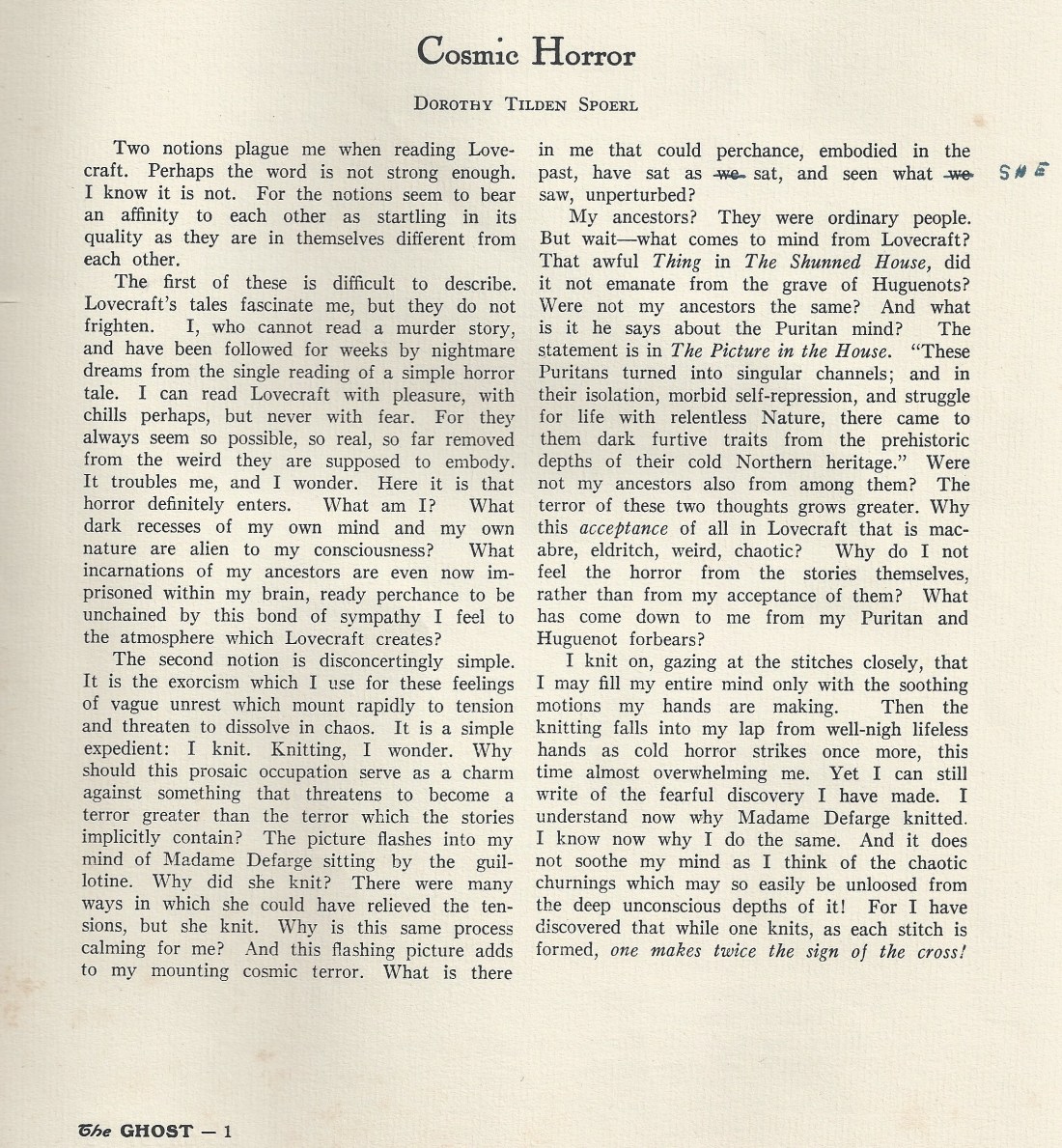
The Woman of Arkham Advertiser (A・Aの女): Article 01: In The Vault (2019) by Takata Yuki (高田 悠希)

It was the publicity attending this investigation which set reporters on the track of the Whateleys, and caused the Boston Globe and Arkham Advertiser to print flamboyant Sunday stories of young Wilbur’s precociousness, Old Whateley’s black magic, the shelves of strange books, the sealed second story of the ancient farmhouse, and the weirdness of the whole region and its hill noises.
—H. P. Lovecraft, “The Dunwich Horror”

The public knows of the Miskatonic Expedition through our frequent wireless reports to the Arkham Advertiser and Associated Press, and through the later articles of Pabodie and myself.
—H. P. Lovecraft, At the Mountains of Madness

As was only natural under the circumstances, this piquant debating finally got into print in the form of letters to the Arkham Advertiser; some of which were copied in the press of those Vermont regions whence the flood-stories came.
—H. P. Lovecraft, “The Whisperer in Darkness”

Lovecraftian manga have been undergoing a recent renaissance in Japan, with the critically acclaimed reception of Tanabe Gou’s adaptations of At the Mountains of Madness, “The Hound,” “The Colour Out of Space,” and most recently “The Call of Cthulhu,” all of which have been or are being translated and published in foreign language editions: Spanish, Italian, French, German, English, etc. Other popular adaptations include the Cthulhu no Yobi Koe series by Chuuou Higashiguchi (中央東口), and related manga include the Minase Yomu and the Really Scary Cthulhu Mythology (水瀬陽夢と本当はこわいクトゥルフ神話) series by Yoshihara Masahiko (吉原雅彦), and the many Zone of Cthulhu manga released by the SAN-EI Corporation (三栄)—which includes The Woman of Arkham Advertiser (A・Aの女) series by Takata Yuki (高田 悠希).

The conceit of the series is simple: Alice Allan is a cub reporter for the Arkham Advertiser, the local newspaper that appears in several of Lovecraft’s stories, and her “cases” cover a number of Lovecraft’s stories, both Mythos and non-Mythos, as set around Arkham. The result is a series of adaptations with a twist: we get to see the stories from a new perspective, that of a young newspaperwoman investigating the odd happenings. The series is categorized as a seinen (青年漫画), aimed at young men (18-30s), being more realistic and less action-packed than manga like One Piece or Dragon Ball, but readers of all genders and ages can appreciate it.

Chibi
Chibi version of Billy, a supporting character.

The adaptation is played seriously, but with more than a few laughs thrown in, the figures sometimes reduced to small chibi-style exaggerated figures to emphasize the one-off joke, familiar from manga like Shirow Masamune’s original Ghost in the Shell. The translation by Amimaru Translation and Localization Services Ltd. is mostly solid, although every now and again a joke may fail to land due to some cultural crossing of wires.

The small details and stark contrasts in the illustrations really shine though. Takata Yuki has worked hard to express the America of the 1920s, full of newsboys and the transition from the small industrial city of Arkham to out-of-the-way rural community of Peck Valley is like traveling back in time. Done in simple black-and-white, the bright outside scenes are given white backgrounds, while the moment the intrepid reporters step into the vault, the page is dominated by huge splashes of stark black, a very effective presentation that accentuates the emotional response of Alice Allan and her associate Billy.

Alice herself is the major focus and driver of the plot. She desires to prove herself as a reporter, and this is her first real opportunity to do so, by looking into the morbid details around the mysterious death and quick burial. While her enthusiasm is sometimes played for laughs, especially when contrasted against her long-suffering friend Billy, it is very effective at cutting right to the heart of Lovecraft’s story.

The story is not exactly a straight adaptation; Takata Yuki wisely doesn’t attempt to mimic the style of Lovecraft’s prose, and takes a few liberties with the ending, hinting at this being a small piece of a bigger picture that the reporters know they can’t quite see yet. Which works very well; Alice Allan is an engaging, energetic, enthusiastic protagonist, and starting slow with one of Lovecraft’s more low-key stories as their first “case” was a wise decision on the part of Takata Yuki.

The Woman of the Arkham Advertiser is available in Japanese on Kindle, and in English on Manga Planet subscription service.


Bobby Derie is the author of Weird Talers: Essays on Robert E. Howard & Others (2019) and Sex and the Cthulhu Mythos (2014).
“The Tree-Men of M’bwa” (1932) by Donald Wandrei

I recently saw a newer and better Wandrei tale, The Tree-Men of M’Bwa, which he should have no difficulty selling to either Bates or Wright.
—August Derleth to H. P. Lovecraft, 14 Aug 1931, Essential Solitude 1.360

[…] I must congratulate you on the novel & original cosmic thrills, & the extremely effective climax, of The Tree-Man. I surely hope this has found—or will find—favour with the editorial fraternity.
—H. P. Lovecraft to Donald Wandrei, 25 Sep 1931,
Letters With Donald and Howard Wandrei and to Emil Petaja 271

“The Tree-Men of M’bwa” by Donald Wandrei was published in the February 1932 issue of Weird TalesIt is neither explicitly a tale of the Cthulhu Mythos nor not a Mythos tale. As with “The Fire Vampires” (WT Feb 1933), Wandrei makes no specific reference to Cthulhu, the Necronomicon, etc. But “The Tree-Men of M’bwa” involves some very Lovecraftian elements, passing references to Atlantis and Mu, and uses the incredibly ambiguous term “Evil Old Ones.” The ambiguity has helped ensure the general obscurity of the story: it has never been published in any English-language Mythos anthology. Indeed, it would probably not be considered part of the Mythos at all except that it was posthumously adopted as part of the Mythos by the Call of Cthulhu Roleplaying Game, appearing as part of the “African Mythos” in works such as Malleus Monstrum (2006), Secrets of Kenya (2007), and The Masks of Nyarlathotep Companion (2014).

The desire to incorporate “The Tree-Men of M’bwa” into the Mythos likely has less to do with the relative merits of the story than the general lack of Mythos fiction dealing with Africa in general. Lovecraft ghost-wrote “Winged Death” for Hazel Heald and “Imprisoned with the Pharaohs” for Harry Houdini, but there are extraordinarily few stories from the first generation of Mythos-writers set in Africa, unless you count Robert E. Howard’s adventures of Solomon Kane, which do not deal with the Mythos directly.

Even then, there is nothing particularly special about this story that separates it from any other weird tale set in Africa and that doesn’t directly contradict any other bit of Mythos-lore, except that Donald Wandrei was part of the circle of Lovecraft’s correspondents and did write at least one actual Mythos story. Hugh B. Cave’s “The Cult of the White Ape” (Weird Tales Feb 1933) might as easily have been borrowed into the Mythos, but as Cave corresponded only briefly with Lovecraft it is generally forgotten, whereas “The Tree-Men of M’bwa” has gone on to its weird literary afterlife.

In context, “The Tree-Men of M’bwa” is a typical “mysteries of darkest Africa” story, where intrepid great white hunters and explorers (led by at least a dozen of the indigenous people who have been there their entire lives and know pretty much where everything is and why you don’t want to muck about with the crashed aliens, etc.) stumble into some unknown peril. The focus of these stories is almost solely on the white people who are telling the narrative, and center it on themselves; the black people are often little more than an afterthought, and Wandrei does not vary from formula.

Most of the country we were going through was unexplored. Even today there’s no telling what may turn up in some out of the way spot. They haven’t begun to exhaust the mysteries of Africa.
—Donald Wandrei, “The Tree-Men of M’bwa”

How much actual research Wandrei did for the story is debatable. The geography is roughly correct, if one makes general allowances (i.e. that the fabled Mountains of the Moon” referred to are the Rwenzori Mountains of Uganda, and “Kola” is actually “Kole,” a town closer to the border) it’s safe to say that he at least glanced at a map. I have not yet found a people in the region named “Neguchi” or similar; either Wandrei picked the name out of an obscure text or made it up. The word “M’bwa” is Swahili, and means “dog.” Whether Wandrei knew that or not is, again, unknown; he may have simply liked the sound of it as sufficiently alien to English.

“M’bwa” is the only African named in the story. The indigenous guides are only the “Neguchi boys,” which turn of phrase could be read as discriminatory when applied by a white man to a group of black men in the 1930s. Africa itself is veritably a character in this story, hostile and alien to the white men who seek to probe its mysteries; Wandrei emphasizes early on:

Why my boat had stopped in this filthy hell-hole on the Gold Coast, I don’t know, but here we were overnight and I had gone ashore to break the monotony of scalding days at sea. It wasn’t much imporvement, even after sunset. Fierce, steamy heat that made you boil with sweat. An unpleasant smell, half-native, half-decayed vegetation, that every village seemed to have. (ibid.)

There are a couple of interesting details to the encounter with M’bwa and the Whirling Flux. The first is the number of trees—despite this being an “unexplored” part of Africa, it is quite evident that there have been at least twenty “explorers” there before him, and the indigenous peoples seem well-informed of the spot in general. The earliest visitors were an Atlantean, an Egyptian, and a Roman—in the 1930s, that would implicitly mean “three white men,” although such racial divisions would have been meaningless in ancient Rome or Egypt. The one tree-man that speaks to Daniel Richards did so apparently in English, suggesting he too was white.

The word zombie is never used in the story to refer to M’bwa, although the dead man has many of the attributes of the revenant; the word was just coming into vogue with the publication of William Seabrook’s The Magic Island (1929), and the film White Zombie (1932) which it inspired; many writers at Weird Tales penned zombie stories during this period, and readers would have been aware of that, even without a voodoo connection.

“The Tree-Men of M’bwa” is arguably not as bad as “The Cult of the White Ape” or “Mother of Serpents” (1936) by Robert Bloch in terms of its portrayal of black people, but neither did Wandrei go out of his way to give an informed or sympathetic portrayal either. It is a white person’s story, written by a white person for what would presumably be a white audience, and it reads like that. That it has been seized on by the Call of Cthulhu roleplaying crowd as a component of the “African Mythos” speaks more to the general paucity of such material available than to any particular merit of the story itself.

Donald Wandrei’s “The Tree-Men of M’bwa” was first published in Weird Tales (Feb 1932); it was reprinted in Wandrei’s collections The Eye and the Finger (1944, Arkham House) and Don’t Dream: The Collected Horror and Fantasy of Donald Wandrei (1997, Fedogan & Bremer; paperback edition 2017). The long gap between publications is one reason why this story has remained so obscure for many decades, but now that it is more available perhaps it will find a new audience.


Bobby Derie is the author of Weird Talers: Essays on Robert E. Howard & Others (2019) and Sex and the Cthulhu Mythos (2014).
Kthulhu Reich (2019) by Asamatsu Ken (朝松健)

Yoth Tlaggon
A mysterious God. The first time the name was written was in a letter form H. P. Lovecraft to C. A. Smith, a close friend and associate of the American horror writer, dated April 4th, 1932. However, Father Lucio Damiani published a monograph on Ancient History entitled Visions of Kusha in which he writes that “In the days when Atlantis was still called Kusha, and Lemuria known as Shalarali, Yoth Tlaggon was named one of the Nine Princes of Hell.” Damiani could have had no knowledge of the Lovecraft letter, for it was not publsihed until 1970.
—Asamatsu Ken, Kthulhu Reich 228

Yoth-Tlaggon—at the Crimson Spring.
Hour of the Amorphous Reflection.
—H. P. Lovecraft to Clark Ashton Smith, 4 Apr 1932,
Dawnward Spire, Lonely Hill 360

Kthulhu Reich (2019) by Asamatsu Ken (朝松健) is a novel from Kurodahan Press. It is comprised of seven interrelated short stories published between 1994 and 1999, and is presented here in English by translator Jim Rion. Each of the stories involves Nazi Germany, and involves the Cthulhu Mythos in some way, and though they do not form a single consistent narrative, together form a kind of occult history of World War II and its legacy.

Lovecraft died in 1937; he lived to see the rise of Mussolini and the fascists in Italy and Adolf Hitler and the Nazi party to power in Germany, and the opening shots of what would become World War II in the Japanese invasion of Manchuria and the Italian invasion of Ethiopia. Though he did not know it, Lovecraft also became aware of the opening stages of the Holocaust as Hitler’s government instituted laws discriminating against Jews in Germany, a practice which the antisemitic Lovecraft had mixed feelings with—approving as he did of Nazi Germany’s ultranationalism, but not their unscientific racial discrimination. He never lived to see how wrong he was regarding Hitler and Mussolini, never saw the true horrors of the Holocaust.

World War II has become fertile ground writers of weird and fantasy fiction; the Nazi interest with the occult and esoteric, based partially on truth, as detailed in books like Nicholas Goodrick Clarke’s The Occult Roots of Nazism (1993) and Kenneth Hite’s The Nazi Occult (2013). Works like Le Matin des magiciens (1960) popularized the idea of the Nazi occult for a new generation, and have led to works like the Indiana Jones adventures Raiders of the Lost Ark (1981) and Indiana Jones and the Last Crusade (1989), the Hellboy comic books and film, and innumerable other appearances.

“Hitler’s a nut on the subject. He’s crazy. He’s obsessed with the occult.”
—Musgrove, Raiders of the Lost Ark

This has been true for the Cthulhu Mythos as well. Herbert West famously found employment in Nazi Germany in Brian McNaughton’s “Herbert West—Reincarnated Part II: The Horror in the Holy Land”; Charles Stross’ The Atrocity Archives (2004) deals with the occult fallout of the Nazi’s Mythos-delvings; Mike Mignola and Jim Robinson have Hellboy team up with Starman and Batman to face Neo-Nazis (and classical Nazis!) summoning Lovecraftian horrors in Batman/Hellboy/Starman (1999).

LovecraftKnew
Art by Mike Mignola, script by Jim Robinson, Batman/Hellboy/Starman #2 (1999)

The Mythos occult WWII angle had become essentially a Mythos subgenre with the release of the roleplaying games World War Cthulhu (2013, Cubicle 7) and Achtung! Cthulhu (2013, Modiphius), which in turn have led to new anthologies like World War Cthulhu (2014, Dark Regions), and even video games.

Which is a long way to say that Asamatsu Ken was a bit ahead of the curve when he first published these stories in Japan in 1994-1999. Some of the stories are eerily prescient as far as capturing the essential dynamic of the post-2000 Mythos WWII craze. Magic is real, the Nazis—deluded and arrogant as they might be, playing with forces they don’t understand—are often portrayed as a genuine occult threat to the entire world. The action is often pulpy, but Asamatsu Ken shows real research in trying to make sure the names, dates, and equipment are correct. The individual stories are like separate, individual episodes taken from a long, drawn-out conflict, but they are constructed with all the care of a good hoax. Mythos references are typically slid in alongside real occult names and texts, the Nazi’s actual activities provide the context for the stories.

In the first place, it is important that we realize that the term “racist,” as used today, has strong post-WWII connotations. We have become much more liberal and open-minded following the dreadful experiences and revelations of the second World War, and anyone espousing extreme anti-ethnic views today must surely be a reactionary, a redneck, or a nut. “Racism” has become extremely unpopular, and we associate the term with the horrors of Auschwitz and Buchenwald.
—Dirk W. Mosig, “Was Lovecraft a Racist?” in Crypt of Cthulhu #98 (1998) 4

One of the shadows looming over Kthulhu Reich (or any other Mythos WWII novel or story) is how it addresses the nature of racism and antisemitism in general, and the Holocaust in particular. No nation in the conflict was free from prejudice and discrimination, but the attempts at genocide which were such a hallmark of WW II present a subject that writers have to decide how to deal with. It is perhaps appropriate that Asamatsu Ken chooses to begin the collection with “The Corporal’s Self-Portrait”—a story which would otherwise seem a bit out-of-place in the anthology, dealing as it does with a contemporary postwar Japan and touching on the attitudes towards racism and how they’ve changed.

“I can take the Koreans and the Chinese. They’re like us, at least. But the day all these Thais and Vietnamese, Cambodians and Filipinios, and Indians and Iranians and Iraqis shoed up, this place became unbearable.”

“Hey, come on… That’s really racist!” I chided, unable to must any real force.

Hirata ignored me.

“They come here to Japan and take the jobs honest students used to be able to count on. Then they send our valuable yen back to their own countries. And then there’s our women! They seduce our women and sully the pure blood of Yamato!”

“Cut it out, you’re talking crazy!”

—Asamatsu Ken, Kthulhu Reich 7

Hirata doesn’t stop. The narrator at least protests, though his words fall on deaf ears. The incident gains sinister connotations as the story unfolds, much like the film Max (2002), yet the reader is shown this angry young man, whose life parallels that of the eponymous Boys from Brazil, and he can muster only ineffective rebukes to his obvious and appallingly vocal prejudice. Asamatsu Ken does not turn a blind eye to the horrors that the Nazis perpetrated. Nor to the real threat that racism and prejudice still form.

Jim Rion deserves accolades here for an excellent translation on what must have been a difficult job—combining as it does real historical elements, occult jargon, Japanese cultural references, the Cthulhu Mythos, the unusual episode “April 20th, 1889” that consists of a series of found documents, and some really well-done action scenes in “The Mask of Yoth Tlaggon.”


Bobby Derie is the author of Weird Talers: Essays on Robert E. Howard & Others (2019) and Sex and the Cthulhu Mythos (2014).
“Le Pornomicon” (2005) by Logan Kowalsky

Eldritch Fappenings

This review deals with a work of pornography, and the history of erotic art and writing. As part of this review, selected art with depictions of genitalia and/or sexually explicit contact will be included.
As such, please be advised before reading further.


Pornomicon . . . derived from the Greek Word “Porne”, meaning prostitute. But the word on the whole means nothing to me.
—Logan, The Pornomicon5

RF_Logan_01Le Pornomicon is a 2005 French-language one-shot homoerotic horror comic book created by writer/artist Logan Kowalsky (credited here simply as “Logan”) by H & O Editions; it was translated into English by Class Comics in 2006. While long out of print, it is still available as an ebook from Class Comics’ website.

The first known erotic comic based on Lovecraft’s Mythos was “Tales of the Leather Nun’s Grandmother” in the underground comix Tales from the Leather Nun (1973, Last Gasp), and ever since there has been a steady addition to the oeuvre of erotic Mythos comic books and graphic novels. For the most part, however, these works are typically created for a heterosexual audience, with women as the primary focus of all sex acts and male-on-female (or, increasingly, tentacle-on-female) pairings making up the majority of all sex acts. A rather smaller cross-section of such works dip into LGBTQ relationships or focus extensively on non-heterosexual intercourse.

One of the first of these was John Blackburn’s Coley series (1989-1999), which featured the bisexual Coley Cochran, who occasionally encountered the servants or descendants of the Old Ones; Noé and Barreiro’s El Convent Infernal (The Convent of Hell, 1996) includes several lesbian scenes, as well as a sexually-explicit copy of the Necronomicon and a notorious tentacle sex scene. The latter work might well have been part of Logan’s inspiration for Le Pornomicon, focusing as it does on the eponymous tome and penetrative sex featuring penis-headed tentacles.

In this respect, readers may suspect an influence from Japanese hentai on one or both works, and there’s probably some truth to that. However, given the focus on size, penetration, and masculinity in Le Pornomicon, the tentacle works well to foster the visual rhetoric of the story when it makes an appearance, taking things from the cartoonishly oversized to beyond anything humanly possible.

The visual grammer permitted by the tentacle is extremely useful to the pornographer. With no restriction on length, it permits penetration without blocking the view. It can also be used as a form of restraint, permiting multiple penetration, sexualised bondage and east of access. Best of all for the tentacle as a pornographic device, while it may often look suspiciously like a penis, to the extent of possessing a foreskin or glans, or even ejaculating upon climax, it is not a sexual organ by definition.
The Erotic Anime Movie Guide 58

It perhaps needs to be said that there is not a single homoerotic aesthetic; the gamut of LGBTQ+ works encompasses a vast range of body types, relationships, preferences, etc. Le Pornomicon tends toward burly, over-muscled, often hairy subjects; the genitals are cartoonishly oversized and the holes are elastic, the relationships are almost entirely purely sexual with no romantic bonds, blushing nervousness, consideration of feelings, etc. While some folks might reductively say “Well, it’s porn,” not all porn is like that. Not even all homoerotic Mythos fiction; “Herbert West in Love” (2012) by Molly Tanzer and “Herburt East: Refuckinator” (2012) by Lula Lisbon both exhibit very different aesthetics, despite both focusing on the homoerotic potential of “Herbert West–Reanimator.”

Part of the reason Logan focuses so slightly on the human relationships is because the main character of the book is not human, but the eponymous Pornomicon and its associated Mythos. The story is set across two time periods, two brief encounters united by the presence of the Pornomicon, and in this way it is reminiscent of the Loc-Nar in the animated film Heavy Metal (1981). Like that object, the presence of the Pornomicon is associated with mental and physical corruption, introducing elements of body horror and the monstrously alien as the humans are possessed, transformed, and eventually subsumed by inhuman carnality. In the universe of the Pornomicon, Cthulhu and Yog-Sothoth are inherently sexual beings, but unlike in the works of Lovecraft or other writers who focus on these entities having sexual relations with human beings to spawn progeny, there is no focus on reproduction. Cthulhu does not impregnate these burly male characters, they become a part of him.

Which could be read as a form of homosexual panic, or a reflection of the implicit bias against sexuality in slasher films where couples who sneak off for a bit of illicit fun receive a brutal comeuppance as they are macheted to death—although it seems likely that neither of these was consciously intended. Rather, Logan offers a pornographic horror comic with no happy ending, the encounters with the Pornomicon are by their nature lustful and end badly for those who tamper with the Great Old Ones, but that would probably be true for anyone of any gender or sexuality. The unbiased nature of Cthulhu and Yog-Sothoth in taking all victims equally only appears to be biased because the story focuses exclusively on homosexual men.

Logan also takes visual inspiration from Mythos-related works. In particular, the background of page 10 is annotated “Apres Mike Mignola” and directly references the visual imagery in the Hellboy: Seed of Destruction (1994) series.

Above, left: Mike Mignola, Hellboy: Seed of Destruction #3.
Above, right: Logan, The Pornomicon.

Sometime after the publication of Le Pornomicon, Logan began a series of illustrations titled The Pornomicon Legacy, but so far there is no indication of another volume forthcoming.


Bobby Derie is the author of Weird Talers: Essays on Robert E. Howard & Others (2019) and Sex and the Cthulhu Mythos (2014).