Posts

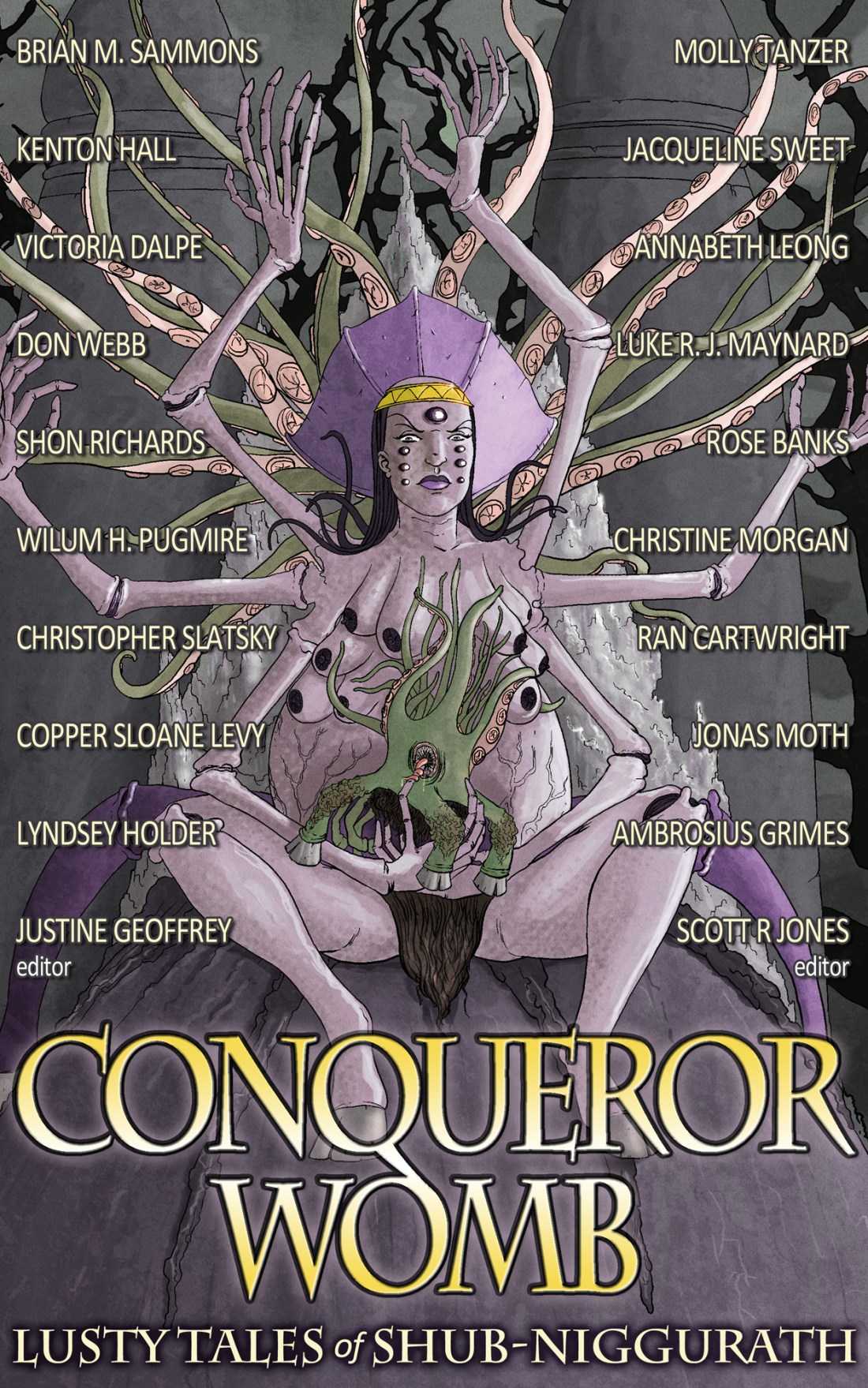
“This Human Form” (2014) by Lyndsey Holder

(A BUZZING IMITATION OF HUMAN SPEECH)

Iä! Shub-Niggurath! The Black Goat of the Woods with a Thousand Young!
—H. P. Lovecraft, “The Whisperer in Darkness”

You call me black, but I am beyond black. I am the space between the stars, the darkness that lies on the edge of your dreams, the sound of death in small spaces.

You say I am from the woods, but my woods contain no trees or birds, no peaceful sounds of wind and stream, no quiet rustle of delicate creatures. My forest pulsates, vibrates, glistens. […]

You call me a goat, and sometimes I am.
⁠—Lyndsey Holder, “This Human Form” in Conqueror Womb: Lusty Tales of Shub-Niggurath

More of a prose-poem or an invocation than a short story, Lyndsey Holder’s “This Human Form” reminds me of “The Elder Sister-like One, Vol. 1” (2016) by Pochi Iida (飯田ぽち。)“Red Goat, Black Goat” (2010) by Nadia Bulkin, and “Cthulhu Sex (ahem!)—a poem—” (1998) by Katherine Morel. Works that take inspiration from the Mythos, but don’t lean heavily on them; they forge their own lore, not bound by any convention of the Mythos and yet still strongly connected to it thematically.

Holder’s first-person account is only implicitly that of the Black Goat of the Woods with a Thousand Young, reveling more in sensation and imagery than any concrete connections to any other story in the Mythos. The connection is stronger by association: the story is in a Mythos anthology, which makes the imagery more apparent. But stick this story in a dark fantasy or horror magazine and would people still get it? Would their minds still make the connection? Probably not, if they weren’t already initiated in Mythos-lore and familiar with Shub-Niggurath, her aspects and attributes. But they could still enjoy the story.

“This Human Form” is exemplary of how in a largely disorganized way, the Mythos has evolved organically into something which the SCP wiki has done by considered design. While it has been said there is no canon to the Mythos, it would be more accurate to say there is no one canon. Certainly, Lovecraft’s Dreamlands stories are fairly consistent in themselves, as are Ramsey Campbell’s Severn Valley tales, Brian Lumley’s Titus Crow stories, W. H. Pugmire’s Sesqua Valley, Charles Stross’ the Laundry Files, etc. Peter Rawlik has curated a canon centered around “Herbert West—Reanimator,” and Shane Ivey has spent considerable time doing much the same with the Delta Green setting.

Most of these works are independent, interconnected, sometimes conflicting. Myths do that. Conflict, arguably, might even be essential to the Mythos: it forces the reader to engage with it, to juggle different concepts, maybe try to reconcile them.

There is on thing you do not call me: mother. My body has sent a thousand children into this world, a thousand mewling, crawling things, suckling and whining, slithering down silvery dream-threads into the soft comfort of your warm beds.
—Lyndsey Holder, “This Human Form”

It is rare to get a first-person take from a Mythos entity, although far from unknown. Neil Gaiman famously did it with I, Cthulhu, or, What’s a Tentacle-Faced Thing Like Me Doing in a Sunken City Like This (Latitude 47° 9′ S, Longitude 126° 43′ W)? (1987) (later publications have quite reasonably shortened this to “I, Cthulhu”). Gaiman’s take, of course, is a quiet taking of the piss. The idea of Cthulhu addressing the user is the main joke. For Mythos entities that are largely defined as ineffable and unknowable, the first-person narrative rather kills the mystery…unless, as Holder does, the meat of the text is salacious, sensation-driven, and suggestive. Making telling feel like showing.

Lyndsey Holder’s “This Human Form” was published in Conqueror Womb: Lusty Tales of Shub-Niggurath (2014). Her other Mythos fiction includes “Parasitosis” (2015) and “Chosen” (2015).


Bobby Derie is the author of Weird Talers: Essays on Robert E. Howard & Others (2019) and Sex and the Cthulhu Mythos (2014).

“I Wore The Brassiere Of Doom” (1986) by Sally Theobald

He was a great reader, mostly of paperback westerns and dime romance novels. All this is well known, but what many readers probably do not ralize is that Howard wrote (under various pseudonyms) several stories and “confession” pieces for magazines of that type. Two of my own favorites were “Showdown at the OK Abyss” (written as “Hank Theobald”) and “I Wore the Brassiere of Doom” (under the by-line “Sally Theobald”). Sonia may have assisted him in some of these, but she would never admit it.
—”Lovecraft as I seem to Remember Him” (1983) by “F. Gumby Kalem” in Crypt of Cthulhu14

Those who chanced to read F. Gumby Kalem’s memoir “Lovecraft as I seem to Remember Him” (Crypt of Cthulhu 14) may recall Kalem’s surprising revelation that HPL, too, wrote for the confession magazines under the transparent pen-name Sally Theobald. Much checking with pulp colectors has turned up a copy of one of these tales, “I Wore the Brassier of Doom.” You will have to admit that Lovecraft could cover his tracks when he wanted to. But for Gumby Kalem’s information, it is a safe bet this work would never have been identified and restored to its rightful place among HPL’s oeuvre.
—”Scandal Sheet” (1986) by Robert M. Price in Lurid Confessions

“I Wore the Brassiere of Doom” is a playful hoax perpetrated by Robert M. Price, editor of both Crypt of Cthulhu and Lurid Confessions (among other ‘zines). The idea that a pulp writer might spread their wings and splash another field of fiction is not far-fetched—many did. Robert E. Howard wrote for example wrote weird fiction, westerns, detective, historical adventure, and spicy stories for the pulps; he tried to write science fiction and confession-style pulps too.

For spicy pulps in particular, Howard adopted the pseudonym “Sam Walser”—and Lovecraft was famous for his own pseudonyms, mostly in the amateur press, such as “Lewis Theobald, Jr.” which was his byline with Winifred Virginia Jackson (“Elizabeth Berkeley”) for “The Green Meadow” and “The Crawling Chaos.” Price, who wrote both “Lovecraft as I seem to Remember Him” and “I Wore the Brassiere of Doom,” was thus careful in picking a realistic pseudonym for the Providence pulpster in “Sally Theobald.”

The hoax was so convincing, that some folks actually fell for it.

Once I wrote a fake Lovecraft tale, as if he had written it for the confession magazines, “I Wore the Brassiere of Doom,” as by Sally Theobald. Without meaning to, I tricked a French Lovecraft scholar into listing it in his Lovecraft bibliography!
“Robert M. Price Interview” (2010)

The story was translated as “Le Soutien-Gorge Ensorcelé” (“The Enchanted Bra”) and published in Pulps No. 2 La Nurserie de l’Épouvante (“The Nursery of Terror,” 1987), a collection of translated pulp reprints, as by Lovecraft.

The broader point that the backstory “I Wore the Brassiere of Doom” emphasizes is not about the gullibility of readers or editors who fell for the hoax; Price’s tongue-in-cheek trail of breadcrumbs is transparent to any Lovecraft scholar (HPL did not read westerns or dime romance novels, no dates or titles of magazines are given, etc.) before they read the first line of the story. What is the point is that there was never anything stopping Lovecraft (or any other writer) from using a pseudonym of a different gender—and this presents a particular challenge at times when seeking to focus on works by female writers in pulps or weird fiction. While it is not clear that there were any women who wrote Mythos fiction under male pseudonyms (or vice versa) before the 1980s, it would not be surprising to find a few such works lurking in odd fanzines and forgotten pulps. Certainly there are plenty of examples of such genderbending nameplay in other genres, probably most famously James Tiptree Jr. (Alice Bradley Sheldon).

The story itself is not a pastiche of Lovecraft’s style, but certainly a pastiche of the confessional, a pulp genre inaugurated by True Story Magazine (1919- ). The moralistic atmosphere of these confessionals generally has women expressing grief for how they erredusually by engaging in inappropriate relationships, having children out of wedlock, drinking or drugs, etc.—providing a taboo thrill to the reader at being able to re-live their adventures while at the same time unsubtly re-affirming the decidedly misogynistic attitudes of the first half of the 20th century.

The story of a young and well-endowed country girl goes to the big city for the first time, intent on making it as a modern business woman is meat for a thousand stories…except in this particular Macy’s, she finds something strange:

As I placed the bra back in its box I noticed something else: the odd seam design. Across each cup, radiating out from the center, was a five-pointed star with an oval or eye-shape in the center.  thought little of this, except to guess that the design might have something to do with the nice way the bra seemed to uphold and almost carress me.
Lurid Confessions 31

The implication, of course, is that this is the Elder Sign as used by August Derleth in his own Mythos fiction:

Elder-Sign-Dearleth

The new brassiere certainly attracts a good bit of attention, and if there’s a fault in Price’s story, this is where it comes in, trying to channel some of the inherent racism of “The Call of Cthulhu” combined with the inherent sexism of the confession pulps:

Oh, I admit, soem of my gentlemen callers were not exactly dreamboats, but in a city populated by herds of rat-faced mongrels and ruffians, one had to make do. And if a girl waits until Mr. Perfect comes along, she’s liable to wind up an old maid. (ibid.)

Price would touch on similar issues in “Nautical-Looking Negroes” (1996) by Peter Cannon & Robert M. Price, and there is certainly something to be said for attempting to accurately capture the atmosphere of racism of the time and of the suggested author; whether Price goes too far or just far enough is a bit subjective, it is certainly not necessary to the story, but does help to tie it in a little closer to Lovecraft’s life and fiction.  While Lovecraft did not work racism into everything he wrote, the language Price uses here is directly influenced by Lovecraft’s.

Price, of course, is all about working in the little references to Lovecraft based on what little was published of the Providence pulpster’s own romantic life. When he wrote:

We would sit on the couch smootching and my sate would say something romantic like, “My dear, you have no idea how much I appreciate you.” Then his hand would begin to drift from my shoulders southward to hover above my breast. (ibid. 32)

The line was lifted wholesale from the memoir of Lovecraft’s former wife, Sonia Davis, The Private Life of H. P. Lovecraft (1985). Price makes a few more little quips like this (“The crinoid thing (or was it an echinodern? High school biology had scarcely prepared me for this!“), Lurid Confessions 34) as the story progresses toward an ending reminiscent of Lovecraft’s “The Diary of Alonzo Typer,” albeit with one last, final and perhaps thematically appropriate twist as Sally gives as a glimpse what might be Yog-Sothoth…

The original story has never been reprinted since Lurid Confessions, except in the French translation, but Robert M. Price allowed it to be republished by the Lovecraft eZine in 2013. So if you wish, prepare yourself and read “I Wore the Brassiere of Doom.”


Bobby Derie is the author of Weird Talers: Essays on Robert E. Howard & Others (2019) and Sex and the Cthulhu Mythos (2014).

“The Man Who Sold Rope To The Gnoles” (1951) by Margaret St. Clair

A HYMN OF HATE

Margaret St. Clair, of Berkeley, California, writes: “I’ve been a good quiet uncomplainng reader of WEIRD TALES for about ten years—but the prospect of another story by Edmond Hamilton moves me to hysterical outcry. He makes me want to scream and bite my nails—’captured thirty-six suns’ indeed! His style is nothing but exclamation marks; his idea of drama is something involving a fantastic number of light-speeds; he is, in the words of one of my favorite comic strip characters, flies in my soup. He is science-fiction at its worst: all WEIRD TALES needs to make the science-fiction atmosphere perfect is a letter from Forrest J. Ackerman and a story by Hamilton. Oh, and another gripe—I dislike the blurbs you are printing at the first of the stories. They are just a waste of space. I hate vampire and werewolf stories—my blood refuses to congeal for any number of undead clammily hooting about. There was a time when I could be made to shiver by the mention of garlic, but now it’s just something to put in salad. Things like Shambleau are what I like. As long as WT prints stories by Clark Ashton Smith, however, I’ll keep on reading it. His tales have a rounded jewel-like self-containedness that is, artistically, a delight. … And Smith’s drawings are, I think, by far the best in the magazine. … In conclusion, Jules de Grandin is a pain in the neck.”
—WEIRD TALES, June 1934

Margaret St. Clair could be considered a peripheral member of the gang of writers commonly called “the Lovecraft Circle.” She met Clark Ashton Smith while a student at the University of California at Berkeley, and began corresponding with him as early as 1933. (Selected Letters of Clark Ashton Smith 208n1) St. Clair broke into the pulps after World War II, and her stories graced the pages of Weird Tales beginning in 1950, one of the last new voices to find a home at the magazine before its inevitable demise.

“The Man Who Sold Rope To The Gnoles” (first published in The Magazine of Fantasy and Science Fiction, Oct 1951), is one of Margaret St. Clair’s most famous stories. Her tale is inspired by and directly references Lord Dunsany’s own famous jocular fantasy “How Nuth Would Have Practiced His Art Upon the Gnoles” (The Book of Wonder, 1912). Dunsany was a substantial influence on Lovecraft’s early fiction, and some later writers have worked to tie the Lovecraft Mythos more directly to Dunsany, such as “My Boat” (1976) by Joanna Russ and “Meet Me on the Other Side” (2002) by Yvonne Navarro.

Margaret St. Clair is drawing directly from Dunsany here, pursuing her own homage to the British master of fantasy instead of trying to tie it into anything larger, expanding his Mythos but staying true to the spirit of the original story. There is something essential of Postwar America in the piece, a lightness of tone and a focus on money and its pursuit, with an ironic dark twist at the end reminiscent of Charles Addams’ The Addams Family and Robert Bloch’s light-hearted Mythos story “Philtre Tip” (1961).

Nuth looked on for a while from the corner of the house with a mild surprise on his face as he rubbed his chin, for the trick of the holes in the trees was new to him; then he stole nimbly away through the dreadful wood.
—Lord Dunsany, “How Nuth Would Have Practiced His Art Upon The Gnoles”

The gnoles were watching him through the holes they had bored in the trunks of trees; it is an artful custom of theirs to which the prime authority on gnoles attests.
—Margaret St. Clair, “The Man Who Sold Rope To The Gnoles”

Dunsany has inspired any number of writers, Lovecraft not least among them. The error most writers make is trying to write like Dunsany, to capture something of his style. Like pasticheurs who ape the cosmetic aspects of Lovecraft’s prose and miss the deeper stylistic structures, themes, and philosophical underpinnings which make his fiction work. St. Clair here does not attempt pastiche, but homage: she pays reverence to Dunsany’s story and the details he gave, while writing her own, in her own voice.

Which is why this is one of the few “Dunsanian” stories which works.

It is not by any stretch of the imagination a story that Dunsany would have written, which is half the point. J. R. R. Tolkien once criticized Dunsany’s story “The Distressing Tale of Thangobrind the Jeweller”, also published in The Book of Wonder, lamenting:

Dunsany at his worst. Trying so hard for the shudder. But not for a moment making the tale ‘credible’ enough

Whether or not Dunsany was trying for a shudder or a chuckle, readers can decide for themselves. St. Clair by contrast was militantly angling for the lighter side, and the way in which she does so showcases, perhaps, how closely allied some of Lovecraft’s style of hinting was to Dunsany’s:

It was the parlor the gnole led him to. Mortensen’s eyes widened as he looked around it. There were whatnots in the corners, and cabinets of curiosities, and on the fretwork table an album with gilded hasps; who knows whose pictures were in it?
—Margaret St. Clair, “The Man Who Sold Rope To The Gnoles”

The juxtaposition of the Gnoles, strange and terrible as they are, having a very British or American-style parlor full of knickknacks and an album is the same sort of intimate contrast of “the fields we know” and the exotic and impossible which is such a hallmark of Dunsany’s early work. St. Clair’s leading question is in line with the unspoken horrors which Tolkien was so displeased with and which Lovecraft often used to such great effect: letting the reader’s imagination fill in the blanks.

The gnoles, it seemed, would be regular customers; and after the gnoles, why should he not try the Gibbelins? They too must have a need for rope. (ibid.)

“The Hoard of the Gibbelins” immediately proceeds “Gnoles” in The Book of Wonder, and St. Clair’s references to it in this story could have been a step toward stitching together some of Dunsany’s standalone stories into something like a larger Mythos, though she never pursued such a design. It is something readers of Lovecraft take almost for granted—didn’t Lovecraft borrow elements from Dunsany, Arthur Machen, Robert W. Chambers (and Chambers himself from Ambrose Bierce)?

Certainly Margaret St. Clair, who was reading Weird Tales so early and so long, knew what she was doing.


Bobby Derie is the author of Weird Talers: Essays on Robert E. Howard & Others (2019) and Sex and the Cthulhu Mythos (2014).

“Machines Are Digging” (2009) by Reza Negarestani

H. P. Lovecraft has an alarming but over-neglected passage about this holey space or ()hole complex (with an evaporative W) as the zone through which the Outside gradually but persistently emerges, creeps in (or out?) from the Inside. A complex of hole agencies and obscure surfaces that unground the earth and turn it to the ultimate zone of emergence and uprising against its passive planetdom and onanistic self-indulgence of the Sun with its solar capitalism. “Great holes secretly are digged where earth’s pores ought to suffice, and things have learnt to walk that ought to crawl.” (H. P. Lovecraft, The Festival)
—Reza Negarestani, “Machines Are Digging: Lovecraft and Poromechanics of Horror” in Songs of the Black Würm Gism (2009) 167

“Machines Are Digging” is an excerpt-cum-recension of a section of Reza Negarestani’s experimental novel Cyclonopedia: Complicity with Anomalous Materials (2008); the two texts are not identical, but represent different iterations of the same concept. The piece represents the crossroads between Negarestani’s philosophical horror and Lovecraft’s cosmic horror, the aesthetic point of contact where they come together and, while approaching the material from different angles, arrive at about the same conclusion.

Negarestani’s approach to horror fiction is with the same care, and to a degree with the same attitude, as writing an essay on philosophy or physics. The format and language of his work echoes that of a very intelligent post-graduate student engaging with concepts at a high level, a straight-faced presentation which is ever so delicately off, so that the reader isn’t quite sure whether the author is a genius or genuinely deluded. Even the select choice of word and phrase underlines the academic tendency to define and re-define a technical language for itself.

There is an art amounting to poetry in the suggestive but probably meaningless phrase, and that is the kind of texture that high-level philosophical works tend to have. “Solar capitalism,” for example—what does that mean? On the surface, it does not connect with any familiar phrase or concept. If you pick it apart to try and find meaning—ah, now the reader is playing Negarestani’s game. They’ve bought into the piece enough to start thinking about it, and once you do that you’re getting into the slightly-warped logic, the madman thinking where the view of reality is skewed, like the first step down the rabbit hole of a conspiracy theory.

Philosophical word-games aside, “Machines Are Digging” works in large part because there is something to the connection with Lovecraft that Negarestani talks about. When he writes:

According to Lovecraft, the realism of horror is built upon poromechanics. The poromechanical universe of Lovecraft or ()hole complex is a machine to facilitate the awakening and return of the Old Ones through convoluted compositions of solid and void. (ibid., 168)

He is, knowingly or not (always hard to tell with Negarestani; it’s tricky with any philosopher or madman to know whether they actually have some secret knowledge or are making shit up as they go along) echoing some solid critical scholarship regarding Lovecraft’s themes. Because Lovecraft did like big holes dug in the Earth and could not lie; the idea of underground caverns and large enclosed spaces feature prominently in stories such as “The Festival,” “The Rats in the Walls,” “The Transition of Juan Romero,” “The Horror at Red Hook,” “The Nameless City,” At the Mountains of Madness, etc. and even featured in essays such as “A Descent to Avernus.”

Critics have speculated on the whys and wherefores of Lovecraft’s fascination, from Jungian womb-symbols to shamanic thresholds between the waking and dreaming worlds; the latter a significant plot point in Alan Moore & Jacen Burrow’s Lovecraftian graphic novel Providence. Scott R. Jones compiled an anthology of tales based around the concept, titled Chthonic: Weird Tales of Inner Earth (2018)One of the collections of memories dedicated to Lovecraft is Caverns Measureless to Man (1996).

Which is a long way to say: Negarestani is on to something.

In pulp-horror fictions and cinema and in Lovecraft fiction, it is the abode of the Old Ones, worm-entities and the blob (petroleum) that surpasses the tentacled-heads in sentience and foreignness. R’lyeh is the every dream, motion and calculation of Cthulhu on the solid part of the earth’s body. (ibid., 173)

Whether or not you buy into what Negarestani is selling is something different. Few people fall headlong into philosophy, because the empirical world is quite a bit messier than the general truths espoused, and conclusions arrived at after torturous paragraphs of twisted logic sometimes don’t seem quite so significant and valid in the harsh light of day when your tea has grown cold. But sometimes, you can pull out some wonderful idea or turn of phrase buried in there, a little treasure to wonder at and turn over in your head. “Machines Are Digging” is, regardless of its other merits, a source of inspiration.

In poromechancial cosmology of Lovecraft, exhumation is undertaken and exercised by units called Rats. In fact, ‘the dramatic epic of the rats’ (Lovecraft) can be found in their act of exhuming surfaces, solid bodies and structures resisting perforation. Rats are exhuming machines, not only full-fledged epidemic vectors but also ferociously dynamic lines of ungrounding. (ibid., 175)

Now who can argue with that? I think we’re all indebted to Gabby Johnson for clearly stating what needed to be said. I’m particularly glad that these lovely children were here today to hear that speech. Not only was it authentic frontier gibberish, it expressed a courage little seen in this day and age.
—Olson Johnson, Blazing Saddles (1974)

“Machines Are Digging” is experimental fiction, or at least is not concerned with a traditional narrative or format. It is perhaps as close as any writer has come to something like genuine Lovecraftian literature, in the sense of trying to write something that genuinely challenges the reader’s preconceptions and introduces a few new ones; a Necronomicon Lite, fiction and fact and big ideas woven together into something which leaves the reader’s mind spinning off into unfamiliar branches of thought. As bizarre and occasionally baffling as it may be, there are rewards to be gained from Negarestani’s challenging read.

As mentioned above, “Machines Are Digging” is an excerpt, or variant text, from Negarestani’s Cyclonopedia. The major differences between the two are a slight truncation of the version in Songs of the Black Würm Gism, and the lack of the surrounding context provided by the novel.

In Cyclonopedia, “Machines Are Digging” is explicitly a pseudo-text among pseudo-texts, a found document that is part of a cache of data for the user to sift through; a part rather than a whole. Reading it in Songs of the Black Würm Gism, wedged between Wakamatsu Yukio’s black-and-white photographs of naked women covered in worms, frogs, octopi, and insects and “Frater Monstrum’s” Chaos Magick-inflected account of “H P Lovecraft and the Loch Ness Monster,” the reader doesn’t necessarily get the full burn of Negarestani’s thesis—but it is certainly in good company.


Bobby Derie is the author of Weird Talers: Essays on Robert E. Howard & Others (2019) and Sex and the Cthulhu Mythos (2014).


“Cthulhu of the Dead Sea” (2015) by Inkeri Kontro

The organism appears unrelated to previously discovered species, therefore we named it Halofractal cthulhu.
—Inkeri Kontro, “Cthulhu of the Dead Sea” in She Walks In Shadows (2015) 205

In 1994, a species of spider was dubbed Pimoa cthulhu; in 2005 a moth was given the scientific name Speiredonia cthulhuiA pair of microorganisms in wood termites were named Cthulhu macrofasciculumque and Cthylla microfasciculumque in 2013, and just recently in 2019, an extinct echinoderm was declared Sollasina cthulhu.

Scientists are horror fans too.

While the impetus of Inkeri Kontro’s “Cthulhu of the Dead Sea” is a tongue-in-cheek rip from the headlines, the story as it develops is much more serious. Hardcore science fiction, all the Lovecraftian jokes slowly disappearing against a much more monstrously plausible reality.

Fans used to pastiche and supernatural explanations might be a little put-off by the lack of Necronomicons and old familiar names, but that is the essential appeal of the story: this isn’t about “What if Cthulhu was real?” in the traditional sense of “What if Lovecraft’s fiction were real history?” 

Instead, we are left to contemplate simpler facts and their implications. Halofractal cthulhu is a microorganism, not a mountain that walked or stumbled. Yet the conclusions are mountainous, and monstrous….even as the outcome is tragic. It is a rare story that attempts something like that, much less succeeds. Yet “Cthulhu of the Dead Sea” certainly achieves everything it aims for.

Inkeri Kontro is a postdoctoral researcher in material physics at the University of Helsinki. Every character and detail of the story reflects true; even the muttered perkele when the Finnish Anna, visiting with her Danish colleagues in Copenhagen, feels honest. These are the people you meet at these conferences, this is how these honest Scandinavian nerds would feel and react to such a person, to such a discovery.

In another writer’s hands, more attention might be placed on Anna. We don’t get her full background, even her full name. Hints of a personality—parents watching her cat back home, trouble sleeping in this foreign country where everyone speaks Danish and has to remember to speak English when she appears—but the lack of detail works here. Ambiguity remains, long into the story, especially with Anna’s dreams. The initiated reader is left always wondering when the turn is going to come, when is Cthulhu, the big C, going to step on the page…

They won’t be disappointed when cthulhu finally makes its big splash instead.

“Cthulhu and the Dead Sea” was first published in She Walks In Shadows (2015) and its American paperback release Cthulhu’s Daughters (2016). It has not been reprinted.


Bobby Derie is the author of Weird Talers: Essays on Robert E. Howard & Others (2019) and Sex and the Cthulhu Mythos (2014).

Whispers (2016) by Kristin Dearborn

The whole matter began, so far as I am concerned, with the historic and unprecedented Vermont floods of November 3, 1927.
—H. P. Lovecraft, “The Whisperer in Darkness”

The whole matter begins, as far as Dearborn is concerned, with the historic floods of August 2011. On August  29th, 2011, Tropical Storm Irene swept through Vermont, washing away roads and bridges and swamping rural communities in a manner which recalled the 1927 flood. Three people were killed.
—Daniel Mills, “Foreword,” Whispers (2016)

If you pick up a copy of Dearborn’s novella, skip the foreword by Mills. Go into it raw, without expectations. Let her surprise you a little.

“Lovecraft Country” is a space of the mind. Psychogeography. A map of myth that isn’t the territory. Walk through the streets of Newburyport, and it isn’t Innsmouth. Parts of Salem and Danvers might remind you of Arkham, but it isn’t that place, not really. There is no Dunwich. The weirdly verdant forests of Vermont were only as real, in their way, as Machen’s hills. Readers get the impression of the place, as it was in the 1920s and 30s, filtered through Lovecraft.

Not many writers re-tread the old literary sod, update it. Kristin Dearborn did.

Whispers is not a straight re-imagining of Lovecraft’s “The Whisperer in Darkness” in the strictest sense. The literary DNA is there, and just to erase any doubt is printed clearly on the cover of the book, but it is “inspired by,” not a pastiche or rehash of the old story. The tone and approach are different, more contemporary. New eyes on old territory.

The narrative shifts back and forth, Sarah and Neveah and Dean, chapter by chapter. One of those transitions which is easier to do in print than in film, for all the horror movie aesthetic. Something in the woods, dogs growling, protective barriers of distrust and paranoia raised and lowered. Then the voices start.

Score some crystal with us, Neveah.
—Kristin Dearborn, Whispers 17

Drug literature is an old standby of weird fiction, from Lovecraft’s “Celephaïs” and Clark Ashton Smith’s “The Hashish-Eater, or, The Apocalypse of Evil” to Robert E. Howard’s Reefer Madness. Most focus on the extraordinary visions, the excuse for phantasmagoric imagery, not the mental and physical cost. Not getting beaten up by your pimp-cum-dealer. It’s a matter-of-fact ugliness, earth-gazing. The kind of detail that keeps the story grounded.

We’ll show you the stars. (ibid, 18)

The stars are very far away from a small cabin in Vermont. Forces are in motion, narrative forces that the reader is aware of but those two women and five dogs in the cabin are not. Everyone brings their own history, their own baggage to bear, coloring their understanding of the situation. It’s a human element which Lovecraft largely distanced himself from. His eyes were for the stars, the wonder and horror of it all. Dearborn’s is for the people living the story.

It’s not the first time a writer has re-approached “The Whisperer in Darkness” from the perspective of human emotions, entanglements—even sex. Richard Lupoff wrote a sequel to Lovecraft’s story titled “Documents in the Case of Elizabeth Akeley” (1982) which brought the cosmic horror back down to Earth…but that is the key difference. Dearborn roots her story in the characters; she isn’t writing a sequel to anything. There are still things to discover for the first time in Whispers.

They aren’t all pretty. Not everybody gets to see the stars.

Whispers was published in 2016 by the Lovecraft eZine Press.


Bobby Derie is the author of Weird Talers: Essays on Robert E. Howard & Others (2019) and Sex and the Cthulhu Mythos (2014).

“The Madonna of the Abbatoir” (2014) by Anne M. Pillsworth

 New England has long been my spiritual home, and the region informs much of my fiction. One day I hope to find Lovecraft’s portals to his mythical towns of witch-haunted Arkham and Kingsport, shadowed Innsmouth and accursed Dunwich. Until then, I’ll just have to write about them.
—Anne M. Pillsworth, “About Me”

Most readers come to later Mythos fiction as initiated adepts rather than neophytes. They have learned the names of peoples, places, tomes, and entities; know what shadow came over Innsmouth and out of time, the twisting branches of the Pickman and Whateley family trees, and are more willing than most cultists to yell “Iä!” Writers fall into the same category, and to an extant face a more serious problem: how to approach the Mythos when the mystery is already gone?

Some writers turn to pastiche, and some embrace it. The latter is essentially what Anne M. Pillsworth does in “The Madonna of the Abattoir” (2014): her protagonists are undead and undying Mythos sorcerers and make no bones to hide that fact from the reader. Although there are Ornes and Pickmans and a Miskatonic University, they are not those exactly mentioned in Lovecraft’s Mythos; her setting is a couple generations earlier, in the late 1850s or 1860s. The Mythos is Pillsworth’s setting and workspace, but she makes no effort to try and capture the same moods as Lovecraft & co.—instead, she leads the knowing reader on. Because for all their knowledge and foreboding, they can’t be sure what is next…

But they can suspect. That’s half the fun.

Like a horror movie told through the eyes of the killer, the readers are in on the secret from the beginning, but there is still a plot to unfold, characters to expand on. Like the gaslamp fantasy of Widdershins (2013) by Jordan L. Hawk or “ALL THIS for the GREATER GLORY of the 7th and 329th CHILDREN of the BLACK GOAT of the WOODS” (2012) by Molly Tanzer, the period brings with it certain considerations for the treatment of female characters and sexuality; when Pickman wants Patience Orne to model for him, he does not approach her directly but a male relative as representative—and they go through the charade of propriety and appearances, acting out the pretense of women-as-property or women-as-delicate-flowers, etc. etc.

All the more pointless than in most Victoriana, because of who & what Patience Orne is.

Two easels in the center of the room held studies for Pickman’s Madonnas. Studies! The preliminary oils had finer detail than many finished paintings. Still more detailed were the pencil sketches tacked to the easels, which ranged in subject from the scrollwork on a marble mantelpiece to a heap of refuse in which each fishbone and tattered shoe, each apple core and moldy crust, was distinct. Only the Madonnas’ faces were left vague, their features barely suggested.
—Anne M. Pillsworth, “The Madonna of the Abattoir”

From a certain perspective, the Mythos abounds in Madonnas: women who approach some nonhuman ideal, perfect and almost unapproachable, often vaguely seen yet often felt. The unnamed Ape Princess in “Facts concerning the Late Arthur Jermyn and His Family”, the Deep One who married Obed Marsh in “The Shadow over Innsmouth”; Lavinia Whateley in “The Dunwich Horror”, Eliza Tillinghast Curwen in “Facts in the Case of Charles Dexter Ward”… and the female body has often been the subject of art, either to portray an idealized reality or to reveal a hidden truth. Pillsworth tackles these ideas directly, and it is the mood of the characters and situation which hold and sustain interest, rather than any further revelations of Mythos lore that may be coming.

Like many Mythos stories, there is a cyclic tone to “The Madonna of the Abattoir”—not a sequel to “Pickman’s Model” in the sense of “Pickman’s Other Model (1929)” (2008) by Caitlín R. Kiernan, but a distant and ancestral prequel which explores and reiterates, in the end, something of the same eternal idea in one of many variations:

She still wore the Madonna’s shroud, ensanguined as in the painting. Of course it was, for how else but from life could Pickman have captured the precise way blood would bloom through the linen weave? (ibid.)

There is an argument to be made that repetition dilutes the original idea, but the difference in style and tone between Pillsworth, Kiernan, and Lovecraft is such that while recognizable as distinct episodes with connective elements—as a Mythos of their own—each has something different to say, and the side-by-side comparison speaks more as a commentary on medium than anything else. Be it paint on canvas, or photography, or crude film reels: how best to capture that terrible reality, how else to capture it except from life?

“The Madonna of the Abbatoir” was published on Tor.com in 2014; it has been republished as a separate chapbook. Anne M. Pillsworth’s other Mythos fiction includes “The Patience Rose” (2009) and her young adult Redemption’s Heir series Summoned (2014) and Fathomless (2015). Along with Ruthanna Emrys, she writes the Lovecraft Reread series for Tor.com.


Bobby Derie is the author of Weird Talers: Essays on Robert E. Howard & Others (2019) and Sex and the Cthulhu Mythos (2014).


“Are You There, Cthulhu? It’s Me, Judy” (2018) by Beth W. Patterson

When the other two would leave the cabin together, I’d try doing my pectoral exercises in private, in hopes of expediting my development into womanhood. bending my arms, I’d swing my elbows in and out, chanting under my breath, “Get back, get back, I must increase my rack!” But of course I’d inevitably start to feel silly and switch to pushups, whispering, “Ph’nglui mglw’nafh Cthulhu R’lyeh wgah ‘nagl fhtagn.”
⁠—Beth W. Patterson, “Are You There Cthulhu? It’s Me, Judy” in Release the Virgins 50-51

Judy Blume’s 1970 classic Are You There God? It’s Me, Margaret is a story about a 6th-grade girl who, without much formal guidance or religious affiliation, finds a personal relationship with God while going through the normal pitfalls and travails of school and puberty. Beth W. Patterson’s twist on the subject shifts the setting to an equestrian summer camp in the contemporary period, and her title character Judy has more interest in the Virgins and Lovecraft than Judaism vs. Christianity. The mafia, cursed Indian burial mound, and zombie horse scare are just icing.

The story was made-to-order for the anthology Release the Virgins, which has as its raison d’être one brief anecdote (told in the foreword) and one simple commandment (followed by a caveat):

Every story must contain the phrase ‘Release the Virgins’ somewhere […] After a week, I amended the process with the admonition “No more unicorns!”
—Michael A. Ventrella, “Introduction” in Release the Virgins 9

The story is not Mythos in any real sense, and claims of Lovecraftian might be dubious: there is nothing of super-nature in the story, at least nothing that isn’t explained away before the end. But there is something interesting just in the idea of a young girl with a personal relationship to Cthulhu, which reminds me a great deal of Scott R. Jones’ When The Stars Are Right: Toward An Authentic R’lyehian Spirituality (2014) or even Phil Hine’s The Pseudonomicon, because as dogmatic as folks might be about the artificial nature of the Cthulhu Mythos and skeptical about the nature of spirituality, some folks just have a Cthulhu-shaped hole in their hearts and need something eldritch to fill it.

Which is really the most endearing part of the story. Judy doesn’t really seek intercession or favor, isn’t a young sociopath or fanatic looking to sacrifice her friends to awaken the dreamer of R’lyeh, but wants…someone she can honestly address her innermost thoughts and desires to.

Are you there, Cthulhu? It’s me, judy. I know you must be awfully busy in the mighty city of R’lyeh, and might not hear my thoughts with you being dead and all. But my friends don’t understand me, and I really think that I could ride Slipper if the counselors would only give me a chance. People say that you will be ready for resurrection when the stars are ready. Don’t you think the stars are ready for me too, Cthulhu?
⁠—Beth W. Patterson, “Are You There Cthulhu? It’s Me, Judy” in Release the Virgins 51

If there’s ever proof that Lovecraft can be applicable to more than just horror and weird fiction, I think it’s summed up in that final line. For those who are less interested in personal spirituality and want a story with horses, virgins, and Shub-Niggurath, I would recommend Charles Stross’ excellent novella Equoid (2014), which covers all of that very nicely…but would probably have not made the cut for the Release the Virgins anthology. Too many unicorns.

“Are You There Cthulhu? It’s Me, Judy” was published in Release the Virgins (2018); it has not yet been reprinted.


Bobby Derie is the author of Weird Talers: Essays on Robert E. Howard & Others (2019) and Sex and the Cthulhu Mythos (2014).

“The Discovery of the Ghooric Zone” (1977) by Richard Lupoff & “In The Yaddith Time” (2007) by Ann K. Schwader

He had seen Yaddith, yet retained his mind,
And come back safely from the Ghooric zone,
—H. P. Lovecraft, “Alienation,” Fungi from Yuggoth XXXII

This is the first appearance of the terms “Yaddith” and “the Ghooric zone” in Lovecraft’s work; though references to the former alien world would appear in his collaboration with E. Hoffmann Price “Through the Gates of the Silver Key,” and a few other places. Neither exactly captured the popular imagination in the same way as R’lyeh or Yuggoth, Carcosa or Innsmouth. Yet this one sonnet served as inspiration for several notable works.

“Discovery of the Ghooric Zone — March 15, 2337” (1977) by Richard Lupoff owes more to New Wave science fiction than Lovecraftian horror or sensibilities; it is the Mythos as space opera, as an epic of an unseen future, an exploration of the solar system as pure as any Golden Age sci fi epic, a looking-forward to cyberpunk, but it is also a literal and literary homage to H. P. Lovecraft—the man, the myth, the legend.

It opens up with what the first interracial LGBTQ+ threesome in Mythos fiction.

They were having sex when the warning gong sounded, Gomati and Njord and Shoten.  […]

Njord Freyr, born in the Laddino Imperium of Earth, had retained his masculinity even as he had undergone the customary implantations, excisions and modifications of pubescent cyborging. […]

Sri Gomati, of Khmeric Gondwanaland, had similarly retained her female primary characteristics in function and conformation even though she had opted for the substitution of metallic labia and clitoris, which replacement Njord Freyr found at times irritating.

But Shoten, Shoten Binayakya, fitted with multiply-configurable genitalia, remained enigmatic, ambiguous as to his or her own origin […]
—Richard Lupoff, “The Discovery of the Ghooric Zone”

Readers today might smile at Njord’s private crisis of masculinity, reminiscent of the same issues apparent in “Gilgamesh in the Outback” (1986) by Robert Silverberg, but the delineation of gender roles echoes in a very real way the alienation of Lovecraft’s poem. Njord clings to his masculine identity while at the same time feeling inadequate compared to the cybernetically enhanced Shoten:

Njord, the male crew member, cursed, distracted by the radar gong, angered by Gomati’s inattention, humiliated by her amusement and by her drawing away from himself and Shoten. Njord felt his organ grow flaccid at the distraction, and for the moment he regretted the decision he had made prior to the cyborging operations of his adolescence, to retain his organic phallus and gonads. A cyborged capability might have proven more potently enduring in the circumstances but Njord’s pubescent pride had denied the possibility of his ever facing inconvenient detumescence. (ibid.)

The attention on biological gender, gender transition surgery, and polyamory in general may seem unnecessary in a Mythos story, but in the case of “The Discovery of the Ghooric Zone” the trio are representatives of their respective future states as well as plot points along a gender spectrum; their interactions echo the places and peoples that they represent, all of future humanity striving together for this voyage of exploration. And, at the same time, the difference between 1977 and 2337 was never so vast as in the openness in sexuality…to which Lupoff wrote:

Cut to logo representing sex.

The major sexual attitude of the time was androgyny, rivaled but not equaled by the cult of pan-sexuality. Androgyny implies recognition of the full sexual potential of each individual. Former distinctions were abandoned. It was no longer regarded as improper to pursue a relationship of male to male or female to female; nor was it required to have two partners in a relationship. Practices ranging from onanism to mass interplay became acceptable.

The pan-sexualists held that androgyny was needlessly limiting in scope. If one could relate to any man or woman—why not to a giraffe? A condor? A cabbage? A bowl of sand? A machine?

The ocean?

The sky?

To the cosmos?

To God? (ibid.)

The format of the “cutscene” is cinematic; Lupoff draws out the action with excerpts on the history of the last four hundred years, anecdotes, personalities, commentaries on culture reminiscent of Dune (1965). It looks forwards and backwards at the same time; the Apollo 11 mission that landed humans on the moon occurred only seven years prior, in 1969, and yet:

Why has it taken until 2337 to reach — Yuggoth? When space flight began almost as long ago as the era Sri Gomati babbles about. The first extraterrestrial landings took place in 1969. Mars thirty years later. Remember the stirring political slogan that we all learned as children, as children studying the history of our era? Persons will set foot on another planet before the century ends! That was the twentieth century, remember?”

“Every schoolchild knows,” Shoten affirmed wearily.

Gomati, recovered from the shock of Njord’s blow, spoke; “We could have been here two hundred years ago, Njord Freyr. But fools on Earth lost heart. They began, and lost heart. They began again—and lost heart again. And again. Four times they set out, exploring the planets. Each time they lost heart, lost courage, lost interest. Were distracted by wars. Turned resources to nobler purposes. (ibid.)

There are more explicit Mythos references; and more explicit references to Lovecraft too. The story is set on the four hundredth anniversary of the death of H. P. Lovecraft, and if the future history is fantastical and impossible, it is also fascinating, an extended meditation that seeks to bridge past and future, weird fiction and New Wave, in a way no other author at the time did—and would be the spiritual precursor to works of Lovecraftian space opera such as Elizabeth Bear & Sarah Monett’s trilogy “Boojum” (2008)“Mongoose” (2009), and “The Wreck of the Charles Dexter Ward” (2012).

Yet those three do not come back safely from the Ghooric zone.

Three decades later, Ann K. Schwader published In the Yaddith Time (2007), a sonnet-cycle deliberately patterned after and echoing Lovecraft’s “Fungi from Yuggoth.” It begins with a quotation from “Alienation,” and continues on a similar theme to Lupoff’s—humanity’s faltering voyage into the unknown solar system, and into familiar territory:

[…] Our captain pointed
us toward the chaos framed beyond that stone
“Through there,” he cried, “awaits the Ghooric zone!”
—Ann K. Schwader, “Sacrifice Eyes,” In the Yaddith Time 14

The literary DNA has echoes of 2001: A Space Odyssey (1968), Alien (1979), Event Horizon (1997), and Ghosts of Mars (2001), the strange extraterrestrial relics left in space for humans to find, the madness overtaking captain and crew. Yet Schwader’s vision is an exploration of Lovecraft’s Mythos, told through her own imagery and captured in her own verse, and again there is that weird echo of Lupoff’s novella:

Writ strange, Earth’s chronicle was what we saw.

Past bled into the present, then ran on

down corridors torn deep in living stone,

revealing future horrors still unspawned

which showed mankind had never been alone.
—Ann K. Schwader, “The Walls of Prophecy,” In the Yaddith Time 26

The specific image here recalls Robert Bloch’s “Fane of the Black Pharaoh” (1937), but it echoes the secret history which underlies Lovecraft’s fiction, and Lupoff’s secret future unveiled piecemeal to his readers: humanity has never been alone, and never will be…

Schwader goes farther than Lupoff, at least in terms of distance; her astronauts go beyond Yuggoth, to the library of Celano, to Carcosa and the Lake of Hali, and finally to Yaddith. In conceptual terms, she travels less far: the bones of the story are old as sailing ships, captains gone mad, visiting places that test the imagination, loyalties tested beyond endurance by death and travails. No playing with gender, and indeed few references to how Earth had changed in whatever span of time separates the “now” of our contemporary period with the “then” of her sonnet-cycle. It is timeless in its futurity, and for her the focus is on the moment, the alien worlds to be explored, not the Earth left behind…except once, and that in a dream.

[…] Sudden night

spread shadowwings in one vast inky smear,

erasing daylight as a shriek of fear

arose from every throat: the stars turn right!
—Ann K. Schwader, “A Dream of Home,” In the Yaddith Time 28

Both “The Discovery of the Ghooric Zone” and In the Yaddith Time remains true to the Mythos as Lovecraft conceived it, the weird forces beyond human ken; what they are faced with when they travel out beyond the safe borders of the known into the outer dark. Yet both also go beyond Lovecraft: these are stories of exploration, in a sense which Lovecraft could only vaguely imagine. Space travel was never a reality for him, but Lupoff and Schwader lived through that—and could extrapolate that much further.

Richard Lupoff’s “Discovery of the Ghooric Zone — March 15, 2337” was first published in Chrysalis (1977), and republished in Tales of the Cthulhu Mythos (1990, Arkham House; 1998, Del Rey) and his collection Claremont Tales (2001, Golden Gryphon Press).

Ann K. Shwader’s In the Yaddith Time was published in 2007 by Mythos books. It has been reprinted in her collection Twisted in Dream: The Collected Weird Poetry of Ann K. Schwader (2011, Hippocampus Press).


Bobby Derie is the author of Weird Talers: Essays on Robert E. Howard & Others (2019) and Sex and the Cthulhu Mythos (2014).

“All Our Salt-Bottled Hearts” (2016) by Sonya Taaffe

So you’re not here to initiate me into the mysteries of the sea-mother whose faces rise and fall with the countless waves and her consort who makes the fish shoal as thick as cornfields in the fall?
—Sonya Taaffe, “All Our Salt-Bottled Hearts” in Forget the Sleepless Shores 247

There is an anthology or two yet to be compiled about Innsmouth. One might be called Women of Innsmouth, exploring the less-trodden narrative paths of the daughters, sisters, wives, and mothers which go largely nameless and implied in Lovecraft’s tale, and include “Shadow Over Innsmouth” (1942) by Virginia Anderson, “Mail Order Bride” (1999) and “Objects From the Gilman-Waite Collection” (2003) by Ann K. Schwader, “Pages Found Among the Effects of Miss Edith Teller” (2005) by Caitlín R. Kiernan, and “A Coven in Essex County” (2016) by J. M. Yales. Another, inspired more by the raid on Innsmouth and its aftermath, might be called The Innsmouth Diaspora, and include “The Doom That Came to Innsmouth” (1999) by Brian McNaughton & “The Litany of Earth” (2014) by Ruthanna Emrys, and “The Gathering” (2017) by Brian Lumley.

“All Our Salt-Bottled Hearts” by Sonya Taffe would fit neatly into both.

There is a promise in “The Shadow over Innsmouth” that is unique in all of Lovecraft’s work, that at the end:

We shall swim out to that brooding reef in the sea and dive down through black abysses to Cyclopean and many-columned Y’ha-nthlei, and in that lair of the Deep Ones we shall dwell amidst wonder and glory for ever.
—H. P. Lovecraft, “The Shadow over Innsmouth”

It is the one ending where the Lovecraftian protagonist embraces their change, and looks forward to what is to come. When all that once terrified them becomes, in a new light, what they have always wanted. And maybe that change in perspective is itself just another of Lovecraft’s rhetorical devices, showing that even the mind is not spared and all that they were was lost…but for some folks, there is a real path forward there. For those who have hated themselves or been hated by others for what they were (or were not), for those who have desired a personal transformation to accompany their private realizations, it is a promising ending. Not necessarily a happy ending, but one that promises a posthuman future.

Sonya Taafe wrote the story about what happens when that promise can’t be fulfilled.

Can’t is a mean word, full of inevitability. There are a lot of can’ts that exist in our world, a lot of nevers. People don’t like that there are things that they can’t change, about themselves and the world around them. Limits to medical science, to money, to talent, to the imagination. Speculative fiction exists in part to answer those can’ts, to provide a haven for what if, a place where it’s okay to dream about a world where you can have the biological gender to match your identity, or can have children, or can fly through the sky to the beating of great wings…

…or where you can breathe water and go down into the dark abysses.

This is a story about those who can’t. Blame it on genetics, the legacy of old Innsmouth families that survived the raid growing diffuse with the generations. Real-world genetics as applied to Lovecraftian biology. Hopes and dreams crushed by terrible realities. It is wonderful in its way: bleak and unsparing as the love between distant cousins, tied together in the loose-knit way of diaspora, like seeking like, and yet feeling distant and alienated from their own kin. Because not everyone belongs. Not everyone can…and it isn’t their fault. Isn’t anyone’s fault.

It is not a universe that cares about what is fair, even for the lost and wandering descendants of Innsmouth. And it can only end one way:

[…]  I was asked that question once and all I could think of was the Odyssey, how the road of the dead is a sea-road, the sun’s road, past the streams of Ocean and the gates of Helios, and maybe the pattern would be clearer to someone outside my head.
“An Interview with Sonya Taaffe, Author, Editor, Durian-Lover” (4 Aug 2004)

For some, the sea calls her children home; for others, they go willingly into a different abyss…and that is, perhaps, still better than the dry land.

“All Our Salt-Bottled Hearts” was first published in Dreams from the Witch-House: Female Voices of Lovecraftian Horror (2016) and republished in her collection Forget the Sleepless Shores (2018).


Bobby Derie is the author of Weird Talers: Essays on Robert E. Howard & Others (2019) and Sex and the Cthulhu Mythos (2014).