This is an odd reference in one of C. L. Moore’s letters, about a story never published:
Well, have just received my first flat rejection from Wright. A harmless little fable about a sorcerer king of antediluvian times, his mysterious witch-queen and a time-traveler with a startling resemblance to a certain Mr. Smith whom I may have mentioned once or twice before, tho no names were named in the story. Ah, well, life is full of disappointments. —C. L. Moore to R. H. Barlow, 31 May 1935
We get no more than that—though Northwest Smith would eventually star in a time-travel story, “Quest of the Star-Stone” (Weird Tales Nov 1937), written with Henry Kuttner. However, before she collaborated with Kuttner, Moore published another time-travel story, one which features a very Northwest Smith-like protagonist: Eric Rosner, hard-bitten adventurer and world-traveler:
ERIC ROSNER at twenty had worked his way round the world on cattle boats, killed his first man in a street brawl in Shanghai, escaped a firing squad by a hairbreadth, stowed away on a pole-bound exploring ship.
At twenty-five he had lost himself in Siberian wilderness, led a troup of Tatar bandits, commanded a Chinese regiment, fought in a hundred battles, impartially on either side.
At thirty there was not a continent nor a capital that had not known him, not a jungle nor a desert nor a mountain range that had not left scars upon his great Viking body. Tiger claws and the Russian knout, Chinese bullets and the knives of savage black warriors in African forests had written their tales of a full and perilous life upon him. At thirty he looked backward upon such a gorgeous, brawling, color-splashed career as few men of sixty can boast. But at thirty he was not content. —C. L. Moore, “Tryst in Time” (Astounding Dec 1936)
Did Moore take that rejected story and resubmit it for Astounding? Or did she just take the idea of the story and re-write it for the science fiction magazine (whose editor and fans were not fond of sorcerers and witch-queens)? There is a certain similarity between this tale and Moore’s previous work in Astounding, “The Bright Illusion” (1934) and “Greater Glories” (1935), a romanticism of a male protagonist finding or recognizing love under unusual and somewhat cosmically tragic circumstances. It wouldn’t be surprising if Moore had married the idea of a rejected tale to the general outline of what had sold successfully in the past.
The temporal physics behind the tale are no better or worse than that of many time travel stories, and if Moore isn’t necessarily erudite in physics, she is well-read in basic time travel literature, having no doubt read a great many stories in the pulps or elsewhere. When she writes, for example, of the idea of how moving through the fourth dimension (time) means the other three dimensions go along without you:
“Yeah, and find yourself floating in space when you let go.” Eric grinned. “Even I’ve heard that the universe is in motion through space. I don’t know about time, but I’m pretty sure space would block your little scheme.” —C. L. Moore, “Tryst in Time” (Astounding Dec 1936)
Clark Ashton Smith had addressed just this problem in “The Letter from Mohaun Los” (Wonder Stories Aug 1932); Smith’s solution was that if you waited long enough, another planet would pass by the point in space you occupied and you’d have your adventure that way. She also addresses the idea of changing the past:
There must be many possible futures. The one we enter upon is not the only way. Have you ever heard that theory explained? It’s not a new one—the idea that at every point of our progress we confront crossroads, with a free choice as to which we take. And a different future lies down each. —C. L. Moore, “Tryst in Time” (Astounding Dec 1936)
Murray Leister’s “Sideways in Time” (Astounding Jun 1934) had played with the idea of parallel timelines and alternate futures, so Moore wasn’t the first to address the idea, but the fact that she did further shows familiarity with the mechanics of time travel in fiction.
Moore squirms around that by letting Rosner stay on terra firma, even as the ages pass around him, skipping through time like a rock on a pond. The result is reminiscent of the Futurama episode “The Late Phillip J. Fry,” (or, if you prefer, the cyclical rise and fall of civilizations a la Olaf Stapledon’s classic Last and First Men (1930)), with Rosner zipping through future (and past) ages, from advanced civilizations to barbarisms and back again. At least one scene may involve a tongue-in-cheek poke at a certain Providence gentleman she corresponded with, who had a tendency to use the word “Cyclopean”:
Even at this distance he recognized those darker blotches upon the tremendous walls as the sign of a coming dissolution. It was a city more awfully impressive than any he had ever dreamed of, standing gigantic under the low, gray sky of this swamplike world—but its glory was past. Here and there gaps in the colossal walls spoke of fallen blocks and ruined buildings. By the thick, primordial air and the swamp smell and the unrecognizable architecture he knew that he gazed upon a scene of immortal antiquity, and his breath came quicker as he stared, wondering where the people were whose Cyclopean city this was. what name they bore and if history had ever recorded it. —C. L. Moore, “Tryst in Time” (Astounding Dec 1936)
For the most part, however, this is a piecemeal narrative, a succession of brief, fragmentary scenes and images punctuated by a character that reappears, again and again—a woman, Maia, who is always separated from Eric Rosner by something. Until the end. Without ever using terms like “reincarnation” or “soul mate,” there is a distinct and heavy hint that these two were meant to be together, and that they will be—eventually.
While the story isn’t bad, it also apparently involved some editorial interference and a couple of cuts, which she complained about to her friend in Providence:
Which bring us to the memory of your distress over the butchery of your two tales in that magazine. I ahd somewhat miraculously escaped much injury in my experiences with them up to the publication of my last story, “Tryst in Time” which was so mangled and dismembered that I could scarcely bear to look upon the bleeding remnants. Typographical errors ranged from the careless to the ludicrous—I remember a brook ‘tickling’ through a meadow, for one. And with the most uncanny precision they eliminated and ruined the only two parts of the story for which I felt real affection. My paragraph referring to the mysterious urge which drives races upon migration was left out entirely. I had mentioned the great prehistoric hegiras of our remote fathers across vast areas of Europe, perhaps over the land-bridge into America, the recent fever to “Go West” that burned in our immediate ancestors, and hinting wisely that mayhap the fever which my hero felt to travel in time might be the beginning of a new race-migration somewhere. It didn’t mean anything much, but it was kinda fun and I bitterly resented its omission. And in the last of the story a sentence whose “well-greased perfection”, to quote yourself, gave me a great joy was utterly butchered. I had it, “Wherver you adventured the knowledge of my presence tormented you, and through all my lives I waited for you in vain.” Perhaps it verges on blank verse in its extreme unctuousness, but who are they to cut it in their vandalism to—“Wherever you adventured the knowledge of my presence tormented you—and I waited in vain!”??? If they don’t like the way I write why don’t they go back where they came from? I am burning up. —C. L. Moore to H. P. Lovecraft, 24 Oct 1936, Letters to C. L. Moore 195
“Race-migration” was a popular historical concept during the 1930s, and makes its appearance in stories like Robert E. Howard’s “The Children of the Night” (Weird Tales Apr/May 1931). The reference to time travel as a form of race-migration might be a nudge-wink-nudge reference to Lovecraft’s “The Shadow Out of Time” (Astounding Jun 1936). The cuts might have been for space, or because the editor disagreed with the ideas expressed—there are many possibilities, but no firm answers. Pulp editors could be merciless and incomprehensible.
There isn’t much feedback on this story; Lovecraft apparently never read it, or at least doesn’t mention it in surviving letters. Fans, however appreciated it, with one fan letter noting:
I was glad to see Miss Moore has begun to write ‘science-fiction. Everything else I have read by her was purely weird. Her story seemed real and plausible, in spite of the unusual plot. —Richard Creecy, Astounding Feb 1937
Which shows how Moore’s reputation was developing.
“Tryst in Time” was published in the December 1936 issue of Astounding Stories. Scans of this issue are available on the Internet Archive.
C. L. Moore is an extremely gifted young woman of 25—a fact as well as fiction writer. Her stories are rivaled (now that Bob Howard is dead) only by Klarkash-Ton’s, & contain a highly unique element of convincing unreality—which could be still better but for a certain stereotyped romanticism & occasional concession to the pulp ideal. —H. P. Lovecraft to Virgil Finlay, [25 Sep 1936], Letters to Hyman Bradofsky & Others 447
“Tree of Life,” published in the October 1936 issue of Weird Tales, isn’t technically the last of the Northwest Smith stories. Yet for many readers, it would have been seen as practically the last. Smith would not appear in print again until “Quest of the Starstone” (WT Nov 1937), a full year later, and the final brief coda “Song in a Minor Key” would only see print in a fanzine in 1940. So too, Moore’s star at Weird Tales was waning. This would be her 13th story published at Weird Tales in just three years, but in the next four years she would publish only three more stories in the magazine.
What changed? The death of Moore’s fiancé in early 1936, her ongoing need to provide for her family with her real job, Weird Tales‘ slow payments and her shift to other pulp markets likely all had their part to play. Yet that was in the future. For now, readers could enjoy this tale and imagine the many other adventures of Northwest Smith that the future might hold for them.
It was an unusually elaborate well, and amazingly well preserved. Its rim had been inlaid with a mosaic pattern whose symbolism must once have borne deep meaning, and above it in a great fan of time-defying bronze an elaborate grille-work portrayed the inevitable tree-of-life pattern which so often appears in the symbolism of the three worlds. Smith looked at it a bit incredulously from his shelter, it was so miraculously preserved amidst all this chaos of broken stone, casting a delicate tracery of shadow on the sunny pavement as perfectly as it must have done a million years ago when dusty travelers paused here to drink. —C. L. Moore, “Tree of Life” (WT Oct 1936)
In broad strokes, “Tree of Life” looks like several other Northwest Smith stories. The opening is reminiscent of “Werewoman” (1938), with Smith on the run. A ruin that rests between two worlds, as in “Julhi” (1935). A pattern that transports Smith between worlds, as in “Scarlet Dream” (1934). The story lives in that space that Moore carved out between science and sorcery, between the interplanetary tale and sheer fantasy.
One of the things that stands out in the story is the strange and terrible Thag—who is reminiscent, thematically, of the monster Thog in Robert E. Howard’s “The Slithering Shadow” (WT Sep 1933), who likewise keeps an entire population in fear. So what are the odds of Robert E. Howard calling one of his tentacled horrors Thog, and C. L. Moore calling one of hers Thag? Is it just coincidence, or was one borrowing from the other?
In many ways, Robert Ervin Howard and Catherine Lucille Moore were operating on the same wavelength. While he wrote for Weird Tales earlier and more prolifically, both of them had a way of lighting on similar themes. Erotic tentacles appear in Howard’s “The Slithering Shadow” (WT Sep 1933) and in Moore’s “Shambleau” (WT Nov 1933). Both would conceive of French swordswomen in “Black God’s Kiss” (WT Oct 1934) and “Sword Woman” (written c.1934, but not published until after Howard’s death), and create series characters that would be remembered by generations of Weird Tales fans
Technically they were in competition from 1933-1936, but in reality Howard wrote more, and sold more, during that period. Moore had a day job, while Howard was a full-time writer. They admired one another, and had similar themes. C. L. Moore’s “science fiction” stories of Northwest Smith, while set on distant planets and involving force-guns and spaceships, were written like fantasies with ancient gods, sorcerers, and creatures from Outside. Howard’s fantasies, by contrast, sometimes came up very close to science fiction: the city of Xuthal in “The Slithering Shadow” is lit by radium-lamps, and golden wine quaffed by Conan recalls super science medicines as much as some alchemical potion
Howard’s Thog is not exactly cast in the mode of any earlier entity, but the name might have been influenced by weird precursors like H. P. Lovecraft’s Yog-Sothoth and Clark Ashton Smith’s Tsathoggua; a similar entity named Thaug appeared in another Conan tale, “A Witch Shall Be Born” (WT Dec 1934). He would also use similar names for entirely different creatures, the ape-man Thak in “Rogues in the House” (WT Jan 1934), and the god Thak, the Hairy One, in the posthumously published Almuric (WT May-Jun-Aug 1939)—so perhaps he derived the name, or simply came up with it on his own and liked the sound of it.
If “Thog” and “Thaug” were inspired by Tsa-THOG-ga, it would not be a great surprise. Many of names in the early Mythos fiction invoke some of the same elements; the “-oth” ending for example appears in Sheol-Nugganoth (Lord Dunsany); Yog-Sothoth, Azathoth, Rhan-Tegoth, shoggoth (Lovecraft); Abhoth, Rlim Shaikorth (Smith); Gol-goroth, Bal-Sagoth (Howard). Lovecraft, Howard, and Smith also made a particular habit of working variations on their names—in Howard’s case, in “The Moon of Skulls” (WT Jun-July 1930) the ancient god is Golgor, in “The Children of the Night” (WT Apr-May 1931) and “The Gods of Bal-Sagoth” (WT Oct 1931) the god is named Gol-goroth.
C. L. Moore left no record of similar-sounding names for her horrors; her approach to naming was by her own account more spontaneous. She also did not, except for one round-robin story, play the kind of game that Lovecraft, Smith, and Howard did by putting references to one another’s works in her fiction of Northwest Smith or Jirel of Joiry. Yet at the same time, if Moore drew some thread of inspiration from that game and worked up a similar-named entity for her own fiction—she did make it her own.
While Thog and Thag both prey on their captive populations, that is about where the similarities end. Thog is monstrous but definitely material, able to be cut and chopped and stabbed, while Thag is something altogether weirder, vulnerable at only a single point. While both stories may be classed as science-fantasy, “The Slithering Shadow” leans more toward sword-and-sorcery than “Tree of Life”; as outclassed as Conan and Northwest Smith might be, there is more of a focus on battle and human drama in Howard’s story. Northwest Smith destroyed or defeated Thag, but Conan made Thog bleed.
Read together, the choice of names is less interesting than how each writer pursued a similar theme, each in their own way…and showcased how these two writers could, coming at similar ideas from different perspectives, create two different but equally enjoyable narratives—and in the end Northwest Smith returned to Mars, to live and fight another day.
I was glad to see the return of Northwest Smith. —John V. Baltadonis, The ‘Eyrie’ in Weird Tales (Dec 1936)
Moore never disappoints, having that rare gift of imagination inexhaustible which keeps this author’s yarns different. —B. M. Reynolds, The ‘Eyrie’ in Weird Tales (Dec 1936)
Fan response was positive, based on the letters published in The ‘Eyrie.’ Lovecraft’s appreciation was more muted, but honest:
C L M’s “Tree of Life” adheres more or less to her formula, though it has effective atmospheric touches —H. P. Lovecraft to R. H. Barlow, 31 Sep 1936, OFF 367
“Tree of Life” runs a bit to the Moore formula, but is distinctive for all that. —H. P. Lovecraft to Duane W. Rimel, 24 Oct 1936, LFB 334
Moore item is average, & “House of Duryea” has a clever ending. —H. P. Lovecraft to August Derleth, 24 Oct 1936, ES2.752
In Oct. the high spots were C L M’s “Tree of Life” & Bloch’s yarn—the Quick, Peirce, & Kuttner efforts deserving honourable mention. —H. P. Lovecraft to Richard F. Searight, 19 Nov 1936, LPS 432
Lovecraft, who was still corresponding with C. L. Moore all through the turmoil of 1936, probably had a better idea of what she was going through than most. It’s not clear what impact their correspondence had on Moore’s writing—was Lovecraft’s gentle suggestion to pursue writing for artistic sake rather than commercial reasons part of the reason why Moore would cease writing Northwest Smith and Jirel of Joiry? We may never know. Yet to describe “Tree of Life” as an “average” Moore story for the period is no insult. It is still a solid piece of writing, reflecting Moore’s interests and personality, showcases her effort to straddle the lines of multiple genres to produce something truly weird.
Today I sent off a gory horror-tale to Kline for marketing, the first and only story I’ve had time to write since I got home. I don’t know if I’ll ever have time to write another. —C. L. Moore to R. H. barlow, 19 May [1936], MSS. Brown Digital Repository
My own writing is practically at a standstill. Am making rather feeble efforts to write for the horror-tale and sugary love-story markets to get some money, and hve finished one story of the former type which Kline has very competently critciized for me and suggested specific revisions. I may get around to it someday. I have neither time nor inclination to write about anything any more. I suppose it will come back ,but the hour is not yet. Though there has been one opus of about 2000 words or so which I wrote about a month ago, with no thought of sale. All about mysterious doings in a holly wood. Once when I was very small a letter from relatives in California around Christmas time reported that someone had gone down to Hollywood to get some holly, and I quite naturally thought, how lovely and convenient, and pictured the aunt in question wandering thru the deep, dark glossy wood of holly, with the growing scarlet light of the berries reflecting from the shining leaves, a place of gloom and greenness and glows of crimson. The image has returned to me time and again, and I finally had to do something about it. —C. L. Moore to H. P. Lovecraft, 26 May 1936, LCM 113
My recent writings seem to have bogged down completely. In the last five months I have produced one trashy horror which Kline ages ago asked me to rewrite, thinking he could sell it in a revised form and which I haven’t touched since, and a drippy love-story which languished away and ceased half-finished some six weeks ago. The weather is partly responsible, but I must admit a sort of mental vacuum which shows no promise of change. I devote seven and a half hours daily to my secretarial duties and spend the rest of the time sewing desultorily, knitting a very handsome afg[h]an, attending about three movies weekly, induling in endless gossip with friends. How long this cloistered and nun-like seclusion will continue I wish I knew. I suspect that if my brain were functioning I would find myself bored to a horrible death, and rather dread the awakening. A few non-commercial attempts which I mentioned I should be very happy to have you read if I could ever get them finished to my satisfaction. I am writing and rewriting them over and over, in moments of comparative consciousness, and am far from satisfied even yet. However, to quote Mr. Penner once again, There’ll come a day. —C. L. Moore to H. P. Lovecraft, 24 Jun 1936, LCM 143
Early 1936 was a tumultuous time in the life of C. L. Moore. In February, her fiancé of at least three years, (Herbert) Ernest Lewis, died from a self-inflicted gunshot wound to the head. In June just a few months later, her correspondent and fellow pulpster Robert E. Howard also died by a self-inflicted gunshot wound to the head. Moore understandably struggled to write anything during this time—kept going in part by a trip to Florida, during which H. P. Lovecraft sent her long letters, and she attempted to writer stories to order for Otis Adelbert Kline, a literary agent.
None of Moore’s letters from the period that I have seen give any insight into the origin of “Lost Paradise,” either when it was written and submitted to Farnsworth Wright, editor of Weird Tales, or what may have inspired it. In format, the story is a typical Northwest Smith tale—a drink at a bar, a sudden bit of action, uncovering an ancient mystery—but the idea it is wrapped around, the story-within-a-story, seems to owe more to “The Bright Illusion” (1934) and “Greater Glories” (1935). The central focus is around the Seles:
They live somewhere in the remotest part of Asia, no one knows exactly where. But they’re not Mongolian. It’s a pure race, and one that has no counterpart anywhere in the solar system that I ever heard of. —C. L. Moore, “Lost Paradise” in Weird Tales Jul 1936
Race in Moore’s Northwest Smith stories is an odd point, and worth a moment’s consideration. The peoples of Earth, Mars, and Venus are all presented as essentially human in body and mind, if not culture; while we aren’t privy to interplanetary marriages, there is the implication that they are more or less one human species, even if separated into different races in 1930s terms. C. L. Moore generally avoids getting more specific; Northwest Smith is implicitly Caucasian, and she generally avoids depicting or referring to Black people, Asians (“Mongoloids” or “Mongolians” in 1930s racial parlance), Native Americans, or any other specific 1930s racial groupings. There are other sentient beings, more or less human-like, such as Shambleau (“Shambleau”) and the Alendar (“Black Thirst”), and at least some of the god-like entities can conceive children, such as Nyusa (“Nymph of Darkness”). For the most part, however, the majority of Northwest Smith’s interplanetary setting seems populated by human beings, and are treated more like exotic cultures and peoples in the 1930s than, say, the random inhabitants of the Mos Eisley cantina in Star Wars.
In the context of 1930s pulp fiction, “Lost Paradise” is a variation of the “Lost Race” or “Lost World” plot; the only difference is that instead of physically traveling to some isolated valley, cavern, island, or moon, Northwest Smith and Yarol are sent back in time—mentally, at least, a bit like Lovecraft’s Great Race of Yith in The Shadow out of Time (Astounding Stories Jun 1936).
Be it remembered that ail who come to pay the race’s debt and buy anew our favor that their world may live, must come to us willingly, with no resistance against our divine hunger—must surrender without struggle. And be it remembered that if so much as one man alone dares resist our will, then in that instant is our power withdrawn, and all our anger called down upon the world of Seles. Let one man struggle against our desire, and the world of Seles goes bare to the void, all life upon it ceasing in a breath. Be that remembered! —C. L. Moore, “Lost Paradise” in Weird Tales Jul 1936
As in “Dust of the Gods” (1934), Northwest Smith once more confronts three ancient gods of a lost world—the story is, like all of the Northwest Smith tales so far, effectively standalone with no direct continuity to the others, so neither Smith nor Yarol make any comment about this coincidence. Moore sets up the eventual struggle with typical skill (Chekov’s prophecy: you can’t set a condition for the total destruction of a world without pulling the trigger).
And once again C. L. Moore puts a dream on paper—a lovely fantasy. Northwest Smith remains one of the greatest fiction characters yet created. —Donald Allgeir, The ‘Eyrie’ in Weird Tales Nov 1936
I do not like Lost Paradise. What I like is plain old-fashioned gjhost stories, werewolf stories and vampire stories. —J. J. Hammond, The ‘Eyrie’ in Weird Tales Nov 1936
Response to “Lost Paradise” in The ‘Eyrie,’ Weird Tales‘ letter page, was slight and mixed; the story wasn’t bad, but it had the misfortune to be published in the same issue as “Necromancy in Naat” by Clark Ashton Smith and the first part of “Red Nails” by Robert E. Howard, which rather overshadowed it. Lovecraft was even more sparse with praise than usual:
Klarkash-Ton & C L M dominate the July issue. —H. P. Lovecraft to Richard F. Searight, 27 Aug 1936, LPS 426
(The only reason Lovecraft doesn’t praise Robert E. Howard is because he never read serials until he had all the parts.)
While “Lost Paradise” is a fair story, in comparison with Northwest Smith’s other adventures it’s notable how passive he is here. It is Yarol that goes after the Seles, Yarol that wants the Secret, and Yarol who ultimately shoots the old priest in the back. Smith was just drinking segir-whiskey and people-watching in New York when he suddenly had to resist the vampiric impulses of some ancient alien entities. It really reads like a Northwest Smith frame wrapped around a different story altogether.
Glad you liked “The Dark Land”. I made the drawing a long time ago, and wrote the story so I could bring it in, with the addition of a cadaverous head and a swirl of vagueness. —C. L. Moore to H. P. Lovecraft, 30 Jan 1936, Letters to C. L. Moore and Others 108
We don’t know much about how C. L. Moore came to write “The Dark Land,” the fourth published adventure of Jirel of Joiry, and saw print in the January 1936 issue of Weird Tales, except that it drew on ideas Moore had at some point before she first conceived of Jirel, and which she now turned to for inspiration:
Jirel’s Guillaume whom I so ruthlessly slew in the first of her stories, yet whom I can’t quite let die, was patterned after the drawing of Pav of Romne with which I illustrated her latest story, “The Dark Land” in Weird Tales. I made that drawing somewhere in the remote past, and have cherished it all these years in the confidence that someday it would come in handy. I meant to use it to illustrate “Black God’s Kiss,” first of the Jirel tales, but somehow the story got out of hand, and I’ve never since been able to introduce a situation it would fit until “The Dark Land.” —C. L. Moore, “An Autobiographical Sketch of C. L. Moore,” Echoes of Valor 2, 37-38
Like most of Moore’s series stories, this tale was effectively a standalone episode; and like many of them, Jirel swiftly finds herself in another dimension, facing a supernatural threat wildly beyond her abilities.
“Our dear lady has dabbled too often in forbidden things,” he murmured to himself above the crucifix. “Too often. . . .” —C. L. Moore, “The Dark Land” in Weird Tales (Jan 1936)
Once again, Jirel of Joiry is up against a dangerous, domineering suitor—an echo of the overbearing Guillaume in “Black God’s Kiss” (1934) by C. L. Moore. The central conflict is effectively a weird social drama, a contest of wills (literally) between Pav of Romne and Jirel of Joiry, as the alien king seeks to seduce or dominate Jirel without destroying her. In that, more than most of Jirel’s stories, there is a fierce resistance that is emblematic of the character that would become Red Sonja, who would give herself to no man who had not bested her in combat.
“Give me a weapon! There is no man alive who is not somehow vulnerable. I shall learn your weakness, Pav of Romne, and slay you with it. And if I fail—then take me.” —C. L. Moore, “The Dark Land” in Weird Tales (Jan 1936)
It is sword & sorcery without much swordplay; Jirel is weaponless in the traditional sense, but then she is facing enemies that cannot be slain with a yard of steel. Like many of Moore’s stories, it deals with entities that are both vastly alien from human conception, and yet peculiarly attracted to either the human form or spirit. It is an aspect of sword & sorcery, the indomitable nature of the human spirit, that separates the swordswomen from the damsels in distress.
While the fans received “The Dark Land” positively, this tendency toward spiritual or psychic warfare was noted:
The Dark Land, by C. L. Moore, gets my vote for first place. . . . For originality of ideas in fantastic realms, Moore takes first place. However, can C. L. Moore discover something else instead of the hero’s (or heroine’s, as the case may be) tremendous will-power, to beat the foe? —Michael Liene in The ‘Eyrie,’ Weird Tales (Mar 1936)
Another reader noted another running theme in Moore’s stories:
Can’t C. L. Moore write anything but woman-witch-halfbreed stories? Shambleau, The Dark Land, Yvala, ye gods! —Willis Conover in The ‘Eyrie,’ Weird Tales (Mar 1936)
“The Dark Land” also aroused little comment from Moore’s peers, beyond polite acknowledgement. it wasn’t a bad story, but it lacked the vast originality of her earliest stories in Weird Tales.
I read your “Dark Land”, and liked it well. —Forrest J Ackermann to C. L. Moore, 12 Feb [1936]
Jan. & Feb. W T issues very poor—saved only by Moore stories. —H. P. Lovecraft to Emil Petaja, 1 Apr 1936, LEP 472
Have skimmed recent W T issues—though I suppose another is out today. Jan. & Feb. poor—each redeemed only by a Moore story. —H. P. Lovecraft to Duane W. Rimel, 1 Apr 1936, LFB 316
Moore herself doesn’t comment on how she felt about this story; but there is a notable gap between “The Dark Land” and the next two (and final) Jirel of Joiry stories, “Quest of the Starstone” (WT Nov 1937) and “Hellsgarde” (WT Apr 1939) and when she returns to the character it is with a very different plot.
Duane W. Rimel (1915-1996) was still in high school when he came into correspondence with H. P. Lovecraft in 1933. Rimel came from a working-class background and the Great Depression hit his family hard, but Lovecraft’s letters and science fiction fandom gave him a creative outlet that he might not otherwise have found. With Lovecraft’s encouragement (and sometimes a bit of Lovecraft’s help), Rimel published stories like “The Sorcery of Alphar” and “The Disinterment” in fan magazines and even in Weird Tales; “The Tree on the Hill” is often counted among Lovecraft’s revision stories.
Yet there is a gap in the published letters of H. P. Lovecraft and Duane W. Rimel; and a gap too in his published fiction. In the October 1936 issue of the Fantasy Fiction Telegram, Rimel’s short story “The Green Book” was published, with little fanfare. While there is no mention of the story in Lovecraft’s letters, Lovecraft did write that he received a copy of the fanzines:
The other day I received a copy of The Fantasy Fiction Telegram (hectographed), published in Philadelphia, which I had never seen before.
The Fantasy Fiction Telegramwas the organ of the Philadelphia Science Fiction Society. Fanzines of the period were often produced by amateur printers, who could not afford traditional letterpress printing and made use of cheap printing methods such as spirit duplication, hectograph, and mimeograph. All of these printing methods had their advantages (typically, low cost for set up) and drawbacks:
My first issue is hectographed, not mimeographed. Letters on the typewriter clog because the ink on the ribbon is very thick and such letters as “a”, “e”, “o”, “d”, “b”, “s”, “n” and etc. clog very easily. The letters “a” and “e” clog very much. An example of such a thing is found in the Fantasy Fiction Telegram.
Weir was himself a fan-printer whose publications would include Fantasmagoria, which published “An Heir to the Mesozoic” (1938) by Hazel Heald. His description of “clogging” letters is accurate, but this is frankly the very least of problems, at least in terms of durability and legibility.
The problem with hectographing is that the ink is impressed on the page very lightly, and worse, fades very swiftly under ultraviolet light. Combined with the often cheap and acidic paper that such ‘zines were printed on, and the text on the fragile pages is often illegible, or fades to almost transparency. Even scanning such paper can be troublesome and insufficient to read the text.
In March 2024, my friend Matthew Carpenter asked if I had a copy of Rimel’s “The Green Room”; the story had never been reprinted since its first appearance in 1936, and the only scan online was particularly poor on some of those pages. I did not have a copy of the Fantasy Fiction Telegram #1 then, but soon acquired one that was fortuitously on sale on eBay. Unfortunately, I soon ran into the exact same problem: parts of the story were almost completely illegible.
The header illustration is by John V. Baltadonis (JVB), and was probably produced by mimeograph; mixed printing methods were not uncommon in ‘zines during the 1930s. Nevertheless, between the two versions it is just possible to make out a more-or-less full transcription of this very obscure story…with a few caveats.
Any text in [parentheses] is largely illegible, but there is enough of the word to make a reasonable guess at what it is. Any text in [bold] inside parentheses represents words that are completely or almost completely illegible and are filled in based on context, length, and the few letter shapes that can be discerned. With the understanding that these may not be 100% accurate, but are as best as can be read under the circumstances.
※
The Green Book by Duane W. Rimel
“It is a curious book,” Arnold was saying, as he fingered the green-covered tome on the table, “I picked it up at a book store down town for a nominal sum.”
“And the title?” I inquired, eyeing the object with growing relish, since I had already recognized signs of great age upon it. One glance was enough to arouse my interest.
“Apparently the thing has none—though the subjects it covers might give a hint as to a name. So far I have read only two chapters, and both of these are about a sort of mystic symbol. In a sense it is a physical study—and in places not altogether pleasant.”
“Is the book dated?” I took my eyes from it and looked about the large room which served Arnold as a combination study and library.
“No,” he replied, “and that makes it all the more puzzling—though the value is greatly reduced in spite of its apparent age. It might have been written anywhere between the sixteenth and the seventeenth centuries, and the English is very crude and ponderous.”
“I would like to read it some time,” I said quite truthfully, “but surely you can tell me more after reading the chapters—”
“Well, it dwells at length upon an unseen God of vague description, and it even gives crazy formulae for communicating with it . . .”
“Very interesting,” I said, though inwardly I decided that I would not, after all, care to peruse the volume. I had heard of such nonsense before.
I left some time later, learning nothing more about the book, but making Arnold promise to call us immediately if he found any points of real interest, for though I still feigned a longing for it, I was, in reality, quite suspicious of the thing. Knowing Arnold’s sensitive temperament; his obsession for obscure mental experiments and kindred twaddle, I could not comfortably associate him with an unknown work on the subject. Despite my own disbelief in the practice, I nevertheless held a half-hearted respect for certain branches of the study. His reluctance to discuss the book’s contents was not a good sign either.
With these thoughts in mind, I proceeded homeward, and as it was already late evening, I secluded myself in the library to read. But I could not keep my attention on the novel and soon cast it aside. It was near midnight, I think, when the phone rang. As I expected, Arnold was on the wire, and in a considerable state of excitement which he tried unpretentiously to hide.
“I’ve been experimenting with those formulae,” he said.
“Cut it out,” I replied sternly, “and leave the book alone”.
“But [listen]”, he went on, “I am getting [results!] The symbol—in the form of a [tangled] cord about a heart—has resolved out [into the air!]”
“Good God,” I cried, “stop it or—.”
“And,” he continued, disregarding my frantic plea, “there seemed to be something [behind] the symbol, but I couldn’t make out make out [sic] what it was . . . I think I’ll try again. . . .”
My protests were out shone his by his act of hanging up. In some heat I dashed from the room and made my way to his house, several blocks down the street. Perhaps I [could] tell little more of that fateful [evening] for when I finally reached Arnold’s study he was dead, with the strange green book open [on] the table before him. On his forehead [was] the mark of a pale red heart, and about [his] neck were dark welts like a [twisted] cord might have left. There had been little [struggle].
My first act upon recovering from the shock of reality was to secret the green book in my clothing. Then [retreating] from his house, I went home once more, for I [did] not want to be discovered near the place [where] Arnold met his death. I met no one along the way.
I placed the book in a secluded [corner] of my library, where it will not be readily noticed. Since Arnold’s passing I have often wondered just how far he had read in that green-covered volume, and some day I shall take it from the shelf and find out. Perhaps I may be able to discover the real cause of my friend’s death. . . .
※
Even though some of the most interesting parts of the story are the least legible, Rimel’s nearly-forgotten story does have a bit of a Lovecraftian flavor to it, with the eponymous Green Book suitable for shelving next to the Necronomicon, Book of Eibon, or Unaussprechlichen Kulten. It is hard to imagine that Rimel wouldn’t have shown it to Lovecraft in some form, but unfortunately any letter commenting on the matter seems to have been lost with the passage of years.
The entire scan of Fantasy Fiction Telegram #1 can be downloaded as a zip file at this link. In practice, it’s better to work with the actual pages, since different angles of light on the paper sometimes highlight the shapes of faded and nigh-illegible letters better, but in the absence of the real thing, a scan is often the only thing to work with.
C. L. Moore (1911-1987) made her debut in Weird Tales with “Shambleau” (1933); and her stories were immediately lauded for their vivid language and distinctive imagination. With her marriage to Henry Kuttner in 1940, Moore would appear to vanish from the scene—she and her husband formed a prolific writing team, with most of their shared output published under his name or one of their joint pseudonyms. Yet during that period when Moore was on her own, she also collaborated on a round robin titled “The Challenge From Beyond” (1935) with A. Merritt, H. P. Lovecraft, Robert E. Howard, and Frank Belknap Long, Jr.; “Quest of the Starstone” (1937) with Henry Kuttner; and two stories with Forrest J Ackerman: “Nymph of Darkness” (1935) and “Yvala” (1936).
Forrest J Ackerman (1916-2008) was the early archfan of science fiction; he became heavily involved in organized science fiction fandom (notably engaging in a brief flame war with Clark Ashton Smith and H. P. Lovecraft in the pages of The Fantasy Fan), a cornerstone of the Los Angeles Science Fiction Society, and closely involved with science fiction and fantasy filmmaking and reporting in Hollywood—notably as editor of Famous Monsters of Filmland (1958-1983). He also co-created the character of Vampirella and was very briefly editor of a revamped Weird Tales in 1984.
Forry had the advantage over Moore in that he lived longer, and had more opportunities to weigh in on their collaborations in the 1930s. Yet from what has emerged, we can see that it was an interesting—if brief—partnership, which Ackerman continued to capitalize on for decades.
“Nymph of Darkness” (1935)
I’ll send you a drawing I’ve just made for FANTASY MAGAZINE. In collaboration with Forrest J. Ackerman, who’s been writing to me for some time, I’ve written a story for them, and Mrs. Schwartz, who edits the magazine, is going to fix things up so he can publish the illustration for it to. All this gratis, of course, for the WT issue of FANTASY. Mr. Ackerman’s idea was so good I just had to write the story. He seems to be bulging with good ideas, and wants to team up with me for WT, but I won’t be able to. Have so little time to write I have to cash in on every minute of it, and as long as I have ideas of my own can’t afford to use someone else’s and split the profits.
Let’s see now. That’s the JULHI drawing, BRIGHT ILLUSION and NYMPH OF DARKNESS I’ve promised. If I can find them. You can keep them all if you want. All three will be the original trial drawing, so I shan’t have any copy of my own, and I suppose you’ll return them if by any remote chance I need them again. I’m far too lazy to make copies of them, and anyhow will be glad to get rid of the things. They just clutter up my already unspeakably cluttered files (what I need is a nice, neat-minded secretary) and [. . .]
C. L. Moore to R. H. Barlow, 31 Dec 1934 – 11 Feb 1935, MSS. John Hay Library
“Nymph of Darkness” by C. L. Moore and Forrest J Ackerman first appeared in Fantasy Magazine April 1935, the Weird Tales special issue. Fantasy Magazine was a neatly-published semiprozine put together by Julius Schwartz (who would go on to become Lovecraft’s agent, and later an editor of DC comics), the same that would publish “The Challenge from Beyond.” It isn’t clear when exactly Moore and Ackerman came into correspondence, although it was probably 1934, possibly through The Fantasy Fan or another fanzines, possibly through Farnsworth Wright at Weird Tales, who sometimes forwarded fan mail to authors.
It was probably Ackerman that had the idea for a collaboration; while he was an avid fan of science fiction and wrote considerable prose, he wasn’t particularly noted as a fiction writer, and he had managed to collaborate with other writers by providing an initial idea and criticism on the work—while the writer did all the writing. Ackerman confirmed this as the general process in a letter:
Thank you for your complimentary remarks about NYMPH OF DARKNESS, which was from my plot. I contrived Nyusa, and her pursuer, and Dolf, et.c, and sent suggestions as Catherine while she was working on the story. After it was all finished and in New York and I had an autographed copy, I thot of the part at the conclusion about Nyusa giving NW a kiss, and C. was so enthusiastic about it and said it gave the story just the proper punch, etc., that she typed an extra page-insert about it and rusht off to FM.
Forrest J Ackerman to Mrs. Burnhill, 7 May 1935
In a 1948 issue of Ackerman’s fanzines Shangri-LA #4, he published “The ‘Nymph’ o’ Maniack,” which reprints some of Ackerman and Moore’s correspondence involved in the process. While labeled as being from 1936, these letters were probably from early 1935:
“Dear Forrie: Happy New Year. And by the way, if you heard a new year’s horn blowing extra loudly just at midnight, your time, and couldn’t locate it—that was me. I blew a special blast for you at about 2:00 a.m. or thereabouts, as nearly as I can remember now—of New Year’s morning just as the radio announced that it was at that moment midnight in Los Angeles. I never quite believe things like that—different times, I mean. Of course, know that you lose a day going round the world, and all that—but somehow can’t quite [268] believe it anyway. I read a story somewhere once in which someone in New York phoned someone in London, and over the wire ‘the late afternoon New York traffic vibrated weirdly in the stillness of the London night.’ It seems impossible, if you see what I mean.
[. . .]
Here is the outline I sent to Catherine when she was living in Indianapolis and working in a bank vault:
THE NYUSA NYMPH—One short and exciting experience in the adventure-filled life of Northwest Smith . . . Of a fleeing figure in the nite that bumped into NW at the Venusian waterfront—an unseen form—that of Nyusa, the girl who was born invisible! Further details: The business of the squat creature who came swiftly slinking thru the street, short on the heels of the figure in NW’s arms, with the strange lite-tube in its hands flashing from side to side (it would have caused Nyusa to become visible, you know—the lite from the tube) . . . and of Nyusa, whose abnormally high body-temperature kept her comfortable free from clothing; so that invisible she remained, as born—And from what she fled, and how NW was of service to her, etc.—I will leave to you.
MOORE to Ackerman: I think I know why the pursuer’s flash made Nyusa visible. Did you ever notice the peculiar colors one’s skin turns under different lights? A violet-ray machine turns lips and nails—as I remember—a sickly green, adn the blue lights they use in photographers shops, sometimes, make you purple. I once figured out why, but can’t remember and haven’t time now to go into it. Something about complementary colors and mixing yellow and blue, and whatnot. Well, you remember in Bierce’s The Damned Thing his invisible monster was a color outside our range of perception. Coudln’t this flash-light be of some shade which, combined with Nyusa’s peculiar skin-tone, produce a visible color? * And Venus is the Hot Planet anyhow, so no need to increase her body temperate above normal tomake it possible fo there to run about in the altogether. * Smith had met her in the absolute black dark of the starless Venusian night. She came tearing down the street and bumped into him, and, tho considerably astonished to find his arms full of scared and quite unadorned girl, he of course didn’t realize her invisibility then. Afterward came this squat, dark pursuer, flashing his greenish glowing ray to and fro. When he’d gone by she heard another sound—origin yet unknown, to me or anyone else—which [269] so alarmed her that she pulled Smith into a run and guided him at top speed thru [the spellings “thru” & “tho” are Catherine’s] devious byways and into an unlighted room. “Lift me up,” said she, “so I can reach the light.” ANd when it goes on he realizes that he is holding in midair a beautifully muscular, firmly curved armful of nothingness. He had just dropped her onto the floor and staggered back, doubting his sanity. What happens next I don’t know. * If you have any more ideas, they’ll be welcome. This is the stage of a story when I usually sweat blood for several days, racking an absolutely sterile brain for ideas. Thens something takes fire and the whole story just gallops, with me flying along behind trying to keep up with it. Very strenuous. & Think hard and see if you can find any possible reasons, sane or insane, as to what the noise was she had heard, why it alarmed her so, whether she is invisible just by a freak of nature or whether by some mysterious mastermind’s intent. I suspect she is in the power of some insiduous villain, but I don’t know yet. * All thru the preface of the story I’ve made some veiled hint about the nameless horrors which stalk by night along the waterfront of Ednes, that said villain might be almost anything—some horror out of the ages before man, or some super-brain of the far advanced races we know nothing of, or an unhappy medium like the Alendar. (That reminds me—Vaudir is the infinitive of–as I remember my college days—the French verb wish. I presume Nyusa is purely original with you, so you deserve more credit than I, for it’s a grand name.) [“Thank you kindly, ma’am,” said the 18-year-old lad. “There is no truth to the rumor that I made it up from the initials of our major metropolis, N.Y. U.S.A.”]
[…]
MOORE to Ackerman: Thanks for the further suggestions. I had already gone on past my stopping point when I wrote you, so can’t use all your ideas, but have incorporated Dolf and the dancing-girl idea. It seems Nyusa is—sorry—really innately invisible, being the daughter of a Venusian woman and a Darkness which is worshipped by a queer race of slug-like, half-human beings which dwell under the Venusian city of Ednes. (Incidentally, Ednes, the city where in the Minga stood, is simply lifted bodily out of the middle of Wednesday.) Anyhow, Nyusa is forced by the preists to dance in their ritual worship under a peculiar light which renders her visible in a dim, translucent way. And because of her mixed breed she has access into other worlds from which her masters bar her out by their own strange mental powers because she’d never return to dance for them if she once got away. Dolf guards her for the same reason. I think now that Nyusa’s captors drive her too far sometime, and she realizes that after all she is half divine, and calls upon the strain of Darkness within her to burst [270] the bonds they have imposed. Smith, attacked by Dolf as he hides in their temple watching the ritual dance, fights with the worshippers and kills the high priest, whereupon their power over Nyusa is weakened and she exerts her demi-divinity to escape. Thus, tho Smith doesn’t get the fortune you suggested, he at least is spared the expense of buying her any clothes, which was a very practical idea on your part.
ACKERMAN to Moore: I have a suggestion about the ending. Shambleau stunned Smith; to this day he had probably not forgotten “it.” Sweet, was the girl of the Scarlet Dream. While in the Black Thirst, he gazed upon beauty incredible. But Shambleau was to be shunned; and the girl of the Dream . . . Vaudir dissolved. So, let the Nymph—Nyusa—just before she escapes . . . couldn’t she—kiss Smith? A kiss never to be forgotten: a kiss . . . so cool, with a depth drawn out of Darkness. And yet, a kiss of fire—from her Venusian strain—hot, alive, searing Northwest’s lips. A kiss, of delicious semi-divinity . . . a fond caress of frozen flame. Making it, under your care, Catherine, a kiss smothering with extra-mundane emotion, leaving the readers gasping. Smith’s reward, the kiss becomes famous and concludes the story.
MOORE to Ackerman: I do wish I had had your suggestion about the parting kiss before I finished. I wasn’t able to expand the idea as fully as I’d have liked to, both because of the space-saving necessity and because to give it the attention it deserved I’d have had to write the story toward it from the beginning. It was a grand idea and would have given the story just the punch it needed at the end. Oh well, no story of mine is complete unless I leave out some major point until too late. I meant to make Shambleau’s eyes shine in the dark, and to play up the idea of the Guardians in Black Thirst.
Conceived and plotted in my den of scientifiction in San Francisco, the actual writing was done by Catherine Moore 3000 miles away at lunchtime in the vault of the bank where she worked as a clerk. (76)
It is not too much to say that Forry’s version of events has essentially been the only one put forward…but there is a bit more to the story. The initial reaction to “Nymph of Darkness” in Fantasy Magazine wasn’t entirely positive:
I read “Nymph of Darkness” in Leedle Shoolie’s mag, & wonder how much Price had to to with it. Full of hokum, & inclined to repeat parts of “Black Thirst”, yet not without a touch of the vividness & originality which one may regard as typically Mooresque.
“Price” is E. Hoffmann Price, a fellow-pulpster, friend, and correspondent of H. P. Lovecraft, C. L. Moore, Clark Ashton Smith, Robert E. Howard, and others. Unlike Lovecraft, who was an auteur, Price in the 1930s dedicated himself to becoming ap professional pulp author who could make a living off of his fiction writing—reasoning that you cannot eat artistic sensibilities. While that commercial mindset served him for a while, it came at the detriment to his fiction; Lovecraft worried about Price’s influence on the young and impressionable Moore, who showed tremendous promise as a writer.
After Lovecraft’s death in 1937, Weird Tales editor Farnsworth Wright arranged with August Derleth to publish some of Lovecraft’s fiction that had appeared in fan magazines. Due to copyright law at the time, this work was technically in the public domain, but the modest sum would go toward Lovecraft’s surviving aunt. Seeing these stories published gave Ackerman the idea that maybe there was an opportunity to earn a few bucks on his own:
How’s about submitting Nymph of Darkness to Weird Tales? I’ll supply U a copy, if U’r in accord; I suggest the title b changed to Nyusa (like Yvala), I want my name to appear without the period after “j”, & I’d recommend, in order to enhance the value of the original, that U do not include Ur illustration for Nod’s first public appearance. Now . . . as for the check (if any): Accurately as I can recall U were responsible for about 4/5ths the story—so simply a proportionate 20% to me?
Forrest J Ackerman to C. L. Moore, 2 August 1938 (draft letter)
“4e” had a fondness for simplified spelling.
What kind of arrangement Moore and Ackerman came to is not clear, but Wright apparently accepted it by September 1938, and “Nymph of Darkness” was published in slightly expurgated form over a year later in Weird Tales December 1939—one of Wright’s final issues. While there are a few changes in formatting, punctuation, and spelling between the Fantasy Magazine and Weird Tales versions, the most notable difference between the two texts is a handful of changes to remove reference to Nyusa’s nudity:
Fantasy Magazine
Weird Tales
His startled arms closed about a woman—a girl—a young girl, beautifully made, muscular and firmly curved under his startled hands—and quite naked.
His startled arms closed about a woman—a girl—a young girl, beautifully made, muscular and firmly curved under his startled hands.
I did not know you, save that I think you are of Earth, and perhaps—trustworthy.
I did not know you, save that I think you are of Earth, and perhaps trustworthy.
“No. But a Martian, or one of my own countrymen, would not so quickly have released a girl who dashed into his arms by night—as I am.”
In the dark Smith grinned. It had been purely reflexive, that release of her when his hand realized her nudity. But he might as well take credit for it.
“No. But a Martian, or one of my own countrymen, would not so quickly have released a girl who dashed into his arms by night.”
In the dark Smith grinned.
It was a blasphemy and an outrage against the eyes, against all that man hopes and believes and is. The darkness of the incredible, the utterly alien and opposed.
It was a blasphemy and an outrage against the eyes, against all that man hopes and believes and is; the darkness of the incredible, the utterly alien.
The readers of Weird Tales received this new Northwest Smith story more positively, but possibly Moore sided more with Lovecraft—or simply didn’t care for the collaboration. It is notable that “Nymph of Darkness” was not included in any of the English-language collections of Moore’s Northwest Smith stories during her lifetime, and really only reprinted near the end, in the Denvention II program book, where Moore was scheduled as a guest of honor.
After Moore died in 1987, Ackerman and others published the story (which was in the public domain) more widely; and in most instances the text used was the unexpurgated version from Fantasy Magazine, with afterword and explanatory essay by Forry. In Sci-Fi Womanthology(2002) and Expanded Science Fiction Worlds of Forrest J Ackerman and Friends, Ackerman even managed to finally give it the title he wanted: “Nyusa, Nymph of Darkness.”
As far as the story itself…to say that the idea of a lithe, naked, invisible young woman that falls into the hero’s arms is a very Ackerman conceit would be an understatement. Forry would revisit the idea several times in other stories, most notably in “The Girl Who Wasn’t There” (1953) by Tigrina & Ackerman, and “The Naughty Venusienne” (1956) by Morgan Ives (Marion Zimmer Bradley) and “Spencer Strong” or “Otis Kaye” (Ackerman), depending on the publication. The idea is fairly fannish, forcing a slightly antiheroic sci fi series character into close quarters with a naked young woman.
The prose, however, is all Moore’s, and Moore takes the idea and runs with it. While not as original as many of her other stories from the 30s, “Nyusa” falls firmly into the science-fantasy field, where a rogue of the space ways might well encounter the cult of an obscure god and the hybrid child. While it isn’t quite “Northwest Smith goes to Dunwich,” there are broadly similar ideas that are being repurposed into a space opera concept, and Moore does her best with the bare bones of a plot that Forry provided.
“Yvala” (1936)
Unlike “Nymph of Darkness,” C. L. Moore’s Northwest Smith story “Yvala” was first published in Weird Tales February 1936 issue—and under her own byline, with no mention of Ackerman’s involvement. Unlike “Nymph of Darkness,” “Yvala” made the cut for the 1954 collection Northwest of Earth that collected most of Moore’s other non-collaboration Smith stories, and it was reprinted several times during her lifetime. We get a hint of Ackerman’s involvement in “Yvala” from his 1938 letter to Moore above (“suggest the title b changed to Nyusa (like Yvala)”). After Moore died in 1987, Ackerman wrote:
En passant, it is a virtually forgotten fact—except by Sharane Yvala Dewey, a woman I knew as a little girl, who was so named by her science fiction author father G. Gordon Dewey, who was captivated by the name of A. Merritt’s heroine in The Ship of Ishtar and the Yvala of Catherine Moore’s Northwest Smith adventure of the same name—it is a practically unknown fact that I created the character (pronounced Ee-vah-lah). I hope it’s not unchivalrous to suggest it, with dear Catherine so mentally decimated by Alzheimer’s disease that she has not known me or herself of what she wrote for two years or more (1987), but reflecting on the origin of the story it occurs to me I might retroactively be entitled to a byline on “Yvala” because in retrospect I feel I contributed about as much inspiration and plot gimmick to it as I did to “Nymph.” I will not belabor the point, however, since Catherine’s memory is a blank book and she is in no position to agree or disagree with my observation.
A decade and change later, Ackerman published the story as by “C. L. Moore and Amaryllis Ackerman,” and slightly expanded on this explanation:
Amaryllis? I confess: ’tis I, FJA. Had I been born a girl, that is the name my parents had selected for me. So what is my byline doing on this strange interplanetary story from the pages of Weird Tales in 1936? Because I have just walked up to the realization, 66 years later, that I was as much a collaborator on this story as on “Nyusa, Nymph of Darkness”! I contacted Catherine, under the spell of the Russian screen siren Anna Sten, and outlined the plot and named the character. Some years later when I met a Mr. & Mrs. G. Gordon Dewey, I recognized the name of one of their daughters, Julhi, as being a CLMoore name, but the middle name of Sharane (Merritt’s The Ship of Ishtar heroine) beffled me. “Eve-uh-lah? How do you spell that?” “Y-v-a-l-a.” “Ee-vah-la!” I exclaimed. “Why, I made up that name!” Today Sharane Yvala Dewey is nicknamed Syd and is a grandmother living in the Hawaiian islands. Yvala’s inspiratory, glamorous Anna Sterm (whose first husband was an Esperanto korespondanto of mine in Kiev)—ascended to anglehood several years ago—but not before being on all-fours in my living room playing with out cat Meetzi.
No details on the inspiration or writing of “Yvala” have appeared in any of Moore’s surviving correspondence that I have seen, so we really have only Forry’s word on it. Reading the story, it is difficult to pick out Ackerman’s influence, except possibly by the seediness—Smith and Yarol are hired to go to an alien planet to kidnap women into sex slavery. That slavery exists in the Northwest Smith series was firmly established in “Black Thirst,” so that’s not necessarily unusual; but where that was something like an Oriental harem out of the Thousand and One Nights set, this one is closer to a sex trafficking tale of the more unpleasant pulp variety. There is something of “Black Thirst” too in the character of Yvala, a kind of embodiment of the inhuman beauty sought by the Alendar in that tale.
What saves “Yvala” is pure description and characterization; Moore throws herself into the description of Smith, the spaceport, and the strange alien world they land on. The climactic battle of wills echoes similar contests in “Shambleau,” “Werewoman,” and other stories. If it isn’t one of Moore’s better stories of the period, it is only because it is a little too derivative in the nature of the threat and the final conflict, which Northwest Smith once again barely survives.
We do not know why the “collaborations” did not continue, although the date “Yvala” was published might give a clue: February 1936 was when C. L. Moore’s fiance died from a self-inflicted gunshot wound to the head, and she was depressed and unable to write for some months afterward—and then she came into correspondence with Henry Kuttner.
A Word on Forrest J Ackerman & #MeToo
In 2018 during the #MeToo movement, allegations surfaced of Forrest J Ackerman sexually harassing female fans, at least some of whom were underage. Given some of Ackerman’s proclivities over the decades, including his preference for young and scantily-clad or unclad women, this doesn’t really come as a huge surprise in hindsight. At the time it came as a shock to many that “Uncle Forry,” who had long been a public face for fandom of science fiction and monsters in general, subjected women and girls to unwanted sexual touching and other forms of harassment.
Does this knowledge change how we read “Nymph of Darkness,” “Yvala,” and the whole relationship of collaboration between a young Forrest J Ackerman and C. L. Moore? Is there a certain additional skeeviness to the depiction of Nyusa, whose age is never given, as being naked all the time…or is that a more garden-variety bit of taboo-daring sensuality that Moore was happy to roll with? Given that Ackerman had several more decades to put forth his narrative on these stories, we may never know the full details of their collaboration, whether Ackerman’s account is accurate, or what other interactions they had when they met in person or through continued correspondence.
[“C. L. Moore.” Perret, Patti. The Faces of Science Fiction: Intimate Portraits of the Men and Women Who Spahe the Way We Look at the Future. New York: Bluejay Books, 1984.] (Ackerman ghosted this piece for the then-ailing Moore.)
The page in question can be viewed online. I don’t know O’Brien’s source for this claim, though it is believable. Moore suffered terribly from Alzheimer’s in her last few years, with failing memory; Ackerman also has a piece in the book; and Moore’s piece itself seems to be stitched together from bits and pieces of what she had written elsewhere about herself over the years, not really adding anything new. Yet even if written with the best of intentions, it showcases the way in which Forry was still shaping the narrative, and it adds a layer of distrust.
We know so little of Moore’s later life, that we have no idea what her actual relationship with Forry was like after the 1930s. Whether they had a falling-out or drifting-apart, if they remained friends, if he did something inappropriate…we don’t have Moore’s side of the story. Lacking that, and with Ackerman’s own known proclivities to emphasize his part, and even to put words in Moore’s mouth—how much do we really know about these stories and their collaboration at all?
Water, water, every where And all the boards did shrink; Water, water, every where, Nor any drop to drink.
In Samuel Taylor Coleridge’s poem, “The Rime of the Ancient Mariner,” a sailor, shamed for committing the societally prohibited sin of killing an albatross, experiences a series of deprivations and perhaps divinely-orchestrated punishments, including severe dehydration. The sailor laments his situation because although he is surrounded by water, it is not drinkable water, and therefore the substance is actually something else entirely—in fact a poisonous material—to his thirst-wracked body.
Seabury Quinn’s story “Strange Interval,” first published in Weird Tales in May 1936, has an emotional resonance with Coleridge’s poem: obsessed with shame and social perception of class status, Quinn’s protagonist undergoes a harrowing series of deprivations and punishments while at sea—and although there is a ubiquity of events occurring that appear to be about gender and gender transition, they are actually something else entirely. Rather than poisonous materials, the story contains a couple of fairly common kinks, as we shall see.
If you were looking for a story about gender identity, though, you’re going to go thirsty.
Willoughby, Seabury Quinn’s protagonist of “Strange Interval,” begins the story identifying as a landed gentleman, outright declaring: “I’m a Virginia gentleman.” Willoughby is white, and possesses all the advantages of his race and class in 1686, including owning a boat that he likes to sail on the Potomac. One day while he’s out sailing, he encounters something that should be impossible: pirates on a river that is normally protected by white colonialism:
The notched shoreline of Carolina swarmed with buccaneers, he knew, but there never had been corsairs in Potomac waters.
The pirates destroy Willoughby’s boat, and the captain, Black Rudolph (the color likely refers to his beard and/or his cruelty, but not his race), disregards Willoughby’s claims of entitlement and rights as a gentleman and enslaves him. Not long after that, Black Rudolph encounters a Spanish ship and attacks it, imprisoning a woman named Carmelita who pretends to be mad in order to avoid Black Rudolph’s sexual advances. Willoughby discovers her secret and they fall in love, declaring that they want to marry each other. Black Rudolph finds out about Carmelita’s deception and their desire to marry, so he promptly organizes a wedding to marry them on the spot.
If you were thinking “wow, that was oddly accepting of him,” it’s not, because right after that Black Rudolph violently castrates Willoughby and makes him submit to “the accolade of degradation”: further feminizing him by shaving his beard off, piercing his ears, and forcing him to wear a dress and put his hair up. After that, Willoughby is tied up on a bed and obliged to watch Black Rudolph sexually assault his wife, Carmelita.
This goes on for a bit—they move to an island where Carmelita is regularly sexually abused by Black Rudolph and Willoughby becomes Joaquina—a force-femmed doll who is bullied by other Spanish women imprisoned on the island, but performs fairly light domestic chores (scrubbing floors and serving meals, etc.) that become even lighter after Carmelita intercedes and upgrades Joaquina’s job to her personal maid. Joaquina and Carmelita spend their days eating fruit and kissing and their evenings being traumatized until Black Rudolph leaves to go pirating.
Carmelita and Joaquina take a walk together, and when they see one of Black Rudolph’s employees, a slave overseer, attempt to physically assault an elderly black woman, Carmelita intercedes. The overseer turns on Carmelita and whips her, but Joaquina kills him before he can do further damage. Afraid for their lives, they turn to the black woman who offers them help. She turns out to be Maman Cécilie, “a magic-working obeah woman,” and capable of summoning sharks that can tow boats at incredible speeds. She also reveals to Joaquina that if she wants to become Willoughby again, she just has to put on a pair of pants.
Hot tears came to his eyes and a choking sob rose in his throat as he saw the shining dark hair fall beneath the scissors blades, but a subtle change came over Willoughby as he felt the rasp of coarse wool breeches on his legs. In a moment, like the fading of a specter at the rising of the sun, Joaquina whose sweet form and substance had been his so many months, was dead […]
So Willoughby puts on some pants, and even though that act doesn’t end up magically reversing his castration, he realizes he is a man, and that realization helps him outduel Black Rudolph, forcing the pirate into the sea and a fate of tugboat shark food. Willoughby and Carmelita return to colonial society, Willoughby becoming a gentleman and Carmelita his lady.
Superficially things appear to have settled down, but it turns out that every year, Carmelita takes a strange trip somewhere. Curious, when an opportunity presents itself for him to find out where she’s going, Willoughby takes it, and discovers that she’s been visiting a cemetery where Carmelita has commissioned a little gravestone for Joaquina.
Even if you set aside the magical sharks for a minute, there’s a lot going on here. There is sexual violence in “Strange Interval,” clearly, but is this text a reflection on gender or something else entirely?
Here’s where it gets sticky.
Let’s hold off from the forced feminization and start instead with the subject of cuckolding. Why? Because cuckolding is a popular American sexual fantasy, particularly among cis heterosexual men, (in Justin J. Lehmiller’s survey of over 4,000 American adults online—58 percent of men surveyed reported fantasizing about troilism/cuckolding, and over a quarter of them fantasized about it regularly) and troilism’s presence in the narrative is an important clue to understanding this text’s logic.
As you may have noticed, cuckolding fantasies often feature elements of submission and masochism, and this appears to be especially true in heterosexual relationships where the man plays the role of observer.
Lehmiller, Tell Me What You Want: The Science of Sexual Desire and How It Can Help You Improve Your Sex Life (2020) 52
While we like to believe that everything is relatively new, cuckolding is found in many ancient myths and religious texts, including Greek mythology and the Christian Bible. The immaculate conception of Jesus presents the essentials of cuckolding without including any sex. A couple is married (or close enough), the wife has (divine) relations with someone perceived as being more powerful than her spouse, the husband feels shame, but their relationship survives, and they are rewarded with a strengthened bond (and a god for a kid).
It’s likely that cuckolding, and cuckolding fantasies, arose directly in response to the anxieties of marriage itself. Partnership as a landed transaction based on a monogamous contract implies that every perceived loss of a partner is a threat. In this scarcity-bound way of thinking, sex outside of marriage threatens an eventual loss of domestic security. Sexual fantasies about cuckolding arise to address these anxieties, which were obviously extant in the 1930s. The 1933 film Design for Living, based on the 1932 Noël Coward play, is an excellent example of a narrative that plays with cuckolding/troilism anxiety and eroticism. “Strange Interval” is only a few years shy of the cuckolding anxiety-rich narrative that swept American box offices in 1939: Gone With the Wind.
In an ideal cuckolding fantasy, the married couple’s relationship survives the “trials” or psychological stress of the cuckolding, and they are rewarded with a strengthened bond. Carmelita and Willoughby undergo that same strengthening, until they are eventually capable of breaking free from their captor. It is interesting to note that although Carmelita is sexually assaulted, she is not haunted with shame like Willoughby is, or forced to perform domestic tasks. Her class position is never threatened, and while they live on the island she is treated like Black Rudolph’s wife:
She had accepted her position with a fatalistic calm, and lived with Black Rudolph in conditions almost simulating matrimony.
That is because her sexual assault is also part of Quinn’s fantasy. She does not suffer from trauma in a chronic or realistic way throughout the narrative because having her character suffer realistically would not be erotic. For all its violent trappings, this is an erotic adventure story, intended to titillate as much as it shocked its readers.
Forced feminization is a kink, and has very little to do with gender and much to do with arousal and power, specifically the perceived power that performing different gender roles enables or diminishes. The key to unlocking Quinn’s interpretation of this as pure kink, and not a sexual fantasy say, about his own gender identity, is his attention to shame and class. Becoming a woman/maid is “the accolade of degradation,” or a way to degrade his male/gentleman body. The constant thematic fixation on shame indicates a BDSM element at play. Quinn’s protagonist loses his class status, his testicles, and his identity as a man, but it’s crucial to observe that even though he never regains his testicles, Willoughby’s gender identity or “manhood” and class status return to him. Like the end of a rough BDSM play session he leaves with scars, but nothing that could ultimately threaten his gender or class. He is, after all, a Virginia gentleman.
Forced feminization fantasies can arise in response to anxieties about gender or class. While extant in the 1930s, these sexual fantasies would have been regarded as queer, and are therefore more difficult to find in mainstream media. One of the earliest known films about forced feminization is 1906’s Les Résultats du féminisme (The Consequences of Feminism) – a short about an alternate reality where gender roles are reversed – that was later remade in 1912 as In the Year 2000. 1908 brought us Troubles of a Grass Widower which uses circumstantial forced feminization as comedy. There’s also 1913’s The Little House in Kolomna, a Russian film where a woman feminizes her boyfriend in order to force him to perform domestic chores for her as a maid. At first he’s excited to dress in drag/be in close proximity to his girlfriend, but he appears to visibly dislike performing these chores, and splits as soon as his cross-dressing is discovered by others.
Even if Seabury Quinn was not exposed to these particular films, he was likely aware of drag. Drag has roots in theater and vaudeville, and drag film history starts alongside the silent film era. Frequently most early drag performances were included for comedic effect. When Charlie Chaplin or The Three Stooges dressed in drag, their performances were intended as jokes. What these jokes hid, of course, was anxiety about the flexibility of gender. It’s notable, therefore, that Seabury Quinn’s story articulates this specific erotic fantasy in a mainstream publication.
Seabury Quinn’s sensual preoccupation with texture lingers on almost every page of “Strange Interval.” Black Rudolph is often described as a dichotomy of textures, rough and soft, violent yet perceptive, he is the “strangely sensitive beast” of the story.
Black Rudolph put the girl from him, not roughly, but with a kind of slow, deliberate tenderness, and the startlingly red lips beneath his black mustache were parted in a smile that showed a hard, white line of teeth as merciless as those of any wolf.
He is the aggressive antithesis to Willoughby’s meek submission, the cuckolding large ship that physically demolishes Willoughby’s small buckeye.
Because this is a sensual world, intended for erotic consumption, there is a preoccupation with sensualism. Fabrics are soft or coarse or expensive or cheap, but they’re always well-described. Black Rudolph wears felt and diamonds, cambric and lace and velvet and Spanish leather. Willoughby is, by contrast, described as being “uniformed” when he is reunited with society and regains his status as a gentleman. Willoughby, although respectable, is less texturally interesting as a gentleman than the pirate Black Rudolph who indulges in his sexual impulses. It’s only when Willoughby becomes Joaquina and starts to delight in the dresses that she wears that her fabrics come to life. “Stiff brocade” and “clinging gowns of rustling silk” are worthy of Seabury Quinn’s descriptive attention, in addition to a pair of red heels and a corset.
Wool is the fabric that restores Willoughby’s masculinity to him—a less flashy and far more functional fabric than what Joaquina prefers to wear. Willoughby’s wool is “coarse” and “rasps”; it is the antithesis of the softness or smoothness of silk. This arbitrary binary is enough to break the spell of Black Rudolph’s hell/paradise and end Quinn’s sexual fantasy, only to briefly take us on a shark-filled high-speed boating adventure on the open sea.
I’d like to think that this was America’s first “jumping the shark” moment. It definitely predates that Happy Days episode.
For a long time he remained kneeling, and when he rose there was a look upon his face such as one might wear if he had seen the wraith of one whom he had loved and lost long since […]
In any case, what does the narrative “sting” of Willoughby discovering Joaquina’s grave lend to this discussion? It certainly implies that Carmelita is mourning Joaquina’s absence, while giving the story a nice “look at your own grave” moment that pulp magazines frequently enjoyed employing as a trope at the time. The grave could also be interpreted as a part or version of Willoughby that he buried when he left his kinky lifestyle behind on the island, but it feels like a stretch to associate this with a buried or lost gender identity. Joaquina is:
[…] a piteous, forgotten little ghost, without so much as a dead body to call hers.
But Willoughby does not mourn her loss. If this story is about Willoughby’s lost identity, why didn’t he commission the gravestone and take trips to grieve? The gravestone is outside of Willoughby’s purview; purchasing the plot and having the stone carved were tasks only Carmelita undertook. The gravestone is about her grief and Willoughby’s shock at encountering it. Gender isn’t buried in that plot. But perhaps there is something about gender to be gleaned here.
Even though he doesn’t articulate it explicitly within his text, on some level Seabury Quinn obviously understood that gender is contained within the human mind, and not our genitals. As he wrote out this sexual fantasy he instinctively knew that gender could be as easy as feeling connected to one’s own gender presentation—that a pair of pants was more than enough to prove Willoughby’s manhood to himself—but failed to distinguish any differences between kink and identity.
Quinn would likely have had a great deal of difficulty understanding the concept of a person identifying as trans and asexual, for example, because he appears to perceive transness as an innately sexual (and temporary) identity. While people may have gender-bending sexual fantasies, being trans is not a kink. Being trans is about living as the gender you identify as. Forced feminization is a kink, a temporary fantasy; but being trans is about gender identity, and living in the real world. Being trans is being trans all of the time, because it’s who a trans person is. It’s being trans and waiting in line at the DMV; it’s being trans and running out to buy toilet paper because you forgot to get it earlier that day; it’s being trans at the hospital and receiving a difficult medical diagnosis; it’s being trans and being a little sad because you broke your favorite coffee mug.
Transness is not inherently sexy, it’s just a part of a person, like a blood vessel or a fingernail. Anything else is erotic projection.
M. Lopes da Silva (he/they/she) is a white Latinx and non-binary trans masc author and artist from Los Angeles. He has previously been employed as a sex worker, an art critic, and an educator. In 2020 Unnerving Magazine published his novella Hooker: a pro-queer, pro-sex work, feminist retrowave pulp thriller about a bisexual sex worker hunting a serial killer in 1980s Los Angeles using hooks as her weapons of choice. Dread Stone Press just published his first novelette What Ate the Angels – a queer vore sludgefest that travels beneath the streets of Los Angeles starring a non-binary ASMR artist and their vore-loving girlfriend – in Volume Two of the Split Scream series. On Twitter he’s @_MLopesdaSilva – on Instagram he’s @authormlopesdasilva.
Meanwhile let me wish you all success with the realistic novel or character study—”No Right to Pity”. Material which ‘must be written out of one’s system’ has a very excellent chance of being genuine art—no less so when it comes hard than when it comes easy. And semeblance to a ‘chronicle of actuality’ is not to be deplored unless all dramatic modulation & implied interpretation be absent. Don’t hurry with the work—but let it unfold itself at whatever rate makes for maximum effectiveness. A subjective or quasi-autobiographical novel is often a stepping-stone to work of wider scope. Certainly, many books of the kind have received the highest honours in recent years.
By early Summer 1936, Robert Hayward Barlow’s focus had turned to prose, poetry, and publication—the amateur journals The Dragon-Fly that Barlow managed to print using the press in the small shack (which Lovecraft had helped with during his last visit) were well-received by many. Barlow’s original fiction efforts ranged from fantasies like the “Annals of the Jinns” to post-apocalyptic vignettes like “The Root-Gatherers.” They showed promise, and Lovecraft was keen to encourage his young friend’s literary efforts.
Yet all was not quite well with R. H. Barlow’s home life.
Col. Everett D. Barlow suffered from what today is called post-traumatic stress disorder. From the hints and suggestions in R. H. Barlow and Lovecraft’s letters, it appears that the colonel was irascible, with periods of depression. Retired from the army and spending most of his time with his wife and youngest son at their homestead in DeLand, Florida, the old man was probably difficult to escape, for both R. H. Barlow and his mother, Bernice. The strain in the marriage would eventually lead to separation and divorce, but for Bobby Barlow, there were few opportunities to escape…
…which is what, essentially, R. H. Barlow’s sudden trip to Providence, Rhode Island to visit Lovecraft was.
It isn’t clear from R. H. Barlow’s autobiographical writing as to when exactly he came to realize he was gay, but there is evidence that around 1936 he was grappling with issues of sexuality and sexual identity. While it isn’t clear if he ever broached these matters with Lovecraft directly, there are hints elsewhere:
Don’t allow yourself to be influenced in any way by Cities of the Plain. This remarkable study in sexual perversion is sui generis.
August Derleth to R. H. Barlow, 8 Jul 1936, MSS. Wisconsin Historical Society
Cities of the Plain was the 1927 translation of Marcel Proust’s Sodome et Gomorrhe (1921/1922), a novel which deals with homosexuality and jealousy. By itself, this isn’t necessarily telling; Derleth was notably relatively open on reading about and discussion of sexuality (there are claims that he was bisexual, see Derleth: Hawk…and Dove (1997) by Dorothy M. Grobe Litersky), and perhaps Barlow felt more comfortable bringing up the book with Derleth than Lovecraft. Yet it could be a sign of Barlow’s growing interest and awareness of gay issues, especially as related to himself.
R. H. Barlow visited H. P. Lovecraft in Providence from 28 July to 1 September 1936, Since they were seeing each other every day, there was no need to write letters, so the surviving accounts of the trip come from Lovecraft’s letters to his other correspondents. One thread from such an exchange with Derleth stands out:
Speaking of impromptus—enclosed are a triad of modernistic character sketches which Barlow wrote the other day without any effort or premeditation whatsoever. He pretends to despise them, but I rather think he’d like to see them in one of the little magazines which you so kindly listed for Pabody. What do you think of them? Would you encourage R H B to revise & submit them, & to pursue further endeavours along the same line? He could grind out this stuff endlessly if there were any demand for it. It seems rather in the Story line.
I read Barlow’s stuff with a good deal of interest, but must regretfully report that while it has the promise it is as yet pretty unformed, and not likely to see publication. Also, it is extremely difficult to read, owing to the fact that RHB is not up on paragraphing, etc. Structurally, the pieces are pretty bad. I Hate Queers has the most promise, but before the really chief characters are introduced, we get 4 pages of tripe about people who do not concern the leads at all. Nobody would take a story like that, though the best bet for Barlow’s emergence into little magazine print would be Manuscrupt, 17 West Washington, Athenos, Ohio. I have made a few marks here and there in one or two of the stories, though I did not contribute the usual amount of marginal notes owing to close typing. […] The use of long-winded, platitudinous expressions annoys, but despite all this I should think there is hope that RHB may make something out of such material as this. Let him drop at once any air of sophistication he may have. Affectations may serve a purpose to one’s self, but not in print. […]
No, RHB’s tales are far from the Story line: Story’s are crisp and clear, Barlow’s are jumbled. I Hate Queers might be revised to some good end, but much of it would have to be cut, and some staple point-of-view maintained throughout. He shifts point-of-view constantly, which is very confusing and not good creation. Frankly, the stuff shows sloppy writing: I can easily believe that he just dashed it off.
Barlow appreciated your criticisms immensely, & will doubtless be guided by them in future attempts. He is now, of course, in a purely experimental stage—scarcely knowing what he wants to write, or whether he wnts to write at all…as distinguished from painting, printing, bookbinding, &c. My own opinion is that writing best suits him—but I think he does better in fantasy than in realism. A recent atmospheric sketch of his—“The Night Ocean”—is quite Blackwoodian in its power of dark suggestion. However—it’s just as well to let the kid work the realism out of his system. At the moment he seems to think that the daily lives & amusements of cheap and twisted characters form the worthiest field for his genius. Plainness in style will develop with maturity.
This is the first and last mention of R. H. Barlow’s “I Hate Queers”—a piece that is not known to survive and has never been published. In another letter around this time, Lovecraft briefly mentions the plot of one of Barlow’s stories in comparison with The Last Puritan(1935) by George Santayana, though whether this is “I Hate Queers” or another piece is unclear:
As for your parallel betwixt Oliver’s admiration of the coarse Lord Jim & your artist’s anomalous devotion to a cheap prize-fighter—I can’t see that it holds. Lord Jim—a character vital & engaging personality despite his feet of clay—was a symbol to young Oliver. He was a symbol of the unrestraint for which one side of Oliver—because of his one-sided education & conventional antecedents—subconsciously longed. Meeting him in extreme youth at a time of suddenly enlarged horizons, Oliver always associated Jim with the abstract quality of liberation & expansion—the associative image persisting even after the basic commonness of the concrete Jim became manifest. Nothing of this sort is apparent in the case in your story. There is not the slightest reason in the world why any sane & mature artist would wish to see or talk with a cheap & undistinguished prize fighter. And I’d some tragic disease or malformation gave the artist an abnormal interest, he would naturally spend all his time in Fi ghting & eradicating the disease—not in displaying or encouraging it as a lower-grade character might. —H. P. Lovecraft to R. H. Barlow, 30 Sep 1936, O Fortunate Floridian365-366
Most likely, like much juvenalia it ended up in the ash bucket, never to see the light of day. Yet it is impossible to read that title, and the surrounding comments on the work, without delving into some speculation. The suggestion of autobiographical elements and the need to write something out of his system recalls Barlow’s later, very much explicit “Autobiography,” which was written as an extension of the psychoanalytic therapy he underwent in his twenties. One can easily imagine a literate young man attempting a quasi-autobiographical story; Robert E. Howard had done much the same thing with Post Oaks & Sand Roughs, and Arthur Machen with The Hill of Dreams, so Barlow was in good company.
The title itself is plainly homophobic, yet Barlow himself was homosexual, even if he hadn’t had his first experience with another man yet. Barlow’s “Autobiography” opens in 1938 at age 18 as he roomed with the Beck family in California, with his attraction to the male form already fully developed, at least if such passages as this are any to go by:
I could not decide which if the Beck boys to fall in love with and vacillated continually. Claire had a mania for bathing, and I saw him once or twice quite naked. he had a nice prick, uncircumcised. At other times he found excuses to go downstairs from the bath to the living room, dressed only in skin-tight drawers, which also showed him off to advantage.
Keep in mind that this was Barlow in 1944 looking back at himself in 1938, so he could have been impressing his then-current comfort level with his sexuality on his past self—but if it is accurate to his teenage feelings, this may suggest that Barlow had passed through any phase of doubt or confusion before this point—and perhaps he was still in that period of self-discovery in 1936 when he dashed off this short story.
This is important because the title “I Hate Queers” is very provocative, designed to establish and evoke an emotional response from the reader. After all, in the very homophobic 1930s, who would publicly disagree? Who would stand up and say they don’t hate queers? This suggests that the expressed prejudice of the title might be performative: the closeted gay character who emphasizes their homophobia to deflect suspicion about their own sexuality…or, perhaps, a heterosexual character who is preoccupied with being mistaken for gay because they know what discrimination that will bring.
It is fun to speculate; certainly Barlow would not have been able to be open about his burgeoning sexuality with his family, and perhaps not even with his few friends like Lovecraft and Derleth. Even discussing Proust or showing them “I Hate Queers” might have represented a risk, albeit a considered one, with any hint of personal interest disguised as literary interest or effort…and there was reason for Barlow to be concerned. Derleth was upfront about it:
Barlow is for sure a homo; from what I have heard, so was the late minister-weird taler Henry S. Whitehead. Any anybody with a mandarin moustache is vulnerable to the kind of flattery, larding I can do very well.
August Derleth to Donald Wandrei, 21 March [1937]
“I Hate Queers” stands out in Lovecraft’s correspondence as one of those fascinating possibilities which have been lost to time. We’ll never really know what the story was, unless an archive of Barlow’s teenage stories shows up at some point. It was a different world then, for LGBTQ+ folks, and it took decades of hard work and legislation to begin to win them recognition and equal rights with heterosexuals…rights and recognition which, sadly, have continually faced opponents dedicated to restrict, redefine, and rescind them. To turn back the clock to when gay men like R. H. Barlow struggled to express themselves even to their closest friends and relatives for fear of imprisonment and fines, censorship and blacklisting; and faced blackmail and violence simply for appearing to be different.
Barlow’s title is expressive of an age and attitude I had hoped was dead and buried, but there are still bigots today who would say it proudly…and that, perhaps, is a more subtle horror than the realism which Barlow had tried to express. For it is still as real today as it was in that earlier century.
For I have always been a seeker, a dreamer, and a ponderer on seeking and dreaming; and who can say that such a nature does not open latent eyes sensitive to unsuspected worlds and orders of being?
—R. H. Barlow with H. P. Lovecraft, “The Night Ocean” (1936)
From 28 July to 1 September 1936, R. H. Barlow visited H. P. Lovecraft for what would be the final time. Barlow had just turned 18 the previous May, and his parent’s marriage was on the point of deterioration; the young man was destined to stay with relatives in Kansas City, and a brief term at the Kansas City Art Institute. But for over a month he roomed at the boarding house near Lovecraft’s home on 66 College Street, and it was presumably at this time that Lovecraft made some revisions to Barlow’s story “The Night Ocean.”
A few paragraphs of this story had first been published as “A Fragment” in The Californian Winter 1935 issue. The Californian was the amateur journal of Hyman Bradofsky, one to which Lovecraft and a few of his friends such as Natalie H. Wooley also contributed, and Lovecraft was luring Barlow into amateur journalism, at least for a brief spell. Lovecraft mentions “The Night Ocean” among items he hadn’t seen before Barlow’s visit (O Fortunate Floridian! 353), so it seems clear that this was a story Barlow had been working on for quite some time. There is some evidence in Lovecraft’s letters that Barlow was at loose ends during this period, trying many different things—art, writing, printing, poetry—to see where his talents were best suited, and this included writing a passel of fiction, some of it carefully, some of it hastily.
Lovecraft apparently showed some of these fictional efforts to August Derleth during or shortly after Barlow’s stay, including an intriguing piece titled “I Hate Queers” which does not appear to have survived. After passing along Derleth’s criticism, Lovecraft wrote:
Barlow appreciates your criticism immensely, & will doubtless be guided by them in future attempts. He is now, of course, in a purely experimental stage—scarcely knowing what he wants to write, or whether he wants to write at all…as distinguished from painting, printing, bookbinding, &c. My own opinion is that writing best suits him–but I think he does better in fantasy than in realism. A recent atmospheric sketch of his—”The Night Ocean”—is quite Blackwoodian in its power of dark suggestion.—H. P. Lovecraft to August Derleth, 23 Sep 1936, Essential Solitude 2.748
Lovecraft’s suggested revisions for “The Night Ocean” were somewhat uncharacteristically light. While we often think of Lovecraft essentially re-writing stories, in this case his changes only amount to less than 10% of the work. A typed manuscript with Lovecraft’s handwritten revisions survives, and is reproduced in facsimile in Lovecraft Annual #8. Barlow then prepared a fresh typescript incorporating most (but not all) of Lovecraft’s suggested revisions, which was submitted and accepted by Bradofsky, who published it in Winter 1936 issue of The Californian. In his letters, Lovecraft praised Barlow and the story:
Glad to know that you’ve been in touch with Kansas City’s brilliant new citizen, & hope you’ll be able to meet the little imp in person before long. He is certainly one of the brightest & most promising kids I have ever seen—gifted alike in literature, art, & various forms of craftsmanship—& despite his present scattering of energies in different fields I think he will go far in the end. His studies at the Art Institute will undoubtedly be very good for him, & help him to establish a sort of aesthetic orientation. Hope he’ll meet your uncle amidst the academic maze—though the size of the institution doubtless minimises the chances of accidental contact. Barlow has been growing fast in a literary as well as artistic way—as you doubtless deduced from his “Dim-Remembered Story” in The Californian. A still later tale of his—”The Night Ocean”, also scheduled for The Californian—shows an even greater advance, being really one of the finest atmospheric studies ever written by a member of the group. —H. P. Lovecraft to Natalie H. Wooley, 21 Nov 1936, Letters to Robert Bloch & Others 213
As much as Lovecraft is sometimes held to include autobiographical elements in his stories, it’s hard not to see something of young Barlow in the the nameless narrator; a sensitive artist who holds himself apart from the crude masses of normal people. Whose sensitive soul opens him to vague fears when they finally achieve the isolation they had thought they wanted:
That the place was isolated I have said, and this at first pleased me; but in that brief evening hour when the sun left a gore-splattered decline and darkness lumbered on like an expanding shapeless blot, there was an alien presence about the place: a spirit, a mood, an impression that came from the surging wind, the gigantic sky, and that sea which drooled blackening waves upon a beach grown abruptly strange. At these times I felt an uneasiness which had no very definite cause, although my solitary nature had made me long accustomed to the ancient silence and the ancient voice of nature. These misgivings, to which I could have put no sure name, did not affect me long, yet I think now that all the while a gradual consciousness of the ocean’s immense loneliness crept upon me, a loneliness that was made subtly horrible by intimations—which were never more than such—of some animation or sentience preventing me from being wholly alone.
—R. H. Barlow with H. P. Lovecraft, “The Night Ocean”
Massimo Barruti, who has examined “The Night Ocean” in the greatest depth in his book Dim-Remembered Stories: A Critical Study of R. H. Barlow notes that the story is a “textbook example of the extreme sensitiveness and poetic attitude of Barlow’s personality” (102)—the mental degeneration brought by isolation and a too-active imagination causes the protagonist to question reality, even as he populates his nighttime seashore with nameless terrors. Imagine an Innsmouth without any Deep Ones, yet none the less haunting for their absence, to one of sufficient temperament to imagine croaking voices by night, or hear something sinister in the splash of water.
“The Night Ocean” is Barlow at his most Lovecraftian. He never tries to pastiche Lovecraft exactly, or to tie his artist’s strange fears, longing, and imagined horrors into anything from Lovecraft’s nascent Mythos, although readers can certainly draw such connections themselves. Instead, Barlow reproduces the atmosphere and themes of Lovecraft, tries to capture and express the cosmicism—perhaps in homage to his mentor, perhaps as a reflection to how much of an influence Lovecraft had on him. Brian Humphreys explored this in detail in “‘The Night Ocean’ and the Subtleties of Cosmicism” in Lovecraft Studies #30. One thing that Humphreys notes is: “He has left society to be alone, yet feels lonely in his solitude” (18).
Which could well be said of Barlow himself.
While he has achieved a posthumous notoriety as one of Lovecraft’s homosexual friends and correspondents, Barlow does not seem to have expressed his sexuality in his published fiction in any overt manner, or even by obvious metaphor or allegory. There might have been something in “I Hate Queers” that addressed his experience as a closeted homosexual growing up in a very homophobic society, but that piece no longer appears to be extant…and it is worth a little digression to ask what we know about Barlow’s sexuality and how we know it.
Like several of Lovecraft’s young proteges, Barlow became an active homosexual. His homosexuality, however, may not have developed until after Lovecraft’s death; at least, Lovecraft apparently never knew of his young friend’s deviation.
—L. Sprague de Camp, H. P. Lovecraft: A Biography (1975), 190
As far as I have been able to determine, de Camp was the first writer to publicly “out” Barlow as homosexual. Lovecraft never mentions this in his letters, nor does E. Hoffmann Price in his memoirs The Book of the Deadmentions Barlow in California, but gives no hint of homosexuality, and none of the memorial pieces after Barlow’s passing mention it. Given the atmosphere of prejudice regarding homosexuality at the time, if any of those who knew Barlow did know about his sexuality, they might have deliberately avoided mention to preserve his memory and reputation. That being said, rumors of Barlow’s sexuality had apparently been circulating for some time within some circles:
Barlow is for sure a homo; from what I have heard, so was the late minister-weird taler Henry S. Whitehead. Any anybody with a mandarin moustache is vulnerable to the kind of flattery, larding I can do very well.
—August Derleth to Donald Wandrei, 21 March [1937]
Derleth had not met either Whitehead or Barlow in person; it is possible that his intuition on Barlow’s sexuality was based entirely on the “I Hate Queers” manuscript and his own experiences. While this is speculative, it could be that the story dealt with a homosexual man who assumed a homophobic persona to better conceal his own sexuality. While this might seem like a stretch, in Barlow’s 1944 autobiographical essay he recalls something of this mindset:
Once I saw a man bring a sailor up to his room and thought of protesting to the management. A blond clerk and a Basque elevator boy—man, rather—caught my eye, and I took them out once or twice to drink at my expense.
—R. H. Barlow, “Autobiography” in O Fortunate Floridian! 411
This autobiographical essay is the most singularly definitive proof we have of Barlow’s sexuality; he very clearly describes his interests, even if he does not record any detailed encounters. When describing his stay with Claire and Groo Beck in California, he wrote:
I could not decide which of the Beck boys to fall in love with and vacillated continually. Claire had a mania for bathing, and I saw him once or twice quite naked. He had a nice prick, uncircumcised. At other times he found excuses to go downstairs from the bath to the living room, dressed only in skin-tight drawers, which also showed him off to advantage. (ibid. 410)
It’s not clear if de Camp read this essay among Barlow’s papers, or whether he picked up the rumors about Barlow’s sexuality. There are many inaccuracies in de Camp’s rendering of Lovecraft and other figures, so it is not beyond the pale to think that de Camp presented rumors as fact. His last word on Barlow in the book is a good example of what he could write without citing any sources:
All this time, however, Barlow energetically pursued his career as a homosexual lover. This was long before Gay Liberation, and Mexico has been if anything less tolerant of sexual deviation than the United States. On January 2, 1951, Barlow killed himself with an overdose of sedatives, because he was being blackmailed for his relations with Mexican youths.
—L. Sprague de Camp, H. P. Lovecraft: A Biography (1975), 431-432
This interpretation of Barlow’s death has since become generally accepted, mainly because no one else has come up with a better reason for Barlow’s suicide at about the height of his career. William S. Burroughs who was present in Mexico at the time and commented on Barlow’s suicide does mention that Barlow was “queer”, but does not mention blackmail. Barlow himself asserts in his autobiography that by 1944 he had “a good part of the material things I have desired—money, sex, a small reputation for ability […]” (O Fortunate Floridian! 407) so de Camp’s assertion is not impossible—merely unconfirmed, and perhaps unconfirmable.
Questions of how “out” Barlow was remain essentially unanswered. He did not, for the most part, grow up in any urban area which might have had an active homosexual subculture to be out in; and what can be reconstructed of his adult life shows him very candid about his sexuality but also not, apparently, flaunting it. The earliest possible hint of his burgeoning sexuality might have been an entry in his 1933 diary for May 23:
Back at George’s again, when he & Si arrived, Si went calmly about cleaning up, in a semi-nude condition. It is perhaps indiscreet to record such observations on paper, for my meaning might be misconstrued, but he looked lovely and young and strong and clean…He is a fine boy; the nicest, I believe, I have ever known. Too, he treats me decently, something no other has ever done.
It isn’t clear who “Si” is, although apparently George and Si are neighbors of the 15 year-old Barlow in or around Deland, Florida. If this is an indication of Barlow’s early awareness of his sexuality, it predated his first meeting with Lovecraft in 1934.
Which brings us back, after a long digression, to Barlow and “The Night Ocean.” Because however much of himself Barlow may have poured into the story, the mood he captured regards that which is not simply mysterious, but unknowable. There are secrets which we cannot fathom, no matter how hard we try…and the narrator accepts this as something essential to the very nature of the sea itself:
The night ocean withheld whatever it had nurtured. I shall know nothing more.
—R. H. Barlow with H. P. Lovecraft, “The Night Ocean”
There is much about R. H. Barlow’s life that we will never know; no matter what bits and pieces wash upon the beach for us to find, there are some things we cannot know. Why did he take his own life? Who did de Camp get his information from? Did Lovecraft ever pick up on his young friend’s sexuality? Shapes in the waves as the sun sets, shadows on the water that suggest more than they define. “The Night Ocean” is not a metaphor for Barlow’s life; he could not know when he wrote it in 1935-1936 what the skein of his career would be, in terms of who he would become Barlow had hardly been born yet. Yet it is a very Lovecraftian story…and R. H. Barlow lived, and ultimately died, a very Lovecraftian death.
“The Night Ocean” by R. H. Barlow with H. P. Lovecraft may be read for free online here.
Let me add that I got a comparable kick out of “Mother of Serpents”—whose Haitian atmosphere is convincing, & whose climax is magnificently clever, powerful, & unexpected.
—H. P. Lovecraft to Robert Bloch, 3 Dec 1936, Letters to Robert Bloch & Others179
Voodoo—whether it be Haitian Vodou, New Orleans Voodoo, rootwork, Obeah, or any other name for the syncretic practices derived from indigenous religions by African slaves in the New World—has an odd place in the Cthulhu Mythos. H. P. Lovecraft wrote very little about it; in all of his fiction, there are only two explicit references to voodoo of any sort:
[…] the one known scandal of my immediate forbears—the case of my cousin, young Randolph Delapore of Carfax, who went among the negroes and became a voodoo priest after he returned from the Mexican War.
—H. P. Lovecraft, “The Rats in the Walls” (1924)
Voodoo orgies multiply in Hayti, and African outposts report ominous mutterings. […] The statuette, idol, fetish, or whatever it was, had been captured some months before in the wooded swamps south of New Orleans during a raid on a supposed voodoo meeting; and so singular and hideous were the rites connected with it, that the police could not but realise that they had stumbled on a dark cult totally unknown to them, and infinitely more diabolic than even the blackest of the African voodoo circles.
—H. P. Lovecraft, “The Call of Cthulhu” (1928)
The sect in “The Call of Cthulhu” turns out to not be connected with voodoo at all, but both references are extremely vague on the details. Much the same could be said of “Medusa’s Coil” (written 1930), which does not feature voodoo explicitly, but includes “wrinkled Sophonisba, the ancient Zulu witch-woman” who provides the connection between Africa and the American South.
The vagueness is perhaps as it should be: Lovecraft was fairly ignorant on the subject of voodoo, as were most in the United States in the early 20th century. Interest in Haitian Vodou increased during the long United States occupation of Haiti (1915-1934) and the Dominican Republic (1916-1924). This experience provided the inspiration and raw material for Arthur J. Burks and other future pulp writers to spin wild tales of curses, cannibals, and human sacrifice; writer William Seabrook lived in Haiti for a period and investigated it, his book The Magic Island (1929) and its account of zombies stirred the American imagination, with Weird Tales writers such as Seabury Quinn and August Derleth quickly borrowing his erudition for stories like “The Corpse Master” (Weird Tales July 1929) and “The House in the Magnolias” (Strange Tales of Mystery and Terror June 1932). For more on this line, see Zombies from the Pulps!(2014).
Lovecraft read The Magic Island in 1931, while visiting Rev. Henry S. Whitehead in Florida. (Letters to F. Lee Baldwin &c. 195) Whitehead had spent summers in the U. S. Virgin Islands, which had been sold to the United States in 1917, and penned tales and articles for the pulps based on the stories of “Obi” and “Jumbees” he encountered.
From The Letters of Henry S. Whitehead (1942)
After Lovecraft read The Magic Island, references to voodoo evaporate from his stories, although there are occasional references in his letters. Knowledge, in this case, may have killed the mystery that voodoo had for Lovecraft; there is no evidence he ever read Zora Neale Hurston or any other anthropologist on the subject, and there is a notable absence of reference to voodoo stories in his essay “Supernatural Horror in Literature”—which he had initially written and published before reading The Magic Island, but which remained without reference to African-American authors or voodoo tales as supernatural fiction even in the later revised and expanded versions.
There was always a racial element as well.
Ordinarily voodoo & Yogi stuff leaves me cold, for I can’t feel enough closeness to savage or other non-Caucasian magic.
—H. P. Lovecraft to J. Vernon Shea, 3 Sep 1931, Letters to J. Vernon Shea &c.45
Curious that your ghost ideas in youth excluded the Indian while including the negro. For my part, though, I can’t feel much weirdness in connexion with any but the white race—so that nigger voodoo stories very largely leave me cold.
—H. P. Lovecraft to Robert E. Howard, 30 Oct 1931, A Means to Freedom1.231
The racial aspect has much to do with prevailing American attitudes about Haiti and black religion in general. Colonialist attitudes remained firmly in place in much of the United States, to the point where Lovecraft and Robert E. Howard were shocked to hear of interracial marriages in the Virgin Islands from Whitehead. In reviewing August Derleth’s voodoo story “The House in the Magnolias,” Lovecraft wrote to his friend:
[…] you have the woman describe herself & family as Haitian, which conclusively implies nigger blood. There are no pure white Haitians. White persons living in Haiti are not citizens, & always refer to themselves in terms of their original nationalities—French, American, Spanish, or whatever they may be. The old French Creoles were wholly extirpated—murdered or exiled—at the beginning of the 19th century.
—H. P. Lovecraft to August Derleth, 9 Sep 1931, Essential Solitude1.376
Which leads eventually to Robert Bloch’s “Mother of Serpents” (Weird Tales Dec 1936). Nothing much remains as to the genesis of this short story; there is no evidence that Lovecraft had a hand in it, or even saw it before publication. Far from Bloch’s mature work, this is a potboiler that goes for the jugular of Haitian racial and cultural stereotypes and never lets it go.
There were no happy blacks in Haiti then. They had known too much of torture and death; the carefree life of the West Indian neighbors was utterly alien to these slaves and descendants of slaves. A strange mixture of races flourished; fierce tribesmen from Ashanti, Damballah, and the Guinea Coast; sullen Caribs; dusky offspring of renegade Frenchmen; bastard admixtures of Spanish, Negro, and Indian blood. Sly, treacherous half-breeds and mulattos ruled the coast, but there were even worse dwellers in the hills behind. —Robert Bloch, “Mother of Serpents”
Essentially a conte cruel with voodoo trappings and a supernatural denouement, much of the atmosphere of “Mother of Serpents” is built up in these broad strokes and fine details; Haiti is described as the epitome of racial tensions, black magic, and vice with all the care that Clark Ashton Smith would give to describing an island of necromancers in the far-flung future of Zothique. The description is half-erudite; it’s clear that Bloch was using Seabrook or some other sources for a few of the basic facts on Haiti (such as the legend that Henri Christophe committed suicide with a silver bullet), but it is equally obvious that he was inventing little horrible details left and right. Every character is a stereotype, and there are no heroes. The voodoo-inflected president—keeping in mind this was nearly two decades before the reign of François “Papa Doc” Duvalier—is (literally) a bastard, a criminal, a “black Machiavelli” who enriches himself at the expense of the country…and what is worse in his mother’s eyes, he sullies his black heritage by marrying a mixed-race woman.
Trying to unpack all the racial insinuations in this short story would take longer than the story itself, and wouldn’t achieve much. How much of this claptrap Bloch actually believed is debatable; it’s pure pulp pandering. The Mythos connection is a slim one:
The Snake-God is the real deity of the obeah cults. The blacks worshipped the Serpent in Dahomey and Senegal from time immemorial. They venerate the reptiles in a curious way, and there is some obscure linkage between the Snake and the crescent moon. Curious, isn’t it—this serpent superstition? The garden of Eden had its tempter, and the Bible tells of Moses and his staff of snakes. The Egyptians revered Set, and the ancient Hindoos had a cobra god. It seems to be general throughout the world—the kindred hatred and reverence of serpents. Always they seem to be worshipped as creatures of evil. Our own American Indians believed in Yig, and Aztec myths follow the pattern.
—Robert Bloch, “Mother of Serpents”
Damballah (in different spellings) is one of the principal loa in Haitian Vodou, and is depicted as a snake. The Egyptian god Set (Seth, Setekh, etc.) is not depicted as a serpent; possibly Bloch was making an error and remembering Robert E. Howard’s Stygian snake-deity Set from the Conan tales; although Bloch did not like Conan. Yig was the creation of H. P. Lovecraft, and appeared in “The Curse of Yig” (1929) and “The Mound” (1940), published as by Zealia Brown Reed Bishop; Lovecraft might have sent Bloch the manuscript for the latter, or perhaps Bloch was only referencing “The Curse of Yig.” In any event, the inclusion of Yig among the snake-deities must have been Bloch’s tip of the hat to Lovecraft.
“Mother of Serpents” barely qualifies as a Mythos tale. Despite being reprinted a number of times, it has not been included in any of the collections of Bloch’s Mythos fiction, and has only been reprinted in a single Mythos anthology: Il terrore di Cthulhu (1968). It is often forgotten today—a relic of Bloch’s youth, when he was still trying to find his feet in the publishing game, a few months before the death of H. P. Lovecraft and a full decade before Psycho (1959).
Voodoo, rootwork, and other syncretic religions of the Americas continue to be an element in the Cthulhu Mythos; this is especially true for roleplaying games, where occupations like “Conjure Woman” are part of Harlem Unbound and rules for voodoo magic in Secrets of New Orleans. Individual depictions run from Hollywood tropes to efforts at accurate ethnographic representation. with so little written about voodoo and how and where it fits into the Mythos, at least from Lovecraft, writers are free to indulge their imagination—and do. Some of them, such as Robert Bloch, let themselves lean in too far on the pulp stereotypes and racism both implicit and explicit in the early depictions of Haiti and Vodou.
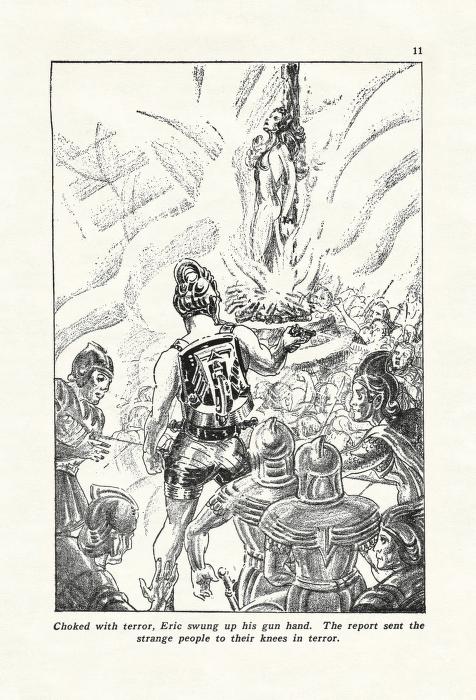
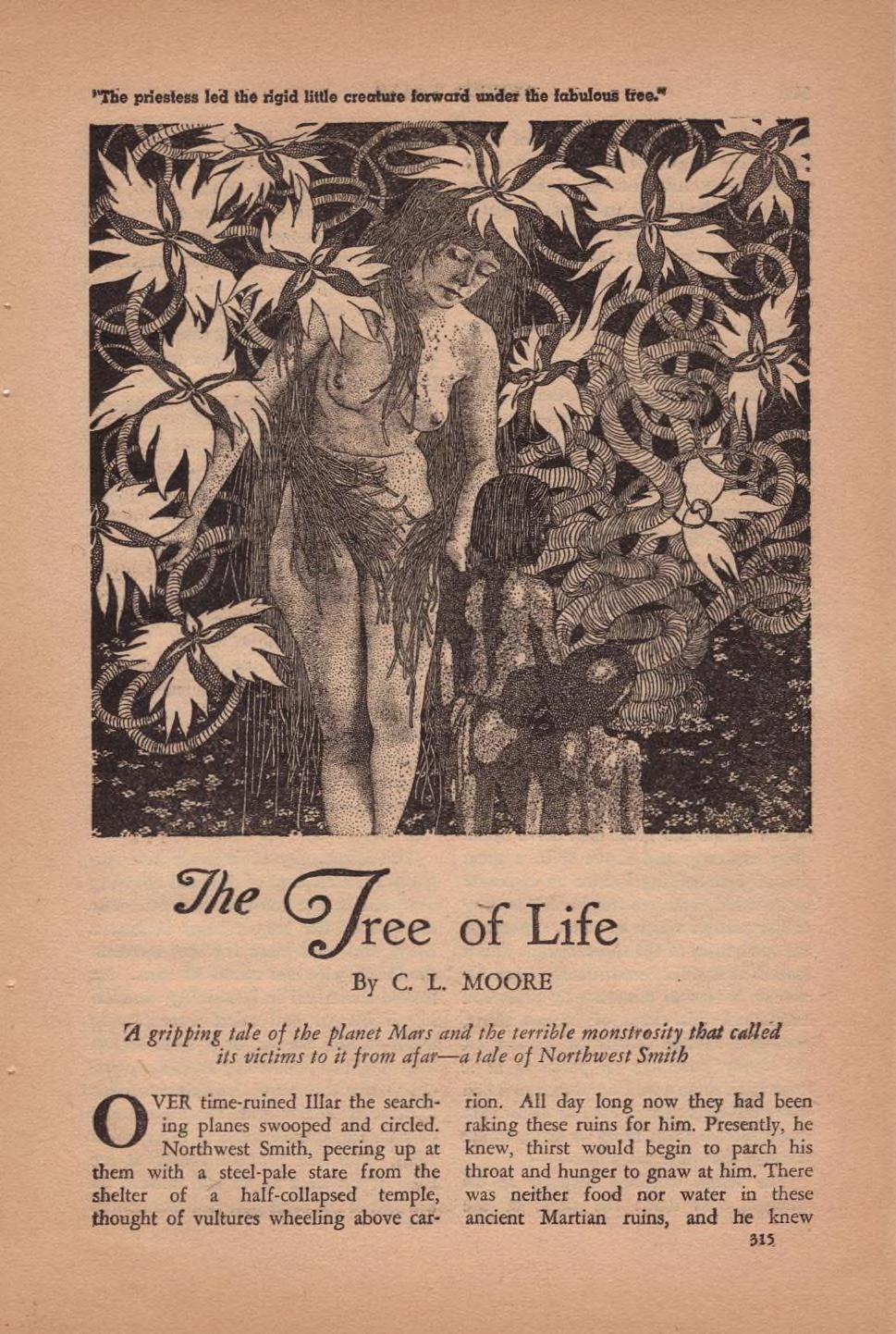
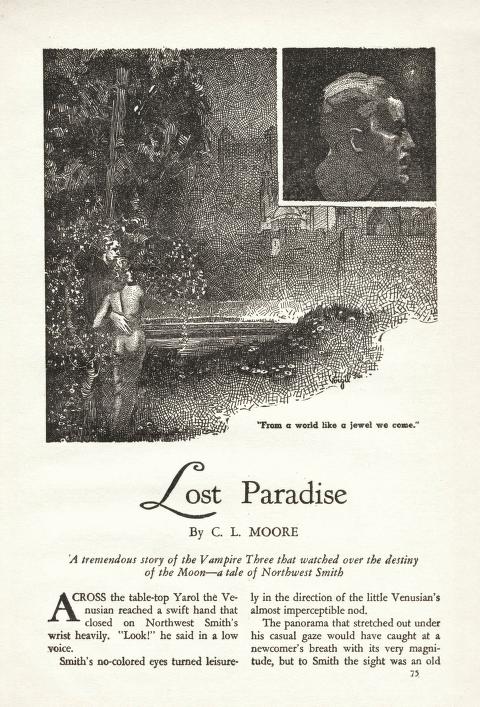
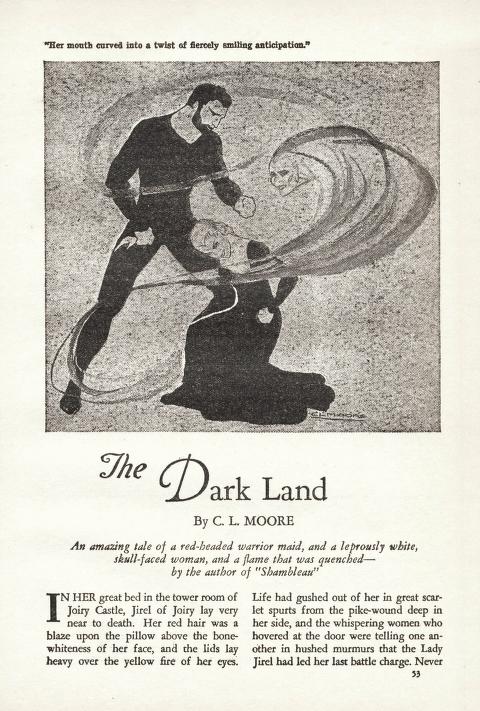
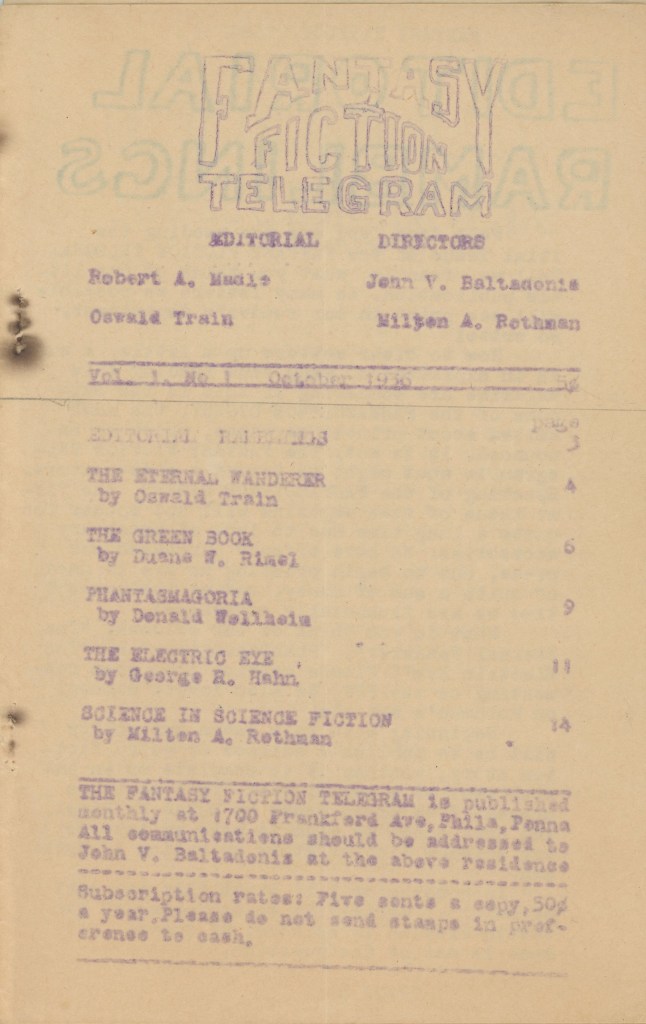

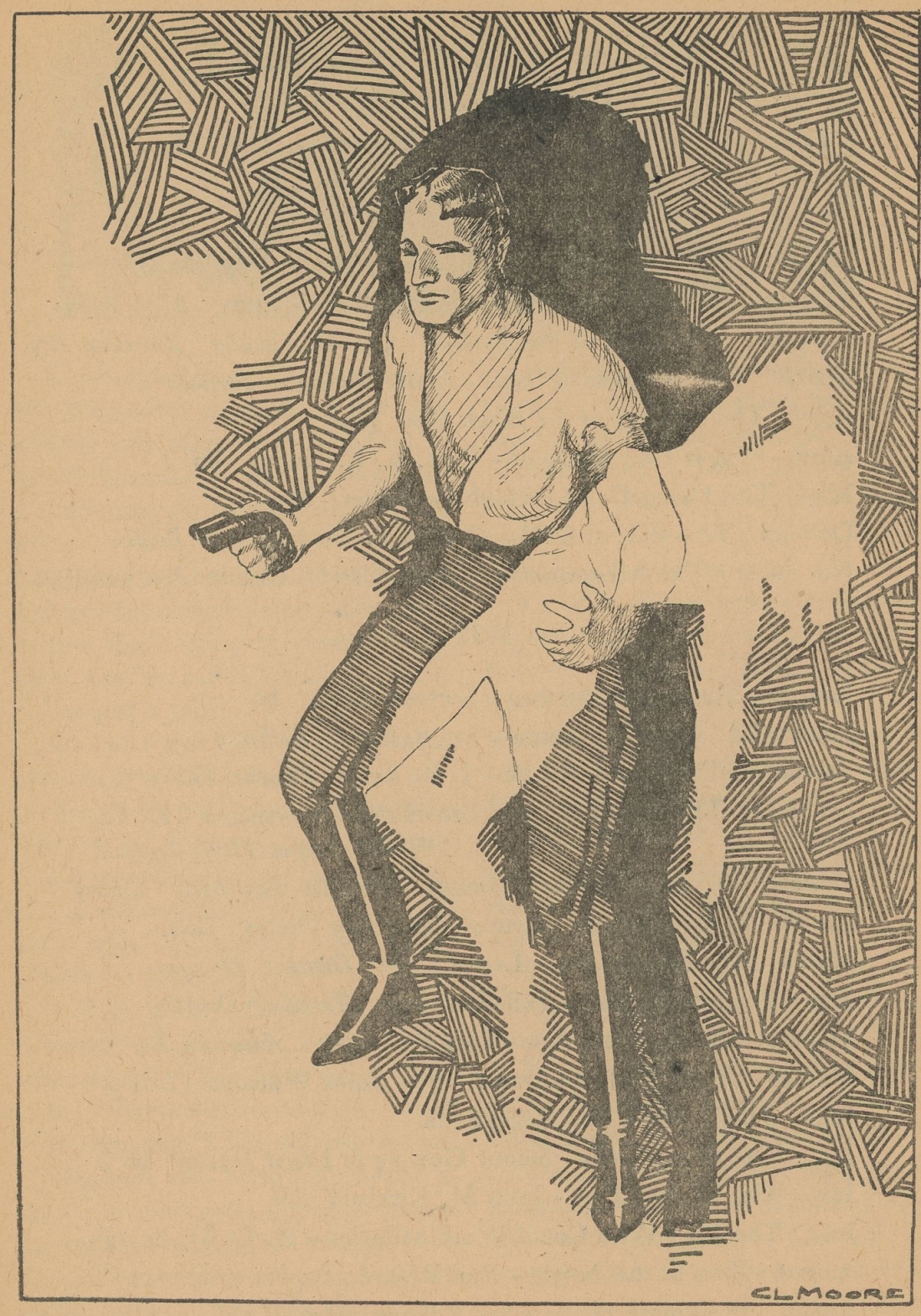

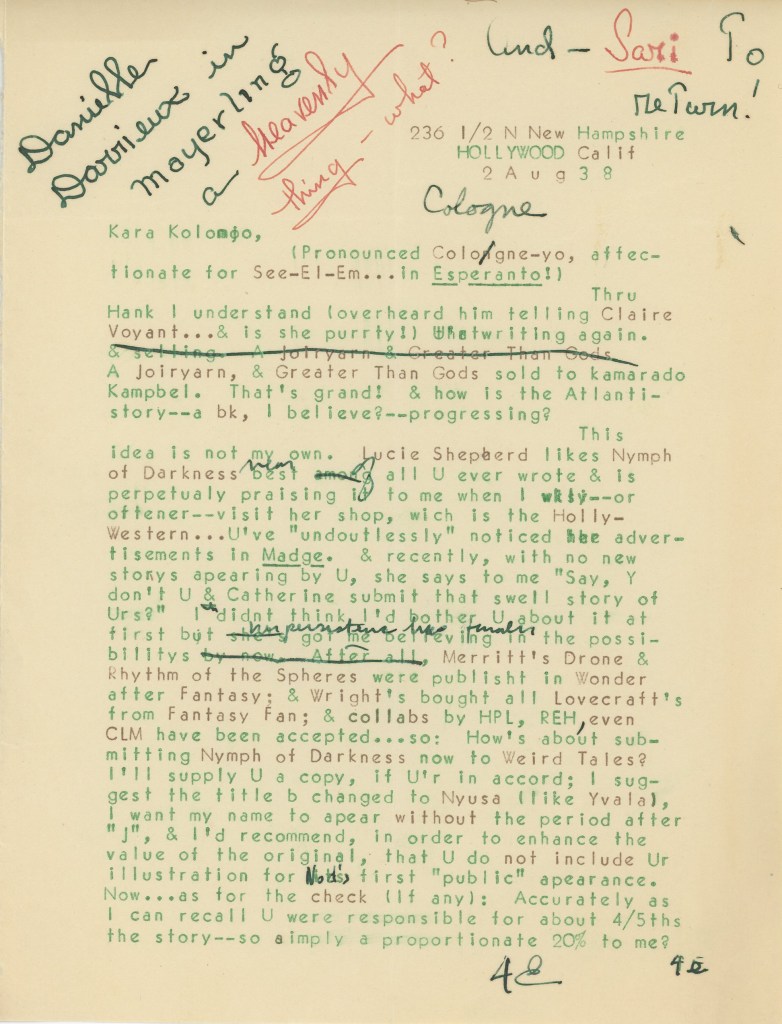
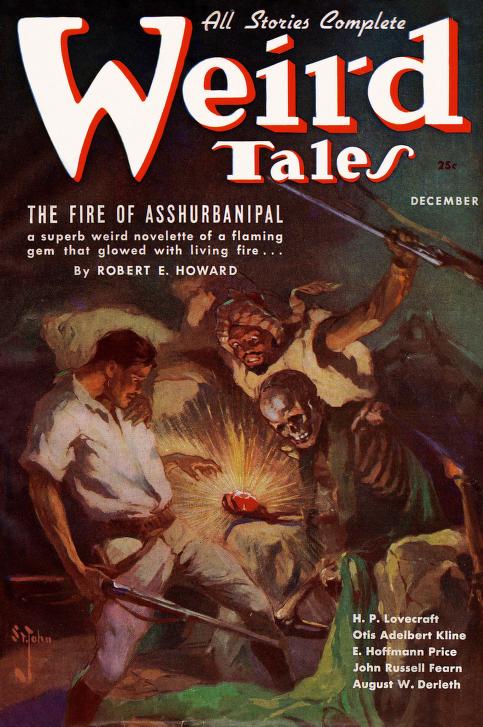
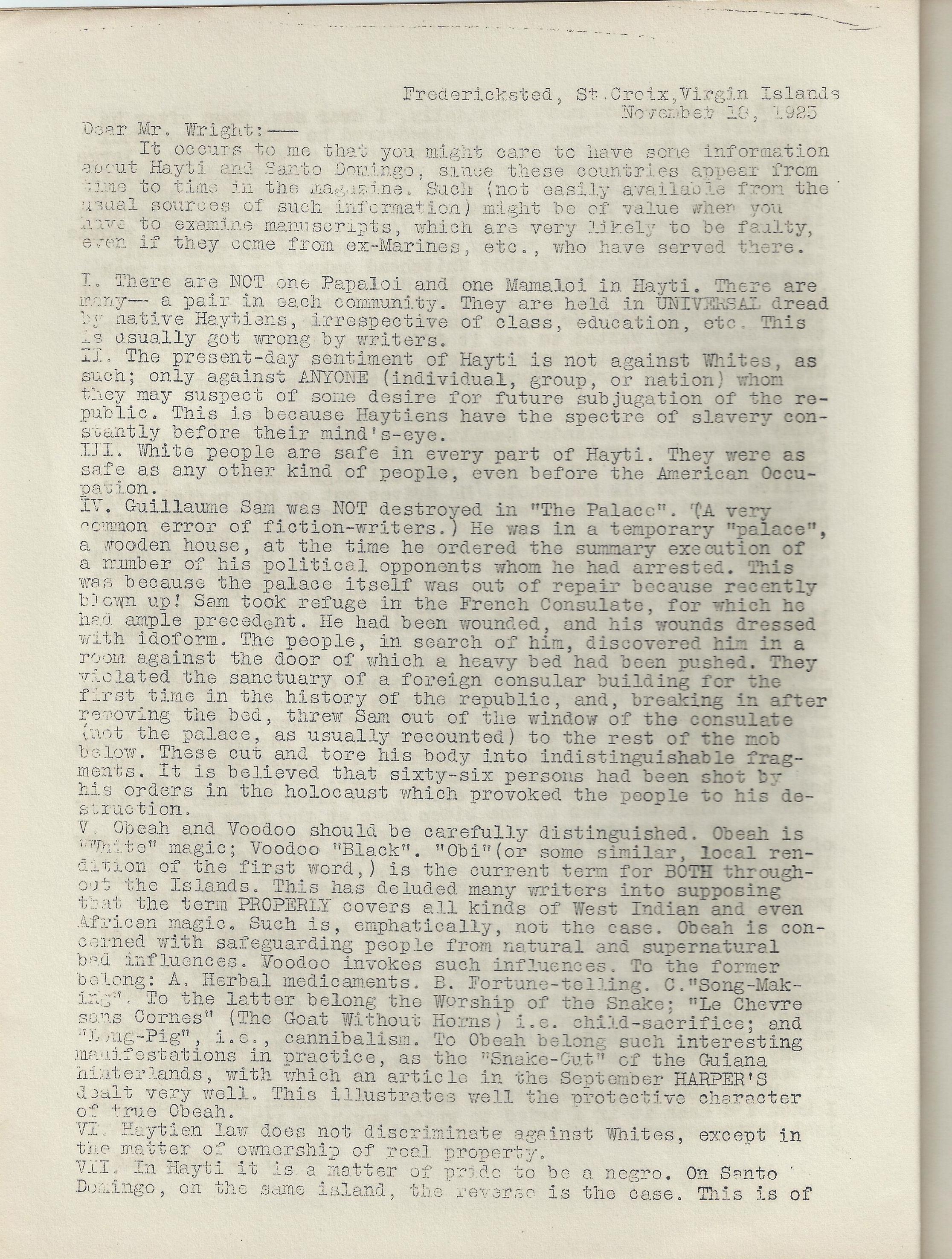
 Deep Cuts in a Lovecraftian Vein