“Under an Arkham Moon” (2014) by Jessica Amanda Salmonson & W. H. Pugmire

(To the memory of Robert Bloch)
—Jessica Amanda Salmonson & W. H. Pugmire, “Under an Arkham Moon” in
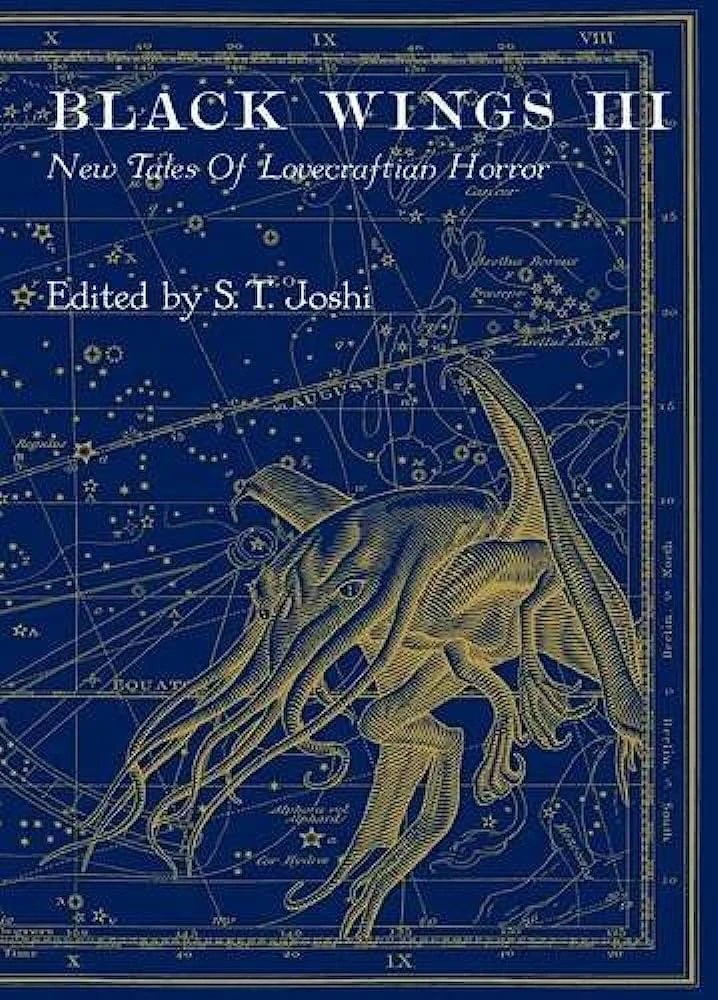
Black Wings III (2014) 57

Teratophilia is the love of monsters and the monstrous. This can be love of any sort, the fondness of familiarity or a sibling-like bond of friendship to sexual desire or even some unchangeable, devoted, and obsessive agape. There are many forms of teratophilia on display in this short tale by Salmonson and Pugmire. The love of human oddities, so often misconstrued as monsters; the love of Arkham, that fictional town that is so steeped in evil it corrupts the dreams of those within it; and a hot, burning physical desire for the monster in the attic…but above all, there is the love for that very human monster H. P. Lovecraft, and the story is written in such a way to pay homage to his creations, while taking them a step or three further.

The dedication to the memory of Robert Bloch is a nod to his story “The Mannikin” (WT Apr 1937), and this story shares a character with a similar conjoined twin and a connection to De Vermis Mysteriis, and may owe itself to a certain idea from Lovecraft. The plot is essentially a sequel to Lovecraft’s “The Unnamable” (1925), evident from its references to “The Attic Window” in Whispers (albeit with a nod toward the Indiana Magazine War), and the thing with the blemished eye. However, for the most part this is a story that reveals in the decadent Lovecraftian aesthetic. That really soaks in the sensuous language, the dark atmosphere, the terrible hints and lore.

This was a story written by a pair of monster kids that grew up into adults still in love with a world of dark delights and evil that was something more than the banal of canceling school lunches or denying health care claims to the sick. A story that tells how someone might be drawn back to old haunts to, as Conan the Cimmerian once put it in “The People of the Black Circle”: “like a crippled snake to soak up fresh venom from some source of sorcery.”

Sometimes, we return to Arkham for renewal.

I had returned to Arkham from the “real” world with fewer victories than I expected. I had been defeated, I of noble blood, noble of its kind. I needed Ambrose’s familiariaty, even that part of him that could slip from poetry to venom in a single heartbeat.
—Jessica Amanda Salmonson & W. H. Pugmire, “Under an Arkham Moon” in
Black Wings III (2014) 59

The twist in this story, when teratophilia proves both sexual and reciprocal, is a delicious one of its kind. Lovecraft always left the nature of the Unnamable deliberately ambiguous, and Salmonson & Pugmire have kept it so here. The terrible truth behind Lovecraft’s original story was very different, but this is still a fine sequel. A return to Lovecraft country, a refreshing dip for dark spirits who remember when Lovecraftian fiction was less hung up in the trappings of the Mythos and evoked more of the strange, decadent mood of Lovecraft’s early fiction, when friends scared each other to look into a house haunted by something they could not give a name to.

“Under an Arkham Moon” by Jessica Amanda Salmonson & W. H. Pugmire was first published in Black Wings III (2014); it was reprinted in Pugmire’s collection An Ecstasy of Fear (2019, Centipede Press).

The Terrible Truth Behind The Unnamable

The thing, it was averred, was biologically impossible to start with; merely another of those crazy country mutterings which Cotton Mather had been gullible enough to dump into his chaotic Magnalia Christi Americana, and so poorly authenticated that even he had not ventured to name the locality where the horror occurred. And as to the way I amplified the bare jotting of the old mystic—that was quite impossible, and characteristic of a flighty and notional scribbler! Mather had indeed told of the thing as being born, but nobody but a cheap sensationalist would think of having it grow up, look into people’s windows at night, and be hidden in the attic of a house, in flesh and in spirit, till someone saw it at the window centuries later and couldn’t describe what it was that turned his hair grey.
—H. P. Lovecraft, “The Unnamable”

Lovecraft gets a bit of a ribbing for “unnamable,” “unspeakable,” or “indescribable” critters – which he never had a monopoly on and was never so addicted to as a lot of critics like to think; the story in question in fact begins by making fun of the tendency in stories like Ambrose Bierce’s “The Damned Thing” or Guy de Maupussant’s “The Horla.”

Beyond that though, Lovecraft would take his inspirations where he found them, and this includes the family copy of Cotton Mather’s Magnalia Christi Americana (1702), which purports to be a religious history of New England but manages to cram in so many weird bits and pieces that you’d be amazed—witchcraft narratives, ghost stories, sea monsters, the works. The bit which inspired Lovecraft’s story is a very obscure bit of gossip about a “thing with a blemished eye”:

At the Southward there was a Beaſt, which brought forth a Creature, which might pretend unto ſomething of an Humane Shape. Now the People minded that the Monſter had a Blemiſh in one Eye, much like what a profligate Fellow in the Town was known to have. This Fellow was hereupon examin’d; and having upon his examination, conſeſ’d his inſandous Beſtialities; for which he was deſervedly Executed.
—Mather, MCM Book VI, Chapter V, Tenth Remark

Which was a hard go, the worse so because while Mather names no names, we know what actually inspired the anecdote.

George Spencer, an ugly balding man with one “pearle” or false eye, had probably been whipped in Boston for receiving stolen goods, and had also been punished in New Haven for botching an attempt to escape to Virginia. He admitted that he had gained no spiritual benefit from the ministry of the famed John Davenport, that he had not said a single prayer during his five years in New England, and that he read the Bible only when ordered to do so by his master. In February, 1642, Spencer’s life took a cruel turn when a sow gave birth to a dead deformed piglet. The “monster” was completely bald and had “butt one eye in the midle of the face, and thatt large and open, like some blemished eye of a man.” Out of its forehead “a thing of flesh grew forth and hung downe, itt was hollow, and like a mans instrum’ of genration.”

The magistrates arrested Spencer and put him in prison. New Haven had not yet tried a capital crime. Spencer had seen enough of the colony’s system of justice to know that the magistrates expected offenders to confess and repent. He had recently seen a man merely whipped for molesting a child, and as Spencer made clear, he thought that child molestation was a more disgusting crime than bestiality. Yet he denied his guilt until one magistrate “remembered him of thatt place of scripture, he that hideth his sin shall not prosper, butt he yt confesseth and forsaketh his sins shall finde mercie.” Spencer then “answered he was sory and confessed he had done itt,” only to learn that his confession would get him hanged and that mercy would come only from the Lord, not the Colony of New Haven. He retracted and repeated his confession several times in a desperate attempt to find a formula that would save his life. But on April 8, 1642, two months after the birth of the monster, the sow was put to the sword in front of the unrepentant Spencer, and he was hanged, “a terrible example of divine justice and wrath.”
—John M. Murrin, “‘Things Fearful to Name’: Bestiality in Colonial America”

Lovecraft was no doubt taken by the layers of obfuscation in Mathers’ account, which only really hinted at the appearance of the unfortunate piglet. Stripped of this mystery and romance, we are left with a man who was wrongly accused and ultimately was executed for an accident of nature by an intolerant society of religious fanatics. A much more banal but frighteningly very real moment in history that served as the seed for some very strange stories.


Bobby Derie is the author of Weird Talers: Essays on Robert E. Howard and Others and Sex and the Cthulhu Mythos.

Deep Cuts in a Lovecraftian Vein uses Amazon Associate links. As an Amazon Associate I earn from qualifying purchases.
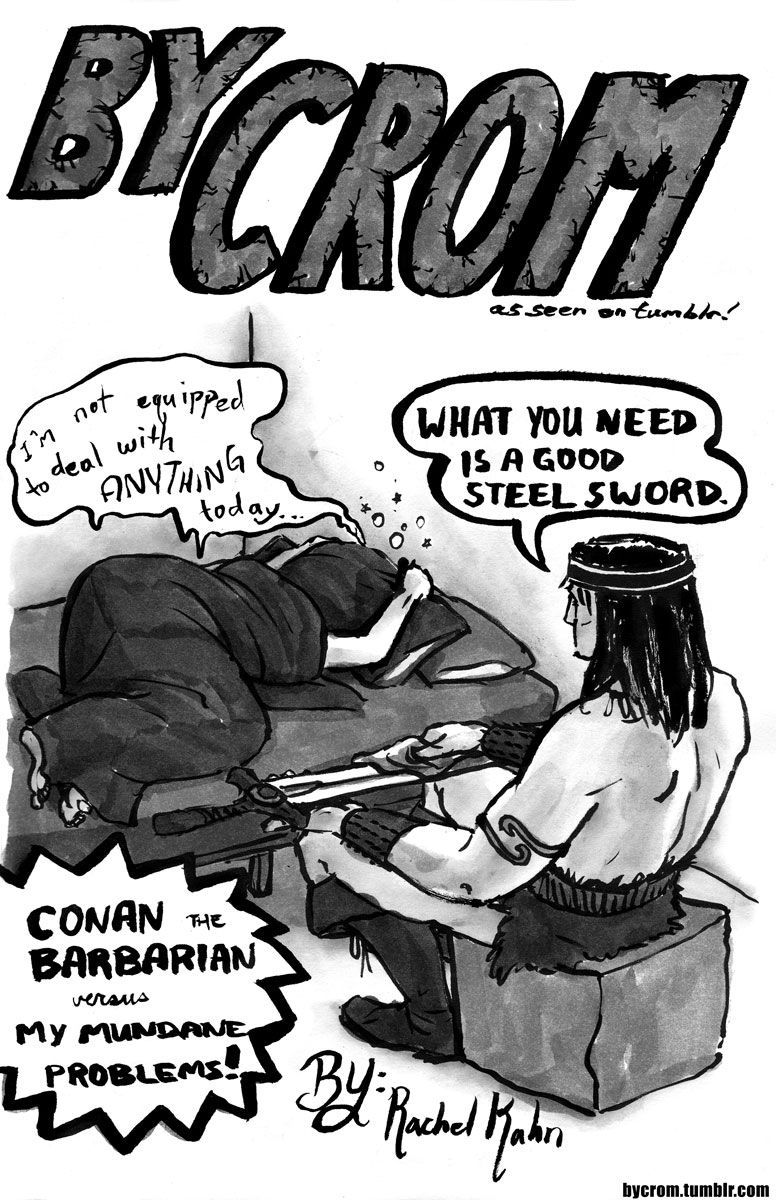
By Crom (2012-2014) by Rachel Kahn

I am not entirely sure how to frame an introduction to a comic book that I hope, very strongly, will speak for itself. So I’m just going to extend the thank yous from the previous page to everyone else who gets these jokes. To everyone who finds my comic accessible, regardless of gender or race or age or level of Conan loremastery, thank you for proving an old artistic tenet true: the personal, made public, can transcend its source. I am completely convinced that a little magic is needed for such an act, and that magic, for me, comes in the form of a fictional character whose worldview has been a wonderful new frame through which to view my own life.

That anyone else is interested in these jokes means two wonderful things are true: I am not the only one who loves Conan this way; and I am not the only one who evaluates her fancy clothing by how fast it would allow her to run away from crap.
—Rachel Kahn, Conan the Barbarian Is My Spirit Guide, By Crom! (2013), 1

In 1936, Robert E. Howard took his own life. A friend, Thurston Torbett of Marlin, Texas, wrote of the sad event to a mutual friend, the pulp writer C. L. Moore in Indianapolis, Indiana. Moore immediately dashed off a postcard to H. P. Lovecraft in Providence, Rhode Island—and Lovecraft, it seems, wrote to nearly everyone. Dozens of letters to people across the country, written in haste, his eulogy building with each one so that we can almost trace when a letter was written by how much he has added in his grief for his Texas friend, who he had never met but had exchanged letters with for six eventful years.

In trying to sum up what made “Two-Gun Bob” Howard special, Lovecraft settled on:

It is hard to say just what made Two-Gun’s yarns stand out so, but the real secret is that he was in every one of them. Even when he made outward concessions to the Mammon-guided editors & commercial critics he had an inner force & sincerity which broke through the surface & put the imprint of his personality on everything he wrote.
—H. P. Lovecraft to August Derleth, 20 June 1936, Essential Solitude 2.737

Yet there is another side to this. It is not just the words that Howard wrote on the page, in his small room in Cross Plains, Texas. It is the people who read them whose imaginations complete the characters. When Conan the Cimmerian, or Kull of Atlantis, or Solomon Kane, Bran Mak Morn, Sailor Steve Costigan, Breckinridge Elkins, El Borak, etc. —when these characters speak to a reader, it is because some of Robert E. Howard speaks to a reader, and the reader responds to that.

One reader might see Conan the Cimmerian as a masculine ideal; another might see him as an archetype of toxic masculinity. One reader might see him as an escapist fantasy on Howard’s part, another might see one of the many clones of Edgar Rice Burroughs’ Tarzan, cynically manufactured for pulp magazine consumption. Readers often look at Conan through the lens of their own lives and desires, influenced by the stories they have read, what they know of the life of Robert E. Howard, the history of pulp magazines, etc.

While everyone reads the same words, the understanding they come away with of the character and the story can vary as widely as the readers themselves do.

Howard, we can be fairly sure from his letters, did not set out to write Conan the Cimmerian or any of his characters as ideals to be followed; he wrote pulp fiction, not theology or philosophy—although having said that, Howard invested a great deal of bloody philosophy and world-weary wisdom into his characters, whose triumphs are often matched by tragedies, and whose tales are often set against the grinding movement of time which will eventually crush and subsume all things. There are veins of cynicism that sometimes give way to wonder, black rage and pity, catlike jests, and dour moods no drink can drown.

In 2012, Rachel Kahn (Shel Kahn) began a series of autobiographical webcomics, originally on Tumblr, and later collected as a ‘zine and a short series of books: Conan the Barbarian Is My Spirit Guide, By Crom! (2013), Full Colour Cromulence: Book 2 of By Crom! (2014), and a crowdfunded full collection titled simply By Crom! (2016).

What lessons can a fictional Cimmerian hold for a Canadian artist in the 2010s? At first glance, the reactions of a wandering barbarian thief, warrior, pirate, and later king might not have much relevance. This is, in part, the initial charm of the comic: the juxtaposition of this forthright, sometimes violent adventurer when faced with a young woman who often faces the trials and tribulations of everyday life, such as anxiety and medical issues.

On the other hand, sometimes Conan says exactly what she needs to hear.

The Conan that plays foil to Rachel Kahn’s alter ego in these strips is derivative of Howard’s Conan the Cimmerian, not the musclebound superhero of the comics or the films starring Arnold Schwarzenegger. Yet it is very obviously a Conan that partakes of Kahn herself as much as Howard. In asking herself, essentially, “What Would Conan Do?” the Cimmerian dispenses advice that often affirms the kind of positive, active attitude she struggles with. Conan, whatever and whoever else he is, makes no pretense and suffers no moment of self-doubt or crisis of identity; in By Crom! he embodies the kind of easy self-confidence, self-awareness, and self-acceptance that many struggle with.

Yet he is rarely a total dick about it.

Rarely. Sometimes tough love is necessary.

In a personal essay at the rear of By Crom! (2016), Kahn elaborated on her inspiration to start the comic, how she fell into Robert E. Howard and other pulp writers, the death of her father, and her ongoing struggles to live and work as an artist with all the stress that entails. And she wrote:

And through this all, this whole time when I felt I was waging war against the whole world alone, carrying all this pain that left me isolated in my own mind, I had Conan. I had comics Conan, novel Conan, even Arnie’s cinematic Conan, who speaks less and succeeds less than any other Conan but still will not give up his quest. Conan managed, so I managed. Conan took risks, so I took risks. Conan pursued his goals despite incredible opposition, so I pushed harder at what I wanted every day. Conan followed his own moral code, so I tried to remember mine more often as well.

Lovecraft wrote that Howard’s secret was that he put himself in every story. It is appropriate that Rachel Kahn followed in his footsteps and put so much of herself into By Crom!, and her depiction of Conan shows the mingled influence. Her Conan does not strip quotes from Howard’s stories in pursuit of some dogmatic canon; she expresses the heart of who Conan was and is to her. In an interview with Jenna Lindford, Kahn wrote:

I think one of the fantasies I can obsess over as someone living with mental illness is the dream of being emotionally invincible, or perhaps, invincible to my own emotions. The futility of that, the reality that I was not a hugely resilient and self sufficient person, was either going to crush me or become something I could laugh about and thus accept, and drawing the comic really helped me choose laughter. In the end no real person can achieve the kind of simple purity of intention that Conan has, and by juxtaposing it with my own experiences I think it shows some of the absurdity of both approaches.

In terms of the fine line, well, while I made myself the butt of most of the jokes, I hope that the honest expression of my frustrations and struggles and concerns communicated a sort of self-acceptance. If I can write and draw a comic about a rage-tinted panic attack in a bra shop, I have to be able to accept myself as someone who lived that. I hope that while the comic has a sense of humour about these anxieties, anyone else who is familiar with living with them senses the acceptance and fellow-feeling, and does not feel like the butt of the joke. However, when you make something like this you have to accept that your intentions don’t dictate the results, so I don’t pretend to think the comic is invincible to other perceptions.

The reader always completes a story; a writer can control the words, but not how someone responds to those words. Robert E. Howard, typing away at his writing table in Cross Plains, Texas in 1936 could never have guessed that in 2012 what he wrote would find new manifestation with a freelance artist in Canada in 2012…yet, that happened, and Rachel Kahn’s Conan is recognizably Conan, as recognizable in his own was as any Frank Frazetta cover.

Readers can start reading By Crom! from the beginning at the Weald Comics website or on Tapas.

Physical copies of the By Crom! collections appear to be sold out, but for those who are interested in the additional commentary, essays, and pin-ups, PDFs are still available via the Gumroad store.


Bobby Derie is the author of Weird Talers: Essays on Robert E. Howard & Others (2019) and Sex and the Cthulhu Mythos (2014).

Deep Cuts in a Lovecraftian Vein uses Amazon Associate links. As an Amazon Associate I earn from qualifying purchases.

“The Chabad of Innsmouth” (2014) by Marsha Morman

“He wasn’t an anti-Semite,” Pavel assured me. “I bet he doesn’t know what a Jew is. Outsiders—you know. That’s all it is.”

Marsha Morman, “The Chabad of Innsmouth” in King David and the Spiders from Mars 142

Jewish characters were rare in Weird Tales. While there were some stories with Jewish characters, such as “The Devil’s Pool” (1932) by Greye La Spina, that is the exception rather than the rule. Whether this was a reflection of the stories submitted or editorial fiat is impossible to determine; we know Jean Ray’s stories in Weird Tales had the antisemitism removed before they were published in the magazine, and that might have been part of an unofficial policy…or just good business. After all many readers, writers, artists, and publishers in the pulp field were Jewish. No need to antagonize folks, even during an era when antisemitism was rife in the United States.

If Jewish characters were rare, Jewish culture was rarer. H. P. Lovecraft was dimly aware that Judaism was not a monolithic religion or heterogenous ethnic group, that there were sectarian differences and distinctions between populations, even if he was ignorant of the exact nature of those differences. For many folks reading Weird Tales, however, the ignorance would have been more profound. White, Anglo-American, Protestant Christian would have been the default cultural syntax for most, and the vast majority of weird fiction from the early 20th century was written from, and read in, that context.

So it isn’t terribly surprising that Lovecraft didn’t include many Jewish characters in his fiction—really, only a bookseller in “The Descendent”—and most of his contemporaries likewise didn’t do much with them (though see Conan and the Shemites: Robert E. Howard and Antisemitism). Thus, the first generation of Mythos fiction was both largely devoid of Jewish representation and of Jewish stereotypes and antisemitism. This absence tended to repeat itself in later generations: there are relatively few stories that are distinctly Mythos and also prominently feature Jewish characters or cultures. There are a number of Jewish authors of Cthulhu Mythos and Lovecraftian fiction, but almost no Jewish Cthulhu Mythos stories to speak of.

(Although I would be remiss if I failed to mention Edward M. Ederlac’s Merkabah Rider series, where an Hasidic gunslinger deals with Mythos threats in the Old West. Those are just plain fun.)

[“]They said if I took another oath, I would be able to understand all that gibbering, but I didn’t.”

“Jew aren’t supposed to take oaths,” I told him. “They’re too powerful. Always say, ‘Maybe, maybe, maybe.'”

Marsha Morman, “The Chabad of Innsmouth” in King David and the Spiders from Mars 164

So what would happen if a Jew came to Innsmouth? And not just any Jew, but an Orthodox Hasidic Jew of the Chabad movement—a traditionalist bringing Judaism to other Jewish people, a young rabbi dedicated to cultural outreach? It is an interesting setup, because Jewish religion and culture is such an absolute lacuna in Lovecraft’s “The Shadow over Innsmouth.” The Esoteric Order of Dagon has an absolute Old Testament flavor (“Dagon an’ Ashtoreth—Belial an’ Beëlzebub—Golden Caff an’ the idols o’ Canaan an’ the Philistines—Babylonish abominations—Mene, mene, tekel, upharsin—”), but in Lovecraft’s Innsmouth before the coming of the Deep Ones there was only a Baptist church, a Methodist church, a Congregationalist church, and a group of Freemasons; no Catholic church, no African-American Methodist-Episcopalian church, no synogogue. The Deep Ones moved in on the prototypical WASP space, but with no real indication of how or why they might interact with Jews or anyone else.

Which means that Marsha Morman had pretty much a blank slate when writing “The Chabad of Innsmouth.” Return to Innsmouth stories tend to be a bit frayed and outworn, like a familiar shirt worn until threadbare—if the reader has read Lovecraft’s original, they know most of the things that the protagonist is about to discover—and there’s certainly a good bit of that shmatte feeling here. The Cthulhu Mythos aspects of it in particular are so utterly familiar that they’re almost hackneyed; not really much innovation on Lovecraft’s original in that sense.

What works is the novel approach itself. Innsmouth, eighty-odd years after the event’s of Lovecraft’s story, has a new rabbi, trying to serve a small community, and…it’s nice to see that different perspective.

It was unwholesome to find someone so visually repellant. I was taught to look to the neshama—soul—of every person instead of their outsides. I was very ashamed as we hurried back to the car, Pavel’s smelly set of keys in hand.

Marsha Morman, “The Chabad of Innsmouth” in King David and the Spiders from Mars 142

Judaism and the Esoteric Order of Dagon are so alien to one another that there isn’t a lot of real interaction. The rabbi and his charges, ironically, can only really categorize the cult through the lens of Christian saints, Satanic cults, and finally the stories of the old Philistine god from the tanakh. We never get the Dagonite perspective on the Chabad house at all, except as outsiders intruding into business they don’t understand. The cultural clash and failure of understanding on both sides is a bit fascinating, and it would have been nice to see more details on that…but that might have killed the pacing. The darker elements of the plot are reminicent of “Mail Order Bride” (1999) by Ann K. Schwader, and “The Chabad of Innsmouth” slides surprisingly well into the broader cycle of Innsmouth stories.

Not everything works. The ending feels more than a bit rushed, and the geography is also a bit ludicrous; Lovecraft put Innsmouth in Essex County, north of Boston, while Morman puts it south of Boston, somewhere around Cape Cod, but that’s a quibble. A few entries from the perspective of the protagonist’s wife, the shalucha, detailing her experience of Innsmouth, might have gone a long way to develop the atmosphere. It’s not really a horror story, or at least the rabbi doesn’t know they’ve stumbled into a horror story, until near the very end, so there is less tension built up before the climax than maybe there should be.

Overall, however, Marsha Morman definitely fulfilled the premise. Readers get something that they rarely, if ever, get anywhere else; the Mythos expands a little, takes on a new dimension, and maybe a new perspective gets placed on an old story. Most intruiging of all, this is ultimately the story about new beginnings, not endings. The chabad house in Innsmouth is still standing at the end, the small community is still there…and the door is open for more stories.

“The Chabad of Innsmouth” by Martha Morman was published in King David and the Spiders from Mars (2014, Dybbuk Press). It has not yet been reprinted.


Bobby Derie is the author of Weird Talers: Essays on Robert E. Howard and Others and Sex and the Cthulhu Mythos.

Deep Cuts in a Lovecraftian Vein uses Amazon Associate links. As an Amazon Associate I earn from qualifying purchases.

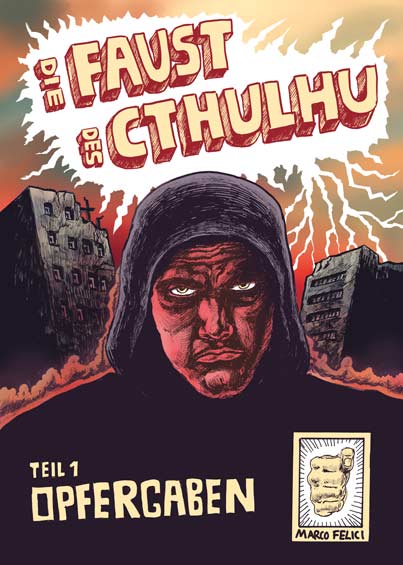
Die Faust des Cthulhu Teil 1: Opfergaben (2014) by Marco Felici

In naher zukunft existiert die menschliche zivilisation, wie wir sie kennen, nicht mehr.

Alte wesen sind aus ihrem schlaf erwacht und haben die herrschaft über die erde übernommen. Die wenigen überlebenden ergaben such der beuen religion und ihrer propheten.

Dies ist die geschichte eines mannes, der sich nicht unterwirft, sondern den kampf gegen die neuen mächte aufnimmt.
In the near future, human civilization as we know it will no longer exist.

Ancient beings have awakened from their sleep and have taken control of the earth. The few survivors surrendered to the new religion and its prophets.


This is the story of a man who does not submit, but takes up the fight against the new powers.
Back cover of Die Faust des Cthulhu 1.English translation

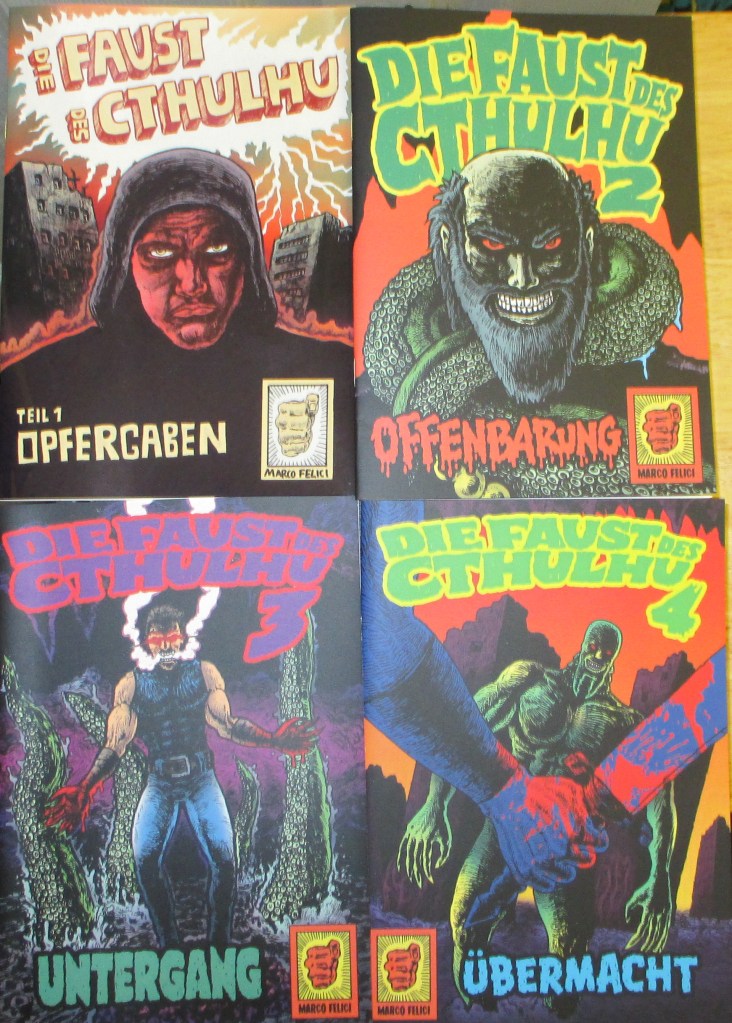
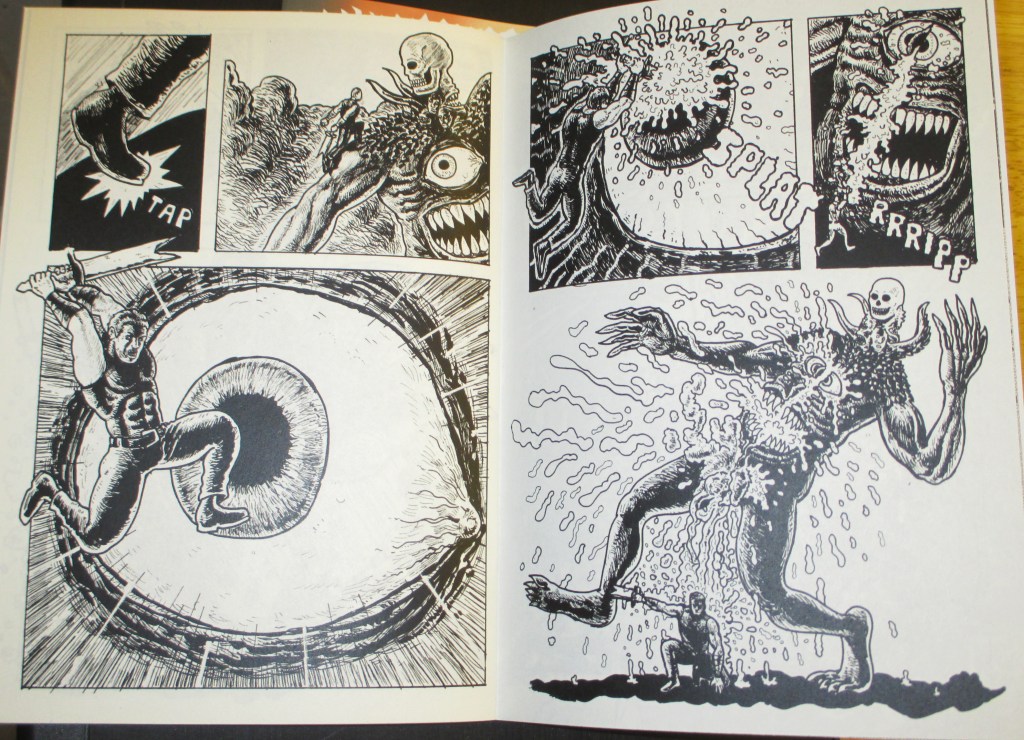
Die Faust des Cthulhu (The Fist of Cthulhu) is an independently published, black-and-white, German-language post-apocalyptic action-horror comic from writer/artist Marco Felici (lettering by Till Felix, cover colors & title design for issues 2-4 by Olaf Hänsel). Published irregularly, the series appears to consist of four separate issues and a collected edition:

  • Teil 1: Opfergaben (Part 1: Offerings) (2014)
  • Teil 2: Offenbarung (Part 2: Epiphany) (2015)
  • Teil 3: Untergang (Part 3: Downfall) (2018)
  • Teil 4: Übermacht (Part 4: Superiority) (2020)
  • Sammelband (Collected) (2022)

(Note: the listing I’ve seen for the collected edition says it collects the first five issues, so I may well be missing one.)

The art and story are strongly reminiscent of American underground comix of the 1970s-1980s, with the occasional shade of Richard Corben (especially in the color covers on issues 2-4), or Eastman and Laird’s early, relatively grungy-looking black-and-white issues of Teenage Mutant Ninja Turtles, long before the children’s cartoon softened their image and sensibilities. Story-wise, there may also be more than a touch of a manga influence, with shades of Fist of the North Star or other post-apocalyptic action-adventure series. Surprisingly, there’s also a touch of luchador influence, with the humanoid monsters sometimes going masked, at least initially.

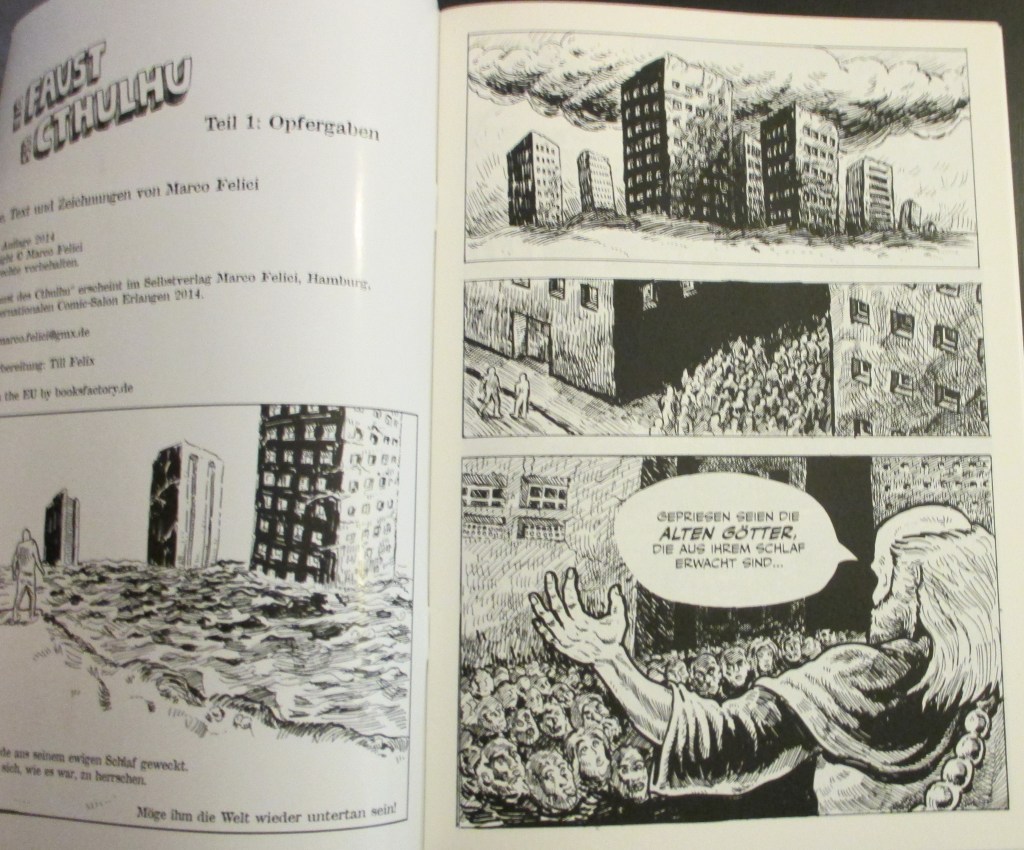
We open on the scene of a sacrifice to the Old Gods.

Fundamentally, the story is straightforward: a mysterious stranger takes exception to one of the regular innocent sacrifices to the Old Ones, and deals with a cultist and his minion—a half-human spawn of elder beings. Of course, our hero soon shows that he isn’t entirely human either…imagine if Wilbur Whateley decided he related more with his mother than Yog-Sothoth and chose to try and rid the world of eldritch horrors, and you’ve about got the scope of the series. Along the way, a kid sees him fight and becomes witness-cum-sidekick as they travel through the hellscape of the future.

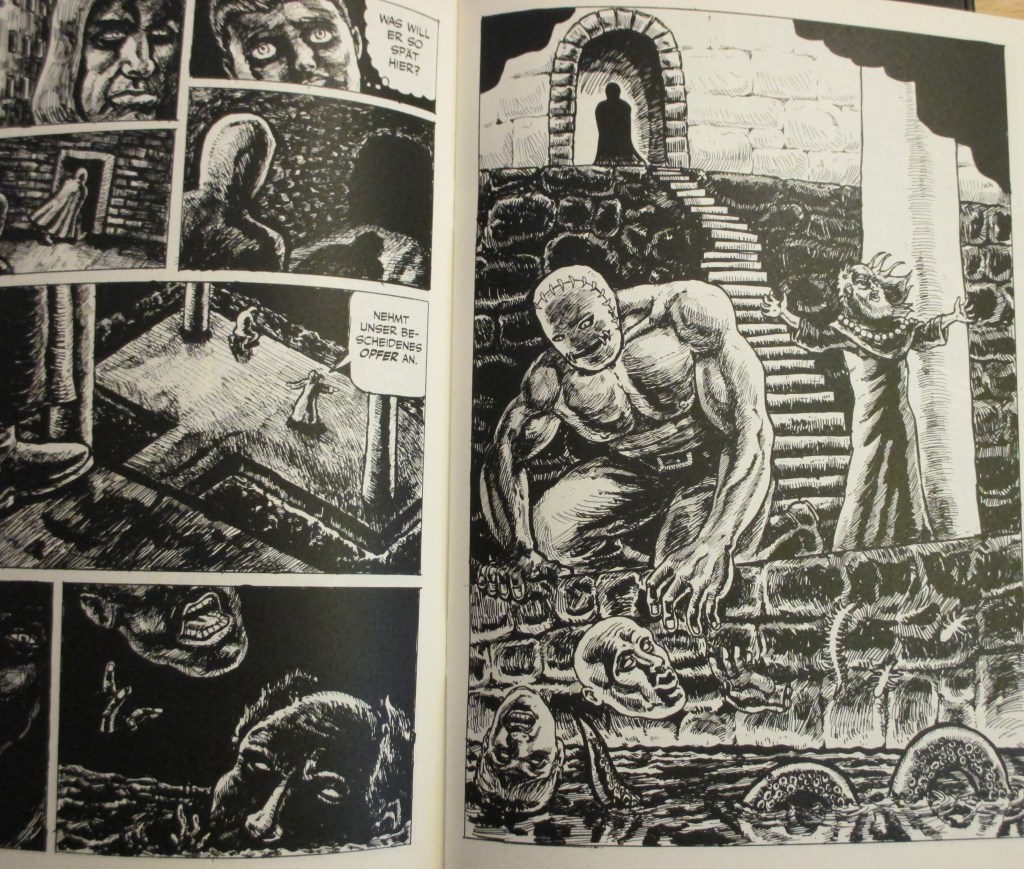
Down below, the dismembered bodies of the sacrifices are fed to… something.

The art is a mix of that underground comix serviceable-enough grunginess and moments of interesting character and creature design. Backgrounds tend to give way to action lines or solid blocks of black or white, which makes sense in black-and-white comics where the focus is on the figures more than the surroundings.

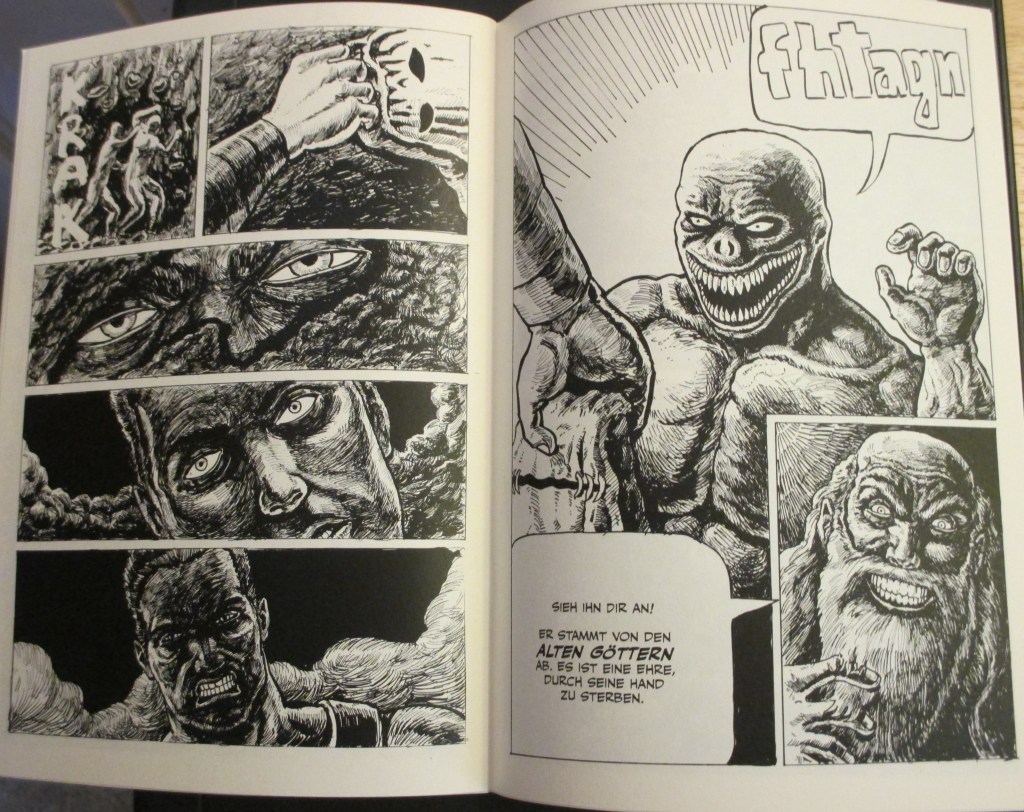
Mythos references are a bit scanty; Die Faust des Cthulhu isn’t a pastiche in the sense that it wants to expand on the lore in vast detail, and while there is a bit of exposition the actions tend to speak louder than words, and the explicit connections to the Mythos are usually relegated to a few exclamations in the heat of battle. There is more of an element of Robert E. Howard to the story than Lovecraft; the nameless hero is of the same mind as Conan that if something bleeds then it can die, even if the thought is not expressed in so many words. Readers hoping for deep pathos or character development may be disappointed, but primarily this is fun. A guy with a pair of knives wrestles tentacled monsters and cuts them apart. It’s closer to sword and sorcery than cosmic horror.

Sometimes that’s silly. Sometimes that’s awesome.

Climactic scene from Teil 4: Übermacht.

It is not clear how many copies of a given issue are printed, but given the scarcity probably not many; readers interested in tracking down a few should check out German comic shops or eBay.


Bobby Derie is the author of Weird Talers: Essays on Robert E. Howard and Others and Sex and the Cthulhu Mythos.

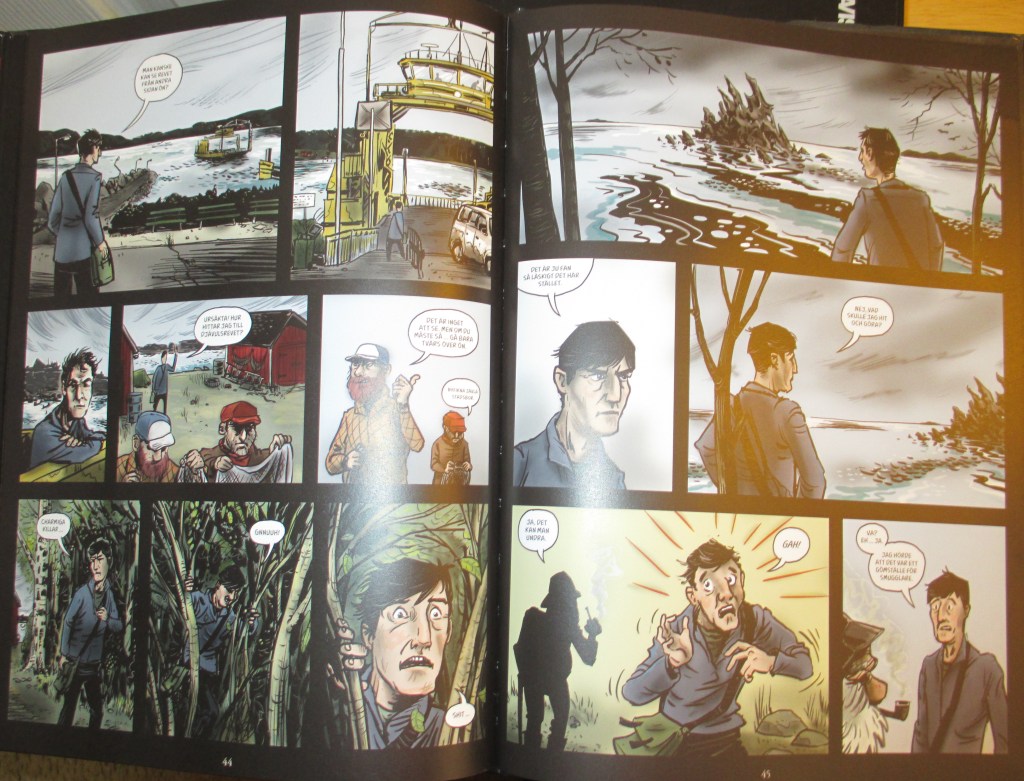
1000 Ögon: Lovecraft (2014) by Jonas Anderson & Daniel Thollin

Tänk om H.P. Lovecraft hade levt idag och bott i Uppsala! Hur hade hans berättelser sett ut då? Vår bok heter helt enkelt 1000 Ögon: Lovecraft och är vår hyllning till denna skräckens mästare. Vi tolkar några av hans berättelser och placerar dem i vårt 1000 Ögon-universum. What if H.P. Lovecraft was alive today and lived in Uppsala! What would his stories look like then? Our book is simply called 1000 Eyes: Lovecraft and is our tribute to this master of horror. We interpret some of his stories and place them in our 1000 Eyes universe.
Swedish pitch on IndiegogoEnglish translation

1000 Ögon (1000 Eyes) is the label for a contemporary Swedish-language series of horror graphic novels (really, thin bandes dessinée-style hardbacks) by the creative team of Jonas Anderson, Anders Björkelid, and Daniel Thollin, the last three published by Albumförlaget. Several of these have Lovecraftian influences, notably Filgia (2013), Lovecraft (2014), and Cthulhu (2015), but like a lot of non-English language publications that don’t make it into translation, they tend to get overlooked by English-reading audiences. The name “1000 ögon” is presumably a reference to the Swedish horror film Skräcken har 1000 ögon (“Fear has 1000 Eyes,” 1970).

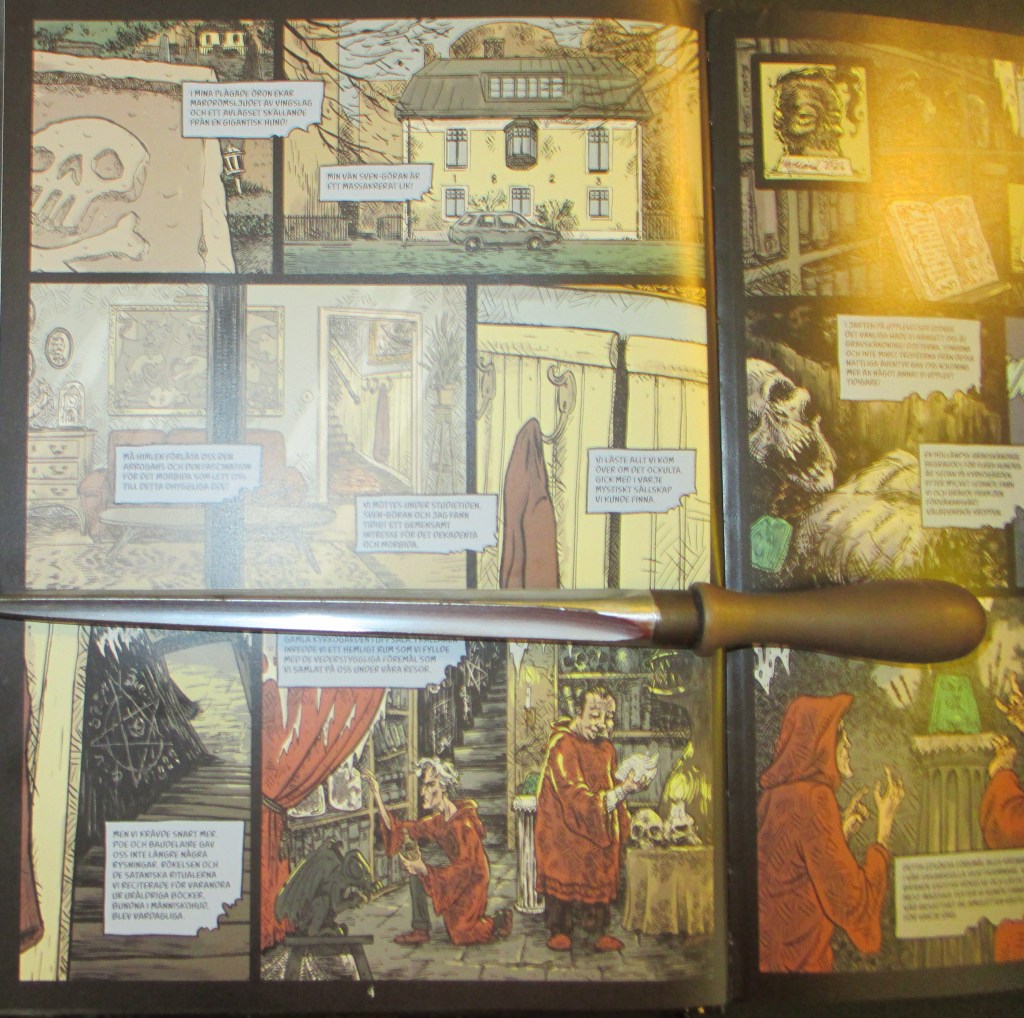
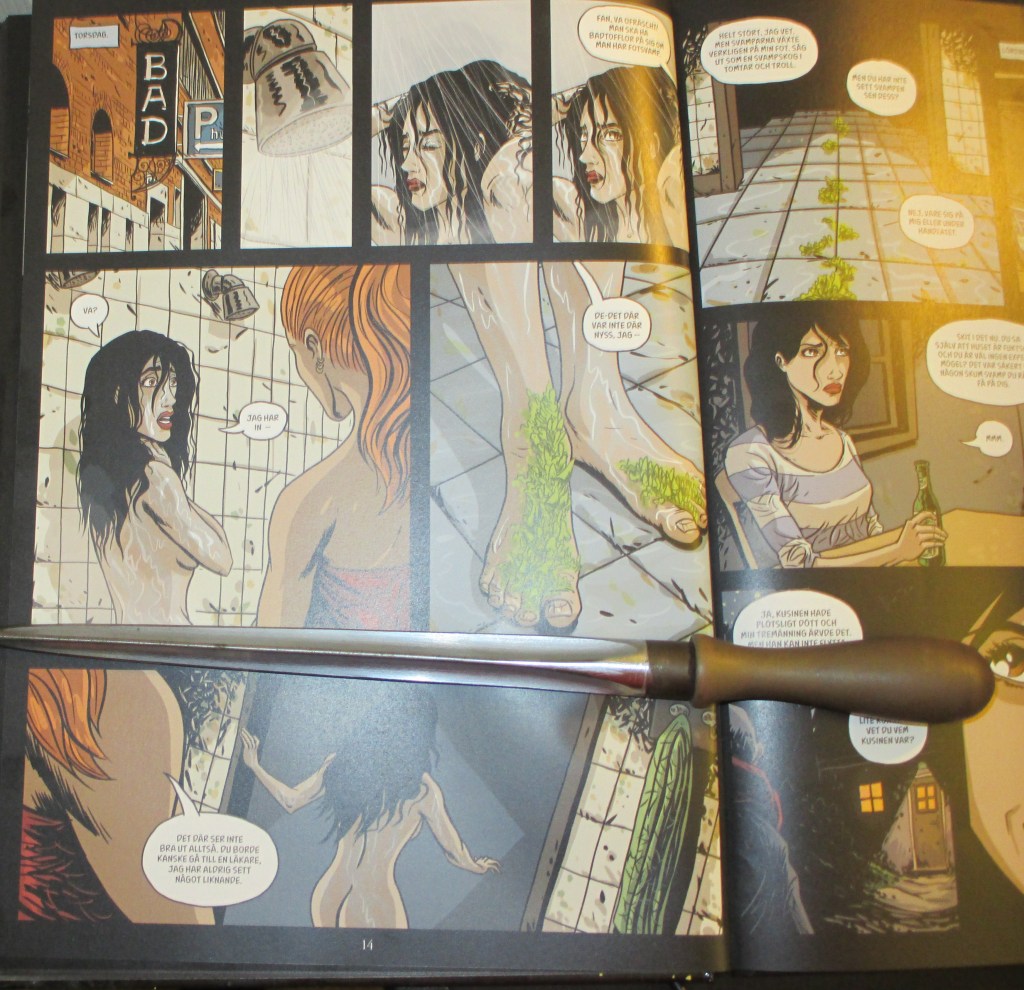
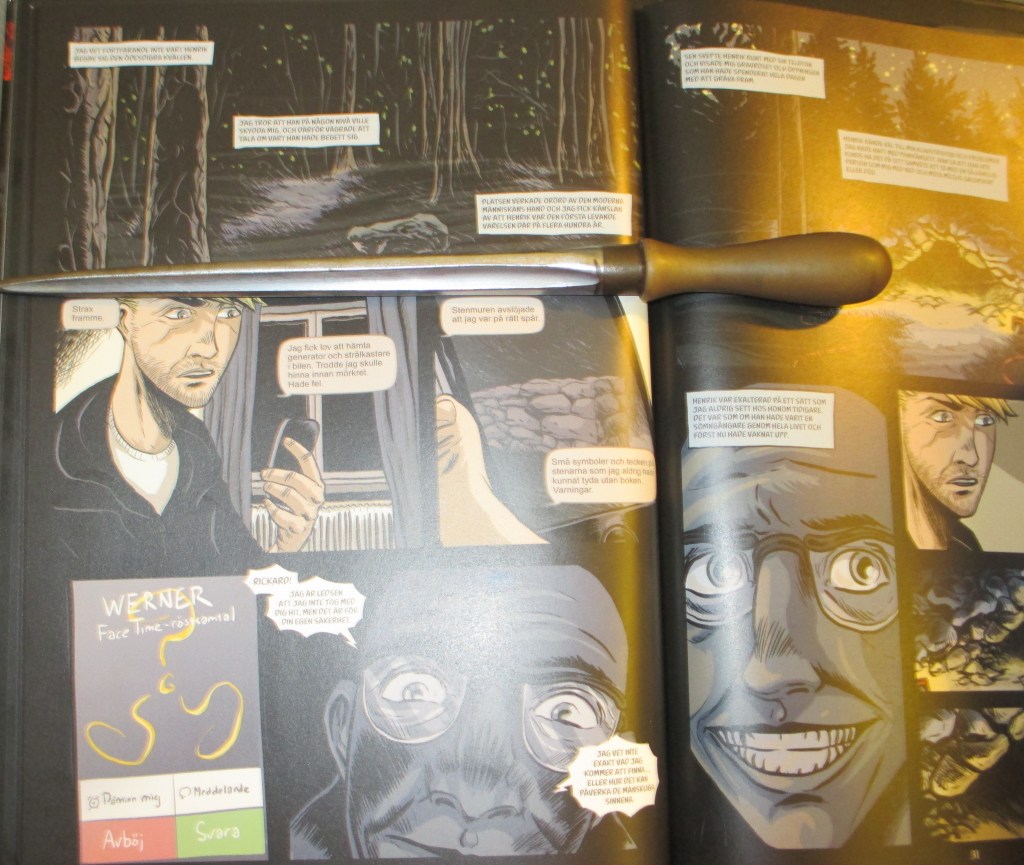
This is a bit of a shame because Lovecraft has an interesting basic premise: taking the core of four of Lovecraft’s stories (“The Hound,” “The Shunned House,” “The Statement of Randolph Carter,” and “The Shadow over Innsmouth”), and reworking them in a shared, contemporary setting, keeping what they feel is the essence of Lovecraft’s stories while freely altering the trappings and settings. In this way, the two graverobbing aesthetes of “The Hound” become more notably occult in their predilections (and apparently drive a Citroën GS); the protagonist of “The Shunned House” is a young woman named Cecilia dealing with something more than the standard mildew and black mold in the house, “The Statement of Randolph Carter” involves facetime over a smartphone rather than a field telephone, and “The Shadow over Innsmouth” takes some specific visual cues from the buildings of Uppsala and the Swedish fishing industry.

“The Hound”

Like many contemporary takes on the Mythos, Thollin and Anderson each work in references to the Cthulhu Mythos in these stories, even if there were none before. As each one writes and draws their respective episodes independently (“The Shunned House” and “The Statement of Randolph Carter” for Daniel Thollin and “The Hound” and “The Shadow over Innsmouth” for Jonas Anderson), this provides a degree of narrative continuity that might otherwise be lacking. Readers get the sense that these stories are connected, expressions of some common threat or body of myth, in a way that might not be obvious otherwise.

“The Shunned House”

For those at least passingly familiar with Swedish architecture or Uppsala in particular, the connectivity of the stories is also geographic and cultural. Which is rather the entire point of this exercise. While Lovecraft never weighed in on localization per se, he did famously note:

Searchers after horror haunt strange, far places. For them are the catacombs of Ptolemais, and the carven mausolea of the nightmare countries. They climb to the moonlit towers of ruined Rhine castles, and falter down black cobwebbed steps beneath the scattered stones of forgotten cities in Asia. The haunted wood and the desolate mountain are their shrines, and they linger around the sinister monoliths on uninhabited islands. But the true epicure in the terrible, to whom a new thrill of unutterable ghastliness is the chief end and justification of existence, esteems most of all the ancient, lonely farmhouses of backwoods New England; for there the dark elements of strength, solitude, grotesqueness, and ignorance combine to form the perfection of the hideous.

H. P. Lovecraft, “The Picture in the House”

Which is to say: horror can be found closer to home than you think. Forget for a moment all those Hollywood horrors set in the United States, don’t think yourself safe just because Lovecraft restricted himself primarily to New England. Horror can be anywhere, closer than you would like…you may be in some corner of Lovecraft Country already and not even know it.

“The Statement of Randolph Carter”

Visually, Thollin’s style is “cleaner” and closer to American-style comic figuring, while Anderson’s is a little scratchier and closer to the Franco-Belgian school, and the digital coloring on Anderson’s work in particular can look a little muddy at times. While it wouldn’t be correct to say that none of the stories being adapted lend themselves to grand visuals, it seems both Thollin and Anderson lean into a more subdued approach, focusing on the human characters and generally keeping things at their scale. So there are few grand visuals, but several clever and well-designed elements, like the stark outcropping of Devil’s Reef, which really stands out when compared to how it is normally portrayed, as barely a bump above the waterline.

“The Shadow over Innsmouth”

Lovecraft was followed up by a sequel titled Cthulhu. Whereas Lovecraft consists of four adaptations, Cthulhu is made up of two original works, both set in Uppsala, before and after the stars are right. The stories maintain much of the same artistic style and themes of the Lovecraft adaptations, but the creators have a little more free play to indulge their imaginations. Readers who dig the style and want to see what happens what Thollin and Anderson move beyond adaptation to pastiche won’t be disappointed.

While you might find Filgia, Lovecraft, and Cthulhu available online in some second-hand bookstores, the best way to order them is probably direct from Albumförlaget.


Bobby Derie is the author of Weird Talers: Essays on Robert E. Howard and Others and Sex and the Cthulhu Mythos.

Deep Cuts in a Lovecraftian Vein uses Amazon Associate links. As an Amazon Associate I earn from qualifying purchases.
Cthulhu Scat Hangover & The Innsmouth Porno VHS (2014) by Adolf Lovecraft

In all of his stories, not one of H. P. Lovecraft’s characters ever pissed themselves in fright. No character soiled their britches as Great Cthulhu stumbled through the waves, or noisily vomited up a half-digested lunch on seeing the swiftly-decomposing remains of Wilbur Whateley. You might run across a reference to a man whose face has been bitten away, but never a dirty diaper; a suggestive smear of blood, but never a drop of menses. A character might be described as moving through filth, but you never get the actual description of the turds, or the rotting carcasses buzzing with flies, or the sudden desperate need for a restroom.

Weird fiction may be horrifying, but it is rarely disgusting. Fear and disgust are basic emotions that can both arise from transgressions, and can be quite intimately linked: a dead body may engender fear and disgust, a prude might find a Satanic orgy both horrifying and revolting. During the heyday of Weird Tales, there was a limit one could go in explicit description, and while later decades grew more lax in terms of actual censorship, many practical limitations remain. Nudity is still more acceptable in horror films than actual feces; a character might be shot a hundred times or bisected by a saw blade, but they probably won’t be drowned in a toilet full of urine.

Even in weird and horror fiction, there are many norms and mores…and transgressing these can result in quite powerful works of art and literature. Terrible, in their own way, but powerful.

This is the psychology of the exploitation films, underground comix, heavy metal and all of its many musical sub-genres and modes with their cover art, and of Splatterpunk fiction and its literary descendants Extreme Horror and Bizarro fiction. For writers and artists who embrace the transgression beyond mere fright, there are strange, vast opportunities to go beyond what any normal writer—even the normal Lovecraftian writer—has gone before.

Of course, it isn’t necessarily pleasant to read or write, but that’s the point. The visceral response, the new emotional sensation that you can’t get anymore. After reading “Innsmouth” or “Cthulhu” for the fiftieth or a hundredth time, do you really still feel the same dread? Or have you gotten used to it? Cthulhu, for many, has become a familiar horror. There are plushies. You can go buy dice and pillows, Cthulhu panties and sex toys. While a Lovecraft reader might be horrified at the mere existence of such merch, Cthulhu itself is far less a figure of terror to most. Cthulhu has become…cuddly.

That isn’t always the case, of course. Some Lovecraftian fiction is more transgressive than others, even in these jaded later days. “Necrophallus” by Makino Osamu (牧野修) is explicitly more visceral than the average Mythos tale; Insania Tenebris (2020) by Raúlo Cáceres pushes Mythos art to an explicit extreme; “The Vulviflora of Vuutsavek” (2008) by Charlotte Alchemilla Smythe is sexually explicit without letting go of the essential element of horror—yet none of these works really embrace disgust as equal to horror. None of them push that element of transgression.

For Lovecraftian works like that, you generally need to look for such works as Edward Lee’s “Hardcore Lovecraft” line including The Innswich Horror, The Haunter of the Threshold, Going Monstering, Trolley No. 1842, and The Dunwich RomanceThese are all stories that put the horror and disgust under a microscope, that don’t pan away or keep the nastier bits of the action off the page or buried under a metaphor, as Lovecraft did. In a more avant-garde vein, you might look at Jordan Krall’s bizarro classic Squid Pulp Blues, pedal-to-the-metal Tentacle Death Trip, and the surreal collection Nightmares from a Lovecraftian Mindor Kevin Strange’s McHumans.

Many of these works are now out of print and rare. Extreme fiction tends to have a limited audience, and self-publishing and small presses have been the norm; once it was Arkham House that published what the big publishers wouldn’t, but now the bleeding, gore-stained edge of extreme Lovecraftian fiction is mostly occupied in self-publishing…and there are some delightfully disgusting treats out on the fringes of known literature.

“Adolf Lovecraft” was the pseudonym for a bizarro writer who self-published three ebooks: Cthulhu Scat Hangover (2014), The Innsmouth Porno VHS (2014), and Cthulhu Bomb (In A Whore’s Guts (2016). While never destined for any best-of anthologies and largely ignored by critics, these are works that are exactly what they set out to be: nasty deep dredges where the balance is less on Lovecraftian horror than Lovecraftian disgust.

Cthulhu Scat Hangover contains two stories: “The Brown Eye From Beyond” and “Cthulhu Scat Hangover.” Both of these stories deal with very similar themes and visuals, and barely amount to more than a scene each; they may or may not have been inspired by a similar scene in chapter four of “The Apocalypse Donkey” in Squid Pulp Blues…

The wet sounds of shit-hitting-cement got louder. The tentacles got closer and before they wrapped around his leg, JImbo thought he saw the hypnotic and crystalline eyes of a squid. He blinked, thinking it was his imagination but when he looked again, they were still there.
—Jordan Krall, Squid Pulp Blues 146

…or perhaps not; independent invention has happened before and will again.

While some of the images are striking, the prose is rather straightforward, with an almost business-like low-budget horror movie earnestness than any effort to wax loquacious. Adolf Lovecraft does not try to ape Lovecraft’s loquaciousness and occasional ultraviolet prose.

The pain was indescribable as Angela from accounts slowly forced her entire fist into his sphincter. He was screaming gibberish, completely helpless, and she too was shouting something equally nonsensical—”Cthulhu R’lyeh wgah’nagl fhtagn!” or some such bollocks—as her wrist, then her forearm, strekaed with gore and faeces, disappeared past Donny’s torn, haemorrhaging anus.
—Adolf Lovecraft, “Cthulhu Scat Hangover”

The stories also have no wider Mythos to tie into; aside from the name and familiar incantation, we aren’t left with any idea of why Angela from accounts is doing this, exactly. We don’t see the cult, if there is one, we get one perspective of a life with all of its petty bullshit hopes, ambitions, fears, and insecurities, and then he dies on a toilet after shitting out a tentacled horror.

It isn’t even played for laughs.

The Innsmouth Porno VHS also consists of two short works: the eponymous “Innsmouth Porno VHS” and “Brown Shower Apocalypse.” The latter has more in common with the contents of “Cthulhu Scat Hangover” than the others, and again there’s that sense of familiarity of theme, if nothing else, with Krall’s Squid Pulp Blues: the looming apocalypse, the terrible mundane sordidness of human relationships, sexual paraphilia, and the use of drugs and alcohol to cope. While it isn’t wholesome to any degree, “Brown Shower Apocalypse” isn’t written as a story to cater to or condemn those who have a sexual desire for a woman to shit on their chest like that infamous scene in Ilsa, She-Wolf of the S.SAs kinks go, it’s disgusting but not horrorific…except, perhaps in this story where it blends from one into the other at the end.

“The Innsmouth Porno VHS” is a different approach: no scat, for one thing. For another, it engages in a bit of intriguing worldbuilding:

Mike and I, in our early 20s, had been born into a world in which the Innsmouth Condition already existed. The Innsmouth kids had been born about a decade earlier. It wasn’t exactly commonplace to us—I’d only ever seen a couple of people with it in my life, and that had been in large cities—but it definitely was part of the world.
—Adolf Lovecraft, “The Innsmouth Porno VHS”

Imagine a world where developing fishy attributes was like Thalidomide babies. Pornography is already intensely driven by genre and tags; the desire for new and different sees users browse by both specific sexual acts and kinks and types of performers. Race, sex and gender, hair color, body types, body modifications like tattoos and piercings are all fair game. It wouldn’t be that strange to imagine what adults with Innsmouth Condition might end up doing in front of the camera…

It is about as far from cosmic horror as you can get. If Joe Koch is correct that body horror is the opposite end of the spectrum from cosmic horror (A Transmusculine Horror Writers Looks At Lovecraft), then “The Innsmouth Porno VHS” might suggest that the spectrum has another axis, and that body disgust is the opposite end of the spectrum from cosmic disgust. The idea recalls Arthur Machen’s dialogue on sorcery and sanctity, the idea that there are transgressions of the mundane world that are more repellent than mere theft or murder, the kind of revulsion against reality hinted at in some weird tales:

And for three hundred years I have done his bidding, from this marble couch, blackening my soul with cosmic sins, and staining my wisdom with crimes, because I had no other choice.
—Robert E. Howard, “The Tower of the Elephant”

A tentacled entity sliding out of a broken rectum covered in shit into a toilet might evoke mingled disgust and horror, but there is nothing of the cosmic in a videotaped orgy featuring two women with birth defects. Weird, certainly; outside the mundane categories on your pornographic website of choice, but the physicality of a hardcore sex tape, with spitting, rough sex, and dirty talk spoken from mouths ill-adapted to human speech trends more toward disgust than horror…although there is still that strange fascination that accompanies anything unusual, bizarre, and taboo.

As the name implies, “The Innsmouth Porno VHS” is sexually explicit, but the real focus is on the mental or spiritual corruption of the protagonist. The eponymous VHS awakens something in him, and Adolf Lovecraft deftly captures that sense of utter fascination, of something beguiling in its wrongness, the shivering sensation of watching something you weren’t meant to see…trying to capture, in a sense, that liminal state of watching pornography for the first time, except with less explicit fear of being caught and more explicit visceral attraction mixed with disgust.

The orgy, gangbang, fish fry, whatever it was, began to wind down.
—Adolf Lovecraft, “The Innsmouth Porno VHS”

The difference between this story and the others in Adolf Lovecraft’s small corpus is that the dirtiness and disgust are on the inside. The other stories are gross-outs, violent, nasty, and viscerally disgusting in the acts they describe, and the point-of-view characters don’t survive to develop new kinks or learn any moral lesson. In “The Innsmouth Porno VHS” however, there’s something more…not in the sense of a greater extreme of physical disgust, but maybe in the sense of cosmic disgust. It isn’t just about jerking off to a new fetish for Innsmouth girls, it’s what that new and unnatural libido leads him to do…and that is, in many ways, more disgusting than all the scat-filled references in the other stories combined.

Cthulhu Bomb (In A Whore’s Guts) is an omnibus anthology of Adolf Lovecraft’s work, including all four stories from the previous two collections along with several new ones. The same themes are at play, but the stories don’t build on one another, there is no larger picture to grasp. Many of the same ideas, spinning out in variations, fucked-up situations that are brutal but never beautiful, that degrade but don’t enlighten.

Disgusting stories aren’t for everyone; it is a different kind of transgression, meant to invoke a different response, and while disgust and fear are closely related, the effects they have on mind and body can be very different. For those who think they have delved into the depths of cosmic horror…there may be some things out there that you aren’t ready for yet, and may never be. There are stranger and more terrible things than Adolf Lovecraft out there.


Bobby Derie is the author of Weird Talers: Essays on Robert E. Howard and Others and Sex and the Cthulhu Mythos.

Deep Cuts in a Lovecraftian Vein uses Amazon Associate links. As an Amazon Associate I earn from qualifying purchases.
“Lascivious Tongues” (2014) by Christine Morgan

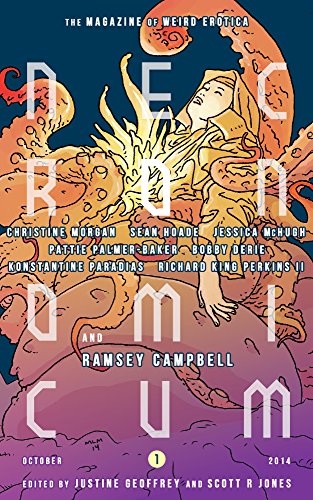
Christine Morgan reminds us that sex is so much more than just bodies coming together in her story Lascivious Tongues; it’s as much a mental, linguistic game as anything else. Words have power, particularly during sex: some words might only power your fucktoys, others could power your house, your city… or destroy your reality altogether! Lascivious Tongues is a lot of fun in a classic “don’t read the cursed book” way, and delivered to us by a master storyteller with a great feel for dialogue and character.
Justine Geoffrey, “On Old Names, Old Guards and Great Old Ones” in Necronomicum #1

There are definite parallels between Mythos literature and pornography. The Necronomicon and 120 Days of Sodom are both forbidden books, shunned by normal people, dealt with (at least in earlier times) only by specialists and pursued only by particularly fanatical readers, often hidden in libraries. These works are all taboo—just reading or possessing them carried a social stigma, and in some cases could even be illegal according to some authorities. Generations of Mythos fans have appreciated the fetishistic element to Mythos tomes when they read of the decadent works described in “The Hound.” Later authors have exploited these parallels to create Mythos tomes that combine the forbidden lore of erotica and cosmic horroras in Le Pornomicon (2005) by Logan Kowalsky, or “The Perils of Liberated Objects, or, The Voyeur’s Seduction” (2009) by Caitlín R. Kiernan. (For more on this subject, see “The Necronomicon as Pornography” in Sex and the Cthulhu Mythos.)

The term “fetish” as normally applied to sex signifies a particular and often fixed image of veneration. This sense of the word is derived in turn from European encounters with votive objects among the indigenous peoples of Africa—literal idolatry, when viewed through the Christian world-view of the traders, sailors, missionaries, and later anthropologists who sought to catalog and categorize what they saw, even if it was with imperfect understanding.

Cthulhu, not coincidentally, had an idol too.

She cared not a whit that the eccentric New England recluse’s library was said to have also contained dozens of tomes on occultism and folios of pornography. Nor did she lend any credence to the scandalous talk of orgies, covens, sacrifices, rituals, and other such hysteria and nonsense.

And it was absurd even to suggest that the book had anything to do with Grantham vanishing.
—Christine Morgan, “Lascivious Tongues”

Sexual fetishes lend themselves to cataloging and categorization too. Specific images—the stern headmistress is a staple character, the all-girls school a staple setting—lend themselves to endless permutations. Like Cthulhu, there is never one single, correct, absolutely perfect and eternal depiction; there is only endless and fascinating repetitions and variations, writers and artists playing on a theme, trying to capture or depict specific moods and ideas.

Which is a long way to say that the similarities between erotica and Mythos fiction are more than skin-deep; there is a certain fundamental similarity in purpose with fetishistic sexual literature. The really good writers are seldom dispassionate, but in the throes of their own fascination with the material, the techniques used in many Mythos pastiches and erotic works are essentially the same—and occasionally bleed over. This is a bit obvious when it comes to remixes such as “Kanye West—Reanimator” (2015) by Joshua Chaplinsky vs. “Herburt East: Refuckinator” (2012) by Lula Lisbon, but the dividing line between “serious Mythos story” and “erotic Mythos story” can be exceptionally thin—and it is entirely possible for a Mythos story to be a work of erotic horror, for a Mythos image like Cthulhu’s tentacles to become a sexual image fulfilling a particular fetish.

“Lascivious Tongues” works in no small part because Christine Morgan plays specifically to images of Lovecraftian horror as well as to sexual fetishes. In combining the two, she is sort of crossing the line twice—in both directions. Jessica Barlowe, the stern, virginal, and sexually repressed headmistress of the all-girl’s college does not satisfy what might be the expectations of the reader—her tastes, once awakened, lie in a more occult direction—and the Lovecraftian horrors have a form and appearance distinctly atypical for those expecting phallic-headed tentacles to burst forth from beyond the portal, as described and depicted in the Necronomicon in Noé & Barreiro’s The Convent of Hell.

Her facility with languages, combined with her position as headmistress of the Eastridge School for Young Ladies, meant that Jessica Barlowe had long since wearied of the inevitable ‘cunning linguist’ jokes with which each new wit fancied himself so clever.
—Christine Morgan, “Lascivious Tongues”

Yet more than anything, Morgan has tongue firmly in cheek. While the puns are few, she is definitely cognizant of the play of words and concept. Lovecraft and pornographers both have a tendency toward adjectives and adverbs, and if “Lascivious Tongues” doesn’t reach the heights of Lovecraft’s ultraviolet prose, it is definitely trying to evoke the particular idiom of a certain range of Victorian and Edwardian erotica in some of its diction.

Compared to many Mythos pastiches are overwritten and drag in terms of pacing, “Lascivious Tongues” moves almost too briskly, hitting its story beats and not slowing down until the weight of the sex scenes demands it. Many passages and transitions are downright terse. It is a very pulp/erotica style of writing, unlike the longer literary form such as Widdershins (2013) by Jordan L. Hawk, which otherwise shares a similar period setting. Which is to say, “Lascivious Tongues” is not exactly The Way of a Man with a Maid (1908) with the addition of a Mythos tome. It could easily have been something like that, if Morgan had aimed at a novel instead of a short story. The basic building blocks for such an erotic Mythos novel are there—but the market is different.

“Lascivious Tongues” was published in Necronomicum: The Magazine of Weird Erotica #1 (2014). Erotica is often ephemeral fiction; read once and then forgotten or discarded. It took quite some time to build up the idea of “erotic horror” as durable literature, beyond masturbation fodder. Which is a shame because some quite good fiction has been lost to disinterest, in men’s magazines and the wilds of the early Internet…and to ebooks which were available for a period, and then disappeared, taking their stories with them.

Necronomicum was set up as a triannual e-periodical; it made it to four issues…which isn’t bad at all, considering it published some well-known authors such as Ramsey Campbell, Christine Morgan, and Brian Sammons. The trick for any series publication is reaching the right market—all the more difficult in an internet already flooded with erotica and pornography. For such a publication, with a token payment, short & simple makes sense. “Lascivious Tongues” isn’t the worse for being written as a fast-paced bit of Lovecraftian erotica, but it definitely makes more sense in context as something written as a quick read in a small ebook anthology.


Bobby Derie is the author of Weird Talers: Essays on Robert E. Howard & Others (2019) and Sex and the Cthulhu Mythos (2014).

“Scritch, Scratch” (2014) by Lynne Hardy

Scritch, scratch, see the rat,
Bright eyes and twitching tail,
Scritch, scratch, chase the rat,
‘Cross hill, and stream, and dale.
—Lynne Hardy, “Scritch, Scratch” in Cthulhu Lives! 158

In the April 1924 issue of Weird Tales a story appeared by H. P. Lovecraft titled “The White Ape.” It wasn’t Lovecraft’s title. In conscious imitation of Edgar Allan Poe, Lovecraft’s original title had been “Facts Concerning the Late Arthur Jermyn and His Family.” An annoyed Lovecraft explained to the editor Edwin Baird on “The White Ape”:

I wish I could convert you to my point of view regarding the annoying literalness and flaccidity of that latter title…but all I can do is say that it is the only title which I could never possibly have applied to that particular tale; that it is at war with the spirit and internal harmonies of the narrative, and clashes fearsomely with the effect of the opening paragraph. One thing—you may be sure that if I ever entitled a story The White Ape, there would be no ape in it. There would be something at first taken for an ape, which would not be an ape. But how can one ever get those subtleties across?
—H. P. Lovecraft to Edwin Baird, 3 Feb 1924, Selected Letters 1.294

The problem with “The White Ape” is that it gives the game away at the start. For Lovecraft, the point was to stave off the moment of ultimate revelation, to let the reader’s imagination fill in the details while building up the events, letting things sink in. Readers can certainly read “Arthur Jermyn” more than once, and appreciate what Lovecraft does with the story, but the revelation can only really be experienced once.

The effectiveness of this approach can be seen in another of Lovecraft’s stories: “The Rats in the Walls” (Weird Tales Mar 1924). The title might be the greatest trick that Lovecraft ever pulled: there are no rats in the story, not a one, though the narrator reads of them, dreams of them, and thinks he hears them scurrying about. The rats, it turns out, are not the ultimate horror of it all…

…which brings us to Lynne Hardy and her story. Which isn’t about rats either, exactly.

“Scritch, Scratch” works as much as it does because it is essentially an update on the old moral about progress sweeping away old traditions which ought not to be fucked with, and that hoary old Aesop slots well into a Lovecraftian milieu. Readers can sense what’s coming, the only question is the specifics, and Hardy delivers without either rushing it or drawing it out too long.

The story is an appropriate “eldritch tribute” to Lovecraft without falling into the domain of pastiche. Hardy hints, but doesn’t show her hand; there are no gods with strange names, no tentacles, not even any cults or strange tomes, as such. It is close to folk horror, and with a little bit of work could easily have become a full-blown part of the Mythos and a pastiche. Genre-savvy readers could easily see an investigator dropped into the strange goings-on, more of the history of the strange little church and its carvings discovered, some solution discovered before the end…

That would be a very different and less effective work of fiction. It might make for a decent game.

Hardy has a long history with roleplaying games, having written extensively for the Cthulhu Mythos Roleplaying Game and Achtung! Cthulhu. In 2018 for Free RPG Day she and Chaosium released a version of “Scritch, Scratch” adapted for play, which readers can download for free. It’s worth pointing out that what works for a standalone Lovecraftian story doesn’t necessarily work for a roleplaying game: the story itself doesn’t have a protagonist as such, while the player characters in the game very much like to think of themselves as protagonists and want to accomplish something. In that regard, Call of Cthulhu cases like “Scritch, Scratch” (2018) become interactive storytelling experiences: the players aren’t just reliving the events of “Scritch, Scratch” (2014), they get to have a say in events.

The basis for this scenario came about as the result of a bit of an emergency. I was just about to set off to the airport for a convention when I received a message from the organizer—one of their guests was no longer able to attend, but was supposed to be running a tailor-made Call of Cthulhu scenario for a Kickstarter backer. Could I step into the breach?

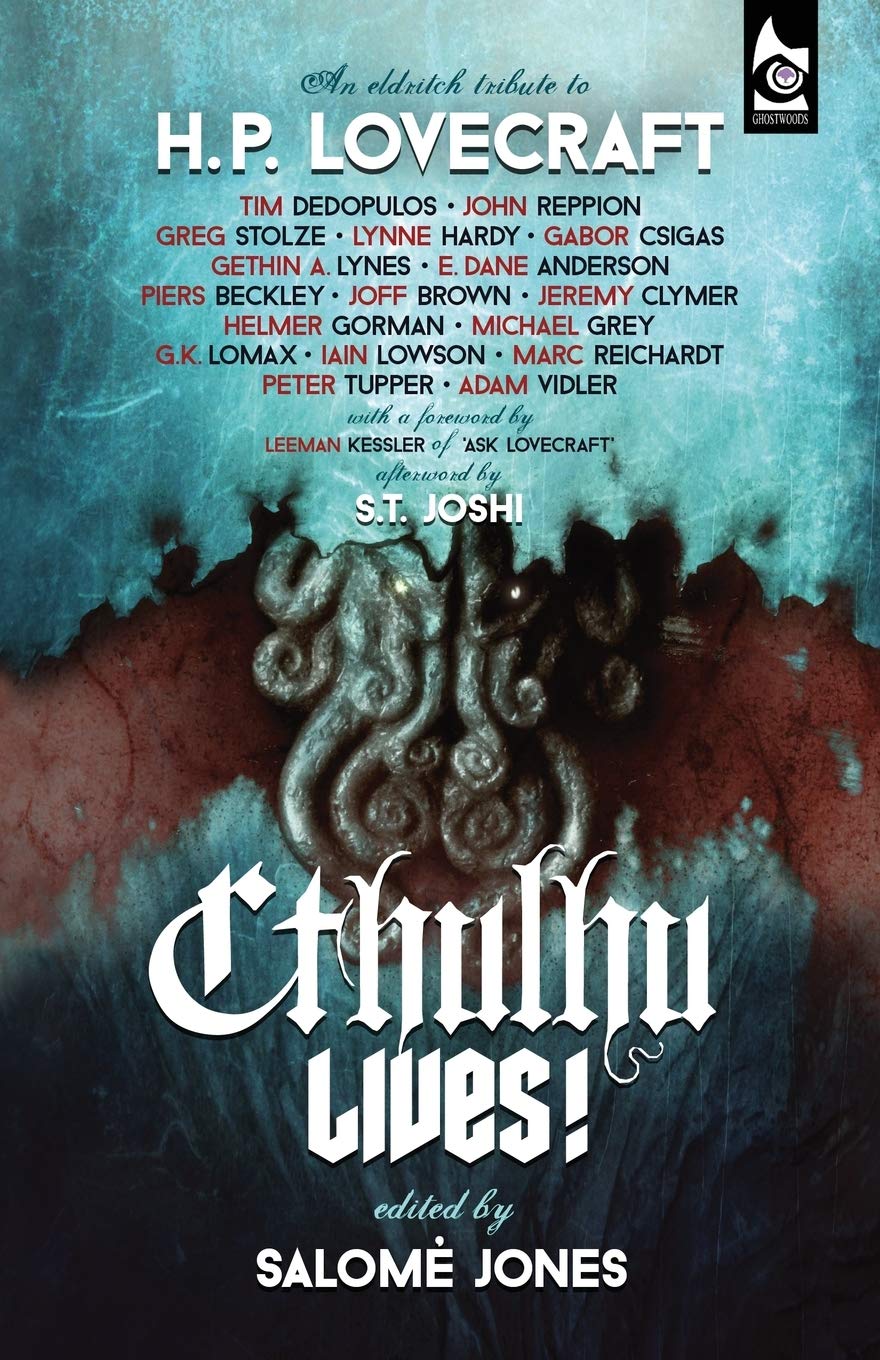
So, on the plane, I got my head together with my husband, Richard, and, after batting a few ideas around, decided to base it on a short story I’d written for the Cthulhu Lives anthology, published by Ghostwoods Books. Not exactly the same—that wouldn’t work—but looking at the events from a different viewpoint. Following its successful premiere at OrcaCon, the scenario has been run at a number of conventions with the pre-generated investigators provided. It’s always great fun to see how different groups tackle the character interaction and their investigators’ fate.

I hope you enjoy it, too.
—Lynne Hardy, “Foreword” in “Scritch, Scratch” (2018)

The scenario has to go into a little more explicit detail than the story. Readers who enjoy the mystery should probably give it a pass; some of the glamour of the Mythos tends to be lost when it’s packed into the relatively dry explanations that are sort of necessary. While readers of the story don’t need to know what’s going on to appreciate Hardy’s prose, gamemasters who are supposed to be running the event absolutely do.

“Scritch, Scratch” was published in Cthulhu Lives!: An Eldritch Tribute to H. P. Lovcraft (2014). It has not yet been reprinted.


Bobby Derie is the author of Weird Talers: Essays on Robert E. Howard & Others (2019) and Sex and the Cthulhu Mythos (2014).

“The Sorrow of Qingfeng” (2014) by Grey Yuen

Traitorous may be one who withholds praise and gratitude to Her Majesty of Ten Thousand Years for appointing the title of Grand Prefect to our Judge Di Renjie, but when caught between the horns of political obligations and the call of justice, it is justice that often falters.
—Grey Yuen, “The Sorrow of Qingfeng” in Swords & Mythos (2014) 256

Judge Di (or Dee) has become popular in the West through a series of historical crime novels by Robert van Gulik; but the character was based on a real person, Di Renjie, a magistrate during the late Tang dynasty and the early Zhou dynasty under the empress Wu Zetian (“Her Majesty of Ten Thousand Years”), and it is in this period (694 CE) that the story is set. This is not a detective story; though it shares some elements with that genre. “The Sorrow of Qingfeng” is something rarer and weirder: a Mythos Wuxia story.

Wuxia is a genre of Chinese (and more broadly Southeast Asian) fiction dealing with the adventures of martial artists; a form of fantasy which has enthralled millions across the globe, especially in the form of Japanese manga and anime like Dragonball and Fist of the North Star, and Chinese martial arts films like The 36th Chamber of Shaolin (1978) and Crouching Tiger, Hidden Dragon (2000). The influence of wuxia can still be clearly seen in Dungeons & Dragons and many other roleplaying games, action film around the world, and English-language fantasy fiction.

Mythos fiction, not so much.

Action & adventure is nothing new to the Mythos. The original draft of the first story of Conan the Cimmerian, “The Phoenix on the Sword” (Weird Tales Dec 1932) mentions Yog-Sothoth and the Old Ones, and that was neither the first or last time Robert E. Howard’s sword & sorcery heroes touched base with the Mythos; “The Vale of Lost Women” being a notable instance of swords being taken up against a Lovecraftian horror. Howard was not entirely ignorant of Asian martial arts; there were exhibitions and matches even in Texas in the 1920s, and even wrote “Hard-Fisted Sentiment,” a mixed-martial arts story where an American boxer goes up against masters in French savate, jujitsu, and British boxing in turn.

It has been relatively rare to see a Mythos story where wuxia-style fantasy martial arts feature prominently. Steve Perry’s “The Case of the Wavy Black Dagger” in Shadows over Baker Street (2003) comes pretty close, but for the most part the two modes of fiction simply don’t cross over very often. Cthulhu may be punched, but said punches usually have little to do with specific schools or techniques, swords of nigh-magical sharpness, or the cultivation of internal force. These are the tropes that Grey Yuen specifically invokes in “The Sorrow of Qingfeng.”

Grey Yuen’s style in the story is reminiscent of “Quest of the Nameless City” (2007) by Tachihara Tōya (立原透耶); the effort is made to set the story not in some nameless quasi-medieval Asian setting, but in a specific era of Chinese history and with a style of narration that borrows at least a little from the Romance of the Three Kingdoms (which period, the Tang dynasty, immediately preceded the Zhou dynasty). Like Tachihara Tōya, Yuen makes an effort to combine Western-style Lovecraftian imagery with a very different cultural context, with fairly solid results:

It stared back at me. He stared back me. He was…black—not dark-skinned, not in his skin tone. He was black like the night. At first, I thought he was from the lands far to the west, where the sun scorches and the sands run yellow, where an ancient city waits to be discovered again. But then I realised he was from much farther aay, waiting to give away secrets that would doom us all.
—Grey Yuen, “The Sorrow of Qingfeng” in Swords & Mythos (2014) 267-268

The question of the racial characterization of Nyarlathotep rears its head, as it did in “Collector the Third: Charles Wilson Hodap (1842-1944)” (1995) by Kenneth W. Faig, Jr., but in a slightly different syntax. Yuen is smart to keep explicit details to a minimum, this is a story where a wuxia character encounters the Mythos, and suggestion works better than detailed explanation. Likewise, the spectacle of Master Yue’s Taishan Wulei Palm is all the more effective for seeing the results than the execution.

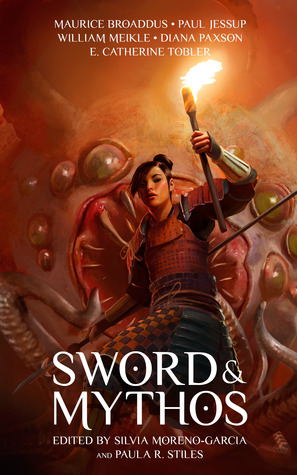
“The Sorrow of Qingfeng” is definitely an odd duck of a story, and it is hard to see where it might have been published except in an anthology like Sword & Mythos (2014), edited by Silvia Moreno-Garcia & Paula R. Stiles—yet it is an effective story, one that marries disparate modes of fiction and cultural contexts into a very competent whole. It has not yet been reprinted.


Bobby Derie is the author of Weird Talers: Essays on Robert E. Howard & Others (2019) and Sex and the Cthulhu Mythos (2014).

“This Human Form” (2014) by Lyndsey Holder

(A BUZZING IMITATION OF HUMAN SPEECH)

Iä! Shub-Niggurath! The Black Goat of the Woods with a Thousand Young!
—H. P. Lovecraft, “The Whisperer in Darkness”

You call me black, but I am beyond black. I am the space between the stars, the darkness that lies on the edge of your dreams, the sound of death in small spaces.

You say I am from the woods, but my woods contain no trees or birds, no peaceful sounds of wind and stream, no quiet rustle of delicate creatures. My forest pulsates, vibrates, glistens. […]

You call me a goat, and sometimes I am.
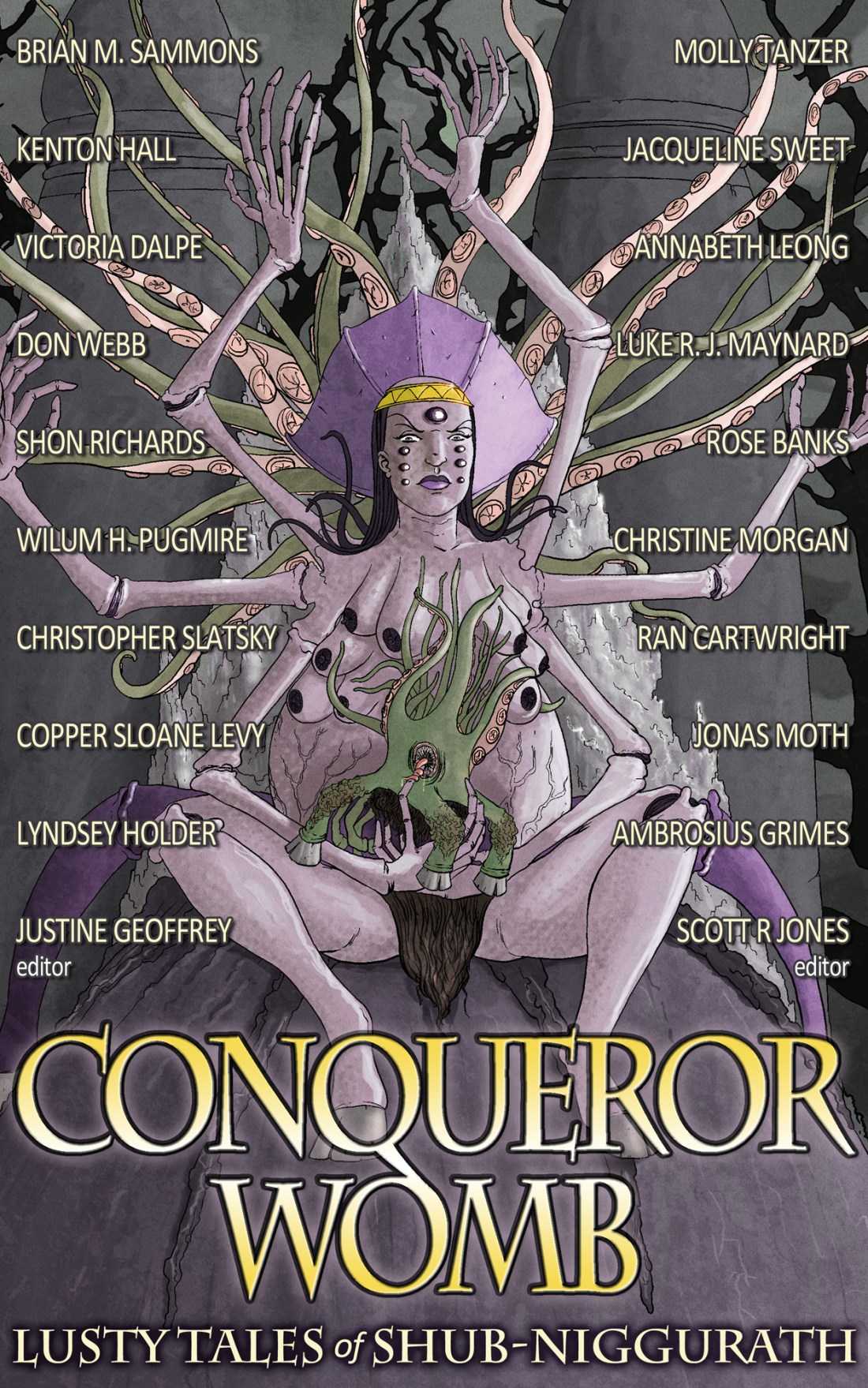
⁠—Lyndsey Holder, “This Human Form” in Conqueror Womb: Lusty Tales of Shub-Niggurath

More of a prose-poem or an invocation than a short story, Lyndsey Holder’s “This Human Form” reminds me of “The Elder Sister-like One, Vol. 1” (2016) by Pochi Iida (飯田ぽち。)“Red Goat, Black Goat” (2010) by Nadia Bulkin, and “Cthulhu Sex (ahem!)—a poem—” (1998) by Katherine Morel. Works that take inspiration from the Mythos, but don’t lean heavily on them; they forge their own lore, not bound by any convention of the Mythos and yet still strongly connected to it thematically.

Holder’s first-person account is only implicitly that of the Black Goat of the Woods with a Thousand Young, reveling more in sensation and imagery than any concrete connections to any other story in the Mythos. The connection is stronger by association: the story is in a Mythos anthology, which makes the imagery more apparent. But stick this story in a dark fantasy or horror magazine and would people still get it? Would their minds still make the connection? Probably not, if they weren’t already initiated in Mythos-lore and familiar with Shub-Niggurath, her aspects and attributes. But they could still enjoy the story.

“This Human Form” is exemplary of how in a largely disorganized way, the Mythos has evolved organically into something which the SCP wiki has done by considered design. While it has been said there is no canon to the Mythos, it would be more accurate to say there is no one canon. Certainly, Lovecraft’s Dreamlands stories are fairly consistent in themselves, as are Ramsey Campbell’s Severn Valley tales, Brian Lumley’s Titus Crow stories, W. H. Pugmire’s Sesqua Valley, Charles Stross’ the Laundry Files, etc. Peter Rawlik has curated a canon centered around “Herbert West—Reanimator,” and Shane Ivey has spent considerable time doing much the same with the Delta Green setting.

Most of these works are independent, interconnected, sometimes conflicting. Myths do that. Conflict, arguably, might even be essential to the Mythos: it forces the reader to engage with it, to juggle different concepts, maybe try to reconcile them.

There is on thing you do not call me: mother. My body has sent a thousand children into this world, a thousand mewling, crawling things, suckling and whining, slithering down silvery dream-threads into the soft comfort of your warm beds.
—Lyndsey Holder, “This Human Form”

It is rare to get a first-person take from a Mythos entity, although far from unknown. Neil Gaiman famously did it with I, Cthulhu, or, What’s a Tentacle-Faced Thing Like Me Doing in a Sunken City Like This (Latitude 47° 9′ S, Longitude 126° 43′ W)? (1987) (later publications have quite reasonably shortened this to “I, Cthulhu”). Gaiman’s take, of course, is a quiet taking of the piss. The idea of Cthulhu addressing the user is the main joke. For Mythos entities that are largely defined as ineffable and unknowable, the first-person narrative rather kills the mystery…unless, as Holder does, the meat of the text is salacious, sensation-driven, and suggestive. Making telling feel like showing.

Lyndsey Holder’s “This Human Form” was published in Conqueror Womb: Lusty Tales of Shub-Niggurath (2014). Her other Mythos fiction includes “Parasitosis” (2015) and “Chosen” (2015).


Bobby Derie is the author of Weird Talers: Essays on Robert E. Howard & Others (2019) and Sex and the Cthulhu Mythos (2014).