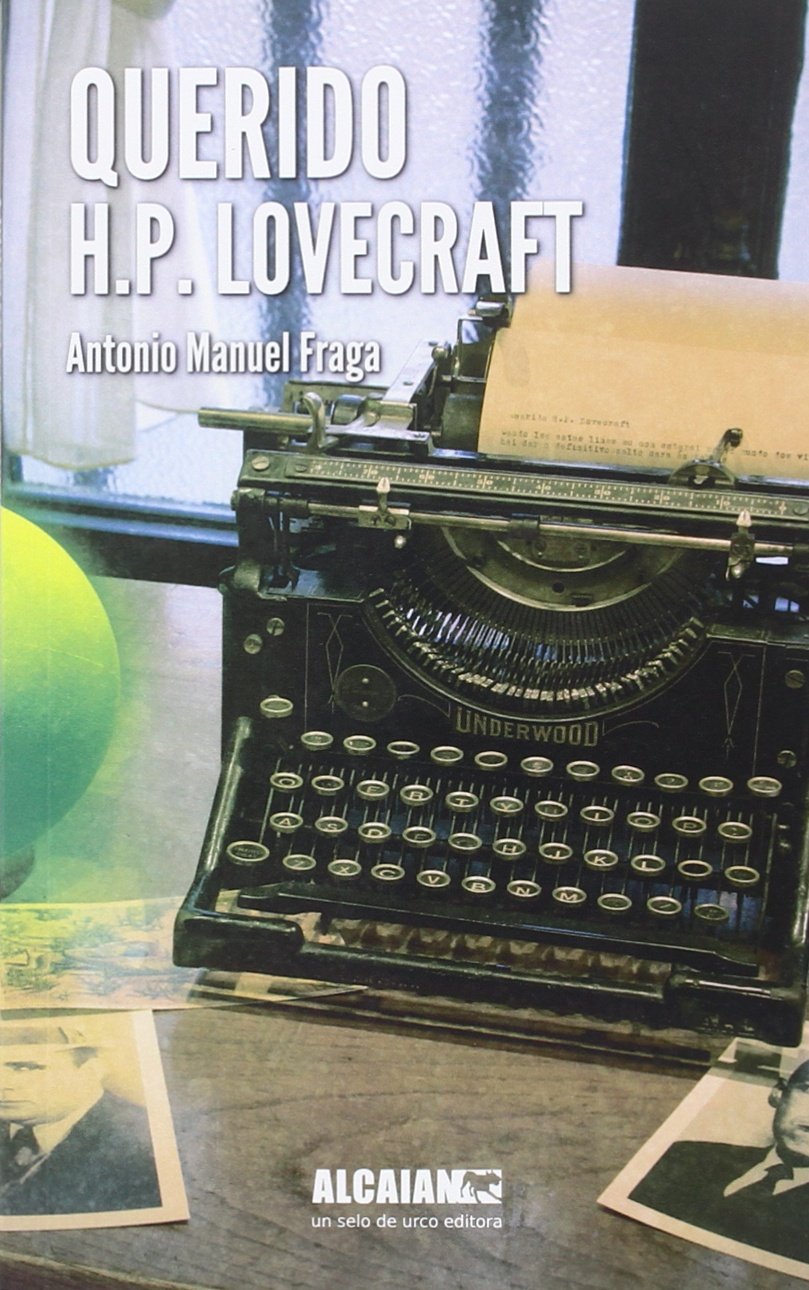
Querido H. P. Lovecraft (2016) by Antonio Manuel Fraga

Querido H. P. Lovecraft:

Cuando lea estas lineas yo no estaré ya en el mundo de los vivos . . .


Con estas palabras comienza la carta que Robert E. Howard envía a su amigo, mentor y famoso escritor. En un escrito delirante el auto tejano describe su progresivo descenso al infierno de la locura y la desesparación después de visitar una antiqua tumba india sita en el interior de una cueva.

En la narración se mezclan los sueños con la realidad, la escritura, la relación con los amigos y su novia, la salud de la madre y su dependencia de ella . . Sin salida, totalmente acorralado por sus miedos, Howard debe buscar una solución, una huida, un sacrificio . . .
Dear H. P. Lovecraft,

When you read these lines, I will no longer be in the world of the living . . .


With these words begins the letter Robert E. Howard sent to his friend, mentor, and famous writer. In a delirious letter, the Texan author describes his gradual descent into the hell of madness and despair after visiting an ancient Indian tomb located inside a cavern.

The story mixes dreams with reality, writing, his relationship with his friends and girlfriend, his mother’s health and his dependence on her… With no way out, completely cornered by his fears, Howard must find a solution, an escape, a sacrifice…
Querido H. P. Lovecraft (2017, Spanish), back cover copyEnglish translation

Rusty Burke, a scholar of the life and work of Robert E. Howard, has noted that REH was one of H. P. Lovecraft’s major correspondents—but that HPL was Howard’s major correspondent. The bulk of the surviving letters we have from Robert E. Howard are to Lovecraft; and while many of Howard’s other letters—to Clark Ashton Smith, Farnsworth Wright, C. L. Moore, Novalyne Price, etc. are important, none of them really cover the same breadth and depth as Howard’s letters to Lovecraft. Nor, in many cases, have we much of the other side of the conversation. In the collected correspondence of both men, at least as much as survives, we gain a deeper understanding and appreciation for the push and tug of the conversation.

This literary friendship has extended far past the limits of the grave. Novalyne Price Ellis mentioned it in her memoir One Who Walked Alone (1986); “Gilgamesh in the Outback” (1986) by Robert Silverberg sees the two palling around the underworld together. The semiotic ghosts of both men have followed each other into novels and comic books, from Rick McCollum’s Ashley Dust (1996) to Lovecraft’s Book (1985) by Richard Lupoff, later restored as Marblehead (2006). Howard makes an appearance in most of the biographical graphic novels that have come out about Lovecraft, and every biography of Howard cannot avoid mentioning their “civilization vs. barbarism” argument in letters that winged their way from Providence, R.I. to Cross Plains, TX and back again.

It is this relationship that Antonio Manuel Fraga has attempted to capture in his novel Querido H. P. Lovecraft (2016, “Dear H. P. Lovecraft), which was written and published in Galician. The novel was then translated into Spanish (Castilian) by Mercedes Pacheco Vázquez and published, also as Querido H. P. Lovecraft, in 2017. It has not yet been translated or published in English, but in brief the novel takes the form of a classic epistolary novel, like Dracula, but consisting of several fictional letters between H. P. Lovecraft, Robert E. Howard, and Dr. Isaac M. Howard (REH’s father, with whom HPL corresponded after REH’s death in 1936). The bulk of the novel consists of Howard’s final letter to Lovecraft, detailing the supernatural curse that descended upon him and the real reason he took his life that day.

De ROBERT ERVIN HOWARD para H. P. LOVECRAFT
10 de junio de 1936
Sr. H. P. Lovecraft
66, College Street. Providence, R.I.


Querido H. P. Lovecraft:

Cuando lea estas líneas no estaré ya en el mundo de los vivos, pues pronto daré el definitivo salto hacia las tinieblas. Sin otra salida, y después de lo vivido, espero que la muerte se abra a mi como una madre redentora, un pecho cálido que me ampare y silencie los horripilates alaridos que no dejan reposar mi mente, cansada y enferma.

Puede que este testimonio, dictado por la urgencia y la necesidad de purga, me sirva también para comprender mejor toda esta atrocidad, o por lo menos para distinguirla de un modo más global.

Hace dos semanas me acerqué a Brownwood, donde compré tres tumbas en su camposanto. Los miembros de mi exiqua familia tendrán así cada uno su trozo de tierra donde reposar, donde olvidar tanto dolor embalsamados en la archilla arenosa de Texas.

Las raíces de nuestros padecimientos se entredan en el pasado, se mezclan y alimentan de las mismas sales, pero sus tallos crecen independientes hacia un sol que es fuego fatuo, sin bndad ni compasión.

En el caso de mi madre, la desgraciada Hester, hablamos de una vida marcada por la enfermedad propia y ajena –si como enfermeded se puede calificar mi mal, que después expcliaré detalladamente. ¡Tiempo habrá!–.

El padecimiento de mi padre, el viejo doctor Howard, tiene el sabor de la ceniza del desprecio de su compañera. Durante toda su vida fue un imán para las malas inversiones, en las que dilapidó los escasos ahorros de la familia. ¡Y bien que se lo reprochó Hester! Esa fue una de las causas del désden de su mujer, pero no el único ni el más importante. En esa guerra fue un titán. Por el contrario, sospecho fundadamente que no resistirá el trance de nuestra partida. Ojalá me equivoque.

Y por último está mi padecimiento, el del necio Bob, el torpe ignorante. Afortunademente, pronto será silenciado por este colt que ahora siento en el muslo y que se convertirá en mi redentor, reverendo y verdugo.
From ROBERT ERVIN HOWARD to H. P. LOVECRAFT
10 June 1936
Mr. H. P. Lovecraft
66 College Street, Providence, R.I.


Dear H. P. Lovecraft:

When you read these lines, I will no longer be in the world of the living, for I will soon take the final leap into darkness. With no other way out, and after what I have experienced, I hope that death will greet me like a redeeming mother, a warm breast to shelter me and silence the horrifying screams that keep my tired and sick mind from resting.

Perhaps this testimony, dictated by the urgency and necessity for a purge, will also help me better understand this whole atrocity, or at least to distinguish it in a more comprehensive way.

Two weeks ago, I went to Brownwood, where I bought three graves in the cemetery. The members of my tiny family will each have their own piece of land to rest in, where they can forget so much pain, embalmed in the sandy Texas clay.

The roots of our sufferings are buried in the past, they mix and feed on the same salts, but their stems grow independently toward a sun that is a will-o’-the-wisp, without kindness or compassion.

In the case of my mother, the unfortunate Hester, we are talking about a life marked by her own and other people’s illnesses—if my illness can be described as illness, which I will explain in detail later. If there is time!

The predicament of my father, old Dr. Howard, tastes like the ashes of his companion’s contempt. Throughout his life he was a magnet for bad investments, in which he squandered our family’s meager savings. And well did Hester reproach him for it! That was one of the causes of his wife’s disdain, but not the only one, nor the most important. In that war he was a titan. On the contrary, I strongly suspect that he will not be able to withstand our departure. I hope I am wrong.

And finally there is my suffering, that of the foolish Bob, the ignorant bumbler. Fortunately, he will soon be silenced by this colt that I now feel in my thigh and that will become my redeemer, reverend and executioner.
Querido H. P. Lovecraft (2017, Spanish) 20-21English translation

Perhaps surprisingly given how prominently the letters formed their relationship—Lovecraft and Howard never met, though they corresponded from 1930 until Howard’s death in 1936—the epistolary format has featured less prominently in their fictional afterlives. In fiction, at least, the two men would get the chance to meet as they never did in life. So too, that way the writer isn’t forced to write as many letters to and from Lovecraft and Howard from the other’s perspective, which would require more than a passing familiarity with both men’s life and letters to convincingly nail the voice and knowledge of each.

It is difficult to judge how well Antonio Manuel Fraga has captured their voices. That Fraga did some research into Robert E. Howard’s life is evident, he obviously read at least the flawed biography Dark Valley Destiny (1983), or Mark Finn’s Blood and Thunder (1st ed. 2006/2nd ed. 2013), which emphasizes the sometimes conflicted family dynamics among the Howards. Some of the choices (filtered, admittedly, through two layers of translation) strike me as unlikely; Robert E. Howard would probably not have referred to his mother by her given name, for example, and never had anything but praise for his father in his letters to Lovecraft. There are a few other details that are “off” in the short novel, but to try and catalogue them would be pedantic. This is a fantasy novel, and some allowances have to be given.

As a novel, Querido H. P. Lovecraft is an interesting example of a familiar idea: the author becoming the character. The Robert E. Howard of this book is not the same REH that comes through in his letters to Lovecraft, but he is recognizable as an interpretation of that person. What it reveals is less about Howard and Lovecraft than it does about Antonio Manuel Fraga—what Fraga has taken away from his research about Howard, the aspects of his life and relationships that he wished to emphasize in telling his story.

Is it a story worth telling? As an exercise in fantasy, it’s fine. There have been innumerable stories that mingled H. P. Lovecraft’s death with his Mythos, that have blurred the lines between reality and fantasy, for fun if nothing else. In that sense, Querido H. P. Lovecraft is something of a fanfic novel, a great and impossible what if, the kind of cache of letters that Lovecraft and Howard fan-scholars might dream of coming across, like the scholarly protagonists of a ghost story that find the document that explains it all at last.

What we cannot forget, however, is that this is not about how Robert E. Howard lived and died, but the stories and interpretations that have grown up around it.

The death Robert E. Howard is tinged with tragedy. This was a man whose life has sometimes been described as a trajectory toward his inevitable demise, with biographers and critics looking back across the whole of his existence for signs that would point to his self-destruction. Howard’s suicide is a part of his mythos, as explored in works like “El guardian” (2010) by Enrique Balmes & Roc Espinet and “Life After Death” (2010) by David Güell, so the focus on his crucial final days isn’t unusual. The addition of a supernatural element throws off the narrative of inevitability; it emphasizes Howard as more of a victim and cheapens a tragic affair by diluting his own agency. He goes out not as the cipher, the man who had reached his hidden limit and came to the final step, but as a haunted man who suffers under persecutions the novel details all too well.

It would be interesting, someday, to read this in a proper English translation. To see what niceties of language I’ve missed, what nuances may come out from having someone fluent translate Fraga’s prose. While I doubt the translation would capture Howard or Lovecraft’s voice in their letters, there are a lot of nods to people, stories, and events in Howard’s life that would get a nod from Howard and Lovecraft aficionados.


Bobby Derie is the author of Weird Talers: Essays on Robert E. Howard and Others and Sex and the Cthulhu Mythos.

Deep Cuts in a Lovecraftian Vein uses Amazon Associate links. As an Amazon Associate I earn from qualifying purchases.

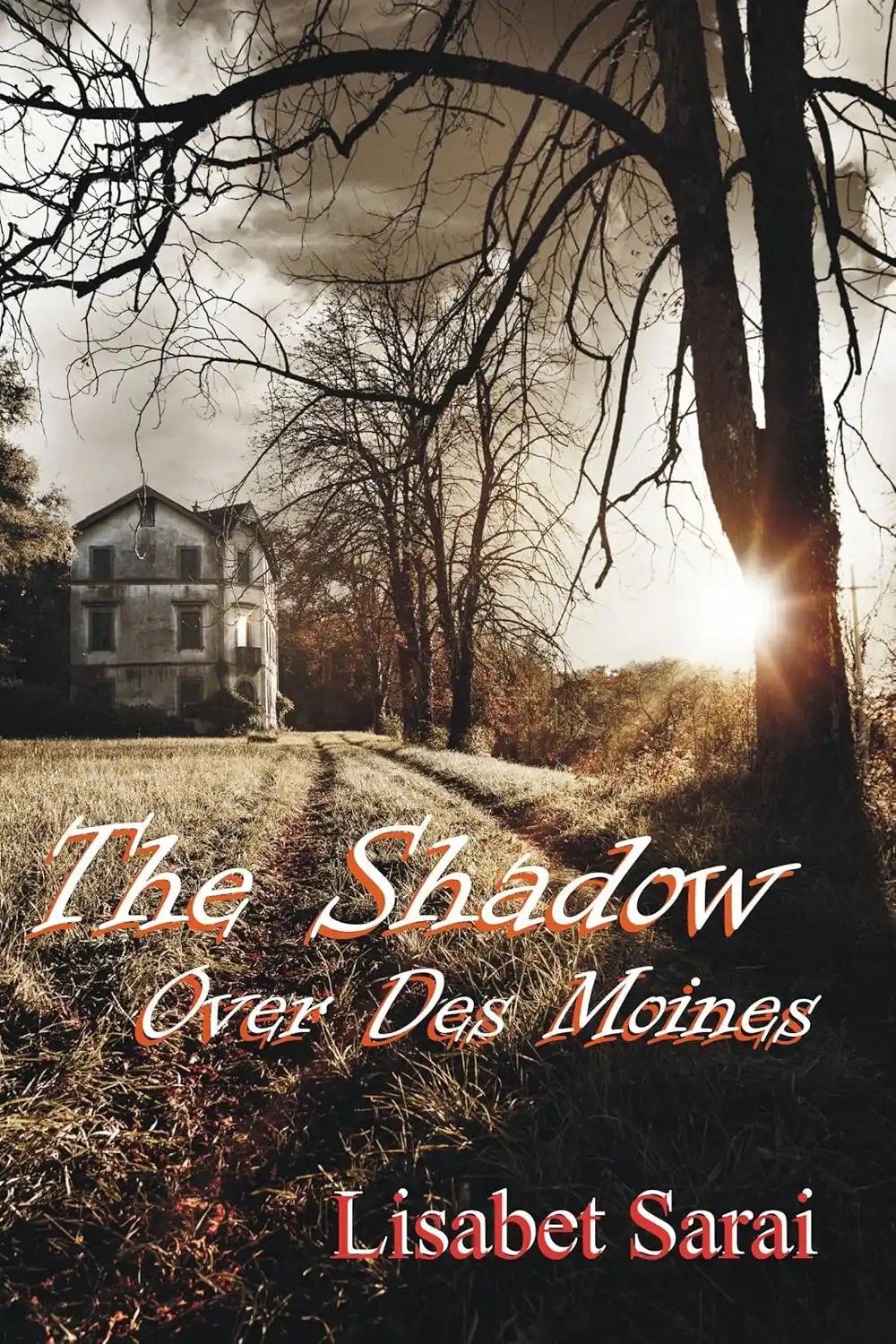
“The Shadow over Des Moines” (2016) by Lisabet Sarai

Searchers after horror haunt strange, far places.
—H. P. Lovecraft, “The Picture in the House”

I come from Des Moines. Somebody had to.
—Bill Bryson, The Lost Continent

Lovecraft country is often associated with New England, because that’s where Lovecraft set many of his most famous stories. Arkham, Dunwich, and Innsmouth are in the fictional Miskatonic River valley of a fantasy version of Essex County of Massachusetts. Yet Lovecraft country was never restricted to the Bay State.

The fictional stomping-grounds of the Old Ones encompassed the Oklahoma frontier of “The Curse of Yig” (1929) and “The Mound” (1940); the French provence of Averoigne in Clark Ashton Smith’s tales; the ancient town of Stregoicavar in Hungary in Robert E. Howard’s “The Black Stone” (1931). Other writers have staked out and developed their own corners of Lovecraft country: the Severn Valley in Ramsey Campbell’s tales, with Goatswood and Brichester; the Sesqua Valley in the Pacific Northwest by W. H. Pugmire; and any other of other additions, popular and obscure, by writers professional and amateur.

Yet this might be a first. Niceville USA meets Shub-Niggurath.

The Shadow over Des Moines is a parody written in the style of the great pulp horror author H.P. Lovecraft. if you are not familiar with his work, you are missing a treat. He’s perfect for Halloween. Check out The Dunwich Horror, At the Mountains of Madness or The Shadow over Innsmouth. I am not ashamed to say that Lovecraft has had a singificant influence on my own writing.
—Lisabet Sarai, “The Shadow over Des Moines”

Two of the elements that make parody work are juxtaposition and exaggeration. The Lovecraftian parodist doesn’t just copy the most obvious or characteristic elements of Lovecraft’s prose, they often enhance them to the point of ridiculousness. Made all the more obvious by contrasting the Lovecraftian aesthetic with an area of the country least associated with anything eldritch.

The surprising thing is, it doesn’t come off badly. The prose is a little purple, but the Midwestern setting itself isn’t exaggerated. It’s more like a Lovecraftian protagonist moved into a suburb than an attempt to reveal the hidden horrors of home-made blueberry pie and calf-length skirts. The humor and horror of the story don’t come at the expensive of the innocent metropolis of Des Moines, but in the quirky Lovecraftian excess of the protagonist—and the fact that this is an erotic parody.

Leonora encouraged me to drop by and visit anytime, but I doubted that I would act on her suggestion. Shivers ran down my spine as a I watched her swaying hips retreat down my path and across the street to her own dwelling. Nevertheless, I found my body reacted to her as if I were fifteen instead of fifty four. I found it necessary to spend a quarter of an hour reading Popular Mechanics before my tumescence subsided.
—Lisabet Sarai, “The Shadow over Des Moines”

The outlines of the story are familiar; basically Fright Night with a sexy Lovecraftian twist and trappings. The fact that so much of it is played straight-faced makes the occasional play on words all the more effective (“Mrs. Gratsky’s gate swung silenly open, as if well-lubricated.”) If it leans a little too hard into some of the stereotypes of Lovecraftian pastiche, it also works to deliver a carefully-curated erotic aesthetic that balances vivid description with an older, quainter verbiage. The end result is as absurd as it is utterly appropriate. Where else but in such a story as this will you get such turns of phrase as “unhallowed anus?”

Like most erotic Lovecraftian ebook fare, things wrap up fairly swiftly after the climax. The pacing is set up for this single encounter, not a longer series of repetitive erotic adventures a la the Booty Call of Cthulhu series. Yet this is a very competent, self-contained example of this mode of fiction. If I had any suggestion for a sequel, it would be to make more use of Des Moines itself; it feels like there was room to make more use of this most un-Lovecraftian addition to Lovecraft country.

“The Shadow over Des Moines” (2016) by Lisabet Sarai is available as a Kindle ebook. More of her work can be found at https://lisabetsarai.com and https://lisabetsarai.blogspot.com.


Bobby Derie is the author of Weird Talers: Essays on Robert E. Howard and Others and Sex and the Cthulhu Mythos.

Deep Cuts in a Lovecraftian Vein uses Amazon Associate links. As an Amazon Associate I earn from qualifying purchases.
The Colour Out of Space (2016) by H. P. Lovecraft & Amy Borezo

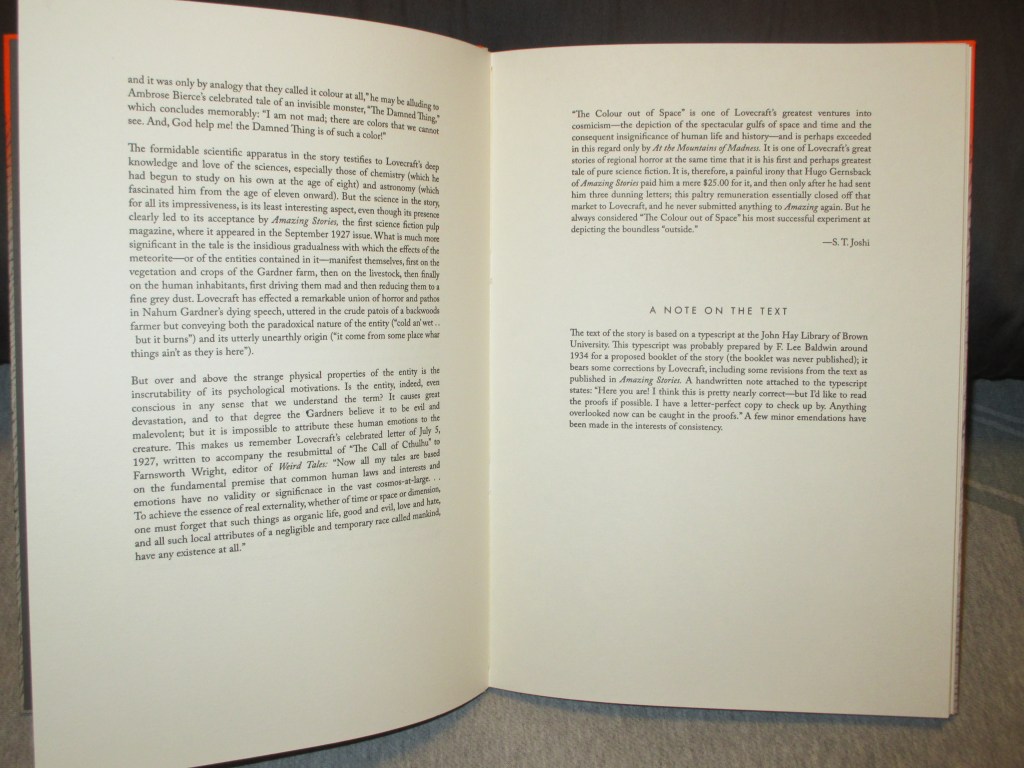
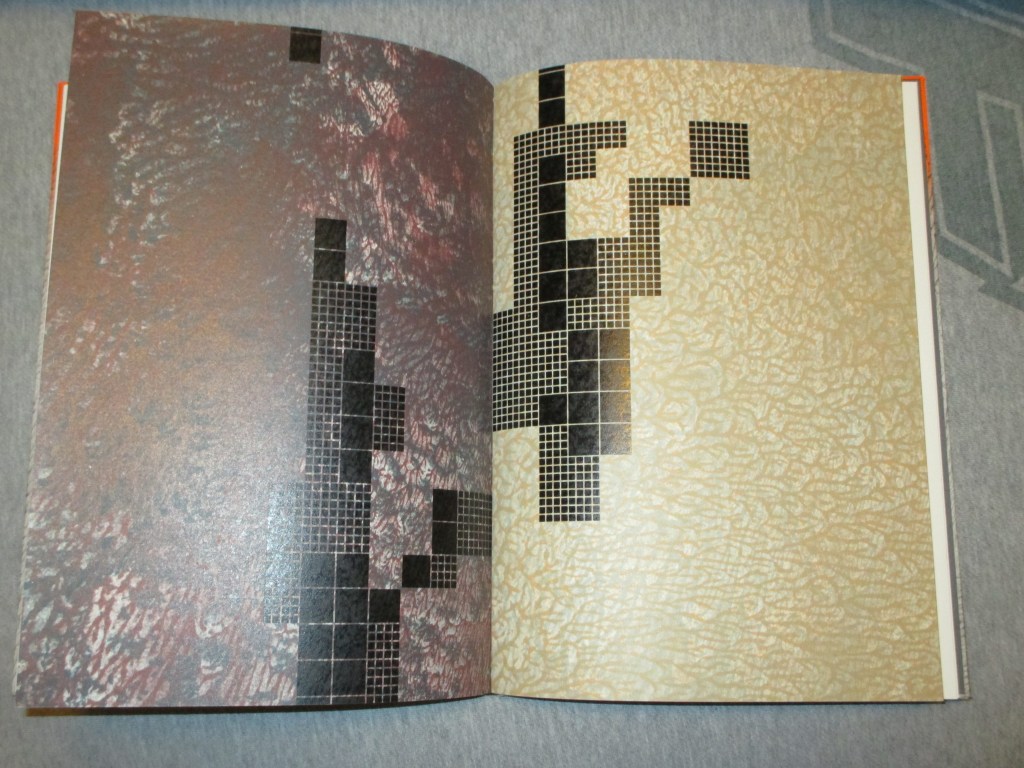
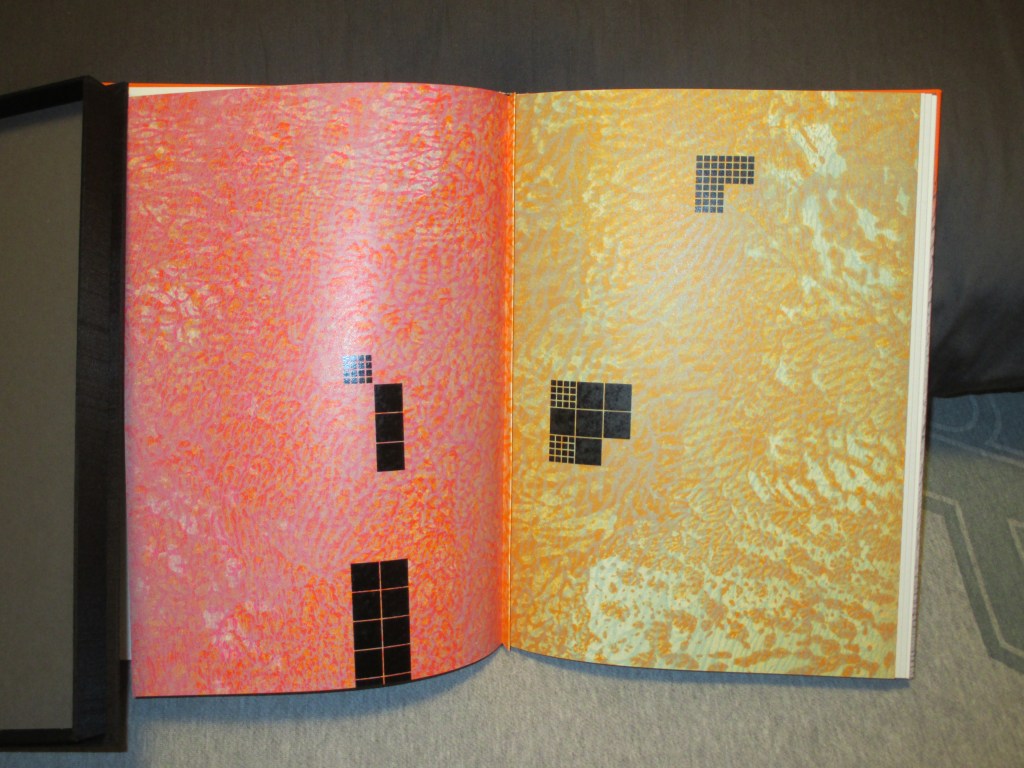
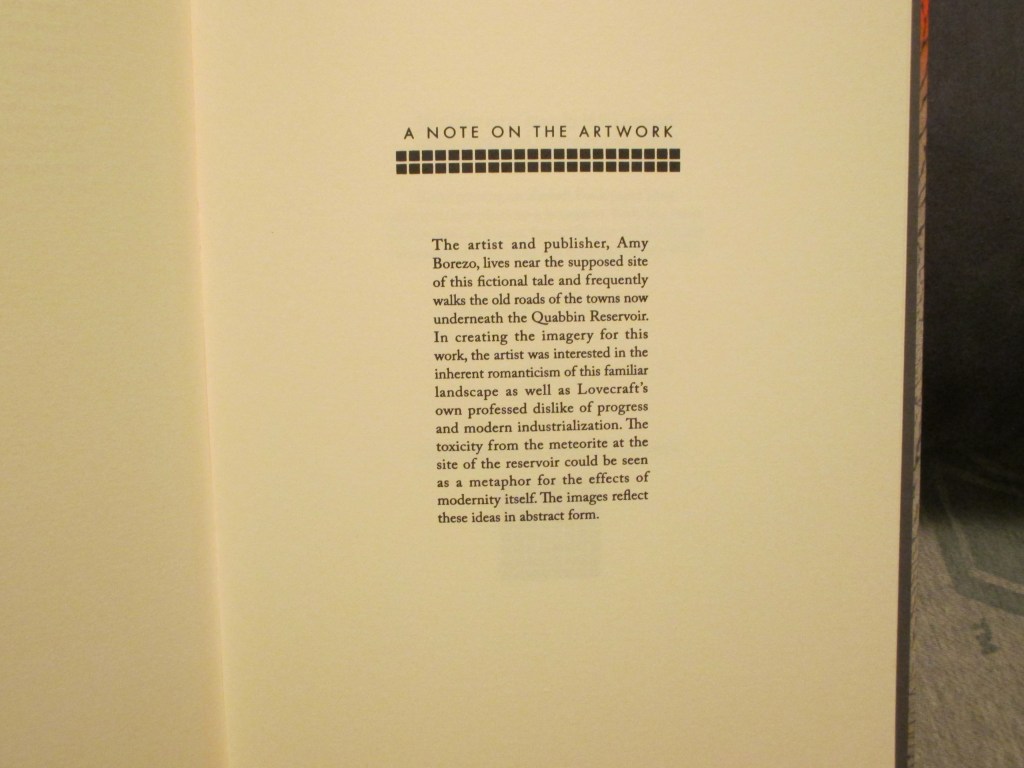
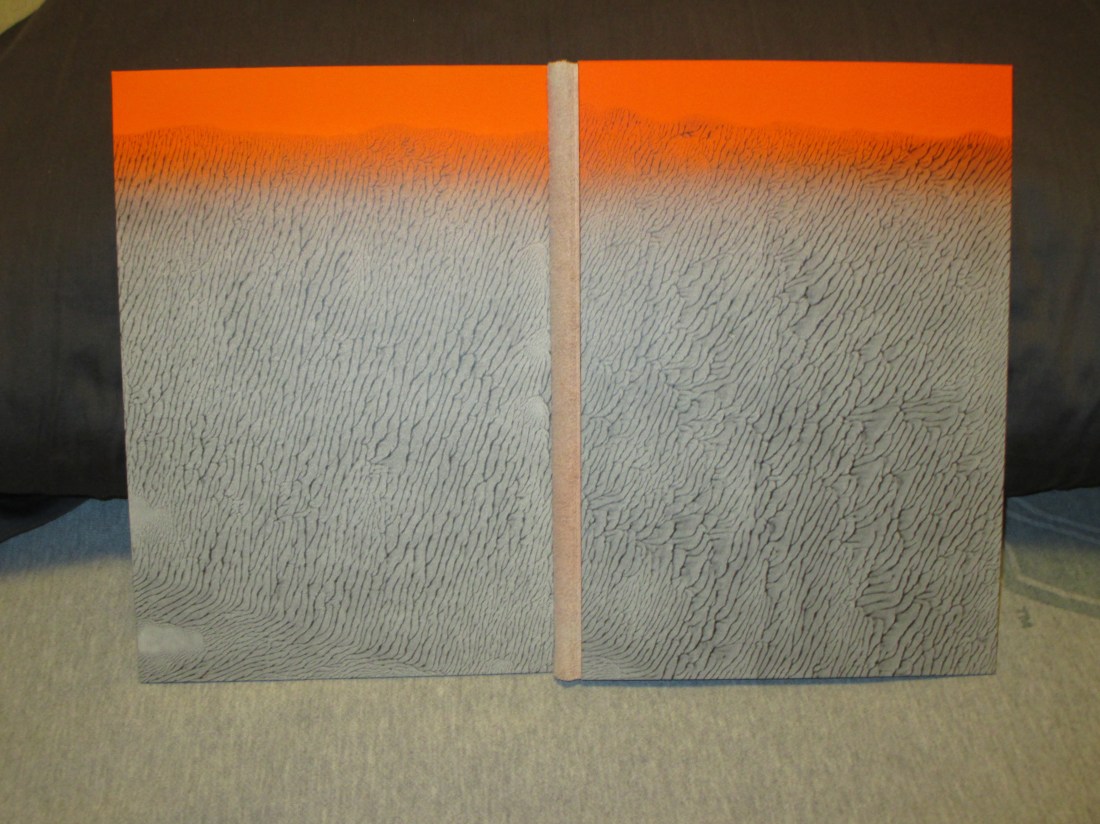
In 2016, artist Amy Borezo published a very limited illustrated edition of H. P. Lovecraft’s story “The Colour Out of Space.” To quote from Shelter Bookworks’ original page:

This hybrid artist’s book/contemporary fine press edition of the 1927 horror/sci-fi story by HP Lovecraft includes an introduction by Lovecraft scholar S.T. Joshi and 14 color images by Amy Borezo. The artist lives near the supposed site of this fictional tale and frequently walks the old roads of the towns written about in this story. In creating the imagery for this work, the artist is interested in evoking the complexity of the local landscape in abstract form with the construction of the reservoir overlaid visually through geometric blocks.

The text for this edition was provided by S.T. Joshi from his recent publication, H. P. LOVECRAFT: COLLECTED FICTION: A VARIORUM EDITION [Hippocampus Press, 2015] and is derived from a typescript at Brown University, evidently prepared by F. Lee Baldwin for a proposed reprint of the story (c. 1934) that never happened. It has some revisions in pen by Lovecraft, so presumably it represents his final wishes for the story.
_____________________

Relief printing on Zerkall Book paper from photopolymer plates on a letterpress. Body text set in Caslon, titles in Futura. Pages sewn onto a shaped concertina. Paste paper over boards with a buffalo suede spine. Housed in a presentation box. Special thanks to Lisa Hersey who assisted in printing and binding.

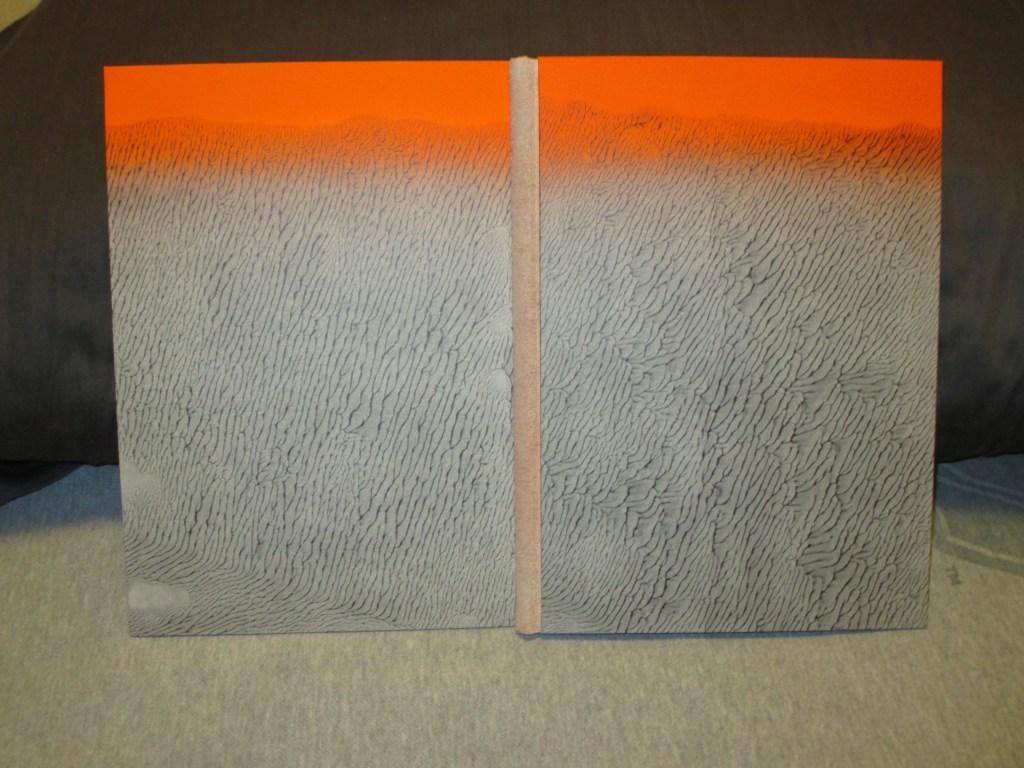
The edition, despite the relatively high cost (US$500 + shipping in 2016), sold out. It arrived in an attractive clamshell box, with a paper label. Inside, the colors on the paper are bright and vivid in a way that the light and the camera don’t really catch, the backstrip soft, the paper creamy and the text sharp. In your hands, the brilliant orange seems to leak through around the edges of the pages. A title page, a brief introduction by S. T. Joshi. The text and illustrations are on alternate pages, distinct, the images vivid but abstract. A word on the artist, a colophon and numbering page, and then the book is at an end.

Amy Borezo’s illustrated edition is, in a very real sense, a piece of art that you can read. The text itself is meticulous in its accuracy, but you can read the same text in Hippocampus Press’ variorum edition, you can read the same text for free online. If you must have a physical copy of a book in your hand, you are spoiled for choice: “The Colour Out of Space” is one of Lovecraft’s most reprinted works, and there are innumerable illustrations for the story from various artists, from J. M. de Aragon in the pages of Amazing Stories in 1927 and Virgil Finlay in Famous Fantastic Mysteries in 1941 to many others of the current day.

This massive plurality of choice, the sheer number of editions, touches on an issue that many readers and would-be readers of Lovecraft deal with: where do you start? What is the best edition? What if you want a really nice copy of a book? Which one of all the hundreds of titles should you go for, and why, and how much will it cost?

If that sounds like more of a collector’s issue than a reader’s issue, then congratulations, you’ve hit on one of the fundamental problems facing not only Lovecraft, but most popular authors in the contemporary period.

When Lovecraft was alive, he was primarily published in the amateur press, pulp magazines, some reprint anthologies like the British Not at Night series, and a couple of very small privately printed editions of The Shunned House (never bound or formally released during his lifetime) and The Shadow over Innsmouth (which was, but the binding was shoddy). There were no finely bound editions of Lovecraft with the embellishments of the bookmaker’s art available to the general public, no leather covers, no gilt lettering, no raised bands (caveat: one copy of The Shunned House was specially bound by R. H. Barlow as a gift for Lovecraft).

Early collectors of Lovecraft often focused on posthumous publications, like the first publications of Arkham House, and little obscurities like the edition of Lovecraft’s commonplace book put out by the Futile Press in 1938. Even ultra-small press editions were typically not “fine” in the sense of lavish materials, artwork, or presentation, but were often considered valuable simply because of the small size of their edition, the ease with which copies perished, and subsequent rarity in the face of growing demand. That demand came from Lovecraft’s own growing popularity; the mass market paperback reprints of Arkham House collections, the armed services editions, and foreign reprints in hardback and paperback vastly increased the audience for Lovecraft’s work.

Until quite recently, fancy fine press editions were not normal for living authors. Before mass literacy, books were often bought unbound and then the author could bind them however they liked; really rich people could commission books that were themselves works of art in every sense of the word, involving whatever costly materials or decorations they cared for. As the commercial basis of book reading and publishing became more egalitarian, fancy editions often became more about the skill of the bookmaker and/or any associated artist, for fine press editions, and the materials shifted.

So when you look at what constituted a really nice Lovecraft edition in, say 1980, you’re likely looking at the output of Roy A. Squires’ press. These were meticulously crafted letterpress editions, usually on high-quality handmaid paper, sometimes featuring tipped-in photographs or other illustrations. Where a normal chapbook from Necronomicon Press or a fan press might be published on an Apple II printer and stapled together, everything about Squires’ production was done by hand.

The slightly bourgeoisie desire for something fancier still nagged the science fiction and fantasy market. Arkham House paved the way in the late 1930s and 40s by showing that a small press publisher specializing in genre books was viable (the presses they inspired apparently didn’t know how often Arkham House founder August Derleth was running in the red, or how long it took for his small, relatively expensive books to sell). Most of these products weren’t fine press; they were solid books, aimed and priced at a select market. Very few of them produced anything that might be described as a luxury edition of Lovecraft; the choicest example might be the 1976 edition of Démons et Merveilles by French publisher Opta, which came bound in leather, with slipcase, and illustrations by Philippe Druillet. The translation has its issues (Lovecraft’s “ghouls” is rendered as “vampires,” to give one notable example), but compared to the rather plain but sturdy Arkham House editions, it’s gorgeous.

Easton Press (founded in 1975 as a division of MBI, Inc.) took up the gauntlet of producing, for lack of a better term, what not-rich people think of as rich people’s books: bound in letter, embossed in 22k gilt, very snazzy to look at. In practice, while Easton Press has consumed many acres of cowhide, the actual books they produce tend not to be very special: they’re reprints of existing books, often not anything particularly rare or obscure, with no additional editorial guidance or notes (and sometimes bad misprints). The books themselves are usually solid, but less than beautiful; their editions of Lovecraft show evidence of corner-cutting and mass production.

There is a niche market for really nice editions of books, at a price affordable to middle-class bibliophiles. Over the last twenty years or so, that niche market has exploded. Centipede Press, Subterranean Press, the Folio Society, etc. are names that are familiar now for deluxe editions of Lovecraft and/or other authors, typically reprinting older works instead of presenting anything original, and typically publishing in limited editions of a few hundred copies. Quality and presentation vary, although are generally pretty high—not quite the same production value as, for example, letterpress outfits like Pegana Press which continue the fine press tradition, but for high-end versions of books that you might otherwise buy at Barnes & Nobles…

…and that is kind of the rub. While there are some exceptions, most of these presses aren’t gambling on producing anything new. There might be new artwork, there might be a new introduction by Alan Moore or S. T. Joshi, but there is no experimentation, there is often nothing unique about these particular editions. There are some exceptions; Centipede Press has produced some original compilations like Conversations with the Weird Tales Circle that collects many rare, obscure, and out-of-print materials; and the art book A Lovecraft Retrospective is pretty much unparalleled. Helios House Press has published some original scholarship among the reprints (full disclosure: they’ve paid me for a few essays and other work).

For most of these companies, however, the text itself isn’t special. The production quality might not be much better than any other mass-produced hardcover. They might be pretty, but from a strictly objective standpoint they don’t offer much new or exciting. They’re just very expensive.

So what exactly are you, the reader, paying for?

Which is what you need to answer for yourself. If you’re a scholar or academic looking for a text that’s pure Lovecraft, you’re probably better off buying the Hippocampus Press variorum editions. If you’re a casual reader, the Penguin paperbacks are cheap and almost as good. If you’re a poor student, stick to the online editions at https://hplovecraft.com. If you want a fancy edition…well, you’ve got options. Lots of them, for every price point. Handmade Japanese paper, bound in leather, with silk bookmarks, signed in blood.

It’s all available for the right price.

So what sets Amy Borezo’s book apart? Normally, based on the materials, the quality of the printing and craftsmanship, I would qualify this as a fine press product. However, in the marketing, the presentation, this is a little different. It is a book, and can be read as a book, but it is also a work of art, and can be experienced and appreciated like buying a lithograph print from a series. If you’re a fan of Lovecraft, you know the words, you’ve read the story a hundred times. Many artists have tried to capture a colour that lies beyond human perception, to depict the events of the story in some fixed form. Only Borezo has gone to such effort to capture that feel in an entire book production, not just as isolated images.

The beauty of Borezo’s art is that it is abstract; it doesn’t try to impose meaning on the text, readers have to stare at it for themselves. Some might not like it, others might get it but not care for the idea, but for me there’s a certain tactile experience with that nearly radioactive orange that seems to seap through and around the pages at times. Yes, it could just be the collector in me, trying to justify the hundreds of dollars this book cost, but in a real way that is the experience we buy with every book, above and beyond the text itself. The feel of it in your hands, the smell of the paper, the crackle of the spine. It’s different, when you’re holding an old pulp whose brittle and yellowed pages are as fragile as a papyrus from a mummy’s tomb, or an old worn paperback whose tanned pages are as soft as toilet paper, or a crisply printed new edition with ink that almost looks still wet.

From a scholar’s perspective, from a historian’s perspective, the focus is usually on the text, not necessarily the visceral experience surrounding how the text is read and received. Yet it is important not to lose touch with that. In an age where Lovecraft is in the public domain, generative AI, and print-on-demand publishing, we are going to see a vast proliferation of books—many of which are going to be strictly hypothetical until someone orders them—and our eyeballs will see cover art generated by some pseudointellectual property theft engine and with text scraped off of somewhere online (errors and all), and pre-packaged to try and appeal to someone that wants to read Lovecraft—and whatever the end product is, the one thing I can guarantee is that it is not going to be anything like Amy Borezo’s edition of The Colour Out of Space.


Bobby Derie is the author of Weird Talers: Essays on Robert E. Howard and Others and Sex and the Cthulhu Mythos.

Deep Cuts in a Lovecraftian Vein uses Amazon Associate links. As an Amazon Associate I earn from qualifying purchases.
King Conan and the Stygian Queen (2016) by Jess Thornton & “Not Quite Milked by the Yeti” (2017) by Callie Page

Robert E. Howard lived during the early years of organized science fiction fandom. Devoted fans of certain literary and popular media works had existed long before, just as science fiction existed before it had a name, but it was in the 1930s that organized fandom coalesced around the science fiction and weird pulp magazines. This first fandom in the 1930s, with its politics and controversies, its enthusiasm and creativity, its sometimes bitter arguments over definitions and big egos clashing over petty pastimes, laid the groundwork for what we think of as fandom today.

Fan fiction during Robert E. Howard’s day was different, however. Fan fiction was simply amateur fiction written by fans, for fans, published in fanzines; this is what ultimately distinguished it from “pro” fiction, which was published in pulp magazines. In terms of quality, the dividing line could be nonexistent—Howard himself didn’t have any concerns if unused and rejected stories or poetry of his appeared in a fanzine, which is why he allowed The Fantasy Fan to publish “The Gods of the North”—a rejected Conan tale.

What fans generally did not do at this period was to write fanfiction as we know it today: that is, original fiction using another writer’s original characters and setting. New stories of Conan the Cimmerian didn’t fill the pages of The Fantasy Fan or any other fanzine during the 1930s, and it was rarely the case for other popular characters to get new installments in the fanzines during this period either. The concern was probably less worry about copyright strikes than propriety; the sense that it wasn’t polite to “steal” a writer’s character.

The only real exception to this was what would become known as the Cthulhu Mythos created by Lovecraft, Howard, Clark Ashton Smith, and other writers during this period—specifically because these authors shared elements of their setting and even encouraged their use. For example, one of the earliest references to the Conan stories outside of Howard or Lovecraft’s own fiction was “Horror at Vecra” by Henry Hasse (The Acolyte #5, Fall 1943), which is a Mythos story that shelves the Nemedian Chronicles almost alongside the Necronomicon.

Finally I said, “All right, what is it this time? And don’t give me any more of that Necronomicon stuff, for I know that’s a myth.” Bruce was an authority on certain terrible lores and forbidden books dealing with such lores, and he had told me things from a certain Necronomicon that literally made my flesh crawl.

“What?” he said in answer to my question. “Why look at these! Not Necronomicons, but interesting!” he trhust a couple of worn, leather-bound volumes into my hands. I glanced at the titles. One was Horride Mysteries by the Marquis of Grosse; the other, Nemedian Chronicles. I looked up at Bruce, and saw that he was genuinely excited.

Henry Hesse, The Acolyte #5 (Fall 1943) 11

The first fanfictional use of Conan as a character is a bit more difficult to pin down. Emil Petaja’s “The Warrior” (1934), dedicated to Robert E. Howard, begins with “From ancient dark Cimmeria he came| With sword uplifted, on that bloody day”—but does not mention Conan by name. R. H. Barlow was so moved by Robert E. Howard’s death in 1936 that he wrote an elegy, titled “R. E . H.” and begins “Conan, the warrior king, lies stricken dead,” though this was published in Weird Tales Oct 1936, not a fanzine. Another early unauthorized use of Conan was in “The Man of Two Worlds” by Bryce Walton (Space Stories Oct 1952), but that wasn’t a fanzine either, though the literary borrowing was perhaps closer to what we think of as fanfiction today:

Thorston leaped back atop the sea-wall and faced them. Below him, thegiant barbarian and sveral other self-appointed discipls of theri hero, faced the mob.

Thorsten kicked the barbarian in the back. As the man looked up, Thorsten shouted: “Your name, barbarian? You used the swod well enough. It’s yours.”

“I thank you, Theseus!” the barbarian’s face stretched in a fierce grin. “I am Conan the CImmerian. I came from your land, Theseus. From the wilds of Cimmeria.”

Bryce Walton, Space Stories (Oct 1952) 43

It took a while for Howardian fanfiction in the sense that folks recognize fanfiction today to get going. In part, this was probably due to the initial lull in reprints and publications of Howard’s work after his death, and then the commercial avenues opened up in the 1950s as L. Sprague de Camp and others began to produce Conan pastiches authorized by the copyright holders of Howard’s estate, as well as reworking existing Howard stories into Conan tales. Professional writers like Gardner Fox quickly determined that it might be easier to create their own carbon-copy barbarians like Crom the Barbarian and Kothar, Barbarian Swordsman instead of getting permission to write a Conan, Kull, or Bran Mak Morn story. There is a certain irony in this, as when Marvel Comics began adapting Howard’s Conan stories to comics in the 1970s, they licensed the rights to adapt some of Fox’s Kothar stories as new adventures of Conan the Cimmerian.

As Howard’s literary legacy grew and spread into other media, more unauthorized fiction and poetry appeared; sometimes in fanzines like “I Remember Conan” (1960) by Grace A. Warren, and sometimes in foreign language markets where local authors decided to continue the adventures of a popular character. With the advent of the internet, fanfiction made the leap from fanzines to websites. The early days of Howardian internet fanfiction aren’t well-attested, and little of the early webrings and erotic fanfiction sites survive except in obscure corners of the Internet Archive, but if you know where to look it still exists—although fanfiction today tends to be based as much on derivative works like the comic books (particularly Red Sonja) and the 1982 film starring Arnold Schwarzenegger.

As the economy grew increasingly online, fanfiction went through another important change: self-commercialization. Desktop publishing, ebooks, and print-on-demand meant that instead of posting fanfiction to a website for free, practically anyone could self-publish an ebook or POD book via Amazon or another online retailer—and a handful of folks did so.

While these works are qualitatively not very different from fanfiction available for free, the commercialization of these works draws greater scrutiny. Whether or not a given usage is legal is a matter for lawyers: if a work is under copyright, the owners of that copyright (the ultimate legal heirs of Howard’s estate) certainly have an exclusive right to profit off it, though certain uses may fall under fair use if they meet the right criteria. A free Conan fanfic on a website certainly isn’t a commercial endeavor, and probably doesn’t substantially impact the market for actual Conan stories by Robert E. Howard, for example. Likewise, works that riff off of Conan but explicitly aren’t Conan like Wolff (1971) by Luis Gasca & Esteban Maroto, The Leopard of Poitain (1985) by Raul Garcia-Capella and Collwen the Cimmerian Volume One (2019) by Matthew N. Sneedon don’t appear to be infringing on anyone’s copyrights.

The issue gets a little more complicated with works that fall in the public domain (as all fiction eventually does) since these are open to being reprinted, remixed, and reimagined in any way the public wants, including new commercialization. Some characters in such works may still be covered by trademarks, which do not expire after a given term. Hence the relatively complicated status of works like The Barbarian King 1: Le Spade Spezzate (2019) by Massimo Rosi & Alessio Landi, Sangre Bárbara (2021) by El Torres, Joe Bocardo, & Manoli Martínez, El Puritano (2021) by El Torres, Jaime Infante, & Manoli Martínez, and The Song of Bêlit (2020) by Rodolfo Martínez, which may be legal in areas where the Conan stories have entered the public domain, but aren’t necessarily available in markets where the copyrights or trademarks for Conan et al. are still valid.

Still, there are a couple of other creative literary efforts that run that grey edge of commercialized fanfiction, and it’s worth taking a look at them to see what they do and don’t do.

King Conan and the Stygian Queen (2016) by Jess Thornton

In 2016, Jess Thornton published four titles publishing original stories of Robert E. Howard’s most famous barbarian, Conan the Cimmerian: Conan Returns, Conan in a Stygian Jail, King Conan and the Stygian Queen, and Conan and the Monkey Men. Three of those books are no longer available; whether this was due to a copyright strike, violation of Amazon’s terms of service, Thornton deciding to take them down or some other reason isn’t very clear, and ultimately doesn’t matter. King Conan and the Stygian Queen is still available at this time of writing.

The subtitle of this book is Beyond the Black River and Robert E. Howard is listed as an author, and for good reason: the book consists of a 68-page novella, then the entire Robert E. Howard Conan story “Beyond the Black River,” and a 3-page epilogue. The 71 pages of original fiction by Thornton effectively form a kind of wraparound story, not entirely unlike what Rodolfo Martínez did with The Song of Bêlit (2020) and Howard’s “Queen of the Black Coast.” However, where Martínez was weaving his story in between Howard’s original chapters, Thornton is trying to do something different.

Thornton’s 68-page novelette has an older King Conan, some decades after the end of “The Scarlet Citadel,” still in fighting shape due to a calisthenics regimen, traveling forward in time to Cross Plains in the 1930s to save author Robert E. Howard from the eponymous Stygian Queen, an undead weapon sent by Thoth-Amon to destroy the Hyborian Age before it ever begins. Along the way, Conan basically narrates his own adventures to Howard, which implicitly forms the basis for the Conan tales that would eventually appear in Weird Tales.

There are a lot of fannish threads to pick apart here. Howard’s legend had been tied in with his most famous creation’s as early as 1936, when H. P. Lovecraft declared:

It is hard to describe precisely what made Mr. Howard’s stories stand out so sharply; but the real secret is that he himself was in every one of them, whether they were ostensibly commercial or not. He was greater than any profit-making policy he could adopt—for even when he outwardly made concessions to Mammon-guided editors and commercial critics he had an internal force and sincerity which broke through the surface and put the imprint of his personality on everything he wrote.

H. P. Lovecraft, “In Memoriam: Robert E. Howard” (1936)

This was, in turn, an extension of Howard’s own personal myth-building, since he wrote:

While I don’t go so far as to believe that stories are inspired by actually existent spirits or powers (though I am rather opposed to flatly denying anything) I have sometimes wondered if it were possible that unrecognized forces of the past or present — or even the future — work through the thoughts and actions of living men. This occurred to me when I was writing the first stories of the Conan series especially. I know that for months I had been absolutely barren of ideas, completely unable to work up anything sellable. Then the man Conan seemed suddenly to grow up in my mind without much labor on my part and immediately a stream of stories flowed off my pen — or rather off my typewriter — almost without effort on my part. I did not seem to be creating, but rather relating events that had occurred. Episode crowed on episode so fast that I could scarcely keep up with them. For weeks I did nothing but write of the adventures of Conan. The character took complete possession of my mind and crowded out everything else in the way of story-writing. When I deliberately tried to write something else, I couldn’t do it.

Robert E. Howard to Clark Ashton Smith, 14 Dec 1933, Collected Letters of Robert E. Howard (2nd ed.) 3.142-143

The truth was a little less poetic, as discussed in the essay on the first Conan story, “The Phoenix on the Sword” in Hither Came Conan (2023). The ghost of Conan didn’t stand over Howard at the typewriter, dictating his adventures; Howard pounded out a draft and then revised it, often multiple times, before submitting it and often receiving corrections that required further revision. Conan may have popped into Howard’s mind full-formed, but he had many fictional antecedents, including Kull of Atlantis and Conan the Reaver, that informed the character.

So the idea of King Conan dictating his stories to Robert E. Howard is the Howardian equivalent of Lovecraft actually owning a copy of the Necronomicon or having secret knowledge that the Mythos was actually real. By itself, that’s not entirely unknown in the wider diaspora of Lovecraftian fiction; Sangre Bárbara and El Puritano both have a wrap-around story of a young Howard listening to the stories that would go on to inform his fiction. The question becomes one of verisimilitude: how does Thornton weave this supernatural visitation from Conan of Hyborian Age Past into his known history?

Poorly.

While there is obviously some familiarity with Howard’s life, including his family, his relationship with Novalyne Price, the town of Cross Plains, Texas, etc., most of the details just don’t add up. Howard’s first Conan story was written and published in 1932; Prohibition ended in 1933; he met Novalyne Price in Cross Plains in 1934; and he committed suicide at age 30 in 1936. Yet when Conan first meets Howard the author is described as about 30, doesn’t recognize Conan, they drink a pitcher of beer together, and he meets Novalyne at the drug store in Cross Plains. Novalyne and Robert were also never engaged to be married and she was not in Cross Plains when he died, but she is described as his fiance and in town when he died at the end. All of the pieces of Howard’s life are there, but the timeline doesn’t jive with what we know of Howard’s life.

The prose is passable; it’s obvious Thornton has a great affection for Robert E. Howard’s Conan stories and sought to reproduce, as much as he could, the flavor of the language. The “methinks!” and “he ejaculated” are laid on a bit thickly and come across less naturally than how Howard wrote Conan, but no author can exactly reproduce another’s style. The use of Thoth Amon as the antagonist probably owes a bit more toward the later Conan pastiches and comic books, since Thoth Amon only appears in one story by Howard (“The Phoenix on the Sword”) and is mentioned in another (“The God in the Bowl”).

On the surface, the inclusion of the entirety of “Beyond the Black River” may seem odd. The story appears to be in the public domain (at least according to Wikisource), but it has nothing directly to do with Thornton’s novelette of King Conan and the Stygian Queen…until you get to the epilogue. Without spoiling the ending, Thornton had implicitly inserted his version of Howard into “Beyond the Black River” as an existing character, without changing a word of Howard’s story, to give the writer what he considered an appropriate glorious death in battle and send-off. Effectively making the story of Howard’s suicide a cover for what really happened.

It doesn’t really work if you think about it too hard, since throughout “Beyond the Black River” there is zero hint of that character sharing any of the information that Howard would presumably have known, and knowing quite a lot that Robert E. Howard would not have known. It’s a well-meaning tribute, perhaps, an effort to rewrite Howard’s end as being more glorious than what it was…but for it to work, the reader has to basically turn a blind eye to who Robert E. Howard was and how he suffered and persevered through the long years of his mother’s illness, the ups and downs of his writing career, his tumultuous relationship with Novalyne Price and his other friends.

King Conan and the Stygian Queen is fanfiction in the sense that this is fiction by fans, for fans—for who else except ardent fans are going to want to read a “new” (and reprinted) story of Conan? Yet the way the story is written, the errors made in depicting Howard’s life, seem likely to alienate a lot of those selfsame fans. At least those who care for who Robert E. Howard was, warts and all, instead of an idealized image of him as the first of Conan’s fanboys.

“Not Quite Milked by the Yeti” (2017) by Callie Press

My name is Brendalee Elkins and I am from round abouts Nevady, just like my whole clan has always been, ancestors and such. We been here since Apache times, and lay claim to some pretty famous Injun-fighters, leastaways teh ones what didn’t marry into the tribes like my cousin Buckminister Elkins done. Daddy always said he weren’t no more than half anything including half an Elkins, though, and I guess that proved it to my kinfolk when he run off with his little squaw.

Callie Press, “Not Quite Milked by the Yeti” in Smutpunk Erotica Collab (2017)

Most of the derivative fiction that stems from Robert E. Howard’s original creations comes from either his Hyborian Age tales of Conan or his Cthulhu Mythos tales. Yet Howard wrote many more characters and settings; original works based on Solomon Kane, Bran Mak Morn, and even Sailor Steve Costigan have seen publication in authorized works. The comedic Western stories starring Breckinridge Elkins (or his close counterparts Grizzly Elkins, Pike Bearfield, and Buckner Jeopardy Grimes) have attracted less creative attention, although they inspired Howard’s friend E. Hoffmann Price to create his own Western character, Simon Bolivar Grimes, for a series of stories. Yet fanfiction efforts to pen new Elkins stories have been few.

“Not Quite Milked by the Yeti” by Callie Press is such a rara avis, although in this case Rule 63 has been applied, and despite continuing the use of outdated cultural depictions is set in the current day. The juxtaposition of the stereotyped backwoods hicks in a contemporary world is played for humor, much the same in 2017 as it would have been in 1967 when The Beverley Hillbillies was on the air, or when Li’l Abner and Snuffy Smith ran in newspapers during Howard’s lifetime. The broad outline of the start of the story resembles Howard’s first Elkins story, “A Gent from Bear Creek,” where occasion requires Brendalee to go into town:

Somehow he said some fellers got some nekkid pitchers of me on the internets, which as I understand it is kinda like the post, only electrical. Someone musta snuck a camera up the creek whilst I was bathin’ or something, but it befuddled me as to when.

Callie Press, “Not Quite Milked by the Yeti” in Smutpunk Erotica Collab (2017)

Press has obviously studied Howard’s Elkins stories and includes several references to the series, including names like McGraw, Bear Creek, Chawed Ear, and the Humbolts. Brendalee, like her male counterpart, is not entirely the brightest or most trustworthy narrator, and casually displays superhuman strength and endurance for comedic effect. It is a solid pastiche of Howard’s style.

Then the yeti (“albino samsquatches”) enter into the story.

While the Breckinridge Elkins stories might border on the ridiculous when describing Elkins’ strength, stamina, capacity for liquor, resistance to common poisons, and thick-headedness, they never veered all the way into outright fantasy. I have a suspicion that the popularity of the “monster sex” erotic ebook scene on Amazon in the 2010s inspired this particular narrative, and fair enough—there are stranger flavors of Howard-inspired erotic fanfiction, if one knows where to look. There is also a certain flair in this novel new element that can’t help but bring a smile:

I knowed when I stared into them other-worldly eyeballs that he wanted to milk my titties somehow, and I didn’t reckon that was gonna fly with this Elkins girl. I hadn’t never had no baby, and I such as shuckin’ didn’t plan to let them big old manglers try to perjuice milk out of my sensitive mammaries, no matter how enormous they is compared to normal gals’s teats.

Callie Press, “Not Quite Milked by the Yeti” in Smutpunk Erotica Collab (2017)

Despite the slightly racy themes and language, Brendalee Elkins’ adventure with the Yeti isn’t erotica, or even particularly raunchy; just a good bit of light-hearted fun involving some oversize genitals and an unexplained desire to induce lactation. What it shares with King Conan and the Stygian Queen is a certain fannish approach: this is a story by someone who has read, enjoyed, and above all understood the Breckinridge Elkins yarns and what makes them work. Some of the jokes are a bit crude and the changes made to the setting are a bit ridiculous, but then the Elkins stories are often ridiculous, that’s what makes them funny. While no one would ever mistake “Not Quite Milked by the Yeti” as something that could have come from Howard’s typewriter, any fan familiar with Howard’s work can definitely see when Callie Press got her inspiration and what she was trying to achieve: a bit of adult-oriented humor in a Howardian vein.

Callie Press and Jess Thornton both approach their material as fans, and the primary audience that would appreciate their efforts are also fans, since they can see the work put into these stories. Yet there is a difference in how each realizes their goals. Press’ Brendalee Elkins is patently based on Breckinridge Elkins, even more than E. Hoffmann Price based Simon Boliver Grimes off of Buckner Jeopardy Grimes, but in writing the story she made Brendalee more than just a mountain man with a big bosom. Brendalee’s character may not be exactly ladylike, but neither is Breckinridge a typical example of Southwestern manhood: they are both exaggerations played for comedic effect, and at points veritably superhuman in their attributes…but they are distinct. By contrast, Thornton set out to write an actual Conan story starring Conan; there is no clever hinting, no tiptoeing around copyrights or trademarks, just an open use of an established character.

Both of these works can be categorized as commercial fanfiction, but each also represents distinct modes of fanfiction. That is part of what fanfiction is: an opportunity to experiment, to try different things, to take characters and settings in new directions that the original author(s) never dreamed. In 1936, Robert E. Howard likely imagined that Conan and Breckinridge Elkins would effectively die with him, notwithstanding a few stories left in his trunk that hadn’t seen publication yet. He would no doubt have been amazed to see what had become of his literary creations…and in the years and decades ahead, who is to say what lies ahead for Howard fandom?


Bobby Derie is the author of Weird Talers: Essays on Robert E. Howard & Others (2019) and Sex and the Cthulhu Mythos (2014).

Deep Cuts in a Lovecraftian Vein uses Amazon Associate links. As an Amazon Associate I earn from qualifying purchases.

Shoggoth Butt Invasion (2016) by Jason Wayne Allen

Eldritch Fappenings
This review deals with a work of erotica, and the history of erotic art and writing. As part of this review, selected passages involving sexually explicit activites will be included.
As such, please be advised before reading further.


Thus I am coming to be convinced that the erotic instinct is in the majority of mankind far stronger than I could ever imagine without wide reading & observation; that it relentlessly clutches the average person—even of the thinking classes—to a degree which makes its overthrow by higher interests impossible.

H. P. Lovecraft to Rheinhart Kleiner, 23 Apr 1921, Letters to Rheinhart Kleiner & Others 177

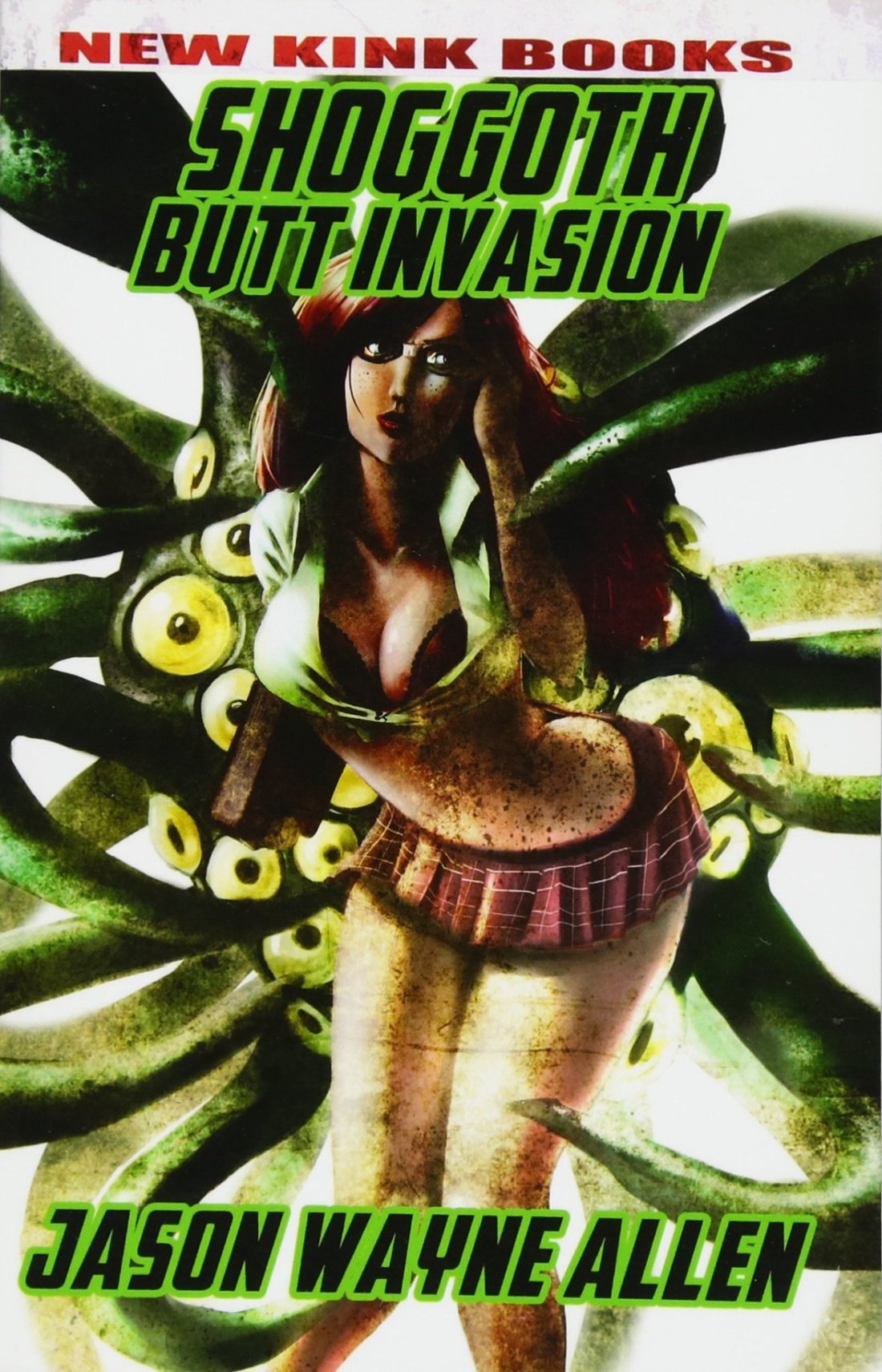
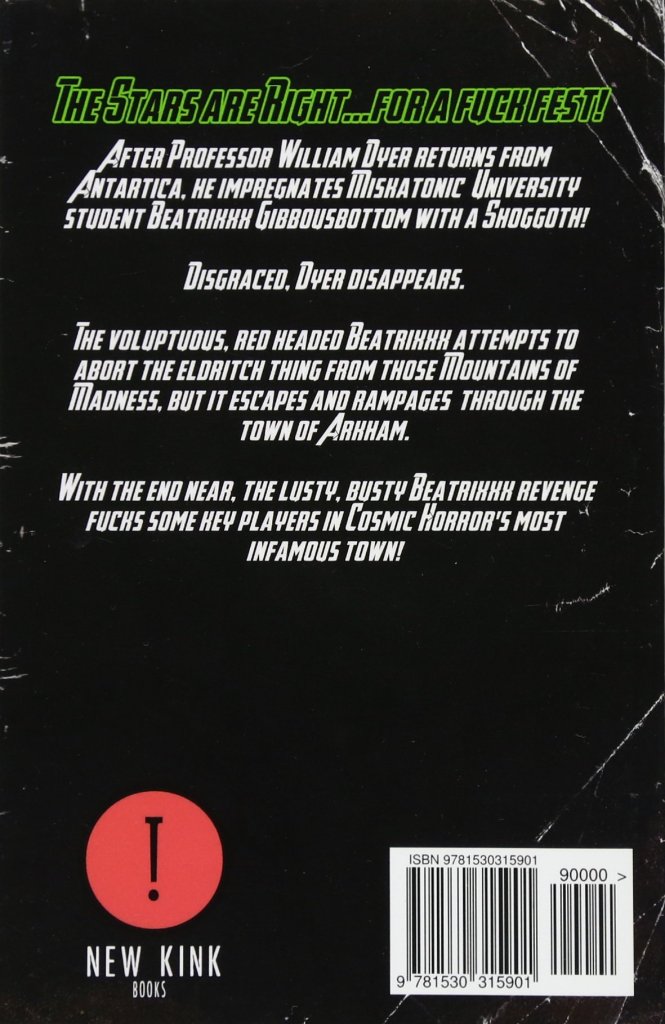
Shoggoth Butt Invasion (2016) by Jason Wayne Allen is a farcical sequel to At the Mountains of Madness by way of Debbie Does Dallas. The tone is very tentacle-in-cheek: sexually explicit, outrageously unrealistic, over-the-top, and surprisingly dedicated to wringing out jokes from Lovecraft’s Mythos with all the aplomb of an X-rated version of National Lampoon’s Bored of the Rings or Doon. It is gleefully and unapologetically taking the piss in a way that is rather rare even for most Mythos parodies such as “The Fluff at the Threshold” (1996) by Simon Leo Barber or “Kanye West—Reanimator” (2015) by Joshua Chaplinsky.

This is not unfamiliar territory for Jason Wayne Allen, whose other Mythos works include the Deep One erotic novella Ichthyic in the Afterglow (2015) and “The Horror at the Garrsmouth Orgy” in Strange Versus Lovecraft (2013). Drawing on both the surrealistic atmosphere of bizarro fiction and the rhetoric of gonzo pornography, Allen has crafted a nymphomaniac heroine who is utterly unfazed as one eldritch horror after another crawls out of—and into—her orifices.

Readers might be shocked and appalled at a character who embodies the sex-crazed vapid bimbo or nymphette, may be affronted by Allen’s mockery of the Mythos, even disgusted by crude language and scenes like this:

My legs in the stirrups, I watch the doctor’s head move between my knees. I wonder if the doctor likes the hair I keep down there, that orange patch matching the carpet to my fiery drapes. My hips slowly rise as I feel his latex fingers part my pussy lips. I come hard in the doctor’s chiseled face, and out with my juices comes the shoggoth.

Dr. Wadsworth is a skid mark on the floor of his examination room.

Jason Wayne Allen, Shoggoth Butt Invasion 7-8

Shocked, appalled, disgusted—and, hopefully, still turning the pages—is the point. A shoggoth emerging during a nonstandard vaginal exam and squishing the attending physician is played for erotic slapstick, not horror. The whole point of the exercise is to push the limits a little, to pile silly on silly, affront on affront, to say to hell with conventions and expectations and keep transgressing further and further…because it’s a fun ride. Disturbing in parts, borderline obscene in others, but that’s rather the point. If you’re not going push the limits of what the audience finds acceptable, the ne plus ultra, then why write a transgressive erotic Lovecraftian novella anyway?

There is one scene that tip-toes on the very borders of obscenity, if it doesn’t cross directly over it. It involves the mortal remains of Dr. Wadsworth, the gynecologist who was splattered by the shoggoth, reassembled with an aborted fetus and reanimated so that the Frankenstein’s Monster can give Beatrixxx one more going-over before the serum wears off. I’m not sure that one would pass the Miller Test.

In a sense, Shoggoth Butt Invasion is Mythos-as-exploitation. The erotic possibilities of Lovecraft’s Mythos may be theoretically infinite, but in practice most “Lovecraftian” erotica follows familiar beats. It’s a rare work that seeks to be as transgressive, weird, and offensive as most readers and critics imagine Lovecraftian erotica should be. Allen is more dedicated to explicitly Mythos erotica than Cthulhu Scat Hangover & The Innsmouth Porno VHS (2014) by Adolf Lovecraft, but doesn’t have the dedication to characterization, setting, and plot that are the hallmarks of Edward Lee’s “Hardcore Lovecraft” novels such as Trolley No. 1852 and The Dunwich Romance.

Cthulhu lets go another shriek. THis one warbles into almost a human moan.

“Fuck yeah! Iä! Iä Fhtagn that pussy, baby!

Jason Wayne Allen, Shoggoth Butt Invasion 42

Future generations will probably never read Shoggoth Butt Invasion. Released as an ebook via AmazonKindle and a slim print-on-demand paperback from CreateSpace, the book is no longer available for sale in either format. New Kink Books, the publisher, appears to be defunct. For all that POD publishing and digital publishing have opened up the marketplace to thousands of new titles for readers, it is a very fast-paced and fragile reading ecosystem. Books that don’t sell fall off the backlist as publishers crash or content managers find offense with them, and there are vanishingly few to filter down into the secondary market of used books. Libraries ignore them.

Sometime in the future, perhaps, if a cult following develops the few surviving copies might become collector’s items—or the files might crop up on some sharing site, helping to circulate those networks and hard drives too eventually crap out. Now, more than ever, books that are not read and appreciated in their time are likely destined to be forgotten utterly.

Does it matter? Is Shoggoth Butt Invasion worth preserving?

You’ll never know unless it is.


Bobby Derie is the author of Weird Talers: Essays on Robert E. Howard and Others and Sex and the Cthulhu Mythos.

Deep Cuts in a Lovecraftian Vein uses Amazon Associate links. As an Amazon Associate I earn from qualifying purchases.

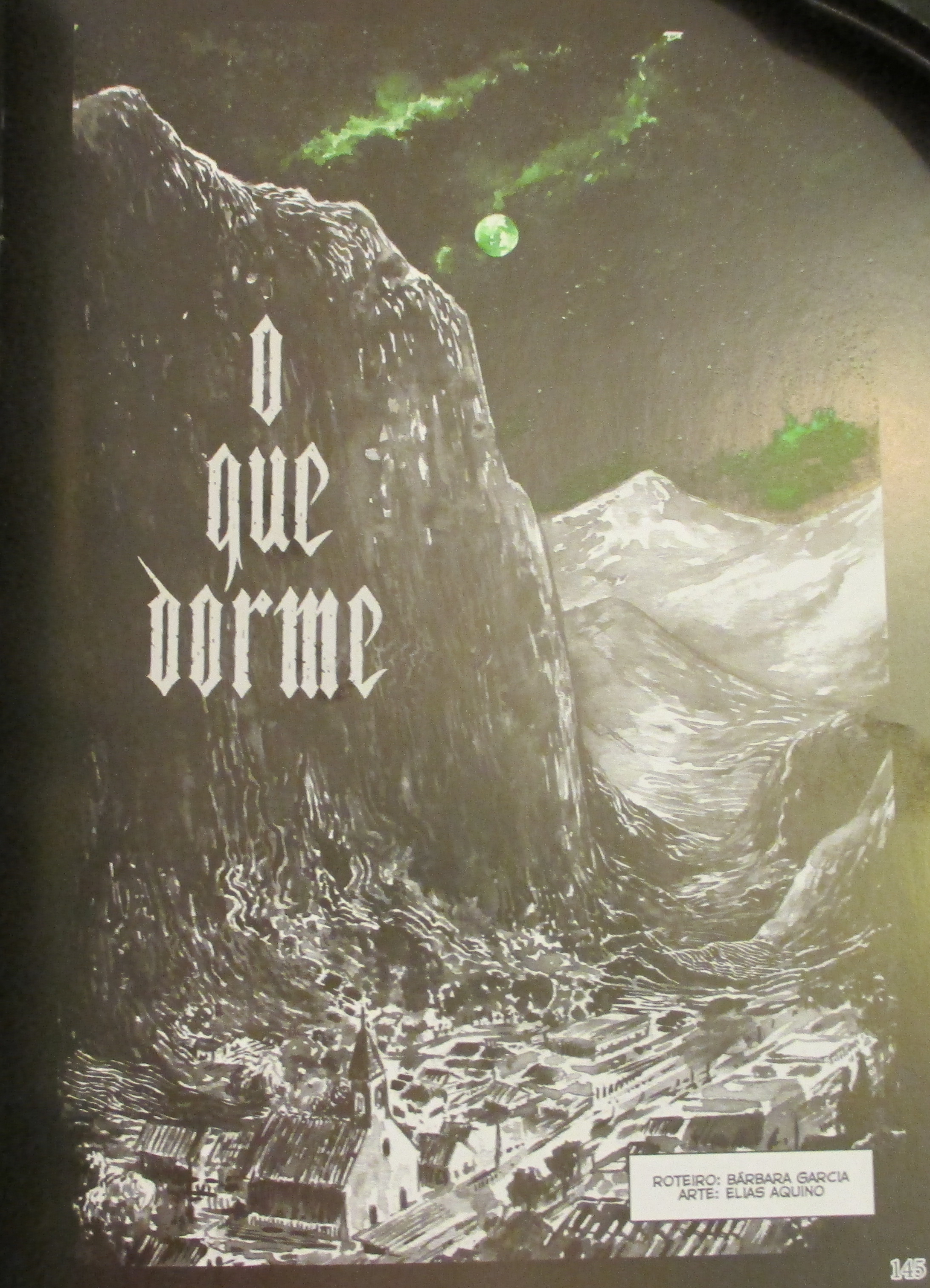
“O que dorme” (2016) by Bábara Garcia & Elias Aquino

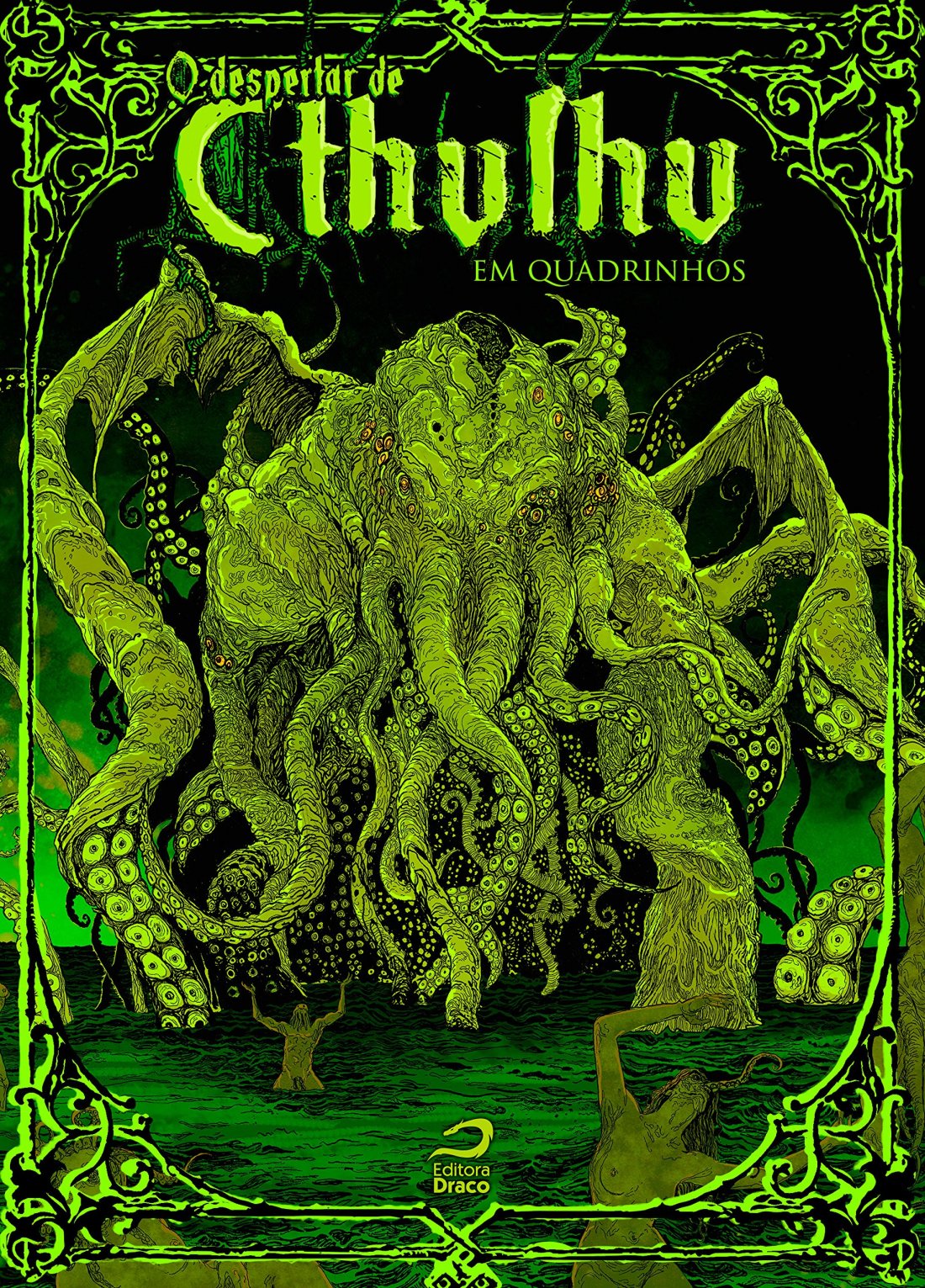
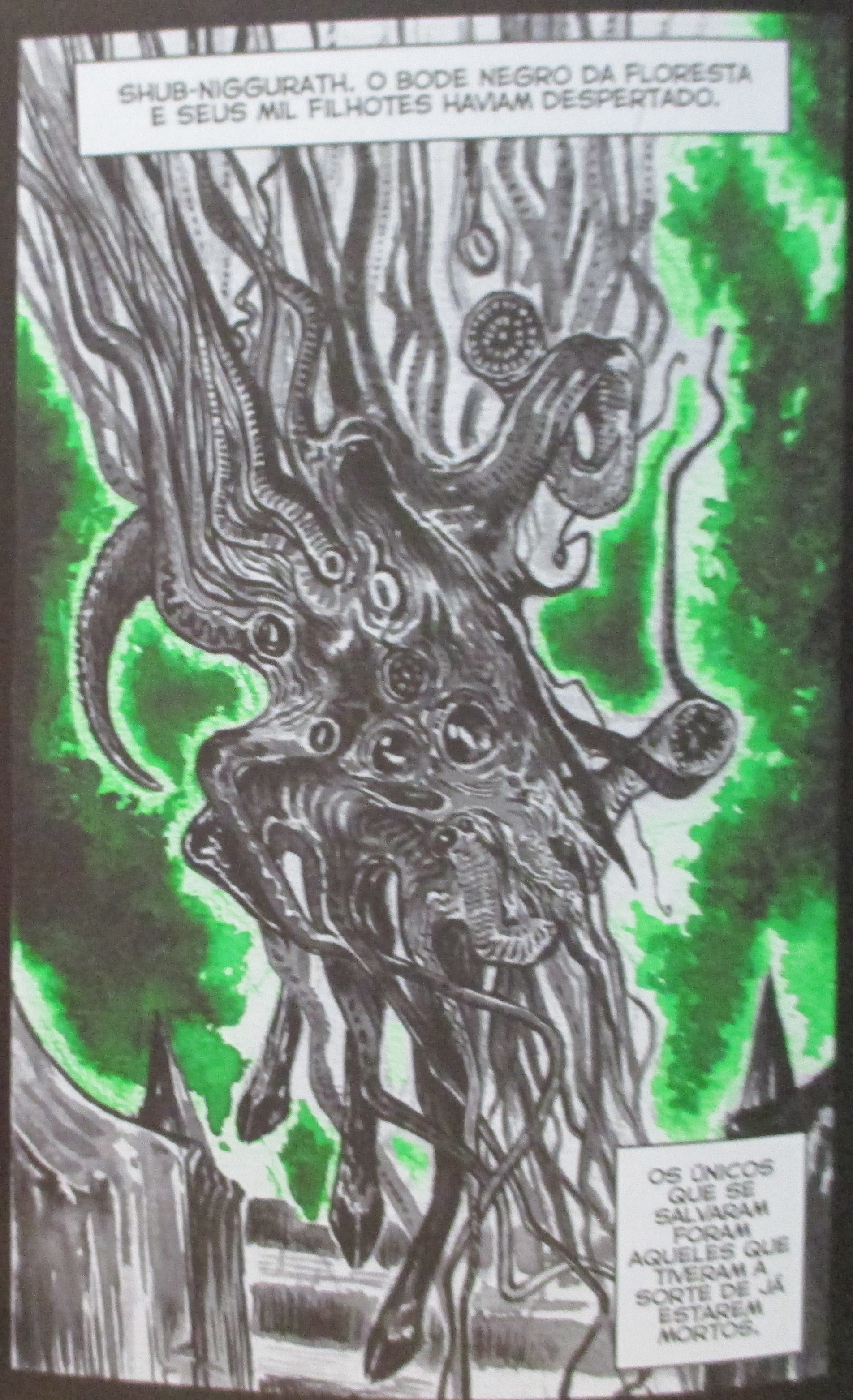
“O que dorme” (“What sleeps”) by writer Bábara Garcia & artist Elias Aquino is the final entry in the comic anthology O Despertar de Cthulhu em Quadrinhos (“The Awakening of Cthulhu in Comics,” 2016) by Brazilian publisher Editora Draco. The book was edited by Raphael Fernandes, who introduces the volume on the inside cover flaps:

The cult work of H. P. Lovecraft is the main inspiration for this collection with eight comics that will transfer the imagination to the darkest side of the human mind, a cosmic horror in white and green.

[…] The Awakening of Cthulhu in Comics and the horror that cannot be uttered, get lost in images and stories that shouldn’t have been conceived. Now there’s no turning back for those involved by the tentacles of despair, it’s time to wake up to a decadent reality tinged with just two colors.

All of the comics, including “O que dorme” are done in black, white, and green—and the addition of the bright, almost sickly green against the otherwise stark noir black-and-whites significantly enhances both the effectiveness of the individual stories, and the uniformity of the overall book—readers might compare the glowing green Loc-Nar from the Heavy Metal (1981) film, or the sickly yellow in Frank Miller’s That Yellow Bastard (1996)—it’s not that the Mythos are color-coded, since any entities that appear on the page can be seen in black and white as well, but only that the splash of color is used by the artists to convey subtleties of mood and atmosphere. Like in the title page, where the green is a faint tinge against the night sky.

IMG_2571

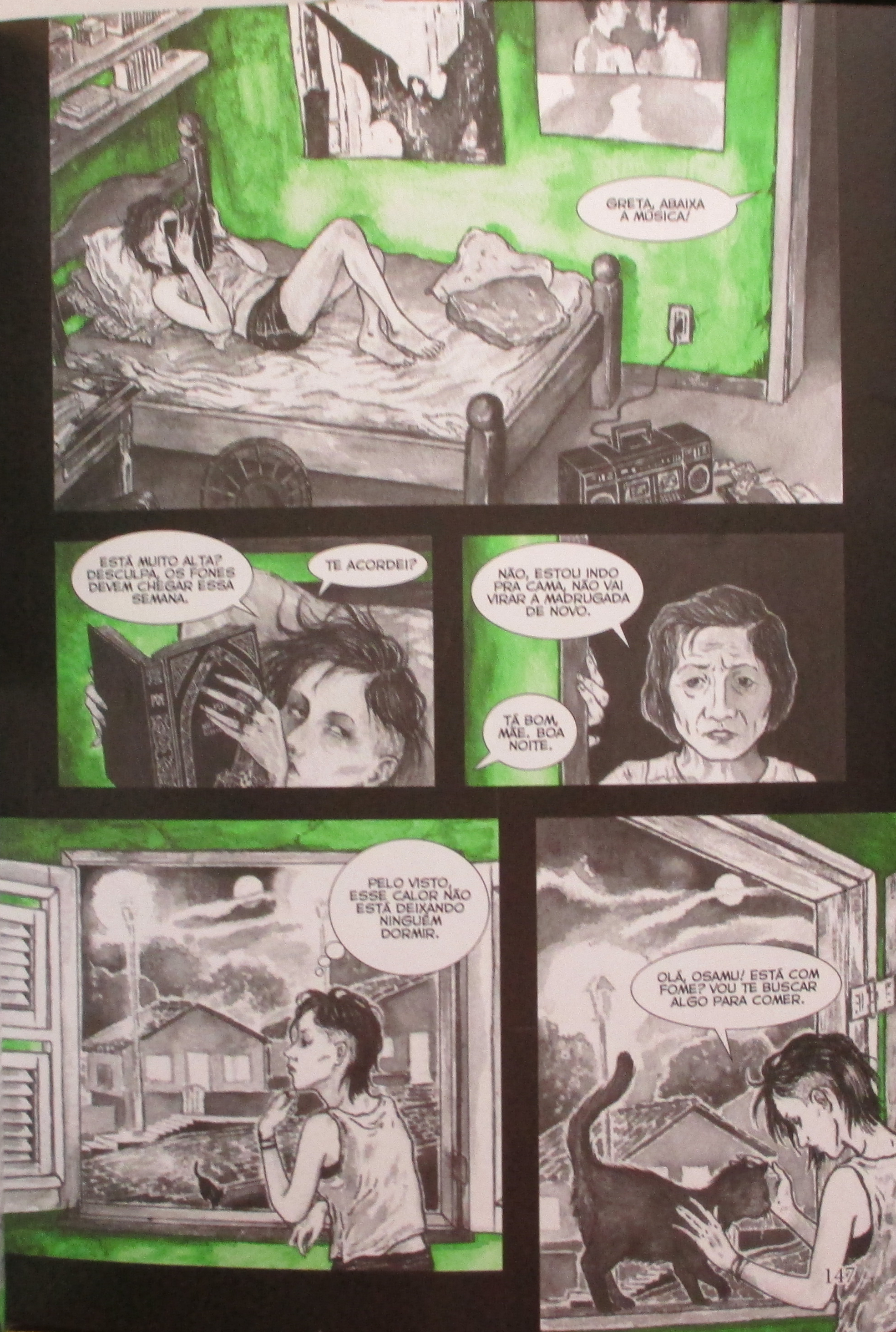
The setting is contemporary. The sensibility is postmodern. Captions and word balloons, but no thought bubbles, no sound effects. A rural community in the mountains which produces coffee. A young woman named Greta who can’t sleep, but stays up all night reading Edgar Allan Poe, a Bauhaus poster on her wall…

I always planned to leave as soon as I had money or a place to stay. Time passed and neither happened.

IMG_2576

Here, the green frames figures and offers contrast. Varies in depth and intensity, fading into the shadows on the corners, but distinct. It gives texture to what would be a blank wall, but doesn’t bleed past the outlines. The atmosphere is aggressively normal, yet something’s off. People talk about the heat, a bad smell, it hasn’t rained, the panels darken as it shifts to nighttime…most of the storytelling is expressed in these little details, showing rather than telling. Ordinary scenes and remarks receive significance only because they are what are being shown to the reader, in the same way as a David Lynch film or Mike Mignola’s Hellboy.

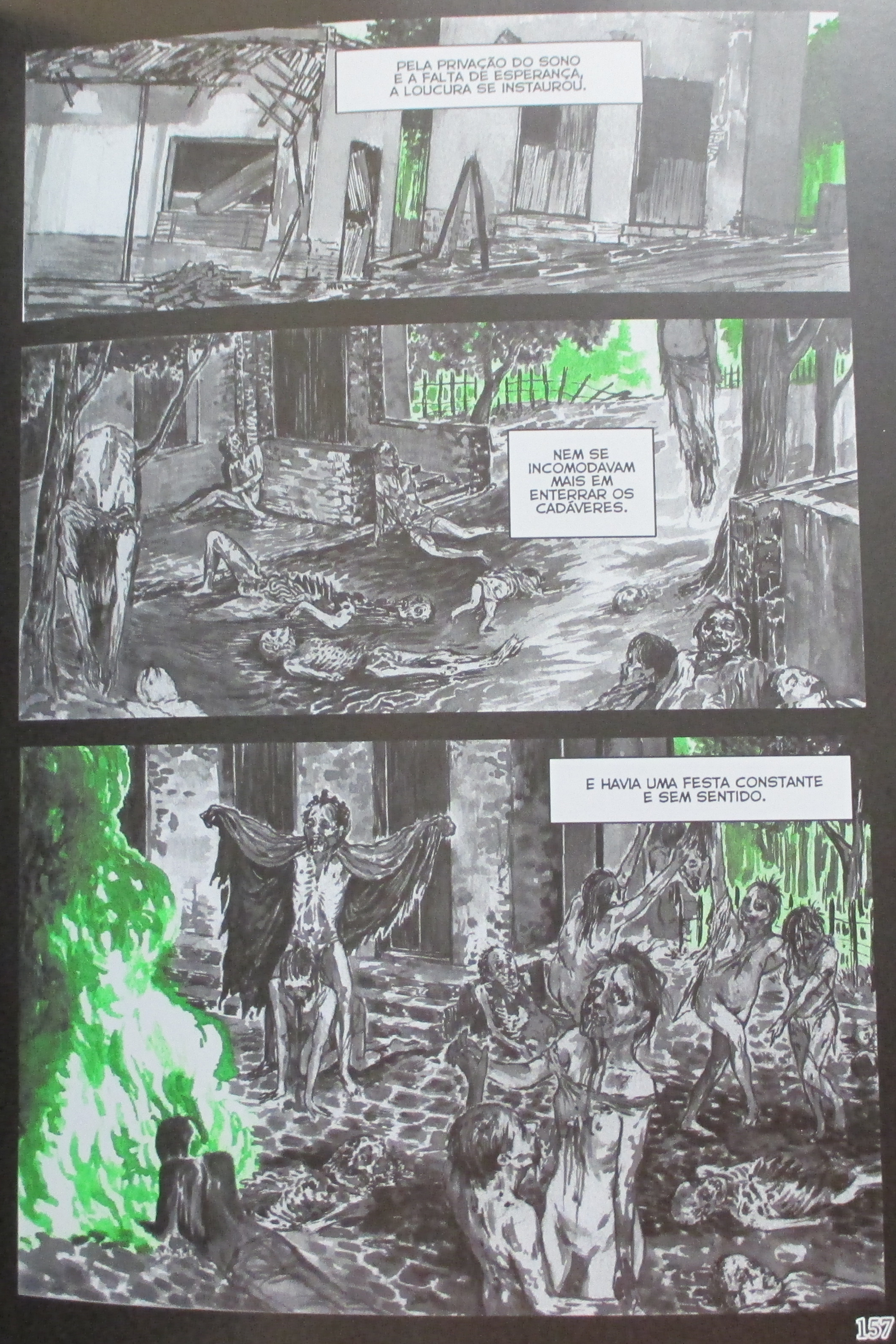
But the fact is that, little by little, everyone stopped sleeping. An entire city sleepless.

Things move quicker. The timeline grows uncertain, but within a panel the corpses appear, and things shift from uneasy to macabre. There is a Poe-like quality to the rapid downward spiral…but the reader knows there are pages left. How much worse can it get?

IMG_2577

The rain comes.

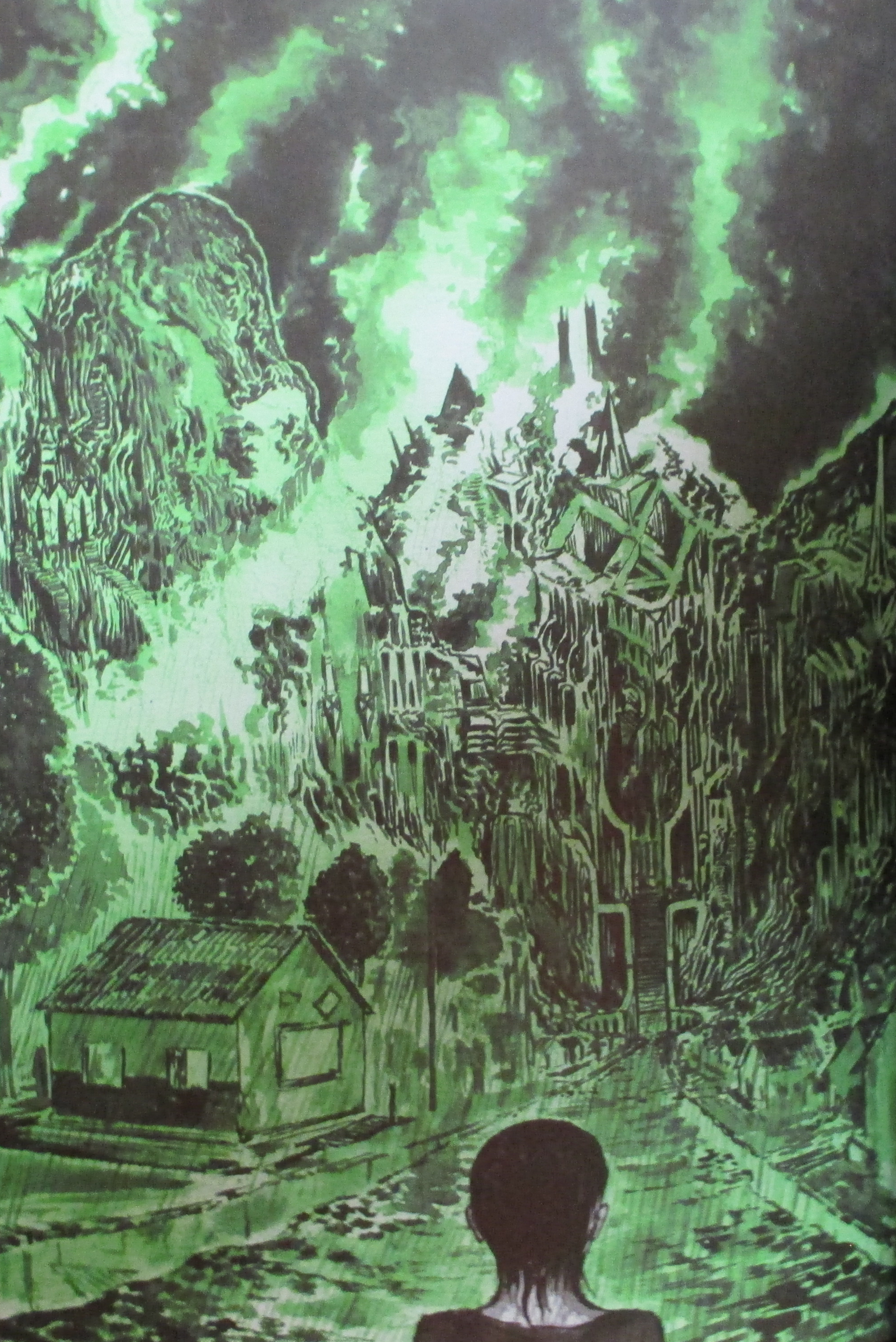
There’s nothing explicitly Mythos to any of this yet, no ancient tomes, not a whisper of alien entities or black stars. Everything that’s happened to this point, it could a disease, a toxic gas, simple madness as the heat and lack of sleep take their toll on frail human psyches. Then the rules change.

IMG_2578

The green in the story to this point had been balanced, contained, a highlight; this deep splash shows it as pervasive, all-encompassing…and a herald of what’s coming. Maybe it was always that.

The only ones who were saved were those who were lucky enough to be already dead.

IMG_2582

As narratives go, the twenty pages go by swiftly. This is a story all about mood and atmosphere, not explanations. No one is at fault, no one went poking about where they shouldn’t, or read the wrong spell and awakened the eldritch horror. There is no cult to worship the things that crawl down off the mountain. It isn’t a deep dive into the lore of the Mythos, though there is definitely some artistic influence from the Call of Cthulhu Roleplaying Game on the design of the Dark Young of Shub-Niggurath. This is almost the definition of the Mythos as uncaring, not even necessarily malevolent, but simply destroying humanity by its very presence, like a tiger in the jungle stepping on so many ants.

“O que dorme” showcases the universality of the Lovecraftian experience. The liminal spaces we know are out there, the things that creep in from outside.

O Despertar de Cthulhu em Quadrinhos has not yet been translated into English.


Bobby Derie is the author of Weird Talers: Essays on Robert E. Howard & Others (2019) and Sex and the Cthulhu Mythos (2014).

“From the Cold Dark Sea” (2016) by Storm Constantine

“Book title Marvels of the Deeps,” she began. “Dimensions approximately 30 centimeters width, 40 centimeters height. Thickness 8 centimeters.”

“How very forensic,” murmured Mrs. De La Mere.
—Storm Constantine, “From the Cold Dark Sea” in Dreams From the Witch House 278

Bibliophilia has been descried as “the gentle madness,” and is one of the more respectable sorts of mental illness for both fans and characters of the Mythos to fall into. Ever since Lovecraft’s “History of the Necronomicon and Robert E. Howard’s history of Nameless Cults in “The Black Stone”, the various tomes and texts of the Mythos have attracted the love of readers. Sometimes this extends to full catalogs of pseudobiblia, including Ex Libris Miskatonici (1993) by Joan C. Stanley and The Starry Wisdom Library: The Catalogue of the Greatest Occult Book Auction of All Time (2014) edited by Nade Pedersen. Sometimes too, it provides an entry into a story through the antiquarian book trade: collectors, sellers, forgers, book detectives like Corso in The Club Dumas (2006) by Arturo Perez-Reverte…and, in the case of Storm Constantine’s “From the Cold, Dark Sea,” a book-restorer named Cara Milltop.

It’s a fish out of water story, pun very much intended. The shadow of “The Shadow over Innsmouth” hangs over it, as it does with many other stories, though Constantine makes no explicit mention of either Innsmouth or the Deep Ones. This is a Mythos story in construction and inference; Cara Milltop never hears any calls to Father Dagon and Mother Hydra, or great Cthulhu. Yet there is enough indisputably there that Mythos aficionados can slip into the feel of this story like putting on an old glove; the pace and texture of it almost tells itself—but Constantine knows what she is doing, and if you don’t question the plot there’s more than enough embroidery on the Deep Ones lore to satisfy, with some lovely imagery to the description of the woodcuts and the dreams that they bring.

What really sets “From the Cold, Dark Sea” apart from stories like “Mail Order Bride” (1999) by Ann K. Schwader is that there is no confirmation. Cara Milltop remains a hired hand, an outsider. Knowledge does not bring initiation, nor does Constantine provide a final proof to any mystery. The unreadable words on the page remain unread, the actual truth remains unconfirmed. Readers are left to wonder if it really is just all in Cara’s head, an overactive imagination from working to restore an old book, exacerbated by staying in a spooky old house full of women.

There are no male characters in the story. Something that might sneak up on readers, but one of those nice details that dovetails with the frisson of unknowing in the story. Is it just coincidence, or is there something more to it? The legend, as Cara interprets it, is a female rite of passage, starkly in contrast to the patriarchal approach of the Esoteric Order of Dagon in, say, “A Coven in Essex County” (2016) by J. M. Yales. Not so much a rebuttal to Lovecraft’s “The Shadow over Innsmouth,” but an alternative. Maybe the Deep Ones don’t marry, as such.

Of course, if every child survived there would be far too many of them. How cruel, though, how barbaric. Yet, little different from the way baby turtles started life, Cara thought. Just the cruel barbarism of Nature herself.
—Storm Constantine, “From the Cold Dark Sea” in Dreams From the Witch House 294

Bibliophilia is a gentle madness. Cara Milltop never gets violent, never says outright what she thinks she knows—or suspects. The Marvels of the Deep can slide onto the shelf next to The R’lyeh Text and the Cthäat Aquadingen, squeezed between the Codex Dagonesis and Invocations to Dagon, and it would not be out of place. What she is left with in the end is not horror, or awe, but disappointment. To have come that close to something so magical, or almost-magical, and yet be unable to know if what she suspects is true, no invitation to take part. In the end, she doesn’t even have the book; she was only there to restore it, as she did. Money is a poor coin in a Mythos story, because so rarely can it buy what the characters—and the readers—really want.

“From the Cold, Dark Sea” was first published in Dreams From the Witch House (2016), and was reprinted in Storm Constantine’s collection Mythumbra (2018).


Bobby Derie is the author of Weird Talers: Essays on Robert E. Howard & Others (2019) and Sex and the Cthulhu Mythos (2014).

“The Star that is Not a Star” (2016) by Lucy Brady

It all revolves around that star, and a damned thing it is! A star beyond the material universe, beyond space and time and all that is made by God. ‘The star that is not a star.’
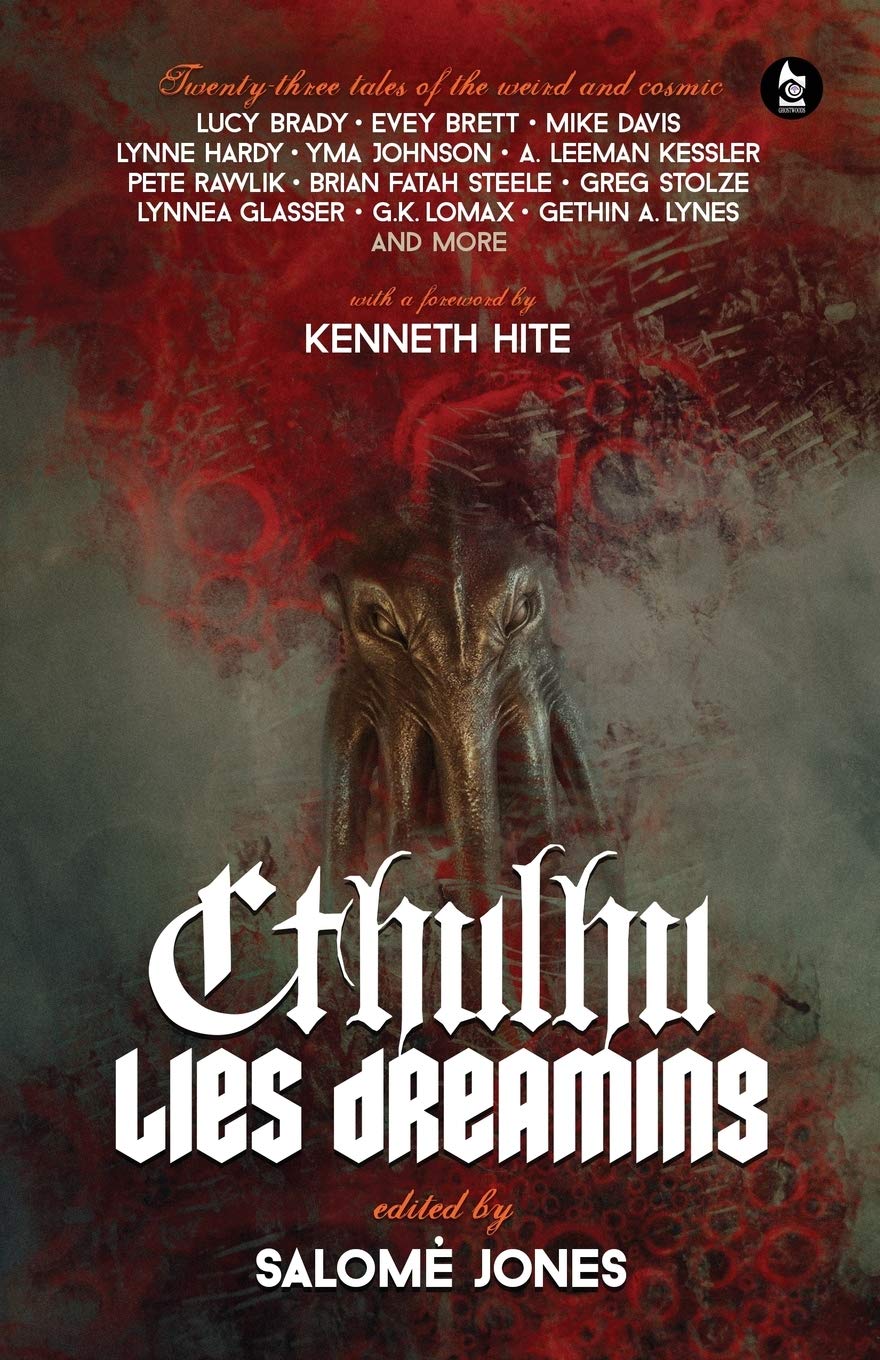
—Lucy Brady, “The Star that is Not a Star” in Cthulhu Lies Dreaming 80

Accursed forevermore is Yamil Zacra, star of perdition, who sitteth apart and weaveth the web of his rays like a spider spinning in a garden. Even as far as the light of Yamil Zacra falleth among the worlds, so goeth forth the bane and the bale thereof. And the seed of Yamil Zacra, like a fiery tare, is sown in planets that know him only as the least of the stars ….
     —Fragment of a Hyperborean tablet
—Clark Ashton Smith, “The Infernal Star”

Spy fiction is a close cousin to Mythos fiction; they share a common descent from the detective fiction of Edgar Allan Poe, and a common concern with the keeping and discovery of secrets. Betimes these cousin modes of fiction have come together: “The Unthinkable” (1991) by Bruce Sterling; “The Courtyard” (1994) by Alan Moore; Delta Green (1997), a branching-off of the Call of Cthulhu Roleplaying Game where the players are agents for government intelligence organizations, their skills and focus shifted to esoteric matters; David Conyer’s Harrison Peel series, including The Spiraling Worm (2007); the Laundry Series by Charles Stross beginning with The Atrocity Archives in 2004 (or, for an earlier variant, his novella A Colder War in 2000) which in turn spawned its own roleplaying game The Laundry (2010); Caitlín R. Kiernan’s Tinfoil Dossier series beginning with Agents of Dreamland (2017). Expand beyond the strictly Mythos-influenced spy fiction, and you run across gems like Tim Powers’ Declare (2000).

Call it cloak-and-tentacle, if you’d like.

The form of the fiction is often a kind of investigation. Think back to “The Call of Cthulhu,” presented to the reader as a series of nested narratives and documents. It isn’t spy fiction, in that the occult groups and secretive individuals involved are not part of any government service above the level of the local police; there are no politics at play in Lovecraft’s story, not really. The G-men make an appearance in “The Shadow over Innsmouth,” and there we can catch a glimpse of the origins of Alan Moore’s “The Courtyard.” Yet for the most part, the Mythos remains unknown to the world and its government powers at large; the mysteries uncovered, no matter how global or cosmic their import, are intensely personal to the initiated investigator in Lovecraft’s fiction.

The trick is to marry the two frames of reference. The investigator is still the main focus or protagonist, but now their actions take place within a broader geopolitical framework—and for the Len Deighton-influenced fiction, a government bureaucracy that’s designed to compartmentalize and contain secrets, to constrain actions. They may be Cold War warriors or those whose small talent in languages brings them in to the orbit of a larger mystery; part of the game is often that the agent or spy can never comprehend the whole of the thing, can never know the whole truth.

Secrets that possess a certain magnitude seem to have their own affinity with one another.
—Lucy Brady, “The Star that is Not a Star” in Cthulhu Lies Dreaming 85

“The Star that is Not a Star” is not explicitly Mythos fiction in any sense; whatever tomes, entities, cults, etc. that Brady employs, they aren’t connections forged with Lovecraft’s corpus or the expanded Cthulhu Mythos. Nor is it a traditional spy-thriller; but that is a large part of the charm. It’s an investigation that spans years and continents with a kind of ennui, and the statement of Natasha Klein—addressed to whom, and why?—is a record of a woman who, after picking up the pieces of the story for a decade, has found her own kind of truth.

Which is a good enough place for an ending as any, in a story like this. It is moody; there is a lot that has to be inferred, and in the end the narrator herself begins to become unreliable, relying on dream-evidence to fill in the gaps. Which all fits. Detectives know not every case has a satisfactory conclusion, and Mythos investigators are often left with scraps of a story told in newspaper clippings and journals, unable to touch the terrible powers at work in the world, burdened by the knowledge of things that they know exist but are impotent to affect.

“The Star that is Not a Star” was published in Cthulhu Lies Dreaming (2016); Lucy Brady’s other Lovecraftian work includes “The Body Electric” in Dreams from the Witch House (2016).


Bobby Derie is the author of Weird Talers: Essays on Robert E. Howard & Others (2019) and Sex and the Cthulhu Mythos (2014).

Monster Girl Encyclopedia II (2016) by Kenkou Cross (健康クロス)

Eldritch Fappenings

This review deals with a work of erotic content, and the history of erotic art and writing. As part of this review, selected art displaying cartoon nudity will be included.
As such, please be advised before reading further.


Monsters once were ghastly beasts that devoured the flesh and blood of human beings. However, since the ascension of the new Overlord, a succubus with godlike power, monsters have taken on utterly different, bewitching, and fantastic forms resembling those of alluring women. These outward changes have been accompanied by dramatic shifts in their ways of life, patterns of behavior, and values.
—foreword to Monster Girl Encyclopedia Vol. II

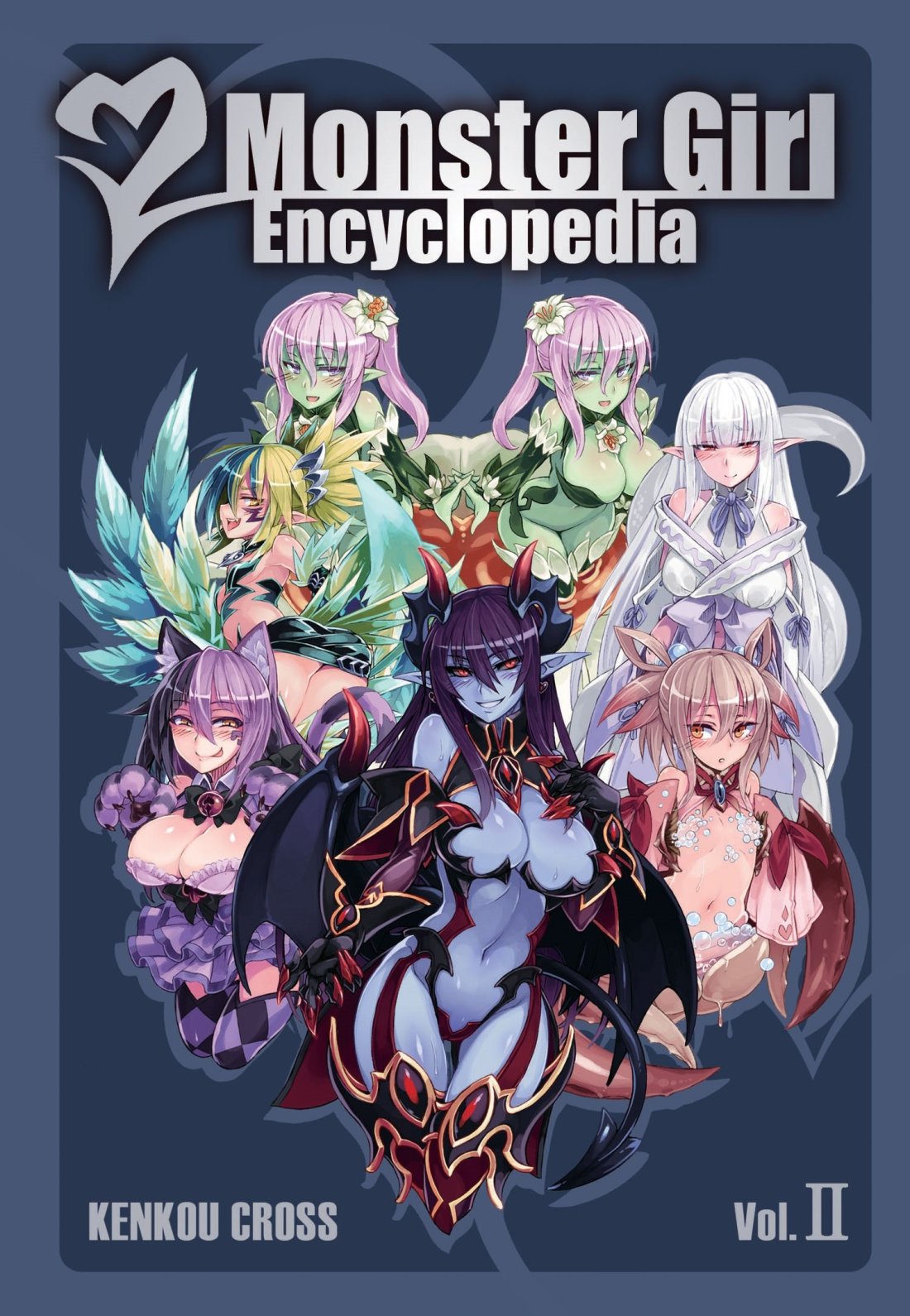
The Monster Girl Encyclopedia (魔物娘図鑑, 2015) by Kenkou Cross (健康クロス) is a variation on the popular pseudobiblia bestiary genre. In the Dungeons & Dragons-inspired fantasy setting that Kenkou Cross has created, a succubus has risen to the position of evil Overlord, and turned all the monsters into, essentially, nubile female forms obsessed with sex. The second volume in the series (魔物娘図鑑 II, 2016) has introduced some Mythos-related entities including the shoggoth, and the series has gone on to generate a good deal of fanfiction, dōjinshi (同人誌, fan-created artwork, comics, etc.) and expanded media, which varies from the sedate to the outright pornographic…and these two works have been translated into English by DK with “English Adaptation” by Harriet Fray.

To really understand and appreciate what Kenkou Cross has done, we have to look at how they got here.

Dungeons & Dragons was published in 1974, a collaboration between Gary Gygax and Dave Arneson and published by TSR, Inc. The original boxed set included a Monsters & Treasure booklet which had brief descriptions of and rules for iconic fantasy monsters—and these were, for the most part, taken from generic fantasy (The Hobbit and The Lord of the Rings, Greek mythology, the 1,001 Nights, etc.); there weren’t much in the way of “original” monsters. In 1977 a revised and expanded edition of the game was published which included a much expanded Monster Manual, which included not only more monsters and illustrations on the monsters, but details on their culture, life, habits, etc. These were still pretty scanty, but from this humble beginning nearly every other roleplaying game has developed their own bestiary or critter compendium. In 1980, TSR Inc. published Deities & Demigods by Jim Ward, which included the first published bestiary of the Cthulhu Mythos.

1-a97fbbd69f

This led to a little kerfuffle; the author had gotten permission from Arkham House to use the Mythos in the book, but Arkham House had also just granted a license to Chaosium, Inc. to develop a roleplaying game based on the Mythos, and they were also developing an RPG based on the Elric stories of Michael Moorcock (who had done basically the same thing as Arkham House). No harm was done, and in the book’s third printing TSR Inc. dropped the two sections with a brief notice.

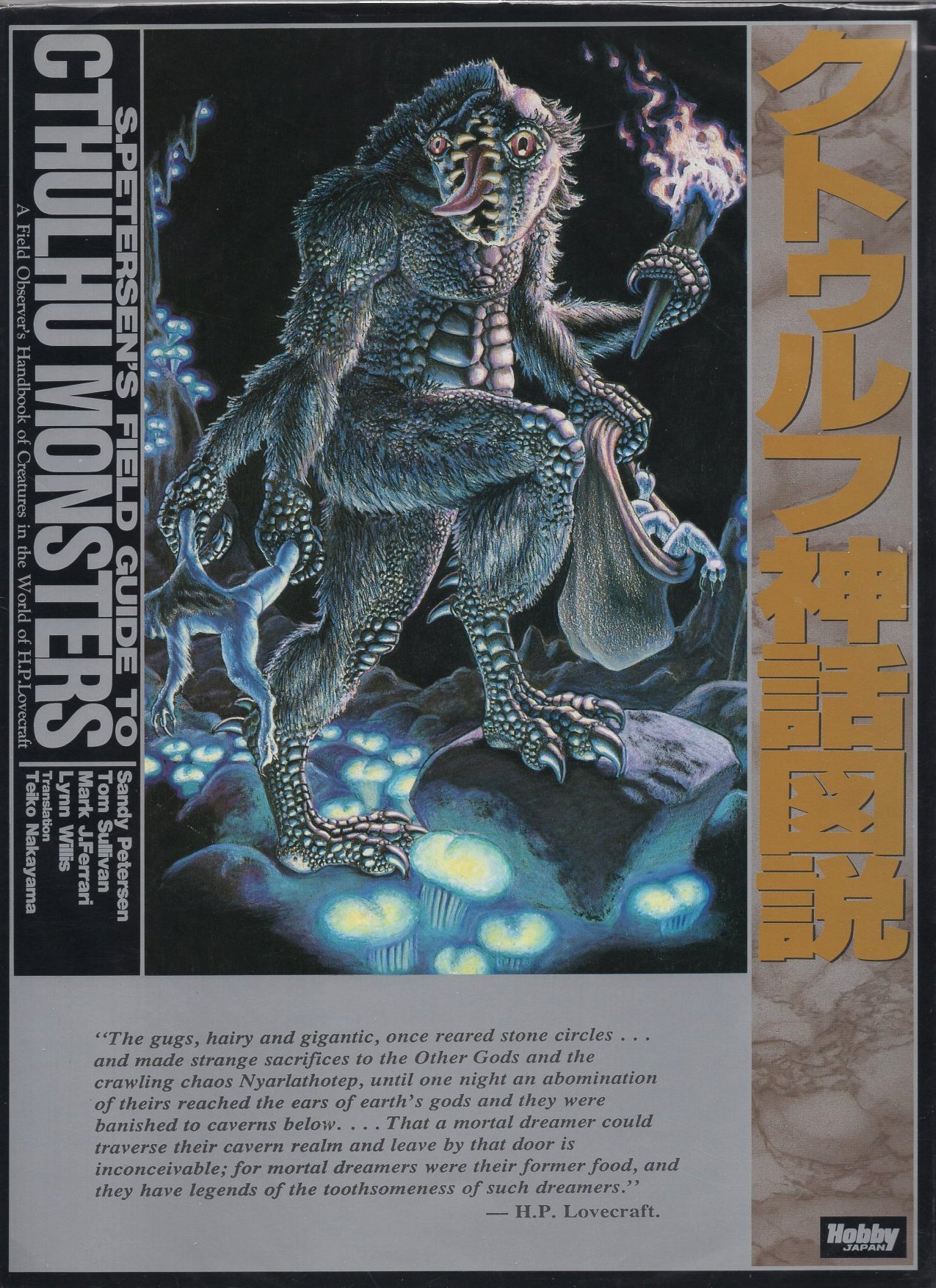
Chaosium, Inc. itself would take a different approach to its monsters. Efforts to categorize the entities in the Mythos dated back to the 1930s efforts of R. H. Barlow and the 1940s efforts of August Derleth and F. T. Laney, whose critical essay “The Cthulhu Mythos: A Glossary” was published in Beyond the Wall of Sleep (1943, Arkham House). So while the new Call of Cthulhu Roleplaying Game (1981, Chaosium, Inc.) did contain a very Dungeons & Dragons-style bestiary section in the main roleplaying book, it also produced a pair of very novel products that were different than anything TSR, Inc. had done to that point: S. Petersen’s Field Guide to Cthulhu Monsters: A Field Observer’s Handbook of Preternatural Entities (1988) and S. Petersen’s Field Guide to Creatures of the Dreamlands (1989).

These were lavishly illustrated books which hewed closer to Barlowe’s Guide to Extraterrestrials (1987) in design and format than the “standard” roleplaying game bestiary, providing lavish full illustrations for each monster in forms that would go on to be iconic, and solely dedicated to the identification, habits, culture, etc. of the various entities within, instead of game stats. All the stats for these creatures were in the Call of Cthulhu Roleplaying Game book itself, and the books have become so iconic that the latest (7th) edition of the game has produced a brand new version, S. Petersen’s Field Guide to Lovecraftian Horrors (2016).

81QwaubiTNL

The Call of Cthulhu Roleplaying Game was not just released in English, however. It was translated into several languages, including Japanese—and the game proved to be a major hit in Japan. More products were translated, including the ’88 and ’89 S. Petersen’s Field Guides (a combined edition was published by Hobby Japan in 1994), and the company and fans in Japan began to produce original material for the game, both official and unofficial—dōjinshi.

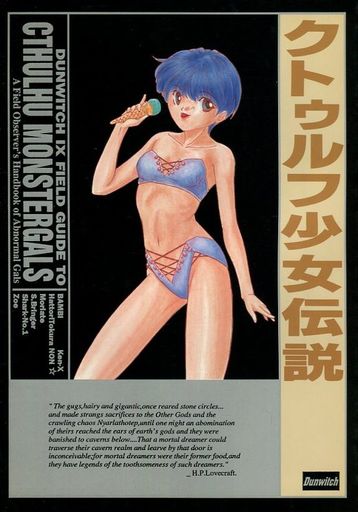
One of these dōjinshi products was the Dunwitch IX Field Guide to Cthulhu Monstergals. This was essentially a fan-created spoof of the S. Petersen guides, right down to the format, except that the familiar Cthulhu Mythos entities were replaced by monster girl versions of themselves.

1263599

Monster girls are a Japanese cultural phenomenon where a normally frightening monster is replaced with a moe (萌え) version of itself; moe being a term that designates a feeling of strong affection and cuteness, and is often combined with non-anthromorphic entities or concepts to create a (typically) young and attractive female character to personify the normally unrelateable. The juxtaposition might be near-sacrilegious to folks that like to keep the Mythos scary, but should be understood as a product of Japanese fan interpretation, all in good fun. Monster girls have been the focus of “monster girlfriend” manga and anime, including “The Elder Sister-like One, Vol. 1” (2016) by Pochi Iida (飯田ぽち。)…and the Monster Girl Encyclopedia which was published in 2015.

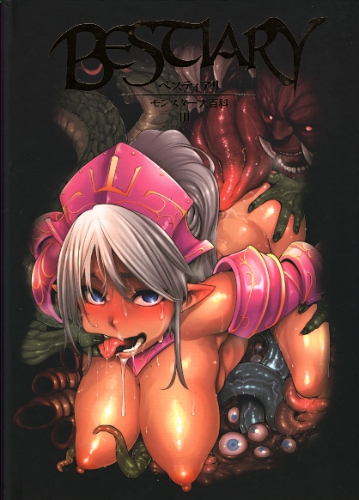
Sometimes, artists go beyond the bounds of “cute” and clean, relatively innocent and positive sexual attraction implied by moe and venture into actual hardcore erotic artwork and writing. This twist often makes the cute girls the victims of the now much more traditionally monstrous monsters. An example of this is Shindo L (新堂 エル)’s Bestiary series which so far as three volumes (2011-2015); the third volume includes a section on the Deep Ones, who in Shindo L’s setting are quite literally rapacious towards human women.

2113850

Which brings us back to Kenkou Cross and the Monster Girl Encyclopedia. This book is not a roleplaying game product, although it is derived from and uses some of the same tropes. There is no game system specified, no statistics or mechanics for the monsters like in Dungeons & Dragons. Instead, it is purely a pseudo-literary production, an “in-character” scholarly manuscript from the setting that the monster girls are from, much like the S. Petersen’s guidebooks. Aside from the artwork, which is generally PG-13 (bare female breasts, but no genitalia), the text itself shows a lot of thought and effort that has gone into the monsters, how the change to be part-succubi has effected them, feeding and mating habits (basically the same thing in this case), etc.

The Lovecraftian references are few, and include the iconic D&D monster the Mindflayer, the Wendigo (loosely connected to August Derleth’s interpretation of Ithaqua), the spider-creature Atlach-Nacha (created by Clark Ashton Smith, already the focus of a Japanese game and associated media) and most especially the Shoggoth.

Shoggoth

The interesting thing about the Shoggoth entry is that Kenkou Cross has reinterpreted their position as “servitors” to the Elder Things in At the Mountains of Madness to coincide with the Japanese pop-culture archetype of the maid—in particular, the conception of the “French Maid” outfit popularized in Victorian and Edwardian fiction (and associated pornography) and the act of being subservient in a sense that approaches (and sometimes sublimates into) domination-subjugation fantasies. “Maid-play” need not be violent, as the position can hold a great potential for sexual subtext and power fantasies without crossing the line into rape, but the formal nature of the attire and the potential power imbalance makes maids, butlers, etc. popular characters in Japanese anime and manga.

Shoggoths are slime monsters with amorphous bodies. They were created long ago to serve monsters of the untold nether reaches, but upon acquiring intelligence and emotion with the rise of the current Overlord, they are thought to have fled their once-masters.
—foreword to Monster Girl Encyclopedia Vol. II, 167 

Which makes the Monster Girl Encyclopedia incarnation of the Shoggoth both somewhat kinky, and probably the most sex-positive possible spin on the original source material, is that the (now female) Shoggoth feels the need to fulfill this position, but is not actually enslaved and still holds a great deal of power in the relationship, which is basically entered into of their own will (although the Overlord’s influence certainly gives them a push). Needless to say, the various authors of Monster Girl Encyclopedia-derived dōjinshi take whatever tack fits the needs of their particular work, ranging from the benign monster girlfriend romantic comedy to explicit erotica (within the limits of Japanese censorship laws, for works produced in Japan).

Kenkou Cross doesn’t delve deep into the Mythos in this volume; the Lovecraftian entities are hinted at being separate from many of the other monsters under the Overlord’s direct control, but Cthulhu and Shub-Niggurath are not named explicitly. In much the same way, Dungeons & Dragons has largely eschewed using the Lovecraft Mythos directly since Deities & Demigods (1981), although they have Lovecraftian critters in the form of mindflayers, aboleths, and other “aberrations.” Much of the Monster Girl Encyclopedia world remains a very vague fantasy kitchen sink; quasi-medieval in the Dungeons & Dragons manner with adventurers, quests, etc. It is testament to the wide and pervasive influence of Western (particularly British and American) on Japanese contemporary pop culture.

It might be difficult for some Mythos fans to think of shoggoths as basically sex-obsessed slime-girl maids, but that’s where the route of transmission, derivation, and development sort of become important. Because Kenkou Cross’ interpretation of the Shoggoths, for their setting, is really no different or less than any other interpretation of the Lovecraftian entity, from Robert Bloch’s “Notebook Found In A Deserted House” (1951) to “Shoggoths in Bloom” (2008) by Elizabeth Bear. And the MGE version of shoggoths is not restricted to Japan, but has filtered back into English through translation and derivation. 

Monster Girl Encyclopedia II (魔物娘図鑑 II) by Kenkou Cross (健康クロス) was first published in 2016; it was translated and published in English by Seven Seas in 2016.


Bobby Derie is the author of Weird Talers: Essays on Robert E. Howard & Others (2019) and Sex and the Cthulhu Mythos (2014).

The Dream-Quest of Vellitt Boe (2016) by Kij Johnson

In a land defined by dreaming men and bickering gods, there were no sure rules, but there was also no certain randomness.
—Kij Johnson, The Dream-Quest of Vellitt Boe 133-134

You don’t have to have read Lovecraft or Dunsany to appreciate The Dream-Quest of Vellitt Boe. Without those references, it is still a very competent fantasy novelette. Johnson has a good eye for detail, characterization, description; the plot moves quick, never gets hung up too long in one place, one peril. Vellitt Boe is on a mission, after all.

That being said, without the historical context of Lovecraft and Dunsany, The Dream-Quest of Vellitt Boe is in danger of being misunderstood as a generic fantasy novel, of the sort inspired by a thousand sessions of Dungeons & Dragons, Tunnels & Trolls, or Fighting Fantasy. This comes almost as a consequence of how you get from Lord Dunsany to Kij Johnson, and to really appreciate what she is doing in this novelette and how it got there requires a bit of background. 

H. P. Lovecraft discovered Lord Dunsany in 1919. The Anglo-Irish peer had created an artificial mythology in his tales of Pegāna, which would inspire Lovecraft’s own mythos, and the stories of “Beyond the Fields We Know” in Tales of Three Hemispheres (1919) including “Idle Days on the Yann” and “The Shop in Go-By Street” would lay the groundwork for Lovecraft’s Dreamlands.

It is important to remember that Lovecraft built his Mythos over time, defining and re-defining it as time went on and other influences came to bear. “The Cats of Ulthar” (written June 1920) was not originally set in the Dreamlands; it was a generic fantasy. The first actual Dreamlands story was “Celephaïs” (written November 1920). In later fiction, these early fantasies and their names and geographies would be subsumed into the Dreamlands—and the “Dream Cycle” with its vagaries and contradictions (were exactly is Leng?) have given compilers of Mythos-lore much to chew on and argue about.

Randolph Carter came into existence in 1919 as well, in “The Statement of Randolph Carter.” This early story had nothing to do with the Dreamlands either; Lovecraft recorded a dream in his letters involving himself and his friend Samuel Loveman. In turning the dream into a story, Loveman became “Hartley Warren” and Lovecraft himself became “Randolph Carter.” The character became a self-identified counterpart for Lovecraft himself in his stories, though he appeared in only a few of them, notably “The Silver Key” (1926), which is the only one that was a Dreamlands tale until The Dream-Quest of Unknown Kadath (written 1926-1927).

Lovecraft’s Dream-Quest is fundamentally different from anything he wrote before or since. Maybe that is why in part it found no publication during his lifetime. Too long, too weird, too inexplicably full of adventure—it is this novelette which binds together Lovecraft’s “dream” stories, early fantasies, and Randolph Carter stories. Without Dream-Quest, you could argue the Dreamlands are still a part of the Mythos, but places like Ulthar wouldn’t be a part of it. This was the story that really gave the scope and connective tissue that bound much of Lovecraft’s early fiction together. In structure and conception, it is much more similar to David Lindsay’s A Voyage to Arcturus (1920) or E. R. Eddison’s The Worm Ouroboros (1922) than anything else.

There aren’t really any women in it.

Which is true for much more of Lovecraft’s fiction than just The Dream-Quest of Unknown Kadath. As discussed in Sex and the Cthulhu Mythos, Lovecraft does have female characters in his stories, but the gender balance is distinctly skewed towards male characters. In large part, this seems to be simply because Lovecraft seldom made a character female unless there was a reason for her to be female. Which is why the only absolute reference to women in Dream-Quest is:

It is known that in disguise the younger among the Great Ones often espouse the daughters of men, so that around the borders of the cold waste wherein stands Kadath the peasants must all bear their blood. 

That’s it. There are other references to women in some of the other stories, if you look hard enough—the cat-killing wife in “The Cats of Ulthar” for example—but for the most part, women are implicit. Priests, but no priestesses. “Men” as a generic term for all persons of every gender, in the very 18th century sense. Rapacious gods of the Greco-Roman school, but no lusty goddesses bedding the handsome young men around Kadath.

It was in this context that Kij Johnson wrote her own Dream-Quest, and it is in many ways both a continuation of the tradition of Dunsany and Lovecraft, and a reflection on those works.

And I must of course acknowledge Lovecraft’s The Dream-Quest of Unknown Kadath. I first read it at ten, thrilled and terrified, and uncomfortable with the racism but not yet aware that the total absence of women was also problematic. This story is my adult self returning to a thing I loved as a child and seeing whether I could make adult sense of it.
—Kij Johnson, “Acknowledgements” in The Dream-Quest of Vellitt Boe 167

Johnson did the work, sifted the stories. The story is set between “The Silver Key” and “Through the Gates of the Silver Key”; it references Lovecraft’s geography and zoology, but also subtly grounds and expands them. The Dreamlands are seen through the eyes of a native, an intelligent and experienced woman who knows more of how things work and finds delight in them. The skill of her construction is such that she never needs to cite a story specifically; it is never written that “In Ulthar no man may kill a cat,” because the idea is implicit in the story: no one even thinks of trying to kill a cat in Ulthar. It simply doesn’t come up. More amusingly and refreshingly, we get little anecdotes like how a young Vellitt Boe tried to climb Hatheg-Kla under the logic that it was only said no man could climb it. A neat bit which feels a bit like Éowyn taking a swing at the Witch-King of Angmar.

The story is at its best when it is showing rather than telling. Why not a woman’s college in Ulthar? Why not a female far-traveler? Nothing in Randolph Carter’s dream-quest required him to have a penis, so what’s to stop a woman from having her own adventure in the Dreamlands? Absolutely nothing.

The story is arguably at its weakest when it stops showing and starts telling.

She had never met a woman from the waking world. Once she asked Carter about it.

“Women don’t dream large dreams,” he had said, dismissively. “It is all babies and housework. Tiny dreams.”

Men said stupid things all the time, and it was perhaps no surprise that men of the waking world might do so as well, yet she was disappointed in Carter. Her dreams were large, of trains a mile long and ships that climbed to the stars, of learning the languages of squids and slime-molds, of crossing a chessboard the size of a city. That night and for years afterward, she had envisioned another dream land, built from the imaginings of powerful women dreamers. (ibid. 71-72)

In narrative terms, the characterization of Randolph Carter as a bit of a straw-man serves its purpose only in highlighting Boe’s struggles as a woman. Even in the Dreamlands, there are gender norms and imbalances; the women’s college of Ulthar is the youngest and most vulnerable of the seven universities, and even a hint of scandal could see it closed, upper education cut off. In that sense, Johnson needed some character to personify the casual misogyny that Boe quested against as much as anything else.

Carter as a mouthpiece is problematic mainly because he never voices such views in Lovecraft’s fiction, and as he is implicitly Lovecraft’s alter-ego (though Johnson does not make this point) it can be read as Johnson putting words in Lovecraft’s mouth. While Lovecraft did evince a few chauvinistic statements during his life, he never wrote anything like what Carter says in Johnson’s Dream-Quest. The statement (“powerful women dreamers” is a great line) needed to be made at some point, if for no other reason than it sets up the finale, but the characterization seems off; rather like Ervin Howard in “The Ballad of Black Tom” (2016) by Victor LaValle. If a dead horse is going to be beaten, at least beat it for something it actually did.

There is a line in the story that may be uncomfortable, but then it would be a sad world where such a line would be otherwise:

As a young woman, when she had been beautiful and had worn her hair short and her clothes loose to conceal that fact, she had known all the signs of men and read them well enough that she had been successfully robbed only three times and raped once; but none of those had burned from her the hunger for empty spaces, strange cities, new oceans. (ibid. 83)

Nothing of the act, which happened sometime in the far past, is shown. Which is good; the last thing the story needed was an exploitative recap, some trauma porn of the effect and slow recovery. The event happened, it didn’t define her. It is also not the only mention of rape in the story; Vellitt Boe is traveling mostly alone in a quasi-Early Modern fantasy world. Sexual assault need not have a gender bias (the setting rarely hints at lesbianism as a possibility, and male homosexuality is completely absent from the text) but old habits die hard. How many women traveling alone today have the same fear?

Which is perhaps the one real criticism of The Dream-Quest of Villett Boe. It is great for what it is, but if the purpose was to have a message as well tell a story, it feels like it could have been that much better. Why aren’t there any female gods in the Dreamlands? Why aren’t there any female dreamers? Johnson wasn’t obliged to stick to Lovecraft or Dunsany in every regard, and doesn’t. Yet her Dreamland is almost too close to the waking world in some of its gender constructs and mores.

You might be interested to know that at the party one very bright young woman described her adolescent reading of SF as a genuinely subversive force in her life, a real alternative to the fundamentalist community into which she had been born. This alternative had nothing to do with the cardboard heroes and heroines or the imperial American/engineering values which she had skipped right over. What got to her were the alien landscapes and alien creatures. We scholars perhaps tend to forget how much subversive potential both SF and fantasy have, even at their crudest.
—Joanna Russ, To Write Like A Woman 64

Russ, of course, wrote her own Dreamlands tale: “My Boat” (1976). Ironically, Russ’s story features a powerful woman dreamer (who also happens to be black), exactly the kind of character that Villett Boe lamented never meeting in her own Dreamlands. It’s a pity that the two characters didn’t run across each other—but the tales remain complementary. The Dreamlands is big enough for both characters, and more besides.

The book is at its most subversive when just letting Vellitt Boe find her own way, rather than being escorted by guards or ghouls or rescued by gugs. The Dreamlands through her eyes is a delight, and just having a female character be the protagonist of a Dreamlands story in itself is more of a statement that See? Women can explore the Dreamlands too! than any of the casual misogyny attributed to Randolph Carter (or, implicitly, Lovecraft). If Johnson’s goal beyond writing the story was to write a Dreamlands where the women aren’t invisible and mute, she can certainly be said to have succeeded. Above and beyond that, The Dream-Quest of Vellitt Boe is a very rare thing: a good Dreamlands story, written in a way that is not a pastiche of Dunsany or Lovecraft.

Kij Johnson’s The Dream-Quest of Vellitt Boe was published in 2016 by Tor.


Bobby Derie is the author of Weird Talers: Essays on Robert E. Howard & Others (2019) and Sex and the Cthulhu Mythos (2014).