And that, friends and neighbors, was eau de cancer, a body rotting from the inside out. Strong today. Very strong.
—Christine Morgan, “Waxen” (2018) in Around Eldritch Corners (2024) 164
Robert W. Chambers and H. P. Lovecraft generally did not write historical fiction. Their stories were set in the present, they dealt with contemporary issues and concerns. Many readers today lack the historical context to understand where Lovecraft and Chambers were necessarily writing from when they wrote their stories. The conventions, the issues, the current events that found expression in their fiction.
The militarism and xenophobia in “The Repairer of Reputations” often catch newcomers to the Yellow Mythos off-guard. Readers today aren’t familiar with the wave of future war fiction that inspired the setting, the rising nationalism, the ugly Yellow Peril fantasies which those first readers in 1895 would have been primed with. Chambers set his tale in an alternate future, but was writing for an audience of the present.
Yet cosmic horror, with whatever trappings it takes, adapts to the syntax of new eras and settings. The King in Yellow may be found as easily in a trailer park in the Southern United States (The Wingspan of Severed Hands (2020) by Joe Koch) as it can in an archaeological dig someplace exotic and tropical (“Slick Black Bones and Soft Black Stars” (2012) by Gemma Files); the issues and concerns expressed may not be looming war or civil insurrection, but the alienation we feel in mental health systems that fail us (Where Black Stars Rise (2022) by Nadia Shammas and Marie Enger) or when racism and sexism intersect (Black Stars Above (2019) by Lonnie Nadler & Jenna Cha).
Sometimes people stumble across the Yellow Mythos. Sometimes it’s omnipresent and only a trick of perception is needed to see it. Yet it tends to zero in on the broken, the outcast, the ones out on the fringes of society. Where things are already broken down, the black stars rise. When things can hardly get worse, there’s something worse waiting, in Carcosa.
“Waxen” by Christine Morgan is a wonderful example of a type of story that has no generic label as yet, although it probably should. They’re a slightly supernatural twist on the conte cruel; an object arrives that turns the protagonist’s own sins against them in some fashion. It’s a close cousin to “Binky Malomar And His Amazing Instant Pussy Kit” (1994) by Nancy Collins, but lust isn’t the cardinal sin here. It is a very specific form of greed, as nastily precise to the syntax of this era as Chambers’ militarism was to his.
How long and how well, he wondered, would the candles mask the full-on decay? When she did die, nobody had to know, did they? The checks would keep coming until it was reported, and who else but him would be reporting it? Quitting the agency and claiming he’d been hired as her live-in was the smartest thing he’d ever done.
—Christine Morgan, “Waxen” (2018) in Around Eldritch Corners (2024) 164-165
Morgan knows her business; “Waxen” doesn’t overstay its welcome, just sets up the story, sketches the characters, and lets events unfold. It does exactly what it sets out to do, in clear and evocative language, with just enough detail and just enough room for the reader to imagine what comes next. Yet brief as it is, the story is not timeless; without ever giving a date, it is set in a nebulous now of scented candles, chemotherapy, and medical fraud. Maybe someday, someone will need that historical context explained to them.
An idle glance at the label didn’t tell him much.
C&C Candles, Lake Hali, The Hyades.
Never heard of them.
—Christine Morgan, “Waxen” (2018) in Around Eldritch Corners (2024) 163
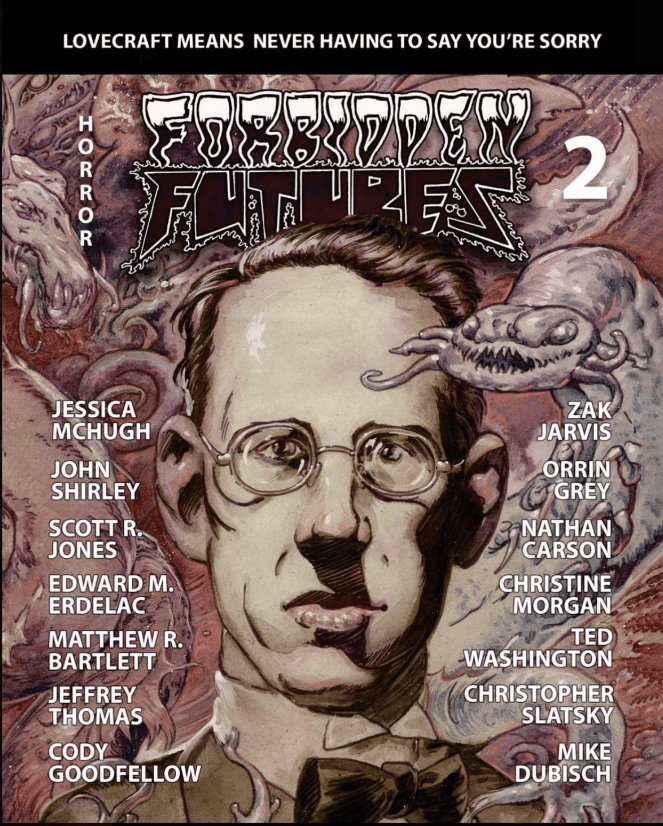
“Waxen” by Christine Morgan was first published in Forbidden Futures #2 (2018), and has been republished in her collection Around Eldritch Corners (2024) by WordHorde.
Bobby Derie is the author of Weird Talers: Essays on Robert E. Howard & Others (2019) and Sex and the Cthulhu Mythos (2014).






 (2014)
 Deep Cuts in a Lovecraftian Vein