Deeper Cut: Muriel E. Eddy’s Selected Letters to the Editor

Muriel E. Eddy was a writer, poet, the wife of pulp writer C. M. Eddy, Jr., a mother of three, and a correspondent with H. P. Lovecraft. Today, she is most remembered for her several memoirs written about Lovecraft, including “The Gentleman from Angell Street” (1961), “Howard Phillips Lovecraft” in Rhode Island on Lovecraft (1945), “Message in Stone” in Fate Magazine (Oct 1956), “Memories of H. P. L.” in The Magazine of Horror (Winter 1965-1966), “Lovecraft’s Marriage and Divorce” in Haunted (Jun 1968), and H. P. L. “The Man and the Image” (1969) (also partially reprinted as “Lovecraft: Among the Demons”). The most recent publication of the Eddys’ memoirs of Lovecraft is The Gentleman from Angell Street: Memories of H.P. Lovecraft (2025) from Helios House.

Less well-known is that Muriel E. Eddy was an inveterate letter writer, often writing in to newspapers and pulp magazines, and having her missives published quite a few times. Many of these letters are of marginal interest for Lovecraft fans, since she wrote many letters about other subjects, often simply praising a magazine or giving advice, for example, her letter published in the Jan. 1926 issue of Weird Tales:

Muriel E. Eddy, of Providence, Rhode Island, writes: “Lukundoo, by Edward Lucas White, in your November issue, receives my vote, as it is by far the most noteworthy, really thrilling and chilling tale you have yet published. It calls to my mind a story I read years ago (by a titled Englishman), entitled The Hand of Fate, wherein the unfortunate hero was fatally marked by an Egyptian magician, before his birth, by a snake. The snake began its growth from the birth of the hero, slowly, bit by bit, out of his side, causing his death. In that story no one dared destroy the hideous monster growing from the man’s side, as to have done so (some thought) would have caused him to bleed to death.”

However, that does leave a collection of letters from Muriel E. Eddy to the editors that do deal with Lovecraft and related matters. Most of these are individually brief and necessarily repetitive. As an addendum to her body of memoirs about Lovecraft, however, they have interest and value, giving greater context to how she constructed and presented the narrative of her friendship with Lovecraft over the years.

  1. Providence Journal, 2 Jan 1944
  2. Thrilling Wonder Stories, Feb 1948
  3. Thrilling Wonder Stories, Jun 1948
  4. Famous Fantastic Mysteries, Aug 1948
  5. The Atlanta Constitution, 8 Aug 1948
  6. Providence Journal, 26 Aug 1948
  7. Providence Journal, 19 Sep 1948
  8. Fantastic Adventures, Oct 1948
  9. Fantastic Adventures, Dec 1948
  10. Startling Stories, Mar 1949
  11. The Boston Globe, 29 Apr 1962
  12. Fantastic, May 1962
  13. Magazine of Horror, Jan 1965
  14. Providence Journal, 8 Jan 1966
  15. Magazine of Horror, Summer 1966
  16. Fantastic, May 1966
  17. Worlds of If, Oct 1966
  18. Providence Journal, 19 Feb 1968
  19. Magazine of Horror, Jul 1968

[1] Providence Journal, 2 Jan 1944

H. P. LOVECRAFT

Editor:

I enjoyed the article about Howard Phillips Lovecraft in the Sunday Journal of Dec. 26, by W. T. Scott, inasmuch as the late Mr. Lovecraft was well known to our family. It was my husband’s uncle, Arthur Eddy, who owned the bookshop on Weybosset street where H. P. Lovecraft loved to browse. Incidentally, there was one great love of Mr. Lovecraft’s life, perhaps unknown, and therefore overlooked, by most of the public. H. P. Lovecraft adored black cats, and would never pass by a stray black feline on the street without stopping to pat it. Mr. Lovecraft often brought his manuscripts to our house to read aloud to us before submitting them to publishers. He was an excellent reader, as well as writer, of weird and macabre tales, calculated to send cold shivers up and down one’s spine He was a gentleman and a scholar, indeed, as Mr. Scott has said in his most interesting article.

H. P. Lovecraft’s wife, whose name Mr. Scott did not know, was Sonia Greene, who lived in Brooklyn, New York.

We are pleased and honored to have been intimate friends of this gifted author. I am convinced that, some day, in the not too distant future, Providence will be proud of having produced such a prolific writer of weird, uncanny yarns that are already known throughout the world.

MRS. CLIFFORD M. EDDY

Notes: Written in response to “The Case of Howard Phillips Lovecraft of Providence, R.I.” by Winfield Townley Scott in the Providence Journal of 26 Dec 1943.

[2] Thrilling Wonder Stories, Feb 1948

LOVECRAFTIANA

Dear Sir: In the OCTOBER issue of “Thrilling Wonder Stories” I was intrigued by a letter from B. De Revere, in which he (or she?) mentioned liking H. P. Lovecraft’s horror tales. As my husband and I knew H. P. L. personally, (he lived in Providence all of his life) I want to publicly thank B. De Revere for all the nice things said re: Lovecraft.

If you, dear editor, had known the man as we did . . . of his passionate love for cats, his dislike of all fish, and his hatred of daylight, you perhaps would realize that anything he wrote in the “weird” or fantastic line, he really “lived” . . . and I used the word “live” advisedly . . . even when he lay dying in the hospital, he asked the nurse for a pencil and paper and vividly recorded (for the doctor’s benefit) exactly how he felt while dying.

Lovecraft was a tall, spare man. His skin was the color of tallow. His handclasp was firm but his hands were always ice-cold. He despised sunshine, and adored utter darkness. He wrote his best horror tales after midnight. His favorite food was sweet chocolate . . . he consumed pounds of it, and cheese and fruit. He loved coffee smothered with sugar . . . as strong as love and as black as sin!

Lovecraft’s marriage was short-lived and his divorce was conducted quietly and without press notices. We sympathized with him in his every mood, because we knew him intimately and well—we often visit his unamrked grave in beautiful Swan Point cemetery in Providence, where a huge shaft in the center of the burial plot proclaims that his parents sleep there. His grave was somewhat sunken, last time we visited it, and covered with creeping green myrtle vines. His very spirit seemed hovering over his grave as we stood there in silent prayer for a man whose genius shall ever life, after his boens have crumbled into dust.

During his lifetime, we used to tell him that his stories rivalled those of Edgar Allan Poe. He “pooh-poohed” the very notion! He considered his work nothing at all, and never displayed any vanity. He wrote simply because he HAD to write . . . from an inner urger that would not let him sleep. May he rest in peace!

—125 Pearl Street, Providence 7, Rhode Island.

Notes: While Lovecraft was very much a night-owl by preference, he was not opposed to sunlight and often walked and wrote outdoors during the daylight hours. Lovecraft noted his own appreciation for coffee, chocolate, and cheese, but he rarely ate fresh fruit. Lovecraft’s death diary existed and has been partially published in various formats, most recently in Collected Essays 5. There was a brief press notice about Lovecraft’s divorce in the Providence Journal 26 Mar 1929.

Link to Thrilling Wonder Stories, Feb 1948.

[3] Thrilling Wonder Stories, Jun 1948

H. P. LOVECRAFT, GENTLEMAN

by Mrs. Muriel E. Eddy

Editor: I’ve been besieged with requests for more information about Howard Phillips Lovecraft, the late Providence writer of weird yarns—so here goes! Lovecraft used to come over to our house and read his manuscripts night after night. Once, he gave my husband a new kind of hair-cutter and advised him to learn how to cut his own hair. It would, he averred, save many a barber’s bill. He assured us he always cut his own hair and shaved himself.

Lovecraft was the soul of neatness, and always looked like the old-fashioned gentleman of culture he preferred to call himself! He once visited the oldest church in Rhode Island with Mr. Eddy and, while there, signed his name in the register—”H. P. Lovecraft, Esquire, Gentleman.”

My hubby’s uncle (now dead) owned and operated a huge second-hand bookstore on Webosset street in Providence. His name was Arthur Eddy. Lovecraft spent hours at night, talking to our ancient uncle and poring over many volumes in the basement. He never appeared in daylight—but always turned up around the Witching Hour of twelve. Uncle liked H.P.L. and stayed open until the wee sma’ hours of morning, to humor this then embryo writer. He once predicted that, with the years, Lovecraft’s fame would mount. How right he was!

Lovecraft asked us to do much of his typing. He used an old, old machine on which he occasionally typed a story—one of the “invisible type” variety, no longer made. It is to be regretted that this typewriter was sold to a second-hand man when some disinterested outsider was cleaning his apartment after his death. I’m sure it would have been a collector’s item, had it not been sold to this unknown person, to whom the name “Lovecraft” meant nothing!

I have pictures of H. P. Lovecraft as a small child, and also pictures of his mother and father. Last summer we ascertained where his grandfather had lived during his boyhood and took interesting snapshots of the yard in which H.P.L. used to play—when he was not ill, for he was not a rugged child. I have a photo of his grandfather (who had brilliant dark eyes, a Lovecraft characteristic) and of his birthplace as well as of the grave in which he is buried (his body was placed in the ground, not in a vault).

I feel that memories of this man are precious indeed—and I even have a letter he wrote to us, congratulating our cat when she presented us with several kittens—written just as one would write to a human mother—because Lovecraft was noted for his great devotion to felines!

By the way, my favorite story in FEBRUARY TWS is “THE SHAPE OF THINGS” by Rad Bradbury. It is written in such a manner that one wonders if—MAYBE—it couldn’t be true! Fantastic but truly fsacinating stuff to ponder over! I enjoyed all the stories and I loved the monstrous hairy spider (?) on the cover! I’ll keep reading TWS!

—125 Pearl Street, Providence 7, Rhode Island.

Notes: The reference to the “disinterested outsider” might be an aside on R. H. Barlow, Lovecraft’s literary executor, who helped deposit Lovecraft’s papers at Brown University, and some of Lovecraft’s books. The remainder of Lovecraft’s possessions were disposed of by his surviving aunt, Annie Gamwell; it’s possible she sold or gave away the typewriter along with other items she did not wish or could not afford to keep. Several of the photographs mentioned appeared in Rhode Island on Lovecraft (1945).

Link to Thrilling Wonder Stories, Jun 1948.

[4] Famous Fantastic Mysteries, Aug 1948

ABOUT H. P. LOVECRAFT

Dear Editor:

My hubby picked up a copy of April 1948 Famous Fantastic Mysteries on the newsstand, and brought it home to me; he was fascinated by the cover . . . somehow, the pointing finger of the old genii with the red eyes and blue face and hair, popping out of the magic beanpot (at least, it looks like a tiny red-brown beanpot, to me!) intrigued him endlessly. He read it on the trolley coming home, and had all the other strap-hangers gaping, open-mouthed, and wondering, no doubt, what it was all about.

As usual, I turned to the letter deparment, first of all . . . somehow, when a magazine conducts such a department, it seems a safer magazine to read, proving that it is not afraid to publish readers’ frank comments . . . and what did my eyes discover there? Mention of Howard P. Lovecraft, Providence, R. I.’s own native son and favorite author of weird stories, in a letter signed Donald L. Fox, of Bicknell, Ind.

This letter praised a sketch of Lovecraft that appeared in the August 1947 issue on page 113 which I , most unfortunately, missed. In fact, this April issue is, believe it or not, the first one we’ve seen. Lay the blame on other lovers of uncanny yarns here in our city . . . no doubt copies of Famous Fantastic Mysteries sell so rapidly that no newsdealer can keep them stocked sufficiently for their customers.

If any kind reader happens to have this issue, if they’ll loan me their copy, I’ll guarantee its safe return, once I’ve glimpsed the drawing of Lovecraft.

You see, my husband and I were literary buddies of H.P.L., as we always called this now famous writer. he used to bring his manuscripts over to our house, for criticism, though Heaven knows they were always letter-perfect in our opinions. Just the same, Lovecraft would read them aloud, munching on bars of sweet chocolate between paragraphs, for he loved this confection. H.P.L. hated cold weather with an intense hatred. He was a man of many idiosyncrasies, but withal a wonderful pal and a staunceh friend. He always made himself perfectly at home with us, loved to pet our cats, and hated fish—in fact, any kind of sea-food was hateful to this master of the macabre.

When H.P.L. died, it broke our hearts. He was buried in historic old Swan Point Cemetery, here in Providence, and we often visit his grave. Sometimes it seems he is very near, as we read over cards he sent us on his various travels.

As for the magazine: “City of the Dead” is a great story . . . kept us interested throughout. We enjoyed Robert W. Chambers’ novelette, “The Messenger”, and the sketch of Algernon Blackwood was wonderfully executed. But best of all I enjoyed the wonderful “Readers’ Viewpoint” with letters from readers everywhere! From now on, I’m taking no chances. I’m ordering my copies of F.F.M. in advance.

Glad to see a letter from August Derleth . . . We know him, too. We met him last summer during his hurried trip to Providence.

Mrs. Muriel E. Eddy
125 Pearl St.
Providence 7, Rhode Island.

Notes: Muriel E. Eddy also corresponded with August Derleth.

Link to Famous Fantastic Mysteries, Aug 1948.

[5] The Atlanta Constitution, 8 Aug 1948

I am pleased to see Joe Lee’s article on Houdini . . . whose real name was Erich Weiss. My husband, Cliff Eddy, was “ghost writer” for Houdini for many years. He also assisted Houdini in exposing fake mediums. I am proud to say that Houdini and his wife Beatrice (now dead) were personal friends of mine. They were remarkable people . . . I often wondered what happened to their pet parrot, Laura, after she flew out an open window in Hollywood (after Houdini’s death) and was last seen heading for the foothills.

Laura always accompanied her mistress on tour and I remember the pretty green bird with the red head perched on her mistress’ shoulder as we walked up a busy street in a sudden downpour of rain.

Laura seemed to enjoy the rain and laughed delightedly and when we entered the lobby of the hotel where we were staying, the bedraggled parrot was still laughing. But when folks started to laugh at her she hid her head under a wing and cried like a baby.

Mrs. Houdini ordered half a melon for the parrot as a special treat, but Laura much preferred sipping tea from a spoon.

Mrs. Muriel E. Eddy,

Providence, R. I.

Notes: Written in reply to “I Knew Houdini” by Joe Lee, Houdini’s former publicity director, published in The American Weekly magazine section of the Chicago Herald-American for the week of 20 Jun 1948. While not directly related to Lovecraft, this letter is relevant for its insight into the Eddy/Houdini relationship, which in turn was connected with Lovecraft’s relationship with Harry Houdini and his wife, Bess Houdini. This letter was published simultaneously in multiple papers, also appearing in at least the Pittsburgh Sun-Telegraph, 8 Aug 1948 and the San Francisco Examiner, 8 Aug 1948.

Link to the Atlanta Constitution, 8 Aug 1948.
Link to the Pittsburgh Sun-Telegraph, 8 Aug 1948.

[6] Providence Journal, 26 Aug 1948

Writer of the Uncanny

Editor:

I read the Sonia H. Davis article on H. P. Lovecraft on the book page of the Aug. 22 Sunday Journal. I thank Mrs. Davis for giving us her impressions of one of the finest writers Providence has ever produced. My husband and I knew Lovecraft so well that we often visit his grave at Swan Point Cemetery in memory of a very dear friend and a gentleman of the “old school.”

Often, we typed Lovecraft’s manuscripts, finding it a joy to assist this prolific writer of the weird and uncanny. Lovecraft lived in a world of his own making, a sort of “dream world” where night became day. Most of his writings were accomplished at night. Providence was Lovecraft’s first, last and only real love in my opinion. He derived his inspiration from Providence’s little-known alleys, back streets and ancient burying grounds. We knew Lovecraft I really believe, better than anyone else (outside of his two aunts), and no finer gentleman ever lived, I feel safe in saying, than this man who just could not reconcile himself to married life, perhaps because his writing meant his entire life to him.

MRS. MURIEL E. EDDY
Providence.

Notes: In response to “Howard Phillips Lovecraft as His Wife Remembers Him” by Sonia H. Davis in The Providence Journal, 22 Aug 1948.

Link to letter in Providence Journal, 26 Aug 1948.

[7] Providence Journal, 19 Sep 1948

First, from a letter from Lovecraft’s friend Mrs. Clifford Eddy:

“I was deeply impressed . . . but one thing I think the charming Sonia overlooked entirely. Writing was H.P.L.’s entire life . . . Lovecraft often used to ssay: ‘I never was young; I was born old!’ But thanks to Sonia for giving us even the vaguest insight into married life with this extraordinary man.

“Sonia perhaps was unaware that after the divorce H. P. L. traveled several times ‘Boston-ward’ to visit a very fine young lady, and to assist her in literary work. The visits were sources of pleasure to the young lady, for she wrote me of visits to museums with H. P. L., of candle-lit suppers on cheese sandwiches and chocolate cake, and of his gentlemanliness and courtesy. It was purely a platonic friendship, but it proves that at heart H. P. L. was surely not a recluse entirely! He was human, but always his literary work came first, last and foremost!”

Notes: This excerpt ran in Winfield Townley Scott’s column, “Bookman’s Gallery,” in the Providence Journal, and was a further response to Sonia H. Davis’ article. The entire letter is available at the Brown Digital Repository. The “young lady” referred to was almost certainly Hazel Heald, a revision client that Lovecraft got in touch with trough Muriel E. Eddy, who had a somewhat romantic and rose-tinted view of their potential relationship.

[8] Fantastic Adventures, Oct 1948

SHAVER AND LOVECRAFT

Sirs:

The May issue of FA was a pip! It bubbled with good reading! “Forgotten Worlds” by Lawrence Chandler was wonderfully illustrated and it held my attention all the way.

I agree with Milton Papayianis of Barstow, California, regarding Richard S. Shaver and H. P. Lovecraft. Lovecraft, a close friend of the family for years, loved red roses, sweet chocolate ice-cream, and soft dreamy music. My husband has composed music for years, and H.P.L. lovecraft to watch him at work.

To those of you who love the weird things in life, I’m sure you love weird music too, as much as the late master of the weird did. My hubby often talked with H.P.L. about setting some of his weird poems to music, but unfortunately H.P.L.’s untimely death prevented this.

Muriel E. Eddy
125 Pearl St.
Providence 7, R.I.

Notes: In the 1940s, some fans drew connections between Lovecraft and the Shaver Mystery; Richard Shaver’s stories and many letters about them were published in the pages of Fantastic Adventures. I have been unable to find independent confirmation that Lovecraft particularly enjoyed roses or “soft dreamy music”; in his letters, Lovecraft indicated his musical tastes tended toward the popular music of his youth. C. M. Eddy, Jr. did write and publish songs, although it isn’t clear he ever approached Lovecraft about such an adaptation; composer Harold Farnese, however, did set some of Lovecraft’s weird poetry to music, so the idea isn’t too far-fetched.

Link to Fantastic Adventures, Oct 1948.

[9] Fantastic Adventures, Dec 1948

LOVECRAFT’S WIFE

Sirs:

Since my letter appeared in the October FA I have been deluged by letters asking me whether or not HPL, the great weird master, was ever married. The answer is, emphatically, yes.

He had a beautiful wife, and she has just written an article pertaining to her married life with him, which appeared, with her photo, in our local paper. HPL was her second husband. They divorced, and she remarried. Her third husband has since passed on. She stated in her article that Lovecraft loved cheese souffle for breakfast, cared very little for foreigners, and that he really loved his native Rhode Isalnd. The article was very interesting, and Sonia H. Greene Lovecraft Davis is really a fascinating woman. Perhaps she’ll read this and write into FA herself!

The October issue of FA was wonderful, from “kiver to kiver.”

Muriel E. Eddy
125 Pearl St.
Providence 7, R.I.

Notes: While they never met, Muriel Eddy and Sonia H. Davis did develop a correspondence after Sonia’s memoir on Lovecraft appeared in the Providence Journal.

Link to Fantastic Adventures, Dec 1948.

[10] Startling Stories, Mar 1949

MORE LOVECRAFTIANA
by Mrs. Muriel E. Eddy

Editor Startling Stories: I’ve been so interested in the many letters re: Lovecraft. Here in Providence, R.I., folks call me an authority on Howard Phillips Lovecraft, because my husband and I knew him intimately for many years. We were aware of his many idiosyncrasies and we loved him!

We know he was allergic to fish—so we never served him fish or any sea food! We knew he enjoyed the white baked meat of chicken—and cheese. He loved chocolates and when he married Sonia Greene in 1924 his two aunts gave our children over 100 empty chocolate boxes to play with! (In fact, a bathtub full!) We used an old gas-plate Lovecraft formerly brewed his coffee on, for a long time.

We remember how dearly this famous author of the weird and uncanny loved coffee with many spoonfuls of sugar! Many a night we listened to Lovecraft reading his original manuscripts—and enjoyed the facial expressions that played over his unusually mobile features as he read aloud with many a theatric gesture!

I’d be glad to furnish readers with any information on Lovecraft I am able to—and in the meantime I’ll just say I do enjoy “STARTLING STORIES” and the November issue was EXCEPTIONALLY fine! I LOVE your illustrations and covers!

—125 Pearl Street, Providence 7, Rhode Island.

Notes: When Lovecraft moved to New York City in March 1924 and married Sonia, he instructed his aunts to send much of his furniture and belongings to him in New York, and some of the other items ended up with the Eddys, who at the time were in a straitened financial situtation. With regards to chicken, Lovecraft’s letters and other memoirs confirm he did enjoy it, and his friend Harry Brobst, when interviewed by Will Murray, claimed that Lovecraft especially liked white meat and disliked dark meat (Ave Atque Vale 313).

Link to Startling Stories, Mar 1949.

[11] The Boston Globe, 29 Apr 1962

They Remember Howard Lovecraft

To the Editor—The year 1962 marks the 25th anniversary of the death of one of New England’s most prolific writers of the weird and uncanny in literature . . . the late Howard Phillips Lovecraft, who was born Aug. 20, 1890, and who died Mar. 15, 1937, in Providence.

My husband and I were personal friends of H.P.L. (as he is known to many of his readers) and we read many of his yarns, which are now published all over the world in many different languages. We spent many hours with this genius, talking over his stories and criticizing them in the rough spots.

Here at 588 Prairie av., Providence, we have many mementoes of this talented writer, who some say rivalled Edgar All[a]n Poe with his weird ideas. My husband, Clifford Eddy, was a frequent pal on the long midnight walks Lovecraft used to take to get story ideas.

MRS. MURIEL E. EDDY
Providence

Notes: According to a 2 Dec 1960 letter to August Derleth, the Eddys had established a Lovecraft “shrine” in a corner of their home for visitors, including photographs of HPL.

Link to The Boston Globe, 29 Apr 1962 letter.

[12] Fantastic, May 1962

Dear Editor:

I was greatly interested in Feb. FANTASTIC because of the story “The Shadow Out of Space,” by H. P. Lovecraft and August Derleth. My husband and I were close personal friends of the late H. P. Lovecraft. This year makes the 25th anniversary of Lovecraft’s death, which occurred March 15, 1937. He is interred in beautiful Swan Point Cemetery, Providence’s finest, most exclusive burying-ground. We often visit the grave of this unusually gifted author of the macabre.

I would be pleased to hear personally from any Lovecraft fans. I have plenty of time and will answer all letters if a stamp is enclosed.

Mrs. Muriel E. Eddy
688 Prairie Ave.
Providence 5, R.I.

Notes: “The Shadow Out of Space” was one of August Derleth’s “posthumous collaborations,” with H. P. Lovecraft, though in fact Derleth wrote them all, often based on some inspiration from Lovecraft or some prose fragment or portion of a letter.

Link to Fantastic, May 1962.

[13] Magazine of Horror, Jan 1965

Mrs. Muriel E. Eddy of 688 Prairie Avenue, Providence, RI, 02905, writes, “Having known Howard Phillips Lovecraft very well, from 1923 to the year of his death, 1937, I would like to share my memories of “HPL” with any of your readers who would care to write to me.

“HPL was a constant nocturnal caller at our home during those years. We discussed manuscripts constantly with him. We knew his aunts, too, and we often visit his grave, here in Providence, R. I.”

Notes: The Magazine of Horror had published some Lovecraft-related material in previous issues, which may have inspired this letter, and this offer probably led to Muriel E. Eddy’s “Memories of H. P. L.” being published in Magazine of Horror (Winter 1965-1966).

Link to Magazine of Horror, Jan 1965.

[14] Providence Journal, 8 Jan 1966

A Tribute to Howard P. Lovecraft

During our many years of close association with the late Providence-born author of weird, uncanny and bizarre tales, Howard Phillips Lovecraft, who died on March 15, 1937, we learned much about this wonderful writer that is not too widely known to those who read his stories and shiver, loving every word of them, or the students who are writing theses on this now famous Providence author of the macabre.

Born August 20, 1890, he was the only child of Sarah Susan (Phillips) Lovecraft and Winfield Scott Lovecraft. As a young boy, H. P. L. (as he was affectionately known to us) became interested in the weird. he was a devotee of Edgar All[a]n Poe, Ambrose Bierce, Arthur Machen, and others in that category.

Knowing Lovecraft made us appreciate the wonderful city we live in. he loved the fan-shaped designs over ancient doorways, and he loved to explore old cemeteries such as St. John’s Churchyard. Many of his stories were inspired by his ramblings in ancient cemeteries.

On March 15, 1966, this now famous writer, born and brought up in our fair city, will have been gone from our midst 29 long years, yet his fame is spreading like wildfire. 

His work is now internationally known. During the past seeral years we have had callers from England and Sweden who wanted to discuss H. P. L. and his writings with us and to see his last resting-place in beautiful Swan Point Cemetery. It is considered a rare privilege by my husband and me to realize that we knew this wonderful man personally.

Long may his memory live!

Muriel E. Eddy
Providence

Notes: In 1959, the Swedish editor and radioman Torsten Jungstedt visited the Eddys at their home in Providence, R.I., as recounted in letters to August Derleth.

[15] Magazine of Horror, Summer 1966

“Thanks for publishing my brief Memoirs of HPL,” writes Mrs. Muriel E. Eddy of 688 Prairie Avenue, Providence, Rhode Island 02905, “in the Winter 1965/66 issue, and thanks to readers who’ve written me how much they liked it. As my husband (Clifford Eddy) and I knew this master of weird fiction so well, I had some photos of HPL copied, so that I can send them (as mementos) to sincere Lovecraft fans. To those who care to send me a self-addressed, stamped envelope, regular size, I’ll send a picture. . . . Call on me, if you wish. We even had a caller from Sweden and two from England, wishing information on HPL, which we gave to them gladly. We still remember how HPL loved ice-cream and hated fish! I still have a chair HPL’s aunt (now gone) gave to me when HPL left Providence to marry Sonia Greene in New York. I used to own the folding bed HPL slept in (his aunt also gave it to me) until one night it collapsed on me! His aunt gave me many souvenirs of HPL which I cherish—those I have left—after all these years. Memories of HPL will never cease!

“Glad to see so many fine stories in the Winter issue. I believe that Master Nicholas, by Seabury Quinn, was my favorite. The Faceless God, but Robert Bloch, was a close second.”

Notes: The aunt was Annie Gamwell.

Link to Magazine of Horror, Summer 1966.

[16] Fantastic, May 1966

Dear Editor:

In the January, 1966 issue of Fantastic the story which held the most appeal for me was Robert Sheckley’s “What a Man Believes.” It really “rang the bell” for me!

Being an “old-timer” when it comes to reading odd, strange and different stories, I feel I am qualified to judge a story pretty well . . . and having read thousands of manuscripts during my lifetime (I’m heard of the R.I. Writers’ Guild here in Providence, R.I., and I’m almost 70 years old!), I don’t mind adding a few more “unbelievable tales” while I’m still alive! Robert Sheckley truly made an “unbelievable” tale BELIEVABLE!

My husband and I were bosom friends of the late weird writer, Howard Phillips Lovecraft, who died March 15, 1937, in our city, and who lies sleeping in beautiful Swan Point Cemetery. One night, after reading an especially weird manuscript aloud to us, he remarked that he believed the human brain was practically indestructible. . .that (who [k]new?), the brain MIGHT keep on functioning even after death. . .at least, it was a subject worth thinking about!

His remark has haunted me for years. Every time we visit Lovecraft’s grave, I think about it, and I wonder if, after death, it is ever a possibility that the human brain MIGHT keep right on functioning. . .whether the heart stops or not. . . .Sheer fantasy, I’m sure. . .or. . . is it?

To get off the subject. . .ALL of the stories in the January, 1966, issue are well worth reading. . .and of course Virgil Finlay’s weird illustration of “Six and Ten Are Johnny” is great. By the way, Virgil has also illustrated many Lovecraft stories. . .he’s my favorite illustrator!

Many times I regret that H.P. Lovecraft died so young. . . he was only 47 at his demise. He’d be 75 if he’d lived. We cherish his memory and invite correspondence referring to H.P.L. and all weird, uncanny subjects! KEEP UP THE GOOD WORK and I’ll continue to be a FANTASTIC FAN!

Mrs. Muriel E. Eddy
Pres. R. I. Writers’ Guild
688 Prairie Avenue
Providence, R.I. 02905

Notes: The anecdote about a brain still living evolved over time, derived from “Thoughts and Feelings of a Head Cut Off,” a story ghostwritten for Harry Houdini, possibly by C. M. Eddy, Jr. The identification of the idea with Lovecraft appeared notably in “Message in Stone” (1956) by Muriel E. Eddy. The idea of an indestructible brain doesn’t sound very much like the materialist H. P. Lovecraft, but it is possible he contributed the idea at some point during a brainstorming session and the years transformed the incident in Muriel E. Eddy’s mind.

Letter to Fantastic, May 1966.

[17] Worlds of If, Oct 1966

Dear Editor:

Toys for Debbie by David A. Kyle rang the bell for me. What a story! And what toys! ALL the stories were well worth reading—the illustrations were wonderful—your “letters” department was fine!

If I sound extra enthusiastic it’s because I AM! I’m a lover of “different” stories from way back. I’m pushing 70 now. My birthday is January 19, hubby’s is January 18—do we have any “birthday twins” among your readers?

My hubby and I have one entire room lined with weird and fantastic books and magazines. We were intimate friends of the late author of the weird and uncanny, H. P. Lovecraft. We spent many pleasant nighttime hours with this fantastic man, listening to him read his manuscripts aloud under flickering gaslight. This was in the early ’20s, when everybody didn’t have electricity in their homes! Nights seemed darker, then . . . and as H. P. L. loved darkness, we three reveled in it, as we pictured monsters, hobgoblins, shapeless creatures of his own imagination and witches steeped in witchcraft, while Lovecraft nibbled on a chicken leg and enjoyed our hospitality!

I could ramble on and on about our association with this master of the weird. We visit his grave often, and we have many pictures of H. P. L. and even one of his parents! We revere his memory and in his honor we peruse all “different” publications on the newsstands. Yours wins top honors with us! Also your cover appealed greatly to me, and it illustrated your feature story, a corker—The Moon Is a Harsh Mistress, by Robert A. Heinlein—beautifully. You’ve got yourself a steady If reader! 

—Mrs. Muriel  E. Eddy, President, R. I. Writers’ Guild, 688 Prairie Avenue, Providence, Rhode Island 02905.

Notes: Link to Worlds of If, Oct 1966.

[18] Providence Journal, 19 Feb 1968

In Memoriam: Howard Phillips Lovecraft

March 15 of this year will mark the 31st anniversary of the death of the new famous Providence author, Howard Phillips Lovecraft. Mr. Lovecraft’s many books of weird literature may be found in many public libraries now throughout the land, and his works have been translated into many foreign languages.

My late husband, Clifford martin Eddy, and I, knew Mr. Lovecraft very well. He was a constant visitor at our home, and as he preferred nighttime to day, we called him “The Man Who Came at Midnight.”

He used to love to read us his original manuscripts before submitting them to an editor. he was not conceited; in fact, he thought but little about his talent for conceiving weird and uncanny plots. I think the story that caused the most shivers when Lovecraft read it aloud, many years ago, was his now famous: “The Rats in the Walls” . . . truly a macabre yarn, a real weird classic in literature.

Born on the East Side, (Angell street, to be exact) Mr. Lovecraft loved Providence dearly. Many of his stories have a Providence-inspired background. One recognizes Benefit Street and Federal Hill in at least two of his weird tales!

All honor to the memory of Howard Phillips Lovecraft, now sleeping the eternal sleep in historic old Swan Point Cemetery. When I visit my husband’s grave, I always pay tribute also at the last resting-place of a truly great Providence author, recognized all over the world since his untimely death, (he died at only 47 years of age) the unforgettable Howard Phillips Lovecraft!

Mrs. Muriel E. Eddy
Providence

Notes: Ruth M. Eddy’s memoir of Lovecraft was “The Man Who Came at Midnight” (1949), recalling her childhood in the 20s when he came to visit.

[19] Magazine of Horror, Jul 1968

Mrs. Muriel E. Eddy writes from 688 Prairie Avenue, Providence, Rhode Island, 02905: “I am deeply sorry to tell you and interested readers of your esteemed magazine (which has always been a welcome visitor to our home) that my dear husband, author of several stories published in the now defunct WEIRD TALES, etc, such as The Loved Dead, Deaf, Dumb and Blind, etc., passed away on Tuesday, November 21, 1967, at the Osteopathic Hospital in Providence, R.I., after a long and painful illness. Death came to him as he slept. The doctor attending him telephoned me at quarter past six a. m., saying my husband had expired at about six a. m. Death came peacefully, after months of suffering.

“My husband, Clifford Martin Eddy, was a bosom pal of the late Howard Phillips Lovecraft, as so many people know, as since a letter of mine appeared in these columns a year or so ago, I received and answered much mail concerning our friendship with the late master of the macabre in fiction. Now my dear one lies sleeping in the same cemetery in which Howard P. Lovecraft sleeps, beautiful Swan Point Burial Ground, here on Blackstone Blvd., in Providence, R.I., where both Lovecraft and Eddy were born.

“Memories of HPL filled Mr. Eddy’s life, and we talked much about the happy times when Lovecraft came to visit us at our humble abode. Now that Mr. Eddy has left this earth I shall always recall those precious moments. To alleviate the loneliness incurred by my dear husband’s demise I shall be glad to answer any letters regarding HPL or my husband’s writings. Mr. Eddy and Mr. Lovecraft often discussed plots of their stories before writing them, and I was always an interested listener, although at times I, too, have tried my hand at weird stories. But these two men (I think you will agree) were tops in their field! August Derleth of Sauk City, Wisconsin, has re-published a few of my husband’s stories in anthologies, and I hope some of your readers remember the name ‘Eddy’ as well as that of Lovecraft! My husband was not as prolific a writer as was HPL, but what he did write was bloodcurdlingly readable! He was 71 at his death, and on February 10, 1968 we would have observed our Golden Wedding . . . but God saw fit to take him . . . and who we are to question God? Nevertheless, I miss him . . . sorely. Letters will help assuage my loneliness! I visit his grave (and Lovecraft’s) very often.”

Notes: Link to Magazine of Horror, Jul 1968.


Bobby Derie is the author of  Weird Talers: Essays on Robert E. Howard and Others  and  Sex and the Cthulhu Mythos .

Deep Cuts in a Lovecraftian Vein uses Amazon Associate links. As an Amazon Associate I earn from qualifying purchases.
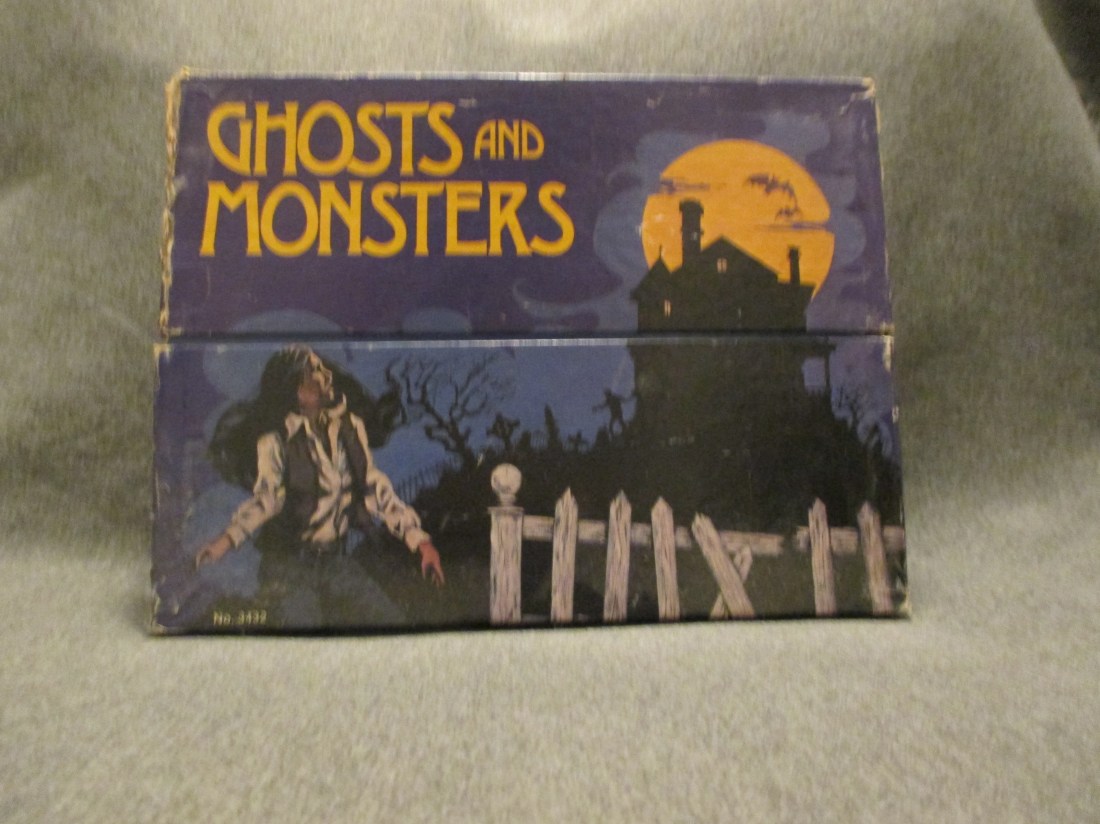
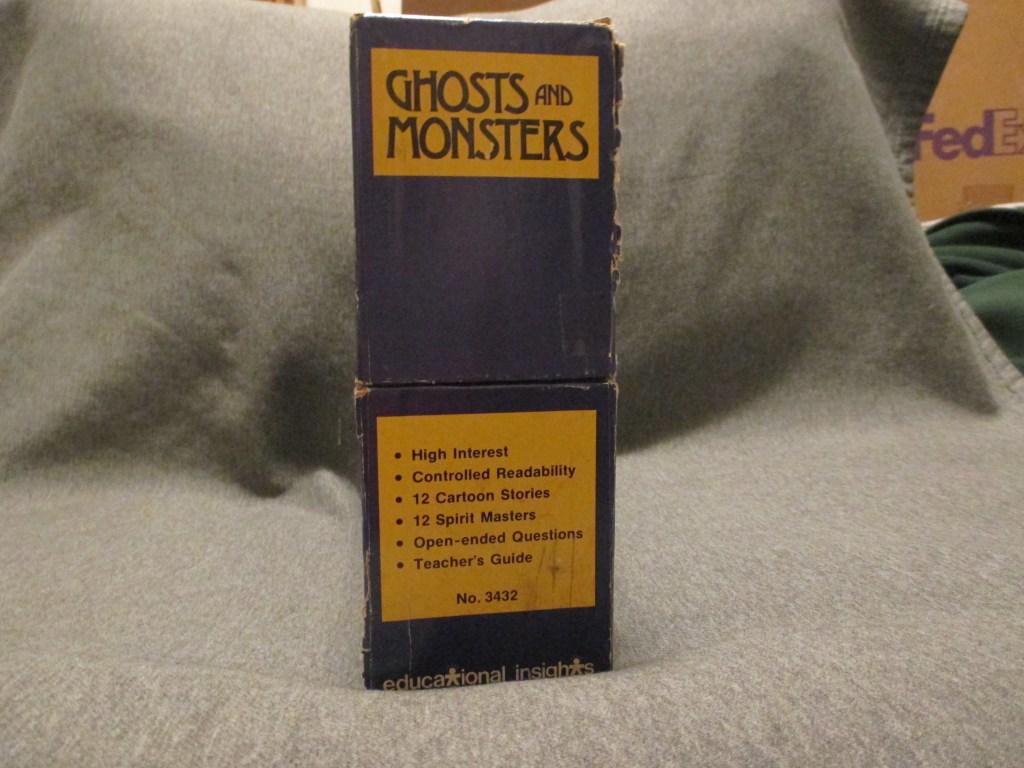
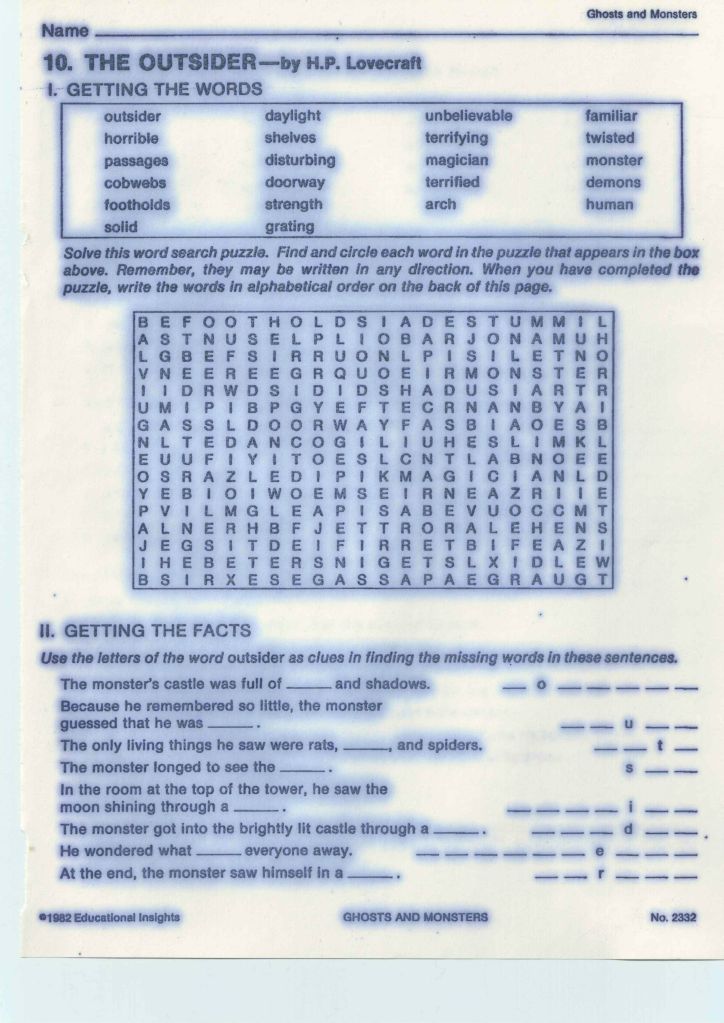
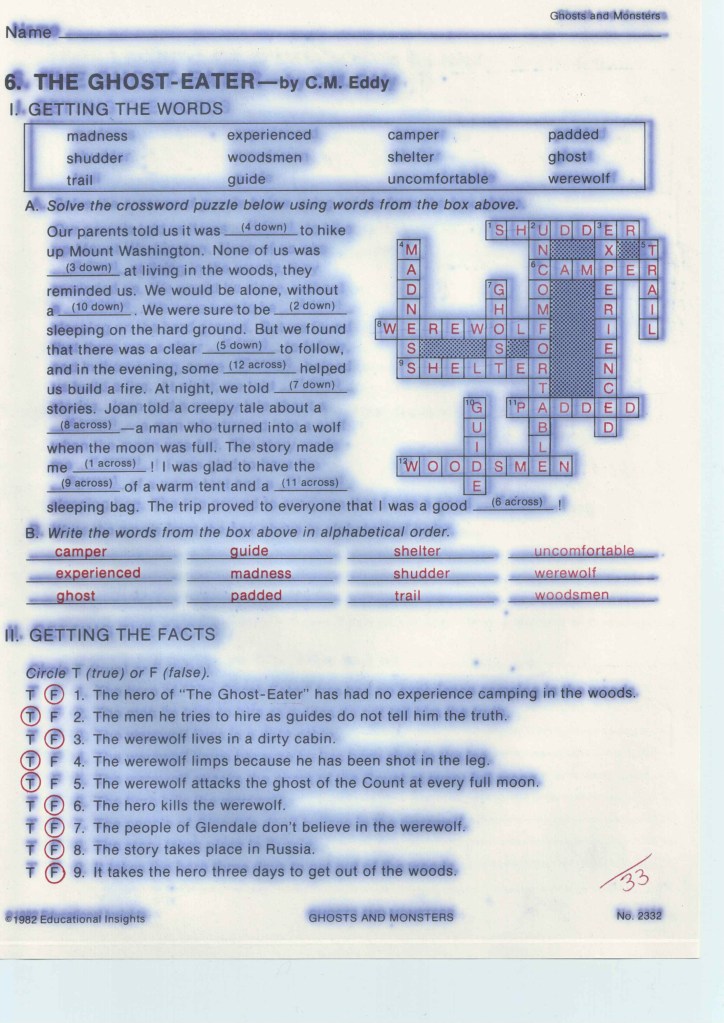
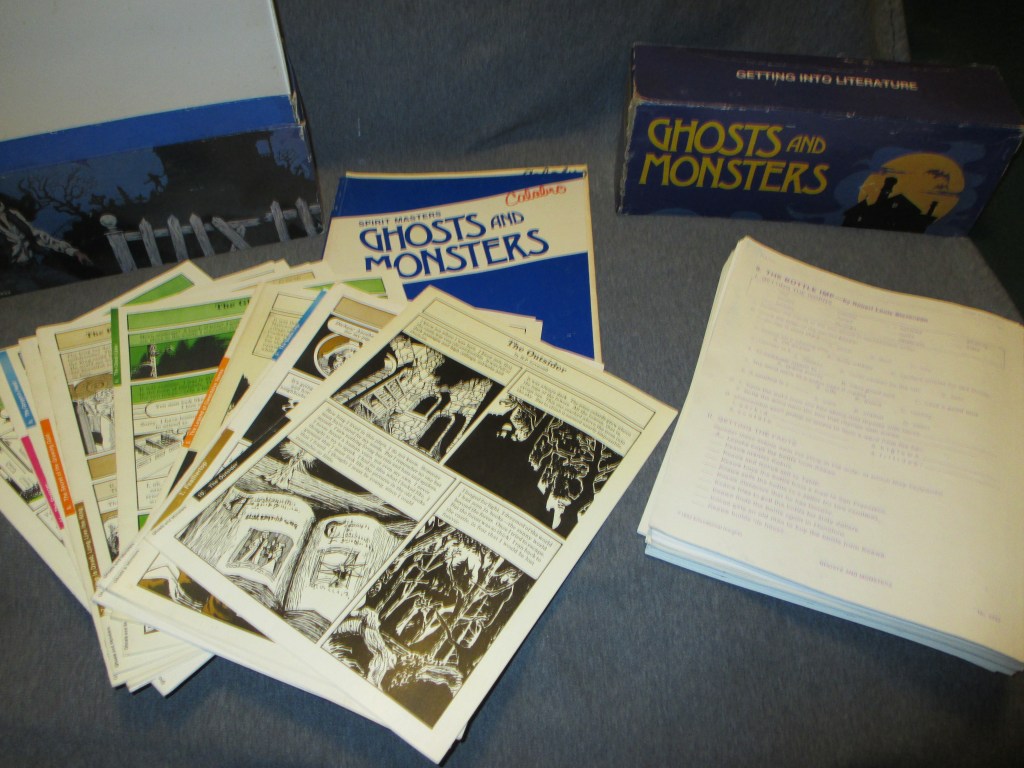
Ghosts and Monsters (1982) by Mark Falstein & Tony Gleeson

Ghosts and monsters have long been favorite topics for many children, so this Getting Into Literature set has a real built-in motivation factor. The art aids understanding, and the text is set in type (rather than hand-lettered in the traditional comic-book style). These features make GHOSTS AND MONSTERS enjoyable and easy to read.
—Teacher’s Guide: Ghosts and Monsters

Imagine yourself in a public middle school in the United States of America, circa the 1980s or early 1990s. A genuine chalk board, rows of desks, an old-style projector. It’s the fall; leaves are falling from the trees, t-shirts are giving way to long sleeves and jackets. The classroom might be decorated with black and orange chains of paper, a cut-out of a witch, a pumpkin with a crooked smile drawn on in sharpie. The teacher passes out a stack of worksheets—but what is this? Comics? Horror comics?

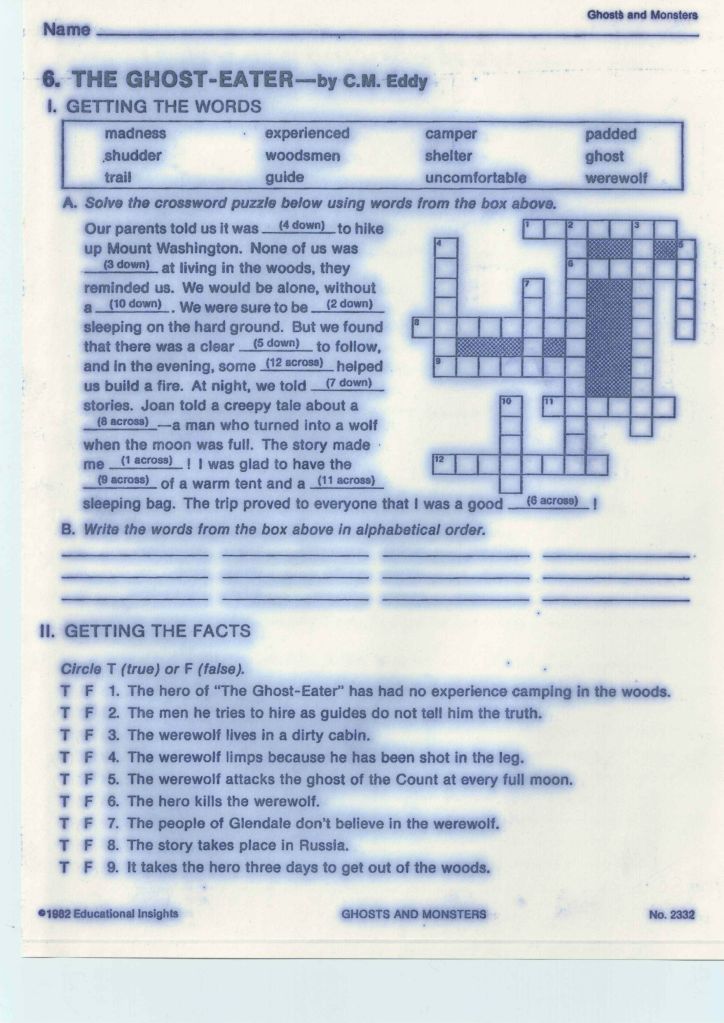
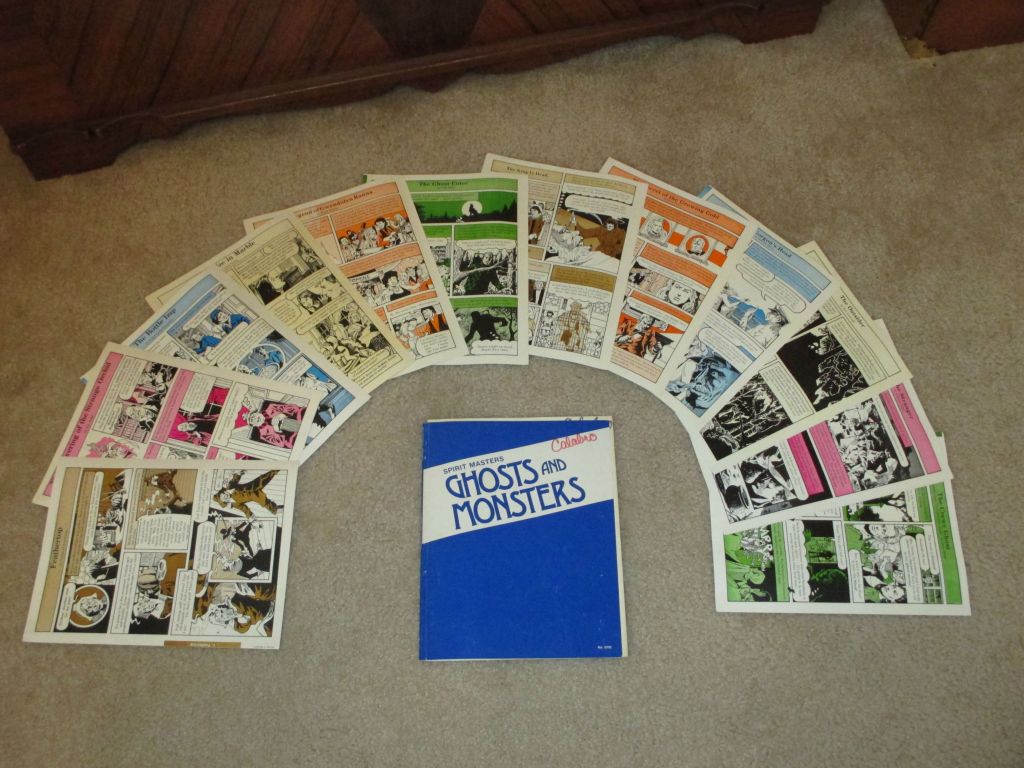
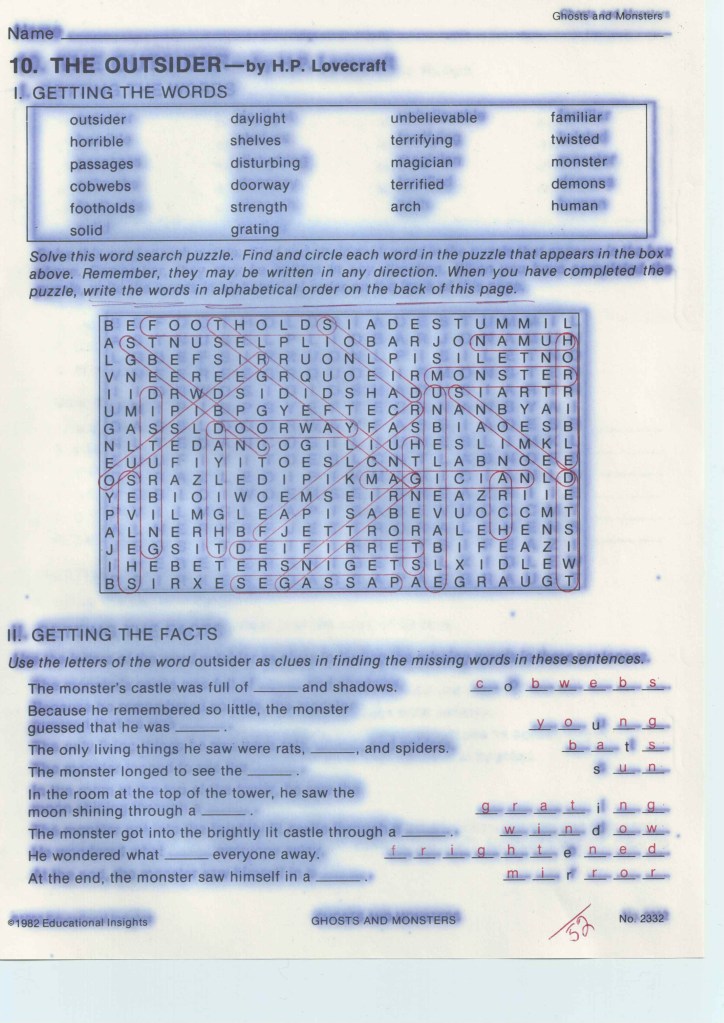
Ghosts and Monsters was published by Educational Insights in 1982. The kind of boxed set of teaching materials that found there way easily into hundreds or thousands of classrooms across the country. The contents were pretty basic: a book of spirit masters for duplicating worksheets (crosswords, etc.) in an age before photocopying became ubiquitous; a brief teacher’s guide with suggested questions and activities; and a package of comic booklets which adapted a dozen tales of horror and weird fiction to comics:

  1. “Feathertop” (1852) by Nathaniel Hawthorne
  2. “The Flowering of the Strange Orchid” (1894) by H. G. Wells
  3. “The Bottle Imp” (1891) by Robert Louis Stevenson
  4. “Man-Size in Marble” (1887) by Edith Nesbit
  5. “The Legend of Gwendolyn Ranna” (1982?) by Frank Maltesi
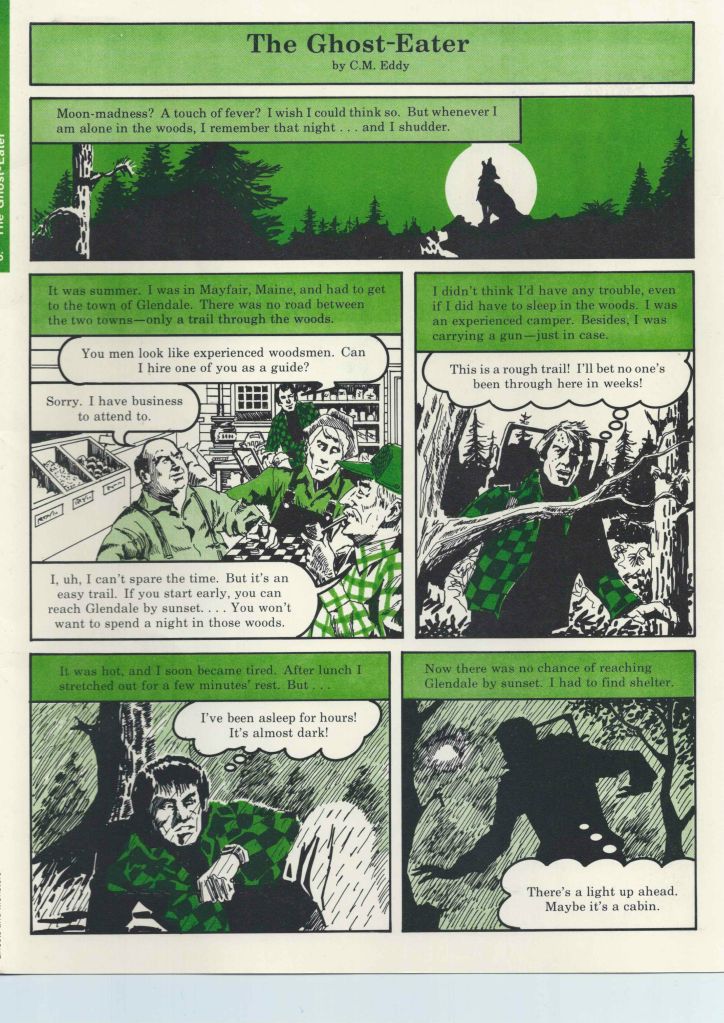
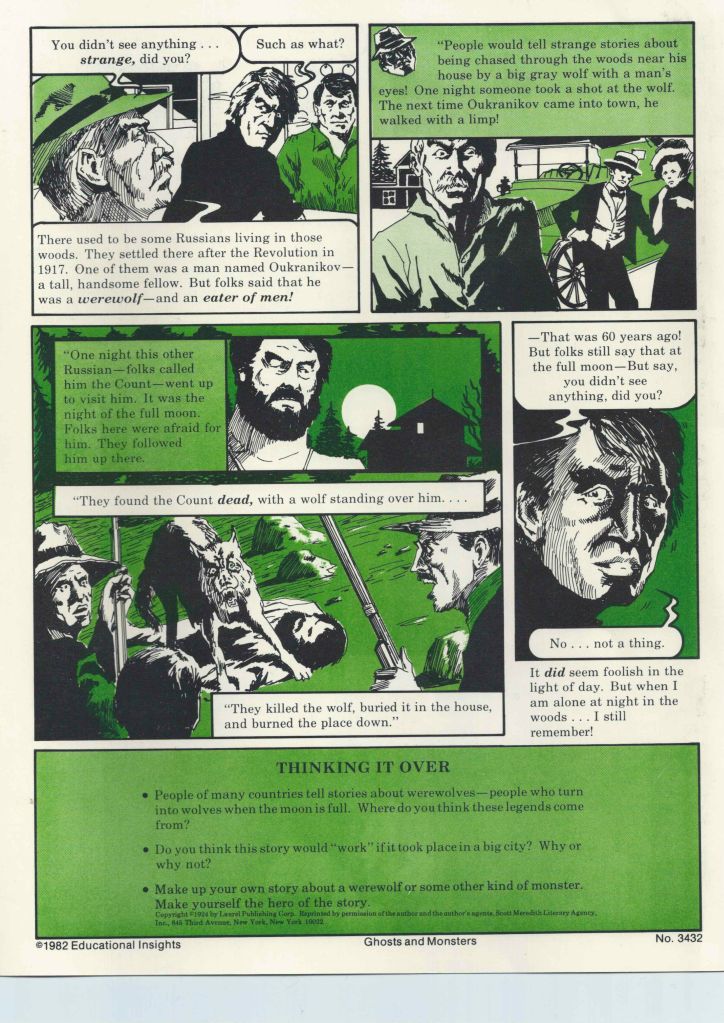
  6. “The Ghost-Eater” (1924) by C. M. Eddy
  7. “The King is Dead, Long Live the King” (1928) by Mary Coleridge
  8. “The Secret of the Growing Gold” (1892) by Bram Stoker
  9. “The Gorgon’s Head” (1899) by Gertrude Bacon
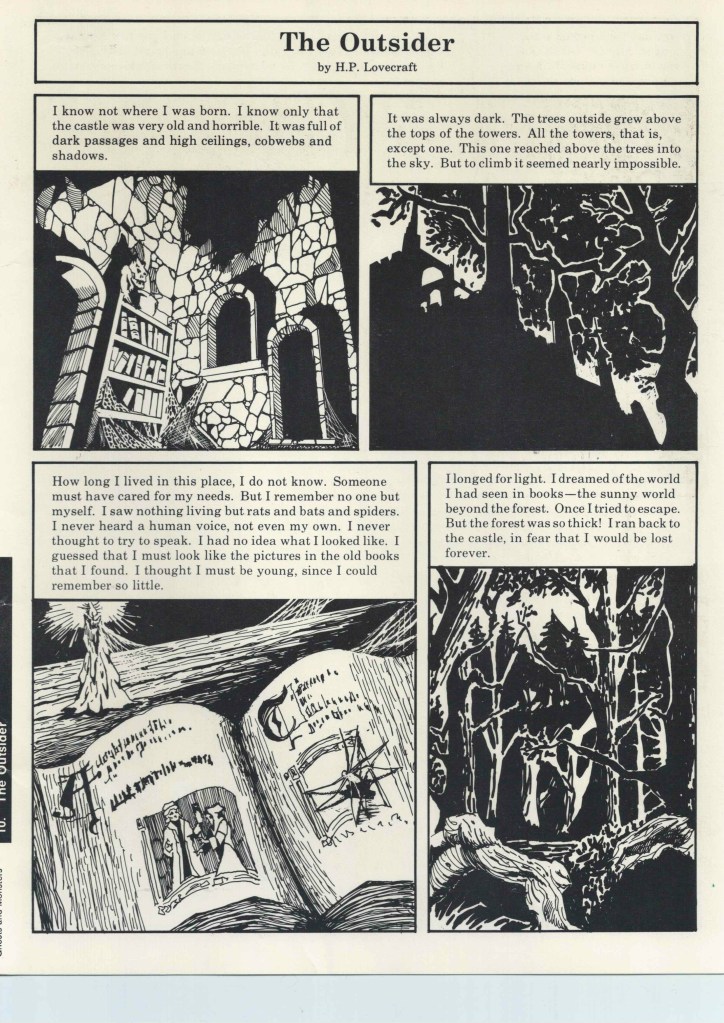
  10. “The Outsider” (1926) by H. P. Lovecraft
  11. “The Stranger” (1909) by Ambrose Bierce
  12. “The Crewe Ghost” after Oscar Wilde [based on “The Canterville Ghost” (1887)]

It’s an odd mix. Many of these works were in the public domain, while the others were largely drawn from the pulps or (more likely) horror anthologies. “The Legend of Gwendolyn Ranna” by Frank Maltesi is a bit of an enigma, though the name is associated with several other brief legendary tales that have popped up in other educational materials; this may well be its first (and only) publication.

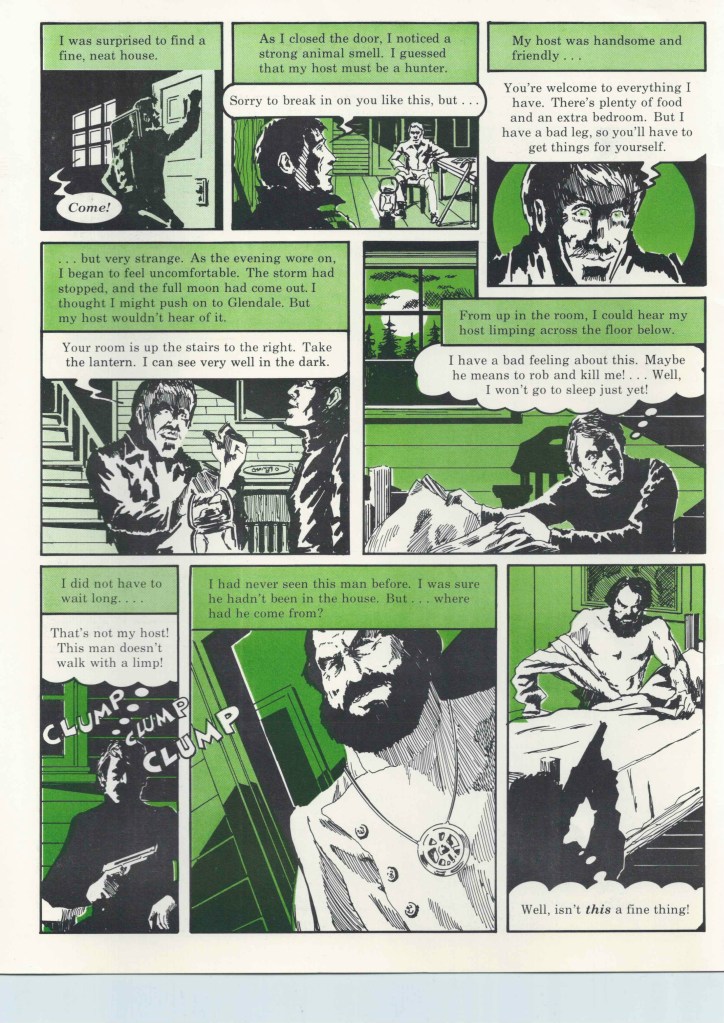
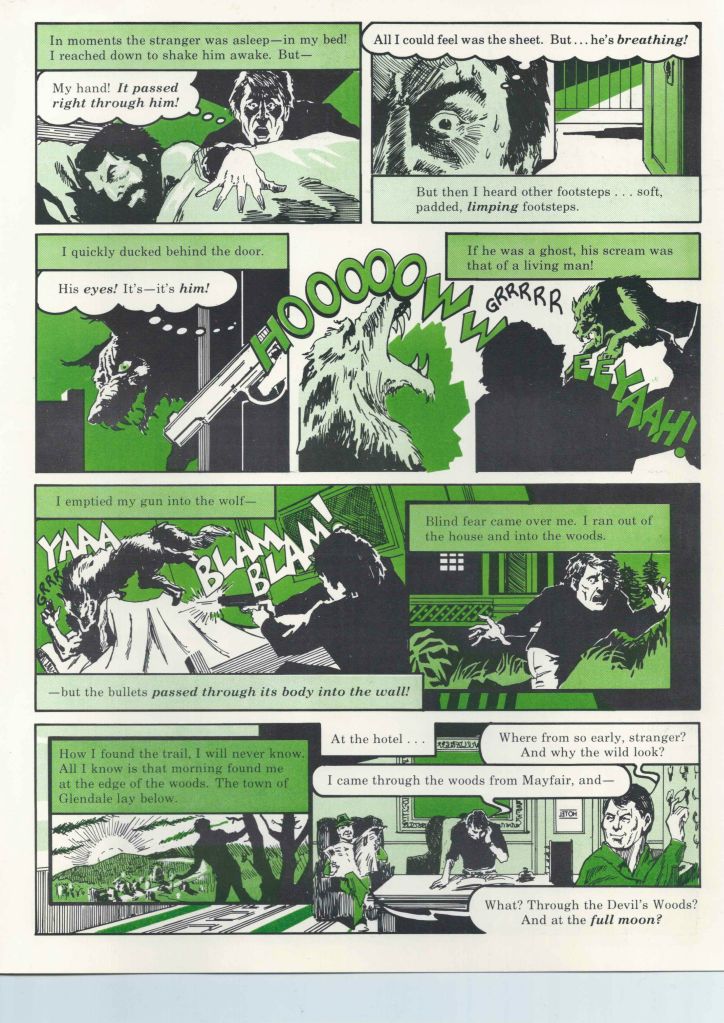
Most of the interest is on the comics themselves. The Teacher’s Guide credits Mark Falstein (well-known author of fiction for young adults) for selection and adaptation, and freelance artist Tony Gleeson for the illustrations. Each comic booklet is basically one large folded page, which gives four pages to tell and illustrate a complete story—a not-inconsiderable task!

The results tend to less grue and taboo than young horror fans might hope for. These were the last generation of “monster kids” that might pick up Famous Monsters of Filmland (1958-1983) on the stand, but they might still find a Helen Hoke-edited horror anthology in the school library, or pick up something from Scholastic involving vampires, werewolves, or bug-eyed aliens at the school book fair. Yet I have to wonder how many kids sat down one day and read Lovecraft for the first time as part of a school assignment—

And then fill out the worksheet afterwards!

Actually, there were two bits of Lovecraft tucked away in this package. C. M. Eddy, Jr.’s “The Ghost-Eater” (Weird Tales Apr 1924) was one of the stories that Lovecraft had somewhat revised for Eddy, and sold to Weird Tales editor Edwin Baird. As Lovecraft put it:

I have, I may remark, been able to secure Mr. Baird’s acceptance of two tales by my adopted son Eddy, which he had before rejected. Upon my correcting them, he profest himself willing to pint them in early issues; they being intitul’d respectively “Ashes”, and “The Ghost-Eater”.
—H. P. Lovecraft to James F. Morton, 28 Oct 1923, Letters to James F. Morton 57

How much of it Lovecraft actually wrote is a matter for debate; S. T. Joshi in Revisions and Collaborations notes the plot and some of the dialogue seems very typical of Eddy, while much of the prose reads like Lovecraft. In any event, it’s a genuine rarity. While many of Lovecraft’s tales have been adapted to comics, his revisions and collaborations are much less likely to receive the same treatment. This is certainly the first, and possibly the only adaptation of “The Ghost-Eater” to comics.

Given the limitations of space, the monochromatic printing, and the incredibly tight scripts, credit has to be given to Tony Gleeson for doing a very decent job on the art. Stuck with a very boxy framing setup, he nevertheless manages to use perspective shots and shadowed silhouettes to hint and convey something of a horror-mood. While the Teacher’s Guide suggests that the typeset text will make it easier to read, I suspect the real issue was that the budget for this project didn’t extend to hiring a letterer.

When we consider Lovecraft as something more than a cult figure, but as a writer who has entered the canon of world literature—this is a good example of what that looks like. Not necessarily fancy, expensive editions that can only be seen and enjoyed by a few, but stories that penetrate into common educational materials, hitting the masses when they’re young and becoming part of the foundation of reading. Ghosts and Monsters is a core sample of how Lovecraft came to the masses.

It’s a bit of history easily overlooked and easily lost. These were sold for classroom use, not to the public, and not preserved in libraries. How many classes went through Ghosts and Monsters before the comics were too worn for further use, or lost and displaced? Who preserves old worksheets from childhood days? These are deliberately ephemeral products, designed to last a few seasons and then be replaced as educational guidelines shift or a company needs to sell a new product. Edutainment marches on.

(Here are the answer keys to the worksheets if you need them.)


Bobby Derie is the author of Weird Talers: Essays on Robert E. Howard and Others and Sex and the Cthulhu Mythos.

Deep Cuts in a Lovecraftian Vein uses Amazon Associate links. As an Amazon Associate I earn from qualifying purchases.
Her Letters To August Derleth: Muriel E. Eddy

The correspondence of August Derleth with Muriel E. Eddy and her husband C. M. Eddy, Jr.—the two overlap and intertwine so much they have to be taken together, especially as later in life Muriel did the writing or typing for both of them—encompasses about 121 separate letters, postcards, and notes, for a total of approx. 222 pages. The bulk of this is spread out among three folders (5-7) in box 16 of the August Derleth archive at the Wisconsin Historical Society; a single letter is at John Hay Library.

The correspondence ran from 1939 to ~1970. It appears to have begun from their mutual correspondent Hazel Heald, and from the publication of The Outsider and Others (1939) by Arkham House.

My dear Mr. Derleth—

Mrs. Hazel Heald, of Cambridge, Mass, told me that you had published a book of Howard P. Lovecraft’s weird stories—and I am wondering if you would please let me known just how much it is, where shall I send for it, if it contains a photo of our beloved H. P. L. and all about it.
—Muriel E. Eddy & C. M. Eddy, Jr. to August Derleth, 29 Nov 1939

Early correspondence was apparently either sporadic or not retained; there is almost a five-year gap between the 1939 letter and the next, in September 1944. After this, however, correspondence becomes more regular. Being in Providence and with access to the local newspapers, the Eddys kept Derleth apprised of relevant items that appeared in the papers during the critical 1940s period which saw important pieces published including Winfield Townley Scott’s “The Case of Howard Phillips Lovecraft of Providence, R. I.” (1943) and Sonia H. Davis’ “Howard Phillips Lovecraft As His Wife Remembers Him” (1948).

Besides local news, points of conversation included Derleth’s latest publications, Lovecraft’s ex-wife, C. M. Eddy, Jr. and H. P. Lovecraft’s work for Houdini (including The Cancer of Superstition), and some of the Eddy tales that Lovecraft had a hand in: “The Ghost-Eater” (Weird Tales Apr 1924), “The Loved Dead” (Weird Tales May-Jun-Jul 1924), and “Deaf, Dumb and Blind” (Weird Tales Apr 1925). Derleth would ultimately re-publish these stories, as well as a version of The Cancer of Superstition, in the Arkham House books Night’s Yawning Peal (1952), The Dark Brotherhood and Other Pieces (1966), and The Horror in the Museum and Other Revisions (1970), as well as The Arkham Sampler (Summer 1948).

Until the publication of Lovecraft’s own letters, these letters from the Eddys were the primary source of data on the revisions with Lovecraft, and likely influenced Derleth’s presentation of the stories. For instance, with regard to “The Loved Dead” and its putative banning:

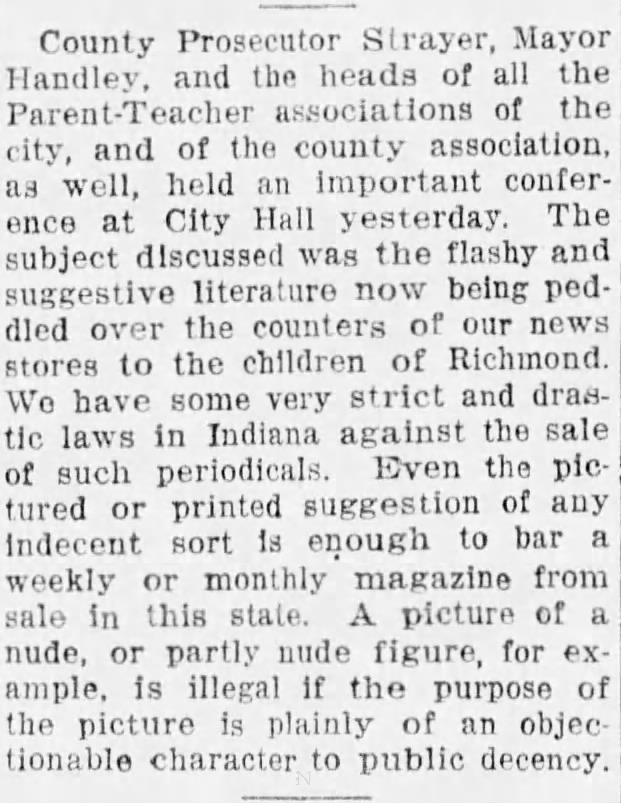
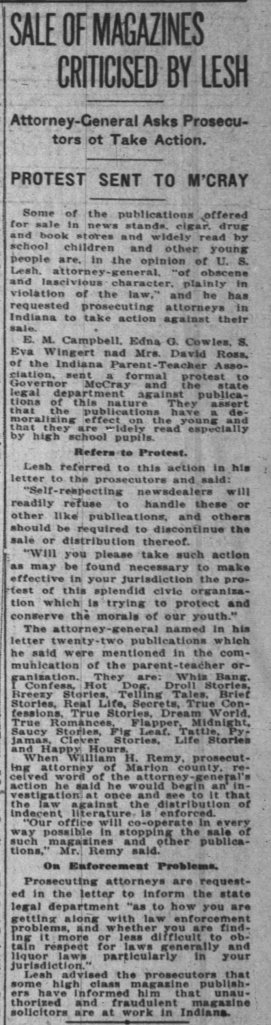
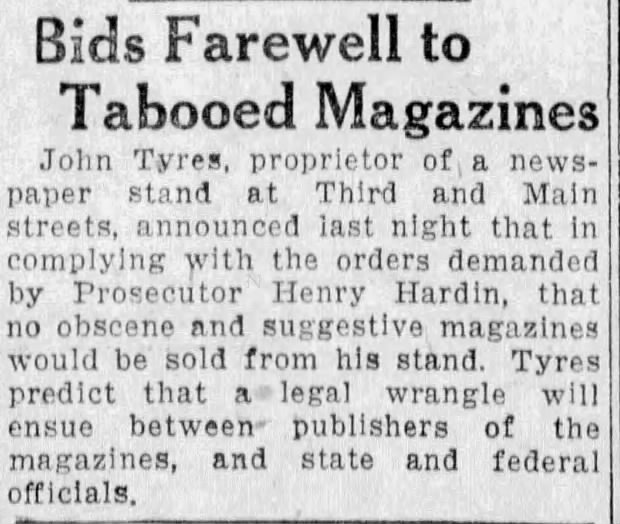
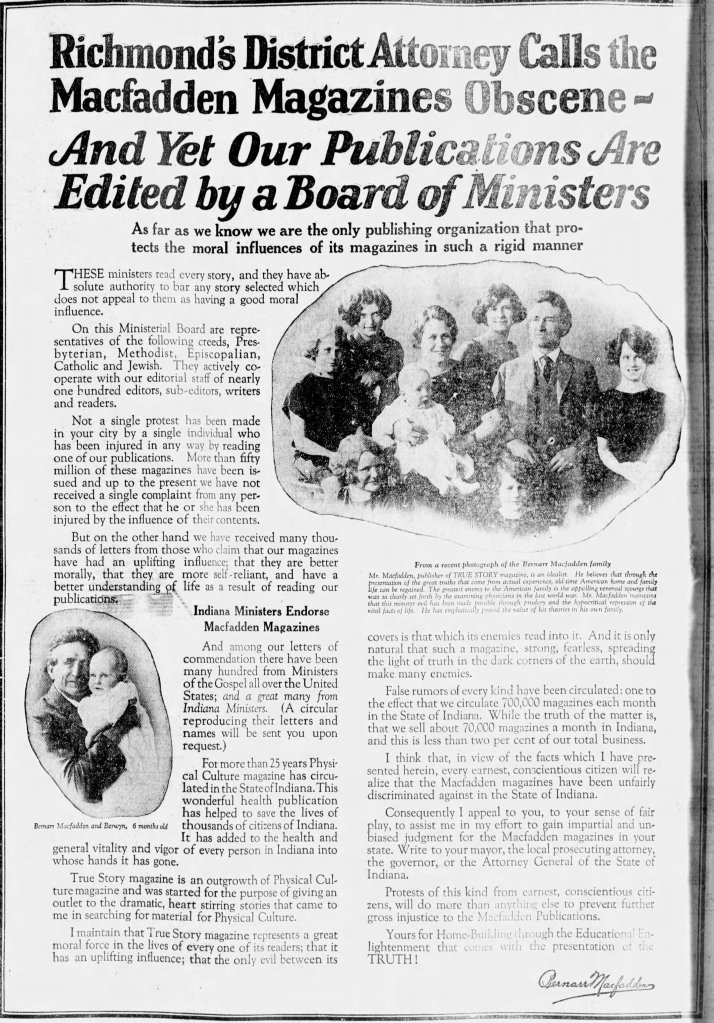
The yarn started out to be a little short study in psychology under the tentative title of “The Leaping Heart”—i.e., a heart that leaped from sheer joy whenever in the presence of the dead. H. P. L. discussed it with me and we decided it might do for a W. T. story. One point we were agreed on was that as many of these tales told by a hero now deceased leave leave the reader completely up in the air as to how the story could ever have reached the public eye. H.P.L. calmly informed me that my hero was suffering from a medically-recognized mental ailment, and he couldn’t be blamed for anything he did during the course of the yarn. He even named the malady—a long Latin term which I had never heard before.

Once I had placed my hero in the graveyard, the story wrote itself. I asked H.P.L. to look over the first draft of the completed story, and decided only minor changes need be made.

Off it went to Weird Tales, but they, at first, were afraid to use it. Finally, the powers that be decided to include it in the big Anniversary Issue. They did!

Then the fun started!!

P.T.A. groups and church organizations in several parts of the country protested vigorously—and succeeded in having the issue removed from the newsstands in many cities and towns!

Some have been kind enough to say that this censorship stimulated enough of a demand for W.T. so that it helped save if from extinction! It’s always been my “pet” Weird Tales story!
—C. M. Eddy, Jr. to August Derleth, 12 Feb 1948

Derleth quoted this more-or-less verbatim in The Arkham Sampler (Summer 1948) when he reprinted “The Loved Dead,” Lovecraft had a slightly different recollection:

It may interest you to know that I revised the now-notorious “Loved Dead” myself—practically re-writing the latter half. […] I did not, though, devise the necrophilia portion which so ruffled the tranquility of parents & pedagogues on the banks of the Wabash.
—H. P. Lovecraft to Robert Bloch, [Mar 1935], Letters to Robert Bloch & Others 132

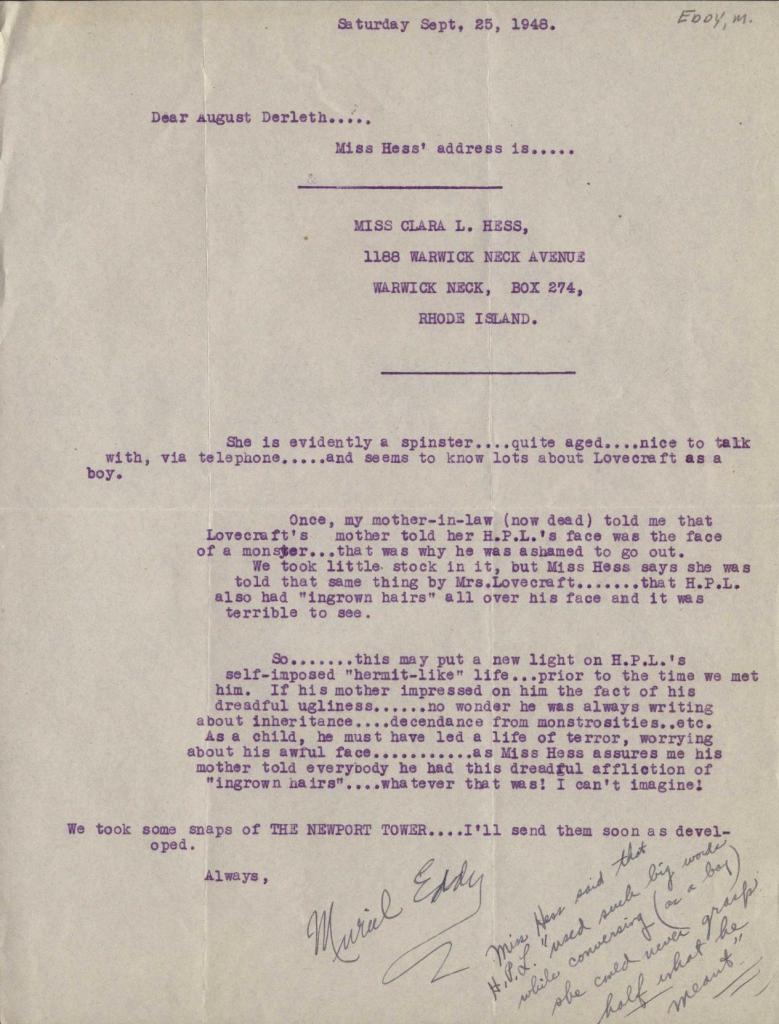
For all their ongoing interest in Lovecraft, which resulted in works like “Message in Stone” (1956) by Muriel E. Eddy and The Gentleman from Angell Street (2001) by Muriel E. Eddy & C. M. Eddy Jr., recollections in the surviving letters are fairly thin on the ground. As with some of Lovecraft’s other friends and correspondents, the Eddys only knew a part of Lovecraft’s life, and had a limited store of stories and insight to share. As an example, a letter dated 25 Sep 1948:

Clara Hess is the primary source for the idea that Lovecraft’s mother Susie Phillips Lovecraft found her son “hideous”; a letter from her was published in the Providence Journal 19 Sep 1948 by Winfield Townley Scott, and letters from Hess to Derleth survive that show Arkham House followed up on the lead for Lovecraftian lore.

For the most part, however, the letters from the Eddys to Derleth verge on the prosaic; for a while, she sent him clippings regarding the Newport Tower, and attempts were made to market some of C. M. Eddy, Jr.’s other weird tales, including “The Red Cap of Mara,” which was eventually published posthumously in The Loved Dead and Other Tales. Over the years, visitors to Providence stopped at the Eddys’, to talk about H. P. Lovecraft with someone that knew him.

Dear August Derleth—

I have erected a little shrine in my house in memory of Howard Phillips Lovecraft. I have so many visitors who are interested in Lovecraft that I decided to have a little corner devoted to “Lovecraftiana”—old “Weird Tales” with his stories, etc.—All I lack is a sutable photo of H. P. L. for the center. I wonder if you have one like that which appeared in one of his published books (published by you)—a picture of his face or profile—or a copy thereof which I might have? I only have the little snapshot of Lovecraft taken in N.Y. and it isn’t a very good picture for a memory-shrine!
—Muriel E. Eddy to August Derleth, 2 Dec 1960

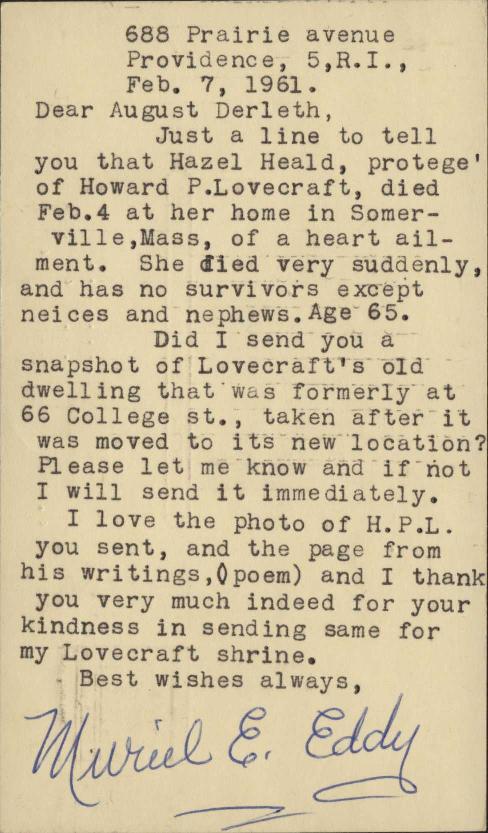
Personal events made it in there as well; Muriel and Cliff would give their condolences on Derleth’s divorce, asked after his children, mourned the deaths of Hazel Heald and Clark Ashton Smith. The Lovecraft circle slowly shrank with the passing years.

One of the more notable anecdotes from this period involved fans visiting or writing:

Don’t you think, August, that it is amazing how so many young people love H.P.L.’s work? One young negro boy has written me that he has all of the H.P.L. stories and books, and loves them dearly!
—Muriel E. Eddy to August Derleth, 24 Feb 1965

While this happened a decade after the events of Lovecraft Country (2016) by Matt Ruff, it’s nice to think that there was a real-life Atticus Freeman out there enjoying H. P. Lovecraft.

Over the years, the Eddys dug through their accumulated correspondence for more material related to Houdini and Lovecraft, some of which was sold to collectors. C. M. Eddy, Jr. sent Derleth some extensive notes for “The Dark Brotherhood,” one of Derleth’s “posthumous collaborations” with H. P. Lovecraft, based on a dream Lovecraft recounted in one of his letters. The Eddys were getting older, and eventually were forced to retire and live off social security.

In 1964, C. M. Eddy, Jr. conceived the idea of a new story, based on the Dark Swamp incident, to be eventually titled “Black Noon”:

Now that I feel slightly improved as to my state of health I’m trying my hand at writing again. The story I’m working on is a novelette half fact and half fantasy—with the central character a prototype of the late H. P. L. Would you have any suggestion or recommendation as to the best possible market to try it on, as I’ve rather lost track of the fantasy market, during my years of non-writing.
—C. M. Eddy, Jr. to August Derleeth, 4 Jun 1964

While signed as by C. M. Eddy, Jr., the writing is Muriel’s. In truth, his health was on a downward spiral, as chronicled in Muriel’s letters to Derleth. Their daughter Ruth is frequently mentioned as trying to work and care for her aging parents.

Mr. Eddy finds it increasingly difficult to walk; he walks haltingly, with his cane. Since my operation, I find it quite hard to get out, much, but Ruth helps us both, in our dilemma. My operation was a tumor of the stomach—but not malignant! […] Mr. Eddy has not yet finished “Black Noon”, the H.P.L. yarn he has been working on—he seems to need encouragement. maybe you can give him the needed “mental stimulus.”
—Muriel E. Eddy to August Derleth, 27 May 1965

Cliff is on the waiting list to enter a hospital (ie: Doctor’s orders) as his stomach now is acting up.

I am pretty sad as he cannot hold anything; district nurses come now, to wash and dress him, and a “Sunshine lady helper” brought him an electric razor to help keep his face shaven. […] Cliff and I are now on “medicare”…saves money on prescriptions, anyway. […] Pray for Cliff. I hate to say “Goodbye” because we have been married so many years…since Feb. 10…1918.
—Muriel E. Eddy to August Derleth, 2 Nov 1965

Cliff rec’d letter and will send MSS. very soon.

He has written some of it by hand—His hand is shaky, but he may as well submit it “as is”, as his days are numbered.

He sleeps a very great deal—sometimes I can’t wake him easily. I am urging him on, to complete “Black Noon.”
—Muriel E. Eddy to August Derleth, 21 Dec 1965

Cliff needs cheering up, at this point. He is drowning in the sea of depression—I think a few lines from you might do wonders. I hope you will do a little favor for me. It’s “sneaky,” but God will forgive us both, I am sure—would you send Cliff a $5.00 check (made out to him) and I will re-imburse you. He must, however, never know I have re-imbursed you. With the check, you might just say: “This is to buy yourself more paper for ‘Black Noon.’ to which I still look forward, or whatever you need to complete the job!” (or say whatever you are prompted to say.”)

It may encourage him, as he has stopped short; he has H.P.L. almost in the swamp, the cat riding on his shoulder—now he says nobody cares, and he sometimes threatens to tear up the manuscript. […] The doctor says Cliff is depressed because his illness shuts him away from the world.
—Muriel E. Eddy to August Derleth, 19 Nov 1966

The Eddys had never asked Derleth for money before; to his credit, he appears to have acquiesced to this request.

Once more I have to tell you that Cliff is very sick again (complications) and doctor says if he pulls out of it, it will be a miracle. He has lost several pounds, and cannot remember very much of anything. […] Hospitalization is out of the question, because it is considered a chronic condition, incurable. So I am carrying on, with God’s help, hoping I am doing the right thing by him.

He cannot wear his dentures, so he can only eat soft foods, such as soft-cooked cereals, etc. that require no chewing.

He never did finish “Black Noon,” which I deeply regret.
—Muriel E. Eddy to August Derleth, 10 May 1967

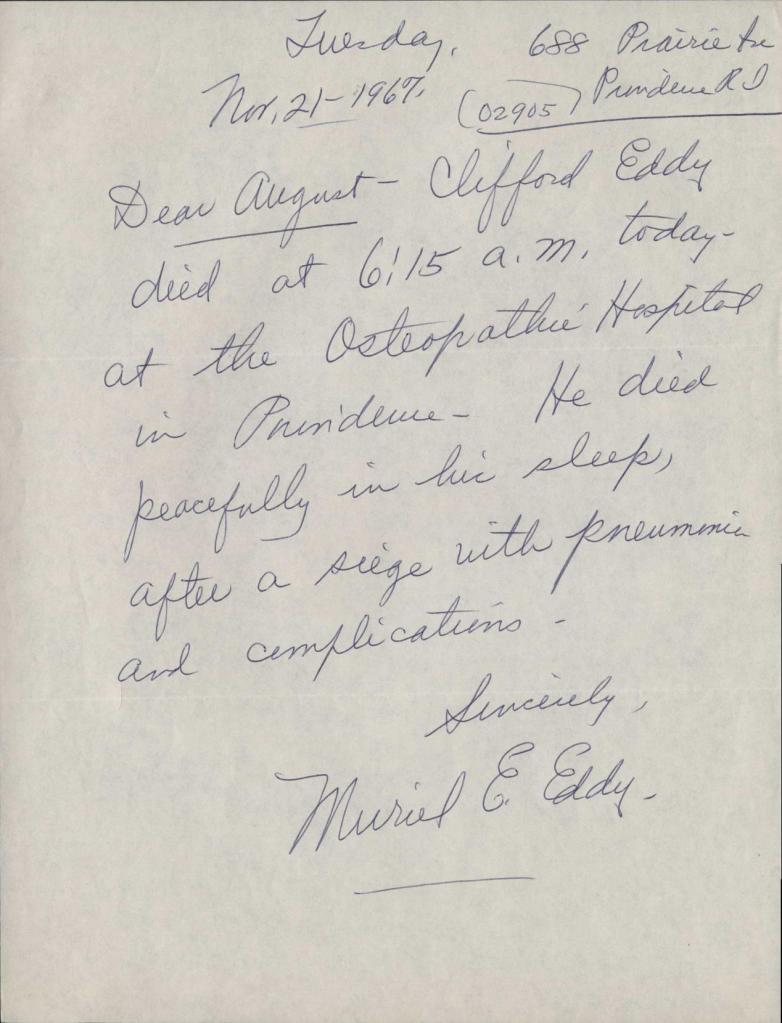
C. M. Eddy, Jr. was hospitalized for a time, then spent the last few months of his life in a nursing home. He passed away in his sleep on 21 Nov 1967, at the age of 71. He and Muriel had been married 49 years.

With the death of her husband, Muriel E. Eddy carried on life as best she could. She was still interested in matters Lovecraftian, which formed her main bond with Derleth through the years:

It is terribly depressing to me not to have Cliff here. I got so used to talking with him, during the years of his illness. I still cannot imagine he has gone, beyond recall. So many things I want to talk over with him.

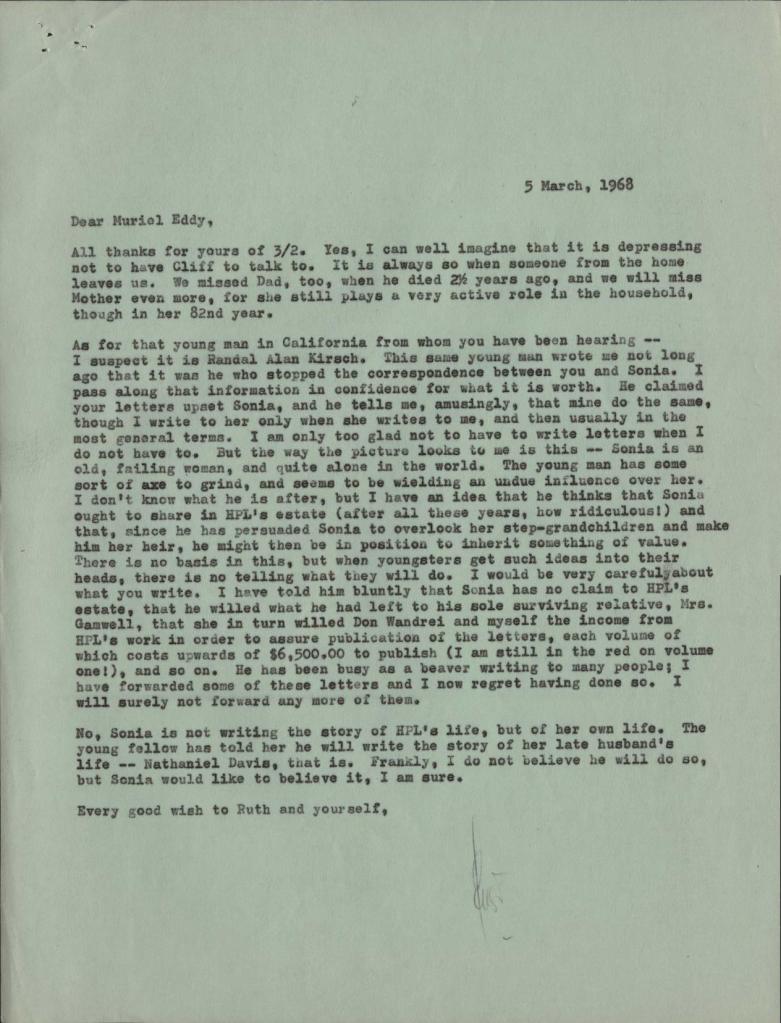
I have been hearing from a young man in California. Sonia (HPL’s ex) was writing to me, but suddenly she stopped. She had somebody in the Nursing Home write me that she was too ill with her heart condition to write, as she was writing the sotry of HPL’s life, or something like that. A thought came to me that it was because of a letter I wrote her mentioning Hazel Heald, for whom HPL used to revise material. I assured her that HPL did not ever speak of marriage to Hazel, but that Hazel (now at rest) DID very much like him. She typed some of his stories fro him to pay him for revising her work. She told me at the time she was going to write you and inquire if you wanted to incorporate it in anything you were writing about HPL, and that she would try to see if you would pay for it. believe me, that was not my idea at all, so if she did write, asking you, please do not blame me, August. Since then, she has not written to me. She just asked her room-mate to write me, letting me know she was financially at a low ebb, and that her health was very poor, and she wanted to reserve all her energy towards whatever she was writing or compiling.
—Muriel E. Eddy to August Derleth, 2 Mar 1968

The “young man” was Randall Allan Kirsch (who later changed his name to R. A. Everts). This was an ongoing headache for Derleth, as Everts made claims regarding Sonia H. Davis as a possible heir to Lovecraft’s estate, since their divorce was never finalized. Derleth kept carbon copies of his few letters to Muriel on the subject of Everts, possibly for safety.

Sonia’s autobiography would eventually be published as Two Hearts That Beat As One (2024) by Sonia H. Davis & Monica Wasserman (ed.).

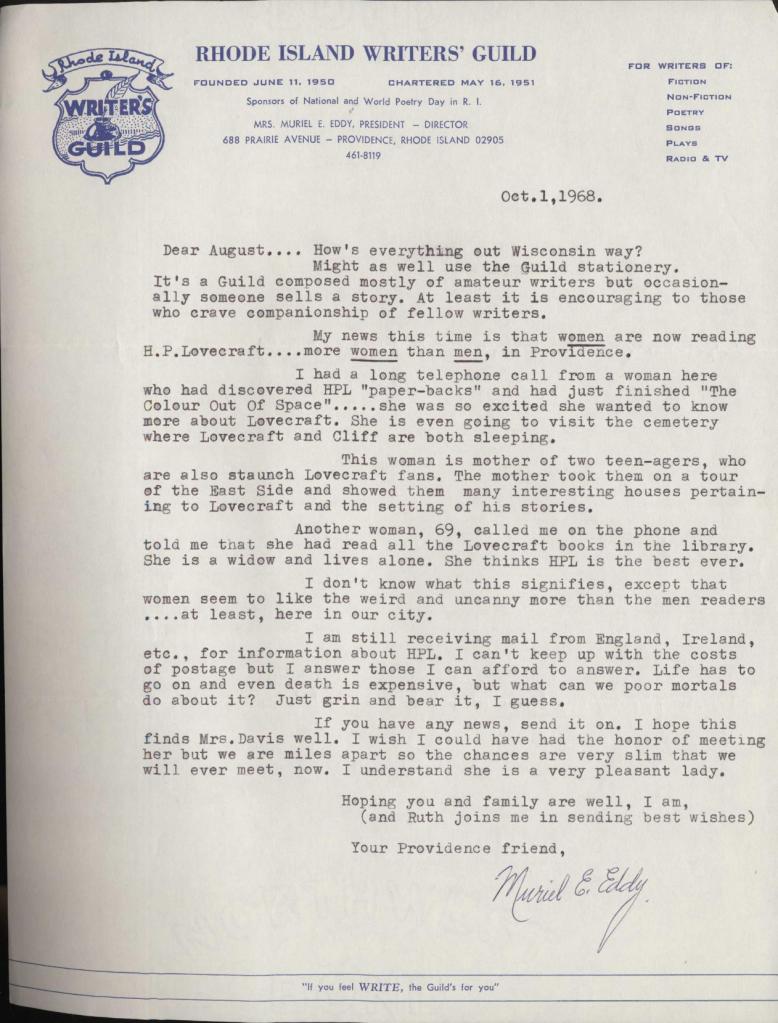
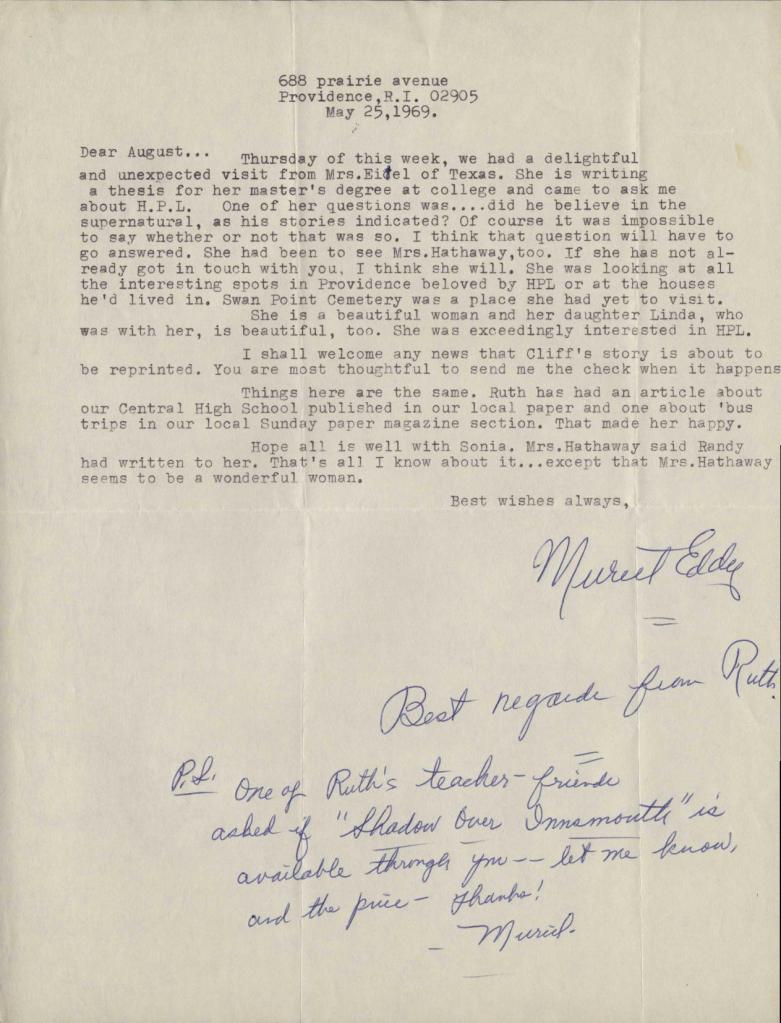
Another interesting late letter regarded women reading H. P. Lovecraft:

One of the women that Muriel heard from was Elaine Gillum Eitel of Texas, whose master’s thesis was The Sense of Place in H. P. Lovecraft (1970). Muriel E. Eddy had become a torchbearer for Lovecraft’s memory, and her letters with Derleth seemed to be a way for her to share her ongoing enthusiasm on the subject with someone else who could appreciate it.

One of the last items of correspondence in the Eddy folders at the Wisconsin Historical Society is a get-well card, signed by Muriel and Ruth Eddy, which must date to Sep-Nov 1969, when Derleth was hospitalized for 87 days, during which he had four operations. He survived until 1971, when a heart attack killed him and brought a final end to his long friendship with the Eddys. Derleth had set to publish the fragment of “Black Noon,” but those publishing plans died with him; it was eventually published in Exit Into Eternity (1973).

Muriel E. Eddy would live until 1978. It is difficult to summarize a friendship of twenty-odd years in letters in postcards; Derleth and the Eddys shared an interest in Lovecraft, but their correspondence went beyond just that, as they revealed more of their personal Iives to one another. It is difficult to extract Muriel from the men in her life; she wrote little in her letters to Derleth about her own writing and work, though she was a pulp writer and poet in her own right. Since she tended to focus on romance rather than weird fiction, perhaps Derleth had little interest, or perhaps she was simply diffident on the subject.

While some of Muriel’s letters appear gossipy to the extreme, it has to be remembered that Derleth would have been one of her major outlets for all things Lovecraft-related, and probably one of the few social outlets she had while caring for her ailing husband. If Muriel’s memories or deductions about Lovecraft were not always correct, she seemed at the least to never wish to tarnish Lovecraft’s posthumous reputation. The end of her correspondence with Derleth marked the closing in a chapter of the book of history, as one more voice that knew Lovecraft grew silent, never to share her memories again save by what had made it into print.


Bobby Derie is the author of Weird Talers: Essays on Robert E. Howard and Others and Sex and the Cthulhu Mythos.

Deep Cuts in a Lovecraftian Vein uses Amazon Associate links. As an Amazon Associate I earn from qualifying purchases.
Deeper Cut: Lovecraftian Newspaper Oddities

Historical Racism

This miscellany includes excerpts from period newspapers, one of which (“Iwo Jima & Innsmouth”) contains historical racism and racist language. As such, please be advised before reading further.


Any tool is also a toy. The only question is whether you’re using it for work or for play. When it comes to online newspaper archives, they are a wonderful tool that has made available a vast amount of minute detail of the past that would otherwise be inaccessible to the average researcher. They are also, however, vast fun if you’re in the right mindset—because newspaper writers are inherently creative, highly literate, hungry for content, and often have a wonderful sense of humor. The result is bits and pieces that are often bizarre or brilliant, though sometimes sober and horrific.

Most of them are effectively noise when considered in terms of “serious” research into Lovecraft’s life, but as a reflection of the growing popularity of Lovecraft and the influence of his work, they stand out as tide water marks: examples of the spread of awareness of Lovecraft and his work. They are sometimes incredibly fun, if only because of how weird they are. I’ve culled out a dozen of the best clippings to showcase the wacky and sometimes fascinating Lovecraftian oddities that have appeared in newspapers over the past century.

Quick links for readers who want to jump to a particular clipping:


The Wood Demon (1930)

Bangor Visitor Tells Odd Yarn Of North Woods

“Are strange stories ever enacted in the North woods? repeated an old-time lumberman from the Ashland district, who has been spending a few weeks in Bangor. “Well, I know one—as weird a yarn as ever was told. If you print it, people will say either that I tried to ‘kid’ you or I should be examined by an alienist; and yet, in my own mind, I believe it true.

“I can’t say from personal experience, for it happened at least 75 years ago. but it’s a tradition among some of the old lumbermen, and it’s been handed down from father to son. Personally, I’m not imaginative, and I don’t believe in any kind of ghosts. I never read Edgar Allen [sic] Poe or Ambrose Bearce [sic] or Harold [sic] Lovecraft. Yet here, as I heard it from many lips, was a tale like Bearce’s [sic] ‘Damned Thing’ and Lovecraft’s ‘Dunwich Horror’ rolled into one.

“Seventy-five years ago, then, in the lumber camps of the great woods and on lonely, outlying farms, hroses and cattle were being slaughtered in considerable numbers. Always it was done in the same way—their throats were ripped open, as though from the teeth of some savage dog or wild animal. And yet gradually, through the countryside, there spread a belief that it was not an animal at all. Tracks sometimes were left near the stables or tie-ups—tracks something like those of a man’s bare foot, and yet were not a man’s. Sometimes a shadowy form, ape-like and hairy, was seen gliding through the darkness—or so imaginative persons said. But the cries of the cattle were real and tangible; and the following morning—for few dared venture out in the dark—always disclosed that the ‘wood demon’, as some called him, had been at his deadly work.

“Finally there arose one who loudly announced he didn’t care for man or devil; he was going to get to the bottom of the mystery, if it was the last thing he did in the world. I don’t recall just what led this man to suppose that, on a certain night, he was due for a visit from the strange marauder. But the story goes that he insisted on staying in the tie-up, and so became the one human witness of the horror that followed.

“The hours passed; nature had never been more placid or calm. And the man was about to return to camp, laughing at himself for having believed in old wives’ tales, when—the thing happened.

“It was a clear night, and a ray of moonlight fell through a hole chopped in the roof that the steam rising from the cattle might escape—a crude but popular system of ventilation in those days. And through this hole, filtering through the moonlight and the shadows, came as strange an object as ever found its way from the Inferno. It was like a huge ape, yet the man swore it was not an ape; it was like a man yet it was not a man; it had hairy, strangely contorted limbs, and cruel teeth that gleamed in the darkness—for the man had put a burlap bag over the lantern he carried.

“It sprang upon the cattle, ripped open their throats, drank of their blood, and disappeared through the roof—as an ape might have done. But, as I have told you, it was not an ape. And the man who had said that he feared nothing in the world just stood there in a corner, a high powered rifle in his hand, too paralyzed by fright to so much as stir. He said afterward that, even had the Thing turned and attacked him, he couldn’t have moved a muscle.

“What was the thing? I don’t know! I never heard how the story ended; but I believe the mystery was never solved. if there is any moral, it is simply that it points the truth of what Hamlet said: ‘There are more things in Heaven and earth, Horatio, than are dreamt of in your philosophy.'”

The Bangor (Maine) Commercial, 25 Feb 1930, p16

One seldom thinks of vampiric sasquatch as having anything to do with H. P. Lovecraft. Yet vampirism of animals is a key plot point of “The Dunwich Horror” Weird Tales (Apr 1929); just as an orangutan formed an essential feature of Edgar Allan Poe’s “The Murders in the Rue Morgue” (1841), and an unseen menace is the key to Ambrose Bierce’s “The Damned Thing” (1893). One suspects that the errors in the names of Edgar Allan Poe, Ambrose Bierce, and Howard Phillips Lovecraft are probably intentional, to give an air of rusticity to a tale that is probably fabricated out of whole cloth. No name is given for the author of the piece, and it may have been a friend or friend-of-a-friend of Lovecraft. Whoever it was had at least a modest affection for weird fiction.

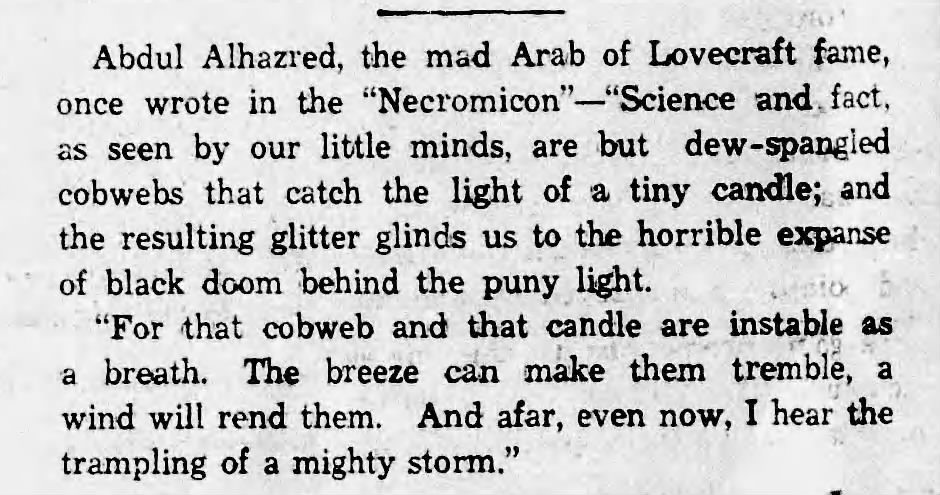
A Quote from the Necronomicon (1937)

Abdul Alhazred, the mad Arab of Lovecraft fame, once wrote in the “Necro[no]micon”—”Science and fact, as seen by our little minds, are but dew-spangled cobwebs that catch the light of a tiny candle; and the resulting glitter [b]linds us to the horrible expanse of black doom behind the puny light.

“For that cobweb and that candle are instable as a breath. The breeze can make them tremble, a wind will rend them. And afar, even now, I hear the trampling of a mighty storm.”

The Knob Noster Gem was a small local paper; Dan Saults was the publisher, editor, and probably wrote a good chunk of the daily output. Judging by this little space-filler figment, he was also a Lovecraft fan.

Robin Hood, Bran Mak Morn, and Cthulhu (1937)

Friar Haw Foresees The Twentieth Century

As Robin Hood’s Prophet Might Have Outlined The Ills Of Our Day

by L. W. S., Eaton, O.

Sherwood forest was aflame with the torches of autumn, bringing all of its robust life. Robin Hood and his merry men had cast aside every care and fathered again beneath the mighty brown oaks and beeches. The silver tang of life was in the air and lusty merriness was in the hearts of Robin’s men.

Of course they were spilling great quantities of the favorite cool brown ale down their throats and singing its praises until the song rang and echoed far down the dark rows of mossy tree trunks, as jolly Friat Truck continually banged his tankard on the rough oak table, swinging his head from side to side.


And brawny Little John Arose, flinging the rumble of his deep bass into the depths of Sherwood forest:

So, laugh lads, and quaff lads
‘Twill make you stout and hale,
Thro’ all my days I’ll sing the praise
Of brown October ale.

Really Robin Hood had called his men together for the purpose of hearing once again the strange prophecies of Friar Haw, but he always had to allow them their little fling first, as a prelude. The men had arrived at some degree of respect for the words of Friar Haw, and they usually sat engrossed. Even the snorts of Friar Tuck had grown fewer.

Friar Haw, grim and ascetic, had been taking Robin’s men into the dream-world of the 20th century. Today he had sat oblivious of the roistering men, his face like a white autumn sickle moon. The men could see that he wasn’t going to talk today about streamlined chorus girls and elaborate movies.


He arose. “Few people,” he began, “who shall live in the 20th century shall realize fully the abysmal depths to which the world conflict in the early part of that century shall plunge the races with the blood of long centuries in theri veins. yea, dark forces of life, far more ancient than the ancient oaks of Sherwood, as ancient as the ideas of Chthulhu [sic], Yog Sothoth, Gol-goroth and the blood of the Gaelic, Cymric and Teutonic. The king of the Dark Empire of the Stone Age, covered so long by the imposition of a new god called Reason, shall break loose again in the emotional abandon of those dark years of 1914-18, and shall continue long afterwards.

“The surface of the collective civilized mind shall be torn adunder and the long-buried emotional elements of the days of a Bran Mak Morn shall break loose, and the 20th century would shall be puzzled and at a loss to understand what forces are driving men.”

“And,” interposed Little John, who had a common sense kind of mind, “what are you driving at, or trying to say? It sounds crazy to me.”

“Oh, doubtless!” said Friar Haw, his sickle face growing a shade colder. “Yet the original minds of the 20th century shall see that strange things are happening. Now, in the country called Germany, age-old psychic forces break loose again. Wotan, who is half rage and frenzy and half seer who understands ‘the runs and interprets destiny.’ Wotan shall be personified in a man named Hitler, a strange figure whose reasoning shall be guided by very, very ancient emotional forces.

“You are to remember that men taken collectively in a nation are not dominated by reason. A wise man of that century shall say: ‘Where the mass rather than the individual is in motion, human control ceases. And at at that point the archetypes begin to operate.'”

“In Germany the stormy personality of Wotan shall come to life again in the youth movement. The waking will be celebrated with the slaughter of more than one sheep. Aye, men called Nietszsche, Schuler, Stephen George and Klages shall anticipate the waking, as shall one called Richard Wagner put it into his music.

“But I have taken only Germany as one example in the Old World, where the 20th century shall see the troubled awakening on every hand of the most ancient archetypes, the most powerful emotional forces. Frightened men shall shout ‘Peace! Peace!’ where there shall be no peace. men shall come to understand somewhat the things that Wotan whispered through Mimir’s head. mean shall come to appreciate what Valhalla means, and the Valkyries and the Fylgjur.”


Whereupon Robin Hood jumped to his feet and shouted: “Engouh for today! I’d rather go and rob a bishop. This chatter makes me uneasy inside.”

“Yes,” came from the sickle autumn moon face of the prophet, “it is a far cry from your simple Sherwood forest and your October ale drinking. yet it shall be the sap in the roots of your Sherwood conflicted with a conflict of world cultures.”

Dayton (Ohio) Daily News, 14 Nov 1937, p13

This is fanfiction. Yet L.W.S. (Leonard W. Sharkey) of Eaton, Ohio must have been a serious fan indeed, to weave references to Lovecraft (Cthulhu, Yog-Sothoth) and Robert E. Howard (Gol-goroth, Bran Mak Morn) into his narrative of Robin Hood in Sherwood Forest, on the run-up to World War II. A likely inspiration for these references is “The Children of the Night” (Weird Tales Apr-May 1931) by Robert E. Howard—which is probably the only story at the time that mentions Cthulhu, Yog-Sothoth, Gol-goroth, and Bran Mak Morn all in the same tale. Sharkey did at least one more Robin Hood/Friar Haw tale, albeit without Mythos references (The Camp of Robin Takes A Forward Look).

Lovecraft & Whippoorwills (1945)

Whip-poor-wills will remind some readers of the stories of the late H. P. Lovecraft.

You never heard of Lovecraft?

Many persons have not, but they will, in time, and all through the affectionate remembrance of two young men in Wisconsin.

They founded a press to put his stories sold to pulp magazines into book form. Extremely limited editions have made these books collectors’ items.

Lovecraft’s tales are somewhat Poe-like in character. They are laid in New England, and bring in visitors from “the outside,” strange beings always ready to push into our own known world.

Some of the stories incorporate the whip-poor-wills, which set up a constant cry, according to legend, every time one died.

If they missed getting his soul, they screamed unusually loudly, and then died out. In this way it was possible to tell what happened to the departing soul.

Evening Star (Washington, D.C.), 7 Apr 1945, p6

In 1939, August Derleth and Donald Wandrei founded Arkham House in Wisconsin to publish the work of H. P. Lovecraft in book form. It was a beginning to establish Lovecraft’s literary legacy, and awareness of the Providence-born horror writer was slowly trickling out into public awareness, although this was slow going, and involved many misunderstandings.

Whippoorwills are a key example. They only feature in one of Lovecraft’s stories, “The Dunwich Horror”; but the idea seems to have appealed to August Derleth, who incorporated the idea of the whippoorwill as psychopomp in several Cthulhu Mythos stories, notably the novel The Lurker at the Threshold (1945). Derleth’s repetition of the idea—and articles like this one—contributed to the spread of certain basic conceptions (and misconceptions) of what Lovecraft wrote.

Iwo Jima & Innsmouth (1945)

Journalettes
by Charles B. Gordon

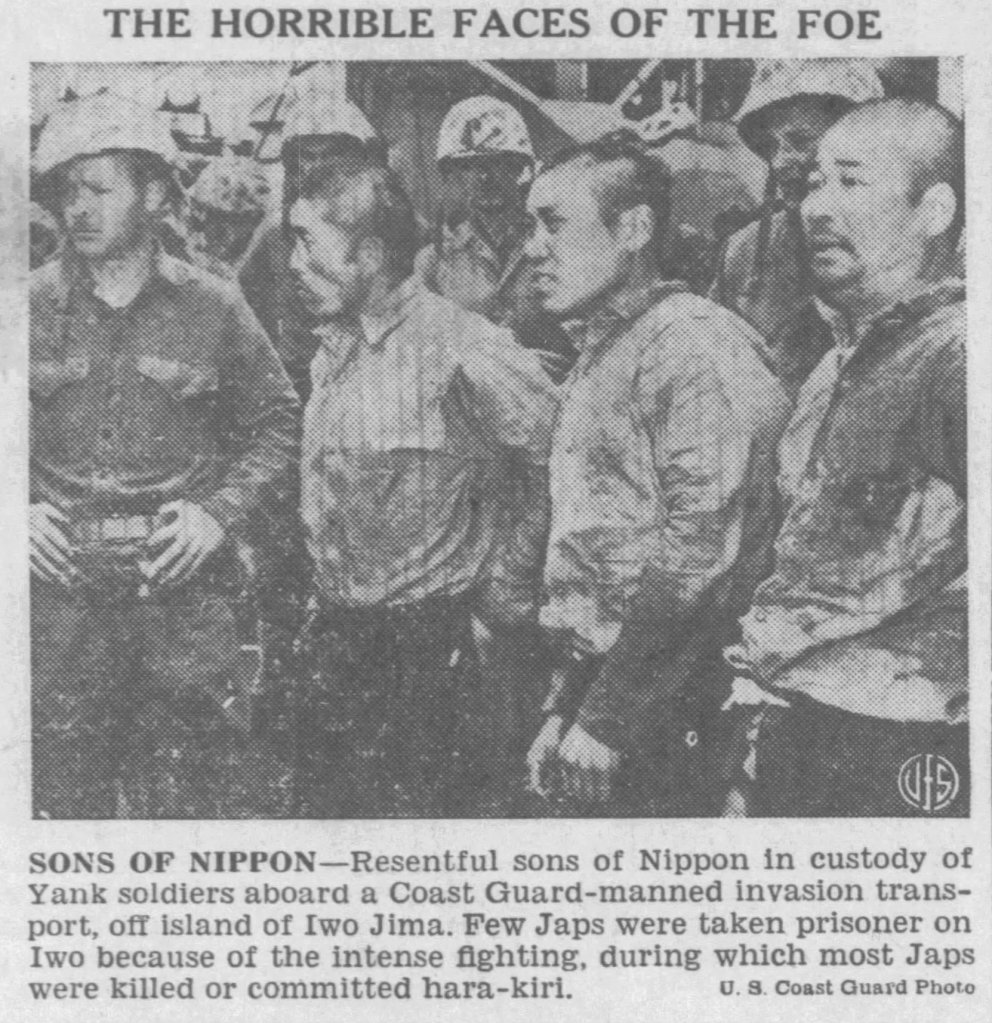
Friday, this newspaper used a cut of three Japanese prisoners, taken on Iwo Jima, and their American guards. The three Japs were three of the most repulsive looking human beings whose faces we have ever gazed upon.

. . . — V . . . —

We think he’s dead now, but some years ago, there was a writer named H. P. Lovecraft. This voracious reader made acquaintence with his works through the current 25-cent pocket books, but it is our belief that most of his output was printed first in pulp “horror” magazines. At any rate, he was the greatest master of the “horror[“] story specializing in stories about beings, things, or whatever you might want to call them, which emerged from places under the earth, under the water, or from ages thousands of years past, but were generally possessed of at least a few human qualities, enabling them to “get by” on the earth of the present day.

. . . — V . . . —

The pictures of those Japs taken on Iwo Jima gave us for the first itme a partial realization of what the creatures of such books of Lovecraft’s as “Weird Shadow Over Innsmouth” and “The Dunwich Horror” must have resembled.

McComb (Mississippi) Daily Journal, 19 Mar 1945, p1

War doesn’t just breed prejudice, it encourages its expression. The enemy is described in terms that downplays or denies their humanity. As things instead of people. The bloody battle of Iwo Jima ran 19 February–26 March 1945. Casualties were horrific, especially on the Japanese side; of 20,933 troops, only 216 Japanese were taken prisoner from the main battle, with an additional 867 taken prisoner post-battle. A photo of three such prisoners was made available to the press—men who, like their counterparts in the US military, had served their country, be it right or wrong, and lived through a terrible and terrifying conflict.

The racist depiction of Japanese military and civilians was sadly common—though as far as I have found, this is the first and only instance where they were compared directly to Lovecraft’s Innsmouth folk during the conflict.

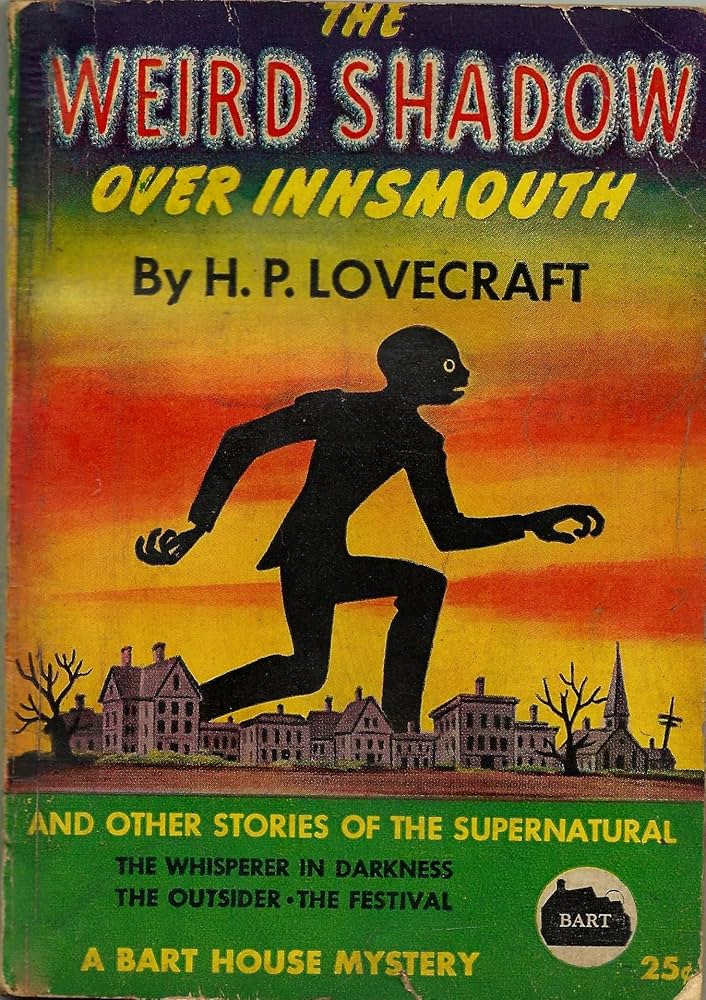
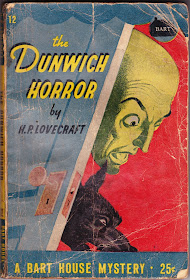
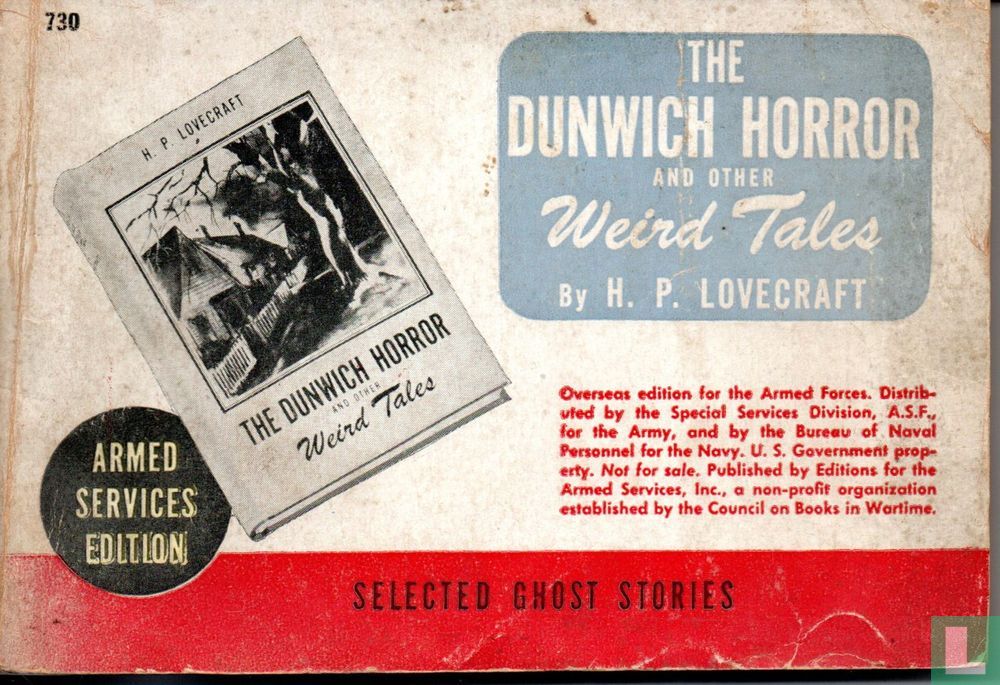
Paper shortages during World War II put a severe crimp in the publishing plans of Arkham House, but also opened up other opportunities. Bartholomew House was a small New York publisher that put out two cheap (25 cents) paperback editions of Lovecraft with the permission of Arkham House: The Weird Shadow over Innsmouth (1944) and The Dunwich Horror (1945). Another cheap paperback readily available to the military was the Armed Services Edition of The Dunwich Horror and Others (n.d., 1945?). These books helped spread the word of Lovecraft during the war years—and beyond.

Lovecraft & Hitler (1945)

Two pieces appeared in the Chicago Tribune in April 1945 which tied Lovecraft to the ongoing world war.

Werewolf Hunt

The werewolf myth, which the frenzied and frightened Nazis threaten to revive as a romantic disguise for a post-war assassination cult, has haunted hte lower levels of the human mind since the era of the cavemen. Its roots are in primitive cannibalism. The word means man-wolf; that is, a betwitched creature which has human form by day and lupine hide, teeth, and appetite by night. The superstition is one of the unwholesome ideas that have survived from pre-history among European peasants to provide material for folklorists and themes for authors who have a bent toward the weird, grotesque, and horrible.

* * *

Hitler, whose career has a werewolfish flavor, comes froma stock in which this notion was likely to breed and influence character. We quote from his best and msot objective biographer, Konrad Heiden, who says in “Der Fuehrer” while discussing his pedigree:

“The Waldviertel in lower Austria, from which both the Hitler and Pölzl families came, is a gloomy, remote, impverished section; like many such regions it has no lack of superstitions and ghost stories. The ancestors were mostly poor peasant people; ‘small cottager’ often stands in the church records.”

* * *

The myth is closely related to the vampire bugaboo, and, therefore, in the novel called “Dracula,” a veritable case book of vampirism, you will find werewolves as auxiliary phantoms. The anthologies of terror stories which ahve become quite an article of commerce in the war time book trade contain numerous examples of werewolf tales. We expect to find out in “Best Supernatural Stories of H. P. Lovecraft,” edited by August Derleth and new on the counters.

* * *

To kill a werewolf according to the folklore formula, yo umust use a gun that has been blessed at a shrine of St. Hubert and fire a silver bullet.

Chicago Tribune, 9 Apr 1945, p12

In this, the unnamed newspaper writer would be disappointed. Vampires and werewolves were not Lovecraft’s normal schtick. However, we know that they did read the new collection—and the horrors in those pages probably compared to those that came in over the news wire. U.S. forces liberated the Buchenwald concentration camp on 11 Apr 1945.

Powers of Darkness

The lifting of the curtain on the massive horrors of Germany’s prison and concentration camps recalls the supernatural tales of H. P. Lovecraft, a writer who was relatively unknown until August Derleth undertook his popularization. To conjure up the mood of unearthly terrors, Lovecraft invented the mythology of Cthulhu in which there are many monstrous spirits of evil, forever seeking to take possession of this planet.

* * *

Lovecraft wrote of his work: “All my stories, unconnected as they may be, are based on the fundamental lore or legend that this world was inahbited at one time by another race hwo, in practicing black magic, lost their foothold and were expelled, yet live on outside, ever ready to take possession of this earth again.”

* * *

Perhaps Cthulhu has come back, thru the cracks in Hitler’s mind. Lovecraft, who died in 1937, would be staggered by the revelation.

* * *

During his lifetime, Lovecraft’s work appeared in pulp paer magazines, chiefly in Weird Tales. Arkham House of Sauk City, Wis., a publishing enterprise over which August Derleth presides, has been assembling this scattered material and putting it between covers in limited editions. A collection of 14 tales, regarded as the best of Lovecraft’s 50-odd, was recently issued by the World Publishing company. Derleth, its editor, says in his introduction:

“The weird tradition was particularly his. In the scarcely two decades of his writng life he became a master of the macabre who had neither peer nor equal in America. . . . It has been said of ‘The Outsider’ that if the manuscript had been put forward as an unpublished tale by Edgar Allan Poe, none would have challenged it.”
Chicago Tribune, 27 Apr 1945, p14

Lovecraft never wrote that “black magic” quote. The unnamed author of this little piece is drawing on The Best Supernatural Stories of H. P. Lovecraft (1945). To place Lovecraft’s horrors with those of Nazi Germany is understandable, journalists must have grasped for any straw of comparison. Three days after this was published, Adolf Hitler committed suicide.

Unlike many of these small newspaper pieces, another journalist picked up on this thread and glossed it in another paper:

Powers of Darkness

The lifting of the curtain on the massive horrors of Germany’s prison and concentration camps recalls the supernatural tales of H. P. Lovecraft, a writer who was relatively unknown until August Derleth undertook his popularization, says a Chicago Tribune column. To conjure up the mood of unearthly terrors, Lovecraft invented the mythology of Cthulhu in which there are many monstrous spirits of evil, forever seeking to take possession of this planet.

Lovecraft wrote of his work: “All my stories, unconnected as they may be, are based on teh fundamental lore or legend that this race [sic] was inhabited at one time by another race who, in practicing black magic, lost their foothold and were expelled, yet live on outside, ever ready to take possession of this earth again.”

Perhaps Othulhu [sic] has come back through the cracks in Hitler’s mind. Lovecraft, who died in 1937, would be staggered by the revelation.

The Windsor (Ontario) Star, 2 May 1945, p4

It is like a telephone game, as Derleth’s jumbled quote gets increasingly jumbled with every step. Yet the tying-together of Lovecraft and Hitler in this instance shows how relevant Lovecraft’s fiction could be, how plastic and adaptable his work was to a new syntax—and how new editions helped spread knowledge of Lovecraft and the Mythos to new audiences.

Lovecraft’s Men From Pluto (1955)

Space Travel

Friday Dr. Wernher von Braun, an expert in the field of astrophysical and astronomical lore, spoke at Rensselaer Polytechnic Institute. he talked chiefly of efforts being made to study the areas beyond the earth’s atmosphere. he talked of artificial satellites and of space travel, topics which tickle the imagination of young and old alike in these days of scientific discussion.

Dr. von Braun asserted that there was no doubt of the capacity of man to leave earth, point toward the moon, circle it and return to earth again. As one who is an expert in the designing of rocket propellants and in all the developments in this sphere he speaks with authority. He insists that we know enough now to launch a space ship and be reasonably sure of its safe voyage moonward and its return.

To the layman all this is fantasy. How can man survive in the intense heat which must exist beyond the atmosphere? How can direction be assured where there is no air friction against which rudders can press when a craft is to be turned? We have to ahve water to direct a ship, air to direct a plane. What possiblity of management exists in the ether where every object runs free?

And to make such a voyage the start must be swift. Through the great spaces where there is no atmosphere presumably the speed would not generate sufficient heat to decompose the ship. But what about the start and the finish? How can the ship begin its flight without at least a speed of 5,000 miles an hour? And how can it be toned down to reason when it returns to the lst hundred miles of its voyage?

We are still skeptics on the whole matter. Those who say such a trip to the moon is possible are the delight of the small boy and the radical scientist. but to the down-to-earth citizen, accustomed to keep his feet on the ground or rise only moderately above it, the natural comment is a Bronx cheer. If such a voyage is possible today, as Dr. von Braun asserts, let’s get at it and stop expending our energies in talk.

The usual reply from the space scientists to such suggests is that the cost is tremendous and there is no source for the funds. That is a complete answer, the best in the world if discussion is preferable to achievement. We have heard people say you could abolish certain diseases in the world if had ten or fifteen billions to spend on them. We have noted those who think permanent peace could be achieved by the careful expenditure of a few hundred billions. The poist that there isn’t any such money so it is easy to talk about it.

If a space ship would cost a few billions there can be no space ship. it would not be worth the price. The scientists, instead of telling us such a craft is possible today, might better expend their time and energy in seeking ways of bringing their creations down to the possible range of expenditure. Otherwise space travel lies in the same domain as the weird tales of Jules Verne, Lovecraft’s story of the men from Pluto who visited earth or Wells’ novel about the coming of the Martians.

The Troy (New York) Record, 5 Dec 1955, p10

The Luna 3, the first spacecraft to manage a successful circumlunar trajectory, did so in 1959; the first manned trip in lunar orbit, however, was Apollo 8 in 1968. It turned out, probably much to the anonymous author’s chagrin, that there actually were billions of dollars to spend on the space race.

The reference to “Lovecraft’s story of the men from Pluto” is a bit bizarre; as near as I can tell this has to be a reference to “The Whisperer in Darkness” (Weird Tales Aug 1931), which featured the Fungi from Yuggoth. Who were about as far from the stereotypical 1950s humanoid aliens as one might imagine—but this is a good example of a typical misreading or misunderstanding. I wonder how many science fiction fans wondered where they could read about Lovecraft’s men from Pluto?

Apocryphal Alhazred (1960)

Man has a back, and if you beat it he works. (Alhazred Bhati Khan, 11th century despot of Samarkand).

The labor policies of Alhazred Khan are frowned upon in the more enlightened areas of the world today. But if his theories on back-beating have fallen in esteem, his basic goal of increasing production has never been held in higher regard.

The actual title of the piece was “Bosses ‘Whip’ Workers With Musical Gimmicks,” and it was about how employers use new psychological tools to manipulate the workplace and motivate their employees. However, the author Ted Smart apparently thought it needed a hook, and so created Alhazred Bhati Khan—who never existed—presumably by combining Lovecraft’s Alhazred, the Hindu word bhati (भाटी), and the Turkic or Mongolian title khan. Samarkand was a reality, however, and if anybody ever checked to see who was ruling it in the 11th century, they did more work than Ted Smart did. I have to wonder if any Lovecraft fans noticed.

Aside from the appearance in the Chicago Daily Herald, the article also appeared in the Arlington Heights (Illinois) Herald, 21 Jan 1960, p27, and possibly ran in other local papers in Illinois.

A Lovecraftian Cipher (1968)

Cipher puzzles are fairly common amusements in newspapers, and have been for decades. As an exercise, they’re fairly simple substitution ciphers: each letter of the alphabet is replaced by another letter, to render what appears on the surface is gibberish. However, the relationship between the letters remains; and there are only 26 letters in the alphabet. Figure out a word or two, either by frequency analysis or trial and error, and the rest of the cipher alphabet falls in place pretty easily. In this case, the puzzle designer has been a little clever: one word has been encoded as the English word FRIGHT, which gives a hint to the solution of the puzzle.

The answer, on the other hand, is a bit of a cheat:

The answer is a cheat because this isn’t a real Lovecraft quote, but a highly abridged version of a line from Lovecraft’s “Supernatural Horror in Literature”:

Children will always be afraid of the dark, and men with minds sensitive to hereditary impulse will always tremble at the thought of the hidden and fathomless worlds of strange life which may pulsate in the gulfs beyond the stars, or press hideously upon our own globe in unholy dimensions which only the dead and the moonstruck can glimpse.

The reason why the full quote isn’t used is pretty obvious: space. While not intellectually any more challenger than the briefer text to decipher, 59 words is a lot more daunting in terms of sheer volume of words to be deciphered. On the plus side, at least Lovecraft wasn’t reminding the readers of the San Francisco Examiner to drink their Ovaltine.

Necronomicon For Sale (1972)

Tucked in at the end of a column of classifieds ads, just above a threat from the Mafia against a fratboy, this is one of a number of ads for a copy of the Necronomicon for sale that have cropped up here and there. Such hoaxes are classics of fan-activity, and vary from carefully-constructed and believable to error-ridden and silly. This one is fairly restrained and detailed, and the writer probably was familiar with Lovecraft’s “History of the Necronomicon,” which had been most recently republished in The Necronomicon: A Study (1967).

Such ads seem to have become rare after the first widely-available commercial Necronomicons began to hit the market in the 1970s.

Old Ben Lovecraft (1978)

Mulligan’s Stew
by Hugh A. Mulligan
AP Special Correspondent

RIDGEFIELD, Conn. (AP)—My old aunt used to say you never really know who your neighbors are until one day you read about them in the paper being appointed to the White House transportation staff or taken off in the patrol wagon for wife-beating or graduating with high honors from welding school.

And, by George, she was right.

This town, for instance, is chock full of interesting people, what you might call real characters just waiting to be discovered by some sharp-eyed reporter or a playwright in search of a sequel to “Our Town.”

Over on Ludlow Hill there’s a man who never in all his born days has seen a flying saucer. Old Ben Lovecraft has lived in these rocky, rolling hills of Connecticut for nigh onto half a century, since moving up from the Bronx, without catching so much as a glimmer of an outer world touchdown on his two acre zoned spread there behind the town dump.

The other night he thought he saw an eerie light reflecting from an elliptical shaped object in his driveway that wasn’t there when he took in the cat and turned off the carriage lamps. he put on his new Christmas cardigan, grabbed a flash light from the hall closet and made his way stealthily along the hedges bordering the garage. he could hear chattering and the sound of equipment being unloaded.

There in the moonlight, he saw five tiny creatures no bigger than a breadbox with enormous shiny eyes filing out of an aluminum cylinder. They fled in panic the instant his beam hit them.

“You know how racoons scamper after they’ve tipped over a garbage can to get at a turkey carcass,” Ben drawled in his matter of fact way. “I called the Air Force and they didn’t want to hear about it. They already had four people on hold with positive sightings.”

Fascinating fellow, Ben. A real skeptic. He’s seen “Star Wars” twice and “Close Encounters of the Third Kind” three times and doesn’t believe a word of either of them. […]

The Orange (Texas) Leader, 8 Mar 1978, p7

At the time of this writing, there are 91 hits for “Old Ben Lovecraft” on newspapers.com. The Associated Press spread the “Mulligan’s Stew” humor column far and wide. While some of the other bits and pieces mentioned above are diamonds in the rough, this is closer to what constitutes noise in search results. Half the country might have read about “Old Ben Lovecraft” between March and April 1978, when the article ran. Perhaps a few had a chuckle; the flying saucer craze of the 50s had given birth to the impressive big box-office sci fi spectacles of Star Wars (1977) and Close Encounters of the Third Kind (1977). No doubt a lot of the country had no idea why some folks got so excited.

Why Lovecraft? I suspect it was simply because Lovecraft was still known as a science fiction writer, and the “Old Ben” part was borrowed from “Old Ben” Kenobi in Star Wars. It’s also possible that the author simply wanted a distinctive name and typed out the first that came to mind; certainly a fan would probably have added a reference to Cthulhu in there at some point.

Lovecraft, C. M. Eddy, Jr., and Dark Swamp (1995)

What happened that night in the swamp?

Editors: I am in my 75th year of life as I write this, and I do not wish to allow a few things to pass unnoticed before I go. My mother, Muriel Eddy, was a gifted author; for several years she was the poet laureate of Rhode Island, the state in which we lived.

My father was also an author—of uncanny horror stories. he had a buddie named H. P. Lovecraft, the famous author of many books about strange things.

Lovecraft was a night person, and back in 1922 and 1923 he and my father would often walk through Providence’s Chinatown at midnight. One night they decided to go into the woods of the “great swamp” of Chepatchet, R.I., because they had heard that “It” (a ghost or monster) had been seen there.

Nobody knows whether or not they encounted the “It” being; they did survive their night in the great swamp, but neither would talk about it. I wonder to this day what they saw.

Clifford Eddy
Macon

The Macon (Georgia) Telepgraph, 10 Jan 1995, p5

Clifford Myron Eddy (1918-2003) was the only son of Clifford Martin Eddy, Jr. and Muriel Elizabeth Eddy. He was about 3-5 years old when H. P. Lovecraft came to the Eddys’ house, located a few miles away from his own in Providence, R.I. Too young, probably, to have much in the way of direct memories of Lovecraft, though no doubt he heard and read his mother’s and father’s stories, in works like The Gentleman from Angell Street (2001) by Muriel E. Eddy & C. M. Eddy Jr. and “Message in Stone” (1956) by Muriel E. Eddy.

Perhaps that telephone-game is why his facts are slightly garbled. For while Lovecraft and C. M. Eddy, Jr. did certainly survive the Dark Swamp in Chepatchet, they weren’t exactly silent about it. We have first-hand accounts from Lovecraft’s letters, a memoir by C. M. Eddy, Jr., and memoirs from Muriel E. Eddy, who would have had the facts from her husband. Unfortunately, the accounts do not all agree.

Lovecraft’s Version
In four letters written c. Oct-Dec 1923, Lovecraft mentions Eddy and Dark Swamp. These are the only accounts that were published at the time of the trip, and Lovecraft goes into some considerable detail.

I find Eddy rather a delight—I wish I had known him before. Next Sunday we are going on a trip which may bring you echoes in the form of horror-tales from both participants. In the northwestern part of Rhode Island there is a remote village called Chepachet, reached by a single car line with only a few cars a day. Last week Eddy was there for the first time, and at the post office overheard a conversation between two ancient rustic farmers which inspired our coming expedition. They were discussing hunting prospects, and spoke of the migration of all the rabbits and squirrels across the line into Connecticut; when one told the other that there were plenty left in the Dark Swamp. Then ensued a description to which Eddy listened with the utmost avidity, and which brought out the fact that in this, the smallest and most densely populated state of the Union, there exists a tract of 160 acres which has never been fully penetrated by any living man. It lies two miles from Chepachet—in a direction we do not now know, but which we will ascertain Sunday—and is reputed to be the home of very strange animals—strange at least to this part of the world, and including the dreaded “bobcat”, whose half-human cries in the night are often heard by neighbouring farmers. The reason it has never been fully penetrated is that there are many treacherous potholes, and that the archaic trees grow so thickly together that passage is well-nigh impossible. The undergrowth is very thick, and even at midday the darkness is very deep because of the intertwined branches overhead. the description so impressed Eddy that he began writing a story about it—provisionally entitled “Black Noon”—on the trolley ride home. And now we are both to see it . . . we are both to go into that swamp . . . and perhaps come out of it. Probably the thing’ll turn out to be a clum p of ill-nourished bushes, a few rain-puddles, and a couple of sparrows—but until our disillusion we are at liberty to think of the place as the immemorial lair of nightmare and unknown evil ruled by that subterraneous horror that sometimes cranes its neck out of the deepest pot-holes . . . It.
—H. P. Lovecraft to Edwin Baird, c. Oct 1923, Letters to Hyman Bradofsky & Others 45

Lovecraft’s letters to Baird was published in Weird Tales (Mar 1924), and forms the first account in print.

My next trip, on which I had as a companion my new adopted son Clifford Martin Eddy, Jr., was on Sunday, Novr. 4; and led thro’ much the same territory as did my trip of Septr. 19 with out amiable confrere Mortonius. It was a quest of the grotesque and the terrible—a search for Dark Swamp, in northwestern Rhode-Island, of which Eddy had heard sinister whispers amongst the rusticks. They whisper that it tis very remote and very strange, and that no one has ever been completely thor’ it because of the treacherous and unfathomable potholes, and the antient trees whose thick boles grow so closelytogether that passage is difficult and darkness omnipresent even at noon, and other things, of which bobcats—whose half-human howls are heard in the night by peasants near the edge—are the very least. It is a peculiar place, and no house was ever built within two miles of it. the rural swains refer to it with much evasiveness, and not one of them can be induc’d to guide a traveller through it’ altho’ a few intrepid hunters and woodcutters have plied their vocations on its fringes. It lies in a natural bowl surrounded by low ranges of beautiful hills; far from any frequented road, and known to scarce a dozen persons outside the immediate country. Even in Chepachet, the nearest village, there are but two men who ever heard of it. Eddy discover’d its rumour at the Chepachet post office one bleak autumn evening when huntsmen gather’d about the fire and told tales and express wonder why all the squirrels and rabbits had left the hills and fled across the plain into Connecticut. One very antient man with a flintlock said that IT had mov’d in Dark Swamp, and had cran’d ITS neck out of the abysmal pothole beneath which IT has ITS immemorial Lair. And he said his grandfather had told him in 1849, when he was a very little boy, that IT had been there when the first settlers came; and that the Indians believed IT had always been there. This antient man with the flintlock was the only one present who had ever heard of Dark Swamp.

So on that Sunday my son and I took the stage for Chapachet, and in due time alighted before the tavern. In the tap-room they had never heard of Dark Swamp, but the landlord told us to ask the Town Clerk, two houses down the road beyond the White Church, who knows everything in the parish Upon knocking at this gentleman’s pillar’d colonial house, we were greeted by the genial owner him self; a prefect rural magnate and Knight of the Shire, than whom Sir Roger himself cou’d not be more oddly humoursome. he told us, that the Dark Swamp had a very queer reputation, and that men had gone in who never came out; but confest he knew little of it, and had never been near it. At his suggestion we went across the road to the cottage of a very intelligent yeoman nam’d Sprague, whom he reported to have guided a party of gentlemen from Brown-University thro parts of the swamp in quest of botanick specimens, some twelve years gone. Sprague dwells in a trim colonial cottage with pleasing doorway and good interior mantels and panelling;a ND tho’ it turn’d out that ’twas not he who guided the gentlemen, he prov’d uncommon genial and drew us a map by which we might reach the house of Fred Barnes, who did guide them […] After a long walk over the same highroad travers’d by Mortonius and me, we came to Goodman Barnes’ place; and found him after waiting Al of thirty-five minutes in his squalid kitchen. When he did arrive, he had not much to say; but told us to find ‘Squire James Reynolds, who dwells at the fork of the back road beyond the great reservoir, south the the turnpike. Again in motion, we stopt not till we came to [Cady’s] Tavern, built in 1683 […] The tavern lyes on the main Putnam Pike; but shortly after quitting it and passing the reservoir we turn’d south into the backwoods, coming in proper season to Squire Reynolds’ estate. We found the gentleman in his yard; a man well on in years, and having a very market rural speech which we had thought extinct save in stage plays. he told us, we had better take the right fork of the road, over the hills to Ernest Law’s farm; declaring, that Mr. Law owns Dark Swamp, and that it was his son who had cut wood at the edge of it. Following the Squire’s directions, we ascended a narrow rutted road betwixt picturesque woods and stone walls; coming at last to a crest […] We found Mr. Law […] He inform’d us, that Dark Swamp lyes in the distant bowl betwixt two of the hills we saw; and that ’tis two miles from his house to the nearest part of it, by a winding road and a cart0path. He said, the peasants have a little exaggerated its fearful singularities, tho’ it is yet a very odd place, and I’ll to visit by night. We thanked him greatly for the civilities he had shewn us, and having complimented him on the fine location of his seat, set out to return to town with the information we shall use upon our next trip.
—H. P. Lovecraft to Frank Belknap Long, Jr., 8 Nov 1923, Selected Letters 1.264-267

[…] setting a time and place of next meeting December 2nd, 6:45 a.m., west facade of the Federal Building—whence leaves the coach for Chepachet and the Dark Swamp.
—H. P. Lovecraft to Maurice W. Moe, 24 Nov 1923, Letters to Maurice W. Moe 137

We were on a still hunt for the grotesque & the terrible—the ghoulish & the macabre—in the form of a hideous locality which Eddy had heard certain rusticks whispering about . . . . . Dark Swamp. The peasants had mutter’d that it is very remote & very strange, & that no one hath ever been completely across it because of the treacherous & fathomless potholes, & the ancient trees whose thick boles grow so closely together that passage is difficult & darkness omnipresent even at noon, & other things, of which bobcats—whose half-human cries are heard in the night by cotters near the edge—are the very least. It is a very peculiar place, & no house was ever built within two miles of it. The rural swains refer to it with much evasiveness, & not one of them can be induc’d to guide a traveller thro’ it. It lies near where we were lost south of the pike—there & westerward—& probably brushes the foot of Old Durf himself. Very few know . . . . or admit they know . . . . of it. Eddy discover’d its rumour at the tavern in Chepachet one bleak autumn evening when huntsmen gather’d about the fire & told tales. One very ancient man said that IT dwells in the swamp . . . . & that IT was alive even before the white man came.

Well, anyway, we took the nine-twenty-five for Chepachet on Nov. 4, & wasted all the noon period getting shunted from one villager to another for directions. One bimbo—a bearded chap named Sprague, who lives in a colonial house—was especially valuable, & gave some extra tips on Durf. […] The last Swain we were directed to was Ernest Law, who owns Dark Swamp, & who was reached by a rutted road that climbs upward betwixt woods & stone walls. […] He told us how to reach Dark Swamp, & inform’d us it is a very odd place, tho’ the peasantry have a little exaggerated its fearful singularities. We thank’d him for the civilities he shew’d us, & having congratulated him on the fine location of his seat, set out to return to town with the information we shall use upon our next trip. […]
—H. P. Lovecraft to James F. Morton, 5 Dec 1923, Letters to James F. Morton 58-59

“Durf” in this case is Durfee Hill, the second-highest point in Rhode Island, located near Chapechet. On 19 September 1923, Lovecraft and James F. Morton had gone to Chapechet to climb the hill, as detailed in a letter to Frank Belknap Long, Jr. (Selected Letters 1.250), which makes no mention of Dark Swamp. According to Lovecraft, C. M. Eddy, Jr. heard about Dark Swamp in Autumn (say, October), they went there on 4 November 1923, but couldn’t find it, though they got directions to find it next time, made plans for such a trip in December—and ultimately never returned to Chepachet.

One unanswered question is what Eddy was doing in the Chepachet post office to overhear these rumors of Dark Swamp. We know Lovecraft was in Chepachet in September, but why would Eddy be there? Stephen Olbrys Gencarella in “Lovecraft and the Folklore of Glocester’s Dark Swamp” (Lovecraft Annual #16) notes several other discrepancies in Lovecraft’s account that suggests that whatever the original story, HPL elaborated the tale with subsequent telling.

Ken Faig, Jr. in “Searching for Dark Swamp” in Lovecraftian Voyages, traced through old maps and records and confirmed much of the geography and named personages that Lovecraft mentions in his letters regarding the search for Dark Swamp, which he believes is currently inundated and forms the northern part of the Ponaganset Reservoir.

C. M. Eddy, Jr.’s Version
In 1966, Eddy’s brief memoir “Walks With Lovecraft” was published in The Dark Brotherhood by Arkham House. Near the end of the memoir, Eddy recalled the trip to Chapachet:

One other jaunt with Lovecraft is retained rather vividly in memory, for all that it was in a way a frustrating one. It was a trip made into the country in August 1923, in search of a blighted area called the “Dark Swamp”—a place of such stygian darkness that the sun reputedly never shone there, never penetrated its fastnesses, even at high noon. Lovecraft had no very clear idea of its setting, but had been told that it was located off the Putnam Pike, about halfway between Chepachet, Rhode Island, and Putnam, Connecticut.

The day we set out was blisteringly hot; though we took the first trolley in the morning to the end of the line in Chepachet, it was already very warm at that hour. In Chepachet, we started out on foot on the road toward Putnam. The heat increased as the day wore on. We had brought sandwiches with us, and from time to time we stopped at farmhouses along the way for water and to inquire about Dark Swamp. But no one seemed to have heard of it, and after four miles, Lovecraft, considerably wilted by the heat, decided reluctantly that we would have to give up the quest. So we found some reasonably comfortable stones at the side of the road and sat there until one of the Putnam-Providence cars stopped for us and put an end to our search. We never afterward took it up again, though, despite the discomfort of the summer day, it was as rewarding as any walk with Lovecraft, in that he found many of the old farm buildings fascinating and conveyed that fascination to me.
—C. M. Eddy, Jr., “Walks With Lovecraft” (1966)
in The Gentleman from Angell Street 49-50

The most immediate discrepancy between the two accounts is that while Lovecraft places the search for Dark Swamp in early November 1923, Eddy places it in August. The comments about the heat make sense if it was a summer hike, but in the autumn?. Lovecraft doesn’t mention the heat in his own accounts, but did allow that he was “monstrous weary, and cou’d scarce stand” at the end of the hike (SL1.267), which would jive with Eddy’s account (though Lovecraft avers that they hiked 17 miles around Chepachet, not 4 miles).

Granted that Eddy was remembering back ~43 years, so some details could be hazy; Lovecraft mentions they were walking about noon, and if it was an All-Saints summer, perhaps that might account for Eddy’s memory of summer heat. More odd is that Eddy makes no mention that he was the originator of the search; by his account, it was Lovecraft that had been told about the swamp, rather than Eddy that told Lovecraft about it. However, we know Lovecraft had been in Chapechet before; perhaps it was Lovecraft who heard of Dark Swamp when he went to Chepachet with Morton, and later asked Eddy to go with him to find it.

Muriel E. Eddy’s Version
There are three versions of the story in Muriel Eddy’s memoirs of Lovecraft, two published before C. M. Eddy’s 1966 memoir and one after. All versions agree largely with each other, and more with C. M. Eddy’s version than with Lovecraft’s—this makes sense given that all of Muriel’s information probably came from her husband or memories of what Lovecraft mentioned about the trip. Though Selected Letters 1, with Lovecraft’s lengthy account of the trip to Long, was published in 1965, the Eddys do not seem to have referred to it.

It was during the hot summer months that Lovecraft expressed the desire to have Mr. Eddy accompany him on a quest to find a so-called “Black Swamp” somewhere, it was said, in the wilds of Chepachet, R.I.—a swamp so overhung with trees that no sunlight ever penetrated it. Always on the lookout for oddities of nature, the idea of seeing such a swamp intrigued Lovecraft to such an extent that he took the whole day off, leaving his writings, as eager as any schoolboy to witness nature’s phenomenon. The whereabouts of that swamp—if such a swamp truly exists—is still a msytery—at least, it was never located, and Mr. Eddy almost had to carry Lovecraft back from the rural excursion, at least a mile, to the trolley line, for, unaccustomed to such vigorous jaunts at that time, the writer of tales macabre soon became so exhausted he could hardly move one foot after the other. It was a great disappointment to Lovecraft that the trip was failure, as far as finding the swamp was concerned; but the rural characteristics of the village delighted him, and found place, I am sure, in many of his later stories.
—Muriel E. Eddy, “Howard Phillips Lovecraft” in Rhode Island on Lovecraft (1945) 18

It was during the summer of 1923 that Lovecraft expressed the desire to have Mr. Eddy accompany him on a quest to find a so-called “Black Swamp” somewhere near the small village of Chepachet, Rhode Island. It was said to be a swamp so overhung by trees that sunshine never penetrated it.

The thought of visiting such a swamp intrigued H.P.L. and he discarded his habit of staying in during the bright hours of the day to join my husband in the long hike. They took a trolley to Chepachet, and from then on they were on their own. It was a long walk to any kind of swamp land from the civic center of the community, and hours later, after viewing several small swamps but not finding any to answer the description of Black Swamp, they were about to turn back when Lovecraft suggested that they stop in and rest at one of the farmhouses dotting the section. besides, he averred, some of the farmers in that region might possibly know where (and if) there was such a swamp in the vicinity.

The wife of one farmer invited them into the kitchen and offered refreshment in the form of a glass of milk and gingerbread. H.P.L. eagerly accepted it, and he listened attentively as their hosts assured them that Black Swamp was virtually unknown to them, and it must have been a pipe dream somebody had, writing up a non-existent place. There were plenty of swamps, but none, they were sure, through which sunlight never filtered. Sometimes their cows got lost in the swampland, but they always found them sooner or later.

Lovecraft, later, jotted down in a little notebook he carried, tidbits of their quaint Yankee talk, saying the trip was not entirely a failure, as he had gleaned quite a bit from hearing the antiquarians converse. It would come in handy when he wrote his next story, he assured my tired-out husband.
—Muriel E. Eddy, “The Gentleman from Angell Street” (1961)
in The Gentleman of Angell Street 11-12

My husband often accompanied Howard on trips to get new ideas. One day they took a trolley car from Providence to the village of Chepachet, Rhode Island, to find a black swamp. it was said to be so overhung by trees that sunshine could not penetrate it.

They hiked for hours, and saw several swamps, but found nothing to answer the description.

But H.P.L. made many notes for future reference. He told Cliff that no trip was ever wasted.

Although Howard never wrote a story about the non-existent swamp, my husband used this as a basis for the last story he wrote during his retirement. Entitled “Black Noon,” it will be published in 1970 by August Derleth of Arkham House, Sauk City, Wis.

—Muriel E. Eddy, H.P.L. “The Man and the Image” (1969) 4
Later revised as “Lovecraft Among the Demons” (1970)
in The Gentleman from Angell Street 54

Muriel E. Eddy’s accounts add certain details lacking in both Lovecraft and her husband’s accounts, such as being served milk and gingerbread by a farmer’s wife (perhaps while waiting in the kitchen of Fred Barnes?) which might be authentic; others might be invented (no notes related to Dark Swamp are in Lovecraft’s Commonplace Book) or the result of the telephone game from husband to wife (neither of them mention any smaller swamps, either).

Both Lovecraft and Muriel Eddy reference “Black Noon,” a story begun by C. M. Eddy, Jr. If the story was begun in 1923, as Lovecraft suggests, it was not completed at that time. C. M. Eddy, Jr. attempted to complete the story in the 1960s, but ill-health made it difficult to impossible for him to write, and the story went unfinished at the time of his death in 1967. In the Arkham Collector Summer 1968, August Derleth announced “Black Noon” would appear in the forthcoming anthology Dark Things, but Derleth died in 1971, before this fragment could be published, and it was not included in Dark Things. “Black Noon” was eventually published in Eddy’s posthumous collection Exit Into Eternity (1973).

“Black Noon” is set in Eddy’s fictional Fenham, with a thinly-disguised Weird Tales (as Uncanny Stories), Lovecraft (as Robert Otis Mather), and Dark Swamp (as Witches’ Swamp). Although little of their adventure features in the fragment, some of the description of the swamp echoes Lovecraft’s:

[…] the trees on either side of this new construction had grown so close together that their trunks touched one another, and so tall that their leafy branches had interlocked to form a well-night impenetrable covering. In addition, hybrid vines, whichh grew rampant in the swamp, had over-grown both oaks and branches to eliminate all light from the canopy thus formed. The only thing that could find a way through this natural barrier was the fog which, during the early Fall, hung over the entire swampy area!

Even at high noon, the portion of the road was black as a moonless midnight! (117-118)

Neither of the Eddys ever mention Lovecraft’s “IT”; whether this was an invention of Lovecraft’s or a local legend that he picked up on but the Eddys failed to mention is unclear. Thomas D’Agostino in “Dark Swamp’s IT” (2020) leans into local legends; Stephen Olbrys Gencarella in “Lovecraft and the Folklore of Glocester’s Dark Swamp” (Lovecraft Annual #16) goes even deeper, and critically analyzes D’Agostino’s claims. Personally, I’m inclined to agree with Gencarella that Lovecraft may have been pulling his correspondent’s legs a bit—whether or not there was a germ of local lore at the heart of it, Lovecraft let his imagination elaborate with each telling.

However, it is interesting that Clifford Myron Eddy mentioned “IT,” when his parents did not. Did the elder Eddys decide it was more believable to leave out the legendary critter, or did the younger Eddy read Lovecraft’s account in his letters? Alas, we may never know. All we are left with is an intriguing bit of data, and it isn’t clear if it is fool’s gold or the real thing; if it is just a bit of glitter among the dross of clippings, or a valuable addition to Lovecraft studies. All researchers can do is sieve through the data.

Lucky for some of us, it is good fun to pan for digital gold in newspaper archives.


Bobby Derie is the author of Weird Talers: Essays on Robert E. Howard and Others and Sex and the Cthulhu Mythos.

Deep Cuts in a Lovecraftian Vein uses Amazon Associate links. As an Amazon Associate I earn from qualifying purchases.
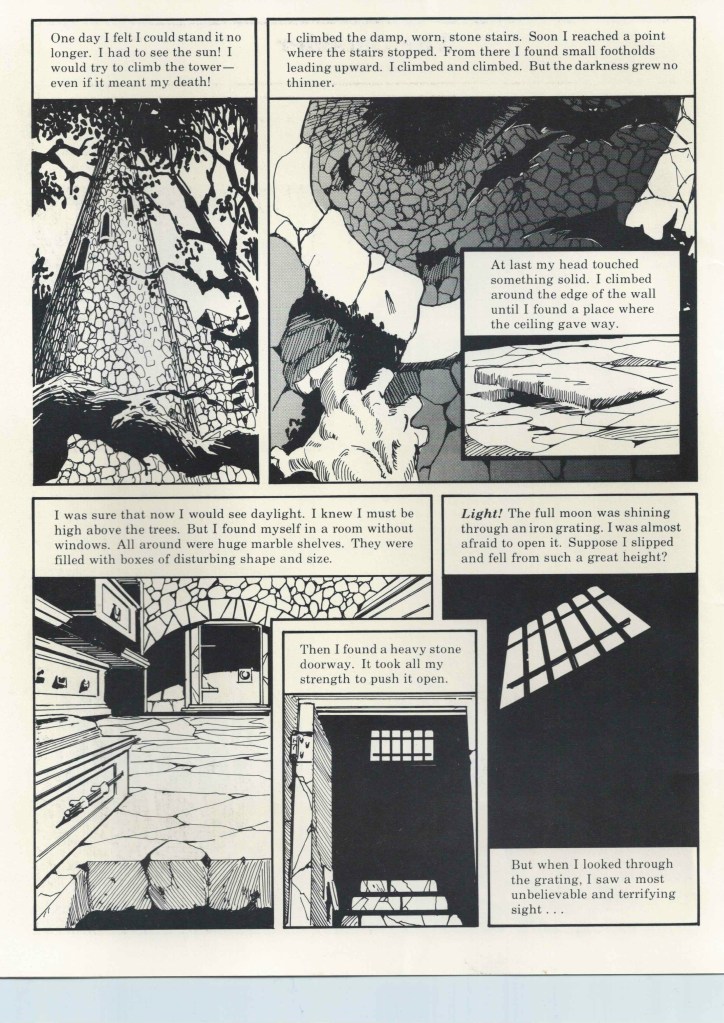
Deeper Cut: “The Loved Dead” & The Indiana Magazine War of 1924

One of his stories in Weird Tales was so frightening that it caused removal of the magazine from the newsstands in at least one city.
—Howard Wolf, “Variety” column, The Akron Beacon Journal 12 Dec 1927, p10

In his 1927 article on H. P. Lovecraft, Howard Wolf relates the above brief anecdote, which probably came from Lovecraft himself, or one of his close associates. In writing to his aunt Lillian D. Clark about the article, Lovecraft explained:

He is wrong in saying that it was a tale of mine which caused an issue of Weird Tales to be barred from the stands in Indiana. The story in question was Eddy’s “The Loved Dead”—which, however, had much of my work in it.
—H. P. Lovecraft to Lilian D. Clark, 10 May 1928, LFF2.652-653

Lovecraft had mentioned a brush with censorship and “The Loved Dead” in his letters since late 1925, although details were vague. One of the key points seemed to be that it involved Indiana and, strangely enough, the Parent-Teacher Associations.

“In the Vault” he rejected because he feared its gruesomeness would get him into trouble with the censors—O Gawd! O Montreal!
—H. P. Lovecraft to Clark Ashton Smith, 4 Nov 1925, DS 86

Glad you like “In the Vault”. Wright’s rejection of that was sheer nonsense—I don’t believe any censor would have objected to it, but ever since the Indiana senate took action about poor Eddy’s “Loved Dead”, he has been in a continual panic about censorship.
—H. P. Lovecraft to Lilian D. Clark, 13 Dec 1925, LFF1.507

About poor Eddy’s tale—it certainly did achieve fame of a sort! His name must have rung in tones of fiery denunciation all through the corridors & beneath the classic rotunda (if it has a rotunda) of the Indiana State Capitol!
—H. P. Lovecraft to Lillian D. Clark, 22-23 Dec 1925, LFF1.520

This worthy editor has been amusingly timid about very bizarre tales ever since he had had some trouble with state censors and parent-teacher associations over a story he printed three years ago—a story, as coincidence would have it, by an acquaintance of mine in Providence.
—H. P. Lovecraft to Bernard Austin Dwyer, [June 1927], LMM 455

C. M. Eddy, Jr. and his wife Muriel E. Eddy were pulp writers that lived a few miles from Lovecraft in Providence, Rhode Island. In the early 20s, Lovecraft and the Eddys were fairly close, and Lovecraft would have a hand in several of C. M. Eddy’s weird stories “Ashes” (Weird Tales Mar 1924), “The Ghost-Eater” (Weird Tales Apr 1924), “The Loved Dead” (Weird Tales May-Jun-July 1924), and “Deaf, Dumb and Blind” (Weird Tales Apr 1925), as well as work on The Cancer of Superstition for Harry Houdini. The degree of Lovecraft’s involvement in the stories is difficult to trace; the Eddys and Lovecraft gave different accounts of his work in “The Loved Dead,” though all agree the initial idea was Eddy’s, and it appeared under his byline when it was published in Weird Tales‘ large anniversary number in 1924, which was an oversize issue on the stands for several months.

The reason for the oversize issue is that Weird Tales itself was going through a critical re-organization. Initially, Weird Tales was published by the Rural Publishing Co. with Edwin Baird as editor, and Farnsworth Wright as first reader for the magazine; the offices were in Chicago. Mounting debts forced a change: Baird departed, and Weird Tales was now published by Popular Fiction Publishing of Indianapolis, Ind., with Wright as editor. The oversize 1924 May-Jun-Jul issueof Weird Tales marks the transition from Baird’s editorship to Wright’s, and the move from Illinois to Indiana.

This, then, at the beginning of Wright’s career as editor of Weird Tales, is when something happened—at least, according to Lovecraft, who would continue to refer to the event in his letters for the rest of his life:

Of course,  you would have to use vast care & subtlety in suiting the tale to Wright’s idea of its reception by the Indiana Parent-Teacher Association—& even so, his timidity might bring about rejection in the end. Poor chap—he’ll never forget the row that Eddy’s “Loved Dead” stirred up some seven years ago!
—H. P. Lovecraft to Clark Ashton Smith, [8 Nov 1931], DS 301

Quinn’s new offering would surely seem to be strong stuff—hope it doesn’t produce another situation like that aroused by Eddy’s “Loved Dead”.
—H. P. Lovecraft to R. H. Barlow, [3?-6 Aug 1934], OFF 157

Poor Farny! That censorship of ‘24 absolutely broke his nerve, so that he has ever since been timid about publishing anything with a corpse over 10 hours old! As you may know, he once rejected my “In the Vault” as “too horrible”—although he did take it later on. It may interest you to know that I revised the now-notorious “Loved Dead” myself—practically re-writing the latter half. Eddy is a Providence man, & I was in fairly close touch with him in ‘23. I did not, though, devise the necrophilic portion which so ruffled the tranquility of parents & pedagogues on the banks of the Wabash.
—H. P. Lovecraft to Robert Bloch, [mid-Mar 1935], LRBO 132

Did I tell you that he rejected a splendid corpse story by Kid Bloch because it was ‘too horrible’? He brought up the spectre of C. M. Eddy’s “Loved Dead” again after 10 years. Poor chap—he’ll never forget the Indiana Parent-Teacher’s Association!
—H. P. Lovecraft to R. H. Barlow, [24 Mar 1935], OFF 230

A recent experience of little Bobby Bloch does not form an encouraging omen—for Pharnabozus turned down a yarn of his (about a chap who found that his bedfellow in an hotel was a badly decomposed cadaver) on the ground of excessive horror, bringing up the now-classic case of 1924 . . . . .  C. M. Eddy’s “Loved Dead” (the latter half of which re-wrote!) & the Indiana Parent-Teacher’s Association. Poor Farny—he’s like a dog that has received a nerve-breaking scare, & cringes every time anything reminds him of it!
—H. P. Lovecraft to Clark Ashton Smith, [26 Mar 1935], DS 594

Poor Farny has been timid ever since 1925, when he had a run-in with the Indiana bourgeoisie over a yarn by C. M. Eddy Jr. of Prov., which I revised!
—H. P. Lovecraft to Robert Bloch, [mid-May 1936], LRBO 170

As with Edith Miniter and the Dracula revision, Lovecraft’s accounts are generally consistent throughout the years, and many scholars and critics have taken him at his word that perhaps the May-Jun-Jul 1924 issue of Weird Tales was banned in Indiana, or at least Indianapolis, and that the Parent-Teacher’s Association had something to do with it. The problem is, no specific evidence of such a ban has ever been uncovered. Unfortunately, the Lovecraft-Farnsworth Wright correspondence has a gap in that timeframe when it would have occurred, and the surviving letters do not mention it; the same goes for Lovecraft’s letters to C. M. Eddy, Jr. and his wife Muriel. While Lovecraft’s data for the anecdote must have come from Wright or Eddy—there would hardly seem to be anybody else in a position to know—we are left with speculation as to what really happened.

John Locke in The Thing’s Incredible! The Secret Origins of Weird Tales (2018) offered one possible explanation:

The editorial offices for Weird Tales at this time were at 854 North Clark Street, Chicago; thier business address was 325 North Capitol Avenue, Indianapolis, the address of a brick building constructed and owned by the Cornelious Printing Company, a well-known, family-owned Indianapolis company of solid standing, who happened to be the printer of Detective and weird Tales, and the largest creditor of Rural Publishing. Their building sat a mere block-and-a-half from the capitol. We suspect that Lovecraft’s initial comment—”His name must have run . . .”—was based on infortmation he misunderstood and which he tuned into a delectable joke. What fun to imagine that Eddy’s devilish little story threw a puritanical state goverment into a tizzy! In fact, what probably happened was that the PTA, a member, or even a state senator, visited the Cornelius office to complain about “The Loved Dead,” and the unwholesome influence it might have on the youth of America, etc. et.c, and that the company, which had financial leverage, asked Henneberger to exercise more caution in the future. Then when “In the Vault” was rejected, Lovecraft converted his initial faulty suppostion into a fact. (173)

New evidence, however, suggests there was at least a germ of truth in Lovecraft’s account.

The Indiana Magazine War of 1924

In the Spring of 1924, a grassroots campaign of concerned parents, educators, and other busybodies had enough of salacious pulps on the newsstands. With a cry of “think of the children!” (or a foreshadowing of the later campaign against comic books by Frederic Wertham), the Parent-Teacher Associations of Indiana came together to petition Governor Warren T. McCray to do something about the pulp menace.

McCray dropped the issue in the lap of Indiana State Attorney-General U. S. Lesh. The focus of the petition was not on all pulp magazines, but seemed to be centered on confession pulps and the slightly risque (for the time) spicy pulps, confessionals, and the men’s humor magazines such as Hot Dog, which might have a few pin-ups that bared a shoulder, an ankle, and a filmy veil through which a reader might catch a glimpse of a nipple. Indiana, like most states, already had legislation on the books to deal with obscene publications (Sale of Obscene Magazines To Be Halted In State part 1, part 2), which had occasionally resulted in successful prosecutions (Johnson County Bars Magazines).

Lesh decided now was the time to enforce these laws, and sent out letters to state prosecutors naming 22 pulp titles that the PTA had put forward as wanting off the stands.

Weird Tales was not on the list; it was neither a confession pulp or a spicy pulp, and the covers during that period were often done by Andrew Brosnatch, and fairly unsalacious.

The news spread quickly in Indiana’s newspapers. Immeditately, there was question of enforcement, cries of censorship, and pushback from newsstands, distributors, and pulp magazine publishers. Several state prosecutors such as Frank T. Strayer, Henry T. Hardin, John Summa, Mark I. Thompson, William H. Remy, and P. H. Hurd garnered notices and grabbed headlines (1924 was, after all, an election year) as they moved forward with enforcement, which initially meant seeing what was actually being sold at the local newsstands and bookstores and making the owners aware of possible legal consequences. As the focus was on the point of sale, several news agents removed the magazines from their stock rather than face arrest, fines, and possible imprisonment:

On Monday, 24 Mar 1924, raids were made at newsstands throughout Indiana. Police and prosecutors confiscated thousands of magazines. Macfadden Publishing, who had three confession pulps on the ban list (True Romances, True Stories, and Dream World) organized a meeting of news agents in Chicago (Publishers To Fight Seizure of Magazines). It was the opening salvo in what several Indiana newspapers would dub the “Magazine War.”

However, there was little that pulp publishers could do except circle the legal wagons. One of the first layers of censorship in the United States in that era was the U. S. Post Office, which had the authority to prevent the sending of obscene matter through the mail. Pulp magazines were classified as second-class mail, and subject to inspection; lawyers for the pulp publishers argued that if the post office accepted it, the content must have passed the postal censor (Ignore Attorney-General). This argument, however, did not hold water with the state attorneys. (Publishers Protest, Briefs Are Sent To Prosecutors).

Soon, rumors started of a “test case”—someone to actually be charged with a crime, tried in court, to see if the law would hold against legal reasoning (A “Test Suit”, Seen and Heard About Richmond). Lesh knew that this would be the litmus test of the campaign, and urged prosecutors to proceed cautiously (Lesh Changes Magazine Rule). Such a case soon became reality. State prosecutor B. H. Hurd had set a deadline of 1 April for local dealers to stop selling the banned pulps; one dealer resisted (One Dealer Selling Tabooed Magazines).

The affadavit charged the appellant on April 4, 1924, at Huntington county, in the State of Indiana, did unlawfully sell to one Sophronia Wannas an obscene, lewd, lascivious and licentious publication in the form of a pamphlet, to wit, a pamphlet bearing the name and title of, “Hot Dog, The Regular Fellows Monthly, price two bits,” being then and there of the issue of the month of April 1924, Vol. 3, which printed matter of said pamphlet being then and there too lewd, lscivious and licentious to set out herein and to incumber the records of the court therewith.
—Sunderman v. State of Indiana, Reports of Cases Decided in the Supreme Court of the State of Indiana, vol. 197, p705

William F. Sunderman was the manager of the South Side News Agency in Huntington, Ind. (The American News Trade Journal, vol. VII, no. 8, p4); Sophronia Wannas was Huntington’s first policewoman (Huntington Mayor-Elect Completes Apopintments). Charges were filed both for the circuit court and the local justice of the peace, Willis A. Jones (News-Agent Is Arrested For Sale of “Peppy” Magazines). The latter trial was speedy; Sunderman was charged on 4 April 1924 and by 12 April the jury had rendered a guilty verdict, with the guilt man fined $10 (the minimum)and costs, with no jail time (Jury in “Snappy” Magazine Test Case Finds Sunderman Guilty part 1, part 2; State Wins First Test on Lurid Magazine Sale). Sunderman vowed to appeal the decision. The PTA was pleased at the result (P. T. A. Members Here Pleased by Victory in Magazine Case).

At the same time as the PTA celebrated, however, Lesh was modifying his order. Macfadden’s pressure had succeeded in getting their publications off of the banned list, and there were outstanding questions about mail subscriptions (News-Agent Is Arrested For Sale of “Peppy” Magazines). At the same time, it appears that the PTA was attempt to add titles to the blacklist (Magazine Blacklist Order Is Forthcoming). Some publishers sent copies of their publications directly to state prosecutors, in an attempt to prove they weren’t obscene (Waltz Will Put A Ban on Severl Publications), and others held conferences with them in an attempt to change their mind (Persuasive Talk Fails To “Take”). Some dealers openly threatened to enjoin prosecutors from enforcing the ban (Evansville Magazine Dealers May Go To Court, Evansville Men Defy “Obscene” Ban); in reply, prosecutor Henry T. Hardin threatened to posecute anyone in possession of a banned magazine (Obscene Literature War in Vanderburg County, Death Knell for 22 Barred Magazines Will Be Sounded Here at Midnight Tonight).

Enforcement of the pulp ban was uneven. While Attorney-General Lesh could send letters to direct and guide state prosecutors, local authorities had considerably leeway into how hard they pursued the matter. When the new governor, Emmett Forrest Branch took office in May 1924, he pushed Lesh to send another letter to aid enforcement , but not every county took up the ban (No Objection to Magazines Heard, Obscene Magazine Fight Gets Impetus, The Indiana Anti-Pulp Crusade). On the other hand, other prosecutors appear to have been more keen: William H. Remy presented evidence before a grand journey to see if he could prosecute (Grand Jury May Get Bad Magazine Cases). Others set a deadline of August 1st to remove offending magazines from their county.

Pulp publishers such as Macfadden and distributors such as the Hoosier News Agency continued to resist however they could. Macfadden managed to convince several Indiana ministers to come out in favor of the moral stories in their confession pulps (Pastors Aid Magazines Banned Here), and Lesh apparently agreed to allow Macfadden’s pulps to be sold until a test case could be resolved (Magazines Under Ban Are Being Sold Thru “Truce”), but the individual district attorneys were the ones who decided which magazines to ban…which may explain why, in September 1924, Macfadden took out a large advertisement against the Richmond District Attorney.

As autumn turned to winter, the magazine war slowed. Lesh consulted with postal inspectors, presumably to stop the offending periodicals from coming into the state (In Postal Campaign). Some pulp publishers were accused of having changed tactics, producing pulp magazines with new titles that didn’t appear on the ban list (New Magazines Are Suspected), but this seems unlikely—or at least, the turnover of old pulps folding and new ones forming doesn’t seem to fit with Lesh’s list or the publishers of the pulps on that list. In practice, the pulp field was so fecund, with new magazines published and ceasing publication every year, that any static blacklist could not possibly keep up.

1925 brought a change: U. S. Lesh was no longer Attorney-General of Indiana. Lesh and the PTA had shifted their attention from enforcing existing laws to pushing new legislation. Their reasoning behind this was clear:

In a report submitted by the state committee it showed that among the 92 counties in the state, only eight had prohibited the sale of this literature. It was also found tha tmost of the books were being bought by high school students.
“Women Behind Bill Against Obscene Books,” The Evansville Journal, 29 Jan 1925, p10

Lesh prepared the bill, which provided for magazine sellers to be licensed by the state. The bill died in the Indiana house of representatives (Magazine Bill Goes Down in the House).

William Sunderman filed an appeal for the case he lost on 7 Jan 1925 (First Appeal Is Filed); the second case, which apparently never went to trial, was dismissed in July 1925 (Session Closes Cir. Court Term). The Indiana Supreme Court finally heard Sunderman’s appeal in May 1926; the court was not convinced by arguments that the issue of Hot Dog was not obscene, and conviction was affirmed (Higher Courts’ Record; Supereme Court Abstracts of Opinions on May 21, 1926; Magazine Fine Upheld; Court Rules Magazine Lascivions [sic]). Huntington city directories suggest Sunderman continued to work as a newsdealer.

Weird Tales entered into the picture near the end of the drama. While Lesh was out, individual prosecutors could and did continue to enforce magazine bans. Henry T. Hardin was a particularly tenacious and truclent. In June 1925, he published a list of 46 pulp titles banned in Evansville, Indiana—based on the initial list of 21 titles provided to Lesh by the PTA, it also included Weird Tales. Hardin’s reasons for including the weird fiction pulp among the spicies, romance pulps, and girlie magazines is not stated. Perhaps someone really did read “The Loved Dead” and got offended.

In addition, Jim Dyer, the grandson of C. M. Eddy, Jr., wrote in the introduction to The Loved Dead and Other Tales:

Farnsworth Wright, who took over as editor of Weird Tales from Edwin Baird, wrote in a September 1924 letter, “The Richmond (Indiana) Parent Teachers’ Association tried to get an injunction out against the further publication of Weird Tales because of ‘The Loved Dead.'” (vi)

Without access to that letter, this quote cannot be confirmed, and no news notice in support of this has yet been located. Yet if accurate, that would be another instance of Weird Tales being targeted.

While the stated intent of the campaign was to save the children, the magazines targeted had an audience largely comprised of older teens and adults, many of them women (“Bootlegging” of Magazines is Predicted). Confession pulps like True Romance and True Confessions more often than not contained morality tales where women expressed their regret for terrible decisions or circumstances that left them wiser and dealing with the consequences; yet to hear state prosecutor William H. Remy tell it:

They make a heroine of the unfaithful wife and a martyr of the renegade husband. The divorce evil is already serious enough in Marion county, and so is the matter of crime, and magazines which tend to encourage either or to condone offenses against the laws of the land ought to be blacklisted by public opinion as well as by law.
“To Prosecure Sellers of Obscene Magazines” part 1, The Indianapolis News, 3 May 1924, p1

Even the spicy pulps like Breezy Stories and Saucy Stories sold the sizzle, not the steak—no pulp publisher was going to print an explicit account of sex. Yet to the stolid men of the state attorneys offices, these were considered obscene.

Conservative groups largely supported Lesh and the state attorneys on their anti-pulp crusade. They received endorsements from the Indianapolis Local Council of Women (Women Indorse Lesh Drive on Obscene Books), the North Indiana Methodist Episcopal conference (Election of Laymen to M. E. Conference Center of Interest), the Indianapolis Ministerial Associtation (Ministers Back Lesh In Fight on Magazines), the Duaghters of the Union (Magazine Blacklist Order Is Forthcoming), and other groups. Meanwhile, Lesh and the PTA reached out for support from the local Chambers of Commerce, Rotary Clubs, and Kiwanis Clubs (Civic Clubs to Be Asked to Aid in Magazine War), PTAs in other states (To Indorse Magazine War, Start Crusade on Obsene [sic] Magazines), and the powerful Anti-Saloon League of America (Lesh Asks Drys To Fight Lurid Literature Sale).

Yet despite all the hullaballoo, it is clear this was not a popular crusade. At a time when the state prosecutors and law enforcement were wrestling with the Volstead Act, Indiana’s Magazine War went unsupported in a majority of its counties, seems to have resulted in few prosecutions or fines, and did not apparently change or diminish the content of any of the pulp magazines involved—unless Lovecraft was correct, and Farnsworth Wright, wet behind the ears as editor of Weird Tales, was scared because his magazine was numbered, however briefly, among the obscene materials that might be banned from the newsstands.

The players in this little drama are little more than footnotes in Indiana state history, but the outlines of the conflict are an old, ugly tale, one which has played out again and again—censorship by an outspoken minority, and the rule by fear.

Loose Ends

As with any old puzzle, there are a few pieces that don’t quite fit, and those deserve to be briefly addressed. In one letter recounting various experiences he has and has not had, Lovecraft wrote:

I have several times been in a police station—usually to inquire about stolen property, & once to see the Chief of Police about the banning of a client’s magazine from the stands—but never in the part devoted to cells.
—H. P. Lovecraft to J. Vernon Shea, 29 May 1933, LJS 131

Lovecraft does not give a date or place for his incident, and some have suggested that this might be a reference to the banning of Weird Tales‘ May-Jun-Jul 1924 issue. However, on the balance this seems unlikely—Lovecraft was never in Indiana, and there doesn’t seem to be anything the Chief of Police in any city he did visit could have done. It is possible that this is a forgotten incident with another magazine—one can imagine the New York Society for the Suppression of Vice getting a hold of a copy of Home Brew and squinting at the phallic shapes of Clark Ashton Smith’s vegetation—but lacking any hint of that in Lovecraft’s letters, it must remain a mystery.

In a memoir of Lovecraft, his friend and literary executor R. H. Barlow wrote:

He tells me he ghostwrote “The Curse of Yig,” “The Last Test,” “The Electric Executioner”; some Houdini stuff in WT—“The Loved Dead”; that the latter was nearly suppressed in Milwaukee because of the necrophilic theme.
—R. H. Barlow, “Memories of Lovecraft (1934)”, OFF 402

Milwaukee is in Wisconsin. In this case, I believe Barlow simply misremembered what Lovecraft had said.


Bobby Derie is the author of Weird Talers: Essays on Robert E. Howard and Others and Sex and the Cthulhu Mythos.

Deep Cuts in a Lovecraftian Vein uses Amazon Associate links. As an Amazon Associate I earn from qualifying purchases.
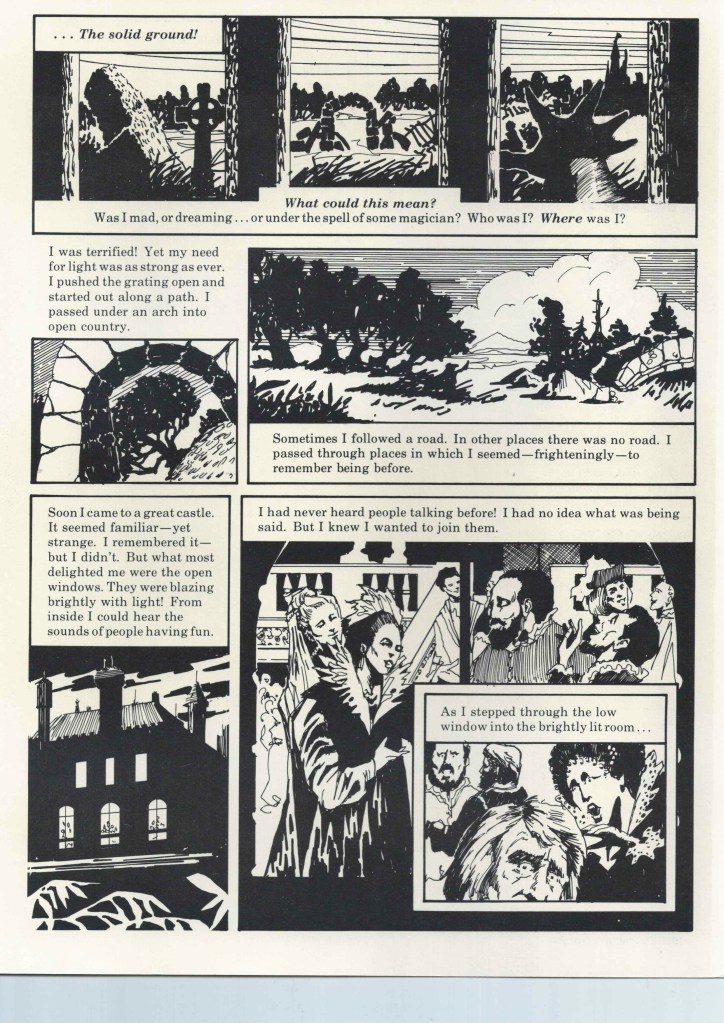
Her Letters To Lovecraft: Muriel E. Eddy

Muriel E. (Gammons) Eddy was born in Taunton, Massachusetts in 1896. She started to write poetry and fiction at a very early age. Muriel was educated in Attleboro Falls, Massachusetts; Redlands, California; and the Horace Mann School in San Jose, California, where she lived during her early teen years. Her father owned a movie theatre during that time, and it was there that she would spend many hours watching the motion picture shows, and writing stories and poems. Upon returning to Massachusetts, much of her poetry was published in her hometown newspaper, The Attleboro Sun.

Being the avid reader that she was, Muriel read all that she could, including the various magazines sold at the local newsstands. One of these held a letter to the editor from Clifford Eddy, Jr. Muriel wrote a letter to him and a correspondence ensued; they were both twenty-one. At the time, the two found they had many common interests: their love for writing, reading habits, their fertile imagination, and their almost twin birthdays (his, January 18, 1896; hers, January 19, 1896). They married the following year on February 10, 1918, eventually settling in Providence, Rhode Island.

Muriel continued writing, all the while raising three children. Her short stories in many different genres including romance, mystery, personal adventure, and suspense were published in the various magazines of the day such as Ghost Stories, Scarlet Adventuress, Complete Detective Novel Magazine, True Confessions, Midnight Magazine, and The Occult Digest. […]

Muriel and Clifford met H. P. Lovecraft and maintained a close friendship with him until his death in 1937.
—Jim Dyer, “Introduction” in In the Gray of the Dusk i-ii

A few letters from Lovecraft to Muriel, and to her husband C. M. Eddy, Jr., survive; so there is no doubt that they did correspond. Beyond that bald fact, the correspondence of Muriel E. Eddy and H. P. Lovecraft gets complicated.

The difficulty comes from the fact that Muriel, more than most of Lovecraft’s friends, memorialized her and her husband’s relationship with Lovecraft. While her major memoir is “The Gentleman from Angell Street” (1961), she also published “Howard Phillips Lovecraft” in Rhode Island on Lovecraft (1945), “Message in Stone” in Fate Magazine (Oct 1956), “Memories of H. P. L.” in The Magazine of Horror (Winter 1965-1966), “Lovecraft’s Marriage and Divorce” in Haunted (Jun 1968), and H. P. L. “The Man and the Image” (1969) (also partially reprinted as “Lovecraft: Among the Demons”), not to mention miscellaneous letters, notes, and probably a few reprints under different titles.

While that sounds substantial, most of these are relatively minor pieces, largely repetitious or filled with Muriel’s own speculation. Digging into the minutiae of what Muriel wrote and when, and trying to cross-reference her statements made through several decades versus the facts given in Lovecraft’s letters and other sources, reveals a great deal of omission, correction, and even contradictions.

To give an example, take this snippet from one of her later, self-published memoirs:

One day he walked all the way up to the top of the First Baptist Metting House in Benefit Street to sign his name in the guest book. He wrote, “H. P. Lovecraft, Esq., Gentleman.” He signed many of his letters to my husband and me with that phrase, and also “your obedient servant.”

*********

Our friendship with Howard began with letter writing, although we also lived in Providence – because he hated to use the telephone or any other mechanical device such as the typewriter. He always wrote in longhand, and later I was to type many of his manuscripts.

We wanted very much to meet him in person, and he finally came to our house one afternoon in August, 1923.
—Muriel E. Eddy, H. P. L. “The Man and the Image” (1969) 3

There is no doubt that Lovecraft did often sign his letters in just this way; we have numerous surviving examples to attest to that. So far, so good. Several of Lovecraft’s letters also attest to how much he detested typing, and his penchant for writing longhand; this is also verified by surviving manuscripts in Lovecraft’s writing. How much Muriel E. Eddy did typing for Lovecraft is more debatable; we cannot point to a typescript and say “Yes, Muriel typed this for Lovecraft.” We do have letters from Lovecraft where he mentions that C. M. Eddy, Jr. typed for him:

I gotta new way to get all my old manuscripts retyped in double-spacing, too. It’s the new local boy Eddy, what I was tellin’ ya about. I revise his stuff; and for every story I jazz up, he types one for me.
—H. P. Lovecraft to Maurice W. Moe, 19 Oct 1924, Letters to Maurice W. Moe 139

Does this mean Muriel E. Eddy didn’t type Lovecraft’s manuscripts? No. But it also means that without supporting evidence, we’re left to take her word on the matter. This becomes important because some of the most interesting and critical points in Muriel Eddy’s memoirs of her friendship and correspondence with H. P. Lovecraft are less well supported by outside evidence.

All of Muriel E. Eddy’s memoirs agree, for example, that Lovecraft first came to visit the Eddys—who lived in Providence, Rhode Island, just a couple of miles from Lovecraft’s front door—in 1923. However, according to Muriel, they actually came into contact years earlier.

Cliff and I met Howard Philips Lovecraft in 1923. We were introduced by their mothers, who were both active in the women’s suffrage movement.
— Muriel E. Eddy, “Introduction” in Exit to Eternity (1973) iii

The 19th amendment granting women’s suffrage in the United States passed in 1919, and Sarah Susan Phillips Lovecraft died in 1921, so this hypothetical first contact would have been c. 1918-1919. Yet there is no mention of the Eddys in Lovecraft’s correspondence before 1923, and the earliest surviving letters from Lovecraft to the Eddys dates to 1923. There is no reference in Lovecraft’s letters of his mother ever attending a suffragette meeting. However, Muriel expanded on this early contact:

Meeting Howard Phillips Lovecraft “in person” was the culmination of months of letter writing. Though we lived but a few miles apart, it had been necessary to contact H.P.L. (as we later learned to call him) by mail, during his mother’s lifetime. […] She said she preferred that we enter into correspondence with Howard, as generally speaking, he hated to talk over the ‘phone, not caring for modern-day inventions or mechanical instruments. […] So we wrote to H.P.L., and found him a willing and eager correspondent. Letters flew thick and fast between us, and he invited us to join the United Amateur Press Association, to which he belonged. He also sent us many copies of The Tryout, a small monthly booklet for amateur writers published by C. W. Smith up in New Hampshire, to which he was a faithful contributor, writing for it under various pen names, one of which was L. Theobald, Jr. We, too, were soon steady contributors to this small magazine.
— Muriel E. Eddy, “The Gentleman from Angell Street” (1961) in The Gentleman From Angell Street (2001), 3, 4-5

While there are no letters from this period to attest to a “thick and fast” correspondence, Lovecraft was definitely keen to recruit fellow-writers to amateur journalism, and the United Amateur Press Association was his personal preference. That being said, The Tryout was associated with the rival National Amateur Press Association, and I’ve yet to find either of the Eddys on the rolls of the UAPA or NAPA. However, in 1918 Muriel E. Eddy did publish a few poems in The Tryout. That much, at least, seems to suggest that they may really have been in contact with Lovecraft as early as 1918.

August Derleth, who presumably got the data directly from C. M. Eddy, Jr. or Muriel Eddy, wrote a slightly more detailed account of Lovecraft coming into correspondence with the Eddys:

By one of those coincidences that are found so frequently in life, however much their incidence may be ridiculed in fiction, Mrs. Sarah Lovecraft and Mrs. Grace Eddy, two ladies of Providence, Rhode Island, who were allied in interest in the movement for women’s suffrage early in this century, had sons who were bending their efforts toward success at writing. Early in 1918, during a lull in a telephone conversation about the goal toward which both worked, the disclosure of their sons’ spare time activity was made, though Clifford M. Eddy Jr. was then courting and shortly married another writer, Muriel Gammons, and it was not until September of that year that Muriel Eddy sent H. P. Lovecraft a note, enclosing a poem of her own and one of her husband’s. Lovecraft responded out of his enthusiasm for fellow writers— and amateur pressdom— as he did in many other cases— with an application blank for each inviting them to join the United Amateur Press Association, and signed his note, “H. P. Lovecraft, Director.” The Eddys accepted Lovecraft’s invitation to join the association, but they did not actually meet one another until the summer of 1923.
— August Derleth, The Dark Brotherhood and other pieces (1966), 97

Muriel went on to write:

All of his letters were interesting and instructive and helped us a great deal. Then the letters became fewer and fewer, and it was evident that Howard was under some sort of stress about which he preferred not to talk. Finally, we knew the reason. His mother had become a patient at Butler Hospital, and his two aunts had taken over the running of the Lovecraft household. […]  After her death, we began to hear from him again… and after over a year of intermittent writing back and forth, we had the temerity to invite him to visit us…never dreaming that he would accept the invitation!
— Muriel E. Eddy, “The Gentleman from Angell Street” (1961) in The Gentleman From Angell Street (2001), 5

Lovecraft’s letters after his mother’s death do show his great bereavement at her loss; at the same time, his involvement with amateur journalism and relationships with individuals like Winifred Virginia Jackson and Sonia H. Greene were undergoing a profound shift; it would not be unusual if a correspondence was allowed to lapse after a while, only to pick up again after things had settled for a period.

Two letters from H. P. Lovecraft to Muriel E. Eddy survive from this period, dated 5 September and 20 October 1923. Both of the Eddys were active writers during this period, though Muriel also had to keep house and watch the children (Clifford b. 1918, Fay b. 1920, and Ruth b. 1921—Muriel’s pregnancies might have been another reason the correspondence lapsed; it was a busy few years). C. M. Eddy, Jr. appears to have had at least occasional other employment as a theater promoter and other jobs. Still, money was obviously tight, and it was going to get tighter. There is evidence from city directories and other sources that the Eddys moved frequently in the 1920s.

The 5 September 1923 letter opens with Lovecraft enclosing several of his weird fiction manuscripts, and a discussion of the May 1923 issue of Weird Tales. This was obviously part of an ongoing discussion about pulps, because Lovecraft wrote:

I never saw The Thrill Book, & was distinctive tantalized by what you say of “The Sargasso Sea”.
—H. P. Lovecraft to Muriel E. Eddy, 5 Sep 1923, Miscellaneous Letters 156

Much of the letter is, unfortunately, not available; the partial transcription included in Miscellaneous Letters is taken from a dealer’s listing. The end of the letter, however, is a brief postscript that says simply: “P.S. Batch of new Tryouts just came—I’ll enclose a copy.” This would be another point in support of Muriel’s claim that Lovecraft had approached the Eddys about joining amateur journalism.

The 20 October 1923 letter opens “My dear Mrs. Eddy:—” and an enclosed story revision—”The Ghost-Eater” for C. M. Eddy, Jr. (which would be published in Weird Tales Apr 1924). The fact that Lovecraft is addressing this business matter through Muriel may suggest that she was the primary point of contact, at least at first, although as with the case of Fritz and Jonquil Leiber, perhaps Lovecraft alternated letters between the two, keeping up a parallel correspondence. The letter goes on to thank her for her comments related to The Poetical Works of Jonathan E. Hoag (1923), which Lovecraft had edited and written the critical preface to.

Taken together, these letters show an active and literary correspondence, mixed with a bit of revisory business. “The Ghost-Eater” is the earliest story of Eddy’s that Lovecraft is known to have touched-up, and might represent C. M. Eddy’s early attempt to crack Weird Tales as a market. Other stories Lovecraft had a greater or lesser hand in were “Ashes” (WT Mar 1924), “The Loved Dead” (WT May-Jun-Jul 1924), and “Deaf, Dumb, and Blind” (WT Apr 1925).

There is a gap in the extant Lovecraft-Eddy correspondence; this is no doubt due in part to Lovecraft’s elopement with Sonia H. Greene to New York in March 1924. Muriel wrote that she saw the announcement in the paper where Lovecraft advertised for the typescript of “Imprisoned with the Pharaohs” (for Harry Houdini), which he had lost on the trip:

I was so sorry for Lovecraft and so intrigued with the expected sight of the advertisement that, impetuously, I sat down, and clipping out the notice, I pasted it on a sheet of note-paper and drew a heavy black edge around it, writing underneath, “My deepest sympathy”.

In the very next mail came a printed announcement of Howard’s marriage to Sonia. They were married March 3, 1924, in St. Paul’s Church in New York City. Was my face red when that announcement arrived…after having just sent Lovecraft a note of sympathy! […]

[19] Lovecraft initially seemed overjoyed and exhilarated, sending us smiling snapshots of himself, also of Sonia, but not taken together. At first his letters were typical missives, then they dwindled, and finally, we did not hear from him at all.
— Muriel E. Eddy, “The Gentleman from Angell Street” (1961) in The Gentleman From Angell Street (2001), 15-16, 19

The Eddys were definitely included on the list of those to be sent the engraved wedding announcement:

About the announcements—the engraved cards ought to come today, and the envelopes are already here and addressed. Of Providentians I have remembered Harold, Ronald, and Eddy—the only ones I think would be really interested.
— H. P. Lovecraft to Lillian D. Clark, 18 Mar 1924, Letters to Family & Family Friends 1.113

The others mentioned are probably Harold Bateman Munroe and Ronald K. Upham.

We know that the correspondence with the Eddys continued during Lovecraft’s New York period (1924-1926), but also that there were gaps—understandable given Lovecraft’s often upset situation (and possibly the Eddys’ as well). For example, in his letters to his aunts, Lovecraft mentions:

I had a piquant note from Eddy today, and must answer it soon. My correspondence and amateur work, however, have had to be greatly neglected on account of this rush order for three chapters of a book of American superstition.
— H. P. Lovecraft to Lillian D. Clark, 30 Mar 1924, Letters to Family & Family Friends 1.131

And in the opening of a letter to C. M. Eddy, Jr., Lovecraft apologizes:

Once more a prodigal adopted grandfather sues for pardon anent epistolary delinquencies!
— H. P. Lovecraft to C. M. Eddy, Jr., 21 Jul 1924, Miscellaneous Letters 158

It is clear from the surviving letters that Lovecraft continued to have a relationship with the Eddys; after he left Providence, the Eddys’ absorbed some of Lovecraft’s furniture from his aunts (as well as dozens of postcards from Sonia H. Greene, which were sadly destroyed). Lovecraft wrote a letter of introduction for C. M. Eddy to Harry Houdini, and C. M. Eddy apparently did some work for Houdini. Lovecraft certainly helped revise or amend some of C. M. Eddy’s fiction for Weird Tales, and they were to collaborate on The Cancer of Superstition for Houdini, a project cut off by the magician’s untimely demise.

There is some indication that Lovecraft may have had a falling-out with, or at least frustration with, the Eddys in late 1925/early 1926. A pair of letters suggests frustration:

Strange case—but as I just wrote A E P G on a card, I’m through with freaks & paupers & plebeians & odd fish at last. It took a long time to shew me how profitless they all are—Arthur Fredlund, Herbert Benson, Eddy, &c—but I now see how asinine it is to bother with them. They give no pleasure in the end, & become an intolerable nuisance & parasitic pest.
— H. P. Lovecraft to Lillian D. Clark, 22 Dec 1925, Letters to Family & Family Friends 1.520

As for me, I’m sick of Bohemians, odds & ends, freaks, & plebeians—C. M. Eddys & satellites & miscellany &c. They amuse me for a while, but begin to after a time to get frightfully on one’s nerves. People get one one’s nerves when they harbour different kinds of memories & live by different kinds of standards& cherish different kinds of goals & ideas.
— H. P. Lovecraft to Lilian D. Clark, 11 Jan 1926, Letters to Family & Family Friends 2.536

Without the Eddys’ end of the correspondence, we don’t really have an idea of what the problem was, but given the general impression of poverty that surrounds the Eddys from Lovecraft’s other letters of the period, it probably has to do with the straitened circumstances of the little family.

One thing we don’t get from this period, or after, is a real sense of Lovecraft’s relationship or correspondence with Muriel E. Eddy. With three kids under ten years old, she certainly had her hands full, on top of whatever other efforts she made to support the family while C. M. Eddy, Jr. tried to alternately write and work odd jobs, so it would not be surprising if C. M. Eddy, Jr. took over the bulk of the correspondence chores. We get a picture of the Eddys as a couple in a few letters from Lovecraft:

Orton is now attempting some writing—though of a popular & low-grade sort, for the Macfadden publications. (the same ones which honest Eddy’s wife writes for.)
— H. P. Lovecraft to Lillian D. Clark, 12 Apr 1929, Letters to Family & Family Friends 2.747

He has so far managed to keep meagrely afloat—with a wife & three children—by undertaking outside work of various sorts; but recent economic conditions have left him jobless & reduced him to such depths of want & peril that nothing short of a miracle—or a flood of fairly lucrative literary chores—can keep him & his flock from actual freezing, starvation, & eviction during the interval before he can again secure some industrial affiliation.
— H. P. Lovecraft to Zealia Brown Reed Bishop, 16 Jan 1930, Letters to Woodburn Harris & Others 429

I say the “House of Eddy” because C.M.E. Jr. made it clear last night that his wife does most of the adaptive revision in cases of this kind. He takes care of the grammatical & rhetorical side, while Mrs. Eddy supplies the “human-interest” hokum & blah for which the Macfadden editors are so avid. She, it seems, has produced much of this material, & has helped many beginners to develop into steady sellers. Her help, Eddy says, generally amounts to actual collaboration—although in your case, as I have just warned, you must not let it approach the status of instruction lest the results of Belknap’s lessons be undone. The rates charged by the Eddys for this collaborative revision of Macfaddenistic material would be very reasonable, & they would be glad to discuss the matter of placement with you whenever you wish to write.
— H. P. Lovecraft to Zealia Brown Reed Bishop, 29 Jan 1930, Letters to Woodburn Harris & Others 436-437

The last letter from Lovecraft to C. M. Eddy, Jr. is c. 1930, and mentions “The Mound” (1940) by Zealia Bishop. A checklist among Lovecraft’s papers suggest he was still in touch with the Eddys at least as late as 1934, as he apparently sent them postcards from St. Augustine, Charleston, and Nantucket, but these are not known to survive (Collected Essays 5. 267).

There is a notable gap in the correspondence, near the end of Lovecraft’s life. Muriel Eddy claimed that she was responsible for putting Lovecraft in contact with Hazel Heald, Lovecraft’s last major revision client. If Muriel E. Eddy did this by letter, those epistles do not appear to have survived and are not in evidence from what other correspondence we have. Then again, why would they be? Lovecraft seldom mentioned such correspondence to others.

How do we square this evidence for correspondence—solid (in the form of two letters to Muriel E. Eddy and ten to C. M. Eddy, Jr.) and circumstantial (references to the Eddys in Lovecraft’s other letters)—with Muriel’s own memoirs? Whether or not Muriel was misremembering or deliberately glossing over a few details, it seems clear that Lovecraft’s relationship with the Eddys was not quite as tight as she liked to present, and the impression given is of a friendship occasionally strained by time, distance, and business or financial matters, albeit not a friendship that was ever completely abandoned on either side.

Because so much of the surviving correspondence is between Lovecraft and her husband, it is difficult to get a bead on Muriel E. Eddy’s relationship with Lovecraft. There is a strong impression that at the beginning (c.1918-1924), Lovecraft was writing mostly to Muriel, as he would to any of a number of amateur journalists. As Lovecraft’s business with C. M. Eddy, Jr. waxes—first with revising his work and getting stuff typed, then the Houdini-stuff, and finally the Bishop revising/typing—we see less and less of Muriel.

While there are a few contradictory points in Muriel’s memoirs of Lovecraft, it’s important to point out that she was not necessarily dishonest—memory can get vague and fuzzy, and by the time Muriel was weighing in Lovecraft had been dead for years. As she told the stories over and over, they became more fixed, as evidenced by comparing the earlier memoirs to later ones; repeating narratives makes them clearer in the mind, but it also means a person teaches themself how to tell a story, sometimes adding or removing details, being informed by what other people wrote, etc. Most of Muriel’s comments on Lovecraft’s marriage, for example, are pure hearsay and speculation, and quite often wrong.

It is unfortunate that more of the Lovecraft/Eddy correspondence is not available. Muriel E. Eddy’s memoirs, even flawed, provide a fascinating insight into Lovecraft’s life and work, and also into her own life and that of her husband during this tumultuous but critical period. What drove a woman like Muriel E. Eddy to write to H. P. Lovecraft? What prompted him to write back? How long did they correspond, of and on? We do not have—will never have—all the pieces of the puzzle.

Imagine a young mother, bouncing a toddler on her knee, squinting at one of Lovecraft’s manuscripts and trying to type it out—or perhaps C. M. Eddy, Jr. was there, a rugrat at his foot, as he read aloud while she typed. Or that breathless expectation on a hot summer afternoon in Providence, as a tall man in a straw hat walked up to the door to introduce himself, with a name they had only read in letters up to that point…it’s easy to wax romantic about these relationships. Yet the whole point of tracing such correspondence and combing through these memoirs is to get a better sense of who these people were, and what their lives were like.

Thanks to Donovan Loucks for his help with this one.


Bobby Derie is the author of  Weird Talers: Essays on Robert E. Howard and Others  and  Sex and the Cthulhu Mythos .

Deep Cuts in a Lovecraftian Vein uses Amazon Associate links. As an Amazon Associate I earn from qualifying purchases.
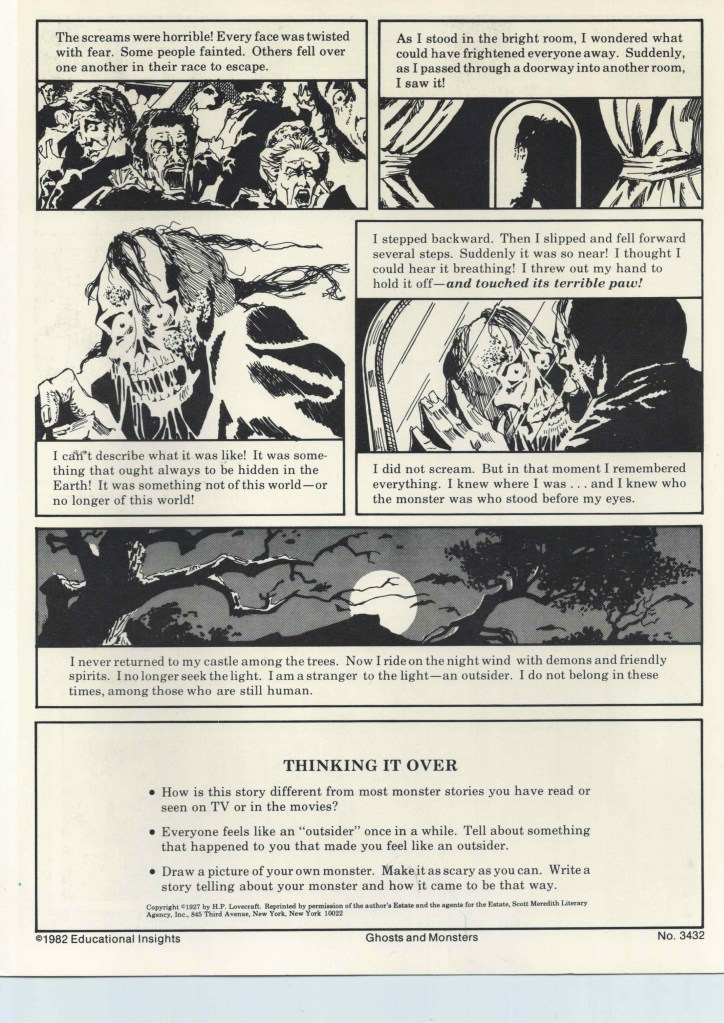
The Gentleman from Angell Street (2001) by Muriel E. Eddy & C. M. Eddy Jr.

I have, I may remark, been able to secure Mr. Baird’s acceptance of two tales by my adopted son Eddy, which he had before rejected. Upon my correcting them, he profest himself willing to print them in early issues; they being intitul’d respectively “Ashes”, and “The Ghost-Eater”. In exchange for my revisory service, Eddy types my own manuscripts in the approv’d double-spac’d form; this labour being particularly abhorrent to my sensibilities.
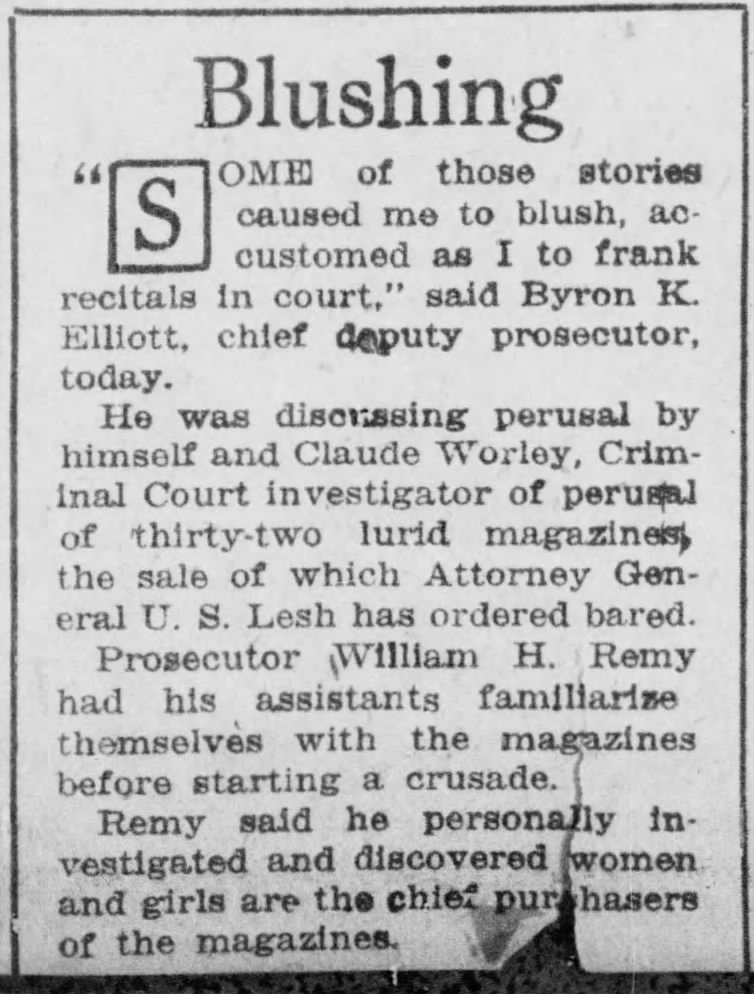
But I must give over these my remarks, for I must take a nap against the afternoon; when (tho’ ’tis devilish cold) I am pledg’d to visit my son Eddy in East-Providence, & help him with his newest fiction, a pleasing & morbid study in hysterical necrophily, intitul’d “The Lov’d Dead”.
—H. P. Lovecraft to James F. Morton, 20 Oct 1923, Letters to James F. Morton 57

The Gentleman from Angell Street: Memories of H. P. Lovecraft (2001) is a collection of the reminiscences of H. P. Lovecraft by the Eddy family, who lived in East Providence and first became acquainted with Lovecraft while he lived at 598 Angell St. in Providence, Rhode Island. All of the non-fiction pieces in this slim collection had been previously published, but all of them had been out-of-print for decades, so the slim collection was a bit of boon to researchers in not having to pay collectors’ prices to read them.

Muriel Elizabeth (Gammons) Eddy and Clifford Martin Eddy, Jr. were married in 1918; they were both writers, in various genres, and Muriel in particular would be president of the Rhode Island Writers’ Guild for over 20 years, while Eddy would have a pulp career that included three stories revised in part by their Providence neighbor H. P. Lovecraft, which were published in Weird Tales—and much else that Lovecraft never had a hand in besides. Students of Lovecraft’s letters will remember the way Lovecraft pleaded with another revision client, Zealia Brown Reed, to give Eddy the job of typing her manuscripts as the Great Depression set in and pushed the Eddys to the brink of poverty.
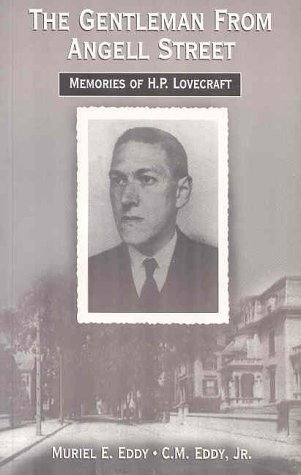
While Lovecraft was closest to C. M. Eddy, Jr., to the extant of calling him one of his “adopted” sons or grandchildren, it was Muriel E. Eddy that wrote the most about her family’s relationship with H. P. Lovecraft. Her first memoir, “Howard Phillips Lovecraft” was published in Rhode Island on Lovecraft (1945) alongside “Lovecraft and Benefit Street” (1943) by Dorothy C. Walter and other works. In 1961 she expanded that essay into “The Gentleman from Angell Street”, and wrote several other short pieces, some privately printed, including H. P. Lovecraft Esquire: Gentleman (no date), The Howard Phillips Lovecraft We Knew (n.d.), “Memories of H. P. L.” (1965), “Lovecraft’s Marriage and Divorce” (1968), Howard Philips Lovecraft: The Man and the Image (1969), and “Lovecraft: Among the Demons” (1970). In addition to this, she wrote a number of letters, some published and some surviving at the John Hay Library where she weighed in on the early biographical sketch of Lovecraft by Winfield Townley Scott and Sonia H. Davis’ memoir of her former husband.

The rest of the family was rather more limited. C. M. Eddy Jr. published “Walks with H. P. Lovecraft” in The Dark Brotherhood and Other Pieces (1966, Arkham House), and their daughter Ruth M. Eddy wrote “The Man Who Came At Midnight” (1949).

The activeness of Muriel E. Eddy in publishing and discussing her experiences with Lovecraft from the late 1930s until her death 1978 means that she had a rather substantial influence on Lovecraft scholarship during that period. To illustrate this, L. Sprague de Camp’s critical H. P. Lovecraft: A Biography (1975) cites seven of Muriel E. Eddy’s publications, plus C. M. Eddy and Ruth M. Eddy’s contributions. In general, these memoirs can be said to be honest and valuable contributions to the understanding of Lovecraft’s life…but are they accurate?

The accuracy of memoirs is important; human memories are imperfect, and tend to fade and distort over time or under influence. Yet these accounts are often all we have to go on for many events and details of life. The more accurate a memoir is, that is the more of it that we can verify according to other documents of the period (Lovecraft’s letters, census data, city maps and directories, etc.), the more we can count the memoir as a reliable source of data for the information that cannot be so independently verified. With some of these memoirs, written decades after the events…and given that they are often the sole source for some of the anecdotes regarding Lovecraft, it is important to look at some of these sources critically.

C. M. Eddy’s “Walks With Lovecraft,” describing their gambols and hikes together in and out of the city, can be said to be reasonably accurate and reliable, insofar as the details of Lovecraft jive with what we know from his lettersthere is, for example, an extended account by Lovecraft of their search for “Dark Swamp,” which agrees fairly closely with C. M. Eddy’s version. There are one or two spots where Eddy may be mistaken, but overall it is a solid essay.

Muriel E. Eddy’s memoirs are a bit more complicated to deal with. The 1945 version “Howard Phillips Lovecraft,” written less than a decade after the subject’s death, is relatively straightforward and accuratethough with little slips here and there; she recalled the Dark Swamp adventure, but referred to it as Black Swamp. Still, it provides a good bit of detail on their association, including some unique insights on the revision-work that Lovecraft did for C. M. Eddy, Jr. and many notes on Lovecraft’s habits and character traits that jive exactly with his letters. The later, expanded version that is “The Gentleman from Angell Street” and appears in the eponymous booklet adds much interesting detailbut the accuracy of this new information, and thus the reliability of the whole account, is less.

For example, Muriel E. Eddy wrote:

Our acquaintance with the Lovecraft family stemmed through my husband’s mother having once met Sarah Lovecraft at a “Women Suffrage” meeting,… although I never learned whether or not Howard’s mother really believed believed in equal rights for women.
—Muriel E. Eddy, The Gentleman from Angell Street 4

This is an intriguing detail, since we know so little (relatively speaking) about Sarah Susan Phillips Lovecraft, and far from impossible. It might explain some of Lovecraft’s attitudes towards women and women’s rights as expressed in his life and letters. However, the memoir also includes a number of small speculations and anecdotes, and these tended to get more evident the further into the expanded essay the reader gets. Some of the anecdotes are likely true, but are strongly influenced by Muriel’s rosey-hued nostalgia; for example when she wrote:

Mrs. Gamwell also gave the children about a hundred picture postcards that Sonia had mailed to Howard. These all held loving, spirited messages to H.P.L. from his sweetheart in New York. Not knowing their possible value in the far-away future, I did not hold on to any of these cards bearing Sonia’s signature, written in her breezy, happy handwriting. It was plain to be seen, from the messages on the cards, that this pretty woman of writing ability—among her other gifts—really liked our H.P.L.! And the strange part of it all was that he had not once mentioned his love affair to us…and we were his very good friends.

The children played for hours with the cards, and they eventually went the way all children’s toys go…in the ash-heap! (ibid. 17)

If a reader traced Muriel’s accounts of Lovecraft over the years, some details shift in the telling. Notably, her account of the extant of Lovecraft’s revision of “The Loved Dead” changes over time, and is a bit at odds with her husband’s own account, given in the Summer 1948 issue of the Arkham Sampler; her insistence on C. M. Eddy Jr.’s sole authorship was likely a response to August Derleth and Arkham House’s publication of stories which Lovecraft had revised or ghostwritten with the emphasis on Lovecraft’s contribution. So too, her references to Lovecraft’s mother seem to shift to reflect views on Susan Lovecraft in line with other memoirs—and this kind of “alignment” of views can easily distort the historical picture, since it appears that several contemporary memoirs are supporting the same image, when in reality later sources may be partially based on earlier ones. A tricky knot to untangle when a memoir is “revised” as “The Gentleman from Angell Street” was.

The most substantial difference between the 1945 and 1961 essays however is the section dealing with Lovecraft’s revision client Hazel Heald.

In this same year, 1932, I formed a little New England writers’ club of my own, and one of my members, a divorcee was very anxious to succeed in the weird writing field. She sent me an original manuscript with a very passable plot, yet told unconvincingly and amateurishly. I let Lovecraft read it when next he came over to our house on Pearl Street, and he agreed that it did have possibilities. (ibid, 22-23)

This is the start of Muriel E. Eddy’s account of “The Man of Stone” (1932) by Hazel Heald & H. P. Lovecraft. For quite a long time, this was the only such account; Lovecraft wrote little about much of his revision work, and Heald’s own version of events is largely unpublished, although she makes an allusion to the Eddys in a letter:

About HPL and whether he was separated or divorced—I am certain he was divorced but have written to someone I know who will give me all the facts as her husband signed certain papers at that time.
—Hazel Heald to August Derleth, 7 Apr 1937

C. M. Eddy Jr. is claimed to have signed the Lovecrafts’ divorce decree as a witness, though Lovecraft himself did not sign it. So while Heald does not give the exact circumstances of her and Lovecraft coming together, there is nothing to directly counter Muriel E. Eddy’s version of events. At the same time, there is every evidence that Muriel E. Eddy’s version of events was including some information from her friend Hazel Heald, at second- or third-hand.

A skeptical scholar might thus wonder how much of it that Muriel E. Eddy knew and neglected to tell in 1945, versus how much of it she heard about later and incorporated into her expanded memoir—and on top of that, how much Muriel E. Eddy’s rose-tinted spectacles were skewing her account. Particularly notable in “The Gentleman from Angell Street” is her suggestion that Heald held a romantic interest in Lovecraft, and:

With a little encouragement, I am convinced that H.P.L. and Hazel might have married, and they would have made a good pair. But Lovecraft knew his health was failing, and perhaps he did not feel like taking a chance on another marriage, seeing that his first one had failed so miserably.
—Muriel E. Eddy, The Gentleman from Angell Street 26

This kind of speculation, and the obvious incorporation of second-or-third-hand information that fed into it, make “The Gentleman from Angell Street” less reliable of a source than it could have been. Which is unfortunate, given that we otherwise have little information on the Heald-Lovecraft stories besides the brief mentions in Lovecraft’s letters, and the sparing accounts given in Heald’s surviving correspondence with August Derleth.

An addendum to “The Gentleman from Angel Street” published in 1977 discusses the death of Sonia H. Davis and August Derleth; these memories are brief, vivid, and fairly accurate. She ends with the rather bittersweet yet hopeful note:

Thus the original Lovecraftian circle has been dwindling, and yet, a new one grows in ever widening arcs among the interest generated by fanzine magazines, biographies of HPL, and the eternal works and character of the man himself. (ibid. 29)

Ruth M. Eddy was born in 1921; she would have been only about two years old when Lovecraft met her parents and first visited their house in 1923, and five when Lovecraft returned to Providence after his stay in New York City. Her brief memoir of his visit was published in 1949, and it may be wondered how much of this she actually remembered at such a young age…but some things do stick in the memory, long after children grow up. So she wrote “The Man Who Came At Midnight:”

Gaslight flicked eerily through the crack in my bedroom door. It was Halloween, night of the supernatural, and long past midnight. I had drifted off to sleep with visions of hobgoblins and Jack-o’-lanterns drifting through my childish mind. Suddenly, as in a dream, I heard a sepulchral voice saying, “Slithering…sliding…squealing…the rats in the walls!”

Half-asleep, half-awake, I lay in the darkness for a moment, and then shouted for my mother as loudly as I could. She came into my room and spoke softly, “Everything’s all right, dear. It’s just Mr. Lovecraft telling us about the new story he’s writing. Don’t be afraid. Go back to sleep…[“]
—Ruth M. Eddy, The Gentleman from Angell Street 59

Ruth’s accounts jive with her mother’s memoir of Lovecraft’s early visits; from Lovecraft’s letters, we know “The Rats in the Walls” was written at about the time he met the Eddys, so it would not be surprising if he read his story aloud to his new friends. Given that this was published after Muriel E. Eddy’s account, there’s also the strong possibility that Ruth was influenced by her mother’s memoir, or at least her parent’s version of events.

There is not much in “The Man Who Came At Midngith” for scholarly interest; no new tidbit of information to seize on—but most memoirs aren’t written for academia, as a record of key facts and vital statistics, or even to set the record straight. They are simply a record of impressions and anecdotes, to keep the memory of the individual from being forgotten as those who knew them in turn grow old and die. Sometimes entertaining, sometimes insightful or gutwrenching—when the person is gone, a life is made of such moments, recalled and set down by those they touched. Or if not a life, then the first step from a pallid ghost to becoming a living myth.

Not a Halloween has passed since Lovecraft’s death in 1937 without my family fathering for the reading aloud of a weird story by our favourite author—now internationally famous as a writer in the genre—although our eloquence cannot compare with his masterful interpretations. (ibid. 61)

The Gentleman from Angell Street: Memories of H. P. Lovecraft was published in 2001 by Fenham Publishing, founded by Jim Dyer, the grandson of C. M. Eddy Jr. and Muriel E. Eddy.


Bobby Derie is the author of Weird Talers: Essays on Robert E. Howard & Others (2019) and Sex and the Cthulhu Mythos (2014).