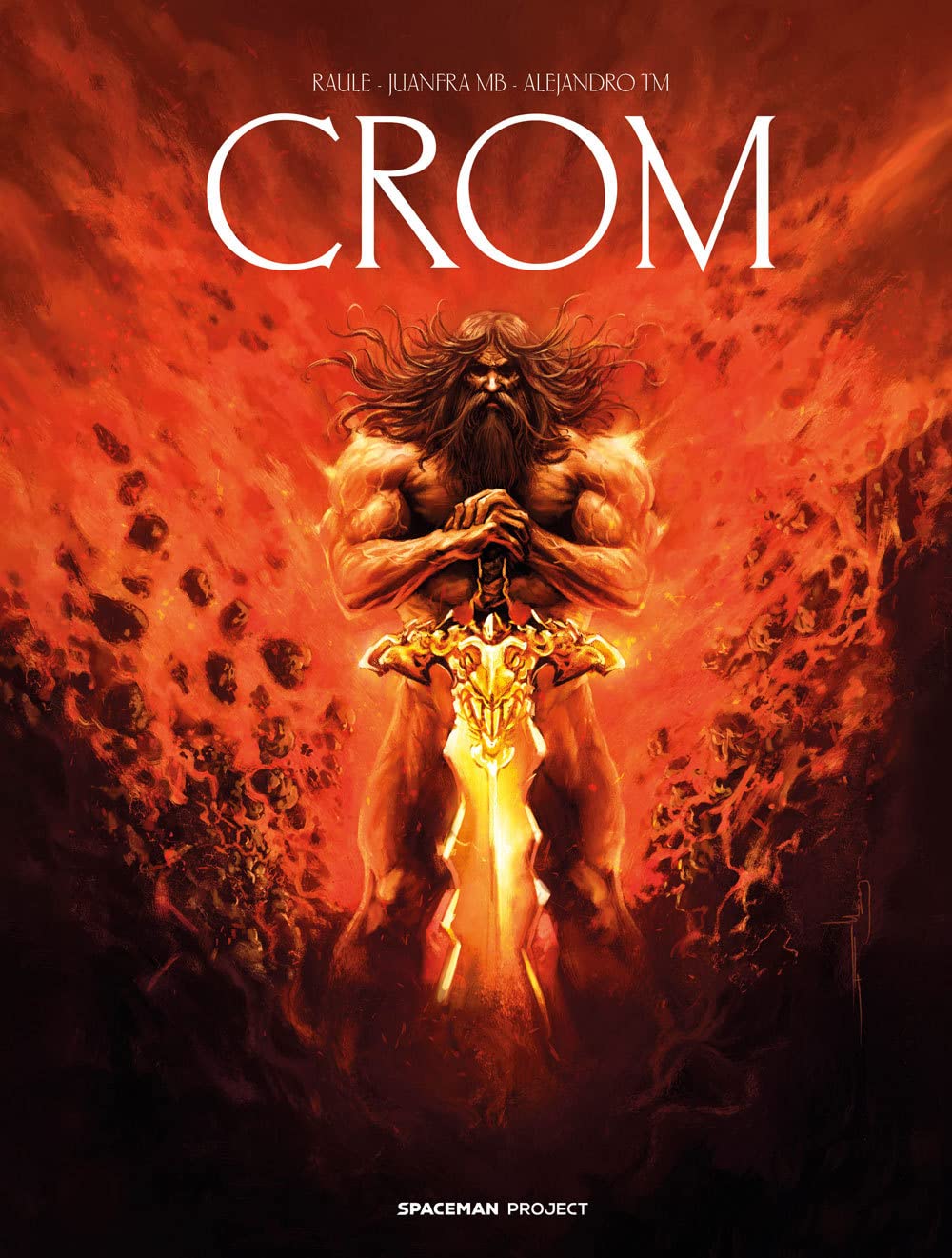
Crom (2022) by Raule, Jaunfra MB, & Alejandro TM

Depuis la nuit des temps, alors que tout n’était que téneberes et silence, les hommes osaient à peine pronouncer son nom, tant il leur inspirait de crainte. Maisie ils ignorant que Crom était né mortel, empli de rage et de haine, avide de connaître son destin dans un monde à l’agonie. Ses yeux aussi noirs que le corbeau portaient en eux le présage d’une pluie de sang éternelle et de rafales de vent tranchantes comme l’acier, semper la vengeance et la mort, anéantir Des civilisations entiéres sur son passage, peu lui important. Il aspiration à devenir le dieu Des dieux et à régner sur toute créature et toute chose. Voici son histoire.Since the dawn of time, when all was darkness and silence, men have scarcely dared to speak his name, so great was their fear of him. But little did they know that Crom was born mortal, filled with rage and hatred, eager to know his fate in a dying world. His raven-black eyes carried the omen of an eternal rain of blood and of steel-sharp winds, sowing vengeance and death, annihilating entire civilizations in his path, mattered little to him. He aspires to become the god of gods and rule over all creatures and all things. This is his story.
Back cover text of Crom (2022).English translation

Crom (2022) is a French-language bande dessinée in homage of Robert E. Howard and his creation Conan of Cimmeria, who swore by Crom. The script was written by Raule, drawn by Jaunfra MB, and colored by Alejandro TM. It is implicitly set long before the age of Conan, and tells what might be a pretty stereotypical blood-soaked, high-octane fantasy story, with some images that could have been ripped straight from a heavy metal album cover.

Chekov’s volcano: if a volcano appears at the start of a fantasy graphic novel, it must erupt by the end.

Men and monsters are killed, there’s very little dialogue and most of the story is told in pithy snippets that try not to get in the way of the artwork.

But who is Crom, really?

“They have no hope here or hereafter,” answered Conan. “Their gods are Crom and his dark race, who rule over a sunless place of everlasting mist, which is the world of the dead. Mitra! The ways of the Aesir were more to my liking.”
—Robert E. Howard, “The Phoenix on the Sword”

“What of your own gods? I have never heard you call on them.”

“Their chief is Crom. He dwells on a great mountain. What use to call on him? Little he cares if men live or die. Better to be silent than to call his attention to you; he will send you dooms, not fortune! He is grim and loveless, but at birth he breathes power to strive and slay into a man’s soul. What else shall men ask of the gods?”
—Robert E. Howard, “The Queen of the Black Coast”

His gods were simple and understandable; Crom was their chief, and he lived on a great mountain, whence he sent forth dooms and death. It was useless to call on Crom, because he was a gloomy, savage god, and he hated weaklings. But he gave a man courage at birth, and the will and might to kill his enemies, which, in the Cimmerian’s mind, was all any god should be expected to do.
—Robert E. Howard, “The Tower of the Elephant”

“Such is not the custom of my people,” Conan growled, “nor of Natala’s either. The Hyborians do not sacrifice humans to their god, Mitra, and as for my people—by Crom, I’d like to see a priest try to drag a Cimmerian to the altar! There’d be blood spilt, but not as the priest intended.”
—Robert E. Howard, “Xuthal of the Dust”

Crom, the name of the god of the Cimmerians in Robert E. Howard’s Hyborian Age adventures of Conan the Cimmerian, is invoked or named in nearly every episode, but very little is said about him. We get an idea of Crom as a sort of patron deity of Cimmerians; powerful, dark, dour, and concerned with fate, but generally uncaring. Howard does not expand on this explicitly in any of his letters, but it’s worth noting that before Conan the Cimmerian called on Crom, Conan the Reaver did:

I had clambered the cliffs—no, by the thunder of Crom, I was still in the cavern! I reached for my sword—
—Robert E. Howard, “The People of the Dark”

“The People of the Dark” (Strange Tales of Mystery and Terror June 1932), features a familiar plot device of Howard’s: a contemporary individual receives a blow to the head and is thrown back into re-living an episode of a past life, in this case the Irish reaver Conan—Conan being a relatively common Gaelic name (e.g. Arthur Conan Doyle, Conan O’Brien, etc.) Howard identified as Irish-American and many of his heroes were Irish or Irish-American too—he later noted in the Hyborian Age essay that in his fanciful history of the world, the Cimmerians were the ancestors of the Celts, and thus the Irish too.

One of Howard’s major conceptual leaps in writing the adventures of Conan the Cimmerian was not just to set the stories before recorded history, but to remove the whole element of past life regression. There is no James Allison to recall his past life as Conan the Cimmerian, Conan’s adventures appear directly on the page, without any framing narrative set in the present day. However, Howard still drew on elements of real world mythology and history in crafting his Hyborian Age.

The Crom that Conan the Reaver swears by is probably intended to be Crom Cruach, a pagan deity of pre-Christian Ireland that Howard may have run across in his studies of Irish history and folklore. This Crom is only known through post-Christian legends, which paint it as an ancient figure of worship that accepted human sacrifice, until the cult-image was destroyed by St. Patrick. The fantasy Crom of Cimmeria is not quite as malevolent (no human sacrifice), and both figuratively and physically more distant, residing atop an unnamed mountain. Howard was free to fudge the details; after all, who was going to correct him?

This image of Crom as essentially distant and dour has persisted through various adaptations; the 1982 Conan the Barbarian movie added a war with giants, a riddle of steel, and a Nordic Valhalla. Various comic adaptations from Marvel and Dark Horse have made Crom a more-or-less humanoid figure who appears only in rare circumstances. For example, in What if? #39, when Thor is sent back to the Hyborian Age, he climbs Crom’s mountain and actually meets with the (literally) dark and vaguely Nordic chief of the Cimmerian pantheon:
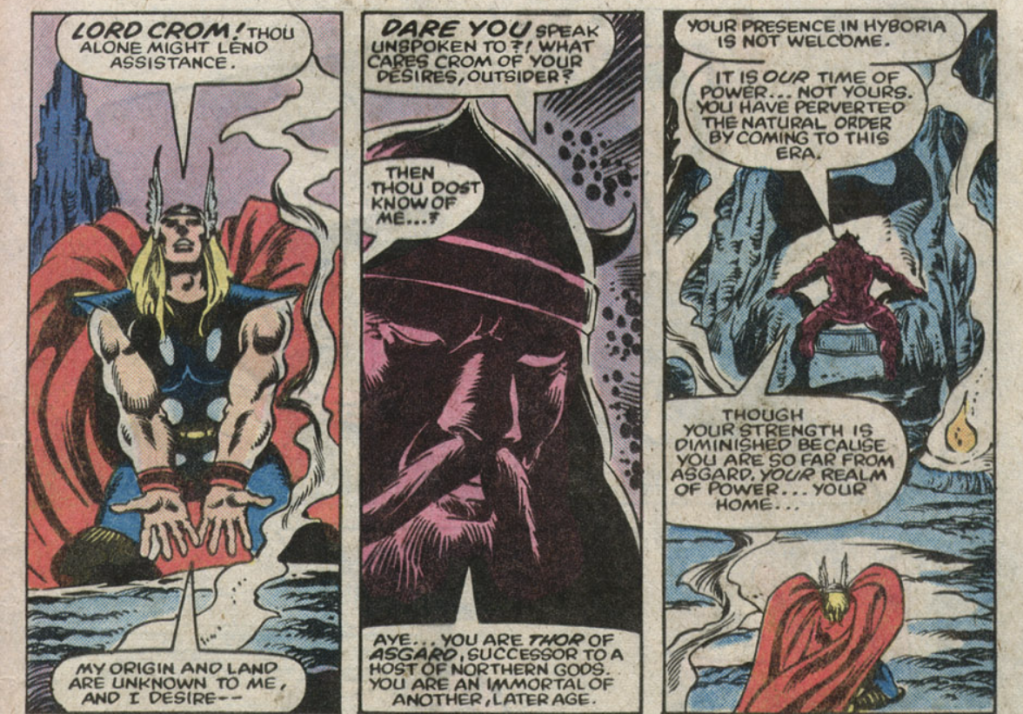
What if? #39 (June 1983). Alan Zelenetz (script), Ron Wilson (pencils), Danny Bulanadi (inks), Janice Chiang (letters), George Roussos (color)

A notable exception is Crom the Barbarian, a Conan pastiche character created by Gardner F. Fox in the 1950s for a few comic strips; this character borrows the name, but nothing else. Like Marvel’s Thor, he even appears blond.

None of these works have really tackled Crom’s origin or expanded much on his mythology; while Conan the Cimmerian might frequently swear by or at his god (or any of the others he’s adopted along the way), there’s been very little written about Crom’s worship or past—and that mostly in roleplaying games.

This is a long way to say that Raule had a free hand when it came to the script, and Jaunfra MB and Alejandro TM could exercise their imagination however they pleased when envisaging Crom and his apotheosis. What they ended up going with was a somewhat stereotypical quest narrative: Crom goes hunting for four artifacts of power, from the ruin of the first city, long sunken to the lairs of various monsters.

With a superhuman physique and strength, Crom slaughters…everyone. Entire armies. Depicted in loving detail, sometimes. Which is really sort of what sets this book off from Conan the CImmerian as Howard first conceived him, and as he is often written.

While many people comment on the artistic portrayals of Conan as this hulking musclebound figure, more brawn than brain, capable of superhuman feats of strength, speed, stamina, and swordplay…the original Conan as Howard first conceived him is very human, very mortal. Strong, but not inhumanly so; tough, but in the way a boxer is tough, able to roll with the punches and soak up punishment, and he does. Conan in “The Phoenix in the Sword” suffers terrible wounds, and only his leonine strength, speed, and skill save him from the assassins out for his hide.

From a meta-perspective, is isn’t likely that the lead character in a successful series is going to die in every fight, and readers might well expect Conan to overcome the odds—he is the hero after all—but generally Conan is in mortal danger for at least part of the story, and tends to overcome the odds with skill and bravery more than any exercise of superhuman power (a notable exception being “A Witch Shall Be Born,” where Conan is crucified…and after he gets his hands free, pulls out the remaining nails himself!)

By contrast, Crom in Crom is nearly superhuman from the get-go, facing major foes but few major injuries, obstacles, or setbacks. This isn’t a grounded, hardboiled tale of sword & sorcery—this is a legend. So when Crom runs out of mortal foes, he faces off against the four ancestral gods.

As an adult, having read many fantasy books and comics, the idea of collecting the four themed artifacts and defeating the four elemental-themed gods may seem a bit basic. If I was a twelve-year-old pouring over the pages of Heavy Metal/Metal Hurlant, however, I’d probably be breathless in awe at how metal this all is. I think everyone involved in the creation of this book understood what they needed to do, and they weren’t going to try and squeeze a lot of metaphysical complications or complex narrative twists into this story. There’s no comedic foil, no love interest, no moral dilemmas.

Sometimes the gods have to die.

In overall style and aesthetic, there are similarities between Crom and Orcs et Gobelins T11: Kronan (2021) by Jean-Luc Istin, Sébastien Grenier, and J. Nanjan. These are artists working within a fantasy milieu where the iconic bodybuilder physique and penchant for big swords has been exaggerated almost to the point of parody; the colors are vivid, but also tend to highlight and oversaturate the atmosphere of the artwork, sometimes adding a lot of emphasis that might have been missing from the original, sparse backgrounds; sometimes muddying the line work a bit.

The real Crom may be only a broken stone figure in Ireland; the Crom of Robert E. Howard’s stories was a distant pagan figure, undefined and possibly better left that way. This is not Robert E. Howard’s Crom.

For what it is trying to be, however—an homage to the concept of Crom, and the superheroic barbarian of comics, film, games, and pastiche—Crom achieves exactly what it set out to be. This incarnation of Crom seems to be almost an over-the-top parody of the comic-book Conan the Barbarian specifically because the Conan of the comics is so often already an exaggerated superheroic figure. Crom needs to be a character that takes all the essence of the Cimmerian and makes the legendary hero into something greater.


Bobby Derie is the author of Weird Talers: Essays on Robert E. Howard & Others (2019) and Sex and the Cthulhu Mythos (2014).

Deep Cuts in a Lovecraftian Vein uses Amazon Associate links. As an Amazon Associate I earn from qualifying purchases.

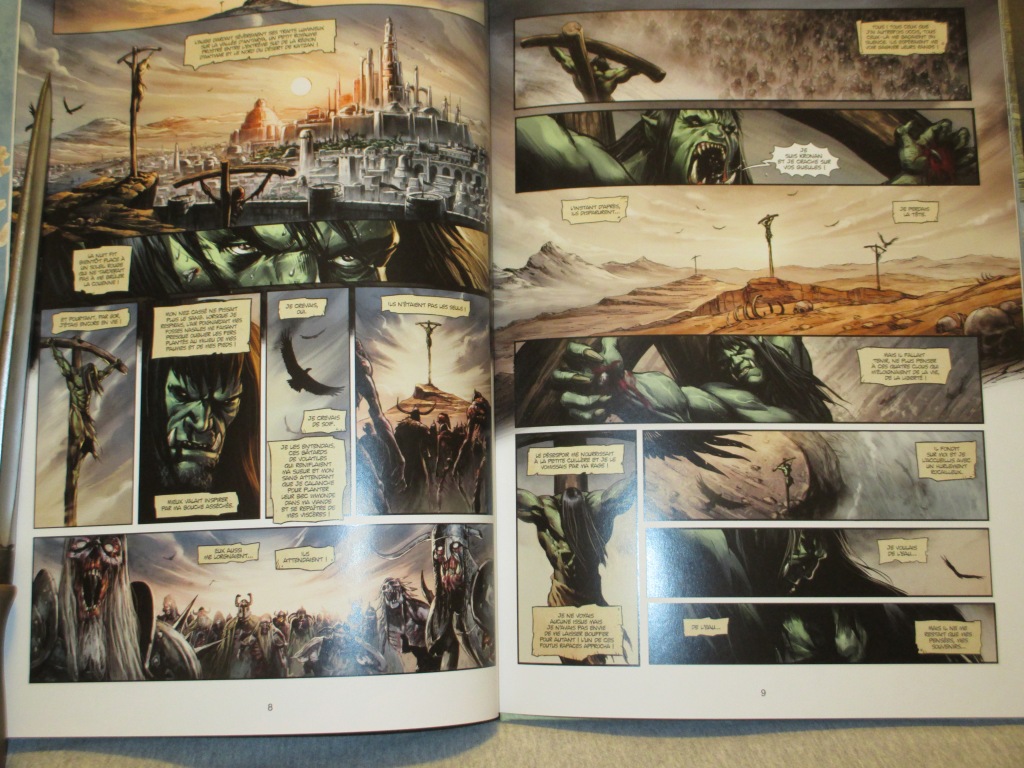
Orcs et Gobelins T11: Kronan (2021) by Jean-Luc Istin, Sébastien Grenier, and J. Nanjan

Antarya traverse une crise des plus graves depuis que la reine Nawell a perdu la raison. Lors d’une trahison de haut vol, elle fait exécuter ses soldats. L’orc Kronan, capitaine de sa garde en réchappe. Pour lui, celle qui dit se nommer Nawell est une usurpatrice et il compte bien le prouver mais aussi se venger. Et quand Kronan se venge, il trace toujours un sillon de sang sur son chemin.Antarya is going through a serious crisis since Queen Nawell lost her mind. In a high-level betrayal, she has her soldiers executed. The orc Kronan, captain of his guard, escapes. For him, the woman who says her name is Nawell is a usurper and he intends to prove it but also take revenge. And when Kronan takes revenge, he always leaves a trail of blood in his path.
Back cover copy for Orcs et Gobelins T11: KronanEnglish translation

The publication of J. R. R. Tolkien’s works The Hobbit (1937), The Lord of the Rings (1954-1955), and The Silmarillion (1977, with Christopher Tolkien and Guy Gavriel Kay) fundamentally changed the landscape of contemporary fantasy. Not just because of what J. R. R. Tolkien created and its enduring popularity, but because his approach to fantasy races and world-building set a high standard which many writers then took as a template for their own works. While Tolkien was not alone in creating fantasy worlds—Lord Dunsany’s The Gods of Pegāna (1905), E. R. Eddison’s The Worm Ouroboros (1922), and Poul Anderson’s The Broken Sword (1954) all preceded The Lord of the Rings—Tolkien’s conception of elves, dwarves, hobbits, ents, orcs, goblins, et al. strongly influenced the public imagination. This can especially be seen in tabletop games like Dungeons & Dragons and Warhammer Fantasy, computer games inspired by those works such as World of Warcraft, and novels such as Dennis L. McKiernan’s Mithgar series.

Robert E. Howard’s fantasy in the pages Weird Tales in the 1920s and 30s represents a very different kind of fantasy. There are fewer distinct fantasy races in Howard’s work; there are no elves and goblins per se. The Children of the Night from “Worms of the Earth” (Weird Tales Nov 1932) and other tales are inspired by the Little People stories of Arthur Machen, but shaped by Howard’s correspondence with Lovecraft, have taken a very different form. They are not servants of a Satanic Morgoth or Sauron, nor are they corrupted elves or even inherently evil in a purely good-and-evil sense. The morality of Howard’s tales is always murkier, the racial politics more complicated, and that tarnished air, that hardboiled sensibility where there is no true good and evil, no ultimate victory for the forces of light or darkness, just men and women and things beyond human ken interacting according to their own needs and desires is part of what sets Howard’s fantasy distinctly apart from Tolkien.

Whether you call it sword & sorcery, heroic fantasy, or something else, Howard’s bloodier, grimier, but very approachable brand of fantasy had an equal influence with Tolkien on later writers. Tolkien may have helped define orcs, elves, and dwarves for a few generations, but Howard helped define the thief, barbarian, and mercenary man-at-arms as iconic roles. They both had their own contributions in terms of magic rings and magic swords, and they had a penchant for taverns and themes of kingship. While their ethos and style sometimes clash, their joint influence on fantasy is undeniable…and sometimes more strongly felt together.

In 2013, French comics publisher Soleil began producing a series of bandes dessinées: Elfes Tome 1: Le Crystal des Elfes Bleus was published in 2013, and became popular enough to become an ongoing series. These were set in a very generic Dungeons & Dragons-derived fantasy world called Arran. The series was popular enough to merit several spin-off series of various levels of popularity: Nains (Dwarves, 2015), Orcs & Gobelins (Orcs and Goblins, 2017), Mages (2019), Terres d’Ogon (Lands of Ogon, 2022), and Guerres d’Arran (Wars of Arran, 2023). As with D&D itself, this is very specifically riffing off of the popular conception of fantasy races derived from Tolkien, but the world is grimier, more visceral, a bit more hardboiled—Tolkien as filtered through Howard, in a sense.

Jean-Luc Istin is a veteran of the series, having written several of the preceding volumes of Elfes and Orcs & Gobelins, and for the 11th tome in the O&G series, he partnered up with Sébastien Grenier (artist) and J. Nanjan (colorist) to produce something kind of special: a re-telling of Robert E. Howard’s “A Witch Shall be Born” (Weird Tales December 1934) set in the world of Arran, and starring not Conan the Cimmerian, but Kronan the Orc.

Copyright law in France works a little differently than in the United States. During Robert E. Howard’s lifetime, the Berne Convention would guarantee his works would remain under copyright for at least 50 years after his death (since Howard died in 1936, that would mean 1986); in France, the general term is 70 years after the author’s death (i.e. 2006). Either way, Howard’s works are generally considered in the public domain in France (although international trademarks may still apply). Even if copyright was an issue, Kronan might still pass as an homage…but not a parody.

While the concept of Conan as an orc might sound silly, the creative team between Kronan plays it very straight. Kronan is a hulking, musclebound figure that takes very strong artistic influence from the fantasy bodybuilder culture that Frank Frazetta’s paperback covers, John Buscema’s comic book Conan for Marvel, and Arnold Schwarzenegger’s turn as Conan in Conan the Barbarian (1982) all helped to inspire, and readers can clearly see in the absolutely ripped muscles, the deep-set eyes, and long hair various influences from all three mashed together. Yet this is not just Conan with tusks and green face paint.

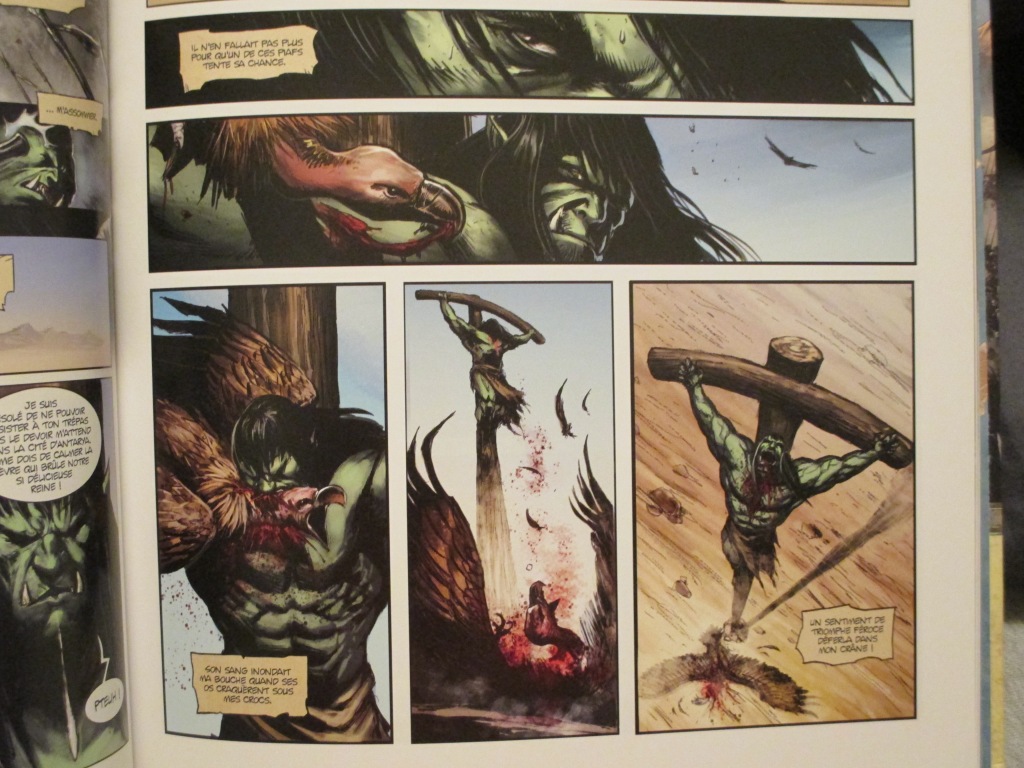
While Kronan follows the general outline of Howard’s story, and includes adaptations of many of the famous scenes—including Kronan on the cross, which was borrowed into the 1982 film—in adapting the story from Hyboria to Arran, the creators have shifted many of the details to fit the new setting. Instead of Crom, Kronan swears by the Orc deity Gor, for one example. In adapting the prose text to comic format, they’ve also veered away from some of the hallmarks of Howard’s narrative style in this story.

It is a weird penchant in Howard’s works that in several of the Conan stories, Conan himself takes a while to appear. The first chapter of “A Witch Shall Be Born” doesn’t mention Conan at all; it features Queen Taramis in her bed chamber, confronted by her twin sister. When Conan is first mentioned in chapter two, it is just that—a mention. The soldier Valerius is telling his sweetheart what happened. So we don’t actually see Conan in the story proper until he is crucified and on the cross.

In Kronan, by contrast, the narrative device is shifted: it is an older orc on a throne that is telling the story. We skip the bedroom scene with the queen (Nawell in place of Taramis) and see her attack her loyal army and citizens, and has Kronan crucified (as seen in a flashback-within-a-flashback). Where Howard had chapter 3 as a letter written to Nemedia about what all has happened, in the comic Kronan meets someone who tells him some these things, and we get a glimpse of Kronan doing some investigations of his own, breaking into a library to learn a bit of eldritch lore at knife-point.

Some aspects of the story are removed or simplified; we don’t actually see Kronan pull the nails out of his own flesh, as we did when Roy Thomas and John Buscema first adapted “A Witch Shall Be Born” to comics in Savage Sword of Conan #5 (1975); the crystal ball and acolyte by which the witch surveys the battle doesn’t feature either. Much of the architecture and landscaping is, for lack of a better term, more generically fantasy in aspect, with huge towers and walls, vast arched libraries carved into the solid earth, huge domed chambers like pagan cathedrals, etc. Arms and armor are likewise much more generic fantasy in design, less realistic than Howard’s descriptions, but more in keeping with the setting of Arran.

Eldritch entities are decidedly less toad-like.

However, we do get some rather inspired artistic decisions. Kronan is the only Orc in the entire book, much as Conan was the only Cimmerian in Howard’s series; the one greenskin among a group of otherwise human characters makes him stand out all the more. Also, the occasional epic page-spread that really gives a sense of scale worthy of the series.

Taken together, the changes streamline the story and focus it more on Kronan himself. A lot of the exposition where a character talks about Conan become tales told to Kronan, or scenes that the reader sees directly; Kronan takes a more active and central role in unraveling the central mystery of the witch in the narrative, and there are fewer secondary characters to keep track of. The bones of Howard’s story are there, but Kronan is much more the focus, and the world is much more one familiar to gamers and Tolkienian fantasy fans than the Hyborian Age.

Yet for all that, it’s fun. There’s never been an adaptation quite like this, and never one that didn’t veer into winking at the reader or lapsing into parody, as when Mark Rogers adapted Howard’s Conan tale “Beyond the Black River” (Weird Tales May-Jun 1935) as “Beyond the Black Walnut” in The Adventures of Samurai Cat (1984). It is faithful to the mood and tone of Howard’s story, and Howard’s conception of Conan, while also making allowances for the different medium, the different setting, and the artistic allowance where a fantasy orc barbarian can ride a massive horned ox into battle while wielding a fifty-pound sword one-handed.

To the memory of Robert E. Howard.

Perhaps needless to say, this is also fun. Sébastien Grenier’s art hits that sweet spot between the almost self-parody of Warhammer Fantasy and the more realistic tone or the Dungeons & Dragons 3rd edition Player’s handbook. J. Nanjan’s coloring work is solid; while I might like to see what a black & white version looks like some day, the vividness of the colors used on the cover really makes the banners pop, and the use of light and darkness on the interiors in muted tones really works. I think a different colorist would have been tempted to make things brighter or darker, which would have ruined the effect and made the whole work much too cartoonish.

While the series has begun to be translated into English, Orcs & Gobelins Tome 11: Kronan is still available primarily in French.


Bobby Derie is the author of Weird Talers: Essays on Robert E. Howard and Others and Sex and the Cthulhu Mythos.

Deep Cuts in a Lovecraftian Vein uses Amazon Associate links. As an Amazon Associate I earn from qualifying purchases.
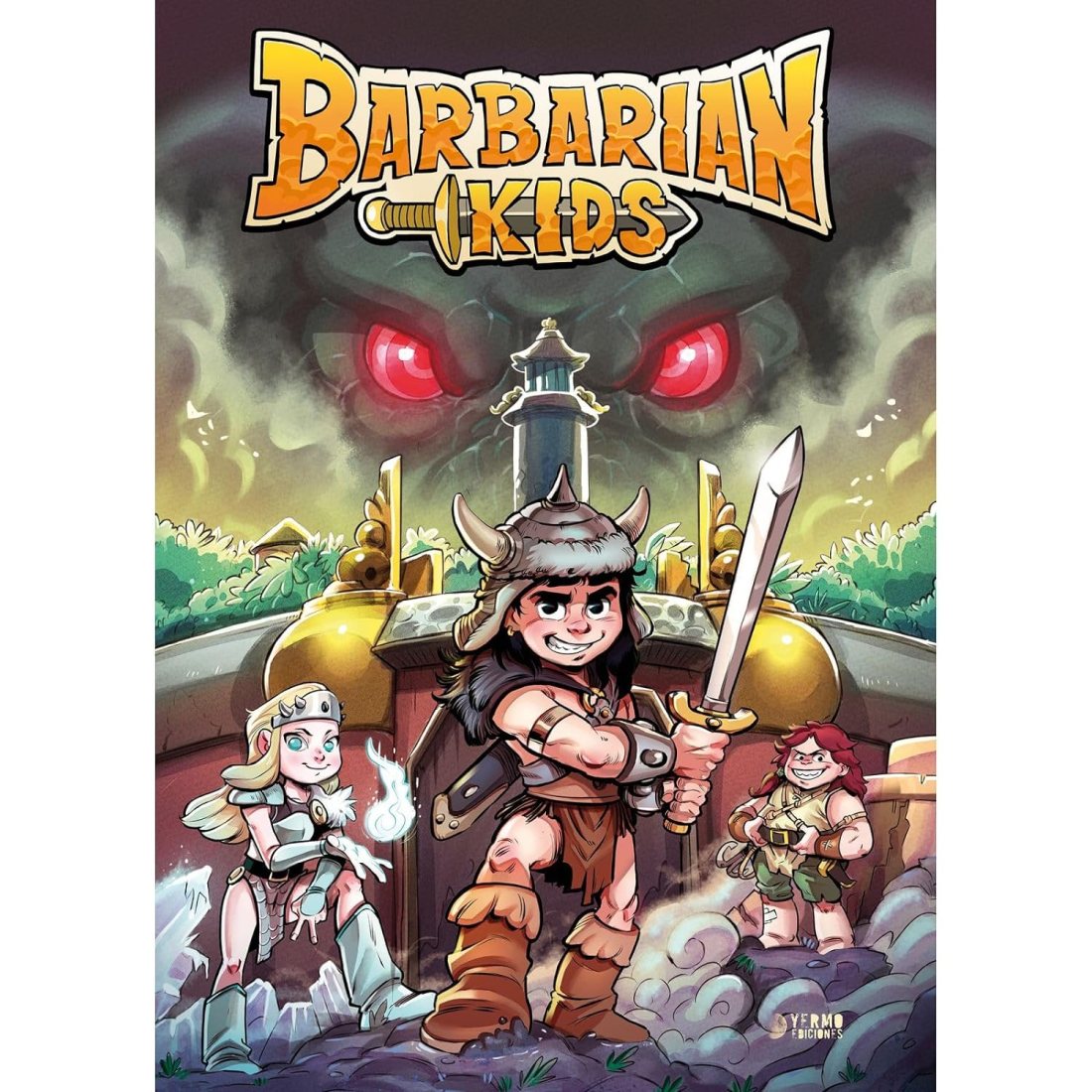
Barbarian Kids 1: La Torre del Elefante (2023) by Nacho Golfe & Dani Peña

When Robert E. Howard sat down at his typewriter to pound out another adventure of Conan the Cimmerian, there is no indication that he had any explicit age range in mind for the audience. Weird Tales was not an all-ages magazine by any stretch of the imagination, but anecdotes show its readers ran from young teens to college students, to grown men and women well into their professional lives. The artistic and literary content leaned toward a more mature audience, what with the occasional nudity, graphic violence, scary monsters, and dabbling in blasphemy and the occult, sometimes even torture and guarded references to more salacious fare such as incest and castration.

Conan the Cimmerian was right at home in Weird Tales, his adventures seldom as spicy as the Spicy pulps, or as gruesome as the Shudder pulps, but definitely at the upper limit of what was deemed acceptable by editor Farnsworth Wright—who sometimes censored stories that went too far over the line in some particular. It can be fairly said that whomever Conan was for in the 1930s, he was not explicitly aimed at kids.

The general audience for Conan remained somewhat ambiguous in the decades after Robert E. Howard’s death. The Gnome Press hardback collections of Conan’s adventures in the 1950s were priced above what the average kid could afford; the paperback reprints and collections put out in the 1960s and 70s were more affordable and accessible, but while the Frank Franzetta covers no doubt caught a few eyes and won a few converts among the younger audience, the paperbacks weren’t explicitly marketed to children.

Then in 1970, Marvel Comics published Conan the Barbarian #1. The formation of the Comics Code Authority in 1954 substantially altered the comics landscape in the United States over the subsequent decades; where before comics had been written, illustrated, and marketed for many audiences, some for children and others for adults, the blanket censorship of the CCA meant that nearly all of the comics sold on newsstands and to the direct market were now aimed almost exclusively at children and teenagers. While Conan the Cimmerian didn’t run around in body-hugging spandex fighting Communists, he still had to conform to a code that resigned in the gore, the sex, and sometimes the morality.

It was the beginning of the kidification of Conan.

Not that the Cimmerian went down without a fight. Marvel launched The Savage Sword of Conan in 1974 through its Curtis Magazines imprint, which allowed it to bypass the CCA and tell stories with more nudity and gore. The 1982 film Conan the Barbarian was given an R rating for nudity and violence—despite the fact that Mattel, who was trying to develop a Conan toy line, asked them to ease up:

Kalinske also worried that the Conan film might be too violent or sexually suggestive to merit an R rating from the Motion Picture Association of America, and he proposed that they “discuss how we might deal with that.”
Conan Properties, Inc. v. Mattel, Inc., 712 F. Supp. 353 (S.D.N.Y. 1989)

Conan the Destroyer (1984), cut down on both sex and violence, and was able to secure a PG rating. The success of the films led to a Universal Studios attraction, The Adventures of Conan: A Sword & Sorcery Spectacular (1983-1993, video), and an animated show Conan the Adventurer (1992-1993), a highly bowdlerized version of the character far removed from Howard’s original conception. The follow-up animated series, Conan and the Young Warriors (1994) was aimed even more directly at younger viewers.

No gore, no sex, and not much in the way of moral ambiguity or complex plotting.

All during this same period, plenty of Conan material was being published for older audiences, from New pastiche novels to reprints of Howard’s original. Conan’s career in the comics waxed and waned with the decades, but has fairly consistently remained aimed primarily for more mature readers, without slipping into either outright pornography (except through bootleg productions like the Red Sonja & Conan: Hot and Dry Tijuana bible) or the more gory excesses of some small press comics like Crossed from Avatar Press.

The question might be asked: so why was Conan kidified at all?

We might as well ask why Norse mythology was bastardized into the blonde, blue-eyed Thor of Marvel Comics, or why Count Chocula wears an opera cape in the style of Bela Lugosi. The writers and artists that shape these works are drawing freely from the original source material, but without excessive concern for accuracy—they’re recycling and repurposing the material for their own ends. As with any adaptation, the end result may barely be recognizable. The Cthulhu plushies sold, cute and cuddly and green as they are, share little more than a name with H. P. Lovecraft’s hulking mountain of an extraterrestrial High Priest of the Old Ones in sunken R’lyeh.

These new works have to be read on their own merits. There’s no point in comparing Lovecraft’s original works to Howard Lovecraft and the Three Kingdoms or Mary Shelley’s School for Monsters: La Llorona in the Machine; the intended audiences and implicit sensibilities are completely different. So it is with Robert E. Howard’s “The Tower of the Elephant” and Barbarian Kids 1: La Torre del Elefante.

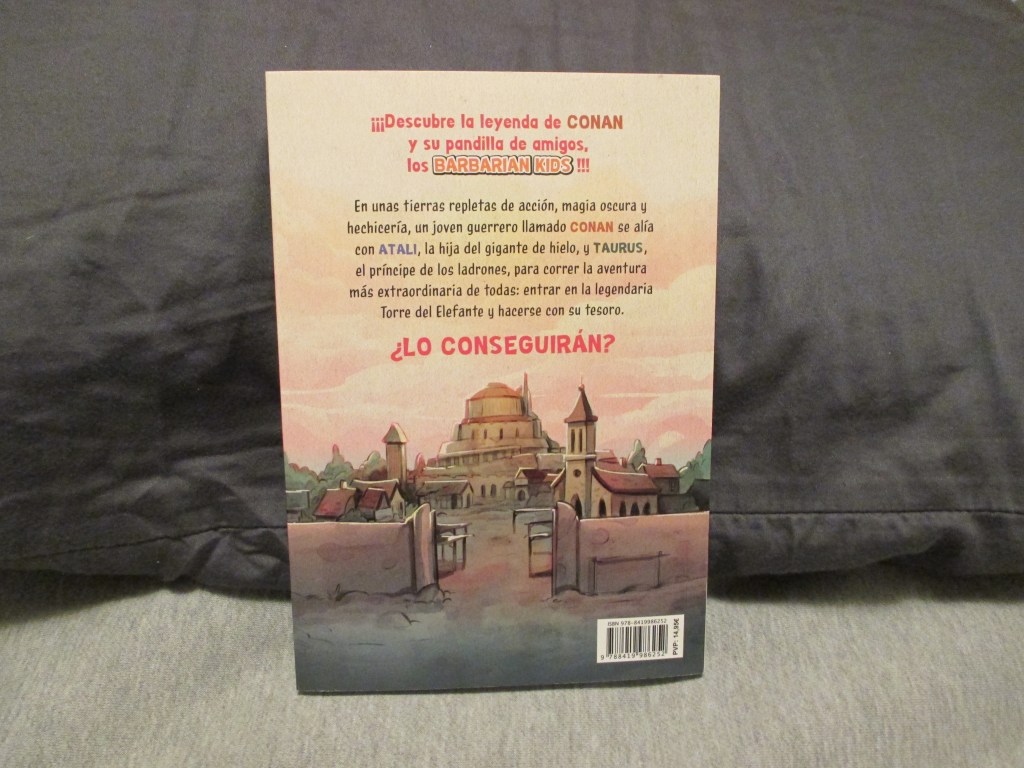
¡¡¡Descubre la leyenda de CONAN y su pandilla de amigos, los BARBARIAN KIDS!!!

En unas tierras repletas de acción, magia oscura ya hechicería, un joven guerrero llamado CONAN se alía con ATALI, la hija del gigante de hielo, y TAURUS, el príncipe de los ladrones, para correr la aventura más extradorindaria de todas: entrar en la legendaria Torre del Elefante y hacerse con su tesoro.

¿LO CONSEGUIRÁN?
Discover the CONAN legend and his gang of friends, the BARBARIAN KIDS!!!

In a world full of action, dark magic and sorcery, a young warrior called CONAN teams up with ATALI, the frost giant’s daughter, and TAURUS, the prince of thieves, to run the most extraordinary adventure of all: enter the legendary Tower of the Elephant and get their hands on its treasure.

WILL THEY SUCCEED?
Back cover copyEnglish translation

Barbarian Kids is an illustrated novel in Brazilian Portuguese by Nacho Golfe (writing) & Dani Peña (illustrations) which tells a highly bowdlerized version of Howard’s epic tale of a young Conan in Shadizar. In this story, Conan is adolescent, and his partners-in-crime are Taurus (from the original story) and Atali (very loosely adapted from “The Frost Giant’s Daughter,” but with powers reminiscent of Elsa in Frozen, and prefers to generate ice daggers). The trio successfully brave the tower’s difficulties, encounter the elephant-headed Yag-Kosha…and then overcome Yara, the evil wizard who imprisoned Yag-Kosha. In a duel of magic, the evil wizard is vanquished into a gem, the Heart of the Elephant…and everyone lives happily ever after.

The 144-page book switches between mostly text with illustrations, to full-on comic pages. The script is fairly dialogue-heavy.

For a fantasy adventure aimed at the younger market, it’s easy to see why “The Tower of the Elephant” was chosen: this is the story with one of the chronologically youngest Conan (“The Frost-Giant’s Daughter” is presumably younger), and is as close to a traditional dungeon crawl adventure as Conan ever went on. Many of the changes made are sensible. Making Conan younger makes him more identifiable to younger readers; adding Atali to the mix makes it more attractive to girls; there is very little blood, and nobody dies. This is supposed to be a fun adventure for impressionable little minds, not a horror story to scare them.

Golfe and Peña do their jobs; the story moves along at a quick pace, the text is designed to be engaging, the more action-packed sequences are rendered as comic panels in a half-graphic novel layout, there’s a puzzle involving gems, a lesson about teamwork is learned, and the heroes are rewarded for saving Yag-Kosha and overcoming the wizard.

Rather than human guards, Conan & Co. face mechano-magical guardians, a lion, a snake, a giant venomous spider, and a puzzle involving various gems.

What they have achieved is fine. Kids will no doubt love it. Yet they have also robbed the story of any depth. There’s no reason for this to be a Conan story anymore. When Roy Thomas and Barry Windsor-Smith adapted “The Tower of the Elephant” in Conan the Barbarian #4 (1971), comic book readers used to seeing heroes defeat and slay evil monsters were confronted with a tragic figure, broken on the rack. A creature that had flown through space, now confined to its tower in a crippled body. There was only one escape possible, and the stroke that Conan gave was one of mercy—and vengeance.

Like many artists, Yag-Kosha is depicted as having a literal elephant’s head.

Roy Thomas notes in Barbarian Life: A Literary Biography of Conan the Barbarian Vol. 1, that in the latter half of the story, Conan is little more than a spectator, first as Yag-Kosha recounts how he came to this place, and then as a witness as the Cimmerian brings the Heart of the Elephant to Yara. This was not an uncommon device of Howard’s; many of his stories begin with a stirring opening, but feature a long and evocative historical narrative, vision, or dream that fills the expository needs of the story, explaining or hinting at some of the vast and shadowy background, so that the conclusion of the story is often the conclusion of a historical epic.

Yag-Kosha’s backstory is dealt with briefly.

In Barbarian Kids 1, the epic of Yag-Kosha’s backstory is about four pages. The confrontation with Yara is not the foregone conclusion it is in Howard’s story; the three principals fight Yara in a duel of swords and sorcery. There is no mercy-stroke, no sacrifice. The idea of Conan as a witness to the end of some great history has vanished. The grandeur and cosmic sweep of Howard’s story are gone…and there is something inexpressibly sad about that, because that was what made “The Tower of the Elephant” so special.

It is a different story. Not a bad story, it is entertaining enough, the art is lively, the mix of fonts and lettering is eye-catching and probably perfect for younger readers. Perhaps, when the kids who read it get a bit older, they’ll read Howard’s original story and find out what they’ve been missing. I hope so.

Coming soon: volume 2: Red Nails and volume 3: The Phoenix on the Sword.

Bobby Derie is the author of Weird Talers: Essays on Robert E. Howard and Others and Sex and the Cthulhu Mythos.

Deep Cuts in a Lovecraftian Vein uses Amazon Associate links. As an Amazon Associate I earn from qualifying purchases.

“Sob As Trevas” (2020) by Douglas Freitas & Chairim Arrais and “Aeons” (2019) by Salvador Sanz

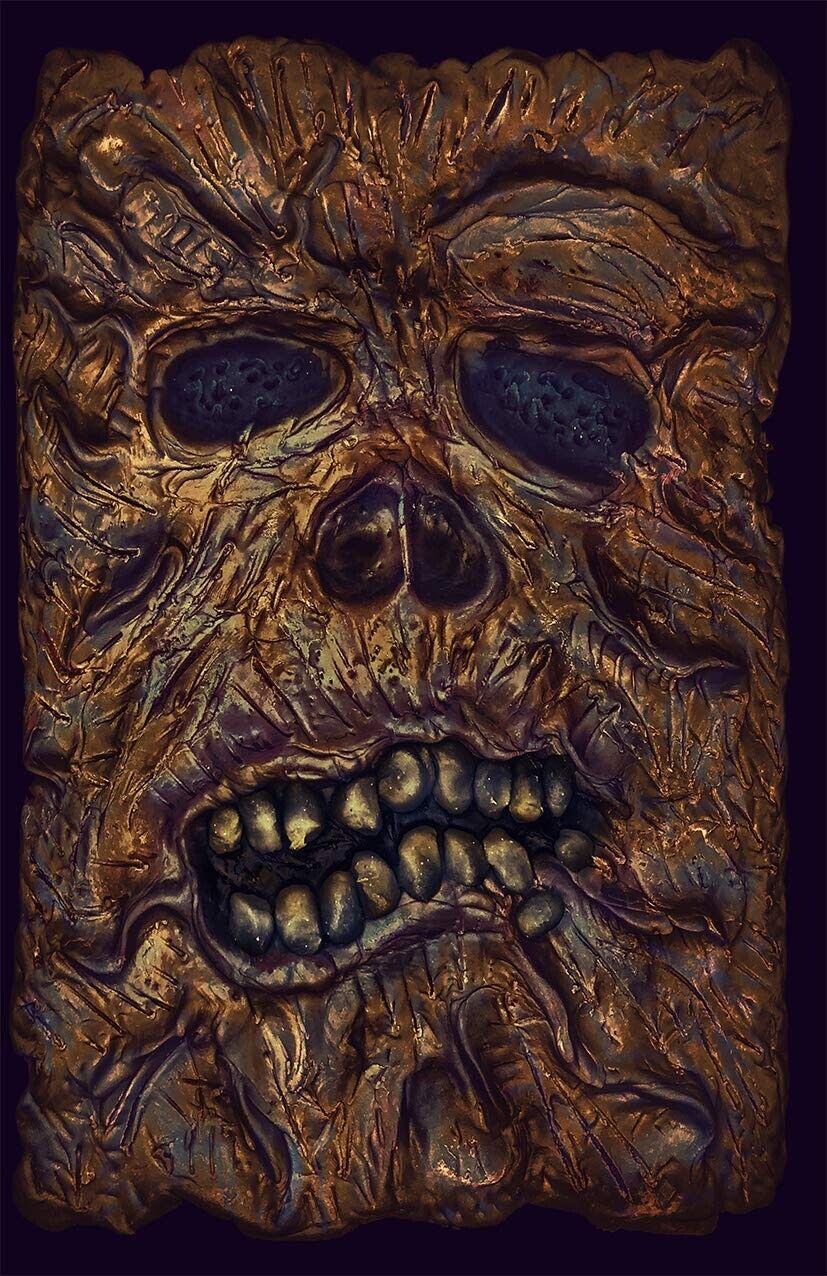
Os Mitos de Lovecraft (2020) is a crowdfunded Brazilian black-and-white graphic anthology edited by Douglas P. Freitas and published by Skript, probably best known for the deluxe hardcover edition which has a cover modeled on the bound-in-human-skin Necronomicon ex Mortis from Evil Dead 2 and Army of Darkness. Like its fellow Brazilian Lovecraftian anthology O despertar de Cthulhu em Quadrinhos (2016), while there is a common theme in terms of subject, the style and tone of the individual works inside varies considerably. Every style of comic art and horror can be represented under the broad remit of Lovecraftian comics, from straight adaptations of Lovecraft in exquisite realistic depiction to splatterpunk-esque gore fests with plenty of airbrush-style gore streaks to lighter works with more cartoonish tentacled Cthulhu-esque characters.

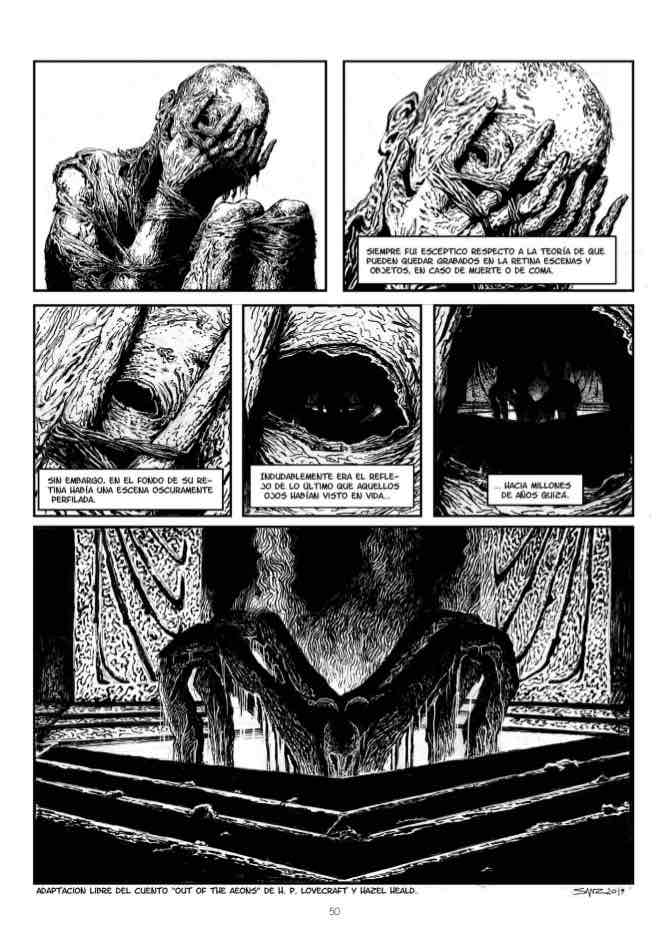
The anthology begins with an absolute masterpiece in two pages, by Argintenean artist Salvador Sanz, which originally appeared in the Spanish-language graphic horror anthology Cthulhu 23; for this anthology, it was translated into Brazilian Portuguese by Aline Cardoso and re-lettered by Johnny C. Vargas. This is a distillation of “Out of the Æons” (1935) by Hazel Heald & H. P. Lovecraft, subtracting all the human characters, the drama, and the fantastic history deciphered from the scroll in exchange for focusing on a masterful rendering of the mummy who caught a glimpse of Ghatanothoa—and paid the price.

In a cinematic journey, the reader is taken closer and closer to the ancient petrified horror. The panels zoom in on the one eye that peeks out between gnarled fingers. To the dark image that is still captured there, on the retina. The detail on the art, the pacing, and the execution of the concept, which boils down the essence of the Lovecraft/Heald horror story into two pages, is exquisite.

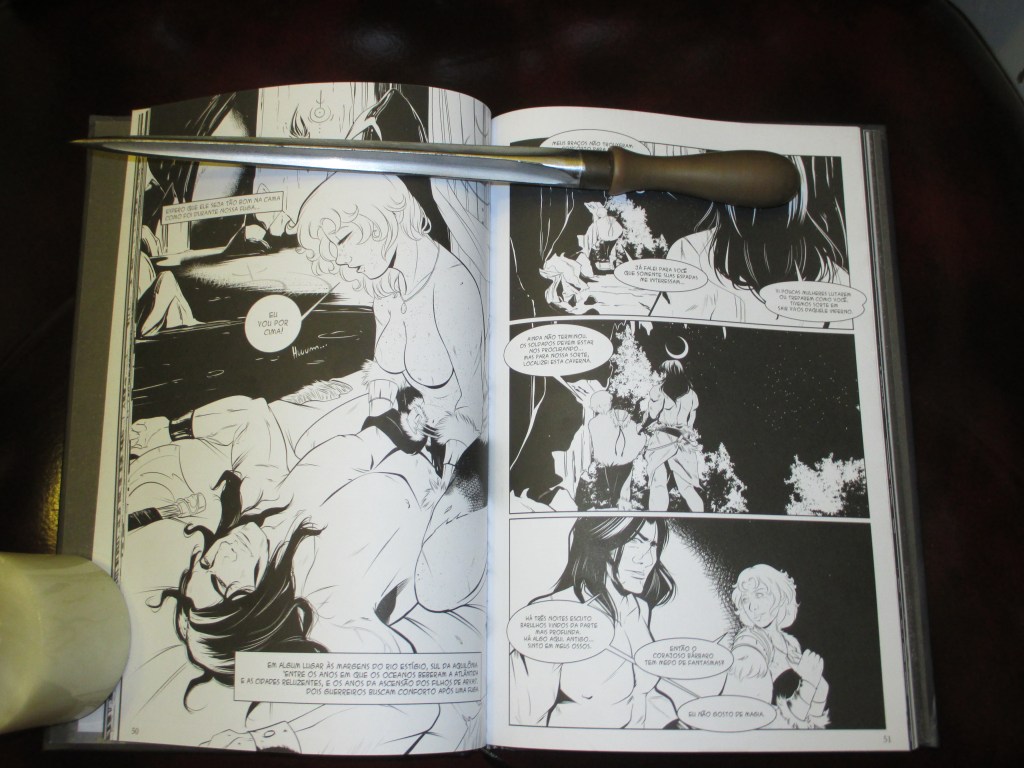
Freitas’ own contribution to Os Mitos de Lovecraft is “Sob As Trevas” (“Beneath the Darkness”), in collaboration with illustrator and comic creator Chairim Arrais. This is a tongue-in-cheek 8-page sword & sorcery story involving a nameless Cimmerian warrior and their female partner Ruivas (“Red”/”Red-hair”). Freitas & Arrais are clearly referencing Robert E. Howard’s most famous creation, Conan the Cimmerian, and aren’t coy about it:

Os Mitos de Lovecraft pp.51-52
Em algum lugar às margens do rio Estígio, sul da Aquilônia, ‘entre os anos em que os oceanos beberam a Atlântida e as cidades reluzentes, e os anos da ascensão dos filhos de Aryas’. Dois guerreiros buscam conforto após uma fuga.Somewhere on the banks of the River Styx, south of Aquilonia, ‘between the years when the oceans drank Atlantis and the gleaming cities, and the years of the rise of the sons of Aryas’. Two warriors seek comfort after an escape.
Os Mitos de Lovecraft page 51English Translation
“KNOW, oh prince, that between the years when the oceans drank Atlantis and the gleaming cities, and the years of the rise of the Sons of Aryas […]”
—Robert E. Howard, “The Phoenix on the Sword”

The character Ruivas is depicted similarly to the eponymous character in Arrais’ standalone comic “Red+18”; whether this is intended as an unofficial crossover, an Easter egg for fans of Arrais’ work, or just a coincidence—the character could as easily be a play on Red Sonja for the Marvel Comics, albeit sans the trademark mail bikini—is unclear, and maybe unimportant.

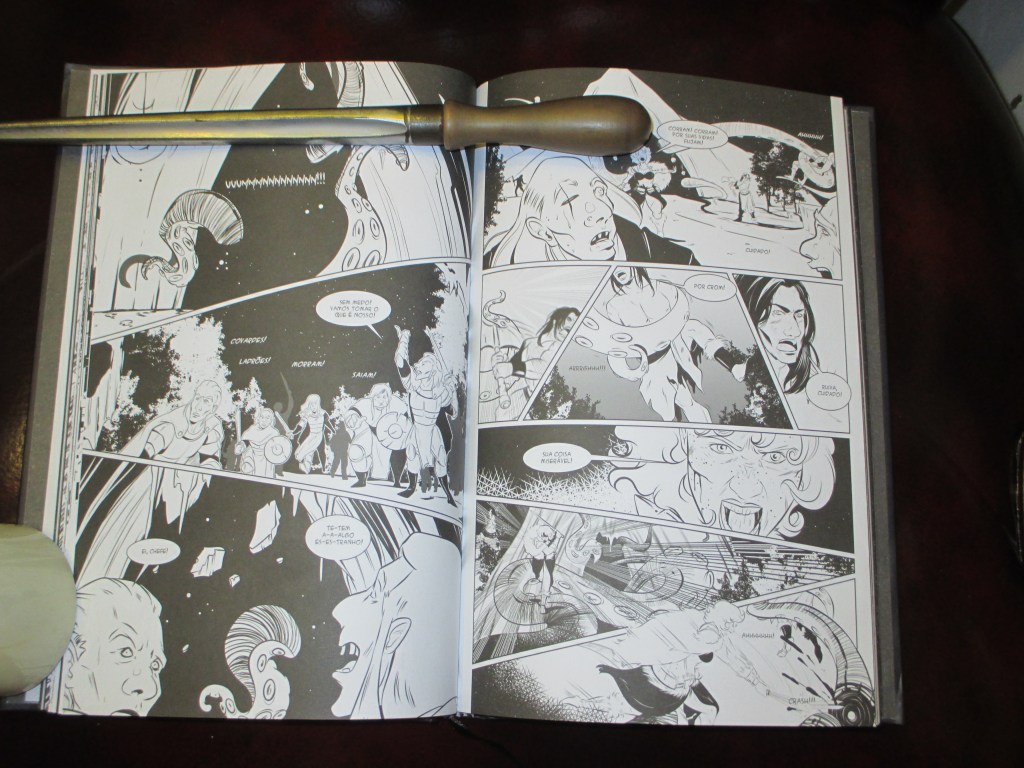
The story itself is fairly slight and straightforward: after successfully stealing a jewel, the pair of thieves hide out in a convenient cavern…which ends up being occupied by some nameless eldritch horror.

Ei, Chefe!

Te-tem a-a-a-algo es-es-tranho!
Hey, Boss!

Th-there’s s-s-something s-strange!
Os Mitos de Lovecraft page 54English translation

The story really wanted more pages; there’s little opportunity to really develop any atmosphere before the tentacles emerge from the darkness, and the action sequences are correspondingly cramped and staccato-like, crammed into increasingly more panels per page. With the in media res debut, the titillation, and the swift conclusion, this is strongly reminiscent of the kind of back-up feature that sometimes ran in Savage Sword of Conan, more of a sketch of an interlude than a full-fledged story.

Yet what there is there is fun. The writing is light-hearted, the chemistry between legally-not-Conan and Ruivas is alternately playful and rocky, and Arrais’ artwork does everything the script calls for. The brief sword & sorcery interlude sets a different tone than the other stories in the anthology, featuring more sex and action than horror or outright comedy. While I would have liked for it to delve more into the Howardian vibe of horror that permeated tales like “Xuthal of the Dusk” or “Red Nails,” limitations of space have to be acknowledged. Still, it would be nice if Freitas & Arrais had the opportunity to revisit the idea at a longer length more suitable to develop the characters and story at some point.


Bobby Derie is the author of Weird Talers: Essays on Robert E. Howard and Others and Sex and the Cthulhu Mythos.

Deep Cuts in a Lovecraftian Vein uses Amazon Associate links. As an Amazon Associate I earn from qualifying purchases.

“Jirel of Joiry: Into The Violet World” (1987) by C. L. Bevill and “Werewoman” (1994) by Roy Thomas, Robert Brown, Rey Garcia, and Susan Crespi

Why aren’t there more C. L. Moore comics?

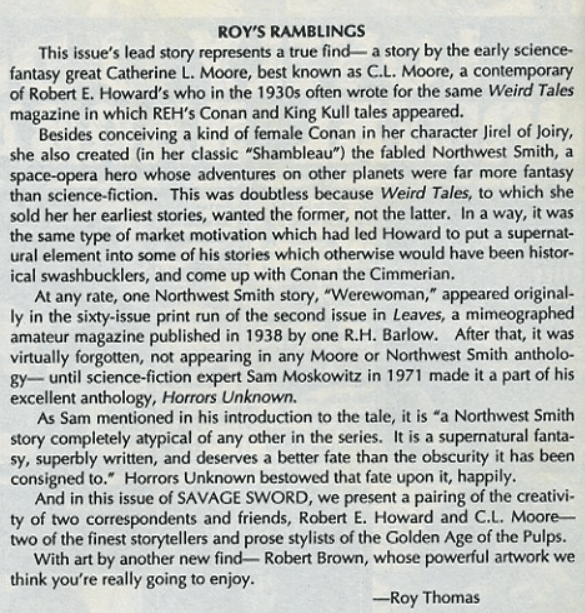
Catherine Lucille Moore was a contemporary and correspondent of Robert E. Howard and H. P. Lovecraft; she was published in the same pulp magazine, Weird Tales, even collaborated with them on the round robin “The Challenge From Beyond” (1935). Her first story, “Shambleau” (1933), was an immediate hit with readers and weird fiction writers alike, and introduced the world to Northwest Smith, who would go on to star in a series of tales from Moore’s typewriter. Her next creation for Weird Tales, the flame-tressed swordswoman Jirel of Joiry in “Black God’s Kiss” (1934), was hailed as a female Conan.

In general outline, the Conan and Jirel publishing timeline largely lines up as well. Conan’s last original story in Weird Tales was in 1936; Jirel’s in 1939. Gnome Press published the first Conan hardcover in 1950, and the Jirel hardcover collection in 1954; paperback reprints for both appeared for both characters in the 60s as part of the general paperback Sword & Sorcery/fantasy boom. Sure, there were more Conan stories and they were more popular—is that the only reason why Robert E. Howard’s Conan the Cimmerian got the big break into comics when Jirel didn’t?

The boring, practical answer is probably “money.” Licensing a character, even an old pulp character, costs money, and anyone who did want to license Jirel for comics would have gone through C. L. Moore’s agent. Even relatively big publishers like Marvel had to balance cost versus popularity; according to Roy Thomas in Barbarian Life vol. 3, Marvel first approached Lin Carter’s agent about licensing Thongor of Lemuria because they thought Conan would be too expensive. Demographics might also have played a role; women warriors in fantasy have a long history, but in print and in comics, male characters dominated, as Nancy Collins noted when a very different red-haired swordswoman hit the page:

I was thirteen years old when I first saw Red Sonja. It was her debut appearance in the Conan the Barbarian comic book written by Roy Thomas and illustrated by Barry Windsor-Smith, back in 1973, and she was wearing a slightly more practical scale-mail tunic and leather hot-pants ensemble, but all the elements of her basic personality were there: bravery, skill with a sword, and the brashness necessary to go make a name for herself in the savage, male-dominated world of Robert E. Howard’s Hyborian Age.

She immediately grabbed my attention because there were so few strong female heroic characters back then, not just in comics but popular culture in general. (Moreover, the fact this outspoken and capable woman of action and I shared the same hair color did not hurt.) [I]t may be hard for today’s audience to understand, but in the 1960s and 1970s, with the notable exception of Wonder Woman and the Black Widow, most of the female characters in comics were either the girlfriends/wives whose role was to be menaced and/or kidnapped by the arch-nemesis of their heroic Significant Other (Lois Lane, Iris Allen, Gwen Stacy), young and far less seasoned distaff versions of well-established male heroes (Supergirl, Batgirl, Hawkgirl, Mary Marvel), superheroines with powers that precluded physical strength (Saturn Girl, Marvel Girl, Sue Storm, Dream Girl), or were symbolically devaluing (Shrinking Violet, The Wasp.)

Nancy Collins, foreword to Drawn Swords: An Unauthorized Exploration of Red Sonja and the Artists who Brought her to Life vii

Red Sonja as a property has enjoyed on-again/off-again success; the audience for a strong female character-led fantasy comic has been there since she first debuted, but the will and ability to keep her published in her own ongoing series hasn’t always been. Other swordswoman characters spun off from Conan like Age of Conan: Bêlit (2019, Marvel), Age of Conan: Valeria (2020, Marvel), and Bêlit & Valeria: Swords vs. Sorcery (2022, Ablaze) have enjoyed much less success in standalone miniseries—and maybe Jirel of Joiry would suffer the same fate, not quite clicking with audiences. It has to be remembered that of the thousands of characters created for pulp and magazine fiction, only a rare few like Doc Savage, Tarzan, The Shadow, Conan the Cimmerian, and Elric of Melniboné enjoy long-term popular and economic success.

So where does that leave Jirel? In the hands of the fans.

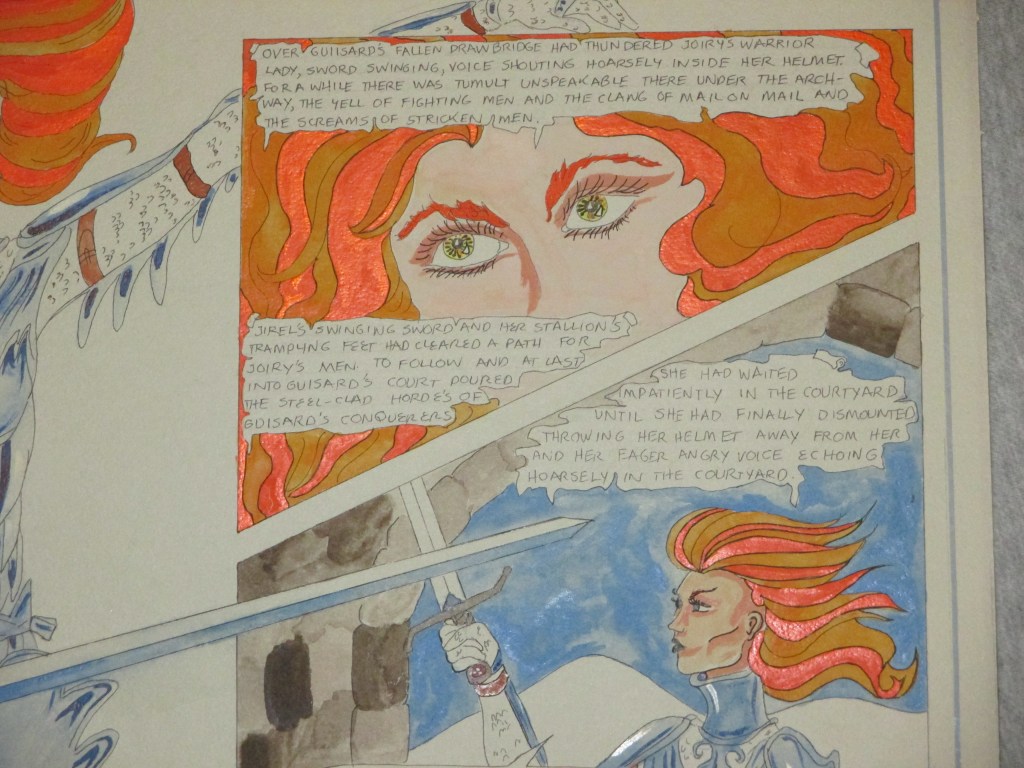
Jirel of Joiry: Into The Violet World (1987)

JIREL OF JOIRY: INTO THE VIOLET WORLD

Panel 1: Over Guiisard’s [sic] fallen drawbridge had thundered Joiry’s warrior lady, sword swinging, voice shouting hoarsely inside her helmet. For a while there was umult unspeakable. There under the archway, the yellow of fighting men and the clang of mail on mail and the screams of stricken men.

Jirel’s swinging sword and her stallion’s tramping feet had cleared a path for Joiry’s men to follow and at last into Guisard’s court poured the steel-clad hordes of Guisard’s conquerors.

Panel 2: She had waited impatiently in the courtyard until she had finally dismounted. Throwing her helmet away from her and her eager angry voice echoing hoarsely in the courtyard.

Jirel: Giraud! Make haste, you varlets! Bring me Giraud!

Panel 3: There was such bloodthirsty impatience in that hollowly booming voice that the men who were returning from searching the castle hung back as they crossed the court toward the lady in reluctant twos and threes, failure eloquent on their faces,

Below: Based on a story ‘Jirel Meets Magic’ by C. L. Moore

This piece came to me via eBay, the only comic art of Jirel I’d ever seen, and illustrating a bit of her third adventure “Jirel Meets Magic” (Weird Tales July 1935). For a couple years I’ve just enjoyed it, but eventually I decided to look up the artist—easy enough as it’s signed and dated—and was surprised to find out that it is author C. L. Bevill. Even better, she was willing to answer a few questions about this piece, how it came to be, and how I ended up with it:

When my sister and I were kids in the 70s we loved, loved, loved all things sword and sorcery. Conan, Robert Howard, Lord of the Rings, you name it. Both of us were artists and we did our own comics. So one of our favorite authors was C.L. Moore, who was a pulp writer in the 30s. Her most famous work is the Jirel of Joiry stories. I think she did those as a serial. (Forgive me if you’ve already looked up the information.)

I believe I did the piece for my sister as a birthday gift, but I don’t recall exactly. I don’t think she liked it but she was too nice to say anything. She died in March 2020 and I found the piece in her stuff, hidden away with a few other things she didn’t like from me. (I don’t hold it against her.) So I cleaned out her stuff after she died and was completely overwhelmed. (If you noticed the date, it was right at the beginning of Covid and she probably died from that.) Her landlord offered to take care of all the stuff and subsequently either sold it in a yard sale or gave it to charity. So if you got it from Washington state that’s likely how it ended up on ebay.

[…] if it’s still in a silver frame, there’s some comic artwork on the inside of the back there that I stuck in there for my sister. It was stuff we did as kids. I’m curious if it’s still there. […] Oh, we were incurable romantics as kids so the comic art in the back is something from a movie we liked as kids. Grayeagle. Terrible movie but we were very young.

C. L. Bevill, personal communication

That last note made me curious as well, so I popped open the frame:

Note: “Sure can tell where your artwork stopped & mine began. Love you, C”

On the back of the piece is a faint inscription:

To Cat,
with Love
your sister
Caren
Dec 25th 1987
—one year too late
Sorry
Dec 25th 1988
Still Love you
Cackie!

Close-up detail.

It is a lovely piece of fan-art, and I’m glad to finally have the story behind it—and the secret it has been hiding all these years.

“Werewoman” (1994)

By a quirk of publishing, “Werewoman” (1938) by C. L. Moore was first published in a fan-magazine, and fell into the public domain. This fact was not immediately recognized for some decades, but the ever-enterprising fan/scholar/anthologist Sam Moskowitz took advantage of this lapse to to republish it (without Moore’s permission or compensation) in his anthology Horrors Unknown (1971). While this has widely been considered as somewhat uncouth, it was technically legal—and if Moskowitz could do it, so could anyone else.

So it was in 1994 “Werewoman” was adapted to graphic format for Savage Sword of Conan #121 (May 1994). Roy Thomas provided the script, Robert Brown, pencils; Rey Garcia, inks; and Susan Crespi, lettering. Originally a story of Northwest Smith and set on Mars, the revamped story was adapted to feature Robert E. Howard’s Conan the Cimmerian in place of Smith, and the setting changed to a rather generic fantasy corner of the Hyborian Age.

Roy Thomas was at this point a veteran hand at such adaptations. When he had started out writing Conan the Barbarian for Marvel, it had been adapting Howard’s original stories and filling in the gaps on his own; later the series would adapt works by other authors, either non-Howard Conan stories like Lin Carter and L. Sprague de Camp’s novel Conan of the Isles (1968), which became a graphic novel of the same name, or non-Conan fantasy stories such as Gardner F. Fox’s Kothar and the Conjurer’s Curse (1970), which became Conan the Barbarian #46-51.

So why do C. L. Moore?

1994 was well into the Dark Age of Comics, and Robert Brown’s artwork is strongly reminiscent of Rob Liefeld’s work on X-Force and Youngblood, but aggressively 90s as it is, and lacking the more somber depth of shadow or evocative linework that characterized many of the better stories in Savage Sword, it kind of works, especially with Rey Garcia’s inks adding some real depth and definition to the lines.

While it may seem odd to adapt a Northwest Smith story as a Conan tale—imagine replacing Harrison Ford with Jason Mamoa in Star Wars—the hazy, dreamlike atmosphere of the story lends itself well to a kind of fever-dream episode in the adventures of everyone’s favorite Cimmerian, while the inherent wildness of running with the pack is almost more suitable to Conan than to Smith. As a Conan story, it’s middling; as a C. L. Moore adaptation, it’s better than nothing—which is, by an large, what readers have lived with.

Readers interested in the full story can find it reprinted in Savage Sword of Conan Omnibus Vol. 21.

Aside from these two works, there is little else to say about C. L. Moore in the comics. A few early horror comics may be unofficial adaptations of or inspired by her works, though this is based on similarity of plot more than anything else. There is another notable graphic adaptation of C. L. Moore’s “Shambleau” that was published in France in 1955, but that is worthy of a longer and more in-depth look on its own.


Bobby Derie is the author of Weird Talers: Essays on Robert E. Howard and Others and Sex and the Cthulhu Mythos.

Deep Cuts in a Lovecraftian Vein uses Amazon Associate links. As an Amazon Associate I earn from qualifying purchases.

Pre-Code Lovecraftian Horror Comics

In the years before Seduction of the Innocent and the rise of the Comics Code Authority (1954), there was an age undreamed of… Garish four-color comics of crime, horror, science fiction, the occult, and the weird filled the newsstands. The comic book had emerged as a definitive form in 1934, at first reprinting newspaper comic strips, but soon comic magazines emerged featuring original material. While the Golden Age of Comic Books is usually said to have begun with the advent of Superman in Action Comics #1 (18 April 1938), the lucrative field swiftly diversified into many different genres, not just superheroes. In the 1940s and 50s, one of the most notable and notorious genres was the horror comic.

Early comic books shared a great deal of crossover with the pulp magazines, including artists, writers, editors, and even publishers. Harry Donenfeld was the entrepreneur behind the Spicy pulp magazines that published Robert E. Howard and E. Hoffman Price—and the same magazines also published comic strips such as Olga Mesmer, The Girl with the X-Ray Eyes; Sally the Sleuth; and Polly of the Plains. Donenfeld would later expand his enterprises into the burgeoning field of comics in the mid-30s with Detective Comics, Inc.—known better today as DC Comics.

Around the same time, future Marvel Comics publisher Martin Goodman edited horror pulps. Julius Schwartz, the science fiction fan who acted as Lovecraft’s agent for At the Mountains of Madness and The Shadow Out of Time, became an editor for DC; Weird Tales writers Frank Belknap Long, Jr., Otto Binder, and Manly Wade Wellman, among others, all wrote comic book scripts. Weird Tales artists Virgil Finlay, Matt Fox, and Frank Kelly Freas worked in comics too. So when it came time to bring their skills to comics, many of the people involved with horror comics turned to horror pulps for inspiration.

Sometimes more than inspiration:

The one instance I remember was a very awkward one. It’s curious that I remember the name of the author who complained. It was August Derleth, a well-known horror writer. It was a story in one of our magazines, called “The Ornalean Clock,” and it involved the other staff writer. Mr. Derleth wrote in (it surprised me that he was reading these comic books) and sent us the story that he wrote which was about an Ornalean clock It was clear that it had been plagiarized.

It was very awkward. Richard [Hughes] confronted the writer, who did what plagiarists always do—that is, claimed he must have dipped into his unconscious, he wasn’t aware of it, and so forth. And perhaps the only defense he had was that it was so blatant!

Norman Fruman, assistant editor of the American Comics Group, quoted in Michael Vance’s Forbidden Adventures: The History of the American Comics Group 73

Derleth’s story was “The Ormolu Clock” in Weird Tales January 1950. Derleth’s friend Frank Belknap Long, Jr. had written the first issue of Adventures into the Unknown, the first ongoing horror comic, published by the American Comics Group. Derleth was well-known for his love of comic strips, and no doubt spotted the plagiarism because he followed the horror comics after Long had brought them to his attention. Ironically, it was Derleth who would write a letter to editor Richard Hughes encouraging them to continue to publish horror comics instead of canceling the series (Forbidden Adventures 110-111).

If ongoing horror comics began in 1948 with Adventures into the Unknown, the horror comics craze was kicked off by Crypt of Terror #17 (April/May 1950) from EC Comics—better known today under its later title, Tales from the Crypt. EC’s comic stories were, for the time, often well-written and well-illustrated; they often had a moral, but they could also feature darker twist endings, and a bit of grue. The many imitators of EC were not often as conscientious in their writing or art; much like the pulp magazines, the newcomers often leaned into gore, mutilations, eye gouging, drug abuse, and nasty ends where criminals get away with their crimes.

While individual comic book publishers had their own internal codes of censorship, there was no industry-wide limitation on content except for general statutes on obscenity. So while explicit sex and nudity were largely the province of Tijuana bibles, comic books on the stand could easily present gore, mutilations, dark and mature storylines, mouldering skeletons, vampires, voodoo, cannibalism, and all the rest. Plagiarism, either of published stories or swipes from other artists, was rife. Yet the period ended swiftly.

In 1954, a moral panic swept the United States (and was echoed in the United Kingdom and other countries around the world), spurred on by Frederic Wertham’s Seduction of the Innocent, his many articles in newspapers and magazines, and his testimony before the Senate Subcommittee on Juvenile Delinquency. Other pearl-clutchers and parents groups added their voices, and federal oversight seemed a real possibility—so the major comic publishers came together and formed the Comics Code Authority, whose Seal of Approval would mark approved comics. Not approved? Horror.

The formation of the CCA effectively ended most horror comics publishing in the United States for a generation, and had a chilling effect on comics intended for mature audiences. They would come back—the underground comix of the 1960s and 70s especially paid tribute to EC’s horror comics, and raised a general middle finger to the censorship of the CCA, while major publishers like Marvel and DC would push back little by little with their own horror comics in the 1960s, sometimes sidestepping the CCA by publishing full-sized comic magazines. This would lead to a great flowering of horror comics magazines from publishers like Warren and Skywald in the 1970s and 80s, and lay the groundwork for comics like Heavy Metal Magazine (originally a translation of the French magazine Metal Hurlant).

Ironically, in 1954 Weird Tales also ceased publication, one of the last of the old-time pulp magazines to give up the ghost, unable to compete either against science-fiction digests or the coming men’s adventure pulps that flourished in the postwar era. An entire sub-industry was gutted almost overnight. Former pulp writers and artists who had known, talked, and corresponded to H. P. Lovecraft, who might have adapted his work to a new medium, never got that chance…well, except during the period before 1954.

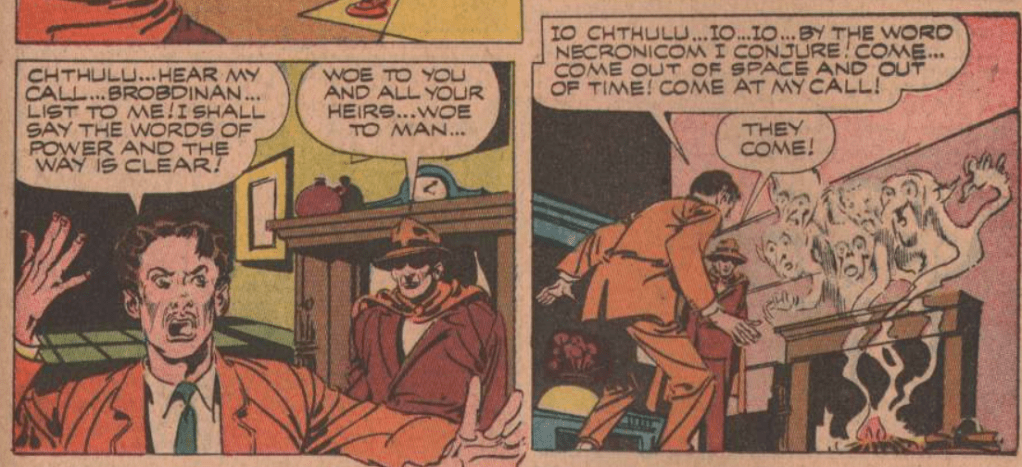
While there are thousands of pre-Code comic books, there are only a handful of comics that can be positively said to be “Lovecraftian horror,” either because they directly adapt a Lovecraft story or explicitly make reference to Lovecraft’s Mythos. If one were to include other early Mythos writers like Robert E. Howard, the list would be a little longer—“Skull of Doom” in Voodoo Comics #12 (1953), for example, seems to be an adaptation of Howard’s “Old Garfield’s Heart.” But for the sake of keeping this list manageable, here are some positively identified pre-Code Lovecraftian horror comics, many of which are in the public domain and can be read for free.

A Note: Many of these early comics were completed in small studios by teams of writers and artists, working for low rates, and often without credit. As such it is not always clear who exactly worked on many of these comics, but as far as it can be determined, the names of the writers, artists, letterers, etc. will be included below.

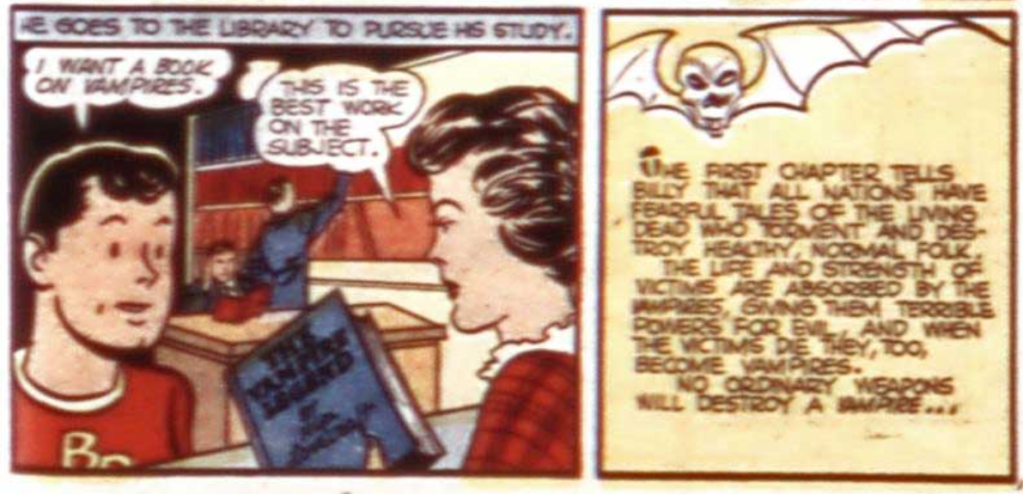
“Captain Marvel Battles the Vampire” (March 1941)

Published in Captain Marvel Adventures #1 (Fawcett Publications), this 16-page story of Captain Marvel (now often known as Shazam) was penciled by Jack Kirby and inked by Dick Briefer. The mystic hero finds himself up against one of the undead, and to better understand his foe and their weaknesses, a librarian hands him The Vampire Legend by H. P. Lovecraft. An unlikely title, but a neat homage to Lovecraft!

“Dr. Styx” (August 1945)

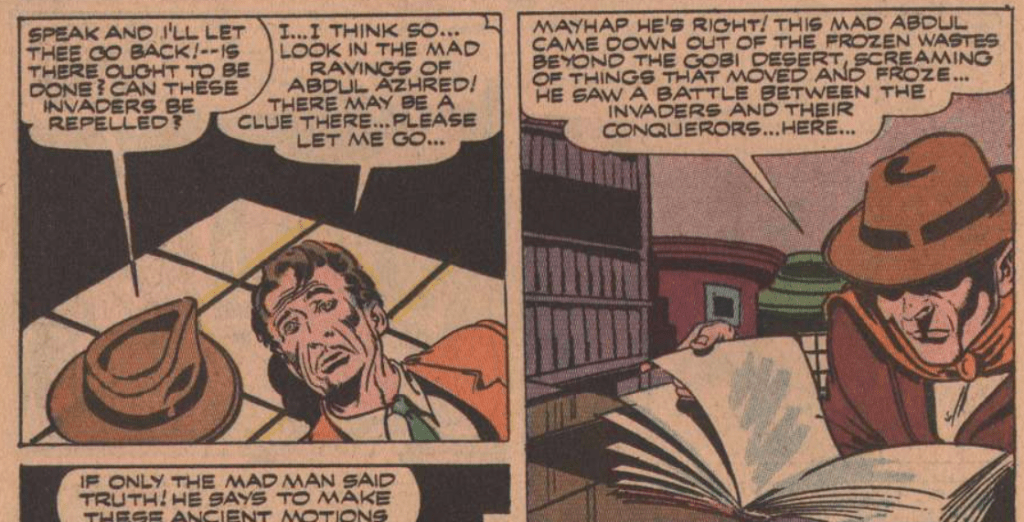
Published in Treasure Comics #2 (American Boys Comics Inc.), this uncredited 8-page comic presents an occult thriller whose eponymous hero is an unsung prototype to Doctor Fate, Doctor Strange, The Phantom Stranger, and John Constantine. Whoever the writer was, they must have read more than a little of the Mythos to cite Ludvig Prinn (created by Robert Bloch), Cthulhu, Abdul Alhazred, and the Necronomicon (however misspelled).

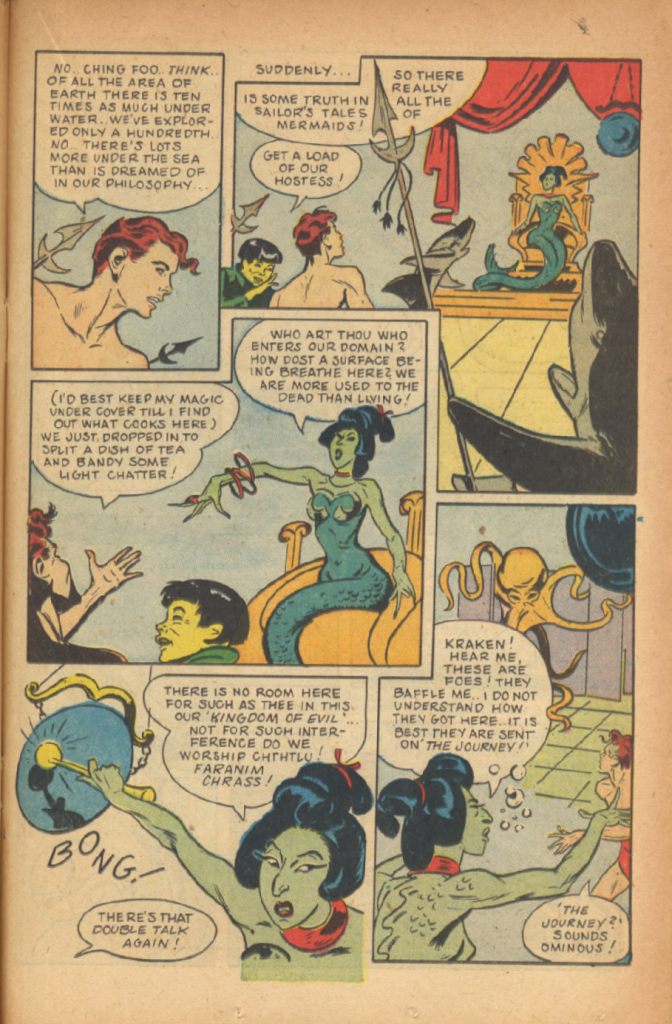
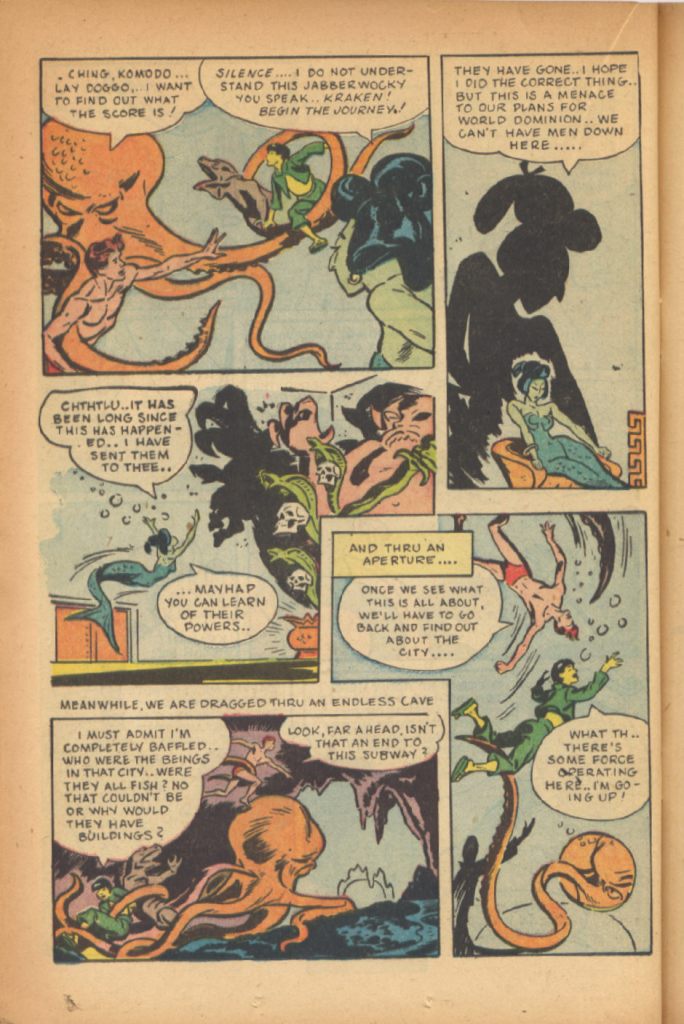
Red Dragon (Feb-Mar-Apr 1946)

Red Dragon was a mystic superhero character whose adventures ran as a back-up feature in Super-Magician Comics published by Street & Smith, better known for their pulp magazines. Whereas most of Super-Magician Comics featured stories with the fantastic adventures of real magicians like Houdini, Red Dragon could perform acts of genuine magic by reciting the mystic words of power “Po She Lo” and a bit of doggerel rhyme. Red Dragon was accompanied on his adventures by a Chinese companion, Ching Foo, and a komodo dragon.

In a three-act adventure (“The Kingdom of Evil!” v.4 #10 Feb 1946, 8 pages; “Where Time Is Not” v.4 #11 Mar 1946, 8 pages; and “End of Evil!” v.4 #12 Apr 1946, 8 pages), Red Dragon and his companions run afoul of a cult of fish-men who worship Dagon and “Chthtlu”—an entity who dwells outside of normal space and time and is a giant green malevolent interdimensional worm with a humanoid face, a bit reminiscent of Mister Mind, and possibly inspired by him. The Lovecraftian influence is scant but noticeable. Sadly, no writer or artist is credited.

“The Thing At Chugamung Cove!” (May 1949)

Marvel Comics’ first foray into horror was Amazing Mysteries #32 (May 1949), which continued on the numbering from Sub-Mariner Comics #31, and the first story in that issue was “The Thing at Chugamung Cove!” (11 pages)—which is, in effect, a highly abridged and transformed version of Lovecraft’s “The Shadow over Innsmouth,” where a writer goes to the legendary deserted town and uncovers some frightful family history. No artist or writer is credited for this adaptation.

“Experiment … In Death” (May-June 1950)

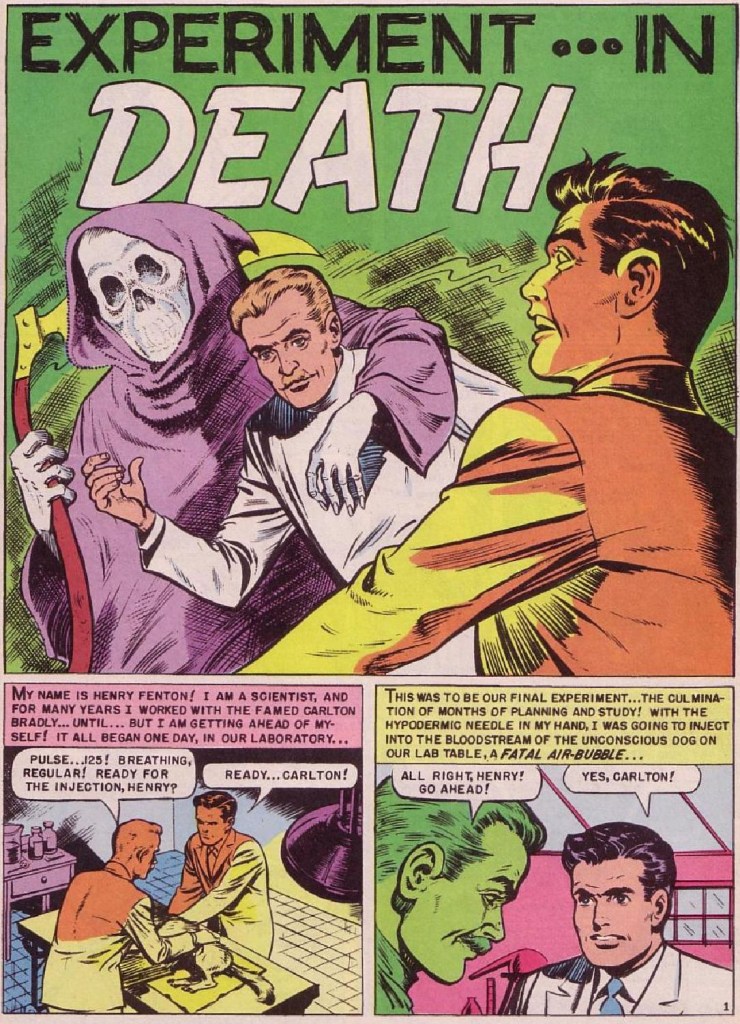
Published in Weird Science #12 (EC Comics), this 6-page story co-scripted by Bill Gaines and Al Feldstein, and illustrated by Jack Kamen with letters by Jim Wroten, is clearly strongly inspired by H. P. Lovecraft’s “Herbert West—Reanimator”; but the lengthy six-part narrative has been largely scrapped to get at the core idea of a reagent that reanimates the dead, two doctors performing experiments to do just that, and how the degradation of the brain renders them violent. In ditching the plot, so too is ditched most of the gore, making this more of an intellectual horror.

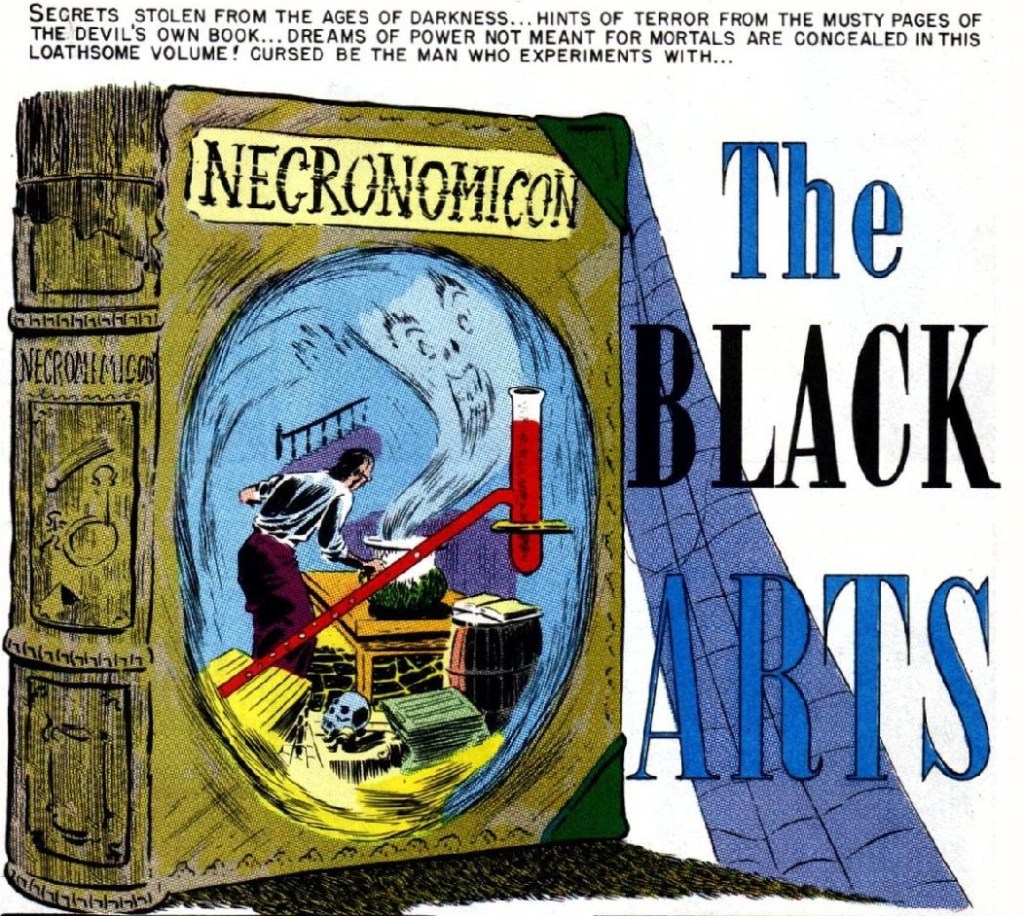
“The Black Arts” (July-August 1950)

Published in Weird Fantasy #14 (EC Comics), this 7-page story by written and inked Harry Harrison, penciled by Wally Wood, and lettered by Jim Wroten is a fairly generic tale of a young man that uses a recipe for a love potion from the Necronomicon to get a young woman to fall in love with him. Nice guys don’t use the black arts to date-rape young women, so the hint of a grisly comeuppance looks like karmic justice. The standout character here is the Necronomicon itself; which features prominently in the story.

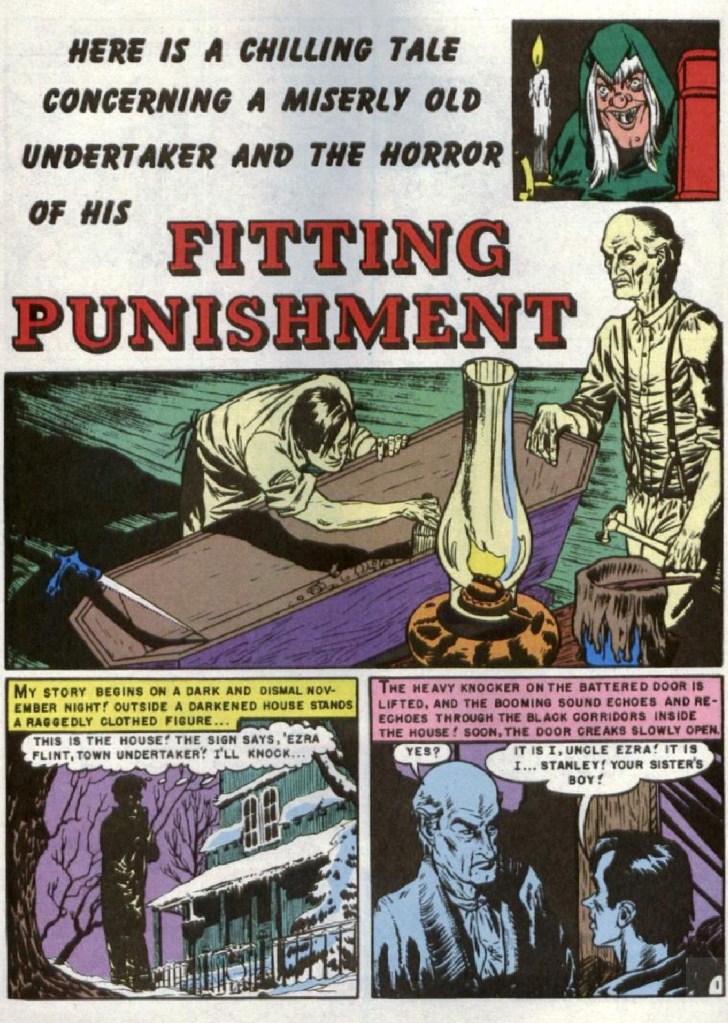
“Fitting Punishment” (December-January 1951)

Published in The Vault of Horror #16 (EC Comics), this 7-page uncredited adaptation of H. P. Lovecraft’s “In the Vault” was written by Al Feldstein, penciled and inked by Graham Ingels, and lettered by Jim Wroten. While stripped of much of Lovecraft’s prose and compressed to its bare essentials, Feldstein and Ingels manage to capture the essence of this very Poe-esque tale, whose climactic ending offers a vivid visual little less gruesome than Lovecraft’s original.

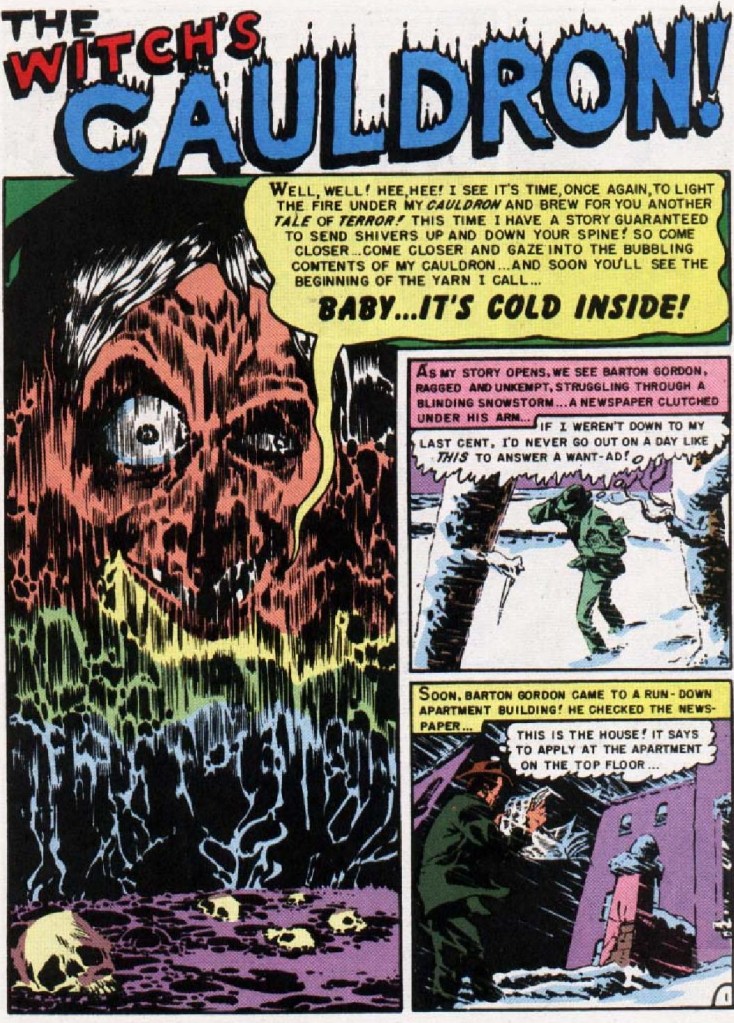
“Baby…It’s Cold Inside” (February-March 1951)

Published in The Vault of Horror #17 (EC Comics), this 7-page uncredited adaptation of Lovecraft’s “Cool Air” was co-written by Al Feldstein and Bill Gaines, penciled and inked by Graham Ingels, and lettered by Jim Wroten. As with “Fitting Punishment,” this isn’t a Mythos story and is very much in the Edgar Allan Poe vein, but even stripped bare to the essentials it gets the message across. “Cool Air” has been one of the more popular of Lovecraft’s stories to adapt to comics, having been adapted at least five times over the decades, perhaps because of its rather straightforward plot—and the gruesome climax.

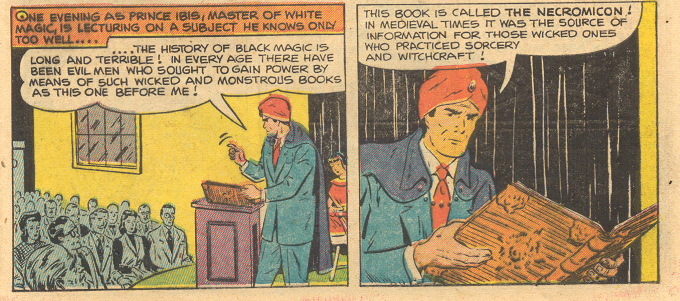
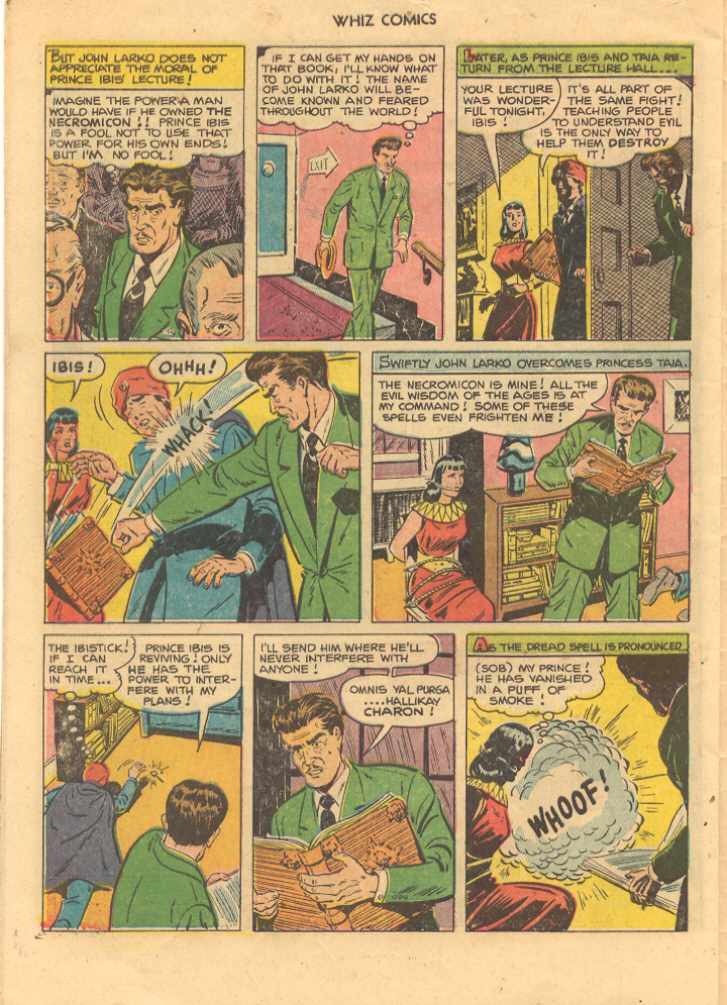
“Prisoner on Charon’s Ferry” (March 1952)

Published in Whiz Comics #143 (Fawcett Comics), this 6-page comic of Ibis the Invicible briefly features a grimoire called the Necromicon as a prop during a lecture, which an unscrupulous attendee uses to summon Charon (and later, a vulture). No artist or writer is credited, though the Grand Comic Book Database credits Bill Woolfolk with the script.

“Portrait of Death” (September 1952)

Published in Weird Terror #1 (Comic Media), this 7-page uncredited adaptation of Lovecraft’s “Pickman’s Model” was illustrated by Rudy Palais. As an adaptation, it’s interesting to compare “Portrait of Death” to “Fitting Punishment” and “Baby…It’s Cold Inside!” The line work and anatomy is a little cruder, the coloring a bit sloppier, and the writing takes many more liberties with the source material. Yet it is very much in the same spirit as the EC Comics adaptations.

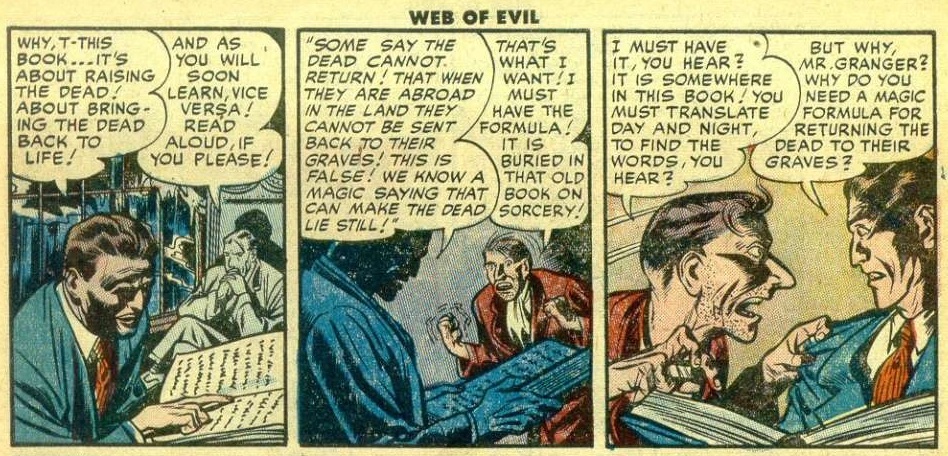
The Corpse That Wouldn’t Die!” (January 1953)

Published in Web of Evil #2 (Quality) this 6-page story is largely adapted from Clark Ashton Smith’s “The Return of the Sorcerer,” though the eponymous sorcerer is not dismembered and the unnamed grimoire is in Sanskrit rather than the Arabic of the Necronomicon. The story was re-worked for Eerie Publications in the 1970s.

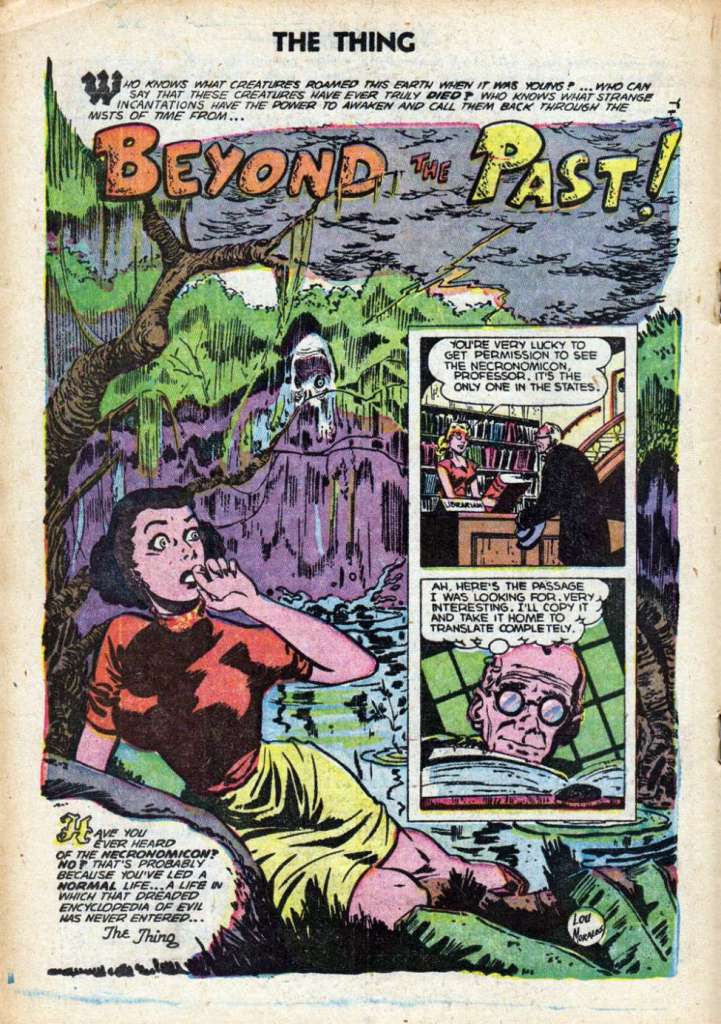
Beyond the Past” (November-December 1953)

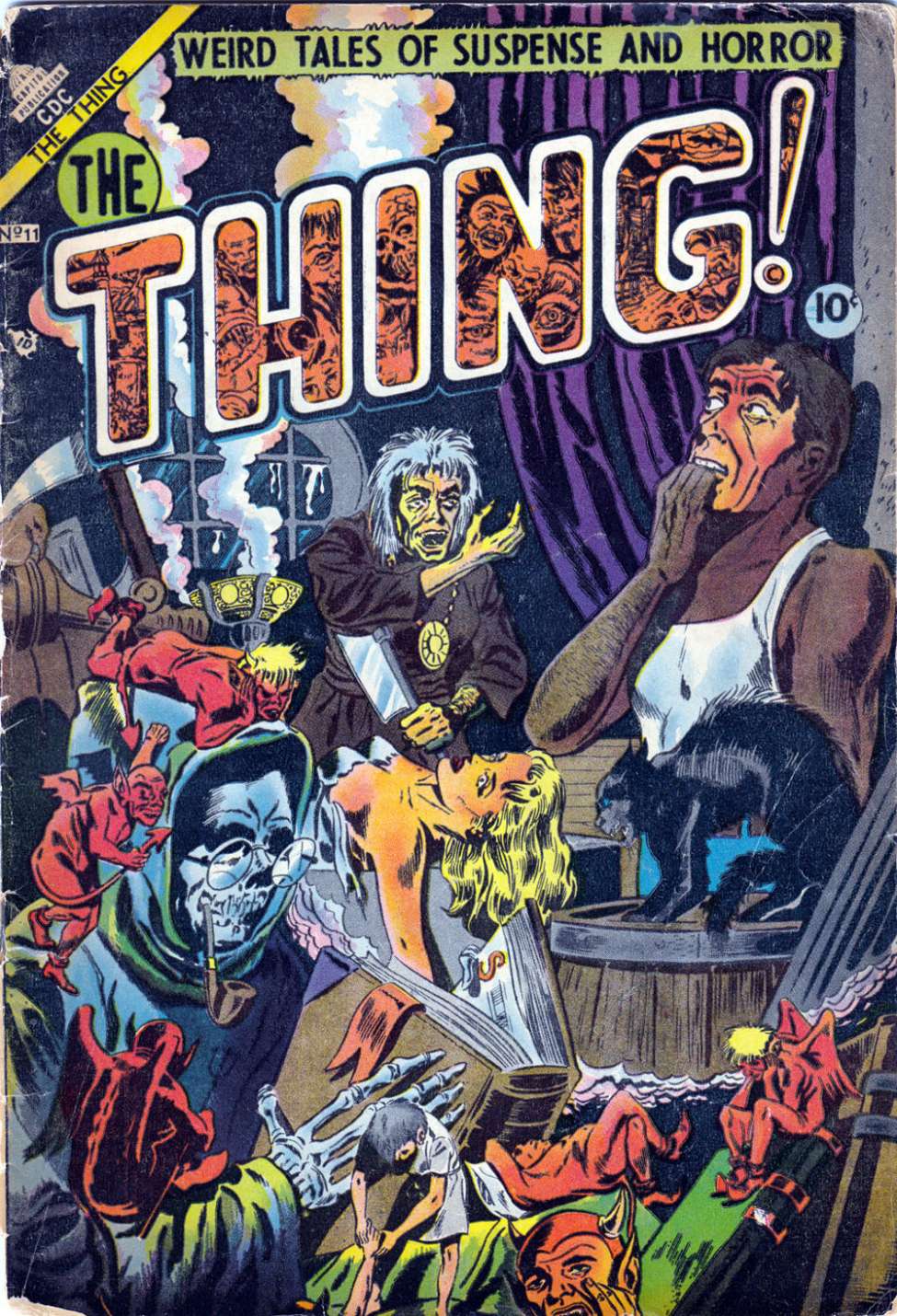
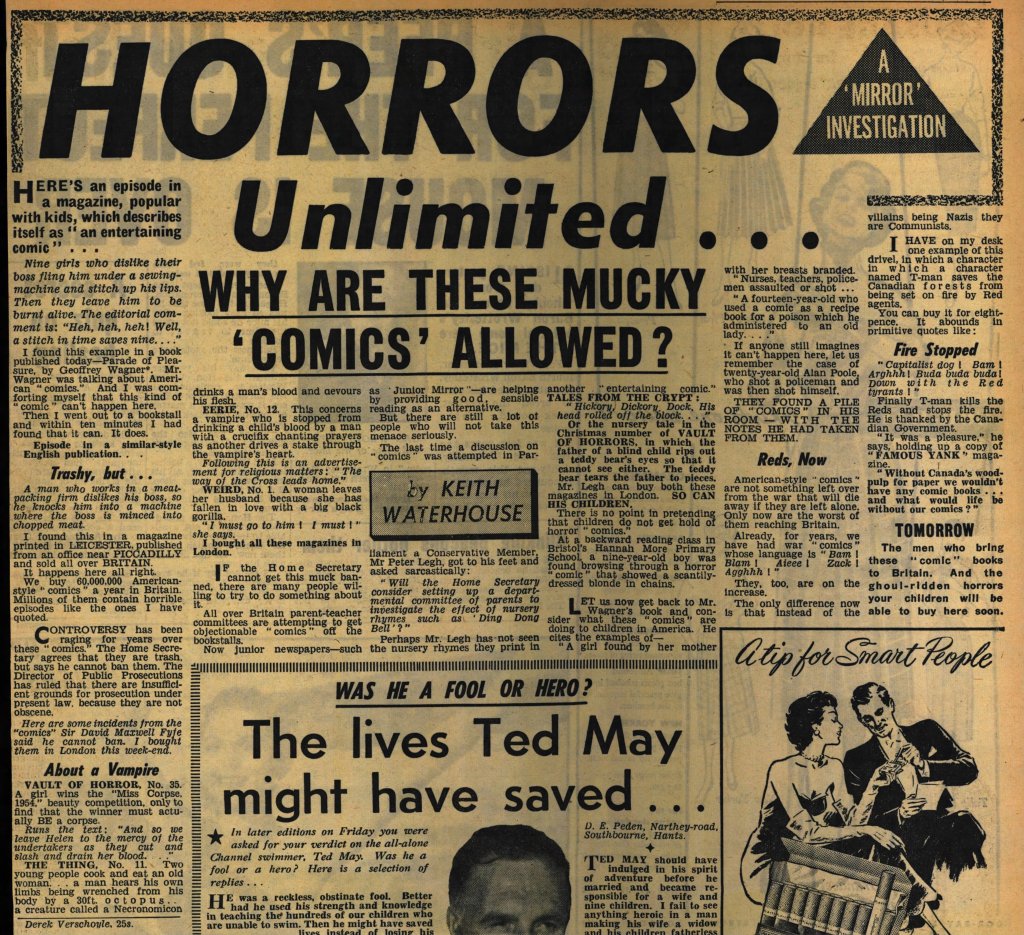
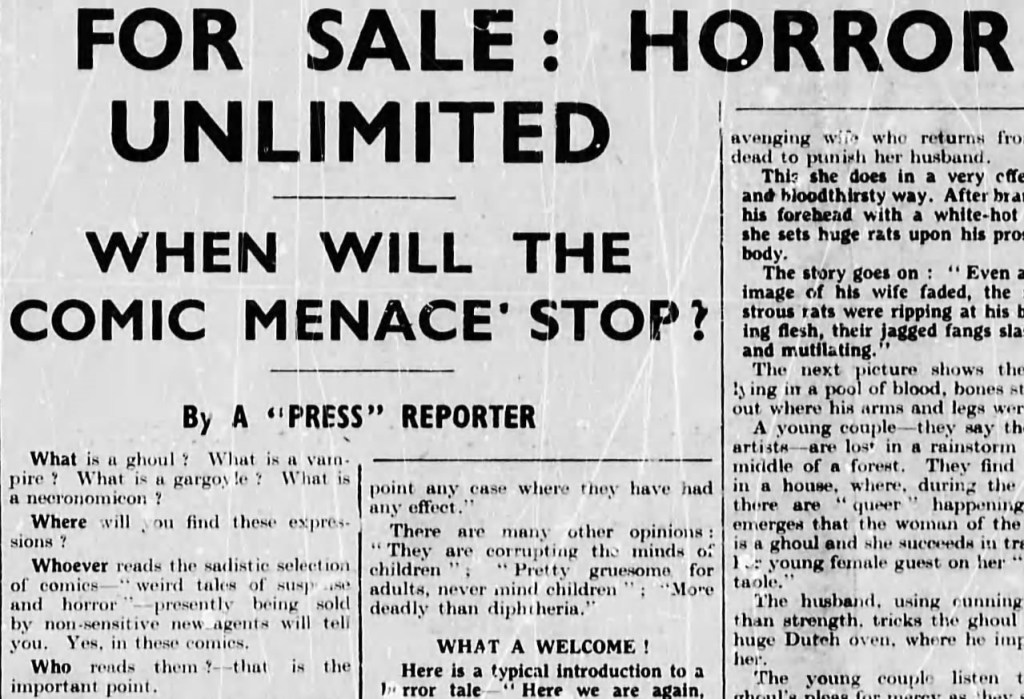
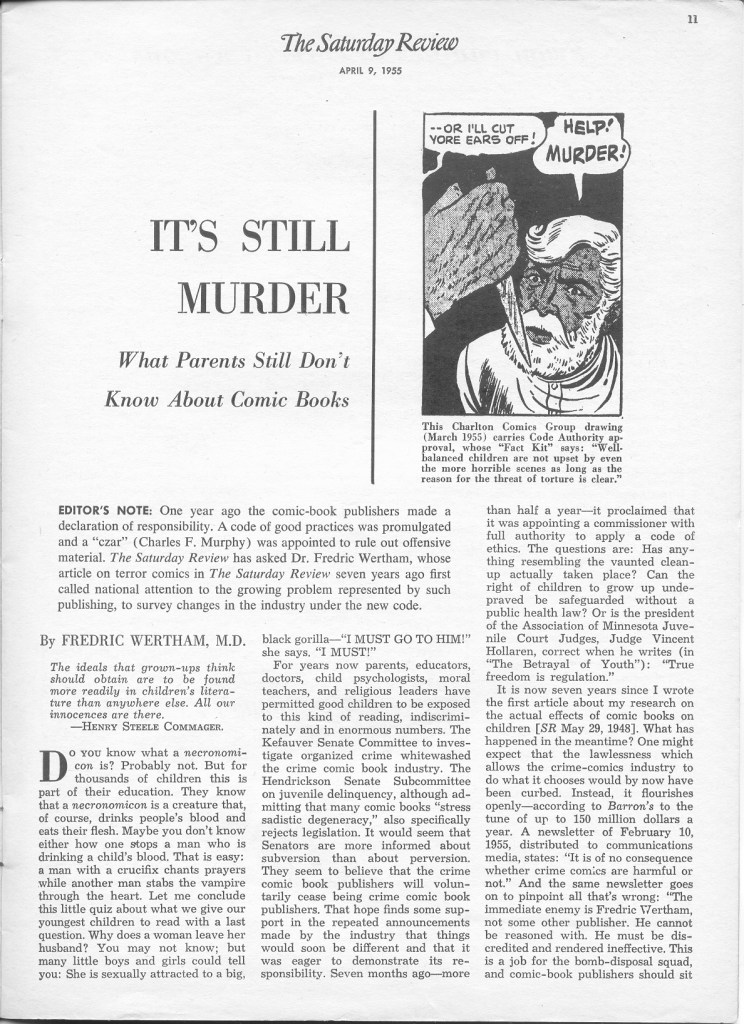
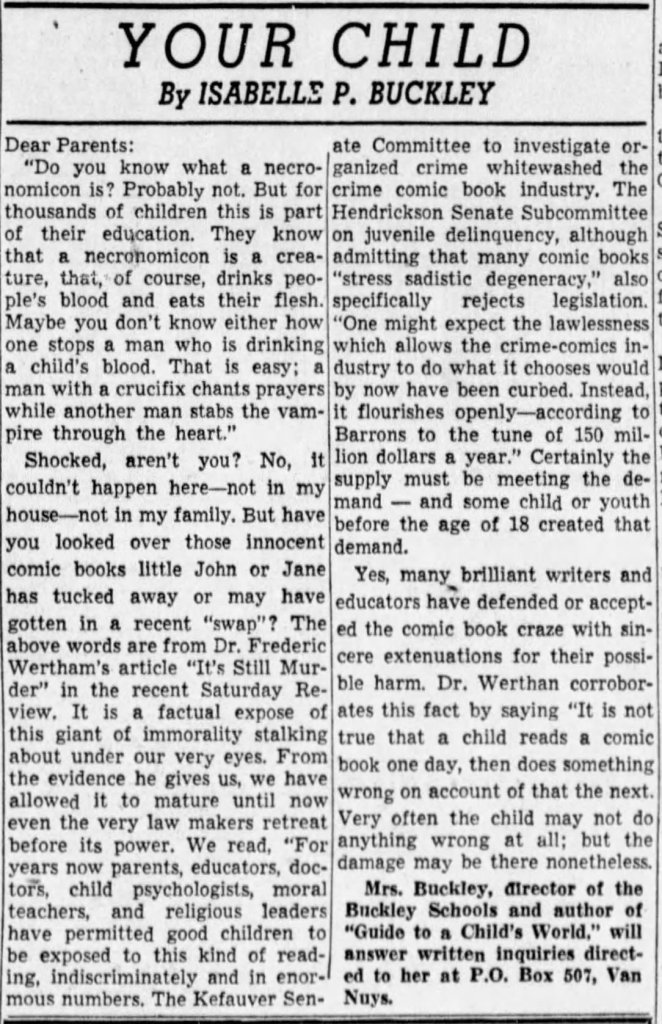
Published in The Thing #11 (Charlton Comics) this brief 4-page original story illustrated by Lou Morales is a definite homage to Lovecraft and the Necronomicon, albeit slightly garbled. The story had an odd afterlife, as newspapers—and then Frederic Wertham himself—mixed up the plot and thought that the Necronomicon a blood-drinking monster, not a tome of eldritch lore!

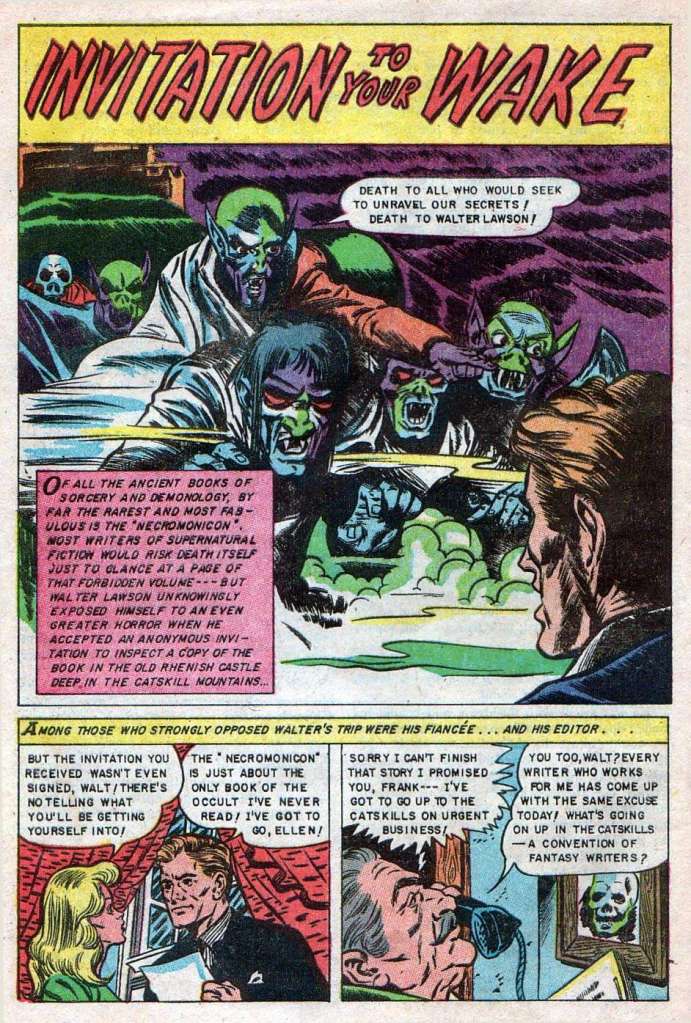
“Invitation to Your Wake” (December 1953)

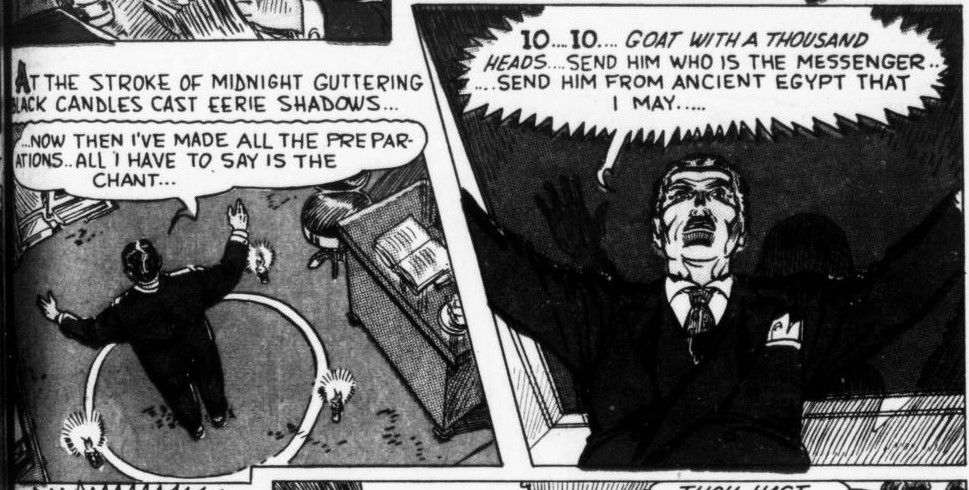
Published in The Hand of Fate #21 (Ace Magazines), this 7-page original story has no credits, although the Grand Comics Database suggests it was penciled and inked by Sy Grudko, probably because of similarities of style. Like EC’s Tales from the Crypt and Vault of Horror, the stories in The Hand of Fate are narrated by a mysterious cloaked figure—by the stories tend to be more serious and less darkly humorous. Once again, the major Lovecraftian element is the appearance of the “Necromonicon,” as the rest of the monsters in this story are typical vampires, werewolves, etc.


There are no doubt many more pre-Code Lovecraftian horror comics out there—for a certain value of Lovecraftian. For example in “The Fish-Men of Nyarl-Amen” in More Fun Comics #65 (DC, March 1941) by Gardner Fox (writer) and Hal Sherman (art), mystic hero Doctor Fate defeats an army of prehistoric fish-men from beneath the sea. Chris Murray in Kevin Corstorphine in “Co(s)mic Horror” in New Critical Essays on Lovecraft argue this is a definite Lovecraftian influence:

The similarity to stories such as “The Call of Cthulhu,” with the sunken city of R’lyeth [sic], and also the Deep Ones who appear in “Dagon” and “The Shadow over Innsmouth” (1931) is obvious. Indeed, the name Nyarl-Amen seems reminiscent of Y’Ha-nthlei, the name of the undersea cyclopean city referred to in “The Shadow over Innsmouth,” and is certainly related to Nyarlathotep. However, the potential for horror in the tale is undercut, as is so often the case in comics of the time, by some rather clunky dialogue.

Murray & Corstophine, New Critical Essays on Lovecraft 166

Is it really? Hard to say. Gardner Fox in particular was well-known for riffing off of material from Weird Tales, both in prose and comics. Robert E. Howard’s Conan the Cimmerian was a definite influence on Fox’s character Crom the Barbarian who debuted in Out of this World #1 (Avon, June 1950), and Fox’s Kothar the Barbarian Swordsman novels (some of which were later adapted into Conan comics by Marvel!) So it wouldn’t be surprising if Fox was riffing off of Lovecraft in the 1940s. Yet, at the same time, Lovecraft didn’t hold a monopoly on fish-people either.

Another edge case is “The Last of Mr. Mordeaux,” penciled and inked by Joe Sinnott, which ran in Astonishing #11 (Atlas, Spring 1952). The 5-page story definitely seems to have taken inspiration from Lovecraft’s “The Lurking Fear” and “The Shadow over Innsmouth”: to prove his aristocratic lineage, the American Mr. Mordeaux travels to his ancestral castle in Hungary, and finds the remains of his family—driven underground centuries ago and degenerated into reptilian creatures, yet still bearing the hallmark bulging eyes and lack of eyebrows that Mr. Mordeaux still bears. Is this any looser of an adaptation than the other pre-Code horrors listed above? Where does the line fall between inspired-by and loose adaptation? In part, “Mordeaux” seems inspired-by because the premise is so broadly evocative of Lovecraft’s stories, but not directly evocative of any particular story. “The Lurking Fear” comes closest, but even that is a loose fit.

We get into the perennial question of: “What does Lovecraftian even mean, anyway?” Defined broadly enough, any terrible entity with tentacles or dark cult might look like stepped-on Lovecraft. In some cases, that’s probably true. With the publication of Lovecraft’s stories in hardback starting in 1939 by Arkham House, and the paperback editions that followed—including an Armed Services edition during World War II—Lovecraft’s fiction was more available than many of his contemporary pulp writers. Still, the Necronomicon didn’t appear in hundreds or even dozens of comics during these decades. It was an in-joke for dedicated fans—and perhaps that is how pre-Code Lovecraftian horror should best be understood. Something for the weird connoisseurs of the horror comic book and weird fiction.

The influence of Weird Tales and its circle of writers and artists on the early comic book industry could be a book in itself, ranging from Manly Wade Wellman’s work on Will Eisner’s The Spirit to the absolute sensation that was (and is) Robert E. Howard’s Conan the Cimmerian. Yet there was a certain magic to that Wild West period before the Code came down like a heavy lid, shutting down entire comic lines. While the Lovecraftian comics above aren’t particularly gruesome even by today’s standards, certainly not among the most notorious offenders of the 1940s and 50s, they were lost to time…and while the EC Comics have been collected and reprinted, many of the others remain virtually unknown.

With the arrival of the Comics Code Authority, comic books in the United States shifted ever more toward a younger audience, and toward superheroes. Unable to publish explicit horror comics, it may be unsurprising that the next Lovecraftian comics published were superhero comics like Justice League of America #10 (DC, March 1962), where the Necronomicon makes an appearance—but that would change. Underground comix creators, Marvel’s 1960s horror comics adaptations, the success of Conan the Barbarian (1970), Warren’s horror comics magazines, and Metal Hurlant’s Lovecraft special issue in 1979—the world of Lovecraftian horror comics was only groing to grow bigger and weirder.

Yet it started here, with a handful of pre-Code horror comics, many of which have never been reprinted. While these might not be the roots from which later Lovecraftian comics would grow, they were definitely precursors, part of that flood of sometimes dark, gory, and trashy four-color horror that scared parents and publishers into censorship. The first faltering steps to bring Lovecraft and Lovecraftian horror into a new medium.

Thanks to Will Murray for help and assistance.


Bobby Derie is the author of Weird Talers: Essays on Robert E. Howard and Others and Sex and the Cthulhu Mythos.

Deep Cuts in a Lovecraftian Vein uses Amazon Associate links. As an Amazon Associate I earn from qualifying purchases.
Where Black Stars Rise (2022) by Nadia Shammas and Marie Enger

I’ve always loved horror, particularly eldritch horror. Despite the deeply racist and misogynistic roots of these works, primarily the violent xenophobia of its creators, there’s an existential understanding of what it feels like to be powerless. While these men grappled with the horror of an uncaring universe, marginalized individuals grapple with the horror of a system specifically designed not to care about us. We are born into something larger, something malevolent, something we have no power to stop. Similarly, in The King in Yellow itself, there is no reason why our unfortunate narrators are chosen.

Nadia Shammas & Marie Enger, Where Black Stars Rise

On 15 December 1973, the American Psychological Association removed homosexuality from its list of mental illnesses. This reversed a course of accepted practice that had run through the 19th and 20th centuries, including during the lives of H. P. Lovecraft, Robert E. Howard, Robert W. Chambers, and other formative voices in what has come to be known as eldritch or cosmic horror. Popular understanding of mental illness and sexuality would take a few decades to catch up; some roleplaying games in the 1980s still listed homosexuality among the mental illnesses a character could have.

To say that Lovecraft et al. were products of their time is not an excuse for their bigotries and prejudices, yet it must be at least an explanation for some of the attributes of their lives and fiction. Lovecraft lived and died in an era when combat-related trauma was categorized as shell shock; the term Post Traumatic Stress Disorder wasn’t coined until 1980. It would be inaccurate to fault Lovecraft and company for working within the limits of knowledge of their own time—and even then, Mythos fiction often treats mental health with more of a Gothic, Victorian, or pulp sensibility. Lovecraft speaks of alienists more often than psychologists, and those who experience breaks from reality or accepted behavior (such as Nathan Peaslee in The Shadow Out of Time, or Delapore in “The Rats in the Walls”), or simple physical or mental abnormality (the errant cousin in “The Shadow over Innsmouth”) are more likely to be institutionalized than diagnosed and treated.

Sanity often seems a fragile, precarious state to many of these characters.

Despite the prevalence of talk of mental health in the works of Lovecraft and co., relatively few of the stories experience sharp breaks with reality—the infamous snap of the last thread that sends them from rationality into incoherence. The sight of Cthulhu in “The Call of Cthulhu” is a terrible shock, but very few characters in the works of Lovecraft or his contemporaries go mad just from the sight of an eldritch entity. More than a few characters who read from the Necronomicon do not lose touch with reality from the revelations therein. Even in Robert W. Chambers’ The King in Yellow, the eponymous play acts more as a catalyst for mental illness than a source of it.

Which is a long way to get to the point: as our cultural and scientific understanding of mental health changes, so too must the literature of horror shift to reflex that new syntax. What Lovecraft and Chambers wrote made sense within their context, but today we look on mental health very differently. This doesn’t invalidate the older stories, but it does open up vast new realms of possibility for new ones. With new understanding comes new ways to think about the Mythos.

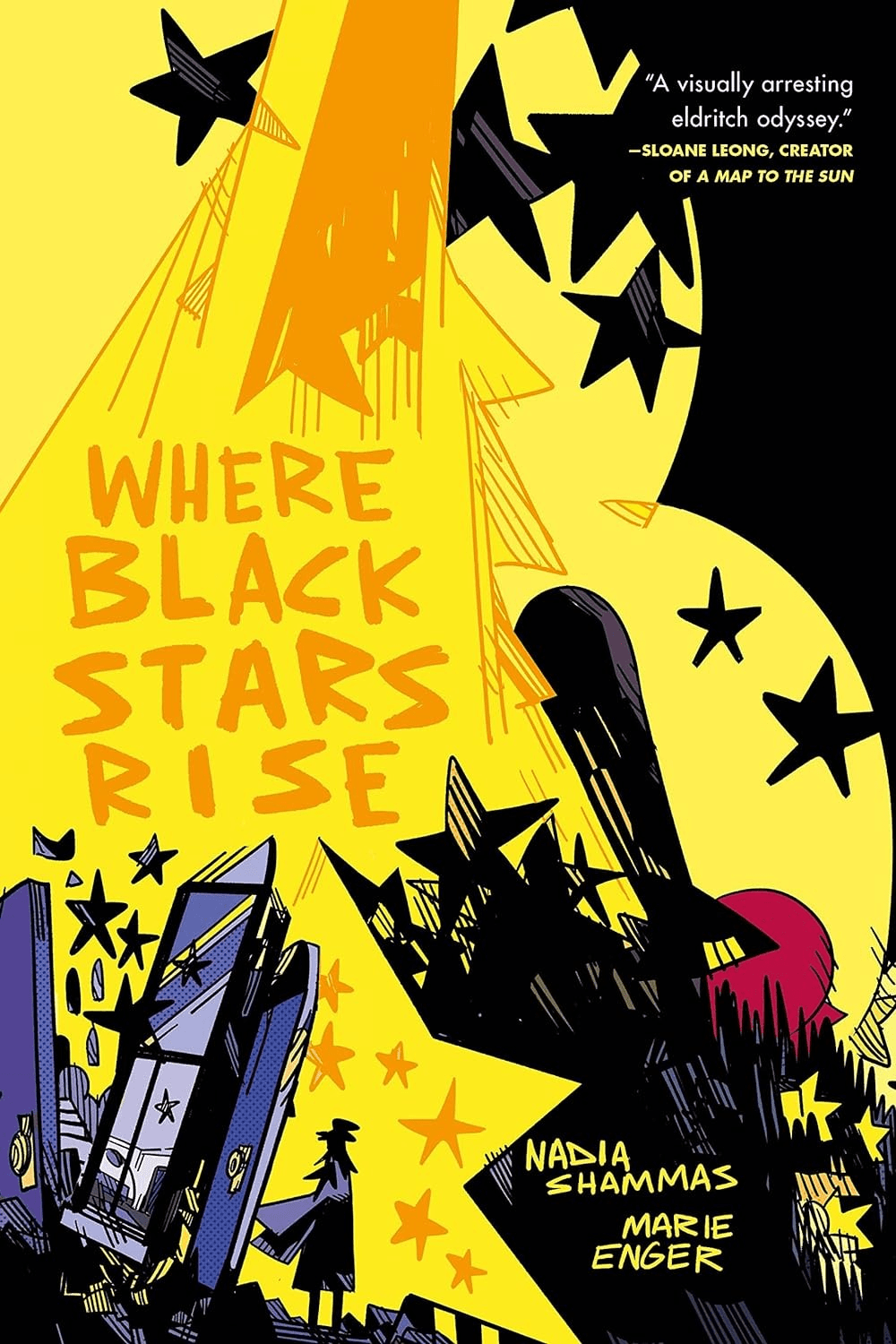
Where Black Stars Rise (2022) by Nadia Shammas (script) and Marie Enger (art) is a graphic novel focused on mental health and the King in Yellow, the eponymous play that acts as a metatextual touchstone for the first half of Robert W. Chambers’ 1895 collection of the same name. In the course of dealing with her own life issues and mental health, therapist Amal Robardin loses a patient—and goes to find her. The journey takes her over the metatextual threshold to Carcosa itself, led by a changeling psychopomp that alternately takes on aspects of Ambrose Bierce, Robert W. Chambers, and H. P. Lovecraft (August Derleth and D. J. Tyrer, perhaps fortunately, didn’t make the cut).

If there’s a point of criticism, it might be in casting those three as the closest thing the story has to a villain—Lovecraft barely used The King in Yellow or its mythos in his work, and Bierce’s original creation bears little resemblance to what Chambers made of it—but having a straw man psychopomp is barely a speed bump in the enjoyment of a dream quest re-cast in terms of therapy.

…you’re wrong

I’m deserving of love. I’m capable of love without fear, and of doing better.

I am capable of more than this. I’m not a monster, and I’m no lost cause.

Nadia Shammas & Marie Enger, Where Black Stars Rise

One of the benefits of eldritch horror is that, very often, there is an external force involved in whatever the characters are dealing with. Dealing with mental health is often a long and involved process, and individuals are rarely “cured” in the sense that a broken bone heals or an infection runs its course. Nor can people overcome trauma or brain chemistry issues simply by lying on the couch and talking about their dreams. You might not be able to punch Cthulhu in his stupid face, but at least you know Cthulhu exists and isn’t just a figment of your imagination. Flip Cthulhu off if it makes you feel better.

There is a moment, after the visual climax, when it looks like Where Black Stars Rise is going to go the full John Milton (“The mind is its own place, and in it self Can make a Heav’n of Hell, a Hell of Heav’n.”) It is to the credit of the creators that the story steps away from this, to something sadder, perhaps more horrific, yet ultimately more real, more in line with “The Book of Fhtagn” (2021) by Jamie Lackey. Happily ever afters are for fairy tales; in the real world, not everyone can be saved, or wants to be. Sometimes you have to respect that.

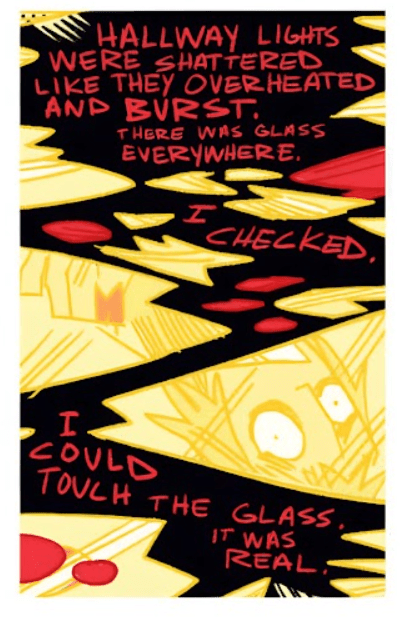
A panel from Where Black Stars Rise by Nadia Shammas & Marie Enger.

For this graphic novel, Marie Enger presents a somewhat grungy, Mike Mignola-esque style. Stark shadows and bright yellows, stipple give more of the texture than hatching; there’s a lovely clutter to some scenes, and others where the curtain is dropped for effect; and the lettering and framing both fit the mood. Like the eponymous play, the graphic narrative is split into two acts, the first relatively normal and almost banal, while the second act is where things go fantastic and metaphysical.

Shammas and Enger’s work makes for an interesting contrast with I. N. J. Culbard’s graphic adaptation of The King in Yellow. Culbard is at pains to be accurate to Chambers’ original story, but as with his Lovecraft graphic adaptations, his restrained style and dedication to the original often misses the opportunity to do something extraordinary, to go beyond the text. That’s not meant as a knock on Culbard, who is meticulous with regard to authenticity, but it illustrates some of the possibilities of reworking old ideas in a new context, of offering up details the original authors had not given, of going beyond traditional interpretations and lore.

The graphic realization of Shammas’ story is a true collaboration, Enger’s art complements and expands on the text, and vice versa. Without the words, Where Black Stars Rise would still work, like Masreel or Lynd Ward’s novels in woodcuts; without art, Shammas’ script would still be a good story. Together, the result is a gem of a graphic novel, reminiscent of Black Stars Above (2019) by Lonnie Nadler & Jenna Cha but representing a distinct and novel approach to the material.

A look at the King in Yellow and its themes from a very different perspective. Not that of a white, heterosexual Anglo-American who grapple with an uncaring universe with outmoded ideas of sanity and madness; but from marginalized folks for whom an uncaring universe is something they deal with on a daily basis.

Where Black Stars Rise by Nadia Shammas and Marie Enger was published in 2022 by Tom Doherty Associates, and won the Ignyte Award for best comics team.


Bobby Derie is the author of Weird Talers: Essays on Robert E. Howard and Others and Sex and the Cthulhu Mythos.

Deep Cuts in a Lovecraftian Vein uses Amazon Associate links. As an Amazon Associate I earn from qualifying purchases.
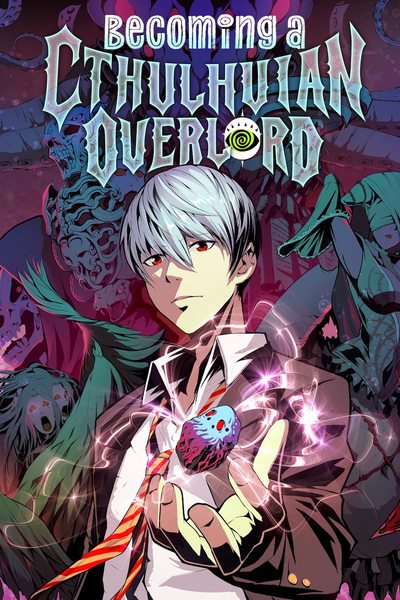
Becoming a Cthulhuian Overlord: Episodes 1-20 (2023) by Yi Jian San Lian (一键三连)

Becoming a Cthulhuian Overlord (成为克苏鲁神主) began as a novel by Yi Jian San Lian (一键三连) published on China Literature, which was then adapted in 2020 into a manhua by An Zhu (渚谙, writing) and Na Ti Maeo (拿铁猫, illustration), produced by Kaite Dongman(凯特动漫, Cat Comics), which has been translated into English by Sangria and is now being serialized online at Tapas.

This serial work falls into the genre of isekai: a very broad and currently popular genre in many media that involves an individual who becomes displaced from the real world to another world. The nature of the displacement and the other world are major flavors for the genre; the protagonist might die, for example, and be reincarnated into a fantasy world that follows rules like a tabletop roleplaying game such as Dungeons & Dragons or an equivalent video game like World of Warcraft. Or they might fall through a portal and be lost in the distant past, transported to an alien world, etc.

If this sounds a bit overbroad, it’s because isekai is a term for a mode of fantasy fiction that existed long before the term itself existed. In A Connecticut Yankee in King Arthur’s Court (1889), a blow to the head sends the Boss back to the Dark Ages Europe; in A Princess of Mars (1912) former Confederate soldier John Carter is transported bodily to a fantastic version of Mars. Lovecraft, Robert E. Howard, and others were familiar with the basic idea; one might consider The Dream-Quest of Unknown Kadath a kind of isekai, and in “The Challenge from Beyond” George Campbell is transposed into the body of an alien worm—and decides to conquer the alien planet, which is a very appropriate approach for a typical isekai protagonist. These portal fantasies bridge a gap between low fantasy (fantasy fiction set in the mundane world or realistic setting) and high fantasy (fantasy fiction set in a world separate from the real world).

Which is all meat for argument for those who like to argue labels. In Becoming a Cthulhuian Overlord, the premise is that the unnamed protagonist dies in a car accident with his pregnant wife, and has a mysterious supernatural encounter with a certain messenger…

…and reincarnates as Qi Su, an orphaned high school student in Lua City, which superficially looks much like the mundane world. Except now he can see a variety of shadowy and horrific phantoms that he has to pretend not to see, or else they’ll eat him.

If that doesn’t sound very Lovecraftian—it is not, at least at first. Serialized graphic fiction are often paced relatively slowly at first, and this has all the hallmarks of a slow-burn comic. There isn’t a lot of exposition to begin with, and a great deal of the storytelling takes place through the art, which takes advantage of the format to do long-scrolling dynamic shots in odd perspectives. Some of the art is quite effective, even if it obviously draws inspiration from works like Parasyte.

The odd tentacled entity aside, the first few chapters of Becoming a Cthulhuian Overlord are very by-the-numbers stuff, drawing strongly on the basic ideas of Yu Yu Hakusho and similar works, riffing off of Buddhism and traditional exorcism practices, with a few twists and turns. Our protagonist is back in high school, dealing with supernatural threats, teenage romances, etc. However, Qi Su doesn’t know the rules of this new world, and that ignorance helps to build a bit of tension as he learns the ropes.

Readers expecting something more overtly Lovecraftian from the title should pause and reconsider their assumptions. Just as many American and European writers attempt to assimilate the Cthulhu Mythos into a fundamentally Christian worldview, associating Cthulhu and co. with Satanism, non-Western cultures tend to fold the Mythos into their own mythopoetic framework. So for Ultraman Tiga, Ghatanathoa is interpreted as a kaiju of great power; for Soul Eater, the Great Old Ones are extremely powerful beings of madness with great spiritual powers. Becoming a Cthulhuian Overlord, working as it does within a very broadly Buddhist and Chinese folk religion framework, is centered around ghosts and exorcism, with the ghosts tending to have a particular Lovecraftian flavor…but it also develops its own unique metaphysics on top of that, tossing in pop culture borrowings to create a kind of a la carte occultism.

For example, in chapter 13 Qi Su gets Gordon Freeman‘s crowbar.

Which is a long way to say: don’t get too hung up on how Lovecraft wrote things. Different creators incorporate or reference his material differently, and sometimes in minimal or unexpected ways.

John Constantine makes an unofficial cameo in Episode 12!

As of the time of this writing, the whole manhua (over 200 episodes) has not yet been translated and released in English, so it continues to be a very slow burn, building up its world, introducing new characters, etc. Hopefully, the translation will actually be completed; some translations of serial works tend to stop before the end if the interest isn’t there for it, leaving the work incomplete, as happened with Apocalypse Zero.

For readers interested, the first chapters are free to read on Tapas, with updates every Monday.


Bobby Derie is the author of Weird Talers: Essays on Robert E. Howard and Others and Sex and the Cthulhu Mythos.

Deep Cuts in a Lovecraftian Vein uses Amazon Associate links. As an Amazon Associate I earn from qualifying purchases.
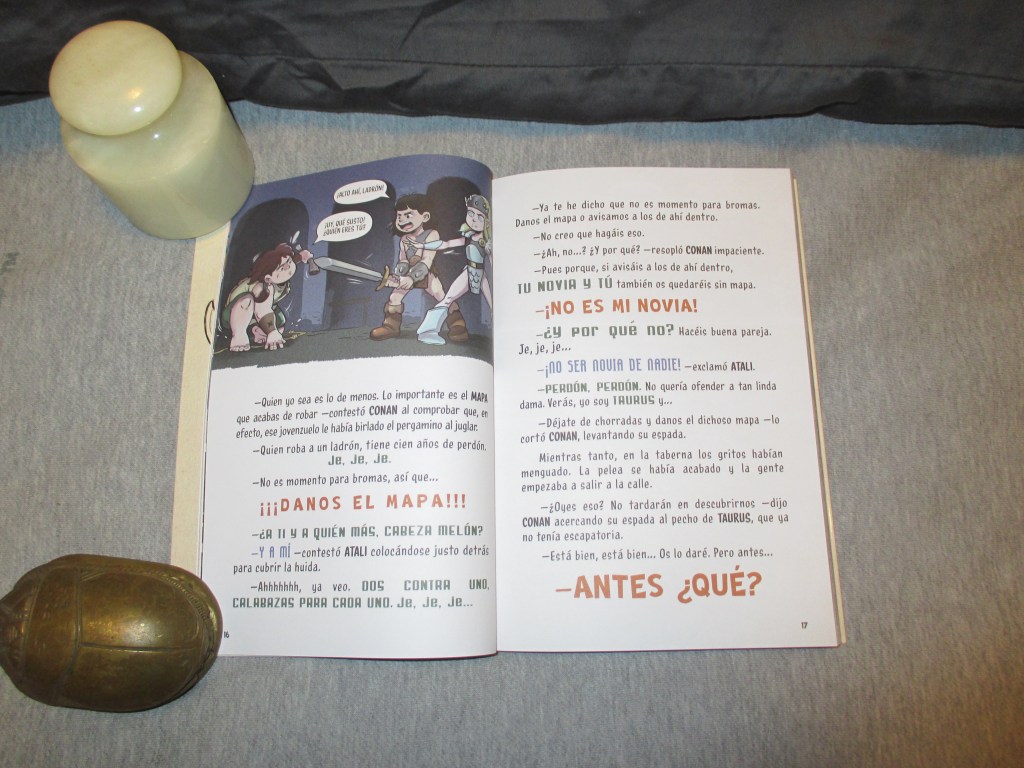
“Beyond the Past” (1953) by Lou Morales

Have you ever heard of the Necronomicon? No? That’s probably because you’ve led a normal life…a life in which that dreaded encyclopedia of evil has never entered…

The Thing #11 (Nov-Dec 1953), 18

1953. The war was over. On the magazine racks, brightly-colored comic books, eager to catch the eye and earn the dimes of children and adults alike. Romances, westerns, a scattering of super-heroes, crime, science fiction, and horror. The pulp magazines are dying, fewer of them on the stands every month, but the comic books are lurid and varied, each outfit competing with the other.

Charlton Comics was a latecomer to the field of horror comics. Their most notable entry was The Thing, a horror anthology comic consciously modeled on EC’s Tales from the Crypt, launched in February 1952 and lasted 17 issues, ending in November 1954; today most notable for the artistic talents of a young Steve Ditko in the later issues. Under the editorship of Al Fago, The Thing sought to distinguish itself in a crowded field with low page rates and relatively lax editorial oversight, with the hope this artistic freedom would provide solid stories and provocative artwork—and unfortunately for them, they succeeded in drawing attention to themselves, though not the kind they wanted. (The Charlton Companion 48, 52-4)

In The Thing #11, released in November 1953. “Beyond the Past” was a short comic in the middle of the issue, only 4 pages. Artist Lou Morales signed the first page, but the writer, letterer, etc. are uncredited, which was typical. Comics in the 50s were often churned out swiftly, in workshop fashion, and individual creators were not always credited. The other stories in the issue (and many issues before and after) were written by Carl Memling, and he may be responsible for the script on “Beyond the Past” as well.

The story itself is relatively direct and minor: an old professor studies the Necronomicon, mumbles an incantation (“Xnapantha..xnapnatha..Chrtlu..xmondii…”), and accidentally calls up that which he cannot put down. Lovecraft had many fans among the early horror comics, as evidenced by “Baby… It’s Cold Inside!” in Vault of Horror #17 (1951), and “Portrait of Death” (1952) in Weird Terror #1 (1952). For the most part, this would be classed as forgettable filler, but for two things.

For one, “Beyond the Past” is an early appearance of the Necronomicon in a comic book. For two, it caught the attention of Fredric Wertham, and became a footnote in the moral panic that led, ultimately, to the institution of the Comics Code Authority and the vanishing of horror comics from the shelves in the United States and other countries.

The Thing, No. 11. Two young people cook and eat an old woman. . . a man hears his own limbs being wrenched from his body by a 30ft. octopus . . a creature called a Necronomicon drinks a man’s blood and devours his flesh.

Keith Waterhouse, “Horrors Unlimited” in the London Daily Mirror, 13 September 1954

Nearly a year after The Thing #11 was first published, an article ran in the London Daily Mirror, decrying the comics that kids were buying these days. This was not exceptional; the United Kingdom had been undergoing its own moral panic about comic books, which would eventually result in the Children and Young Persons (Harmful Publications) Act, which was passed into law in 1955. For details see Martin Baker’s excellent A Haunt of Fears: The Strange History of the British Horror Comics Campaign; see also John A. Lent (ed.)’s Pulp Demons: International Dimensions of the Postwar Anti-Comics Campaign, which adds important detail.

Keith Waterhouse focused on imported American horror comics and described a handful of issues in a sensationalist style. Never mind the issues he rants about had likely been off the stands (in the United States, at least) for months; and that he could hardly have read them very carefully if he mistook the Necronomicon for the blood-thirsty monster Xnapantha the professor had summoned. No one was likely to fact-check him.

This article was paraphrased in at least one other British paper, which asked “What is a necronomicon?”:

The Clydebank Press, 5 Nov 1954, p1

Someone in the United States, however, also read Waterhouse’s article.

Do you know what a necronomicon is? Probably not. But for thousands of children this is part of their education. They know that a necronomicon is a creature that, of course, drinks people’s blood and eats their flesh.

Fredric Wertham, “It’s Still Murder” in the Saturday Review 9 April 1955, 11

By 1955, Wertham had won. In April 1954 his book Seduction of the Innocent had stirred a moral panic in the United States and abroad to the highest level, he testified before the Senate Subcommittee on Juvenile Delinquency in April and June, and in September the collective comic book publishers in the United States formed the Comics Code Authority, censoring themselves to stave off government interference. Crime and horror comics vanished from the newsstands, and would have a ripple effect around the world, starting similar moral panics in the United Kingdom and other countries.

Yet Wertham continued to campaign against the deleterious influence of comic books on the youth. Thanks to the research of Carol Tilley, we now know that Wertham faked his research, distorted facts and figures to match his narrative. What most folks don’t acknowledge is that Wertham didn’t stop. He certainly wasn’t above reusing Waterhouse’s garbled idea of what a Necronomicon was to his own benefit.

Wertham used the leading question about the Necronomicon more than once; a 1954 article titled “The curse of the comic books” appeared in the journal Religious Education Vol. 49, No. 6 a few months prior with essentially the same opening, and Wertham may have reused it elsewhere.

There is no surprise in this case that Wertham got the details wrong; there are numerous examples in Seduction of the Innocent where his apparent encyclopedic knowledge of comic characters and plots is shown to be superficial at best. What’s surprising is how he got ahold of a British newspaper article—possibly through a clipping service—and how swiftly and avidly he seized on the word Necronomicon, apparently in complete ignorance of its provenance.

Like a weird game of telephone, the misconception about the Necronomicon, now totally separated from its source material, continued to promulgate through the web of concerned citizens.

Dear Parents:
“Do you know what a necronomicon is? Probably not.[“]

Isabelle P. Buckley, “Your Child” in the North Hollywood Valley Times, 22 Apr 1955, 11

Buckley depended on Wertham’s integrity as a scholar; she took his article as fact as she clutched her metaphorical pearls and told parents to worry about what their kids might pick up down at the corner drug store or newspaper stand. Wertham depended on Waterhouse’s journalistic integrity, that the reporter had gotten his facts correct. Neither of them bothered to investigate for themselves, any more than Lou Morales picked up an Arkham House book to confirm whether it was supposed to be “Chrtlu” or “Cthulhu” in the incantation.

After all, who would notice?

“Beyond the Past,” like many of the stories from The Thing, has relished in relative obscurity. Now in the public domain, it was finally reprinted in Haunted Horror #25 (2016, IDW), and in rougher form in The Giant Readers Thing (2019, Gwandanaland Comics), but the whole story can be read for free at Comic Book Plus.

Addendum: A sharp-eyed reader pointed out that while this might be one of the earliest comic appearances of the Necronomicon by name, the story “Dr. Styx” in Treasure Comics #2 (Aug 1945) includes the writings of the mad Arab Abdul Alhazred. Read G. W. Thomas’ article on the story here. The Necronomicon also featured in “The Black Arts” in Weird Fantasy #14 (Jul-Aug 1950).


Bobby Derie is the author of Weird Talers: Essays on Robert E. Howard and Others and Sex and the Cthulhu Mythos.

Deep Cuts in a Lovecraftian Vein uses Amazon Associate links. As an Amazon Associate I earn from qualifying purchases.
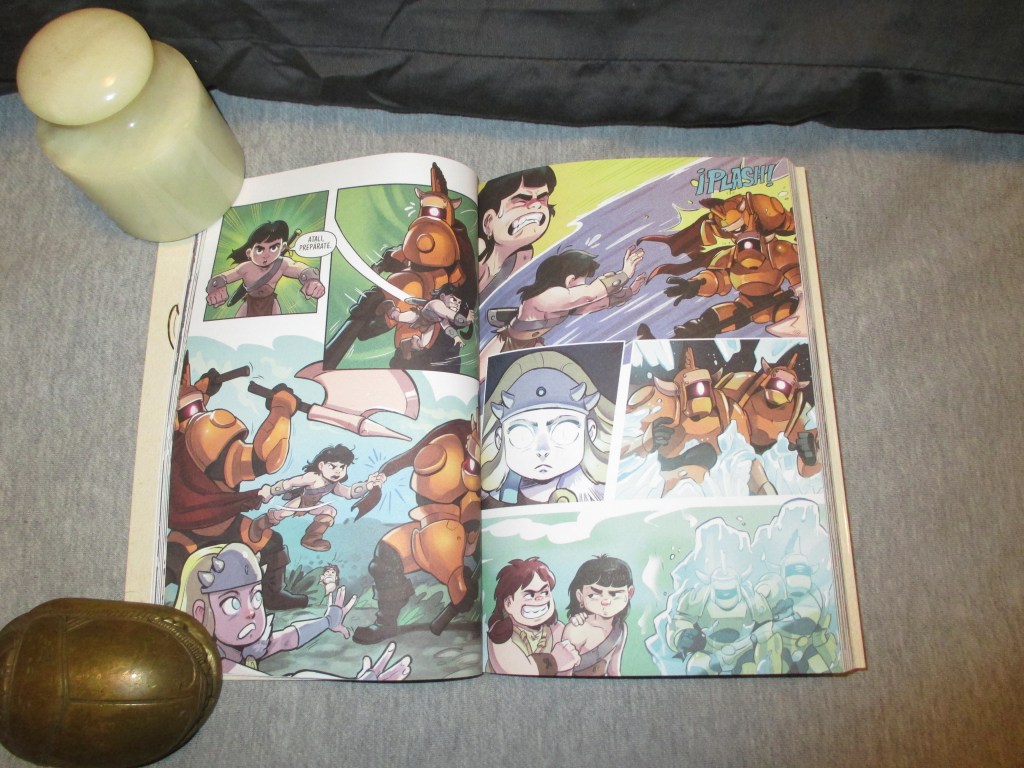
Yuggoth Rising: Erster Act (2012) by Sebastien Dietz

En Episches Abenteuer in den Welten H. P. Lovecrafts

Back cover copy of Yuggoth Rising #1

“An Epic Adventure in the world of H. P. Lovecraft,” is what is promised, and that is what writer/artist Sebastien Dietz sets out to deliver. Yuggoth Rising is a German-language black-and-white 9-issue independent comic series, originally produced by Undergroundcomix.de in 2012. While physical issues were limited in number and now quite scarce, the series is collected in both German and English through Comixology/Amazon Kindle in three acts, beginning with Yuggoth Rising: Erster Act (Deutsch) / Yuggoth Rising: First Act (English, translated by Craig Stanton).

The epic adventure gets off on a bit of a left foot. February 1930, the Great Depression is settling in as our protagonist, an unemployed but educated young woman, returns to New York City—and on the ship runs into Lionel P. Hatecraft, author of popular romances.
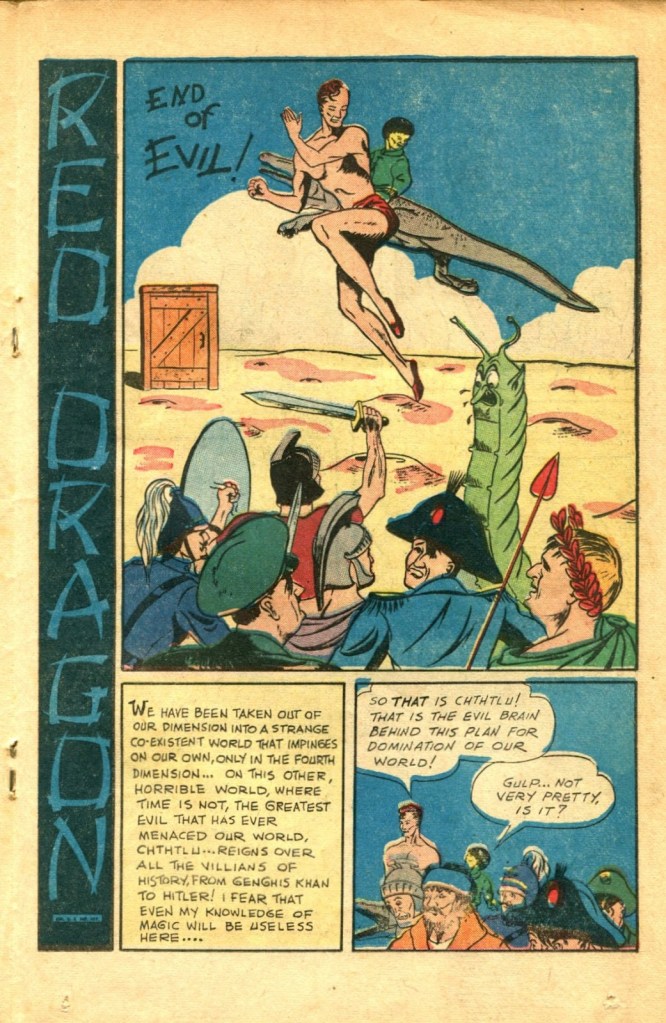
At first glance, this is a set-up for a farce; in light of what comes later, it may be more appropriate to think of it as an unsubtle hint that while this takes place in the world of Lovecraft’s Mythos, this is not the world we know, the one that Lovecraft inhabited. Like the future envisaged by Robert W. Chambers in “The Repairer of Reputations,” or the 1920s and 30s envisaged in the Call of Cthulhu Roleplaying Game, this is a subtly different setting.

Dietz’ art is detailed, and cityscapes, streets, buildings, and ships are especially well-executed; he has an eye for splashes of darkness that stand out against the page. If there’s a criticism of his work, it is his human figures, whose heads are often slightly oversized in proportion to their bodies—but that’s more in the nature of a stylistic convention than a flaw. When he does break out for splash pages, the effect is worth it.

It’s not a tale told exclusively in comic panels. The end of each issue is punctuated by letters, articles, pages from magazines and newspapers, a convention used in other works to give the series a lived-in feel, to expand on things happening in many places during the same time period. Some of which are connected, and some of which are not.
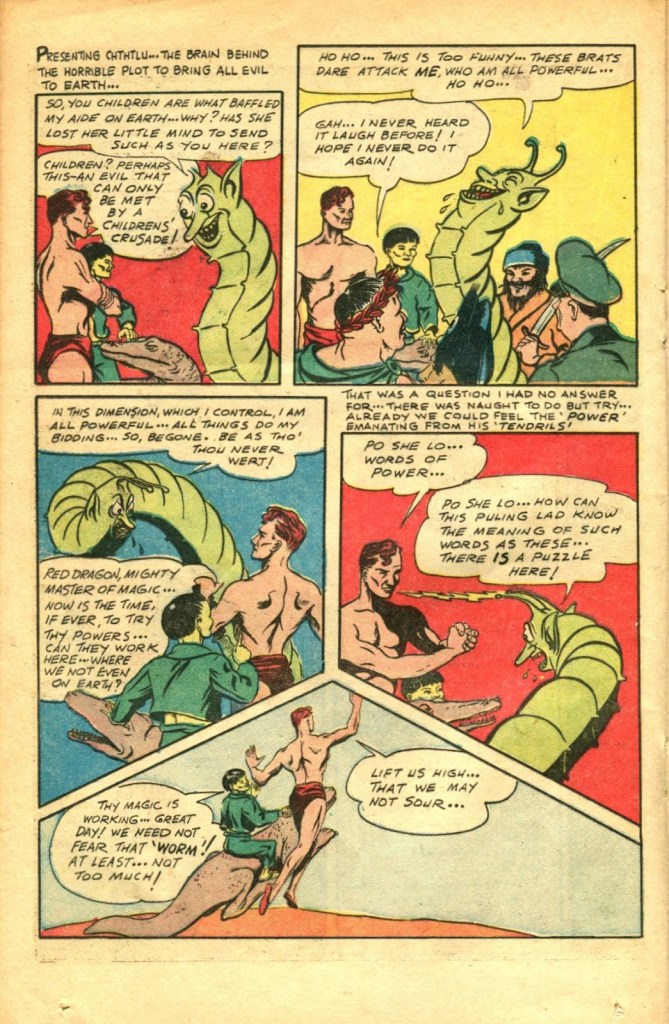
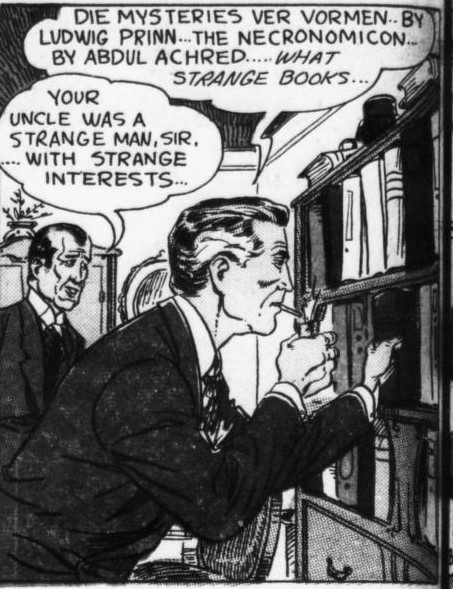
Dietz’ story takes a broadly familiar shape: different threads, interweaving; widely separated characters working their way together until they meet. A young woman down on her luck, a brilliant expert in Mayan script, a millionaire embroiled in an international conspiracy, a slightly seedy newspaper porter on the werewolf-and-alien beat…ancient mysteries, the hunt for Planet X, and the Unaussprechlichen Kulten. The story moves at its own pace, neither too slowly or too quickly in this first act, these first three issues…

…but it just the opening act, the preliminaries. What revelations are here are just the beginning; our characters haven’t all met yet, the epic adventure has just begun. Taken by itself, it is promising…but readers shouldn’t be expecting “At the Mountains of Madness” or “The Shadow Out of Time,” although it takes a few cues from those works. Dietz’ inspirations more likely lie in Call of Cthulhu the Roleplaying Game, or the slightly pulpier adventures of August Derleth’s Trail of Cthulhu. The story of Yuggoth Rising—if the name isn’t clue enough—is things moving into place, the stars becoming right, cults and investigators getting into position, to destroy the world or redeem it.

If that sounds familiar, it’s because “when the stars are right” is the natural end-game of the Mythos; the Ragnorok or End Times, the eschatological frontier that looms in the unspecified future. Alan Moore and Jacen Burrows worked with that idea at the end of Providence, Jonas Anderson & Daniel Thollin did the same in 1000 Ögon: Cthulhu, and there are dozens of literary examples, in Cthulhu’s Reign and elsewhere. As with every Mythos story, it is less the tropes that are important than how it is told, how the characters develop and toward what end.

None of which a reader can tell in Yuggoth Rising: Erster Act, not on a first reading. On subsequent readings, readers can pick out more details, foreshadowings, hints that maybe they overlooked. Dietz has done a very credible job in setting the stage…and it is fortunate that this is a case where readers of both English and German have the opportunity to read it to the end, even if only digitally.


Bobby Derie is the author of Weird Talers: Essays on Robert E. Howard and Others and Sex and the Cthulhu Mythos.

Deep Cuts in a Lovecraftian Vein uses Amazon Associate links. As an Amazon Associate I earn from qualifying purchases.