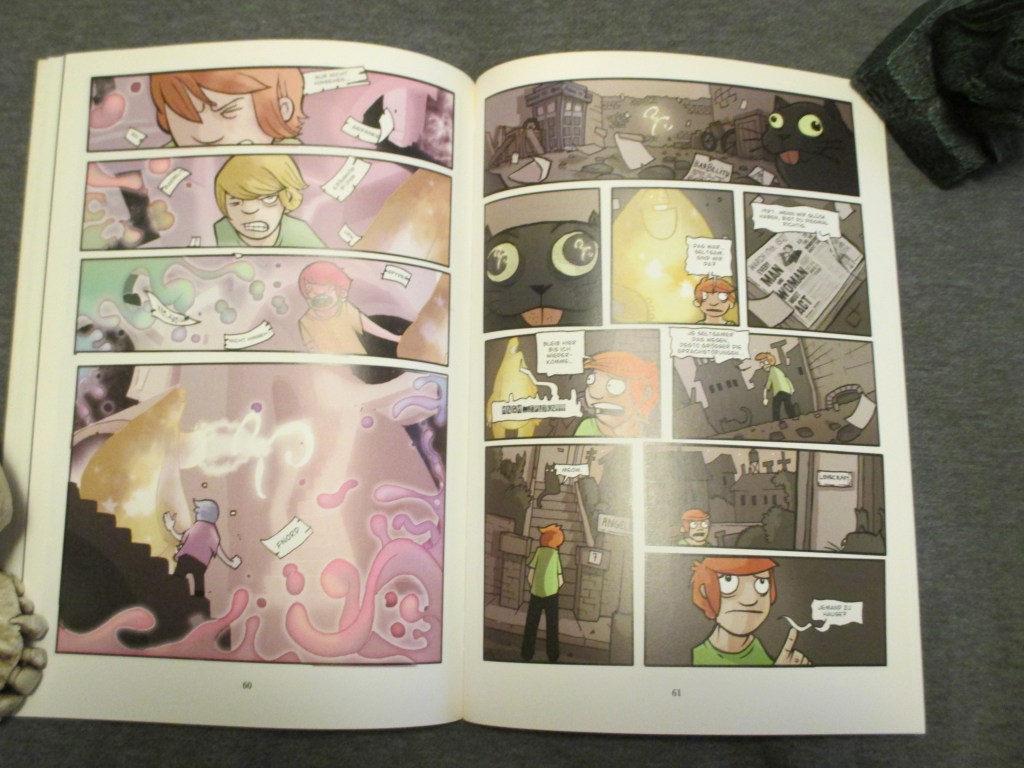
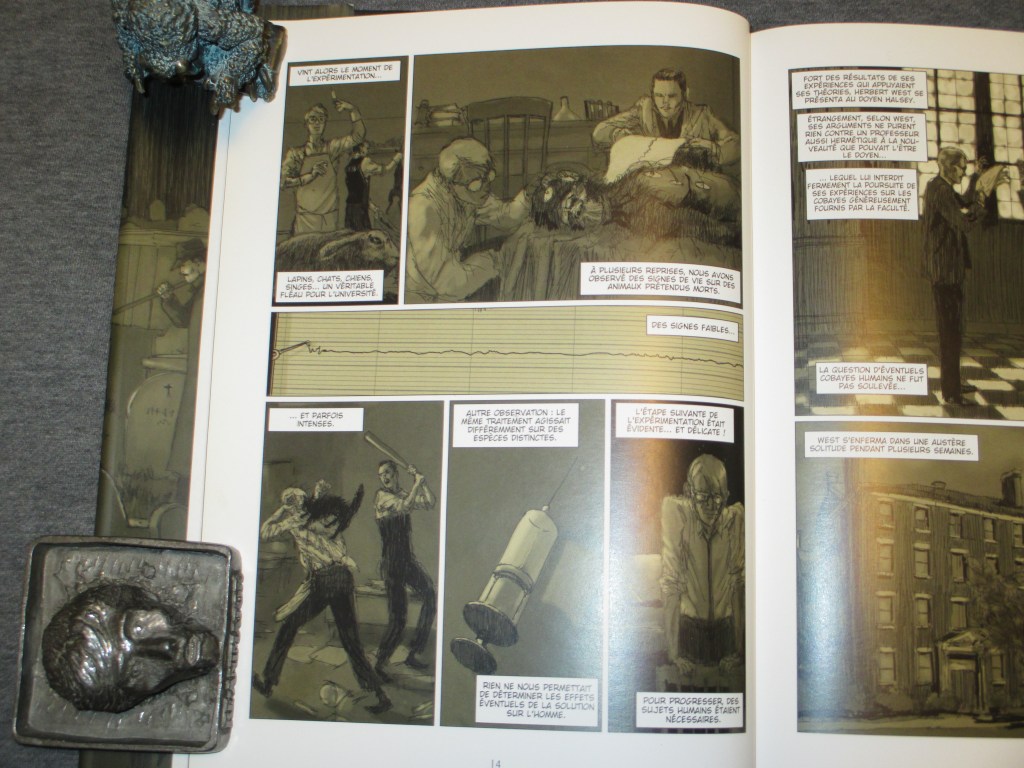
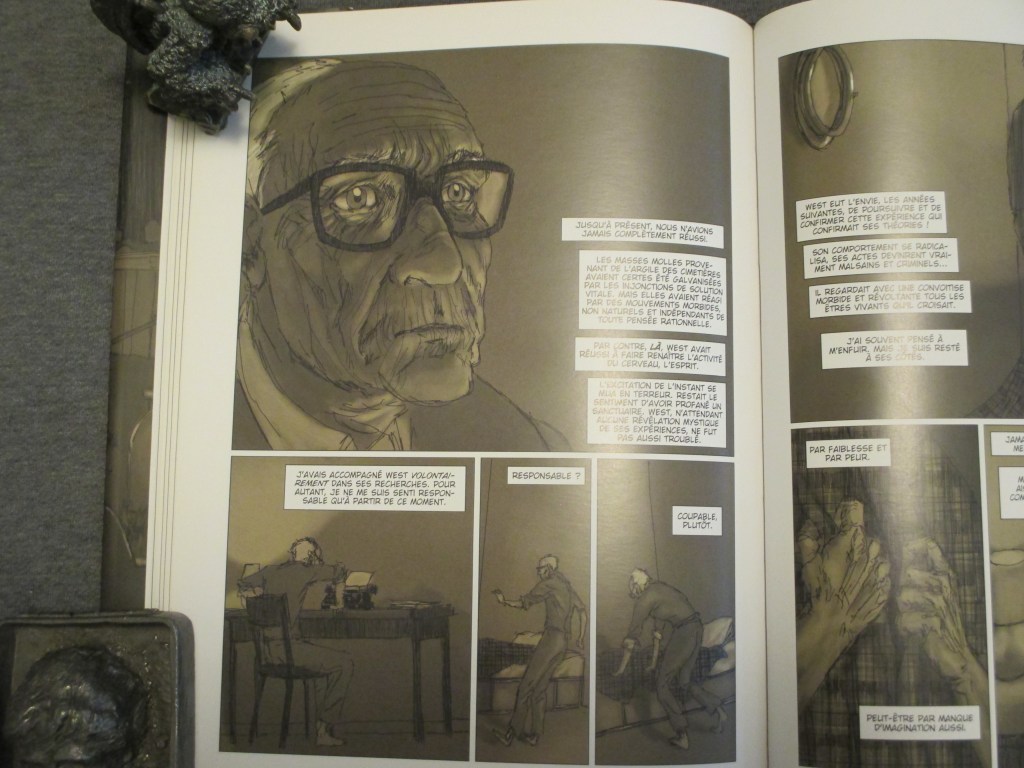
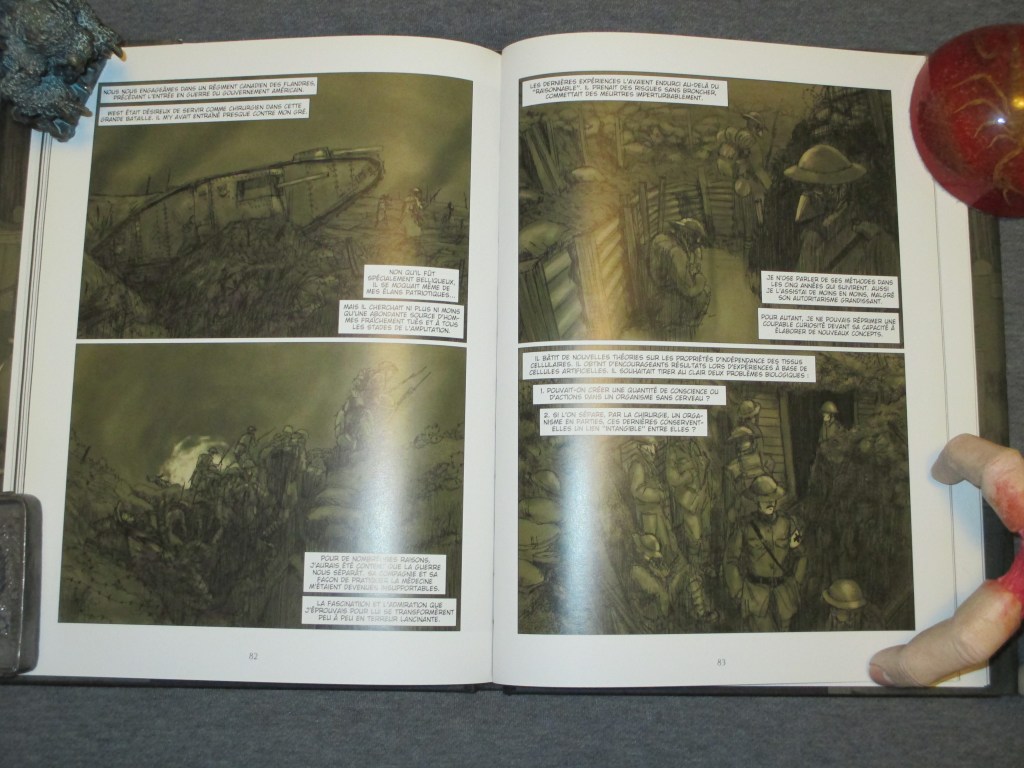
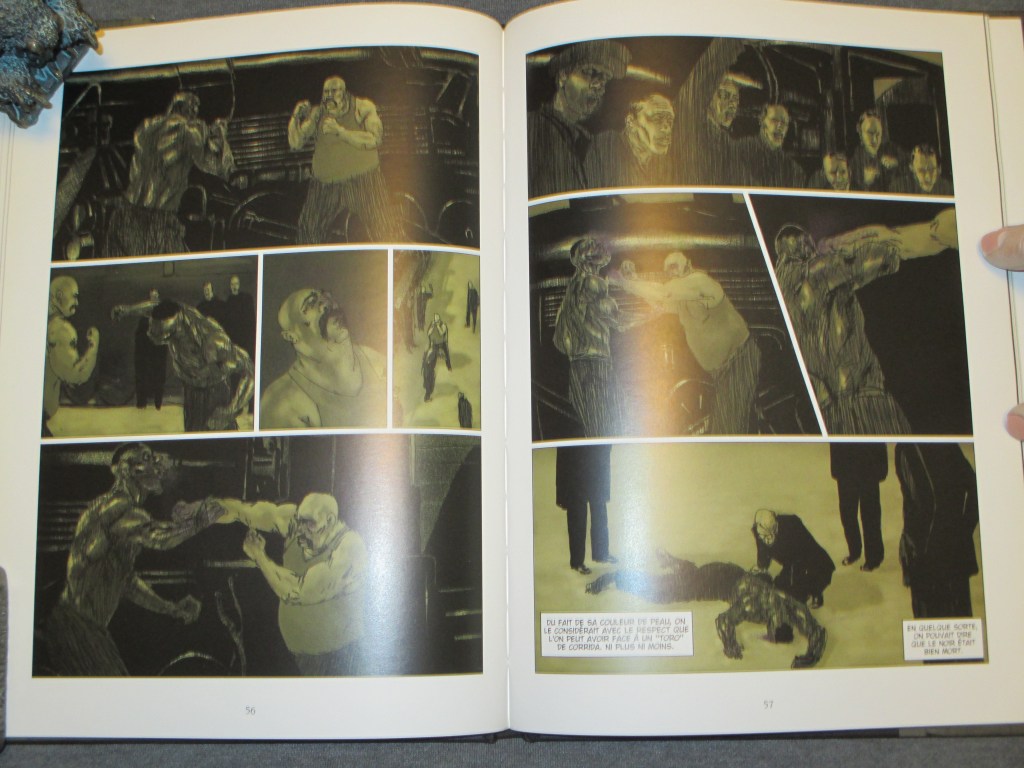
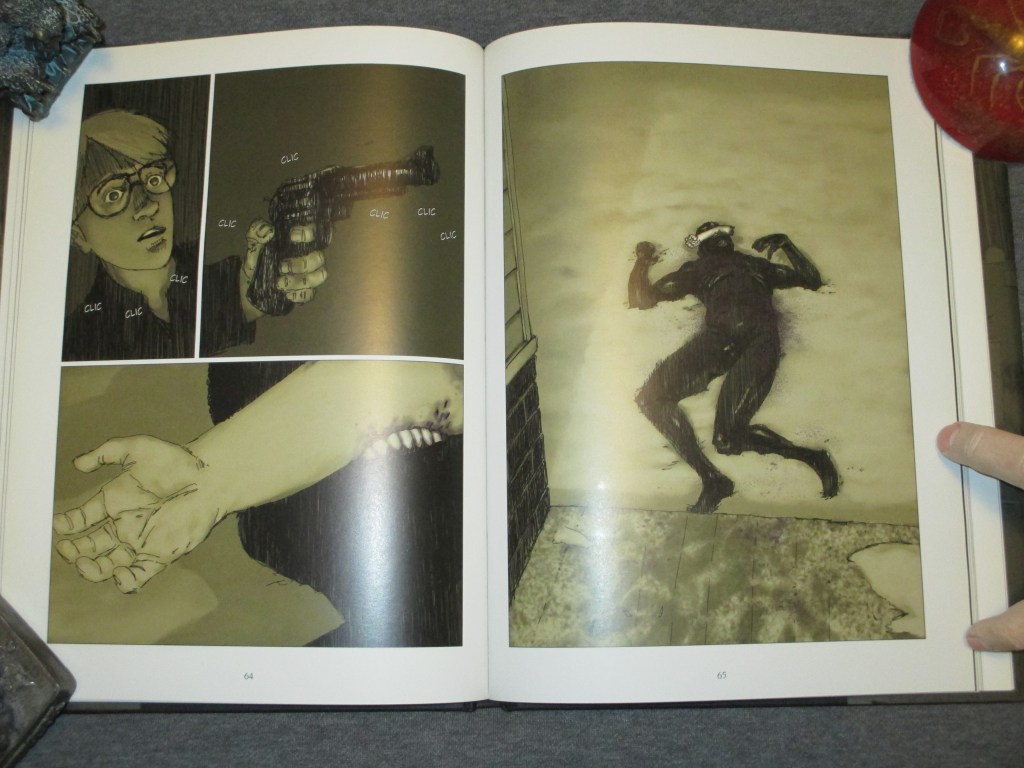
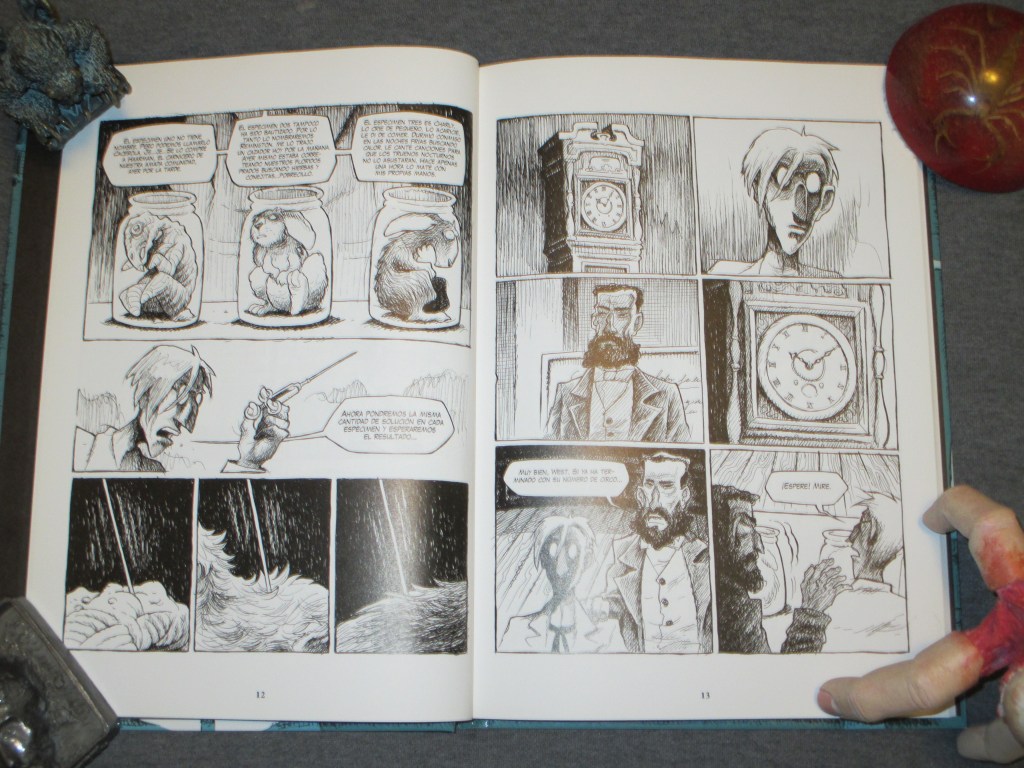
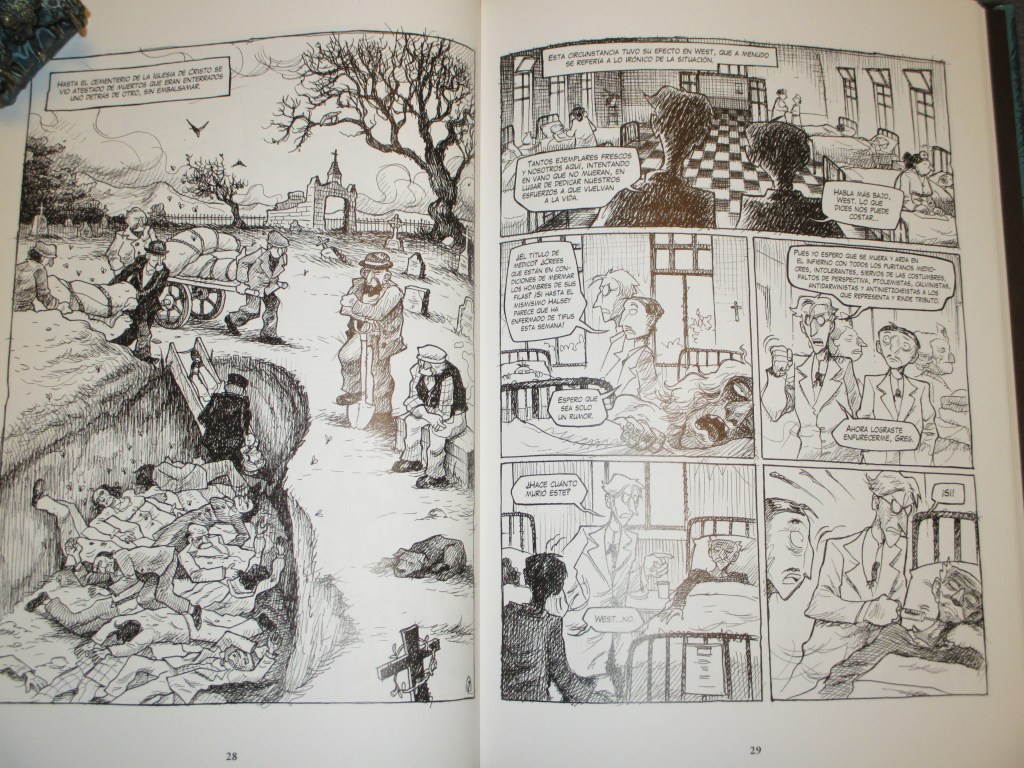
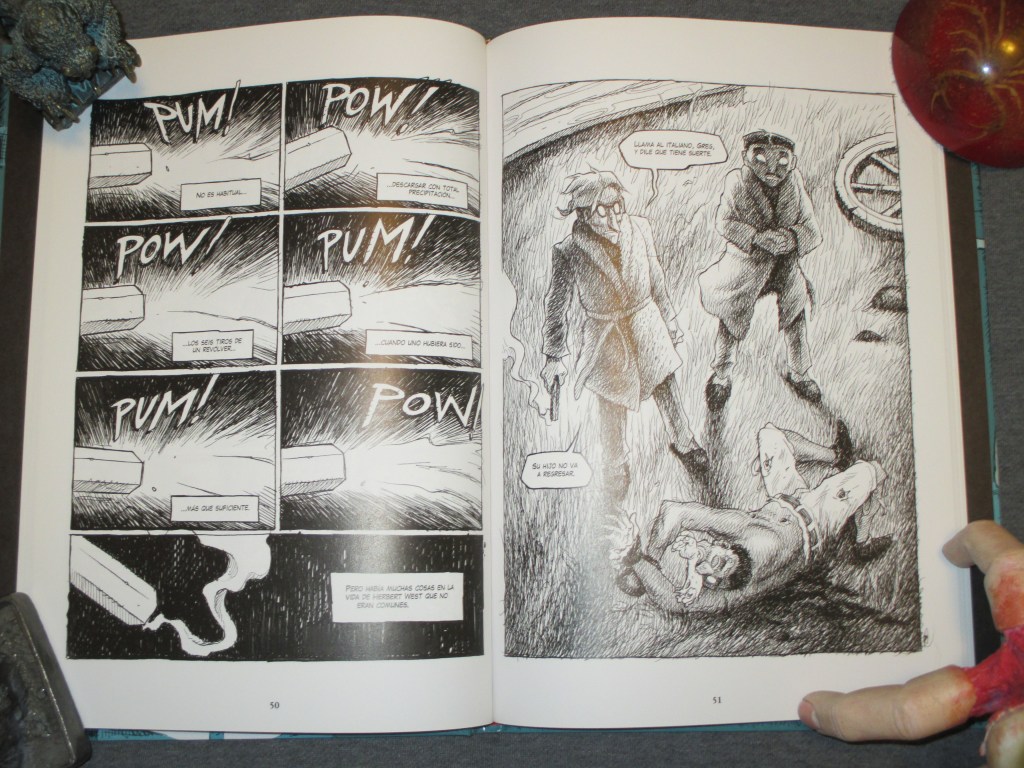
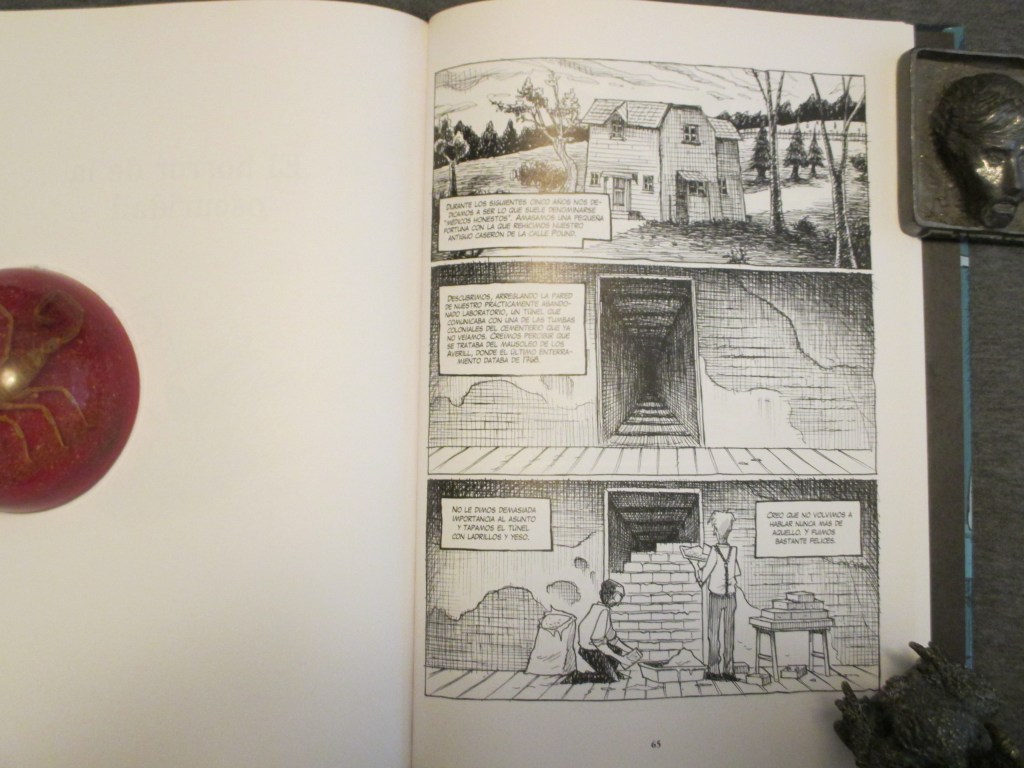
Ghosts and Monsters (1982) by Mark Falstein & Tony Gleeson

Ghosts and monsters have long been favorite topics for many children, so this Getting Into Literature set has a real built-in motivation factor. The art aids understanding, and the text is set in type (rather than hand-lettered in the traditional comic-book style). These features make GHOSTS AND MONSTERS enjoyable and easy to read.
—Teacher’s Guide: Ghosts and Monsters

Imagine yourself in a public middle school in the United States of America, circa the 1980s or early 1990s. A genuine chalk board, rows of desks, an old-style projector. It’s the fall; leaves are falling from the trees, t-shirts are giving way to long sleeves and jackets. The classroom might be decorated with black and orange chains of paper, a cut-out of a witch, a pumpkin with a crooked smile drawn on in sharpie. The teacher passes out a stack of worksheets—but what is this? Comics? Horror comics?

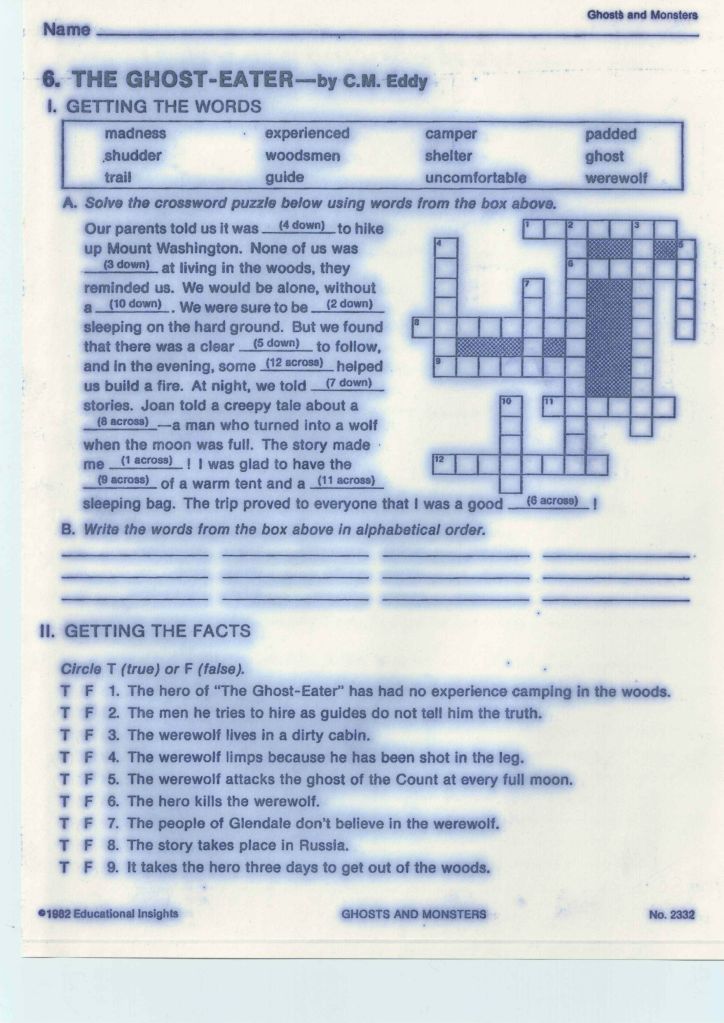
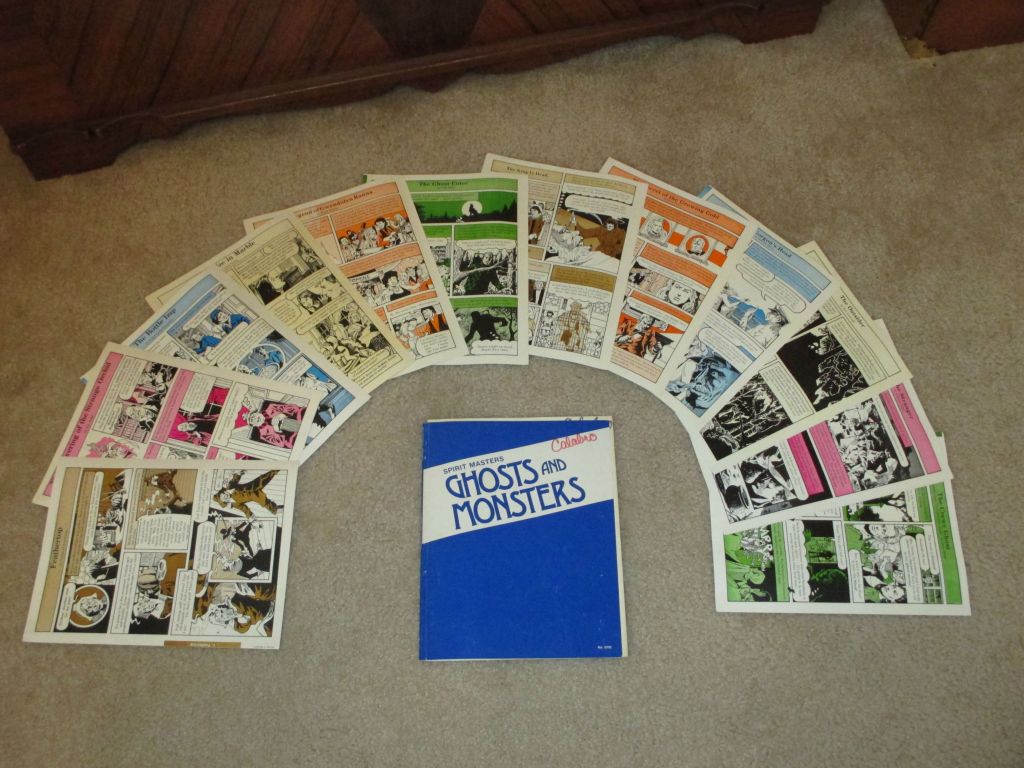
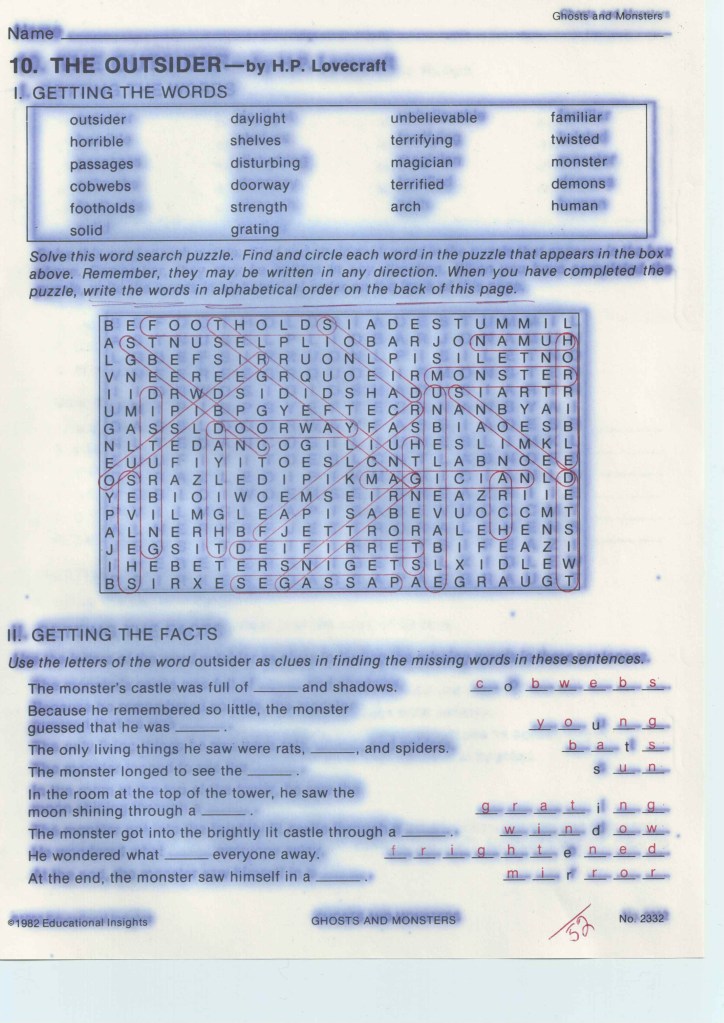
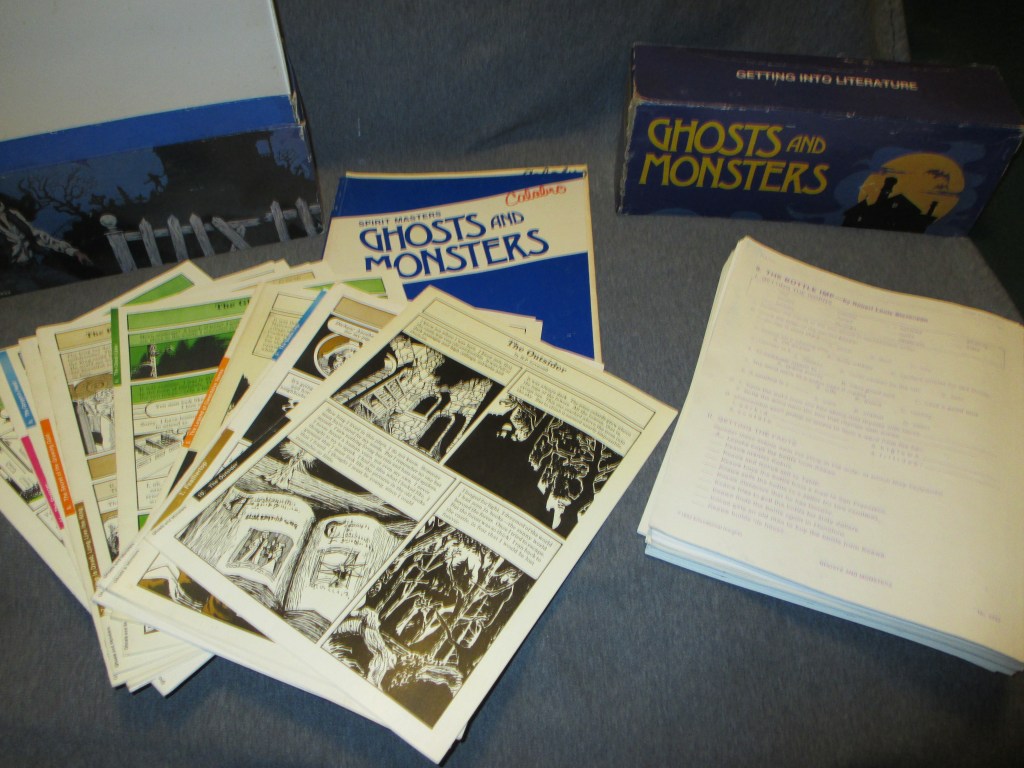
Ghosts and Monsters was published by Educational Insights in 1982. The kind of boxed set of teaching materials that found there way easily into hundreds or thousands of classrooms across the country. The contents were pretty basic: a book of spirit masters for duplicating worksheets (crosswords, etc.) in an age before photocopying became ubiquitous; a brief teacher’s guide with suggested questions and activities; and a package of comic booklets which adapted a dozen tales of horror and weird fiction to comics:

  1. “Feathertop” (1852) by Nathaniel Hawthorne
  2. “The Flowering of the Strange Orchid” (1894) by H. G. Wells
  3. “The Bottle Imp” (1891) by Robert Louis Stevenson
  4. “Man-Size in Marble” (1887) by Edith Nesbit
  5. “The Legend of Gwendolyn Ranna” (1982?) by Frank Maltesi
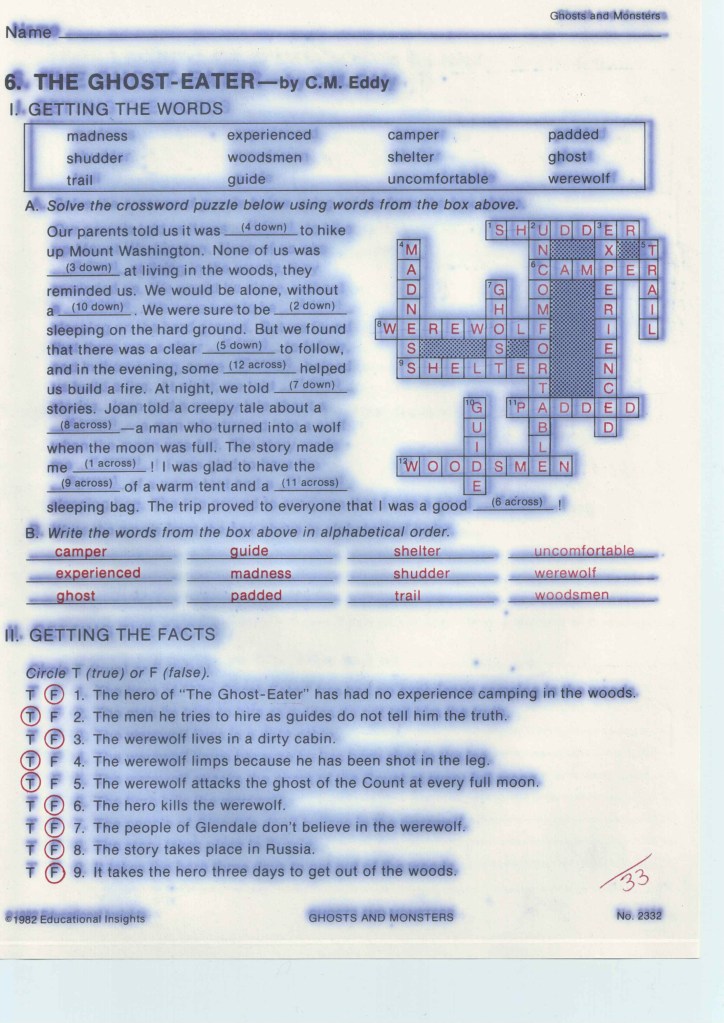
  6. “The Ghost-Eater” (1924) by C. M. Eddy
  7. “The King is Dead, Long Live the King” (1928) by Mary Coleridge
  8. “The Secret of the Growing Gold” (1892) by Bram Stoker
  9. “The Gorgon’s Head” (1899) by Gertrude Bacon
  10. “The Outsider” (1926) by H. P. Lovecraft
  11. “The Stranger” (1909) by Ambrose Bierce
  12. “The Crewe Ghost” after Oscar Wilde [based on “The Canterville Ghost” (1887)]

It’s an odd mix. Many of these works were in the public domain, while the others were largely drawn from the pulps or (more likely) horror anthologies. “The Legend of Gwendolyn Ranna” by Frank Maltesi is a bit of an enigma, though the name is associated with several other brief legendary tales that have popped up in other educational materials; this may well be its first (and only) publication.

Most of the interest is on the comics themselves. The Teacher’s Guide credits Mark Falstein (well-known author of fiction for young adults) for selection and adaptation, and freelance artist Tony Gleeson for the illustrations. Each comic booklet is basically one large folded page, which gives four pages to tell and illustrate a complete story—a not-inconsiderable task!

The results tend to less grue and taboo than young horror fans might hope for. These were the last generation of “monster kids” that might pick up Famous Monsters of Filmland (1958-1983) on the stand, but they might still find a Helen Hoke-edited horror anthology in the school library, or pick up something from Scholastic involving vampires, werewolves, or bug-eyed aliens at the school book fair. Yet I have to wonder how many kids sat down one day and read Lovecraft for the first time as part of a school assignment—

And then fill out the worksheet afterwards!

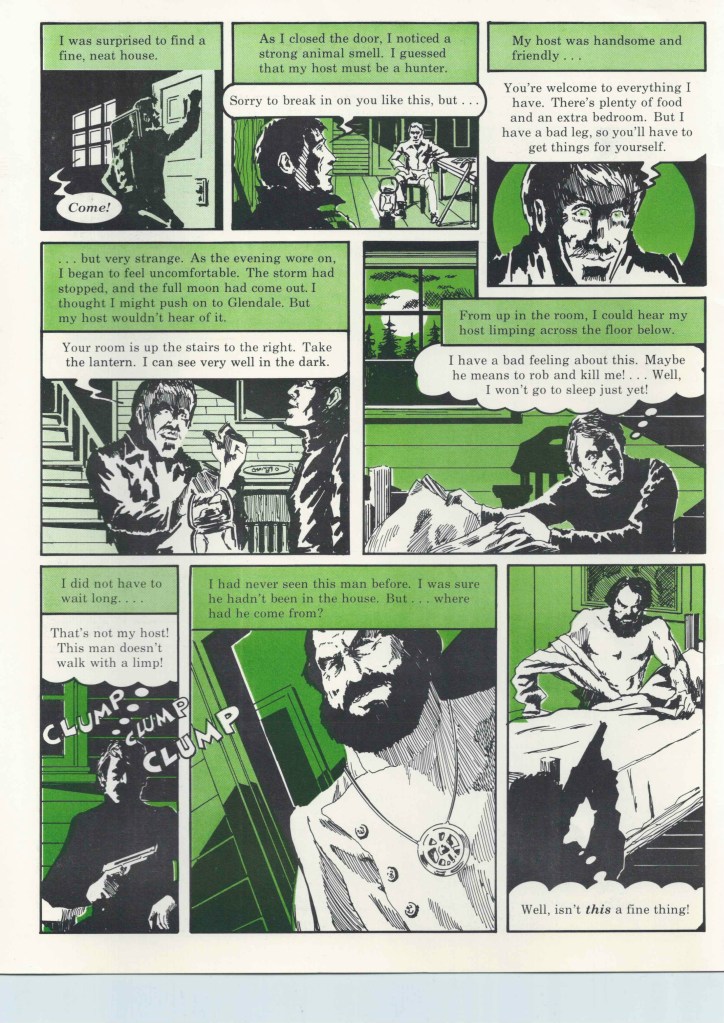
Actually, there were two bits of Lovecraft tucked away in this package. C. M. Eddy, Jr.’s “The Ghost-Eater” (Weird Tales Apr 1924) was one of the stories that Lovecraft had somewhat revised for Eddy, and sold to Weird Tales editor Edwin Baird. As Lovecraft put it:

I have, I may remark, been able to secure Mr. Baird’s acceptance of two tales by my adopted son Eddy, which he had before rejected. Upon my correcting them, he profest himself willing to pint them in early issues; they being intitul’d respectively “Ashes”, and “The Ghost-Eater”.
—H. P. Lovecraft to James F. Morton, 28 Oct 1923, Letters to James F. Morton 57

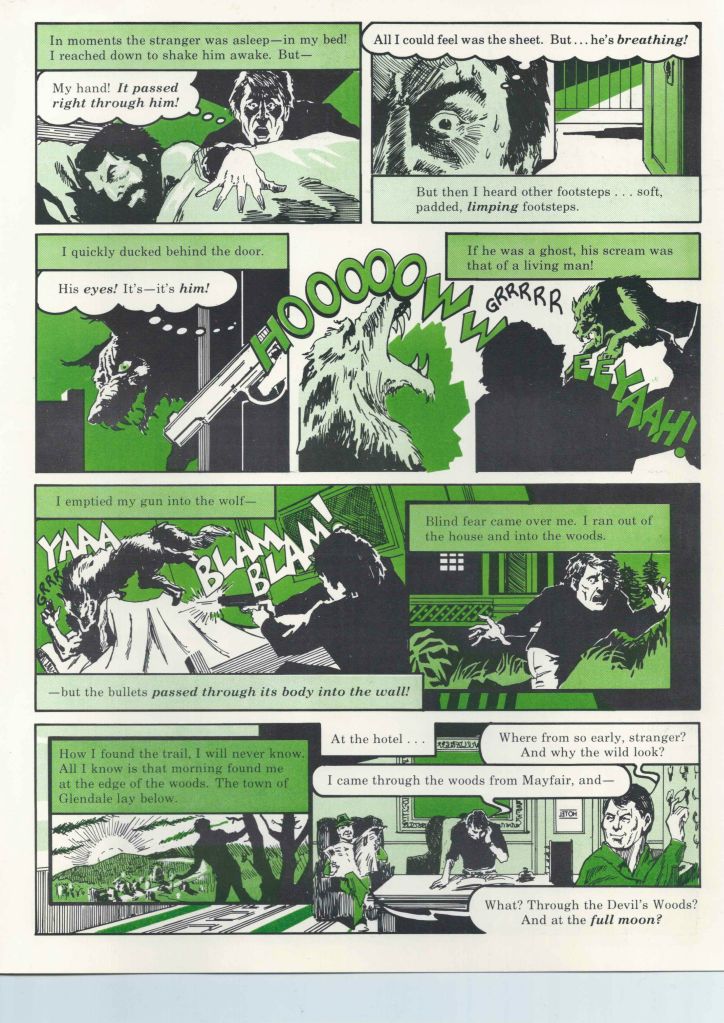
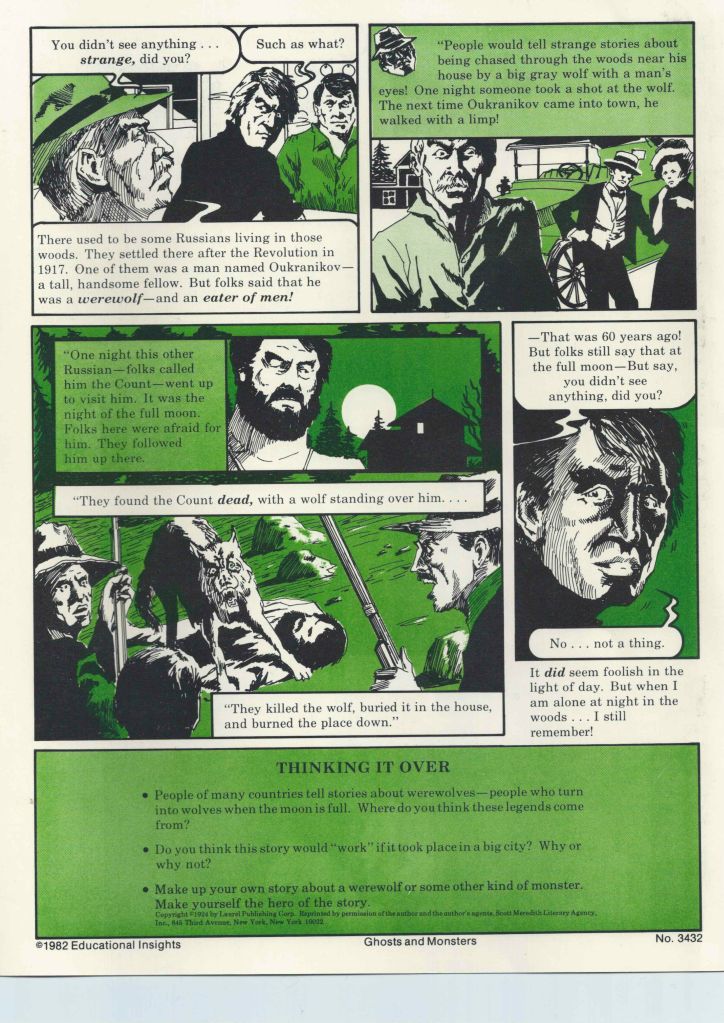
How much of it Lovecraft actually wrote is a matter for debate; S. T. Joshi in Revisions and Collaborations notes the plot and some of the dialogue seems very typical of Eddy, while much of the prose reads like Lovecraft. In any event, it’s a genuine rarity. While many of Lovecraft’s tales have been adapted to comics, his revisions and collaborations are much less likely to receive the same treatment. This is certainly the first, and possibly the only adaptation of “The Ghost-Eater” to comics.

Given the limitations of space, the monochromatic printing, and the incredibly tight scripts, credit has to be given to Tony Gleeson for doing a very decent job on the art. Stuck with a very boxy framing setup, he nevertheless manages to use perspective shots and shadowed silhouettes to hint and convey something of a horror-mood. While the Teacher’s Guide suggests that the typeset text will make it easier to read, I suspect the real issue was that the budget for this project didn’t extend to hiring a letterer.

When we consider Lovecraft as something more than a cult figure, but as a writer who has entered the canon of world literature—this is a good example of what that looks like. Not necessarily fancy, expensive editions that can only be seen and enjoyed by a few, but stories that penetrate into common educational materials, hitting the masses when they’re young and becoming part of the foundation of reading. Ghosts and Monsters is a core sample of how Lovecraft came to the masses.

It’s a bit of history easily overlooked and easily lost. These were sold for classroom use, not to the public, and not preserved in libraries. How many classes went through Ghosts and Monsters before the comics were too worn for further use, or lost and displaced? Who preserves old worksheets from childhood days? These are deliberately ephemeral products, designed to last a few seasons and then be replaced as educational guidelines shift or a company needs to sell a new product. Edutainment marches on.

(Here are the answer keys to the worksheets if you need them.)


Bobby Derie is the author of Weird Talers: Essays on Robert E. Howard and Others and Sex and the Cthulhu Mythos.

Deep Cuts in a Lovecraftian Vein uses Amazon Associate links. As an Amazon Associate I earn from qualifying purchases.
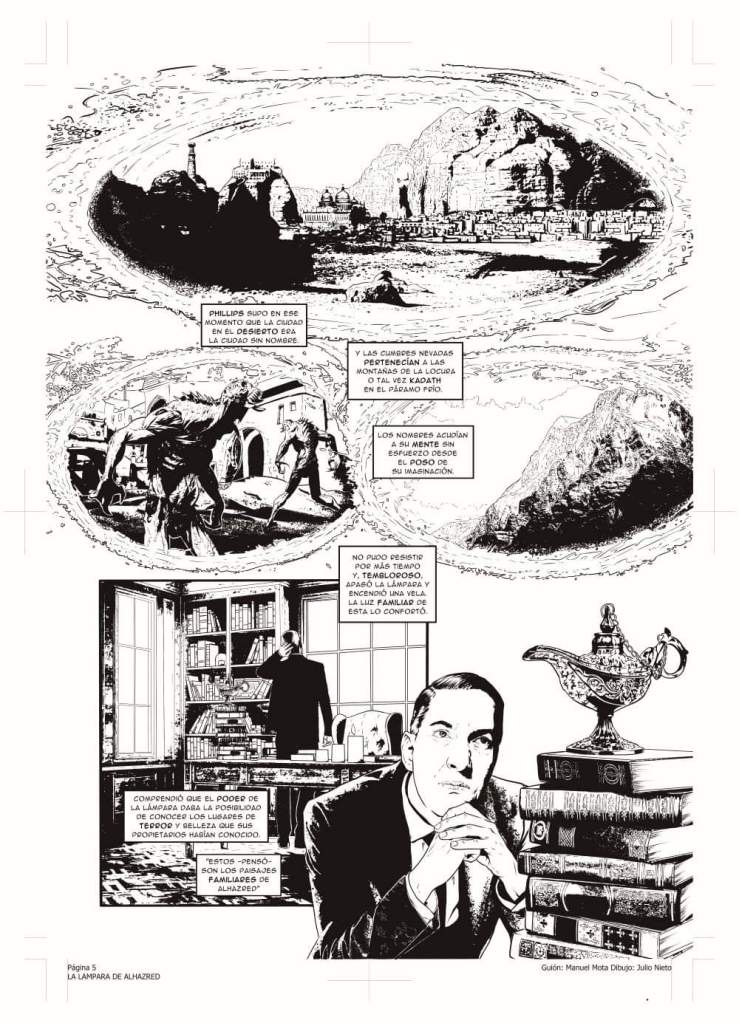
“La Lámpara de Alhazred” (2023) by Manuel Mota & Julio Nieto

Habían pasado siete años desoe la desparaición de su abuelo Whipple cuando Ward Phillips recibió la lámpara.Seven years had passed since the disappearance of his grandfather Whipple when Ward Phillips received the lamp.It was seven years after his Grandfather Whipple’s disappearance that Ward Phillips received the lamp.
“La Lámpara de Alhazred” (2023) by Manuel Mota & Julio Nieto,
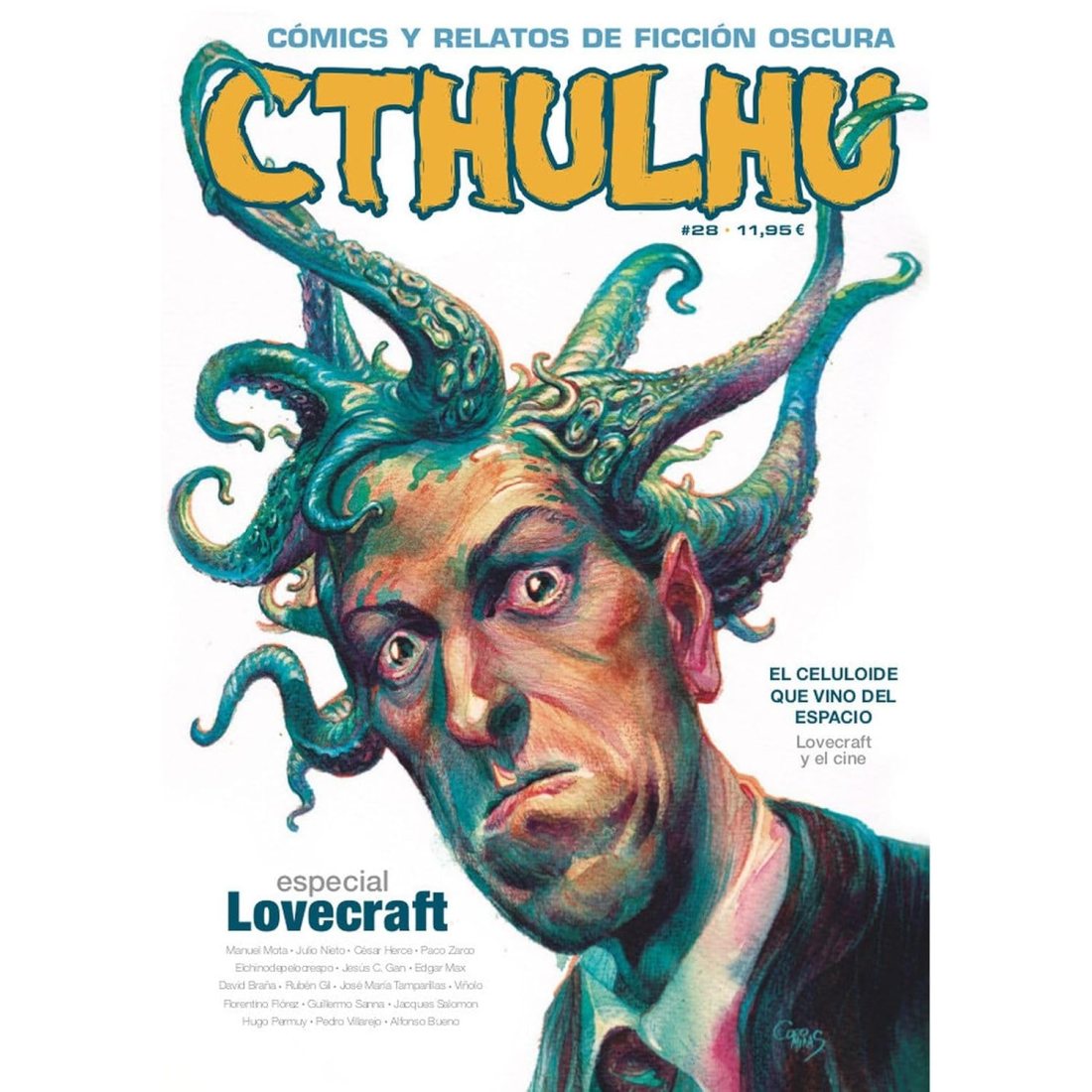
Cthulhu #28.5
English translationAugust Derleth, “The Lamp of Alhazred” (1957), The Watchers out of Time 114

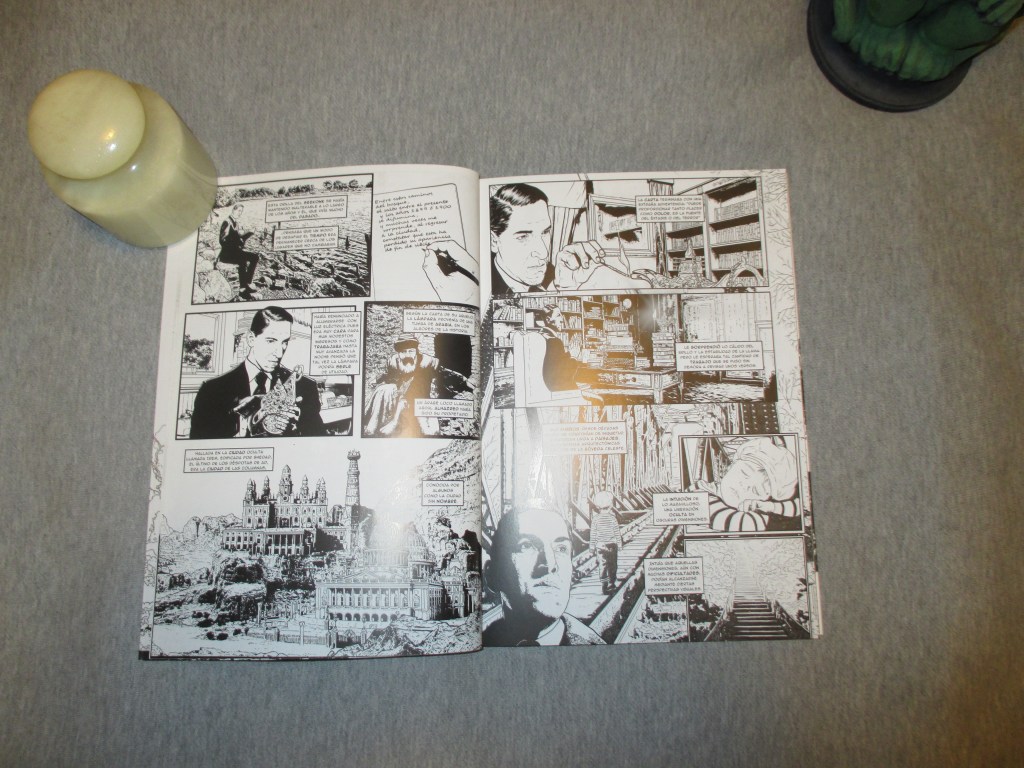
Many of August Derleth’s “posthumous collaborations” with H. P. Lovecraft have been derided as pastiches. Yet “The Lamp of Alhazred” is more homage—and more accurately a collaboration than most of Derleth’s stories, since it incorporates a large chunk of text from Lovecraft’s letter to Derleth dated 18 Nov 1936, where Lovecraft described coming across a previously unknown wood west of Neutaconkanut Hill.

On Oct. 28 I penetrated a terrain which took me half a mile from any spot I had ever trod before in the course of a long life. I followed a road which branches north 7 West from the Plainfield Pike, ascending a low rise which skirts Neutaconkanut’s Western foot & which commands an utterly idyllic Vista of rolling Meadows, ancient stone walls, hoary groves, 7 distant cottage roofs to the west & south. Only 2 or 3 miles from the city’s heart—& yet in the primal rural New-England of the first colonists!He penetrated a terrain which took him almost a mile from any spot he had ever before trod in the course of his life, following a road, which branched north and west from the Plainsfield Pike and ascending a lot rise which skirted Nentaconhaunt’s Western foot, and which commanded an utterly idyllic Vista of rolling Meadows, ancient stone walls, hoary groves, and distant cottage roofs to the west and south. he was less than three miles from the heart of the city, and yet basked in the primal rural New England of the first colonists.
H. P. Lovecraft to August Derleth, 18 Nov 1936, Essential Solitude 2.756August Derleth, “The Lamp of Alhazred” (1957), The Watchers out of Time 119

Derleth also took inspiration from an entry in Lovecraft’s commonplace book:

From Arabia Ency. Britt. II.–255. Prehistoric fabulous tribes of Ad in the south, Thamood in the north, and Tasm & Jadis in the centre of the peninsula. “Very gorgeous are the descriptions given of Irem, the City of the Pillars (as the Koran styles it) supposed to have been erected by Shedad, the latest despot of Ad, in the regions of Hudramant, and which yet, after the annihilating of its tenants, remains entire, so Arabs say, invisible to ordinary eyes, but occasionally, and at rare intervals, revealed to some heaven-favored traveler.” Rock excavations in N. W. Hejaz ascribed to Thamood tribe.It had once been the property of a certain half-mad Arab, known as Abdul Alhazred, and was a product of the fabulous trident of ad—one of the four mysterious, little-known tribes of Arabia, which where ad—of the south, Thamood—of the north, Tasm and Jadis—of the center of the peninsula. it had been found long ago in the hidden city called Irem, the city of Pillars, which had been erected by Shedad, last of the despots of Ad, and was known by some as the Nameless City, and said to be in the area of Hadramant, and, by others, to be buried under the ageless, ever-shifting sands of the Arabian deserts, invisible to the ordinary eye, but sometimes encounter by chance by the favorites of the Prophet.
The Notes and Commonplace Book of H. P. Lovecraft 21-22August Derleth, “The Lamp of Alhazred” (1957), The Watchers out of Time 115-116

While nearly every Lovecraft story has been adapted to comics at some point, rather fewer of Derleth’s stories have attracted the same treatment. Yet it makes sense that Manuel Mota (script) and Julio Nieto (artwork) would adapt “The Lamp of Alhazred” for Cthulhu #28, the Lovecraft special issue. Because there are homages which capture as much of the pathos of H. P. Lovecraft as well as this one.

Manuel Mota’s script is a fairly straight translation of Derleth text, albeit truncated for space and with the illustrations serving in place of much of the description, which inadvertently cuts out most of Lovecraft’s text. Yet the presentation and framing of the words and Julio Nieto’s art does much to lend a sense of action to what is a largely contemplative story that draws on both Lovecraft’s life and the sentiment of “The Silver Key.” Readers feel Ward Phillips loss and loneliness, his refuge in his imagination, and the visions of other worlds, other times.

It is escapist in the most literal sense of the word, and one of several stories that reflect that quiet, profound desire to abandon the daily grind of life, with its quiet indignities, defeats, and injuries.

Nieto’s artwork is carefully realistic, the page layout traditionally grid-like; it is a straight-forward presentation that puts the more fantastic sequences, the break-outs where the panel cannot contain a wondrous scene, in context. The weirdness isn’t a part of Ward Phillips world; it is the way out.

Jamás se encontro el cuerpo de Ward Phillips.

La policía aún espera queue sus restos aparezcan en Alguno de los lugares queue solía frecuentar en sus solitarios paseos.

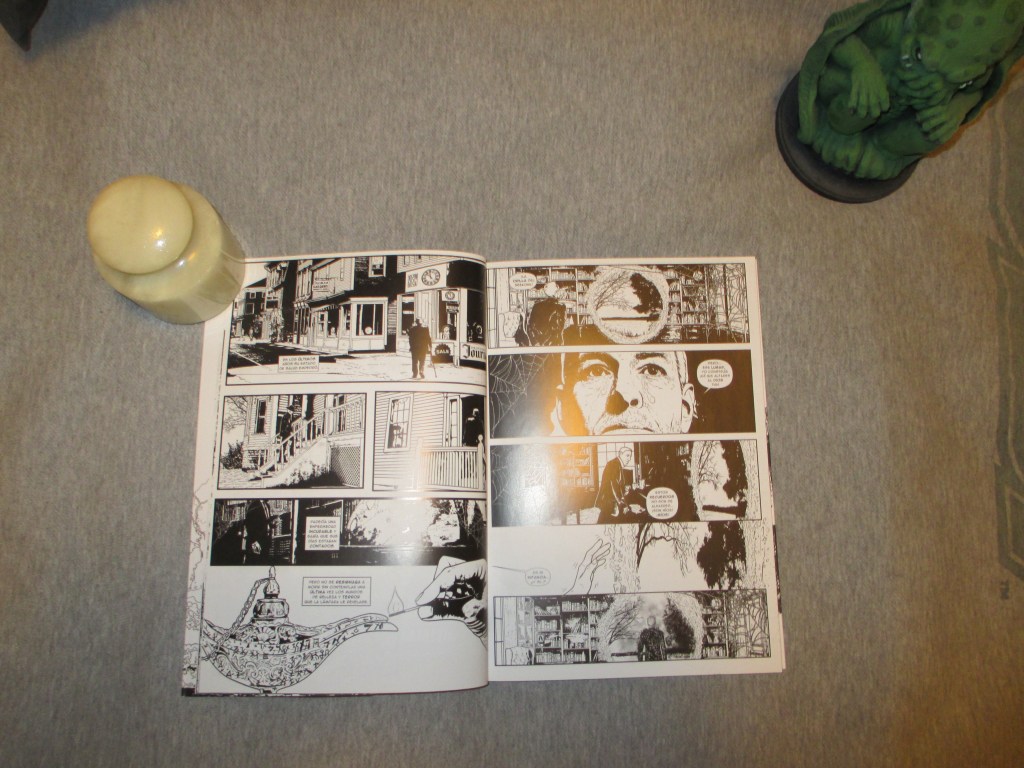
Con el paso de Los años, la vieja casa fue derribada, la biblioteca adquirida por librerías anticuarias y lo queue quedó gue vendido como chatarra incluida una vieja lámpara Árabe a la que nadie encontró utilidad alguna.
The body of Ward Phillips was never found.

Police are still hoping that his remains will turn up in one of the places he used to frequent on his solitary walks.

Over the years, the old house was demolished, the library was acquired by antiquarian bookstores and what remained was sold as scrap, including an old Arabic lamp that no one found any use for.
Though desultory searching parties were organized and sent out to scour the vicinity of Nentaconhaunt and the shores of the Seekonk, there was no trace of Ward Phillips. The police were confident that his remains would some day be found, but nothing was discovered, and in time the unsolved mystery was lost in the police and newspaper files.

The years passed. The old house on Angell Street was torn down, the library was bought up by book shops, and the contents of the house were sold for junk—including an old-fashioned antique Arabian lamp, for which no one in the technological world past Phillips’ time could devise any use.
“La Lámpara de Alhazred” (2023) by Manuel Mota & Julio Nieto,
Cthulhu #28.14
English translationAugust Derleth, “The Lamp of Alhazred” (1957), The Watchers out of Time 123-124

It is a story that almost demands a familiarity with Lovecraft to truly appreciate; those who have read his letters, who knows what Lovecraft struggled with during his life, can recognize more of the man in Derleth’s framing of the Nentaconhaunt narrative. Mota and Nieto do well to capture and depict as much of this atmosphere as they can, and the sensibility of the story is necessarily both sad and romantic in the older sense—this is not a Mythos story, despite the name “Alhazred.” it is a fantasy, a myth, so much more elegant than the reality that saw Lovecraft end his days in pain in a hospital as the cancer consumed him.

“La Lámpara de Alhazred” (2023) by Manuel Mota & Julio Nieto is an excellent overall adaptation of Derleth’s homage to Lovecraft, one that captures the spirit of the original—the echo of Lovecraft, as it were—for a new medium and a new audience.


Bobby Derie is the author of Weird Talers: Essays on Robert E. Howard and Others and Sex and the Cthulhu Mythos.

Deep Cuts in a Lovecraftian Vein uses Amazon Associate links. As an Amazon Associate I earn from qualifying purchases.
“The Obi Makes Jumbee” (1945)

Comic books arose during the peak of the pulp magazine era, and commonly shared writers, artists, and sometimes publishers. Given the crossover in creative talents, it is no surprise that several ideas and sometimes entire stories were lifted from the pages of Weird Tales and other pulps to appear in the pre-Code horror comics. Many of these stories were produced basically anonymously, with little or no credit given to the writers or artists involved, which makes it more difficult to determine who did what, or whether a particular idea was borrowed, stolen, or just carried over by a creator from one project to another.

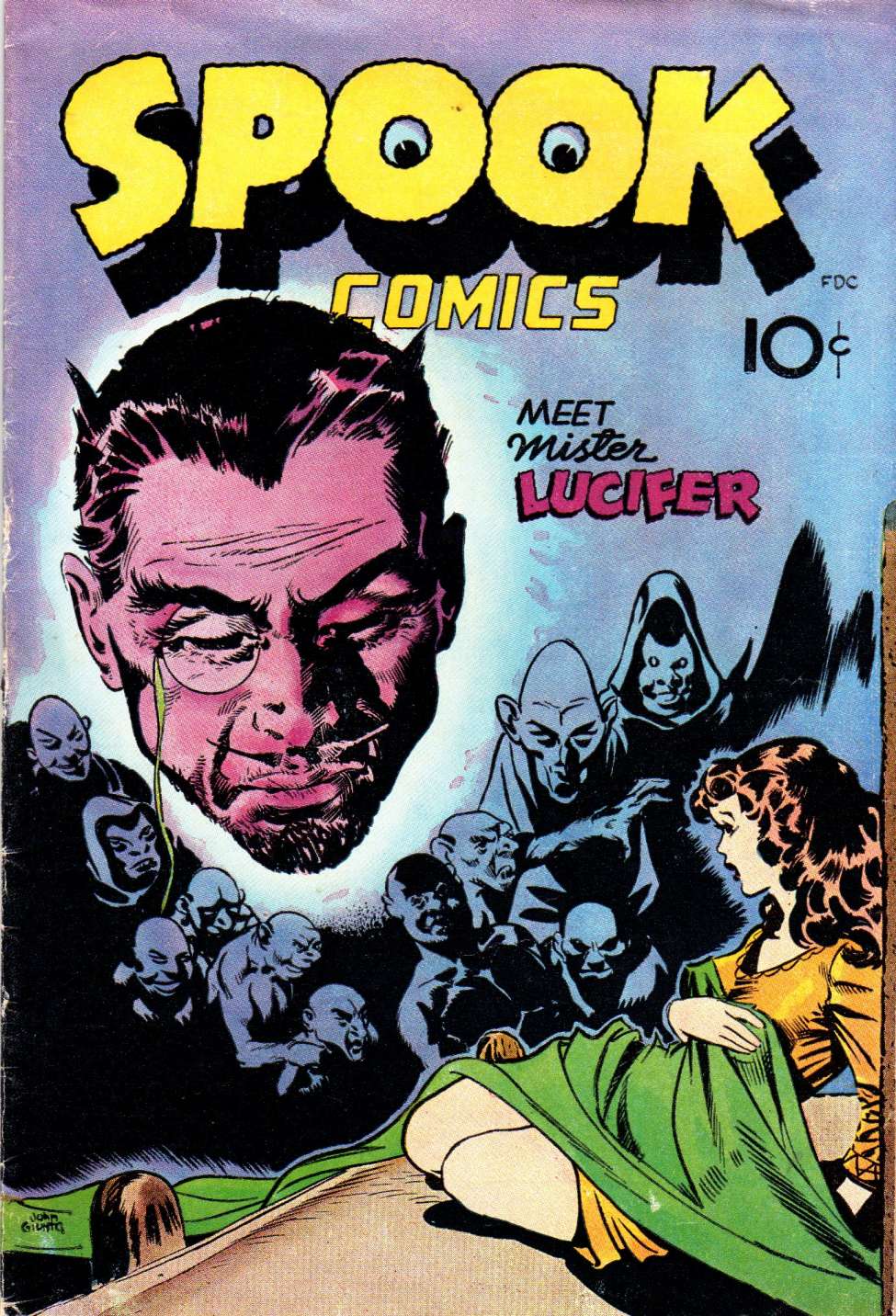
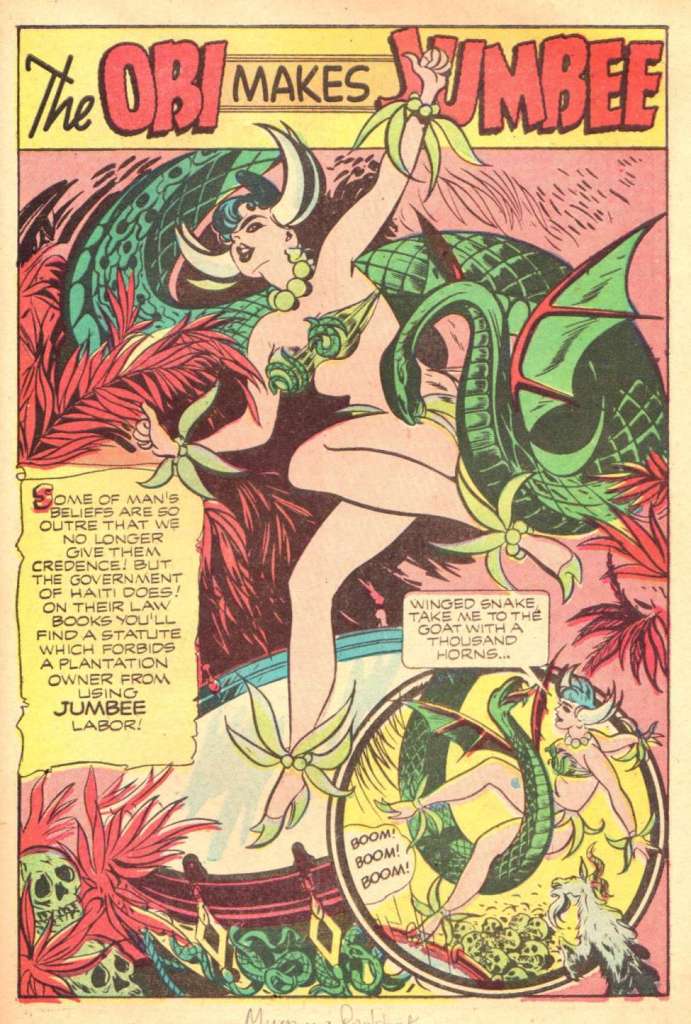
This is the case for “The Obi Makes Jumbee,” an 8-page story that first appeared in Spook Comics, a one-shot horror comic from Baily. Though not dated, the issue is thought to be published in 1945 or 1946 (in one panel, a character reads a newspaper with the date December 1945). No writer is credited. The Grand Comics Database says the art is credited to Robert Baldwin (I can’t find a signature on any of the pages, so I’m not sure where that came from), but also claims the art was actually done by Munson Paddock. Based solely on the art style, I lean toward Paddock. Since Paddock is only known to have worked with Baily in 1945, that would support that date.

The one thing we can say about the script is that it probably came from a Weird Tales fan.

Spook Comics, p27

The U.S. invasion and occupation of Cuba (1906-1909, 1917), Haiti (1915-1934) and the Dominican Republic (1916-1924), and the purchase of the Danish Virgin Islands in 1917, brought more and more of the Caribbean into their sphere of influence. So too, more U.S. citizens gained contact with the island cultures, which differed radically from the hard racial limits of Jim Crow. More tantalizing to many would-be anthropologists or tourists were the syncretic African diaspora religions on these tropic isles—remnants of African indigenous religions, often hybridized and combined with elements of Roman Catholicism.

In the 1930s, zombies and Haitian Vodou were popularized in the United States through William Seabrook’s The Magic Island (1929), and works that were inspired by it like the film White Zombie (1931). Seabrook wasn’t the first to write about Vodou or Vodoun; novels like The Goat Without Horns (1925) by Beale Davis, but it was Seabrook who captured the imagination of a generation of writers, whose zombie stories trickled into first pulps and then comic books. H. P. Lovecraft read Seabrook, as did Seabury Quinn, August Derleth, and many others. While far from the only source of data on African diaspora religions—Zora Neale Hurston would write Tell My Horse (1938) and other works, to name one—Seabrook was the most sensational and popular, and his version of Haitian Vodou made a lasting impression on “voodoo” as it appeared in pulps, comics, and film.

“Jumbee” however, is something a bit different. As a category of supernatural being, jumbee is most often associated with the folklore and African diaspora religion (“Obi”) of the Virgin Islands, and Jumbee tales were told by a substantially smaller group of authors—especially Henry St. Clair Whitehead, H. P. Lovecraft’s friend, correspondent, and fellow Weird Tales writer. Although Whitehead died in 1932, in 1944 Arkham House published his first collection of supernatural fiction: Jumbee and Other Uncanny Tales. A follow-up collection, West India Lights (1946) includes Whitehead’s non-fiction article “Obi in the Caribbean.” Given how scarce Jumbee stories are in comics (“The Obi Makes Jumbee” is the only comic story with that word in the title on the Grand Comics Database), it seems likely the author of that comic script had to have read Whitehead.

They knew enough to differentiate Jumbee from zombies, Obi from Vodou. Yet they make what seems to be an odd mistake or artistic license. “The goat without horns” is a term used for human sacrifice in some works that discuss Haitian vodou. Seabrook didn’t originate the term, though he helped popularize it, and in his book he quotes from the March 1917 Museum Journal of the University of Pennsylvania, Philadelphia:

In Hayti the basis of Voodooism is the frank worship of a sacred green snake that must be propitiated to keep off the evil spirits. The meetings of the cult are held at night about bonfires in secret places in the forests. The presiding official is an old man “papaloi,” or woman “mamaloi” who has gained renown as a Voodoo sorcerer. After assembling, all present take an oath of secrecy and then the priest exhorts them to remember the sacred green snake, and to hate the whites. Prayer is offered to the divine serpent that is supposed to be present in a box placed near the fire. Then follows the sacrifice of a cock which the “papaloi” kills by biting off its head. With a great deal of drumming and incantation the blood is smeared over the faces of the worshipers and drunk by the officiating priest. A goat may be sacrificed with similar ceremony. After the goat there might be a human sacrifice, as was reported by a French priest. He said that it was the wish of some of the devotees that “a goat without horns,” that is a child, be sacrificed. This was done and the flesh, raw or partly cooked, was eaten by the members of the cult.

Readers familiar with blood libel will recognize the familiar tropes at work; similar accusations were made against witchcraft and against many non-Christian religions. For a horror comic dealing with Hollywood-style voodoo in the 1940s, a human sacrifice wouldn’t be unusual—but the odd thing is that the writer doesn’t use “the goat without horns.” Instead, the mamaloi dancer Caresse invokes “The Goat with a Thousand Horns.”

There’s no such figure in Seabrook’s book, or any other text or story on Vodou (and, in context, it is being used as another appellation for Damballah). But it is awfully close to the epithet of “the Black Goat of the Woods with a Thousand Young” associated with Shub-Niggurath in H. P. Lovecraft stories like “The Whisperer in Darkness” and “The Dreams in the Witch-House.” Is that a sub rosa reference to Lovecraft? Maybe. Certainly, it’s not the only oddity in the tale.

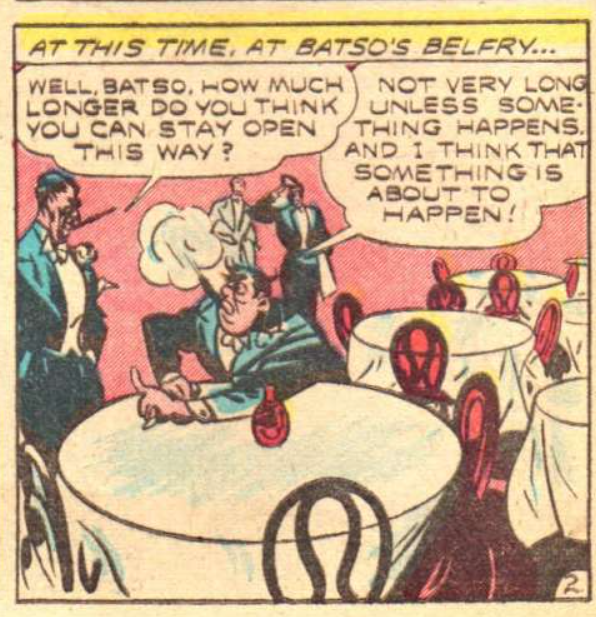
For example, the rival club is called the Belfry, and is owned by Batso…Batso’s Belfry… “Bat’s Belfry” (1926) by August Derleth. Coincidence? Or an Easter egg for Weird Tales readers?

Spook Comics, p28

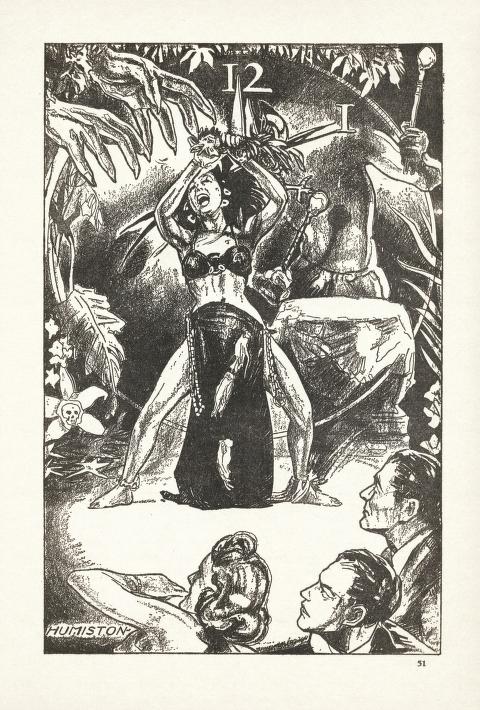
The basic idea of the narrative seems to borrow very heavily from the beginning of Manly Wade Wellman’s “The Third Cry to Legba” (Weird Tales Nov 1943), where a new voodoo-themed club has a dancer (Illyria) that provides authentic Haitian dances for the clientele. In Wellman’s story, this is a plot by the evil magician Rowley Thorne to start a new cult, and he is thwarted by occult detective John Thunstone.

Interestingly, Wellman was inspired by real life, as he mentioned in ‘The Eyrie‘:

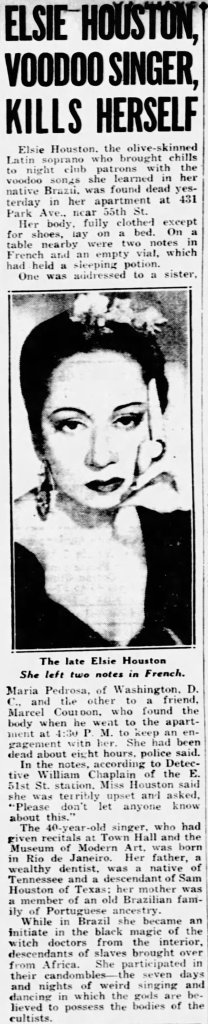
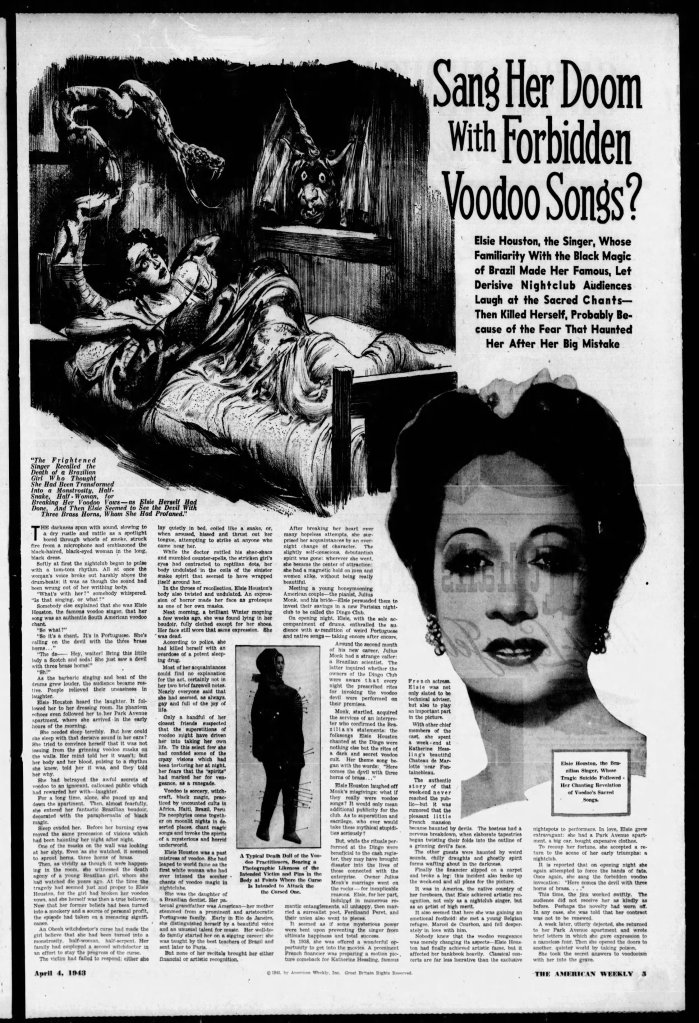
It is a fact that something appeared recently in New York newspapers that might be the public version of THE THIRD CRY TO LEGBA. Some may remember an account of how a certain singer chanted black magic songs and attracted big audiences, including at least one attentive being that she must have wished would stay away. We can’t check on that now, for the singer is untimely dead.

Wellman was probably referring to the case of Elsie Houston:

Ironically, the Brazilian singer was apparently claiming initiation in another African diaspora religion, Candomblé. To the general public of the United States of America, ignorant of the differences, it was all “voodoo” in their eyes. The Daily News article is actually fairly restrained; the American Weekly gave Houston an entire page to herself.

While the Weird Tales connections (real or apparent) are fun, “The Obi Makes Jumbee” also has a bit more plot than you might expect for a mere eight pages. The setup has readers expecting a zombie yarn—and they get gangsters, a fake death, a doublecross, a fake zombie, double murder, and then at the end—it’s all true. Which is as neat a bit of storytelling as you can expect. I might almost believe Wellman wrote it himself; he did a good bit of comic book scripting. Unless we find evidence to prove that, however, that remains speculative.

Does “The Obi Makes Jumbee” belong on the list of pre-Code Lovecraftian horror comics? It depends entirely on how much weight you place on “The Goat with a Thousand Horns” as a sneaky reference to Shub-Niggurath. The story has been reprinted a handful of times according to the Grand Comics Database, and can be read for free online at Comic Book Plus.


Bobby Derie is the author of Weird Talers: Essays on Robert E. Howard and Others and Sex and the Cthulhu Mythos.

Deep Cuts in a Lovecraftian Vein uses Amazon Associate links. As an Amazon Associate I earn from qualifying purchases.
Deeper Cut: Lovecraft, Racism, & Humor

Racist Language
The following article deals explicitly with racism in humor, many examples of which use racial pejoratives. Frank discussion of these matters requires the reproduction of at least some samples of racist pejoratives and ideas in quotes, titles, etc.
As such, please be advised before reading further.


Mr. Snow, I believe these to be Negro eggs.
—The Author, Planetary/The Authority: Ruling the World (2000) by Warren Ellis & Phil Jimenez

Few authors have been as personally identified with their work as H. P. Lovecraft. Even during his own lifetime, Lovecraft’s friends began to incorporate fictional versions of them into his stories—as “Howard” in “The Space-Eaters” (1928) by Frank Belknap Long, Jr.; as the unnamed mystic dreamer in “The Shambler from the Stars” (1935) and Luveh-Keraph, Priest of Bast in “The Suicide in the Study” (1935) by Robert Bloch; and as “the man with the long chin” in The Village Green (192?) by Edith Miniter.

In life, Lovecraft was a self-effacing and ready correspondent who made many contacts with his fans and peers in pulp fiction and amateur journalism; he liked to project the image of himself as older and more reclusive than he actually was. After his death, this personal myth-making took on a life of its own, as his legend developed and spread. There was no absence of humor from the early decades as awareness of Lovecraft and his Mythos grew, with both parody and satire present in works like “At the Mountains of Murkiness, or From Lovecraft to Leacock” (1940) by Arthur C. Clarke.

A notable absence in early humor directed at Lovecraft is any mention of his racism. The biographical facts of Lovecraft’s life were generally slow to emerge, and not always readily available to fans. So while comments on Lovecraft’s racism and antisemitism were made public by the first version of his wife’s memoir in the 1940s (see The Private Life of H. P. Lovecraft (1985) by Sonia H. Davis), and August Derleth felt the need to address the issue in print in Some Notes on H. P. Lovecraft (1959), Lovecraft did not develop a widespread reputation as a racist until the publication of L. Sprague de Camp’s Lovecraft: A Biography (1975). De Camp, who had studied Lovecraft’s published and unpublished letters and other materials, emphasized Lovecraft as neurotic, a flawed human being, a possible homosexual, and especially as a racist—and published the entirety of the poem “On the Creation of Niggers” which is attributed to Lovecraft.

De Camp’s biography came at a time when Lovecraft was beginning to spread to a much larger audience, due to reprint of his work in paperback, films like The Dunwich Horror (1970), and growing influence on music, adaptations in comic books, and other media—and as Lovecraft was gaining more critical awareness and acceptance. The same year as de Camp’s book came out, the first World Fantasy Convention was held in Lovecraft’s hometown of Providence, Rhode Island, with the theme “The Lovecraft Circle,” and the first World Fantasy Awards were given out—in the form of a bust of Lovecraft, carved by noted cartoonist Gahan Wilson. So, just at a time when Lovecraft’s popularity blossomed and more information on his life emerged, de Camp released a highly influential book.

Many Lovecraft scholars criticized de Camp’s approach, presentation, and conclusions—though not the underlying facts: while speculation about Lovecraft’s sexuality or mental health were subjective, Lovecraft’s prejudices were clearly expressed in his letters. The critiques, however, didn’t have the reach of the book itself, and many of de Camp’s misconceptions continue to color perceptions of Lovecraft to the present day. This has been very apparent in various fictional depictions of Lovecraft in various media, which often exaggerate Lovecraft’s characteristics and prejudices for humorous effect.

When the little kitten darted from the door and fled into the hall, the apparition in the darkness shouted out loud. It shouted in the high nasal accent native only to that part of New England once known as Rhode Island and the Providence Plantations. And its words were these:

“Come back!” it cried. “Come back, my pet! Come back, NIGGER-MAN!“
—Gregory Nicoll, “The Man Who Collected Lovecraft,” The Diversifier (May 1977) 68

As a subject of satire and ridicule, Lovecraft might seem to be a particularly strange dead horse to choose to whip. Obviously, Lovecraft is dead and is unaffected by mockery; he can’t regret or reform his reviews, and won’t roll in his grave no matter how hard you make fun of him. Humorous takes on Lovecraft are thus aimed at the living: at fans who are familiar with Lovecraft and his fiction, whether or not they enjoy either. In the case of Lovecraft’s racism in particular, this effectively serves as a kind of damnatio memoriae: unable to condemn a living Lovecraft for his prejudices, they make fun of a dead Lovecraft. These humorous portrayals, with all of their exaggerations, have influenced Lovecraft’s posthumous reputation and image.

Does making fun of a dead man constitutes “punching down?” Certainly, Lovecraft has no ability to defend himself from false accusations or inaccurate claims about his prejudices. On the other hand, he doesn’t really need any such defense. While Lovecraft may have no power to answer now, Lovecraft was racist, and part of the white majority that kept racial and ethnic minorities as second-class citizens during his life. Empathy in cases of historical racism should be on the victims of discrimination, not the perpetrators. Lovecraft may not have been a member of the Ku Klux Klan or participated in any racial violence directly, but he was still part of the majority of U.S. citizens that supported the legalized racism of Jim Crow and the social norms that prevented racial equality.

The occasional depiction of Lovecraft as “Genre’s Racist, Crazy Uncle” has exactly that much truth in it: Lovecraft’s prejudices were largely tolerated during his lifetime, and for some decades beyond that, because they were the same prejudices that millions of other people in the U.S. held. Just because those prejudices were common does not make them universal. Just because other people were racist does not make Lovecraft’s racism okay. The broad cultural background radiation of racism during Lovecraft’s lifetime is an explanation for his views, not an excuse for them.

The fact that Lovecraft is often depicted as much more cartoonishly racist than he was in real life, or than his peers, is in part down to the needs of the writer or artist to make a joke, but also in part due to lack of understanding of what Lovecraft’s prejudices were and how they fit into the historical context. Pretty much no one that mentions “On the Creation of Niggers” in any context wants to read a dissertation on the tradition of racist light verse in English poetry, just as few people who are familiar with the name of Lovecraft’s cat in “The Rats in the Walls” want a lecture on the propensity for naming pets racial epithets around the turn of the 20th century. They care about the current context, when the N-word is a racial epithet of unique power, not a historical context when such usage was more broadly accepted by a more openly racist society.

Many expressions of prejudice that were commonplace in the early 20th century seem egregiously racist now. Plain statements of Lovecraft’s life may seem ludicrously racist by the standards of the present, because many plain statements of racism in the 1930s and 30s are ludicrously racist by today’s metric. It is difficult for today’s readers to get a grasp of what a “normal” amount of racism was in the 20s and 30s when minstrel shows, coon songs, and the African Dodger were still socially acceptable.

In 1897 I was trying for Beethoven—but by 1900 I was whistling the popular coon songs & musical comedies of the day.
—H. P. Lovecraft to J. Vernon Shea, 3 Sep 1931, Letters to J. Vernon Shea et al. 46

As a consequence, when combined with a general ignorance of the actual nature and scope of Lovecraft’s prejudices, the exaggerations of Lovecraft’s bigotry are often much more extreme to get a laugh.

Ah! Look, it’s attempting to communicate. No doubt the savage thing knows language as a house pet knows its reflection in the mirror. The sense is taken in, but the process, the meaning is forever lost.
—H. P. Lovecraft, Atomic Robo and the Shadow From Beyond Time by Brandon Masters

There is a certain irony in that the more that we know of the facts of Lovecraft’s prejudice, the more ridiculous and far from Lovecraft’s actual beliefs that humorous takes on Lovecraft’s racism tend to get. The earliest humor was written by weird fiction fans who were generally aware of who Lovecraft was, his work, and some of the scholarship about his life. Later writers tend to be less familiar with the minutiae of Lovecraftiana and base more of their image of Lovecraft off the memes and stereotypes of Lovecraft and his work, or lean into a particular presentation that relies on such a specific image of Lovecraft as cartoonishly bigoted.

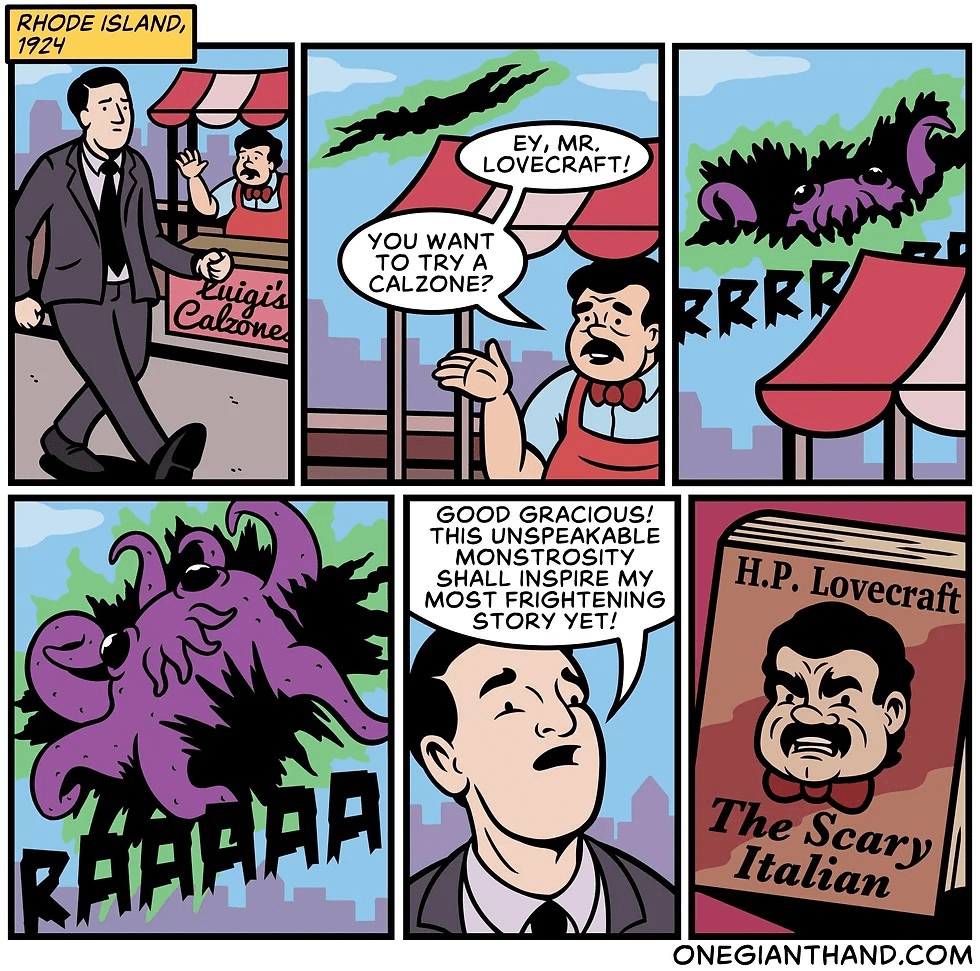
As a case in point:

Original Twitter post. Used with permission. All rights reserved.

In terms of accuracy, there’s a kernel of truth here: Lovecraft did express some prejudice against Italian immigrants, especially those in the Federal Hill area of his native Providence, RI. Lovecraft had even made mention of Italian immigrants in some of his publications, such as his very first widely-published poem, “Providence in 2000 A.D.”:

In 1912 my first bit of published verse appeared in The Evening Bulletin. It is a 62-line satire in the usual heroic couplet, ridiculing a popular movement on the part of the Italians of the Federal Hill slums to change the name of the main street from “Atwells’ Avenue” to “Columbus Avenue”. I pictured Providence in 2000 A.D., with all the English names changed to foreign appellations. This piece received considerable notice of a minor sort, I am told, though I doubt if it had much effect in silencing the Italians’ clamour. The idea was so foolish that it probably died of its own weakness.
—H. P. Lovecraft to the Kleicomolo, 16 Nov 1916, Letters to Rheinhart Kleiner & Others 76

The humor comes from the juxtaposition of the prosaic (and to contemporary eyes, ridiculous) prejudice against the harmless (if stereotypical) Italian immigrant and the eldritch entity breaking its way through the dimensional barriers. The cartoon also draws on and supports the misconception that Lovecraft’s fiction was largely driven by his personal fears and prejudices.

In real life Lovecraft actually liked Italian food, generally had congenial relationships with Italian immigrants he got to know, and rarely included Italian characters in his fiction. But that is a lot more nuance than can be expected in six panels. The joke doesn’t work if Lovecraft is presented as someone who isn’t triggered by the fact an Italian offered him a calzone, whose cosmic horrors aren’t inspired by more prosaic prejudices.

My taste has become so prodigiously Italianised that I never order anything but spaghetti & minestrone except when those are not to be had—& they really contain an almost ideal balance of active nutritive elements, considering the wheaten base of spaghetti, the abundant vitamines in tomato sauce, the assorted vegetables in minestrone, & the profusion of powdered cheese common to both.
—H. P. Lovecraft to Lillian D. Clark, 18 Sep 1925, Letters to Family & Family Friends 1.402

If there is a problem with the humorous expression of Lovecraft’s racism, it isn’t in the fact of making fun of a dead racist, or of painting racism as ridiculous or illogical. The problem is what it is often wrapped around in: the normalization of negative depictions of someone with mental health issues, and the downplaying of the dangers that contemporary racism represents. While a few scholars and pedants may decry the propagation of misinformation about Lovecraft and his fiction, that is ultimately a minor quibble compared to the bigger issues of propagating negative stereotypes like de Camp’s neurotic picture of Lovecraft, or of ignoring the really scary part about Lovecraft’s prejudices:

Many people held them then, and many people still hold them today.

Racist humor always has the caveat that to a certain audience, it isn’t funny because it’s ridiculous or breaking a taboo, but because it appeals to their own prejudices. Dave Chappelle mentioned in a 2006 interview with Oprah about someone laughing at him, rather than with him. The same thing cannot happen in the same way with Lovecraft because Lovecraft is white, and even prejudicial words like “cracker” and “honky” don’t have the same bite or weight as the N-word. Yet at the same time, making fun of Lovecraft’s prejudices has become a popular excuse for continuing to spread that language—the name of his cat, the poem “On the Creation of Niggers”—many writers find it acceptable to repeat that in a humorous context, as the punchline of the joke.

So might their audience.

The use of nigger by black rappers and comedians has given the term a new currency and enhanced cachet such that many young whites yearn to use the term like the blacks whom they see as heroes or trendsetters.
—Randall Kennedy, Nigger: The Strange Career of a Troublesome Word (2003) 36

The moral problem with the humorous portrayal of Lovecraft’s racism isn’t about making fun of Lovecraft, who is already dead and long past injury. It is that the jokes themselves do little but reiterate and spread prejudice. They don’t teach the audience anything about Lovecraft’s racism, and often only work when predicated on an audience already aware of Lovecraft’s racism in some form.

Is there any hidden moral or germ of insight in these portrayals?

A case in point might be made for the Midnight Pals, which takes as its set-up the idea of famous writers, living and dead, sitting around a campfire and having brief conversations. The nature of the form means that the personalities are exaggerated and deliberately satirical. Lovecraft is often portrayed as neurotic, racist, although often ultimately harmless (as opposed to J. K. Rowling, who also appears.) In most cases, Howard’s portrayal makes him the butt of the joke, and the series is clear in demonstrating that racism is bad and Lovecraft is cringe for his prejudices—though not ostracised. Indeed, despite the differing beliefs presented, the campfire group is specifically accepting, even of members who are wildly far apart in their views on race, sex, etc.

The series doesn’t work without some butt to the jokes. Like Archie Bunker, Lovecraft in the Midnight Pals has become the mostly-lovable racist, whose prejudices are played for laughs rather than evidence of malice.

Humor is only one way of portraying Lovecraft in fiction, and Lovecraft’s racism is often used to make him a figure of ridicule. Yet even to do that, humorists often have to go far beyond Lovecraft’s own recorded words and actions. As racist as Lovecraft was, and with the unusually deep record we have from his letters and essays to give evidence to that racism, many people remain ignorant of what Lovecraft actually wrote and said, and many humorists invent new ways for Lovecraft to be racist—which perpetuates the idea of Lovecraft as racist, but isn’t very useful for refuting his actual beliefs. Lovecraft the racist is more often than not effectively a straw man when it comes to humorous portrayals.

It’s not conclusive, Clark, but it appears this dark-haired woman is your ancestor. Please, take no offense…university rules, you know. I’ll have to ask you to leave the premises.
—Prof. Upsley, Rat God (2015) by Richard Corben

A very rare form of humor when it comes to Lovecraft’s prejudices is irony. In Richard Corben’s Rat God, the very Lovecraftian protagonist discovers that he is less of a WASP than he thought he was—thanks to the late revelation of a long-forgotten Native American great-great-grandmother. The story takes obvious inspiration from Lovecraft’s “Arthur Jermyn” and “The Shadow over Innsmouth,” as well as the prejudices expressed in Lovecraft’s own life and letters. The result is not funny in a ha-ha sense, but a grim irony in that the character who exhibited such terrific prejudice throughout the story has discovered that he himself is now subject to the same prejudice by others.

Corben’s ironic unmasking of Lovecraftian prejudice does something that a lot of riffs on Lovecraft’s prejudices don’t: it moves the plot forward. It has something to say beyond “look at how racist Lovecraft is! Isn’t that funny?” It is a bit more subtle, but it also has a point, and illustrates that prejudice is a doctrine which is, ironically, color-blind to its targets. Who knows who every ancestor of theirs is, after all? Who do you think you are?

It has to be recognized that the depiction—accurate or exaggerated—of Lovecraft’s racism goes far beyond humorous jokes and portrayals. There are quite serious fictional depictions of or references to Lovecraft as a racist, as in Richard Lupoff’s Lovecraft’s Book (1985, later re-released as Marblehead), Alan Moore and Jacen Burrow’s graphic novel Providence, Lovecraft Country (2016) by Matt Ruff, The Ballad of Black Tom (2016) by Victor LaValle, Ring Shout (2020) by P. Djèlí Clark, and The City We Became (2020) by N. K. Jemisin. Accuracy is always a challenge for any historical character incorporated into a fictional work, and each author’s usage of Lovecraft is determined by their own research (or lack thereof) and their understanding—and perhaps especially, by the point they want to make.

In several of the latter novels, the point is specifically to bring attention to Lovecraft’s racism, as part of the point of their narrative is the acknowledgment and refutation of Lovecraft’s prejudices. Where a humorous depiction of Lovecraft’s racism shows prejudice as laughable, the serious depiction shows racism as no laughing matter. Either approach is workable depending on what point or mood the creator is trying to get across, one is not superior to the other, and many of the same observations about humorous depictions of Lovecraft’s racism also applies to non-humorous depictions.

Both humorous and non-humorous depictions of Lovecraft tend to be strongly driven by the myth of Lovecraft, rather than historical reality. The neurotic, cartoonishly racist caricature of a horror writer is often an easier character to work with than the more complex and nuanced historical human being, just as bumbling or villainous Nazis are easier to depict than stalwart German troopers with wives and kids who enlisted in a rush of patriotic spirit or economic need and ended up participating in a genocide. Lovecraft is not alone in being depicted first and foremost as a racist; many characters based on historical persons are essentially caricatures.

Lovecraft stands out in this respect only in that he is a pulp author from the period that humorists and their readers are still familiar with. Would the same jokes work if the subject was Ernest Hemingway or Catherine Lucille Moore? Probably not. Not because such jokes wouldn’t be as accurate (or inaccurate) as applied to Lovecraft, but because readers are less familiar with those writers and their prejudices. Lovecraft’s continued relevance, name recognition, and a vague awareness of his life are the main drivers for his continued humorous portrayals—racist warts and all. These depictions have been shaped by previous characterizations of Lovecraft, and in turn continue to shape his myth.

Real historical people are messy and complicated. Myths are easier to deal with. Yet the more the myth is repeated—the more extremes the depiction of a fantasy Lovecraft’s racism become—the harder it is to see the real historical individual. Many people, if they have the image of an individual as racist, take any correction of that image as an attempt to downplay or deny that racism. It can be very difficult to correct such a reputation once it takes hold.


Bobby Derie is the author of Weird Talers: Essays on Robert E. Howard and Others and Sex and the Cthulhu Mythos.

Deep Cuts in a Lovecraftian Vein uses Amazon Associate links. As an Amazon Associate I earn from qualifying purchases.
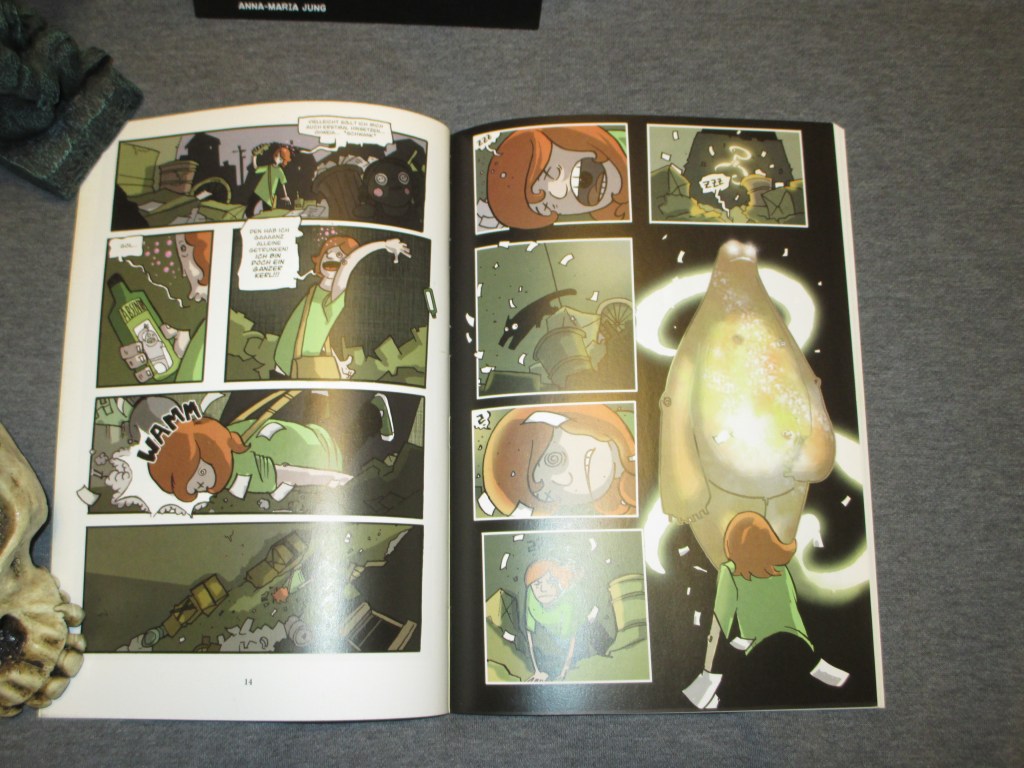
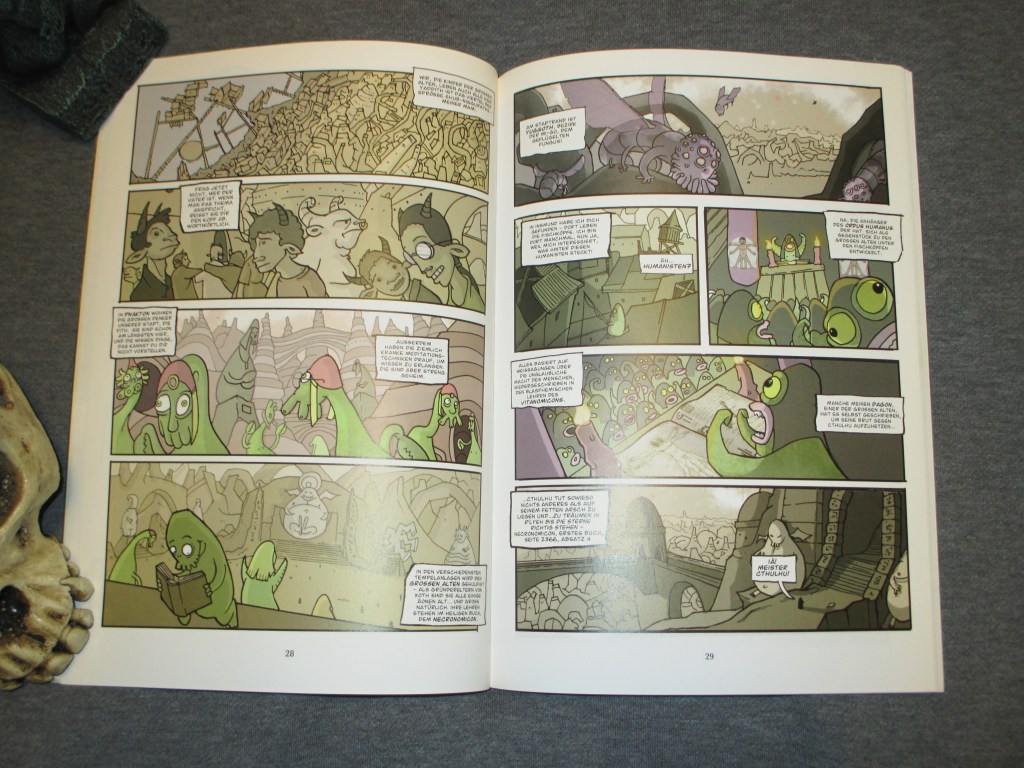
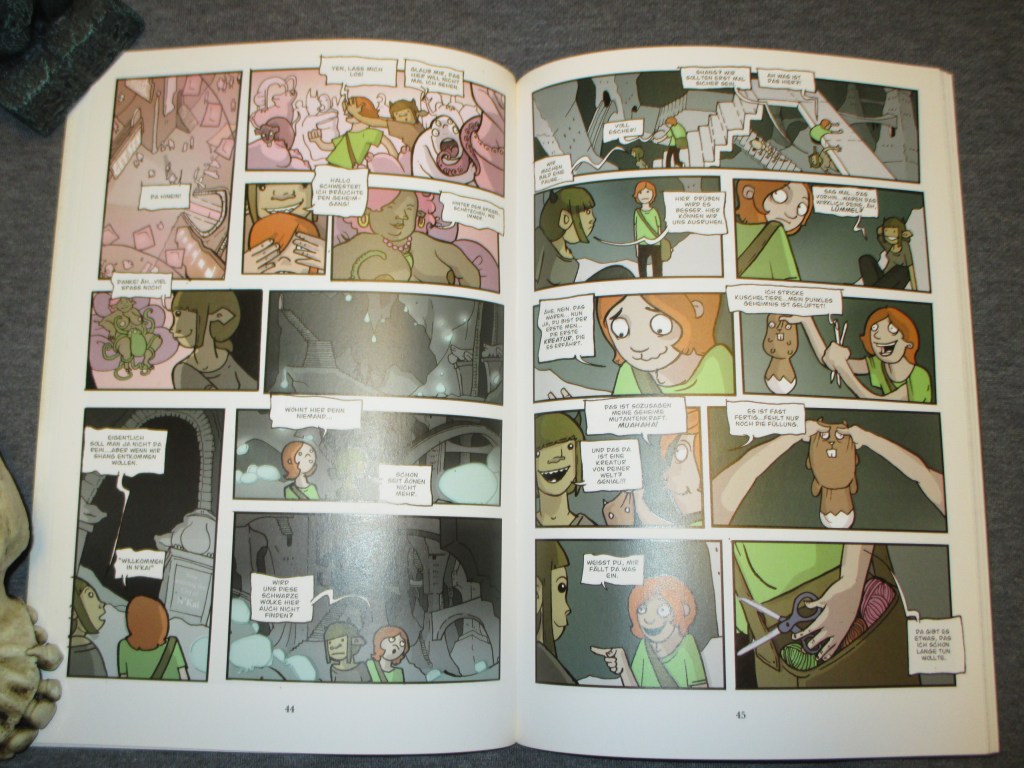
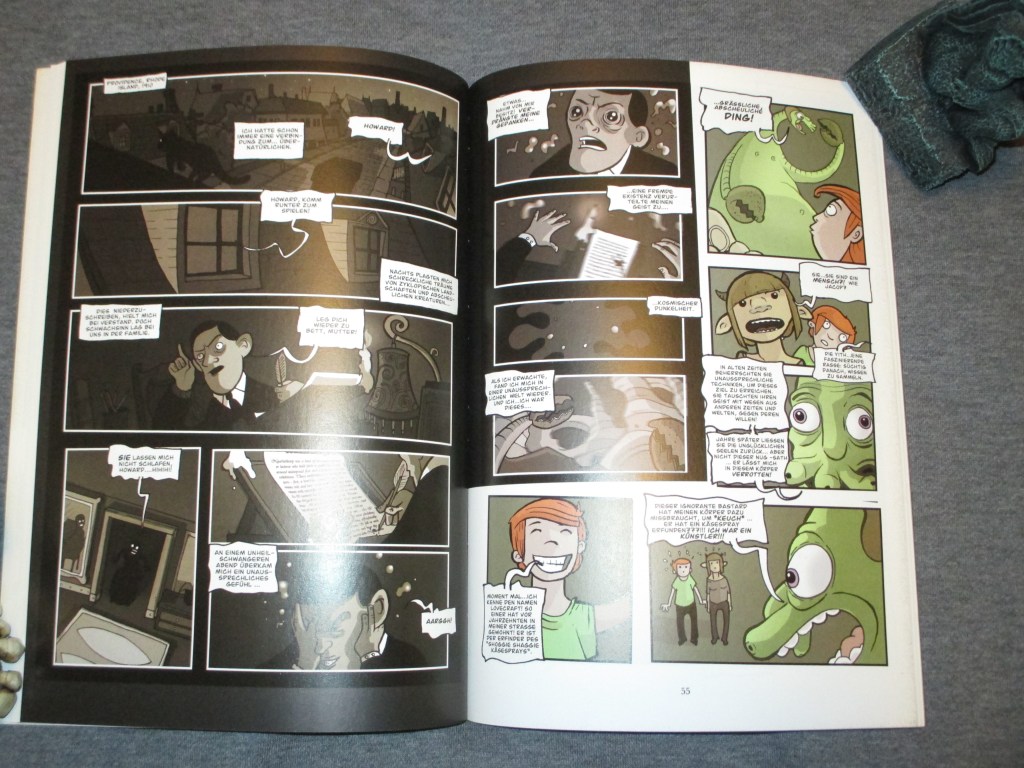
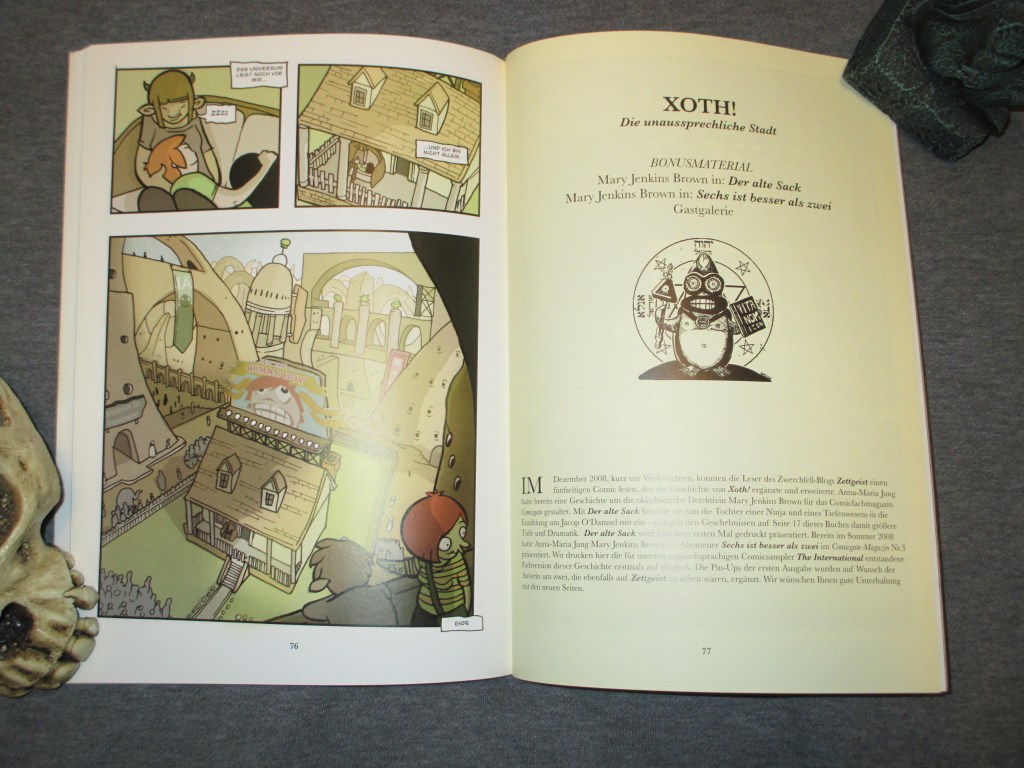
Xoth! Die Unaussprechliche Stadt (2007) by Anna-Maria Jung

An einem seiner vielen ereignislosen, langweiligen Abenden beschließt der junge Jacop O’Damsel, freiberuflicher Nerd, sich besoffen in einem Hinterhof schlafen zu legen. Blöd, wenn ausgerechnet da plötzlich ein intergalaktischer Dimensionsschlürfer auftaucht. Bevor Jacop überhaupt die Chance bekommt, einen Kater zu haben, nimmt in das Ding auch schon einfach so mit.

Jacop wacht in Xoth auf, einer fremden Welt voller abartiger Kreaturen – oder solite man sagen: geradezu unsagbar grauenhaft? Auf jeden Fall sind da noch die »Humanisten«, eine Bande von stinkigen Fischköpfen, die Menschen kultarig verehren, und die Jacop angeblich für eine Mission brauchen. Und gäbe es niche genug an Wahnsinn zu verkraften, setzt der Bürgermeister der Stadt, der mächtige Cthulhu, seine besten Killer auf den Fall an. Den großen Alten sei Dank gibt es da noch Yen Niggurath, ein hübisches Ziegenmädchen, Des Gefallen an dem hilflosen Menschlein findet. Zusammen mit ihr get Jacop dem »Ordus Humanus« auf den Grund, Dennis – bei Cthulhus fettem Arsch! – er hat keine Lust, ständig um sein Leben zu rennen.

Vor dem Hintergrund von H. P. Lovecrafts Cthulhu Mythos entwirft Anna-Maria Jung eine Geschichte voller Monster, Nerds, Monsternerds und Nerd monster. Und der Mann aus der Angell Street kommt auch drin vor.
On one of his many uneventful, boring evenings, young Jacop O’Damsel, a freelance nerd, decides to get drunk and sleep in a backyard. Too bad when an intergalactic dimensional shambler suddenly turns up. Before Jacop even gets the chance to have a hangover, the thing takes him with it.

Jacop wakes up in Xoth, a strange world full of disgusting creatures – or should we say, downright unspeakably horrible? In any case, there are also the “Humanists”, a gang of smelly fishheads who worship humans in a cult-like manner and who supposedly need Jacop for a mission. And when there isn’t enough madness to deal with, the mayor of the city, the mighty Cthulhu, sets his best killers on the case. Thank the Great Old Ones, there is also Yen Niggurath, a pretty goat girl who takes a liking to the helpless little human. Together with her, Jacop gets to the bottom of the “Ordus Humanus”, Dennis – by Cthulhu’s fat ass! – he doesn’t want to constantly run for his life.

Against the backdrop of H. P. Lovecraft’s Cthulhu Mythos, Anna-Maria Jung creates a story full of monsters, nerds, monster nerds and nerd monsters. And the man from Angell Street appears in it too.
Back cover copy, 2010 editionEnglish translation

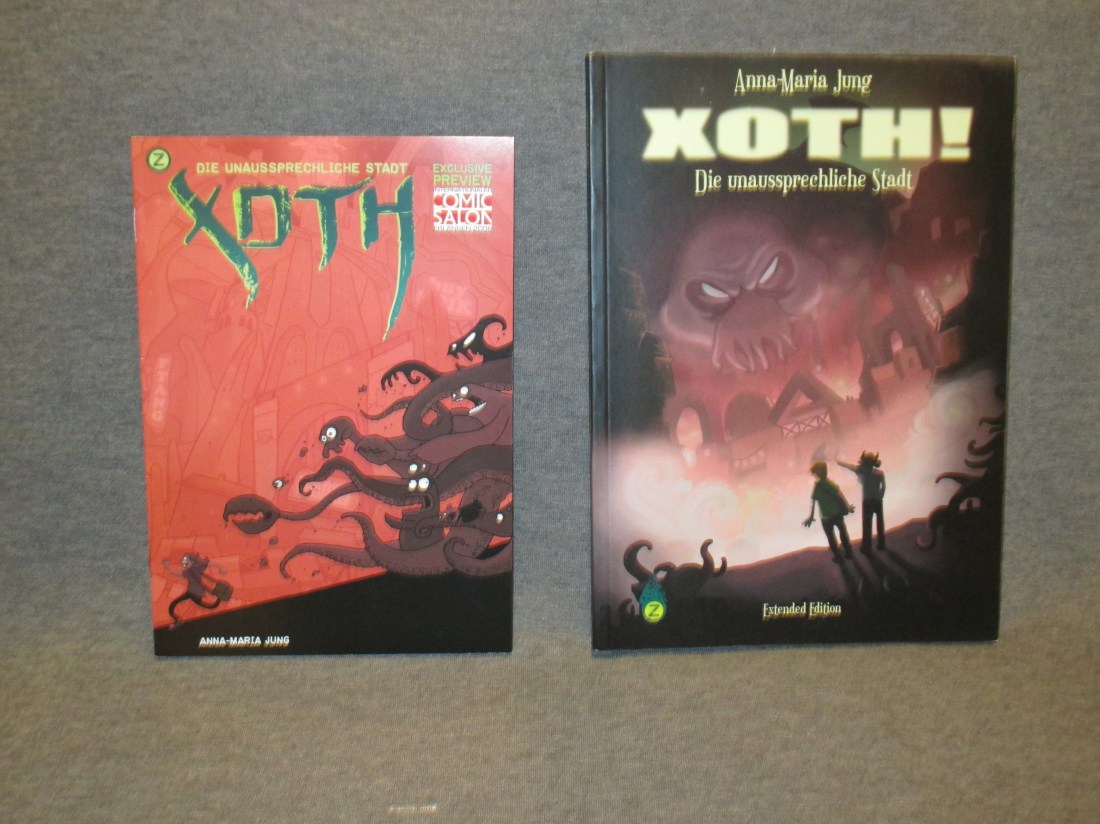
Xoth! Die unaussprechlichen Stadt (“Xoth! The unspeakable City!”) is a 2007 graphic written and drawn by Anna-Maria Jung ( https://www.annamariajung.com/ ), an Austrian illustrator with a penchant for monsters and nerds. The publication history is a little difficult to piece out, because part of the history has been eaten by the web, but the Internet Archive maintains a copy of (most) of the old website, which offers some background:

Xoth! ist ein 70 seitiges Farbcomic, das auf dem “Cthulhu-Mythos” von Howard Philips Lovecraft beruht.

Die Idee für Xoth! kam Anna-Maria Jung 2006 in New York, als sie ein Buch zu H.P. Lovecrafts Cthulhu Mythos entdeckte. Beruhend auf diesem Mythos entstand die Idee, eine einzige Heimatwelt für Lovecrafts Kreaturen zu kreieren.

Anna-Maria diplomierte 2007 mit einer Arbeit über »Lovecraft in den Medien«. Diese Diplomarbeit wurde eine konzeptuelle Vorarbeit für ihren Comic sie erforschte Lovecrafts Vergangenheit, den gesamten Mythos und seine Einflüsse auf die Medienwelt. Auf Wunsch kann man diese Diplomarbeit bei mir als PDF kostenlos bestellen.

Als praktischen Teil entwickelte sie die Charaktere, Hintergründe, Gegenstände, Zusammenhänge, Beziehungen und Verhältnisse einer Welt, die sie, inspiriert von Sci-Fi Autor Lin Carter, Xoth taufte.
Xoth! is a 70-page color comic based on the 
“Cthulhu Mythos” by Howard Philips Lovecraft.

Anna-Maria Jung came up with the idea for Xoth! in 2006 in New York when she discovered a book about HP Lovecraft’s Cthulhu Mythos. Based on this myth, the idea of ​​creating a single home world for Lovecraft’s creatures was born.

Anna-Maria graduated in 2007 with a thesis on “Lovecraft in the Media.” This thesis was a conceptual preparatory work for her comic; she researched Lovecraft’s past, the entire myth and his influence on the media world. 
If you wish, you can order this thesis from me free of charge as a PDF.

As a practical part, she developed the characters, backgrounds, objects, contexts, relationships and conditions of a world that she named Xoth, inspired by sci-fi author Lin Carter.
Was ist Xoth? (Deutsche)What is Xoth? (English)

Lin Carter’s Mythos fiction was published in The Xothic Legend Cycle by Chaosium; Xoth was the star from which Cthulhu originated, and Carter’s fiction dealt with Cthulhu’s progeny. Cthulhu himself appears in Jung’s Xoth! as the mayor of the city.

Unfortunately, with the death of early web, stuff like Jacop O’Damsel’s MySpace page and the English translation of some of the comic pages are likely sadly gone forever.

This English-language image was included in a 2011 interview with Anna-Maria Jung from Shirt List.

A 2008 “exclusive preview” of Xoth for the Internationaler Comic Salon Erlangen 2008, where the book presumably premiered; Jung also wrote and drew a spin-off comic titled “Marie Jenkins Brown: Sechs ist Besser als zwei” (“Mary Jenkins Brown: Six Is Better Than Two”) published in Comicgate Magazin #3 (2008). Both Xoth! and the Marie Jenkins Brown spin-off were collected and published in the Xoth! Die unaussprechliche Stadt Extended Edition (2010, Zwerchfell Verlag).

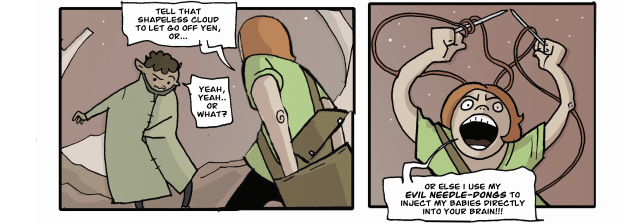
Absinthe and Dimensional Shamblers don’t mix.

There is a slightly cartoonish, early-2000s webcomic vibe to Jung’s art style, which might make some folks to confuse Xoth! for a comic intended for kids at first glance, but really this is aimed at a more mature audiences, with references to alcohol and sex, and some brief cartoon nudity that is designed to amuse rather than titillate. It’s a fun takeoff of the Mythos for grown ups, especially grownups who were monster enthusiasts in their youth.

Fans will appreciate the many references to Lovecraft’s Mythos (and the Call of Cthulhu Roleplaying Game) sprinkled throughout the story. It’s definitely played for humor more than horror, reminiscent of works like The Unspeakable Vault (of Doom!), but with more narrative and focus on characters. This is really the story of Jacop O’Damsel, the sole human in the city.

Fortunately, Jacop has help from Yen Niggurath, one of the Dark Young, who takes a shine to him. Their relationship has a meet-cute quality, and there’s a certain romantic frisson between the two almost from the start.

Lovecraft, “the Man from Angell Street.” does indeed make an appearance, although he spends most of the comic in the body of a Yithian he’s been mind-swapped with. Which is a fun way to include Lovecraft in what is otherwise a contemporary setting that includes cellphones.

A scene where Jacop meets a dying Lovecraft in 1937 is also included, although Jung makes a slip here in getting the date and address incorrect.

It is a fun graphic novel. The plot isn’t very profound, but not all stories have to be epic. Some people just learn to accept where they are and who they’re with. To monsters, humans are ultimately just another monster.

The Mary Jenkins Brown spin-off comics are a bit more deliberately mature, even racy in parts. Mary is an occult detective in these brief strips, but seems more interested in getting laid than solving mysteries. They’re short and cute, played for laughs more than eroticism. It’s nice to have them collected somewhere.

There is no published English translation of Xoth!, and sadly probably never will be, which I feel is a pity because there was a time and place when I think it would have definitely found an appreciative audience. The German-language Extended Edition is still available for sale, and Anna-Maria Jung’s webstore has a lot of cool shirts.


Bobby Derie is the author of Weird Talers: Essays on Robert E. Howard and Others and Sex and the Cthulhu Mythos.

Deep Cuts in a Lovecraftian Vein uses Amazon Associate links. As an Amazon Associate I earn from qualifying purchases.
Reanimator (2020) by Juscelino Neco & H. P. Lovecraft

Eldritch Fappenings
This review deals with a work that contains excessive cartoon violence and sexuality. Selected images with cartoon depictions of body horror, violence, genitalia and/or sexually explicit contact will be displayed.
As such, please be advised before reading further.


Lovecraft não era sequer um grande astesão, mas is so também não importa, como o rock e, mais que ele, o punk rock, provou inúmeras vezes. Um artista menos dotado é perfeitamente capaz de Fazer uma obra mais oportuna, historicamente falando, do que um virtuose incapaz de pensar sua própria profissão em termos amplos. Mas isso também não era o caso de Lovecraft, um artesão obviamente limitado e um artista incapaz de seguir as veredas que ele mesmo abria a golpes desajeitados de marreta. Sua dificuldade técnica fica ainda mais evidente em Reanimator, uma de suas obras menos felizes, mas capaz de gerar tantas pérolas pelas mãos de artists mais dotados que o próprio, como o quadrinista Juscelino Neco.Lovecraft wasn’t even a great artist, but that doesn’t matter either, as rock and, more than that, punk rock, have proven time and time again. A less gifted artist is perfectly capable of making a more timely work, historically speaking, than a virtuoso incapable of thinking about his own profession in broad terms. But that wasn’t the case with Lovecraft either, an obviously limited craftsman and an artist incapable of following the paths he himself opened up with clumsy sledgehammer blows. His technical difficulty is even more evident in Reanimator, one of his less successful works, but capable of generating so many pearls in the hands of artists more gifted than himself, such as the comic artist Juscelino Neco.
Rafael Campos Rocha, foreword to Reanimator (2020)English translation

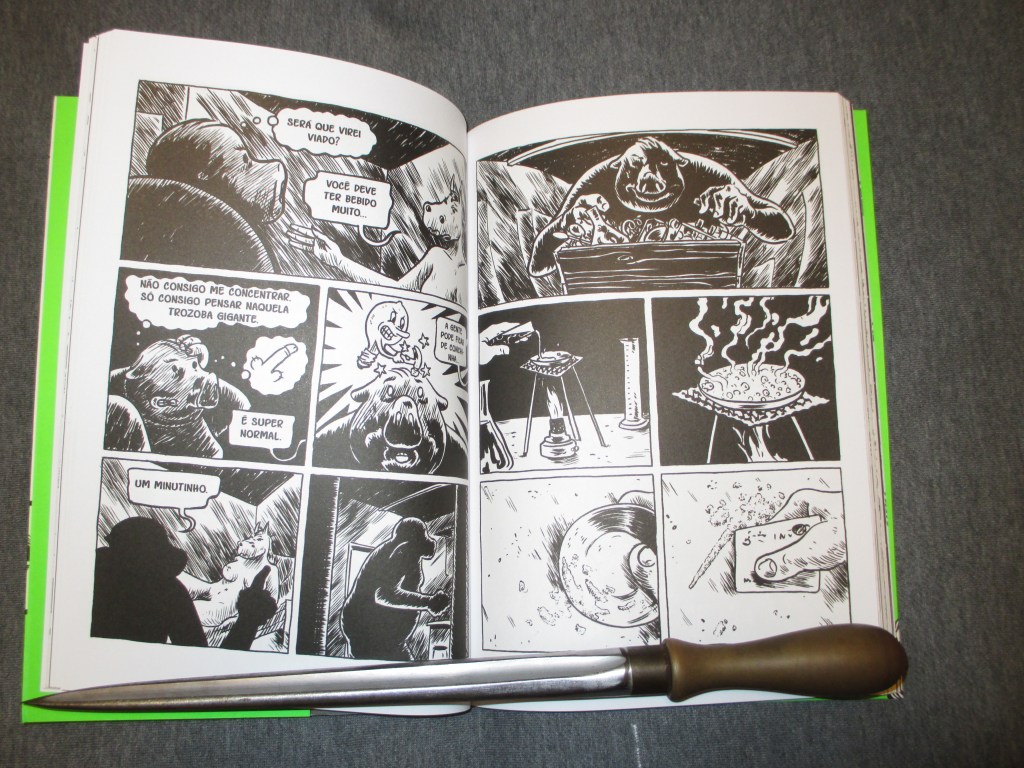
Rocha’s introduction to Juscelino Neco’s Reanimator (2020) is irreverent toward Howard Phillips Lovecraft. Yet irreverence has ironically been the cornerstone to the posthumous success of “Herbert West—Reanimator.” This minor tale of Lovecraft’s, his first commercial effort at horror fiction, has been adapted, expanded upon, reimagined, and incorporated into other works innumerable times since its first publication—something that has only been possible because artists have been free to do what they like with this story and its setting and characters, to freely distort and play with tone, characterization, and events as they see fit. To turn the grue-filled six episodes into dark comedies, zombie gorefests, introspective reflections on sexuality, and the mechanistic nature of life…all to entertain, explore, and reexamine what Lovecraft did and did not do.

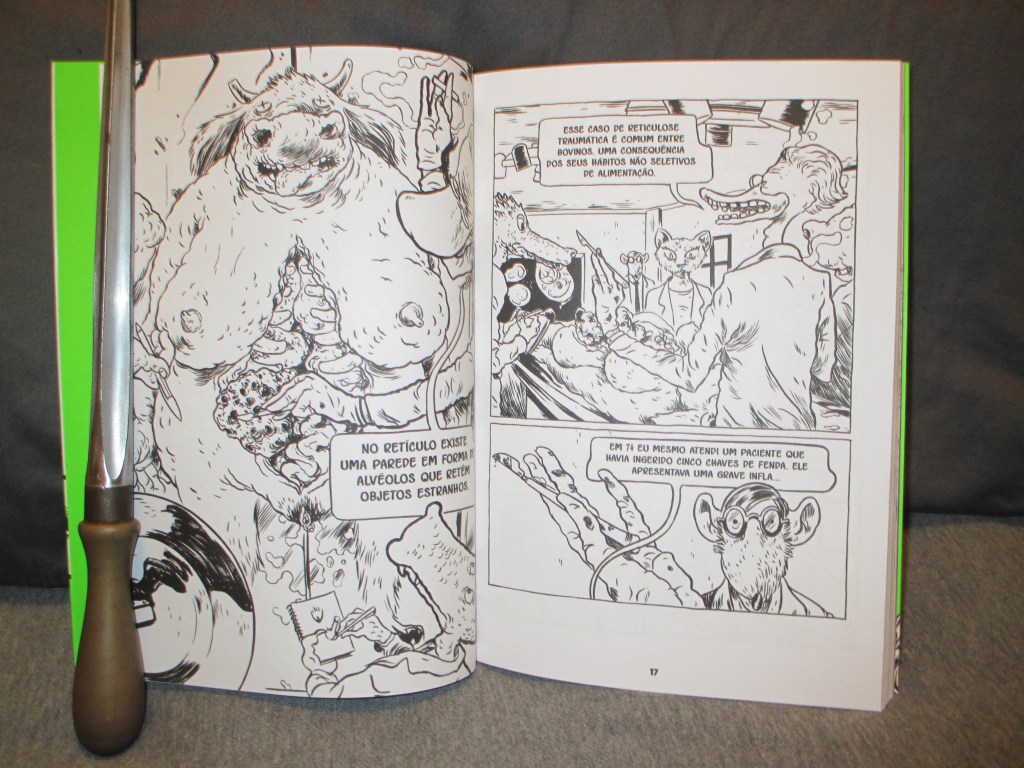
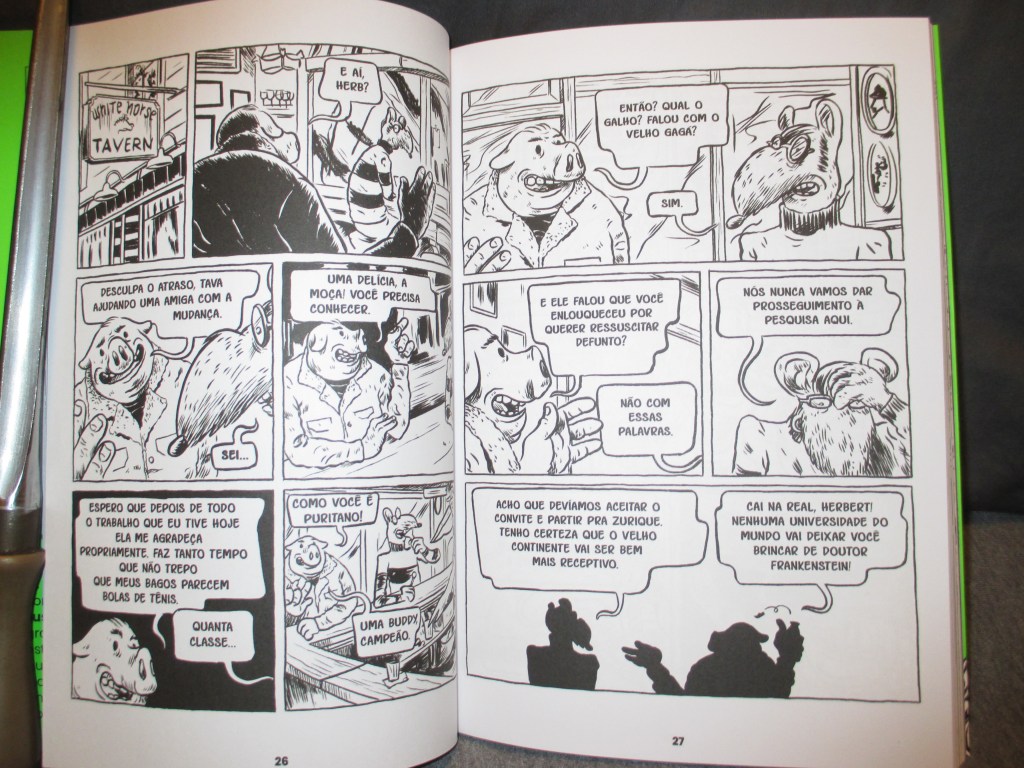
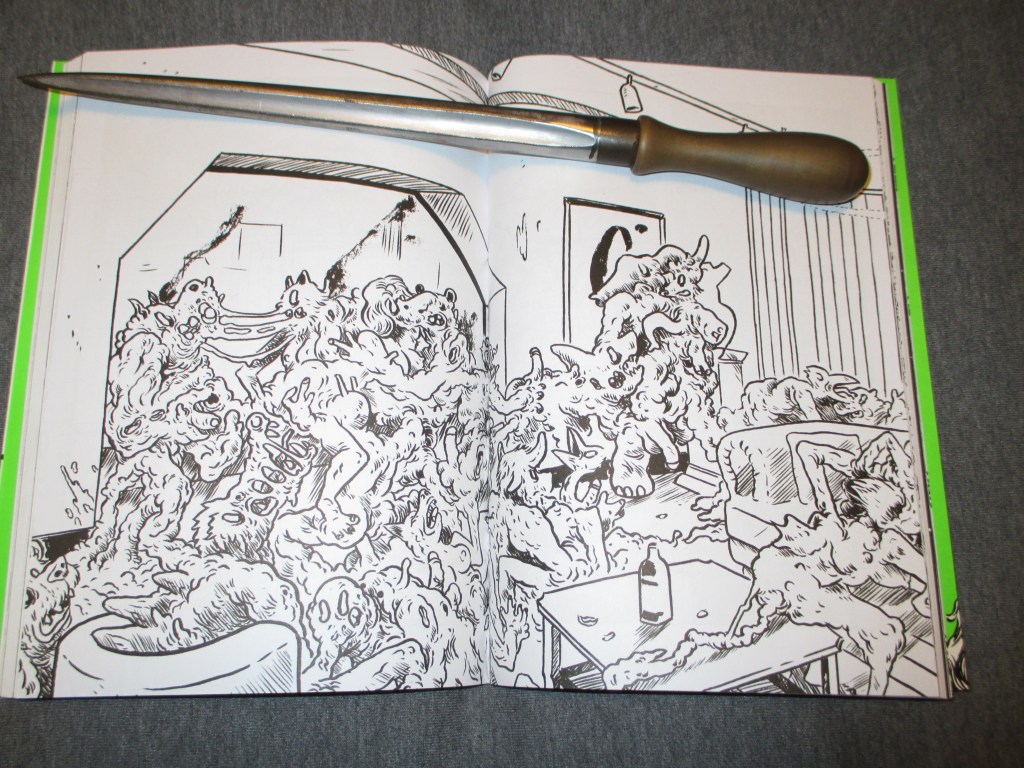
What Brazilian comic creator Juscelino Neco did was to approach “Herbert West—Reanimator” through the lens of 1960s underground comix. Herbert West and the other characters are cast as anthropomorphic animals, the grungy cousins of Mickey Mouse and Bugs Bunny, and their adventures are sexually explicit, violent, and drug-fueled. Neco put on the page everything that Lovecraft left off the page—and added a few other details of his own along the way.

The beginning is relatively restrained, Herbert West is in medical school. The broad outline of the first portion of Neco’s graphic novel follows the opening episode of Lovecraft’s story, although Neco takes many liberties with the framing of characters and events. As well as making the most of the opportunity to add a little gross-out imagery, such as a full-page pin-up of an autopsy in progress.

A vida não e um filme de terror barato.Life is not a cheap horror movie.
Reanimator p23English translation

It is difficult to express how emotive the combination of art and text can be. The instinctive comparison is something like Art Spiegelman’s Maus, but the over-the-top black humor characteristic of the film Re-Animator (1985) is still there. There will be a page of dark panels where West laments the unimaginative bureaucracy that refuses to entertain his ideas about reanimation—and then you turn the page and its West talking to himself while being the bottom in a graphically-portrayed homosexual BDSM scene.

Then West gets an assistant. Someone to help him out.

In Neco’s Reanimator, the porcine assistant is no passive observer of events, but an active partner in West’s operations. They enable West’s experiments, but also his worst impulses. Together the two secure their first victim/experimental subject—and this is where things start to get a little more punk rock. The presence of drugs and the necessity of violence start to ramp up swiftly.

Until, while with a prostitute, the assistant cooks up some reanimation agent like its crack cocaine and injects himself. It does provide new life for spent flesh, but is also suggests a new sideline for West and his friend as drug dealers.

At this point, Neco’s Reanimator has completely abandoned Lovecraft’s narrative for a literal orgy of sex and violence. One that continues to try and outdo itself with almost every turn of the page. There is one scene at a reanimation drug-fueled party that is reminiscent of something like the end of Brian Yuzna’s Society (1989), where the individual ceases to exist.

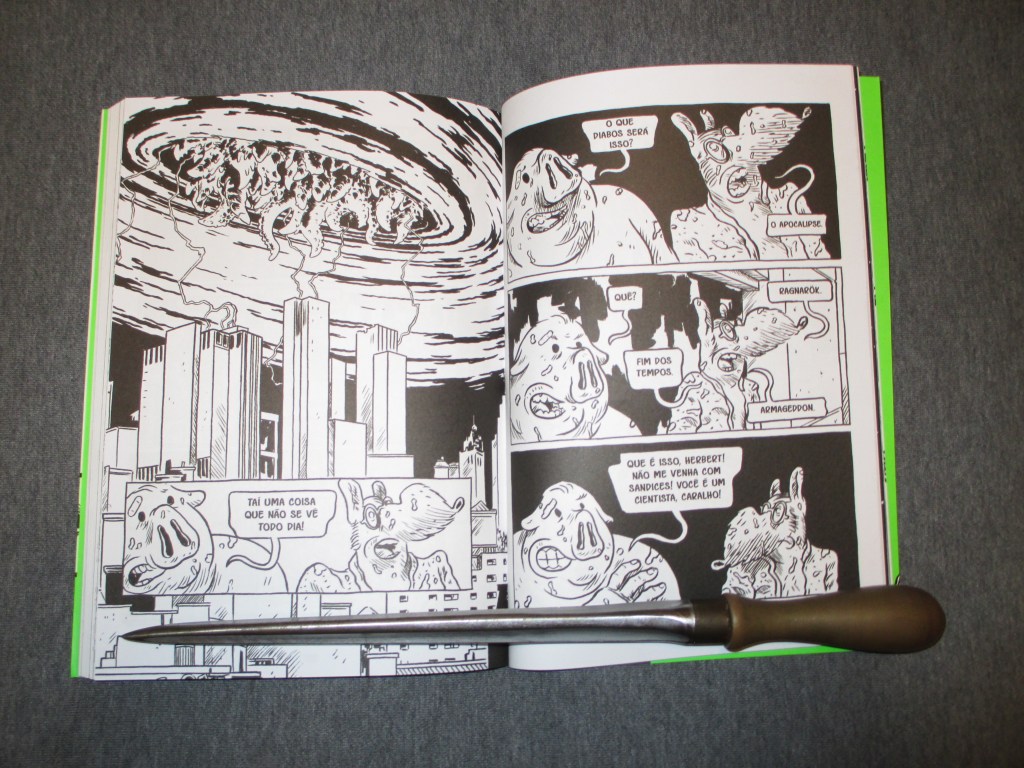
From there, Neco goes full eldritch, bringing in some of Lovecraft’s other ideas while retaining the same ’60s underground comix shock mentality.

It is never clear, at the end, whether this is something Herbert West and his friend have caused by defying the laws of nature, or just a coincidental apocalypse. In a way, it doesn’t matter. Something fundamental has changed, the scientific genie has been let loose from the bottle and they can’t put it back. The world ends…and Neco doesn’t stop there. The world is fucked. Quite literally.

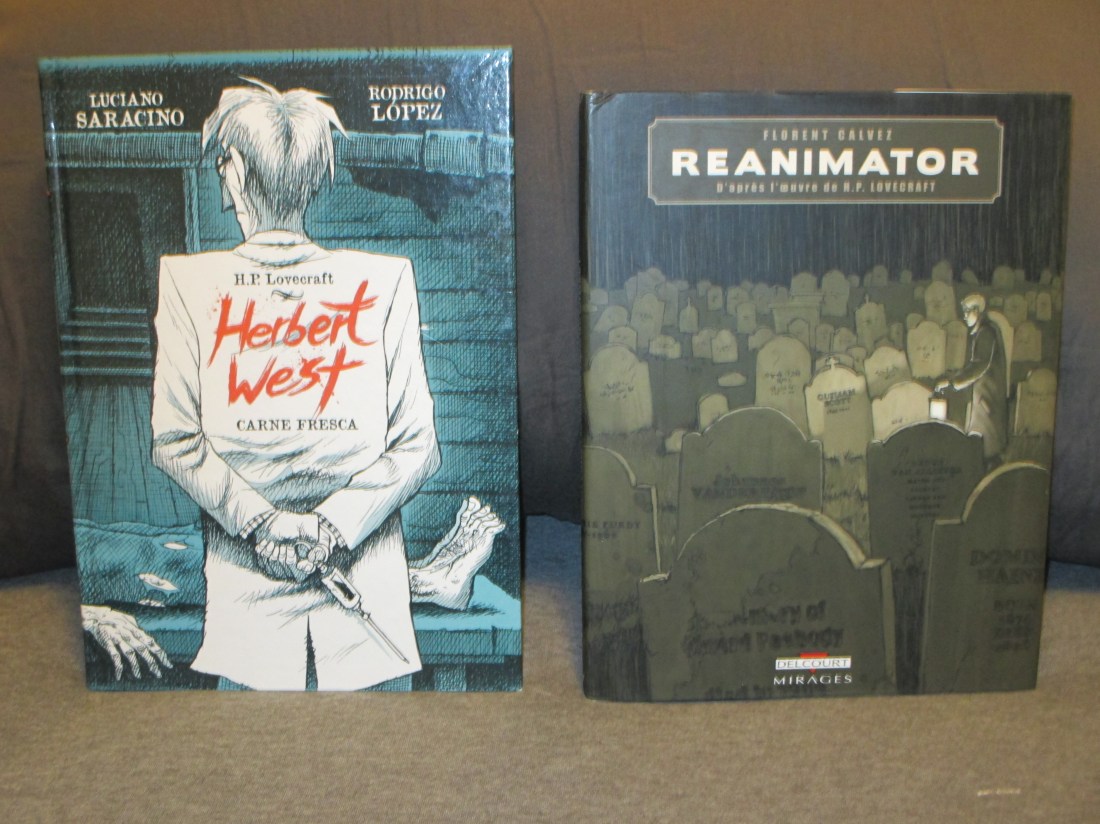
What stands out about Reanimator (2020) is how fully Neco embraces the remit. Critics have read a homosexual subtext in Lovecraft’s original story, some works like “Herbert West in Love” (2012) by Molly Tanzer and “(UN)Bury Your Gays: A Queering of Herbert West – Reanimator by H.P. Lovecraft” by Clinton W. Waters have made that more explicit, but here West’s sexuality is embraced and depicted as an open part of his character. The sex and violence are over-the-top and cartoonish, but that stands in stark contrast to efforts at more realistic portrayal like Reanimator (2008) by Florent Calvez and Herbert West: Carne Fresca (2021) by Luciano Saracino & Rodrigo López.

Reanimator (2020) by Juscelino Neco works on its own terms. It’s fun, disgusting, ribald, edgy, slightly ridiculous, and in the end cosmic in its scope. Readers are left without all the answers, but there’s the impression that one man’s obsession, with the aid and assistance of a friend, has led to the destruction of an entire world. That isn’t how Lovecraft ended the story, but that is the point. To do what Lovecraft would not have done, to use his fiction as a springboard, not to limit creators to only aping what he wrote forever.


Bobby Derie is the author of Weird Talers: Essays on Robert E. Howard and Others and Sex and the Cthulhu Mythos.

Deep Cuts in a Lovecraftian Vein uses Amazon Associate links. As an Amazon Associate I earn from qualifying purchases.
Reanimator (2008) by Florent Calvez v. Herbert West: Carne Fresca (2021) by Luciano Saracino & Rodrigo López

Not all of H. P. Lovecraft’s works are of equal merit, or of equal attractiveness to readers, artists, and writers. While some stories have been adapted many times in different media, others languish in relative obscurity—reprinted in Lovecraft’s collections, but rarely in anthologies, and with less impact on popular culture. The whys and wherefores differ with each tale; generally, such works were not popular during Lovecraft’s lifetime and may have only been published after his death, have little or no direct connection to the Mythos, or represent some difficulty due to changing tastes or the prejudices expressed in the story.

As something that represents all three of these categories, “Herbert West—Reanimator” is an unexpected posthumous breakout hit for Lovecraft. Initially published as a series of six interconnected short tales in the pages of Home Brew, and not published more widely until after Lovecraft’s death when Weird Tales reprinted them, “Herbert West—Reanimator” has only slight connection to Lovecraft’s wider Mythos with the Arkham/Miskatonic University setting, and contains a chapter with one of the most baldly racist characters and characterizations in Lovecraft’s oeuvre. Written as Lovecraft’s first attempt at commercial fiction, it isn’t really typical of his later style or efforts at all.

Yet…there is something about Dr. Herbert West that has thrilled audiences and inspired writers and artists for decades. The 1985 film Re-Animator spawned a small film franchise, a novelization, comic books, and merchandise; helped launch the Lovecraftian film careers of Stuart Gordon, Brian Yuzna, Jeffrey Combs, and Barbara Crampton; and even a hardcore pornographic film: Re-Penetrator (2004). Beyond this, many writers have taken a stab at the Re-Animator, including the anthology Legacy of the Reanimator (2015), Peter Rawlik’s Reanimators (2013) and Reanimatrix (2016), “Herbert West in Love” (2012) by Molly Tanzer, “Kanye West—Reanimator” (2015) by Joshua Chaplinsky, “Herburt East: Refuckinator” (2012) by Lula Lisbon, “(UN)Bury Your Gays: A Queering of Herbert West – Reanimator by H.P. Lovecraft” by Clinton W. Waters, and “Herbert West and the Mammaries of Madness” (2015) by Dixie Pinoit, “Albertina West: Reanimator” by TL Wiswell—among many others.

Comic and graphic adaptations of “Herbert West—Reanimator” are especially fascinating, because on those rare occasions where readers get two full adaptations, of approximately equal length, for side-by-side comparison, you can see how very different two adaptations can be of the same material—and how much work goes into turning a prose text into a comic script.

Such an opportunity presents itself with Reanimator (2008) by Florent Calvez, a hardbound 112-page French-language bande dessinee published by Delcourt, and Herbert West: Carne Fresca (“Fresh Meat”) (2021) by Luciano Saracino (script) and Rodrigo López (art), a 96-page Spanish-language hardbound album published by Dolmen. Both of these works adapt the full six episodes of “Herbert West—Reanimator” fairly faithfully—but how they do it and what they choose to emphasize is very different.

Calvez’ Reanimator is a sepia-toned period piece, starkly realistic. Unlike many later works, there are few if any visual cues or references to the 1985 film; Herbert West is blond, for example, as Lovecraft’s narrator described him, not a brunet like actor Jeffrey Combs. The most notable reference to the film is the brief shot of West being attacked by a reanimated black cat, a scene made infamous in the movie.

The main departure from Lovecraft’s story is that Calvez provides a framing narrative: the nameless assistant, older now, and visually similar to William S. Burroughs, is writing down his account of events on a ship. This wraparound segment helps give shape to the narrative as a Memoir, which features little speech and a great deal of exposition translated directly from Lovecraft’s text.

The stark realism of the work helps make the horrors stand out. There’s not a lot of gore in the traditional sense; the world of Reanimator is dark, murky, washed out like the sepia photographs of long-ago atrocities. Care and attention to detail are everywhere apparent: the details of costume and press, the architecture of houses, bits of English on newspapers and gravestones for the scenes set in the United States. It is a testament to Calvez’ skill and dedication to get the details right.

In Lovecraft’s story, we don’t see the boxing match, only the aftermath. Calvez has taken another liberty here: “Kid O’Brien” is implicitly a Jewish boxer under an Irish name, while “Buck Robinson, ‘The Harlem Smoke'” is almost a caricature of Black boxers like world heavyweight champion Jack Johnson. Boxing was a major national sport, and while Lovecraft may have cared little for it, he was certainly aware of some of the major boxers of his era, including Jackson.

The narrator’s prejudices that depicted the dead boxer in animal-like terms, and wondered if some obscure biological difference between white and black caused the failure of the reanimation experiment, Calvez leaves out. Their absence isn’t particularly noticeable, unless you know to look for them. It does not diminish the horror that marks the climax of the episode.

Saracino and López take a slightly different approach to Herbert West. The art style, in black and white, is more stylized. There is still great care and attention to detail, but the pages tend to more standard layouts, based around a six-panel grid, and there is much more dialogue. Herbert West himself is allowed to speak in his own words, instead of being relayed through his assistant.

So instead of doing a lot of telling, which Lovecraft was more or less forced to do by the nature of his medium, we get a lot more showing. Instead of a wraparound segment, we get more of an extended prologue, a demonstration of West’s experiments with animals.

West’s assistant gets a name and an identity beyond memoirist: Gregory Carter is a fellow medical student at Miskatonic University—and swiftly becomes West’s accomplice in his experiments—but here at least we get to see more interaction between the two. This isn’t Carter writing what has happened; the reader watches over his shoulder, so to speak, as events unfold.

Rodrigo López’ style shows a certain European influence; while the architecture, the dress, and the hairstyles are all very specifically old-fashioned in accordance with the setting, there are details that are more reminiscent of and older Europe than an older New England. There are roofs that look more like tile than anything you’d see in a New England winter, churches without steeples, police officers in kepi hats. A subtle transmigration of atmosphere that doesn’t change much of anything in the story, but reinforces the idea that this is not just an adaptation—it’s a localization.

Probably López’ best moments are when he gives himself a full page to really go while and showcase a scene, often from above to capture some of the landscape, to really play with broad white empty spaces and dark shadows. There’s a very Edward Gorey-like character to this splash pages. As always though, the horror is lurking near the climax of every episode.

As with Calvez, Saracino & López gently excise the racism expressed by the narrator. It is enough that initial injections of the reanimation serum have no effect, the body is disposed of…and it comes back.

It is interesting how both artists focused on this moment as the climax of the episode; both were determined to present the stark horror, the rare bit of action and excitement in these stories, the most arresting visual image in perhaps the whole story. Yet they do it very differently; the reanimated corpse of Robsinon here is still half-dressed, more human-like, and despite the hatching, not as dark in complexion compared to the other characters (a common issue with black-and-white, which needs hair, facial features, and other cues to help delineate race to the audience visually).

Both stories approach the end with characteristic foreshadowing. Yet in this instance, López’ formatting standardization helps set up the scene better. We see the passage that leads from the old funeral home’s basement to the nearby cemetery; we see Carter and West bricking it up. Centrally placed, a Chekov’s gun loaded and with safety off.

When you’ve read “Herbert West—Reanimator” and seen so many different adaptions and variations on it over the years, there’s rarely any surprise in the ending, just as there is no real shock when Godzilla goes on a rampage through a city. The cities in Godzilla films are there to be squashed. Yet there is an aesthetic appreciation for how the job is done, how well the adaptation captures something of the tone and feel of the story, what grue the artist can supply—and how the writer and artist together choose to portray events.

It is not a question of whether Reanimator or Herbert West: Carne Fresca is the better adaptation: they each have their strengths, and they each have their differences. To convey the geographic setting, the period, the tone and atmosphere all requires going beyond just the words printed on the page in Lovecraft’s story. The adaptors need to block out the story, episode by episode, scene by scene, finally page by page and panel by panel. How to establish where the events take place. Leaving room for dialogue, for exposition. Finding the balance between showing and telling—and, in some cases, what not to say, to remain faithful to the spirit of the text without offending present audiences with old prejudices.

Neither of these works has been translated into English; non-English adaptations of Lovecraft rarely are. Yet there are few if any graphic adaptations of “Herbert West—Reanimator” in English to really equal them.

Reanimator (2008) by Florent Calvez is available in hardcopy and as a Kindle ebook.

Herbert West: Carne Fresca (2021) by Luciano Saracino and Rodrigo López is available in hardcopy.


Bobby Derie is the author of Weird Talers: Essays on Robert E. Howard and Others and Sex and the Cthulhu Mythos.

Deep Cuts in a Lovecraftian Vein uses Amazon Associate links. As an Amazon Associate I earn from qualifying purchases.
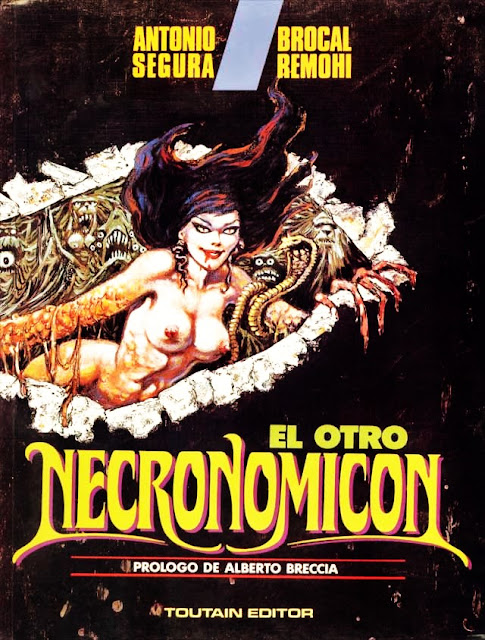
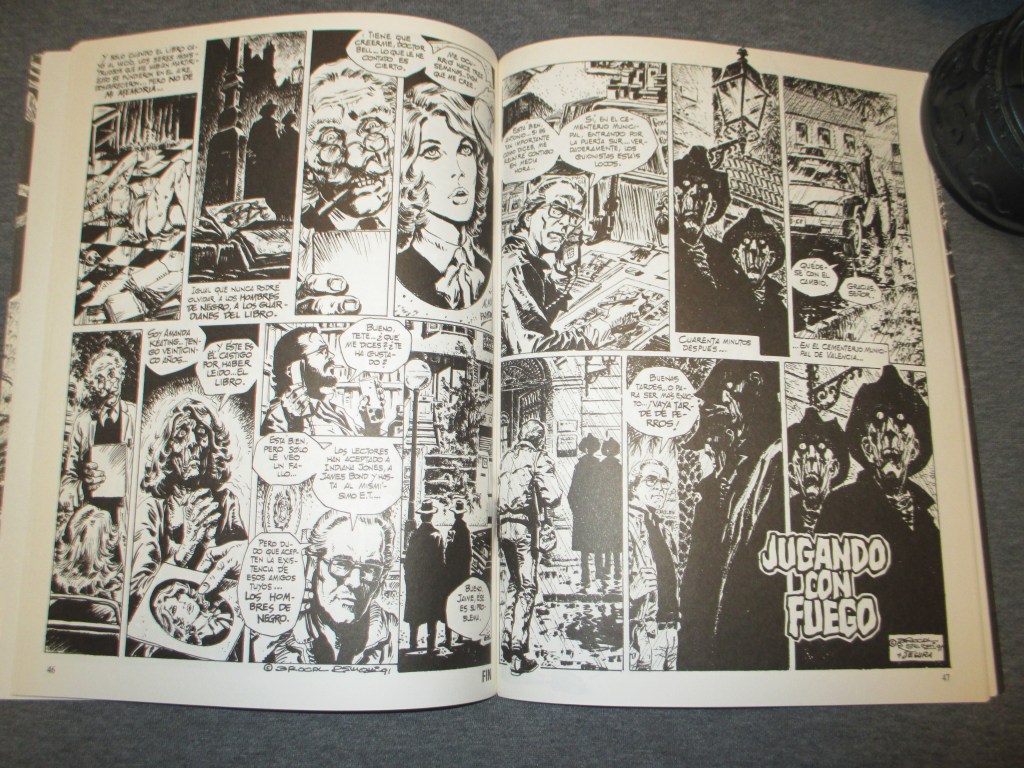
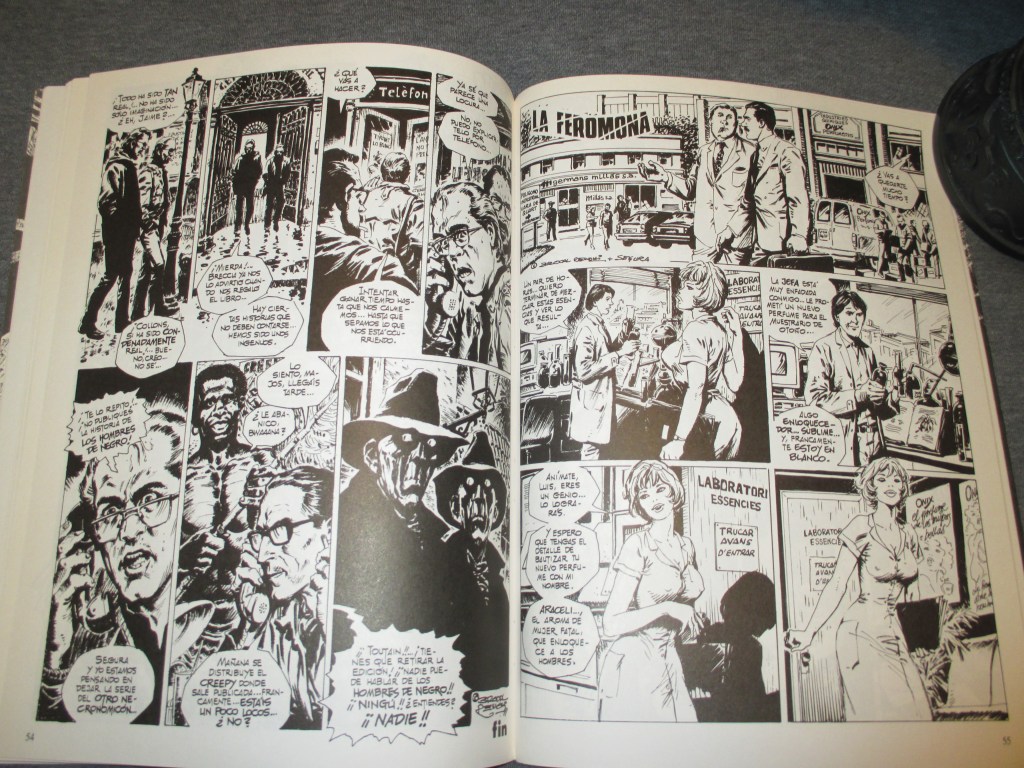
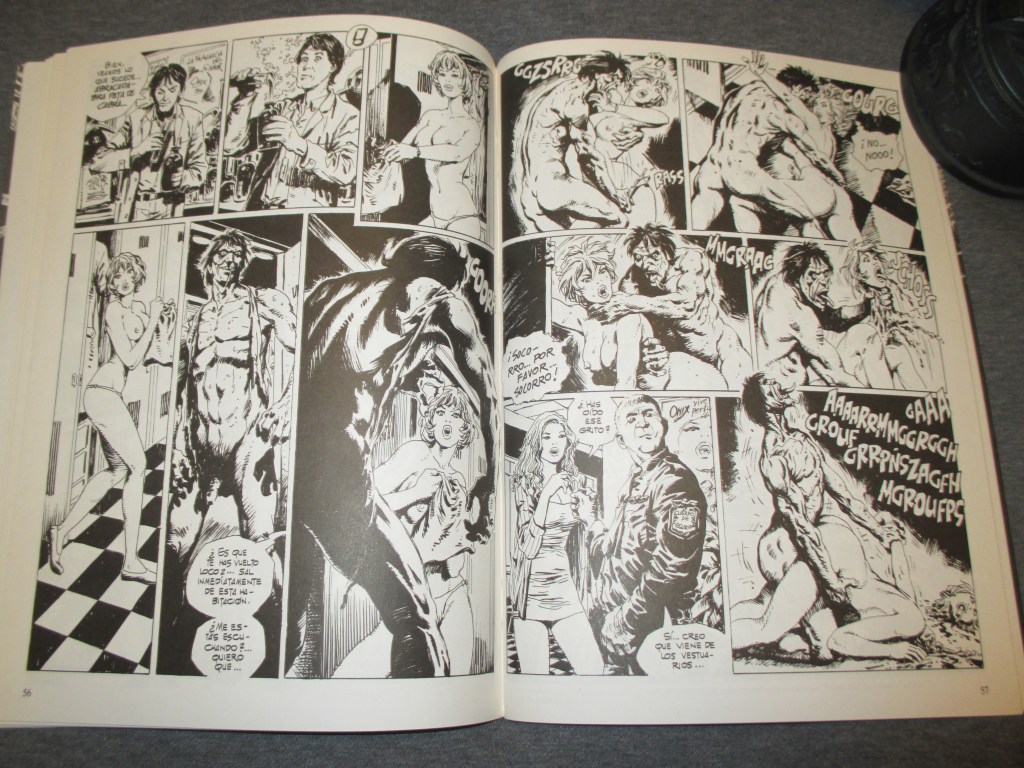
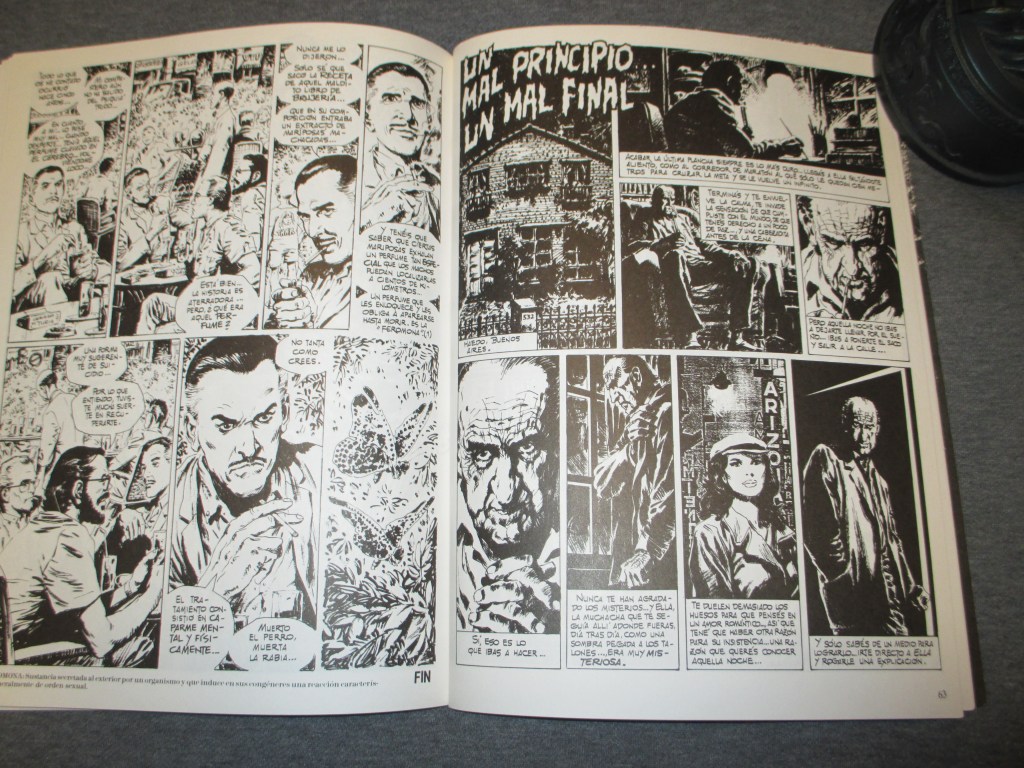
El Otro Necronomicón (1992) by Antonio Segura & Brocal Remohi

Eldritch Fappenings

This review deals with a horror comic intended for adult audiences. As part of this review, selected images with cartoon depictions of genitalia and graphic violence will be displayed as the work is discussed.
As such, please be advised before reading further.


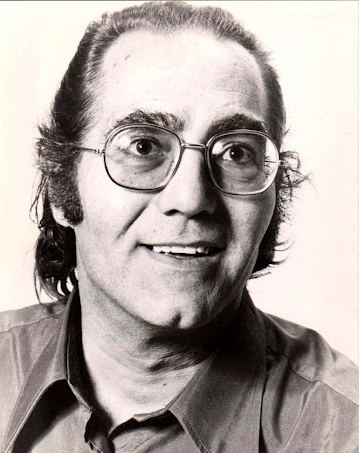
Antonio Segura (1947-2012) was a Spanish comics writer, and Jaime Brocal Remohi (1936-2002) was a Spanish comics artist. Both were natives of Valencia, and both achieved recognition for their work, and though neither quite broke through to fame in the English-speaking comics world, Jaime (as Jaime Brocal) was one of the stable of Spanish artists that found work with Warren Publishing in horror magazines like Eerie and Creepy.

In the 1979, the situation inverted somewhat:

A Spanish version of Creepy, wearing the name on the cover, finally appeared in March 1979. Published by Toutain until issue # 79 (Jan. 1986), this series offered a mix of stories. The mix, this time, was not the result of putting together stories from different publishers—all the stories were not from Warren—but by grouping, under the same cover, reprints from American authors and illustrators with original stories by Spanish artists and writers.

The quality was high and the magazine a success. The artistic styles varied from story to story and from nationality to nationality, but the tales were genuinely interesting, provoking, and, fittingly, creepy. Yet, a stark difference can be spotted between the American stories and the Spanish ones. While American authors favored the supernatural monsters of lore and Hollywood cinema such as zombies and vampires, Spanish creators were more inclined to human monsters and realistic grounding. Supernatural horrors were mostly absent—except in beautiful adaptations of H. P. Lovecraft’s works—in the Spanish stories, the horror rather being born from alienation and human cruelty.
—Fernando Gabriel Pagnoni Berns, “Spanish Creepy: Historical Amnesia in ‘Las mil caras de Jack El destripador’ in Critical Approaches to Comic Books (2023) 50

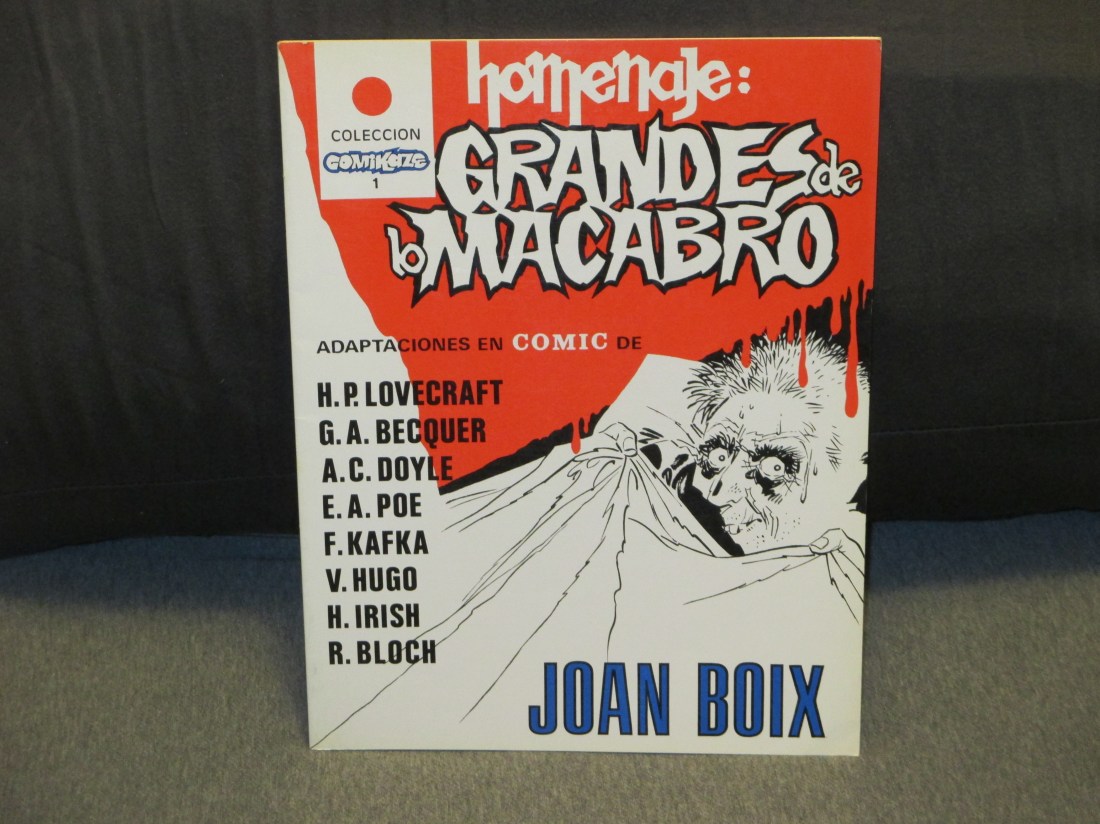
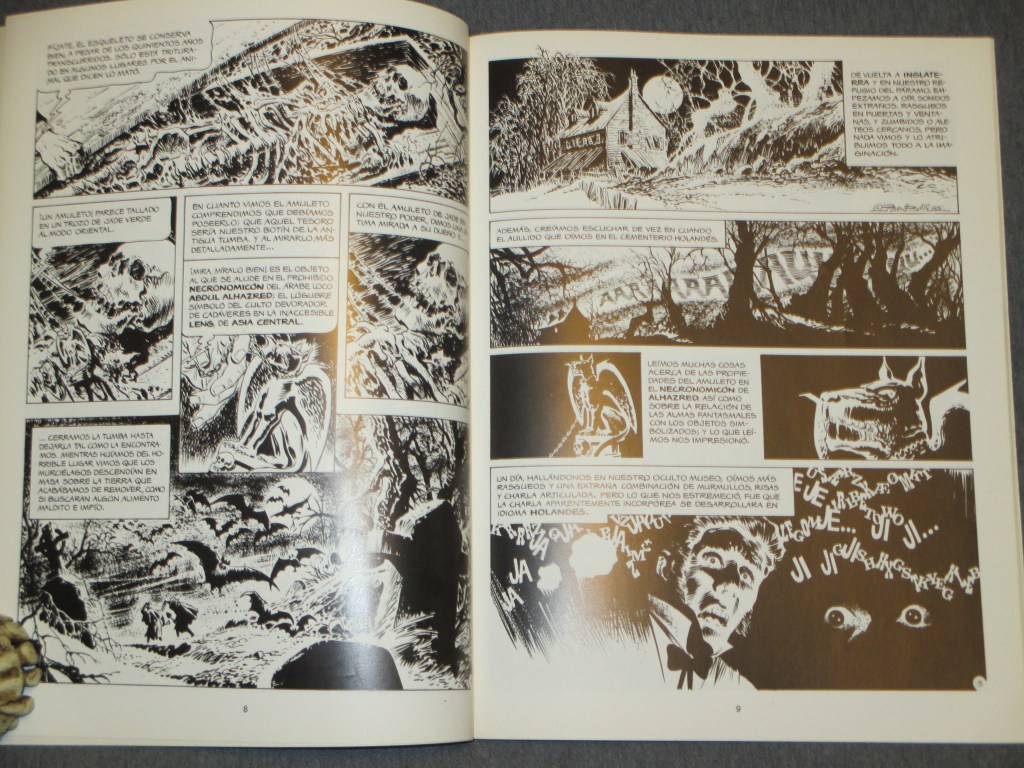
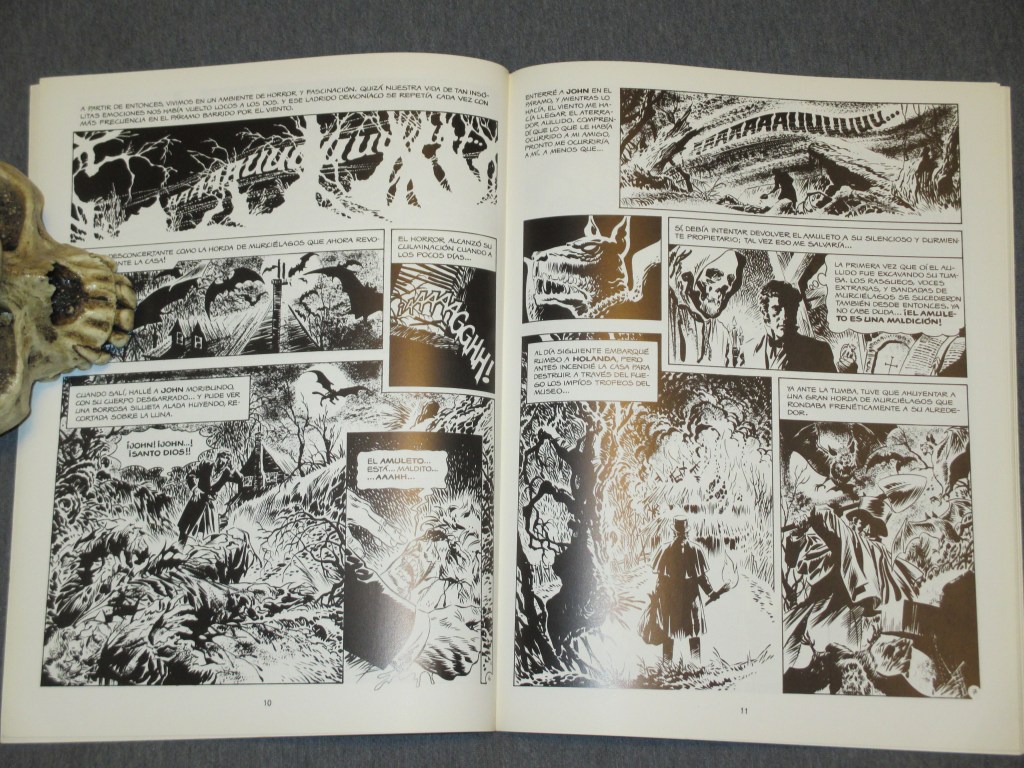
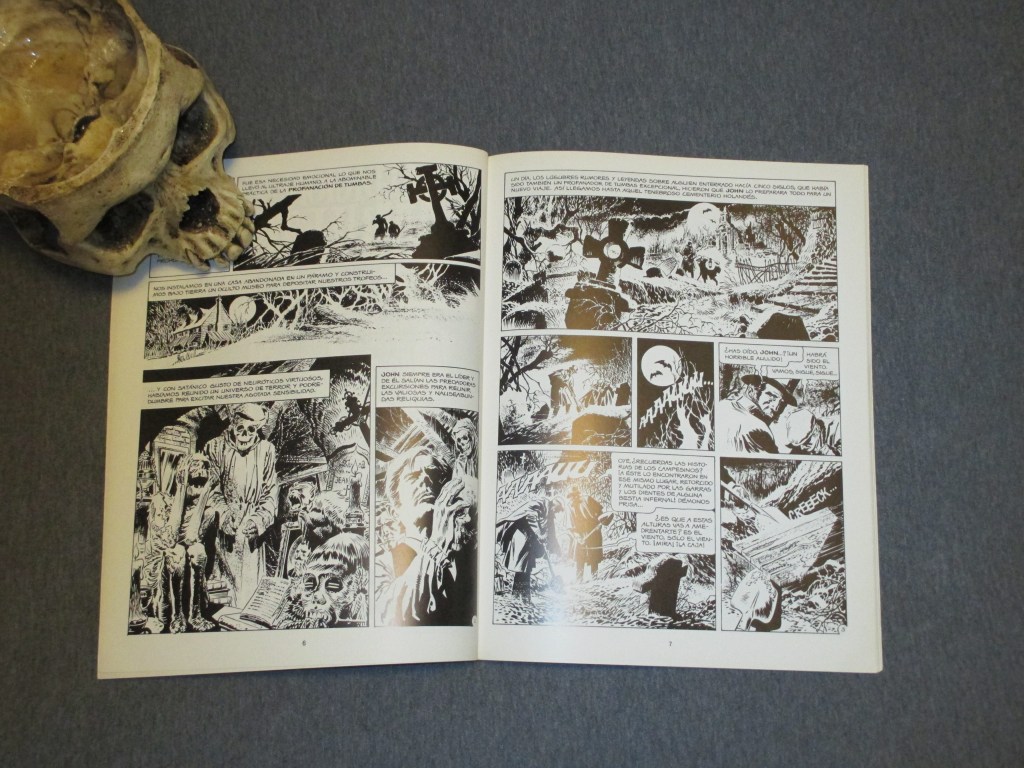
The Lovecraft adaptations included “La maldición del amuleto” (Creepy #73, Jul 1985) by Joan Boix; “La Sombra sobre Innsmouth” (Creepy #63, Sep 1984) and “La casa en el umbral” (Creepy #64, Oct 1984) by Norberto Buscaglia and Alberto Breccia, the latter an Argentinan comics artist who achieved fame for his adaptations of Lovecraft, translated in several languages—his work in the French comics magazine Métal Hurlant was translated into English in the Heavy Metal Lovecraft special issue in Oct 1979. The letters-to-the-editor page for Spanish Creepy was “Consultas al Necronomicón,” and the replies were signed “Alhazred.”

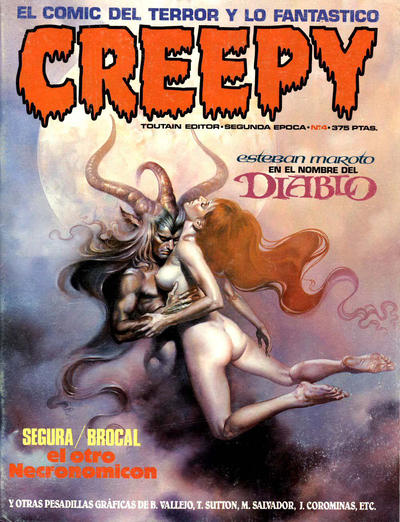
The Spanish Creepy was revived in 1990-1991 and ran for 19 issues, and the publisher Toutain tapped some of the same great Spanish talents from the first run for a series of seven original Lovecraftian horror comics, written by Antonio Segura and illustrated by Jaime Brocal Remohi.

Creepy #4 (1990)

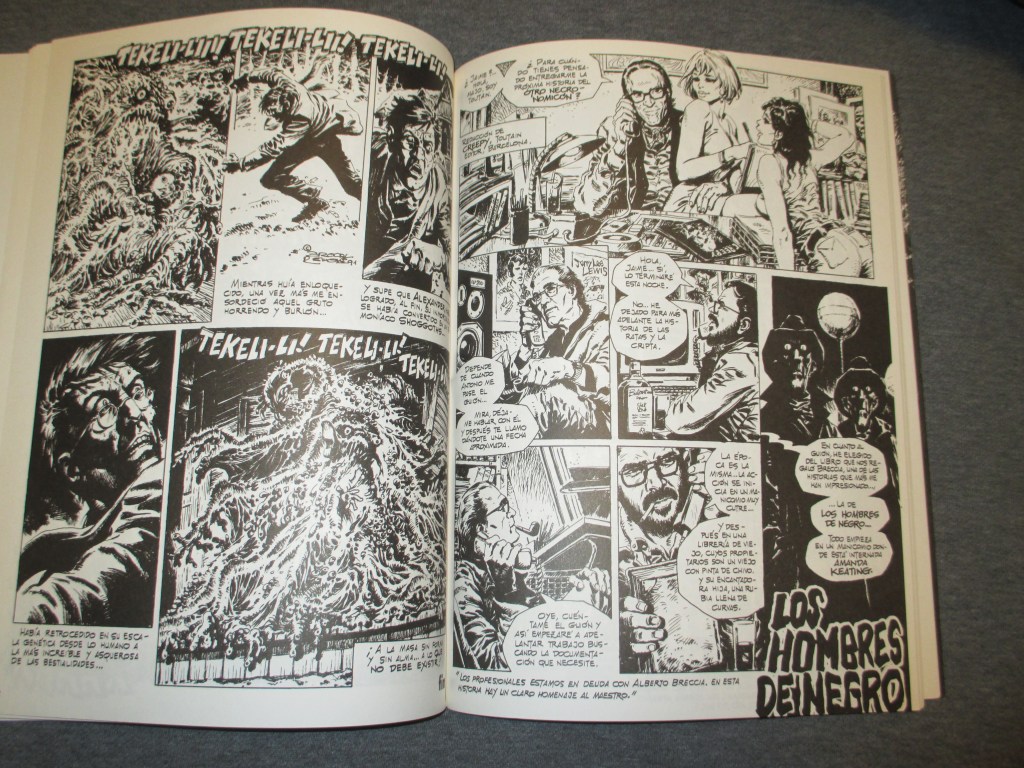
El Otro Necronomicón (“The Other Necronomicon“) followed the sensibility of European comics rather than mainstream English or British comics; violence, gore, and nudity could be graphic, but also the approach to the subject could be vividly intelligent, aesthetic, and intellectual, with metafictional flourishes. These stories of El Otro Necronomicon were never translated or published in English-language markets, and remain relatively obscure. Even the 1992 softcover album that collects the seven stories is now quite scarce.

Alberto Breccia explained the origin of the series in his foreword to the album:

Mi amigo, mi hermano Jaime, generosamente me ha pedido que prologue su libro sobre guiones de Antonio Segura, «EL OTRO NECRONOMICÓN». Mi cierta habilidad para el dibujo no es la misma que para la escritura. Pero no puedo rehusarme y escribiré entonces una’s lineas. Hablaré de nuestro entrañable amistad de tantos años, de nuestras interminables charlas sobre dibujo y libros. Nuestras correrías por Barcelona y Valencia por librerías de viejo revolviendo, buscando y hallando antiguos cronicones, polverientos folletines y regrasando felices con nuestros trofeos a tomar unos mates en su casa en compañia de su encantadora esposa Conchín y sus hijos, a los cuales he visto crecer. ¿Qué es un prólogo? ¿Una introducción al contenido del libro? ¿Una presentación de sus autores? ¿Mi opinion sobre la obra? . . . un poco de todo eso. Es de sobra conocido que nunca he leído comics, ni siquiera de niño. Lo cual no habla mal de los comics, sino de mí. Pero estos que tengo sobre mi mesa he tenido que leerlos. En principio como un gesto de lealtad hacia al amigo y porque debía hablar sobre ellos. Poco a poco su lectura me fue atrapando hasta lamentar su término. Ese manuscrito que hallé en el viejo puesto de revistas y libros viejos de mi amigo Yoel Novoa, escultor y demonólogo, ha encontrado en Antonio Segura y Jaime Brocal los intérpretes ideales. Hace unos años, en Barcelona, Jaime me manifestó su interés en volver a dibujar una historia fantástica. Frankenstein fue la elegida. Durante unas semanas discutimos cómo pensaba encararla, discutimos bocetos; hasta su hijo Jaime confeccionó en plastilina un possible rostro del monstruo.

Luego yo debí partir a Italia para regresar posteriormente a la Argentina. Pasado un tiempo, Jaime me escribió diciéndome que había desechado el proyecto. En Valencia, en Octubre de 1988 volvimos sobre el tema. Un año después, en Buenos Aires, doy con el manuscrito. En un siguiente viaje a España, me reúno con Jaime y Antonio en Valencia y les doy con cierto pesar el manuscrito. Hoy escribo estas lineas frente al resultado de estas inquietudes. He contado el origen de la obra. He dado mi opinión sobre ella. Los autores, a través de la excelencia del trabajo pueden prescindir de mí presentación. Ahora resta la opinión de los lectores.

Alberto Breccia.

Buenos Aires, 25 de Noviembre de 1991
My friend, my brother Jaime, has generously asked me to write the prologue to his book written by Antonio Segura, “THE OTHER NECRONOMICON.” My ability to draw is not the same as my ability to write. But I can’t refuse and I’ll write a few lines. I will talk about our close friendship of so many years, about our endless conversations about drawing and books. Our trips to Barcelona and Valencia through old bookstores rummaging, searching and finding old chronicles, dusty pamphlets and returning happy with our trophies to drink some mate at his house in the company of his lovely wife Conchín and his children, whom I have seen grow up. What is a prologue? An introduction to the content of the book? An introduction of its authors? My opinion on the work? . . . a bit of all that. It is well known that I have never read comics, not even as a child. Which does not speak badly of comics, but of me. But these I have on my desk I had to read. In principle as a gesture of loyalty towards my friend and because I had to talk about them. Little by little, its reading captivated me until I regretted its end. That manuscript that I found in the old stand of magazines and old books of my friend Yoel Novoa, sculptor and demonologist, has found in Antonio Segura and Jaime Brocal the ideal interpreters. A few years ago, in Barcelona, ​​Jaime expressed his interest in drawing a fantasy story again. Frankenstein was the chosen one. For a few weeks we discussed how he intended to approach it, we discussed sketches; even his son Jaime made a possible face of the monster in plasticine.

Then I had to leave for Italy and later return to Argentina. After some time, Jaime wrote to tell me that he had abandoned the project. In Valencia, in October 1988, we returned to the subject. A year later, in Buenos Aires, I found the manuscript. On a subsequent trip to Spain, I met Jaime and Antonio in Valencia and, with some regret, gave them the manuscript. Today I am writing these lines as a result of these concerns. I have told the origin of the work. I have given my opinion on it. The authors, thanks to the excellence of their work, can dispense with my introduction. Now all that remains is for the readers to give their opinion.

Alberto Breccia.

Buenos Aires, 25 November 1991
Prólogo de Alberto Breccia, El Otro NecronomiconPrologue by Alberto Breccia, English translation

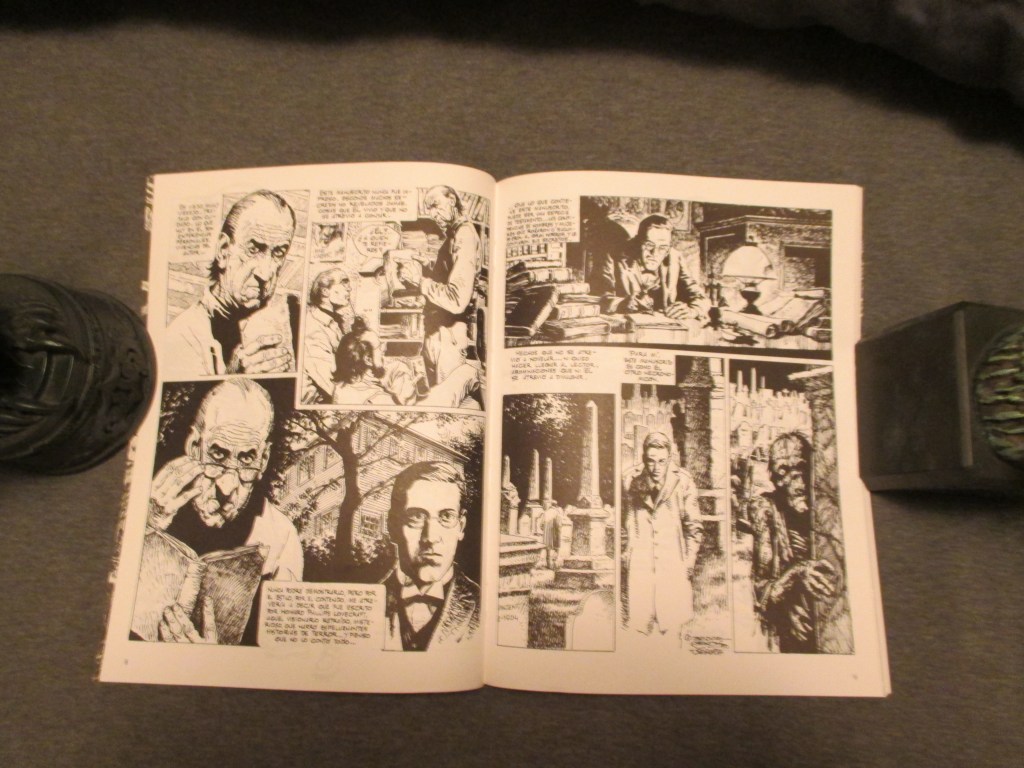
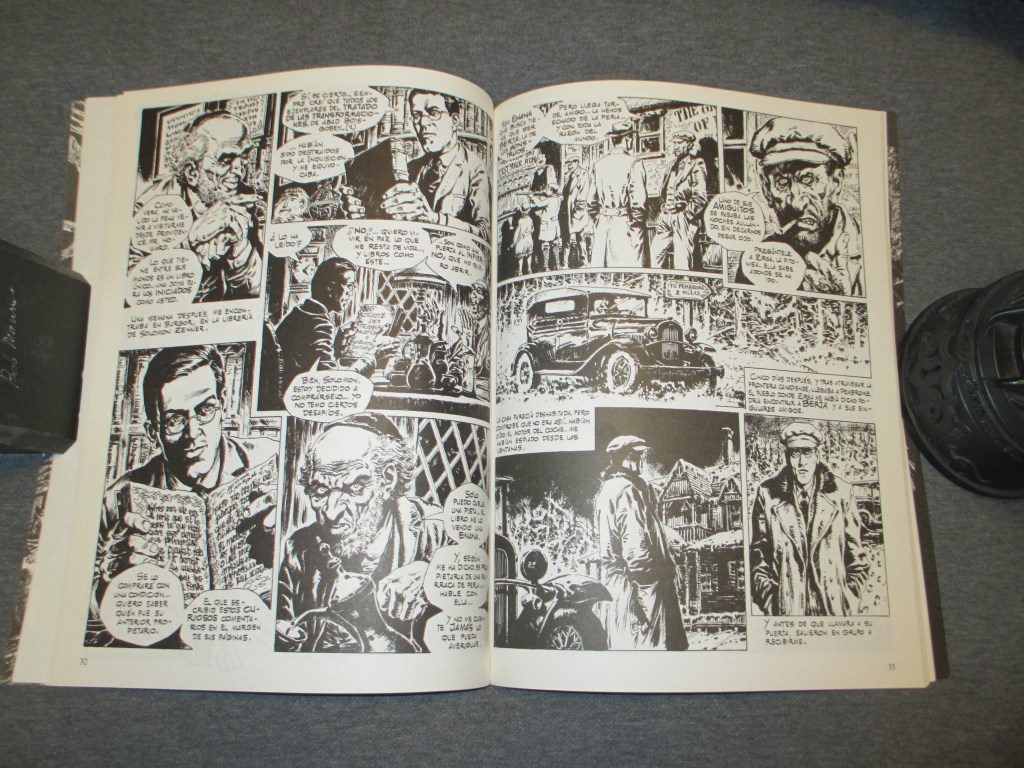
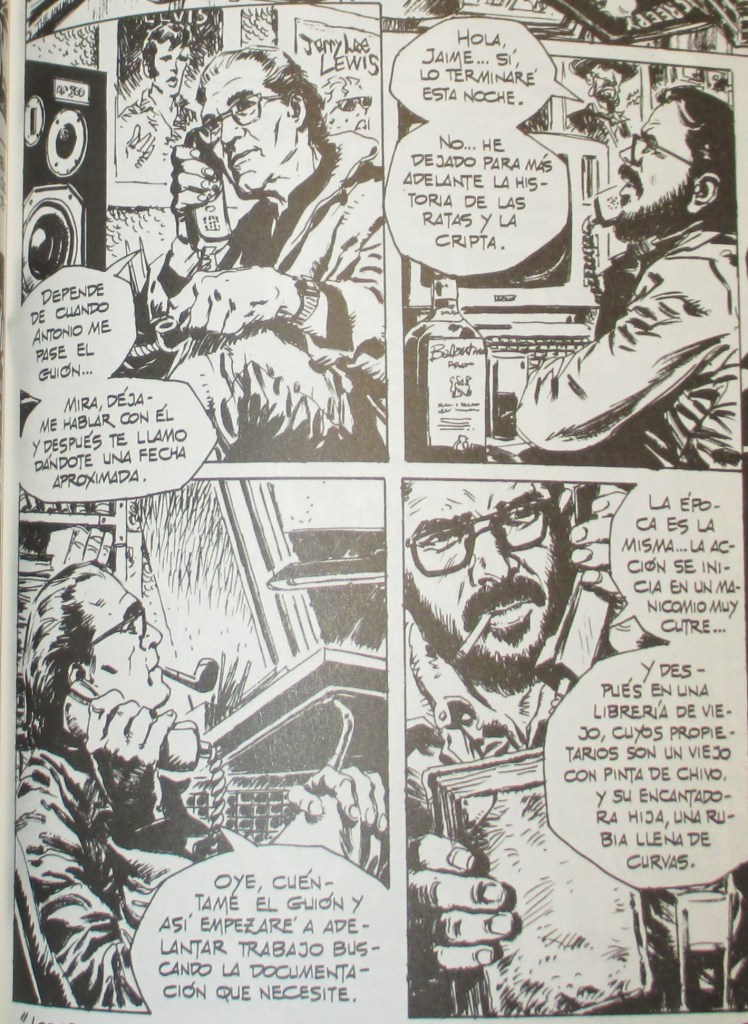
Breccia’s prologue makes a little more sense as an extension of the comic prologue to the stories, where a comic version of Alberto Breccia relates to comic versions of Antonio Segura & Brocal Remohi to adapt stories from a secret manuscript that H. P. Lovecraft wrote. The results are the seven stories in this collection.

Hechos que no se atrevió a novelar…. ni quiso hacer llegar al lector, abominaciones que ni el se atrevió a divulgar.

Para mí, este manuscrito es como el otro Necronomicon.
Facts that he did not dare to novelize …. and did not want to make them known to the reader, abominations that he did not dare to divulge.

For me, this manuscript is like the other Necronomicon.

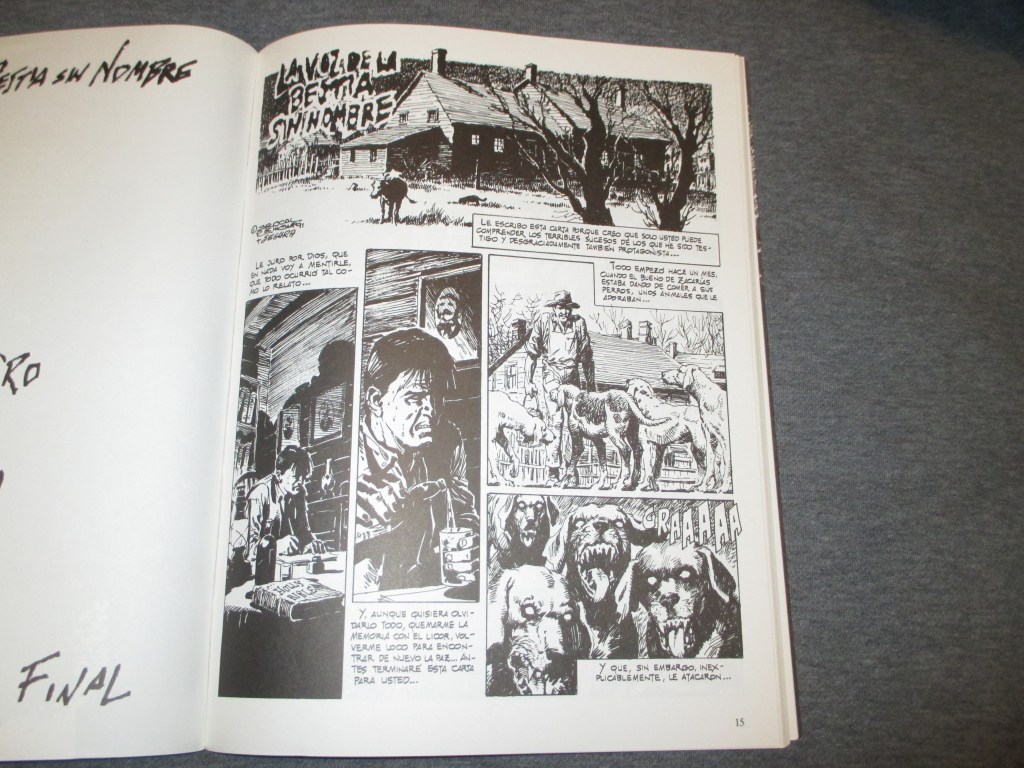
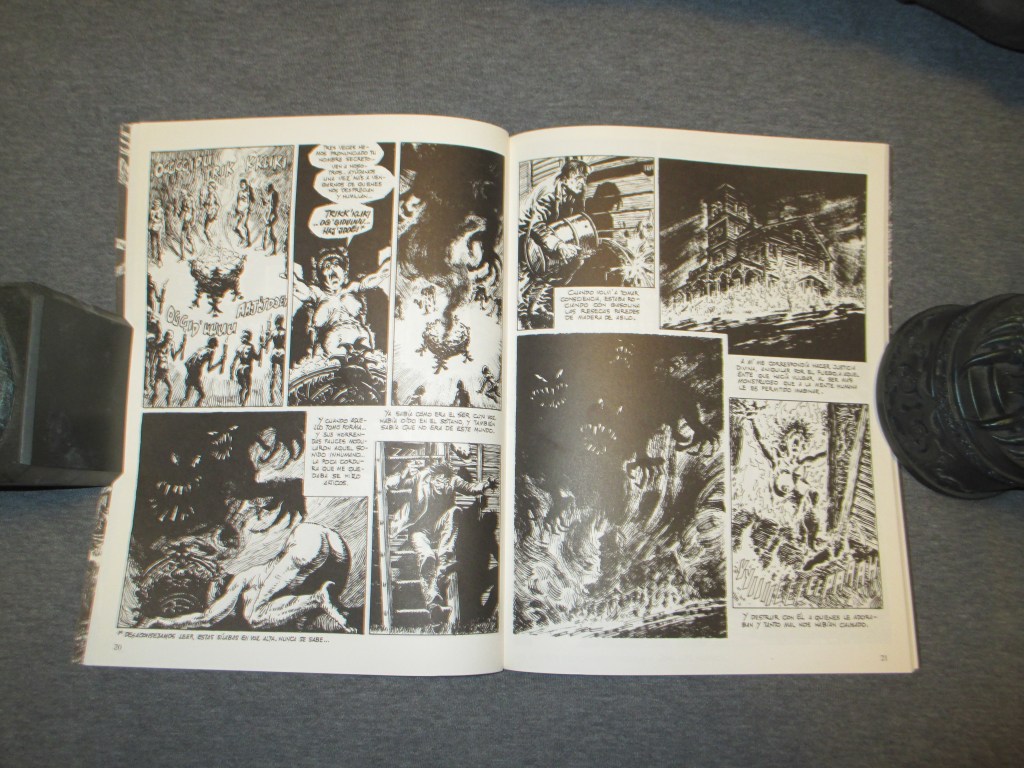
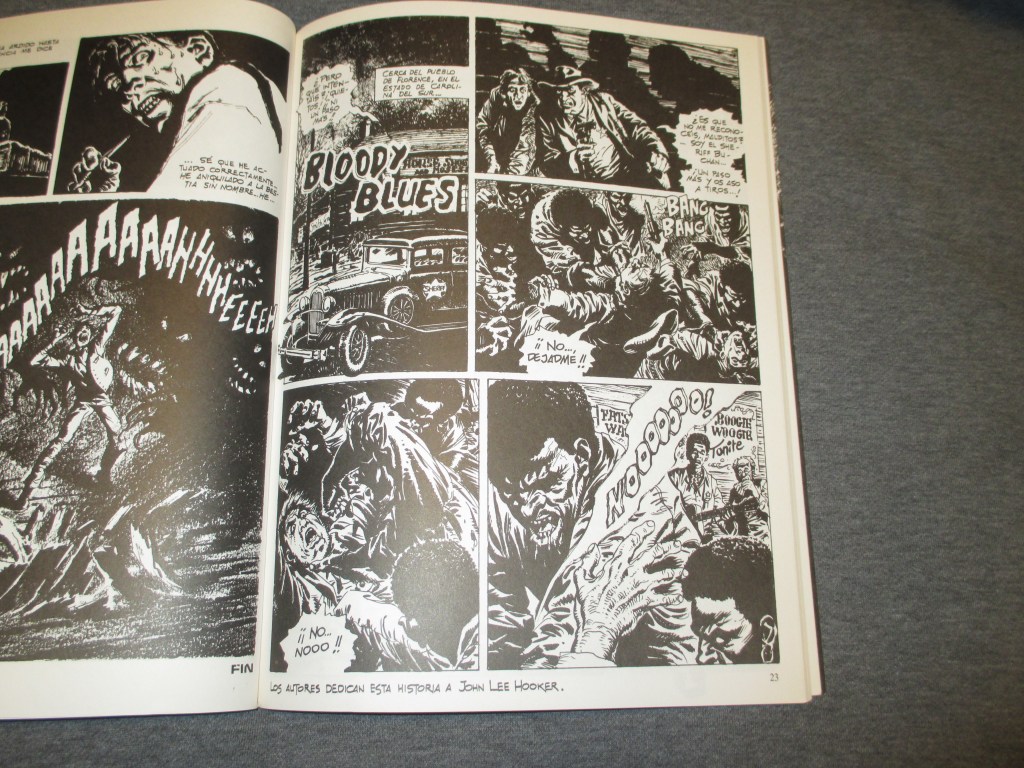
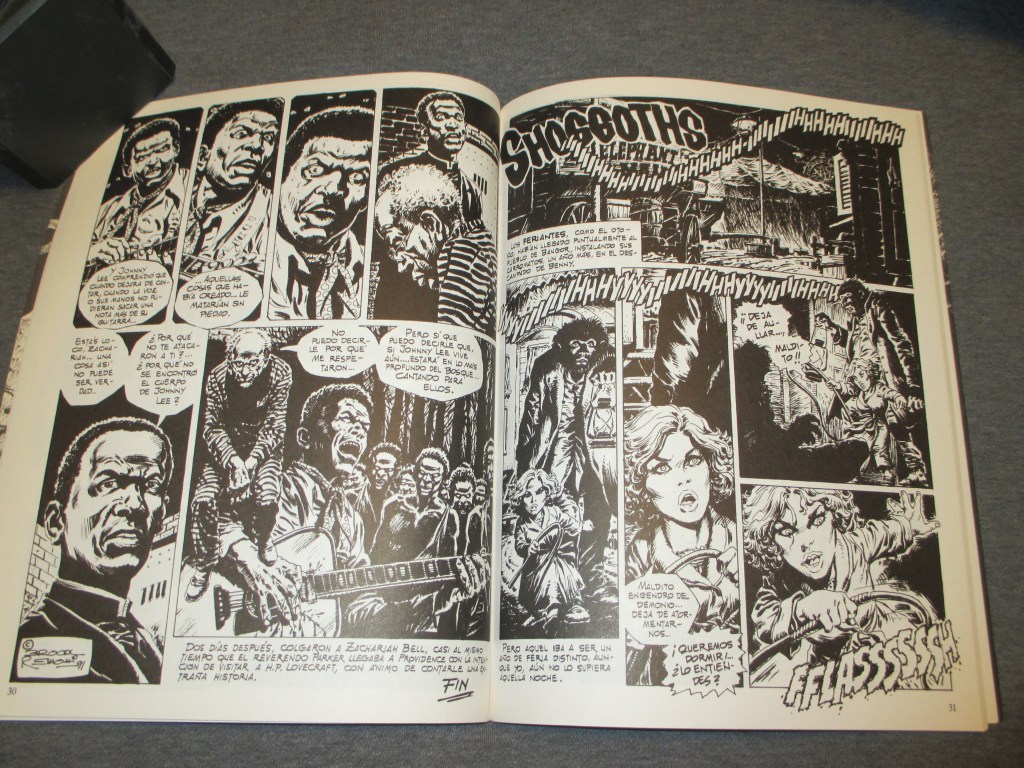
“La Voz de la Bestia sin Nombre”

“The Voice of the Nameless Beast” opens in a rural setting where animals have begun to attack humans. A repairman comes to the small, insular community…

…and discovers a cult.

Tres veces hemos pronunciado tu nombre secreto… ven a nosotros… ayúdanos una vez más a vengarnos de quienes nos desprécian y humillan… trikk’kliki… og’giduuuu… haj’jdoei*Three times we have pronounced your secret name… come to us… help us once again to take revenge on those who despise and humiliate us… trikk’kliki… og’giduuuu… haj’jdoei*
Nota: *Desaconsejamos leer estas sílabas en voz alta. Nunca see sabe…Footnote: *We advise against reading these syllables aloud. You never know…

Without being explicitly connected to Lovecraft’s stories, the brief story is very Lovecraftian in outline, albeit able to depict explicitly on the page the kind of naked cultists at their ceremonies which Lovecraft could not.

“Bloody Blues”

Titled in English, this story is implicitly set in the Southern United States of a generation ago; like Robert Johnson’s “Hellhound on My Trail” (1937), it combines the Blues with supernatural horror…and, in this case, borrows a couple of licks from Lovecraft’s “The Hound.”

Los autores dedican está historia a John Lee Hooker.The authors dedicate this story to John Lee Hooker.

To the credit of Seguna and Brocal Remohi, not only are the majority of characters in this story African-American, but they are not depicted as racial stereotypes. Unfortunately, this is slightly offset by the fact that this is one of the grislier of the tales in this volume, with an infernal blues song sending the Black audience into a literal orgy of rape, murder, and cannibalism worthy of Emaneulle and the Last Cannibals (1977) or Cannibal Holocaust (1980).

In a footnote at the end of the tale, it is explained that one of the survivors had traveled to Providence to tell H. P. Lovecraft a strange story.

“El Shoggoths”

The first story with an explicitly Lovecraftian connection features a “Mr. Howard” from Providence dealing with a rare book dealer named Solomon over an obscure volume, and wants to know the author of certain annotations in the margins. The dealer says he bought it from a little person who runs a circus. This gives Brocal Remohi the chance to draw several very special people, some of whom have a distinct resemblance to various characters that appeared in Creepy.

The annotator, however, is no longer quite human.

“Los Hombres de Negro”

“The Men in Black” opens on a picture of the Spanish Creepy offices—imagine in 1991 opening the latest magazine and staring at a rather good rendition of the magazine editor, asking artist Jaime Brocal Remohi (pipe) and Antonio Seguna (cigarette):

¿Para cuándo tienes pensado entregarme la próxima historia del Otro Necronomicón?When do you plan to deliver the next story of the Other Necronomicon?

Inserting themselves into the story adds a bit of metafictional framing to the tale—which is itself a nested narrative, where a woman in a wheelchair at an asylum explains to the doctor how one day her father returned from Salem with a book written in archaic Latin…and after his untimely death, two men in black come looking for it. Unwisely, Amanda decides to read the book herself, and ends up literally ravished by the dark forces unleashed.

“Jugando con Fuego”

“Playing with Fire” continues to follow the Men in Black—as well as Segura and Jaime Brocal Remohi. The creative team end up at a cemetery to confront a few corpses that don’t want to stay dead. It seems the creators of horror comics have been drawn into a horror comics themselves…literally.

Igual que nunca podré olvidar a los Hombres de Negro, a los Guardians del Libro.Just as I will never forget the Men in Black, the Guardians of the Book.

“La Feromona”

“The Pheromone” is a return to the Lovecraftian-but-not-specifically-Lovecraft horror stories. A chemist makes a perfume that changes any male who breathes it into a mindless, sexually insatiable, incredibly strong brute.

Which leads to a scene of physical and sexual violence worth of some of the bolder French and Italian adult horror comics of the 1970s like Outre-Tombe and Satanik.

While featuring gore worthy of Re-Animator (1985), there is an odd twist at the end which is more reminiscent of Arthur Machen’s classic “The White People” (1904):

Sólo sé que sacó la receta de aquel maldito libro de brujería.All I know is that he got the recipe from that damn book of witchcraft.

It is important at this point to appreciate what both Antonia Segura and Jaime Brocal Remohi bring to the table with this collection. The art is very Creepy-like, and the impression I get is that this is very deliberate; these were stories in the mold of the old Warren horrors. Yet the aesthetic sensibility is more a European: more sex, more violence, and a little more high brow concept to the writing, yet it never spills over into parody.

Brocal Remohi in particular uses a lot of photo-references to get the real-life characters’ faces and expressions correct, there’s a lot of work that goes into his backgrounds, and yet his page layouts are very restrained—no big splash pages, no Dutch angles, a very careful play between light and dark which gives a grounded, realistic scale to his art that helps make the horror more horrific.

“Un Mal Principio, Un Mal Final”

“A Bad Beginning, A Bad Ending” is the final tale in El Otro Necronomicón, and appropriately enough wraps back to where it all began: with Alberto Breccia.

It is almost a character study; an old man seduced by a young woman, the forces of darkness tempting and threatening and closing in—Alberto Breccia (1919-1993), he was the generation before Segura and Remohi, and this is an homage to Breccia’s legend as much as any of the homages penned by Lovecraft’s friends for the Old Gent from Providence. The difference being, Breccia was still around at the time to receive the sincere admiration.

Taken all together, the basic premise of El Otro Necronomicón has real potential: an excuse to write basically any horror story, and give it the added cachet that it supposedly came from the black book of secret tales that not even H. P. Lovecraft dared release upon the world. That basic formulae doesn’t last very long, though; Segura and Brocal Remohi kept extending the metafictional elements. It feels like the natural conclusion of the story might have to be their own destruction as the Men in Black reclaim the manuscript, but we don’t get that ending. Instead, they made a final tribute to the artist who had inspired them. The last words of the last story are:

El maestro que nos ensenó cómo contar lo que muchas veces resulta imposible de contar.The master who taught us how to tell what is often impossible to tell.

When you think about Lovecraft’s fiction, and the difficulty that so many have faced in trying to adapt them to comics, radio, film, video games—how few seem to actually capture something of the horror in the tales—I think there is a fitting tribute to someone who did have the artistic vision and skill to not just realize adaptations of Lovecraft’s work, but to do it well. Much as we might praise Bernie Wrightson’s Frankenstein or Tanabe Gou’s At the Mountains of Madness for their outstanding masterworks.


Bobby Derie is the author of Weird Talers: Essays on Robert E. Howard and Others and Sex and the Cthulhu Mythos.

Deep Cuts in a Lovecraftian Vein uses Amazon Associate links. As an Amazon Associate I earn from qualifying purchases.
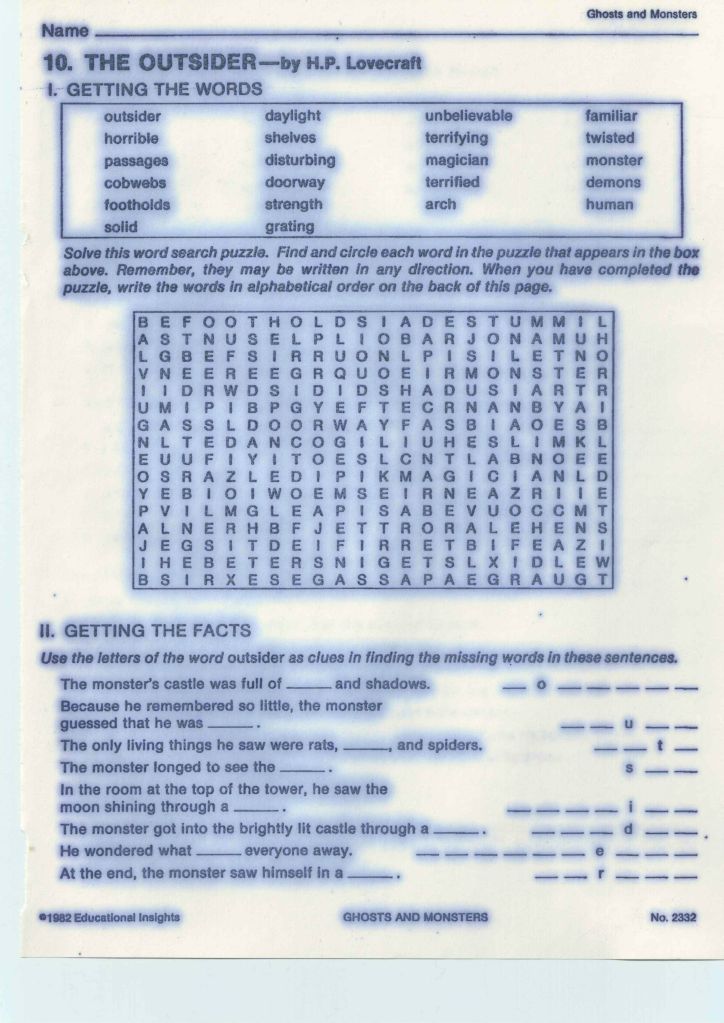
“La Maldición del Amuleto” (1985) by Joan Boix & H. P. Lovecraft

Hay quienes consideran el género de TERROR como un subproductio. Es cierto que, como en todo, a veces domina una calidad ínfirma, pero no sólo en los Comics. También en cinema, televisión, literature…

Tal vez porque el tema se ha explotado a fondo con abusos commerciales aprovechando que a la gente le gustan las emociones fuertes y muchos, sin saberlo, las utilizan para liberarse de sus propios miedos. Pero también es cierto que otros se han servido de sus miedos para expresar sus sentimientos y emociones segun su condición psicológica dando lugar a las mejores obras del género. Tal as el caso de POE, LOVECRAFT, KAFKA, y muchos más.

El experto en la materia no dejará nunca de reconocer que el TERROR es un tema de gran interés que además nos revela la personalidad más intrínseca de sus autores. Por eso, repito, el TERROR no se debe subestimar a la ligera sin un previo análisis.

Conociendo lo suficiente (presumo) sobre la vida atormentada y la obra de Los maestros del terror, he seleccionado una serie de relations pasándolos al Comic, Bien adaptando fielmente algunos, Bien dando mi toque personal a otros.

Y aquí está el resultado: Este libro con el que deseo rendir homenaje a los «GRANDES DE LO MACABRO».

Espero que lo pasen de miedo.
There are those who consider the TERROR genre as a by-product. It is true that, as in everything, sometimes a low quality dominates, but not only in Comics. Also in cinema, television, literature…

Perhaps because the topic has been thoroughly exploited with commercial abuse, taking advantage of the fact that people like strong emotions and many, without knowing it, use them to free themselves from their own fears. But it is also true that others have used their fears to express their feelings and emotions according to their psychological condition, giving rise to the best works of the genre. Such is the case of POE, LOVECRAFT, KAFKA, and many more.

The expert on the subject will never fail to recognize that TERROR is a topic of great interest that also reveals the most intrinsic personality of its authors. Therefore, I repeat, TERROR should not be underestimated lightly without prior analysis.

Knowing enough (I presume) about the tormented life and work of The Masters of Terror, I have selected a series of relations, transferring them to the Comic, either faithfully adapting some, or giving my personal touch to others.

And here is the result: This book with which I wish to pay tribute to the “GREAT OF THE MACABRE.”

I hope you have a scary time.
Introduction to Homenaje: Grandes de Los Macabro (1985)English translation

Joan Boix (born Juan Boix Sola Segales in Badalona, Spain) is not well-known to English-reading audiences, although he has had a long career both in Spain and internationally, able to turn his hand from everything from romance comics in the 1960s to being one of the artists that drew The Phantom comic strip in the 1990s. Yet for those who appreciate horror comics, Joan Boix holds a special place for his work in that field. Even there, in English his work is a bit of a footnote: a story in Marvel’s Monsters Unleashed #5 (1974), which was reprinted in the Monsters Unleashed Annual (1975). Yet his Spanish-language work, never translated into English, is his best. And in 1985 he published a collection of adaptations of classic horror fiction: Homenaje: Grandes de Los Macabro (Tribute: Greats of the Macabre).

“La Maldicion del Amuleto” is an adaption of H. P. Lovecraft’s “The Hound.” In Spanish, the story is typically translated as “El Sabueso,” and while there are many words for dog in Spanish (perro, can or canino, cacharro (“puppy”), chandoso, etc.) “sabueso” has the specific meaning of a hunting dog; we might even say “bloodhound” in English. Which is a nice shade of meaning, given the context.

Boix’s tastes in terms of illustration are gloriously Gothic, redolent of an 18th-century macabre that recalls the horror films of Hammer Films in Britain and Profilmes in Spain. There’s that sense that Peter Cushing, Christopher Lee, or Paul Naschy could step onto the panel at any time, and be right at home.

The starkness of the black-and-white works to Boix’s advantage; there are single panels that could be glorious two-page spreads, with a lot of detail that might have been muddied by a careless colorist. The chiaroscuro effect is glorious, the kind of deep shadows that drink in the light which would inspire the likes of Mike Mignola’s signature aesthetic.

It is always tempting, when reviewing one of these adaptations of Lovecraft, to compare it against all the other adaptations. Jack “Jaxon” Jackson in Skull Comix #4 (1972), Stuart Gordon and Tula Lotay in The Thought Bubble Anthology #1 (2011), Chad Fifer and Bryan Baugh in The Lovecraft Anthology: Volume II (2012), Tanabe Gou in H. P. Lovecraft’s The Hound and Other Stories (2017)—and all of these have their charms and advantages, their different takes and take-offs on the material.

For sheer joie de morte, however, Boix’s tendency to revel in a single panel is hard to top. It’s a world where the moon is always full and glaring like the eye of some forgotten God, where every tombstone is encrusted with grave-mould, and the collection of the pair of necrophiles would put Hammer’s prop department into giddy ecstasies of macabre delight.

As horror comics have gained new appreciation, so too has awareness of Joan Boix’s work begun to grow, with new critical editions in Spanish like Grandes de la Macabro (2021), and Joan Boix. Antología: Relatos pasados, recuerdos presentes, maestría absolute (2022). Very fortunately for English-reading audiences, for the first time ever his horror comics have been translated into English: Terror! The Horror Comics Genius of Joan Boix (2022).


Bobby Derie is the author of  Weird Talers: Essays on Robert E. Howard and Others  and  Sex and the Cthulhu Mythos .

Deep Cuts in a Lovecraftian Vein uses Amazon Associate links. As an Amazon Associate I earn from qualifying purchases.
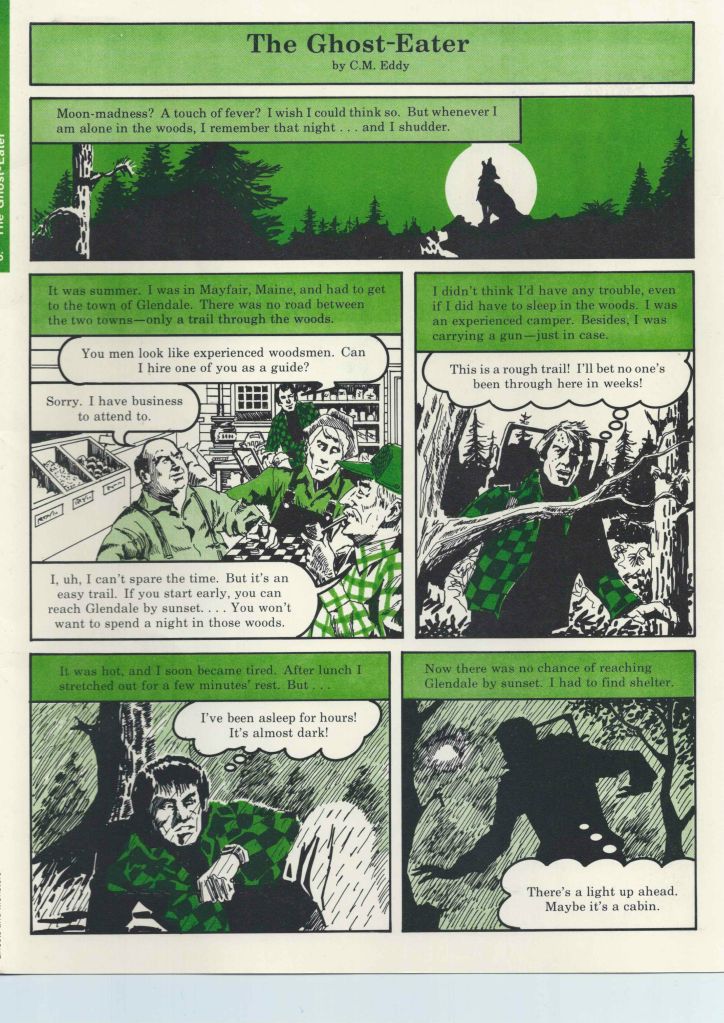
Skinny Dipper (2023) by Sex and Monsters

Eldritch Fappenings

This review deals with a work of art that includes nudity. As part of this review, selected images with nudity will be displayed. As such, please be advised before reading further.


It was many and many a year ago,
   In a kingdom by the sea,
That a maiden there lived whom you may know
   By the name of Annabel Lee;
And this maiden she lived with no other thought
   Than to love and be loved by me.
—Edgar Allan Poe, “Annabel Lee” (1849)

Skinny Dipper was a successfully crowdfunded multimedia project by Sex and Monsters, who are best known for their retro chic combinations of horror, pulp fiction, and tiki culture to produce works like the comic/cocktail booklet Tiki Surf Witches Want Blood.

The form of this particular project is a 32-page mixed-media comic ‘zine that remixes Poe’s “Annabel Lee” and “The Night Ocean” (1936) by R. H. Barlow with H. P. Lovecraft, re-imagining them against a palette of mixed comic and photographic work by Emily Roberts, April Snellings, Jelena Đorđević, May Nguyen, Dennis Swiatkowski, Sam McKenzie, Slime Sunday, Brite Lite Tribe, and Will Penny; and a 7″ vinyl record by Nite Jewel that contains a soundtrack to accompany the piece. Various Kickstarter bonuses to the campaign add decals, instant film shots of May Nguyen, and other goodies.
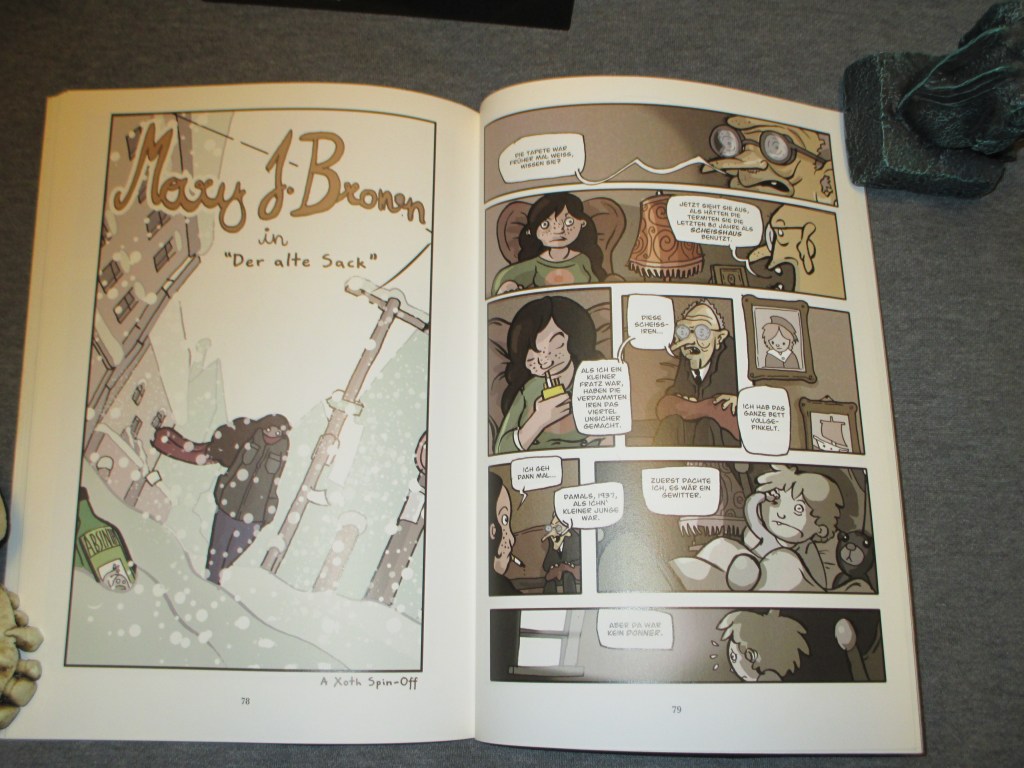
The crux of the re-imagining is model May Nguyen, who appears both in photographs and as the character model for the character of Annabel Lee in the story. Told in sparse, evocative images, Annabel Lee shifts from the bright and crowded daylit beach to a lonely moonlit scene, to go skinny dipping alone in the night ocean.

Chunks of Poe’s and Barlow and Lovecraft’s texts are taken out of context and reframed as poetry. The artists are each distinctive in their style and approach to the material; the center black-lettering on black-pages at the center of the story is incredibly evocative of the dark abysses hinted at in poem and short story, here rendered visually—and the combination of Poe’s verse and select snippets from Barlow and Lovecraft work well together with the visuals, terribly suggestive of far more than appears on the page.

Kitsch is a dirty word, but in this case the artists are trying to recapture specific moods and art styles, from the Charles Atlas bully-kicks-sand-in-your-face comics of the 50s to 80s glossy magazine photo spreads that are terribly suggestive of exotic vacations, where the sea foom can lap at your feet as you read and relax on holiday. It is a deliberate effort to reproduce an aesthetic that existed, even if that exact place never did.

One thing that both “Annabel Lee” and “The Night Ocean” capture is a sense of loneliness and longing; that may be why giving Annabel in Skinny Dipper such a distinctive face adds something to the text. May Nguyen provides a sense of reality that might have been missing if this a more traditionally-made comic book; there’s a fotonovella-style sense that these could be stills to some ancient straight-to-video movie that graced the shelves of mom & pop video stories.
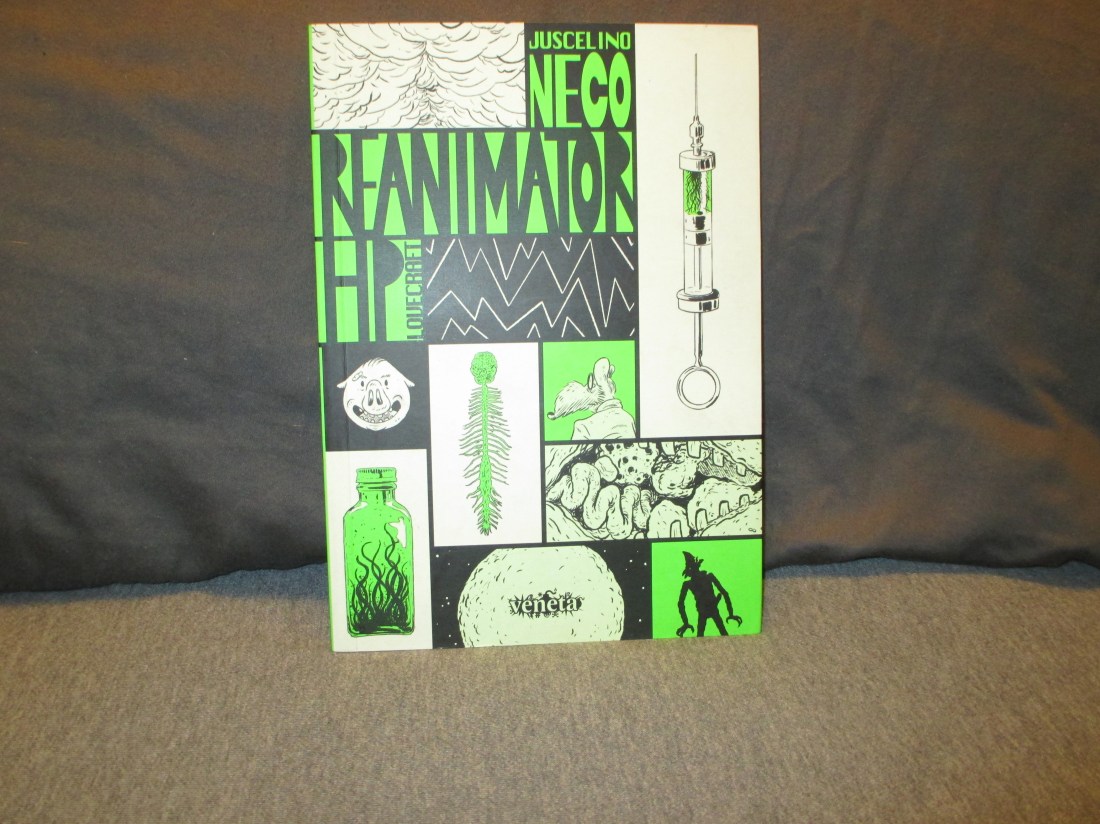
It is not horror in any strict sense; not int he bloody bones and a shark coughing up a limb. It’s closer to a vacation where all the time away reminds you that the one thing ou can’t get a vacation from is yourself, can’t get out of your own head. That loneliness and the endless, ageless warm waters of the ocean might swallow you up forever, given half a chance.
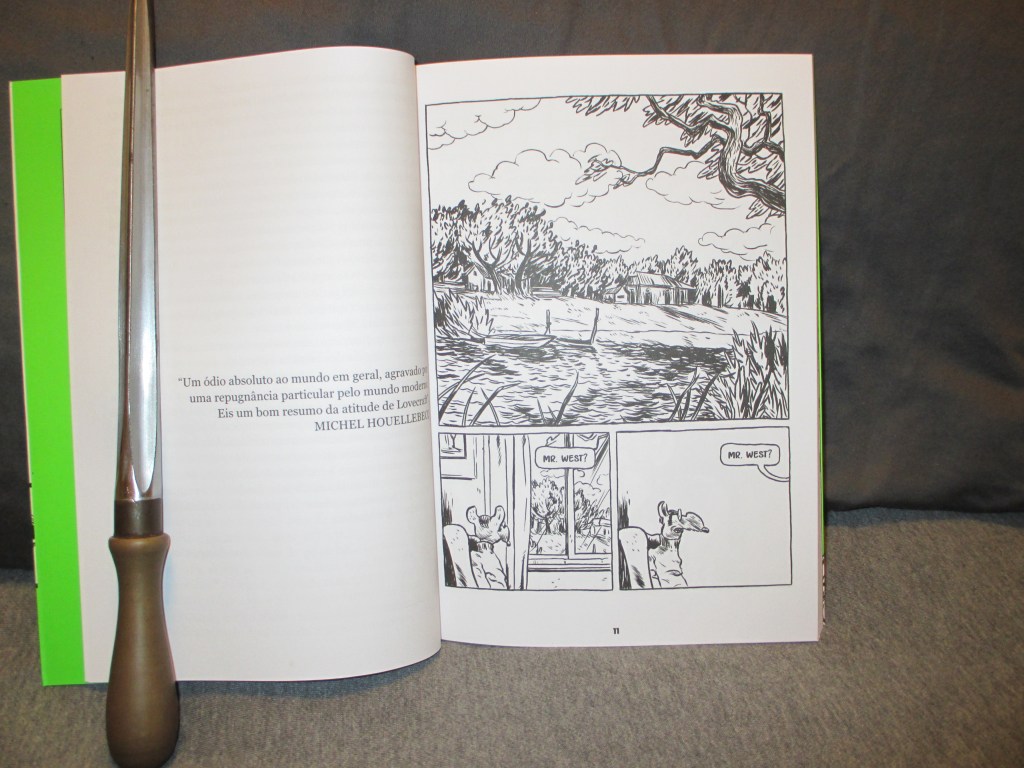
Nite Jewel’s Skinny Dipper single is a soundtrack to the story; I’d call it synthwave or retrowave, while the tags for the album on call it chillwave and hypnogogic pop. Combined with the stylistic flourishes of the comic, it grounds the reader in that almost-never-when promised in a thousand 80s and early 90s magazines, comics, films, and music videos. The idea of the beach as this place of escape, the music a poppy invitation that’s a bit more upbeat than tiki exotica, but holds many of the same audio cues, just for a later generation.

At this time of writing, the album is the only thing available for direct purchase, although many stills and videos associated with the project are located on Sex and Monsters’ Facebook page.

Skinny Dipper is an interesting collaboration, one that showcases the abilities and visions of the individual artists that went into it. Copies are still available through the Kickstarter store (click “Order Now”), and will hopefully receive a wider release in the near future.


Bobby Derie is the author of  Weird Talers: Essays on Robert E. Howard and Others  and  Sex and the Cthulhu Mythos .

Deep Cuts in a Lovecraftian Vein uses Amazon Associate links. As an Amazon Associate I earn from qualifying purchases.