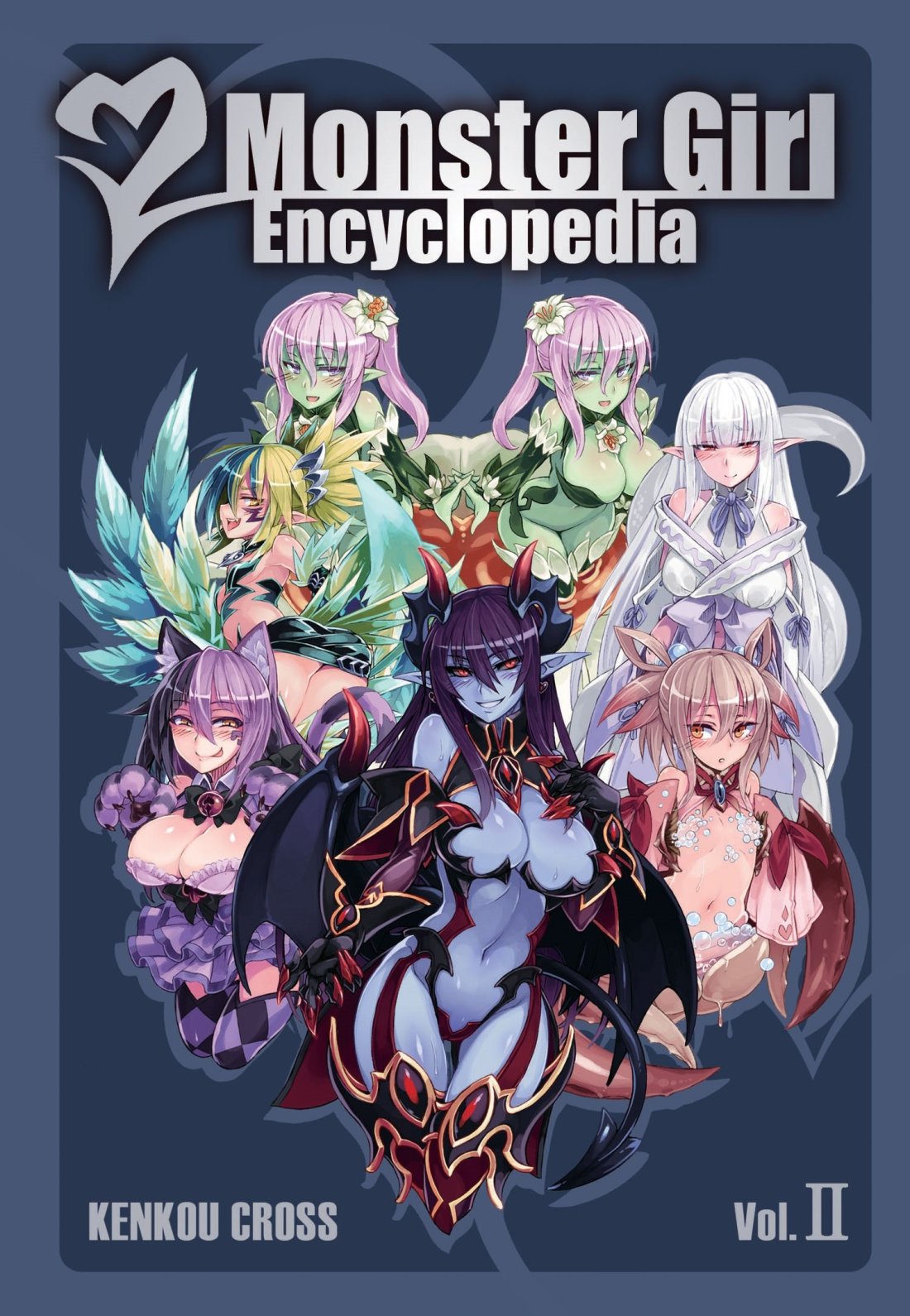
Monster Girl Encyclopedia II (2016) by Kenkou Cross (健康クロス)

Eldritch Fappenings

This review deals with a work of erotic content, and the history of erotic art and writing. As part of this review, selected art displaying cartoon nudity will be included.
As such, please be advised before reading further.


Monsters once were ghastly beasts that devoured the flesh and blood of human beings. However, since the ascension of the new Overlord, a succubus with godlike power, monsters have taken on utterly different, bewitching, and fantastic forms resembling those of alluring women. These outward changes have been accompanied by dramatic shifts in their ways of life, patterns of behavior, and values.
—foreword to Monster Girl Encyclopedia Vol. II

The Monster Girl Encyclopedia (魔物娘図鑑, 2015) by Kenkou Cross (健康クロス) is a variation on the popular pseudobiblia bestiary genre. In the Dungeons & Dragons-inspired fantasy setting that Kenkou Cross has created, a succubus has risen to the position of evil Overlord, and turned all the monsters into, essentially, nubile female forms obsessed with sex. The second volume in the series (魔物娘図鑑 II, 2016) has introduced some Mythos-related entities including the shoggoth, and the series has gone on to generate a good deal of fanfiction, dōjinshi (同人誌, fan-created artwork, comics, etc.) and expanded media, which varies from the sedate to the outright pornographic…and these two works have been translated into English by DK with “English Adaptation” by Harriet Fray.

To really understand and appreciate what Kenkou Cross has done, we have to look at how they got here.

Dungeons & Dragons was published in 1974, a collaboration between Gary Gygax and Dave Arneson and published by TSR, Inc. The original boxed set included a Monsters & Treasure booklet which had brief descriptions of and rules for iconic fantasy monsters—and these were, for the most part, taken from generic fantasy (The Hobbit and The Lord of the Rings, Greek mythology, the 1,001 Nights, etc.); there weren’t much in the way of “original” monsters. In 1977 a revised and expanded edition of the game was published which included a much expanded Monster Manual, which included not only more monsters and illustrations on the monsters, but details on their culture, life, habits, etc. These were still pretty scanty, but from this humble beginning nearly every other roleplaying game has developed their own bestiary or critter compendium. In 1980, TSR Inc. published Deities & Demigods by Jim Ward, which included the first published bestiary of the Cthulhu Mythos.

1-a97fbbd69f

This led to a little kerfuffle; the author had gotten permission from Arkham House to use the Mythos in the book, but Arkham House had also just granted a license to Chaosium, Inc. to develop a roleplaying game based on the Mythos, and they were also developing an RPG based on the Elric stories of Michael Moorcock (who had done basically the same thing as Arkham House). No harm was done, and in the book’s third printing TSR Inc. dropped the two sections with a brief notice.

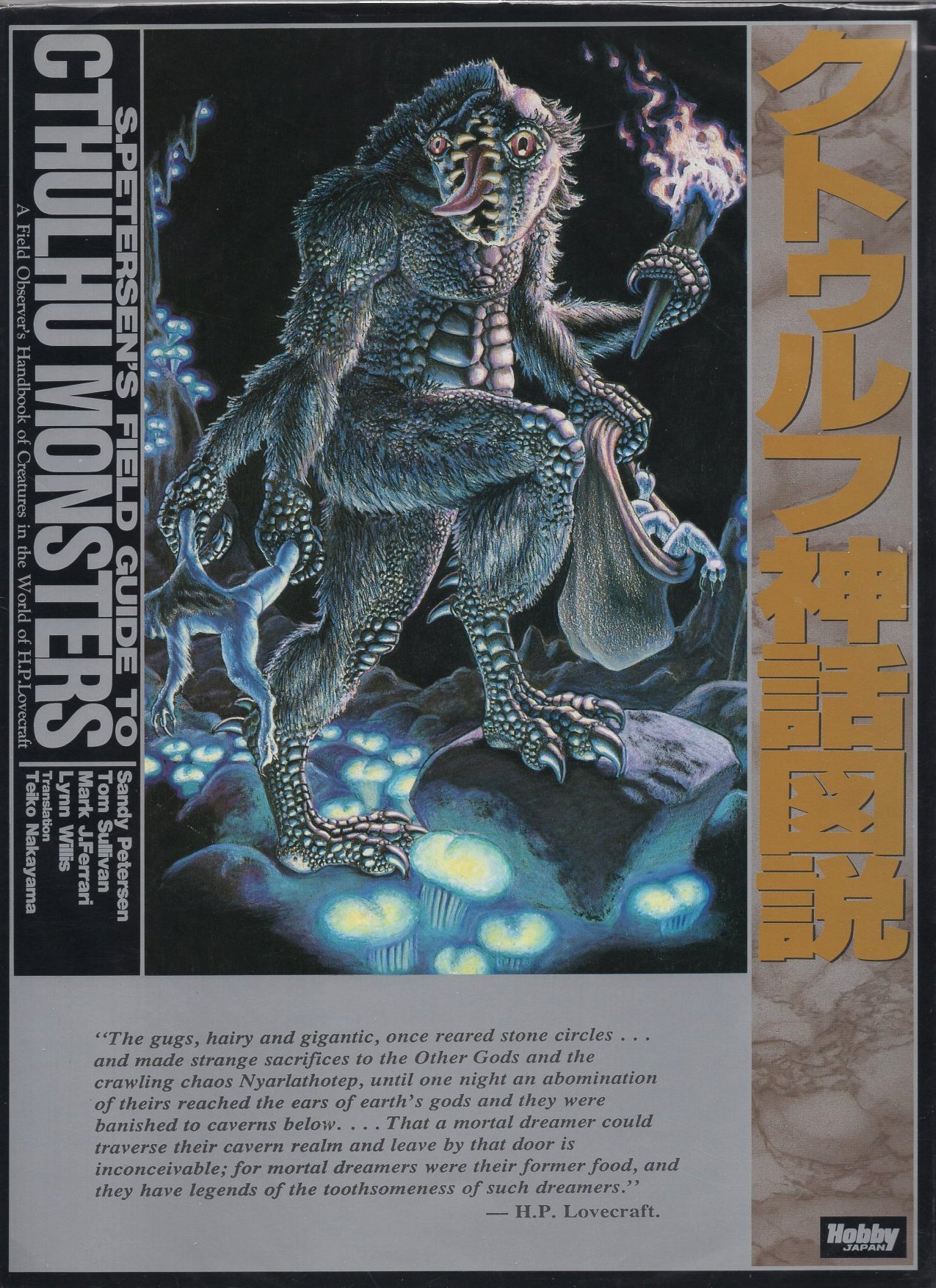
Chaosium, Inc. itself would take a different approach to its monsters. Efforts to categorize the entities in the Mythos dated back to the 1930s efforts of R. H. Barlow and the 1940s efforts of August Derleth and F. T. Laney, whose critical essay “The Cthulhu Mythos: A Glossary” was published in Beyond the Wall of Sleep (1943, Arkham House). So while the new Call of Cthulhu Roleplaying Game (1981, Chaosium, Inc.) did contain a very Dungeons & Dragons-style bestiary section in the main roleplaying book, it also produced a pair of very novel products that were different than anything TSR, Inc. had done to that point: S. Petersen’s Field Guide to Cthulhu Monsters: A Field Observer’s Handbook of Preternatural Entities (1988) and S. Petersen’s Field Guide to Creatures of the Dreamlands (1989).

These were lavishly illustrated books which hewed closer to Barlowe’s Guide to Extraterrestrials (1987) in design and format than the “standard” roleplaying game bestiary, providing lavish full illustrations for each monster in forms that would go on to be iconic, and solely dedicated to the identification, habits, culture, etc. of the various entities within, instead of game stats. All the stats for these creatures were in the Call of Cthulhu Roleplaying Game book itself, and the books have become so iconic that the latest (7th) edition of the game has produced a brand new version, S. Petersen’s Field Guide to Lovecraftian Horrors (2016).
81QwaubiTNL

The Call of Cthulhu Roleplaying Game was not just released in English, however. It was translated into several languages, including Japanese—and the game proved to be a major hit in Japan. More products were translated, including the ’88 and ’89 S. Petersen’s Field Guides (a combined edition was published by Hobby Japan in 1994), and the company and fans in Japan began to produce original material for the game, both official and unofficial—dōjinshi.

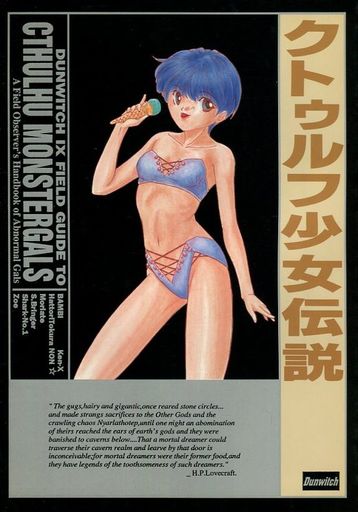
One of these dōjinshi products was the Dunwitch IX Field Guide to Cthulhu Monstergals. This was essentially a fan-created spoof of the S. Petersen guides, right down to the format, except that the familiar Cthulhu Mythos entities were replaced by monster girl versions of themselves.
1263599

Monster girls are a Japanese cultural phenomenon where a normally frightening monster is replaced with a moe (萌え) version of itself; moe being a term that designates a feeling of strong affection and cuteness, and is often combined with non-anthromorphic entities or concepts to create a (typically) young and attractive female character to personify the normally unrelateable. The juxtaposition might be near-sacrilegious to folks that like to keep the Mythos scary, but should be understood as a product of Japanese fan interpretation, all in good fun. Monster girls have been the focus of “monster girlfriend” manga and anime, including “The Elder Sister-like One, Vol. 1” (2016) by Pochi Iida (飯田ぽち。)…and the Monster Girl Encyclopedia which was published in 2015.

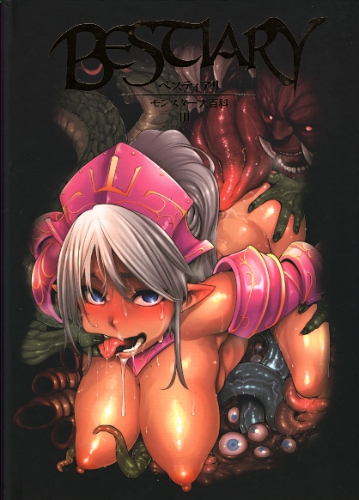
Sometimes, artists go beyond the bounds of “cute” and clean, relatively innocent and positive sexual attraction implied by moe and venture into actual hardcore erotic artwork and writing. This twist often makes the cute girls the victims of the now much more traditionally monstrous monsters. An example of this is Shindo L (新堂 エル)’s Bestiary series which so far as three volumes (2011-2015); the third volume includes a section on the Deep Ones, who in Shindo L’s setting are quite literally rapacious towards human women.
2113850

Which brings us back to Kenkou Cross and the Monster Girl Encyclopedia. This book is not a roleplaying game product, although it is derived from and uses some of the same tropes. There is no game system specified, no statistics or mechanics for the monsters like in Dungeons & Dragons. Instead, it is purely a pseudo-literary production, an “in-character” scholarly manuscript from the setting that the monster girls are from, much like the S. Petersen’s guidebooks. Aside from the artwork, which is generally PG-13 (bare female breasts, but no genitalia), the text itself shows a lot of thought and effort that has gone into the monsters, how the change to be part-succubi has effected them, feeding and mating habits (basically the same thing in this case), etc.

The Lovecraftian references are few, and include the iconic D&D monster the Mindflayer, the Wendigo (loosely connected to August Derleth’s interpretation of Ithaqua), the spider-creature Atlach-Nacha (created by Clark Ashton Smith, already the focus of a Japanese game and associated media) and most especially the Shoggoth.

Shoggoth

The interesting thing about the Shoggoth entry is that Kenkou Cross has reinterpreted their position as “servitors” to the Elder Things in At the Mountains of Madness to coincide with the Japanese pop-culture archetype of the maid—in particular, the conception of the “French Maid” outfit popularized in Victorian and Edwardian fiction (and associated pornography) and the act of being subservient in a sense that approaches (and sometimes sublimates into) domination-subjugation fantasies. “Maid-play” need not be violent, as the position can hold a great potential for sexual subtext and power fantasies without crossing the line into rape, but the formal nature of the attire and the potential power imbalance makes maids, butlers, etc. popular characters in Japanese anime and manga.

Shoggoths are slime monsters with amorphous bodies. They were created long ago to serve monsters of the untold nether reaches, but upon acquiring intelligence and emotion with the rise of the current Overlord, they are thought to have fled their once-masters.
—foreword to Monster Girl Encyclopedia Vol. II, 167 

Which makes the Monster Girl Encyclopedia incarnation of the Shoggoth both somewhat kinky, and probably the most sex-positive possible spin on the original source material, is that the (now female) Shoggoth feels the need to fulfill this position, but is not actually enslaved and still holds a great deal of power in the relationship, which is basically entered into of their own will (although the Overlord’s influence certainly gives them a push). Needless to say, the various authors of Monster Girl Encyclopedia-derived dōjinshi take whatever tack fits the needs of their particular work, ranging from the benign monster girlfriend romantic comedy to explicit erotica (within the limits of Japanese censorship laws, for works produced in Japan).

Kenkou Cross doesn’t delve deep into the Mythos in this volume; the Lovecraftian entities are hinted at being separate from many of the other monsters under the Overlord’s direct control, but Cthulhu and Shub-Niggurath are not named explicitly. In much the same way, Dungeons & Dragons has largely eschewed using the Lovecraft Mythos directly since Deities & Demigods (1981), although they have Lovecraftian critters in the form of mindflayers, aboleths, and other “aberrations.” Much of the Monster Girl Encyclopedia world remains a very vague fantasy kitchen sink; quasi-medieval in the Dungeons & Dragons manner with adventurers, quests, etc. It is testament to the wide and pervasive influence of Western (particularly British and American) on Japanese contemporary pop culture.

It might be difficult for some Mythos fans to think of shoggoths as basically sex-obsessed slime-girl maids, but that’s where the route of transmission, derivation, and development sort of become important. Because Kenkou Cross’ interpretation of the Shoggoths, for their setting, is really no different or less than any other interpretation of the Lovecraftian entity, from Robert Bloch’s “Notebook Found In A Deserted House” (1951) to “Shoggoths in Bloom” (2008) by Elizabeth Bear. And the MGE version of shoggoths is not restricted to Japan, but has filtered back into English through translation and derivation. 

Monster Girl Encyclopedia II (魔物娘図鑑 II) by Kenkou Cross (健康クロス) was first published in 2016; it was translated and published in English by Seven Seas in 2016.


Bobby Derie is the author of Weird Talers: Essays on Robert E. Howard & Others (2019) and Sex and the Cthulhu Mythos (2014).
“The Flower of Innsmouth” (2011) by Monique Poirier

Eldritch Fappenings

This review deals with a work of erotic content, and the history of erotic art and writing. As part of this review, selected passages with descriptions of genitalia and/or sexually explicit contact will be included.
As such, please be advised before reading further.


In ’forty-six Cap’n Obed took a second wife that nobody in the taown never see—some says he didn’t want to, but was made to by them as he’d called in—had three children by her—two as disappeared young, but one gal as looked like anybody else an’ was eddicated in Europe. Obed finally got her married off by a trick to an Arkham feller as didn’t suspect nothin’.
—H. P. Lovecraft, The Shadow over Innsmouth

The undeniable fact of “The Shadow over Innsmouth” is that a great deal of sex has occurred. That is true in pretty much every town; human beings do not spontaneously pop into existence, but are the end result of a typically long and somewhat agreeably messy process of conception, gestation, birth. Within the specific parameters of Lovecraft’s plot, Innsmouth itself has hosted a lot of sexual liaisons with the Deep Ones, and this has fired imaginations in many strange ways because unlike with stories such as “The Call of Cthulhu,” sex is essentially the driving engine of the plot. The central horror of the story isn’t just the revelation that Deep Ones exist, but that they are breeding with humans.

Most of the sequels, prequels, and miscellaneous episodes inspired by Lovecraft’s story deal with the subject in one form or another, examining the gender and sexual politics, the vast possible permutations of marriage, lineage, growing up with or without “the Innsmouth Look.” Most of them don’t get into erotic details. Tide of Desire (1983) by Sheena Clayton does, a little; “Pages Found Among the Effects of Miss Edith M. Teller” (2005) by Caitlín R. Kiernan broaches some new territory; “Mail Order Bride” (1999) by Ann K. Schwader and “A Coven in Essex County” (2016) by J. M. Yales hints at nuptial horrors…

…but does Innsmouth sex have to be horrific?

Fans of horror are no stranger to teratophilia, the love of monsters. While it would be an exaggeration to say that Cthulhu Mythos erotica has been with us nearly as long as we have conceived of Cthulhu, the sexualization of “monstrous” entities has been and is and will be an ongoing aspect of reader interaction. It was not long after Carmilla or Dracula’s wives appeared on the page that “sexy vampires” became a thing, and artists and writers have, in their own way and in their own time, broached the subject of a sexy Deep One or Deep One hybrid.

The psychology of why is varied and individual. The Innsmouth Porno VHS (2014) focuses on a fascination with the different, the monstrous, the alien, the deformed. There’s a certain jaded sensibility expressed where “normal” is no longer arousing. “Under the Keeper of the Key” by Jaap Boekestein in Lovecraft After Dark (2015) uses the Innsmouth transformation as the ultimate physical expression of the mental and spiritual changes experienced during BDSM.

Monique Poirier is more sex-positive. What if a young couple just really hit it off and try something a bit different and end up liking it?

I’d never so much as seen Octavia’s unclothed ankle, never laid a hand upon her thigh for more than the barest moment before she demurely removed it. She had always been most perfectly modest and coy. In the echoing distance, thunder rolled, and another volley of sleet pelted the windows with a smooth hiss. Lightning flashed, and I saw it reflect in her eyes with a ravenous light.
—Monique Poirier, “The Flower of Innsmouth” in Whispers in Darkness

It’s fun. There’s no blood and gore, no hand-wringing or guilt, no rape or regret. All those things have their place, and there are absolutely flavors of Innsmouth fiction that will give them to you. Yet it has to be remembered that the Victorians, for all their straitlaced propriety, produced and consumed a vast amount of pornography as well. Just because sex is taboo doesn’t mean people didn’t do it.

Frankly, it makes you wonder why someone else didn’t do try to write a story like this before.

Plotwise, “The Flower of Innsmouth” is technically a prequel to “The Shadow over Innsmouth,” showing how the youngest daughter of Captain Marsh’s got “married off by a trick.” The setup was right there in Lovecraft’s own story. If one wants to get technical, there’s room to nitpick: Poirier uses “Obadiah” instead of “Obed,” “Octavia” instead of “Eliza,” the marriage should have been in 1867 instead of 1870—but there’s room to gloss that kind of detail. However, most readers will probably be more interested in the kind of bedroom scene that Lovecraft did not and would not write:

Something hot and slick probed between my buttocks in insistent exploration. I think I made a noise of protest then, and certainly tensed at the intrusion, but Octavia chose that moment to tighten her nether muscles in a paroxysm around my manhood, as if she meant to draw it up into her body entirely and the whole of me with it. (ibid.)

There is a bit of a delight in the language involved. It is probably closer to Edwardian than Victorian; reminiscent of The Way of a Man with a Maid (1908), but in the confluence between historical erotica and historical Mythos fiction, Poirier manages to get the message across without losing contemporary audiences entirely. She hits a lot of tropes—”I’m not like other girls”—but tropes aren’t a sin if used well. Nor does the story overstay its welcome; there is a plot, there is a scene, and the finale is a single sentence—but that’s really all you need for a story like this. As a brief episode of Innsmouth history, this works. As a brief erotic episode, this also works.

“The Flower of Innsmouth” by Monique Poirier was first published in Whispers in Darkness: Lovecraftian Erotica (2011, Circlet Press); it has since been reprinted in her own collection This World Between: Erotic Stories (2018).


Bobby Derie is the author of Weird Talers: Essays on Robert E. Howard & Others (2019) and Sex and the Cthulhu Mythos (2014).
“Shoggoths in Bloom” (2008) by Elizabeth Bear

The sea-swept rocks of the remote Maine coast are habitat to a panoply of colorful creatures. It’s an opportunity, a little-studied maritime ecosystem. This is in part due to the difficulty of access and in part due to the perils inherent in close contact with its rarest and most spectacular object: Oracupoda horibilis, the common surf shoggoth.
—Elizabeth Bear, “Shoggoths in Bloom” in The Book of Cthulhu 150-151

Shoggoths appear or are mentioned only three times in the work of H. P. Lovecraft: they appear on the page in At the Mountains of Madness (written 1931, published 1936), and they are mentioned in passing but do not appear in “The Shadow over Innsmouth” (written 1931, published 1936) and “The Thing on the Doorstep” (written 1933, published 1937). It is in the latter story that we learn there are shoggoths in Maine.

In “The Mound”, Lovecraft had shown how an “advanced” yet alien race had used biological science to enslave and shape living creatures to their use. Intelligent beings became beasts of burden and livestock. The shoggoths extended this conception: where part of the horror in “The Mound” (as with the earlier story “The Rats in the Walls”) was that the creatures of K’n-yan were part-human, the shoggoths were entirely inhuman in their conception. Biological robots in all but name, engineered lifeforms created to serve…and for anyone raised in the United States of America, as Lovecraft and most of his readers would have been, there are connotations there. Because for centuries the slave system of the United States had been based entirely on race.

Lovecraft knew this. He commented on historical slavery in his letters with friends. Like many white people in the early 20th century, he was misled by the Lost Cause propaganda of the United Daughters of the Confederacy and the Dunning School—and by his own prejudices—about the horrors of slavery. His view of the plantation system in the antebellum South (and his own native Rhode Island and Providence Plantations, which was an historical nexus for the slave trade) was rose-colored. The best example of Lovecraft’s line of thought on this matter, when he and his friend and fellow pulpster Robert E. Howard had fallen into a discussion of what we would call wage-slavery today:

As for peonage or actual slavery—that is hardly a practical possibility except with inferior or badly-cowed race-stocks. The whole psychological equilibrium which made it possible in mediaeval and ancient times has been permanently destroyed. But it really wouldn’t be so bad to enslave niggers, Mexicans, and certain types of biologically backward foreign peasants. I’m no abolitionist—in fact, I’d probably have been almost ostracised in New England in the hectic days of Charles Sumner, Wendell Phillips, and Bostonese pharasaism in general. Of course, slavery ought to be regulated by stringent laws as to the treatment of slaves—laws backed up by frequent governmental inspections, and sustained by a carefully directed public sentiment as to humane conditions. In the 18th century, when we had negro slaves in Rhode Island, there was never any discontent or talk of ill-treatment. On the large estates of King’s County (estates duplicating the plantations of the South, and quite unique for the North) the blacks were in general simply contented—having their own festivities, and indulging in a kind of annual Saturnalia in which large numbers met and elected one of their number “King of Africa” for the ensuing year. One of my ancestors—Robert Hazard—left 133 slaves in his will. What caused slavery to decline in the north was the complex economic readjustment which rendered large-scale agriculture and stock-raising no longer as profitable as maritime commerce. When it no longer paid to keep niggers, our pious forbears began to have moral and religious scruples about the matter—so that around 1800 Rhode Island passed a law limiting slavery to black over 21, and declaring all others, and all subsequently born, free. Later this was amended to free the adult negroes—though most stayed right on with their masters as nominally paid servants. In the next generation, when slavery was defunct in the north but seen to be still a source of profit in the south, it occurred to northern politicians to become very Quixotic and devoted to the ideal of freedom—hence the impassioned frock-coated moralists of the abolitionist school, calling upon heaven to end the unrighteous curse of human bondage. But on the whole I don’t think slavery would form a practical policy for the future. Psychological conditions have changed. I don’t think inferior races, or persons of very inferior education or capacity in any race, ought to have the political franchise; but I think it is the best public policy to give them as much freedom as is consistent with the maintenance of the civilisation on an unimpaired level.
—H. P. Lovecraft to Robert E. Howard, 7 Nov 1932, A Means to Freedom 466-467

Howard, for his part, concurred and cited his own family’s history of slaveowningalthough as Rob Roehm pointed out on Howard History, Robert E. Howard appeared ignorant of the details of his own ancestors’ violence toward their slaves.

The shoggoths had rebelled.

Rebellion was the one great fear of all slave-owners; that the violence inflicted on slaves for years and generations would be returned. Lovecraft, writing in 1931, might have been inspired by the Haitian Revolution (1791-1804) mentioned in books he read that year such as William Seabrook’s The Magic Island (1929). The racial violence of that conflict was very clear to Lovecraft, and in discussing one of August Derleth’s voodoo stories of the period Lovecraft notes:

[…] you have the woman describe herself & family as Haitian, which conclusively implies nigger blood. There are no pure white Haitians. White persons living in Haiti are not citizens, & always refer to themselves in terms of their original nationalities—French, American, Spanish, or whatever they may be. The old French Creoles were wholly extirpated—murdered or exiled—at the beginning of the 19th century.
—H. P. Lovecraft to August Derleth, 9 Sep 1931, Essential Solitude 1.376

Shoggoths are not explicitly a metaphor for the Haitians throwing off the yoke of slavery, or of any African-American rebellion. Slavery in the pulps was not uncommon when it came to both historical and fantasy subjects, and the treatment was seldom sympathetic unless person enslaved was white, as is the case in “The Vale of Lost Women”(1967) by Robert E. Howard—and that involves a very different set of racial stereotypes, though white supremacy is still implicit.

It is notable that in At the Mountains of Madness, none of the characters are explicitly African-American. There is no one in that story who might sympathize with the shoggoths through the lens of their personal history. No one like Paul Harding, the protagonist of Elizabeth Bear’s “Shoggoths in Bloom.”

Harding’s an educated man, well-read, and he’s the grandson of Nathan Harding, the buffalo soldier. An African-born ex-slave who fought on both sides of the Civil War, when Grampa Harding was sent to serve in his master’s place, he deserted, and lied, and stayed on with the Union Army after.
—Elizabeth Bear, “Shoggoths in Bloom” in The Book of Cthulhu 150

It is interesting to compare and contrast Harding with Theotis Nedeau in “Jeroboam Henley’s Debt” (1982) by Charles R. Saunders. Both characters are Lovecraftian protagonists as they might have been. College-educated African-American men, with deep roots in American history. However, both Bear and Saunders take their characters further, exploring the black experience in the United States at the time. Throughout the story we get more hints of Harding’s background, his mother in Harlem, his experience with segregation and Jim Crow in the South, and even fighting prejudices from nominally sympathetic white Yankees like Burt Clay in Maine.

His Ph.D. work at Yale, the first school in America to have awarded a doctorate to a Negro, taught him two things other than natural history. One was that Booker T. Washington was right, and white men were afraid of a smart colored. The other was that W. E. B. Du Bois was right, and sometimes people were scared of what was needful.
—Elizabeth Bear, “Shoggoths in Bloom” in The Book of Cthulhu 155-156

There is no doubt that the Cthulhu Mythos needs more characters like Paul Harding, and more stories like “Shoggoths in Bloom.” Not because fans of the Mythos need to be beaten over the head with the historical horrors of racial violence and discrimination in the United States or any principle of forced inclusion as a form of political correctness, but because Harding brings a new and important perspective to shoggoths, both as a natural scientist and an African-American who remembered the scars of shackles around his grandfather’s back, and the dark lines of scar tissue on his back.

That is the advantage of inclusiveness: bringing in new points of view.

Bear makes this especially topical in that the story is implicitly set during the opening days of World War II—before there is a war, before the United States is in it. The Holocaust has begun, though the world may not yet know it. What can one man do, when faced with such a threat? Especially when the people around him seem devoted to doing nothing. To standing by while Jews are legislated against, forced out of public life and into concentration camps. This is a different tact than undertaken by “The Doom That Came to Innsmouth” (1999) by Brian McNaughton & “The Litany of Earth” (2014) by Ruthanna Emrys. In those stories, the comparison between the concentration camps at Innsmouth and the Nazi efforts fall apart a bit because the Innsmouth folk are confirmed as at least partially inhuman; but in “Shoggoths in Bloom,” it is their common humanity that makes Paul Harding sympathize with the Jewish people in Germany. A victim of racial violence and discrimination all his life, he feels for them as a fellow-sufferer.

In 2009, Elizabeth Bear wrote an article titled “Why We Still Write Lovecraftian Pastiche”, where she writes:

As for what it is about his worlds that brings me as an artist back to them time and again? It’s the holes, quite frankly. The things I want to argue with.

I want to argue with his deterministic view of genetics and morality, his apparent horror of interracial marriage and the resulting influence on the gene pool, as exemplified in The Shadow over Innsmouth. That leads me to write a story like “The Follow-Me Light,” in which a descendent of the Marsh and Gilman families meets a nice human girl and wants to settle down. I want to argue with his reflexive racism, which leads me to write a story like “Shoggoths in Bloom,” in which an African-American college professor confronts the immorality of slavery on the eve of one of our greatest modern atrocities.

Lovecraft is dead, so such an argument might strike readers as one-sided—but it isn’t, not really. Because people are still writing Mythos fiction and pastiche, still elaborating, reinterpreting, re-engaging with Lovecraft’s world and concepts. The context and syntax of the conversation changes, but it hasn’t stopped. People still find new things they want to talk about, and new ways to talk about it. That is in large part what keeps the Mythos alive as a mode of weird fiction.

“Shoggoths in Bloom” by Elizabeth Bear won the 2009 Hugo award for best novelette; it was also nominated for a Locus award the same year. It was first published in Asimov’s Science Fiction (Mar 2008), and has been reprinted many times, including in The Book of Cthulhu (2011) and New Cthulhu: The Recent Weird (2011), and it lent its title to Bear’s collection Shoggoths in Bloom (2012). Readers interested in a deeper analysis of the story may be interested in “How to Hack Lovecraft, Make Friends with His Monsters, and Hijack His Mythos: Reading Biology and Racism in Elizabeth Bear’s “Shoggoths in Bloom”” (2016) by Anthony Camara.


Bobby Derie is the author of Weird Talers: Essays on Robert E. Howard & Others (2019) and Sex and the Cthulhu Mythos (2014).
“Jeroboam Henley’s Debt” (1982) by Charles R. Saunders

And he remembered a night more than a dozen years ago in Virginia, when he and Nedeau had been stopped by a policeman wanting to know exactly how a couple of “Nigras” had come by such a fine motorcar as the one they were in without having stolen it. Nedeau had flattened the policeman with one blow and they’d fled the state with a posse of cracker cops on their tail all the way up to the gates of the black college they’d been attending.
—Charles R. Saunders, “Jeroboam Henley’s Debt” in The Book of Cthulhu 228

The success of Imaro (1981), which virtually inaugurated the Sword & Soul genre, made the fame of Charles R. Saunders. Not many African-American authors were writing Sword & Sorcery, much less with a focus on black protagonists and settings. This is unfortunate because like Robert E. Howard, who essentially defined Sword & Sorcery with his stories of Kull and Conan, Saunders also writes horror fiction. In an era of The Ballad of Black Tom and Lovecraft Country, those interested in more of the same need not wait for more to be written—Saunders was writing it long before Victor LaValle or Matt Ruff came on the scene.

Of course, it is not exactly the same. “Jeroboam Henley’s Debt” is more steeped in black history and the black experience over time. Just as Lovecraft found horror delving into the Colonial past in America, so Saunders found new sins to show the readers—for there are some betrayals worse than others, with the right historical context, and old hatreds which persist over generations. Saunders’ own style is neither contemporary nor pastiche; his character Theotis Nedeau is reminiscent of Manly Wade Wellman’s burly occult detective John Thunstone: erudite, intelligent, compassionate, loyal, but also a powerful athlete, prone to action. It is probably the first time a professor of history at Howard University—an historically black college—played a role in a Mythos story; but he plays it very well.

“Voodoo!” he spat the word as if it were a curse. “It would take more time than I have to explain to you the difference between the half-baked Haitian superstition and the true magic of Africa.” (ibid, 234)

African magic and voodoo have been connected with the Mythos since the 1930s; “Mother of Serpents” (1936) by Robert Bloch and “Medusa’s Coil” (1939) by Zealia Bishop & H. P. Lovecraft testify to how white authors tried to draw connections with African traditions, capitalizing on stereotypes and prejudice for effect. One might easily add Hugh B. Cave’s “The Cult of the White Ape” (Weird Tales Feb 1933), or Robert E. Howard’s “The Hyena” (Weird Tales Mar 1928) and “Pigeons From Hell” (Weird Tales May 1938). The latter makes an especially interesting comparison, as there are thematic parallels between Howard’s zuvembie and Saunders’ semando in this story, although the actual details are sharply different.

Saunders knows the tropes, and uses them as he sees fit in the story, but there is a difference in approach. In the fiction of Lovecraft, Howard, Bloch, the black characters tend to be innately superstitious and inclined to believe in the reality of magic, to fear supernatural reprisal. White characters, if they come to believe, have their fears heightened by racial prejudice—stereotypes of Africa as ancient, unholy, even inhuman. In this story, where the two main characters are college-educated black men, the whole context of the subject is different.

“God!” Henley exclaimed. “This is so senseless—unreal! Savage ceremonies here, in 1933…” (ibid. 235)

Just because he’s black, doesn’t mean Henley knows anything about or even believes in magic. Theotis Nedeau has to convince his friend of the reality of what they face, and the way Saunders touches on the subtle prejudices involved with African-Americans towards indigenous African beliefs is…a world of human experience that the Mythos has never really touched on before.

The ending may surprise people. It is not what is expected, though it is fitting and appropriate, from a certain point of view. It is in part about a question that plagues us still—though the American system of slavery is over, there are many who are born of slavers and slaver-owners; what responsibility do they have? Descendants are not culpable for the crimes of their ancestors, yet the descendants of former slaves still suffer economic and social consequences of their ancestors enslavement. Innocent people can still suffer…and, in the setting of “Jeroboam Henley’s Debt,” the suffering is not yet ended when the reader arrives at the final word of the final sentence.

“Jeroboam Henley’s Debt” was first published in Potboiler #4 (1982). It was republished by Innsmouth Free Press in July 2010, and may be read for free online here. It was subsequently reprinted in The Book of Cthulhu (2011).


Bobby Derie is the author of Weird Talers: Essays on Robert E. Howard & Others (2019) and Sex and the Cthulhu Mythos (2014).
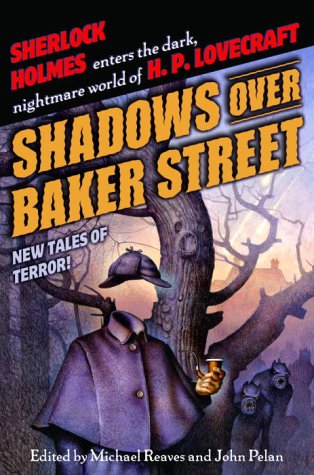
“The Curious Case of Miss Violet Stone” (2003) by Poppy Z. Brite and David Ferguson

“The Necronomicon!” Holmes murmured. “What could a young English lady want with that moldy bit of occult trash?”
—Poppy Z. Brite & David Ferguson, “The Curious Case of Violet Stone”
in Shadows over Baker Street 143

Sherlock Holmes, the consulting detective, has one of the earliest and most enduring fandoms in all of genre fiction. It is perhaps the nature of such an extensive and long-lasting phenomenon for it to mingle with Lovecraft and his Mythos at various junctures.

The practice began, in a sense, with August Derleth: alongside his Mythos fiction, Derleth also wrote an extensive pastiche of Sherlock Holmes under the guise of the detective Solar Pons. “The Adventure of the Six Silver Spiders” (1951) contains a reference to the Mythos—although in this case, it is a bit of a red herring. The idea was made more concrete in The Necronomicon of Solar Pons (2020). From that humble beginning, the idea grew: Peter Cannon’s Pulptime (1984) let Lovecraft and Holmes meet; Lovecraft met with his creator Sir Arthur Conan Doyle in Gordon Rennie & Frazer Irving’s Necronauts (2001), Thomas Wheeler’s The Arcanum (2005), and Jon Vinson and Marco Roblin’s Edge of the Unknown (2010). Holmes himself has tackled in the Mythos in the anthology Shadows over Baker Street (2003), Sylvain Cordurié and Laci’s Sherlock Holmes & le Necronomicon (2011, published in English as Sherlock Holmes and the Necronomicon), and in 2017 James Lovegrove began the Cthulhu Casebooks series and Lois H. Gresh the Sherlock Holmes vs. Cthulhu series…and the list goes on.

Two households, both alike in dignity.

The nature and quality of the literary mash-up—and, sometimes, double-pastiche—can be desperately silly or deadly serious depending on the attitude and capabilities of the author. In the case of Brite & Ferguson’s “The Curious Case of Miss Violet Stone,” the double-pastiche is played straight and serious. Sherlock Holmes is on the case, displaying examples of his deductive logic, in all of his old habits (including cocaine)—only now he’s come across something uniquely outside his particular experience.

There is a central difficulty with a Mythos/Holmes mash-up in that the central mystery is almost always the Mythos itself, which rather gives the game away before it begins. Ideally, if you wanted to surprise the reader, you wouldn’t have entire anthologies of Lovecraftian/Holmesian genreblenders in the first place—but fans might mutiny if they sit down expecting straightforward detective fair and suddenly run across a Yithian. So with the caveat in mind that savvy Mythos readers will no doubt figure out what is going on before long, there isn’t much in the way of tension in the story—”The Curious Case of Miss Violet Stone” is not a daring adventure that tests Holmes’ intellect to the limit or results in criminals to be captured. No crimes are committed, no one dies.

What readers are given instead is a very well-considered what if. Should Sherlock Holmes have genuinely encountered a Lovecraftian entity…an alien entity…if he was presented with proof of the existence of such things…how would he react? That is the crux of this story, and while it is fairly sedate by the standards of both Lovecraft and Doyle, it is handled with real skill and appreciation for both of the literary forebears whose work comes together in this strange alchemy.

“The Curious Case of Miss Violet Stone” by Poppy Z. Brite and David Ferguson was published in Shadows over Baker Street (2003). It has not been reprinted.


Bobby Derie is the author of Weird Talers: Essays on Robert E. Howard & Others (2019) and Sex and the Cthulhu Mythos (2014).
“An Imp of Aether” (1997) by W. H. Pugmire

To ye memory of August William Derleth
—original dedication

“Lovecraft Country” was the name given to that fictional setting in New England where so many of his stories were set, or at least referred to. The Miskatonic River that flowed through Arkham and gave is name to the university there down to Innsmouth, Dunwich and Kingsport—all based on real places that Lovecraft visited in Massachusetts, but occupying an unreal estate in the mind; Lovecraft country is a character itself in stories like “The Dunwich Horror.”

Some subsequent writers in the Mythos have carved out their own geographies; Ramsey Campbell, on the suggestion of August Derleth, set his early Lovecraftian tales in a fictional Severn Valley with towns like Brichester and Goatwood, which continues to be developed today. W. H. Pugmire set his Sesqua Valley in the Pacific Northwest, and populated the place shadowed by the mountains with his own strange creations, including the poet William Davis Manly and the sorcerer Simon Gregory Williams.

In this story, set in the shadows of Sesqua Valley, Pugmire pays homage to August Derleth.

We thought at first that it was some kind of poem, but upon further study discovered that it was a prayer to something called Cthugha. Known as ‘the Burning One.’
—W. H. Pugmire, Tales of Sesqua Valley 39

We thought at first that it was some kind of poem or unholy psalm, but upon further study discovered that it is a prayer to something called Cthugha. Supposedly a fire element. You know the idiotic notion that Great Old Ones represent terrestrial elements, as if these cosmic creatures could be molded by corporeal law or understanding. Utterly absurd; but in this case, there seems some sustainment.
—W. H. Pugmire, Sesqua Valley & Other Haunts 94-95

We thought at first that it was some kind of poem or unholy psalm; but with further study we discovered it to be a prayer to something called Cthugha, supposedly a fire elemental. You know the idiotic notion that the Great Old Ones represent terrestrial elements, as if these cosmic creatures could be molded by corporeal law. Bah! However, in this case, there seems to be some sustainment.
—W. H. Pugmire, An Imp of Aether 129

As a writer, Pugmire was a tinkerer; many of his stories show the result of revision between printings, so that while the title, plot, and overall characters are the same, the text in each publication is different—sometimes slightly, sometimes markedly. The revised texts tend to be cleaner, in general; the result of looking back at a work from a decade ago and tidying it up after one’s younger self.

In the February 1933 issue of Weird Tales, Donald Wandrei published “The Fire Vampires”; a tale of the 24th century involving the fiery alien entity Fthaggua; and the idea of elementals in the Mythos dates back to Derleth’s “The Thing That Walked On The Wind” (Strange Tales of Mystery and Terror, Jan 1933). Wandrei’s tale was not explicitly of the Cthulhu Mythos, although later writers adopted it, or elements from it, into the Mythos; Derleth’s was deliberate pastiche. After Lovecraft’s death, August Derleth and Donald Wandrei came together to form Arkham House to publish Lovecraft’s fiction and letters—and Derleth himself continued to publish Mythos pastiches.

The “elemental theory” as a paradigm for the Cthulhu Mythos (as Derleth called Lovecraft’s artificial mythology) as a whole came after Lovecraft’s death, detailed by fan Francis T. Laney in “The Cthulhu Mythology” in The Acolyte #2 (1942), where he noted:

The fire gods were not covered by Lovecraft, so it is up to other writers to fill in this section of the Mythos. (8)

August Derleth was paying attention. He wrote to Laney, asking him to expand the article for a further book of Lovecraft’s fiction—which became “The Cthulhu Mythos: A Glossary” in Beyond The Wall of Sleep (1943, Arkham House). This expanded article includes mention of a fire elemental, Cthugha, created by Derleth:

I’m certainly agog to read “The Dweller in Darkness.” Cthugha will certainly fill a gaping hole; I well remember how disgusted I was when I found the “fire department” had been completely neglected. I’m not trying to appear conceited, but by any chance did my mention of this in my article start you off on this tack, or was it just a coincidence?
—Francis T. Laney to August Derleth, 29 Mar 1943

Whether it was Laney that inspired Derleth, or two fans arriving at the same conclusion, Derleth determined to “fill the gap” and embraced the elemental theory wholeheartedly, making it his own (and borrowing elements of Wandrei’s Fthaggua in the process). As it happened, publication of fiction didn’t always go in order—the story that effectively introduced Cthugha was “The Dweller in Darkness” (Weird Tales Nov 1944), but the first story that saw mention of Cthugha in print was “The Trail of Cthulhu” (Weird Tales Mar 1944), later titled “The House on Curwen Street.”

Derleth’s conception of the Mythos did not long survive him; Richard L. Tierney famously exploded the idea in “The Derleth Mythos” (1972), beginning a period when fans and scholars seriously re-assessed what Lovecraft did and did not write, and interest increased in textually accurate versions of Lovecraft’s fiction—but selective elements of Derleth’s Mythos fiction, such as Cthugha, were adopted by others.

Hence, Pugmire’s dedication.

This is a story with a nod-and-a-wink toward Mythos fans who can pat themselves on the back that they know about Derleth and the elemental theory and can scoff at such notions along with the sorcerer Simon Gregory Williams. And yet…that is just the beginning of the story, the set-up. That is Pugmire laying the groundwork.

Because there is potential in Cthugha, and some of Derleth’s other ideas—and as much as Derleth’s memory was somewhat hounded in latter years because of his flaws as a writer, a businessman, sometimes even as a human being, he was still a good writer, and he promoted and published Lovecraft unceasingly during his life, and there are ideas which he introduced to the Mythos that are worth exploring and expanding on. So Pugmire did.

No, no. It was the fire vampire. You looked too long and deeply into its burning eyes. Your cool silver eyes took in too much of its property, and thus you burn with strange agitation. One born of the valley’s shadow cannot withstand such cosmic brilliance.
—W. H. Pugmire, Sesqua Valley & Other Haunts 97

No, lad. It was the fire vampire, an essence of the Old One that burns in Fomalhaut. You looked too long, too deeply, into its ember eyes. Your cool silver orbs are slightly scarred, so potent was your engagement with the valet of Cthugha.
—W. H. Pugmire, An Imp of Aether 132-133

Pugmire never shied away from making his creations sensual; but this is a rare story where he plays with gender as a concept. Wilus Shakston (original) or Jacob Wirth (revised) has encountered the old witch of Cthugha…plaited a lock of her hair with his own…and so began a transformation. Whether the transition can be said to be transgender or genderqueer is largely up to the reader to interpret; the nature of the transition is slower and less total than in “The Thing on the Doorstep.” But in a setting where the children of Sesqua Valley seem to be predominantly male, the acquisition of feminine attributes is marked—and not-unwelcomed by Wilus/Jacob.

In an afterword to this story, Pugmire wrote:

In 1995, after my lover’s heroine overdose and death, I began to write a series of Sesqua Valley stories dedicated to deceased members of the Lovecraft Circle. I suppose I was trying to take my mind off personal tragedy by sinking into creativity. It worked quite well, and many of those tales became the core of my first American collection of fiction, Tales of Sesqua Valley, published by my good buddy and fellow author Jeffrey Thomas. With these stories I mentioned breifly the addition to the Mythos created by the gent to whom the story was dedicated. It was a fun wee game, although the results were not stories of importance. The original version of this story had its first appearance in the chapbook that Jeff published in 1997 under his Necropolitan Press imprint; it has been susbtantially rewritten for this edition.
—W. H. Pugmire, Sesqua Valley & Other Haunts 99

Whatever version of the story you read, it is worth reading. Proof that the Mythos can be reimagined and reworked by different hands, and that ideas that had their start in the nigh-forgotten pulp fiction of the 1930s can inspire strange and wondrous things.

“An Imp of Aether” was first published in Tales of Sesqua Valley (1997), it was revised and republished in Sesqua Valley & Other Haunts (2008) and The Tangled Muse (2011); and revised again for publication as the title piece in Pugmire’s posthumous collection An Imp of Aether (2019).


Bobby Derie is the author of Weird Talers: Essays on Robert E. Howard & Others (2019) and Sex and the Cthulhu Mythos (2014).
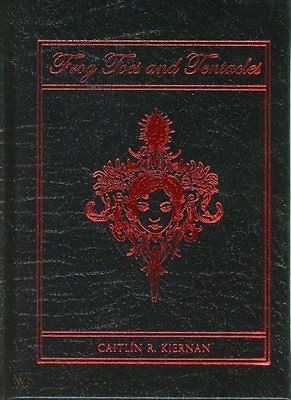
“Pages Found Among the Effects of Miss Edith M. Teller” (2005) by Caitlín R. Kiernan

And you stood up, then. You stood, taller than I recalled because you have grown longer, and the moon flashed across the glistening scales below your small breasts, your nipples as erect and sharp as barnacles, thorns grown from the sea, and I took a step back, despite myself.

Do not retreat.
Do not retreat from me.

Only my thoughts, not yours. I will not now be so conceited as to believe I could ever know your thoughts. Not after what she has done with you, or you have done with her. Mother Hydra has held you tight to her bosom in the lightless places at the bottom of the world, and she has accepted all your gifts, all those human parts you were forever trying to cast aside. The old flesh.
—Caitlín R. Kiernan, “Pages Found Among The Effects of Miss Edith M. Tiller” in Frog Toes and Tentacles (2005), 13

Monsters have a particular fascination in a transgender context. The act of transformation, however violent or painful, gives results. What you were is gone, and you have become something else—perhaps who you were meant to be. Body dysmorphic disorder is real, and the fantasy of such transformations that do not require months or years of hormone replacement therapy and surgery is real.

There is a sexual component to such transformation fantasies. Consider the ending to The Shape of Water, blood erupting in clouds from the vertical scars in her neck as the gills finally come in, as a visual metaphor for losing her virginity all over again. To become a woman…and more than that, to cast her old life behind. Such transformations are one-way, like puberty. You can’t go back again.

In the various sequels to “The Shadow over Innsmouth,” a great deal of focus is given to the transformation itself, its implications and effects. “The Gathering” (2017) by Brian Lumley and “All Our Salt-Bottled Hearts” (2016) by Sonya Taaffe both look at what happens when the change does not come, and how those who cannot go down beneath the waves to live in glory forever and ever deal with that. Caitlín R. Kiernan, by contrast, looks at a heretic. Someone who has refused the call.

And her lover.

Innsmouth-related erotica is not exactly rare; Tide of Desire (1983) by Sheena Clayton is an entire novel exploring it, and one could easily fill a fairly decent anthology of short stories including such pearls as “The Flower of Innsmouth” (2011) by Monique Poirier or “Madeline Marsh’s Midlife Crisis” (2015) by K. Z. Morano. Yet it is rare to find stories that focus on the characters involved, their complex motivations and emotions, as much as the sexual action itself. In stories like “The Innsmouth Porno VHS” (2014) by Adolf Lovecraft, the characters involved are consciously skeezy and the fetish is teratophilia; they don’t have any emotional investment in the transformation or the people transformed, much like folks fetishize transgender sex workers, seeing them not as individuals but as commodities.

Not so with Caitlín R. Kiernan.

She wants you to feel the reunion of these two lovers, one of whom took the plunge (literally), and the other who would not. Wants that taste of real horror as the act begins, and the clothes are shredded “making of them ribbons for a mermaid’s hair.” Edith’s lover Samaritana did not come back as she had known her…and there are surprises in store.

I stopped struggling (I had been; I can say that now, because I know I ama a heretic) and lay entirely still while those tendrils worked their way quickly between my legs, those strong tendrils or arms sprouting from the hairless mound where your sex had been, twisting back upon themselves, flexing, searching like blind, unfed serpents. What is it the old stories say? Cut off one, and two will sprout in its stead? (ibid., 21)

There is much unsaid in the story. The text has the quality of Edwardian prose, at once explicit and poetic. This is not sexploitation, no actors mugging for the camera and faking orgasms. Elaborations on the Mother Hydra mythos are hinted at but not elaborated upon, and the relationship, like many of the relationships in her fiction, does not have a happy ending. The subtitle for this story is:

Dead by her own hand, Janury 7th, 1905
Danvers State Insane Asylum, Mass.

Which is how it should be. Not every story, even an erotic story, has a happy ending. Transgender folks know that better than most. The struggle of whether or not to transition is real, and takes its toll both physically and psychologically. There is more to unpack in this story…and that probably says more to its quality than anything else.

“Pages Found Among the Effects of Miss Edith M. Teller” was first published in Frog Toes and Tentacles (2005).


Bobby Derie is the author of Weird Talers: Essays on Robert E. Howard & Others (2019) and Sex and the Cthulhu Mythos (2014).
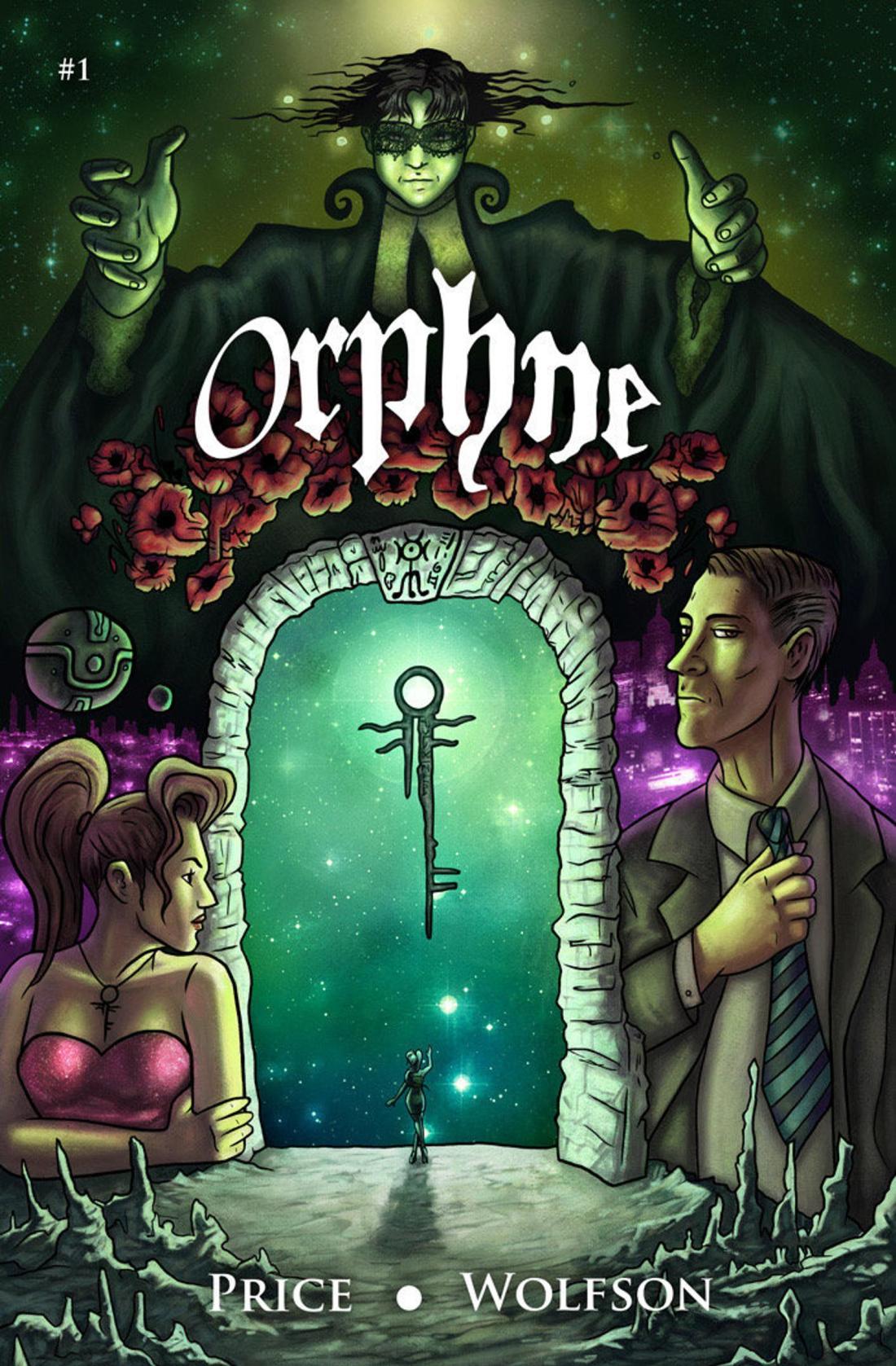
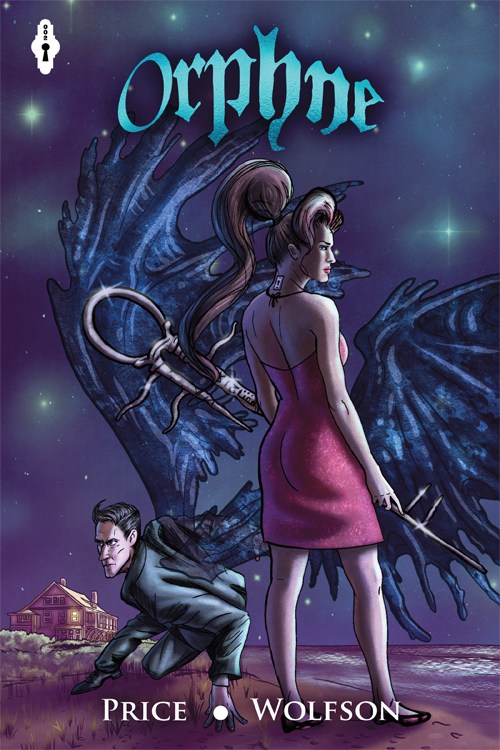
Orphne #1 & #2 (2018) by Mani C. Price

We live in a Golden Age of Mythos comics. More Mythos comics have been published in the last two decades than in the four that came before that. Lovecraftian references can, and do, appear in everything from webcomics to manga, from The Woman of Arkham Advertiser (A・Aの女): Article 01: In The Vault (2019) by Takata Yuki (高田 悠希) to “The Elder Sister-like One, Vol. 1” (2016) by Pochi Iida (飯田ぽち。) to Innsmouth (2019) by Megan James and Calla Cthulhu (2017). Independent presses have risen with the advent of affordable print-on-demand comic publishing services like IndyPlanet and digital comic marketplaces like Comixology have made it much easier for creators to get their work out there—and to highlight more diverse voices.

orphne002

When Randolph Carter was thirty he lost the key of the gate of dreams.
—H. P. Lovecraft, The Silver Key

“The gods travel into men’s dreams by way of a key hole and exit from whence they came once their divine mission is complete.”
—Artemidorus, quoted in Orphne #1

Mythos comics cover all the ground that prose Mythos fiction does, from pastiche and parody to genre-bending and genre-blending; it is rarely four-color superheroes punching out the minions of Great Cthulhu. There is room for comedy, erotica, dark fantasy, science fiction, and sometimes quite subtle and atmospheric horrors. What sets comics and graphic novels apart from their pure prose counterparts, or even illustrated stories, is the ability of art and words to come together a such a way as to create a unique reading experience—there are things that can be done in a graphic novel that would be difficult or impossible to pull off in a prose story.

Mani C. Price is a visionary artist and diviner; her penchant for Lovecraft and mythology is evident from her artwork. As the writer and artist for Orphne, Price brings her interests to bear with references to Classical Greek mythology, magic, and Lovecraftian references that are present but not pressed on the viewer. There is no mention in these stories to Lovecraft’s “The Silver Key,” yet the artistic theme of both issues emphasizes keys and key-holes; the figure of Mr. Angell is the image of H. P. Lovecraft—whom Muriel Eddy described as “The Man from Angell Street,” referring to his family’s house in Providence, Rhode Island.

Orphne prefers to show rather than tell; there are mysteries for the reader to unravel, characters are not introduced, and their identities must be divined by what they say and do. We know little about the main character Victoria, but that little we do know is intriguing…she is, more than Mr. Angell, the central character and mystery of the story so far. What key will unlock those answers?

But always I shall guard against the mocking and insatiate Hypnos, lord of sleep, against the night sky, and against the mad ambitions of knowledge and philosophy.
—H. P. Lovecraft, “Hypnos”

Lovecraft also had a penchant for Greek and Roman myth, and in the second issue this brings in the figure of Hypnos, Lord of Dreams. Some readers may draw parallels between this character and another popular comics character: Dream of the Endless, created by Neil Gaiman for his run on Sandman (1989-1986). The similarities are superficial, however; Gaiman and Price (and Lovecraft) are drawing in common from the well of Greco-Roman mythology in populating their Dreamlands. As the holder of the artifact that Victoria seeks, Hypnos is being set up as the primary antagonist in a story where most of the conflict so far is unseen—a combination of internal conflicts and unknown forces acting on Victoria, secrets unspoken, hints of supernatural influence.

Where the story goes from here is another question that goes unanswered. Issues #1 and #2 were published in 2018, but the series is not yet finished. Art takes time, and as Orphne is being produced by an individual rather than a big company, some delay is to be expected before we see issue #3. Yet it seems certain that it will be worth the wait.

Orphne #1 and #2 are written and illustrated by Mani C. Price, coloring and layout by Justin Wolfson, lettering by Jason Price, editing by Jason Price and the late Sam Gafford. Issues can be purchased directly from the website Mani The Uncanny.


Bobby Derie is the author of Weird Talers: Essays on Robert E. Howard & Others (2019) and Sex and the Cthulhu Mythos (2014).
“Paedomorphosis” (1998) by Caitlín R. Kiernan

“Oh,” Annie said and sat down on the rug, grateful for something between her and the concrete. “Where are you from, anyway?”

The loose flap of cloth falling back in place, once again concealing the crack, and “Massachusetts,” Elise replied, “but no place you’ve probably ever heard of.”
—Caitlín R. Kiernan, “Paedomorphosis” in Song of Cthulhu 93

Music, lesbians, a muggy Georgia summer, and white blind things in the dark. “Paedomorphosis” is a story of mood and affect, intimation almost to the point of deliberately hiding things. If it wasn’t published in a Mythos anthology…if it wasn’t published by Caitlín R. Kiernan…there are certain connections which might not be made at all. Like “She Flows” by Takeuchi Yoshikazu (竹内義和) the story lives in that liminal space between telling and showing and knowing. It’s not a horror story by any stretch, but there are the bones of horror story technique there: the way the story and characters are built up, like fossils emerging from dry rock of an ancient river bed, and there are only a few people that can read those old bones and reconstruct something of what happened.

To a degree, all stories are reflections of their authors. We read about Lovecraft’s life and we look for the echoes of events and ideas in his fiction; as his life becomes more well-known through biographies, Lovecraft himself has become a kind of character in the fictional universe, fragments of his life and thought cropping up here and there in stories, some more explicit than others.

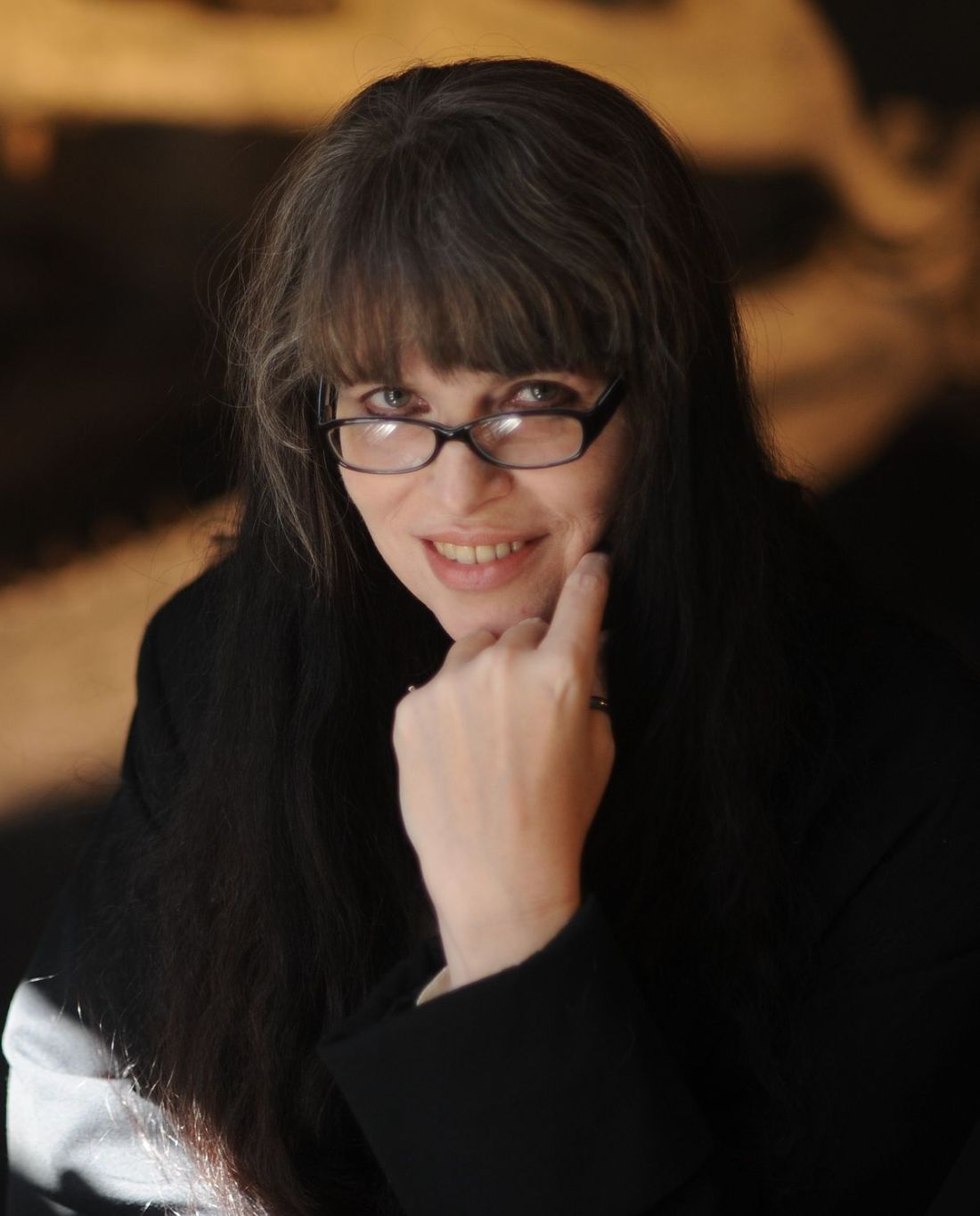
With “Paedomorphosis,” readers may well ask how much of Kiernan herself is reflected in the story. The setting of Athens, Georgia, where she lived. Elise-from-Massachusetts with her interest in paleontology; Kiernan herself a paleontologist. The imagery of drowning, repeated in some stories, especially her later novel The Drowning Girl: A Memoir (2012). The lesbian characters and her own sexuality.

“I thought dykes were supposed to be all tough and fearless and shit,” she said.

Annie shook her head, swallowed before she spoke. “Big ol’ misconception. right up there with the ones about us all wanting dicks and pickup trucks.”
—Caitlín R. Kiernan, “Paedomorphosis” in Song of Cthulhu 93

The story has the feel of something cribbled together from bits of life; people and places known rather than imagined. A bit of sexual longing, fulfilled. Drugs and rock and roll. And it takes Annie…and the audience…somewhere they never expected, gives them a glimpse of a world they never imagined might exist, those strange caverns measureless to man, the porous world spoken of so cryptically in “Machines Are Digging” (2009) by Reza Negarestani.

The title is never explained; look up the definition on your own time. The story ends with, of all things, a quote from Tolkien:

There are strange things living in the pools and lakes in the hearts of mountains…
—J. R. R. Tolkien, quoted in “Paedomorphosis” in Song of Cthulhu 98

But not the whole of it:

There are strange things living in the pools and lakes in the hearts of mountains: fish whose fathers swam in, goodness only knows how many years ago, and never swam out again, while their eyes grew bigger and bigger and bigger from trying to see in the blackness; also there are other things more slimy than fish. Even in the tunnels and caves the goblins have made for themselves there are other things living unbeknown to them that have sneaked in from outside to lie up in the dark.
—J. R. R. Tolkien, The Hobbit, Chapter V “Riddles in the Dark”

The story captures a mood, but the mood itself is almost inexpressible in anything less than the story. There are things to think about, long after the last page is turned. What might have happened, if Annie had been fearless enough to take the plunge? Who is the subject of paedomorphosis in the story? These are questions that Kiernan doesn’t answer in this story…but in some of her other stories, we catch hints of what might have happened, in love affairs that lasted a little longer and got a little weirder.

“Paedomorphosis” was first published in The Urbanite #10 (1998), it has been reprinted in Kiernan’s collection Tales of Pain and Wonder (2000, 2002, & 2008); Song of Cthulhu (2001); and Rock On: The Greatest Hits of Science Fiction & Fantasy (2012).


Bobby Derie is the author of Weird Talers: Essays on Robert E. Howard & Others (2019) and Sex and the Cthulhu Mythos (2014).
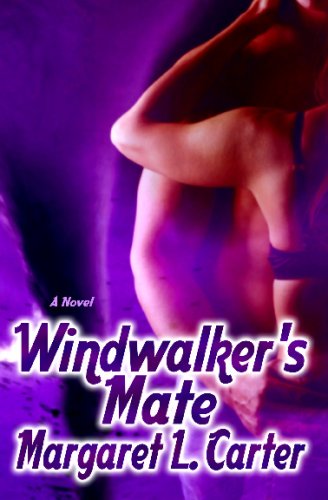
Windwalker’s Mate (2008) by Margaret L. Carter

She had been chose, she said, to be sacrificed to Ithaqua, the wind-walking elemental which the Stillwater people are said to have worshipped, and she had decided that she would flee, rather than die for a pagan god, of whsoe existence even she was not too sure.
—August Derleth, “The Thing That Walked on the Wind,” Strange Tales of Mysery and Terror Jan 1933

Ithaqua is one of August Derleth’s original contributions to the Mythos; the story that introduced him is first mentioned to Lovecraft in 1930, after Wright apparently rejected it (ES1.277). The sort of chequered history has dogged the Windwalker down the decades; few writers have made much use of Derleth’s creation, although Brian Lumley has made good use of Ithaqua—and given that entity a penchant for spawning children, a la Yog-Sothoth and “The Dunwich Horror”—in works such as “Born of the Winds” (1975) and Spawn of the Winds (1978).

It is Lumley’s interpretation that almost certainly inspired M. L. Carter’s dark paranormal romance novel Windwalker’s Mate (2008), although she puts her own spin on the proceedings. Shannon is a survivor; after the Rite of Union, she left the cult that was trying to bring strange Mythos entities to overrun this world—and forty weeks later she gave birth to her son Daniel, never knowing if his father was Nathan, the son of the culture leader who had participated in the rite with her, or the Windwalker who had possessed him.

Romance may seem an odd genre for Lovecraftian fiction; Lovecraft himself saw little of it in his life and his stories focus very little on those kind of human relationships. Nor were many of Lovecraft’s followers very inclined toward such things. Yet there is a thin substratum of genuine Mythos romance, dealing with the complex tangle of human relationships in a Mythos milieu—and much more seriously than “I Wore The Brassiere Of Doom” (1986) by Sally Theobald or “Love’s Eldritch Ichor” (1990) by Esther M. Friesner. These are works that tend to get overlooked by the main audience of Mythos writers; stuff like Tide of Desire (1983) by Sheena Clayton, Arkham Dreams (2011) by Robin Wolfe, Widdershins (2013) by Jordan L. Hawk…and one might even include The Dunwich Romance (2013) by Edward Lee, although that gets a little more hardcore than the others.

There are a few steamy moments in Windwalker’s Mate. It is far from the elaborate sexual fantasies of, say, Shoggoth Butt Invasion (2016) by Jason Wayne Allen. The sex scenes serve the plot as much as the reader; Shannon is reconnecting with Nathan, worried about her kidnapped son, placing her hope that coitus will re-establish their telepathic bond (it makes sense in the context of the book)…

He deepened the kiss, drawing her back into the present. her tongue darted eagerly to meet his. His hand cupped her breast through the T-shirt and thin bra. The tingling in the nipple zapped to the pit of her stomach and the V between her legs. The explosion of colors crashed over her again.

Then she saw stars falling like snowflakes and the sky behind them splitting open.
—Margaret L. Carter, Windwalker’s Mate 105

…yet the emotional core of the novel is very serious. Shannon is trying to save her son; she’s a lonely single mother, the cops are useless, and the former cult leader is trying to use Daniel to summon Ithaqua and the Ancient Ones into the world…there is a great deal of drama, both of the mind-numbingly mundane and weird kind.

It works. Opinions will vary on the approach, but M. L. Carter succeeds at what she set out to do: write a paranormal romance with the Mythos as a setting. If Chaosium ever published a sequel to The Ithaqua Cycle (1998/2006), this would not be out of place. The basic premise is much like the question of what happens after Rosemary’s Baby? only with Rosemary having the hard practicality to not stay with the Satanic cult because she had a baby to think of now. Daniel might well be the spawn of the Windwalker, but he isn’t a Wilbur Whateley-esque monster…not yet, anyway.

Windwalker’s Mate was published in 2008 by Amber Quill Press. Carter’s other Lovecraftian works include “Prey of the Goat” (1994) and the erotic novella Tentacles of Love (2009).


Bobby Derie is the author of Weird Talers: Essays on Robert E. Howard & Others (2019) and Sex and the Cthulhu Mythos (2014).