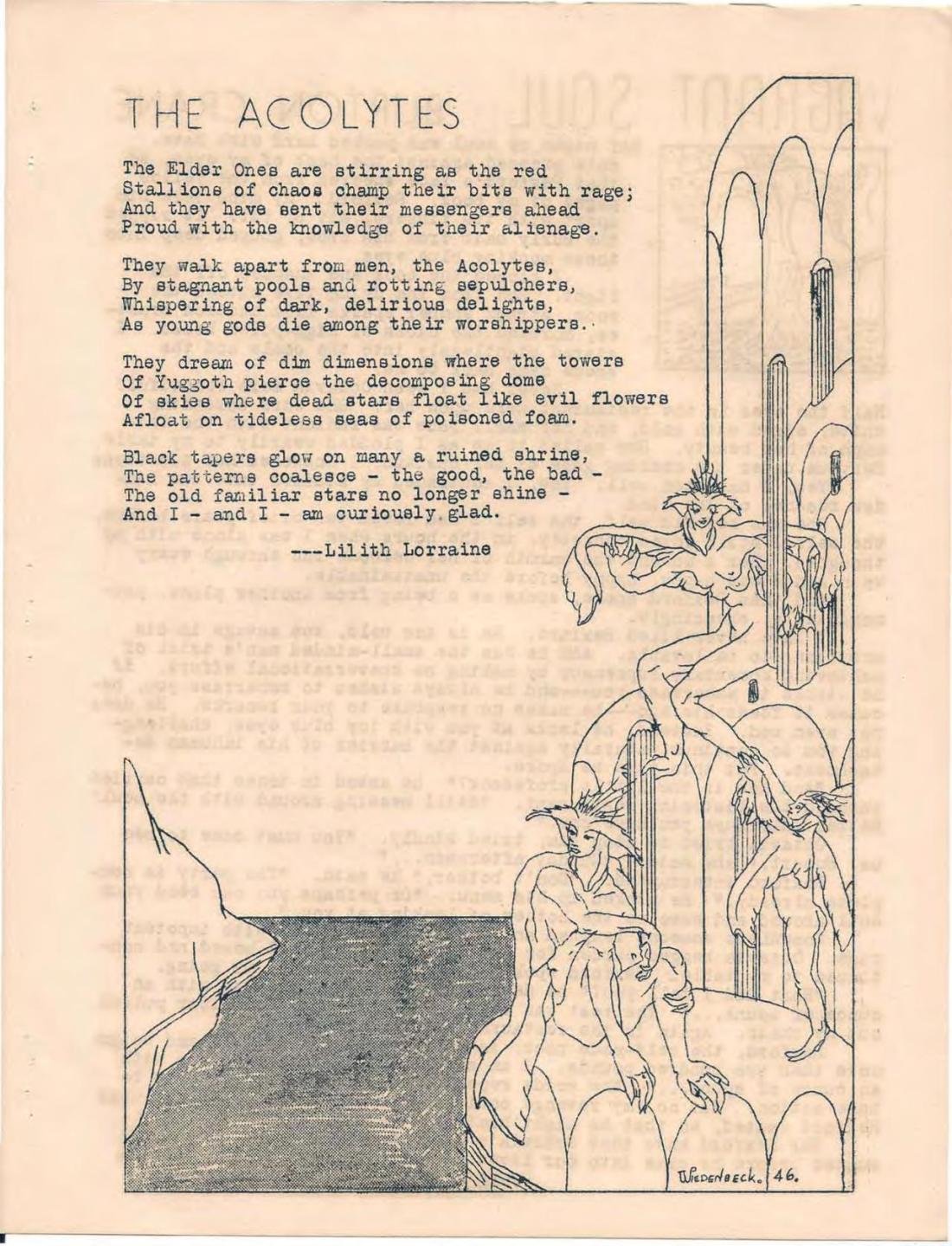
“The Acolytes” (1946) by Lilith Lorraine

The Elder Ones are stirring as the red
Stallions of chaos champ their bits with rage;
And they have sent their messengers ahead
Proud with the knowledge of their alienage.

They walk apart from men, the Acolytes,
By stagnant pools and rotting sepulchers,
Whispering of dark, delirious delights,
As young gods die among their worshippers.

They dream of dim dimensions where the towers
Of Yuggoth pierce the decomposing dome
Of skies where dead stars float like evil flowers
Afloat on tideless seas of poisoned foam.

Black tapers glow on many a ruined shrine,
The patterns coalesce – the good, the bad –
The old familiar stars no longer shine –
And I – and I – am curiously glad.
—Lilith Lorraine, “The Acolytes” in The Acolyte (Spring 1946)

Mary Maude Wright (née Dunn) wrote under a number of pseudonyms, at least three of them masculine. She wrote pulp fiction for some of the same magazines as H. P. Lovecraft and Clark Ashton Smith, but among early science fiction fandom she had her greatest esteem as a poet, for she was prolific and skilled. As a correspondent of August Derleth and Clark Ashton Smith, like Margaret St. Clair, she was on the fringes of the Weird Tales circle. She was likewise associated with The Acolyte, Francis T. Laney’s prominent 1940s fanzine devoted to Lovecraft and his contemporaries, sharing space with Virginia “Nanek” Anderson, Fritz Leiber, Jr., E. Hoffmann Price and other pulp fans and professional pulpsters.

Sgt. R. A. HOFFMAN. Acolyte art editor, reports from “Somewhere in Tex- Texas” on his visit to the home of Lilith Lorraine, noted poet:

…I Visited San Antonio, which I found to be a primitive, degenerate town, and telephoned Lilith Lorraine, mentioning that CAS had insisted I look her up… She and her husband met me in their car, and drove me out to their Shrine (Avalon Poetry Shrine. — eds.). As we entered the grounds, I heard the barking of what seemed to be myriad dogs, though it turned out to be only three— two of them Russian wolf and the other a crossbreed between Russian wolf and spitz. All were beautiful creatures and very friendly. Inside I was startled to find a veritable menagerie. A large parrot was quietly perched inside its huge cage which sat on the floor, and two cats were snarling at each other. They also have a monkey, but it was asleep in bed at the time, though later she brought it out.

Miss Lorraine is a most amazing person, and going out there was a most fascinating adventure. She and her husband have been married 33 years, but she says she is all the time receiving love letters from strangers. She prefers her pen-name so much that even her husband calls her Miss Lorraine sometimes! They are both native Texans, and she is complete with drawl and all. She has a charming personality and a fine sense of humor.

I had only 2 1/2 hours before my bus, and every minute was spent in incessant conversation or in listening to Lilith read us some of her verse. She read me selections from her then as yet unpublished book The Day of Judgement (Banner Press, 1944), and I was completely caught in her spell, totally swept away with them. She showed me the shrine itself, and the sunken garden, though unfortunately it was late at night, and the floodlights did not give the proper perspective we would have desired….Miss Lorraine thinks CAS the finest American poet since Poe….

Lilith Lorraine’s previous poems in The Acolyte were “On Walking in the Tomb” (Fall 1943) and “Black Cathedrals” (Spring 1944), but “The Acolytes” was a little different. It came in the final issue (#14) of the ‘zine, and is a tribute to those who contributed to the important little magazine…those who, through their efforts kept interest in H. P. Lovecraft and Robert E. Howard going after their death, who began the study of their work and the creation of original fiction and poetry of the Mythos.

The last lines of the poem are strangely appropriate; evocative of Lovecraft and perhaps Robert W. Chambers’. The Acolyte was extinct with this issue, but the Acolytes, that first post-Lovecraft generation of fans and scholars survived and flourished. The stars were right…and Lilith Lorraine was there, to capture a moment in verse.

The_Acolyte_14_v04n02_1946-Spring_0011


Bobby Derie is the author of Weird Talers: Essays on Robert E. Howard & Others (2019) and Sex and the Cthulhu Mythos (2014).

“A Night at Yuan-Su” (2005) by Nanjo Takenori (南條竹則)

My heart is gently warmed, in particular, by the many works left by an obscure writer who lived in Providence in the early twentieth century. when I read his work, I am strangely suffused with warmth, as though I have found a friend from beyond the seas.
—“A Night at Yuan-Su,” Inverted Kingdom: Lairs of the Hidden Gods Vol. Two 279

“A Night at Yuan-Su” (2005) by Nanjō Takenori (南條竹則) was published in the second volume in the Lairs of the Hidden Gods series from Kurodahan Press, edited by Asamatsu Ken (朝松健). It is the English-language translation of the 2002 story ユアン・スーの一夜 (Yuan Sū no Yoru); the translator was Usha Jayaraman.

In his letters, H. P. Lovecraft decried the loss of old buildings, old ways of life. He was not a Luddite, but his sense of aesthetics was tied to antique styles, and he despaired when an old block of buildings was torn down to make way for something new, as a piece of the past was lost. In this sense, he felt a stranger in his own century. Some of these sentiments are apparent in his fiction, in stories like “He” and “The Outsider.” The idea is expressed most succinctly in sonnet XXX of the Fungi from Yuggoth cycle, “Background”:

I never can be tied to raw, new things,
For I first saw the light in an old town,

In this brief tale, Nanjō Takenori sketches the story of a different outsider, thousands of miles away, lamenting the slow loss of historic Tokyo. There are nods to Lovecraft here and there—and a certain kind of humor. The narrator’s deprecation of human beings could almost have turned into one of Lovecraft’s rants about immigrants, the new people displacing the old, but stops short; “A Night at Yuan-Su” is not “The Street” or any other kind of racist fable. It is, ultimately, about a lonely creature out for a drink and a bit of quiet companionship.

This is where the narrative takes a turn, from the atmospheric descriptions of Yuan-Su (really Harajuku in Tokyo), its old buildings torn down to make way for housing developments, to the more fantastic. Reminiscences of a bar named HE, where Imhotep serves araq to an odd clientele. Odd reactions, fragments of names. Unlike Lovecraft’s eponymous Outsider, there is no final revelation in the story…but there is still that peculiar sense of humor. Earlier in the tale, the nameless narrator describes the evil spell of Betelgeuse, the red star, has on them. At the end, finally settling down with a beer and a bowl of tofu, they are thwarted by a shot of ergoutou (Chinese sorghum liquor)—one of the popular brands of which is Red Star.

Given the setting, I almost suspect there are parts of the joke I’m missing. Perhaps the narrator’s particular attributes reflect some specific species of yōkai which Japanese readers might be more familiar with; perhaps the fragmentary names of bars contain more half-hidden meanings for those familiar with Mandarin and Japanese. Whether this is the case or not, doesn’t really matter for the enjoyment of the story. It’s a mood piece, a snapshot of a night, a moment, an attitude. We have all been outsiders, at times; there’s an empathy there for those who desire simple comforts which are then denied.

Never again will I go into that dirty town. Not even on a bright, moonlit night! I have no need to. If my loneliness gets the better of me, if I feel like visiting a friend, I can always go to Celephaïs, the city of dreams, wrapt in its golden aura…
—”A Night at Yuan-Su,” Inverted Kingdom: Lairs of the Hidden Gods Vol. Two 285

In a dream I fled from that haunted and accursed pile, and ran swiftly and silently in the moonlight. When I returned to the churchyard place of marble and went down the steps I found the stone trap-door immovable; but I was not sorry, for I had hated the antique castle and the trees. Now I ride with the mocking and friendly ghouls on the night-wind, and play by day amongst the catacombs of Nephren-Ka in the sealed and unknown valley of Hadoth by the Nile. I know that light is not for me, save that of the moon over the rock tombs of Neb, nor any gaiety save the unnamed feasts of Nitokris beneath the Great Pyramid; yet in my new wildness and freedom I almost welcome the bitterness of alienage.
“The Outsider”

The end of “A Night at Yuan-Su” is curiously ambiguous. Does the nameless narrator mean literally that they will go to Celephaïs, or is that a poetic statement to refer to diving once more into Lovecraft’s fiction, finding comfort in the old familiar tales? It can be read either way; nothing the narrator says or does up to this point is explicitly supernatural. Whether they are a human recluse or something else is left up to the reader—and many readers will want to believe in the stranger, more fantastic option. It is a meaner, uglier world that doesn’t allow for a bar named HE to stand on some corner of Harajuku, where exiles from fantastic lands can sip anise-flavored liquors with their collars turned up and their big hats dipped low over their faces, speaking of distant planets and the depths of the sea.


Bobby Derie is the author of Weird Talers: Essays on Robert E. Howard & Others (2019) and Sex and the Cthulhu Mythos (2014).
“Mother of Serpents” (1936) by Robert Bloch

Let me add that I got a comparable kick out of “Mother of Serpents”—whose Haitian atmosphere is convincing, & whose climax is magnificently clever, powerful, & unexpected.
—H. P. Lovecraft to Robert Bloch, 3 Dec 1936, Letters to Robert Bloch & Others 179

Voodoo—whether it be Haitian Vodou, New Orleans Voodoo, rootwork, Obeah, or any other name for the syncretic practices derived from indigenous religions by African slaves in the New World—has an odd place in the Cthulhu Mythos. H. P. Lovecraft wrote very little about it; in all of his fiction, there are only two explicit references to voodoo of any sort:

[…] the one known scandal of my immediate forbears—the case of my cousin, young Randolph Delapore of Carfax, who went among the negroes and became a voodoo priest after he returned from the Mexican War.
—H. P. Lovecraft, “The Rats in the Walls” (1924)

Voodoo orgies multiply in Hayti, and African outposts report ominous mutterings. […] The statuette, idol, fetish, or whatever it was, had been captured some months before in the wooded swamps south of New Orleans during a raid on a supposed voodoo meeting; and so singular and hideous were the rites connected with it, that the police could not but realise that they had stumbled on a dark cult totally unknown to them, and infinitely more diabolic than even the blackest of the African voodoo circles.
—H. P. Lovecraft, “The Call of Cthulhu” (1928)

The sect in “The Call of Cthulhu” turns out to not be connected with voodoo at all, but both references are extremely vague on the details. Much the same could be said of “Medusa’s Coil” (written 1930), which does not feature voodoo explicitly, but includes “wrinkled Sophonisba, the ancient Zulu witch-woman” who provides the connection between Africa and the American South.

The vagueness is perhaps as it should be: Lovecraft was fairly ignorant on the subject of voodoo, as were most in the United States in the early 20th century. Interest in Haitian Vodou increased during the long United States occupation of Haiti (1915-1934) and the Dominican Republic (1916-1924). This experience provided the inspiration and raw material for Arthur J. Burks and other future pulp writers to spin wild tales of curses, cannibals, and human sacrifice; writer William Seabrook lived in Haiti for a period and investigated it, his book The Magic Island (1929) and its account of zombies stirred the American imagination, with Weird Tales writers such as Seabury Quinn and August Derleth quickly borrowing his erudition for stories like “The Corpse Master” (Weird Tales July 1929) and “The House in the Magnolias” (Strange Tales of Mystery and Terror June 1932). For more on this line, see Zombies from the Pulps! (2014).

Lovecraft read The Magic Island in 1931, while visiting Rev. Henry S. Whitehead in Florida. (Letters to F. Lee Baldwin &c. 195) Whitehead had spent summers in the U. S. Virgin Islands, which had been sold to the United States in 1917, and penned tales and articles for the pulps based on the stories of “Obi” and “Jumbees” he encountered.

JnSlHJt
From The Letters of Henry S. Whitehead (1942)

After Lovecraft read The Magic Island, references to voodoo evaporate from his stories, although there are occasional references in his letters. Knowledge, in this case, may have killed the mystery that voodoo had for Lovecraft; there is no evidence he ever read Zora Neale Hurston or any other anthropologist on the subject, and there is a notable absence of reference to voodoo stories in his essay “Supernatural Horror in Literature”—which he had initially written and published before reading The Magic Island, but which remained without reference to African-American authors or voodoo tales as supernatural fiction even in the later revised and expanded versions.

There was always a racial element as well.

Ordinarily voodoo & Yogi stuff leaves me cold, for I can’t feel enough closeness to savage or other non-Caucasian magic.
—H. P. Lovecraft to J. Vernon Shea, 3 Sep 1931, Letters to J. Vernon Shea &c. 45

Curious that your ghost ideas in youth excluded the Indian while including the negro. For my part, though, I can’t feel much weirdness in connexion with any but the white race—so that nigger voodoo stories very largely leave me cold.
—H. P. Lovecraft to Robert E. Howard, 30 Oct 1931, A Means to Freedom 1.231

The racial aspect has much to do with prevailing American attitudes about Haiti and black religion in general. Colonialist attitudes remained firmly in place in much of the United States, to the point where Lovecraft and Robert E. Howard were shocked to hear of interracial marriages in the Virgin Islands from Whitehead. In reviewing August Derleth’s voodoo story “The House in the Magnolias,” Lovecraft wrote to his friend:

[…] you have the woman describe herself & family as Haitian, which conclusively implies nigger blood. There are no pure white Haitians. White persons living in Haiti are not citizens, & always refer to themselves in terms of their original nationalities—French, American, Spanish, or whatever they may be. The old French Creoles were wholly extirpated—murdered or exiled—at the beginning of the 19th century.
—H. P. Lovecraft to August Derleth, 9 Sep 1931, Essential Solitude 1.376

Which leads eventually to Robert Bloch’s “Mother of Serpents” (Weird Tales Dec 1936). Nothing much remains as to the genesis of this short story; there is no evidence that Lovecraft had a hand in it, or even saw it before publication. Far from Bloch’s mature work, this is a potboiler that goes for the jugular of Haitian racial and cultural stereotypes and never lets it go.

There were no happy blacks in Haiti then. They had known too much of torture and death; the carefree life of the West Indian neighbors was utterly alien to these slaves and descendants of slaves. A strange mixture of races flourished; fierce tribesmen from Ashanti, Damballah, and the Guinea Coast; sullen Caribs; dusky offspring of renegade Frenchmen; bastard admixtures of Spanish, Negro, and Indian blood. Sly, treacherous half-breeds and mulattos ruled the coast, but there were even worse dwellers in the hills behind.
—Robert Bloch, “Mother of Serpents”

Essentially a conte cruel with voodoo trappings and a supernatural denouement, much of the atmosphere of “Mother of Serpents” is built up in these broad strokes and fine details; Haiti is described as the epitome of racial tensions, black magic, and vice with all the care that Clark Ashton Smith would give to describing an island of necromancers in the far-flung future of Zothique. The description is half-erudite; it’s clear that Bloch was using Seabrook or some other sources for a few of the basic facts on Haiti (such as the legend that Henri Christophe committed suicide with a silver bullet), but it is equally obvious that he was inventing little horrible details left and right. Every character is a stereotype, and there are no heroes. The voodoo-inflected presidentkeeping in mind this was nearly two decades before the reign of François “Papa Doc” Duvalier—is (literally) a bastard, a criminal, a “black Machiavelli” who enriches himself at the expense of the country…and what is worse in his mother’s eyes, he sullies his black heritage by marrying a mixed-race woman.

Trying to unpack all the racial insinuations in this short story would take longer than the story itself, and wouldn’t achieve much. How much of this claptrap Bloch actually believed is debatable; it’s pure pulp pandering. The Mythos connection is a slim one:

The Snake-God is the real deity of the obeah cults. The blacks worshipped the Serpent in Dahomey and Senegal from time immemorial. They venerate the reptiles in a curious way, and there is some obscure linkage between the Snake and the crescent moon. Curious, isn’t it—this serpent superstition? The garden of Eden had its tempter, and the Bible tells of Moses and his staff of snakes. The Egyptians revered Set, and the ancient Hindoos had a cobra god. It seems to be general throughout the world—the kindred hatred and reverence of serpents. Always they seem to be worshipped as creatures of evil. Our own American Indians believed in Yig, and Aztec myths follow the pattern.
—Robert Bloch, “Mother of Serpents”

Damballah (in different spellings) is one of the principal loa in Haitian Vodou, and is depicted as a snake. The Egyptian god Set (Seth, Setekh, etc.) is not depicted as a serpent; possibly Bloch was making an error and remembering Robert E. Howard’s Stygian snake-deity Set from the Conan tales; although Bloch did not like Conan. Yig was the creation of H. P. Lovecraft, and appeared in “The Curse of Yig” (1929) and “The Mound” (1940), published as by Zealia Brown Reed Bishop; Lovecraft might have sent Bloch the manuscript for the latter, or perhaps Bloch was only referencing “The Curse of Yig.” In any event, the inclusion of Yig among the snake-deities must have been Bloch’s tip of the hat to Lovecraft.

“Mother of Serpents” barely qualifies as a Mythos tale. Despite being reprinted a number of times, it has not been included in any of the collections of Bloch’s Mythos fiction, and has only been reprinted in a single Mythos anthology: Il terrore di Cthulhu (1968). It is often forgotten today—a relic of Bloch’s youth, when he was still trying to find his feet in the publishing game, a few months before the death of H. P. Lovecraft and a full decade before Psycho (1959).

Voodoo, rootwork, and other syncretic religions of the Americas continue to be an element in the Cthulhu Mythos; this is especially true for roleplaying games, where occupations like “Conjure Woman” are part of Harlem Unbound and rules for voodoo magic in Secrets of New Orleans. Individual depictions run from Hollywood tropes to efforts at accurate ethnographic representation. with so little written about voodoo and how and where it fits into the Mythos, at least from Lovecraft, writers are free to indulge their imagination—and do. Some of them, such as Robert Bloch, let themselves lean in too far on the pulp stereotypes and racism both implicit and explicit in the early depictions of Haiti and Vodou.

“Mother of Serpents” can be read online.


Bobby Derie is the author of Weird Talers: Essays on Robert E. Howard & Others (2019) and Sex and the Cthulhu Mythos (2014).
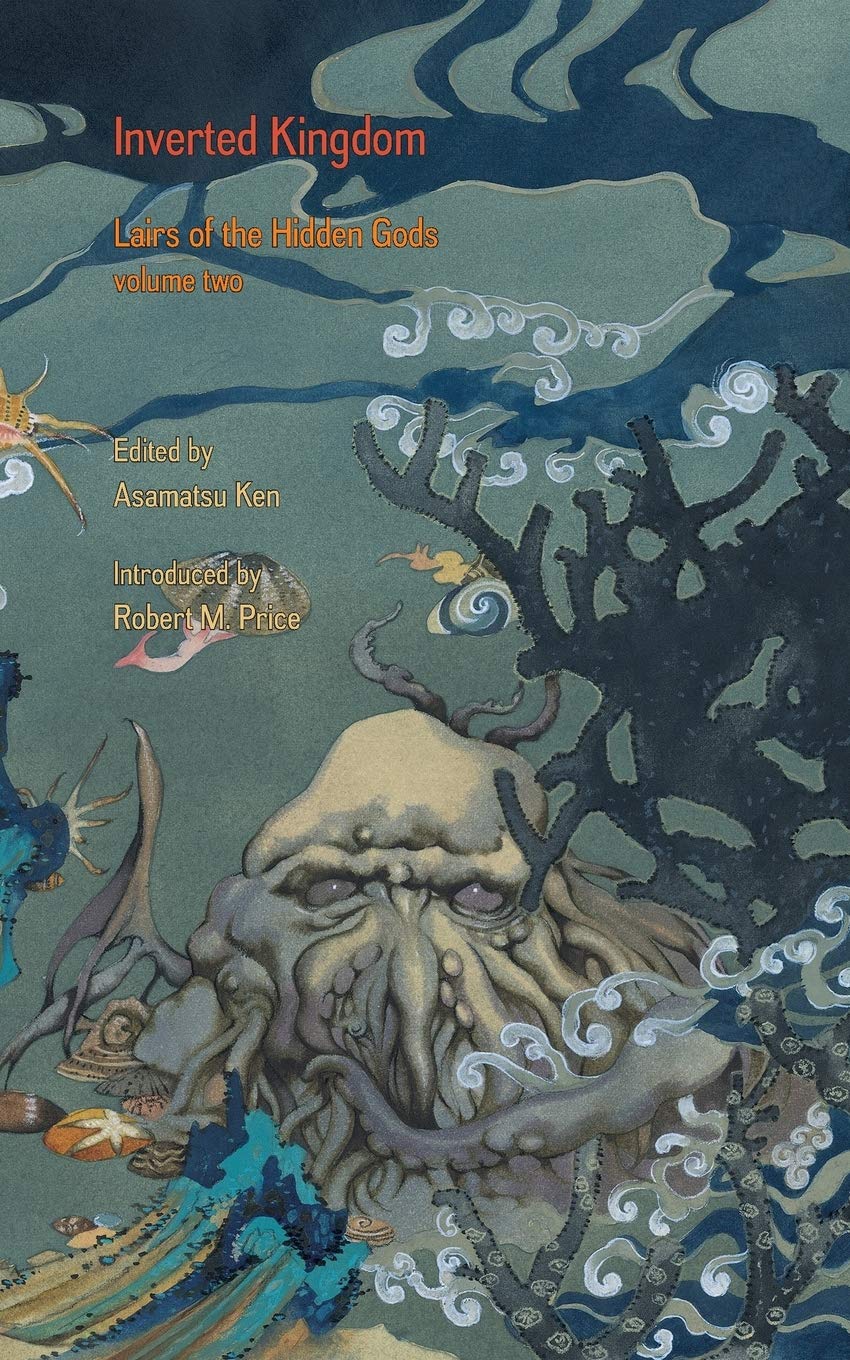
“Night Voices, Night Journeys” (2005) by Inoue Masahiko (井上雅彦)

Outstanding stories always leave the reader in silence.

But one very special type of outstanding story, after silencing them, stimulates them into furious action. I’m sure you know what I’m talking about.
Asamatsu Ken (朝松健), foreword to Night Voices, Night Journeys 2

“Night Voices, Night Journeys” (2005) by Inoue Masahiko (井上雅彦) is the title story of the first volume in the Lairs of the Hidden Gods series from Kurodahan Press, edited by Asamatsu Ken (朝松健). It is the English-language translation of the 2002 story 夜の聲 夜の旅 (Yoru no Koe, Yoru no Tabi); the translator was Edward Lipsett.

This is a story about revelation. In Shanghai, the femme fatale Azie is the plaything of her master, the last in a long line of those who possess her. Yet this is not a story about human trafficking or sex slavery. That is the frame of it, the red herring. Onion layers of truth are peeled back, one at a time, bandaids ripped off as the reader starts to understand what is actually going on…and when you finally get it, when the realization of who and what “Azie” is finally comes together, there’s a desire to go back from the beginning and read it again.

At the same time, this is also a story about how images translate across cultures, in particular how certain images of the Cthulhu Mythos have been interpreted and popularized in Japan.

Lovingly, those fingers toyed with her ear.

Those fingertips, moving so skillfully, soothed along the perfectly-sculpted rim of her ear, cupping; the trace of a fingernail. […] The rhythm of his fingers. She lay on the bench seat, facing upward, body stretched out to him. To his fingers. His incessant, gentle, ravenous fingers.

Of course, the fingers would love not only her ear. He would surely walk them elsewhere. From her ear, on down, to other parts. those unique fingertips, slick with saliva pungent with the scent of myrrh, would glide from that other place to yet another spot, rich in so many secrets, never ceasing their mysterious dance.
—Inoue Masahiko (井上雅彦), Night Voices, Night Journeys 181

ED2Book
Necronomicon Ex Mortis, The Evil Dead 2 (1987)

H. P. Lovecraft first mentioned the Necronomicon in his short story “The Hound” (1924). Although given little description there, it is in good company alongside:

A locked portfolio, bound in tanned human skin, held certain unknown and unnamable drawings which it was rumoured Goya had perpetrated but dared not acknowledge.

This was the beginning of the Necronomicon‘s association with anthropodermic bibliopegy and the strange and varied library of Mythos tomes which continues on even today. While Lovecraft himself did not bind it in human leather, other creators did, and the idea was given visual form in the Evil Dead franchise as a series of props that still possessed discernible human features on cover—including a distorted face on the front cover and an ear on the back cover.

The films in the Evil Dead series made their way to Japan. The image of the Necronomicon Ex Mortis became strongly associated with visual representation of the Necronomcion in various Japanese Mythos artwork, most recently appearing as the inspiration for the volume in Tanabe Gou (田辺剛) in his adaptation of “The Hound”:

DI9yrTDXcAE0IO5
Excerpt from H. P. Lovecraft’s The Hound and Other Stories by Tanabe Gou

It is a fine point as to whether or not “Azia” takes the form of a literal woman in Inoue Masahiko’s story; the prose often deliberately obscures the details from the unknowing reader until practically the end. The idea of the Al Azif becoming a nubile female was a major conceit of the series Demonbane (デモンベイン, 2003), but “Night Visions, Night Journeys” predates that work, and the approach is much more subtle. “Azia” is in many senses an object, the reader gets her view but she does practically nothing, being utterly passive, something to be possessed by different masters.

It is in miniature a history of the Necronomicon in the works of H. P. Lovecraft, from the view of the Necronomicon, and that is fantastic enough when the realization hits, but even more fantastic when the reader sees how cleverly and carefully the work was done. For example, in the story when it is written:

She had donned an Islamic robe for him, plucking the Egyptian qanoon.
—Inoue Masahiko (井上雅彦), Night Voices, Night Journeys 196-197

Is a reference to:

Mediaeval Jews and Arabs were represented in profusion, and Mr. Merritt turned pale when, upon taking down a fine volume conspicuously labelled as the Qanoon-e-Islam, he found it was in truth the forbidden Necronomicon of the mad Arab Abdul Alhazred, of which he had heard such monstrous things whispered some years previously after the exposure of nameless rites at the strange little fishing village of Kingsport, in the Province of the Massachusetts-Bay.
—H. P. Lovecraft, “The Case of Charles Dexter Ward”

That is only brushing the surface of things; “Night Voices, Night Journeys” is a tremendously fun story for fans of the Mythos, with many more references both subtle and explicit. The reader’s sympathies lie with “Azia” (or “Nekkie” as the others call her), who is innocent of the uses that her various “Masters” put her secrets to, yet is forced to witness every evil end, her skin absorbing the spilled blood. It’s imagery that translates very well, especially if you’re familiar with the sources being drawn from—but the story is much more than a nostalgic retread through the pages of Lovecraft.

There is a scene at the end where “Azia” faces an audience—and that is us, the readers.

“They’re your fans. They love you.”

“But… those horrible faces…” she said, shivering. “They’re all my sacrifices.”

“No, your recipients. The recipients of your saga,” he corrected.
—Inoue Masahiko (井上雅彦), Night Voices, Night Journeys 200-201

How could it be otherwise? The Mythos has always been about reader participation; the reader always brings their prior knowledge of the Mythos with them to each new story they read, building their own canon, putting together pieces of the puzzle. For readers who have never read “The Shadow over Innsmouth,” the reference to Innsmouth in “The Thing on the Doorstep” is meaningless—as may be the reference to the limousine driver from the port town in “Night Voices, Night Journeys.” To read about the Mythos and play the game of connections is to be a part of it, whether or not the reader ever creates anything to expand on it themselves.

If there’s a criticism with “Night Voices, Night Journeys,” it’s that certain absences in representation are more apparent. Lovecraft never had any female characters in possession of the Necronomicon, so none of the “Masters” in the book are female. There are in fact no other female characters in the story, aside from the brief passage where the books whisper to each other on the shelves. The gendered perspective of “Azia” as both female and passive and sensual might be interpreted as borrowing on sexist tropes, although in this case that appears to be entirely incidental. A byproduct of the raw material for the story rather than any deliberate statement being made by the author.

Which is certainly true for many other Mythos stories as well. Still, it would be interesting to see how “Azia” would take to having a Mistress caress her instead of a Master—or if there was some fundamental difference in how a woman might use and interpret the Necronomicon. But that would be a different story altogether; “Night Voices, Night Journeys” is about the way “Azia,” simply by existing, twists those around her…and it is fascinating and fun.


Bobby Derie is the author of Weird Talers: Essays on Robert E. Howard & Others (2019) and Sex and the Cthulhu Mythos (2014).
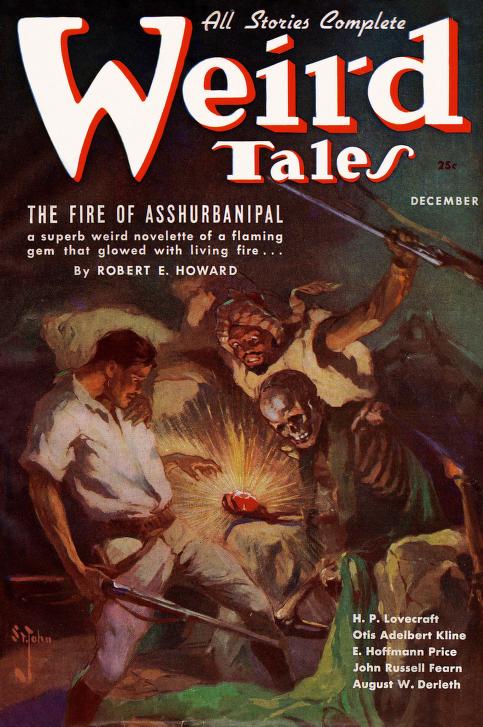
The Queen of K’n-yan (2008) by Asamatsu Ken (朝松健)

This is Cthulhu Mythos fiction unlike any you have read before.
—Darrel Schweitzer, introduction to The Queen of K’n-Yan xiii
The Queen of K’n-yan (2008, Kurodahan Press) by Asamatsu Ken (朝松健) is the English-language translation of his 1993 novel 崑央の女王 (K’n-Yan no Joō); the translator was Kathleen Taji.
There is a world of Mythos fiction beyond the English language, and it depends on translation. The original works of Lovecraft and his contemporaries, their ideas, concepts, and language, have to be translated from their original English into the new language. This process is not automatic or uniform, not every word that Lovecraft & co. wrote has been translated or published; many of the letters especially have not yet made the jump into other languages, and may never. Imagine what it takes to read Lovecraft, filtered through someone else trying to capture his style and language, to twist the language to translate not just the literal words but the ideas and weird names which might not transliterate easily or cleanly.
Then imagine translating an original Mythos novel back into English. How much survives? How much is recognizable? What new cultural syntax is picked up?
It is more of an issue than you might think, because there is a cultural syntax to the Cthulhu Mythos already; the stories, and the secondary literature of pastiches, sequels, prequels, etc. are highly intertextual, sometimes metatextual—and not everything that is written in English gets translated. The result is that some ideas which are largely outmoded in current English-language Mythos fiction may be retained longer in non-English-language Mythos fiction; and of course some new bits are often added which English language Mythos fans have never seen before.
Kathleen Taji’s translation of The Queen of K’n-Yan is a good example. As a novel, Asamatsu Ken’s work is definitely atypical for Mythos fare: the setting is a contemporary Japan and WW2-era China, the massive, secured corporate arcology and overall plot are something out of a cyberpunk novel, echoes of The Thing (1982), Aliens (1986), and Gunhead (1989). Archaeological mystery and psychic flashbacks to a Japanese war camp conducting medical experiments on Chinese civilians give way to a survival horror/body horror aesthetic somewhat foreshadowing works like Parasite Eve (1995) and Resident Evil (1996).
As the title suggests, the primary Mythos influence of the story is “The Mound” (1940) by Zealia Bishop & H. P. Lovecraft:
It isn’t too much of a spoiler to let you know that Asamatsu Ken’s The Queen of K’n-yan involves the discovery of a mummy from that same underground realm, but excavated in China […]
—Darrel Schweitzer, introduction to The Queen of K’n-Yan ix
Asamatsu Ken takes the idea of the people of K’n-Yan and expands them to a global scale, parts of their underground realm running throughout Asia, and ties them into existing history and mythology:
Before the advent of humanity, the world was divided and ruled by several races of intelligent beings. That’s to say, the dragon race, the denizens of Zhùróng – the fire deity – the earth wolf tribes, the wind bull people, and the star-spawn – as can be deduced, they symbolize the five elements of water, fire, earth, wood, and metal. The human descendants of the dragon race are the Han, the human descendants of the earth wolf are the Manchu, and the human descendants of the wind bull people are the Tibetans […] The denizens of Zhùróng, the symbol of fire, rose in revolt against the Yellow Emperor and were sealed underground in retribution. The underground cavern where they were imprisoned is called K’n-Yan. And the star-spawn were banished to the distant heavens.
—Asamatsu Ken, trans. Kathleen Taji, The Queen of K’n-Yan 85
For English-language Mythos fans, this might be sounding suspiciously like the early “elemental” theory of the Cthulhu Mythos first postulated by August Derleth in “The Return of Hastur” (1939). Derleth designated various entities according to the four elements of the Western tradition of Hermetic occultism (Cthulhu, water; Tsathoggua, earth; Hastur, air; and creating Cthugha as the missing “fire elemental”). Asamatsu Ken is certainly paying homage to this idea, even if he is taking it in a different direction:

What appeared were strange sentences containing a mix of Chinese characters, cursive Japanese hiragana, and roman letters. They read –

“Beseech the god of the western seas, THCLH, with sacred reverence.
Beseech the forefather of heat and flame, THGHC, with sacred reverence.

Beseech anon our birth lord, ZTHRNG, with sacred reverence.

The infant princess, through the black disease

When reborn as Queen

Even death will not die…”
—Asamatsu Ken, trans. Kathleen Taji, The Queen of K’n-Yan 112

Zhùróng is a complicated personage, but often considered a god of fire; THGHC is a reference to Derleth’s Cthugha, THCLH to Cthulhu. The complexities of Japanese, Chinese, and Japanese languages coming into play here were probably difficult to translate, but readers can recall how in “The Mound” Cthulhu was represented as “Tulu” and get the vague idea of how Japanese readers might have been piecing together clues.
As an aside, applying the five-element approach to the Mythos is not unique to Asamatsu Ken’s work either. Shirow Masamune in his manga Orion (仙術超攻殻オリオン) has a Cthulhu-esque entity arise from an occult effort involving an unbalanced water-element.
The discussion of “races” in the context of Mythos fiction is more complicated, and not unique to this work. Perhaps for the best, Asamatsu Ken doesn’t delve too deep into the geopolitics or genetics of it all. The main characters are left piecing together bits of history so old that they’ve faded into myth, trying to sort out bits of truth from the old legends.
As the story enters its penultimate phase, the survival horror aspect comes to the fore. A weird game of cat-and-mouse occurs between Morishita Anri (the novel’s protagonist, Japanese), Dr. Li (the novel’s secondary antagonist, Chinese), and the Queen of K’n-Yan, who a la The Thing has taken on the form of a human woman—hinted to possibly be either Morishita or Li. Reanimated body parts are combined together in was reminiscent of Bride of Re-animator (1990):
An ankle with eyes. A left hand with three lips. Orifices with fangs. A large intestine with wings on its back. Thirty upper arms congealed together, spherical in shape. A thigh with a face, knees with thin hands, and ankles growing out of shins. Eyeballs with tentacles, and most horrendous of all, hordes of internal organs, squirming and groping.
—Asamatsu Ken, trans. Kathleen Taji, The Queen of K’n-Yan 175
Strange as it may be with all these diverse elements, the novel does actually come together at the end, in a fairly satisfying way. Not every mystery is explained, nor do they need to be; background noise about large sinkholes in China where the Princess of K’n-Yan was discovered, outbreaks of disease, and rising heat suggest what is about to come, but that is a horror for the future beyond the last page in the novel.
For all that works, at least within the internal rationale of the novel, there are a few things that don’t translate well. There are elements of style and plot which simply don’t come across to English-language readers as nicely as they could, and it is difficult (not having read, or able to read, the original) to tell whether this is a quirk of the translation being too literal or simply a faithful reproduction of Asamatsu’s style which doesn’t quite click.
Stylistically, the chunks of raw exposition embedded in the narrative stand out as exactly that; the Mythos references when they come aren’t exactly subtle. From the standpoint of characters, most are fairly weakly developed except for the protagonist Morishita Anri and the mysterious Dr. Li…and even then, there is a relatively late development in the novel which comes almost out of nowhere:

Something was trying to take shape. Akiyama Haruka’s face appeared in midair – three times larger than the actual face. This was followed by the appearance of a neck, shoulders, lithe arms, and lastly, shapely breasts. Akiyama winked at Anri, and her pupils sent an insinuating and lascivious look her way.

“Hold me, please…pretty please.”

On hearing her words, Andri felt like retching.

The queen knows?! Somehow she’s found out that I’m gay.
—Asamatsu Ken, trans. Kathleen Taji, The Queen of K’n-Yan 199

The issue of Mosihita Anri’s homosexuality, for about the first hundred and ninety-eight pages up until this point, is so low-key as to be completely absent. Going back to re-read the novel, there are only extremely vague hints which maybe point to that if the reader already knows she’s a lesbian; this feels like a character development which was either not communicated well in the original or which was so subtle that the translation didn’t quite convey it. Which is not in any way a dig at Kathleen Taji, only an exemplar of how difficult the job of translation is. How do you communicate someone’s sexuality in Japanese culture when they do not have any immediate love interest? Were there cues that would have made sense to a Japanese audience that an English reader would miss?
These are the kind of questions that consume the reader in The Queen of K’n-Yan. It is an effective Mythos novel; Asamatsu Ken knows what he is doing. Yet it is undoubtedly a very different Mythos novel from August Derleth’s The Lurker at the Threshold (1945) or Robert Bloch’s Strange Eons (1978). The setting and the syntax are in line with Japanese horror of the late 1980s and early 1990s, the Mythos translated, adapted, and integrated into a post-WW2 world with computers, genetic engineering, wuxing, and the People’s Liberation Army.
Perhaps most importantly, The Queen of K’n-Yan is an example of what translation offers to the English-speaking audience: something different, a new way to think about the old Mythos. For those of us who cannot read Japanese, it is only through translation that we can approach these works—even if, like Wilbur Whateley in “The Dunwich Horror,” thumbing through the English translation of the Necronomicon, we know that there is something missing from the original.

Bobby Derie is the author of Weird Talers: Essays on Robert E. Howard & Others (2019) and Sex and the Cthulhu Mythos (2014).

“Polaris” (1920) by H. P. Lovecraft & “The Lair of the Star-Spawn” (1932) by August Derleth and Mark Schorer

That night had the news come of Daikos’ fall, and of the advance of the Inutos; squat, hellish, yellow fiends who five years ago had appeared out of the unknown west to ravage the confines of our kingdom, and finally to besiege our towns. Having taken the fortified places at the foot of the mountains, their way now lay open to the plateau, unless every citizen could resist with the strength of ten men. For the squat creatures were mighty in the arts of war, and knew not the scruples of honour which held back our tall, grey-eyed men of Lomar from ruthless conquest. […]

They say there is no land of Lomar, save in my nocturnal imaginings; that in those realms where the Pole Star shines high and red Aldebaran crawls low around the horizon, there has been naught save ice and snow for thousands of years, and never a man save squat yellow creatures, blighted by the cold, whom they call “Esquimaux”.
—H. P. Lovecraft, “Polaris”

At the end of the 19th century, the Yellow Peril or Yellow Terror had gripped the imagination of the Western world; works such as weird fiction author M. P. Shiel’s The Yellow Danger; Or, what Might Happen in the Division of the Chinese Empire Should Estrange all European Countries (1898) were pure invective, fueling racist and Orientalist fantasies about Asia and the prospect of a global conflict on the lines not of nation-states, but of race. The victory of an industrialized Japan in the Russo-Japanese War (1904-1905) stoked these fears, and a year before the Great War broke out found an avatar in Dr. Fu Manchu, the villainous star of what would become thirteen novels by Sax Rohmer. Fu Manchu would inspire hundreds of copycats, not a few of whom appeared in Weird Tales, and even by favorite authors; Robert E. Howard’s “Kathulos” from the serial “Skull-Face” (1929) definitely has Fu Manchu in its literary DNA. The Yellow Peril, in more generalized form, would be familiar in Weird Tales throughout its entire run from 1923-1954, as was the case in many pulps.

Throughout his life H. P. Lovecraft was clear in his genuine belief in the Yellow Peril, at least as an impending threat. One passage from a letter will suffice to give the general substance of this racialist paranoia, although in many other instances Lovecraft wrote admiringly of Japanese culture and aesthetics, and of Japanese actors and artists:

Of Japan I have not so far spoken, because I think it a certain enemy of the future, which no plan can permanently make a friend. It demands free access to Anglo-Saxon soil for its citizens, and this can never be given. Orientals must be kept in their native East till the fall of the white race. Sooner or later a great Japanese war will take place, during which I think the virtual destruction of Japan will have to be effected in the interests of European safety. The more numerous Chinese are a menace of the still more distant future. They will probably be the exterminators of Caucasian civilisation, for their numbers are amazing. But that is all too far ahead for consideration today.
—H. P. Lovecraft to Alfred Galpin, 30 Sep 1919, Letters to Alfred Galpin 57

Despite this belief, which was relatively common during the period, the Yellow Peril is scarce in Lovecraft’s fiction. He never quite develops a Fu Manchu type character, the cult in “The Horror at Red Hook” has overtones of the multiethnic criminal enterprise of Rohmer’s villain, the “corpse-eating cult of inaccessible Leng” in “The Hound” is located in Central Asia, and Castro in “The Call of Cthulhu” claims that he has spoken to the “undying leaders of the cult in the mountains of China,” likely a reference to the mythical Shambala and the claims of the Theosophical Society to receive their guidance from the Great White Brotherhood in Asia. There are only two stories where the idea of a racial conflict on these lines is suggested in Lovecraft’s fiction: a glancing reference in “Through the Gates of the Silver Key” (“that Pickman Carter who in the year 2169 would use strange means in repelling the Mongol hordes from Australia”) written with E. Hoffmann Price, and the very short story “Polaris.”

The story came from an odd start. In 1918, Lovecraft was arguing about religion in one of his letters, which led to a discussion of truth and recalling a recent dream:

Several nights ago I had a strange dream of a strange city—a city of many palaces and gilded domes, lying in a hollow betwixt ranges of grey, horrible hills. There was not a soul in this vast region of stone-paved streets and marble walls and columns, and the numerous statues in the public places were of strange bearded men in robes the like whereof I have never seen before or since. […]
—H. P. Lovecraft to Maurice W. Moe, 15 May 1918, Letters to Maurice W. Moe 70

Shortly thereafter, Lovecraft shaped the dream into “Polaris,” about a man who dreams (or is possessed by the spirit) of an ancestor from 26,000 years before, in the land of Lomar situated in the far north. This would be familiar to audiences at the time as a reference to racialist theories of Caucasians originating from Northern Europe. Lomar is under peril from the Inutos—and these are explicitly Asian stereotypes, which Lovecraft near the end directly associates them with the Inuit people, foreshadowing his reference to the “degenerate Esquimaux” in “The Call of Cthulhu” a decade later.

At this point in his life, Lovecraft’s racialist beliefs were strongly influenced by Thomas Henry Huxley, who categorized the Inuit and other Native Americans and trans-polar peoples as “Mongoloids” alongside many Asian ethnicities. Lovecraft typically shortened this to reference to “Mongolians” or “Mongols,” regardless of nationality or ethnicity. The fantasy racism that Lovecraft engages in here, equating a contemporary group of people with a mythical precursor, was not unknown—the entire “Lost Race” subgenre of scientific romance depends on such linkages, and the basic ideology can be seen in Robert E. Howard’s “The Hyborian Age” (1936) essay and in some of the worldbuilding of J. R. R. Tolkien, who at the same time was crafting what would the background of The Hobbit (1937) and The Lrod of the Rings (1955).

Lovecraft’s use of the term “Esquimau” and its plural “Esquimaux” was a touch archaic in the 1910s, 20s, and 30s, but not necessarily intended as a pejorative. The term “Eskimo” was in general use (as evidenced by the 1933 film Eskimo, which Lovecraft had seen), and Lovecraft’s preference for the older form an apparent affection. The term “Inutos” suggests he was at least aware of the term “Inuit,” even if he chose not to use it; the suffix “-os” would make the name match the other pseudo-Grecian names in the story. While there are no contemporary accounts of Lovecraft’s thoughts on the Inuit, later in life his few references in his letters categorize them as a “degenerate offshoot” of the “Mongolian race.” (A Means to Freedom 1.482) This was a very typical distinction for Lovecraft to make, when regarding a culture that he was generally ignorant of but perceived as “primitive” compared to contemporary (and white) civilization.

Which is a great deal to unpack from a few lines in a story of a little over 1,500 words. Nor was it an immediate success; Lovecraft shared it in the amateur Transatlantic Circular, and it was published in the amateur journal The Philosopher in 1920. In 1925, Lovecraft submitted it to editor Farnsworth Wright at Weird Tales, but it was rejected as a “prose-poem.” In 1931, Lovecraft submitted it to editor Harry Bates at Strange Tales of Mystery and Terror, who likewise rejected it, and in 1932 to Carl Swanson’s projected magazine Galaxy, which never came out. “Polaris” was finally reprinted in the fanzine The Fantasy Fan (Feb 1934), where it was well-received by readers. The first professional publication of “Polaris” was posthumous, in Weird Tales (Dec 1937). August Derleth and Donald Wandrei included it in their initial Arkham House publication The Outsider and Others (1939), sealing its place in the Lovecraft canon.

That wasn’t necessarily the case. Lovecraft had a soft spot for the little tale, but soured on it nearer the end of his life:

“Polaris” is a sort of semi-favourite of mine—written in 1918 & therefore largely experimental.
—H. P. Lovecraft to Clark Ashton Smith, 28 Aug 1930,
Dawnward Spire, Lonely Hill 229

I’ve expunged both from my list of acknowledged writings—relating them to the oblivion now enjoyed by such failures as “The Street” & “Juan Romero”. Before long I shall strike other times out in the same way—”The Tree”, “Polaris”, “The Hound”, “The White Ship”, “He”, & perhaps a few more. It doesn’t do me any good to have my name associated with absurd crap.
—H. P. Lovecraft to R. H. Barlow, 19 Mar 1934, O Fortunate Floridian! 120

The real legacy of “Polaris” and the impact it had on Lovecraft and his writings is that the idea of Lomar as this mythical ancient northern land became an intertextual element in Lovecraft’s fiction, mentioned in “The Other Gods,” “The Quest of Iranon,” “The Dream-Quest of Unknown Kadath,” “The Mound” (with Zealia Bishop), At the Mountains of Madness, “Through the Gates of the Silver Key” (with E. Hoffmann Price), and “The Horror in the Museum” (with Hazel Heald), and “The Shadow out of Time,” which contains Lovecraft’s only other reference to the Inutos:

I talked […] with that of a king of Lomar who had ruled that terrible polar land 100,000 years before the squat, yellow Inutos came from the west to engulf it […]
—H. P. Lovecraft, “The Shadow out of Time”

Which is where things get a little weird. In “The Dream-Quest of Unknown Kadath,” Lovecraft says:

[…] the hairy cannibal Gnophkehs overcame many-templed Olathoë and slew all the heroes of the land of Lomar.
—H. P. Lovecraft, “The Dream-Quest of Unknown Kadath”

Just to make things complicated, a very different entity with a similar name and geographic bound is given in another story:

A small bulge in the canvas far to the right suggested the sharp horn of Gnoph-keh, the hairy myth-thing of the Greenland ice, that walked sometimes on two legs, sometimes on four, and sometimes on six.
—H. P. Lovecraft & Hazel Heald, “The Horror in the Museum”

The accounts are contradictory and at a glance irreconcilable; it is difficult to tell if Lovecraft was deliberately muddying the waters of his own Mythos, or if his conception of what caused the fall of Lomar had shifted from 1918 when he wrote “Polaris” to 1926 when he wrote “Dream-Quest” to 1932 when he wrote “The Horror in the Museum” for Hazel Heald. Later writers made efforts to gloss these contradictions, which resulted in stories such as “Nautical-Looking Negroes” (1996) by Peter Cannon & Robert M. Price.

It is too much to suggest that Lovecraft made the change from Inutos to Gnophkehs because he recognized the Yellow Peril influence of the work and wished to change it; the last appearance of the Inutos is in “The Shadow out of Time,” written in 1934, and there is no evidence in Lovecraft’s letters that his basic prejudices regarding the Inuit changed substantially by that point in his life.

When we talk about talk about the effect that Lovecraft’s prejudices had on his fiction, and by extension the fiction of other writers, it is not necessarily the very blatant examples of an N-word in print, or even the infamous ending to “Medusa’s Coil.” It is the much more subtle impact of racialist thought and tropes, however common and accepted they may have been in Lovecraft’s time, which persist as part of the Mythos. The Inutos, thankfully, are not especially pervasive in the wider Cthulhu Mythos; Lomar and Gnoph-Keh/the gnophkehs are more popular.

This is not always the case.

One of us was home for the summer from a year of teaching at a military academy in Missouri and preparing for post-graduate work at Wisconsin and Harvard, the other was back to stay in Sauk City, Wisconsin, having resigned an editorial position with Fawcett Publications in order to do or die as a writer. Though both our homes were in Sauk City, we chose not to work in them but to rent what had once been a summer cottage on the village’s main street, just north of the business section, in a relatively quite zone on the west bank of the Wisconsin. […] the method of work was this—the basic outline for each story was set down by Derleth, the entire first draft then written by Schorer, a final revision made by Derleth. […] he went over the manuscript, sometimes rewriting, sometimes simply retyping selected pages or paragraphs; and prepared the story for submission—usually to Weird Tales or Strange Tales, and rounded out the evening by outlining the next story to be done.
—August Derleth & Mark Schorer, Colonel Markesan and Less Pleasant People

The industrious collaboration during the summer of 1931 netted the two young writers 17 stories, one of which was a Mythos story titled “The Statement of Eric Marsh,” echoing Lovecraft’s “The Statement of Randolph Carter,” and it would introduce a new element to the expanding artificial mythology:

Though your major field will probably be much broader, you nevertheless have a very distinct aptitude for convincing spectral creation; & it would be a pity if things like the Tcho-Tchos & Rigelian daemons were to remain for ever unchronicled.
—H. P. Lovecraft to August Derleth, 3 Aug 1931, Essential Solitude 1.354

Herewith the Tcho-Tcho story, The Statement of Eric Marsh; I don’t like the story. Have you any suggestions for a better one? But then, the story is rotten, too.
—August Derleth to H. P. Lovecraft, 21 Aug 1931, ES1.365

As for a new title—how would “The City of Elder Evil” do? Or “The Lair of the Star-Spawn”? I’m not much for fancy titles, but I presume something on this order is what you’re looking for. I shall undoubtedly use the Tcho-Tchos in some later story—let Wright say what he please!
—H. P. Lovecraft to August Derleth, 26 Aug 1931, ES1.367

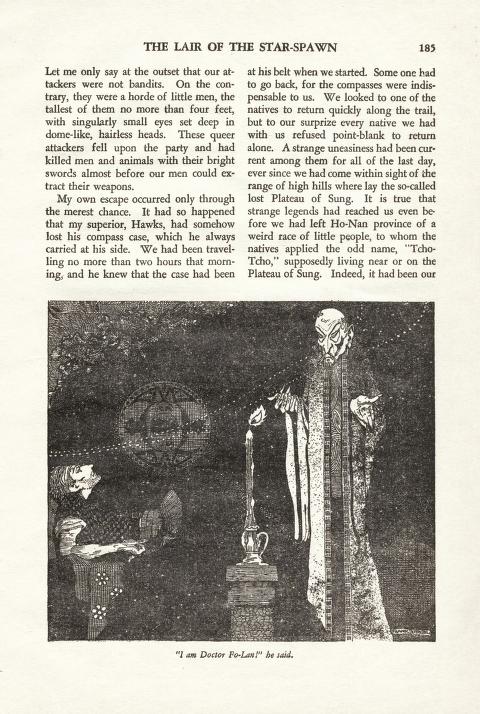
“The Lair of the Star-Spawn” became the title; the story was accepted and published in Weird Tales (Aug 1932). Among the elements that Derleth & Schorer added or referenced in the story were the Tcho-Tcho:

It is true that strange legends had reached us, even before we had left Ho-Nan province, of a weird race of little people, wo whom the natives applied the odd name, Tcho-Tcho, supposedly living near or on the Plateau of Sung.

So the Hawk Expedition proceeded into Burma (present-day Myanmar). The story in many ways is a very typical Lost World/Lost Race narrative, comparable to H. Rider Haggard’s She (1886), Edgar Rice Burrough’s At the Earth’s Core (1914), Robert E. Howard’s “The Slithering Shadow” (1933) and “Red Nails” (1936), C. L. Moore’s “The Tree of Life” (1936), and many others—only with a Mythos twist, as the Tcho-Tcho are servants of Lloigor and Zhar. The descriptions of them are stereotypical:

[…] the tallest of them no more than four feet, with singularly small eyes set deep in dome-like, hairless heads. These queer attackers fell upon the party and had killed men and animals with their bright swords almost before our men could extract their weapons. […]

The Tcho-Tcho people could not believe them dead, since it is impossible for them to conceive of such a weapon as a gun. At base, they are very simple people. Yet they are inherently malevolent, for they now that they are working for the destruction of all that is good in the world. […]

Then the Old Ones, the Elder Gods, returned to the stars of Orion, leaving behind them ever-damned Cthulhu, Lloigor, Zhar, and others. But the evil ones left seeds on the plateau, on the island in the Lake of Dread which the Old Ones caused to be put here. And rom these seeds have sprung the Tcho-Tcho people, the spawn of elder evil, and now these people await the day when Loloigor and Zhar will rise again and sweep over all the earth!

Damning an entire species to be unapologetically or uncomplicatedly “evil” from birth is a gross oversimplification—but easy moralities play well in politics, pulp stories, and fairytales; J. R. R. Tolkien would do much the same thing with Orcs in his legendarium, with all the unfortunate implications still being worked out decades later. It’s not necessarily a problem of having a group of antagonists depicted as irredeemable—its the use of racialist language, ideas, and reasoning behind it.

Like the Inutos of “Polaris,” the Tcho-Tcho are depicted as aggressive, primitive, and adversarial to the main viewpoint of the story; Lovecraft doesn’t make the Inutos explicitly evil (or the men of Lomar good), but the framing of the story as a quasi-fable of the Yellow Peril would establish those relationships with the readers. Derleth & Schorer are if anything more explicit, even if they make the Tcho-Tcho a “race apart,” from both the Caucasian Eric Marsh and the Chinese Dr. Fo-Lan.

If it had been a one-off story where the Tcho-Tcho were never mentioned again, this would be worthy of a footnote—none of them appear to survive the end of Derleth & Schorer’s tale, though Derleth references them again in “The Thing That Walked On the Wind” (1933) and a few later stories; “The Sandwin Compact” (1940) moves them from Burma to Tibet—but of course, it didn’t end there.

“Do you remember,” he shouted, “what I told you about that ruined city in Indo-China where the Tcho-Tchos lived? You had to admit I’d been there when you saw the photographs, even if you did think I made that oblong swimmer in darkness out of wax. If you’d seen it writhing in the underground pools as I did. . . .”
—H. P. Lovecraft and Hazel Heald, “The Horror in the Museum”

Of earthly minds there were some from the winged, star-headed, half-vegetable race of palaeogean Antarctica; one from the reptile people of fabled Valusia; three from the furry pre-human Hyperborean worshippers of Tsathoggua; one from the wholly abominable Tcho-Tchos; two from the arachnid denizens of earth’s last age; five from the hardy coleopterous species immediately following mankind, to which the Great Race was some day to transfer its keenest minds en masse in the face of horrible peril; and several from different branches of humanity.
—H. P. Lovecraft, “The Shadow out of Time”

Lovecraft doesn’t expand much on the original conception of the Tcho-Tcho, aside from adding the “s” for a plural; he places them alongside the Serpent-People of Robert E. Howard’s “The Shadow Kingdom,” the Voormi of Clark Ashton Smith’s “The Seven Geases,” and his own Elder Things from At the Mountains of Madness—all in good fun, just an inside joke for astute readers and members of the gang. Yet it cemented, if that was necessary, the Tcho-Tcho as part of the Mythos.

For many readers the occasional references to the Tcho-Tcho people encountered in Cthulhu Mythos fiction do not really register. Aren’t these hard-to-prounounce people just one more of the so-called “servitor-races” of the Old Ones? So what?
—Robert M. Price and Tani Jantsang, “The True History of the Tcho Tcho People”
in Crypt of Cthulhu #51, 24

Unlike the Inutos, several later authors decided to elaborate on the Tcho-Tcho, to various purpose and effect. The term “servitor-races” that Price and Jantsang use is particular to the Call of Cthulhu Roleplaying Game, and is exemplary of the problem that the Tcho-Tcho embody: the long shadow of the Yellow Peril, sliding uncomfortably into the contemporary day. Call of Cthulhu came out of Runequest which came out of Dungeons & Dragons, which based itself on the borrowed racialist terminology of later 19th and early 20th century popular fiction: scientific romance, science fiction, fantasy, pulp fiction, Lost World and Lost Race tales, The Hobbit and The Lord of the Rings, Robert E. Howard, H. P. Lovecraft, Clark Ashton Smith, Fritz Leiber…and more, but the gist is that in the translation to the roleplaying milieu, the Tcho-Tcho, Deep Ones, and other strange critters of the Mythos were translated into D&D-esque terms: where Tolkien (and thus D&D) had “races” of Elves, Dwarves, Orcs, and Humans, CoC had Humans, Deep Ones, Serpent People, Voormis, and Tcho-Tcho.

The habit of thinking of groups of sentient humanoid entities as biologically and culturally distinct from anatomically modern humans and essentially not human and morally irredeemable can be problematic in and of itself—there are plenty of parallels to scientific racialism and racial discrimination, which some authors of the Mythos have explored, such as in “The Doom That Came to Innsmouth” (1999) by Brian McNaughton & “The Litany of Earth” (2014) by Ruthanna Emrys.

In the case of the Tcho-Tcho, there are added wrinkles: their original placement in Southeast Asia, and subsequent movement around Asia by different authors, their depiction as inherently autochthonous and antagonistic to “human” life, and their initial description aspects of Asian visual stereotypes (short stature, different eyes), has allowed them to pick up several more Yellow Peril characteristics in their general depiction. Many Call of Cthulhu Roleplaying Game products, including spin-offs like Delta Green, depict the Tcho-Tcho as Asian characters, often conflating them with negative stereotypes as criminals and drug-dealers.

The issue of the Inutos and the Tcho-Tcho is a problem that transcends the Cthulhu Mythos. Those are symptoms, the result of many different writers working independently toward different goals, not stepping back to consider where some of the conceptions they were using came from or how they were being used. Fantasy racism can be used to explore some of the consequences of real-life racial discrimination and prejudice in a way that echoes the experience of ethnic minorities without calling them out…and it can be used very lazily, so that Tcho-Tcho (or Orcs,  etc.) can serve as easy villains and faceless fodder for the heroes to kill without moral compunction.

It is seductively easy to use stereotypes to apply to entire groups of people. That’s why pulp fictioneers did it; painting with a broad brush, using tropes the readers were familiar with, they could sketch out stories quickly and the reader could suspend disbelief. It is also why many people use it today; discrimination is terribly easy, appreciating the nuance and complexity of human relationships and seeing them as individuals rather than representatives of a group is hard.

Perhaps because of the initial complexity of “The Shadow over Innsmouth,” and their tremendous popularity, the Deep Ones have gotten a lot of attention and engendered a good deal of sympathy from later Mythos writers. The Tcho-Tcho have not attracted anything like the same level of development or empathy, and have fallen into a very weird space where they have largely become “acceptable villains” in Mythos roleplay and fiction—and, if they have not already, are in danger of becoming nothing more than a Mythos-flavored Yellow Peril.


Bobby Derie is the author of Weird Talers: Essays on Robert E. Howard & Others (2019) and Sex and the Cthulhu Mythos (2014).
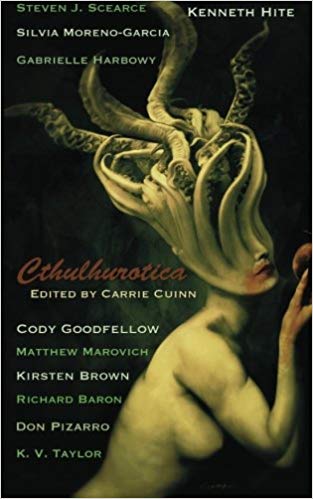
“Riemannian Dreams” (2010) by Juan Miguel Marín

He was getting an intuitive knack for solving Riemannian equations, and astonished Professor Upham by his comprehension of fourth-dimensional and other problems which had floored all the rest of the class.
—H. P. Lovecraft, “The Dreams in the Witch House”

What inspired your story? The weird quasi-Lovecraftian speculations behind Einstein’s theory of relativity and its Riemannian mathematics.
Interview: Juan Miguel Marín

When it comes to the erotic possibilities of the Lovecraft Mythos, “The Dreams in the Witch House” and “The Whisperer in Darkness” may not jump immediately to mind, much less German mathematician Georg Friedrich Bernhard Riemann (1826-1866). Yet that is what Juan Miguel Marín attempts in his entry for the Cthulhurotica anthology…and not without some success. Whether Marín knew it or not, his particular approach of visitations of the Lovecraftian erotic through dreams echoes certain critical interpretations of Lovecraft’s “The Dreams in the Witch House”:

But something significant happens in this dream. Keziah thrusts into Gilman’s right hand “a huge grey quill” with which to sign his name to the devil’s book and to provide the necessary blood. Brown Jenkin races across his body, up to his shoulders and down his right arm, to bite him in the wrist, causing a “spurt” of blood at which Gilman faints. The next morning “his cuff was brown with dried blood.” The stories of the devil’s book are, let us admit, rather unimaginative, but they conceal a masturbatory fantasy that seems actually at work here. Gilman faints away because he cannot accept the wet dream.
—Robert Waugh, “The Ecstasies of ‘The Thing on the Doorstep’, ‘Medusa’s Coil,’ and Other Erotic Studies” in A Monster of Voices 101

“Riemannian Dreams” begins as an echo of Riemann’s own mathematical proofs, stating the facts as clearly as he can, but also a kind of dream-diary. The timeline is unclear; Riemann died in 1866, but he feels the dreams were inspired by the Edison wax phonograph, c.1899; other references to “The Dreams in the Witch House” and “The Whisperer in Darkness,” and Einstein’s theory of relativity put it somewhere between 1905 and the 1920s. Perhaps this is not the Bernhard Riemann, but another professor; or some alternate timeline where Riemann survived another forty or fifty years.

The lack of certainty is a hallmark of Marín’s narrative. For the most part, readers are presented with bits and pieces, notes and letters, fragments of a story that build up to suggest a narrative. This echoes how Lovecraft would do much the same thing with “The Whisperer in Darkness” and other tales, although the connective tissue is a bit thinner here; the dates not quite adding up is one example, but more importantly, we gain no real glimpse of Riemann’s waking life—his protestant faith, his wife, where he lives and works, though there are references to teaching. The material world is faint, hazy, dream-like, but the dream sequences themselves are vivid.

Riemann’s wet dreams are queer; they do not fall easily into any particular spectrum of sexuality, the subjects of his attention being particularly fluid—now male, now female, sometimes both.

In the first lucid dream I could glimpse only a young, pale, androgynous face, which the water ripples sometimes hid, sometimes revealed. I could not tell whether the atractive stranger was a boy or a girl. I could only notice the blond-auburn hair, pale skin of a healthy pinkish color, rose-colored cheeks, rosy red lips, and the eyes… […] I see now a beautiful backside. Like mine, also covred with nothing but a loincloth. My scientific curiosity tries to find out more about those lovely hips but the mist prevents me.
—Juan Miguel Marín, “Riemannian Dreams” in Cthulhurotica 72-73

The “scientific curiosity” is a hallmark of the Lovecraftian protagonist, the libidi sciendi, the desire to know. It’s tempting to look for metaphors here in Riemann’s efforts to define the nature of the subject of his desires, a quest for self-knowledge of his own sexuality as much as an effort to define an external reality. The subjects of his dream-vision, however, are a bit outside of those dreamt in this particular Horatio’s philosophy…at least at the start.

As an episode, “Riemannian Dreams” occupies a bit of an odd place in the Mythos. It is not situated clearly in respect to any time and place, but the connections between this story and “The Dreams in the Witch House” and “The Whisperer in Darkness” are established clearly and deliberately, but not the timeline. It’s not quite sequel, prequel, or interqual, simply an episode. Contrast this to a story such as “The Dreams in the Laundromat” by Elizabeth Reeve in Whispers in Darkness: Lovecraftian Erotica, which takes care to establish setting and continuity, set after “The Dreams in the Witch House” and focusing on the continuing legacy of Keziah Mason and Walter Gilman. “Riemannian Dreams” walks a fine line between mathematical logic and dream logic; fitting, since ultimately that is the choice which Riemann is presented with at the end.

What is your favorite bit?

“…leaving me covered in salty sweat, uncomfortably wet, and, unfortunately, awake.”
Interview: Juan Miguel Marín

“Riemannian Dreams” was published in Cthulhurotica (2010), and has not yet been reprinted. Juan Miguel Marín is also the author of “The Bats in the Walls” (2010).


Bobby Derie is the author of Weird Talers: Essays on Robert E. Howard & Others (2019) and Sex and the Cthulhu Mythos (2014).

“Legacy of Salt” (2016) by Silvia Moreno-Garcia

The Mayans thought the cenotes were portals to the realm of the dead, Xibalba, but his family called it by another name, Y’ha-nthlei, and the cenote was Yliah’he. It had no meaning in Mayan, this was an older language, the elders had told him. A language from before the Conquest, before the great pyramids rose upon the limestone bedrock of Yucatán. Much of the knowledge had been lost through the years, but some true names and words remained. Yliah’he.
—Silvia Moreno-Garcia, “Legacy of Salt” in The Mammoth Book of Cthulhu 324

The Mythos, from its small hard core of writings by Lovecraft and his contemporaries, has been spun out by many writers in many ways. That is the great gift of it: being able to play with the ideas, to have readers trace the shape of old stories and old ideas, newly embodied: refreshed, reincarnated, yet recognizable.

Scene: Yucatán, the 1960s. An old family, an old house; echoes of Edgar Allan Poe, the shadows a little darker in the harsh tropical sunlight. The family name is Marin rather than Marsh; there is no Devil’s Reef, but there is the cenote Yliah’he.

A Mexican Innsmouth, a new corner of Lovecraft country.

The story itself is a romance, almost a telenovela; we know this story even if we haven’t read it before. Will they/won’t they? There are all the usual and unusual obstructions: a fiance back in Mexico City, the call of the modern world, the titillating hint of incest. Yet Silvia Moreno-Garcia carries us through admirably. She knows these waters, the details that make the setting pop, the buttons to push to keep the reader wondering, until the very end, which way it will go.

Silvia Moreno-Garcia wrote “Legacy of Salt” around the time she was reading a lot of philosophy of biology materials and also a Darwin biography as part of her Master’s degree studies. “Some of the scientific issues I was exploring collided with this story. I have always found ‘The Shadow Over Innsmouth’ to be fascinating since it seems to dip its toes into the notion of repulsion/attraction. Is it such a bad thing to swim eternally in underwater palaces? I kind of like the idea. The Yucatán peninsula is definitely nothing like New England but the numerous markers for archaeological sites somewhat reminded me of the nation of the past creeping upon the present, which occurs in some of Lovecraft’s fiction.”
The Mammoth Book of Cthulhu 312

Unlike “Ahuizotl” (2011) by Nelly Geraldine García-Rosas or “Mail Order Bride” (1999) by Ann K. Schwader, there is very little of horror in this story, and that which remains is mixed with fascination. The protagonist, Eduardo Marin, has tragedy in his life—father dead in a car crash, a mother that abandoned him to start a new family—but there is nothing as traumatic to the family as a whole as the raid on Innsmouth which overshadows and informs “All Our Salt-Bottled Hearts” (2016) by Sonya Taaffe and “The Litany of Earth” (2014) by Ruthanna Emrys.

Except in the sense that the Marins are survivors; remnants of some family line that dates back before the Conquest of Mexico. There are hints throughout the story, references to the Mayan rain-god Chaac, in the shape of a frog, but nothing specific. Hints, remnants, just enough to whet the imagination. The lack of knowledge, loss of knowledge, is the great sub-theme of this story. The biological and material “legacy of salt” is undeniable, but there is a loss of cultural knowledge keenly felt…and that too is a legacy of the Conquest.

“Legacy of Salt” was published in The Mammoth Book of Cthulhu (2016), and has not yet been reprinted. Silvia Moreno-Garcia has been an editor, writer, and translator. Her Lovecraftian fiction includes “Flash Frame” (2010), “In the House of the Hummingbirds” (2012), “The Sea, Like Broken Glass” (2014), and “In the Details” (2015), and her latest novel is Mexican Gothic (2020).


Bobby Derie is the author of Weird Talers: Essays on Robert E. Howard & Others (2019) and Sex and the Cthulhu Mythos (2014).
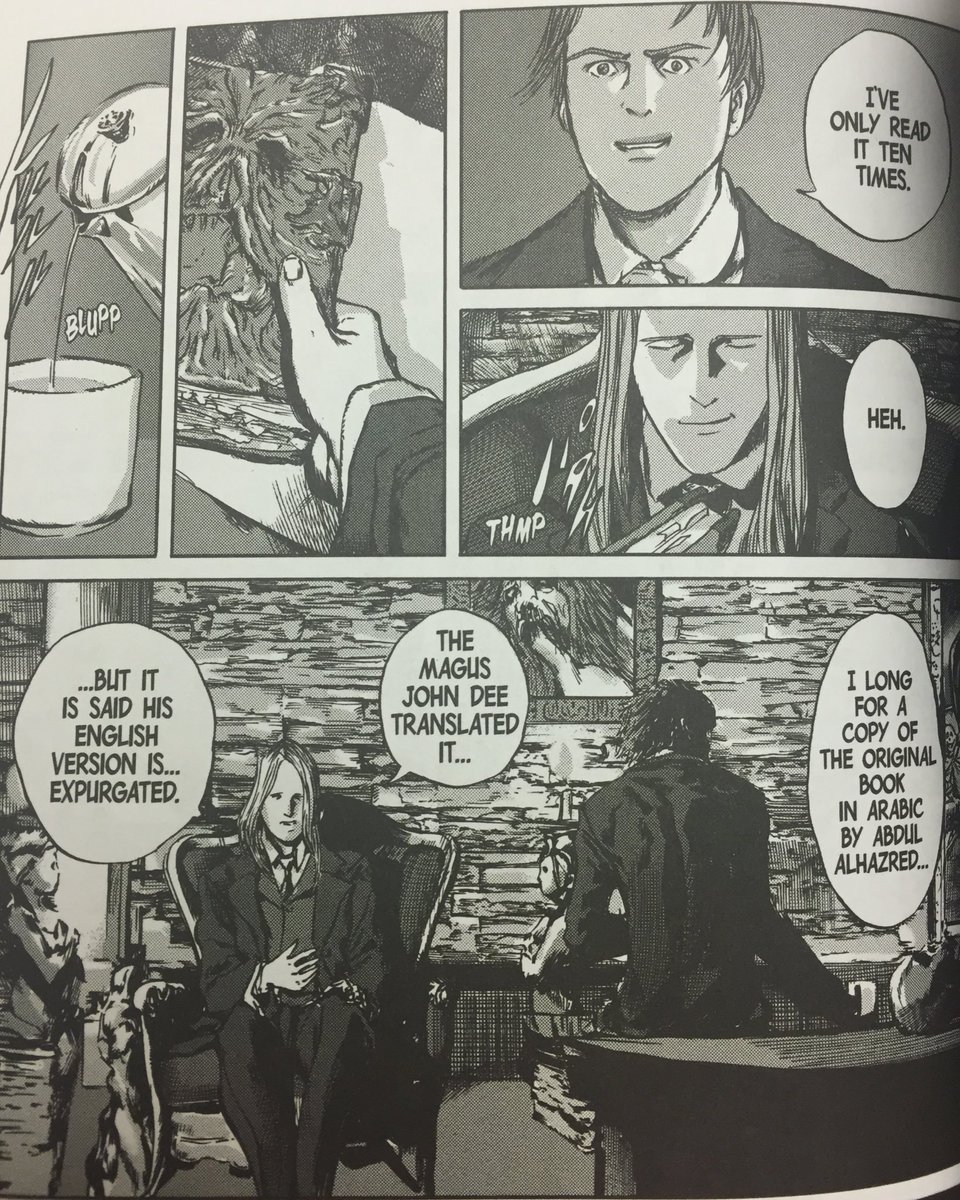
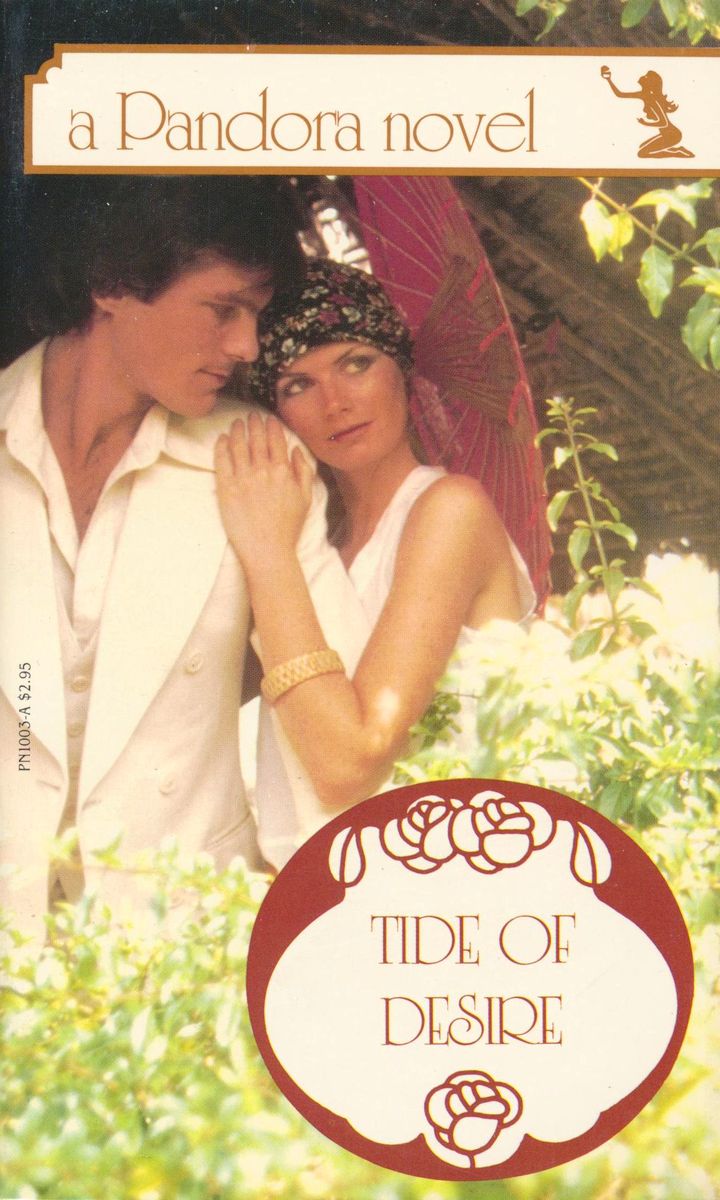
Tide of Desire (1983) by Sheena Clayton

“Their religion? You mean, they have one of their own?”

“The Reformed Order of Dagon. It’s a branch, or a schism of a church that was founded in Massachusetts about a hundred and fifty years ago. As I understand it, the main body of the church was stamped out by some pretty high-handed federal action back in the nineteen-twenties. But they never got around to bothering the Squampottis bunch, either because they’re so isolated, or because cooler heads prevailed in Washington. The thing in Massachusetts was remarkably well hushed-up. All the relevant government records have been destroyed.”
—Brian McNaughton, Tide of Desire (1983)

The very first erotic novel to deal with the legacy of Innsmouth came from the typewriter of Brian McNaughton. Active as a fan during his teenage years in the 1950s, McNaughton was briefly a journalist before turning his hand to erotic novels, starting with In Flagrant Delight (1971). His “break” came in the late 70s when he began producing erotic horror novels, starting with Satan’s Love Child (1977)—the publisher’s title, not his—which included elements of or references to the Cthulhu Mythos. It was successful enough to merit several other books, and McNaughton transitioned back over into doing mainstream horror in Weirdbook and other publications, and won the World Fantasy Award for Throne of Bones (1997).

Erotic horror wasn’t exactly new, as Grady Hendrix notes in Paperbacks from Hell: The Twisted History of ’70s and ’80s Horror Fiction, sex has long been a selling point and those two decades saw a boom in erotic horror and horror erotica. Still, this was a decade before Ramsey Campbell’s Scared Stiff: Tales of Sex and Death (1987) or the anthology Hot Blood (1989), and erotic horror fiction of the period tended to work off existing properties like Universal Monsters or classic horror novels—The Adult Version of Dracula (1970) and The Adult Version of Frankenstein (1970) being exemplary of the latter trend. By comparison, Lovecraft was largely a virgin field for erotic horror, or at least not entirely played out.

Beginning in the early 1980s, McNaughton wrote a series of erotic novels for Tigress Books. These were written under the pseudonym “Sheena Clayton,” and the line itself may have been aimed more at a female audience than typical adult novels of the period, a more hot-blooded and explicit counterpart to mainstream romance novels. The books tend to feature female protagonists and writers with female names, and the relatively sedate photo covers give the impression. On the name, McNaughton once wrote:

Sheena Clayton was the illegitimate daughter of Sheena, Queen of the Jungle, and
John Clayton, Lord Greystroke. I channeled her in several novels, of which TIDE OF
DESIRE may have been the best. (Sex and the Cthulhu Mythos 202)

These novels were Love and Desire (1982), The Aura of Seduction (1982), Tide of Desire
(1982/3), Danielle Book Two (1983), There Lies Love (1983), and Perfect Love (1983). All of these to greater or lesser extant contain references to the Mythos. For example, Edward Pickman Derby appears briefly as a member of a “Rats in the Walls”-esque Magna Mater cult in Love and Desire; Ramsey Campbell’s Lovecraftian fictional grimoire Astral Rape from his novel The Parasite (1980) is prominent in Danielle Book Two; and the cult in Perfect Love was founded by a Rev. H. P. Whateley from Arkham, Massachusetts.

Inside the door, Cthulhu ran up with a hearty meow, and he seemed just as glad to see Melisande as herself. The girl was quite indifferent to him, however, perhaps even a bit impatient with his rubbing against her ankles.

“Scat!” Antonia cried, moving him along with a nudge of her toe. “Cthulhu doesn’t normally take to strangers.”

“Who?” The girl seemed startled, even shocked.

“Cthulhu. That’s the cat’s name.”
—Brian McNaughton, Tide of Desire (1983)

The style of the novel partakes strongly of the Derlethian combination that Lovecraft’s fictional works exist in the world of Tide of Desire, and that the stories chronicle at least partially real events, so that the Mythos definitely exists. A good point of comparison might be Robert Bloch’s novel Strange Eons (1979). More interesting for fans of McNaughton’s later Mythos fiction is that several of the concepts for the Deep One culture are carried over between the novel and his story “The Doom That Came to Innsmouth” (1999). For example, the idea of a Deep One hybrid transitioning from land to water is called “Passing Over”:

“Dagon flay me alive! Ye be right! What an old ninny I be! Our Caleb’s daughter, she passed over a good ten-fifteen years ago. I ain’t seed her lately, but she be down there, don’t you worry. You look like her; that got me all confused. You look like her before she passed over, I mean. I never seed her before she passed over, of course, but I got her picture as a girl someplace. Our Caleb sent pictures of him and his mainland wife and all their kids to prove that the kids didn’t have the look, no more’n he did. But that girl sure did, all right. Poor Caleb. He was right about hisself, he never passed over, but he never told his daughter a word about the Blessing of the Deep Ones. So there she lied, passing over in the middle of nowhere, miles from the sea, and not knowing what the hell were happening to her.”

Mrs. Nicker mumbled to herself as she debated the whereabouts of the photograph she’d mentioned. Then she said to Antonia: “But by pure luck-or more likely it were the hand of Dagon stretching out to help her-there were this colored man from New Orleans who knew somewhat about the doings of the Deep Ones, and he told her she had better get herself to the sea, fast. She paid him to help her, and he took her to… where? To Charleston, South Carolina, that’s right! So she got there just in time to pass over. Then she come to Squampottis and told us all about it. It were the most exciting thing happened on this here island since the visitation of Shug-N’gai, just after the federals smote all them blasphemers and heretics at Innsmouth. That were in nineteen-and-twenty-eight, I do believe. Who says my memory ain’t perfect, hey? Don’t you try to tell me about our Caleb, boy. You wasn’t even borned then.”
—Brian McNaughton, Tide of Desire (1983)

The gist of the novel is that the protagonist, Antonia Shiel, is herself a descendant of the Deep Ones whose body is preparing to “cross over,” encountering a splinter sect of the Esoteric Order of Dagon on Squampottis Island—and realizing too late that she herself has the “Squampottis look.” the changes in herself adding a touch of body horror to the novel as her hair falls out and her feet swell…all of which are undone by the ending.

“Your hair seems to be thicker all of a sudden,” he noted admiringly. “That lovely pubic patch is just like a beautiful young woman’s, and not bare like a child’s. And the hair on your scalp looks thicker already.” (ibid)

The novel comes to an abrupt, jarringly disconcerting “happy ending” very atypical for McNaughton’s novels, as the novel was bowdlerized badly by the editors. McNaughton found the original ending and was revising Tide of Desire for eventual publication at Wildside Press, under the title Riptide. However, McNaughton’s untimely death in 2004 appears to have ended any plans to republish the novel. We can only speculate what the original ending would have been, but given that the story as a whole is a kind of contemporary, sexually explicit update to “The Shadow over Innsmouth,” it would have been both appropriate and in keeping with the tone of the novel if Antonia had “passed over” and joined the Deep Ones.

It would be wrong to say that Tide of Desire, or any of the Sheena Clayton novels, were influential. Pornography is ephemeral literature, and the novels didn’t make much of a splash in Lovecraftian circles when they came out. Which is unfortunate because, as Matthew Carpenter notes in his own review and synopsis, this is actually a very competent Mythos novel, and presaged some of the ideas developed independently by later writers. Sonya Taaffe in “All Our Salt-Bottled Hearts” (2016) wrote about some hybrids that don’t make the transition, and McNaughton wrote:

“It’s me that’ll die, it’s me that’ll be dumped into the ground like dead meat.” She began to sob bitterly, clawing at the arms of the chair with abnormally large hands. “Oh, you should see Rev. Preserved. He’s like an angel! Just last month I seed him in all his glory at Marsh Cove, taking no less than a dozen of our maidens, and our Melly one of them. Whether she be carrying his child or not, I don’t know, it be too soon to tell. When Rev. Preserved told me to have faith, I nearly believed it. He were like a god walking on earth. He said I’d pass over yet, but I don’t believe him now. Dead meat in the churchyard, that’s where I be bound.” (ibid.)

Tide of Desire is not quite the spiritual ancestor of erotic Deep One works such as The Innsmouth Porno VHS (2014), Innsmouth After Dark (2014), Taken By The Deep Ones (2015), Ichythic in the Afterglow (2015), and The Pleasures Under Innsmouth (2020). There is rather less sex, and that less explicit, than one might think; there are no sexual encounters such as in Alan Moore and Jacen Burrows’ Neonomicon (2011).

Which makes sense, because Brian McNaughton was not writing an erotic story dealing primarily with sexual encounters with Deep Ones, a horror story not afraid to go into details like mature sexual relationships, body image issues over breast size and pubic hair, etc. Vulgar terms for genitalia are completely absent. One of the more explicit passages in the book is almost sedate by contemporary standards:

She’d had only two hours of fitful sleep, sleep plagued by distorted versions of her conversations with the Boggs boy and Rev. Marsh and Mrs. Nicker; by dreams in which she gazed on a hostile world through a black veil, where she lay wheezing in a dark bedroom in Hamlen, where a long-dead minister pinned her against the Joyful Pillar in the town square with ravaging thrusts of his phallus while Melisande Seale looked on with demonic glee. (ibid.)

More of a dry (wet?) run for the paranormal romance novel genre, in many respects.

Whatever the initial print run was, Tide of Desire did not become an instant collector’s item. Very few copies of any of the Sheena Clayton novels appear to survive, with Tide of Desire being noted as especially rare…at last in the English version.

tide_japan (1)

By a quirk of fate, Tide of Desire actually got a Japanese translation and publication in 1984. 謎に包まれた孤島の愛 was one of a number of erotic novels translated into Japanese for mail order. Although out-of-print, copies may still be available today on the second-hand market.

For those who do desperately desire to read this novel, while the paperback is long out of print, ebook editions (really text files, but beggars cannot be choosers) of the Sheena Clayton novels are available from Triple X Books.


Bobby Derie is the author of Weird Talers: Essays on Robert E. Howard & Others (2019) and Sex and the Cthulhu Mythos (2014).
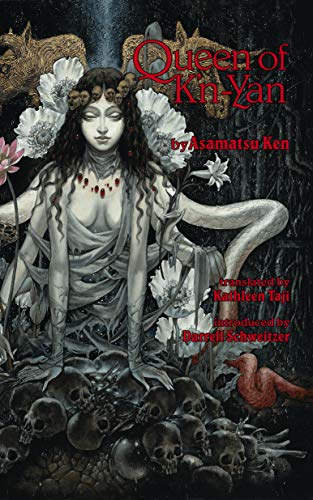
“The Nature of Faith” (2010) by Oscar Rios

In the early 90’s I got into the Cthulhu Mythos, from the works of R.E. Howard and the H.P. Lovecraft.  I’d been a role player for years playing Dungeons and Dragons, Star Frontiers and soon learned about the game Call of Cthulhu. […]

I started running Call of Cthulhu games at conventions… I started writing my own games… I started writing for Chaosium, the publisher of the Call of Cthulhu Role Playing Game…

Slowly the Call of Cthulhu Role Playing Game became a bigger and bigger part of my life.  I wrote more, became published more often, and even branched off into cosmic horror fiction.  Running scenarios at conventions soon became holding panels and seminars.  Writing my own scenarios became editing the scenarios of others.  Being published became publishing the works of others while working with Miskatonic River Press.  Then that changed to being in charge of a small publishing house producing supplements for the Call of Cthulhu Role Playing Game.

Then I stopped and looked back… to realize that twenty years has gone by.
—Oscar Rios, “Twenty Years Searching For The Necronomicon” (2013)

The Call of Cthulhu Roleplaying Game is undoubtedly one of the most critical vectors of infection for disseminating Lovecraft and the Mythos into the popular consciousness. Certainly, Weird Tales and Arkham House did their parts, popular paperback editions from Ballantine and Del Rey assured a wider audience, Hollywood films like The Dunwich Horror (1969) and Re-Animator (1985) spread the word. Yet after the death of August Derleth, it was Chaosium that launched its Call of Cthulhu Fiction line, reprinting both long-out-of-print classics and introducing new authors into the field. The roleplaying game has an international scope and appeal, and has attracted talented artists and writers.

Oscar Rios had been writing for Call of Cthulhu for six years when “The Nature of Faith” was published in Cthulhu’s Dark Cults: Ten Tales of Dark & Secretive Orders (2010). The roleplaying game roots show, but only if you’re already familiar with the material. The Order of the Silver Twilight, mentioned in passing, is from the Shadows of Yog-Sothoth campaign. This isn’t a gaming scenario re-cast as a novella, just an original work of fiction from someone steeped in the setting and its lore.

In a real way, the story is a love-letter to Dunwich, both as Lovecraft first described it and as it developed with the additions of other authors. It should be considered in the context (if not actually the continuity) of “The Devil’s Hop Yard” (1978) by Richard Lupoff & “The Cry in the Darkness” (2011) by Richard Baron, although unlike those stories it makes no mention of the Whateleys at all. The character of Gertrude “Gerdy” Pope, in particular, whose near-albino appearance is so evocative of Lavinia Whateley and Hester Sawyer, explained here as a “type” that shows up in Dunwich on occasion.

If there’s a flaw in the story, it might be a penchant for organization and exposition. When Rios writes:

Gerdy’s understanding of the Believers history was scant, but she knew they were a secretive group dedicated to worshiping nature, studying various forms of magic, and living in harmony with the world around them. Exactly the type of organization that appealed to her sensibilities.

The first Believers had apparently come to Dunwich from Salem, fleeing the witch hysteria that swept through that coastal community. It was said they were led here by dreams, unconscious calls beckoning them to these hills. For hundreds of years the Believers have lived in Dunwich, elarning much about the landscape’s unqiue and still-mysterious history. Many knew they were not the first people called here, and some suspected they would not be the last. Gerdy had seen enough of their inner workings to know that Believers varied in the nature of their gifts, abilities, and worship, but one rule was universal within their cult: secrecy.
Cthulhu’s Dark Cults 136

It’s almost a write-up from a setting-book, and certainly more in line with New Age-y, Wicca-oriented, post-WWII fiction than the rather more sinister and nameless cultic activities of Lovecraft’s “The Dunwich Horror” or August Derleth’s The Lurker at the Threshold (1945).

Which is not to say that the Believers don’t have their darker aspects, nor that there aren’t more mysteries left unspoken than laid out plain. It’s notable that the plot is mainly focused on the women of the townGerdy, Mother & Marie Bishop, Virginia Adams, Ne’seal, Celestia. The story wouldn’t pass the Bechdel Test, but by Mythos standards it has much more female representation than typical. But then, the gist of the story boils down to gender politics, with the intrusive, logical male outsider invading the peaceful, intuitive, female-dominated Dunwich. And hinted at being part of a cycle of such things.

“Men!” she proclaimed aloud, “ya never listen. Mebbe next time.”
Cthulhu’s Dark Cults 152

A bit of an inversion from “The Dunwich Horror,” where Lavinia Whateley is used, sidelined, and ultimately disappeared; the female playing her role and then ushered quickly off-stage. Yet not exactly progressive either; there are still stereotypes at play here, both male and female. It is difficult to break out of those ideas of gender roles and actions, in any mode of fiction.

Oscar Rios’ “The Nature of Faith” was first published in Cthulhu’s Dark Cults (2010), it has not been republished.


Bobby Derie is the author of Weird Talers: Essays on Robert E. Howard & Others (2019) and Sex and the Cthulhu Mythos (2014).