He noticed only the tiny waist, the flaring lower hourglass of her hips, and the bushy white triangle at the junction of her sturdy legs. He was so distracted that he didn’t notice the malformations on her flanks, her hips, the myriad tiny eyes embedded there, blinking lashless lids in the flickering orange glow. —Angela Slatter, “Lavinia’s Wood” in She Walks In Shadows 69
Readers and scholars often talk about the body of fiction inspired by Lovecraft in terms of religion and folklore. That is the nearest real equivalent we have to a very unusual phenomenon, where so many different authors are riffing off similar ideas, similar characters and stories. Terms like canon get thrown about a great deal, and some of Lovecraft’s own stories are as close to the Biblical canon get. Most authors agree that the events of “The Dunwich Horror” and “The Shadow over Innsmouth” happened, though they might fiddle with the details, and expand in different ways on what came before and after.
Yet the Mythos is not a single coherent body of internally-consistent works, or some divine text interpreted by many different authors. It is a sprawling mass of stories by different writers who often work in familiar cycles. The point is that not all of the stories do agree, or can agree. There is no one absolute, true, final, and complete version of any story. There are multiple different takes on the same subject, and they are often strongly divergent. Readers might be able to reconcile “The Dunwich Horror,” “The Shuttered Room” by August Derleth, “The Devil’s Hop Yard” by Richard Lupoff, and “The Cry in the Darkness” by Richard Baron as all being episodes in a single tale, but it is harder to fit in Lavinia Rising by Farah Rose Smith, The Dunwich Romance by Edward Lee, or “Lavinia’s Wood” by Angela Slatter.
At some point, there are too many differences to gloss, too many points of disagreement.
Too many different versions of Lavinia Whateley (or, in some versions, Whatley).
“The Dunwich Horror” is Lavinia’s story as much as that of her sons, though she is given short shrift by the folk of Dunwich. Various authors have expanded on her character. In some, she is a pure victim, like her predecessor Mary in Arthur Machen’s “The Great God Pan.” In many stories, Lavinia lacks agency, utterly dominated by her overbearing father Wizard Whateley. In a few, she is more active, even malevolent, an active participant rather than a meek vessel to be filled.
It is a rare story that suggests that Wilbur and his brother take as much from Lavinia as they do from Yog-Sothoth. Angela Slatter’s version in “Lavinia’s Wood” is more complicated than most, giving evidence of Lavinia’s dreams, desires, and actions that go far beyond the woman seen in Lovecraft’s account. Someone who dreams of a world beyond Dunwich, and who herself is not quite completely human.
There is a degree of pathos to Dunwich prequels. Readers already know Lavinia’s fate, or at least one of her possible fates. How she gets there is where authors diverge; what details they choose to emphasize, and what aspects of the character they develop in new directions. In “Lavinia’s Wood,” Angela Slatter gives Lavinia context. Social, geographic, biographical, biological. Lavinia as a part of the decayed Whateleys, in contrast to her richer and more educated cousins; as an outsider even among the inbred rural folk of Dunwich; her relation with her father and his books; and even how her body differed from others in ways not immediately obvious.
“Lavinia’s Wood” is not the prequel to “The Dunwich Horror.” It is one of many. Yet it is an interesting, insightful take on Lavinia, one that sheds a different light on the preceding events—and who knows what elements of that might make their way into further stories in the Dunwich cycle?
“Lavinia’s Wood” by Angela Slatter was first published in She Walks In Shadows, and its reprints. It has not otherwise been reprinted.
It was Arkham House that perpetuated the Big Lie in this case, and from there a mechanism of critical bandwagonism took off and continues to this day. The tenet is, if you tell a lie big enough and enough times, people will believe it. That’s why Lovecraft has been raved about for all these decades. It’s a big lie that readers have been force-fed by a pro-Lovecraftian syndicate designed to make money. —Edward Lee & Mary SanGiovanni, Strange Stones(2025) 3
Professor Robert Everard, who speaks those words at a horror convention, is a Lovecraft-hating asshole. That is his point. If the sentiment gets a rise out of you and makes you want to refute it, congratulations: the authors have succeeded at their characterization. It is a very unconventional way to draw readers into a rather meta short Lovecraftian horror novel, but Everard’s arguments and the context in which they take place are important to understand, because they’re fundamental to the plot of the novel.
Fiction genres in the sense that we think of them today tended to emerge around the turn of the 20th century. Western dime novels were a staple of 19th century popular literature in the United States; science fiction, mysteries, fan clubs, etc. all preceded the emergence of pulp magazines in the 1910s and 1920s, but it was really the pulp magazines that began to crystallize genre as we think of it today, and especially organized fandom as we think of it today. The horror conventions today are all descended, more or less, from the early science fiction fan conventions of the 1930s in the United States.
Genre is only secondarily a literary convention; the primary purpose was marketing. Specialization allowed pulp magazines to carve out niches and develop dedicated readership that they could directly market to. Magazines in the same genre competed with one another for the same dimes and quarters; Weird Tales had to struggle against Ghost Stories, Tales of Magic and Mystery, Strange Tales of Mystery and Terror, Terror Tales, Famous Fantastic Mysteries, Unusual Stories, and others, and tried to draw in readers from science fiction magazines like Astounding Stories, Amazing Stories, Wonder Stories, and Planet Stories.
Hardbacks, paperbacks, comics, and movie makers all learned this lesson, that specialization has the benefit of attracting a specific, dedicated readership. And once you have that audience, the quality of the content is less important than if it stays in genre. Decades of genre products have been, essentially, disposable pap, churned out quick and cheap for an eager audience that cared less about quality than if it was horror or science fiction. This is the kind of silly, low-quality stuff that gives genre media a bad name, but it’s also the stuff that’s generally predominant at any given moment. True genre classics are rare, and stand out because so much of the run-of-the-mill material is generic, familiar monsters and spaceships.
In this sense, what is a genre convention, then, then a target-rich environment? The earliest conventions weren’t entirely uncommercial, but they weren’t dominated by dealer rooms or particular creators promoting their latest film or book, which are common attributes of contemporary conventions. What creators and companies learned was that it’s a lot easier to sell your product if your customers are all in the same place; genre conventions in the United States in particular have become an important part of the economic ecosystem of various celebrities, independent dealers, small companies, and boutique shops.
The cultural phenomenon of the convention has developed to the point where it’s become a key aspects of organized fan culture, to the point of becoming the setting of new creative works, like I Am Providence: A Novel(2016) by Nick Mamatas and Screamland: Death of the Party(2012) by Harold Sipe, Christopher Sebela, and Lee Leslie. And it’s this crux of the commercialization of horror and the convention experience which forms the springboard setting for Edward Lee and Mary SanGiovanni’s novel Strange Stones (2025).
Richard Everard’s grudging kvetch against Lovecraft’s ascendance in horror media is in part a tongue-in-cheek jab at a genuine aspect of fandom and how Lovecraft and his Mythos have faced posthumous commercialization and pop culture significance way beyond its initial tiny dedicated genre audience. Everard’s own interaction with the convention circuit has been primarily a lecherous attempt to get in the pants of as many women as he could, a series of sexual conquests that is both a kind of wish fulfillment and a genuine recognition that yes, fans do hook up at conventions. Rachel Bloom wasn’t being entirely inaccurate with Fuck Me Ray Bradbury in the way genre literary figures can attract groupies.
There is a dark side to that, too: many prominent or even beloved genre literary figures have been revealed as sex pests or abusers. Alec Nevala-Lee’s excellent Astounding: John W. Campbell, Isaac Asimov, Robert A. Heinlein, L. Ron Hubbard, and the Golden Age of Science Fiction (2018) contains accounts of bad behavior by writers like Isaac Asimov, for example. This kind of contact between fans and creators is mainly possible because of events like conventions, where individuals who would normally be separated by hundreds or thousands of miles are brought into geographical proximity and with shared purpose.
So Everard is a caricature of specific figures in convention culture: a lecher (right there in the name: “Everard”/”Ever-hard”), a high-minded academic who snobbishly looks down on the tastes of the masses, a shit-stirrer more focused on selling his own books and tearing others down instead of creating something positive. All of which makes him less than sympathetic when he does encounter some real horror.
The back three-quarters of the short novel are a whirlwind tour through several of Lovecraft’s Mythos stories, but not in a way that readers might think. Lee and SanGiovanni are very carefully and deliberately introducing Lovecraftian settings like Innsmouth, Arkham, and Dunwich in ways that are very accurate to Lovecraft’s fiction—often focused on small details, which are then blown up and expanded upon—but not trying to pastiche Lovecraft’s particular style or language. So it is very deliberately Lovecraftian, with Everard’s familiarity with Lovecraft’s corpus letting him recognize where and when he is, yet at the same time the settings are fresh, parts of the setting that Lovecraft himself never put on the page.
Readers might be curious if there are any connections with Edward Lee’s “Hardcore Lovecraft” series which includes books like The Haunter at the Threshold and The Wet Dreams of Dead Gods. Strictly speaking, the answer is no; Lee’s own Lovecraftian novels remain very distinct in setting and approach, and Strange Stones is in general much less explicit in terms of violence, gore, and sexual activity. That doesn’t mean it isn’t there, but it is less prominent in the plot. In part because the focus of the story isn’t on titillation or exploitation-level sex and violence, while there is definitely transgressive grue and sexual activity, the pace of the story is such that the writers don’t dwell on it in anything like the detail of Lee’s more extreme solo works.
One important characteristic of Strange Stones, however, is that it is not nostalgic for Lovecraft. Works of the type “Lovecraft was right! The Mythos was real!” or revisiting old stomping grounds like Dunwich and Innsmouth can lead to much more watered-down horrors. Like Bela Lugosi’s Dracula or Boris Karloff’s Frankenstein or Lon Chaney Jr.’s Wolfman, there comes a point where Cthulhu becomes overly familiar, to the point that the appearance of the Big C comes across more as a friendly face than a stark horrific reality that haunts the imagination. A point Ken Hite touched on in “Cthulhu’s Polymorphous Perversity” in Cthulhurotica, discussing the plush toy incarnations of Lovecraft’s primal alien horror.
Instead, Lee and SanGiovanni present Lovecraft’s Mythos as terrifying.
Dismembered corpses. Perverse sexual defilements. Sudden violence. The Mythos in Strange Stones has all the subtlety of a Goatwhore album cover or an issue of Crossed by Garth Ennis and Jacen Burrows. Readers are going to have to make their way through dead babies, threats of anal assault by oversized piscine pricks, and an alien orgy in which dismembered torsos feature prominently. The Mythos is not a dry, abstract, intellectual horror in this novel; it is a living, breathing cult simmering with malice, madness, and strange and terrible hungers. That this is not quite as extreme in terms of sex and violence as Edward Lee gets up to on his own is not the same as saying that this novel is tame or soft in any way.
It is a difference in emphasis. Everard doesn’t see the clean Mythos that Lovecraft presented to the world, with its carefully-constructed narratives where all the orgies and most of the violence happens off the page. What Everard sees is Lovecraft with the blinders taken off; what Lovecraftian fiction could look like, if writers approached his Mythos with the imagination normally reserved for a particularly lurid Cannibal Corpsealbum or exploitation film. Fairly reminiscent in many ways of what Antony Johnston, Alan Moore, and Jace Burrows did in The Courtyard and Neonomicon, though without quite as elaborate a working-out of details.
Strange Stones is, after all, a fairly short novel, briskly paced, and not concerned with a unified theory of the Cthulhu Mythos as much as keeping the story moving through each step of Everard’s ordeal. While there is room for a sequel, as a one-and-done novel it stands alone effectively enough. While not perfect, it is fun and a quick read, quite unlike the majority of Mythos fiction published these days.
France, 1974. Jean Giraud (Mœbius), Philippe Druillet, Jean-Pierre Dionnet, and Bernard Farkas came together to create Les Humanoïdes Associés, a publisher for a new type of comic magazine: Métal Hurlant (“Howling Metal,” 1974-1987). Initially released as a quarterly and focused on science fiction, Métal Hurlant featured some of the best international comic artists of its time, as well as some of the most daring content, not just featuring sex, drugs, and rock & roll—but humor, horror, gory violence, politics, and philosophy.
The magazine was successful enough to inspire spin-offs in other countries, largely based, at least initially, on material translated from Métal Hurlant. So in the United States and Commonwealth countries, Anglophones could read Heavy Metal (1977-2023), with various special issues, spin-offs, graphic novels, and other projects; in Italy, the localized version of Métal Hurlant lasted only 12 issues (1981-1983), with several standalone Metal Extra issues, though the sister magazine Totem lasted longer (1980-1984). In West Germany, Schwermetall (“Heavy Metal,” 1980-1984) lasted a respectable 57 issues under its first publisher, and eventually ran to issue 219/220 (1998). Spain had their own translation of Métal Hurlant in the 1980s, the Netherlands had Zwaar Metaal (“Heavy Metal”), Denmark had Total Metal, Finland had Kylmä metalli (“Cold Metal”), Sweden had Tung Metal (“Heavy Metal”) and Pulserande Metal (“Pulsing Metal”), Turkey had Heavy Metal Türkiye…most of these international runs didn’t last long, but they spread the stories and art far and wide.
The creation of Métal Hurlant coincided with a number of other trends. H. P. Lovecraft, Robert E. Howard, Clark Ashton Smith, and other early contributors to the Cthulhu Mythos became more widely available thanks to paperback reprints, and with the death of August Derleth, Arkham House lost its grip on the Mythos. New anthologies like The Disciples of Cthulhu(1976) proved that anyone could now play with the shared universe that Lovecraft and his friends had created. Argentinian master Alberto Breccia began and completed a series of Lovecraft adaptations for comics from 1973-1979, many of which first appeared in the Italian magazine Il Mago. Underground comix in the United States like Skull Comix (1970-1972) were giving way to semi-prozines like Star * Reach (1974-1979), and publishers also found they could side-step the Comics Code Authority by publishing magazines like Creepy (1964-1983) and Eerie (1966-1983) instead of standard-size comics, all of which featured material inspired by or adapting Lovecraft. H. R. Giger’s Necronomicon art collection was published in 1977, and quickly inspired the aesthetic for the film Alien (1979).
There was, in other words, a small revolution in Lovecraftian art, comics, and fiction in the 1970s. Not all at once, but from many different angles—and Métal Hurlant, the international crossroads where underground American artists like Richard Corben; French masters like Mœbius, Druillet, and Nicollet; Swiss artists like Giger; and Argentinian masters like Breccia could all come together at once.
That is what happened in September 1978, when Les Humanoïdes Associés published a 150-page special issue of Métal Hurlant dedicated to H. P. Lovecraft. The idea was so attractive that the next year, the English-language Heavy Metal magazine released their own Lovecraft special issue to coincide with Halloween, and when Métal Hurlant was translated in Italy, they released a one-off Metal Extra special issue dedicated to Lovecraft.
All three of these magazines share certain common elements, largely because the English- and Italian-language productions included material translated from the French special Lovecraft issue. Yet they were each different as well…and that’s kind of fascinating in itself, how these three magazines represent three different takes on the material, each tailored for their respective audience.
What follows is a survey: what each Lovecraft special issue contains, and by comparison, what they do not contain. To avoid excessive repetition, each issue and its unique contents are discussed separately, and then a single section discusses all the shared features. Because this is a long, image-heavy post, a table with links is provided to aid navigation:
150 pages, counting covers, the table of contents, ads, etc., Métal Hurlant Special #33 bis (“extra”) was one of several themed issues released by Les Humanoïdes Associés, with the other themes including Fin du monde (“the End of the World”, #36), Rock (#39), Guerre (“War”, #42), and Alien (#43). Not every feature in this issue involves Lovecraft or the Mythos, but a majority do. There are errors in the table of contents as printed, so a full list is given here.
Features involving Lovecraft or his creations are marked in bold; color pages are marked [c].
Front Cover: H. R. Giger
“La cimetière” (illustration) by Souchu, 2-3
Advertisement for Heilman by Voss and A l’Est de Karakulac by Daniel Ceppi, 4
Table of Contents, 5
Edito triste./Edito gai by Philippe Manœuvre, 6
“La Chose” by Alain Voss, 7-12
“Lettres de Lovecraft” by François Truchaud, 13
“La Retour de Cthulhu” by Alan Charles & Richard Martens, 14-15
“La Nuit du Goimard: Un ecrivain nommé Habileté-à-l’amour” by Jacques Goimard, 16-18
“Le Monstre Sur le Seuil” by Norberto Buscaglia & Alberto Breccia, 19-29
“Je m’appelle Howard Phillips Lovecraft” by François Truchaud, 30-32
“L’Homme de Black Hole” by Serge Clerc, 33-36
“Hommage à HPL…” (uncredited), 37-39
“Petite bibliothèque lovecraftienne” by François Truchaud, 40-41
“La Trace Ecarlate” by Jean-Jacques Mendez & Daniel Ceppi, 42-43
“Excursion Nocturne” by Frank Margein, 44-47
“Le langage des chats” by Nicole Claveloux, 48-49
Untitled illustration by Richard Martens, 50
“L’Indicible Horreur d’Innswich” by Philippe Setbon, 51-52
“Amitiés Rencontres” by Vepy & Daniel Ceppi, 53-57
“Barzai le Sage” by Marc Caro, 58-65
Advertisement for Richard Corben’s Den, 66
[c] “Le Chef d’Œuvre de Dewsbury” by Yves Chaland & Luc Cornillon, 67-70
[c] “L’énigme du mystérieux puits secret” by Yves Chaland & Luc Cornillon, 71-74
“A la Recherche de Kadath” by François Truchaud & M. Perron, 75-78
“H. P. Lovecraft 1890-1937” by George Kuchar, 79-81
“Les Bêtes” by Dank, 82-84
Advertisement for Le Diable by Nicollet and Les Naufragés du Temps by Paul Gillon, 85
“Le Necronomicon” by Druillet, 86-96
Advertisment for La Boite Oblungue by Edgar Allan Poe and La Rivier du Hibou by Ambrose Bierce, 97
Advertismenet for Les Trafiquants d’Armes by Eric Ambler
“Les 3 Maisons de Seth” by Dominique Hé, 99-101
“Les 2 Vies de Basil Wolverton” by Yves Chaland, 102-103
Advertisement for back issues of Métal Hurlant, 104-105
Advertisement for Métal Hurlant posters, 106
[c] “H.P.L.” by Jean-Michel Nicollet, 107-109
[c] “Ktulu” by Mœbius, 110-114
“Plat du Jour” by Vepy & Daniel Ceppi, 115-117
“Le Pont Au Dessus de l’Eau” by Luc Cornillon, 118-119
“Cauchemar” by Alex Niño, 120-129
“H. P. Lovecraft au cinéma” by Jean-Pierre Bouyxou, 130-131
“L’Abomination de Dunwich” by Alberto Breccia, 132-146
Back cover by Richard Martens
Unique Content
Front Cover: A plate from H. R. Giger’s Necronomicon(1977).
“Cauchemar” (“Nightmare”) by Alex Niño is a 10-page black-and-white comic that showcases a series of nightmares realized in surrealistic and highly detailed form; Niño pays homage to the styles of other artists, naming Heinrich Kley, Arthur Rackham, Phillip Druillet, and Jean Giraud (Mœbius). Not explicitly Lovecraft-related.
Edito triste./Edito gai (“Sad Editorial/Gay Editorial”); “Edito triste” is written as by “Abdul Fernand Alhazred”, while the “Edito gai” (as in happy, not homosexual) is by Philippe Manœuvre. Both concern how the Métal Hurlant Lovecraft Special came together.
“Je m’appelle Howard Phillips Lovecraft” (“I am called Howard Phillips Lovecraft”) by François Truchaud is a brief biographical sketch of Lovecraft’s life, fairly accurate for the compressed time and space, with illustrations by Richard Martens and Druillet; the Druillet illustration is the same as the cover to the Lovecraft special issue of L’Herne(1969).
“La Nuit du Goimard: Un ecrivain nommé Habileté-à-l’amour” (“The Night of Goimard: A Writer Named Able-to-Love”) by Jacques Goimard is an essay on Lovecraft’s fiction, illustrated by Perry’s silhouette of Lovecraft.
“Le Monstre Sur le Seuil” (“The Monster on the Threshold”) by Norberto Buscaglia & Alberto Breccia is an 11-page black-and-white comic adaptation of Lovecraft’s “The Thing on the Doorstep.” Breccia’s art combines traditional pen-and-ink with collage, which leads a strange, otherworldly aspect to the artwork.
“L’énigme du mystérieux puits secret” (“The Riddle of the Mysterious Secret Well”) by Yves Chaland & Luc Cornillon is a 4-page color comic where an investigative duo investigates a mysterious well and uncovers some counterfeiters; slightly reminiscent in overall style to Hergé’s Tintin. Not explicitly Lovecraft-related.
“Lettres de Lovecraft” (“Lovecraft’s Letters”) by François Truchaud is a review of Lettres 1 (1978), the French-language translation of the first volume of Lovecraft’s Selected Letters. Illustrated by Mœbius’ cover for Lettres d’Arkham (1975).
“L’Indicible Horreur d’Innswich” (“The Unspeakable Horror of Innswich”) by Philippe Setbon is a short fiction that purports to be the last story written by H. P. Lovecraft, complete with a mock reproduction of the original manuscript written on an envelope, based on the famous At the Mountains of Madness envelope.
“Petite bibliothèque lovecraftienne” (“Little Lovecraftian Library”) by François Truchaud is a brief survey of Lovecraft-related material available in French publications, as well as some related publications such as The Occult Lovecraft (1975) and H. P. Lovecraft: A Biography (1975) in English.
Back cover by Richard Martens, based on a photo of Lovecraft.
Heavy Metal H. P. Lovecraft Special Issue (Oct 1979)
This material is taken, for the most part, from a bizarre and eldritch tome written in a strange tongue, the “Homage á Lovecraft” issue of Métal Hurlant. We trust it will add just the right touch to your Hallowe’en festivities. —Sean Kelly, editorial for Heavy Metal vol. III, no. 6
96 pages, counting the ads, table of contents, etc., which makes for a thinner magazine that can still be side-stapled. Heavy Metal magazine vol. III, no. 6 is part of the normal numbering rather than an extra or one-off issue. While it draws much of its material directly from the Métal Hurlant Lovecraft special, the publishers chose not to reproduce all of the Lovecraft material from the French.
What didn’t they translate? The text pieces, the Georges Kuchar reprint, several of the more humorous and less Lovecraft-related comics, a couple pages of Druillet’s Necronomicon, and oddly the Breccia adaptation of “The Thing at the Doorstep.” What remains isn’t exactly entirely dedicated to Lovecraft, either, so that the “Lovecraft” issue has rather less Lovecraft-related material in it than might be expected.
Maybe there was a crunch with time to put the issue together, or some issues with the right. However, they also added a few things that didn’t appear in the Métal Hurlant issue, notably the J. K. Potter cover and “The Devil’s Alchemist,” a work of fiction. Unlike the Métal Hurlant Lovecraft special, the majority of Heavy Metal pages are in color, including colorizing some works that were in black-and-white in Métal Hurlant.
Lovecraftian items are marked in bold; color pages are marked [c]; items from the Métal Hurlant special are marked with an asterisk (*).
Front cover (“Mr. Lovecraft”) by J.K. Potter
Advertisement for Strategy & Tactics, 1
[c] Table of Contents, 2
[c]Advertisement for Job Cigarette Papers, 3
“…Thirty-one…” (editorial) by Sean Kelly w/ J. K. Potter, 4
[c] Advertisement for The Encyclopedia of Science Fiction, 5
[c] “Final Justice” by Chateau, 6-14
[c] Advertisement for Heavy Metal posters, 15
[c] Advertisement for Heavy Metal subscriptions, 16
[*] “The Dunwich Horror” (“L’Abomination de Dunwich”) by Alberto Breccia, 17-25, 74-80
[c] [*] “Ktulu” by Mœbius, 25-29
[c] “Xeno Meets Dr. Fear and Is Consumed” by Terrance Lindall & Chris Adames, 30-31
[*] “The Thing” (“La Chose”) by Alain Voss, 32-37
[*] “The Beasts” (“Les Bêtes”) by Dank, 38-40
[c] [*] “The Man from Blackhole” (“L’Homme de Black Hole”) by Serge Clerc, 41-44
[c] [*] “H.P.L.” by Jean-Michel Nicollet, 45-47
[c] “Love’s Craft” by Sean Kelly & Matthew Quayle, 48-49
[c] [*] “Dewsbury’s Masterpiece” (Le Chef d’Œuvre de Dewsbury) by Yves Chaland & Luc Cornillon, 50-53
[c] Advertisement for back issues of Heavy Metal, 54-55
[*] “The Necronomicon” by Druillet, 56-61
[*] “The Language of Cats” (“Le langage des chats”) by Nicole Claveloux, 62-63
“Chain Mail” (letters page, but comic by Christopher Browne) 64
[c] Advertisement for Dragonworld, 65
[c] “Pat and Vivian” by Frank Margerin, 66-68
[c] “The Alchemist’s Notebook” by David Hurd & William Baetz, w/Walter Simonson, 69-73
[“The Dunwich Horror” continued, 74-80]
[c] Advertisement for The Grailwar by Richard Monaco, 81
[c] “Bad Breath” by Arthur Sudyam, 82-89
[c] Advertisement for Heavy Metal books/graphic novels, 90-91
[*] “The Agony Column” (“Amitiés Rencontres”) by Vepy & Daniel Ceppi, 92-96
Back cover (“Elizabeth”) by George Smith
Unique Content
Front cover: “Mr. Lovecraft” by J.K. Potter. Before digital image manipulation programs existed, Potter was producing strange, disturbing images with a combination of photographs, airbrush, and traditional pen and ink. The effects, with Potter’s imagination, could be quite stunning. In this instance, he uses it to place Lovecraft in a cosmic scene. Potter would lend his talents to several future Lovecraft-related projects, including the cover for Tales of the Cthulhu Mythos (1990).
“The Alchemist’s Notebook” by Byron Craft (as by David Hurd & William Baetz) is an original work of Mythos fiction, with illustrations by Walter Simonson. A note on the first page says that this story is “an excerpt from the novelization of the upcoming movie, The Cry of Cthulhu“—but the film never made it past pre-production (Cthulhu Calling: An Interview with Byron Craft). In 2016, Craft published the full version of the novelization as The Alchemist’s Notebook, which was later changed to The Cry of Cthulhu.
“Bad Breath” by Arthur Sudyam is an 8-page comic that is principally black-and-white with color tints on Selected panels and figures; it follows an amorous young man whose bad breath is impacting his love life, and the solution he attempts has horrific—and amusing—consequences. Not explicitly Lovecraft-related.
“Final Justice” by Chateau is a 9-page color comic where a couple in Europe to write a book on historical crimes watch the re-enactment of a medieval murder at an ancient chateau. Not explicitly Lovecraft-related.
“Love’s Craft” by Sean Kelly is a poem, accompanied by an illustration by Matthew Quayle. Tentatively Lovecraftian based on the title, but with no direct references to Lovecraft or the Mythos.
“Pat and Vivian” by Frank Margerin is a 3-page humorous comic about a woman awoken by a strange entity at the door. Not explicitly Lovecraft-related.
“…Thirty-one…” (editorial) by Sean Kelly, discussing Lovecraft in brief. Accompanied by a photo-manipulated image of Lovecraft by J. K. Potter.
“Xeno Meets Dr. Fear and Is Consumed” by Terrance Lindall & Chris Adames is a two-page color fantasy/horror comic with a distinct textured painting style. Young Xeno, asking a fundamental question about certainty, sets off in dreams to find Dr. Fear—and does. Not explicitly Lovecraft-related.
Metal Extra Speciale Lovecraft (Nov 1982)
Cui, questo numero speciale di Métal Hurlant e un vero e proprio “omaggio” nei limiti è nei termini in cui puo esserlo una realizzazione a fumetti. Essa però dimostra sino a che punto è giunta oggi l’influenza del “solitario di Providence” e del suo mondo di sogni, di miti, di realtà alternative. E’un “ommagio” che ciascun disegnatore o scrittore ha estrinsecato secondo la sua predisposizione, il suo modo di vedere, il suo atteggiaento mentale, culturale, di spirito. E cosi (non ci si meravigli di ciò) vi saranno controbuti (fumetti) “seri” e meno seri o aprtamente ironici, allucinati e satirici. Un autore è amato non soo quando si prende sul serio il suo universo incubico (come ne L’uomo del Buco Nero, Il capolavoro di Dewsbury, ecc.), ma anche quando ci si scherza su, fra il serio e il faceto (Cthulhu), lo si prende aperamente in giro (La traccia scarlatta, Escursione notturna, Il ritorno di Cthulhu e cosi via).
Hence, this special issue of Métal Hurlant is a real “homage” to the extent that a comic book production can be. However, it demonstrates how far the influence of the “solitary of Providence” and his world of dreams, myths, and alternative realities has reached today. It is an “homage” that each artist or writer has expressed according to his predisposition, his way of seeing, his mental, cultural, and spiritual attitude. And so (don’t be surprised by this) there will be “serious” and less serious or overtly ironic, hallucinatory and satirical counterparts (comics). An author is loved not only when his nightmare universe is taken seriously (as in The Man from the Black Hole, Dewsbury’s Masterpiece, etc.), but also when he is joked about, half-jokingly (Cthulhu), and openly made fun of (The Scarlet Trail, Night Excursion, The Return of Cthulhu, and so on).
Gianfranco de Turris, Metal Extra Speciale Lovecraft, 5
English translation
Instead of trying to publish this as part of their regular series of issues, the editors in Italy essentially excerpted the majority of the Lovecraft comics content from the Métal Hurlant Lovecraft special and squeezed it into a 100-page (counting covers) square-bound Metal Extra issue. They also added some additional materials not in either the Métal Hurlantor Heavy Metal Lovecraft special issues
Lovecraftian items are marked in bold; color pages are marked [c]; items from the Métal Hurlant special are marked with an asterisk [*].
[*] Front Cover by Mœbius
Table of Contents, 3
“Howard Phillips Lovecraft” by Gianfranco de Turris, 4-5
[*] “Annunci sul Gironale…” (“Amitiés Rencontres”) by Vepy & Daniel Ceppi, 6-10
[*] “Barzai il Saggio”(“Barzai le Sage”) by Marc Caro, 11-18
[c] [*] “Ktulu” by Mœbius, 19-25
“Il Nome e la Cosa” by Luigi de Pascalis, 24-26
[c] [*] “La Traccia Scarlatta” (“La Trace Ecarlate”) by Jean-Jacques Mendez & Daniel Ceppi, 27-28
[*] “H. P. Lovecraft al Cinema” (“H. P. Lovecraft au cinéma”) by Jean-Pierre Bouyxou [uncredited], 29-30
[c] [*] “Il Capolavoro di Dewsbury”(Le Chef d’Œuvre de Dewsbury) by Yves Chaland & Luc Cornillon, 31-34
[*] “Il Ritorno di Cthulhu” (“La Retour de Cthulhu”) by Alan Charles & Richard Martens, 35-36
[*] “La Cosa” (“La Chose”) by Alain Voss, 37-42
[*] “Alla Ricerca di Kadath” (“A la Recherche de Kadath”) by François Truchaud & M. Perron, 43-46
[*] “H. P. Lovecraft 1890-1937” by Georges Kuchar, 47-49
[*] “Il Linguaggio dei Gatti” (“Le langage des chats”) by Nicole Claveloux, 50-51
[*] “Il Piatto del Girno” (“Plat du Jour”) by Vepy & Daniel Ceppi, 52-54
[*] “Escursione Notturna” (“Excursion Nocturne”) by Frank Margerin, 55-58
“R. H. B.” by Andreas & François Rivière, 59-66
[*] “H. P. L.” by Jean-Michel Nicollet, 67-69
“Incubo Londinese” by Riccardo Leveghi, 70-72
[c] [*] “Il Ponte dull’acqua” (“Le Pont Au Dessus de l’Eau”) by Luc Cornillon, 73-74
[c] “Oltre L’autore Lovecraft” by Onomatopeya, 75-82
[*] “Le 3 Case di Seth”(“Les 3 Maisons de Seth”) by Dominique Hé, 83-85
[*] “La Bestie” (“Les Bêtes”) by Dank, 86-88
[*] “L’Uomo di Black Hole” (“L’Homme de Black Hole”) by Serge Clerc, 89-92
[*] “Le 2 Vite di Basil Wolverton” (“Les 2 Vies de Basil Wolverton”) by Yves Chaland, 93-94
[*] “Omaggio a H. P. Lovecraft” (“Hommage à HPL…”), 95-97
“Piccola Bibioteca Lovecraftiana” by Gianfranco de Turris & Sebastiano Fusco, 98
Unique Content
Front Cover is a colorized version of Mœbius’ depiction of Lovecraft at his desk from Lettres d’Arkham.
“Howard Phillips Lovecraft” by Gianfranco de Turris is a two-page editorial-cum-introduction to the issue and Lovecraft, illustrated with reproductions of photos of Lovecraft.
“Il Nome e la Cosa” (“The Name and the Thing”) by Luigi de Pascalis is a short work of fiction about the Golem of Prague, accompanied by illustrations by Massimo Jacoponi, a photo of Lovecraft, and Perry’s silhouette of Lovecraft. Other than the illustrations, no explicit Lovecraftian content.
“Incubo Londinese” (“London Nightmare”) by Riccardo Leveghi is a short work of fiction. Illustrated by Bradley, Druillet’s cover art from L’Herne, a photo of Lovecraft, and two images from Lovecraft’s letters. Other than the illustrations, no explicit Lovecraftian content.
“Oltre L’autore Lovecraft” (“Beyond the Author Lovecraft”) by Onomatopeya is an 8-page fotonovela-style comic about Lovecraft’s life and literary afterlife, a montage of photos tinted, textured, and collaged together with speech bubbles and text boxes to provide a humorous but largely accurate narrative.
“Piccola Bibioteca Lovecraftiana” (“Little Lovecraftian Library”) by Gianfranco de Turris & Sebastiano Fusco; while sharing essentially the same title as its counterpart in Métal Hurlant, this is a brief listing of the relevant Arkham House volumes and the Italian translations of Lovecraft and related materials, including August Derleth’s “posthumous collaborations.”
“R. H. B.” by Andreas & François Rivière is an 8-page, black-and-white comic about Lovecraft’s friend R. H. Barlow.
Shared Content
Listed below are the shared features, drawn from the original Métal Hurlant issue and also appearing in either or both of Heavy Metal and Metal Extra, along with notes on differences between the versions and necessary context.
“A la Recherche de Kadath” (“Alla Ricerca di Kadath,” “In Search of Kadath”) by François Truchaud & M. Perron is a 4-page black-and-white fantasy pictorial map of Lovecraft’s Dreamlands in a lavish, detailed style. Appears in Métal Hurlant and slightly smaller in Metal Extra.
“Amitiés, Rencontres” (“Annunci sul Gironale…,” “The Agony Column”) by Vepy & Daniel Ceppi is a 5-page black-and-white comic. The French title translates literally as “Friendships, Meetings”, and the Italian as “Announcements in the Daily,” but in context it might better be called Personal Ads. The nameless protagonist is in police/medical custody, and flashes back to when he answered a personal ad in the paper, and received a response. When he goes to meet the woman, he is waylaid: the whole setup has been a trap. Not explicitly Lovecraftian. Appeared in Métal Hurlant, Heavy Metal, and Metal Extra.
“Barzai le Sage”(“Barzai il Saggio,” “Barzai the Sage”) by Marc Caro is an 8-page comic composed of several extremely dark, heavily-exposed photos of a sculpture of a figure in various poses and backgrounds; the text is derived from Lovecraft’s “The Other Gods.” Appears in Métal Hurlant and in Metal Extra, where text boxes replace the original typed text annotations.
“Excursion Nocturne” (“Escursione Notturna,” “Noctural Excursion”) by Frank Margerin is a 4-page black-and-white comic that is wordless until the final panel; the whole is a careful set-up of horror tropes with a comedic flourish. Not explicitly Lovecraftian. Appeared in Métal Hurlant and Metal Extra.
“Hommage à HPL…” (“Omaggio a H. P. Lovecraft,” “Homage to Lovecraft”) by uncredited is nominally a 3-page black-and-white cut-out diorama inspired by Lovecraft; though the content is more descriptive of general witchcraft and I haven’t been able to source any particular Lovecraftian inspiration. Appeared in Métal Hurlant and Metal Extra.
“H. P. L.” by Jean-Michel Nicollet is a 3-page color fantasy painted comic. A pair of fantasy creatures travel through a city to where a suited, winged figure sits on a throne atop a pillar, and asks a sphinx-like riddle. A panel reveals the figure has the face of Lovecraft. While slight in terms of content, and the events play out with a dry humor, the artwork is fantastic. Nicollet would go on to do many painted covers for weird fiction translated into French, including collections of Robert E. Howard, Clark Ashton Smith, etc. The winged, demonic Lovecraft would reappear on the cover of Robert Bloch’s Retour à Arkham(1980). Appeared in Métal Hurlant, Heavy Metal, and Metal Extra.
“H. P. Lovecraft 1890-1937” by Georges Kuchar is a 3-page biographical comic of Lovecraft’s life, which first appeared in the U.S. underground comix Arcade #3 (1975). Kuchar exaggerates certain elements of Lovecraft’s life and personality for comedic effect, but largely follows the available scholarship and characterization of H.P.L. in 1975. Appeared in Métal Hurlant and Metal Extra.
“KTULU” by Mœbius is a 5-page color comic; a group of politicians, finished with a week’s work, descend to a strange place and ask Lovecraft where to find a Ktulu to hunt. A surreal, sardonic work that owes little to the Mythos but echoes Mœbius’ other work of the period, like Le Garage Hermétique; the image of Lovecraft on a high throne oddly echoes Nicollet’s “H.P.L.” Appeared in Métal Hurlant, Heavy Metal, and Metal Extra.
“L’Abomination de Dunwich” (“The Dunwich Horror”) by Alberto Breccia, a 15-page black-and-white adaptation of Lovecraft’s “The Dunwich Horror”—and a fairly faithful and evocative adaptation, with particular care given to Wilbur Whateley and his unnamed twin. Appeared in Métal Hurlant and Heavy Metal; many of Breccia’s adaptations of Lovecraft stories first appeared in Italian in the magazine Il Mago, which may be why Metal Extra chose not to reprint it.
“La Chose”(“La Cosa,” “The Thing”) by Alain Voss is a 6-page black-and-white adaptation of Lovecraft’s “The Statement of Randolph Carter.” Voss elaborates on Lovecraft’s story a bit, making Harley Warren more sinister and flamboyant, and the grave they break into becomes an elaborate sepulchre, but is otherwise very faithful. Appeared in Métal Hurlant, Heavy Metal, and Metal Extra.
“La Retour de Cthulhu” (“Il Ritorno di Cthulhu,” “The Return of Cthulhu”) by Alan Charles & Richard Martens is a 2 -page black-and-white comic. “Uncle Nyarlathotep” narrates a tongue-in-cheek account of the ritual that results in the reincarnation of H. P. Lovecraft. Appeared in Métal Hurlant and Metal Extra.
“La Trace Ecarlate” (“La Traccia Scarlatta,” “The Scarlet Track”) by Jean-Jacques Mendez & Daniel Ceppi is a two-page, slightly humorless, mostly wordless spectacle. Métal Hurlant printed the comic in black and white, but Metal Extra added a bit of red to actually illustrate the “scarlet trace,” which works much better.
“Le Chef d’Œuvre de Dewsbury” (“Il Capolavoro di Dewsbury,” “Dewsbury’s Masterpiece”) by Yves Chaland & Luc Cornillon is a 4-page color comic that ells an original Lovecraftian story, somewhat in the vein of “Pickman’s Model,” with the mysterious Dewsbury taking the place of Pickman, but truncated and dedicated to not showing the unnamable horror. Appeared in Métal Hurlant, Heavy Metal, and Metal Extra.
“Le langage des chats” (“Il Linguaggio dei Gatti,” “The Language of Cats” ) by Nicole Claveloux is a 2-page black-and-white comic, and adapts an excerpt from “The Dream-Quest of Unknown Kadath” involving the cats of the Dreamlands. Appeared in Métal Hurlant, Heavy Metal, and Metal Extra.
“Le Pont Au Dessus de l’Eau” (“Il Ponte dull’acqua,” “The Bridge over the Water”) by Luc Cornillon is a 2-page comic where a man attempts to commit suicide by leaping from a bridge, and finds himself embattled by a protoplasmic tentacled entity. Not explicitly Lovecraft-related, though some might call it Lovecraftian. Published in black-and-white in Métal Hurlant, and colorized in Metal Extra.
“Les 2 Vies de Basil Wolverton” (“Le 2 Vite di Basil Wolverton,” “The Two Lives of Basil Wolverton”) by Yves Chaland is a 2-page black-and-white comic. In Lord Whateley’s residence is uncovered the diary of an old servant, Basil Wolverton (after the comic artist), who had long served the family. The diary describes how Wolverton was a mad genius who sought to use the life-forces of others to extend his lifespan and rule the world—but he chose as his experimental subjects Black slaves, and found afterward his he fell into idleness and stupidity. The story is effectively a brief echo of the kind of weird racism typical of 1920s and 30s pulp fiction, although the artwork is excellent. Appeared in Métal Hurlant and Metal Extra.
“Les 3 Maisons de Seth” (“Le 3 Case di Seth,” “The 3 Houses of Seth”) by Dominique Hé is a 3-page black-and-white comic in the form of a document about an artist’s visit to an ancient temple in Egypt, where he received a vision of the eldritch entity Suthluhlu. The artistic depiction of Egyptian pyramids, temples, statues, hieroglyphs, etc. is exquisite in its precision, though the Lovecraftian content itself is slight. Appeared in Métal Hurlant and Metal Extra.
“Les Bêtes” (“La Bestie,” “The Beast”) by Dank is a 3-page black-and-white comic. The narrative is slight, a soldier or servant informs a man that the Beasts are back, which turn out to be a collection of fanged dinosaurs (and, bizarrely, a rhinocerous of unusual size) that are mowed down with guns; the hunter leaves strange three-toed tracks as he leaves after the slaughter. It’s a surreal bit of fluff, striking for its visuals, but deliberately obtuse. Not explicitly Lovecraftian. Appeared in Métal Hurlant, Heavy Metal, and Metal Extra.
“L’Homme de Black Hole” (“L’Uomo di Black Hole,” “The Man from Blackhole”) by Serge Clerc is a 4-page comic. Howard Phillip Wingate, horror author, recalls a visit to Arkham, where he encounters Nathaniel Jenkins, a retired doctor who lived at Blackhole Cottage, and participates in his experiments. What he sees there causes him to flee, but he hears once more from Jenkins, whose brilliant mind has succumbed… The story is a pure pastiche of Lovecraft, with little visual and written nods scattered throughout. Published in black-and-white in Métal Hurlant and Metal Extra, but in color in Heavy Metal.
“Le Necronomicon” (“The Necronomicon”) by Druillet is 11 pages of black-and-white pseudo-script and illustrations, laid out as pages from an alien manuscript; a photograph of Lovecraft is included on the frontispiece. Druillet’s recension of the Necronomicon was released near-contemporaneously with Al Azif (1973) by L. Sprague de Camp, the Necronomicon (1977) by Simon, and The Necronomicon: The Book of Dead Names (1978) ed. by George Hay. Yet where the others focused primarily on producing some kind of decipherable content or referenced existing cultures and systems, Druillet deliberately made his pages evocative but untranslateable—and as a result, universal across all languages. Published in Métal Hurlant and Heavy Metal, with some slight differences in presentation.
“Plat du Jour” (“Il Piatto del Girno,” “Dish of the Day”) by Vepy & Daniel Ceppi is a 3-page black-and-white comic. A hooded figure buys a spider, takes it home, cooks it up, and serves it to a bed-written individual in a rat costume. The tone is slightly ghastly, but also slice-of-life. Not explicitly Lovecraft-related. Published in Métal Hurlant and Metal Extra.
Cultural Impact
In the decades after the Métal Hurlant Lovecraft Special was published, many of the stories and artwork have been reprinted in various formats and languages. Today, you can find collections of Druillet and Breccia’s Lovecraft comics and art in several languages. What might strike readers, however, is that the bulk of the three issues do not consist of adaptations of Lovecraft’s stories, but also comics, art, fiction, and nonfiction about Lovecraft himself. That issue, and to a degree the English and Italian magazines it inspired, was a nexus of Lovecraftian art and fiction that helped to further the spread of not just Lovecraft’s Mythos, but the myth of Lovecraft and his life, inexplicably entwined with his creations.
For many readers, one of these issues was their first introduction for Lovecraft. For some, it was an example of what Lovecraftian comics and art could be, unfettered by censorship or expectations to conform to commercial standards of what a comic or Lovecraftian work should be like. These works aren’t pornographic or particularly graphic, but they vary from reverent to irreverent, ghoulish to enchanting. Lovecraft and his work are interpreted many different ways by different creators—and that’s okay. There’s room for all those different approaches, and many more.
Métal Hurlant is being published in a new series. Perhaps appropriately, in August 2024 they published a new Lovecraft special—reflecting a new generation of talents to flex their imaginations and showcase their skills. It is a testament to the cultural impact of that first mammoth issue, but also a reflection that these specials are part of an enduring tradition. Creators that are happy not just to read about Lovecraft, his fiction and letters, but to participate in the process and add to the body of art and literature he inspired.
On page 50, quire E, on the 7th leaf, on the face of one of the only decorative plates in the book, an illustration, beneath which these handwritten words appear (Translations are my own):
Idh-yaa Lythalia Vhuzompha Shub-Niggurath Yaghni Yidhra (names of lesser outer goddesses) Dare licentiam ad ut eam in servitium vestrum Arma capere milites, (Give her permission to arem soldiers in your service.) —Jilly Dreadful, “De Deabus Minoribus Exterioris Theomagicae” in She Walks In Shadows (2015) 51
There is a strong strain of bibliophilia that runs right through the heart of the Mythos, its authors and readers. Part of the game was creating eldritch tomes like the Necronomicon and Unaussprechlichen Kulten, some of them with detailed backstories, strange and terrible authors, and blasphemous contents that were often only hinted at—secret histories, oddly effective spells, sanity-sapping diagrams and illustrations.
Yet very few Mythos tomes are written by women. Even fewer are written for women.
How women interacted with the male-dominated cult space of the Mythos, and why they did so, may seem like questions directly born out of second-wave feminism—but while there have been efforts to address those issues, directly or indirectly (see “A Coven in Essex County” (2016) by J. M. Yales), in practice such explorations have been relatively rare and limited in scope. Because beyond writing a feminist lore for the Mythos, there needs to be a narrative attached to it, a story that demands telling that uses that lore in some essential way.
That’s what makes Jilly Dreadful’s “De Deadbus Minoribus Exterioris Theomagicae” so much fun. The experimental format is the breadcrumb trail of a bibliophilic investigation, but the mythology is different in focus from the typical Mythos lore. What it outlines is a representative undercurrent to the popular literary cults of Cthulhu, Hastur, Nyarlathotep, and other Mythos entities normally presented in a male aspect; and that aspect has not to do with gender than sex.
Woodcut features worm-like Idh-yaa; sylvan Lythalia; Vhuzompha covered in multiple sets of eyes, mouths, as well as male and female genitalia; horned goat goddess Shub-Niggurath suckling infant devil at breast; many-tentacled Yaghni; and beautiful dream-witch Yidhra. —Jilly Dreadful, “De Deabus Minoribus Exterioris Theomagicae” in She Walks In Shadows (2015) 53
If it were just another story of yet another researcher finding yet another eldritch tome and falling prey to its influence, that wouldn’t be terribly original; something to be judged on the execution, like a panel of judges marking their scorecards. However, there is a shift near the end—a final twist of the knife which, if it isn’t entirely foreshadowed, rather makes the piece. It breaks a wall that is rarely broken in Mythos fiction, and addresses the reader directly.
There is room for more elaboration on the secret history and alternate Mythos theology suggested by this story; perhaps some other writer will pick up the ball and sketch their own elaboration, add their own little flourish to what Jilly Dreadful has started here. That is how the Mythos grows, after all.
The space opera comic strip Jeff Hawke by British cartoonist Sydney Jordan (with William Patterson 1956-1969) ran from 15 Feb 1955-18 Apr 1974 in the Daily Express. While cut in the mold of Flash Gordon, Jeff Hawke was aimed at an adult audience (including some mild erotic elements in the form of topless women, which also appeared in British newspaper strips like Axa), and found an appreciative audience not just in the United Kingdom but in translation outside of English, particularly in Italy, Spain, and Sweden. Because the Express owned the rights to the strip, there were no English-language reprints until the 1980s, wheren Titan Books obtained the rights, although various European collections appeared.
In 1976, Sydney Jordan launched a “new” strip, Lance McLane (1976-1988), which ran in the Scottish Daily Record newspaper (several strips, 1-238, also ran in the London Evening News under the title Earthspace.) This was, more or less, a soft relaunch of Jeff Hawke under a different title; Jordan even made it clear in a connecting storyline that “Lance McLane” was simply Jeff Hawke, several decades into the future, and some European editions continued the series numbering without interruption (which leads to some confusion, especially as some strips were created specifically for European magazines or fanzines that didn’t run in the daily paper).
In 1985, the “Even Death May Die” storyline began which saw Jeff Hawke and the telepathic female android Fortuna up against the Cthulhu Mythos—a run has only been collected once in English, in Jeff Hawke’s Cosmos vol. 10, no. 3, a subscription-only publication of the Jeff Hawke Fan Club. The storyline is more available in the Italian collection Jeff Hawke/Lance McLane 2 Storie Inedite (2014), which also offers some valuable background material, if you can read Italian.
Io fui uno dei pochi a non esere totalmente sorpreso dall anuova direzione che aveva preso la storia, a circa metà di Vele nel Rosso Tramonto, perché sapevo che Sydney Jordan aveva acquisito i diritti di un racconto di H. P. Lovecraft da utilizzare per una storia chiamata The Dark Tower che non fu mai pubblicata. Le prime citazioni derivano da Il Richiamo di Cthulhu (1928), ristampato da August Derleth nella raccolta L’Orrore di Dunvich e altre storie, 1963, e in una selezione di storie da essa tratte, Il Colore dallo Spazio e altre storie (Lancer, 1964). Marise Morland suggerì la litania “O Gorgo, Mormo, luna dalle mille facce, guarda con benevolenza ai nostri sacrifici”, e altri dettagli, perché Sydney aveva letto solo poche storie, mentre lei le aveva lette tutte.
I was one of the few who wasn’t totally surprised by the new direction the story had taken, about halfway through Sails in the Red Sunset, because I knew that Sydney Jordan had acquired the rights to an H. P. Lovecraft story for use in a story called The Dark Tower that was never published. The earliest citations are from “The Call of Cthulhu” (1928), reprinted by August Derleth in the collection The Dunwich Horror and Other Stories, 1963, and in a selection of stories from it, The Colour from Space, and Other Stories (Lancer, 1964). Marise Morland suggested the litany “O Gorgo, Mormo, thousand-faced moon, look kindly upon our sacrifices,” and other details, because Sydney had only read a few stories, while she had read them all.
“Notes on ‘Even Death May Die!'” by Duncan Lunan Translated into English
Sails in the Red Sunset was the storyline immediately preceding Even Death May Die, and includes the first references to Lovecraft and Cthulhu, on the lips of a madman in a derlict spaceship; it is this clue that leads McLane and Fortuna to Earth to investigate the cult of Cthulhu. It isn’t clear which Lovecraft story Jordan might have attempted to license for the never-published “The Dark Tower” story; presumably this would have been a deal with Arkham House. Based solely on the title, I wonder if it didn’t involve The Lurker at the Threshold (1945).
Duncan Lunan also shared the above image in his post Space Notes 24 Jeff Hawke Part 4 – Not As We Know It (29 Oct 2023), a montage that combines panels and images from several strips in the storyline under the Earthspace banner.
Many of Jordan’s storylines ran 12-16 weeks (~72-96 strips), but but according to Tony O’Sullivan’s index “Even Death May Die” ran for 145 daily strips (A1508 – 1653), making this one of the longer storylines, and according to O’Sullivan’s notes the storyline wasn’t even syndicated in Europe (hence “Storie Inedite”—”Unpublished Stories”). Italian Wikipedia gives a different numbering, 149 strips (A1503 – A1652), but with the way “Even Death May Die” dovetails with the previous storyline and idiosyncrasies of international publishing it can be tricky to decide where one story starts and ends, exactly.
Given that there are ~10,000 strips, that the Cthulhu material came nearly at the end of this long-running project, wasn’t even published in Europe at the time, and that reprints nearly always focus on the beginning of the run, it may be no surprise that collections are scarce and that Jordan’s take on the Mythos has been largely overlooked. I only stumbled across it because the Daily Record archive is available on newspapers.com. I was trying to find the first newspaper comic strips to include Lovecraft and Cthulhu; this may well be it.
The story itself follows what is now fairly familiar territory: Lovecraft was writing more than fiction, the Cthulhu Mythos is real, malevolent, and it’s up to Lance McLane and Fortuna to stop their nefarious plans for the human race. The pace of a daily strip can seem plodding compared to a comic book or graphic novel, and the often muddy tones of newsprint often render Jordan’s artwork very dark in the newspaper scans. Which is a pity, because Jordan’s artwork is strongly realistic, grounding the strip in a way that makes the fantasy elements appear as truly intrusive…even if the darker text boxes are sometimes difficult to read.
The 1980s UK sensibilities allowed a degree of eroticism, which is probably one of the reasons Lance McLane never found syndication in the United States newspapers. This is measured titillation (Jordan couldn’t be explicit even if he wanted to), but not inappropriate to the material: the idea of an orgiastic cult comes straight from “The Call of Cthulhu,” after all, and it’s a bold storyteller that manages to get as much on the screen as Jordan does.
It is a pity that “Even Death May Day” hasn’t received a more widespread publication; at the moment, your best bet to read it in English is to get a newspaper.com subscription and manually scroll through the Daily Record day by day. For those that read Italian, Jeff Hawke/Lance McLane 2 Storie Inedite (2014) is a choice option to see the strip compiled and restored, looking better than it ever did on newsprint, being on glossy paper and in color:
Eldritch Fappenings This review concerns a work of adult literature. Some images contain nudity. Reader discretion is advised.
Powers of Darkness
The lifting of the curtain on the massive horrors of Germany’s prison and concentration camps recalls the supernatural tales of H. P. Lovecraft, a writer who was relatively unknown until August Derleth undertook his popularization, says a Chicago Tribune column. To conjure up the mood of unearthly terrors, Lovecraft invented the mythology of Cthulhu in which there are many monstrous spirits of evil, forever seeking to take possession of this planet.
Lovecraft wrote of his work: “All my stories, unconnected as they may be, are based on teh fundamental lore or legend that this race [sic] was inhabited at one time by another race who, in practicing black magic, lost their foothold and were expelled, yet live on outside, ever ready to take possession of this earth again.”
Perhaps Othulhu [sic] has come back through the cracks in Hitler’s mind. Lovecraft, who died in 1937, would be staggered by the revelation.
In the aftermath of World War 2, the combination of Allied propaganda and the real-world horrors and atrocities committed by the Nazis and central powers created a perfect icon of evil. The Nazis became the epitome of cruelty, madness, violence, lust, and decadence; while Hitler and the Nazis became occasional figures of ridicule in works like Hogan’s Heroes, they also became the perfect embodiment of sin in post-war men’s adventure magazines, comic books, Stalag novels, and the Nazisploitation films like Ilsa, She-Wolf of the S.S. (1974), The Night Porter(1974), and Salon Kitty(1976).
H. P. Lovecraft died before the German invasion of Poland in 1939 that sparked the European beginnings of World War 2, and long before the Final Solution was decided upon and enacted. He did not live to see the Holocaust laid bare, and certainly not the pop-culture cross-pollination as the Nazis, the ultimate figures of taboo, became enmeshed in erotic and sadistic art and literature. Yet perhaps it is not surprising that, over time, Lovecraft’s Mythos and Nazis have mixed and mingled on occasion.
Dagger of Blood (1997) by John Blackburn, for instance, featured a former Nazi scientists in South America, inspired by Mengele and works like The Boys from Brazil (1976). Hellboy fought any number of Nazis in comics and film, some of whom had connections with Lovecraftian critters (a point called out specifically in the crossover Batman/Hellboy/Starman). Brian McNaughton brought the Reanimator to the Nazis with “Herbert West—Reincarnated: Part II, The Horror from the Holy Land” (1999). Insania Tenebris (2020) by Raúlo Cáceres also includes scenes where the Third Reich mixes with the Mythos, and Kthulhu Reich (2019) by Asamatsu Ken (朝松健) is an entire collection of stories that re-imagines the Nazis in a Lovecraftian context, and Charles Stross’ outstanding novel The Atrocity Archives(2004) also riffs on the wedding of these two taboos, the eldritch evils of Lovecraft and the visceral cruelty of Hitler and the Nazis.
Most of these works take as a jumping-off point the Nazi’s real and fictional investigations into the archaeological and the occult, which became widespread in popular culture thanks to films like Raiders of the Lost Ark (1981) and Indiana Jones and the Last Crusade (1989). There is some basis for truth in this, as Kenneth Hite explores in The Nazi Occult (2013), but the pop culture legacy of Nazi mystics dabbling in the Mythos has grown very far from reality. Intersections between sex and the Nazi occult exist, and so do works that combine sex and Lovecraft’s Mythos, but the combination of all three flavors is relatively rare.
Most works that deal with Lovecraftian Nazism eschew the erotic.
Uterus of the Blackgoat Vol 1.(黒山羊の仔袋 1, 2022) by Haruki (春輝) is a standout in that it very specifically does just that. This historical occult action manga’s prologue opens in Nazi Germany, where Hitler’s disciples are trying to unlock a Lovecraftian artifact with sex magick.
Nazi sacrifices disrobe for a ritual to Shub-Niggurath
Haruki (春輝) is an established mangaka whose works include the Ero Ninja Scrollsand Parasite Doctor Suzune series. Like all legal erotic works in Japan, the actual genitalia is obscured, often by carefully placed speech bubbles, figure-work, and blurring out the genitals. However, this work is more than “tits and tentacles”; there is a considerable amount of detail given to period dress, architecture, and background to ground the story, including some very effective splash pages that appear to have been referenced from period photographs.
Post-War Berlin
The bulk of the story takes place during the early days of the Cold War, as both the USSR and United States attempt to seize the Nazi’s research into Shub-Niggurath for themselves. At the center of their separate and competing investigations is a former maid, Mia Olbrich, who worked in the house where the rituals took place. Trying to keep both the Americans and the Soviets from getting the information is a woman named Macleod (who may actually be Mata Hari) with supernatural powers, who is also the secret agent codenamed Black Goat.
What readers get is thus a three-way struggle involving a lot of sex, some body horror, and Cold War spy shenanigans with some interesting plot twists and revelations (and this only in volume 1, there are 3 volumes in the series). While there are many typical tropes of the eromanga genre (all of the main characters are willowy, busty young women; there’s a sex scene in every chapter, etc.), it is sort of refreshing to see a work that strongly leans into the sexual aspect of Shub-Niggurath in as explicit a means as they can given the limits of the medium. While we don’t get a lot of actual Nazis in this volume after the prologue, the emphasis on sex, sexual violence, and the setting is what draws comparisons to exploitation films; there is a similar aesthetic, the idea that this is a serious story that is being played for titillation as well as action and intrigue.
There are some cosmetic parallels with “The Elder Sister-like One, Vol. 1” (2016) by Pochi Iida (飯田ぽち。) and The Mystery of Lustful Illusion -Cthulhu Pregnant- (2015) by Takayuki Hiyori (宇行 日和); the manga creators are each drawing from similar manga artistic traditions and Lovecraftian stories and roleplaying games, which shows variations on similar themes, less in any plot sense as in similarities between the depictions of Shub-Niggurath, playing with tentacles, etc. However, the emphasis on erotic content in each work is different and distinct and reflects the tone of the stories, with Uterus of the Black Goat aimed more toward erotic horror than the other two.
A Dark Young of Shub-Niggurath, as inspired by the Call of Cthulhu roleplaying game
Uterus of the Black Goat has not yet had an official English translation or release, but Japanese editions are available from various outlets, including Amazon.co.jp and Ebay.
Eldritch Fappenings This review concerns a work of adult literature. Reader discretion is advised.
The work of H. P. Lovecraft hints at weird sex. Generations of incest in “The Lurking Fear” lead to a rapid devolution among the fecund family; Arthur Jermyn in “Facts Concerning the Late Arthur Jermyn and His Family” is the byproduct of an ancestor not quite human; Audrey Davis in “The Curse of Yig” killed the children of Yig, and bore them in return; the men and women of Innsmouth in “The Shadow over Innsmouth” take on Deep Ones as their mates to spawn the next generation; Lavinia Whateley gives birth to the childer of Yog-Sothoth in “The Dunwich Horror.” The common theme that runs through these stories is one of procreation; these are stories of the aftermath of sex for the purpose of reproduction.
So what if a character is infertile? Asexual? Gay?
After 1921, Lovecraft was aware that homosexuality was a sexual practice and preference in the present day, as well as in ancient historical accounts. Specifics were not something he went into in his letters in any great detail; and because of the mores and censorship at the time, homosexual characters or acts in fiction could often only be alluded to obliquely, if at all. Lovecraft could mention the decadence of the people of K’n-yan in “The Mound” or the delvers in “The Hound” and let readers fill in the blank with their imaginations, but that was about the limit of how explicit he could go in Weird Tales.
So it has been up to other creators to wonder how homosexuality fits into the Mythos.
All of the above stories involve cisgender male/male relationships where neither partner is capable of being impregnated through any normal sexual action (an important caveat). Lesbians and transgender relationships are also present in the Mythos; such as in “Pages Found Among the Effects of Miss Edith M. Teller” (2005) by Caitlín R. Kiernan and “The Artist’s Retreat” (2011) by Annabeth Leong; for some of these characters, the reproductive theme rears its head again, simply by virtue of a functionary womb. However, in general there seem to be relatively fewer lesbians, transwomen, and transmen in Lovecraft country than homosexual men.
Weird and erotic literature can blur issues of gender, sexuality, and reproduction to play to various kinks. The Invitation (2017) by InCase depicts with characters that exhibit different combinations of genitalia and secondary sexual characteristics (all functional); Dagger of Blood (1997) by John Blackburn uses some weird surgery to swap the genitalia of two characters; Devil’s Due: A Transgender Tale (2021) by Diane Woods uses magic to effect a gender transition. These kinds of gender-bending play to specific sexual fantasies, and while these examples don’t deal with pregnancy, there is an entire mode of gender-bending weird fiction that does.
“Shethulhu: The Elder Goddess Returns” (2017) by T. G. Cooper (who also writes as Cooper Kadee) stars Charles Ward Dexter as a private detective hired to find the Femnomicon—and who is dealing with personal issues:
Back in his room, he crawled back onto his damp, smelly bed, and lay on his back, staring at the full moon outside his window. As he did so, he felt a thump inside his belly and put a hand on his tummy, grimacing. He didn’t want to sleep. Didn’t dare, really, and so he just lay there, staring at the moon and waiting for the dawn.
In his dream he’d been a woman, again, and that memory disturbed him. He’d always been a dude, a bro, a man’s man, and he didn’t know what it meant in his dreams now, which came every night, he always found himself in a woman’s body, helpless and afraid.
T. G. Cooper specializes in gender-bending fiction, and this particular story is pretty typical of the genre, adapted as a Lovecraftian pastiche. This is not a politically correct tale of an individual coming to an awareness of themselves as trans. There’s magic and tentacles involved, and the tongue is firmly in cheek:
“You should get yourself a real dog,” Ward said, pausing to scratch the white poodle under the chin.
“She was a Pitbull named Butch when I read that damn book,” the girl said. “We both got turned into girls.”
The pace flows quickly as Cooper runs through some familiar feminization tropes—including a marriage to Dexter’s former secretary, Asenath Waite. The Lovecraftian references are a bit basic; instead of the Necronomicon it’s the Femnomicon; instead of Miskatonic University, it’s Chthonic College; instead of Cthulhu it is Shethulhu. The erotic content is slight; there is no traditional humping and pumping; the eroticism is bound up in Ward’s situation, their transformation, their strong sense of gender identity and powerlessness as it is changed, and above all the pregnancy itself.
The kink aspect of “Shethulhu” plays up the crisis of masculinity that characters feel during the unwanted transition, the helplessness and despair at finding themselves in their new body; and in this case the shock and terror at being pregnant. The crisis—and, as in the end of “The Shadow over Innsmouth,” the final acceptance—is all-important; it is the arc that Charles Ward Dexter completes, the ultimate submission to the new self which is so terribly taboo in toxic masculinity. Not that gender-bending and pregnancy need always play to those specific ideas, but that’s the set-up here.
It is important to distinguish that there is a difference between erotic fiction starring trans characters vs. gender-bending erotic fiction that is firmly grounded in and plays to cisgender sexual mores and ideology. This is less Emilia Pérez (2024) and more Dr. Jekyll and Sister Hyde (1971). This is not a positive depiction of transition as much as it a vehicle for a specific set of kinks.
The Lovecraftian names and setting are played mostly for laughs, and we don’t get any deep meditation on the reproductive themes in Lovecraft’s work. Rather, it is played straight: horror is what a man would feel to suffer through what Lavinia Whateley did.
There are many permutations of pregnancy, birth, and gender-bending as kinks in Mythos fiction, this is just a relatively scarce example that puts them all together. It is especially scarce because it is less available than it once was: the story was previously available on Amazon Kindle, but is no longer purchasable through the store. T. G. Cooper’s DeviantArt page for the story indicates that it is available on their Patreon, for anyone interested in reading it.
E-books, unfortunately, are often subject to the whims of corporations and hosting services. “Shethulhu” and the Femnomicon may well be lost entirely someday.
Eldritch Fappenings This review concerns a work of explicit adult literature. Reader discretion is advised.
Men’s adult magazines emerged during the 1950s. Titles like Modern Man (1952) and Playboy (1953) featured softcore nude pictorials of women models, intermixed with a combination of editorials, articles, interviews, advertisements, cartoons, letters from readers, and quite a bit of fiction. The relative success of Playboy in particular inspired numerous imitators of various degrees of sophistication and quality. Loosening censorship restrictions in the United States and other countries in the 1970s saw some magazines become more explicit, directly depicting genitalia, sex acts (including penetration), and sexual fluids, but every magazine publisher and editor had to find the right balance for the time and place—to sell the magazine to readers, and not to get thrown in jail if they went too far.
Weird fiction has a surprisingly long history in men’s adult magazines; Playboy published William Hope Hodgson’s “The Voice in the Night” in the July 1954 issue, and various other publications have published articles on pulp magazine art, Robert E. Howard’s Conan character, H. P. Lovecraft, and related subjects. Even a revised version of “The Rats in the Walls” (1956) by H. P. Lovecraft first appeared in a minor men’s magazine. So it might not come as too big of a surprise that there’s a small body of Cthulhu Mythos fiction which has appeared first—and only—in men’s adult magazines.
Such is the case of the “Wicked Walter” series by grandmaster of horror Brian McNaughton (under his pseudonym Mark Bloodstone), which ran in the magazine Beaver from 1981 to 1983, and are comprised of “Wicked Walter” (July 1981), “The Panty Demon” (October 1981), “They Don’t Write Them Like They Used To” (November 1981), “Glamour Puss” (February 1982), “The Enchanted Dildo” (July 1982), “The Great Cat-House Raid” (January 1983), “How Are They Hanging?” (February 1983), “I’ll See You In My Dreams” (May 1983), and according to Robert M. Price a final unpublished story “Her Night to Howl.”
The eponymous “Wicked Walter” is about an Arkham cop and Miskatonic University graduate named Walter Finn, a hereditary witch who uses his powers to solve other magical crimes.
You don’t expect a red-blooded American cop to pack every room of his partment from floor to ceiling with mouldy old books, some of them in Latin and Greek. Nor do you expect him to have a pet crow named Dr. Dee who squawks that he’s a raven when you call him a crow, and whose favorite perch is a human skull on Walter’s desk. Walter didn’t even have a television set. She would have laid odds that he didn’t have a bowling ball in his closet or a six-pack in his icebox, either, like every other guy on the force. But he did have a bed, and once he got her into it she forgot everything else. —Brian McNaughton (as Mark Bloodstone), Beaver July 1981, 66
Wicked Walter came along at an odd time and place for McNaughton.
McNaughton began his career in the fanzines of the 1950s while in high school; he attended Harvard but did not take a degree, and for a decade worked as a newspaperman at the Newark Evening News until the paper folded, and he turned to other work, including a decade as night manager of a motel. In 1971 he began writing adult fiction with In Flagrant Delight (1971) by Olympia Press. Under his own name and pseudonyms he would go on to write at least twenty erotic novels and a couple dozen short stories published between 1971 and 1983. The vast majority of these works have no reference to the Mythos, nor does McNaughton’s thriller Buster Callahan (1978; also released as The Poacher).
McNaughton’s breakthough came in the late-1970s, when he convinced longtime publisher Carlyle Communications to print a series of non-erotic horror novels. Although stuck with editorially mandated titles by Carlyle, the novels Satan’s Love Child (1977), Satan’s Mistress (1978) and its sequel Satan’s Seductress (1980), and Satan’s Surrogate (1982) proved successful enough to help relaunch McNaughton as a writer of dark fantasy and horror fiction. Aside from the middle two books, the Satan novels are not part of the same series as the titles would indicate, and the share little with one another besides a common writer and certain common themes. However, the success of these novels signaled McNaughton’s transition (or return) to weird and horror fiction, including contributions to Weirdbook (1968–97) and Lore (1995–98), and culminated in such masterpieces as The Throne of Bones (1997).
Brian McNaughton also wrote a number of pornographic “romance” novels under the pen names Sheena Clayton and Mark Bloodstone as well as his own, mainly for Carlyle Communications under imprints like Beeline, Tigress, and Pandora. The exact number and titles of his books I have been unable to determine, but the ones written as Sheena Clayton include Love and Desire (1982), The Aura of Seduction (1982), Tide of Desire (1983), Danielle Book Two (1983), There Lies Love (1983), and Perfect Love (1983)—all of which to greater or lesser extent contain supernatural elements and references to the Mythos. It was during this same time frame that McNaughton wrote his Wicked Walter stories.
In the first story, Walter Finn encounters a new cult in Arkham, run by a woman who calls herself Isobel Gowdie. Finn takes a magical precaution before he confronts Gowdie, and once inside her office he confirms she’s up to no good.
He hadn’t needed more proof, but it was all here in the decor of her office. One of the supposedly modern paintings on her wall was in fact the very old and awesome Yellow Sign. The tapestry on the opposite wall incorporated secret symbols of Nodens and Magna Mater, whose worshippers had been driven underground by the horrified pagans of ancient Rome. The paper-weight on her desk was a statuette of the dread Cthulhu. Few people would recognize the significance of these clues, but they alerted Walter that he was in the presence of a power darker and more terrible than he had suspected. —Brian McNaughton (as Mark Bloodstone), Beaver July 1981, 70
The language is very pulpy, with lots of straightforward action and declarations, not getting too bogged down into details but offering enough details to tantalize, titillate, and even assure readers that they’re reading about consensual sexual encounters and not rape or coercion…this time.
Walter seldom used his occult powers to overcome a girl’s resistance, partly from masculine pride and partly because it took some of the spontaneity out of it. He was glad he hadn’t done that with Isobel. Apart from taking her dress off, everything she’d done had been done of her own free will. Maybe she was hoping to con him in some way, but she sure as hell wasn’t faking her responses. —Brian McNaughton (as Mark Bloodstone), Beaver July 1981, 70
The character of Walter Finn very much falls into a certain male archetype of the period; a guy who is confident, amiable, willing and able to have sex at nearly any opportunity, but who isn’t extraordinarily strong, good-looking, rich, intelligent, cruel, or overly moralistic. A kind of hypersexual everyman, not unlike many characters in period films like Animal House (1978), Stripes (1981), Police Academy (1984), or Revenge of the Nerds (1984).
It isn’t a very long story, and McNaughton sets things up and wraps them up quickly, with two very explicit sex scenes taking up a considerable chunk of the word count. Yet “Wicked Walter” is, without a doubt, a bit of fun. McNaughton had no need to build up Walter Finn’s character as well as he did, didn’t need to add in the Mythos references. Yet they don’t come across as padding, either. McNaughton was finding a happy middle ground between erotic fiction and what today we might call urban fantasy. The series as a whole makes entertaining light reading, if the mandatory sex scenes often throw the pacing off a little.
McNaughton’s “Wicked Walter” stories, with their occasionally dated references and language, are artifacts of erotic fiction from an age before shaving pubic hair was commonplace, and practically unique for their content at the time of publication. Unfortunately, unless you’re a collector of vintage men’s adult magazines, you will probably never read them. “Wicked Walter” and its sequels have never been reprinted since their original publication, and anyone who did desire to do so would probably have an interesting time sorting out who owns the rights and getting the correct permissions to do so.
If you stay in Haiti long enough and really mingle with the people, the time will come when you hear secret societies mentioned. Nobody, of course, sits down and gives lectures on these dread gatherings. It is not in any open way that you come to know. You hear a little thing here and see a little thing there that seem to have no connection at first. It takes a long time and a mass of incidents before it all links up and gains significance. —Zora Neale Hurston,Tell My Horse(1938)
William Seabrook’s The Magic Island(1929) was the book that launched the craze for Haitian Vodun and zombies in the United States, the direct inspiration for the film White Zombie(1932) and stories in pulp magazines like Strange Tales of Mystery and Terror such as August Derleth’s “The House in the Magnolias” (ST Jun 1932). Lovecraft read Seabrook’s book on a visit to Florida, and seems to have largely lost interest in voodoo, though he praised tales like “Mother of Serpents” (1936) by Robert Bloch.
Seabrook, however, was not the only one writing about African diaspora religions or African-American folklore. Zora Neale Hurston seems to have completely missed Lovecraft and his immediate contemporaries. In part, this was just a matter of timing; Lovecraft was dead by ’38 when Hurston’s book on Haitian Vodun, Tell My Horse, was finally published. In part, it was a reflection of segregation: as a Black woman, Hurston struggled seemingly her whole life against the prejudices of white editors and white audiences. Voodoo as a theme for Mythos fiction did not die off after the ’30s, but the Hollywood tropes of pins in dolls and zombies as reanimated corpses tended to overshadow authentic anthropology and folklore research.
Zora Neale Hurston never really got a chance to go up against the Mythos. Not until 2021, when Edward M. Erdelac, author of the Merkabah Rider series, published Rainbringer. In this episodic novel, Erdelac wears together fact and fiction, interpolating encounters with the Mythos into Hurston’s already busy and adventurous life. Her particular career of poking her nose into hoodoo, Vodun, and other systems of belief provide a good excuse for her to stumble across the much weirder cults and entities of the Cthulhu Mythos, and the stories are inflected in their interpretation and depiction of the Mythos to reflect Hurston’s own writings.
Erdelac took pains to present a period-accurate but not discriminatory view of Black people during the period; the word “Negro” was in common use at the time, without any pejorative association. Gullah speech is presented with fair accuracy. Most of Hurston’s investigations into insular African-American communities are played straight, and the joy of exploration and discovery, the use of her wits and charisma, her respect for the people she meets and their beliefs all lend verisimilitude to the stories. Then things get a little Lovecraftian.
“An Old One?” I said, folding my arms, and thought to myself, Lord God and Papa Yig, not these motherfuckers again. —Ed Erdelac, “Ekwensu’s Lullaby” in Rainbringer57
Yig, in the context of the fictional Zora Neale Hurston’s career, is cast as her hoodoo patron, the figure who presided over her initiation into the occult. Yet stories like “Ekwensu’s Lullaby” are not an effort to cast African diaspora beliefs into a Mythos mold; rather, it is a story about African diaspora religion and strange survivals in an out-of-the-way place, in a universe that is Mythos-inflected.
This is much more believable, and therefore more interesting, than if Zora Neale Hurston were trying to fight Cthulhu by her lonesome. The approach is reminiscent of “Jeroboam Henley’s Debt” (1982) by Charles R. Saunders, “Hairwork” (2015) by Gemma Files, and Ring Shout (2020) by P. Djèlí Clark in that the stories are very much grounded in the African-American and African-Caribbean experience, the echoes of slavery and discrimination that have left their mark on bodies, minds, souls, and cultures. In a system of belief that already accepts the supernatural, the existence of Yig & co. doesn’t have the same sanity-blasting effect.
Erdelac was strongly inspired by Hurston’s fieldwork in writing these stories, as he mentioned in his interview Cthulhu in the Deep South on Tentacle Talk, but there is a second vein trying to balance out in these stories, and that’s weaving Zora’s adventures into the Mythos with the skill of a pasticheur. If the whole book had only been about Hurston’s dealings with Yig as her patron, that might have been interesting but slight from a Mythos perspective. However, she also encounters the Dreamlands, the “King in Yeller,” Tsathoggua, and other eldritch entities. Which sometimes adds spice to the gumbo, and sometimes is a bit of an overpowering flavor.
The strength of each episode is really in how well the story hangs together more than how many references to Hurston’s work of Lovecraft’s Mythos he can stir in. The more spiritual and dream-like episodes are balanced out with shoot-’em-up pulp action sequences, and the balance of elements shifts from episode to episode, reflecting changes in both Hurston’s real life and whatever Mythos threat Erdelac wants to put her against next. The result isn’t an exhaustive Mythos biography of Zora Neale Hurston, by any means. I could easily see Erdelac writing another story that fits in between the existing episodes, as the plot occurs to him.
Ghosts and monsters have long been favorite topics for many children, so this Getting Into Literature set has a real built-in motivation factor. The art aids understanding, and the text is set in type (rather than hand-lettered in the traditional comic-book style). These features make GHOSTS AND MONSTERS enjoyable and easy to read. —Teacher’s Guide: Ghosts and Monsters
Imagine yourself in a public middle school in the United States of America, circa the 1980s or early 1990s. A genuine chalk board, rows of desks, an old-style projector. It’s the fall; leaves are falling from the trees, t-shirts are giving way to long sleeves and jackets. The classroom might be decorated with black and orange chains of paper, a cut-out of a witch, a pumpkin with a crooked smile drawn on in sharpie. The teacher passes out a stack of worksheets—but what is this? Comics? Horror comics?
Ghosts and Monsters was published by Educational Insights in 1982. The kind of boxed set of teaching materials that found there way easily into hundreds or thousands of classrooms across the country. The contents were pretty basic: a book of spirit masters for duplicating worksheets (crosswords, etc.) in an age before photocopying became ubiquitous; a brief teacher’s guide with suggested questions and activities; and a package of comic booklets which adapted a dozen tales of horror and weird fiction to comics:
“Feathertop” (1852) by Nathaniel Hawthorne
“The Flowering of the Strange Orchid” (1894) by H. G. Wells
“The Bottle Imp” (1891) by Robert Louis Stevenson
“Man-Size in Marble” (1887) by Edith Nesbit
“The Legend of Gwendolyn Ranna” (1982?) by Frank Maltesi
“The Ghost-Eater” (1924) by C. M. Eddy
“The King is Dead, Long Live the King” (1928) by Mary Coleridge
“The Secret of the Growing Gold” (1892) by Bram Stoker
“The Gorgon’s Head” (1899) by Gertrude Bacon
“The Outsider” (1926) by H. P. Lovecraft
“The Stranger” (1909) by Ambrose Bierce
“The Crewe Ghost” after Oscar Wilde [based on “The Canterville Ghost” (1887)]
It’s an odd mix. Many of these works were in the public domain, while the others were largely drawn from the pulps or (more likely) horror anthologies. “The Legend of Gwendolyn Ranna” by Frank Maltesi is a bit of an enigma, though the name is associated with several other brief legendary tales that have popped up in other educational materials; this may well be its first (and only) publication.
Most of the interest is on the comics themselves. The Teacher’s Guide credits Mark Falstein (well-known author of fiction for young adults) for selection and adaptation, and freelance artist Tony Gleeson for the illustrations. Each comic booklet is basically one large folded page, which gives four pages to tell and illustrate a complete story—a not-inconsiderable task!
The results tend to less grue and taboo than young horror fans might hope for. These were the last generation of “monster kids” that might pick up Famous Monsters of Filmland (1958-1983) on the stand, but they might still find a Helen Hoke-edited horror anthology in the school library, or pick up something from Scholastic involving vampires, werewolves, or bug-eyed aliens at the school book fair. Yet I have to wonder how many kids sat down one day and read Lovecraft for the first time as part of a school assignment—
And then fill out the worksheet afterwards!
Actually, there were two bits of Lovecraft tucked away in this package. C. M. Eddy, Jr.’s “The Ghost-Eater” (Weird Tales Apr 1924) was one of the stories that Lovecraft had somewhat revised for Eddy, and sold to Weird Tales editor Edwin Baird. As Lovecraft put it:
I have, I may remark, been able to secure Mr. Baird’s acceptance of two tales by my adopted son Eddy, which he had before rejected. Upon my correcting them, he profest himself willing to pint them in early issues; they being intitul’d respectively “Ashes”, and “The Ghost-Eater”. —H. P. Lovecraft to James F. Morton, 28 Oct 1923, Letters to James F. Morton57
How much of it Lovecraft actually wrote is a matter for debate; S. T. Joshi in Revisions and Collaborations notes the plot and some of the dialogue seems very typical of Eddy, while much of the prose reads like Lovecraft. In any event, it’s a genuine rarity. While many of Lovecraft’s tales have been adapted to comics, his revisions and collaborations are much less likely to receive the same treatment. This is certainly the first, and possibly the only adaptation of “The Ghost-Eater” to comics.
Given the limitations of space, the monochromatic printing, and the incredibly tight scripts, credit has to be given to Tony Gleeson for doing a very decent job on the art. Stuck with a very boxy framing setup, he nevertheless manages to use perspective shots and shadowed silhouettes to hint and convey something of a horror-mood. While the Teacher’s Guide suggests that the typeset text will make it easier to read, I suspect the real issue was that the budget for this project didn’t extend to hiring a letterer.
When we consider Lovecraft as something more than a cult figure, but as a writer who has entered the canon of world literature—this is a good example of what that looks like. Not necessarily fancy, expensive editions that can only be seen and enjoyed by a few, but stories that penetrate into common educational materials, hitting the masses when they’re young and becoming part of the foundation of reading. Ghosts and Monsters is a core sample of how Lovecraft came to the masses.
It’s a bit of history easily overlooked and easily lost. These were sold for classroom use, not to the public, and not preserved in libraries. How many classes went through Ghosts and Monsters before the comics were too worn for further use, or lost and displaced? Who preserves old worksheets from childhood days? These are deliberately ephemeral products, designed to last a few seasons and then be replaced as educational guidelines shift or a company needs to sell a new product. Edutainment marches on.
(Here are the answer keys to the worksheets if you need them.)
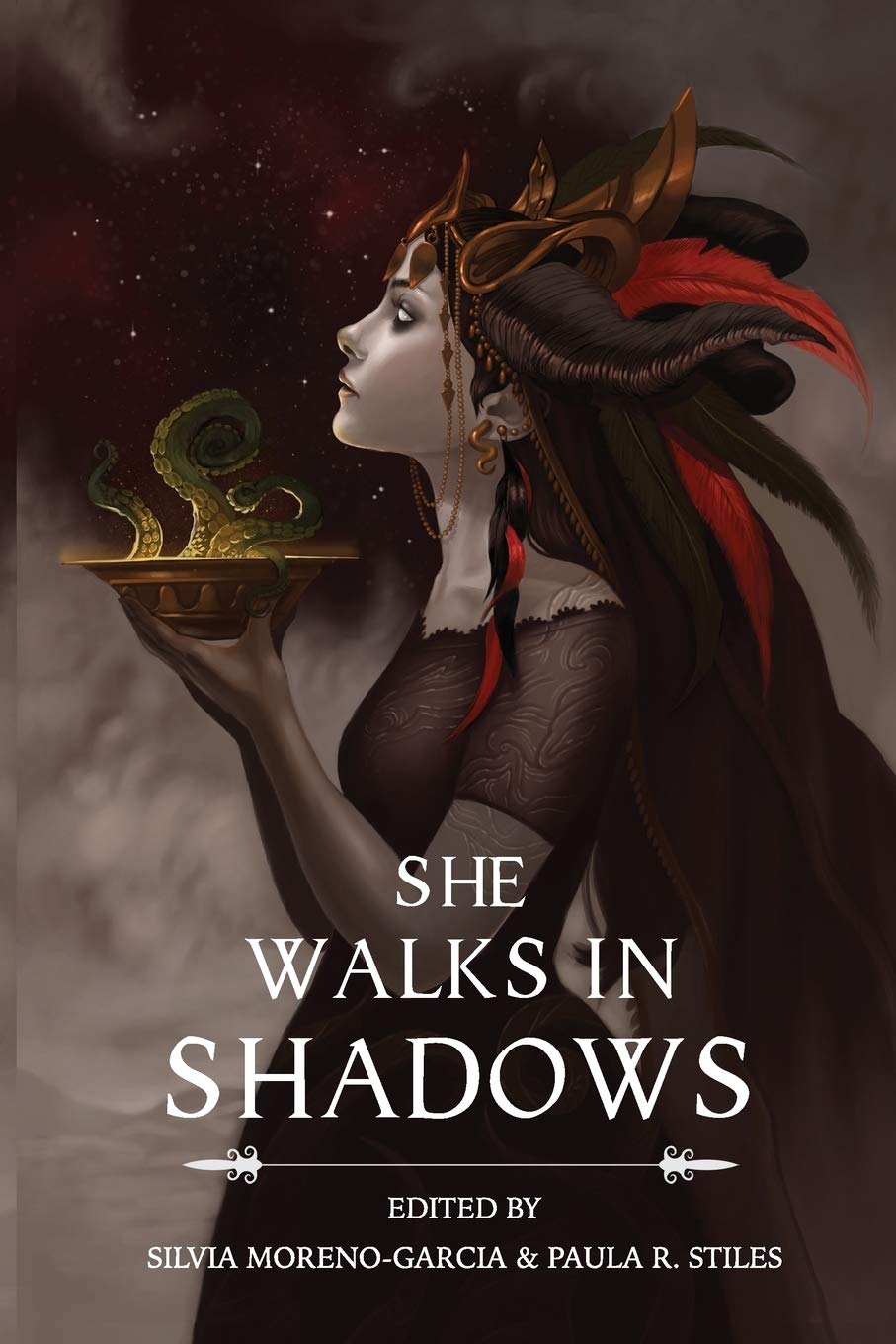
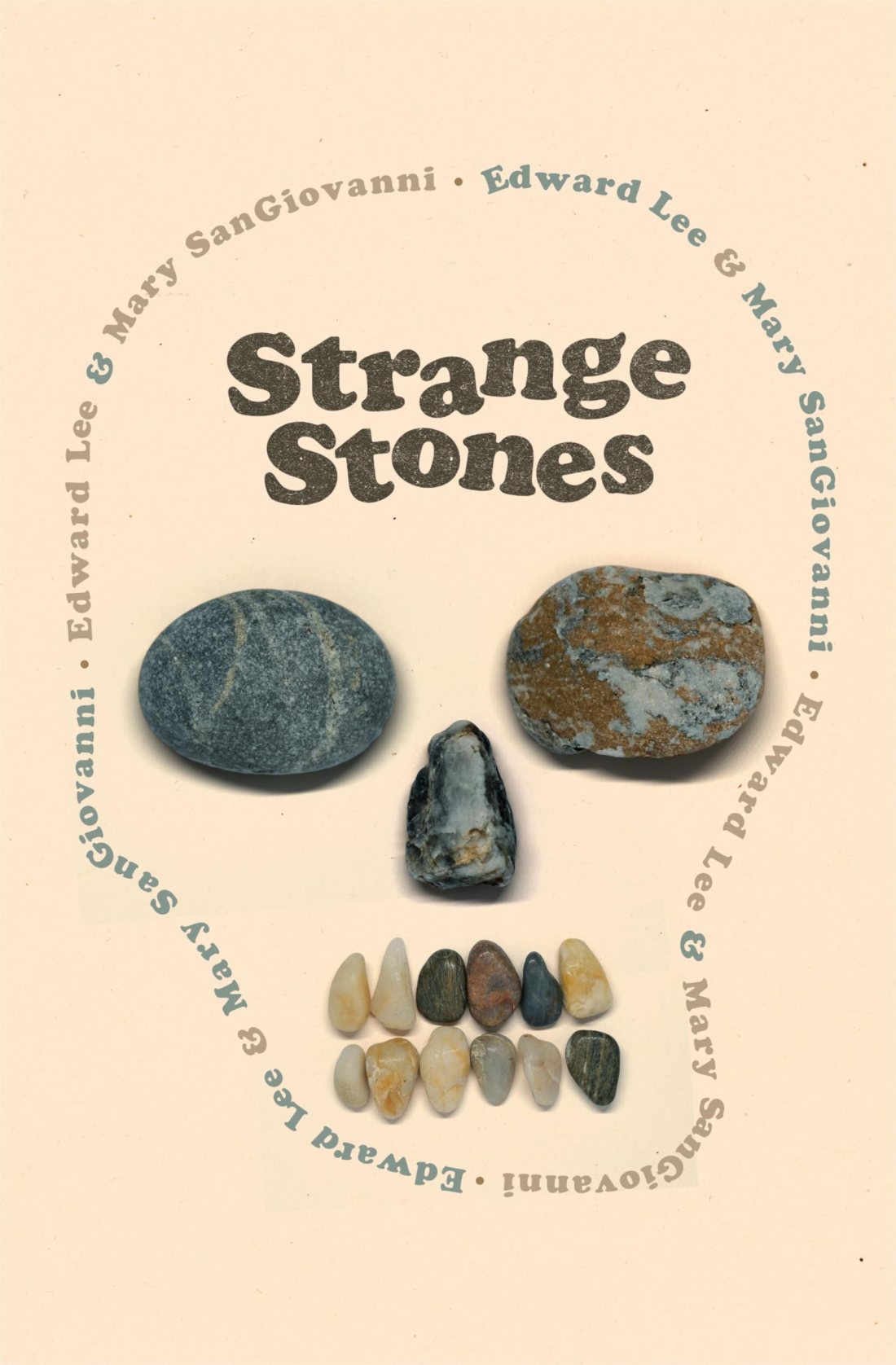
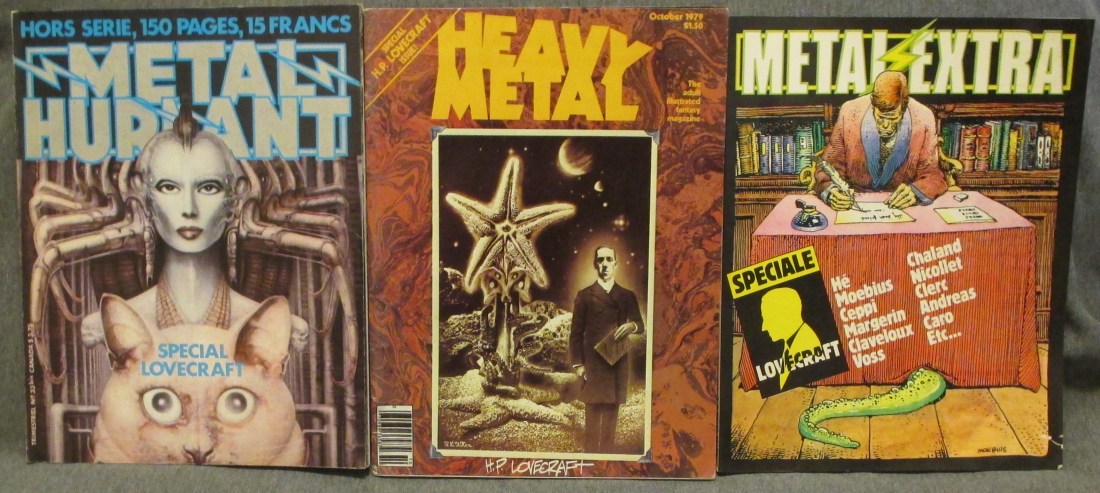
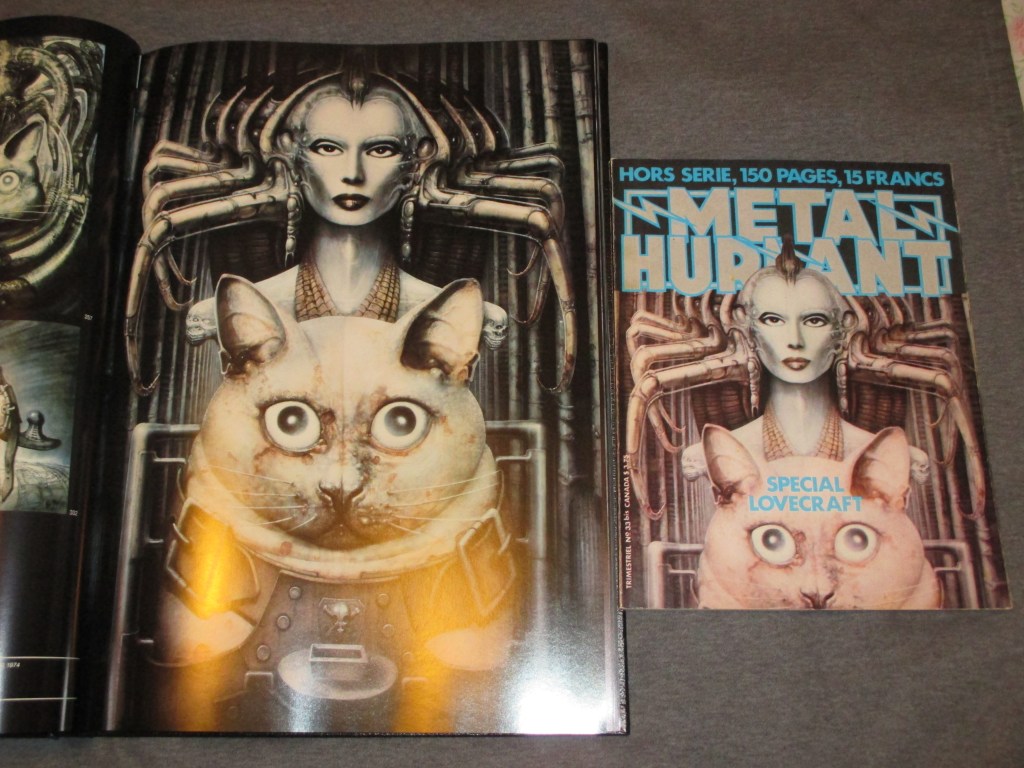
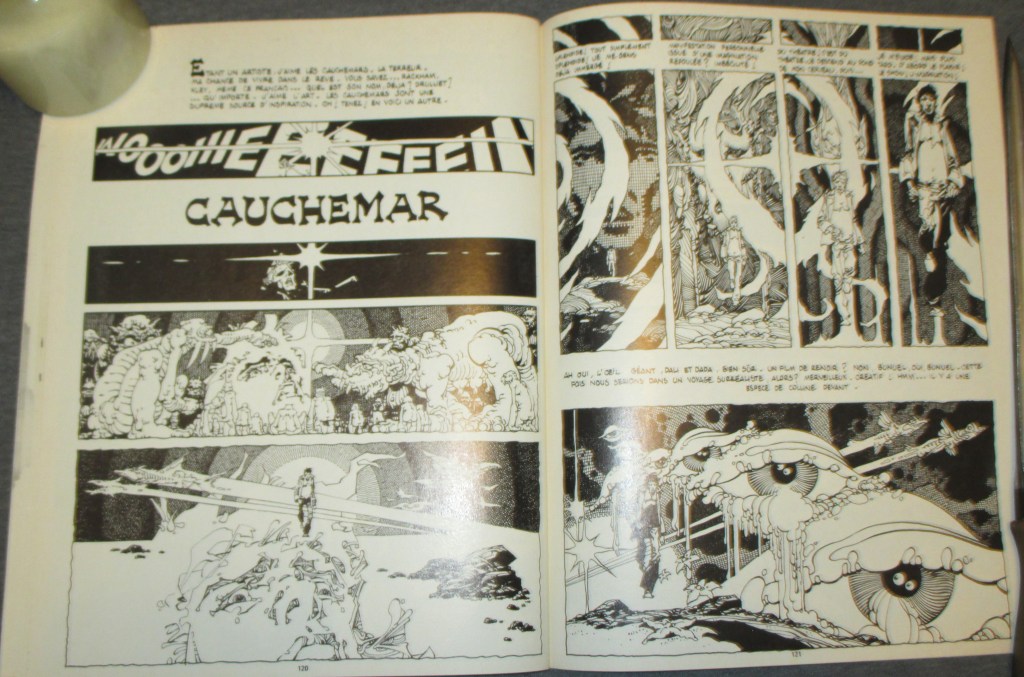
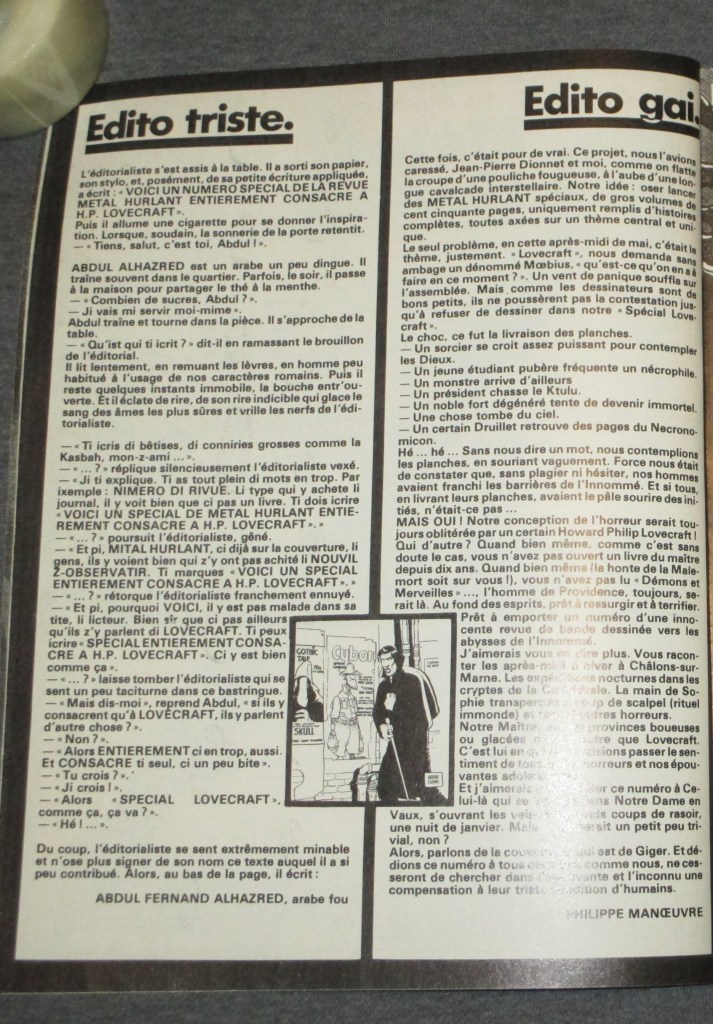
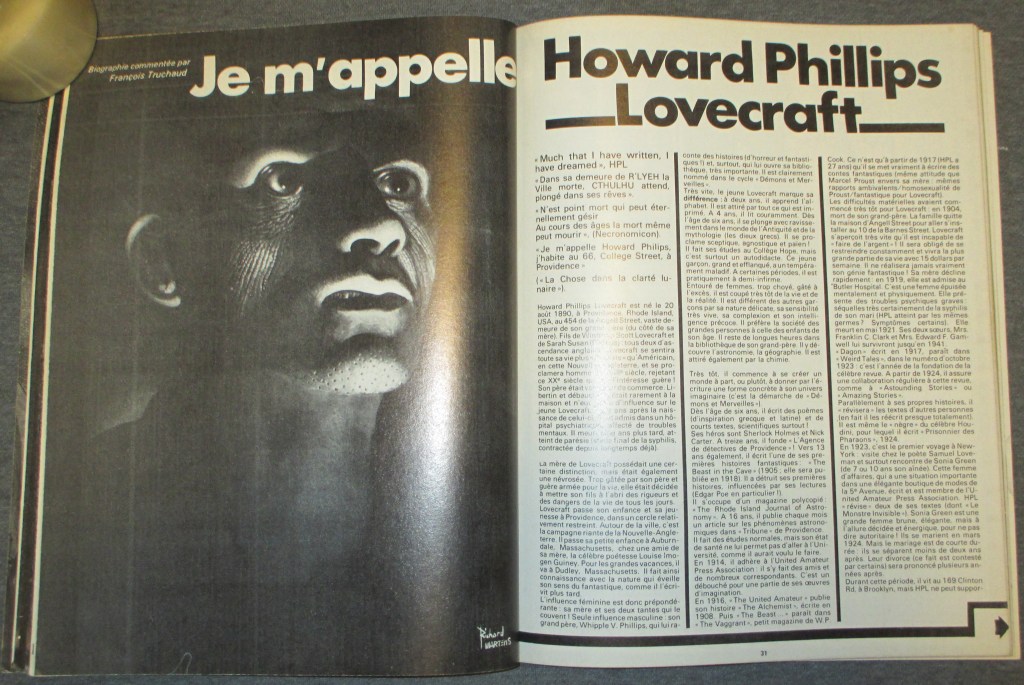
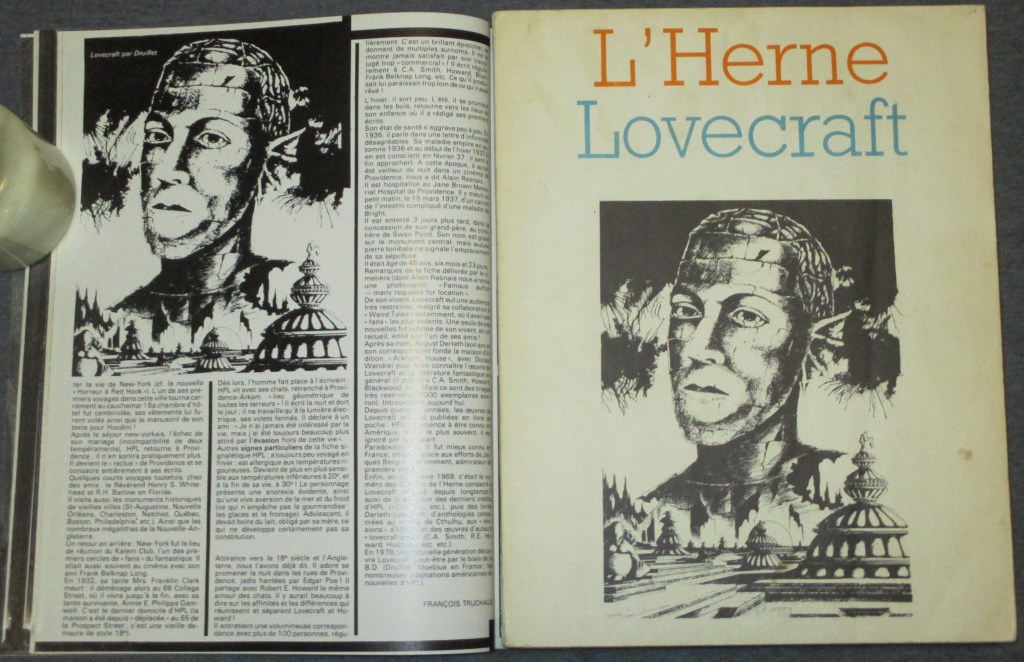
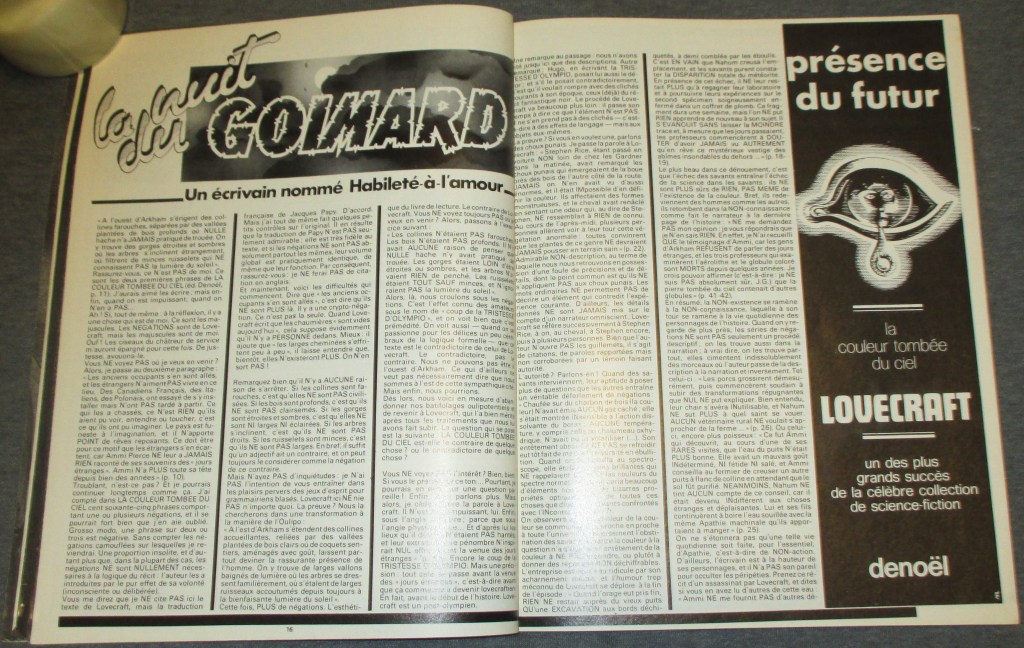
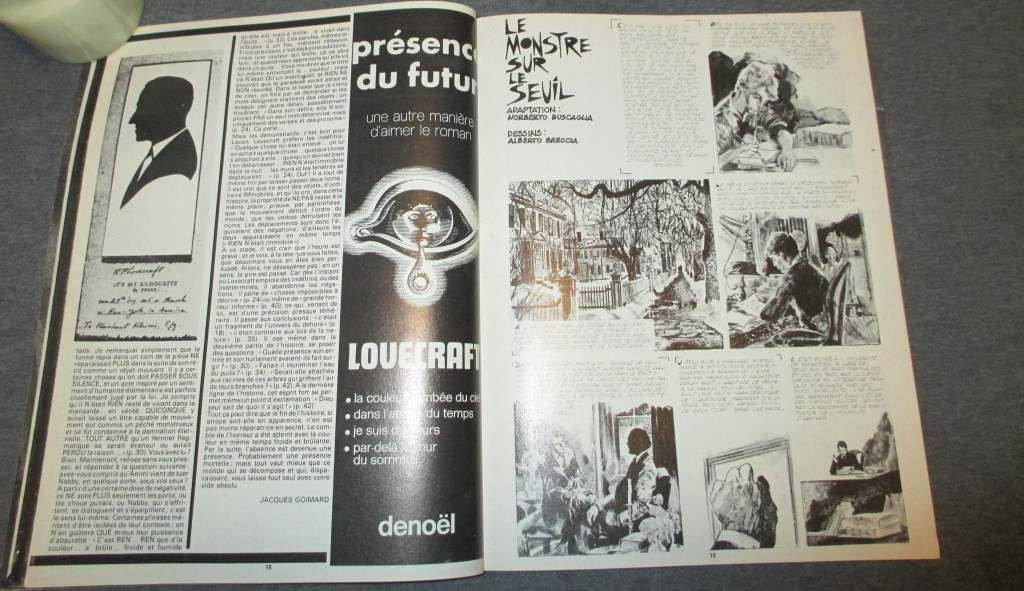
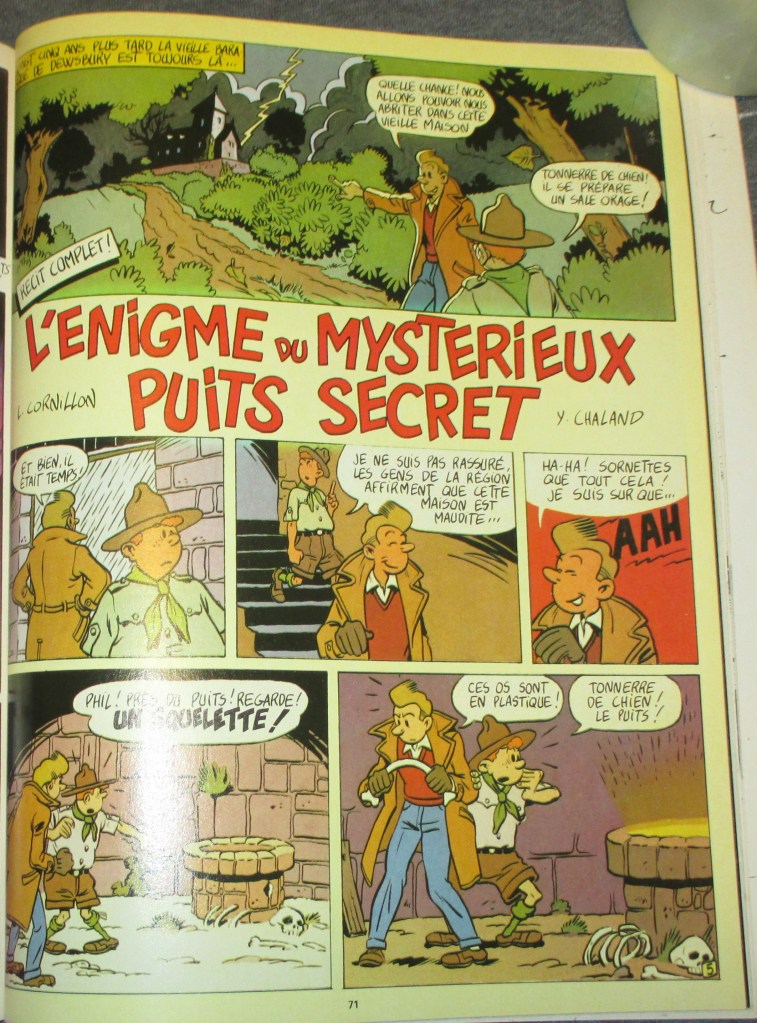
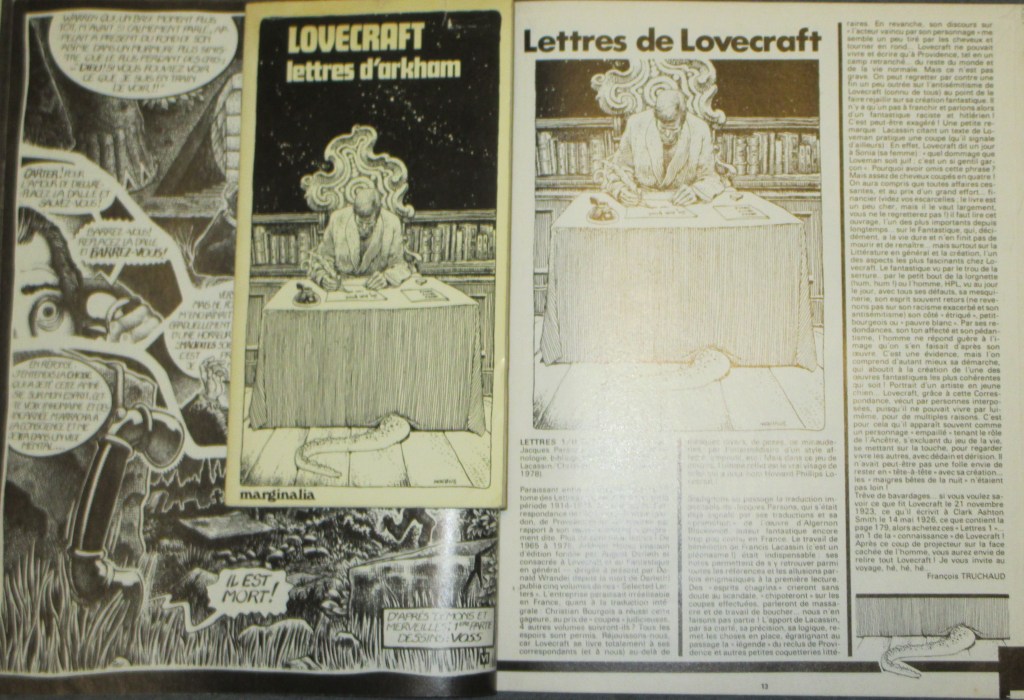
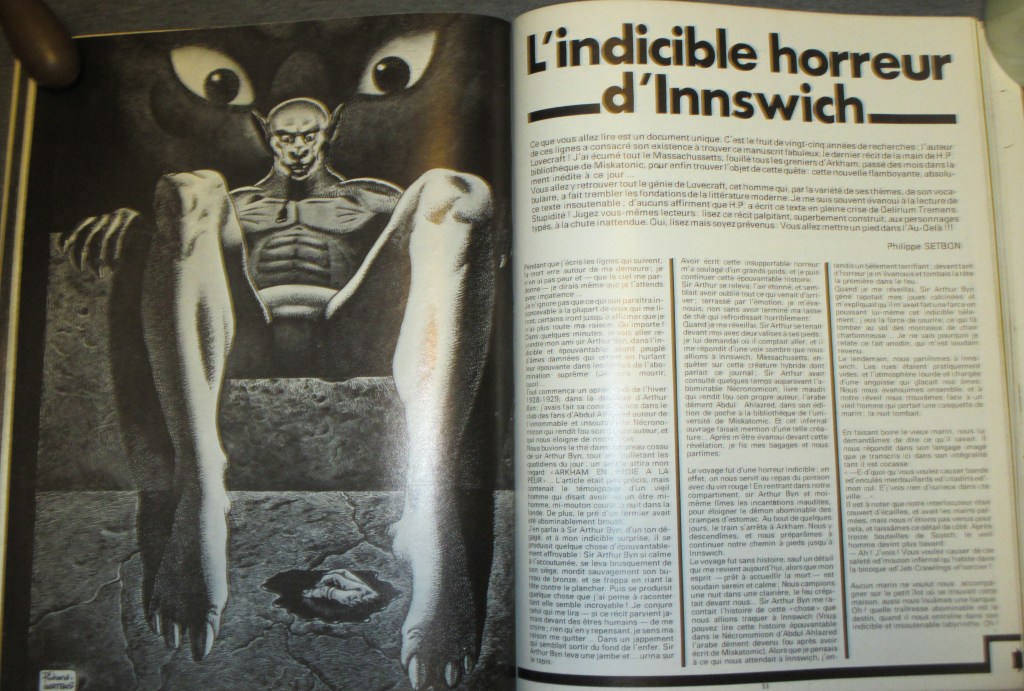
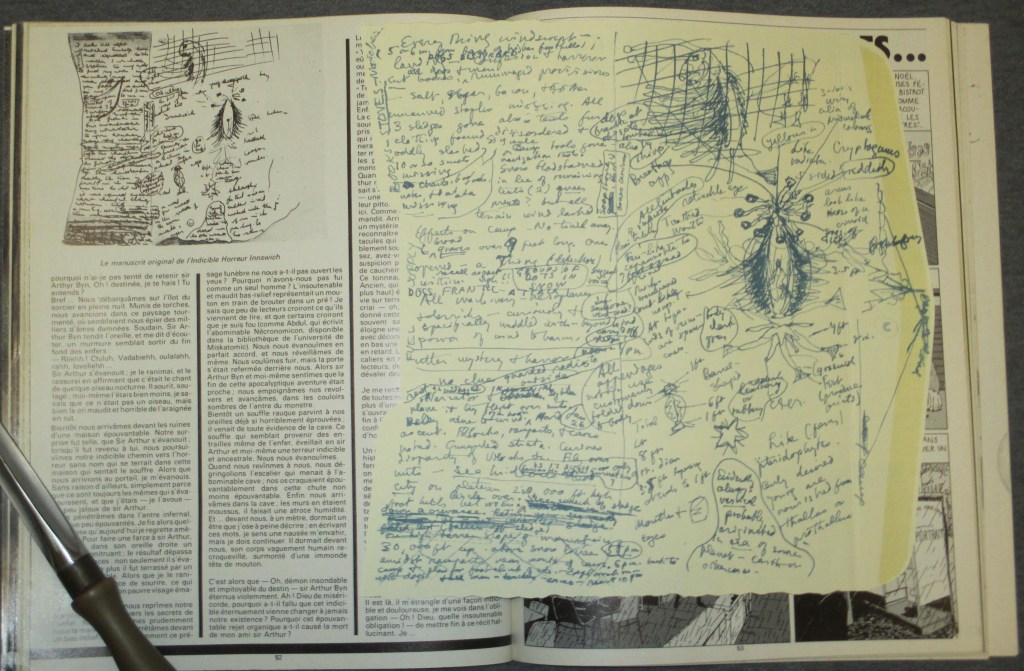
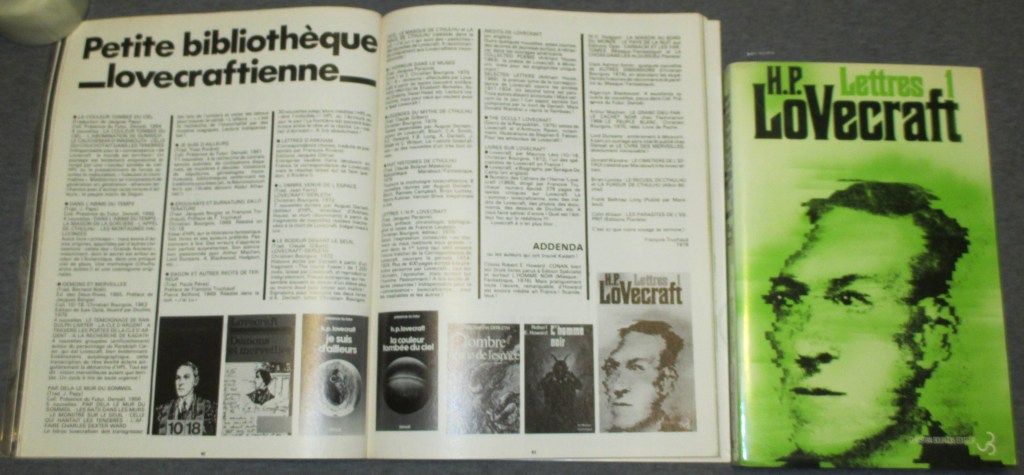
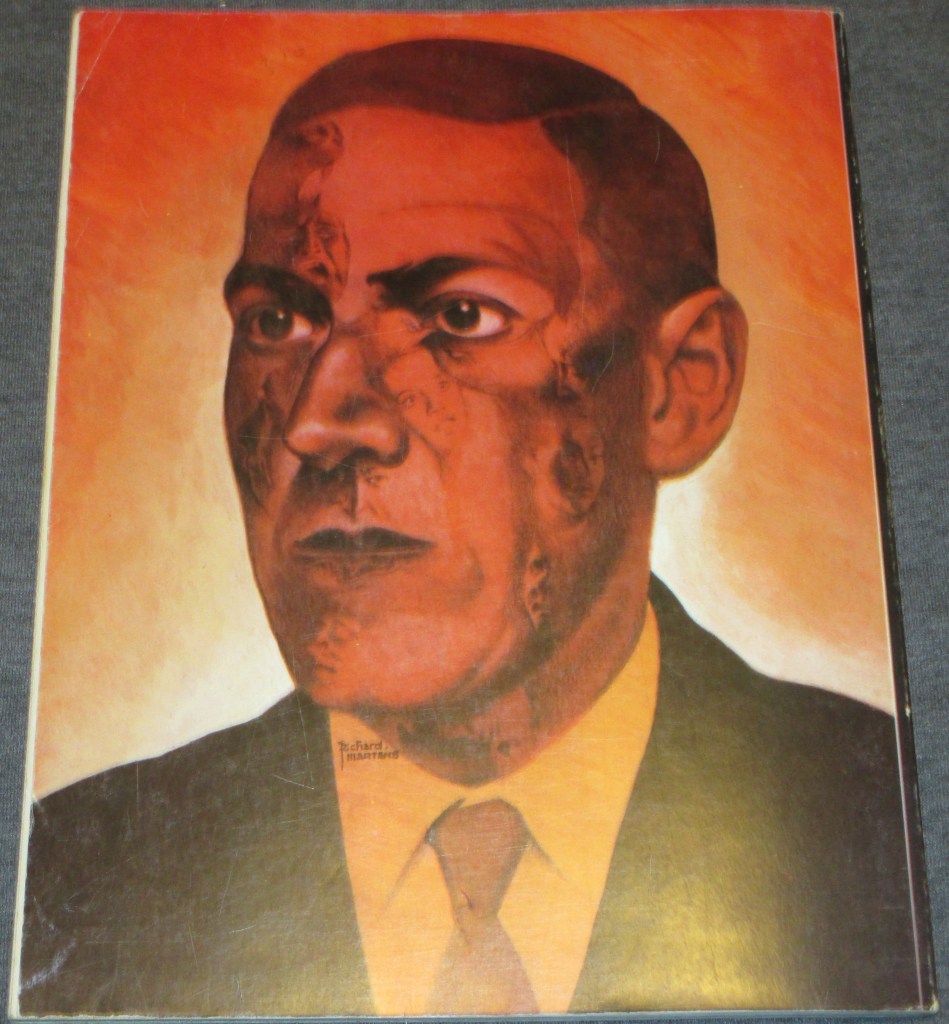
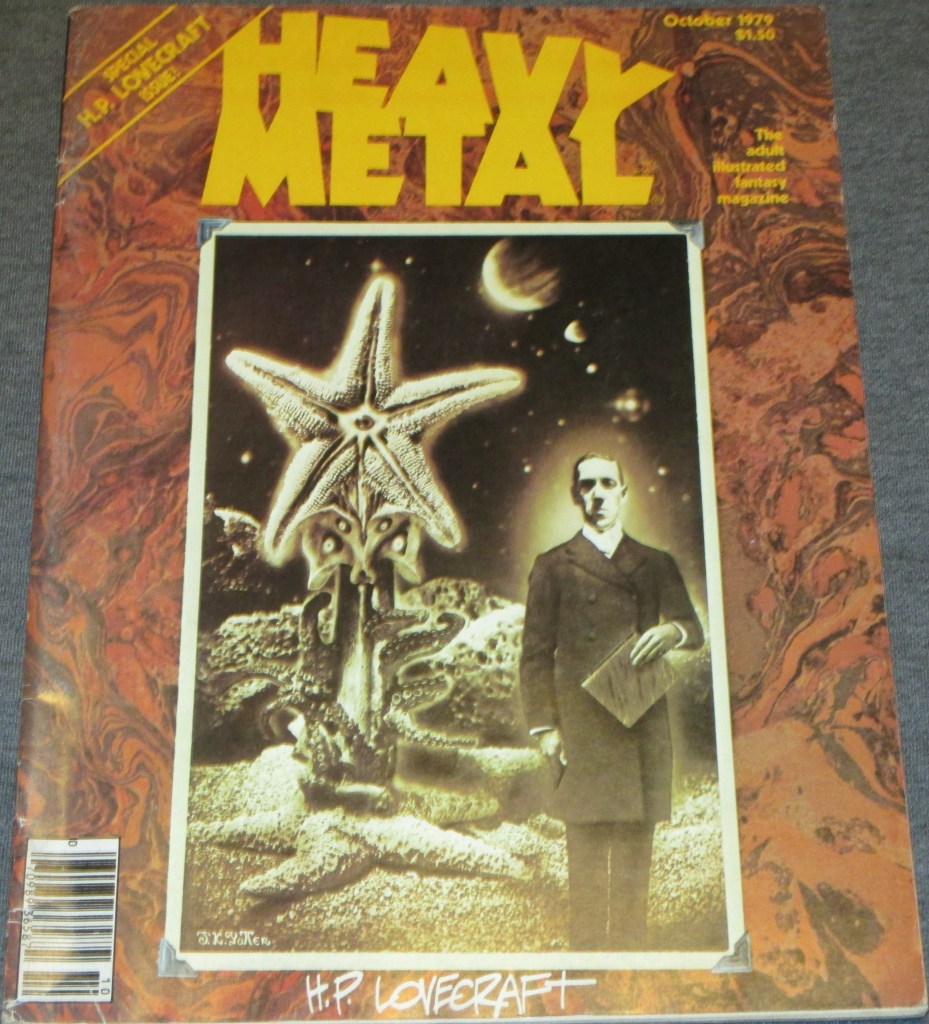
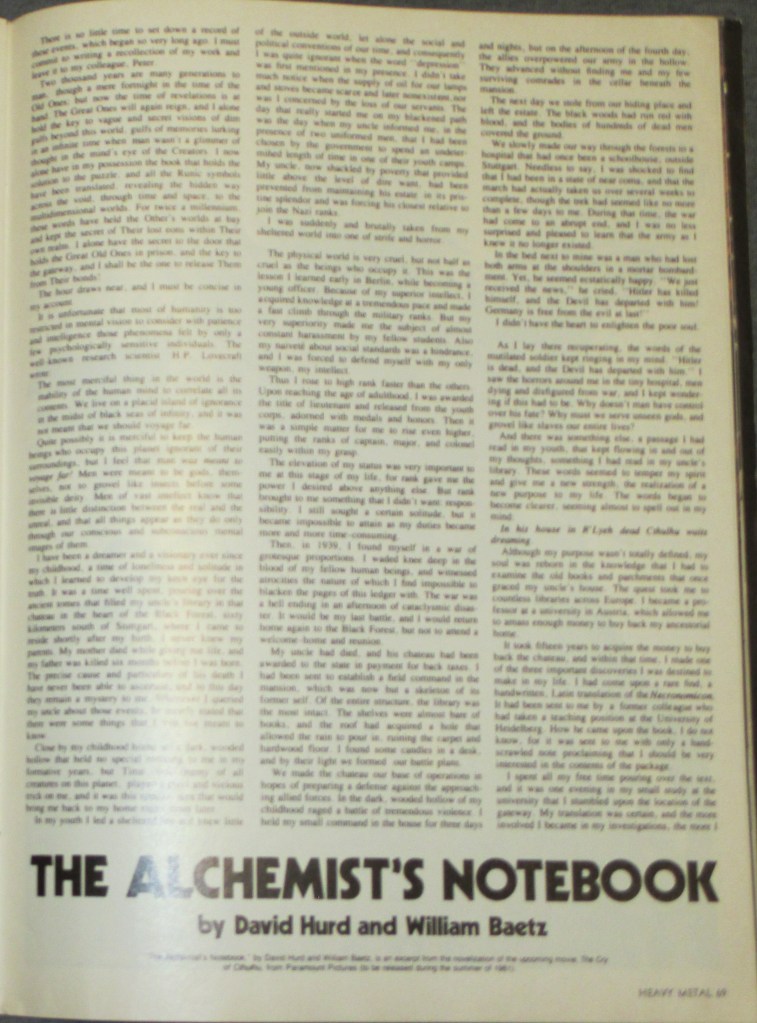
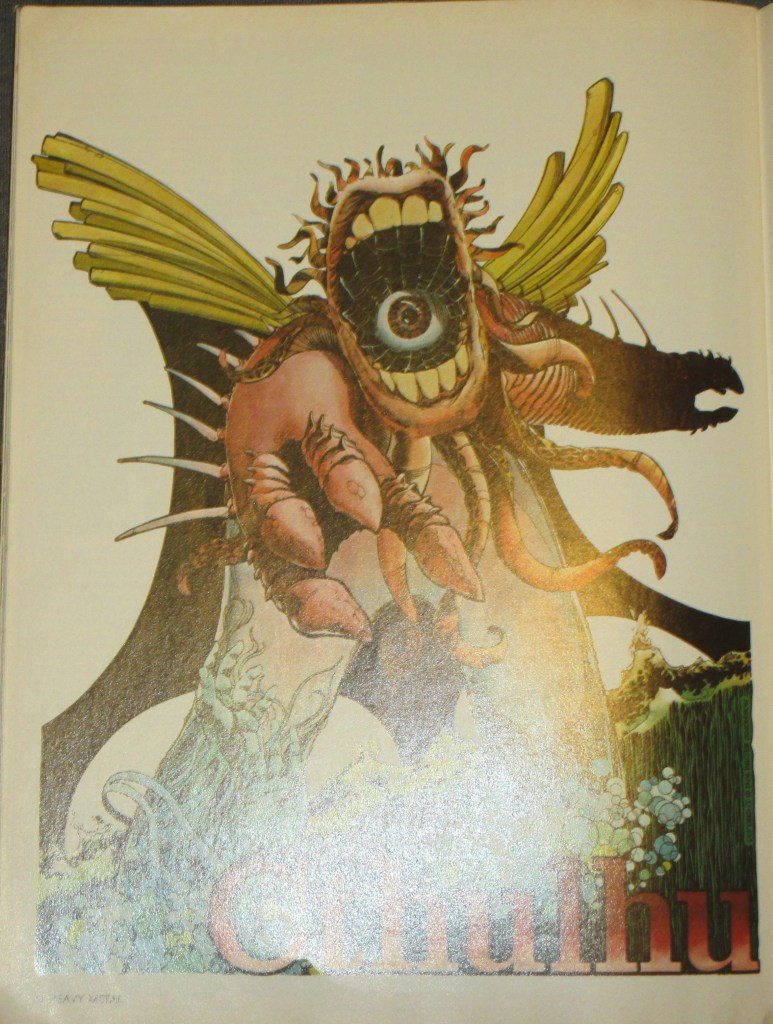
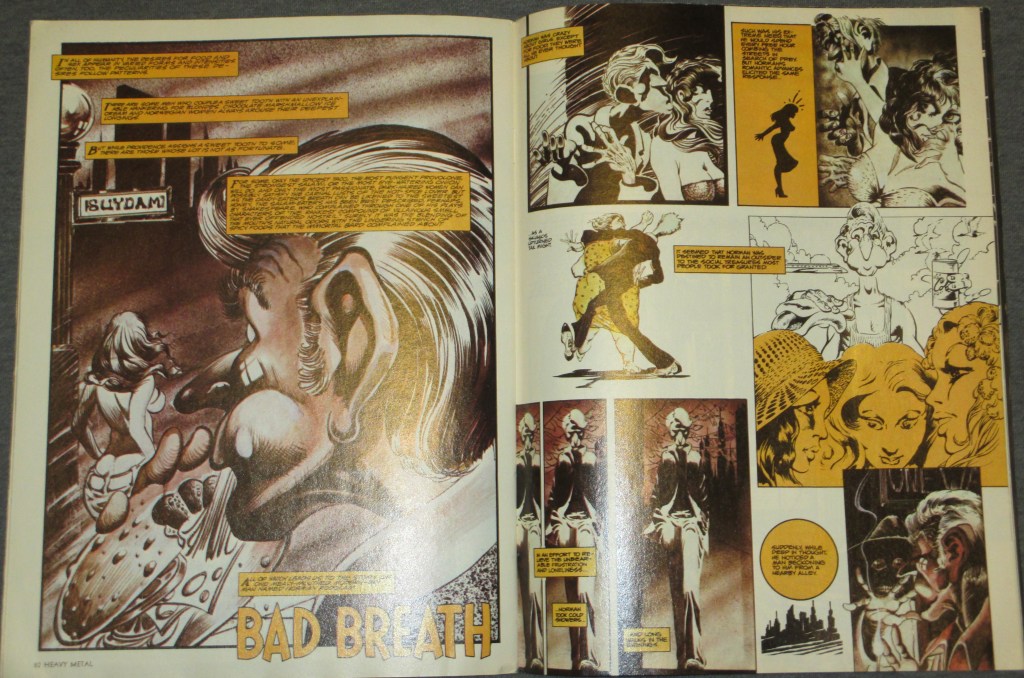
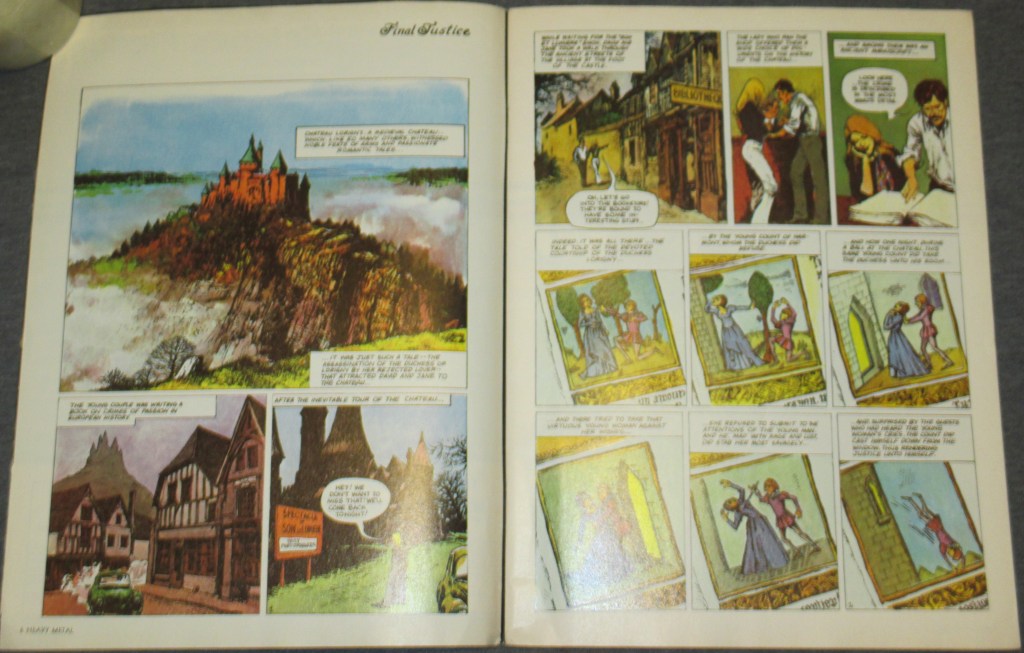
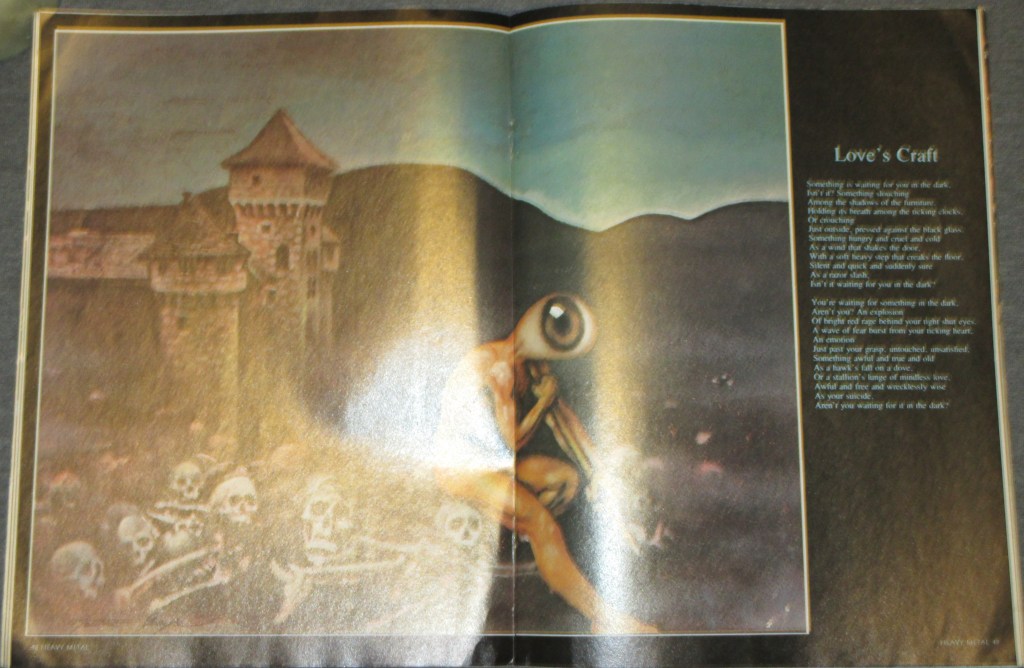
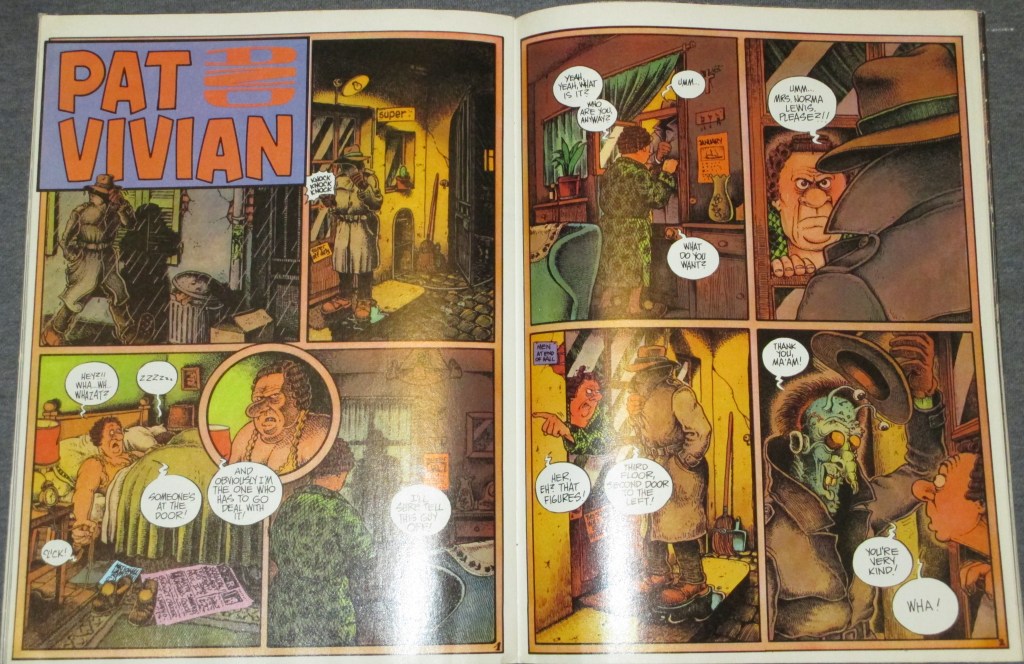
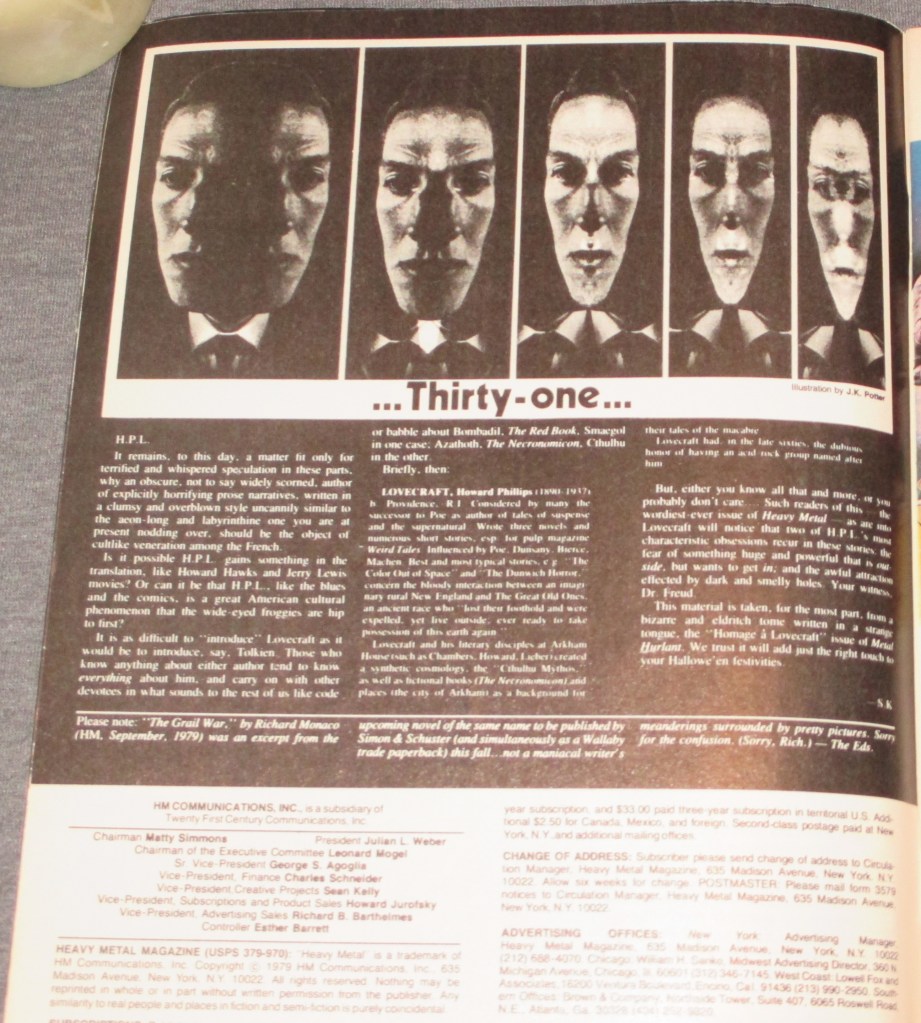
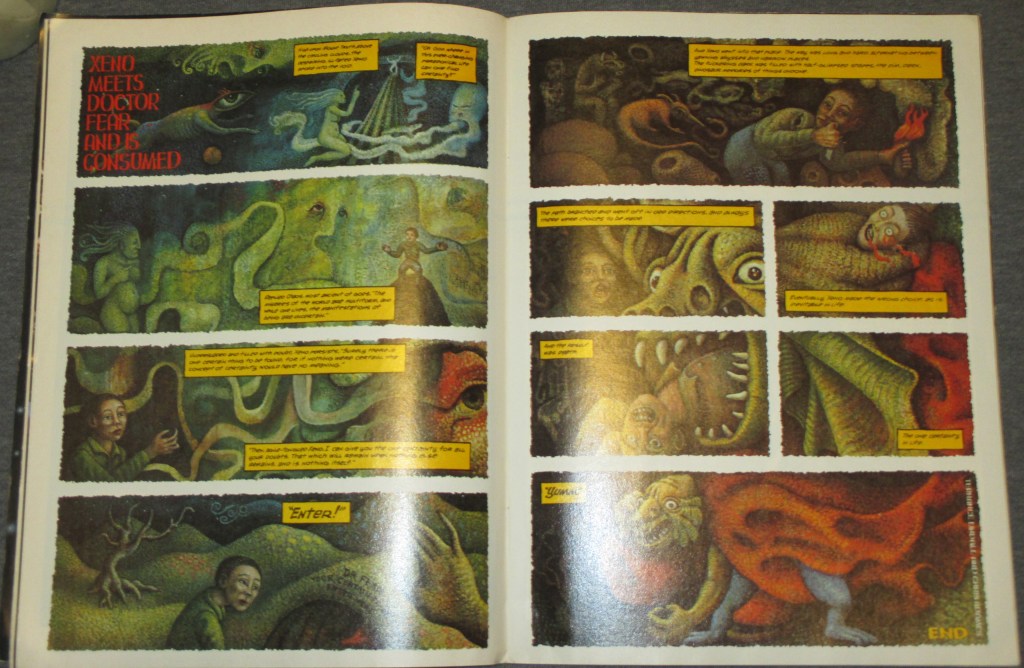
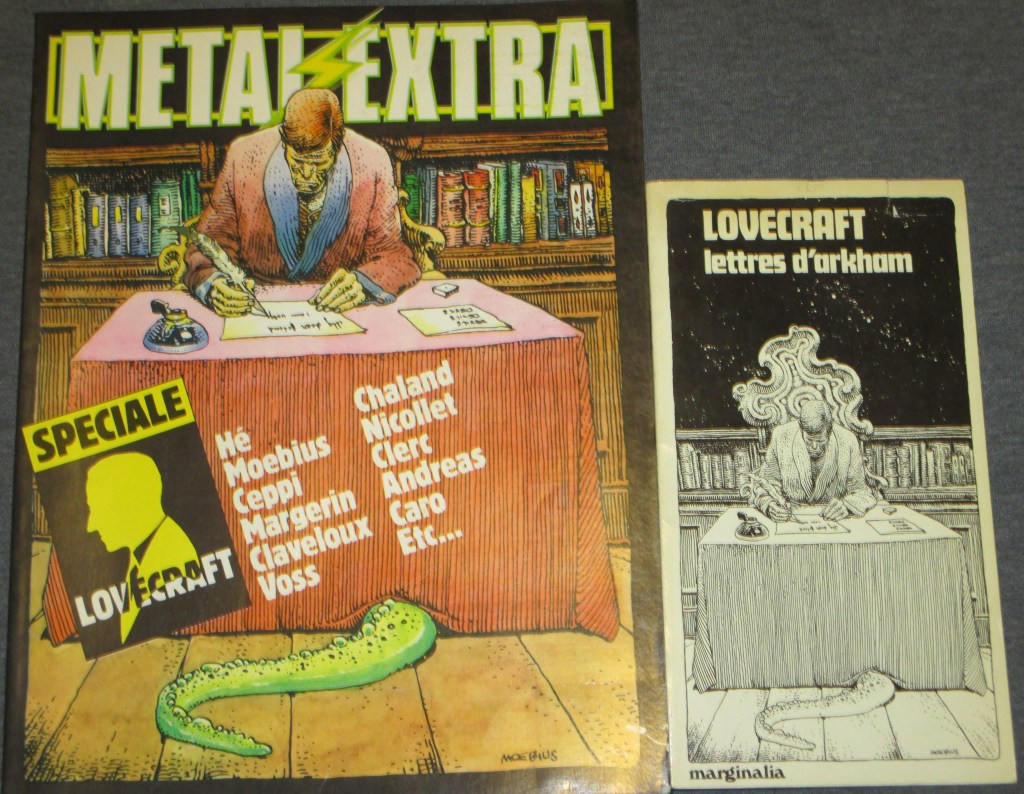
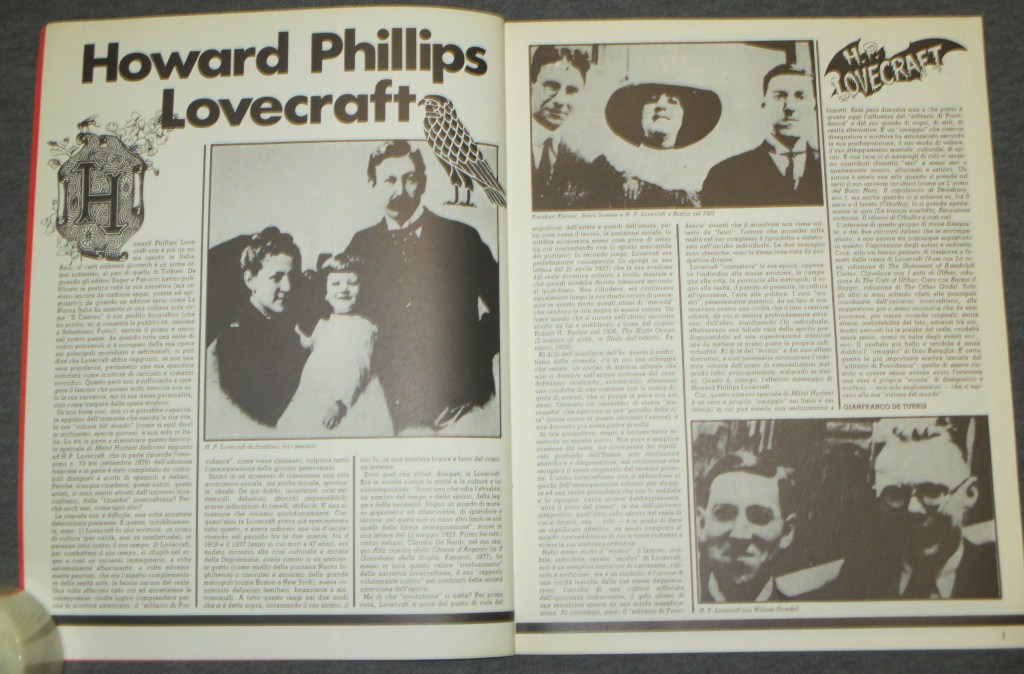
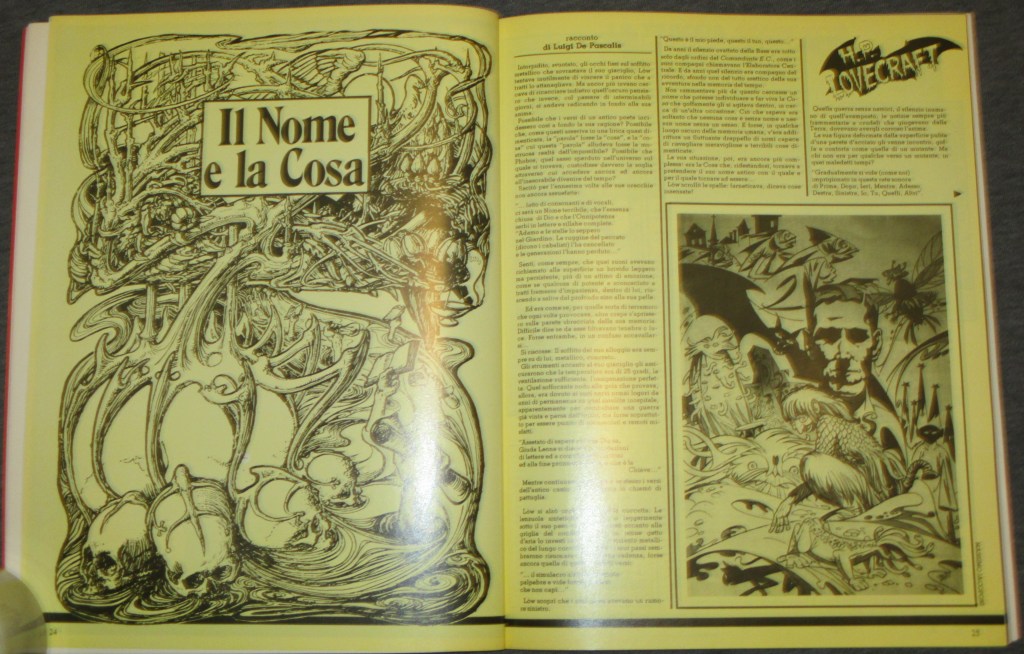
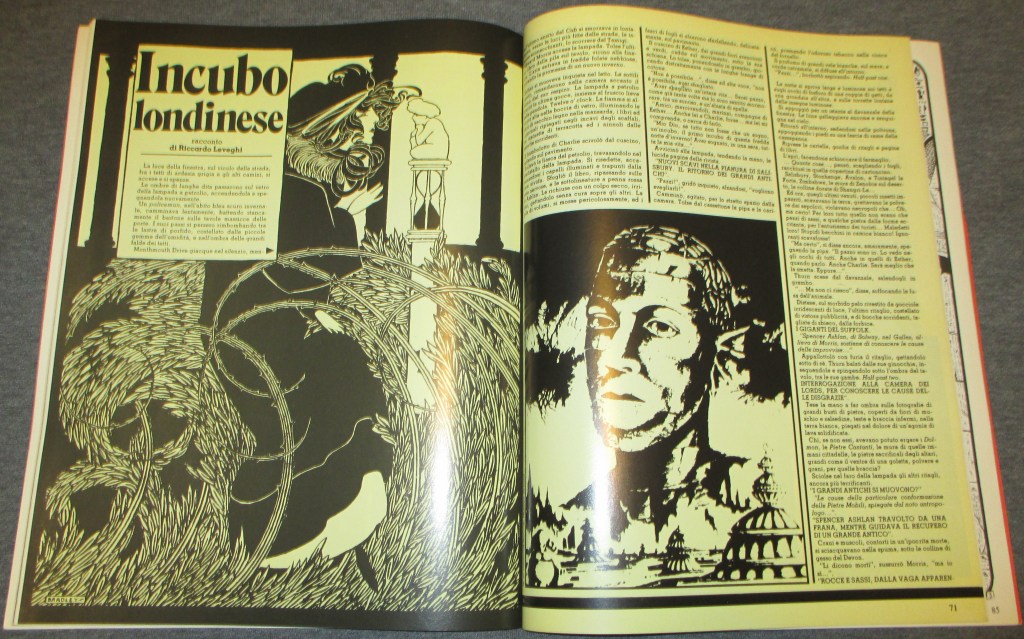
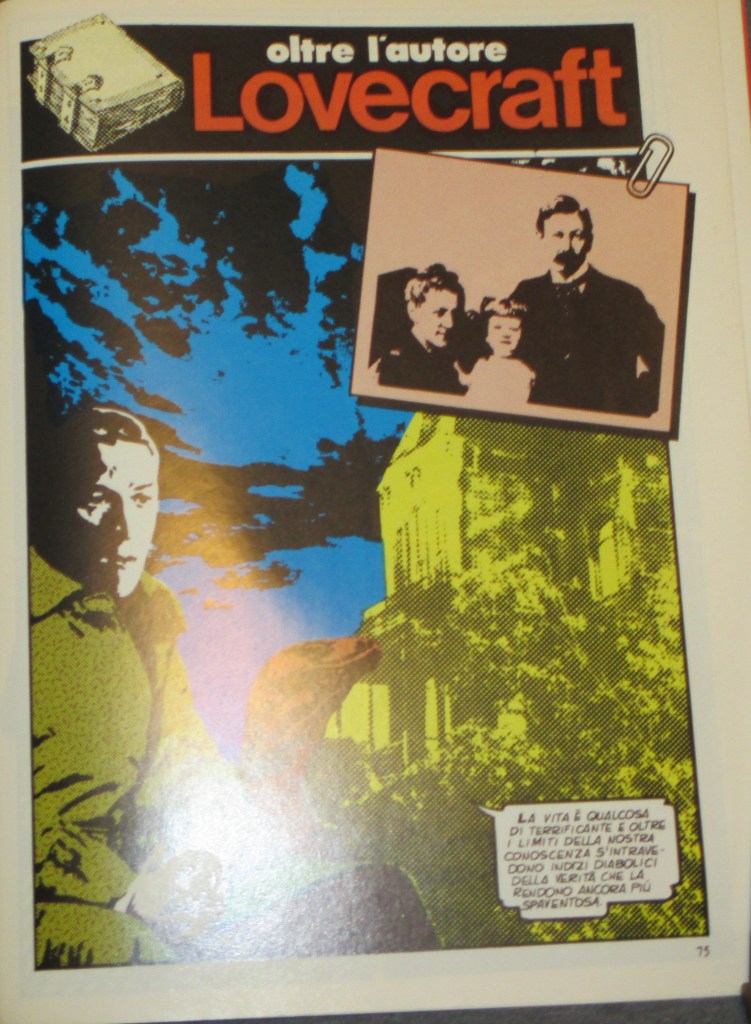
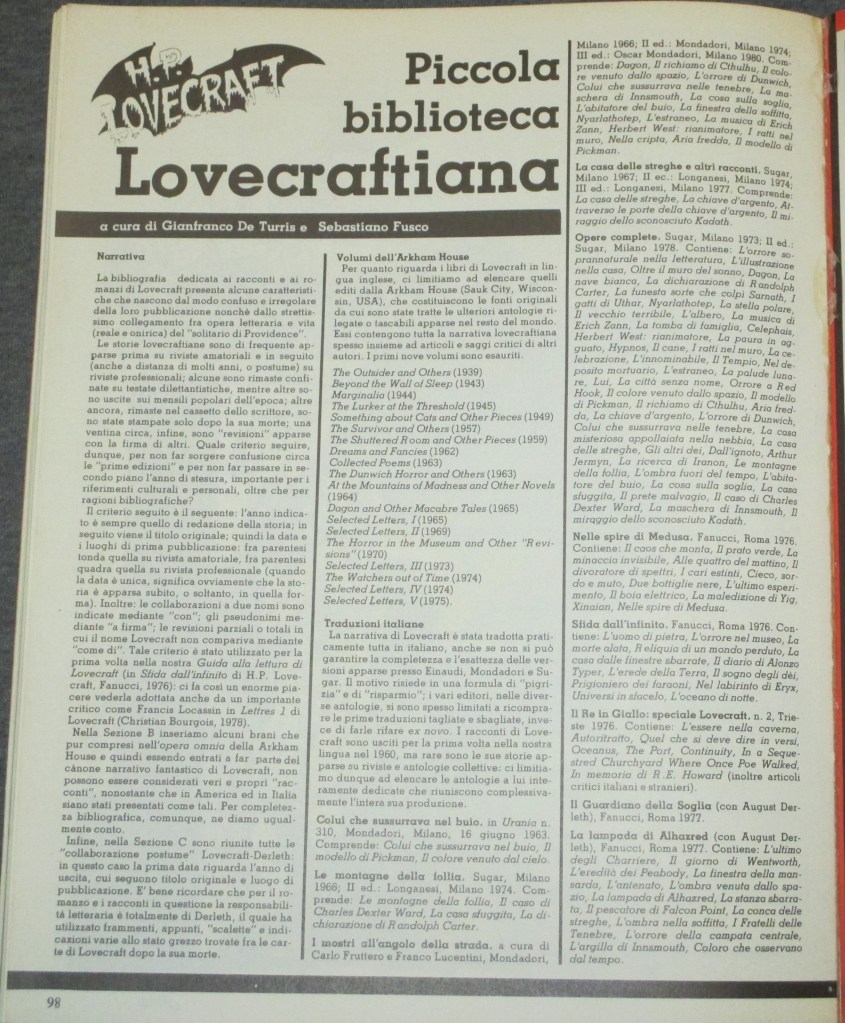
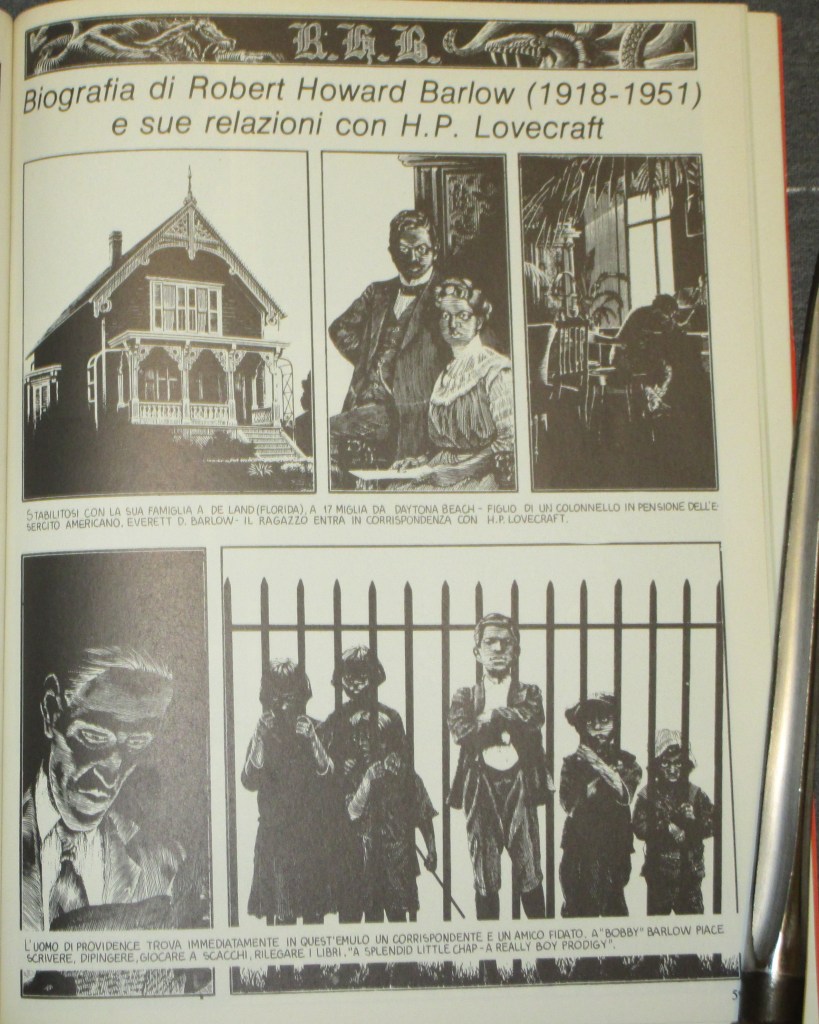
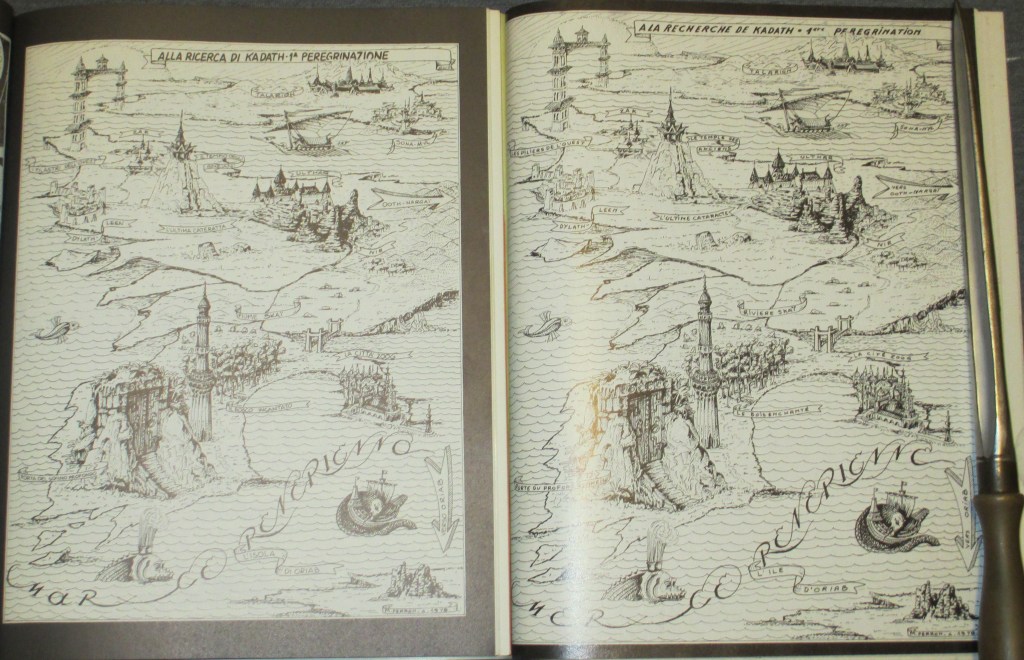
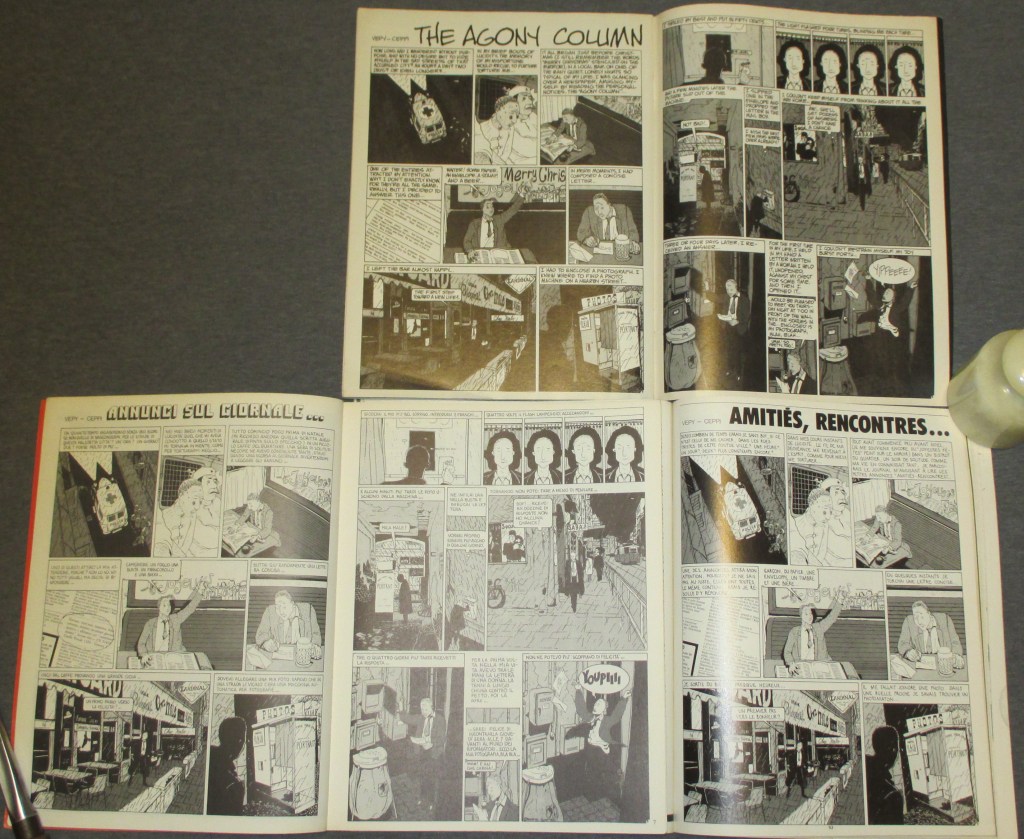
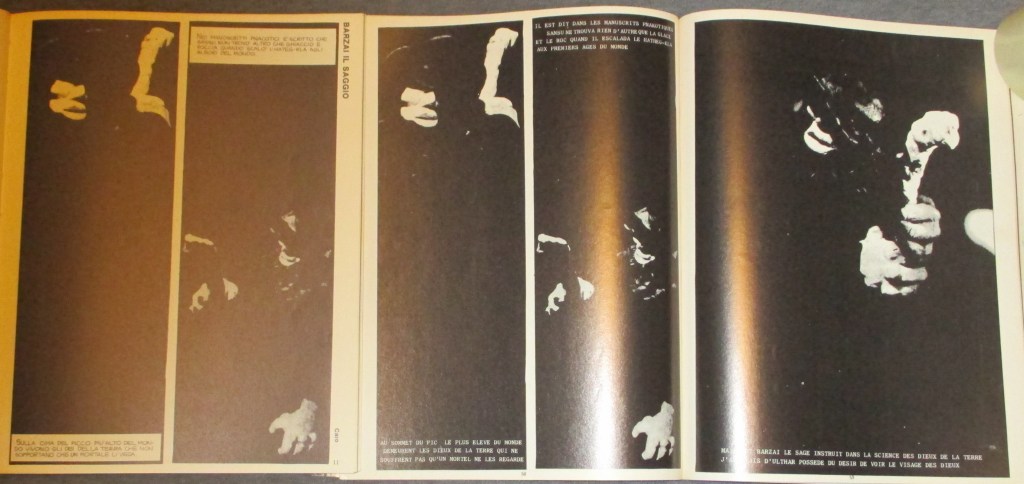
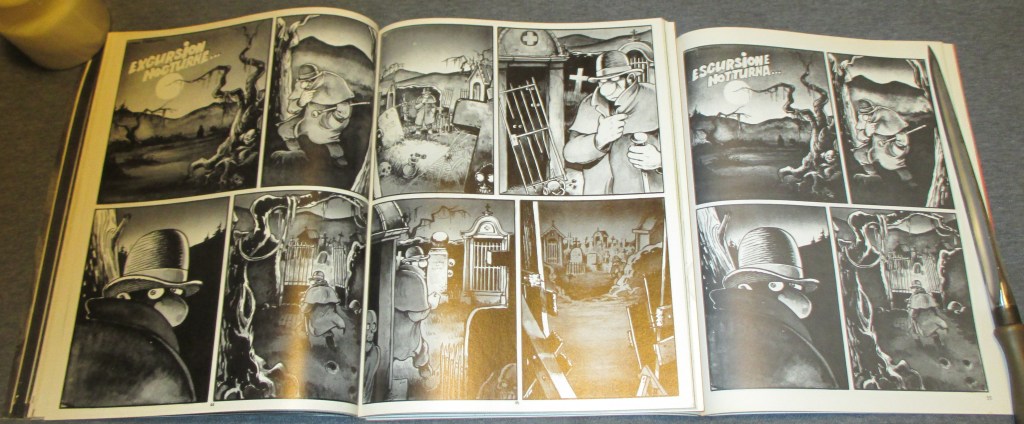
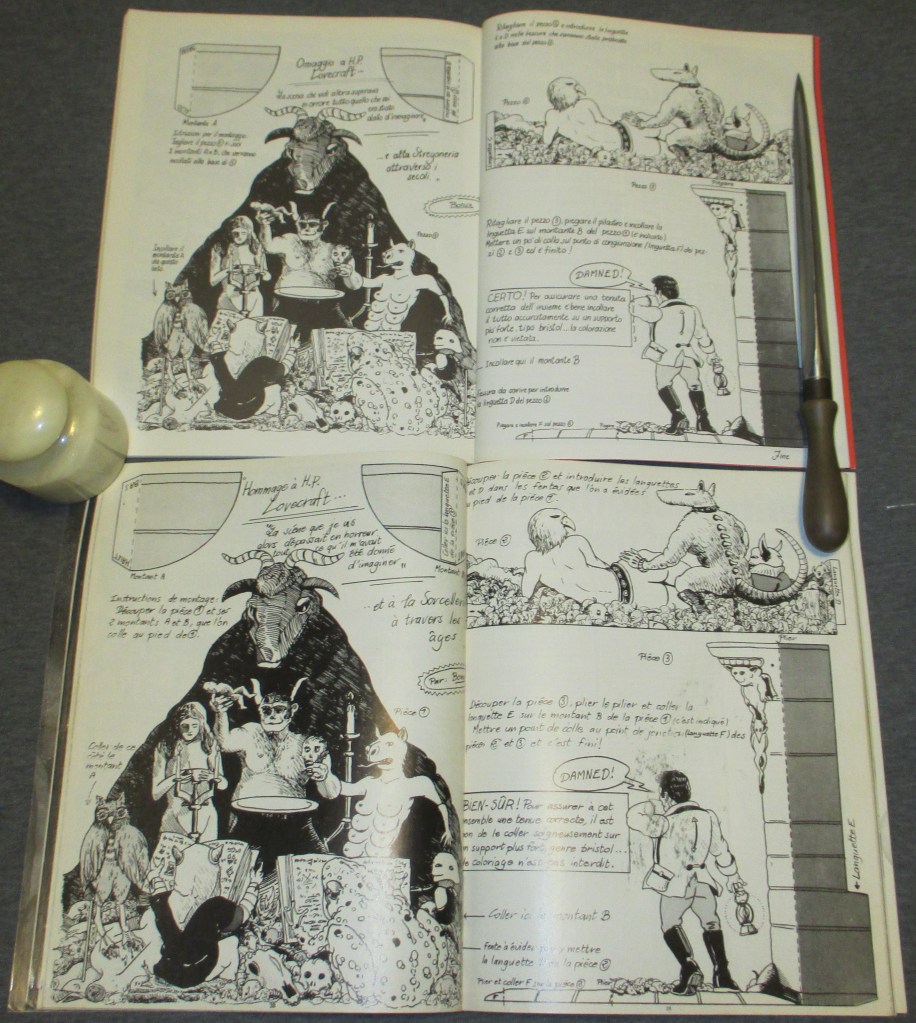
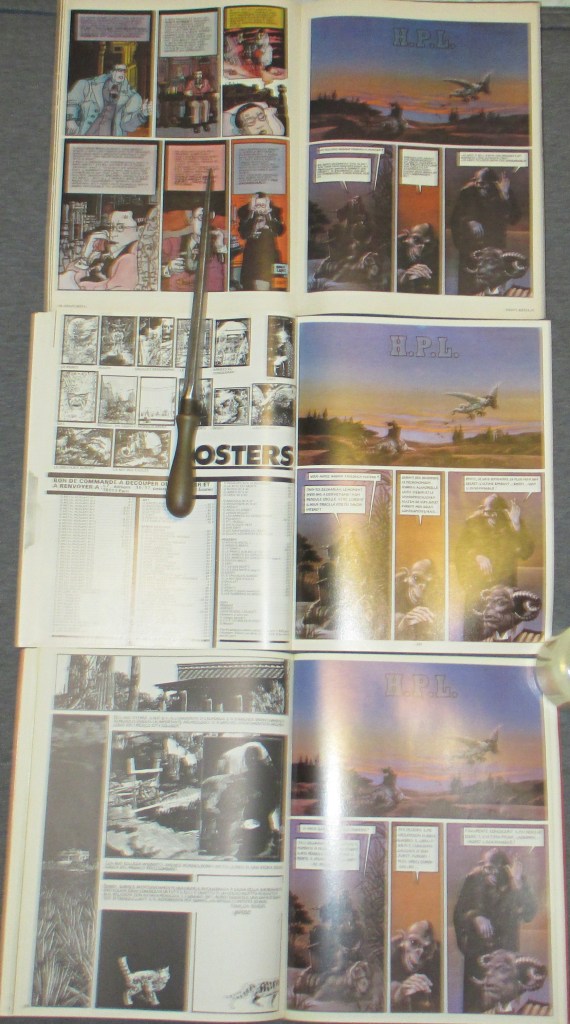
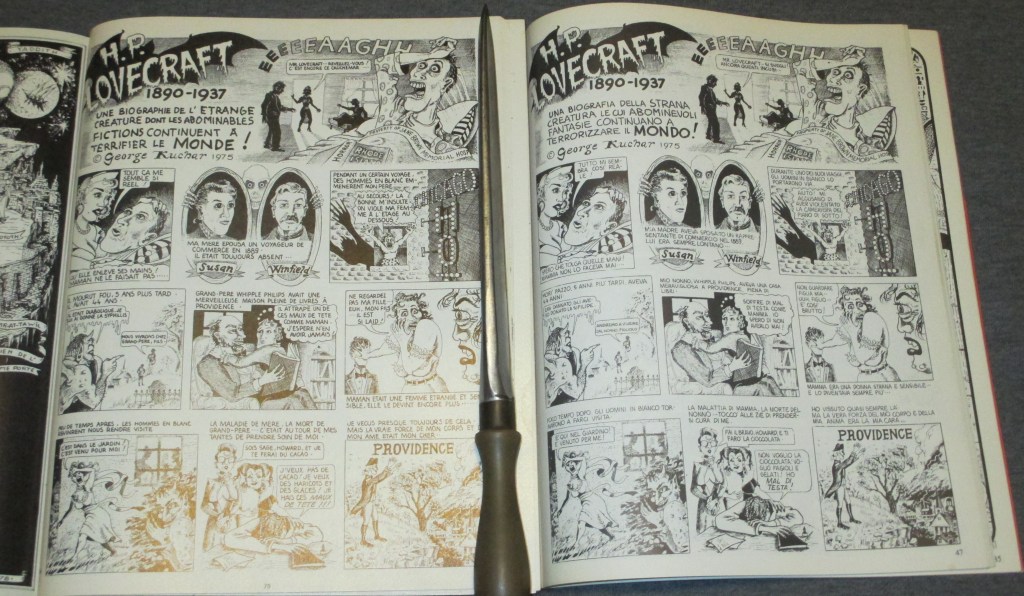
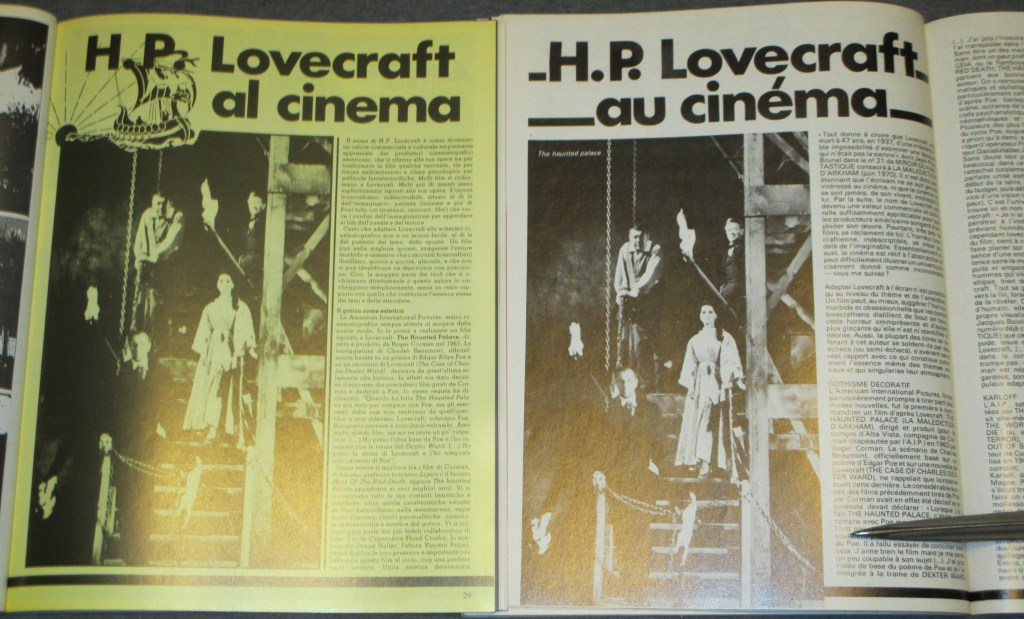
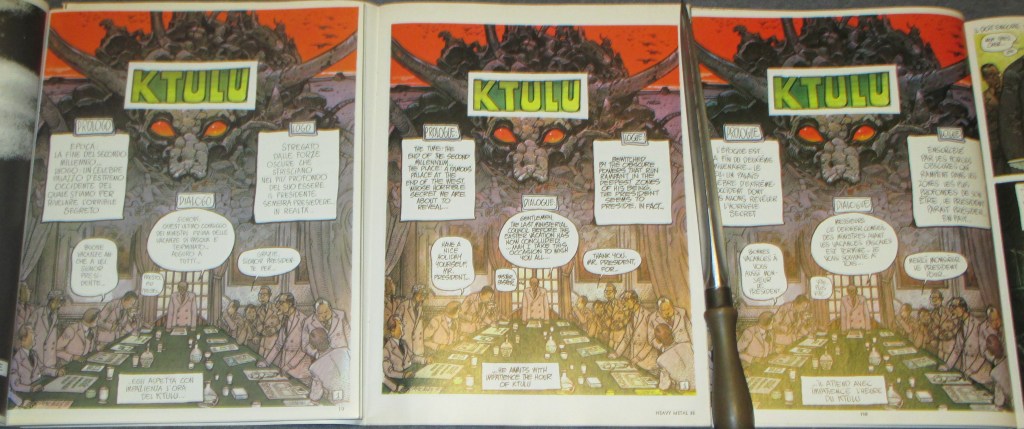
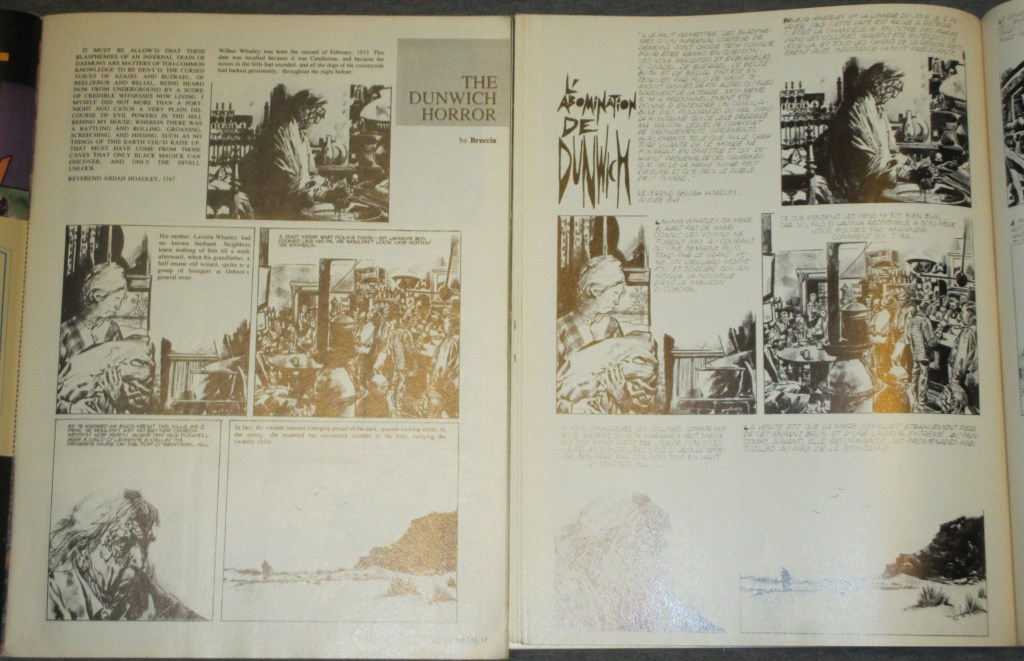
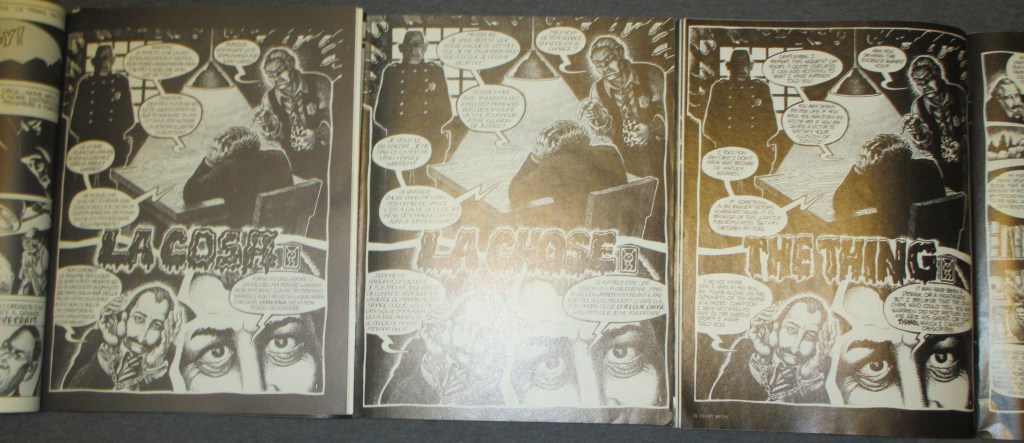
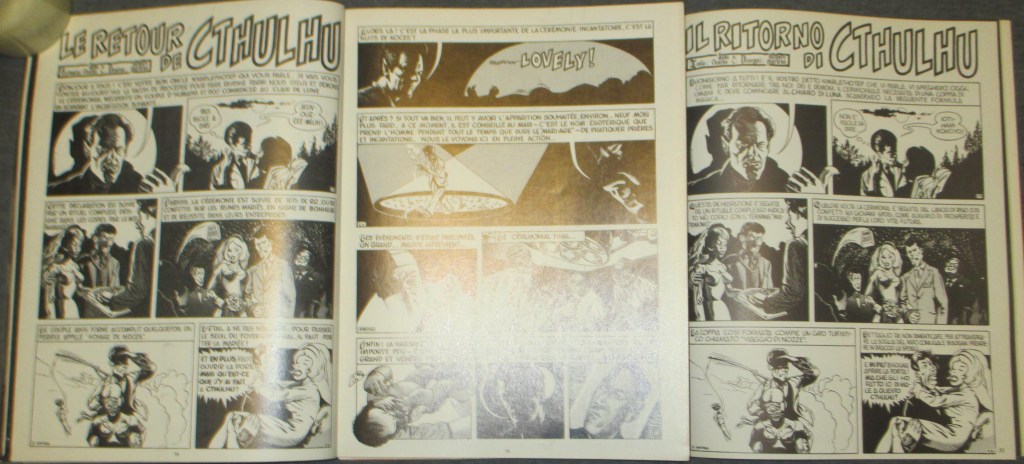
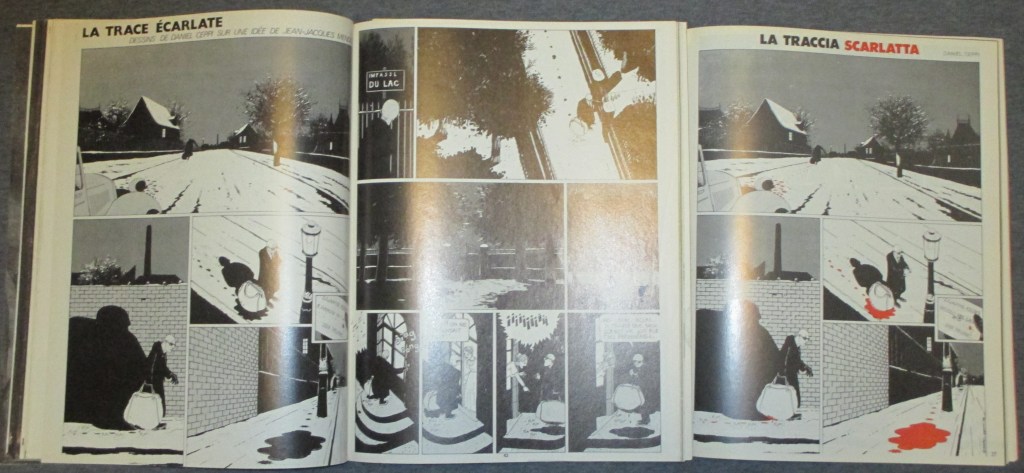
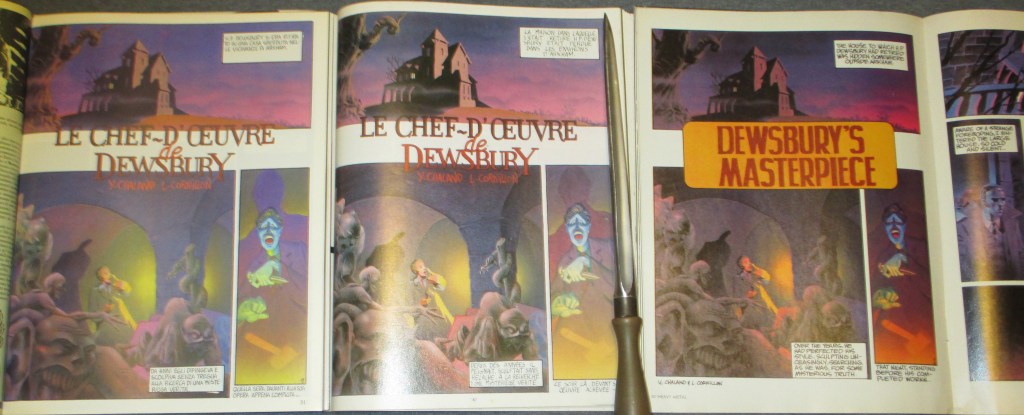
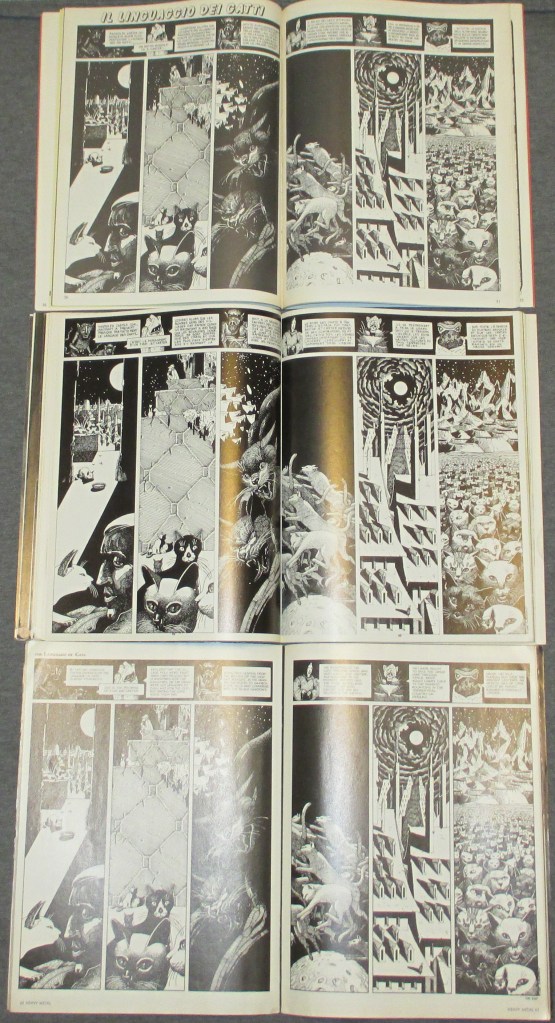
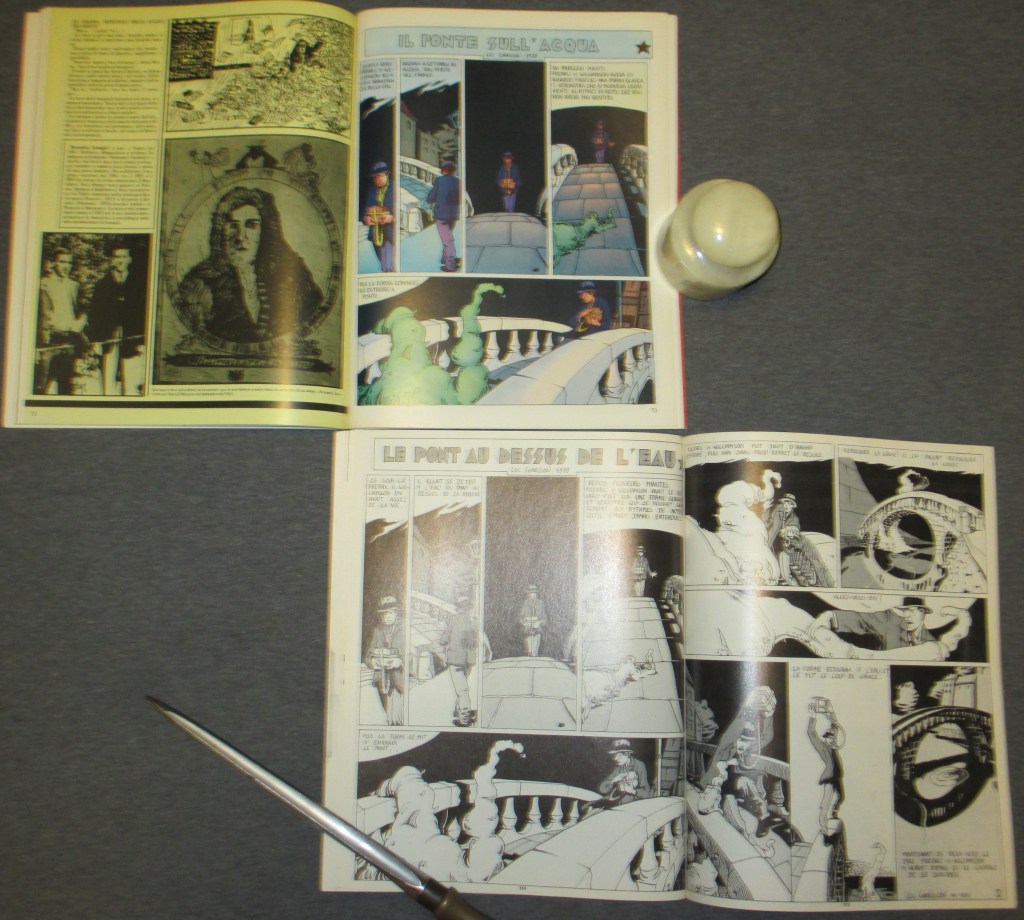
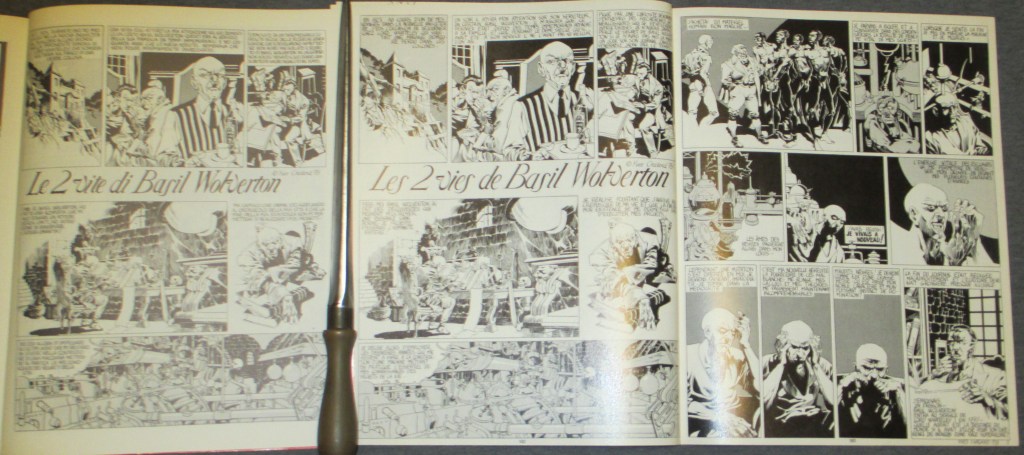
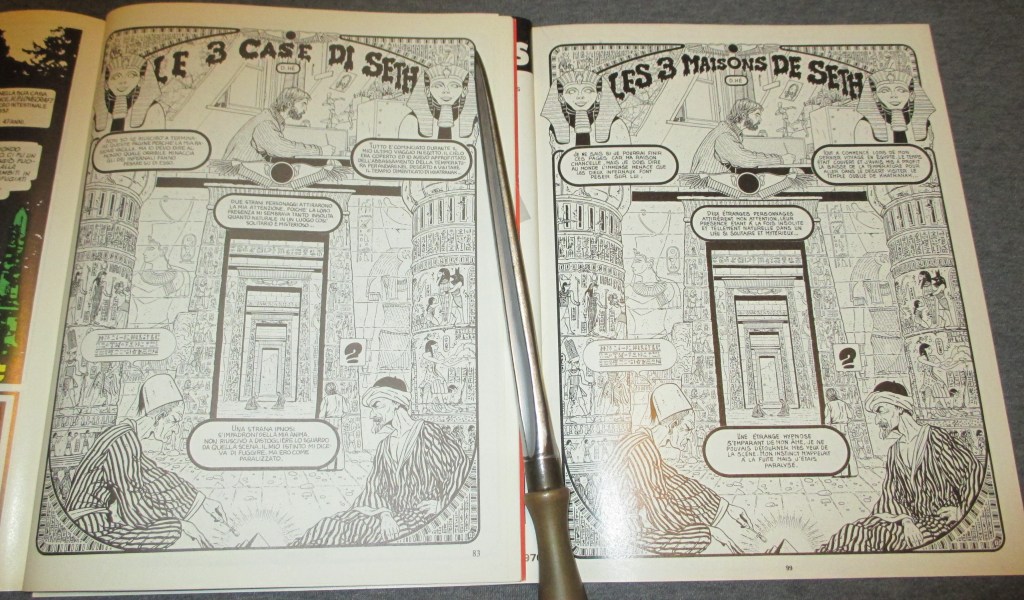
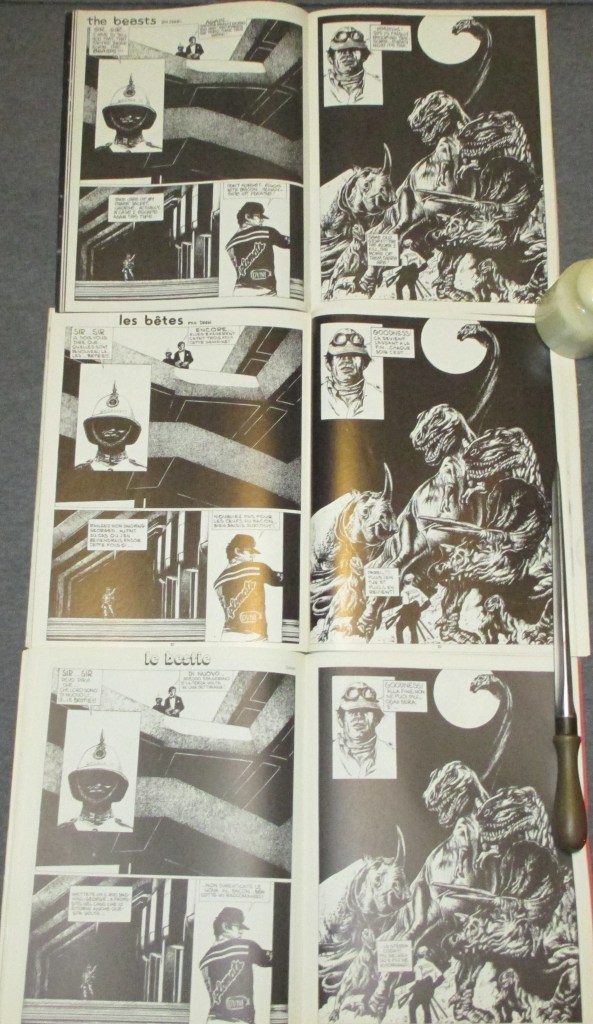
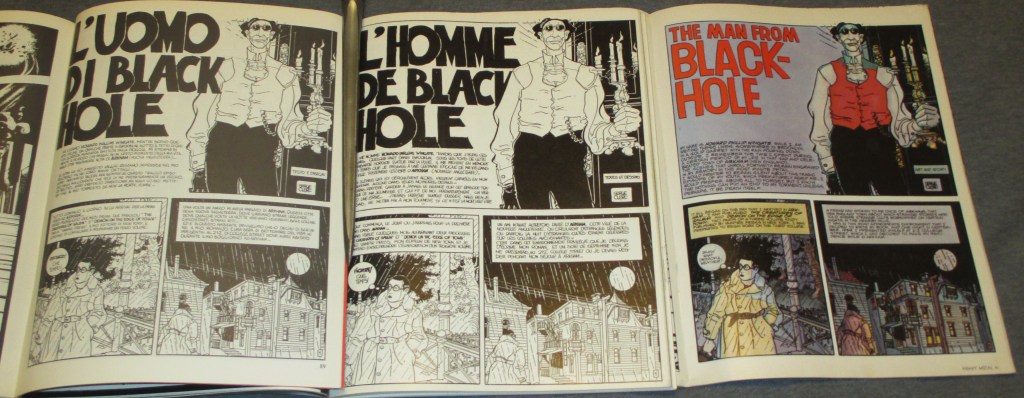
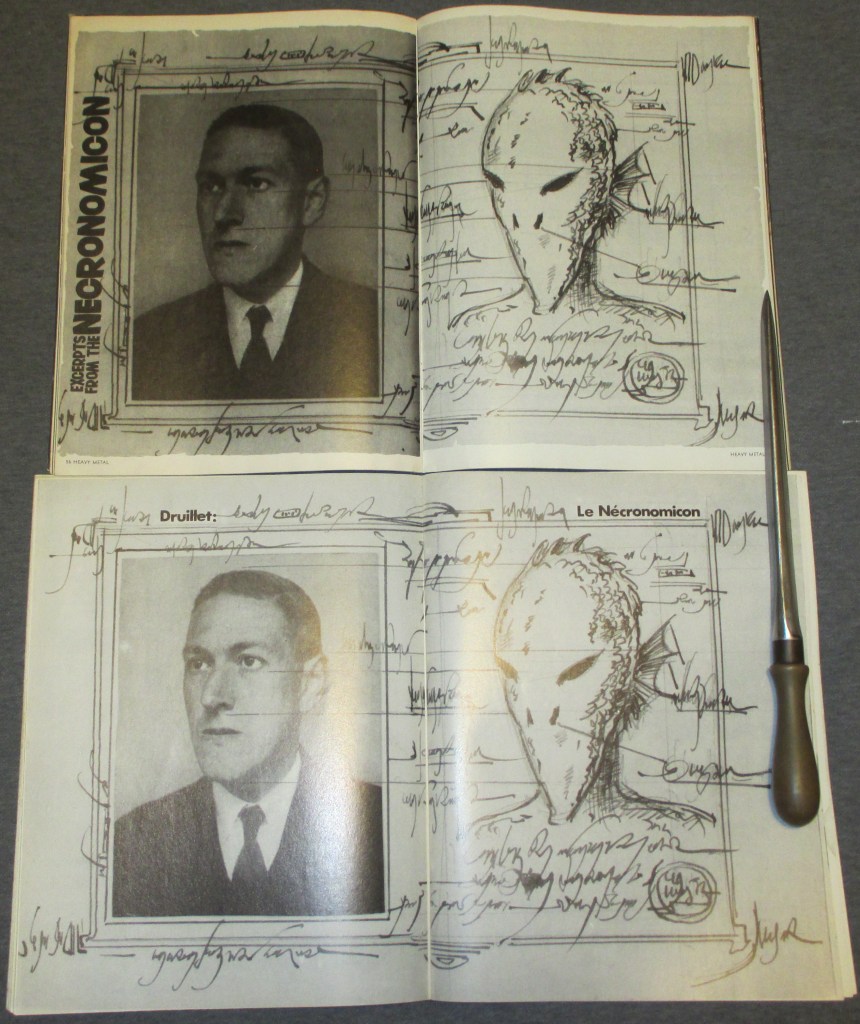
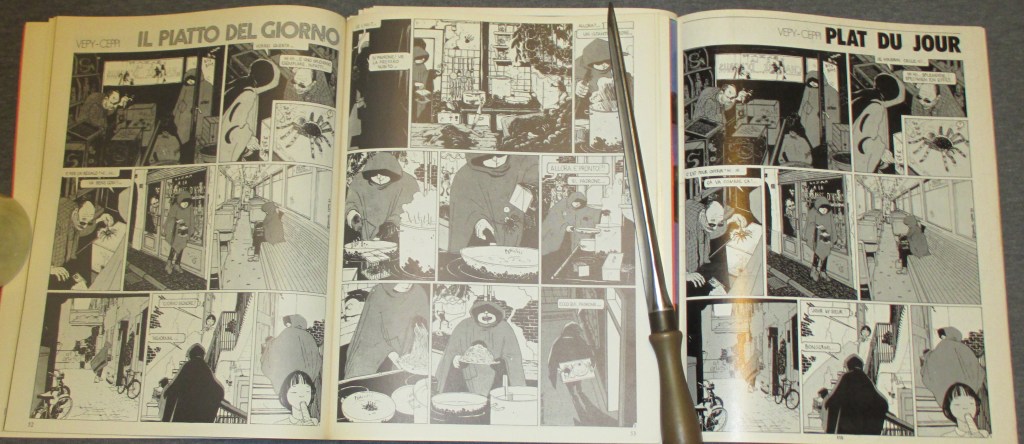
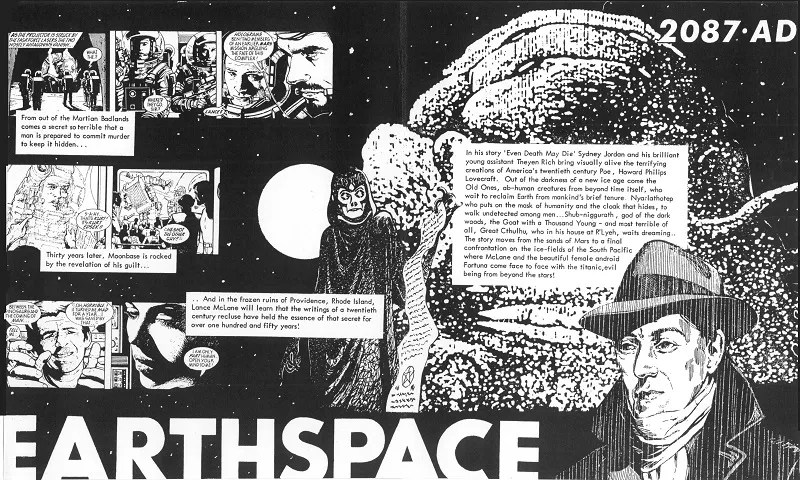
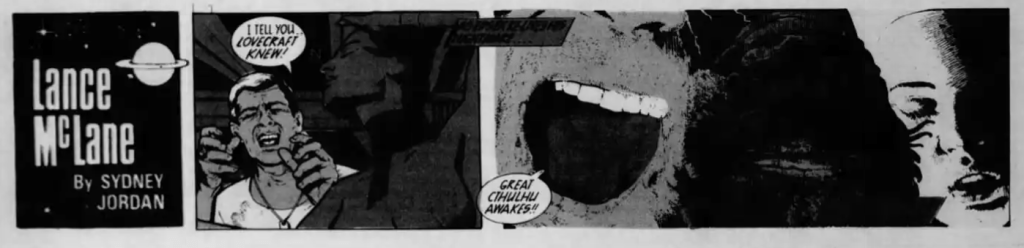
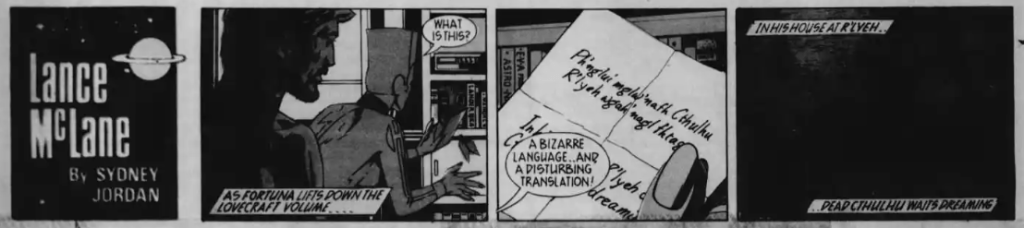
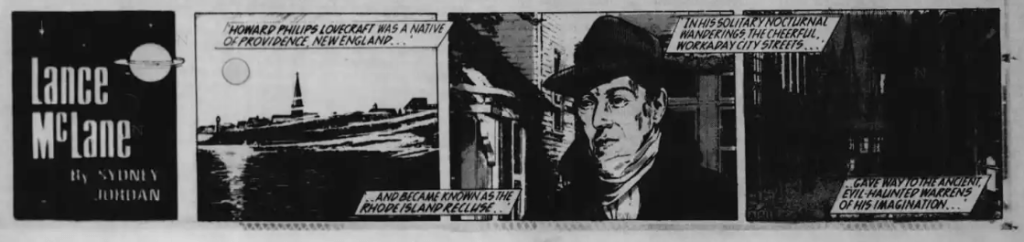
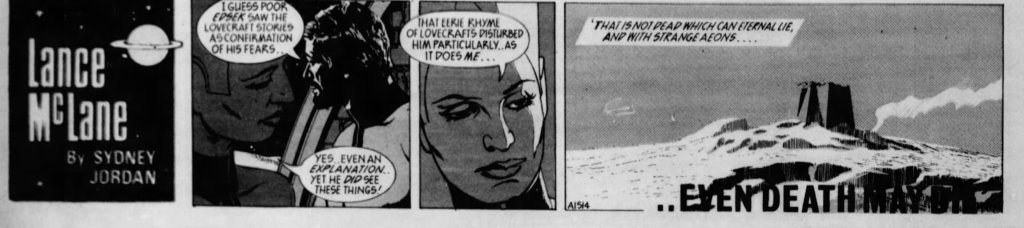
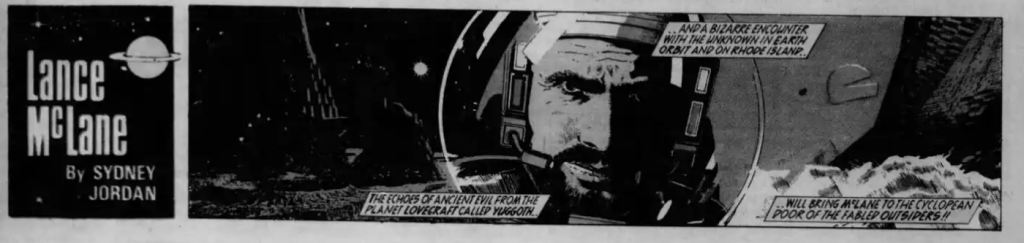
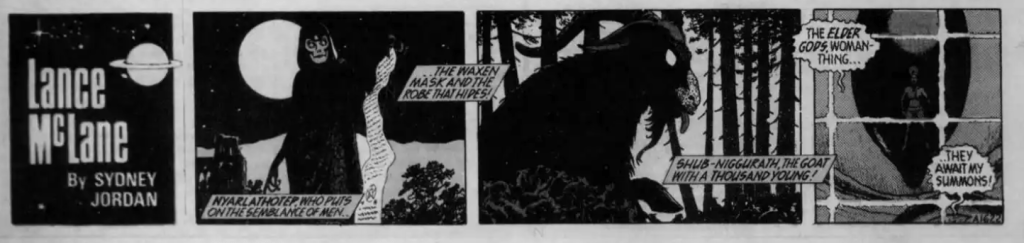
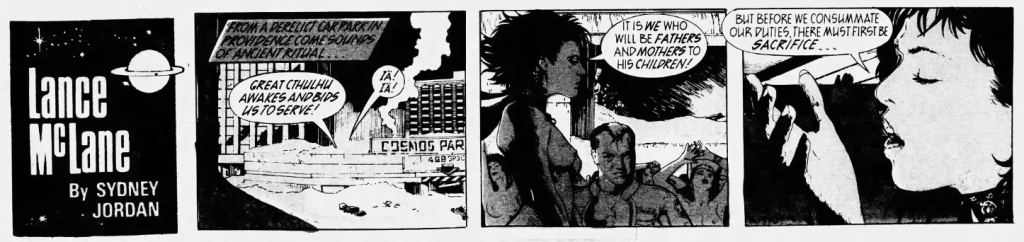
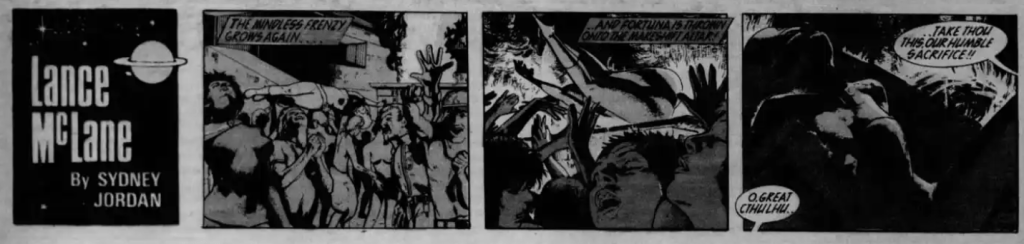
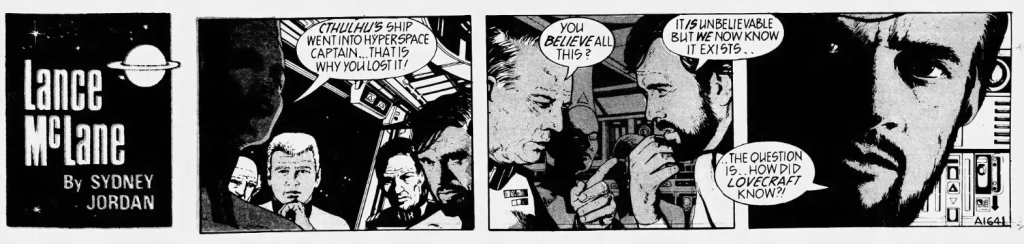

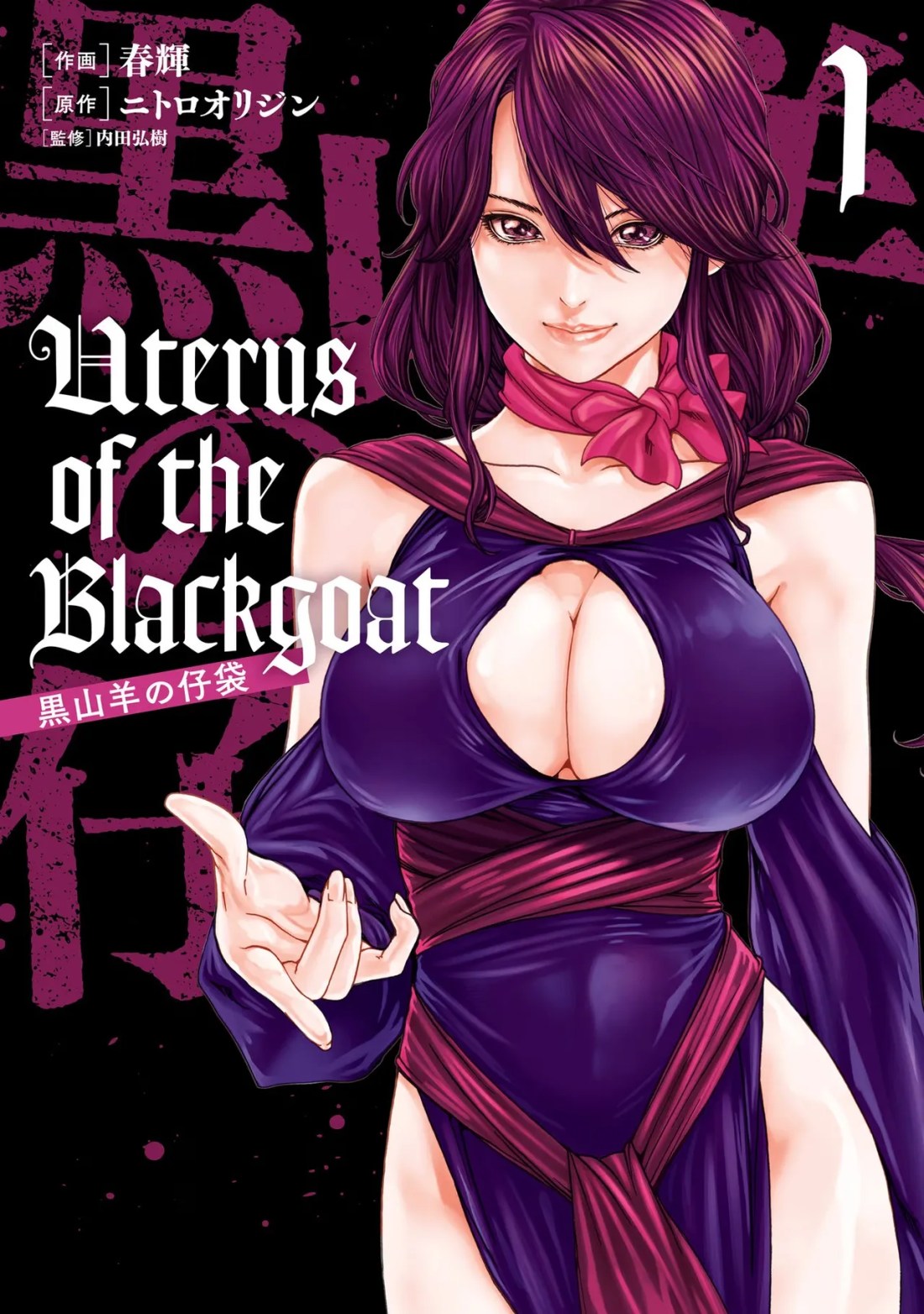
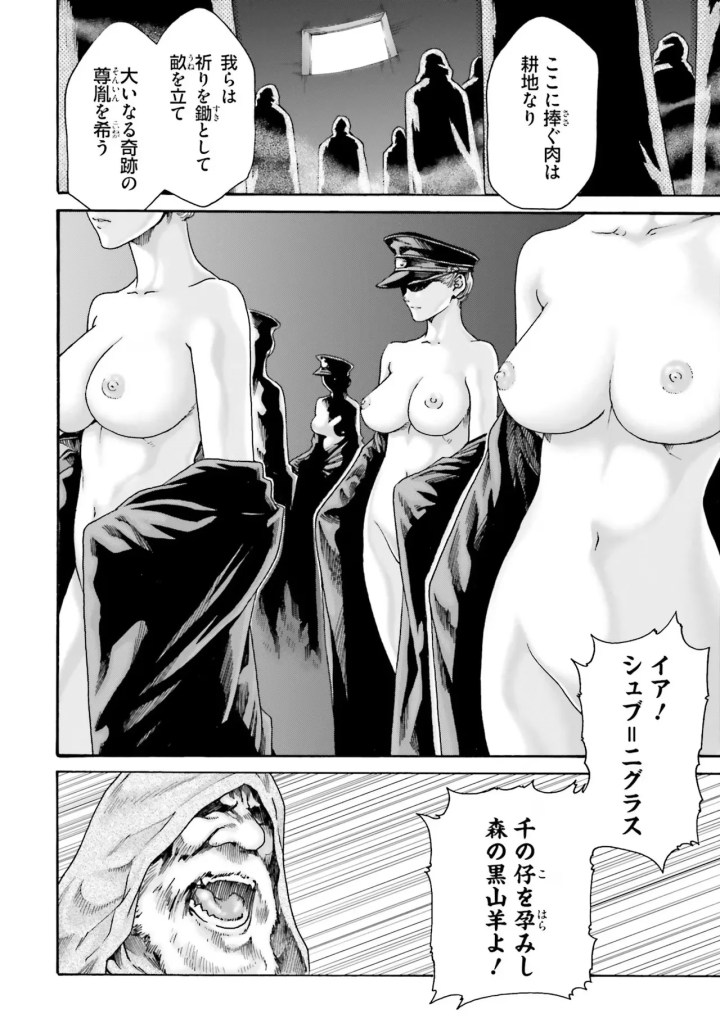

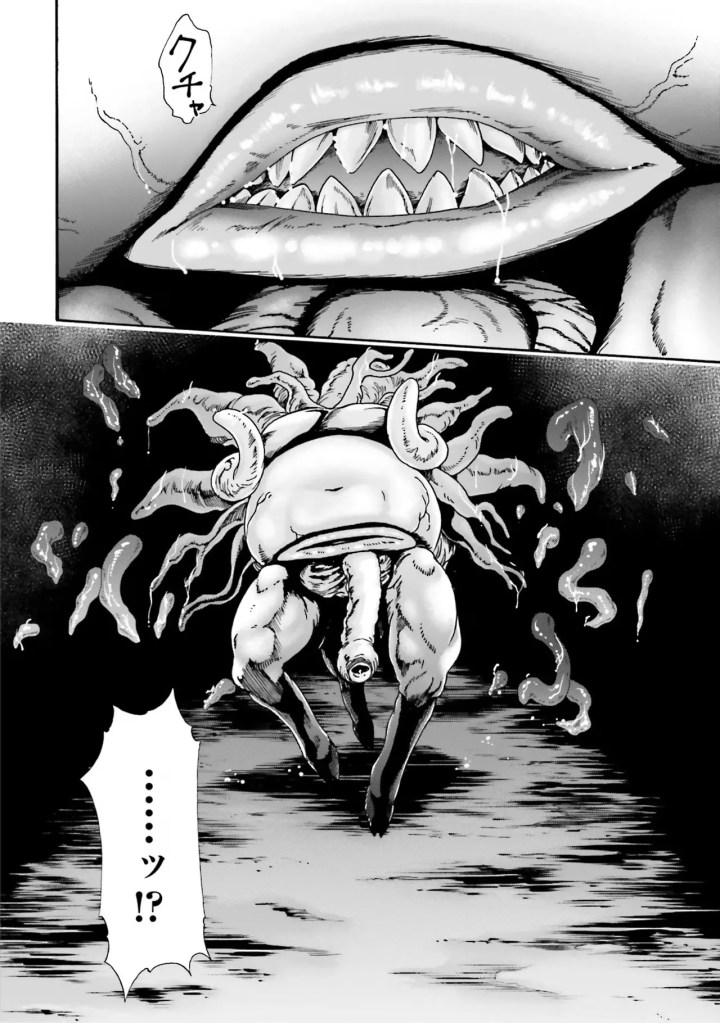

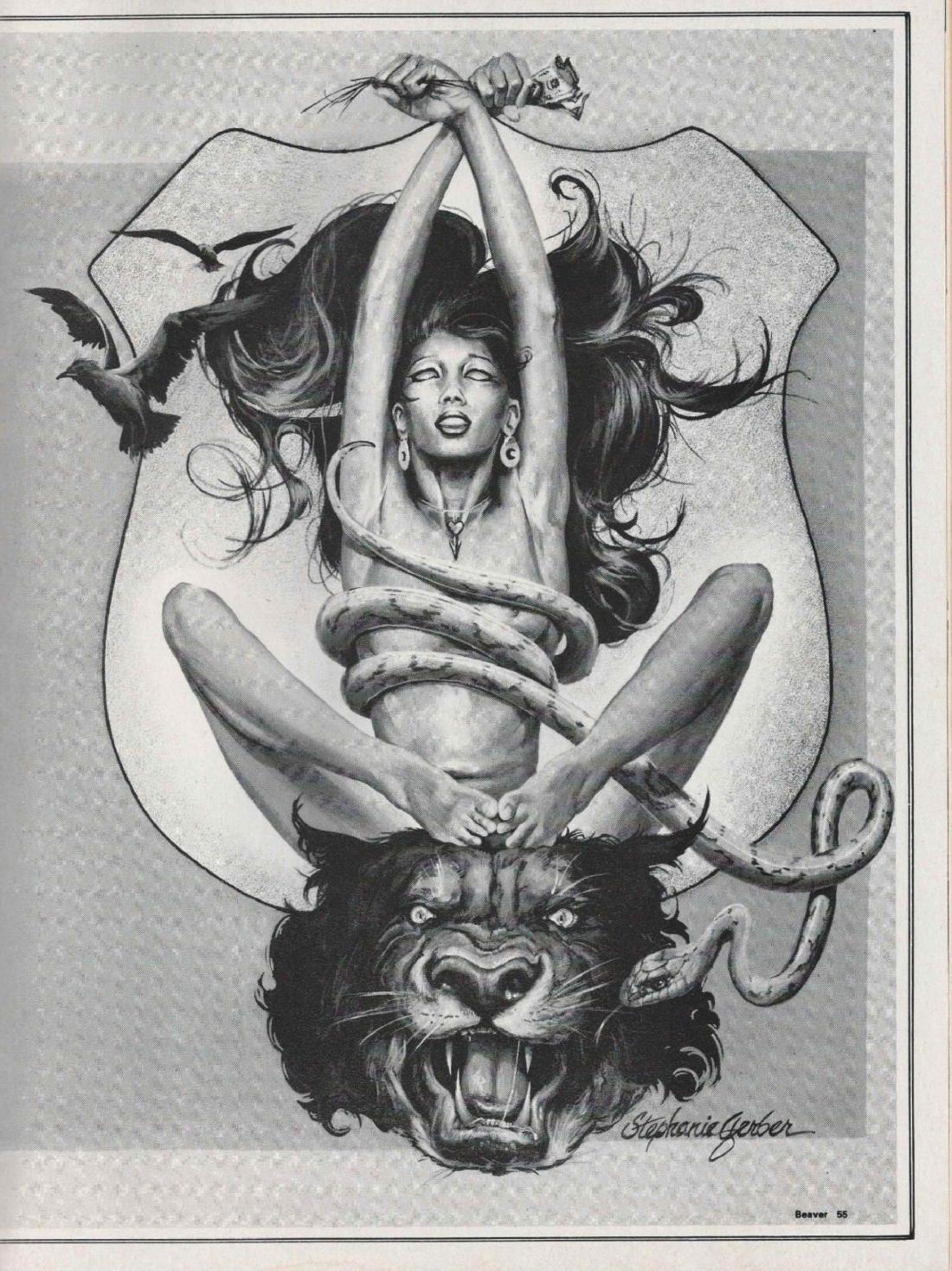
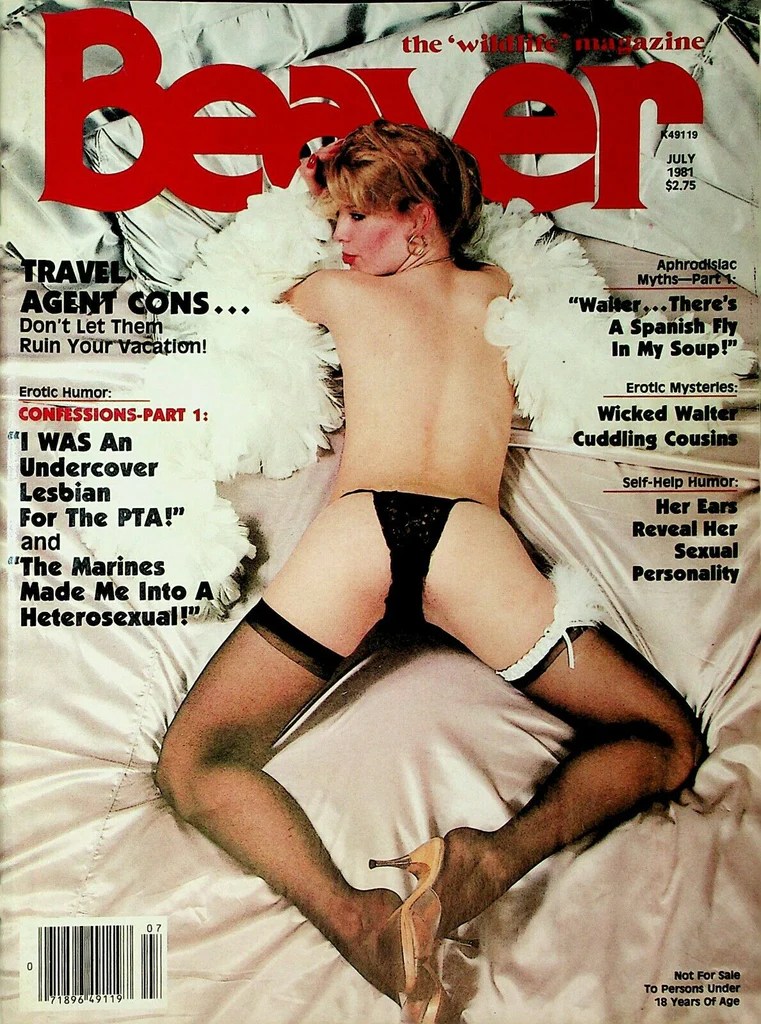
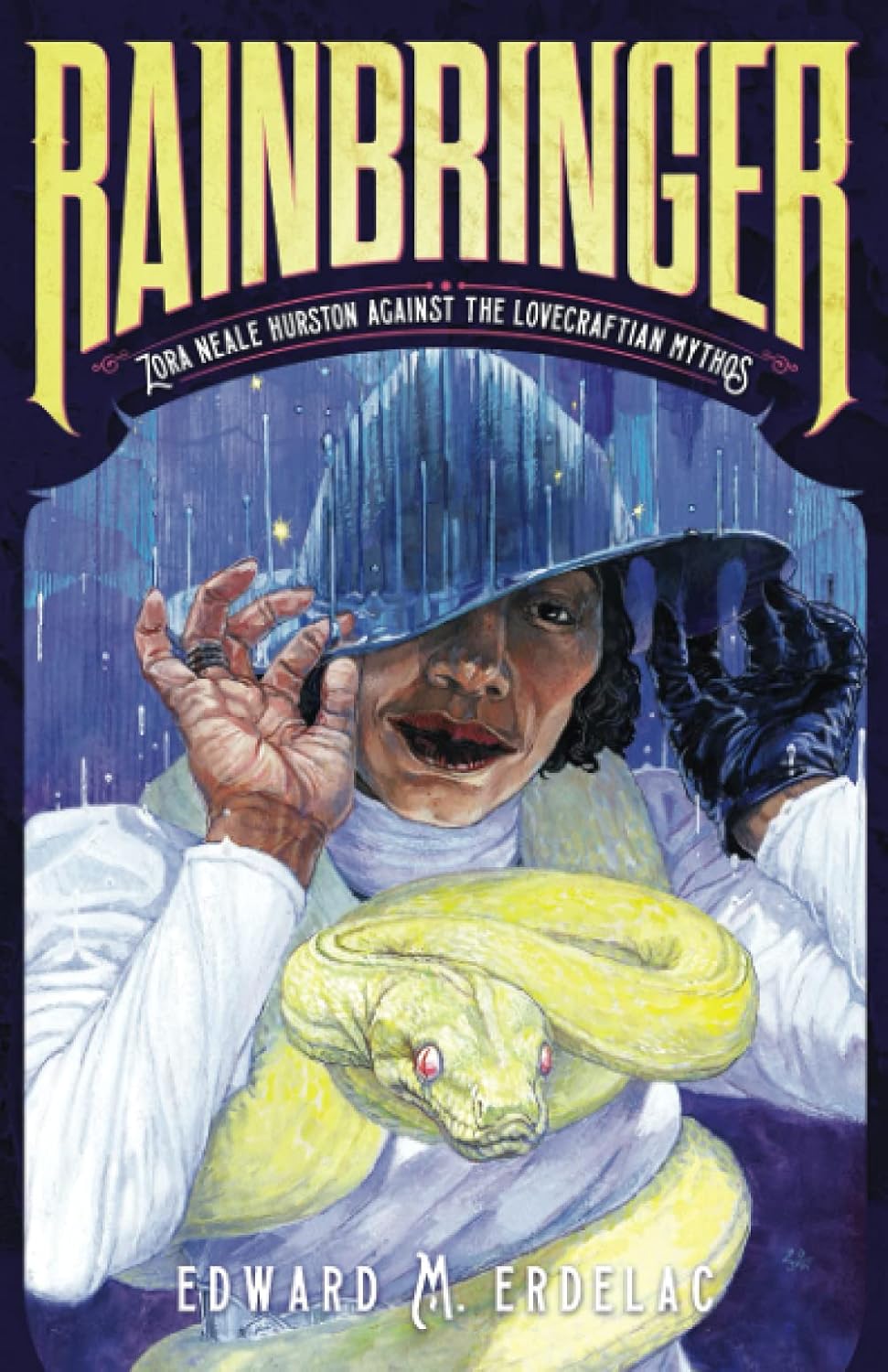
 Deep Cuts in a Lovecraftian Vein