The old gentry, representing the two or three armigerous families which came from Salem in 1692, have kept somewhat above the general level of decay; though many branches are sunk into the sordid populace so deeply that only their names remain as a key to the origin they disgrace. Some of the Whateleys and Bishops still send their eldest sons to Harvard and Miskatonic, though those sons seldom return to the mouldering gambrel roofs under which they and their ancestors were born.
—H. P. Lovecraft, “The Dunwich Horror” Weird Tales April 1929
Among the Salem witches in 1692, ‘this Rampant Hag, Martha Carrier, was the person, of whom the Confessions of the Witches, and of her own Children among the rest, agreed, That the Devil had promised her, she should be Queen of Hell.
—Margaret Murray, The Witch-Cult in Western Europe (1921) 47
Since 1924 when he first read Margaret Murray’s book on witches, H. P. Lovecraft had believed in the reality of the witch-cult, and that it had an American coven in Salem which had precipitated the famous witch-trials. So too, Lovecraft began to connect his stories with a fictional Salem diaspora, which included Joseph Curwen (“The Case of Charles Dexter Ward”), the ancestors of Randolph Carter (“Through the Gates of the Silver Key”), Richard Upton Pickman (“Pickman’s Model”) and the unnamed narrator of “The Festival.” Lovecraft even hinted at the events in his “History of the Necronomicon.” Yet when Lovecraft wrote “The Dunwich Horror” and “them witch Whateleys” little did he know that he was about to have an encounter with a real-life descendant of Salem.
By the way—that tale has just earned me a highly interesting letter from a curious old lady in Boston, a direct lineal descendant of the Salem witch Mary Easty, who was hanged on Gallows Hill Aug. 19, 1692. She hints at strange gifts & traditions handed down in her family, & asks me if I have access to any ancient secret witch-lore of New England. Also, she wants to know if Dunwich & Arkham are real places! I shall answer the letter, & see if I can get the good old soul to relate some of the whispered witch-traditions! A story of Salem horror based on actual “inside dope” from a witch-blooded crone would surely be a striking novelty!
—H. P. Lovecraft to Clark Ashton Smith, 22 Mar 1929, Dawnward Spire, Lonely Hill 171
Mary Towne Eastey (or Este, Easty, & other variations) was 58 when she was hanged for witchcraft. Her case is less famous than some of the other victims; Arthur Miller barely names her in The Crucible (1952). Two of her sisters were accused as well, with Rebecca Nurse hanged a few months earlier, but Sarah Cloyce was released the following year. Among the victims of the Salem Witch Trials, Mary Eastey was remembered as one of the most pious and eloquent, and in the end begged the court not for her own life, but for the lives of her fellow accused.
Before she died, Mary Eastey had eleven children, and many grandchildren—and in the 237 years between her death and the letter that H. P. Lovecraft received from “a curious old lady in Boston,” there is room for hundreds of potential descendants. Lovecraft never identifies his correspondent by name, nor does he appear to have kept any of her letters, so this particular correspondent has never been identified, and may never be, so brief was their relationship—so as with many of his lesser-known correspondents, we have to piece together what we can not from the letters themselves, but from Lovecraft’s references in his letters to others.
By the way—the publication of “The Dunwich Horror” has just earned me a curious & interesting letter from an old lady in Boston, a direct lineal descendant of the Salem witch Mary Easty, who was hanged on Gallows Hill Aug. 19, 1692. She claims to have heard some strange traditions handed down in the family, & to possess certain powers of peering into the future which she cannot explain. A quaint old soul, apparently—I shall write & see if any of her “inside” witch traditions have fictional value. She wants to know whether Dunwich & Arkham are real places, since they don’t appear on ordinary maps of Massachusetts!
—H. P. Lovecraft to August Derleth, c. 22 Mar 1929, Essential Solitude 1.189
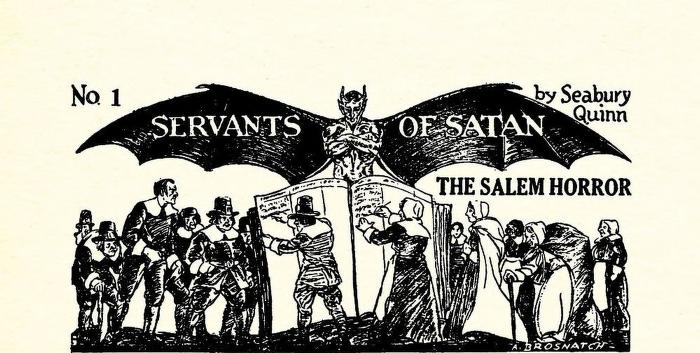
It is likely that like many fans she wrote at first by way of Weird Tales, and that the editor Farnsworth Wright had forwarded the letter to Lovecraft, much as he would do with Robert E. Howard’s letter to Lovecraft the next year. Weird Tales had never shied away from tales of the Salem Witch Trials; Seabury Quinn had covered the trials in his series of nonfiction articles titled Servants of Satan, beginning with “The Salem Horror” (WT Mar 1925). Quinn, like Lovecraft in “The Dunwich Horror,” mentions tourists—Salem in the 1920s was beginning to appreciate its reputation as “witch country,” though not quite to the extant that it one day would.
While Quinn paints the victims of the Salem witch hysteria as innocent here, in his fiction he was more than happy to hint at real witches caught and burned by the trials. Lovecraft was far from alone in imagining a Salem witch diaspora, which caught on in the public imagination with films like I Married A Witch (1942) and eventually the television show Bewitched (1964-1972) and characters like Sabrina Spellman (Archie’s Mad House #22, Oct 1962). But at the time, these “real” witches of Salem were often depicted less positively, such as in Robert Bloch’s short story “Satan’s Servants” (written c. 1935) which Lovecraft had a slight hand in.
Yes—I may call on that venerable & genial witch-descendant before long. She is certainly the epitome of thoughtfulness & generosity—no sooner had I chanced to mention casually my long desire to read “The Wind in the Rosebush”, than the good soul sent it along as an unsolicited loan—she having owned it these 25 years, ever since it was published!
—H. P. Lovecraft to August Derleth, 1 Apr 1929, Essential Solitude 1.190
While we don’t know for certain what Lovecraft’s letter contained, his first letter would not doubt disabused her that any of his artificial mythology—including Arkham and Dunwich—were real, as this is what he always did whenever anyone asked him about the reality of of the Necronomicon, Cthulhu, et al. It is curious that Lovecraft would mention such a scarce volume as Mary Eleanor Wilkins Freeman’s The Wind in the Rose-Bush and Other Stories of the Supernatural (1903), but given that the unnamed correspondent was a reader of Weird Tales, it suggests she had some tastes in weird fiction, and Lovecraft had recently published his “Supernatural Horror in Literature” (1927), which mentioned Freeman’s book, so perhaps that formed a point of discussion.
Yes—that letter from a witch-descendant was rather unusual, & I am still hoping for dark data when she gets ready to unfold some real family history. It appears that her forbears were well acquainted with the Marblehead witches Edward Dimond & his daughter Moll Pitcher, (whose home, “The Old Brig”, still stands on Burying Hill) & that she herself, through the Easty or Este line, is a scion of the D’Estes of Ferrara, Italy, & a descendant of no less a malign character than Lucrezia Borgia! Some ancestry! The wildest progenitors on my own family charts seem pretty tame besides this array of glittering sinistrality.
—H. P. Lovecraft to Clark Ashton Smith, 14 Apr 1929, Dawnward Spire, Lonely Hill 172
Marblehead, Massachusetts, neighboring Salem, was a model for Lovecraft’s Kingsport just as Salem (or Salem Village, modern day Danvers) was the basis for “witch-haunted Arkham.” Edward Dimond was known as “the Wizard of Marblehead” or “Wizard Dimond”; his granddaughter Moll Pitcher gained some fame as a fortune-teller in nearby Lynn, and was the subject of a poem by famed poet John Greenleaf Whittier.
I’ve heard more from the Boston witch-descendant, who likewise turns out to be a lineal scion (through the Massachusetts Eastys, who were originally D’Estes of Ferrara, Italy) of Lucrezia Borgia & Pope Alexander the Sixth! Likewise, her forbears were intimately acquainted with Old Diamond & Moll Pitcher of Marblehead, about whom I told you some time ago. She has not yet related any specific dark tales transmitted down her family line, but still promises to do so.
—H. P. Lovecraft to Elizabeth Toldridge, 15 Apr 1929, Letters to Elizabeth Toldridge & Anne Tillery Renshaw 56
The connection with the House of Este of Ferrara appears fanciful—many amateurs in genealogy make assumptions based on common names. If that is fancy, or an error, it may be that the entire witch-genealogy of this unknown correspondent was so. Certainly, it doesn’t appear that the “dark lore” was apparently ever passed to Lovecraft, or at least he makes no mention of further correspondence with her after 1929, nor are there any specific mentions of his visiting her in Boston at any point. There is one likely reference to her in a letter from Zealia Bishop to Lovecraft:
The Boston witch-lady & the Maine wizard prove rather interesting—the latter in a somewhat amusing way.
—H. P. Lovecraft to Elizabeth Toldridge, 4 May 1929, Letters to Elizabeth Toldridge & Anne Tillery Renshaw 61
“The Maine Wizard” was a male occultist who corresponded with Lovecraft at roughly the same time and for roughly the same purpose: asking after the genuine lore behind the Necronomicon and all that. As with the “Boston witch-lady,” Lovecraft never gives his name, though the very few descriptions suggest he was not William Lumley, another occultist of Lovecraft’s acquaintance. The correspondence did not last:
As for my spectrally affiliated New England correspondents—I have not again heard from the grotesque Maine person, but hear frequently from the old lady descended from Salem witches. She sent several moderately gruesome legends lately, but in general I find it more natural to invent cosmic horrors of my own than to utilise actual folklore incidents.
—H. P. Lovecraft to Elizabeth Toldridge, 24 Oct 1930, Letters to Elizabeth Toldridge & Anne Tillery Renshaw 162
Both of these correspondents have in common that they wrote to Lovecraft, probably via Weird Tales, as essentially “serious fan letters”—and we might imagine their thrill at receiving a response from the author, even as we imagine their disappointment when Lovecraft revealed that it was all made up after all. In the case of the Salem witch descendant, the correspondence appears to have continued for some time, turning to other subjects. While we never learn her name, we do learn her ultimate fate:
An old lady in Bostom whom I knew—& who died just a year ago—was a direct descendant of Mary Easty, one of the Salem witches hanged in 1692—& therefore a collateral descendant of the more famous Rebecca Nurse (Mrs. Easty’s sister), whose ancient house (built 1636) in Danvers, Mass. [near Salem—formerly called Salem-Village] is still in existence & open as a public museum (I saw it in 1923).
—H. P. Lovecraft to R. H. Barlow, 19 Mar 1934, O Fortunate Floridian! 116
You perhaps did not remember that I sent The Mound to Sonny Belknap over two years ago—in fact immediately after the old Boston lady—I’m grieved to learn of her death—returned it.)
—Zealia Bishop to H. P. Lovecraft, 26 May 1934, The Spirit of Revision
One thing we can be relatively sure of is that Lovecraft did not have her copy of The Wind in the Rose-Bush in later years, because he did not have a copy when Samuel Loveman gifted one to him in 1935. Lovecraft tended to be punctual in such things, and his last published recollection of his former correspondent shows it is no longer in his possession:
It’s an achievement nowadays even to read “The Wind in the Rosebush”, for scarcely any library has a copy. I never saw it till a year & a half ago, when a nice old lady in Boston lent a copy to Munn & me.
—H. P. Lovecraft to August Derleth, 14 Apr 1932, Essential Solitude 2.472
H. Warner Munn was a fellow weird taler from Athol, Massachusetts who had famously written “The Werewolf of Ponkert” (WT Jul 1925) following a suggestion from Lovecraft; the Rhode Islander also noted Munn’s extensive weird library. Curiously, when Loveman gifted Lovecraft with a copy of the rare book, he noted:
Loveman brought me a copy of “The Wind in the Rosebush” which he had promised me so long. Now you, Munn, & I are all equipped!
—H. P. Lovecraft to R. H. Barlow, 5 Sep 1935, O Fortunate Floridian! 291
Where did Munn get his copy? Did he have a bit of luck and buy one in the book store or—perhaps—was he one of those bastards that borrow a book and never give it back? We don’t know; perhaps she sold or gifted the copy to Munn.
Even after his death, Lovecraft’s friends remembered her through his letters:
Another, a woman claiming descent from infamous New England witches and also from Lucretia Borgia, offered HPL some inside dope on the witch cult and its practices.
That is all there is on Lovecraft’s correspondence with the unnamed descendant of Mary Towne Eastey, that innocent old woman killed in the witch-hysteria that gripped Salem Village in 1692. Seabury Quinn in “The End of the Horror” called the whole episode absurd and a tragedy, and so it was. Yet reading these lines over, I am given to wonder if in their brief correspondence Lovecraft might have touched on Mary Eastey’s sister Rebecca Nurse—and maybe he recalled a very singular experience he had in a trip to Danvers some years prior, before he read The Witch-Cult in Western Europe:
I now put the aera of Colonial refinement behind me, and hark’d back farther still to an age of darker and weirder appeal—the age of the dreaded witchcraft. Leaving Danvers, I struck out along the roads and across the fields toward the lone farmhouse built by Townsend Bishop in 1636, and in 1692 inhabited by the worthy and inoffensive old widow Rebekah Nurse, who was seventy years of age and wished no one harm. Accused by the superstitious West Indian slave woman Tituba (who belong’d to the Reverend Samuel Parris and who caused the entire wave of delusion) of bewitching children, and denounced blindly by some of the hysterical children in question, Goodwife Nurse was arrested and brought to trial. Thirty-nine persons sign’d a paper attesting to her blameless conduct, and a jury render’d a verdict of “not guilty”; but popular clamour led the judges to reverse the verdict (as was then possible), and on 19 July 1692 the poor grandam was hang’d on Gallows Hill in Salem for a mythological crime. Her remains were brought back from Salem and interred in the family burying-ground—a ghoulish place shadowed by huge pines and at some distance from the house. In 1885 a monument was erected to her memory, bearing an inscription by the poet Whittier.
As I approach’d the spot to which I had been directed, after passing through the hamlet of Tapleyville, the afternoon sun was very low. Soon the houses thinn’d out; so that on my right were only the hilly fields of stubble, and occasional crooked trees clawing at the sky. Beyond a low crest a thick group of spectral boughs bespoke some kind of grove or orchard—and in the midst of this group I suddenly descry’d the rising outline of a massive and ancient chimney. Presently, as I advanced, I saw the top of a grey, drear, sloping roof- sinister in its distant setting of bleak hillside and leafless grove, and unmistakable belonging to the haunted edifice I sought. Another turn—a gradual ascent—and I beheld in full view the sprawling, tree-shadowed house which had for nearly three hundred years brooded over those hills and held such secrets as men may only guess. Like all old farmhouses of the region, the Nurse cottage faces the warm south and slopes low toward the north. It fronts on an ancient garden, where in their season gay blossoms flaunt themselves against the grim, nail-studded door and the vertical sundial above it. That sundial was long concealed by the overlaid clapboards of Gothic generations, but came to light when the house was restored to original form by the memorial society which owns it. Everything about the place is ancient—even to the tiny-paned lattice windows which open outward on hinges. The atmosphere of witchcraft days broods heavily upon that low hilltop.
My rap at the ancient door brought the caretaker’s wife, an elderly unimaginative person with no appreciation of the dark glamour of the ancient scene. This family live in a lean-to west of the main structure—an addition probably 100 years less ancient than the parent edifice. I was the first visitor of the 1923 season, and took pride in signing my name at the top of the register. Entering, I found myself in a low, dark passage whose massive beams almost touched my head; and passing on, I travers’d the two immense rooms on the round floor—sombre, barren, panell’d apartments with colossal fireplaces in the vast central chimney, and with occasional pieces of the plain, heavy furniture and primitive farm and domestick utensils of the ancient yeomanry. In these wide, low-pitch’d rooms a spectral menace broods—for to my imagination the 17th century is as full of macabre mystery, repression and ghoulish adumbrations as the 18th century is full of taste, gayety, grace and beauty. This was a typical Puritan abode; where amidst the bare, ugly necessities of life, and without learning, beauty, culture, freedom or ornament, terrible stern-fac’d folk in conical hats or poke-bonnets dwelt 250 and more years ago—close to the soil and all its hideous whisperings; warp’d in mentality by isolation and unnatural thoughts, and shivering in fear of the Devil on autumn nights when the wind howl’d through the twisted orchard trees or rustled the hideous corpse-nourish’d pines in the graveyard at the foot of the hill. There is eldritch fascination—horrible buried evil—in these archaic farmhouses. After seeing them, and smelling the odour of centuries in their walls, one hesitates to read certain passages in Cotton Mather’s strange old “Magnalia“ (which you, little Belknap, shall see when you come to visit your old grandpa) after dark. After exploring the ground floor I crept up the black crooked stairs and examin’d the bleak chambers above. The furniture was as ugly as that below, and included a small trundle-bed in which infant Puritans (even as you, children) were lull’d to sleep with meaningless prayers and morbid hints of daemons riding the night-wind outside the small-paned lattice-windows. Poor little creatures! […]
I saw old Rebekah’s favourite chair, where she used to sit and spin before the Salem magistrates dragged her to the gallows. And the sunset wind whistled in the colossal chimney, and ghouls rattled ghastly skeletons from unseen attic rafters overhead. Tho’ it was not suppos’d to be open to the public, I persuaded the caretaker to let me ascend to that hideous garret of century’d secrets. Thick dust cover’d everything, and unnatural shapes loom’d on every hand as the evening twilight oozed though the little blear’d panes of the ancient windows. I saw something hanging from the wormy ridge-pole—something that swayed as if in unison with the vesper breeze outside, tho’ that breeze had no access to this funereal and forgotten place—shadows … shadows … shadows… And I descended from that accursed garret of palaeogean arcana, and left that portentous abode of antiquity; left it and went down the hill to the graveyard under the shocking pines, where twilight shew’d sinister slabs and rusty bits of fallen iron fence, and where something squatted in shadow on a monument—something that made me climb the hill again, hurry shudderingly past the venerable house and descend the opposite slope to Tapleyville as night came.
—H. P. Lovecraft to Frank Belknap Long and Alfred Galpin, 1 May 1923, Letters to Alfred Galpin & Others 247-249
What might she have made of that, if Lovecraft cared to retell that particular tale? Perhaps it would have thrilled her…or perhaps she would have taken more comfort in the lines of Whittier that adorn Rebecca Nurse’s monument:
O, Christian martyr! who for truth could die,
When all about thee owned the hideous lie!
The world, redeemed from superstition’s sway,
Is breathing freer for thy sake today.
Bobby Derie is the author of Weird Talers: Essays on Robert E. Howard & Others (2019) and Sex and the Cthulhu Mythos (2014).