In the early days of organized fantasy, weird, and science fiction fandom, “fan fiction” was simply fiction by fans for fans, published in fanzines without compensation, to differentiate it from the fiction published professionally in pulp and slick magazines, newspapers, etc. Early fan fiction may have had an amateurish quality, but it wasn’t explicitly based on the works of other writers, or include characters and settings from other works. Mythos stories, however, were an exception; they emerged quite naturally beginning in the 1930s, from poetry like & “The Woods of Averoigne” (1934) by Grace Stillman, “Shadow Over Innsmouth” (1942) by Virginia Anderson, and “The Acolytes” (1946) by Lilith Lorraine, and short fiction like “The Picture” (1939) by Robert D. Harris. The Mythos was open to exploration and exploitation in a way many more consolidated properties were not at the time.
Herman Stowell King (1929-2015) was a science fiction fan and collector, known mostly today for his fanfiction and poetry and a few other pieces published in magazines like Fate and Exploring the Unknown. His particular contribution to the Cthulhu Mythos seems unusually overlooked.
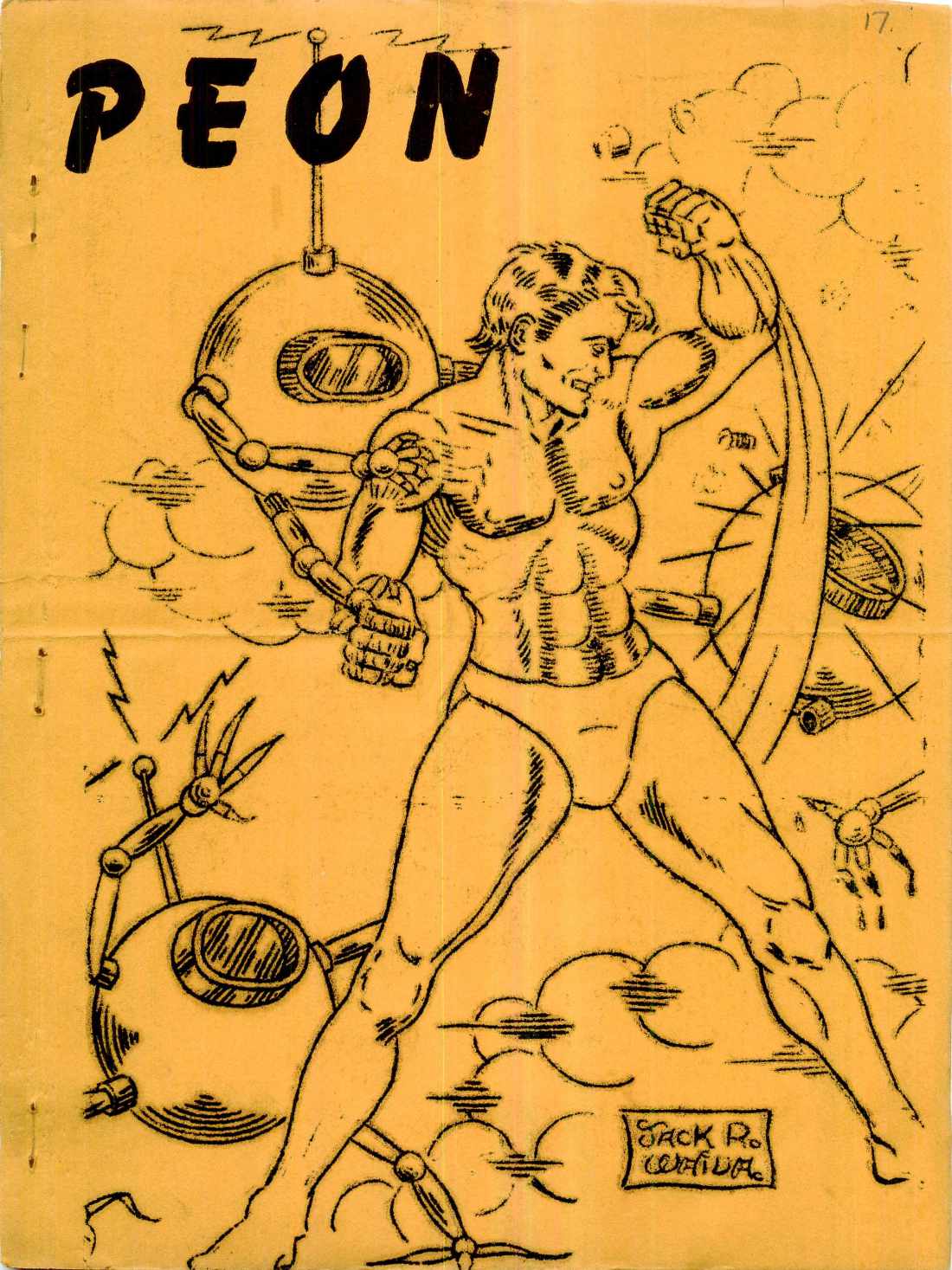
First published in Peon #17 (January 1951).
※
The Coming of Tsathoggua
by Herman Stowell King
Far back in the pre-existence of manking, when Earth was still a steaming morass, and the first weird life form crawled forth from the ooze of primal slime, the god Tsathoggua came through the void from a distant planet called Cykranosh (now termed as Saturn by astronomers). Tsathoggua was an evil god; he had lived for interminable eons of time, and Cykranosh was not his original home. Vicenillions of years ago, he had come there from a remote star, in a galaxy so distant as to be unthinkable.
In appearance, Tsathoggua somewhat resembled a huge, bloated toad, although he was not batrachian in the least. His skin, and again we must use a mundane analogy totally adverse from the real thing, was covered with a short, sloth-like fur. There were no pupils in his bulging eyes, and his nose was almost bridgeless. His body was moist and slimy: composed of some viscid, protoplastic substance.
Now although Tsathoggua was extremely repulsive in every aspect, he was an incredibly wise god. He held secrets that a normal terrestrial mind could not begin to conceive; knowledge of extra-cosmic galaxies, multiple dimensions, primordial races of ultimate evolution, the creation of the elements; this, and more, he knew, and could be drawn from wells of the subconscious should he ever have use for such wisdom.
Tsathoggua, however, had more than one attribute of the toad. Aside from quasi-physical resemblance, he was sluggishly lazy. The long journey from Cykranosh (although infinitesimally small in comparison with the one from his original habitat) had tired him, and after gorging on a few amphibian creatures, he burrowed deep in some hot, fetid muck, where for many milleniums he slept soundly.
The Earth had gone through a long stage of cooling and solidification; and the slime vanished from the surface to be replaced by warm seas. Green vegetation sprang up, and soon the land was covered with lush, tropical jungles. Living organisms went through various processes of evolution, and presently the earth teemed with tremendous animals, most of which were reptilian.
Dinosaurs roamed the jungles, and marshes, and pterodactyls flapped ugily though the air. Diplodocus fed on vegetables, while Tyrannosaurus fed on Diplodocus.
The god Tsathoggua was awakened by the cooling of the muck in which he was embedded. Lazily blinking his protuberant eyes (he had sight despite the lack of pupils—a fantastic extra-optical sense of perception) he wobbled elastically onto the dry ground, and proceeded to search about for means of nourishment.
The first living animal to impinge on Tsathoggua’s cognition was a flying Pteranodon. Displaying a remarkable elongation, the squat, drowsy-looking deity from outer space flicked out his tongue and viscously encircled the poor Pteranodon. There was an inarticulate squawk, and Tsathoggua gulped the reptilian bird down his plastic esophagus. Anon followed a period of digestion. Tsathoggua did not convert his food in the manner characteristic of homo sapiens and lesser animals; instead he merely assimilated it into his own individual substance. And considering his essence, there was no danger of over-expansion.
Having done with that small morsel, the toad god ran rubberly off, apparently awkward, but with amazing celerity. Entering the thick jungle he espied a huge, scaly-clad creature walking upright. Tyrannosaurus Rex, the most ferocious of all reptiles.
Surely, this enormous quadruped would satiate his hunger, thought Tsathoggua. Immediately, he waddled placidly toward the Tyrannosaurus, who after an interval of surprised silence (surprised that anything dared approach him) snorted a loud challenge. Eyes red with terrible wrath the battle-scarred carnivora of the Mesozoic Age bounded to meet his non-terrestrial adversary.
Tsathoggua quickly underwent a phenomenal metamorphosis, melting into a semi-liquid state, and literally pouring over the bewildered Rex! There was a short moment of violent convulsion, as the die-hard warrior struggled valiantly against the swallowing tide of tenacious life which engulfed him. All effort was futile however, and after a few feeble tremours, the lumpy mass of adhesively sticky matter remained motionless. It had not taken long for Tsathoggua to incorporate the scrawny Pterandon into himself, but the great Tyrannosaurus was a vastly different undertaking to him!
Hours later, following this extended absorption, Tsathoggua remolded back to his anurian likeness, and deciding he did not like the surface climate, commenced to seek some subterranean abode.
This proved an easy task for such an intelligent deity. By use of some recondite, extra sense, Tsathoggua located a suitable place deep in the bowels of the earth, the entrance being a narrow, volcanic fissure atop a black basaltic mountain.
So the god Tsathoggua found a residence agreeable for a long state of Earth existence. In this underground grotto he slept continuously, coming to the surface only occasionally for food; but usually he even transported his substance by exerting some subtle, psychokinetic energy, without moving physically from his spot of repose.
The ages unfolded as he drowsed; the Mesozoic giving way to the Tertiary, the Tertiary yielding to the Pleistocene, and so on. Man appeared on Earth, and civilization pushed back barbarism.
Vast empires graced the lands; Hyperborea and Atlantis with their fair cities rearing marble cupolas aloft; Mu and Valusia came and went, leaving naught but myth and legend of their existence. There was among those peoples a mystical few who worshipped Tsathoggua, and in return for their carnal tributes he gave them awful and marvellous powers of sorcery and necromancy. Having the wisdom of an elder god at the evocation, these wizards executed nameless foul deeds of evil and corruption. Through the performance of unholy rites and incantations, those that numbered the cult of Tsathoggua could control the elements, conjure up the dead, withstand mortality by regulating the metabolism in the protoplasm; in fact, there was little those devil worshippers could not do.
But as time passed, and all those wonderful civilizations vanished into limbo, so vanished man’s credulity in gods and all things considered immaterial, till finally there was no one to worship Tsathoggua, because no one believed he existed.
Very few were those who still sought pleasure in the form of strange and inexplicable pursuits, and the ones that did find Tsathoggua were woefully weak and pusillanimous, for they went mad at the knowledge of the toad god’s reality. Many of these never returned from the dark-lit grotto, but fell victim to his evil gluttony.
Yea, gone are Hyperborea and Atlantis; gone save in vague fables; but the god Tsathoggua still sleeps in his subterrene abode, and there shall come the time when he awakens voracious, and horror and havoc will descend on the cities of man.
※
Tyrannosaurs (late Cretaceous period, 69-66 million years ago) did not prey on Diplodocus (late Jurassic, 152-149 Ma). Nor did either co-exist with Pteranodon (late Cretaceous, 86-78 Ma). If I were glossing this, I would suggest that Tsathoggua had awoken in some remote region where various dinosaur species had continued to co-exist long after the period that paleontologists have assigned to them, like the Savage Land in Marvel Comics. That’s a quibble for a brief, very fannish piece.
Tsathoggua was the creation of Clark Ashton Smith, but because of the vicissitudes of pulp publishing, Lovecraft actually ended up mentioning Tsathoggua in print first. King was clearly drawing more on Smith’s interpretation of Tsathoggua than Lovecraft’s, but was synthesizing from disparate elements in the Mythos to put his little characterization together:
It’s from N’kai that frightful Tsathoggua came—you know, the amorphous, toad-like god-creature mentioned in the Pnakotic Manuscripts and the Necronomicon and the Commoriom myth-cycle preserved by the Atlantean high-priest Klarkash-Ton.
—H. P. Lovecraft, “The Whisperer in Darkness” (1931)I had never seen an image of Tsathoggua before, but I recognized him without difficulty from the descriptions I had heard. He was very squat and pot-bellied, his head was more like that of a monstrous toad than a deity, and his whole body was covered with an imitation of short fur, giving somehow a vague suggestion of both the bat and the sloth. His sleepy lids were half-lowered over his globular eyes; and the tip of a queer tongue issued from his fat mouth. In truth, he was not a comely or personable sort of god, and I did not wonder at the cessation of his worship, which could only have appealed to very brutal and aboriginal men at any time.
—Clark Ashton Smith, “The Tale of Satampra Zeiros” (1931)He had cultivated the acquaintance of Zhothaqquah, who, in the desuetude of his worship, was now driven to lead an existence wholly subterranean; he had offered the prescribed prayers, had made the sacrifices that were most acceptable; and the strange, sleepy little god, in return for Eibon’s interest and his devotion, had confided to him certain information that was more than useful in the practise of the black arts. Also he had presented Eibon with some autobiographical data that confirmed the popular legends in more explicit detail. For reasons which he did not specify, he had come to Earth in former aeons from the planet Cykranosh (the name by which Saturn was called in Mhu Thulan); and Cykranosh itself had been merely a waystation in his travels from remoter worlds and systems.
—Clark Ashton Smith, “The Door to Saturn” (1932)Black Tsathoggua moulded itself from a toad-like gargoyle to a long, sinuous line with hundreds of rudimentary feet […]
—H. P. Lovecraft & Hazel Heald, “The Horror in the Museum” (1933)Somewhere beneath that four-coned mountain, the sluggish and baleful god Tsathoggua, who had come down from Saturn in years immediately following the Earth’s creation, was fabled to reside […] You shall know Tsathoggua by his great girth and his batlike furriness and the look of a sleepy black toad which he has eternally. He will rise not from his place, even in the ravening of hunger, but will wait in divine slothfulness for the sacrifice. And, going close to Lord Tsathoggua, you must say to him: “I am the blood-offering sent by the sorcerer Ezdagor.’ Then, if it be his pleasure, Tsathoggua will avail himself of the offering.
—Clark Ashton Smith, “The Seven Geases” (1934)[…] could turn a human Carter into one of those earlier entities which had dwelt in primal Hyperborea and worshipped black, plastic Tsathoggua after flying down from Kythanil, the double planet that once revolved around Arcturus […]
—H. P. Lovecraft & E. Hoffmann Price, “Through the Gates of the Silver Key” (1934)It had been built in imitation of certain temples depicted in the vaults of Zin, to house a very terrible black toad-idol found in the red-litten world and called Tsathoggua in the Yothic manuscripts.
—H. P. Lovecraft & Zealia Bishop, “The Mound” (1940)
Like “Why Abdul Al Hazred Went Mad” (1950) by D. R. Smith, this is a fan filling in a piece of unwritten Mythos history. There’s not a lot in the way of plot in this short piece, but it’s a rare example of someone leaning more toward Clark Ashton Smith instead of Lovecraft in early Mythos fanfiction.
Bobby Derie is the author of Weird Talers: Essays on Robert E. Howard and Others and Sex and the Cthulhu Mythos.
Deep Cuts in a Lovecraftian Vein uses Amazon Associate links. As an Amazon Associate I earn from qualifying purchases.

