The Early Fiction of Farnsworth Wright

Farnsworth Wright (1888–1940) will forever be associated with Weird Tales and its sister magazine Oriental Stories (later The Magic Carpet Magazine). He helmed the Unique Magazine from 1924 until shortly before his death in 1940; 13 years that saw the publication of some of the best fiction and poetry by H. P. Lovecraft, C. L. Moore, Robert E. Howard, Mary Elizabeth Counselman, Clark Ashton Smith, Greye La Spina, Seabury Quinn, Leah Bodine Drake, August Derleth, and Robert Bloch, among many others. It can be fairly said that Wright’s editorial tastes defined the magazine for a generation, and both praise and criticism have been heaped upon his name.

Yet before Wright was an editor, he was a writer himself, as an amateur journalist, professional journalist, and professional fiction writer. Some of his later fiction appeared in Weird Tales and Oriental Stories, either under his own name (before he was editor) or under the pseudonym Francis Hard (after he was editor). Rumor has suggested Wright may have silently written or re-written various pieces in Weird Tales, but lacking the business files, no one knows for certain.

Wright’s earliest fiction, however, appeared largely in the Overland Monthly and newspapers. Most of these works haven’t been reprinted since their original publication, and all are, by dint of the date of publication, in the public domain. For the most part, these aren’t works of weird fiction, but small dramas of human interest. Pulp historian John Locke in his book The Thing’s Incredible! The Secret History of Weird Tales reads many autobiographical elements in these early stories, and for those who want more insight into the editorial hand doling out guidance and criticism to Lovecraft & co., these stories provide an interesting sidelight on Wright’s own voice and tastes.

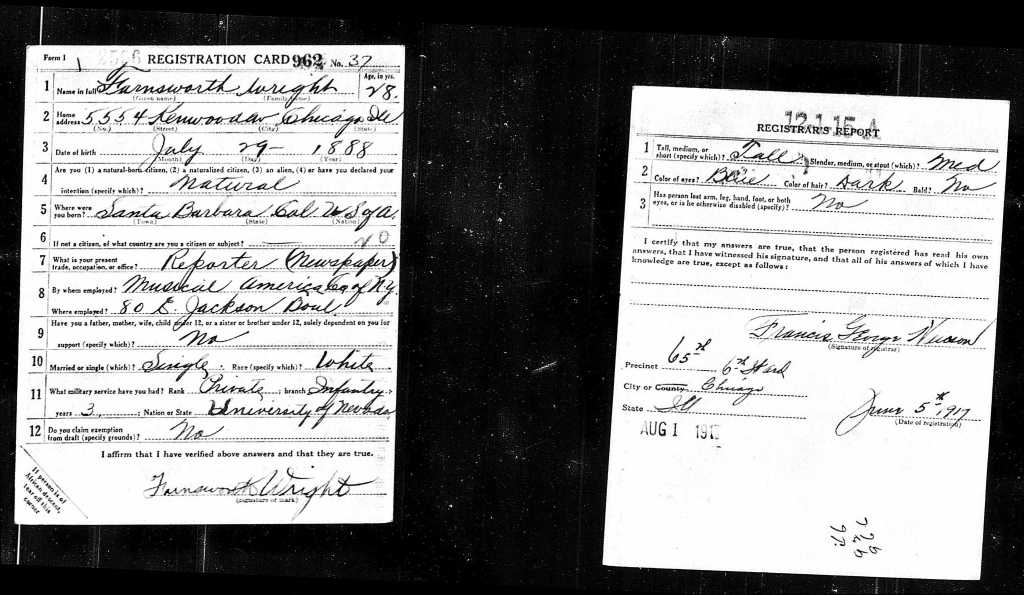
In 1914, Farnsworth Wright graduated from the University of Washington, where he had spent the last two years as managing editor of the University of Washington Daily. He did stints as a journalist at the Seattle Sun and the Chicago Tribune before landing a job as the Chicago correspondent of Musical America. During this stint, Wright would place his first two stories in the Overland Monthly: “Enemies (Feb 1917) and “The Vow” (Aug 1917). World War I loomed, and Wright was drafted, sent overseas to France, where he served as an interpreter, and returned stateside in 1919.

Wright returned to a career in journalism, but published six stories in the Overland Monthly in 1919 and 1920: “Lonesome Time” (Oct 1919), “In the Depths” (Dec 1919), “A Cookery Queen” (Dec 1919), “The Silent Shot” (Feb 1920), “Out of the Frying Pan” (May 1920), and “The Stolen Melody” (Nov 1920). For a couple of years, no more fiction seems to have flowed from Wright’s typewriter, but when Weird Tales solicited stories, Wright answered, with a handful of stories in the early 1923 issues: “The Closing Hand” (Mar), “The Snake Fiend” (Apr), “The Teak-Wood Shrine” (Sep), “An Adventure in the Fourth Dimension” (Oct), and “Poisoned” (Nov). Wright also placed a story in Munsey’s Magazine and the Detroit News, “The Medal of Virtue” (Dec 1923), which would be reprinted in various other newspapers.

Farnsworth Wright wasn’t just writing stories for Weird Tales, he was soon one of the first readers for the magazine alongside Otis Adelbert Kline under editor Edwin Baird, and in 1924 he would move into Baird’s chair as editor of the reorganized magazine. From that point on, Wright published little of his own fiction; either too busy with his other duties, because of his increasing difficulties with Parkinson’s disease, or some combination thereof.

This double-handful of tales showcases Wright as a writer able to identify and write to the needs of the market. While few of these are classics of the form of short fiction, they are competent and informative about Wright’s tastes and style, which he would carry with him into Weird Tales and Oriental Stories.


Bobby Derie is the author of Weird Talers: Essays on Robert E. Howard and Others and Sex and the Cthulhu Mythos.

Deep Cuts in a Lovecraftian Vein uses Amazon Associate links. As an Amazon Associate I earn from qualifying purchases.
Lost Tale: “The Medal of Virtue” (1923) by Farnsworth Wright

“The Medal of Virtue” by Farnsworth Wright was first published in Munsey’s Magazine (Dec 1920), and subsequently in The Detroit News 9 Dec 1923, and may have been published in additional newspapers.

※

The Medal of Virtue

by Farnsworth Wright

The Medal of Virtue (1923) by Farnsworth Wright

“A PACKAGE for Mlle. Josephine Duprez.”

The three men and three women who were making merry in the cage raised their eyes questioningly. A champagne cork was popped.

“A package for me?”

“For you, certainly, if you are Mlle. Josephine Duprez,” said the postman, shaking the rain from his cape.

THe girl lifted her glass for a quick sip of champagne and rose. Her gown was cut low in the front and back and the train dragged.

“A birthday present! A birthday present for Josephine!” shouted Yvette, letting herself fall sideways into the arms of her male companion.

Every one laughed uproariously, as if Yvette had done something immensely clever. It was evident that the liquor was evidently going to their heads, althought it was only midafertnoon and Josephine’s birthday party was to last far into the night.

“Is it from you, Amedee?” inquired Jospheine. “How original you are, to send it to me through the mail!”

She leaned over to plant a kiss on his cheek but her aim was bad and the kiss fell on his open mouth. Every one laughed again. Amedee threw his arms around her and squeezed her until she cried out. Struggling from his embrace, she ran to the postmand and snatched the package from his hand.

“Merci, monsier le facteur,” she thanked him. “But, parbleu, this looks more like a letter than a package. Are you sure it is for me?”

“It is for you, certainly. Ah, thank you, monsieur,” he added, as Amedee poured him a glass of champagne.

He shrugged his shoulders once again to shake up the rain and touched glasses around the table.

“To your very good health,” he said; “and to the felicity of mademoiselle for I perceive it is her birthday party.”

“I am 21,” said Josephine.

• • •

THE postman drank his champagne in little sips, smacking his lips and chewing the bottom of his mustache, not to lose a drop of the sweet liquor. He drained the glass; then, bowing low, he went out into the blustering storm that was drenching the city of Orleans.

“Open the package, Josephine.”

“Open it. A ring, I’ll wager!”

“From the Emperor of China!”

“No, the President of France!”

“From the hunchback of the Rue St. Hermain—the one that makes mooneyes at her!”

A peal of laughter greeted each of these sallies. Josephine succeeded in undoing the package. It contained a little bronze medal. The accompanying parchment proclaimed that the Society of Jeanne d’Arc for the Encouragement of Morality had bestowed on Mlle. Josephine Duprez the medal of virtue in recognition of her many good deeds.

“A medal of virtue for Josephine!”

Her companions shrieked hilariously and fat Albert’s voice went out in little flickering gasps at the top of the scale.

Yvette tore the medal and parchment from Josephine’s hands. Her comrades all tried to read at once.

“For the encouragement of morality!” Yvette proclaimed.

“Hail to our little St. Josephine!” cried Jacqueline with mock reverence.

“For virtue!” piped Albert between glasses.

Josephine stood bewildered. A crimson flush became visible under the rouge on her cheeks.

“A medal of virtue for Josephine!” gurgled Paul, convulsed as if he never had heard of anything so ridiculous.

“She is blushing! She is blushing!” screamed Jacqueline, clapping her hands.

A hot surge of anger flamed up in Josephine. She snatched the medal from Albert’s fat fingers.

“No matter what I am, I am not what you think!” she exclaimed.

Clasping the medal to her breast, she ran out into the street.

• • •

As she hurried furtively across the corner of a public square, her eyes fell upon an equestrian statue of Jeanne d’Arc, the patron saint of the city, whose life and death are portrayed in the cathedral’s stained-glass windows. The cheerful light of a Jeanne d’Arc bakery winked at her through the falling rain. She passed Jeanne d’Arc hotels, Jeanne d’Arc bookshops, Jeanne d’Arc cafes. The whole city seemed to do homage to the white soul of the maid, “La Pucelle d’Orleans.” She muttered a swift prayer to the saint whose memory she had dishonored, but checked herself with a pang of fright. Would that spotless maid receive a prayer from one so fallen?

She reached the convent in a state of agitation bordering on hysteria. She hesitated a minute on the steps. Then, summoning courage, she rang violently. A nun appeared.

“Sister Dolores!” exclaimed Josephine. “I must see Sister Dolores!”

Sister Dolores was out in the city, ministering to the poor. Josephine was told; but she insisted.

“I must see her!” she cried, almost fiercely, clutching the medal tightly to her breast. “I have come all this way in the rain to seek Sister Dolores. Where is she? When will she return?”

The nun, judging from the girl’s agitation that the matter was urgent, gave her three street addresses, and Josephine set out again on her search.

She passed through a squalid quarter, choosing the narrower and less frequented streets. The rain was driving down with increased violence, and Josephine’s wet clothes clung to her flesh. A panic fear assailed her lest she might not be able to find the good nun to whom the medal really belonged. A gnawing sense of depression followed the exhilaration caused by the champagne.

She found herself at last in a lane so narrow that she could touch the houses on both sides by merely extending her two arms. The walls seemed to press in on her, and a great weight lay on her heart.

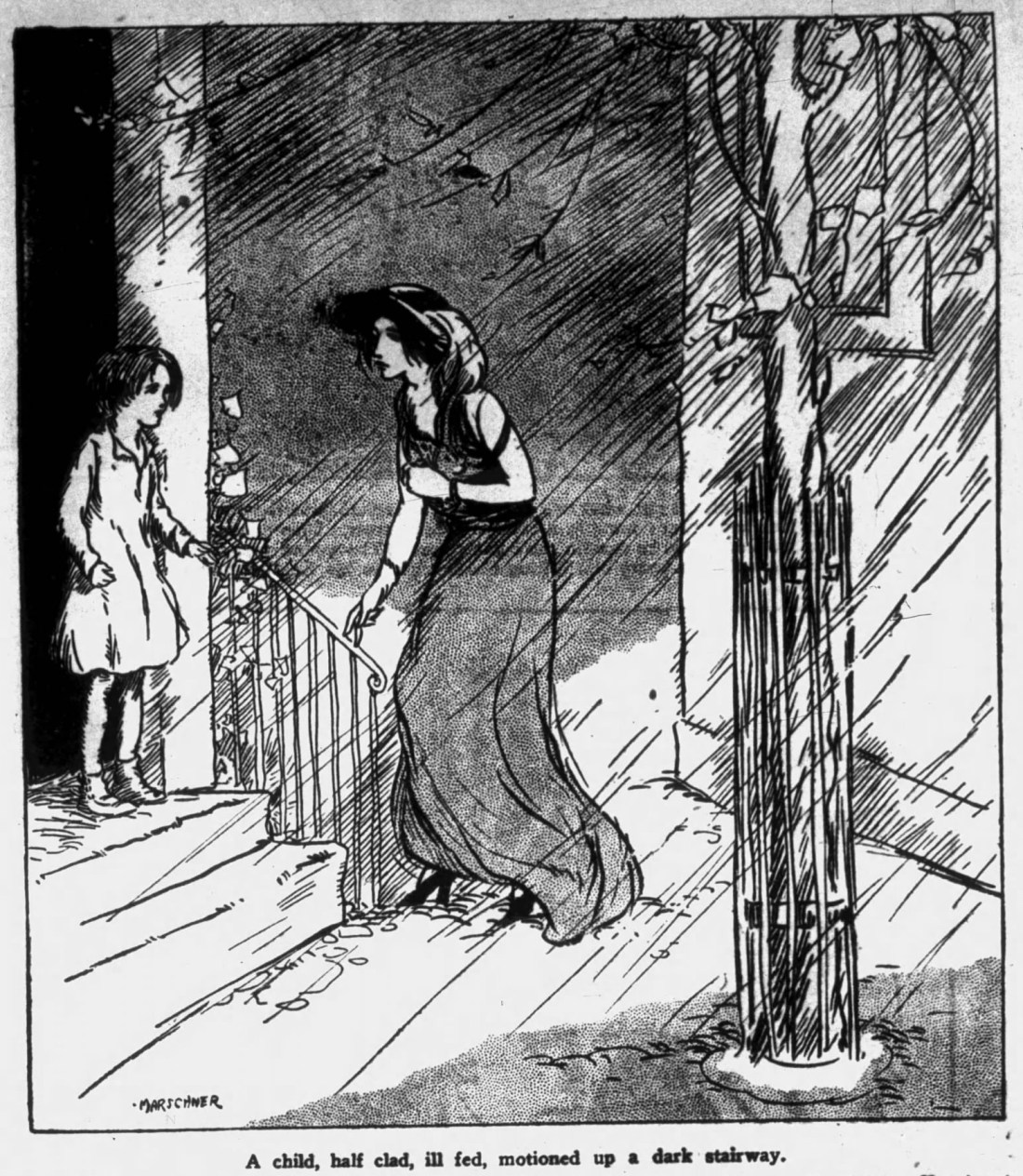
She knocked at the first of the addresses, and inquired whether a sister of charity had been there. A child, half-clad and ill fed, motioned up a dark stairway. Josephine crept up to the landing, and knocked at the door. Her heart was beating wildly. The door opened and she found herself face to face with Sister Dolores.

• • •

JOSEPHINE staggered weakly toward the sweet-faced nun, but for a minute she could not utter a word. Then she held out the medal in both hands. The parchment was crumbled and dripping.

“For you!” she cried. “The medal!”

Sister Dolores looked at her curiously. The plume of her hat sagged heavily across her face dripping water. Her gaudy gown was water-soaked and mud-spattered. Her train was soiled and tangled. Her bodice, cut low, showed the heaving of her breast as she held out the medal to the nun.

“For you! The medal of virtue!”

Sister Dolores seemed not to understand.

“Sit down, my poor girl,” she said. “Then you can tell me what it is all about.”

Josephine did not take the proffered chair. Two or three starved-looking children huddled in a corner, frightened at this sudden apparition. Josephine stood in the center of the room.

“They made fun of it—of your medal! The postman brought it—for Mlle. Josephine Duprez; but it is not for me—it is a medal of virtue. I—I knew your name was Josephine Duprez—like mine—and it must be for you. They all made fun of it—Amedee and Albert and Paul, Yvette and Jacqueline—so I took it away from them.”

Beseechingly she held out the medal and the damp, crumpled certificate. The water dripping from her garments formed a pool on the floor.

“It was my birthday party,” she continued. “I went to the convent, and they—they said you were here—and I came—to find you—to give you the medal.”

The nun gazed at her in pity, seeming puzzled.

“Don’t you see it must be for you?” Josephine implored. “Look!”

She opened the water-soaked parchment.

“‘Mlle. Josephine Duprez,'” she read. “‘For her many good deeds.’ Ah, that is for you! And the postman—he brought it to me—at my birthday party. I—I am a—a—but you would not understand! I am the worst! Yes, it has come to that! I steal at cards. I look over the men’s shoulders when they play. I signal to Amedee what cards they hold. For five years I have led this life. And I was bad before that. I steal—I lie—I sell myself. And the postman brought me a medal of virtue! But I knew it was for you.”

• • •

THE nun took the parchment, still uncomprehending. She smoothed it out and read it. Josephine turned to go.

“Wait, my sister; you must sit down and rest,” said Sister Dolores. “You are tired and wet. You have come a long way in the rain.”

“Yes, a long way,” repeated Josephine absently.

She remained standing.

“You have made a mistake,” said Sister Dolores tenderly, after a pause. “This medal is for you.”

“No, no, no! It is for virtue! See, where it is engraved: ‘The Medal of Virtue!’ It is given for good deeds!”

“Are you then incapable of good deeds?”

“Assuredly, for, look you, I am a—a bad woman. I live in sin—it is my occupation. I am lost beyond hope. Pray for me, sister!” she exclaimed, sinking to her knees in a sudden excess of terror. “Pray for me! I am lost, I am lost!”

“And yet—you left your birthday party to bring me this medal—in the rain—clothed as you are?”

“It was yours, Sister Dolores. I could not keep it.”

“Are you not Mlle. Josephine Duprez?”

“Yet, but the medal was for virtue! That could not be for me.”

“You could have kept the deal. You could have had much mirth over it. You could have ridiculed it with your companions, and added to the gaiety of your birthday party.”

“But it was not for me, sister! It belonged to you.”

Sister Dolores held out her arms.

“My poor child! You deceive yourself,” she said. “You say there is no good in you, yet you left your birthday party to restore this medal to me. You have spoiled your happiness and angered your friends; you have walked mile sin the rain; you have made yourself miserable to do a simple deed of duty that you could easily have left undone. Yet you call yourself lost to noble impulses. Do you not see the springs of good in your nature? In truth, the medal belongs to you. You have earned it.”

• • •

SHE forced the medal into Josephine’s hands. The girl’s pent-up feelings broke their gates, and swept away the reserve she had frantically tried to maintain. She flung her arms about the nun, sobbing violently. Her breast heaved; her heart was pounding. She poured her sorrow and remorse into the sympathetic ears of Sister Dolores. Her years of shame stood out like sickly specters before her awakened eyes, and she saw her wasted life in all its black ugliness.

But when the storm of tears had spent itself, and the passion of grief had moderated, her face was alight with new hope. The nun’s words had uncovered hidden waters, and Josephine realize that she was not incurably evil. She still had good aspirations; she still was capable of noble thoughts and actions. With that realization came the knowledge that her old life was gone like a tale that is told.

Arm in arm with Sister Dolores, she left the house, and these two daughters of Eve passed out into the storm together.

※

If Overland, his reliable magazine of choice, had rejected it, that would help explain why his fiction career faded out at this time. […] Farnsworth was “Exceedingly proud” of this story because it contained a “sacrilegious pun in French.”
—John Locke, The Thing’s Incredible! The Secret History of Weird Tales 50

I read one of his slick paper stories, done years before he took charge of Weird Tales. There were others, though I remember only that one, which, incidentally, he did not give me time to finish. He showed it to me for only one reason: the yarn contains a pun in French, and he was proud of that! And he dismissed his writing by saying that he had soon realized that while he could sell fiction, he could not produce sufficient quantities to make a living.

As to the correctness of his self-appraisal, no one could say, not even he himself, for he did not, as far as we know, ever put the question to the ultimate test.

That pun? The locale of the story was France, where he had served during World War I, as an interpreter. Whether he wore the Sphinx insignia from the start, or later got it as recognition of his linguistic ability, I never learned. But the pun: la plus sale d’Orleans, that is what he wrote when the context of course called for la pucelle, Jean d’Arc. He took a boyish pride in that quip, for he did love puns.
—E. Hoffmann Price, “Farnsworth Wright” in The Weird Tales Story: Expanded and Enhanced 12

Farnsworth Wright wasn’t editor of Weird Tales. Not yet. He had been selling to the magazine, he was reading the submissions, but he was still a journalist and a pulpster on the rise. “The Medal of Virtue” shows that Wright was still writing and selling stories. It is, at once, slightly daring—Josephine admits she’s a sex worker, even if she doesn’t name her profession—and immensely schmaltzy, with a happy ending that might have satisfied any confessions story editor. Plotwise, it’s little more than an episode; setting-wise, it may have been inspired by a visit to Orléans during Wright’s military service in France.

It is tempting in looking at “The Medal of Virtue” to see in it some of the attitudes that Wright would bring to the editorship. Unafraid of a little sex or nudity, tastefully alluded to; willing to court a little controversy, but with enough moral sense to resolve into a happy ending. A story that hinges on character and personality to drive the action, such as it is. A balancing act that produces nothing revolutionary, but good enough for publication. Or perhaps, more simply, the belief that every individual has something to offer, if properly encouraged.


Bobby Derie is the author of Weird Talers: Essays on Robert E. Howard and Others and Sex and the Cthulhu Mythos.

Deep Cuts in a Lovecraftian Vein uses Amazon Associate links. As an Amazon Associate I earn from qualifying purchases.
Lost Tale: “The Silent Shot” (1920) by Farnsworth Wright

“The Silent Shot” by Farnsworth Wright was published in The Overland Monthly (Feb 1920).

※

The Silent Shot

by Farnsworth Wright

“YOU say you heard no shot, Dr. Burns?” Wyatt asked.

“No,” replied the young physician. “She must have held the revolver so close to her head that it muffled the sound.”

“Strange,” muttered the reporter. “Where was she when she shot herself?”

“Here in my office. I had just returned from some professional calls, and Helen got me some medicine to take up to my wife, who was ill in bed. The girl seemed despondent, but I didn’t dream that she was planning to kill herself. I took the medicine upstairs, and neither my wife nor I heard the shot. I had not been gone ten minutes when the doorbell rang, and I came down to let in George Locke and his wife. The door into my waiting room was open, and we looked in as we went through the hall. Beyond, on the floor of my office, we saw poor Helen lying dead, and my pearl-handled revolver lay beside her. She had shot herself through the head.”

“Helen Hume lived here in the house, then?” asked the reporter.

“Yes. She was an attendant in my office, and she stayed here. Her father and brothers live about four blocks down the street, but I don’t think she got along very well with them. I think that’s what made her despondent.”

“How did she happen to have your revolver?”

“I suppose she took it to kill herself. Or maybe she wanted it for protection against burglars. I kept it under my pillow.”

“How could Miss Hume take the revolver without being seen, if your wife was lying in the room sick in bed?”

“She could easily do that when she was making the beds. She helped around the house when there was nothing else to do. But you have all the information you need, haven’t you?”

“Yes, I guess so. I have her father’s address, and her age, and—oh, yes; where was the body taken?”

Dr. Burns gave him the address of the undertaker.

“May I speak to your wife?” asked the reporter.

“No, you can’t go up there,” Dr. Burns replied. “My wife is so terribly upset by the tragedy that she is on the verge of a nervous breakdown. She is so ill anyway that she was out of her head for a time, and this has given her a relapse.”

“All right, Dr. Burns. Just one question more: do you think Miss Hume could have been shot by a burglar?”

“Oh, no, absolutely not,” declared the physician emphatically. “She killed herself. I told you that she was despondent, didn’t I?” he went on, growing slightly excited. “This is a plain case of suicide, and you won’t get anywhere by trying to make a murder mystery out of it. Burglars wouldn’t enter a house as early as 10 o’clock, anyway.”

• • •

Ordinarily the reporter would not have gone to the undertaker’s, especially so late at night. The case seemed to be an ordinary suicide, and he knew that at that hour, when the mail edition had already gone to press, a suicide story could get only a few lines unless it possessed very unusual features, or concerned a prominent person. But the girl’s name sounded strangely familiar to him.

“Helen Hume, Helen Hume,” he mused. “Why, that’s the name of the little girl I used to play with in Cincinnati. I think I’ll run over and see. But it’s probably only a coincidence in names, for I haven’t heard that Helen was living in Chicago.”

The undertaker was just going to bed, but he let Wyatt into his morgue when the reporter explained his errand. The girl was Helen, beyond any doubt, although she had changed much since he had last seen her. Now she was eighteen years old, comely, well formed, just blossoming into young womanhood.

Wyatt looked closely at her face. Suddenly his eyes opened wide.

“Look there!” he exclaimed, pointing to Helen’s temple. “Did that girl kill herself?”

“You know as much about it as I do,” the undertaker answered, and shrugged his shoulders. “I’ve seen many people that have shot themselves, but never one like this.”

“So have I,” said Wyatt. “Let me use your telephone.”

“This is Wyatt talking,” he told his city editor over the wire. “That girl didn’t commit suicide. She was murdered.”

“Who murdered her?” asked the city editor.

“I don’t know. But listen—this girl didn’t have any powder burns, and there isn’t a hair singed, although the bullet went in at the temple, close to the hair. Did you ever see a person who had shot himself? Always terribly powder-burned, wasn’t he? This girl must have held the revolver at least three feet away.”

“That’s good work, Wyatt,” commented the city editor. “You may have a good story there. Keep after it, and see what else you can find. Ring me up if you get anything. Call back before half-past twelve, anyway, and turn in what you have.”

Wyatt examined the body again. The bullet hole was as clean as if it had been drilled with a gimlet. He recollected other suicides whose bodies he had examined.

Always the bullet had spread and made a larger hole where it came out than where it went in. This shot,
then, had been fired from across the room. It had taken a horizontal path, emerging at the same place on one side of the face where it had entered on the other side.

Wyatt held an imaginary revolver to his own temple, and found it hard to hold the weapon against his head with the barrel horizontal. While this fact in itself was not conclusive, yet, in connection with the clean, even bullet hole and the total absence of powder burns, it made Wyatt certain that Helen Hume had been murdered.

“Surely she was murdered,” affirmed the undertaker. “I knew that as soon as I saw her.”

Frank went over to see Helen’s father, ostensibly to get Helen’s photograph, but really to question him.

“So you’re little Frankie Wyatt that used to play with my Helen, are you? I never would have known you,” Hume greeted him. “Well, this is an awful shock to me. No sir, she hasn’t been despondent, as far as I know. No, she didn’t have any fellows, so it wasn’t a love affair. I can’t for the world imagine why she should want to kill herself. Surely she would have dropped some hint if she had been planning suicide. Oh no, sir, there was never any trouble between us. Was she murdered, did you say? Well now, sir, I’ll say this much: she didn’t have any reason to kill herself. If she was murdered, I want ’em to go to the bottom of it and find out who did it. No sir, I’m glad to hear you say that, because I’d hate to think poor little Helen had gone and killed herself.”

• • • •

Wyatt telephoned his story to one of the rewrite men on the newspaper, quoting both the father and the undertaker as charging that the girl had been murdered. He cast no suspicions, contenting himself with trying to show that the girl could not have killed herself. His story was given a column, whereas the other two morning papers printed only a few lines about a “suicide.”

Wyatt’s account caused the coroner’s inquest to be put over for ten days. The coroner was convinced that the girl was murdered; the undertaker was convinced; and the girl’s father was convinced. But the police detectives assigned to investigate her death reported that she had killed herself.

Wyatt asked some of his friends on the detective force:

“Is it possible for a person committing suicide to hold the revolver so close to his head that there will be no powder burns?”

From one and all he got an emphatic no.

“It can’t be done,” they declared. “There is bound to be a recoil, and there will be ugly powder burns, no matter how close you press the muzzle.”

“Can you muffle the noise by holding the revolver close?”

“Why, I suppose you can muffle it a little,” assented one. “But see here, young fellow, if you’re planning to kill
yourself I can show you a way that won’t hurt at all, and won’t leave a sign to show what happened to you. You’d make a beautiful corpse.”

“Thanks,” said Wyatt. “I don’t care to shuffle off just yet.”

“Helen Hume wasn’t killed in a love quarrel,” he told his city editor, “for she had no sweethearts. The theory that she was shot by burglars is silly. I don’t think Dr. Burns killed her, but there are some peculiar things about this case that make me suspicious. One is that neither the doctor nor his wife heard the shot, although he admits that the door was open into the office when he passed by with Mr. and Mrs. Locke. And then his preventing me from seeing Mrs. Burns set me wondering. Maybe she is really sick, but her husband gives
me the impression that he just doesn’t want anybody to question her.”

The coroner’s jury, when it finally sat on the case, refused to turn in a verdict of suicide, despite the police report. The jury found that Helen Hume came to her death “as the result of a shot from a revolver, fired by person or persons unknown,” and recommended that the police investigate further to find out who fired the fatal shot.

Wyatt’s convictions concerned the murder and not the murderer. As to who the slayer was he harbored only vague suspicions, which he could satisfy only by examining the physician’s house. This the physician forbade. So Wyatt put the girl’s death out of his mind as one of the unexplained murder mysteries which often crop up to puzzle reporters.

• • • •

“Do you think you can find out who killed that Hume girl, if I let you work on that alone for two or three days?” demanded the city editor, several days after the coroner’s jury turned in its verdict.

“I might. I’d like to try,” Wyatt answered.

He boarded a street car and went at once to Helen’s father.

“Mr. Hume,” he said, “I want to ask you frankly, have you any suspicions as to who murdered Helen?”

“I think Dr. Burns did it,” Hume replied. “I don’t know who else could have done it. Somebody did it.”

“What kind of a woman is Dr. Burns’ wife?”

“Why, she seems to be a nice little woman. But you surely don’t suspect her? I might think her husband did it, but not Mrs. Burns.”

A few minutes later, Wyatt tiptoed softly up the doctor’s front steps and tried the door, but found it locked. He could see a light in the parlor, and a newspaper, behind which he surmised Dr. Burns was sitting. Then the telephone bell rang, and Dr. Burns got up to answer it.

Wyatt silently withdrew into the shadow. The doctor came out, carrying his case in his hand. Wyatt slunk around to the rear door. This was unlocked, and he entered the house without knocking.

There was a back stairway leading down to the doctor’s office, as Wyatt had supposed. He turned the doorknob and entered, closing the door behind him. Then he opened the door from the office into the waiting room, and the door from there into the vestibule. The front stairway was in plain view from the office.

Did some strange acoustic vacuum intervene between him and the front stairs, so that a shot fired in the office could not be heard upstairs? This question was almost immediately answered for him by the voice of the doctor’s wife calling from upstairs. Lightly though he had moved, yet she had heard him.

“Robert,” she called down. “I thought you had gone out.”

A minute of silence ensued.

“Robert,” she called again. “I wish you would come up to me.”

He returned no answer. Presently he heard her coming up the back stairs. He slunk behind the office door.

“Robert,” she called again. “Where are you?”

She entered the office and switched on the lights. She gave a little shriek when she saw Wyatt, and she stood in the middle of the floor in her nightgown, opening and closing her mouth, as if she wanted to speak. Her face was white, and Wyatt observed also that she was thin, that her eyes bore a haunted, scared look, that her face was drawn and careworn, although she was still a young woman.

“Who are you, and what do you want?” she finally found voice to ask.

Wyatt closed the door.

“I want to know why you killed Helen Hume.”

Mrs. Burns put her hands to her head as if in pain, and stood for more than a minute silently rocking back and forth on her heels. Then her strength left her, and she would have fallen if Wyatt had not caught her. He helped her to a chair, and brought a glass of cold water, which he held to her lips.

“Who are you? And why do you come here to torture me?” she exclaimed indignantly, pushing away the glass.

“Don’t excite yourself, Mrs. Burns. I see that it really was true that you were too ill to testify at the coroner’s inquest. I had thought it was merely a bluff to keep you away.”

“Who are you?” Mrs. Burns asked again.

“My name is Wyatt. I am an old friend of Helen Hume. Why did you kill her?”

“What right have you to enter my house this way, without warrant and without invitation?”

“In cases of this kind, Mrs. Burns, one does not wait for invitation—Helen Hume was standing over here when you shot, wasn’t she? And then you fled up the back stairs while your husabnd faced the police, while he shielded you and kept you from being interviewed, and invented a suicide story that can’t hold water. Why did you kill Helen Hume?”

“Mr. Wyatt, leave my house this instant. Such affrontry is unpardonable. The girl killed herself.”

“Did you see her do it?”

“No. I was just going upstairs when I heard the shot.”

“You HEARD the shot?”

“No, no, no! I don’t mean that. There wasn’t any shot. I didn’t HEAR the shot, I mean.”

“Then you were NOT upstairs sick in bed. You were down here.”

“I wasn’t down here, I tell you! I was going up the stairway when she shot herself.”

“That is enough, Mrs. Burns. Your husband said that you were both upstairs, and that you were in bed. But
you tell me that you were on the back staircase. Your husband says that neither of you heard the shot. You tell me that you heard the shot, and then, remembering that your husband’s story was different, you deny that you heard it. You say that you were there on the stairs and knew when it happened, but your husband pretended that he discovered the body when he came through the hall with Mr. and Mrs. Locke. As a matter of fact, your husband left the corpse of the girl to answer the door bell. He led his visitors through the hall, and then, when they saw the body lying in a pool of blood in his office, he pretended that he was seeing it for the first time.

Mrs. Burns, I am a reporter. If I print the statements you have just made, flatly contradicting your husband, he will be arrested. The police will naturally suppose that he was the girl’s murderer. Otherwise why should he lie and pretend that he had not heard the shot, and knew nothing about her death?”

“You say my husband would be suspected?” the doctor’s wife asked, her eyes big with fear.

“He will be convicted. He is already suspected, because of his fishy story about not hearing the shot when ail
doors were open between him and the office where Helen was killed. The fact that he perjured himself will execute him. Many men have been sent to the chair on less evidence.”

“You won’t do it! You shan’t do it! You mustn’t drag my husband into this! I swear to you that he had absolutely nothing to do with the shooting! His murder will lie on your soul if you bring this unjust suspicion on him!”

“I am only after facts, Mrs. Burns. If your husband is innocent, why does he conceal the facts? It is because he is protecting you. You were jealous of Helen Hume. You thought your husband was too fond of her, and so you shot her. Isn’t that so? You will do him a still greater wrong by keeping silent now. I can’t vouch for his fate if you still refuse to tell me why you killed Helen Hume.”

“I didn’t shoot her deliberately! I didn’t, I swear I didn’t! I am not a murderess! I was out of my head, but even
so I didn’t intend to kill her. I was arguing with her, and trying to scare her with the revolver. I didn’t even know it was loaded. Don’t, please don’t print anything, Mr. Wyatt! It was purely an accident! Enough unhappiness has been caused already, without adding this.”

“Wyatt heard a noise, and, turning he saw Dr. Burns standing in the doorway.

“You’re in mighty fine business!” the young physician exclaimed, shaking with wrath. “Mighty fine business, breaking into a house to make a sick woman confess to something that isn’t true! What are you going to do?”

“That depends on you and your wife,” answered the reporter. “I want to know all the details.”

“There are no details,’ replied the physician. “My wife and I were happy, until this tragedy happened. My wife has been very ill. She was not responsible for the shooting, for she was delirious when it occurred. You can’t get a conviction on the evidence you have, but the publication of a story such as you want to print would ruin our lives. There was an unnatural situation here—a beautiful girl, just developing into womanhood, living on terms of intimacy with a young married couple. The intimacy was nothing more than a strong friendship, but at that it was an unnatural situation to have her living in the same house. My wife’s illness made her supersensitive, supersuspicious. And she was out of her head when poor Helen was shot.

“There is nothing more to tell. But consider this—the coroner’s inquest is over, and unless you revive the matter the police will make no further investigation, and it will soon be forgotten except by us. You hold our happiness in your hands.”

• • • •

“What success did you have?” the city editor demanded when Wyatt showed up in the local room next day. “Did you find the murderer?”

“I have talked with the doctor’s wife,” Wyatt answered. “She was my last clue, and I have followed it out as far as I can. Please give me another assignment.”

※

The story offers a radical perspective on two levels. It features the selflessness of the reporter in forgoing headlines and glory while arguing for individual preemption of the cruelties of the press and legal system.
—John Locke, The Thing’s Incredible! The Secret History of Weird Tales 50

In broad outlines, “The Silent Shot” is a whodunit. Farnsworth Wright likely brought his personal experience as a reporter to play, illustrating the pressures put on journalists by editors, and balancing the needs of the job and the personal cost to individuals who become news. It isn’t a pleasant story; both the protagonist reporter and the married couple break the law in pursuit of their names, and while they declare the death accidental, it’s far from clear if that is the case—after all, they’re already lied about it.

So what starts off as a mystery has a noirish twist at the end, a moral dilemma that leaves a young woman murdered and her killer not brought to justice. The journalist has gotten as close to the truth as he could, but ultimately accomplishes nothing.


Bobby Derie is the author of Weird Talers: Essays on Robert E. Howard and Others and Sex and the Cthulhu Mythos.

Deep Cuts in a Lovecraftian Vein uses Amazon Associate links. As an Amazon Associate I earn from qualifying purchases.
Lost Tale: “Out of the Frying Pan” (1920) by Farnsworth Wright

“Out of the Frying Pan” by Farnsworth Wright was published in The Overland Monthly May 1920.

※

Out of the Frying Pan

An Operatic Tragedy

by Farnsworth Wright

FORTUNIO DUO was an operatic tenor. That does not explain how he happened to be owing a thousand dollars to his hotel, for he received that much every night he sang, according to the newspapers, and he therefore ought to have found it easy to pay his bills. But the tenor was all but broke, and the hotel was guarding his trunks until he should pay up.

He was promised two thousand dollars for a two weeks’ engagement as guest artist in a neighboring city, where he was to make his first appearance in opera the next day. This was twice as much money as was needed to pay his bill at the hotel. But the hotel managers, who were pigs without appreciation of art, would not release his trunks. So Signor Duo, he of the musical name, laid his head to his pillow and wept. He wailed aloud in his anguish of soul, and called down curses on the pigs who treated him so shamefully.

How came the tenor to be penniless when he received one thousand dollars a night? He had sung fifteen times during the operatic season just ended, and simple arithmetic shows that he should have been paid fifteen thousand dollars.

Unfortunately, the rules of arithmetic did not apply. The newspapers simply were misinformed about Signor Duo’s salary, for they had accepted the statements of the opera company’s publicity man at their face value. Signor Duo’s contract called for fifteen performances, but three of these were to be sung gratis, and for
the other twelve he was to be paid two hundred and fifty dollars each, or one-fourth what the newspapers declared he received. Out of this he had to pay his manager ten per cent.

And he gave Mr. Doppler fifty dollars a week to furnish paid applauders. Of course he did not need a claque! It was an insult to suggest that he, the great Italian tenor, could not get applause without buying it! But—suppose the claquers should hiss him if he refused to pay? That was different, and Signor Duo was very
grateful to Mr. Doppler, who knew the ways of these Americans, for saving his singing from being ruined by a wicked and unprincipled claque. He also gave Mr. Doppler fifty dollars a week to bribe the newspaper critics into saying pleasant things about him. In his simple soul he supposed there would be not the slightest
difficulty in buying favorable notices. But Mr. Doppler knew better, and put the money into the Doppler bank account, the newspapers saw not a cent of it all.

Mr. Doppler was secretary and assistant to Signor Parmese Pescatore, the great Italian maestro and operatic director. The maestro was of course too exalted a personage to stoop to graft, but—he hired Mr. Doppler as his secretary.

Of the three thousand dollars allowed to Signor Duo in his contract, the tenor received in actual cash only seventeen hundred dollars. He had to advertize in several musical journals, as all important singers do. He had to buy many high-priced costumes. He had been mulcted by a fellow patriot who wanted funds to back a benefit for Italian war orphans, and ran away with his collections. But why enumerate all the ways in which a
tenor spends money? Suffice it to say that he still owed the money due to the musical papers that carried his advertising, that he owed money to his tailor, his hotel, his music teacher, and everybody else who had dealings with him. The only people that had collected from him were his manager and Mr. Doppler. The manager was paid only through the courtesy of Mr. Doppler, who deducted the managers commission from Signor Duo’s salary and sent it to this gentleman after he (Doppler) had first taken one-fourth of it as a collection fee. Alas that there are so many Dopplers in this vale of tears!

One might well ask why the tenor did not leave his trunks and his troubles, board the train, sing his two weeks as guest tenor, and then get his baggage back by paying his hotel bill. The reason he could not do so is because his costumes were in those trunks, and without costumes an operatic tenor is of no more use than a drum major in overalls.

Many schemes went through his perplexed brain, but one after another he had to abandon them all. He wiped his perspiring forehead on a richly perfumed handkerchief, sprayed perfumery on his clothes, sat down on his bed, and wept.

Then a dread assailed him—what if this superfluity of sobs were affecting his voice? So he opened his mouth and began to shake forth Canio’s lament from “I. Pagliacci,” the opera in which he was billed to open the next night. He stopped, dismally, as the import of the words was borne in on him: “Tu sei pagliaccio!”
(You are a clown!)

“No, pagliaccio non son!” he sang, and resumed his interrupted flow of tears.

There came a knock at his door, and he hastily powdered his face to conceal the stains of weeping, sprayed perfume on his hair, and quavered, “Come in.”

It was his friend, Carter, a newspaper reporter who sometimes breezed around the opera house in search of stories and features about the “nuts,” as he called them. He blew into the tenor’s room at this dismal minute like a breath of fresh air.

“Ah, Meester Carter,” exclaimed the tenor, in his inimitable French-Italian accent; “I am in trooble, Meester Carter, mooch trooble, and I wish you should help-a me. Ah, you will aid me! Now I can be happy once more, for I have leaved it to you! You will find-a ze way! Tra-la-la!”

“What’s up?” Carter queried.

“Ah, Meester Carter, I must to sing in ‘Pagliacci’ tomorrow night. But I cannot to take ze trunks from zis hotel. And all my costumes, zay are in ze trunks, and I must not leave ze city wizzout ze costumes. I owe it to ziss hotel mooch money, and zay hold ze trunks until zay have ze money. But now I leave it all to you, and you will make it arrange. Oh tra-la-la,” he sang merrily.

Carter thought the tenor was giving him a pretty stiff assignment, but he tackled it with spirit.

“You be here in your room tonight at 10 o’clock, without fail, and I’ll fix it for you,” he promised after a minute of reflection, which was punctuated by the tenor’s warblings.

Carter reserved a room, as he went out, for Miss Cecily Jones of Milwaukee, and about 10 that evening he came into the hotel with a young woman of the operatic chorus, who registered under the name he
had chosen for her. She ordered her trunk and two suit-cases taken up to her room. Carter smuggled the key to the tenor. Then he accompanied the young woman to the nearest elevated station, and escorted her to her home.

Signor Duo worked hard that night. Packing trunks and suit-cases is a tedious job for a tenor who has no valet to assist him. In the morning he came down to the hotel desk.

“I eat here no more where nobody not trust me,” he snapped to the hotel clerk. “I go eat-a my breakfast outside in ze restaurant. Some time, | make you mooch trooble—mooch trooble!”

In the morning Carter’s friend of the chorus also made her appearance at the hotel, and paid her bill—out of the little money yet remaining to the tenor. She ordered her trunk and suit-cases sent to the railroad station, and Signor Duo took charge of them there. A happy smile lighted his face.

“Ah, zoze hotel peegs!” he exploded. “Now zay will wait wan long time for ze money! You will see.”

The tenor’s soul was at peace. He sat in the parlor car and enjoyed the beauties of the landscape. Joy had returned to his world. And he would get his revenge on those grasping hotelkeepers, for they would wait, wait, wait, a m-ee-leon year, before they got any money from him.

Signor Duo arrived in good time at his destination. He sent his trunk to the theater and his suit-cases to the hotel, and notified the opera company by telephone of his arrival. Then he went to his hotel and washed for dinner.

Never had life seemed so rosy. He was about to conquer a new city, to bring new hundreds of music lovers under the potent spell of his voice. He pictured to himself the many curtain calls he would receive, the salvos of applause, the cries of “bravo,” the adoration of the women, the handclaps of the orchestra. He glanced at the pictures of himself as Canio and Don Jose, in the evening newspapers, and read the exaggerated reports, prepared by the press agent of the local opera company, which seemed to him truthfully accurate, of his successes in New York and other cities. He ate his dinner with more than usual relish, tipped the waiter bountifully, and set out on foot for the theater where he was to sing, stopping several times to admire the announcements on the billboards heralding him as “Italy’s Golden-voiced Tenor.” It was indeed a happy day for Signor Fortunio Duo.

As he neared the theater, the crowds increased.

“They come early to the opera here,” thought the proud tenor. “The press agent his work well done.”

He quickened his pace. There were more people in the streets, and still more, hundreds of them, thousands, and all hurrying in the same direction.

“Where stands the opera house?” he asked an excited urchin who came rushing by him.

“Just around the corner,” shouted the boy, “before it took fire. The front wall is just fell in.”

Signor Duo, staggered under the blow and almost fell between the wheels of a fire-engine rushing up to answer a general alarm.

He wiped his damp brow with his perfumed handkerchief and reflected that it was indeed a most merciful dispensation of a kind Providence which made him a waiter before he took to the grand opera stage.

※

A comic piece, it displays Farnsworth’s inside knowledge of the music business, good and I’ll, and the relationship of performers to reporters.
—John Locke, The Thing’s Incredible! The Secret History of Weird Tales 50

We have limited evidence for Farnsworth Wright’s sense of humor, though he definitely had one. E. Hoffmann Price in Book of the Dead: Friends of Yesteryear: Fictioneers & Others recalls Wright’s devastating comic timing and his skill with double (and even a triple) entendre. His comic fiction, however, involves broad stereotypes and a very dry wit at the end.


Bobby Derie is the author of Weird Talers: Essays on Robert E. Howard and Others and Sex and the Cthulhu Mythos.

Deep Cuts in a Lovecraftian Vein uses Amazon Associate links. As an Amazon Associate I earn from qualifying purchases.
Lost Tale: “The Stolen Melody” (1920) by Farnsworth Wright

“The Stolen Melody” by Farnsworth Wright was published in The Overland Monthly (Nov 1920).

※

The Stolen Melody

by Farnsworth Wright

IT IS HARD TO BELIEVE that there ever was a time when Mascal was not a musician. Yet the world of music was an undiscovered country to him until after his twentieth birthday. He used to run the night elevator in the Occidental, an old-style apartment house in a part of the city formerly wealthy, and still retaining much of its gentility, though fallen on evil days. Somber gables stared a mute protest at the upstart modern flats which stood at the end of the block; the walls were chastely papered in a plain, dark pattern; and an elevator
jerked hesitatingly from floor to floor under the uncertain propulsion of an iron rope.

Hard though it is to believe that Mascal at one time in his life knew nothing about music, it is still more incredible that he lacked ambition. Such, however, is the fact. In the drowsy atmosphere of pride and decay which hung heavily on the apartment house, Mascal had seemingly no higher aspiration than to remain an elevator boy all his life. The guileless expression of face, which still characterizes him, seemed to contradict the nobility of his finely sculptured head; his gentle blue eyes contrasted strangely with his brick-red hair; and from these soft eyes gleamed at times the dreaming soul of a poet. Why Mascal, of all men, should bury his light in so trivial an occupation as running an elevator is beyond comprehension. How many unearthly sweet melodies must have been lost to the world by his utter lack of desire or ability to set them down on paper!

Mascal did not play any instrument. He could not sing, for his voice was unmusical. Written music was like Chinese hieroglyphics to him, and he had never heard an opera or a symphony orchestra. The music of the vaudeville theaters sounded tawdry and coarse to his sensitive ear, but he liked some of the old tunes, such as “Swanee River,” and “Old Black Joe,” and he used to whistle Dvorak’s “Humoresque” and an aria from “Il
Trovatore” until they became banal. He learned few new tunes, and most of these were torture to him.

Mascal was better pleased with the tunes that welled up out of his own brain—soulful melodies, which sang themselves to him, possessed him, and grew and developed as he whistled them. They came to him on walks in the suburbs, amid the roar of street traffic, or when he was alone in his elevator at night. Then they passed out of his mind, except the melody.

This particular melody was no better than many others that had come to Mascal, but he could not banish it from his thoughts. It haunted both his waking and sleeping hours, wove itself into his dreams, and molded his musings. Metz, the violin student who lived in the same boarding house, wanted to know the name of the tune he was whistling, and Mascal did not know what to tell him. Mascal took the melody, at the advice of Metz, to a musician who made his living by transcribing music, supplying parts for orchestras, arranging and harmonizing. He charged Mascal only five dollars, and for this he not only wrote out the melody on manuscript paper, as Mascal whistled it to him, but he also supplied a piano accompaniment for it.

Mascal was now, in a sense, a composer. Metz played the melody on his violin, and showed him what the notes meant on the keyboard of the boarding house piano. Mascal was fascinated at finding meaning in each little tail to the notes, and logic in every dot and line. The hieroglyphics were taking on significance.

He took enormous pains in mastering the characters on that sheet of music. He easily learned to play the melody with his forefinger; but the chords in the accompaniment, the synchronizing of his fingers, were so difficult that they almost disheartened him. His fingers refused to strike the right notes.

When he had learned to play the piece, in a manner of speaking, very slowly, with frequent pauses to rearrange his fingers on the keys, it annoyed-and depressed him. He began to experiment with different chords, and found that he could better the transcriber’s arrangement. But he did not know how to set down the harmonies that were in his mind, so he left it in its unsatisfactory shape, and whistled other tunes as he went up and down in the elevator—snatches of airs from the operas, as he had heard them in cafe orchestras, and old-time tunes; but mostly he whistled phrases that gushed unbidden from the depths of his own consciousness.

It was in a vaudeville theater that he heard his tune again. At first he thought it must be only a coincidence, in the opening measures; but no, it was his melody which the girl was singing in her throaty, disagreeable voice. All the beauty had gone from it. It was twisted and tortured out of its original form, set to disgusting verses, and the girl was ragging it, debasing it, shouting it at the audience, dancing to it and making eyes as she sang, to bring out the risque suggestiveness of the verses. The audience clapped and stamped and yelled for more, and the creature sang additional verses.

The tune was catchy, cheap and trashy! His brain was hot with anger. As he went out of the theater with the
throng, people were humming his melody. If it had only been sung in its original form, and set to noble verses! He was ashamed of it now, and enraged by the debasement of a theme that once had haunted him by its sheer beauty. Mascal sought out Mueller, the man to whom he had paid five dollars for transcribing his melody, and protested vigorously. He was met with insolence. Mueller defied him to prove the melody his.

“Mr. Mueller,” Mascal explained, a menacing glint steeling his gentle blue eyes, “it is not that I object to your
making money out of my melody. But you have robbed it of its beauty. You have set it to filthy words. My melody was majestic, singing, beautiful. You have made it a cheap thing, a nothing.”

Mascal’s accusation brought Mueller to his feet.

“You upstart!” he bellowed, the fat folds of his bullneck purpling, and his little pig eyes narrowing in the red ocean of his puffy face. “You, what do know about music, hey? You can’t play—you can’t read—you have to come to me to write your tune on paper. Now you try to tell me what to do with it, hey? I made it popular. Less than one month it is printed, and one hundred thousand copies are sold. Hey? In three more months I sell a million. Get out of here, you, you—”

Mueller was shaking a pudgy forefinger under Mascal’s nose, and Mascal’s anger flamed hot within him. His clenched fist caught the melody-thief under the chin, and knocked his across a chain. Mueller bellowed for help, and Mascal hastily retreated down the stairs.

Perhaps it needed just such a burst of anger to break the chains that bound the slumbering genius of this easy-going boy. Certain it is that ambition came to him then for the first time in his life. It was no selfish resolve that he made that day, for it brought him pain and suffering, sleepless nights and days of hunger. He would devote his life to vindicating his melody before the world. The tawdry thing was even now a torment in his ears, as whistled by the driver of a passing taxicab.

Mascal smiles reminiscently when he thinks of the months that followed. But he did little smiling then, for he spent the greater part of that disheartening time in shiny clothes, underfed, often wondering how he was going to get his next meal. But it is a glorious thing to be possessed by a dream.

Most of his little bank account went to pay his tuition at the musical college. He had to learn from the beginning. They let him take up piano and violin playing, but they told him it must be a year before he could begin the study of harmony, for he had no preparation for it. He never became a great player. He seldom touches his violin today, and he still finds his fingers stiff on the piano. But he studied hard, and read harmony and musical history on the side, and they let him begin harmony lessons within four months.

He soon discovered that he could read harmonies away from the piano. They sang themselves to his eye. He nearly fainted from excitement the first time that he ever read a measure of chords away from the piano and pictured the harmony in his mind. He rushed to the piano to verify the harmonies that his eye had sung into his brain. He began to be able to play all of his pieces in any key, for the notes that were written on the staff sang into his ear before he struck the ivory and ebony keys of the keyboard.

He possessed, far more valuable than familiarity with the classics, the ability to evolve melodies out of himself. Each new musical discovery thrilled him, and he never lost his enthusiasm, despite his privations. He applied himself so diligently to harmony and composition that he left the class behind him, and had to
take private lessons. These cost more money. His bank balance was used up, and the money he earned as night elevator boy was not enough to keep him properly and pay for his lessons also.

He moved into an attic room for which he paid one dollar a week, and another dollar each week went for the privilege of practicing two hours a day on a piano. He began going without his breakfasts, and occasionally he had to skip his evening meal. He became woefully thin, and darned his cheap cotton socks with coarse
thread when the holes got large, for he could not afford to throw them away. The Chinese laundry tore his shirts and saw-edged his collars. He did his own cleaning and pressing, and his clothes became smooth and shiny. He carefully polished his shoes each morning, but more than once he went to his lessons with his shoe laces knotted in three or four places, to postpone the expense of buying new ones.

His privations depressed him, because he could not see the end. But when he was studying he forgot everything except the beauty that was burning in his soul.

He earned his teacher’s praise for the intrinsic beauty of the original themes on which he elaborated, even when the elaboration was unskillfully done. His pet delight was to disguise the stolen melody and elaborate it, but always his teacher rebuked him, saying that the theme, which he recognized as the tune of a distressingly vulgar popular ragtime air, offended his ear whenever and wherever he heard it. Each such rebuke inspired in Mascal a gnawing dread lest his sacrifice and struggles be in vain. He lost hours of sleep trying to make noble arrangements of his melody, but the teacher’s eye sought them out under each disguise, and always branded them as tawdry.

Mascal had been studying a year before he ever heard a symphony. He plucked up courage to ask for his
teacher’s ticket for a day when he knew the teacher would be absent from the city. He did not realize what important results his request would bring, what further sacrifices and what marvelous joys were to be his.

He watched the different themes enter and leave as the orchestra played an overture, but it was simply greater playing than he had heard in the orchestra of the musical college. It was followed by Beethoven’s Fifth Symphony. Mascal heard the striking of the first four notes. They were repeated, in a lower pitch. Then the strings took them up, playing them quickly, in ascending series, and the first movement of the symphony finally came to an end without varying from the one little theme of four notes. Can four notes make a whole composition? he asked himself. But as he listened he realized that they were indeed the soul of the movement, now sung by the strings, now sounded by the brasses, now shouted in chorus by all the choirs at once. Little themes sprang from them, and the orchestra returned to them. The movement was a composite whole, as different as may be from those sugary impromptus that begin nowhere, end nowhere, and have no excuse for being. The world of harmony that followed the opening of these was predestined in the first four notes.

Mascal realized that this symphony would lose its glory if played on the piano. The color of the different instruments gave it life, soul, feeling and beauty. If a great master can develop a whole movement of a wonderful symphony from four notes, like a knocking at the door, why could not he do equally wonderful things with the wail of the wind, the roar of the waves, and the murmur of leaves in the trees?

He obtained a miniature score of the symphony from the library of the musical college before he went to his room that afternoon, and studied the staves that represented the different instruments. Now they played in unison, now in harmony; now each choir was divided off from the others; now one choir played a counterpoint against the others. He did not know the instruments well enough to hear in his mind their tone colors, but already he had decided that his melody, when it stood vindicated before the world, would not be written for piano. He would make of it a tone poem for orchestra.

Underfed though he was, yet he skipped two evening meals during the next week, and with the fifty cents thus saved he bought a seat up near the roof to hear the next symphony concert. The happiness that came to him that day with the realization of his own genius never left him from that time.

The symphony was Schubert’s Unfinished, the great song-writer’s orchestral masterpiece, discovered years after his death. Instead of hearing a plain theme majestically developed, Mascal’s ears drank melodic beauty from the first movement. The symphony sang straight into the beauty-loving soul of him, and tears rolled unabashed down his cheeks, for the great idea had come to him.

Beautiful melodies were uttered by the strings, and sung by the orchestra with a piercing sweetness of tone such as he had never dreamed. This man, this Schubert, must have gone to the angels in heaven for his themes, for the outpouring of beautiful sound ‘as far surpassed in sheer beauty anything within the narrow limits of his knowledge as the odor of wild roses on a country roadside surpass the smells of a city street. Every stroke of the violins, every chord of the music that sent the salt tears trickling down his cheeks, sang to him:

“You are another such master! No music, be it harmonized and developed to the uttermost limits of the theme, can move the unfeeling world unless it be founded on melody. To you the world looks for the supreme musical outpouring, for melody comes to you as easily as song to the throat of the meadowlark. You are the melodic master of the world.”

Mascal knew that it was true. All his life he had been thrilled by the beauty of his own themes. His mother, in those pleasant days before he was orphaned, used to smile happily when he came into the house whistling some stronge and lovely rhythm, and remark, “Ah, my boy, why do you not learn to play the flute? How pretty that would be on the flute!”

He did not hear the rest of the program. He threw himself on his bed and dreamed, until it was time for him to work. He dreamed while he was running the elevator; he dreamed in the early morning while he was undressing for bed; and when he fell asleep his melody was shouted to him by a bevy of flutes. He awoke to hear a passing teamster whistling it in its dance-hall garb.

Mascal no longer built on the stolen melody for his work at school, for he know that his teacher, having heard it in its street dress, would brand it as trivial no matter in what gorgeous apparel it were presented to him. But he starved himself further to take in the symphony concerts each week. He lived for them, and for his melody.

He studied the scores in the music room of the public library, and tried to pick out the different instruments as they sang the themes. He found that reading orchestral scores was a different matter from reading piano music. The themes jumped disconcertingly from the horns at one end of the page to the strings at the other, and other instruments came in between with notes that only careful study revealed as mere accompaniment or harmonic background. He had to learn a third clef. He found it hard to read the chords, for the notes were distributed among different instruments, on different staves. But by diligently comparing the scores with the actual playing of the orchestra he began to find order in the chaos. Best of all, he began to recognize the tone-colors of the different instruments, to learn what was uttered to the ear by different combinations of instruments, and to divine the function of each of the tone scheme.

Even before he learned this he was working on his symphony. He tried to orchestrate his melody the same week he heard Schubert’s symphony, and he failed because he did not know the meaning of the different instruments. A piccolo to him was a small flute, and he could not differentiate between the parts owing to the obo, and those that should be given to the clarinets. Yet he worked on until he had completed a first movement to his symphony. The foundation of it was the melody that had been hammered out in every dance hall from Florida to Alaska.

It must not be supposed that Mascal’s First Symphony at that time was more than remotely similar to the great work which the world now knows as the Melodic Symphony. The same melody dominated the first movement, but the melodic theme was the only likeness between the two. However, the completion of this movement gave him a sense of triumph, and in the joy of it his mind sang with melodies that welled up joyously like a gurgling fountain. He wrote four more movements within as many weeks, and every page of the score was permeated by beautiful themes. One will look in vain through Mascal’s First Symphony for the amazing counterpoint that distinguishes his later works, but it still remains the favorite of all his compositions, for even Mascal has written no more melodically wonderful symphony than this, which is a way of saying that it is the most melodious composition in orchestral literature.

But the writing of a symphony could not be accomplished by one so inexperienced. Mascal had to work at it through many months, and he discarded practically all of the scoring that had cost him so much effort, leaving only the bare melodies that sang so sweetly in his dreams. That wonderful variation in the first movement, where the pilfered melody is shouted full-voiced by the entire choir of woodwinds, with a counter melody picked out on the strings, was not added until the very week before his interview with Koruloff.

The first meeting between Mascal and Koruloff should be marked as the happiest date in music since Wagner decided to build operas on the German myth-lore. One year and a half before that meeting Mascal could not read the notes on the staff, and neither he nor Koruloff had heard of each other. On the one hand a boy, not yet twenty-two years old, holding out with faltering hands the score of his symphony, and stammering a frightened explanation of why he had dared to take up the time of the conductor; on the other hand the bluff old musician, who for fifteen years had guided one of the world’s greatest symphony orchestras.

Mascal turned the pages and showed the master where the theme changed from one group of instruments to another, and hummed each new theme and variation. The master smiled as the boy turned page after page, but he said nothing until Mascal came to the end of the first movement.

“You have never studied the instruments of the orchestra, I perceive,” he commented, a peculiar smile playing on his face.

Mascal gulped. Was his work in vain?

“I—I am learning to play the violin,” he stammered, “and I—I have come often to the concerts, and I have followed the instruments with the scores.”

“The general effect is good,” smiled the master reassuringly. “But you have given to the trumpets and horns notes that they cannot play. This passage runs too low for them, and you repeat your mistake on the next page. If the brasses tried to play this passage here, of a sudden you would have stopped notes, exactly as if they had caught cold. And here, in this passage for the bassoons—what effect are you trying to get?”

“Wh—why, the bassoon adds richness and beauty to the passage,” he explained.

“Then put the passage down. The bassoon can serve your purpose very well, but not in this range. It can give depth and richness to the tone picture, but it is a fickle instrument, and its upper tones are ghastly. If your symphony pictured a gloomy castle, with bats flying around the haunted windows, and you wanted an
uncanny and ghostly effect, you could get it from the upper notes of the bassoon. Put this phrase down into the lower part of the bassoon’s range, and you will obtain the rich effect you want.”

Mascal was reassured, and Koruloff began to examine the other movements. The wealth of melody in them was beyond the range of his experience, although he knew by heart and could conduct without his scores more symphonies than any other conductor in the world. So prolific in singing melodies had been the brain of the young composer that he had not taken the trouble to develop many of them, but had written them as simple themes or introductions to other themes, and passed on to new side themes in his recapitulation of the leading melodies.

Koruloff gave him much advice as to the scoring, showed him why different instrumentation in parts of the work would bring out its beauties better, and even pruned away several choice melodies, which are now among the best of Mascal’s songs. He suggested changes in the treatment of certain of the themes. But the fabric itself, the framing, the melodic and harmonic structure, and even the scoring, were fundamentally sound, and Koruloff promised to produce the symphony in the autumn. He was so impressed that he postponed his vacation several days to help Mascal, and within two weeks the work was scored. Koruloff took the manuscript with him that summer.

The symphony was not presented until late in the winter, and what happened at its presentation is common knowledge. The number of times Mascal was called out to acknowledge the demonstration can be equaled only in the annals of grand opera, when a Patti or a Galli-Curci is forced to show herself twenty times in front of the curtain after repeating some unusually lovely aria.

How the critics hailed the work as the supreme triumph of orchestral music, how the composer leaped at one bound to be the recognized leader of the musical world, how this super-Beethoven brought American music into its own—all these things are well known. But what the world has never known is why Mascal chose a tawdry ragtime melody as the theme of his symphony. Some critics have seen in it an attempt to prove that no melody is tawdry, and they use specious reasoning to show that Mascal took the most trivial tune he could find and developed it into one of the majestic themes of music. Others argue, with equal heat, that Mascal built on a popular theme to prove that the music of the people is really the only great music after all. But what none of them has understood—and that is why this account is written—is that the melody was never tawdry. It was a noble melody from the first, and Mascal simply restored it to its primal state.

※

When I was an undergraduate student at university, I minored in electronic music. One of my professors was teaching the first course in music composition and asked me to enroll. I didn’t have any of the theory prerequisites, and no traditional musical education, but he approved my enrollment anyway. It was the most difficult course of my undergraduate studies, working my fingers to the bone to learn music notation and the basics of composition, copying and re-copying scores, learning how to listen—and I came away with a greater appreciation for what music students do and the challenges they face, though I knew I’d never be a composer.

Which is a long way to say, I recognize the pitfalls and personalities in this piece. Farnsworth Wright, who long worked as a music journalist, was drawing from real life.

John Locke, reviewing the piece in brief, comments:

[…] Farnsworth Wright uses music as a metaphor for social class. A composer, Mascal, writes a great symphony whose central theme is a “tawdry ragtime melody.” […] The story suggests that Farnsworth may have enjoyed summing to the popular music of vaudeville, though remaining reluctant to sign his name to such sentiments. Additionally, “The Stolen Melody” may be where the thoughts inspired by the African-American soldiers finally found a home.
—John Locke, The Thing’s Incredible! The Secret History of Weird Tales 50

I don’t agree; at least, to my reading, “The Secret Melody” is less a metaphor for class than it is a realistic depiction of a layman with an ear for music but lacking the education to express the music inside of him. There is a class element: the reason Mascal lacks musical education is poverty, but Mascal overcomes that with hard work—a basic rags-to-riches tale, but played out through self-expression.

Elements of popular styles like ragtime and jazz were already being incorporated into Classical compositions during this period, and Wright was probably aware of that. Claude Debussy’s “Children’s Corner” (1908), for example, incorporates ragtime.


Bobby Derie is the author of Weird Talers: Essays on Robert E. Howard and Others and Sex and the Cthulhu Mythos.

Deep Cuts in a Lovecraftian Vein uses Amazon Associate links. As an Amazon Associate I earn from qualifying purchases.

Lost Tale: “Lonesome Time” (1919) by Farnsworth Wright

“Lonesome Time” by Farnsworth Wright was first published in The Overland Monthly Oct 1919.

※

Lonesome Time

by Farnsworth Wright

THE sun poised like a glowing cannon ball on top of the ridge, and slowly began to sink as the last of the airplanes lighted gently, like a bird, on the plain. Allen, whose machine had been the first to land, looked on and admired the light build of the planes and the easy grace of the landings. These were fighting craft, the wasps of the sky, the smallest and the fleetest of the squadron. They had been engaged that afternoon in mimic warfare—rearing like horses, looping, rolling, tumbling, two miles above the ground, to keep in trim for the reality of actual combat.

Allen was in love with the graceful little biplanes in which he had been playing war behind the fighting line for the last two weeks. Measuring only thirteen feet from tip to tip of the wings, built lightly, fitted with sturdy liberty engines, they responded instantly to their pilot’s touch, and were a welcome change from the large observation and bombing planes to which he was accustomed.

A swarm of mechanics and helpers ran the biplanes into the airdrome and commenced to overhaul them, while gunsmiths speedily dismounted the machine guns and began to clean them and make them ready for the next flight. The aviator that had just landed came over to Allen, and opened his cigarette case. Allen declined the proffered smoke, and the lieutenant passed on to the farther end of the shed, where a group of aviators were talking and laughing, and playing with a frolicsome spaniel that belonged to the squadron.

Allen did not join them, but sat alone, resting his chin on his hands. He was busy with his thoughts, and did not want his mood disturbed. The glowing disk of the sun disappeared, and the low crest of the ridge was sharply silhouetted against the western sky, with its little grove of shell torn trees standing out in relief like a wharf jutting into the water. Beyond that ridge was the Atlantic Ocean, and home. Allen heard only the laughter of his brother officers, the barking of the spaniel, and the distant irregular shouting of cannon. The sounds did not register on his consciousness. He heard them, but he did not notice them, for he was absorbed in his musings.

Allen did not need to feast his eyes on the little snapshot that he carried always with him, for the picture was graven on his memory. He saw Helen plainly in his mind’s eyes, her long yellow hair cascading over her shoulders in bewitching disarray, her blue eyes dancing with light, her face radiant with sunshine. He pictured her countenance as he liked it best, brimming with love, and he lived over in happy retrospect the
blissful vacation they had spent together, less than a year before. They had canoed and tramped much, and the acid test of spending a month almost constantly in each other’s company had only made him love her even more devotedly than before. He had studied her moods, her expression, her every gesture, longing, doubting, carefully noting each litle sign that perhaps she returned the love that filled his being.

It was at this same lonesome hour of the day, the restful period just after sunset, that he had found the courage to speak what was on his mind. Tonight there would be another big round moon, like the one that had made a long flashing lane across the lake to them that evening, as they drifted on in dreamy silence in the canoe, forgetting place, forgetting time, forgetting everything except that they loved each other.

Now he was a lieutenant in the aviation corps, fighting in France against his country’s enemies. She was immensely proud of her big soldier boy, but he knew that she watched every mail in dread, lest it bring news that would break her heart. She had smiled bravely when she bade him good-bye at the railroad station, but the trembling of her lips showed the effort she was making to keep back her tears. She knew how eager he was to go, after he received his commission, and she was ready to make the sacrifice, if need be, for her country’s good, but she dreaded to part from him lest he might never return.

To his mind, death was only an incident, a necessary risk, but not one to be weighed too gravely. But now he suddenly realized what it would mean to her. Most of the light and sweetness of life had gone when he went to France, for she loved him deeply.

He pictured her face at news of his death, and tried to realize the sickening catch at her heart, the growing sense of bereavement, the aching pain, the sleepless nights, the scalding tears, the void in her life that would never be entirely filled. The unutterable sadness of it so depressed him that he took out her picture,
which he always kept nearest his heart, and gazed long into the laughing eyes of the photograph.

His mood was interrupted by an outcry. Warning had come of the approach of hostile airplanes. Allen rushed to his machine, thrilled with the realization that he was at last to experience actual combat in the sky. Several black dots showed high up in the east, and he knew that these were his antagonists.

Twenty American planes skimmed over the ground and began to climb, not in spirals, but directly upwards, to reach the great height at which their foes were flying. Allen had made this climb many times during the past two weeks, to engage in mock battle, but never so eagerly as now, when he flew to meet the thrilling reality. Up, up, straight into the sky he shot. He paid no attention to the three large bombing planes that were approaching him for his game was high up in the sky above him.

Leading his comrades by a hundred yards, he plunged into a group of ten German planes, opened on one with his machine gun, and passed through to attack a lone German airplane that was flying a great distance above the rest.

Up, still up, he climbed, straight at the German aviator, who suddenly dived at him. They trained their machine guns on each other simultaneously, and the shots glanced from Allen’s engine as the German machine dipped beneath him. He turned, endeavoring to get his enemy in front of him, but the German skilfully maneuvered to keep Allen from opening fire. They flew around each other in circles, looking for an opening, and again the German raked Allen with his machine gun. Despite his slower airplane, he was
more skilfull than the American.

Allen dived repeatedly, trying to come up on the German from beneath, but he only exposed himself to attack, so he circled again to keep the German from facing him. Suddenly he depressed his right wing-tip, and began to roll over. The German, seeing his adversary apparently collapsing, turned and poured a hail of bullets into the American plane. They did not take effect, but Allen’s dangerous ruse brought his foe in front of him. As his plane righted, he shot upwards, like a hawk standing on its tail, and opened fire.

The German convulsively threw up his arms, for he was mortally hit. With a look of terrible agony on his face, he tore open his uniform and thrust his hand deep into his breast. He withdrew some small pasteboard object and pressed it passionately, to his lips. His plane fell earthwards, and Allen looped upwards just in time to avoid a collision.

The other enemy air scouts had been driven off, and the returning planes of Allen’s comrades were visible in the east. Beneath him the darkness was beginning to flow over the landscape, pouring over every ridge and low-lying hill, streaming out from the highland and filling the chinks and hollows. The airdrome was dimly visible directly underneath him, in the pool of darkness that was rising steadily higher.

He began to descend, for his work was done. Unaided, he had won his first air fight and shot down his foe from the sky, while his companions had merely driven their enemies away.

As his biplane gracefully sped over the field and came to a stop, his captain threw aside military restraint and hailed him joyously.

“It is Freihofen,” he shouted, “the best of the German aces, who has brought down more than sixty planes. You will be recommended for this, Lieutenant Allen, and the French will undoubtedly give you the Legion of Honor also, for most of Freihofen’s victims were French. I want to thank you and give you my heartiest congratulations. Freihofen has been the terror of the French and English airmen.”

Allen saluted, and strode silently over to the fallen airplane. The mechanicians were at work disentangling Freihofen’s body. The machine had been smashed to bits by its drop of more than two miles, but the body showed few traces of its fearful fall.

The hands were still pressed tightly to the dead man’s lips. Allen gently straightened the rigid fingers, one by one, and took from their grasp a small; oval portrait. The fading twilight disclosed the laughing features of a beautiful German girl.

Allen received the congratulations and handclasps of his fellow officers in silence. He went at once to his quarters, a fire in his, rain, and in his heart a fever. The girl of the portrait, to whom Freihofen’s thoughts had flown in the moment of his death agony, might cry her eyes out, but Freihofen would never come back to her. How many tens of thousands of girls in the warring countries must wait in vain for their soldiers? Allen sat on his cot a long time, meditating. His face was wet with tears.

※

Pilots were heroes during the early era of aviation, and that went doubly so for wartime pilots, whose lives were often brief and whose exploits made them fodder for romantic tales of duels in the sky, chivalry reborn on wings, giving rise to characters like G-8 and his Battle Aces, or the Hans von Hammer, the Enemy Ace. Farnsworth Wright’s brief war tale is contemplative and melancholy, despite the tense moment of action.

The empathetic story seemed to close the circle on any ideas Farnsworth may have taken into the war about “subduing the Hun.” Back was the internationalism of “The Vow,” in which all people are sons and daughters of the same humanity. […] “Lonesome Time” provided his last written words on the war, so far as we know. It became yet another subject he didn’t care to talk about.
—John Locke, The Thing’s Incredible! The Secret History of Weird Tales 49

I do not know if this is strictly true—enough bits and pieces about Wright’s service have emerged in memoirs that I think it is likely he discussed his service in France with a few close friends and associates—but he certainly does not seem to have left any substantial written record of his wartime experiences, and didn’t return to war stories.


Bobby Derie is the author of Weird Talers: Essays on Robert E. Howard and Others and Sex and the Cthulhu Mythos.

Deep Cuts in a Lovecraftian Vein uses Amazon Associate links. As an Amazon Associate I earn from qualifying purchases.

Lost Tale: “In the Depths” (1919) by Farnsworth Wright

“In the Depths” by Farnsworth Wright was published in The Overland Monthly Dec 1919. It was reprinted in The Thing’s Incredible! The Secret History of Weird Tales.

※

In the Depths

by Farnsworth Wright

DAN CARLSON looked down at the oily waters of Puget Sound and wondered what strange creatures lived in its slimy depths, and whether they were not really happier, after all, than he. A whirlwind racked his brain, for he faced involuntary separation from his job, and, being young, he was not used to it. For three days he had been a reporter on one of the city dailies—his first job, and he had failed on three assignments, so the city editor told him that he lacked aptitude and could not be used as a reporter. The boy pleaded for one more chance.

“I’ll give you another chance,” the city editor finally promised him, “if you go down to the waterfront and find a deepsea diver named Angus McLeod and get his story of his fight with a devilfish three weeks ago. Look up the story in the files. Myers should have been able to interview him, for he has been marine reporter for years and ought to know everybody on the waterfront. But Myers hasn’t been able to find him, and I can’t
tell you where you can locate him except that he ought to be somewhere on the waterfront. McLeod’s story would have been a corker three weeks ago, but we can still use it.”

Myers, the marine reporter, had learned only by chance of the diver’s thrilling struggle with a giant octopus, and his rescue after he had lost consciousness, for McLeod was little known on the waterfront. The newspaper account of the battle under the waves was for the most part drawn by Myers from his imagination, for he had been unable to find and interview the dour Scot who was the hero of it.

Dan set out at once in search of McLeod, and he found that the old Scotch diver had moved from his lodgings several days before he was sent out on the job which so nearly cost him his life. Nobody seemed to know where he was living.

“He’s about your height and pretty well tanned,” the man in the salvage company’s office described him to Dan. “He’s got a grayish-reddish beard and he don’t wear a mustache. He’s an oldish fellow, a little bit deaf from being under the water so much, and he’s got red hair and blue eyes.”

On this meagre information Dan made the rounds of the waterfront saloons, but failed to find the man he was seeking. He did not want to go back to his city editor and report failure, so he stood on the wharf and speculated on the things that live under the water, and on his own drowning career.

The mystery of the ocean depths had always fired his imagination, but now it depressed him. He compared himself to the diver. The world was an enormous octopus, twisting its arms about his neck to drag him down. The breaking of the diver’s air-tube was the fell stroke of chance, which had caused him to fail on his assignments and now prevented him from finding MeLeod. Dan’s star of hope, which had lit up his sky for an instant when he had been given this last chance to make good was sinking fast behind vast clouds of gloom. Hardly a ray now lighted the muddy depths of his despondency.

Looking up from his gloomy musings he noticed a roughly-dressed, ragged man, unshaven, dirty and hatless, leaning against a pile. His torn shirt was open at the throat. A queer moaning gurgle came from his half-opened mouth. He reeled as if he were drunk.

Dan feared the old fellow would fall into the bay, so he seized him quickly from behind, by the arms, just below the shoulders. The man shrank from his grasp with a moaning cry, and would have fallen from the dock had Dan not pulled him quickly back from the edge.

The stranger twisted around to face the youth, and he struck Dan’s hands away as he did so. He gazed for an instant full into Dan’s eyes with the fright of a hunted animal showing on his face. Then his gaze roved, and a puzzled, intent expression came over his face, as if he were vainly trying to recall something to his memory. He ran his fingers through his long, coarse hair and stared into Dan’s eyes again. Dan noticed that the man’s eyes were blue.

“You almost fell into the water,” laughed Dan, reassuringly. “I guess you’re sick, but at first I thought you were drunk when I saw you hanging to that post and reeling.”

“Drunk,” asked the stranger. The intent, puzzled expression came over his face again and he rubbed his fingertips over his stubby, reddish-gray beard.

“Drunk?” he repeated, and his bewildered look became pitiful in its intensity and suffering.

“Oh, no! I mean I thought so at first—the way you staggered! Of course you’re not drunk. But you did nearly
fall into the water,” Dan went on, hastening to change the subject. “You don’t want to make fish-food of yourself, and be washed out into the sound where the devilfish can twist his snaky tentacles around your neck and little fishes come and swim through the holes in your skull, where your eyes are now.”

“Fishes?” the man asked. “Oh, ay, there are millions of ’em, lad, millions of ’em! I’ve seen whole armies of ’em come and look at me while I worked, and one big fish came and looked in the little window to see what made the bubbles come up. But he swam away quick when I tried to grab him.”

Dan was still deep in his gloom and took in the import of the old man’s strange words only vaguely as in a
dream. He looked up wonderingly.

“There are strange things down there in the depths,” he said slowly.

“In the depths,” moaned the old man. “Oh, ay, in the depths!” His eyes opened big and he stared at Dan as at some dreadful specter.

A flash of comprehension came to the youth as he pondered the stranger’s peculiar utterance about the fish armies and the big fish that looked into the little window; and Dan suddenly noticed that the stranger’s close-cut beard was reddish and that he did not possess a mustache. But his hair was not red—it was snow-white!

Dan’s heart jumped and the star of hope suddenly flooded his firmament with light again. The clouds of gloom were dissipated as if by the fresh wind which was springing up from the sound. Dan’s thoughts were no longer vague and wandering.

“Is your name Angus McLeod?” he asked his odd acquaintance.

“Ay,” answered the diver, his eyes intently searching Dan’s face.

“Carlson’s my name—Dan Carlson,” Dan introduced himself, his eyes sparkling. “Come over and have a glass of beer with me.”

McLeod did not answer, neither did he clasp Dan’s outstretched hand.

“Come on,’ urged Dan, and he took the diver by the arm.

McLeod struck the boy’s hand away as if in terror, but he followed him to the saloon. They were soon seated at a table and the bartender brought some beer.

“Now,” demanded Dan eagerly, “tell me all about it.”

“All about what?” asked McLeod.

“Why, about your fight with the devilfish up near Anacortes, of course.”

“Oh, ay, the devilfish!”

The diver’s eyes wandered; he looked terrified, and he passed his hands several times through his hair, then rubbed his stubby beard with his fingertips.

“Set ’em up again,” called Dan to the bartender, for McLeod had drained his glass at a gulp.

“You were exploring an old wreck, weren’t you?” he went on. “How long had the wreck been there?”

“Ay, a wreck it was. Several years old. It wasn’t so awful deep, but I stayed too long.”

McLeod ran his fingers through his hair again and horror was written in scarehead letters on his face.

“Come, come; you’re all right now.” Dan tried to calm him. “Drink your beer. Now go on. How deep was it?”

“Not too deep, for the sunlight was shimmering and shivering over the bones o’ the ship, according as the waves was rippling and curling on top o’ the water. It wasn’t too deep, and there was a lot o’ little fishes kept looking, and then they’d scamper away all of a sudden when they was frighted, like a lot o’ minnows. But down in the ship it was dark and there was strange creatures there.”

The diver shuddered and beads of sweat stood out on his furrowed forehead.

“Drink some more beer,” Dan urged.

The former intense bewilderment again furrowed McLeod’s face as if something he was seeking kept hiding just beyond reach of his memory. He drank the beer and wiped the foam from his lips and chin on his sleeve.

“How did the octopus get hold of you? Tell me all about your fight with it. Nobody knows anything about it except what you told them through your diver’s telephone while you were slicing the beast’s arms off,” Dan explained.

“Got hold on me? Oh, ay, it got hold on me all right,” answered McLeod. “It must have got me from behind, because I didn’t see it till it was around my neck. Long arms, like snakes, and it gets hold on me with two of ’em at once. First thing I knows about it, it draws me to one side, and I try to get away, but my feet are weighted and I can’t move fast enough. But I’m just as cool as a clam. ‘Never lose your head now or you’ll never see Seattle again,’ I says to myself. But it’s hard to saw through those slippery, tough arms with my knife, though they look so soft and easy when the thing’s captured and lying on shore, dead. But I’ve lost my knife,” he moaned. “I tell you it’s gone, and I can’t pick it up.”

The intent, bewildered look had again given place to horror.

“Come, come,” Dan soothed him, “what ails you? Here, let me pour you some more beer. You say you had a knife?”

“I tell you I dropped it,” exclaimed the diver with growing excitement. “Pick it up! Quick, I tell you!”

Pressing one knee against the table as if he were still struggling in the tight grip of the eight-armed monster, the diver gave a sudden push, upsetting the beer onto Dan, and sending his own chair backward onto the floor. He struggled to his feet with a frightened oath. As Dan sprang to help him, the diver seized his arms, pinning them to his sides and stared hard into his face, panting and shrieked—

“Where’s that knife? I dropped it, I tell you!”

Dan struggled to free himself, but the diver with wild, livid, staring eyeballs, held him fast. The sweat poured from the old man’s face. Dan was thoroughly frightened and was about to call loudly for help when McLeod relaxed his hold and sank to the floor, moaning as if in agony.

Dan lifted him up and helped him to a chair. McLeod was as weak as a kitten. He stared helplessly around the room, while the sweat ran down his face in tiny rivulets. Boisterous laughter from the barroom explained why nobody had heard the struggle.

“Come, now,” urged Dan. “You had a knife, you tell me, and you lost it. How did the air-hose break?’

“I cut it,” McLeod answered, very slowly. “I didn’t mean to, but the beast. drew me towards him, and kept shooting a black, inky stuff at me, so by and by I couldn’t see him for the dark clouds of it in the water. I sawed through three of its ugly hands, and I’ll get away all right, only it’s got me by the arm, and I’ve cut into the air-tube over my head, and I’ve dropped my knife and I can’t pick it up.

“Where is that knife, lad?” he whined. “There’s no time to lose, for I’ve got no air, I tell you! They’re pulling on the ropes up there, can’t you feel ’em? Give me that knife! I’ve got to cut loose, I tell you! They’re trying to pull me up, and the air-tube’s cut, and I can’t breathe, and I’ve got to cut away! Don’t you hear me?”

He covered his face with his hands, moaning piteously.

“It’s no use! It’s no use!” he whimpered. “I’ve lost the knife.”

His unkempt, coarse white hair was wet with perspiration. Understanding began to dawn on Dan.

“Come, now,” Dan said at last. ‘“Nobody’s going to hurt you. You’re all right now. Tell me, how did you get to
the surface?”

McLeod took his hands from his face and stared at Dan blankly.

“How did they get you up? How did you get to the top?” Dan repeated.

“Get to the top?” the diver moaned. “I didn’t.”

He covered his face again with his hands.

Dan felt a strange sinking of the stomach as he looked at the moaning creature before him, who was still fighting hopelessly on in his mind, with blank horror always at the end of his tale. For the diver’s mind had given way under the strain of the desperate struggle under the waves and recorded no memories beyond that terrific combat, nor gave any glimmer of hope as to the outcome.

Dan had his story. And that same day tender hands took McLeod into their care and ministered to his overwrought nerves and anguished brain.

※

Octopodes were a professional hazard of diving in the Pacific Northwest, which eventually gave way to the “sport” of octopus wrestling. Farnsworth Wright likely picked up this element during his time in Seattle, and the reporter protagonist likely represents some of his own experiences as a journeyman journalist. Yet there is one more critical element that goes into this story: in 1913, Farnsworth Wright’s roommate at university, John P. Rauen, drowned while they were out in the water. Wright himself barely survived.

Locke finds this story very psychologically revealing:

“In the Depths” is a story about being saved. Carlson’s career is saved because he “had his story.” The driver is saved, not just from the octopus, but from his trauma when, as observed int eh closing sentence, Carlson’s “tender and anguished brain.” Within the story, Carlson and McLeod save each other by giving what the other needs most. Outside of the story, knowing of the drowning tragedy in the author’s life, we get a broader suggestion. A deeply depressed Farnsworth needed saving from his own painful memories. he was a haunted man, haunted by memories of the earthquake, the splitting up of the family, the drowning of Raeun, his own near-death experience, and who knows what else.
—John Locke, The Thing’s Incredible! The Secret History of Weird Tales 44

We don’t actually know what Wright’s feelings were in writing this story—he never describes the writing of it in any of his autobiographical material—but the influence from his personal life adds psychological depth to this story. It might be the best of his non-weird fiction.


Bobby Derie is the author of Weird Talers: Essays on Robert E. Howard and Others and Sex and the Cthulhu Mythos.

Deep Cuts in a Lovecraftian Vein uses Amazon Associate links. As an Amazon Associate I earn from qualifying purchases.

Lost Tale: “The Cookery Queen” (1919) by Farnsworth Wright

“The Cookery Queen” by Farnsworth Wright was published in The Overland Monthly Dec 1919.

※

The Cookery Queen

by Farnsworth Wright

TIME was when Standish MacNab was a tireless explorer among Chicago’s eating houses. Memories of San Francisco drove him from one to another in search of something to remind him of the sea-girt city of the Golden West. For San Francisco is the best fed city on the continent, while Chicago, for its size, is the poorest fed.

On food, Standish spent careful thought and most of the income from his law practice. The greater part of what he ate he termed “grub.” As for the rest, the service was slow, or the table cloths dirty, or the waiters surly; anyway, he found it hard to imagine himself in the Techau Tavern or Tait-Zinkand’s. His gastronomic ramblings carried him into every cafe on Michigan boulevard, from the palatial Blackstone, where the waiters
take themselves very seriously, to the Russian Tea Room and other pleasant sample establishments where one can enjoy the dainty portions served to him, if his appetite is not too big. In Marshall Field’s tea room he sat among ladies who wore earrings and sealskin coats and stuck out their little fingers when they ate; he dined in cafes where heavy-jowled gourmands with bald heads and fat necks drank the juice from their
oyster shells and gnawed the last speck of meat from their broiled lobsters; he also ate where hungry shop-girls counted out pennies for their meals, for his quest took him to the tops of skyscrapers and down into basement cafeterias. He nibbled at egg “fo young” in the Mandarin Inn and King Joy Lo’s in search of something as tasty as the chop suey and bird’s nest hoong chop blooey of Chinatown-by-the-Golden-Gate, but Chicago’s almond-eyed waiters soon saw him no more. He manipulated spaghetti in Italian restaurants over saloons, and mourned the days before the earthquake (this word has disappeared from California lexicons) when for two-bits in the Fior d’Italia on the Barbary Coast he could eat a meal that shamed anything Chicago could offer for a dollar. He tried goulash in four or five Little Hungary restaurants, swallowed chicken and lamb a la Greek at Protopapa’s, and wandered far from the “loop” to taste Venetian chicken at the Bismarck Garden. Time was when the young Chicago lawyer changed his eating-place thrice daily, but that was before he met Sadie.

Sadie was without doubt the most divine waitress that ever slung hash in a restaurant. She wasn’t a raving beauty, yet despite that she had wonderful blue eyes like the sky seen from the top of Mt. McKinley; her smile was a stunner; her little pug nose was fascinating, and as for grace, she made all other waitresses look like Zeppelins and dreadnaughts cruising among the tables.

Standish stuffed a slice of bread into his ample mouth and stared in astonishment at finding such a sylph in a hashery. She was of that buxom type of women whose age cannot be judged from their looks. She might be twenty-three, or she might be over forty. Standish surmised that the lower limit was about correct.

His search for an eating-house was ended, and attacking forty-cent table d’hotes became henceforth his favorite pastime. The food was not better than otherwhere; in fact, an unprejudiced judge might have pronounced it a great deal worse. But Standish would not have rolled the College Inn, Kunz-Remmler’s
and the Boston Oyster House into one and taken the choicest viands from each in exchange for a daily seat in the Quality Lunchroom, after he first met Sadie waiting on the tables there.

“Whatcha going to eat?” she smacked.

“Just a minute—hm!—now let me see—nice restaurant you have here huh?”

“Want our businessmen’s lunch?” she questioned. “It costs forty cents, but it’s real good.”

She took his order, stuck her pencil into her hair—light brown, flavored with golden—and walked away, leaving Standish with his head in a whirl. He never had been in love before, at least not seriously, but this time the little winged boy had twanged an arrow with terrific force through his chest. Henceforth he thought and dreamed and lived for Sadie.

Yet he dared not make love at once. She had not yet learned to reciprocate his affection, and besides, she might think he was flirting, and lose respect for him. So for the present he must be satisfied to leave a quarter for her on his plate, and get better acquainted later on.

Every day Standish ate in the Quality Lunchroom, except when urgent business called him elsewhere. He opened his thoughts to Sadie, told her his business; confided in her that he was making nearly $200 a month from his law practice, and would soon be able to get married.

But she never allowed him to talk of what lay uppermost in his thoughts. She would often sit opposite him and chat while he ate, after he had learned to come in during the slack hours, but she always found something to occupy her and take her away from him whenever he began talking about his heart…

Sometimes it seemed to him that the cashier, a man about the same age as Standish, was narrowly eyeing his tete-a-tetes with Sadie, and he attributed it to jealousy. It worried him, too, for he feared lest the young man, with his handsome face and gracile mustache, might already have the key to Sadie’s heart. So he determined to bring matters to a head and declare his love.

Fifteen cents for breakfast and a quarter each noon and evening. This was the unvarying amount of his daily tips. Sixty-five cents a day. Sadie did not lack spending money. Three-dollars and ninety cents a week. She bought new hats, and sometimes forsook the movies for the Follies. Sixteen dollars a month. She could pay her entire confectionery bill with the lawyer’s tips. Forty-eight dollars in three months. But here Sadie’s pin money suddenly ceased, as it now becomes my heavy duty to relate.

At half-past three one afternoon Standish entered the lunchroom. Experience had taught him that the restaurant business was slackest at that hour. Luck seemed to be with him, for the other girls were out (gone to lunch, probably), and there was not another soul in the place besides Sadie and the good-looking, but
jealous cashier.

Standish ordered eggs and coffee, and Sadie sat down opposite him to gather an earful of talk.

“Sadie,” Standish began, “Sadie, what’s the use of going on like this? You weren’t meant to work in a restaurant. I want you to be my wife, and we can get a cozy flat up on the north side, and I’ll buy a flivver, and—”

“Stop it,” Sadie interrupted, rising. “Not another word about love. Not a word.”

“But Sadie, don’t you care for me?” Standish pleaded.

The cashier frowningly left his desk and strode toward them,

“I like you well enough, Mr. MacNab, but I can’t marry you. Because—”

She burst out laughing, and sank weakly into a chair.

“Frank,” she gasped, when her mirth had somewhat subsided, “Mr. MacNab has asked me to marry him. Can you beat it?”

A sudden suspicion flashed Standish’s brain as he saw the angry face and threatening fists of the cashier.

“You aren’t—already—married?” he gasped.

“You said it,” she “You can’t blamee for laughing, Mr. MacNab, although I know it isn’t a bit funny to you. I kind of thought you were in love with me; but—can’t you see how funny it is?”

“I am deeply mortified,” Standish confessed. “I apologize most humbly to you, and to your husband.”

“My husband!” Sadie exclaimed.

“Yes. Isn’t he your husband?”

The cashier shook with silent laughter, and Standish gravely surveyed him from the points of his patent leathers to the tips of his neatly curled mustache.

“My husband,” said Sadie, “is the chef who owns the lunchroom. Frank is my youngest son.”

Time was when Standish MacNab forgot San Francisco and her cafes de luxe and was content to eat forty-cent dinners in a lunchroom under the elevated. But that time is also past, and a ceaseless hunger drives him from cafe to cafe, for the fire of hope burns bright in the breast of youth, and he still dreams that some
day he may find a real San Francisco restaurant in Chicago.

※

The most notable element of this story is that the protagonist is a gourmand from San Francisco seeking equal dining in Chicago; this echoes Farnsworth Wright’s own background, from his youth in San Francisco to his working as a journalist in Chicago—and, if E. Hoffmann Price’s memoir on Wright in Book of the Dead: Friends of Yesteryear: Fictioneers & Others can be trusted, his penchant for good food. John Locke sees this as a personally revealing story:

His reference to the earthquake reflects his own behavior: it’s an event you scarcely hint at. More telling, the story is drenched in nostalgia—mourning—for the good life that existed before Fate stole it away. The earthquake occurred when Farnsworth was three months shy of his eighteenth birthday. Most of us can blame the loss of our youth on the passage of time. he could blame his on the earthquake, lending a false sense that it could be recaptured. The earthquake was his dividing line between youth and experience.
—John Locke, The Thing’s Incredible! The Secret History of Weird Tales 41-42

Which may be true, but this is still a rather one-note joke of a comic story, one that might make the reader cringe in sympathy for the well-meaning gourmand. It only gains an extra dimension if you’re aware of Wright’s own background.


Bobby Derie is the author of Weird Talers: Essays on Robert E. Howard and Others and Sex and the Cthulhu Mythos.

Deep Cuts in a Lovecraftian Vein uses Amazon Associate links. As an Amazon Associate I earn from qualifying purchases.

Lost Tale: “The Vow” (1917) by Farnsworth Wright

“The Vow” by Farnsworth Wright was first published in The Overland Monthly Aug 1917.

※

The Vow

by Farnsworth Wright

A COLD December rain was falling, but it was uncomfortably warm inside of the train that rolled slowly westward toward Liege. The gray haired, portly German who shared my compartment mopped his face with a handkerchief, rose and paced slowly back and forth. Then he abruptly resumed his seat, and stared out of the car window at the gently rolling fields, from which all traces of the great war had disappeared.

I had already studied him minutely. The nobility of his bearing attracted me, and something in his expression fascinated me. He seemed like one who had endured some terrible ordeal, which had impressed itself into his life and recorded itself indelibly on his face.

As if he felt my gaze, he suddenly looked up, and his eyes met mine. Abashed at being caught staring, I pulled from my pocket a newspaper and proceeded to peruse it, although I already had mastered its contents long before the German boarded the train at Aix-la-Chapelle.

The German noticed the newspaper, glanced at my face, and then looked at the paper again. All this I saw out of the corner of my eye.

“Pardon me, sir,” he said, in a rich, sonorous voice, his accent only slightly suggesting his German origin. “I notice that you are reading the Chicago Tribune. May I ask whether you are an American?”

“Yes,” I answered, thinking that he was probably a German who had lived in the United States.

“Your country fascinates me,” he continued, “and I always enjoy talking to Americans, or to my fellow countrymen who have lived in America. It is the world’s great melting pot, where peoples of different races and religions dwell in peace and amity together, animated by the same ideals, and co-operating one with another. The lesson of America will one day bring the International Republic.”

I looked at him intently, trying to form a correct estimate of him. He was plainly an idealist, yet he seemed also a man who had lived through great experiences.

“So you are an internationalist,” I remarked. “One meets them everywhere since the ending of the Great War.”

“I was an internationalist even before the war,” he said, somewhat proudly. “My belief in internationalism never faltered, even when the world was turned into a madhouse.”

“Then you were not a soldier?” I suggested.

“I was a soldier despite my beliefs,” he explained. ‘‘And yet my beliefs had much to do with my part in the war.

“I was with the first of the gray-clad legions that swept over this region. I took part in the first infantry charge against the cannon-battered forts of Liege, before the war became a siege-battle of trenches. But I went into battle without the spiritual exaltation that animated my comrades and made them glad to die for the Fatherland. My heart revolted at the part I was playing. It was not that my soul cried out against the wrong to little Belgium, for I would have felt the same way toward Russia or England or France. Before the forts of Liege I sought release from my soul-torment, but I bore a charmed life. Instead of death I received the Iron Cross for valor.”

His face displayed a noble dignity such as I have seldom seen. His soft gray eyes seemed to fill with memories, to embrace the past and not the present in their field of vision. Even his fierce, stubby gray mustache could not frustrate the tenderness of those compassionate eyes.

“I fought through the war without receiving a scratch,” he went on. “Once I nearly gained the death I coveted,
but it was denied me. I brought my dearest friend into the grave instead.”

“Some dear college chum?” I hazarded.

“Yes,” he answered. “He laid down his life for me, and I am going now to visit his grave. He died in Flanders.”

“You say you were friends in college,” I said. “Was it at Heidelberg?”

“At Oxford,” he replied.

“Then your ‘dead comrade was an Englishman!” I exclaimed.

“No. He was a Frenchman.”

“How on earth did you, a German, come to be the chum of a Frenchman in an English university? And how did you meet on the battlefield? As foes or as friends? By accident, or by tryst?”

“There were three of us,” he explained. “One was an Englishman, one a Frenchman, and I was a German. We represented three diverse races, three dissimilar languages, yet no comrades ever loved each other more whole-heartedly than we three. We were true Corda Fratres, which is Latin for ‘Brothers in Heart.’

“Filled with the spirit of internationalism and human brotherhood, we felt that our experience was but the forerunner of a similar feeling that some day would sweep over the world and break down the barriers of nationalism everywhere. So we met one night in my room and pledged ourselves to citizenship in the great World Commonwealth. Gone for us, we declared, were the ties that bound us to our native countries. Henceforward we would live for no single nation, but for the world. I solemnly renounced my allegiance to Germany, and my comrades renounced their devotion to France and England. We failed to see that nationalism must be the basis for internationalism. A man does not renounce his family to become a member
of his city or his country. He is at once a citizen of his nation and his district. If he is not a loyal member
of his family, a good citizen of his town, he cannot truly be a citizen of his country. We failed to see that we
must be true citizens of our nations to be citizens of the world. But I am digressing.

“We pledged ourselves never to bear arms for our individual countries, and we became citizens of the world
brotherhood. We named Christmas Day, the anniversary of our vow, as a day of tryst, and agreed to renew our vow each year on that day. We signed the pledge with pens dipped in our own veins, as a token that the same blood flowed through us in spite of our different nationalities. We affixed our names according to the alphabetical order of the Esperanto names of our countries, Anglujo, Francujo and Germanujo: Harold William Hazelwood, Alfred Bonnet, Heinrich Schmid.

“The next summer saw us each in his own country. Then came the thunderclap. Europe speedily became a slaughter-house.

“A wave of patriotic fervor swept each country, and even those pacificists and socialists who had preached the general strike as a preventive of war rushed to the colors. Among them was Hazelwood, my English comrade, stricken by the enlistment fever which hit the English universities like a pestilence. He entered an English drill camp, and became a soldier of the king. Alfred Bonnet and I had no choice. We were receiving military training from our governments at that time, and were at once rushed to the front.

“The months that followed were like a nightmare. At first we advanced rapidly, overrunning Belgium and northern France like an onrushing tidal wave, by sheer force of men and guns. Village after village, city after city, fell to us without offering much resistance, except at Liege and Namur, where the Belgians made a heroic stand. Then the Battle of the Marne was fought, and the opposing armies dug themselves into the earth. The trench lines stretched from Switzerland to the North Sea.

“One day I was ordered to report to my general. I was at that time in Flanders.

“‘Private Schmid,’ said the general, ‘I am informed that you speak both French and English like a native. Is
it true?’

“‘My pronunciation been praised by natives of those two countries,’ I replied.

“‘Private Schmid,’ the general continued, ‘you have received the Iron Cross for valor. Your courage is unquestioned, and we wish to make further use of it. You will be fitted with a French uniform, given a name and full details regarding the French regiment to which you will belong. The man whose name you will bear is a prisoner in our hands, and he bears a close resemblance to you. You will seek out his regiment, impersonate the captured Henri Martel, and bring back certain information which we require. Report to me at midnight in your French uniform, when you will receive final instructions and be passed through our lines.’

“The assignment pleased me because of its very danger. There seemed but little chance to impersonate Henri Martel successfully among those who knew him. I would cease to be an accredited murderer, for I would be put to death as a spy.

“I shaved off my mustache, got into the enemy’s lines, it matters not how, and found Henry Martel’s regiment.
So little of it was left that it was joined to another command, and there remained only one or two men who had known Henri Martel. They did not discover the deception.

“I obtained the information that my general wanted, and then I was ready to escape. I hid my notes in my
boots.

“It was Christmas Day. I was to go on sentry duty that night. I watched the great shells mount from the French guns behind me, and flit through the air with a dull whine, like foul bats, and now and then a German shell plopped into the ground near me. They made a hideous noise, plowing holes into the earth as if they wanted to get back to the infernal regions where they belonged. I watched the cannons spit fire. I heard an occasional dull roar, miles away to the north, from our huge German forty-twos, which the English soldiers called Jack Johnsons because of the clouds of black smoke which they belched. I had seen those monsters pounding Liege in the first days of the war, and I thought they must surely succeed in blasting a path to Calais and Paris, and even to Dover and London. Nothing seemed able to stand against them.

“My spirits sank lower and lower as my hour approached to go on sentry duty. At last the minute came. I
received the countersign, and took my place in a sort of listening pit, with a telephone by my side to give a quick alarm in case of attack.

“I was preparing to make my flight, when through the communicating trench a small group approached, in
command of a lieutenant. It was a party of newspaper correspondents. With them was an Englishman who
had been wounded in the arm. He was acting as interpreter between the French and British soldiers, for his
wound unfitted him for other military duty.

“I did not at first notice the young lieutenant, for my eyes were popping out of my head at sight of the interpreter. It was my English comrade, Hazelwood.

“He started when he saw me. Then he gazed intently into my face to assure himself that it was really I. He
strove to conceal his recognition of me, so as not to doom me, but even his impassive English face could not become a mask after that unexpected meeting.

“The lieutenant addressed him, but Hazelwood did not hear. The lieutenant saw the direction of his gaze, and raised a flashlight to my face. ‘Heinrich!’ he ejaculated, recoiling a pace.

“The lieutenant was Alfred Bonnet.

“‘Alfred!’ I exclaimed. ‘It is you! And Harold is here, too! Do you remember? This is our trysting day! But I am discovered, and now I will find the death I have sought ever since I was forced to bear arms against my brothers. I am a German spy.

“‘Oh, Heinrich, this is indeed the day of our tryst,’ put in Hazelwood, in English. ‘We swore eternal friendship,
but in this tragic moment we are met as enemies!’

“‘Wait for me in the communicating trench,’ Bonnet ordered. ‘I wish a few words with this German before I
give him into custody.’

“The soldiers and correspondents withdrew, and Hazelwood went with them, leaving me alone with Bonnet.

“‘Heinrich, I am desolated,’ he exclaimed. ‘I cannot let you perish. Promise that you will never use against
France any military information you have gained, and you shall escape.’

“‘Alfred,’ I replied, ‘I have violated all my ideals by fighting in this war, and I want to be allowed to die.’

“‘Heinrich,’ he replied with emotion, ‘I cannot permit it. You must at once run for your lines. Go now, while there is yet time.’

“At that he fired a shot into the air.

“‘Now they are coming. Run, run quickly,’ he entreated. “I stood still, and then he shot himself in the shoulder.

“‘Don’t wait! I will say that you shot me in trying to escape. Oh, Heinrich, run, for God’s sake, run!’ he implored, in an agony of impatience.

“He sank to the ground, and I ran blindly into the night. The shots of my pursuers whistled after me. I stumbled into one of our barbed wire entanglements, and went through it, leaving much of my clothing on the
wire.

“How I crawled through the remaining entanglements amid the hail of bullets is more than I can say. I passed the last barrier, then stood upright and walked slowly toward the German trenches. In the glare of the fire balloons my French uniform was recognized, and I became the target of German bullets. I suppose the men
in the trenches thought the French were attacking. But I bore a charmed life, as at all times during the war, and I stumbled into a German trench in a faint, but without a wound.

“When I came to, I was lying in a field hospital. My boots were gone, and I knew that the information which
they contained, and which Bonnet had asked me never to use against France, was even then before the general. I was congratulated for my work, and given a four weeks’ furlough.

“Not until the war was ended did I learn what had become of Alfred Bonnet. He fell ill of his self-inflicted
wound and of the excitement which my appearance and escape had caused him. In his delirium he called on me, pleading with me, implored and begged me to escape. Again and again he lived over his meeting with me, and exhorted me to run, run, and keep running.

“Out of his own mouth he was convicted of aiding an enemy spy to escape. He was tried and shot. On his
grave was placed this inscription:

“‘Traitre Il a perfide son pays.’

“Hazelwood was wounded again shortly afterwards, and took part in the war no more. Bonnet, rotting in
a traitor’s grave, at least was at rest. Only I, the most ardent internationalist of the three, was doomed to fight
on and on as a nationalist, until the very last day of the great conflict. I fought at Ypres, at Verdun, in Picardy,
sometimes against the British and sometimes against the French. Several times my regiment was decimated, and I was assigned to new commands, but I always came through without a wound.

“When the war was over, my first thought was of Bonnet, and then I learned from Hazelwood how he had lost his life in saving mine.

“I am now on my way to Bonnet’s grave in Flanders. Hazelwood and I have removed the lying epitaph which
stigmatized our comrade as a traitor, and we have built him a worthy monument. Each year, on Christmas Day, we clasp hands over his grave and offer prayers for his soul.

“Last Christmas, after our tryst, I went with Hazelwood to England, but this year he will spend several quiet weeks with me in Aix.

“It is good to have such a comrade,” he concluded, and smiled for the first time since he had been talking to me.

The sadness of his face modified his smile, making of it a smile of consecration rather than one of gladness.

The train was rolling into Liege when he finished his narration, and I had to change for the express to Paris. I bade farewell to my new-found friend with genuine regret at parting from him so soon.

Three weeks later I was motoring through the war zone with a friend.

We had been visiting the ruins at Ypres, and from there we turned southeast. A few miles west of the Belgian
frontier my gasoline gave out.

While my friend waited in the car, I took a pail and went to the nearest farmhouse, walking through a line of
trees that had been pollared by shellfire. I succeeded in getting a few gallons of gasoline, and started back with it, when I came across a grave with a marble headstone. I had seen so many soldiers’ graves in the field that they no longer interested me. Possibly it was the marble headstone that caused me to stop, or perhaps it was the weight of the gasoline.

The headstone bore the name of Alfred Bonnet.

Reverently I removed my hat, and knelt down in the falling rain to read the epitaph. In three languages—English, French and German—was scribed:

“A noble friend, a true patriot, he died a martyr to his country, which was the world. May his soul rest in peace.”

※

Farnsworth Wright’s Draft Registration

The United States of America entered the Great War on 6 Apr 1917. “The Vow” is set in the hypothetical period after the war ends. When all the killing and dying is done, and people can look back and reflect on what they did, then. It expresses the hope of internationalism and the ideals of Esperanto as a way to overcome linguistic barriers.

By the time “The Vow” was published, Farnsworth had just registered for the draft, which he did on June 5. Judging from the story, he was weighing his own feelings about participating in the grand conflict. For years, the dispatches from Europe had shocked American readers with tales of wanton carnage on the battlefields of the Western Front. At the same time, the Germans had emerged as the unqualified villains, an impression fueled by the rampant homefront propaganda which abetted American entry into the war.
—John Locke, The Thing’s Incredible! The Secret History of Weird Tales 47

Farnsworth Wright was drafted for the U.S. Army in 1918.


Bobby Derie is the author of Weird Talers: Essays on Robert E. Howard and Others and Sex and the Cthulhu Mythos.

Deep Cuts in a Lovecraftian Vein uses Amazon Associate links. As an Amazon Associate I earn from qualifying purchases.

Lost Tale: “Enemies” (1917) by Farnsworth Wright

“Enemies” by Farnsworth Wright was published in The Overland Monthly (Feb 1917).

※

Enemies

by Farnsworth Wright

ARMAND’S baggy red trousers, dirty though they were after weeks of fighting, shone resplendent in the rays of the rising Belgian sun. The French uniforms worn during the first months of the Great War, undoubtedly made a gorgeous show on parade, but they were excellent rifle targets—a fact which the French government had not yet learned.

Armand’s rifle was slung carelessly over his shoulder. He walked slowly towards a well in a deserted farmyard. All the farms in that region were abandoned. The panic-stricken Belgian peasants, taking with them what household goods they could carry, were in wild flight westward towards Antwerp or northward into Holland.

Armand was tired and thirsty. He had a slight wound on the back of his hand, hardly more than a scratch, it is true, but very dirty, and needing to be washed and bound. He was alone, for he had become separated from his regiment a few hours before, during a night encounter with the Germans.

When the Great War broke out with the suddenness of an earthquake, Armand had nearly completed the military training which the French republic requires from each of its able-bodied citizens. But now he must continue to serve until peace should be declared, unless he should be killed or crippled before that time.

He had been hurried into Belgium with the first French troops sent to that unhappy country. Pressed northward by the onsweep of the German tidal wave, his company found itself attached to a Belgian regiment near the frontier of Holland, with the whole of Belgium lying between it and the armies of France. Now he was separated even from the Belgian troops.

Inexpressible hate for the invaders filled his breast. They were trying to murder his country. They had brought this unwelcome change into his life. Had it not been for this inexcusable war (Armand swelled with rage at the thought) he would now be back in his native village in southern France, there to take charge of his father’s shop and live out the rest of his life in obscurity and peace.

One thing more. There was a not bad looking girl of his acquaintance in the village. She would make him an excellent wife. It was high time he was getting married, for would he not be master of his father’s shop and
thus be in business for himself? He was well able to support a wife, indeed, and this girl would not be bad! But now it could not be. The Germans—they were to blame for it all!

As Armand drew near the well a bullet hummed by him. He unslung his rifle at once, and looked around to locate his assailant. His first thought was that the farmhouse concealed a sniper, but the crack of the rifle did
not come from that direction. Another bullet made him hastily seek what shelter he could find behind a large bush.

Cursing the French government for making living targets of its soldiers, he attentively examined the landscape to find his enemy. At length he caught sight of a spiked helmet peering from behind the trunk of a lone poplar, not more than four hundred yards away.

He fired at once, but the helmet disappeared behind the tree trunk. Every time it appeared again, Armand fired, and each time the helmet was quickly withdrawn.

The German soldier who had made Armand the target for his fire at length hit on an expedient to outwit him. He carefully notched the tree with his knife. Then he placed his spiked helmet on his bayonet, and wedged the bayonet into the gash in the tree trunk. The helmet projected to one side, as if some one were trying to
peer around the trunk.

Armand fired twice, and missed. Then the German leaped to the opposite side of the tree and fired three times before he retired behind the trunk again.

All morning the duel continued. Every few minutes the German sprang out to one side or the other from behind the tree and fired at Armand.

Armand returned the fire. But the tension irritated him almost beyond measure, and at times he could hardly see the sights on his rifle, so full of rage was he.

Who was this German? Why did he keep up this senseless fray? Why did he not decently come out and surrender, or at least go away? He must see that his shooting was accomplishing nothing! He had no business in this country anyway! He was a Boche, an invader, a tool of that accursed military despotism which so long had threatened France, and now had little Belgium back against the wall, fighting for life!

A bitter smile curled Armand’s lips at the thought that the Boche was having equally as bad a time of it as he himself.

“The coward!” he thought. “He brought it on himself! To shoot at an unwarned man! No brave man would do such a thing. And he gave me no chance to defend myself!”

Then the thought intruded: “I would have done the same thing! If I had seen him first I would have shot, for this is war! But then he is a Boche! It is these red trousers that gave him his chance!”

Spitefully he blazed away at the German’s helmet until he knocked it down. Then he felt quite satisfied with himself, as if he had shot the German instead of only his helmet. But when his enemy sprang out and fired again, Armand was beside himself with rage.

He was hungry and thirsty, and very angry. The wound in his hand was beginning to pain him. Already the sun was past its zenith.

He decided to stop this foolish fray, in which neither side was winning. He took from his pocket a large handkerchief, but at once put it back again. He wanted something white, but one would never suspect that his handkerchief had once been of that color. He opened his uniform and tore a large piece from his shirt. This he tied to his bayonet, to be a flag of parley. Fixing the bayonet to his rifle, he slowly waved the gun from side to side, and waited for the German to show himself.

When the enemy again leaped from behind the poplar he caught sight of Armand’s improvised flag of truce and did not fire. Armand slowly advanced, waving the white flag.

As he approached the German, he groped in his memory for suitable German words in which to ask for an armistice. He had studied his enemy’s language and even had written to correspondents in Germany before the war broke out.

The German held his rifle ready for use in case Armand should make any threatening move. But Armand, although burning with suppressed anger and indignation, had not come to kill. He wanted to eat and drink and wash his wounded hand.

“Qu’est ce que c’est?” the German called out as Armand drew near.

“Sie sprechen Fransoesisch!”

Armand exclaimed in astonishment.

“Yes, I speak French a little bit,” the German answered slowly, in guttural French. “And you speak also my language, is it not so?”

“I have studied German a little,” Armand replied in German. “But I never have talked it.”

“This German may not be such a bad fellow, after all,” he thought. “He speaks French, too! Still, he tried to kill me when my back was turned! I had best be on my guard.”

Anger filled his heart.

He explained, in broken German, that he was tired of this shooting, and thought it might be well to declare an
armistice until they had eaten and drunk and rested. The German willingly fell in with the scheme.

“Je ne veux pas vous—vous—toeten,” he said.

So the two enemies suspended their strife and went together to the well. They shared each other’s food and
drank to each other’s health, yet each hated the other in his heart.

“Prosit!” said Armand, lifting his cup of water.

“A votre sante!” replied the German.

Armand washed his wounded hand, and was about to bind it with his dirty handkerchief, but the German prevented him. He took from his knapsack a bandage. He sterilized Armand’s wound, and bound the bandage tightly around the injured hand of his enemy.

Armand thanked him and asked him his name.

“Friedrich Krogoll,” replied his enemy; “but my acquaintances all call me Fritz.”

“Then I, too, will call you Fritz, Boche,” said Armand. “I am called Armand Roullier.”

“Freue mich,” said Fritz, relapsing into his own tongue. He extended his hand, and Armand grasped it.

“I was afraid you might try to kiss me,” laughed Fritz.

“Oh, I know where you get your idea of our customs,” said Armand. “You have been visiting the cinema! A
Frenchman doesn’t exchange kisses with a stranger, especially if the stranger is a German.”

And he thought: “This Boche is a good sport, even though he does murder our beautiful language. But he
will bear watching.”

“You come from Paris?” asked Fritz.

Each spoke in the language of the other, filling in the gaps in his vocabulary from his mother-tongue.

“No, I come from the south,” said Armand. “And you?”

“From Munich. I am a Bavarian. But for two years now I am an instructor in the University at Goettingen. I teach entomology.”

“So?” said Armand. “I never could go to the university. I had to work in my father’s shop. My father is old, and I will manage the shop when I get back, if I escape being killed.”

“Ah, this terrible slaughter!” said Fritz. “War is so terrible! The young men, they are the victims. No nation can spare its young men.”

“That is fine talk for a German!” thought Armand. “Why did they begin this war if that is the way they feel?”

But he did not say this aloud.

“Why are you not with your regiment?” asked Fritz, seating himself on the ground.

Armand explained how he had become separated from his comrades in arms.

“I got lost from my regiment because I was too deeply interested in my profession,” said Fritz. “In short, I was chasing a large night beetle. It flew several times, and each time I ran after it. It was not yet light, and I was behind our lines.

“Suddenly I heard the Belgians coming. They charged, yelling like all the devils of hell. They came between me and my command. I was afraid to fire, for fear I might hit my comrades. So I drew away, and thought only of how I could get back to my company. I went far back of the lines, out of the fighting, but it was darker than an Ethiopean Hades, and I did not go the right way. The firing stopped, and I walked a long distance trying to get back to my comrades. But when it was light, I found myself here. And the German soldiers—where are they? I don’t know.”

“I was one of the attacking party,” said Armand. “How the fight turned out I don’t know any more than you do. But—did you find that beetle?”

“Oh, no!” laughed Fritz. “I entirely forgot about the beetle when the Belgians charged. “You and the Belgians, I suppose I ought to say.”

“What were you going to do with it?”

“The beetle? Oh, I was only curious. I could not be certain, in the dark, whether I had seen one like it before. I have a big collection of beetles at Goettingen, beetles from all over the world. Do insects interest you? Your fellow countryman, Fabre, has made a marvelous study of insect life.”

“They don’t interest me very much,” said Armand. “I never collected them, not even butterflies. But I collect postage stamps and coins. It was to help my collecting that I studied German. I write to several collectors in your country, and I correspond regularly with a philatelist in Munich. That is, we corresponded before the war. His name is Franz Link. Did you know him?”

“No. Munich is a large city, and, besides, I have not lived there for several years. My father sent me to
Goettingen, where his brother is a professor of languages. There I did so well that I am now helping to teach in the entomology courses. It is a great study, entomology. But you should learn English, if you are a philatelist. In that language you can correspond all over the world—in Canada, India, the United States, Egypt, Africa and the islands of the Pacific Ocean. It must be very interesting, if one has the time to give to it. Tell me about your village. What is it like in that place?”

Armand told him all the interesting things he could think of about the village. “Professor” Fritz, as he dubbed the youthful looking assistant, then told long tales of the student life in his beloved Goettingen.

Each laughed at the other’s ridiculous errors of speech, for each was speaking a foreign tongue. In the absorbing interest of their conversation they took no note of the lapse of time.

“Hey, Professor Fritz,” Armand at last exclaimed, “I do believe the sun is about to set. It is time to eat again. Please give me some more of that delicious marmalade. And here is a big slice of that cheese you like so much. My father sent it to me out of his shop.”

“The marmalade was made by my mother in Munich,” said Fritz. “How she will laugh when I write her how I
shared it with a Frenchman! Won’t she, though!”

He threw back his head and laughed heartily.

“How my father would rage if he knew his cheese was being eaten by a Boche! He had to send it by way of
England to get it to me.”

Both laughed long and loudly. The German suddenly became very serious.

“Look!” he cried out. “The sun is setting! We must part.”

“Yes,” cried Armand. “We must part. Your way lies yonder. I must go west, but I don’t know whether there are Germans between me and the Belgian troops. If there are, then I must go north.”

“North!” cried Fritz. “That way lies Holland, and you can’t get back until the war is over, if you cross the Dutch frontier.”

“I must go west then,” Armand replied.

“The Dutch frontier is only four or five miles distant, for we have both come north since we left our regiments. And now, my friend”—his face became very grave—“I pray God we may never meet again while the war lasts. You are a good fellow, but we are enemies.”

“Enemies?” exclaimed Fritz. “We were enemies. But now? Tell me, my friend, do you really want to shoot me?”

“I have already said,” Armand answered with emotion, “that I pray God we may never meet again in this war.
It would be murder. It would be like killing one’s brother. It is a terrible thought.”

Fritz stood in silence and listened to the distant roar of cannon. He thought of the lives that were being
blotted out at the minute.

“Holland?” he said at last. “You say it is not far?”

“Not far,” said Armand. “Six miles—perhaps—but maybe only three.”

He saw his own thought reflected in the German’s face.

“Allons, mon ami,” said Fritz, after a minute of silence.

“Come!” said Armand.

* * * *

They had been walking perhaps an hour, in silence, when they heard the pounding of hoofs. Through the deepening darkness they made out a troop of Belgian lancers, galloping west.

“Ha,” said Armand to himself. “I am the master now. I will capture this fine fellow who was going to shoot me down without warning!”

But one look into his companion’s smiling face shamed him from the unworthy attempt. He did not hail the
cavalrymen, and they passed by in the dusk without seeing him.

The two continued north until they were stopped by a Dutch sentry. He could not converse with them, for he
knew neither French nor German. An officer was called.

Armand explained that they had crossed the border into Holland to avoid having to shoot each other. The
officer listened contemptuously, and sent them away under guard.

They were deserters, and their friends would call them traitors. Yet their minds were at peace, for a ray
of light from that nobler age of which poets dream had fallen into their souls. So they smiled as they were led away. The Dutch officer stood looking after them. Perhaps he was touched, perhaps he was only puzzled. At any rate, a mist came over his eyes, but it suddenly vanished, and he turned abruptly on his heel.

“Fools!” he muttered. ‘What would happen if all the soldiers should do that?”

※

While reporting for Musical America, he started selling fiction to the Overland Monthly, placing two well-crated short stories in 1917. Both are war stories centered in Belgium. Both express a staunchly pacifistic perspective and both incorporate the idea of language creating barriers that must be overcome, ideas that flow directly from his engagement with the universal language of Esperanto.
—John Locke, The Thing’s Incredible! The Secret History of Weird Tales 46

The world in 1917 was in the third year of the Great War. Farnsworth Wright, who had grown up during the peace and dedicated time and energy to Esperanto and its society and literature, wrote a war story where the heroic action was not to kill or maim the opponent, but just to end the ceaseless slaughter. It may seem an odd beginning for an editor that would one day deal with werewolves, vampires, cultists, and Conan the Cimmerian, but for all of its idealism, it also shows a solid understanding of the tension and drama in the scenario of two enemies meeting one another, and wondering how far either can trust the other.


Bobby Derie is the author of Weird Talers: Essays on Robert E. Howard and Others and Sex and the Cthulhu Mythos.

Deep Cuts in a Lovecraftian Vein uses Amazon Associate links. As an Amazon Associate I earn from qualifying purchases.