“Room Party Fit for an Elder God” (2025) by Elizabeth Guizzetti

Elder Gods liked cupcakes, right? The text said ritual sweet bread.
—Elizabeth Guizzetti, “Room Party Fit for an Elder God” in Cthulhu FhCon 255

The cuddlification of the Cthulhu cult did not happen overnight. It took a few steady years of fanfiction and pastiche for some of the tropes to gel. Cultists in robes, human sacrifices, silly titles, and wavy daggers did not start out as standard parts of Lovecraft’s Mythos, but became familiar over time. With familiarity came the jokes, cartoons, limericks, and funny stories.

The Cthulhu Mythos is old enough that the cult-trope-driven stories are older than some entire genres of science fiction and fantasy. You can draw a line from “Lights! Camera!! Shub-Niggurath!!!” (1996) by Richard Lupoff through “Shub-Niggurath’s Witnesses” (2015) by Valerie Valdes. Increasingly, there is a trend toward examination of the prosaic side of Mythos cult activities. Some are relatively serious tales that try and get into the psychology of Mythos cults like “The Book of Fhtagn” (2021) by Jamie Lackey, while others include things like bake sales and potluck dinners a la Innsmouth (2019) by Megan James, but there is that mingling where the extraordinary becomes grounded in the disturbingly mundane.

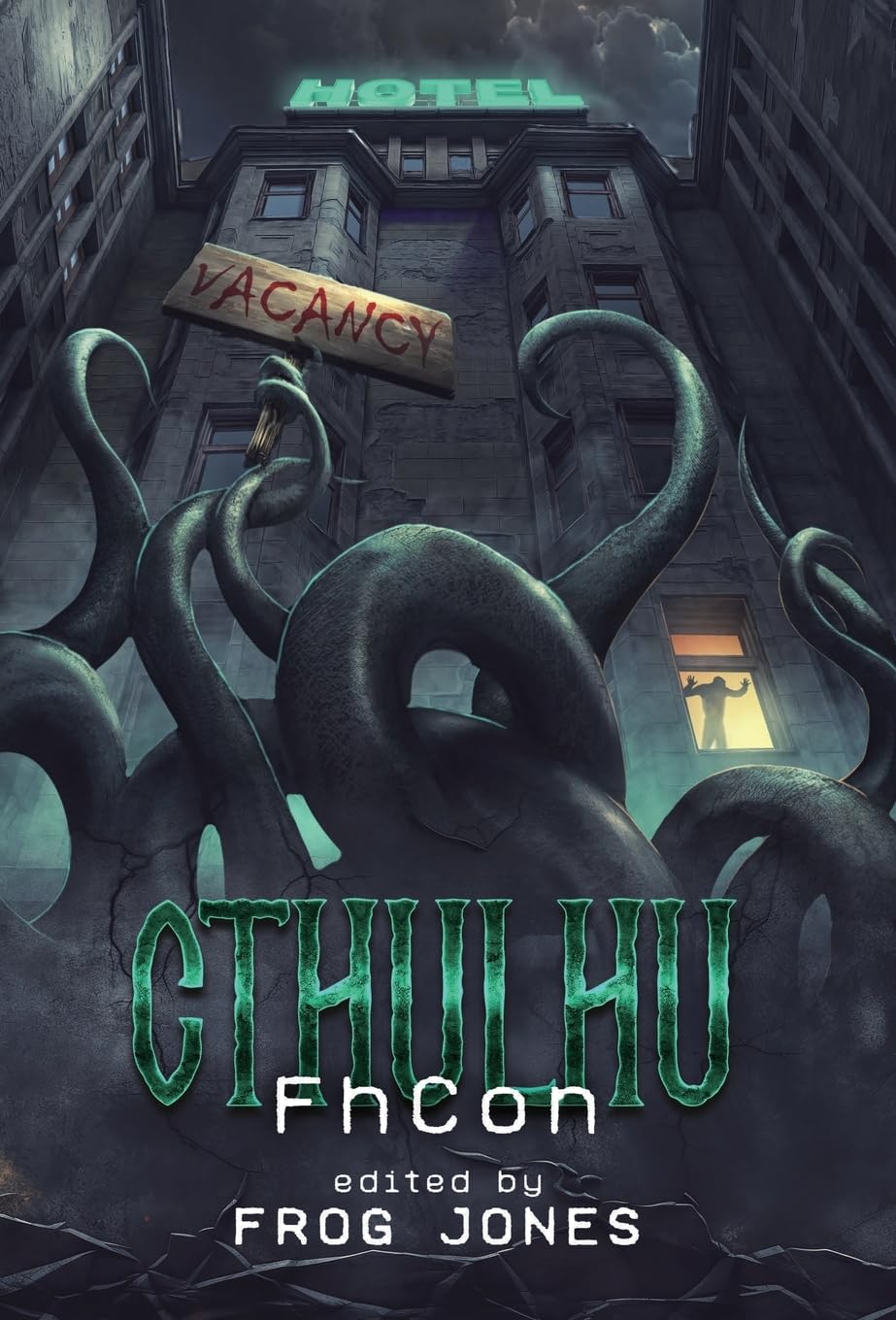
Cthulhu FhCon (2025) is an odd anthology that rather embraces the cuddlification and tropes by postulating a convention for eldritch entities and their mortal servitors. The convention tale is an outgrowth of SFF culture, and there have been Mythos versions before, such as Strange Stones (2025) by Edward Lee & Mary SanGiovanni. This is the first time there’s been an entire anthology of such stories…and of course, at least one writer had to address the idea of the room party.

Elizabeth Guizzetti’s “Room Party Fit for an Elder God” is very much a Lovecraftian convention story from a cult-trope point of view. Cult membership is falling off, and if one of the Elder Gods makes an appearance, it’ll grow again. If the priestess is lucky, the God will like the chocolate sardine cupcakes and she might even get her deposit back. As such, it fits well into the ongoing cuddlification of the Cthulhu cult. The collateral damage of the room party is a punchline, not unlike an Addams Family cartoon. What’s a little death and madness when the Elder God really liked your cupcakes?


Bobby Derie is the author of Weird Talers: Essays on Robert E. Howard and Others and Sex and the Cthulhu Mythos.

Deep Cuts in a Lovecraftian Vein uses Amazon Associate links. As an Amazon Associate I earn from qualifying purchases.
Deeper Cut: Lovecraft, Racism, & Humor

Racist Language
The following article deals explicitly with racism in humor, many examples of which use racial pejoratives. Frank discussion of these matters requires the reproduction of at least some samples of racist pejoratives and ideas in quotes, titles, etc.
As such, please be advised before reading further.


Mr. Snow, I believe these to be Negro eggs.
—The Author, Planetary/The Authority: Ruling the World (2000) by Warren Ellis & Phil Jimenez

Few authors have been as personally identified with their work as H. P. Lovecraft. Even during his own lifetime, Lovecraft’s friends began to incorporate fictional versions of them into his stories—as “Howard” in “The Space-Eaters” (1928) by Frank Belknap Long, Jr.; as the unnamed mystic dreamer in “The Shambler from the Stars” (1935) and Luveh-Keraph, Priest of Bast in “The Suicide in the Study” (1935) by Robert Bloch; and as “the man with the long chin” in The Village Green (192?) by Edith Miniter.

In life, Lovecraft was a self-effacing and ready correspondent who made many contacts with his fans and peers in pulp fiction and amateur journalism; he liked to project the image of himself as older and more reclusive than he actually was. After his death, this personal myth-making took on a life of its own, as his legend developed and spread. There was no absence of humor from the early decades as awareness of Lovecraft and his Mythos grew, with both parody and satire present in works like “At the Mountains of Murkiness, or From Lovecraft to Leacock” (1940) by Arthur C. Clarke.

A notable absence in early humor directed at Lovecraft is any mention of his racism. The biographical facts of Lovecraft’s life were generally slow to emerge, and not always readily available to fans. So while comments on Lovecraft’s racism and antisemitism were made public by the first version of his wife’s memoir in the 1940s (see The Private Life of H. P. Lovecraft (1985) by Sonia H. Davis), and August Derleth felt the need to address the issue in print in Some Notes on H. P. Lovecraft (1959), Lovecraft did not develop a widespread reputation as a racist until the publication of L. Sprague de Camp’s Lovecraft: A Biography (1975). De Camp, who had studied Lovecraft’s published and unpublished letters and other materials, emphasized Lovecraft as neurotic, a flawed human being, a possible homosexual, and especially as a racist—and published the entirety of the poem “On the Creation of Niggers” which is attributed to Lovecraft.

De Camp’s biography came at a time when Lovecraft was beginning to spread to a much larger audience, due to reprint of his work in paperback, films like The Dunwich Horror (1970), and growing influence on music, adaptations in comic books, and other media—and as Lovecraft was gaining more critical awareness and acceptance. The same year as de Camp’s book came out, the first World Fantasy Convention was held in Lovecraft’s hometown of Providence, Rhode Island, with the theme “The Lovecraft Circle,” and the first World Fantasy Awards were given out—in the form of a bust of Lovecraft, carved by noted cartoonist Gahan Wilson. So, just at a time when Lovecraft’s popularity blossomed and more information on his life emerged, de Camp released a highly influential book.

Many Lovecraft scholars criticized de Camp’s approach, presentation, and conclusions—though not the underlying facts: while speculation about Lovecraft’s sexuality or mental health were subjective, Lovecraft’s prejudices were clearly expressed in his letters. The critiques, however, didn’t have the reach of the book itself, and many of de Camp’s misconceptions continue to color perceptions of Lovecraft to the present day. This has been very apparent in various fictional depictions of Lovecraft in various media, which often exaggerate Lovecraft’s characteristics and prejudices for humorous effect.

When the little kitten darted from the door and fled into the hall, the apparition in the darkness shouted out loud. It shouted in the high nasal accent native only to that part of New England once known as Rhode Island and the Providence Plantations. And its words were these:

Come back!” it cried. “Come back, my pet! Come back, NIGGER-MAN!
—Gregory Nicoll, “The Man Who Collected Lovecraft,” The Diversifier (May 1977) 68

As a subject of satire and ridicule, Lovecraft might seem to be a particularly strange dead horse to choose to whip. Obviously, Lovecraft is dead and is unaffected by mockery; he can’t regret or reform his reviews, and won’t roll in his grave no matter how hard you make fun of him. Humorous takes on Lovecraft are thus aimed at the living: at fans who are familiar with Lovecraft and his fiction, whether or not they enjoy either. In the case of Lovecraft’s racism in particular, this effectively serves as a kind of damnatio memoriae: unable to condemn a living Lovecraft for his prejudices, they make fun of a dead Lovecraft. These humorous portrayals, with all of their exaggerations, have influenced Lovecraft’s posthumous reputation and image.

Does making fun of a dead man constitutes “punching down?” Certainly, Lovecraft has no ability to defend himself from false accusations or inaccurate claims about his prejudices. On the other hand, he doesn’t really need any such defense. While Lovecraft may have no power to answer now, Lovecraft was racist, and part of the white majority that kept racial and ethnic minorities as second-class citizens during his life. Empathy in cases of historical racism should be on the victims of discrimination, not the perpetrators. Lovecraft may not have been a member of the Ku Klux Klan or participated in any racial violence directly, but he was still part of the majority of U.S. citizens that supported the legalized racism of Jim Crow and the social norms that prevented racial equality.

The occasional depiction of Lovecraft as “Genre’s Racist, Crazy Uncle” has exactly that much truth in it: Lovecraft’s prejudices were largely tolerated during his lifetime, and for some decades beyond that, because they were the same prejudices that millions of other people in the U.S. held. Just because those prejudices were common does not make them universal. Just because other people were racist does not make Lovecraft’s racism okay. The broad cultural background radiation of racism during Lovecraft’s lifetime is an explanation for his views, not an excuse for them.

The fact that Lovecraft is often depicted as much more cartoonishly racist than he was in real life, or than his peers, is in part down to the needs of the writer or artist to make a joke, but also in part due to lack of understanding of what Lovecraft’s prejudices were and how they fit into the historical context. Pretty much no one that mentions “On the Creation of Niggers” in any context wants to read a dissertation on the tradition of racist light verse in English poetry, just as few people who are familiar with the name of Lovecraft’s cat in “The Rats in the Walls” want a lecture on the propensity for naming pets racial epithets around the turn of the 20th century. They care about the current context, when the N-word is a racial epithet of unique power, not a historical context when such usage was more broadly accepted by a more openly racist society.

Many expressions of prejudice that were commonplace in the early 20th century seem egregiously racist now. Plain statements of Lovecraft’s life may seem ludicrously racist by the standards of the present, because many plain statements of racism in the 1930s and 30s are ludicrously racist by today’s metric. It is difficult for today’s readers to get a grasp of what a “normal” amount of racism was in the 20s and 30s when minstrel shows, coon songs, and the African Dodger were still socially acceptable.

In 1897 I was trying for Beethoven—but by 1900 I was whistling the popular coon songs & musical comedies of the day.
—H. P. Lovecraft to J. Vernon Shea, 3 Sep 1931, Letters to J. Vernon Shea et al. 46

As a consequence, when combined with a general ignorance of the actual nature and scope of Lovecraft’s prejudices, the exaggerations of Lovecraft’s bigotry are often much more extreme to get a laugh.

Ah! Look, it’s attempting to communicate. No doubt the savage thing knows language as a house pet knows its reflection in the mirror. The sense is taken in, but the process, the meaning is forever lost.
—H. P. Lovecraft, Atomic Robo and the Shadow From Beyond Time by Brandon Masters

There is a certain irony in that the more that we know of the facts of Lovecraft’s prejudice, the more ridiculous and far from Lovecraft’s actual beliefs that humorous takes on Lovecraft’s racism tend to get. The earliest humor was written by weird fiction fans who were generally aware of who Lovecraft was, his work, and some of the scholarship about his life. Later writers tend to be less familiar with the minutiae of Lovecraftiana and base more of their image of Lovecraft off the memes and stereotypes of Lovecraft and his work, or lean into a particular presentation that relies on such a specific image of Lovecraft as cartoonishly bigoted.

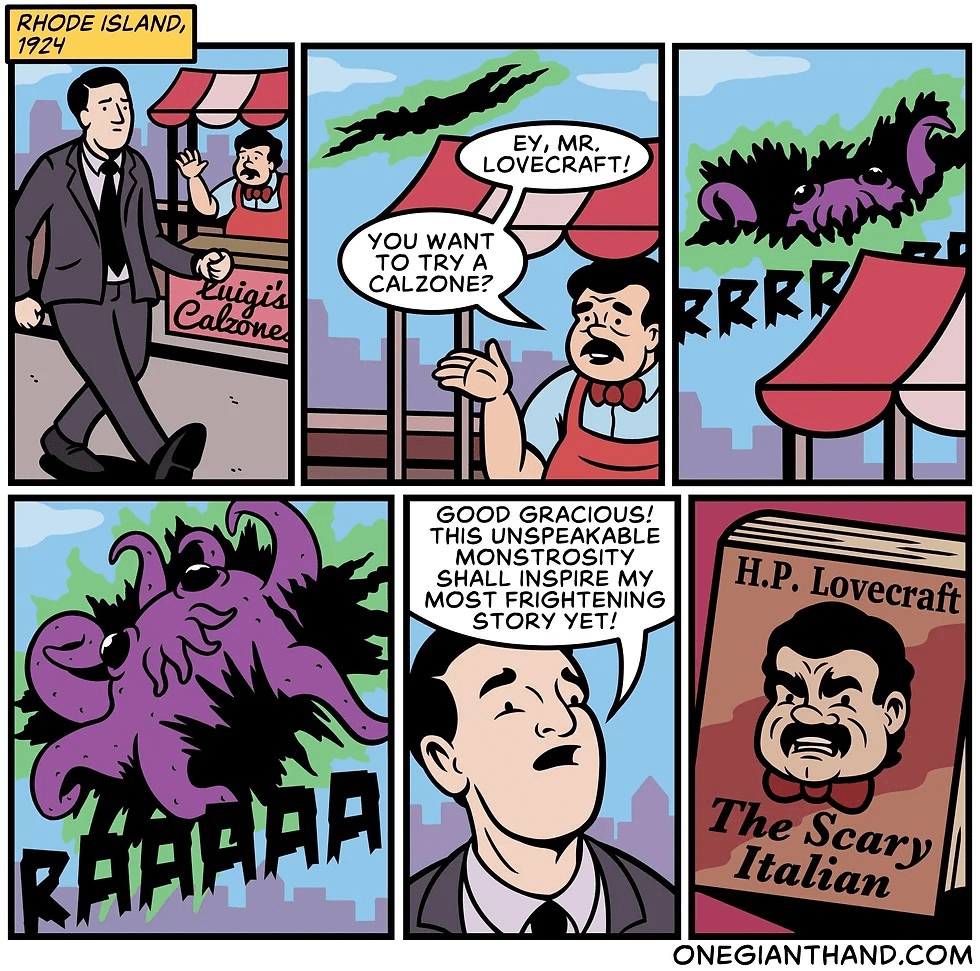
As a case in point:

Original Twitter post. Used with permission. All rights reserved.

In terms of accuracy, there’s a kernel of truth here: Lovecraft did express some prejudice against Italian immigrants, especially those in the Federal Hill area of his native Providence, RI. Lovecraft had even made mention of Italian immigrants in some of his publications, such as his very first widely-published poem, “Providence in 2000 A.D.”:

In 1912 my first bit of published verse appeared in The Evening Bulletin. It is a 62-line satire in the usual heroic couplet, ridiculing a popular movement on the part of the Italians of the Federal Hill slums to change the name of the main street from “Atwells’ Avenue” to “Columbus Avenue”. I pictured Providence in 2000 A.D., with all the English names changed to foreign appellations. This piece received considerable notice of a minor sort, I am told, though I doubt if it had much effect in silencing the Italians’ clamour. The idea was so foolish that it probably died of its own weakness.
—H. P. Lovecraft to the Kleicomolo, 16 Nov 1916, Letters to Rheinhart Kleiner & Others 76

The humor comes from the juxtaposition of the prosaic (and to contemporary eyes, ridiculous) prejudice against the harmless (if stereotypical) Italian immigrant and the eldritch entity breaking its way through the dimensional barriers. The cartoon also draws on and supports the misconception that Lovecraft’s fiction was largely driven by his personal fears and prejudices.

In real life Lovecraft actually liked Italian food, generally had congenial relationships with Italian immigrants he got to know, and rarely included Italian characters in his fiction. But that is a lot more nuance than can be expected in six panels. The joke doesn’t work if Lovecraft is presented as someone who isn’t triggered by the fact an Italian offered him a calzone, whose cosmic horrors aren’t inspired by more prosaic prejudices.

My taste has become so prodigiously Italianised that I never order anything but spaghetti & minestrone except when those are not to be had—& they really contain an almost ideal balance of active nutritive elements, considering the wheaten base of spaghetti, the abundant vitamines in tomato sauce, the assorted vegetables in minestrone, & the profusion of powdered cheese common to both.
—H. P. Lovecraft to Lillian D. Clark, 18 Sep 1925, Letters to Family & Family Friends 1.402

If there is a problem with the humorous expression of Lovecraft’s racism, it isn’t in the fact of making fun of a dead racist, or of painting racism as ridiculous or illogical. The problem is what it is often wrapped around in: the normalization of negative depictions of someone with mental health issues, and the downplaying of the dangers that contemporary racism represents. While a few scholars and pedants may decry the propagation of misinformation about Lovecraft and his fiction, that is ultimately a minor quibble compared to the bigger issues of propagating negative stereotypes like de Camp’s neurotic picture of Lovecraft, or of ignoring the really scary part about Lovecraft’s prejudices:

Many people held them then, and many people still hold them today.

Racist humor always has the caveat that to a certain audience, it isn’t funny because it’s ridiculous or breaking a taboo, but because it appeals to their own prejudices. Dave Chappelle mentioned in a 2006 interview with Oprah about someone laughing at him, rather than with him. The same thing cannot happen in the same way with Lovecraft because Lovecraft is white, and even prejudicial words like “cracker” and “honky” don’t have the same bite or weight as the N-word. Yet at the same time, making fun of Lovecraft’s prejudices has become a popular excuse for continuing to spread that language—the name of his cat, the poem “On the Creation of Niggers”—many writers find it acceptable to repeat that in a humorous context, as the punchline of the joke.

So might their audience.

The use of nigger by black rappers and comedians has given the term a new currency and enhanced cachet such that many young whites yearn to use the term like the blacks whom they see as heroes or trendsetters.
—Randall Kennedy, Nigger: The Strange Career of a Troublesome Word (2003) 36

The moral problem with the humorous portrayal of Lovecraft’s racism isn’t about making fun of Lovecraft, who is already dead and long past injury. It is that the jokes themselves do little but reiterate and spread prejudice. They don’t teach the audience anything about Lovecraft’s racism, and often only work when predicated on an audience already aware of Lovecraft’s racism in some form.

Is there any hidden moral or germ of insight in these portrayals?

A case in point might be made for the Midnight Pals, which takes as its set-up the idea of famous writers, living and dead, sitting around a campfire and having brief conversations. The nature of the form means that the personalities are exaggerated and deliberately satirical. Lovecraft is often portrayed as neurotic, racist, although often ultimately harmless (as opposed to J. K. Rowling, who also appears.) In most cases, Howard’s portrayal makes him the butt of the joke, and the series is clear in demonstrating that racism is bad and Lovecraft is cringe for his prejudices—though not ostracised. Indeed, despite the differing beliefs presented, the campfire group is specifically accepting, even of members who are wildly far apart in their views on race, sex, etc.

The series doesn’t work without some butt to the jokes. Like Archie Bunker, Lovecraft in the Midnight Pals has become the mostly-lovable racist, whose prejudices are played for laughs rather than evidence of malice.

Humor is only one way of portraying Lovecraft in fiction, and Lovecraft’s racism is often used to make him a figure of ridicule. Yet even to do that, humorists often have to go far beyond Lovecraft’s own recorded words and actions. As racist as Lovecraft was, and with the unusually deep record we have from his letters and essays to give evidence to that racism, many people remain ignorant of what Lovecraft actually wrote and said, and many humorists invent new ways for Lovecraft to be racist—which perpetuates the idea of Lovecraft as racist, but isn’t very useful for refuting his actual beliefs. Lovecraft the racist is more often than not effectively a straw man when it comes to humorous portrayals.

It’s not conclusive, Clark, but it appears this dark-haired woman is your ancestor. Please, take no offense…university rules, you know. I’ll have to ask you to leave the premises.
—Prof. Upsley, Rat God (2015) by Richard Corben

A very rare form of humor when it comes to Lovecraft’s prejudices is irony. In Richard Corben’s Rat God, the very Lovecraftian protagonist discovers that he is less of a WASP than he thought he was—thanks to the late revelation of a long-forgotten Native American great-great-grandmother. The story takes obvious inspiration from Lovecraft’s “Arthur Jermyn” and “The Shadow over Innsmouth,” as well as the prejudices expressed in Lovecraft’s own life and letters. The result is not funny in a ha-ha sense, but a grim irony in that the character who exhibited such terrific prejudice throughout the story has discovered that he himself is now subject to the same prejudice by others.

Corben’s ironic unmasking of Lovecraftian prejudice does something that a lot of riffs on Lovecraft’s prejudices don’t: it moves the plot forward. It has something to say beyond “look at how racist Lovecraft is! Isn’t that funny?” It is a bit more subtle, but it also has a point, and illustrates that prejudice is a doctrine which is, ironically, color-blind to its targets. Who knows who every ancestor of theirs is, after all? Who do you think you are?

It has to be recognized that the depiction—accurate or exaggerated—of Lovecraft’s racism goes far beyond humorous jokes and portrayals. There are quite serious fictional depictions of or references to Lovecraft as a racist, as in Richard Lupoff’s Lovecraft’s Book (1985, later re-released as Marblehead), Alan Moore and Jacen Burrow’s graphic novel Providence, Lovecraft Country (2016) by Matt Ruff, The Ballad of Black Tom (2016) by Victor LaValle, Ring Shout (2020) by P. Djèlí Clark, and The City We Became (2020) by N. K. Jemisin. Accuracy is always a challenge for any historical character incorporated into a fictional work, and each author’s usage of Lovecraft is determined by their own research (or lack thereof) and their understanding—and perhaps especially, by the point they want to make.

In several of the latter novels, the point is specifically to bring attention to Lovecraft’s racism, as part of the point of their narrative is the acknowledgment and refutation of Lovecraft’s prejudices. Where a humorous depiction of Lovecraft’s racism shows prejudice as laughable, the serious depiction shows racism as no laughing matter. Either approach is workable depending on what point or mood the creator is trying to get across, one is not superior to the other, and many of the same observations about humorous depictions of Lovecraft’s racism also applies to non-humorous depictions.

Both humorous and non-humorous depictions of Lovecraft tend to be strongly driven by the myth of Lovecraft, rather than historical reality. The neurotic, cartoonishly racist caricature of a horror writer is often an easier character to work with than the more complex and nuanced historical human being, just as bumbling or villainous Nazis are easier to depict than stalwart German troopers with wives and kids who enlisted in a rush of patriotic spirit or economic need and ended up participating in a genocide. Lovecraft is not alone in being depicted first and foremost as a racist; many characters based on historical persons are essentially caricatures.

Lovecraft stands out in this respect only in that he is a pulp author from the period that humorists and their readers are still familiar with. Would the same jokes work if the subject was Ernest Hemingway or Catherine Lucille Moore? Probably not. Not because such jokes wouldn’t be as accurate (or inaccurate) as applied to Lovecraft, but because readers are less familiar with those writers and their prejudices. Lovecraft’s continued relevance, name recognition, and a vague awareness of his life are the main drivers for his continued humorous portrayals—racist warts and all. These depictions have been shaped by previous characterizations of Lovecraft, and in turn continue to shape his myth.

Real historical people are messy and complicated. Myths are easier to deal with. Yet the more the myth is repeated—the more extremes the depiction of a fantasy Lovecraft’s racism become—the harder it is to see the real historical individual. Many people, if they have the image of an individual as racist, take any correction of that image as an attempt to downplay or deny that racism. It can be very difficult to correct such a reputation once it takes hold.


Bobby Derie is the author of Weird Talers: Essays on Robert E. Howard and Others and Sex and the Cthulhu Mythos.

Deep Cuts in a Lovecraftian Vein uses Amazon Associate links. As an Amazon Associate I earn from qualifying purchases.
“The Fluff at the Threshold” (1996) by Simon Leo Barber

WHICH ELDER BEING MAKES THE BEST SEX PARTNER?
There are many opinions, but shoggoths come well recommended for sheer versatility.
Thus:
Found posted by: Nyar@blibble.demon.co.uk, November 1994
Retyped in by: Kevin@fairbruk.demon.co.uk (so the typos are all my fault)

10 Reasons why a shoggoth is the perfect lover
———————————————-
1) It can form any pseudopod, and thus can form the perfect extrusion or cavity to suit your needs.

2) It will sleep on the wet patch, or on the floor, or even in the garage.

3) It can keep going as long as you want it to.

4) Since it has a different biological basis, it cannot give you any form of STD, and thus barrier methods are not required. Please remember to wash your shoggoth in an antiseptic if sharing between partners.

5) It cannot get you pregnant

6) It can give you a back massage, answer the phone, open a beer, have sex with multiple people, change the CD _and_ take dictation all at the same time. (They also make good secretaries.) They do have a slight problem with Microsoft Word for Windows though, no-one is quite sure why.

7) It can hold the door shut so no-one can burst in on you.

8) It never suffers from impotence or headaches.

9) It will respect you in the morning and will not leave you for someone else (unless they happen to know ‘bind shoggoth’ as well. At this point your shoggoth will get very confused, split into two shoggoths, and bits of both will keep commuting between the two masses. Great for parties.)

10) It won’t insist on you meeting it’s parents. (If you do meet its parents, lose 1d6/0 SAN.)

Nyar – now all I have to do is learn to summon one…

alt.sex.cthulhu FAQ (29 May 1997)

On 30 November 2001, a would-be erotic fanfiction writer under the pseudonym Winston Marrs (lifted from a character in the 1994 Shadowrun game for Sega Genesis) uploaded a story titled “The Mother of Cthulu” (sic) to an erotic fanfiction site called The Grey Archive. Via the internet archive, you can revisit the Grey Archive just as it was on the day the story was posted—but you can’t read it. The archive didn’t try to capture “The Mother of Cthulu” until after the Grey Archive had changed its hosting service, and the old addresses all led to spam sites. Nor did anyone else apparently think to preserve Winston Marrs’ erotic opus elsewhere on the internet.

“The Mother of Cthulu” is lost to time.

Which is a fate that has probably occurred to the bulk of erotic Lovecraftian fanfiction on the internet over the last twenty-plus years. Erotica is an inherently disposable mode of fiction; with rare exception the literary and artistic value of individual works doesn’t overcome the taboo nature of ownership. Erotic fiction on the internet faces additional challenges: site owners and administrators retire or pass away, copyright claims can deter downloading or hosting content, file formats go obsolete, changes in search engines make finding it harder. While a number of fans have written adult-oriented Mythos fiction, much of it is by its very nature obscure to the casual user—or even the dedicated researcher.

In the early days of computer networking, popular networks like Usenet fulfilled the function that forums and social media sites do today. Many of these early networks, and the world wide web they began to interact with, were poorly or incompletely archived, like the Grey Archive above. Bits and pieces still exist, in some form or another. Google acquired the Usenet archives in 2001, and you can still visit Usenet groups like alt.sex.cthulhu today—if you’re willing to dig through twenty-plus years of pornographic spam.

Fortunately, if you dig down far enough, you don’t have to. Back around 1996, an archive site for alt.sex.cthulhu was created at cthulhu.org, and the Internet Archive has a copy of that. These were stories originally posted to the alt.sex.cthulhu Usenet group in the mid-to-late 1990s…which is probably as far back as internet Lovecraftian erotica can go. Included in this archive is “The Fluff At The Threshold” by Simon Leo Barber…which can serve as an exemplar of Lovecraftian erotic fanfiction during this period. A core sample from the digital Mountains of Madness.

It was to my cousin’s house on Carcosa Crescent that I came that December, to look over the property and to set the place in order. I had been long overseas, first working as an assistant to the Professor Of Difficult Sums at Celaeno Gate College in the sultry Celebes Islands, and then recalled to the family Regiment when it formed up at the end of the War of Liberation in 2029, when the stranglehold of the EC over the (now happily Nationalised) landmass of Europe, had been so crashingly broken.
—Simon Leo Barber, “The Fluff At The Threshold”

One of the hallmarks of this story is that it is pretty much pure pastiche—while the setting is in the (now not so far and distant) future of 2029, in a near-Cthulhupunk setting, Barber is deliberately invoking tropes of Mythos fiction past: the inheritance gambit, where a relative died and now the protagonist inherits their property and its terrible secrets.

The setting is almost surreal, the kind of mish-mash of 90s references and silliness one might expect to find in a bizarro novel today. This is not porn-without-plot, there’s a fair narrative built up before we get to anything that might be mistaken for a naughty bit. As weird as it may sound, while this exact combination of strangeness may never have been arrived at before or since, the thread of humor in the story is exceptionally characteristic of much fanfiction in the period. The general attitude toward the material is reminiscent of farcical works like Bored of the Rings and National Lampoon’s Doon, or the Lovecraftian episode of The Adventures of Samurai Cat.

Good clean fun…well, maybe not entirely clean.

“Our Dark Mother Of The Woods,” I smiled to myself, making a reverent sinuous gesture, as tentacle-like as an internal skeleton would allow, to Shub-Niggurath, the Dark Goat Of The Woods With A Thousand Young. “Or, as they’d call her under the EC’s Correction Enforcement Policies, “The Ethnically Coloured Caprine Deity-Person of The Sylvan Ecosystem With The Relaxed Attitude To Birth-Control”……..”
—Simon Leo Barber, “The Fluff At The Threshold”

Readers looking for exquisite descriptions of shoggoth sex should probably look elsewhere. While there is that kind of smut on alt.sex.cthulhu archives and elsewhere, this is a Mythos story about sex in the same way that “The Dunwich Horror” or “The Shadow over Innsmouth” is—just one that takes place in a dystopic future full of talking animals.

Which is, in its own way, a testament to the kind of variety one sees in erotic fanfiction. It’s not all hardcore pornography, nor has it ever been. While there is plenty of sexually explicit Lovecraftian fanfiction out there, on sites like Literotica.com and the Alt Sex Stories Repository, the erotic impulse isn’t restricted to just the nastiest and most explicit kink-laden literary porn one can dream up…it can be fun too.


Bobby Derie is the author of Weird Talers: Essays on Robert E. Howard and Others and Sex and the Cthulhu Mythos.

Deep Cuts in a Lovecraftian Vein uses Amazon Associate links. As an Amazon Associate I earn from qualifying purchases.
“Shoggoth Makes Three” (2003) by Jean Ann Donnel

Eldritch Fappenings

This review deals with a work of adult subjects, and the history of erotic art and writing. As part of this review, selected images with artistic depictions of genitalia and/or sexually explicit contact will be displayed.
As such, please be advised before reading further.


A house in the suburbs or an apartment in the city would be assigned him, and he would be initiated into one of the large affection-groups, including many noblewomen of the most extreme and art-enhanced beauty, which in latter-day K’n-yan took the place of family units.
—H. P. Lovecraft, “The Mound”

Most readers don’t normally associate H. P. Lovecraft with polyamory. Then as now, monogamy was the prevailing paradigm among the bulk of the population, and Lovecraft’s romances in his fictions are almost always explicitly monogamous in nature; there are a few lover’s triangles in stories like “The Man of Stone” with Hazel Heald and “Medusa’s Coil” with Zealia Bishop, but there are no polycules in Lovecraft country outside of “The Mound.”

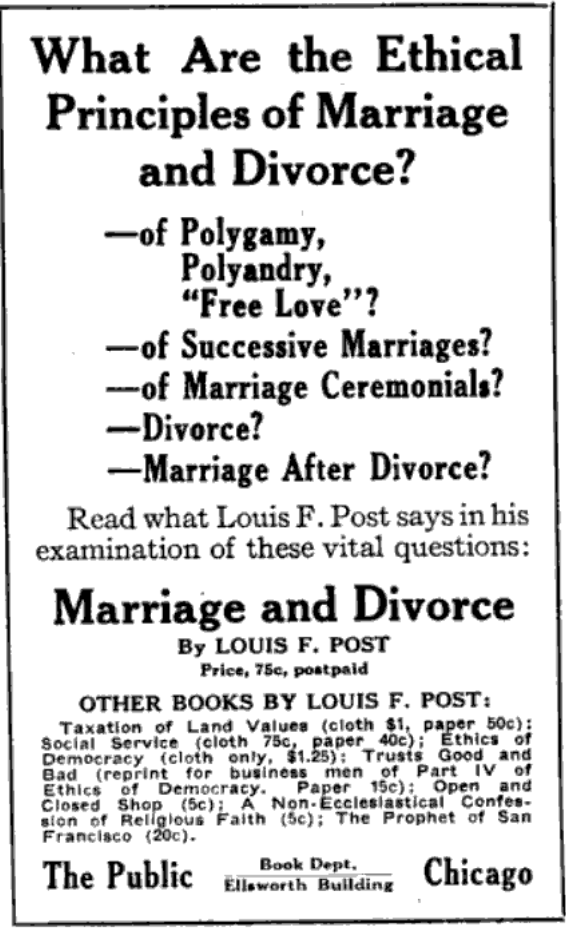
There was nothing new with the idea of polyamory during Lovecraft’s lifetime. His friend James F. Morton was part of a “free love” group at one point, and his chapbooks were advertised in The Public in 1916, alongside advertisements like this:

Screenshot 2021-02-23 at 9.42.15 PM

After Lovecraft’s death, polyamory became more common. “The Discovery of the Ghooric Zone” (1977) by Richard Lupoff famously opens with a polyamorous threesome…but for the most part, monogamy remains the overwhelming romantic schema of Mythos fiction, both serious and jocular, erotic and non-erotic. Indeed, while the attitudes regarding sex have become much more progressive and expressive in Mythos fiction, romances—particularly marriage—often deal with existing attitudes and problems, with a Mythos twist. This can be seen in works like “Mail Order Bride” (1999) by Ann K. Schwader (marriage-by-contract, the stresses of pregnancy on a marriage), “A Coven in Essex County” (2016) by J. M. Yales (patriarchal attitudes towards marriage, spousal abuse), Mexican Gothic (2020) by Silvia Moreno-Garcia (marriage under duress, consanguineous marriage), etc. Infidelity remains a relatively rare theme, as well as marriage counseling. The bulk of marital issues in the expanded Cthulhu Mythos appear to be solved only be the death of one or both partners.

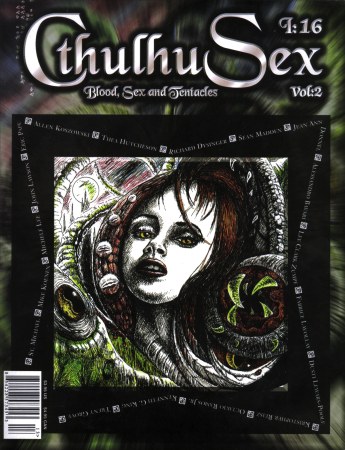
Which is part of what makes Jean Ann Donnel’s “Shoggoth Makes Three” so special.

“Fi Fi is your lover’s name as well?” she inquired.

Cantraip looked at her startled. Could it be?

“You’re not a lesbian, are you Ms. Peaches?” the moderator asked, arching an eyebrow. “That would explain your being in a dysfunctional relationship group,” he stated.

Ms. Peaches stared at him steadily with contempt in her eyes. “I’m quite straight. Fi Fi’s not exactly a woman and definitely has male members,” she commented.
—Jean Ann Donnel, “Shoggoth Makes Three” in Cthulhu Sex Magazine (2003), vol. 2, no. 16, 20

Donnel is playing the situation for laughs; the idea of a polycule with a polymorphous shoggoth in the middle is almost a one-note joke. Yet for all that the idea is being played for transgressive comedy, it does include several interesting developments in Mythos fiction which other authors would also explore—and maybe a few that haven’t been explored much at all.

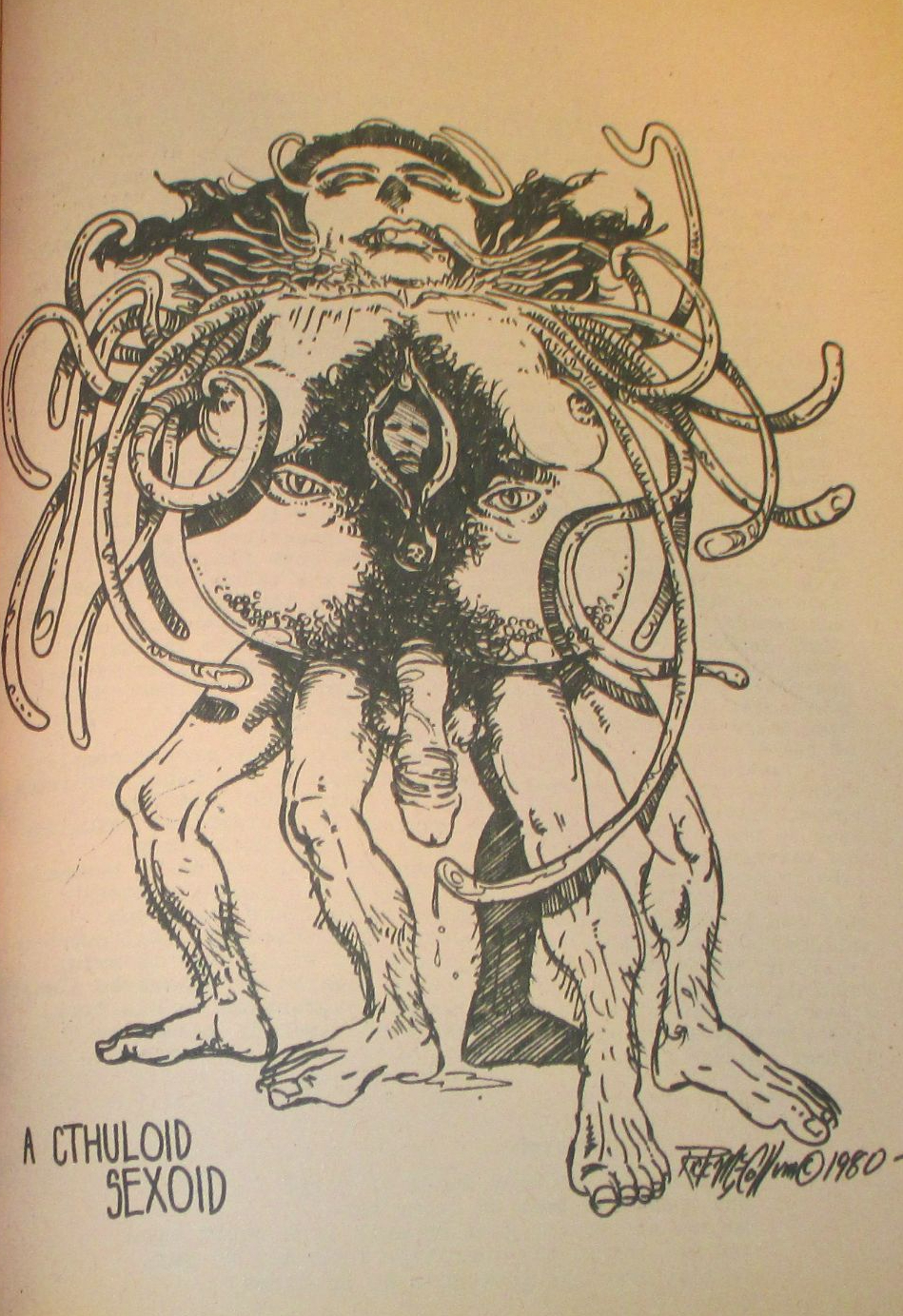
It is hard to pinpoint where exactly the idea of a shoggoth (or other Mythos entity) with multiple genitalia serving as a bridge between heterosexuality to a broader range of sexual experiences originated. Certainly there was some fanfiction where ardent weird fiction fans were imagining the possibilities; Rick McCollum illustrated one possibility for a fanzine in 1980:

jdHyQEW

One might also add Robert M. Price’s story “A Thousand Young” (1989), where a libertine encounters:

For there, revealed by the glare of the lights, was no solid heap of swaying orgiasts, but rather chains of bodies spread over the pulsing and gelatinous surface of a tentacled, amoeboid horror, the revelers grotesquely arrayed like suckling whelps as the thing fed greedily on their sexual vitality through the questing pseudopodic phaluses, teats, and vulvas it sent forth!
—Robert M. Price, “A Thousand Young” in The Shub-Niggurath Cycle (1994) 94

The idea, both artistic and literary, of a polymorphous Mythos entity that can produce genitalia at will is still very much part of the creative erotic lexicon of the Mythos, as can be clearly seen in many depictions of the shoggoth in, for example, fan-works related to Monster Girl Encyclopedia II (2016) by Kenkou Cross (健康クロス). Arguably there were prototypical works in the Mythos anticipating this, such as the strange plants to which parts of human men and women were grafted in Clark Ashton Smith’s “The Garden of Adompha.”

What these stories generally lack is the emotional connection. For many, the ability of a shoggoth to assume multiple genitalia, male and female, is purely a matter of sexual possibilities. Jean Ann Donnel’s Ms. Peaches doesn’t feel it’s homosexual to be with a shoggoth, no matter how many vulvas it may have at the moment; but her interest in Fi Fi, like Cantraip’s, is more than just sexual. There’s a romantic bond, above and beyond just the sexual one…and it’s a bond that Ms. Peaches and Cantraip learn to share with each other as well as Fi Fi.

Fi Fi had parts entwined, and in, both of them and covering them protectively. They slept in Fi Fi and Fi Fi in them, as well as in one another. They were not going back to the dysfunctional relationship group. The three of them felt their relationship was absolutely perfect just as it was.
—Jean Ann Donnel, “Shoggoth Makes Three” in Cthulhu Sex Magazine (2003), vol. 2, no. 16, 21

“Shoggoth Makes Three” has a happy ending…and, for what the story is, a short-short of only two pages, played for laughs, that’s workable. However, there is the potential in that setup for much more substantial and powerful stories that explore this kind of theme, of humans finding a meaningful relationship with an eldritch entity that extends beyond just sex, which eschews the limitations of gender.

Such a story is “Ink” by Bernie Mozjes in Whispers in Darkness: Lovecraftian EroticaWhile Mozjes doesn’t cover quite the same ground as Donnel (no therapy), “Ink” is played more seriously; the conclusion is less foregone, and the emotions being addressed have more kick. Donnel takes it for granted that the shoggoth, because of their multiple genitalia, is able to bridge the gap between men and women mostly on a sexual basis. Mozjes is more focused on what else might attract someone to enter into a polyamorous relationship with an eldritch entity—and why the polymorphic entity itself might enter into such a relationship.

Which is rare ground. It’s often a strange case for Mythos fiction, particularly Lovecraftian erotica, that regardless of how fantastic the physical forms and acts of copulation turn out to be, the actual basic mechanics tend to default to heteronormative values of sex and relationships. Whether that’s a collective failure of the imagination or catering to what the audience wants, who can tell? Yet it doesn’t seem that many people have written of, say, polygamous marriages in Innsmouth. For everyone that thinks every possibility for Mythos fiction has been explore…reconsider your preconceptions. There’s a lot stranger territory out there.

“Shoggoth Makes Three” by Jean Ann Donnel was first published in Cthulhu Sex Magazine (2003) vol. 2, no. 16. It has not been republished. Donnel had written some short-short fiction on the alt.cthulhu.sex Usenet group, and also published “Have You Found Him” in Eldritch Blue: Love & Sex in the Cthulhu Mythos (2004).


Bobby Derie is the author of Weird Talers: Essays on Robert E. Howard & Others (2019) and Sex and the Cthulhu Mythos (2014).

“At the Mountains of Murkiness, or From Lovecraft to Leacock” (1940) by Arthur C. Clarke

Something about the scene reminded me of the strange and disturbing Asian paintings of Nicholas Roerich, and of the still stranger and more disturbing descriptions of the evilly fabled plateau of Leng which occur in the dreaded Necronomicon of the mad Arab Abdul Alhazred.
—H. P. Lovecraft, “At the Mountains of Madness” (1936)

Surely, I thought, the mad Arab, Abdul Hashish, must have had such a spot in mind when he wrote of the hellish valley of Oopadoop in that frightful book, the forbidden “Pentechnicon.”
—Arthur C. Clarke, “At the Mountains of Murkiness” (1940)

Four years after “At the Mountains of Madness” was published in the pages of Astounding, and three years after Lovecraft had died, his work was already being parodied (Clarke could not know that he was far from the first). “Murkiness” was only Clarke’s fifth story to see print, published in the amateur sci-fi zine Satellite #16 (vol. 3, no. 4, March 1940), and is a very respectable early work. Like many later pasticheurs, it focuses on the most obvious aspects of Lovecraft’s writing and imagery to lampoon; unlike many of them, it does so from a very British standpoint, with Clarke deliberately drawing inspiration from the humorist Stephen Leacock.

As a spoof, the work is quite fannish. One of the key plot points revolves around how the Elder Things authored the stories about themselves in Weird Tales, which is why no one believes in them—and at the end the explorers find and misapprehend a note:

Destroy human race by plague of flying jellyfish (?Sent through post in unsealed envelopes?). No good for Unknown – try Gillings.

Fans of science fiction would recognize Unknown as one of the premier fantasy pulps of its day; Walter Gillings was the editor of the British pulp Tales of Wonder. The explorers, unfamiliar with these nuances, take it for an actual insidious plot and flee. Exeunt, pursued by eldritch horror requesting whether they mind condensed milk in their tea.

It is difficult to say what lasting impact Lovecraft had on Clarke; certainly, he was a fan, but he never attempted to add to the Mythos as such, aside from noting that the Programming Manual for the HAL 9000 Computer: Revised Edition was published by Miskatonic University Press. Thematically, one could argue that Lovecraft’s science fiction may have been an inspiration for some of Clarke’s stories, particularly the sense of cosmic horror in stories such as “The Nine Billion Names of God” (1953), but “Murkiness” was the only time Clarke explicitly tried his hand at anything explicitly Lovecraftian. If there is a distinction to be had for Clarke’s “Murkiness,” it may be as one of the earliest Lovecraft-related works written by a homosexual author outside of Lovecraft’s immediate circle of friends such as Samuel Loveman and R. H. Barlow.

On New Year’s Day 1951, Robert H. Barlow, who had been Lovecraft’s friend, correspondent, and literary executor, took his own life. The motive is believed to have been the threat of exposure: Barlow was homosexual. It was a difficult time and place in which to be a homosexual; not just 1950s Mexico, but for most of the 20th century in most countries. In the United Kingdom a year after Barlow’s suicide, the British mathematician Alan Turing would be charged with “gross indecency” for having a homosexual relationship, and chemically castrated. Small wonder, then, that many homosexual men opted for extreme discretion, rather than submit themselves to prosecution. Turing would commit suicide in 1954.

This was the world of Arthur C. Clarke.

“At the Mountains of Murkiness or, From Lovecraft to Leacock” has nothing overtly to do with the fact that Clarke was homosexual—relatively little of Clarke’s fiction does. We will never know what quips or insinuations he might have made, without the hovering threat of discovery. Would he have made anything of the lack of women on Lovecraft’s expedition? Or the asexual reproduction of the Elder Things?

The chilling factor of the United Kingdom’s laws against homosexuality in 1940 cannot be measured, but no doubt it was far greater than whatever sub-zero temperatures populated the imaginary Antarctica of Poe, Lovecraft, and Clarke. What might he have written differently? Would it have been different at all? We will never know.

“At the Mountains of Murkiness” has been reprinted a number of times since it was first published, most notably in At the Mountains of Murkiness and Other Parodies (1973), The Antarktos Cycle: At the Mountains of Madness and Other Chilling Tales (2006), and The Madness of Cthulhu: Volume 1 (2014).


Bobby Derie is the author of Weird Talers: Essays on Robert E. Howard & Others (2019) and Sex and the Cthulhu Mythos (2014).


Innsmouth (2019) by Megan James

I grew up reading the works of H. P. Lovecraft. I loved every fish monster, evil cult and doomed protagonist, frankly finding his affected writing style and weird creatures intrinsically hilarious because of how corny it all was.
—Megan James, Foreword to Innsmouth (2019)

H. P. Lovecraft, and to a degree his compatriot Mythos creators Robert E. Howard, Clark Ashton Smith, August Derleth, and Robert Bloch, have seen their life and works adapted to the medium of comic books and graphics novels since the 1950s. These range from fairly straight adaptations a la Alberto Breccia, Richard Corben, John Coulthart, I. N. J. Culbard, Gou Tanabe, and Ben Templesmith (to name a few) to original re-imaginings of the Mythos such as Alan Moore & Jacen Burrow’s Providence, Matt Howard’s Con and C’Thulhu, Mike Vosberg’s Lori Lovecraft, and dozens of other offerings in a number of languages.

Megan James is in good company.

The tone of the story is reminiscent of nothing else than a particular scene in Terry Pratchett and Neil Gaiman’s Good Omens:

Sister Mary Loquacious has been a devout Satanist since birth. She went to Sabbat School as a child and won black stars for handwriting and liver. When she was told to join the Chattering Order she went obediently, having a natural talent in that direction and, in any case, knowing that she would be among friends. (27)

The point being that at a certain point in the life of a church, the mundanity sort of grinds out the divine nature of the proceedings. Or, as is the case in Megan James’ Innsmouth, the end times when Cthulhu is summoned can’t be held on a Thursday because they’ve already got the potluck scheduled.

“Well, the Elder Gods clearly didn’t give the events committee proper notice.”
Innsmouth, issue #1

What we get in five issues is a re-imagining of Innsmouth where intermarriage with fish people is just accepted and maybe working toward the end times is not a major priority for most of them. But like certain outbreaks of Millenialism and Milleniarianism, a few folks are actually looking forward to (or actively trying to cause) the project of waking Cthulhu up in more than a theoretical Sunady-go-to-meeting sense. Which is a problem if you kind of like the world as it is, thank you very much.

The cast and crew assembled by the combination of slapstick and well-meaning anti-cult activities is not coincidental. The team that is assembled includes a female Innsmouth acolyte (Abigail), a female Muslim (Fatima Alhazred, descendant of that Alhazred), and a pair of homosexual African-American reanimators (Drs. Edward Herbert & Jason West). This well-rounded cast is a deliberate effort on James’ part:

While much of the book is inspired by Lovecraft, James said she did take a few of his common outdated themes and views on certain issues such as race and switch them up.

“I wanted to address that in how I’m treating these characters, updating that for 2016,” she said. “Kind of giving voice to some of the characters he shafted along the way.”

For example, in the author’s 1924 short story, “The Hound” he introduces the Necronomicon, which according to James is a book of evil which Lovecraft linked to Arabic heritage.

“That’s not really cool,” she said. “I have a character Fatima she’s Muslim and studies the Necronomicon and it’s part of her family heritage…kind of reclaiming the stuff that he’s messed up.”

—Amy David, Local Comic Book Artist Megan James Mixes Humor and Evil in Upcoming Book, Innsmouth (28 July 2016)

It’s worth pointing out, none of this feels forced. Having Abdul Alhazred’s descendant majoring in eldritch anthropology at Miskatonic University is a key plot point, especially since the Innsmouthian’s Pocket Necronomicon is only about 20% complete; she and Abigail score a couple of gags playing off of each other’s alienation to the culture at large. Each of the characters has their role to play and is a character in their own right, not a walking two-dimensional stereotype.

James expands on this in her foreword a bit:

Of course, Lovecraft stresses fear of the unknown. Unfortunately, as I realized more and more as I grew older, his unknowns included not only fungus planets and brain-snatching flesh spiders, but also anyone who did not fit the mold of a white, straight, educated, Anglo-Saxon. […] I wanted to pay homage to all the things I love about the Mythos, but I also wanted to reinterpret the more troubling aspects and have some fun along the way.
—Megan James, Foreword to Innsmouth (2019)

This is in many ways the meat of the book, and the issue that every contemporary writer and artist has to consider when working with Lovecraft and the Mythos today. There are things that Lovecraft wrote in the 1920s and 30s which passed for publication then, but would not and should not today. It is a good thing that new artists approaching the work are willing and able to engage with this aspect of his writing, to grapple with how best to approach the material and update it to fit the syntax of today.

With any luck…there will be more:

This is just the beginning of Randolph, Fatima and Abigail’s story. Ideally, by the end of Innsmouth, I’ll have crafted a story that Lovecraft would have detested…but truly, I have no interest in playing by his rules just because I’m in his sandbox.
—Megan James, Foreword to Innsmouth (2019)

H. P. Lovecraft is long dead, and cannot render judgment—but in the here and now, what matters is not what Lovecraft would have thought, but what the readers and audience think. Megan James has put together a fun, adventurous story with a group of likable (if not always competent) characters whose hearts are in the right place. Readers looking for seriously nihilistic cosmic horror would be better off looking elsewhere, but for those who can take enjoyment in something more light-hearted, it’s a good book.

Innsmouth ran for five issues from 2016 to 2018, published by Sink/Swim Press and available at the store on her website. The collected trade paperback edition, published by ComicMix in July 2019, is also available on Amazon.com.


Bobby Derie is the author of Weird Talers: Essays on Robert E. Howard & Others (2019) and Sex and the Cthulhu Mythos (2014).


“The Man Who Sold Rope To The Gnoles” (1951) by Margaret St. Clair

A HYMN OF HATE

Margaret St. Clair, of Berkeley, California, writes: “I’ve been a good quiet uncomplainng reader of WEIRD TALES for about ten years—but the prospect of another story by Edmond Hamilton moves me to hysterical outcry. He makes me want to scream and bite my nails—’captured thirty-six suns’ indeed! His style is nothing but exclamation marks; his idea of drama is something involving a fantastic number of light-speeds; he is, in the words of one of my favorite comic strip characters, flies in my soup. He is science-fiction at its worst: all WEIRD TALES needs to make the science-fiction atmosphere perfect is a letter from Forrest J. Ackerman and a story by Hamilton. Oh, and another gripe—I dislike the blurbs you are printing at the first of the stories. They are just a waste of space. I hate vampire and werewolf stories—my blood refuses to congeal for any number of undead clammily hooting about. There was a time when I could be made to shiver by the mention of garlic, but now it’s just something to put in salad. Things like Shambleau are what I like. As long as WT prints stories by Clark Ashton Smith, however, I’ll keep on reading it. His tales have a rounded jewel-like self-containedness that is, artistically, a delight. … And Smith’s drawings are, I think, by far the best in the magazine. … In conclusion, Jules de Grandin is a pain in the neck.”
—WEIRD TALES, June 1934

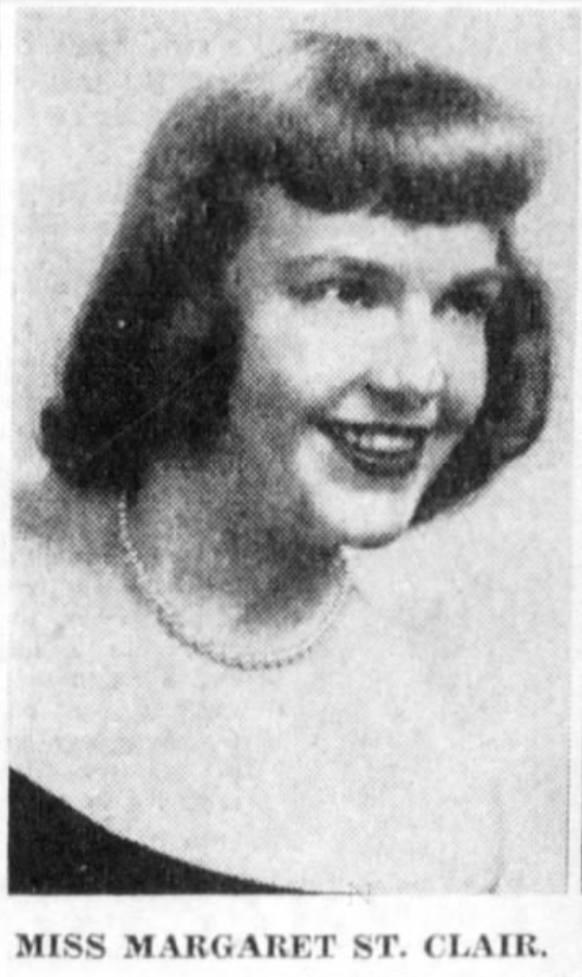
Margaret St. Clair could be considered a peripheral member of the gang of writers commonly called “the Lovecraft Circle.” She met Clark Ashton Smith while a student at the University of California at Berkeley, and began corresponding with him as early as 1933. (Selected Letters of Clark Ashton Smith 208n1) St. Clair broke into the pulps after World War II, and her stories graced the pages of Weird Tales beginning in 1950, one of the last new voices to find a home at the magazine before its inevitable demise.

“The Man Who Sold Rope To The Gnoles” (first published in The Magazine of Fantasy and Science Fiction, Oct 1951), is one of Margaret St. Clair’s most famous stories. Her tale is inspired by and directly references Lord Dunsany’s own famous jocular fantasy “How Nuth Would Have Practiced His Art Upon the Gnoles” (The Book of Wonder, 1912). Dunsany was a substantial influence on Lovecraft’s early fiction, and some later writers have worked to tie the Lovecraft Mythos more directly to Dunsany, such as “My Boat” (1976) by Joanna Russ and “Meet Me on the Other Side” (2002) by Yvonne Navarro.

Margaret St. Clair is drawing directly from Dunsany here, pursuing her own homage to the British master of fantasy instead of trying to tie it into anything larger, expanding his Mythos but staying true to the spirit of the original story. There is something essential of Postwar America in the piece, a lightness of tone and a focus on money and its pursuit, with an ironic dark twist at the end reminiscent of Charles Addams’ The Addams Family and Robert Bloch’s light-hearted Mythos story “Philtre Tip” (1961).

Nuth looked on for a while from the corner of the house with a mild surprise on his face as he rubbed his chin, for the trick of the holes in the trees was new to him; then he stole nimbly away through the dreadful wood.
—Lord Dunsany, “How Nuth Would Have Practiced His Art Upon The Gnoles”

The gnoles were watching him through the holes they had bored in the trunks of trees; it is an artful custom of theirs to which the prime authority on gnoles attests.
—Margaret St. Clair, “The Man Who Sold Rope To The Gnoles”

Dunsany has inspired any number of writers, Lovecraft not least among them. The error most writers make is trying to write like Dunsany, to capture something of his style. Like pasticheurs who ape the cosmetic aspects of Lovecraft’s prose and miss the deeper stylistic structures, themes, and philosophical underpinnings which make his fiction work. St. Clair here does not attempt pastiche, but homage: she pays reverence to Dunsany’s story and the details he gave, while writing her own, in her own voice.

Which is why this is one of the few “Dunsanian” stories which works.

It is not by any stretch of the imagination a story that Dunsany would have written, which is half the point. J. R. R. Tolkien once criticized Dunsany’s story “The Distressing Tale of Thangobrind the Jeweller”, also published in The Book of Wonder, lamenting:

Dunsany at his worst. Trying so hard for the shudder. But not for a moment making the tale ‘credible’ enough

Whether or not Dunsany was trying for a shudder or a chuckle, readers can decide for themselves. St. Clair by contrast was militantly angling for the lighter side, and the way in which she does so showcases, perhaps, how closely allied some of Lovecraft’s style of hinting was to Dunsany’s:

It was the parlor the gnole led him to. Mortensen’s eyes widened as he looked around it. There were whatnots in the corners, and cabinets of curiosities, and on the fretwork table an album with gilded hasps; who knows whose pictures were in it?
—Margaret St. Clair, “The Man Who Sold Rope To The Gnoles”

The juxtaposition of the Gnoles, strange and terrible as they are, having a very British or American-style parlor full of knickknacks and an album is the same sort of intimate contrast of “the fields we know” and the exotic and impossible which is such a hallmark of Dunsany’s early work. St. Clair’s leading question is in line with the unspoken horrors which Tolkien was so displeased with and which Lovecraft often used to such great effect: letting the reader’s imagination fill in the blanks.

The gnoles, it seemed, would be regular customers; and after the gnoles, why should he not try the Gibbelins? They too must have a need for rope. (ibid.)

“The Hoard of the Gibbelins” immediately proceeds “Gnoles” in The Book of Wonder, and St. Clair’s references to it in this story could have been a step toward stitching together some of Dunsany’s standalone stories into something like a larger Mythos, though she never pursued such a design. It is something readers of Lovecraft take almost for granted—didn’t Lovecraft borrow elements from Dunsany, Arthur Machen, Robert W. Chambers (and Chambers himself from Ambrose Bierce)?

Certainly Margaret St. Clair, who was reading Weird Tales so early and so long, knew what she was doing.


Bobby Derie is the author of Weird Talers: Essays on Robert E. Howard & Others (2019) and Sex and the Cthulhu Mythos (2014).

“Are You There, Cthulhu? It’s Me, Judy” (2018) by Beth W. Patterson

When the other two would leave the cabin together, I’d try doing my pectoral exercises in private, in hopes of expediting my development into womanhood. bending my arms, I’d swing my elbows in and out, chanting under my breath, “Get back, get back, I must increase my rack!” But of course I’d inevitably start to feel silly and switch to pushups, whispering, “Ph’nglui mglw’nafh Cthulhu R’lyeh wgah ‘nagl fhtagn.”
⁠—Beth W. Patterson, “Are You There Cthulhu? It’s Me, Judy” in Release the Virgins 50-51

Judy Blume’s 1970 classic Are You There God? It’s Me, Margaret is a story about a 6th-grade girl who, without much formal guidance or religious affiliation, finds a personal relationship with God while going through the normal pitfalls and travails of school and puberty. Beth W. Patterson’s twist on the subject shifts the setting to an equestrian summer camp in the contemporary period, and her title character Judy has more interest in the Virgins and Lovecraft than Judaism vs. Christianity. The mafia, cursed Indian burial mound, and zombie horse scare are just icing.

The story was made-to-order for the anthology Release the Virgins, which has as its raison d’être one brief anecdote (told in the foreword) and one simple commandment (followed by a caveat):

Every story must contain the phrase ‘Release the Virgins’ somewhere […] After a week, I amended the process with the admonition “No more unicorns!”
—Michael A. Ventrella, “Introduction” in Release the Virgins 9

The story is not Mythos in any real sense, and claims of Lovecraftian might be dubious: there is nothing of super-nature in the story, at least nothing that isn’t explained away before the end. But there is something interesting just in the idea of a young girl with a personal relationship to Cthulhu, which reminds me a great deal of Scott R. Jones’ When The Stars Are Right: Toward An Authentic R’lyehian Spirituality (2014) or even Phil Hine’s The Pseudonomicon, because as dogmatic as folks might be about the artificial nature of the Cthulhu Mythos and skeptical about the nature of spirituality, some folks just have a Cthulhu-shaped hole in their hearts and need something eldritch to fill it.

Which is really the most endearing part of the story. Judy doesn’t really seek intercession or favor, isn’t a young sociopath or fanatic looking to sacrifice her friends to awaken the dreamer of R’lyeh, but wants…someone she can honestly address her innermost thoughts and desires to.

Are you there, Cthulhu? It’s me, judy. I know you must be awfully busy in the mighty city of R’lyeh, and might not hear my thoughts with you being dead and all. But my friends don’t understand me, and I really think that I could ride Slipper if the counselors would only give me a chance. People say that you will be ready for resurrection when the stars are ready. Don’t you think the stars are ready for me too, Cthulhu?
⁠—Beth W. Patterson, “Are You There Cthulhu? It’s Me, Judy” in Release the Virgins 51

If there’s ever proof that Lovecraft can be applicable to more than just horror and weird fiction, I think it’s summed up in that final line. For those who are less interested in personal spirituality and want a story with horses, virgins, and Shub-Niggurath, I would recommend Charles Stross’ excellent novella Equoid (2014), which covers all of that very nicely…but would probably have not made the cut for the Release the Virgins anthology. Too many unicorns.

“Are You There Cthulhu? It’s Me, Judy” was published in Release the Virgins (2018); it has not yet been reprinted.


Bobby Derie is the author of Weird Talers: Essays on Robert E. Howard & Others (2019) and Sex and the Cthulhu Mythos (2014).

“Pickman’s Centerfold, Or: The Dunwich Ho” (2003) by Nancy Holder

Next thing I saw on the computer screen was a close-up of a drawing in a book of what looked to me like a big, enormous cock with tentacles and a beaked glans. I thought, Oh, Jesus, he’s the one for sure been cutting up the hookers. He’s got some kind of psychosexual thing going.

Gil slurred, “This’s Cthulhu.” Then he started crying.

—Nancy Holder, “Pickman’s Centerfold” in Hot Blood XI Fatal Attractions 245

Richard Upton Pickman holds a particular fascination with some writers in the Mythos. Artists have often struggled with censorship, obscenity, and unveiling true forms to the naked eye. It’s a very small conceptual leap to add an erotic element to Pickman’s work, like “Pickman’s Necrotica” in Alan Moore and Jacen Burrows’ Neonomicon (2010), the films in “Pickman’s Other Model (1929)” (2008) by Caitlín R. Kiernan…and the camshow websites designed by Pickman in “Pickman’s Centerfold, or: The Dunwich Ho.”

There is a certain reverent irreverence to Nancy Holder’s prose, right from the title to the very last line. It’s a free-wheeling, open approach to the Mythos fiction which borrows liberally from previous works, but isn’t beholden to any of them. So while Cthulhu and the Necronomicon and all make an appearance, it is in service to this story and its plotline, not to some larger fabric of Mythos fiction. “Pickman’s Centerfold” is not a sequel or prequel or really in any way connected with the narrative of “Pickman’s Model.”

This method of radical re-interpretation of the Mythos is very similar to that of “Showdown at Red Hook” (2011) by Lois H. Gresh or “Love’s Eldritch Ichor” (1990) by Esther M. Friesner and the result is…fun. Readers who have chewed through all of Lovecraft’s work and a hundred pastiches will find a story that can’t be fit into any timeline of the Mythos, and that’s okay. Holder has taken inspiration and elements from Lovecraft’s stories but has gone off to do her own thing.

The story itself is a bit light for the subject; despite appearing in (and probably written exclusively for) the erotic horror Hot Blood series, titillation and gore are not really the point, and Holder never crosses the line into either splatterpunk or erotica. Pornography and prostitution, with all its tawdry bits, are the waters in which FBI Special Agent Eliot Blake and his erstwhile comrade Gilman Innsmouth swim, like a particularly screwy episode of Law & Order: Special Victims Unit crossed with the film 8MM.

Hookers are people too, and we have a lot of those people in Boston, don’t let nobody lie to you that w have “clean up” our cit. It gets cold here. (ibid, 238)

That approach, of an FBI Special Agent hunting a serial killer running afoul of the Mythos is at once familiar to many readers but quirky enough to keep them reading.  Alan Moore did much the same thing in “The Courtyard” (1994) and its sequel. This approach helps in that it brings an “outsider” ignorant of the Mythos to come investigating, letting the readers re-live their own initiation into the weird mysteries. Holder draws on some established tropes in the process, some of more relevant than others. At one point, for example, Agent Gil pulls out a pile of books:

So wham! the books got put on the table front and center, and the first one had a picture of a really buffed-out Hannibal Lecter on the front and the title was Tales of the Cthulhu Mythos. I picked the next one up and title was At the Mountains of Madness, with a corpse in a hooded robe on the cover.

I waited for Gil to explain. (ibid, 242)

Gil couldn’t explain, and maybe Holder couldn’t either. Having works of Mythos fiction actually be present in the stories themselves is an old trick, going back to August Derleth placing Arkham House titles and copies of Weird Tales in the Mythos stories he wrote after the death of H. P. Lovecraft—Moore did the same thing in Neonomicon, Robert Bloch did it in his novel Strange Eons (1978). But whereas Bloch & Derleth were trying to establish the “truth” of Lovecraft’s Mythos in their narrative, and Moore was pursuing a grand metafictional narrative, Holder’s use here feels like a misstep. There are narrative ramifications which go unexplored: if Lovecraft lived, wrote, and died, then how has the FBI not run across the name “Richard Upton Pickman” before? The title-drops feel like an unwanted tie-in to a story that is deliberately trying to pursue its own separate narrative.

That possible misstep aside, the real focus on the latter part of the story is on the revelations: what Pickman is actually up to, what agents Blake and Innsmouth actually uncover. Despite the title, there is no centerfold—this is the digital era—and no “Dunwich Ho.” A grave disappointment for some readers, certainly, but also exemplary of one of the unconscious problems of this story: the women.

Pickman’s websites are implicitly heterosexual, places for camgirls to post their content and draw in clients; later in the story there is the suggestion he runs sites for men as well, but again exclusively for a heterosexual (if not always human) audience. The women themselves are only present in the story as nameless victims.

She was a truly awesome sight, with silicone tits of rounded perfection, big red nipples pointed directly toward the North Star. Her pussy had been shaved, and she looked fantastic. I figured, professional girl. Then I realized: one of Prickman’s girls. (ibid, 246)

There are a lot of possible invisible constraints here: maybe editorial policy at Hot Blood emphasizes heterosexual relations, maybe it would kill the pacing if Eliot Blake focused in on the identities of the female victims, maybe it’s just in keeping with Blake’s personality to treat all adult entertainers as prostitutes, characterized by their physical attributes rather than their names or personalities, and Holder was honestly reflecting that. Whatever the case, the women end up as ciphers, present only to be sex objects and then die gruesomely.

The human women aren’t the only ones that go nameless, but at least when Cthulhu’s wife/mate appears there’s a deliberate shift in tone: when the focus goes from “he” (Cthulhu) to “she,” it becomes retrospectively obvious that “she” has been the major driver for the story, not Pickman or Cthulhu. Holder doesn’t go into the details of “her”—doesn’t even her use common appellation—but it’s a rare story that puts Cthulhu and his mate on sexual parity, so to speak, and the revelation of what has really been going on works well.

“Pickman’s Centerfold, Or: The Dunwich Ho” was published in Hot Blood XI Fatal Attractions (2003); it has not been reprinted. Nancy Holder’s other Mythos work includes “In Arkham Town, Where I Was Bound” (2014), “Baubles” (2015), and “Nyarlathotep Came Down To Georgia” (2018), and she has taught Lovecraft at the University of California at San Diego and the Stonecoast Creative Writing Program at the University of Southern Maine.


Bobby Derie is the author of Weird Talers: Essays on Robert E. Howard & Others (2019) and Sex and the Cthulhu Mythos (2014).

“Falco Ossifracus” (1921) by Edith Miniter

For the next few years I saw Mrs. Miniter quite often at meetings and festivals of the Hub Club, and always admired the effectiveness with which she devised entertainment and maintained interest. In April, 1921, her quaintly named and edited paper The Muffin Man contained a highly amusing parody of one of my weird fictional attempts… “Falco Ossifracus, by Mr. Goodguile”…thought it was not of a nature to arouse hostility.
—H. P. Lovecraft, “Mrs. Miniter—Estimates and Recollections” (1938) in the Collected Essays of H. P. Lovecraft 1.381

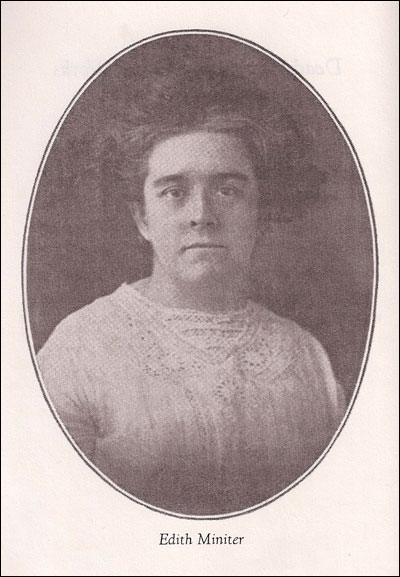
Edith Dowe Miniter was a professional journalist during the 1880s to 1900s, writing both articles and perceptive stories that dealt often with the perspective of women in New England; her sole published novel was Our Natpuski Neighbors (1916), chronicling the experience of an immigrant Polish family to Massachusetts—and the townfolks’ not always positive reaction to their new neighbors.

Along with professional journalism, Edith Miniter was a powerful voice in amateur journalism, a leading voice of the Hub Amateur Journalism Club in Boston. An idealist, she was not one for compromise and engaged in fierce battles over the administration of the National Amateur Press Association, which caused one friend to write:

In spite of unusual difficulties and unforseeable betrayals, her administration was able and efficient; and it ended forever the tradition that the highest official position within out gift was earmarked “For Men Only.”
—James F. Morton, “Some Thoughts on Edith Miniter” in Dead Houses and Other Works 79

In 1920, she met the young amateur Howard Phillips Lovecraft, and they became good friends through her final years, with a visit to her home in 1928 providing some of the details to “The Dunwich Horror.” For all that Miniter and Lovecraft were friends, their tastes did not all run in the same line. Lovecraft reported that:

Mrs. Miniter did not care for stories of a macabre or supernatural cast; regarding them as hopelessly extravagant and unrepresentative of life.
H. P. LovecraftCollected Essays of H. P. Lovecraft1.381

At the time, Lovecraft was publishing little else. His published fiction in amateur periodicals in 1921 included “Beyond the Wall of Sleep” (1919), “Dagon” (1919), “The White Ship” (1919), “The Statement of Randolph Carter” (1920), “The Doom that Came to Sarnath” (1920), “The Cats of Ulthar” (1920), “Nyarlathotep” (1920), and “Polaris” (1920). It was in this spirit that Miniter chose to tweak her younger friend’s nose with one of the first parodies of his style. In her epigraph to the story, Miniter wrote:

It pleasures us exceedingly to offer our readers a condensed novel by the renowned Mr. Goodguile. Why pursue the works of this author throught Tryouts, Vagrants and National Amateurs, as yet in press, when here is the quintessence? Similar attention is promised later to such of our eminent fictionists as merit it.
—Edith Miniter, Dead Houses and Other Works 117

The Tryout, Vagrant, and National Amateur well all amateur journalism magazines where Lovecraft’s work had appeared; the name “Goodguile” (aside from being an obvious play on Lovecraft), was a jab at Lovecraft’s love of pseudonyms during this period, as was used in “Poetry and the Gods” (1920) by Anna Helen Crofts & H. P. Lovecraft and “The Crawling Chaos” (1921) by Winifred Virginia Jackson & H. P. Lovecraft. In this, Miniter was unknowingly anticipating the work of pasticheurs and parodists of several generations in the future, such as “I Wore the Brassiere of Doom!” (1986) by “Sally Theobald” (Robert M. Price).

The primary inspiration for Miniter’s parody appears to be “The Statement of Randolph Carter,” at least so far as the protagonist is their with his close male associate in a graveyard echoes some of the essentials of that story. Lovecraft had not yet written “The Unnameable” or “The Hound,” but the fact that those stories hit so close to the same formula shows how squarely Miniter’s critique hit home.

Other shots followed, and ones Lovecraft and their mutual friends could hardly miss:

“Your pal,” came the response, “Iacchus Smithsonia,” the name was originally John Smith, but it is always my will that my friends bear a name of my choosing and as cumbersome a one as possible, “is cleaning out Tomb 268.” (ibid, 118)

This is a jab at Lovecraft’s habit of doing exactly this with friends, addressing them by nicknames in letters and sometimes other places; famously this was adopted by his circle of pulp friends so that Clark Ashton Smith became Klarkash-Ton, and Robert E. Howard was Two-Gun Bob, but it was applied to many as a sign of affection. In her surviving letters to Lovecraft, Miniter addresses him as “Mr. Goodguile.” (ibid. 46)

A little farther down, she takes a shot at Lovecraft’s occasionally ultraviolet prose and fondness for obscure, archaic, or technical terminology:

“I am really sorry to have to ask you to absquatulate,” he said, employing the chaice diction which is so peculiar to we of the educated aristocracy, “but this ain’ no place for a feller with cold feet.” (ibid.)

As parodies go, Miniter’s “Falco Ossifracus” probably hits home a little less to contemporary readers than The Adventures of Samurai Cat (1984) by Mark E. Rogers or “Nautical-Looking Negroes” (1996) by Peter Cannon & Robert M. Price. Lovecraft’s mythos had not strictly been put to paper yet, as the first tale in the Arkham cycle, “The Picture in the House” was written in December 1920 but not published until the summer of 1921, so Miniter had no such target to purposefully aim for.

Yet if it lacks for not being a true pastiche, or for going after what today might seem to be obvious targets, there is no doubt that the good-natured shots aimed at Lovecraft must have hit home. The well-intentioned roasting was likewise received with good humor considering they were still subsequently on good terms.

“Falco Ossifracus” first appeared in The Muffin Man (Apr 1921), and has been reprinted by Kenneth W. Faig, Jr. in Going Home and Other Amateur Writings  (1995) and Dead Houses and Other Works (2008).


Bobby Derie is the author of Weird Talers: Essays on Robert E. Howard & Others (2019) and Sex and the Cthulhu Mythos (2014).