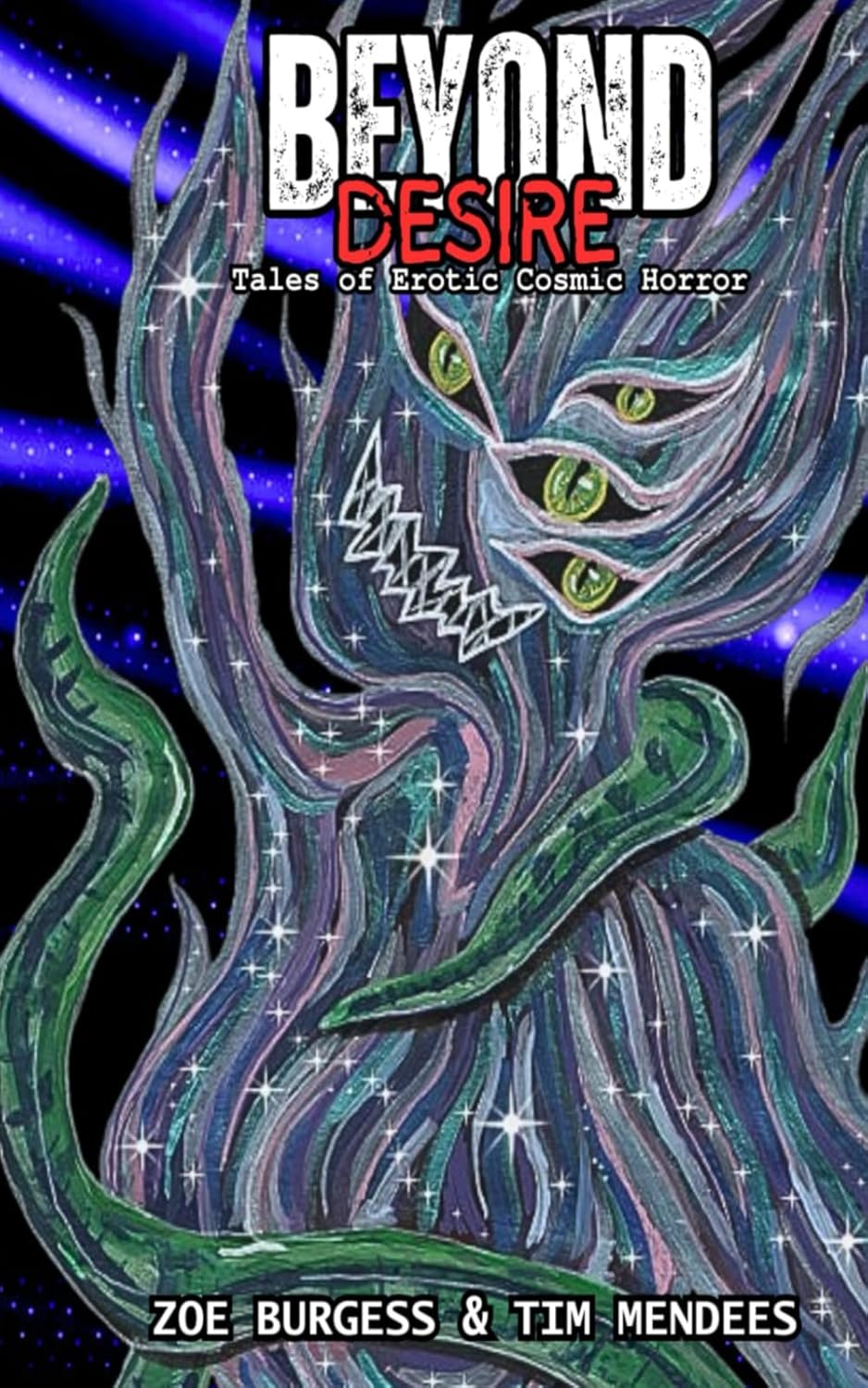
Ever since Helen Vaughan saw ‘the face of The Great God Pan’ and Lavinia Whately gave birth to the spawn of Yog-Sothoth, a sexual undercurrent has existed in cosmic horror. Rarely seen but its effects often felt, eroticism helps to shape tales of the uncanny and unfathomable. —Back cover copy of Beyond Desire (2025)
This is a difficult balance, yet it seems to be what Zoe Burgess aims for in “The Tunnel.” The beginning of this story was featured in the Flash Horror 250 Contest in 2024, and if that visceral opening whets a reader’s whistle, Burgess goes much deeper—and gets more explicit—as the story is developed in her joint collection with Tim Mendees: Beyond Desire: Tales of Erotic Cosmic Horror (2025); the volume also contains “Writhing Mind” (2022) by Zoe Burgess.
Like in that story, “The Tunnel” is a tale of obsession, of an almost fetishistic desire for knowledge and sensation. There’s a quality reminiscent of Clive Barker’s “The Hellbound Heart,” the familiar outlines of which have been seen in many weird and erotic stories over the decades. Shades of Dr. Raymond’s search in Mary’s brain for the Great God Pan, or of William’s desire to uncover real magic through the artifact in The Invitation (2017) by InCase The language of the story is deliberately decadent, emphasizing the physical, the intimate, and hinting at something more than merely carnal.
This was what awoke Izzy’s companions, and they were greeted by faces of fear and adjective horror as the iron shell melted away to reveal the throbbing flesh-like pages of the manuscript inside. —Zoe Burgess, “The Tunnel” in Beyond Desire (2025) 166
There is a literalness to the descriptions that is reminiscent of “Night Voices, Night Journeys” (2005) by Inoue Masahiko (井上雅彦), but it is probably more accurate to say that Burgess knows the tropes of the genre and plays to them. Familiar images remixed, recombined, carefully arranged. The tunnel of the title is both physical distance for the protagonist Izzy to transverse and the metaphysical vagina to be reborn from. The reader is just along for the ride, the voyeur of a journey of discovery and self-discovery:
Izzy held onto tarlike hips and almost felt like they were pushing deeper into the unknown, as that hot cavern pulsated and caressed as well. —Zoe Burgess, “The Tunnel” in Beyond Desire (2025) 175
Metaphor and description break down on such an ecstatic psychosexual journey. Burgess strives to capture both novel sensations and something beyond that, some spiritual contagion that warps and fills and makes the sex act something profoundly more than just sticking tab A into slot B, repeat as desired. The story is essentially a spiritual descendant of the climax of Ramsey Campbell’s “The Moon Lens,” a story of initiation and transformation; while the cosmic horror is not called Shub-Niggurath, Burgess’ Void Walker has some of the same attributes.
More than anything else, “The Tunnel” by Zoe Burgess is an effort to tell an erotic horror story in the Lovecraftian mode. Not by invoking Cthulhu and the Necronomicon, but by trying to invoke familiar images and aspects as she tells a raw, uncensored story of transgression, transfiguration, and finally a kind of transcendence. When Izzy goes back out into the world, born from the tunnel, they are a carrier of a strange and terrible disease of knowledge, one which they desire to spread—and isn’t that so very familiar, readers of the Mythos?
Tell my sad little life story? I was a weird kid. Believed I was a Witch when very young, as did my older sister. She and I used to practice what we thought was magick. Grew up knowing I was a sissy (loved playing house with the neighborhood girls, but always dressed LIKE them, wearing play dresses &c) and being tormented for it by grown-ups, kids at school, and thus I became an introvert and created my own realms of reality where I could be safe. My best friend in high school was Jewish, and that began a Jewish identification. Later I learned that I AM Jewish on my mom’s side of the family. —W. H. Pugmire, “An Interview with W. H. PUGMIRE” (28 Feb 2009) by Jeffrey Thomas
There is a fine distinction between Jewish weird fiction and weird fiction that takes Jews or Judaism as its subject. Jewish weird fiction should be, ideally, written from a Jewish point of view; that may or may not involve aspects of Jewish religion or culture, but it should definitely have that viewpoint—and ideally, it should be written by someone who has lived experience to lend verisimilitude and authenticity to the story, who can approach the story as someone other than an outsider looking in. A good example might be “My Mother Was A Witch” (1966) by William Tenn.
A story doesn’t have to have a Jewish point-of-view to be about Jews or Judaism. Innumerable examples of Christian supernatural fiction reach back to Jewish religion and folklore to tell a story that is still focused, primarily, on a Christian point of view. The Wandering Jew in legend and literature may be Jewish in name, but their characterization follows the narratives conceived by predominantly Christian writers.
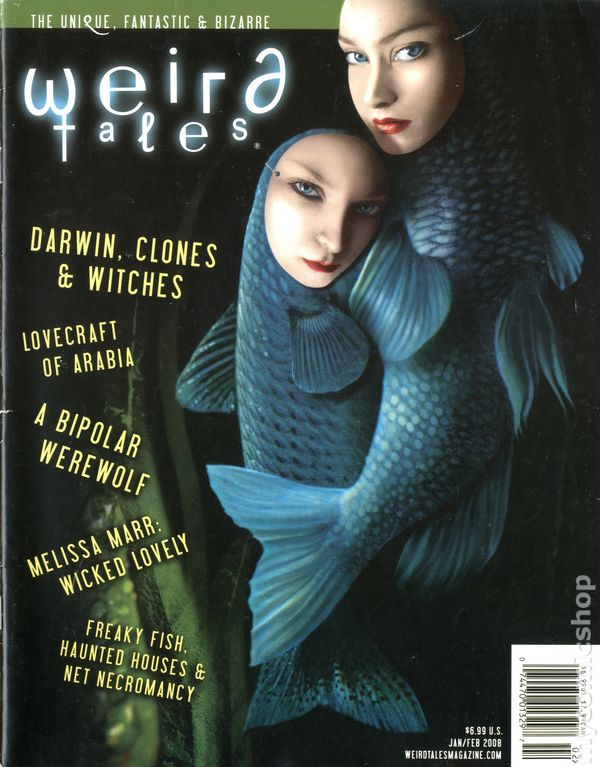
“The House of Idiot Children” (2008) by W. H. Pugmire & Maryanne K. Snider is, I suspect, their attempt at Jewish weird fiction. It follows Rav Samuel Shammua, a teacher in a small Jewish community who works at a school for autistic students. The description of the students reflects common depictions of autistic savants, formerly and derogatorily known as idiot savants:
They sat there, some very still some moving slightly back and forth, all staring into the air before them. Samuel shocked himself to feeling suddenly jealous. What did they see as they looked into nothingness. What did they listen to with an inner ear? The world saw these children as idiots who would always have difficulty functioning with the normal ear; and yet these children each contained a singular degree of genius. One was a mathematical genius. Another had memorized huge portions of Torah and Talmud in both English and Hebrew. And Moshe, who sat awaiting him, had excelled in the art of gematria […] —W. H. Pugmire & Maryanne K. Sinder, “The House of Idiot Children” in Weird Tales #308 (26)
As in many of his stories, Pugmire slightly reworked the language in subsequent publications, so for example in An Imp of Aether (2019) he wrote:
[…] saw some students who, sitting at various tables awaiting instructors, watched his entrance, some very still, some moving slightly to and fro. Samuel shocked himself with feelings of sudden jealousy. What did they see with their autistic senses, what could they hear with an inner ear? The world saw these children as idiots who would always have difficulty functioning in the “normal” world; and yet these children each contained a singular degree of genius. One excelled in mathematics, another had memorized weighty portions of Torah and Talmudic lore, in both English and Hebrew. And mOshe, who sat awaiting him, had excelled in the art of gematria […] (44)
Autistic savants have their in supernatural literature, like the young girl Tiffany in Hellbound: Hellraiser II (1988) who uses her knack for puzzle solving to solve the Lament configuration. Such peculiar aptitudes can interact oddly with certain aspects of Jewish culture. The Hebrew alphabet has 22 letters, each of which can also represent an associated number, a practice called gematria. This overlap of linguistic and mathematical concepts has significant interest with topics like cryptography, the interpretation of certain Jewish and Christian religious texts, as well as Kabbalah and other occult systems. The intersection of these different areas of interest has been a fruitful area for creatives, such as the film Pi (1998) where a genius Jewish mathematician’s investigations into the nature of π reveal a number which might be the secret name of God.
Pugmire and Snider play with this idea:
“A twenty-third Hebrew letter, a letter of fire.” The elder man raised his hand so as to thoughtfully stroke his beard. “An angelic letter. A letter out of which nothing is formed.”
Samuel’s face felt odd, and he ran his hands over it, trying not to shudder. “You know of this?” His voice was laced with fear, for never had he experienced such a conversation. The mysteries of cabalistic lore were something with which he had never trafficked. He had seen certain friends of his become utterly obsessed with studying the Zohar and other such books, to the detriment of everything else. It was a lure in which he had no wish to find himself entangled. —W. H. Pugmire & Maryanne K. Sinder, “The House of Idiot Children” in Weird Tales #308 (26)
“They’re not like others, that’s the point!” Samuel suddenly shouted, his face flushed with anger. “They are special creatures, for whom we especially care. What the hell is normal, Avram? Were you a normal kid? Our religious and ethnic heritage makes us outsiders in the normal world, that’s why we’re hated, that’s why madmen seek to destroy us.” —W. H. Pugmire & Maryanne K. Sinder, “The House of Idiot Children” in Weird Tales #308 (29)
All of these elements come together in this story in an ending that is expected, and yet powerful. We the readers never learn the final mystery, which Moshe and the autistic children know and which Samuel Shammua learns. It is a literally ineffable truth, a knowledge beyond the scope of human experience. Whatever flaws the story might have in its depiction of autistic children, this was a deliberate and researched effort to weave together these disparate threads into a story that tried to express a weird tale from a Jewish point of view.
“The House of Idiot Children” was first published in Weird Tales #308 (Jan/Feb 2008). It was slightly revised and republished in The Tangled Muse (2008, Centipede Press), and then slightly revised again for An Imp of Aether (2019), which appears to be the authors’ final version.
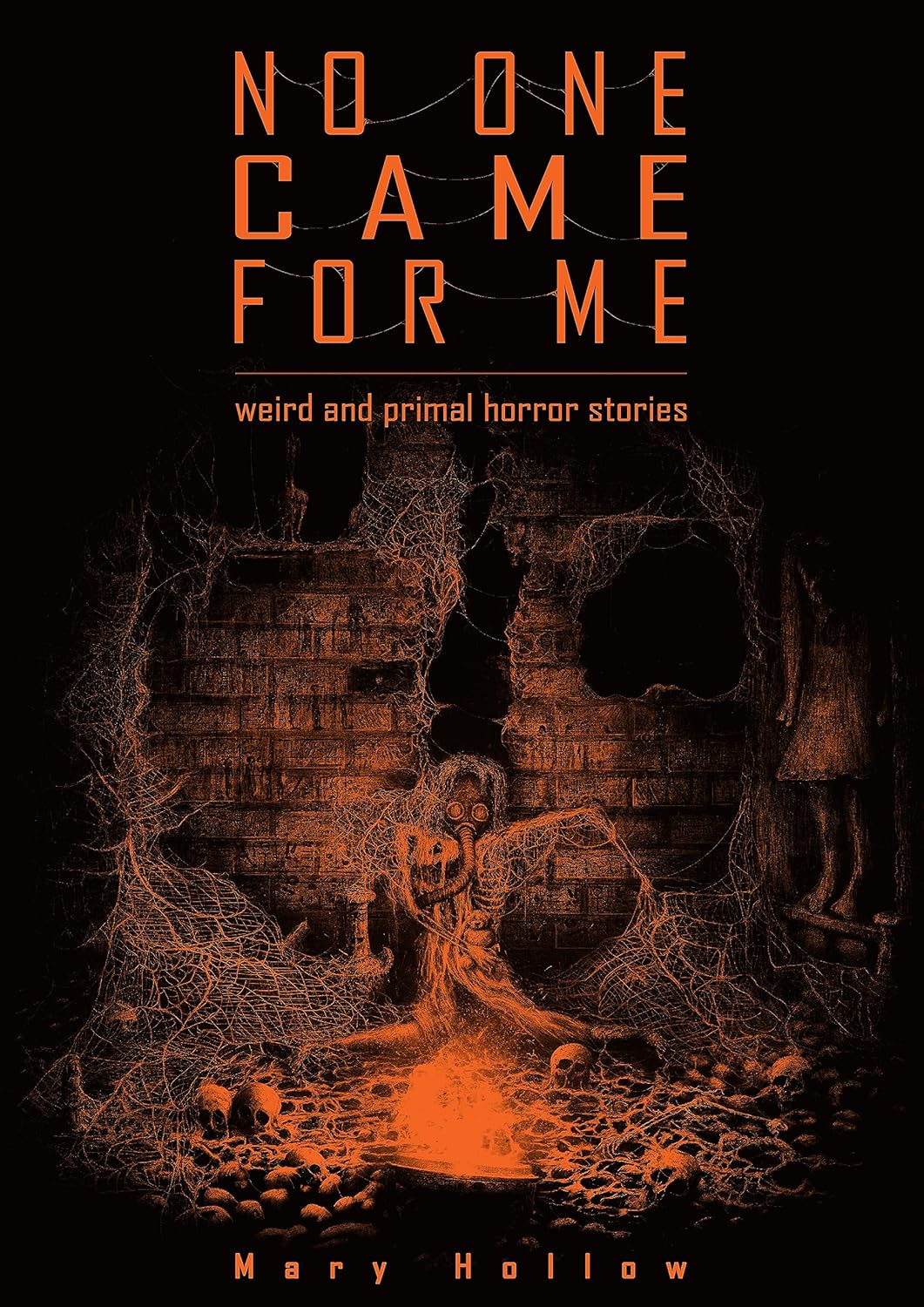
Dear Ms. Hollow. You don’t know me, but you and I share a mutual acquaintance, through whom I had the opportunity to read the draft of your horror story about the exotic fruit that turns pain signals into pleasure. I much enjoyed the prose of your story, but I have some relevant information that I would like to share with you. —Mary Hollow, No One Came For Me: Weird and Primal Horror Stories
Lines of literary descent are not always easy to trace. If a writer goes out of their way to mention Cthulhu or the Necronomicon, then we can say with some certainty that they’ve read Lovecraft, or that they’ve read somebody that read Lovecraft, and so on. Without such concrete citations, it can be tricky to assign influences with any certainty. Would we say that Jeff Vandermeer’s Annihilation owes a debt to H. P. Lovecraft’s “The Colour Out of Space?” Well, probably not within earshot of Vandermeer.
Fiction is like that. Writers can play with the same subjects, but may arrive at parallel approaches. We can only note the parallels. Fortunately, in this case, in the afterword to her collection, Mary Hollow gives thanks to Thomas Ligotti, so it is easy to say that yet, “Neural Mechanisms of Analgesia” (2023) is a story in the Ligotti lineage of weird fiction.
There’s a relation to Lovecraftian fiction, a similarity, but a distance as well. Hollow doesn’t cite the Necronomicon or Arkham, doesn’t try to fit her work into someone else’s mythology. As a medical horror, there is a distant echo of “From Beyond” and other gland stories, the clinical detachment that threads its way to a kind of sublime understanding regarding some fundamental function of life.
If you prick us, do we not bleed? —William Shakespeare, The Merchant of Venus Act 3, Scene 1
The story takes the form of a letter to Hollow herself. The epistolary format offers some advantages; like with “Machines Are Digging” (2009) by Reza Negarestani, there is that fine frisson as scientific citation and rational argument segues into something else. That moves beyond science fiction and touches on something else, something that goes beyond science in a direction that approaches—not the mystical, but a kind of revelation that limits rather than expands the possibilities of life. The opposite of wonder is not terror, but a kind of disenchantment that negates wonder, cancels it out.
There is that aspect of—not exactly pessimism, but the kind of microscopic focus of ultra-sanity that strips away the comforting illusions of life, or even of weird fiction. There is no Elder Sign to ward of the neurological realities of the pain response in humans, no resonator to smash to hide from what was always around us all the time. Imagination can offer no comfort, and when stripped away there is only a kind of philosophical numbness. The reader ends the story burdened with knowledge, but there is nothing to do with that knowledge.
Does it matter if Hollow draws from Lovecraft or Ligotti? Only insofar as we can recognize the connection, the thematic parallels with their works. Hollow is working in a tradition, though not borrowing from anyone’s mythology in doing so. A reminder that as fun as the Mythos is, there is much more to Lovecraftian literature than just the Mythos.
The works of H. P. Lovecraft have never entered another language wholesale; they tend to trickle in, translated a story here and a story there, or at best one collection at a time. Tracing the spread and influence of Lovecraft’s work in languages other than English thus becomes doubly tricky. A Spanish translation might have first been published in Barcelona, Mexico City, or Buenos Aires, just as an English edition might be published in New York, London, or Brisbane, and by what paths a copy in one nation might end up in the hands of a reader in another…well, the distribution is ultimately uneven.
According to S. T. Joshi’s H. P. Lovecraft: A Comprehensive Bibliography (2009), Lovecraft began being translated into Spanish in the 1940s, although publication was largely piecemeal until the 1980s (which in Spain, at least, may have been in part due to the Francoist regime), and regional languages like Galician and Catalán have their own publication histories that largely start in the 1980s and 1990s. However, when it comes to the history of Lovecraft in Catalan and Spanish, there is at least one really interesting outlier, which has been largely overlooked in much English-language histories of Mythos fiction.
Joan Perucho Gutiérrez (1920 – 2003) was a noted writer and poet in the Spanish and Catalán languages in Spain, who wrote under the pen-names Joan Perucho (Catalán) and Juan Perucho (Spanish). In 1956 he published his first short fiction, “Amb la tècnica de Lovecraft” (“In the style of Lovecraft”) in the Catalán publication Els Quaderns d’atzavara (“The Agave Notebooks”). Perucho must have been a precocious writer indeed, because Lovecraft was far from a household name in Spain at the time, and this is sometimes credited as Lovecraft’s introduction to Catalán audiences—a claim I cannot verify or deny.
In 1969, Perucho translated “Amb la tècnica de Lovecraft” into Spanish, where it was published in the newspaper La Vanguardia Española (16 Aug 1969, p.9) under the title “Magia Negra” (“Black Magic”), and in the anthology Los Mitos de Cthulhu (Alianza Editorial) under the more well-known title “Con la técnica de Lovecraft” (“In the style of Lovecraft”); the two Spanish versions have some minor differences, particularly in the beginning of the text. Largely because of its inclusion in that important Spanish-language Mythos anthology, Perucho’s story has gained a degree of notability, if not exactly acclaim, and has been republished a few times. However, it has largely gone without comment in English.
The following translation is taken from the “Magia Negra” Spanish version of the piece:
TRADUJO el texto, hace aproximadamente diez años, el poeta José Corredor Matheos, en homenaje a Philip Howard Lovecraft, escritor de «science fiction» que murió perseguido por los seres invisibles. Sólo entonces se supo la verdadera relación de los hechos y que, en un momento impreciso, el automático de la gramola se disparó; hizo un ruidito y lentamente bajó el disco. Hubo uno pausa. Alguna cosa, como una corriente de aire casi imperceptible, fue creciendo en intensidad; entreabrió una puerta y descendió unos escalones que daban a un patio interior; tropezó con algo sólido y opaco, y blasfemó en vox baja; después se dirigió a un pequeño pasadizo, al otro lado del patio, y allí se arremolinó. La música se oía ahora lejana, sorda, filtrada. Era una noche silenciosa y tranquila, de una gran suavidad, con el aromo de la primavera que descendía de los árboles.
La magia de la boca desapareció debajo de las pequeñas placas de la sífilis en los labios y en el paladar. Eran unas luces rojas y verdes, en el interior de las cuales podía verse perfectamente su imagen con un rictus de ironía amarga y de decepción. Ironía nacida de la desesperación y de la muerte, más allá de las cuales, débiles ráfagas de aire descansan en el interior de los vasos abandonados, llenos de ceniza y agua pútrida; o dentro de la caja de resonancia de los pianos «Chassaigne», modelo 1906, esperando la oportunidad del conducto sutilísimo que les una, con unas cuantas palabras no pronunciadas, al oído del caballero momificado o de la dama solitaria. Formas gastadas de vida o de muerte, de nacimiento mecánico en un dolor visceral; de vómitos que se suceden implacables (o que por lo menos atormentan con la angustia del espasmo que ha de venir y que siempre, siempre desemboca en una suerte de abismo, y en el sudor, y en los cabellos enganchados) y de pequeñas crisis de histeria, y de dientes que se carían y que la lengua percibe voluminosos y febricitantes.
No era esto. Sólo la quemadura gélida de un «thoulú», uno di aquellos seres informes y terribles que ya había descrito minuciosamente en el siglo XII el árabe Al-Buruyu en su tratado «Los que vigilan». La evidencia de las cosas surgía de improviso con mil y una significaciones aterradoras y alusivas. No había fuerza humana capaz de conjurar lo inevitable, de alejar el dogal que ceñiría al elegido, el cual, por un impulso misterioso, sería arrastrado al sacrificio, al aniquilamiento de lo propia personalidad, y se convertiría en algo horrible y sin nombre. Abominable concepción ésta, fruto de las nupcias del cielo y del infierno. No era otra cosa lo aparición de señales en todas las habitaciones de la casa, y aquellos restos de cuerpos extraños, hallados en el patio una mañana, y que se volatilizaron misteriosamente una hora después. El magisterio de Al-Buruyu se presentaba como una fuerza maléfica, anticipándose a los siglos; como un ojo impasible y escrutador; y con una voz caligráfica y cabalística que iba avanzando como una risa en la noche, sobre la nieve surcada de pisadas deformes y con alaridos alucinantes cerca de las rejas de los manicomios.
Se oyó la bocina de un automóvil. La presencia, inquieta, se distendió. Murmuró unos sonidos ininteligibles y se insinuó —leve fosforescencia apenas— en el fondo del pasadizo, entre inmundicia y botellas de licor vacías. Se encendió una luz en una ventana vecina y poco después se apagó. La primavera respiraba afuera.
El tiempo se acumulaba en el cerebro y en la sangre en pliegues suavísimos y turbadores, en los cuales se percibía la claridad solar. Había cortezas y una materia rugosa, resquebrajada por surcos sin dirección precisa, que parecía calcinada por un contacto satánico o sordamente enfurecido. O bien una superficie enharinada con polvos de arroz, debajo de la cual, latían, vívidas y sensibles, amplias llagas supuradoras, como bocas martirizadas y ocultas, como flores monstruosas y sonámbulas que súbitamente se agrandaban inflándose, tensando su estructura íntima hacia un delirio febril. Era demasiado tarde para el antídoto: la invertida esvástica de plata, que traería ecos de los cantos litúrgicos hasta la huida de la estepa y la venida de la savia vivificadora. El vuelo de las hojas era un vuelo de bronces, enlutado y solemne, sobre una tierra árida y espectral. Apenas se podío entrever, con un supremo esfuerzo, la risa de un niño vestido de marinero, medio nublada por el dolor; o la triste tenacidad del hombre que medita hasta altas horas de la madrugada, y que se veía ahora bajo el peso de una lágrima; o la inútil trenza perfumada, aire de una mirada que alimentaba el deseo. La carne había comenzado a corromperse, todavía con la presencia de la vida, y exhalaba una pestilencia indefinible que lo impregnaba todo. Lentamente se inició el éxodo, e incluso la araña huyó, con su perezosa pero terrible seguridad, abandonando el refugio de su vida feliz. Entreveía lecturas de íncubos y súcubos, formulas mágicas dé la muerte y del diablo, traspasando todo vestigio de razón, viéndose hojear la «Dissertation sur les apparitions des anges, des demons et des esprits et sur les revenants et vampirs», del monje Calmet, que ponía en evidencia la realidad de la fría certeza de Al-Buruyu. Ya Angela Foligno había revelado al comentarista que al principio «non est in me membrum quod non sit percussum, tortum, et pœnatum a dœmonius, et semper sum infírma, et semper stupefacta, et plena doloríbus in omnibus membris vivís». Existía también un flotar sobre la realidad, un ir a la deriva a través de paisajes inexistentes, de algas mortecinas que se crispaban airadas y amenazadoras al contacto más leve, y manubrios que giraban vertiginosamente dentro del cráneo, con un alboroto insufrible de timbres y altavoces disporados, para desaparecer después en un angustioso silencio de tumba.
Se alisó el cabello con la mano, despacio y maquinalmente. Bebía con delectación y a pequeños sorbos una copa de auténtico «scotch» Forrester, y se encontraba seguramente a diez millas de la costa y con una tempestad de todos los diablos. Una muchacha rió, con la risa provocadora di Jane Rusell, y se aproximó desde la barra. Llevaba la boca pintada de un rojo intenso, color de sangre de buey, y un jersey que le ceñía apretadamente el busto. Le hizo una caricia en la mejilla y le murmuró algo afectuoso, mientras rozaba con su cara la de él. Había una atmósfera densa y enturbiada por el humo del tabaco, y algunos invitados se habían quitado la chaqueta. Otra muchacha, que movía las ancas como una estrella de Hollywood, cantaba con éxtasis lánguido y sensual que se adhería a la piel.
Creía que no lo volvería a ver. De pronto se le ocurrió ponerse a reír delante de aquel niño vestido de marinero, pasado de moda y ridiculo. Lo relacionó con muchas otras cosas, como el banderín de un club de hockey clavado en alguna pared, una desteñida fotografía que fijaba unos rostros ausentes en una lejana excursión a Bañólas, un día de mucho frío; o en un pequeño bar del Paseo de Gracia, mucho tiempo después, cuando ella ya preparaba el equipo de novia y le regalaba corbatas el día de su santo.
La cantante agradeció los aplausos con una sonrisa. Ahora la gente intentaba bailar, excepto un grupito que bebía y conversaba con el camarero y con la muchacha, que ya había concluido su número. Había una media luz, sucia y gastada.
Penetrado por las sombras, detrás del gran monumento a Napoleón, detrás de las campanas de los tranvías, bajo los burdeles de todas las ciudades del mundo, en el último momento lúcido, necesitaba ahora buscar la luz, engañar a la presencia, acercarla si era preciso, de la manera que fuese, a la luz limpia y purificadora, a la luz que a veces rasgaba las tinieblas. Debía haber luz en algún sitio. Así se lo parecía a él.
Muy lejos, seguramente a diez millas de distancia, alguien o algo reptaba por la alfombra. Dejó atrás las dos butacas y se incorporó poco a poco. Era como un babear o como un ruido inconfesable. Se hizo una claridad lívida. Como una alucinación de Lovecraft.
Juan PERUCHO
I TRANSLATED the text, about ten years ago by the poet José Corredor Matheos, in homage to Philip Howard Lovecraft, a science fiction writer who died persecuted by invisible beings. Only then did the true story become known, and that at an imprecise moment, the jukebox automatically triggered; it made a little noise and slowly lowered the record. There was a pause. Something, like an almost imperceptible current of air, grew in intensity; it half-opened a door and went down some steps that led to an inner courtyard; it stumbled against something solid and opaque, and cursed in a low voice; then it went to a small passageway on the other side of the courtyard, and swirled there. The music now sounded distant, muffled, filtered. It was a night silent and calm, of great softness, with the aroma of spring descending from the trees.
The magic of the mouth disappeared beneath the small syphilis plaques on the lips and palate. They were red and green lights, inside which one could perfectly see his image with a rictus of bitter irony and disappointment. Irony born of despair and death, beyond which, weak gusts of air rest inside abandoned glasses, full of ashes and putrid water; or inside the sound box of the “Chassaigne” pianos, model 1906, waiting for the opportunity of the subtlest conduit that would unite them, with a few unspoken words, to the ear of the mummified knight or the lonely lady. Worn-out forms of life or death, of mechanical birth in visceral pain; of vomiting that follows one another relentlessly (or that at least torments with the anguish of the spasm that is to come and that always, always ends in a kind of abyss, and in sweat, and in tangled hair) and of small hysterical crises, and of cavities in teeth that the tongue perceives as voluminous and feverish.
It was not this. Only the icy burn of a “thoulú”, one of those formless and terrible beings that the Arab Al-Buruyu had already described in detail in the 12th century in his treatise “Those Who Watch”. The evidence of things emerged suddenly with a thousand and one terrifying and allusive meanings. There was no human force capable of adjuring the inevitable, of removing the noose that would bind the chosen one, who, by a mysterious impulse, would be dragged to sacrifice, to the annihilation of his own personality, and would become something horrible and nameless. Abominable conception this, fruit of the marriage of heaven and hell. It was nothing else than the appearance of signs in all the rooms of the house, and those remains of strange bodies, found in the courtyard one morning, and which mysteriously vanished an hour later. The teaching of Al-Buruyu presented itself as an evil force, anticipating the centuries; like an impassive and scrutinizing eye; and with a calligraphic and cabalistic voice that advanced like a laugh in the night, on the snow furrowed with deformed footprints and with hallucinatory screams near the bars of the asylums.
The sound of a car horn honked. The presence, uneasy, became relaxed. It murmured some unintelligible sounds and insinuated itself—barely a faint phosphorescence—at the end of the passage, among filth and empty liquor bottles. A light came on in a neighboring window and shortly after went out. Spring was breathing outside.
Time accumulated in the brain and blood in soft and disturbing folds, in which the light of the sun could be perceived. There were crusts and rough matter, cracked by furrows without a precise direction, which seemed calcined by a satanic or dully enraged contact. Or a surface floured with rice powder, beneath which, vivid and sensitive, wide suppurating sores throbbed, like martyred and hidden mouths, like monstrous and somnambulistic flowers that suddenly enlarged and inflated, straining their intimate structure towards a feverish delirium. It was too late for the antidote: the inverted silver swastika, which would bring echoes of liturgical chants until the flight from the steppe and the coming of the life-giving sap. The flight of the leaves was a flight of bronze, mournful and solemn, over an arid and spectral land. It was only with a supreme effort that one could make out the laughter of a child dressed as a sailor, half clouded by pain; or the sad tenacity of the man who meditates until the early hours of the morning, and who now saw himself under the weight of a tear; or the useless perfumed braid, the air of a look that fed desire. The flesh had begun to rot, still with the presence of life, and exhaled an indefinable stench that permeated everything. Slowly the exodus began, and even the spider fled, with its lazy but terrible security, abandoning the refuge of its happy life. He glimpsed readings of incubi and succubi, magical formulas of death and the devil, transcending all vestiges of reason, seeing himself leafing through the “Dissertation sur les apparitions des anges, des demons et des esprits et sur les revenants et vampirs” [1], by the monk Calmet, which highlighted the reality of the cold certainty of Al-Buruyu. Angela Foligno had already revealed to the commentator that at the beginning “non est in me membrum quod non sit percussum, tortum, et pœnatum a dœmonius, et semper sum infírma, et semper stupefacta, et plena doloríbus in omnibus membris vivís.” [2] There was also a floating above reality, a drifting through non-existent landscapes, through dying algae that twitched angrily and threateningly at the slightest touch, and handlebars that turned vertiginously inside the skull, with an unbearable uproar of ringing bells and loudspeakers, to then disappear in an agonizing silence of the grave.
He smoothed his hair slowly and mechanically. He sipped a glass of genuine Forrester scotch with delight and in small sips, and was probably ten miles from the coast and in a hell of a storm. A girl laughed, the provocative laugh of Jane Russell, and came over from the bar. Her mouth was painted a deep red, the color of oxblood, and her sweater cinched tight around her bust. She caressed his cheek and murmured something affectionate as she brushed her face against his. The air was thick and clouded with tobacco smoke, and some of the guests had taken off their jackets. Another girl, who moved her haunches like a Hollywood star, sang with a languid, sensual ecstasy that clung to the skin.
He thought he would never see her again. Suddenly it occurred to him to laugh in front of that boy dressed as a sailor, old-fashioned and ridiculous. He connected it to many other things, like the pennant of a hockey club nailed to a wall, a faded photograph that showed some absent faces on a distant excursion to Bañólas, one very cold day; or in a small bar in Paseo de Gracia, long after, when she was already preparing her bridal outfit and giving him ties on his saint’s day.
The singer acknowledged the applause with a smile. Now people were trying to dance, except for a small group that was drinking and talking with the waiter and the girl, who had already finished her number. There was a half-light, dirty and worn.
Penetrated by the shadows, behind the great monument to Napoleon, behind the bells of the trams, beneath the brothels of all the cities of the world, in his last lucid moment, he now needed to seek the light, to deceive the presence, to bring it closer if necessary, in whatever way, to the clean and purifying light, to the light that sometimes pierced the darkness. There had to be light somewhere. It seemed so to him.
Far away, surely ten miles away, someone or something was crawling across the carpet. He left the two armchairs behind and slowly sat up. It was like drooling or an unutterable noise. It became a livid clarity. Like an hallucination of Lovecraft.
[1] French: “Dissertation on the apparitions of angels, demons and spirits, and on ghosts and vampires” [2] Latin: “There is not a member in me that is not struck, twisted, and punished by the devil, and I am always sick, and always astonished, and full of pains in all my living members.”
Juan PERUCHO
Transcribed from La Vanguardia Española (16 Aug 1969, p.9)
English translation
“Magia Negra” / “Con la técnica de Lovecraft” is more of a prose poem than a short story; a collection of images and ideas meant to invoke the mood and style of Lovecraft more than a pastiche like “Celui qui suscitait l’effroi…” (1958) by Jacques Janus. It isn’t clear what exactly Perucho had read of Lovecraft at this point, but several themes are and ideas are evocative of Lovecraft’s Mythos tales without being direct references to any specific story.
We have a strange Arab author (“Al-Buruyu” instead of Abdul Alhazred), and his mysterious book (Those Who Watch, rather than the more familiar Necronomicon). There is no Cthulhu but there are the strange and formless “thoulú.” Was this deliberate, mangling things like Howard Phillips Lovecraft’s name for effect, or the result of a botched translation from English into another language? I suspect the cumulative differences represent Perucho’s innovation and playing of the Mythos game, mixing fact and fiction. Which is very Lovecraftian.
The work remains a liminal entry, a Catalán introduction to an English-language author that was later translated into Spanish for a wider audience, even as Lovecraft himself began to enjoy wider translation in Spanish-language markets. It is easy to see how it might have frustrated early readers of Los Mitos de Cthulhu (1969); it doesn’t fit neatly into the Mythos like many early pastiches. The very ambiguity gives it character, however; so few early efforts to write in Lovecraft’s style try to capture the essence. While I don’t think Perucho really nailed it—like the pasticheurs, he tends to focus on the more obvious elements—it’s an interesting experiment, and strikes an interesting contrast with some of the other Lovecraft-inspired works in the 1950s and 60s.
Thanks to Mariano Villarreal ( literfan@yahoo.es ) for his help and assistance; all the errors in the translation are mine.
Eldritch Fappenings This review concerns a work of explicit adult art and literature, and will touch on aspects of historical pornographic works, including NSFW images. Reader discretion is advised.
By the way—Cthulhu isn’t a she but a he. He’d feel deeply enraged if anyone regarded him as sissified! —H. P. Lovecraft to Willis Conover, Jr. 29 Aug 1936 Letters to Robert Bloch & Others 389
In “The Call of Cthulhu,” Lovecraft defaults to referring to Cthulhu as male. Whether human gender binaries can encompass Great Cthulhu is something for later writers in the Mythos to decide. Lovecraft, for his part, only addresses it in his letters in a joking matter, with the typical cultural disdain toward “sissies”—men who display effeminate manners or dress, often misconstrued as homosexuals; Lovecraft had made another comment about the “sissy” Gordon Hatfield.
Throughout human history, in pretty much every culture, there has existed a minority who do not fit into rigid gender or sexual binaries. Whether this was a physical condition such as being intersex, or an individual’s identification with a different gender than assigned at birth, or taking on cultural attributes and attire associated with different genders—there is a broad range of physical, psychological, social, and sexual aspects involved. Each culture and language has their own nomenclature involved. In English in the 20th century, terms like hermaphrodite have fallen out of use in favor of words like intersex; the term transvestite, once identified largely as a sexual fetish or mental disorder, has largely fallen away from use in favor of transgender.
The rich vocabulary includes both contemporary efforts to define identities (e.g. genderqueer, gender fluid), pejorative terms (e.g. tranny, cross-dresser), and a grey middle ground of terminology most often associated with sex work, erotic literature, and pornography (e.g. ladyboy, shemale). Loanwords from other languages also enrich the language, e.g., futanari, from the Japanese ふたなり. The term futanari has come to be a pornographic genre unto itself, both in adult comics and literature, with its own specific tropes, and generally presents a fetishized ideal: an individual that possesses (sometimes exaggerated) sexual traits of both male and female.
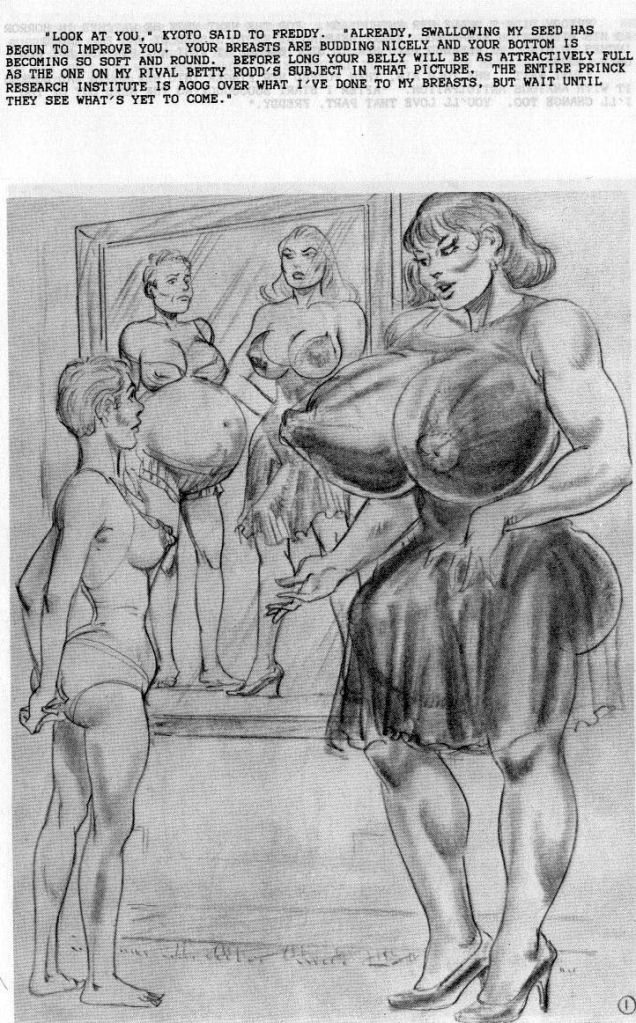
Despite the term futanari coming from the Japanese language and popularized by Japanese erotic comics, the basic idea is not unique to Japan. In the 1980s, for example, U.S.-born adult artist Eric Stanton created his “Princks” or “Ladyprinckers” or “Princkazons,” women with Amazonian physiques who also possessed penises (often of exaggerated proportions) and used their great strength and sexual organs to dominate and emasculate men. For example, in Stantoons #49 (“Makeover”), he presents a scenario where the men, unable to resist, are forcibly transformed and feminized. Stanton takes this idea to its cartoonish limit, and plays it for body horror and black humor as much as sexual titillation.
For the most part, however, “Princks” died with Eric Stanton. By the 1990s and 2000s, gender transition surgery and hormone replacement therapy had progressed substantially from the gland stories of early science fiction (see The Hormonal Lovecraft); the legal recognition of homosexuality and rights led to greater awareness of different LGBTQ+ identities outside of fetishized pornographic stereotypes. Besides this, futanari proved to be a more popular fetishized pornographic stereotype.
More importantly, the increasing acceptance of transgender individuals and the process of gender transition opened up literature for more positive stories of gender transition. While feminization as a sexual fantasy, voluntary or involuntary, will always remain, the acceptance and embrace of such a change as a positive metamorphosis instead of body horror gained more traction (see Seabury Quinn’s “Lynne Foster is Dead!” (1938): A Mistaken Gender Identity by Sophie Litherland).
Which doesn’t mean that a clever and skilled creator couldn’t combine the two. Lovecraft in “The Shadow over Innsmouth” presented a narrator who, at first horrified at the changes happening to their body, comes to accept their metamorphosis and the new identity that comes with it. For Lovecraft, the reader is allowed a peak as someone that fear and hated the alien and other becomes the other—and in fact, was one of them all along. The completeness of their change is indicated by how thoroughly they embrace who they are now, and reject who they thought they were.
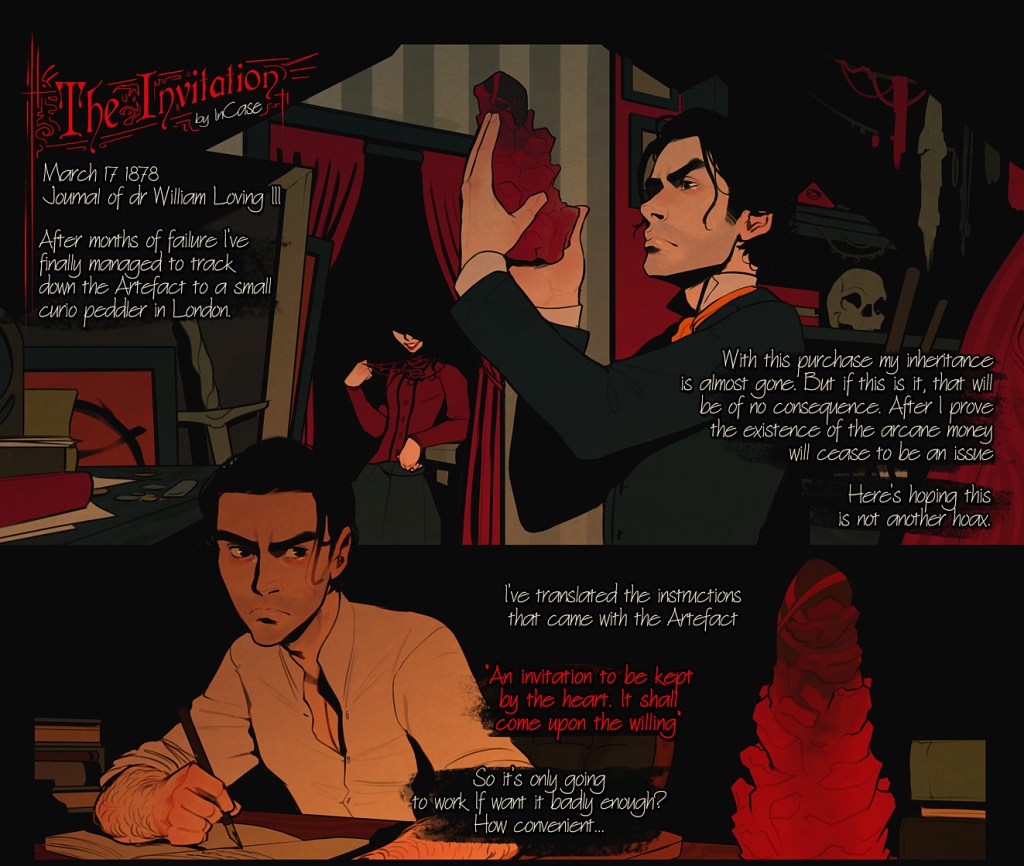
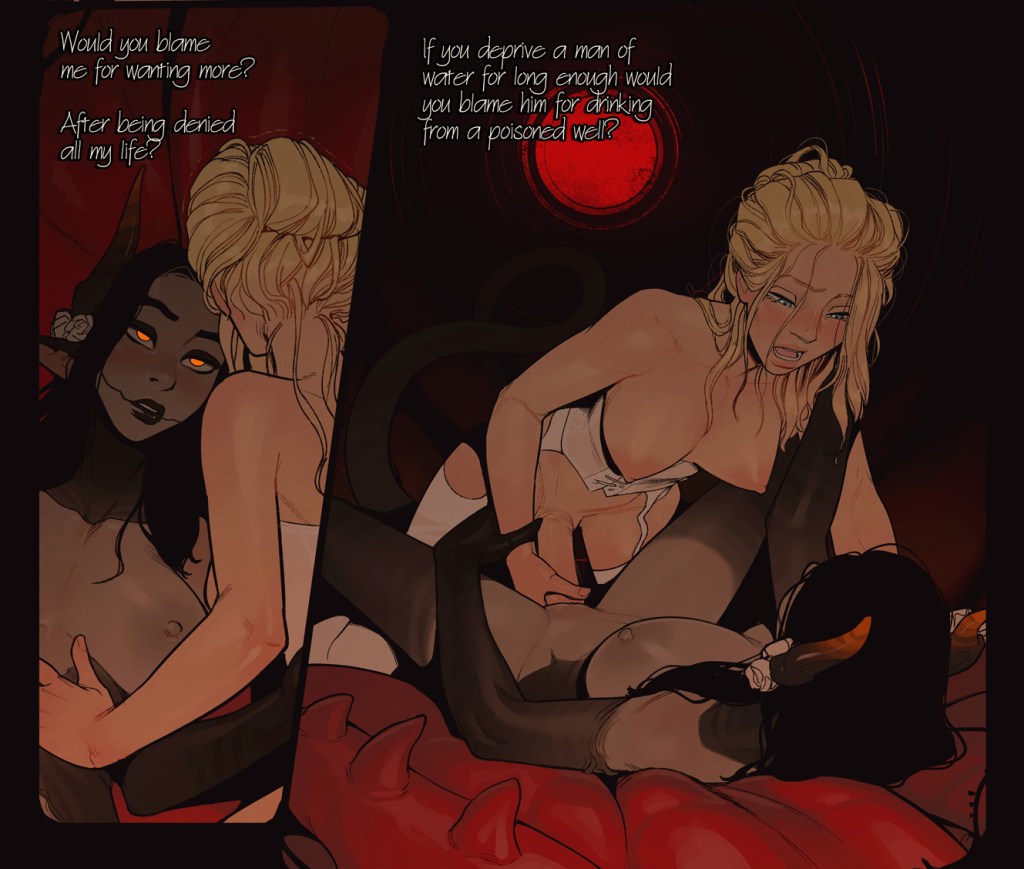
In 2017, erotic comic artist InCase began producing “The Invitation,” a sexually explicit webcomic. The second chapter was published in 2019. At first glance, “The Invitation” shares many hallmarks with feminization and futanari adult comics. Part of what sets it apart, however, is the framing and development of the story.
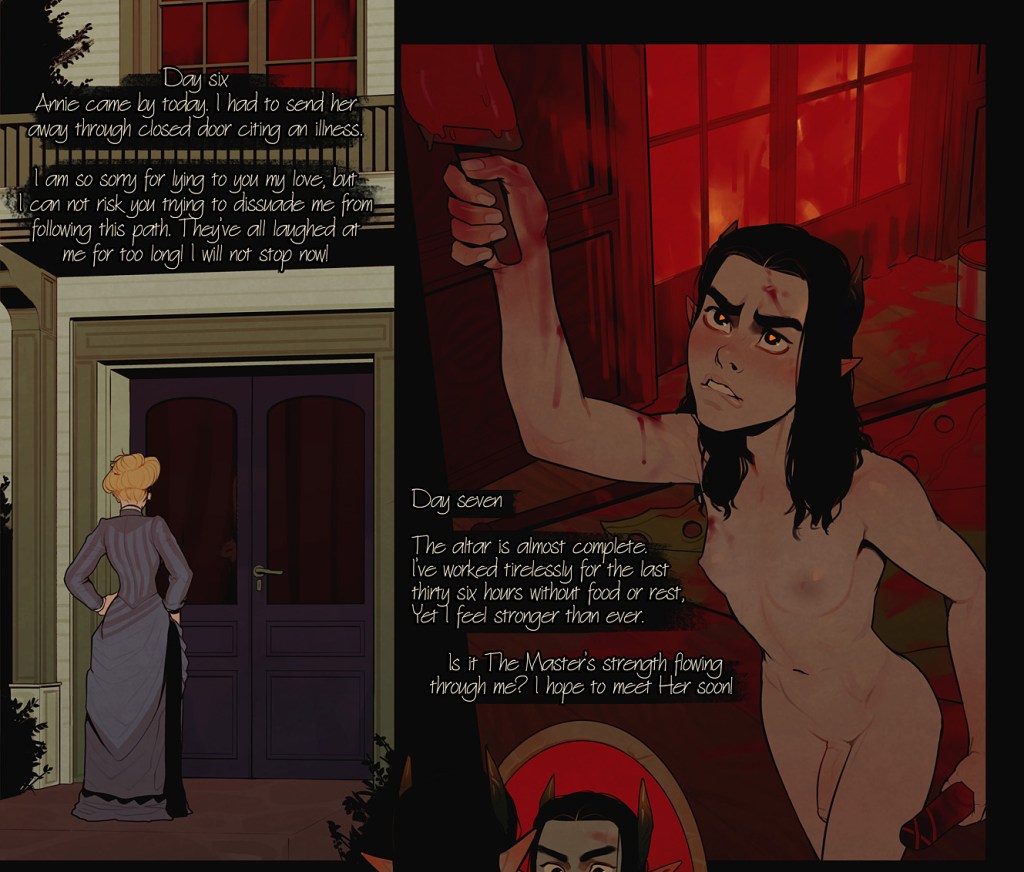
William Loving III starts out as a very Lovecraftian protagonist, an obsessive delver in the obscure and occult, who had finally found an artefact that promises to put him in touch with a strange, eldritch entity…and he goes a little mad with the revelations.
As their transformation progresses, William’s priorities and attitudes shift, their old mores fall away as they embrace a broader and more inclusive attitude toward gender and sexuality attraction. Above all, the Master who brought these changes to body and mind is imprisoned, and members of their cult, like William, seek to free them. Idol, old one, madness, cult…while InCase is not using Lovecraft’s Mythos directly, there are some clear parallels to aspects of Lovecraft’s work and the broader genre of stories inspired by the Mythos.
Then, whispered Castro, those first men formed the cult around small idols which the Great Ones shewed them; idols brought in dim aeras from dark stars. That cult would never die till the stars came right again, and the secret priests would take great Cthulhu from His tomb to revive His subjects and resume His rule of earth. The time would be easy to know, for then mankind would have become as the Great Old Ones; free and wild and beyond good and evil, with laws and morals thrown aside and all men shouting and killing and revelling in joy. Then the liberated Old Ones would teach them new ways to shout and kill and revel and enjoy themselves, and all the earth would flame with a holocaust of ecstasy and freedom. Meanwhile the cult, by appropriate rites, must keep alive the memory of those ancient ways and shadow forth the prophecy of their return. —H. P. Lovecraft, “The Call of Cthulhu”
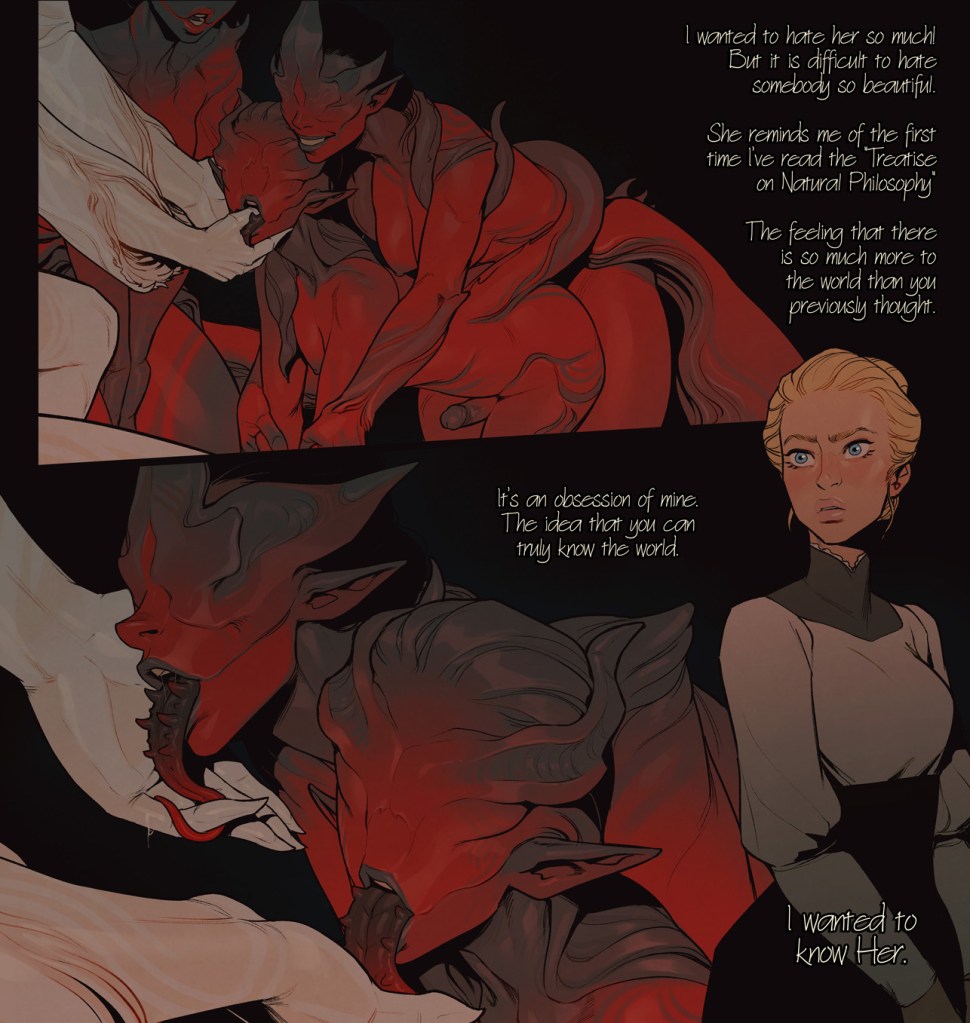
In the second half of the first chapter, InCase shifts the focus away from William pursuing the transformation on their own to interacting with the Master and their other servants. Sexual activity slowly grows more transgressive, with rougher action, bigger penetrations, more and less human (and more tentacular) participants…and the wonder of transformation and the bliss of sex is juxtaposed against the cosmic horror of the Master’s true face, and a glimpse of their true nature.
For a story about transformation and sex, and the gorgeously rendered artwork that conveys both sexuality and teratophilia, corruption and indulgence, these two characters are essentially character-driven. William is obsessed with magic, and having followed that obsession it consumes them utterly. What he left behind was his fiancé Annie, who becomes the protagonist of the second chapter.
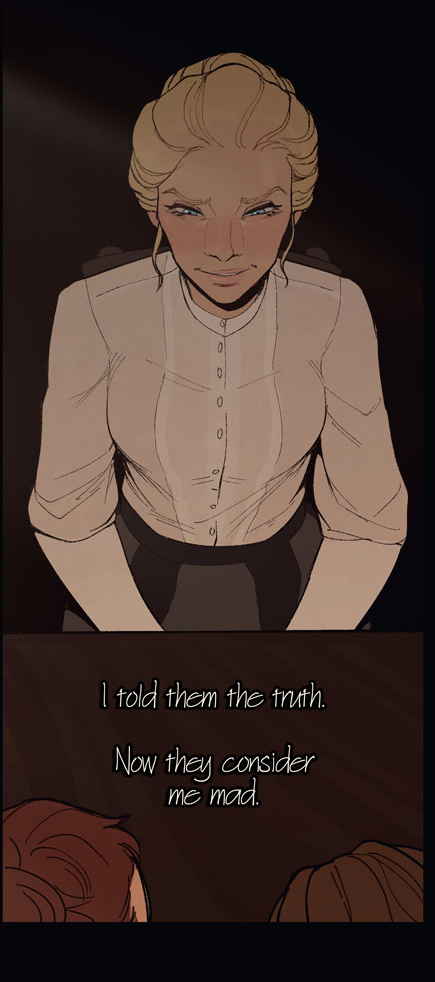
In the Victorian milieu of The Invitation, Annie more than William represents a character whose body and identity are repressed by society; she is bound up in expectations of behavior (social and sexual) that she strains again; a woman of science at a period when women are not widely tolerated in science. A woman whose social standing is in peril from a broken engagement. A person who is, like William, innately curious.
There is a strong fantasy element to InCase’s work, both in The Invitation and in their other erotic comics. Without going into clinical detail, many of their characters fall into the spectrum of the sexualized fantasy of intersex characters rather than the reality. There are rarely true hermaphrodites, but there are often characters who appear to be women in every aspect save for having a penis and testes, which is fully functional (often incredibly so). Characters don’t undergo costly top and bottom and facial surgeries, they don’t take regimens of hormones their entire lives to achieve some semblance of the body they desire, that matches their gender identity. In real life, things are messy and imperfect; in comics, they can be idealized.
It is the fantasy that allows the exploration of these ideas. What would a Victorian woman do if she suddenly had a penis? If she was no longer restricted to the sexual role that biology and society had deigned for someone of her sex and gender? If you grew gills in Innsmouth, would you avoid the sea?
The Invitation is not a body-positive story about gender transition. It is an erotic horror story with themes of body horror and cosmic horror. William and Annie are not individuals who seek transition as a means to express and assert their gender identity. They are cultists who reject the world that they feel has rejected them; they are the outsiders who having finally given up on belonging to the world around them, with all the repressive mores, have turned to a being for whom all laws and mores are oppressive. Even natural laws.
It is important to distinguish between the reality of being transgender and the fantasy. Not everyone who is trans undergoes surgery or takes hormones; nor are trans folk mere sexual objects for others to fetishize and covet. InCase is drawing specifically on the tropes of trans and intersex characters as they have developed in erotic comics art over the last several decades; Annie and William are not Stanton’s Princks, but they are conceptual cousins. Where the Princks’ purpose is entirely driven by kink, the transition of Annie and William is much more moral.
Stanton’s Princks are domineering and cruel; they degrade and make fun of the men they transform, they revel in their strength and the men are helpless to resist. The suffering of the Princks’ victims is the point; that’s the relationship that Eric Stanton often pursued, regardless of whether it was Princkazons vs. men, or women vs. men, or women vs. women. The Master never taunts her victims, never degrades them, never says a cruel word; the Master’s inhuman hunger is frightening, but what really breaks Annie at the end is the realization that it is entirely voluntary. Like the Cenobites in Clive Barker’s “The Hellbound Heart” (1986), the Master does not seek out new victims—they find her. Drawn in by curiosity, they find a moral universe at odds with what they know.
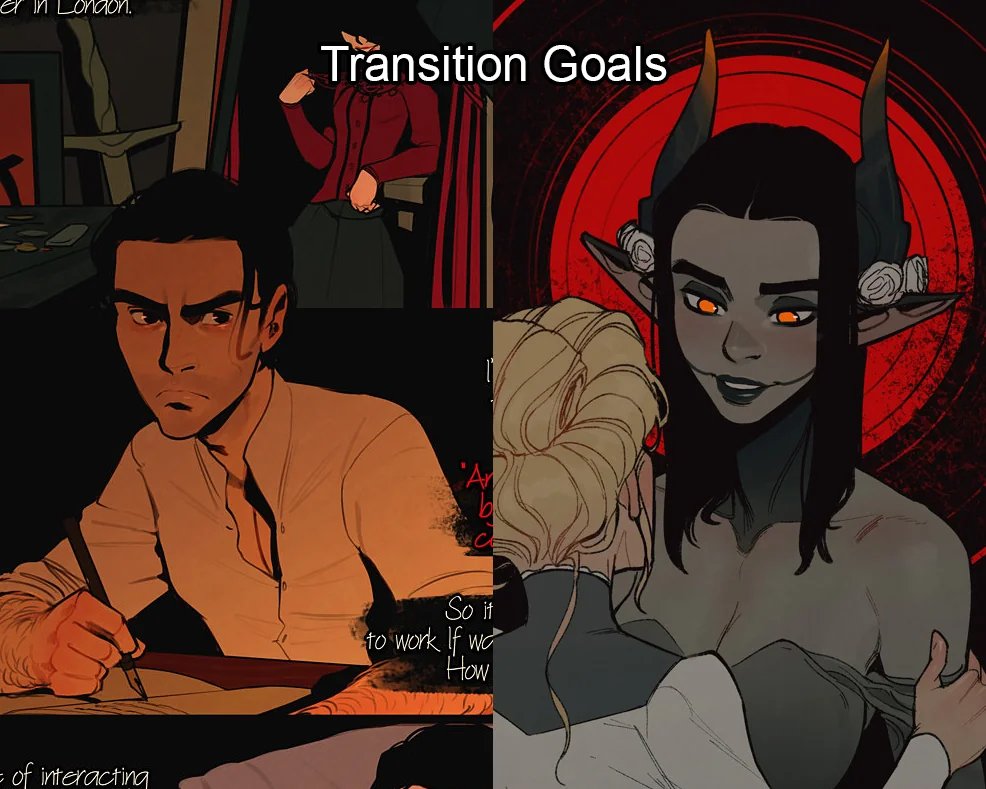
A universe both horrific and addictive. Twisted, unnatural, and yet utterly freeing. Is it any wonder why some folks have embraced it as a positive example of gender transition, at least in jest?
In the end, it isn’t about whether or not William has a vagina or Annie has a dick. Their final acceptance of each other was to move beyond their conceptions of sex and gender, to discard all labels. This is presented as both horror…and a short of transcendence. As old de Castro said in “The Call of Cthulhu,” they had become like the Master themselves, they had moved beyond the need to define themselves in human terms, and had come at last into a more complete marriage, through and within the Master.
Which is about as Lovecraftian an ending as one could hope for.
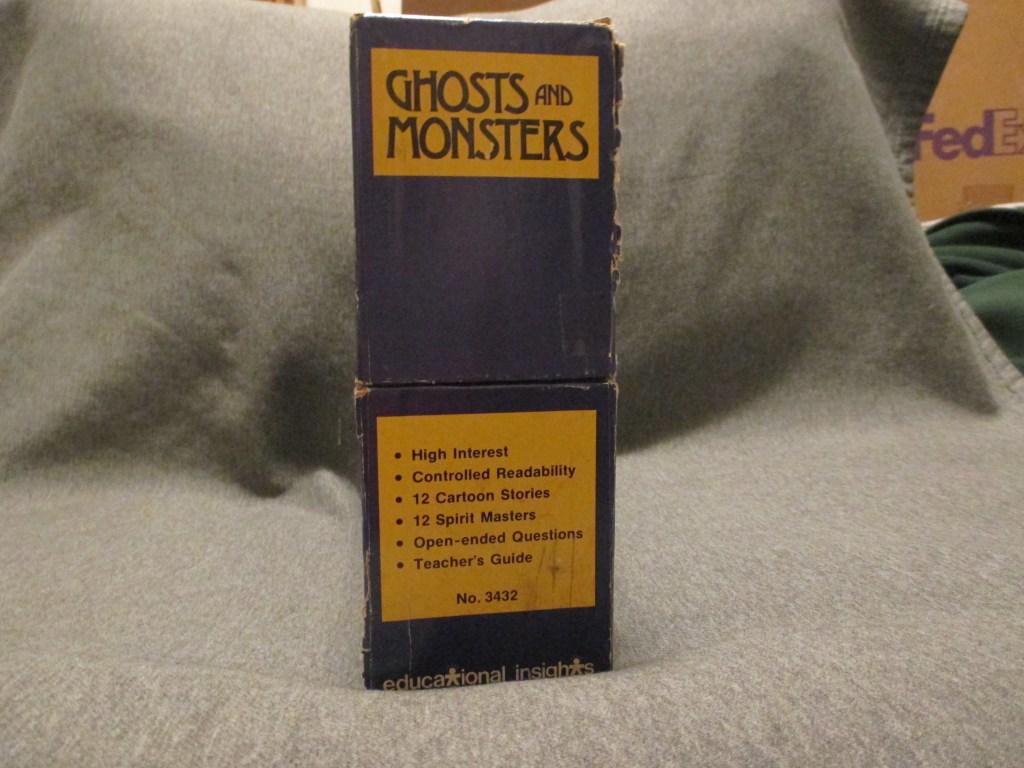
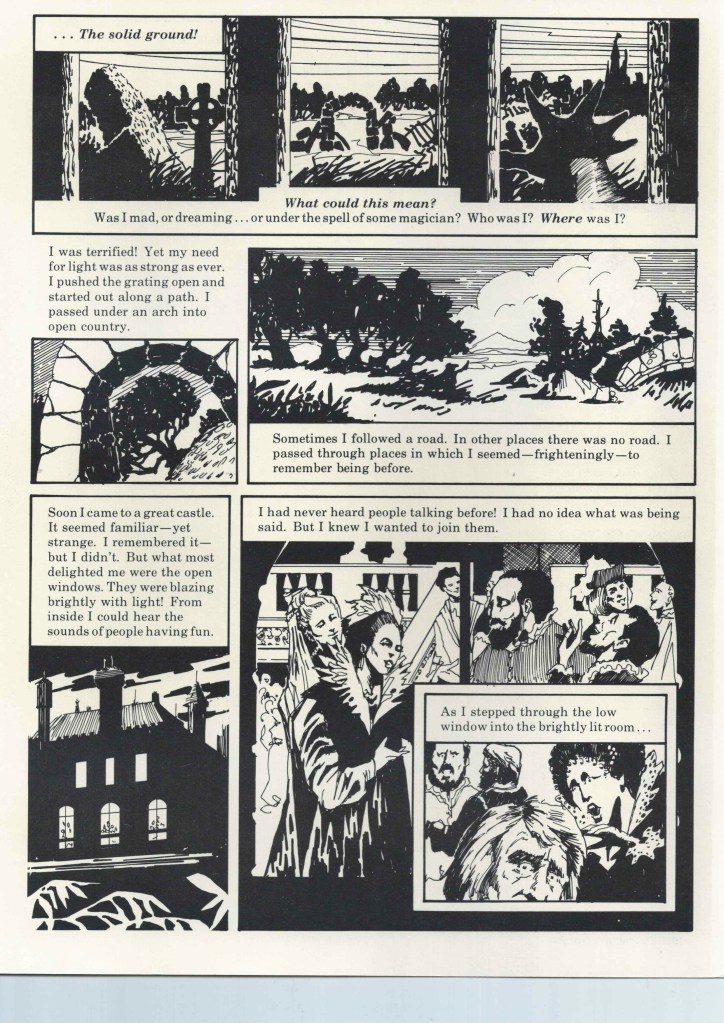
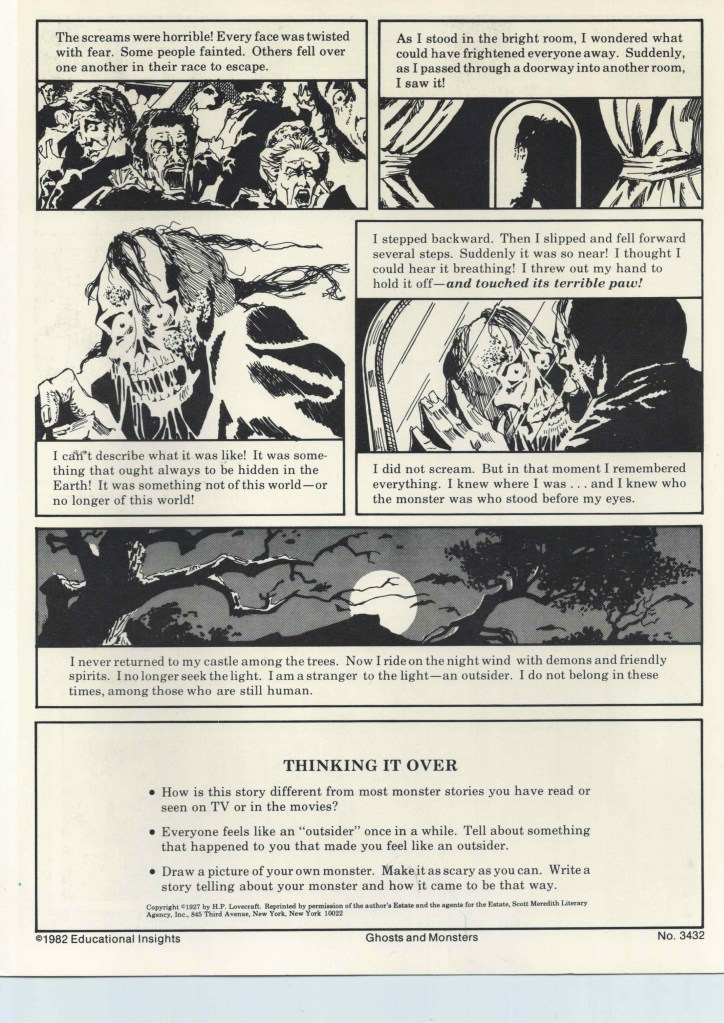
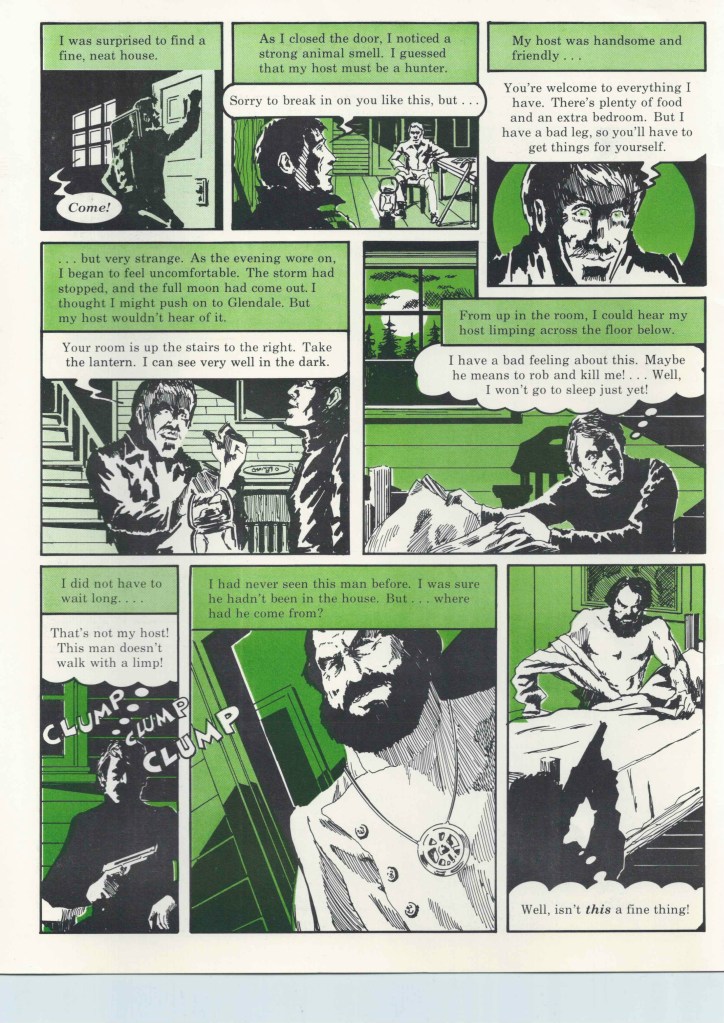
Ghosts and monsters have long been favorite topics for many children, so this Getting Into Literature set has a real built-in motivation factor. The art aids understanding, and the text is set in type (rather than hand-lettered in the traditional comic-book style). These features make GHOSTS AND MONSTERS enjoyable and easy to read. —Teacher’s Guide: Ghosts and Monsters
Imagine yourself in a public middle school in the United States of America, circa the 1980s or early 1990s. A genuine chalk board, rows of desks, an old-style projector. It’s the fall; leaves are falling from the trees, t-shirts are giving way to long sleeves and jackets. The classroom might be decorated with black and orange chains of paper, a cut-out of a witch, a pumpkin with a crooked smile drawn on in sharpie. The teacher passes out a stack of worksheets—but what is this? Comics? Horror comics?
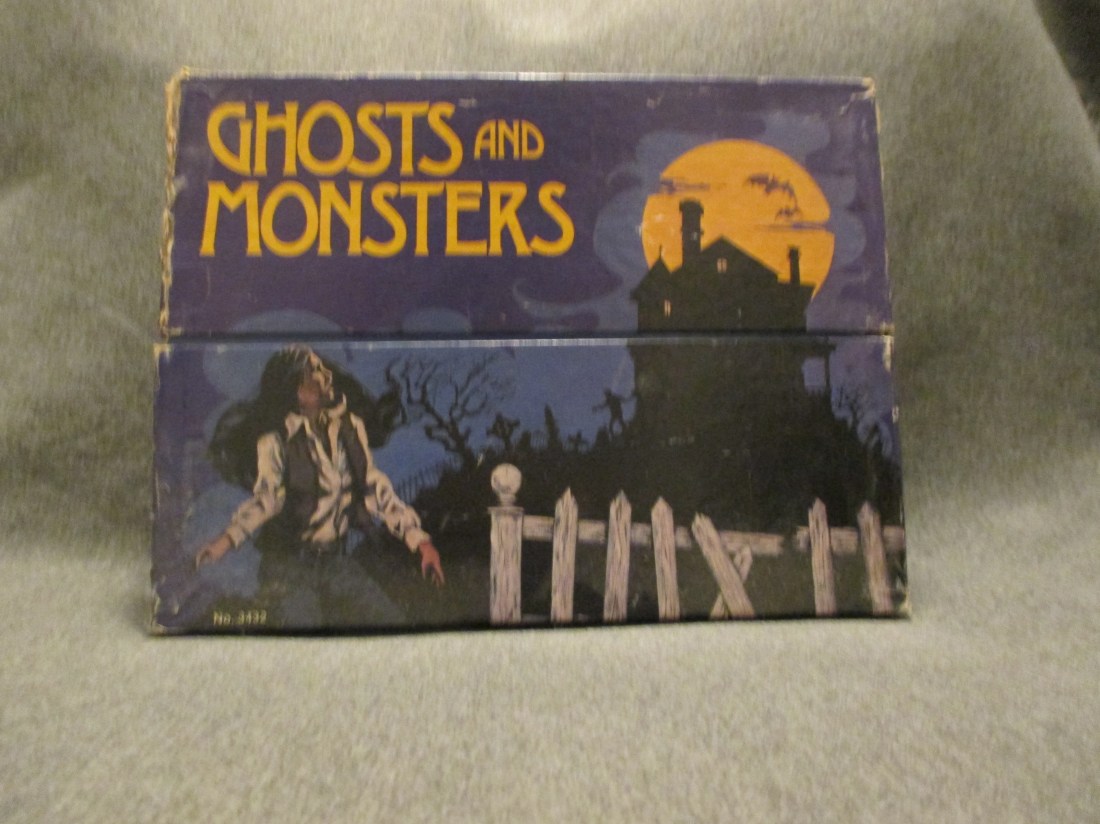
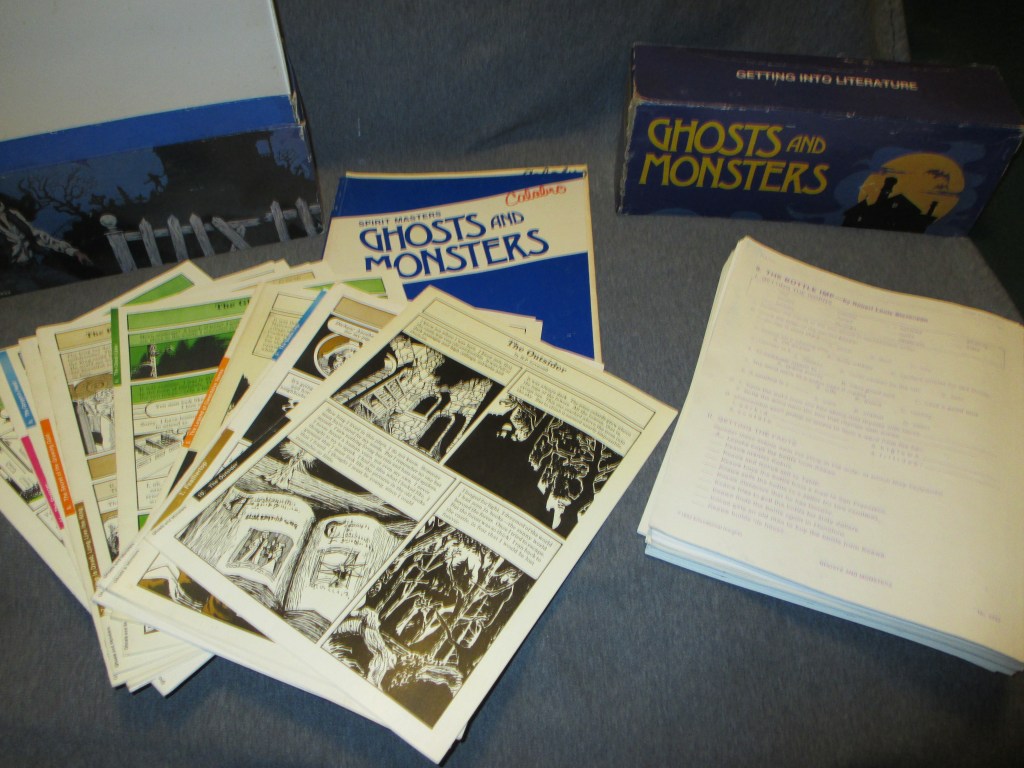
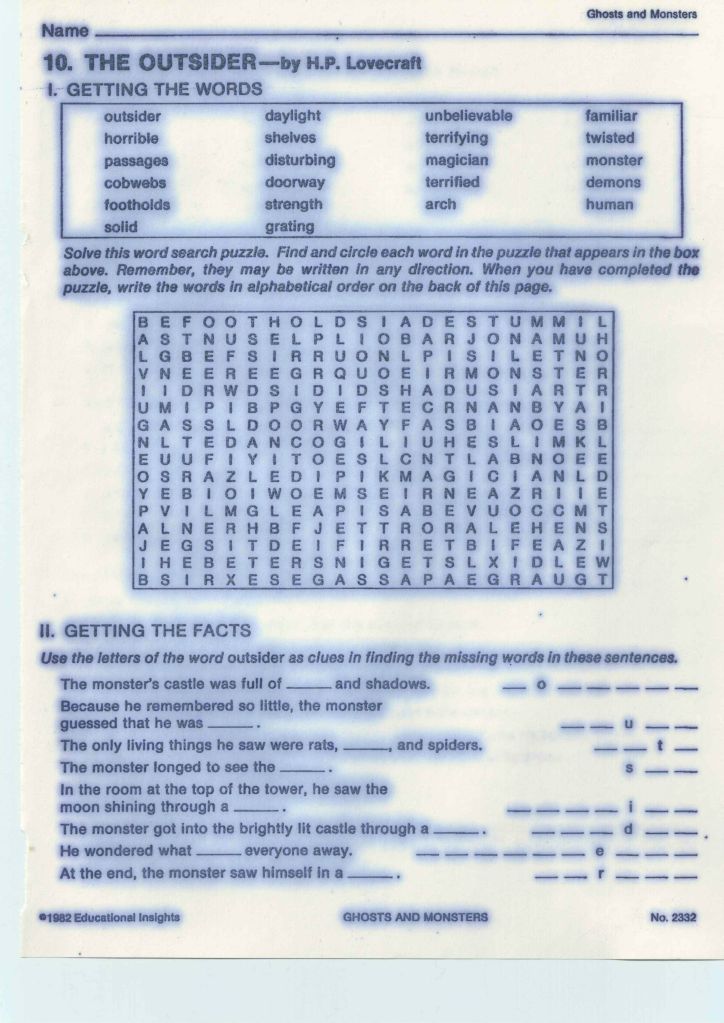
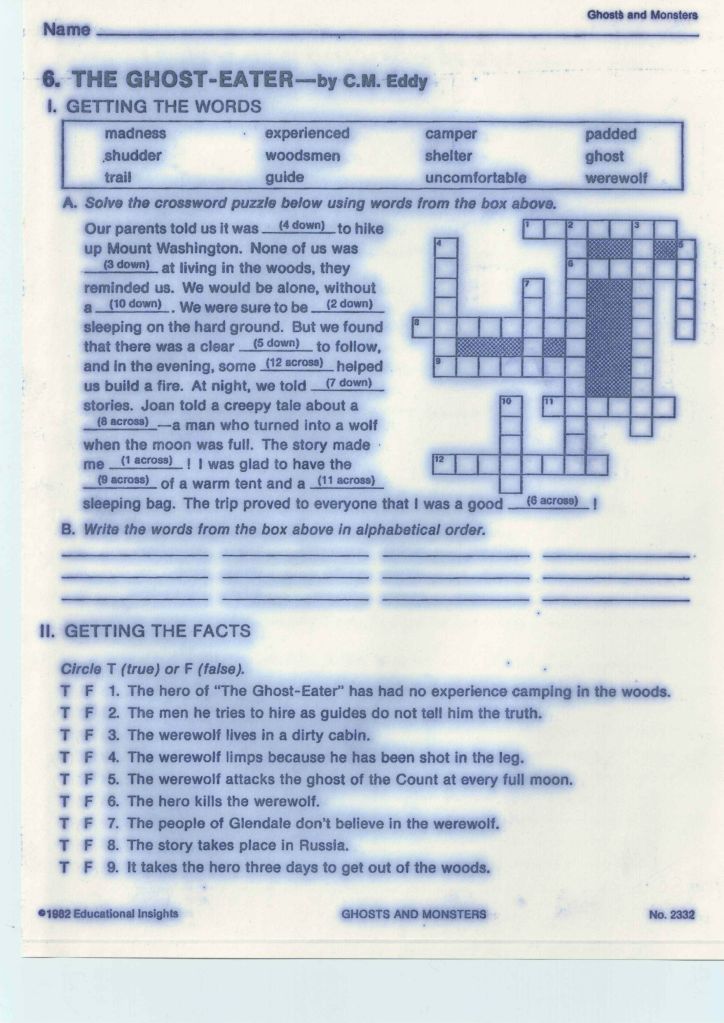
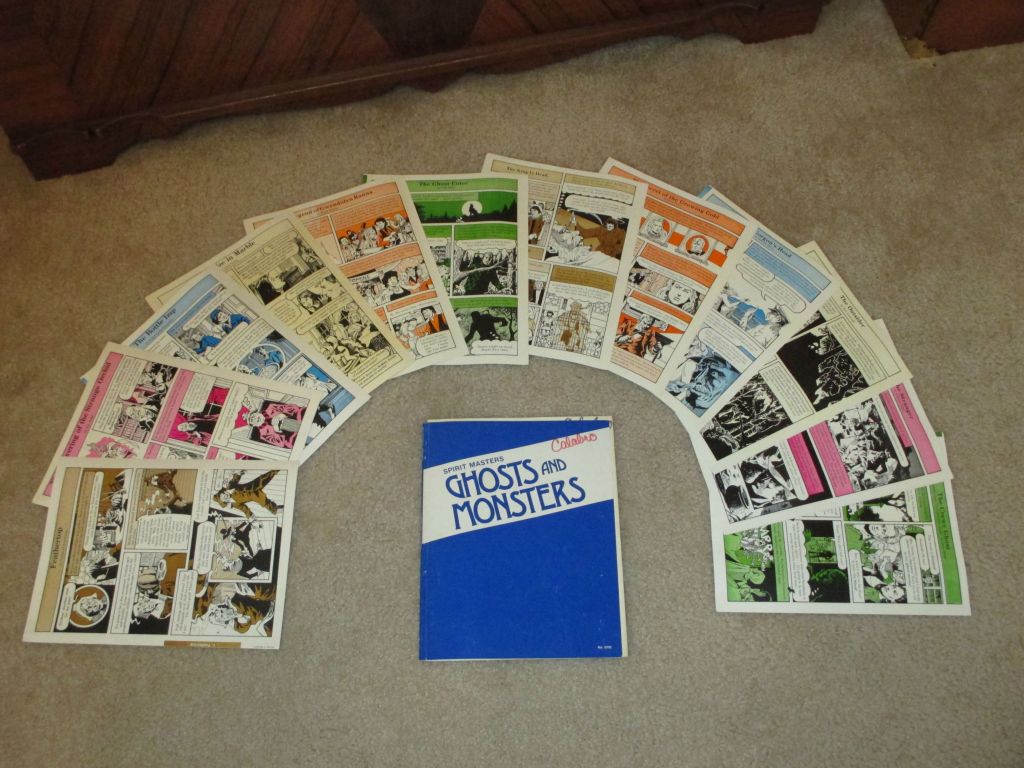
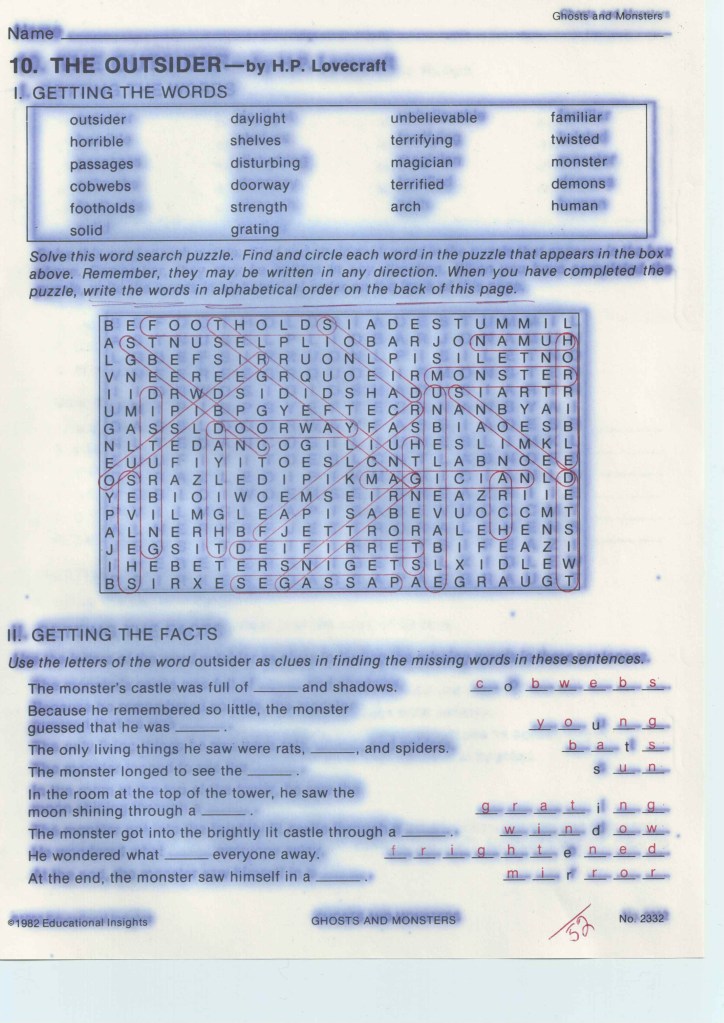
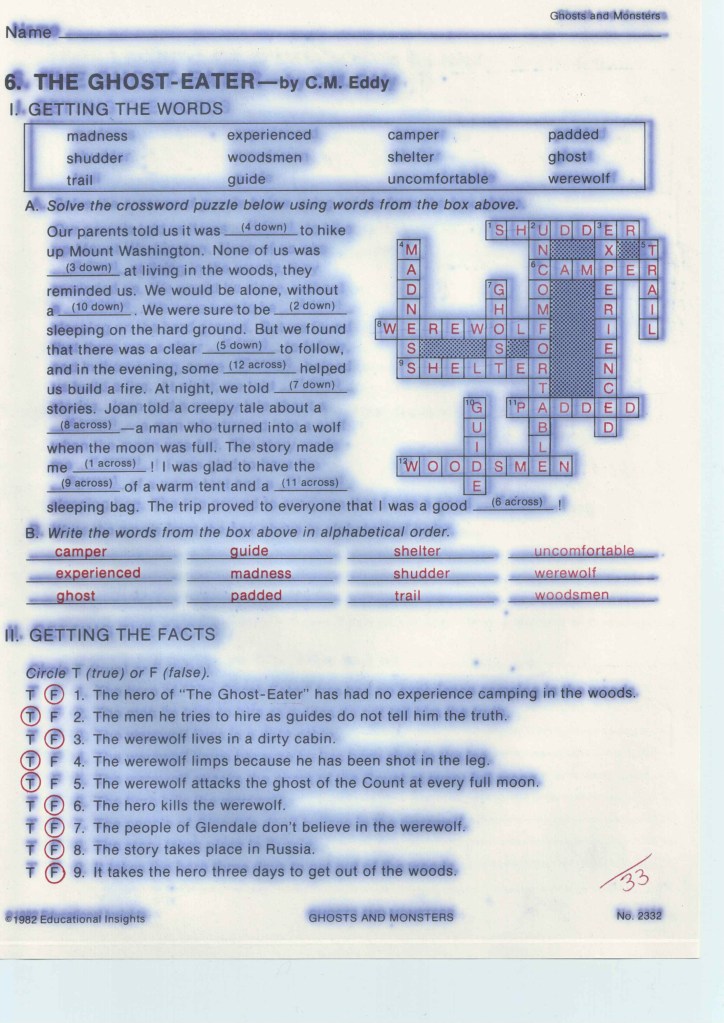
Ghosts and Monsters was published by Educational Insights in 1982. The kind of boxed set of teaching materials that found there way easily into hundreds or thousands of classrooms across the country. The contents were pretty basic: a book of spirit masters for duplicating worksheets (crosswords, etc.) in an age before photocopying became ubiquitous; a brief teacher’s guide with suggested questions and activities; and a package of comic booklets which adapted a dozen tales of horror and weird fiction to comics:
“Feathertop” (1852) by Nathaniel Hawthorne
“The Flowering of the Strange Orchid” (1894) by H. G. Wells
“The Bottle Imp” (1891) by Robert Louis Stevenson
“Man-Size in Marble” (1887) by Edith Nesbit
“The Legend of Gwendolyn Ranna” (1982?) by Frank Maltesi
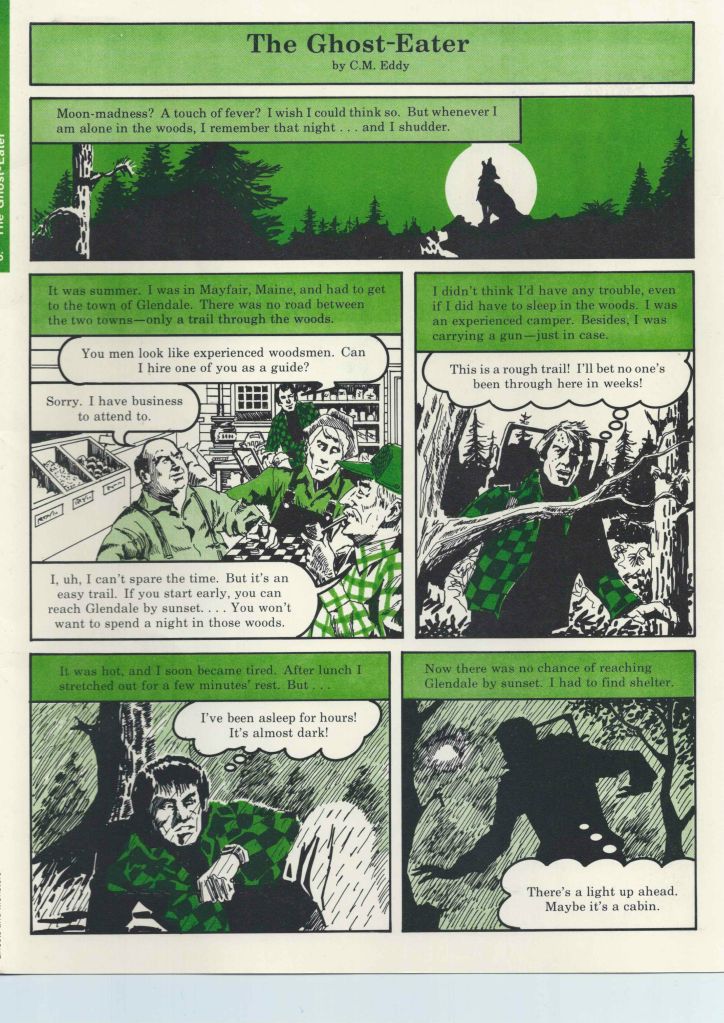
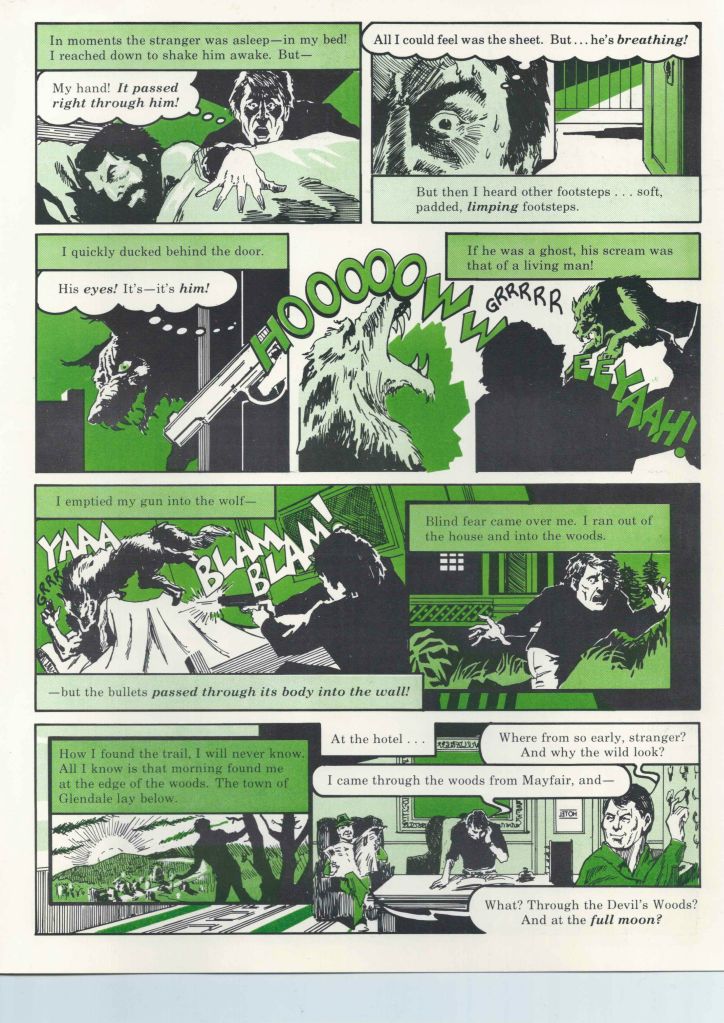
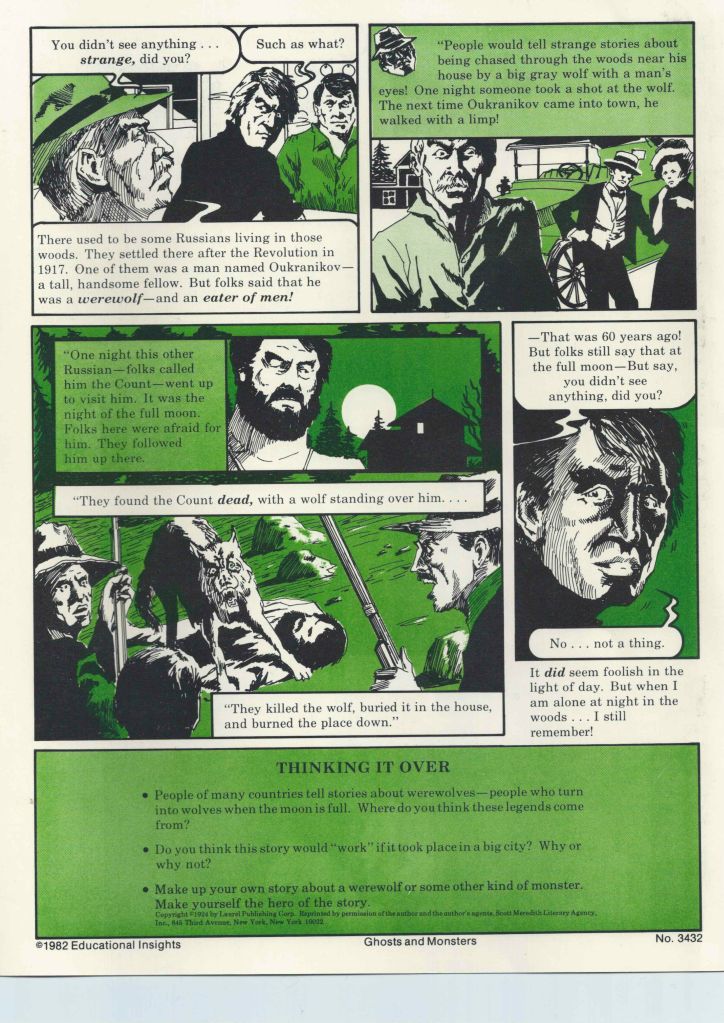
“The Ghost-Eater” (1924) by C. M. Eddy
“The King is Dead, Long Live the King” (1928) by Mary Coleridge
“The Secret of the Growing Gold” (1892) by Bram Stoker
“The Gorgon’s Head” (1899) by Gertrude Bacon
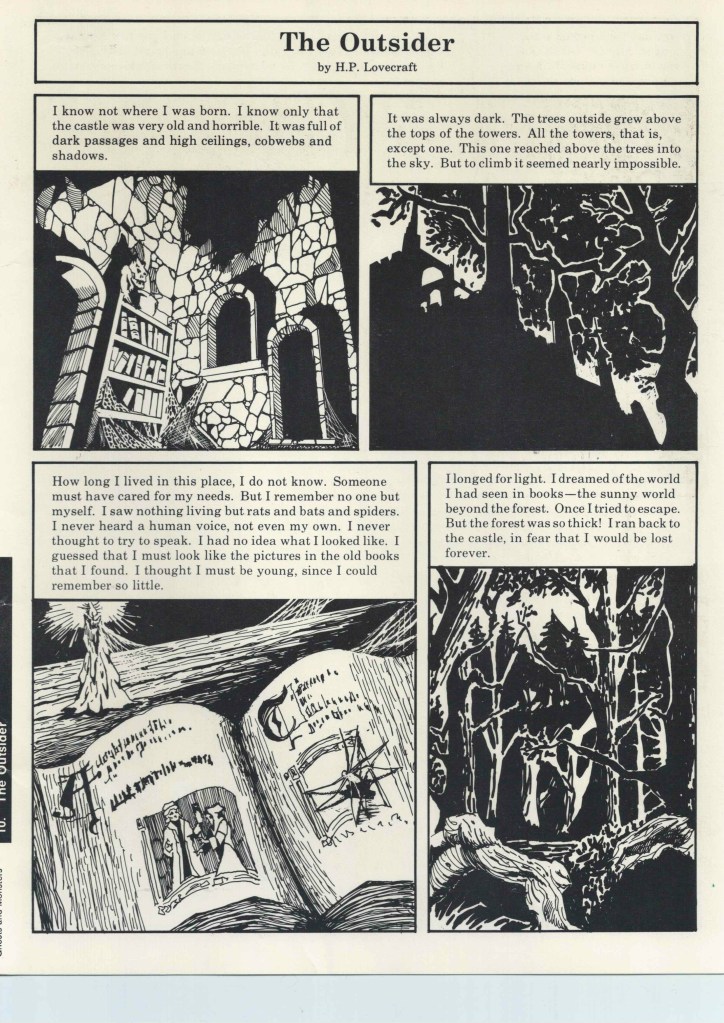
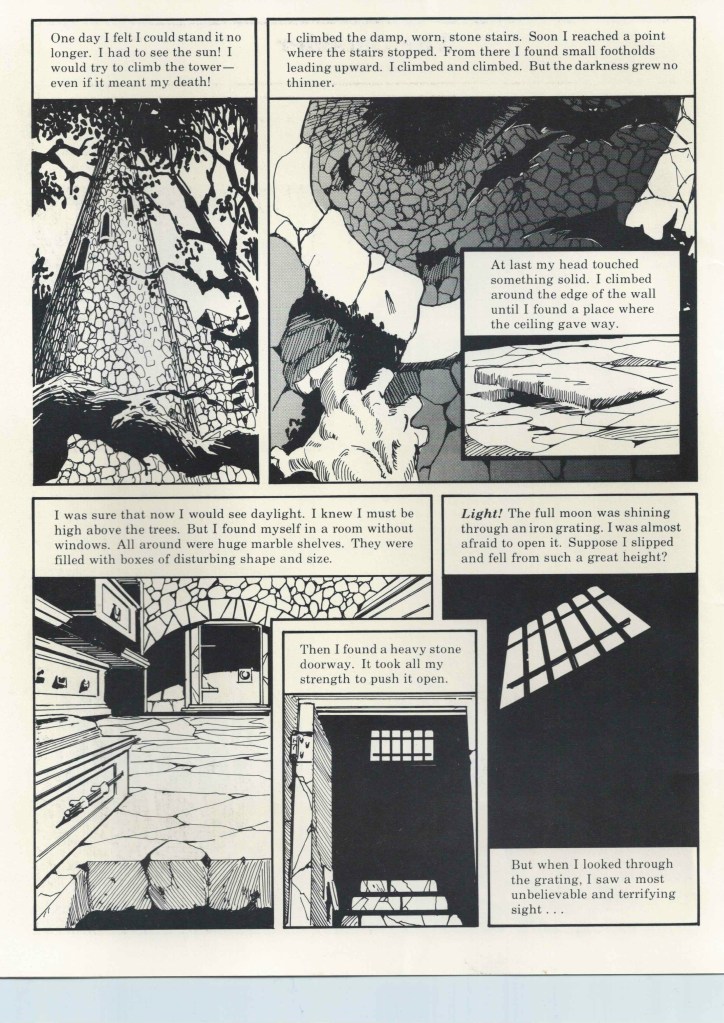
“The Outsider” (1926) by H. P. Lovecraft
“The Stranger” (1909) by Ambrose Bierce
“The Crewe Ghost” after Oscar Wilde [based on “The Canterville Ghost” (1887)]
It’s an odd mix. Many of these works were in the public domain, while the others were largely drawn from the pulps or (more likely) horror anthologies. “The Legend of Gwendolyn Ranna” by Frank Maltesi is a bit of an enigma, though the name is associated with several other brief legendary tales that have popped up in other educational materials; this may well be its first (and only) publication.
Most of the interest is on the comics themselves. The Teacher’s Guide credits Mark Falstein (well-known author of fiction for young adults) for selection and adaptation, and freelance artist Tony Gleeson for the illustrations. Each comic booklet is basically one large folded page, which gives four pages to tell and illustrate a complete story—a not-inconsiderable task!
The results tend to less grue and taboo than young horror fans might hope for. These were the last generation of “monster kids” that might pick up Famous Monsters of Filmland (1958-1983) on the stand, but they might still find a Helen Hoke-edited horror anthology in the school library, or pick up something from Scholastic involving vampires, werewolves, or bug-eyed aliens at the school book fair. Yet I have to wonder how many kids sat down one day and read Lovecraft for the first time as part of a school assignment—
And then fill out the worksheet afterwards!
Actually, there were two bits of Lovecraft tucked away in this package. C. M. Eddy, Jr.’s “The Ghost-Eater” (Weird Tales Apr 1924) was one of the stories that Lovecraft had somewhat revised for Eddy, and sold to Weird Tales editor Edwin Baird. As Lovecraft put it:
I have, I may remark, been able to secure Mr. Baird’s acceptance of two tales by my adopted son Eddy, which he had before rejected. Upon my correcting them, he profest himself willing to pint them in early issues; they being intitul’d respectively “Ashes”, and “The Ghost-Eater”. —H. P. Lovecraft to James F. Morton, 28 Oct 1923, Letters to James F. Morton57
How much of it Lovecraft actually wrote is a matter for debate; S. T. Joshi in Revisions and Collaborations notes the plot and some of the dialogue seems very typical of Eddy, while much of the prose reads like Lovecraft. In any event, it’s a genuine rarity. While many of Lovecraft’s tales have been adapted to comics, his revisions and collaborations are much less likely to receive the same treatment. This is certainly the first, and possibly the only adaptation of “The Ghost-Eater” to comics.
Given the limitations of space, the monochromatic printing, and the incredibly tight scripts, credit has to be given to Tony Gleeson for doing a very decent job on the art. Stuck with a very boxy framing setup, he nevertheless manages to use perspective shots and shadowed silhouettes to hint and convey something of a horror-mood. While the Teacher’s Guide suggests that the typeset text will make it easier to read, I suspect the real issue was that the budget for this project didn’t extend to hiring a letterer.
When we consider Lovecraft as something more than a cult figure, but as a writer who has entered the canon of world literature—this is a good example of what that looks like. Not necessarily fancy, expensive editions that can only be seen and enjoyed by a few, but stories that penetrate into common educational materials, hitting the masses when they’re young and becoming part of the foundation of reading. Ghosts and Monsters is a core sample of how Lovecraft came to the masses.
It’s a bit of history easily overlooked and easily lost. These were sold for classroom use, not to the public, and not preserved in libraries. How many classes went through Ghosts and Monsters before the comics were too worn for further use, or lost and displaced? Who preserves old worksheets from childhood days? These are deliberately ephemeral products, designed to last a few seasons and then be replaced as educational guidelines shift or a company needs to sell a new product. Edutainment marches on.
(Here are the answer keys to the worksheets if you need them.)
We are living in the only period in history in which it is considered fashionable to be a witch. Given this complete public acceptance, an understandable tendency towards fadism develops. The once-stigmatizing label of “witch” has become a title of positive intrigue and has attained a status never before realized. —Anton Szandor LaVey, The Satanic Witch(1989), 1
In his book The Triumph of the Moon (1999), Ronald Hutton traces the history of modern pagan witchcraft, and how a combination of factors and personalities in the late 19th/early 20th century—the shift to urban living which caused a romantic attitude toward nature and rural areas, the spiritual awakenings that weakened the grip of Christianity and encouraged the spread of new religious movements and ceremonial magic, the anthropological re-evaluation of myth in George Frazer’s The Golden Bough (1890) which inspired The Witch-Cult in Western Europe (1921) by Margaret A. Murray—all came together in the mid-century as individual practitioners like Gerald Gardner and Doreen Valiente shaped the core practices that would characterize Wicca and other modern pagan witchcraft systems.
Lovecraftian witchcraft is an interesting concept. H. P. Lovecraft’s views on witchcraft were largely shaped by Murray’s Witch-Cult Hypothesis as set forth in The Witch-Cult in Western Europe; there’s no evidence he read her later book The God of the Witches, and while Lovecraft had some understanding of the history of ceremonial magic based on Éliphas Lévi’s The History of Magic (1922, trans. by A. E. Waite), he was never an occultist or member of any group like the Hermetic Order of the Golden Dawn. When asked by one Salem witch descendant for magical secrets hinted at in his fiction, Lovecraft had to politely confess he made it all up. While Lovecraft made much of the Salem witch diaspora in his stories, connecting characters like Keziah Mason (“The Dreams in the Witch House”), Joseph Curwen (The Case of Charles Dexter Ward), and the founders of Dunwich (“The Dunwich Horror”) among others with the cult, that religion is uniformly depicted as dark, secretive, and often violent and malevolent. Keziah Mason even sacrifices children, repeating the old blood libel.
Most of Lovecraft’s contemporaries and immediate followers were not much better. Robert E. Howard’s Stregoicavar in Turkey in “The Black Stone” (1931) is a degenerate, alien, bloodthirsty religion. Henry Kuttner’s “The Salem Horror” (1937) strongly echoes “The Dreams in the Witch House,” with Abigail Prinn standing in for Keziah Mason. The image of the witch as a positive figure for female empowerment hadn’t really formed yet, though it was on its way with novels like Conjure Wife (1943) by Fritz Leiber. Over the decades, as the image of witchcraft shifted, Lovecraftian media often shifted to reflect the syntax of the time.
When exactly modern witches began to incorporate Lovecraftian elements into their work is a matter of debate. Doreen Valiente’s first book, Where Witchcraft Lives (1962), includes an invocation of the Old Ones during a full-moon ritual, which Hutton notes is nowhere in Gerald Gardner’s Writings and is very Lovecraftian (321). Any prospective witch who picked up Anton LaVey’s The Compleat Witch (1971; later reprinted as The Satanic Witch), could have used the Lovecraftian rites presented for the Church of Satan in The Satanic Rituals (1972) a year later. Kenneth Grant, one of the heirs of Aleister Crowley, threaded the needle of working references to witchcraft and Lovecraft into his system of ceremonial magick in The Magical Revival (1972). In 1977, Schlangekraft published the Necronomicon by Simon, which included a very Murray-esque witch cult into its Lovecraftian version of magical history as well.
So from the mid-to-late 1970s at least, modern pagan witches have had a vast amount of Lovecraftian occultism and lore to potentially draw on and incorporate into their own practices, if they so choose. Most of them do not. Daniel Harms and John W. Gonce in The Necronomicon Files noted that Doreen Valiente was familiar with Lovecraft and Lovecraftian occultism because she published an article on it: “Necronomicon—the Ultimate Grimoire?” that appeared in Prediction magazine (Apr 1982), which referenced a few of Lovecraft’s occult connections but gave little shrift to the Necronomicon as a genuine reality. As Harms & Gonce put it:
Most present-day Wiccans won’t give the Necronomicon (Simon or anyone else’s) the time of day. Other members of the Neopagan community also seem to give the Simon book short shift. Many of them see themselves as followers of the Light just as much as Christians do, and have no use for a “dark” grimoire. (209)
Modern pagan witchcraft in general has sometimes been derided as “cafeteria paganism” where practitioners pick and choose elements of their personal religion, and replaced any effort toward authenticity with fantasy, but the high degree of individualism and adaptability is a genuine strength for the movement as a whole. There is no hard canon for most would-be witches to get hung up on, and syncretization of Wiccan practices with other themes, or the incorporation of different magical and ceremonial practices into a Wiccan framework is fairly common.
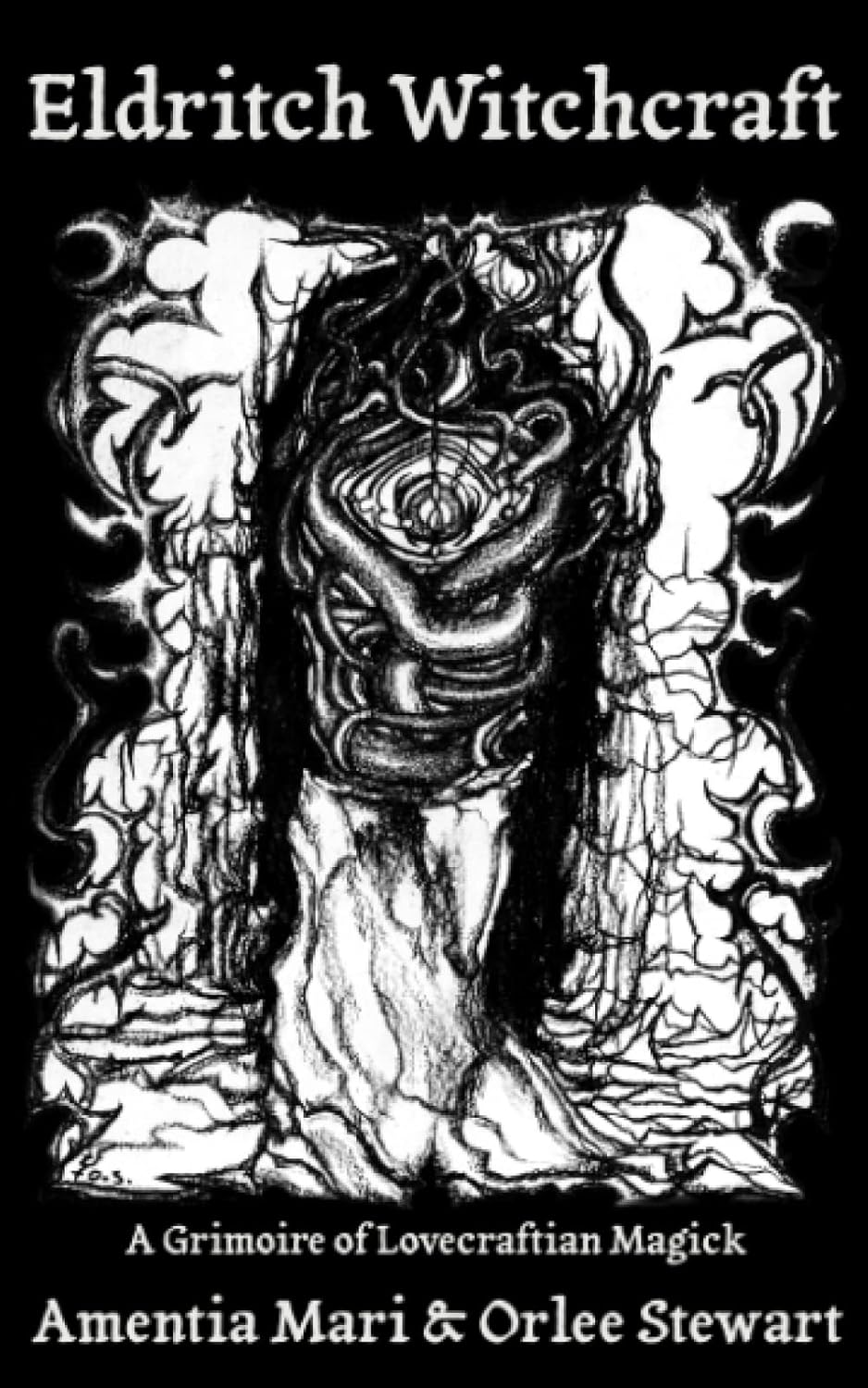
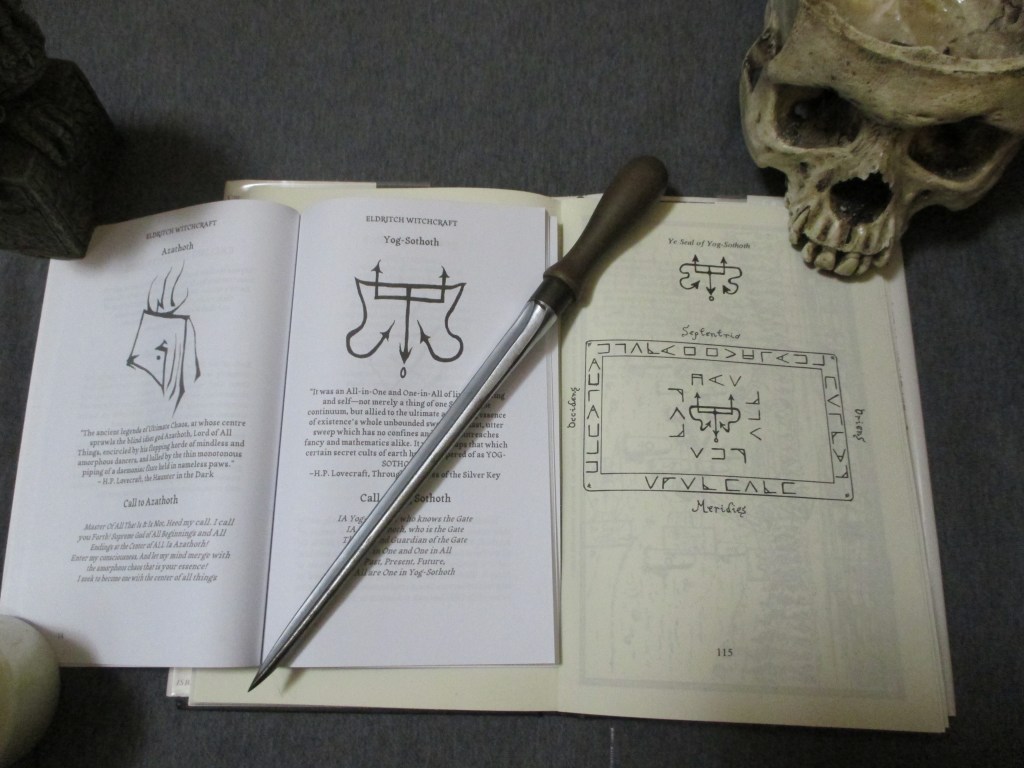
Which brings us to Eldritch Witchcraft: A Grimoire of Lovecraftian Magick(2023) by Amentia Mari & Orlee Stewart. This slim (38 pages) POD-published workbook is relatively light on Lovecrafian lore (a 3-page essay on “Eldritch Witchcraft” that discusses witches in some of Lovecraft’s stories, and mentions influential occultist Austin Osman Spare), and the rest of the book consists of magical recipes, rituals, sigils, and illustrations divided into five chapters:
Rite to Become An Eldritch Witch: A Lovecraft Mythos-themed rite for solo initiation.
The Eldritch Candle Prayer of Chaos: A variation on a prayer candle, with Lovecraftian trappings.
Calling the Outer Gods: Sigils and incantations to invoke various Lovecraftian entities (Azathoth, Yog-Sothoth, Nyarlathotep, Shub-Niggurath, and Nahab (Keziah Mason)).
Spells of Yog-Sothothery: Collection of recipes and charms: a ritual to consecrate your altar and tools, creating an amulet consecrated to Nyarlathotep, compounding a “witch’s unguent” of unspecified purpose, making the incense of Zkauba, making a dream pillow associated with Keziah Mason, and brewing dream tea. Many of the materials require the information from the previous two sections.
Heart of Stars Meditation: A meditation intended to provide contact with alien intelligences via automatic writing; uses some of the materials in the “Spells of Yog-Sothery.” Ends with a brief personal account by Orlee Stewart of her experiences using this ritual, including contact with an entity that she speculates might be Nyogtha from “The Salem Horror.”
As a workbook for solo witches go, this book presumes a level of familiarity with the terminology and basic practices of contemporary witchcraft. Probably many Wiccans could fold it into their practice fairly easily; the gist is basic enough and familiar enough to magical practices by Austin Osman Spare, Thelemites, etc. that many occultists would have little difficulty adapting it to their own practices as well (though the Heart of Stars Meditation, it should be added, is written only for women in its current form).
Perhaps surprisingly, Eldritch Witchcraft doesn’t borrow heavily from Aleister Crowley, Kenneth Grant, or the Simon Necronomicon; instead it takes inspiration from the Necronomicon (1978) edited by George Hay, which is presented as translations from a fictitious medieval grimoire that is claimed to be the original from which Lovecraft derived the Necronomicon in his fiction.
Right: Hay Necronomicon, showing various ritual gestures. Left: Eldritch Witchcraft, showing a subset of the same gestures.
Right: Hay Necronomicon showing the Seal of Yog-Sothoth. Left: Eldritch Witchcraft showing a very similar sigil for Yog-Sothoth.
Many elements from the Hay Necronomicon have proven popular among artists and creators and both been re-used and inspired similar depictions. While the majority of the sigils and all of the artwork in Eldritch Witchcraft is original, it’s clear that the authors were drawing on the Hay Necronomicon when developing some of their practices.
Perhaps most notably absent in Eldritch Witchcraft are the trappings and religious underpinnings commonly associated with contemporary pagan witchcraft; neither is there any extended effort to pronounce Lovecraft’s Mythos as real or his stories as representing literal truth. The direct use of fictional characters in place of more traditional deities and the prominence of Austin Osman Spare suggests the influence of chaos magick, and a certain level of pragmatism: this is a practical collection of spells and materials designed to build one on the other, not a quasi-philosophical work like Phil Hine’s Pseudonomicon or Scott R. Jone’s When the Stars Are Right: Toward An Authentic R’lyehian Spirituality. Readers get the how, but not necessarily the why.
Which leaves open the question: what is the viewpoint of a Lovecraftian witch? How would a contemporary pagan witch reconcile their ideology and practice Lovecraft’s Mythos? Which tradition(s), if any, do they blend into their own practices? Eldritch Witchcraft provides one possible answer to the latter, but the other questions the reader will have to figure out for themselves.
Many of August Derleth’s “posthumous collaborations” with H. P. Lovecraft have been derided as pastiches. Yet “The Lamp of Alhazred” is more homage—and more accurately a collaboration than most of Derleth’s stories, since it incorporates a large chunk of text from Lovecraft’s letter to Derleth dated 18 Nov 1936, where Lovecraft described coming across a previously unknown wood west of Neutaconkanut Hill.
On Oct. 28 I penetrated a terrain which took me half a mile from any spot I had ever trod before in the course of a long life. I followed a road which branches north 7 West from the Plainfield Pike, ascending a low rise which skirts Neutaconkanut’s Western foot & which commands an utterly idyllic Vista of rolling Meadows, ancient stone walls, hoary groves, 7 distant cottage roofs to the west & south. Only 2 or 3 miles from the city’s heart—& yet in the primal rural New-England of the first colonists!
He penetrated a terrain which took him almost a mile from any spot he had ever before trod in the course of his life, following a road, which branched north and west from the Plainsfield Pike and ascending a lot rise which skirted Nentaconhaunt’s Western foot, and which commanded an utterly idyllic Vista of rolling Meadows, ancient stone walls, hoary groves, and distant cottage roofs to the west and south. he was less than three miles from the heart of the city, and yet basked in the primal rural New England of the first colonists.
Derleth also took inspiration from an entry in Lovecraft’s commonplace book:
From Arabia Ency. Britt. II.–255. Prehistoric fabulous tribes of Ad in the south, Thamood in the north, and Tasm & Jadis in the centre of the peninsula. “Very gorgeous are the descriptions given of Irem, the City of the Pillars (as the Koran styles it) supposed to have been erected by Shedad, the latest despot of Ad, in the regions of Hudramant, and which yet, after the annihilating of its tenants, remains entire, so Arabs say, invisible to ordinary eyes, but occasionally, and at rare intervals, revealed to some heaven-favored traveler.” Rock excavations in N. W. Hejaz ascribed to Thamood tribe.
It had once been the property of a certain half-mad Arab, known as Abdul Alhazred, and was a product of the fabulous trident of ad—one of the four mysterious, little-known tribes of Arabia, which where ad—of the south, Thamood—of the north, Tasm and Jadis—of the center of the peninsula. it had been found long ago in the hidden city called Irem, the city of Pillars, which had been erected by Shedad, last of the despots of Ad, and was known by some as the Nameless City, and said to be in the area of Hadramant, and, by others, to be buried under the ageless, ever-shifting sands of the Arabian deserts, invisible to the ordinary eye, but sometimes encounter by chance by the favorites of the Prophet.
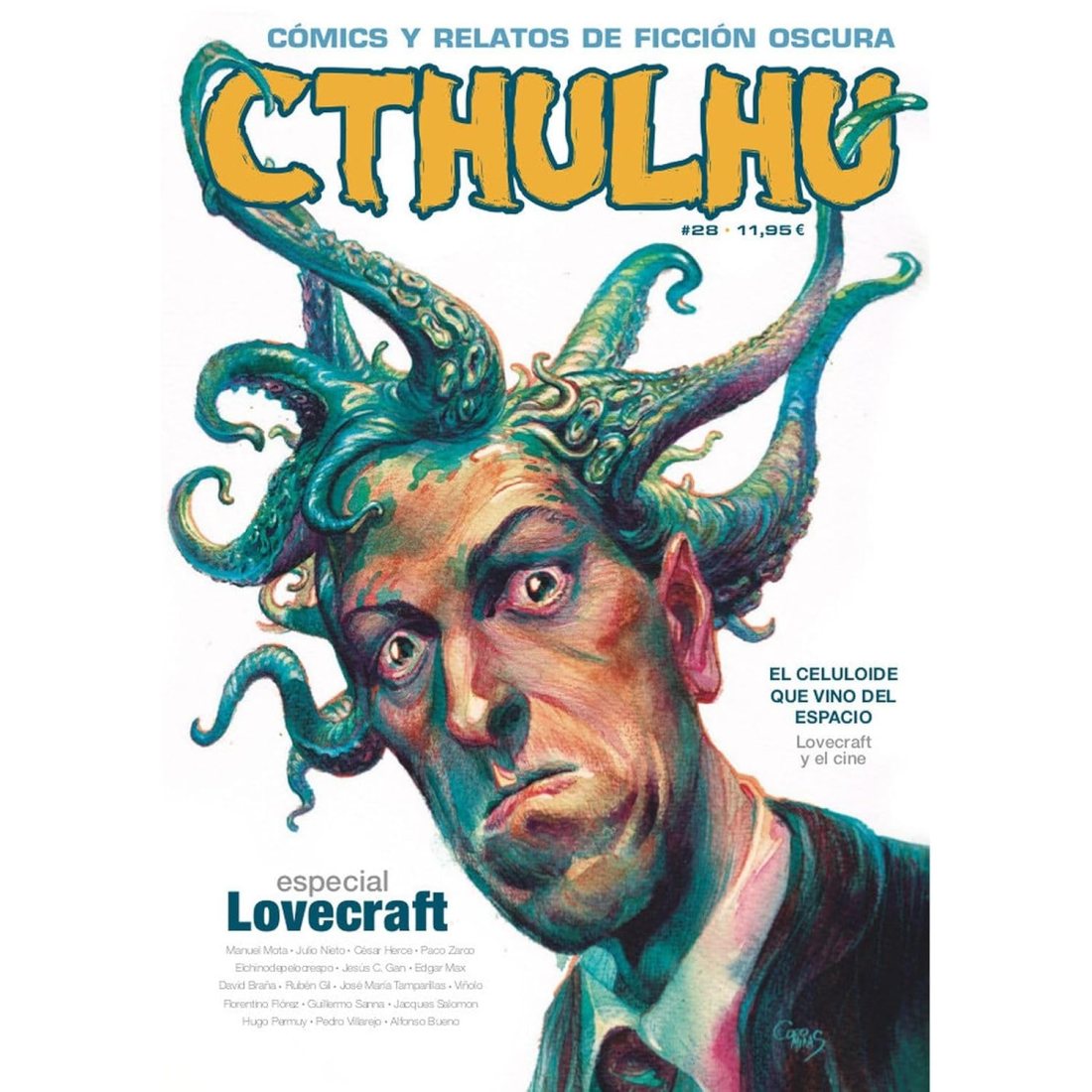
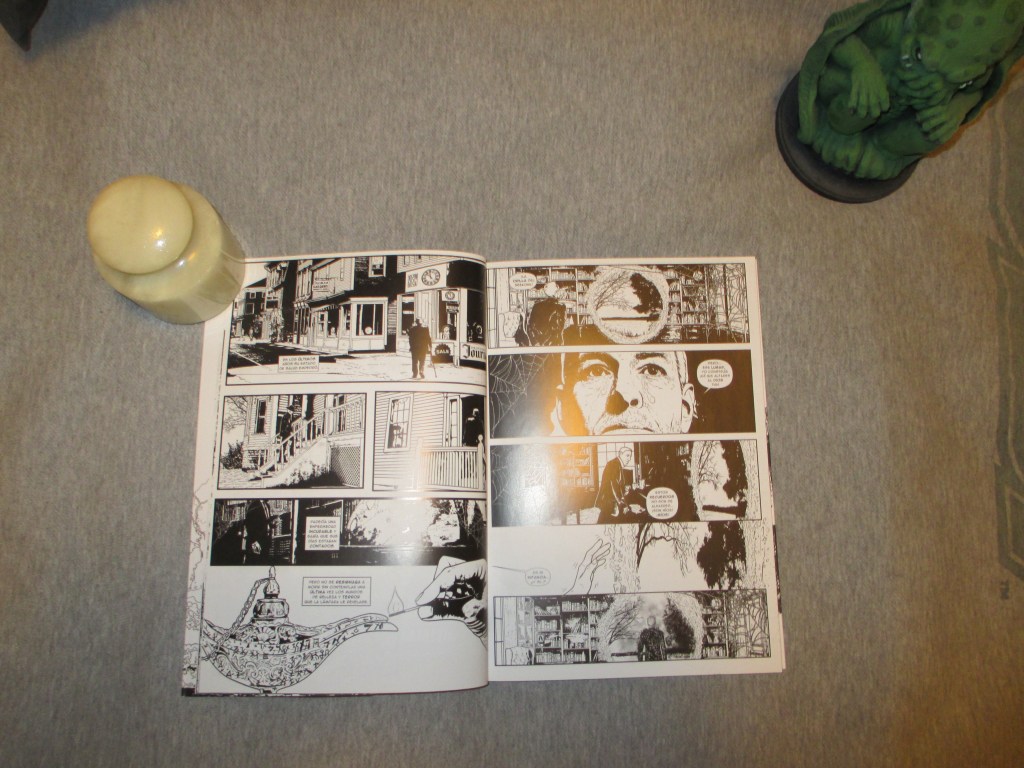
While nearly every Lovecraft story has been adapted to comics at some point, rather fewer of Derleth’s stories have attracted the same treatment. Yet it makes sense that Manuel Mota (script) and Julio Nieto (artwork) would adapt “The Lamp of Alhazred” for Cthulhu #28, the Lovecraft special issue. Because there are homages which capture as much of the pathos of H. P. Lovecraft as well as this one.
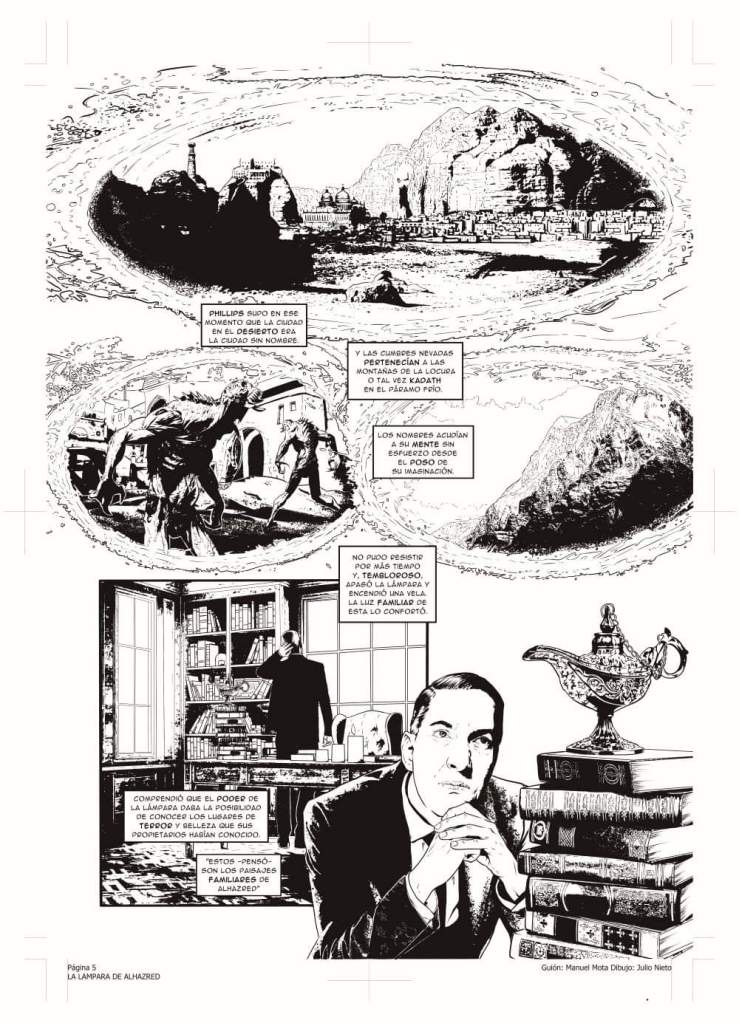
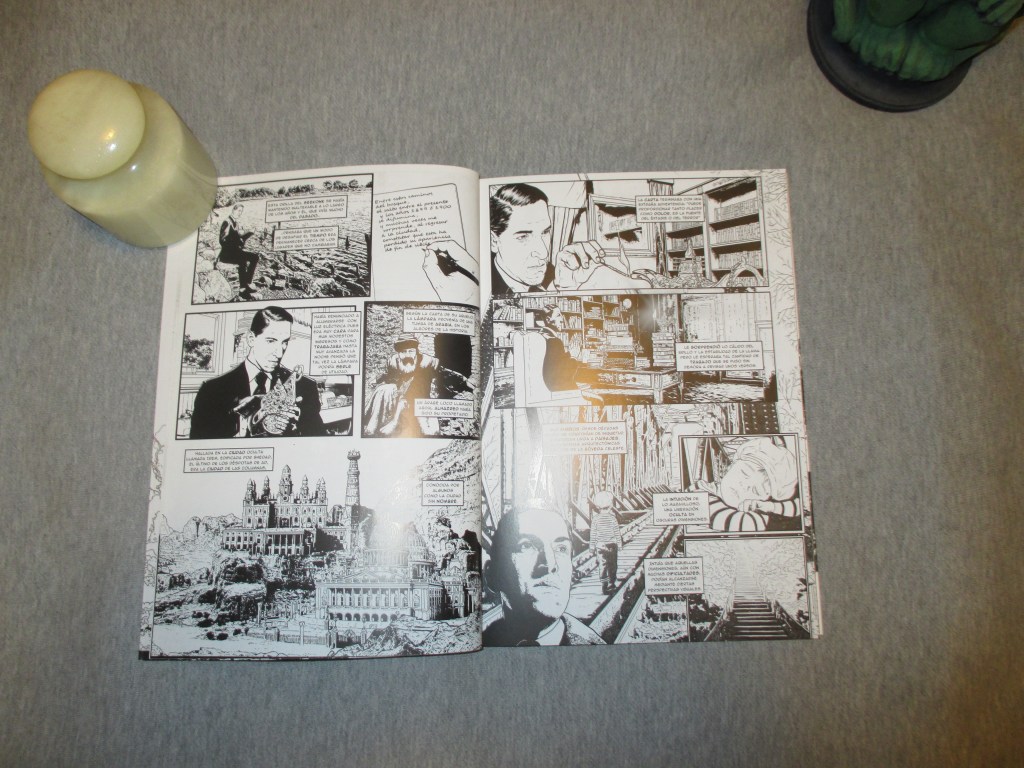
Manuel Mota’s script is a fairly straight translation of Derleth text, albeit truncated for space and with the illustrations serving in place of much of the description, which inadvertently cuts out most of Lovecraft’s text. Yet the presentation and framing of the words and Julio Nieto’s art does much to lend a sense of action to what is a largely contemplative story that draws on both Lovecraft’s life and the sentiment of “The Silver Key.” Readers feel Ward Phillips loss and loneliness, his refuge in his imagination, and the visions of other worlds, other times.
It is escapist in the most literal sense of the word, and one of several stories that reflect that quiet, profound desire to abandon the daily grind of life, with its quiet indignities, defeats, and injuries.
Nieto’s artwork is carefully realistic, the page layout traditionally grid-like; it is a straight-forward presentation that puts the more fantastic sequences, the break-outs where the panel cannot contain a wondrous scene, in context. The weirdness isn’t a part of Ward Phillips world; it is the way out.
Jamás se encontro el cuerpo de Ward Phillips.
La policía aún espera queue sus restos aparezcan en Alguno de los lugares queue solía frecuentar en sus solitarios paseos.
Con el paso de Los años, la vieja casa fue derribada, la biblioteca adquirida por librerías anticuarias y lo queue quedó gue vendido como chatarra incluida una vieja lámpara Árabe a la que nadie encontró utilidad alguna.
The body of Ward Phillips was never found.
Police are still hoping that his remains will turn up in one of the places he used to frequent on his solitary walks.
Over the years, the old house was demolished, the library was acquired by antiquarian bookstores and what remained was sold as scrap, including an old Arabic lamp that no one found any use for.
Though desultory searching parties were organized and sent out to scour the vicinity of Nentaconhaunt and the shores of the Seekonk, there was no trace of Ward Phillips. The police were confident that his remains would some day be found, but nothing was discovered, and in time the unsolved mystery was lost in the police and newspaper files.
The years passed. The old house on Angell Street was torn down, the library was bought up by book shops, and the contents of the house were sold for junk—including an old-fashioned antique Arabian lamp, for which no one in the technological world past Phillips’ time could devise any use.
“La Lámpara de Alhazred” (2023) by Manuel Mota & Julio Nieto, Cthulhu #28.14
It is a story that almost demands a familiarity with Lovecraft to truly appreciate; those who have read his letters, who knows what Lovecraft struggled with during his life, can recognize more of the man in Derleth’s framing of the Nentaconhaunt narrative. Mota and Nieto do well to capture and depict as much of this atmosphere as they can, and the sensibility of the story is necessarily both sad and romantic in the older sense—this is not a Mythos story, despite the name “Alhazred.” it is a fantasy, a myth, so much more elegant than the reality that saw Lovecraft end his days in pain in a hospital as the cancer consumed him.
“La Lámpara de Alhazred” (2023) by Manuel Mota & Julio Nieto is an excellent overall adaptation of Derleth’s homage to Lovecraft, one that captures the spirit of the original—the echo of Lovecraft, as it were—for a new medium and a new audience.
Eldritch Fappenings This review is of a homoerotic romance work which deals with mature themes and tentacle erotica. Reader discretion advised.
Romance fiction is about the churn. Individual works often have minimal lasting value; only a rare few works of the sticking power or cultural cachet of Maurice (1971) by E. M. Forester. Yet the appetite for such works is constant. Consumers don’t just want porn, they want characters, settings, relationships, hardship, overcoming adversity, happy endings, unhappy endings—new stories, all the time. And creators need to eat, so they need to keep producing more and more to try and fill that demand.
There are times when a spate of Amazon erotic ebooks in a month are focused on bigfoot weddings, or older bosses (of either gender) seducing a new employee, or being isekai’d into a novel and now locked into a forbidden sexual relationship with a step-sibling. One month the flavor might be elves, another Regency-era settings, and sometimes a clever or ambitious author might combine the two. All’s fair in love and genre fiction.
Holiday-themed offerings are available in abundance. Hallowe’en, Thanksgiving, and Christmas are all well-represented…and probably also Boxing Day, Hanukkah, and Arbor Day too. Christmas, however, remains a particular favorite. There’s something about the immense cultural memeplex that extends far beyond the actual celebration of Christ’s birth. A jolly old elf has never stuffed so many stockings; kids who wished for new siblings for Xmas may well get them, Rudolf may be a well-hung were-reindeer with amorous intentions toward Mrs. Claus, and the mistletoe works overtime to trigger steamy kisses. The literary stakes of such works are often pitifully low, with writers and readers more or less satisfied so long as the product delivers the bare minimum of what it promises or hints at.
Content Warning: violence, mature content, brief discussion of child abandonment —Meghan Maslow, “Cthulhu for Christmas” (2023)
To paraphrase Roger Ebert, I have a sneaky respect for anyone that goes much, much further than too far. With a premise that starts out with “Cthulhu-themed Christmas book” and then expands into: “A Winter Holiday MM Tentacle Romance,” it would have been easy—ridiculously easy—to do a minimalist job, check off the hashtags, and pump out a simple, quirky, and porntastic M/M tentacle erotica ebook in time for the Xmas sales boost. No one would have complained.
What readers get is so much more. Readers going in hoping to see tentacles stretch out holes like pre-lubricated o-ring orifices from page one will be disappointed to find themselves going through short chapters filled with with well-developed characters, in an interesting and evocative setting (with map!), as personal dramas and a murder mystery slowly unfolds. Many of the plot-beats might feel like a Hallmark Christmas movie mixed with your favorite detective show. Will gay cop Zen King tell his straight best friend he’s in love with him? What does Zak’s best friend Grey Criswell and his old money family have to do with the mysterious murder at Salem’s Tree Lot? And what the heck does any of this have to do with a break-in at the local library?
“Cthulhu’s Compendium is a one-of-a-kind artifact. I can’t believe you glimpsed it! Please tell me you were able to read some of it! I’ve requested permission from the Special Collections numerous times, but they always inform me it doesn’t exist.”
“Cthulhu’s. Compendium.” Uh huh. “Like Lovecraft? It’s a work of fiction?”
I’d actually read some Lovecraft in high school when an emo kid recommended him.
She huffed. “It’s not fiction. And while it’s unsubstantiated, it’s well known that Lovecraft vacationed here on many occasions. Even visited the museum. You do the math.” —Meghan Maslow, “Cthulhu for Christmas” (2023)
The Mythos elements of the plot don’t come exactly as a surprise (it’s in the title), but to Maslow’s credit the story takes the time to build up to the revelations. The tone is paranormal romance rather than horror—and because Lovecraft’s work is explicitly fiction within the setting, there’s room for Maslow to play fast and loose with what is “true” in terms of the Mythos. For the most part, that means that sometimes there are tentacles and sometimes they are frisky, though not always cooperative.
If you’d have told me I’d be cock-blocked by tentacles, I’d have laughed. But I wasn’t laughing now.
(For those interested in the steamier bits, the tentacles don’t cock-block for long. Quite the opposite.)
There’s a lot of little silly details that add up in the story to make it more charming. There’s a beaver that’s moved onto a houseboat like a stray dog. A pair of caribou driving a sleigh that work like a Uber service with an app called Caribou For You. An arranged marriage. An ugly sweater contest. If that sounds silly—that’s the point. Mundane weirdness tends to ground a story with more fantastical elements.
“Cthulhu for Christmas” (2023) by Meghan Maslow is not some quick and dirty romp churned out to meet a Yuletide theme and a couple keywords. There is a lot more heart to the story, and a lot more craft to the writing this tale of love, lust, and magic, than a reader might expect.
This story was written as part of a set of holiday-themed tentacle romance offerings: Tinsel & Tentacles.
“Since you are a church-going type, I wanted to extend an invitation to our service.” —Bernadette Johnson, Southern Fried Cthulhu200
There are many cultural fault lines and divides in the United States, fuzzy though they have grown over time as the country becomes more integrated, the population more mobile. The Bible Belt is largely co-terminous with the Southern and Southwestern states and parts of the Midwest. Christian church attendance is high in this area, but the Christian churches involved are varied, multitudinous, and often evangelical, independent, fractious, and unregulated.
Anyone can buy a collar and a Bible. Anyone can preach and call themselves a preacher. The charismatic preachers may be itinerant or fixed; sermons may be preached from multi-million dollar megachurches or from tents or old rented commercial buildings. Some churches are part of large established denominations like the Southern Baptists and Methodists, and may have organized seminaries and organizations like the Southern Baptist Convention, but as many or more may be independent and idiosyncratic.
If you live and grow up in the Bible Belt, affiliation with a given church is a personal as well as cultural choice. Even small towns might support a number of independent churches, sometimes with unfamiliar names, quirks on ideology, theology, and ritual.
Good cover for older, stranger religions.
“”Glory Be to the Father and Mother” by Bernadette Johnson plays on the frisson of the unfamiliar-and-near-familiar. Set in an unspecified small town, a newcomer is courted by opposing congregations, and there is a space of wariness—which is the Mythos cult, and which is just a weird little independent church? Where’s the line between the two? It’s a tension that can’t last very long; especially in a short story, and before too long before the strange altars and human sacrifices come out. Old tropes die hard.
If there’s a criticism for the story, it’s that the premise has enough potential it would have been nice to see more done with it. A more developed setting that spent more time to flesh out the churches and temples involved, the cults, to give them more personality instead of relying on the familiar Mythos Cultist imagery, would have added welcome depth to the story, which races to try and get through its plot points before the end.
In general, few Lovecraftian stories really come to grips with what it means to be a part of a cult, to be recruited, to live inside the group. Stories like “The Book of Fhtagn” (2021) by Jamie Lackey, “The Well” (2023) by Georgia Cook, and “The Things We Did in the Dark” (2024) by Julia Darcey show different approaches to how Mythos cults can work, and it’s not all cowled robes and wavy daggers. The interaction with charismatic evangelical Christianity is rarer; Charles Stross played with the idea in The Fuller Memorandum (2010), and the idea crops up in other stories, but it is a rich and varied field, because of the wide array of churches in the region.
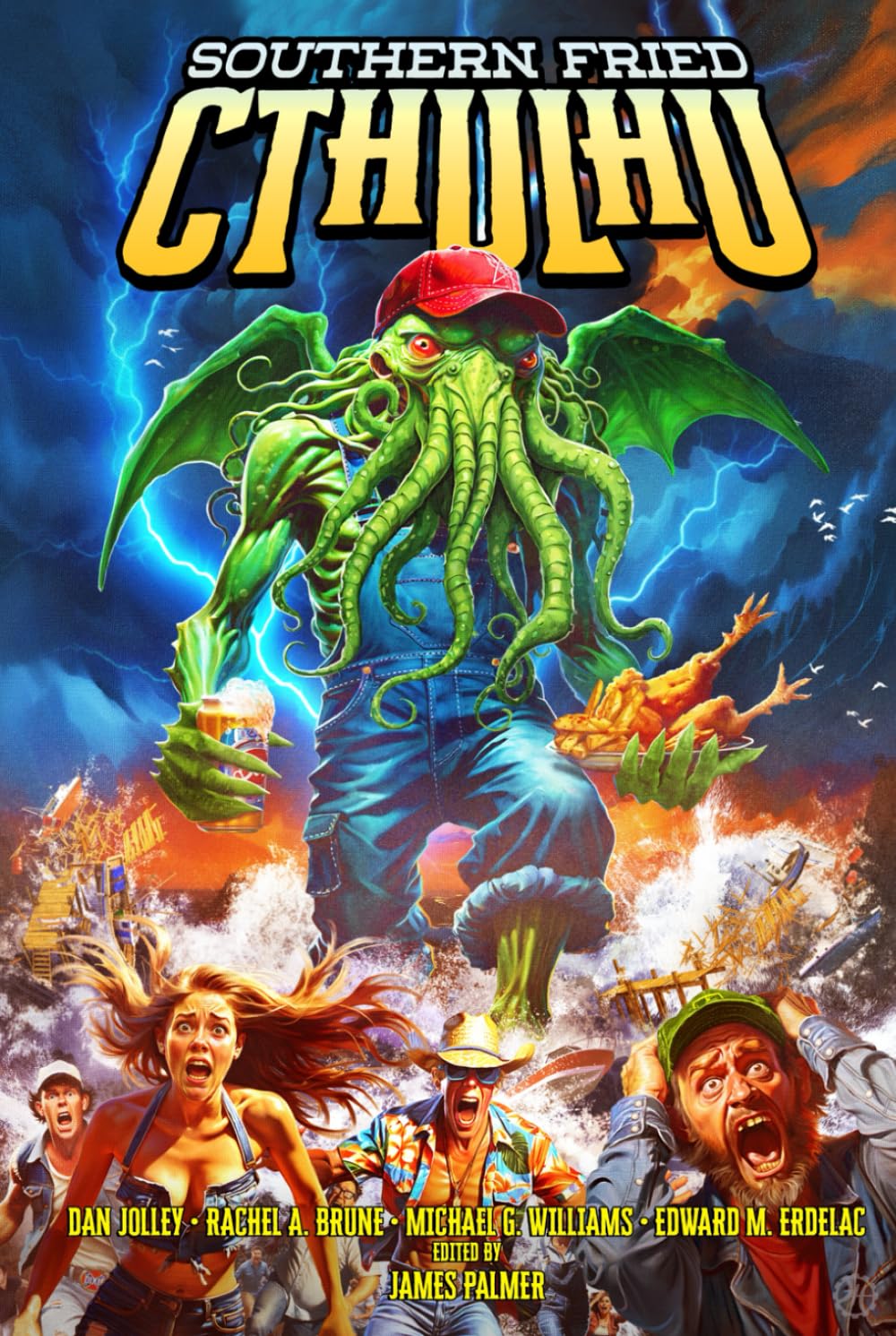
“”Glory Be to the Father and Mother” by Bernadette Johnson was published in Southern Fried Cthulhu (2024).



 Deep Cuts in a Lovecraftian Vein