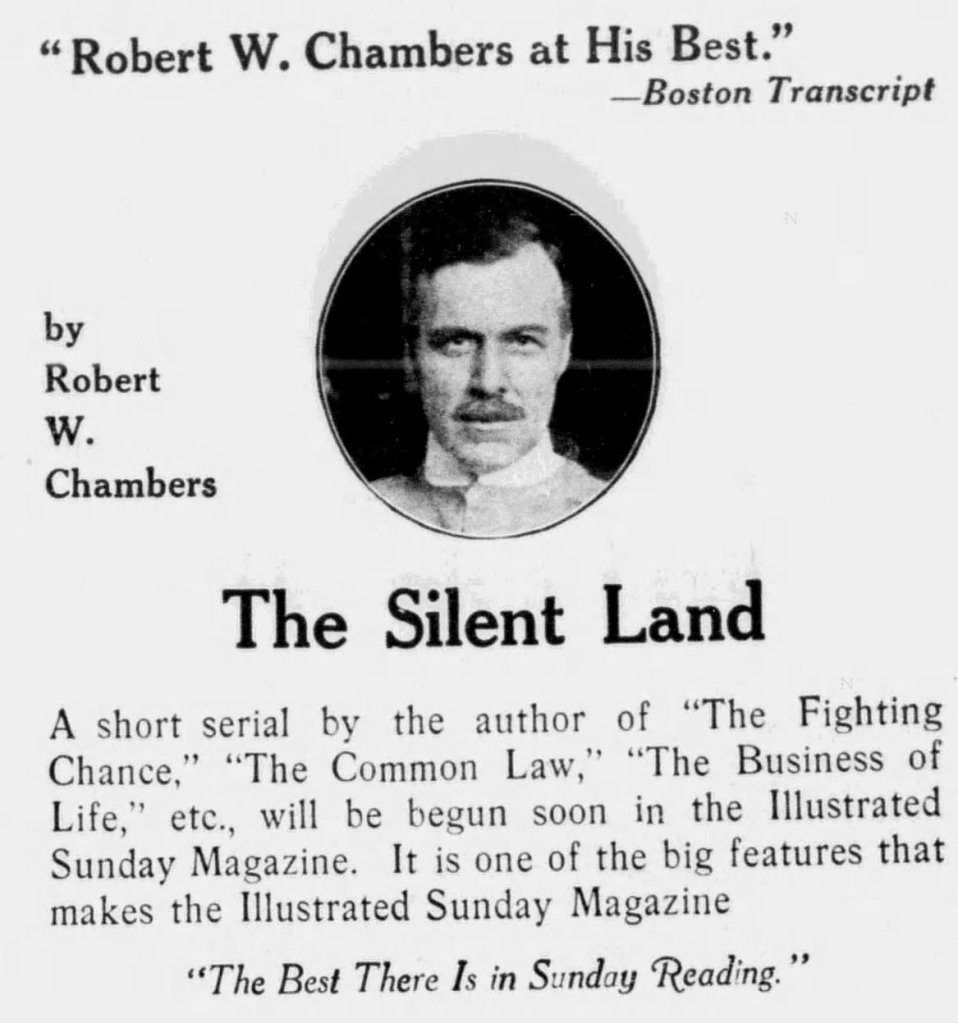
Robert W. Chambers is best remembered today for his collection The King in Yellow (1895), the first half of which features the weird stories that originated Yellow Mythos, with vague and disconcerting references to Carcosa, the Lake of Hali, the Yellow Sign, and the eponymous play The King in Yellow. These stories have proved to have an enduring popularity, and have been rewritten and analyzed many times. Chambers would go on to considerable success as a writer, primarily of popular romances.
However, Chambers didn’t stop writing weird fiction. His next collection The Maker of Moons (1896) is another collection of odd novelettes and short stories; the showcase—and most frequently reprinted—story from that volume is the eponymous “The Maker of Moons,” a Yellow Peril fantasy that Lovecraft would make discreet reference to in “The Whisperer in Darkness.” What many readers miss, however, is that Chambers wrote The Maker of Moons so that the stories lead into each other; it begins with “The Maker of Moons” and then proceeds to “The Silent Land,” whose final paragraphs call back to the first story and then lead into the next story, “The Black Water.” What we get, then, is a more complex metafictional narrative, somewhat similar to what Arthur Machen did with The Three Impostors; or, The Transmutations (1895).
“The Silent Land” contains two references to Carcosa—and as such, can be read as a kind of addendum or extension of The King in Yellow, although the connection is tenuous and the atmosphere is different. Still, for students of the Yellow Mythos, it rewards reading.
In the same year that it was originally collected in The Maker of Moons (1896), “The Silent Land” was serialized in several newspapers, notably The Pittsburgh Press (12 & 19 Jul 1896), The Inter Ocean (19 & 26 Jul 1896), and The Buffalo Courier Express (19 & 26 Jul 1896); it was later serialized again in The Salt Lake Herald (10 Nov 1907) and the Illustrated Sunday Magazine (3 & 10 Aug 1913).
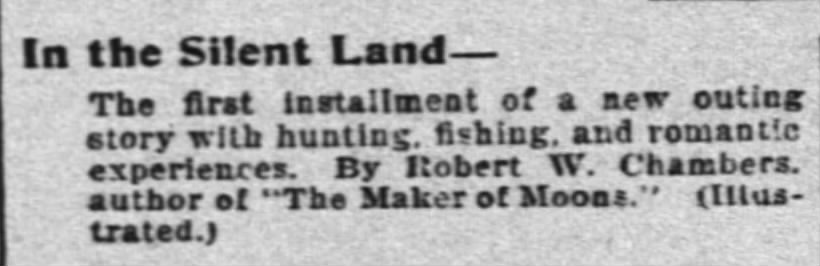
While a complete Chambers bibliography is difficult to compile, “The Silent Land” seems to have been rarely reprinted except in reprints of the entire The Maker of Moons collection, as newspaper serials, or, now that it is in the public domain, as part of a general mass reprint of Chambers’ weird work. Anthologists have largely missed it, likely because it is such a slight story, though attentive critics and scholars like Kenneth Hite have long noted it and the connection to The King in Yellow, including reference to it among their annotations.
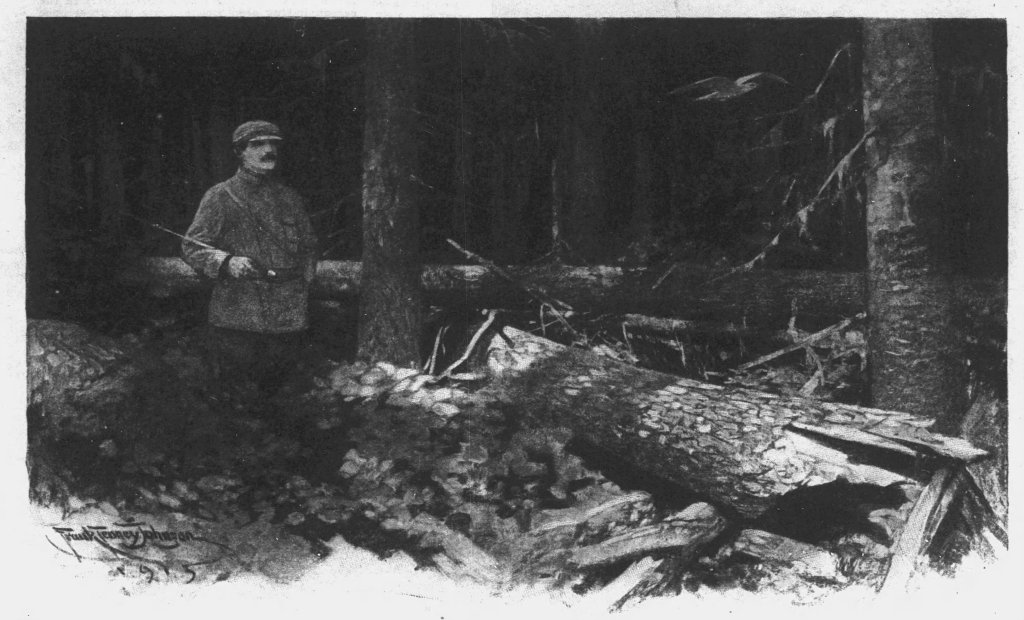
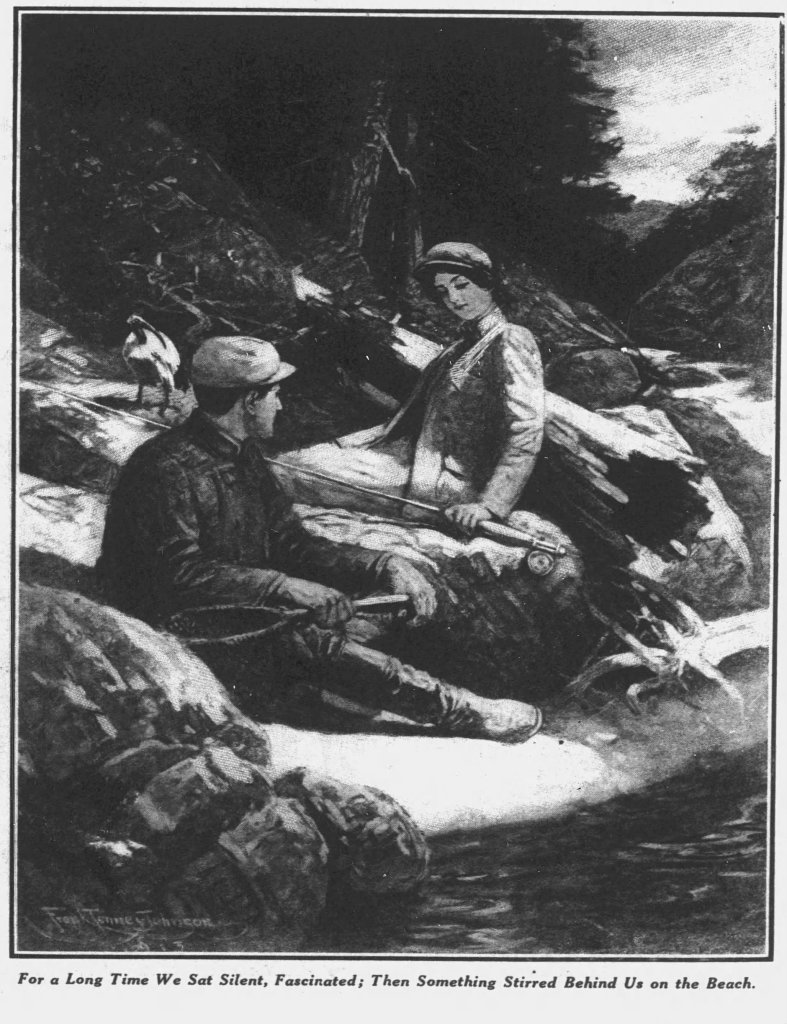
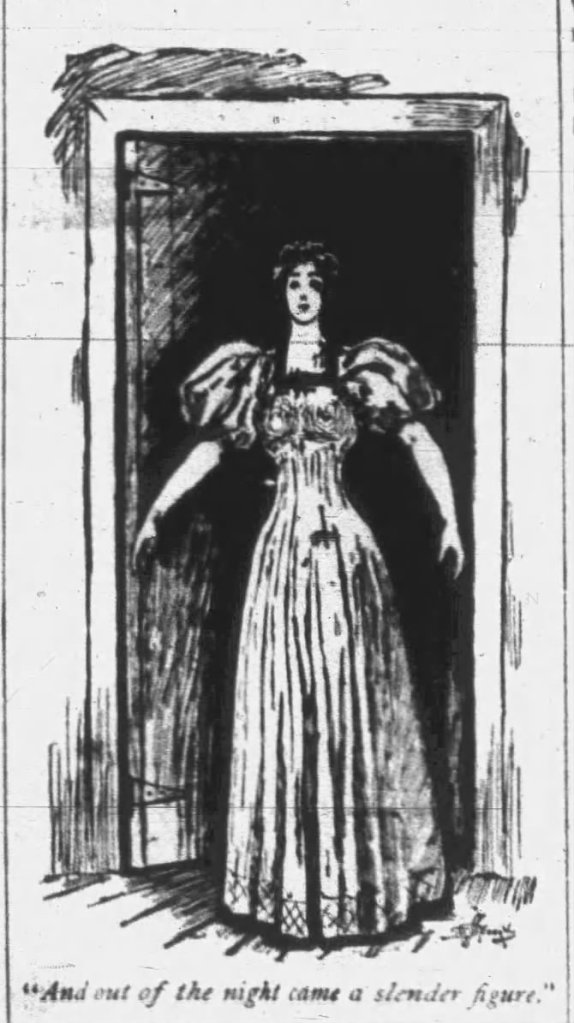
The text of “The Silent Land” reproduced below is taken from The Maker of Moons (1896) (which can be read in toto at the Internet Archive), with two changes. First, several of the newspaper serializations included illustrations, which have never been reprinted; these are included below. Second, Chambers’ original story included several songs in untranslated French. For the benefit of readers, a literal translation of these lines in English is provided alongside the original text.
※
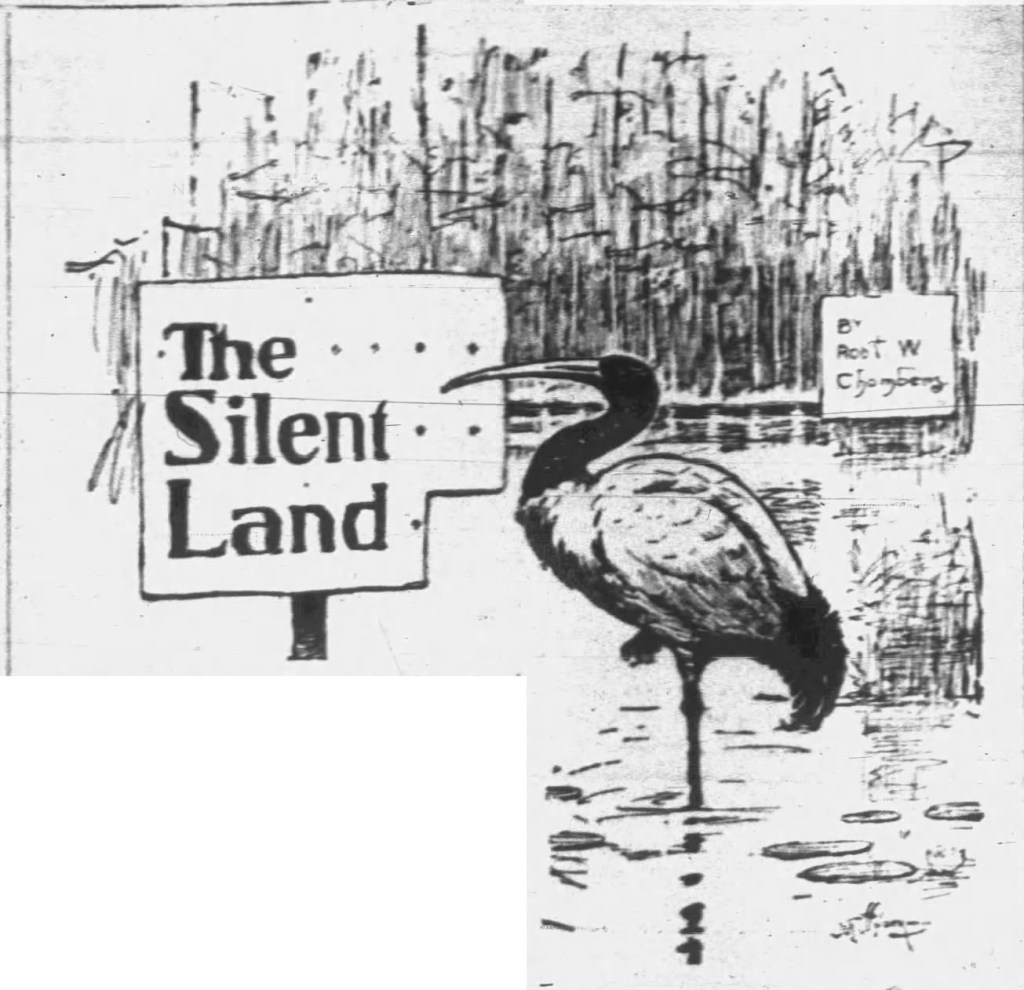
The Silent Land
by Robert W. Chambers
“And the woman fled into the wilderness, where she hath a place prepared of God.”
I.
FERRIS and I had had a dispute, a bitter one, and, as usual, Ferris had pushed his cap over his eyes until the hair on the back of his head stuck out.
“You can’t do it,” he said, shoving both hands up to the wrists in his canvas fishing-coat.
“I’ll prove it,” said I. “What a stubborn mule you are, Ferris!”
“Stubborn nothing,” he retorted, “you and your theories must have your little airing, I suppose, but I don’t intend to assist.”
“I’m right sometimes,” I said.
“Sometimes you’re wrong, too,” said Ferris.
Then he walked off toward the cliffs, whistling, uncompromising, untidy.
“There’s a hole in your leggings!” I called after him, but he did not deign to answer me.
“Obstinate ass,” I thought, for we were very fond of each other, “if he wastes his time with the Silver Doctor he’ll rue it.”
Then I looked at Solomon and lighted a cigarette.
Solomon was a bird, an enervating bird of the Ibis species, wrinkled and wizened, like the mummies of his native land, which was Egypt. The bird was mine, a sarcastic tribute from Ferris, and the bird and the sarcasm both bore directly on the only disputes which ever arose between Ferris and myself. The cause of these disputes was a trout-fly, an innocent toy of scarlet and tinsel, known to anglers as the “Red Ibis.” I swore by it, Ferris swore at it. In the long winter nights when the streams gurgled under the frozen forests and the lake was a sheet of soggy snow, Ferris and I loafed before the fire pulling tangled masses of leaders and flies about and dragging the silken lines over the rugs to hear the reels click. Every fly known to the
brethren of the angle was discussed-every fly except the Red Ibis. We both honestly tried to avoid this bone of contention. We talked of Duns and Hackles, and Spinners and Gnats, but in spite of every precaution the Red Ibis would occasionally rise like a fiery spectre between us, and then we disputed vehemently.
“No angler with a rag of self-respect would use the Ibis,” said Ferris, with that obstinate shrug which added gall to the insult, and I—well, the crowning insult came when Ferris sent to Cairo and imported a live Egyptian Ibis for me.
“Pull out his tail feathers when you ‘re short of Red Ibis,” gasped Ferris, weak with laughter, as I stood silently inspecting the bird in my studio.
“I’ll send him to Central Park,” said I, swallowing my wrath; but I thought better of it, and Solomon, the wizened, became an important member of my household.
The bird was a mystery. I never cared to encounter his filmy eyes. Centuries seemed to roll away when he unclosed them, visions of tombs and obelisks filled my mind-glimpses of desert sunsets and the warm waters of lazy rivers. His black shrivelled head, bare as a skull, lay like a withered gourd among the garish flame-coloured feathers on his breast.
“Solly,” said I, when Ferris disappeared below the cliff, “do you want a frog?”
The bird unclosed one eye. I went to a pail of water in which I kept minnows, and Solomon followed me, solemnly hopping.
“Help yourself, Solly,” said I, uncovering the pail.
I called him Solly because I wished to put myself at ease with this relic of Egyptian Royalty. The splendour of Pharo’s court had not dimmed this hoary prophet’s eye, which was piercing when the sleepy film left it—piercing enough to make me feel thousands of years young, and very bourgeois. In vain I addressed him as
Solly, in vain I gave him chocolate creams,—he was the aristocrat, the venerable high-priest of an Empire dead—and I was his man-servant, his ass, and his ox.
Solomon dabbed once or twice at a sportive minnow, pecked pensively at the handle of the pail, swallowed a pebble or two, and then, ruffling his scarlet feathers, sidled aimlessly back into the sedge by the frog-pond. I watched him for awhile, brooding dreamily among the rushes, but he paid no further attention either to me or to the small green frogs that squatted on the lily-pads or floated half submerged, watching him with enormous eyes.
A noisy blue-jay flitted through the orchard and alighted on a crab-apple tree solely to insult Solomon. He of course was unsuccessful, and his language became so utterly unfit for publication that I moved away, shocked and annoyed.
The sun was very hot. It glittered with a blinding light across the rippling pond, where dragon-flies darted and sailed and chased each other over the water, or flitted among the clouds of dancing midges, searching for prey.
A sweet smell came to me from orchard and sedge; there was an odour of scented rushes in the air, and the lingering summer wind bore puffs of perfume from clover-fields and meadows fragrant with flowering mint. I looked again toward the cliffs. Ferris was not in sight.
“Obstinate mule,” I thought, and, picking up my rod and fly-book, I sauntered toward the forest.
“Ferris,” said I to myself, “is after that big trout by the Red Rock Rapids, but he’ll never raise him with a Silver Doctor, and he’ll come home in a devil of a temper.”
I sat down in a clump of sweet fern and joined my rod. When I had run the silk through the guides and had fastened the nine-foot leader, I opened my fly-book and sought for a Red Ibis fly. There was not one in the book.
“I must send to New York to-morrow,” I thought, turning the aluminum leaves impatiently; ‘ fancy my being out of Red Ibis!” I selected a Yellow Oak fly for the dropper and a nameless Gnat for the hand-fly, and, drawing the leader down to the reel, started on again, carrying my rod with the tip behind me.
The forest was dim and moist and silent. Where the sunshine fell among the ferns a few flies buzzed in the gilded warmth; but except for this and a strange grey bird which flitted before me silently as I walked, there was no sign of life, nothing stirring, not a rustle among the leaves, not a movement, not a bird-note.
Over moss and dead leaves aglisten in the pale forest light I passed,—over crumbling logs, damp and lichen-covered, half submerged in little pools; and the musty fragrance of the forest mould set me dreaming of dryads, and fauns, and lost altars, whose marbles, stained with tender green, glimmer in ancient forests.
This belt of woods was always silent; I often wondered why. There were no birds—none except this strange grey creature which kept flitting ahead of me, uttering no note. It was the first bird I had ever seen in the western forest belt the first bird except Solomon, who occasionally accompanied me on my trips to the long pool in the river which borders the wooded belt on the west.
It was an unknown bird to me,—I could catch fleeting glimpses of it,—and its long slender wings and dark eyes brought no recollections to my mind.
To the north, south, and east the woods were full of thrushes and wood-peckers; full of game, too—grouse, deer, foxes, and an occasional mink and otter, but the shy wood creatures left the western forest belt alone, and even the trout seemed to shun the dark pools where the river swept the edges of the wood until it curved out again by Lynx Peak. I say the trout shunned it, but there was one, a monstrous fish, wily and subtile, that lived in the long amber pool below. Early in the season Ferris had raised him with a Silver Doctor, and Ferris’s madness on the Silver Doctor dated from that moment. His mania for this fly lead him to use it in season and out, and no amount of persuasion or of ridicule moved him.
“Because,” said I, “you had a Silver Doctor snapped off by a big fish, do you imagine it’s the only fly in the world?”
“It’s good enough for me,” he said.
There were two things which Ferris used to say that maddened me. One was, “The Silver Doctor’s good enough for me;” the other was, “New York’s good enough for me.”
We never discussed the latter question after Ferris had alluded to me as a “Latin Quarter Nondescript,” but the battle still raged over the merits of the Silver Doctor and the Red Ibis.
When I came to the wooded slope which overhung the river I buttoned my shooting coat and began a cautious descent, trailing my rod carefully. I headed for the foot of the pool, for one of my theories, which ruffled Ferris, was that certain pools should be fished up stream. This was one of those pools, according to my theory; and when I had reached the rocks and had waded into the rushing water, I faced up stream and
cast straight out into the rapids which curled among the boulders at the foot of the pool.
At the second cast I hooked a snag and waded out to disengage it. Fumbling about under the foaming water I found my fly imbedded in something which refused to give way. I tugged cautiously and gently; it was useless. Then I rolled up my sleeve and plunged my arm into the water up to the shoulder. This time it did give way; I drew out my arm and held up something glistening and dripping, in which my hook was firmly imbedded. It was a shoe, small, pointed, high-heeled, and buckled with a silver buckle.
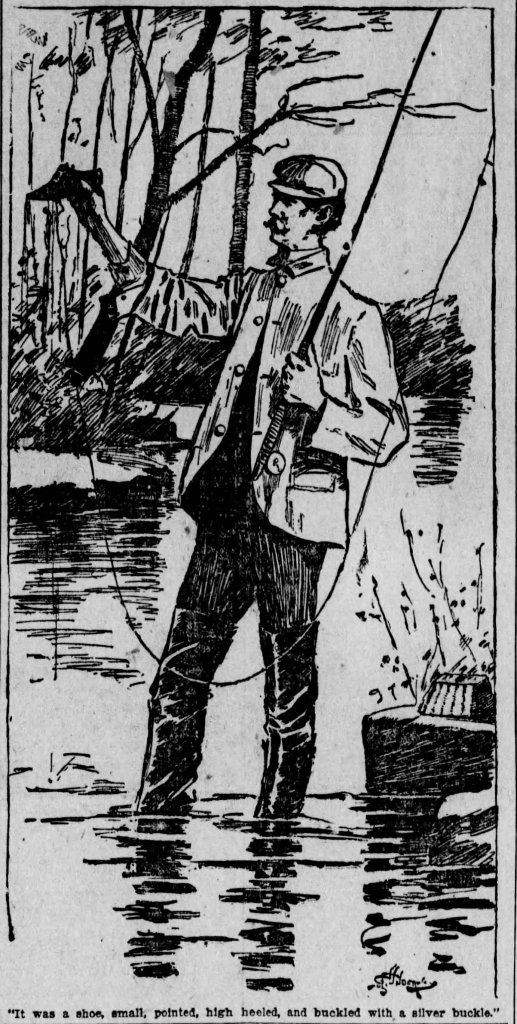
“This,” said I, “is most extraordinary,” and I sat down on a flat rock, holding the shoe close to my eyes.
“Besnard—Paris,” I read stamped on the lining over the heel. And the buckle was of sterling silver. I sat for a moment, thinking.
Our cottage, Ferris’s and mine, was the only house in the whole region that I knew of, except the old house in the glade by the White Moss Spring. That was unoccupied and had been for years—a crumbling, abandoned farm, tottering among the young growth of an advancing forest.
But as I sat thinking I remembered early in the season having seen smoke above the trees once when we were in the neighbourhood of the White Moss Spring, and I recollected that Ferris had spoken of poachers. We had been too lazy to ininvestigate, too lazy even to remember it until, as I sat there holding the small shoe, the incident came back to me, and I wondered whether anybody had taken up an abode in the abandoned farm.
I didn’t like it. The forests and streams belonged to Ferris and me, and although up to the present moment it had not been necessary to employ many keepers, I began to fear that our woods were being invaded and that we should soon be obliged to find protection.
I looked at the shoe, turning it over carefully in my hands. It was new-had scarcely been worn at all.
“Pooh,” I thought, ” the owner of this could scarcely do much damage among the game, but of course there may be bigger shoes in company with this, and those bigger shoes had better look out!”
My first impulse was to throw the shoe into the underbrush. I started to do this, and then carefully laid it down on a sun-warmed rock.
“Let it dry,” I muttered; “it’s evidence for Ferris.” But as it happened, Ferris was not destined to see the shoe.
II.
I FISHED the pool twice, once up and once down, and heaven knows I fished it conscientiously; but no trout rose to the flies, although I changed the cast half a dozen times and even violated my feelings by tying a Silver Doctor. It was true I glanced up and down the river to see whether Ferris was in sight before I did so.
“The wily old devil won’t come up,” said I to myself, meaning the trout; “I’ll give him a rest for a while.” And I sat down on the rock where the pointed shoe was drying in the sun, laying my rod beside me.
“What’s the use of speculating about this shoe,” I thought, and straightway began to speculate.
The strange grey bird with the slender wings and dark eyes slipped through the undergrowth along the opposite side of the pool, but it uttered no call, and I caught only fleeting glimpses of it at intervals. Once, for a moment, it flitted quite near, and a sudden sense of having seen it before came over me, but lfter a little thinking I found myself associating it with a rare bird I had once noticed in Northern France, and of course it was impossible that this could be a French bird.
“It was an association of ideas,” said I to myself, looking at the mark in the slim shoe. “Besnard—Paris.” And I began speculating upon the owner of the shoe.
“Young? Probably. Slender? Probably. Pretty? The deuce take the shoe,” I muttered, picking up my rod. Presently I laid it down again, softly.
“Now, perhaps,” said I to myself, “this little shoe has tapped the gravel of the Luxembourg, patted the asphalt of the Boulevard des Italiens, brushed the lawns of the Bois—ah me! ah me!—the devil take the shoe!”
The sun beat down upon the rock; the little shoe in my hand was nearly dry.
“No,” said I to myself, “I’ll not show it to Ferris. And I’ll not shove it into my pocket—no—for if Ferris finds it he’ll rag me to death. I’ll throw it away.” I stood up.
“I’ll just throw it away,” I repeated aloud to encourage myself, for I didn’t want to throw it away.
“One, two, three,” said I, with an attempt at carelessness which changed to astonishment as I raised my eyes to the bank above whither I had intended to hurl the shoe.
For an instant I stood rigid, my right hand clutching the shoe, arrested in mid air. Then I placed the shoe very carefully upon the rock beside me and took off my shooting-cap.
“I beg your pardon,” said I, ” I did not see you.”
I stood silent, politely holding my shooting-cap against my stomach. But I was confused, for she had answered me in French, pure Parisian French, and my ideas were considerably unbalanced.
I am afraid I stared a little. I tried not to. She was slender and very young. Her dark eyes, half shadowed under black lashes, made me think of the strange, dark-eyed bird that had followed me. She sat on the crooked trunk of a tree overhanging the bank, her feet negligently crossed, her hands in the pockets of a leather shooting-jacket. I’m afraid to say how short her skirts were,—but of course this is the age of bicycles
and shooting-kilts.
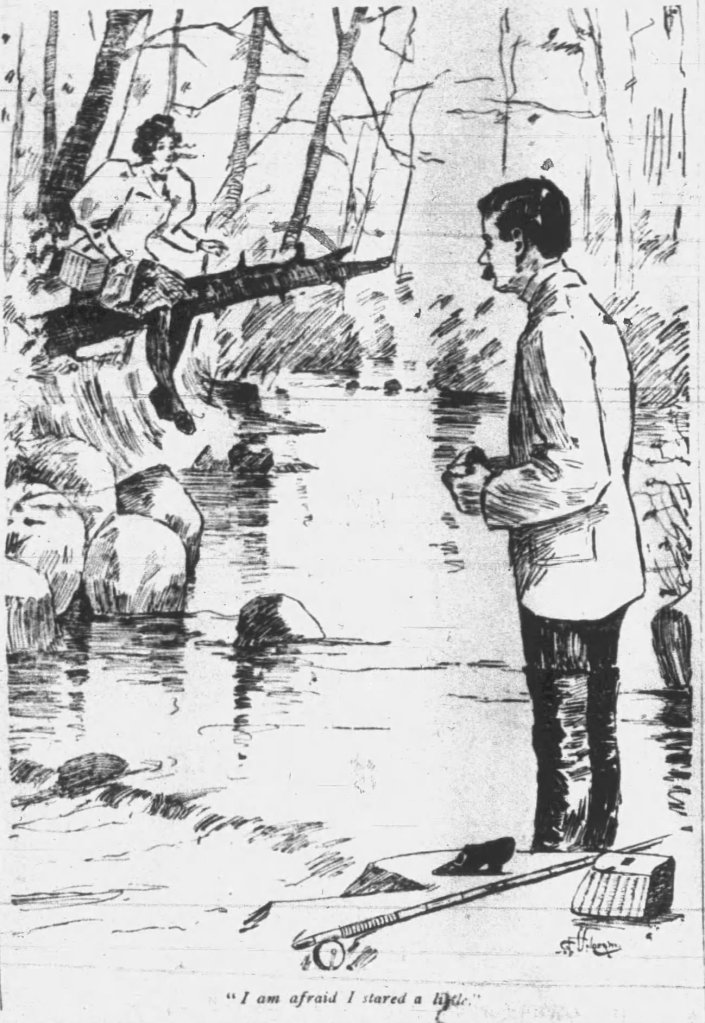
“Madame,” I said, trying to keep my eyes from one small stockinged foot, ” I have found a shoe—”
“My shoe, Monsieur,” she said, serenely.
“Permit me, madame,” said I—
“Mademoiselle—” said she—
“Permit me,—a thousand pardons, Mademoiselle,—to return to you your shoe.”
“It was very stupid of me to lose it,” said she.
“It is nearly dry,” said I; “will Mademoiselle pardon the uncommitted stupidity of which I was nearly guilty.”
“You were going to throw it away,” said she.
“I almost perpetrated that unpardonable crime—”
“Give it to me,” she said, with a gracious gesture.
Now when she smiled I smiled too, and picking up the shoe waded across the pool to the bank under her.
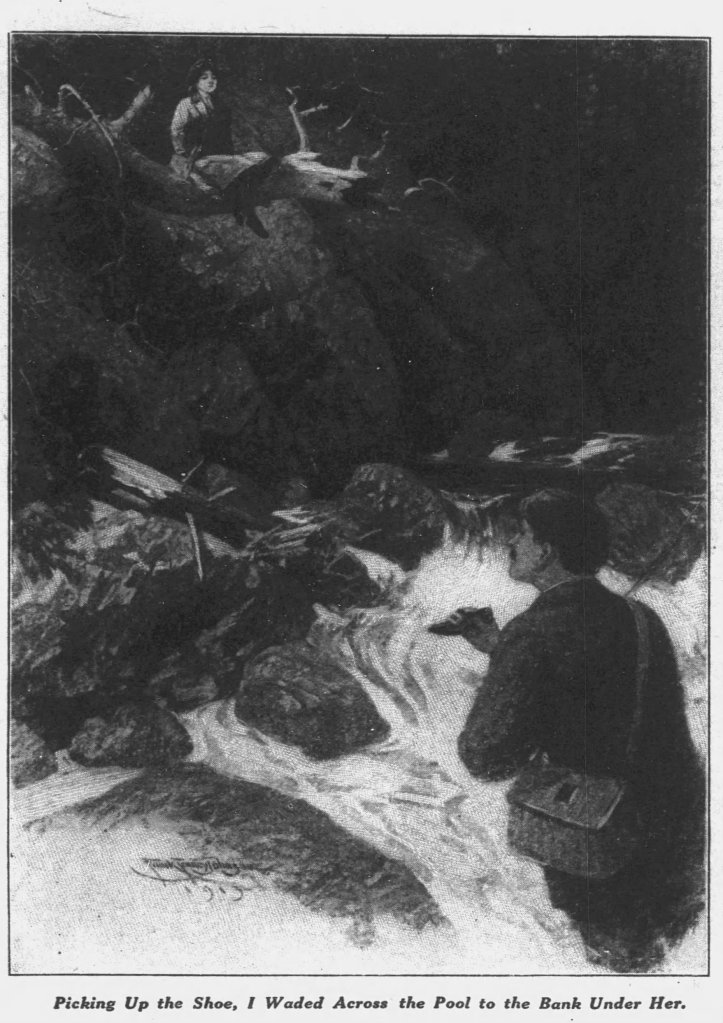
“May I come up?” I asked.
“Pardi, Monsieur, how else am I to get my shoe?”
I clambered up, hanging to limbs and branches. It was a miracle I did not break my neck.
“Why do you not take the path?” she asked. “Do you not know you might fall—and all for a shoe?”
“But such a shoe—”
“True, the buckle is silver—”
“Which I claim the privilege of buckling,” said I, dragging myself up beside her.
She deliberately held out her slim stockinged foot, and I slipped the shoe on it.
The silver buckle was not easily buckled. There were difficulties—for the tongue had become
bent and needed straightening.
“You might take the shoe off again to arrange the buckle,” she said.
“I can straighten it without that,” said I.
When at last the buckle was clasped we had been talking so long that I had told her my name, my residence, my profession, and more or less about Ferris. I don’t know why I told her all this. She seemed to be interested. Then I asked her if she lived at the “Brambles.”
“The Brambles? ” she repeated, looking at her shoes.
“The deserted Farm by the White Moss Spring—”
“Yes—not alone; I have a housekeeper.”
“Aged?”
“Very—and fierce. But I shall do as I please.”
“Did you buy the house? “
“No. It was empty, and I walked in. Next day they sent my twelve trunks from Lynne Centre. The furniture was good.”
“And you have been there for two months?”
“Yes. I have a horse and dog cart too. Rose drives to Lynne Centre twice a week for the marketing. I think I shall keep a cow—I generally do what I please. I choose to amuse myself with you just now.”
“This,” said I, ” is a very strange history; did you know that Mr. Ferris and myself—existed?”
“It is not a strange history,—no, I once saw your house as I passed through the forest belt, but there was nobody there on the lawn except an ordinary person with little side whiskers.”
“Howlett!” I exclaimed.
“Comment?” she asked.
“A servant, an Englishman.”
“Probably,” said she, looking dreamily at me.
Then I told her all about Ferris and myself; how we came every spring to the Clover Cottage with Howlett, a cook, and three dogs as retinue, how we fished in summer and shot in the autumn, how twice a year men came all the way from Lynne Center to house our hay and repair damages, how the game-keepers lurked at the mouth of the valley, miles to the south, to prevent poachers from entering, but we concluded it was not necessary for keepers to patrol the woods inside the valley.
“Now,” I said, “the poachers are in our very midst—here established—and such dangerous poachers, too! What shall we do with them, Mademoiselle?”
“You mean me,” she said, with wide open eyes.
“No,” said I, “I do not mean. you—you are very welcome in our valley.”
“But I am sure you do mean me,” she said, smiling.
Then we talked of other things, of Paris and France; of trout, and flies, and Ferris, of Normandy, and the beauty of the world; but it was nearly five o’clock before we spoke of love.
“I have never loved,” she said, looking at me calmly.
“Oh, how unnecessary!” I thought, for I had believed her clever.
“But,” she continued, gravely, “I think it is time that I did.”
“I think so too,” said I.
“I should like to fall in love,” said she; “I have nothing else to do.”
“I also am very idle,” I said.
“Then,” said she, “the opportunity only is lacking.”
I think I muttered something about poachers—I was not perfectly cool.
“Now,” said she, “I know you mean me!”
“Ah,” said I, “I mean a keener poacher than you or I, a free rover more to be dreaded than an
army of riflemen.”
“Then you don’t mean me,” she said.
I shook my head.
“Do you know,” said she, ” I should very much like to be the heroine of a romance.”
“I will aid you to be one!” I said, hastily.
We had known each other nearly three hours.
“Let us,” said she, “pretend that this is the forest of Versailles in the time of Louis Quinze.”
“Let us indeed!” I cried, enthusiastically.”
“And you are a Count—”
“And you a Marquise—”
“Named Diane; it is my real name.”
“Diane.”
“And you—”
“My real name is Louis—”
“It will do; you may kiss my hand.”
I wondered just where she was going to draw the line. Then, the devil prompting, I entered recklessly into this most extraordinary adventure.
And what an adventure! Words, thoughts even failed me as I looked at her. This woodland maid with the wonderful eyes! There was no mistaking the challenge in her eyes, the half-innocent smile, the utter disregard for every human conventionality.
“How,” thought I— “how can such a woman wear a childlike face!”
I had known coquettes,—many,—but the depth of this strange girl’s recklessness I feared to sound—I dreaded almost to understand.
“She is too deep,” said I to myself— “too deep for me,” and I looked her questioningly in the
eyes.
I don’t know why or how,—I never shall know probably, but a sudden conviction seized me that she was as innocent as she looked. Imagine a man coming to such a conclusion! I felt inclined to laugh, and yet I was as firmly convinced as though I had known her all my life.
“You may kiss my hand,” she said, and held it out to me.
I did. I wished I hadn’t a moment later, for I tumbled head over heels in love with her and fairly gasped at the idea.
“Lovers in the Court of Louis Quinze resembled us, I think,” she said, after a long silence.
“We will try to make the resemblance perfect,” said I, taking both her hands in mine.
She bent her head a little,—there was just a shadow of resistance,—then I kissed her on the
lips.
There are moments in a man’s life when he does not know whether he is a-foot or a-horseback. I remember that I sat down on the bank and carefully uprooted several fems. When I had regained control of myvoice,—the little maid was very silent,—I asked her to tell me of herself, if it might please her to do so.
“I was born,” said the little maid, resting her small head on one hand, “in Rouen. Do you know Rouen?”
“Yes.”
“Papa was an officer, and he killed his general when I was seven years old. It was something about Mama; I never saw her again. Then we went to Canada very quickly; Papa died there. I had been in a convent school; I ran away, and went to New York. I am nineteen, and very reckless.”
“Yes, Diane…”
“I have a great deal of money in banknotes. It was Papa’s. I have never counted it—it is in a big trunk. I understand English, but do not care to speak it. I do not care what becomes of me; I wish it were over—this life. You are the first man who ever kissed me. Do you believe me?”
“Yes, Diane.”
“I wonder you do. Let us go down to the river where the sunlight falls. The descent is easy—”
“Diane—you must not go—”
“With you—will you give me your hand?”
“Come.”
“Did you see that shy grey bird?” said the little maid, hesitating on the slope, her hand in in mine.
I could not see it, for we had already begun the descent.
III.
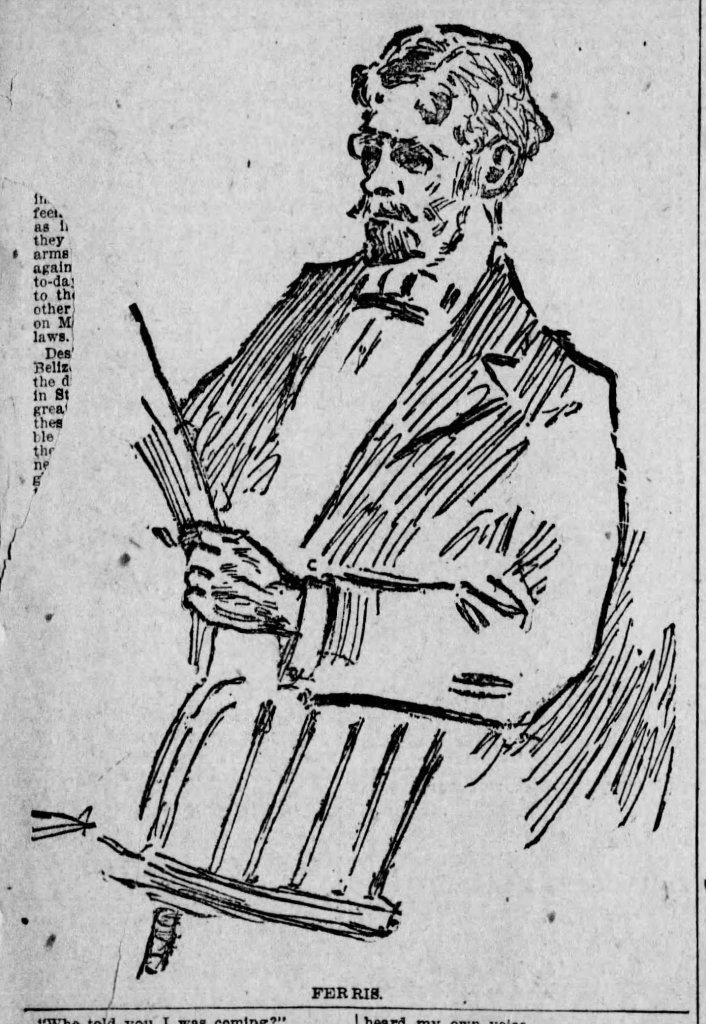
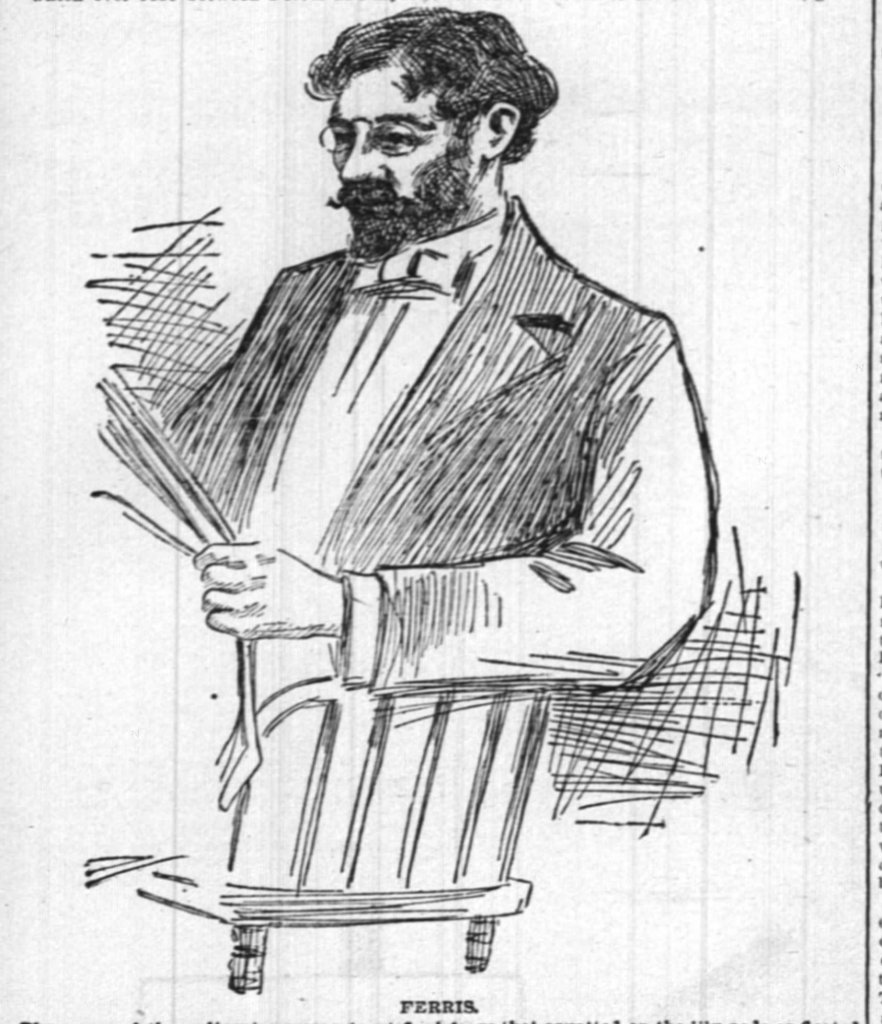
“WHERE the mischief have you been all day?” demanded Ferris that evening as we sat on the veranda after dinner.
“Well,” said I lighting a pipe, “when you bad your fit of sulks I went off for a brace of trout.”
“Did you see anything worth seeing?”
“I saw no trout,” said I.
“Unfortunate, eh?”
“Oh not very,” I said, looking at Solomon.
“Not very?”
“Look at that ridiculous bird, Ferris.”
“Swallowed a frog the wrong way…” said Ferris, watching the solemn contortions of Solomon; “he looks like a little Jew in a crimson overcoat with a stomach ache. What fly did you use, Louis?”
“Everything; couldn’t raise a fin.”
“Oh, you’ve been trying that old devil down by the west woods ! I should think you’d let him alone; it’s useless,” yawned Ferris.
“I’m going to try for him every day till I get him,” said I, trying not to lie more than necessary.
“Of course you’ll not infringe?”
“Infringe I Not much! You can have the whole west woods to your own sweet self; but you’re an idiot!”
“Not at all,” said I, thankfully; and in a burst of confidence I confessed that I had used a Silver Doctor.
There was a momentary gleam of triumph in Ferris’s eyes, but he was very decent about it and
asked me most politely for the loan of a Red Ibis. Oh men of the busy world, learn courtesy from
the angler! There are other things you need not learn from anglers.
“My dear fellow,” said I, more touched than I had been for a long time, “I haven’t a Red Ibis left. I shall write Conroy to-night before I retire. If you really do want an Ibis I will catch Solomon and pluck a plume from his tail feathers.”
“I don’t want it enough to inconvenience you or hurt Solomon’s feelings,” said Ferris, laughing.
After a long interval of silent smoking Ferris rose and yawned at the moon.
“Do you know what a Spirit-bird is, Ferris?”
I asked, rapping my pipe on the arm of my chair.
“Spirit-bird—the French one—the Oiseau Saint-Esprit? Yes, I’ve seen one—in the Vosges.”
“Grey-with slim wings and big dark eyes?”
“That’s the bird,” said Ferris; “why?”
“Well, I thought I saw one to-day. Of course that ‘s impossible.”
“Of course,” said Ferris, yawning again! “I’m going to turn in; good-night, old chap.”
“Good-night,” said I, tapping nervously on the veranda with my pipe.
Howlett came out a few moments later with my wading-shoes which he had been oiling.
“Well,” said I, “are the hob-nails all right?”
“Seving ‘ob nails is h’out, sir,” replied Howlett, holding up the shoes for my inspection.
“Put them in as soon as they’re dry. Did you oil the bamboo? Good. Is my lamp lighted? Put it out—and you need not sit up, Howlett; I ‘m going for a stroll.”
“Thank you sir,” said Howlett,— “and Solomon, sir?”
Now it was one of my delights to see Howlett house Solomon. The wily Ibis loved to snoop about in the moonlight, and he was always ready for Howlett when that dignified servant came to round him up.
I looked at Solomon, who stood gloomily brooding among the water-lilies.
“He ought to be in bed,” said I.
Howlett descended the veranda steps with arms extended, but Solomon sidled out into the pond. Howlett pleaded earnestly. He flattered and cajoled, but Solomon was obdurate.
“Nothink I say do move ‘im, sir!” said Howlett, stiffly; “he is vicious to-night, sir.”
“Then take the boat,” I said.
Howlett in a boat chasing a sulky Ibis was one of those rare spectacles that few are permitted to witness. Once a week Solomon turned “vicious” and then, at Ferris’s and my suggestion, Howlett took to the boat. A terrestrial Howlett was solemnly ludicrous, but an aquatic Howlett was impossible. Of course Ferris and I never laughed—that is, aloud, but we usually felt rather weak after it was over.
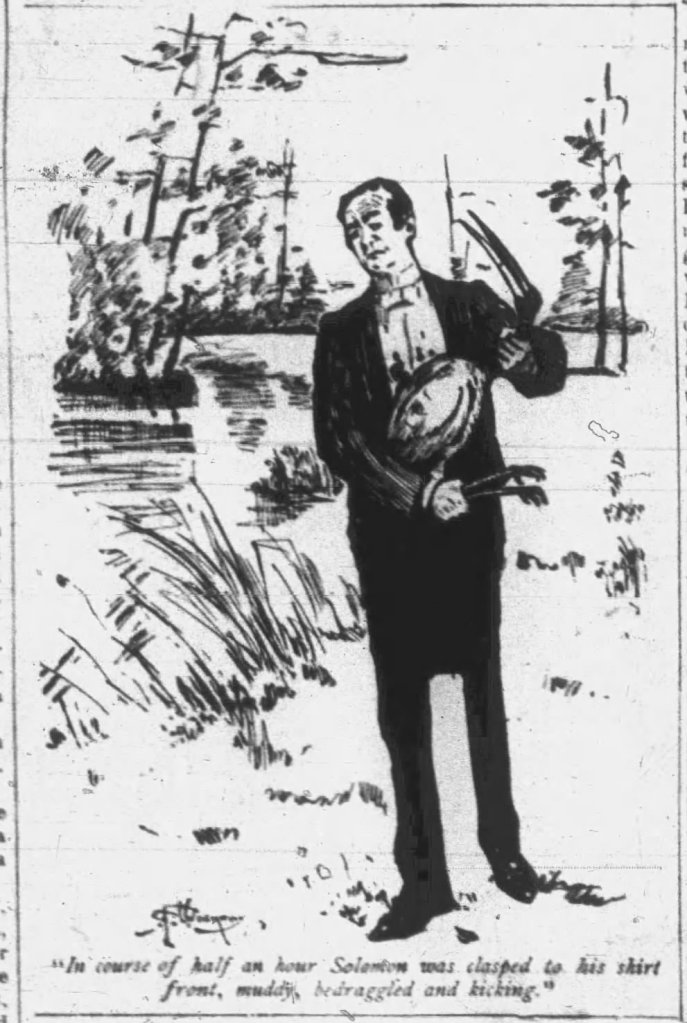
In the course of half an hour Solomon, mad, wet, and rumpled was cornered by Howlett and clasped to his stiff shirt front, muddy, bedraggled, and kicking.
“Are you not mortified, you bad bird?” said I, as Howlett passed toward the kitchen where Kitty the cook was airing his straw-thatched house.
“A vicious bird, sir, good-night, sir,” murmured Howlett.
“Good-night, Howlett; breakfast at seven tomorrow,” said I, and sauntered out into the moonlit valley.
I had been walking almost half an hour when it occurred to me that I should be in bed.
“What the deuce am I sprinting about the valley at this hour for?” I thought, looking around.
Over the shadowy meadows the night mist hung, silvered by the moonlight, and I heard the meadow-brook rippling through the sedge. Slender birches glimmered among the alders, and all the little poplar leaves were quivering, but I felt no breath of air.
Where the dark forest fringed the meadow I saw the moonbeams sparkling on lonely pools, but the depths of the woodland were black and impenetrable, and the forest itself was vague as the mist that shrouded it.
For a long time I stood, looking at the stars and the mist, and little by little I came to understand why I was there alone.
I knew I should go on, I wished to, but I lingered in the moonlight staring at earth and sky until something moved in the thicket beside me, and I followed it, knowing it was the Spirit-bird.
When I entered the forest I could scarcely see my hand, but I felt a trodden path beneath my feet, and I heard before me the whisper of soft wings, and presently I heard the river, rushing through rocks of the western forest, and when I came to the wooded bank the moonlight fell all around me.
There was a narrow strip in the forest, overgrown with silver birch and poplar and lighted by the moon, but I searched it in vain, up and down, up and down, always with the whisper of soft wings in my ears.
At last I called, “Diane,” and before I called again, her hands lay close in mine.
* * * * * *
“I came,” said the little maid, “because you were coming.”
“Who told you I was coming?”
“Told me? No one told me. Rose is asleep. Why did you come?”
“Why did you, Diane?”
“I? Because you came. How did you find my bower?”
“Your bower, Diane?”
“It is yours I know; I call it mine; I call it the Silent Land.”
“It is very silent,” I said.
“It is always silent—no birds, not even the noise of the water. Do you think it is sad? There are times when sounds,—the song of living creatures and the countless movements of things that live, trouble me. Then I come here. There are flowers.”
“The air is very sweet, too sweet. What is the perfume? The trees are heavy with fragrance. Ah!—are you tired, Diane?”
“No—it is the odour of blossoms; I sleep here sometimes.”
“Your hair is loose—how long it is I Is it the perfume from your hair—is it your breath—”
“The blossoms are very sweet; the moon has gone.”
“There is a star,—bow soft your breath is.”
“I do not see the star; where, Louis?”
“It is there;—clouds are veiling it;—there is a mist over all—”
“It is my hair—over your eyes.”
IV.
“HOWLETT,” said I, one warm afternoon, “Solomon is unendurable: he follows me everywhere, and I wish you to see that he minds his own business.”
“A hobstinate bird, sir,” said Howett, ” and vicious when crossed,—which I scorn ‘is h’anger,—beg pardon sir,—for ‘e’s took to biting wen ‘is vittles disagrees.”
“Has he bitten you?”
“Twice, sir,—which ‘appily my h’eyes is huninjured, though h’aimed at by ‘is beak.”
“This is intolerable,” said I; “you must punish him, Howlett.”
“‘Ow, sir?”
“Tie him up when he bites. Have those flies come from Conroy’s?”
“Nothink ‘as came, sir.”
“Where is Mr. Ferris?”
“Mr. Ferris is a whipping of the h’Amber Pool sir, with three sea-trout to the good and a brace of square tails. Solomon followed ‘im, sir, and is h’observing the sport.”
“Then I can get away without that red feathered Paul Pry tiptoeing after me,” I thought, and sent Howlett for my rod-case.
“Tell Mr. Ferris, when he returns, that I may not be back until dinner,” I said, when Howlett brought the case.
I selected a four-ounce split bamboo, pocketed my fly-book and a tin box of floating flies for dry fishing, picked up a landing-net, and walked away toward the western woodland, whistling. I had not fished for three weeks, although every day I went away into the western woods with rod and creel. Ferris laughed at my infatuation for the long pool where the great fish lay and jeered at me when I returned evening after evening with no trout, although the river, except the western stretch, was full of trout. He had never come to the pool,—I should have seen him from the Silent Land if he had,—but Solomon sneaked after me on several occasions. Once I caught him craning his neck and peering into the bower,—our bower—and as I did not care to have him pilot Ferris thither, I hustled him off.
The woods were fragrant and warm, stained by the afternoon sun ; the quiet murmur of the brook came to me from leafy thickets as I walked, and I heard the river rushing in the distance and the summer wind among the pines. White clouds shimmered in the blue above, sailing, sailing God knows where, but they passed across the azure, one by one, drifting to the south, and I watched them with the vague longing that comes to men who watch white sails at sea.
I had turned my steps toward the long pool, for I had decided to fish that afternoon, wishing to redeem my words to Ferris—at least in part; but as I stepped across the trail I heard the sound of wings, and a shadow glided in front of me toward the forest. It was always so from the first, and now, as always, I turned away, following unquestioningly the Spirit-bird. The noise of the river ceased as I entered the Silent Land. For
an instant the grey bird hovered high in the sunshine, then left me alone.
I threw myself full length upon the blossoming bank and waited, chin on hand. And as I waited, she came noiselessly across the moss, so quietly, so silently that I saw her only when her fingers touched mine.
“It has been a long time,” we said; and; “Did you sleep?” and; “When did you awake?”
Then we asked each other a thousand little questions which are asked when lovers meet, and we answered as lovers answer. We spoke of the Spirit-bird as we always did, wondering, and she told me how that morning it had tapped upon her window as the day broke.
“Rose did not hear it,” she said, “but I was already awake and thinking.”
“I awoke at sunrise too,” I said; “for a moment I thought it was a swallow in the chimney that fluttered so—”
“The Spirit-bird flies swiftly when Love is dreaming,”—that is a very old proverb of Normandy. What shall we do, Louis—there is so much to do and so little time in life!—I brought my lute—ah! you are laughing!”
“The lute is such an old-fashioned toy; I didn’t know you played. Will you sing too, Diane? Something very old, older than the lute.”
“I learned a song this morning because I thought you would care for it. That is why I dared to bring my lute into the Silent Land. The song is called, “Tristesse.”
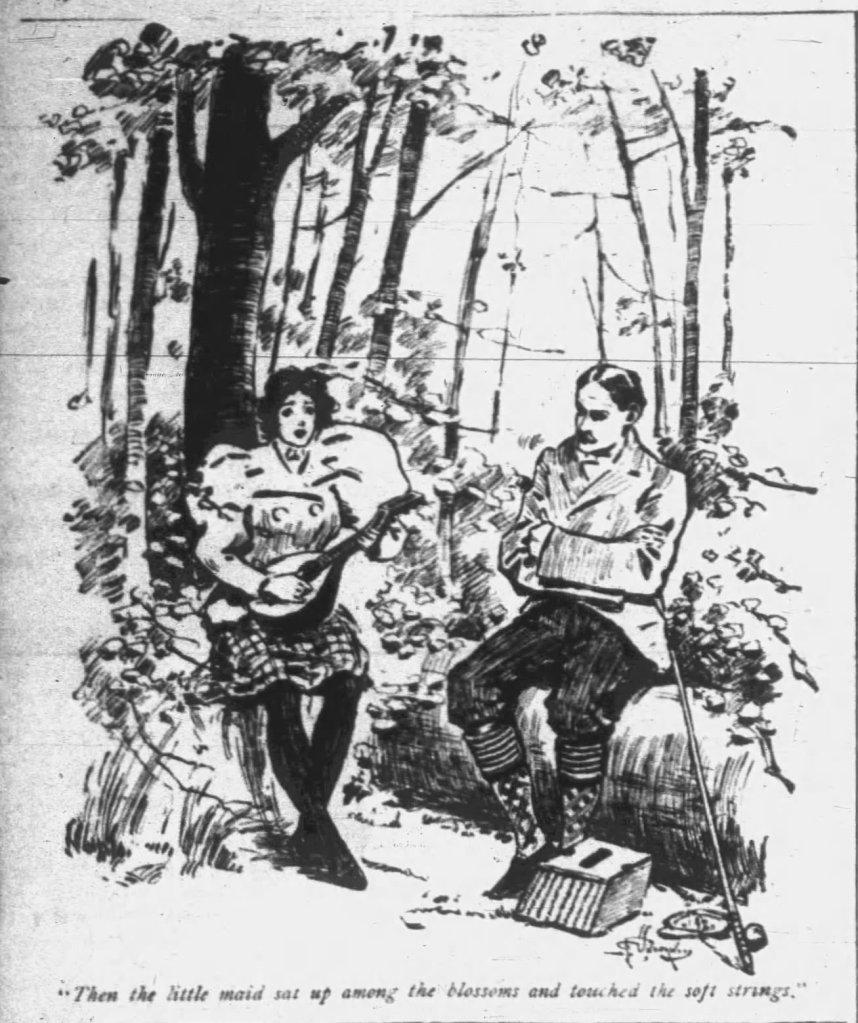
Then the little maid sat up among the blossoms and touched the soft strings, singing:
| “J’ai perdu ma force et ma vie, Et mes amis et ma gaité; J’ai perdu jusqu’ á la fierté; Qui faisait croire á mon génie. Quand j’ai connu la Vérité J’ai cru que c’était une amie; Quand je l’ai comprise et sentie, J’en etais déjà dégoûté. Et pourtant elle est éternelle Et ceux qui se sont passés d’elle lci-bas ont tout ignoré. Dieu parle, il faut qu’on lui réponde; Le seul bien qui me reste au monde Est d’avoir quelquefois pleuré. | “I have lost my strength and my life, And my friends and my joy; I have even lost the pride That made people believe in my genius. When I first encountered the Truth, I thought it was a friend; When I understood and felt it, I was already weary of it. And yet it is eternal, And those who have done without it Here below knew nothing. God speaks; He must be answered; The only good thing I have left in this world Is that I have sometimes wept. |
“That is all,” said the little maid.
“Sing, Diane,” I said, but I scarcely heard my own voice.
She laughed and bent above me with a graceful gesture. “Not that,” she said, “for you at
least are not sad. There is a chansonnette,—shalt I sing again?—then be very still, here at my
feet. Do you not think my lute is sweet?”
| “Je voudrais pour moi qu’il fut toujoura fête Et tourner la tête Aux plus orgueilleux; Être en même temps de glace et de flamme, La haine dana l’âme, L’amour dans lea yeuz.” | “I wish for myself it were always a celebration And to turn the heads Of the proudest; To be at once ice and flame, Hate in my soul, Love in my eyes.” |
“You, Diane?” I whispered; but she smiled, and the mystery of love veiled her dark eyes; and she sang:
| “Je ne voudrais pas á la contredanse, Sans quelque prudence Livrer mon bras nu Puis, au cotillion, laisser ma main blanche Trainer sur la manche Du premier venu.” “Si mon fin corset, sl souple et si juste, D’un bras trop robuste Se sentait serré, J’aurais, je l’avoue, une peur mortelle Qu’un bout de dentelle N’en fut déchiré.” | “I wouldn’t want, at the contradance, Without some caution, To offer my bare arm; Then, in the cotillion, to let my white hand Linger along the sleeve Of the first man who comes along.” “If my fine corset, so supple and so snug, Were to feel constricted By an arm too strong, I would, I confess, be mortally afraid That a piece of lace Might be torn.” |
She looked at me with soft, unfathomable eyes and touched the lute. When I moved she started
from her reverie with a gay little nod to me:
| “Quand on est coquette, il faut être sage, L’oiseau de passage Qui vole à plein cœur Ne dort pas en l’air comme une hirondelle, Et peut, d’un coup d’aile Briser une fleur!” | “When one is a coquette, one must be wise, The passing bird That flies with all its heart Doesn’t sleep in the air like a swallow, And can, with a beat of its wing, Break a flower!” |
“Sing,” I said in a changed voice.
“I have sung,” she said, and laid her lute in my hands. But I knew nothing of minstrelsy and lay silent, idly touching the strings.
She had fashioned for her fair head a wreath of sweet-fern twined with clustered buds, white as snow and faintly perfumed.
“So I am crowned,” she said, “a princess in the Silent Land. Where I step, all things green shall flourish; where I tum my eyes, blossoms shall open in the summer wind;—am I not queen?”
“Will you not sing again, Diane? “
“No, it pleases me to hear a legend now. You may begin, Louis.”
“Which—the Were-wolf or the Man in Purple Tatters or the—”
“No, no—something new.”
“The Seventh Seal?”
“Begin it.”
“And when be opened the Seventh Seal there was silence in Heaven—”
“Dear Saints, have we not silence enough in the Silent Land? Tell me about battles.”
“‘And the sound of their wings was as the sound of chariots of many horses running to battle.’ I could tell you about battles, Diane.”
“Tell me,—don’t move your arm,—tell me of battles, Louis.”
“There was once a King in Carcosa,” I began.
But the little maid was already asleep.
I thought I heard a step in the undergrowth and listened.
The forest was silent.
V.
WHEN we awoke it was night. Down from the dark heavens a great star fell, burning like a lamp. Above the low-hanging branches, sombre, drooping, heavy with fragrance, a misty darkness lay like a vast veil spread.
In the stillness I heard her quiet breathing, but we did not speak.
Silence is a Prophet, unveiling mysteries.
Then, through the forest, we heard the sound of wings, and as we moved, stepping together into the shadows, the moon rose above Lynx Peak, gigantic, golden, splendid.
So we passed out of the forest into the star-lit night.
VI.
THE skies were leaden, the watery clouds hung low over the valley, and a wet wind blew from the west, ruffling the long pool where Diane stood. Kilted and capped in tweeds, creel swinging with every movement of the rod which swayed and bent with her bending wrist, she moved from ripple to shallow, wading noiselessly while the silken line whistled and the gay flies chased each other across the wind-lashed pool.
We spoke in a low voice, glancing at each other when the light cast struck the water.
“Under the alders Diane—” I said; “have you changed the Grey Dun for the Royal?”
“No, what is your new cast?”
“Emerald and Orange Miller—I shall tie an Alder-fly in place of the Miller. Do you think the water warrants a cast of three?”
“It is rough; I don’t know,—Louis, was that an offer?”
“I think it was the spray from the rapids. Shall we move up a little? Do you feel the chill of the water?”
“I am cold to my knees,” said the little maid, “the river is rising I think—ah, what was that?”
“Nothing,—you touched a floating leaf in the swirl.”
“Splash!” A great fish flopped over in the pool, a trout, lazy, unwieldy, monstrous.
“Oh! he missed it!” cried Diane, turning a little white.
“Cast again,” I whispered, tossing my rod onto the sandy beach and unslinging my landing-net.
Trembling a little with excitement she cast across the swirl, once, twice, twenty times, but the monster was invisible. Somewhere in the dusky depths of that amber well the fierce fish lay watching the lightly dropping flies, unmoved. Then we changed the cast; I emptied my fly book, but nothing stirred except the hurrying
water, curling, gurgling, tumbling through the rocks. Finally I broke the silence.
“Diane, it was the spinner that he rose to. He’s after something redder. Have you a Scarlet Ibis?”
“No—have you?”
I almost groaned, for Conroy’s flies had not arrived, and I hadn’t an Ibis in the world.
After a while she reeled in her silken line, and we waded to the sandy beach and sat down.
“Oh, the pity of it,” sighed Diane; “never have I seen such a trout before. I suppose it is useless, Louis.”
I sat moodily poking holes in the sand with the butt of my landing-net.
We spoke of other things for a time, sinking our voices below the roar of the river. Presently a sunbeam stole through the vapour above, lighting the depths of the dark pool. And all at once we saw the trout, hanging just above the pebbly bottom; we saw the scarlet fins move, the great square tail waving gently in the current, the mottled spotted back, the round staring eyes. The swelling of the gills was scarcely perceptible, the broad mouth hardly moved.
For a long time we sat silent, fascinated; then something stirred behind us on the beach and we slowly turned. It was Solomon.
“Ciel!” faltered Diane, “what is that?”
“My bird—an Egyptian Ibis,” I whispered, laughing silently; “he has followed me, after
all.”
Solomon ruffled his scarlet plumes, blinked at me, scratched his head with his broad foot, pecked at a bit of mica, and took two solemn steps nearer.
“Diane,” said I, suddenly, “I’ll get a red fly for you; don’t move—the bird will come close to us.”
But Solomon was in no hurry. Inch by inch he sidled nearer, dallying with bits of moss and shining pebbles, often pausing to reflect, but gradually approaching, for his curiosity concerning Diane was great.
“He looks as if he had stepped off an obelisk,” murmured Diane; “I have seen hieroglyphics that resembled him. Oh, what a prehistoric head—so old, so old!”
“His name is Solomon,” I whispered. “Solomon in all his glory was not arrayed like one of these. I’m going to have a small bit of Solomon’s glory—sh—h! ah! I’ve got him!”
It was over in a second, and I do not believe it was painful. There was a flurry of sand, a furious flapping of flame-coloured wings, a squawk! a smothered laugh—nothing more.
Mortified, furious, Solomon marched off, shaking the river sand from wing and foot, and Diane and I, with tears of laughter in our eyes, wound the scarlet feather about a spare hook, tied it close with a thread from my coat, and whipped it firmly to the shank. I looped the improvised fly to Diane’s leader, and she shook the line free.
The reel sang a sweet tune as she drew the silk through the guides, and presently she motioned me to follow her out into the rippling shallows, and I went, swinging my landing-net to my shoulder. She cast once. The fly struck the swirl and sank a little, but she drew it to the surface and the current swept it under the alders.
For a moment it sank again; then the ripples parted, and a broad crimson-flecked side rolled just below the surface of the water. At the same moment the light rod curved, deeply quivering, the reel screamed like the wind in the chimney, and the straining line cut through the water, moving up the pool with lightning speed.
“Strike!” I cried, and she struck heavily, but the reel sang out like a whistling buoy, and the fish tumbled into the churning water under the falls at the bead of the pool.
“Now,” said Diane, with a strange quiet in her voice, “I suppose he is gone, Louis.”
But the vicious tug and long, fierce strain contradicted her, and I stepped back a pace or two to let her fight the battle to the bitter end.
The struggle was splendid. Once I believe she became a little frightened,—the rod was staggering under the furious fish,—and she spoke in a queer, small voice:
“Are you there, Louis?”
“I am here, Diane.”
“Close behind?”
“Close behind.”
She said nothing more until the great fish lay floating within reach of my net.
“Now!” she gasped.
It was done in a second; and, as I bore the deep-laden net to the beach, I caught a fleeting glimpse of a figure among the trees on the bank above. Diane was kneeling breathlessly on a rock beside me; she did not see the figure. I did, for an instant. It was Ferris.
VII.
DINNER was over. Ferris and I lingered silently over the Burgundy; and Howlett hovered in the corner with a decanter of port until Ferris shook his head.
It had been a silent dinner. Ferris tried to be cordial, and failed. Then he tried to be indifferent, with better success. We exchanged a word or two concerning a new keeper who was to be stationed at the notch in the north, and I spoke to Howlett about cleaning the lamps.
Neither of us mentioned rods or trout, although Howlett had served us a delicious sea-trout that evening which had fallen to Ferris’s rod, over which we ordinarily should have exulted.
Ferris of course knew that I had seen him among the trees on the bank above the long pool. It was my place to speak; we both understood that, but I did not. What was there to say? Suppose I should go back to the beginning and tell him—not all, but all that I was bound in honour to tell him.
What would he think if I spoke of the Spirit-bird, of the Silent Land, of my long deception ? An explanation was due him—I felt that with a vague sense of anger and humiliation. For weeks I had abandoned him; I never thought about his being lonely, but I knew now that he had felt it deeply. Oh, it was the underhand part of the business that sickened me, the daily deceit, the double dealing. Ferris was no infant. A word would have been enough. I had never by sign or speech spoken that word which would at least have set me right with him, and which I could have spoken honourably. And moreover, if I had spoken that word,—no, not a word even, a look would have been enough,—Ferris would never have entered the western forest belt.
We sat dawdling over our wine in the glow of the long candles while the fire crackled in the chimney place; for the evening was chilly, and Solomon brooded sullenly before the blaze. Howlett, noiseless and pompous, glided from side-board to table, decorously avoiding the evil jabs from Solomon’s curved bill, until Ferris woke up and told him he might retire, which he did with a modest “good-night, sir,” and a haughty glance at Solomon. A half hour of strained silence followed.
I leaned on the table, my head on my hands, watching the candle light reflected on the fragile wine glasses. Myriads of little flames glistened on the crystal bowls, deep stained with the red wine’s glow. The fire snapped and sparkled on the hearth, and Solomon slept, his wizened head buried in the depths of his flaming plumage.
And as we sat there, there came a faint tapping at the curtained window. Ferris did not hear it I did, for it was the Spirit-bird.
“I must go,” said I, rising suddenly.
“Where?” said Ferris.
I looked at him stupidly for a moment, then sank back into my chair.
Solomon stirred in his slumber and I heard the wind rising in the chimney.
Ferris leaned across the table and touched my sleeve.
I looked at him silently.
“I must speak,” he said; “are you ready?”
I did not reply.
“Sadness and silence have no place here, between you and me. Shall I tell you a story I once read?”
“I am half asleep,” I muttered.
“This is the story,” he said, unheeding my words. “There was once a King in Carcosa—”
My hand fell heavily upon the table.
“—And there was given unto him a mouth speaking great things and blasphemies—”
“For God’s sake, Ferris—”
“Yes,” he said,” for God’s sake.”
We sat staring at each other across the table, and if my face was as white as his I do not know, but my hand trembled among the glasses till they tinkled.
“I was born in France,” he said at last. “You did not know it, for I never told you. What do you know about me after all? Nothing. What have years of friendship taught you about my past? Nothing. Now learn. My father was shot dead by an inferior officer in Rouen. The assassin escaped to Canada where—I found him. He died by his own hand—from choice. I did not know he had a child.”
The dull fear at my heart must have looked from my eyes. Ferris nodded.
“Yes, you know the rest,” he said; “the shame and disgrace of the suicide drove the child away—anywhere to escape it—anywhere—here, into the wilderness the woman fled where she hath a place prepared of God.”
The Spirit-bird was tapping on the window, I heard the noise of wings beating against the pane.
“I must go,” I said, and my voice sounded within me as from a great distance.
“Vengeance is God’s,” said Ferris, quietly: “I am guilty.”
“I must go,” I repeated, steadying myself with my hand on the table.
The noise of wings filled my ears. I knew the summons.
“Do you not hear?” I cried.
“The wind,” said Ferris.
Then the door slowly opened from without, the long candles flared in the wind, and the ashes stirred and drifted among the embers on the hearth. And out of the night came a slender figure, with dark eyes wide, and timid hands outstretched—outstretched until they fell into my own and lay there.
“I came from the Silent Land,” she said; “the bird lead me; see, it has entered with me, Louis.”
“It is my wife who has entered,” I said quietly to Ferris, and the little maid clung close to me, holding out one slim hand to Ferris.
There was an interval of silence.
“Father Gregory will breakfast with us tomorrow,” said Ferris to me.
“A Priest?”
“Open the window,” smiled Ferris; “there is a small grey bird here.”
So I opened the window and it flew away.
“Good-night,” whispered the little maid, and kissed her hand to the open window.
“Diane!”
She came to me quietly. Ferris had vanished; Solomon peered dreamily at us with filmy eyes.
“The Spirit-bird has gone,” she said.
Then, with her arms about my neck, I raised her head, touching her white brow with my lips.
* * * * * *
When my wife read as far as you have read, she picked up the embroidery which she had dropped beside her on the table.
“Do you like my story?” I asked.
But she only smiled at me from under her straight eyebrows.
The next morning I received her ultimatum; I am to cease writing about beautiful women of doubtful antecedents who inhabit forest glades, I am to stop making fun of Howlett, I am to curb my passion for rod and gun, and, if I insist on writing about my wife, I am to tell the truth concerning her. This I have promised Ysonde to do, and I shall try to, in “The Black Water.”
※
There is not much of a plot to “The Silent Land”; the tone is often flippant, the characters ciphers, and strictly speaking, there is nothing overtly supernatural that might mark this as a weird tale. Yet there is a great deal of atmosphere and suggestion to the writing, and that tantalizing ambiguity is, I suspect, the point. There’s a quality to the story reminiscent of Robert Aickman or Shirley Jackson, which toys with supernatural horror but refuses to resolve any of it.
Probably the most notable tease in the story is the repeated refrain “There was a King in Carcosa”—which readers of Chambers’ previous weird collection, The King in Yellow (1895), will connect with “dim Carcosa” in the shadowy mythology of those stories. We never get more than that beginning; never know whether the characters have read or are paraphrasing The King in Yellow play or some other, related legend. Yet the thought they might lends the utterances more dread than they would normally have.
Readers interested in further Chambersian connections might compare the characters of Hastur in “The Demoiselle d’Ys” (1895) and The Drums of Aulone (1927).
Bobby Derie is the author of Weird Talers: Essays on Robert E. Howard and Others and Sex and the Cthulhu Mythos.
Deep Cuts in a Lovecraftian Vein uses Amazon Associate links. As an Amazon Associate I earn from qualifying purchases.

