Historical Racism
This story contains racist historical stereotypes and language.
Reader discretion advised.
Seabury Grandin Quinn was the most prolific contributor to Weird Tales during its initial run (1923-1954); especially remembered for his occult detective character Jules de Grandin, whose adventures ran to a whopping 93 stories in WT over a period of 25 years. Readers might well ask how Quinn was able to keep things fresh and not repeat himself…and, well, he did. Just not always in obvious ways.
Like Robert E. Howard and other prolific pulpsters, Quinn wasn’t above recycling themes or even cannibalizing entire plots into new stories as the situation required it. While folks who only read his stories in Weird Tales will pick up on the structural similarities between the de Grandin tales—which are structured a bit like a murder mystery, starting out with a victim or inciting incident and ending with an expository explanation and the villain dead or in custody—to really see how much Quinn borrowed from himself, you have to look at what he wrote outside Weird Tales.
One such series was the Washington Nights’ Entertainment, a series of 24 detective/mystery stories starring his character Major Sturdevant that ran in Detective Tales and Real Detective Tales, and reprinted in various newspapers. Many of the Sturdevant tales have a weird element, and Quinn borrowed from several of them heavily for later de Grandin stories; in particular, “The Kiss of Madagascar” (Sturdevant, Real Detective Tales Dec 1924) became the basis for “The Black Orchid” (de Grandin, Weird Tales Aug 1935).
“The Kiss of Madagascar” was reprinted in various newspapers (such as the Muncie Evening Press, 7 Mar 1929 (12)), and also appeared under the title “The Blood Thief” in Detective Book Magazine (Sep 1931). However, like the other Sturdevant tales, it has never been collected and remains obscure.
※
The Kiss of Madagascar
by Seabury Quinn
“Hey, somebody lend me twenty-five bucks?” Bailey, who represented the Post-Intelligencer at Washington, peered through the Record’s office door, glancing hopefully from Williams, the Record’s correspondent, to Loomis, of the Clarion-Call.
“Kind o’ original in your needs, ain’t you?” Loomis asked. “Most of us don’t need more than ten, or fifteen bucks, anyhow.”
“Aw, fellers,” Bailey pleaded, “don’t throw me down; I need this dough, I tell you. Gotta get my sweetie some flowers. She’s goin’ to a doings up at the Highlands tomorrow, and I want to knock her dead with an orchid corsage. I’ll pay you back when my check comes next week, honest—”
“Orchid,” Loomis cut in again. “Gosh, he’d actually give her orchids.”
“Hey, what’s biting on you?” Bailing asked angrily. “You talk as if I was fixin’ to present the dam with a lovers’ knot of rattlesnakes, or something.”
“You might as well, according to my way of thinking,” Loomis returned. “Listen: Do you remember when the French Madagascar Commercial Mission was over here last year?”
“Yes,” Bailey agreed sulkily, “I remember, all right. But what’s that got to do with your disliking orchids?”
“Everything,” Loomis answered. “When that aggregation hit Washington last year they looked like a constellation of bright stars of hope to me. I’d slipped up on important matters three times hand-running, and it looked as if I’d soon be hunting a Government clerkship when the Frenchmen came along.
“‘Here’s where I get in solid,’ I dolt myself. ‘I’ll just run up and cop off a red-hot story and square myself with the old man.’
“Did I? I did not. The Frenchies were occupying the Bushnell residence, in Sheridan Circle, and they’d had time to dig in by the time I rang the front doorbell. A tenth-assistant secretary, who smelled like a ladies’ hairdressing emporium, gave me a supercilious look anda sheet of mimeographed legal cap. ‘Zat ees all ze Commeesion haff for pooblication,’ he said, and nodded to the doorkeeper to give me the gate.
I started down Massachusetts Avenue toward DuPont Circle, when someone hit me a crack on the shoulder.
“‘Hello, Frank,’ my assailant said, ‘what’s the trouble? You look as if you were taking a guilt conscience out for an airing.’
“It was Major Sturdevant, of the Secret Service, and he’d been responsible for my scoring more beats than all the luck I’d have since coming to Washington.
“‘No: it’s the job,’ I said. ‘Those Frenchmen back there gave me a raw deal.’
✾
“‘WELL, well. I reckon I can give you a lift. I know La Peruse, the director of the Commission, slightly—was on my way to see him when I bumped into you. I’ll take you back with me.’
“‘Next time you want ten or a dozen guys murdered, call on me, Major.” I asked as we mounted the Bushnell steps and Sturdevant rang the bell.
“‘Ze Commeessionaire, he air not to see ze journaleests,’ the overgrown porter announced.
“Sturdevant thrust his card foward, adding the oral explanation. ‘Service de Surete.’
“‘Oh, mais oi, M’sieur, certainment,’ the porter agreed, his hostility evaporating before Sturdevant’s announcement.
“We rode up two floors in the automatic electric elevator, and entered a large parlor on the third floor which seemed to combine the duties of lounging room and office.
“‘Ah, Monsieur Sturdevant,’ a big, blond man greeted as we followed the porter through the tapestry lambrequins at the door.
“The Major shook hands cordially and presented me to the Frenchman. He was well over six feet tall and proportionately broad, with the prominent nose and cheekbones that bespoke Basque ancestry and the fair skin and light eyes that told of descent from the Northmen who overran Brittany in the days before Hastings.
“‘Mister Loomis,’ he acknowledged Sturdevant’s introduction in excellent English. ‘I had not thought to give anything but a formal statement to the press at this time; but I make an exception of you. Here are some memoranda you may find of interest. Copy what you wish and announce your dispatches as coming from the Commission.’
“I thanked him and dug into the papers, getting enough live stuff to fill two columns comfortably.
✾
“STURDEVANT and La Peruse talked of adventures in far places as I worked, and it was not till the library clock struck midnight that I realized how long we had been there.
“‘But, gentlemen, you will surely remain the night, certainly,’ La Peruse insisted as we rose to go. ‘It is past twelve, and the snow is deep. I can make you most comfortable.’
“I looked out the window and saw he was correct. Both Sturdevant and I hastened to accept the invitation.
“‘Queer chap, La Peruse,’ the Major told me as he snapped off the light. ‘He could have retired twenty years ago, if he’d wished, but colonial administration seems a sort of passion with him. Africa, Polynesia, Madagascar—wherever the French have possessions, he’s given the best years of his life and a lot of his own money to carrying on their work. This commissionership he holds now is only an honorary position: he doesn’t get a cent out of it. Why— Good Lord! What’s that?”
“We leaped out of bed and rushed into the darkened hall as a second blood-chilling cry echoed through the house.
“‘Down there!’ Sturdevant shouted, running headlong toward a room at the turn of the corridor. In a moment we were at the door.
“‘La Peruse!’ he called. ‘La Peruse, what’s wrong; are you ill?”
“We pressed our ears to the wood, waiting a reply, but no word came from the bedroom. Only a gurgling noise, like water escaping through a drain, or a man fighting desperately for breath. Then we burst open the door.
✾
“FEELING his way along the wall, Sturdevant located the electric switch and snapped on the light. La Peruse lay on his bed, the covers kicked to the floor, his hands flexed in a rigidity lie that of death, fingers digging into the yielding mattress. His pajama jacket was open at the neck, and on the white skin of his throat, below the line of tan, was a ruby disc where warm blood welled up from a tiny wound. His eyes were wide open, staring, and on his sunburned face was such a look of mortal terror as it seldom seen outside the phantasies of nightmare.
“‘La Peruse,’ the Major called, hurrying to the bedside and laying a hand over the Frenchman’s heart.
“His warm touch seemed to revive the stricken man. He rose unsteadily on his elbow, staring at us in pathetic bewilderment. ‘Where is it?’ he asked in a shaking voice. ‘Did you see it, Sturdevant, mon ami?’
“‘See what?’ Sturdevant asked. ‘What hurt you, La Peruse?’
“The other passed a trembling hand across his forehead. ‘The vampire,’ he answered with a shudder. ‘The demon un-dead, Major. It was here. I tell you, sitting on my breast, sucking the life-blood from my veins—’ he crossed himself awkwardly. ‘I saw it, flicking like a flame of hell-fire over me——”
“‘Rats!’ Sturdevant interrupted. ‘My dear fellow, you’ve had a bad dream. A vampire! You’ll be seeing old Mother Hubbard and her dog, next!’
“The Frenchman smiled wanly. ‘So?’ he said. ‘Look,’ he touched the wound at his throat and held his blood-stained fingertips up for inspection. ‘Is this blood or not blood, my friend? And if it be blood, how comes it there? You, yourself, can testify my door was locked; there is no other entrance to the room. Yet when you broke in what did you find, hein? If it were no vampire, then, pour l’amour de Dieu, what was it?”
✾
“SERVANTS and attaches of the Commission, in varying stages of dishabille, were crowding into the room. La Peruse waved them away and turned to Sturdevant.
“‘My friend,’ he said, ‘I am afraid. And my fear is the greater because I know not what it is I fear. How long I slept before It came I cannot tell, but I remember waking with a feeling of suffocation—no pain, but weakness and utter impotence—to see a red, fiery thing waving like a flame above me and to smell the odor of a charnel house. At first I knew not where I was, but realization came slowly. The thing that seemed to burn above me I cannot describe, for the darkness of the room and its very nearness obscured my vision. How long I lay wondering I have no idea; but suddenly I became aware of a feeling like a pulling at my throat. Then I knew: The thing was sucking my blood.
“‘Rubbish!’ Sturdevant replied. ‘I don’t doubt you think you saw this thing, but you couldn’t have. No one ever saw a vampire, or anything like one, outside a book or a bad dream.’
“‘You do not know the things I have seen, my friend,’ the other returned. ‘Here in what we call civilization we have forgotten the ancient things of nature, so we say they do not exist. But the people who live in the silent places have not forgotten, they remember, and they know. Listen, my friend:
“‘The revolt of Hova in 1898, which led ultimately to the exile of Queen Ranavalona, was not particularly anti-European. The Malagasy government had long employed English and French army officers and engineers, and found Europeans quite tolerable. But there is no question the Hova were violently opposed to Christianity. Travelers say the Hova had no definite religion of their own. That is not so. They worshiped a goddess known as “The Fragrant One,” whose manifestation was said to be a man-eating tree.’
“‘I was in Gallieni’s army of pacification when we put down the rebellion. One day word came by a convert Andevo that Hova insurrectionists had captured a missionary priest. We hurried inland to the rescue, and arrived to find the mission a smoldering ruin. Two days forced marching brought us to the Hova camp fires’ ashes, still warm. Another day our scouts surprised the war party dancing about something white on the ground. One volley of musketry sent them into the jungle, and when we charged their camp we found a skull and several bones in the center of their dancing circle.’
“‘Cannibalism?’ Sturdevant asked.
“‘Non, non,’ La Peruse denied. “The skull and bones were clean, clean as though scraped with sandpaper: there was no evidence of fire upon them, but something more we found: their surfaces had been eaten away—how do you say? eroded?—as though by acid.’
✾
“‘H’M,’ Sturdevant commented. ‘Whose skull was it?’
“‘The skull was that of a white man, and in the front of the mouth was a gold tooth—what you call a crown—the priest had set in by an American dentist in Paris. Our guide, the convert, recognized it at once, for that golden tooth had been the marvel of the mission settlement.’
“‘Still, I don’t see any evidence of your man-eating tree,’ Sturdevant objected. ‘The Hova might have used an acid substance to pickle their victim’s skeleton. Such things are no uncommon among barbarous peoples.’
“‘Yes, yes, you are right to be skeptical,’ the Frenchman admitted, ‘but wait. The guide told us the Hova made sacrifices to “The Fragrant One” by placing the victim (preferably a Christian) in the tree’s branches. It is supposed to be a sort of vegetable octopus, with tentacles to catch and hold its prey. When the tree had eaten the offering, the bones were collected and kept as souvenirs by the devotees.
“‘Now I, myself, had always scouted these stories: but when I saw the murdered priest’s skeleton I reconsidered. Do you know the Benus [sic] flytrap?”
“‘You mean the insect-catching plant of Carolina?’ Sturdevant asked.
“‘Yes,’ La Peruse answered, ‘the same. That plant, as you know, has a flower so delicately sensitive that the slightest touch by an insect closes the petals like the leaves of a book. Once imprisoned, the unfortunate insect is slowly dissolved by a powerful acidulous liquid excreted by the plant. As you would say, he is digested.
“‘Now consider: in tropical lands the flora of the temperate zone attains much greater size. If American and south Europe produce “flytrap” plants large enough to digest the humble bee, why should not a tropic island like Madagascar develop a tree large enough and fierce enough to devour a man? Eh?’
“‘H’m, possibly,’ Sturdevent tugged at his beard, ‘you may be right. At any rate, we’re still in the dark regarding the cause of your wound. It’s nearly morning; lie down and try to sleep. I’ll stay with you the rest of the night.’
“I left them together and crawled back in my own bed, but did precious little sleeping. The echo of the Frenchman’s ghastly cry and the sight of his still, horror-drawn face stayed with me till daylight.
✾
“WE had a Continental breakfast—coffee and rolls—in our bedroom, and I turned my overcoat collar up against the storm as I plunged my way toward Connecticut Avenue. La Peruse begged Sturdevant to stay with him so piteously that the Major consented to remain an hour or so.
“I knocked the information I’d gotten into shape and sent it off to the home office. The job was moderately safe for while longer, anyhow.
“I hadn’t been in the office fifteen minutes next morning when a call came from Sturdevant. ‘Hello, Loomis,’ he said, ‘there’s something dam’ queer going on up here.’
“‘What’s the trouble?’
“‘I don’t know: that’s where the difficulty comes in. La Peruse is worse. I stayed her again last night, and ran in to see how he was getting on about every half hour till five o’clock this morning. Everything seemed O. K., and I’d turned in for a couple of hours’ sleep when he gave another one of those war whoops, and when I got to his room he was lying just as we found him yesterday morning. I had more trouble in bringing him to this time, and he’s so weak from loss of blood we’ve had a physician up to look him over.’
✾
“I REPORTED at the Bushnell House about seven that evening, and Sturdevant took me to La Peruse’s room at once. The Frenchman was like a wraith of his former self. Violet half-moons under his eyes, a waxen pallor beneath his sunburn and a queer, pinched look about the nostrils testified eloquently to sudden and overwhelming weakness. The hand he extended unsteadily in greeting was as thin and bloodless as a fever patient’s.
“‘Now, Frank,’ the major said, ‘I want you to act as relief guard tonight. I’ll sit with La Peruse while you sleep; then you take your turn at sentry-go.’
‘We sat talking till I began to feel drowsy, and the Major took up his vigil by the sick man’s bed.
“He shook me awake shortly after two o’clock, and I slumped down in an easy chair beside the night light, a copy of the Clarion-Call in my hand.
“‘Do you wish coffee, sir?’ someone asked in a strong English accent. I looked up and saw a small and exceedingly black man with regular features and wire-straight hair, standing in the doorway, a tray containing a coffee pot and cup in his hands.
“‘Yes, thank you,’ I answered. ‘Pour it black, please.’
“‘Very good, sir,’ he replied, filling my cup. I swallowed a mouthful of the steaming black beverage and turned back to my paper.
“The old man had a riproaring editorial in that issue, lambasting the tar out of the administration about the coal strike, but, somehow, the words seemed to have lost their punch as I sipped my coffee. Presently the lines of type began to run together before my eyes. I nodded, shook my head to clear my vision, and—
✾
“LOOMIS, Loomis, wake up. Give me a hand here!”
“‘Eh, wha—what?’ I asked stupidly, half-rising from my chair, then sinking down again as the room commenced whirling like a Coney Island carousel.
“Gradually I began to see thing. Sturdevant, his white hair and beard bristling with anger and excitement, bent about La Peruse. La Peruse lay half out of the bed, head downward, eyes staring glassily, the bandage on his throat displaced, and a thin trickle of blood oozing from his reopened wound.
“‘Good Lord!’ I exclaimed, bracing myself against the arms of my chair. ‘What’s happened, Major?’
“‘La Peruse has been murdered while you sat there snoring.’
“‘But I wasn’t asleep,’ I protested. ‘I felt a little queer after I drank that coffee, but—’
“‘Eh? What’s that?” he asked sharply. ‘You drank coffee? Where? When? Who gave it to you?”
“‘Why, the boy!’ I answered.
“‘H’m,’ the Major lifted La Peruse to the bed, and glared at me. ‘Go find that servant and have someone ‘phone the doctor. There’s still a flutter in this poor chap’s pulse. No thanks to you, though.’
“I roused a secretary and asked him to call a physician, then inquired my way to the servants’ quarters. Three minutes’ search sufficed to find the man who served me, peacefully sleeping.
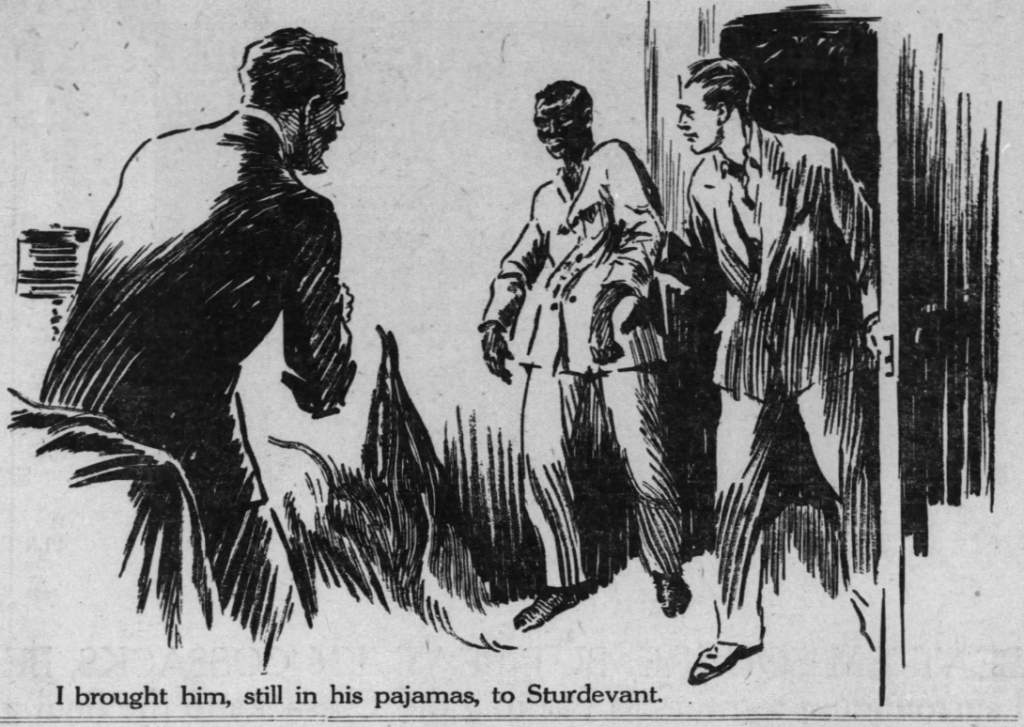
“I brought him, still in his pajamas, to Sturdevant.
“‘Did you serve coffee to this gentleman?’ the Major asked, eyeing him sternly.
“‘Yes, sir,’ the black man answered. ‘I thought some black coffee might help him stay awake.’
“‘H’m,’ Sturdevant looked him over from head to feet. ‘Pretty bold, doping him right under my eyes, aren’t you?’
“‘Doping him?’ the man’s assumption of horrified incredulity was masterly. ‘You surely don’t think that, sir.’
“He turned to me. ‘How much coffee did you drink, sir?’ he asked.
“‘Not more than half a cup,’ I answered.
“‘Ah,’ his insolence was superb as he stretched out his hand, lifted the cup, and drained it at a single gulp.
“He looked at Sturdevant. ‘If the coffee is drugged, sir,’ he announced, ‘it surely should act on me.’
“‘H’m, all right; you may go.’
“‘Thank you, very much, sir,’ the other replied, as he bowed his way from the room.
“The physician came bustling in. ‘What’s all this?’ he asked testily, making a hasty examination of this patient.
“‘Why, the man’s almost dead from exhaustion. Every indication of severe hemorrhage. Where’s the blood?’
“Sturdevant shrugged in annoyance. ‘We know no more about it than you do, doctor,’ he replied.
“‘Then you’re dam’ ignorant,’ the physician blurted. ‘There’ll have to be an immediate transfusion of blood if we’re going to save this man’s life.’
“Hurried telephone calls to the doctor’s office for paraphernalia, an examination of half a dozen of the Commission’s personnel for a suitable blood count, and the big porter was chosen to supply the vital fluid.
“When morning came La Peruse was resting easily, his body refreshed with new blood.
“‘We saved him this time,’ the doctor said as he struggled into his ulster, ‘but I’ll not answer for the consequences if he has another hemorrhage. See that he’s watched every moment.’
“‘He’ll be watched, all right, doctor, you may depend on it,’ Sturdevant assured him.
“As I was leaving he whispered, ‘Come up again tonight, Loomis. We’ll find out what’s what this evening, or know the reason why.’
✾
“LA PERUSE was slightly improved, though still very weak, when I arrived at the Bushnell house about eleven o’clock that evening.
“‘Hello, Frank,’ Sturdevant greeted as I was divesting myself of hat, muffler and overcoat.
“He led me to the room assigned us, shut the door carefully and lighted one of his long, black cheroots. ‘Been doing some visiting and exploring today,’ he announced. ‘Had quite a conference with Professor Stockton, of the Smithsonian Institute. He’s the foremost authority on tropical flora in the country.’
“‘What’s the idea?’ I asked. ‘Did you want to check up on La Peruse’s theory of the man-eating tree?’
“‘Partly,’ he replied. ‘Stocktown says La Peruse may not be far wrong. He gave me a lot of interesting data on Madagascar, too.’
“‘Shall I take the first trick?’ I asked as we walked toward La Peruse’s room.
“‘Not much; we’ll handle this business together,’ he answered. ‘I can’t risk having you sleep at the switch a second time.’
“We tiptoed across the room, and I was about to take a chair when the Major put out his hand, giving me a slight push. ‘Under the day bed, Loomis,’ he ordered.
“‘What?’ I whispered incredulously.
“‘Get under the day bed there,’ he repeated. ‘You’re going to be the silent partner in our little game tonight, and the invisible one, too. Crawl under that couch and keep your mouth shut and your eyes open. Go on.’
“I slipped to the floor beneath the couch.
“THE Major pressed the bell communicating with the servants’ rooms. In a few moments the little black man who had waited on me the previous night entered. ‘You rang, sir?’ he asked.
“‘Yes,’ Sturdevant replied without looking up from his book. ‘Bring me some coffee at midnight, please.’
“‘Very good, sir.’
“The time crawled by like a frostbitten snake. The servant entered with the coffee, set the tray on the table and stood waiting Sturdevant’s orders.
“‘That’s all, thank you,’ the major said as he resumed his chair and picked up the cup. He took a swallow of the drink, then resumed his reading. Five, ten, fifteen minutes ticked off on my wrist watch, nothing happened. Then the room’s quiet was disturbed by a low guttural sound. I looked at Sturdevant in fascinated horror. His head had fallen on his chest, the book had dropped from his head. He was asleep—snoring.
✾
“I WRIGGLED a few inches on the floor, intent on crawling from under the couch and waking him, then froze where I lay.
“Stepping softly as a panther, the colored servant came into the room, followed by another. The second one carried a tray with coffee pot and cups, the first bore a bundle of some sort carefully between his outstretched hands.
“Pausing beside the Major a moment, they smiled at each other, then placed another cup exactly like that from which Sturdevant had drunk on the table, pouring an mount of coffee equal to that he had left into the substituted cup. Quietly the fellow with the coffee turned and walked quickly down the hall.
“The trick by which I’d been drugged the night before, and which had enabled the suspected black to demonstrate his innocence and my dereliction of duty, was so simple as to be childish, yet Sturdevant and I had been fooled by it.
“I lave where I was, watching the man’s movements.
“Quickly he leaned over the sleeping Frenchman, unfastening the bandage at his throat with a deftness the most experienced pickpocket might envy. A moment more and he produced a jar of oil, touched the sleeping man’s wound with the unguent, then, with a tiny scalpel, removed the softened scab.
“I saw a spot of blood form and grow larger as the wound was opened, and fixed my muscles for a spring when his next move struck me stone-still with mystification.
“Something like a ball of coarse moss, doubled upon itself like a giant, sleeping spider, dangled from a thread as the man drew his hand from the bundle he carried. I saw him swing the thing through the air several times, slowly t first, then faster and faster, till it whirled round his head like a wheel of light. Carefully he slackened the swinging thing’s speed, finally dangling it at arm’s length from him above La Peruse. The rapid motion through the air had opened the thing he held till its parts were fully displayed.
“Leaning forward, he dropped the knot of moss upon the Frenchman’s open wound.
“My eyes almost started from my head in horror. While I watched, the thing upon the sleeper’s throat began to live, putting out tiny tendrils like the fronds of an asparagus fern, but red as rusted iron in color. Like a living animal, the thing’s leaves waved and swayed in the air. Gradually, like a toy balloon slowly inflated, a great, tri-petaled, blood-red flower began unfolding.
“La Peruse moaned and stirred uneasily in his sleep.
“‘AT him, Loomis!’ With a bound Sturdevant was out of his chair. He leaped across the room, hands outstretched to seize the black.
“With a snarl of bestial ferocity, the little man dodged, hurling himself toward the door.
“I squirmed from my hiding place and leaped in his path, driving my fist at the point of his jaw.
“He fought like a wildcat. Shorter than I by almost a foot and under-weighing me by at least forty pounds, he was all I could handle, and more.
“‘Ah! Got him!’ Sturdevant dropped on the follow’s shoulders, seized his elbows in an iron grip and pressed them into his sides.
“‘Now, you little hellion,’ he rasped, ‘take that accursed thing off La Peruse and see you don’t leave any roots in his wound.’
“‘Ha! You think to make me?’ the other answered with a snarl. ‘You cannot. Your friend will die. You may kill me, cut me in pieces, if you like, but the cursed Frenchman dies. I’ll make no move to save him from his judgment.’
“‘No?’ Sturdevant replied, seizing the man’s left wrist in his right hand and slowly forcing it upward in a hammer-lock. ‘No? We’ll see about that.’
“Perspiration glistened on the fellow’s forehead, his eyes started in their sockets like a frog’s, his mouth drew taut with agony as Sturdevant slowly increased his pressure.
“Step by step the Major forced his captive toward the bed. At last the other dropped to his knees beside La Peruse. ‘Let me go,’ he begged. ‘Let me go, you white beast, and I’ll take “the Kiss” from him.’
“The captive reached out, seized the waving, red thing at the Frenchman’s throat, and lifted it carefully from his wound. Like an inflated bladder pricked with a pin, the infernal plant began wilting as its terrible nourishment was cut off.
“‘Now we’ll gather in the other one,’ Sturdevant announced as he snapped a pair of handcuffs over the prisoner’s wrists.
“The other black was lying in bed, apparently sound asleep, when we reached his room; but it required our combined efforts to subdue and shackle him when he leaped up as we entered the door.
✾
“‘HOW’D you dope it all out, Major’ I asked when La Peruse, rebandaged and soothed with a strong sedative, had fallen asleep once more.
“He bit the end from a cigar as he replied: ‘Just adding a few facts together, Loomis. A knowledge of Madagascar, plus a knowledge of the West Indies, plus a little thought—and there you are.’
“‘Take Madagascar, for instance. We know the difficulties the French had subduing the place and every effort the natives made to get back autonomy.
“‘When Gallieni and his forces defeated the Hova in 1896 they overthrew one of the most corrupt governments in the world. Ranavalona III had come to the throne by the simple expedient of murdering her predecessor with slow poison. The island’s inhabitants consisted of three classes, Andriana, or nobility, the Hova freemen, and the Andevo, or slaves. But actually there were no freemen but the Andriana. They had a custom called fanampoona which meant simply forced labor. The government would notify a man he was “honored” by being selected to work for it, and work he had to, without compensation.
“‘The natural result was the impoverishment of the people and the enrichment of the nobility. The French changed all this. They freed the slaves, forbade fanampoona, and made the nobles go to work. You can imagine how popular such a policy was with the ruling classes.
“‘La Peruse was one of the leaders in perfecting the new order of things, and he’s had more attempts made on his life than any man in the island, I suppose.
“‘A little conference with our historical experts and a talk with the French embassy revealed the existence of a well-developed, though unsuccessful, organization among descendants of Malagsy nobility to assassinate the directors of the colonial administration and restore the old regime.
✾
“NOW, when I talked with Professor Stockton yesterday he not only agreed La Peruse’s theory concerning the man-eating tree might be correct: but he told me something that furnished a definite working hypothesis for the cause of La Peruse’s illness. It seems there is a beautiful orchid of the epiphyte variety known as Angraecum, which grows on the west coast of Madagascar. But the natives whisper strange stories of a vampire plant, a sort of vegetable leech, which infests the interior. Stockton searched for the thing for months, but never found anything like it. Everywhere he heard of “the Kiss,” as they call it—a red, terrible plant that fastened on travelers as they slept and sucked their lives away, but no specimens could be found. He finally abandoned the hunt and decided the strange orchid was only a native myth. However, when he mentioned it, I saw where such a thing—provided it actually existed—could easily account for La Peruse’s strange sickness.
“‘The next question was: ‘Who is the logical suspect?’ The natives of Madagascar aren’t negroes in the generally accepted sense, though their skins are black when they happen to be pure-bloods, unmixed with Malay, Chinese or Hindu stock. These small, straight-haired regular featured black boys we captured tonight didn’t look like ordinary negroes, nor did they talk like them.
“‘The fact that you went to sleep after drinking his coffee was even a stronger clue, and the insolent manner in which he alibied himself only served to make my suspicions stronger.
“‘I took the precaution to search his room today, and got into every box he had, excepted on. That was iron and fastened with two Yale locks. If it hadn’t been for two things I’d have thought he had ordinary valuables in it; but I found a box of gold coin in his bureau drawer secured by an ordinary lock, and in another drawer I found a dagger about ten inches long with a waved, razor-edged blade—a Malay kris.
“‘NOW what would a servant have more valuable than a box of gold? If the man were an ordinary servant, as he assumed to be, there was no explanation for his possession of so much gold; but if he were the agent of a conspiracy, well supplied with ready cash from the conspiracy’s war chest, it was simply enough. Also, if he were a West Indian, as he claimed, why should he have a Malay kris concealed among his clothes?
“‘That’s the way I figured it, and I staged our little party last night on those assumptions. I knew he’d hardly try the drugged coffee again unless I gave him an opening, so I pretended to trust him, and everything worked out exactly as I’d figured. Pretending to drink his coffee was one of the hardest things. My shirt from is still sticky where I poured the villainous stuff down my collar.
“‘What are you going to do with “the Kiss”? I asked.
“‘Give it to Stockton,’ Sturdevant answered with a grin. ‘He spent six months looking for a specimen in its native habitat, and now I’ve got him one right here in Washington.'”
✾
LOOMIS drew a deep breath and stared hard at Bailey. “Now you see why I can’t abide the sight or thought of an orchid,” he explained. “Do you wonder I was horrified when you said you wanted to give your girl some of the awful things? Why, they’re all first cousins to ‘The Kiss of Madagascar.'”
“Gosh,” Bailey commented, “lend me ten dollars, will you? That’ll just pay for the violets.”
※
In 1874, journalist Edmund Spencer wrote an article about a man-eating tree in Madagascar, an idea that has inspired a number of pulp authors for decades thereafter; readers might compare the tree as described by Quinn and “The Plant-Thing” (1925) by R. G. Macready, or check out Plant Monsters in Weird Tales from Dark Corners Quarterly for more examples.
The mythology of “the Fragrant One,” however, was unique to Quinn, and something shared by both “The Kiss of Madagascar” and its weird counterpart, “The Black Orchid.”
| “‘The revolt of Hova in 1898, which led ultimately to the exile of Queen Ranavalona, was not particularly anti-European. The Malagasy government had long employed English and French army officers and engineers, and found Europeans quite tolerable. But there is no question the Hova were violently opposed to Christianity. Travelers say the Hova had no definite religion of their own. That is not so. They worshiped a goddess known as “The Fragrant One,” whose manifestation was said to be a man-eating tree.’ […] “NOW, when I talked with Professor Stockton yesterday he not only agreed La Peruse’s theory concerning the man-eating tree might be correct: but he told me something that furnished a definite working hypothesis for the cause of La Peruse’s illness. It seems there is a beautiful orchid of the epiphyte variety known as Angraecum, which grows on the west coast of Madagascar. But the natives whisper strange stories of a vampire plant, a sort of vegetable leech, which infests the interior. Stockton searched for the thing for months, but never found anything like it. Everywhere he heard of “the Kiss,” as they call it—a red, terrible plant that fastened on travelers as they slept and sucked their lives away, but no specimens could be found. He finally abandoned the hunt and decided the strange orchid was only a native myth. However, when he mentioned it, I saw where such a thing—provided it actually existed—could easily account for La Peruse’s strange sickness. | “I was there with Gallieni in 1895, serving as sous-lieutenant of chasseurs, later as commandant of a detail of native guides. It was while serving with my detachment that I met Mamba. She was the daughter of an Andriana, or noble, family, distantly related to Ranavalona, the native queen just deposed by the French. Her skin was black as a minorca’s wing, with a blue, almost iridescent sheen; her features were small and delicate, her body as beautiful as anything ever chiseled out of marble in the Peridean age. She had tremendous influence not only with the Hova, or middle-class natives, but with the Andriana as well; for she was reputedly a witch and priestess of ‘the Fragrant One’, and a word from her would bring any native, noble or commoner, from miles around crawling on his belly to lick her tiny, coal-black feet, or send him charging down upon French infantry, though he knew sure death awaited from our chassepots and Gatling guns. […] “You will recall Monsieur Sorensen referred to his native wife as Mamba, and called her a priestess of ‘the Fragrant One’? Very good. Mamba, my friends, is a native term for a terrible, strange black orchid said to infest the jungles of inland Madagascar. It is supposed to be a kind of vampire plant, or vegetable leech, and if it be placed upon an open wound it blossoms in the likeness of a human figure and nourishes itself upon the blood of its unfortunate host till he or she is dead. According to the stories I was told in Madagascar, the habitat of this strange plant is strictly guarded by the priesthood which serves ‘the Fragrant One,’ which is the native name for the more or less mythical man-eating tree of which such dreadful tales are told. |
| Real Detective Tales Dec 1924 | Weird Tales Aug 1935 |
“The Black Orchid,” though it shares much with “The Kiss of Madagascar”—including the essential plot, a colonialist-friendly approach to French colonial history, some racial stereotyping, and a grasp of the French language which which can charitably be described as workmanlike—is not simply a redressing of a Sturdevant story in de Grandin’s clothes. Quinn took the opportunity in revisiting this idea to expand on the mythology, and “The Fragrant One” stands out as one of those odd bits of fakelore that mark Quinn as a mythmaker, much as his peers H. P. Lovecraft, Robert E. Howard, and Clark Ashton Smith were, albeit in a much more limited fashion.
Bobby Derie is the author of Weird Talers: Essays on Robert E. Howard and Others and Sex and the Cthulhu Mythos.
Deep Cuts in a Lovecraftian Vein uses Amazon Associate links. As an Amazon Associate I earn from qualifying purchases.

