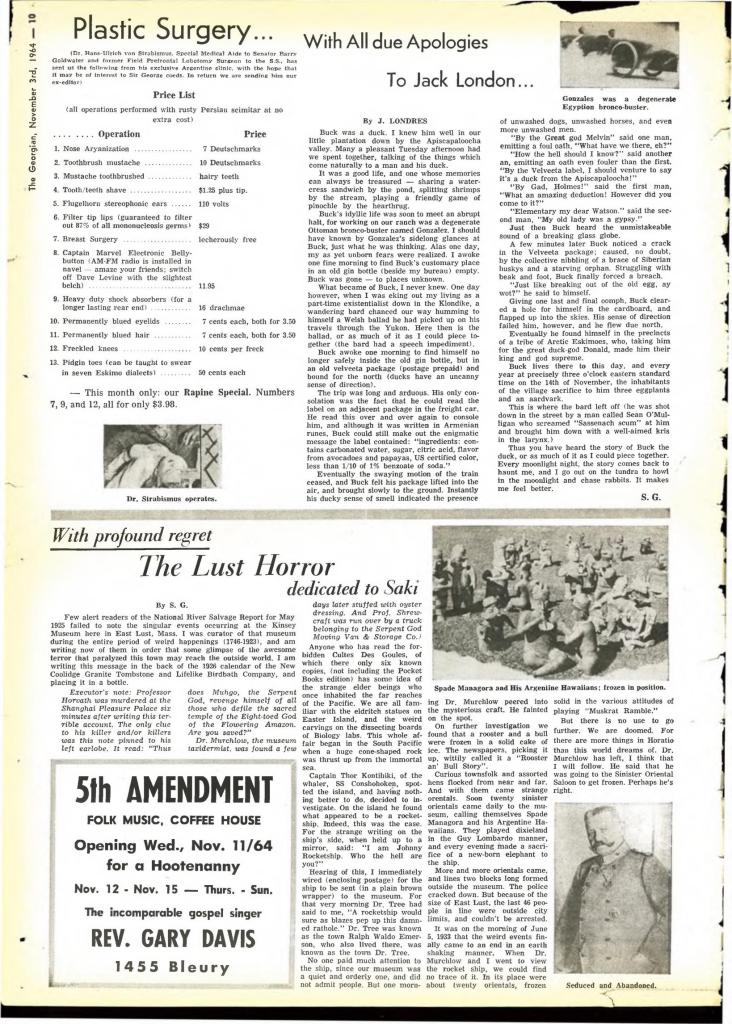
First published in The Georgian 3 Nov 1964. It has not been reprinted.
※
The Lust Horror
by S. G.
dedicated to Saki
Few alert readers of the National River Salvage Report for May 1925 failed to note the singular events occurring at the Kinsey Museum here in East Lust, Mass. I was curator of that museum during the entire period of weird happenings (1746-1923), and am writing now of them in order that some glimpse of the awesome terror that paralyzed this town may reach the outside world. I am writing this message in the back of the 1926 calendar of the New Coolidge Granite Tombstone and Lifelike Birdbath Company, and placing it in a bottle.
Executor’s note: Professor Horvath was murdered at the Shanghai Pleasure Palace six minutes after writing this terrible account. The only clue to his killer and/or killers was this note pinned to his left earlobe. It read: “Thus does Muhgo, the Serpent God, revenge himself of all those who defile the sacred temple of the Eight-toed God of the Flowering Amazon. Are you saved?”
Dr. Murchlow, the museum taxidermist, was found a few days later stuffed with oyster dressing. And Prof. Shrewcraft was run over by a truck belonging to the Serpent God Moving Van & Storage Co.)
Anyone who has read the forbidden Cultes Des Goules, of which there only six known copies, (not including the Pocket Books edition) has some idea of the strange elder beings who once inhabited the far reaches of the Pacific. We are all familiar with the eldritch statues on Easter Island, and the weird carvings on the dissecting boards of Biology labs. This whole affair began in the South Pacific when a huge cone-shaped rock was thrust up from the immortal sea.
Captain Thor Kontihiki, of the whaler, SS Conshohoken, spotted the island, and having nothing better to do, decided to investigate. On the island he found what appeared to be a rocketship. Indeed, this was the case. For the strange writing on the ship’s side, when held up to a mirror, said: “I am Johnny Rocketship. Who the hell are you?’’
Hearing of this, I immediately wired (enclosing postage) for the ship to be sent (in a plain brown wrapper) to the museum. For that very morning Dr. Tree had said to me, ‘‘A rocketship would sure as blazes pep up this damned rathole.’’ Dr. Tree was known as the town Ralph Waldo Emerson, who also lived there, was known as the town Dr. Tree.
No one paid much attention to the ship, since our museum was a quiet and orderly one, and did not admit people. But one morning Dr, Murchlow peered into the mysterious craft. He fainted on the spot.
On further investigation we found that a rooster and a bull were frozen in a solid cake of ice. The newspapers, picking it up, wittily called it a “Rooster an’ Bull Story’’.
Curious townsfolk and assorted hens flocked from near and far. And with them came strange orientals. Soon twenty sinister orientals came daily to the museum, calling themselves Spade Managora and his Argentine Hawaiians. They played dixieland in the Guy Lombardo manner, and every evening made a sacrifice of a new-born elephant to the ship.
More and more orientals came, and lines two blocks long formed outside the museum. The police cracked down. But because of the size of East Lust, the last 46 people in line were outside city limits, and couldn’t be arrested.
It was on the morning of June 5, 1933 that the weird events finally came to an end in an earth shaking manner. When Dr. Murchlow and I went to view the rocket ship, we could find no trace of it. In its place were about twenty orientals, frozen solid in the various attitudes of playing “Muskrat Ramble.”
But there is no use to go further. We are doomed. For there are more things in Horatio than this world dreams of. Dr. Murchlow has left, I think that I will follow. He said that he was going to the Sinister Oriental Saloon to get frozen. Perhaps he’s right.
※
“S. G.” is presumably Steve Goldberg, the humor editor for The Georgian, a small college magazine which included quick little spoofs among its contents. This particular setup draws more heavily from Lovecraft than Saki (readers can easily see plot points lifted from “Out of the Æons” (1935) by Hazel Heald & H. P. Lovecraft), but they’ve mixed in a number of other references as well, such as Thor Heyerdahl and the Kon-Tiki expedition.
Satire and parody are an important part of any literary tradition. Like pastiche, they tend to focus on the most obvious elements of a story, ignoring the subtleties; but where a pasticheur is attempting a serious derivative work, the satirist delights in absurdity. Spoofs in particular tend to bring in incongruous elements, double entendres, and mockingly undercut the mood or seriousness of the original with slightly risqué humor.
All in good fun.
Bobby Derie is the author of Weird Talers: Essays on Robert E. Howard and Others and Sex and the Cthulhu Mythos.
Deep Cuts in a Lovecraftian Vein uses Amazon Associate links. As an Amazon Associate I earn from qualifying purchases.

