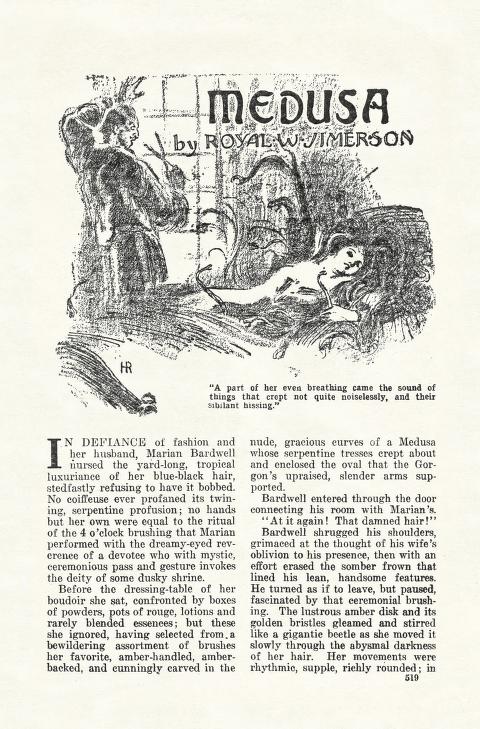
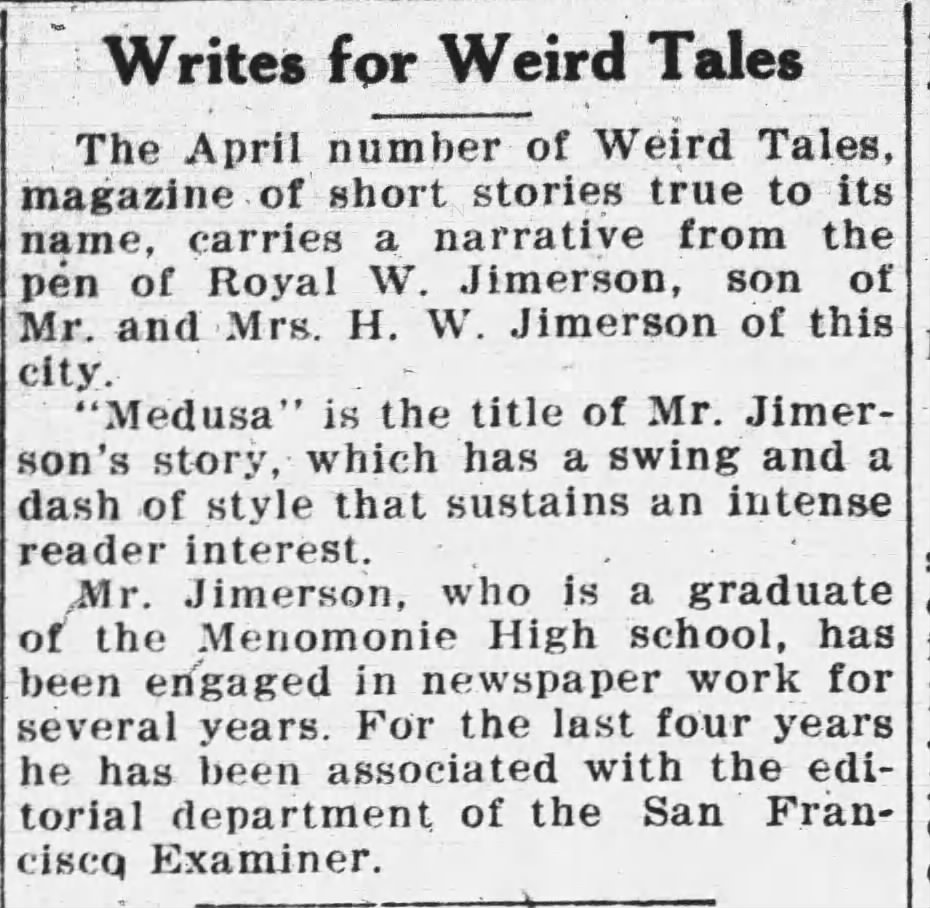
Weird Tales was unusual among pulp magazines in publishing a relatively large number of “unique” authors—that is, authors who only appear with a single credit in the magazine. Often, it is their only story credit in any pulp magazine. While WT editors Edwin Baird, Farnsworth Wright, and Dorothy McIlwraith worked to attract recognizable writers, they were not above giving any author their chance. Such was the case with Royal W. Jimerson, a staid newspaper editor (Lesser Known Writers). “Medusa” is his only known published fiction story.
First published in Weird Tales (Apr 1928); it was reprinted in the Not At Night anthology By Daylight Only (1929), and Weird Tales (May 1938). The internet presence and continued interest in scans of old issues of Weird Tales have given “Medusa” renewed prominence, with reviews, audio adaptations, and speculation.
※
Medusa
by Royal W. Jimeson
IN DEFIANCE of fashion and her husband, Marian Bardwell nursed the yard-long, tropical luxuriance of her blue-black hair, stedfastly refusing to have it bobbed. No coiffeuse ever profaned its twining, serpentine profusion; no hands but her own were equal to the ritual of the 4 o’clock brushing that Marian performed with the dreamy-eyed reverence of a devotee who with mystic, ceremonious pass and gesture invokes the deity of some dusky shrine.
Before the dressing-table of her boudoir she sat, confronted by boxes of powders, pots of rouge, lotions and rarely blended essences; but these she ignored, having selected from a bewildering assortment of brushes her favorite, amber-handled, amber-backed, and cunningly carved in the nude, gracious curves of a Medusa whose serpentine tresses crept about and enclosed the oval that the Gorgon’s upraised, slender arms supported.
Bardwell entered through the door connecting his room with Marian’s.
“At it again! That damned hair!”
Bardwell shrugged his shoulders, grimaced at the thought of his wife’s oblivion to his presence, then with an effort erased the somber frown that lined his lean, handsome features. He turned as if to leave, but paused, fascinated by that ceremonial brushing. The lustrous amber disk and its golden bristles gleamed and stirred like a gigantic beetle as she moved it slowly through the abysmal darkness of her hair. Her movements were rhythmic, supple, richly rounded; in some unbelievable way her arm glided in a series of convolutions whose sinister grace made Bardwell shudder.
“That damned hair!” he repeated as he wrenched himself from the fascination of the ritual. And then: “Why don’t you cut out all this nonsense and be human? Have your hair bobbed, buy up a bunch of new clothes, and we’ll take a second honeymoon in Florida next month. We can afford it now, you know. And . . . we both need a change of scene,” concluded Bardwell irrelevantly, knowing well that no change of scene could ever veil the aura of age-old evil that clung to the serpentine blackness of Marian’s hair.
The chilly, repellent opulence of that somberly gleaming, iridescent coiffure haunted Bardwell, distracting his hours of waking and making his sleep a confusion of reptilian nightmares. The living, creeping coldness of those profuse tresses had in four years frozen an indefinable terror into his soul. An age-old horror nightly twined itself on Marian’s pillow, separating them as might a limitless expanse of steaming, evil-haunted jungle.
“I’ll never cut my hair,” declared Marian with the passionless certitude of one pronouncing a law of nature. “Never again mention such a thing!”
Then she set aside her mirror and, after a final lingering reverent caress with the Medusa-handled brush, turned in her low chair to face Bardwell.
“Win, can’t you take me as I am and be content to leave me as I am? You knew when you married me that there was something strange about me. I loved you, Win. Still do. Always shall. But I can’t—”
“But you must!” flared Bardwell.
“No, I can not. Please don’t be unkind to me,” she pleaded. “All my life I’ve been different from other women. I worried my mother into her grave—”
“And now I’m in line,” despaired Bardwell. “Marian—”
But even as she spoke, the animation faded from the exquisite oval of her face; she picked up the amber brush and again languidly stroked the coiling darkness that hung heavily on her white shoulders, spelling the wordless syllable of an everlasting prayer to the deity Bardwell hated and—feared.
“We’ll take a second honeymoon in Florida,” he had said. But he knew that it was no honeymoon but rather the fantastic hope that the warmth and unfailing sunlight of Florida might sear to extinction the living, chilly blackness before whose shrine Marian worshiped with measured, languid passes of an amber brush.
Drawn by a compelling sorcery, attracted in spite of himself, Bardwell drew closer, catching the sound of the brush that caressed Marian’s waist-long hair, strands that blended and writhed, curled and intertwined independently of the golden bristles. He gently laid his fingers on a strand, hoping against hope . . . shivered . . . muttered . . . then turned and strode from the room.
Marian’s movements became slower, more and more torpid, more languid, until finally, succumbing to the tropical, overheated atmosphere of her Riverside Drive boudoir, she carefully placed the amber brush on the table and, mustering her ebbing vitality, picked her way to bed.
The black, tentacular strands disposed themselves about the pillow, dark serpents basking on silver-white sand. . . .
2
SARASOTA, rather than glittering Miami or Palm Beach, appealed to Bardwell as being the most suitable field on which to make his final play against that which hung over him like the mantle of an oppressive doom.
And there he sought to inveigle Marian into play and festivity, to entice her from the somnolent ritual of everlasting hair-combing, to revive the gayety of their earlier days. He succeeded, for a few days; but on the first morning of the second week he found Marian before her mirror, amber Medusa in hand, and lost in the impenetrable sorcery that had made his life a vortex of madness.
That same afternoon found her asleep at the edge of a steaming lagoon, her hair spread fanwise about her, basking in that fierce damp heat.
“Now, by the Lord, this is too much!” he snarled, as he seized her by the hand, thrust her into their car, and carried her, still dazed and half asleep, back to their hotel. Once in the privacy of their suite, he continued, “This damned nonsense must stop! And I’ll stop it, here and now!”
Bardwell seized a pair of scissors and, stifling his repugnance, grasped a handful of that serpentine, black hair. And then he dropped the gleaming steel, recoiling before the chilly flame that came to life in Marian’s smoldering eyes.
“Win Bardwell,” she began in a calm voice whose deadliness matched the light in her eyes, “this is going too far. Whatever else you may wish to do, at least stop short of mutilating me and killing yourself.”
“What?” demanded Bardwell. “Mutilate you? Kill myself—good Lord, Marian, this is getting worse every day! What’s going to become of us?”
The venom faded from her voice, and the fire from her eyes, as she replied: “Win, I’ve told you a thousand times I can’t help being what I am. Can’t you remember the old days when my strange ways didn’t annoy you?”
And Bardwell recalled the first weeks of their marriage—mad, ecstatic nights and dream-filled days. The chill contact of Marian’s hair, even then, had carried the faint suggestion of some ancient evil that always blended in their love-making, adding piquancy to Bardwell’s pleasure, suggesting to him that he had found Eve and Lilith in one person. He had loved the dank chill of her hair, cold strands that burned like creeping, living fire; and a curious, pagan fascination lay in that queer gesture, so like an archaic, dimly remembered ritual, with which Marian would toss the great braids about her back and shoulders, where they clung and twined. . . .
“Win,” continued Marian, “have you changed, or have I? Leave me if you wish. You needn’t stay. I’ll play fair with you if you wish to leave me. Only . . . promise me you’ll never again attempt to cut my hair. Promise me, and I’ll forgive you. And if you can . . . try to remember.”
Bardwell remembered, and promised. And that night, and many nights thereafter, Bardwell held stony-eyed communion with bottles branded with three stars and marked with the name of Martel.
Yet hope was not entirely gone: for Bardwell would occasionally vary his routine, emerge from the haze, and in the calmness of evening seek anew the means of overcoming that which oppressed him. And thus it was that wandering at random he met old Dr. Berg, who during the many years previous to his retirement from active practise had attended Marian and Marian’s parents.
“Dr. Berg! Strike me blind, but it is good to see you!”
In the pleasure of this unexpected encounter, Win Bardwell for the moment forgot that which the undying sun of Florida had not eradicated.
“And just as good to see you, Win. What in the world brings you to Sarasota?”
The doctor paused, hesitating to inquire as to Bardwell’s wife, yet knowing that such inquiry must be forthcoming from him. Bardwell’s next remark bridged the gap.
“I know you’ve retired, Doctor,” he began, “but I want to have a word with you. In private. And at once, if you’re not engaged.”
Dr. Berg nodded acquiescence. A cab carried them to the doctor’s apartment.
“Either I’m utterly loco,” declared Bardwell, “or else—”
“No, lad,” interrupted the white-haired medico, “you’re not loco. It killed her mother; and It has made me wonder, and pass quite beyond the borders of reason and science. In a word, Win, it’s that deadly poison coldness of Marian’s hair. . . .”
The doctor shivered.
“Yes,” agreed Bardwell. “It’s driving me nutty. She won’t have it cut. She spends hours brushing it. Like some fakir sitting before a heathen god and thinking himself into the silence. Lord in heaven, but I often wonder if she’s human! The touch of a single strand of it drives me wild. And at the same time, I think the world of her. That’s the worst of it!”
THE old doctor poured a slug of Bacardi. Bardwell swallowed the amber flame and continued, “Either I’m absolutely bughouse, or something is totally wrong with Marian. One of us should be sewed up in a sack and dropped into the Gulf. If she’s okay, then I’m due for a padded cell; or if I’m right, then that girl is a monstrosity . . . oh, hell! What do you make of it, Doc?”
“I make exactly nothing of it,” replied Dr. Berg. “Nothing that any sane man of science could accept. Her parents told me a similar story, when she was about six years old—told me of the ghastly, snaky coldness and clamminess of Marian’s heavy hair. I laughed and called it nerves. But when I touched the kid’s unusually long hair, I nearly passed out, used as I was to grotesque and repellent deformities. It was as though I had thrust my hand into a nest of serpents all clinging together for warmth.”
Bardwell lifted his face from his hands.
“This madness has to stop. I’ll clip that poisonous jungle she nurses day and night. Promised her I wouldn’t, but promises be damned!”
“No, Win, don’t do that. Her mother tried it, once. Leave her if you can’t stand it any longer. But don’t kill her. Or yourself—”
“What? You, too? What in thunder do you mean—kill her, or my self?” demanded Bardwell, recovering himself, and drawing animation from the incredible words the doctor had just spoken in paraphrase of Marian’s outlandish speech. “Are you as nutty as she is, and I shall be? For God’s sake—”
“Steady, lad. She isn’t, and I’m not, and you’re not, yet. Listen. . . .”
The doctor drew from his desk a leather-bound, loose-leaf notebook, turned a few pages, remarking as he did so, “Heredity is a curious thing. Marian’s outlandish hair inspired me to study the matter in general and in particular. I’ve never dared publish my thoughts and findings. Like Rabelais, I prefer to die before I am cremated. But I’ll tell you as much as I can. It may help you. For we lose fear of that which we understand, even if but partly.”
The doctor paused; pinched the end from a long black cigar; sought, found, but forgot to strike his match. And then he read, intoning solemnly, like a judge pronouncing sentence.
“Atavism is an outcropping of tendencies and characteristics that have skipped two generations or more. Such outcroppings are rare enough, though usually not startling. But what of tendencies that have lain dormant, skipping thousands of generations, reappearing only after hundreds of centuries of extinction?
“Your wife, Win. . . . For twenty years I’ve studied this matter, ever since at her mother’s insistence I touched that living, snaky hair.”
“For God’s sake, Doctor, what do you mean?”
“Just what I said. One thing at a time. You’ll finally grasp what you’re up against.”
The doctor struck his match, touched light to the lean, dark cigar, then continued: “You’ve played polo, and witnessed many polo matches. Remember Captain Erich von Ostenburg?”
“Yes. Fierce, heathen sort of fellow. Wonderful player. But what the devil—?”
“One thing at a time, Win. Have patience and let me put it across bit by bit, groping with you even as I myself have groped in the dark. He resembles not one of his relatives, distant or near; nor does he resemble any one of his ancestors for ten generations back, if the private rogues’ gallery, as he calls the family portraits, means anything at all. That fellow is a Tartar, pure and simple; a throw-back to some obscure ancestor who rode in the trace of Genghis Khan. Look at him; look at those eyes, those cheekbones, the contour of his skull, and see the stamp of the Mongol. Look at the way he sits his horse, crouched like some squat demon riding into battle. He might be the Grand Khan himself. That is atavism, but on a small scale. Merely a dozen odd generations.”
Bardwell was too much puzzled to interrupt.
“Some Tartar of the hordes of Genghis Khan grafted himself onto the family tree of the house of Ostenburg. And now, centuries later, we have Captain Erich. But this,” repeated the doctor, “is atavism on a small scale. Listen again:”
And from his notes the doctor read, “It was Herbert Spencer, greatest of all rationalists, who pointed out that there is a foundation of fact for every legend and superstition of mankind. Was there then a race, back in the mists that shroud the emergence of humanity from prehistoric reptilian slime, whose physical attributes supplied the fact basis for the Medusa myth, the legend of the Gorgons?”
Bardwell stared, blinked, wondered whether or not he had heard aright the madness which dripped from the white-mustached lips of the old doctor. Then Bardwell remembered all too well the serpentine, clinging coldness of Marian’s hair and knew that he had indeed married a Medusa whose type for a thousand centuries had been, and would today, but for some ghastly jest of nature, be extinct.
3
DAY after day the amber brush with its carved Medusa flickered like some monstrous golden beetle as Marian, secure in the shelter of Bardwell’s promise, devoted more and more of her time to the now endless caressing of the coiling, midnight madness that crowned her pallid features, enshrouded her shoulders, and reached almost to her knees.
Small, swift boats brought Bardwell solace from Bimini: Martel, and Bacardi, and the deadly, pale green Pernod—wormwood distilled with madness. Substitution: serpents for serpents. And through the haze gleamed a pair of long-bladed coupon shears. Martel and Pernod and promises mingle curiously.
Dr. Berg watched from a distance, resigned himself to the futility of further effort, and confined his pity to a slow, sorrowful shake of his white head. His words were unvarying: “Don’t attempt to cut her hair. Her mother tried it, once. . . . Grin and bear it, or else leave her. But forget those scissors, and remember your promise. . . .”
Martel and Pernod and promises mingle curiously. Yet through it all persisted the memory of ancient days, of mad, ecstatic nights and dreamfilled days, and of a lovely, pallid girl whose great dark braids of hair clung and twined about his shoulders, adding piquancy to his pleasure; so that one night Bardwell, deciding that while he could not grin, he might at least bear it, thrust aside the pale green madness that turned milky white as the melting ice diluted it, and sought Marian’s boudoir.
A shaft of moonlight filtered in through the thinly draped French window and enriched the pale features and argentine shoulders of his sleeping wife. Her long hair somberly enshrouded the loveliness of her face and spread fanwise across both pillows. A faint, acrid odor mingled itself with the perfume of the sleeping Madonna; and apart from, but somehow a part of her even breathing, came the vague sound of things that crept not quite noiselessly, and their sibilant hissing.
As Bardwell stared fixedly, the sable strands moved, stirred, animated by an independent life: black serpents awakening from their slumber on silver-white sands. For the first time he saw that which he had suspected, and feared.
From the pocket of his brocaded lounge robe he drew the final solution, the companion of endless nights of grief: a pair of long-bladed coupon shears.
4
“JUST across the hall from 614? Yes, sir, I’ll look into it right away,” replied the night clerk. And then, slamming the receiver, he addressed the house detective: “Dawson, for the love of Mike see who’s got the heebie-jeebies in 640.”
Whereat the night clerk yawned and prepared to resume his nap while awaiting Dawson’s report as to the cause of that prolonged scream of anguish, the voice of a man and woman mingled in an awful cry of horror and despair, the ghastly disturbance whereof the guest in 614 had complained.
But that nap was interrupted ere it was resumed.
“I’ll be eternally damned!” gasped the night clerk, paused a moment, then started in pursuit of the house detective who had in three bounds cleared the lobby and gained the street.
A patrolman on a beat several blocks from the hotel collared the frenzied man and clubbed him into a state of comparative calmness. Investigation verified the house detective’s outrageous story, thus keeping him clear of a padded cell; but investigation came to a dead standstill when confronted by the scarlet, excoriated mask of what had once been Win Bardwell’s lean, handsome features, and the thousand tiny, livid punctures which had pierced the skin. Nor was it any easier to account for the monstrous black coil, wrist-thick, which encircled Bardwell’s body, and stranglingly, closed about his throat: frosty cold, midnight black, iridescent hair the like of which came from no man or beast . . . but which must have come from the head of the woman who lay dead on the bed beside Bardwell.
Dr. Berg saw, but wisely refrained from venturing an opinion. On returning to his apartment, he drew from his desk a loose-leaf, indexed notebook, turned to the page ending, “Was there a race in the mists that shroud the emergence of humanity from prehistoric, reptilian clime, whose physical attributes supplied the fact basis for the Medusa myth?”, and completed in a few words his commentary on atavism.
※
Royal W Jimerson only wrote one fictional story, and this is it. It bears a lot of resemblance to Medusa’s Coil, a collaboration between H P Lovecraft and Zealia Bishop. A story which was published AFTER Medusa.
—Morgan Scorpion, “Medusa” by Royal W. Jimeson audio narration (Youtube)
“Medusa’s Coil” by H. P. Lovecraft was the third and final weird fiction story that he revised/ghostwrote for Zealia Brown Bishop; although written in 1930, it was not actually published until Weird Tales (Jan 1939). As part of its re-discovery in the internet era, some reviewers have noted a similarity between “Medusa’s Coil” (1939) and “Medusa” (1928).
Lovecraft never mentioned “Medusa” or Jimerson in any of his letters, even when discussing the April 1928 issue of Weird Tales. While Lovecraft probably read it, as he seems to have read most issues of WT, it either didn’t stand out or he failed to mention it to any correspondent in any surviving letter. The stories do share some commonalities: a woman with unusual hair, a reference to the medusa myth, and a jealous husband. In everything else, from plot to setting, the stories are different.
While we cannot rule out that “Medusa” may have influenced Lovecraft in some way, if it was an inspiration, it was one ingredient in a mix that combined Zealia Bishop’s original idea, Lovecraft’s Mythos, and a complicated narrative framework.
Bobby Derie is the author of Weird Talers: Essays on Robert E. Howard and Others and Sex and the Cthulhu Mythos.
Deep Cuts in a Lovecraftian Vein uses Amazon Associate links. As an Amazon Associate I earn from qualifying purchases.


One thought on “Lost Tale: “Medusa” (1928) by Royal W. Jimerson”