Historical Orientalism
The work presented and discussed includes stereotypes of Orientialism in accordance with the period, including depictions of a Jewish character in accordance with antisemitic stereotypes.
Reader discretion advised.
In 1786, a new Gothic novel appeared on the market: An Arabian Tale, From an Unpublished Manuscript. The author, unnamed in the first edition, was William Beckford, who composed the tale in French as an original work in the style of Oriental folklore being translated into European languages at the time, and translated into English by the Rev. Samuel Henley. It was published in French as simply Vathek, and in myriad editions over the next couple of centuries would be published under some variation of that title. In 1909, two episodes and an unfinished fragment initially intended as part of the novel were discovered among Beckford’s papers by Lewis Melville, and translated by Sir Frank T. Marzials and published in 1912.
The influence of Vathek on English literature is vast. It is the archetype of the Oriental romance novel, and the discovery and subsequent publication of the lost episodes, occurring when it did, renewed interest in the story among the Weird Tales crowd. When H. P. Lovecraft named the original of the Necronomicon as the Al Azif, he was borrowing an Arabic term from one of Henley’s footnotes to Vathek: “being the name applied to those strange night noises (of insects) which the Arabs attribute to the howling of daemons” (H. P. Lovecraft to Clark Ashton Smith, [27 Nov 1927], Dawnward Spire, Lonely Hill 150). The unfinished third episode in particular caught their imagination:
Regarding “Episodes of Vathek”—my copy is even now on its way to you as a long-term loan, & it is my hope that—as interest—you will ere long shew me a completion of the 3d episode which shall out-Beckford Beckford! Possibly you may not wish to write the text in French, as Beckford did, but I am sure you can capture the general atmosphere better than anyone else in the gang. Cook once had a wild idea of letting us all try our hands at this job of completion, & of publishing the collected results in book form. That plan has now evaporated, but I don’t think literature has lost very much thereby—since most of us would be very inept at this form of composition. You, however, are really well fitted for it—& Morton & I were impressed with the idea of what a splendid result you could obtain. I’ll wager Wright would publish the episode with your ending—& perhaps a brief explanatory introduction.
—H. P. Lovecraft to Clark Ashton Smith, [27 Aug 1932], DS 381
Smith did write his “Conclusion to Wm. Beckford’s story of Princess Zulkais & Prince Kalilah,” later as “The Third Episode of Vathek,” which was published by R. H. Barlow in Leaves #1 (1937).
Yet there was another episode.
“An unpublished Episode of Vathek” was “edited by Charles Pendragon,” and was first published in Knights Quarterly Magazine (1823), a highly literary magazine best remembered today for publishing a review which claimed Percy Bysshe Shelley was the true author of Frankenstein; or, The Modern Prometheus (1818) by Mary Wollstonecraft Shelley. By comparison, the spurious Vathek episode was a bit of fun, on the order of a literary hoax.
※
An unpublished Episode of Vathek
edited by Charles Pendragon
The taste for tower building, of which Vathek had set the example, became infectious in the country about Samarah. This monarch was at first indignant that his subjects should presume to copy his extravagancies; but his vanity was stronger than his pride, and he left them in the quiet possession of their follies. His most ambitious rival was the merchant Bekfudi. The riches of this superb person were enormous. His caravans every year brought him silks and jewels that would have rivalled a princess’s dowry, and the slaves that cultivated his groves of cinnamon might have formed the rear-guard of a sultan’s army. He became dizzy with his wealth, and fancied that he was descended from the Assyrian kings;—though his grandfather had carried a basket in the streets of Bagdad.
Bekfudi had a handsome palace and extensive grounds; the hills and the valleys of a little province were his; a broad lake lingered in his groves of citrons and palms; and the apricots of his garden almost rivalled those which Vathek so prized from the isle of Kirmith. The ladies of his seraglio were as numerous and as beautiful as the harem of the grand vizier, and the other furniture of his palace was equally rare and costly. But Bekfudi began to be satiated with the pleasures and the magnificence of ordinary mortals; in an evil hour he pulled down his palace and sold his women. He built an impenetrable wall round his extensive gardens, and vowed to raise, upon the highest hill which this barrier enclosed, a palace upon a new fashion. Bekfudi had no violent reverence for the religion of his country; and he therefore considered it a sinless profanation to make his dwelling-place like a mosque, and his tower resembling a minaret, though he modestly proposed it to be only ten times higher than the minarets of Bagdad. It was the extravagance of his ambition which prompted him to shut out all the world till he should have finished his mosque; and when his tower rose above the highest pines of the neighbouring hills, he solaced himself with the hope, that the peasants who gazed at an awful distance would believe that within its walls dwelt one of the sons of men, as powerful as the Genii, and as mysterious as the Dives.
Bekfudi possessed abundance of taste. His command of wealth enabled him to engross the rare productions of art which were sometimes too costly even for emirs to acquire; and he lavished his gold upon those who could best apply their talents to the excitement of his self-admiration. All the ornaments of his palace had reference to his ancestors; but though the artists, who recorded in fit emblems the mighty deeds of his progenitors, had an especial regard to truth, they sedulously avoided all allusion to the basket-bearer. In a word, the mosque was a very magnificent place. It was the handsomest monument that taste ever reared to pride; and though Bekfudi in his arrogance had tried to make his tower rival the dome of the great mosque at Damascus, and had only been stopt in his presumptuous aspirings by the equally insolent hurricane, which twice blew it down,—and though in his profaneness he had built his dormitories like the cells of the most pious santons, and had constructed studies and refectories after the models of sanctuaries and shrines,—still the palace was gorgeous and elegant, and such as no subject ever before raised in the dominions of the Commander of the Faithful.
Bekfudi went on for many moons building and embellishing his mosque,—heaping stones upon his tower till the uncivil blasts gave him hints where to stop, and hanging up new draperies of Persian silks till the limited art of the dyer forbade any further change. The superb merchant lived away in a round of selfish enjoyment; his slaves racked their inventions to prepare him viands of the most costly materials; and as his health would not allow him always to drink the red wine of Shiraz, he took care, under the fatal necessity of resorting to so common a beverage as water, to render it palatable by sending caravans and escorts to bring it from a fountain at a hundred leagues’ distance.
The great Mahomet, who had commissioned the Genii to mature and then pull down the presumptuous darings of the caliph Vathek, also resolved to crush the ambition of the merchant Bekfudi. But as the pride and power of the mosque=builder were bounded by natural limits, it was unnecessary to work any miracles for his instruction. He lived on in his round of luxuries; and as his caravans came duly over the desert, and his ships were seldom lost upon the sea, he thought that the spices and the fruits of his fertile isles would last for ever. But there was a sudden change in the fashions of Samarah. The cooks began to make their comfits without cinnamon, and the green dates of their native plains came into request, to the exclusion of the dried fruits of our wealthy merchant. His spices and his figs lay rotting in his warehouses, and, for the first time in his life, he began to think that his mine of wealth was not inexhaustible.
Thirty moons had passed before Bekfudi ceased to pull down and build up the apartments of his mosque, or to send a hundred leagues for his water. The pastry-cooks were inexorable, and his own household even could not endure the flavour of cinnamon. He at length discharged his masons and his carpenters, and, as a great effort of economy, abridged his table of one of the fifty-two dishes with which it was daily covered. But all these privations were unavailing; Bekfudi was in debt, and his creditors would not wait for a change in the taste for spices. He resolved to invite all Samarah to see his mosque, and to purchase his curiosities. For three moons all Samarah went mad. Away ran the idle and the busy, to scramble up Bekfudi’s tower,—to wander about his long galleries upon carpets from Cairo,—to touch his gold censers, or to pore upon his curious pictures. As to his books, Bekfudi carefully locked them up. He was a great commentator, and his relish for theological speculations led him to fear that his performances might introduce him to too close an acquaintance with the mufti and the cadi.
Amongst the mob who had been to see Bekfudi’s tower, was a clever little Persian Jew, who had the reputation of being one of the most discreet dealers in Samarah. Did a courtier require a thousand piastres to bribe a judge, our little Jew would raise the sum in a moment, upon the pledge of the courtier’s carbuncle; or did a lady of the seraglio desire a pound of gold dust to fee an eunuch, our little Jew would furnish it upon the most moderate interest. His warehouses were full of the moveable treasures of all the great men of the palace, from the grand vizier to the principal mute; and everybody vowed that he was the honestest Jew in the world, and it was a great pity so useful and so clever a trader should be a dog of an infidel.
Bekfudi had a hatred of all Jews; but, nevertheless, our little factor contrived to approach him. “He had come to proffer his services to the great merchant; he humbly proposed to purchase his matchless curiosities, and his magnificent furniture.” “What! he, the giaour from Persia? he presume to offer a price for rarities that monarchs might covet?” “Yes; and moreover, he would purchase his books and his paintings, his vessels of gold and of silver, his wine, his——.” The merchant was in a rage, and drove the Jew from his presence; but he quickly recalled him. “Slave,” cried Bekfudi, “I will hold a moment’s parley with thee. How much wilt thou give for my topaz cup, and my goblet set with emeralds?” “I will not purchase these alone,” said the Jew, “but I will purchase thy lands, and thy mosque, and thy silken draperies, and thy woven carpets, and thy golden vessels, and thy jewels, and thy books, and thy pictures, and all that thy palace contains; and here, without, I have twenty dromedaries laden with four hundred thousand sequins, which shall be thine.” Bekfudi was in a rage, but the eloquence of the dromedaries prevailed; and that night the little Jew locked up the mosque with the airs of a master.
The mob from Samarah was soon dispersed; and Bekfudi prepared with many a sigh to leave a palace of which he had so long been the uncontrolled lord. The little Jew haunted him from gallery to gallery, and from the gloom of the sanctuary to the sunlight of the great lantern. With the most provoking malice he dwelt upon the beautiful proportions of this pavilion, and the magnificent furniture of that saloon; and swore that none of the monarchs of the world could rival the great merchant in taste and splendour. “And what will you do with this unequalled palace,” said Bekfudi? “I have bought it for a dealer in sulphur,” replied the Jew. The pride of Bekfudi was ground into the dust; but he was curious to see the rival of his wealth and the inheritor of his possessions. It was agreed that they should meet at dinner.
The hour came, and Bekfudi appeared in the grand saloon attired in a splendid vest;—the aigrette of his turban was composed of the largest diamonds, and the plume that it bore was from the wing of a bird of paradise. His delicate hands were washed with the choicest essences, and the perfumes of his garments plunged the senses into a languor which nothing but the excitements of the most exquisite viands could dissipate. He expected to have met in the dealer in sulphur, a personage whose riches would have procured for him some of the refinements which belonged to the dealer in spices;—but how was he humiliated when a miserable old man presented himself, as ugly as a faquir that had been doing penance for fifty years, wrapped round with a wretched robe of dirty cotton, and his head surmounted with a beastly turban, that all the waters of Rocnabad could never purify. The forehead of this captivating personage was covered with knots and wrinkles, his blear eyes twinkled in their little pursed-up sockets, his enormous mouth exhibited three teeth of the most delicious blackness, and his rheum was freely bestowed upon those whom the flavour of his breath did not keep at a respectful distance. Bekfudi shrieked and shouted for his dwarf; but the obsequious Jew called in a loud voice for dinner, and the unhappy merchant was constrained by his politeness to take his seat at the board. The new possessor of the mosque was equally attractive in his diet; a ragout of garlic was served up for his especial pleasure; and as he dipped his grimy hands into the golden dish, Bekfudi would, have fainted at the odour of the savoury steams, had not his faithful dwarf thrown the reviving attar over his forehead, and forced a cup of sherbet down his throat. The mouth of the dealer in sulphur distended into an audible grin, and he pledged the dainty merchant in execrable brandy. Their conversation at length became interesting. The man of sulphur had a most agreeable collection of oaths; and as he swore by Solomon and Eblis, by the sacred camel and the dog of the seven sleepers, the man of spice perceived that he had a high reverence for the mysteries of theology;—and a wonderful sympathy in this particular grew up between them. They embraced and parted; but Bekfudi never forgot the garlic.
The little Jew soon applied his master’s purchase to good account. Within a week the superb merchant began to indulge a wish for the possession of some of his former most splendid baubles; he bethought him that his free habit of expressing his thoughts in the broad margins of his beautiful manuscripts might one day cause some awkward inquiries; and he was desirous of securing some pictures, of which he thought none but himself knew the peculiar value. He of the dirty hands was as ready to comply with these reasonable wishes, and Bekfudi began to think that his turban and his garlic might in time be endurable. The articles were selected, but the little Jew had yet to name the price. Bekfudi raved and tore his hair when a fourth of his four hundred thousand sequins were demanded for what had cost even him not a tenth of the sum. He raved and tore his hair; but the Jew and the sulphur-merchant were calm. Bekfudi had not yet learned to subject his desires to his circumstances; and two dromedaries marched off with their costly load.
The Jew and his merchant passed the winter very industriously. From his warehouses in Samarah, this active dealer brought all the glittering pledges which the misfortunes of his clients had left unredeemed; and he decorated the mosque like a grand bazaar, with a great many new curiosities, and a great many rare commodities with fine names from the east and the west, which the artists of Samarah could manufacture as well as those of Persia or China. The little Jew knew where to find expert limners, who could imitate the paintings even of the celebrated Mani, so as to deceive the most critical eyes; clever copyists, that would transcribe the tales and poems of Arabia, with a correctness that would enchant the most exquisite connoisseurs; and acute chemists, that would give to the secretly pressed grape-juice of the gardens of Bekfudi himself, the inimitable flavour of the wines of Shiraz or Kismische. The little Jew had, however, not quite so complete a judgment as the builder of the mosque, and he therefore committed a few mistakes with a very enterprising spirit. Amidst the solemn and subdued splendour of the sanctuary, upon which Bekfudi most prided himself, he hung up an enormous mirror which brought all the varied colours of the neighbouring galleries, and all the garishness of day, into the heart of its former deep and impressive gloom; and in the hall which the spice merchant had dedicated to the worthies of his country, he stuck up the statue of one of the rebellious princes who had presumed to contend against the justice of the great Haroun al Raschid. But the little Jew was yet a most deserving factor. All Samarah again flocked to the mosque with the great minaret; and all Samarah came this time with money in their vests, to purchase some relic of the magnificent Bekfudi. Every one was pleased, except the unhappy builder of the palace, for every one was agreeably relieved of his sequins at his own free-will. He alone writhed under the mortifications of his pride, and the outrages upon his taste. He stalked one day into the palace of his splendour, now metamorphosed into one large bazaar, and with a yell of fury he overthrew the statue of the foe of the caliph, and shivered into a thousand pieces the mirror which deformed the sanctuary. He then coolly paid the price which the Jew demanded, and retired to a humble dwelling without a minaret, to pass the remainder of his days in composing treatises on temperance and humility.
※
Lady Vandeleur, at the other end of the apartment, was speaking somewhat eagerly with her brother, Charlie Pendragon, an elderly young man, much broken with dissipation, and very lame of one foot.
—Robert Louis Stevenson & Fanny van de Grift Stevenson, More New Arabian Nights: The Dynamiter (1885)
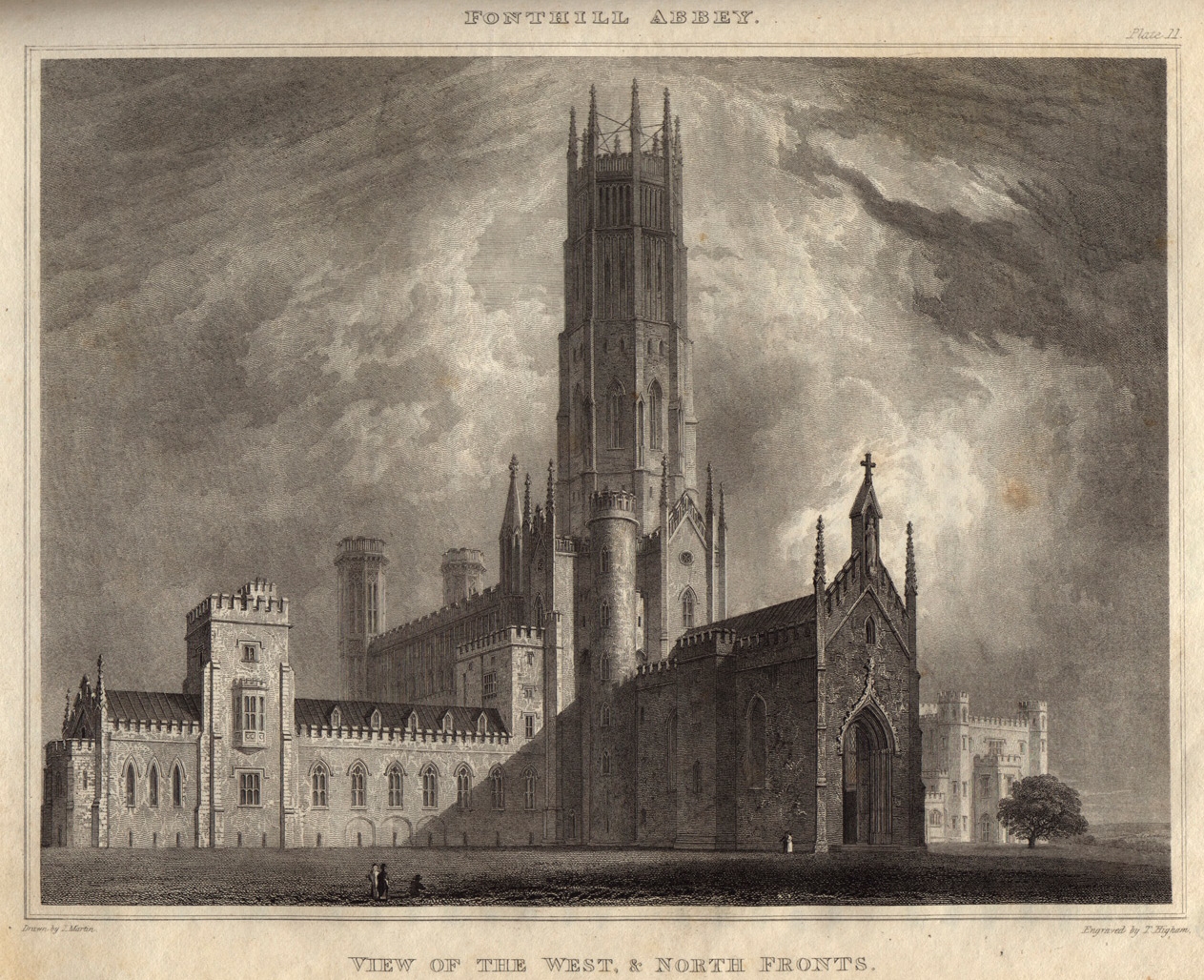
There was no Charles Pendragon. Many of the purported authors and editors of the Knights Quarterly Magazine were pseudonyms. The true author of “An unpublished Episode of Vathek” was Charles Knight, the founder and editor of Knight’s Quarterly Magazine. In Passages of a Working Life During Half a Century: With a Prelude of Early Reminiscences (1864/1865), Knight recalls the inspiration for the episode, when Fonthill Abbey, the home of William Beckford (author of Vathek), was to be auctioned off:
In the second number of the Magazine I wrote a paper, upon which I may not improperly say a little, as it in some measure related real incidents of my Working Life. “An unpublished Episode of Vathek” is reprinted in my volumes of “Once upon a Time.” Mr. Rutter, an enterprising bookseller of Shaftesbury, had proposed to me to publish a splen didly illustrated work, which he was preparing, on Fonthill, soon after the period when the wondrous building, of which every one had some marvel to relate but which no one had ever seen, was thrown open to those who chose to travel over Salisbury Plain, and pay a guinea for the long-coveted sight.
Bekfudi, says my tale, the superb merchant, had gone on for many moons building and embellishing his mosque, and living in a round of selfish enjoy ment. But gradually Bekfudi found there was a limit to his extravagance. Bekfudi was in debt. He resolved to invite all Samarah to “see his mosque, and purchase his curiosities. For three moons all Samarah went mad. Away ran the idle and the busy to scramble up Bekfudi’s tower,—to wander about his long galleries upon carpets from Cairo,—to touch his gold censers, or to pore upon his curious pictures. As to his books, Bekfudi carefully locked them up. He was a great commentator, and his relish for theological speculations led him to fear that his performances might introduce him to too close an acquaintance with the mufti and the cadi.”
I was amongst the curious, and had an agreeable holiday. But some months later I went to Fonthill to assist the worthy quaker bookseller of Shaftesbury in getting up his quarto. Fonthill had then passed into the possession of Mr. Farquhar, in the negotiation for which purchase Mr. Phillips, the famous auctioneer of Bond Street, was the agent. He stipulated for the purchase of Fonthill and everything which it contained:
“‘I will purchase thy lands and thy mosques, and thy silken draperies, and thy woven carpets, and thy golden vessels, and thy jewels, and thy books, and thy pictures, and all that thy palace contains; and here, without, I have twenty drome daries laden with four hundred thousand sequins, which shall be thine.’ Bekfudi was in a rage, but the eloquence of the dromedaries prevailed; and that rdght the little Jew locked up the mosque with the airs of a master.”
At this juncture I went to Fonthill. Artists were there making drawings. Journalists were there writing elaborate paragraphs, with a slight tendency to puff. My friend Stedman Whitwell was with me, and we rambled freely over the American gardens, partook of the choice fruit of the hothouses, and laid a sumptuous table every day. To me the ostensible lord of the place, the clever auctioneer, was particularly civil. The first night I was led by him through a long corridor apart from the saloons and galleries of this architectural marvel, and was instiled in a chamber of state, where the hangings of the bed were of velvet, and the chairs were of ebony reputed to have belonged to Wolsey. I sat in a reverie, moralizing, upon the probable dispersion of these splendid things, when I heard a whirr—my wax candle was suddenly extinguished—the bat that had dwelt in the gorgeous draperies was hovering about me. I was glad to creep into the downy bed. But I could not sleep. “Why rather, sleep, liest thou in smoky cribs?”
There were other’s to whom sleep was that night more difficult to be secured than to myself. Two or three adventurous artists—I think George Cattermole was of the number—elected to lodge in the dormitories of the great tower, some hundred and fifty feet above the floor from which it sprang. The wind rose; the storm grew louder and louder; the frail structure rocked, as Gulliver’s cage rocked in the eagle’s beak. The terrified guests rushed down the broad stairs, and sat drearily in the dark saloon till the daybreak gave them assurance of safety. But I am rambling from my Episode of Vathek.
“Within a week the superb merchant began to indulge a wish for the possession’of some of his former most splendid baubles; he bethought him that his free habit of expressing his thoughts in the broad margins of his beautiful manuscripts might one day cause some awkward inquiries.”
I was taken by my host to the Library. “You are free,” he said, “to make any transcript you please of marginal notes on these books. I have sent an invitation to Hazlitt to come also; but I hear that he has not got beyond Winterslow Hut.” Something was whispered about a new book, to be called “Fly Leaves from Fonthill.” My curiosity was roused, though I shrank from making profit by book or article out of my notes. In truth, as far as I could trace, there was little in these volumes to, alarm their annotator or interest the public. I need not have tested my conscience. When the Library had been glanced at by profane eyes the object was accomplished.
“The articles,” says the Episode, “were selected, but the little Jew had yet to name the price. Bekfudi raved and tore his hair when a fourth of his four hundred thousand sequins were demanded for what had cost even him not a tenth of the sum.” (309-312)
Without this background, “An unpublished Episode of Vathek” must seem a literary oddity with only superficial connection to Beckford’s novel. With Knight’s little memoir, it becomes a biting satire, where Bekfudi is Beckford, and the mosque with the tall minaret is Fonthill Abbey itself, which was constructed unsoundly, the dangerous tower eventually collapsing in 1825; and the 400,000 sequins equivalent to the £330,000 price Fonthill Abbey and all its contents sold for. How many contemporaries were sufficiently familiar with the situation to recognize the satire is difficult to say, but it is in the nature of things that the punchline to a joke may be lost to history—unless someone took the pains to explain it, some decades later.
I suspect it was the lack of any supernatural element in “An unpublished Episode of Vathek,” rather than its satirical nature, which has prevented its wider exploitation. At the time, Knight could hardly have known there were more episodes of Vathek forthcoming, and made no attempt to carry the hoax further. It speaks well of Clark Ashton Smith that, with Lovecraft’s encouragement, he entered into the enterprise of finishing Beckford’s fragment with an open heart and an eye toward producing a work as weird as Beckford himself managed, far away from the literary jests of bookmen.
Bobby Derie is the author of Weird Talers: Essays on Robert E. Howard and Others and Sex and the Cthulhu Mythos.
Deep Cuts in a Lovecraftian Vein uses Amazon Associate links. As an Amazon Associate I earn from qualifying purchases.

