Eldritch Fappenings
This review concerns a work with adult Lovecraft themes and graphic art.
Reader discretion advised.
Right and proper gentlemen, your attention, please. This is a public announcement: Room 308 Graphics & Publishing will no longer pursue games supplement production. Newly completed, the long-anticipated Call of Cthulhu adventure supplement The Mysteries of Mesoamerica, which was to be RM308’s premier publication, will instead be published by Pagan Publishing with an estimated release date as Summer 2008.
My apologies.
As the lone chief editor, operations manager, financial coordinator, sales representative, and sole artist, illustrator and designer for the entire company, I laboured for several years to get The Mysteries of Mesoamerica, a lavishly illustrated 150-page opus and RM308’s premier publication, into production, devoting many hundreds of hours, early mornings and late evenings, weekends and holidays — every spare scrap of free time — to its design and development, anticipating my return to the games publishing forum. But as 2007 came to a close and I began final preparations for MoM’s release — at the same time preparing the foundation for the next supplement, The Mysteries of the Old West, Volume I (like ‘Mesoamerica, another monster supplement in excess of 175 pages!) — I realized that it would be impossible for RM308 to continue as it had. It was simply too much for one artist: rendering cover art, interior illustrations, NPC portraits, maps, spot art and layout, and struggling to maintain the production schedule of a respectable, marketable games publisher. As the sole proprietor, I concluded that RM308 could never become what I’d originally intended it to be.
It must be said that I had meanwhile also grown increasingly disenchanted and frustrated (again) with the games industry’s orthodoxy, mediocrity, vapidity and apathy. Especially where Lovecraft and roleplaying are concerned, I feel strongly that too many bubbly, juvenile, tender-hearted milksops have infested the genre: Pollyannas promoting a kinder, gentler version of the Cthulhu Mythos by way of Cthulhu plush dolls, Elder Sign earrings, ‘Niggurath nursery rhymes, Miskatonic Christmas carols, and buttloads of other flippant silliness.
And it’s not just the gaming industry. The general population of devotees among “Lovecraftian circles” suffers from a fairy tale misconception of the Mythos, one that I believe would turn poor Howard in his grave if he could see the candy-ass travesty that his grand universe has become. The mainstream Mythos is a dumbed-down and diluted, popularized and trivialized, emasculated cartoon, wholly separate from the dark, unutterable, obscene and blood-soaked savagery that is the true essence of the Mythos, and my contempt for this fashionable, New Age, Hello Kitty Lovecraft is well known.
So no more games. RM308 hereby retires from its ambitions at roleplaying publication. Again, my apologies, especially to Brian Appleton and John Crowe, my trusted colleagues and brothers-in-arms.
Room 308 Graphics & Publishing will now concentrate its efforts on the development of my former personal works, Black Sands: Betrothed (the original), Black Sands: Catalogue of the Ten Thousand Churches, and Black Sands: Temple of the Compass. This “creative course correction” will be more manageable and feasible than full-time game supplement production, and will more faithfully reflect my personal (hardcore) concepts of the greater Mythos. More importantly, the rendering of these books will better serve and honour my lord and master, the Great Phæraoh Ahau Nyarlathotep, the Crawling Chaos, Father of Knives, Cæsar of the Ten Thousand Tongues and Architect of the Monument of the Great Rain — blessings be upon His name! I’ve long considered my personal works to be secondary to CoC, but no longer.Previews will soon be available for your inspection at my new website: www.RM308.com, and I hope to receive your continued support.
Cheers,
Blair Reynolds, Editor-in-Chief
Room 308 Graphics & Publishing
Blair Reynolds died in 2021. A few who knew him or admired his work marked his passing (“Blair Reynolds has left the building”). In the few short years after, much of his presence and memory have vanished from the internet. The above message was posted on the Yog-Sothoth.com forums, now defunct and unlikely to rise again. Blair Reynolds’ website, rm308.com, is long gone, although the Internet Archive contains bits and pieces of what it was. Most of his self-published work remains largely unavailable in hardcopy. Perhaps in five or ten years someone will contact the family, scrape through the archives, and put together an artist retrospective. Maybe then we’ll remember Blair Reynolds for who he was and what he did.
The Call of Cthulhu Roleplaying Game was first released in 1981. Heavily influenced by RuneQuest (1978) and Advanced Dungeons & Dragons (1977), CoC brought then-contemporary ideas of roleplaying gaming to then-contemporary ideas of what Lovecraftian horror and the Cthulhu Mythos were. By the end of the decade, however, things were shifting. Horror roleplaying was moving in different directions (Vampire: the Masquerade would be published in 1991), and Lovecraftian horror was becoming more open and accessible to new voices, further from the rigid categorization of the Mythos under August Derleth.
In 1990, John Tynes founded Pagan Publishing, a small group that put out a Call of Cthulhu gaming fanzine called The Unspeakable Oath. This would be the starting point of what would become Delta Green and a variety of contemporary Mythos fiction that spun out of that, reworking and reimagining Lovecraft’s Mythos in new ways (for more on the history of Pagan Publishing, see Shannon Appelcline’s Pagan Publishing: 1990–Present). What struck most readers first and foremost was the cover by Blair Reynolds:
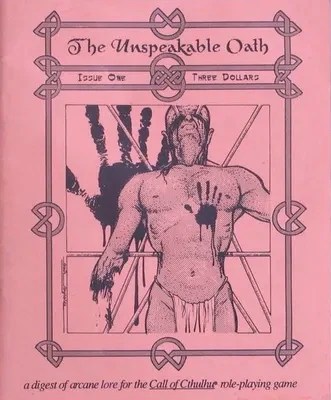
Reynolds’ artwork was featured on all of the issues of The Unspeakable Oath through 8/9 in 1993. It is probably Reynolds’ best-known work, stylistically distinct, often featuring a combination of photorealism, gore, nudity, and ritual elements that many found suggestive, tantalizing, and disturbing. Some of the effect, with distinct foreground characters against a detailed but darker background, suggests a multimedia-like approach, layering elements on top of each other to form the final composition.
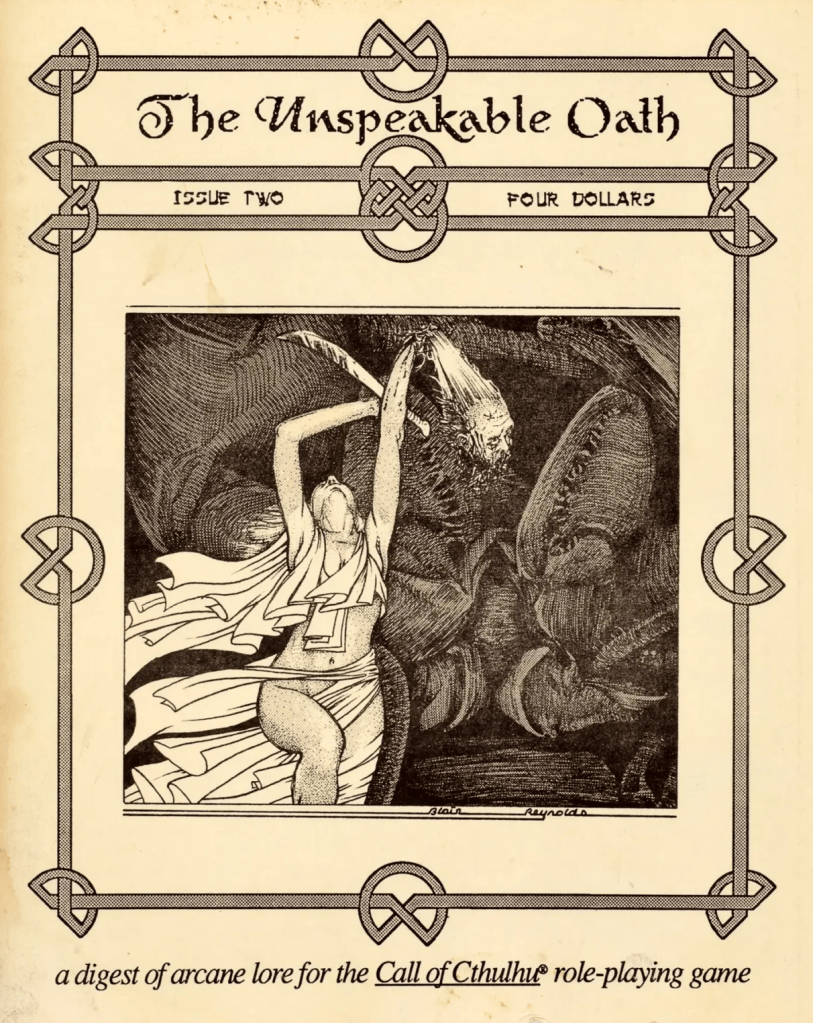
At the time, Call of Cthulhu artwork wasn’t transgressive. Decent artists worked for Chaosium, but no one pushed the envelope in terms of what was acceptable for a roleplaying product in the 1990s; there was little gore, little nudity, and the monsters and cultists could often look more goofy than menacing. In an era when horror roleplaying was moving toward a more mature audience with various White Wolf games like Vampire: The Masquerade, it took more than tentacles and fish-people to really sell Lovecraftian horror as being something more than quaint. It needed something fresh, artwork that took chances and hinted at forbidden rites and rituals, monstrosity and corruption. Blair Reynolds provided that edge of mystery and taboo-breaking.
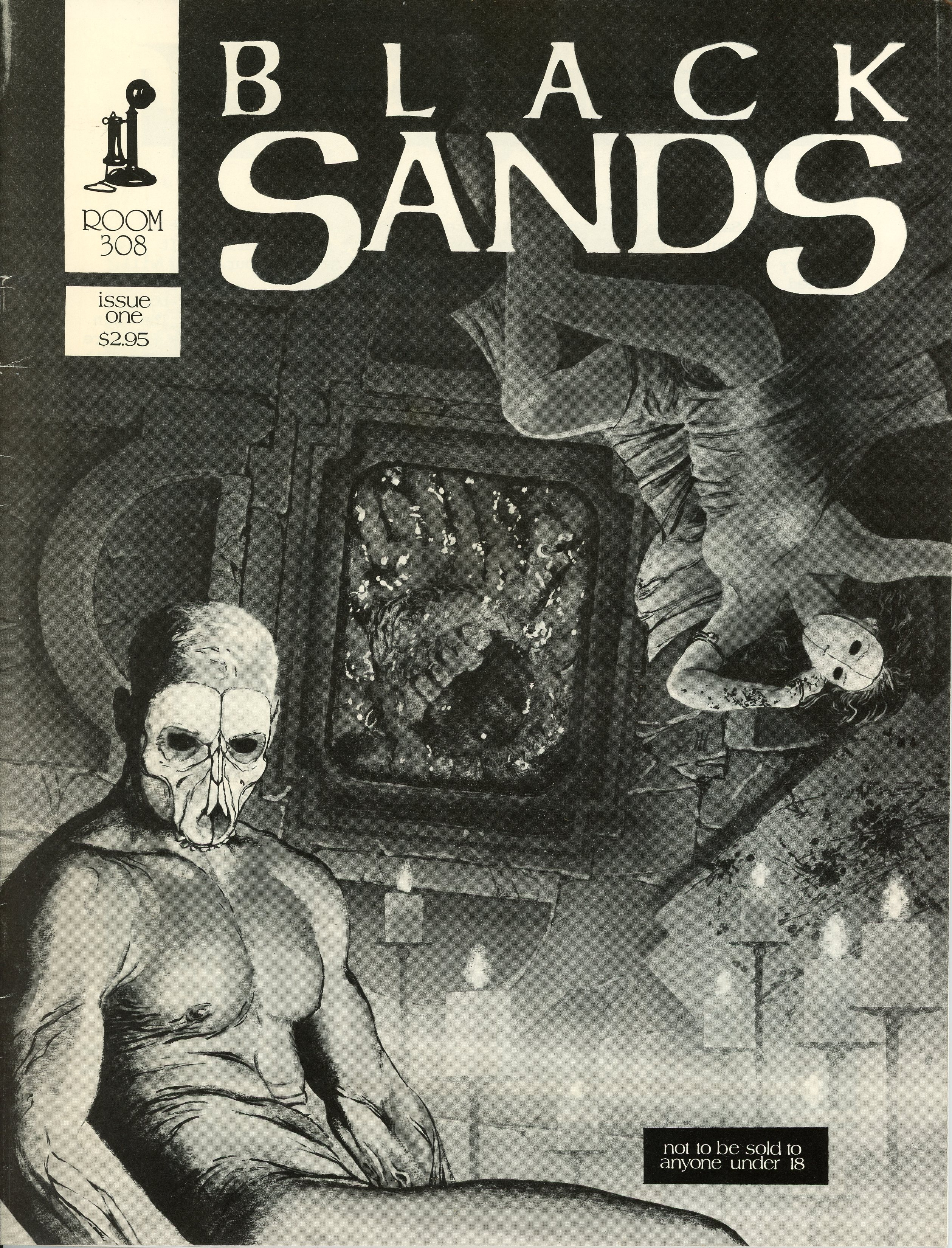
In 1994, Reynolds left Pagan Publishing to form his own Room 308 Publishing, and although he provided some more artwork for other gaming projects, his focus turned to a creator-owned work: Black Sands #1 (1996), the first part of a self-published black-and-white graphic novel written and illustrated by Blair Reynolds with additional works of fiction provided by James Reynolds.
“Black Sands: Betrothed” runs 26 pages. The pages are not laid out as a comic strip, but are a collection of artistically arranged art, some of it sexually explicit, and text. The text consists of excerpts from the 1924 journal of Frank Orand Buhtbaumbe, recounting a dream given to him by the Vision Serpent about his wife Allison, during their honeymoon in Haiti. Buhtbaumble watches his wife have sex with the human form of the Vision Serpent, and in the morning finds her gone; he consults with a friend, Dr. Henry Tiller, in New Orleans, and discovers that it was Nyarlathotep that took his bride. Buhtbaumbe seeks her at an ancient temple and kills many cultists—only to discover that was his wife’s plan all along. Then he wakes from the dream.
Cover and sample pages:
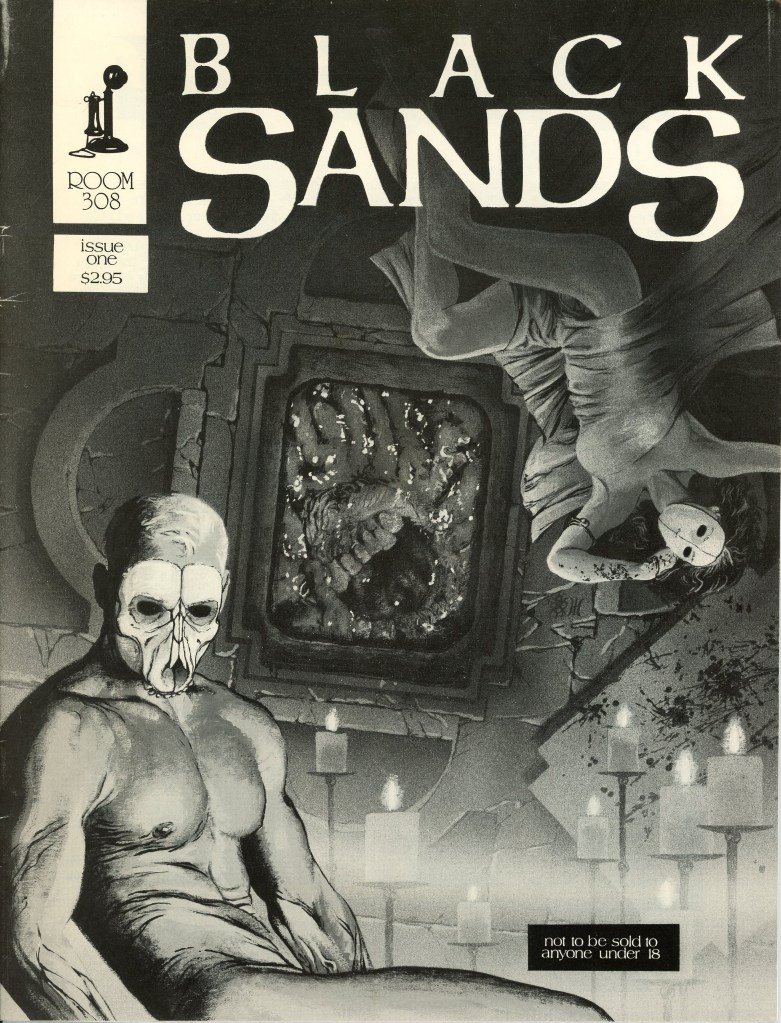

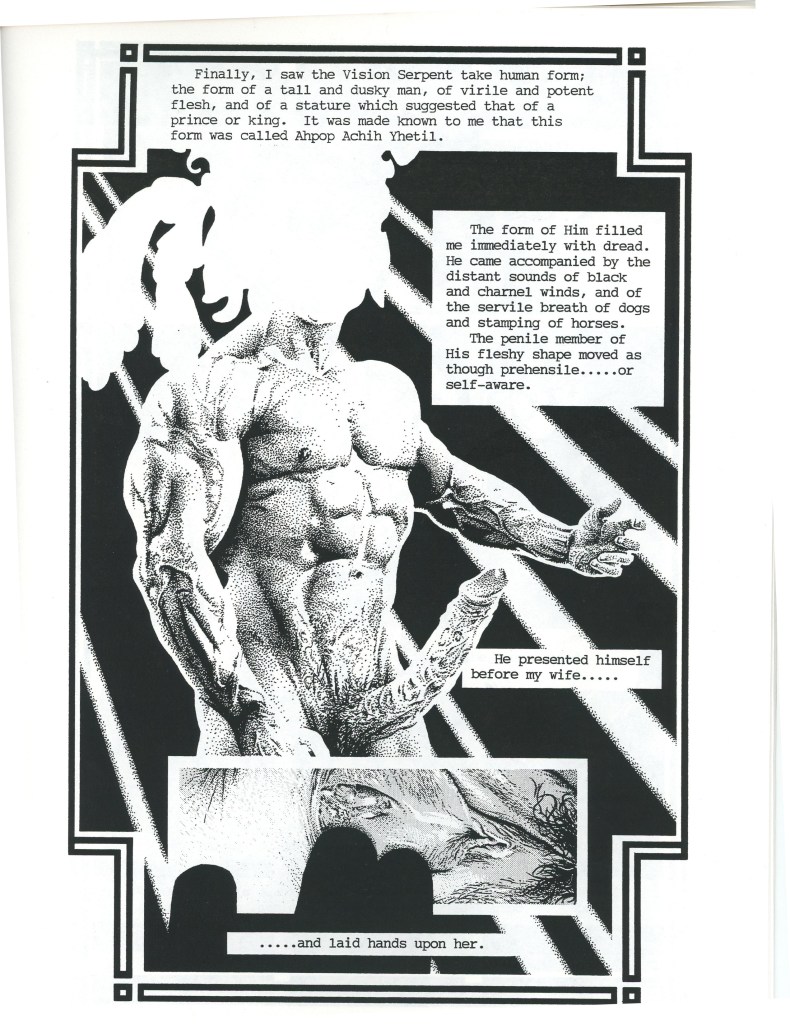
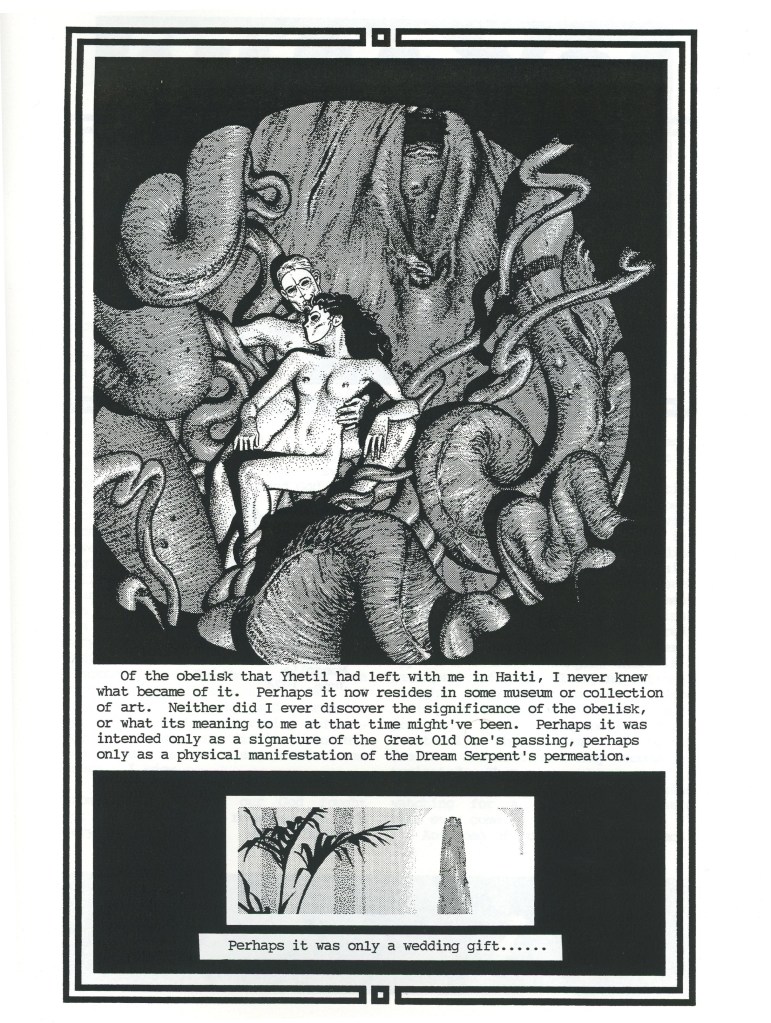
In the introduction to this issue, Reynolds explains:
This is a “cyclic” story, which means simply that portions of the book – Parts I, II, and III – will trade places back and forth each issue. The main body of each issue will always be entitled “Black Sands”, and for the Premiere Issue the main body is devoted to Part II, which takes place in the early 20th century. In addition to the main body, two “preludes” set the stage for upcoming issues, giving you an idea of what is ahead. The preludes for this issue include Part I (prehistory) and Part II (near future). Issue Two will see Part II (20th century) sliding into a prelude spot while Part I moves into the Black Sands main body, and the “meeting” of Hiuto and Messala will be illustrated in full detail, as the event deserves. Part III will take another prelude position in Issue Two and then come full circle to the main body – and the forefront – in Issue Three. Issues afterward will continue in this cyclic fashion, and in this manner the Black Sands saga will unfold.
It was an ambitious plan, and sadly wouldn’t quite come to fruition. But we can see the outline of what Reynolds hoped to accomplish.
The first prelude is “Tunc” (then), which takes the form of a prose account by Commander Torrence MacLaren, 22 April 2103 that runs for two prose pages. There is a heavy Delta Green vibe, a sense that this is a future of secrets where the Mythos is spilling into the open, and that MacLaren is more than he appears.
The second prelude is “Nunc” (now), two pages of prose from the journal of Onufari Iramus El’de Shaideene Messala, in an indeterminate year, but implicitly pre-gunpowder. This is the first appearance of the characters Hiuto and Messala mentioned in the introduction, and based on the last line, their “meeting” would have been vivid, if it had been published:
She was left speckled with the fluids of her escort when I finally go to her, tied her and left her face-down on one of the mattresses.
I made certain to stand where she could see me while I undressed. I wanted her to see the scars, and the marks of faith. And when I opened the haversack I’d brought in with me, it was especially important for her to see the pale mask I withdrew . . . . . . . as well as the polished metal cylinders and needles.
The remaining six pages consist of four works in the form of “files” for some unnamed group or agency. Two of these are labeled in the introduction “Templar File SK60550/312G” and “Templar File HD86179/782V” by James Reynolds, with supporting artwork by Blair. Again, there’s a strong Delta Green vibe to all of these, the idea of hidden narratives of the Mythos in a contemporary setting, buried under layers of government secrecy. Very much in the vein of what would become the SCP wiki format, although less structured.
“SK60550/312G” involves an experiment where student subjects are dosed with the hallucinogenic excrement of a newly discovered insect species. The results are strongly implied to be nasty, although a lot of blanks are left in the record.
“HD86179/782V” is slightly more infamous; the “Dogon Project” has a child born and raised in complete darkness with minimal human contact, echoing various feral child legends and Harry Harlow’s infamous monkey studies. This is the part which gets, if not exactly graphic, more transgressive than typical:
In his twelfth year he discovered masturbation. I still wonder what his source of fantasy was. He even used to try to engage in sex with his feces and food.
Yet there was one particularly interesting twist beyond that:
When he turned nineteen he had formed his own type of language. His grunts and movements were a way of talking to himself. This seemed perfectly natural to me until one day he formed a word, a word that I knew all too well: CTHULHU!
Sample pages from the files:
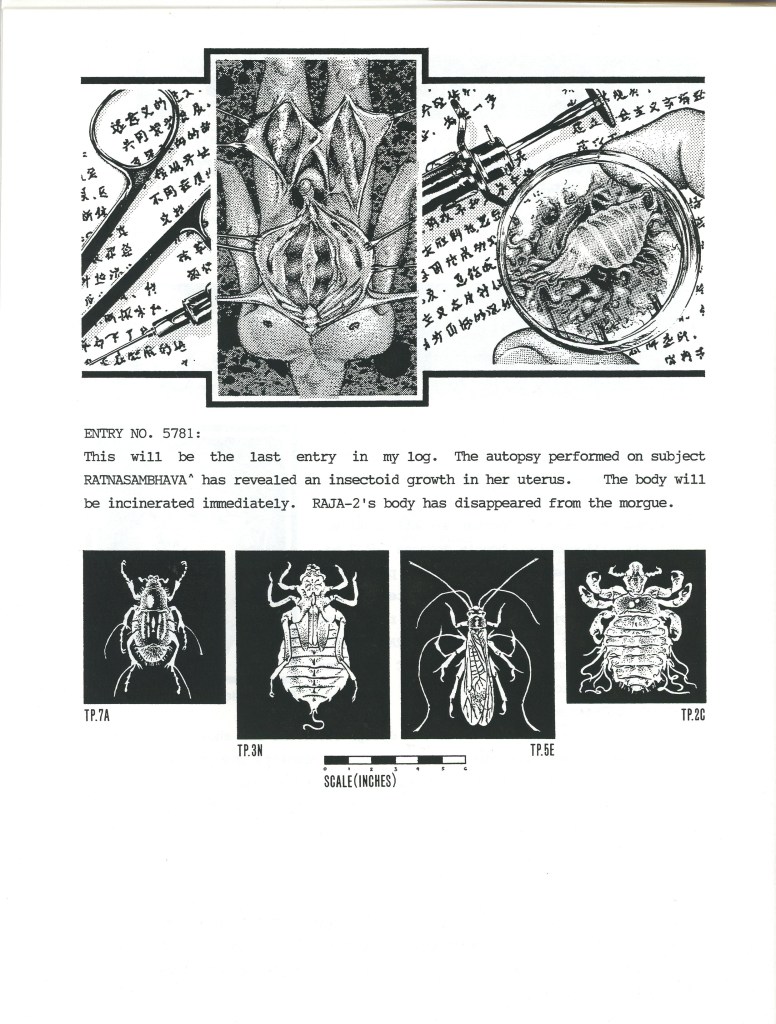
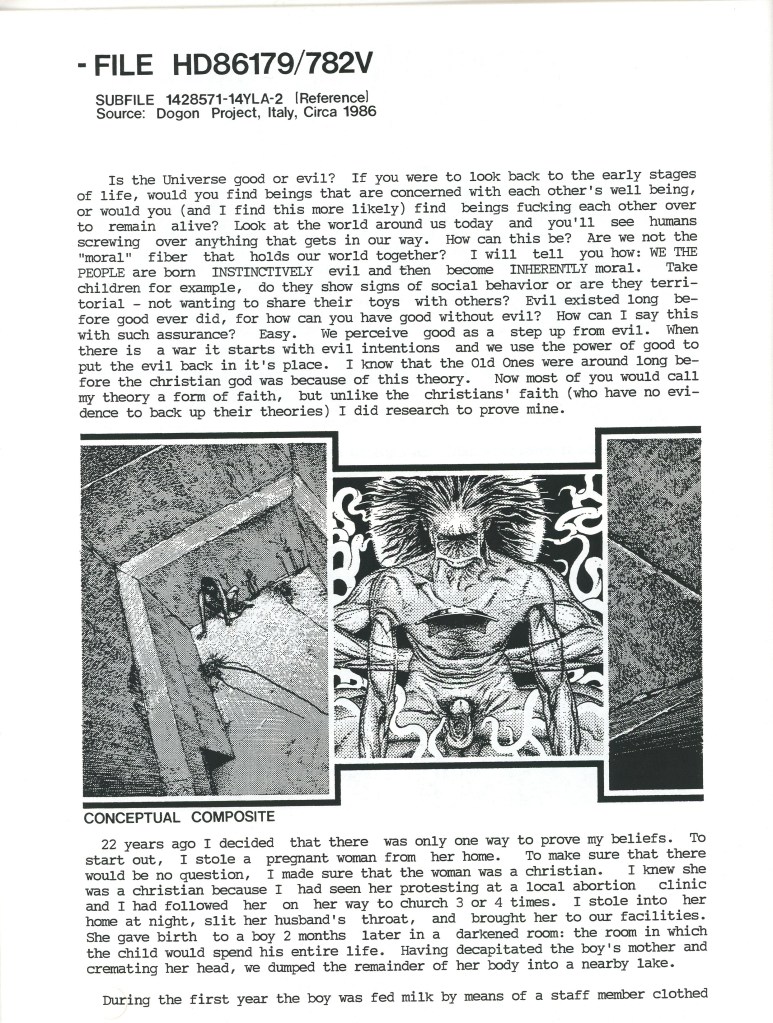
Black Sands #1 (1996) is as vivid today as it was thirty years ago. There are still boundaries that fiction and art rarely approach, and while I wouldn’t qualify any of this as pornography or even erotica, there is no doubt that this is in the same vein as the Linda Lovecraft anthologies in terms of being very explicit, mature works, with none of the humor or silliness that often cuts the Lovecraftian horror like baking soda in cocaine. If there’s a criticism, it might be that the writing is a little too obsessed with the question of good and evil, too focused on contrasting what the characters are seeing with Christian definitions of good and evil.
Black Sands #2 and subsequent issues would never emerge; in the 90s he returned to illustration for roleplaying games, and then stuck mostly with prose fiction. However, there was a sort of sequel in the 2010s. In 2013, Room 308 published Black Sands: Catalog of the Ten Thousand Churches, Journal No. 1, which republishes the entirety of the “Betrothed” sequence, along with prose chapters. Here, Blair Reynolds abandoned his original plan and rewrote the material as Col. Franklin Mackenzie Keyes’ field notes on various Lovecraftian cults he had encountered in his adventures.
Journal No. 1 was followed by an edited, much less explicit second edition in 2019, which alters the original “Betrothed” art to remove an erect phallus and various vulvas. This was followed by Journal No.2 (2019) and Journal No. 3 (2021) shortly before Blair Reynolds’ death. All of these volumes are illustrated, though nowhere to the degree of Black Sands #1 (1996), and the later volumes make considerable use of public domain and stock art, altered for purpose. They make for fun reading, nowhere near as edgy as the original Black Sands, but with plenty of wit and quite a lot of thought behind the various cults and cultic shenanigans.
It is a sad legacy. Blair Reynolds’ work, prose and art, is largely forgotten today; his great project of Black Sands was never fully completed, at least not according to his original vision, and even the few books he did put out near the end of his life are rare. All are out of print, except for Kindle editions of Black Sands: Catalog of the Ten Thousand Churches, Journal No. 1 (without the “Betrothed” comic), Journal No. 2, and Journal No. 3, which are still available for now.
Maybe, one day, that will change. I hope so. More people deserve to see what Blair Reynolds achieved, or tried to.
Bobby Derie is the author of Weird Talers: Essays on Robert E. Howard and Others and Sex and the Cthulhu Mythos.
Deep Cuts in a Lovecraftian Vein uses Amazon Associate links. As an Amazon Associate I earn from qualifying purchases.

