Keener news-followers, however, wondered at the prodigious number of arrests, the abnormally large force of men used in making them, and the secrecy surrounding the disposal of the prisoners. No trials, or even definite charges, were reported; nor were any of the captives seen thereafter in the regular gaols of the nation. There were vague statements about disease and concentration camps, and later about dispersal in various naval and military prisons, but nothing positive ever developed. Innsmouth itself was left almost depopulated, and is even now only beginning to shew signs of a sluggishly revived existence.
—H. P. Lovecraft, “The Shadow over Innsmouth”
Concentration camps today are largely associated with the second World War: the Holocaust, the internment of Japanese Americans, the Bataan death march and other horrors. The Nazi government would begin the creation of concentration camps soon after Hitler was appointed chancellor in January 1933…but Lovecraft would not have known about this at the time he was writing “The Shadow over Innsmouth” in Nov-Dec 1931. Lovecraft’s use of the idea would hearken back to the first World War, when the United States and other nations interned “enemy aliens”—sometimes on the basis of ethnicity and nationality, sometimes for disloyalty, real or suspected.
The reference to concentration camps in “The Shadow over Innsmouth” is thus a sub rosa nod to readers, cluing them in that these people were different and perhaps held dangerous loyalties. Yet it is a message whose meaning has changed over time. Readers who have grown up in the aftermath of World War II, with a full awareness of the horrors that the Nazis would accomplish and the extremes that Americans would go to when driven by fear and prejudice—and because of this change in syntax, it has inspired different fictional interpretations, the two most notable of which are Brian McNaughton’s “The Doom That Came to Innsmouth” (1999) and Ruthanna Emrys “The Litany of Earth” (2014).
We need not dust off the history of our nation’s dealings with the Indians to find examples of genocide, nor even go so far from our doorsteps as Montgomery, Alabama, to see instances of racism. Right here in our own state of Massachusetts, in February of 1928, agents of the U.S. Treasury and Justice Departments perpetrated crimes worthy of Nazi Germany against a powerless minority of our citizens…
—Brian McNaughton, “The Doom That Came to Innsmouth” (Even More Nasty Stories 7)
McNaughton’s opening sets the scene: the events of “The Shadow over Innsmouth” are not undone, but are showcased in an entirely different light, in line with contemporary attitudes towards racial prejudice and xenophobia. The raid becomes not a protective government hand sweeping in to solve a terrible threat, but a jackbooted act of discrimination, with a reductio ad Hitlerum thrown in just in case anyone missed it. This was immensely novel at the time, and the story carries on from there in much the same vein: set in the modern day, two generations removed the end of Lovecraft’s story, Bob Smith is a descendant of Innsmouth, his grandmother being one of the few that escaped the federal raid, and apparently ignorant of the Innsmouth heritage, the religion…all of it, except what bits and fragments his senile grandmother had told him.
Part of what makes McNaughton’s story work is what is said and left unsaid. Readers who may empathize with Bob Smith and the other Innsmouth residents are subtly reminded at every turn, without being explicit, that these people are not entirely human, that their religion (“In the name of Mother Hydra!”) was real, and also that they face prejudice from being who they are and holding to their beliefs. Shades of the Holocaust, with a blending of conspiracy theory and institutional racism; but where a Jew might be called a “hymie,” the Innsmouth pejorative is “Kermie”—after Kermit the Frog, to reflect their batrachian appearance.
The twist of the story is not so much the action climax, or the revelations about Bob Smith’s extracurricular activities that follow, but that the residents of Innsmouth are at least as dangerous as Lovecraft had written them, with McNaughton’s own small embellishments on Esoteric Order of Dagon theology and ceremonies adding a rather more overtly sordid and bloody emphasis. It’s a subversion of expectations: in an era when judging people by appearance, ethnicity, and religion are all considered taboo, when the discrimination and prejudice they have suffered is shown at length and in great detail, with parallels drawn to that experienced by real-life groups…readers may well have been sympathetic for Bob Smith, until he showed his true colors.
What stops “The Doom That Came to Innsmouth” from being a fable whose moral is that race prejudice is a positive thing? McNaughton was clever enough to make use of the racial allegories that can be read in “The Shadow over Innsmouth” and contemporary post-WWII, post-Civil Rights era mentality, and bold enough to do a Twilight Zone-esque subversion of expectations, but the subtextual message of the story is unpleasant: that sometimes prejudices are justified. It’s doubtful McNaughton ever intended that specific reading; after all, the idea that the residents of Innsmouth are partially inhuman fish-people is normally taken for granted by Mythos authors—and that itself is part of the problem.
The idea that there is a race that is inherently considered monstrous and a threat to “regular” humans in fiction is already unpleasantly close to the stereotypes and libels applied to real-world minorities and ethnic groups. The fact that writers use that idea without examination of the underlying implications is worse—nothing McNaughton writes about Deep Ones and Innsmouth hybrids is very different than the characterization in “Objects From the Gilman-Waite Collection” (2003) by Ann K. Schwader or “In His Daughter’s Darkling Womb” (1997) by Tina L. Jens. However, because he specifically invoked tropes of institutional racism, prejudice, and hate crimes, McNaughton is taking the subtext and making it text—what could be read as a dog whistle in the first “Innsmouth” becomes blatant in “The Doom That Came to Innsmouth.” The latter remains a good story, but also serves as an example for why it can be very difficult to tell stories that interact with racism in a realistic way in Lovecraft’s fiction.
In the evenings, the radio told what I had missed: an earth-spanning war, and atrocities in Europe to match and even exceed what had been done to both our peoples. We did not ask, the Kotos and I, whether our captors too would eventually be called to justice. The Japanese American community, for the most part, was trying to put the camps behind them. And it was not the way of my folk—who had grown resigned to the camps long before the Kotos’ people were sent to join us, and who no longer had a community on land—to dwell on impossibilities.
—Ruthanna Emrys, “The Litany of Earth”
Emrys starts from the same place as McNaughton: the Innsmouth diaspora. In her setting, the concentration camps of 1928 faded into those set up for Japanese-Americans starting in 1942. Innsmouth is mostly gone, and after her release Aphra Marsh too tries to reclaim what bits and pieces she can of her heritage, while living with the Japanese family she had shared the camp with.
What is markedly different between the two stories is tone. “The Litany of Earth” is a not a horror story, but a dark fantasy. There is no subtle hinting; the Cthulhu Mythos is real to Aphra, a part of her old life before the government shut her away and what she hopes to get back. While race is still a point of discrimination, Emrys focuses on religion and the eradication of history and culture:
In ’26, the whole religion were declared enemies of the state, and we started looking out for anyone who said the wrong names on Sunday night, or had the wrong statues in their churches. You know where it goes from there.
Contrasting with Aphra is FBI Agent Spector: an agent of the government that imprisoned her, a German immigrant of Jewish descent. Almost a literal “Good German.” Their shared experience of discrimination provides at least a slight thawing of relations, though not instant rapport. After all, he needs her help.
“And every religion has its fanatics, who are willing to do terrible things in the name of their god. No one is immune.” His lips quirked. “It’s a failing of humanity, not of any particular sect.”
The focus on religion cuts away from some of the less pleasant aspects of Lovecraft’s concentration camp victims. Aphra Marsh and her folk are a people apart, but a sharp delineation is made between the cultists of “The Shadow over Innsmouth” and “The Call of Cthulhu,” less of race and more in understanding and approach: in Agent Spector’s plea for cooperation, it is the extremists with their blood sacrifices that are the bad guys. Even among those there are poseurs, con-artists, the desperate and deluded.
Yet Aphra Marsh sticks to Lovecraft’s script that the Deep Ones are a different race of people, and that their attributes are not those of homo sapiens. Biological immortality, an ancient culture and eldritch lore, an attachment to aspects of nature—the Deep Ones in “The Litany of Earth” are the second cousins of Tolkien’s Sea Elves from The Lord of the Rings. As in Tolkien’s work, there is a pettiness to some humans, a clash over the limited lifespan compared to those of the elder folk. The same essential conflict, only with Lovecraftian trappings.
Thus, “The Litany of Earth” shares some of the same problems as “The Doom That Came to Innsmouth.” The central falseness of racism and racialism is that humans are, for better or for worse, all basically the same. Races are a social construct, not a biological one. Different populations may exhibit common features due to shared ancestry, but homo sapiens is one species. The Deep Ones are different. They may look human, when young; they may interbreed with humans, yet they are fundamentally other. In the fantasy setting of the Cthulhu Mythos, the Deep Ones embody the Nazi conception of a race apart far more than the Jews ever did.
When the lines between allegory and exposition are erased, you’re not looking at racism as was understood and practiced by Lovecraft, or in the concentration camps of World War II. If the subject of fantastic racism actually is alien, the dynamic shifts and the old arguments used to oppose it have to shift as well. The trappings are the same, but you’re not dealing with human-on-human racism, but something akin to destroying the natural habitat of apes and cetaceans and keeping them in captivity—and whether or not the detainees have human-level intelligence, or what constitutes “human” as far as rights, become part of the conversation. Or at least it should.
Neither McNaughton or Emrys really want to explore that direction in these stories; their narratives depend on Deep Ones that are human enough to face prejudice and be sympathetic, and alien enough to provide a core of real insurmountable difference with actual humans. Both McNaughton and Emrys also hedge away from miscegenation and immigration, arguably the most prominent themes regarding race in “The Shadow over Innsmouth.” There’s no real discussion in either story of the Deep Ones having come to Innsmouth from somewhere else and absorbing or displacing the population; the threat to humanity is never existential as far as Deep Ones irrevocably contaminating the human gene pool or culture. The protagonists in each story are members of an embattled minority, almost an endangered species, at least on land.
Genocide is the shadow that hangs over both McNaughton and Emrys’ versions of Innsmouth. The purpose of concentration camps when Lovecraft wrote “The Shadow over Innsmouth” was internment, at least in the United States; yet it lead inexorably to the effort to exterminate entire peoples by the Nazis. In “The Doom That Came to Innsmouth,” the effort is ongoing, albeit less direct; in “The Litany of Earth,” the FBI’s focus has shifted to cultists, but it took WWII for them to begin to face their mistakes. In both cases, families were broken up, generations lost. McNaughton and Emyrs looked, with the wizened eyes of those who have seen the outcome of the Holocaust, past the end that Lovecraft wrote at the consequences which he did not, could not fully predict.
Complaints from many liberal organisations were met with long confidential discussions, and representatives were taken on trips to certain camps and prisons. As a result, these societies became surprisingly passive and reticent. Newspaper men were harder to manage, but seemed largely to coöperate with the government in the end.
—H. P. Lovecraft, “The Shadow over Innsmouth”
Brian McNaughton got his start as a writer in the fan-scene of the 1950s; worked as a newspaperman, and eventually spent over a decade writing pornographic novels and stories for adult magazines, before crossing back over into horror and weird fiction in the 1980s, where he won acclaim, including a World Fantasy Award in 1997. He wrote a number of Cthulhu Mythos stories, with a penchant for outrageousness, sexuality, and black humor. His best short horror fiction is collected in Nasty Stories (2000) and Even More Nasty Stories (2002), and he wrote several novels of the Cthulhu Mythos—including a pornographic novel involving another Innsmouth survivor, Tide of Desire (1982) under the name Sheena Clayton. He died in 2004.
Ruthanna Emrys continues the story of Aphra Marsh in her series The Innsmouth Legacy, currently consisting of Winter Tide (2017) and Deep Roots (2018). Her Lovecraftian short fiction includes “Those Who Watch” (2016), and with Ann M. Pillsworth she is part of Tor.com’s series The Lovecraft Reread.
Bobby Derie is the author of Sex and the Cthulhu Mythos (2014)






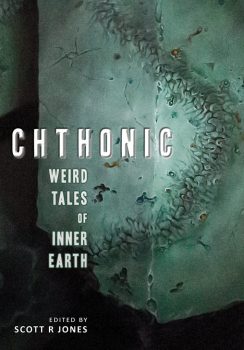 Nadia Bulkin’s “Pugelbone” first appeared in ChiZine (Oct-Dec 2010), and was reprinted in her collection