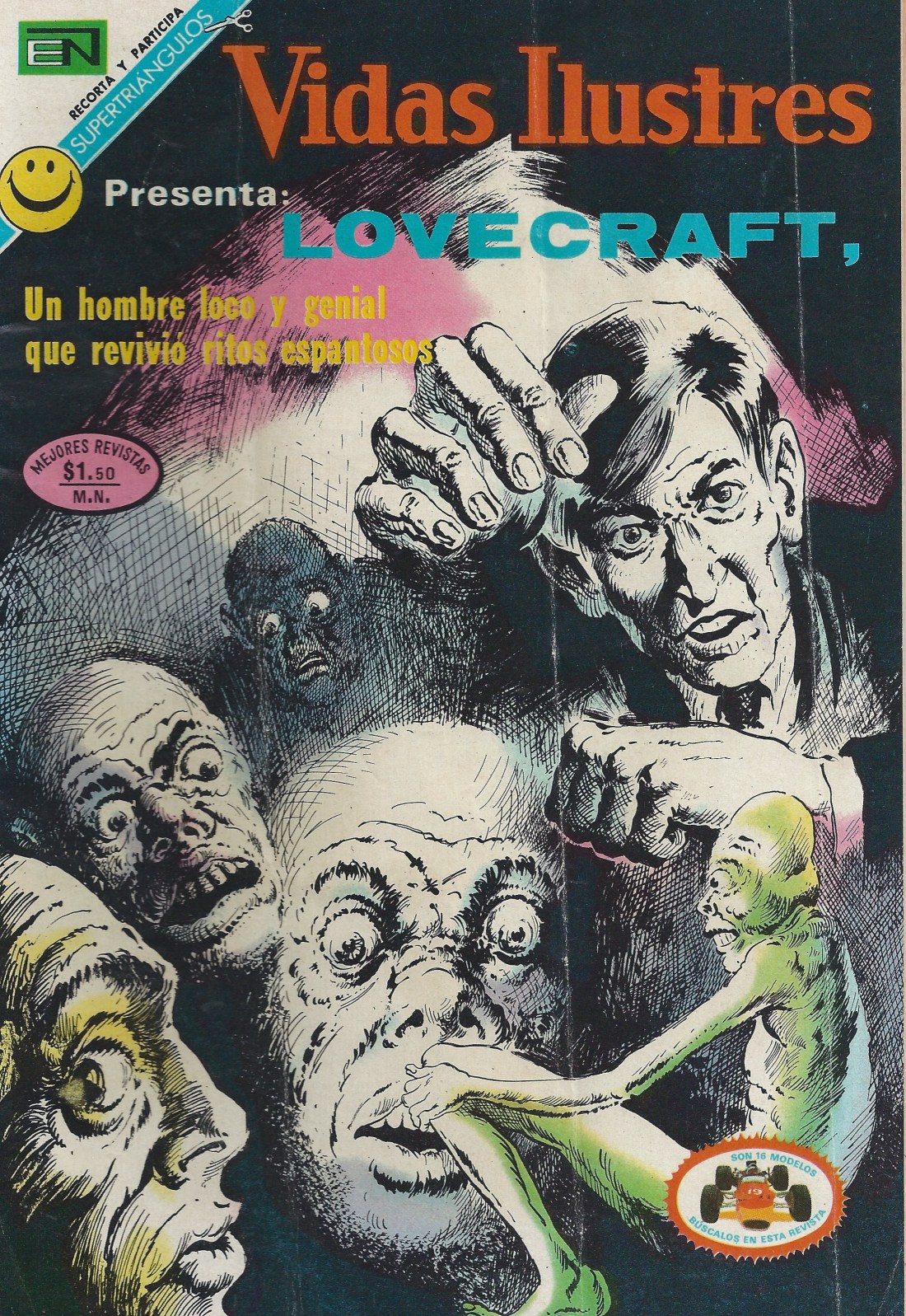
The works of H. P. Lovecraft were first translated into Spanish (Castilian) and published in book form in the 1950s, no doubt some individual magazine appearances preceded those publications. But readers in Mexico in the 1970s could enjoy El color que cayó del cielo (1957 or 1964, Ediciones Minotauro), Obras escogidas (1966, Ediciones Acervo), En las montañas de la locura (1968, Eidtorial Seix Barral), El caso de Charles Dexter Ward (1971, Barral Editores), and Viajes al otro mundo (1971, Alianza Editorial)…and in September of 1972 in Mexico, eager young readers could snap up Vidas Illustres #292, thirty-two color pages dedicated to H. P. Lovecraft.
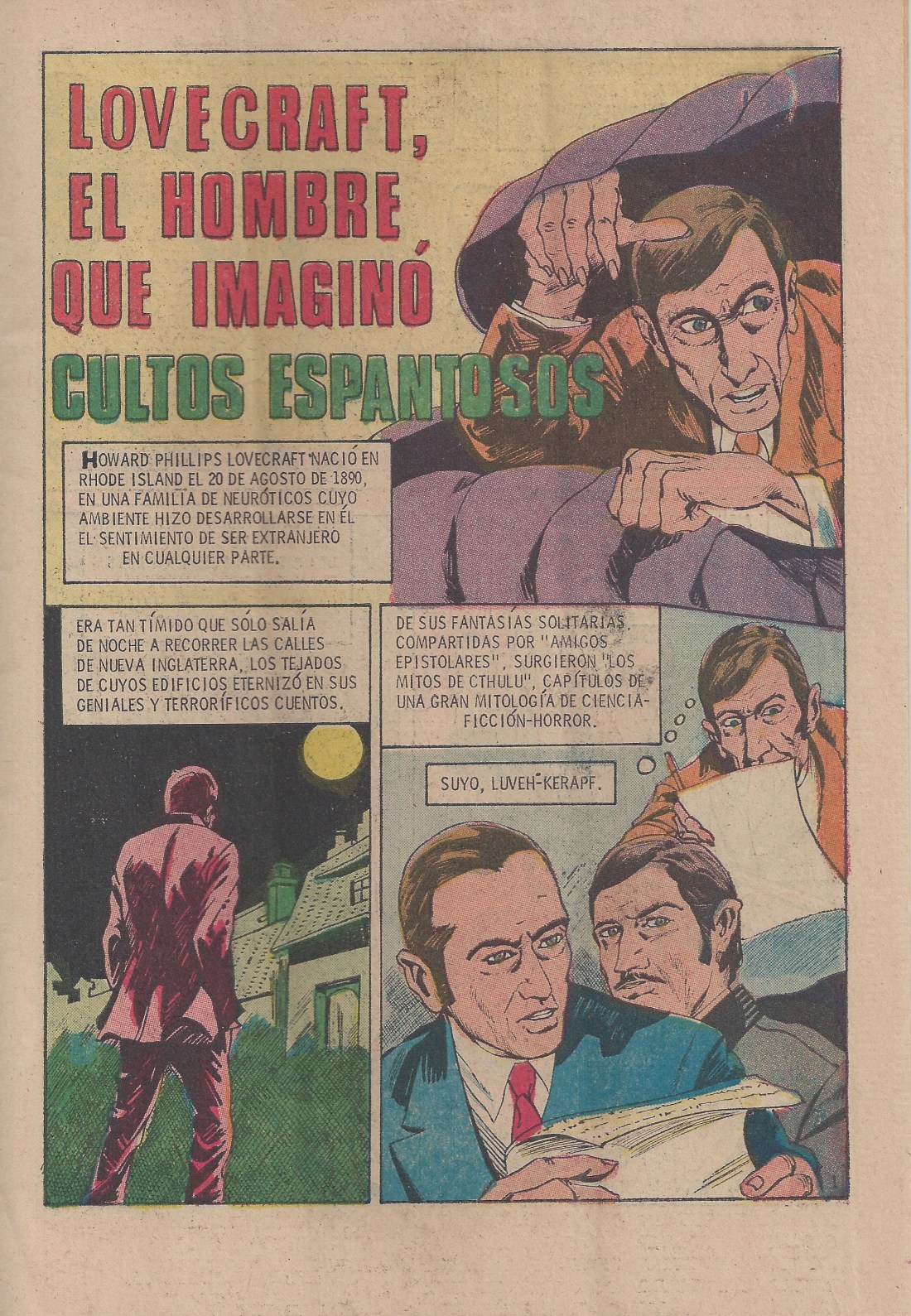
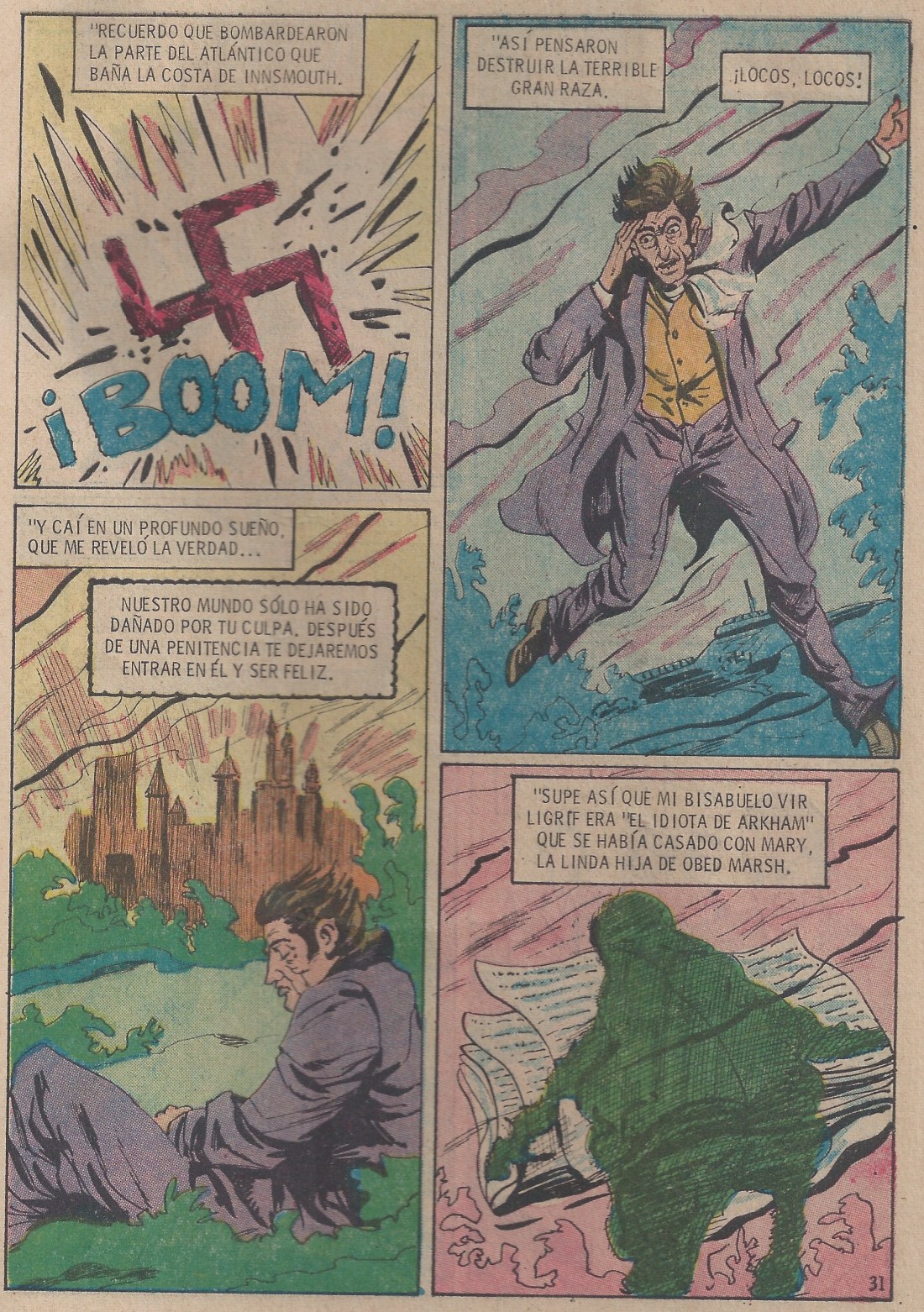
The date is significant; the first English-language biographical comic of H. P. Lovecraft was Kuchar’s “H.P.L.” in Arcade #3 (1975), and the first full-length biography, L. Sprague de Camp’s Lovecraft: A Biography (1975), were both published three years later. While Charlton Comics had published a very brief piece on Lovecraft in Baron Weirdwulf’s Haunted Library #61 (1971), that was only about a third of a page at the back of the book. Yet based on the details in the panels, the makers of this comic book (neither writer or artist is credited) obviously knew their Lovecraft. From the very first page:
This is a very fair snapshot of Lovecraft’s life, as readers of imported Arkham House titles (or the cheaper paperback reprints) would have had in 1972, right down to signing off as “Luveh-Kerapf” (“Luveh-Keraph”). Nor were the writers/artists unwilling to show their influences:
This issue would have been on the stands next to Mexican horror comics like Tradicions y Leyendas de la Colonia, El Monje Loco (issue #52 of which contains an uncredited adaptation of “The Colour Out of Space”), Las Momias de Guanajuato, and Mini Terror. These were infinitely more lurid and creepy than nearly anything on the newsstands in the English-speaking world in the early 1970s, with the possible exception of Warren publications like Eerie and Creepy. Mexico had no Comics Code Authority, but the Comisión Calificadora de Publicaciones y Revistas Ilustradas had limited resources with which to censor comics.
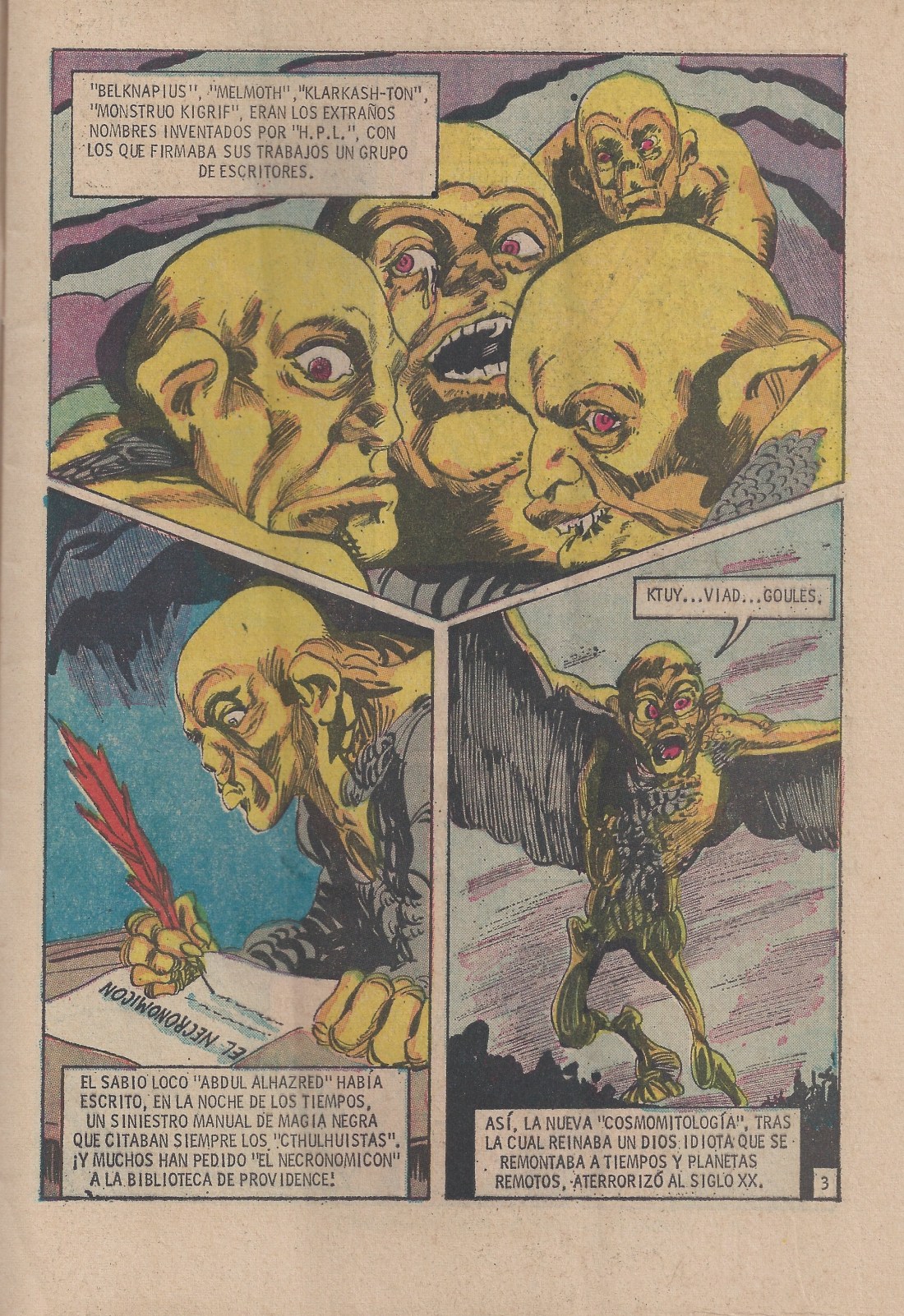
In production quality, the paper and printing are cheap and shoddy by today’s standards—but by 1970s standards, this wasn’t half bad, definitely on the lower end of the scale of professional publication but far from embarrassing to be seen next to second-tier horror comics like Charlton’s Haunted or Gold Key’s Doctor Spektor. Some of the panel layouts in particular show an awareness and willingness to experiment. This triptych layout for example:
Not the height of comic art in the 1970s by any means, especially the bizarre anatomy of the critter in that lower right-hand panel, and the backgrounds are perfunctory at best, but the framework is more than just a four-by-four grid. Someone was definitely trying to invoke something, no matter the limitations of their skills or the medium.
While nominally Vidas Illustres #272 begins as a bio-comic of Lovecraft, by page eight it morphs into a very brief adaptation of “The Shadow over Innsmouth,” presented as a quasi-biographical story of Lovecraft himself! This is actually pretty fair for such an abbreviated epic, with the most notable odd discrepancy being the mix of clothing styles—the protagonist’s top-hat recalls the 1800s rather than the 1900s, although I suspect it owes something to The Haunted Palace (1963), a period horror film nominally adapting Edgar Allan Poe’s story of the same name but really borrowing from Lovecraft’s “The Case of Charles Dexter Ward”—the second figure in the third panel of the first page bears a distinct likeness to Haunted Palace star Vincent Price.
Some things did get lost in translation, or at least a little jumbled. The swastika-shaped signs are reduced to a single out-of-context panel that probably confused a lot of readers in a post-World War II Mexico. In one panel, “Iä! Iä! Cthulhu fhtagn” is transliterated as “¡Ia, Ia, Cthulu tfañg!” These are features more than flaws, writer and artist trying to cram as much into the thirty-two page comic as they could.
There is something really poignant about the last pages, where fact and fiction combine and you get this version of Lovecraft reflecting back on his life and saying:
El horror de mi vida solitria y extravagante adquirió entonces un sentido: yo no soy de este mundo.
The horror of my lonely and extravagant life then acquired meaning: I am not of this world.
As an individual work, Vidas Ilustres #292 might be seen by many as a curiosity—but it should be seen as exemplary of a distinct mode of Spanish-language graphic works involving Lovecraft and his Mythos. Artists from Latin America such as Alberto Breccia (Los Mitos de Cthulhu), his son Enrique Breccia (Lovecraft), and Horacio Lalia (Les Cauchemars de Lovecraft) have crafted superb adaptations and original stories based on Lovecraft’s work, as have Spanish artists such as Joan Boix (Grandes de la Macabro) and master painter Esteban Maroto (Lovecraft: The Myth of Cthulhu). Several of these works have been translated into English, but most can only be read in their original Spanish or in other languages.
References to the Mythos in Spanish comics has ranged from the erotic, such as Ignacio Noé and Ricardo Barreiro’s The Convent of Hell, to the lighthearted and comic such as José Oliver and Bart Torres’ El Joven Lovecraft. Lovecraft continues to be an influence on Spanish-language comics to this day through the ongoing comics anthology Cthulhu from Diabolo Ediciones, including the special issue Lovecraft, un homenaje en 15 Historietas.
I could go on; the field is vast, and the influence of Lovecraft and his mythos runs deep. As far as I am aware, this issue was never reprinted in any form. If you are interested in reading the long out-of-print Vidas Illustres #292 yourself, the issue has been scanned and uploaded to the Internet Archive, where it can be read for free.
My thanks and appreciation to Silvia Moreno-Garcia whose article “Mexican Horror Comics” in the Weird Fiction Review #10 provided some of the background and inspiration for this piece.
“Just—Irem. Ah, I see by your expression you too know of my namesake, that legendary place—”
“You have heard of the city called ‘Irem’?”
“I’ve read esoterica about the City of Magicians. ‘Tis said to be but fancy, master. But a poet never forswears such dreams.”
—Raul Garcia-Capella, “Caravan to Kuthchemes” in The Leopard of Poitain57
The fictional worlds of Robert E. Howard and H. P. Lovecraft are intertwined, one Mythos shading into another. In his long and varied career Conan faced Lovecraftian horrors such as the tentacled monster Thog in the lost city of Xuthal, and dealt with wizards birthed on Dagoth Hill which might have been cousins to Wilbur Whateley. Lovecraft himself put small references to Valusia, Bran Mak Morn, and the Serpent Men into his fiction…so it is not too much of a gloss to say that the Howardian heroes existed in the same world as nameless Lovecraftian protagonists.
Fans took note of this, and the Lovecraftian element has never quite left Howardian fiction even to this day.
I was born in Puerto RIco and brought up in San Juan in P.R., and in Miami. My paternal grandmother, a schoolteacher, taught me my first couple of grammar school years. Mom and Dad were readers; Dad was also a movie fna. As a kid, I’d read fairy tales to my younger cousins, while Dad introduced me to the serials, some of which were the Buster Crabbe Flash Gordon and the Nyoka serials, not to mention a number of Tarzan movies, Westerns, etc. Here’d by books for Christmas, and by the time I was eight had read Tarzan of the Apes and 20,000 Leagues Under the Sea in Spanish.
—”An Interview with Raul Garcia-Capella” by James Van Hise
in Sword & Fantasy #6, 44
Raul Garcia-Capella is better known as an illustrator for science fiction and fantasy books and magazines, with dozens of covers and interior art to his credit, sometimes under the name Ray Capella or R. Garcia Capella. Born in 1933, his family arrived in Brooklyn in the 1940s, just in time for the last decade-and-a-half of the pulp magazine craze.
DID YOU READ WEIRD TALES AT THE TIME?
No. Weird Tales didn’t attract me, I knew it was horror and my interest was more for science fiction/adventure. Through collecting and coming across Lovecraft’s work in the Boys High Library I realized HPL and Howard had written for Weird Tales.
I’d buy writers that had appeared in WT but I didn’t get the magazine itself, as when I did, I never could get through an entire issue. Later, I discovered Clark Ashton Smith and began appreciating the quality of material published by it. but I never got into collecting it. (ibid., 47)
This was during the period Dorothy McIlwraith was editor at Weird Tales, where she dropped science fiction and adventure stories. It wasn’t until about 1960 that Garcia-Capella became involved with Howard fandom, in the pages of the prominent fanzine Amra, and it was there that he began to write:
I wrote the brief autobiogrpahy of an Argossean; a fanciful bunch of ideas featuring a character who lived in the Hyborean Age. I thought it’s be presumptious to mess with Conan, who could only be done by Howard. So my creation tried to add more color to Conan’s world without altering it. In a word, it was a tribute. But [George H.] Scrithers wouldn’t let me off the hook because I’d outlined stories and titles. He kept nudging me by mail whenever I contributed illos or articles. Although hesitant to do it, when I finally started, the tales wrote themselves. It was great fun. I was reading Howard and Brackett and all the people that influenced me. But it was just—boom; they came out. (ibid., 51)
“The Leopard of Poitain” was published in the April 1960 issue of Amra, the outline inspired by “A Probable Outline of Conan’s Career” (P. Schuyler Miller & John D. Clark, 1938). This was followed up over a period of years with other adventures of Arquel of Argos. They were fun; Raul Garcia-Capella was a competent fantasist, and he knew what he wanted to write—action-driven sword & sorcery inspired by Robert E. Howard, Leigh Brackett, A. Merritt, and Fritz Leiber. Arquel himself, the eponymous “Leopard of Poitain,” is no Conan-clone or pastiche. An adventurer, certainly, but like Leiber’s Gray Mouser more interested in the thaumaturgical and wizardly side of things than the Cimmerian.
Working in another man’s story-world is a tricky business. […] Capella wisely—very wisely—uses Howard’s world without using Howard’s principal characters in on-stage rôles. Arquel is neither Conan nor an imitation of him; Capella is no Howard—he’s far saner, far easier to know and like. In doing so, Capella has illuminated corners of the Hyborean world that Howard overlooked: what was going on behind the scenes; why the enemies were foiled in their attempt to launch a sneak attack or to bring into being a evil, magical past best left buried; and how magic and magicians can work for good as well as for evil.
—George H. Scithers, “Introduction” to The Leopard of Poitainii
The book-length collection The Leopard of Poitain(1985) is a bit of a hybrid. The first half (“Book I”) is a stitch-up novel that collects all of the Arquel adventures published in the pages of Amra and Fantasy Book up to that point, and pieces them together with brief episodes (“Witch’s Pebbles”) that forecast the new and longer novella (“The Winds of Acheron”) which makes up the second half (“Book II”), and takes place in and around the events of the final Conan novel, The Hour of the Dragon(1936). As he put it:
Jim Kelly, a fantasy fan who wanted to get into publishing, wrote asking why no one had put all the Arquel stories into one volume. The editors forward the letter to me. While exchanging letters, I let Jim know the project would need the final novella; it hadn’t been written. He agreed to wait and sent an advance check when the book was ready. The rest you know. Morgan Holmes proposed using the novella—”The Winds of Acheron”—and I did some polishing on it for that edition.
—”An Interview with Raul Garcia-Capella” by James Van Hise, 53
Explicit Lovecraftian references in Garcia-Capella’s Arquel stories are few—a reference to Irem here, a Serpent Man there—and he made no attempt to create new entities and tomes as was common in Mythos pastiches of the period. One of the most Lovecraftian is “Turutal” (1965), which involves a lost dwarf race known as the Ituru awakened from a curse to reclaim their miniature citadel; shades of Robert E. Howard’s “Little People” stories and Conan tales such as “The Devil in Iron” and “Shadows in the Moonlight,” although it has no direct connections to either.
As a result, The Leopard of Poitain is often overlooked and forgotten compared to the Howardian pastiche novels published by L. Sprague de Camp, Lin Carter, Björn Nyberg, Poul Anderson, Karl Edward Wagner, Andrew J. Offutt, and Robert Jordan of the period. Yet it is no less than any other work expanding the world that Howard created, and by extension is a serviceable a sword & sorcery offshoot of the Mythos as any other—and more conscientious of the source material and style than most pasticheurs. As he put it:
[Robert E. Howard’s] style balances mood and action almost seamlessly. Whether he’s doing horror or adventure, he has a flair for making scenes segue almost so well that you’re carried headlong. You can’t stop, go back, catch a gltich in the plot or—in the case of the “spicy” stories, for instance—an unevenness about the relationship between the characters. But you don’t care. In other words—his pacing is some of the best there is, in the pulp era or now.
In Moorcock’s aricles on fantasy, he traced the influences of gothic horror and the manner in which a description set story mood or was made to reflect the feelings of the characters involved. Lovecraft overdid it. C. L. Moore did this more lengthily than Brackett; Howard learned how to do it with a few words. In “The Devil in Iron,” the fisherman loosens the knife in its scabbard at the beginning of the opening paragraph—which ends with a sentence that sets the mood. Conflict comes first; mood closely follows and is interspersed through the fisherman’s exploration to his climactic demise. (ibid., 55)
Raul Garcia-Capella continued to write and illustrate, including other “Hyborian Age” tales such as “The Lair” (2006). He died in 2010.
After a year and a half of almost daily letter-writing, back and forth, we were finally divorced in 1929, but we still kept up correspondence; this time it was entirely impersonal, but on a friendly basis, and the letters were far and few between until in 1932 I went to Europe. I was almost tempted to invite him along but I knew that since I was no longer his wife he would not have accepted. However, I wrote to him from England, Germany and France, sending him books and pictures of every conceivable scene that I thought might interest him.
When I visited the Cheshire Cheese Restaurant in London I sent him a replica of the beerstein out of which Dr. Johnson drank, and other souvenirs including a picture card of the corner (which was roped off and held sacred) in which the table and chairs stood that D.r johnson and his cronies and Boswell sat and drank and talked. […] From Germany and from france I sent him more scenic views; whole sets of the Castle of Rambouillet, the residence of Francis I, Versailles, Fontainbleau, Chartres, Rheims, Soissons, Chateau Thierry, Sevres, Le Lido, in Paris, the Luxembourg, the King’s Chapel—the entire walls of which are made of exquisite stained glass of which the process of coloring has become a lost art—Montmartre, Eglise Madeleine, Genevieve, the beautiful Russian Church on the Hill from which hilltop the entire city of Paris may be seen, Notre Dame, and many, many more places of historic interest that I no longer remember at present.
H. P. Lovecraft and his wife Sonia would meet for the final time in March 1933, when she prevailed upon him to visit her during a trip to Farmington, Connecticut. Whether she had any intention of publishing these “European Glimpses” is unknown, as the manuscript was not published until some years after her death. Most of their letters were largely lost—Sonia claims in her memoir to have burned her letters from Lovecraft—and as for her side of the correspondence:
[Lovecraft’s surviving aunt] Mrs. Gamwell also gave the children about a hundred picture postcards that Sonia had mailed to Howard. These all held loving, spirited messages to H.P.L. from his sweetheart in New York. Not knowing their possible value in the far-away future, I did not hold on to any of these cards bearing Sonia’s signature, written in her breezy, happy handwriting. […] The children played for hours with the cards, and they eventually went the way all children’s toys go…in the ash heap!
—Muriel Eddy, The Gentleman from Angell Street 17
Lovecraft himself spoke only very rarely of his wife in his letters after the divorce, and very seldom mentioned the marriage itself. It is possible that this circumspection may be why Lovecraft wrote to one friend living and studying abroad in Paris:
For the past year I have had such knowledge of Paris that I’ve felt tempted to advertise my services as a guide without ever having seen the damn place—this erudition coming from a ghost-writing job for a goof who wanted to be publicly eloquent about a trip from which he was apparently unable to extract any coherent first-hand impressions. I based my study on maps, guide-books, travel folders, descriptive volumes, & (above all) pictures—the cards secured from you forming the cream of the latter. Fixing the layout of the city in my mind, & calculating what vistas ought to be visible from certain points (pictures seen under a magnifying-glass furnish a splendid subsittute for first-hand vistas), I cooked up a travelogue which several Paris-wise readers have almost refused to believe was written by one never within 3000 miles of the place. If I ever get to your beloved burg I shall be able to stat in sightseeing without any preliminary orientation-tour or rubberneck-wagon ride. In my article I took a vicious fling at the ugly Eiffel Tower, & ventured the suggestion that the Victorian trocadero is an eyesore at close range, but glamourous when seen in the distance against a flaming sunset. Other parts of the text touched on chartres, Rheims, Versailles, Barbizon, Fontainebleau, & other tourist high spots. I revelled in the London section (I studied Old London intensively years ago, & could ramble guideless around it from Hampstead Heath to the Elephant & Castle!), but was not able to do it justice because of the nominal author’s hasty passage through it. nothing but the Tower, the Abbey, & the Cheshire Cheese seemed to give him a first-class kick.
—H. P. Lovecraft to Alfred Galpin, 4 Nov 1933, Letters to Alfred Galpin196-197
All of these sites were in fact included in “European Glimpses,” and despite the references to “he” it seems clear that this travelogue was Sonia’s, with Lovecraft being misleading about the identity of his “client.” A manuscript written on the backs of letters to friends at the John Hay Library is dated 19 December 1932, and aside from internal evidence, this is the only date we have for when the piece was written.
As with Lovecraft’s other revisions, there is a question as to how much of his own writing makes up the final product. S. T. Joshi weighs in on this in the introduction to its first publication:
What we have, therefore, is a travelogue recounting Sonia’s experiences but written in Lovecraft’s style and frequently with his outlook and perspective. Would Sonia have called certain vistas of Paris “Dunsanian”? Would she have harped on the “meaningless” and “hideous” modernistic architecture of Germany (the subject of Lovecraft’s essay “Heritage or Modernism” written three years later)? Would she have thought of Rémy de Gourmont (author of the languidly philosophical prose-poem A Night in the Luxembourg) when wandering through Luxembourg Gardens? As we read this document we mut constantly adopt a sort of schizophrenic mind-set: the first-person narrator is supposed to be Sonia, but Lovecraft cannot help injecting his own views into her sights and experiences.
To be quite frank, however, Lovecraft was extraordinarily charitable to rewrite this travelogue for Sonia. Even in his version it is hopelessly unpublishable. Where did Sonia think she could land such a piece? Do we really want yet another commonplace account of hackneyed tourist sites like the Tower of London or Versailles?
—S. T. Joshi, “Introduction” to European Glimpses5
It is a valid point; most of the entries are relatively brief and contain little real insight or interest as a travelogue. The ending of the narrative seems to acknowledge this:
There may be those who will think my modest jaunt a sadly hackneyed coursing in the beaten paths, but to them I can only reply that no path is truly purged of its glamour so long as any ancient memories or overtones of fancy still cling around to its sights and impressions.
The contents also echo both Sonia’s memoir and Lovecraft’s letter to Galpin strongly. For example, in discussing the Cheshire Cheese tavern, “European Glimpses” notes on Dr. Johnson’s mug: “Duplicates of these mugs are for sale, and form especially apt mementoes of the place and its illustrious frequenter.” (Collected Essays 4.234)
The one part of the travelogue that does hold continued interest is a reference to a gathering of the National Socialist party at which Adolf Hitler, then on campaign for the presidency of Germany, gave a speech:
During my stay of five days at Wiesbaden I had opportunities to observe the disturbed political state of Germany, and the constant squabbles between various dismally uniformed factions of would-be patriots. Of all the self-appointed leaders, Hitler alone seems to retain a cohesive and enthusiastic following; his sheer magnetism and force of will serving—in spite of his deficiencies in true social insight—to charm, drug, or hypnotise the hordes of youthful “Nazis” who blindly revere and obey him. Without possessing any clear-cut or well-founded programme for Germany’s economic reconstruction, he plays theatrically on the younger generation’s military emotions and sense of national pride; urging them to overthrow the restrictive provisions of the Versailles treaty and reassert the strength and supremacy of the German people. He is fond of such phrases as: “Germany, awaken and take your rightful heritage with your own strong hands!”—and when speaking of elections usually intimates that in case of defeat he will consider an armed march on Berlin corresponding to Mussolini’s Roman coup d’etat of 1922.
Hitler’s lack of clear, concrete objectives seems to lose him nothing with the crowd; and when—during my stay—he was scheduled to speak in Wiesbaden, the Kurpark was crowded fully two hours before the event by a throng whose quiet seriousness was almost funereal. The contrast with America’s jocose and apathetic election crowds was striking. When the leader finally appeared—his right hand lifted in an approved Fascist salute—the crowd shouted “Heil!!” three times, and then subsided into an attentive silence devoid alike of applause, heckling, or hissing. The general spirit of the address was that of Cato’s “Delenda est Carthago“—though one could not feel quite sure what particular Carthage, material or psychological, “Handsome Adolf” was trying to single out for anathema.
After the conclusion the crowd respectfully opened a path for his departure, and he left in his car as quietly as he had arrived—the only sound being a shot of farewell from his followers. Then—silently, though perhaps with the general muffled discontent of the period—the kindly burghers dispersed to their not quite happy homes. At the time of this speech Hitler’s tactics hinted of a “back to the Monarchy” movement; and Prince August Wilhelm, son of the ex-Kaiser, was a brief supplementary speaker. The royal scion, however, failed to overshadow the would-be dictator in the popular emotions.
The waste of energy and widespread chaos caused by the incessant conflict of no less than thirty-six separate parties—of which three may be called major ones—is the most distressing phenomenon in modern Germany; yet no one seems able to reconcile the various shades of opinion and feeling which cause this confusing diversity. Taxes are exorbitant, unemployment terrific, and general confidence at a very low ebb. the people of Wiesbaden have lately come to call their habitat “the city without a smile”, though the same might be said for almost any city in the Reich. Passport restrictions are very stringent, including both visas and police registration; and the tourist is taxed nine pfennigs a day during his sojourn in the country. Yet the German people as a whole, apart from the governmental meshes in which they are entangled, are perhaps the most kindly and affable beings I have ever met. they are gracious, courteous, and delightful; and seem to radiate a really cordial glow devoid of hollowness or superficiality. they perform their duties with an almost military precision and effectiveness, and when once led out of their present chaos will undoubtedly resume their place of importance in the world. One hopes that a suitable leader may arise before the existing misery increases. (ibid. 239-240)
This speech was July 28th, 1932, part of a tour that Hitler was giving in the run-up to the 1932 elections in Germany (election day was 31 July). There is a lot to unpack in the general sentiments; some bits are clearly Lovecraft, some bits are clearly Sonia. The date of the manuscript is after the election, so he would know of the Nazi party’s success, even as Hitler lost his bid for the presidency.
Lovecraft’s own opinion of Hitler was one of cautious optimism. The Providence writer had a low opinion of the intellect of the masses, and believed that the democratic trust of the lowest denominator was illogical; he believed in a kind of natural aristocracy of the intelligent and capable who would rise to leadership positions—and thought he saw this in the rise of Mussolini, and later Hitler. He approved of strongly nationalistic ethos, which jived with his own prejudices regarding race and culture, and with a planned, state-run economy. However, he disliked the Nazis’ racial theories—finding them unscientific—and he thought Hitler a clownish figure (particularly the mustache). Overall, Lovecraft’s opinion on Hitler was mixed, and leaned toward approval…at least until Hitler became chancellor and began to actually enact his program, where Lovecraft’s support rapidly dwindled. Lovecraft died in 1937, before World War II or the horrors of the Holocaust could be revealed.
Sonia’s opinion of Hitler was less charitable; in a letter to the editor in October 1932 she lambasts him and his antisemitism:
As a Jewish woman whose family had lived through pogroms in Russia, Sonia was keenly aware of the antisemitic thrust of Nazi ideology. Her memoir of their marriage includes mention of Lovecraft’s apparent consideration, including a claim that Lovecraft read Mein Kampf as soon as it came out; the only English-language translation during HPL’s lifetime was the Dugdale abridgment, available for sale in 1933 (after their final meeting), and there are no mentions of it in Lovecraft’s surviving letters. Possibly she referred to excerpts from the translation published in the Times in 1933, which Lovecraft would more likely have had access to, and which presumably he may have written her about.
So how much of this incident was Sonia, and how much was Lovecraft? It seems clear that she must have mentioned the rally in her notes or correspondence; the interpretation seems more strongly evocative of Lovecraft. It is not unlikely that this represents a sort of balancing act between Sonia’s disapproval and Lovecraft’s tentative optimism toward a man and political party that would go on to be some of the greatest monsters in human history. This was the calm before the storm that would be another world war and the horrors of the Holocaust. Lovecraft and Sonia could not have known that, readers today cannot forget it.
Where was I? Oh, yes, back from Europe and once more in New England with Howard at my side exploring the grounds and places of cities more than three hundred years old. Yes, I believe I must have still loved Howard very much, more than I cared to admit even to myself. For, although in my travels I met many eligible men, some of them offering honest proposals of marriage, none appealed to me until after a period of eight years, during which time I could not help but compare what to me appeared as the inadequacy of other men, when compared in point of intellect, with Howard.
—Sonia H. Davis, “The Private Life of H. P. Lovecraft” in Ave Atque Vale 143
If “The Horror at Martin’s Beach” marks the true beginning of Sonia and Lovecraft’s relationship, then “European Glimpses” marks its true end. A strange and fitful journey that left its imprint on both of them.
“European Glimpses” was first published in 1988 by Necronomicon Press; it is republished in volume four of Lovecraft’s Collected Essays. The unedited 1932 manuscript is available to be read online for free.
Four years ago Hazel Heald made her bow to the readers of Weird Tales with an eery story called “The Horror in the Museum,” which established her at once among the most popular writers of weird fiction. She followed this with “Winged Death,” a story of the African tse-tse fly, and another tale of a weird monster from “the dark bacward and abysm of time.” The story published here, “The Horror in the Burying-Ground,” is as weird and compelling as anything this talented author has yet written. We recommend this fascinating story to you, for we know you will not be disappointed in it. —Weird Tales, May 1937
“The Horror in the Burying-Ground” was the last of Lovecraft’s revisions for Hazel Heald to be published. The details of its creation, and how much input she had into the plot, are difficult to make out. H. P. Lovecraft died on 15 March 1937; the May issue of Weird Tales containing this story would have hit the stands around mid-April. No manuscript or typescript is known to survive. As most of the information we have on the other Heald revisions comes from Lovecraft’s letters, and Lovecraft himself was dead and unable to comment on the story, we are left with far less data to go on.
What little information we have though points at “The Horror in the Burying-Ground” as something of an outlier. The previous revision “Out of the Æons” had come out a full two years prior in the April 1935 issue of Weird Tales, and Lovecraft had been firm that he was not doing any more collaborations after that—with no indications in his correspondence that he had changed his mind or was working on a new story for a client. Yet the story’s text clearly shows Lovecraft’s heavy revisory hand, if he didn’t simply ghost-write the whole thing. So what happened?
The simplest answer would be that this was indeed written after the sale of “Out of the Æons,” and that Lovecraft had simply neglected to mention it. Shortly after Lovecraft’s death, August Derleth began writing to Lovecraft’s correspondents and clients, beginning to collect data for what would be Arkham House publications of Lovecraft’s fiction. She wrote back:
By the way, I will have another tale in the May Weird Tales—my own. […] Truly we have all lost a wonderful friend in HPL. I feel lost without his letters and kind advice even though I have not worked with him for three years on my stories. He had told me that now I could stand on my own feet and work things out for myself. —Hazel Heald to August Derleth, 25 Mar 1937
The “three years” comment would mean that the last story Lovecraft revised or ghost-wrote would be in 1934, which suggests that “The Horror in the Burying-Ground” was written earlier than that. Heald’s next comment on the story was some years later:
My HORROR IN THE BURYING GROUND was rejected once by Wright, then several years later I rewrote it in several places and he accepted it. He said I had too much dialect to read easily. —Hazel Heald to August Derleth, 14 Oct 1944
The implication is that “The Horror in the Burying-Ground” was written somewhere between 1932 and 1934, submitted to Farnsworth Wright, editor of Weird Tales, and then rejected and shelved for some years until he requested to see it again. Nowhere does Heald give any credit to Lovecraft for the story, or say when it was written—but there are is a possible clue in Lovecraft’s letters.
The Horror in the Museum—a piece which I “ghost-wrote” for a client from a synopsis so poor that I well-nigh discarded it—is virtually my own work. Glad you found it entertaining. There will be two more Heald tales equally dependent on my pen. —H. P. Lovecraft to Richard Ely Morse, 28 Jul 1933, Selected Letters4.229
“The Horror in the Museum” was published in Weird Tales July 1933; the next two tales would presumably be “Winged Death” (March 1934), and “Out of the Æons” (April 1935); the first mention of “Winged Death” in Lovecraft’s letters is actually August 1932 (Essential Solitude 2.497), suggesting it was probably written before “The Horror in the Museum.” That would suggest that “The Horror in the Burying-Ground” was probably written before those three tales. If that is the case, then “The Horror in the Burying-Ground” was one of their first stories—either a revision or ghost-written. “The Man of Stone”(Wonder Stories Oct 1932) is typically given as the start of Lovecraft’s revision services, given that it was the first published and that Muriel E. Eddy states in her memoir The Gentleman from Angell Streetstates that “The Man of Stone” was the story that Heald was working on that caused Eddy to put her in touch with Lovecraft, which would suggest “The Horror in the Burying-Ground” was second.
But…what if “The Horror in the Burying-Ground” was the first of the Lovecraft/Heald revisions? That would make the order of writing:
“The Horror in the Burying-Ground”
“The Man of Stone”
“Winged Death”
“The Horror in the Museum”
“Out of the Æons”
This order, incidentally, would start with a story that has no Mythos connection (“The Horror in the Burying-Ground”) to stories with minimal Mythos references (“The Man of Stone,” “Winged Death”) to the full-blown Mythos tales (“The Horror in the Museum,” “Out of the Æons”). Could the fact that “The Man of Stone” appeared in Wonder Stories and that “Winged Death” was offered first to Strange Tales suggest, perhaps, Wright’s rejection of “The Horror in the Burying Ground” soured Heald to Weird Tales for a period?
We don’t know. While the idea is suggestive, it is still speculative. Given the nature of pulp publishing, the situation may have been even more complex. Heald’s later re-writing of the story may have removed any obvious Mythos elements, as well as removed some of the “dialect.” It should be noted that in her letters to Derleth, Heald always stated that “The Man of Stone” was her first story—but then she also insisted that it was her own work, although she admitted “he did actually rewrite paragraphs” (Hazel Heald to August Derleth, 30 Sep 1944).
Looking at the text of the story itself, this unknown history of the story presents three possibilities for “The Horror in the Burying-Ground”:
An extensive revision, along the lines of “The Man of Stone.”
A ghost-writing job, along the lines of “Winged Death.”
An original story by Hazel Heald.
(1) assumes that there is more plot or writing involvement on Heald’s part, and would make more sense if it was written early in her relations with Lovecraft, and/or if she revised it after Wright rejected it. (2) is what the story is normally assumed to be; if the story was written late in their relationship, where Lovecraft was ghost-writing the stories entirely, this would be likely. (3) is what Heald claimed the story as; this appears to be unlikely, as the text has several hallmarks of Lovecraft’s prose, especially the portions of New England dialect. Compare:
“Don’t ye bury him, don’t ye bury him! He ain’t dead no more nor Lige Hopkins’s dog nor Deacon Leavitt’s calf was when he shot ’em full. He’s got some stuff he puts into ye to make ye seem like dead when ye ain’t! Ye seem like dead but ye know everything what’s a-goin’ on, and the next day ye come to as good as ever. Don’t ye bury him—he’ll come to under the earth an’ he can’t scratch up! He’s a good man, an’ not like Tom Sprague. Hope to Gawd Tom scratches an’ chokes for hours an’ hours. . . .” —”The Horror in the Burying-Ground”
“The graoun’ was a-talkin’ lass night, an’ towards mornin’ Cha’ncey he heerd the whippoorwills so laoud in Col’ Spring Glen he couldn’t sleep nun. Then he thought he heerd another faint-like saound over towards Wizard Whateley’s—a kinder rippin’ or tearin’ o’ wood, like some big box er crate was bein’ opened fur off. What with this an’ that, he didn’t git to sleep at all till sunup, an’ no sooner was he up this mornin’, but he’s got to go over to Whateley’s an’ see what’s the matter. He see enough, I tell ye, Mis’ Corey! This dun’t mean no good, an’ I think as all the men-folks ought to git up a party an’ do suthin’. I know suthin’ awful’s abaout, an’ feel my time is nigh, though only Gawd knows jest what it is.” —”The Dunwich Horror”
The dialect is very similar, if not quite identical; the Dunwich speakers use more long vowels. Heald’s comment that Wright asked her to remove some of the dialectic language may account for the difference, we have no way of knowing. Other elements that point toward Lovecraft’s involvement are various place and character names which appear elsewhere in Lovecraft’s life and works: Peck (“In the Vault”), Akeley (“The Whisperer in Darkness”), Frye (“The Dunwich Horror”), Atwood (At the Mountains ofMadness, Fungi from Yuggoth), and “Goodenough” (perhaps a nod to his friend, the poet Arthur Goodenough).
The basic idea of the story has similarities to “The Man of Stone”—a chemical which induces a state of paralysis—and there are echoes of this same basic idea in the living brain in the mummified body in “Out of the Æons”; so it is thematically tied to the other stories, although less weird and fantastic than them. Unusual for a Lovecraft story is the bitter romantic story between Sophie Sprague, her brother Tom Sprague, and her attempted suitor Henry Thorndike. This story of control and aborted courtship, the complex of emotions that Sophie experienced as both the men in her life who tried to own and control her were gone—may suggest Heald had more to do with the plot than in the later ghost-written stories.
When would Wright have asked Heald to see the story again? While it would be poetic if Wright heard news of Lovecraft’s death and rushed a letter to Heald asking for it, knowing he would get no more stories from the deceased, the timing would be tight—Heald’s letter to Derleth is dated just ten days after Lovecraft’s date of death. Wright would have had to write immediately and Heald would have had to send it on as quickly. Not impossible, but given that Wright was known to hang on to stories for months, sometimes years after acceptance, it is just as likely that he had asked her to revise it at an earlier date and that May 1937 was simply when he slotted it into an issue.
The death of H. P. Lovecraft and its announcement crowded out most mentions of the story in “The Eyrie”; the only comment published was by longtime fan Gertrude Hemken:
I have not been disappointed in Hazel Heald’s story of The Horror in the Burying-Ground. The lady knows how to keep one’s interest brimming. Her method of relating the circumstances as told by the general store council has a touch of humor. Any hard-fisted citizen would condemn them for a bunch of crackpots. As for me—I’d listen, git werry uncomfy and when the tale is done, run like heck for home… —Weird Tales, July 1937
August Derleth must have had at least some suspicion of Lovecraft’s hand in the story, and it was anyway good enough for him to publish in one of the wartime Arkham House anthologies, Sleep No More: Twenty Masterpieces of Horror for the Connoisseur (1944), produced in both hardback and an Armed Services Edition. His introduction to the tale:
HAZEL HEALD is in a large sense a protege of the late H. P. Lovecraft, and her published work, which is not voluminous, plainly bears the mark of the master. A self-admitted “amateur” in writing, Hazel Heald has never sought to deny the felicitous influence of Lovecraft, whose work, she says, inspired her to write, and under whose direction she did her best work. Her story, The Curse of Yig (included in the Lovecraft collection Beyond the Wall of Sleep) is a Weird Tales classic, and her Out of the Eons and The Horror in the Museum (also reprinted in Beyond the Wall of Sleep) are also remarkably fine tales of horror. A New Englander all her life, Mrs. Head [sic] has occupied her time in many and varied positions; writing is an evocation which she has followed sparingly in the past few years.
Derleth confuses Heald with Zealia Bishop, Lovecraft’s client for the revision “The Curse of Yig”; Heald is credited with the story in Sleep No More. The tale is not published as a Lovecraft “revision” until it was published in Something About Cats and Other Pieces (1949)—whether Heald admitted Lovecraft’s part in the story or Derleth simply made the determination on his own is unknown. Heald herself died in 1961, and after this general scholarly consensus has leaned heavily on “The Horror in the Burying-Ground” being at least an extensive revision by Lovecraft, if not actually ghost-written. S. T. Joshi in his Variorumsimply states:
The entire conception and execution of this story must be by HPL. (433)
Which may well be the case, although I suspect at least a little more of the plot was hers. We don’t know. All we do know is that “The Horror in the Burying-Ground” represents the posthumous end of their association. Only one other story of hers is known to have been published, “The Heir to the Mesozoic” which was published in Fantasmagoria #4 (Nov 1938) and Fantasmagoria #5 (Winter 1939/1940).
Near the end of Muriel Eddy’s memoir, she remarks:
Hazel, the sweet-faced writer who thought so much of Lovecraft, died February 3, 1961. She died unexpectedly of a heart seizure in a Boston hospital. She never remarried. What a match it would have been, if love had entered the heart of Lovecraft for this fine woman. They could have written many a weird classic together, for Hazel, unlike his other wife, would have been kind and understanding with him, knowing his sensibilities and his inborn gentleness. He could not be pushed into rank commercialism, but as a writer of the weird and unusual he was always tops in his field. And with that Hazel would have been content. —The Gentleman from Angell Street27
Rose-tinted spectacles. While Lovecraft was almost certainly friendly toward Heald, as he was to many of his clients, and engaged in correspondence and visits outside the scope of a purely professional relationship, at its base Lovecraft was writing or re-writing Heald’s stories for money—and determined, at the end, that the revision-work was both creatively exhausting and insufficiently remunerative to continue pursuing. It did result in five stories, two of which are significant additions to Lovecraft’s Mythos.
From what little evidence remains it appears her actual contribution in terms of writing was small, but Heald deserves credit for her part both as a catalyst to Lovecraft’s imagination and for the stories’ publication.
“The Horror in the Burying-Ground” may be read for free here.
Glad you enjoyed the Witch House and Museum story. Another tale which I revised for the “Museum” author, and which Wright has accepted, brings in von Juntz and his black book as almost the central theme. It concerns a mummy found in the crypt of a Cyclopean stone temple of fabulous antiquity; volcanically upheaved from the sea. —H. P. Lovecraft to Robert E. Howard, 24 Jul 1933, A Means to Freedom2.619
Regarding the scheduled “Out of the Æons”—I should say I did have a hand in it…..I wrote the damn thing! The original museum-mummy story submitted for revision was so utterly lousy (some crap about a Peruvian miner trapped underground) that I had to discard it altogether & prepare a fresh tale. But it’s really foolish to attempt jobs so extensive, when with the same amount of work one could write an acknowledged story of one’s own. This is the last collaboration of the sort I shall ever attempt—indeed, I’ve turned a deaf ear to all further suggestions from Sultan Malik, Mrs. Heald, Kid Bloch, & others. —H. P. Lovecraft to Clark Ashton Smith, 26 Mar 1935, Dawnward Spire, Lonely Hill 594
Glad you like “Out of the Æons”—which is, as I may have mentioned, virtually an original story of mine. All that survives from the initial Heald outline (worthy Mme. H. never bothered to write out any actual text for it!) is the basic idea of a living brain discovered in an ancient mummy. —H. P. Lovecraft to Clark Ashton Smith, 11 Apr 1935, Dawnward Spire, Lonely Hill 603
I enjoyed very much the story “Out of the Eons”. It might as well have carried your name beneath the title, for it was yours, all the way through. —Robert E. Howard to H. P. Lovecraft, May 1935, A Means To Freedom 2.851
“Out of the Æons” (also “Eons” and “Aeons” depending on the edition) was H. P. Lovecraft’s penultimate revision for Hazel Heald. Her part in this story appears to be comparatively less than that of “The Horror in the Museum” and “Winged Death”, and Lovecraft’s fleeting reference to “some crap about a Peruvian miner trapped underground” suggests a very different kind of story; as with other revision-clients, Lovecraft was taking increasing liberties in his ghost-writing to create a tale which was essentially his.
Hazel Heald’s own version of events is a little difficult to reconcile with Lovecraft’s:
I was a beginner and happened to be lucky enough to find HPL who certainly was the best to be found. he was a severe critic but I knew that if I finally suited him in my work that the editor would usually accept it. for example— I had to rewrite “Out of the Eons” six times to before he was completely satisfied! […] My “Out of the Eons” was inspired by trips that we had to taken [sic] to Boston and Cambridge museums together to visit any museum with HPL was certianly enough inspiration to write many tales. —Hazel Heald to August Derleth, 25 Mar 1937
The first part is difficult to reconcile with Lovecraft’s claim to have ghostwritten the piece, unless perhaps “Out of the Æons” had a very long development. More interesting is the latter comment in the letter which discusses their time together. Lovecraft’s 1932 trip is detailed in the entry for “The Man of Stone”, at least as far as Muriel Eddy and W. Paul Cook were aware of it, since Lovecraft never mentioned it in any published letter. Heald adds her own response to Cook’s piece:
I was interested in Paul Cook’s account of lovecraft’s Boston visit, and how he made him rest up before coming over to my house. He certainly did not act tired, and ate very well, although Cook said her gave him a good meal before he came. I wonder if he thought that he would be starved at my house? He seemed to enjoy himself a lot. Soon after that he came again, and we visited all of the museums together. That was where I conceived the idea for OUT OF THE EONS. —Hazel Heald to August Derleth, 14 Oct 1944
It is not clear which museums they might have visited, or when this might have occurred, although both the Museum of Fine Arts in Boston and the Semitic Museum in Cambridge, Massachusetts are possibilities, with collections of Egyptian artifacts and mummies that might have inspired the fictional Cabot Museum.
Muriel Eddy, who considered the divorced Mrs. Heald and Lovecraft a possible couple, commented on the story and ruminated on the match not working out:
One of these stands out vividly in my memory, “Out of the Eons”, a story of an Egyptian mummy inspired by a trip Hazel and H. P. L. took to a Boston museum, during which they stared at many mummies and geot steeped in Egyptian lore. […]
She confided in me that Lovecraft was truly a wonderful man, a real gentleman in every sense of the word. Schoalrly, precise, polite, grateful for her friendship…she was fast learning to like him a great deal. What should she do about it? Ah, that was the question!
She asked me to “drop a hint” when he visited our house…suggesting that Hazel was indeed a very lonely person, as most writers were, and enjoyed his company so much. I tried my best to have them both come to my house at the same time, but it never seemed convenient. He was really a busy man, with many commitments in the writing field, and this she could not understand. Gradually, his visits to Cambridge became less frequent. But she told me once that he sent her almost daily letters and many, many postcards […]
With a little encouragement, I am convinced that H.P.L. and Hazel might have married, and they would have made a good pair. But Lovecraft knew his health was failing, and perhaps did not feel like taking a chance on another marriage, seeing that his first one had failed so miserably. —Muriel M. Eddy, The Gentleman From Angell Street24-26
Lovecraft’s letters do not mention any romantic or quasi-romantic relationship with Hazel Heald; nor is it likely they would even if he was so inclined—which he probably was not. Neither Heald nor Eddy would have been aware that Lovecraft had never signed the papers to finalize the divorce with his wife Sonia. Heald gives little evidence to support Eddy’s assertions of possible matrimony, although some years later when Sonia’s account of their marriage “Howard Phillips Lovecraft As His Wife Remembers Him” was published, she wrote to comment:
It is possible that Eddy mistook the relationship between Heald and Lovecraft for more than it was; perhaps Heald did as well. Whatever the case, the story was written and submitted to Farnsworth Wright at Weird Tales, who accepted and published it in the April 1935 issue.
In content, the story is much like “The Mound” in that Lovecraft takes the opportunity to write an extensive addition to his mythos, with entities and locations new and old, ties to his past work (both under his own name and that of his revision-clients; Yig from “The Curse of Yig” appears, for example), and reference is made to the works of Clark Ashton Smith (Tsathoggua) and Robert E. Howard (von Junzt and his Black Book). Portions of the story have a much more pulpy atmosphere than usual for Lovecraft’s work, and T’yog, high priest of Shub-Niggurath’s dealings with those Muvian gods “friendly” to humanity (Shub-Niggurath, Nug and Yeb, and Yig) have a very high-fantasy cast; the whole story approaches a parody of Lovecraft’s typical work.
“Out of the Æons” is also notable for introducing Ghatanothoa, an entity described as “gigantic—tentacled—proboscidian—octopus-eyed—semi-amorphous—plastic—partly squamous and partly rugose”—who dwells in the Pacific Ocean and is served by “widespread secret cults of Asiatics, Polynesians, and heterogeneous mystical devotees.” Robert M. Price in “Lovecraft’s ‘Artificial Mythology'” argues that this is “really a new version of Cthulhu,” but later authors such as Lin Carter in his Xothic Cycle would make Ghatanothoa a son of Cthulhu, which would in turn lead to an expansion of the Cthulhu family tree along the style of Greek and Roman gods (eventually including Cthylla).
Despite all of its Lovecraftian excesses—or perhaps because of them—the story ended up being voted the best in the issue. Letters from readers in ‘The Eyrie’ praised it, and Heald:
Like a Lovecraft Masterpiece
John Malone, of Jackson, Mississippi, writes: “How does Hazel Heald do it? ‘Out of the Eons’ was like a masterpiece by H. P. Lovecraft. Hardly any of the horror was pictured, most of it was suggested, until the climax, when the revelation came!
Out of the Eons
Lewis F. Torrance, of Winfield, Kansas, writes: “‘Out of the Eons’ was the most remarkable, the best, the greatest, et al, narrative it has ever been my good fortune to read in Weird Tales. It seems to have that indefinable something that science-fiction has been lacking. Yours for more Hazel Heald.
In Praise of Mrs. Heald
B. M. Reynolds, of North Adams, Massachusetts, writes: “The April number was a treat. I cannot say enough in praise of the work of Hazel Heald. She is veritably a female Lovecraft. Her ‘Out of the Eons’ is a masterpiece…. I almost expected that Mr. Lovecraft himself would stroll into the museum and take a hand at deciphering the hieroglyphics on the scroll and cylinder. Let’s have more like this from Mrs. Heald…
—Weird Tales, “The Eyrie” June 1935
The frequent references to Lovecraft suggest that at least a couple of readers were in on the joke, and had guessed that this was really a Lovecraft piece under a pseudonym—a common enough practice in the pulps. Lovecraft took this in stride with good humor.
August Derleth and Arkham House republished the story in Beyond the Wall of Sleep (1943), and it has enjoyed an active literary afterlife, having been reprinted many times. The main historical import of the story, as with “The Horror in the Museum” was in the way it deftly expanded the awareness of the Mythos, since more stories by more authors in Weird Tales were using the same strange names and books of lore.
For those interested in Hazel Heald, however, the most interesting part of it must remain the story behind the story—for while we may never know exactly what inspiration she provided to Lovecraft, it was clearly their association and their relationship that provided the crux of the tale.
“Out of the Æons” may be read for free online here.
Charles David Isaacson was born in Brooklyn in 1892. He studied the violin with his father, Mark N. In 1916, he became associated with “The New York Globe” as editor of the feature “Club Family” music. In connection with this newspaper feature, Mr. Isaacson organized and directed several thousand free concerts in all parts of the city. He was associated with other newspapers, including the Brooklyn Daily Eagle, as musical critic, and was the author of “Face to Face With Great Musicians,” “Simple Story of Music,” “Jews, Money and Such,” and “Stories from the Hindu.” He died in 1936.
—History of Brooklyn Jewry(1937), 169
ISAACSON, CHARLES DAVID: Writer, publicist; b. Nov. 9, 1891, Brooklyn, N.Y.; s. Mark Napoleon and Kate Cohen (Aarons) Isaacson; ed. Public schools; m. Emolyn Gloria Silverman, 1915, Brooklyn, N.Y. Founder and dir. of Charles D. Isaacson free concerts, totaling over 4,000 in number, covering period of 12 years; over 3,000,000 in N.Y.C. have attended; first under auspices N.Y. Globe and then N.Y. Evening Mail, of which was music editor; over 6,000 foremost artists contributed services. Toured U.S., lecturing and writing for newspapers and syndicates on music and art; associated with Chicago Opera, San Carlo Opera, Soc. of American Singers, etc.; contributes articles and short stories to Collier’s, Pictorial Review, Musical Quarterly, Musical America, Theatre Magazine, Jewish Tribune, Arts and Decorations, Motion Picture News, Ladies’ Home Journal, Outlook, American Hebrew, and others, many as regular editor. Author: Face to Face with Great Musicians (6 vols., Appleton); Music of David Minden (novel); THe Music Garden (Pictorial Review, 2 years); New Democratic Philosophy; Journeys of Modern Wandering Jew (Jewish Tribute); On Tour with Temperament (Hearst’s). Inventor; holds several patents. Director, Radio Station WRNY. Wrote several motion pictures, traveled in Chautauqua three seasons and carried on many civic “Art revivals” in Dallas, Philadelphia, Tulsa, Chattanooga, Memphis, Pittsburgh, Washington, etc. Res.: 51 Charlton St. Office: Roosevelt Hotel, N.Y. City.
—Who’s Who In American Jewry(1926), Vol. 1, 288
In early 1915, Charles D. Isaacson, along with his new wife Emolyn G. S. Isaacson and William Harry Goodwin, published the first issue of In A Minor Key, an amateur journal which followed his musical upbringing and social and aesthetic interests, including: “advocated pacifism, condemned prejudice against African Americans and Jews, and praised Walt Whitman” (An H. P. Lovecraft Encyclopedia127). He was a member of the National Amateur Press Association, and would receive a laureateship for his sketch “Andante Appasionato [sic]” in 1916 (The History of Amateur Journalism 222). Edward H. Cole in 1917 lauded Isaacson’s participation in the Blue Pencil Club (an amateur journalist group, whose members would include James F. Morton and Sonia H. Greene, the future Mrs. H. P. Lovecraft).
H. P. Lovecraft had joined amateur journalism in 1914, and began publishing his own amateur journal The Conservative in 1915, around the same time as Isaacson. Pretty much from the beginning, Lovecraft and The Conservative attracted attention; the second issue included “The Conservative and His Critics,” a rebuttal to an unflattering review of the first issue which had appeared in William B. Stoddard’s amateur periodical The Brooklynite. In the same issue, Lovecraft also sets his critical sights on another amateur journal:
It was the good fortune of THE CONSERVATIVE to receive from The Blue Pencil Club a pamphlet entitled “In a Minor Key”, whose phenomenal excellence furnishes emphatic evidence that the old National still retains some members who would have done it credit even in its palmiest days. But great as may be the literary merit of the publication, its astonishing radicalism of thought cannot but arouse an overwhelming chorus of opposition from the saner elements of amateur journalism.
Charles D. Isaacson, the animating essence of the publication, is a character of remarkable quality. Descended from the race that produced a Mendelsshon, he is himself a musician of no ordinary talent, whilst as a man of literature he is worthy of comparison with his co-religionists Moses Mendez and Isaac D’Israeli. But the very spirituality which gives elevation to the Semitic mind, partially unfits it for the consideration of tastes and trends in Aryan thought and writings, hence it is not surprising that he is a radical of the extremest sort.
—H. P. Lovecraft, “In A Major Key,” The Conservative (July 1915)
reprinted in Collected Essays of H. P. Lovecraft1.56-58
Lovecraft then goes on to criticize Isaacson’s appreciation of Walt Whitman (whose Leaves of Grass was sometimes considered obscene), his arguments regarding prejudice (including the film The Birth of a Nation released in 1915, based on the book and play The Clansman, which inspired the second incarnation of the Ku Klux Klan), and the call for pacifism. The point/counter-point approach of Lovecraft’s critique in The Conservative can be read in The Fossils #331.
Isaacson answered these claims in the next issue of In a Minor Key with a lengthy double-spread editorial:
“Concerning the Conservative” has the distinction of being the first public address of Lovecraft’s antisemitic views in print. It may be the first real criticism that he had received regarding his views on Jews in his entire life. Such views were evident in his juvenile writings, beginning with a Latin inscription in the Poemata Minora (1900-1902) when Lovecraft was 10-12 years old. By his own account in his letters, his first encounters with Jews were fellow students at Hope Street English and Classical High School in 1904; the teachers appeared to tolerate this attitude without disciplining Lovecraft, giving tacit acceptance to his antisemitism (Letters to Rheinhart Kleiner 74-75).
In his rebuttal to Lovecraft, Isaacson strikes a chord when he describes his critic as “a lingerer in the traditions of the past.” The Eighteenth Century was the period that Lovecraft most identified with, aesthetically and personally; while Isaacson could not have known about Lovecraft’s Anglophilism (unless he had read the previous issue of The Conservative), he was absolutely correct when he identified that Lovecraft did not believe in the spirit of Republicanism, and the list of assertions that follows shortly after is basically accurate:
He is against free speech.
He is against freedom of thought.
He is against the liberty of the press.
He is against tolerance of color, creed and equality.
He upholds race prejudice.
He is in favor of monarchy.
—Charles D. Isaacson, “Concerning the Conservative,” In A Minor Key 2, Aug 1915
Lovecraft would eventually change his mind regarding censorship, but most of these were traits that the Old Gent from Providence would continue to espouse in his letters for the rest of his life. What is really striking about these comments, however, is how clearly and accurately they strike at the flaws in Lovecraft’s own method of argument. When Isaacson adds:
Despite his continued abeisance to the intellectuality and spirituality of the Jew, he continually attempts to place him apart—explaining away the ideas of an individual by his religion. (ibid.)
This was a direct counter to Lovecraft’s own claim that “Mr. Isaacson’s views on race prejudice […] are too subjective to be impartial.” Again, the insight is incredibly accurate.
Throughout his life and letters, Lovecraft would dismiss views regarding racial equality or attacking scientific racialism by saying that the individuals who held such views were either biased or sentimentalists—not, as he himself maintained to be, objectivists who held that scientific racism was a proven and unassailable fact. This is in direct contrast to many other fields of science, where Lovecraft would change his world view when new evidence presented itself. Scientific racism supported Lovecraft’s prejudices, and Lovecraft’s prejudices largely prevented him from considering the errors of scientific racism.
Isaacson’s comments regarding The Birth of a Nation are worth examining in some detail:
When, however, Mr. Lovecraft objects to my excoriation of “The Birth of a Nation” and agrees with me that in this moving picture there is an appeal against the negro, he does not get the point of my protest. […] In my condemnation of “The Birth of a Nation” I did not enter into a sociological argument for tolerance of the negro, nor will I do so now. If Mr. Lovecraft is the true American he professes he will not seek to destroy what Lincoln has built. He will aim to assist and uplift the black and aid him to a clearer reason and purer morality. (ibid.)
At this point, Abraham Lincoln had been dead for some 50 years, and Reconstruction had been over since before either Lovecraft or Isaacson had been born. The United Daughters of the Confederacy and the Dunning School were quite literally re-writing the history of the Civil War and its aftermath, recasting the Southern rebels as heroes and martyrs to the Lost Cause, erecting monuments and having unfavorable school books labeled “unfair to the South.” Isaacson missed the mark here; Lovecraft had already been exposed to these views and expressed sympathy for the Confederacy:
In history classes we used to have thunderous debates, for while “Abbie” was the daughter of a Union veteran, the Munroe boys & I were Confederate sympathizers. How we used to annoy her with our “compositions”—all flaming with love & glorification of the South! I subjoin for some verses which I once placed upon her desk. I have the original copy, for I composed them on the back of a half-tone illustration in Montgomery’s “American History”—a book still on my shelves. (LRK72)
So it is not that Lovecraft did not get Isaacson’s initial point, but that Lovecraft did not see anything wrong with the work in question (even though Lovecraft had not seen the film, he had read the book and seen the play it was based on.) Isaacson’s argument that the film incited racial hatred ultimately fell on ears that were not deaf, but heard nothing wrong. Neither man could foresee that in November 1915, the Ku Klux Klan would be re-founded, inspired by the film. Nor could they envisage the domestic terrorism that this second Klan would be responsible for.
The subject which both Lovecraft and Isaacson dance around is the issue of Whitman’s sexuality, an issue which has been the subject of continued debate, although the general consensus is that Whitman was either homosexual or bisexual. This, as much as any particular language of Whitman’s poetry, is what Lovecraft hints obliquely at when he wrote: “His joys were sordid, and his morals mean.” Isaacson’s answer to this is equally circumlocutive:
I know what it is that Mr. Lovecraft and others object to and think vile. But if ever Mr. Lovecraft and these others grow so foolish as to love; and out of their love their reason for existence is justified, I hope they will not be ashamed.
—Charles D. Isaacson, “Concerning the Conservative,” In A Minor Key 2, Aug 1915
Again, Isaacson hits home: Lovecraft had no real romantic experience at this point, and would not marry until some years later. Given that both men were of about the same age, it may be that Isaacson’s careful and mostly correct dissection of Lovecraft suggests experience dealing with such arguments and prejudices. In the end, Isaacson’s final statement is about as clear a distinction of how far apart their two positions were:
We are looking forwards, not backwards. We are living, not acting. We are Americans, not ancients. We are coming to the land of Whitman, according to Lincoln, the greatest American, who said of him:
“There is a man.” (ibid.)
Unsurprising that he should find himself in disagreement with Lovecraft, who would declare in 1929: “The past is real—it is all there is.” (Letters to James F. Morton180).
Lovecraft’s “In A Major Key” apparently demanded a response from Isaacson, and at least one friend apparently warned Lovecraft that it was coming and suggested an apology. In a letter that apparently dates before “Concerning the Conservative” was published, Lovecraft responded:
From your hint regarding Isaacson I imagine that my reply will differ very much from the apologetic form! A Jew is capable of infinite nastiness when he seeks revenge, & I believe I shall have ample grounds for making this particular Israelite the hero of a spirited Dunciad. I can almost predict his line of attack. he will call me superficial, crude, barbaric in thought, imperfect in education, offensively arrogant & bigoted, filled with venomous prejudice, wanting in good taste, &c. &c. &c. But what I can will say in reply is also violent & comprehensive. […] I am an anti-Semitic by nature, but thought I had concealed my prejudice in my remarks concerning Isaacson. I showed him every consideration in my article, carefully saying that I attacked not the man, but the ideas. […] The Jew is an adverse influence, since he insidiously degrades or Orientalizes our robust Aryan civilization. The intellect of the race is indisputably great, but its nature is not such that it may be safely employed in forming Western political & social ideas. Oppressive as it seems, the Jew must be muzzled. Wherefore Isaacson has reason to expect a warfare of the bitterest kind if he uses his revengeful sarcasm on me. I shall not utter the first word, but shall hold the CONSEVATIVE until the serpent strikes. Then—LET HIM BEWARE. Like old Marcus Fabius on his mission to Carthage, I come with folded toga, ready for peace or war.
—H. P. Lovecraft to Rheinhart Kleiner, 10 Aug 1915, LRK 18-19
That Lovecraft thinks he concealed his antisemitism in “In A Major Key” speaks to how far out of touch he was with the daily realities of prejudice; the grandstanding regarding the war of editorials in amateur journals has all of the drama of an internet forum flamewar in this century. As it happened, Isaacson did not make the arguments that Lovecraft predicted, refraining from ad hominem attacks and addressing the substance of Lovecraft’s own claims.
When “Concerning the Conservative” did appear, Lovecraft’s response in private was irate at the intellectual challenge to his criticism:
Isaacson’s predilection for obscenity has robbed him of all the delicacy inherent in real white men, & he views Nature without its beauty & its refining adornments. It is a mistake to allow Jews to mingle with Aryans as social equals. I have never been forced to do this, & at high school I drew the colour line at Jews as well as negroes, though of course there is no racial comparison between the two classes of undesirables. How diabolically Isaacson tries to compare different classes of prejudices, & trace to one source those arising from race, religion, & politics. As fellow sufferers with himself he groups races both above & beneath him; he calls everyone “persecuted”, from the masterful Aryan German, representative of the world’s highest racial stock, to the bestial nigger, link between man & the apes! If this be radicalism, let me thank heaven I am a conservative!
—H. P. Lovecraft to Rheinhart Kleiner, 25 Nov 1915, LRK 25
Lovecraft’s distinction of different sources of prejudice and discrimination rings a bit hypocritical, considering that his own justifications often combine aspects of historical prejudice, religious bias, scientific racism, and classism. Considering that this was, from all appearances, his first real interaction with a Jewish person in his adult life, and that the individual happened to hold largely opposite views to Lovecraft’s own, the reaction is not entirely unexpected. Challenged and called out on his views for basically the first time, Lovecraft’s response is an ugly diatribe—and might have been nastier, except for one thing.
Morton is a problem. I can feel the more wholesome nature of his work—with him I can come to grips as man to man—there is no slimy Jewry or Orientalism there—while Isaacson defies analysis with his shifty Asiatic caprices. Morton is harsh, insolent, overbearing, but not nasty. (ibid.)
James Ferdinand Morton had also published “Conservatism Gone Mad,” his critique of The Conservative in In A Minor Key No. 2; as Lovecraft recognized, he was not Jewish and could not be dismissed via prejudice as easily. Morton was the author of a tract, The Curse of Race Prejudice(1906), an early member of the National Association for the Advancement of Colored People, and very much the social progressive to Lovecraft’s social conservative—but also literate, intelligent, and insightful.
Lovecraft prepared an epic poem insulting both men: “The Isaaconio-Mortoniad”, in imitation of Alexander Pope’s “The Dunsiad”—but it was never published. In the next issue of The Conservative, Lovecraft still apparently had not read “Concerning the Conservative,” and gave some brief remarks in “The Conservative and His Critics”:
It appears that The Conservative’s review of Charles D. Isaacson’s recent paper was not accepted in the honestly critical spirit intended, and that Mr. Isaacson is preparing to wreak summary verbal vengeance upon the crude barbarian who cannot appreciate the loathsome Walt Whitman, cannot lose his self-respect as a white man, and cannot endorse a treasonable propaganda designed to deliver these United States as easy victims to the first hostile power who cares to conquer them. In view of The Conservative’s frank and explicit recognition of Mr. Isaacson’s unusual talent, the predicted reprisal seems scarcely necessary; yet if it must come, it will find its object, as usual, not unwilling to deliver blow for blow.
—H. P. Lovecraft, The Conservative Vol. 1, no. 3, Oct 1915
As it happened, Lovecraft made no public rejoinder to either Isaacson or Morton. Whether Kleiner or someone else in amateur journalism impressed on Lovecraft the need to let it drop, or he came to the conclusion on his own, Lovecraft chose not to continue. This may have simply been a matter of time to cool off more than anything else; the general substance of Lovecraft’s prejudices would not change, although experience in the coming years would considerably broaden his horizons.
There were three perhaps surprising outcomes of Charles D. Isaacson’s rebuttal to Lovecraft. The first came on 1 July 1916, when Isaacson and Kleiner passed through Providence on their way to a NAPA convention, stopping off to meet Lovecraft. The meeting was apparently amicable, and Lovecraft was invited along, but couldn’t go. The second came when he met James F. Morton at another amateur convention; this initiated a friendship that would last until the end of Lovecraft’s life, and Morton would continue to challenge his friend regarding the prejudices that he held.
The third and final outcome came late in 1936. Lovecraft and Isaacson had gone their separate ways for the most part, and there are no indications that they had conversed for twenty years, though one or two references to Isaacson’s work appeared in Lovecraft’s essays. Then, within months of succumbing to his terminal illness, he wrote:
Dominating the contents of this issue is the satiric mythological allegory on certain phases of human nature entitled “The God and the Man, a Saga of the Uphrigees”, by the late Charles D. Isaacson. Here we have grace, brilliancy, and wit of a high order; clever parallels, gentle irony, and apt imagery clothed in musical and well-balanced prose. this allegory, we are told, would have appeared some years ago in The American Mercury but for H. L. Mencken’s withdrawal from that magazine.
—H. P. Lovecraft, The Californian vol. 4, no. 3 (Winter 1936)
reprinted in Collected Essays of H. P. Lovecraft1.404
Charles D. Isaacson spoke out, in “Concerning the Conservative.” It is good that he did. He would not be the last to challenge Lovecraft’s preconceptions. Lovecraft’s response in his private letters speaks to how thoroughly ensconced he was in that worldview at that time; his lack of response—and effective letting go of the feud, aside from a few snide remarks in letters—and ability to praise Isaacson in later years speaks well for Lovecraft.
What would have happened if Isaacson had kept his peace? How long would Lovecraft have gone on, blissfully confident that no-one would challenge his prejudices? No one can do more than speculate. Yet we can say that this confrontation brought the subject out in the open, where Lovecraft’s views would be challenged repeatedly by Kleiner, Morton, and others. Isaacson was far from the last Jewish person that Lovecraft would meet—he would come into contact with the Jewish poet Samuel Loveman in 1917, and Jewish expatriate Sonia H. Greene of the Blue Pencil Club, who would become his wife in 1924. These relationships were not free from the shadow of Lovecraft’s antisemitism either, but they certainly influenced his life and writings.
It would be accurate to say that the brush with Lovecraft was but a footnote in Charles D. Isaacson’s life, one devoted chiefly to music and music journalism. So too, from the standpoint of Lovecraft’s career as an author of weird fiction, the incident is an early contretemps, from years before the founding of Weird Tales. Yet for both men, it is a tangent point, one where their stories collided—and, perhaps, changed them both.
“Winged Death” is pretty much a ghost-written Ech-Pi-El-ism. All that honest Mrs. Heald had to start with was a cloudy idea about somebody killing somebody with bugs. Then she got a medical friend to shed some light on poisonous African insects, & decided to give the tale an African cast. That was all I had to go on. The plot—with the idea of transferred personality & the returning & ceiling-writing death-envoy—is entirely my own. But it doesn’t pay to do this sort of work—when one could have just as good chances of fullpay with a piece nominally as well as actually one’s own. I’ve cut it out now—though the last two reliques of my collaboration (one more Heald opus & the collaboration with Sultan Malik) are yet to be printed. —H. P. Lovecraft to Clark Ashton Smith, 9 Mar 1934, Dawnward Spire, Lonely Hill 544
“Winged Death” was nothing to run a temperature over, though Belknap has taken an unaccountable fancy to it. My share in it is something like 90 to 95%. —H. P. Lovecraft to R. H. Barlow, 10 Apr 1934, O Fortunate Floridian! 129
Once again, H. P. Lovecraft takes a basic idea from a revision client and works it into his own very weird plot (more or less, there are some distinct parallels with another revision, “The Last Test”). For those interested in Hazel Heald’s contribution to this story, the question lies in what Lovecraft accounts for “5-10%”; no comment survives from Heald herself to shed light any light on the matter. In this case, that appears primarily to be the use of poisonous insects and an African setting—rare enough territory for Lovecraft, whose work very seldom went in that direction.
In 1934, Africa was still largely under the control of European powers. The Great War had seen a re-shuffling of African colonial possessions, but home rule by the indigenous peoples was rare, with only Ethiopia and Liberia free of European control—and Italy under Benito Mussolini would invade Ethiopia in 1935, beginning the Second Italo-Ethiopian War (and arguably part of the larger conflict that became World war II).
In the pulps, even in Weird Tales, Africa was still portrayed as the Dark Continent, with undiscovered marvels and horrors, black magic and primitive tribal societies far from white European rule that practiced body modification, cannibalism, and whatever else. The language and portrayal of native Africans were almost universally crude and prejudiced. H. Rider Haggard and Edgar Rice Burroughs led the way with their Allan Quartermain and Tarzan novels; Robert E. Howard’s Solomon Kane tromps through the jungles and deserts of the continent before the Scramble for Africa; Donald Wandrei’s “The Tree-Men of M’bwa” (Weird Tales Feb 1932) and Hugh B. Cave’s “The Cult of the White Ape” (Weird Tales Feb 1933) are set in contemporary Africa, but might easily have been written fifteen years earlier or later, as far as the pulps were concerned.
Lovecraft’s literary visits to Africa were few. “Facts Concerning the Late Arthur Jermyn and His Family” (1921) touches on 18th-century British exploration of the Congo region, where Sir Wade Jermyn runs across a very Edgar Rice Burroughs-esque hidden city; “The Picture in the House” (1921) includes as a vital detail an engraving by the de Bry brothers about a cannibal butcher shop in the 16th century book Regnum Congo. In 1924, Lovecraft ghost-wrote “Imprisoned with the Pharaohs” for the magician Harry Houdini, supposedly based on an adventure during the latter’s tour of Egypt. Meditations on the ruins of Great Zimbabwe, which Lovecraft believed were left by a lost white civilization, formed the basis for the poem “The Outpost” (1930) and the African link in “Medusa’s Coil” (1939). There are other, minor references scattered throughout some of his stories, but Africa as a setting and Africans as characters rarely appear in Lovecraft’s fiction.
So “Winged Death” stands out as one of Lovecraft’s few attempts to actually capture Africa, particularly contemporary Africa, as a setting. Lovecraft chose South Africa, and did at least basic research as far as names and geography. The town of “M’gonga” is invented, and the description represents the old Colonial attitudes, warts and all:
When I saw myself losing ground in Mombasa, I applied for my present situation in the interior—at M’gonga, only fifty miles from the Uganda line. It is a cotton and ivory trading-post, with only eight white men besides myself. A beastly hole, almost on the equator, and full of every sort of fever known to mankind. Poisonous snakes and insects everywhere, and niggers with diseases nobody ever heard of outside medical college. —H. P. Lovecraft, “Winged Death”
The “N-word” is used a grand total of three times in this story, which is less than in “Medusa’s Coil” or “The Rats in the Walls” (due solely to the name of the cat), and in keeping with Lovecraft’s style only ever as part of an account by a white character displaying their prejudice; the more neutral term “black” is used throughout when referring to the indigenous African characters. Arguably, this might be called restraint on Lovecraft’s part—he could certainly have gotten away with worse—but that’s a bit damning with faint praise, considering there was no need to use the word at all.
More interesting is the protagonist’s use of the name Galla, which is a racial slur for the Otomo people in Ethiopia, far from Uganda and South Africa where the story is set. Whether this was due to an error on Lovecraft’s part (possibly misreading antiquated sources as research), or a deliberate allusion to the “Gullah” people of Georgia and South Carolina whom Lovecraft discussed in a 1933 letter to R. H. Barlow (O Fortunate Floridian 88), is not clear. Intent, in cases like this, is impossible to tell.
The black supporting characters, notably the infected crocodile-hunter Mevana and the fly-victims Batta and Gamba, play their parts in this story but get little in the way of character development. This is nothing atypical of either Lovecraft or comparable African fiction; the focus is on the criminal mad scientist and the weird goings-on of the tale. The best that can be said is they are not portrayed in a notably negative way, aside from a touch of superstition.
Notable in the story is its sole connection to the Mythos, with an allusion to “The Outpost” (where “The Fishers from Outside” make their first appearance) and thus a kind of tie to “Medusa’s Coil”:
In one spot we came upon a trace of Cyclopean ruins which made even the Gallas run past in a wide circle. They say these megaliths are older than man, and that they used to be a haunt or outpost of “The Fishers from Outside”—whatever that means—and of the evil gods Tsadogwa and Clulu. To this day they are said to have a malign influence, and to be connected somehow with the devil-flies. —H. P. Lovecraft, “Winged Death”
Not a lot of effort has been made by subsequent Mythos authors to tie together “Clulu” or “Winged Death” and “Marse Clooloo” of “Medusa’s Coil”; and probably for obvious reasons, although Lin Carter made some use of “The Fishers from Outside.” Still, it’s worth noting that Lovecraft himself was apparently not against the idea of an African recension of the Mythos. There is a certain irony in the final statement of Thomas Slaunewaite, who had ridiculed the native beliefs throughout the story, in admitting at the end “THE BLACKS WERE RIGHT.”
For the average reader at the time, however, “Winged Death” would likely have been taken as no more than another tale of African black magic, in the vein of Edward Lucas White’s “Lukundoo” (1907, reprinted in Weird Tales Nov 1925) or Henry S. Whitehead’s “The Lips” (Weird Tales Sep 1929). At least one fan noted that it was essentially an inverse detective tale:
Bernard J. Kenton, of Cleveland, writes: “How can any discriminating reader find merit in other fantasy magazines when Weird Tales adds a new Poe to its columns every month or so? Of the recent writers, Hazel Heald strikes my fancy most, for whenever did anything so strikingly horrible as ‘The Horror in the Museum’ appear in print? Even Lovecraft—as powerful and artistic as he is with macabre suggestiveness—could hardly, I suspect, have surpassed the grotesque scene in which the other-dimensional shambler leaps out upon the hero. ‘Winged Death’ (Heald) makes life a living joy for the amateur criminologist. It is my prediction (verified at least in fiction such as ‘Winged Death’ and ‘The Solitary Hunters’) that the man of exceptional intellect will turn to crime when legitimate channels of amassing wealth are unnavigable; compared to them, Al Capone will look like a kid stealing milk bottles.
—”The Eyrie” in Weird Tales May 1934
All of the language and most of the plot were supplied by Lovecraft rather than Heald; it is possible that her medical friend provided some of the technical data on poisonous African flies, though it is equally possible that Lovecraft dug this up himself through research. Once the story was written, probably in the summer of 1932, Hazel Heald then tried to sell it—and, interestingly enough, did not go straight for Weird Tales.
Something odd befell a client of mine the other day—involving a story-element which I had intended & introduced under the impression that it was strictly original to me. The tale was sent to Handsome Harry [Harry Bates, editor of Strange Tales], & he rejected it on the ground that the element in question (the act of an insect dipping itself in ink & writing on a white surface with its own body) formed the crux of another tale which he had just accepted. Hell’s bells—& I thought I’d hit on an idea of absolute novelty & uniqueness! Now I’m hoping that my client will land with Wright before the S.T. item appears, for otherwise there will be a suspicion of plagiarism from the latter. —H. P. Lovecraft to August Derleth, Aug 1932, Essential Solitude2.497
Strange Tales of Terror and Mystery was essentially a clone of Weird Tales, but it paid better (2 cents per word on acceptance for ST, vs. 0.5 cent per word on publication for WT), and it successfully poached several authors from Weird Tales during its short run, including Robert E. Howard and Henry S. Whitehead. However, it only ran seven issues between 1931 and 1933; the story with the insect-writing was never published in its pages. No doubt Lovecraft advised Heald to try the story on S.T. first, and only after it was rejected to submit it to Wright, who apparently held onto it for some time before it was finally published in 1934.
The story remained fairly obscure; August Derleth reprinted it as one of Lovecraft’s revisions in Marginalia (1944), but it was not reprinted again until bundled with the rest of the revisions and collaborations in The Horror in the Museum and Other Revisions in the 1970s, from where it began to be reprinted more frequently. Regrettably, no comment survives from Hazel Heald of what Lovecraft made of her plot-germ.
I’ve just ghost-written a tale for a client in a fashion amounting virtually to original composition—about a waxwork museum or chamber of horrors where there is a rumour that not all of the fabulous monsters displayed are artificial. I’ve included Tsathoggua among the blasphemies. —H. P. Lovecraft to Clark Ashton Smith, 28 Oct 1932, Dawnward Spire, Lonely Hill 394
After the successful sale of “The Man of Stone” (1932), Hazel Heald and H. P. Lovecraft pursued further “revisions”—which, as with his client Zealia Bishop, critics and biographers assume amounted to Lovecraft writing the story based on an idea or synopsis provided by Heald. This is certainly the case as far as Lovecraft was willing to discuss it in his letters:
Yes—the waxwork museum story is mostly my own; entirely so in wording, & also so far as concerns the background of Alaskan archaeology & antique horror. You will find Tsathoggua mentioned. —H. P. Lovecraft to Clark Ashton Smith, 14 Jun 1933, Dawnward Spire, Lonely Hill 420
The Horror in the Museum—a piece which I “ghost-wrote” for a client from a synopsis so poor that I well-nigh discarded it—is virtually my own work. Glad you found it entertaining. There will be two more Heald tales equally dependent on my pen. —H. P. Lovecraft to Richard Ely Morse, 28 Jul 1933, Selected Letters4.229
There is not much to gainsay this. Other pulpsters of the period noted Lovecraft’s style without needing to be told. Heald herself does not comment on the writing of the story in any surviving letter, but she did note in a much later letter to August Derleth:
He was a severe critic but I knew that if I finally suited him in my work that the editor would usually accept it. For example— I had to rewrite “Out of the Eons” six times before he was completely satisfied! —Hazel Heald to August Derleth, 25 Mar 1937
This would appear to jive with a comment on collaboration or revision work that Lovecraft made to another correspondent:
These alleged authors are pretty easy to handle—discard their dope little by little & substitute your own, & in the end they not only swallow it but honestly believe they wrote it themselves! Thus some of my revision clients congratulate themselves when the readers of Weird Tales praise stories (like “The Last Test”, “The Curse of Yig”, “The Horror in the Museum”, “Winged Death”, &c.) that I wrote. —H. P. Lovecraft to James F. Morton, 28 Mar 1934, Letters to James F. Morton 350
So the possibility remains that the revision process for this story could have been a bit more involved than Lovecraft simply writing the tale from scratch based on a mostly-discarded synopsis. Presumably, the business arrangement was identical to that of Lovecraft’s other client: Heald would have paid a fixed sum for the work, and then tried to sell it to the pulp magazines for whatever she could get. None of their correspondence survives to give greater insight into this aspect of their dealings or the composition of their stories.
The idea of a waxwork museum and its chamber of horrors goes back to the 19th century, with Madame Toussads in London being the archetype and inspiration for a number of other such galleries, and the horror stories and comics eventually created in tribute to them. It is notable that the same year “The Horror in the Museum” was released, the horror film Mystery of the Wax Museum(1933, once thought lost), hit theaters. Lovecraft recalled:
Haven’t done much cinema-viewing, but I did drop in to see that “Wax Museum” thing—especially since I had revised (in fact, virtually ghost-written) a tale on a similar theme for a client. (you’ll see it in the current W.T.) As a story, the film was of course childishly cheap—but it did have some effective horror-touches—especially when the mask falls off & reveals the monstrosity beneath. —H. P. Lovecraft to R. H. Barlow, 13 Jul 1933, O Fortunate Floridian! 67
This puts the Heald/Lovecraft story in a small but distinct media-spanning horror tradition, one which includes the 1953 and 2005 House of Wax films, Terror in the Wax Museum (1973), and “Vandoom, The Man Who Made A Creature” (Tales to Astonish #17, 1961, by Stan Lee, Jack Kirby, and Dick Ayers), as well as pulp stories such as Robert Bloch’s “Waxworks” (1939). The wax museum with its simulacra and tradition of a chamber of horrors offers a ready-made setting for a number of simple plots, perhaps the simplest and most realistic of which involves actual human remains incorporated into one or more of the figures—an idea with its parallels in real life—and thematically linked to “Pickman’s Model,” where the horrors are taken from life.
But this is an H. P. Lovecraft story, and that rather simple premise served as the bare beginnings for yet another tale of cosmic horror. As with “The Mound,” the opportunity was presented to add a major chapter to the nascent Mythos, trying together not only some of Lovecraft’s fiction; writers such as August Derleth, Clark Ashton Smith, and Robert E. Howard all noted their own creations (the Tcho-Tcho, Book of Eibon, and the Unaussprechlichen Kulten of von Junzt, respectively) mentioned, and it introduced a new entity, Rhan-Tegoth, who would go on to feature in stories by later writers.
What did Hazel Heald make of it? We don’t have her account, although the fact that it sold (and that she didn’t have to sue Weird Tales to get the money) must have been gratifying. So too, the readers of Weird Tales were enthusiastic; one wrote:
A Bouquet for Mrs. Heald
Bernard J. Kenton, of Cleveland, writes: “How can any discriminating reader find merit in other fantasy magazines when Weird Tales adds a new Poe to its columns every month or so? Of the recent writers, Hazel Heald strikes my fancy most, for whenever did anything so strikingly horrible as ‘The Horror in the Museum’ appear in print? Even Lovecraft—as powerful and artistic as he is with macabre suggestiveness—could hardly, I suspect, have surpassed the grotesque scene in which the other-dimensional shambler leaps out upon the hero. —Weird Tales “The Eyrie” May 1934
The response which most sticks out, however, was another entry in ‘The Eyrie’:
“H. P. Lovecraft’s tale of witchcraft and the elder gods, The Dreams in the Witch-House, was superb; while not far behind was Hazel Heald’s The Horror in the Museum—a particularly exceptional tale for a woman to write, in that she built up the horror sequence as few women writers have ever been capable of doing. —Weird Tales “The Eyrie” Sep 1933
Weird Tales was perhaps better than other science fiction and fantasy pulps of its day with regards to women writers (such as Greye La Spina and C. L. Moore), poets (including Alice I’Anson and Grace Stillman), fans (notably Gertrude Hemcken and a young Margaret St. Clair), and artists (Margaret Brundage being a particular favorite), but a degree of sexism still existed in the pages of the magazine. To us today, with women authors like Joyce Carol Oates and Nancy Collins, who grew up reading Shirley Jackson and Alice B. Sheldon (James Tiptree, Jr.) it seems strange to imagine “few women” capable of writing a horror sequence. Even in the 1930s, readers of horror would probably have recognized Lady Cynthia Asquith and Edith Nesbit.
So, an odd comment. Perhaps Heald reconciled herself with the satisfaction that the story was popular enough to be reprinted in the “Not at Night” anthology Terror by Night (1934), and again in the Not at Night Omnibus (1937). If she was wise enough to only sell Weird Tales first American serial rights, these reprints may even have netted her some profit—although there is evidence in Lovecraft’s letters that, like Zealia Bishop, Heald had fallen behind on paying for revision services and ended up typing “The Thing on the Doorstep” for Lovecraft in lieu of part of the debt.
Whatever the exact nature of their business arrangements, they were apparently satisfactory enough that three more “revisions” would issue from Lovecraft’s pen, under Hazel Heald’s name.
“The Horror in the Museum” may be read for free online here.
Of genuinely fantastic dreamers, I have discovered but one in amateurdom—this being Mrs. Jordan. I will enclose—subject to return—an account of a Jordanian dream which occurred in the early part of 1919, & which I am some time going to weave into a horror story, as I did “The Green Meadow” dream of earlier date, which I think I once shewed you. That earlier dream was exceptionally singular in that I had one exactly like it myself—save that mine did not extend so far. It was only when I had related my dream that Miss J. related the similar & more fully developed one. The opening paragraph of “The Green Meadow” was written for my own dream, but after hearing the other, I incorporated it into the tale which I developed therefrom. —H. P. Lovecraft to Rheinhart Kleiner, 21 May 1920, Letters to Rheinhart Kleiner190
In 1918, she was Winifred Virginia Jordan. Blonde, blue-eyed, working as a librarian in Boston, an amateur journalist who corresponded with Howard Phillips Lovecraft, and married to Horace Jordan, who is sometimes described as African-American, though his birth certificate and draft card list him as white. Her marriage would shortly end in divorce, and her relationship with Lovecraft would lead to their first collaboration: “The Green Meadow.”
The story of this collaboration begins, very likely, near the end of World War I. Lovecraft, having been passed over for the draft and unable to contribute to the war effort, threw himself into amateur affairs. His mother Susan Lovecraft suffered a nervous breakdown in the winter of 1918, and was removed to the sanitarium of Butler Hospital on 13 March 1919, where she would die two years later. H. P. Lovecraft would write of the story:
My next job was more mechanical. A singular dream had led me to start a nameless story about a terrible forest, a sinister beach, and a blue, ominous sea. After writing one paragraph I was stalled, but happened to send it to Mrs. Jordan. Fancy my surprise when the poetess replied that she had had a precisely similar dream, which, however, went further. In her dream a piece of the shore had broken off, carrying her out into the sea. A green meadow had loomed up n the left hand side, and horrible entities seemed to be hiding among the trees of the awful forest behind her. The piece of earth on which she was drifting was slowly crumbling away, yet this form of death seemed preferable to that which the forest things would have inflicted. And then she heard the sound of a distant waterfall and noted a kind of singing in the green meadow—at which she awaked. It must have been quite some dream, for she drew a map of it and suggested that I write a story around it. After a little consideration I decided that this dream made my own proposed story a back number, so I abandoned my plan and used my original opening paragraph in the new story. Just as I was speculating how I should infuse a little life and drama into the rather vague fragment, my mother broke down, and I partially broke down as a result of the shock. For two months I did nothing—in fact, I can hardly remember what I even thought during those two months—I know I managed to perform some imperative amateur work mechanically and half-consciously, including a critical report or two. When I emerged, I decided to add piquancy to the tale by having it descend from the sky in an aerolite—as Galba knows, for I sent the thing to him. I according prepared an introduction in very prosaic newspaper style, adding the tale itself in a hectic Poe-like vein—having it supposed to be the narrative of an ancient Greek philosopher who had escaped from the earth and landed on some other planet—but who found reason to regret his rashness. As it turned out, it is practically my own work all through, but on account of the Jordanian dream-skeleton I felt obliged to concede collaboration, so labelled it “By Elizabeth Neville Berkeley and Lewis, Theobald, Jun.” I sent it to Cook, who will soon print it. —H. P. Lovecraft to the GALLOMO, Apr 1920, Letters to Alfred Galpin82-83
The GALLOMO was a circular of Alfred GAlpin, H. P. LOvecraft, and James F. MOrton. “Cook” is W. Paul Cook, an amateur printer with which Lovecraft was friendly and who admired his work, he would eventually publish “The Green Meadow” in his amateur journal The Vagrant (Spring 1927). This account puts the letter exchange as probably November or December 1918, with Lovecraft finishing the tale a few months after his mother entered the hospital, in late May or June 1919.
Sometimes between 1919 and 1920, Winifred would divorce her husband and return to her maiden name of Jackson. The two would go on to write one more story together, “The Crawling Chaos”, and then their association would apparently end sometime around late 1921. Lovecraft’s future wife Sonia H. Greene, whom he met shortly after the death of Susan Lovecraft at an amateur journalist convention in Boston, would later claim in a 1967 interview that: “I stole HPL away from Winifred Jackson.”
While Lovecraft had great respect for Winifred as a poet, he was more critical of her work as writer:
In prose technique she fails, hence can utilise story ideas only in collaboration with some technician. These ideas are generally fantastic and terrible in the extreme, and so curiously like my own conceptions that I can develop and express them—in some cases build upon them—with so little difference that the result shows no sign of dual authorship. Such tales are published under the pseudonyms “Elizabeth Berkely” and “Lewis Theobald Jun.” The Green Meadow is the earlier of the two tales enclosed, and has a curious history. It began with me—the seacoast and forest scene being an actual dream of my own, around which I wrote the first paragraph of the story proper as an isolated bit on which to build a later narrative. The paragraph was a mere impression, or a bit of colouring. Later, in the course of a discussion on imaginative writing, I showed it to Miss Jackson, who was amazed to find that it corresponded exactly to a dream of her own—a dream which had extended much farther than mine. Upon her relating this dream, and furnishing a map of its supposed scene, I decided to abandon the plan for an original story and develop the Jacksonian outline—which I did, supplying the quasi-realistic aerolite introduction from my own imagination. W. P. Cook will eventually print The Green Meadow, but Heaven only knows when…. —H. P. Lovecraft to Frank Belknap Long, 4 Jun 1921, Selected Letters1.136
This would be the first map associated with Lovecraft’s works. Unfortunately, both the map and the letter from Winifred V. Jackson do not appear to survive, for reasons Lovecraft would explain in a subsequent letter:
In the case of “The Green Meadow” I related to her a dream of mine, and she claimed to have had exactly the same dream, with a subsequent development which mine lacked. this was certainly her honest belief, yet I could swear that she had no such dream till she had seen my account. Then, doubtless, she did have the dream in its amplified form; automatically putting it backward in time when later thinking of it and repeating it. I will send the epistolary extract to [James F. Morton], who seems most interested in the tale. He can return it either directly to me, or to me via Appleton. And by the way—don’t mention to W.V. J. that I sent the thing. She has a fad for destruction, and wishes all her epistles burnt without exhibition, though they are in truth far less slanderous than the presumably preserved GALLOMO. I usually comply with the wish, though in this case had to save this one sheet for the sake of the story. —H. P. Lovecraft to the GALLOMO, 12 Sep 1921, Letters to Alfred Galpin 109
A few of Lovecraft’s letters to Winifred V. Jackson survive, although none mention “The Green Meadow.” Given Lovecraft’s forthcoming and consistent accounts, there is little doubt that events likely happened as he said; the story built up from two dream-fragments, one by Lovecraft and one by Winifred, almost certainly rewritten in his own words, and framed in the way given.
However, there is one thing that Lovecraft did not tell all of his correspondents.
“Elizabeth Neville Berkeley” was Lovecraft’s private nickname for Winifred Virginia Jackson, and he addressed at least one letter to her in this way. Among “Elizabeth Berkeley’s” publications was a poem that ran in the October 1916 issue of Lovecraft’s own amateur journal, The Conservative:
THE UNKNOWN
A seething sky— A mottled moon— Waves surging high— Storm’s raving rune;
Wild clouds a-reel— Wild winds a-shout— Black vapours steal In ghastly rout.
Thro’ rift is shot The moon’s wan grace— But God! That blot Upon its face!
Lovecraft in “The Department of Amateur Criticism” for The United Amateur (Mar 1917) would discuss this poem:
Another bit of sinister psychology in verse is “The Unknown”, by Elizabeth Berkeley. Mrs. Barkeley’s style is less restrained than that of Mrs. Jordan, and presents a picture of stark, meaningless horror, the like of which is not often seen in the amateur press. It is difficult to pass upon the actual merit of so peculiar a production, but we will venture the opinion that the use of italics, or heavy-faced type, is not desirable. The author should be able to bring out all needed emphasis by words, not priner’s devices. (Collected Essays1.140)
On the surface, this appears to be a continuation of the hoax that “Elizabeth Berkeley” and Winifred Virginia Jordan were separate writers. However, he gave the game away later:
It is true that I once used the pseudonym of “Elizabeth Berkeley” in conjunction with its more rightful owner W. V. J.—in 1916 the name covered certain verses by both authors, in an effort to mystify the public by having widely dissimilar work from the same nominal hand. But that is past history, and today Elizabeth ain’t me at all […] —H. P. Lovecraft to the GALLOMO, 12 Sep 1921, Letters to Alfred Galpin 108
“The Unknown,” it turns out, was not the work of Winifred at all, but of Lovecraft operating under a female pseudonym—a first for himself. The double-joke, then is that in his review Lovecraft is gently chiding himself for the habit of using italics for the culminating revelation, a tactic that he would later go on to employ to great effect in his fiction. An especially amusing irony, considering the confusion raised by Sally Theobald.
Chronologically speaking, “The Green Meadow” was the first of Lovecraft’s collaborations with a woman—and that is important, regardless of how much of Winifred’s prose made it into the final product, or that it is a relatively minor piece with little connection to the wider Mythos (Stethelos would be mentioned in “The Quest of Iranon.”). Works like this were stepping stones to what would one day become the Lovecraft Mythos—a precursor to the tales of the Dreamlands, to the way of writing stories as found accounts or documents, of taking inspiration from his dreams as the basis of narratives.
Too, a hundred years after it was written, “The Green Meadow” affirms the role of women in Lovecraftian fiction:
I found Lovecraft diffident but very gallant, with a gallantry of an era we only read about in mid-Victorian literature. In our conversation we discusses among things my short novel, “The Mound”—an outgrowth of another tale told by the Comptons from their recollections of two old Indians living near Binger, Oklahoma […]
—Zealia Bishop, “H. P. Lovecraft: A Pupil’s View” in Ave Atque Vale259
After the successful sale of “The Curse of Yig,” Zealia Brown Reed appeared eager, and Lovecraft willing, to pursue a second ghost-writing job, in between his other revision work—Zealia still pursuing other stories and submitting them to, among other places, Weird Tales and Cupid’s Diary. The extent of her involvement in “The Mound” was apparently substantially less than in “The Curse of Yig,” at least according to Lovecraft:
I had hoped to be able to send along the weird Indian tale when replying to yours of the 11th, but once more the Fates were against me. It is fortunate that you are in no haste for it, & I surely hope I can produce a good piece of work when I am at last able to undertake the construction. No—There is not any other story-nucleus in my possession. The only one is the cryptic Oklahoma mound & its taciturn guardians.
—H. P. Lovecraft to Zealia Brown Reed, 28 Oct 1928, The Spirit of Revision135
My next real bill will come when I deliver the Indian ghost story, a thing I intend to do as soon as I recover enough mental & nervous energy to resume creative work.
—H. P. Lovecraft to Zealia Brown Reed, 22 Jan 1929, The Spirit of Revision 138
As soon as I finish my current De Castro quota I shall tackle another incident-germ (“plot-germ” would be too flattering a designation!” of Mrs. Reed’s producing a story which will be virtually my own. I hope (mildly, because I’ll get my $20.00 anyhow!) Wright will take it when he’s done.
—H. P. Lovecraft to August Derleth, 21 Oct 1929, Essential Solitude1.225
My chief—& sufficiently submerging—occupation is concocting what will pass as a tale by the author of “Yig”, though it will really be altogether my own, as woven around the merest non-plot suggestion. It is getting to be almost a novelette—& I’ll be curious to see how you like it if it ever gets into print. The provisional name is “The Mound.”
—H. P. Lovecraft to August Derleth, 1 Dec 1929, Essential Solitude 1.231
That St. Louis mound item is of especial interest to me just now, insomuch as my current job is the weaving of a tale around a similar thing in Oklahoma. The alleged author intended to let the story go as a simple tale of a haunted mound, with a couple of Indian ghosts around it; but I decided at once that such a thing would be insufferable tame & flat. Accordingly I am having the mound turn out to be the gateway of a primordial & forgotten subterranean world—the home of a fearsomely ancient & decadent race cut off from the outer earth since the prehistoric sinking of fabulous Atlantis & Lemuria. In the course of the tale I introduce a man who descends into the abyss—a Spaniard of Coronado’s expedition of 1541—& another, in the present age who begins a descent but very hastily returns to the upper air after seeing a certain thing.
—H. P. Lovecraft to Elizabeth Toldridge, 29 Dec 1929, Letters to Elizabeth Toldridge & Anne Tillery Renshaw118
The gist of Lovecraft’s comments on the story as it was being written in 1929 suggest a very simple premise. R. H. Barlow, who re-typed the story in 1934, records the original plot-germ on the typescript as:
There is an Indian mound near here, which is haunted by a headless ghost. Sometimes it is a woman.
In Caddo County, Oklahoma there are a group of rocky hills—actual hills, not earthen mounds such as Cahokia Mounds in Illinois—known as the Caddo Mounds, near the small towns of Binger and Hydro. Two of these in particular have been suggested as the ultimate source for Zealia’s transmitted legend: Ghost Mound and Dead Woman’s Mound. Original accounts are sparse, but newspaper articles provide some insight into what she may have heard from the Comptons:
“The Legend of Ghost Mound” by Ferdie J. Deering, The Daily Oklahoman, 4 Apr 1965
The Daily Oklahoman, 29 Oct 1987
Less has been recorded in print about Dead Woman Mound or Dead Woman’s Mound, although there is an account from resident Laura Cox Brand in the 1930s which may give the flavor of local legends. John Biggs has some photographs of the mounds, for those eager to see what they look like. Lovecraft’s own account of the inspiration as “tame & flat” is apparent in the story when he writes:
I had gone into Oklahoma to track down and correlate one of the many ghost tales which were current among the white settlers, but which had strong Indian corroboration, and—I felt sure—an ultimate Indian source. They were very curious, these open-air ghost tales; and though they sounded flat and prosaic in the mouths of the white people, they had earmarks of linkage with some of the richest and obscurest phases of native mythology. All of them were woven around the vast, lonely, artificial-looking mounds in the western part of the state, and all of them involved apparitions of exceedingly strange aspect and equipment.
—Zealia Bishop & H. P. Lovecraft, “The Mound”
Lovecraft supplemented Zealia’s legend with his own research—the description of John Willis, U.S. Marshal and his phantom riders, was taken from Myths and Legends of Our Own Land (1896) or another contemporary source.
As a ghost-writer, working in the same Oklahoma setting as “The Curse of Yig,” Lovecraft was at pains to be consistent with the previous tale—Yig reappears (he had previously been mentioned as “Niguratl-Yig!” in “The Electric Executioner,” written in-between “The Curse of Yig” and “The Mound”), as does Grandma Compton and Grey Eagle, who gets a much-expanded role as a source of local lore and legend. The first two Zealia Bishop/Lovecraft stories thus form a kind of mini-mythos of their own—although Lovecraft would take the opportunity afforded by this revision to write something much more expansive and weird than Zealia Bishop probably intended.
Therein lies a problem.
In her memoir of Lovecraft, Zealia asserted:
At Lovecraft’s gentle insistence, I left “The Mound” with Frank Belknap Long, and it was Long who advised and worked with me on that short novel. Lovecraft’s instructions were negligible; he merely advised both Belknap and myself when we felt we were not following his guidance. Yet the short novel has the same Lovecraftian mood and flavor as the other horror stories, because Belknap himself had long been a protégé of Lovecraft, and had himself absorbed much of the Lovecraft manner in tales of the macabre.
—Zealia Bishop, “H. P. Lovecraft: A Pupil’s View” in Ave Atque Vale260
In terms of polite fictions and little white lies, this is a load of horseshit. Zealia’s memoir was published in 1953, in a book published under her own name, and while it’s possible that in the intervening 25 years she had convinced herself this was the truth, it is clear from Lovecraft’s letters that he wrote the whole story. What may have begun or been intended as a folksy ghost story of the West—something like Robert E. Howard’s later tale “The Horror from the Mound”—became a substantial Lovecraftian epic, a major work in Lovecraft’s developing artificial mythology. Which makes it rather difficult to say much about Zealia’s own influence on this tale, since it appears to be almost pure Lovecraft from start to finish.
So what is there to talk about in terms of her own contribution to the story?
For starters, the description of Binger and its inhabitants certainly seems to owe a great deal to Lovecraft’s client rather than his own research. When we read:
Binger is a modest cluster of frame houses and stores in the midst of a flat windy region full of clouds of red dust. There are about 500 inhabitants besides the Indians on a neighbouring reservation; the principal occupation seeming to be agriculture. The soil is decently fertile, and the oil boom has not reached this part of the state. My train drew in at twilight, and I felt rather lost and uneasy—cut off from wholesome and every-day things—as it puffed away to the southward without me. The station platform was filled with curious loafers, all of whom seemed eager to direct me when I asked for the man to whom I had letters of introduction. I was ushered along a commonplace main street whose rutted surface was red with the sandstone soil of the country, and finally delivered at the door of my prospective host. Those who had arranged things for me had done well; for Mr. Compton was a man of high intelligence and local responsibility, while his mother—who lived with him and was familiarly known as “Grandma Compton”—was one of the first pioneer generation, and a veritable mine of anecdote and folklore. That evening the Comptons summed up for me all the legends current among the villagers, proving that the phenomenon I had come to study was indeed a baffling and important one. The ghosts, it seems, were accepted almost as a matter of course by everyone in Binger. Two generations had been born and grown up within sight of that queer, lone tumulus and its restless figures. The neighbourhood of the mound was naturally feared and shunned, so that the village and the farms had not spread toward it in all four decades of settlement; yet venturesome individuals had several times visited it. Some had come back to report that they saw no ghosts at all when they neared the dreaded hill; that somehow the lone sentinel had stepped out of sight before they reached the spot, leaving them free to climb the steep slope and explore the flat summit. There was nothing up there, they said—merely a rough expanse of underbrush.
—Zealia Bishop & H. P. Lovecraft, “The Mound”
It seems likely that the bulk of this description likely came from Zealia, though Lovecraft put it into his own words and worked it into the story in his own fashion.
“The Mound” touches on a number of points of interest—too many to go into any great level of detail on them all. For example, the people of K’n-Yan are a permutation of the idea of the “Mound-Builders,” a race that preceded the Native Americans on the North American continent and was displaced and eradicated by them. While this idea has no archaeological merit, Henry Shetrone’s The Mound-Builders (1930) firmly established that Native Americans had built mounds such as Cahokia and Fort Ancient, it provided plentiful room for fantasy—Manly Wade Wellman’s Shonokins, which appeared some decades later in Weird Tales as adversaries of occult detective John Thunstone are another example—and yet, the idea of the “Mound-Builders” was essentially a racialist one, used to downplay the achievements and capacities of the indigenous peoples of the Americas by arguing that they did not have the capacity to build such structures or complicated polities. This is similar today to how arguments of “ancient Aliens” being responsible for the building of pyramids denigrate the legacy of the actual human builders of pyramids.
Lovecraft and Bishop almost certainly weren’t thinking things through quite so thoroughly. The treatment of Grey Eagle in this regard may be taken as singular: he is the most prominent Native American character in the entire corpus of Lovecraft’s work. That he is also a dime-novel stereotype is perhaps unfortunate, but the depiction may well have arisen more out of ignorance than malice: Lovecraft had never yet met a Native American. As much as contemporary readers may wince when reading his dialogue…
You let um ’lone, white man. No good—those people. All under here, all under there, them old ones. Yig, big father of snakes, he there. Yig is Yig. Tiráwa, big father of men, he there. Tiráwa is Tiráwa. No die. No get old. Just same like air. Just live and wait. One time they come out here, live and fight. Build um dirt tepee. Bring up gold—they got plenty. Go off and make new lodges. Me them. You them. Then big waters come. All change. Nobody come out, let nobody in. Get in, no get out. You let um ’lone, you have no bad medicine. Red man know, he no get catch. White man meddle, he no come back. Keep ’way little hills. No good. Grey Eagle say this. (ibid.)
…it’s important to remember that Lovecraft was working within an established tradition of depiction Native Americans that lasted from at least the late 19th century through to the westerns of the 1960s and 70s. That Lovecraft did not transcend the limitations of the stereotype regarding Native Americans is unfortunate, but not terribly surprising.
The culture of K’n-Yan itself is the most developed alien civilization that Lovecraft would depict until At the Mountains of Madness, written in early 1931. Critics have seen influence of Edgar Rice Burroughs’ Pellucidar novels and Oswald Spengler’s The Decline of the West, and the arguments for both are not difficult to make. The K’n-Yan are portrayed as near-human, but wise, powerful, and decadent. Their “affection-groups”—essentially polyamorous relationships—recall the free love group of which Lovecraft’s friend James Ferdinand Morton was a member. They are insular yet imperialistic; given to necromancies and slavery, cruel and worshipping strange alien gods—the parallels to Michael Moorcock’s Melniboné are uncanny but probably coincidental; both writers were drawing off of similar ideas of an exceedingly ancient, powerful, and decadent culture approaching the end of its natural lifespan (in Spenglerian terms). Rome, as depicted by Gibbons in The Decline and Fall of the Roman Empire, might be another good data point for comparison.
Fantasy racism, which Lovecraft had toyed with in stories since “Polaris,” reaches a kind of peak here. The K’n-yans had fought, conquered, and subjugated the intelligent race in the red-litten caverns of Yoth, who had been bred over generations into beasts of burden…and a food source, recalling the revelations of “The Rats in the Walls”:
The beasts or gyaa-yothn, they explained, surely were curious things; but were really very harmless. The flesh they ate was not that of intelligent people of the master-race, but merely that of a special slave-class which had for the most part ceased to be thoroughly human, and which indeed was the principal meat stock of K’n-yan. They—or their principal ancestral element—had first been found in a wild state amidst the Cyclopean ruins of the deserted red-litten world of Yoth which lay below the blue-litten world of K’n-yan. That part of them was human, seemed quite clear; but men of science could never decide whether they were actually the descendants of the bygone entities who had lived and reigned in the strange ruins. The chief ground for such a supposition was the well-known fact that the vanished inhabitants of Yoth had been quadrupedal. This much was known from the very few manuscripts and carvings found in the vaults of Zin, beneath the largest ruined city of Yoth. But it was also known from these manuscripts that the beings of Yoth had possessed the art of synthetically creating life, and had made and destroyed several efficiently designed races of industrial and transportational animals in the course of their history—to say nothing of concocting all manner of fantastic living shapes for the sake of amusement and new sensations during the long period of decadence. The beings of Yoth had undoubtedly been reptilian in affiliations, and most physiologists of Tsath agreed that the present beasts had been very much inclined toward reptilianism before they had been crossed with the mammal slave-class of K’n-yan. (ibid.)
The use of “master-race” in this context is likely derived more from American slavery rhetoric than scientific racialism—and the Nazis had not yet risen to power. Burroughs led the way in scientific romance in applying Colonialist fiction tropes of race and racial relationships to aliens and fantasy races; African and Asian peoples became various-colored Martians. Lovecraft makes a point to that effect:
The average interplanetary tale is just a camouflaged “Western” with the pioneers & soldiers called “space-explorers”, & the Indians called “Martians” or “lunarians” or something like that.
—H. P. Lovecraft to Wilson Shepherd, 29 May 1936, Letters to Robert Bloch & Others 250
Of all the characters in the novel, one of the most tragic is T’la-yub:
In the year 1545, as he reckoned it, Zamacona began what may well be accepted as his final series of attempts to leave K’n-yan. His fresh opportunity came from an unexpected source—a female of his affection-group who conceived for him a curious individual infatuation based on some hereditary memory of the days of monogamous wedlock in Tsath. Over this female—a noblewoman of moderate beauty and of at least average intelligence named T’la-yub—Zamacona acquired the most extraordinary influence; finally inducing her to help him in an escape, under the promise that he would let her accompany him.
—Zealia Bishop & H. P. Lovecraft, “The Mound”
Her introduction, in some form or another, was apparently necessary for Lovecraft to subscribe to at least the general appearance of keeping with Zealia’s initial idea: “Sometimes it is a woman.” The tragedy of her appearance is underscored almost immediately by Zamacona’s immediate desire for infidelity: whatever affection she held for him, he does not love her in return:
T’la-yub he would perhaps allow to share his fortunes, for she was by no means unattractive; though possibly he would arrange for her sojourn amongst the plains Indians, since he was not overanxious to preserve links with the manner of life in Tsath. For a wife, of course, he would choose a lady of Spain—or at worst, an Indian princess of normal outer-world descent and a regular and approved past. But for the present T’la-yub must be used as a guide. (ibid.)
The “Indian princess” is another stub of stereotype wedged into the mix…but Lovecraft had little concern for romantic relationships. His major interest in the story was for primal weirdness, and he achieves that in large part by working in references to his friend Clark Ashton Smith’s creation Tsathoggua:
[…] the “revision” job I’m doing now is the composition of an original tale from a single paragraph of locale & subject orders—not even a plot germ. The only reason I do this kind of thing is that the pay is absolutely certain, whereas on signed original work one has to take one’s chances of acceptance or rejection. […] My present job is a Reed yarn to be entitled “The Mound”—with the Oklahoma locale of “Yig,” but with ramifications extending to blasphemously elder worlds, & a race of beings that came down from the stars with great Cthulhu. I also bring in a Spaniard who deserted from Coronado’s party in 1541. This job—& the two De Castro jobs preceding it—will tend to limber up my fictional pen for the spontaneous effusions to follow!
—H. P. Lovecraft to Clark Ashton Smith, 3 Dec 1929, Dawnward Spire, Lonely Hill187-188
As for me—Tsathoggua made such an impression on my fancy that I am using him in the “revision” (i.e.—”ghost-writing”) job I am now doing—telling of some things connected with his worship before he appeared on the earth’s surface. As you know my tale concerns a nether world of unbelievable antiquity below the mound-&-pueblo region of the American southwest, & the visit thereto in 1541-45 by one of Coronado’s men—Panfilio de Zamacona y Nuñez. It is a place litten by a blue radiance due to magnetic force & radio-activity, & is peopled by the primal proto-humans brought down from the stars by Great Cthulhu—a forgotten, decadent race who cut themselves off from the upper world when Atlantis & Lemuria sank. But there was a race of beings in the earth infinitely older than they—the saurian quadrupeds of the red-litten caverns of Yoth which yawn underneath the blue-litten caverns of K’n-yan. When the first men came to K’n-Yan they found the archaeological reliques of Yoth, & speculated curiously upon them. At the point where I introduce our friend Tsathoggua, the Spanish explorer has entered K’n-yan, has encountered a party of friendly natives led by one Gll’-Hthaa-Ynn, & is being escorted to the great city of Tsath—mounted on a monstrous horned & half-human quadruped.
—H. P. Lovecraft to Clark Ashton Smith, 19 Dec 1929, Dawnward Spire, Lonely Hill 192
Shall be interested to know what you think of “The Mound” when you get around to it. You will learn therein—back to a certain point—where Klarkash-Ton’s nighted Tsathoggua cam from.
—H. P. Lovecraft to Farnsworth Wright, Jan 1930, Lovecraft Annual #8(21)
Tsathoggua introduced in Smith’s story “The Tale of Satampra Zeiros,” which was submitted to Weird Tales and rejected, but the manuscript was shared by Lovecraft who was so taken with the entity that he included references to him in “The Mound.” Smith would later go on to include references to Tsathoggua in several tales, though he was first mentioned in print in “The Whisperer in Darkness” (Weird Tales Aug 1931).
The manuscript of “The Mound” was completed by Lovecraft in December 1929, and sent to his friend and revision collaborator Frank Belknap Long, to be sent off to Zealia for approval. Unfortunately, there was a snag.
I have just learned to my surprise & dismay that Little Belknap has, through a misunderstanding, not yet forwarded to you the completed MS. of “The Mound” which I sent him late in December to read & pass onward. […] He thought you might wish to see it first in rough draught, so that you can order any needed changes concerning Binger local colour &c. […] If Wright takes the tale—as he is very likely to do—you will make a very handsome profit. Sonny seems to think it is very good—I can’t resist enclosing his note regarding it—& is inclined to spoof Grandpa for doing it for $20.00; but I never raise a figure I have quoted in advance. That is why I can’t make revision pay!
I hope you will like the story.
—H. P. Lovecraft to Zealia Brown Reed, 14 Jan 1930, The Spirit of Revision 168
At around 29,000 words, “The Mound” would have netted $145 dollars if sold at half-a-cent per word—Weird Tales‘ lowest rate—so Lovecraft had every right to be optimistic, not least because Zealia still owed him money from previous revision work. The manuscript was still untyped, and Lovecraft suggested it be typed up by his friend and sometime collaborator C. M. Eddy, Jr., who was in a bad way financially. Zealia agreed.
[C. M. Eddy, Jr.] was prodigiously grateful for the “Mound” MS., & promises a good typed copy & carbon in something like a week’s time. I furnished him with all the needed supplies, gave him warning about all the difficult & artificial words in the MS., & in general did what I could to make the job less formidable for him. I think he will have no difficulty, & believe the resulting text will be very neat & accurate. I am telling him not to bother about the diacritical marks on the Spanish & artificial words, since I can easily supply these with pen & ink when I go over the MS. in the end. Wright will have a very legible & prepossessing MS. to survey when the time comes for him to pass judgment upon it.
—H. P. Lovecraft to Zealia Brown Reed, 29 Jan 1930, The Spirit of Revision 173
The story was duly submitted to Farnsworth Wright, editor of Weird Tales…who promptly bounced it.
The damned fool has just turned down the story I ‘ghost-wrote’ for my Kansas City client, on the ground that it was too long for single publication, yet structurally unadapted to division. I’m not worrying, because I’ve got my cash; but it does sicken me to watch the caprices of that editorial jackass!
—H. P. Lovecraft to August Derleth, Feb 1930, Essential Solitude 251
Confound that unutterable Chicago dunce! The fool could have divided the story as well as not—but he was evidently in the same dense mood which afflicted him when he rejected Smith’s “Satampra Zeiros.”
If I were you I would try the tale on the following magazine in the following order: Astounding Stories Amazing Stories Science Wonder Stories
[…] If these three markets prove closed, you might ask Wright whether he would consider a condensation of the story. With plenty of time, I might manage to pare the thing down here & there—although it would be a monstrous task. You could ask Wright his maximum word-limit of acceptance. Not long ago he accepted a tale of Smith’s on condition of its abridgment.
—H. P. Lovecraft to Zealia Brown Reed, Feb 1930, The Spirit of Revision 176
Lovecraft was essentially listing all the pulps in early 1930 that might accept weird or science fiction stories, including Science Wonder Stories, which was owned by Hugo Gernsback and Lovecraft knew from painful experience was difficult to collect money from. His exasperation must have been high to have even suggested abridging the story—a practice he was normally loathe to do—and eventually Frank Belknap Long abridged it by removing some pages of the original typescript (O Fortunate Floridian145n2).
Even abridged, the story remained unsold.
On 22 July 1930, Zealia Brown Reed married D. W. Bishop, and was known thereafter as Zealia B. Bishop. In 1934, Lovecraft was visiting R. H. Barlow in DeLand, Florida. A collector of pulp manuscripts, the issue of “The Mound” arose, and he inquired about purchasing or making a copy of it, as he was working to systemize the Mythosian lore within it:
You perhaps did not remember that I sent The Mound to Sonny Belknap over two years ago—in fact immediately after the old Boston lady—I’m grieved to learn of her death—returned it.) I wired him just now to send the unabridged copy to Mr. Barlow at once—If he decides to buy it—is it for publication or just to keep the Mss.? You did not make that part clear and I should like to know. Do you suppose Mr. Barlow would be interested in reading Medusa’s Coil? I have it and a carbon copy of The Mound except the first three pages—Have you time to recall them were you to see it?
—Zealia Bishop to H. P. Lovecraft, 26 May 1934, The Spirit of Revision 177
As I am pointing out to Ar-e’ch-Bei, Pnom’s account of Ts. can be reconciled with the legendry told to Zamarcona (sic) in The Mound. The myth, through aeons, was varied in the usual mythopoeic fashion by the cavern-dwellers, who came at last to believe that merely the images of Tsathoggua, and not the god himself, had emerged in former cycles from the inner gulf. Ts., travelling fourthdimensionally from Saturn, first entered the Earth through the lightless abyss of N’kai; and, not unnaturally, the Yothians regarded N’kai as his place of origin.
—Clark Ashton Smith, c. 16 Jun 1934, Dawnward Spire, Lonely Hill 560
Ar-E’ch-Bei, with his mania for systematisation, will be infinitely grateful to you for your transcripts from the parchments of Pnom. I am mostly interested to know that Pnom’s account can be reconciled with the rambling lore gathered in subterrene K’nyan by Panfilo de Zamacona, & am especially impressed by the knowledge of Tsathoggua’s present whereabouts. Suppose an expedition were to be sent to unearth It? What would ensue?
—H. P. Lovecraft to Clark Ashton Smith, 25 Jun 1934, Dawnward Spire, Lonely Hill 563
I see that CAS is linking up his own Tsathogguan data with the legends in “The Mound”, to that a minimum of discrepancies will exist.
—H. P. Lovecraft to R. H. Barlow, 25 Jun 1934, O Fortunate Floridian! 142
As to this matter of the Bishop MSS.—of course, it’s only fair to Mrs. B—in view of what she’s paid for ghosting or revision—to let her try the stuff on any possible markets. I assumed that Sonny Belknap, as her main literary agent, had done so; & am astonished to find that any stone was left unturned. Now as to the correct procedure—of course, “Medusa’s Coil” is a matter wholly separate from “the Mound”. […] Now as to “The Mound”—probably there’ll be only three pages missing from the complete version; so that if you’ll type duplicates of these, you’ll have both copies in good shape. You can then let Mrs. B. do what she likes with the abridged version, or offer to try to place it for her if she’ll tell you the place to send it. I hardly think she’ll insist on retaining a copy of the original if you’ll assure her of its safety, & guarantee to let her see it or copy it if she ever wishes o do so. This is especially true if you let her have the abridged copy. After all, typing three double-spaced pages isn’t so bad a job—especially when it solves a problem so neatly. I’m writing Mrs. B. now, & urging that she does not insist on keeping a copy of the unabridged version. Enclosed—incidentally—is her epistle, for which I have no further use.
—H. P. Lovecraft to R. H. Barlow, 26 Jun 1934, O Fortunate Floridian! 143-144
Zealia’s letter to Barlow of 11 July 1934, shows she intended to have Long shop around the fresh typescript to the pulps once again, but it remained unsold. Nevertheless, the personal and professional relationship remained.
Glad the unabridged “Mound” wasn’t an extreme disappointment. Mrs. B. has begun to pay up her debt in weekly dollar installments—because she wants more revision done.
—H. P. Lovecraft to R. H. Barlow, Aug 1934, O Fortunate Floridian! 157
As late as 1936, Lovecraft claimed that Zealia Bishop owed Long $43, himself $26, and Maurice W. Moe (a friend and associate) $11 (O Fortunate Floridian! 370). The sum to Lovecraft was outstanding at the time of his death in 1937. Farnsworth Wright, editor of Weird Tales, was fired from his position and died in 1940. He was replaced as editor by Dorothy McIlwraith…and in the November 1940 issue of Weird Tales, an abridged version of “The Mound” finally appeared, as by Z. B. Bishop.
This abridgment was made by August Derleth, based on existing annotated typescripts from Long & Barlow. Derleth appears to have actively been working with McIlwraith to get previously unpublished Lovecraftiana into Weird Tales, and eventually into Arkham House volumes. “The Curse of Yig” had been reprinted by Wright in the April 1939 Weird Tales (under the byline Z. B. Bishop), so regular readers of the magazine would have been familiar when the quasi-sequel appeared. “The Eyrie,” the letters-column of Weird Tales, was much-shrunken from Wright’s days, but “The Mound” was still praised by a couple of fans as one of the better stories in the issue.
The “unabridged” version of “The Mound” (based on Long’s altered typescript0 was published in Beyond the Wall of Sleep (1943, Arkham House)—where it was finally acknowledged as one of Lovecraft’s collaborations, although the principal authorship was still credited to Bishop. Smith, on reading it, wrote to Derleth:
Such revisions as “Out of the Aeons,” “The Mound,” and “The Diary of Alonzo Typer” are genuine Lovecraftian masterpieces.
—Clark Ashton Smith to August Derleth, 30 Nov 1943, Selected Letters of Clark Ashton Smith342
In 1953, Arkham House released The Curse of Yig, containing all three of the Zealia Bishop/Lovecraft stories, as well as her memoir “H. P. Lovecraft: A Pupil’s View.” She would recall there about their relationship:
But in this rather specialized field, undoubtedly Lovecraft’s own attitudes about sex and love (capably discussed in H. P. L: A Memoir, by August Derleth) got in his way when he revised the work of his pupils. These were experiences not entirely within his ken. And in me, Lovecraft had a pupil who could have been encouraged to write for the contemporary love story magazines instead of led away from them, for, after his untimely death, I found the editors of confession and love pulp magazines to be ruthless yet most helpful critics, and managed to sell stories to them at far better prices than I was paid for those weird tales I had written under Lovecraft’s tutelage.
—Zealia Bishop, “H. P. Lovecraft: A Pupil’s View” in Ave Atque Vale263
There is some truth to what Zealia wrote; Lovecraft’s interests did not lie in the confession pulps, and she probably would have had more luck with an agent that had experience in that line. The three Bishop/Lovecraft tales were not successful enterprises. While “The Curse of Yig” did finally sell, and was even anthologized, “Medusa’s Coil” only sold in 1939 and “The Mound” remained unsold until 1940. Her other stories that Lovecraft had a hand in revising or correcting which are mentioned in her letters, such as “The Unchaining,” appear to have not sold and are now apparently lost.
In 1989, a corrected text for “The Mound” was made by S. T. Joshi, based on the original typescripts, and published unabridged in The Horror in the Museum & Other Revisions (1989). It may be read online for free.