Deeper Cut: Alberto Breccia & the Cthulhu Mythos

Alberto Breccia (1919-1993) was an Argentine comic artist, acknowledged as a master of the form. He began working professionally in 1939, working on comic magazines like Tit-Bits, and providing illustrations for Narraciones terrorificas, a Spanish-language horror fiction magazine which reprinted (in unofficial translation) stories from the U.S. Weird Tales.

Saturain: Ce qui t’a pousse a creer Captura, outre le fait de gagner des sous, c’etait ton interet pour le genre, evidemment. Et la litterature d’epouvante, tu l’as toujours aimee ou ca t’est venu apres?

Breccia: Avant. J’ai commence ave la collection Narraciones terrorificas des editions Molino. J’ai dessine des couvertures [pour cette collection], Albistur aussi Ce’etait dans les annees 1930, en gros, j’etais encoure celibatair. Ca a dure quelques annees. C’est la que j’ai commence a acheter et lire des recits d’epouvante. Jusqu’alors, je connaissais seulement Poe, qui est plus ou moins un auteur d’epouvante. Ou Conan Doyle et Sax Rhomer avec Fu Manchu, mais ce ne sont pas des auteurs de genre a proprement parler.

Saturnin: Ils combinent l’aventure, les feuilleton et l’epouvante.

Breccia: Oui, et le policier. Mais avec Narraciones terrorificas, je me suis plonge dans le genre, en y decouvrant Bloch, Lovecraft tous ceux dont j’ignorais alors jusqu’au nom.

Sasturain: Et tu commences a les lire pour de bon.

Breccia: Tout a fait, et je ne savais pas que la revue etait une replique de cette celebre revue americaine (Weird Tales), tu vois? Je m’en suis rendu compte longtemps apres. C’est la-dedans que j’ai lu Lovecraft, entre autres. Je possedais surement tous les Mythes de Cthulhu, et j’ai du tout vendre. Parce que j’avais cette idee fixe d’etre un lecteur cultive. Alors j’ai commence a vendre ce qui me paraissait inutile pour m’acheter a la place des livres ennuyeux a mourir Les pensees d’un tel, les maximes de La Rochefoucauld et toutes ces conneries qui ne m’ont absolument servi a rien. Maintenant, j’ai un mal de chien a reuperer ces tresors, que je tretouve mais abimes, manges aux mites. Tu sais, Lovecraft, je pense l’avoir lu bien avant. J’imaginais l’avoir decouvert lors de mon voyage en Europe, mais je l’avais probablement lu tout gamin, sans le savoir.

Sasturain: Quend tu lis de l’histoire, des romans, etc., quelle epoque preferes-tu?

Breccia: J’aime le dix-neuvieme siecele des romans de Dickens, tu vois? Cette epoque me plait: les auberges, les diligences. Mais davantage la litterature europeenne qu’americaine. J’aime les recits dont l’action se situe vers la moitie du siecle dernier, voire avants. Jusqu’en 1915, 1920.
Saturain: What pushed you to create Captura, besides earning money, was your interest in the genre, obviously. And horror literature, have you always liked it or did it come to you later?

Breccia: Before. I started with the collection Narraciones terrorificas from Molino publishing. I designed covers [for this collection], Albistur too. It was in the 1930s, basically, I was still single. It lasted a few years. That’s when I started buying and reading horror stories. Until then, I only knew Poe, who is more or less a horror author. Or Conan Doyle and Sax Rhomer with Fu Manchu, but they are not genre authors strictly speaking.

Saturnin: They combine adventure, soap opera and horror.

Breccia: Yes, and the detective story. But with Narraciones terrorificas, I immersed myself in the genre, discovering Bloch, Lovecraft, all those whose names I didn’t even know at the time.

Sasturain: And you start reading them for real.

Breccia: Exactly, and I didn’t know that the magazine was a replica of this famous American magazine (Weird Tales), you see? I realized it a long time later. It’s in there that I read Lovecraft, among others. I probably had all the Cthulhu Mythos, and I had to sell everything. Because I had this fixed idea of ​​being a cultured reader. So I started selling what seemed useless to me in order to buy instead the boring books The Thoughts of So-and-So, the Maxims of La Rochefoucauld and all that crap that was absolutely useless to me. Now, I have a hell of a time finding these treasures, which I find but damaged, moth-eaten. You know, Lovecraft, I think I read him long before. I imagined I had discovered it during my trip to Europe, but I probably read it as a kid, without knowing it.

Sasturain: When you read history, novels, etc., what era do you prefer?

Breccia: I like the nineteenth century of Dickens’ novels, you see? I like that era: the inns, the stagecoaches. But more European literature than American. I like stories whose action takes place around the middle of the last century, or even before. Up to 1915, 1920.
Breccia: Conversations avec Juan Sasturain 349-350
(This interview was conducted in Spanish by Breccia’s collaborator Juan Sasturain and first published in that language, but I only had access to a French translation.)
English translation

Breccia continued working for local publishers for twenty years before he made his first trip to Europe in 1959, and began working with European publishers. It was then that Breccia became more thoroughly acquainted with the works of H. P. Lovecraft. In the 1970s, Breccia would create adaptations of several of Lovecraft’s stories, not for any specific publisher, but on his own, and using that as an opportunity to experiment artistically with the form:

Sasturain: C’etait un systeme de pensee tres profondement ancre en toi, non?

Breccia: C’es la que ‘ai pris conscience que je devais creer pour moi. C’est la que j’ai commence a dessiner Les Mythes de Cthulhu sans avoir un editeur precis en vue. Je me rendais compte que ce marche s’ouvrait a moi, alors je me suis mis a travailler pour ce marche.

Sasturain: Tu dis toujours que Les Mythes, cette idee de dessiner due Lovecraft, est nee bien avant. Qu’un jour, bien des annees plus tot, tu t’etais achete un petit livre de lui et que tu l’avais lu…

Breccia: Je l’avais achete en 1959, au cours de mon premier voyage.

Sasturain: Et quel a ete le detonateur pour te lancer la-dedans dix ans apres?

Breccia: A l’epoque, j’avais rassemble tous les Mythes, je les avais tudies a fond, et je me sentais capable de m’y attaquer. D’ailleurs, j’avais plaisieurs versions du premier, Le Ceremonial, toutes ratees – j’ai tout jete.

Sasturain: Le Ceremonial est le premier.

Breccia: Le premier que j’adapte. Je ne me souviens plus dans quel order, mais j’ai fait La Ceremonial, Le Cauchemar d’Innsmouth, Le Monstre sur le seuil, et an 1973 j’ai decide d’aller montrer tout ca.

Sasturain: Tu pars avec plusieurs episodes termines. Les autres, tu les as faits a ton retour. Je crois que le dernier date de 1975.

Breccia: Je crois que c’est Celui qui chuchotait dans les tenebres.

Sasturain: Tu es parti en Europe avec ces nouvelles planches.

Breccia: Oui, just celles-la.
[179]
Sasturain: C’etait la premier fois que tu produisais quelque chose sans savoir qui allait le publier.

Breccia: Exactement, avec amour, en prenant mon temps. C’est tout un horizon qui s’ouvre a moi, je ne suis plus un salarie un professionniel qui y consacre le temps necessair. Je commence a jouir du dessin d’une autre manier. Enfin bref, h’ai du mal a expliquer ce que j’ai ressenti.
Sasturain: It was a very deeply rooted system of thought in you, wasn’t it?

Breccia: That’s when I realized that I had to create for myself. That’s when I started drawing The Myths of Cthulhu without having a specific publisher in mind. I realized that this market was opening up to me, so I started working for this market.

Sasturain: You always say that The Myths, this idea of ​​drawing by Lovecraft, was born well before. That one day, many years earlier, you had bought a little book by him and that you had read it…

Breccia: I bought it in 1959, during my first trip.

Sasturain: And what was the trigger that got you into this ten years later?

Breccia: At the time, I had collected all the Myths, I had studied them thoroughly, and I felt able to tackle them. Besides, I had several versions of the first one, The Festival, all failed – I threw them all away.

Sasturain: The Festival is the first.

Breccia: The first one I adapted. I don’t remember in what order, but I did The Festival, The Innsmouth Nightmare, The Monster on the Doorstep, and in 1973 I decided to go and show all that.

Sasturain: You leave with several episodes finished. The others, you did them when you returned. I think the last one dates from 1975.

Breccia: I think it’s The Whisperer in Darkness.

Sasturain: You left for Europe with these new boards.

Breccia: Yes, just those.
[179]
Sasturain: It was the first time you produced something without knowing who was going to publish it.

Breccia: Exactly, with love, taking my time. It’s a whole horizon that opens up to me, I’m no longer an employee, a professional who devotes the necessary time to it. I’m starting to enjoy drawing in a different way. Anyway, I have a hard time explaining what I felt.
Breccia: Conversations avec Juan Sasturain 177, 179English translation.

Breccia would complete ten adaptations of Lovecraft’s stories, the majority of them between 1972-1974, six of them from scripts developed by his collaborator Norberto Buscaglia. The first six stories were published in the Italian comic magazine Il Mago, but were translated and reprinted in other languages, such as the Métal Hurlant/Heavy Metal/Metal Extra Lovecraft Special. Multiple collections of these comic stories have been published over the decades, although ironically, few of Breccia’s influential Lovecraft adaptations have been published in English. While the first nine are relatively well-known and widely republished, after Breccia’s death a new collection of adaptations was published, Sueños Pesados (2003, “Heavy Dreams”). These are painted, in color, and contain one additional Lovecraft adaptation.

It is difficult to overstate how influential Breccia’s Lovecraft adaptations were, from their first publication in the 1970s right up until today, when they are still being reproduced. These are experimental comics, playing with the form, the medium, often combining elements of collage, photography, paint, and watercolors in addition to traditional pen and ink. Breccia’s assistant Horacia Lalia would go on to produce his own highly-regarded series of adaptations of Lovecraft stories, and his son Enrique Breccia provided the artwork for the graphic novel Lovecraft (2004), with Hans Rodinoff and Keith Griffen.

While it wouldn’t be accurate to say that Breccia was the first to adapt Lovecraft to comics, he single-handedly raised the bar for the quality of Lovecraft adaptations. So it is only fitting to take a look at each in turn.

These works were not published strictly in order of completion, although there is considerable stylistic variation between the earliest stories and the last (“El Que Susurraba en Las TInieblas”), and the exact publishing history is a little hazy (since they were all first published in non-English periodicals and collections), so this is a roughly chronological order of publication.


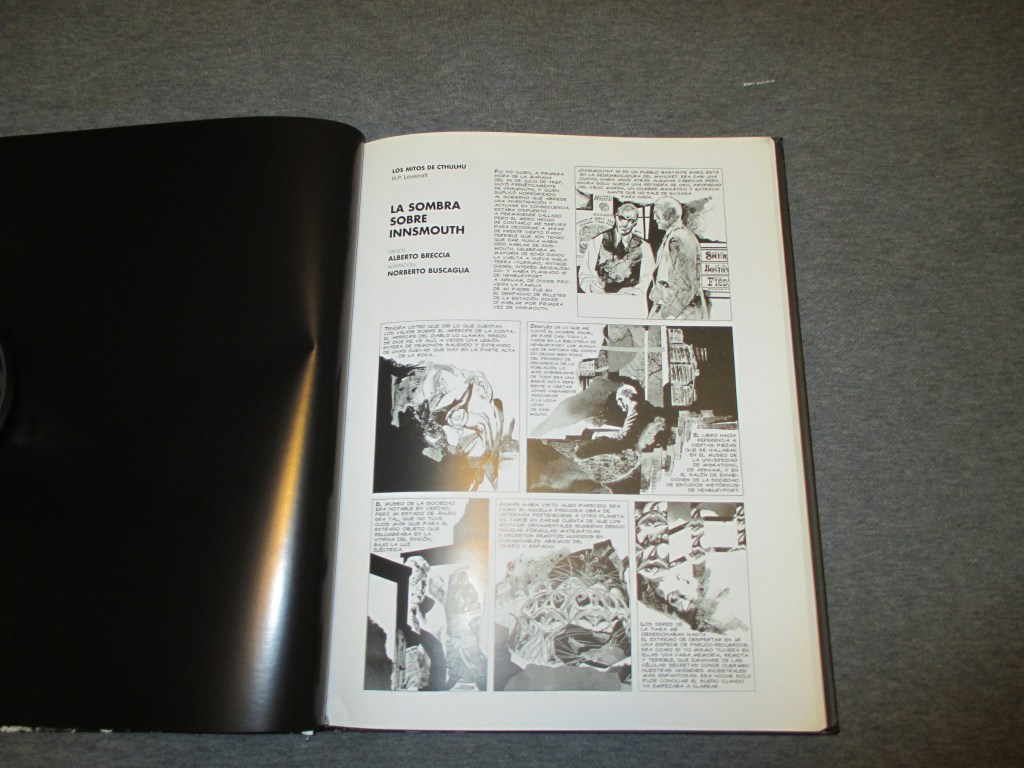
“La Sombra Sobre Innsmouth” (1973)

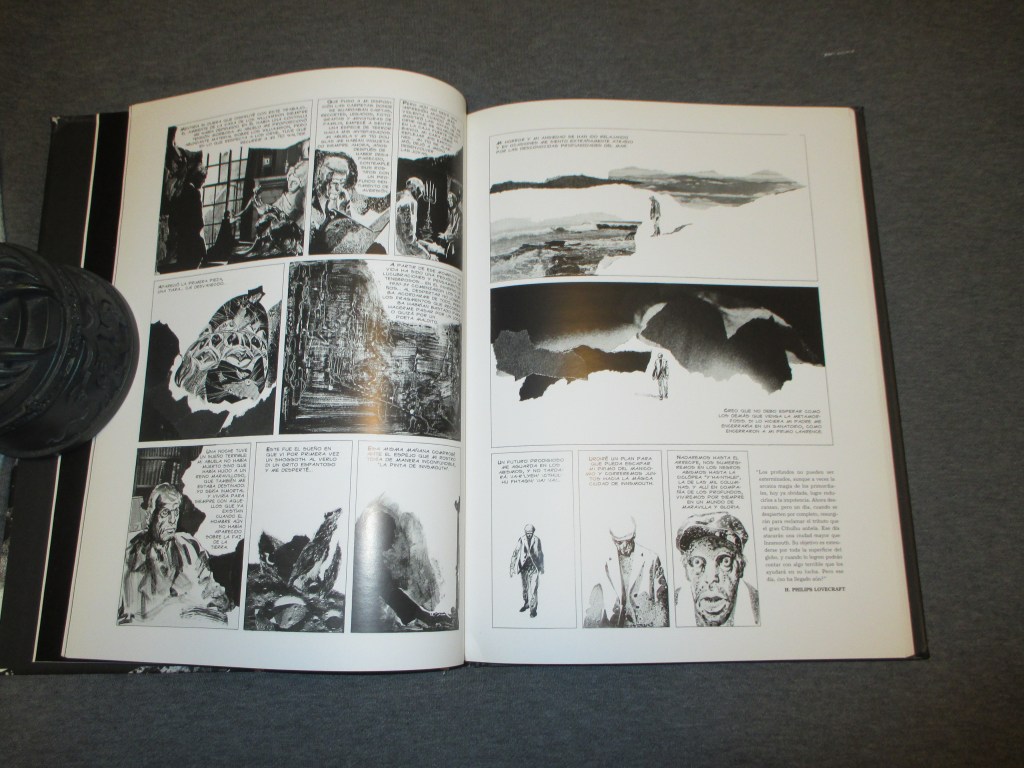
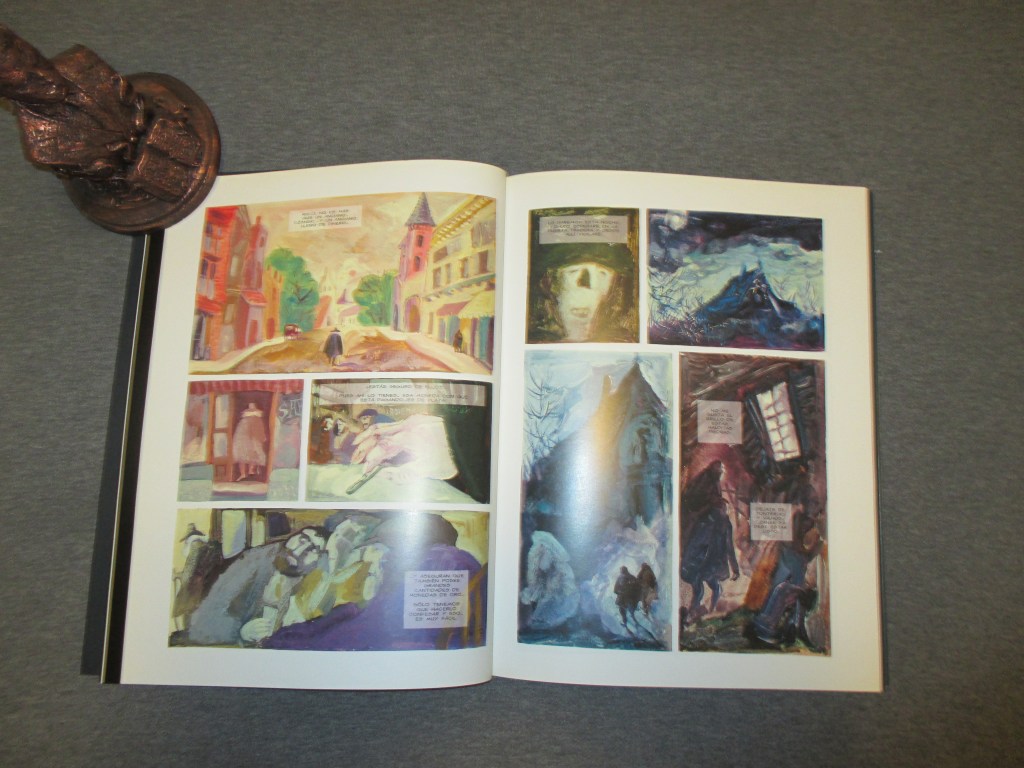
17 pages. Script by Norberto Buscaglia, art by Alberto Breccia. First published in Il Mago (Nov 1973). This adaptation of “The Shadow over Innsmouth” is verbose, selective in its imagery, evocative and often ambiguous in terms of landscape but with detailed faces and figures that give evidence of “the Innsmouth Look.”
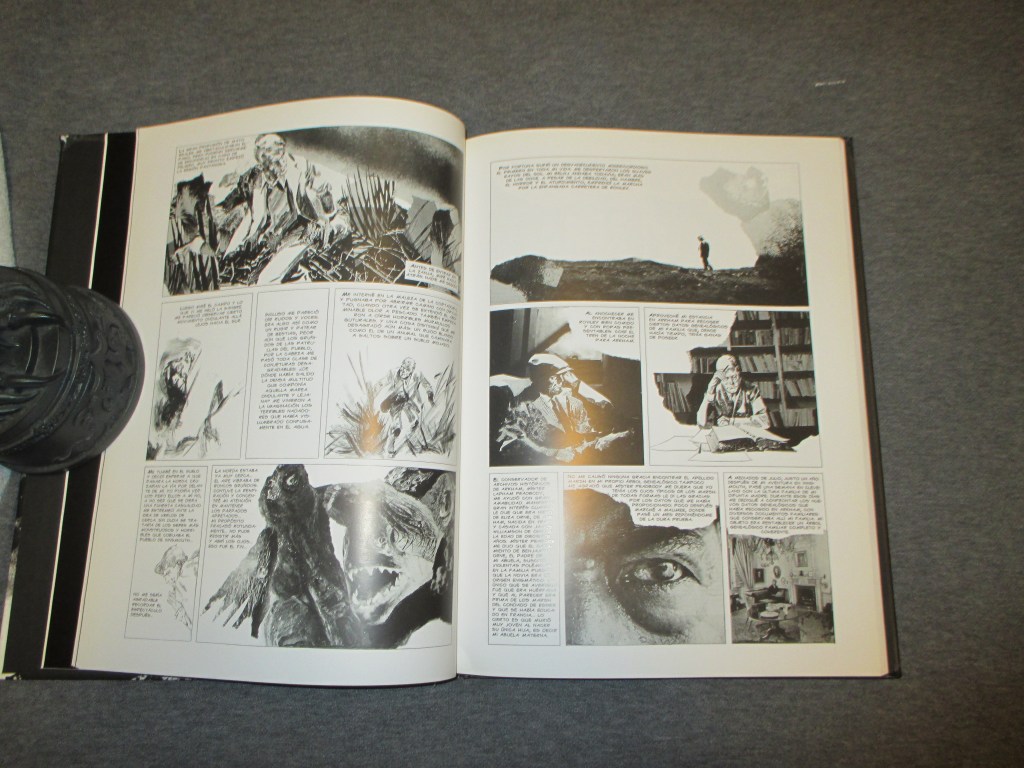
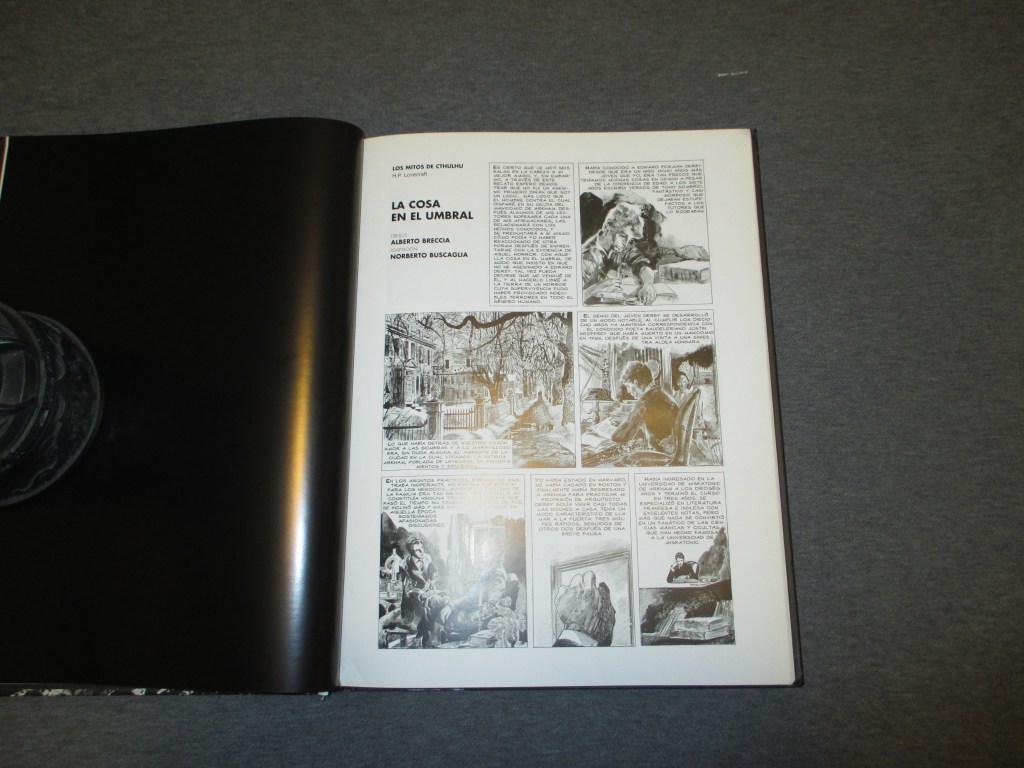
“La Cosa en el Umbral” (1973)

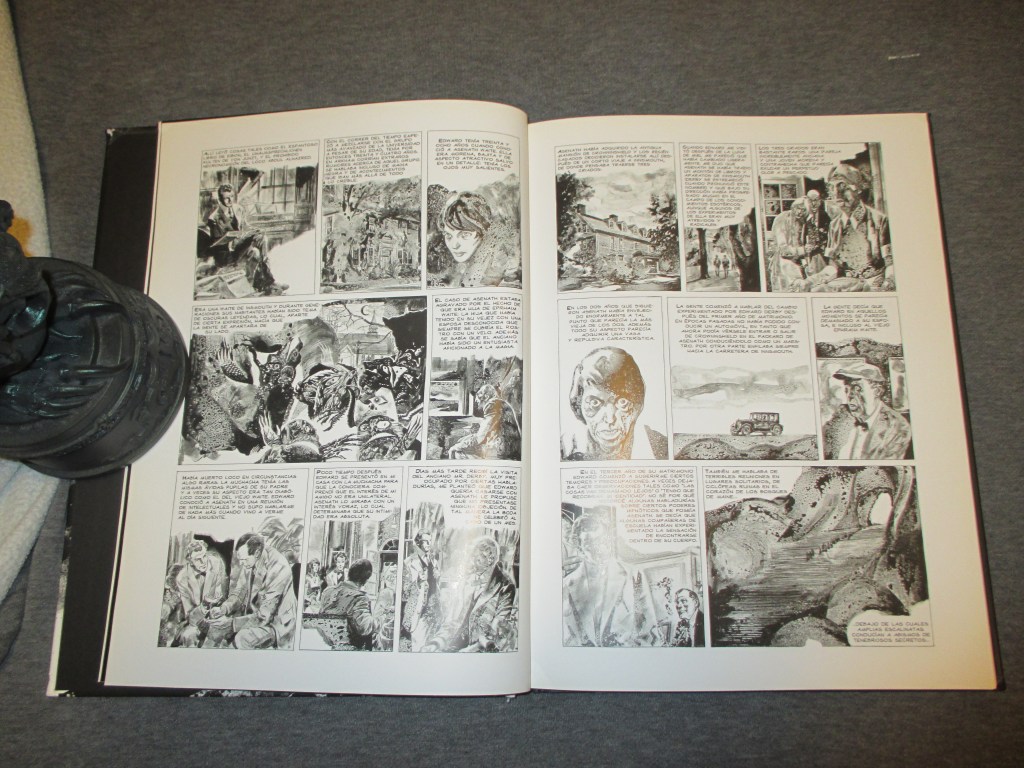
11 pages. Script by Norberto Buscaglia, art by Alberto Breccia. First published in the album Il piacere della paura (Oct 1973), and then in Il Mago (Jan 1974). This adaptation of “The Thing on the Doorstep” begins very sedately, with a heavier emphasis on traditional line work, Breccia’s other techniques mainly adding texture. However, that texture soon comes to grow and dominate as it reflects Edward Pickman Derby’s relationship with Asenath Waite; the depiction of “the Innsmouth Look” is very consistent with Breccia’s adaptation of “The Shadow over Innsmouth.”
“El Ceremonial” (1974)

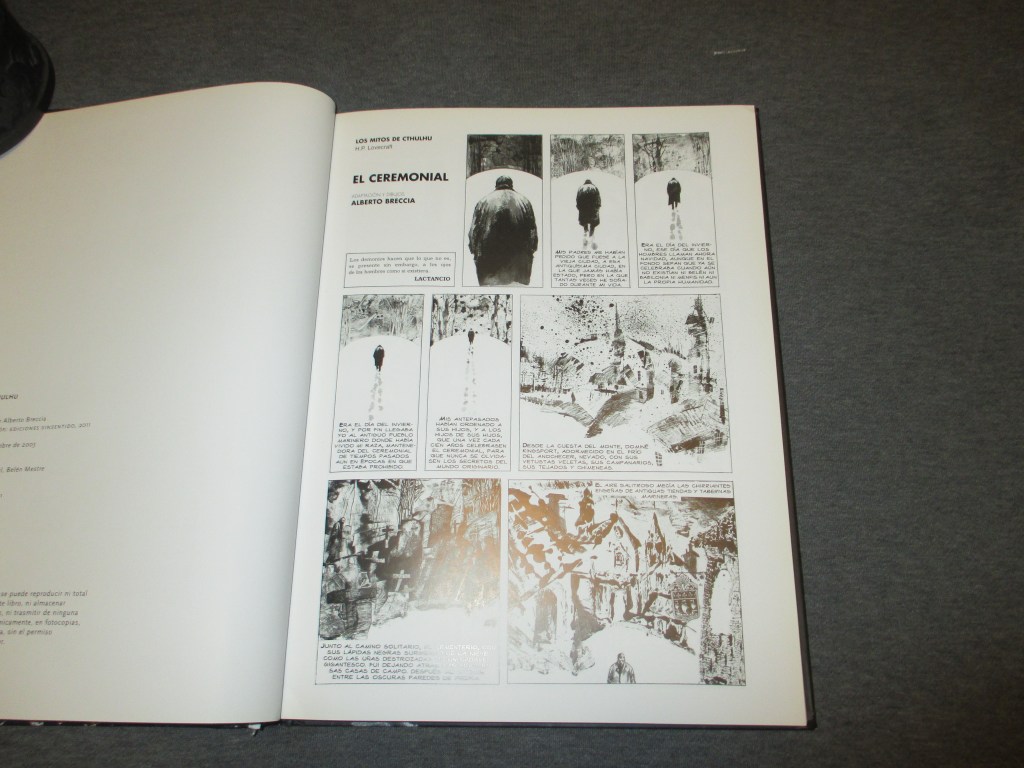
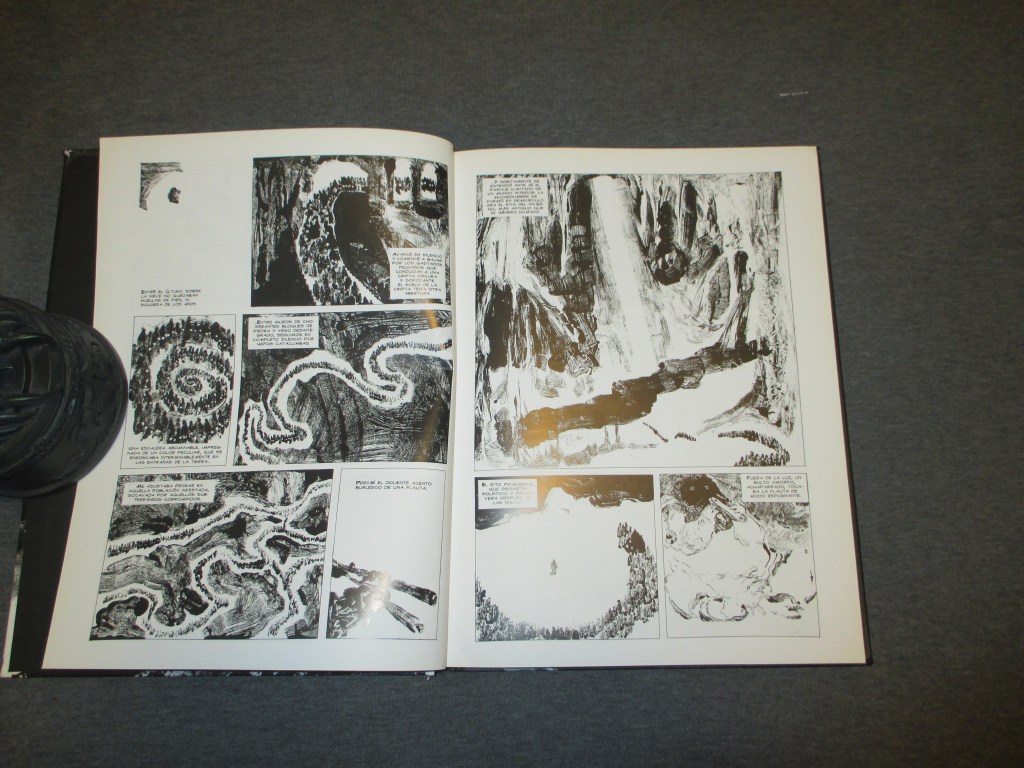
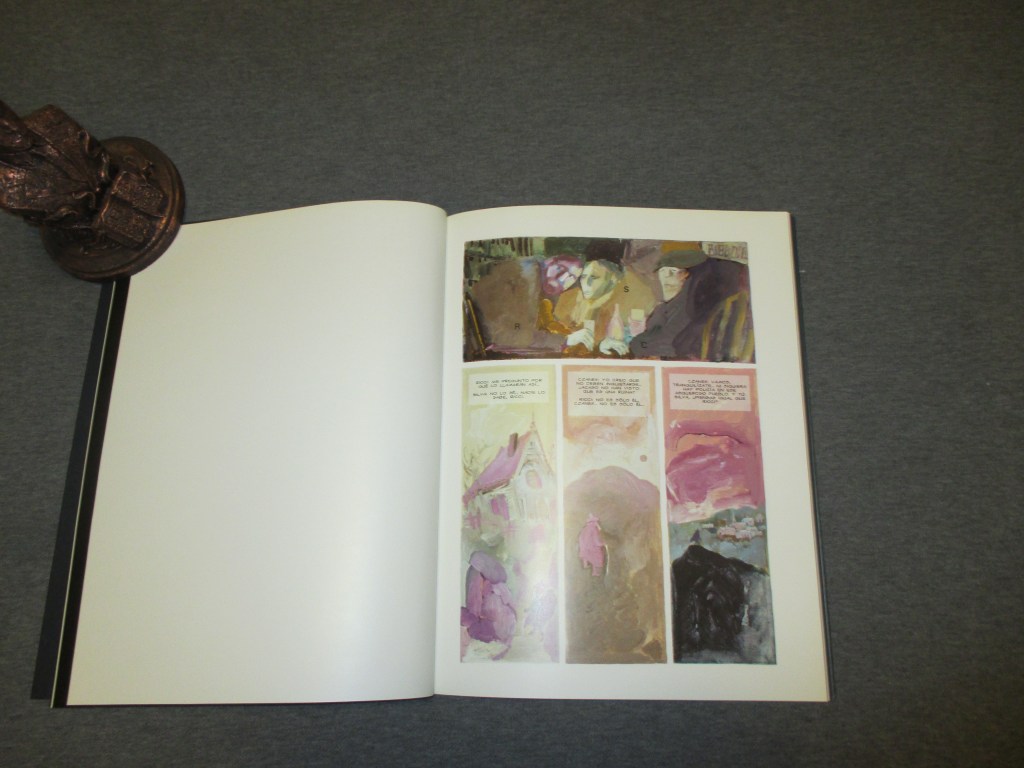
9 pages. Written and illustrated by Alberto Breccia. Signed “Breccia ’72,” this is the first adaptation of Lovecraft that Breccia completed, but wasn’t published until Il Mago (Mar 1974). Breccia makes the most of the chiaroscuro possibilities, with the white space sometimes doubling for snow, sometimes for light, or simply negative space. The combination of the surreal painting and collage with the ultra-realistic photographs and sketches that bookend the story add to the dreamlike nature of the narrative.
“La Ciudad sin Nombre” (1974)

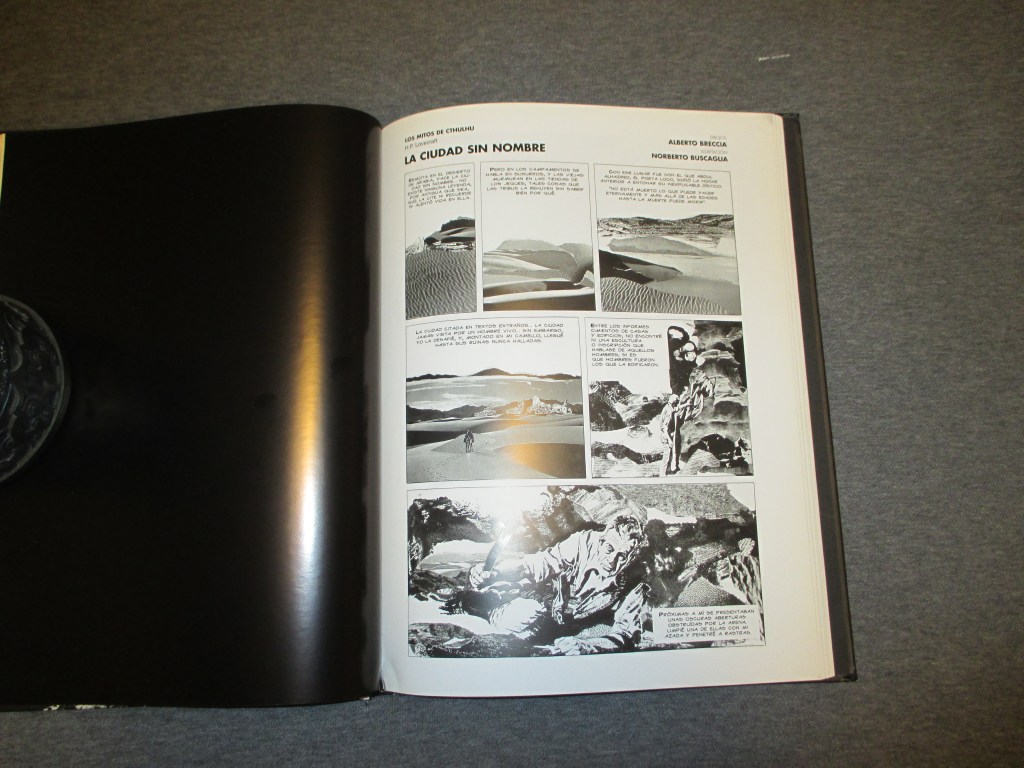
6 pages. Script by Norberto Buscaglia, art by Alberto Breccia. First published in Il Mago (Sep 1974). The shortest of the adaptations, and dominated by photographs of sandy deserts and rock outcroppings, which are collaged with sketched figures in a way suggestive of alien vistas that pure pen and ink could not capture alone.
“El Llamado de Cthulhu” (1974)

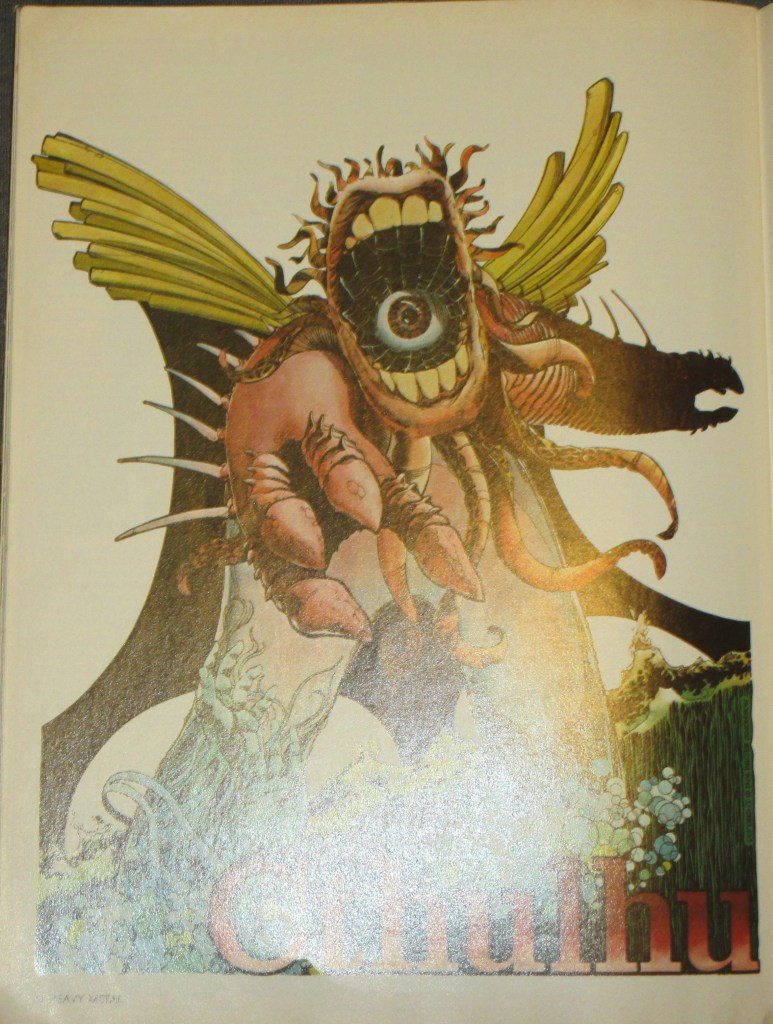
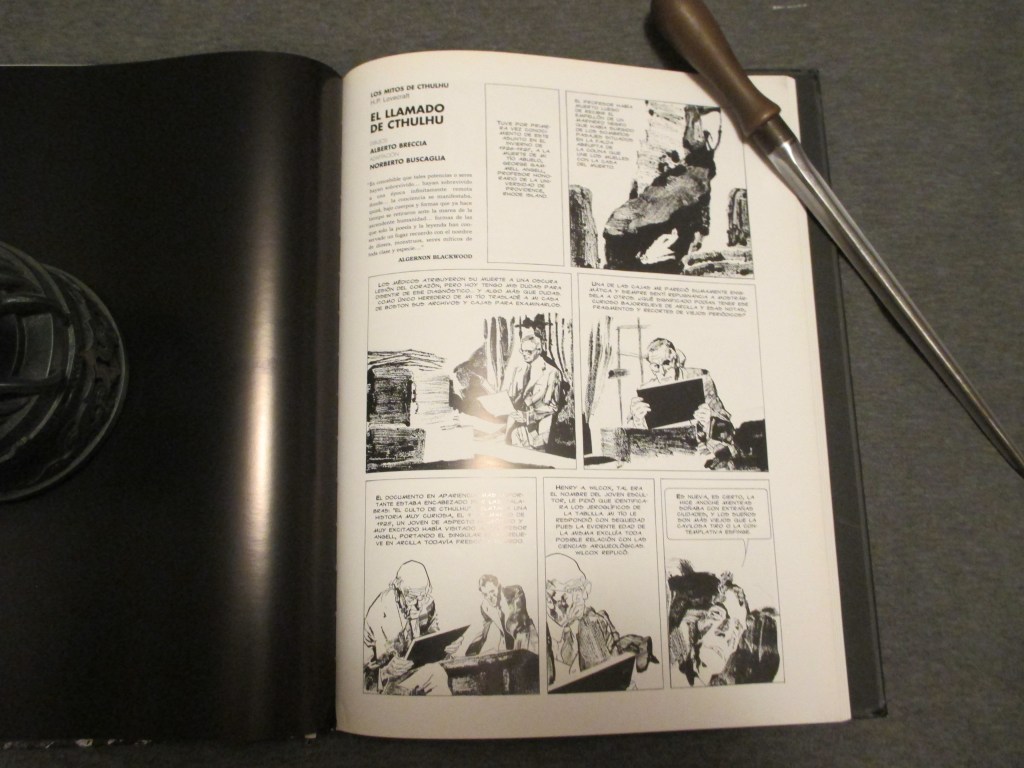
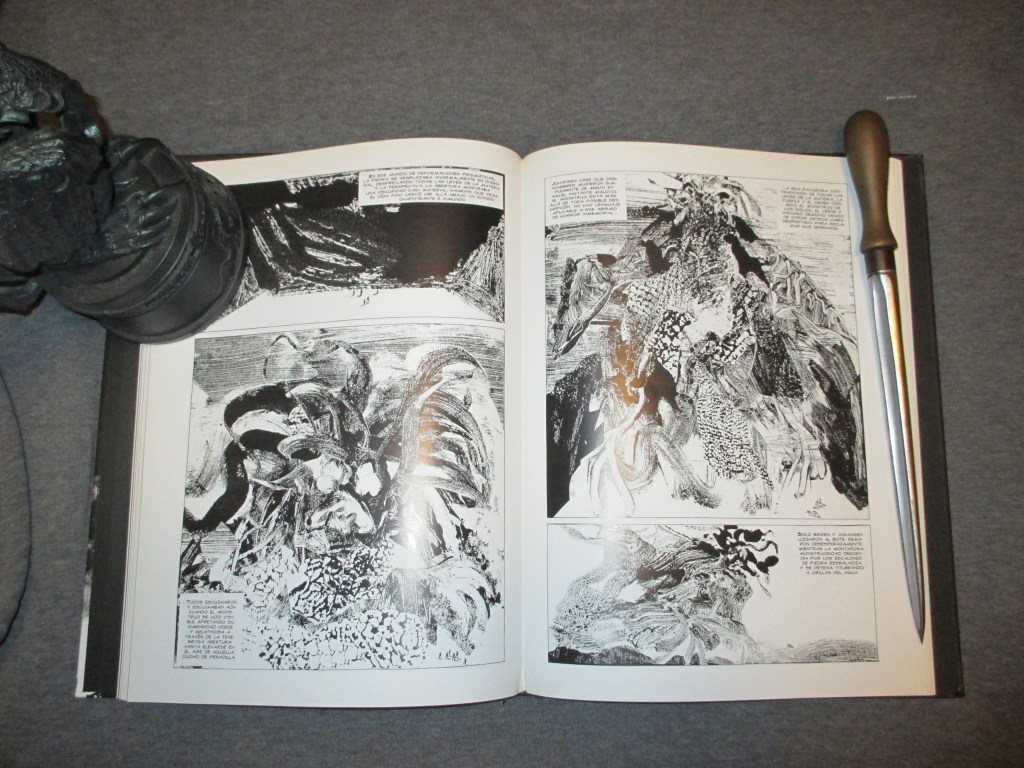
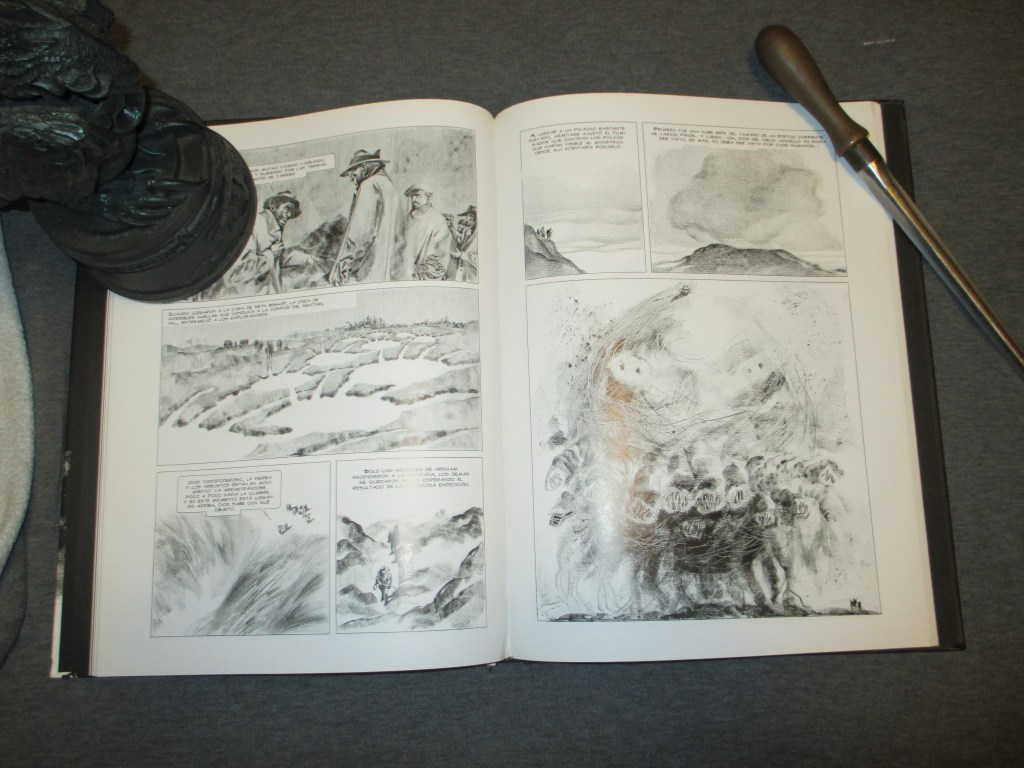
11 pages. Script by Norberto Buscaglia, art by Alberto Breccia. First published in Il Mago (Dec 1974). At 11 pages, this is a very truncated version of Lovecraft’s story “The Call of Cthulhu,” though it captures all the essential plot points, it also abbreviates the complicated narrative story-within-story structure. What is really striking about this brief adaptation is how well Breccia restrains himself from revealing Cthulhu, even in the image in clay, until the moment that title entity appears on the page, at which point he presents something so truly outlandish that readers almost don’t notice the miniscule human figures that give it scale.
“El Horror de Dunwich” (1975)

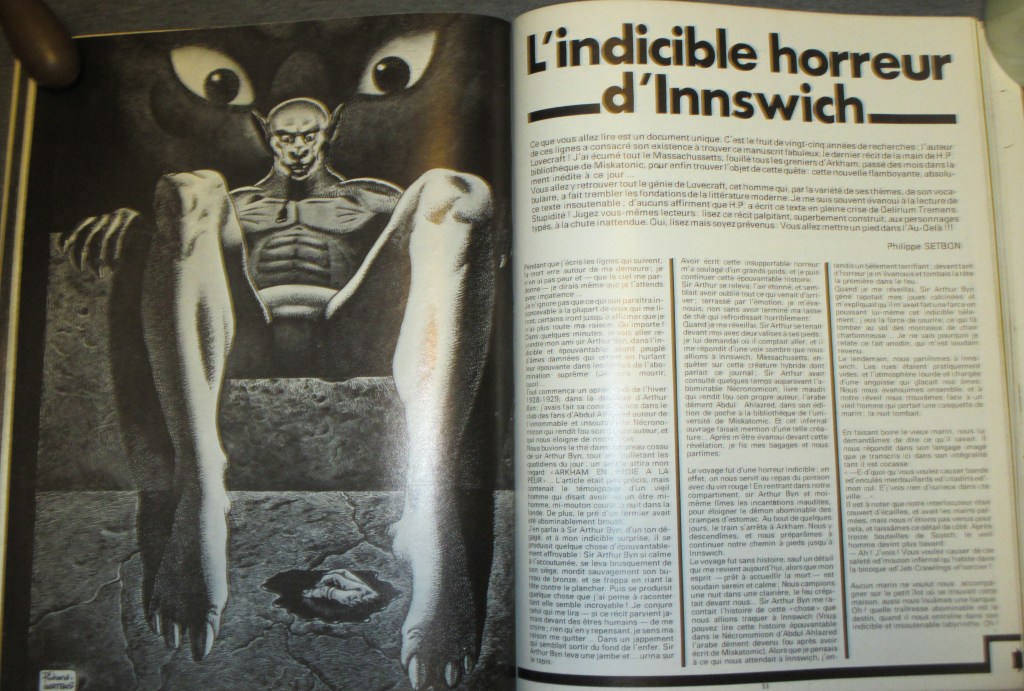
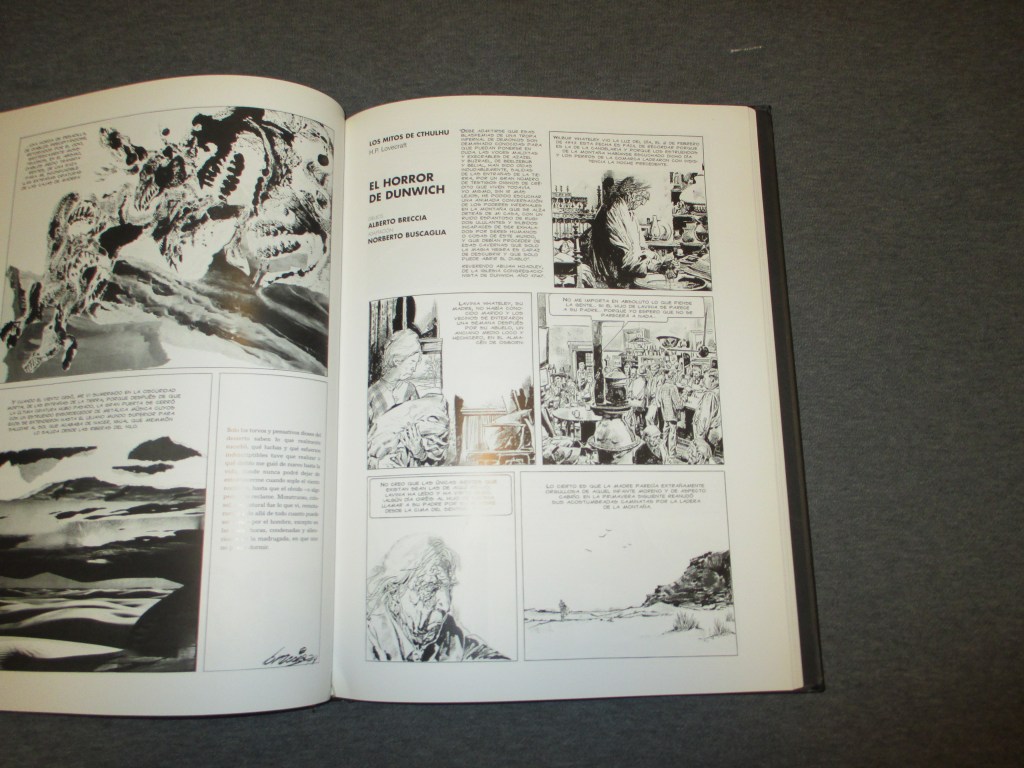
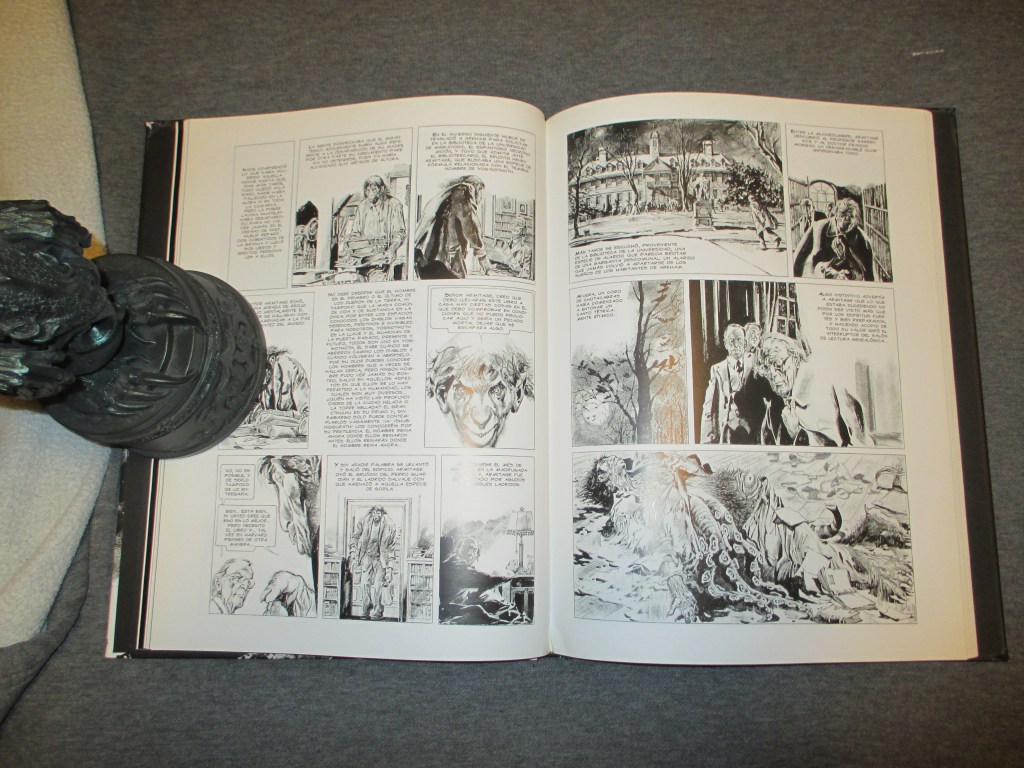
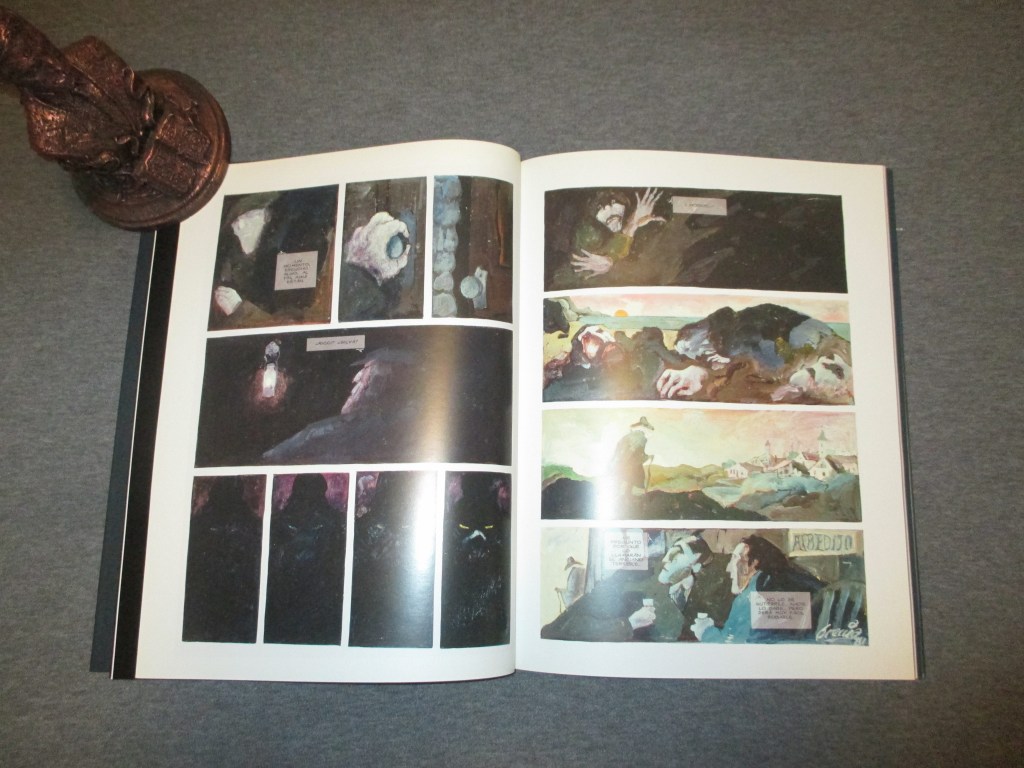
15 pages. Script by Norberto Buscaglia, art by Alberto Breccia. First published in Il Mago (Nov 1975). Arguably, this adaptation of “The Dunwich Horror” is the most famous and widely-republished of Breccia’s adaptations, because of its including in the Métal Hurlant Lovecraft Special, and the works that followed from that. Possibly some of Breccia’s finest figure and face work went into the goatish countenance of Wilbur Whateley. Like most of Breccia’s adaptations, the backgrounds and setting details are relatively spare but evocative.
Sasturain: Ce qui explique peut-etre que, pour la creature extraterrestre de <<Tres ojos>>, dans Sherlock TIme, tu n’as pas dessine un monstre. Dans L’Eternaute, tu les as desintegres. Les monstres sont intangibles: tu as dessine la sensation que genere l’epouvante chex les gens, pas l’object qui la prodout. Et tu as fait pareil pour Lovecraft.

Breccia: Je n’aime ni voir ni dessiner des monsters. Ca ne m’interesse pas.
Sasturain: Which may explain why, for the extraterrestrial creature of <<Three Eyes>>, in Sherlock Time, you didn’t draw a monster. In L’Eternaute, you disintegrated them. Monsters are intangible: you drew the sensation that generates terror in people, not the object that produces it. And you did the same for Lovecraft.

Breccia: I don’t like to see or draw monsters. I’m not interested.
Breccia: Conversations avec Juan Sasturain 355English translation

Despite Breccia’s comment, when the time came at the end of the story to reveal Wilbur’s unnamed twin, he pulled out all the stops.
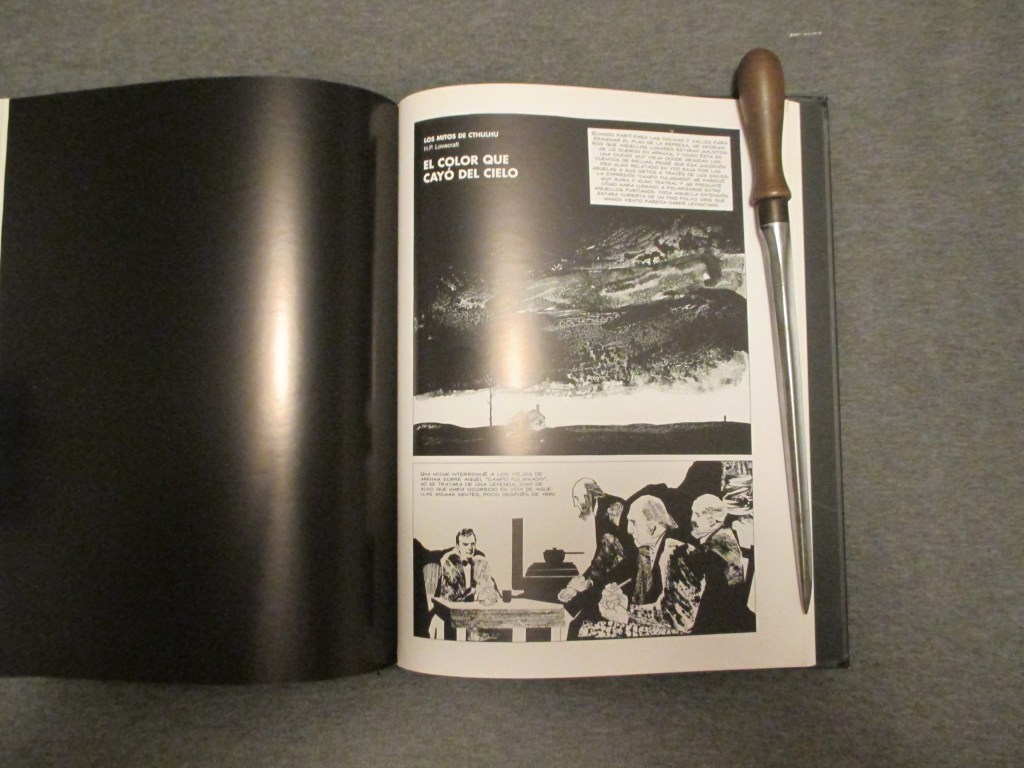
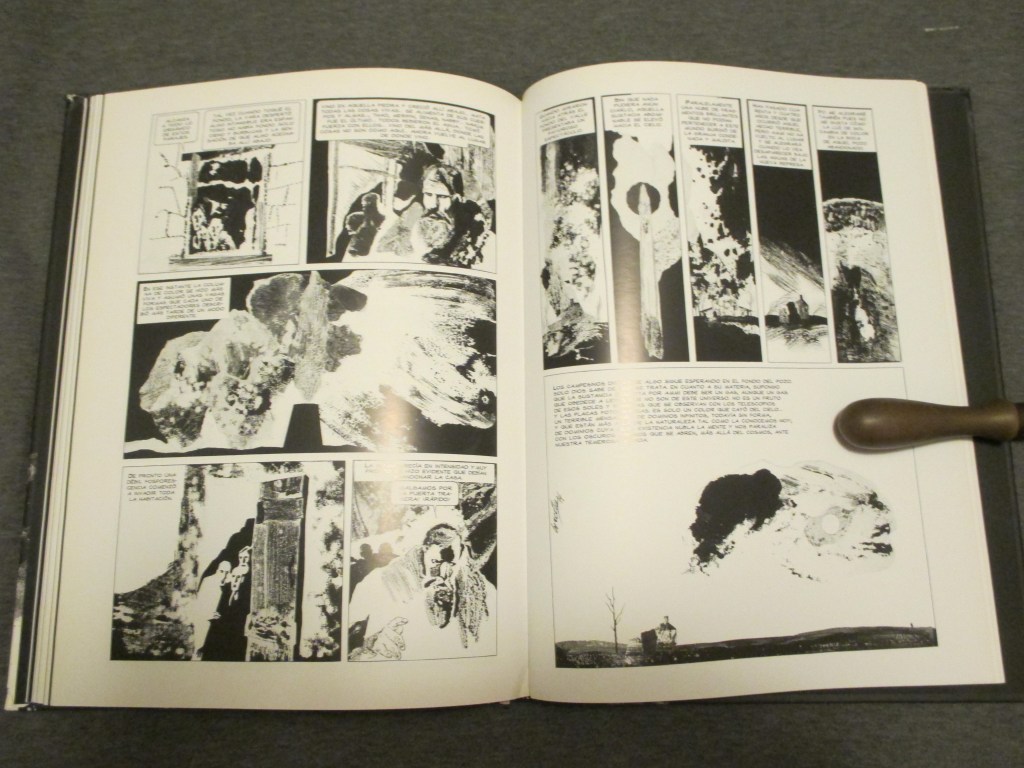
“El Color que Cayó del Cielo” (1975)

13 pages. Written and illustrated by Alberto Breccia. This adaptation of “The Colour Out of Space” first appeared in his album Los mitos de Cthulhu (1975), which contained all but one of his Lovecraft adaptations (the last not being published until years later). Compared to the previous stories, this one is much more experimental in style, bolder in its use of collage, stark blacks and blinding whites.
“El Morador de las Tinieblas” (1975)

15 pages. Written and illustrated by Alberto Breccia. This adaptation of “The Haunter of the Dark” first appeared in his album Los mitos de Cthulhu (1975). Again, Breccia pushes the envelope of his experimental style, his pen-and-ink illustrations taking on the more exaggerated style characteristic of his work in the 80s like Drácula, but still playing with texture, shape, and strong contrasts.

According to a note by Latino Imperato in later collections, many of the original pages for this story have been lost, and subsequent reproductions were made from the first Italian printing.
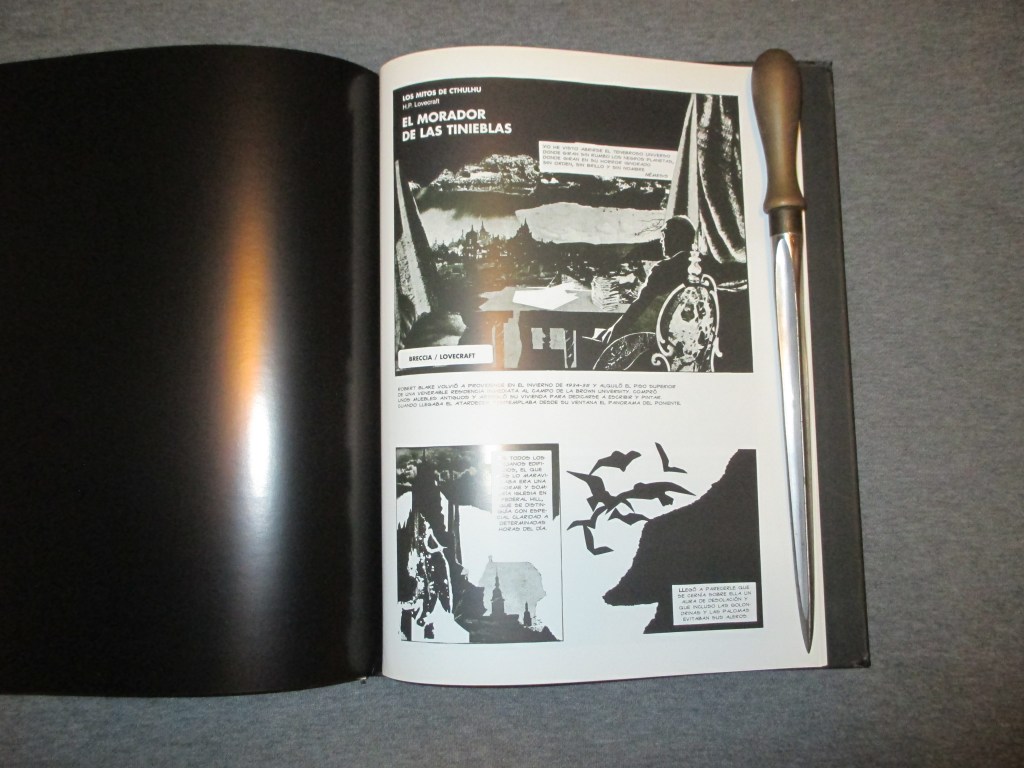
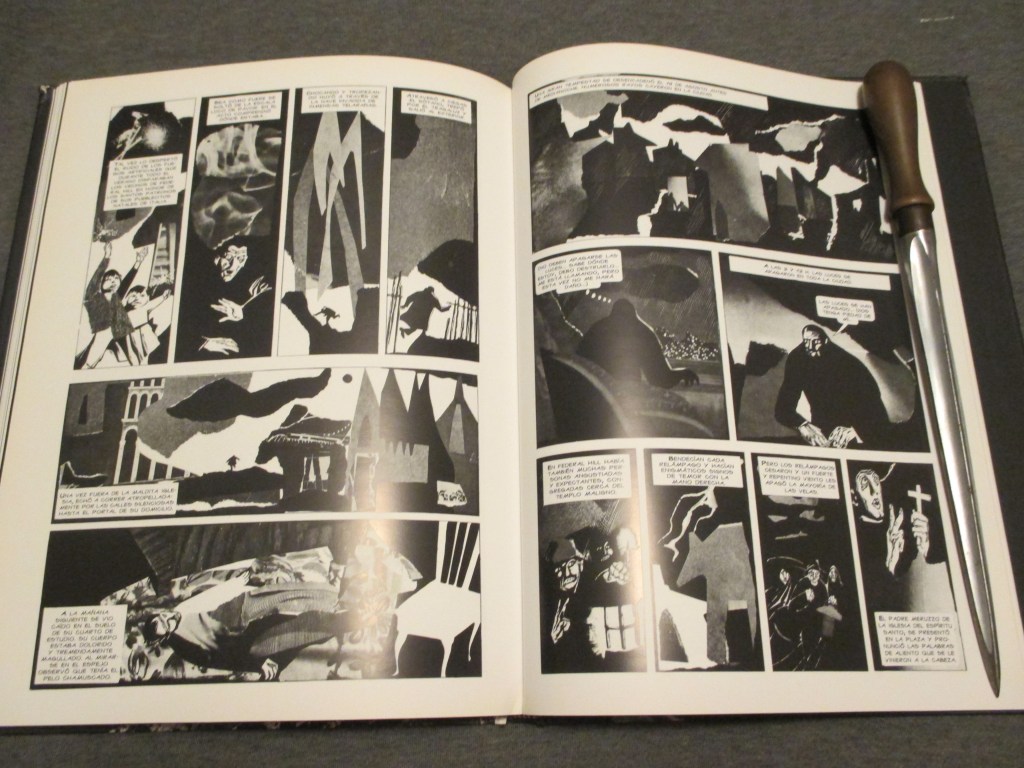
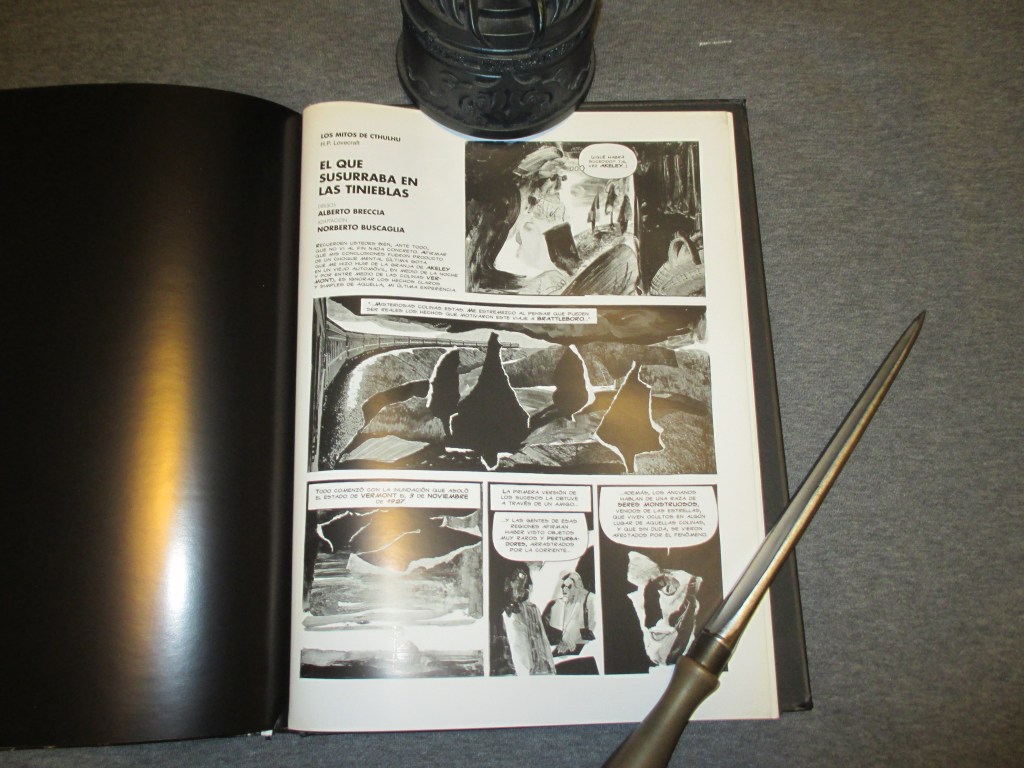
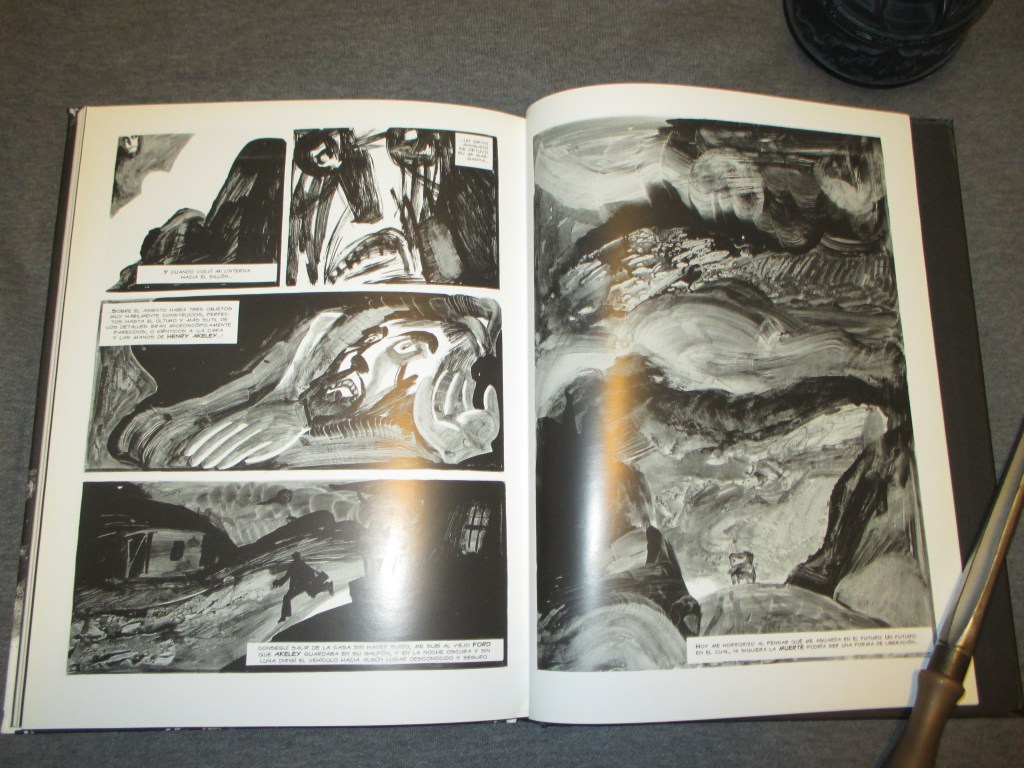
“El Que Susurraba En las Tinieblas” (1979)

15 pages. Script by Norberto Buscaglia, art by Alberto Breccia. First published in the Argentine magazine El Pendulo (Sep 1979). This adaptation of “The Whisperer in Darkness” was the last of Breccia’s Lovecraft adaptations to be published, and the last to be collected. It is in many ways the apex of the artistic experiments and strongly points to some of Breccia’s stylistic choices in subsequent works during the 1980s like Perramus. For the most part, however, it is the most deliberately choppy and nightmarish of Breccia’s adaptations.
“El anciano terrible” (2003)

7 pages. Painted, in color, as are the other works in Sueños Pesados. The last page is dated “Breccia ’81.” Here, Breccia takes more liberties with the text than usual, eschewing much of Lovecraft’s exposition and description to give the characters a bit of dialogue, letting the art do most of the talking. The art is characteristic of this period, with vibrant colors, rich textures, but muddier faces, deliberately stylized and evocative.
Bobby Derie is the author of Weird Talers: Essays on Robert E. Howard and Others and Sex and the Cthulhu Mythos.

Deep Cuts in a Lovecraftian Vein uses Amazon Associate links. As an Amazon Associate I earn from qualifying purchases.
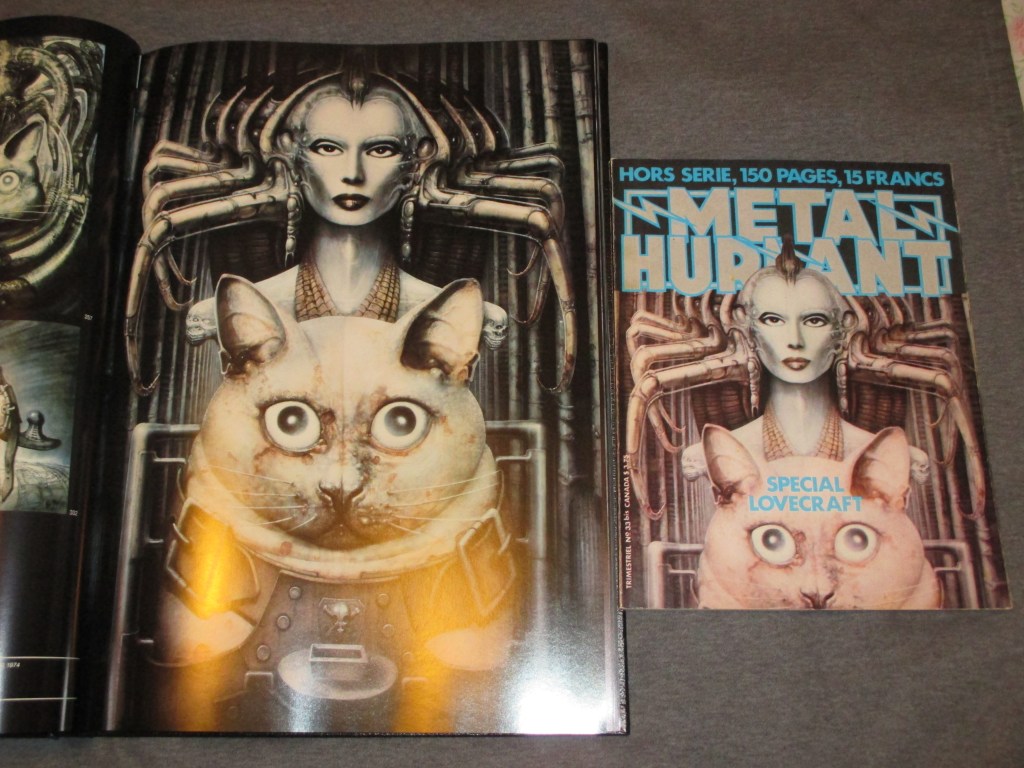
Deeper Cut: Métal Hurlant/Heavy Metal/Metal Extra Lovecraft Special

France, 1974. Jean Giraud (Mœbius), Philippe Druillet, Jean-Pierre Dionnet, and Bernard Farkas came together to create Les Humanoïdes Associés, a publisher for a new type of comic magazine: Métal Hurlant (“Howling Metal,” 1974-1987). Initially released as a quarterly and focused on science fiction, Métal Hurlant featured some of the best international comic artists of its time, as well as some of the most daring content, not just featuring sex, drugs, and rock & roll—but humor, horror, gory violence, politics, and philosophy.

The magazine was successful enough to inspire spin-offs in other countries, largely based, at least initially, on material translated from Métal Hurlant. So in the United States and Commonwealth countries, Anglophones could read Heavy Metal (1977-2023), with various special issues, spin-offs, graphic novels, and other projects; in Italy, the localized version of Métal Hurlant lasted only 12 issues (1981-1983), with several standalone Metal Extra issues, though the sister magazine Totem lasted longer (1980-1984). In West Germany, Schwermetall (“Heavy Metal,” 1980-1984) lasted a respectable 57 issues under its first publisher, and eventually ran to issue 219/220 (1998). Spain had their own translation of Métal Hurlant in the 1980s, the Netherlands had Zwaar Metaal (“Heavy Metal”), Denmark had Total Metal, Finland had Kylmä metalli (“Cold Metal”), Sweden had Tung Metal (“Heavy Metal”) and Pulserande Metal (“Pulsing Metal”), Turkey had Heavy Metal Türkiye…most of these international runs didn’t last long, but they spread the stories and art far and wide.

The creation of Métal Hurlant coincided with a number of other trends. H. P. Lovecraft, Robert E. Howard, Clark Ashton Smith, and other early contributors to the Cthulhu Mythos became more widely available thanks to paperback reprints, and with the death of August Derleth, Arkham House lost its grip on the Mythos. New anthologies like The Disciples of Cthulhu (1976) proved that anyone could now play with the shared universe that Lovecraft and his friends had created. Argentinian master Alberto Breccia began and completed a series of Lovecraft adaptations for comics from 1973-1979, many of which first appeared in the Italian magazine Il Mago. Underground comix in the United States like Skull Comix (1970-1972) were giving way to semi-prozines like Star * Reach (1974-1979), and publishers also found they could side-step the Comics Code Authority by publishing magazines like Creepy (1964-1983) and Eerie (1966-1983) instead of standard-size comics, all of which featured material inspired by or adapting Lovecraft. H. R. Giger’s Necronomicon art collection was published in 1977, and quickly inspired the aesthetic for the film Alien (1979).

There was, in other words, a small revolution in Lovecraftian art, comics, and fiction in the 1970s. Not all at once, but from many different angles—and Métal Hurlant, the international crossroads where underground American artists like Richard Corben; French masters like Mœbius, Druillet, and Nicollet; Swiss artists like Giger; and Argentinian masters like Breccia could all come together at once.

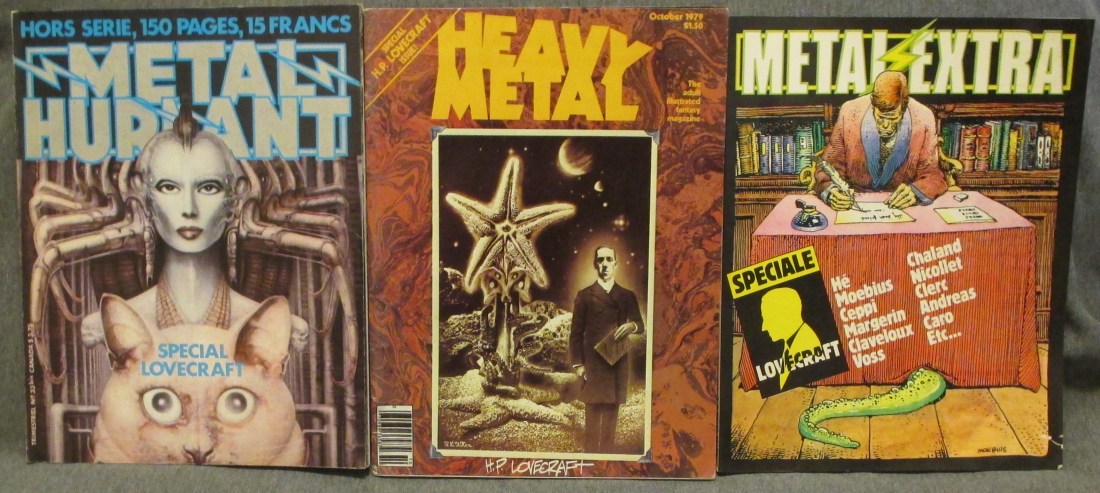
That is what happened in September 1978, when Les Humanoïdes Associés published a 150-page special issue of Métal Hurlant dedicated to H. P. Lovecraft. The idea was so attractive that the next year, the English-language Heavy Metal magazine released their own Lovecraft special issue to coincide with Halloween, and when Métal Hurlant was translated in Italy, they released a one-off Metal Extra special issue dedicated to Lovecraft.

All three of these magazines share certain common elements, largely because the English- and Italian-language productions included material translated from the French special Lovecraft issue. Yet they were each different as well…and that’s kind of fascinating in itself, how these three magazines represent three different takes on the material, each tailored for their respective audience.

What follows is a survey: what each Lovecraft special issue contains, and by comparison, what they do not contain. To avoid excessive repetition, each issue and its unique contents are discussed separately, and then a single section discusses all the shared features. Because this is a long, image-heavy post, a table with links is provided to aid navigation:


Métal Hurlant Special Lovecraft (Sep 1978)

150 pages, counting covers, the table of contents, ads, etc., Métal Hurlant Special #33 bis (“extra”) was one of several themed issues released by Les Humanoïdes Associés, with the other themes including Fin du monde (“the End of the World”, #36), Rock (#39), Guerre (“War”, #42), and Alien (#43). Not every feature in this issue involves Lovecraft or the Mythos, but a majority do. There are errors in the table of contents as printed, so a full list is given here.

Features involving Lovecraft or his creations are marked in bold; color pages are marked [c].

  • Front Cover: H. R. Giger
  • “La cimetière” (illustration) by Souchu, 2-3
  • Advertisement for Heilman by Voss and A l’Est de Karakulac by Daniel Ceppi, 4
  • Table of Contents, 5
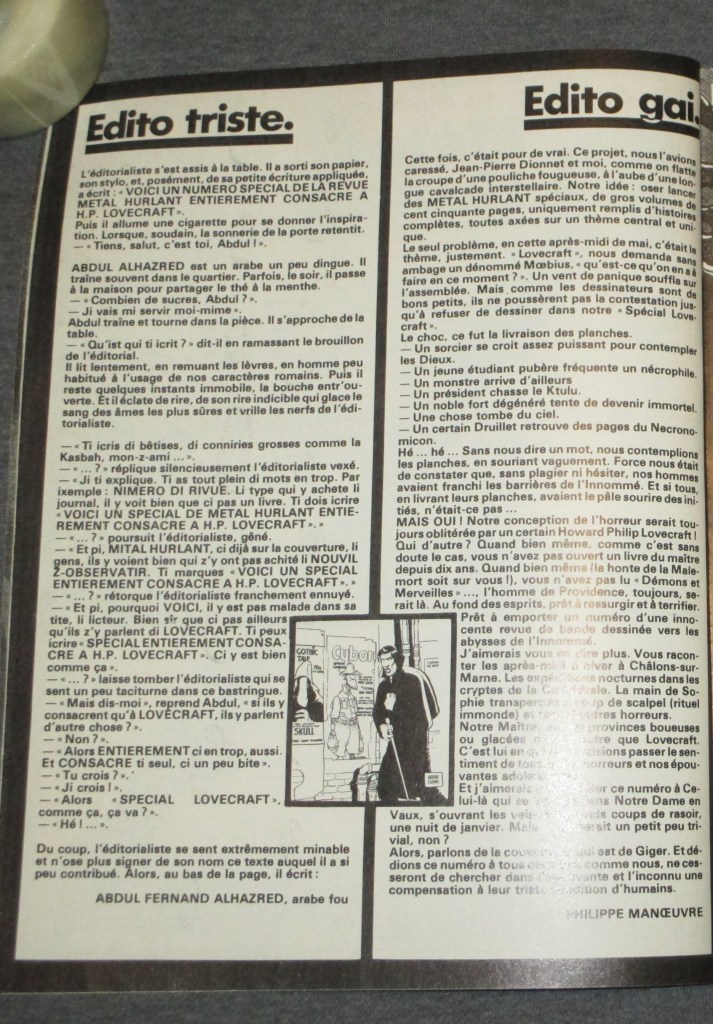
  • Edito triste./Edito gai by Philippe Manœuvre, 6
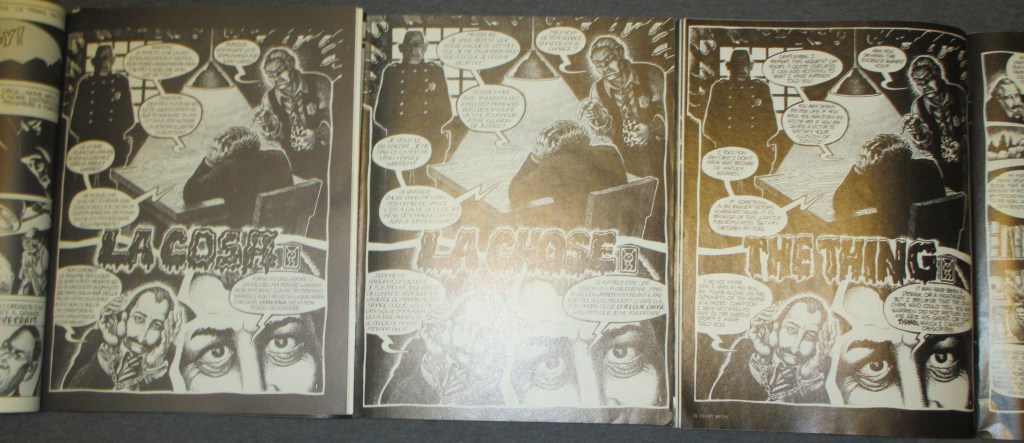
  • “La Chose” by Alain Voss, 7-12
  • “Lettres de Lovecraft” by François Truchaud, 13
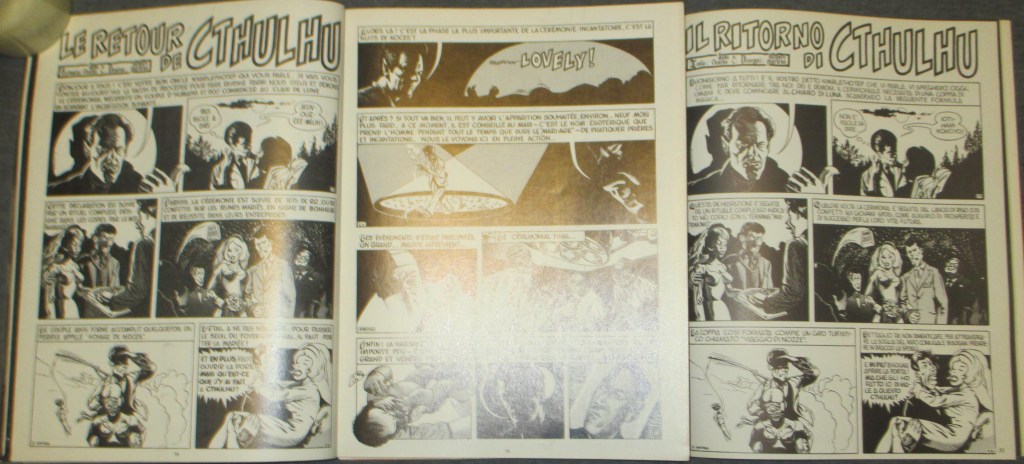
  • “La Retour de Cthulhu” by Alan Charles & Richard Martens, 14-15
  • “La Nuit du Goimard: Un ecrivain nommé Habileté-à-l’amour” by Jacques Goimard, 16-18
  • “Le Monstre Sur le Seuil” by Norberto Buscaglia & Alberto Breccia, 19-29
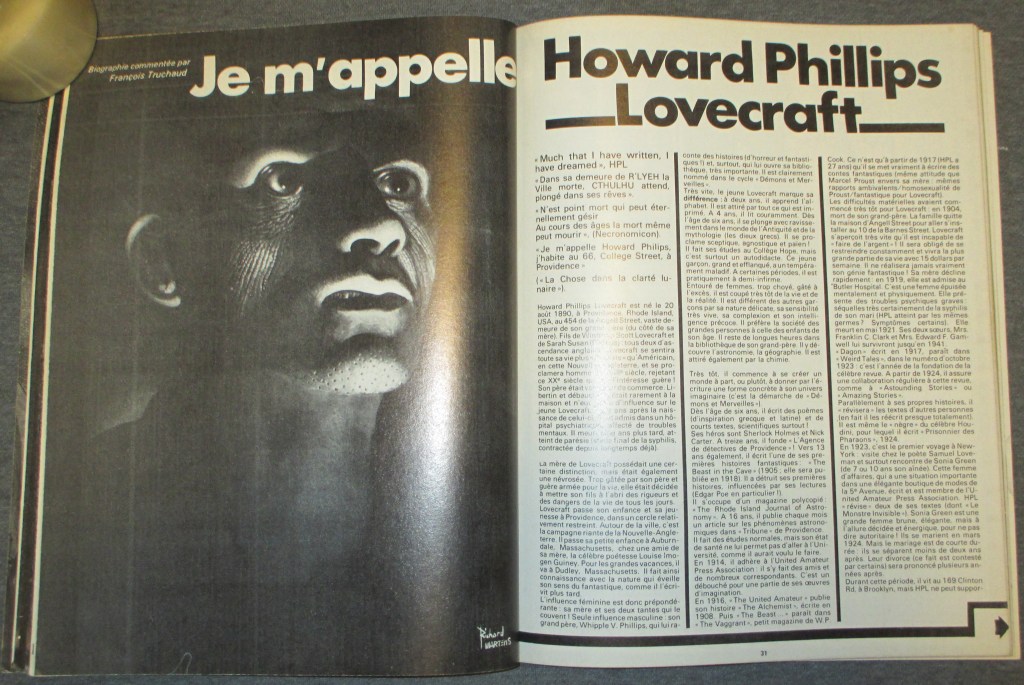
  • Je m’appelle Howard Phillips Lovecraft” by François Truchaud, 30-32
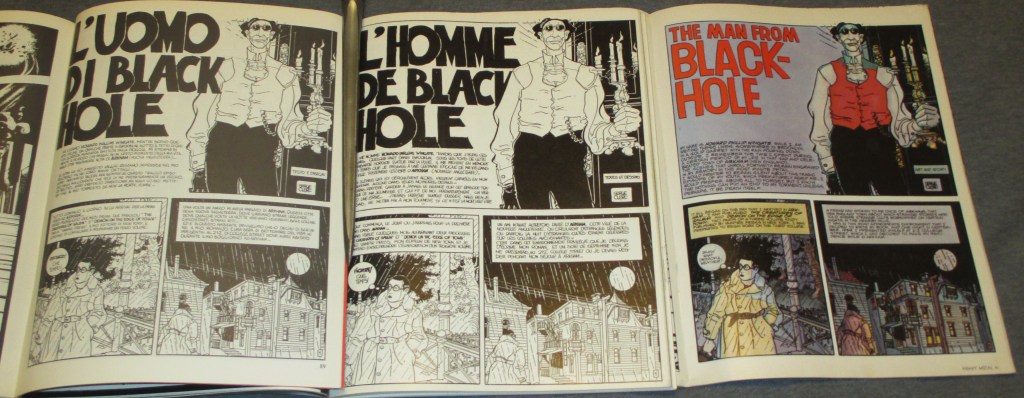
  • “L’Homme de Black Hole” by Serge Clerc, 33-36
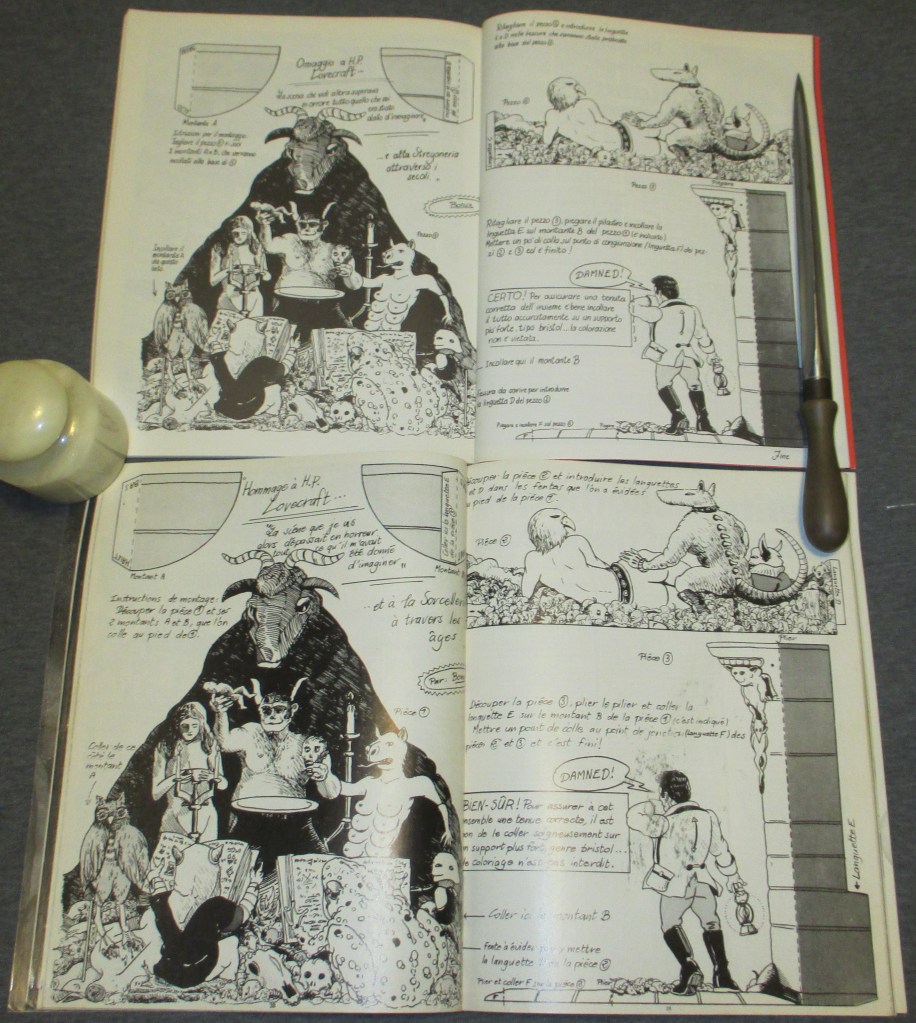
  • “Hommage à HPL…” (uncredited), 37-39
  • “Petite bibliothèque lovecraftienne” by François Truchaud, 40-41
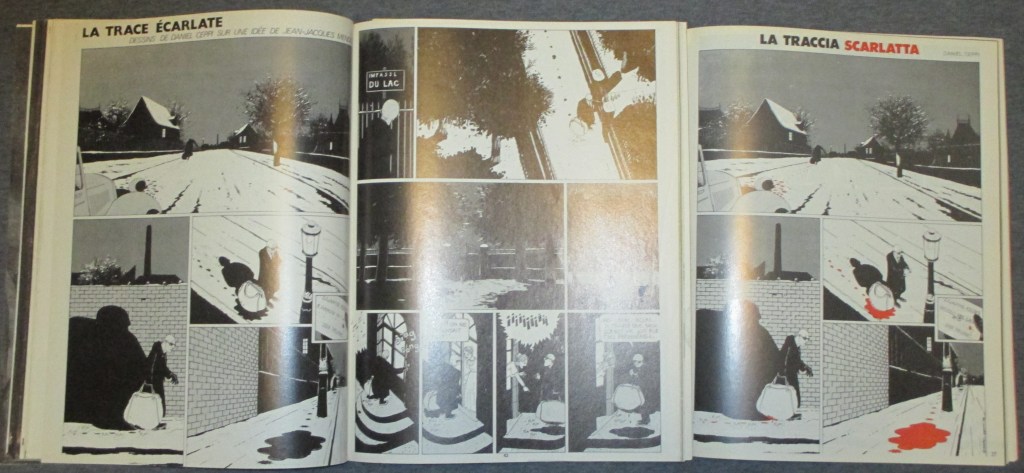
  • “La Trace Ecarlate” by Jean-Jacques Mendez & Daniel Ceppi, 42-43
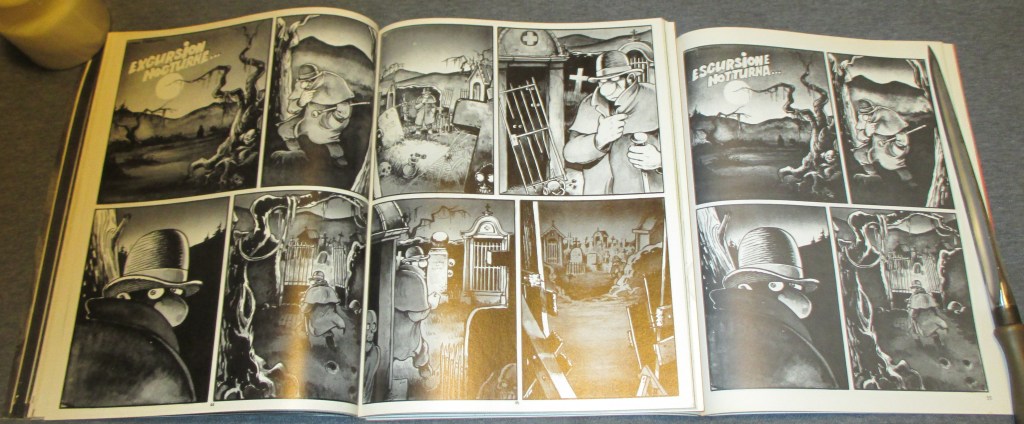
  • “Excursion Nocturne” by Frank Margein, 44-47
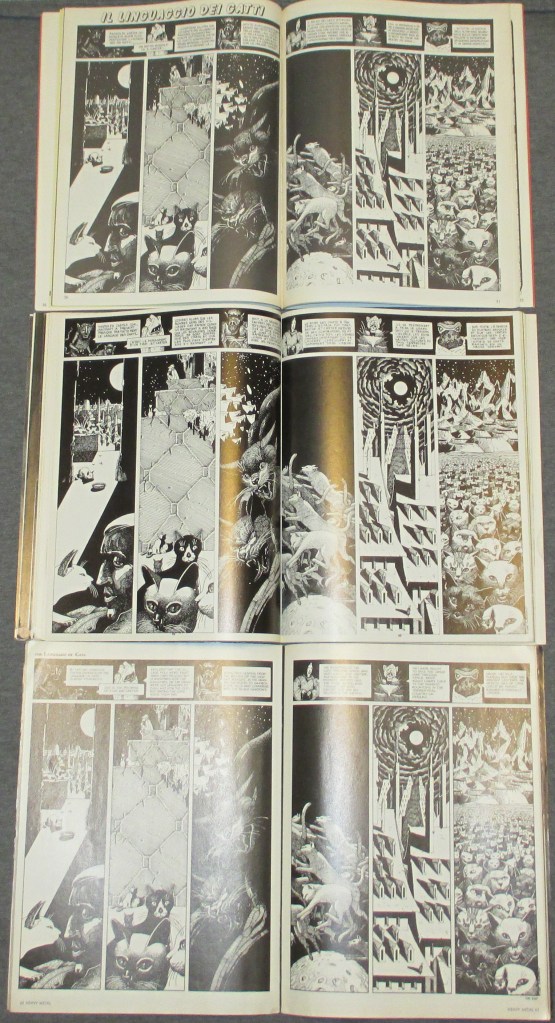
  • “Le langage des chats” by Nicole Claveloux, 48-49
  • Untitled illustration by Richard Martens, 50
  • “L’Indicible Horreur d’Innswich” by Philippe Setbon, 51-52
  • “Amitiés Rencontres” by Vepy & Daniel Ceppi, 53-57
  • “Barzai le Sage” by Marc Caro, 58-65
  • Advertisement for Richard Corben’s Den, 66
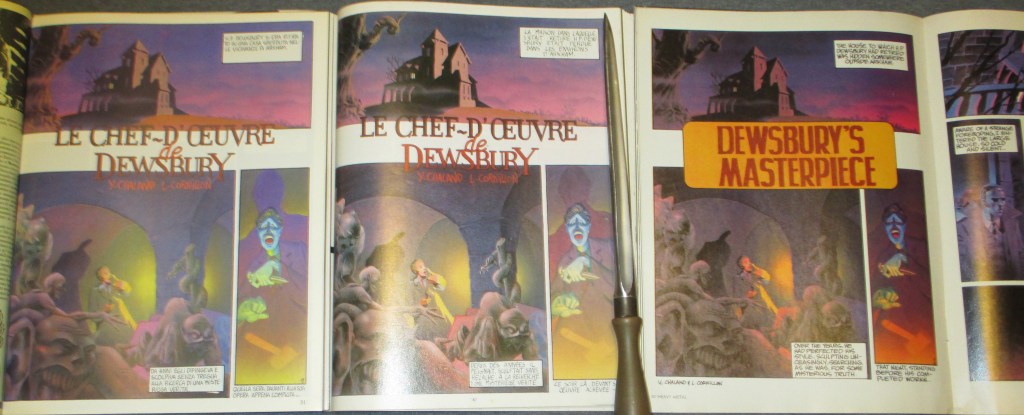
  • [c] “Le Chef d’Œuvre de Dewsbury” by Yves Chaland & Luc Cornillon, 67-70
  • [c] “L’énigme du mystérieux puits secret” by Yves Chaland & Luc Cornillon, 71-74
  • “A la Recherche de Kadath” by François Truchaud & M. Perron, 75-78
  • “H. P. Lovecraft 1890-1937” by George Kuchar, 79-81
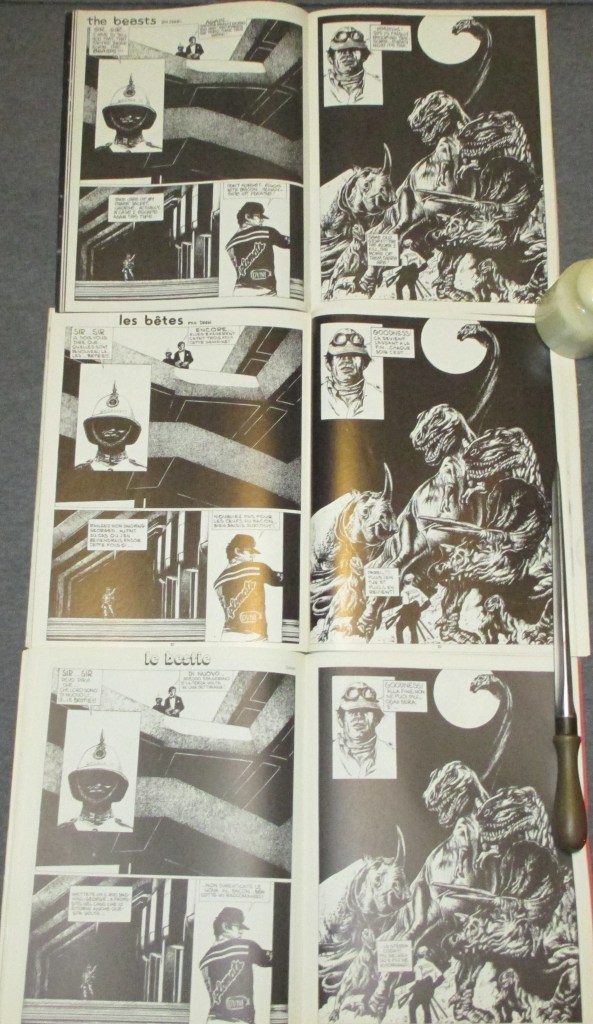
  • “Les Bêtes” by Dank, 82-84
  • Advertisement for Le Diable by Nicollet and Les Naufragés du Temps by Paul Gillon, 85
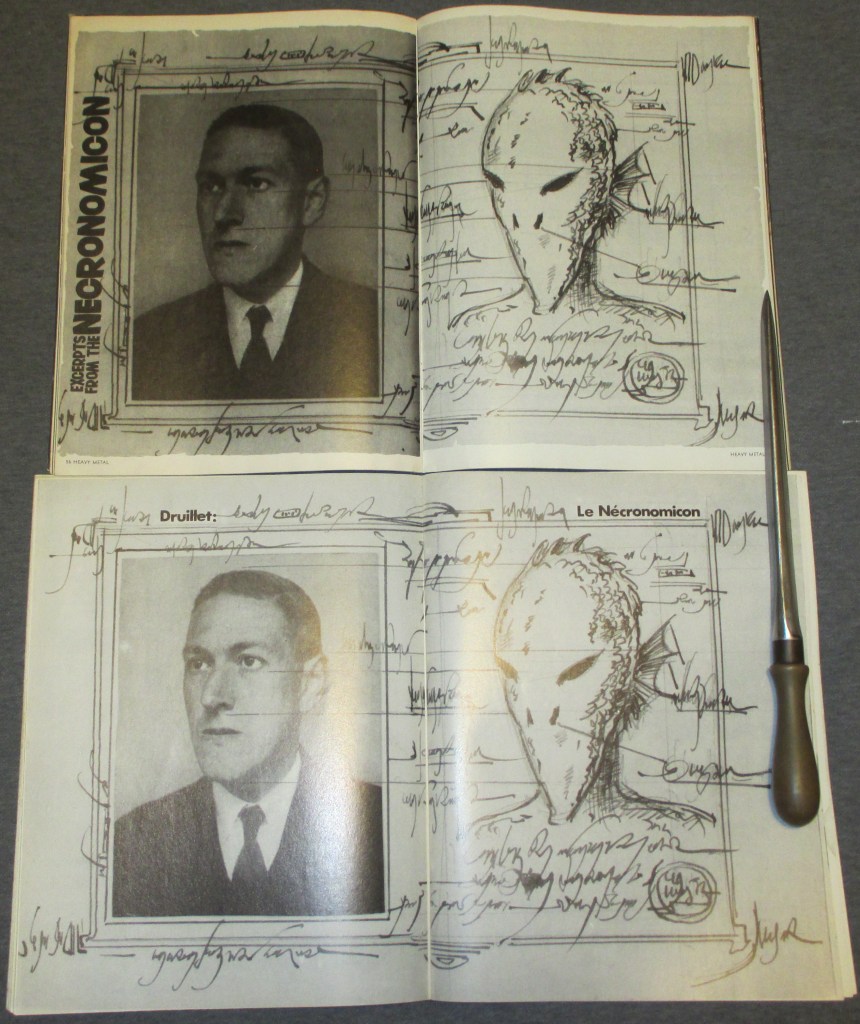
  • “Le Necronomicon” by Druillet, 86-96
  • Advertisment for La Boite Oblungue by Edgar Allan Poe and La Rivier du Hibou by Ambrose Bierce, 97
  • Advertismenet for Les Trafiquants d’Armes by Eric Ambler
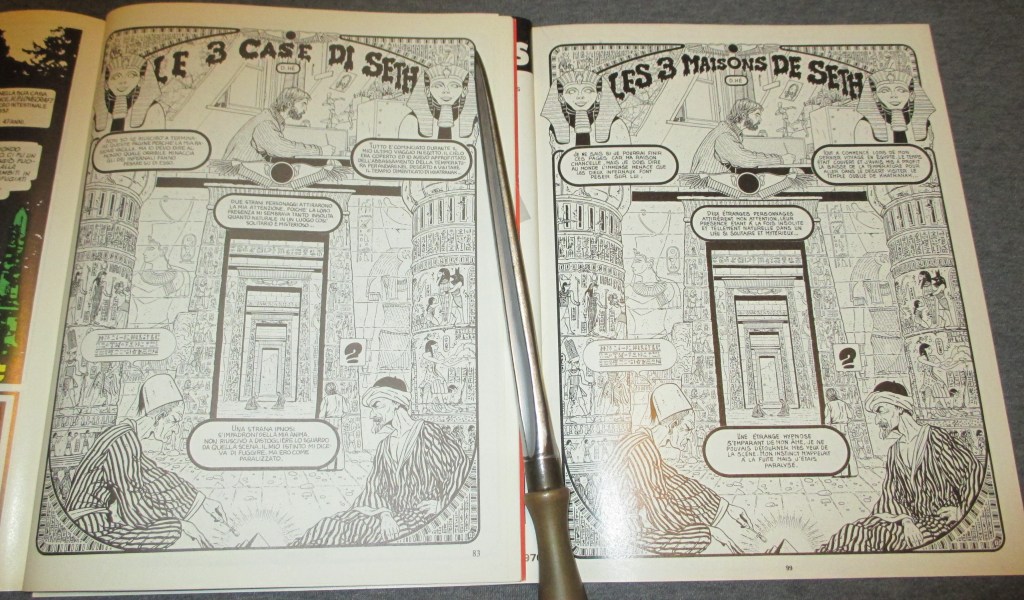
  • “Les 3 Maisons de Seth” by Dominique Hé, 99-101
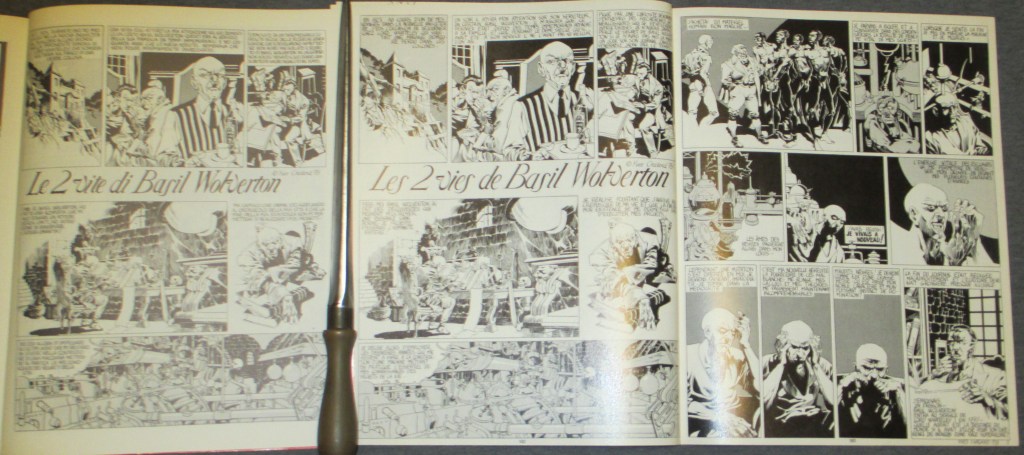
  • “Les 2 Vies de Basil Wolverton” by Yves Chaland, 102-103
  • Advertisement for back issues of Métal Hurlant, 104-105
  • Advertisement for Métal Hurlant posters, 106
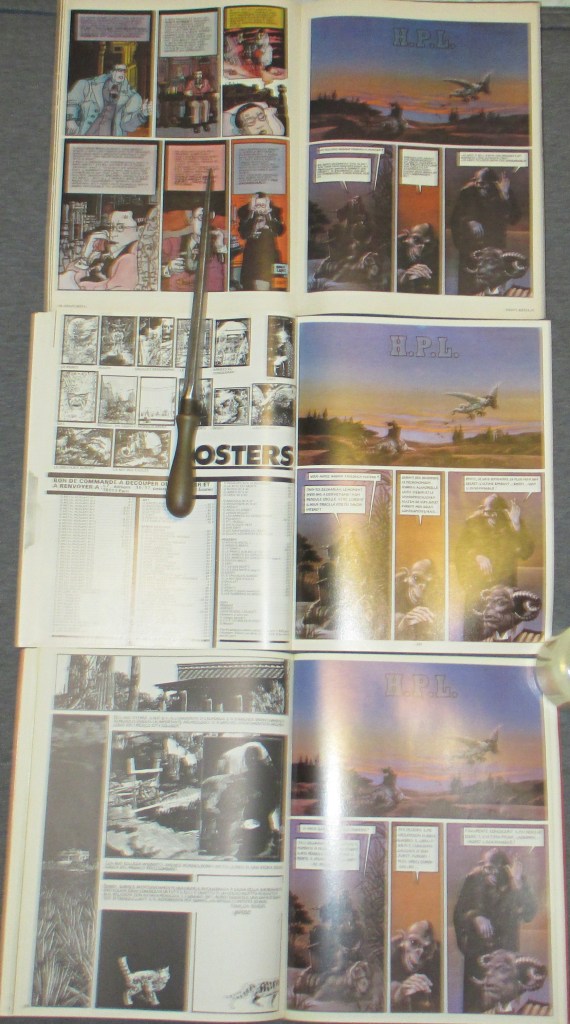
  • [c] “H.P.L.” by Jean-Michel Nicollet, 107-109
  • [c] “Ktulu” by Mœbius, 110-114
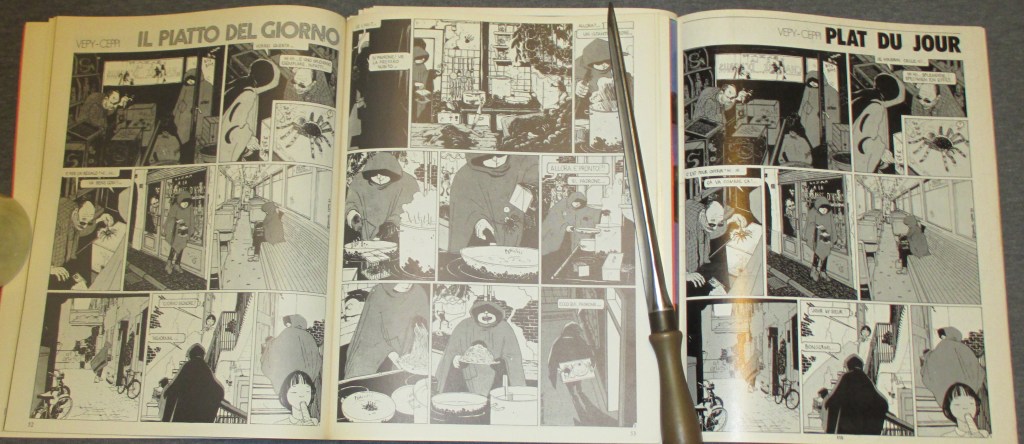
  • “Plat du Jour” by Vepy & Daniel Ceppi, 115-117
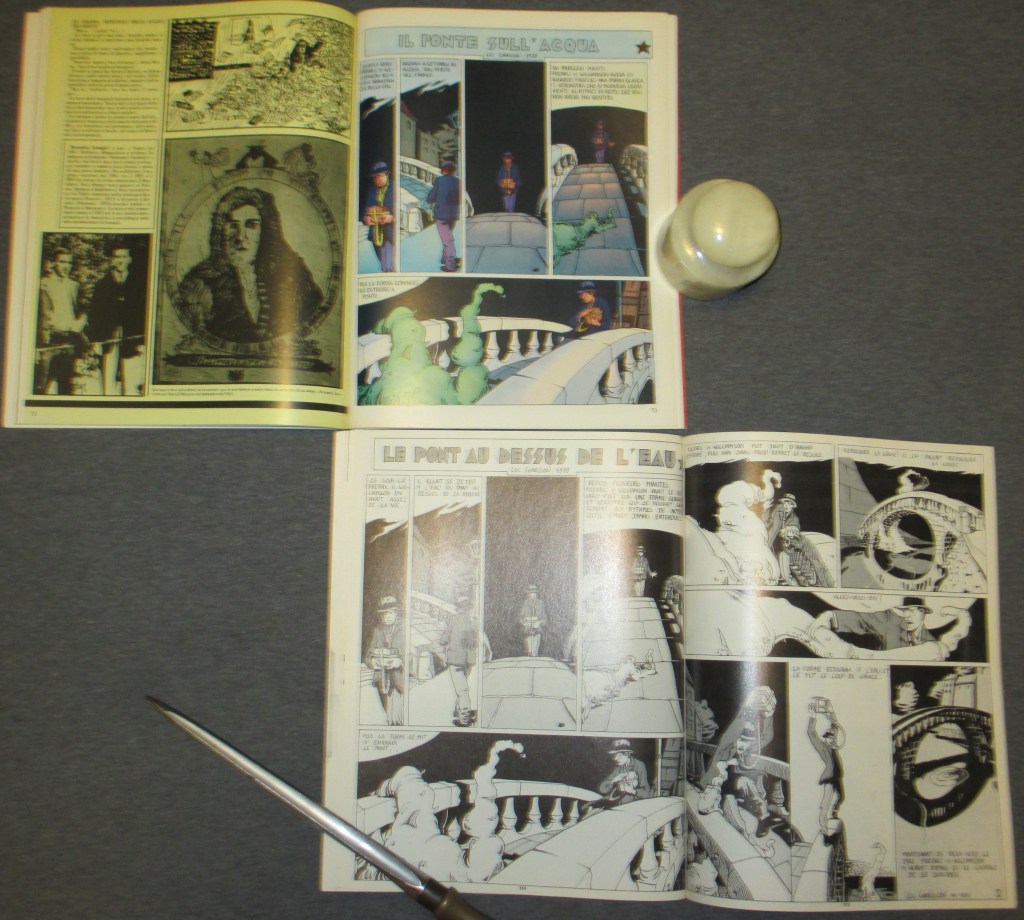
  • “Le Pont Au Dessus de l’Eau” by Luc Cornillon, 118-119
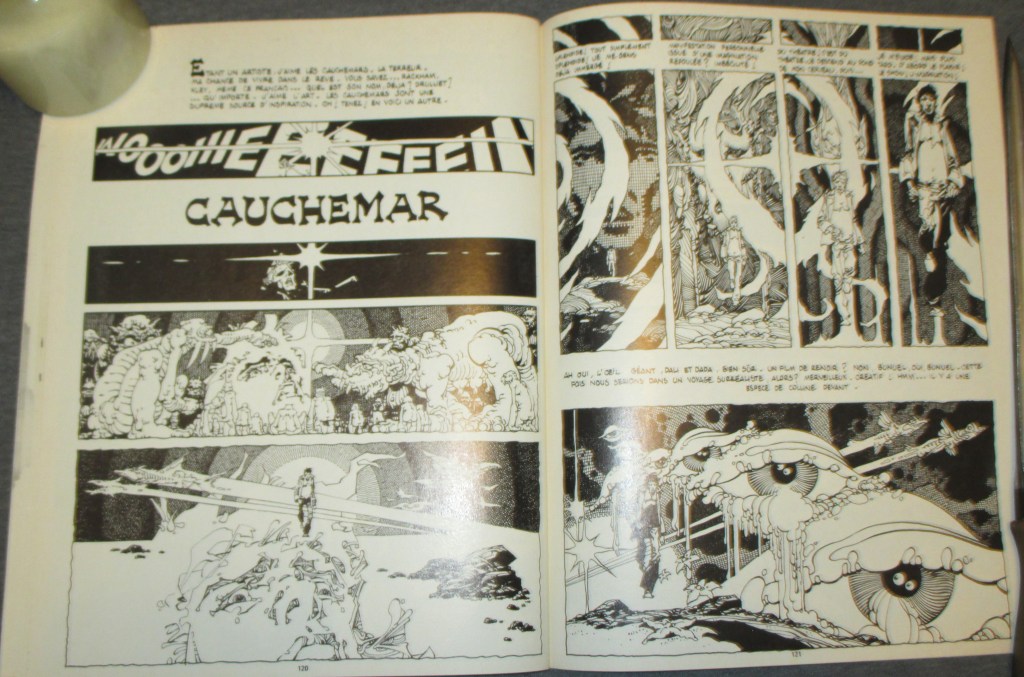
  • “Cauchemar” by Alex Niño, 120-129
  • H. P. Lovecraft au cinéma” by Jean-Pierre Bouyxou, 130-131
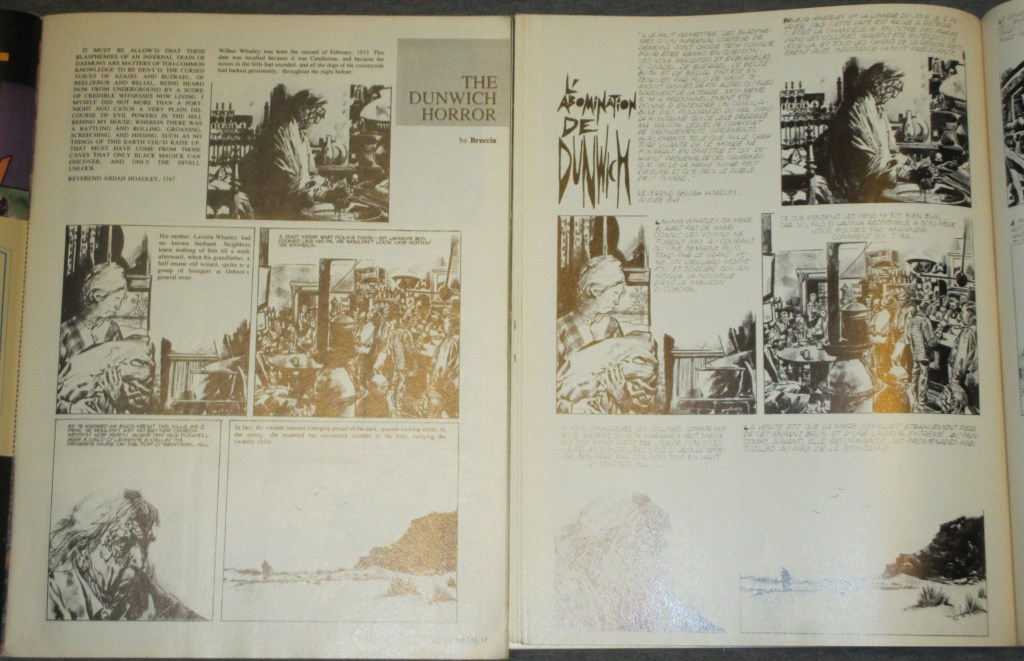
  • “L’Abomination de Dunwich” by Alberto Breccia, 132-146
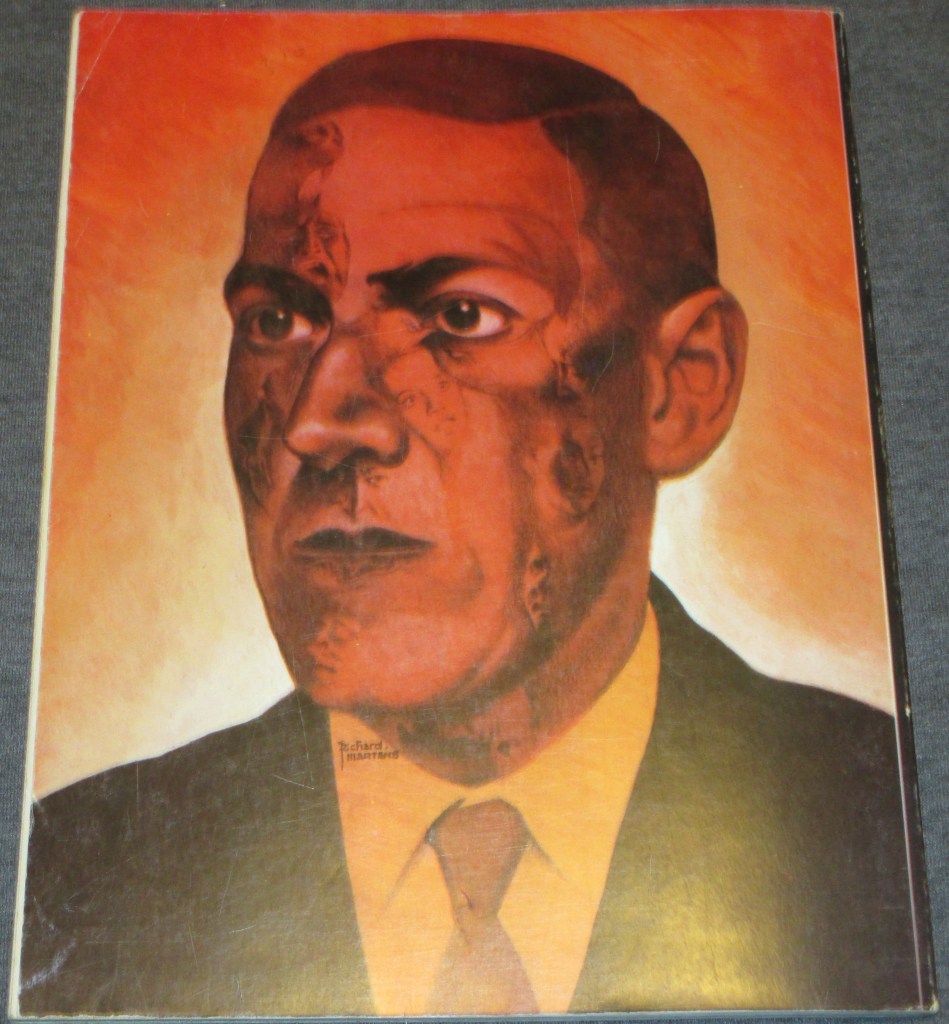
  • Back cover by Richard Martens

Unique Content

Front Cover: A plate from H. R. Giger’s Necronomicon (1977).

“Cauchemar” (“Nightmare”) by Alex Niño is a 10-page black-and-white comic that showcases a series of nightmares realized in surrealistic and highly detailed form; Niño pays homage to the styles of other artists, naming Heinrich Kley, Arthur Rackham, Phillip Druillet, and Jean Giraud (Mœbius). Not explicitly Lovecraft-related.

Edito triste./Edito gai (“Sad Editorial/Gay Editorial”); “Edito triste” is written as by “Abdul Fernand Alhazred”, while the “Edito gai” (as in happy, not homosexual) is by Philippe Manœuvre. Both concern how the Métal Hurlant Lovecraft Special came together.

“Je m’appelle Howard Phillips Lovecraft” (“I am called Howard Phillips Lovecraft”) by François Truchaud is a brief biographical sketch of Lovecraft’s life, fairly accurate for the compressed time and space, with illustrations by Richard Martens and Druillet; the Druillet illustration is the same as the cover to the Lovecraft special issue of L’Herne (1969).

“La Nuit du Goimard: Un ecrivain nommé Habileté-à-l’amour” (“The Night of Goimard: A Writer Named Able-to-Love”) by Jacques Goimard is an essay on Lovecraft’s fiction, illustrated by Perry’s silhouette of Lovecraft.

“Le Monstre Sur le Seuil” (“The Monster on the Threshold”) by Norberto Buscaglia & Alberto Breccia is an 11-page black-and-white comic adaptation of Lovecraft’s “The Thing on the Doorstep.” Breccia’s art combines traditional pen-and-ink with collage, which leads a strange, otherworldly aspect to the artwork.

“L’énigme du mystérieux puits secret” (“The Riddle of the Mysterious Secret Well”) by Yves Chaland & Luc Cornillon is a 4-page color comic where an investigative duo investigates a mysterious well and uncovers some counterfeiters; slightly reminiscent in overall style to Hergé’s Tintin. Not explicitly Lovecraft-related.

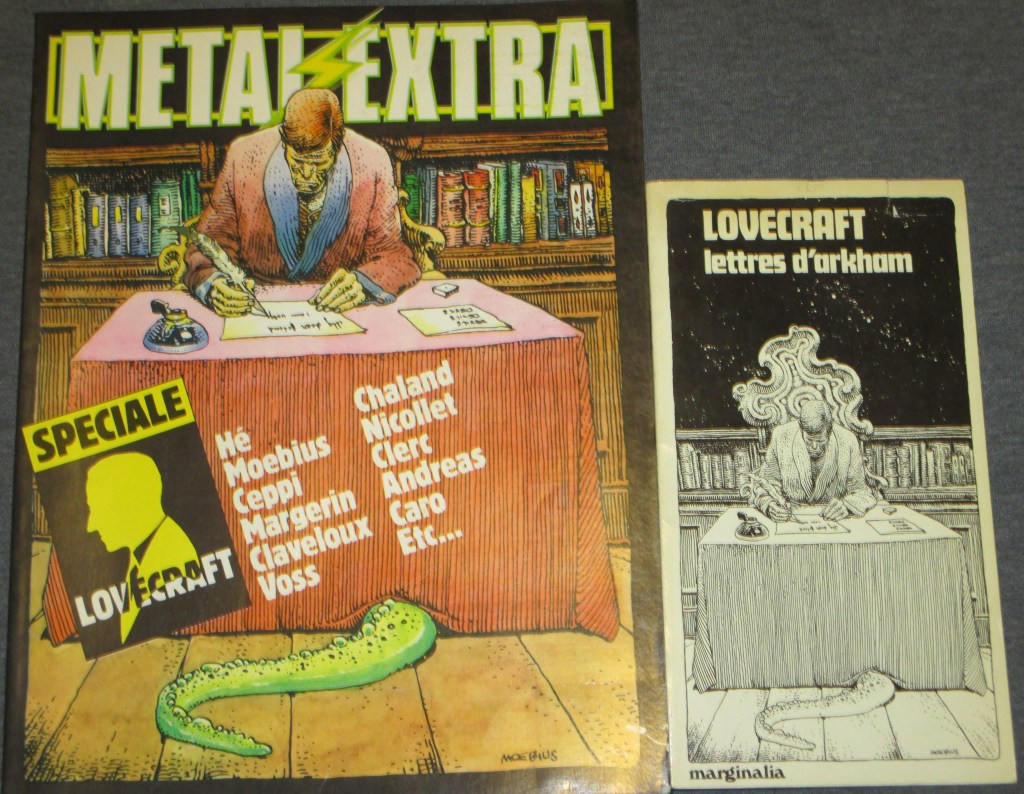
“Lettres de Lovecraft” (“Lovecraft’s Letters”) by François Truchaud is a review of Lettres 1 (1978), the French-language translation of the first volume of Lovecraft’s Selected Letters. Illustrated by Mœbius’ cover for Lettres d’Arkham (1975).

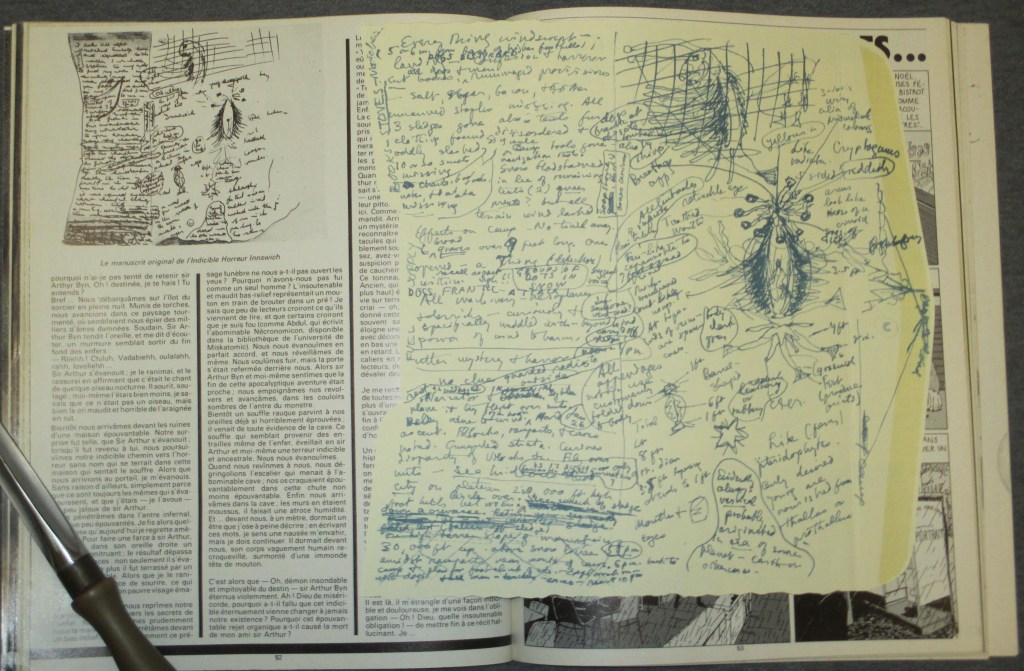
“L’Indicible Horreur d’Innswich” (“The Unspeakable Horror of Innswich”) by Philippe Setbon is a short fiction that purports to be the last story written by H. P. Lovecraft, complete with a mock reproduction of the original manuscript written on an envelope, based on the famous At the Mountains of Madness envelope.

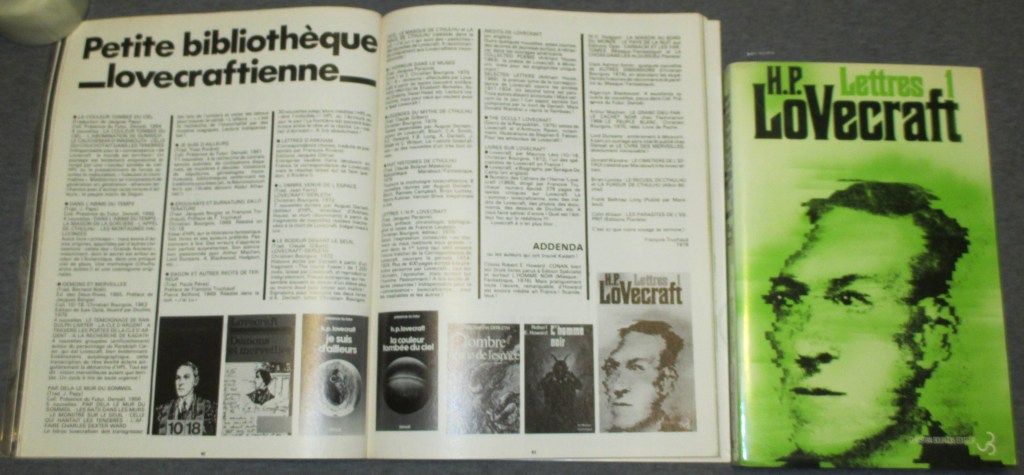
“Petite bibliothèque lovecraftienne” (“Little Lovecraftian Library”) by François Truchaud is a brief survey of Lovecraft-related material available in French publications, as well as some related publications such as The Occult Lovecraft (1975) and H. P. Lovecraft: A Biography (1975) in English.

Back cover by Richard Martens, based on a photo of Lovecraft.


Heavy Metal H. P. Lovecraft Special Issue (Oct 1979)

This material is taken, for the most part, from a bizarre and eldritch tome written in a strange tongue, the “Homage á Lovecraft” issue of Métal Hurlant. We trust it will add just the right touch to your Hallowe’en festivities.
—Sean Kelly, editorial for Heavy Metal vol. III, no. 6

96 pages, counting the ads, table of contents, etc., which makes for a thinner magazine that can still be side-stapled. Heavy Metal magazine vol. III, no. 6 is part of the normal numbering rather than an extra or one-off issue. While it draws much of its material directly from the Métal Hurlant Lovecraft special, the publishers chose not to reproduce all of the Lovecraft material from the French.

What didn’t they translate? The text pieces, the Georges Kuchar reprint, several of the more humorous and less Lovecraft-related comics, a couple pages of Druillet’s Necronomicon, and oddly the Breccia adaptation of “The Thing at the Doorstep.” What remains isn’t exactly entirely dedicated to Lovecraft, either, so that the “Lovecraft” issue has rather less Lovecraft-related material in it than might be expected.

Maybe there was a crunch with time to put the issue together, or some issues with the right. However, they also added a few things that didn’t appear in the Métal Hurlant issue, notably the J. K. Potter cover and “The Devil’s Alchemist,” a work of fiction. Unlike the Métal Hurlant Lovecraft special, the majority of Heavy Metal pages are in color, including colorizing some works that were in black-and-white in Métal Hurlant.

Lovecraftian items are marked in bold; color pages are marked [c]; items from the Métal Hurlant special are marked with an asterisk (*).

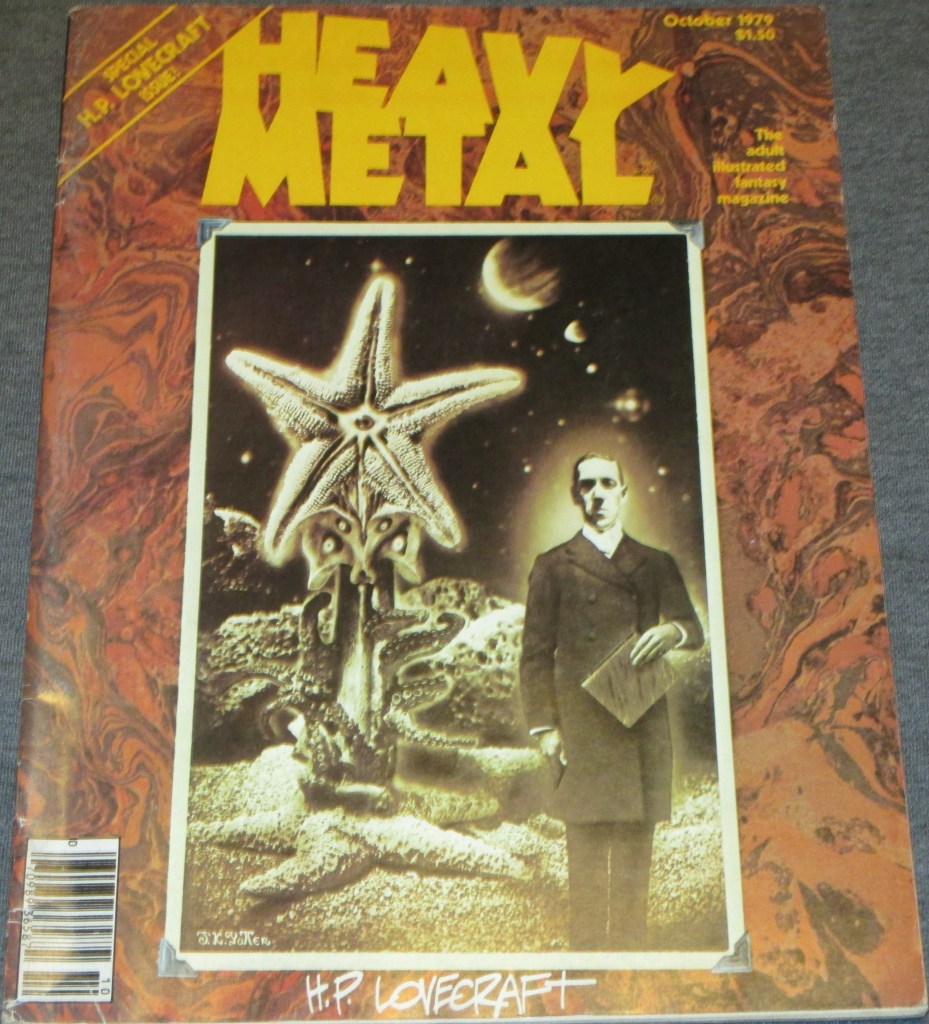
  • Front cover (“Mr. Lovecraft”) by J.K. Potter
  • Advertisement for Strategy & Tactics, 1
  • [c] Table of Contents, 2
  • [c]Advertisement for Job Cigarette Papers, 3
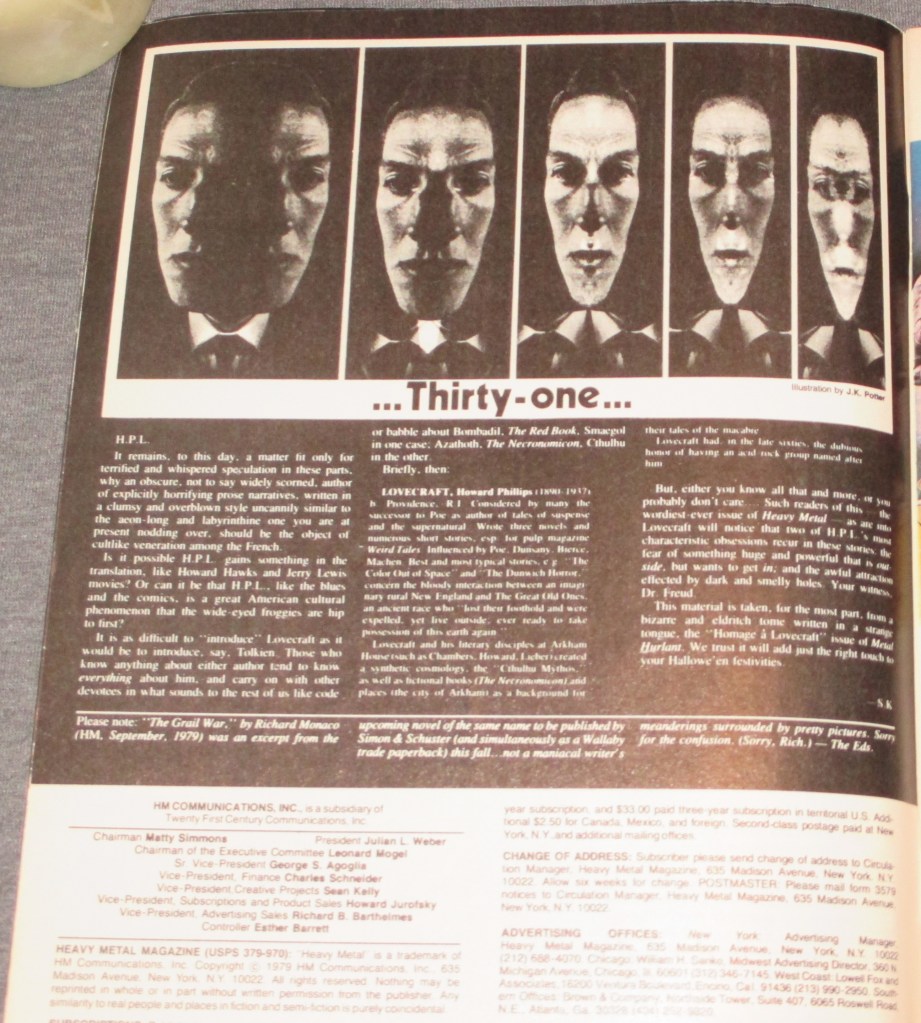
  • “…Thirty-one…” (editorial) by Sean Kelly w/ J. K. Potter, 4
  • [c] Advertisement for The Encyclopedia of Science Fiction, 5
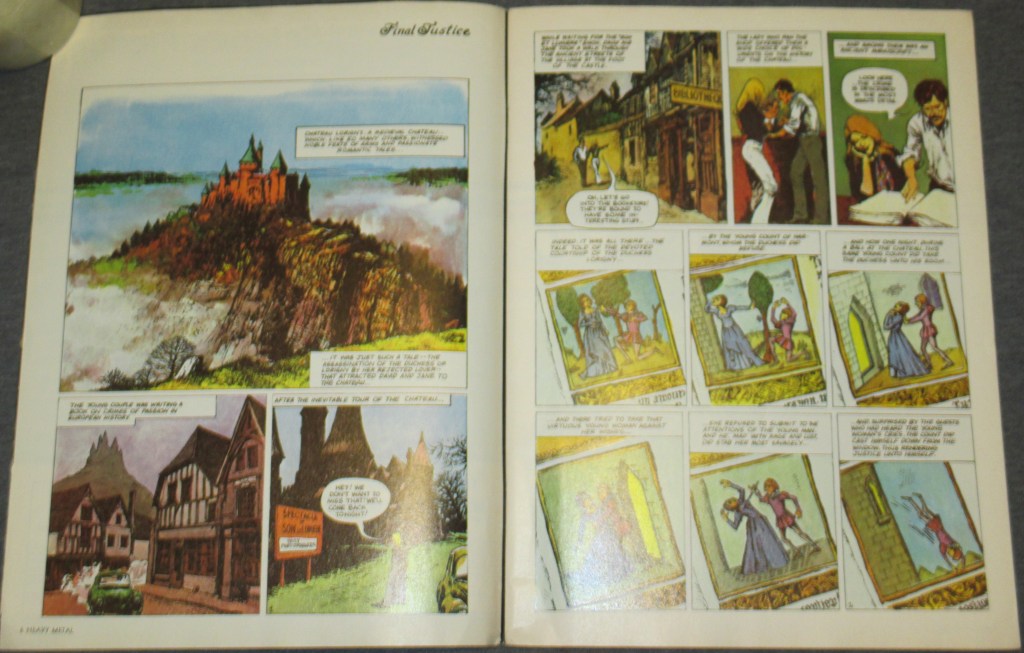
  • [c] “Final Justice” by Chateau, 6-14
  • [c] Advertisement for Heavy Metal posters, 15
  • [c] Advertisement for Heavy Metal subscriptions, 16
  • [*] “The Dunwich Horror” (“L’Abomination de Dunwich”) by Alberto Breccia, 17-25, 74-80
  • [c] [*] “Ktulu” by Mœbius, 25-29
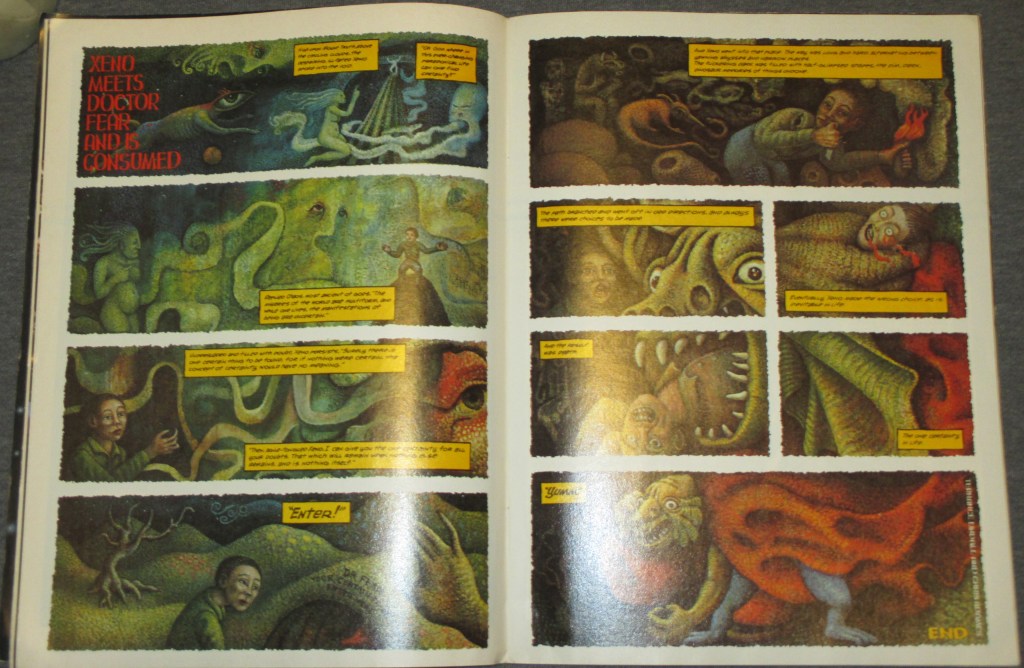
  • [c] “Xeno Meets Dr. Fear and Is Consumed” by Terrance Lindall & Chris Adames, 30-31
  • [*] “The Thing” (“La Chose”) by Alain Voss, 32-37
  • [*] “The Beasts” (“Les Bêtes”) by Dank, 38-40
  • [c] [*] “The Man from Blackhole” (“L’Homme de Black Hole”) by Serge Clerc, 41-44
  • [c] [*] “H.P.L.” by Jean-Michel Nicollet, 45-47
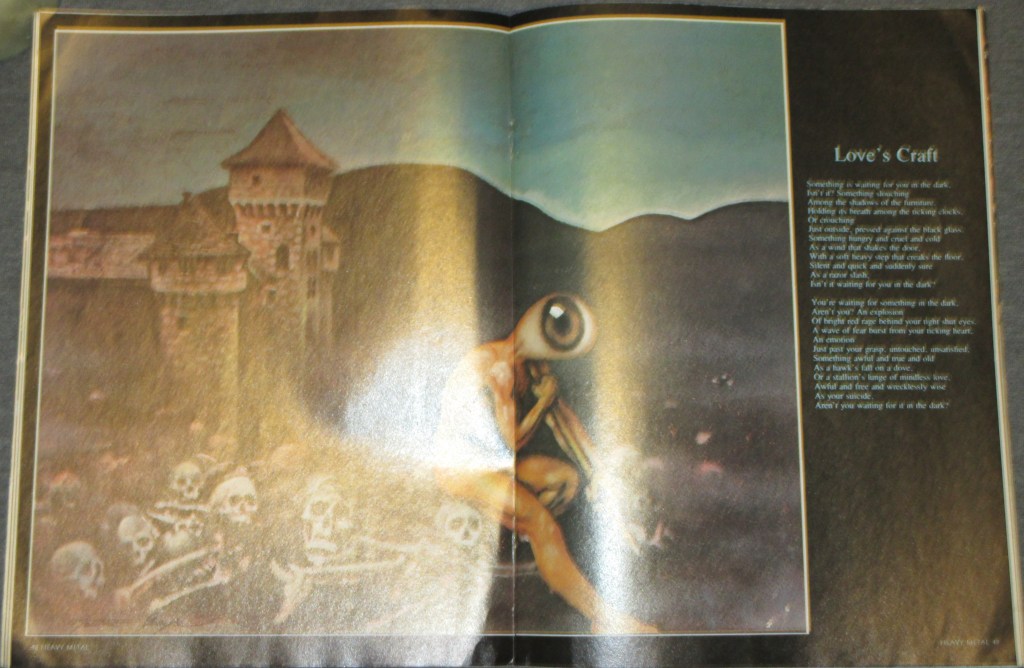
  • [c] “Love’s Craft” by Sean Kelly & Matthew Quayle, 48-49
  • [c] [*] “Dewsbury’s Masterpiece” (Le Chef d’Œuvre de Dewsbury) by Yves Chaland & Luc Cornillon, 50-53
  • [c] Advertisement for back issues of Heavy Metal, 54-55
  • [*] “The Necronomicon” by Druillet, 56-61
  • [*] “The Language of Cats” (“Le langage des chats”) by Nicole Claveloux, 62-63
  • “Chain Mail” (letters page, but comic by Christopher Browne) 64
  • [c] Advertisement for Dragonworld, 65
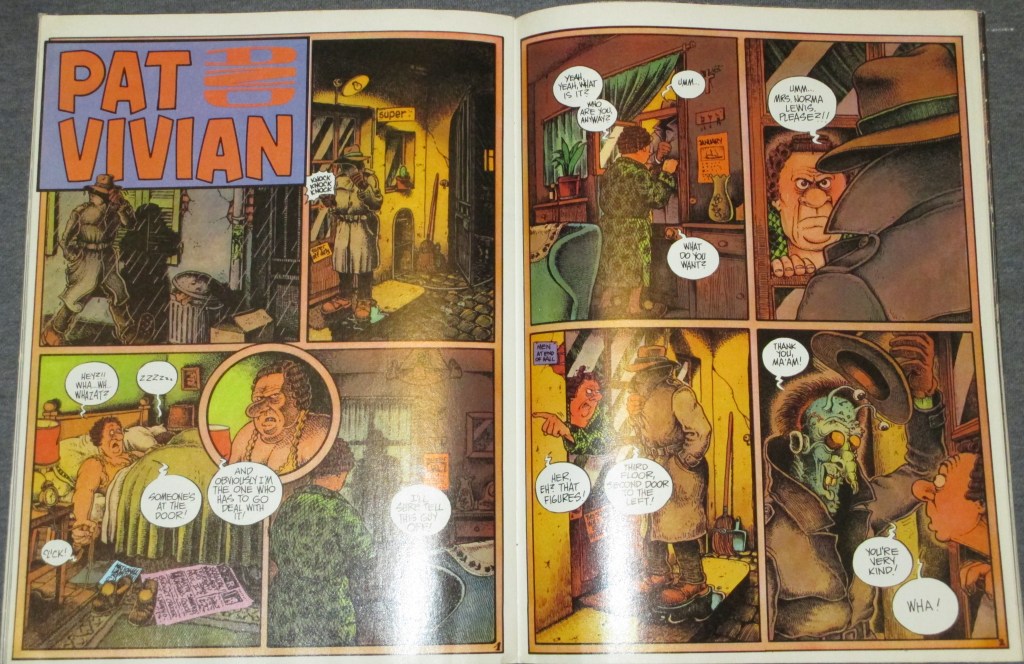
  • [c] “Pat and Vivian” by Frank Margerin, 66-68
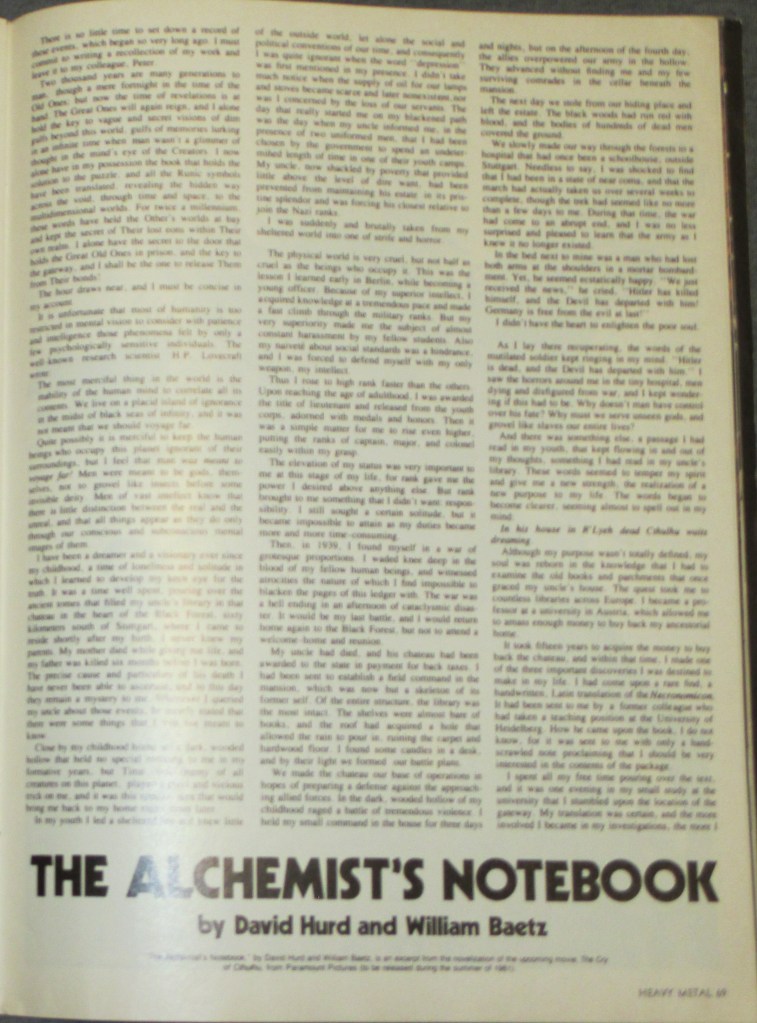
  • [c] “The Alchemist’s Notebook” by David Hurd & William Baetz, w/Walter Simonson, 69-73
  • [“The Dunwich Horror” continued, 74-80]
  • [c] Advertisement for The Grailwar by Richard Monaco, 81
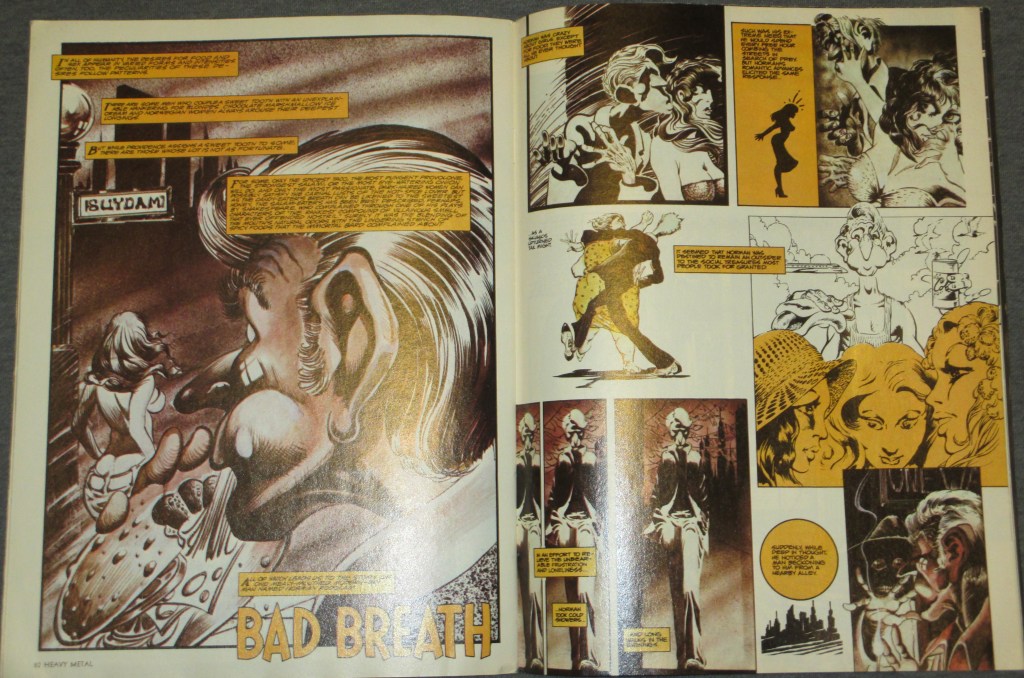
  • [c] “Bad Breath” by Arthur Sudyam, 82-89
  • [c] Advertisement for Heavy Metal books/graphic novels, 90-91
  • [*] “The Agony Column” (“Amitiés Rencontres”) by Vepy & Daniel Ceppi, 92-96
  • Back cover (“Elizabeth”) by George Smith

Unique Content

Front cover: “Mr. Lovecraft” by J.K. Potter. Before digital image manipulation programs existed, Potter was producing strange, disturbing images with a combination of photographs, airbrush, and traditional pen and ink. The effects, with Potter’s imagination, could be quite stunning. In this instance, he uses it to place Lovecraft in a cosmic scene. Potter would lend his talents to several future Lovecraft-related projects, including the cover for Tales of the Cthulhu Mythos (1990).

“The Alchemist’s Notebook” by Byron Craft (as by David Hurd & William Baetz) is an original work of Mythos fiction, with illustrations by Walter Simonson. A note on the first page says that this story is “an excerpt from the novelization of the upcoming movie, The Cry of Cthulhu“—but the film never made it past pre-production (Cthulhu Calling: An Interview with Byron Craft). In 2016, Craft published the full version of the novelization as The Alchemist’s Notebook, which was later changed to The Cry of Cthulhu.

“Bad Breath” by Arthur Sudyam is an 8-page comic that is principally black-and-white with color tints on Selected panels and figures; it follows an amorous young man whose bad breath is impacting his love life, and the solution he attempts has horrific—and amusing—consequences. Not explicitly Lovecraft-related.

“Final Justice” by Chateau is a 9-page color comic where a couple in Europe to write a book on historical crimes watch the re-enactment of a medieval murder at an ancient chateau. Not explicitly Lovecraft-related.

“Love’s Craft” by Sean Kelly is a poem, accompanied by an illustration by Matthew Quayle. Tentatively Lovecraftian based on the title, but with no direct references to Lovecraft or the Mythos.

“Pat and Vivian” by Frank Margerin is a 3-page humorous comic about a woman awoken by a strange entity at the door. Not explicitly Lovecraft-related.

“…Thirty-one…” (editorial) by Sean Kelly, discussing Lovecraft in brief. Accompanied by a photo-manipulated image of Lovecraft by J. K. Potter.

“Xeno Meets Dr. Fear and Is Consumed” by Terrance Lindall & Chris Adames is a two-page color fantasy/horror comic with a distinct textured painting style. Young Xeno, asking a fundamental question about certainty, sets off in dreams to find Dr. Fear—and does. Not explicitly Lovecraft-related.


Metal Extra Speciale Lovecraft (Nov 1982)

Cui, questo numero speciale di Métal Hurlant e un vero e proprio “omaggio” nei limiti è nei termini in cui puo esserlo una realizzazione a fumetti. Essa però dimostra sino a che punto è giunta oggi l’influenza del “solitario di Providence” e del suo mondo di sogni, di miti, di realtà alternative. E’un “ommagio” che ciascun disegnatore o scrittore ha estrinsecato secondo la sua predisposizione, il suo modo di vedere, il suo atteggiaento mentale, culturale, di spirito. E cosi (non ci si meravigli di ciò) vi saranno controbuti (fumetti) “seri” e meno seri o aprtamente ironici, allucinati e satirici. Un autore è amato non soo quando si prende sul serio il suo universo incubico (come ne L’uomo del Buco Nero, Il capolavoro di Dewsbury, ecc.), ma anche quando ci si scherza su, fra il serio e il faceto (Cthulhu), lo si prende aperamente in giro (La traccia scarlatta, Escursione notturna, Il ritorno di Cthulhu e cosi via).Hence, this special issue of Métal Hurlant is a real “homage” to the extent that a comic book production can be. However, it demonstrates how far the influence of the “solitary of Providence” and his world of dreams, myths, and alternative realities has reached today. It is an “homage” that each artist or writer has expressed according to his predisposition, his way of seeing, his mental, cultural, and spiritual attitude. And so (don’t be surprised by this) there will be “serious” and less serious or overtly ironic, hallucinatory and satirical counterparts (comics). An author is loved not only when his nightmare universe is taken seriously (as in The Man from the Black Hole, Dewsbury’s Masterpiece, etc.), but also when he is joked about, half-jokingly (Cthulhu), and openly made fun of (The Scarlet Trail, Night Excursion, The Return of Cthulhu, and so on).
Gianfranco de Turris, Metal Extra Speciale Lovecraft, 5English translation

Instead of trying to publish this as part of their regular series of issues, the editors in Italy essentially excerpted the majority of the Lovecraft comics content from the Métal Hurlant Lovecraft special and squeezed it into a 100-page (counting covers) square-bound Metal Extra issue. They also added some additional materials not in either the Métal Hurlant or Heavy Metal Lovecraft special issues

Lovecraftian items are marked in bold; color pages are marked [c]; items from the Métal Hurlant special are marked with an asterisk [*].

  • [*] Front Cover by Mœbius
  • Table of Contents, 3
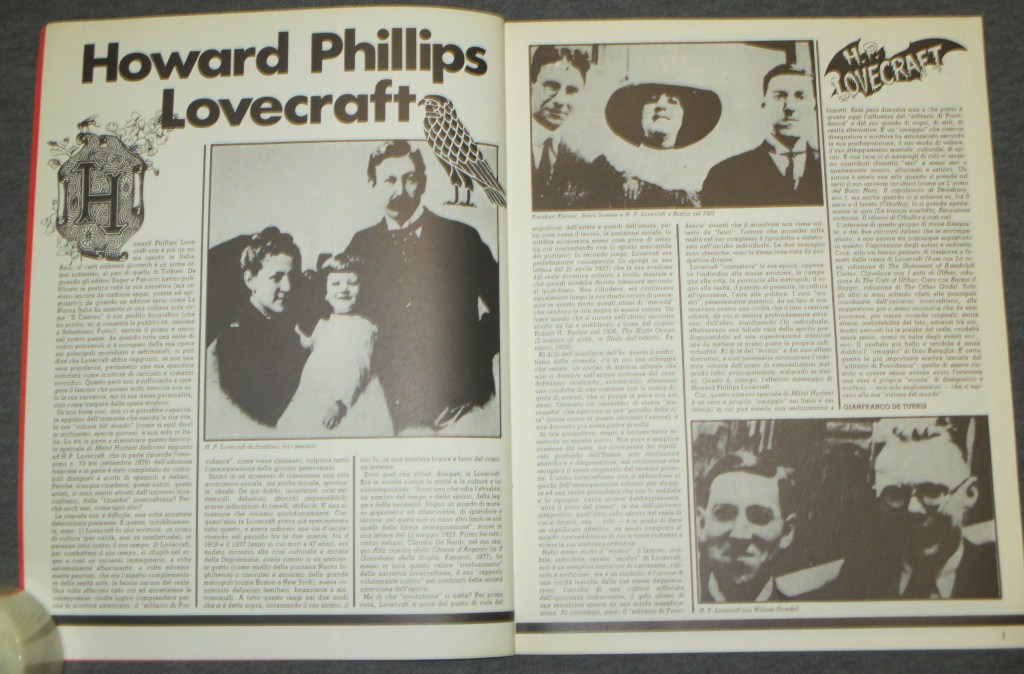
  • “Howard Phillips Lovecraft” by Gianfranco de Turris, 4-5
  • [*] “Annunci sul Gironale…” (“Amitiés Rencontres”) by Vepy & Daniel Ceppi, 6-10
  • [*] “Barzai il Saggio” (“Barzai le Sage”) by Marc Caro, 11-18
  • [c] [*] “Ktulu” by Mœbius, 19-25
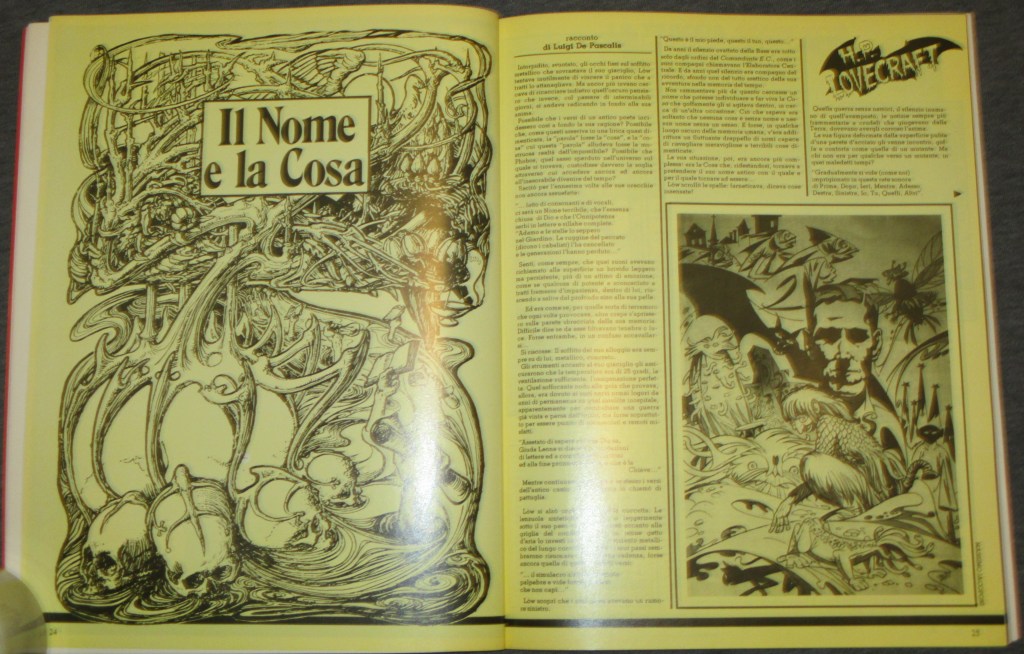
  • “Il Nome e la Cosa” by Luigi de Pascalis, 24-26
  • [c] [*] “La Traccia Scarlatta” (“La Trace Ecarlate”) by Jean-Jacques Mendez & Daniel Ceppi, 27-28
  • [*] “H. P. Lovecraft al Cinema” (“H. P. Lovecraft au cinéma”) by Jean-Pierre Bouyxou [uncredited], 29-30
  • [c] [*] “Il Capolavoro di Dewsbury” (Le Chef d’Œuvre de Dewsbury) by Yves Chaland & Luc Cornillon, 31-34
  • [*] “Il Ritorno di Cthulhu” (“La Retour de Cthulhu”) by Alan Charles & Richard Martens, 35-36
  • [*] “La Cosa” (“La Chose”) by Alain Voss, 37-42
  • [*] “Alla Ricerca di Kadath” (“A la Recherche de Kadath”) by François Truchaud & M. Perron, 43-46
  • [*] “H. P. Lovecraft 1890-1937” by Georges Kuchar, 47-49
  • [*] “Il Linguaggio dei Gatti” (“Le langage des chats”) by Nicole Claveloux, 50-51
  • [*] “Il Piatto del Girno” (“Plat du Jour”) by Vepy & Daniel Ceppi, 52-54
  • [*] “Escursione Notturna” (“Excursion Nocturne”) by Frank Margerin, 55-58
  • “R. H. B.” by Andreas & François Rivière, 59-66
  • [*] “H. P. L.” by Jean-Michel Nicollet, 67-69
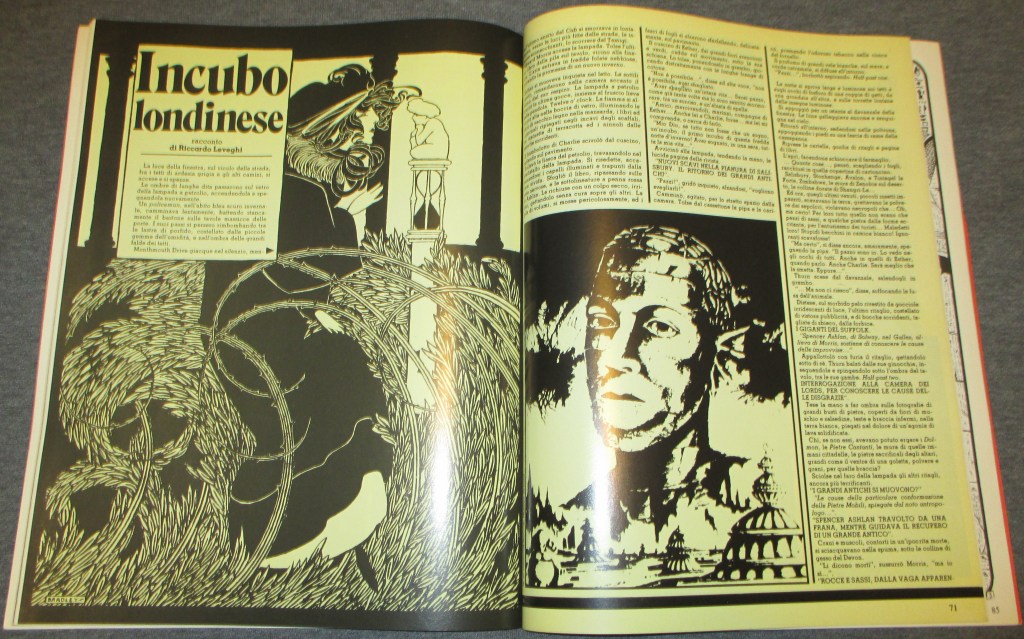
  • “Incubo Londinese” by Riccardo Leveghi, 70-72
  • [c] [*] “Il Ponte dull’acqua” (“Le Pont Au Dessus de l’Eau”) by Luc Cornillon, 73-74
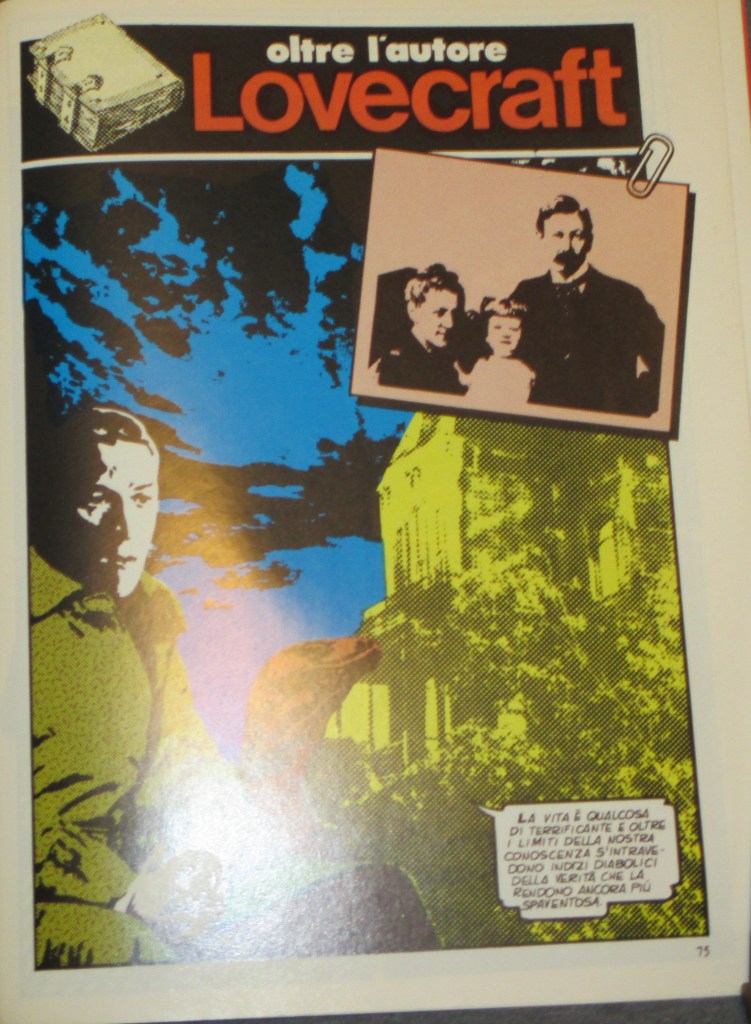
  • [c] “Oltre L’autore Lovecraft” by Onomatopeya, 75-82
  • [*] “Le 3 Case di Seth” (“Les 3 Maisons de Seth”) by Dominique Hé, 83-85
  • [*] “La Bestie” (“Les Bêtes”) by Dank, 86-88
  • [*] “L’Uomo di Black Hole” (“L’Homme de Black Hole”) by Serge Clerc, 89-92
  • [*] “Le 2 Vite di Basil Wolverton” (“Les 2 Vies de Basil Wolverton”) by Yves Chaland, 93-94
  • [*] “Omaggio a H. P. Lovecraft” (“Hommage à HPL…”), 95-97
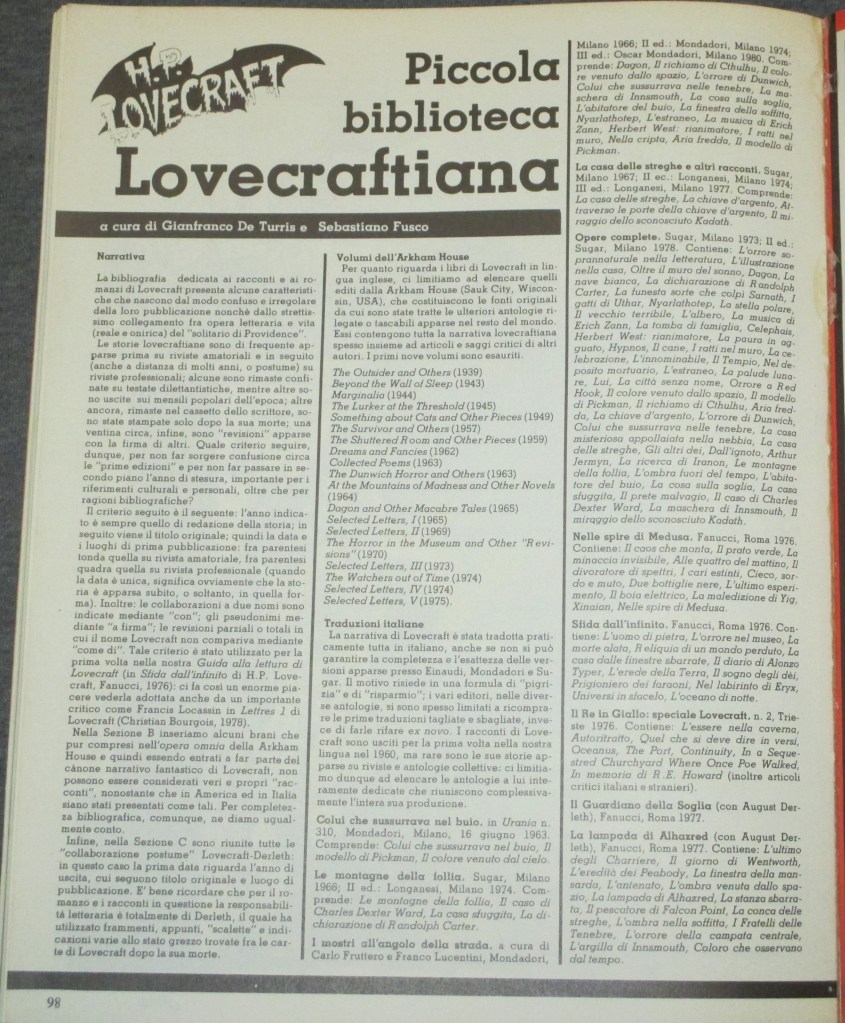
  • “Piccola Bibioteca Lovecraftiana” by Gianfranco de Turris & Sebastiano Fusco, 98

Unique Content

Front Cover is a colorized version of Mœbius’ depiction of Lovecraft at his desk from Lettres d’Arkham.

“Howard Phillips Lovecraft” by Gianfranco de Turris is a two-page editorial-cum-introduction to the issue and Lovecraft, illustrated with reproductions of photos of Lovecraft.

“Il Nome e la Cosa” (“The Name and the Thing”) by Luigi de Pascalis is a short work of fiction about the Golem of Prague, accompanied by illustrations by Massimo Jacoponi, a photo of Lovecraft, and Perry’s silhouette of Lovecraft. Other than the illustrations, no explicit Lovecraftian content.

“Incubo Londinese” (“London Nightmare”) by Riccardo Leveghi is a short work of fiction. Illustrated by Bradley, Druillet’s cover art from L’Herne, a photo of Lovecraft, and two images from Lovecraft’s letters. Other than the illustrations, no explicit Lovecraftian content.

“Oltre L’autore Lovecraft” (“Beyond the Author Lovecraft”) by Onomatopeya is an 8-page fotonovela-style comic about Lovecraft’s life and literary afterlife, a montage of photos tinted, textured, and collaged together with speech bubbles and text boxes to provide a humorous but largely accurate narrative.

“Piccola Bibioteca Lovecraftiana” (“Little Lovecraftian Library”) by Gianfranco de Turris & Sebastiano Fusco; while sharing essentially the same title as its counterpart in Métal Hurlant, this is a brief listing of the relevant Arkham House volumes and the Italian translations of Lovecraft and related materials, including August Derleth’s “posthumous collaborations.”

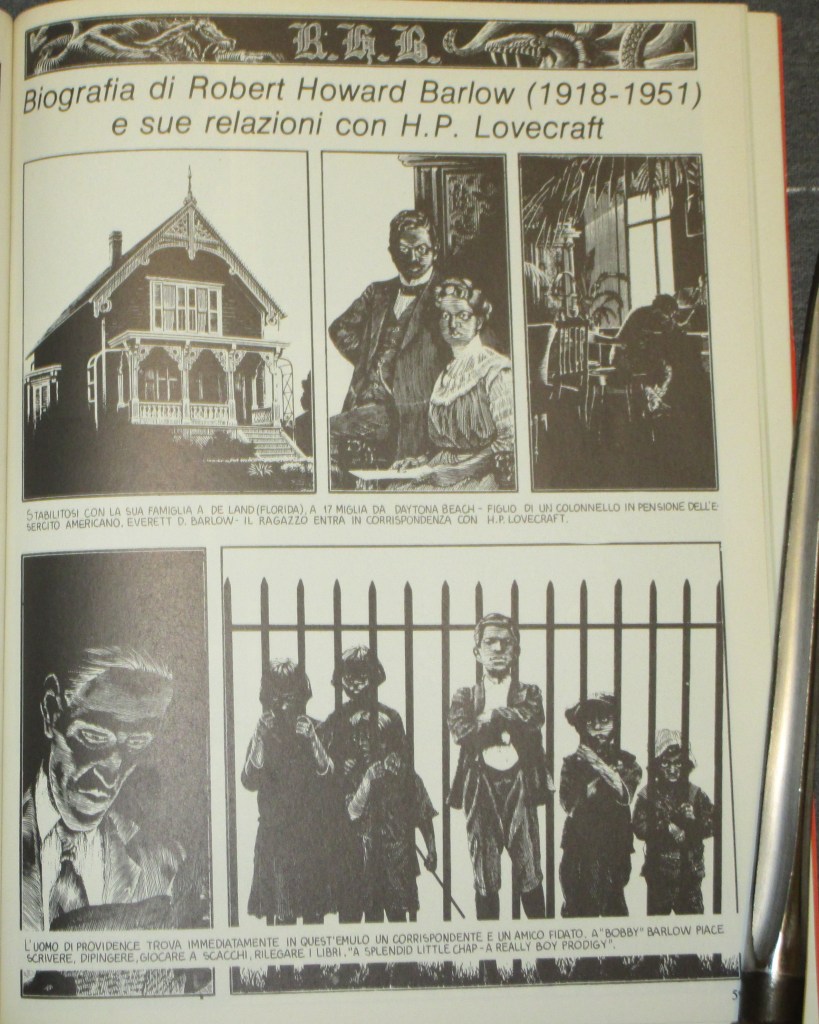
“R. H. B.” by Andreas & François Rivière is an 8-page, black-and-white comic about Lovecraft’s friend R. H. Barlow.


Shared Content

Listed below are the shared features, drawn from the original Métal Hurlant issue and also appearing in either or both of Heavy Metal and Metal Extra, along with notes on differences between the versions and necessary context.

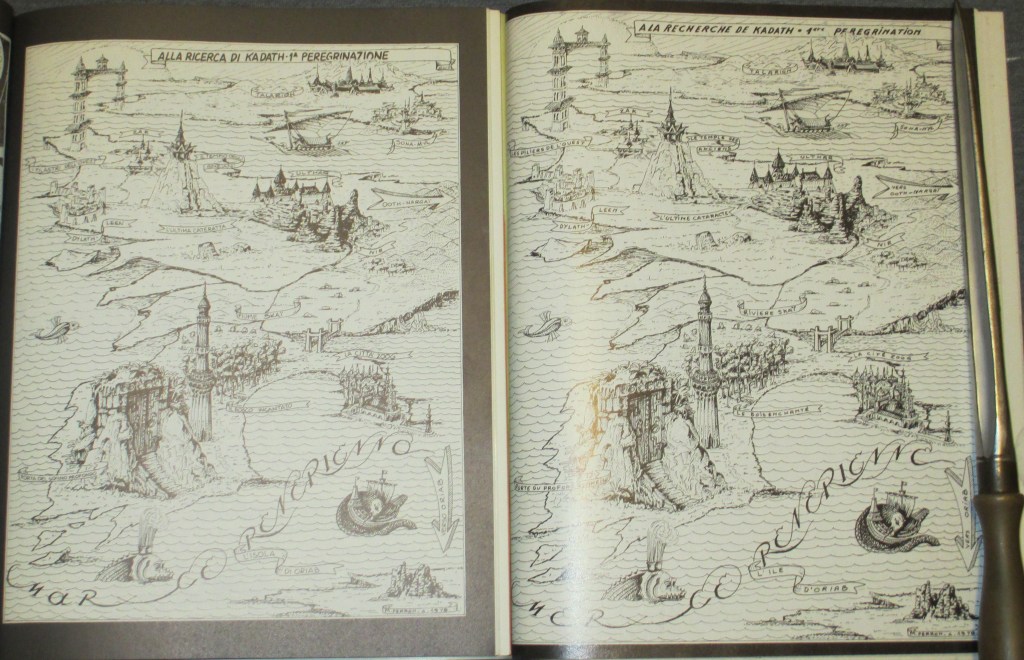
“A la Recherche de Kadath” (“Alla Ricerca di Kadath,” “In Search of Kadath”) by François Truchaud & M. Perron is a 4-page black-and-white fantasy pictorial map of Lovecraft’s Dreamlands in a lavish, detailed style. Appears in Métal Hurlant and slightly smaller in Metal Extra.

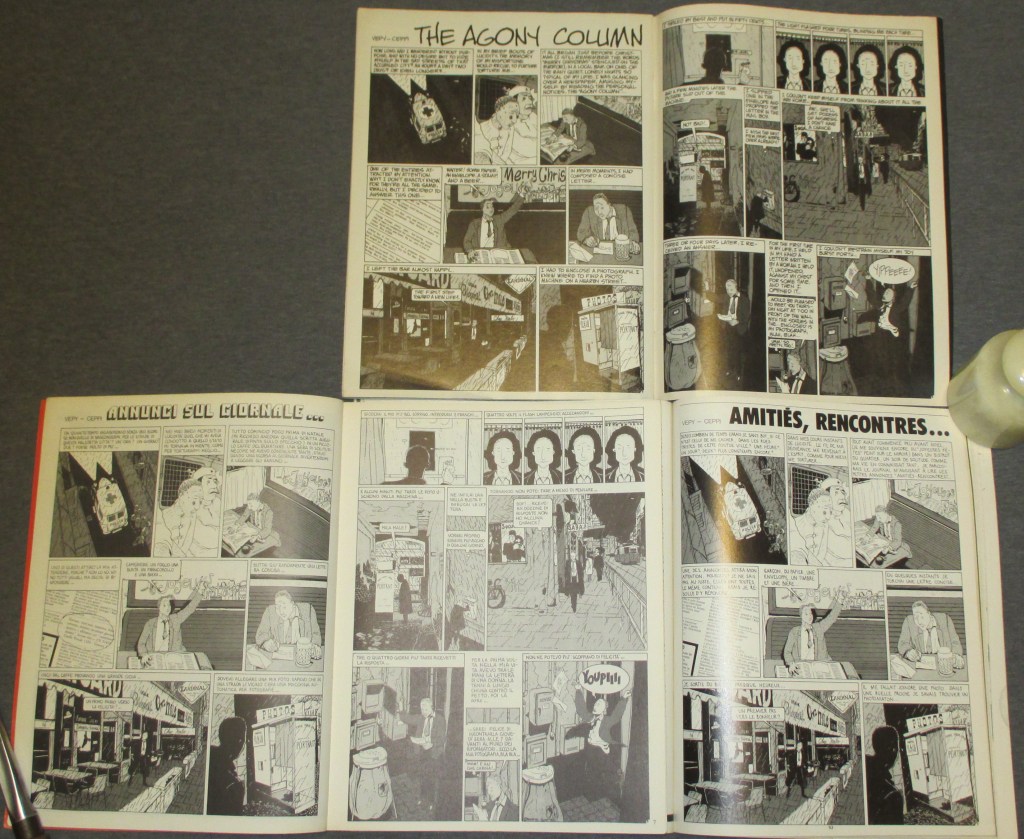
“Amitiés, Rencontres” (“Annunci sul Gironale…,” “The Agony Column”) by Vepy & Daniel Ceppi is a 5-page black-and-white comic. The French title translates literally as “Friendships, Meetings”, and the Italian as “Announcements in the Daily,” but in context it might better be called Personal Ads. The nameless protagonist is in police/medical custody, and flashes back to when he answered a personal ad in the paper, and received a response. When he goes to meet the woman, he is waylaid: the whole setup has been a trap. Not explicitly Lovecraftian. Appeared in Métal Hurlant, Heavy Metal, and Metal Extra.

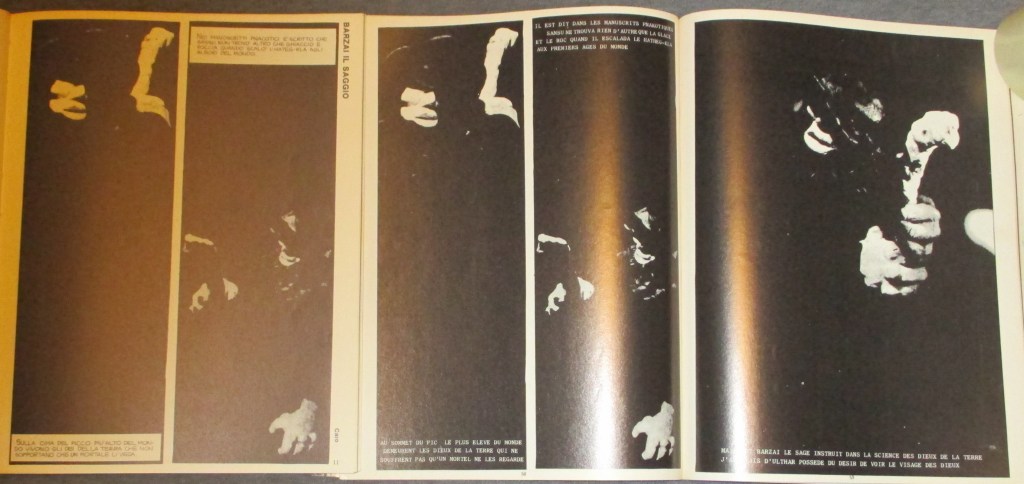
“Barzai le Sage” (“Barzai il Saggio,” “Barzai the Sage”) by Marc Caro is an 8-page comic composed of several extremely dark, heavily-exposed photos of a sculpture of a figure in various poses and backgrounds; the text is derived from Lovecraft’s “The Other Gods.” Appears in Métal Hurlant and in Metal Extra, where text boxes replace the original typed text annotations.

“Excursion Nocturne” (“Escursione Notturna,” “Noctural Excursion”) by Frank Margerin is a 4-page black-and-white comic that is wordless until the final panel; the whole is a careful set-up of horror tropes with a comedic flourish. Not explicitly Lovecraftian. Appeared in Métal Hurlant and Metal Extra.

“Hommage à HPL…” (“Omaggio a H. P. Lovecraft,” “Homage to Lovecraft”) by uncredited is nominally a 3-page black-and-white cut-out diorama inspired by Lovecraft; though the content is more descriptive of general witchcraft and I haven’t been able to source any particular Lovecraftian inspiration. Appeared in Métal Hurlant and Metal Extra.

“H. P. L.” by Jean-Michel Nicollet is a 3-page color fantasy painted comic. A pair of fantasy creatures travel through a city to where a suited, winged figure sits on a throne atop a pillar, and asks a sphinx-like riddle. A panel reveals the figure has the face of Lovecraft. While slight in terms of content, and the events play out with a dry humor, the artwork is fantastic. Nicollet would go on to do many painted covers for weird fiction translated into French, including collections of Robert E. Howard, Clark Ashton Smith, etc. The winged, demonic Lovecraft would reappear on the cover of Robert Bloch’s Retour à Arkham (1980). Appeared in Métal Hurlant, Heavy Metal, and Metal Extra.

“H. P. Lovecraft 1890-1937” by Georges Kuchar is a 3-page biographical comic of Lovecraft’s life, which first appeared in the U.S. underground comix Arcade #3 (1975). Kuchar exaggerates certain elements of Lovecraft’s life and personality for comedic effect, but largely follows the available scholarship and characterization of H.P.L. in 1975. Appeared in Métal Hurlant and Metal Extra.

“H. P. Lovecraft au cinéma” (“H. P. Lovecraft al Cinema,” “H. P. Lovecraft at the Cinema”) by Jean-Pierre Bouyxou is an article on cinematic adaptations of Lovecraft up to that point, which was essentially The Haunted Palace (1963), Die, Monster, Die! (1965), The Shuttered Room (1967), Curse of the Crimson Altar (1968), and The Dunwich Horror (1970); although they also mention Necronomicon – Geträumte Sünden (1968) and Equinox (1972). Originally published in Métal Hurlant and translated for Metal Extra. Illustrated with stills from The Haunted Palace.

“KTULU” by Mœbius is a 5-page color comic; a group of politicians, finished with a week’s work, descend to a strange place and ask Lovecraft where to find a Ktulu to hunt. A surreal, sardonic work that owes little to the Mythos but echoes Mœbius’ other work of the period, like Le Garage Hermétique; the image of Lovecraft on a high throne oddly echoes Nicollet’s “H.P.L.” Appeared in Métal Hurlant, Heavy Metal, and Metal Extra.

“L’Abomination de Dunwich” (“The Dunwich Horror”) by Alberto Breccia, a 15-page black-and-white adaptation of Lovecraft’s “The Dunwich Horror”—and a fairly faithful and evocative adaptation, with particular care given to Wilbur Whateley and his unnamed twin. Appeared in Métal Hurlant and Heavy Metal; many of Breccia’s adaptations of Lovecraft stories first appeared in Italian in the magazine Il Mago, which may be why Metal Extra chose not to reprint it.

“La Chose” (“La Cosa,” “The Thing”) by Alain Voss is a 6-page black-and-white adaptation of Lovecraft’s “The Statement of Randolph Carter.” Voss elaborates on Lovecraft’s story a bit, making Harley Warren more sinister and flamboyant, and the grave they break into becomes an elaborate sepulchre, but is otherwise very faithful. Appeared in Métal Hurlant, Heavy Metal, and Metal Extra.

“La Retour de Cthulhu” (“Il Ritorno di Cthulhu,” “The Return of Cthulhu”) by Alan Charles & Richard Martens is a 2 -page black-and-white comic. “Uncle Nyarlathotep” narrates a tongue-in-cheek account of the ritual that results in the reincarnation of H. P. Lovecraft. Appeared in Métal Hurlant and Metal Extra.

“La Trace Ecarlate” (“La Traccia Scarlatta,” “The Scarlet Track”) by Jean-Jacques Mendez & Daniel Ceppi is a two-page, slightly humorless, mostly wordless spectacle. Métal Hurlant printed the comic in black and white, but Metal Extra added a bit of red to actually illustrate the “scarlet trace,” which works much better.

“Le Chef d’Œuvre de Dewsbury” (“Il Capolavoro di Dewsbury,” “Dewsbury’s Masterpiece”) by Yves Chaland & Luc Cornillon is a 4-page color comic that ells an original Lovecraftian story, somewhat in the vein of “Pickman’s Model,” with the mysterious Dewsbury taking the place of Pickman, but truncated and dedicated to not showing the unnamable horror. Appeared in Métal Hurlant, Heavy Metal, and Metal Extra.

“Le langage des chats” (“Il Linguaggio dei Gatti,” “The Language of Cats” ) by Nicole Claveloux is a 2-page black-and-white comic, and adapts an excerpt from “The Dream-Quest of Unknown Kadath” involving the cats of the Dreamlands. Appeared in Métal Hurlant, Heavy Metal, and Metal Extra.

“Le Pont Au Dessus de l’Eau” (“Il Ponte dull’acqua,” “The Bridge over the Water”) by Luc Cornillon is a 2-page comic where a man attempts to commit suicide by leaping from a bridge, and finds himself embattled by a protoplasmic tentacled entity. Not explicitly Lovecraft-related, though some might call it Lovecraftian. Published in black-and-white in Métal Hurlant, and colorized in Metal Extra.

“Les 2 Vies de Basil Wolverton” (“Le 2 Vite di Basil Wolverton,” “The Two Lives of Basil Wolverton”) by Yves Chaland is a 2-page black-and-white comic. In Lord Whateley’s residence is uncovered the diary of an old servant, Basil Wolverton (after the comic artist), who had long served the family. The diary describes how Wolverton was a mad genius who sought to use the life-forces of others to extend his lifespan and rule the world—but he chose as his experimental subjects Black slaves, and found afterward his he fell into idleness and stupidity. The story is effectively a brief echo of the kind of weird racism typical of 1920s and 30s pulp fiction, although the artwork is excellent. Appeared in Métal Hurlant and Metal Extra.

“Les 3 Maisons de Seth” (“Le 3 Case di Seth,” “The 3 Houses of Seth”) by Dominique Hé is a 3-page black-and-white comic in the form of a document about an artist’s visit to an ancient temple in Egypt, where he received a vision of the eldritch entity Suthluhlu. The artistic depiction of Egyptian pyramids, temples, statues, hieroglyphs, etc. is exquisite in its precision, though the Lovecraftian content itself is slight. Appeared in Métal Hurlant and Metal Extra.

“Les Bêtes” (“La Bestie,” “The Beast”) by Dank is a 3-page black-and-white comic. The narrative is slight, a soldier or servant informs a man that the Beasts are back, which turn out to be a collection of fanged dinosaurs (and, bizarrely, a rhinocerous of unusual size) that are mowed down with guns; the hunter leaves strange three-toed tracks as he leaves after the slaughter. It’s a surreal bit of fluff, striking for its visuals, but deliberately obtuse. Not explicitly Lovecraftian. Appeared in Métal Hurlant, Heavy Metal, and Metal Extra.

“L’Homme de Black Hole” (“L’Uomo di Black Hole,” “The Man from Blackhole”) by Serge Clerc is a 4-page comic. Howard Phillip Wingate, horror author, recalls a visit to Arkham, where he encounters Nathaniel Jenkins, a retired doctor who lived at Blackhole Cottage, and participates in his experiments. What he sees there causes him to flee, but he hears once more from Jenkins, whose brilliant mind has succumbed… The story is a pure pastiche of Lovecraft, with little visual and written nods scattered throughout. Published in black-and-white in Métal Hurlant and Metal Extra, but in color in Heavy Metal.

“Le Necronomicon” (“The Necronomicon”) by Druillet is 11 pages of black-and-white pseudo-script and illustrations, laid out as pages from an alien manuscript; a photograph of Lovecraft is included on the frontispiece. Druillet’s recension of the Necronomicon was released near-contemporaneously with Al Azif (1973) by L. Sprague de Camp, the Necronomicon (1977) by Simon, and The Necronomicon: The Book of Dead Names (1978) ed. by George Hay. Yet where the others focused primarily on producing some kind of decipherable content or referenced existing cultures and systems, Druillet deliberately made his pages evocative but untranslateable—and as a result, universal across all languages. Published in Métal Hurlant and Heavy Metal, with some slight differences in presentation.

“Plat du Jour” (“Il Piatto del Girno,” “Dish of the Day”) by Vepy & Daniel Ceppi is a 3-page black-and-white comic. A hooded figure buys a spider, takes it home, cooks it up, and serves it to a bed-written individual in a rat costume. The tone is slightly ghastly, but also slice-of-life. Not explicitly Lovecraft-related. Published in Métal Hurlant and Metal Extra.


Cultural Impact

In the decades after the Métal Hurlant Lovecraft Special was published, many of the stories and artwork have been reprinted in various formats and languages. Today, you can find collections of Druillet and Breccia’s Lovecraft comics and art in several languages. What might strike readers, however, is that the bulk of the three issues do not consist of adaptations of Lovecraft’s stories, but also comics, art, fiction, and nonfiction about Lovecraft himself. That issue, and to a degree the English and Italian magazines it inspired, was a nexus of Lovecraftian art and fiction that helped to further the spread of not just Lovecraft’s Mythos, but the myth of Lovecraft and his life, inexplicably entwined with his creations.

For many readers, one of these issues was their first introduction for Lovecraft. For some, it was an example of what Lovecraftian comics and art could be, unfettered by censorship or expectations to conform to commercial standards of what a comic or Lovecraftian work should be like. These works aren’t pornographic or particularly graphic, but they vary from reverent to irreverent, ghoulish to enchanting. Lovecraft and his work are interpreted many different ways by different creators—and that’s okay. There’s room for all those different approaches, and many more.

Métal Hurlant is being published in a new series. Perhaps appropriately, in August 2024 they published a new Lovecraft special—reflecting a new generation of talents to flex their imaginations and showcase their skills. It is a testament to the cultural impact of that first mammoth issue, but also a reflection that these specials are part of an enduring tradition. Creators that are happy not just to read about Lovecraft, his fiction and letters, but to participate in the process and add to the body of art and literature he inspired.


Bobby Derie is the author of Weird Talers: Essays on Robert E. Howard and Others and Sex and the Cthulhu Mythos.

Deep Cuts in a Lovecraftian Vein uses Amazon Associate links. As an Amazon Associate I earn from qualifying purchases.
“Donde suben y bajan las mareas” (1978) by Alberto Breccia, Carlos Trillo, and Lord Dunsany

Sasturain: Mais mesure un peu l’influence que peut avoir un regard critique sur ton oeuvre: dans les années 1960, tu as tout laissé tomber jusqu’à ce qu’apparaissent des gens qui te lisaient, te suivaient, t’appreciaient. Qu t’ont renvoyé un écho positif de ce que tu avais fait. Ce n’est qu’en 1968, à la sortie du livre de Martínez Peyrou, puis celui de Masotta, qu’on t’apprécie, qu’on reconnaît ta valeur. Ton travail est reconnu en Europe, tu retrouves une stimulation. La réaction de l’extérieur te motive, t’encourage.

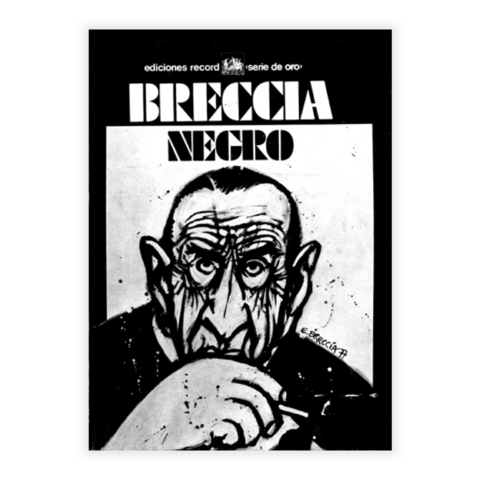
Breccia: Et j’ai trouvé un marché où proposer des choses dont tout le monde se fichait ici. Quand j’ai fait L’Éternaute, on m’a tiré dessus à boulets rouges. Mort Cinder n’a pas eu de succés. Richard Long est passé completèment inaperçu. Je veux dire par là que toutes ces ouevres relativement valables, tout le monde s’en battait l’oeil, en Argentine, alors qu’elles ont eu du succès en Europe. Si je propose Le Couer révélateur ici, personne ne le publie. Il est paru dans Breccia Negro, édité par Scutti, mais c’est moi qui l’ai imposé. À cette époque, Scutti publiait n’importe quoi. Je lui ai dit: «Faisons un livre», et c’etait parti. Le cas de Là où la marée monte et se retire, l’adaptation de la nouvelle de Lord Dunsany, par exemple, montre qu’un tas de choses n’ont pas reçu non plus un bon accueil en Europe, elles sont restées et restent inédites. Mais c’est vrai que ce genre-là m’a intéressé. Après, quand j’ai voyagé en Europe et que j’ai vu ce qui se passait la-bas, tout a changé, j’ai découvert qu’il existait un marché immense, un public qui attendait des oeuvres différentes, et qu’on pouvait faire du neuf. Un endroit où la bande dessinée était très respectée, pas comme ici, où elle demeure encore aujourd’hui un genre marginal.
Sasturain: But consider the influence that a critical eye can have on your work: in the 1960s, you dropped everything until people appeared who read you, followed you, appreciated you. Who gave you a positive response to what you had done. It was only in 1968, with the release of Martínez Peyrou’s book, then Masotta’s, that you were appreciated, that your value was recognized. Your work was recognized in Europe, you found stimulation. The reaction from outside motivated you, encouraged you.

Breccia: And I found a market where I could offer things that nobody cared about here. When I did The Eternaut, I was shot at with red-hot cannonballs. Mort Cinder was not a success. Richard Long went completely unnoticed. I mean by that that all these relatively valid works, nobody cared about them, in Argentina, while they were successful in Europe. If I offer “The Telltale Heart” here, nobody publishes it. It appeared in Breccia Negro, published by Scutti, but I was the one who insisted on it. At that time, Scutti published anything. I told him: “Let’s make a book,” and that was it. The case of “Where the Tide Ebb and Flow,” the adaptation of Lord Dunsany’s story, for example, shows that a lot of things were not well received in Europe either; they remained and remain unpublished. But it’s true that this genre interested me. Then, when I traveled to Europe and saw what was happening there, everything changed, I discovered that there was a huge market, an audience that was waiting for different works, and that we could do something new. A place where comics were very respected, not like here, where they still remain a marginal genre today.
Breccia: Conversations avec Juan Sasturain (2019) 306English translation

Alberto Breccia, a comic artist now hailed as a master and whose work is internationally recognized and translated into myriad languages, got his start like pretty much every other artist: wherever he could. When opportunities in his native Argentina were few, Breccia turned to Europe, which welcomed international talent. His fame in the English-speaking world largely rests on a series of nine adaptations of H. P. Lovecraft’s stories that he first completed and published in the 1970s, but while these have gained fame and been published and republished, they were part of a broader turn in his career toward adapting classic works of horror and fantasy into the medium of comics during the 70s.

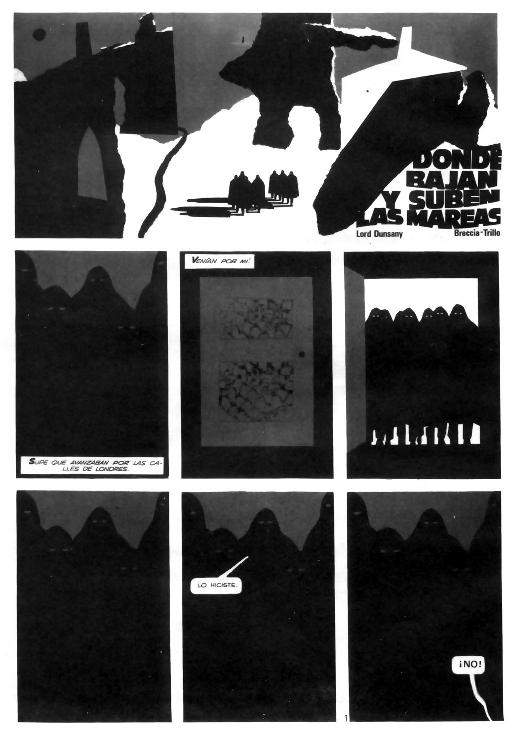
One of the more obscure of these adaptations, especially to English-language audiences, is “Donde suben y bajan las mareas” (1978), adapted from Lord Dunsany’s “Where the Tides Ebb and Flow” from A Dreamer’s Tales (1910). The script was written by Carlos Trillo, and Breccia did the artwork using a collage method; a technique that provides a certain texture to his more experimental 70s works. At a scanty 8 pages, it was probably intended for an Italian market like Il Mago, but as near as I can determine the first—and for a long time only—publication was in the now rare Breccia Negro (1978), a collection of his unpublished and scarce work, which has itself never been reprinted.

Supe que avanzaban por las calles de Londres.
Venían por mí.
Lo hiciste.
¡NO!
I knew they were advancing through the streets of London.
They were coming for me.
You did it.
NO!
Informe sobre ciegos y otras historias 101English translation

The effect is dark, almost minimalist, a chiaroscuro nightmare. As in Dunsany’s tale, it is told primarily from the view of the protagonist, who cannot see the faces of his friends and executioners clearly. Only their eyes, only the numberless mass of them who come to execute justice for the unspoken crime. When in Europe in the 70s, Breccia went to Great Britain to stand on the banks of the Thames.

Sasturain: Un jour, tu m’as raconté que tu étais allé à Londres pour chercher…

Breccia: Pour chercher la boue de la Tamise, celle de Là où la marée monte et se retire. Je suis allé voir ça de nuit. Et j’ai marché dans les ruelles de Soho, tu vois? Les ruelles de Jack l’Éventreur. Tue sais que je ne suis pas vraiment un rigolo. (Rires) J’ai suivi la piste de Lord Dunsany et de Jack l’Éventreur. Mais la ville de Lonres m’a plu tout entiere, tout ce que j’ai vu de l’Angleterre m’a plu.
Sasturain: One day, you told me that you went to London to look for…

Breccia: To look for the mud of the Thames, the one Where the tide ebbs and flows. I went to see it at night. And I walked in the alleys of Soho, you see? The alleys of Jack the Ripper. You know I’m not really a joker. (Laughs) I followed the trail of Lord Dunsany and Jack the Ripper. But I liked the whole city of London, everything I saw of England I liked.
Breccia: Conversations avec Juan Sasturain (2019) 366English translation
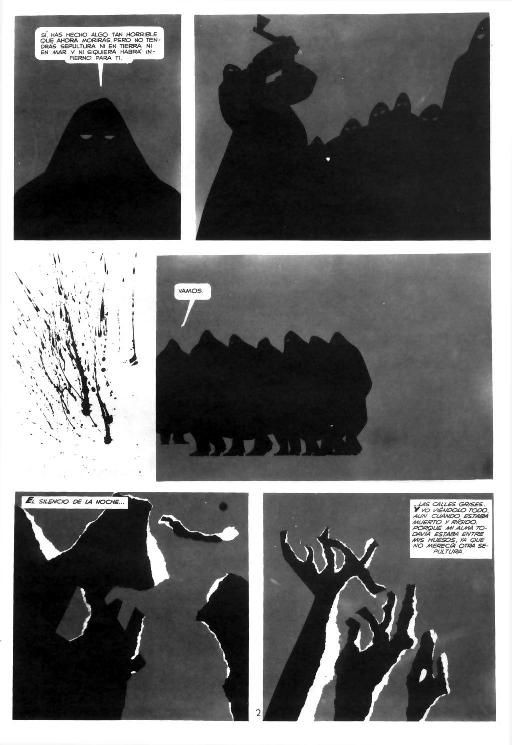
Sí. Has hecho algo tan horrible que ahora morirás. Pero no tendrás sepultura ni en tierra ni en mar y ni siquiera habrá infierno para ti.

Vamos.

El silencio de la noche…

…las calles grises yo viéndolo todo. Aun cuando estaba muerto y rígido. Porque mi alma todavía estaba entre mis huesos, ya que no merecía otra sepultura.
Yes. You have done something so horrible that now you will die. But you will have no burial on land or sea, and there will not even be hell for you.

Let us go.

The silence of the night…

…the gray streets, I saw it all. Even when I was dead and stiff. Because my soul was still among my bones, for it deserved no other grave.
Informe sobre ciegos y otras historias 102English translation

I dreamt that I had done a horrible thing, so that burial was to be denied me either in soil or sea, neither could there be any hell for me.

I waited for some hours, knowing this. Then my friends came for me, and slew me secretly and with ancient rite, and lit great tapers, and carried me away.

It was all in London that the thing was done, and they went furtively at dead of night along grey streets and among mean houses until they came to the river. And the river and the tide of the sea were grappling with one another between the mud-banks, and both of them were black and full of lights. A sudden wonder came in to the eyes of each, as my friends came near to them with their glaring tapers. All these things I saw as they carried me dead and stiffening, for my soul was still among my bones, because there was no hell for it, and because Christian burial was denied me.
—Lord Dunsany, “Where the Tides Ebb and Flow”

Truncated, translated; in dark blacks on greys and stark whites, Breccia sought to capture, not the cityscape of London or the lushness of Dunsany’s prose, but that shadowy limbo in which the murdered man was caught. In describing this style, Laura Caraballo wrote:

En premier lieu, les papiers lisses constituent des aplats et sont souvent utilisés pour créer des figures elliptiques qui se détachent du fond créant aussi une réversibilité entre les deux, comme on peut le voir dans Là où la maree monte et se retire (adaptation de la nouvelle de Lord Dunsany, Where the Tides Ebb and Flow), où le collage est la seule technique apploquée. Dans ces séquences, la qualité tangible des couches de papier est mise en avaunt. Breccia ajoute un élément qui redonne son caractère palpable au papier collé, notamment la trace du papier arraché qui vient à la fois avertir sur la technique et fonctionner comme accent de lumière ciblée au niveau de la composition. Dans cest formes construites par la technique du papier arraché, on peut donc retracer le geste de l’auteur qu exerce un mouvement intempestif au moment de définir ses plans et ses figures en coupant brusequement le papier. Il explore ainsi, avec une quantité minimale d’éléments et trois valeurs achromatiques, la possibilitié de construire des images avec des atmosphères très pesantes et un état d’esprit déscenchanté, tout comme la voix du narrateur dans le text de Lord Dunsany, à l’origine de cette adaptation. Le collage oscille alors entre sa fonction de trace de la technique en elle-même et de contiguïté physique avec le geste, et sa fonction mimétique, par exemple pour représenter l’impact de la lumière sur les objets.In the first instance, smooth papers are used as solids, often to create elliptical figures that stand out from the background, also creating a reversibility between the two, as can be seen in Là où la maree monte et se retire (an adaptation of Lord Dunsany’s short story, “Where the Tides Ebb and Flow”), where collage is the only technique applied. In these sequences, the tangible quality of the layers of paper is brought to the fore. Breccia adds an element that restores its palpable character to the collaged paper, notably the trace of the torn paper which both warns about the technique and functions as an accent of targeted light at the level of the composition. In these forms constructed using the torn paper technique, we can therefore trace the author’s gesture, which exerts an untimely movement at the moment of defining his planes and figures by abruptly cutting the paper. He thus explores, with a minimal quantity of elements and three achromatic values, the possibility of constructing images with very heavy atmospheres and a disenchanted state of mind, just like the voice of the narrator in Lord Dunsany’s text, at the origin of this adaptation. The collage then oscillates between its function as a trace of the technique itself and of physical contiguity with the gesture, and its mimetic function, for example to represent the impact of light on objects.
Alberto Breccia, le Maître Argentin Insoumis 46-47English translation

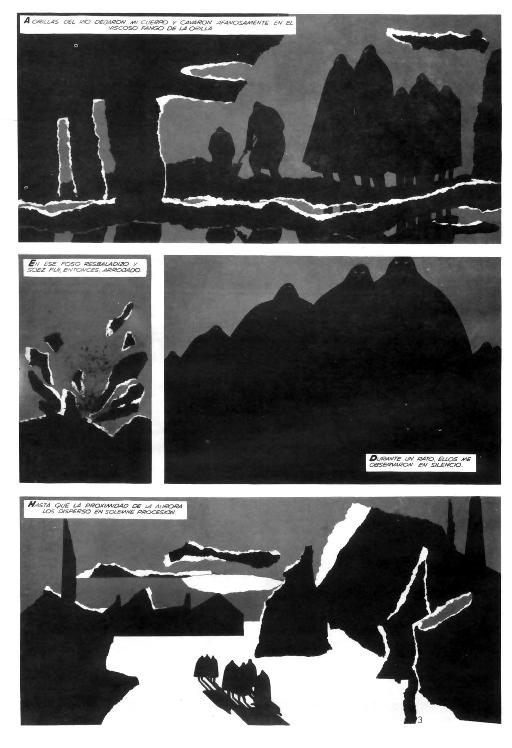
The result is a rather stark, dark tale, in keeping with the mood of Breccia and Trillo’s other adaptations of Edgar Allan Poe and the like; probably the grimmest adaptation of any story by Lord Dunsany to comics to date, though they preserve Dunsany’s ending. While no one would claim this is one of Breccia’s masterworks—the collage technique is effective but lacks some of the energy and brilliance of his pen and mixed media art—it is an effective adaptation, and one that deserves more attention.

A orillas del río dejaron mi cuerpo y cavaron afanosamente en el viscoso fango de la orilla.

En ese foso resbaldizo y soez fui, entonces arrojado.

Durante un rato, ellos me observaron en silencio.

Hasta que la proximidad de la aurora los disperso en solemne procession.
On the banks of the river they left my body and dug busily in the slimy mud of the shore.

Into that slippery and foul ditch, I was then thrown.

For a while, they watched me in silence.

Until the approach of dawn dispersed them in solemn procession.
Informe sobre ciegos y otras historias 103English translation

“Donde suben y bajan las mareas” has been reprinted and translated into several languages, but the only English-language adaptation I could locate is Alberto Breccia Sketchbook (2003, Ancares Editora), a bilingual edition in English and Spanish, but difficult to locate as it was published in Argentina and is now out of print. Most curious readers will have to satisfy themselves with the Spanish-language version reprinted in collections like Informe sobre ciegos y otras historias if they wish to read this tale.

A Note: I am aware that the Breccia interviews conducted with his occasional collaborator Juan Sasturain were originally done in Spanish, but the only edition I have of them is in French. Sometimes we have to work with what we have on hand.


Bobby Derie is the author of Weird Talers: Essays on Robert E. Howard and Others and Sex and the Cthulhu Mythos.

Deep Cuts in a Lovecraftian Vein uses Amazon Associate links. As an Amazon Associate I earn from qualifying purchases.
“ZOMBIO/死霊のしたたり” (1987) by Abe Yutaka (阿部 ゆたか)

Only a fraction of the comics that Japan produces are ever translated for English-language markets. As a consequence, Anglophones miss out on a lot of great—and sometimes terrible—manga, and sometimes get a misleading impression of the diversity and quality of Japanese comic art and writing. There is far more to horror manga, for example, than luminaries like Junji Ito and Gou Tanabe.

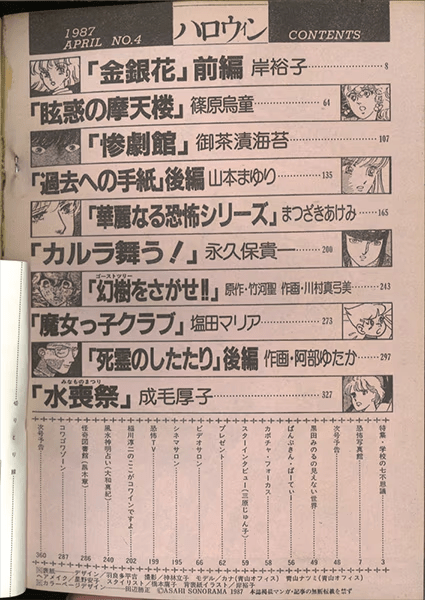
Monthly Halloween (月刊ハロウィン, 1985-1995) was a monthly horror comics anthology publication focused on the shōjo (teenaged girls) market; horror movies being popular among that demographic at the time. It was the first such shōjo horror magazine, but quickly inspired many imitators, and among its publications were the first appearance of Junji Ito’s Tomie. While it wouldn’t be exactly analogous to say Monthly Halloween was like Weird Tales aimed toward Japanese teenage girls, it wouldn’t be entirely inaccurate either. The tales within varied in theme from traditional Japanese ghost stories to ripped-from-the-latest-horror-film-from Hollywood. For great overviews, check out Renzo Adler’s Monthly Halloween: How American Horror was Translated for Shoujo Manga (2021) and kevndr’s Halloween Hijinks: Hollywood Horror in Japanese Comics (2022).

Table of contents for Monthly Halloween April 1987.
Herbert West can be seen, second row from bottom.

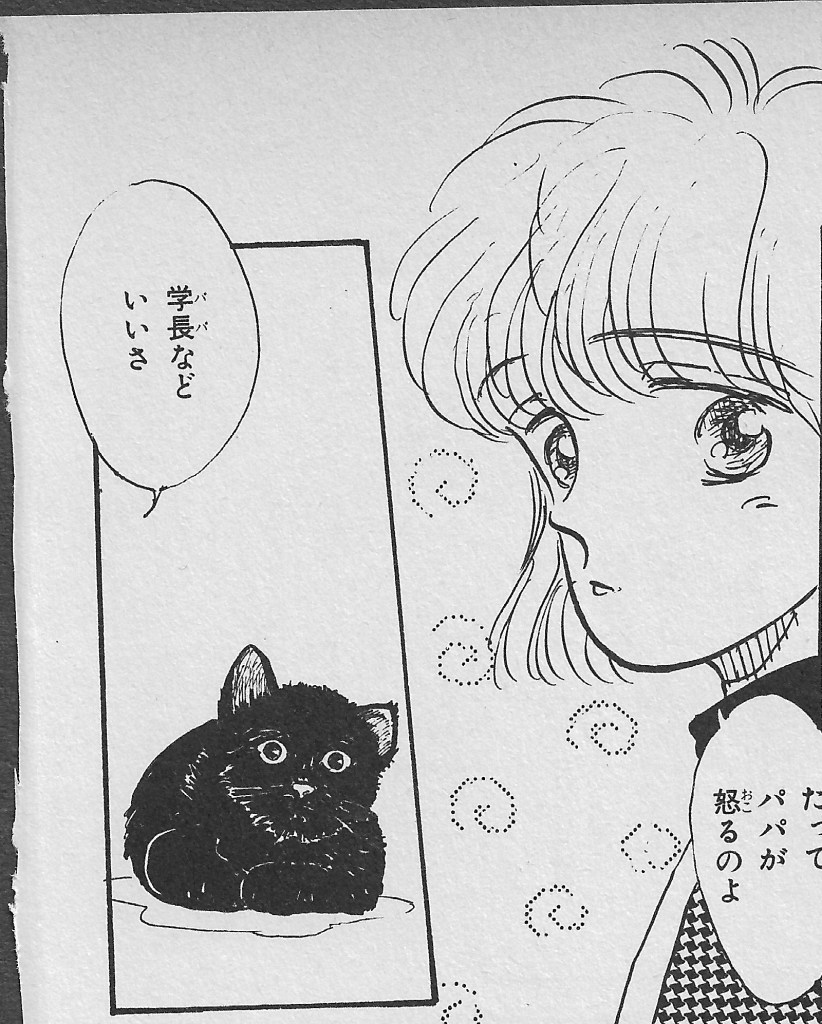
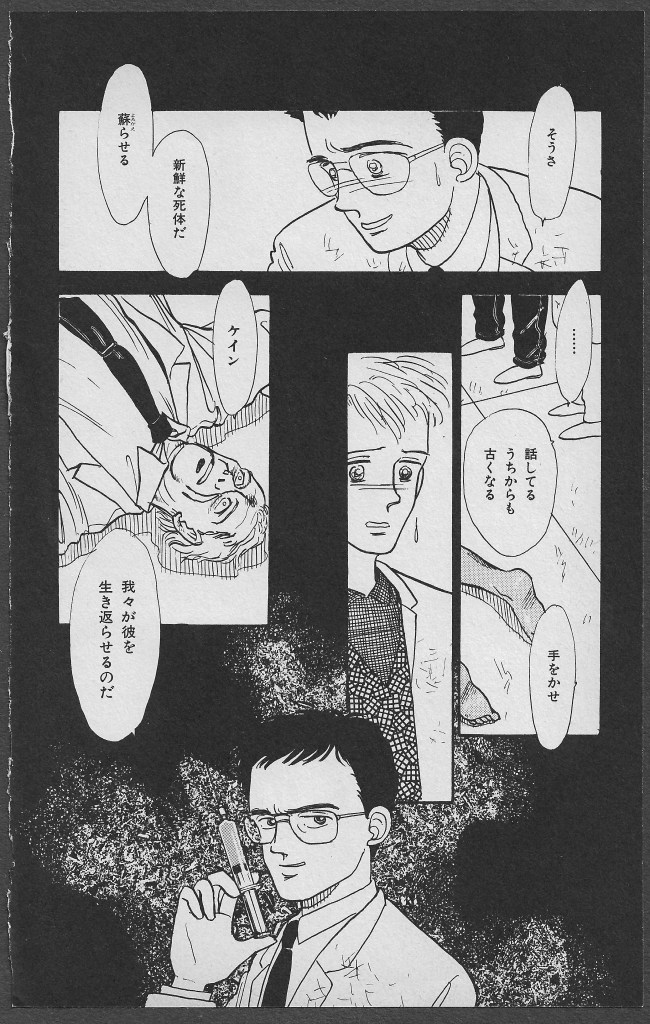
Director Stuart Gordon’s Re-Animator (1985) arrived in Japan on 14 March 1987 under the title “ZOMBIO/死霊のしたたり” (“Zombio/Dripping of the Dead”). Not coincidentally, in the March and April 1987 issues of Monthly Halloween, the story was adapted to manga by Abe Yutaka (阿部 ゆたか), probably better known to US audiences for his work on Detective Conan, who had previously adapted Day of the Dead (1985) for the magazine, which also had its Japanese release around the same time. The 64-page adaptation follows the film fairly closely, with a few artistic concessions given the intended audience, the younger characters (Herbert West, Dan Cain, and Megan Halsey) given more stereotypical teenaged appearances compared to the older characters.

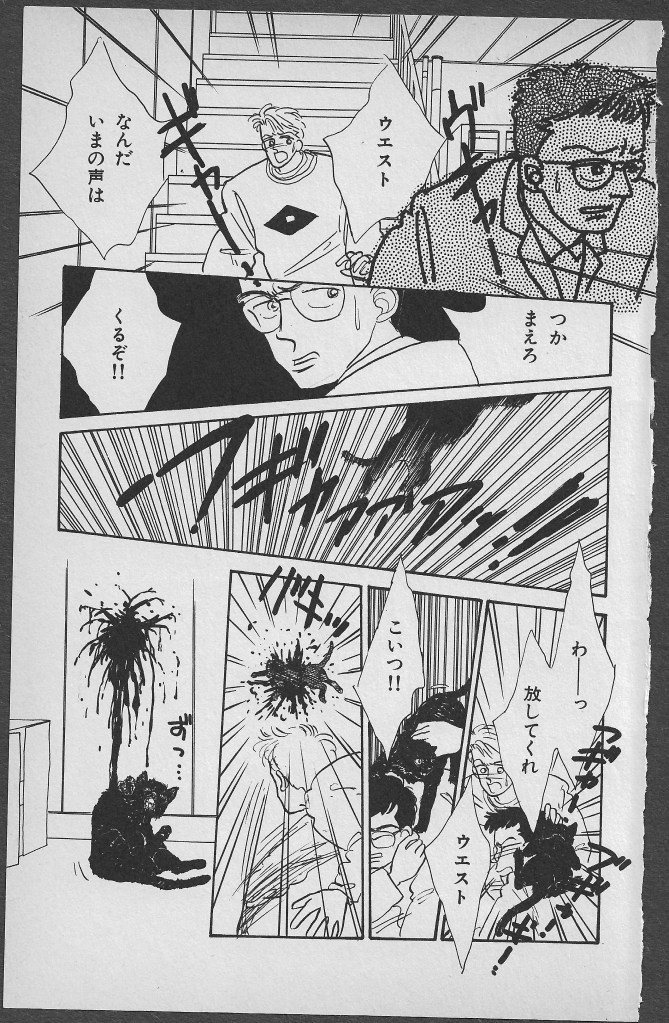
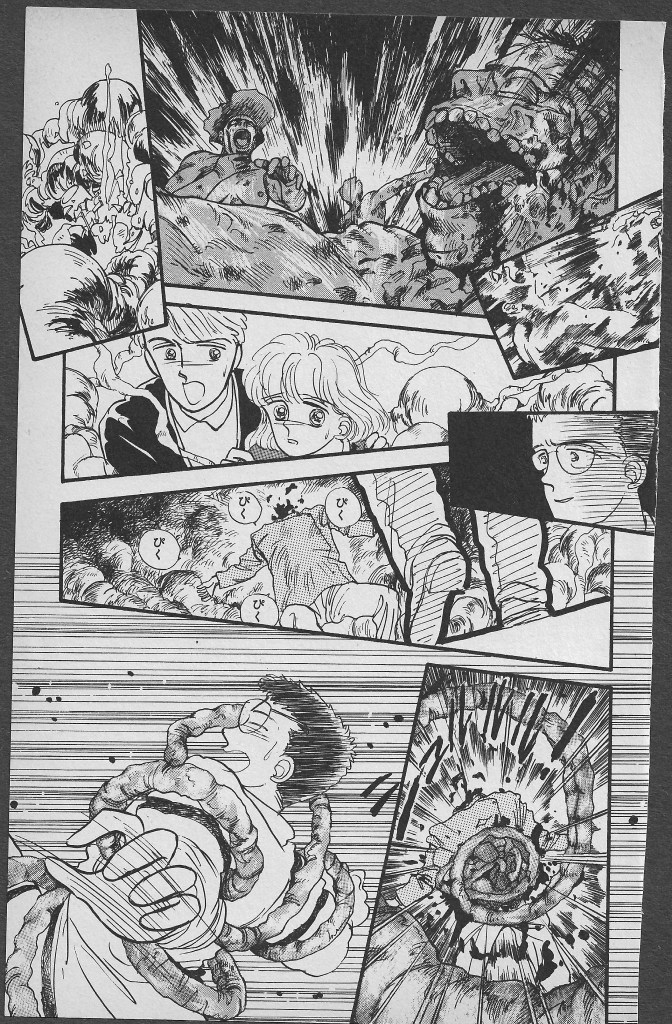
The nuances of the actors’ performances don’t really translate, but the somewhat slapstick action does, aided in no small part by an unflinching ability to depict a bit of gore and some common manga visual rhetoric that helps sell frantic energy and motion.

Top Panel:
Dan Cain: West! What is that sound?

Second Panel:
Herbert West: Grab it! Here it comes!

Third Panel:
<<Scream>>

Bottom row, right to left:
West: Ouch! Let go of me!
Dan: West!
West: Damn thing!
<<Splat>>

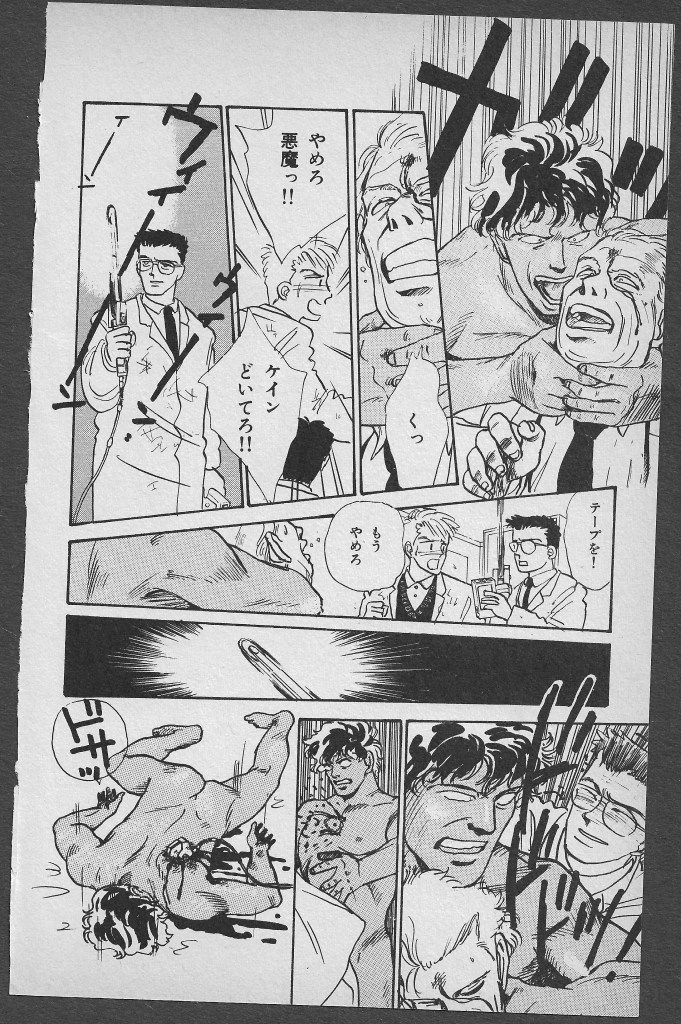
The pacing is also kept up fairly well; while there might be a bit more emphasis on the Re-Animator sub-plot where Dr. Carl Hill is trying to convince Dean Halsey to give him Megan, balancing that romance angle, they don’t skimp on the actual reanimation, even if it lacks some of the visceral oomph of the film.

Top row, right to left:
<<choking sound>>
<<gulp>>
Dan: Get off him!!
West: Move aside, Cain.
<<buzz>>

Second row:
West: Keep the tape running! Take it, man.

Bottom row:
<<cutting noises>>

While the likenesses of the leads aren’t particularly close to the original actors, the faces are expressive and convey a lot of the emotion of the scenes, and Abe made sure to include many of the now-iconic shots from the film.

Top row, right to left:
West: You know… this is a fresh corpse. Let’s revive it.

Middle row, right to left:
West: As we speak, the corpse gets older. So give me a hand.

West: Cain. We will bring him back to life.

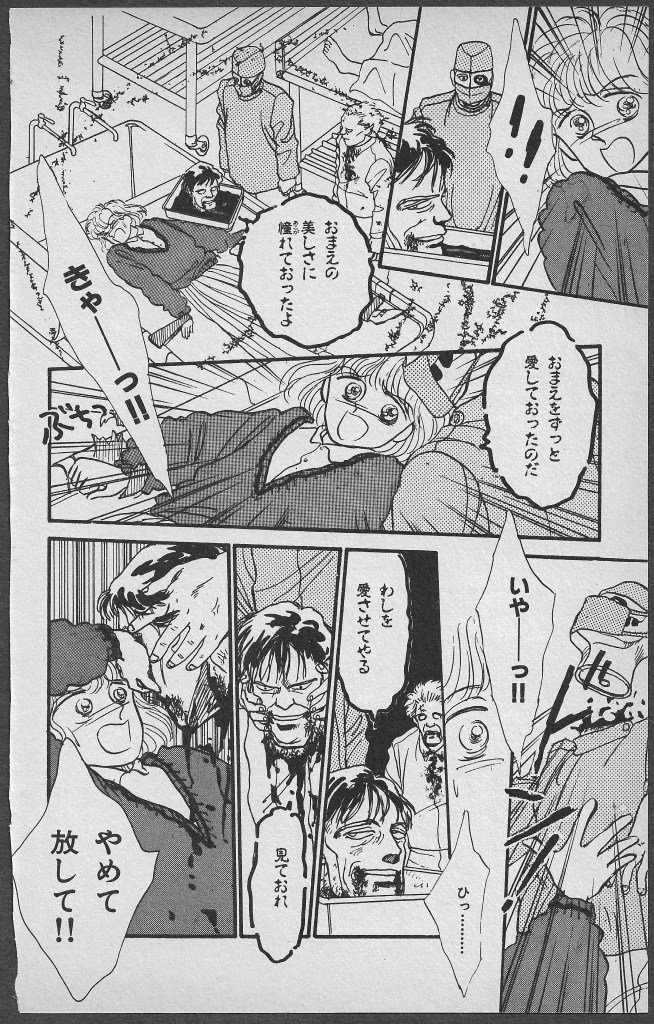
Omissions, there are a few. The infamous visual pun of the “head giving head,” which featured so prominently on some of the Japanese posters for the film (and the Ghana hand-painted equivalents) was rendered inert by keeping Megan Halsey fully clothed.

Top row, right to left:
Megan Halsey: !!
Dr. Carl Hill: I was always attracted to you…
Megan: NOOO!!

Middle row:
Hill: I have been in love with you for a long time!

Bottom row, right to left:
Megan: No!! Please…
Hill: Let me love you.
Hill: Look.
Megan: Stop it! Let me go!!

The emphasis on looking into Hill’s eyes is a reflection of a sub-plot in the film that is sometimes overlooked, that Dr. Hill has developed the power of mesmerism or hypnotism. A bit corny, but it gives him more agency than just as a disembodied head, and is implicitly how he can control his headless body through sheer will. It’s easy to see how the emphasis on the quasi-love triangle between Megan, Hill, and Dan might have appealed in adapting this story to an intended audience of young Japanese women.

The big action scene in the morgue is a bit perfunctory, although Abe covers all the critical moments:

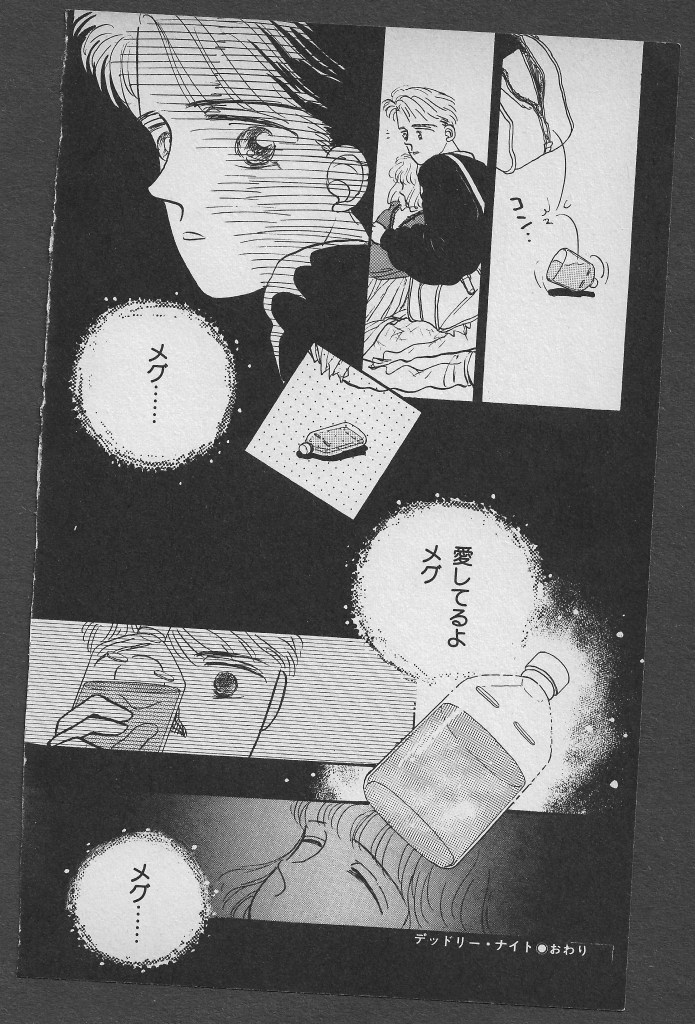
Fortunately, Abe and the editors of Monthly Halloween didn’t try to bowdlerized the ending. As in the original film, Dan Cain is left with a dead girlfriend and a choice:

Top to bottom, left to right:
<<tink>>
Dan: Meg…

Dan: I love you Meg.

Dan: Meg…

Given the limitations of the medium—it would have been nice if they could afford a splash of luminescent green for the reanimation serum—this is a very solid adaptation of the film. There isn’t any indication that Abe Yutaka had access to the 1985 novelization of the film by Jeff Rovin, and it predates the first English-language Re-Animator comic adaption from Adventure, which ran in three issues in 1991, and had the advantage of a larger page size and color.

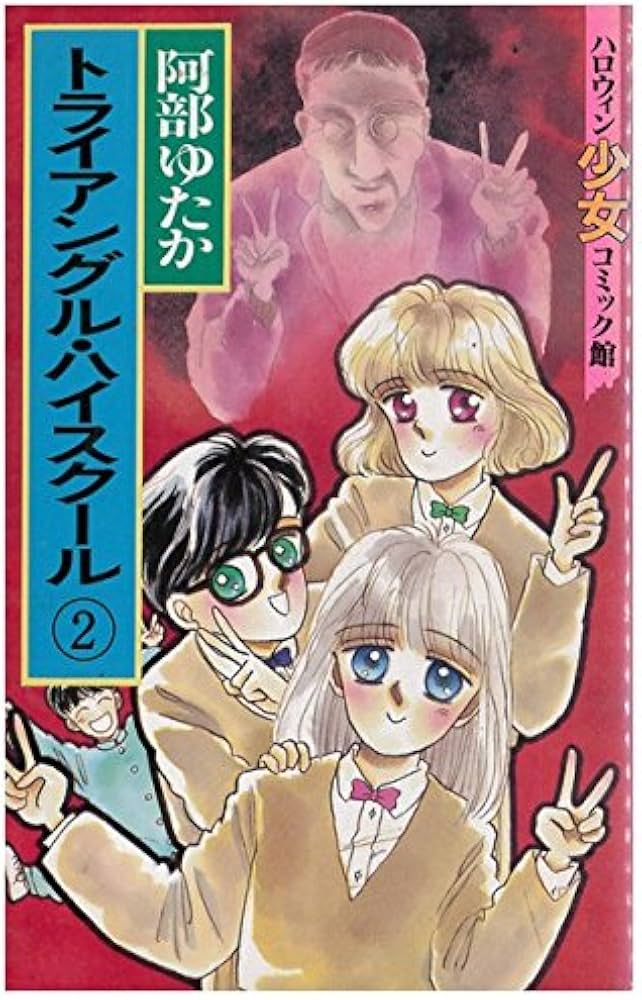
“ZOMBIO/死霊のしたたり” was reprinted in the back of トライアングル・ハイスクール 2 (Triangle High School 2), which collects another of Abe Yutaka’s series from Monthly Halloween; the first volume also collects Abe’s adaptation of Day of the Dead. Other than that, however, the Japanese manga adaptation of Re-Animator doesn’t seem to have been reprinted; it has never been officially translated into English, although raw scans have circulated on the internet for years.

With thanks and assistance to Dr. Dierk Günther of Gakushuin Women’s College for assistance and translation of the Japanese original.


Bobby Derie is the author of Weird Talers: Essays on Robert E. Howard and Others and Sex and the Cthulhu Mythos.

Deep Cuts in a Lovecraftian Vein uses Amazon Associate links. As an Amazon Associate I earn from qualifying purchases.
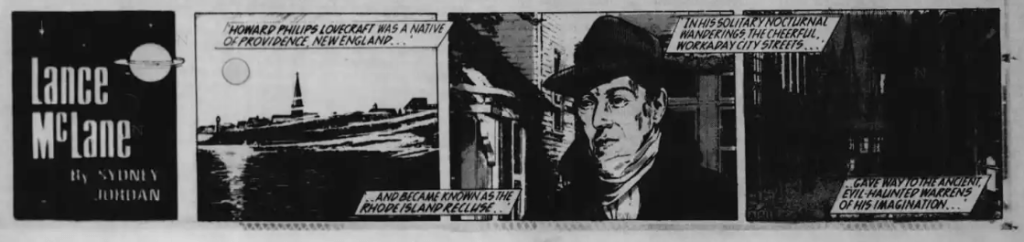
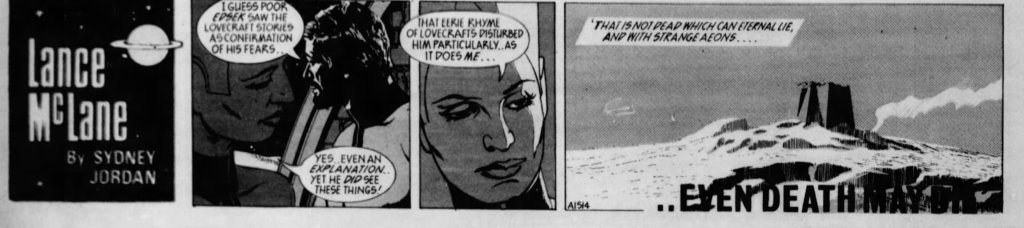
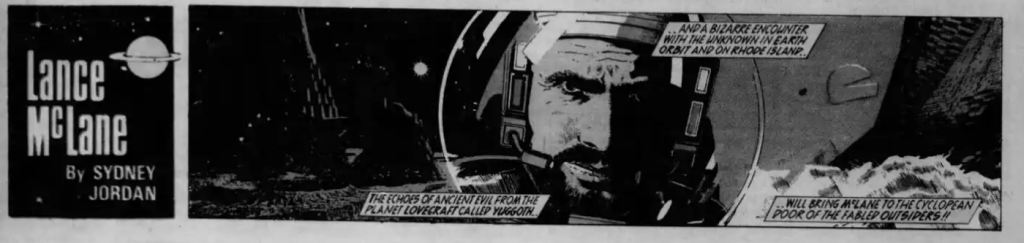
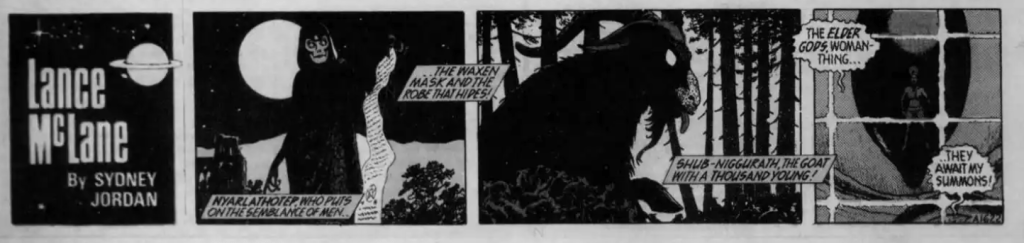
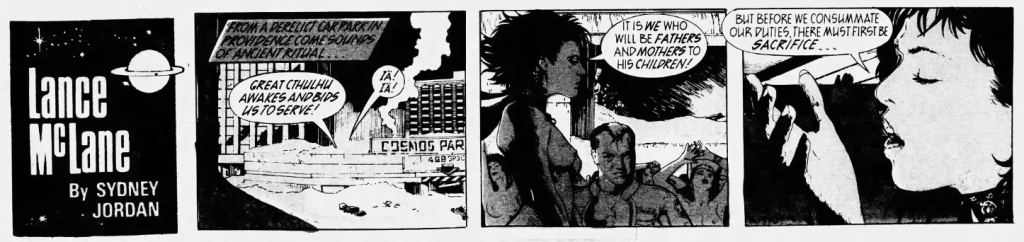
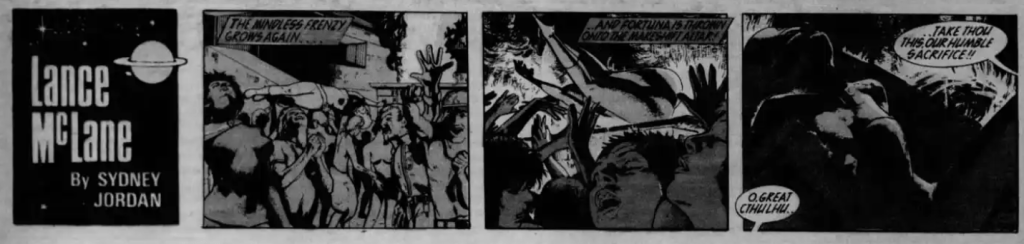
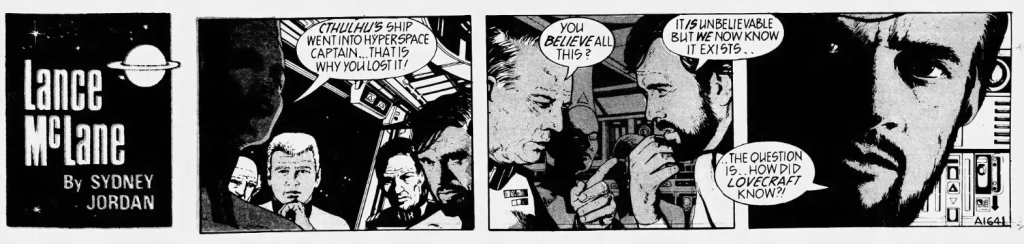
Lance McLane: Even Death May Die (1985-1986) by Sydney Jordan

The space opera comic strip Jeff Hawke by British cartoonist Sydney Jordan (with William Patterson 1956-1969) ran from 15 Feb 1955-18 Apr 1974 in the Daily Express. While cut in the mold of Flash Gordon, Jeff Hawke was aimed at an adult audience (including some mild erotic elements in the form of topless women, which also appeared in British newspaper strips like Axa), and found an appreciative audience not just in the United Kingdom but in translation outside of English, particularly in Italy, Spain, and Sweden. Because the Express owned the rights to the strip, there were no English-language reprints until the 1980s, wheren Titan Books obtained the rights, although various European collections appeared.

In 1976, Sydney Jordan launched a “new” strip, Lance McLane (1976-1988), which ran in the Scottish Daily Record newspaper (several strips 1-238 also ran in the London Evening News under the title Earthspace.) This was, more or less, a soft relaunch of Jeff Hawke under a different title; Jordan even made it clear in a connecting storyline that “Lance McLane” was simply Jeff Hawke, several decades into the future, and some European editions continued the series numbering without interruption (which leads to some confusion, especially as some strips were created specifically for European magazines or fanzines that didn’t run in the daily paper).

In 1985, the “Even Death May Die” storyline began which saw Jeff Hawke and the telepathic female android Fortuna up against the Cthulhu Mythos—a run has only been collected once in English, in Jeff Hawke’s Cosmos vol. 10, no. 3, a subscription-only publication of the Jeff Hawke Fan Club. The storyline is more available inthe Italian collection Jeff Hawke/Lance McLane 2 Storie Inedite (2014), which also offers some valuable background material, if you can read Italian.

Io fui uno dei pochi a non esere totalmente sorpreso dall anuova direzione che aveva preso la storia, a circa metà di Vele nel Rosso Tramonto, perché sapevo che Sydney Jordan aveva acquisito i diritti di un racconto di H. P. Lovecraft da utilizzare per una storia chiamata The Dark Tower che non fu mai pubblicata. Le prime citazioni derivano da Il Richiamo di Cthulhu (1928), ristampato da August Derleth nella raccolta L’Orrore di Dunvich e altre storie, 1963, e in una selezione di storie da essa tratte, Il Colore dallo Spazio e altre storie (Lancer, 1964). Marise Morland suggerì la litania “O Gorgo, Mormo, luna dalle mille facce, guarda con benevolenza ai nostri sacrifici”, e altri dettagli, perché Sydney aveva letto solo poche storie, mentre lei le aveva lette tutte.I was one of the few who wasn’t totally surprised by the new direction the story had taken, about halfway through Sails in the Red Sunset, because I knew that Sydney Jordan had acquired the rights to an H. P. Lovecraft story for use in a story called The Dark Tower that was never published. The earliest citations are from “The Call of Cthulhu” (1928), reprinted by August Derleth in the collection The Dunwich Horror and Other Stories, 1963, and in a selection of stories from it, The Colour from Space, and Other Stories (Lancer, 1964). Marise Morland suggested the litany “O Gorgo, Mormo, thousand-faced moon, look kindly upon our sacrifices,” and other details, because Sydney had only read a few stories, while she had read them all.
“Note a ‘..Anche la morte può morire!’” di Duncan Lunan,
Jeff Hawke/Lance McLane 2 Storie Inedite (2014) 96
“Notes on ‘Even Death May Die!'” by Duncan Lunan
Translated into English

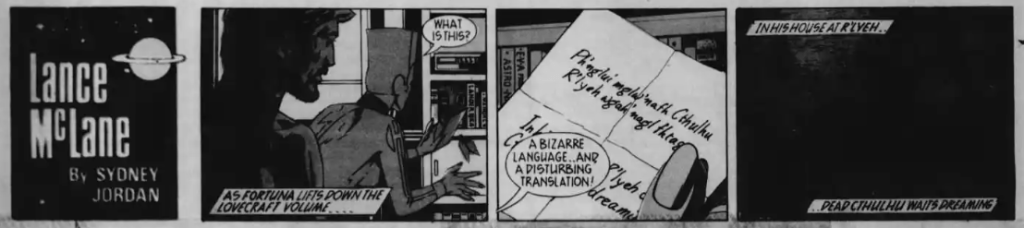
Sails in the Red Sunset was the storyline immediately preceding Even Death May Die, and includes the first references to Lovecraft and Cthulhu on the lips of a madman; it is this clue that leads McLane and Fortuna to Earth to investigate the cult of Cthulhu. It isn’t clear which Lovecraft story Jordan might have attempted to license for the never-published “The Dark Tower” story; presumably this would have been a deal with Arkham House, based solely on the title, I wonder if it didn’t involve The Lurker at the Threshold (1945).

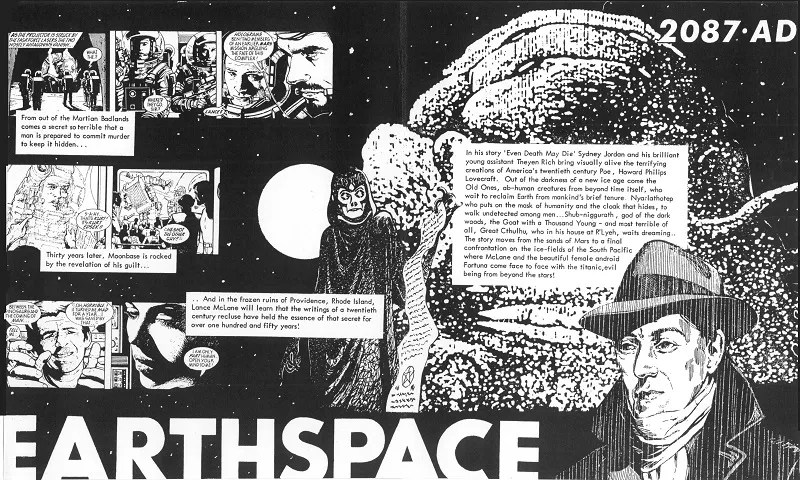
Duncan Lunan also shared the above image in his post Space Notes 24 Jeff Hawke Part 4 – Not As We Know It (29 Oct 2023), a montage that combines panels and images from several strips in the storyline under the Earthspace banner.

Many of Jordan’s storylines ran 12-16 weeks (~72-96 strips), but but according to Tony O’Sullivan’s index “Even Death May Die” ran for 145 daily strips (A1508 – 1653), making this one of the longer storylines, and according to O’Sullivan’s notes the storyline wasn’t even syndicated in Europe (hence “Storie Inedite”—”Unpublished Stories”). Italian Wikipedia gives a different numbering, 149 strips (A1503 – A1652), but with the way “Even Death May Die” dovetails with the previous storyline and idiosyncrasies of international publishing it can be tricky to decide where one story starts and ends, exactly.

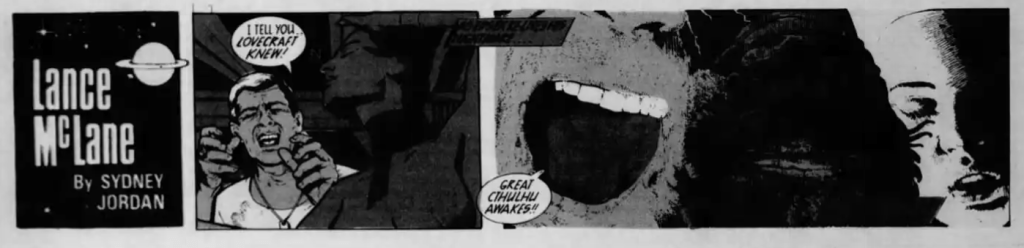
Given that there are ~10,000 strips, that the Cthulhu material came nearly at the end of this long-running project, wasn’t even published in Europe at the time, and that reprints nearly always focus on the beginning of the run, it may be no surprise that collections are scarce and that Jordan’s take on the Mythos has been largely overlooked. I only stumbled across it because the Daily Record archive is available on newspapers.com, while trying to find the first newspaper comic strips to include Lovecraft and Cthulhu.

The story itself follows what is now fairly familiar territory: Lovecraft was writing more than fiction, the Cthulhu Mythos is real, malevolent, and it’s up to Lance McLane and Fortuna to stop their nefarious plans for the human race. The pace of a daily strip can seem plodding compared to a comic book or graphic novel, and the often muddy tones of newsprint often render Jordan’s artwork very dark in the newspaper scans. Which is a pity, because Jordan’s artwork is strongly realistic, grounding the strip in a way that makes the fantasy elements appear as truly intrusive…even if the darker text boxes are sometimes difficult to read.

The 1980s UK sensibilities allowed a degree of eroticism, which is probably one of the reasons Lance McLane never found syndication in the United States newspapers. This is measured titillation (Jordan couldn’t be explicit even if he wanted to), but not inappropriate to the material: the idea of an orgiastic cult comes straight from “The Call of Cthulhu,” after all, and it’s a bold storyteller that manages to get as much on the screen as Jordan does.

However, this has to be read in the context of works like “The Discovery of the Ghooric Zone” (1977) by Richard Lupoff and Strange Eons (1978) by Robert Bloch: this was one of the first attempts to project the Mythos into the space opera future, and it was doing it in a mainstream newspaper, not in the pages of Metal Hurlant/Heavy Metal or other specialist comic magazine.

It is a pity that “Even Death May Day” hasn’t received a more widespread publication; at the moment, your best bet to read it in English is to get a newspaper.com subscription and manually scroll through the Daily Record day by day. For those that read Italian, Jeff Hawke/Lance McLane 2 Storie Inedite (2014) is a choice option to see the strip compiled and restored, looking better than it ever did on newsprint, being on glossy paper and in color:


Bobby Derie is the author of Weird Talers: Essays on Robert E. Howard and Others and Sex and the Cthulhu Mythos.

Deep Cuts in a Lovecraftian Vein uses Amazon Associate links. As an Amazon Associate I earn from qualifying purchases.
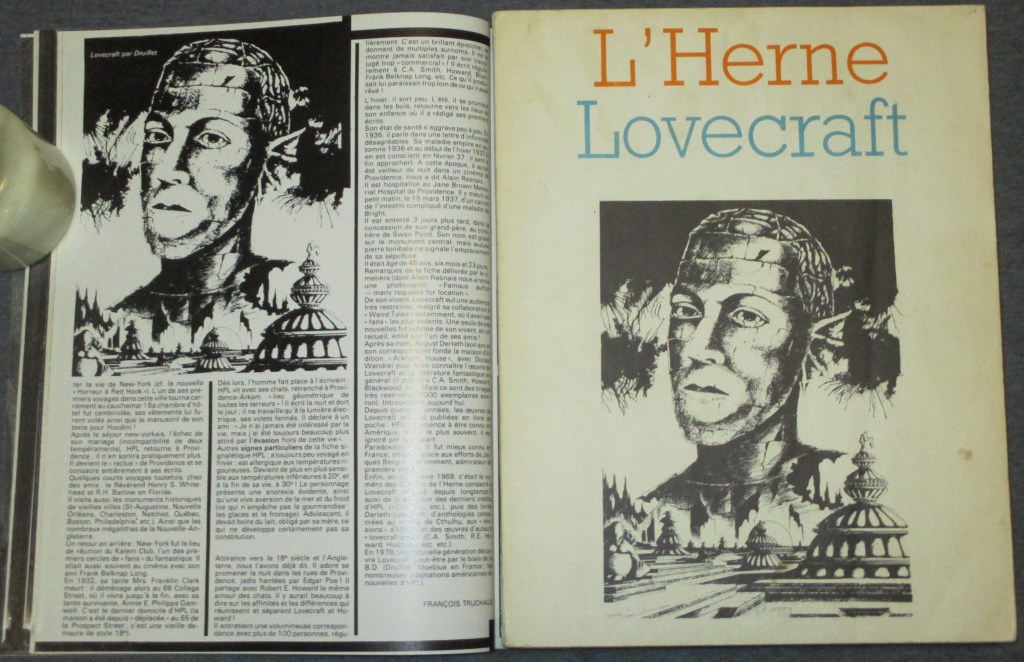
Uterus of the Black Goat Vol 1.(黒山羊の仔袋 1, 2022) by Haruki (春輝)

Eldritch Fappenings
This review concerns a work of adult literature. Some images contain nudity. Reader discretion is advised.


Powers of Darkness

The lifting of the curtain on the massive horrors of Germany’s prison and concentration camps recalls the supernatural tales of H. P. Lovecraft, a writer who was relatively unknown until August Derleth undertook his popularization, says a Chicago Tribune column. To conjure up the mood of unearthly terrors, Lovecraft invented the mythology of Cthulhu in which there are many monstrous spirits of evil, forever seeking to take possession of this planet.

Lovecraft wrote of his work: “All my stories, unconnected as they may be, are based on teh fundamental lore or legend that this race [sic] was inhabited at one time by another race who, in practicing black magic, lost their foothold and were expelled, yet live on outside, ever ready to take possession of this earth again.”

Perhaps Othulhu [sic] has come back through the cracks in Hitler’s mind. Lovecraft, who died in 1937, would be staggered by the revelation.

The Windsor (Ontario) Star, 2 May 1945, p4

In the aftermath of World War 2, the combination of Allied propaganda and the real-world horrors and atrocities committed by the Nazis and central powers created a perfect icon of evil. The Nazis became the epitome of cruelty, madness, violence, lust, and decadence; while Hitler and the Nazis became occasional figures of ridicule in works like Hogan’s Heroes, they also became the perfect embodiment of sin in post-war men’s adventure magazines, comic books, Stalag novels, and the Nazisploitation films like Ilsa, She-Wolf of the S.S. (1974), The Night Porter (1974), and Salon Kitty (1976).

H. P. Lovecraft died before the German invasion of Poland in 1939 that sparked the European beginnings of World War 2, and long before the Final Solution was decided upon and enacted. He did not live to see the Holocaust laid bare, and certainly not the pop-culture cross-pollination as the Nazis, the ultimate figures of taboo, became enmeshed in erotic and sadistic art and literature. Yet perhaps it is not surprising that, over time, Lovecraft’s Mythos and Nazis have mixed and mingled on occasion.

Dagger of Blood (1997) by John Blackburn, for instance, featured a former Nazi scientists in South America, inspired by Mengele and works like The Boys from Brazil (1976). Hellboy fought any number of Nazis in comics and film, some of whom had connections with Lovecraftian critters (a point called out specifically in the crossover Batman/Hellboy/Starman). Brian McNaughton brought the Reanimator to the Nazis with “Herbert West—Reincarnated: Part II, The Horror from the Holy Land” (1999). Insania Tenebris (2020) by Raúlo Cáceres also includes scenes where the Third Reich mixes with the Mythos, and Kthulhu Reich (2019) by Asamatsu Ken (朝松健) is an entire collection of stories that re-imagines the Nazis in a Lovecraftian context, and Charles Stross’ outstanding novel The Atrocity Archives (2004) also riffs on the wedding of these two taboos, the eldritch evils of Lovecraft and the visceral cruelty of Hitler and the Nazis.

Most of these works take as a jumping-off point the Nazi’s real and fictional investigations into the archaeological and the occult, which became widespread in popular culture thanks to films like Raiders of the Lost Ark (1981) and Indiana Jones and the Last Crusade (1989). There is some basis for truth in this, as Kenneth Hite explores in The Nazi Occult (2013), but the pop culture legacy of Nazi mystics dabbling in the Mythos has grown very far from reality. Intersections between sex and the Nazi occult exist, and so do works that combine sex and Lovecraft’s Mythos, but the combination of all three flavors is relatively rare.

Most works that deal with Lovecraftian Nazism eschew the erotic.

Uterus of the Blackgoat Vol 1.(黒山羊の仔袋 1, 2022) by Haruki (春輝) is a standout in that it very specifically does just that. This historical occult action manga’s prologue opens in Nazi Germany, where Hitler’s disciples are trying to unlock a Lovecraftian artifact with sex magick.

Nazi sacrifices disrobe for a ritual to Shub-Niggurath

Haruki (春輝) is an established mangaka whose works include the Ero Ninja Scrolls and Parasite Doctor Suzune series. Like all legal erotic works in Japan, the actual genitalia is obscured, often by carefully placed speech bubbles, figure-work, and blurring out the genitals. However, this work is more than “tits and tentacles”; there is a considerable amount of detail given to period dress, architecture, and background to ground the story, including some very effective splash pages that appear to have been referenced from period photographs.

Post-War Berlin

The bulk of the story takes place during the early days of the Cold War, as both the USSR and United States attempt to seize the Nazi’s research into Shub-Niggurath for themselves. At the center of their separate and competing investigations is a former maid, Mia Olbrich, who worked in the house where the rituals took place. Trying to keep both the Americans and the Soviets from getting the information is a woman named Macleod (who may actually be Mata Hari) with supernatural powers, who is also the secret agent codenamed Black Goat.

What readers get is thus a three-way struggle involving a lot of sex, some body horror, and Cold War spy shenanigans with some interesting plot twists and revelations (and this only in volume 1, there are 3 volumes in the series). While there are many typical tropes of the eromanga genre (all of the main characters are willowy, busty young women; there’s a sex scene in every chapter, etc.), it is sort of refreshing to see a work that strongly leans into the sexual aspect of Shub-Niggurath in as explicit a means as they can given the limits of the medium. While we don’t get a lot of actual Nazis in this volume after the prologue, the emphasis on sex, sexual violence, and the setting is what draws comparisons to exploitation films; there is a similar aesthetic, the idea that this is a serious story that is being played for titillation as well as action and intrigue.

There are some cosmetic parallels with “The Elder Sister-like One, Vol. 1” (2016) by Pochi Iida (飯田ぽち。) and The Mystery of Lustful Illusion -Cthulhu Pregnant- (2015) by Takayuki Hiyori (宇行 日和); the manga creators are each drawing from similar manga artistic traditions and Lovecraftian stories and roleplaying games, which shows variations on similar themes, less in any plot sense as in similarities between the depictions of Shub-Niggurath, playing with tentacles, etc. However, the emphasis on erotic content in each work is different and distinct and reflects the tone of the stories, with Uterus of the Black Goat aimed more toward erotic horror than the other two.

A Dark Young of Shub-Niggurath, as inspired by the Call of Cthulhu roleplaying game

Uterus of the Black Goat has not yet had an official English translation or release, but Japanese editions are available from various outlets, including Amazon.co.jp and Ebay.


Bobby Derie is the author of Weird Talers: Essays on Robert E. Howard and Others and Sex and the Cthulhu Mythos.

Deep Cuts in a Lovecraftian Vein uses Amazon Associate links. As an Amazon Associate I earn from qualifying purchases.
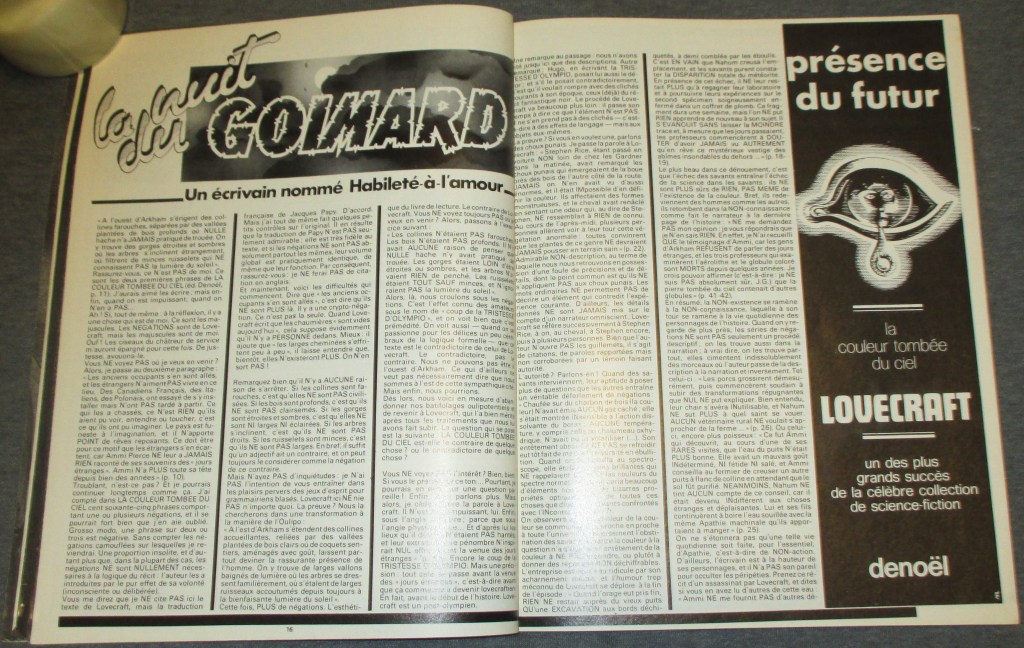
The Invitation (2017) by InCase

Eldritch Fappenings
This review concerns a work of explicit adult art and literature, and will touch on aspects of historical pornographic works, including NSFW images. Reader discretion is advised.


By the way—Cthulhu isn’t a she but a he. He’d feel deeply enraged if anyone regarded him as sissified!
—H. P. Lovecraft to Willis Conover, Jr. 29 Aug 1936 Letters to Robert Bloch & Others 389

In “The Call of Cthulhu,” Lovecraft defaults to referring to Cthulhu as male. Whether human gender binaries can encompass Great Cthulhu is something for later writers in the Mythos to decide. Lovecraft, for his part, only addresses it in his letters in a joking matter, with the typical cultural disdain toward “sissies”—men who display effeminate manners or dress, often misconstrued as homosexuals; Lovecraft had made another comment about the “sissy” Gordon Hatfield.

Throughout human history, in pretty much every culture, there has existed a minority who do not fit into rigid gender or sexual binaries. Whether this was a physical condition such as being intersex, or an individual’s identification with a different gender than assigned at birth, or taking on cultural attributes and attire associated with different genders—there is a broad range of physical, psychological, social, and sexual aspects involved. Each culture and language has their own nomenclature involved. In English in the 20th century, terms like hermaphrodite have fallen out of use in favor of words like intersex; the term transvestite, once identified largely as a sexual fetish or mental disorder, has largely fallen away from use in favor of transgender.

The rich vocabulary includes both contemporary efforts to define identities (e.g. genderqueer, gender fluid), pejorative terms (e.g. tranny, cross-dresser), and a grey middle ground of terminology most often associated with sex work, erotic literature, and pornography (e.g. ladyboy, shemale). Loanwords from other languages also enrich the language, e.g., futanari, from the Japanese ふたなり. The term futanari has come to be a pornographic genre unto itself, both in adult comics and literature, with its own specific tropes, and generally presents a fetishized ideal: an individual that possesses (sometimes exaggerated) sexual traits of both male and female.

Despite the term futanari coming from the Japanese language and popularized by Japanese erotic comics, the basic idea is not unique to Japan. In the 1980s, for example, U.S.-born adult artist Eric Stanton created his “Princks” or “Ladyprinckers” or “Princkazons,” women with Amazonian physiques who also possessed pensis (often of exaggerated proportions) and used their great strength and sexual organs to dominate and emasculate men. So example in Stantoons #49 (“Makeover”), he presents a scenario where the men, unable to resist, are forcibly transformed and feminized. Stanton takes this idea to its cartoonish limit, and plays it for body horror and black humor as much as sexual titillation.

For the most part, however, “Princks” died with Eric Stanton. By the 1990s and 2000s, gender transition surgery and hormone replacement therapy had progressed substantially from the gland stories of early science fiction (see The Hormonal Lovecraft); the legal recognition of homosexuality and rights led to greater awareness of different LGBTQ+ identities outside of fetishized pornographic stereotypes. Besides this, futanari proved to be a more popular fetishized pornographic stereotype.

More importantly, the increasing acceptance of transgender individuals and the process of gender transition opened up literature for more positive stories of gender transition. While feminization as a sexual fantasy, voluntary or involuntary, will always remain, the acceptance and embrace of such a change as a positive metamorphosis instead of body horror gained more traction (see Seabury Quinn’s “Lynne Foster is Dead!” (1938): A Mistaken Gender Identity by Sophie Litherland).

Which doesn’t mean that a clever and skilled creator couldn’t combine the two. Lovecraft in “The Shadow over Innsmouth” presented a narrator who, at first horrified at the changes happening to their body, comes to accept their metamorphosis and the new identity that comes with it. For Lovecraft, the reader is allowed a peak as someone that fear and hated the alien and other becomes the other—and in fact, was one of them all along. The completeness of their change is indicated by how thoroughly they embrace who they are now, and reject who they thought they were.

In 2017, erotic comic artist InCase began producing “The Invitation,” a sexually explicit webcomic. The second chapter was published in 2019. At first glance shares many hallmarks with feminization and futanari adult comics. Part of what sets it apart, however, is the framing and development of the story.

William Loving III, starts out as a very Lovecraftian protagonist, an obsessive delver in the obscure and occult, who had finally found an artefact that promises to put him in touch with a strange, eldritch entity…and he goes a little mad with the revelations.

As their transformation progresses, William’s priorities and attitudes shift, their old mores fall away as they embrace a broader and more inclusive attitude toward gender and sexuality attraction. Above all, the Master who brought these changes to body and mind is imprisoned, and members of their cult, like William, seek to free them. Idol, old one, madness, cult…while InCase is not using Lovecraft’s Mythos directly, there are some clear parallels to aspects of Lovecraft’s work and the broader genre of stories inspired by the Mythos.

Then, whispered Castro, those first men formed the cult around small idols which the Great Ones shewed them; idols brought in dim aeras from dark stars. That cult would never die till the stars came right again, and the secret priests would take great Cthulhu from His tomb to revive His subjects and resume His rule of earth. The time would be easy to know, for then mankind would have become as the Great Old Ones; free and wild and beyond good and evil, with laws and morals thrown aside and all men shouting and killing and revelling in joy. Then the liberated Old Ones would teach them new ways to shout and kill and revel and enjoy themselves, and all the earth would flame with a holocaust of ecstasy and freedom. Meanwhile the cult, by appropriate rites, must keep alive the memory of those ancient ways and shadow forth the prophecy of their return.
—H. P. Lovecraft, “The Call of Cthulhu”

In the second half of the first chapter, InCase shifts the focus away from William pursuing the transformation on their own to interacting with the Master and their other servants. Sexual activity slowly grows more transgressive, with rougher action, bigger penetrations, more and less human (and more tentacular) participants…and the wonder of transformation and the bliss of sex is juxtaposed against the cosmic horror of the Master’s true face, and a glimpse of their true nature.

For a story about transformation and sex, and the gorgeously rendered artwork that conveys both sexuality and teratophilia, corruption and indulgence, these two characters are essentially character-driven. William is obsessed with magic, and having followed that obsession it consumes them utterly. What he left behind was his fiancé Annie, who becomes the protagonist of the second chapter.

In the Victorian milieu of The Invitation, Annie more than William represents a character whose body and identity are repressed by society; she is bound up in expectations of behavior (social and sexual) that she strains again; a woman of science at a period when women are not widely tolerated in science. A woman whose social standing is in peril from a broken engagement. A person who is, like William, innately curious.

There is a strong fantasy element to InCase’s work, both in The Invitation and in their other erotic comics. Without going into clinical detail, many of their characters fall into the spectrum of the sexualized fantasy of intersex characters rather than the reality. There are rarely true hermaphrodites, but there are often characters who appear to be women in every aspect save for having a penis and testes, which is fully functional (often incredibly so). Characters don’t undergo costly top and bottom and facial surgeries, they don’t take regimens of hormones their entire lives to achieve some semblance of the body they desire, that matches their gender identity. In real life, things are messy and imperfect; in comics, they can be idealized.

It is the fantasy that allows the exploration of these ideas. What would a Victorian woman do if she suddenly had a penis? If she was no longer restricted to the sexual role that biology and society had deigned for someone of her sex and gender? If you grew gills in Innsmouth, would you avoid the sea?

The Invitation is not a body-positive story about gender transition. It is an erotic horror story with themes of body horror and cosmic horror. William and Annie are not individuals who seek transition as a means to express and assert their gender identity. They are cultists who reject the world that they feel has rejected them; they are the outsiders who having finally given up on belonging to the world around them, with all the repressive mores, have turned to a being for whom all laws and mores are oppressive. Even natural laws.

It is important to distinguish between the reality of transgender and the fantasy. Not everyone who is trans undergoes surgery or takes hormones; nor are trans folk mere sexual objects for others to fetishize and covet. InCase is drawing specifically on the tropes of trans and intersex characters as they have developed in erotic comics art over the last several decades; Annie and William are not Stanton’s Princks, but they are conceptual cousins. Where the Princks’ purpose is entirely driven by kink, the transition of Annie and William is much more moral.

Stanton’s Princks are domineering and cruel; they degrade and make fun of the men they transform, they revel in their strength and the men are helpless to resist. The suffering of the Princks’ victims is the point; that’s the relationship that Eric Stanton often pursued, regardless of whether it was Princkazons vs. men, or women vs. men, or women vs. women. The Master never taunts her victims, never degrades them, never says a cruel word; the Master’s inhuman hunger is frightening, but what really breaks Annie at the end is the realization that it is entirely voluntary. Like the Cenobites in Clive Barker’s “The Hellbound Heart” (1986), the Master does not seek out new victims—they find her. Drawn in by curiosity, they find a moral universe at odds with what they know.

A universe both horrific and addictive. Twisted, unnatural, and yet utterly freeing. Is it any wonder why some folks have embraced it as a positive example of gender transition, at least in jest?

In the end, it isn’t about whether or not William has a vagina or Annie has a dick. Their final acceptance of each other was to move beyond their conceptions of sex and gender, to discard all labels. This is presented as both horror…and a short of transcendence. As old de Castro said in “The Call of Cthulhu,” they had become like the Master themselves, they had moved beyond the need to define themselves in human terms, and had come at last into a more complete marriage, through and within the Master.

Which is about as Lovecraftian an ending as one could hope for.

InCase’s work can be found on their website and their Patreon account.


Bobby Derie is the author of Weird Talers: Essays on Robert E. Howard and Others and Sex and the Cthulhu Mythos.

Deep Cuts in a Lovecraftian Vein uses Amazon Associate links. As an Amazon Associate I earn from qualifying purchases.
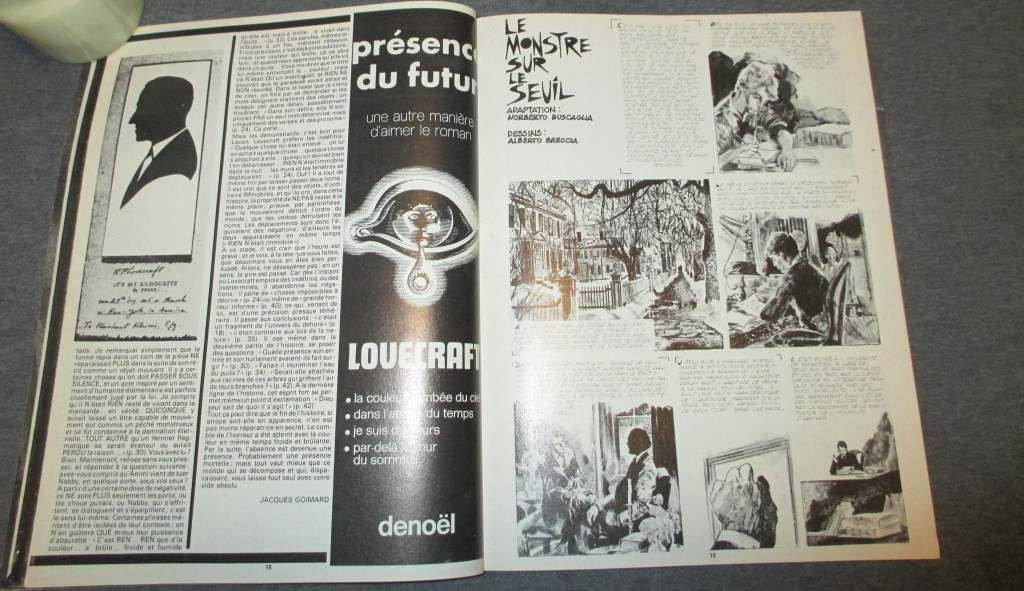
All images copyright their respective owners.

Ghosts and Monsters (1982) by Mark Falstein & Tony Gleeson

Ghosts and monsters have long been favorite topics for many children, so this Getting Into Literature set has a real built-in motivation factor. The art aids understanding, and the text is set in type (rather than hand-lettered in the traditional comic-book style). These features make GHOSTS AND MONSTERS enjoyable and easy to read.
—Teacher’s Guide: Ghosts and Monsters

Imagine yourself in a public middle school in the United States of America, circa the 1980s or early 1990s. A genuine chalk board, rows of desks, an old-style projector. It’s the fall; leaves are falling from the trees, t-shirts are giving way to long sleeves and jackets. The classroom might be decorated with black and orange chains of paper, a cut-out of a witch, a pumpkin with a crooked smile drawn on in sharpie. The teacher passes out a stack of worksheets—but what is this? Comics? Horror comics?

Ghosts and Monsters was published by Educational Insights in 1982. The kind of boxed set of teaching materials that found there way easily into hundreds or thousands of classrooms across the country. The contents were pretty basic: a book of spirit masters for duplicating worksheets (crosswords, etc.) in an age before photocopying became ubiquitous; a brief teacher’s guide with suggested questions and activities; and a package of comic booklets which adapted a dozen tales of horror and weird fiction to comics:

  1. “Feathertop” (1852) by Nathaniel Hawthorne
  2. “The Flowering of the Strange Orchid” (1894) by H. G. Wells
  3. “The Bottle Imp” (1891) by Robert Louis Stevenson
  4. “Man-Size in Marble” (1887) by Edith Nesbit
  5. “The Legend of Gwendolyn Ranna” (1982?) by Frank Maltesi
  6. “The Ghost-Eater” (1924) by C. M. Eddy
  7. “The King is Dead, Long Live the King” (1928) by Mary Coleridge
  8. “The Secret of the Growing Gold” (1892) by Bram Stoker
  9. “The Gorgon’s Head” (1899) by Gertrude Bacon
  10. “The Outsider” (1926) by H. P. Lovecraft
  11. “The Stranger” (1909) by Ambrose Bierce
  12. “The Crewe Ghost” after Oscar Wilde [based on “The Canterville Ghost” (1887)]

It’s an odd mix. Many of these works were in the public domain, while the others were largely drawn from the pulps or (more likely) horror anthologies. “The Legend of Gwendolyn Ranna” by Frank Maltesi is a bit of an enigma, though the name is associated with several other brief legendary tales that have popped up in other educational materials; this may well be its first (and only) publication.

Most of the interest is on the comics themselves. The Teacher’s Guide credits Mark Falstein (well-known author of fiction for young adults) for selection and adaptation, and freelance artist Tony Gleeson for the illustrations. Each comic booklet is basically one large folded page, which gives four pages to tell and illustrate a complete story—a not-inconsiderable task!

The results tend to less grue and taboo than young horror fans might hope for. These were the last generation of “monster kids” that might pick up Famous Monsters of Filmland (1958-1983) on the stand, but they might still find a Helen Hoke-edited horror anthology in the school library, or pick up something from Scholastic involving vampires, werewolves, or bug-eyed aliens at the school book fair. Yet I have to wonder how many kids sat down one day and read Lovecraft for the first time as part of a school assignment—

And then fill out the worksheet afterwards!

Actually, there were two bits of Lovecraft tucked away in this package. C. M. Eddy, Jr.’s “The Ghost-Eater” (Weird Tales Apr 1924) was one of the stories that Lovecraft had somewhat revised for Eddy, and sold to Weird Tales editor Edwin Baird. As Lovecraft put it:

I have, I may remark, been able to secure Mr. Baird’s acceptance of two tales by my adopted son Eddy, which he had before rejected. Upon my correcting them, he profest himself willing to pint them in early issues; they being intitul’d respectively “Ashes”, and “The Ghost-Eater”.
—H. P. Lovecraft to James F. Morton, 28 Oct 1923, Letters to James F. Morton 57

How much of it Lovecraft actually wrote is a matter for debate; S. T. Joshi in Revisions and Collaborations notes the plot and some of the dialogue seems very typical of Eddy, while much of the prose reads like Lovecraft. In any event, it’s a genuine rarity. While many of Lovecraft’s tales have been adapted to comics, his revisions and collaborations are much less likely to receive the same treatment. This is certainly the first, and possibly the only adaptation of “The Ghost-Eater” to comics.

Given the limitations of space, the monochromatic printing, and the incredibly tight scripts, credit has to be given to Tony Gleeson for doing a very decent job on the art. Stuck with a very boxy framing setup, he nevertheless manages to use perspective shots and shadowed silhouettes to hint and convey something of a horror-mood. While the Teacher’s Guide suggests that the typeset text will make it easier to read, I suspect the real issue was that the budget for this project didn’t extend to hiring a letterer.

When we consider Lovecraft as something more than a cult figure, but as a writer who has entered the canon of world literature—this is a good example of what that looks like. Not necessarily fancy, expensive editions that can only be seen and enjoyed by a few, but stories that penetrate into common educational materials, hitting the masses when they’re young and becoming part of the foundation of reading. Ghosts and Monsters is a core sample of how Lovecraft came to the masses.

It’s a bit of history easily overlooked and easily lost. These were sold for classroom use, not to the public, and not preserved in libraries. How many classes went through Ghosts and Monsters before the comics were too worn for further use, or lost and displaced? Who preserves old worksheets from childhood days? These are deliberately ephemeral products, designed to last a few seasons and then be replaced as educational guidelines shift or a company needs to sell a new product. Edutainment marches on.

(Here are the answer keys to the worksheets if you need them.)


Bobby Derie is the author of Weird Talers: Essays on Robert E. Howard and Others and Sex and the Cthulhu Mythos.

Deep Cuts in a Lovecraftian Vein uses Amazon Associate links. As an Amazon Associate I earn from qualifying purchases.
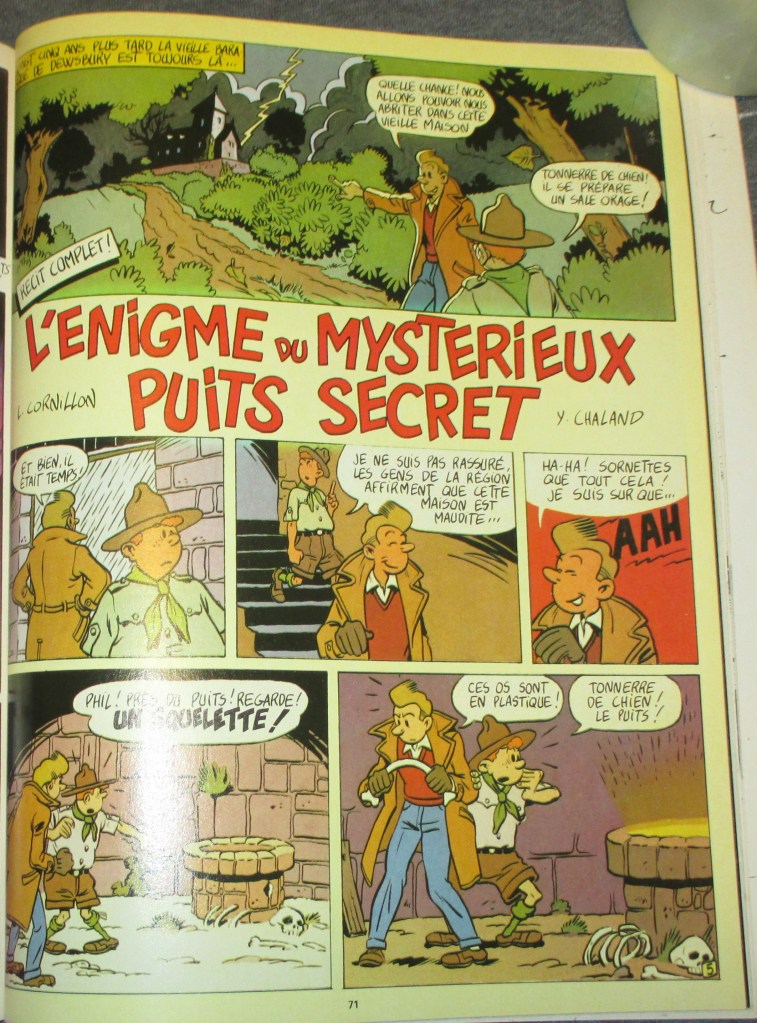
“La Lámpara de Alhazred” (2023) by Manuel Mota & Julio Nieto

Habían pasado siete años desoe la desparaición de su abuelo Whipple cuando Ward Phillips recibió la lámpara.Seven years had passed since the disappearance of his grandfather Whipple when Ward Phillips received the lamp.It was seven years after his Grandfather Whipple’s disappearance that Ward Phillips received the lamp.
“La Lámpara de Alhazred” (2023) by Manuel Mota & Julio Nieto,
Cthulhu #28.5
English translationAugust Derleth, “The Lamp of Alhazred” (1957), The Watchers out of Time 114

Many of August Derleth’s “posthumous collaborations” with H. P. Lovecraft have been derided as pastiches. Yet “The Lamp of Alhazred” is more homage—and more accurately a collaboration than most of Derleth’s stories, since it incorporates a large chunk of text from Lovecraft’s letter to Derleth dated 18 Nov 1936, where Lovecraft described coming across a previously unknown wood west of Neutaconkanut Hill.

On Oct. 28 I penetrated a terrain which took me half a mile from any spot I had ever trod before in the course of a long life. I followed a road which branches north 7 West from the Plainfield Pike, ascending a low rise which skirts Neutaconkanut’s Western foot & which commands an utterly idyllic Vista of rolling Meadows, ancient stone walls, hoary groves, 7 distant cottage roofs to the west & south. Only 2 or 3 miles from the city’s heart—& yet in the primal rural New-England of the first colonists!He penetrated a terrain which took him almost a mile from any spot he had ever before trod in the course of his life, following a road, which branched north and west from the Plainsfield Pike and ascending a lot rise which skirted Nentaconhaunt’s Western foot, and which commanded an utterly idyllic Vista of rolling Meadows, ancient stone walls, hoary groves, and distant cottage roofs to the west and south. he was less than three miles from the heart of the city, and yet basked in the primal rural New England of the first colonists.
H. P. Lovecraft to August Derleth, 18 Nov 1936, Essential Solitude 2.756August Derleth, “The Lamp of Alhazred” (1957), The Watchers out of Time 119

Derleth also took inspiration from an entry in Lovecraft’s commonplace book:

From Arabia Ency. Britt. II.–255. Prehistoric fabulous tribes of Ad in the south, Thamood in the north, and Tasm & Jadis in the centre of the peninsula. “Very gorgeous are the descriptions given of Irem, the City of the Pillars (as the Koran styles it) supposed to have been erected by Shedad, the latest despot of Ad, in the regions of Hudramant, and which yet, after the annihilating of its tenants, remains entire, so Arabs say, invisible to ordinary eyes, but occasionally, and at rare intervals, revealed to some heaven-favored traveler.” Rock excavations in N. W. Hejaz ascribed to Thamood tribe.It had once been the property of a certain half-mad Arab, known as Abdul Alhazred, and was a product of the fabulous trident of ad—one of the four mysterious, little-known tribes of Arabia, which where ad—of the south, Thamood—of the north, Tasm and Jadis—of the center of the peninsula. it had been found long ago in the hidden city called Irem, the city of Pillars, which had been erected by Shedad, last of the despots of Ad, and was known by some as the Nameless City, and said to be in the area of Hadramant, and, by others, to be buried under the ageless, ever-shifting sands of the Arabian deserts, invisible to the ordinary eye, but sometimes encounter by chance by the favorites of the Prophet.
The Notes and Commonplace Book of H. P. Lovecraft 21-22August Derleth, “The Lamp of Alhazred” (1957), The Watchers out of Time 115-116

While nearly every Lovecraft story has been adapted to comics at some point, rather fewer of Derleth’s stories have attracted the same treatment. Yet it makes sense that Manuel Mota (script) and Julio Nieto (artwork) would adapt “The Lamp of Alhazred” for Cthulhu #28, the Lovecraft special issue. Because there are homages which capture as much of the pathos of H. P. Lovecraft as well as this one.

Manuel Mota’s script is a fairly straight translation of Derleth text, albeit truncated for space and with the illustrations serving in place of much of the description, which inadvertently cuts out most of Lovecraft’s text. Yet the presentation and framing of the words and Julio Nieto’s art does much to lend a sense of action to what is a largely contemplative story that draws on both Lovecraft’s life and the sentiment of “The Silver Key.” Readers feel Ward Phillips loss and loneliness, his refuge in his imagination, and the visions of other worlds, other times.

It is escapist in the most literal sense of the word, and one of several stories that reflect that quiet, profound desire to abandon the daily grind of life, with its quiet indignities, defeats, and injuries.

Nieto’s artwork is carefully realistic, the page layout traditionally grid-like; it is a straight-forward presentation that puts the more fantastic sequences, the break-outs where the panel cannot contain a wondrous scene, in context. The weirdness isn’t a part of Ward Phillips world; it is the way out.

Jamás se encontro el cuerpo de Ward Phillips.

La policía aún espera queue sus restos aparezcan en Alguno de los lugares queue solía frecuentar en sus solitarios paseos.

Con el paso de Los años, la vieja casa fue derribada, la biblioteca adquirida por librerías anticuarias y lo queue quedó gue vendido como chatarra incluida una vieja lámpara Árabe a la que nadie encontró utilidad alguna.
The body of Ward Phillips was never found.

Police are still hoping that his remains will turn up in one of the places he used to frequent on his solitary walks.

Over the years, the old house was demolished, the library was acquired by antiquarian bookstores and what remained was sold as scrap, including an old Arabic lamp that no one found any use for.
Though desultory searching parties were organized and sent out to scour the vicinity of Nentaconhaunt and the shores of the Seekonk, there was no trace of Ward Phillips. The police were confident that his remains would some day be found, but nothing was discovered, and in time the unsolved mystery was lost in the police and newspaper files.

The years passed. The old house on Angell Street was torn down, the library was bought up by book shops, and the contents of the house were sold for junk—including an old-fashioned antique Arabian lamp, for which no one in the technological world past Phillips’ time could devise any use.
“La Lámpara de Alhazred” (2023) by Manuel Mota & Julio Nieto,
Cthulhu #28.14
English translationAugust Derleth, “The Lamp of Alhazred” (1957), The Watchers out of Time 123-124

It is a story that almost demands a familiarity with Lovecraft to truly appreciate; those who have read his letters, who knows what Lovecraft struggled with during his life, can recognize more of the man in Derleth’s framing of the Nentaconhaunt narrative. Mota and Nieto do well to capture and depict as much of this atmosphere as they can, and the sensibility of the story is necessarily both sad and romantic in the older sense—this is not a Mythos story, despite the name “Alhazred.” it is a fantasy, a myth, so much more elegant than the reality that saw Lovecraft end his days in pain in a hospital as the cancer consumed him.

“La Lámpara de Alhazred” (2023) by Manuel Mota & Julio Nieto is an excellent overall adaptation of Derleth’s homage to Lovecraft, one that captures the spirit of the original—the echo of Lovecraft, as it were—for a new medium and a new audience.


Bobby Derie is the author of Weird Talers: Essays on Robert E. Howard and Others and Sex and the Cthulhu Mythos.

Deep Cuts in a Lovecraftian Vein uses Amazon Associate links. As an Amazon Associate I earn from qualifying purchases.
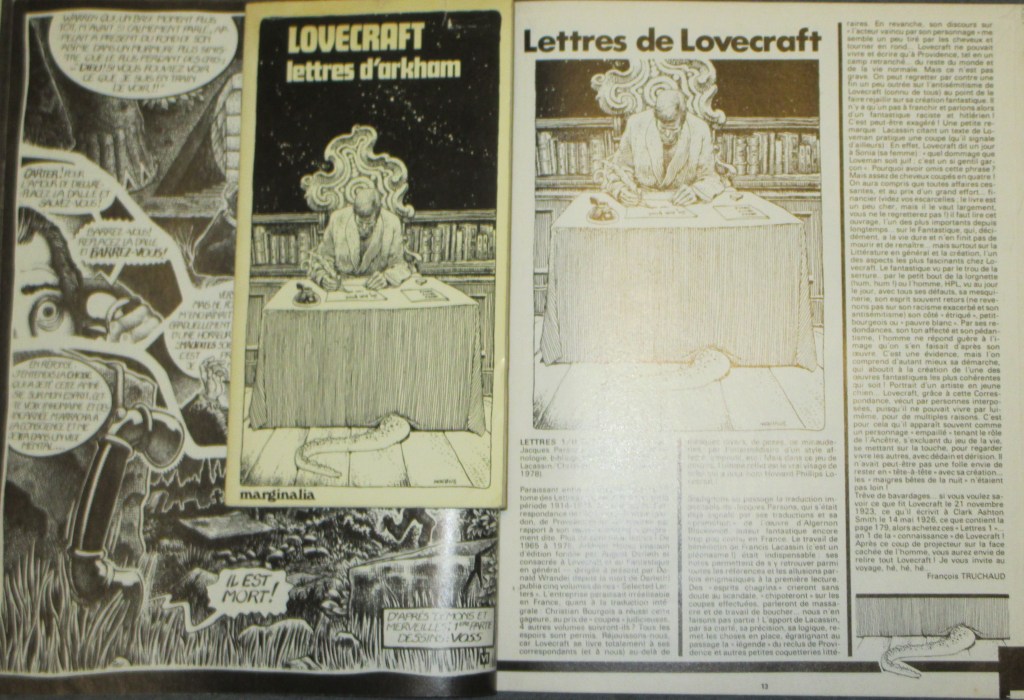
“The Obi Makes Jumbee” (1945)

Comic books arose during the peak of the pulp magazine era, and commonly shared writers, artists, and sometimes publishers. Given the crossover in creative talents, it is no surprise that several ideas and sometimes entire stories were lifted from the pages of Weird Tales and other pulps to appear in the pre-Code horror comics. Many of these stories were produced basically anonymously, with little or no credit given to the writers or artists involved, which makes it more difficult to determine who did what, or whether a particular idea was borrowed, stolen, or just carried over by a creator from one project to another.

This is the case for “The Obi Makes Jumbee,” an 8-page story that first appeared in Spook Comics, a one-shot horror comic from Baily. Though not dated, the issue is thought to be published in 1945 or 1946 (in one panel, a character reads a newspaper with the date December 1945). No writer is credited. The Grand Comics Database says the art is credited to Robert Baldwin (I can’t find a signature on any of the pages, so I’m not sure where that came from), but also claims the art was actually done by Munson Paddock. Based solely on the art style, I lean toward Paddock. Since Paddock is only known to have worked with Baily in 1945, that would support that date.

The one thing we can say about the script is that it probably came from a Weird Tales fan.

Spook Comics, p27

The U.S. invasion and occupation of Cuba (1906-1909, 1917), Haiti (1915-1934) and the Dominican Republic (1916-1924), and the purchase of the Danish Virgin Islands in 1917, brought more and more of the Caribbean into their sphere of influence. So too, more U.S. citizens gained contact with the island cultures, which differed radically from the hard racial limits of Jim Crow. More tantalizing to many would-be anthropologists or tourists were the syncretic African diaspora religions on these tropic isles—remnants of African indigenous religions, often hybridized and combined with elements of Roman Catholicism.

In the 1930s, zombies and Haitian Vodou were popularized in the United States through William Seabrook’s The Magic Island (1929), and works that were inspired by it like the film White Zombie (1931). Seabrook wasn’t the first to write about Vodou or Vodoun; novels like The Goat Without Horns (1925) by Beale Davis, but it was Seabrook who captured the imagination of a generation of writers, whose zombie stories trickled into first pulps and then comic books. H. P. Lovecraft read Seabrook, as did Seabury Quinn, August Derleth, and many others. While far from the only source of data on African diaspora religions—Zora Neale Hurston would write Tell My Horse (1938) and other works, to name one—Seabrook was the most sensational and popular, and his version of Haitian Vodou made a lasting impression on “voodoo” as it appeared in pulps, comics, and film.

“Jumbee” however, is something a bit different. As a category of supernatural being, jumbee is most often associated with the folklore and African diaspora religion (“Obi”) of the Virgin Islands, and Jumbee tales were told by a substantially smaller group of authors—especially Henry St. Clair Whitehead, H. P. Lovecraft’s friend, correspondent, and fellow Weird Tales writer. Although Whitehead died in 1932, in 1944 Arkham House published his first collection of supernatural fiction: Jumbee and Other Uncanny Tales. A follow-up collection, West India Lights (1946) includes Whitehead’s non-fiction article “Obi in the Caribbean.” Given how scarce Jumbee stories are in comics (“The Obi Makes Jumbee” is the only comic story with that word in the title on the Grand Comics Database), it seems likely the author of that comic script had to have read Whitehead.
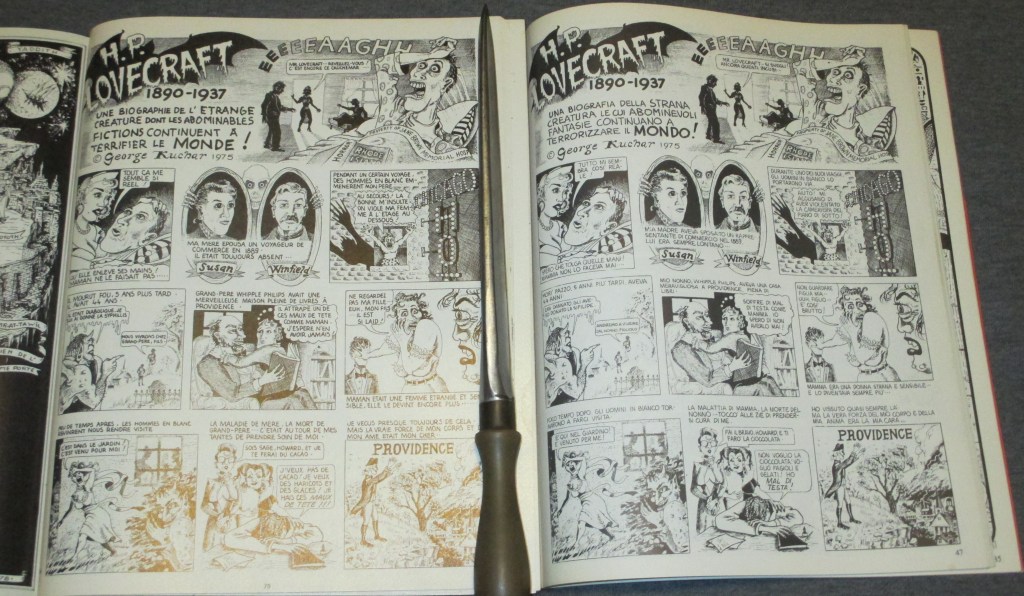
They knew enough to differentiate Jumbee from zombies, Obi from Vodou. Yet they make what seems to be an odd mistake or artistic license. “The goat without horns” is a term used for human sacrifice in some works that discuss Haitian vodou. Seabrook didn’t originate the term, though he helped popularize it, and in his book he quotes from the March 1917 Museum Journal of the University of Pennsylvania, Philadelphia:

In Hayti the basis of Voodooism is the frank worship of a sacred green snake that must be propitiated to keep off the evil spirits. The meetings of the cult are held at night about bonfires in secret places in the forests. The presiding official is an old man “papaloi,” or woman “mamaloi” who has gained renown as a Voodoo sorcerer. After assembling, all present take an oath of secrecy and then the priest exhorts them to remember the sacred green snake, and to hate the whites. Prayer is offered to the divine serpent that is supposed to be present in a box placed near the fire. Then follows the sacrifice of a cock which the “papaloi” kills by biting off its head. With a great deal of drumming and incantation the blood is smeared over the faces of the worshipers and drunk by the officiating priest. A goat may be sacrificed with similar ceremony. After the goat there might be a human sacrifice, as was reported by a French priest. He said that it was the wish of some of the devotees that “a goat without horns,” that is a child, be sacrificed. This was done and the flesh, raw or partly cooked, was eaten by the members of the cult.
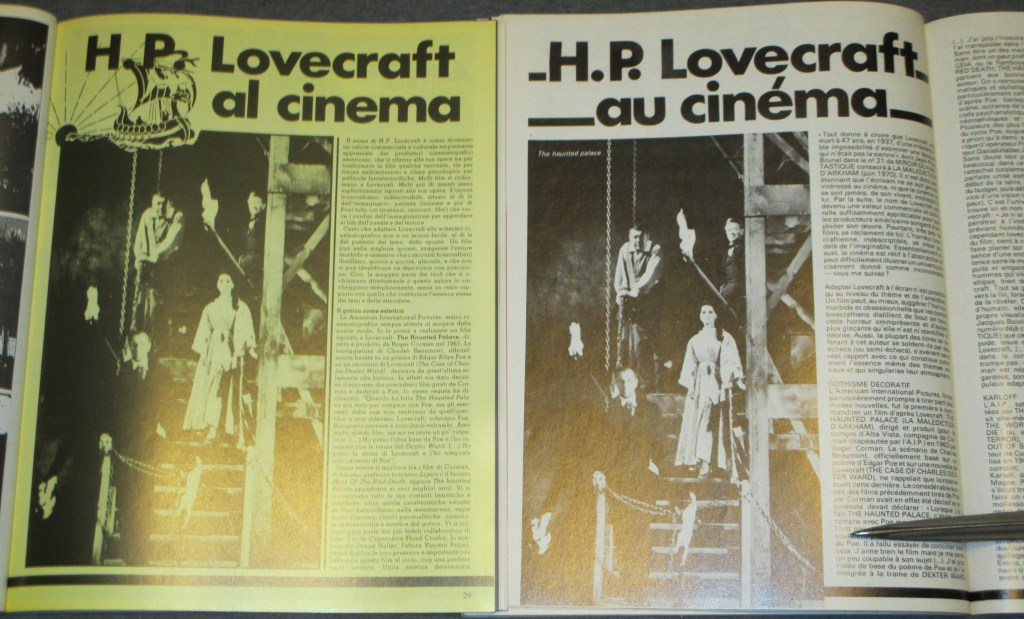
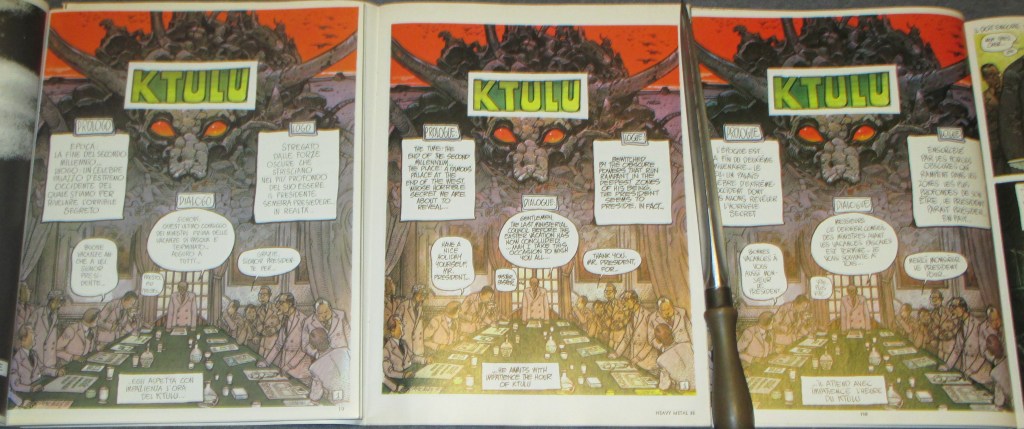
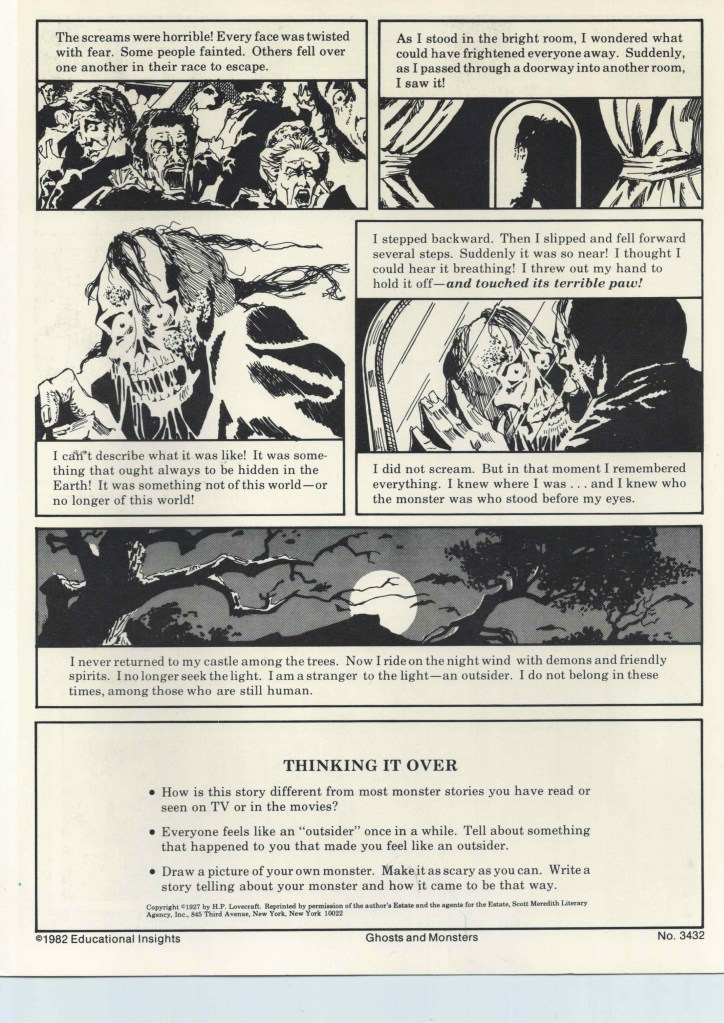
Readers familiar with blood libel will recognize the familiar tropes at work; similar accusations were made against witchcraft and against many non-Christian religions. For a horror comic dealing with Hollywood-style voodoo in the 1940s, a human sacrifice wouldn’t be unusual—but the odd thing is that the writer doesn’t use “the goat without horns.” Instead, the mamaloi dancer Caresse invokes “The Goat with a Thousand Horns.”
There’s no such figure in Seabrook’s book, or any other text or story on Vodou (and, in context, it is being used as another appellation for Damballah). But it is awfully close to the epithet of “the Black Goat of the Woods with a Thousand Young” associated with Shub-Niggurath in H. P. Lovecraft stories like “The Whisperer in Darkness” and “The Dreams in the Witch-House.” Is that a sub rosa reference to Lovecraft? Maybe. Certainly, it’s not the only oddity in the tale.
For example, the rival club is called the Belfry, and is owned by Batso…Batso’s Belfry… “Bat’s Belfry” (1926) by August Derleth. Coincidence? Or an Easter egg for Weird Tales readers?

Spook Comics, p28

The basic idea of the narrative seems to borrow very heavily from the beginning of Manly Wade Wellman’s “The Third Cry to Legba” (Weird Tales Nov 1943), where a new voodoo-themed club has a dancer (Illyria) that provides authentic Haitian dances for the clientele. In Wellman’s story, this is a plot by the evil magician Rowley Thorne to start a new cult, and he is thwarted by occult detective John Thunstone.

Interestingly, Wellman was inspired by real life, as he mentioned in ‘The Eyrie‘:

It is a fact that something appeared recently in New York newspapers that might be the public version of THE THIRD CRY TO LEGBA. Some may remember an account of how a certain singer chanted black magic songs and attracted big audiences, including at least one attentive being that she must have wished would stay away. We can’t check on that now, for the singer is untimely dead.

Wellman was probably referring to the case of Elsie Houston:

Ironically, the Brazilian singer was apparently claiming initiation in another African diaspora religion, Candomblé. To the general public of the United States of America, ignorant of the differences, it was all “voodoo” in their eyes. The Daily News article is actually fairly restrained; the American Weekly gave Houston an entire page to herself.

While the Weird Tales connections (real or apparent) are fun, “The Obi Makes Jumbee” also has a bit more plot than you might expect for a mere eight pages. The setup has readers expecting a zombie yarn—and they get gangsters, a fake death, a doublecross, a fake zombie, double murder, and then at the end—it’s all true. Which is as neat a bit of storytelling as you can expect. I might almost believe Wellman wrote it himself; he did a good bit of comic book scripting. Unless we find evidence to prove that, however, that remains speculative.

Does “The Obi Makes Jumbee” belong on the list of pre-Code Lovecraftian horror comics? It depends entirely on how much weight you place on “The Goat with a Thousand Horns” as a sneaky reference to Shub-Niggurath. The story has been reprinted a handful of times according to the Grand Comics Database, and can be read for free online at Comic Book Plus.


Bobby Derie is the author of Weird Talers: Essays on Robert E. Howard and Others and Sex and the Cthulhu Mythos.

Deep Cuts in a Lovecraftian Vein uses Amazon Associate links. As an Amazon Associate I earn from qualifying purchases.