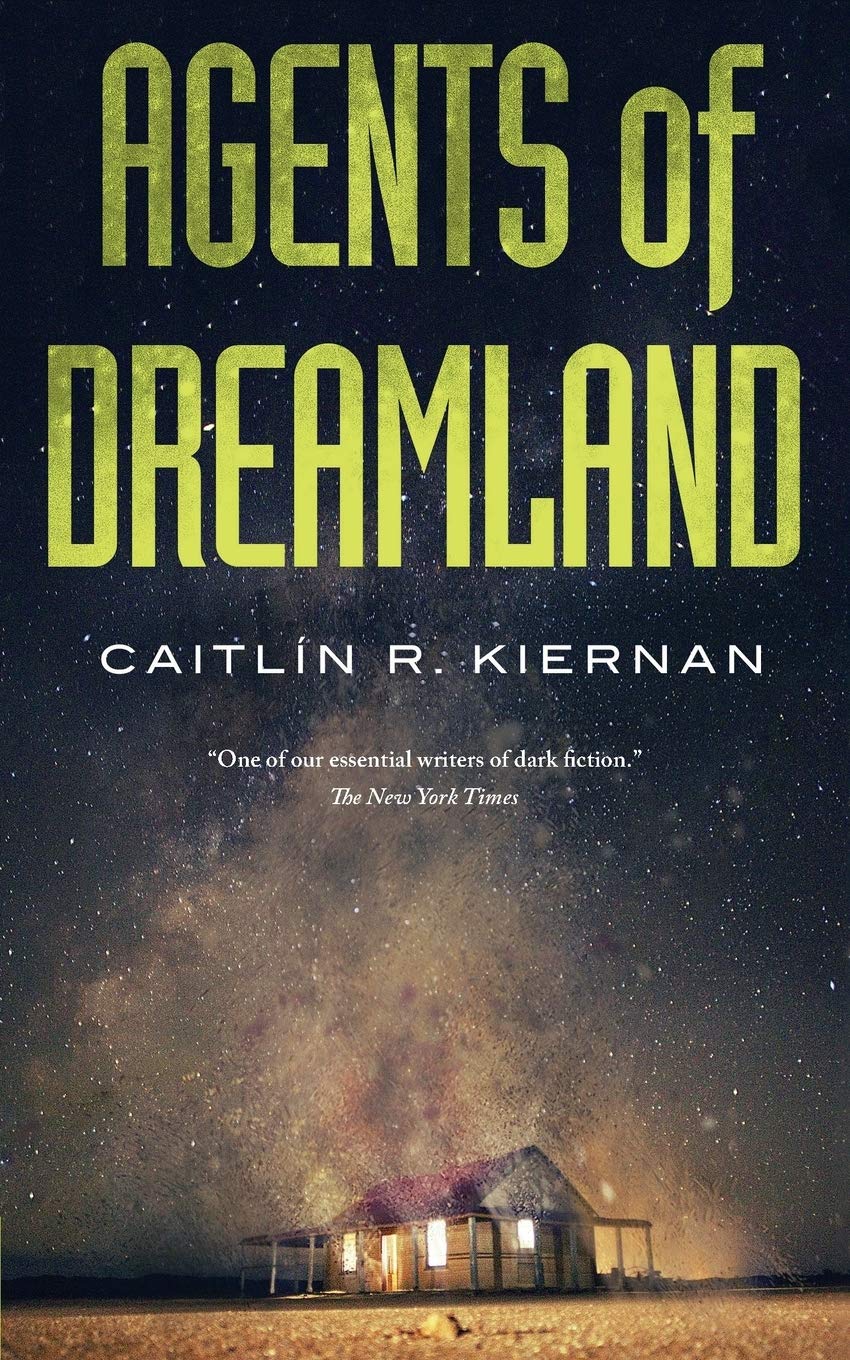
Agents of Dreamland (2017) by Caitlín R. Kiernan

The Truth Is Out There
—X Files, “Pilot,” 10 September 1993

The Federal Bureau of Investigation was created in 1908, when H. P. Lovecraft was eighteen years old. In his youth, he had formed a detective agency with his friends, inspired by the Pinkerton National Detective Agency and similar private companies. The Secret Service was the arm of the U. S. Treasury department, set up to crack counterfeiting rings and protect the president; the Black Chamber, forerunner of the National Security Agency, wouldn’t be formed until 1919.

Lovecraft had grown up in a world without G-men. With the passage of the Volstead Act and Prohibition, that would change. Hardboiled pulp crime magazines demanded more than just Sherlock Holmes-style consulting detectives, police detectives, Texas Rangers, federal marshals, or Pinkertons, though all of those characters had their place in the pages of magazines like Black Mask. Dashiell Hammett cut his teeth with The Continental Op, who worked for a fictional Continental Detective Agency modeled after the Pinkertons that Hammett himself would work for. Yet it was the rise of organized crime that came with Prohibition, and the personage of J. Edgar Hoover as head of the new Bureau of Investigation, that put their stamp on the idea of government agents in pulp fiction.

Which is why the opening to “The Shadow over Innsmouth” starts off as it does:

During the winter of 1927–28 officials of the Federal government made a strange and secret investigation of certain conditions in the ancient Massachusetts seaport of Innsmouth. The public first learned of it in February, when a vast series of raids and arrests occurred, followed by the deliberate burning and dynamiting—under suitable precautions—of an enormous number of crumbling, worm-eaten, and supposedly empty houses along the abandoned waterfront. Uninquiring souls let this occurrence pass as one of the major clashes in a spasmodic war on liquor.

H. P. Lovecraft didn’t invent the idea that governments conceal certain things from the public; the Great War impressed on the whole nation the importance of some things remaining secret. Yet it is important to place “The Shadow over Innsmouth” in that context of the rise of the G-men, of government agencies concerned with finding secrets and keeping them…and to understand that the roots of spy fiction in the Mythos, the whole cloak-and-tentacle business in Bruce Sterling’s “The Unthinkable” (1991), Alan Moore’s “The Courtyard” (1994), Delta Green (1997), Charles Stross’ “A Colder War” (2000) and The Atrocity Archives (2004), “The Star that is Not a Star” (2016) by Lucy Brady—they’re all part of a continuing tradition, born out of changes in the United States government, world affairs, and the semiotic impact on an American culture that knows that its government is hiding things from it.

Which leads also to flavors and trends in spy fiction. Ian Fleming’s James Bond is flashy, emotionally damaged, fighting secret wars against terrorists with next-generation gadgetry; Len Deighton’s unnamed protagonist of The IPCRESS FILE is faced with something no less fantastic, but the syntax is different—James Bond doesn’t deal with paperwork and bureaucracy. Spy fiction tends to vacillate between the glamorous fantasy and the grungy reality. The staid George Smiley of John le Carré’s Tinker, Tailor, Soldier, Spy is not the psychologically damaged one-man-army of Robert Ludlum’s The Bourne Identity, but they’re two sides of the same fictional coin, different iterations of the concept of the government agent, the finders and keepers of secrets.

Which is all background to set Caitlín R. Kiernan’s Agents of Dreamland in it’s proper context: the here-and-now of 2015, with a hazy secret history that extends out of knowing into past and future alike. The post-Cold War zeitgeist married the pre-war concept of G-men with the burgeoning fields of Ufology, the Shaver Mystery, Men in Black and Black Helicopters, and the warehouse at the end of Raiders of the Lost Ark. Pulp fiction jumped the semiotic shark when conspiracy fantasies like Robert Shea & Robert Anton Wilson’s The Illuminatus! Trilogy and Umberto Eco’s Foucault’s Pendulum became more or less indistinguishable from the actual conspiracy theories being peddled in Fate Magazine. When The X-Files hit in 1993, based on the 70s journalistic exploits of Kolchak, the Night Stalker, it was a spike driven straight into the vein of the American collective unconscious.

People want to believe the truth really is out there…and that the government knows and is hiding it.

Post-X Files fiction in this vein is rife, everything from big-budget Hollywood blockbusters like Independence Day (1996), Men in Black (1997), and Paul (2011) to graphic novels like Groom Lake (2009). Some are played straight, others for laughs—the bigger the cover-up, the more people and resources at play, the more it stretches the suspension of disbelief that any government agency can keep a lid on anything for any period of time.

Yet at the same time, everyone accepts that governments do successfully cover up things all the time. Documents are unclassified over time and reveal the details of events that happened in the shadows…and we know there are files still sealed. Secret histories under lock and seal. Anything might be in there—and that’s the attraction of the government conspiracy mindset. The imagination can populate those locked binders with any secrets—never mind that most of them are probably mundane things, like the sexual escapades of past presidents now safely dead, or the schematics for encryption machines rusting away in some government warehouse.

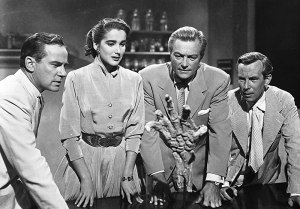
While his parents sleep, the boy is treated to Ray Harryhausen’s Rhedosaurus, Charles Laughton’s Quasimodo, and, finally, English director James Whale’s little-known and once-believed-lost The Star Maiden (1934).
—Caitlín R. Kiernan, Agents of Dreamland (2017), 48

Agents of Dreamland is the first in her Tinfoil Dossier series, which will probably be compared to Charles Stross’s Laundry series by default: both involve the Men-in-Black end of a government cover up, agencies working behind the scenes to investigate and contain the Mythos. The two bodies of work are distinctly different beasts, however. Kiernan’s point-of-view character the Signalman is on the ragged end of a career out on the edge of the spook world, a veteran of too many horrors. Not the smartest or the most clever, no Jason Bourne-style action scenes, just a bone-weary tiredness and a looming sense of desperation hovering over all.

That’s the mood. This is a war that can’t be won, because the people fighting it don’t realize it is a war yet.

The lore is stripped down; this isn’t a roleplaying game supplement about the Men in Black and their valiant secret war against the Cthulhu Mythos. This is grungier, grittier, more homely and with an air of inevitability. There are scenes and themes reminiscent of Mexican Gothic (2020) by Silvia Moreno-Garcia. Lovecraft, for all that he created, was working within a late-19th/early-20th century frame of scientific understanding—and science has dug up some much stranger things since 1937.

Kiernan doles out the information from the black dossier in measured doses, switching point of view and time between chapters, balancing exposition and description. The idea isn’t to give the reader too much at once, to let the reader form their own connections, to feel the people that are in these places at these times. It’s a spy story written like a Cthulhu Mythos story, and by the time the reader finds out the truth about The Star Maiden, puts the pieces together and think they have a clue about where this is going…

The truth is weirder than you think.

Caitlín R. Kiernan’s Agents of Dreamland (2017) is the first in the Tinfoil Dossier series, and is followed by Black Helicopters (2018) and The Tindalos Asset (2020).


Bobby Derie is the author of Weird Talers: Essays on Robert E. Howard & Others (2019) and Sex and the Cthulhu Mythos (2014).

“The Child of Dark Mania” (1996) by W. H. Pugmire

This story appeals to me more than most of the things I’ve written this past decade. I am fond of the image of the woman with her weird masked face, and was delighted when two pictorial renditions of that image were included in my first American collection, one by my editor and publisher, Jeffrey Thomas, and the other gracing the superb cover illustration by Earl Grier. There is a lot of peculiar passion in this story, and it gets me, deliciously. I was delighted to be able to write it in memory to HPL’s great buddy and fellow weird author, Frank Long. “The Child of Dark Mania” originally appeared in The Pnakotic Series.
—W. H. Pugmire, “Afterword” in Sesqua Valley & Other Haunts 113

Frank Belknap Long, Jr.’s “The Horror from the Hills” (Weird Tales Jan, Feb-Mar 1931) is one of his most famous additions to the Cthulhu Mythos—mostly because the novella incorporates a lengthy sequence borrowed from one of Lovecraft’s letters (with permission), describing a Roman dream in ancient Iberia. The main antagonist of the novella is Chaugnar Faugn, which in turn was inspired by a small statuette of the elephant-headed Hindu deity Ganesha that Long’s aunt Cassie Symmes had gifted him.

Long is busy on a horror tentatively called “The Elephant God of Leng”—based on a curiously carved idol his aunt lately brought him from Europe, plus a suggestion or two of mine.
—H. P. Lovecraft to Clark Ashton Smith, 2 Feb 1930, Dawnward Spire, Lonely Hill 204

The appropriation of an Indian religious icon was not uncommon in Weird Tales during the period. Readers might compare the elephant-headed Yog-Kosha from Robert E. Howard’s “The Tower of the Elephant” (Weird Tales Mar 1933), or the eponymous idol in Seabury Quinn’s “The Green God’s Ring” (Weird Tales Jan 1945). Inspiration comes where it does, and the “Exotic East” was an important inspiration for many pulp writers, and a draw for many pulp readers—and we can perhaps be grateful that Long drew a distinction between the benevolent Ganesha and the malevolent Chaugnar Faugn.

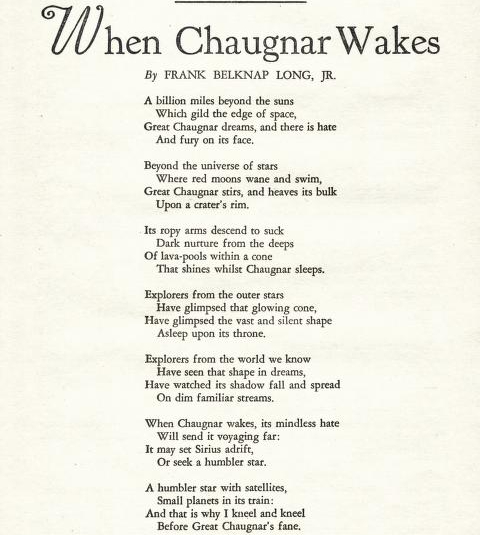
While “The Horror in the Hills” has been long recognized as a part of the Mythos, there has never quite been a distinct “Chaugnar Faugn Cycle.” Lovecraft would include Chaugnar Faugn among the deities in “The Horror in the Museum” (1933), and Long would revisit the character in his poem “When Chaugnar Wakes” (Weird Tales Sep 1932), and a few others have tried their hand at it, notably Robert Bloch with “Death is an Elephant” (Weird Tales Feb 1939), Joseph Pulver, Sr.’s untitled poem that begins “Elephant Lord, Chaugnar Faugn,…” (Cthulhu Cultus #12, 1998), Robert M. Price’s “The Elephant God of Leng” (Black Book #1, 2002), and W. H. Pugmire’s “The Child of Dark Mania” (1996).

Weird_Tales_v20n03_1932-09_sas_0123

As with “An Imp of Aether” (1997), “The Child of Dark Mania” is one of a series of stories that Pugmire wrote in the 1990s in homage to various weird authors that had come before; and as with “Imp” this one has been revised in its various publications, so that while the basic elements of the story remain, the details shift a bit depending on whether you read it in the original Pnakotic Fragments (1996) fanzine, the Tales of Sesqua Valley (1997) chapbook, or paperback publication in Sesqua Valley & Other Haunts (2008) or An Imp of Aether (2019).

Most of these changes are minimal—the consolidation of paragraphs, another word or sentence of description, etc. One notable change is the name of the protagonist, a writer of horror fiction who in the original is Frank or Franklyn, and in the 2019 version is “Sonny” or Francis—no doubt to more closely associate the writer with “Sonny” Belknap, as Lovecraft used to call his friend.

She went to a stand and unwrapped a piece of plastic, from which she removed a cone of incense. This she placed next to me on the bed, along with an incense burner shaped as an Eastern deity, an elephant god whose name I could not recall.
—W. H. Pugmire, “Child of Dark Mania” in An Imp of Aether 169

In keeping with his usual style, Pugmire is not so unsubtle as to name Chaugnar Faugn directly. The story is all the more effective for not being another gushing bit of fanfiction that tries to dump a vast chunk of Mythos lore on the reader. Nor does Pugmire try for anything grandiose; this is a quieter tale than “The Dunwich Horror” or “The Devil’s Hop Yard” (1978) by Richard Lupoff, somewhat closer to Arthur Machen’s “The Great God Pan” in scope—and Melissa is perhaps a close cousin to Helen Vaughn as portrayed in Helen’s Story (2013) by Rosanne Rabinowitz.

Instead, it is a very slight, intimate story, content to communicate the plot by image and intimation, and leave the reader’s imagination to fill in the rest. One of the most distinct such images is worth going into a little more deeply:

I tired but found it impossible not to study the grotesque cloth mask, and the bizarre shape that moved beneath it. I had known that Melissa had been born with birth defects, and we had assumed that this had been the result of Diane’s consumption of foreign opiates. (ibid. 168)

Savvy readers might draw any number of references: the masked high priest not to be described in The Dream-Quest of Unknown Kadath, perhaps—but also Joseph Merrick, the Victorian performer billed as “The Elephant Man,” who would wear a hood or mask to help conceal his features when in public.

There is that sense of empathy for Diane, the wild child who had “journeyed with a gang of lesbian witches” and returned pregnant, disapproved of by her family, and forced to raise her daughter alone…and now might lose her, as Melissa comes of age—which is the only odd part of the changes between editions. In the earlier versions of the text, Diane gave birth eighteen years before the start of the story, in the 2019 text this is shortened to eight. Whether this is an error or meant to invoke the quick growth of Wilbur Whateley is not clear, and doesn’t effect the final story much.

In conception, Pugmire’s Chaugnar Faugn is more intriguing than Long’s. Here, the deity has an aspect reminiscent of Pan, Bacchus, or Dionysus, who might attract very Lovecraftian maenads, drunk on the cosmic wonder of it all…and dance.

My blood froze as she bent low and kissed the shadow of the rigid god, and I inwardly cringed when that blasphemous silhouette began to blur and bend. (ibid. 171)

Why did Diane flee to Sesqua Valley? Perhaps because that was Pugmire’s corner of Lovecraft Country, and he wished to draw to himself those dark, shining jewels of the Mythos he prized. There is a jealous tendency to the valley, magnetic and sympathetic, like calling to like. The Child of Dark Mania fits in well among those shadowy residents.

The latest version of the text, titled “Child of Dark Mania,” can be read in An Imp of Aether (2019).


Bobby Derie is the author of Weird Talers: Essays on Robert E. Howard & Others (2019) and Sex and the Cthulhu Mythos (2014).
“The Were-Snake” (1925) by Frank Belknap Long, Jr.

My contributions to the Mythos were of assorted shapes and sizes, ranging from the tiny, flesh-devouring Doels, who inhabited an alien dimension shrouded in night and chaos, to the monstrous Chaugnar Faugn, whom only the suicidally inclined would have mistaken for a pachyderm. I also contributed one scenic vista, the mysterious, perpetually mist-shrouded Plateau of Leng, and one forbidden book, John Dee’s English translation of The Necronomicon, which I placed at the head of The Space Eaters when that story first appeared in Weird Tales […]
—Frank Belknap Long, Jr., Howard Phillips Lovecraft: Dreamer on the Nightside 23-24

To hear Long tell it, his first contribution to the Cthulhu Mythos—and the first stories written as part of the Mythos, outside of Lovecraft’s own pen—were “The Space Eaters” (Weird Tales July 1928) and “The Hounds of Tindalos” (Weird Tales March 1929). These stories have been enshrined in canon as much as anything written by anyone other than H. P. Lovecraft himself, and predate anything written specifically incorporating references to the Mythos by Clark Ashton Smith, Robert E. Howard, August Derleth, or others.

What most compilers of Mythos stories seem to forget is that the first published story with a Mythos connection by Long was actually his third story professionally published: “The Were-Snake” (Weird Tales September 1925). Looking at Long’s memoirs, and the collections of his fiction, one gets the impression that perhaps Long wished it would be forgotten. Although reprinted twice during his lifetime in anthologies, like “Mother of Serpents” (1936) by Robert Bloch this story has never been published in any Cthulhu Mythos collection, and remains absent from Long’s The Early Long and Arkham House anthologies.

Normally, when looking into such matters, Lovecraft’s letters are a great asset. However, in this case most of his letters to Long have not been published, and the references to the story in Lovecraft’s published correspondence is minimal:

Next month my “Temple” & Belknap’s “Were-Snake” will appear.
—H. P. Lovecraft to Lillian D. Clark, 6 Jul 1925, Letters to Family and Family Friends 1.306

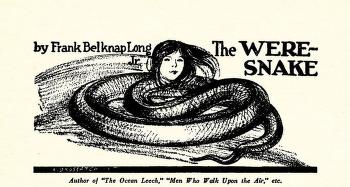
Hope your friend will get some vignette & tailpiece jobs—you might tell Wright it’s about time he stopped using Brosnatch’s ancient designs for Belknap’s “Desert Lich” & “Were-Snake” & Seabury Quinn’s “Servants of Satan” in this capacity!”
—H. P. Lovecraft to August Derleth, 27 Jan 1932, Essential Solitude 2.444

Andrew Brosnatch was the artist that did the header-pieces for Frank Belknap Long’s stories; the art was re-used periodically in Weird Tales as filler for years afterward. Other than that, there is nothing much in Lovecraft’s correspondence: 1925 was before most of his pulp friends began to correspond with him, and if Lovecraft and Long discussed the story, those letters haven’t come to light yet. What we know of this story’s genesis, then, is mostly down to inference.

Shortly after Weird Tales hit the stands in 1923, H. P. Lovecraft wrote to the editor Edwin Baird—and was soon enmeshed in correspondence with both Baird and the pulp magazine’s owner, J. C. Henneberger. Several submissions from Lovecraft had been accepted at Weird Tales, and in 1924 Lovecraft encouraged his young friend in amateur journalism to submit his own stories to the magazine:

Now, Child, send Grandpa that horror story! If you will be good and write lots and lots of terrible things, I believe you may have a chance to land them in Weird Tales, for as you will see when I send you the Henneberger letter, they are desperately in need of material which is basically unconventional. Pray picture to yourself the curiosity of a fiend-loving Old Gentleman, and delay no longer in making Grandpa your nameless monstrosity! About the Ashton Smith reference in my Hound—I omitted that myself, on advice of Eddy (not Poe but my local protege C. M. Eddy), who said that the editor would object to such exploitation of an artist-poet whose work I am trying to push with Weird Tales. Now that I see how solidly I stand with both Baird and Henneberger, I am sorry I took the advice—but what’s done is done. Another time I may do some free advertising for Smith and Sonny Belknap and Mortonius and everybody!
—H. P. Lovecraft to Frank Belknap Long, Jr., Feb 1924, Selected Letters 1.292-293

“The Hound” was published in the February 1924 issue of Weird Tales; the surviving typescript shows Lovecraft made a few alterations from the original which appear in the published text:

A locked portfolio, bound in tanned human skin, held the unknown and unnamable drawings of Clark Ashton Smith.
—H. P. Lovecraft, “The Hound” (original text)

A locked portfolio, bound in tanned human skin, held certain unknown and unnamable drawings which it was rumoured Goya had perpetrated but dared not acknowledge.
—H. P. Lovecraft, “The Hound” (as published)

This would have been, if published, one of Lovecraft’s first literary in-jokes—Lovecraft was already in correspondence with Clark Ashton Smith at the time—and together with Lovecraft’s urge that Long write and submit his stuff to Weird Tales for publication is probably what led, ultimately, to “The Were-Snake.”

Long’s first stories published in Weird Tales were “The Desert Lich” (WT Nov 1924) and “Death-Waters” (WT Dec 1924); both tales can be said to be typical of his very early professional efforts, dealing with white people in exotic settings and stumbling across something dangerous and uncanny. Later Long would grow as a writer with more complex plots and characterization, but these short pieces were in good company for the early issues of Weird Tales, which was still feeling its way after the editorial shakeup that had seen Baird (and Henneberger) ousted and Farnsworth Wright in the editorial chair.

By the time “Death-Waters” was published, Lovecraft had come down to New York City, married Sonia H. Greene, and taken up residence; he was seeing a good deal of Long and the rest of the gang in the Kalem Club. Long’s third story in Weird Tales was “The Were-Snake” (WT Nov 1925)—published nearly a year after his last one. Why the long delay? Rejection, possibly, or backlog; even if Long wrote it in the spring of 1925, it likely wouldn’t be published until winter…and there are reasons to suspect it might have been written in the spring of 1925.

“The nethermost caverns,” wrote the mad Arab, “are not for the fathoming of eyes that see; for their marvels are strange and terrific. Cursed the ground where dead thoughts live new and oddly bodied, and evil the mind that is held by no head. Wisely did Ibn Schacabao say, that happy is the tomb where no wizard hath lain, and happy the town at night whose wizards are all ashes. For it is of old rumour that the soul of the devil-bought hastes not from his charnel clay, but fats and instructs the very worm that gnaws; till out of corruption horrid life springs, and the dull scavengers of earth wax crafty to vex it and swell monstrous to plague it. Great holes secretly are digged where earth’s pores ought to suffice, and things have learnt to walk that ought to crawl.”
—H. P. Lovecraft, “The Festival”

I sat and dozed, or stared drowzily into the darkness, and thought of the charnel worms which the mad Arab Alhazred bred in the bellies of slain camels.
—Frank Belknap Long, Jr., “The Were-Snake”

That is the sole line that connects “The Were-Snake” with the Cthulhu Mythos. Lovecraft’s “The Festival” was first published in Weird Tales January 1925 issue; if Long read it there…and he might have read it in manuscript, for all we know, before that due to his close association with Lovecraft during that period…it might make sense that “The Were-Snake” with its reference to Alhazred and worms was written later, sometime during early 1925, and submitted to Wright at Weird Tales. Nothing can be said for certain, until and unless more evidence comes to light, but the sequence of events makes sense.

As to the story itself… “The Were-Snake” is very similar to “The Desert Lich” and “Death-Waters.” American tourists in the Near East; more than a touch of exoticism and rather casual racial prejudice and sexism which is sometimes played for laughs:

Our consul has red hair, and he beats his wife and he judges men by the color of their skin
—Frank Belknap Long, Jr., “The Were-Snake

It’s a stilted joke, since the courageous American archaeologist sleeping in the haunted ruins is trying to bluff and bluster at what he thinks are a group of indigenous people playing a trick on himthere are some parallels in this story with Helena Blavatsky’s “A Witch’s Den” (1892), which had been published in Best Psychic Stories (1920), a book that we know Long had read and lent to Lovecraft. But whereas Blavatsky’s apparition was a group of clever natives pulling a ruse, Long’s were-snake is very real…

Robert E. Howard is not known for certain to have read this story; he apparently missed several early issues of Weird Tales. Yet it is notable that one of his early Conan stories, “The God in the Bowl,” was rejected by Farnsworth Wright, includes a man-headed serpent with hypnotic powers and deific connections—was Howard at all aware of “The Were-Snake” when he wrote “The God in the Bowl?” Did Wright reject the story because that element was similar to Long’s story? The latter seems unlikely; but it’s curious that both stories have such similar monsters. There is also a reference at the beginning to Dr. John Dee, which is notable only in that it was Long who attributed to Dee an English translation of the Necronomicon in “The Space Eaters.”

For the most part, however, it’s easy to see why Long might have wished to forget about “The Were-Snake.” The central protagonist and his fiance (?) Miss Beardsley are not terribly compelling. The descriptive material in the encounters in the dark ruins are interesting, but the final revelations lack punch, and little explanation is given as to the nature of the were-snake and her siren-like charms and habits.

The reference to Abdul Alhazred seems a little absurd in hindsight—but in context? Lovecraft hadn’t really established the cosmic scope of his Mythos yet, and the Necronomicon had appeared only in “The Festival” and “The Hound” in print. Long’s usage of Alhazred was no more than a literary in-joke at this point, and not out of keeping with the uses that Lovecraft had already made of the character. That’s how the Cthulhu Mythos started in many ways, with little throwaway references that slowly built up into something else. There were no rules, no planning, little effort to standardize and a great deal of encouragement to experiment.

In hindsight, it’s hard to see where “The Were-Snake” would have “fit” into the growing Mythos, especially after Lovecraft’s death when folks like Francis T. Laney and August Derleth were making an effort to codify the Mythos. Where would the were-snake have fit in their system? Nowadays, of course, fans might say that the were-snake was of the same species as Howard’s “God in the Bowl,” or perhaps a child of Yig, but those are both concepts that came up after Long had conceived and written his piece, and there is no evidence that either Howard or Lovecraft intended any such connection to this early work by Long.

Virtually all myth cycles, fictional or otherwise, include these “fringe-level” borrowings, which but to a minor extent enter into the main body of the cycle. The contributions of other writers did not diminish the genius-inspired originality of the Cthulhu Mythos; in its major aspects it remains entirely Lovecraftian.
—Frank Belknap Long, Jr., Howard Phillips Lovecraft: Dreamer on the Nightside 24

For those who like a bit of trivia, it’s worth noting that the first Mythos entity created by someone other than Lovecraft (and one of the first Mythos entities period) was indisputably female. Whatever else she might have been—god or human, witch or monster—Long’s were-snake was a woman.

Frank Belknap Long, Jr.s’ “The Were-Snake” may be read free online here.


Bobby Derie is the author of Weird Talers: Essays on Robert E. Howard & Others (2019) and Sex and the Cthulhu Mythos (2014).
“The Tulu Jar” (2000) by Ann K. Schwader

Of one thing I am really glad, and that is that I could not then identify the squatting octopus-headed thing which dominated most of the ornate cartouches, and which the manuscript called “Tulu”. Recently I have associated it, and the legends in the manuscript connected with it, with some new-found folklore of monstrous and unmentioned Cthulhu, a horror which seeped down from the stars while the young earth was still half-formed; and had I known of the connexion then, I could not have stayed in the same room with the thing.
—H. P. Lovecraft & Zealia Bishop, “The Mound”

In “Winged Death” it is Clulu; in “Medusa’s Coil” it is “Marse Clooloo”; in “The Electric Executioner” it is “Cthulhutl”—and in “The Mound” it is “Tulu.” Different names for the same concept, the same entity. Variations on a theme. One of humanity’s great gifts is pattern recognition, and one of Lovecraft’s great insights in writing those first Mythos stories was to recognize the tendency of weird fiction fans to correlate the contents. This was part of the game that Lovecraft played with his readers: giving them the pieces of the puzzle and letting them put it together.

Despite the variations on the same name, Lovecraft never wrote a full comparison of how different cultures perceived Cthulhu. The names alone suggest a signal-to-noise ratio; the oral tradition like a long game of telephone down the ages, bits of lore garbled, misunderstood, mistranslated, subject to reinterpretation. However, they also represent possibility. Maybe there isn’t just one canon, one truth. Maybe there are a lot of different ways to look at Cthulhu…and absent the original article, who is to say which is more correct than any other?

“The Tulu Jar” by Ann K. Schwader plays on misunderstandings & mistranslations. The audience knows who or what Tulu is, and thus has a bit more of an inkling of what is going on than the characters in the story. The narrative itself is fairly straightforward, the effectiveness is measured in how the revelations build and develop. There are things the reader never finds out, mysteries that are not explained—because they don’t need to be.

The name is the only thing that connects “The Tulu Jar” to “The Mound,” the only tie between Schwader’s story and Yig Country. In all other respects, “The Tulu Jar” could just as easily have been “The Cthulhu Jar” and stood next to works like “Something in Wood” (1948) by August Derleth, or as an appendix to Lin Carter’s Xothic Legend Cycle. One more horror in clay, one more work of Mythos artwork to sit alongside the masterpieces of Pickmans and Wilcoxes.

So why Tulu?

In part perhaps because it implies mistranslation, incompleteness, something different. Cthulhu makes no appearance in the story; Miskatonic University and Arkham are mentioned but far-off, and no one consults the Necronomicon. Using “Tulu” instead of “Cthulhu” tells the reader that those involved do not know what they’re dealing with. Quite literally dabbling with forces they don’t understand…and that works, in the context of the story.

Speaking of which…there is an anecdote about this story that bears repeating:

By the way, there really is a Tulu jar! Ann and her husband bought an art object at a Denver scifi con entitled Cthulhu Scroll Case. They bought it before the actual art sale, but then the lid was vandalized while the piece was still on display. She tells me that the artist offered to make it right by making another lid, which he subsequently did, but Ann was understandably upset nonetheless. As she put it, “a little literary justice seemed in order”, and the result was this story. The sculpture still holds a place of honor on a shelf in her office. Ann describes it as “wonderfully nasty-looking”, but in reality it looks nothing like the jar in the story.
—Kevin O’Brien, Strange Stars & Alien Shadows 1

“The Tulu Jar” was first published in Chronicles of the Cthulhu Codex #17 (2000) and subsequently republished in The Black Book #3 (2003), and Strange Stars & Alien Shadows: The Dark Fiction of Ann K. Schwader (2003).


Bobby Derie is the author of Weird Talers: Essays on Robert E. Howard & Others (2019) and Sex and the Cthulhu Mythos (2014).

“Taste of the Snake’s Honey” (2005) by Rio Matsudono (松殿理央)

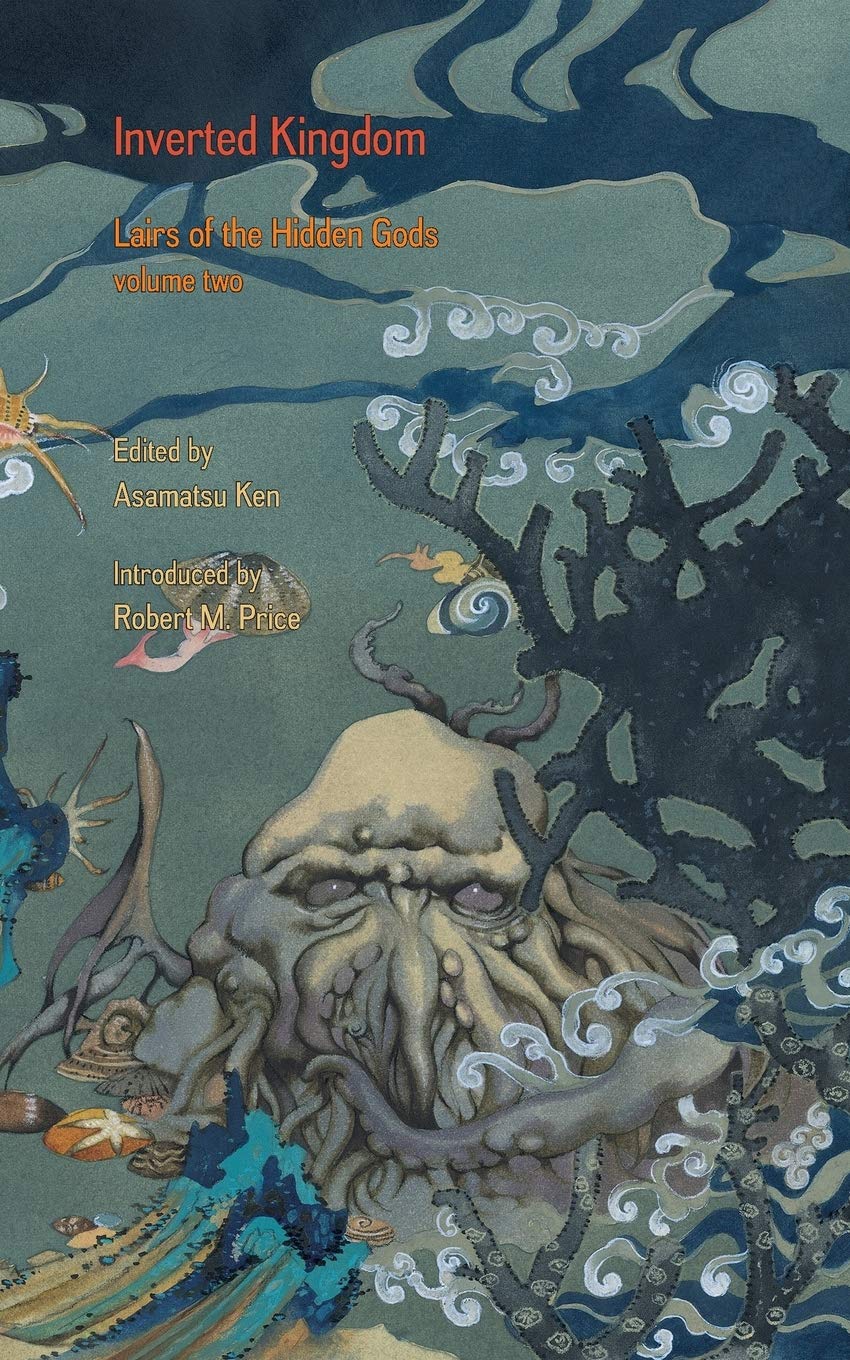
“Taste of the Snake’s Honey” (2005) by Rio Matsudono (松殿理央) was published in the second volume in the Lairs of the Hidden Gods series from Kurodahan Press, edited by Asamatsu Ken (朝松健). It is the English-language translation of the 2002 novella 蛇蜜 (Hebi Mitsu); the translator was Erin S. Brodhead.

Sexuality is a fundamental aspect of Yig. In “The Curse of Yig” (1929) by Zealia Bishop & H. P. Lovecraft, this nature is implicit: the curse of Yig is that Aubrey Davis bears children with snake-like characteristics. While at least one critic claimed this was a story of maternal impression, the impression usually given was that Yig raped her, presaging to some degree the connection between Yog-Sothoth and Lavinia Whateley in “The Dunwich Horror.” The aspect of Yig as a sexual deity was affirmed in “The Mound” (1940) by Zealia Bishop & H. P. Lovecraft as “the principle of life symbolised as the Father of all Serpents.”

In writing that, Lovecraft might have been inspired by contemporary ideas that ancient serpent deities represented phallic cults, as discussed in O. A. Wall’s Sex and Sex Worship (1922); this was a book that Robert E. Howard owned, and Howard mentioned phallic worship in at least one letter to Lovecraft (A Means to Freedom 1.87). A few later authors have taken the general idea of the Father of Serpents as a masculine deity of virility and run with it; occultists like Kenneth Grant have incorporated Yig into their system as an aspect of masculine sexual power, representing the “Ophidian Current” in his Typhonian Trilogies.

Sex presents certain difficulties for translation; the language of sex is usually either dryly technical (penis, vagina, anus, etc.) or extremely idiomatic or euphemistic (rod, Johnson, 69, French letter, salad tossing, etc.), and sexual slang varies by region, language, culture, and period—compare the language in The Merry Order of St. Bridget (1857) to something like Anne Rice’s Sleeping Beauty trilogy, and it’s easy to see that while it covers some of the same thematic ground, the language and cultural syntax have shifted drastically. Trying to write period-appropriate sexual language is tricky enough, translating it in such a way that it retains the essence of its meaning for an audience doubly so…and that’s before you try to work the Mythos into it.

This is all necessary ground to cover because “Taste of the Snake’s Honey” is one of the relatively scarce Mythos works which contains a great deal of sexual matter, but isn’t really erotic in any significant sense. The best comparable work is probably Robert M. Price’s “A Thousand Young” (1989), which follows a young libertine seeking admission into a Mythos cult through increasingly deviant sexual acts, but both that story and this one are ultimately a more explicit version of the decadent pleasure-seekers in Lovecraft’s “The Hound”—the idea being that libido sciendi, the desire to know, the quest for forbidden knowledge applies equally well to sexual knowledge as it does to, say, advanced mathematics and occultism (cf. “The Dreams in the Witch-House”).

Sometimes this is very explicitly the case, such as in “Under the Keeper of the Key” (2015) by Jaap Boekestein, but in the case of Rio Matsudono, it’s more of a barometer to let readers know that the ambient sexual morality of the tale is falling fast, and as the Lovecraftian protagonist slides from receiving fellatio from women who had had all their teeth removed to necrophilia, the novella is really just getting started.

Which is all on purpose: the acts given are almost dry in their description, which might be a translation issue (see above; imagine trying to write 1930s-period sexual decadence to a 2000s-contemporary Japanese audience, and then imagine trying to translate that into English for a completely different audience) but likely also because the purpose of the acts is not to titillate or tantalize but to transgress, to provoke a degree of rejection and outrage at the breaking of taboos. The actual acts themselves aren’t dwelt on until we get to the literal climax of the story, because the author isn’t trying to get you off, or go into horrorporn territory with microscopic detail a la Edward Lee’s Hardcore Lovecraft novels like Going Monstering.

For “The Taste of the Snake’s Honey,” sex isn’t the revelation, it’s the initiation.

What the reader and the protagonist are initiated into is another question. Rio Matsudono’s novella is a direct expansion on the lore of Yig, and the straightforward lore dumps are maybe at the expense of the story itself. Like with The Queen of K’n-yan (2008) by Asamatsu Ken (朝松健), there’s an effort to at least draw parallels between an aspect of Lovecraft’s Mythos with Chinese folklore…and the parallels work fine; the exposition is a little heavy at points, but that’s pretty common in Lovecraftian pastiches. What the story lacks, aside from a certain prosody, is a direct explanation for what drove the sexual decadence of the protagonist in the first place…unless you understand and appreciate Yig’s role as a fundamentally sexual entity to begin with.

So much of this novella is stated bluntly or outright that some of the subtextual implications and assumptions can be easily lost. The protagonist’s sexual activities aren’t portrayed as mental illness or learned practices; they’re the result of natural inclinations—or, maybe, supernatural ones. Nature winning out over nurture. At the same time those sexual desires and activities appear to have nothing to do with the final resolution of the plot: they led the narrator protagonist to the point of revelation, but aside from plot fiat there was no reason that these specific revelations had to happen in this way. A surface read of this story might suggest that Rio Matsudono wanted to deliberately shock the reader, but the apparent conflict can be resolved by thinking of Yig and his children as driven by inhuman appetites.

He was not wholly evil, and was usually quite well-disposed toward those who gave proper respect to him and his children, the serpents; but in the autumn he became abnormally ravenous, and had to be driven away by means of suitable rites.
—H. P. Lovecraft & Zealia Bishop, “The Curse of Yig”

Suppose these appetites are analogous to the strange hankerings of a pregnant woman? Suppose the hungers for strange flesh, and blood, and wild venturings way over the borders of sane sexuality are a reaching out for ultramundane fare, the pickles and ice cream of the alien soul coming to birth within the confines of a human life that is only a womb for that which gestates inside, increasingly making its presence known?
—introduction to “Taste of the Snake’s Honey” in Inverted Kingdom 113-114

The introduction to “The Taste of Snake’s Honey” spotlights the issue for reader, although like all good warnings to the curious, the full implications aren’t necessarily clear until after the novella is finished. Then the story can be seen in the theme of “Paedomorphosis” (1998) by Caitlín R. Kiernan—a changeling or puberty story, where the old self is shed to make way for the new, adult form.

If read from this angle, the sexual deviations from the beginning of the story are not just there to shock the reader, but as deliberate steps in a process of development. The sexual pleasures being sought are increasingly strange and terrible by human standards because what the protagonist is being prepared to mate with is nothing human. It’s a rationalization which resolves some of the apparent conflicts in the story, such as why the narrator feels their behaviors are different from those of decadent humans who engage in the same or similar practices like teratophilia or necrophilia.

A point of view which potentially has interesting implications if applied to some of the other entities in the Cthulhu Mythos, especially those that pass for human, or whose cults engage in proscribed sexual practices.


Bobby Derie is the author of Weird Talers: Essays on Robert E. Howard & Others (2019) and Sex and the Cthulhu Mythos (2014).
“The Head of T’la-yub” (2015) by Nelly Geraldine García-Rosas

We came to the Mictlán, the place of the dead, which the ancient people called Xinaián […]
—”The Head of T’la-yub” by Nelly Geraldine García-Rosas, trans. Silvia Moreno-Garcia

Most of “The Mound” is given as a story-within-a-story: the English translation of the Spanish conquistador Pánfilo de Zamacona y Nuñez, gentleman, of Luarca in Asturias, Concerning the Subterranean World of Xinaián, A. D. 1545. Few of the Aztec codices have survived the flames and floods, the mold and wear of centuries of hands; we today often read about the peoples and places they encountered through accounts like Zamacona’s…who being their own skewed, flawed interpretation of what they see and witnessed of ways of life and belief of which they knew little, and could only understand through the lens of their own religion, politics, philosophy, and experience.

Which is a long way to say: no one has tried to tell the story from T’la-yub’s point of view.

In Lovecraft’s narrative via Zamacona, T’la-yub is a tragic figure. She dared to love, dared to dream of a monogamous union, and the subject of her affections determined only to put her aside as soon as convenient. For her transgressions in the name of romance, she is doomed to mutilation, death, and then undeath. T’la-yub is one of the ghosts of the mound, the dead woman who holds her head, facing eternal punishment for a momentary infraction.

There’s something very Christian about that interpretation, isn’t there? Nelly Geraldine García-Rosas flips the script. What if Zamacona didn’t understand what was happening? What if he misconstrued his place and importance in the sequence of events?

As with her other stories “Tloque Nahuaque” (2011)“Ahuizotl” (2011), and “In Xochitl in Cuicatl in Shub-Niggurath” (2014), “The Head of T’la-yub” mixes elements of the Mythos was Aztec mythology. Instead of the more Pellucidar-esque elements of Lovecraft’s alien civilization beneath the earth, the focus is on T’la-yub’s personal spiritual and physical journey, here modeled on the descent of the dead to Mictlán, the growth of her understanding as to what she has become and what her role is. The result is brief, but novel: a new way to look at this aspect of the “Mesoamerican Mythos,” taking Lovecraft not at face value, but as one interpretation of events told through a very European lens.

Which doesn’t mean that Lovecraft was wrong and García-Rosas is right; the point of the story is not to disprove Lovecraft or point out sources of error, but to provide a new viewpoint that suggests that the picture is much more richly complex than Lovecraft himself gives it. Where works like Winter Tide (2017) by Ruthanna Emrys takes “The Mound” at more or less face value, or The Queen of K’n-yan (2008) by Asamatsu Ken (朝松健) that takes the basic ideas but moves in its own direction, “The Head of T’la-yub” is essentially an alternative narrative of “The Mound”—and readers can put on their scholar’s caps, read up on Aztec mythology, and decide for themselves where the balance of truth lies.

“The Head of T’la-yub” by Nelly Geraldine García-Rosas was translated by Silvia Moreno-Garcia and was first published in She Walks in Shadows (2015); it was republished in the paperback edition Cthulhu’s Daughters (2016).


Bobby Derie is the author of Weird Talers: Essays on Robert E. Howard & Others (2019) and Sex and the Cthulhu Mythos (2014).
“Yig Country” (1993) by Ann K. Schwader

In this particular case, we are looking into the possibility of a single mound inhabited by an Indian snake-god of death, referred to as “Yig” by Zealia Bishop. […] After trudging through the countryside around Binger [, Oklahoma], I have not had the luck so far of stumbling across the mound mentioned by Zealia Bishop. […] In retrospect, it is well known that Indians even now will not often divulge the true location of something held sacred to their tribe – much less something which is feared and forbidden. Should information leak out concerning such a spot, the informant might fear the finger of tribal suspicion pointed in his direction. The Indian ways have changed little in the last three hundred years, and it is not their nature to trust a man from outside the tribes.
—W. E. Baardson, “The Mound of Yig?” in Etchings & Oddyseys (1973) 10-12

As I braced myself for the tourist trap, I bet Wallace [Baardson] a quarter we’d have to pay to see the Snake Mound. Certainly, there would be dozens of bright painted signs with the come-on, “Only two miles to the horrible Snake Mound…..one mile…..one yard….. […] But where was the arrow pointing to the mound? It had to be Binger’s second most famous site! […] For my part, I have given up the search for the Binger Mound and Father Yig but Wallace is still searching. He has found several mounds in that section of Oklahoma and is still searching for some peiece of evidence to throw more light on the subject. If anyone can find it, I’m sure Wallace can. For now, though, it looks as though the mound does not exist. Perhaps only Lovecraft and Zealia Bishop know the truth.
—J. J. Koblas, “In Search of Yig” in Nyctalops#9 (1974), 11-12

Lovecraft blundered in selecting the location of his mound. There are no mounds of Indian (or pre-Indian origin) in Oklahoma, the setting of “The Mound.” […] None of the extant Amerindian cultures has a snake god that even approximates Yig.
—Michael DiGregorio, “‘Yig,’ ‘The Mound,’ and American Indian Lore” in Crypt of Cthulhu #11 (1983), 25-26

Searchers after Yig Country have, for the most part, been looking in the wrong place. Zealia Bishop did tell H. P. Lovecraft real bits of local folklore about Binger, Oklahoma around which he wrote “The Curse of Yig” (1929) and “The Mound” (1940)—but Yig Country is not marked on any gas station map or visible from GoogleEarth. It is a province of Lovecraft Country, and the borders grow gradually in works like “Mother of Serpents” (1936) by Robert Bloch “Medusa’s Curse” (1995) by Sakura Mizuki (桜 水樹氏)The Queen of K’n-yan (2008) by Asamatsu Ken (朝松健)Winter Tide (2017) by Ruthanna Emrys, and Wrath of N’kai (2020) by Josh Reynolds. As the lore grows, so too does Yig Country spread…from contemporary China & Japan to ancient Zambebwei in the Hyborian Age.

Yet rarely in Oklahoma, for all that is where the original two stories were set, and have their real-world roots.

Low tom-toms throbbing through the autumn air,
Shrill Pawnee whistles rising day & night,
Alter the learned traveler to beware
Of this cursed region’s legendary blight.
—Ann K. Schwader, “Yig Country” in Twisted in Dream 85

“Yig Country” is part of a collection of poems that Schwader has written inspired by “The Mound” and “The Curse of Yig.” The others are “Namesake” (In dread K’n-yan’s spired citadel, Tsath”), “Survivals” (“In Anasazi lands where ruins rise”), “Drums of the Father” (“Dread autumn brings a throbbing on the wind”), and “Guardians of the Mound” (“In Caddo County where the snake-god’s rite”). Of all the works that were inspired by Lovecraft and Bishop’s stories, Schwader’s poems might come closest to capturing the promise of this Southwestern corner of the Mythos…and with a degree of consideration that some searchers after Yig Country have lacked.

Both “The Mound” and “The Curse of Yig” explicitly incorporate the presence of Native Americans, and suggest that Yig and the eponymous mound are a part of their local folklore, history, and religion. Lovecraft invented Gray Eagle as a representative, but he did not invent the Pawnee; fact and fiction were woven together—and it is always a question of appropriateness how far to pursue that particular warp and weft, because the Native Americans are still around, in the United States, in Oklahoma. It was perhaps a bit easier in past decades to be ignorant about Native American culture, to pretend they were just like they were depicted in the movies and on television. Maybe this, as much as anything, is why authors following on Lovecraft and Bishop so rarely return to Caddo County, and are more content with K’n-yan than Binger; the geography is a bit too real.

Even the Tewa do not remember why certain glyphs were first carved, or what waits coiled between the stars until they fade. But the Old Ones do.

And the Old Ones still whisper.
—Herbert J. Spinden, Songs from the Tewa (1915), quoted in Twisted in Dream 85

No one has yet written the Mound as a tourist trap, like Innsmouth in “Down into Silence” (2018) by Storm Constantine. The descendants of Aubrey Davis do not haunt the dilapidated sideshows of the circus that follows the dusty road to set up outside the quiet little town, charging for a peep. Yig Country is still frontier territory, even for dedicated searchers after horror. It grows in fits, a poem here, a short story there. Shedding the scales of racist rhetoric as it outgrows them, turning into something fresh and new, bigger and deadlier than it once was…and no one yet has captured that attitude as well, in a single poem.

Drive on to a cleaner country if you’re wise
—Ann K. Schwader, “Yig Country” in Twisted in Dream 85

Ann K. Schwader’s “Yig Country” was first published Eldritch Tales #28 (1993), it has been republished along with her other Yig- and Mound-inspired poems in her collections The Worms Remember (2001) and Twisted in Dream: The Collected Weird Poetry of Ann K. Schwader (2011).


Bobby Derie is the author of Weird Talers: Essays on Robert E. Howard & Others (2019) and Sex and the Cthulhu Mythos (2014).

Winter Tide (2017) by Ruthanna Emrys

After I wrote “The Litany of Earth,” I thought I was done. I’d said what I needed to about Lovecraft and being a monster; it was time to move on. When people started asking for more, I figured it was just a nice way of saying “I liked it.” But the requests kept coming, and I started explaining to anyone who’d listen why the story didn’t need a sequel.

My second thanks, therefore, are to everyone who pushed for more of Aphra’s story until I talked myself around and figured out what else I had to say.
—Ruthanna Emrys, “Acknowledgements” in Winter Tide (2017) 363

A Cthulhu Mythos novel is difficult to write. The very first was August Derleth’s The Lurker at the Threshold (1945); others followed, such as Brian Lumley’s Beneath the Moors (1974) and Robert Bloch’s Strange Eons (1978). Most of these early Mythos novels face the same problems and criticisms: the difficulty of maintaining a Lovecraftian narrative and atmosphere at length, and an over-reliance on Mythos tie-ins. They were basically very long pastiches, and not always good pastiche. The little tie-ins which readers thrill in during a short story can become overburdening if dwelt on at length, or if the entire story’s plot serves no other purpose than to expand on connections between parts of the Mythos. While Lovecraft could sometimes inundate readers with references, it was usually fairly brief and never to the detriment of the plot of the story he was telling. The reference to Innsmouth in “The Thing on the Doorstep,” for example, is a reference that would thrill readers of “The Shadow over Innsmouth,” but Lovecraft doesn’t focus on the connection, or even explain it.

Ruthanna Emrys’ “The Litany of Earth” is admirably self-contained in that way. While Aphra Marsh retells some of the events of “The Shadow over Innsmouth” in her own words, the story is not just a retelling and commentary of Lovecraft’s story, but focuses on Aphra’s life after that tragedy. Coping and rebuilding, forming bonds and friendship, learning and learning to deal with accumulated trauma, trust issues, etc. The close of the story doesn’t cease Aphra’s narrative—she’s still alive—but neither does it beg for or immediately suggest a sequel.

Looking back at “The Litany of Earth” and Winter Tide in hindsight, it is easier to see how Emrys got from one to the other. The novel takes advantage of its length to explore a few of the themes of “Litany” in greater depth, and following that thread Aphra and her companions return to Lovecraft Country in Massachusetts, picking up on some of the wider connections between “The Shadow over Innsmouth” and the Mythos. Some of these work better than others; Pickman Sanitarium is basically an Easter egg, the Cthäat Aquadingen (originally created by Brian Lumley in “The Cyprus Shell”) a wink and a nod. The regurgitation of endless Mythos titles is the kind of thing that feels like running a finger down the laundry-list of tomes in the Call of Cthulhu Roleplaying Game; the little Mythos details are generally at their best when being creative (salt-cakes!)

While Emrys’ novel definitely isn’t pastiche, the over-reliance of tie-ins does drag a little; Miskatonic University in this incarnation looks a lot more like Ex Libris Miskatonici (1993) by Joan C. Stanley in the sheer density and scale of the occult shenanigans. More annoyingly because some of the details given don’t line up, but without any real explanation. The founders of Innsmouth, for example, are alleged in the novel to have come from England rather than Oceania, and for reasons unspecified apparently the Deep Ones don’t have any communities off the West Coast of the United States. There might be good narrative reasons for this, but without some hint it feels like a misstep rather than a deliberate authorial choice. Those pedantic niggles are relatively rare, and not necessarily bad. For example, the Hall School for girls which Lovecraft mentioned in “The Thing on the Doorstep” is transformed into a women’s college affiliate with Miskatonic University in Winter Tide.

The issue of plot and atmosphere are different for Winter Tide than the early Mythos novels. “The Litany of Earth” never made any attempt to copy Lovecraft’s atmosphere;  Emrys has her own voice and is comfortable with it. Aphra and the other main characters are essentially already initiates into the Mythos, or become initiated quickly, so there is a lot less peeling-back-the-onion…which is fine, except that nominally the A plot is a Cold War occult spy thriller (“cloak & enchanted dagger,” or maybe “cloak & tentacle”) a la Charles Stross’ The Atrocity Archives and “A Colder War,” Tim Powers’ Declare, or even the Delta Green Roleplaying Game, and that plot goes…essentially nowhere. Most of the book, and thus most of the interest in the novel, relies entirely on the drama generated by the interactions between the slowly expanding cast of characters.

The expansion of the cast seems less organic than it should be. While admirably diverse for a Mythos novel in terms of gender, race/ethnicity, and sexual orientation, the cast is bigger than it needs to be and some of the relationships feel forced. One of the characters from “Litany” is revealed as homosexual, for example, but there’s no build-up to the revelation and ultimately no real impact on the narrative. While Emrys is keenly aware of the discrimination that various characters are subject to in the 1940s United States of America for being some combination of women, homosexual, African-American, Japanese, Jewish, and/or an Innsmouth hybrid and doesn’t shy away from how bad the “good old days” could be if you weren’t a white, Anglo-Saxon Protestant, she can’t give equal attention to every single character’s experience and not all of those characters have an equal contribution to the nominal plot.

The opposition to Aphra & her group are basically heterosexual white people—whether privileged Miskatonic students, sexist and sexually abusive male university professors, or racist and sexist FBI agents. The characterization isn’t inaccurate to the time period (and it is the rampant bigotry, spoken and unspoken, which unites the group of outsiders in common cause), but it does get to be a little frustrating when pretty much every single one of them refuses to learn absolutely anything from the mistakes that leave a trail of bodies and ruined lives in their wake. Maybe that’s deliberate, but it still feels like there could have been room for more nuance—or, at least, that there would have been some small moral victory in getting at least one them to step out of their headspace of thinking they know better than everyone else, or of being self-righteous about it.

Where “Litany of Earth” doesn’t demand a sequel, readers might wonder what the point of Winter Tide is. Mostly, it serves to drag Aphra back to Innsmouth, the prodigal daughter returning home to reconnect with and face the demands of her family. Many Mythos stories have focused on issues of reproduction, from Lovecraft’s miscegenation theme in “The Shadow over Innsmouth” to miscarriage and infertility (“In His Daughter’s Darkling Womb” (1997) by Tina L. Jens), arranged marriages and unwanted pregnancies (“Mail Order Bride” (1999) by Ann K. Schwader), to rape leading to pregnancy (“The Thing from Lover’s Lane” (1996) by Nancy A. Collins), to spousal abuse (“A Coven in Essex County” (2016) by J. M. Yales), but this is one that addresses an issue both perennial and very current: family expectations to have kids, and the right to choose not to have a child.

This could honestly have been the theme of the novel in many ways; a way of confronting past and future at once…but it feels like a B-plot that is, if not completely resolved, at least resolved way too quickly. There are good reasons why Aphra (or any woman) might want to have a child and not want to have a child; replace an aging parent with an immortal, fully-transformed Deep One asking when and how you’re going to spawn and suggesting suitable mates from your immediate pool of friends is something that could be played up for both horror and laughs. Yet for a decision that doesn’t have to be made right away, it’s one that Aphra caves to after a bare minimum of self-reflection. Aphra isn’t the only one subject to this expectation—at least two or three other characters are in analogous positions, even if not all of their family have gills—and Emrys could have played with the comparison of situations a bit more there, but chose not to.

Winter Tide is definitely a better written novel than The Lurker at the Threshold or Strange Eons; the characters are deeper, the interactions better, many of the embellishments on the Mythos more creative. From a Mythos perspective, it feels like it draws too much from the roleplaying game side of things; as a dramatic novel, it feels like it has too many characters and doesn’t do enough with those that are there. In comparison with “The Litany of Earth,” Winter Tide definitely doesn’t have the same focus; Emrys already made her point about providing an alternate take on “The Shadow over Innsmouth,” and there’s no need to rehash it here—but neither does Emrys have quite the same twist or insight to offer on Miskatonic-focused stories like “The Thing on the Doorstep” and The Shadow Out of Time.

The marketing for this novel refers to it as part of the “Innsmouth Legacy” series—and it really is the focus on the bits and piece of Innsmouth culture, material and otherwise, that survive which are the best “Mythos” parts of the novel. The references to “The Mound” (1940) by Zealia Bishop & H. P. Lovecraft are less interesting and relevant than the pieces of Innsmouth gold we see, and the meaning that they represent; the depictions of the gods (including “Shub-Nigaroth” as a substitute for “Shub-Niggurath,” probably to avoid any perceived issues with etymology); an origin story for the Deep Ones; the reference to how Innsmouth had few graveyards and that the dates on the stones were relatively young (stillbirths and childhood illnesses & accidents)…these are all good details. The kind of world-building which the book could have used more of, or have focused more on.

 It’s a great story and a seamless subversion of Lovecraft’s most repellent views while simultaneously being a tribute to his greatest accomplishments.
—Carrie S., review of Winter Tide on Smart Bitches, Trashy Books (26 May 2017)

Is Winter Tide actually subverting Lovecraft? This is a question that applies to many books published around the same time which dealt with issues of race, prejudice, and the Mythos, including Lovecraft Country (2016) by Matt Ruff and “The Ballad of Black Tom” (2016) by Victor LaValle. It’s not an easy question to answer. 1949 is a different world than the one Lovecraft left in 1937, or wrote about when “The Shadow over Innsmouth” in 1931. Lovecraft himself was racist, to the point of bigotry, he was homophobic, antisemitic, and anti-immigrant; how much of that made it into “The Shadow over Innsmouth” and “The Thing on the Doorstep?”

The fantasy racism with regards to Innsmouth in Lovecraft’s fiction is inspired by the real-life racial discrimination of the United States in the 1930s, but in Lovecraft’s stories it is very specifically so much weirder than “normal” racism that the prejudices of the surrounding towns is the red herring. Unlike Winter Tide, no one in Lovecraft’s stories suspects what the people of Innsmouth actually are. That is what makes Lovecraft’s Innsmouth narrative so sensational…and what makes it so difficult to subvert.

Is it a subversion if the Deep Ones are sympathetic and not actively evil? Is it a subversion to tell a story from the perspective of a Deep One? Or to have a protagonist who openly embraces various characters without discriminating about them based on gender, sexuality, race, or religion? Not rhetorical questions; Ruthanna Emrys doesn’t carry forward many of Lovecraft’s prejudices, but neither does she invert all of them.

“The Innsmouth Legacy” is more inclusive than Lovecraft’s Mythos, but it can’t negate or even really address the substance of race and discrimination that informed Lovecraft’s writing. Or to put it another way, Winter Tide does not exist to deconstruct the ideas of race & the Cthulhu Mythos. Emrys works to turn Lovecraft’s ideas to her own usage, but in doing so never really questions the underlying fundamentals of some of those ideas—the Deep Ones (“Children of Water”) and K’n-yans (“Children of Earth”) are in several respects fundamentally different from “normal humans” (“Children of Air”), and Lovecraft’s depictions of them are treated as broadly accurate, if not universal—and they could not be otherwise, for the characters to be as they are, or the narrative to play out as it does.

In the review for “The Litany of Earth,” it was noted to make Deep Ones just a nigh-immortal, magically adept subspecies of humanity is to basically turn them into ugly versions of Tolkien’s elves. To extend a tortured metaphor, the depiction of the inhabitants of K’n-yan is basically a version of the Drow from Dungeons & Dragons. While they don’t have dark skin pigmentation, the K’n-yans are a magically adept subspecies of humanity, but one which is seen as (perhaps genetically) evil, insane, and sadistic; they are shunned by other intelligent peoples and subject to pejorative epithets (“dustblood”) and wariness, if not outright discrimination. The discovery of K’n-yan heritage fundamentally changes how a character views herself, and how she is viewed by an interacts with the other characters; this isn’t an ancestry test where the character is pleasantly surprised to see an unexpected result giving them a genetic tie that didn’t know about…and unlike at the end of “The Shadow over Innsmouth,” acceptance of this unusual heritage does not equal any kind of promise of glorious transfiguration.

Which does not make Winter Tide in any sense a bad novel; a Dungeons & Dragons novel can be fine fantasy without working to subvert everything J. R. R. Tolkien wrote about elves. A book can be fresh and well-written without necessarily being revolutionary. Part of the point of a Cthulhu Mythos novel is to build on what has gone before—and add to it. Ruthanna Emrys has certainly done that.

Winter Tide was published in 2017; the Innsmouth Legacy series would continue with a sequel novel Deep Roots in 2019.


Bobby Derie is the author of Weird Talers: Essays on Robert E. Howard & Others (2019) and Sex and the Cthulhu Mythos (2014).

“The Song of Sighs” (2013) by Angela Slatter

I am hidden, but lovely, O ye daughters of darkness,
as the dreams of Great Old Ones
as the drowned houses of R’lyeth
—Angela Slatter, “The Song of Sighs” in Weirder Shadows Over Innsmouth 169

The pathos of “The Shadow over Innsmouth” is that the nameless narrator does not know who he is. What should be a homecoming, a prodigal son awaiting the proverbial fatted calf, the embrace of heritage and belonging, all goes terribly wrong. The various sequels to the story, written in the years and decades after, usually mark the nameless narrator as a traitor or black sheep for their unknowing betrayal, rather than the pathetic figure that they are. For those who survive in the Innsmouth diaspora, as in “The Doom That Came to Innsmouth” (1999) by Brian McNaughton & “The Litany of Earth” (2014) by Ruthanna Emrys, the loss of community, accumulated knowledge, and shared identity is as important as the actual lives destroyed and people killed.

Memory and identity thus make appropriate themes for Angela Slatter’s “The Song of Sighs.”

Lovecraft painted the Innsmouth identity in broad strokes: clannish, taciturn, inward-looking, forward-looking, religious, conscientious of appearances. The rites of the Esoteric Order of Dagon are not given in any detail, no holidays are named, no community activities described, or peculiarities of dress or cooking. The vast majority of what makes up “Innsmouth culture” or identity was built up by later writers, using what little fragments Lovecraft left in his writing. The result is somewhat stilted; imagine trying to recreate the ancient druid religion from Julius Caesar’s Commentarii de Bello Gallico: what you get is largely based on biased, partial accounts by outsiders, filled in with a great deal of extrapolation and wishful thinking. There’s little enough there that writers can do practically whatever they want with the inhabitants of Innsmouth—and have.

So when readers begin the journals of Vivienne Croftmarsh, they look to seize on what they know. To place this story, this fragment of the Innsmouth Cycle, in context with the other fragments. Like scholars piecing together the Dead Sea Scrolls, the “truth” is a bit plastic: here is the evidence we have, where do the pieces fit? Are we even looking at the right puzzle? In this case, the situation is complicated by Croftmarsh’s own faulty memory: like the protagonist of “The Shadow over Innsmouth,” she does not know herself. Which is as clever a way for a writer to get the readers as any other; a clever reader will path themselves on the back as Dr. Croftmarsh scratches at her neck, as she worms her way deeper into the secrets of the school she teaches at. They think they know what’s coming…because they’ve read this story before, or at least variations of it. The wayward Innsmouthian that comes to know themselves, that discovers their heritage.

Of course, if Angela Slatter was just parroting Lovecraft’s story, it wouldn’t be much of a story at all. The point of invoking the same themes is to seize on the reader’s expectations before subverting them; to give, if not a genuine surprise, than at least a bit of a shock that the reader hadn’t thought to ask the right questions before the answers were given to them. Slatter is a deft hand at this sort of writing, and the crumb-trail left for Vivienne Croftmarsh to follow, and for the readers to vicariously pick up as they read along, is just that: a way for someone to find their way back over ground they’ve covered before. It isn’t that the readers’ memories of Innsmouth are wrong, but the trail may be leading them to a different destination than they might expect.

That is the lesson which readers are sometimes long in learning: sometimes you have to forget what you think you know. Don’t anticipate. “The Shadow over Innsmouth” is so familiar to many stalwart regular readers of the Mythos that it is sometimes difficult to forget that there are other ways to read and interpret the events, and that some things are, if not best forgotten, than not the pleasant reconstructions of those who like to think of the Innsmouth folk as purely victims.

“Them things liked human sacrifices. Had had ’em ages afore, but lost track o’ the upper world arter a time. What they done to the victims it ain’t fer me to say, an’ I guess Obed wa’n’t none too sharp abaout askin’. But it was all right with the heathens, because they’d ben havin’ a hard time an’ was desp’rate abaout everything. They give a sarten number o’ young folks to the sea-things twict every year—May-Eve an’ Hallowe’en—reg’lar as cud be. Also give some o’ the carved knick-knacks they made. What the things agreed to give in return was plenty o’ fish—they druv ’em in from all over the sea—an’ a few gold-like things naow an’ then.
—H. P. Lovecraft, “The Shadow over Innsmouth”

Caesar’s druids were a bloody-handed lot too; human sacrifice was anathema to the Romans, and for those cultures that followed the Romans, it became a familiar polemic (cf. cannibalism and Relatione del Reame di Congo (1591) by Filippo Pigafetta). The “reality” of these practices remains a key part of Innsmouth identity in many stories of the Innsmouth diaspora: Brian McNaughton in “The Doom That Came To Innsmouth” leans one way, Ruthanna Emrys in “The Litany of Earth” and her subsequent novels leans another. Fewer readers sympathize with an Innsmouth diaspora that does practice human sacrifice in some form.

There’s probably a thesis to be written on the finer philosophical details of that point. For the Innsmouth identity to have verisimilitude, there should be unpleasant or alien aspects, things that set it apart from contemporary culture at more than a superficial level. If all of the survivors of Innsmouth were virtuous, ethical, hardworking, and not hurting anybody, then they’d be a culture of Mary Sues. Angela Slatter holds the reader in suspense on that point to the end, and for good reason.

Angela Slatter’s “The Song of Sighs” was first published in Weirder Shadows Over Innsmouth (2013), and has been reprinted in New Cthulhu 2 (2015), her collection Winter Children and Other Chilling Tales (2016), and Broad Knowledge: 35 Women Up To No Good (2018).


Bobby Derie is the author of Weird Talers: Essays on Robert E. Howard & Others (2019) and Sex and the Cthulhu Mythos (2014).

“From Cabinet 34, Drawer 6” (2005) by Caitlín R. Kiernan

On screen, a cavern beneath the black Amazonian lake, glycerine mist and rifle smoke, and the creature’s gills rise and fall, struggling for breath; its bulging eyes are as blank and empty as the glass eyes of a taxidermied fish. —Caitlín R. Kiernan, “From Cabinet 34, Drawer 6” in Weird Shadows Over Innsmouth 170
There both continuity and a disconnect between H. P. Lovecraft’s “The Shadow over Innsmouth” (1936) and The Creature from the Black Lagoon (1954). Disconnect, because according to all the official histories, Lovecraft’s pulp story was not an inspiration for the film; the Gilman Hotel did not give rise to the Gill-Man.  Continuity because fans and subsequent creators did draw comparisons, sometimes explicit and sometimes implicit. When viewers today see Abe Sapien in Mike Mignola’s Hellboy and B.P.R.D. comics and related media, there are obvious echoes of Lovecraftian elements in “Ichthyo Sapien.” The Shape of Water (2017), director Guillermo del Toro’s homage to The Creature from the Black Lagoon, also draws on Abe Sapien’s image in the creature design—in part because actor Doug Jones played the amphibian in both 2017 and in del Toro’s two Hellboy films. Alan Moore and Kevin O’Neill directly connect the creature and the Deep Ones in Nemo: River of Ghosts (2015)…and the list could go on. Caitlín R. Kiernan went a step further.
Her twenty-fifth birthday, the stormy day in early July when Lacey Morrow found the Innsmouth fossil, working late and alone in the basement of the Pratt Museum. (ibid., 174)
“‘From Cabinet 34, Drawer 6’ probably started taking shape in 1996,” recalls the author, “after David J. Schow sent me a beautiful reproduction of the Devonian-aged fossil hand shown in the opening scenes of The Creature from the Black Lagoon. Dave has the most awesome collection of Creature memorabilia anywhere on earth, I suspect. I sat the model atop a bookshelf in my office, and from time to time I’d think about its plausibility as an actual fossil, about coming across it in some museum drawer somewhere, forgotten and dusty with an all but indecipherable label, and what implications to our ideas of vertebrae evolution such a fossil would have. […] Anyway, the two things came together—the “fossil” hand of the Creature, ‘The Shadow Over Innsmouth’—and I stopped working on the novel just long enough to write this story. I borrowed Dr. Solomon Monalisa from one of my earlier stories, ‘Onion.’ —Caitlín R. Kiernan, Afterword in Weird Shadows Over Innsmouth 287
There’s a dedication to the secret history of The Creature from the Black Lagoon in this story that has all the care of a good hoax. It is told in bits and pieces; lengthy quotes from books that don’t exist but could easily have, variations of anecdotes that today’s readers could get off wikipedia. There is a kind of irony too—readers of Weird Shadows Over Innsmouth, where the story first appeared, would be expected to pick up on the bits related to Lovecraft’s tale, but in the 2000s and beyond—how many monster fans have actually seen The Creature from the Black Lagoon in action? Everyone knows the Gill-Man, but like plush Cthulhus, often at third- or fourth-hand, watered-down derivations, jokes, cartoons, a discarded juice carton in The Monster Squad (1987), one more familiar figure in the old line-up of Universal Horror monsters—and unlike Dracula, Frankenstein, the Wolf-Man, and the Mummy, not one that ever got an update by Hammer in the ’70s, that largely avoided exploitation and cheesy effects in the ’90s. The 79-minute original 1954 film is considered a classic, but with fewer sequels and fewer imitators. The Gill-Man, in its original incarnation, is humanoid but alien; ancient, inhuman, yet akin to humanity. A bit like King Kong (1933) in that respect; beauty killed that beast as well…though why these creatures should go for human women is left unspoken in the films, movie-goers knew why. Kiernan’s timeline in the story is disjointed; she starts at the end, then delves into the beginning, and cuts back and forth. Nonlinear storytellling, masterfully done: when a reader goes to the last word on the last page, they want to turn back to the beginning to find out what it means…and reading the story again, after you know everything, bits and pieces click into place. Lacey Morrow isn’t quite the unnamed protagonist of “The Shadow over Innsmouth” or the nubile fishbait Kay Lawrence in her custom white swimsuit, but borrows a bit of both. Sometimes the unfortunate victim, more often the intrepid investigator bumbling into deeper waters. Nor does Kiernan tell the reader everything. There’s a sketch of what happened between the events of Lovecraft’s story and the filming of The Creature from the Black Lagoon, but only the sketch. Readers can fill in the details with their imagination. If this had been that story of the filming, it might have been something closer to James Morrow’s Shambling Towards Hiroshima (2009)—and maybe someone will write that someday, and talk a little bit more about Milicent Patrick, The Lady from the Black Lagoon who sculpted the models for the original Gill-Man suits, and how she fits into the Innsmouth diaspora. James Goho in Caitlín R. Kiernan: A Critical Study of Her Dark Fiction (2020) files “From Cabinet 34, Drawer 6” under chapter 5: “Warnings to the Curious,” subsection “The Danger in Fossils,” and observes in her work:
Our world may not be as we normally designate it. It is weirder, stranger and more hostile than we can imagine. (78)
For Goho, the story illustrates something of the essential paradox of scientists: to challenge new hypotheses and new interpretations for proof, and yet to be open to such viewpoints if they can be proven. The dogmatic scientist that is too conservative to change or challenge convention can find nothing new, the radical who proposes new theories endlessly but cannot support them is a crank. The wonder of discovery, the possibility of upsetting the established conventions with new evidence, to study and preserve it—is Morrow’s main motivation in the story. Against this she pushes into a secret history, where some things cannot be published, some orthodoxies cannot be challenged—and there’s a great deal of frustration and sadness wrapped up in that. While few stories of the Innsmouth diaspora touch on this attitude in so many words, there are elements of this theme in many of them. Something happened in the winter of 1927-1928, and the public part of it is not the whole of the story…and those who find a piece of it, who descend from the old families, or are drawn into the web of secrecy through curiosity have to face the challenges that come with knowing too much. A conspiracy of silence, and the question has to be asked: who holds those secrets, and why? Why are they secrets, and who benefits from keeping the public from knowing what really happened? Every writer who sits down to write a tale of the Innsmouth diaspora is, in effect, that nameless narrator at the beginning of Lovecraft’s story who claims:
But at last I am going to defy the ban on speech about this thing. Results, I am certain, are so thorough that no public harm save a shock of repulsion could ever accrue from a hinting of what was found by those horrified raiders at Innsmouth. Besides, what was found might possibly have more than one explanation. I do not know just how much of the whole tale has been told even to me, and I have many reasons for not wishing to probe deeper. —H. P. Lovecraft, “The Shadow over Innsmouth”
May they dwell amidst wonder and glory for ever. Caitlín R. Kiernan’s “From Cabinet 34, Drawer 6” was first published in Weird Shadows Over Innsmouth (2005), and has since been reprinted in her collections Two Worlds and In Between (2011) and Houses Under the Sea: Mythos Tales (2018).
Bobby Derie is the author of Weird Talers: Essays on Robert E. Howard & Others (2019) and Sex and the Cthulhu Mythos (2014).