Eldritch Fappenings
The following historical poetry is of a ribald nature, with both suggestive and explicit references to human sexuality. It is presented uncensored, as originally published. Reader discretion is advised.
THE secret of a poem, no less than a jest’s prosperity, lies in the ear of him that hears it. Yield to its spell, accept the poet’s mood: this, after all, is what the sages answer when you ask them of its value. Even though the poet himself, in his other mood, tell you that his art is but sleight of hand, his food enchanter’s food, and offer to show you the trick of it,—believe him not. Wait for this prophetic hour; then give yourself to his passion, his joy or pain […]
—Edmund C. Steadman, “Comment on the Poem” in The Raven (1884) by Edgar Allan Poe
Edgar Allan Poe’s “The Raven” (1845) is widely considered a classic; a narrative poem of 18 stanzas of six lines each, with a relatively complex meter (primarily trochaic octameter) and rhyme scheme (ABCBBB). The result is distinct and easy to recognize, more difficult to emulate accurately but easy enough to parody. Parodies work in part because of shared familiarity; when kids on a school bus sing “Jingle bells, Batman smells…” it hits because of the subversion of expectations. They all know the tune and the original lyrics, and then it veers off into irreverent and transgressive territory. A bit juvenile, but all in good fun. At some point after its publication and rise to popularity, “The Raven” inspired a number of parodies, some of the explicitly sexual variety.
Ribald poetry and poetic parodies used to be more popular. They still are popular, but there are fewer common cultural touchstones, poems that large portions of the reading public can be expected to be familiar enough with that people can appreciate the parody. The parody songs of Weird Al Yankovic like “Amish Paradise” (1996) are good examples of successful and popular contemporary parody verse, though Yankovic’s work is generally fairly clean. Adult parodies these days are normally much more explicit, taking the form of pornographic parodies of popular movies (e.g. Evil Head, a pornographic parody of the Evil Dead films), comic book characters, or celebrities.
Yet in the publishing environment of the late 19th and early 20th century, explicit parodies were difficult to publish openly. Tijuana bibles like Batman and Robin in The Occult Coven (197?) and Red Sonja and Conan: Hot and Dry (1977) by Randy Crawford were explicitly underground publications, crude and potentially opening the publisher up to prosecution. So there was less openly pornographic work and more publications of a spicy or ribald character. Such is the case with sex-infused parodies of “The Raven” that circulated in the cultural milieu of the early 20th century United States.
One particular group or tradition of poems stands out. In the collection Immortalia (1927), which collected various anonymously authored folksongs, poems, doggerel verse, etc. is a parody of “The Raven” titled “The Mortal.” The poem beings with the lines “Once upon a midnight dreary, When of smoking I was weary”; and instead of a raven appearing, a mortal does—in this specific case, a sex worker. Numerous versions of this poem (under various titles) were published in subsequent decades, all of which have the same theme and much of the same specific language, though with notable variations.
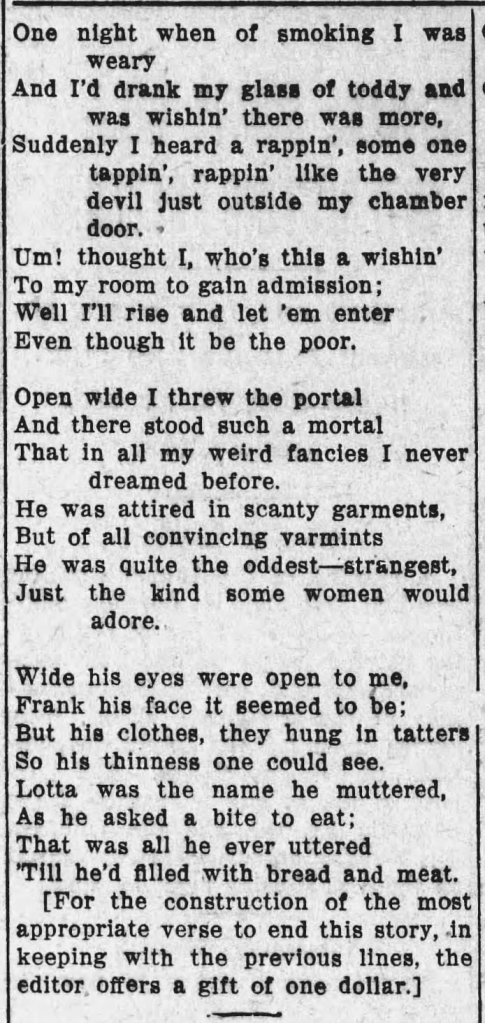
However, “The Mortal” didn’t appear full-grown from the head of some anonymous dirty poet, but appears to draw on an existing tradition of parodies of “The Raven.” The earliest relevant version I’ve found is an untitled parody by Edward Cowles from 1913:
This was the obvious inspiration for a bit of verse titled “Raving”or “The Raving” from 1918:
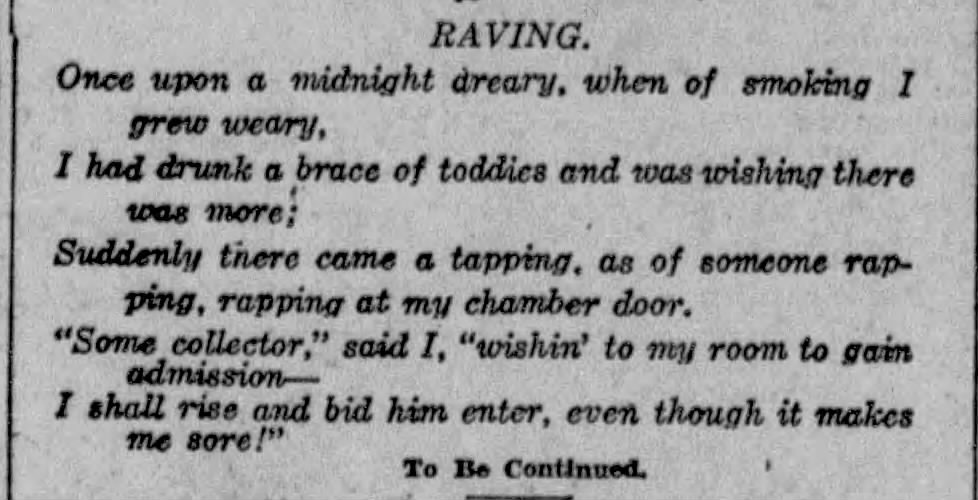
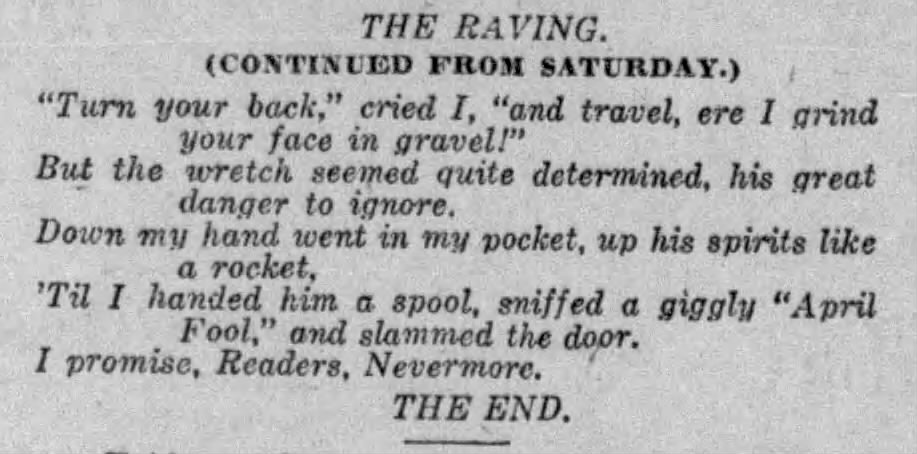
Both of these have some distinct parallels in language and theme with the opening to “The Mortal,” especially the rhyme “[…] a wishin’ | To my room to gain admission,” which would become characteristic of “The Mortal” and subsequent poems. The repeated language points to a wider family of parodies of “The Raven” that were current in the 1910s and 20s, of which “The Mortal” and its descendants are a subset. For example, “A Big Time in Norfolk” by E.F.S. begins:
“Once upon an evening dreary, When of smoking I was weary, Got me out and—”
—The Transmitter (Mar 1921) 17
And an unsigned bit of newspaper verse from 1922:
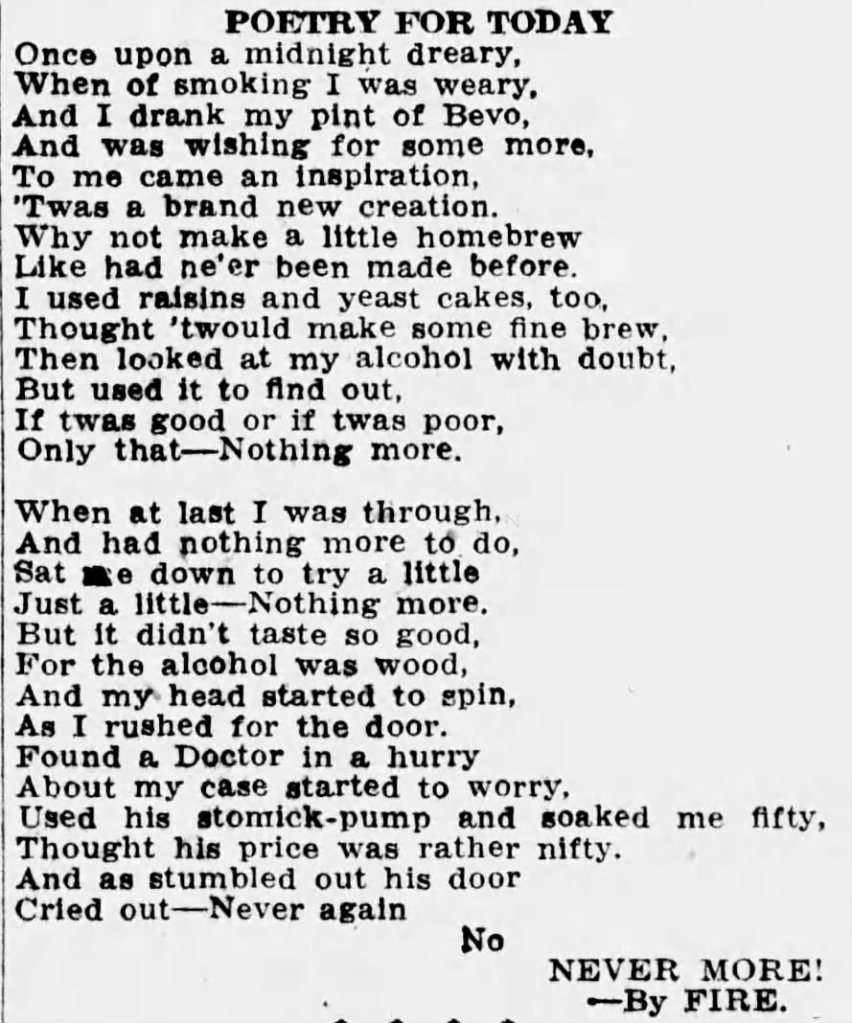
(There is a seperate tradition of temperance poems parodying “The Raven”; see also “Your Health” (1935) by C. M. Young).
In the way different groups of kids had slightly different lyrics to “Jingle bells, Batman smells…” This collection of related verses presents an interesting opportunity to compare and contrast how a dirty poem evolved over time. Four iterations of “The Mortal” are presented here, since they all appear to be in the public domain:
Each publication formatted the poem differently, not trying to parody the full poem or all of its attributes, but invoking its rhyme scheme and specific lines and imagery. While it is tempting to try and squeeze these into a format closer to Poe’s original stanzas, the changes to the rhyme scheme and meter make that difficult. So these are mostly formatted in a way that eases direct comparison of the texts.
The Mortal (1927)
Once upon a midnight dreary,
When of smoking I was weary,
And had drunk up all my whisky
Only wishing there was more;
Suddenly there came a rapping
As of some fair female tapping
Tapping at my chamber door.
’Tis some chippy that’s a-wishin’
To my room to gain admission.
Well, I’ll rise and let her enter,
Enter though she be a whore,
Only that, and nothing more.
So I opened wide the portal,
And there stood such a mortal
As in all my living moments,
I had never seen before.
She had lost her upper garments,
And of all seductive varmints,
She was sure the warmest baby
Mortal woman ever bore;
And each palpitating bubby
Was so round and firm and chubby,
That my spirits rose within me,
Just my spirits, nothing more.
’Twas the fourteenth of December;
But more clearly I remember
When I woke up in the morning
Of December twenty-four—
Sequel of ten days before.
All that’s left of what passed between us
Is one poor infected penis;
Drooping, red and retrospective,
Penitent, and very sore;
And that penis still is dripping,
Every morning, every evening,
Dripping on the bathroom floor.
And I murmur vows forgotten
Every time I change the cotton.
No more tapping, no more rapping,
No, never, nevermore.
“Chippy” is late 19th-century slang for a promisculous woman or sex worker. It’s notable that the action takes place in December, which is in line with “The Raven” being set in “the bleak December,” and there is a sly working of the dates so that the sexually transmitted infection is apparently on the 24th—an unhappy Christmas present! The painful drip is largely associated with gonorrhea.
†
Raven (1928)
Once upon a Midnight dreary
When of smoking I was weary
And I’d drank my pint of whisky
And was wishing there was more.
Suddenly there came a tapping,
Sounding like a female rapping,
Rapping like the very Devil,
Just without my chamber door.
’Tis some chip thought I that’s wishing
To my room to gain admission,
Well I’ll rise and let her enter,
Even if she be a whore,
Only this and nothing more
Then I opened wide the portal,
And there stood such a mortal,
As in all my wildest fancies,
I had never seen before.
She had lost her upper garments,
And of all seductive varmints
She surely was the warmest baby
That woman ever bore.
And each palpitating bubby
Was so smooth and firm and chubby.
That my spirits rose within me,
As I went to close the door,
Just my spirits—nothing more.
And distinctly I remember,
’Twas the 14th of September,
’Twas the 15th when she left me,
When our little dream was o’er.
It was a dream without a sleeping,
With sad reproach and weeping,
She showed me some red spots,
Made she told me by her hymen’s gore.
Aye, the 14th of September
But more clearly I remember,
What I found upon the morning of Sept. 24.
Sequel to ten days before,
All that’s left of what passed between us,
Is one infected penis,
Drooping, sad and retrospective,
Penitent and very sore.
And that penis never skipping,
Every morning, Dripping, Dripping,
Still is dripping, still is dripping.
Dripping on the bath room floor.
And I murmur vows forgotten,
Every time I change the cotton,
No more rapping, no more tapping,
Not for Uncle—never more.
Source: The Book of a Thousand Laughs (1928) 38
This version of the poem is more explicit in what it’s parodying by a change of title, but also makes several notable changes. The scene is moved from December to September, which is probably an error, since September, November, and December all fit the rhyme scheme. The woman “showed me some red spots, Made she told me by her hymen’s gore”—but as she was a sex worker and he caught a disease, this is more likely a reference to chlamydia, a sexually transmitted infection that can cause bleeding between periods.
The last line “Not for Uncle” is likely a bit of 1930s slang where “your Uncle” was used for “myself.” So the understood meaning would be “Not for me.”
‡
The Raven (1933)
Once upon a midnight dreary
When of smoking I was weary,
And had drunk up all my whiskey,
Only wishing there was more;
Just as I was lightly napping,
Suddenly there came a rapping
As of some fair female tapping,
Tapping at my chamber door;
“Tis some chippy that’s awishin?
То my room to gain admission;
Well, I’ll rise and let her enter,
Enter tho’ she be a whore,
Only that and nothing more.
So I opened wide the portal
And there stood such a mortal
As in all my living moments
I had never seen before.
She had lost her upper garments,
And of all seductive varmints
She was sure the warmest baby
Mortal woman ever bore;
And each palpitating bubby
Was so round and firm and chubby
That my spirits rose within me,
Just my spirits, nothing more;
Yes, my spirits; nothing more.
Source: The Wrecks (1933) 58
This is a very truncated version, with the poetic scheme greatly simplified and the infectious epilogue to the encounter completely cut out. Which is likely a result of where it was published; the booklet being much more upbeat and cheerful, a little naughty but not filthy. Interestingly, the poem likely derives more or less directly from “The Mortal,” since the language is much closer to that than to “Raven” (1928).
⹋
The Raven Maniac (1945)
Once upon a midnight dreary,
When of smoking I was weary,
And had drank my pint of whiskey,
And was wishing there was more;
Suddenly there came a tapping,
Sounded like a female rapping,
Rapping like the very devil,
Just outside my chamber door.
’Tis some chippy that’s a’ wishing
To my room to gain admission,
Well, I’ll rise and let her enter,
Even though she be a whore,
Let her enter, nothing more.
So I opened wide the portal,
And there stood such a mortal,
That in all my wildest fancies,
I had never seen before;
She had lost her upper garments,
And of all seductive varmints,
She surely was the warmest baby,
That mortal woman ever bore;
And each palpitating bubbie,
Was so smooth, so round and chubbie,
That my spirits rose within me,
As I closed my chamber door,
Just my spirits, nothing more.
Oh! distinctly I remember,
’Twas the thirteenth of November,
’Twas the fourteenth when she left me,
When our little dream was o’er;
But more clearly I remember,
The nineteenth of November,
Six days later, and she said
The blood was just her Hymen’s gore,
Only blood, and nothing more.
All that’s left of what passed between us,
Is one poor infected penis
Drooping, sad and penitent,
And very VERY sore;
And that penis-never skipping
Still is dripping—STILL IS DRIPPING,
Morning, afternoon, and evening,
Dripping on the bathroom floor,
And I utter vows forgotten,
Every time I change the cotton,
No more rapping, no more tapping
Not for Uncle, NEVERMORE.
Source: Folk Poems and Ballads (1945) 55-56
If “The Raven” (1933) comes straight from “The Mortal,” then “The Raven Maniac” (1945) derives more or less directly from “Raven” (1928). Once again, the setting shifts (14/24 December→ 14/24 September→ 13/19 November), which is as likely to be an error as anything, but the sex worker still has her bleeding and her false claim of virginity. Aside from the dates, the most notable shift is an emphasis on certain words; one can easily imagine this one being read aloud to a raucous crowd.
⸸
One of my fondest childhood memories is The Simpsons’ Treehouse of Horror rendition of Edgar Allan Poe’s “The Raven” (1990). What made the segment stand out is that the poem itself is unchanged; it isn’t a parody in the sense that words are mocked or changed, but in the way the poem’s visuals are reimagined into the particular style of animation, with some added asides. It’s an expansion of the poem in the direction of humor, while retaining its core identity with longing and obsession.
“The Mortal” and its variants are a different direction; much more focused on the easily-imitable (and easily-parodyable) external elements of the poem than it is with Poe’s message. Yet to work effectively as parodies, these poems all have to retain the essential features of Poe’s “The Raven”: an individual is alone and hears a knock upon the door, and opens to find a companion for the night. The sole reminder of that fateful encounter is painful, but at the end, the individual is still alone. In a sense, this could be seen as a moral narrative—the wages of sin—but it is also a distant, mutated echo of Poe’s sentiment.
She is gone.
The narrator is alone.
With only a painful reminder of the love they shared.
And the raven, never flitting, still is sitting, still is sitting
On the pallid bust of Pallas just above my chamber door;
And his eyes have all the seeming of a demon that is dreaming,
And the lamp-light o’er him streaming throws his shadow on the floor;
And my soul from out that shadow that lies floating on the floorShall be lifted—nevermore!
—Edgar Allan Poe, “The Raven” (1845)
Bobby Derie is the author of Weird Talers: Essays on Robert E. Howard and Others and Sex and the Cthulhu Mythos.
Deep Cuts in a Lovecraftian Vein uses Amazon Associate links. As an Amazon Associate I earn from qualifying purchases.

