“Herbert West and the Mammaries of Madness” (2015) by Dixie Pinoit

I cannot bring myself to speak of it, so of course I must. It is with terror and that utmost thrill of lust-filled despair that I write of my wedding night, that night that wouldst,—for any average couple, be filled with so much innocent discovery, so much joy in the uncovering of what a lifetime of connubial bliss is meant to be.
—Dixie Pinoit, “Herbert West and the Mammaries of Madness” in Lovecraft After Dark 144

The soundtrack to this review is “Move Your Dead Bones” (2003) by Dr. Reanimator (Jordi Cubino).

Parody is one of the great underappreciated modes of Lovecraftian erotica. All of the factors that make it so easy to pastiche Lovecraft’s fiction—the emphasis on surface features of purple prose and melodrama, the tendency to riff off of existing elements of the mythology, and the emphasis on taboo topics—are easy to twist into parody, usually by exaggerating the already over-exaggerated until the emotional language becomes just absurd. Once you cross the line from serious pastiche into parody, adding sex is pretty natural, given how many parallels there are. “Forbidden literature,” for example, can apply equally well to pornography as it can to eldritch tomes like the Necronomicon:

Doris didn’t like the Necronomicon, although she considered herself an emancipated and free-thinking young woman. There was something sinister, or to be downright honest about it, perverted about that book—and not in a nice, exciting way, but in a sick and frightening way. All those strange illustrations, always with five-sided borders just like the Pentagon in Washington, but with those people inside doing all those freaky sex acts with those other creatures that weren’t people at all.
—Robert Shea & Robert Anton Wilson, The Eye in the Pyramid (1975), 93

“Herbert West—Reanimator!” has for whatever reason been an unusually prolific target for parody and pastiche, both erotic and otherwise, as shown by such diverse works as “Kanye West—Reanimator” (2015) by Joshua Chaplinsky vs. “Herburt East: Refuckinator” (2012) by Lula Lisbon, “The Wreck of the Charles Dexter Ward” (2012) by Elizabeth Bear & Sarah Monette, “Herbert West in Love” (2012) by Molly Tanzer, Re-Animator (1985) with its infamous head-giving-head scene and its various sequels, and the hardcore adult film Re-Penetrator (2004, Burning Angel). So Dixie Pinoit in “Herbert West and the Mammaries of Madness” is in good company.

As it happens, Pinoit blends a few details between Lovecraft’s original opus and the 1985 film: where Jeffrey Combs (the actor for Herbert West) is brunet, Lovecraft had West as blond in the original novella, and Pinoit has West as a blond; where Lovecraft had West’s partner as a nameless protagonist, the 1985 film gives him the name Dan Cain, so Pinoit uses Dan Cain as the name for West’s assistant. It is the kind of detail that rewards the detail-oriented Mythos enthusiast, though easy to miss when the narrative lens turns to some of the other action:

Noticing that one of Elena’s awe-inspiring breasts had somehow freed itself from its restraints, I stroked it plaintively before restoring it to what could indeed become its burial shroud unless the doctor was simply premature in his determination of death.
—Dixie Pinoit, “Herbert West and the Mammaries of Madness” in Lovecraft After Dark 145

Chekov’s corpse. There is something wonderfully straightforward about Reanimator media, in that all you really need is a body at or rapidly cooling toward room temperature for the fun to start, and there’s a great deal of fun to be had in various scenarios about how the corpse came to be and what happens when it is eventually reanimated. A great deal of Reanimator adaptations can riff on this concept pretty much nonstop, but what makes it really work is not the practice of revivifying the dead—any Frankenstein-derived or zombie story can give you the thrill of the dead coming back to life—it’s Herbert West himself, with all of his quirks and monomania, which drives the plot. A good Reanimator story is about the Reanimator as much as the reanimated.

My beloved’s corpse now stripped of the ivory lace and silk wedding dress that had once adorned her curvaceous form, stripped bare under the yellow lights to make it easier for Dr. West to inject things into her delicious upper arms while her ample breasts and small tuft of pubic hair glistened and juggled from the force of his ministrations.
—Dixie Pinoit, “Herbert West and the Mammaries of Madness” in Lovecraft After Dark 148

Readers that think they know where this is going are still in for a surprise or two; the protagonist surely was. Pinoit by this point plays a little fast and loose with the “rules” of reanimation—murderous bloodlust is out, and certain other types of lust are very much in—but the subversion of expectations, especially when transgressive and exaggerated for comedic effect, are common techniques in all parody.

Yet for all the surprises, one of the most notable is that Pinoit is obviously a fan as much as a pornographer. The nameless Lovecraftian protagonist is actually a Lovecraftian protagonist, inspired by the events of Lovecraft’s life and so the characterization—a parody of Lovecraft’s style—is really an affectionate tribute to the Old Gent himself.

Sales plummeted until the hat shop could no longer support us.

Eventually she moved away to start over. A larger town, where her curious predilections were less likely to be remarked upon amongst a larger populous, and would perhaps even be welcomed by an adventurous few.

I did not go with her.
—Dixie Pinoit, “Herbert West and the Mammaries of Madness” in Lovecraft After Dark 154

Lovecraft as the star of an erotic story might seem odd, or even off-putting at first glance, but Pinoit is far from the only one to do it; Edward Lee has used Lovecraft (or a character based on him) in several of his “Hardcore Lovecraft” novels and novellas, especially Pages Torn from a Travel Journal (2013) and Trolley No. 1852 (2010). These depictions are often exaggerated for humor as much or more than erotic value, but there is a real amount of effort put into some of these stories to embed aspect of Lovecraft’s life, style, fiction, and just plain character into the fictionalization. These are homages—and speak as much to how Lovecraft himself has become a part of his own artificial mythology.

Considering how much interest has been devoted to Lovecraft’s sex life after his death by fans and scholars alike, this aspect of his character—his sexuality and sexual experiences, real or imagined—present what might be one of the more ultimate taboos to transgress. If you as a reader are at all squicked out at the thought of H. P. Lovecraft having sex, then the author has succeeded at their goal. If you’re excited at the idea of your literary idol getting laid, then the author has also succeeded! The whole point of using a character that is such an obvious version of Lovecraft is to evoke some visceral or emotional reaction from the reader. This effect can only be achieved because of the degree of posthumous fame that Lovecraft has achieved.

While there are few people that might write the Lovecraftian equivalent to Rachel Bloom’s “Fuck Me, Ray Bradbury” (2010), the same basic idea has found expression in the Mythos. H. P. Lovecraft may be dead, but as a fictional character he can do things he never did in life; he has been in many ways reanimated himself—and the interest is not necessarily in what the literary corpse of Lovecraft does, but in why the reanimator has brought them back, and how. In many cases, like this one, it is little more than an in-joke—a nod and a wink to the dedicated Lovecraftian that found themselves coming to the end of this erotic tale—but it is also a tribute to the lasting appeal of H. P. Lovecraft as a character, that he can be inserted into a story such and expect to be recognized, without his name ever being given.

“Herbert West and the Mammaries of Madness” appeared in the erotic Cthulhu Mythos anthology Lovecraft after Dark (2015).


Bobby Derie is the author of Weird Talers: Essays on Robert E. Howard & Others (2019) and Sex and the Cthulhu Mythos (2014).
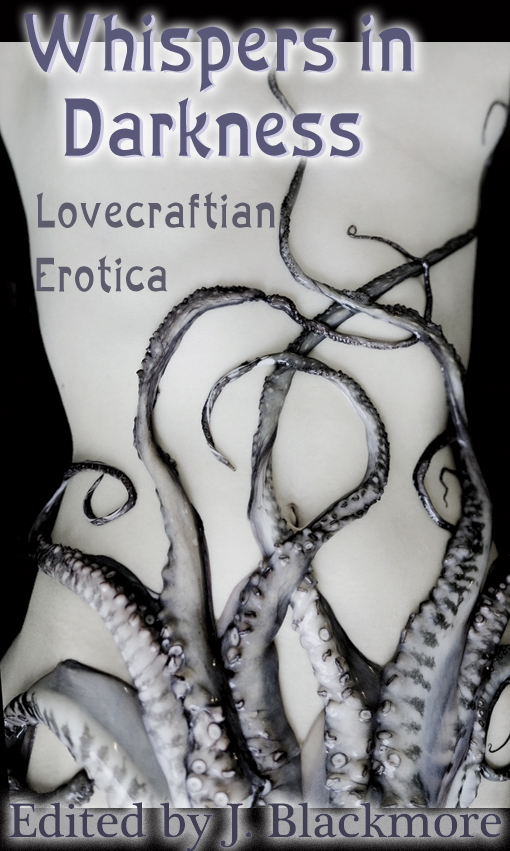
“The Artist’s Retreat” (2011) by Annabeth Leong

Eldritch Fappenings

This review deals with a work of erotic content, and the history of erotic art and writing. As part of this review, selected passages with descriptions of genitalia and/or sexually explicit contact will be included.
As such, please be advised before reading further.


Do you crave intellectual tentacle porn?
—Ad copy, Whispers in Darkness: Lovecraftian Erotica (2011)

What is “Lovecraftian erotica?” If you rule out erotic works that directly parody or refer to the stories Lovecraft wrote, such as “Herburt East: Refuckinator” (2012) by Lula Lisbon or “The Ape in Me: A Tale of Lovecraftian Lust” (2016) by Raine Roka; his creations such as Cthulhu and the Necronomicon in works like “Le Pornomicon” (2005) by Logan Kowalsky or Mother Hydra in “Pages Found Among the Effects of Miss Edith M. Teller” (2005) by Caitlín R. Kiernan; those rare erotic works that refer to or depict Lovecraft directly as a character—as in Edward Lee’s Trolley No. 1852 (2010)—then what you have left is a very vaguely defined body of erotic materials which that take more nebulous inspiration from Lovecraft’s ideas of cosmic horror and the tropes of Mythos fiction that came later, but don’t directly attempt to incorporate the man or the Mythos.

For many Lovecraftian erotic works, the tropes and set dressing are usually as far as the author cares to take things. Tentacles often make their appearance, ancient gods or eldritch entities come when summoned, sacrifices are usually less than virginal and surprisingly enthusiastic, and the whole pornographic scenario often reads like a bootleg X-rated session of the Call of Cthulhu Roleplaying Game. Lindsey Purl’s erotic triptych Tentacles of the Elder Gods (2013), which involves “Kum-Shaggurath” is an exemplar of this kind of fiction. Quality and creativity varies; few works are erotic classics, but are often packaged and sold as disposable literature. Intended as flash entertainment, they answer to a momentary need, often as part of a brief zeitgeist, and then quickly sink out of sight into online back catalogs or other form of obscurity.

Then you have works like Annabeth Leong’s “The Artist’s Retreat.”

The dreams were confused and irresolute, but there was nothing vague about the position in which I work. I snatched my hand from where it lay nestled between my legs and tried to ignore the throbbing there. Sweat soaked the pillows and bed beneath me, and the sheets were tangled around my legs as if I’d been rolling from one side of the bed to the other all night. Sometime, I’d managed to yank my nightshirt up and off one arm, leaving one breast free to the chill air of my dark and silent room. Shivering, I pulled the garment down and fathered my blankets more tightly around me.
—Annabeth Leong, “The Artist’s Retreat” in Whispers in Darkness: Lovecraftian Erotica (2011)

The distinction between “The Artist’s Retreat” and any other work of Lovecraftian fiction, like say “From the Cold Dark Sea” (2016) by Storm Constantine, is one of degree rather than kind. Leong’s work is in an anthology of erotic Lovecraftian fiction, and the erotic element appears early and grows more intense throughout; it is a central part of the plot, where in most other Lovecraftian works sex is usually not the primary focus of the narrative lens. That aside, the work is really nothing less than an original story that draws obvious inspiration from Lovecraft and the Mythos without feeling the need to directly invoke or squeeze itself into the framework of the Mythos.

The distinction shifts the reader’s focus from looking for tie-ins or how the story might into the bigger picture of Mythos lore and instead the reader might begin to see “The Artist’s Retreat” as something that fits into Lovecraft’s milieu, and pursues some of his themes, yet in a way that Lovecraft and most of his co-creators in the Mythos would never have put together. There are the same-gender heterosexual friends, one of them an artist; very much a Lovecraftian pairing…until they become something more. There is the setting, in a rural Massachusetts that Lovecraft might find familiar, but not in any named and denoted part of his Lovecraft Country. There is the tricky distinction of that thing, seen and unseeable, which invokes Lovecraft’s “The Colour Out of Space,” Guy de Maupassant’s “The Horla,” Ambrose Bierce’s “The Damned” thing…yet what it does under Leong’s direction is nothing like what any of those authors would have their creations do.

“The Artist’s Retreat” is, after all, Lovecraftian erotica.

Many writers appear to find it difficult to pursue both weird and erotic themes simultaneously. Lovecraft in “Supernatural Horror in Literature” emphasized:

The one test of the really weird is simply this—whether or not there be excited in the reader a profound sense of dread, and of contact with unknown spheres and powers; a subtle attitude of awed listening, as if for the beating of black wings or the scratching of outside shapes and entities on the known universe’s utmost rim. And of course, the more completely and unifiedly a story conveys this atmosphere, the better it is as a work of art in the given medium.

It is a rare story that can both scary and erotic; that can work that atmosphere of the sense of outside contact with the intensely grounded sensations of physical eroticism. Not impossible, because for all their differences, there are points of commonality: the sense of heightened awareness brought about by sexual arousal and the fear-response, the titillation and excitement when it comes to approaching and then violating some taboo, the psychological impact and physical consequences that may result from such sudden violations, with all their long-term ramifications…these are the building blocks of erotic horror, as shown in works like Ramsey Campbell’s “The Faces at Pine Dunes” (1980) and his exquisite novel The Darkest Part of the Woods (2003).

Part of what makes “The Artist’s Retreat” successful is the atmosphere. The pacing is steady, but takes its time setting up each scene, providing small climaxes for each chapter, letting the protagonist Edie sink deeper and deeper into the mystery and the renewed friendship with her painter friend Olivia. there aren’t any huge surprises; the plot might almost be called formulaic in how the Lovecraftian protagonist is compelled to leave their familiar surrounds for an isolated local, where they sink into strangeness—it worked for Lovecraft in “The Festival,” and it worked for Silvia Moreno-Garcia in Mexican Gothic (2020), and it works for Annabeth Leong here. There is absolutely nothing wrong with playing a familiar plot straight, so long as it is done well…and it helps that the weird parts are refreshingly weird, not just a priapic Cthulhu.

The cryptic images did not depict any shaps or beings I know—still, they stirred me. I got to my knees beside Olivia, and together we explored the contours of the boulder. I could not piece together an overall image of the design. Neither could I decode any individual piece. But the longer I ran my fingers over it, and the longer I knelt beside her and stared, the more I began to see flashes of meaning. Two coiled appendages, wound around each other and rubbing their undersides together obscenely; what could have been a thousand tiny fingers caressing a swollen, monolithic shaft; a long and muscular tongue, curved into a suggestive question.
—Annabeth Leong, “The Artist’s Retreat” in Whispers in Darkness: Lovecraftian Erotica (2011)

Leong’s story fits well into an anthology of Lovecraftian erotica, but it could fit just as well into a mainstream Lovecraftian anthology. Nothing of the weird atmosphere is sacrificed for the erotic, and nothing of the erotic is sacrificed for the weird. They work together, hand in hand, and while they echo the ways sex was used as an entry point for beings from outside in Lovecraft’s fiction—think of “The Dunwich Horror”—the way that it works is ultimately original, fresh, and well done.

“The Artist’s Retreat” by Annabeth Leong was published in Whispers in Darkness: Lovecraftian Erotica (2011) by Circlet Press. Her other Lovecraftian works include “Our Child” in Conqueror Womb: Lusty Tales of Shub-Niggurath (2014) by Martian Migraine Press.


Bobby Derie is the author of Weird Talers: Essays on Robert E. Howard & Others (2019) and Sex and the Cthulhu Mythos (2014).
“Under the Keeper of the Key” (2015) by Jaap Boekestein

Eldritch Fappenings

This review deals with a work of erotic content, and the history of erotic art and writing. As part of this review, selected passages with descriptions of genitalia and/or sexually explicit contact will be included.
As such, please be advised before reading further.


I have never read the famous “Justine” of de Sade, or the equally famous “Venus in Furs” of von Masoch. Both are undoubtedly significant in the history of psychology, though perhaps less so as works of art. Probably they can be obtained at any time from dealers in so-called “curiosa” like the Falstaff Press or Esoterika Biblion of New York.
—H. P. Lovecraft to Lee McBride White, 12 Sep 1932, Letters to J. Vernon Shea, &c. 353-354

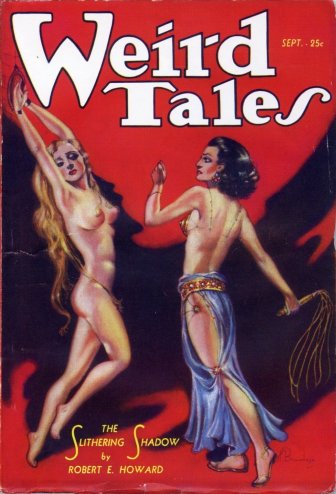
The term BDSM (Bondage Domination Sadism Masochism) did not exist when Lovecraft was writing his Mythos, though he would have recognized parts of it from his cursory knowledge of psychology and sexology, and would have been familiar with aspects of its depiction in pulp magazines—Weird Tales among other pulps included vivid scenes of men and women being bound, whipped, and tortured, or forced into subservience, sometimes in a sexual manner (though never explicitly). Indeed, Robert E. Howard’s early Mythos fiction such as “The Black Stone” (1931) contain scenes of flagellation (for more on which, check out Charles Hoffmann’s “Elements of Sadomasochism in the Fiction and Poetry of Robert E. Howard”).

Brundage-WT-Slithering-ShadowThis early influence of BDSM literature on Howard’s Mythos tales is part of a complicated collision of censorship, psychology, and economics. Sadomasochism and physical punishment were commonly understood as psychological deviations rather than sexual kinks, since the acts themselves were adjacent to sex, but didn’t necessarily include intercourse or masturbation. As such, works which presented themselves medical, legal, anthropological, or historical treatises could sometimes pass censors—Robert E. Howard had a small library of such volumes—and more importantly for pulp publishers, meant that they could be more freely advertised in magazines, and that dramatized aspects of these practices could add some sexual titillation to encourage sales. This in turn encouraged some pulp writers to work such elements into their stories; including Weird Tales favorites like Seabury Quinn and Robert E. Howard, who vied for cover art by Margaret Brundage for their stories.

These early BDSM-inflected pulp stories should be understood as fantasy, strongly influenced by erroneous understandings of sexuality, gender, and relationships, not a reflection of real-life practice. This can be clearly seen in, among other things, Robert E. Howard’s complicated depiction of lesbianism in his fiction. The whole stereotype of the “sadistic” villain may not owe itself to the pulps, but the pulps definitely helped build and promote such stereotypes. It would take considerable time for the “scene” to build up, and for knowledge and philosophy of BDSM as a safe, consensual adult activity to become more open, established, and move away from the stark depictions of utter depravity showcased in pulp fiction.

As understanding of sexual kinks has spread and grown in acceptance in society at large, that understanding has rarely fed back into Cthulhu Mythos fiction. While there are occasional characters that engage in obviously sadistic or masochistic practices, and bondage in various forms has never gone out of fashion, BDSM is rarely a key feature of Mythos fiction, especially BDSM of the consensual sexual activity between adults variety. For example, in the Delta Green roleplaying game (an offspring of the Call of Cthulhu Roleplaying Game), the Shan (Insects from Shaggai) that originated in the fiction of Ramsey Campbell display masochistic tendencies when they take a host. Another notable example is “Necrophallus” by Makino Osamu (牧野修), which focuses on the sadistic element and body horror as its primary theme—again, emphasizing the deliberate fantasy rather than consensual bloodplay or body modification play.

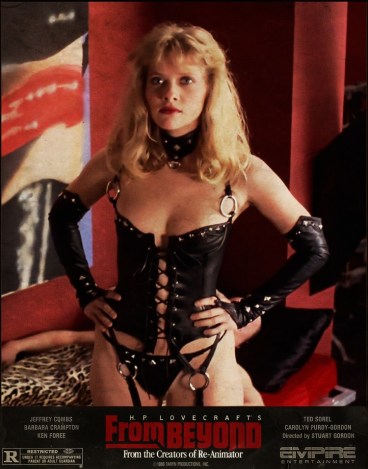
Compton_FromBeyondOne of the most interesting overt uses of BDSM themes and imagery in a Lovecraftian work is the film adaptation of From Beyond (1986), which occupies an interesting middle ground between pulp sadism and consensual BDSM practice. BDSM equipment and imagery is used both to show the character’s increasing desire for more intense experiences, and the sado-masochistic depths that the villainous Dr. Pretorius had descended to in the search for some new sensation.
Weird as it might be to think about, erotic Mythos fiction and pornographic materials also rarely broach BDSM territory, especially consensual activity. While it is relatively common to have a sacrifice to Yog-Sothoth or Cthulhu tied up so that the Mythos entity can sexually assault them, it is much rarer to see ropeplay, or the “sacrifice” an elaborate sexual roleplaying scenario featuring consenting adults.

There are several reasons why might we don’t see more a more elaborate BDSM Mythos. For one, it’s kink-stacking; the subset of your audience that enjoys both BDSM and Lovecraftian erotica is likely going to be smaller than the audience that enjoys both separately. For another, the intensely personal relationships between the players in a BDSM scenario—especially a consensual one—can be difficult to square with the often very impersonal nature of Lovecraftian horrors. While Cthulhu might bind you with its mighty tentacles, it’s not clear that Cthulhu is getting off on the act. Yet there are a couple of stories which tread this rare territory and do interesting things with it.

“Sub-space,” said Machteld. “Pain is a key that can open doors. It begins with fear, followed by anger, resistance, resignation, and finally surrender. Deeper and deeper down into the warm red sea until you reach the core Down there are no desires, no thoughts, just the primal void. In that place the universe is waiting, a blank slate, ready to be filled with its latent destiny. And there the worthy will find the answers they seek.”
—Jaap Boekestein, “Under the Keeper of the Key” in Lovecraft after Dark 17

The idea of achieving a different state of consciousness is an old one in magical and religious practice. Some choose to use drugs, and drug-fiction is a staple of early fantasy and weird fiction, including H. P. Lovecraft’s “Ex Oblivione” and Clark Ashton Smith’s “The Hashish Eater.” Other methods might include fasting, chanting, drumming, and dancing; in “The Case of Charles Dexter Ward” Lovecraft wrote:

For the fright and fainting of his mother he expressed the keenest contrition, and explained that the conversation later heard was part of an elaborate symbolism designed to create a certain mental atmosphere.

There are parallels in Lovecraftian occultism too; Donald Tyson in Grimoire of the Necronomicon parrots Aleister Crowley’s rite of eroto-comatose lucidity, where the altered state of consciousness is achieved by excessive sexual activity:

On the day prior to the attempt to open the Gate of the East upon the path to the black throne, the follower of this way should rely on the aid of a partner to sustain his arousal without interruption continuously. This can be done with the aid of caresses, embraces, erotic art, sensual music, incense, sensual baths, and oils for the skin. If necessary, the aspirant may sustain his own arousal, but this is more difficult as it divides concentration. Always the image of Shub-Niggurath should be held in the imagination, but in a form of the goddess that is attractive and seductive to the aspirant for her favor. Female disciples will choose to conceive her in her masculine aspect, unless they favor the love of women. (148)

Richard Gavin in his entry for The Starry Wisdom Library outlined another such procedure:

The method employed to accomplish this was a ritual entitled “Alimenting the Ghul (or Ghoules).” In preparation for this ritual, the aspirant would neither sleep nor consume food for three days, all the while conducting a repetitive series of darkly meditative chants while sitting cross-legged within a “place of death,” presumably a mausoleum, a catacomb, or other large tomb. At the conclusion of the three-day preparation period, the aspirant’s naked body would be rubbed with various salves before he was wrapped in a funerary shroud and buried alive within a coffin made of oak. (127)

Scott R. Jones wrote in When The Stars Are Right: Towards An Authentic R’lyehian Spirituality: 

The Black Gnosis may be triggered in the moment of orgasm, or at any moment during the sexual act (or indeed at any moment at all, sexual or otherwise) by allowing the Being-Strangeness of the act itself manifest fully in the consciousness. This awareness is brought forth through a meditation on fear. (108)

There are other examples, different paths. Different authors working at different purposes to express similar ideas: that there are different states of consciousness, that can be arrived at through various means (which may resemble magic, or sex), and which unlock…something for the individual. Sometimes a particular occult knowledge, in others a transformation of self. All of which has its clear parallels with BDSM as it is understood in the contemporary consciousness.

You don’t need to build a dungeon, elaborate set-pieces of torture devices, and a wardrobe of latex and leather gear to have a little bondage fun, or to engage in some hearty spanking. Domination is an attitude and game that need not be confined to a bedroom. While we often get fixated on the outward trappings of BDSM play, there is a deeper psychology at work. Sexual submissives in the BDSM scene are not psychologically stunted or damaged individuals who are dominated by more powerful personalities, they are fully conscious human beings who feel the need to submit, and derive something from the act—or ritual—of submission.

Which is not as easy as it sounds. Yet subspace is the essential bridge that Jaap Boekestein uses to connect BDSM to the Cthulhu Mythos. Where Robert E. Howard and the From Beyond film were using the striking imagery of flagellation, and BDSM’s props and costumes to titillate the reader or viewer, Boekestein goes into the psychology of the individual that would willing subject themselves to such rites as Robert E. Howard described in “The Black Stone”—and very specifically, why someone seeking out the Cthulhu Mythos might do this.

The whip hit the exact same spot. A groan escaped his lips, bright flames shot through his leg. Is this an initiation or sadistic torture? What has this to do with the secrets of the ancients?

Whap. Whap.

She kept hitting Without mercy, Machteld thrashed him. He could not see anything but he felt her moving around, hitting his chest, his stomach, his cock. Burning strokes of pain as she hit him everywhere. Nothing was safe. Nothing was sacred.
—Jaap Boekestein, “Under the Keeper of the Key” in Lovecraft after Dark 21

It is a process that the reader themselves goes through with the protagonist. His questions are their questions, but in the end…well, a vicarious flagellation session will never equal the real experience. The result will be familiar to many readers of the Mythos; Lovecraft wrote about another protagonist who achieved the same state, albeit through a different path. Boekestein wrote about this:

What kind of people, I wondered, wouldn’t have much of a problem with the Mythos Universe? People who were different from the norm, was my conclusion. People who perceived reality differently. “Transformation is the key. Transformation of both the body and the mind.” If you live in a non-mundane world, you don’t feel mundane fears. The monsters might even welcome you in as one of their own.
—Jaap Boekestein, “Afterword” in Cyäegha #8 (Spring 2013)

Many of the people that read and write the Cthulhu Mythos identify as outsiders. Weird fiction attracts weird people. Those with an interest or affinity in BDSM are outsiders too. While the communities are separate, there are individuals who have a foot in both worlds…and for those who have such an inclination, maybe they will be happy to know that they too can trace their roots back to the beginnings of the Mythos.

Jaap Boekestein is a Dutch writer who has written several Mythos stories, which have been published in English and Dutch, and editor of Waen Sinne and Wonderwaan. Some of his Mythos fiction appeared under the pseudonym Claudia van Arkel. “Under the Keeper of the Key” appeared in the erotic Cthulhu Mythos anthology Lovecraft after Dark (2015).


Bobby Derie is the author of Weird Talers: Essays on Robert E. Howard & Others (2019) and Sex and the Cthulhu Mythos (2014).

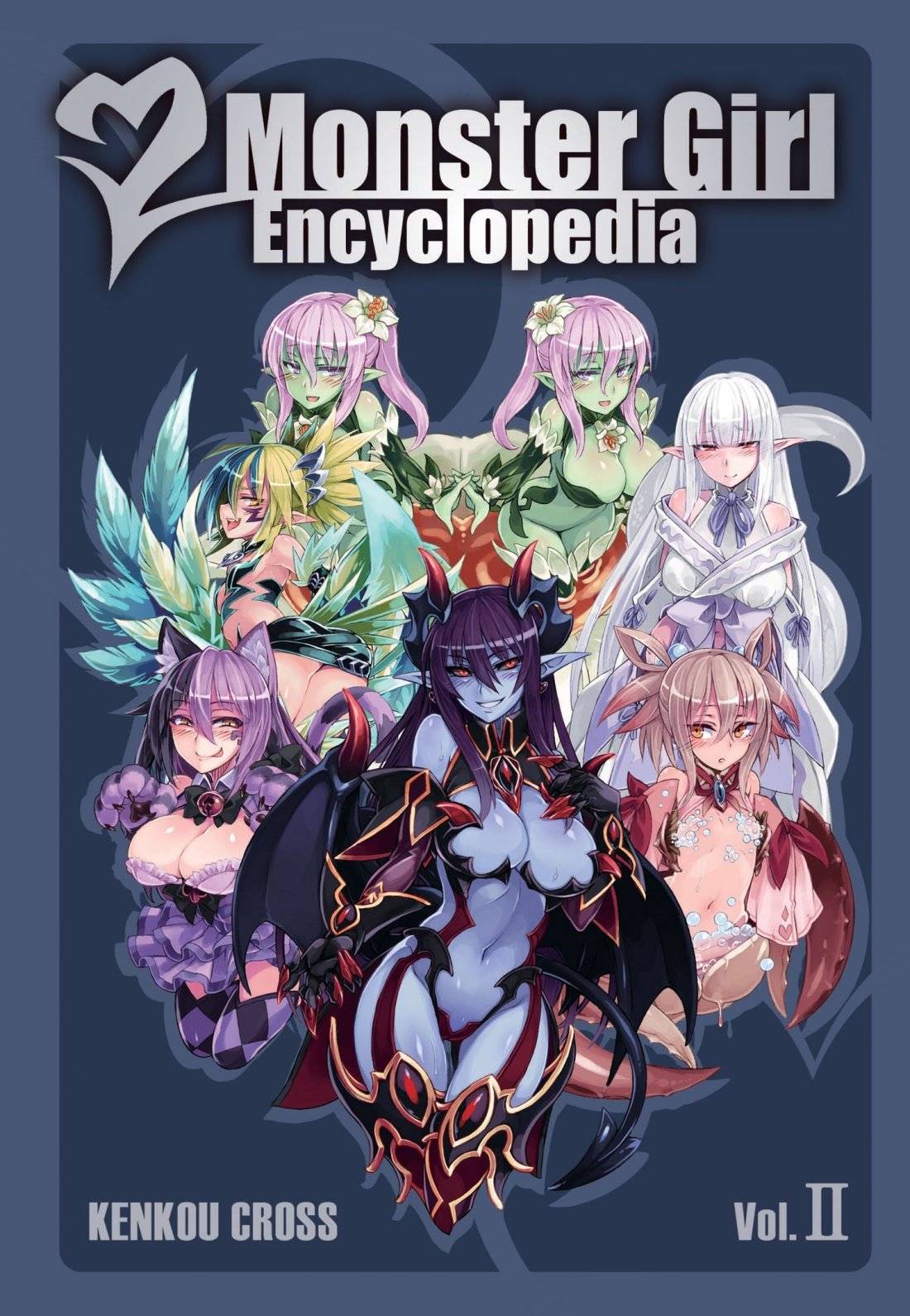
Monster Girl Encyclopedia II (2016) by Kenkou Cross (健康クロス)

Eldritch Fappenings

This review deals with a work of erotic content, and the history of erotic art and writing. As part of this review, selected art displaying cartoon nudity will be included.
As such, please be advised before reading further.


Monsters once were ghastly beasts that devoured the flesh and blood of human beings. However, since the ascension of the new Overlord, a succubus with godlike power, monsters have taken on utterly different, bewitching, and fantastic forms resembling those of alluring women. These outward changes have been accompanied by dramatic shifts in their ways of life, patterns of behavior, and values.
—foreword to Monster Girl Encyclopedia Vol. II

The Monster Girl Encyclopedia (魔物娘図鑑, 2015) by Kenkou Cross (健康クロス) is a variation on the popular pseudobiblia bestiary genre. In the Dungeons & Dragons-inspired fantasy setting that Kenkou Cross has created, a succubus has risen to the position of evil Overlord, and turned all the monsters into, essentially, nubile female forms obsessed with sex. The second volume in the series (魔物娘図鑑 II, 2016) has introduced some Mythos-related entities including the shoggoth, and the series has gone on to generate a good deal of fanfiction, dōjinshi (同人誌, fan-created artwork, comics, etc.) and expanded media, which varies from the sedate to the outright pornographic…and these two works have been translated into English by DK with “English Adaptation” by Harriet Fray.

To really understand and appreciate what Kenkou Cross has done, we have to look at how they got here.

Dungeons & Dragons was published in 1974, a collaboration between Gary Gygax and Dave Arneson and published by TSR, Inc. The original boxed set included a Monsters & Treasure booklet which had brief descriptions of and rules for iconic fantasy monsters—and these were, for the most part, taken from generic fantasy (The Hobbit and The Lord of the Rings, Greek mythology, the 1,001 Nights, etc.); there weren’t much in the way of “original” monsters. In 1977 a revised and expanded edition of the game was published which included a much expanded Monster Manual, which included not only more monsters and illustrations on the monsters, but details on their culture, life, habits, etc. These were still pretty scanty, but from this humble beginning nearly every other roleplaying game has developed their own bestiary or critter compendium. In 1980, TSR Inc. published Deities & Demigods by Jim Ward, which included the first published bestiary of the Cthulhu Mythos.

1-a97fbbd69f

This led to a little kerfuffle; the author had gotten permission from Arkham House to use the Mythos in the book, but Arkham House had also just granted a license to Chaosium, Inc. to develop a roleplaying game based on the Mythos, and they were also developing an RPG based on the Elric stories of Michael Moorcock (who had done basically the same thing as Arkham House). No harm was done, and in the book’s third printing TSR Inc. dropped the two sections with a brief notice.

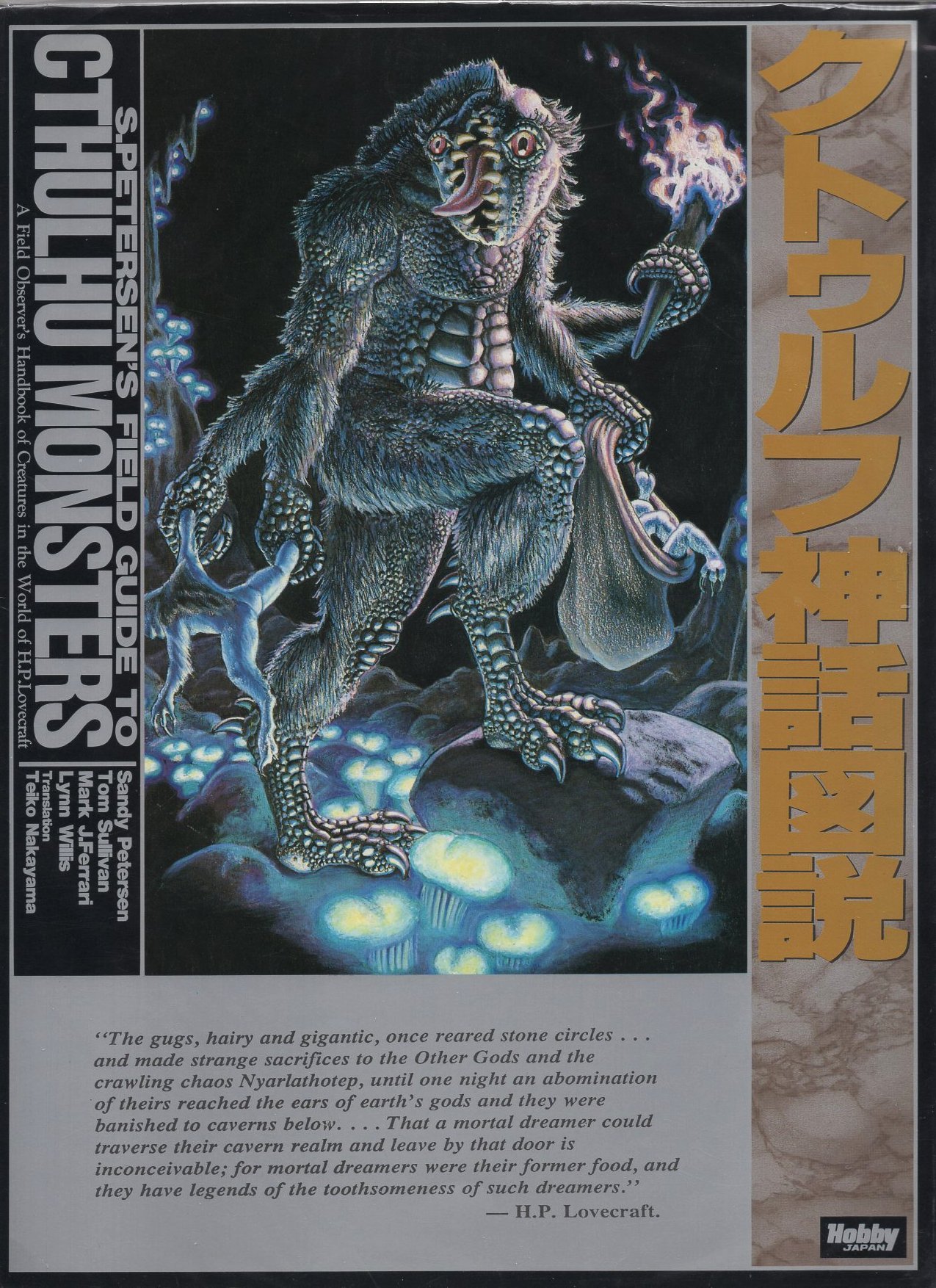
Chaosium, Inc. itself would take a different approach to its monsters. Efforts to categorize the entities in the Mythos dated back to the 1930s efforts of R. H. Barlow and the 1940s efforts of August Derleth and F. T. Laney, whose critical essay “The Cthulhu Mythos: A Glossary” was published in Beyond the Wall of Sleep (1943, Arkham House). So while the new Call of Cthulhu Roleplaying Game (1981, Chaosium, Inc.) did contain a very Dungeons & Dragons-style bestiary section in the main roleplaying book, it also produced a pair of very novel products that were different than anything TSR, Inc. had done to that point: S. Petersen’s Field Guide to Cthulhu Monsters: A Field Observer’s Handbook of Preternatural Entities (1988) and S. Petersen’s Field Guide to Creatures of the Dreamlands (1989).

These were lavishly illustrated books which hewed closer to Barlowe’s Guide to Extraterrestrials (1987) in design and format than the “standard” roleplaying game bestiary, providing lavish full illustrations for each monster in forms that would go on to be iconic, and solely dedicated to the identification, habits, culture, etc. of the various entities within, instead of game stats. All the stats for these creatures were in the Call of Cthulhu Roleplaying Game book itself, and the books have become so iconic that the latest (7th) edition of the game has produced a brand new version, S. Petersen’s Field Guide to Lovecraftian Horrors (2016).

81QwaubiTNL

The Call of Cthulhu Roleplaying Game was not just released in English, however. It was translated into several languages, including Japanese—and the game proved to be a major hit in Japan. More products were translated, including the ’88 and ’89 S. Petersen’s Field Guides (a combined edition was published by Hobby Japan in 1994), and the company and fans in Japan began to produce original material for the game, both official and unofficial—dōjinshi.

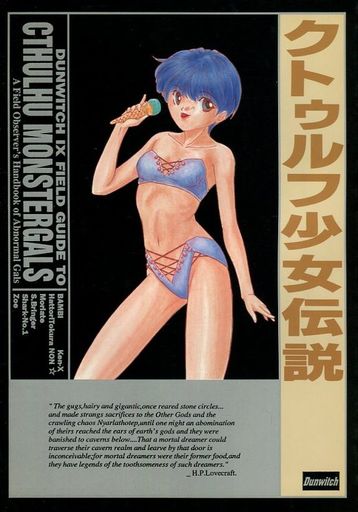
One of these dōjinshi products was the Dunwitch IX Field Guide to Cthulhu Monstergals. This was essentially a fan-created spoof of the S. Petersen guides, right down to the format, except that the familiar Cthulhu Mythos entities were replaced by monster girl versions of themselves.

1263599

Monster girls are a Japanese cultural phenomenon where a normally frightening monster is replaced with a moe (萌え) version of itself; moe being a term that designates a feeling of strong affection and cuteness, and is often combined with non-anthromorphic entities or concepts to create a (typically) young and attractive female character to personify the normally unrelateable. The juxtaposition might be near-sacrilegious to folks that like to keep the Mythos scary, but should be understood as a product of Japanese fan interpretation, all in good fun. Monster girls have been the focus of “monster girlfriend” manga and anime, including “The Elder Sister-like One, Vol. 1” (2016) by Pochi Iida (飯田ぽち。)…and the Monster Girl Encyclopedia which was published in 2015.

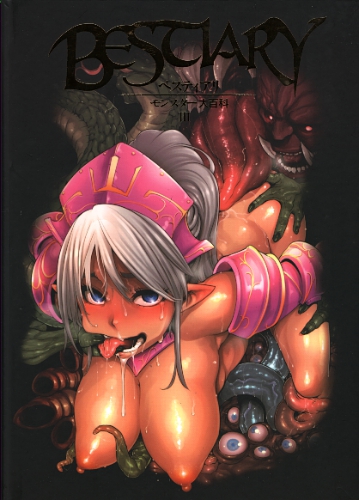
Sometimes, artists go beyond the bounds of “cute” and clean, relatively innocent and positive sexual attraction implied by moe and venture into actual hardcore erotic artwork and writing. This twist often makes the cute girls the victims of the now much more traditionally monstrous monsters. An example of this is Shindo L (新堂 エル)’s Bestiary series which so far as three volumes (2011-2015); the third volume includes a section on the Deep Ones, who in Shindo L’s setting are quite literally rapacious towards human women.

2113850

Which brings us back to Kenkou Cross and the Monster Girl Encyclopedia. This book is not a roleplaying game product, although it is derived from and uses some of the same tropes. There is no game system specified, no statistics or mechanics for the monsters like in Dungeons & Dragons. Instead, it is purely a pseudo-literary production, an “in-character” scholarly manuscript from the setting that the monster girls are from, much like the S. Petersen’s guidebooks. Aside from the artwork, which is generally PG-13 (bare female breasts, but no genitalia), the text itself shows a lot of thought and effort that has gone into the monsters, how the change to be part-succubi has effected them, feeding and mating habits (basically the same thing in this case), etc.

The Lovecraftian references are few, and include the iconic D&D monster the Mindflayer, the Wendigo (loosely connected to August Derleth’s interpretation of Ithaqua), the spider-creature Atlach-Nacha (created by Clark Ashton Smith, already the focus of a Japanese game and associated media) and most especially the Shoggoth.

Shoggoth

The interesting thing about the Shoggoth entry is that Kenkou Cross has reinterpreted their position as “servitors” to the Elder Things in At the Mountains of Madness to coincide with the Japanese pop-culture archetype of the maid—in particular, the conception of the “French Maid” outfit popularized in Victorian and Edwardian fiction (and associated pornography) and the act of being subservient in a sense that approaches (and sometimes sublimates into) domination-subjugation fantasies. “Maid-play” need not be violent, as the position can hold a great potential for sexual subtext and power fantasies without crossing the line into rape, but the formal nature of the attire and the potential power imbalance makes maids, butlers, etc. popular characters in Japanese anime and manga.

Shoggoths are slime monsters with amorphous bodies. They were created long ago to serve monsters of the untold nether reaches, but upon acquiring intelligence and emotion with the rise of the current Overlord, they are thought to have fled their once-masters.
—foreword to Monster Girl Encyclopedia Vol. II, 167 

Which makes the Monster Girl Encyclopedia incarnation of the Shoggoth both somewhat kinky, and probably the most sex-positive possible spin on the original source material, is that the (now female) Shoggoth feels the need to fulfill this position, but is not actually enslaved and still holds a great deal of power in the relationship, which is basically entered into of their own will (although the Overlord’s influence certainly gives them a push). Needless to say, the various authors of Monster Girl Encyclopedia-derived dōjinshi take whatever tack fits the needs of their particular work, ranging from the benign monster girlfriend romantic comedy to explicit erotica (within the limits of Japanese censorship laws, for works produced in Japan).

Kenkou Cross doesn’t delve deep into the Mythos in this volume; the Lovecraftian entities are hinted at being separate from many of the other monsters under the Overlord’s direct control, but Cthulhu and Shub-Niggurath are not named explicitly. In much the same way, Dungeons & Dragons has largely eschewed using the Lovecraft Mythos directly since Deities & Demigods (1981), although they have Lovecraftian critters in the form of mindflayers, aboleths, and other “aberrations.” Much of the Monster Girl Encyclopedia world remains a very vague fantasy kitchen sink; quasi-medieval in the Dungeons & Dragons manner with adventurers, quests, etc. It is testament to the wide and pervasive influence of Western (particularly British and American) on Japanese contemporary pop culture.

It might be difficult for some Mythos fans to think of shoggoths as basically sex-obsessed slime-girl maids, but that’s where the route of transmission, derivation, and development sort of become important. Because Kenkou Cross’ interpretation of the Shoggoths, for their setting, is really no different or less than any other interpretation of the Lovecraftian entity, from Robert Bloch’s “Notebook Found In A Deserted House” (1951) to “Shoggoths in Bloom” (2008) by Elizabeth Bear. And the MGE version of shoggoths is not restricted to Japan, but has filtered back into English through translation and derivation. 

Monster Girl Encyclopedia II (魔物娘図鑑 II) by Kenkou Cross (健康クロス) was first published in 2016; it was translated and published in English by Seven Seas in 2016.


Bobby Derie is the author of Weird Talers: Essays on Robert E. Howard & Others (2019) and Sex and the Cthulhu Mythos (2014).

“The Flower of Innsmouth” (2011) by Monique Poirier

Eldritch Fappenings

This review deals with a work of erotic content, and the history of erotic art and writing. As part of this review, selected passages with descriptions of genitalia and/or sexually explicit contact will be included.
As such, please be advised before reading further.


In ’forty-six Cap’n Obed took a second wife that nobody in the taown never see—some says he didn’t want to, but was made to by them as he’d called in—had three children by her—two as disappeared young, but one gal as looked like anybody else an’ was eddicated in Europe. Obed finally got her married off by a trick to an Arkham feller as didn’t suspect nothin’.
—H. P. Lovecraft, The Shadow over Innsmouth

The undeniable fact of “The Shadow over Innsmouth” is that a great deal of sex has occurred. That is true in pretty much every town; human beings do not spontaneously pop into existence, but are the end result of a typically long and somewhat agreeably messy process of conception, gestation, birth. Within the specific parameters of Lovecraft’s plot, Innsmouth itself has hosted a lot of sexual liaisons with the Deep Ones, and this has fired imaginations in many strange ways because unlike with stories such as “The Call of Cthulhu,” sex is essentially the driving engine of the plot. The central horror of the story isn’t just the revelation that Deep Ones exist, but that they are breeding with humans.

Most of the sequels, prequels, and miscellaneous episodes inspired by Lovecraft’s story deal with the subject in one form or another, examining the gender and sexual politics, the vast possible permutations of marriage, lineage, growing up with or without “the Innsmouth Look.” Most of them don’t get into erotic details. Tide of Desire (1983) by Sheena Clayton does, a little; “Pages Found Among the Effects of Miss Edith M. Teller” (2005) by Caitlín R. Kiernan broaches some new territory; “Mail Order Bride” (1999) by Ann K. Schwader and “A Coven in Essex County” (2016) by J. M. Yales hints at nuptial horrors…

…but does Innsmouth sex have to be horrific?

Fans of horror are no stranger to teratophilia, the love of monsters. While it would be an exaggeration to say that Cthulhu Mythos erotica has been with us nearly as long as we have conceived of Cthulhu, the sexualization of “monstrous” entities has been and is and will be an ongoing aspect of reader interaction. It was not long after Carmilla or Dracula’s wives appeared on the page that “sexy vampires” became a thing, and artists and writers have, in their own way and in their own time, broached the subject of a sexy Deep One or Deep One hybrid.

The psychology of why is varied and individual. The Innsmouth Porno VHS (2014) focuses on a fascination with the different, the monstrous, the alien, the deformed. There’s a certain jaded sensibility expressed where “normal” is no longer arousing. “Under the Keeper of the Key” by Jaap Boekestein in Lovecraft After Dark (2015) uses the Innsmouth transformation as the ultimate physical expression of the mental and spiritual changes experienced during BDSM.

Monique Poirier is more sex-positive. What if a young couple just really hit it off and try something a bit different and end up liking it?

I’d never so much as seen Octavia’s unclothed ankle, never laid a hand upon her thigh for more than the barest moment before she demurely removed it. She had always been most perfectly modest and coy. In the echoing distance, thunder rolled, and another volley of sleet pelted the windows with a smooth hiss. Lightning flashed, and I saw it reflect in her eyes with a ravenous light.
—Monique Poirier, “The Flower of Innsmouth” in Whispers in Darkness

It’s fun. There’s no blood and gore, no hand-wringing or guilt, no rape or regret. All those things have their place, and there are absolutely flavors of Innsmouth fiction that will give them to you. Yet it has to be remembered that the Victorians, for all their straitlaced propriety, produced and consumed a vast amount of pornography as well. Just because sex is taboo doesn’t mean people didn’t do it.

Frankly, it makes you wonder why someone else didn’t do try to write a story like this before.

Plotwise, “The Flower of Innsmouth” is technically a prequel to “The Shadow over Innsmouth,” showing how the youngest daughter of Captain Marsh’s got “married off by a trick.” The setup was right there in Lovecraft’s own story. If one wants to get technical, there’s room to nitpick: Poirier uses “Obadiah” instead of “Obed,” “Octavia” instead of “Eliza,” the marriage should have been in 1867 instead of 1870—but there’s room to gloss that kind of detail. However, most readers will probably be more interested in the kind of bedroom scene that Lovecraft did not and would not write:

Something hot and slick probed between my buttocks in insistent exploration. I think I made a noise of protest then, and certainly tensed at the intrusion, but Octavia chose that moment to tighten her nether muscles in a paroxysm around my manhood, as if she meant to draw it up into her body entirely and the whole of me with it. (ibid.)

There is a bit of a delight in the language involved. It is probably closer to Edwardian than Victorian; reminiscent of The Way of a Man with a Maid (1908), but in the confluence between historical erotica and historical Mythos fiction, Poirier manages to get the message across without losing contemporary audiences entirely. She hits a lot of tropes—”I’m not like other girls”—but tropes aren’t a sin if used well. Nor does the story overstay its welcome; there is a plot, there is a scene, and the finale is a single sentence—but that’s really all you need for a story like this. As a brief episode of Innsmouth history, this works. As a brief erotic episode, this also works.

“The Flower of Innsmouth” by Monique Poirier was first published in Whispers in Darkness: Lovecraftian Erotica (2011, Circlet Press); it has since been reprinted in her own collection This World Between: Erotic Stories (2018).


Bobby Derie is the author of Weird Talers: Essays on Robert E. Howard & Others (2019) and Sex and the Cthulhu Mythos (2014).

“Pages Found Among the Effects of Miss Edith M. Teller” (2005) by Caitlín R. Kiernan

And you stood up, then. You stood, taller than I recalled because you have grown longer, and the moon flashed across the glistening scales below your small breasts, your nipples as erect and sharp as barnacles, thorns grown from the sea, and I took a step back, despite myself.

Do not retreat.
Do not retreat from me.

Only my thoughts, not yours. I will not now be so conceited as to believe I could ever know your thoughts. Not after what she has done with you, or you have done with her. Mother Hydra has held you tight to her bosom in the lightless places at the bottom of the world, and she has accepted all your gifts, all those human parts you were forever trying to cast aside. The old flesh.
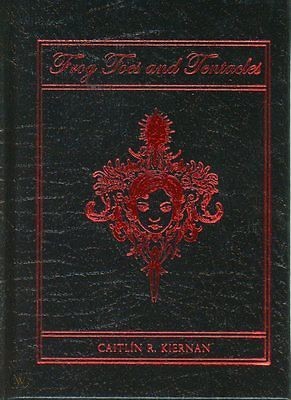
—Caitlín R. Kiernan, “Pages Found Among The Effects of Miss Edith M. Tiller” in Frog Toes and Tentacles (2005), 13

Monsters have a particular fascination in a transgender context. The act of transformation, however violent or painful, gives results. What you were is gone, and you have become something else—perhaps who you were meant to be. Body dysmorphic disorder is real, and the fantasy of such transformations that do not require months or years of hormone replacement therapy and surgery is real.

There is a sexual component to such transformation fantasies. Consider the ending to The Shape of Water, blood erupting in clouds from the vertical scars in her neck as the gills finally come in, as a visual metaphor for losing her virginity all over again. To become a woman…and more than that, to cast her old life behind. Such transformations are one-way, like puberty. You can’t go back again.

In the various sequels to “The Shadow over Innsmouth,” a great deal of focus is given to the transformation itself, its implications and effects. “The Gathering” (2017) by Brian Lumley and “All Our Salt-Bottled Hearts” (2016) by Sonya Taaffe both look at what happens when the change does not come, and how those who cannot go down beneath the waves to live in glory forever and ever deal with that. Caitlín R. Kiernan, by contrast, looks at a heretic. Someone who has refused the call.

And her lover.

Innsmouth-related erotica is not exactly rare; Tide of Desire (1983) by Sheena Clayton is an entire novel exploring it, and one could easily fill a fairly decent anthology of short stories including such pearls as “The Flower of Innsmouth” (2011) by Monique Poirier or “Madeline Marsh’s Midlife Crisis” (2015) by K. Z. Morano. Yet it is rare to find stories that focus on the characters involved, their complex motivations and emotions, as much as the sexual action itself. In stories like “The Innsmouth Porno VHS” (2014) by Adolf Lovecraft, the characters involved are consciously skeezy and the fetish is teratophilia; they don’t have any emotional investment in the transformation or the people transformed, much like folks fetishize transgender sex workers, seeing them not as individuals but as commodities.

Not so with Caitlín R. Kiernan.

She wants you to feel the reunion of these two lovers, one of whom took the plunge (literally), and the other who would not. Wants that taste of real horror as the act begins, and the clothes are shredded “making of them ribbons for a mermaid’s hair.” Edith’s lover Samaritana did not come back as she had known her…and there are surprises in store.

I stopped struggling (I had been; I can say that now, because I know I ama a heretic) and lay entirely still while those tendrils worked their way quickly between my legs, those strong tendrils or arms sprouting from the hairless mound where your sex had been, twisting back upon themselves, flexing, searching like blind, unfed serpents. What is it the old stories say? Cut off one, and two will sprout in its stead? (ibid., 21)

There is much unsaid in the story. The text has the quality of Edwardian prose, at once explicit and poetic. This is not sexploitation, no actors mugging for the camera and faking orgasms. Elaborations on the Mother Hydra mythos are hinted at but not elaborated upon, and the relationship, like many of the relationships in her fiction, does not have a happy ending. The subtitle for this story is:

Dead by her own hand, Janury 7th, 1905
Danvers State Insane Asylum, Mass.

Which is how it should be. Not every story, even an erotic story, has a happy ending. Transgender folks know that better than most. The struggle of whether or not to transition is real, and takes its toll both physically and psychologically. There is more to unpack in this story…and that probably says more to its quality than anything else.

“Pages Found Among the Effects of Miss Edith M. Teller” was first published in Frog Toes and Tentacles (2005).


Bobby Derie is the author of Weird Talers: Essays on Robert E. Howard & Others (2019) and Sex and the Cthulhu Mythos (2014).

“Le Pornomicon” (2005) by Logan Kowalsky

Eldritch Fappenings

This review deals with a work of pornography, and the history of erotic art and writing. As part of this review, selected art with depictions of genitalia and/or sexually explicit contact will be included.
As such, please be advised before reading further.


Pornomicon . . . derived from the Greek Word “Porne”, meaning prostitute. But the word on the whole means nothing to me.
—Logan, The Pornomicon5

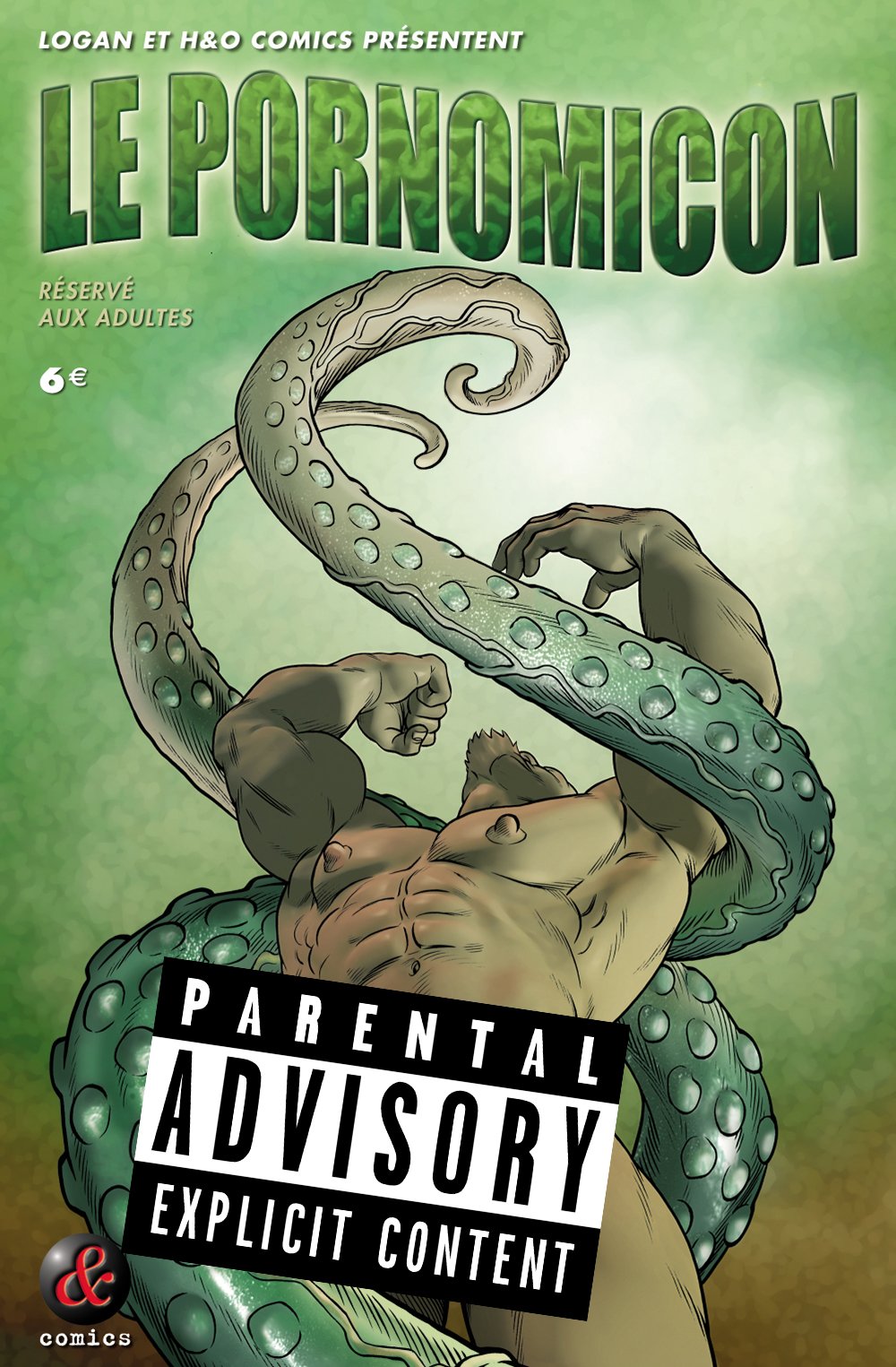
RF_Logan_01Le Pornomicon is a 2005 French-language one-shot homoerotic horror comic book created by writer/artist Logan Kowalsky (credited here simply as “Logan”) by H & O Editions; it was translated into English by Class Comics in 2006. While long out of print, it is still available as an ebook from Class Comics’ website.

The first known erotic comic based on Lovecraft’s Mythos was “Tales of the Leather Nun’s Grandmother” in the underground comix Tales from the Leather Nun (1973, Last Gasp), and ever since there has been a steady addition to the oeuvre of erotic Mythos comic books and graphic novels. For the most part, however, these works are typically created for a heterosexual audience, with women as the primary focus of all sex acts and male-on-female (or, increasingly, tentacle-on-female) pairings making up the majority of all sex acts. A rather smaller cross-section of such works dip into LGBTQ relationships or focus extensively on non-heterosexual intercourse.

One of the first of these was John Blackburn’s Coley series (1989-1999), which featured the bisexual Coley Cochran, who occasionally encountered the servants or descendants of the Old Ones; Noé and Barreiro’s El Convent Infernal (The Convent of Hell, 1996) includes several lesbian scenes, as well as a sexually-explicit copy of the Necronomicon and a notorious tentacle sex scene. The latter work might well have been part of Logan’s inspiration for Le Pornomicon, focusing as it does on the eponymous tome and penetrative sex featuring penis-headed tentacles.

In this respect, readers may suspect an influence from Japanese hentai on one or both works, and there’s probably some truth to that. However, given the focus on size, penetration, and masculinity in Le Pornomicon, the tentacle works well to foster the visual rhetoric of the story when it makes an appearance, taking things from the cartoonishly oversized to beyond anything humanly possible.

The visual grammer permitted by the tentacle is extremely useful to the pornographer. With no restriction on length, it permits penetration without blocking the view. It can also be used as a form of restraint, permiting multiple penetration, sexualised bondage and east of access. Best of all for the tentacle as a pornographic device, while it may often look suspiciously like a penis, to the extent of possessing a foreskin or glans, or even ejaculating upon climax, it is not a sexual organ by definition.
—The Erotic Anime Movie Guide 58

It perhaps needs to be said that there is not a single homoerotic aesthetic; the gamut of LGBTQ+ works encompasses a vast range of body types, relationships, preferences, etc. Le Pornomicon tends toward burly, over-muscled, often hairy subjects; the genitals are cartoonishly oversized and the holes are elastic, the relationships are almost entirely purely sexual with no romantic bonds, blushing nervousness, consideration of feelings, etc. While some folks might reductively say “Well, it’s porn,” not all porn is like that. Not even all homoerotic Mythos fiction; “Herbert West in Love” (2012) by Molly Tanzer and “Herburt East: Refuckinator” (2012) by Lula Lisbon both exhibit very different aesthetics, despite both focusing on the homoerotic potential of “Herbert West–Reanimator.”

Part of the reason Logan focuses so slightly on the human relationships is because the main character of the book is not human, but the eponymous Pornomicon and its associated Mythos. The story is set across two time periods, two brief encounters united by the presence of the Pornomicon, and in this way it is reminiscent of the Loc-Nar in the animated film Heavy Metal (1981). Like that object, the presence of the Pornomicon is associated with mental and physical corruption, introducing elements of body horror and the monstrously alien as the humans are possessed, transformed, and eventually subsumed by inhuman carnality. In the universe of the Pornomicon, Cthulhu and Yog-Sothoth are inherently sexual beings, but unlike in the works of Lovecraft or other writers who focus on these entities having sexual relations with human beings to spawn progeny, there is no focus on reproduction. Cthulhu does not impregnate these burly male characters, they become a part of him.

Which could be read as a form of homosexual panic, or a reflection of the implicit bias against sexuality in slasher films where couples who sneak off for a bit of illicit fun receive a brutal comeuppance as they are macheted to death—although it seems likely that neither of these was consciously intended. Rather, Logan offers a pornographic horror comic with no happy ending, the encounters with the Pornomicon are by their nature lustful and end badly for those who tamper with the Great Old Ones, but that would probably be true for anyone of any gender or sexuality. The unbiased nature of Cthulhu and Yog-Sothoth in taking all victims equally only appears to be biased because the story focuses exclusively on homosexual men.

Logan also takes visual inspiration from Mythos-related works. In particular, the background of page 10 is annotated “Apres Mike Mignola” and directly references the visual imagery in the Hellboy: Seed of Destruction (1994) series.

Above, left: Mike Mignola, Hellboy: Seed of Destruction #3.
Above, right: Logan, The Pornomicon.

Sometime after the publication of Le Pornomicon, Logan began a series of illustrations titled The Pornomicon Legacy, but so far there is no indication of another volume forthcoming.


Bobby Derie is the author of Weird Talers: Essays on Robert E. Howard & Others (2019) and Sex and the Cthulhu Mythos (2014).

“Riemannian Dreams” (2010) by Juan Miguel Marín

He was getting an intuitive knack for solving Riemannian equations, and astonished Professor Upham by his comprehension of fourth-dimensional and other problems which had floored all the rest of the class.
—H. P. Lovecraft, “The Dreams in the Witch House”

What inspired your story? The weird quasi-Lovecraftian speculations behind Einstein’s theory of relativity and its Riemannian mathematics.
—Interview: Juan Miguel Marín

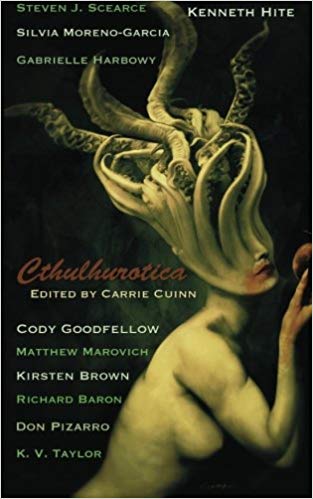
When it comes to the erotic possibilities of the Lovecraft Mythos, “The Dreams in the Witch House” and “The Whisperer in Darkness” may not jump immediately to mind, much less German mathematician Georg Friedrich Bernhard Riemann (1826-1866). Yet that is what Juan Miguel Marín attempts in his entry for the Cthulhurotica anthology…and not without some success. Whether Marín knew it or not, his particular approach of visitations of the Lovecraftian erotic through dreams echoes certain critical interpretations of Lovecraft’s “The Dreams in the Witch House”:

But something significant happens in this dream. Keziah thrusts into Gilman’s right hand “a huge grey quill” with which to sign his name to the devil’s book and to provide the necessary blood. Brown Jenkin races across his body, up to his shoulders and down his right arm, to bite him in the wrist, causing a “spurt” of blood at which Gilman faints. The next morning “his cuff was brown with dried blood.” The stories of the devil’s book are, let us admit, rather unimaginative, but they conceal a masturbatory fantasy that seems actually at work here. Gilman faints away because he cannot accept the wet dream.
—Robert Waugh, “The Ecstasies of ‘The Thing on the Doorstep’, ‘Medusa’s Coil,’ and Other Erotic Studies” in A Monster of Voices 101

“Riemannian Dreams” begins as an echo of Riemann’s own mathematical proofs, stating the facts as clearly as he can, but also a kind of dream-diary. The timeline is unclear; Riemann died in 1866, but he feels the dreams were inspired by the Edison wax phonograph, c.1899; other references to “The Dreams in the Witch House” and “The Whisperer in Darkness,” and Einstein’s theory of relativity put it somewhere between 1905 and the 1920s. Perhaps this is not the Bernhard Riemann, but another professor; or some alternate timeline where Riemann survived another forty or fifty years.

The lack of certainty is a hallmark of Marín’s narrative. For the most part, readers are presented with bits and pieces, notes and letters, fragments of a story that build up to suggest a narrative. This echoes how Lovecraft would do much the same thing with “The Whisperer in Darkness” and other tales, although the connective tissue is a bit thinner here; the dates not quite adding up is one example, but more importantly, we gain no real glimpse of Riemann’s waking life—his protestant faith, his wife, where he lives and works, though there are references to teaching. The material world is faint, hazy, dream-like, but the dream sequences themselves are vivid.

Riemann’s wet dreams are queer; they do not fall easily into any particular spectrum of sexuality, the subjects of his attention being particularly fluid—now male, now female, sometimes both.

In the first lucid dream I could glimpse only a young, pale, androgynous face, which the water ripples sometimes hid, sometimes revealed. I could not tell whether the atractive stranger was a boy or a girl. I could only notice the blond-auburn hair, pale skin of a healthy pinkish color, rose-colored cheeks, rosy red lips, and the eyes… […] I see now a beautiful backside. Like mine, also covred with nothing but a loincloth. My scientific curiosity tries to find out more about those lovely hips but the mist prevents me.
—Juan Miguel Marín, “Riemannian Dreams” in Cthulhurotica 72-73

The “scientific curiosity” is a hallmark of the Lovecraftian protagonist, the libidi sciendi, the desire to know. It’s tempting to look for metaphors here in Riemann’s efforts to define the nature of the subject of his desires, a quest for self-knowledge of his own sexuality as much as an effort to define an external reality. The subjects of his dream-vision, however, are a bit outside of those dreamt in this particular Horatio’s philosophy…at least at the start.

As an episode, “Riemannian Dreams” occupies a bit of an odd place in the Mythos. It is not situated clearly in respect to any time and place, but the connections between this story and “The Dreams in the Witch House” and “The Whisperer in Darkness” are established clearly and deliberately, but not the timeline. It’s not quite sequel, prequel, or interqual, simply an episode. Contrast this to a story such as “The Dreams in the Laundromat” by Elizabeth Reeve in Whispers in Darkness: Lovecraftian Erotica, which takes care to establish setting and continuity, set after “The Dreams in the Witch House” and focusing on the continuing legacy of Keziah Mason and Walter Gilman. “Riemannian Dreams” walks a fine line between mathematical logic and dream logic; fitting, since ultimately that is the choice which Riemann is presented with at the end.

What is your favorite bit?

“…leaving me covered in salty sweat, uncomfortably wet, and, unfortunately, awake.”
—Interview: Juan Miguel Marín

“Riemannian Dreams” was published in Cthulhurotica (2010), and has not yet been reprinted. Juan Miguel Marín is also the author of “The Bats in the Walls” (2010).


Bobby Derie is the author of Weird Talers: Essays on Robert E. Howard & Others (2019) and Sex and the Cthulhu Mythos (2014).

Tide of Desire (1983) by Sheena Clayton

“Their religion? You mean, they have one of their own?”

“The Reformed Order of Dagon. It’s a branch, or a schism of a church that was founded in Massachusetts about a hundred and fifty years ago. As I understand it, the main body of the church was stamped out by some pretty high-handed federal action back in the nineteen-twenties. But they never got around to bothering the Squampottis bunch, either because they’re so isolated, or because cooler heads prevailed in Washington. The thing in Massachusetts was remarkably well hushed-up. All the relevant government records have been destroyed.”
—Brian McNaughton, Tide of Desire (1983)

The very first erotic novel to deal with the legacy of Innsmouth came from the typewriter of Brian McNaughton. Active as a fan during his teenage years in the 1950s, McNaughton was briefly a journalist before turning his hand to erotic novels, starting with In Flagrant Delight (1971). His “break” came in the late 70s when he began producing erotic horror novels, starting with Satan’s Love Child (1977)—the publisher’s title, not his—which included elements of or references to the Cthulhu Mythos. It was successful enough to merit several other books, and McNaughton transitioned back over into doing mainstream horror in Weirdbook and other publications, and won the World Fantasy Award for Throne of Bones (1997).

Erotic horror wasn’t exactly new, as Grady Hendrix notes in Paperbacks from Hell: The Twisted History of ’70s and ’80s Horror Fiction, sex has long been a selling point and those two decades saw a boom in erotic horror and horror erotica. Still, this was a decade before Ramsey Campbell’s Scared Stiff: Tales of Sex and Death (1987) or the anthology Hot Blood (1989), and erotic horror fiction of the period tended to work off existing properties like Universal Monsters or classic horror novels—The Adult Version of Dracula (1970) and The Adult Version of Frankenstein (1970) being exemplary of the latter trend. By comparison, Lovecraft was largely a virgin field for erotic horror, or at least not entirely played out.

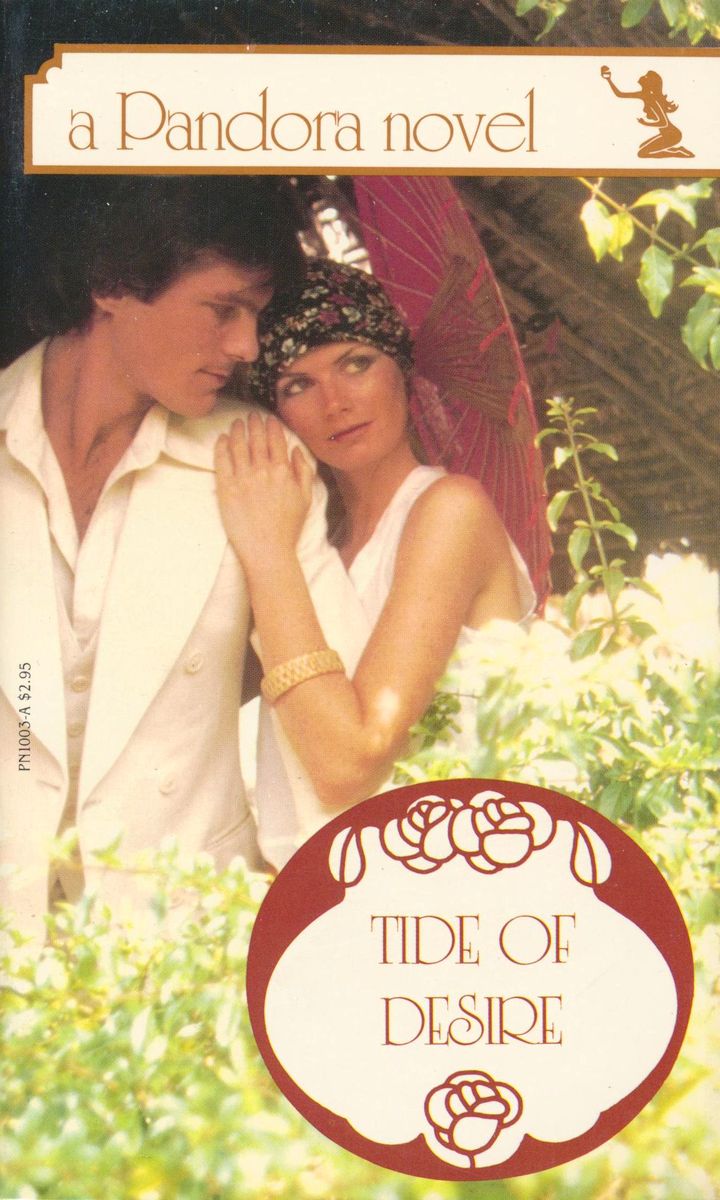
Beginning in the early 1980s, McNaughton wrote a series of erotic novels for Tigress Books. These were written under the pseudonym “Sheena Clayton,” and the line itself may have been aimed more at a female audience than typical adult novels of the period, a more hot-blooded and explicit counterpart to mainstream romance novels. The books tend to feature female protagonists and writers with female names, and the relatively sedate photo covers give the impression. On the name, McNaughton once wrote:

Sheena Clayton was the illegitimate daughter of Sheena, Queen of the Jungle, and
John Clayton, Lord Greystroke. I channeled her in several novels, of which TIDE OF
DESIRE may have been the best. (Sex and the Cthulhu Mythos 202)

These novels were Love and Desire (1982), The Aura of Seduction (1982), Tide of Desire
(1982/3), Danielle Book Two (1983), There Lies Love (1983), and Perfect Love (1983). All of these to greater or lesser extant contain references to the Mythos. For example, Edward Pickman Derby appears briefly as a member of a “Rats in the Walls”-esque Magna Mater cult in Love and Desire; Ramsey Campbell’s Lovecraftian fictional grimoire Astral Rape from his novel The Parasite (1980) is prominent in Danielle Book Two; and the cult in Perfect Love was founded by a Rev. H. P. Whateley from Arkham, Massachusetts.

Inside the door, Cthulhu ran up with a hearty meow, and he seemed just as glad to see Melisande as herself. The girl was quite indifferent to him, however, perhaps even a bit impatient with his rubbing against her ankles.

“Scat!” Antonia cried, moving him along with a nudge of her toe. “Cthulhu doesn’t normally take to strangers.”

“Who?” The girl seemed startled, even shocked.

“Cthulhu. That’s the cat’s name.”
—Brian McNaughton, Tide of Desire (1983)

The style of the novel partakes strongly of the Derlethian combination that Lovecraft’s fictional works exist in the world of Tide of Desire, and that the stories chronicle at least partially real events, so that the Mythos definitely exists. A good point of comparison might be Robert Bloch’s novel Strange Eons (1979). More interesting for fans of McNaughton’s later Mythos fiction is that several of the concepts for the Deep One culture are carried over between the novel and his story “The Doom That Came to Innsmouth” (1999). For example, the idea of a Deep One hybrid transitioning from land to water is called “Passing Over”:

“Dagon flay me alive! Ye be right! What an old ninny I be! Our Caleb’s daughter, she passed over a good ten-fifteen years ago. I ain’t seed her lately, but she be down there, don’t you worry. You look like her; that got me all confused. You look like her before she passed over, I mean. I never seed her before she passed over, of course, but I got her picture as a girl someplace. Our Caleb sent pictures of him and his mainland wife and all their kids to prove that the kids didn’t have the look, no more’n he did. But that girl sure did, all right. Poor Caleb. He was right about hisself, he never passed over, but he never told his daughter a word about the Blessing of the Deep Ones. So there she lied, passing over in the middle of nowhere, miles from the sea, and not knowing what the hell were happening to her.”

Mrs. Nicker mumbled to herself as she debated the whereabouts of the photograph she’d mentioned. Then she said to Antonia: “But by pure luck-or more likely it were the hand of Dagon stretching out to help her-there were this colored man from New Orleans who knew somewhat about the doings of the Deep Ones, and he told her she had better get herself to the sea, fast. She paid him to help her, and he took her to… where? To Charleston, South Carolina, that’s right! So she got there just in time to pass over. Then she come to Squampottis and told us all about it. It were the most exciting thing happened on this here island since the visitation of Shug-N’gai, just after the federals smote all them blasphemers and heretics at Innsmouth. That were in nineteen-and-twenty-eight, I do believe. Who says my memory ain’t perfect, hey? Don’t you try to tell me about our Caleb, boy. You wasn’t even borned then.”
—Brian McNaughton, Tide of Desire (1983)

The gist of the novel is that the protagonist, Antonia Shiel, is herself a descendant of the Deep Ones whose body is preparing to “cross over,” encountering a splinter sect of the Esoteric Order of Dagon on Squampottis Island—and realizing too late that she herself has the “Squampottis look.” the changes in herself adding a touch of body horror to the novel as her hair falls out and her feet swell…all of which are undone by the ending.

“Your hair seems to be thicker all of a sudden,” he noted admiringly. “That lovely pubic patch is just like a beautiful young woman’s, and not bare like a child’s. And the hair on your scalp looks thicker already.” (ibid)

The novel comes to an abrupt, jarringly disconcerting “happy ending” very atypical for McNaughton’s novels, as the novel was bowdlerized badly by the editors. McNaughton found the original ending and was revising Tide of Desire for eventual publication at Wildside Press, under the title Riptide. However, McNaughton’s untimely death in 2004 appears to have ended any plans to republish the novel. We can only speculate what the original ending would have been, but given that the story as a whole is a kind of contemporary, sexually explicit update to “The Shadow over Innsmouth,” it would have been both appropriate and in keeping with the tone of the novel if Antonia had “passed over” and joined the Deep Ones.

It would be wrong to say that Tide of Desire, or any of the Sheena Clayton novels, were influential. Pornography is ephemeral literature, and the novels didn’t make much of a splash in Lovecraftian circles when they came out. Which is unfortunate because, as Matthew Carpenter notes in his own review and synopsis, this is actually a very competent Mythos novel, and presaged some of the ideas developed independently by later writers. Sonya Taaffe in “All Our Salt-Bottled Hearts” (2016) wrote about some hybrids that don’t make the transition, and McNaughton wrote:

“It’s me that’ll die, it’s me that’ll be dumped into the ground like dead meat.” She began to sob bitterly, clawing at the arms of the chair with abnormally large hands. “Oh, you should see Rev. Preserved. He’s like an angel! Just last month I seed him in all his glory at Marsh Cove, taking no less than a dozen of our maidens, and our Melly one of them. Whether she be carrying his child or not, I don’t know, it be too soon to tell. When Rev. Preserved told me to have faith, I nearly believed it. He were like a god walking on earth. He said I’d pass over yet, but I don’t believe him now. Dead meat in the churchyard, that’s where I be bound.” (ibid.)

Tide of Desire is not quite the spiritual ancestor of erotic Deep One works such as The Innsmouth Porno VHS (2014), Innsmouth After Dark (2014), Taken By The Deep Ones (2015), Ichythic in the Afterglow (2015), and The Pleasures Under Innsmouth (2020). There is rather less sex, and that less explicit, than one might think; there are no sexual encounters such as in Alan Moore and Jacen Burrows’ Neonomicon (2011).

Which makes sense, because Brian McNaughton was not writing an erotic story dealing primarily with sexual encounters with Deep Ones, a horror story not afraid to go into details like mature sexual relationships, body image issues over breast size and pubic hair, etc. Vulgar terms for genitalia are completely absent. One of the more explicit passages in the book is almost sedate by contemporary standards:

She’d had only two hours of fitful sleep, sleep plagued by distorted versions of her conversations with the Boggs boy and Rev. Marsh and Mrs. Nicker; by dreams in which she gazed on a hostile world through a black veil, where she lay wheezing in a dark bedroom in Hamlen, where a long-dead minister pinned her against the Joyful Pillar in the town square with ravaging thrusts of his phallus while Melisande Seale looked on with demonic glee. (ibid.)

More of a dry (wet?) run for the paranormal romance novel genre, in many respects.

Whatever the initial print run was, Tide of Desire did not become an instant collector’s item. Very few copies of any of the Sheena Clayton novels appear to survive, with Tide of Desire being noted as especially rare…at last in the English version.

tide_japan (1)

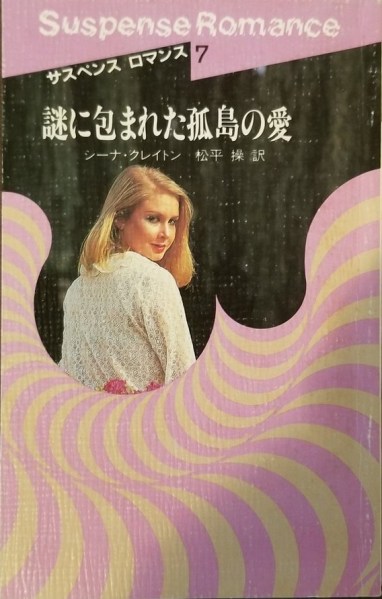
By a quirk of fate, Tide of Desire actually got a Japanese translation and publication in 1984. 謎に包まれた孤島の愛 was one of a number of erotic novels translated into Japanese for mail order. Although out-of-print, copies may still be available today on the second-hand market.

For those who do desperately desire to read this novel, while the paperback is long out of print, ebook editions (really text files, but beggars cannot be choosers) of the Sheena Clayton novels are available from Triple X Books.


Bobby Derie is the author of Weird Talers: Essays on Robert E. Howard & Others (2019) and Sex and the Cthulhu Mythos (2014).

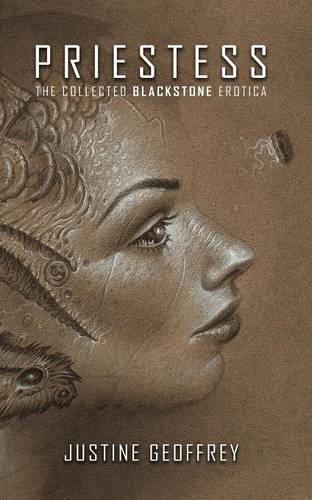
“Red Monolith Frenzy” (2012) by Justine Geoffrey

for Howard,
who would have hated it
and for Bob,
who probably saw it coming

Dedication to “Red Monolith Frenzy” (2012)

Robert E. Howard’s “The Black Stone” (Weird Tales Nov 1931) was one of the first expansions of Howard Phillips Lovecraft’s Mythos; it introduced the Black Monolith in the town of Stregoicavar; the mad poet Justin Geoffrey and von Junzt and his Black Book, Nameless Cults. Lovecraft enjoyed these new elements to the Mythos, particularly von Junzt and his book, which the Gent from Providence incorporated into his own stories, including “The Shadow out of Time,” “The Dreams from the Witch House,” “The Haunter of the Dark,” and “The Thing on the Doorstep,” and two stories ghostwritten for Hazel Heald:“Out of the Aeons” and“The Horror in the Museum.” Lovecraft even had a hand in creating a German name for the Black Book: Unaussprechlichen Kulten.

What Lovecraft largely did not comment on in the story was the lengthy flagellation scene that the protagonist in a dream-like vision witnesses before the phallic image of the Black Monolith. Robert E. Howard’s inclusion of this scene was plainly an effort to get on the cover of Weird Tales, which often went to stories with scenes of female nudity and flagellation, as beautifully illustrated by Margaret Brundage. Lovecraft’s refusal to include such scenes may explain why during his lifetime none of his stories ever received a cover illustration.

“The Black Stone” wasn’t the first hint of sex in the nascent Cthulhu Mythos, but for a long time it was one of the few stories that had anything like a sexual act on the page…and has inspired others. For one example, Spanish artist Estaban Maroto famously lifted the flagellation scene from “The Black Stone” to spice up his comic adaptation of Lovecraft’s “The Festival,” recently republished in Lovecraft: The Myth of Cthulhu (2018). For another, there’s “Red Monolith Frenzy” by Justine Geoffrey.

Inspired by Robert E. Howard’s mad poet, “Justine Geoffrey” is the female pseudonym of Scott R. Jones, author of books like When The Stars Are Right: Toward An Authentic R’lyehian Spirituality, a number of short stories, and the editor and publisher of the sadly defunct Martian Migraine Press, which produced evocative anthologies such as Conqueror Womb: Lusty Tales of Shub-Niggurath (2014), Resonator: New Lovecraftian Tales From Beyond (2015), Cthulhusattva: Tales of the Black Gnosis (2016), Chthonic: Weird Tales of Inner Earth (2018) as well as Necronomicum: The Magazine of Weird Erotica (2014, 4 issues).

The use of a feminine pseudonym by Jones is similar to the use of “Sally Theobald” by Robert M. Price for “I Wore The Brassiere Of Doom” (1986): a transparent hoax, not intended to deceive the audience. However, where Price never used that name for more than the single story, Jones found his alter ego an excellent editorial voice as well as author pseudonym. In adopting this voice for the editorial of the premiere issue of Necronomicum, “Justine” is able to make observations about her “co-editor”:

For instance, my co-editor Jones frequents any number of Lovecraftian and weird fiction groups on social media, and reports that all too often, when the subject of Sex and the Weird comes up, he is witness to a barrage of prudish voices protesting that there’s no place for sex in horror. “Lovecraft never wrote about sex!” they shriek while clutching at their pearls. (Never mind that sex and sexuality and weird blasphemous couplings are pretty much the foundation of HPLs horrific universe. Methinks the geeks protest too much!) These are the same voices that get inordinately upset when you mention Lovecraft’s racism, or chuckle with derision if you happen to misidentify a Gug as a Ghast during casual conversation. Basically, these are the to-be-expected thrashings of the Old Guard as they’re shown the door by the new fans, and the new voices with new things to say.

As an authorial and editorial poise, the assumption of an identity had value for Jones—and he is neither the first nor the last author to find refuge in a pseudonym, to take on those aspects and attitudes necessary for what has to be written.

Such as the Blackstone erotica series.

Taking its name from Robert E. Howard’s eponymous monolith, the Blackstone series of Lovecraftian erotica began with book 1: “Red Monolith Frenzy” (2012), and was followed by book 2: “Green Fever Dream” (2012); book 3, “Yellow Sign Bound” has not been published, although an excerpt appears in the printed collection Priestess (2014), which also contains the prequel story “Summonings: Anicka and Kamil” (2012) and the interqual “Summonings: Yvette’s Interview” (2013).

“Red Monolith Frenzy” is the start of things, chronologically and narratively. A novella in five parts, the narrative is a combination of the structure of “The Black Stone” and Lovecraft’s “The Statement of Randolph Carter,” at least initially. “Justine G.” is the narrator, the character that is the focus of the action, and Jones’ adoption of the pseudonym for these works lends strength to the idea that this is really her story (weirdly and unconsciously echoing the confessional style of “Sally Theobald.”)

There is a lot of deliberate homage, sometimes almost to the point of parody. But the work is not a remix in the sense of “Herburt East: Refuckinator” (2012) by Lula Lisbon; it is an original twist on the old material, keeping a sense of humor like “Koenigsberg’s Model” (2011) by Peter Tupper & “The Ape in Me: A Tale of Lovecraftian Lust” (2016) by Raine Roka. The pacing of the story is determined: contemporary erotica demands regular “beats” of titillation every couple of pages, much as action stories require hitting the right action beats to keep things moving, and keep the reader turning to see what happens next. A dull spot in a regular novella a reader might struggle through, but with porn they’re more likely to put the book down and never come back. So the flow of the story is a bit faster than Lovecraft, or even Howard writing at his Lovecraftian best. For the “omnisexual” Justine G., this means the fun and revelations keep on coming, usually more or less at the same time.

The sexual content is explicit and varied. It is difficult not to draw comparisons with Edward Lee’s “Hardcore Lovecraft” fiction such as Trolley No. 1852 (2010) and The Dunwich Romance (2013), which takes similar inspiration from Lovecraft but also doesn’t attempt Lovecraftian erotica pastiche. On the spectrum of erotic horror, this first episode in Priestess definitely leans toward the fun-loving erotic, and does so in a way that doesn’t involve rape, inhuman monsters, or even tentacles, which is rare enough for Lovecraftian erotica. The editorial for Necronomicum returns to mind when considering the direction of this story:

We want to showcase a kind of erotica that, though it draws a lot of its dark inspiration from, say, the work of H. P. Lovecraft and writers of his ilk, moves beyond the cheesy realms of “monster sex” or “tentacle smut” and into areas where our connection to ourselves, and to the Other (within us and outside of us) can be explored. Stories that thrill as much as they chill, that provoke thought in the head as much as they produce heat in the… well, elsewhere, let’s just say.

The character of Justine Geoffrey—both within this story and in a more metafictional way as the author and editor of works for Martian Migraine Press—is not that of a victim, a prostitute, or a sadistic slut. She enjoys sex, and gets sexually excited easily; emotional attachments in this first chapter are very ephemeral, so that sexual attraction and consummation does not necessarily equal love. By some standards, her behavior might certainly be considered evidence of hypersexual disorder, but Justine G. feels no inherent guilt or distress at her sexual desires and escapades.

At what point does a woman empowered by and embracing her sexual nature and actively pursuing sexual experiences cross whatever threshold separates a healthy sexual appetite into a mental health disorder? At what point does a character in a porn novella cease to be a believable character and become a wanton caricature, a fantasy of a nymphomaniac? Does the apparent gender and sexuality of the author influence how the audience reads these stories? These are the questions at the heart of the characterization of Justine Geoffrey, both in the stories and in the larger context as author and editor.

Answers are going to be subjective. The complexity of Scott R. Jones’ female anima is one of the more interesting aspects of a series that largely makes no bones about nor has any shame in being Lovecraftian erotica. “Justine G.” is not a patient to be analyzed, and as an editorial voice has grown beyond the role she experiences and enjoys in “Red Monolith Frenzy” and the other episodes in Priestess, where Jones would go on to draw inspiration from Mythos writers such as Ramsey Campbell and Alan Moore.

“Red Monolith Frenzy” was initially published as an ebook in 2012. It was collected in Priestess in 2014, which was translated into German and published as Die Chronik des Schwarzen Steins in 2018 in a limited edition of 999 copies.


Bobby Derie is the author of Weird Talers: Essays on Robert E. Howard & Others (2019) and Sex and the Cthulhu Mythos (2014).