I have given the whole of a cloudy Sabbath to finish my dismembered corpse story—“The Return of Helman Carnby”. I shall enclose the carbon with this; and I hope you will like it. The thing became a sizable yarn, with all the details that I worked out . . . It goes to “Ghost Stories”, then to W. T.,—both of which will doubtless reject it. But I think myself that the tale is a pretty fair literary beginning for the New Year. I like to picture it in the sunny and lightsome pages of the “Ladies’ Home Journal.” —Clark Ashton Smith to H. P. Lovecraft, c. early Jan 1931, Dawnward Spire, Lonely Hill290
Needless to say, I perused the monstrous narrative of Helman Carnby with the most acute & shuddering admiration; &, having made the verbal changes indicated in your supplementary note, have forwarded to Derleth with instructions for return to you through Wandrei. It is certainly a great piece of work, & I am extremely flattered by the prominent part played therein by the Necronomicon. But God! If there is still a copy of the original Arabic version in existence, what safety can we guarantee for this unhappy planet? Is it not true that no copy was found when the police entered the seemingly deserted mansion of Carnby & observed those hideous & inexplicable conditions which the newspapers were not allowed to print? What of that utterly unthinkable foot-mark which seemed to be burned into the floor? But one must not think of such things! Anyway, it’s a great yarn, & the cumulative suspense & malign suggestiveness of the earlier parts are enough to set any outfit of teeth—even false ones on a dentist’s cupboard shelf—chattering! It looks to me quite all right as it is—if there were any way of piling on another shudder, I’d say it would be by veiling the final horror a little more obscurely from actual sight, & trying to hint or imply the blasphemous abnormality which sent the secretary fleeing from that accursed habitation. I certainly hope that the tale will find a typographical haven. —H. P. Lovecraft to Clark Ashton Smith, c. 18 Jan 1931, Dawnward Spire, Lonely Hill293
Ghost Stories did not take “The Return of Helman Carnby,” not even after Smith re-wrote the ending and sent it back for another look; nor was it published by Weird Tales. The story was published in Strange Tales of Mystery and Terror (Sep 1931), under the title “The Return of the Sorcerer.” This is arguably Smith’s most distinctly “Lovecraftian” story, being an explicit extension of Lovecraft’s Mythos rather than involving any of Smith’s own fabulous settings and entities, and one of the first uses of the Necronomicon outside of Lovecraft’s own works (compare “The Were-Snake” (1925) by Frank Belknap Long, Jr. and “The Picture” (1939) by Robert D. Harris).
“The Return of the Sorcerer” was reprinted in Smith’s first Arkham House collection Out of Space and Time (1942), and anthologist August Derleth selected it for inclusion in Sleep No More(1944), which meant it was included in the Armed Services Edition of that book issued to soldiers during World War II. One can just about imagine a marine en route across the Pacific Ocean idling away a sweltering hour reading of the dismembered corpse crawling from the grave. By the 1950s, however, “The Return of the Sorcerer” had been out of print for years—though not forgotten.
Web of Evil was a horror comic published by Quality in the years immediately before the formation of the Comics Code Authority, and which ran 21 issues. The product was typical of the era: often shoddy artwork and simple, quick stories that emphasized grue and taboo, shock and suspense. The stories were often unsigned and the creators weren’t above lifting a plot from an old pulp magazine from time to time.
“The Corpse That Wouldn’t Die!” in Web of Evil #2 (Jan 1953) by artist Jack Cole is very clearly based on “The Return of the Sorcerer.” The names were changed to hide the plagiarism, and the unnamed Necronomicon is in Sanskrit rather than Arabic, but the essentials of the story are clearly recognizable. It may no longer be a Mythos story, but for all that it has a distinct charm for those that recognize that Cole is, at least, lifting from the best.
At six pages, the action moves fast—and in almost every panel, Cole tries to add some dramatic element of lighting or motion to capture the eye or set the tone, which often leads to near-comical exaggeration. Though there is not so much grue as there might have been: after all the corpse of the deceased sorcerer is still intact when it returns from the grave.
Lifting stories from pulp writers was not unusual in the 50s, and “The Corpse That Wouldn’t Die!” sits neatly among the Pre-Code Lovecraftian Horror Comics. The tale has been reprinted a number of times, including a version in Tales of Voodoo vol. 5, no. 2 (Mar 1972), where the art was reworked by Oscar Fraga and the result retitled “The Deadly Corpse” (sample pages below). Fraga’s rework updates the art to match the sensibilities of Eerie Publications in the 70s, but doesn’t add anything new to the story itself.
A major focus of the Western occult tradition is the grimoire. For the most part, the occult tradition that has come down to us is primarily a literate one rather than an oral one; and potential occultists are more likely to first encounter magical teachings in written form than by word of mouth. While that may be shifting a bit in an era of ubiquitous streaming video and podcasts, for the most part it holds true: Western magic as we know it has focused heavily on written texts as a primary store of data and means of transmission. Readers interested in delving further into the topic are recommended to read Owen Davies’ excellent and accessible Grimoires: A History of Magic Books.
Translations are a major part of the occult publishing scene. Dan Harms regularly reviews new translations of occult manuscripts and texts into English. However, these reviews rarely deal with just the quality of the individual translation, but the selection and editing of the text, the critical and academic apparatus that surrounds the text. While some works might be simply translated into another language without comment, most translations involve either selective transmission, or the addition of explanatory and critical material that adds to the value of the translation by providing additional historical or literary context, or speaks to the translator’s intended purpose for the translation.
The Simon Necromonicon(1977) was the first, most popular, and at this point most pirated Grimoire associated with the Lovecraftian occult tradition; for decades the mass-market paperback edition has been a mainstay of New Age bookshelves, and has numerous sequels and derivative works. Elías Sarhan’s authorized translation, first published in 1992 by EDAF in Spain, has also gone through multiple editions. It is a faithful translation of the Avon paperback edition, including Simon’s acknowledgments, the preface to the second edition, the quote from the Chaldean Oracle of Zoroaster, and all illustrations, magical seals, and non-English names in the original text, with one notable exception:
The highly characteristic Necronomicon gate sigil created by Khem Caigan which normally graces the cover and frontispiece of the Simon Necronomicon is nowhere in evidence. Whether Avon didn’t ship the plates or that wasn’t part of the licensing deal, the publishers simply didn’t use it, at least on several printings. The paperback copy I have includes a generic computer-generated 10-pointed star on the cover. Considering how prominently Caigan’s design has been displayed in many editions and how widely it has been swiped by artists as a generic Lovecraftian symbol, its absence is a significant departure from English-language version.
Necronomicon gate sigil created by Khem Caigan
In addition, there is an appendix. “Cronología, Fragmentos e Invocaciones de H. P. Lovecraft sobre « El Necronomicón»” (“Chronology, Fragments, and Invocations from H. P. Lovecraft’s Necronomicon). This begins with an introduction by Alberto Santos Castillo, an editor of many Spanish-language translations of Lovecraft’s works, that begins:
Si abordamos la obra de H. P. Lovecraft teniendo en cuenca el contenido del presented libro, nos surgeon does cuestiones queue son como dos caras different es del author de Providence: el iniciado en saberes ocultos y el escéptico materialista.
A lo largo de toda su vida, Lovecraft defendió que el contenido de sus historias era producto de un ejercicio literario propio de la ficción y que no mostraban ningún tipo de realidad posible o alternativa a la nuestra. Desde muy pequeño convivió con la soledad y el aislamiento. La imagen de su abuelo Whipple, un hombre bondadoso y «sabio», por toda esa biblioteca que le donó a su muerte, afianzaron en él esa inquietud por el concocimiento. El mundo debía ser creado y medido entre los povorientos volúmenes de las estanterías. Sin embargo, Lovecraft ansiaba un saber oculto cuando las pesadillas y las obsesiones se cebaban en él. Al leer su obra, uno descubre que hay una verdad que se escapa entre líneas, frente a esa imagen de frialdad y distanciameiento emocional pretendido.
If we approach the work of H. P. Lovecraft taking into account the content of the presented book, there are two different faces of the author of Providence: the initiate in occult knowledge and the materialistic skeptic.
Throughout his life, Lovecraft maintained that the content of his stories was the product of a literary exercise characteristic of fiction and that they did not depict any kind of possible or alternative reality to our own. From a very young age, he lived with loneliness and isolation. The image of his grandfather Whipple, a kind and “wise” man, and the entire library he donated to him upon his death, strengthened his desire for knowledge. The world had to be created and measured among the dusty volumes on the shelves. However, Lovecraft yearned for hidden knowledge when nightmares and obsessions took their toll on him. Reading his work, one discovers that there is a truth that escapes between the lines, in contrast to that image of coldness and intended emotional detachment.
El Necronomicón 271
English translation
Simon’s Necronomicon has any number of flaws, many of which are discussed in The Necronomicon Files by Dan Harms and John W. Gonce, but there are two immediate issues every Lovecraft fan and would-be Lovecraftian occultists have to face: 1) Simon’s assertions of the real existence of the Necronomicon goes against what we know of Lovecraft’s life, attitudes, and knowledge of the occult; and 2) Simon’s Necronomicon, purportedly a translation of the original text, bears basically no similarity to the Necronomicon that Lovecraft and his contemporaries wrote about, containing only a scattered handful of familiar-sounding names and none of the translations or contents supposed to be in there according to stories like “The Dunwich Horror.”
To address these shortcomings and add value to the basic Simonomicon, Castillo tacked on an appendix that contains (in order), a Spanish translation of Lovecraft’s “History of the Necronomicon,” a collection of quotes (“fragmentos”) from the Necronomicon that Lovecraft peppered into his work in stories like “The Nameless City” and “The Dunwich Horror,” and finally a collection of incantations from Lovecraft’s work, mostly in his made-up artificial language (e.g. « ¡Wza-y’ei! ¡Wza-y’ei! Y’kaa haa bho: ii, Rhan-Tegoth: Cthulhu fthang: ¡Ei! ¡Ei! ¡Ei! ¡Ei! Rhan-Tegoth. ¡Rhan-Tegooth, Rhan-Tegoth!» (287) adapted from “The Horror in the Museum”). Some minor spelling and formatting errors aside from the translation, this is a neat piece of work and a definite improvement over the base version of Simon’s Necronomicon, and makes sense for a Spanish translator that knows they need to address both potential audiences: those primarily interested in Lovecraft’s fiction and those primarily interested in the occult.
Fragmentos Originales del Necronomicón (2001) trans. Marcelo Bigliano
The Necronomicon: The Book of Dead Names (1978) edited by George Hay is probably the second-most popular (and pirated) Necronomicon grimoires in existence. Except much of the book is not actually a grimoire at all; of the 184 pages, there are 12 pages of front matter, an introduction by Colin Wilson that weaves a fictional history of the “real” Necronomicon manuscript (pp. 13-56), a fake letter from Dr. Stanislaus Hinterstoisser (pp. 57-64), a commentary by Robert Turner (pp. 65-80), and a note on supposed decipherment of the text (pp. 81-102) before readers actually get to the supposed English translation of the medieval grimoire that inspired Lovecraft (pp.103-140). Then there are the appendices in the form of three essays: “Young Man Lovecraft” by L. Sprague de Camp (pp. 141-146), “Dreams of Dead Names” by Christopher Frayling (pp. 147-171), “Lovecraft and Landscape” by Angela Carter (pp. 171-182), and the whole book is rounded off with a bibliography (pp. 183-4).
The actual Necronomicon material in the Hay Necronomicon is effectively less than 40 pages. Which might explain why someone had the bright idea to cut out the pseudo-scholarship and present a highly abridged translation of the book. That is exactly what Marcelo Bigliano did in Fragmentos Originales del Necronomicón: El Libro de Los Nombres Muertos de Abdul al-Hazred (2001), published by Tomo in Mexico in several editions, as a modestly sized and priced paperback.
Where El Necronomicón was being inclusive, Fragmentos Originales is selective. Bigliano begins with what appears to be an original prologue that essentially lays out an abbreviated version of Lovecraft’s history of the Necronomicon and then tries to sell the authenticity of the Necronomicon as an occult document. To give a sample:
También los conocidos libros negros titulados Seventh Books of Moses son mencionados por Lovecraft en sus relatos. Si se considera la relación entre estas obras, basadas en versiones latinas alterads de Key of Solomon y ciertos textos hebreos poco conocidos: The Leyden Papyrus, un antiquo libro de magia egipcio que se le considera parte de un todo con el Eigth Book of Moses y the Sword of Moses, que a su vez se cree que contiene en Ninth and Tenth Books de la serie, surge con fuerza un sistema mágico estrechmente relacionado con el Necronomicón.
Also the well-known black books titled the Seventh Books of Moses are also mentioned by Lovecraft in his stories. Considering the relationship between these works, based on altered Latin versions of the Key of Solomon and certain little-known Hebrew texts—The Leyden Papyrus, an ancient Egyptian book of magic considered part of a whole with the Eighth Book of Moses and the Sword of Moses, which in turn is believed to contain the Ninth and Tenth Books of the series—a magical system emerges that is closely related to the Necronomicon.
Fragmentos Originales del Necronomicón 9
English translation
However, this is really an uncredited translation of Robert Turner’s “The Necronomicon: A Commentary” from the Hay Necronomicon:
The well-known ‘black books’ entitled the Sixth and Seventh Books of Moses are mentioned by Lovecraft in his stories, and if one considers the terlationship between these works—based on corrupt Latin versions of the Key of Solomon and certain little known Hebrew texts—The Leyden Papyrus,—an ancient Egyptian book of magic said to be one with the Eighth Book of Moses—and The Sword of Moses—held to contain the Ninth and Tenth Books in the series, a system of magic closely related to concept of the Necronomicon powerfully emerges. (Hay 68)
Lovecraft does not mention the Sixth and Seventh Books of Moses—which are genuine grimoires—in any of his fiction, though the title crops up in some related works by other authors (Dan Harms pointed out to me that the Seventh Book of Moses appears in “Wentworth’s Day,” one of Derleth’s “posthumous collaborations” with Lovecraft). This is part of Turner’s wind-up to the actual magical manuscript material he invented, and if it resembles those “authentic” grimoires at all, it’s because he designed them to.
Following this prologue (pp. 8-16), Bigliano then presents the translation of Turner’s “Foreword” (Hay 105, 108; Fragmentos 17-20), sans illustrations, and then jumps directly into a highly abbreviated rundown of the major eldritch entities in the Lovecraft Mythos, again borrowed from Turner (Hay 74-75; Fragmentos 20-23). For example:
Shub-Niggurat El Gran Macho Cabrío Negro de los Bosques con un millar de Jóvenes. La manifestación Terrenal del Poder de los Antiquos. El Dios del Aquelarre de las Brujas. La naturaleza ELemental de Shub-Niggurat es la de la Tierra, simbolizada por el signo de Tauro en los cielos y, en el mundo, por la Puerta del Viento del Norte.
Shub-Niggurath The Great Black Goat of the Woods with a thousand Young. The Earthly manifestation of the Power of the Ancients. The God of the Witches’ Sabbath. Shub-Niggurath’s Elemental nature is that of the Earth, symbolized by the sign of Taurus in the heavens and, in the world, by the Gate of the North Wind.
Fragmentos Originales del Necronomicón 23
English translation
Not actually sure if Bigliano picked up these planetary associations somewhere or if they’re original additions to the text, but from there he continues directly into a translation of the magical manuscript portion of the Hay Necronomicon, including reproducing all the sigils and seal (pp. 25-85). A conclusion chapter is also borrowed from Turner in an earlier part of the book (Hay 78-79; Fragmentos 87-89). A brief note on Lovecraft (pp. 91-92) is followed by a translation of Angela Carter’s essay (pp. 93-116), and finally a section on the Cthulhu Mythos (pp. 117-124).
In the end, the Fragmentos lives up to its title: like a handful of pages from a larger manuscript that have been re-bound as their own work. Bigliano cut out the heart of the Hay Necronomicon and packaged it as a mass-market grimoire along the lines of the Simon Necronomicon, judiciously rearranging bits and pieces to suit his needs or tastes and ejecting most of the more peripheral matter about the supposed manuscript’s origins and connections to Lovecraft. All of the tongue-in-cheek elements, such as Colin Wilson’s carefully written introduction, and all the more elaborate illustrations, were cut. That isn’t particularly surprising when one considers that there are no notices of permission granted; this was, by all appearances, one of the many unauthorized translations of the Hay Necronomicon and its material.
The two Spanish-language grimoires are separated in time, translator, and geographical publishing context, but were both working toward a similar end: translating this English-language Lovecraftian occult material to a Spanish-language market who were presumably familiar with Lovecraft and eager for more. The popularity of the works can be attested by their multiple editions, and the different paths that the editors and translators took to the material represent respective approaches.
It is fun to think how, in a couple of centuries, historians of the occult might have multiple different recensions and translations of the Necronomicon available, and will have to figure how the family of texts relate to one another, to try and understand or re-create the chain of events or decisions that led to such similar material following different paths. If only the Fragmentos survived, one could not reconstruct the Hay Necronomicon; but they could probably ascertain its influence on Eldritch Witchcraft: A Grimoire of Lovecraftian Magick (2023) by Amentia Mari & Orlee Stewart based on certain illustrations and lore. Who knows what the Lovecraftian occult tradition might look like, in a different time and in different tongues?
This miscellany includes excerpts from period newspapers, one of which (“Iwo Jima & Innsmouth”) contains historical racism and racist language. As such, please be advised before reading further.
Any tool is also a toy. The only question is whether you’re using it for work or for play. When it comes to online newspaper archives, they are a wonderful tool that has made available a vast amount of minute detail of the past that would otherwise be inaccessible to the average researcher. They are also, however, vast fun if you’re in the right mindset—because newspaper writers are inherently creative, highly literate, hungry for content, and often have a wonderful sense of humor. The result is bits and pieces that are often bizarre or brilliant, though sometimes sober and horrific.
Most of them are effectively noise when considered in terms of “serious” research into Lovecraft’s life, but as a reflection of the growing popularity of Lovecraft and the influence of his work, they stand out as tide water marks: examples of the spread of awareness of Lovecraft and his work. They are sometimes incredibly fun, if only because of how weird they are. I’ve culled out a dozen of the best clippings to showcase the wacky and sometimes fascinating Lovecraftian oddities that have appeared in newspapers over the past century.
Quick links for readers who want to jump to a particular clipping:
“Are strange stories ever enacted in the North woods? repeated an old-time lumberman from the Ashland district, who has been spending a few weeks in Bangor. “Well, I know one—as weird a yarn as ever was told. If you print it, people will say either that I tried to ‘kid’ you or I should be examined by an alienist; and yet, in my own mind, I believe it true.
“I can’t say from personal experience, for it happened at least 75 years ago. but it’s a tradition among some of the old lumbermen, and it’s been handed down from father to son. Personally, I’m not imaginative, and I don’t believe in any kind of ghosts. I never read Edgar Allen [sic] Poe or Ambrose Bearce [sic] or Harold [sic] Lovecraft. Yet here, as I heard it from many lips, was a tale like Bearce’s [sic] ‘Damned Thing’ and Lovecraft’s ‘Dunwich Horror’ rolled into one.
“Seventy-five years ago, then, in the lumber camps of the great woods and on lonely, outlying farms, hroses and cattle were being slaughtered in considerable numbers. Always it was done in the same way—their throats were ripped open, as though from the teeth of some savage dog or wild animal. And yet gradually, through the countryside, there spread a belief that it was not an animal at all. Tracks sometimes were left near the stables or tie-ups—tracks something like those of a man’s bare foot, and yet were not a man’s. Sometimes a shadowy form, ape-like and hairy, was seen gliding through the darkness—or so imaginative persons said. But the cries of the cattle were real and tangible; and the following morning—for few dared venture out in the dark—always disclosed that the ‘wood demon’, as some called him, had been at his deadly work.
“Finally there arose one who loudly announced he didn’t care for man or devil; he was going to get to the bottom of the mystery, if it was the last thing he did in the world. I don’t recall just what led this man to suppose that, on a certain night, he was due for a visit from the strange marauder. But the story goes that he insisted on staying in the tie-up, and so became the one human witness of the horror that followed.
“The hours passed; nature had never been more placid or calm. And the man was about to return to camp, laughing at himself for having believed in old wives’ tales, when—the thing happened.
“It was a clear night, and a ray of moonlight fell through a hole chopped in the roof that the steam rising from the cattle might escape—a crude but popular system of ventilation in those days. And through this hole, filtering through the moonlight and the shadows, came as strange an object as ever found its way from the Inferno. It was like a huge ape, yet the man swore it was not an ape; it was like a man yet it was not a man; it had hairy, strangely contorted limbs, and cruel teeth that gleamed in the darkness—for the man had put a burlap bag over the lantern he carried.
“It sprang upon the cattle, ripped open their throats, drank of their blood, and disappeared through the roof—as an ape might have done. But, as I have told you, it was not an ape. And the man who had said that he feared nothing in the world just stood there in a corner, a high powered rifle in his hand, too paralyzed by fright to so much as stir. He said afterward that, even had the Thing turned and attacked him, he couldn’t have moved a muscle.
“What was the thing? I don’t know! I never heard how the story ended; but I believe the mystery was never solved. if there is any moral, it is simply that it points the truth of what Hamlet said: ‘There are more things in Heaven and earth, Horatio, than are dreamt of in your philosophy.'”
One seldom thinks of vampiric sasquatch as having anything to do with H. P. Lovecraft. Yet vampirism of animals is a key plot point of “The Dunwich Horror” Weird Tales (Apr 1929); just as an orangutan formed an essential feature of Edgar Allan Poe’s “The Murders in the Rue Morgue” (1841), and an unseen menace is the key to Ambrose Bierce’s “The Damned Thing” (1893). One suspects that the errors in the names of Edgar Allan Poe, Ambrose Bierce, and Howard Phillips Lovecraft are probably intentional, to give an air of rusticity to a tale that is probably fabricated out of whole cloth. No name is given for the author of the piece, and it may have been a friend or friend-of-a-friend of Lovecraft. Whoever it was had at least a modest affection for weird fiction.
Abdul Alhazred, the mad Arab of Lovecraft fame, once wrote in the “Necro[no]micon”—”Science and fact, as seen by our little minds, are but dew-spangled cobwebs that catch the light of a tiny candle; and the resulting glitter [b]linds us to the horrible expanse of black doom behind the puny light.
“For that cobweb and that candle are instable as a breath. The breeze can make them tremble, a wind will rend them. And afar, even now, I hear the trampling of a mighty storm.”
The Knob Noster Gem was a small local paper; Dan Saults was the publisher, editor, and probably wrote a good chunk of the daily output. Judging by this little space-filler figment, he was also a Lovecraft fan.
Robin Hood, Bran Mak Morn, and Cthulhu (1937)
Friar Haw Foresees The Twentieth Century
As Robin Hood’s Prophet Might Have Outlined The Ills Of Our Day
by L. W. S., Eaton, O.
Sherwood forest was aflame with the torches of autumn, bringing all of its robust life. Robin Hood and his merry men had cast aside every care and fathered again beneath the mighty brown oaks and beeches. The silver tang of life was in the air and lusty merriness was in the hearts of Robin’s men.
Of course they were spilling great quantities of the favorite cool brown ale down their throats and singing its praises until the song rang and echoed far down the dark rows of mossy tree trunks, as jolly Friat Truck continually banged his tankard on the rough oak table, swinging his head from side to side.
And brawny Little John Arose, flinging the rumble of his deep bass into the depths of Sherwood forest:
So, laugh lads, and quaff lads ‘Twill make you stout and hale, Thro’ all my days I’ll sing the praise Of brown October ale.
Really Robin Hood had called his men together for the purpose of hearing once again the strange prophecies of Friar Haw, but he always had to allow them their little fling first, as a prelude. The men had arrived at some degree of respect for the words of Friar Haw, and they usually sat engrossed. Even the snorts of Friar Tuck had grown fewer.
Friar Haw, grim and ascetic, had been taking Robin’s men into the dream-world of the 20th century. Today he had sat oblivious of the roistering men, his face like a white autumn sickle moon. The men could see that he wasn’t going to talk today about streamlined chorus girls and elaborate movies.
He arose. “Few people,” he began, “who shall live in the 20th century shall realize fully the abysmal depths to which the world conflict in the early part of that century shall plunge the races with the blood of long centuries in theri veins. yea, dark forces of life, far more ancient than the ancient oaks of Sherwood, as ancient as the ideas of Chthulhu [sic], Yog Sothoth, Gol-goroth and the blood of the Gaelic, Cymric and Teutonic. The king of the Dark Empire of the Stone Age, covered so long by the imposition of a new god called Reason, shall break loose again in the emotional abandon of those dark years of 1914-18, and shall continue long afterwards.
“The surface of the collective civilized mind shall be torn adunder and the long-buried emotional elements of the days of a Bran Mak Morn shall break loose, and the 20th century would shall be puzzled and at a loss to understand what forces are driving men.”
“And,” interposed Little John, who had a common sense kind of mind, “what are you driving at, or trying to say? It sounds crazy to me.”
“Oh, doubtless!” said Friar Haw, his sickle face growing a shade colder. “Yet the original minds of the 20th century shall see that strange things are happening. Now, in the country called Germany, age-old psychic forces break loose again. Wotan, who is half rage and frenzy and half seer who understands ‘the runs and interprets destiny.’ Wotan shall be personified in a man named Hitler, a strange figure whose reasoning shall be guided by very, very ancient emotional forces.
“You are to remember that men taken collectively in a nation are not dominated by reason. A wise man of that century shall say: ‘Where the mass rather than the individual is in motion, human control ceases. And at at that point the archetypes begin to operate.'”
“In Germany the stormy personality of Wotan shall come to life again in the youth movement. The waking will be celebrated with the slaughter of more than one sheep. Aye, men called Nietszsche, Schuler, Stephen George and Klages shall anticipate the waking, as shall one called Richard Wagner put it into his music.
“But I have taken only Germany as one example in the Old World, where the 20th century shall see the troubled awakening on every hand of the most ancient archetypes, the most powerful emotional forces. Frightened men shall shout ‘Peace! Peace!’ where there shall be no peace. men shall come to understand somewhat the things that Wotan whispered through Mimir’s head. mean shall come to appreciate what Valhalla means, and the Valkyries and the Fylgjur.”
Whereupon Robin Hood jumped to his feet and shouted: “Engouh for today! I’d rather go and rob a bishop. This chatter makes me uneasy inside.”
“Yes,” came from the sickle autumn moon face of the prophet, “it is a far cry from your simple Sherwood forest and your October ale drinking. yet it shall be the sap in the roots of your Sherwood conflicted with a conflict of world cultures.”
This is fanfiction. Yet L.W.S. (Leonard W. Sharkey) of Eaton, Ohio must have been a serious fan indeed, to weave references to Lovecraft (Cthulhu, Yog-Sothoth) and Robert E. Howard (Gol-goroth, Bran Mak Morn) into his narrative of Robin Hood in Sherwood Forest, on the run-up to World War II. A likely inspiration for these references is “The Children of the Night” (Weird Tales Apr-May 1931) by Robert E. Howard—which is probably the only story at the time that mentions Cthulhu, Yog-Sothoth, Gol-goroth, and Bran Mak Morn all in the same tale. Sharkey did at least one more Robin Hood/Friar Haw tale, albeit without Mythos references (The Camp of Robin Takes A Forward Look).
Lovecraft & Whippoorwills (1945)
Whip-poor-wills will remind some readers of the stories of the late H. P. Lovecraft.
You never heard of Lovecraft?
Many persons have not, but they will, in time, and all through the affectionate remembrance of two young men in Wisconsin.
They founded a press to put his stories sold to pulp magazines into book form. Extremely limited editions have made these books collectors’ items.
Lovecraft’s tales are somewhat Poe-like in character. They are laid in New England, and bring in visitors from “the outside,” strange beings always ready to push into our own known world.
Some of the stories incorporate the whip-poor-wills, which set up a constant cry, according to legend, every time one died.
If they missed getting his soul, they screamed unusually loudly, and then died out. In this way it was possible to tell what happened to the departing soul.
In 1939, August Derleth and Donald Wandrei founded Arkham House in Wisconsin to publish the work of H. P. Lovecraft in book form. It was a beginning to establish Lovecraft’s literary legacy, and awareness of the Providence-born horror writer was slowly trickling out into public awareness, although this was slow going, and involved many misunderstandings.
Whippoorwills are a key example. They only feature in one of Lovecraft’s stories, “The Dunwich Horror”; but the idea seems to have appealed to August Derleth, who incorporated the idea of the whippoorwill as psychopomp in several Cthulhu Mythos stories, notably the novel The Lurker at the Threshold(1945). Derleth’s repetition of the idea—and articles like this one—contributed to the spread of certain basic conceptions (and misconceptions) of what Lovecraft wrote.
Iwo Jima & Innsmouth (1945)
Journalettes by Charles B. Gordon
Friday, this newspaper used a cut of three Japanese prisoners, taken on Iwo Jima, and their American guards. The three Japs were three of the most repulsive looking human beings whose faces we have ever gazed upon.
. . . — V . . . —
We think he’s dead now, but some years ago, there was a writer named H. P. Lovecraft. This voracious reader made acquaintence with his works through the current 25-cent pocket books, but it is our belief that most of his output was printed first in pulp “horror” magazines. At any rate, he was the greatest master of the “horror[“] story specializing in stories about beings, things, or whatever you might want to call them, which emerged from places under the earth, under the water, or from ages thousands of years past, but were generally possessed of at least a few human qualities, enabling them to “get by” on the earth of the present day.
. . . — V . . . —
The pictures of those Japs taken on Iwo Jima gave us for the first itme a partial realization of what the creatures of such books of Lovecraft’s as “Weird Shadow Over Innsmouth” and “The Dunwich Horror” must have resembled.
War doesn’t just breed prejudice, it encourages its expression. The enemy is described in terms that downplays or denies their humanity. As things instead of people. The bloody battle of Iwo Jima ran 19 February–26 March 1945. Casualties were horrific, especially on the Japanese side; of 20,933 troops, only 216 Japanese were taken prisoner from the main battle, with an additional 867 taken prisoner post-battle. A photo of three such prisoners was made available to the press—men who, like their counterparts in the US military, had served their country, be it right or wrong, and lived through a terrible and terrifying conflict.
The racist depiction of Japanese military and civilians was sadly common—though as far as I have found, this is the first and only instance where they were compared directly to Lovecraft’s Innsmouth folk during the conflict.
Paper shortages during World War II put a severe crimp in the publishing plans of Arkham House, but also opened up other opportunities. Bartholomew House was a small New York publisher that put out two cheap (25 cents) paperback editions of Lovecraft with the permission of Arkham House: The Weird Shadow over Innsmouth (1944) and The Dunwich Horror (1945). Another cheap paperback readily available to the military was the Armed Services Edition of The Dunwich Horror and Others (n.d., 1945?). These books helped spread the word of Lovecraft during the war years—and beyond.
Lovecraft & Hitler (1945)
Two pieces appeared in the Chicago Tribune in April 1945 which tied Lovecraft to the ongoing world war.
Werewolf Hunt
The werewolf myth, which the frenzied and frightened Nazis threaten to revive as a romantic disguise for a post-war assassination cult, has haunted hte lower levels of the human mind since the era of the cavemen. Its roots are in primitive cannibalism. The word means man-wolf; that is, a betwitched creature which has human form by day and lupine hide, teeth, and appetite by night. The superstition is one of the unwholesome ideas that have survived from pre-history among European peasants to provide material for folklorists and themes for authors who have a bent toward the weird, grotesque, and horrible.
* * *
Hitler, whose career has a werewolfish flavor, comes froma stock in which this notion was likely to breed and influence character. We quote from his best and msot objective biographer, Konrad Heiden, who says in “Der Fuehrer” while discussing his pedigree:
“The Waldviertel in lower Austria, from which both the Hitler and Pölzl families came, is a gloomy, remote, impverished section; like many such regions it has no lack of superstitions and ghost stories. The ancestors were mostly poor peasant people; ‘small cottager’ often stands in the church records.”
* * *
The myth is closely related to the vampire bugaboo, and, therefore, in the novel called “Dracula,” a veritable case book of vampirism, you will find werewolves as auxiliary phantoms. The anthologies of terror stories which ahve become quite an article of commerce in the war time book trade contain numerous examples of werewolf tales. We expect to find out in “Best Supernatural Stories of H. P. Lovecraft,” edited by August Derleth and new on the counters.
* * *
To kill a werewolf according to the folklore formula, yo umust use a gun that has been blessed at a shrine of St. Hubert and fire a silver bullet.
In this, the unnamed newspaper writer would be disappointed. Vampires and werewolves were not Lovecraft’s normal schtick. However, we know that they did read the new collection—and the horrors in those pages probably compared to those that came in over the news wire. U.S. forces liberated the Buchenwald concentration camp on 11 Apr 1945.
Powers of Darkness
The lifting of the curtain on the massive horrors of Germany’s prison and concentration camps recalls the supernatural tales of H. P. Lovecraft, a writer who was relatively unknown until August Derleth undertook his popularization. To conjure up the mood of unearthly terrors, Lovecraft invented the mythology of Cthulhu in which there are many monstrous spirits of evil, forever seeking to take possession of this planet.
* * *
Lovecraft wrote of his work: “All my stories, unconnected as they may be, are based on the fundamental lore or legend that this world was inahbited at one time by another race hwo, in practicing black magic, lost their foothold and were expelled, yet live on outside, ever ready to take possession of this earth again.”
* * *
Perhaps Cthulhu has come back, thru the cracks in Hitler’s mind. Lovecraft, who died in 1937, would be staggered by the revelation.
* * *
During his lifetime, Lovecraft’s work appeared in pulp paer magazines, chiefly in Weird Tales. Arkham House of Sauk City, Wis., a publishing enterprise over which August Derleth presides, has been assembling this scattered material and putting it between covers in limited editions. A collection of 14 tales, regarded as the best of Lovecraft’s 50-odd, was recently issued by the World Publishing company. Derleth, its editor, says in his introduction:
“The weird tradition was particularly his. In the scarcely two decades of his writng life he became a master of the macabre who had neither peer nor equal in America. . . . It has been said of ‘The Outsider’ that if the manuscript had been put forward as an unpublished tale by Edgar Allan Poe, none would have challenged it.” —Chicago Tribune, 27 Apr 1945, p14
Lovecraft never wrote that “black magic” quote. The unnamed author of this little piece is drawing on The Best Supernatural Stories of H. P. Lovecraft(1945). To place Lovecraft’s horrors with those of Nazi Germany is understandable, journalists must have grasped for any straw of comparison. Three days after this was published, Adolf Hitler committed suicide.
Unlike many of these small newspaper pieces, another journalist picked up on this thread and glossed it in another paper:
Powers of Darkness
The lifting of the curtain on the massive horrors of Germany’s prison and concentration camps recalls the supernatural tales of H. P. Lovecraft, a writer who was relatively unknown until August Derleth undertook his popularization, says a Chicago Tribune column. To conjure up the mood of unearthly terrors, Lovecraft invented the mythology of Cthulhu in which there are many monstrous spirits of evil, forever seeking to take possession of this planet.
Lovecraft wrote of his work: “All my stories, unconnected as they may be, are based on teh fundamental lore or legend that this race [sic] was inhabited at one time by another race who, in practicing black magic, lost their foothold and were expelled, yet live on outside, ever ready to take possession of this earth again.”
Perhaps Othulhu [sic] has come back through the cracks in Hitler’s mind. Lovecraft, who died in 1937, would be staggered by the revelation.
It is like a telephone game, as Derleth’s jumbled quote gets increasingly jumbled with every step. Yet the tying-together of Lovecraft and Hitler in this instance shows how relevant Lovecraft’s fiction could be, how plastic and adaptable his work was to a new syntax—and how new editions helped spread knowledge of Lovecraft and the Mythos to new audiences.
Lovecraft’s Men From Pluto (1955)
Space Travel
Friday Dr. Wernher von Braun, an expert in the field of astrophysical and astronomical lore, spoke at Rensselaer Polytechnic Institute. he talked chiefly of efforts being made to study the areas beyond the earth’s atmosphere. he talked of artificial satellites and of space travel, topics which tickle the imagination of young and old alike in these days of scientific discussion.
Dr. von Braun asserted that there was no doubt of the capacity of man to leave earth, point toward the moon, circle it and return to earth again. As one who is an expert in the designing of rocket propellants and in all the developments in this sphere he speaks with authority. He insists that we know enough now to launch a space ship and be reasonably sure of its safe voyage moonward and its return.
To the layman all this is fantasy. How can man survive in the intense heat which must exist beyond the atmosphere? How can direction be assured where there is no air friction against which rudders can press when a craft is to be turned? We have to ahve water to direct a ship, air to direct a plane. What possiblity of management exists in the ether where every object runs free?
And to make such a voyage the start must be swift. Through the great spaces where there is no atmosphere presumably the speed would not generate sufficient heat to decompose the ship. But what about the start and the finish? How can the ship begin its flight without at least a speed of 5,000 miles an hour? And how can it be toned down to reason when it returns to the lst hundred miles of its voyage?
We are still skeptics on the whole matter. Those who say such a trip to the moon is possible are the delight of the small boy and the radical scientist. but to the down-to-earth citizen, accustomed to keep his feet on the ground or rise only moderately above it, the natural comment is a Bronx cheer. If such a voyage is possible today, as Dr. von Braun asserts, let’s get at it and stop expending our energies in talk.
The usual reply from the space scientists to such suggests is that the cost is tremendous and there is no source for the funds. That is a complete answer, the best in the world if discussion is preferable to achievement. We have heard people say you could abolish certain diseases in the world if had ten or fifteen billions to spend on them. We have noted those who think permanent peace could be achieved by the careful expenditure of a few hundred billions. The poist that there isn’t any such money so it is easy to talk about it.
If a space ship would cost a few billions there can be no space ship. it would not be worth the price. The scientists, instead of telling us such a craft is possible today, might better expend their time and energy in seeking ways of bringing their creations down to the possible range of expenditure. Otherwise space travel lies in the same domain as the weird tales of Jules Verne, Lovecraft’s story of the men from Pluto who visited earth or Wells’ novel about the coming of the Martians.
The Luna 3, the first spacecraft to manage a successful circumlunar trajectory, did so in 1959; the first manned trip in lunar orbit, however, was Apollo 8 in 1968. It turned out, probably much to the anonymous author’s chagrin, that there actually were billions of dollars to spend on the space race.
The reference to “Lovecraft’s story of the men from Pluto” is a bit bizarre; as near as I can tell this has to be a reference to “The Whisperer in Darkness” (Weird Tales Aug 1931), which featured the Fungi from Yuggoth. Who were about as far from the stereotypical 1950s humanoid aliens as one might imagine—but this is a good example of a typical misreading or misunderstanding. I wonder how many science fiction fans wondered where they could read about Lovecraft’s men from Pluto?
Man has a back, and if you beat it he works. (Alhazred Bhati Khan, 11th century despot of Samarkand).
The labor policies of Alhazred Khan are frowned upon in the more enlightened areas of the world today. But if his theories on back-beating have fallen in esteem, his basic goal of increasing production has never been held in higher regard.
The actual title of the piece was “Bosses ‘Whip’ Workers With Musical Gimmicks,” and it was about how employers use new psychological tools to manipulate the workplace and motivate their employees. However, the author Ted Smart apparently thought it needed a hook, and so created Alhazred Bhati Khan—who never existed—presumably by combining Lovecraft’s Alhazred, the Hindu word bhati (भाटी), and the Turkic or Mongolian title khan. Samarkand was a reality, however, and if anybody ever checked to see who was ruling it in the 11th century, they did more work than Ted Smart did. I have to wonder if any Lovecraft fans noticed.
Cipher puzzles are fairly common amusements in newspapers, and have been for decades. As an exercise, they’re fairly simple substitution ciphers: each letter of the alphabet is replaced by another letter, to render what appears on the surface is gibberish. However, the relationship between the letters remains; and there are only 26 letters in the alphabet. Figure out a word or two, either by frequency analysis or trial and error, and the rest of the cipher alphabet falls in place pretty easily. In this case, the puzzle designer has been a little clever: one word has been encoded as the English word FRIGHT, which gives a hint to the solution of the puzzle.
The answer, on the other hand, is a bit of a cheat:
The answer is a cheat because this isn’t a real Lovecraft quote, but a highly abridged version of a line from Lovecraft’s “Supernatural Horror in Literature”:
Children will always be afraid of the dark, and men with minds sensitive to hereditary impulse will always tremble at the thought of the hidden and fathomless worlds of strange life which may pulsate in the gulfs beyond the stars, or press hideously upon our own globe in unholy dimensions which only the dead and the moonstruck can glimpse.
The reason why the full quote isn’t used is pretty obvious: space. While not intellectually any more challenger than the briefer text to decipher, 59 words is a lot more daunting in terms of sheer volume of words to be deciphered. On the plus side, at least Lovecraft wasn’t reminding the readers of the San Francisco Examiner to drink their Ovaltine.
Tucked in at the end of a column of classifieds ads, just above a threat from the Mafia against a fratboy, this is one of a number of ads for a copy of the Necronomicon for sale that have cropped up here and there. Such hoaxes are classics of fan-activity, and vary from carefully-constructed and believable to error-ridden and silly. This one is fairly restrained and detailed, and the writer probably was familiar with Lovecraft’s “History of the Necronomicon,” which had been most recently republished in The Necronomicon: A Study(1967).
Such ads seem to have become rare after the first widely-available commercial Necronomicons began to hit the market in the 1970s.
Old Ben Lovecraft (1978)
Mulligan’s Stew by Hugh A. Mulligan AP Special Correspondent
RIDGEFIELD, Conn. (AP)—My old aunt used to say you never really know who your neighbors are until one day you read about them in the paper being appointed to the White House transportation staff or taken off in the patrol wagon for wife-beating or graduating with high honors from welding school.
And, by George, she was right.
This town, for instance, is chock full of interesting people, what you might call real characters just waiting to be discovered by some sharp-eyed reporter or a playwright in search of a sequel to “Our Town.”
Over on Ludlow Hill there’s a man who never in all his born days has seen a flying saucer. Old Ben Lovecraft has lived in these rocky, rolling hills of Connecticut for nigh onto half a century, since moving up from the Bronx, without catching so much as a glimmer of an outer world touchdown on his two acre zoned spread there behind the town dump.
The other night he thought he saw an eerie light reflecting from an elliptical shaped object in his driveway that wasn’t there when he took in the cat and turned off the carriage lamps. he put on his new Christmas cardigan, grabbed a flash light from the hall closet and made his way stealthily along the hedges bordering the garage. he could hear chattering and the sound of equipment being unloaded.
There in the moonlight, he saw five tiny creatures no bigger than a breadbox with enormous shiny eyes filing out of an aluminum cylinder. They fled in panic the instant his beam hit them.
“You know how racoons scamper after they’ve tipped over a garbage can to get at a turkey carcass,” Ben drawled in his matter of fact way. “I called the Air Force and they didn’t want to hear about it. They already had four people on hold with positive sightings.”
Fascinating fellow, Ben. A real skeptic. He’s seen “Star Wars” twice and “Close Encounters of the Third Kind” three times and doesn’t believe a word of either of them. […]
At the time of this writing, there are 91 hits for “Old Ben Lovecraft” on newspapers.com. The Associated Press spread the “Mulligan’s Stew” humor column far and wide. While some of the other bits and pieces mentioned above are diamonds in the rough, this is closer to what constitutes noise in search results. Half the country might have read about “Old Ben Lovecraft” between March and April 1978, when the article ran. Perhaps a few had a chuckle; the flying saucer craze of the 50s had given birth to the impressive big box-office sci fi spectacles of Star Wars (1977) and Close Encounters of the Third Kind (1977). No doubt a lot of the country had no idea why some folks got so excited.
Why Lovecraft? I suspect it was simply because Lovecraft was still known as a science fiction writer, and the “Old Ben” part was borrowed from “Old Ben” Kenobi in Star Wars. It’s also possible that the author simply wanted a distinctive name and typed out the first that came to mind; certainly a fan would probably have added a reference to Cthulhu in there at some point.
Lovecraft, C. M. Eddy, Jr., and Dark Swamp (1995)
What happened that night in the swamp?
Editors: I am in my 75th year of life as I write this, and I do not wish to allow a few things to pass unnoticed before I go. My mother, Muriel Eddy, was a gifted author; for several years she was the poet laureate of Rhode Island, the state in which we lived.
My father was also an author—of uncanny horror stories. he had a buddie named H. P. Lovecraft, the famous author of many books about strange things.
Lovecraft was a night person, and back in 1922 and 1923 he and my father would often walk through Providence’s Chinatown at midnight. One night they decided to go into the woods of the “great swamp” of Chepatchet, R.I., because they had heard that “It” (a ghost or monster) had been seen there.
Nobody knows whether or not they encounted the “It” being; they did survive their night in the great swamp, but neither would talk about it. I wonder to this day what they saw.
Perhaps that telephone-game is why his facts are slightly garbled. For while Lovecraft and C. M. Eddy, Jr. did certainly survive the Dark Swamp in Chepatchet, they weren’t exactly silent about it. We have first-hand accounts from Lovecraft’s letters, a memoir by C. M. Eddy, Jr., and memoirs from Muriel E. Eddy, who would have had the facts from her husband. Unfortunately, the accounts do not all agree.
Lovecraft’s Version In four letters written c. Oct-Dec 1923, Lovecraft mentions Eddy and Dark Swamp. These are the only accounts that were published at the time of the trip, and Lovecraft goes into some considerable detail.
I find Eddy rather a delight—I wish I had known him before. Next Sunday we are going on a trip which may bring you echoes in the form of horror-tales from both participants. In the northwestern part of Rhode Island there is a remote village called Chepachet, reached by a single car line with only a few cars a day. Last week Eddy was there for the first time, and at the post office overheard a conversation between two ancient rustic farmers which inspired our coming expedition. They were discussing hunting prospects, and spoke of the migration of all the rabbits and squirrels across the line into Connecticut; when one told the other that there were plenty left in the Dark Swamp. Then ensued a description to which Eddy listened with the utmost avidity, and which brought out the fact that in this, the smallest and most densely populated state of the Union, there exists a tract of 160 acres which has never been fully penetrated by any living man. It lies two miles from Chepachet—in a direction we do not now know, but which we will ascertain Sunday—and is reputed to be the home of very strange animals—strange at least to this part of the world, and including the dreaded “bobcat”, whose half-human cries in the night are often heard by neighbouring farmers. The reason it has never been fully penetrated is that there are many treacherous potholes, and that the archaic trees grow so thickly together that passage is well-nigh impossible. The undergrowth is very thick, and even at midday the darkness is very deep because of the intertwined branches overhead. the description so impressed Eddy that he began writing a story about it—provisionally entitled “Black Noon”—on the trolley ride home. And now we are both to see it . . . we are both to go into that swamp . . . and perhaps come out of it. Probably the thing’ll turn out to be a clump of ill-nourished bushes, a few rain-puddles, and a couple of sparrows—but until our disillusion we are at liberty to think of the place as the immemorial lair of nightmare and unknown evil ruled by that subterraneous horror that sometimes cranes its neck out of the deepest pot-holes . . . It. —H. P. Lovecraft to Edwin Baird, c. Oct 1923, Letters to Hyman Bradofsky & Others 45
Lovecraft’s letters to Baird was published in Weird Tales (Mar 1924), and forms the first account in print.
My next trip, on which I had as a companion my new adopted son Clifford Martin Eddy, Jr., was on Sunday, Novr. 4; and led thro’ much the same territory as did my trip of Septr. 19 with out amiable confrere Mortonius. It was a quest of the grotesque and the terrible—a search for Dark Swamp, in northwestern Rhode-Island, of which Eddy had heard sinister whispers amongst the rusticks. They whisper that it tis very remote and very strange, and that no one has ever been completely thor’ it because of the treacherous and unfathomable potholes, and the antient trees whose thick boles grow so closelytogether that passage is difficult and darkness omnipresent even at noon, and other things, of which bobcats—whose half-human howls are heard in the night by peasants near the edge—are the very least. It is a peculiar place, and no house was ever built within two miles of it. the rural swains refer to it with much evasiveness, and not one of them can be induc’d to guide a traveller through it’ altho’ a few intrepid hunters and woodcutters have plied their vocations on its fringes. It lies in a natural bowl surrounded by low ranges of beautiful hills; far from any frequented road, and known to scarce a dozen persons outside the immediate country. Even in Chepachet, the nearest village, there are but two men who ever heard of it. Eddy discover’d its rumour at the Chepachet post office one bleak autumn evening when huntsmen gather’d about the fire and told tales and express wonder why all the squirrels and rabbits had left the hills and fled across the plain into Connecticut. One very antient man with a flintlock said that IT had mov’d in Dark Swamp, and had cran’d ITS neck out of the abysmal pothole beneath which IT has ITS immemorial Lair. And he said his grandfather had told him in 1849, when he was a very little boy, that IT had been there when the first settlers came; and that the Indians believed IT had always been there. This antient man with the flintlock was the only one present who had ever heard of Dark Swamp.
So on that Sunday my son and I took the stage for Chapachet, and in due time alighted before the tavern. In the tap-room they had never heard of Dark Swamp, but the landlord told us to ask the Town Clerk, two houses down the road beyond the White Church, who knows everything in the parish Upon knocking at this gentleman’s pillar’d colonial house, we were greeted by the genial owner him self; a prefect rural magnate and Knight of the Shire, than whom Sir Roger himself cou’d not be more oddly humoursome. he told us, that the Dark Swamp had a very queer reputation, and that men had gone in who never came out; but confest he knew little of it, and had never been near it. At his suggestion we went across the road to the cottage of a very intelligent yeoman nam’d Sprague, whom he reported to have guided a party of gentlemen from Brown-University thro parts of the swamp in quest of botanick specimens, some twelve years gone. Sprague dwells in a trim colonial cottage with pleasing doorway and good interior mantels and panelling;a ND tho’ it turn’d out that ’twas not he who guided the gentlemen, he prov’d uncommon genial and drew us a map by which we might reach the house of Fred Barnes, who did guide them […] After a long walk over the same highroad travers’d by Mortonius and me, we came to Goodman Barnes’ place; and found him after waiting Al of thirty-five minutes in his squalid kitchen. When he did arrive, he had not much to say; but told us to find ‘Squire James Reynolds, who dwells at the fork of the back road beyond the great reservoir, south the the turnpike. Again in motion, we stopt not till we came to [Cady’s] Tavern, built in 1683 […] The tavern lyes on the main Putnam Pike; but shortly after quitting it and passing the reservoir we turn’d south into the backwoods, coming in proper season to Squire Reynolds’ estate. We found the gentleman in his yard; a man well on in years, and having a very market rural speech which we had thought extinct save in stage plays. he told us, we had better take the right fork of the road, over the hills to Ernest Law’s farm; declaring, that Mr. Law owns Dark Swamp, and that it was his son who had cut wood at the edge of it. Following the Squire’s directions, we ascended a narrow rutted road betwixt picturesque woods and stone walls; coming at last to a crest […] We found Mr. Law […] He inform’d us, that Dark Swamp lyes in the distant bowl betwixt two of the hills we saw; and that ’tis two miles from his house to the nearest part of it, by a winding road and a cart0path. He said, the peasants have a little exaggerated its fearful singularities, tho’ it is yet a very odd place, and I’ll to visit by night. We thanked him greatly for the civilities he had shewn us, and having complimented him on the fine location of his seat, set out to return to town with the information we shall use upon our next trip. —H. P. Lovecraft to Frank Belknap Long, Jr., 8 Nov 1923, Selected Letters 1.264-267
[…] setting a time and place of next meeting December 2nd, 6:45 a.m., west facade of the Federal Building—whence leaves the coach for Chepachet and the Dark Swamp. —H. P. Lovecraft to Maurice W. Moe, 24 Nov 1923, Letters to Maurice W. Moe137
We were on a still hunt for the grotesque & the terrible—the ghoulish & the macabre—in the form of a hideous locality which Eddy had heard certain rusticks whispering about . . . . . Dark Swamp. The peasants had mutter’d that it is very remote & very strange, & that no one hath ever been completely across it because of the treacherous & fathomless potholes, & the ancient trees whose thick boles grow so closely together that passage is difficult & darkness omnipresent even at noon, & other things, of which bobcats—whose half-human cries are heard in the night by cotters near the edge—are the very least. It is a very peculiar place, & no house was ever built within two miles of it. The rural swains refer to it with much evasiveness, & not one of them can be induc’d to guide a traveller thro’ it. It lies near where we were lost south of the pike—there & westerward—& probably brushes the foot of Old Durf himself. Very few know . . . . or admit they know . . . . of it. Eddy discover’d its rumour at the tavern in Chepachet one bleak autumn evening when huntsmen gather’d about the fire & told tales. One very ancient man said that IT dwells in the swamp . . . . & that IT was alive even before the white man came.
Well, anyway, we took the nine-twenty-five for Chepachet on Nov. 4, & wasted all the noon period getting shunted from one villager to another for directions. One bimbo—a bearded chap named Sprague, who lives in a colonial house—was especially valuable, & gave some extra tips on Durf. […] The last Swain we were directed to was Ernest Law, who owns Dark Swamp, & who was reached by a rutted road that climbs upward betwixt woods & stone walls. […] He told us how to reach Dark Swamp, & inform’d us it is a very odd place, tho’ the peasantry have a little exaggerated its fearful singularities. We thank’d him for the civilities he shew’d us, & having congratulated him on the fine location of his seat, set out to return to town with the information we shall use upon our next trip. […] —H. P. Lovecraft to James F. Morton, 5 Dec 1923, Letters to James F. Morton 58-59
“Durf” in this case is Durfee Hill, the second-highest point in Rhode Island, located near Chapechet. On 19 September 1923, Lovecraft and James F. Morton had gone to Chapechet to climb the hill, as detailed in a letter to Frank Belknap Long, Jr. (Selected Letters 1.250), which makes no mention of Dark Swamp. According to Lovecraft, C. M. Eddy, Jr. heard about Dark Swamp in Autumn (say, October), they went there on 4 November 1923, but couldn’t find it, though they got directions to find it next time, made plans for such a trip in December—and ultimately never returned to Chepachet.
One unanswered question is what Eddy was doing in the Chepachet post office to overhear these rumors of Dark Swamp. We know Lovecraft was in Chepachet in September, but why would Eddy be there? Stephen Olbrys Gencarella in “Lovecraft and the Folklore of Glocester’s Dark Swamp” (Lovecraft Annual #16) notes several other discrepancies in Lovecraft’s account that suggests that whatever the original story, HPL elaborated the tale with subsequent telling.
Ken Faig, Jr. in “Searching for Dark Swamp” in Lovecraftian Voyages, traced through old maps and records and confirmed much of the geography and named personages that Lovecraft mentions in his letters regarding the search for Dark Swamp, which he believes is currently inundated and forms the northern part of the Ponaganset Reservoir.
C. M. Eddy, Jr.’s Version In 1966, Eddy’s brief memoir “Walks With Lovecraft” was published in The Dark Brotherhood by Arkham House. Near the end of the memoir, Eddy recalled the trip to Chapachet:
One other jaunt with Lovecraft is retained rather vividly in memory, for all that it was in a way a frustrating one. It was a trip made into the country in August 1923, in search of a blighted area called the “Dark Swamp”—a place of such stygian darkness that the sun reputedly never shone there, never penetrated its fastnesses, even at high noon. Lovecraft had no very clear idea of its setting, but had been told that it was located off the Putnam Pike, about halfway between Chepachet, Rhode Island, and Putnam, Connecticut.
The day we set out was blisteringly hot; though we took the first trolley in the morning to the end of the line in Chepachet, it was already very warm at that hour. In Chepachet, we started out on foot on the road toward Putnam. The heat increased as the day wore on. We had brought sandwiches with us, and from time to time we stopped at farmhouses along the way for water and to inquire about Dark Swamp. But no one seemed to have heard of it, and after four miles, Lovecraft, considerably wilted by the heat, decided reluctantly that we would have to give up the quest. So we found some reasonably comfortable stones at the side of the road and sat there until one of the Putnam-Providence cars stopped for us and put an end to our search. We never afterward took it up again, though, despite the discomfort of the summer day, it was as rewarding as any walk with Lovecraft, in that he found many of the old farm buildings fascinating and conveyed that fascination to me. —C. M. Eddy, Jr., “Walks With Lovecraft” (1966) in The Gentleman from Angell Street 49-50
The most immediate discrepancy between the two accounts is that while Lovecraft places the search for Dark Swamp in early November 1923, Eddy places it in August. The comments about the heat make sense if it was a summer hike, but in the autumn?. Lovecraft doesn’t mention the heat in his own accounts, but did allow that he was “monstrous weary, and cou’d scarce stand” at the end of the hike (SL1.267), which would jive with Eddy’s account (though Lovecraft avers that they hiked 17 miles around Chepachet, not 4 miles).
Granted that Eddy was remembering back ~43 years, so some details could be hazy; Lovecraft mentions they were walking about noon, and if it was an All-Saints summer, perhaps that might account for Eddy’s memory of summer heat. More odd is that Eddy makes no mention that he was the originator of the search; by his account, it was Lovecraft that had been told about the swamp, rather than Eddy that told Lovecraft about it. However, we know Lovecraft had been in Chapechet before; perhaps it was Lovecraft who heard of Dark Swamp when he went to Chepachet with Morton, and later asked Eddy to go with him to find it.
Muriel E. Eddy’s Version There are three versions of the story in Muriel Eddy’s memoirs of Lovecraft, two published before C. M. Eddy’s 1966 memoir and one after. All versions agree largely with each other, and more with C. M. Eddy’s version than with Lovecraft’s—this makes sense given that all of Muriel’s information probably came from her husband or memories of what Lovecraft mentioned about the trip. Though Selected Letters 1, with Lovecraft’s lengthy account of the trip to Long, was published in 1965, the Eddys do not seem to have referred to it.
It was during the hot summer months that Lovecraft expressed the desire to have Mr. Eddy accompany him on a quest to find a so-called “Black Swamp” somewhere, it was said, in the wilds of Chepachet, R.I.—a swamp so overhung with trees that no sunlight ever penetrated it. Always on the lookout for oddities of nature, the idea of seeing such a swamp intrigued Lovecraft to such an extent that he took the whole day off, leaving his writings, as eager as any schoolboy to witness nature’s phenomenon. The whereabouts of that swamp—if such a swamp truly exists—is still a msytery—at least, it was never located, and Mr. Eddy almost had to carry Lovecraft back from the rural excursion, at least a mile, to the trolley line, for, unaccustomed to such vigorous jaunts at that time, the writer of tales macabre soon became so exhausted he could hardly move one foot after the other. It was a great disappointment to Lovecraft that the trip was failure, as far as finding the swamp was concerned; but the rural characteristics of the village delighted him, and found place, I am sure, in many of his later stories. —Muriel E. Eddy, “Howard Phillips Lovecraft” in Rhode Island on Lovecraft(1945) 18
It was during the summer of 1923 that Lovecraft expressed the desire to have Mr. Eddy accompany him on a quest to find a so-called “Black Swamp” somewhere near the small village of Chepachet, Rhode Island. It was said to be a swamp so overhung by trees that sunshine never penetrated it.
The thought of visiting such a swamp intrigued H.P.L. and he discarded his habit of staying in during the bright hours of the day to join my husband in the long hike. They took a trolley to Chepachet, and from then on they were on their own. It was a long walk to any kind of swamp land from the civic center of the community, and hours later, after viewing several small swamps but not finding any to answer the description of Black Swamp, they were about to turn back when Lovecraft suggested that they stop in and rest at one of the farmhouses dotting the section. besides, he averred, some of the farmers in that region might possibly know where (and if) there was such a swamp in the vicinity.
The wife of one farmer invited them into the kitchen and offered refreshment in the form of a glass of milk and gingerbread. H.P.L. eagerly accepted it, and he listened attentively as their hosts assured them that Black Swamp was virtually unknown to them, and it must have been a pipe dream somebody had, writing up a non-existent place. There were plenty of swamps, but none, they were sure, through which sunlight never filtered. Sometimes their cows got lost in the swampland, but they always found them sooner or later.
Lovecraft, later, jotted down in a little notebook he carried, tidbits of their quaint Yankee talk, saying the trip was not entirely a failure, as he had gleaned quite a bit from hearing the antiquarians converse. It would come in handy when he wrote his next story, he assured my tired-out husband. —Muriel E. Eddy, “The Gentleman from Angell Street” (1961) in The Gentleman of Angell Street 11-12
My husband often accompanied Howard on trips to get new ideas. One day they took a trolley car from Providence to the village of Chepachet, Rhode Island, to find a black swamp. it was said to be so overhung by trees that sunshine could not penetrate it.
They hiked for hours, and saw several swamps, but found nothing to answer the description.
But H.P.L. made many notes for future reference. He told Cliff that no trip was ever wasted.
Although Howard never wrote a story about the non-existent swamp, my husband used this as a basis for the last story he wrote during his retirement. Entitled “Black Noon,” it will be published in 1970 by August Derleth of Arkham House, Sauk City, Wis.
—Muriel E. Eddy, H.P.L. “The Man and the Image” (1969) 4 Later revised as “Lovecraft Among the Demons” (1970) in The Gentleman from Angell Street54
Muriel E. Eddy’s accounts add certain details lacking in both Lovecraft and her husband’s accounts, such as being served milk and gingerbread by a farmer’s wife (perhaps while waiting in the kitchen of Fred Barnes?) which might be authentic; others might be invented (no notes related to Dark Swamp are in Lovecraft’s Commonplace Book) or the result of the telephone game from husband to wife (neither of them mention any smaller swamps, either).
Both Lovecraft and Muriel Eddy reference “Black Noon,” a story begun by C. M. Eddy, Jr. If the story was begun in 1923, as Lovecraft suggests, it was not completed at that time. C. M. Eddy, Jr. attempted to complete the story in the 1960s, but ill-health made it difficult to impossible for him to write, and the story went unfinished at the time of his death in 1967. In the Arkham Collector Summer 1968, August Derleth announced “Black Noon” would appear in the forthcoming anthology Dark Things, but Derleth died in 1971, before this fragment could be published, and it was not included in Dark Things. “Black Noon” was eventually published in Eddy’s posthumous collection Exit Into Eternity (1973).
“Black Noon” is set in Eddy’s fictional Fenham, with a thinly-disguised Weird Tales (as Uncanny Stories), Lovecraft (as Robert Otis Mather), and Dark Swamp (as Witches’ Swamp). Although little of their adventure features in the fragment, some of the description of the swamp echoes Lovecraft’s:
[…] the trees on either side of this new construction had grown so close together that their trunks touched one another, and so tall that their leafy branches had interlocked to form a well-night impenetrable covering. In addition, hybrid vines, whichh grew rampant in the swamp, had over-grown both oaks and branches to eliminate all light from the canopy thus formed. The only thing that could find a way through this natural barrier was the fog which, during the early Fall, hung over the entire swampy area!
Even at high noon, the portion of the road was black as a moonless midnight! (117-118)
Neither of the Eddys ever mention Lovecraft’s “IT”; whether this was an invention of Lovecraft’s or a local legend that he picked up on but the Eddys failed to mention is unclear. Thomas D’Agostino in “Dark Swamp’s IT” (2020) leans into local legends; Stephen Olbrys Gencarella in “Lovecraft and the Folklore of Glocester’s Dark Swamp” (Lovecraft Annual #16) goes even deeper, and critically analyzes D’Agostino’s claims. Personally, I’m inclined to agree with Gencarella that Lovecraft may have been pulling his correspondent’s legs a bit—whether or not there was a germ of local lore at the heart of it, Lovecraft let his imagination elaborate with each telling.
However, it is interesting that Clifford Myron Eddy mentioned “IT,” when his parents did not. Did the elder Eddys decide it was more believable to leave out the legendary critter, or did the younger Eddy read Lovecraft’s account in his letters? Alas, we may never know. All we are left with is an intriguing bit of data, and it isn’t clear if it is fool’s gold or the real thing; if it is just a bit of glitter among the dross of clippings, or a valuable addition to Lovecraft studies. All researchers can do is sieve through the data.
Lucky for some of us, it is good fun to pan for digital gold in newspaper archives.
What follows is an extended deep-dive into the history of one of the most contentious affairs in pulp science fiction in the 1940s, the Shaver Mystery, and its interactions with H. P. Lovecraft’s Mythos, which was also beginning to coalesce in the same period. The ramifications of their interactions would spill over into science fiction fandom, conspiracy circles, and occult literature, with long-lasting effects on popular culture. Because this is very long, the following internal links are provided for those who would like to jump to specific sections.
I am certainly inclined to believe that [Shaver] has been inspired by the success of Lovecraft in attempting to create a literary mythos with much the same basic motif as he developed in his stories of the Old Ones. But, unlike Lovecraft, Mr. Shaver is not an artist. —Alan Devereux, “Mr. Shaver’s Memories” in Fantasy Review (Oct-Nov 1948) 11
The entire Shaver mythos is so obviously derived from the Lovecraftian fictional background that it is hard today to imagine that it impressed any experienced readers. The first Shaver story told how the people of ancient Earth were endangered by a degenerated elder, how the hero and his followers learned of the danger, and how escape was achieved with the help of immortal elder gods. —Harry Warner, Jr., All Our Yesterdays: an informal history of science fiction fandom in the 1940s (2004), 234
In 1926, Hugo Gernsback had founded Amazing Stories as the first pulp magazine devoted to science fiction. Mismanagement cost Gernsback the magazine, and it went through several hands; by the late 1930s it was owned by pulp publisher Ziff Davis and its readership in decline. In 1938, the editorship of Amazing was given to Ray Palmer, a young and enthusiastic pulp writer and editor who had cut his teeth in science fiction fandom, writing, editing, and publishing fanzines.
Palmer worked to improve the magazine’s circulation by aiming at younger readers, with more adventure, sensational illustrations, and less hard science. Small hoaxes in the pages of Amazing were not uncommon, with stories written by pseudonymous authors accompanied by fake biographies and critical comments from Palmer. At the same time, editor John Campbell had just taken over rival magazine Astounding Stories and was aiming for a more high-brow market. The dichotomy polarized science fiction fandom—Palmer became known as a hack, or at least a purveyor of junk fiction. But Amazing’s circulation increased.
In the October 1943 issue of Writers’ Digest, in the small personal ads are buried two notices from a “Shaver, Barto, Pa.” One was a lonely heart advertisement, the other was more unusual: advice requested for a newly discovered ancient language.
What response was received from these advertisements is unclear, but the response was likely unsatisfactory, because in December 1943 a letter from a Pennsylvania steelworker named Richard S. Shaver arrived at the offices of Amazing Stories. Shaver claimed to have discovered an ancient alphabet for a universal language (later called “Mantong”), supposedly of a pre-human race with connections to Atlantis.
Crank letters were a part of the business every pulp editor had to deal with, along with unsolicited manuscripts and fanmail. However, Palmer saw potential reader interest, and printed the entire letter as “An Ancient Language?” in Amazing Stories Jan 1944. Moreover, Palmer encouraged readers to try out Shaver’s language. Readers responded. As Palmer put it:
Many hundreds of readers’ letters came in, and the net result was a query to Richard S. Shaver asking him where he got his Alphabet.
The answer was in the form of a 10,000 word “manuscript” typed with what was certainly the ultimate in non-ability at the typewriter, and entitled “A Warning To Future Man.”
I read it through, every single word, and then sat back. What was it I had here? Certainly not an attempt by an “author” to sell a story. Mr. Shaver wanted no money for hia manuscript. It wasn’t a manuscript, but a letter. Mr. Shaver seemed anxious that it be published, not for notoriety, but out of sincere (apparently) desire that the world be warned of a terrible danger it faced, and informed of a wonderful heritage it had lost, and which should be recovered if at all possible. —Ray Palmer, The Secret World(1975), 36-37
Palmer continued to correspond with Shaver, who sent him a 10,000-word letter or manuscript titled “A Warning to Future Man.” Ray Palmer bought the manuscript, and re-wrote it.
I put a clean piece of paper into my typewriter, and using Mr. Shaver’s strange letter-manuscript as a basis, I wrote a 31,000-word story which I titled “I Remember Lemuria!” although I added all the trimmings, I did not alter the factual basis of Mr. Shaver’s manuscript except in one instance. Here, perhaps, I made a grave mistake. However, I could not bring myself to believe that Mr. Shaver had actually gotten his Alphabet and his “Warning to Future Man” and all the “science” he propounded from actual underground people. Instead, I translated his thought-records into “racial memory” and felt sure this would be more believable to my readers, and a reasonable and perhaps actual explanation of what was going on was in Mr. Shaver’s mind—which is where I felt it really was going on; and not in any caves or via any telaug rays or telesolidograph projections of illusions from the cavern ray operators. —Ray Palmer, The Secret World(1975), 38
For those of you who will read on and carefully weigh what I am about to tell you I am convinced there will be no thought of puns. Instead, when you consider the real truths behind what I say—and even better, experiment and study to corroborate them—it seems to me to be inevitable that you will forget that I am Richard Sharpe Shaver, and instead, am what science chooses to very vaguely define as the racial memory receptacle of a man (or should I say being?) named Mutan Mion, who lived many thousands of years ago in Sub Atlan, one of the great cities of ancient Lemuria! —Richard S. Shaver & Ray Palmer, The Shaver Mystery Compendium, Vol. 1, 8
In the original manuscript, Shaver had made more explicit reference to Atlantis, not Lemuria; Palmer’s change brought a Theosophical bent to the re-written work (see The Book of Dzyan for other examples of Theosophical influence on the pulps). A footnote interpreted “Mutan Mion” through Shaver’s universal language, which shows the long build-up to this particular story.
In the words of Mutan Mion (amplified by many explanatory footnotes from Palmer), the readers are introduced to a scientifically advanced civilization that lives in underground caverns as protection from the damaging rays of the sun. As the advanced, nigh-immortal Titans and Atlans prepare to migrate to a different solar system, Mutan Mion and Sub Atlan are faced with the threat of the dero.
Pressed for a more complete explanation, Mr. Shaver has defined ‘dero’ for us:
“Long ago it happened that certain (underground) cities were abandoned and into those cities stole many mild mortals to live, at first, they were normal people, though on a lower intelligence plane; and ignorant due to lack of proper education. It was inevitable that certain inhabitants of the culture forests lose themselves and escape proper development; and some of them are of faulty development. But due to their improper handling of the life-force and ray apparatus in the abandoned cities, these apparatii became harmful in effect. They simply did not realize that the ray filters of the ray mechanisms must be changed and much of the conductive metal renewed regularly. If such renewals are not made, the apparatus collects in itself—in its metal—a disintegrant particle which gradually turns its beneficial qualities into strangely harmful ones.
“These ignorant people learned to play with these things, but not to renew them; so gradually they were mentally impregnated with the persisitently disintegrative particles. This habituates the creature’s mind, its mental movements, to being overwhelmed by deterimental, evil force flows which in time produce a creature whose every reaction in thought is dominated by a deterimental will. So it is that these wild people, living in the same rooms with degenerating force generators, in time become dero, which is short for detrimental energy robot.
“When this process has gone on long enough, a race of dero is produced whose every thought movement is concluded with the decision to kill. They will instantly kill or torture anyone whom they contact unless they are extremely familiar with them and fear them. That is why they do not instantly kill each other—because, being raised together, that part of their brain that functions has learned very early to recognize as friend or heartily to fear the members of their own group. They recognize no other living thing as friend; to a dero all new things are enemy.
“To define: A dero is a man who responds mentally to dis impulse more readily than to his own impulses. When a dero has used old, defective apparatus full of dis particle accumulations, they become so degenerate that they are able to think only when a machine is operating and they are using it; otherwise they are idiot. When they reach this stage, they are known as ‘ray’ (A Lemurian word not to be confused with ray as it is used in English.) Translated, ray means ‘dangerous or deterimental energy animal.’ Ray is also used to mean a soldier—one of those who handles beam weapons (note how the ancient meaning has come into our modern word).” —Richard S. Shaver & Ray Palmer, The Shaver Mystery Compendium, Vol. 1, 28-29
Mutan Mion finds aid from Mars and the Nortans (yet another advanced subterranean people), sometimes referred to as Elder Gods and Goddesses. After getting some upgrades and falling in love, Mutan Mion returns to free the Atlans from the dero—who, it turns out, are also cannibals:
These devilish abandondero had a meat market in the lower floors, filled with human flesh; and a pile of choice cuts I saw was composed mainly of Atlan girl breasts! These dero things were cannibals and lived off immortal Atlan flesh! —Richard S. Shaver & Ray Palmer, The Shaver Mystery Compendium, Vol. 1, 73
The story ends with Mutan Mion victorious, the dero temporarily thwarted but not utterly destroyed, and he heads off to a new planet with his love. His warning to the future is inscribed on “telonian message plates” and left for the wild men left behind on the planet to discover. Implicitly in this story, those wild men are the ancestors of homo sapiens today—and the threat of the dero remains.
“I Remember Lemuria!” took clear inspiration from hollow earth fiction such as Jules Verne’s Voyage au centre de la Terre (“Journey to the Center of the Earth,” 1864), Edgar Rice Burrough’s Pellucidar novels beginning with At the Earth’s Core (1914), and A. Merritt’s “The Moon Pool” (1918) and “Conquest of the Moon Pool” (1919)—the latter of which are known to have been in Shaver’s library (see “Dick Shaver’s Library” in Shaverology); Shaver also specifically cited Merritt’s works in his “Open Letter To The World” (Amazing Stories Jun 1945). Palmer’s re-casting of the story as one of “racial memory” or recalling a past life was not novel. Past-life stories such as Jack London’s The Star Rover (1915), Lovecraft’s “Polaris” (1920), and Robert E. Howard’s “People of the Dark” (1932) were well-known among science fiction and weird fiction fans.
Yet these works were all presented as fiction. What was remarkable about “I Remember Lemuria!” was not the content—but because Shaver insisted it was true, and Palmer steadfastly claimed to believe him. The reader response, both positive and negative, was tremendous. Letters poured in. Fans debated and denounced the stories. Issues of Amazing Stories sold well.
From 1945 to 1948, more Shaver material appeared in Amazing Stories. Palmer assisted with the prose, but encouraged by publication Shaver continued to develop and expand on his new artificial mythology. Many science fiction fans derided it as a hoax; others bought into it. There’s always a wild conspiratorial fringe in any population, and Shaver’s talk of malicious dero, conspiracies to restrict access to technology, and invisible rays afflicting people caught the imaginations of few.
Palmer left Ziff Davis in 1949, and would go on to help publish more of Shaver’s material in smaller independent magazines and fanzines; he would also be influential in the development of ufology, and founded Fate magazine, among others. He was a titan in the development, spread, and popularization of fringe ideas like flying saucers and various conspiracy theories, and thanks to him Shaver’s Mystery has an outsized cultural footprint, such as the subterranean Derro race in Dungeons & Dragons. Shaver himself continued to write, publish, and evolve his strange little world of paranoid fantasies, with the dero becoming more sexually sadistic and voyeuristic.
In 1934, the death of Shaver’s brother severely impacted his mental health; he began experiencing auditory hallucinations, and was institutionalized at the Ypsilanti State Hospital. When he got out two years later, he found his wife had died (accidentally electrocuted) and their daughter taken into the custody of her maternal grandparents. The following years are poorly-documented but apparently involved rough living and an arrest trying to cross the border to Canada, and culminated in a stay at the Ionia State Hospital for the Criminally Insane in Michigan, from which Shaver was discharged in May 1943 into the care of his parents. (This is a highly abridged version of the account given in The Man from Mars: Ray Palmer’s Amazing Pulp Journey (2013) by Fred Nadis). The letter to Amazing Stories would come about six months later after his release from Ionia.
Shaver was not unique, however. In the 1930s, a fan named G. P. Olson (or Olsen) of Sheldon, Iowa began to write bizarre fan letters expounding theories about vampires and physics to writers like H. P. Lovecraft, Robert E. Howard, Hugh B. Cave, Henry S. Whitehead, August Derleth, and Clark Ashton Smith. In 1932, Cave wrote to Carl Jacobi suggesting that he mine Olson for ideas for his own fiction (see “The Fool Olson” in Weird Talers)—and I suspect that is ultimately what Palmer did with Shaver, at least in the early part of their correspondence and friendship. Whether Palmer’s encouragement of Shaver’s paranoid fantasies, and the resultant negative response from fans, was detrimental to his mental health is hard to say; that Palmer ultimately exploited Shaver is impossible to ignore.
Lovecraft’s influence on Shaver is also difficult to assess. “I Remember Lemuria!” includes references to Elder Gods, but these do not seem to be the Elder Gods of Lovecraft’s fiction. Nor did Lovecraft go in very much for hollow earth stories, though he certainly had cannibalistic underground peoples in stories like “The Lurking Fear” and “The Rats in the Walls,” and the ruins of an advanced alien civilization feature prominently in At the Mountains of Madness (1936). Probably the closest Lovecraft approached Shaver’s mythos was in “The Mound” (1940) by Zealia Bishop & H. P. Lovecraft—and, as it turns out, this is the one Lovecraft story we know Shaver read.
Palmer published a number of letters from fans in the pages of Amazing Stories as the Shaver Mystery stories unfolded. Being typical fans, some of these were hoax letters, and slipped past the editorial radar. One such letter that saw print:
THE NECROMINICON [sic]
Sirs:
In line with your research on the Lemurian question, may I refer you to the “Necrominicon” [sic] of Abdul Alhazred, and also, the singularly famous “Das Inausprechlichen Kulten” [sic] by Von Junzt.
Both of these volumes may be found in the reserve room of Miskatonic University’s library at Arkton [sic], Massachusetts.
I am a graduate in occult sciences of this university, and have been engaged in conflict with Mr. Shaver’s “underground deros” since my graduation there in 1935.
Translation of the seventh chapter of the “Necronominicon” [sic] using the “Lemurian alphabet” should aid greatly in discovering the missing plates.
I regret deeply that a certain interest in the (deleted by the editor for very good reasons) keeps me from aiding you materially in your search, but a hint to so fertile a brain as Mr. Shaver’s should be enough. And I feel quite sure that after you have read the above-mentioned volumes, many things should be clear that are now confused and dark.
This was all in good fun, and Palmer seemed to know that Poldea was pulling his leg—yet it may also have suggested possibilities to Palmer. In an undated letter to August Derleth of Arkham House publishers, Palmer wrote asking for copies of Lovecraft’s The Outside and Others (1939), Beyond the Wall of Sleep (1943), and Marginalia (1944), and added:
I wonder if you were right when you said Lovecraft did not believe a word of what eh wrote. Strangely enough, I have received some interesting comments on “truth” contained in his writings which, together with corroborative evidence in support of those comments, intrigues me very much.
Also, do you have on your lists the name of John Poldea? An affirmative answer would be very interesting to me.
A copy of Derleth’s answer is not in his file of correspondence with Palmer at the Wisconsin Historical Society, but it was likely very much in the negative on both accounts. In a follow-up letter, Palmer wrote:
I am slightly amazed at your reaction to my question concerning Lovecraft. I understand little about the matter, except that it seems you’ve built up a “legend” about Lovecraft and his creations. Would you mind explaining briefly.
I published a letter which I knew was fake, in order to get the reaction, which was terrific, regarding the Miskatonic U and the books Das Unaussprechlichen Kulten and the Necronomicon of Alhazred.
Maybe you wouldn’t be surprised to know how many people believe there are such things—and maybe you wouldn’t be surprised to know how many people know there are not—and yet are fascinated by your “legend”.
You say you’d jump on any statement that Lovecraft believed what he wrote with both feet. This fascinates me. Personally I believe he did believe what he wrote, and further, I think I could even prove it.
I might even be able to produce what he wrote about! —Ray Palmer to August Derleth, 20 Jun 1945, MSS. Wisconsin Historical Society
For Palmer, this was just another possible dimension by which to extend the Shaver Mystery; and even Shaver wasn’t sure how much of it he believed in or not, so long as it got a reaction from people. What Palmer probably had no idea of was how he was crossing nearly every possible line with Derleth, who had worked and sweated to build Arkham House in part on Lovecraft’s reputation as a literary figure, not a general pulp writer and certainly not as part of some cockamamie hoax running in Amazing.
A carbon copy of Derleth’s answering letter was immediate, and makes the Arkham House founder’s position clear—including an unsubtle legal threat if Palmer decided to push the matter any further:
You ask about Lovecraft. Contrary to your belief, we have NOT been building any “legend” about Lovecraft and his creations. We have been doing all in our power to keep him a straight literary figure, even to the extent of my taking time to write a brief critico-biography of him when I have little time for anything off-trail, and when you write that you “believe he did believe what he wrote and think” you “could prove it” this is simply to anyone who knows a plain bid to use the memory of a dead man in a cheap bid for publicity, which I construe as plain fraud and which would force me and the Lovecraft estate into legal action against the Ziff-Davis Company, regrettable as that is. I know very well what you are getting at when you say you might “even be able to produce what he wrote about”—crackpots have offered to write a NECRONOMICON for us, and you may be sure that such a purely Lovecraft creation would again, if fraudulently offered, bring action from us.
Where you got the idea we have built up a legend about HPL and his creations is beyond me. Certainly there are a lot of people who believe in the NECRONOMICON, and so forth; the origin of all these things is correctly set down in my H. P. L.: A MEMOIR, coming in book form in a month or so. I suggest you get hold of a copy and inform yourself before falling into any belief pattern. The UNAUSSRPECHLICHEN KULTEN was Howard’s invention, and I still have in my possession letters between R. E. Howard and HPL, with some of my own, showing that I contributed the UNAUSSPRECHLICHEN to the title in place of another word Howard wanted to use. Other titles came from other writers with Lovecraft’s permission.
Naturally, when, in the face of the contention of the man who has read more of the Lovecraft papers and letters than any man alive, you still say you “believe” to the contrary and contemplating offering “proof”, I have no other course but to think that you are contemplating some cheap plan to involve HPL and his mythos in a publicity plan for the Z-D magazines. I might expect that from Davis, but hardly from you, and you are right when you suggest that I might be “shocked”. I frankly hope that I am very much wrong.
Before going into the publication of any NECRONOMICON etc., you might look into the legal aspects of copyright in this matter; you will find that we have very solid grounds to take action against anyone purporting to offer “THE” book. I am thoroughly familiar with the copyright laws, and your use of a NECRONOMICON in this way is the equivalent of anyone else’s use of a w–k character or device under copyright. —August Derleth to Ray Palmer, 21 Jun 1945, MSS. Wisconsin Historical Society
In strict point of fact, Derleth’s legal position was probably weaker than it looked. He had an arrangement with the estate of Lovecraft to reprint his works, in cooperation with Lovecraft’s literary executor R. H. Barlow (then in Mexico), but his stated control over the copyrights was mostly bluff and bluster. Yet it was an effective threat, because Palmer had no way of knowing that. Nor was Palmer aware that he had inadvertently threatened everything Derleth had built at Arkham House by confusing the nascent Mythos with Shaver’s Lemurian stories. Certainly, Palmer didn’t appear to have any idea of Derleth’s personal involvement with the Mythos, as with the naming of Robert E. Howard’s Unaussprechlichen Kulten (for which see “Unspeakable! The Secret History of Nameless Cults”).
For Palmer, it was all potential fodder for the expanding Shaver Mystery—and his own weird capability of believing things. As it was, in Palmer’s answering letter he did his best to defuse the situation and cover his ass.
Your information is interesting. Some of my readers informed me there was a “business” being built up about the “cthulhu mythos”. I understand Esquire has purchased an article about Lovecraft hinting such a buildup. You see, I am not without foundation for that idea. […]
Nor did I mean that I had any mss to present. I meant that I (and numberless readers) believe Lovecraft’s writings to a certain extent, and that excludes those fictional books and university. You see, what I said I could prove was the existence of the “beings” Lovecraft writes about. I’ve had some quite entertaining experiences with them of a personal nature. But before you think me mad, we’ll drop my little dabblings into demonology, as they are personal, and get back to the “proof” I could offer that many readers believe in Lovecraft, and dis-believe in his Necronomicon and Kulten books, and the Miskatonic U. they believe in his demons, because they’ve seen them. I have dozens of sincere letters addressed to my Discussions columns, affirming that these experiences are true, and that they are identical with Lovecraft’s so-called fictional ones. Of course, suggestion is a powerful thing, and Lovecraft’s writings can be said to be powerful. Believing them is a matter of personal choice. I believe that more people believe them sincerely than accept Lovecraft asa great writer. This should interest you, since you are not trying to build up anything but his reputation as a writer.
On a purely personal vein, I know Lovecraft believed his basic theories, and his choice in taking that field for expression of his art was not just because he liked weird things. But of course, this has nothing to do with your reaction.
Regarding “hoaxes”, you remember I asked if you had a certain name on your list? You said no, which absolved you of being an innocent party to a rather filthy trick that was played on me, to discredit my Lemurian stories through the Lovecraft “mythos”. I have since discovred the unprincipled gentlemen were those who call themselves the “fans” of science fiction, and you know who they are.
[…] But, since the “fans” have taken up Lovecraft’s creations as a club to show that mine are the same attempt at “falsifying”, I will retaliate by publishing those letters which show a sincere belief in Lovecraft does exist Naturally these letters are authentic. I have thousands of letters from persons who believe in Shaver, many more than those who believe in Lovecraft. but most significant, all belief in both because they present the same basic theory (I’ll not call it fact, because I’d rather have the scientific world go on calling the Shaver material “metaphysics” or whatever they choose. I am prepared to present the positive scientific proof of the Shaver stories, by producing the caves, the machines, and the people. But this must wait until I am prepared scientifically. Amazingly, we have uncovered a vast storehouse of new knowledge, which if not handled carefully, might be very ineptly applied to our bloodthirsty civilization.)
But please be assured I have no manuscripts, or any ideas of producing Lovecraft’s fictional pieces as the real McCoy. But perhaps I will produce one of his “monsters”. It would look very well in the local park along with the giraffes and the anteater. —Ray Palmer to August Derleth, 22 Jun 1945, MSS. Wisconsin Historical Society
In his memoir The Secret World (1975), Palmer wrote of some remarkable experiences he had when he visited Shaver and his wife in Pennsylvania; this may or may not have been the personal experiences that Palmer spoke of. It is hard to tell because Palmer never seemed to be able to turn the huckster or hoaxer part of himself off; it wasn’t just a poise, it seemed to be fundamental to his being to believe whatever he was selling at the moment, at least to some degree. However, he had badly miscalculated his audience: Palmer had misunderstood or misread Lovecraft, and Derleth knew it.
The end result was that Shaver and Palmer never made any attempt to shoe-horn the Cthulhu Mythos into the Shaver Mystery, at least not in the pages of Amazing. Ray Palmer acknowledged Poldea’s fake letter in Amazing Stories Dec 1945 with a good-natured shrug and didn’t pursue that particular development of the Shaver Mystery further.
However, some of the fans were more critical than Poldea. In the popular fanzine Vampire published by Joe Kennedy, a scathing review was published in issue #4 of Maxin 96, a Lemurianist/occultist/Shaver Mystery zine published by fan David D. Dagmar. The review caught the eye of Amazing Stories’ competitor Startling Stories, which reprinted it in the Summer 1946 issue as part of a regular feature that reviewed science fiction fan publications. In response, Shaver sent a rebuttal to Kennedy, who would report:
Up until a couple moths ago, I corresponded with Shaver. He wrote me when a highly unfavorable comment on the Lemurianist fanzine, Maxin-96, was reprinted from Vampire in Startling’s fanzine review. Shaver seemed to welcome the chance to blast somebody’s ears off for the opposition which the “Shaver mystery” had evoked from the majority of actifandom. Misspellings and simple errors displaying marked ingorance of the fundamental rules of English grammar abounded in his letters. For the publication in Vamp he forwarded me a four-page “prose poem” which, as a piece of literature, was mildly amazing. The thing started off in undistinguished blank-verse style, rambled on another page, with references to Palmer and the deros becoming more and more frequent, bubbled and forthed into an attack on the opposing fan element (supposedly dero-controled!), then broke into straight prose, meandered on as a letter for a page or two, with intermittent ravings, then came to a decidedly abrupt conclusion. I sent it back to him. However, the main reason it was impossible to correspond with the guy, although I tried to give his side of the story a fair chance, was that all my arguments concerning the Shaver “truths” were either completely ignored or raidly passed over with but sparse comment. You can’t argue with a chap who just keeps drilling, over and over, THE DEROS ARE POWERFUL! YOU MUST BELIEVE! I’ve compared the Shaver letters and certain portions of his Palmer-rewritten published stories with examples of psychoneurotic literature quoted in psychology texts. The resemblance is remarkable, and indicative of far more than pure coincidence… No, I don’t correspond with R.S. Shaver any more. —Joe Kennedy, Gruzlak #1 (Oct 1946), 14-15
Eventually, Kennedy and Shaver agreed to a rewritten version of this rebuttal as “Lovecraft and the Deros” by Richard S. Shaver. This piece was first published in the fanzine Vampire #6 (1946); it was later republished in another fanzine, Spicy Armadillo Stories #5 (1991). The entire text is reproduced below.
※
LOVECRAFT AND THE DEROS
((EDITOR’S NOTE: Since much has been written in the fan press against the Lemurian series in Amazing Stories, we believe that it is no more than fair that Dick Shaver be given an opportunity to tell his side of the story. We are completely convinced of the author’s sincerity, although the following article does not necessarily reflect the views of Vampire’s staff.))
Up to twelve years ago I was a stf fan, much like yourself, I suppose. I thought I knew exactly what was true in science and what could happen and that I could draw a precise line in my reading between fact and fantasy.
Then it happened, almost exactly as I tell it in the stories I write. Things that couldn’t happen except through a wonder-science never produced by modern men of science at all.
There were three conclusions. The first that these machines and rays came from space (visitors). The second was that they were modern secret science—things that science had developed and kept to itself as a monopoly, for the power and wealth the advantages of using these apparatuses would give them. This second conclusion was my conclusion until I knew more about it, which took many years. It is the usual deduction of the person first contacting secret ray.
The third deduction came after long experience with the phenomena I talk about in my stories. That this thing was a persistence of the same thing the medieval were talking about when they raised such a hullabaloo about witchcraft. The same thing Homer was talking about when he mentioned the immortal gods. I did a lot of research, believe it or not. And this last deduction is the correct one. The caverns I saw were not modern—they were not even built fairly recently by space travelers who stopped here long enough to leave such gigantic traces—were built before Man had a history. They are the big missing portion of history, and they have a history all of their own far more important in many ways than our own surface history.
Witchcraft, fairy tales, legends of the underworld—are not all antique fiction. It is surprising how well they describe some things that are done with with the machines. Merlin, in King Arthur, had a cave full of machines; and he died in it. In Deirdre—a ray from nowhere cuts down the heroes at the climax. The list of references is endless—I know—I looked them up. Take “The Destruction of Da Derga’s Hostel”—a fifth century Irish MSS.—translated in the Five Foot Shelf—The Men From the Elfmounds are mentioned over and over. The underworld was well known in the past and it shall be in the future. It has been the monopoly of a little group of savagely monopolistic people for a few centuries.
Read Lovecraft’s rewrite for a woman friend of his—”The Mound” in Beyond the Wall of Sleep, quite a long story and as good a picture of the underworld as ever I read. Take off about twenty per cent for Lovecraft’s weird ideation and ornamentation—and you have an exact picture of the underworld—except for the radioactive light.
As for Maxin 96 ((The Lemurianist fanzine—ed.)) I find it unfortunate that all the occultists have leaped to my banner—for I never meant to inferno that spirits had anything to do with what I am talking about. In fact the ray phenomena I mention explain away all spiritualist phenomena as ray work—of my despised dero—incidentally—the real explanation of all evil is dero, detrimental energy robot. These mysterious ray phenomena do exist and occur regularly. I always thought it was wool and lies and fakers myself just as you probably do—’till they happened without benefit of a medium within miles. No, I didn’t leap to the conclusion that they were spirits. I figured out the real reason—and it is some answer. naturally it is hard to swallow offhand, mainly because you don’t get all the background. Read “Da Derga’s Hostel” and Lovecraft’s “The Mound.”
I note in Vampire how the fans booed me at the convention in Newark. All this active fan opposition hurts like hell—but the truth of it is—they lose so darn much I could give them—if THEY UNDERSTOOD! But they are not my worst worry. My worry is the mad dero of the caverns—and they do our country even more harm. Some of those fans who are most loud in denouncing my “LIES” are directly used by the dero ray for that purpose. DON’T BE USED! The very copulation by which those same fans were conceived was watched over a telaug by a dero or a tero—humans who inherit a long line of conditional variational factors from a surrounding entirely different from our own—was watched for the vicarious entertainment received from the augmented emotional and sensory impulses which is greater than ordinary human.
Under our feet is a world of scientific wonder beyond any writer’s power of description, but there before Earth had a sun. Those metals don’t rust—those caves are as dry and hot as a desert—perfectly preserved, they wait for modern scientists to wrest their ancient secrets from those machines. That no scientist will accept this “impossible” truth is the only stumbling block between men and a wonder world. Our race was not the only race on earth; there were greater races and greater times. We are in truth the degenerate descendants of a great race, and not the apre’s mutant brother evolutionists would have us think. If you had been to Mars on an unannounced trip—how would you tell about it? Prove it, people would say. Well, it’s a hard job, but we may get it done—this proof you want is growing every day. Pluto did live, and strangely enough Dante’s concept of the nether world and the city of Dis has its counterpart in actuality.
There was a semi-sequel to this article, in the form of an answer to a letter to Shaver from J. O. Cuthbert in 1948 that opens “Dear Mr. Shaver: L—la-ngai-ygg—Ia—Shub-Niggurath. Ph’nglui mglw ‘nafh Cthulhu R’lyan wgah ‘hagl fhtagn.”, Shaver’s response to that reads:
Dear J. O. Cuthbert:
Did you ever read Lovecrafts [sic] protege’s story, The Mound? Better than Lovecraft, and it has some true data on the caves mingled with Lovecraft expansion. In a Lovecraft collection of storys [sic]. —Richard S. Shaver, The Shaver Mystery Magazine (1948), vol. 2, no. 2, 34
Beyond the Wall of Sleep, which reprinted “The Mound,” was published in 1943, the same year that Shaver began corresponding with Palmer, and a year before Shaver wrote “A Warning to Future Man.” It isn’t clear when Shaver read Beyond the Wall of Sleep, though, and there are many disparate threads of science fiction, fantasy, and folklore that could (and probably did) work to inspire Shaver besides Lovecraft. The Togail Bruidne Dá Derga is a real Irish story reprinted as part of Harvard Classic’s Five-Foot Shelf of Books line in volume 49, Epics and Sagas (1937).
In 1964, a portion of Richard S. Shaver and Ray Palmer’s correspondence in the 1940s was published in the Shaver Mystery zine The Hidden World (issues A-13, -14, -15, and -16). These letters give some insight into Shaver’s life, thoughts and habits, and working relationship with Palmer. Direct references to Lovecraft only occur in two of the published letters, but are relevant. The first is:
The mention of Merritt is good I think—there are several reasons—the Lovecraft cult of writers uses his name all the time to good effect—and certainly Merritt is more worthy of such honor—as well as the corroboration of my contentions which his work offers and the enticement of his followers is also commercially valuable as they are legion. —Richard S. Shaver to Ray Palmer, [n.d., c.mid-Oct 1944], The Hidden World A-14, 2443-2444
There are a number of mentions of A. Merritt and his stories, particularly “The Snake Mother” (1930) in Shaver’s letters and other writings. Shaver was likely discussing “Open Letter to the World” (Amazing Stories Jun 1945), which mentions Merritt repeatedly. The “Lovecraft cult of writers” references the growing popularity of Lovecraft (who was published in an Armed Services Edition during the war), and emulators and pasticheurs like August Derleth.
The second reference to Lovecraft in Shaver’s letters to Palmer is more extensive:
Reading in Lovecraft’s “Marginalia” which Bob sent me—noted a concept of his directly opposed to one of yours—wish you would think about it—for to a degree he is right.
He is talking in a chapter entitled “Notes on Interplanetary Fiction”.
“The characters, though they must be natural, should be subordinated to the central marvel around which they are grouped. The true ‘hero’ of a marvel tale is not any human being, but simply a set of phenomena.”
I have thought that perhaps you said the reverse in order to get me to think more carefully of character work in my writing, and in the main you agree with Lovecraft here. Personally, I think he is right, and that if the characters are too natural, we lose the illusion of other worldliness we are trying to create. I think then motivations of such characters should be different, as out of the ordinary as the settings, and thus the whole behavior of your characters, too, becomes the reverse of what we call “natural”—so here I disagree to an extent with Lovecraft, too. I admit the characters behaviour [sic] should be logical, and I stop there.
Personally I think Lovecrafts [sic] buildup for his marvels gets a little tiresome, but old stf fans are apt to be immune to the usual fanfare of intense surprise attempted by the stf writer.
In stf we have to write about marvels, we have to do it in a way that the average man can understand and enjoy as much as he does his Sunday supplement, and it is here that I agree and endorse your views. But that does not necessarily mean the characters can all be “natural”, meaning everyday people, at all. Some of the characters must of course be natural to set off the unnaturalness of those who are motivated by an other-world set of values.
Granted we all agree if boiled down to it. I thought you would be interested in his idea—the “hero of a marvel tale is a set of phenomena.” —Richard S. Shaver to Ray Palmer, [n.d., c. Mar 1945], The Hidden World A-15, 2632-2633
“Bob” is Robert McKenna, a friend of Shaver’s who would also help improve Shaver’s prose and ghostwrite for him. Arkham House published Lovecraft’s Marginalia in 1944; which included his essay “Some Notes on Interplanetary Fiction,” which Derleth had excerpted from one of Lovecraft’s letters. The fundamental idea of the weird phenomena taking center stage rather than the human characters who witness it is very much at the core of Lovecraft’s fiction, exemplified in stories like “The Dunwich Horror” and “The Colour out of Space,” and more fully expressed in his essay “Supernatural Horror in Literature.”
Shaver’s focus on this bit of writing advice is a glimpse behind the curtain of the Shaver Mystery. While Shaver seems to have very much believed in Deros, rays, et al, he was also keenly aware that what he and Ray Palmer were creating was fiction—perhaps as a way to get the truth out there to the masses, but still very clearly a creative exercise, which involved plotting, narratives, characters who required development, motivations, etc. Palmer, as something of a pulp hack, knew the advantages of character-driven stories, and probably steered Shaver in this direction with his fiction in Amazing Stories; Shaver’s fiction outside of those pages tends to be far less character-focused. With Lovecraft’s advice opposing Palmer’s, Shaver struggled to find his own course and his own voice somewhere between the two.
Despite Harry Warner’s proclamation that Shaver’s Mystery was derived from Lovecraft, in the corpus of Shaver’s writing references to Lovecraft and his work are so few that it cannot be said that the Lovecraft Mythos inspired the Shaver Mystery—but Lovecraft certainly seems to have been one of the influences on Shaver. Lovecraft and Shaver shared some inspirations in common, such as A. Merritt’s “The Moon Pool,” which explains a few of their similarities, but at no point does Lovecraft’s artificial mythology impinge on Shaver’s Atlantis and Lemuria. “Lovecraft and the Deros” emphasizes how much Shaver dismisses Lovecraft’s Mythos in favor of recasting “The Mound” in terms of his own artificial mythology. I suspect that if Lovecraft was a more substantial influence on Shaver, more references to “The Mound” would have found their way into Shaver’s writing at some point…yet all we have, really, is “Lovecraft and the Deros.”
Henry S. Whitehead, “Bothon,” & the Shaver Mystery
Recalling the “old days” brings us to a mention of Henry S. Whitehead’s “Bothon” in this issue. Reverend Whitehead is, of course, dead, but this unpublished story of his is far from dead. We consider it a very fine piece of work, and as we read it, we remember that Henry S. Whitehead was himself a researcher into the unusual, and we wonder what he would have said about the stories of Mr. Shaver? It is a very astounding fact to consider that in this story “Bothon,” Reverend Whitehead’s story is similar in all details to many letters we have from readers who claim to remember, or be reincarned, or have contact with some weird occult record which describes the events Whitehead describes so graphically in his story. Could it be that “Bothon” is itself a “thought record or a “racial memory” or did he believe eh was reincarnated and the story that formed in his mind was really memory of that former life? It is introguing to wonder what the truth behind “Bothon” really is. —Ray Palmer, Amazing Stories Aug 1946
The Reverend Henry St. Clair Whitehead was an Episcopal priest and pulp writer, a friend and correspondent of H. P. Lovecraft, E. Hoffmann Price, and Robert E. Howard who wrote for pulps like Adventure, Weird Tales, and Strange Tales of Mystery and Terror. He was best known for his “jumbee” stories, based on the folklore of the U.S. Virgin Islands, which he would visit during the 1920s, as well as “The Trap,” a story written with Lovecraft, and “Cassius,” a story written based on one of Lovecraft’s ideas. At the time of his death on 23 Nov 1932, Whitehead apparently had several unpublished manuscripts, including one called “The Bruise.”
I’m helping Whitehead prepare a new ending for a story which Bates rejected. It was about a man in 1923 who got a bruise on the head which caused him to hear strange cataclysmic sounds—that turned out to be the Tokyo earthquake. The bruise had made a sort of radio of his ears! In my new version, the bruise excites certain cells of hereditary memory & causes him to hear the destruction of one of the cities of fabulous Mu—the sunken continent of the Pacific—20,000 years ago. —H. P. Lovecraft to August Derleth, 31 Mar 1932, Essential Solitude2.469
I’m now helping Whitehead prepare a new ending & background for a story Bates has rejected. The original told of a young man who bumped his head & thereafter heard sounds of a mighty cataclysm, although the city around him was quiescent. It was supposed to be due to a result of the bruise—which made the fellow’s head a natural radio & enabled him to hear the Japanese earthquake—which was occurring at the time. Bates rightly thought this tame, so I am having the cataclysm & its cause somewhat different. I am having the bruise excite cells of hereditary memory causing the man to hear the destruction & sinking of fabulous Mu 20,000 years ago! —H. P. Lovecraft to Clark Ashton Smith, 4 Apr 1932, Dawnward Spire, Lonely Hill 361
He had a splendid tale under way called “The Bruise”, which (at my suggestion) involved the lost & fabulous Pacific continent of Mu. I am wondering whether it was ever finished. —H. P. Lovecraft to E. Hoffmann Price, 7 Dec 1932, Letters to E. Hoffmann Price & Richard F. Searight 38
Whitehead also had another story under way—his old tale “The Bruise”, with a new ending (suggested and mapped out by myself) involving the fabulous lost continent of Mu 20,000 years ago; but whether this was ever put in final publishable shape I don’t know. —H. P. Lovecraft to Farnsworth Wright, 6 Jan 1933, Letters to Woodburn Harris & Others75
Harry Bates was editor of Strange Tales of Mystery and Terror (1931-1933), a short-lived competitor to Weird Tales that Whitehead contributed to, and Astounding Tales of Super-Science (1930-1933).
Years after Whitehead and Lovecraft’s death, August Derleth, co-founder of Arkham House, pursued the publication of Whitehead’s collected weird fiction, which eventually resulted in two books: Jumbee and Other Uncanny Tales (1944) and West India Lights (1946). This required dealing with Whitehead’s heirs; a confusing situation where a woman named Edna Black owned the copyrights, but a woman named Mary Starr owned several of the actual manuscripts. Included in a letter from Starr to Derleth dated 8 Nov 1943 is a list of unpublished manuscripts; at the bottom are two stories labeled “Scar-Tissue” and “Bothon.”
Mss. Wisconsin HIstorical Society, August W. Derleth Archive
It isn’t clear what some of these annotations mean, such as the checkmarks; possibly those indicate that the completed manuscript had been submitted to a given market (which suggests that “Scar-Tissue” at least may have been sent to Weird Tales, and was presumably rejected).
“Scar-Tissue” involves Gerald Canevin, a series character in Whitehead’s fiction, and a Dr. Pelletier who encounter a patient named Joe Smith who not only remembers Lemuria, but carried a physical scar that corresponds with a wound obtained in a past life as a gladiator. Canevin and Pelletier had previously appeared together in “The Great Circle” (Strange Tales Jun 1932). “Bothon” follows the general plot laid down by Lovecraft: a man bangs his head, and the bruise unlocks memories of his past in Lemuria. The story ends with a reference to a man named Smith who had similar memories.
The interrelation between “The Great Circle,” “Scar-Tissue,” and “Bothon” is unclear. Canevin and Pelletier form a link between “The Great Circle” and “Scar-Tissue,” while “Scar-Tissue” and “Bothon” share much common ground, including the character Bothon, and the latter “Bothon” appears to reference the character of Smith in “Scar-Tissue”; but there is no Canevin or Pelletier in “Bothon.” Was this the aborted start of an intended series, or the tail end of an ongoing one? We may never know. All three stories are also somewhat uncharacteristic of Whitehead’s typical pulp product, with more action and fantasy, but that was a direction that some of his fiction was headed toward near the end of his life.
It is unknown if one or both stories were complete at the time of Whitehead’s death, or existed in draft. “Scar-Tissue,” if it was submitted to Weird Tales as the above list implies, must have been in decent shape. Lovecraft’s involvement appears to have been primarily suggestion and plotting for “The Bruise”—he never mentions “Scar-Tissue” nor contributed any actual text to “The Bruise.” Though there have been claims that someone else may have written or completed the stories:
It is not certain that Whitehead ever finished the revision and expansion of “The Bruise” before his death. As late as December 1932, Lovecraft speaks of the process being still “under way” ([see letter to Price above]). It is possible, therefore, that the story was finished and retitled by August W. Derleth, who oversaw the editing and assembling of West India Lights, where it appeared. Derleth fleshed out a number of Lovecraft’s plots and notes into complete stories (see The Survivor and Others, 1957), and frequently wrote fiction pseudonymously. It has been claimed, for example, that in Night’s Yawning Peal (1952), an anthology he edited, there were three such tales, Derleth appearing (in addition to an entry under his own name) as Stephen Grendon, Michael West, and—J. Sheridan le Fanu! See Jack L. Chalker, “Arkham House & Sons, part 2,” Fantasy Review, no. 97 (December 1986): 19. —A. Langley Searles, “Fantasy and Outré Themes in the Short Fiction of Edward Lucas White and Henry S. Whitehead) in American Supernatural Fiction: From Edith Wharton to the Weird Tales Writers (1996), 75n62
As mentioned in the review of “The Murky Glass” (1957) as by August Derleth & H. P. Lovecraft, Derleth’s approach to “posthumous collaboration” was often one of entirely original writing based around an extent bit of text or story synopsis. Derleth did use pseudonyms as well; this was a common practice in the pulps, and “Stephen Grendon” was an established alternate name that Derleth used many times. So Derleth was certainly capable of writing or revising a story and publishing it under a different name, and had done so. But did he do it?
Before or concurrent with the publication of West India Lights, both “Scar-Tissue” and “Bothon” were published in Amazing Stories in 1946, in the July and August issues respectively. While there is no copyright notice or reference to Derleth attached to the stories, and unfortunately no letters with Starr or Black from this period attest to any deal or payments for publication, Derleth’s letters to Ray Palmer show that he submitted the stories, and brokered their sale at the same time as he was arguing with Palmer about Lovecraft:
Yes, I’d like to look at the Whitehead things concerning Lemuria, etc. Would appreciate your sending me the manuscripts. —Ray Palmer to August Derleth, 20 Jun 1945, MSS. Wisconsin Historical Society
I will send along the Whitehead stories—BOTHON and SCAR-TISSUE—just as soon as my secretary gets around to typing them: in a fortnight or so. They are very good stories of the Lemuria type which you seem now to tbe seeking. —August Derleth to Ray Palmer, 21 Jun 1945, MSS. WHS
Thanks for getting the Whitehead stories in shape for me to look at. —Ray Palmer to August Derleth, 22 Jun 1945, MSS. WHS
This was followed up some months later by a receipt of sale:
MSS. Wisconsin Historical Society
Derleth submitting stories on behalf of Whitehead’s heirs isn’t unusual. In the early 1950s, Derleth had arranged for the reprinting of two of Whitehead’s stories in the pages of Weird Tales (“The Tree-Man,” WT Sep 1953 and “Passing of a God,” WT Jul 1954), so we know Derleth did sometimes act as agent for such stories. Whether Derleth was acting as agent or ghost-writer, some of this money should have gone to Edna Black; unfortunately, the correspondence for this period between Black and Derleth is lacking.
There are some substantial textual differences between the text in Amazing Stories and West India Lights, with the Amazing Stories version of the text being substantially shorter and punchier. Probably Palmer cut the text down for publication to better fit the space in the magazine. To give one example of the differences:
“Do you get that picture? Here we were, prisoners of war — after a couple of months of the hardest training I have ever known, in the Ludektan gladitorial school, about to shed our blood to make an Atlantean holiday! Yes, Ludetka was the southernmost province of Atlantis, the cultural center of the continent. There had been innumerable wars between the Atlanteans and Lemuria. Like Rome and Carthage.
“Do you get that picture? Here we were, prisoners of war — after a couple of months of the hardest training I have ever known, in the Ludektan gladitorial school, about to shed our blood to make an Atlantean holiday!
“Scar-Tissue,” West India Lights 233
“Scar-Tissue,” Amazing Stories (Jul 1946) 149
Practically all of the changes in the Amazing Stories text represent a condensation of the story, truncating some of the battle scenes and speeding up the pacing. The above is a rare instance where a bit of the “lore” of the setting was excised. Was this done by Palmer so that Whitehead’s story dovetailed more closely with the Shaver Mystery? Given that so much setting material was left intact, probably not.
What is remarkable about “Scar-Tissue” and “Bothon,” and what might be most suggestive of Derleth’s involvement, is not so much the existence of two salable manuscripts by Whitehead that finally saw print after fourteen years—but that both such stories were directly relevant to the current trend in Amazing Stories. The timing is key: just when Amazing Stories was pushing the Shaver Mystery hard, here comes two stories of essentially similar theme from a different, established author, that could almost have been written to order.
Whether Derleth saw an opportunity to market Whitehead’s stories and took it, or Derleth re-worked one or both of the stories to fit isn’t clear, but it seems more than coincidence that two such atypical stories from a fortunately deceased author could emerge at just this time in Amazing Stories. That topicality makes them suspect. Yet without access to the original manuscripts there is no way to know for sure.
Despite Searles’ surety that someone other than Whitehead was involved, the evidence for Derleth revising, completing, or writing “Scar-Tissue” or “Bothon” is entirely circumstantial. We know at least from Lovecraft’s letters that “The Bruise” contained recognizable elements to be found in “Bothon,” and the 1943 manuscript list from Mary Starr clearly lists both stories. So it seems likely that if Derleth did touch up the manuscripts, he at least had some manuscript to work with, rather than writing the tales out of whole cloth, or based only on the synopsis in Lovecraft’s letters about “The Bruise.”
There is undoubtedly more to the story of how these two Whitehead works ended up at Amazing Stories. It’s notable that the publication in those magazines does not mention Lovecraft, Derleth, Arkham House, or West India Nights; for a tireless self-promoter and champion of Lovecraft like Derleth, it seems odd he wouldn’t make more of the opportunity for some free advertising, or to at least promote the Lovecraft connection elsewhere. In fact, when Clark Ashton Smith commented on “Bothon” in a letter to Derleth after West India Nights came out, Derleth’s reply didn’t mention Lovecraft at all (Eccentric Impractical Devils 370).
There are several Lovecraftian traces in “Bothon” that are not present in “Scar-Tissue.” The simian slave-class is called “Gyaa-Hua”; compare with “The Mound” (1940) by Zealia Bishop & H. P. Lovecraft, where the slave-class is called the “gyaa-yothn.” Two transcribed bits of ancient Lemurian speech in “Bothon” are: “Iï, Iï, Iï, Iï;—R’ly-eh!—Ieh nya, —Ieh nya; —zoh, zoh-an-nuh!” and “Ióth, Ióth,—natcal-o, do yan kho thútthut,” which bare similarities to some of Lovecraft’s alien speech,” especially the appearance of”R’y-eh” is particularly close to “R’lyeh” from “The Call of Cthulhu,” and “kho thútthut” could be a phonetic rendering of “Cthulhu.” Either Whitehead or Derleth could easily have inserted these references; though given Derleth’s contretemps with Palmer over adding anything Lovecraftian to the Shaver Mysteries, why he would insert such a reference is unclear. It is perhaps notable that when Lovecraft used Mu in his fiction in “Out of the Æons” (1935) by Hazel Heald & H. P. Lovecraft, he made no reference to either R’lyeh or the gyaa-yothn/gyaa-hua.
The connection between Lovecraft, “The Bruise,” and “Bothon” does not appear to have become publicly known until after Derleth’s death, when Selected Letters IV (1976) was published, which book contains the references in letters to E. Hoffmann Price and Clark Ashton Smith. Without access to concrete evidence in the form of drafts, letters, or business records to clarify matters, this small tangent to the Shaver Mystery and its almost-connection to the Lovecraft Mythos must remain a mystery.
Manly Wade Wellman, The Necronomicon, & the Shaver Mystery
“Suppose,” said Thunstone, “that I wanted a copy of the Necronomicon?”
“Suppose,” rejoined the old woman, “that I gave it to you?” She turned to a shelf, pulled several books out, and poked her withered hand into the recess behind. “Nobody else that I know would be able to look into the Necronomicon without getting into trouble. To anyone else the price would be prohibitive. To you, Mr. Thun—”
“Leave that book where it is!” he bade her sharply. —Manly Wade Wellman, “The Letters of Cold Fire” in Weird Tales May 1944
Lovecraft and Wellman overlapped a bit at Weird Tales, but never corresponded. Nevertheless, Wellman had respect for his elder in weird fiction, and paid homage to Lovecraft in several stories, including “The Terrible Parchment” (WT Aug 1937) and “The Letters of Cold Fire” (WT May 1944), which feature the Necronomicon, and “Shonokin Town” (WT Jul 1946) where Lovecraft is mentioned as an expert in eldritch lore.
Wellman came into his own in Weird Tales during the 1940s, when his occult detective character John Thunstone ran in a successful series of tales. Like Lovecraft, Robert E. Howard, and others, Wellman had learned to build up a degree of interconnectedness in his stories for greater verisimilitude—Thunstone mentions Weird Tales authors H. P. Lovecraft and E. Hoffmann Price, Seabury Quinn’s occult detective Jules de Grandin (who would also mention Thunstone in his own stories), and several of Wellman’s characters exist in the same general setting, and sometimes face the same enemies—notably the pre-human, magically adept beings known as the Shonokin.
One of the details revealed in Richard S. Shaver’s correspondence with Ray Palmer in The Hidden World is that Shaver himself read Weird Tales, at least occasionally, and even submitted short fiction to the magazine. One story that caught his eye was “The Letters of Cold Fire” by Manly Wade Wellman:
In a tale in Weird Tales mag. recently it spoke of THE DEEP SCHOOL of Magic. I think you will find this is pertinent. Men who had been through the school could no longer stand the light at all. The underworld – hereditarily – have extra large eyes. This was in the Rowley Thorne – Dunstone [sic] series – runs regularly in Weird Tales and the author may know something though it’s hard to tell among all his magic wool. He should not be hard to contact and writers can explain what they mean. I hope he is not one who believes really the common concept of magic. —Richard S. Shaver to Ray Palmer, 8 Jun [1944], The Hidden World A-14 2338-2339
It isn’t known if Shaver ever attempted to contact Wellman. In Weird Tales Jul 1946 and in the fanzine Sunspots #28 (Fall 1946), Wellman claims to have received letters form those who were convinced the Shonokin were real and could tell him more. Could Shaver have been among them? Perhaps, perhaps not; Shaver’s further letters to Palmer don’t mention any such attempt.
What is known is that Shaver remembered “The Letters of Cold Fire,” and later when the subject of grimoire came up after reading William Seabrook’s Witchcraft: Its Power in the World Today (1940), Shaver was inspired to an elaboration on his theories.
Such writers as your firned [sic] friend of Weird Tales mention such EVIL books—the book from the DEEP SCHOOL etc. etc.—and such wonderful things can be done with formula in them—is standard weird talk for witch stories through the ages—why—because once that was true and magicians—or mag-neticians—did save those books and work wonders with but they were not numerous to save that wisdom for us—or they lived in the caves and all that history of theirs still lies down there waiting for us—but if my observations of dero are right they are still using the ancient libraries for toilet paper and fire starting as in the ancient days. —Richard S. Shaver to Ray Palmer, Jan 12 [1945], The Hidden World A-15, 2570
There is something strange and terrible about the image of a Dero, after evacuating last night’s cannibalistic feast, reaching for the age-softened, crumbling pages of the Necronomicon to wipe themselves clean—and that is an aspect of Shaver’s mystery that readers of Amazing Stories perhaps did not appreciate, the degree to which Palmer and other ghostwriters cleaned things up, for Shaver could be quite brusque about subjects like torture, sex, and some of the more unpleasant aspects of life in his stories.
Muriel E. Eddy, David H. Keller, & the Shaver Mystery
In a 1948 interview, David H. Keller, a prolific author of science fiction and weird tales and a contemporary of Lovecraft’s, was asked about the Shaver Mystery:
“What is your opinion of the Shaver controversy?”
“A healthy affair in some ways. After all there is not much difference between Shaver and Lovecraft as far as the basic idea is concerned. Even Jules Verne hinted at it in his JOURNEY TO THE CENTER OF THE EARTH. Merritt talked about those Old Ones and Lovecraft wrote constantly in regard to such a menace. […] —David H. Keller, interviewed by Jacob Hudson, Fantasy-Times #64 (Apr 1948), 5
Keller’s comparison of Shaver and Lovecraft is not unique; it’s a point that crops up repeatedly in the literature. One of the key points Keller makes is that “Lovecraft wrote constantly in regard to such a menace”—but did he really? At this date, Arkham House had brought Lovecraft into print in hardback, and in the mid-40s editions paperback editions were available through Bartholomew House and the Armed Services Edition. Weird Tales under Dorothy McIlwraith published or re-printed Lovecraft stories provided by August Derleth and Arkham House, as well as Derleth’s own pastiches. Derleth’s first “posthumous collaboration,” the novel The Lurker on the Threshold, was published in 1945.
While Lovecraft wrote of many terrors, some ancient and some underground, there was never a single unifying threat that ran through multiple stories as the Deros do through Shaver’s oeuvre. However, for casual readers who absorbed a great deal of Derleth along with Lovecraft, this fine distinction between the Mythos as Lovecraft wrote it versus how Derleth tended to play it up was easily lost. Derleth’s pastiches tended to emphasize a unity and structure to Lovecraft’s Mythos that wasn’t originally there, while Shaver seems to have had a very clear conception from the beginning of how things were in the underground caverns, even if he struggled with how to present this information to the audience.
This kind of comparison led to another tangential connection between Lovecraft and Shaver, in the pages of Fantastic Adventure, another Ziff Davis pulp magazine that was under the editorship of Ray Palmer. While the Shaver Mystery stories largely appeared in Amazing Stories, some of Shaver’s fiction also appeared in Fantastic Adventure, which was at least nominally dedicated to fantasy, although in practice Ray Palmer tended to run both fantasy and science fiction together in the magazine.
In Fantastic Adventure s(Feb 1948), Shaver’s story “Slaves of the Worm” ran. The story is not explicitly related to the Mystery—not a Dero in sight—and may owe something to Robert E. Howard’s “The Shadow Kingdom” (1929) and “The Valley of the Worm” (1934) as well as A. Merritt’s “The Face in the Abyss” (1923) and its sequel “The Snake Mother” (1930). Yet something about the story prompted a reader to write in and compare it to Lovecraft; and Ray Palmer agreed.
Not many would look to the letter-columns of Fantastic Adventures for a brief memoir about Lovecraft, yet that is part of the legacy of the Shaver Mystery too.
Robert E. Howard, Serpent People, & the Shaver Mystery
One of the hallmarks of conspiratorial literature is how quickly it is to absorb new ideas into its existing framework, and the same is true for the Shaver Mystery. In the August 1946 issue of Amazing Stories, Ray Palmer wrote a piece about the pamphlets of Maurice Doreal, an occultist, which presents his ideas of the hollow earth (drawing much inspiration from Theosophy), and wrote that:
I am advising that Doreal’s booklets be read by all students of the Shaver matter. I do not believe that he is correct in all his statements, but there may be a basis underlying them, and this knowledge should be known to students simply as a matter of theory.
In the October 1946 issue of Amazing Stories, an answering letter from Doreal was published, essentially confirming the subterranean evil Dero exist, and working the Dero into their schema.
Maurice Doreal (also M. Doreal, Morris Doreal, etc.) was a pseudonym for Claude Doggins, an occultist and conspiracy theorist inspired by both Theosophy and pulp fiction. One of Doreal’s most notable publications is The Emerald Tablets of Thoth the Atlantean (n.d.). The esoteric poem includes a lot of material drawn from ancient Egyptian religion, Hermetic occultism, and Theosophy, but there’s one passage in particular which is basically a synopsis of Robert E. Howard’s story “The Shadow Kingdom (Weird Tales Aug 1929):
In the form of man they amongst us, but only to sight were they as are men. Serpent-headed when the glamour was lifted but appearing to man as men among men. Crept they into the Councils, taking forms that were like unto men. Slaying by their arts the chiefs of the kingdoms, taking their form and ruling o’er man. Only by magic could they be discovered. Only by sound could their faces be seen. Sought they from the Kingdom of shadows to destroy man and rule in his place.
While Doreal does not connect the dero to the serpent people directly, they share certain attributes, being evil, shape-shifting, and subterranean. It goes to show how flexible and adept at self-promotion Doreal was to latch onto the Shaver Mystery, however briefly. Doreal also borrowed from other pulp authors, notably referencing Frank Belknap Long Jr.’s “The Hounds of Tindalos” (Weird Tales mar 1929), also referenced in The Emerald Tablets:
Strange and terrible are the HOUNDS of the Barrier. Follow they consciousness to the limits of space. Think not to escape by entering your body, for follow they fast the Soul through angles. Only the circle will give ye protection, save from the claws of the DWELLERS IN ANGLES.
Like Shaver, Doreal’s writings influenced popular conspiracy theories, and his works tied together aspects of Theosophy, pulp fiction, and the nascent ufology culture. Michael Barkun in A Culture of Conspiracy: Apocalyptic Visions in Contemporary America(2013) notes that Doreal also authored a pamphlet giving a revisionist history of the world featuring this serpent race (Mysteries of the Gobi), where the perverted, underground Lemurians were supposedly the ancestors of all Semitic peoples. Another pamphlet, Flying Saucers: An Occult Viewpoint postulated the serpent people were extraterrestrials, which would help set the stage for popular depictions of reptilian humanoid aliens, such as the television series V. All of these have uncertain publication dates, but based on this letter we can definitely say they were around in the 1940s.
Doreal would be quoted extensively in David Icke’s Children of the Matrix: How an Interdimensional Race has Controlled the World for Thousands of Years—and Still Does (2001), which collates and updates the whole idea of shapeshifting reptilians for a 21st-century audience. Icke is noted for his antisemitism, and for his identification of members of the Jewish Rothschild family as secret reptilians (Barkun 146); the entire shape-shifting reptilian alien idea in popular culture has been tinged by Icke’s prejudice.
Robert E. Howard did not invent the idea of serpent people or reptilian humanoids; H. P. Lovecraft had played with the idea in “The Nameless City” (1921), A. Merritt had the eponymous Snake-Mother of Yu-Atlanchi in “The Snake-Mother” (1923); Frank Belknap Long, Jr. had a woman-headed serpent in “The Were-Snake” (1925); Edgar Rice Burroughs had underground serpent people in Tarzan at the Earth’s Core (1929-1930); Clark Ashton Smith had made serpent a part of his stories in “The Double Shadow” (1933) and “The Seven Geases” (1934); Edmond Hamilton, famous for his space operas, included reptilian alien humanoids in “Monsters of Mars” (1931) and “The Snake-Men of Kaldar” (1933), and John Murray Reynolds had similar Scaly Ones in “The Golden Amazons of Venus” (1939); E. Hoffmann Price played on Southeast Asian beliefs about the Naga in “Snake Goddess” (1939), and there are many other precursors and cases of independent invention. There is even a famous case in 1934, an engineer named G. Warren Shufelt even advertized that there was an underground city of lizard people beneath Los Angeles.
Richard S. Shaver had serpent-people in his Shaver Mystery fiction too—most notably in “The Fall of Lemuria” in Other Worlds Science Stories (Nov 1949). These snake-people probably owe more to Merritt’s “Snake-Mother” than to anything Howard or anyone else wrote.
Yet Howard’s serpent-people have gained pop-culture precedence—and entered conspiracy circle legend—because of several contributing factors. For Lovecraft, Smith, and many others, the reptilians and serpent people, whether beneficient or inimical to humanity, hatched no conspiracies, and dwelt underground and apart from humanity and its affairs. Howard’s were actively seeking to undermine and manipulate human civilization, and doing so with the aid of magical disguises to impersonate others.
Marvel Comics introduced serpent people to their universe through works adapted from and inspired by the work of Robert E. Howard; in the pages of Conan the Barbarian,Kull the Conqueror, and (oddly enough) Marvel Premiere #4, where Dr. Strange fights the spawn of Sligguth in a story that combines aspects of “The Shadow Kingdom” and “The Shadow over Innsmouth.” Robert E. Howard’s version of the serpent-god Set, and his serpent-people followers, would play a major role in the Marvel Universe during storylines like Atlantis Attacks! (1989), although since Marvel subsequently lost the license to Conan, the serpent-people have played substantially less of a role.
Roleplaying games have featured a number of reptilian and serpent-people, some of whom were inspired by pulp fiction, others of which are original. The Call of Cthulhu roleplaying game adapted Howard, Smith, and Lovecraft’s serpent-people lore and glossed and expanded it. Dungeons & Dragons have the Yuan-Ti, who were largely humanoid serpent-people with shapeshifting powers, that first appeared in Dwellers in the Forgotten City (1980); whether they were originally based on Howard’s serpent people or not, they embody many of the tropes—but there are innumerable fantasy serpent- and reptile-people in fantasy and science fiction, too many to narrow them all down to one single source. Publisher White Wolf would also borrow from Howard when creating the clan called the Followers of Set for Vampire: The Masquerade (1991), whose discipline of Serpentis gives them serpent-like powers and attributes.
The Followers have an Egyptian theme, despite the fact that the Egyptian god known as Set, Seth, or Sutekh does not have serpentine attributes—a common misconception which also affected the Marvel comics (where the Egyptian god Seth was a separate deity, though still serpent-themed) and even Dungeons & Dragons (where the Mulhorandi god Set was largely based on the Egyptian god, but also took on serpentine characteristics). Robert Bloch would commonly err in making the serpentine Set an Egyptian god in some of his early horror and fantasy stories. The confusion comes because in the Conan tales, Set is the god of the Stygians—who are intended to be strongly reminiscent of ancient Egypt, and to be the precursor civilization to it:
Meanwhile, also, a tribe of Vanir adventurers had passed along the Pictish coast southward, ravaged ancient Zingara, and come into Stygia, which, oppressed by a cruel aristocratic ruling class, was staggering under the thrusts of the black kingdoms to the south. The red-haired Vanir led the slaves in a general revolt, overthrew the reigning class, and set themselves up as a caste of conquerors. They subjugated the northern-most black kingdoms, and built a vast southern empire, which they called Egypt. From these red-haired conquerors the earlier Pharaohs boasted descent. —Robert E. Howard, “The Hyborian Age” (1936)
There is a terrible irony to Doreal and Icke’s adding bigotry to Howard’s serpent people: Howard was thinking about Jews when he wrote it. Howard’s original story “The Shadow Kingdom” was in part inspired by some of his own characterization of Jews in the Old Testament in his private letters (see Deeper Cut: Conan and the Shemites: Robert E. Howard and Antisemitism). However, a study of Howard’s letters do not show any definite awareness or belief in popular antisemitic conspiracy theories, and Howard never made any explicit connection between serpent people and Jews in his fiction. Howard did not confuse fantasy and real-world prejudice; he took a metaphor based on a personal reading of the Old Testament and wove into his fantasy fiction—making literal serpents out of the metaphorical manipulators of King Saul. This wasn’t a huge stretch for Howard, who had already included his antipathy to serpents and characters with snake-like attributes in several stories before Kull was created (see “Conan and the Little People: Robert E. Howard and Lovecraft’s Theory.”)
The 1930s and 40s saw the cross-pollination between pulp and popular fiction and fringe conspiracy theories, and what would become New Age movements, many of which were in a foundational stage during the interwar and WW2 period. Doreal’s letter in support of Shaver’s Mystery is an example of how easily these works incorporated ideas from science fiction and weird fiction into already-extent occult and conspiratorial ideologies about the hollow earth and hidden masters. It also demonstrates how antisemitic tropes can grow and spread, sometimes under unlikely guises.
Marebito (稀人, 2004)
Marebito(“Unique One,” 稀人) is a Japanese horror film from director Shimizu Takashi (清水 崇), based on a novel and screenplay by Konaka Chiaki (小中 千昭). As the film opens, freelance cameraman Masuoka (played by Tsukamato Shin’ya 塚本 晋也) is obsessed the nature of fear and with viewing the world through a camera lens. Masuoka investigates the apparent suicide of a terrified man underground that was captured on camera. His investigation leads him to a subterranean network of tunnels beneath Tokyo. Masuoka meets people who live in the tunnels and believe in Richard Shaver’s Deros; Masuoka himself finds a section of the underground that resembles ancient ruins and believes he has come to the Mountains of Madness spoken of by Lovecraft—although he acknowledges both Shaver and the hollow earth theory are fiction. Yet in that netherworld, fact and fiction seem to merge.
Throughout the film, possibly-supernatural events occur, and the line between what is real and what is just in Masuoka’s head is not clear. The film plays with aspects of voyeurism, documentary filmmaking, the nature of reality, and the uncertain nature of perception. The narrative is shot through with sudden transitions, artifacts of digital recording in settings of clear reality, impromptu encounters and conversations, and a growing uncertainty about who the characters really are and how much of this is really happening, or if Masuoka is just off his meds and reality and delusion are merging together inseparably.
The Deros are a repeated touchstone in the ideology of the film, not something seen on the screen much, but a pervasive idea. Likewise, while Lovecraft is seldom referenced directly, the questioning of the nature of fear is strongly reminiscent of his work. This is no accident, Konaka Chiaki has also written Cthulhu Mythos fiction, including the screenplay for a Japanese television adaptation of “The Shadow over Innsmouth” (インスマスを覆う影, 1992). In Marebito, Konaka gets to marry those ideas with the questioning of reality and memory that are trademarks of some of his anime work such as Serial Experiments Lain and The Big O.
Shimizu Takashi brings these ideas to the screen with an aesthetic that places it in the general oeuvre of the Ring films directed by Nakata Hideo (中田 秀夫) and the later documentary-style horror films of director Shiraishi Kōji (白石 晃士). While there is no single video artifact or ghost at the center of Marebito, the visual transition between watching what is “really” happening and watching the same through the lens of a camera introduces a layer of visual rhetoric that gives the film considerable depth. If Konaka adapted Shaver and Lovecraft for a new Japanese context, Shimizu adapted that script for a new Japanese syntax, translating the voyeuristic impulses of Shaver and the fear of the unknown in Lovecraft into present-day fears of video surveillance, the questionable fidelity of memory, and the pliable reality of recordings.
Which might be an interesting way of looking at the Shaver Mystery and the Lovecraft Mythos in the 21st century: not as literal truth, and not necessarily as something to copy and pastiche, but collections of ideas and images to use as a springboard for new work. Shaver and Lovecraft did not live to see the long tail of their creations influence popular culture, nor for the fringe of true believers to spread their ideas of ancient aliens from the pulps to the mainstream. Yet it is a new century now, and new voices find uses for old pulp ideas.
In this way, the Shaver Mystery and the Lovecraft Mythos live on.
Well-read weird fiction aficionados might point to Algernon Blackwood’s “The Wendigo” (1910), though that story was essentially grandfathered into the Mythos when August Derleth identified his creation Ithaqua with Blackwood’s wendigo in “The Thing That Walked on the Wind” (Strange Tales of Mystery and Terror Jan 1933). But as far as the first story written as a Mythos story, written and set in Canada…well, weren’t there Canadian fans? During the interwar period U. S. pulps were sold on both sides of the border, and even after wartime paper restrictions prevented such traffic, from 1942-1951 Canada produced its own localized edition of Weird Tales. Canadian fans like Nils Frome were well-known. So where is the Canadian Mythos fanfiction?
Sasha Dumontier discovered “The Picture” (1939) by Robert D. Harris in the online newspaper archive of The McGill Daily, which is the daily college newspaper of McGill University in Montreal. The short story ran in the 24 November 1939 issue; Dumontier also found Harris published at least two other stories (“Pen and Ink,” 8 Feb 1939 and “Winter Twilight,” 20 Dec 1939) and a few poems and letters to the editor in The McGill Daily. Both stories are short and straightforward weirds, though neither has any Mythos elements.
Robert Dresser Harris was born in 1920 in Island Pond, Vermont; the 1920 U.S. Federal census records both his parents as born in Canada. The family shortly moved to Asbestos, Quebec (now known as Val-des-Sources). Harris attended McGill University and graduated in 1940. After graduation, Harris worked as a cordite chemist supporting the wartime industries, but in 1942 he joined the Royal Canadian Air Force. A card at McGill University sketches out his service, but details on his later life and career are a bit sketchy without access to Canadian census records. A memorial notice shows Harris died in Toronto in 1991.
That Harris was a fan of weird fiction is obvious from his work published in The McGill Daily; whether he had any connection with other Canadian fans is unknown. Canadian fandom was not well-organized in the late 1930s, and the Canadian Amateur Fantasy Press was founded in 1942, after Harris had graduated and joined the war effort. Still, he may have some distinction at least in writing and publishing “The Picture,” which deals with an eldritch tome familiar to every Lovecraft fan…
※
The Picture
Garland hardly needed the picture on his bureau, for he could call up mentally with amazing clarity the image of Peggy’s face at any time. It was, however, a concrete symbol of what seemed to him the main reason for existence, and he appreciated it accordingly. it was Peggy at her very best with that singularly sweet expression which had first caused him to notice her. But strangely enough, there was no studio name on the picture anywhere and when he asked Peggy where it came from, she could not remember the exact place. From the best photographer in the city, it would have been a masterpiece; from an unknown, it was astonishing.
At times, something about the photo seemed to bother him. He would be working at something when he would feel irresistably that someone was staring at him intently; he would resist it as long as he could, and then swing round, to meet its gaze. On first sight, he always felt revulsion; it looked at him so devotedly—almost sickeningly so—and yet so possessively; certainly not like Peggy. The queer thing was, that other times it looked quite normal.
One night, Wilson dropped in, and as Garland scraped into the debris on his desk for an ashtray, Wilson said “That’s a nice picture there—queer expression, though, somehow quite malevolent. Not like Peggy at all, that way. You know I could swear the eyes followed you, as you walk around, just as though it’s watching you; trick of the light, I suppose.”
“You’ve noticed it too?” Garland asked, trying to keep his voice steady. “Weird thing, but it’s just coincidence, of course.”
†††
But after that, the picture came more out into the open with it. The night he came dejectedly home, after a good-sized row with Peggy, the picture first leered at him, but when he looked again, it was smiling sympathetically; there was no mistake about it, it was the truth. At Christmas, when we went home, it was especially bad. He took the picture with him, and all the holidays it wore that happy, possessive look, as though it were saying, “Now I’ve got you all to myself, she isn’t around any more. Just you and I, Brad.”
It was true, the thing was infernally jealous of its prototype. It knew what had happened, every time he came in from being with Peggy. The night of the Formal, when things really occurred, he didn’t get home till five; and the picture seemed to know that he and Peggy had left the dance at two. The thing fairly gibbered at him with rage; the whole face was distorted, the lips slightly drawn back, the brows contracted—it was horrible. He tossed it into the drawer with a shudder; he couldn’t possibly sleep with that looking at him.
He confided in Wilson, who, having seen the picture, was not inclined to laugh. “I don’t even know what the thing wants me to do.” he said. “I can’t very well make love to a picture—but even if I knew, I wouldn’t let it scare me into it.”
“I wonder how it works,” Wilson mused. “If we knew, we might be able to do something about it. Apparently, someone’s got hold of a way of photographing character. If you can get a distortion in physical appearance you can distort the character of the picture, too. If it’s deliberate, I’d say the man was a wizard, meaning just that.”
“Would you destroy the picture?” Garland asked.
“Not yet,” Wilson answered. “It’s very interesting, and you’ll never see anything like it again. Of course, if you feel you can’t stand it—”
“That’s all right,” Garland broke in. “I’ll see what happens.”
†††
The situation got no worse, but it was still bad enough to prey on Garland’s nerve. This continued for about a month, and then matters took on a worse appearance. At first, the picture had tried to get its way by a nauseating amative coaxing, but now its aspect was positively menacing. Strange, vague figures began to appear in the background, and those took on a sharper outline as the days passed.
Then Garland began having nightmares, of the most macabre sort, in which the face in the portrait played a large part. Several times, just as he awoke from a troubled sleep, he heard rustlings in the room, as if numerous little beings were making for the bureau, on which the picture stood.
One night, he woke up suddenly from a worse dream than usual. The full moon was shining in brightly, and in its light, he saw several black shapes moving and flowing about on the walls and ceiling.. With a courage I can only admire, he managed to persued himself that the shapes were only spots on the wall, and that the deceptive moonlight made them appear to move. However, in the morning, the wall was perfectly blank.
There was a little blood on the pillow. “Queer,” he thought. “I don’t remember cutting myself when I shaved last night. However—”
A sudden thought seized him, and he swung out of bed, and over to the bureau. There was blood on the cover, small blobs of blood scattered over the background of the picture, but the largest smear was right on the mouth of the portrait.
He wiped it off. The picture smiled sweetly back at him, but when he picked it angrily up, the features twisted to a look of dismay and rage. The eyes were horribly distended, but worst of all was the ghastly sound when he ripped it across. It certainly did not sound like tearing paper; to him, it sounded like a human scream, but that was probably due to his imagination.
In disgust and terror, he hurriedly held the fragments to a lighted match, and dropped them into the waste-basket. Then, without looking for coat or hat, he ran from the room.
†††
Garland had no more toruble from that source, but there is a sequel. The next day, he saw Peggy, and asked again about the source of the photo.
“Oh, yes,” she said. “I’d written the address down, and I found it a few days ago. It’s blotted, but it’s either 383 or 385 Ste. Clarisse.”
Garland made a point of investigating these two addresses. 383 was closed, and he could not get in, and the other was merely a rooming house; on inquiry he found that no photographer had ever had a studio there, at least for some years.
I told this story to give point to a little discovery of my own. A friend of mine last week showed me a book that was found on demolishing a row of buildings along Ste. Clarisse and Devraux streets. It is a huge tome, bound in leather, and completely illegible, except for a few words here and there. The name, which conveys nothing to me, is “Necronomicon.” There are several pages of cabalistic symbols, which make it probably a mediaeval book on Alchemy, Black Magic, or some such subject. It is hand-written, in a fluid which resembles very much deteriorated red ink; however, a reputable chemist tells me that it is almost completely of organic origin, which eliminates any theory that it might be ink. The pages, are quite dry and cracked, but I think, like everyone else who has seen it, that they are of human skin.
Found along with the book were several containers for Mazda No. 2 Photoflood Bulbs, and in another corner of the room was a blue silk screen.
— Robert D. Harris
※
As a story, “The Picture” is little more than a sketch, with underdeveloped characters and a bit of a rushed ending. Yet Harris manages to tell his story, even if the ending would be obscure to anyone that wasn’t fairly well-read in Weird Tales or managed to get a copy of some early Arkham House books from across the border. If it is a little ungainly in its telling, there are some elements that have the ring of real college life—like staying out ’til 5AM with a girlfriend, when they’d left the dance at 2AM—and readers could only imagine what happened in the intervening three hours unaccounted for.
The most notable element is the description of the Necronomicon; while Lovecraft had hinted at a “portfolio, bound in tanned human skin” in “The Hound,” in none of his writings had he suggested that the Necronomicon itself was bound in human leather, or that the pages were made of human vellum or inked with blood (or at least, a mostly-organic reddish substance). The popular association of the Necronomicon with anthropodermic bibliopegy and being written in blood came from the Necronomicon ex Mortis featured in Evil Dead II (1987) (and for more Necronomicon lore, see The Necronomicon Files by Dan Harms & John W. Gonce III). So Robert D. Harris was certainly ahead of the game in that respect.
“The Picture” by Robert D. Harris is ultimately just a bit of fanfiction, with the inclusion of the Necronomicon just a nod in Lovecraft’s direction—but who else in Canada was that in 1939?
Thanks to Sasha Dumontier, who found “The Picture,” did the initial research on Harris and his publications in The McGill Daily, and was kind enough to bring it to my attention. Thanks too to Dave Goudsward for his help on Harris’ vital statistics.
In the years before Seduction of the Innocent and the rise of the Comics Code Authority (1954), there was an age undreamed of… Garish four-color comics of crime, horror, science fiction, the occult, and the weird filled the newsstands. The comic book had emerged as a definitive form in 1934, at first reprinting newspaper comic strips, but soon comic magazines emerged featuring original material. While the Golden Age of Comic Books is usually said to have begun with the advent of Superman in Action Comics #1 (18 April 1938), the lucrative field swiftly diversified into many different genres, not just superheroes. In the 1940s and 50s, one of the most notable and notorious genres was the horror comic.
Early comic books shared a great deal of crossover with the pulp magazines, including artists, writers, editors, and even publishers. Harry Donenfeld was the entrepreneur behind the Spicy pulp magazines that published Robert E. Howard and E. Hoffman Price—and the same magazines also published comic strips such as Olga Mesmer, The Girl with the X-Ray Eyes; Sally the Sleuth; and Polly of the Plains. Donenfeld would later expand his enterprises into the burgeoning field of comics in the mid-30s with Detective Comics, Inc.—known better today as DC Comics.
Around the same time, future Marvel Comics publisher Martin Goodman edited horror pulps. Julius Schwartz, the science fiction fan who acted as Lovecraft’s agent for At the Mountains of Madness and The Shadow Out of Time, became an editor for DC; Weird Tales writers Frank Belknap Long, Jr., Otto Binder, and Manly Wade Wellman, among others, all wrote comic book scripts. Weird Tales artists Virgil Finlay, Matt Fox, and Frank Kelly Freas worked in comics too. So when it came time to bring their skills to comics, many of the people involved with horror comics turned to horror pulps for inspiration.
Sometimes more than inspiration:
The one instance I remember was a very awkward one. It’s curious that I remember the name of the author who complained. It was August Derleth, a well-known horror writer. It was a story in one of our magazines, called “The Ornalean Clock,” and it involved the other staff writer. Mr. Derleth wrote in (it surprised me that he was reading these comic books) and sent us the story that he wrote which was about an Ornalean clock It was clear that it had been plagiarized.
It was very awkward. Richard [Hughes] confronted the writer, who did what plagiarists always do—that is, claimed he must have dipped into his unconscious, he wasn’t aware of it, and so forth. And perhaps the only defense he had was that it was so blatant!
Derleth’s story was “The Ormolu Clock” in Weird Tales January 1950. Derleth’s friend Frank Belknap Long, Jr. had written the first issue of Adventures into the Unknown, the first ongoing horror comic, published by the American Comics Group. Derleth was well-known for his love of comic strips, and no doubt spotted the plagiarism because he followed the horror comics after Long had brought them to his attention. Ironically, it was Derleth who would write a letter to editor Richard Hughes encouraging them to continue to publish horror comics instead of canceling the series (Forbidden Adventures 110-111).
If ongoing horror comics began in 1948 with Adventures into the Unknown, the horror comics craze was kicked off by Crypt of Terror #17 (April/May 1950) from EC Comics—better known today under its later title, Tales from the Crypt. EC’s comic stories were, for the time, often well-written and well-illustrated; they often had a moral, but they could also feature darker twist endings, and a bit of grue. The many imitators of EC were not often as conscientious in their writing or art; much like the pulp magazines, the newcomers often leaned into gore, mutilations, eye gouging, drug abuse, and nasty ends where criminals get away with their crimes.
While individual comic book publishers had their own internal codes of censorship, there was no industry-wide limitation on content except for general statutes on obscenity. So while explicit sex and nudity were largely the province of Tijuana bibles, comic books on the stand could easily present gore, mutilations, dark and mature storylines, mouldering skeletons, vampires, voodoo, cannibalism, and all the rest. Plagiarism, either of published stories or swipes from other artists, was rife. Yet the period ended swiftly.
In 1954, a moral panic swept the United States (and was echoed in the United Kingdom and other countries around the world), spurred on by Frederic Wertham’s Seduction of the Innocent, his many articles in newspapers and magazines, and his testimony before the Senate Subcommittee on Juvenile Delinquency. Other pearl-clutchers and parents groups added their voices, and federal oversight seemed a real possibility—so the major comic publishers came together and formed the Comics Code Authority, whose Seal of Approval would mark approved comics. Not approved? Horror.
The formation of the CCA effectively ended most horror comics publishing in the United States for a generation, and had a chilling effect on comics intended for mature audiences. They would come back—the underground comix of the 1960s and 70s especially paid tribute to EC’s horror comics, and raised a general middle finger to the censorship of the CCA, while major publishers like Marvel and DC would push back little by little with their own horror comics in the 1960s, sometimes sidestepping the CCA by publishing full-sized comic magazines. This would lead to a great flowering of horror comics magazines from publishers like Warren and Skywald in the 1970s and 80s, and lay the groundwork for comics like Heavy Metal Magazine (originally a translation of the French magazine Metal Hurlant).
Ironically, in 1954 Weird Tales also ceased publication, one of the last of the old-time pulp magazines to give up the ghost, unable to compete either against science-fiction digests or the coming men’s adventure pulps that flourished in the postwar era. An entire sub-industry was gutted almost overnight. Former pulp writers and artists who had known, talked, and corresponded to H. P. Lovecraft, who might have adapted his work to a new medium, never got that chance…well, except during the period before 1954.
While there are thousands of pre-Code comic books, there are only a handful of comics that can be positively said to be “Lovecraftian horror,” either because they directly adapt a Lovecraft story or explicitly make reference to Lovecraft’s Mythos. If one were to include other early Mythos writers like Robert E. Howard, the list would be a little longer—“Skull of Doom” in Voodoo Comics #12 (1953), for example, seems to be an adaptation of Howard’s “Old Garfield’s Heart.” But for the sake of keeping this list manageable, here are some positively identified pre-Code Lovecraftian horror comics, many of which are in the public domain and can be read for free.
A Note: Many of these early comics were completed in small studios by teams of writers and artists, working for low rates, and often without credit. As such it is not always clear who exactly worked on many of these comics, but as far as it can be determined, the names of the writers, artists, letterers, etc. will be included below.
Published in Captain Marvel Adventures #1 (Fawcett Publications), this 16-page story of Captain Marvel (now often known as Shazam) was penciled by Jack Kirby and inked by Dick Briefer. The mystic hero finds himself up against one of the undead, and to better understand his foe and their weaknesses, a librarian hands him The Vampire Legend by H. P. Lovecraft. An unlikely title, but a neat homage to Lovecraft!
“Dr. Styx” (August 1945)
Published in Treasure Comics #2 (American Boys Comics Inc.), this uncredited 8-page comic presents an occult thriller whose eponymous hero is an unsung prototype to Doctor Fate, Doctor Strange, The Phantom Stranger, and John Constantine. Whoever the writer was, they must have read more than a little of the Mythos to cite Ludvig Prinn (created by Robert Bloch), Cthulhu, Abdul Alhazred, and the Necronomicon (however misspelled).
Red Dragon (Feb-Mar-Apr 1946)
Red Dragon was a mystic superhero character whose adventures ran as a back-up feature in Super-Magician Comics published by Street & Smith, better known for their pulp magazines. Whereas most of Super-Magician Comics featured stories with the fantastic adventures of real magicians like Houdini, Red Dragon could perform acts of genuine magic by reciting the mystic words of power “Po She Lo” and a bit of doggerel rhyme. Red Dragon was accompanied on his adventures by a Chinese companion, Ching Foo, and a komodo dragon.
In a three-act adventure (“The Kingdom of Evil!” v.4 #10 Feb 1946, 8 pages; “Where Time Is Not” v.4 #11 Mar 1946, 8 pages; and “End of Evil!” v.4 #12 Apr 1946, 8 pages), Red Dragon and his companions run afoul of a cult of fish-men who worship Dagon and “Chthtlu”—an entity who dwells outside of normal space and time and is a giant green malevolent interdimensional worm with a humanoid face, a bit reminiscent of Mister Mind, and possibly inspired by him. The Lovecraftian influence is scant but noticeable. Sadly, no writer or artist is credited.
“The Book of Doom” (Oct-Nov 1948)
Red Dragon lent his name to two short series by Street & Smith in the 1940s. Like Super-Magician Comics, these were a mix of illusionism, mystery, and supernatural adventure. In Red Dragon #5 (Oct-Nov 1948), psychic investigator Dr. Savant tells the tale of a man who inherited an occult library—including a copy of the Necronmicon—and sought to raise the devil. Dr. Savant was suspicious (and he was right). The Lovecraftian elements are little more than trappings. This story ran for 8 pages; no artist or writer is credited.
“The Thing At Chugamung Cove!” (May 1949)
Marvel Comics’ first foray into horror was Amazing Mysteries #32 (May 1949), which continued on the numbering from Sub-Mariner Comics #31, and the first story in that issue was “The Thing at Chugamung Cove!” (11 pages)—which is, in effect, a highly abridged and transformed version of Lovecraft’s “The Shadow over Innsmouth,” where a writer goes to the legendary deserted town and uncovers some frightful family history. No artist or writer is credited for this adaptation.
“Experiment … In Death” (May-June 1950)
Published in Weird Science #12 (EC Comics), this 6-page story co-scripted by Bill Gaines and Al Feldstein, and illustrated by Jack Kamen with letters by Jim Wroten, is clearly strongly inspired by H. P. Lovecraft’s “Herbert West—Reanimator”; but the lengthy six-part narrative has been largely scrapped to get at the core idea of a reagent that reanimates the dead, two doctors performing experiments to do just that, and how the degradation of the brain renders them violent. In ditching the plot, so too is ditched most of the gore, making this more of an intellectual horror.
“The Black Arts” (July-August 1950)
Published in Weird Fantasy #14 (EC Comics), this 7-page story by written and inked Harry Harrison, penciled by Wally Wood, and lettered by Jim Wroten is a fairly generic tale of a young man that uses a recipe for a love potion from the Necronomicon to get a young woman to fall in love with him. Nice guys don’t use the black arts to date-rape young women, so the hint of a grisly comeuppance looks like karmic justice. The standout character here is the Necronomicon itself; which features prominently in the story.
“Fitting Punishment” (December-January 1951)
Published in The Vault of Horror #16 (EC Comics), this 7-page uncredited adaptation of H. P. Lovecraft’s “In the Vault” was written by Al Feldstein, penciled and inked by Graham Ingels, and lettered by Jim Wroten. While stripped of much of Lovecraft’s prose and compressed to its bare essentials, Feldstein and Ingels manage to capture the essence of this very Poe-esque tale, whose climactic ending offers a vivid visual little less gruesome than Lovecraft’s original.
“Baby…It’s Cold Inside” (February-March 1951)
Published in The Vault of Horror #17 (EC Comics), this 7-page uncredited adaptation of Lovecraft’s “Cool Air” was co-written by Al Feldstein and Bill Gaines, penciled and inked by Graham Ingels, and lettered by Jim Wroten. As with “Fitting Punishment,” this isn’t a Mythos story and is very much in the Edgar Allan Poe vein, but even stripped bare to the essentials it gets the message across. “Cool Air” has been one of the more popular of Lovecraft’s stories to adapt to comics, having been adapted at least five times over the decades, perhaps because of its rather straightforward plot—and the gruesome climax.
“Prisoner on Charon’s Ferry” (March 1952)
Published in Whiz Comics #143 (Fawcett Comics), this 6-page comic of Ibis the Invicible briefly features a grimoire called the Necromicon as a prop during a lecture, which an unscrupulous attendee uses to summon Charon (and later, a vulture). No artist or writer is credited, though the Grand Comic Book Database credits Bill Woolfolk with the script.
Published in Weird Terror #1 (Comic Media), this 7-page uncredited adaptation of Lovecraft’s “Pickman’s Model” was illustrated by Rudy Palais. As an adaptation, it’s interesting to compare “Portrait of Death” to “Fitting Punishment” and “Baby…It’s Cold Inside!” The line work and anatomy is a little cruder, the coloring a bit sloppier, and the writing takes many more liberties with the source material. Yet it is very much in the same spirit as the EC Comics adaptations.
Published in Web of Evil #2(Quality) this 6-page story is largely adapted from Clark Ashton Smith’s “The Return of the Sorcerer,” though the eponymous sorcerer is not dismembered and the unnamed grimoire is in Sanskrit rather than the Arabic of the Necronomicon. The story was re-worked for Eerie Publications in the 1970s.
Published in The Thing #11 (Charlton Comics) this brief 4-page original story illustrated by Lou Morales is a definite homage to Lovecraft and the Necronomicon, albeit slightly garbled. The story had an odd afterlife, as newspapers—and then Frederic Wertham himself—mixed up the plot and thought that the Necronomicon a blood-drinking monster, not a tome of eldritch lore!
“Invitation to Your Wake” (December 1953)
Published in The Hand of Fate #21 (Ace Magazines), this 7-page original story has no credits, although the Grand Comics Database suggests it was penciled and inked by Sy Grudko, probably because of similarities of style. Like EC’s Tales from the Crypt and Vault of Horror, the stories in The Hand of Fate are narrated by a mysterious cloaked figure—by the stories tend to be more serious and less darkly humorous. Once again, the major Lovecraftian element is the appearance of the “Necromonicon,” as the rest of the monsters in this story are typical vampires, werewolves, etc.
There are no doubt many more pre-Code Lovecraftian horror comics out there—for a certain value of Lovecraftian. For example in “The Fish-Men of Nyarl-Amen” in More Fun Comics #65 (DC, March 1941) by Gardner Fox (writer) and Hal Sherman (art), mystic hero Doctor Fate defeats an army of prehistoric fish-men from beneath the sea. Chris Murray in Kevin Corstorphine in “Co(s)mic Horror” in New Critical Essays on Lovecraft argue this is a definite Lovecraftian influence:
The similarity to stories such as “The Call of Cthulhu,” with the sunken city of R’lyeth [sic], and also the Deep Ones who appear in “Dagon” and “The Shadow over Innsmouth” (1931) is obvious. Indeed, the name Nyarl-Amen seems reminiscent of Y’Ha-nthlei, the name of the undersea cyclopean city referred to in “The Shadow over Innsmouth,” and is certainly related to Nyarlathotep. However, the potential for horror in the tale is undercut, as is so often the case in comics of the time, by some rather clunky dialogue.
Is it really? Hard to say. Gardner Fox in particular was well-known for riffing off of material from Weird Tales, both in prose and comics. Robert E. Howard’s Conan the Cimmerian was a definite influence on Fox’s character Crom the Barbarian who debuted in Out of this World #1(Avon, June 1950), and Fox’s Kothar the Barbarian Swordsman novels (some of which were later adapted into Conan comics by Marvel!) So it wouldn’t be surprising if Fox was riffing off of Lovecraft in the 1940s. Yet, at the same time, Lovecraft didn’t hold a monopoly on fish-people either.
Another edge case is “The Last of Mr. Mordeaux,” penciled and inked by Joe Sinnott, which ran in Astonishing #11(Atlas, Spring 1952). The 5-page story definitely seems to have taken inspiration from Lovecraft’s “The Lurking Fear” and “The Shadow over Innsmouth”: to prove his aristocratic lineage, the American Mr. Mordeaux travels to his ancestral castle in Hungary, and finds the remains of his family—driven underground centuries ago and degenerated into reptilian creatures, yet still bearing the hallmark bulging eyes and lack of eyebrows that Mr. Mordeaux still bears. Is this any looser of an adaptation than the other pre-Code horrors listed above? Where does the line fall between inspired-by and loose adaptation? In part, “Mordeaux” seems inspired-by because the premise is so broadly evocative of Lovecraft’s stories, but not directly evocative of any particular story. “The Lurking Fear” comes closest, but even that is a loose fit.
We get into the perennial question of: “What does Lovecraftian even mean, anyway?” Defined broadly enough, any terrible entity with tentacles or dark cult might look like stepped-on Lovecraft. In some cases, that’s probably true. With the publication of Lovecraft’s stories in hardback starting in 1939 by Arkham House, and the paperback editions that followed—including an Armed Services edition during World War II—Lovecraft’s fiction was more available than many of his contemporary pulp writers. Still, the Necronomicon didn’t appear in hundreds or even dozens of comics during these decades. It was an in-joke for dedicated fans—and perhaps that is how pre-Code Lovecraftian horror should best be understood. Something for the weird connoisseurs of the horror comic book and weird fiction.
The influence of Weird Tales and its circle of writers and artists on the early comic book industry could be a book in itself, ranging from Manly Wade Wellman’s work on Will Eisner’s The Spirit to the absolute sensation that was (and is) Robert E. Howard’s Conan the Cimmerian. Yet there was a certain magic to that Wild West period before the Code came down like a heavy lid, shutting down entire comic lines. While the Lovecraftian comics above aren’t particularly gruesome even by today’s standards, certainly not among the most notorious offenders of the 1940s and 50s, they were lost to time…and while the EC Comics have been collected and reprinted, many of the others remain virtually unknown.
With the arrival of the Comics Code Authority, comic books in the United States shifted ever more toward a younger audience, and toward superheroes. Unable to publish explicit horror comics, it may be unsurprising that the next Lovecraftian comics published were superhero comics like Justice League of America #10 (DC, March 1962), where the Necronomicon makes an appearance—but that would change. Underground comix creators, Marvel’s 1960s horror comics adaptations, the success of Conan the Barbarian (1970), Warren’s horror comics magazines, and Metal Hurlant’s Lovecraft special issue in 1979—the world of Lovecraftian horror comics was only groing to grow bigger and weirder.
Yet it started here, with a handful of pre-Code horror comics, many of which have never been reprinted. While these might not be the roots from which later Lovecraftian comics would grow, they were definitely precursors, part of that flood of sometimes dark, gory, and trashy four-color horror that scared parents and publishers into censorship. The first faltering steps to bring Lovecraft and Lovecraftian horror into a new medium.
Have you ever heard of the Necronomicon? No? That’s probably because you’ve led a normal life…a life in which that dreaded encyclopedia of evil has never entered…
1953. The war was over. On the magazine racks, brightly-colored comic books, eager to catch the eye and earn the dimes of children and adults alike. Romances, westerns, a scattering of super-heroes, crime, science fiction, and horror. The pulp magazines are dying, fewer of them on the stands every month, but the comic books are lurid and varied, each outfit competing with the other.
Charlton Comics was a latecomer to the field of horror comics. Their most notable entry was The Thing, a horror anthology comic consciously modeled on EC’s Tales from the Crypt, launched in February 1952 and lasted 17 issues, ending in November 1954; today most notable for the artistic talents of a young Steve Ditko in the later issues. Under the editorship of Al Fago, The Thing sought to distinguish itself in a crowded field with low page rates and relatively lax editorial oversight, with the hope this artistic freedom would provide solid stories and provocative artwork—and unfortunately for them, they succeeded in drawing attention to themselves, though not the kind they wanted. (The Charlton Companion48, 52-4)
In The Thing #11, released in November 1953. “Beyond the Past” was a short comic in the middle of the issue, only 4 pages. Artist Lou Morales signed the first page, but the writer, letterer, etc. are uncredited, which was typical. Comics in the 50s were often churned out swiftly, in workshop fashion, and individual creators were not always credited. The other stories in the issue (and many issues before and after) were written by Carl Memling, and he may be responsible for the script on “Beyond the Past” as well.
The story itself is relatively direct and minor: an old professor studies the Necronomicon, mumbles an incantation (“Xnapantha..xnapnatha..Chrtlu..xmondii…”), and accidentally calls up that which he cannot put down. Lovecraft had many fans among the early horror comics, as evidenced by “Baby… It’s Cold Inside!” in Vault of Horror #17 (1951), and “Portrait of Death” (1952) in Weird Terror #1 (1952). For the most part, this would be classed as forgettable filler, but for two things.
For one, “Beyond the Past” is an early appearance of the Necronomicon in a comic book. For two, it caught the attention of Fredric Wertham, and became a footnote in the moral panic that led, ultimately, to the institution of the Comics Code Authority and the vanishing of horror comics from the shelves in the United States and other countries.
The Thing, No. 11. Two young people cook and eat an old woman. . . a man hears his own limbs being wrenched from his body by a 30ft. octopus . . a creature called a Necronomicon drinks a man’s blood and devours his flesh.
Keith Waterhouse focused on imported American horror comics and described a handful of issues in a sensationalist style. Never mind the issues he rants about had likely been off the stands (in the United States, at least) for months; and that he could hardly have read them very carefully if he mistook the Necronomicon for the blood-thirsty monster Xnapantha the professor had summoned. No one was likely to fact-check him.
Someone in the United States, however, also read Waterhouse’s article.
Do you know what a necronomicon is? Probably not. But for thousands of children this is part of their education. They know that a necronomicon is a creature that, of course, drinks people’s blood and eats their flesh.
By 1955, Wertham had won. In April 1954 his book Seduction of the Innocent had stirred a moral panic in the United States and abroad to the highest level, he testified before the Senate Subcommittee on Juvenile Delinquency in April and June, and in September the collective comic book publishers in the United States formed the Comics Code Authority, censoring themselves to stave off government interference. Crime and horror comics vanished from the newsstands, and would have a ripple effect around the world, starting similar moral panics in the United Kingdom and other countries.
Yet Wertham continued to campaign against the deleterious influence of comic books on the youth. Thanks to the research of Carol Tilley, we now know that Wertham faked his research, distorted facts and figures to match his narrative. What most folks don’t acknowledge is that Wertham didn’t stop. He certainly wasn’t above reusing Waterhouse’s garbled idea of what a Necronomicon was to his own benefit.
Wertham used the leading question about the Necronomicon more than once; a 1954 article titled “The curse of the comic books” appeared in the journal Religious Education Vol. 49, No. 6 a few months prior with essentially the same opening, and Wertham may have reused it elsewhere.
There is no surprise in this case that Wertham got the details wrong; there are numerous examples in Seduction of the Innocent where his apparent encyclopedic knowledge of comic characters and plots is shown to be superficial at best. What’s surprising is how he got ahold of a British newspaper article—possibly through a clipping service—and how swiftly and avidly he seized on the word Necronomicon, apparently in complete ignorance of its provenance.
Like a weird game of telephone, the misconception about the Necronomicon, now totally separated from its source material, continued to promulgate through the web of concerned citizens.
Dear Parents: “Do you know what a necronomicon is? Probably not.[“]
Buckley depended on Wertham’s integrity as a scholar; she took his article as fact as she clutched her metaphorical pearls and told parents to worry about what their kids might pick up down at the corner drug store or newspaper stand. Wertham depended on Waterhouse’s journalistic integrity, that the reporter had gotten his facts correct. Neither of them bothered to investigate for themselves, any more than Lou Morales picked up an Arkham House book to confirm whether it was supposed to be “Chrtlu” or “Cthulhu” in the incantation.
“Beyond the Past,” like many of the stories from The Thing, has relished in relative obscurity. Now in the public domain, it was finally reprinted in Haunted Horror #25 (2016, IDW), and in rougher form in The Giant Readers Thing (2019, Gwandanaland Comics), but the whole story can be read for free at Comic Book Plus.
Addendum: A sharp-eyed reader pointed out that while this might be one of the earliest comic appearances of the Necronomicon by name, the story “Dr. Styx” in Treasure Comics #2 (Aug 1945) includes the writings of the mad Arab Abdul Alhazred. Read G. W. Thomas’ article on the story here. The Necronomicon also featured in “The Black Arts” in Weird Fantasy #14 (Jul-Aug 1950).
After Lars’ and my collaboration on the book CREATION OF A GOD [ATT BYGGA EN GUD, 2015], the plans of a trilogy began to take shape. While CREATION OF A GOD was a cross between the works of Lovecraft and Lord Dunsany, the second book, CREATION OF THE NECRONOMICON, was pure Lovecraftian fan fiction. The third will be a kind of Clark Ashton Smith-inspired postapocalyptic dark fantasy about three pregnant outlaws running from the law after a trainrobbery [SKAPANDET AV EN MYT —CREATION OF A MYTH, 2018].
Henrik Möller, introduction to Vägen till Necronomicon—Creation of the Necronomicon (2017)
The middle of a trilogy of illustrated books, Vägen till Necronomicon—Creation of the Necronomicon (2017) consists of a text in Swedish and English by Henrik Möller, and black-and-white illustrations by Lars Krantz. While some sellers have categorized this book as a graphic novel, it would probably be more correct to label this an illustrated novel; text and image stand in contrast to one another, complementing one another: where one is sparse, the other is detailed; when one is subdued, the other is vivid. The result is as effective a work of graphic fiction as has yet been produced.
Möller’s description of the work as “fanfiction” is accurate, although that doesn’t quite do it justice. The story is an expansion of Lovecraft’s “The History of the Necronomicon,” retaining the essential elements of the story but expanding the narrative of Abdul Alhazred, adding a Vathek– or 1,001 Nights-style doomed romance. However, like many fans Möller and Krantz chose to weave fact with fiction, and the story has a framing narrative: one night in Providence, H. P. Lovecraft is out in a walk and finds his mind cast back a thousand years.
This is a not-uncommon device, the idea that Lovecraft and his fictional creation were both real, that the Mythos he created was real, at least to him—that the stories he told are occult truth, or even that he found or inherited a copy of the Necronomicon, from which he learned all this eldritch lore. The idea tends to rob Lovecraft of a certain genius, or at least agency; it makes him from a master storyteller to a kind of pulp journalist or cryptic occultist.
However, when carried out with sufficient style, the narrative convention of “the real Necronomicon!” still holds a bit of cachet. The tome, and its creators real and fiction, have achieved that legendary status where fact and fiction easily flow together. There are dozens of Necronomicons in the world today, from comic books to grimoires like Magic of Atlantis: Sauthenerom: The Real Source of the Necronomicon (1985) by Frank G. Ripel & Necronomicon: Il Libro Proibito di Abdul Alhazred (2022) by Mirando Gurzo, long novels to pillowbooks. All variations on the idea of the terrible book whose secrets are so terrible they make the skin crawl and the bright light of day a bit dimmer.
The Necronomicon is a sourcebook of horror. So it should come as no surprise that parts of Möller and Krantz’ book are appropriately horrible.
He fought bravely until the caliph revealed what it was Alhazred had been fed the last three days, holding up the mangled remains of his newborn son. FInally, Alhazred screamed out, a mutes [sic], muffled cry of the soul. The small insect was hiding in his throat. Waiting… Waiting.
Henrik Möller, Vägen till Necronomicon—Creation of the Necronomicon (2017)
This motif of the insect comes from a very small, often overlooked detail about the Necronomicon, which Lovecraft had borrowed from another source:
Original title Al Azif—azif being the word used by Arabs to designate that nocturnal sound (made by insects) suppos’d to be the howling of daemons.
H. P. Lovecraft, “The History of the Necronomicon“
It is a small detail, often overlooked. Some authors credit Alhazred as an arch-cultist, heretic, and magician; others a hero whose dire warnings are often misinterpreted and abused; or a prophet, puppeted about by unseen powers. His life is a function with a single output: the Necronomicon. It is often the book that matters, the text itself, not necessarily where it came from or how it got into its current form.
Yet for Lovecraft, the whole point of “The History of the Necronomicon” is that the story of the text was what was important. The contents could never match the darkest depths of the readers’ imagination. Alhazred is integral to the story; it was the first such book to have a proper author and history, to be more than a strange and terrible name on the shelf in the secret library of some cultist. The story of the Necronomicon is important, because without that story, it is just another odd tome, no more special than the rest.
It is a book born in blood and mystery.
There is an epilogue. The narrative returns to the frame-story. Lovecraft at his typewriter. The temporal loop is closed. In the final pages, the story comes to a bit of an ugly and unsettling close, weaving fact and fiction again:
Finally, on his deathbed, he wrote down all of Alhazred’s writings from memory into what he called his death diary and bequeathed it to his friend Robert Barlow.
After Lovecraft’s death, Barlow took the book to Mexico where he eventually committed suicide. The book is, as of today, still missing.
Henrik Möller, Vägen till Necronomicon—Creation of the Necronomicon (2017)
The truth of Lovecraft’s “death diary” is more prosaic, and perhaps more terrible for that. It was a minute record of Lovecraft’s final, fatal illness and last days, beginning 1 January 1937. While the actual diary is missing, Barlow copied and condensed some entries, which are reproduced in Lovecraft’s Collected Essays volume 5. The entry for March 7th simply reads “hideous pain.”
The reality of the death diary puts the Necronomicon in context. We may fill it with whatever terrible cruelties and eldritch lore we may dream up. The Necronomicon Files by Daniel harms & John Wisdom Gonce III has a list; everything from the secret of telepathy to how to breed worms in the carcasses of camels. The real world is often more prosaic, but no less horrible. Lovecraft’s death diary is an account of adult fears, the yawning death in hospital beds as cancer gnaws at our bowels. A death by inches, punctuated by a thousand indignities, and then…nonexistence. Throwing the gates wide to let the Old Ones come again would at least be a choice.
Henrik Möller is also a filmmaker, and to accompany the publication of Vägen till Necronomicon—Creation of the Necronomicon (2017), he also released a short video adaptation of the work, which is still available on Youtube. The film in narrated by Möller in Swedish and English, to Krantz’ illustrations, with a soundtrack by Möller. If you cannot get the book, it is a good way to experience their story.
Occult readings of Lovecraft’s fiction began while he was still alive, with correspondents like William Lumley and the unnamed Salem witch descendent and “Maine wizard” expressing interest or belief in the reality of the artificial mythology and lore that Lovecraft and his contemporaries concocted. As Lovecraft put it:
[William Lumley] is firmly convinced that all our gang—you, Two-Gun Bob, Sonny Belknap , Grandpa E’ch-Pi-El, and the rest—are genuine agents of unseen Powers in distributing hints too dark and profound for human conception or comprehension. We may think we’re writing fiction, and may even (absurd thought!) disbelieve what we write, but at bottom we are telling the truth in spite of ourselves—serving unwittingly as mouthpieces of Tsathoggua, Crom, Cthulhu, and other pleasant Outside gentry. Indeed—Bill tells me that he has fully identified my Cthulhu and Nyarlathotep ……. So that he can tell me more about ‘em that I know myself.
Lovecraft, as an ardent materialist, always disabused those who wrote to him asking for the reality of the Necronomicon or for occult lore; while he was happy to play the game of terrible incantations and rites in fiction and in his letters, he did not wish to actually misinform or mislead anyone. The interest generation in such works did, however, present an interesting possibility:
I dont wonder that you recieve letters inquiring about the Necronomicon. You invest it with so much realism, that it fooled me among others. Until you enlightened me, I thought perhaps there was some such book or manuscript sufficiently fantastic to form the basis of fictionized allusions. Say, why dont you write it yourself? If some exclusive house would publish it in an expensive edition, and give it the proper advertising, I’ll bet you’d realize some money from it.
Robert E. Howard to H. P. Lovecraft, c. Apr 1932, A Means to Freedom 1.279
While neither Lovecraft or Howard pursued the idea, long after their death others acted on the idea. Two of the earliest and most prominent of these were the Necronomicon by Simon, first published by Schlangekraft in 1977 and in 1980 as an affordable mass-market paperback (which has never yet gone out of print) and in 1978 The Necronomicon: The Book of Dead Names edited by George Hay. These two books were both hoaxes that claimed to derive their text from a genuine manuscript; the Simon Necronomicon took as its inspiration Sumerian mythology and a dash of Aleister Crowley’s Thelema, while the Hay Necronomicon riffed off the European medieval grimoire tradition.
Of the two, the Simon book was more “serious” and aimed at fooling students of the occult, while the Hay book (with a lengthy introduction by Colin Wilson) was more fun. However, both books were embraced by burgeoning occult communities in the 1970s and 80s, were referenced by Kenneth Grant (a successor to Aleister Crowley) in his occult workbooks The Typhonian Trilogies (1972-2002), and continue to influence contemporary works of occultism such as Necronomicon Gnosis: A Practical Introduction (2007) by Asenath Mason. For more on the complicated Lovecraftian occult scene, see The Necronomicon Files by Daniel Harms & John W. Gonce III.
Nor were they the only such works; many occult Necronomicons have proliferated over the years…and not all of them in English. Many non-English language Necronomicons are, in whole or in part, translations of the popular Simon and Hay Necronomicons, sometimes with their rituals and imagery mixed together, sometimes interpolated with original material. Other works are largely original. Two particular works from Italy are good examples to compare and contrast how the occult Necronomicon tradition functions.
Magic of Atlantis: Sauthenerom: The Real Source of the Necronomicon (1985) by Frank G. Ripel
This Work is essentially divided into two parts. The first reveals the Text “Sauthenerom” whose source is lost in the Night of Times, and the other is an essay on particular esoterical matters that are related to the Ordo Rosae Misticae (The Order of the Mystic Rose) and connected with the Current of Occult Knoweldge that reaches back 4,000 years to the end of the Stellar-Lunar Cults and the beginning of the Lunar Cults. […]
I can assert that the Sauthenerom (The Book of the Law of Death) is the Text of the Real Necronomcion (The Book of Dead Names), i.e. the Text out of which later on the Necronomicon had developed.
Frank G. Ripel, “Introduction” to Magic of Atlantis 7
Frank Giano Ripel is an Italian occultist whose works primarily derive from Aleister Crowley’s system of ceremonial magic, whose best-known practitioners are the Ordo Templi Orientalis (O.T.O.). This system of ritual magic in turn grows out of the teachings of the Hermetic Order of the Golden Dawn, which in turn attempted to distill, codify, and systemize various occult practices such as the Western grimoire tradition such as The Sacred Book of Abramelin the Mage, Christian Kabbalah, and tarot (for more on which, see Eldritch Tarot (2021) by Sara Bardi).
After Aleister Crowley’s death, his last secretary Kenneth Grant sought to expand the system of Thelema through a series of books, starting with The Magical Revival (1972), which began to incorporate fictional elements—particularly the Lovecraft Mythos—into the already complicated system of occult correspondences. Other occultists picked up on this thread, and the Simon Necronomicon in particular included a table of correspondences suggesting that the Necronomicon and the Lovecraft Mythos were associated with Crowley’s teachings; Grant referred back to this in his later books, and like how the Cthulhu Mythos grew up from different authors pursuing their own writing goals and referencing one another’s work, the Lovecraftian occult began to expand. Ripel was part of that expansion.
As with many occultists and groups, the background is a little hazy. It appears that in the 1980s Ripel began self-publishing his own occult works for a relatively small and select audience; the principal volumes of these are the Sabean Trilogy which consists of three books, with the titles Magic of Atlantis, Red Magic, and Stellar Magic in English. Various translations of some of these were made in English, Spanish, and Serbian by small presses, and today several editions are available as ebooks, but the early English translations Magic of Atlantis are quite rare and it isn’t clear if the other books in the trilogy were ever translated into English, so Ripel’s influence on English-speaking Lovecraftian occultists appears to be minimal.
Ripel’s Magic of Atlantis is a sort of hybrid between Kenneth Grant’s and Simon’s approaches. The first part of the book, called the Sauthenerom, is implicitly a “received text” on the order of “The Book of the Forgotten Ones” (1977) by Nema Andahadna—or at least, unlike The Book of Dzyan (1888) by Helena Blavatsky there is no suggestion that Ripel was pretending to work off of a physical manuscript he had discovered. This Necronomicon ur-text borrows rather liberally from Lovecraft, though not without its original changes:
The Old Ones Are, the Old Ones Were and the Old Ones Will Be. From the Dawn of Times, in the Primordial Chaos, in ever Centre of the Infinite called Naxyr, the Gods Were and Were-Not; They were floating in the formless Waters of Darkness, in the Void of Naxyr. […]
At the Centre of Naxyr resideth his Manifestation in the form of that Protoplasmic Chaos, that Boiling Energy; the Manifested Father who is also the Son, the Projection of the Mother.
His Name is Azathoth,the Blind God who Explodes with no End, and out of his Death, the Manifested Worlds are born; and Planets and Stars and Suns and their inhabitants. He is the One that sits on the Double Throne. He is the One that clothes Yog-Sothoth of his Mother.
Frank G. Ripel, Magic of Atlantis 11
This mythological section borrows fairly heavily from Theosophy…too much, in that it reproduces some of the inherent racism of the “root races”:
There were divisions among the Races caused above all by climactic conditions. For example, the South Race developed the faculty of enduring the bruning Sun’s Rays through the emission of a substance which darkens the skin. In the span of Ten Generations, this factor became hereditary.
Frank G. Ripel, Magic of Atlantis 25
References to Lovecraft’s Mythos aside, the Sauthenerom section is relatively brief (26 pages) and divided into 13 chapters with a combination of myth, cosmology, and ritual. The bulk of the book is the second section, which details the magickal practices and beliefs of the Ordo Rosae Misticae, which presents itself as a splinter of the O.T.O.; Ripel both criticizes Grant’s publications while borrowing from them—like Crowley and Simon, Ripel borrows in Lovecraft’s creations to his system, though much of the Magic of Atlantis involves “correcting” Grant’s errors:
Talking of the relation between Lovecraft’s Cult and that of Crowley, we must point out an erroneus assertion of Kenneth Grant (see The Magical Revival) that Lovecraft did not know the Work of Crowley. Lovecraft’s letters, instead, demonstrate precisely the contrary. Besides, Grant’s comparative table between the Two Cults contains considerable mistakes.
Frank G. Ripel, Magic of Atlantis 56-57
The third part of the book is devoted to the grades of Ripel’s order, and the actual magickal operations are described in part four; these mostly involve fairly typical instructions for how to create various ritual tools and spaces, and variations of familiar Thelemic rites—in place of Crowley’s “Mass of the Phoenix,” for example, is given instructions for the “Host of Satan”:
To prepare the Host of Satan (Lucifer’s Bread of Light) various types of Blood could be used, the best is that of the Moon, that is the Menstrual Blood. One will have to burn the Blood making cakes out of it.
Frank G. Ripel, Magic of Atlantis 179
There is little to nothing of Lovecraft in this “operational” portion of the book, and that rather reveals Magic of Atlantis for what it is: a handbook for by and for practicing Thelemic magicians working within Ripel’s particular interpretation of Crowley and Grant’s system.
The fanciful pseudo-Lovecraftian material that fronts the book ultimately gives way to almost prosaic repetition of standard Hermetic ceremonial matters in the back half; despite grand claims to have at his access ultimate secrets, at least in this book Ripel’s imagination falls far short of expectations. Would-be Lovecraftian cultists may be disappointed not to find anything as weird or grand as in the Simon and Hay Necronomicons…but actual serious-minded occultists will probably appreciate Ripel’s criticisms of Grant (provided they agree) and his efforts at magical scholasticism.
Necronomicon: Il Libro Proibito di Abdul Alhazred (2022) by Miranda Gurzo
La versione di Hay e Wilson, ad esempio, è interessante per tutta la parte introduttiva, che tesse un intricato mistero attorno alla figura di John Dee e alle sue “comunicazioni angeliche”, ma il testo vero e proprio del libro maledetto è piuttosto breve e modellato senza tropa fantasia sull’impronta dei manuali magical medievali.
Hay and Wilson’s version, for example, is interesting throughout the introductory part, which weaves an intricate mystery around the figure of John Dee and his “angelic communications”, but the actual text of the cursed book is rather short and modeled without too much imagination on the imprint of medieval magical manuals.
Where Magic of Atlantis is a book for magicians by magicians, Miranda Gurzo’s Necronomicon is plain about being a work of fiction more in the vein of the Hay Necronomicon—but to go it one better and try and produce a work of fiction that is more in keeping with the spirit and scope of the Necronomicon-as-medieval-grimoire. Rather than overly concerning itself with contemporary Lovecraftian occultism, Gurzo focused on creating something closer to what the Necronomicon in Lovecraft’s stories might have looked like, if it was a real book.
There have been a few other books with similar approaches, but most of them are ultimately prop books—works that look the part, but without a particularly coherent or interesting original text. Italian publisher Libri Prohibiti for example creates beautiful, functionally unique works of book art, but the texts of these imaginary-books-made-flesh aren’t original, being often taken from some public domain text, sometimes with alterations to reflect the theme. Efforts to actually write the Necronomicon in whole or in part tend to run up hard against a lack of effort, lack of creativity, or both. L. Sprague de Camp, for example, famously published a version of the Al Azif in 1973 that consists only of a long narrative introduction and eight pages of the same pseudo-Duriac text, repeated to fill the space.
It looks the business, but you can’t actually read it.
Many other authors have tried to write pieces of the Necronomicon, as collected in the Chaosium book of the same name, but the results usually fail to meet expectations. In part, that has to do with the reputation that the Necronomicon was attributed by Lovecraft in his early fiction, and which has only grown over subsequent generations. It’s pretty much impossible to distill something sufficiently shocking, terrible, revelatory, occult, grotesque, and weird into a single book…and if you did manage that feat, it would still fail to live up to expectations, because the whole point of the Necronomicon is a book which is literally defined as being beyond your imagination. If you can pick it up and read it, how could it ever compare to that ancient, moldering tome kept under lock and key in the Miskatonic University library?
In a sense, Gurzo tries to get around this by tempering expectations.
Ma io, Abdul Alhazred, ho potuto con i miei stessi occhi scrutare i mistici caratteri delle Cronache di Nath, la cui antichita’ supera quella del nostro cosmo, e la cui origine si situa nel mondo da cui Quelli di Prima vennero in principio, che i mistici conoscono come Nath dei Tre Soli.
But I, Abdul Alhazred, was able with my own eyes to scrutinize the mystical characters of the Chronicles of Nath, whose antiquity surpasses that of our cosmos, and whose origin lies in the world from which Those who First came in the beginning, which the mystics know as Nath of the Three Suns.
Basically, the Gurzo Necronomicon is a kind of pseudo-medieval occult textbook, combining aspects of fantastical geography, cosmology, theology, metaphysics, and “functional” occultism. It is written in a pseudo-archaic style—as far as tone and format—although the actual language is contemporary Italian rather than another dialect (such as Venetian), and all the proper names (Abdul Alhazred, Shub-Niggurath, Cthulhu, etc.) are in recognizable contemporary forms. In this, it probably more closely resembles translations of actual medieval grimoires into contemporary languages than it does a genuine medieval product…but you can actually read it (or, if you don’t read Italian, translate it by hand or via an app).
If the Gurzo Necronomicon doesn’t promise the most terrible secrets of the universe, it does at least present a reasonable and readable facsimile of what a medieval occult textbook based on the Mythos might actually have looked like. It is relatively long (356 pages of text), detailed, and certainly a labor of love to gather bits and pieces of Mythos lore from across dozens of stories and try to weave them together into something like a coherent narrative. This goes beyond just Lovecraft, but borrowing from Clark Ashton Smith and other Mythos writers as well:
Compresi allora aldila’ di ogni dubbio che quello che avevo veduto altro non era che l’Idolo dei Ciechi, il simulacro di un mostruoso Essere venuto dall’Esterno; Egli dimora nel lago sotterraneo del deserto di Chaur, e nelle tenebre tartaree e’ adorato e servito da una razza degenerata di Aihai chiamati Yorhis, i quali sono costantemente mantenuti dall’Abitatore dell’Abisso in uno stato di oblio e inconsapevolezza, cosi’ che non possano ribellarsi alla tirannia del loro Signore.
I understood then beyond any doubt that what I had seen was none other than the Idol of the Blind, the simulacrum of a monstrous Being who came from Outside; He dwells in the underground lake of the desert of Chaur, and in the Tartarean darkness he is worshiped and served by a degenerate race of Aihai called Yorhis, who are constantly kept by the Dweller of the Abyss in a state of oblivion and unawareness, so that they cannot rebel against the tyranny of their Lord.
Probably the closest equivalent in English would be Necronomicon: The Wanderings of Alhazred (2004) by Donald Tyson, which was part of a series of Necronomicon-related works of dubious merit for the new spirituality shelves at your favorite local chain bookstore. Tyson’s books are almost the definition of cheap pop-occultism, utterly unambitious and aimed at a reader that doesn’t know much of anything about either magic or the Mythos. Gurzo at least delves deep into Mythos lore, to the point where you might want to keep the Cthulhu Mythos Encyclopedia handy to look up an obscure reference or two.
Gurzo hasn’t neglected the Lovecraftian occult elements, but the incantations, magic circles, and other instructions tend to be interspersed through the text; to give the flavor of it:
E le labbra degli stregoni, e con loro le mie, iniziarono a cantilenare le Parole proibite del Rituale Nero di Yaddith:
Like the Hay Necronomicon, the Gurzo Necronomicon is not attempting to be a complete magical system or text in the sense of the Simon Necronomicon or Ripel’s Magic of Atlantis. What it is trying to do, more than the other books, is to present a Necronomicon that is reasonably accurate to the contents of the Necronomicon as Lovecraft and his contemporaries and heirs described it, with explicit and frequent reference to the Mythos entities, places, books, and magical operations that you can read about in Mythos fiction.
Which probably won’t stop some eager cultists from trying out a few of the tongue-twisting incantations on their own. The nature of the Lovecraftian occult is to spur the imagination of practitioners, who tend to borrow from myriad sources as they explore the weird world of magick. Ripel and Gurzo are coming from different perspectives, and in different ways: Magic of Atlantis is a relatively slim hardback that was published in a single edition in limited numbers, and the main illustrations are a series of line-diagrams of the Tree of Life and poorly-reproduced black-and-white photographs; Gurzo’s Necronomicon is a fat hardback published print-on-demand with relatively more diagrams…but the images show loss of resolution, blurring and pixelization. Both are primarily products of single creators rather than corporate products, but the publishing environment has shifted vastly in the nearly 40 years between the two books.
Ripel is attempting to appeal to occultists, and Gurzo to weird literature fans—but they have ended up in practically the same place, both of them crafting new recensions in the Necronomicon occult tradition. The line between “real” occultism and fiction is blurry, and the two influence one another all the time; the Necronomicon quotes that Lovecraft came up with in “The Dunwich Horror” have been assimilated into these fictional grimoires, and some of those practices have in turn inspired new Lovecraftian fiction like Trolling Lovecraft (2021) by V. McAfee.
How much influence these particular works will ever have on English-language Mythos fiction or the Lovecraftian occult is hard to say; the language barrier can be difficult to pass. Plus, the market is saturated: we are in the fifth decade of Lovecraftian occult publishing, and there is no end in sight, and would-be practitioners have a lot of raw material to choose from.
When Lovecraft began to hit his peaks in the late 1920s a young William Burroughs was cultivating a lifetime hatred of authority during his tenure at the Los Alamos Ranch School in New Mexico. In August 1931, teenage Bill could have gone to a news-stand in Los Alamos town and picked up the latest issue of Weird Tales, there to read about “the monstrous nuclear chaos beyond angled space which the Necronomicon had mercifully cloaked under the name of Azathoth” from Lovecraft’s ‘The Whisperer in Darkness’. —John Coulthart, Architects of Fear
Thirteen years and change after Lovecraft’s death, in Mexico:
Somewhere in that grainy black-and-white photo are William S. Burroughs, who would become the godfather of the Beat generation and punk, and R. H. Barlow, the literary executor of H. P. Lovecraft. After Lovecraft’s death, Barlow had gone to university in Kansas City, MO and Berkeley, CA, before emigrating to Mexico in the 1940s. Barlow became an expert in Nahuatl and Mexica anthropology, a professor at Mexico City College, taught classes on Mayan codices and language.
Low tuition and cost of living combined with the G. I. Bill made Mexico City College a popular destination for American expatriates, including a young William S. Burroughs II, his wife Jean Vollmer, and their children. Burroughs studied the Mayan codices and mythology, suffered opiate withdrawal, experimented with orgone, and engaged in homosexual affairs. On the atmosphere of Mexico City, he remarked:
This is basically an oriental culture (80% Indian) where everyone has mastered the art of minding his own business. If a man wants to wear a monocle or carry a cane he does not hesitate to do it and no one gives him a second glance. Boys and young men walk down the street arm in arm and no one pays them any mind. It is not that people here don’t care what other’s think. It simply would not occur to a Mexican to expect criticism from a stranger, nor would it occur to anyone to criticize the behavior of others. —William S. Burroughs to Allen Ginsberg, 1 May 1950, The Letters of William S. Burroughs: 1945 to 1959, 69
Despite Burroughs’ assertion, homophobia was still present in Mexico in the ’50s, and many homosexuals remained closeted. It is believed that fear of being “outed” may have been the reason behind the suicide of R. H. Barlow, who took an overdose of sleeping pills after a New Year’s Eve party ringing in 1951. Burroughs remarked:
A queer Professor from K.C., Mo., head of the Anthropology dept. here at M.C.C. where I collect my $75 per month, knocked himself off a few days ago with an overdose of goof balls. Vomit all over the bed. I can’t see this suicide kick. —William S. Burroughs to Allen Ginsberg, 11 Jan 1951, ibid. 78
This was, as far as is known, the first of Burroughs’ brushes with things Lovecraftian.
The stay in Mexico City was short-lived. On 6 September 1951, Burroughs shot his wife Joan Vollmer in the head and killed her during a party. The children were sent back stateside to live with their grandparents, and after protracted legal proceedings, Burroughs left Mexico and was tried in absentia. Burroughs then spent several months traveling through South America, seeking out the drug yagé (ayahuasca), a fictionalized account of which was published as The Yage Letters (1963).
Burroughs’ writing became more experimental and nonlinear; Naked Lunch(1959) brought something like fame, as the book became the focus of an important 1966 obscenity case in the United States. He traveled: Rome, Tangiers, Paris, London. Mayan codices surfaced in his life again in London, as he sought to collaborate with artist Malcolm McNeill, even arranging to view the Dresden Codex at the British Library, for the work Ah Pook is Here. The complete work never quite came off, though both creators’ parts have been published since.
By 1974 he was back in the United States, in New York City—where just a few years later the Necronomiconby “Simon” was being put together at an occult bookstore called Magickal Childe. As Khem Caighan, the illustrator of the book, put it:
It was about that time that William Burroughs dropped by, having caught wind of a “Necronomicon” in the neighborhood. After going through the pages and a few lines of powder, he offered the comment that it was “good shit.” He might have meant the manuscript too—check out the “Invocation” on page xvii of his Cities of the Red Night. Humwawa, Pazuzu, and Kutulu are listed among the Usual Suspects. —quoted in The Necronomicon Files 138
The success of the first hardback editions of the Simon Necronomicon gave way to a mass-market paperback. In 1978 Burroughs wrote an essay on this development “Some considerations on the paperback publication of the NECRONOMICON” (ibid. 139), where he said:
With some knowledge of the black arts from prolonged residence in Morocco, I have been surprised and at first shocked to find real secrets of courses and spells revealed in paperback publications for all to see and use. […] Is there not something skulking and cowardly about this Adept hiding in his magick circle and forcing demons to do the dirty jobs he is afraid to do himself, like some Mafia don behind bulletproof glass giving orders to his hitmen? Perhaps the Adept of the future will meet his demons face to face. (ibid)
As Dan Harms and John Wisdom Gonce III note in the Necronomicon Files, Burroughs fails to speak specifically about any edition of the Necronomicon in his essay, but the editors of the paperback edition truncated a quote from the essay and slapped in on the back book anyway. The full and unadulterated version they quote:
Let the secrets of the ages be revealed. This is the best assurance against such secrets being monopolized by vested interests for sordid and selfish ends. The publication of the NECRONOMICON may well be a landmark in the liberation of the human spirit. (ibid, 140)
All of these factors—drugs, homosexual experiences, Mayan codicology and mythology, death and violence, studies in the occult, and travels in South America, Africa, and Europe—came together in the experimental novel Cities of the Red Night(1981). Among those ingredients were Burroughs’ tangential brushes with things Lovecraftian. As Khem Caighan and Harms & Gonce note, the opening invocation to Cities is:
This book is dedicated to the Ancient Ones, to the Lord of Abominations, Humwawa, whose face is a mass of entrails, whose breath is the stench of dung and the perfume of death, Dark Angel of all that is excreted and sours, Lord of Decay, Lord of the Future, who rides on a whispering south wind, to Pazuzu, Lord of Fevers and Plagues, Dark Angel of the Four Winds with rotting genitals from which he howls through sharpened teeth over stricken cities, to Kutulu, the Sleeping Serpent who cannot be summoned […] to Ah Pook, the Destroyer, to the Great Old One and the Star Beast, to Pan, God of Panic, to the nameless gods of dispersal and emptiness, to Hassan I Sabbah, Master of the Assassins.
To all the scribes and artists and practitioners of magic through whom these spirits have been manifested….
Harms & Gonce have called Cities of the Red Night a “surrealistic tribute to pulp fiction,” and it may even be that. We know little of what pulps that Burroughs read, but we do know that he read them. The manuscripts for The Yage Letters mention True; Cities of the Red Night includes reference to Amazing Stories, Weird Tales, and Adventure Stories (329); The Place of Dead Roads (1983) includes a short but accurate summary of Frank Belknap Long Jr.’s “The Hounds of Tindalos” from Weird Tales. In one interview, Burroughs said:
I read Black Mask; I remember Weird Tales and Amazing Stories—there were some very good ones in there, and some of them I’ve never been able to find I used some of those in my own work, but I’d like to find the originals, but never could. Who was that guy [who wrote about] “the Old Ones”?
H. P. Lovecraft?
There was somebody else.
Arthuer Machen?
He was another one, too. But anyway, Lovecraft was quite good and earnest. This place right by the—it’s always New England—where there’s vile rural slums that stunk of fish because they’re these half-fish people! It was great.
The book is nonlinear, bouncing back and forth between narratives that interconnect in odd ways, sharing characters, hinting at a bigger picture that never quite resolves. Burroughs had a skill for pulp-style genre fiction, but his greater talent lay in subverting readers’ expectations. Just when you think you know what is going on, the next chapter usually proves you wrong. Plot threads are laid down and then forgotten, or picked up a hundred pages later in a completely different context. The eponymous Cities of the Red Night are simultaneously physical locations that exist before all other human civilizations, places that can be visited, and spiritual stages in a journey of soul improvement.
If you had to give the whole text a label, “experimental novel” works as well as any. The book defies rational analysis because it defies conventions, full stop. The protagonists are almost exclusively violent and homosexual, the sexual situations graphic, genres blend together quickly and easily. Considerable chunks of the text are pure exposition, describing imaginary weapons, occult rites, the structure of a revolution that never happened, cities that didn’t exist, fantastic and impossible combinations of drugs and sexually transmitted diseases, conspiracy theories involving aliens and time travel, and complicated systems of reincarnation.
It is busy book, bursting with ideas and imagery, and quite lavishly indulges in breaking taboos. In many ways, Cities of the Red Night is a regurgitation of long-festering ideas and influences; chunks of the early book seem inspired by the Yage Letters, chunks of the later chapters from Ah Pook Is Here. Those who have read more of Burroughs’ earlier works may get more out of it than those who come in cold, but anyone expecting a trippy read that yet resolves itself into some kind of ongoing revelation a la Robert Anton Wilson’s The Eye in the Pyramid(1975) might want to brace themselves. The end of Cities of Red Night does not resolve; the plot threads are not tied up; characters and ideas are left where dropped, like a child’s playthings.
Maybe next book.
There were two more books, in what is generously defined as a “trilogy”: The Place of Dead Roads (1983) and The Western Lands(1987). There are some nominal connections between the stories, and a great many common themes, but as with Cities of the Red Night there is not really any sort of overarching plot. The scope and characters change, gunslingers in the Old West that seek escape into space, or away from death, and these things are tied together in different ways, but…they are books more suited to sortilege than casual entertainment.
They are also ugly. Burroughs’ sexual tastes at that point in his life were homosexual, and nearly all of the sexual encounters in the book are homosexual, which is fine and maybe to be expected—those squeamish about such things might consider what it is like for a homosexual man or woman to read a book that goes on at length about heterosexual encounters and how they might feel. Yet it is also true that many of the sexual encounters skew young, even to the point of pedophilia; this was noticeable in The Yage Letters and is hard to miss in Cities of the Red Night, which includes teenage prostitutes and sexually-active young boys. Female characters are almost absent, and those present often villainous or included solely for purposes of reproduction. At points in the trilogy this breaks out to straight misogyny where the characters hope to break free of women as essential for reproduction altogether.
Racism is prevalent, although a bit complicated. Burroughs’ protagonists are almost always white and male, like Burroughs himself. Stereotypes based on race and ethnicity are common, often exaggerated for comedic or scatological effect, and racial pejoratives aren’t uncommon. It’s unclear sometimes how much of this is Burroughs’ deliberate taboo-breaking and how much of it is just Burroughs’ own prejudice, the drug-addicted, homosexual gringo globetrotting the world, trying to keep one step ahead of the criminal convictions, carrying the remnants of early 20th century colonial attitudes with him where he went.
Is it Lovecraftian? Is anything of Burroughs? The Simon Necronomicon certainly had its influence, however small, on Cities of the Red Night and its sequels; The Place of Dead Roads has absorbed a chunk of “The Hounds of Tindalos” into its literary DNA. Burroughs even had a story published in a Lovecraftian anthology: “Wind Die. You Die. We Die.” (1968) appeared in The Starry Wisdom: A Tribute To H. P. Lovecraft (1994); it contains not one word in reference to the Mythos or Lovecraft. Yet Ramsey Campbell in the introduction to that book observed:
Burroughs has fun with pulp in very much the same way that Lovecraft parodied such stuff in his letters. (7)
Which is certainly true. Lovecraft and Burroughs were both working with some of the same building blocks—quite literally in the case of “The Hounds of Tindalos”—albeit to different purposes and with a vastly different sense of aesthetics. John Coulthart in his essay “Architects of Fear” draws this comparison as well, and says of Cities of the Red Night:
Burroughs’ cities are brothers to Lovecraft’s Nameless City, and to Irem, City of Pillars, described in ‘The Call of Cthulhu’ as the rumoured home of the Cthulhu Cult. The Cities of the Red Night are invoked with a litany of Barbarous Names, a paean to the “nameless Gods of dispersal and emptiness” that includes the Sumerian deities that Burroughs found catalogued in the ‘Urilia Text’ from the Avon Books Necronomicon, and which includes (how could it not?) “Kutulu, the Sleeping Serpent who cannot be summoned.” In Burroughs work the ‘Lovecraftian’ is transmuted, the unspeakable becomes the spoken and the nameless is named at last, beneath the pitiless gaze of Burroughs’ own “mad Arab”, Hassan I Sabbah, Hashish Eater and Master of Assassins. “Nothing is true, everything is permitted.”
Burroughs remains one of the most influential postmodernist writers of the 20th century. Lovecraft, through however many degrees of contact, was an influence on Burroughs. Distinguishing between the shades of their joint influence on subsequent authors is like trying to put a crowbar under a fingernail to see what lies underneath. That is the creeping nature of literary influence; like one of Burroughs’ fictional viruses, it gets into almost everything, and often comes from unlikely sources at unexpected times.
You don’t have to have even read Lovecraft to be influenced by him.
Which is both a very Lovecraftian and a very Burroughsian thought.
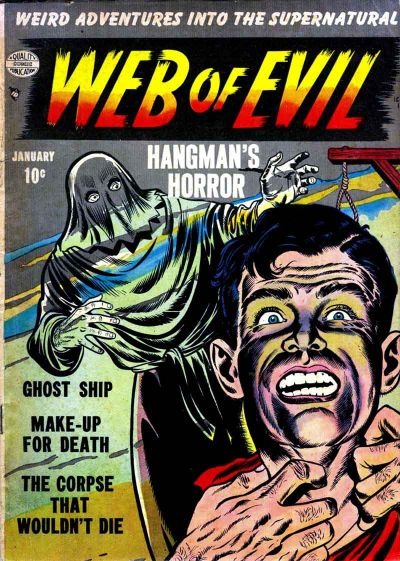
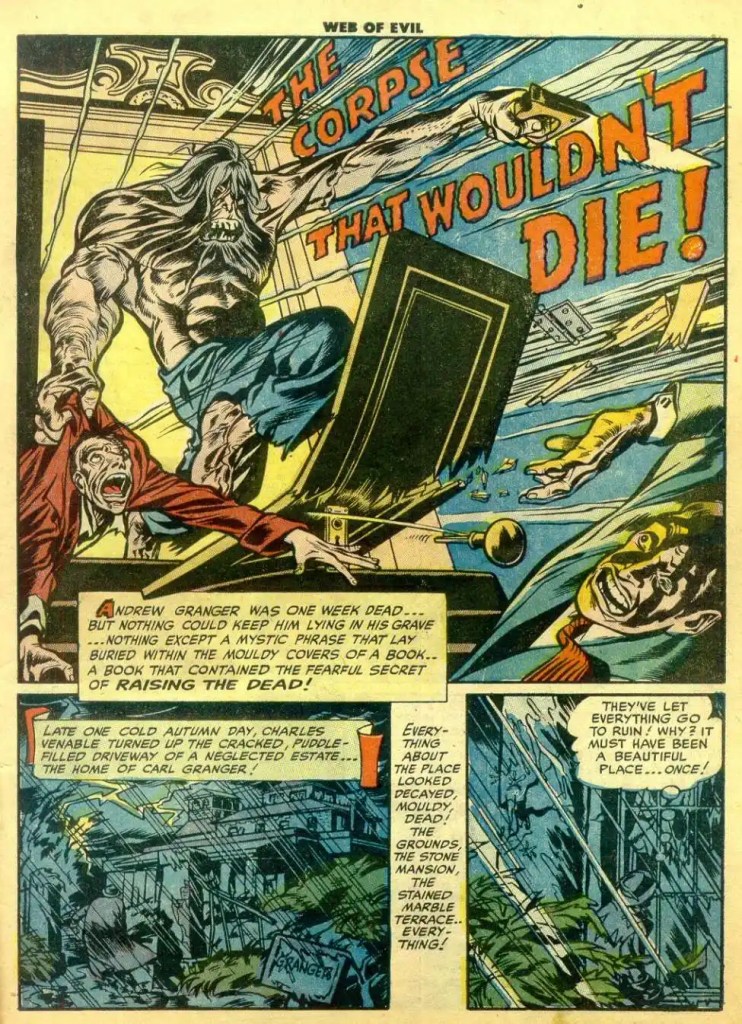
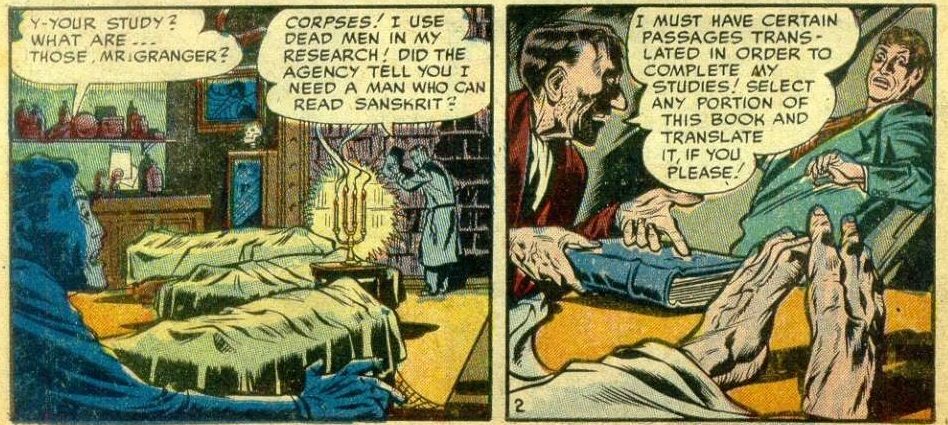
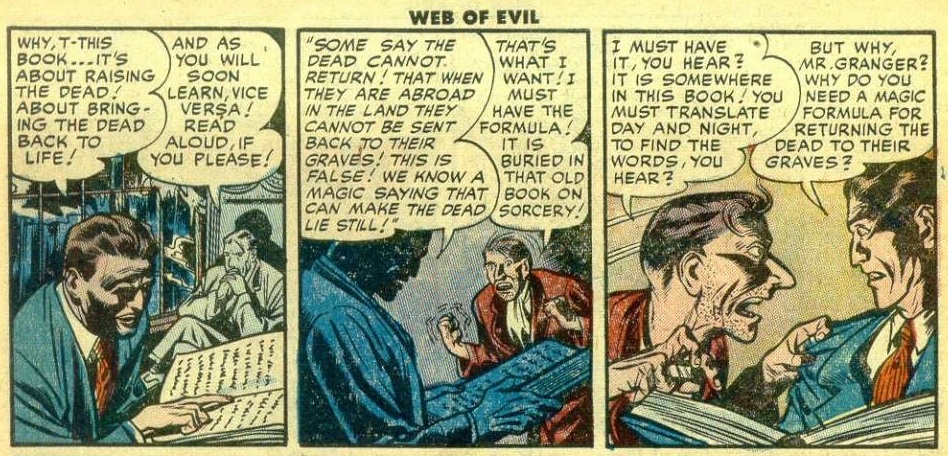
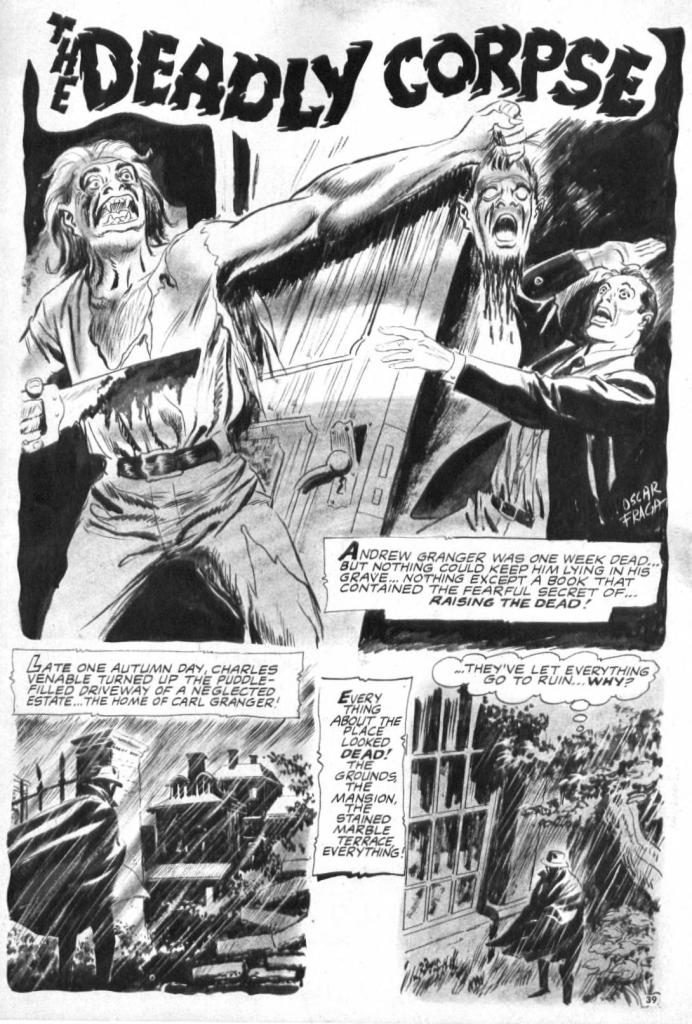
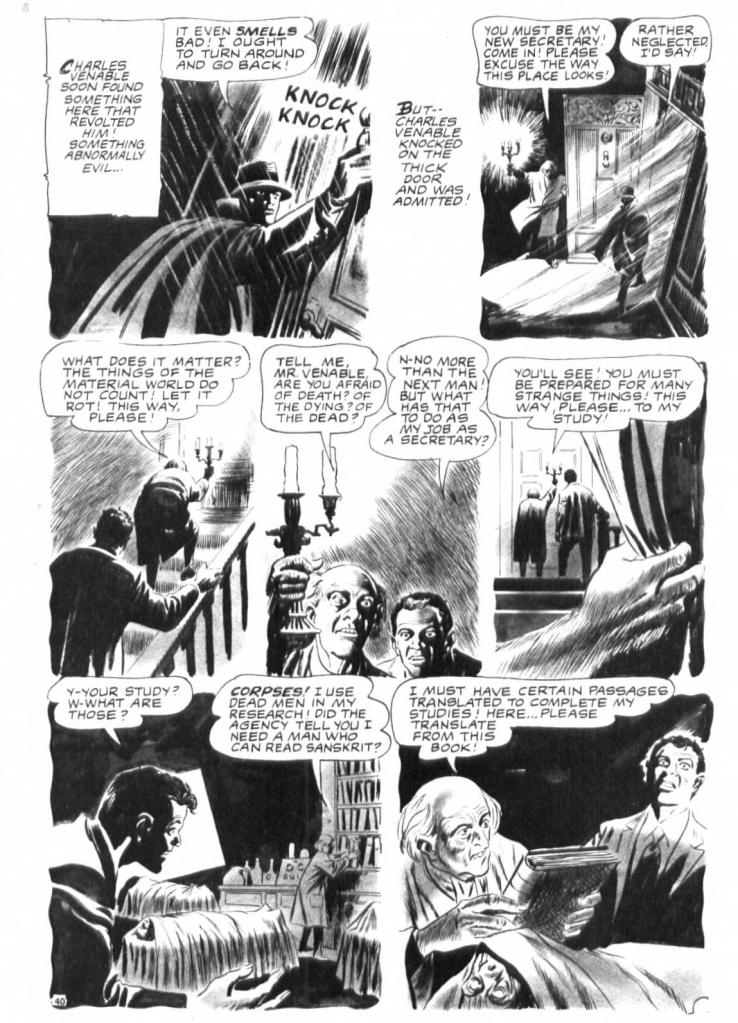
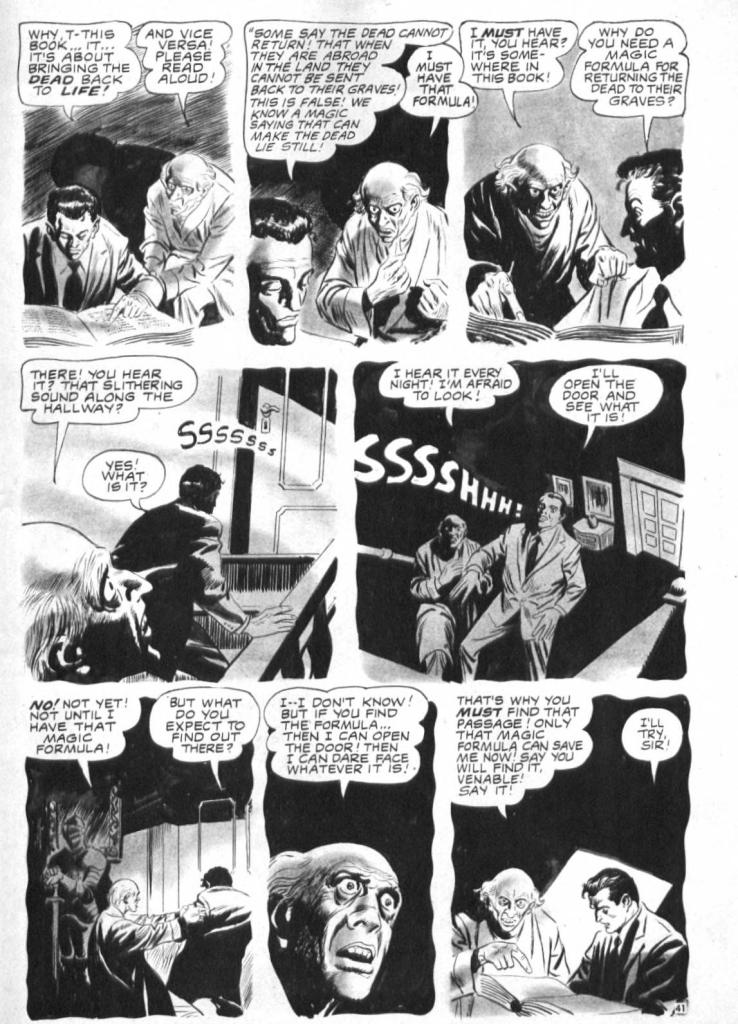

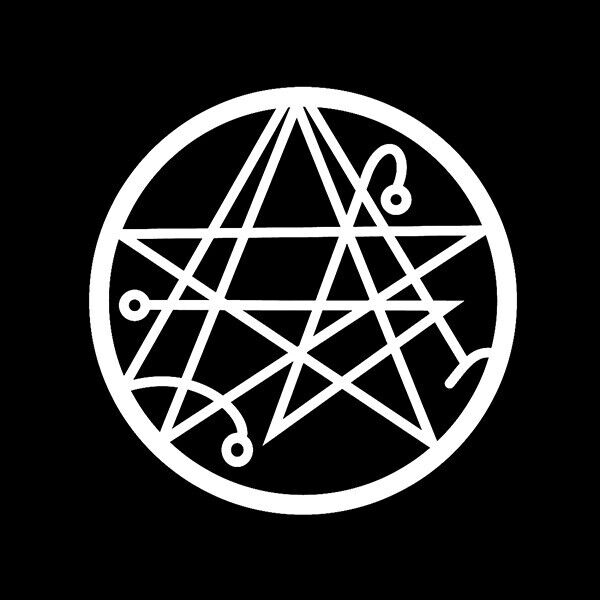
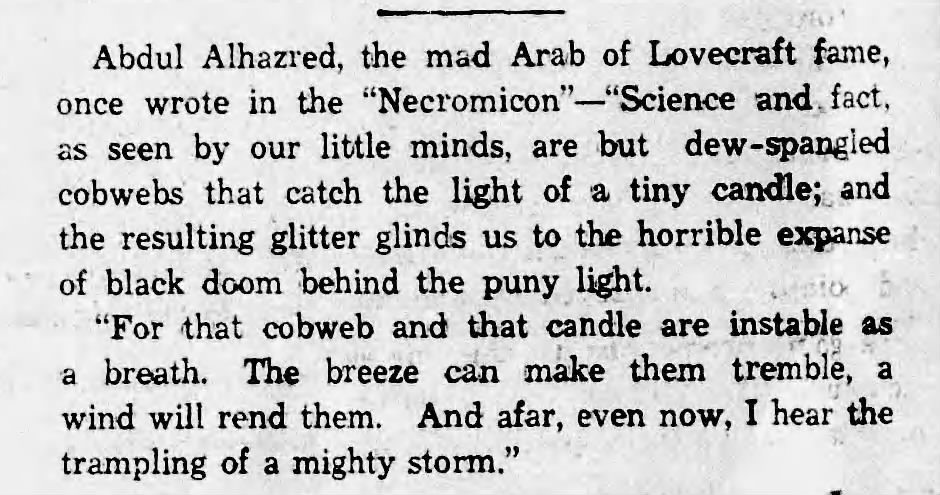
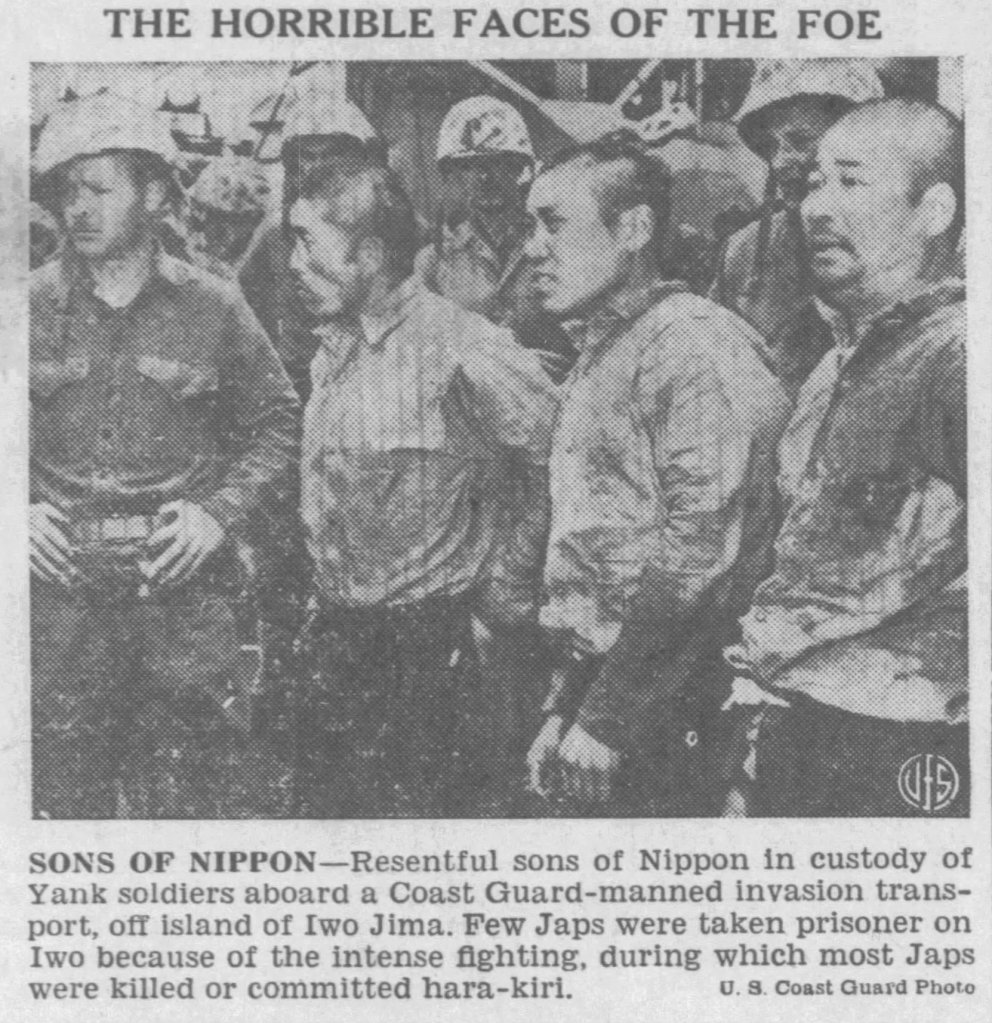
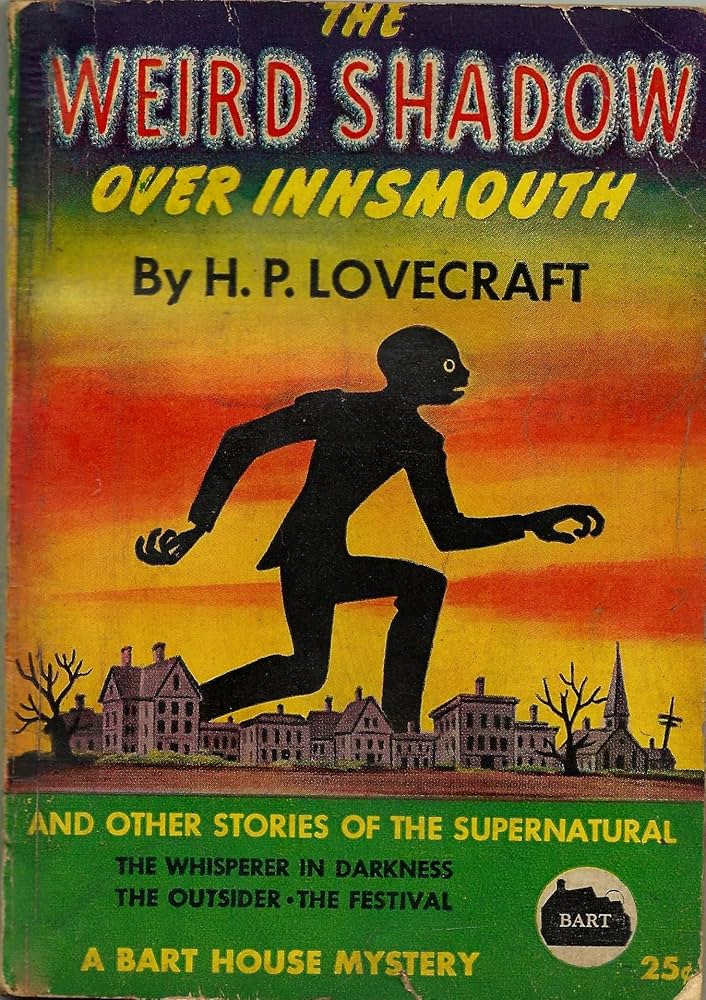
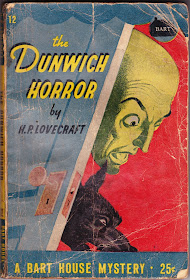
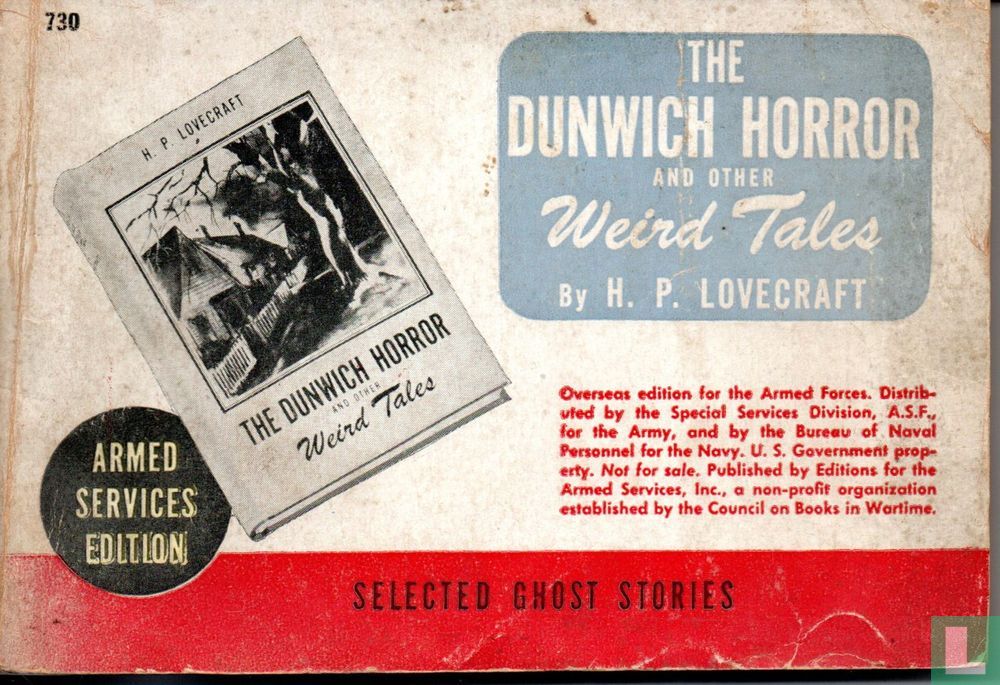
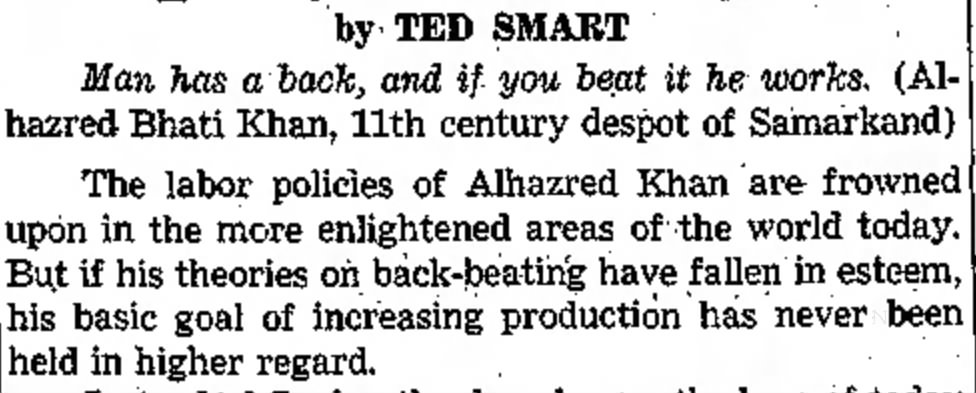
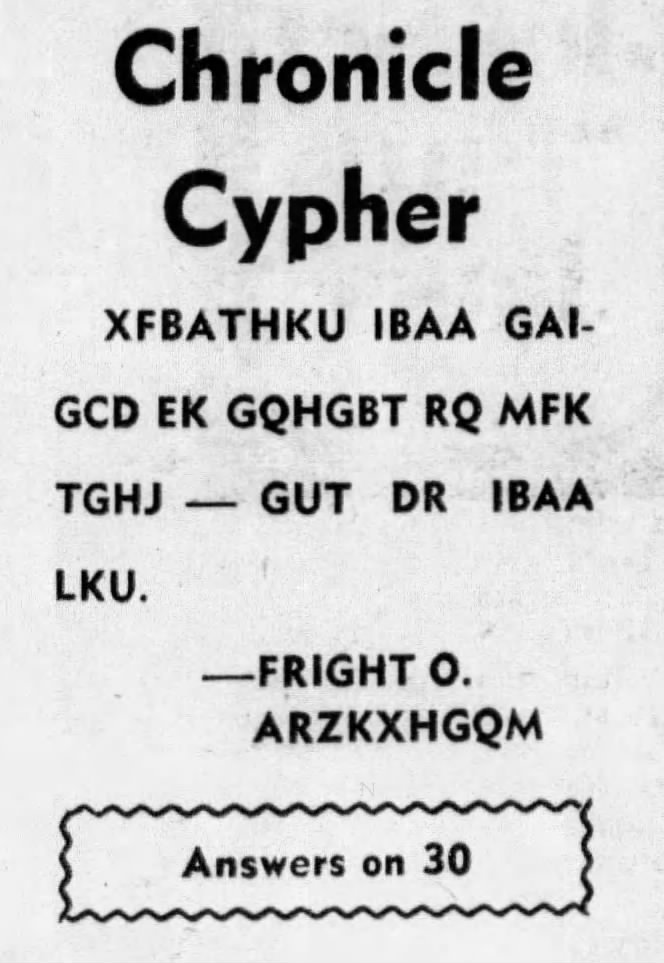
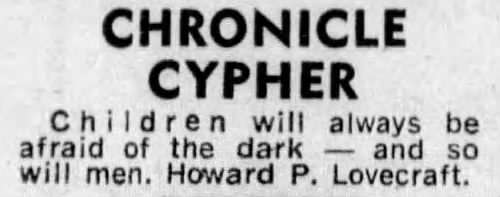
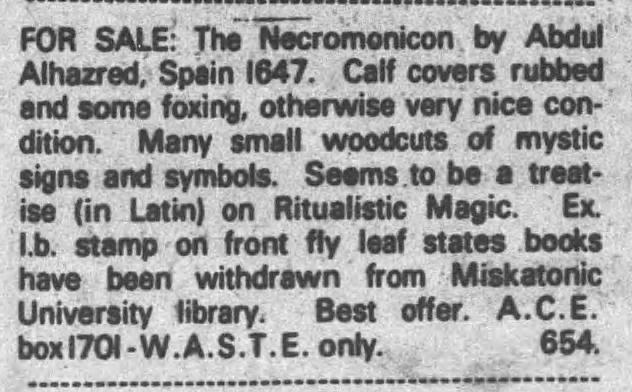
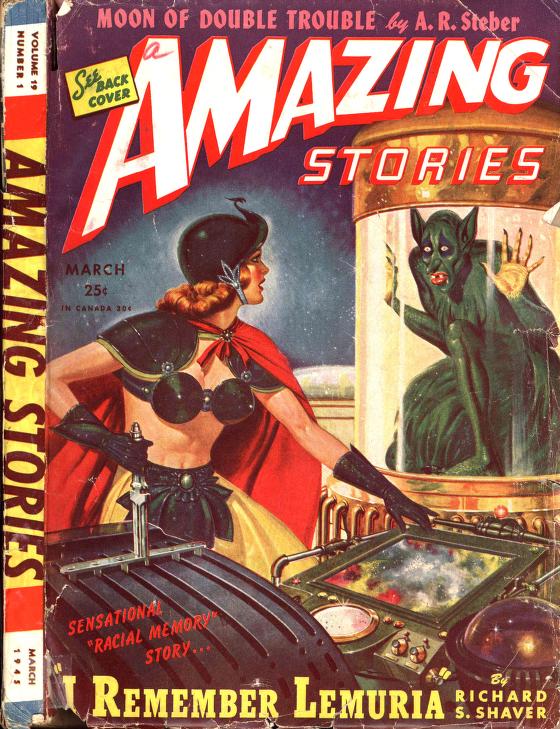
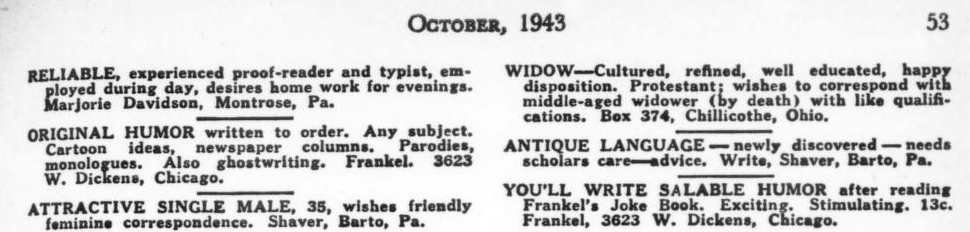
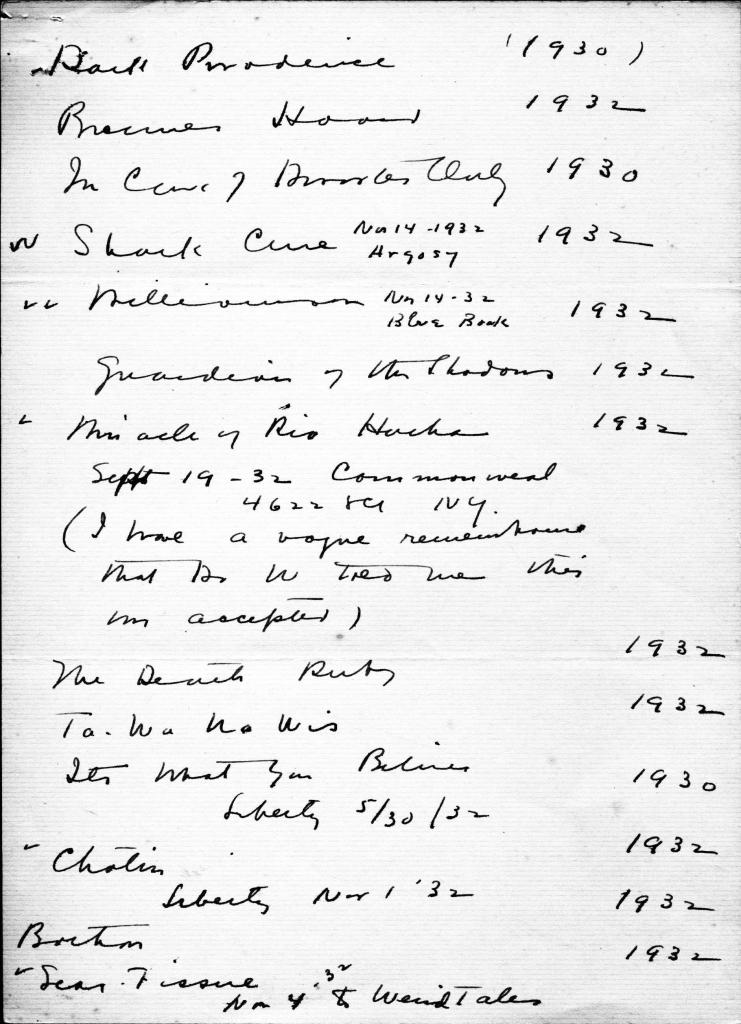
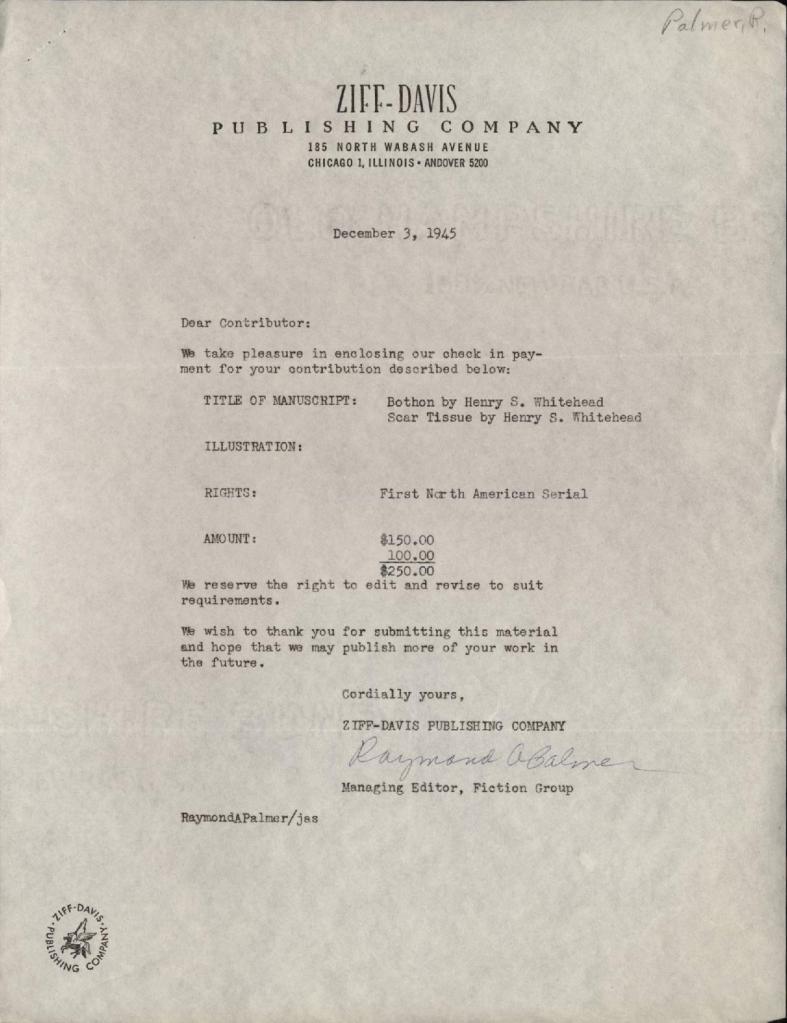
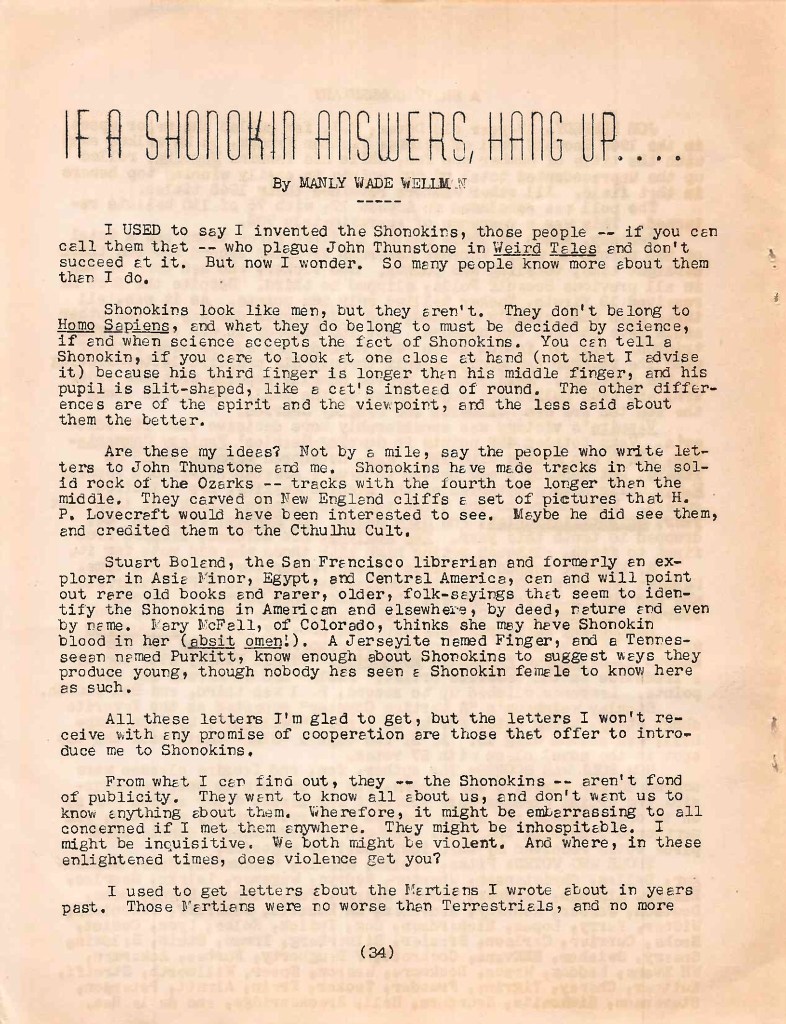
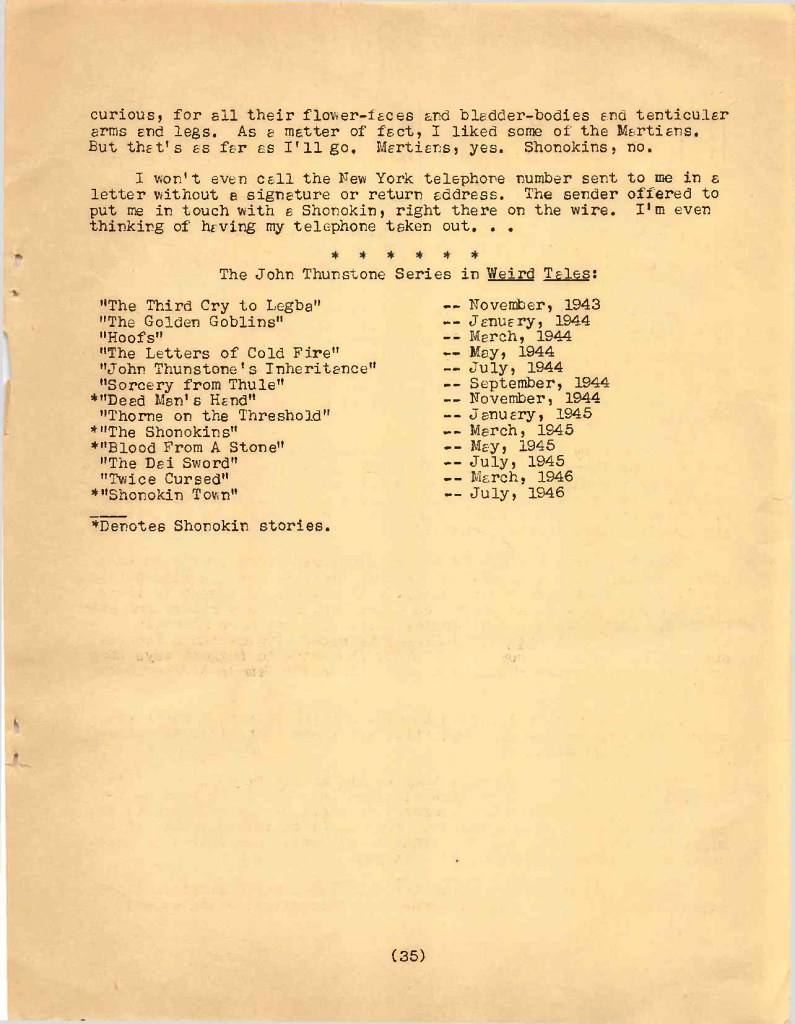
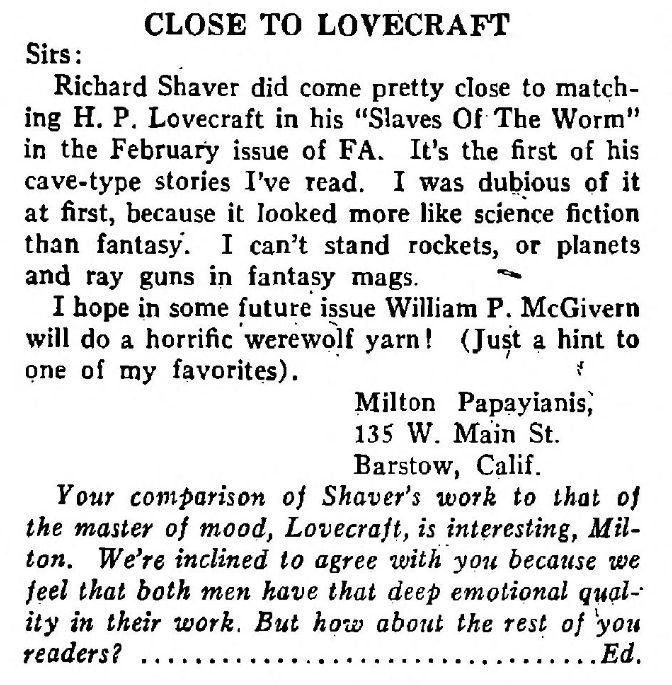
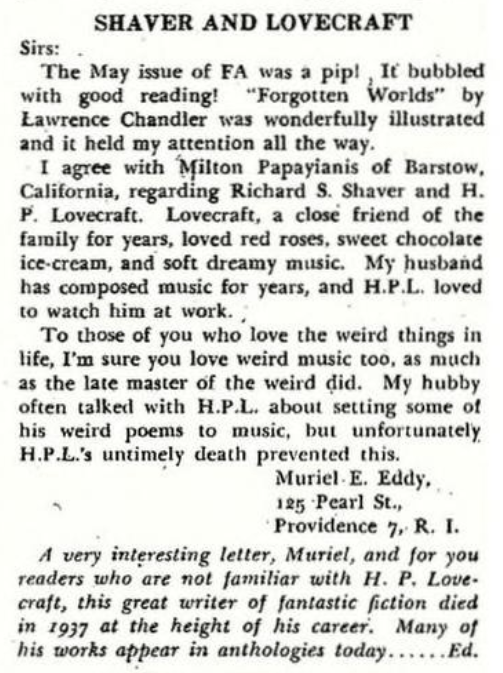
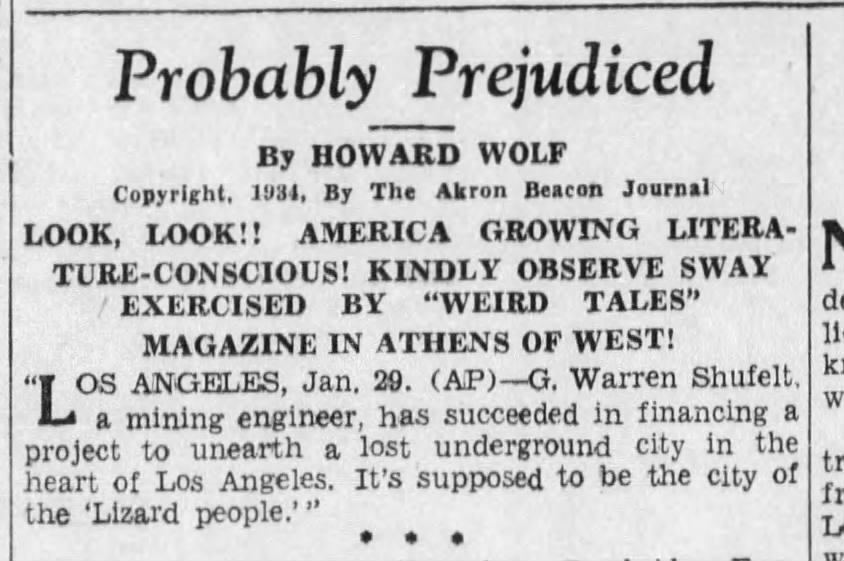
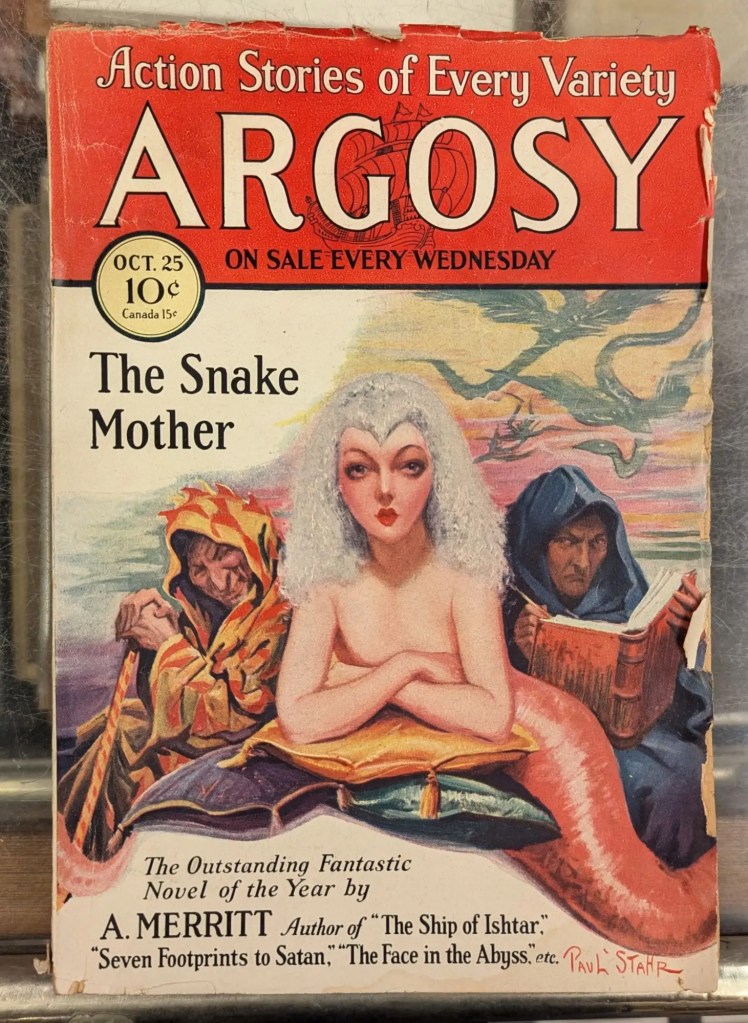
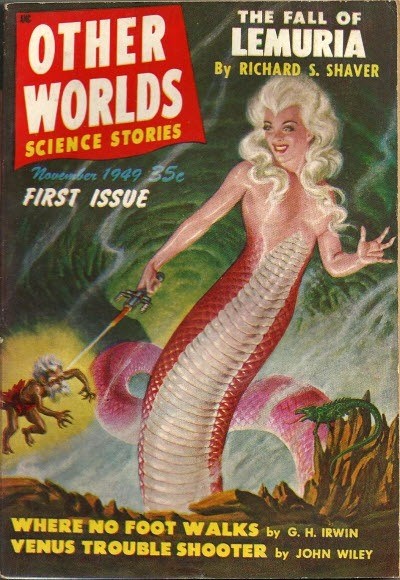
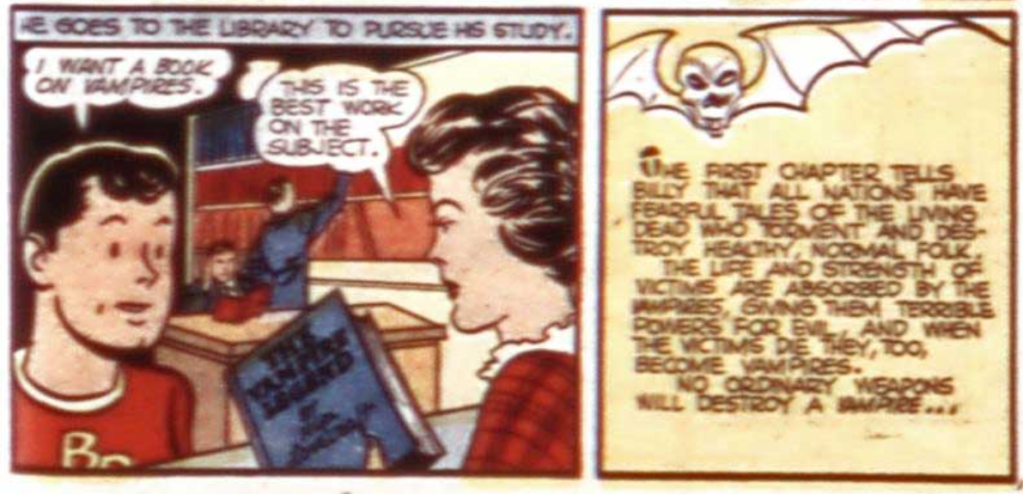
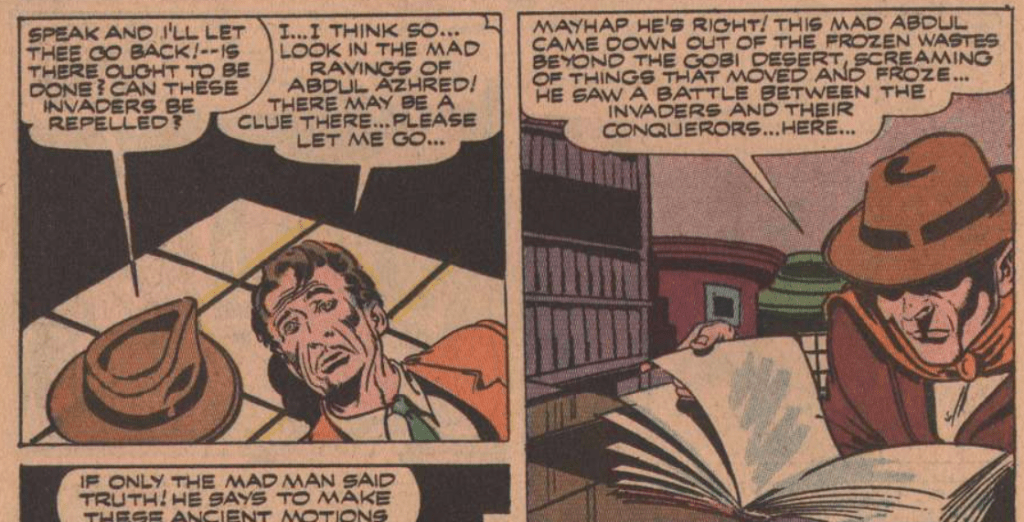
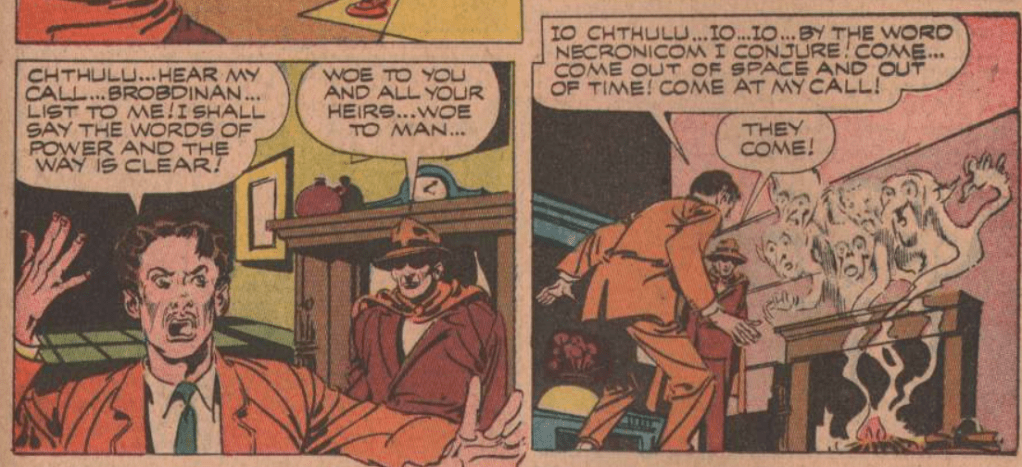


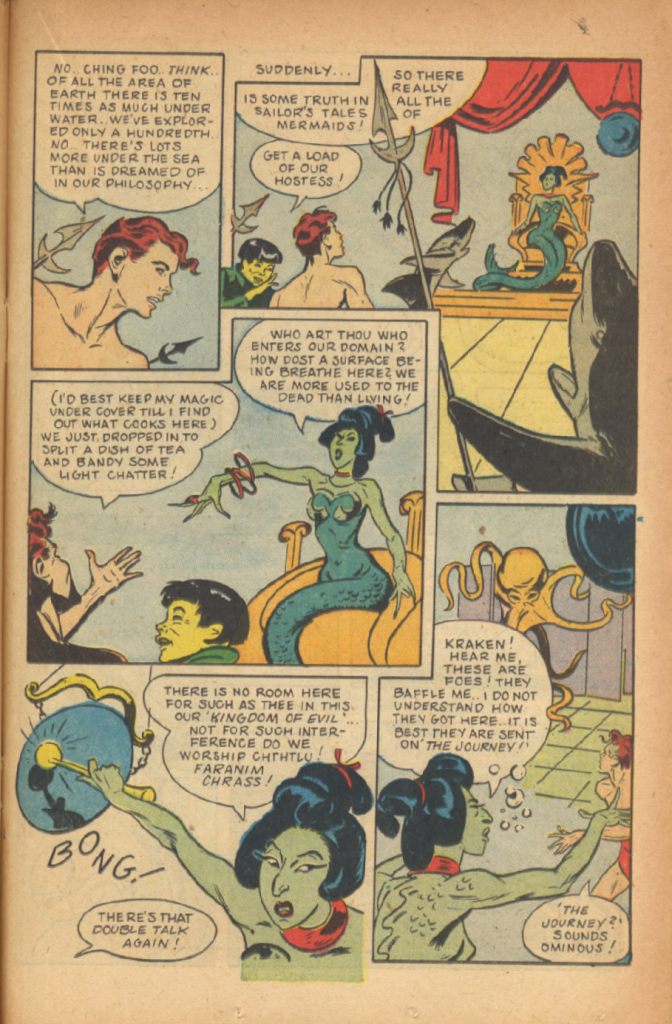
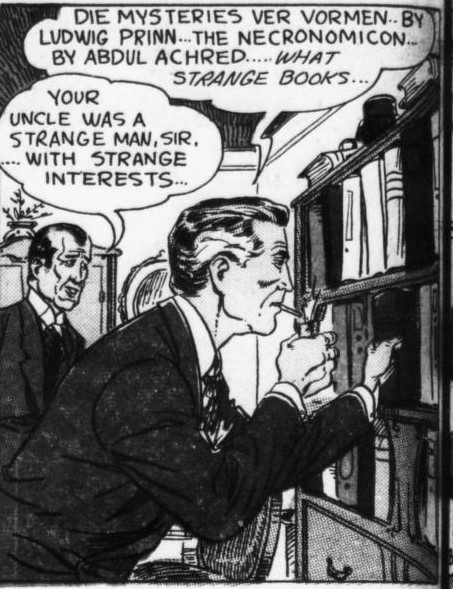
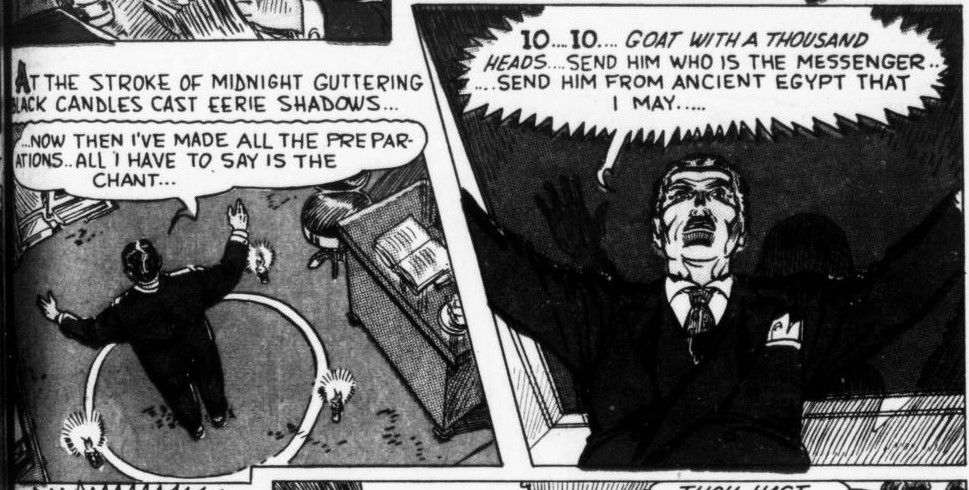
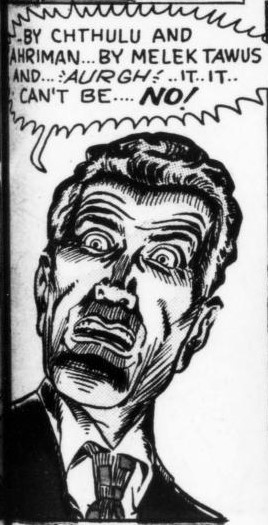

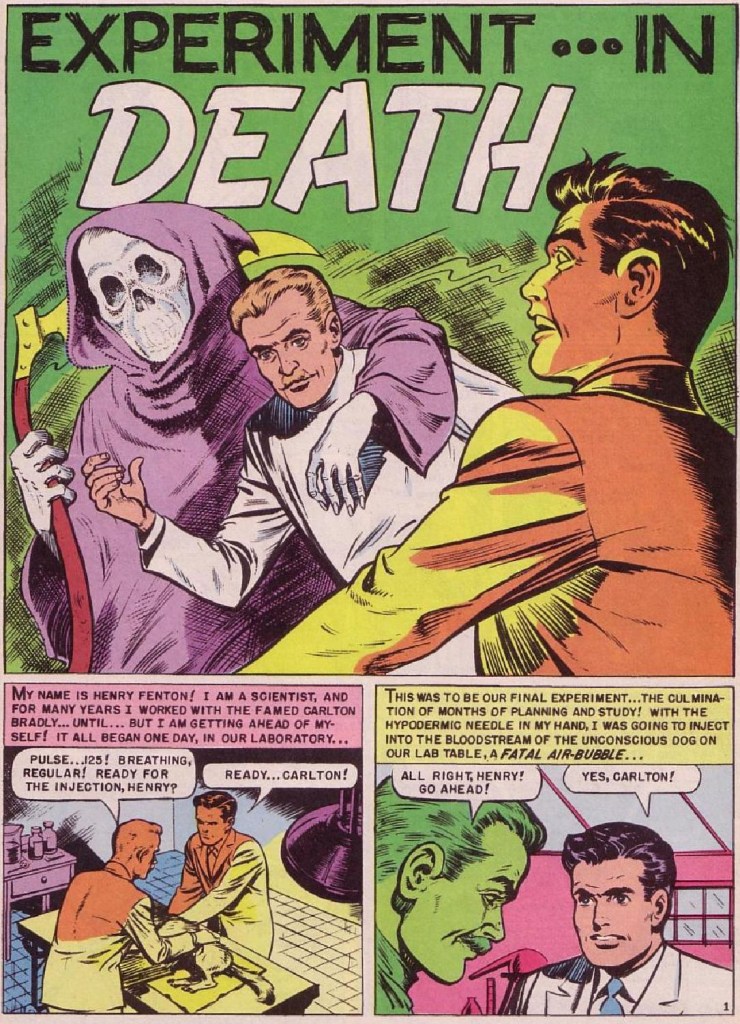
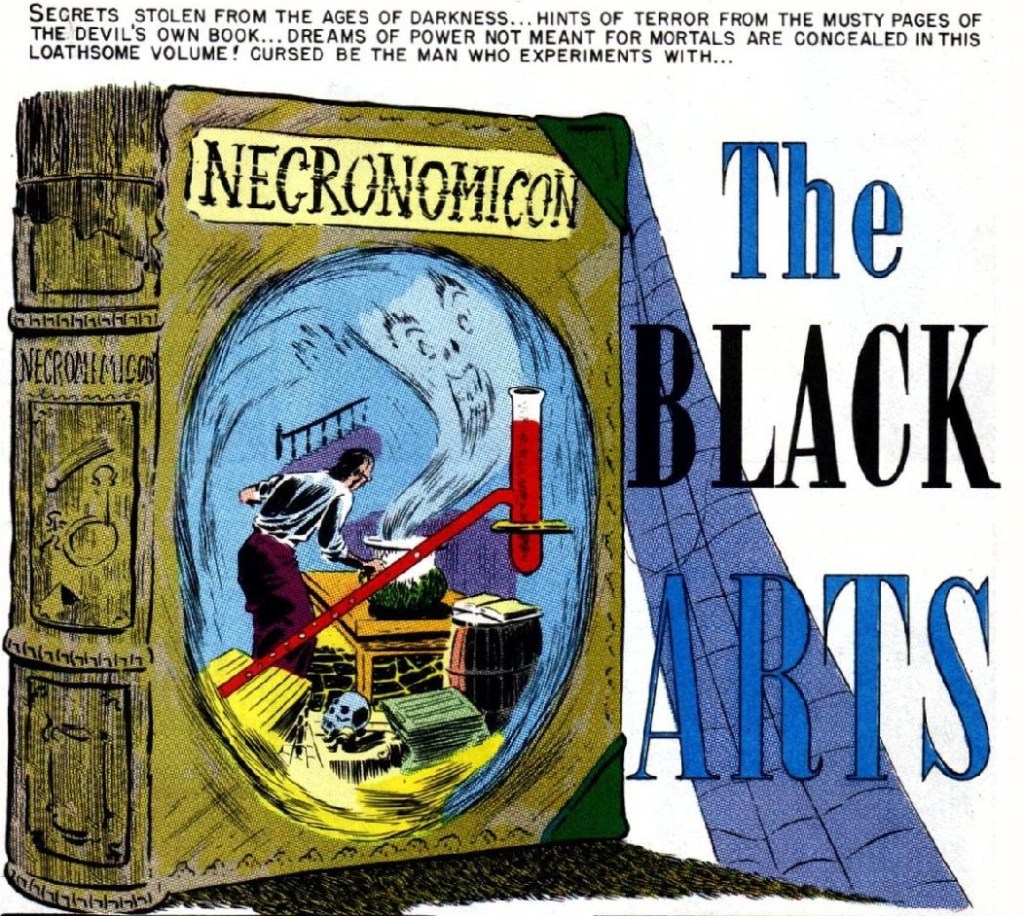
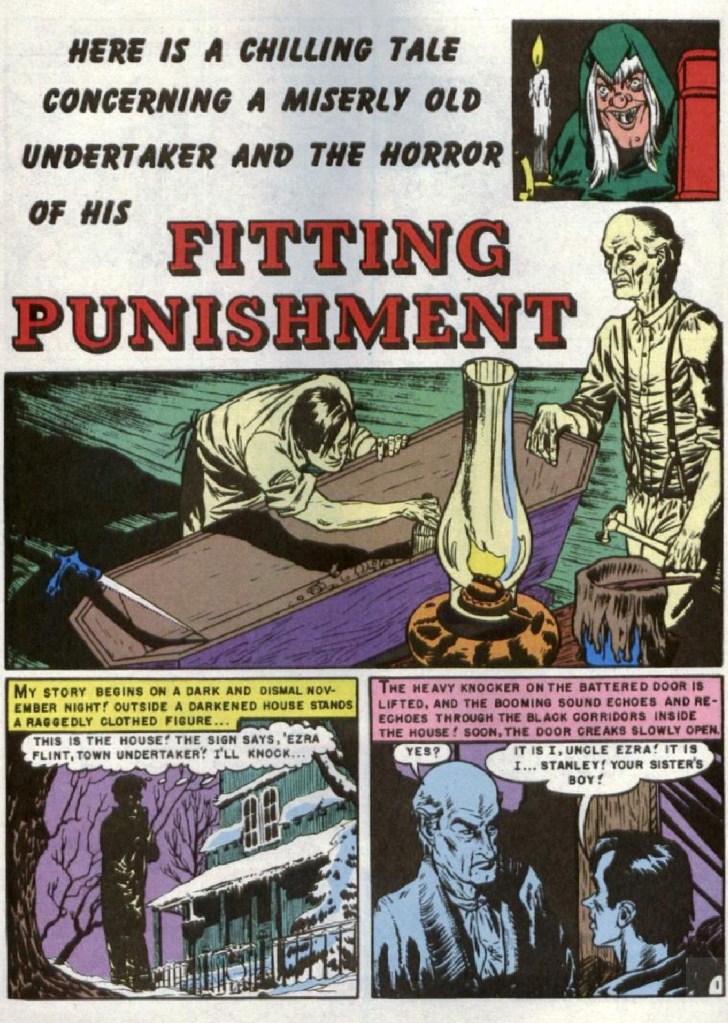
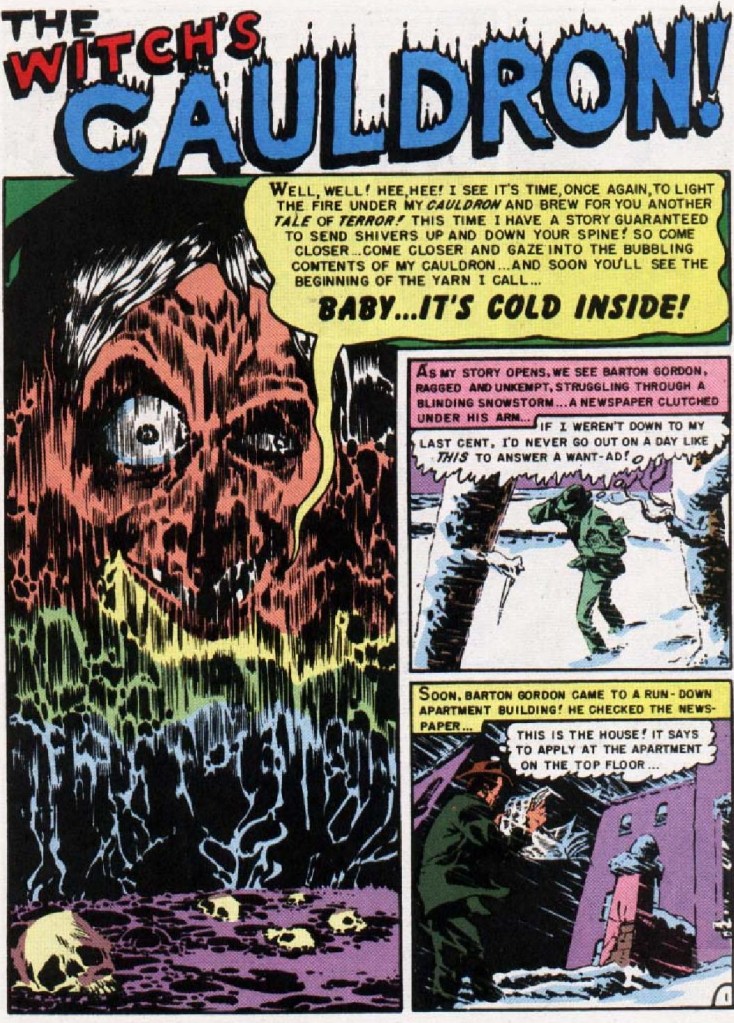
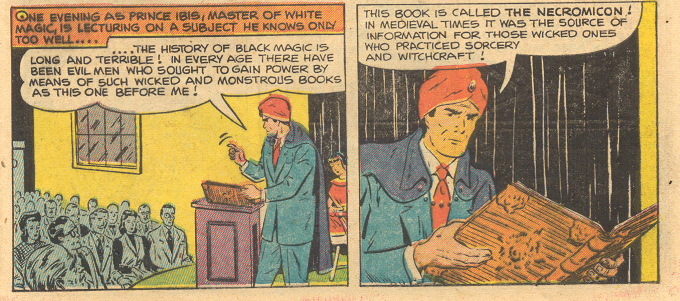
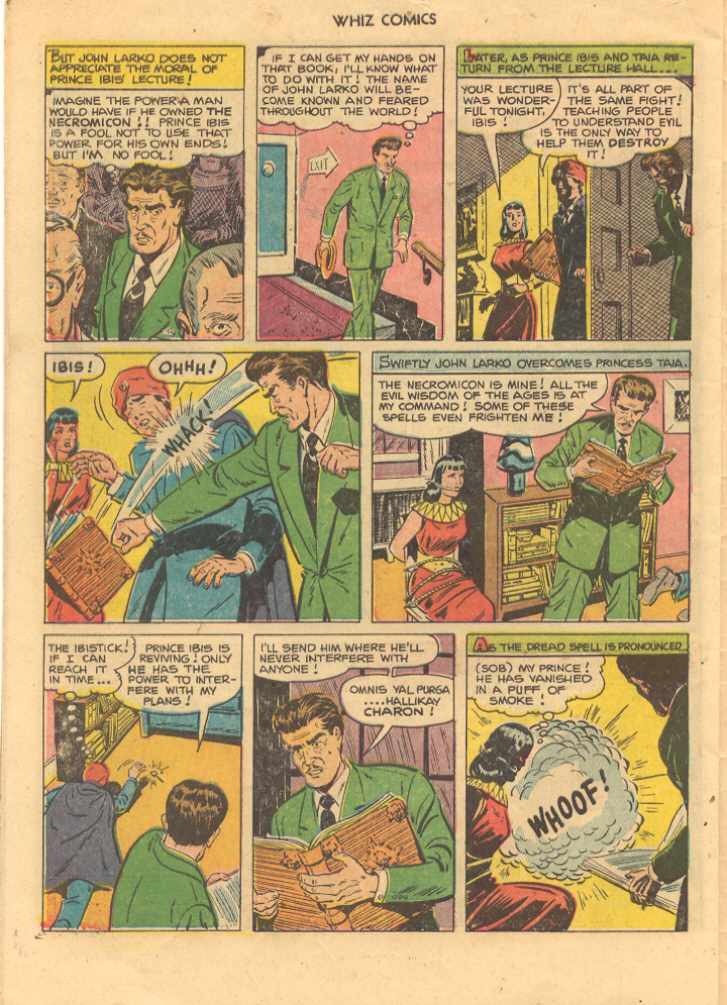

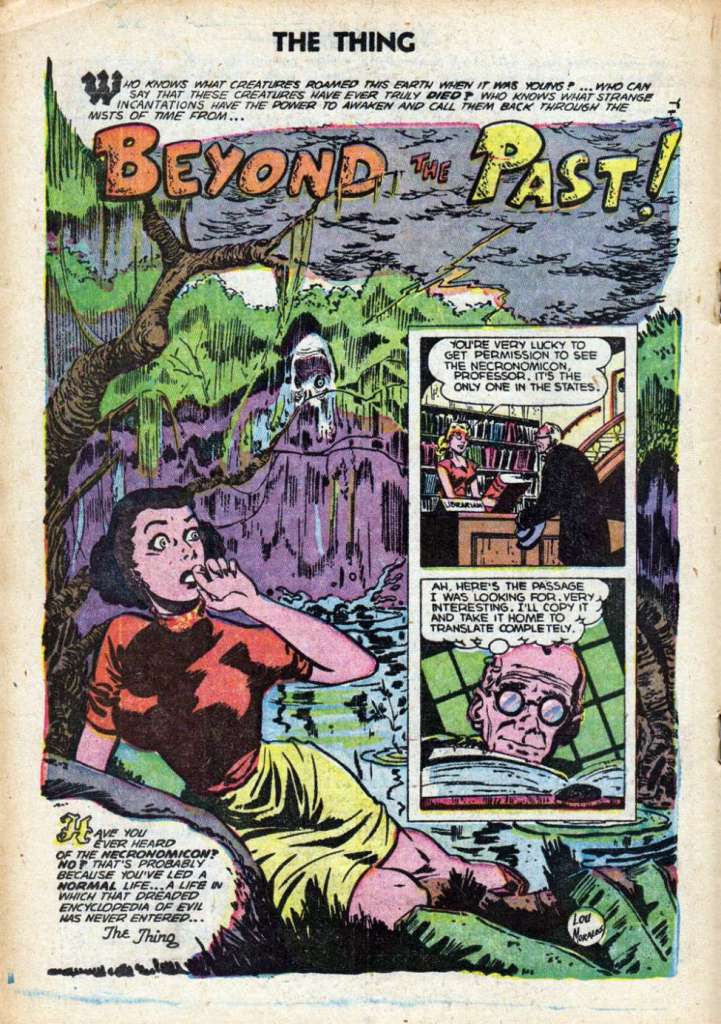
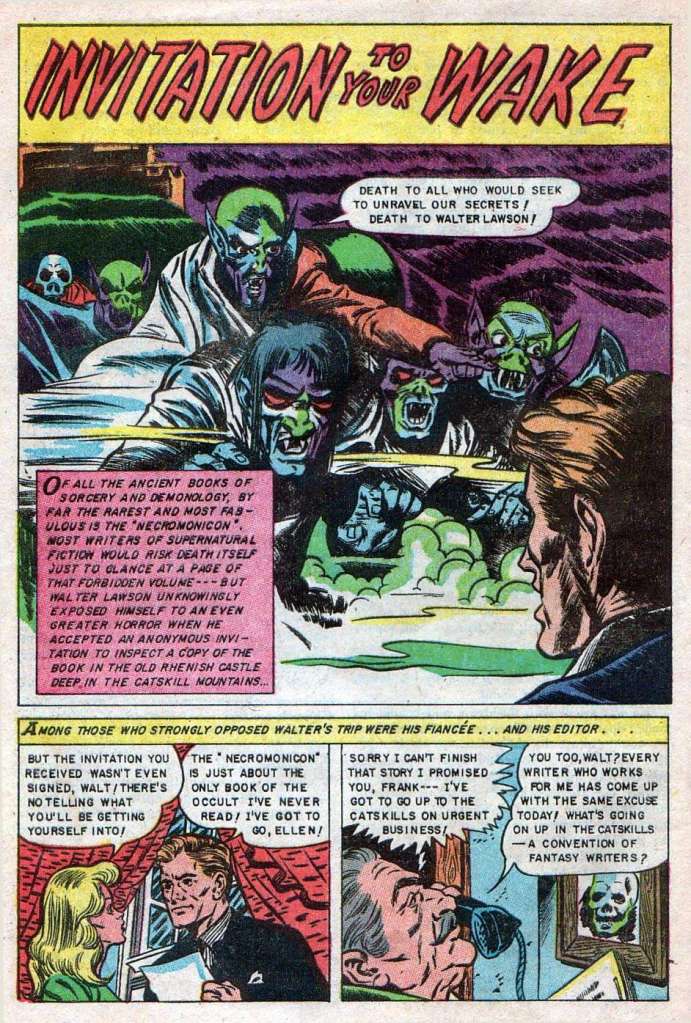
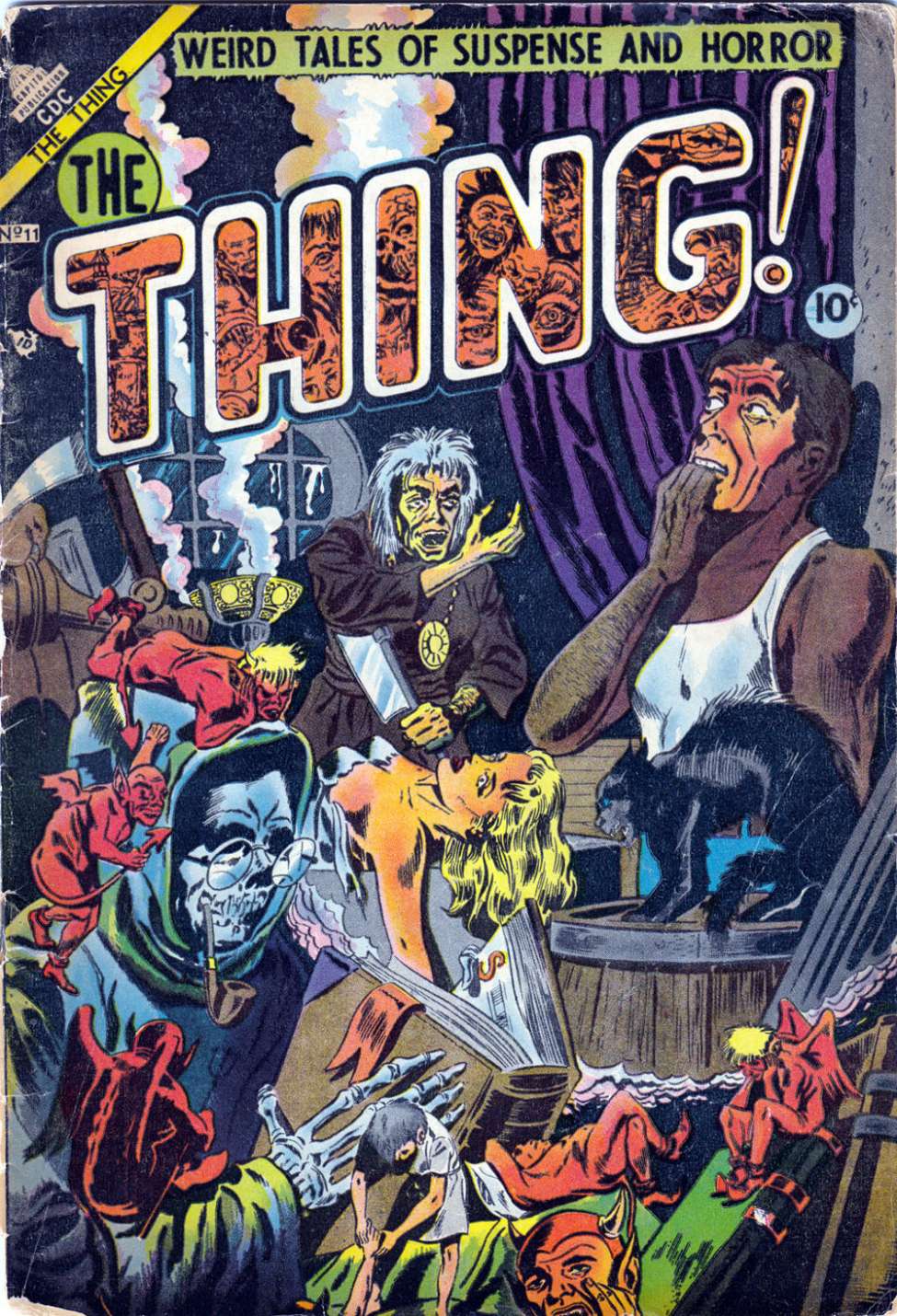
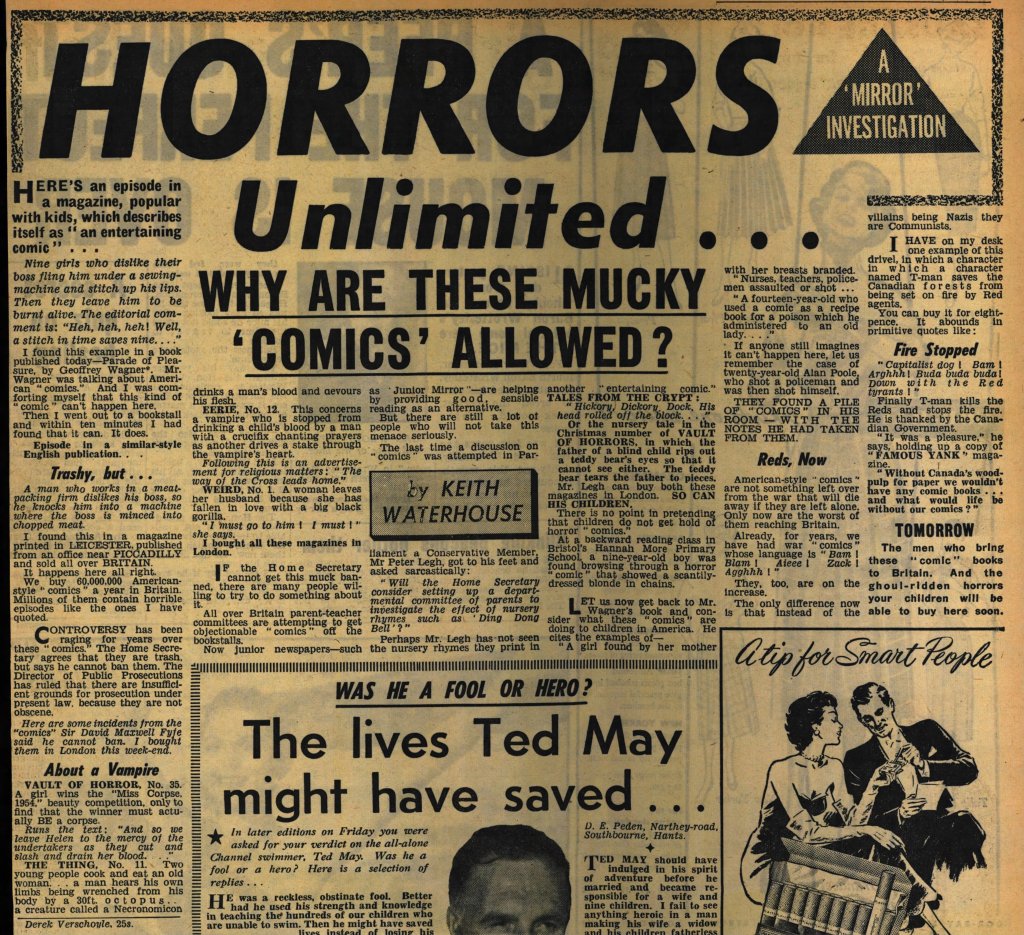
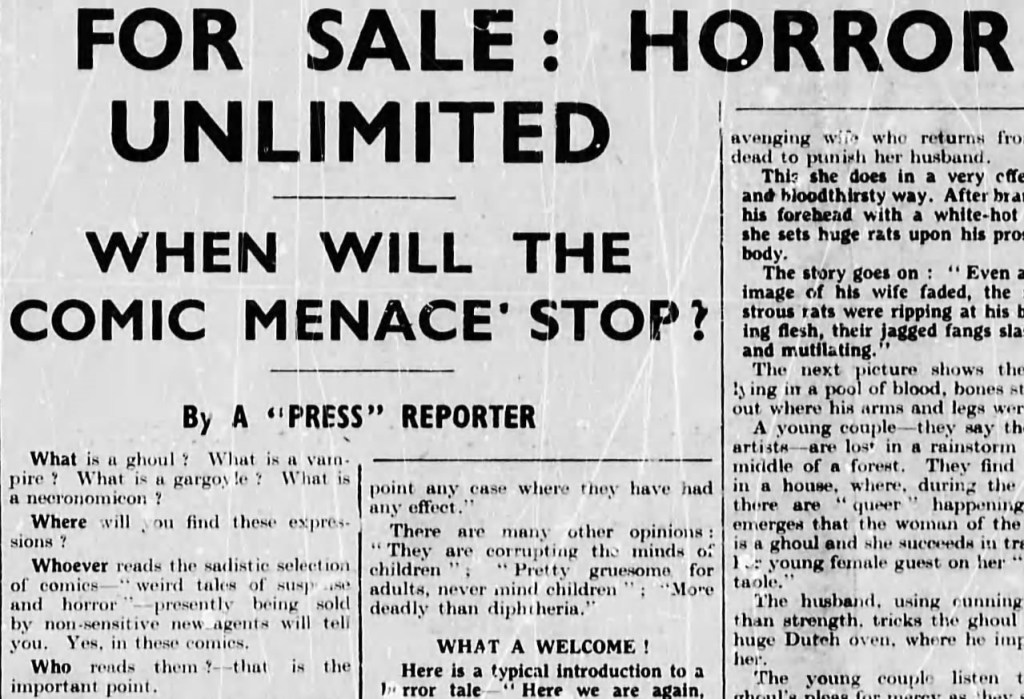
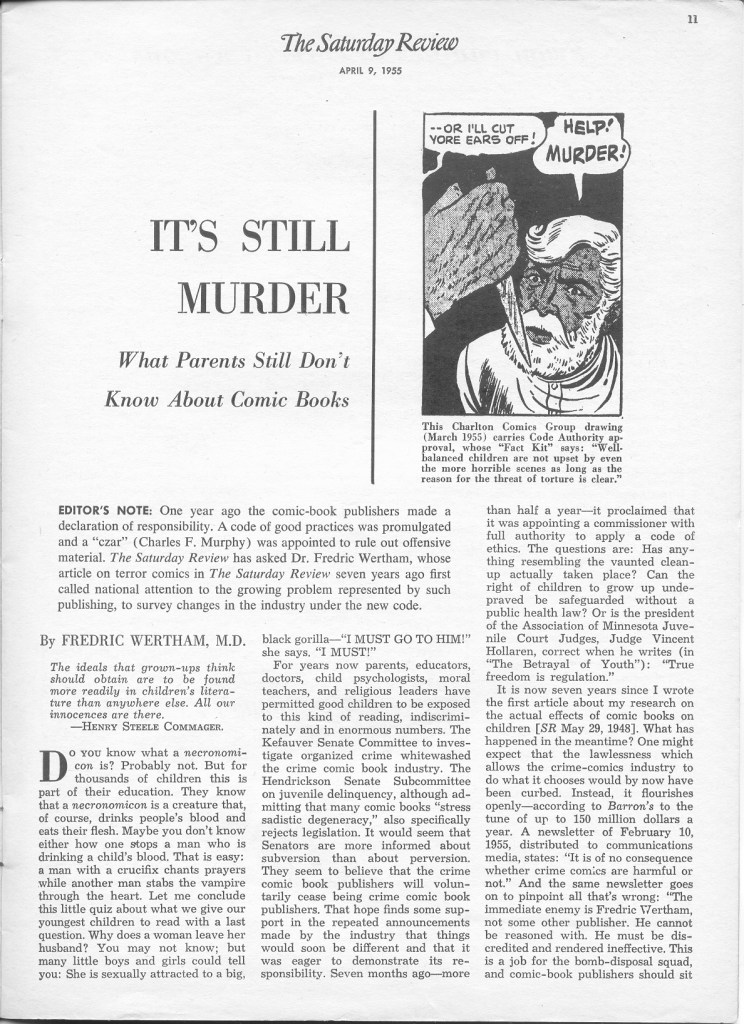
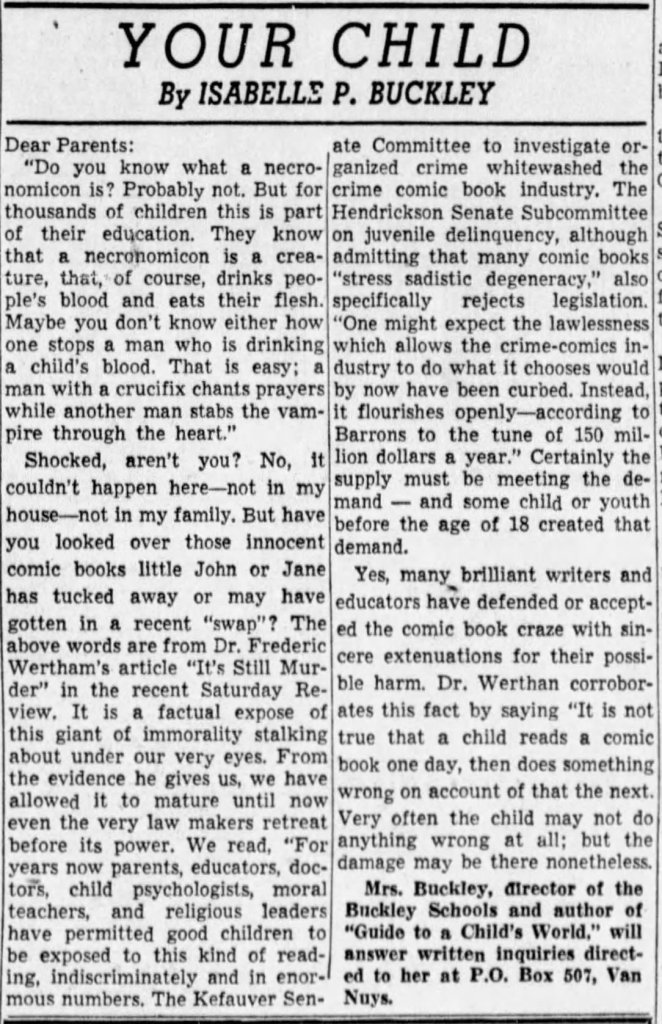
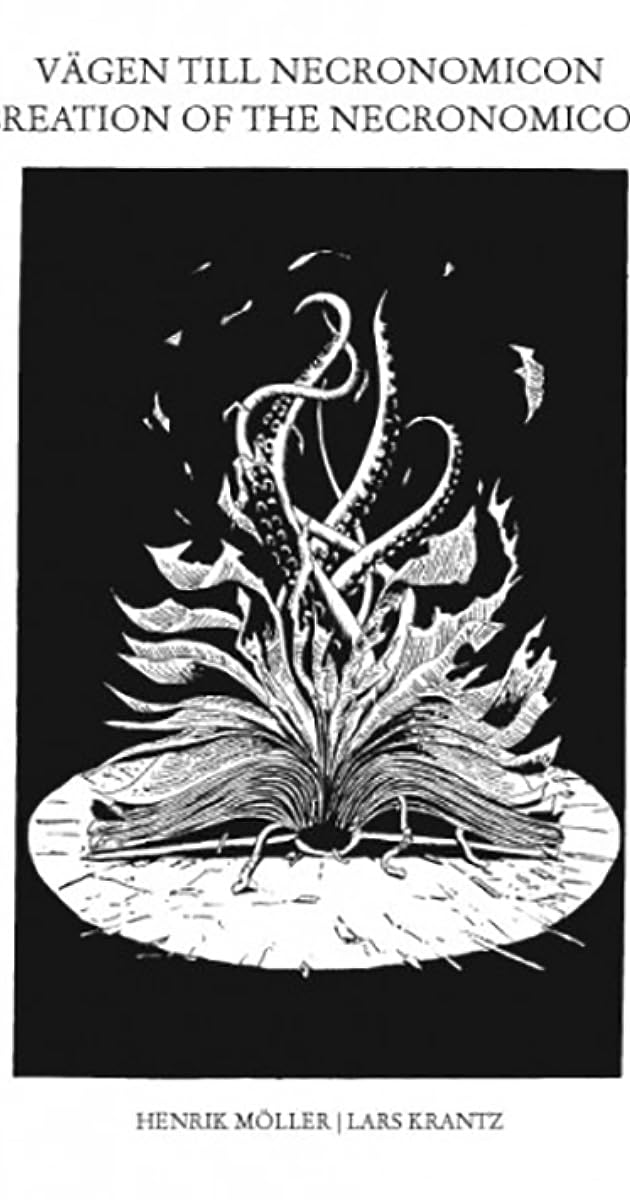
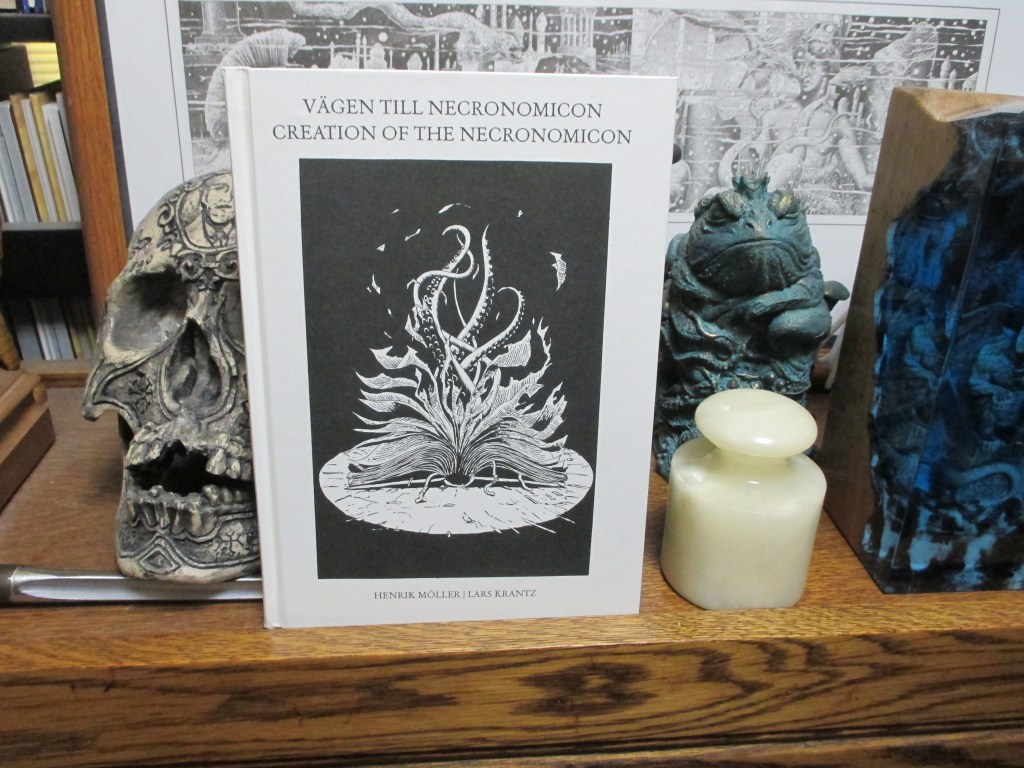
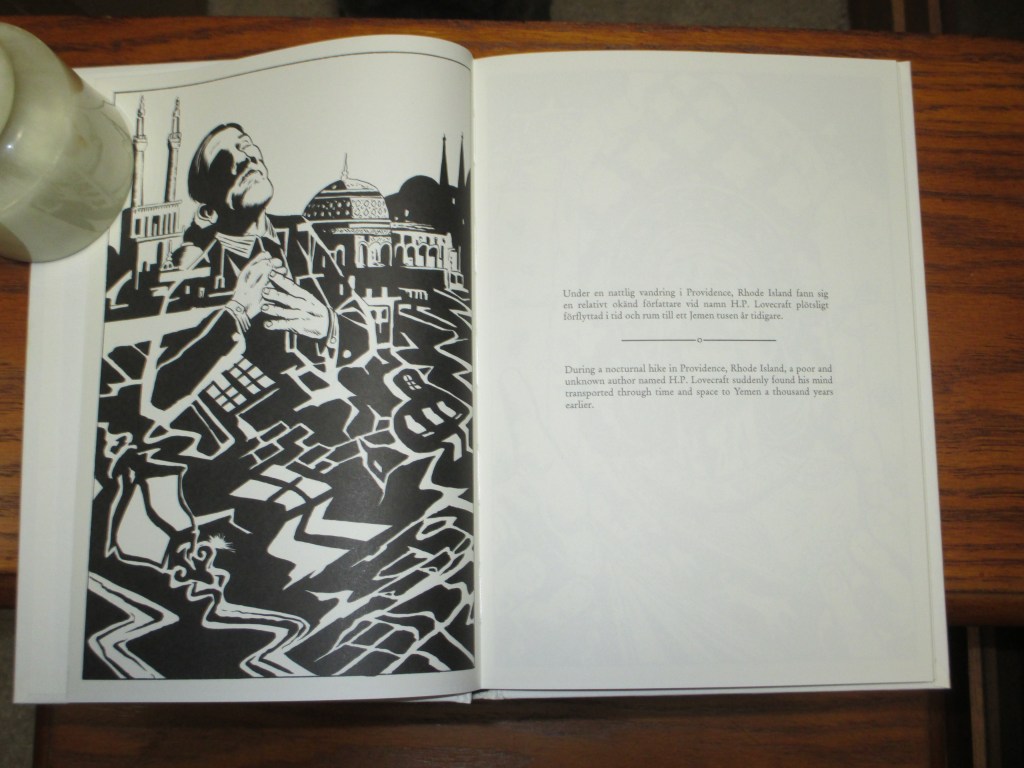
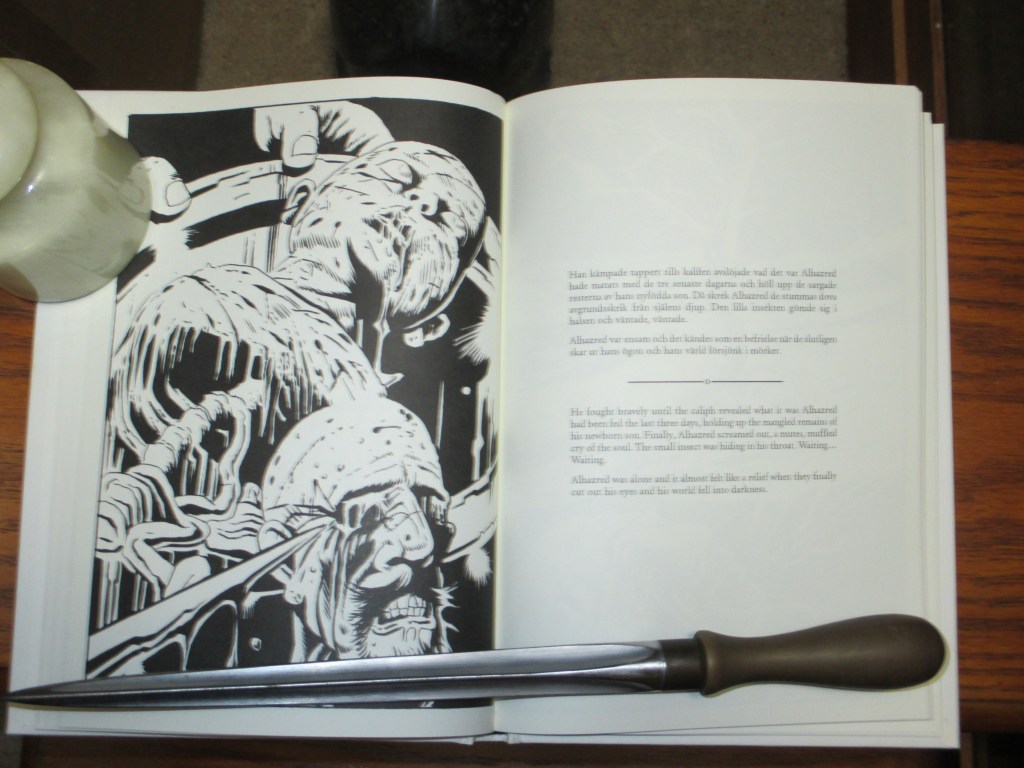
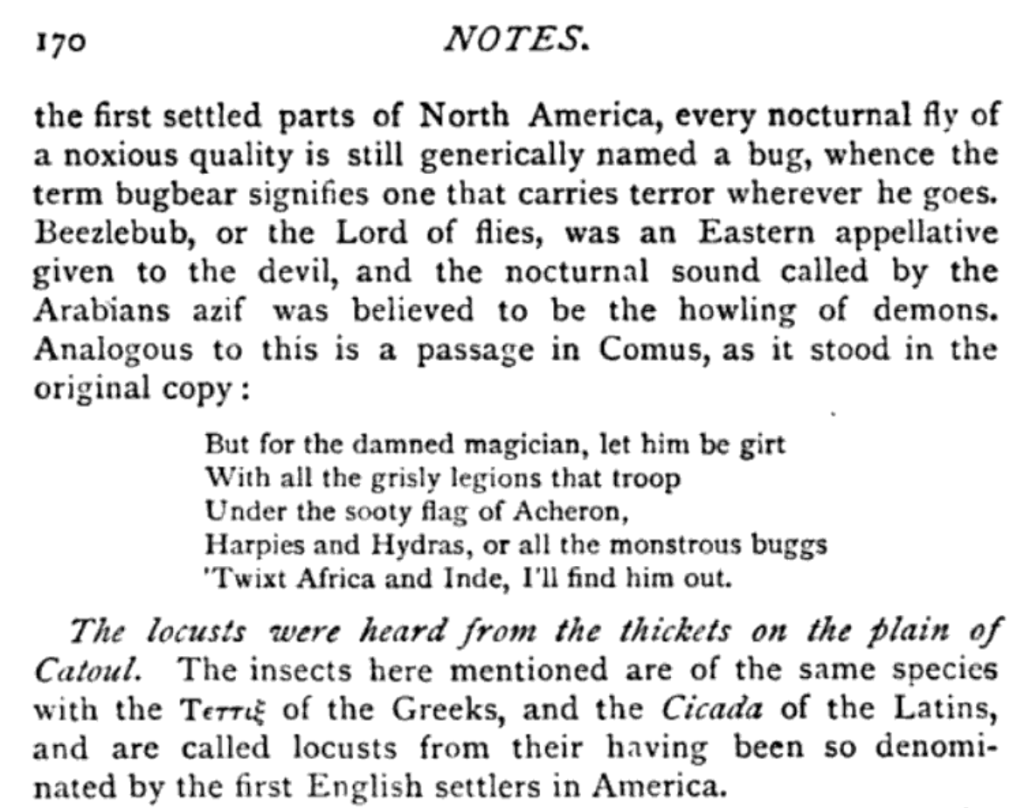
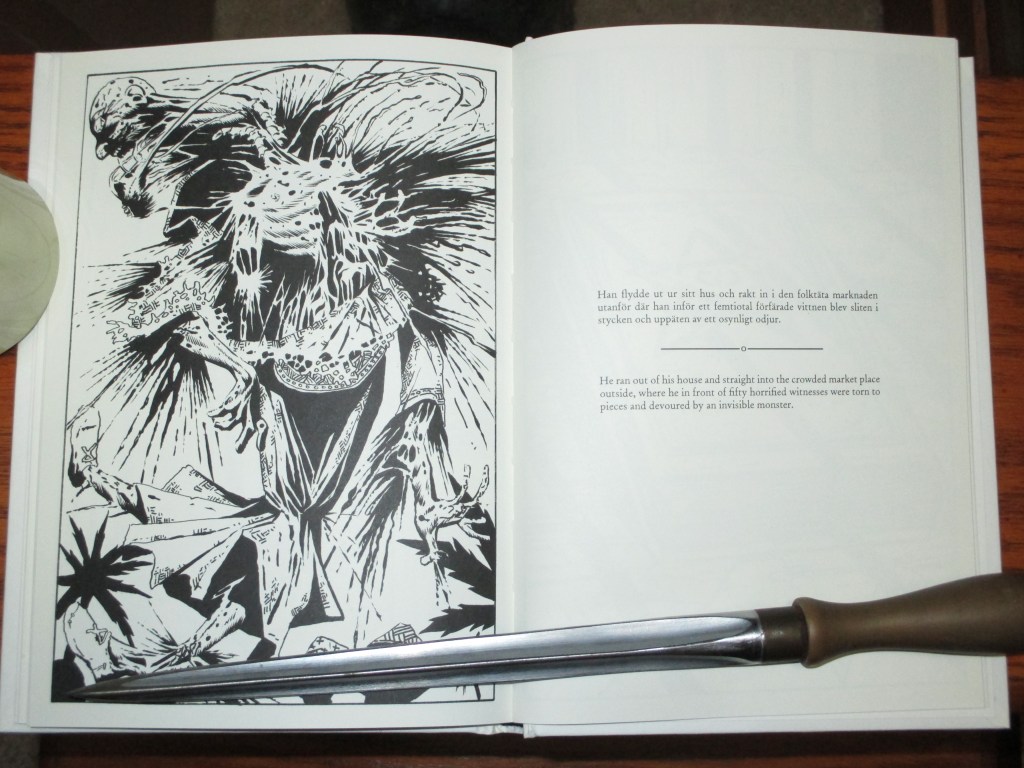
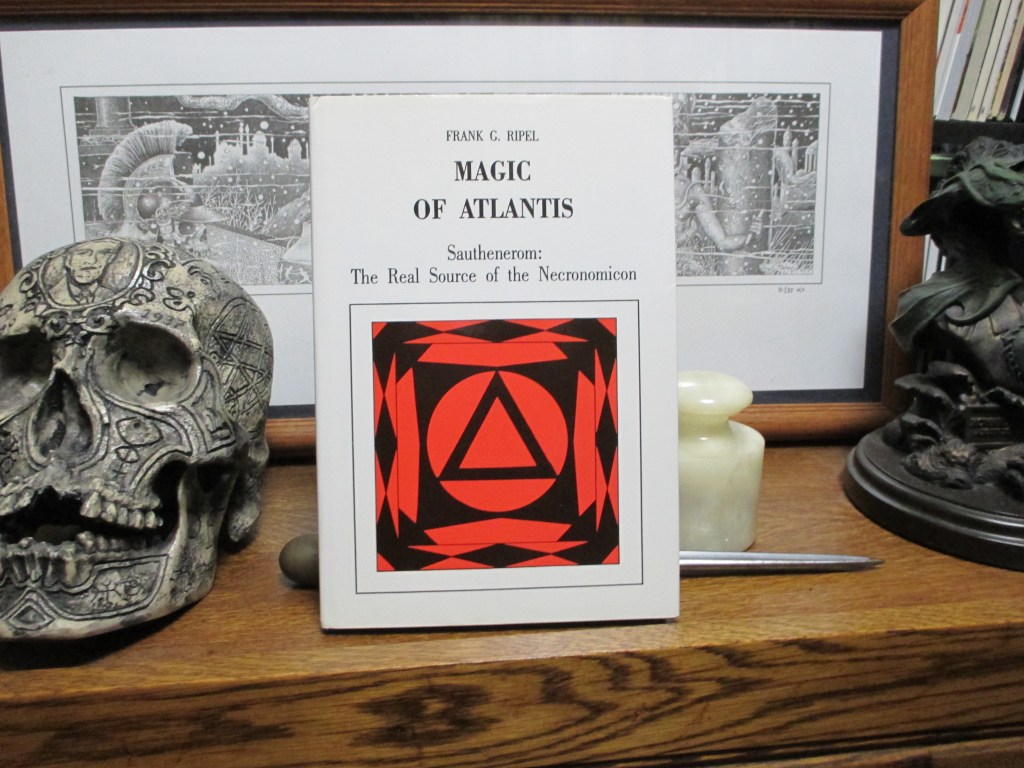
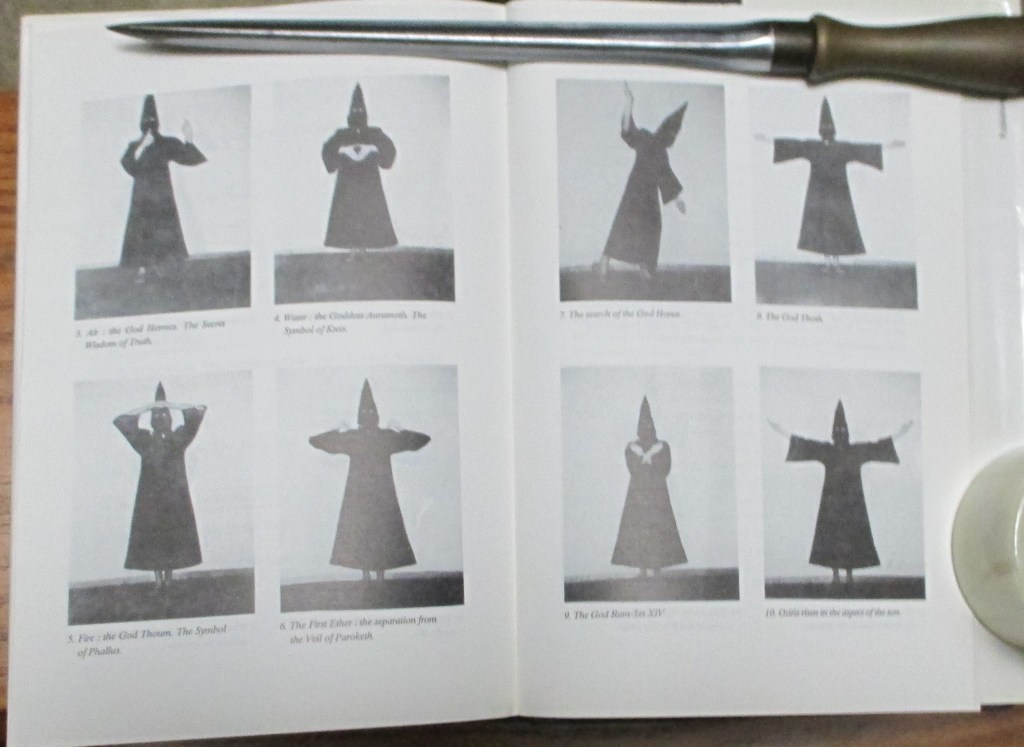
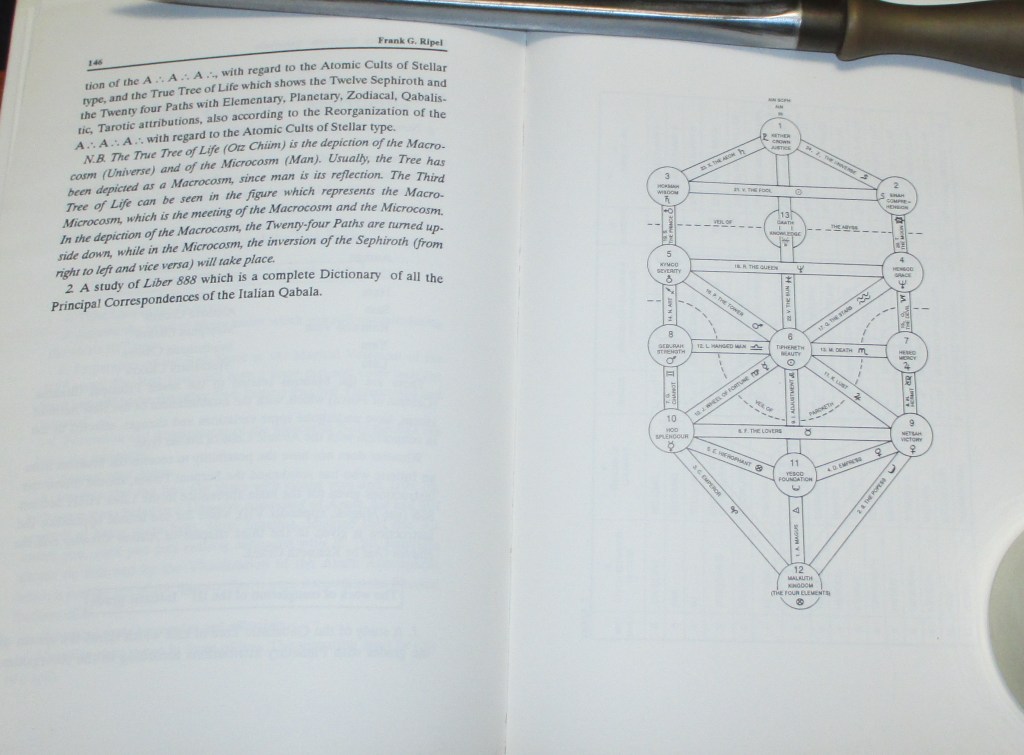
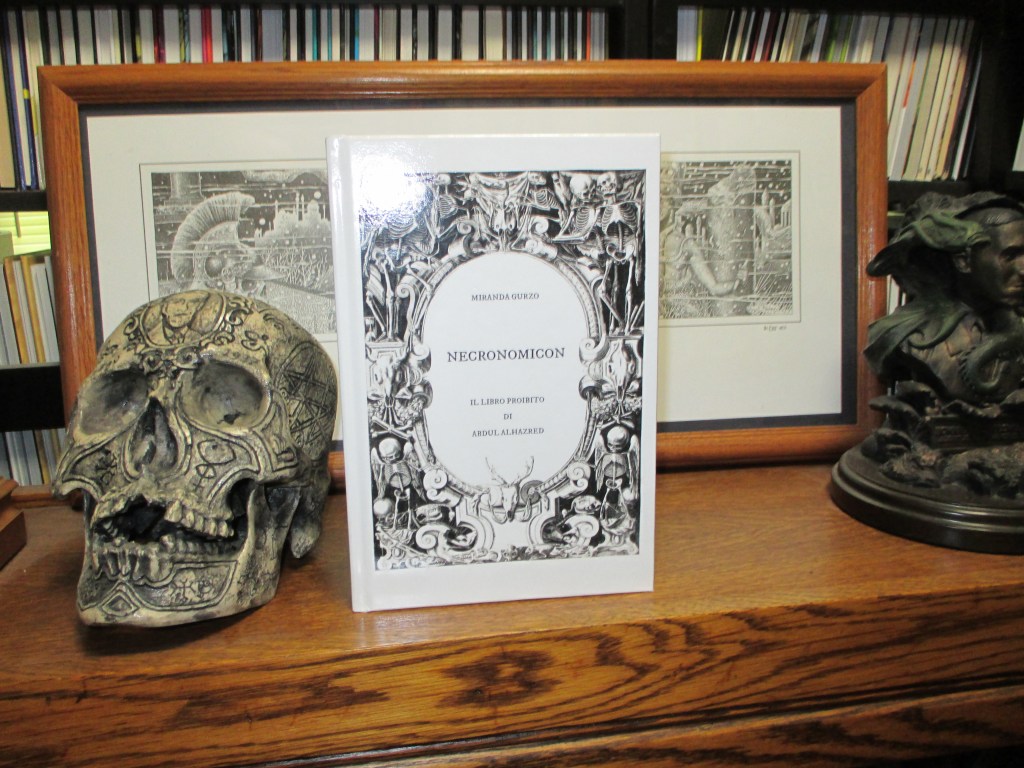
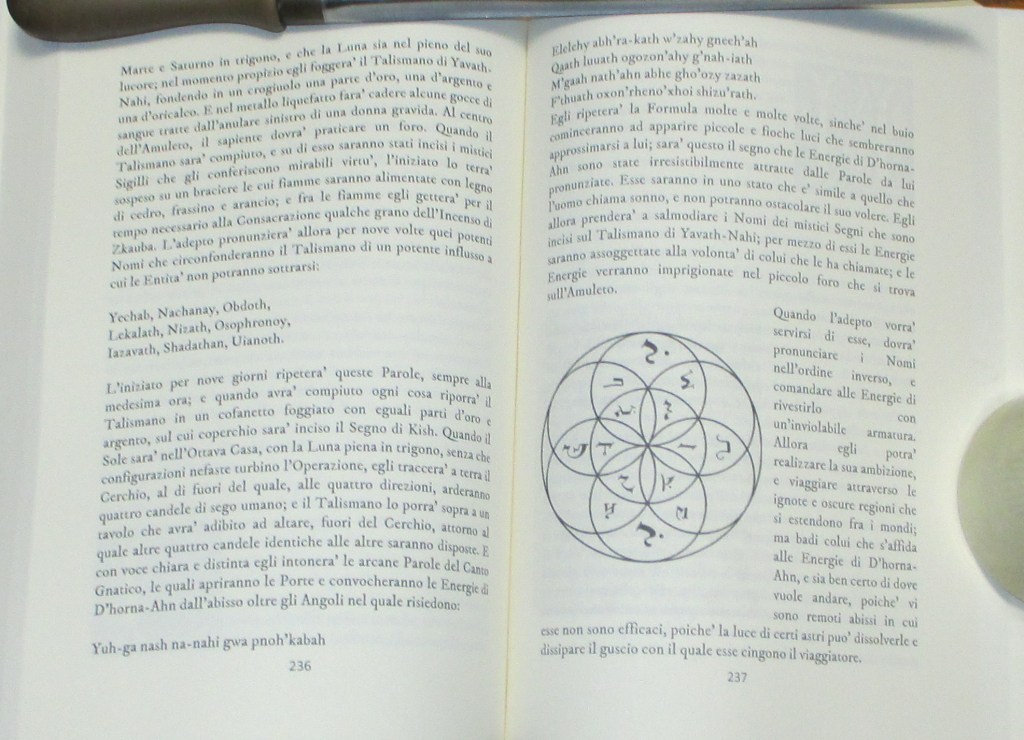
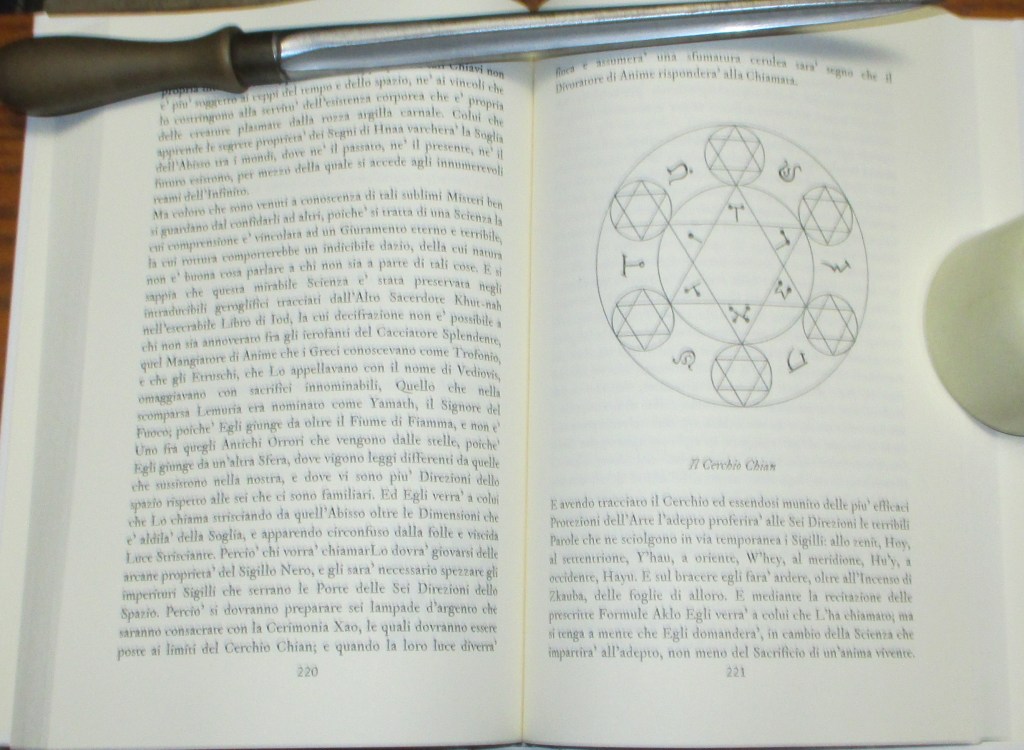

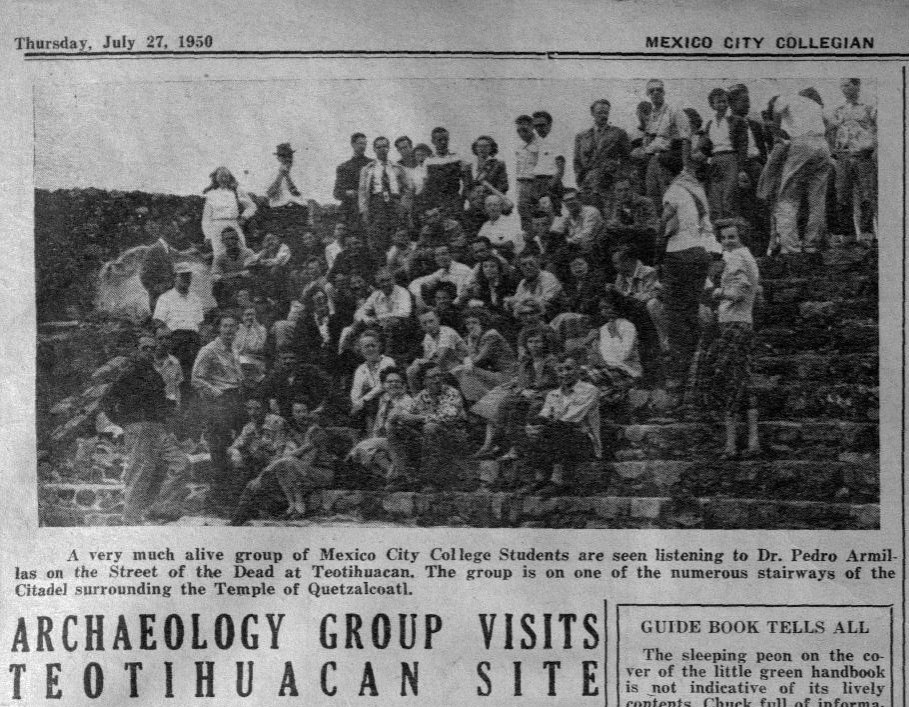
 Deep Cuts in a Lovecraftian Vein