
Eldritch Fappening
The following review concerns a work of Lovecraftian pornography.
It includes nude images and will discuss relevant matters of sexuality in detail.
Reader discretion advised.
Ignacio Noé (1965– ) and Ricardo Barreiro (1949–1999) were two of the Argentinian comic creators who found a niche in European comics, their work often bouncing between Spain, France, and Italy, with translations in many different markets. Their collaboration El Converto Infernal first appeared in the Spanish-language adult comics magazine Kiss Comix in 1995, serialized from issue 49 to issue 56, running 62 pages, lavishly painted and drawn by Noé. The result was popular enough to be translated into several languages, and an English translation by Robert Legault was published in a lightly censored edition by NBM in 1997 as The Convent of Hell.
As the title suggests, The Convent of Hell is a work of nunsploitation. The roots of this genre go deep in European art and literature, including historical accounts that amount to “nuns behaving badly,” like the Nun of Watton, but most contemporary scholars point to La Religieuse (1792) by Denis Diderot, a sympathetic novel about a nun trapped in the legal and social constraints of her order and unable to leave, as a turning point. The work both emphasizes the lack of personal freedom that the nun Suzanne Simonin experiences and offers sharp criticism of the Catholic Church and its institutions. This set the stage for the main erotic line, where nunsploitation erotica is primarily a variation on the “women in prison,” but offering tangential and complementary taboos including lesbianism, sex work, BDSM, and blasphemy—themes which all crop up in greater or lesser degree in works like The Devils (1971), directed by Ken Russell.

Openly erotic explorations of the theme varied widely. Robert E. Howard, for example, owned a copy of The Merry Order of St. Bridget, a flagellation novel involving nuns, and captured the central theme of imprisoned passion in a poem:
NUN
I have anchored my ship to a quiet port;
A land that is holy and blest.
But I gaze through my bars at the tempest’s sport
And I long for the sea’s unrest.
—Robert E. Howard to Tevis Clyde Smith, 23 Jun 1926, Collected Letters 1.98
Exploitation filmmakers, comic book artists, and writers in the 1970s became especially lavish in using nuns, working out several variations on the basic theme, especially in countries with a strong Catholic influence such as Italy, Spain, France, and their diaspora. Nor was Lovecraftian media immune. The underground comic Tales from the Leather Nun (1973) includes one of the first original Lovecraftian comics, “Tale of the Leather Nun’s Grandmother” by writer/artist Jaxon, who owes her youth and beauty to the work of the wizard Alhazred—and who has accidentally turned her vulva into a portal into the cosmic domain of Cthulhu and other eldritch entities.
Barreiro and Noé were quite evidently drawing from an eclectic mix of resources in composing their work, and the graphic novel has a frankly erotic character playing out to many interests. There are elements of sadomasochism, bondage, lesbianism, Satanism, and corruption that come together with supernatural elements. After a brutal opening involving the sexual torture of a novitiate, the nuns uncover a hidden locked door in the basement (possibly a reference to Lucio Fulci’s Gates of Hell trilogy), which inspires in the Mother Superior a dream of a Lovecraftian-flavored Satanic ritual:
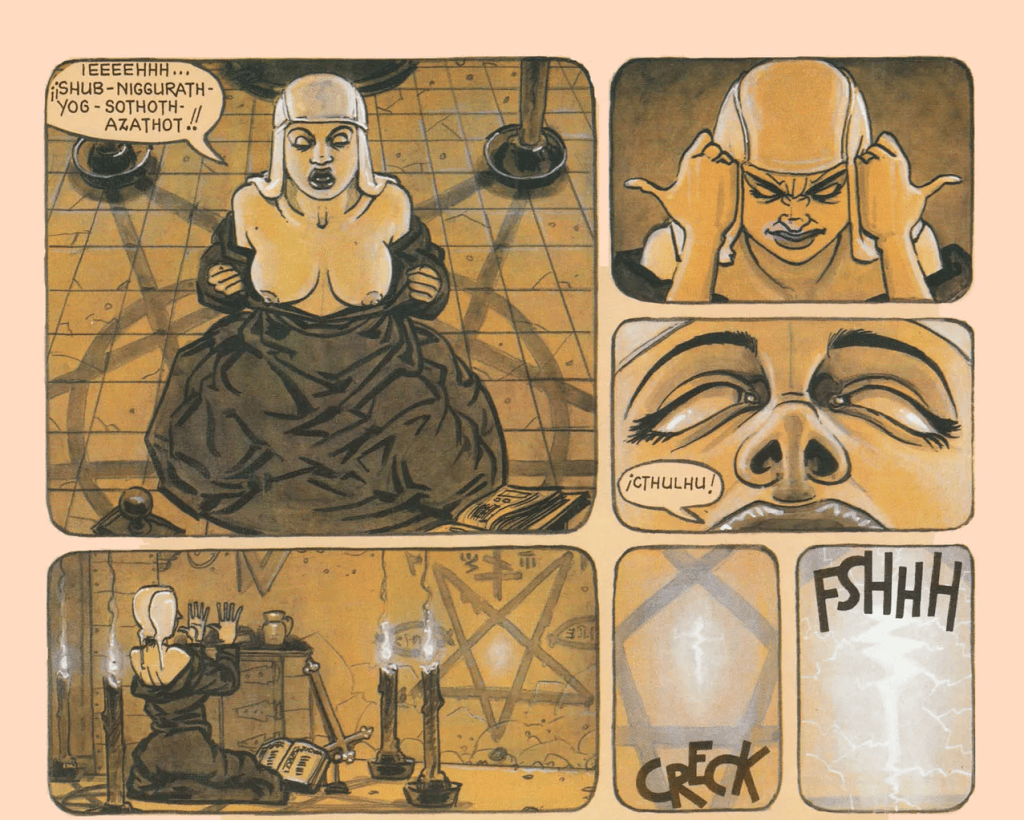
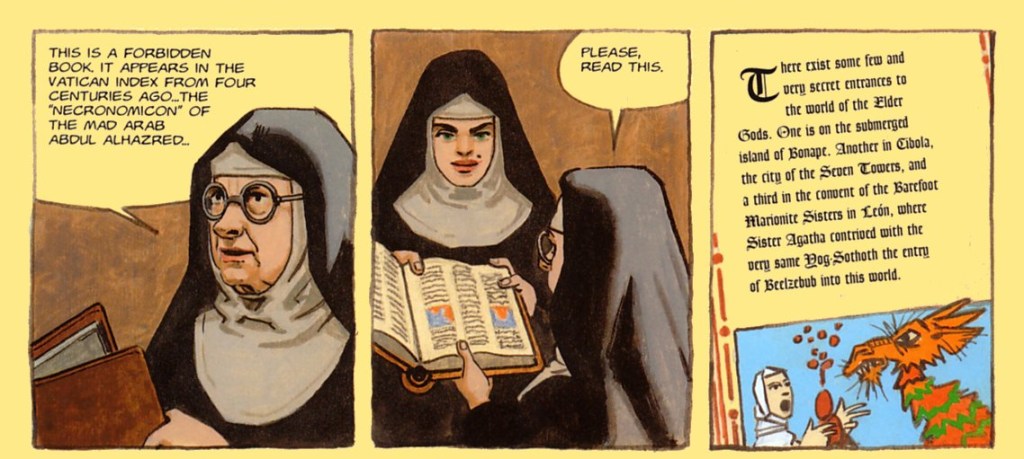
While the Church of Satan does include a few Lovecraftian elements, the actual being that emerges in this dream is a monstrously-endowed satyr. An older nun manages to find a reference to the door in a handy copy of the Necronomicon…

The mother superior of the convent doesn’t listen to her, however, and forces the door open, leading to an eruption of phallic-headed tentacles reminiscent of Japanese hentai in one of the most infamous scenes from the graphic novel.
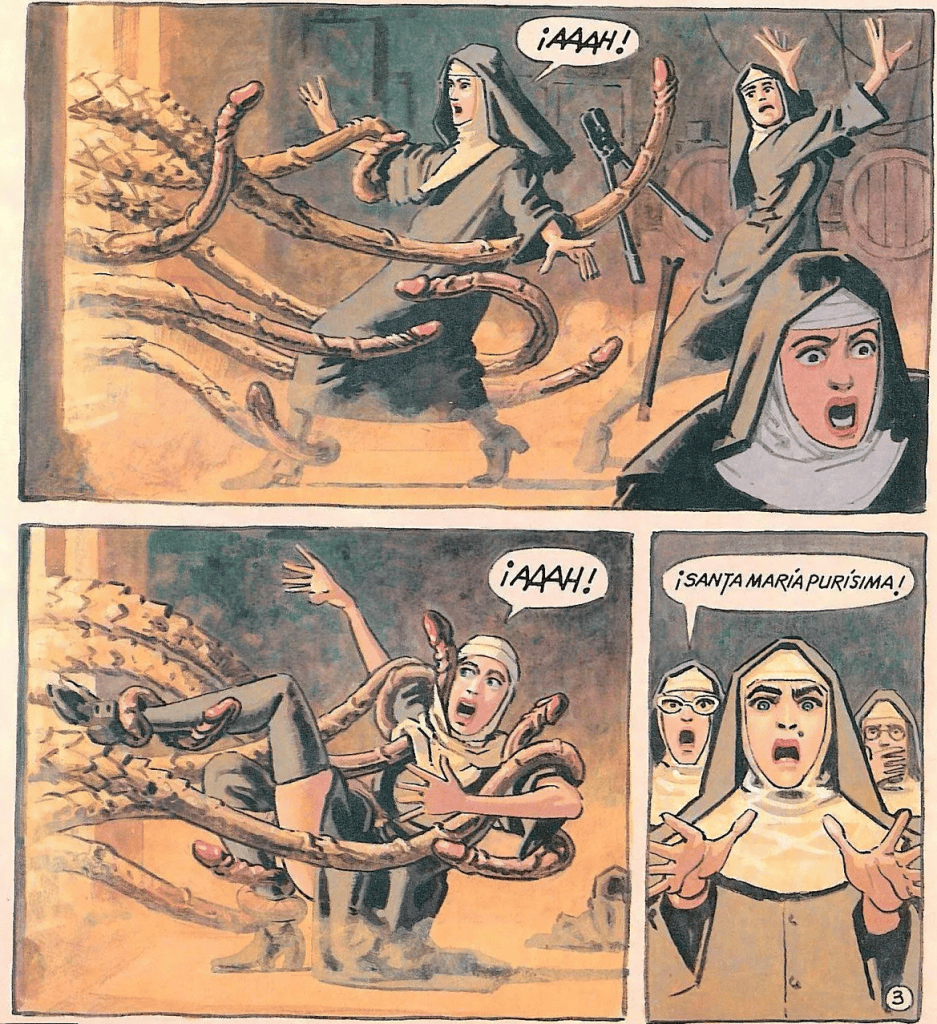
Which gets explicit and quite graphic, leading to the afflicted nun’s death and the sealing of the door. Douglas E. Cowan, who summarizes the graphic novel in greater detail in his book The Forbidden Body: Sex, Horror, and the Religious Imagination, waxes clinical:
When the locks are broken, though, the nuns shrink back in fear as this time a true Lovecraftian horror bursts into the room. A flurry of tentacles, each rubbery arm tipped with a sinister phallus, emerges from whatever unearthly space lies beyond the door. Seizing the first available Marionite sister, it quickly envelops and strips the screaming woman. Fondling her ever more intmately, the tentacled abomination progresses to vaginal, anal, and oral rape—physical manifestations of everything she has sworn to abjure as a consecrated virgin. Although the other nuns are frozen in terror, with every new invasion of the young nun’s body a cut-away panel shows the effect on the Mother Superior, who grows increasingly turned on with each grotesque violation. Finally, the abbess orgasms as the Great Old one lifts the other woman high into the air, sexually impaled, every tentacular phallus ejaculating at once. A rain of eldritch sperm covers her body, and unable to withstand the supernatural assault, she dies naked on the rude stone floor.
We are never told her name. (111-112)
That night, the corrupted Mother Superior goes to unseal the door, and is interrupted by a messenger from God, a child-like angel.
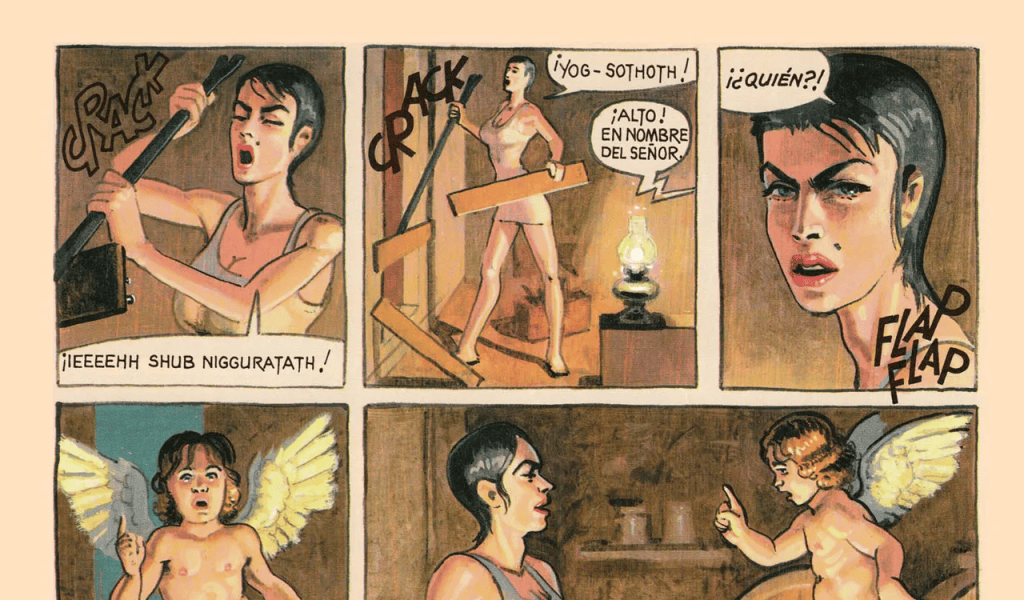
This sequence—where the corrupted Mother Superior nails the tiny angel to the door and then literally sucks the life out of them through their penis—was omitted from NBM’s edition of The Convent of Hell, probably out of fear that what it was depicting was too close, at least visually, to child sexual abuse material. There are anecdotes that even this mild self-censorship wasn’t sufficient; Steve Fentone in AntiCristo: The Bible of Nasty Nun Snema & Culture reports that: “[…] initial shipments of THE CONVENT OF HELL were reputedly stopped at the Canadian/US border, presumably for the books elements of bestiality and degradation.” (234)
With this sacrifice, the Mother Superior manages to summon a monstrously endowed Beelzebub through the door, in the form of a gigantic satyr. The corruption of the convent is soon complete in an orgy of sex and blood. After a chance encounter with a pair of newlyweds, the Vatican learns of the degradation and sends a special assault force with holy-water-blessed members and flamethrowers to deal with the Satanic infestation, destroy the demon, and block up the doorway once again.
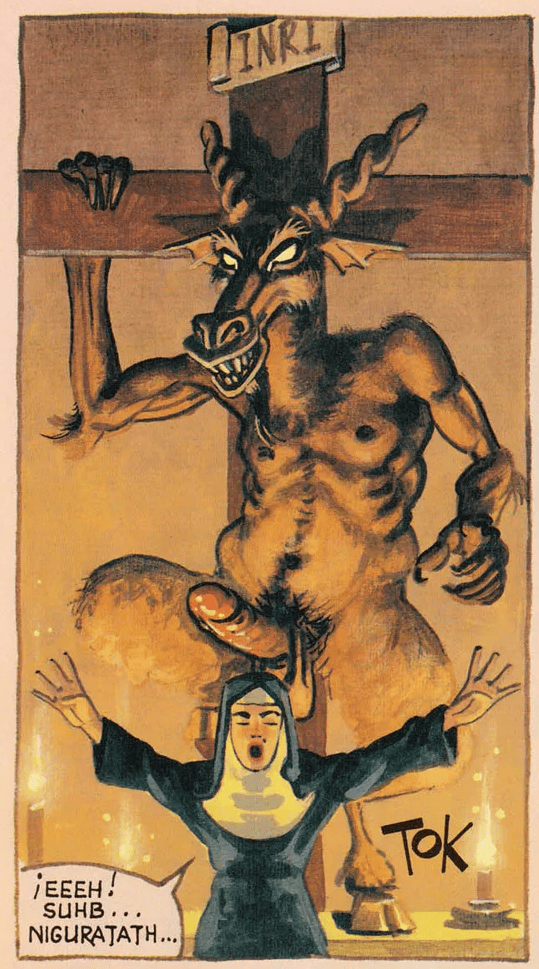
This is not the first erotic comic work to invoke Lovecraftian names and themes; aside from the aforementioned Tales from the Leather Nun, there were works like the Italian comic Ramba, written by Marco Delizia; and the Young Witches series, which was created by Ricardo Barreiro and Francisco Solano López. The conflation of Lovecraftian elements with Satanic elements wasn’t uncommon in this respect, but neither is it really an attraction for those looking for Lovecraftian erotica, instead of Satanic porn with a thin skin of Lovecraftian elements. These few panels reproduced for this review contain basically all the Lovecraftian names and references across 64 pages of art.
El Convento Infernal is definitely a work of art. It is sacrilegious to the point of comedy; occasionally brutal, often over-the-top, yet the artwork is vivid and, as Cowan points out, often draws on classical works of Satanic imagery for reference. There is a vividness to the full-color artwork which is starkly at odds with the sometimes muddy shading of the black-and-white artwork that dominated Kiss Comix at the time. It is an exercise in excess where every episode seeks to grab the reader with at least one can’t-unsee-that image. In that respect, it is a success.
But does it go too far?
This is not a work that delves deep into the psychology of cloistered nuns, although there are hints of sexual repression and political considerations throughout the story; it is primarily, and always, a pornographic work, and some of the acts are violent and nonconsensual. There isn’t any actual bestiality, as Fentone mentions; the great hoofed goat with the enormous phallus is a demon. There is not technically any CSAM; it’s an angel. Yet it is definitely a dark fantasy, and one that is narratively built like a sexploitation horror film if there were no budget on special effects and the actresses would do absolutely anything in front of the camera.
Clark Ashton Smith was living in Auburn, California, when the Catholic order the Sisters of Mercy opened a convent within sight of his cabin in 1939/1940. He sometimes jokingly called it “the Nunnery of Averoigne,” and the sight of the nuns inspired a few poems. Most were relatively sedate affairs, but one speaks of the temptation of the forbidden:
IMPROBABLE DREAM
In my dream a nun,
Proudly bosomed, lunar-pale,
Danced naked in the sun.—Clark Ashton Smith, Complete Poetry 2.499
El Convento Infernal is, in a much more explicit fashion, just such an improbable dream. More lavish, more detailed, and probably tripping the censors as obscene in some jurisdictions, yet in every sense a pure sexual fantasy that bespeaks a fascination with seeing the untouchable touched, the inviolate violated, witnessing the act of transgression against deeply ingrained cultural taboos.
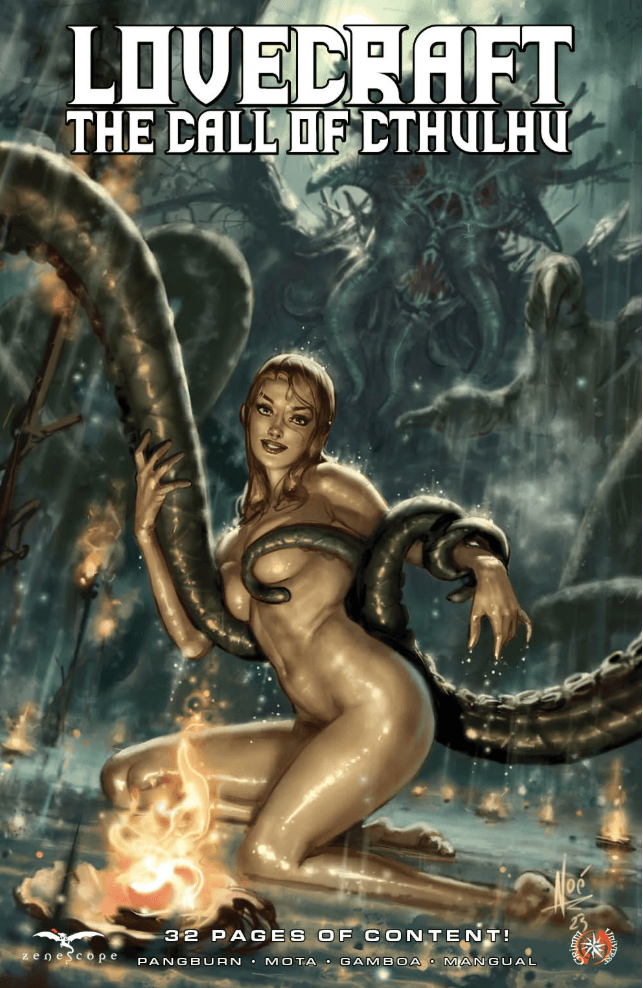
Outside the United States, there have been multiple editions of this work collected in Spanish, French, and possibly other languages. The English edition has never been reprinted and today is quite scarce. Noé would return to Lovecraftian themes in 2023 when he provided a variant cover for Lovecraft: The Call of Cthulhu (Zenescope), which is evocative of his earlier work while being in no way tied to it.
Bobby Derie is the author of Weird Talers: Essays on Robert E. Howard and Others and Sex and the Cthulhu Mythos.
Deep Cuts in a Lovecraftian Vein uses Amazon Associate links. As an Amazon Associate I earn from qualifying purchases.

