In 1941, Robert A. W. Lowndes became editor of a science-fiction pulp magazine titled Future, which had been merged with another magazine titled Science Fiction Quarterly, and over the next few years would go by such titles as Future Combined with Science Fiction, Future Fiction, Future Fantasy and Science Fiction, and Science Fiction Stories over the next few years. Future, under whatever title, contained a great deal of work by Lowndes and his friends, sometimes under their own names and sometimes under pseudonyms, often joint pseudonyms for collaborations. One such pseudonym was Paul Dennis LaVond.
Lowndes had been a minor correspondent of H. P. Lovecraft, and like several of HPL’s friends, had carved out his own corner of the Mythos, starting with “The Abyss” (Stirring Science Stories Feb 1941), which introduced a new eldritch tome: The Song of Yste. Lowndes would revisit and expand this personal Mythos in stories like “The Mantle of Graag” as by Paul Dennis LaVond (The Unique Magazine Oct 1941), “The Long Wall” as by Wilfred Owen Morley (Stirring Science Stories Mar 1942), “The Leapers” as by Carol Grey (Future Fantasy and Science Fiction Dec 1942), and the poem “Nyaghoggua” (Phantasmagoria 1939 / Famous Fantastic Mysteries Apr 1941). All of these stories were reprinted, sometimes in revised form and under slightly different titles, in later years…except one.
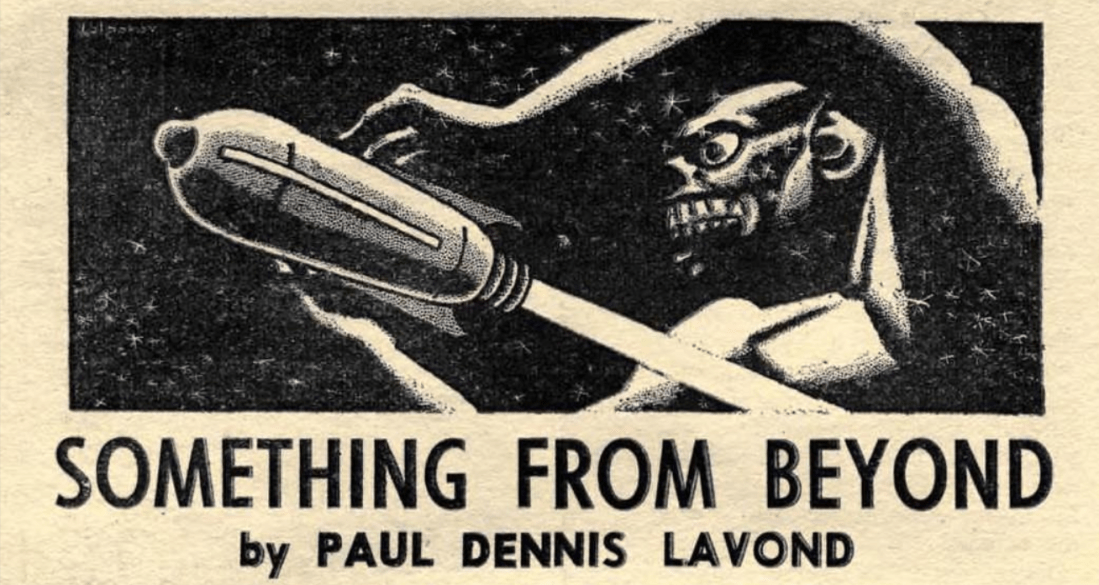
“Something from Beyond” (Future Dec 1941) by Paul Dennis LaVond is a story in the Song of Yste cycle that somehow fell through the cracks. Lowndes never republished or revised it; nor did Robert M. Price, who was studiously collecting early Mythos fiction in Crypt of Cthulhu and various anthologies like The Necronomicon: Selected Stories and Essays Concerning the Blasphemous Tome of the Mad Arab (1996, Chaosium) and Tales of the Lovecraft Mythos (1992, Fredogan & Bremer / 2002, Del Rey). Other authors associated with Paul Dennis LaVond include C. M. Kornbluth, Frederik Pohl, and Dirk Wylie; Mike Ashley in Science Fiction, Fantasy, and Weird Fiction Magazines (1985) credits “Something from Beyond” to Lowndes, Pohl, and Wylie (279). Perhaps that was why Lowndes never reprinted it.
※
Something from Beyond
by Paul Dennis LaVond
Foreword
WALLACE GREY was born in 2009, some thirty years after Harley Graeme made his first moon flight, in Norwich, and was schooled in Laurie Hall nearby, later attending Norwich University.
Although not nationally known, Norwich University has a fine, solid reputation for turning out acute, liberally-minded men, men who are neither too idealistic to adjust themselves to the harsh practicalities, nor yet too cut and dried to see beyond their noses. There are compulsory courses in subjects the mere mention of which would bring ridicule in other schools; they teach the occult and delve into what is known as Black Magic. Yet never do they permit their students thus to lose their grip on a world which denies and derides these things. The purpose of these courses is to instil into the student a love of truth and the unknown; they seek to make them like those sturdy scholars of a distant past who were willing to search through innumerable haystacks of falsehood for the needle of truth therein. Norwich men have always been the last to snort and cry “impossible” when the unknown occurs.
Shortly after graduating, Grey turned to anthropology for his vocation, but found the recognized authorities in the field to be grey-headed dodderers with a distaste for unorthodox views. In a fit of despair, he joined the Space Patrol, then popularly thought to be a glorified suicide club, nothing more. After a few months, his state of mind improved; but instead of buying his way out, as easily he could have done, he set about forging ahead in the Patrol. He was the first commissioned officer to rise from the ranks and there is no doubt but that he would have gone far, made a name both for himself and for the Patrol had not his career abruptly been terminated.
Grey was found dead, along with two other members of the crew, in the Patrol ship he commanded. The circumstances of his death were unusual inasmuch as the bodies of the three men were frozen, although the ship was quite warm. These bodies could not be thawed, yet gained heat rapidly upon arrival at Earth until the temperature was almost that of living men. An investigation brought no light upon the incident; there remains only Wallace Grey’s journal, extracts from which we give below.
From the Journal of Wallace Grey
“WHATEVER our scientists may say about the lifelessness of space, I cannot help believing that the void is indeed a harbor of life, even though it may not resemble the life we know. Perhaps such life is so alien that the very word itself cannot be applied, so different that by no stretch could the most plastic imagination conceive it. Yet, we have this word, and it signifies anything which possesses consciousness of being; to that we add growth, power of ingestion, reproduction, motion, and thought. Perhaps there are vortices of pure thought here in space. . . . But there is something out here which we cannot see, hear, taste, touch or smell. Yet we do sense its presence; we know it is here.
“It…. I cannot call the thing by any term more definite than ‘it’…. is watching us, or, should I say, it is aware of us; it may not possess what we know as sight. It is aware of us and has been following us for the last few days…. perhaps longer: we cannot tell how long it may have been hovering over us before we became aware of it. Perhaps a considerable length of time in its presence is necessary before any suggestion of its being can permeate us; Awareness has come, but not through the customary channels of perception. I wonder, though: is it conscious of us?…. Are trees conscious of the birds and animals that nest therein, of the little boys that climb them, of the men who come at last to hew them down?…. No, trees are still strange to men, even though men have known and dealt with trees as far back as our racial memories go. Even yet we do not know whether or not the tree has a consciousness of being, an awareness of other life-forms about it…. Imagination, psychological delusion, wishes that father thought…. we cannot be certain about anything; our greatest positivism can only be relative. Yet, I say that I can feel that this is a living, malevolent entity; but how do I know it is not my own emotions telling me this, my emotions which color my every act no matter how diligently I try to whitewash? It is only natural that we distrust what we do not know: all that we know is full of danger, pain, disaster, and death for us. We cannot trust ourselves: how, then, can the unknown bring other than apprehension to us?….
“I think that I am aware of this…. phenomenon…. more than Orloff or Jac; yet Orloff has been acting queerly for a number of days. He always was more than a little absent-minded; now he seems completely dazed. Ever since he and Jac repaired the blast-tube, Orloff has been…. different. He speaks very little, and, when he does, it is almost with an effort, as if he did not know the language he was trying to use. His voice, too, seems to have changed and the inflection is weird. I can see that Jac is puzzled; he asked me a few hours ago whether I thought Orloff might be developing some form of space-dementia. That is possible. I have tried to speak to Orloff several times, to see if he is in pain or feeling sick; he evades me and does not seem to understand what I am saying. There is, however, no fault to be found with his work; he does, true, perform his duties a trifle more slowly than before, but his efficiency has increased noticeably. He was always somewhat timid at the controls, fearful lest he make a blunder which would be disastrous to us all; now he handles them with confidence, does so well that I need not oversee him. He spends nearly all of his spare time staring out the portholes into space, although he does not appear to be watching anything. His eyes, I have noticed, are somewhat glazed as he stands there and, after he has finally turned away, his movements, for a few seconds, are incongruously stiff and awkward. Can there be any relationship between Orloff’s eccentricity and it? I must look into the Song of Yste again…. How out of place that ancient book seems aboard this ship, on the dark side of Luna, some quarter-million miles from Earth. Did those olden probers into the unknown, I wonder, ever dream of the day when men would leave the Earth physically?…. Yet, there is a vast amount of truth in this volume! I am told, by friends, that it was once declared pernicious, blasphemous, accursed, and to be destroyed on sight. A few copies were handed secretly from generation to generation lest they be discovered and burnt. (I wonder sometimes just how grandfather obtained it. Did he find it in a tomb, as he claimed, or was it obtained by other methods?)”
Later:
“Something has happened to my copy of the Song of Yste. I am positive that it was packed among other, more orthodox, volumes when we left Earth; yet it is not there now. I am sure Jac would not be rummaging around my things; even if he were, what possible Interest could a book like that hold for him. And Orloff…. but how could the lock on my chest be tampered with without traces being left? Moreover, of what value could a copy of this book be to other than myself? It is in cipher, most ingenious cipher. It took grandfather ten years to work it out, and another five to prepare the volume I now possess. But the mere possession of the key would be of little value, for even then one uninitiate could not read it. Each page holds a different variation of the cipher, the clue to which lies in the little sketch heading the page. Grandfather told me before he died. I mention this to point out the difficulty of reading a volume like my special copy of the Song of Yste and to draw attention to the high improbability that two people on the same ship, two members of the Space Patrol, further, would have the required abilities. Yet, Orloff’s condition leaves him open to grave suspicion.”
Later:
“Orloff has taken a change for the worse. He is unconscious now: Jac found him lying on the floor when he went below to see why Orloff did not respond to his signals. For a moment, he appeared to revive; his eyes opened yet I would swear that it was not Orloff who looked at us. He is lying on the couch in the next room; Jac and I are sharing his duties. I took advantage of the emergency to search Orloff’s room. Of course, it is within my authority to demand search at any time but I had been reluctant to use my power in this case as I was not sure that perhaps the blame was not mine. But the search proved my initial suspicions to be correct; it was in his room, and he had been reading it. Found figures on a sheet of paper in his desk which prove conclusively that he knew the cipher, was computing the variations for specific pages. When I am free, I shall determine just what he was reading; perhaps it will shed some light upon this gruesome state of affairs.”
Later:
“We are functioning under automatic controls, such as they are…. I have been reading that portion of the Song of Yste which seemed to be of so much interest to Orloff; it is damnable. Now I know what it is which has come out of space to dog our heels; I know why we feel so cold and the reason for Orloff’s curious condition…. We are completely helpless…. If I seem a bit reluctant to state what I know, it is because of the stark, objective closeness of the thing which stuns me. It is one thing to delve into the unknown and learn of hideous and alien secrets with which the cosmos is filled. That is one thing, I say, and it is a thing more than many minds can endure. But to face the actuality of these things is another matter. To those not afraid of thought, the Song of Yste is not so utterly horrible…. bizarre, grotesque…. words, words, words, but what can they mean, what can they mean when the reader has nothing in his own experience to approximate them?…. Imagination always paints a fascinating picture, albeit how gruesome, attaching glamor to the unknown and alien…. but the reality… Ia, Nyagghogua! Shub-Niggurath! Nyarlathotep! Nyartathotep!…. Nyagghogua, dissolver of space…. K’halkru!….
“Orloff’s condition is unchanged. He is still in a coma, apparently. But there are no wounds, no concussion, fractures or symptoms of shock. Jac does not suspect his true condition… but I know…. I know!”
“This is my last entry. It has come out of space…. for us. A short time ago I heard the call…. within. Weird piping sound ending in a piercing shriek. We…. felt it rather than heard it. Jac did not know what it was…. I tried to explain something natural….
“Orloff has arisen…. at the call. He stood in the doorway for a moment, looking at us, and, in his eyes a blackness, a vast shape of inconceivable power, malevolent power, that glared out at us. We are rooted to our seats…. though I cannot see what manner of resistance we could make were we free. I suppose it prefers us alive…. though could I reach the wall, none of us would go to it alive.
“We both feel very cold, although the instruments show that the temperature has not dropped a single degree. The cold comes from…. within. Orloff is moving slowly toward the space-lock; I sit here frozen to my seat, writing furiously…. Must try to put down what I read in that accursed book last night….
“‘Let not the hearts of men dwell too pleasantly upon escape from this earth to worlds of strangeness and glamor beyond the veil of night for without lies horror and madness and that which no human tongue or pen can describe. Vaster by far than the might and malevolence of those demons that plague and befoul the earth is that which comes out of space to feast upon the souls of men; yet, indeed, it is but a lesser manifestation of the evil which dwells beyond the stars. This out of space may be known by the coldness it brings, a coldness which no fire can abate, and by its unholy piping by which it summons its victims to sacrifice. For of old is it known to send itself into the living bodies of certain creatures so that they appear bewitched and know not themselves, shunning the day and the radiance of the sun which is hateful to it. Many and multiform are the prodigies it performs, for it may enter a city and blast all within into frozen corpses, yet, when these are discovered, there will have been no sign either of cold or of its point of entrance. Many and multiform are the prodigies it performs for its own amusement and contempt for men. And the crowning foulness of all….’
“I may write no more. The space lock is opening…. Orloff…”
“ENTRY in the log of the Space- Liner Majestic, Earth-Mars voyage EM 206: (From File .0078, Derelicts, Report of, for the year 2027, Record Rooms, Interplanetary Transit Building, N’York, Terra.)
“December 9, 2027. Discovered derelict space-patrol cruiser. #SP-070 R3, reported missing August 24, 2027, drifting in and parallel to Band 5. Found bodies of three men in cabin. Two in their official places; a third lying on the floor in such a position as to assume he had been placed there after death. Although ship was entirely warm and instruments showed no variation in room temperature, the corpses were frozen. Ship’s log, found in cabin, was dated August 5, 2027, no entries after that date being found. Journal of Commanding Officer, Wallace Grey, Lieutenant, Space-Patrol, hereby forwarded without comment. Lt. Grey was found, pen in hand, in the act of making entries in aforementioned journal.’’
The End
※
“Something from Beyond” is pure Lovecraftian pastiche, albeit in an uncommon space opera setting, which gives it the feel of a very stripped-down prototype of Event Horizon. Aside from the direct mentions to Lovecraft’s Mythos, the mention of Khalk’ru is a nod toward A. Merritt’s Dwellers in the Mirage (1932), where Khalk’ru is an extradimensional kraken worshipped by a cult in Alaska—sometimes seen as Merritt’s nod toward Lovecraft. Whether Lowndes intended any connection between Wallace Grey and Carol Grey (or simply liked the name) is unknown.
The original publication of “Something from Beyond” can be read on the Internet Archive.
Bobby Derie is the author of Weird Talers: Essays on Robert E. Howard and Others and Sex and the Cthulhu Mythos.
Deep Cuts in a Lovecraftian Vein uses Amazon Associate links. As an Amazon Associate I earn from qualifying purchases.


