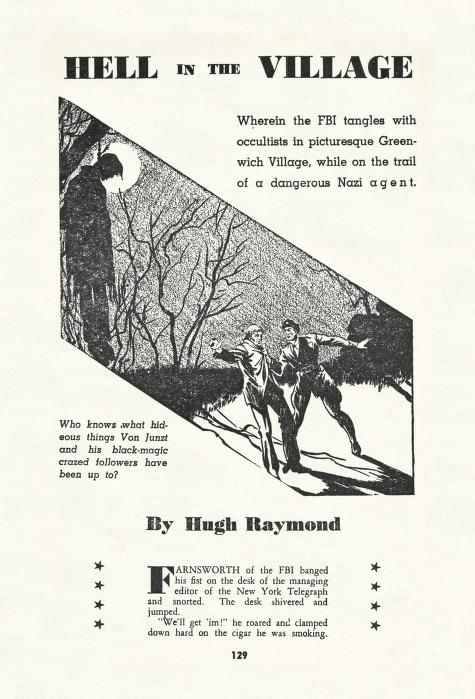
“Hell in the Village” by Hugh Raymond was first published in Science Fiction Quarterly (Winter 1942). It has never since been reprinted. Raymond was one of the pen names of John B. Michel, a prominent science fiction fan of the late 1930s, a founding member of the Futurians, who turned pro science fiction writer in 1941 (cf. Futuria #2, 1944 for a partial list of his work). This story caught my attention for several reasons, most notably the name of the villain, Von Junzt, was likely inspired by the author of Nameless Cults in the Cthulhu Mythos fiction of Robert E. Howard. Michel also tipped in references to Lovecraft and Aleister Crowley, which suggests the whole might be a nod to Weird Tales—with tongue firmly in cheek.
※
Hell in the Village
by Hugh Raymond
FARNSWORTH of the FBI banged his fist on the desk of the managing editor of the New York Telegraph and snorted. The desk shivered and jumped.
“We’ll get ‘im!” he roared and clamped down hard on the cigar he was smoking. “We’ll get ‘im as sure as I’m a foot high!”
Harrington, editor of the Telegraph inclined his head toward Jimmy Collins, his star reporter, whose feet were sticking almost in his face as they rested comfortably on the desk and smiled.
“Well,” he said, whimsically, “he is a foot high.”
“Humph!” the FBI agent folded his arms and sat back in his chair, while Collins picked a glass from a tray in front of Harrington and looked into its winy depths reflectively.
“It is all very simple,” he breathed, took a long drink of wine and knocked the ashes from his pipe. He shot a glance of derision at the FBI man. “You’re a sucker, Farny, a sucker for the cleverest Nazi in the country. Wouldn’t he love to see you now, red-faced, snorting like a bull and mad as a procupine. Pipe down. You’re talking too loudly.”
Farnsworth drained his own glass, regained a little normal color and took his feet off Harrington’s desk.
“You two are so helpful,” he grated, standing up. Abruptly he ruffled a stack of back issues of the Telegraph laying on a folding extension of the telephone board. “Mary 23rd,” he began softly, and help up one of the issues, “Von Junzt Escapes! FBI Chief Demoted!” he paused, his voice taking on a raspy edge, threw the sheet to the floor and picked another one from the pile, “June 10th, FBI Shaken Up. President Alarmed As Nazi Spy Von Junzt Carries Out Daring Sabotage After Escape!” he dropped the sheet, ran his hands nervously through his hair and bit his cigar in two. “And after that! Bombings in San Francisco, explosions in airplane plants up and down the California coast. Two important operatories slain in Denver. On August 7th he blows up a munitions plant in Illinois, killing six hundred. How!“
Harrington blew on his hands, lifted his eyes toward the FBI man and grunted.
“We blasted you plenty, rolled you over the coals and signed the seat of your pants for four months. He’s still at large. Bah! You babies in Washington are so weak-minded a child could steal your false teeth out of your mouth while you were asleep. Von Junzt vanishes! You spent the greater part of 1942 looking for the scoundrel and he’s not twenty-four hours in your hands when you do snap on the handcuffs and he’s gone!”
“Sixth Columnist!” murmured Collins.
“Nuts!” cried Harrington. He abruptly put his own feet on his desk, folding his hands primly on his lap. “I’m fed up with this big boy’s blatherings.”
Farnsworth grumbled a little and then sat down.
“All right, all right, but I said we’ll get him again and we will. I don’t know how the slimy insect got away the last time. We had him behind steel bars, I tell you, locked up so securely a cockroach couldn’t have got to him. Those special cells we’ve got in Washington are no sardine cans. They’re Norwegian steel, welded and an inch thick. Remember that the door hadn’t been forced. And there was no window. If he got out at all he must have walked through the door, locked or not.”
“Dissolved through it, as it were, like mist,” jeered Collins. He wiped some sweat from his brow and tilted his fedora further back on his head. “This case calls for Cotton Mather and some castor oil. Not the FBI.”
Farnsworth lit a fresh cigar, refilled his wine glass and looked darkly around Harrington’s little cubicle of an office.
“For all I know it may be witchcraft. I’m willing to entertain any theory. If I don’t get my nippers on that bird within thirty days, they’ll have the skin off my back in Washington. Mrs. Farnsworth is not going to like that.”
Collins threw a match at Harrington who was groping helplessly through his tattered vest. He lifted his hands in a gesture.
“I will admit you boys haven’t had a snap job of it. Every time I think of Von Junzt a cold chill crawls down my back. The devil! Six major jobs of sabotage and not a clew as to how it was done, just signed cards in the mail. His signature, of course? You’ve checked.”
“To a ‘T,'” sighed Farnsworth.
The phone rang. Harrington put down his pipe, brushed his glass out of the way and hitched the phone receiver to his left ear. He listened a while and then let a sharp breath escape.
“Blast!” he said explosively and cursed fluently for five seconds.
Collins raised his eyes sleepily.
⸸
FARNSWORTH leaned over the desk, a look of impending doom on his moustached face.
The editor replaced the receiver, leaned back and braced him visibly.
“You’re not going to like this,” he began, looking at the FBI agent. “You’re not going to like it at all. Our San Francisco Bureau just phoned. The Vulture airplane works were blown up this afternoon at one o’clock, an hour and a half ago. Twenty minutes after the land promontory on which it had rested had sunk beneath the Pacific. Von Junzt phoned the FBI headquarters in Washington and confessed he’d done it. Said there was more coming!” He paused and snapped over his inter-office phone button. “Gimme the pressroom and send up a rewrite man!”
Farnsworth’s face was purple. His cigar, sticking out of his mouth like a long pole trembled visibly. Then he sat down and collapsed in his chair. Collins looked at him pityingly. The reporter turned his head toward Harrington who was busily barking orders over the phone.
The editor finished what he was doing, poured himself a full glass of wine and drained it before saying anything. Then he shot a rapid glance at Farnsworth and grunted.
“You’ll be heading out to Santa Fresna by midnight if I know your boss, Courtneigh. And you, Jimmy,” he continued turning his attention to the reporter still lazing in his chair, “will go with him. We might as well get some use out of this government bloodhound. Farnsworth, you’ve been practically living at this office in your spare time for the last month. I’m not charging you rent, but I want you to see to it that Jimmy gets on the spot. He’s going to write an eye-witness account and he’d better make it good.”
Collins nodded sourly. “There will be the usual bonus, I suppose?” he inquired delicately, picking at his nose, while the FBI agent went through the mechanical motions of getting Washington on Harrington’s wire.
“If you make this read like something written by a four-year-old child you’re fired. Anything otherwise will get you a thousand-dollar bonus and a week’s vacation without pay. Well?” he demanded as Farnsworth put the receiver back on its hook and stood up slowly.
“Bull’s-eye, Sherlock,” he groaned. “It’s the nine o’clock plane out of La Guardia airport. I could’ve taken a Navy plane from Floyd Bennett, but Courtneigh said no.”
“Good,” barked Harrington. “I’ll book Jimmy on the same plane. Now get the hell out of here. I’ve enjoyed the chat, but I’m a working man which is more than I can say for either of you. Listen!” he cried as Collins shambled to his feet and joined the FBI man at the door. “If you take a drink between here and Frisco, I’ll can you, shoot you and dock your widow the thousand-dollar bonus. Scram!”
Collins finished the rest of the bottle he’d filched from the tray on Harrington’s desk on the way down in the elevator. He handed the empty to the girl operator as she slid the door open on the first floor and winked at her. She flushed and went a duller red as he patted her on the behind.
“There are times, Tommy,” he remarked to Farnsworth, reflectively, “when I actually enjoy life.”
The FBI man’s face lengthened. “Which is more than I can say for myself. Von Junzt gets away and you clean up a neat bankroll in four months writing feature stories without sweating a pint. I make a salary a microbe would starve on and sweat blood. Every now and again they pin a medal on me and hand me some soothing syrup. Well, I can always pawn the medals after the war for cigarette money. Wonder how much I’ll get for a Congressional?” he asked sadly, making an oblique reference to a medal presented to him several years before on the completion of a job which preserved the peace of the world for a year or so.
Collins put his foot outside the building entrance and immediately collided with a huge, fur-clad figure on its way in.
“Chimmy! Farny!” the ball of fur stepped back, stood arms akimbo and regarded the forlorn pair quisically.
“Oh, hello, Professor,” they said in unison, swung him around nonchalantly and began walking down Fifth Avenue, arm in arm.
The fur ball, a Professor Heinrich Pfleugel had come to America in 1936 after making the bad mistake of writing the word “human” after the printed query “Race” on the questionnaire put in front of him by a member of the Gestapo. One of the world’s leading anthropologists and experts on ballistics, they threw him out.
He left a magnificently equipped laboratory in Leipzig but he got cheaper beer and better cigars in the USA. He was happy in God’s country. So was his daughter, Eva, tall, bown Aryan who had kept just two steps ahead of Collins until he had given up in disgust and married a blue-eyed and just as tall and Aryan Irish girl from Chrystie Street.
On the way to a corner bar, Farnsworth related his sad story.
Pfleugel lifted his beer, gazed at it fondly and downed it in one gulp. He accepted one of the FBI man’s cigars, lit it and sighed.
“Yess,” he began, “I know Von Junzt. A clavar man. He vas der Brofessor of Occult Arts in der Munich University. Dabbled a lot in witchcraft und such nonsens.”
⸸⸸
“YEAH,” grunted Collins. “I understand that in the New Germany any kind of quack has a legal standing.”
“He was a vary cruel man,” continued the Professor. “I saw him take a Jew vunce ven he was Wager’s sub hauleiter in Munich und—vell, I saw idt anyvay,” he said, sighing again.
“I’m ready to believe the guy magicianed himself out of that cell,” groaned Farnsworth.
“Bah!” snorted Pfleugel. “You sound like dot idiodt Barton. If der case vas as simble as dot, you couldt ask Stephen to make a few passes mit his hands und ask a spiridt to tall you vere is Von Junzt.”
“Barton!” shrieked Farnsworth and threw his arms around the big bulk excitedly. “If it was witchcraft, red, blue, black or orange magic, Barton would know it.”
Collins got rid of his beer in a hurry and crossed himself.
“This morning,” he said to the empty air before him, “I’d have sworn that two and two made four and that the only way of getting a precipitate out of strontium potassinate was to pour calcium chorate in it. God rest my soul!”
It took the trio twenty minutes to get to Barton’s place in the Village.
The Village, of course, is a daffy place. Most of its legends have long since ceased to bear repeating. Lovecraft immortalized it in one of his shorter fantasies and that is as far toward eternal flame as it will really ever get, but even today a lot of faded glamor hangs around its sloping Parisian roofs and towers that look like bad imitations of the Campanile. The Bohemian inhabitants are still there and salons flourish as much as they did in the days when Mabel Dodge Luhan had her famous hangout on lower Fifth Avenue near Washington square and Ominipotent Zoom or Boom or something invented the post-war admonition: “Do as thou wilt” and topped off the advice with the biggest series of orgies this side of Sodem and Gomorrah. The rents are higher now because they’ve fixed the leaking roofs and drains and installed plumbing. Consequently, only the better class of “artists” can afford to live in the Village proper. But it is still possible to starve in a garret and while the wash hanging on the lines in the belt of old stables that girds the Village may be colorful, it’s ragged. Bohemia lives and the egg on its vest is still there.
Stephen Barton’s apartment was on the twentieth floor of one of the biggest apartment skyscrapers in the Village and served, of sheer necessity by a private elevator. This all led to expense but his father didn’t invent the only aperient on the market guaranteed not to turn you inside out for nothing. The necessity is nothing more or less than a need for privacy. The Village and environs are used to all sorts of odd characters, but some of Barton’s friends and the people they brought with them were too much, even for the wilder Bohemian element. Barton was a crackpot and dippy as a bedbug. Such temporary boarders—and there were usually a score or more—as invaded his castle and fed like leeches on a fat vein were even worse than he was. Most of them were discredited scientists, investigators of “psychic” phenomena cultists and even a sprinkling of quite ordinary people whom Barton kept on hand to serve as guinea pigs in his experiments. They had nothing to complain about as their main interest in life was booze.
Barton’s liquor bill was New York’s biggest.
The Professor stumbled out of the elevator first.
Wham! A big dark object flew out of a corner and smacked him on the schnozzle. He saw stars for a minute and clawed freebly at the air, murmuring Teutonic curses at one of Stephen’s tenants, a Madame Duvray, a medium of sorts and parts who had her eye on Stephen and her bats at the same time. As Pfleugel wiped his streaming eyes a door down the corridor opened and a long slinky woman rolled sinuously up to the elevator door and crooned the winged horror down from the ledge where it had stuck, hissing piteously. She gave the trio a dirty look, stroked the cheesy head of the ghastly thing and slithered away. The door to her room closed with a sharp bang.
“Der fledermaus,” began the Professor lamely, still wiping his eyes.
“Forget it,” barked Farnsworth. “Say, where the hell is everybody?” He took the others’ overcoats and piled them carelessly on a highly decorated table near the elevator door. “The place is usually alive with vermin on Tuesdays,” he continued. He strode up to a large Chinese gong standing by a large window giving out on the south and kicked it savagely. Booming noises crashed out. A mangy cur, sleeping behind the gong gave a dolorous series of barks and fled precipitously down the corridor. Simultaneously there was a piercing shriek.
“In the name of Heaven and the Holy Golden Abacus of Kai Ling! God’s Wownds I should ever see the day that more horrible noises pervaded these awful halls. Is it possible for a good sorcerer to pursue his maledictions in peace? Begone devils, ere I call down upon ye the wrath of eight-six and a half forgotten gods!”
⸸⸸⸸
A SHORT clay pipe stuck itself out of one of the portals lining the hall and spouted a particularly nauseating cloud of brown vapor. The trio, startled, breathed easier. It was only Sandy MacGoovern, best warlock born of the Highlands before winding head replaced crags as their chief obstruction to the view. His short, four and a half foot length, crowned with a thatch of pure white bristle followed the rest of the pipe in the corridor.
As he caught sight of the Professor and his companions, a genial smile broke upon his enraged features. | “Ah, ’tis the brethren. And what is the good word, today, friends?”
“Hello, Sandy,” said Collins, smiling. “Did we break up your communion with the sperrits?”
“‘Tis nothing,” he replied and emptied his pipe on the floor. “The slimy devils are cagey this afternoon. I plied them with fresh blood from Goldfarb’s Medical Supplies, Inc. I offered them honey from the crevices of a bee’s proboscis. I even danced the sacred Fling but nary one showed his stinking head.” The merry eyes twinkled as the other smiled amusedly. MacGoovern was the only one of Barton’s collection of freaks they liked.
“Und vhere iss Hiss Imperial Machesty?” demanded Pfleugel.
“Yeah,” interrupted Farnsworth. “We came on a professional call.”
The large head stuck closely to the spindly shoulders inclined toward the far end of the hall.
“Sure and the High Priest of this unholy temple is occupied with his congregation smelling out a couple of ghosts that arrived with a piece of the original underwear of Charlemagne.”
“Didn’t know they wore it in those days,” snorted Collins.
“They did,” solemnly asserted the sprite and sidled closer to Farnsworth. “And would your worship have an extra tenner he wouldn’t miss? There are a few odds and ends of equipment—skulls, monkey tails, bat wings, a piece of the True Cross necessary to my great experiments—”
“Scream, you little phoney!” blared the FBI man. “Not another dime! Not a plugged shekel! I gave you five dollars the last time and what did you do with it? Bought a chastity belt supposed to have belonged to the Queen of Sheba. Bah, you rattlebrain! An imbecile could swindle you out of your soul in his sleep. Provided you had one, I mean.”
“But monied one, I conjured up from that inert metal a vision of loveliness sublime. ‘Twas not the Queen herself, I’ll grant you, but one of her chambermaids, Li-Hme, and there is not her equal on Minsky’s boards!”
Pfleugel blew his nose. he raised a threatening hand. Abruptly the Scotch wizard took to his hells. He left a trail of tinkling laughter behind him.
They knew the Inner Sanctum of old. Barton had had the walls of six apartments on the twentieth floor removed and special partitions put up to conform to his ideas of a Temple of Science. The corridor through which the trio had entered was merely the outer boundary of one of the four sides of the queer arrangement of rooms. Beyond a great pair of bronze doors at the hall’s end lay the immense circular council of “conjuring” room, as Phleugel put it, disgustedly, surrounded on three sides by living quarters functioning also as “preparation” or dressing rooms for the quick changes of costume demanded by most of Stephen’s odd rites he insisted were merely scientific procedure.
At the time of their last visit the population of Barton’s madhouse had numbered a full score, not to speak of assorted cats, dogs, bats, snakes, monkeys and other animals which made the atmosphere when not otherwise permeated, hideous with groans, wails, barks, screams and caterwaulings.
As they passed down the corridor to the great portal, Collins leading the way, a shocking burst of phrases billowed out from behind the mighty doors.
“Magicum! Squadigum! Squidicum! Squdge!
“I command a Smootch to jump out of this sludge!”
“Schrechlekleit!” screamed Pfleugel and jumped a foot in the air. Without further delay, Farnsworth pushed against the doors and they swung in.
The council chamber was bathed, as usual, with a violet radiance emanating from a series of weird-looking tubes set high in the ceilings and around the walls. Built in the form of an amphitheater by the ambitious Barton who had imagined the need for a cooperating audience of about a hundred, it was sparsely filled to the tune of six or seven people. Through the dim illumination, the visitors were able to make out the series of strange machinery which Barton called his ray and vibration generators occupying most of the cleared central space. Barton’s tall and spare form occupied a raised dais nearly drowned in cushions in the exact center of the circle of machines. Around him, scattered haphazardly in the rising circular seats were “Doctor” Speshan of Persia and other oarts orientale, Hamil Ali Sala, a sharp hawk-visaged Arab of unknown antecdents, Madame Elsa Buboise, late of the Comedie Paris and sections of the Surete Files, Moots Schroon, a hexer from Pennsylvania, his wife Hepzibah, a grotesque creature seemingly minur a neck or nose, Saide Max, a shrewd gold-digger from Scranton and a few assorted electrical geniuses rescued from spending the rest of their lives as licensed electricians by Barton’s bounty.
⸸⸸⸸⸸
THE lights went on, replacing the soft glow and the crackling sparks with a cold, penetrating flood of white. Barton paid no further attention to his experimenters. He shook off the white smock he was wearing and flinging it carelessly on what looked like an operating table, mentioned the trio to proceed to the nearest exit, beyond which lay a private drinking and smoking room.
He waved aside apologies for breaking into his experiments, summoned a servant, ordered a round of Scotches and sat down in one of the overstuffed chairs surrounding a comfortable table in the middle of the room. Cigars, cigarettes and pipe tobacco were close to hand. Collins filled his pipe. The Professor and Darnsworth lit stogies. Stephen Barton, choosing a delicately scented cigarette, asked our business. He sat listening sympathetically then shook his head.
“Despite Professor Phleugel’s opinions, I am no [o]ccultist quack, gentlemen,” he began, “but a scientist, an investigator into vibrations into sounds, colors, smells. This Von Junzt,” he waved a hand vaguely toward the West, “is by reputation a supernaturalist, a pure fraud of the worst type, using incantations and spells. I appreciate your difficulties but I am sure that Von Junzt’s disappearance can be explained by simple scientific laws. It may be true that he escaped in some spectacular fashion, but lacking my knowledge and especially my machinery and experience with the scientific method, I do not believe he could have done anything out of the ordinary. You presume—O, I can see it in your eyes—” he gibed, pausing, “that this scoundrelly spy is skipping from place to place via some as yet undiscovered and unknown space or plane.” He brushed his cigarette in an ashtray and laughed lightly. “This might be possible to such a man as I, for I have had some very definite and conclusive results from my experiments, but Von Junzt, no! It is impossible!”
Pfleugel looked contemptuous. he was derogatory of both Farnsworth and Barton. When he heard the word “results” he puffed up like a balloon.
“Stephen,” he said, “you are a presumptuous liar. For an educated man this is ridiculous. Idt iss even silly. I haff listened to you for years. Talk, talk, talk. Und not one ouns of sense in a vordt of idt! Cease, Stephen, ve muszt consider der question from der scientific viewpount. My dear vriends, ve are liffing in der tventieth century, nodt in medieval Prague!”
Barton waved his cigarette under the Professor’s nose.
“You are a skeptic,” he announced sadly, “and all skeptics must be shown the error of their ways. Eh, gentleman?”
“Nonsens!” roared Pfleugel.
“There are worlds beyond worlds, Heinrich,” said Stephen soothingly. “His eyes were dreamy. “Look!” he emptied his tall drink into a large bowl. Rapidly he bit off the end of two matches and held one poised above the liquid-filled bowl. From their deep seats, Collins and Farnsworth watched expectantly.
A match end dropped abruptly. Instantly a series of waves began spreading. Barton moved his hand slightly. Another match end fell. The waves met and overlapped. Then he brought his hand to a position directly between the merging vibrations. He dropped a whole match this time. Instantly the two minor circles were blanked out. He said nothing until the upheaval in the bowl had completely subsided.
“Everything is vibration. One basic vibration underlying the cosmos. Somewhere there must be room for another, maybe more.”
“Vere?” cried Pfleugel excitedly. “Vere iss somevere? Can two objecdts ogguby der same space at der same time?”
“They could if their basic rates of vibration were different.” Barton pointed to the bowl, “Two did, Heinrich. I blanked them out with a third, superior vibration. That’s the purpose of this house of mine, noises, colors, smells, vibrations of all kinds are my stock in trade. With them I batter at the walls of unseen universes.”
“Too bad you can’t batter down a few of my difficulties,” grumbled Farnsworth.
“When are you leaving for San Francisco?” asked Barton reflectively.
When the FBI man told him, the experimenter asked everyone to stay for dinner. Collins winced at the memory of past dinners in that high-flung cafeteria but accepted anyway, figuring he’d have plenty of time to pack his toothbrush.
Later, at dinner he thought he must have been crazy. Barton made a habit of allowing his people to indulge their little whims. At the tale there appeared not only twenty guests but also their pets. Dogs crept in and between legs and several cats drove the Professor slightly wild by chewing on his shoelaces. Collins was beginning to enjoy the soup when one of Madame Buboise’s snakes started slithering up his leg. He lost interest in the food immediately.
⸸⸸⸸⸸⸸
ANOTHER of their ghastly habits was the bland assumption that their psychic familiars were present at the festive board, joining in the conversation and grim merriment. Madame Duvray, sitting to Farnsworth’s right, persisted in carrying on a decidedly one-sided conversation with an Indian spirit named variously Bull-of-the-Woods and Perfume-That-Flies-On-the-Wind. Sadie Max, the Scranton wench was playing coyly with one of the snakes which was jabbing viciously at a bat diving over the Professor’s soup like a Stuka, fishing tender morsels at every swoop. Hepzibah Schroon who buttressed Pfleugel from the other side fed two snakes who wet engaged in crushing the life out of a small kitten whose tail sloshed around in the soup tureen, spattering slimy green drops.
“I’m not promising anything,” said Barton, finishing his coffee and rising and taking Farnsworth by the arm, “but we may just get the teeniest weeniest results this evening.” He swung his companion toward the doors of the council chamber. “We’re working mainly in the dark, remember. Anything ight happen. Time ight slip sidewise. nero ight step into our world playing jazz on his lyre. We might even meet up with an intelligent germ. Look what we got this afternoon.” He slipped a finger into the pocket of his smoking jacket and extracted a small cube of metal, pressing it into Farnsworth’s hand. The FBI men shuddered. Under the slight pressure of his fingers the strange object seemed to crawl.
“What is it?” he asked.
“You tell me,” snapped Barton, flinging open the doors. He let go of Farnsworth’s arms, mounted the central dais, resumed his smock and held up his hands for silence to the other crowding through the portal.
“You will all observe the usual proprieties, please. No smoking, no talking except by the properly authorized persons. Ah, Madame Duvray, as you well know animals are not allowed in here. Get rid of that bat.”
Collins looked around him cautiously and noticed uncomfortably that Sadie Max was seated behind him. He shuddered, knowing the woman was unpredictable.
Pfleugel grunted.
“All dots missing is a virchen, Stephen. Maybe ve should haff invited Eva.”
“Never use virgins,” replied the experimenter. “The spirits hate ’em.”
“Achoo!” sneezed Pfleugel. He drew out a handkerchief and wiped his nose, glared fiercely at the several people who stared at him threateningly.
“Quiet there, Professor,” warned Barton. “OK, Moots, turn on the reproducers one at a time.”
Collins’ hair was standing on end as Moots pressed a button on an improvised control hoard set on legs near his seat.
“Boogiewoogie! Boogiewoogie! Beat me Daddy, Eight to the Bar! Rah, rah, rah!” A torrent of babbling cut loose from an amplifier hidden behind baffle boards in the walls and the show was on.
The lights flickered, at first slowly, then faster and faster. Sparks shot blindingly from whirring machines in front of Barton.
Some of the celebrants were groaning softly, others bleating in short, interrupted bursts. Another phonograph wailed on:
“Shizzy, wizzy, lat, bat me! Hoji, poji, si, si keeeeeeeeeeee!”
“Aunt Mary! OOOoooooooo, Aunt Maryyyyyyyyyyy!” behind Collins a squeaky voice began piping. “Aunt Mary!” it piped again, “wow, auntie, marygantie! Wow, jigamajantie!”
Woosch! Something smally, furry and winged swooped by Farnsworth and lost itself on the other side of the room. One of Duvray’s bats was loose. Farnsworth swallowed audibly.
“Qviet!” whispered Pfleugel. “Idts only der fledermaus!”
Now Barton’s voice came high and tinkling from the depths below. He seemed to be waving a wand tipped with a tiny red flashbulb at one end, mouthing some nonsense or other as he manipulated the stick. As the bulb flashed on a tremendous surge of power from beneath nearly pushed Collins out of his seat.
“Wrooooooooomm! WROOOOOOMM! Wroooooo! WROOOOOOMM!”
“Qviet! Idts only der centrifuge!” came the Professor’s voice hoarsely.
“What centrifuge?” screamed Collins, holding on to his seat as he began feeling slightly.
“Der rotating vun,” cried Pfleugel above the din. “Der whole room iss balanced on roller bearings!”
Someone groaned loudly as if in pain.
⸸⸸⸸⸸⸸⸸
BY NOW he procedure had taken on a kind of rhythm. The various phonograph reproducers beginning in low tones were working themselves up to a frenzy, seeking passionately to join forces with the wails and shrieks that rose palpably, like a cloud, from the celebrants. The only living things out of tune in that chamber were the trio and the bat. It stumbled blindly from side to side, skidding off the rotating walls, crashing audibly into glass chimes and once or twice upset some small bottles of chemicals.
“Quiet!” hissed Sadie Max to no one in articular. Collins put his hand up behind im and caressed thin air. An instant later he was caressing a short length of snake that fell into his lap, crawled under his belt and sought the warmth of his legs. He sat rigidly, not daring to move. For all he knew it might be a fer de lance.
The thunder below rose alarmingly.
A thin reedy wail crawled out of the confusion of noises. “We begin now,” it said. “We begin to open the door to Outside.” Abruptly the tone changed and sank to an apologetic sob. “We seek freedom, release, power…”
The reproducers shrieked to a new crescendo. Another one broke in stridently.
“A wiggon is better than wwwoose. The weese are three and even four. Must then the wiggon bloose?”
“Rhythm!” cackled a female voice, “Shake, people shake! Time’s awastin’! Shake, shake, shake!”
Sirens cut in.
“Achoo!” sneezed Pfleugel.
Crescendos rose deafeningly. The wails, groans and roars increased to the point of insupportability.
Collins held his breath. His teeth chattered. Chills shot up and down his spine and down his legs. They shook the snake loose. It fell to the floor hissing angrily. “ACHOOOOO!”
Simultaneously with the Professor’s mighty sneeze, the noises ceased, stopped instantly as if by some outside agency. There were a few seconds of shocked surprise.
“Damn!” screamed Barton, cursing from the dais.
Then a storm broke loose.
It began somewhere over Pfleugel’s head, travelling in widening spirals until it crashed into the circular walls and started travelling in again. Compared to this the previous uproar was a mere breath in a gale of wind. Voices hurled themselves from out of nothing and shouted. They sang, they wailed, they snorted and bawled. It sounded like the birth of chaos.
A cold wind rippled through the room. Then the flickering lights went out altogether, there was a tremendous shattering crash followed immediately by total silence.
“We’re getting sick of this,” said a new voice quietly. It seemed to come from all directions at once. It’s timbre was distinct, level and decidedly unknown as though a snake or giraffe had been granted the power of speech. A whiff of perfume, heaving loaded with musk floated through the room.
“We’re getting bored with it,” continued the voice. “Why can’t you leave us alone. We’re people, too, y’know. We like peace and quiet. But it’s trouble, trouble, trouble all the time. Day in, day out you creatures from the other side putting your two cents in. What d’ye want, anyway?” Then there was a smothered noise like a suppressed yawn. “It’s an ordered universe, folks. We’re here, you’re there. Why not live and let live? Think of all the upsets you things have been causing for centuries with your pokings and probings. Pushing your big noses where they’re not wanted. Why we’ve got a colony of you creatures over here as big as a city. Don’t take it as an insult, folks, but you just don’t smell right! We’re incompatible, see? Let’s get this straight. Leave us alone and we’ll leave you alone.”
Perspiration ran down Farnsworth’s forehead in streams. He absently wrung out his handkerchief.
“Umpf, wait a minute, folks,” said the voice and suddenly a sound of commotion and struggling poured out of the emptiness. “One of your kind came over here a couple of years ago. He’s been back and forth a lot of times since. Goes by a funny name I can’t even spell. He’s whackier than the usual ran of you things. Wants us to drop our organized anarchy and go back to some form of dictatorial absolutism. The dope’s already got your colony in an uproar. Well, take him back. We don’t want him. He’s poison.”
“What the hell is all this?” roared Barton. Then a clap of thunder hurled him into his operating table. A terriWe tornado tore out from the center of the room and nearly pulled his clothes off. Bits of cloth whirled about. From beneath could be heard the sound of the centrifuge whirling to a stop.
The lights went on.
The FBI man nearly split his eyelids as he caught sight of what was hanging naked by the feet from nothing at all in the center of the room, just a little beyond Barton’s head.
’’Look out!” he yelled and Barton ducked. Writhing and mumbling curses the body dropped to the floor, its fall broken neatly by the pile of cushions surrounding Barton’s dais.
’’Von Junzt!” Farnsworth rose to his feet abruptly and dove over the ring of seats. Triumphantly bellowing, Professor Pfleugel followed, describing graceful arc as he jumped straight into the air and came crashing down on the unprotected body of the Nazi spy. Within thirty seconds they had him not merely subdued but tightly bound with some ornamental rope pulls hanging from the ceiling.
“Ha!” bellowed Farnsworth. “The magician! Well, maybe he could get through steel, but not cold iron.” He drew back one huge paw, and clipped the frantically cursing spy on the button, then he leaped for the nearest wall, plucked an old ornamental sword of wrought iron from its moorings and wrapped it nonchalantly around Von Junzt’s wrists.
⸸⸸⸸⸸⸸⸸⸸
COLLINS shot a wide-eyed glance at the scene below. Then rising, he leaped over the balustrade and headed for the open bronze doors.
“What a scoop!” he yelled. “Von Junzt and a thousand bucks too!”
“Jimmy!”
“Chimmy!”
Collins bowled over Sandy MacGoovern as he sped out the Goon. The last sound he heard in that house was Sadie Max’s voice. She was standing in her seat holding a snake by the tail.
“Aunt Mary!” she crooned to it. “Aunt Maryyyyyyyyyyyyy!
THE END
※
The Village, of course, is a daffy place. Most of its legends have long since ceased to bear repeating. Lovecraft immortalized it in one of his shorter fantasies and that is as far toward eternal flame as it will really ever get, but even today a lot of faded glamor hangs around its sloping Parisian roofs and towers that look like bad imitations of the Campanile.
—Hugh Raymond, “Hell in the Village”It was in a grotesque hidden courtyard of the Greenwich section, for there in my ignorance I had settled, having heard of the place as the natural home of poets and artists. The archaic lanes and houses and unexpected bits of square and court had indeed delighted me, and when I found the poets and artists to be loud-voiced pretenders whose quaintness is tinsel and whose lives are a denial of all that pure beauty which is poetry and art, I stayed on for love of these venerable things.
—H. P. Lovecraft, “He”
Science fiction and fantasy in the early 1940s were closely linked; one of the hallmarks of magazines like Unknown was a sardonic approach to magic, superstition, fantasy, and the occult in a contemporary setting. Michel was equally at home with goblins and spaceships, and this minor effort is almost farcical in its studied unseriousness. Authors like Clark Ashton Smith wrote stories of modern-day occultists like “The Devotee of Evil” (1933) with an eye toward horror; Michel plays the same basic idea for laughs. Yet both get results. Science fiction writers were keen to mock, but just as eager for there to be something there beneath that mumbo-jumbo, a hidden reality masked by millennia of mummery.
Still, this almost has the feel of filler. The story is largely insubstantial, mostly notable for wearing its literary references on its sleeve; the characters are stereotypes, of the drink-like-fish, smoke-like-chimneys, and sexually-harass-the-elevator-operator type that was regrettably common in the 1940s. While we get a conclusion, answers are thin on the ground: what was Von Junzt, ultimately? Was he the same as the author of Nameless Cults, or was that just a little Easter egg for Weird Tales fans?
John B. Michel died relatively young (51 years old) in 1968, and almost none of his fiction has been collected or anthologized. Maybe it never will be. Most of it was potboiler stuff that ran in magazines like Science Fiction Quarterly, Cosmic Stories, Stirring Science Stories, and Future Fantasy and Science Fiction. One of a number of journeyman writers filling issues. Some of them went on to greater things; Michel simply died. He is remembered today mostly by Damon Knight’s portrait of him in The Futurians, and there’s a place reserved for him in the history of science fiction fandom for all his contributions.
Bobby Derie is the author of Weird Talers: Essays on Robert E. Howard and Others and Sex and the Cthulhu Mythos.
Deep Cuts in a Lovecraftian Vein uses Amazon Associate links. As an Amazon Associate I earn from qualifying purchases.


“Kai Ling” may be a reference to Ernest Bramah’s Chinese fantasist Kai Lung.
LikeLiked by 1 person