Native American Stereotypes
This story contains historical stereotypes of Native American cultures and characters.
Reader discretion advised.
The very first issue of Weird Tales included “The Thing of a Thousand Shapes” by Otis Adelbert Kline—the first part of the first serial to run in the Unique Magazine. Kline was, alongside Farnsworth Wright, one of the readers for the magazine under its first editor Edwin Baird, and one source claims that Kline ghost-edited the massive May-Jun-July 1924 triple-issue that marked the end of the old management. Wright would end up in the editorial seat at Weird Tales, and we can only speculate how things might have been different if Kline had gotten the job instead.
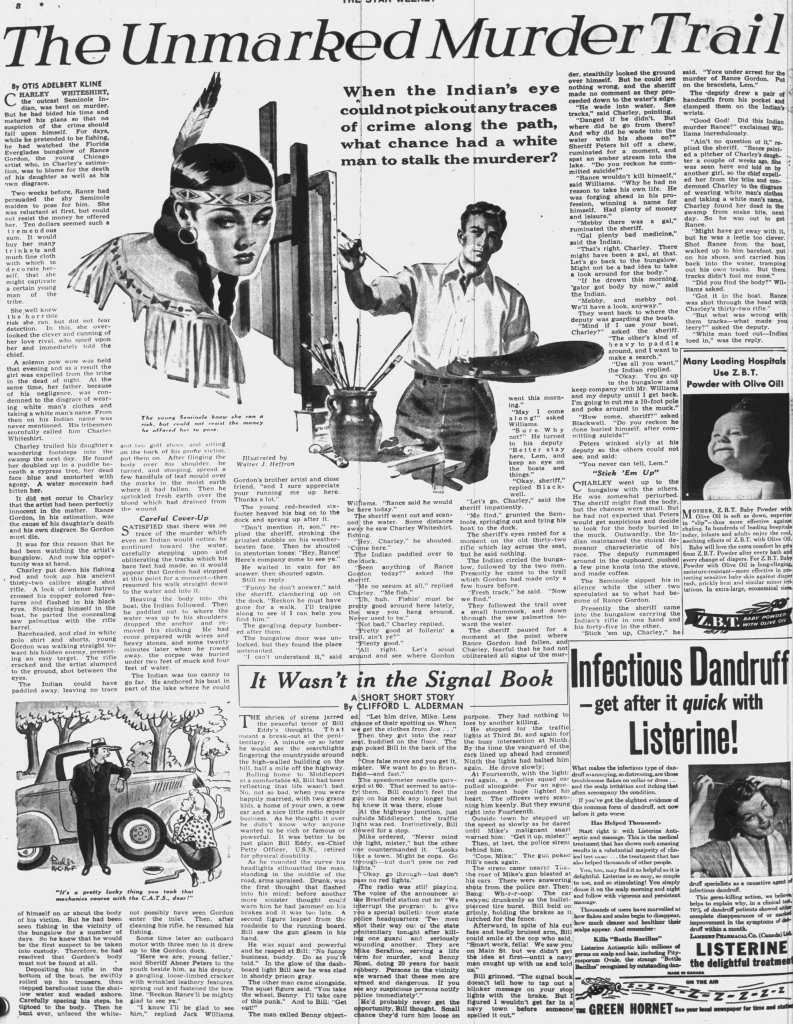
Kline continued as a writer and increasingly as a literary agent, marketing the pulp stories of Robert E. Howard, E. Hoffmann Price, C. L. Moore, and others during the 1930s and 40s, until his death in 1946. Most of Kline’s weird fiction from the pulps has been reprinted in various places, but there are more obscure non-weird works that have never been reprinted, including a handful of short pieces for newspapers. The most substantial of these is “The Unmarked Murder Trail,” which appeared in the Toronto Star Weekly 1 Nov 1941.
※
The Unmarked Murder Trail
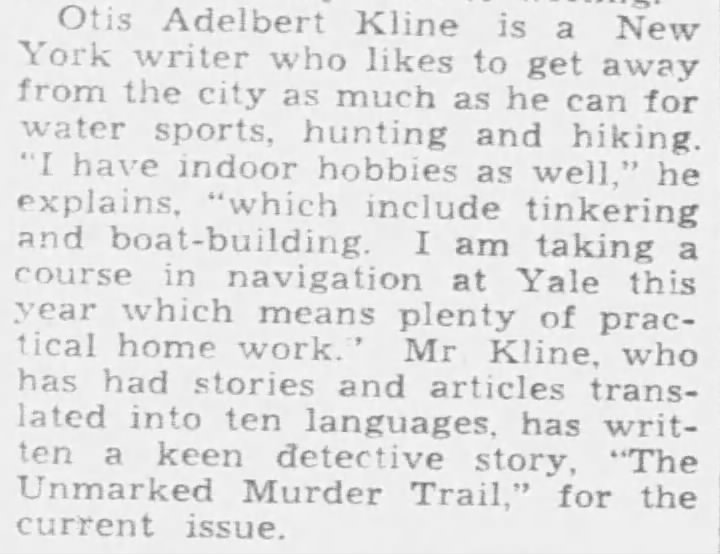
by Otis Adelbert Kline
CHARLEY WHITESHIRT, the outcast Seminole Indian, was bent on murder. But he had bided his time and matured his plans so that no suspicion of the crime should fall upon himself. For days, while he pretended to be fishing, he had watched the Florida Everglades bungalow of Rance Gordon, the young Chicago artist who, in Charley’s estimation, was to blame for the death of his daughter as well as his own disgrace.
Two weeks before, Rance had persuaded the shy Seminole maiden to pose for him. She was reluctant at first, but could not resist the money he offered her. Ten dollars seemed such a tremendous sum. It would buy her many trinkets and much fine cloth with which to decorate herself, that she might captivate a certain young man of the tribe.
She well knew the horrible risk she ran but did not fear detection. In this, she overlooked the clever and cunning of her love rival, who spied upon her and immediately told the chief.
A solemn pow wow was held that evening and as a result the girl was expelled from the tribe in the dead of night. At the same time, her father, because of his negligence, was condemned to the disgrace of wearing white man’s clothes and taking a white man’s name. From then on his Indian name was never mentioned. His tribesmen scornfully called him Charley Whiteshirt.
Charley trailed his daughter’s wandering footsteps into the swamp the next day. He found her doubled up in a puddle beneath a cypress tree, her dead face blue and contorted with agony. A water moccasin had bitten her. | It did not occur to Charley that the artist had been perfectly innocent in the matter. Rance Gordon, in his estimation, was the cause of his daughter’s death and his own disgrace. So Gordon must die.
It was for this reason that he had been watching the artist’s bungalow. And now his opportunity was at hand.
Charley put down his fishing rod and took up his ancient thirty-two calibre single shot rifle. A look of intense hatred crossed his copper colored features and flashed in his black eyes. Steadying himself in the boat, he parted the concealing saw palmettos with the rifle barrel.
Bareheaded, and clad in white polo shirt and shorts, young Gordon was walking straight toward his hidden enemy, presenting an easy target. The rifle cracked and the artist slumped to the ground, show between the eyes.
The Indian could have paddled away, leaving no trace of himself on or about the body of his victim. But he had been seen fishing in the vicinity of the bungalow for a number of days. So he knew that he would be the first suspect to be taken into custody. Therefore he had resolved that Gordon’s body must not be found at all.
Depositing his rifle in the bottom of the boat, he swiftly rolled up his trousers, then stepped barefooted into the shallow water and waded ashore. Carefully spacing his steps, he tiptoed to the body. Then he bent over, unlaced the white-and-tan golf shoes, and sitting on the back of his prone victim, put them on. After flinging the body over his shoulder, he turned, and stopping, spread a few handfuls of leaf mould over the marks in the moist earth where it had fallen. Then he sprinkled fresh earth over the blood which had drained from the wound.
Careful Cover-Up
SATISFIED that there was no trace of the murder which even an Indian would notice, he continued toward the water, carefully stepping upon and obliterating the tracks which his bare feet had made, so it would appear that Gordon had stopped at this point for a moment—then resumed his walk straight down to the water and into it.
Heaving the body into the boat, the Indian followed. Then he paddled out to where the water was up to his shoulders, dropped the anchor, and removed his clothing. He had come prepared with wires and heavy stones, and some twenty minutes later when he rowed away, the corpse was buried under two feet of muck and four feet of water.
The Indian was too canny to go far. He anchored his boat in part of the lake where he could not possibly have seen Gordon enter the inlet. Then, after cleaning his rifle, he resumed his fishing.
Some time later an outboard motor with three men in it drew up to the Gordon dock.
“Here we are, young feller,” said Sheriff Abner Peters to the youth beside him, as his deputy, a gangling, loose-limbed cracker with wrinkled leathery features, sprang out and fastened the bow line. “Reckon Rance’ll be mighty glad to see ye.”
“I know I’ll be glad to see him,” replied Jack Williams, Gordon’s brother artist and close friend. “and I sure appreciate your running me up here. Thanks a lot.”
The young red-headed six-footer heaved his bag on to the dock and sprang up after it.
“Don’t mention it, son,” replied the sheriff, stroking the grizzled stubble on his weather-beaten face. Then he shouted in stentorian tones: “Hey, Rance! Here’s company come to see ye.”
He waited in vain for an answer, then shouted again.
Still no reply.
“Funny he don’t answer,” said the sheriff, clambering up on the dock. “Reckon he must have gone for a walk. I’ll traipse along to see if I can help you find him.”
The gangling deputy lumbered after him.
The bungalow door was unlocked, but they found the place untenanted.
“I can’t understand it,” said Williams. “Rance said he would be here today.”
The sheriff went out and scanned the water. Some distance away he saw Charley Whiteshirt, fishing.
“Hey, Charley,” she shouted. “Come here.”
The Indian paddled over to the dock.
“Seen anything of Rance Gordon today?” asked the sheriff.
“Me no seeum at all,” replied Charley. “Me fish.”
“Uh, huh. Fishin’ must be pretty good around here lately, the way you hang around. Never used to be.”
“Not bad,” Charley replied.
“Pretty good at follerin’ a trail, ain’t ye?”
“Plenty good.”
“All right. Let’s scout around and see where Gordon went this morning.”
“May I come along?” asked Williams.
“Sure. Why not?” He turned to his deputy. “Better stay here, Lem, and keep an eye on the boats and things.”
“Okay, sheriff,” replied Blackwell.
“Let’s go, Charley, said the sheriff impatiently.
“Me find,” grunted the Seminole, springing out and tying his boat to the dock.
The sheriff’s eyes rested for a moment on the old thirty-two rifle which lay across the seat, but he said nothing.
The Indian circled the bungalow, followed by the two men. Presently he came to the trail which Gordon had made only a few hours before.
“Fresh track,” he said. “Now we find.”
They followed the trail over a small hummock, and down through the saw palmettos toward the water.
The sheriff paused for a moment at the point where Rance Gordon had fallen, and Charley, fearful that he had not obliterated all signs of the murder, stealthily looked the ground himself. But he could see nothing wrong, and the sheriff made no comment as they proceeded down to the water’s edge.
“He wade into water. See tracks,” said Charley, pointing.
“Danged if he didn’t. But where did he go from there? And why did he wade into the water with his shoes on?” Sheriff Peters bit off a chew, ruminated for a moment, and spat an amber stream into the lake. “Do you reckon he committed suicide?”
“Rance wouldn’t kill himself,” said Williams. “Why he had no reason to take his own life. He was forging ahead in his profession, winning a name for himself. Had plenty of money and leisure.”
“Mebby there was a gal,” ruminated the sheriff.
“Gal plenty bad medicine,” said the Indian.
“That’s right, Charley. There might have been a gal, at that. Let’s go back to the bungalow. Might not be a bad idea to take a look around for the body.”
“If he drown this morning, ‘gator got body by now,” said the Indian.
“Mebby, and mebby not. We’ll have a look, anyway.”
“Mind if I use your boat, Charley?” asked the sheriff. “The other’s kinda of heavy to paddle around, and I want to make a search.”
“Use all you want,” the Indian replied.
“Okay. You go up to the bungalow and keep company with Mr. Williams and my deputy until I get back. I’m going to cut me a 10-foot pole and poke around in the muck.”
“How come, sheriff?” asked Blackwell. “Do you reckon he done buried himself, after committing suicide?”
Peters winked slyly at his deputy so the others could not see, and said:
“You never can tell, Lem.”
“Stick ‘Em Up”
CHARLEY went up to the bungalow with the others. He was somewhat perturbed. The sheriff might find the body, but the chances were small. But he had not expected that Peters would get suspicious and decide to look for the body buried in the muck. Outwardly, the Indian maintained the stoical demeanor characteristic of his race. The deputy rummaged around in the cupboard, pushed a few pine knots into the stove, and made coffee.
The Seminole sipped his in silence while the other two speculated as to what had become of Rance Gordon.
Presently the sheriff came into the bungalow carrying the Indian’s rifle in one hand and his forty-five in the other.
“Stick ’em up, Charley,” he said. “Yore under arrest for the murder of Rance Gordon. Put on the bracelets, Lem.”
The deputy drew a pair of handcuffs from his pocket and clamped them on the Indian’s wrists.
“Good God! Did this Indian murder Rance?” exclaimed Williams incredulously.
“Ain’t no question of it,” replied the sheriff. “Rance painted a pitcher of Charley’s daughter a couple of weeks ago. She was seen here and told on by another girl, so the chief expelled her from the tribe and condemned Charley to the disgrace of wearing white man’s clothes and taking a white man’s name. Charley found her dead in the swamp from snake bit, next day. So he was out to get Rance.
“Might have got away with it, but he was a leetle too clever. Shot Rance from the boat, walked up to him barefoot, put on his shoes, and carried him back into the water, tramping out his own tracks. But them tracks didn’t fool me none.”
“Did you find the body?” Williams asked.
“Got it in the boat. Rance was shot through the head with Charley’s thirty-two rifle.”
“But what was wrong with tracks—what made you leery?” asked the deputy.
“White man toed out—Indian toed in,” was the reply.
※
“The Unmarked Murder Trail” is not a whodunit. Or a howdoneit, or even a whydoneit; the murderer is identified right away, their motivation established, the method described clearly. So this is an inverted detective story or howcatchem. Having established the crime scene, the interest becomes how the wily lawman outthinks the criminal despite all of his precautions. Television’s Columbo is probably the best-known example of this style in popular culture.
Kline’s little howcatchem isn’t a great example of the genre. The sheriff comes into the story apparently having full knowledge of Charley’s motivation and quickly determines the method. The final clue hinges on something not seen or hinted at—Charley could wear the dead man’s shoes, but his gait was different, so the tracks the two left were distinct.
What is notable about this story is the characterization of the Native Americans. While Kline gets the geography and tribal affiliation correct—the Seminole people have long been associated with Florida and the Everglades (Lovecraft even met a couple during a trip to Florida in the 1930s)—pretty much everything else is stereotype. Charley Whiteshirt speaks in Native American Pidgin English. The Seminoles in Florida do hold a powwow celebration today, but it was started in 1971, borrowed from similar celebrations by other indigenous peoples; the usage here as a general meeting is in keeping with the broad flattening of diverse Native American cultures into a dime novel or Hollywood mold. Even the art for the story by Walter J. Heffron is characteristic garb of Plains peoples, not Florida Seminoles. The total effect is neither particularly accurate nor sympathetic.
This is a potboiler mystery, one that relies on stereotypes for interest, with the barest hint of impropriety—there is the implicit suggestion that Charley’s daughter posed nude; why else would merely modeling warrant expulsion?—and maybe if it were longer Kline would have fleshed it out with a romance and more characterization. As it is, the cast is almost too crowded and much depends on coincidence; Jack Williams only exists to bring the sheriff there in time to see the tracks. One good Florida afternoon rain might have erased the tracks, and Charley would have gotten away with it.
Bobby Derie is the author of Weird Talers: Essays on Robert E. Howard and Others and Sex and the Cthulhu Mythos.
Deep Cuts in a Lovecraftian Vein uses Amazon Associate links. As an Amazon Associate I earn from qualifying purchases.

