When Long introduced [Otto] Binder, Lovecraft smiled and exclaimed, “You’re half of one of my favorite authors!”
—Otto Binder: The Life and Work of A Comic Book and Science Fiction Visionary 40-41
Eando (“E and O”) Binder was the joint pseudonym of the brothers Earl Binder (4 Oct 1904–13 Oct 1966) and Otto Binder (26 Aug 1911–14 Oct 1974). The Binder brothers were writers for the pulp magazines in the 1930s, including science fiction pulps like Amazing and horror fiction pulps like Weird Tales, where they came to the attention of peers like H. P. Lovecraft. By 1939, Otto was doing the writing while Earl was acting as a literary agent, and in the same year they expanded from the pulps into the burgeoning comic book industry, where Otto would make his mark on characters like Captain Marvel and Superman, among many others.
In the 1950s, before the Comics Code Authority was established that would kill off most of the horror comics, the typical horror comic magazine was essentially an anthology featuring 2-4 short comics, featuring different characters, with a couple of pages of prose fiction. A ghoulish host might introduce the issue and stories and act as a bare-minimum framing narrative. The reason for this specific format could be cultural—various publishers aping the successful EC comics formula—but there are indications of other forces at work.
Comic books fell into part of a broader discussion on changing postal rates during the 1940s and 50s—critics claimed that the government was essentially subsidizing advertisers by allowing them to mail off periodicals primarily intended for advertising at lower rates—and, in part, mail censorship, as postal inspectors were the first line of blocking obscene publication (for more on which, see Obscenity in the Mails: Controls on Second-Class Privileges 1942-1957). However, the Postal Laws and Regulations of the United States of America Edition of 1940 and the Post Office Manual (1952) make no specific reference to comic books or give any guideline for the minimum number of pages of prose fiction in a periodical.
We do know some publications were denied as second-class mail; crossword puzzle magazines notably faced difficulties qualifying as second-class mail (cf. P.O.D. Docket Nos. 1/141; 1/147; 1/155 and 1/156), in part because of the lack of varied content. Report on second-class mail to the postmaster general (1946) by Charles A. Heiss does specifically discuss comic books and the percentage of comics, fiction, and advertising in a sample issue (the fiction coming to ~2.5 pages), so content was clearly an issue the USPS considered, though no guidelines are mentioned or given as to specific numbers of pages per issue. However, there are indications that there were informal guidelines stipulating such requirements. In one trial, a series of questions concerned comic magazines with second-class mail privileges:
Q. Each of these magazines contains not over two pages of textual matter?
A. I wouldn’t say that.
Q. As a minimum?
A. I wouldn’t say that. They usually tell their story in pictures.
Q. Do they have textual matter?
A. I am comming to that.
Q. Can’t you tell me whether or not they have textual matter?
A. Indeed they do.
Q. That is what I wanted to know.
A. They have a reasonable amount of textual matter.
—Hannegan v. Esquire, Inc., 327 U.S. 146 (1946) (No. 399)
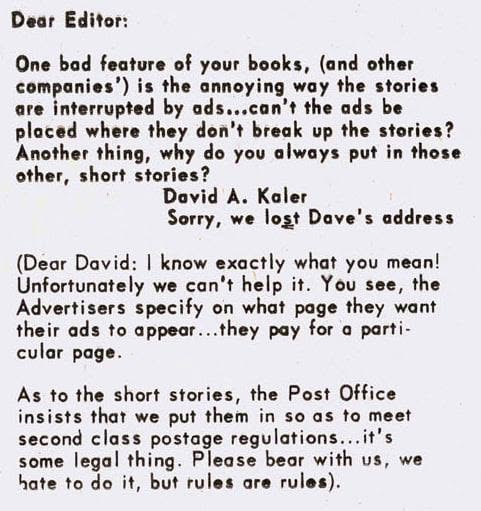
Compare this to a letter and its answer in Blue Beetle #5 (1965):
Carl Barks recalled in one instance:
As explained in the entry for “Land Beneath the Ground” (US 13-02), the Gyro Gearloose stories that began in “Uncle Scrooge” No. 13 came about as a result of Western’s applying for a second class mailing permit for the comic. To gain second class privileges a periodical must contain at least two stories, each one featuring different characters. Barks turned to Gyro Gearloose, the inventor, to provide the required second feature.
Two stories had been completed before it was realized that no characters from the lead story could be used. In his 1969 list for Michael Barrier, Barks commented: “The four-page Gyro stories for Uncle S. #13 and #14 were sent back to me for changes. In the #13 story I’d used the nephews. Because of postal mailing laws, no characters used in other parts of the book could be used in the Gyro story. Hence the change to Mickey’s nephews. The character ‘Speedy’ in #14 was originally Donald.”
—Applying For A Second Class Mailing
I have not found any print postal regulations from the 1940s, 50s, or 60s that specify a number of pages of non-comic material, or that stories may not share the lead character. Nor have I found anyone who cites a specific regulation or judicial ruling. However, I have found a judicial ruling which implies guidance on the matter was provided:
The publication with which we are concerned is printed monthly and is principally in comic strip form. Each issue features a special topic such as dogs, horses, Indians, the FBI, etc. […] By agreement at the hearing, ten issues of the publication published at the time of the application were introduced into evidence. The petitioner offered three later issues and counsel for the Director objected to this receipt into evidence. After the hearing he withdrew his objection when the Hearing Examiner indefinitely recessed the hearing because the Director would not appear to testify after being requested to do so by the Hearing Examiner. Each of these three later issues contain four separate stories on four subjects not connected with the principal topic of the issue. These are printed stories and articles rather than the comic strips which are the balance of the magazine. The petitioner added this matter upon the advice of the Director who had informed him that in the former format each issue of the publication was a book about a specific subject and not a periodical. After being so advised the petitioner made an effort to comply with the regulations and changed the format. There is nothing in the applicable regulations as to the content of a publication except to require that it must be for the purpose of “disseminating information of a public character” or “devoted to literature, the sciences, art or some special industry.” Section 132.224, Postal Manual. […] The fact that the Director did not tell him an exact number of pages which had to be devoted to other matter should not be held against the petitioner, especially since no regulation has been promulgated on this point.
—P.O.D. Docket No. 1/158 (36 Feb 1960)
The indication is that at some point, one or more postal inspectors provided guidelines for what qualified a comic magazine as a periodical (second-class matter) instead of a book (third-class matter), and this became de facto standard industry practice, even if it might not have been put explicitly into writing and published as a federal regulation.
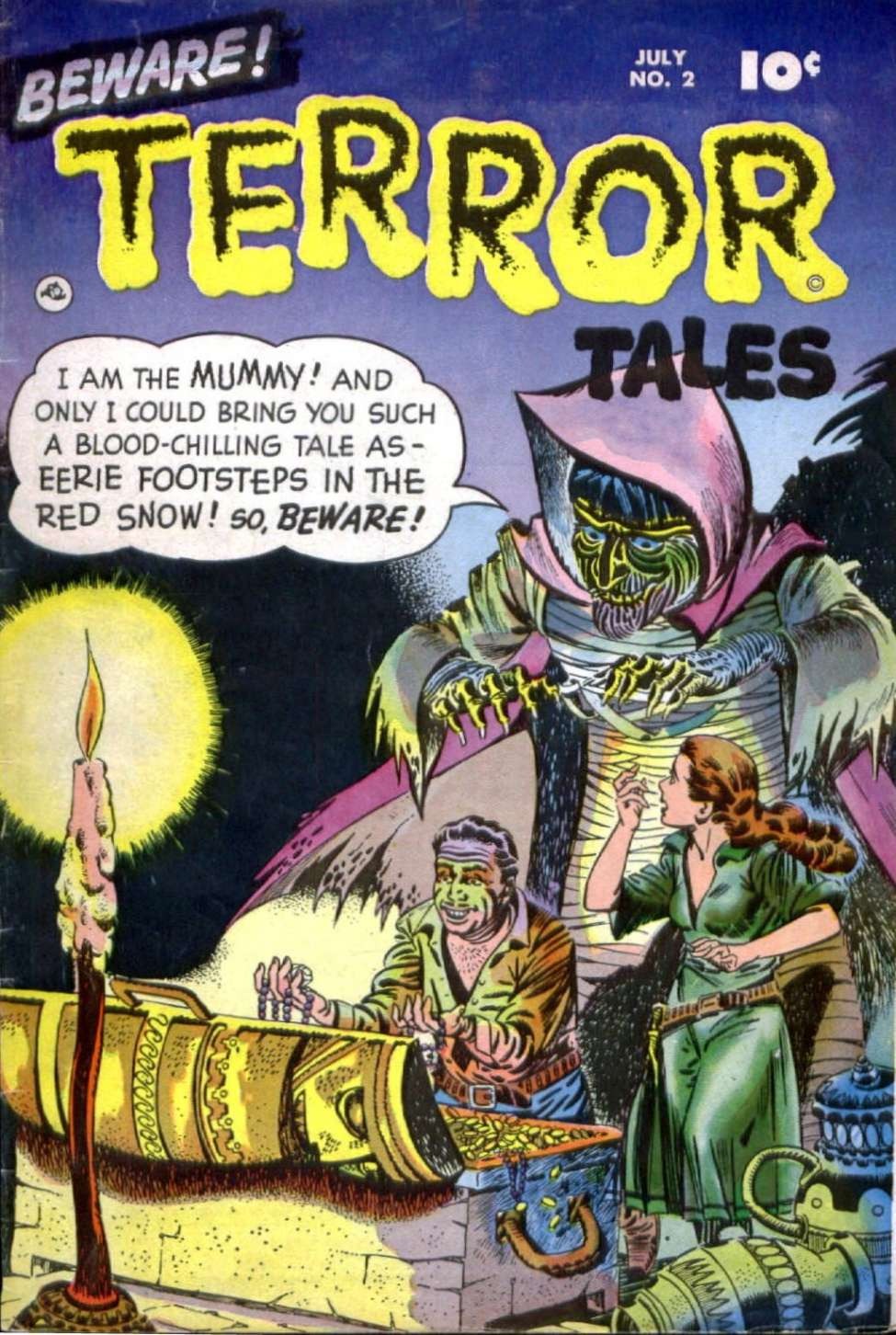
Whatever the actual cause, comics in the ’50s often featured brief, forgettable, potboilerish fiction, the vast majority of it not particularly noteworthy and written either anonymously or under pseudonyms. But…there’s also the occasional story from a recognizable name, such as “Fiend of Fire” as by Eando Binder, which was published in Beware! Terror Tales #2 (July 1952, Fawcett). This was almost certainly a solo work by Otto, dashed off quickly to fill an issue, but while it has been reprinted in various comic book reprints since entering the public domain, it has never been included in collections of the Binders’ pulp fiction, as far as I’ve been able to determine.
※
Fiend of Fire
by Eando Binder
HARLOW MAXON felt pretty good as he stuffed his pipe and prepared to settle back for a smoke. He was safe now. His big problem had been settled—completely. He could relax now and enjoy life.
Maxon lit the match and held it to his pipe, ready for a good smoke. But suddenly, the match flame hissed and sprang toward his eyes, like a live thing! With a yelp of pain and fright, Maxon flung it down and stamped on it, breathing hard.
Why had the match acted like that? Maxon calmed down. “Oh, just a defective one,” he told himself. “I’ll try another.”
Lighting another match, he held it gingerly at arm’s length, in case it would act up too, but it’s flame was normal and steady. Sighing in relief, he brought it to his pipe, puffing. But again, amazingly, the flame suddenly expanded lividly and hissed toward his face as if to burn his eyes out!
Cursing, bewildered, Maxon flung it down. But the flame was not out and the rug caught fire, fiercely. It did not seem like a normal flame at all as a patch of rug swiftly burned and widened. Maxon had all he could do to stamp it out with both feet, crushing it underfoot!
Maxon stood there panting, but more puzzled than frightened. Matches just shouldn’t act that way. And he was annoyed too. How could he light his pipe and enjoy a smoke? Well, skip it, he told himself reluctantly.
He settled back and picked up the paper, forgetting the incident. What did it matter, for there, in the news columns, were the words that made him safe—MAN DIES IN FLAMING AUTO! The text went on to state that driving down the street, John Begget’s car suddenly caught fire and the trapped driver was burned to death within, an unfortunate accident.
“Accident,” gloated Harlow Maxon to himself. “Sure it was an accident—planned by yours truly! I killed him, but nobody suspects!”
It was a common enough story. Maxon had borrowed heavily from John Begget, his friend, to indulge his taste for gambling. Losing steadily, he had kept putting off Begget, until in anger, Begget threatened to have him arrested and jailed. Maxon had been unable to raise the money. So what else was there to do but silence Begget? Get him out of the way? That solved everything—at least in the unscrupulous mind of Maxon. And so he had secretly planted the thermite-bomb in Begget’s car, leading to its explosion and complete burning.
That had been this morning. And now, tonight, Maxon was a free man, safe from the law. He dropped the paper with a satisfied smirk, settled back, and started to light his pipe.
But he had forgotten. Again there was a deadly hiss as the small flame grew and shot at his face like a fireball! Maxon stamped it out in a hurry, choking, with a slow dread clutching at his heart. Looking in a mirror, Maxon saw that his eyebrows had been singed that time.
Cursing, eager for his smoke, Maxon went into the kitchen and turned on one burner of the gas-range. It was automatic. He needed no matches. But at the moment the burner went on, its blue flame gave a hiss and shot toward him in a long searing tongue like a striking snake!
Maxon staggered back. The flame seemed to search for him, curling and twisting through the air. Horrified, Maxon dropped to his knees and was thus able to reach up and turn off the gas. The flame died just before it reached the hair on his head.
Trembling and shaken, Maxon went back to the living room and pulled an easy chair up to the fireplace. He had lit the fire before and needed to bask in its warm glow, and recover from his jitters over the weird events that had just happened.
“Ah, this is better,” he mumbled, stretching his hands toward the dancing flames.
But abruptly, they were dancing flames no longer. With a roaring hiss much louder than before, a sheet of flame burst from the fireplace toward Maxon. Screeching, Maxon leaped from the chair and stumbled back, barely in time, out of range.
The long ribbon of flame from the fireplace seemed to reach for him like clutching hands, even though he ran the length of the room. After him the fiery hands came, as if there was no escape!
And then Maxon was in the corner of the room; trapped. He turned at bay, moaning. He waited for the searing hot touch on his body, shuddering, whining in fear . . .
But then, most eerie of all, the flame took form slowly—human form. And its hiss became a mocking voice that said—”No, I won’t kill you this soon. Not before you suffer torment and know what I am. Look at me, Harlow Maxon! Don’t you see who I am?”
Maxon’s eyes bulged, taking in the human shape that the flame had formed. “No, it can’t be!” Maxon moaned. “It can’t be you—John Begget!”
“Yes, John Begget, your victim, hissed back the fire-spirit. “In flames I died—and in all flames I live again! Don’t try to understand, Maxon. It is something beyond the mundane. I was able to make those match flames dart in your eyes before. I made the gas flame leap at you. And now I’ve come for you out of the fire-place. Call me a fire ghost or whatever you will, but now you will die as I died—in fiery torment!”
And with a ghastly, hollow laugh, the fire spirit clutched for Maxon with its flaming hands . . .
But Maxon remembered the fire-extinguisher nearby, enclosed in a wall niche. Somehow he grabbed it out and swung the nozzle at the flame form. The fine spray beat it back. The fire ghost retreated before him and Maxon reached the fireplace, putting out the whole fire there. Only then did he stop, feeling that he had won out in this mad duel to the death with the fire fiend.
But one last ember glowed, and a somber hiss echoed in the air, forming words. “You have won for now, Maxon. But you can’t escape me. Remember, I can strike at you from any flame—anywhere—anytime! You can’t escape me!”
“Yes, I will!” shouted back Maxon. “It’s simple—I’ll just avoid all flame. It’s as simple as that!”
In the following days, Maxon carried out his grim campaign. He stopped smoking. He would never light a match again. And he could do without fires in the fireplace easily enough. As long as he kept away from flame, he was safe. In his daily life among others at the track or gambling casino, it was not hard to keep away from those lighting matches nearby. With care, he could keep out of range of an open fire, in any form.
He had one bad moment when some friends dropped in one evening, surprising him on his birthday. One of the girls came out of the kitchen with a birthday cake and lighted candles, as they all sang the familiar birthday song to him. Maxon stared horrified and then dumped a bottle of soda, snuffing out the candles. He had acted like a maniac and ruined the evening, but once more he had foiled the fire ghost.
Maxon was triumphant, getting a sort of twisted joy out of his strange duel with the supernatural. By sheer persistence, he’d won out.
Even on a hunting party in the winter season, Maxon took care not to sit near the blazing fire they built when having lunch. He almost froze, sitting away from the heat, but he was safe!
Safe that is, until a whipping wind kicked up sparks and before they knew it, a brush fire had blazed up! The others fought the flame but Maxon ran—only to be blinded by smoke. Staggering, coughing, he was suddenly faced by a wall of fire, out of which a fiery shape loomed hugely, with a hissing roar of laughter. The fire ghost again!
Long arms of flame shot toward him, but Maxon saw his salvation not far off—a running brook. Without hesitation, he plunged into the icy waters, safe from the fire spirit, until his friends succeeded in beating out the last of the fire.
Even in the hospital, where his friends hastened him after the icy plunge. Maxon was happy. He was safe from fire—safe from the fire ghost. Safe from being consumed by fiery vengeance from beyond . . .
†
MAXON suddenly started, his spine crawling. What was that the doctor was saying?
“Fever! A very high fever—one hundred and five! We can’t bring it down! Poor chap!”
Maxon’s eyes alone saw the wraith-like shape that sat on his chest, in flowing outline, grinning. He heard the soft hiss of the fire ghost’s words—”Fever is a form of ‘fire’ too, Maxon! Fever consumes the sick body just like a fire! Didn’t I tell you there was no escape? . . .”
THE END
※
“Fiend of Fire” is brief, original, and fairly straightforward with a slight EC-style twist at the end—Binder would go on to write for EC for about a year before the Comics Code Authority killed their horror and crime comics. The bad guy gets his thematically appropriate comeuppance; the supernatural occurrences are an atypical haunting, but otherwise unexplained. A fairly minor work in a long and storied career, but for fans who thought they’d read all of Eando Binder, there’s far more beyond the pulps.
Bobby Derie is the author of Weird Talers: Essays on Robert E. Howard and Others and Sex and the Cthulhu Mythos.
Deep Cuts in a Lovecraftian Vein uses Amazon Associate links. As an Amazon Associate I earn from qualifying purchases.


One thought on “Lost Tale: “Fiend of Fire” (1952) by Eando Binder”