
Henry Hasse was a science fiction fan and writer; some of his early work includes Cthulhu Mythos fiction such as “The Guardian of the Book” (Weird Tales Mar 1937) and “Horror at Vecra” (The Acolyte, Fall 1943). One of his less well-known works to mention the Mythos is “Three Lines of Old Martian” (Space Stories Feb 1953).
The title of this story is a reference to A. Merritt’s minor classic “Three Lines of Old French” (All-Story Weekly, 9 Aug 1919). While you don’t have to read that story to appreciate this one, it is a good story to be familiar with in general.
※
Three Lines of Old Martian
by Henry Hasse
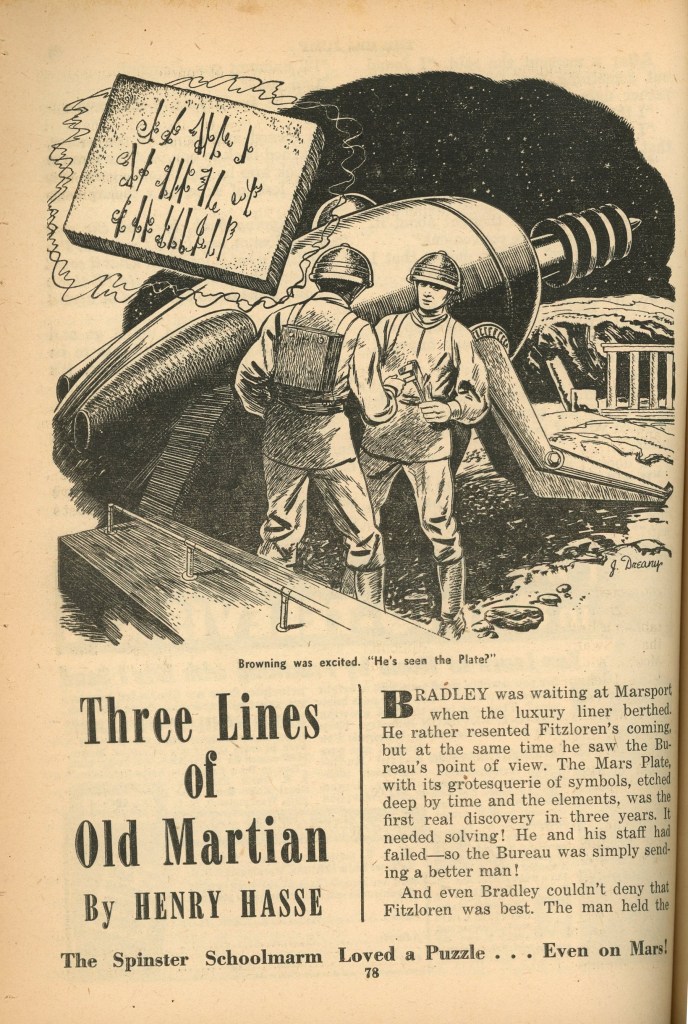
BRADLEY was waiting at Marsport when the luxury liner berthed. He rather resented Fitzloren’s coming, but at the same time he saw the Bureau’s point of view. The Mars Plate, with its grotesquerie of symbols, etched deep by time and the elements, was the first real discovery in three years. It needed solving! He and his staff had failed—so the Bureau was simply sending a better man!
And even Bradley couldn’t deny that Fitzloren was the best. The man held the Chair of Languages and Alien Culture at Earth’s largest university. No one could come within a light-year of his talents in the field of dead languages, which included in large part the deciphering of alien code symbols. Twenty years ago he had solved the Atlantean Fragments, putting that age-old controversy to a conclusive end. He had added to his laurels with the solution of the Kralwaan Sculptures found on Earth’s moon. More recently, the Pnakotic Manuscripts of Venus’ abandoned South City had been child’s play for him where all others had failed.
So, it was only logical that Fitzloren should be sent to supervise at Mars Finding. “Supervise” was the way the trans-telector tape read—and that’s what worried Bradley now. It could mean “take over.” he’d have to wait and see.
Spotting Fitzloren in the debarking throng, he pressed forward to introduce himself. He saw a short, balding man of middle age, inclined to paunchiness, and—he might have been mistaken, but Bradley thought he detected a trace of smugness.
“I was on Venus when the Bureau contacted me,” Fitzloren said, beaming through his spectacles. “Trying to establish a lingual basis with those K’Yarthan Swamplanders. Most difficult! Most. All sibilants, you know. But when I learned I was needed here, naturally I came at once.”
“Naturally,” said Bradley drily.
“Most intriguing, that Mars Plate you uncovered—when was that—four months ago?” The man’s lips quirked knowingly. “Bit of a difficulty there, eh?”
“Some,” Bradley admitted. Damn it all! Archaeological engineering was his field, it didn’t extend to alien symbols. He resented being placed in a position of having to defend himself. He added, an edge to his voice: “Understand, it’s a little out of our province. We’re uncovering the ruin; the rest is up to you language boys.”
“Of course, of course! I anticipate no trouble.”
More smugness. Bradly decided he wasn’t going to like this man. He glanced at the square leather case which Fitzloren hugged to his side. “What’s that you brought with you?”
“Equipment. Special equipment—tools of the trade, you know.” Fitzloren smiled mysteriously and then glanced around. “Can’t we get away from here? I hate these crowds.”
“I have a gyro-cab waiting.” Bradley moved through the throng with Fitzloren in tow, but there came an interruption. A middle-aged, spinsterish lady thrust her way forward, calling Fitzloren’s name. Bradley noted with some amusement that she was dragging a long-haired poodle on a leash.
“Professor! Oh, Professor Fitzloren, there you are. I was so afraid I might miss you, and I did want to tell you how much I enjoyed the trip—especially your stories about your adventures on Venus. So thrilling! I trust I’ll see you again?”
Fitzloren flushed crimson, but managed to bow stiffly. “Possibly, madam. But I am going to be very busy, you know.”
“Oh, of course, I do understand. The Mars Plate. And I want to wish you every success on the project.” She extended a hand. Fitzloren took it limply, then let it fall.
◐
HE AVOIDED Bradley’s amused glance as they hurried toward the gyro-cab. “Tourist!” he muttered. “I had scarcely a free moment the entire trip. Somehow she learned who I was, and she would talk of nothing else but that Mars Plate!”
Bradley’s worry was unfounded. “I shan’t interfere with your work,” Fitzloren informed him magnanimously when they arrived at the camp. “You just show me the Plate, and go right ahead with your—ah—digging.” The tone of condescension was unmistakable.
Bradley took him into a large room next to his office. “I set this aside for you. You can even sleep here if you wish,” indicating the light metal cot. “Mess hall’s at the rear of the building.”
“Satisfactory. Yes, quite.”
“You’ll find everything here you need. Reference books. Equipment. Also, all of our previous notes on the deciphering, though I’ll admit we’ve made little headway.”
“Reference books? Fitzloren smiled, a little pompously, Bradley thought, and strode over to the meager shelf of books. He pulled one down. “I see you have mine—Symbols and Interpretation: An Approach to Alien Culture. Didn’t help?”
Bradley sighed. “Professor, nothing helped. Browning—that’s my assistant—really worked on it harder than I. For weeks, in fact. He’s had some experience in that line. Once he thought he’d found a clue, but it didn’t pan out.”
“Clue. Yes, that’s the important thing. Find an initial clue, and the rest unravels.” Fitzloren turned away. “Show me the Plate.”
It reposed under protective glass in the center of the table. Roughly square, some twenty inches by twelve, the Plate was of dull greenish metal overlaid by an even darker green—the patina of the ages. But there was no erosion of the symbols. They were etched and distinctly defined, roughly angular in the vertical direction, but twisting and spewing with tiny curls of an alien language long dead.
It was apparent that Fitzloren savored the moment. Almost casually, he removed and polished his spectacles. Then he bent and peered close, drinking in the symbols.
“Fascinating,” Bradley heard him mutter. “Most fascinating. Three lines, only three lines. . . .”
“Right. Three lines. I’m sorry to say this, Professor, but that’s why I can’t attach any particular importance to it! If the Maritans left this as some kind of record, or message, what could they say in three lines?”
Fitzloren straightened slowly. “My dear Bradley! It’s apparent that you didn’t go very deeply into my book. Don’t you realize that each symbol here, indeed each particle of each symbol, might speak volumes? The clue, the clue! I’ve got to find the clue!”
“You think the Plate’s important, then.” Bradley was still skeptical.
“I’m sure of it! I’m sure it’s a message!” He paced the floor with quick little strides, as excitement mounted. “You found nothing more? No other plates? No—”
“This is all. We’re uncovering the city slowly, it takes time, you know! But we’re sure it’s a city. Oh, we’ve found a few things that might have been tools, some bits of utensils, the usual artifacts, But nothing more in the language.”
“But you found this first,” the Professor’s voice mounted. “Doesn’t that indicate to you that it must have been placed prominently by those ancients—that it was intended to be found?”
It indicated nothing of the kind to Bradley. He was an archaeological engineer; he knew his job and did it. Just as Fitzloren knew his. Who was he to argue with the foremost authority in the field of alien language?
“I’ll leave you to it, then.” Bradley paused at the door. “If you need me for anything, I’ll be over at the diggings; we have a trans-com setup.”
But he doubted if Fitzloren heard him. Already the little man had set to work, hunched over the table with calipers and magni-gass and reams of paper before him.
◓
TWO of the cat-treads on the huge diggers had gone haywire. Donning his duralloy helmet against the sun, Bradley dragged out his tools and bent to the task, soon was plastered with a grime of sweat and red dust. This was his real love—this and the drama of the city that was slowly being exposed in the great mile-wide hollow of sand. He felt about it, he supposed, much as Fitzloren felt about his languages.
Late in the afternoon Browning came over to him, finished with his crew for the day. Grinning, Bradley hit him with the news. “Fitzloren’s here.”
Browning was excited. “He’s seen the Plate? What does he think?”
“Same as you. He’s enthralled. Thinks he’s got something there.”
“And I think so too!”
Bradley shrugged, then was serious as he waved an arm at the half-buried masonry. “This is what the Martians left us. Nothing more. No dire warnings, no high-flown messages—I just can’t subscribe to that romantic nonsense! Anything we learn about this vanished race will be through what we can piece together from their architecture, their tools, the few artifacts. . . .”
Browning was insistent. “Brad . . . I’ll bet you a month’s salary that Fitzloren solves the Plate. And it’ll be significant!”
Bradley grinned again. “A month’s salary? You’re on!”
Fitzloren didn’t show up for mess call, and Browning was disappointed. “Don’t worry, don’t worry,” Bradley said. “You’ll meet him soon enough. Just leave him alone.” He added under his breath, “And the more he leaves us alone the better I’ll like it.”
Later, heading for his office, Bradley paused to look in on Fitzloren. The Professor was still bowed over his work, scribbling notes furiously. For nearly seven hours he’d been at it! Brad shrugged. He had his own problems.
He worked late in his office, figuring out a new system of stress-supports—duroplastic—for the crumbling walls. When he left, about midnight, he saw that Fitzloren was still at it. But now the Professor was pacing the room restlessly. He looked worried, Brad thought. An immense pile of crumpled notes littered the floor.
◑
NEXT morning, at the diggings, Browning said: “Well, I’ve met Fitzloren.”
“What? You didn’t go barging in on him!”
“No. At three o’clock this morning he came inquiring after me. Three o’clock, mind you. Wanted to see those notes I’d made.” Browning grinned ruefully. “Well, I was flattered. Sleepy—but flattered. I showed him my notes. Remember that clue I almost thought I had? I pointed it out, think he might make something of it—”
“And?”
“I’m beginning to see what you mean, Brad. I don’t think I like this man. ‘Wrong approach! Wrong approach!’ he yelled at me. ‘Imbecile! If you’d read my book! If you’d had the slightest grasp of symbolics’—and so on. He tore up the notes and flung them in my face. He shoved me out the door.”
“He’s hit a blank wall. He’s grasping for straws.”
“He’s beginning to realize this is a tough one to crack,” Browning said. “I grant you, he’s a pompous ass—but he’ll get there. Our bet’s still on!”
Bradley changed the subject, glancing around at the expanse of ruins. “Today we clean up. We’ve got to make things nice and pretty. Remember, tomorrow’s T-Day.”
“Oh, Lord,” Browning groaned. “Tourist day! I’d forgotten about it.” He spread his hands. “Look, Brad, not me again!”
“No. I’ve already assigned Tanner and Smitty to guide duty.” One day a month had been set aside fro the tourists—some of them pretty important people—who came to trample the sands and gape at the ruins, agog with speculation and romantic fancy. The men hated it, the flow of silly questions that demanded answer, but the Earth-Bureau had decreed that this day be set aside.
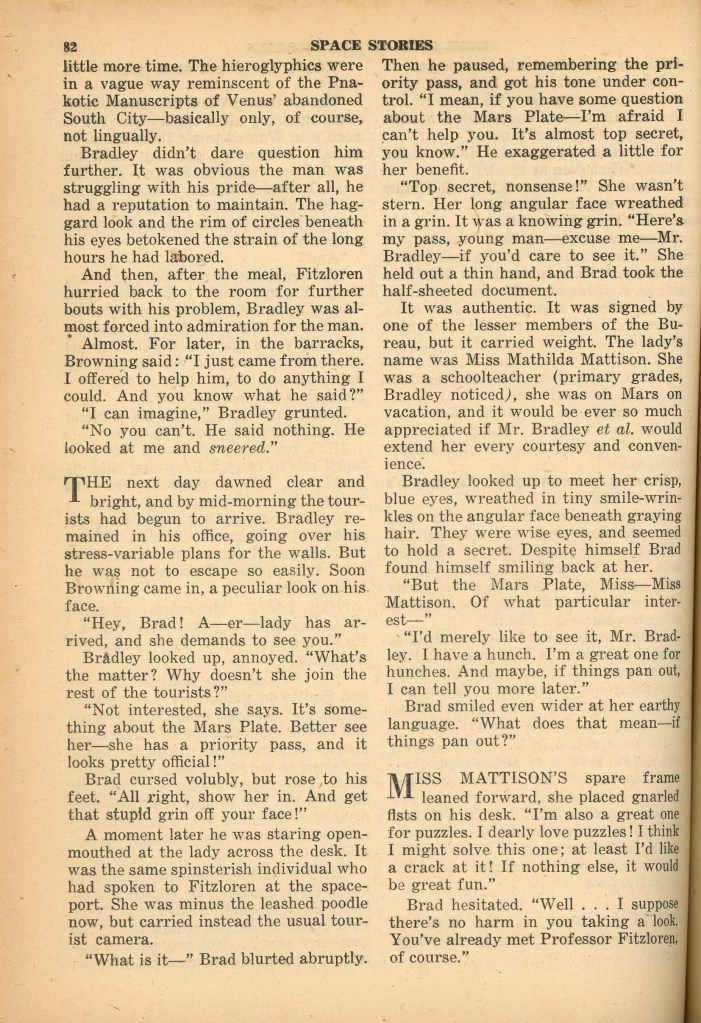
Fitzloren attended mess call that evening. He’d managed to snatch a few hours sleep, he said, in answer to Bradley’s question. No, he hadn’t found the necessary clue . . . but yes, he was certain it would be forthcoming, given a little more time. The hieroglyphics were in a vague way reminiscent of the Pnakotic Manuscripts off Venus’ abandoned South City—basically only, of course, not lingually.
Bradley didn’t dare question him further. It was obvious the man was struggling with his pride—after all, he had a reputation to maintain. The haggard look and the rim of circles beneath his eyes betokened the strain of the long hours he had labored.
And then, after the meal, Fitzloren hurried back to the room for further bouts with his problem, Bradley was almost forced into admiration for the man.
Almost. For later, in the barracks, Browning said. “I just came from there. I offered to help him, to do anything I could. And you know what he said?”
“I can imagine,” Bradley grunted.
“No, you can’t. He said nothing. he looked at me and sneered.”
◒
THE next day dawned clear and bright, and by mid-morning the tourists had begun to arrive. Bradley remained in his office, going over his stress-variable plans for the walls. But he was not to escape so easily. Soon Browning came in, a peculiar look on his face.
“Hey, Brad! A—er—lady has arrived, and she demands to see you.”
Bradley looked up, annoyed. “What’s the matter? Why doesn’t she join the rest of the tourists?
“Not interested, she says. It’s something about the Mars Plate. Better see her—she has a priority pass, and it looks pretty official!”
Brad cursed volubly, but rose to his feet. “All right, show her in. And get that stupid grin off your face!”
A moment later he was staring open-mouthed at the lady across the desk. It was the same spinsterish individual who had spoken to Fitzloren at the spaceport. She was minus the leashed poodle now, but carried instead the usual tourist camera.
“What is it—” Brad blurted abruptly. Then he paused, remembering the priority pass, and got his tone under control. “I mean, if you have some questions about the Mars Plate—I’m afraid I can’t help you. It’s almost top secret, you know.” He exaggerated a little for her benefit.
“Top secret, nonsense!” She wasn’t stern. Her long angular face wreathed in a grin. It was a knowing grin. “Here’s my pass, young man—excuse me—Mr. Bradley—if you’d care to see it.” She held out a thin hand, and Brad took the half-sheeted document.
It was authentic. It was signed by one of the lesser members of the Bureau, but it carried weight. The lady’s name was Miss Mathilda Mattison. She was a schoolteacher (primary grades, Bradley noticed), she was on Mars on vacation, and it would be ever so much appreciated if Mr. Bradley et al. would extend her every courtesy and convenience.
Bradley looked up to meet her crisp, blue eyes, wreathed in tiny smile-wrinkles on the angular face beneath graying hair. They were wise eyes, and seemed to hold a secret. Despite himself Brad found himself smiling back at her.
“But the Mars Plate, Miss—Miss Mattison. Of what particular interest—”
“I’d merely like to see it, Mr. Bradley. I have a hunch. I’m a great one for hunches. And maybe, if things pan out, I can tell you more later.”
Brad smiled even wider at her earthy language. “What does that mean—if things pan out?”
◐
MISS MATTISON’S spare frame leaned forward, she placed gnarled fists on his desk. “I’m also a great one for puzzles. I dearly love puzzles! I think I might solve this one; at least I’d like a crack at it! If nothing else, it would be great fun.”
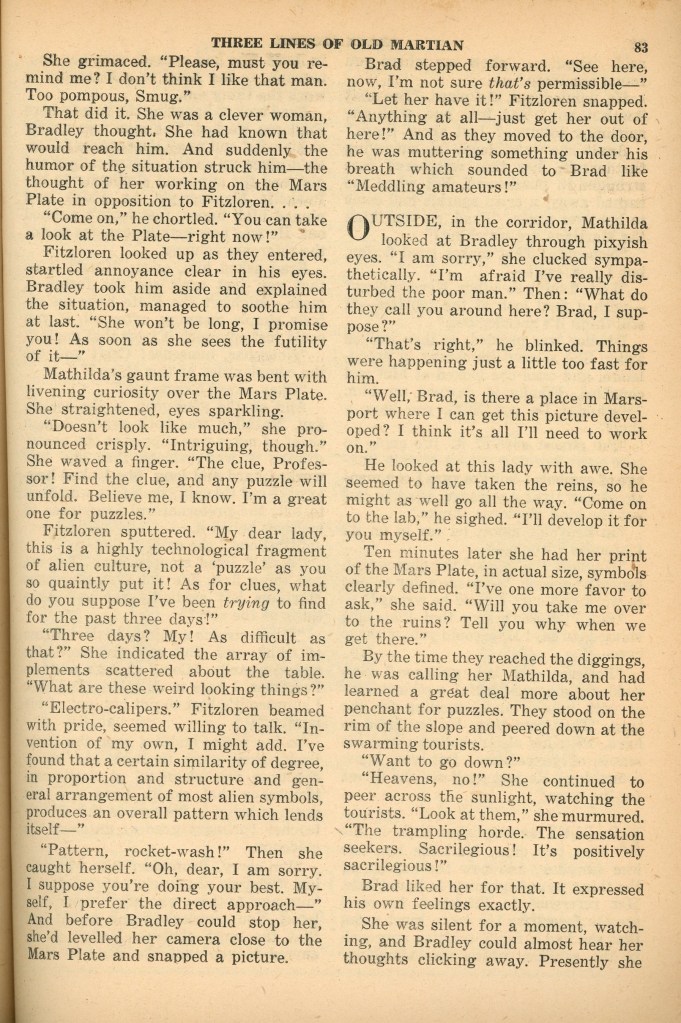
Brad hesitated. “Well . . . I suppose there’s no harm in you taking a look. You’ve already met Professor Fitzloren, of course.”
She grimaced. “Please, must you remind me? I don’t think I like that man. Too pompous. Smug.”
That did it. She was a clever woman, Bradley thought. She had known that would reach him. And suddenly the humor of the situation struck him—the thought of her working on the Mars Plate in opposition to Fitzloren. . . .
“Come on,” he chortled. “You can take a look at the Plate—right now!”
Fitzloren looked up as they entered, startled annoyance clear in his eyes. Bradley took him aside and explained the situation, managed to soothe him at last. “She won’t be long, I promise you! As soon as she sees the futility of it—”
Mathilda’s gaunt frame was bent with livening curiosity over the Mars Plate. She straightened, eyes sparkling.
“Doesn’t look like much,” she pronounced crisply. “Intriguing, though.” She waved a finger. “The clue, Professor! Find the clue, and any puzzle will unfold. Believe me, I know. I’m a great one for puzzles.”
Fitzloren sputtered. “My dear lady, this is a highly technological fragment of alien culture, not a ‘puzzle’ as you so quaintly put it! As for clues, what do you suppose I’ve been trying to find for the past three days!”
“Three days? My! As difficult as that?” She indicated the array of implements scattered about the table. “What are these weird looking things?”
“Electro-calipers.” Fitzloren beamed with pride, seemed willing to talk. “Invention of my own, I might add. I’ve found that a certain similarity of degree, in proportion and structure and general arrangement of most alien symbols, produces an overall pattern which lends itself—”
“Pattern, rocket-wash!” Then she caught herself. “Oh, dear, I am sorry. I suppose you’re doing your best. Myself, I prefer the direct approach—” And before Bradley could stop her, she’d levelled her camera close to the Mars Plate and snapped a picture.
Brad stepped forward. “See here, now, I’m not sure that’s permissible—”
“Let her have it!” Fitzloren snapped. “Anything at all—just get her out of here!” And as they moved to the door, he was muttering something under his breath which sounded to Brad like “Meddling amateurs.”
◓
OUTSIDE, in the corridor, Mathilda looked at Bradley through pixyish eyes. “I am sorry,” she clucked sympathetically. “I’m afraid I’ve really disturbed the poor man.” Then: “What do they call you around here? Brad, I suppose?
“That’s right,” he blinked. Things were happening a little too fast for him.
“Well, Brad, is there a place in Marsport where I can get this picture developed? I think it’s all I need to work on.”
He looked at this lady with awe. She seemed to have taken the reins, so he might as well go all the way. “Come on to the lab,” he sighed. “I’ll develop it for you myself.”
Ten minutes later she had her print of the Mars Plate, in actual size, symbols clearly defined. “I’ve one more favor to ask,” she said. “Will you take me over to the ruins? Tell you why when we get there.”
By the time they reached the diggings, he was calling her Mathilda, and had learned a great deal more about her penchant for puzzles. They stood on the rim of the slope and peered down at the swarming tourists.
“Want to go down?”
“Heavens, no!” She continued to peer across the sunlight, watching the tourists. “Look at them,” she murmured. “The trampling horde. The sensation seekers. Sacrilegious! It’s positively sacrilegious!”
Brad liked her for that. It expressed his own feelings exactly.
She was silent for a moment, watching, and Bradley could almost hear her thoughts clicking away. Presently she said, “Brad . . . show me where you found the Plate.”
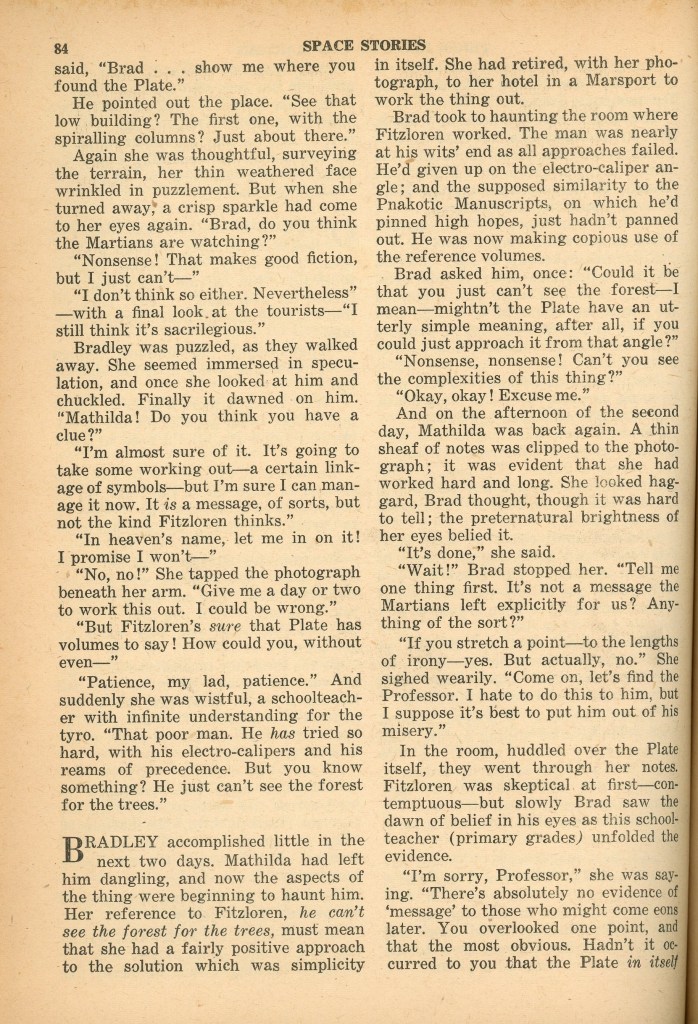
He pointed out the place. “See that low building? The first one, with the spiralling columns? Just about there.”
Again she was thoughtful, surveying the terrain, her thin weathered face wrinkled in puzzlement. But when she turned away, a crisp sparkle had come to her eyes again. “Brad, do you think the Martians are watching?”
“Nonsense! That makes good fiction, but I just can’t—”
“I don’t think so either. Nevertheless”—with a final look at the tourists—”I still think it’s sacrilegious.”
Bradley was puzzled, as they walked away. She seemed immersed in speculation, and once she looked at him and chuckled. Finally it dawned on him. “Mathilda! Do you think you have a clue?”
“I’m almost sure of it. It’s going to take some working out—a certain linkage of symbols—but I’m sure I can manage it now. It is a message, of sorts, but not the kind Fitzloren thinks.”
“In heaven’s name, let me in on it! I promise I won’t—”
“No, no!” She tapped the photograph beneath her arm. “Give me a day or two to work this out. I could be wrong.”
“But Fitzloren’s sure that Plate has volumes to say! How could you, without even—”
“Patience, my lad, patience.” And suddenly she was wistful, a schoolteacher with infinite understanding for the tyro. “That poor man. He has tried so hard, with his electro-calipers and his reams of prejudice. But you know something? He just can’t see the forest for the trees.”
◑
BRADLEY accomplished little in the next two days. Mathilda had left him dangling, and now the aspects of the thing were beginning to haunt him. Her reference to Fitzloren, he can’t see the forest for the trees, must mean that she had a fairly positive approach to the solution which was simplicity in itself. She had retired, with her photograph, to her hotel in Marsport to work the thing out.
Brad took to haunting the room where Fitzloren worked. The man was nearly at his wits’ end as all approaches failed. He’d given up on the electro-caliper angle; and the supposed similarity to the Pnakotic Manuscripts, on which he’d pinned high hopes, just hadn’t panned out. He was not making copious use of the reference volumes.
Brad asked him, once: “Could it be that you just can’t see the forest—I mean—mightn’t the Plate have an utterly simple meaning, after all, if you could just approach it from that angle?”
“Nonsense, nonsense! Can’t you see the complexities of this thing?”
“Okay, okay! Excuse me.”
And on the afternoon of the second day, Mathilda was back again. A thin sheaf of notes was clipped to the photograph; it was evident that she had worked hard and long. She looked haggard, Brad thought, though it was hard to tell; the preternatural brightness of her eyes belied it.
“It’s done,” she said.
“Wait! Brad stopped her. “Tell me one thing first. It’s not a message the Martians left explicitly for us? Anything of that sort?”
“If you stretch a point—to the lengths of irony—yes. But actually, no.” She sighed wearily. “Come on, let’s find the Professor. I hate to do this to him, but I suppose it’s best to put him out of his misery.”
In the room, huddled over the Plate itself, they went through her notes. Fitzloren was skeptical at first—contemptuous but slowly Brad saw the dawn of belief in his eyes as this schoolteacher (primary grades) unfolded the evidence.
“I’m sorry, Professor,” she was saying. “There’s absolutely no evidence of ‘message’ to those who might come eons later. You overlooked one point, and that the most obvious. Hadn’t it occurred to you that the Plate in itself might have been functional to the Martians and to them alone? It was functional. In a small, almost negligible degree, I grant you—but it leaves me to believe that they couldn’t have been a great deal different from us. Look . . . here’s my translation. I can show you the linkage of symbols, the similarity of context which reduces it to language.
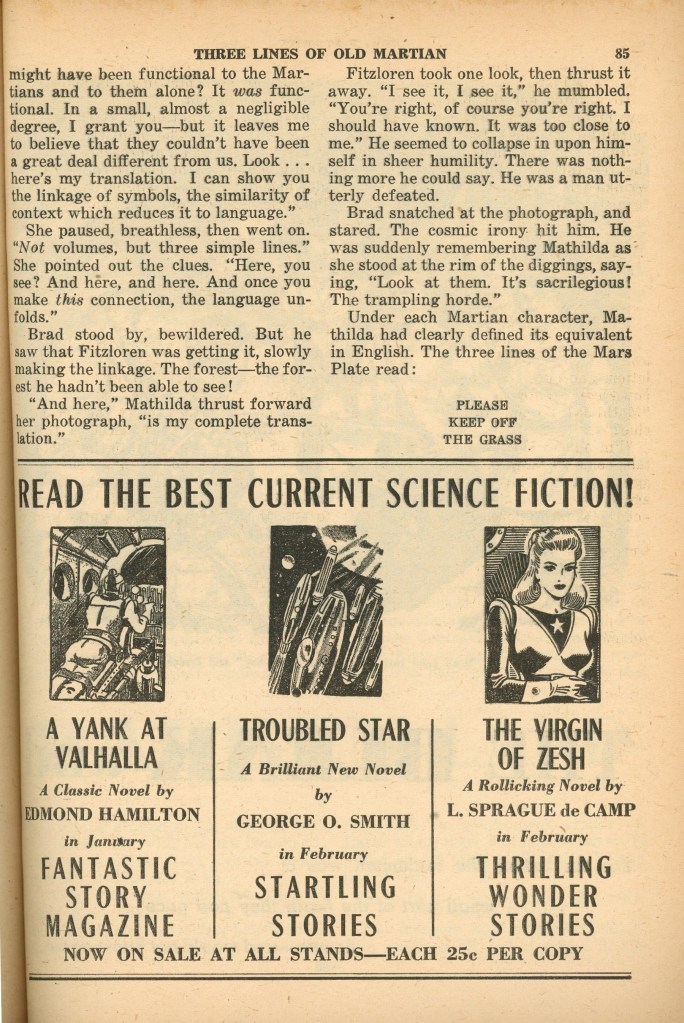
She paused, breathless, then went on. “Not volumes, but three simple lines.” She pointed to the clues. “Here, you see? And here, and here. And once you make this connection, the language unfolds.”
Brad stood by, bewildered. But he saw that Fitzloren was getting it, slowly making the linkage. The forest—the forest he hadn’t been able to see!
“And here,” Mathilda thrust forward her photograph, “is my complete translation.”
Fitzloren took one look, then thrust it away. “I see it, I see it,” he mumbled. “You’re right, of course you’re right. I should have known. It was too close to me.” He seemed to collapse in upon himself in sheer humility. There was nothing more he could say. He was a man utterly defeated.
Brad snatched at the photograph, and stared. The cosmic irony hit him. He was suddenly remembering Mathilda as she stood at the rim of the diggings, saying, “Look at them. It’s sacrilegious! The trampling horde.”
Under each Martian character, Mathilda had clearly defined its equivalent in English. The three lines of the Mars Plate read:
PLEASE
KEEP OFF
THE GRASS
※
Like several “Something from Beyond” (1941) by Paul Dennis LaVond, this is another space opera with a minor Mythos connection; like “Why Abdul Al Hazred Went Mad” (1950) by D. R. Smith or “The Coming of Tsathoggua” (1951) by Herman Stowell King, it is also essentially one long setup for a punchline. We might smile at a Mars with Earth-normal gravity and atmosphere, or a stellar empire that still relies on pencils and without digital cameras, but those were the days when space travel was in its infancy; Sputnik wouldn’t be launched into orbit until 1957, and yet science fiction writers were looking ahead to the already-fantastic notion of a solar system full of inhabitable planets and intelligent species.
Still, no less fantastic than Clark Ashton Smith’s stories of Mars and Saturn, or H. P. Lovecraft and Kenneth Sterling’s Venus in “In the Walls of Eryx.” If there is room in your imagination for Cthulhu and Tsathoggua, perhaps there is room for a universe where humanity may yet colonize other planets in the solar system and find strange ruins there.
The linguistics don’t work. What Miss Mathilda Mattison describes isn’t a translation, but the solution to an alphabetic cipher. Old Martians, apparently, wrote in English but with their own alphabet. Well, it’s a cute punchline. The Pnakotic Manuscripts, which ultimately are of no help with the Martian cipher, are essentially an Easter egg and red herring for Mythos aficionados. A nod and wink from one Lovecraft fan to others.
Bobby Derie is the author of Weird Talers: Essays on Robert E. Howard and Others and Sex and the Cthulhu Mythos.
Deep Cuts in a Lovecraftian Vein uses Amazon Associate links. As an Amazon Associate I earn from qualifying purchases.

